❌

Lese-Ansicht

Woodrow Wilson (Presidential Ratings, #5)

We’ve been assessing the merits of political leaders in (more or less) democratic countries, illustrated by a single board game each, on this blog for a few years now. Today’s subject is another US president – domestic reformer turned foreign policy prophet Woodrow Wilson. And which game could be more appropriate for him than Versailles 1919 (Geoff Engelstein/Mark Herman, GMT Games)?

If you want to read more ratings of historical leaders like this, I strongly recommend you subscribe to the blog – all new posts in your inbox right when they go live!

The Rating System

Some caveats ahead: The presidents will be rated by the knowledge of their time. If they or their contemporaries could not have known about the effects of something, I will not use my hindsight to mark it as a mistake of theirs. The assessment is focused on their conduct as president, but includes their life after holding the office (in which they will still be regarded in the public eye as (ex-)presidents).

Now, to the system itself: There are three policy field categories (foreign, domestic, and economic policy) and three more general ones (vision, pragmatism, integrity). A president can earn from one to five stars in each category (for a total sum of up to 30). In detail, the president is assessed as follows:

Foreign policy: Did the president increase US influence in the world and the security of Americans at home? Did the president wield US power responsibly and with positive results for the regions affected (the latter counting for a greater deal in times of US power being great)?

Domestic policy: Did the president increase the liberty of Americans to express themselves and to participate in the political process? Did the president promote domestic security and shape the framework for fair justice dealing with offenses?

Economic policy: Did the president facilitate the prosperity and economic security of Americans (including in the mid- and long-term)? Was the president’s economic policy based on mutual benefit of those involved or did it unduly burden one side?

Vision: Did the president have an idea of what the United States and the world (the latter counting for more in times of US influence being great) should look like beyond the immediate future? Did the president’s policies steer the United States (and, if applicable, the world) in this direction?

Pragmatism: Did the president succeed in seeing his policy through from inception to completion? How well did the president manage the support from Congress, society, the administration, the media (the latter counting for more in more recent years)?

Integrity: Did the president understand the office as a means to benefit himself, special interest groups, the entire country, or another community? Did the president respect the boundaries of the office?

Wilson’s Life

Receiving and Providing Education

Thomas Woodrow Wilson was born on December 28, 1856 as the son of a Presbyterian pastor in Staunton, Virginia. Wilson grew up in several states of the American South before, during, and after the Civil War. He would be the only American president who had been a citizen of the Confederacy.

Wilson became a lawyer, but found it not to his liking. Instead, he pursued graduate studies in political science with a dissertation on Congressional government at Johns Hopkins University. His PhD, awarded in 1886, makes him to this day the only US president with such an academic distinction. Even though Wilson had never bothered to take a trip from Baltimore to Washington, D.C., to see the object of his study in action, his dissertation was well received. Atypically for a southerner, he advocated for a strong federal government. At the end of his graduate studies, Wilson married Ellen Louise Axson, who came from a southern clergy family like himself.

Wilson’s academic career led him to teach at several universities. Eventually, he became president of Princeton University in 1902. He took the university out of the grip of Presbyterian traditionalists, appointed the first Catholic and Jewish professors, but worked vigorously against the enrolment of Black students. Wilson turned Princeton into one of America’s leading teaching and research institutions, fueled by the large contributions of outside donors which he attracted. At the same time, Wilson advocated – in often fiery rhetoric – for the independence of the university; a contradiction he could never resolve. Both his administrative reforms and his powerful oratory aroused interest in him political circles; and Wilson put out feelers to the Democratic Party.

To the Presidency

The Democrats, perennially shut out of national office since the Civil War, were in dire need of fresh candidates. Wilson seemed like an ideal fit to party bosses due to his reputation as a natural conservative with progressive credentials. He ran for governor of New Jersey in 1910 and was the first Democrat to be elected to the office in 18 years.

Woodrow Wilson was consistent in his support for labor reforms.

Anyone who believed Wilson to be a conservative at heart was swiftly disabused of the notion once he took office. He directed his energy to labor, electoral, and education reform. Within his first two years in office, Wilson had gained nationwide fame as a progressive leader.

That made him a contender for the 1912 presidential election. His campaign was ably run by the Texas businessman Edward M. House, and Wilson entered the 1912 Democratic National Convention second only to Speaker of the House James “Champ” Clark. When Clark gained the support of New York’s Tammany Hall political machine, that threw the liberal wing of the party, led by three-time presidential nominee William Jennings Bryan, into Wilson’s arms. Wilson gained his party’s nomination and went on to run against a split Republican Party in the general election: Incumbent president William H. Taft represented the party’s conservative wing, former president Theodore Roosevelt mounted a progressive challenge. As the Republican vote split, Wilson’s 42% of the popular vote were enough to give him a landslide victory in the electoral college.

Edward M. House ran Wilson’s election campaign, would conduct European diplomacy on Wilson’s behalf during and after World War I. He took great liberties in his diplomatic assignments and would be summarily sacked.

Reforms and Interventions

Wilson started the presidency where he had left off the governorship – with an ambitious domestic reform program. To clinch the reforms, he broke with the tradition that separated the executive and legislative branches of the American government: Wilson was the first president to appear before Congress since John Adams, a precedent which has since become standard practice. In another momentous move, Wilson focused his efforts to build legislative majorities on mobilizing his own party (which held both the Senate and the House), ignoring the Republican opposition. With these measures, Wilson enacted far-reaching economic reforms:

  • He replaced tariffs with a federal income tax as the chief source of federal revenue.
  • He established the Federal Reserve system to stabilize the heretofore decentralized, fragile American finance world.
  • His Antitrust Act clarified that unions and collective bargaining did not constitute a breach of freedom of contract.

Other Wilsonian reforms were less progressive: Wilson introduced segregation in several federal institutions including the Navy Department and the Post Office.

The worst imaginable day for Woodrow Wilson: Having to speak not one, but two people of color with opinions!

Wilson’s belief in a racial hierarchy also carried over into his foreign policy. During his presidency, the United States intervened in Mexico (twice), Nicaragua, the Dominican Republic, and Haiti (where a new constitution imposed on the country reintroduced the forced labor of corvée). The most momentous of these interventions took place in Mexico, where a US-backed coup had brought the authoritarian Victoriano Huerta to the presidency shortly before Wilson’s own accession to power. Wilson opposed Huerta and first imposed an arms embargo on Mexico, then landed forces in the Mexican port of Veracruz. The intervention did not shift the political situation in Mexico, and US forces left Veracruz after seven months of occupation in November 1914.

Wilson’s rhetoric accompanying the intervention was based on lofty principles, but he applied them rather flexibly: He argued both for imposing and for lifting the arms embargo with the “standards of neutrality”; and he justified both beginning and ending the intervention on moral grounds – the former with his commitment to constitutional government, the latter with Mexico’s right to national self-determination.

Self-determination – easy to define in the Americas (no intervention in other countries’ domestic affairs), but a thorny issue in the often ethnically diverse European countries at the Versailles peace negotiations.

Neutrality, Honor, and Prosperity

While the United States had been busy in Mexico, a much bigger conflict had erupted in Europe – the Great War. Over the next years, Wilson pursued a course which would allow the United States to maintain three competing objectives – neutrality, honor, and prosperity.

Wilson was driven by an honest desire to keep the United States out of the war. That did not mean that he was indifferent to its outcome. His sympathies lay clearly with the Allies. Every few months, his administration launched a peace initiative which would invariably come to nothing as they demanded very different things from the belligerents: The Allies were given the idea that Wilson wanted them to win victories before a peace should be negotiated, the Central Powers presented with unacceptable demands (like the cession of Alsace-Lorraine from Germany to France as a precondition for a peace conference).

Honor was an even trickier business than neutrality. Wilson demanded that the belligerent parties adhered to the London Declaration concerning the Laws of Naval War (which none of them had ratified), but in practice complied with the British violations of the Declaration – the harassment of neutral (including American) trade and the blockade of the German coast – while he denounced the German violations – submarine warfare. When a German submarine sunk the British ocean liner Lusitania shortly before it arrived in Liverpool with its cargo of ammunition for the Western front as well as over a thousand passengers – 128 of them American citizens – Wilson was outraged. He declared in a note to the German government that he would hold Germany responsible for any damages to American citizens and property. Secretary of State William Jennings Bryan resigned after the incident, believing Wilson endangered American neutrality with his hardline insistence on German (but not British) respect for trade rights.

“Global Trade” is a mildly isolationist strategy card in Versailles 1919: You focus on industrial growth (icon to the left), your own national happiness (third icon from the left), and try to not have the world blow up (bonus for regions with low unrest, icon to the right).

That brings us the third leg on which Wilson’s stool rested: While he never mentioned prosperity (much unlike neutrality and honor), it was a major motive for his wartime policies. In August 1914, Wilson had publicly opposed bonds for the Allies to be raised by American banks, but when the banks started issuing them, he did not contest it. Consequently, the American economy was effectively mobilized for the Allied cause: US goods were bought with money from US bonds. Allied victory thus became a national interest for the United States to see the bonds repaid.

In the short term, Wilsons’s hard line was successful. He forced Germany to comply with his notions of naval law while the American economy boomed from the war trade to the Allies. America reaped all the benefits of the war at none of the costs.

That made Wilson a strong contender for re-election in 1916. The Democratic Party touted his foreign policy success with “He Kept Us Out of the War” (a slogan which had been adopted without consulting Wilson). Still, Wilson’s main advantage of 1912 – the split Republican field – had evaporated. To beat his Republican opponent Charles Evans Hughes, he had to make inroads in states where Democrats had not fared well over the last decades. As Wilson feared that the new women voters in many of the western and midwestern states might take objection to his marriage to Edith Bolling Galt – just a year after his first wife Ellen had died – he tried to balance it out with publicly supporting women’s suffrage. While we do not have electoral statistics by gender for 1916, Wilson’s strong showing (for a Democrat) in the West and Midwest indicates that his strategy worked. In the end, Wilson’s victory in California by the hair’s breadth of 3,773 voters decided the presidential contest in his favor.

Women’s suffrage remained in the waiting room for a long time thanks to Wilson.

Into the War

In Wilson’s second term, his three-way balancing act between neutrality, honor, and prosperity became ever more precarious. One of them had to give – and the most likely candidate seemed neutrality, whose meaning Wilson had stretched beyond recognition anyway. Ironically, that happened just as Wilson made his first attempt to put pressure on the Allies (by withholding bonds if they did not agree to a peace conference).

Germany, unaware of any rifts between the US and the Allies, played the elephant in the diplomatic China shop again in January 1917: The German Foreign Secretary Arthur Zimmermann secretly instructed the German embassy in Mexico to sound out the Mexicans for an alliance in case the United States entered the war. Two weeks later, Germany resumed unrestricted submarine warfare in the British home waters again. Wilson felt he could not honorably back down from his hardline position of American trade and travel rights which he had taken in 1915, and broke off all diplomatic relations to Germany. A few days later, British naval intelligence relayed the contents of the “Zimmermann Telegram” to Wilson. Its release helped inflame American public opinion against Germany, but the essential decision had been made already: America would enter the war as an “associated power” on the Allied side. Congress voted in favor of a declaration of war at Wilson’s request on April 6, 1917.

Militarily, the United States was a dwarf in 1917. Safe itself due to large oceans and weak neighbors, its armed forces had been minuscule since the end of the Civil War. Expanding and training them would take time. And economically, the awesome might of America had been mobilized for the Allied cause anyway. Thus, the American war entry mattered little for the course of the war in the short term.

It did, however, have immediate domestic repercussions: On the one hand, government spending exploded. The expenses which the federal government accrued in the 19 months of war from April 1917 to November 1918 would exceed those of almost 130 years since the founding of the country. And Wilson cracked down on perceived opponents of the war: The Espionage Act made interference with military operations or recruitment illegal, which in practice meant that any kind of anti-war activism could – and often did – send the protester to prison.  “Illoyal” publications were banned from postal transport which made them practically unavailable at any distance from their printing.

Preparing for the Post-War World

In the meantime, the war raged on. Wilson’s initial lofty rhetoric of a “war without victory” by which the world would be “made safe for democracy” had been largely superseded by the gritty requirements of military buildup and diplomatic compromises with the Allies. The day-to-day realpolitik of the Allies suffered a heavy blow when the October Revolution took Russia out of the Allied coalition in late 1917; and Wilson was subsequently also replaced as the leading visionary by a certain Vladimir Lenin whose radical rejection of imperialist war (along with capitalism as a whole) proved popular with the European masses after three years of carnage – and they set Russia to seal a deal with Germany and leave the war for good.

The second-worst imaginable day for Woodrow Wilson: Having to speak to a person of color with opinions and being usurped as the leading thinker on peace!

Wilson countered by laying out his vision for the post-war world before Congress on January 8, 1918: The Fourteen Points contained a mix of specific territorial changes and universal principles – the freedom of navigation and trade, disarmament, the rejection of secret diplomacy, and the founding of a “general association of nations”.

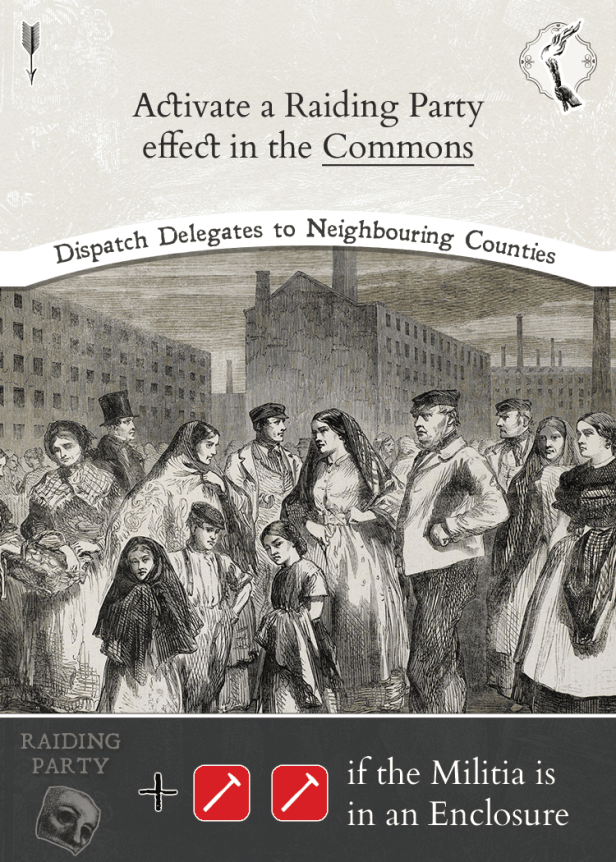
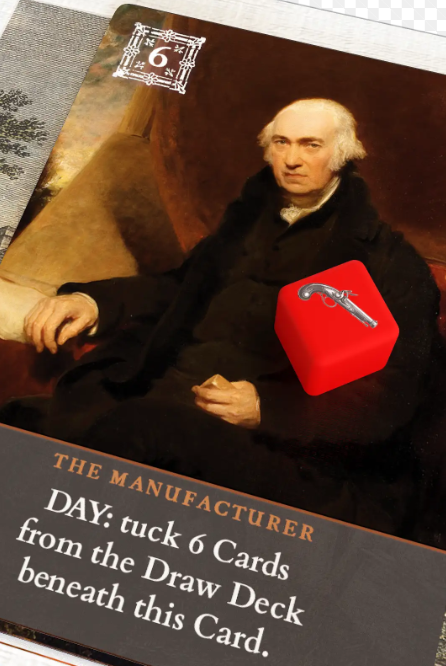
Wilson’s views condensed into one strategy card: Bonuses for containing Germany, self-determination to various nations, having Japan and Italy sign the Treaty of Versailles (and presumably joining the League of Nations), and for controlling issues pertaining to the League of Nations.

By summer 1918, American forces had arrived in Europe in substantial numbers. They contributed to turning the tide on the Western Front, and their ever-growing numbers (which matched the British and neared the French) and excellent supply situation convinced the German High Command that the war could not be won anymore. The German generals abandoned the sinking ship. Their civilian successors applied for a peace on the basis of the Fourteen Points.

Wilson, meanwhile, urged the American voters to consider the 1918 midterm elections as a plebiscite on his policies, especially the post-war order he had formulated. The voters soundly rejected him by giving majorities in both houses to the Republicans for the first time in eight years.

Germany and the Allies agreed to an armistice on the Western Front on November 11, 1918. While Germany’s new parliamentarian leaders dealt with the turmoil in their new republic, the Allies met on the outskirts of Paris to negotiate the peace treaty, chief of them the “Big Four” France, Britain, Italy, and the United States. Wilson attended the Versailles negotiations in person, which made him the first US president to leave the country on official business. After he had alienated the Republicans by his adversarial rhetoric before the 1918 midterms, he snubbed them even further by not including a single Republican senator in his delegation.

The Big Four on the cover of Versailles 1919. Image ©Rodger B. MacGowan.

Versailles 1919

All of Wilson’s political goals merged at the Versailles peace negotiations. He wanted a new world order which would provide for long-term peace: “I am playing for a hundred years hence”, he told those who asked him why he would forgo short-term American gains. And the US was indeed different as the country did not angle for territorial enlargement – unlike the other major countries, which sought colonial expansion (especially Britain and France in the Middle East and Africa) or direct annexations of regions bordering their mainland (especially France along the Rhine and Italy in the Alps and on the Dalmatian coast). Wilson held mixed views on the territorial changes in Europe, but supported colonial expansion, especially where it benefitted European imperial powers rather than imperial Japan (another expression of his racial views).

Japan, the only non-white major nation at the Versailles peace conference, pushed hard to include a racial equality clause in the League of Nations. Wilson would have none of it.

Make no mistake: The US had direct material interests at stake as well. On the one hand, Wilson’s interest in free trade aligned with American business wanting to sell goods in the European markets, on the other, American finance expected the war bonds to be repaid. In the view of the European debtors, that required large reparations from Germany, so that the vanquished would pay for the costs of the war.

The Iron Bank… er, J.P. Morgan will have its due.

Wilson’s most cherished goal, however, was the establishment of that “association of nations” outlined in the Fourteen Points. In an ironic repudiation of the other principles of the Fourteen Points, Wilson engaged in the secret diplomacy horse-trading of Versailles, making large concessions to the wishes of the other Big Four nations for territorial enlargement, to get them to agree to what would become the League of Nations.

Here the card does not quite grab the nuances of the issue: The “One State, One Vote” camp at least partially had a special notion of it – Britain pushed hard (and eventually was confirmed) in securing a vote not only for its European part, but also for the four settler dominions Canada, Australia, New Zealand, and South Africa, as well as for its colonial possession India. Wilson, a supporter of the British Empire, was sympathetic to this arrangement.

In June 1919, the negotiations were concluded and the Treaty of Versailles presented to Germany. The Germans engaged in some naïve protests and then signed anyway, as the only alternative of resuming hostilities was utterly impossible for the country. Wilson’s task now was to convince his own countrymen that America must join the League of Nations.

The Struggle for Ratification

Initially, popular support for the League was high in America. However, the Senate which needed to ratify the Treaty for America to join the League was not on board with Wilson:

  • A small part of the senators, the “Irreconcilables”, was adamantly against the Treaty. Some of the Irreconcilables were adherents to America’s traditional isolationist foreign policy, others came from (or were supported by) groups which had been against the United States’s entry into the war (chiefly German-Americans and Irish-Americans), a third subset were Republicans eager to get back at Wilson for the hostility he had shown them at least since 1918.
  • A larger, but not sufficiently large group were Wilson’s loyal supporters, who wanted ratification of the Treaty without any changes.
  • Lastly, the largest group were not opposed to the Treaty as such, but wanted changes which would confirm Congress’s sovereignty on foreign policy decisions, ensure that no territorial mandates could be forced on the United States, and that the Monroe Doctrine would be confirmed and its interpretation left to the United States alone.
The fear that America could be forced into militarily intervening on behalf of the League enraged the skeptics of the Treaty of Versailles, but Wilson was adamant on the issue.

Wilson once more relied on public pressure. He embarked on a speaking tour to advocate for the Treaty. When a bipartisan majority of senators, led by Republican Henry Cabot Lodge, put forward a proposal for a Treaty with amendments in November 1919, Wilson rejected it, and the proposal could not find a two-thirds majority in the senate against Wilson’s allies and the Irreconcilables. By then, Wilson had suffered a stroke and was physically unable to partake in competition for hearts and minds in either the Senate or the public arena. The Treaty of Versailles would never be ratified, and America never joined the League of Nations.

The Final Years

Wilson prepared for another presidential run in 1920 (the Twenty-second Amendment limiting presidents to two terms would only be passed under Harry S. Truman). His party, however, had enough of him and chose Ohio governor James M. Cox as their candidate – a mixture of a turn from Wilson’s policies and the simple truth that his poor health made him barely able to discharge the duties of his office in the present, let alone for another four years. Wilson, undeterred by his defeats in 1918 and 1919, framed the 1920 election once more as a plebiscite on his policies, specifically the League of Nations. The American voters had enough of them and gave the Republican party in the person of Warren G. Harding the presidency and enlarged its majorities in both the House and the Senate. The end of Wilson’s presidency also marked the end of the Progressive Era of sweeping in the United States.

Isolationism, or, as Wilson’s successor Warren G. Harding phrased it, “normalcy”, consisted in a retreat to domestic happiness (right), a booming economy (left), and not getting too involved with other countries (bonus VP for self-determination icons and Japan and Italy not signing the Treaty). Notice that Self-Determination appears both on this strategy card and the 14 Points one, which represent diametrically opposed views within American politics.

Four years later, Woodrow Wilson considered another presidential run. Yet just a few days after he had laid out his program, he died on February 3, 1924.

The Rating

Foreign policy:

Woodrow Wilson really pushed America on the global stage with the entry into World War I. From then on, no matter of great importance in the world has been decided without the United States, very much in line with Wilson’s programmatic thinking. His practical policies, however, were disjointed. His interventionism in Latin America infringed on the locals’ freedoms (up to the point of practically reintroducing slave labor in Haiti), but did not come at a high cost for the United States. The entry into World War I, on the other hand, prioritized export opportunities and especially the travel rights of the affluent few over the lives of the American soldiers who then had to defend those rights and opportunities. Despite all these costs, it is hard to find a positive foreign policy outcome for the United States besides its increased global stature.

Rating: 2 out of 5.
John Maynard Keynes is well-known for his scathing criticism of the economic provisions in the Treaty of Versailles, but he also had a few choice words for Wilson’s negotiating skills at Versailles: “[T]he President had thought out nothing; when it came to practice his ideas were nebulous and incomplete. He had no plan, no scheme, no constructive ideas whatever for clothing with the flesh of life the commandments which he had thundered from the White House. He could have preached a sermon on any of them or have addressed a stately prayer to the Almighty for their fulfillment; but he could not frame their concrete application to the actual state of Europe. […] [H]is mind was slow and unadaptable. […] There can seldom have been a statesman of the first rank more incompetent than the President in the agilities of the council chamber.”

Domestic policy:

By 1920, most Americans were less free than they had been eight years before. Wilson’s expansion of segregation shut down opportunities for African Americans, his wartime policies of censorship and oppression limited the traditional American freedom of expression. Women’s suffrage, the great enfranchisement, was brought about during Wilson’s time, but his support for the cause was minimal.

Rating: 1 out of 5.

Economic policy:

Wilson’s early economic reforms (federal income tax replacing tariffs, the Federal Reserve System, and the Antitrust Act) benefitted consumers, workers, and the economy as a whole. Later, Wilson’s interpretation of neutrality meant that the United States enjoyed a long war boom as a supplier of goods to the Allies. This prosperity came with risks, as it relied on the Allies winning the war and eventually being able to repay their loans, which would become a major matter of contentment after the war and endanger both the American and the global economy.

Rating: 4 out of 5.

Vision:

Wilson redefined the presidency. He strengthened the executive and established the president as lawmaker-in-chief, a change which has held up until today.

He looked far beyond the day-to-day issues of politics. While his idea of a liberal internationalist global order was discredited when he left office, and remained so for the next twenty years, it was rehabilitated by Franklin D. Roosevelt and Harry S. Truman. As these later presidents had more political common sense than Wilson, they were able to form them into a bipartisan consensus which only eroded in recent years.

Rating: 4 out of 5.

Pragmatism:

Wilson parlayed his electoral triumph in 1912 into a sweeping reform agenda, which he got through Congress by mobilizing his own party and cowing the opposition with the force of his public oratory. He later found out that there were limits to speaking from the bully pulpit. His electoral success ran out in 1918, and his stubborn intransigence made it impossible for him to reach compromise in Congress. Wilson would rather be right and achieve none of his goals than concede a little and receive a lot – a distinctly unpolitical trait for a politician.

Rating: 2 out of 5.

Integrity:

Wilson was driven by an honest commitment to better his country, and through the means of it, the world. His practical politics were not always this clean. His appointments were often based on loyalty rather than merit, he treated his political opponents as enemies and traitors, and he clung to power even when his health limited his ability to discharge the duties of his office to the point that even his cabinet pondered if to declare him unfit.

Rating: 2 out of 5.

Overall:

Woodrow Wilson was one of the greatest visionaries in the White House. The completion of his visions was left to others due to his own lack of political skills. The great principles for which he strove – prosperity for all, free trade, eternal peace – were mixed with his authoritarian tendencies and his hostility to his political opponents as well as non-whites. His presidency contains the sublime and the ignoble, and calling it middling is charitable.

  1. Abraham Lincoln 28/30
  2. Franklin D. Roosevelt 25/30
  3. Friedrich Ebert 25/30
  4. Winston Churchill 25/30
  5. Robert Walpole 24/30
  6. Willy Brandt 23/30
  7. Konrad Adenauer 22/30
  8. Harry S. Truman 21/30
  9. John F. Kennedy 17/30
  10. Hermann Müller 17/30
  11. Wilhelm Marx 17/30
  12. Woodrow Wilson 15/30
  13. Ludwig Erhard 12/30
  14. Paul von Hindenburg 10/30

How would you rate Wilson? Let me know in the comments!

Further Reading

The most recent full-length biography of Wilson is O’Toole, Patricia: The Moralist. Woodrow Wilson and the World He Made, Simon & Schuster, New York City, NY 2018.

For a snappy, but nuanced biography, see Berg, Manfred: Woodrow Wilson. Amerika und die Neuordnung der Welt. Eine Biographie [Woodrow Wilson. America and the Reshaping of the World. A Biography], C.H. Beck, Munich 2017 (in German).

As always when it comes to American presidents of the 20th century, see the respective chapter in Leuchtenburg, William E.: The American President. From Teddy Roosevelt to Bill Clinton, Oxford University Press, Oxford 2015, pp. 70-116.

  •  

Osprey Games lets entire board and card game development team go, cancels Essen booth

UK-based Osprey Games has let go of its entire board and card game development team and cancelled its booth at the upcoming Spiel Essen game fair, five months after parent company Bloomsbury began searching for a buyer for the operation.

Osprey revealed in May that multinational book giant Bloomsbury had made the “difficult decision” to sell the board and card game segment as part of a wider “strategic refocusing” on book publishing, which would see Osprey concentrate on its wargame and RPG lines.

Two sources with knowledge of the matter told BoardGameWire at the time that Bloomsbury hoped to find a buyer willing take on the existing board and card game team in addition to its catalogue, which includes acclaimed titles such as the Undaunted and Imperium lines.

But a Bloomsbury spokesperson has now confirmed to BoardGameWire that “all our colleagues who exclusively worked on creating and manufacturing our board and card games have now left the company”.

Multiple sources spoken to by BoardGameWire said those exits were in the form of redundancies at the end of September, although the company declined to say exactly how many staff were affected.

The departures mean Bloomsbury is now seeking a buyer solely for the board and card game catalogue, rather than the department as a whole – but questions remain over exactly how the rights to its portfolio of games could be sold on to a new owner.

Undaunted: Normandy from Osprey Games, designed by Trevor Benjamin and David Thompson

BoardGameWire understands that some Osprey designer contracts include restrictions governing the transfer of publishing rights to third parties, which could complicate the sale efforts – with some agreements seeming to limit transfers to buyers acquiring all or substantially all of the imprint’s titles.

Asked about that situation by BoardGameWire, a Bloomsbury spokesperson said, “The contractual arrangements relating to Osprey Games are confidential, so we’re not able to share details of specific terms or comment on potential outcomes.

“We appreciate that these questions are important to designers and other partners, and we’ll share further information with those directly involved as soon as we’re able to.”

The spokesperson also confirmed that Osprey has multiple unreleased board and card game projects under contract at “various stages of development”, but did not say whether those titles would be published by Osprey or transferred to another buyer.

They said, “As with our published games, we will share information about the future of those projects with the relevant designers as soon as we are able to.”

Osprey’s existing games remain “well stocked”, the spokesperson said, adding that the company had no current plans for reprints “but will continue to review the situation as we move forwards”.

They said, “We remain committed to supporting our fantastic range of board and card games with sales, marketing and licensing efforts and each of our games remains available to purchase.

“Our upcoming games, Undaunted 2200: Revolution from David Thompson and Trevor Benjamin, and Upland & Prairie from Peer Sylvester will be released as planned this month.  

“We are, as ever, incredibly grateful to our brilliant in-house team, to our wonderful designers and illustrators, and to everyone who has supported Osprey Games over the years.”

Upland & Prairie from Osprey Games, designed by Peer Sylvester

Osprey Games was launched in 2015 as part of Bloomsbury arm Osprey Publishing, which had a decades-long history of creating military and historical information and reference books before beginning to publish wargaming rulebooks in 2008.

The gaming arm’s early successes included Peer Sylvester’s The King is Dead and The Lost Expedition, as well as popular titles such as Hal Duncan and Ruth Veevers’ design Cryptid and the second edition of Martin Wallace’s London.

Those releases were followed by the high-profile success of the Undaunted series of deckbuilding wargames from David Thompson and Trevor Benjamin and the Imperium games from Nigel Buckle and Dávid Turczi.

Osprey also gained a reputation for taking chances on a range of titles with intriguing mechanisms and designs, such as Sylvester’s area control and trick-taking hybrid Brian Boru, highly asymmetric area control title Crescent Moon, card-based strategic wargame Battalion: War of the Ancients and small-box, quick-playing conflict title General Orders: World War II.

The publisher has continued releasing games in the wake of the sale process announcement, including Threaded, Flip Pick Towers and Rattlesnake earlier this year and CRAB RAGE! last month.

Bloomsbury has not specified a timetable for completing the sale, with the spokesperson telling BoardGameWire that conversations were “ongoing”.

They added, “I’m sure you’ll appreciate that this is a very complex situation, and the timelines are based around confidential conversations. We will provide updates when we can do so.”

Osprey parent Bloomsbury, which has a stock market valuation of more than £500m, announced in April that it was “streamlining its structure for further growth” – which included a reorganisation of the company’s editorial divisions and the loss of about 55 jobs. No mention of Osprey was made in the restructuring announcement.

Bloomsbury has seen its profits almost double in the last five financial years, and confirmed at its July annual meeting that it expects annual revenue of more than £350m and was on track for record adjusted pre-tax profits of £49.9m, according to Publishers Weekly.

The post Osprey Games lets entire board and card game development team go, cancels Essen booth first appeared on .

  •  

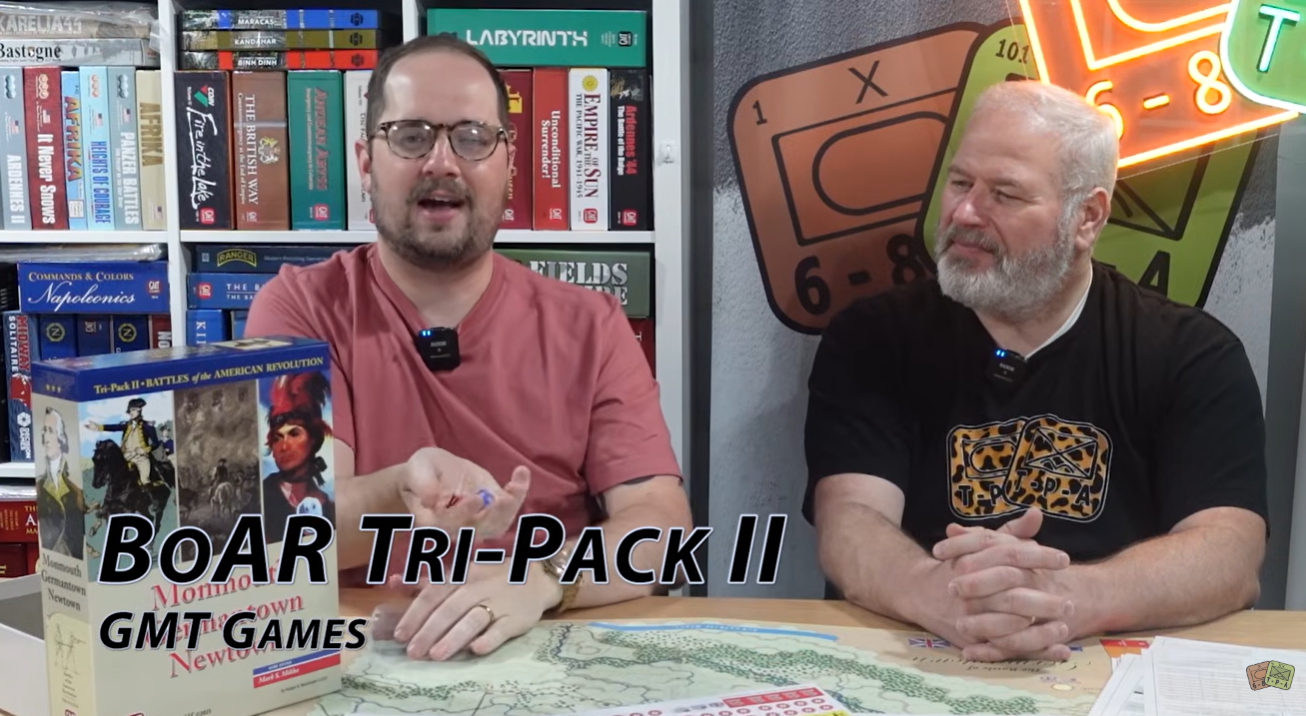
Video Review: Battles of the American Revolution Tri-Pack II: Germantown from GMT Games

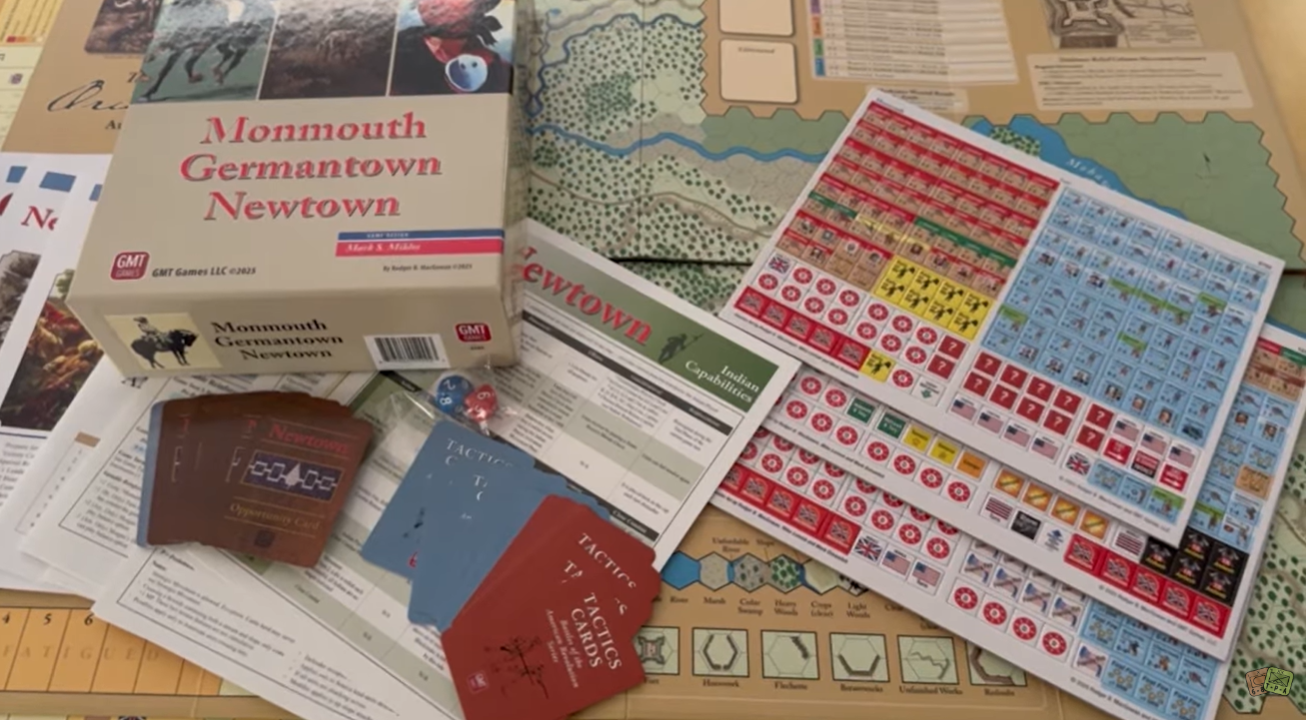
Battles of the American Revolution Tri-Pack II: Monmouth, Germantown and Newtown is the second compilation of earlier releases from GMT Games’ Battles of the American Revolution Series. These are tactical level battles at the regimental level with a map scale of approximately 200 yd/hex. We played Germantown and shot the following video review to share our thoughts on the game.

-Grant

  •  

Discussion Thread: The All Too Common Misunderstanding or Misinterpretation of the Word “Wargame”

A few months ago, I started a new feature on the blog called Discussion Thread where I plan to pose a question or a share a situation and seek your input and comments on the issue to gain greater understanding and to encourage thoughtful feedback. The response to the first post about In-Game Retribution was positive and there were a lot comments and opinions shared followed by a not so successful post on Zones of Control. I now wanted to do another post in the series and focus on the all too common problem that non-wargamers have with the word Wargame and misinterpreting or misunderstanding what it actually is.

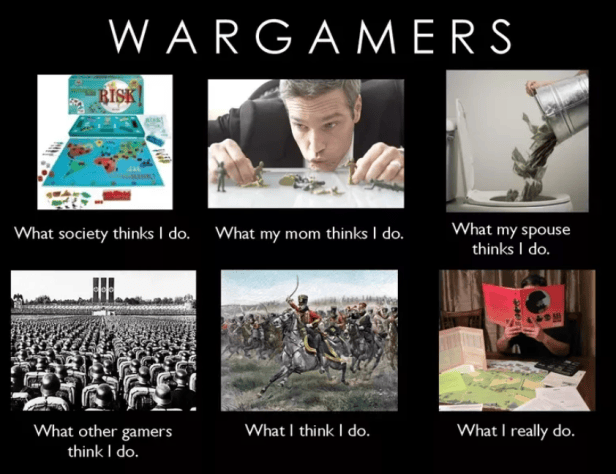
The most common misconception about a board wargame is that it is simply a casual, luck-based mainstream game such as the likes of Risk or Monopoly, that cheapens or treats lightly the historical period covered and those who participated in the event and who fought and gave their lives. Conversely, some people hold that wargames are an inaccessible, dry academic simulation meant only for hardcore military personnel or history professors. Many non-wargamers assume that “wargame” simply means moving plastic armies around a world map and rolling dice to conquer territories. But in reality, traditional board wargames, such as hex and counter games, prioritize historical operational mechanics, logistics, supply lines and terrain modeling over casual social dice-rolling. They also do a credible job at attempting to recreate the outcomes of these battles by ensuring that various elements are accurate including terrain features, weather, commanders and the make-up and skill of troops involved. Finally wargames are a serious matter. No one who plays them takes them lightly nor do they not consider the history covered.

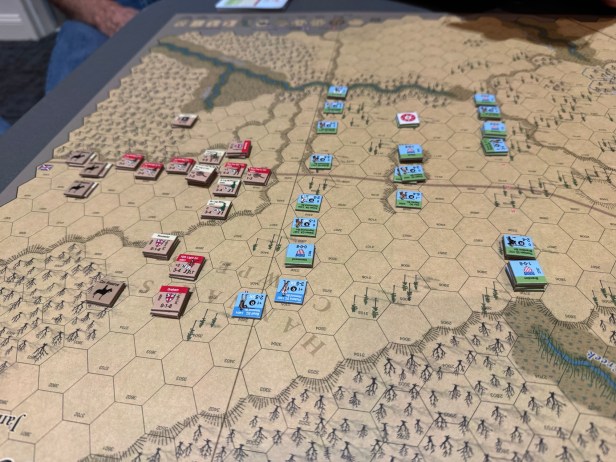
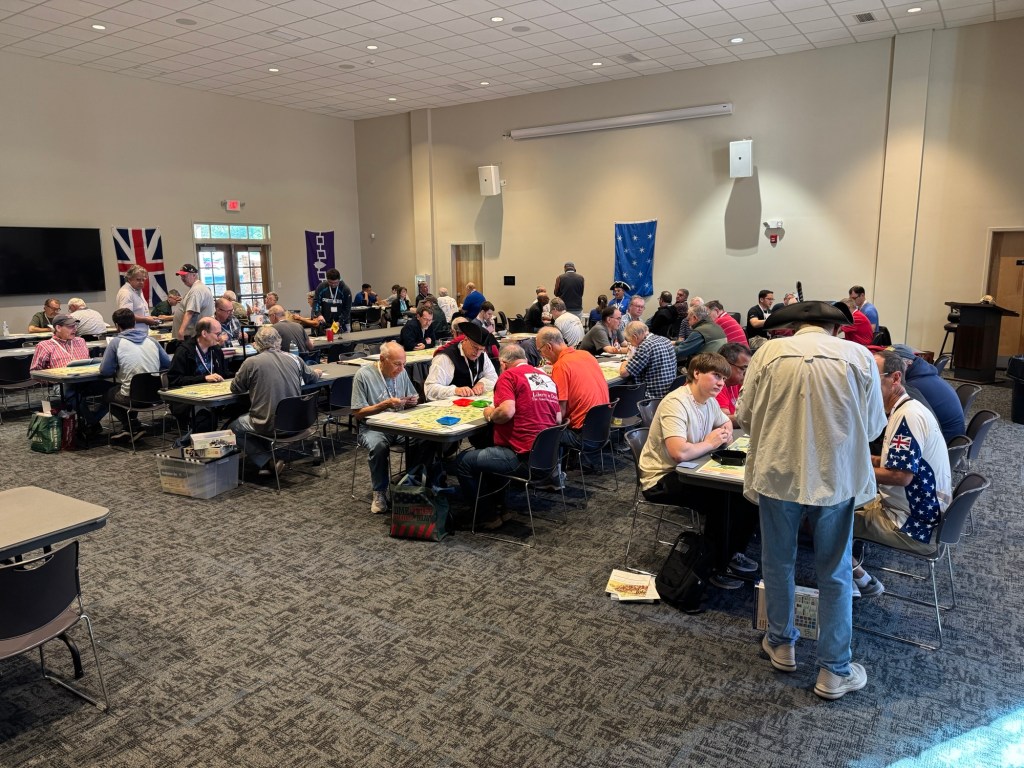
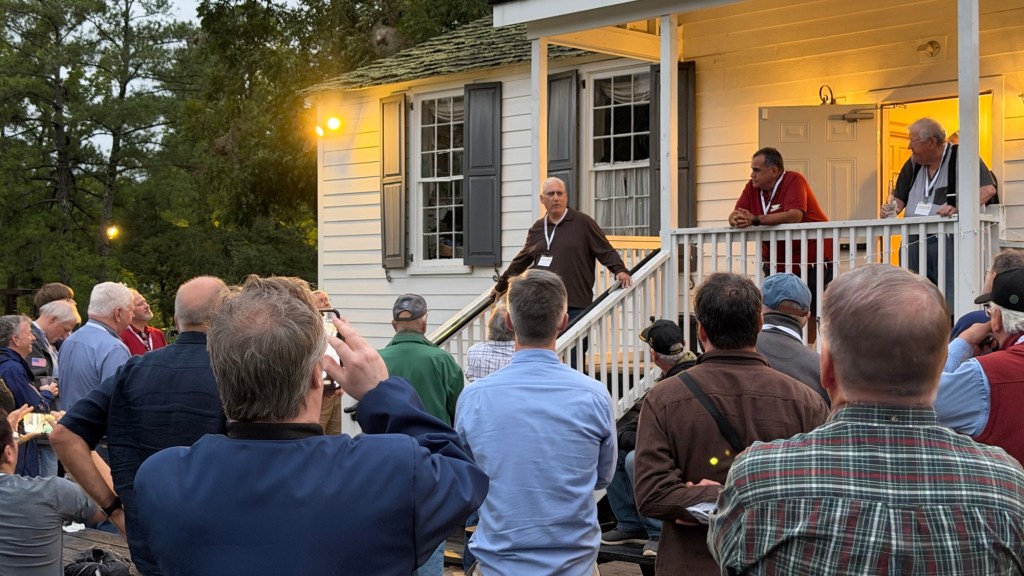
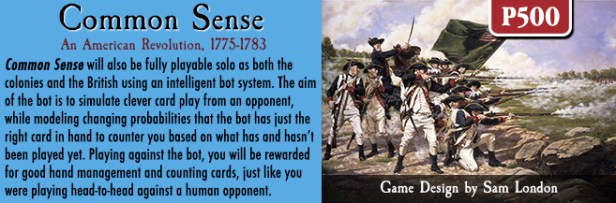
So the reason for me writing this post came from something that I experienced last weekend while attending the Gaming the American Revolution Camden 250 Event in Camden, South Carolina. At this event, which was sponsored by GMT Games, about 100 gamers showed up to play games on the American Revolutionary War from GMT Games including titles such as Washington’s War, Liberty or Death, the upcoming announced Common Sense and the various games from the Battles of the American Revolution Series. As a part of the convention, which was held at the Revolutionary War Visitor Center at Camden, there was a 4-hour tour set up that took participants to see the Camden battlefield, located about 8 miles out of the city limits, and the Hobkirk’s Hill battlefield located in Camden. This tour was expertly lead by the South Carolina Battlefield Preservation Trust Executive Director Rick Wise who was very knowledgeable and entertaining to listen to. You could really feel his passion for the American Revolution as well as the role that these battles in South Carolina and the Southern Theater held in the wider war and the eventual surrender of Lord Charles Cornwallis and his army at Yorktown, Virginia.

The Kershaw-Cornwallis House at Camden, South Carolina.

But, when he spoke on a few different occasions he brought up the fact that we were wargamers and that we were gathered to “play” games. This statement is not incorrect as we are all wargamers and were there to play games together. He also said that we needed to understand and keep in mind that there were soldiers who fought, bled and died to win independence and establish the great American nation. I felt like he was really preaching to the choir here with this group as everyone was there for the gaming and the recognition of the history tied to that gaming. Also many attendees were former military and had also served. Finally, I think almost every one in attendance participated not only in his 4-hour guided tour, but also walked the grounds of the Camden Visitors Center to take a look at the redoubt there as well as the Kershaw-Cornwallis House that was used by Lord Charles Cornwallis and Lord Francis Rawdon as an active HQ during the occupation of Camden from 1780-1781. In addition, many attendees came to South Carolina early to visit other battlefields in the area such as Cowpens, King’s Mountain, Waxhaws and Eutaw Springs. I bring this up because of Rick’s tone, and I am not sure that it was valid or necessary in speaking to this crowd, was assuming that as wargamers we were trivializing or taking lightly the gravity of the history involved in the games we were playing. I know that he was not trying to offend or belittle us and our focus but simply wanted to drive home his point of the sacrifices that were made and that we were playing out in a game with dice.

A recreation of a British redoubt found on the Revolutionary War Visitor Center at Camden grounds.

Well, I want to point out a few things about these wargames. They are not trivial but are focused on the actual historical details of the period and the battles involved. Wargames are built upon a few stalwart truths…the people who participated and the terrain upon which they fought and died. These are both hallmarks of every single wargame that I have ever played. The designers take these battles seriously and do hours upon hours of research and investigation to make sure that they have the details correct. For example, with the Orders of Battle or OOB’s, they find the names of each formation, typically named after their commanding officer, and in smaller scale games the names of actual soldiers who were there. These details are listed on the counters and have an impact in the game play itself. But, sometimes the names don’t have an impact and are just added to bring the battle to the view of the players and to hammer home the human element. The designers want players to understand who was involved, how they fit into the larger battle, who their leaders were and even adding in small historical details to make the game grounded in the history. The Battles of the American Revolution Series does this exceptionally well.

A picture of the setup for the Battle of Cowpens from GMT Games, which is the first entry in the Small Battles of the American Revolution Series.

The detail about the makeup of the soldiers involved, as well as their relative strengths and weaknesses, are on full display and are central to us as wargamers gaining insight into the conditions under which they fought, the issues that they would have experienced and the challenges that their commanders would have dealt with in directing their efforts. I like that one of the more interesting parts that is included in this makeup typically is a unit’s morale or their willingness to continue fighting in the face of mounting casualties and fatigue. Numbers are typically assigned for things like morale by designers after reading the histories and taking into account the performance and standing of these troops. More veteran troops typically have higher morale than green or relatively less experienced troops. These factors and attributes are all based on the history and are typically designed as a simulation of the event, or at least as the most realistic and plausible recreation of the event that can be made. And that is the appeal. Understanding the situation from the participants point of view and seeing how it turned out and why. I have played dozens upon dozens of wargames and have always thought about the soldiers and their sacrifice. How did they do what was done? Where did their bravery come from in the face of overwhelming odds? How could they have possibly held up to the better trained and better equipped professional armies of the British? For me, the soldiers are the reason that I play these games. And I assume the same for many of you.

An example of the named counters, based on historical formations, found in the Battles of the American Revolution Series.

I understand why the average person doesn’t understand wargaming and I get that the word “game” is found in what we do. To the average person, the word game is associated with lighter fare such as Risk, Trouble or Sorry, which are games where you can laugh and joke about things and focus on having a good time and experience with your family and friends. But wargames are more than that…they are a look into the past. A look that includes the gory details, the challenges and the difficulties….and they are made as an homage to the past. Just as books are written to commemorate and outline the details of these battles, wargames are made to serve a similar purpose. To teach, to instruct, to challenge and to test the meddle of players to see if they can meet or exceed historical outcomes or even flip the script and turn history upside down with a totally different outcome. And they are made to be enjoyable but in a different way to the games I mentioned earlier. I love playing games with friends, being with them for hours upon hours, getting to know them, better understanding them and better understanding the history. I would deign to say that I even enjoy playing wargames and do have a good time with them. But I always do keep in mind the history and the soldiers and their sacrifice.

What are your thoughts on this topic? Did I miss the mark in my response? Am I being too sensitive? Thanks for reading and for sharing your thoughts. I will come up with a few more of these posts to share and I hope to see lots of comments and reaction.

-Grant

  •  

August 2026 Monthly Debrief Video – American Revolutionary War

The August 2026 Monthly Debrief Video, which is the 8th episode in Season 6 of this series, saw us discussing American Revolution Wargames. As you may know, I really enjoy the history of the American Revolutionary War. I have read dozens of histories on the subject, with my favorite being Robert Leckie’s George Washington’s War: The Saga of the American Revolution, and it never ceases to amaze me how a group of ragtag rebels were able to best an entire global Empire in open rebellion. The reason for that was the patriots resolve and their ability to run away when outmatched to fight another day when they had a better advantage and not necessarily because they were better armed, or drilled or disciplined. I think that their desire to truly be free was the main difference but that is up for speculation. I love the games on this subject and have played nearly 20 and I was surprised at the number when we had this discussion.

In case you are interested, typically each year during July (although I didn’t do so this year) I write a Gaming the American Revolution post where I rank those games on the subject that we have played. This is the 2025 version of the post and you can read that at the following link: https://theplayersaid.com/2025/07/04/gaming-the-american-revolution-ranking-the-games-we-have-played-2025-edition/

Also, as usual, we covered the games we played in August as well as the games we plan to play in September and had a short discussion of our plans to attend the Gaming the American Revolution Camden 250 Event in Camden, South Carolina sponsored by GMT Games.

We will remind you here that we are fortunate to be continuing our relationship with Noble Knight Games as the sponsor for our Monthly Debrief Video series. In case you don’t know, Noble Knight Games specializes in hard to find games but also carry all the new releases. But what makes them truly unique is that you can find some of the rarest games, long out of print games, hand made games, imported games from overseas, etc. Thanks to them for their sponsorship and we hope that you will consider them first when looking for the games we cover.

-Grant

  •  

My Favorite Wargame Cards – A Look at Individual Cards from My Favorite Games – Card #96: Henry Knox Continental Artillery Commander from Washington’s War from GMT Games

With this My Favorite Wargame Cards Series, I hope to take a look at a specific card from the various wargames that I have played and share how it is used in the game. I am not a strategist and frankly I am not that good at games but I do understand how things should work and be used in games. With that being said, here is the next entry in this series.

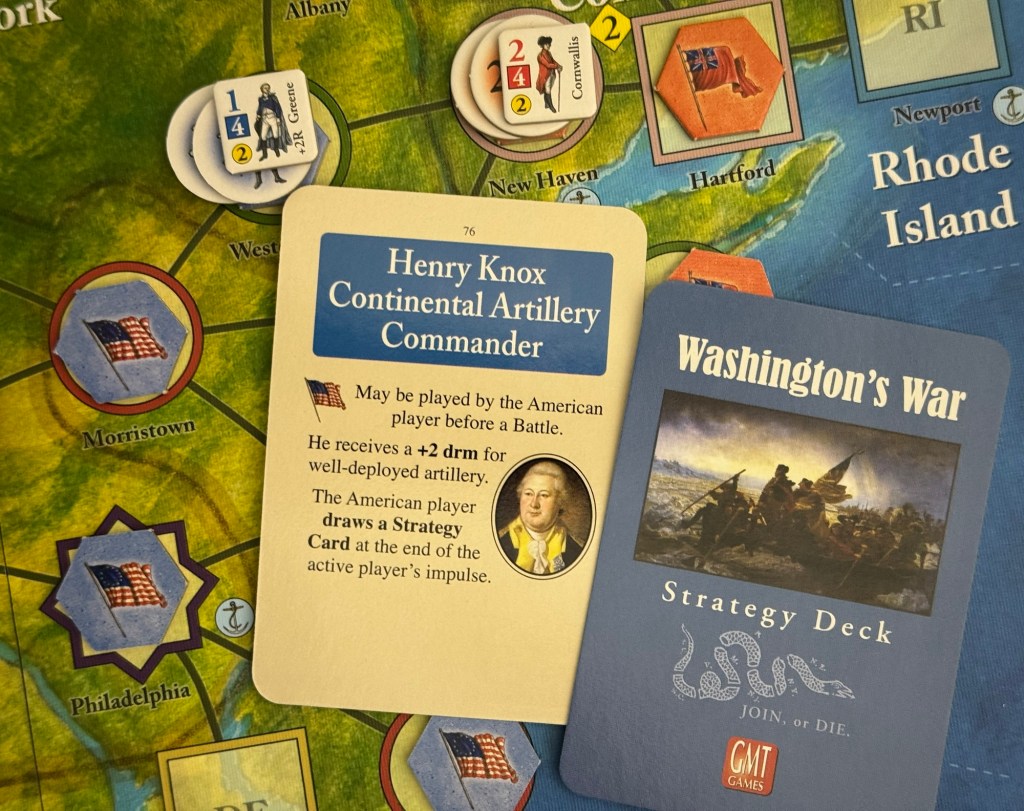
#96: Henry Knox Continental Artillery Commander from Washington’s War from GMT Games

Washington’s War is a war game, make no mistake about that. But, it is virtually impossible to win the game by focusing only on the field of battle. For that to happen, the Patriots need to completely drive the British forces out of the 13 colonies or the British need to wipe the American forces off the map. Both are extremely difficult and I would be surprised if any more than 1 out of 30 games ended in such a way. Rather, the ultimate goal of the game is to have political control of the colonies. If at the end of the game the Patriots control 7 colonies, while holding the British to control of less than 5, they win. If not, the British win. Simple as that. So, you can see that battle is not the main goal but control is. And more importantly political control.

I really like this about the design and feel that the real core of the American Revolution was the groundswell of patriotism and the desire to live free from the shackles of an overseas monarch who cared little for the American way of life. This desire led great men of the time to sacrifice themselves, their livelihood and their families to further the true cause of liberty and build a truly free and democratic nation where individual liberty and freedom was prioritized over anything else. And yes, I realize that this nation was not perfect, not without contradiction but the concept of liberty helped to form a country that would lead to the ultimate freedom of all people.

Washington’s War is a Card Driven Game, and as such, relies on cards to provide to players the actions needed to play the game. The cards contain OPS Points which can be used to drive various actions, including such things as activating leaders, who in turn will then move with forces to attack, and also contain written text in the form of events. These events can be played only by the side they are intended for and if drawn and played by the opposing side, they can only be thrown away while granting a few possible actions, such as placing or removing Political Control markers.

In Washington’s War, the Strategy Card Deck contains several different type of cards of which one is Battle Cards. Battle Cards are special event cards that provide a powerful +2 Die Roll Modifier (DRM) during combat and allow the user to draw a replacement card at the end of the turn. All of the Battle Cards offer a +2 DRM but each of them are tied to a different historical character or event. In this instance, the card’s effects reflect the work of Henry Knox who was a prominent Continental Artillery Commander during the Revolutionary War. There are only 9 total Battle Cards in the 110-card deck with the Patriot side having 5 cards, while the British side only has 4. I also want to point out that when these cards are used, they allow the using player to draw a replacement card at the end of the active player’s turn, keeping your hand size strong and not forcing you to sacrifice a card. And due to the fact that they swing combat odds significantly and also replace themselves with a draw, they are heavily prized and typically are saved in a player’s hand for those critical campaign-deciding clashes.

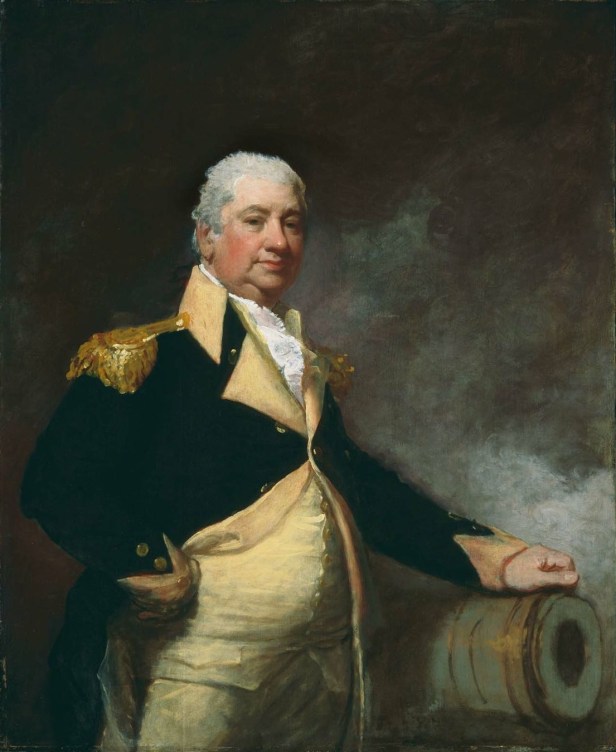
Henry Knox was an American military officer, politician, bookseller, and a Founding Father of the United States. Knox, born in Boston, became a senior general of the Continental Army during the Revolutionary War, serving as chief of artillery in all of George Washington’s campaigns. Following the war, he oversaw the War Department under the Articles of Confederation from 1785 to 1789. Washington appointed him the nation’s first Secretary of War, a position which he held from 1789 to 1794. He is well known today as the eponym of Fort Knox in Kentucky.

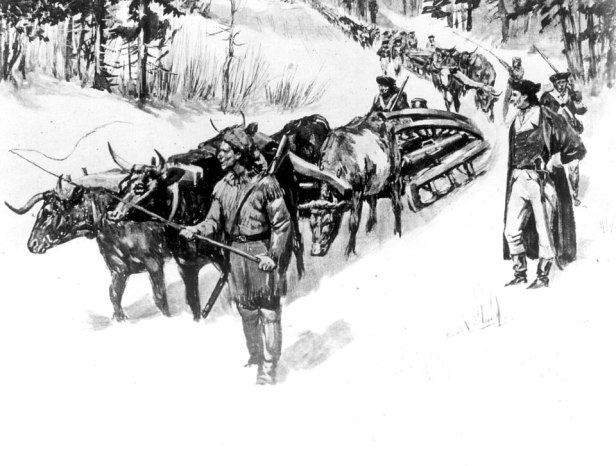
During the siege of Boston, the idea arose that cannon recently captured at the fall of forts Ticonderoga and Crown Point in upstate New York could have a decisive impact on its outcome. Knox is generally credited with suggesting the prospect to Washington, who placed him in charge of an expedition to retrieve them even though Knox’s commission as an officer had not yet arrived. Reaching Ticonderoga on December 5, 1775, Knox commenced what came to be known as the “noble train of artillery”, hauling 60 tons of cannon and other armaments by horse-drawn and ox-drawn sleds across some 300 miles of ice-covered rivers and snow-draped Berkshire Mountains to the Boston siege camps.

The region was lightly populated and Knox had to overcome difficulties hiring personnel and draft animals. On several occasions, cannon crashed through the ice on river crossings, but the detail’s men were always able to recover them. In the end, what Knox had expected to take just two weeks actually took more than six, and he was finally able to report the arrival of the weapons train to Washington on January 27, 1776. Historian Victor Brooks writes that this was “one of the most stupendous feats of logistics” of the entire war, and Knox’s effort is commemorated by a series of plaques marking the Henry Knox Trail in New York and Massachusetts.

The cannon were immediately deployed to fortify the Dorchester Heights recently taken by Washington. The battery’s position over Boston harbor led the British to evacuate Boston for Halifax, Nova Scotia. With the siege ended, Knox undertook the improvement of defenses in Connecticut, Rhode Island and New York in anticipation of a possible British assault. In New York he became friends with Alexander Hamilton, commander of the local artillery. He also established a close friendship with Massachusetts general Benjamin Lincoln.

A team of oxen hauls captured artillery toward Boston as part of the 1775-76 “Noble train of artillery”.

Here is a link to our full video review of the game:

In the next entry in this series, we will take a look at Prudence from 1989: Dawn of Freedom from GMT Games.

-Grant

  •  

Gaming the American Revolution – Camden 250 Event Daily Debrief Series – Day 4

Day 4 was our site visiting day and we planned out an all day trip that would take us to 4 different American Revolution battlefield sites including Waxhaws (Buford’s Massacre), King’s Mountain, Cowpens and Musgrove Mill.

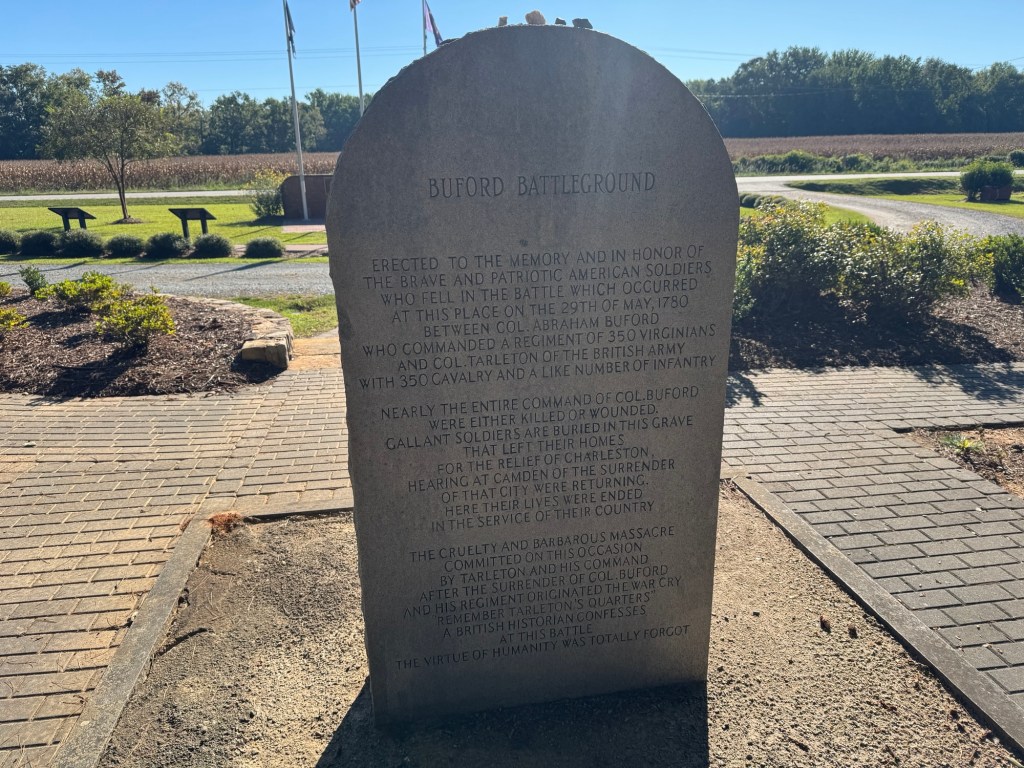
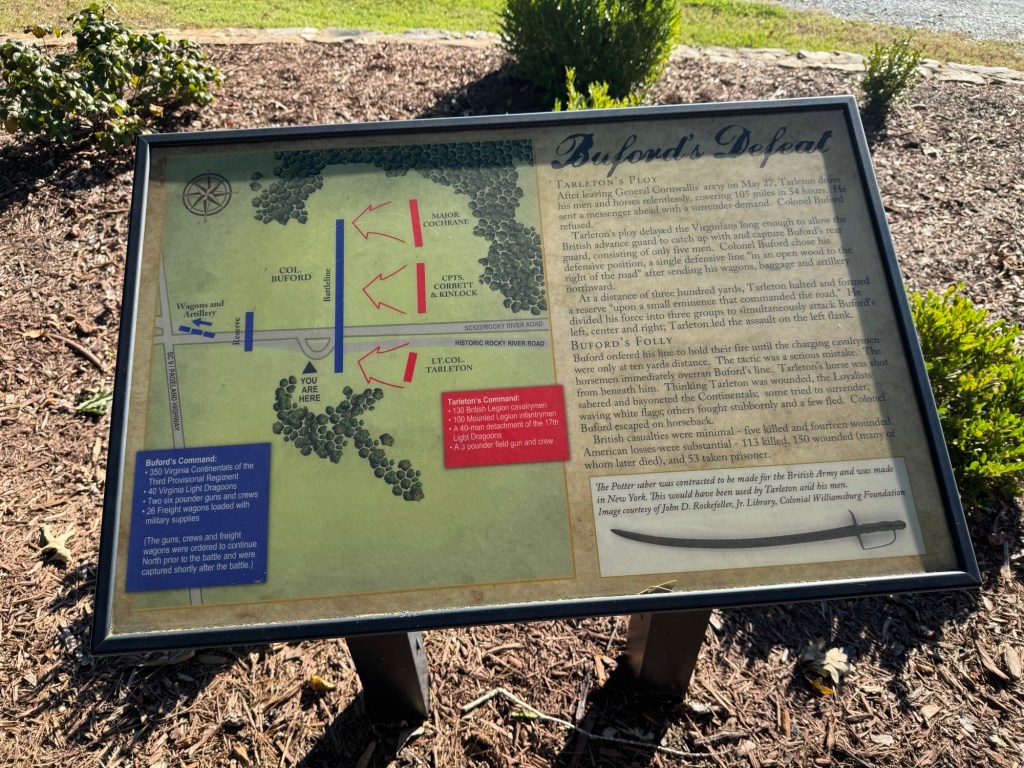
But first we visited the Battle of Waxhaws also known as Buford’s Massacre in Lancaster, South Carolina. The Battle of Waxhaws took place on May 29, 1780. British Lieutenant Colonel Banastre Tarleton overtook Colonel Abraham Buford’s regiment of 350 Virginian Continental troops as they were attempting to relieve Charleston. The battle was short lived and saw over 113 Patriot soldiers killed in a brief but brutal engagement after a breakdown in surrender communications as the Patriot soldiers were attempting to give up under a white flag and the British bayoneted and sabred many of them earning Tarleton the infamous nickname “Bloody Ban”.

The site was very clean and well done with lots of landscaping and hardscape features and they had a sign board showing the timeline of improvements over time. The central ficus is the mass grave of the men who were killed there.

I very much enjoyed the various interpretive signage and especially those showing the battle lines and disposition of troops as it helps me to place the event on the site and better understand how it unfolded.

The mass grave memorial was very well done and has been improved over the years to its present day condition. The mass grave is marked by a large 10-foot tall white marble obelisk marker originally erected in 1860 and later replaced in 1955.

We then made our way to King’s Mountain and very much enjoyed this site which commemorates a Patriot victory over the British on October 7, 1780. The battle was fought on a very rocky ridge in western South Carolina, near the North Carolina border. Around 900 Patriot frontier militiamen known as the “Overmountain Men” were against an equivalent force of Loyalist militia led by British Major Patrick Ferguson. The battle lasted only 65 minutes.

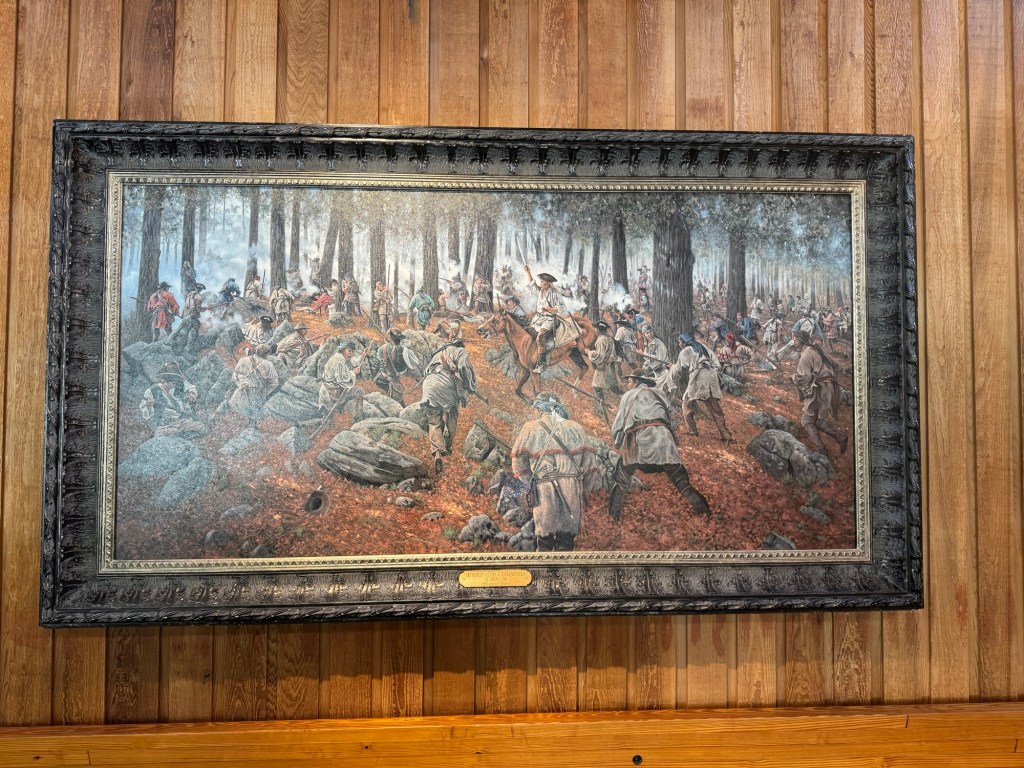
The Patriot forces consisted of frontier militia from the Carolinas, Virginia and Georgia who had tracked Ferguson’s Loyalist force to their camp on the protected high ground. The Patriots used their hunting skills and knowledge of the terrain to surround the hill and while moving up the rocky slope, Patriot riflemen picked off the exposed Loyalists.

A painting hanging in the visitor center of the battle.

The Patriots had fewer than 100 casualties (around 28 milled and 90 wounded) while the Loyalists incurred over 1,000 total casualties, including roughly 240 killed or wounded and more than 600 captured.

The Loyalist leader Major Ferguson was shot and killed after trying to lead a desperate charge and the remaining Loyalist forces quickly surrendered.

A monument to Major Ferguson.

This one took me by surprise as the Loyalists had the high ground and superior positioning but were unable to overcome the Patriots. Just very interesting! The defeat halted the British invasion of North Carolina and forced General Charles Cornwallis to retreat from his forward positions.

Looking down from the ridge you can see the brutally steep and difficult terrain the Patriots maneuvered across.

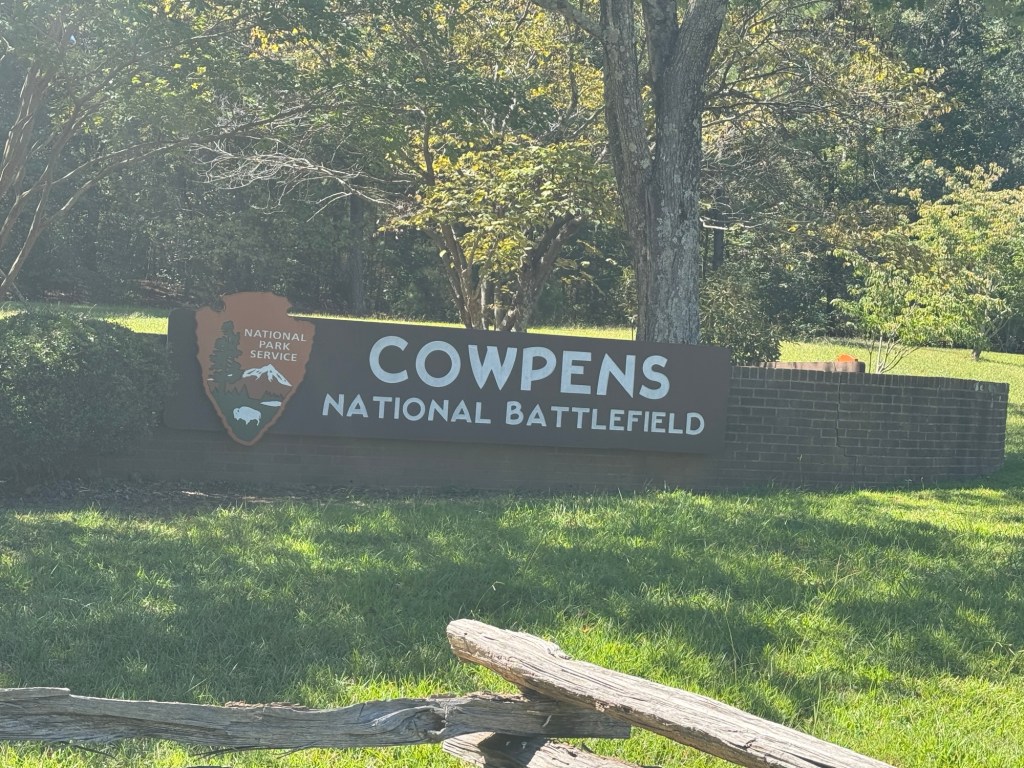
We then made it over to Cowpens which was the battlefield that I was most interested in seeing especially since we just had played the game and were somewhat familiar with the situation.

The Battle of Cowpens occurred on January 17, 1781 near the town of Cowpens, South Carolina. A Patriot army of nearly 2,000 regulars and militia under Brigadier General Daniel Morgan defeated a force of about 1,000 British and Loyalist troops commanded by Lieutenant-Colonel Banastre Tarleton and was the worst defeat suffered by the British in North America during the conflict following the 1777 Saratoga campaign.

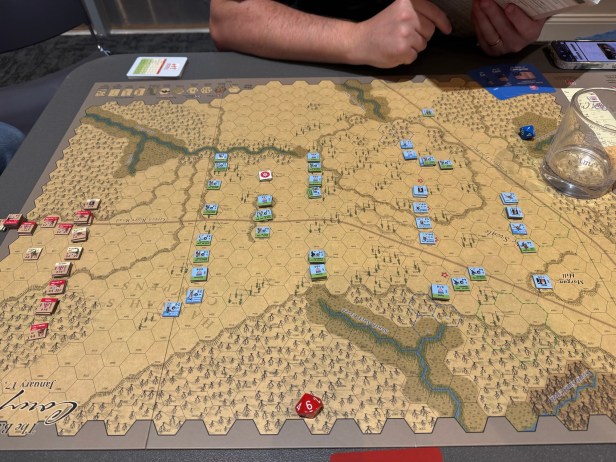
After playing Small BoAR Cowpens, I was anxious to see the battlefield and the terrain to see how it compared. The setup of the units was spot on to what was shown at the site and I was guard to see that.

There were 3 lines of Patriot forces including skirmishes at the front, maim Continentals in the center and reserve cavalry in the back.

Then there was the actual terrain with the barren pines being somewhat present but most importantly the elevation change that would have obscured the Patriot trap.

There also was the cane break terrain that was found at the edges of the battlefield and that was pretty cool to see as it is very thick and darned near impassable.

Cane break at the edges of the battlefield.

A very enjoyable experience and we were able to walk the entire site in about an hour.

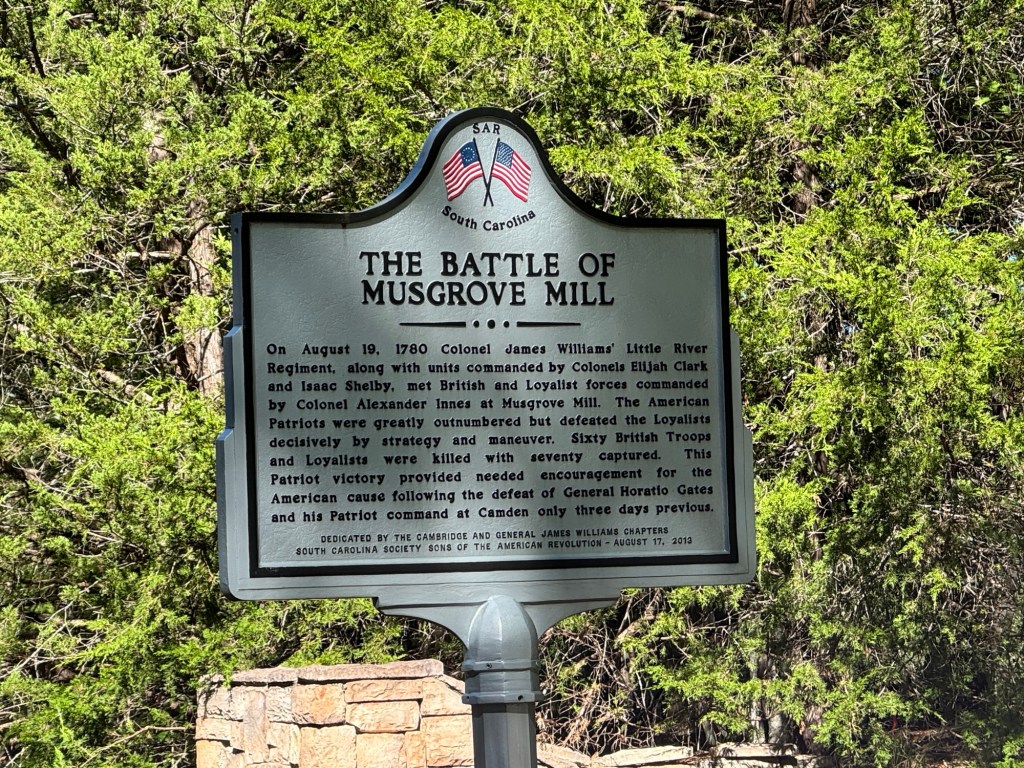
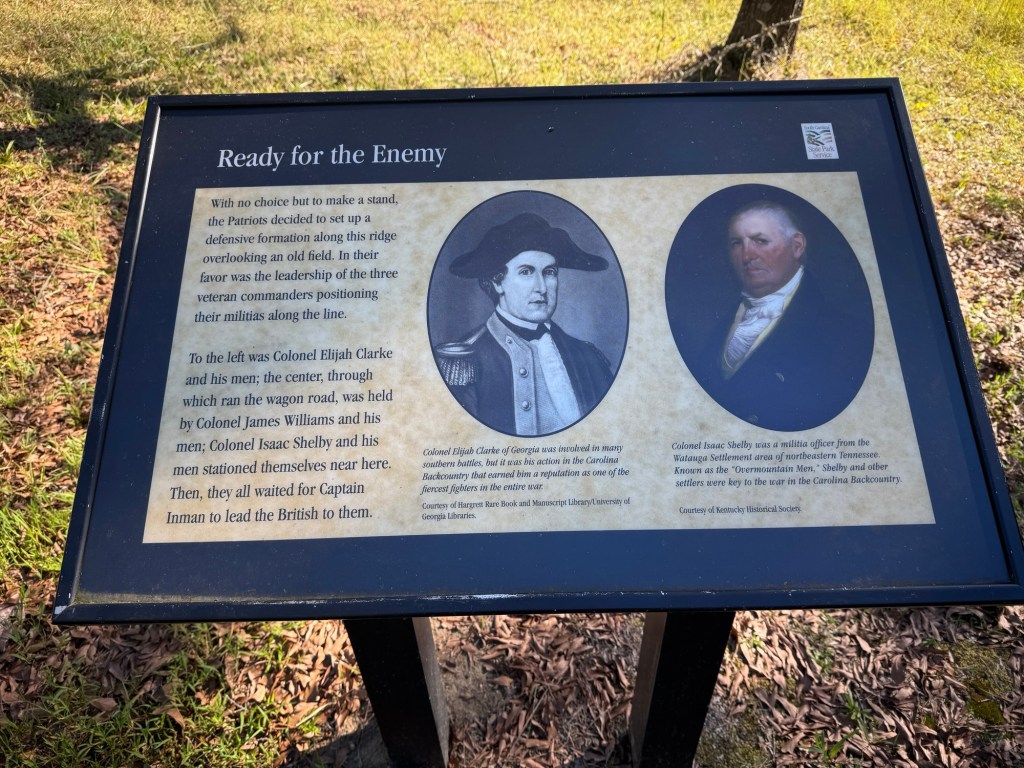
The final site we visited was the small battle at Musgrove Mill. Here Patriot forces outmaneuvered a larger Loyalist force and setup an ambush to even the odds. On the morning of August 19, 1780 mounted Patriots arrived near Musgrove Mill, the key to the local grain supply and the site of a Tory outpost. The Patriot force consisted of Georgians under Colonel Elijah Clarke, South Carolinians under Colonel James Williams and a group of “Over Mountain Men” from present-day Tennessee commanded by Colonel Isaac Shelby.

The Patriots revealed their presence when several of their scouts clashed with a Loyalist patrol. Two Rebels were wounded in the brief clash. Falling back, the Patriots encountered a friendly farmer who informed them that, contrary to their initial intelligence, the Tory garrison had been reinforced and now consisted of 500 men.

Outnumbered, and having lost the element of surprise, the Patriots formed up on a ridge top overlooking the road to Musgrove Mill and threw up a make-shift breastwork. A small detachment under the command of Captain Shadrach Inman was dispatched to lure the enemy into an ambush.

We walked the trail that followed the action ending in what was called an Indian hill where the Patriots drew in the Loyalists and waited to fire until they were within 30 yards to devastating effect. They could wait because of the elevation of the hill and the thick trees they were hiding behind.

Although the battle only lasted for an hour, the Loyalists suffered heavy casualties while the Patriots’ losses were fairly light. Before they could follow up on their success, however, the Patriot commanders learned of Horatio Gates’s defeat at Camden and decided to disperse their forces. The Battle of Musgrove Mill signaled that resistance to British rule had not been snuffed out.

That was it. We did a ton of stuff in just 4 days including playing 4 games, visiting a total of 6 battlefields, shooting 4 videos and enjoying our time with other wargamers. It was a great convention and my thanks go out to all those that made this possible including Mark Miklos, Gene Billingsley and GMT Games as well as the good folks of the Camden Visitor Center and the South Carolina Battlefield Preservation Trust.

-Grant

  •  

Gaming the American Revolution – Camden 250 Event Daily Debrief Series – Day 3

What a great time we have had at this convention! 2 fulls day of gaming in a fantastic historical setting here in Camden, South Carolina. But it hasn’t just been gaming though. Today started with a 3+ hour tour of the Camden battlefield and a demonstration at the Battle of Hobkirk’s Hill as well.

Rick Wise who is the Executive Director of the South Carolina Battlefield Preservation Trust gave us a 90 minute tour and discussion on the battle fought at Camden on August 16, 1780. The Patriots led by Horatio Gates and Baron DeKalb fielded about 4,000 muskets versus around 2,200 British soldiers led by Lord Charles Cornwallis and Lord Rowdon. The battle resulted in a major British victory with Cornwallis’ force suffering just over 300 casualties while Gates’ suffered almost 2,000.

Rick had a British Brown Bess musket and a French Charleville musket used by the Patriots that we were able to see fitted with bayonets and wielded by 2 lucky volunteers. These would have been truly terrifying to stand against and when wielded by trained soldiers were deadly weapons.

He also shared with us that archaeologists discovered the skeletal remains of 14 soldiers at the battlefield alongside period artifacts like musket balls and buttons.

Forensic and artifact analysis identified 12 Continental soldiers from Maryland and Delaware, one North Carolina Loyalist militia member (who was also Native American), and one British soldier from the 71st Regiment of Foot (Fraser’s Highlanders). They also were able to reveal that some of the Continental soldiers were teenagers, including two young men aged 16 to 19. It was truly sobering to see their unmarked grave and to find out that several were so young. Honor and bravery as well as the desire for freedom knows no age and these soldiers truly gave their lives for a cause they believed in.

There also was a nice monument to the sacrifice of de Kalb who commanded the American right wing during the engagement leading the premier units of the Delawareans and Marylanders. When the left and center of the American line disintegrated, de Kalb’s force had to beat a retreat before becoming completely surrounded. During this juncture of the fighting, the Baron’s horse was shot out from under him and he was thrown to the ground. Before he could gain his feet, he was hit with three musket balls and bayoneted multiple times by approaching British soldiers. The wounds would prove to be mortal.

Captured shortly thereafter by the British, the wounded general was picked up by General Lord Charles Cornwallis on his way to the rear. The British general, upon seeing de Kalb said the following: “I am sorry, sir, to see you, not sorry that you are vanquished, but sorry to see you so badly wounded.” Showing respect to the Baron though, Cornwallis reportedly, oversaw the dressing of the German’s wounds by his own surgeons. de Kalb would die 3 days later of his wounds.

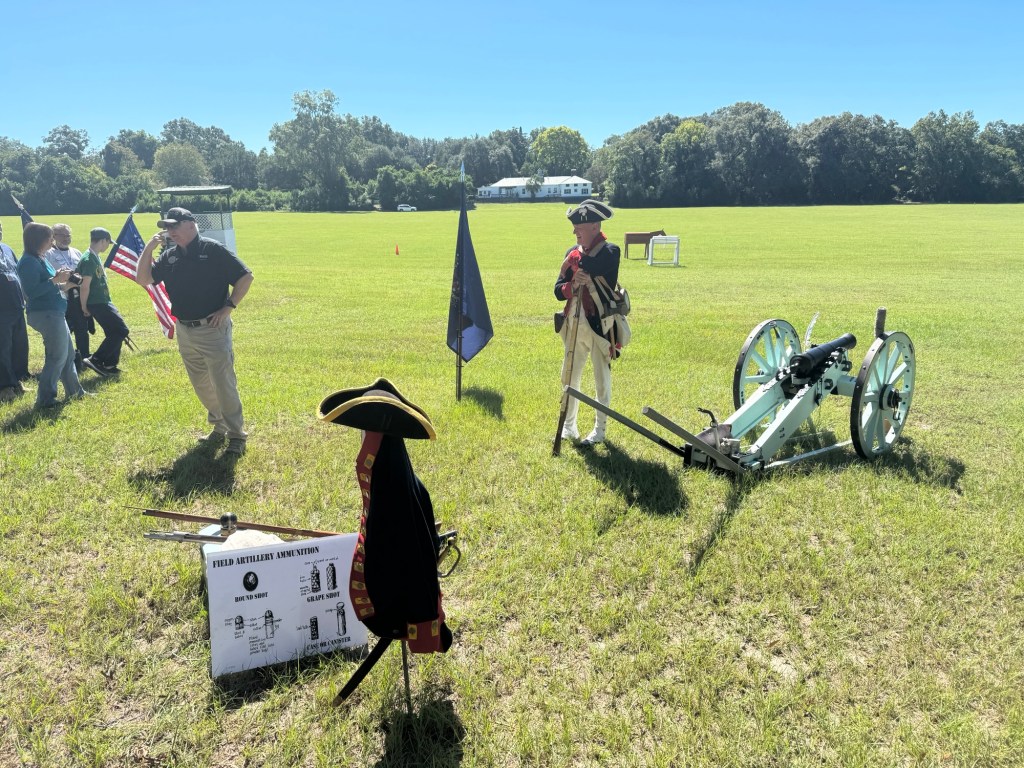
We then made our way to the site of the Battle of Hobkirk’s Hill and were instructed by a US Army artillery officer on the use of Continental cannon. I was lucky to be chosen to act as the rammer or spongeman and very much enjoyed the activity where we trained to load and fire the cannon in under 15 seconds.

Here is a video of the firing of a musket but you will have to wait for the cannon video to come out on the YouTube Channel.

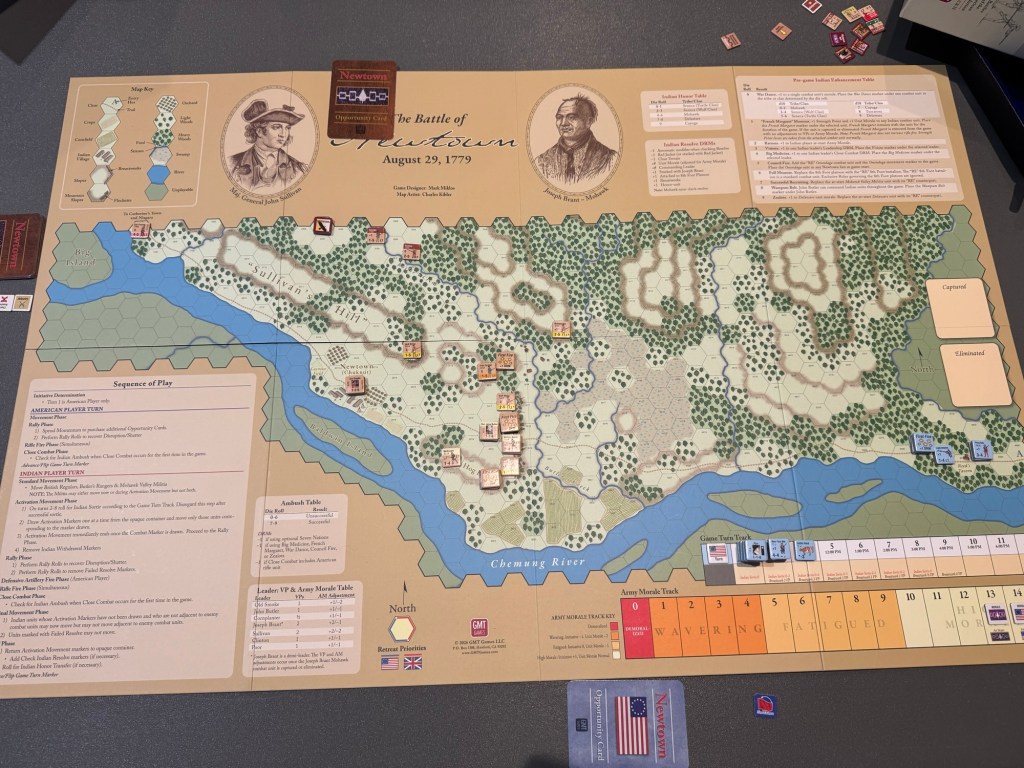
Such a great experience and I was very glad we took the time to participate in the tour. We then returned to the gaming area and setup BoAR Newtown from GMT Games.

I have wanted to play this for a while now as it is a unique and specialized entry to the BoAR Series. Newtown feels quite different from standard BoAR titles mainly because it replaces traditional line-infantry tactics with combat rules for the Indians that are very different.

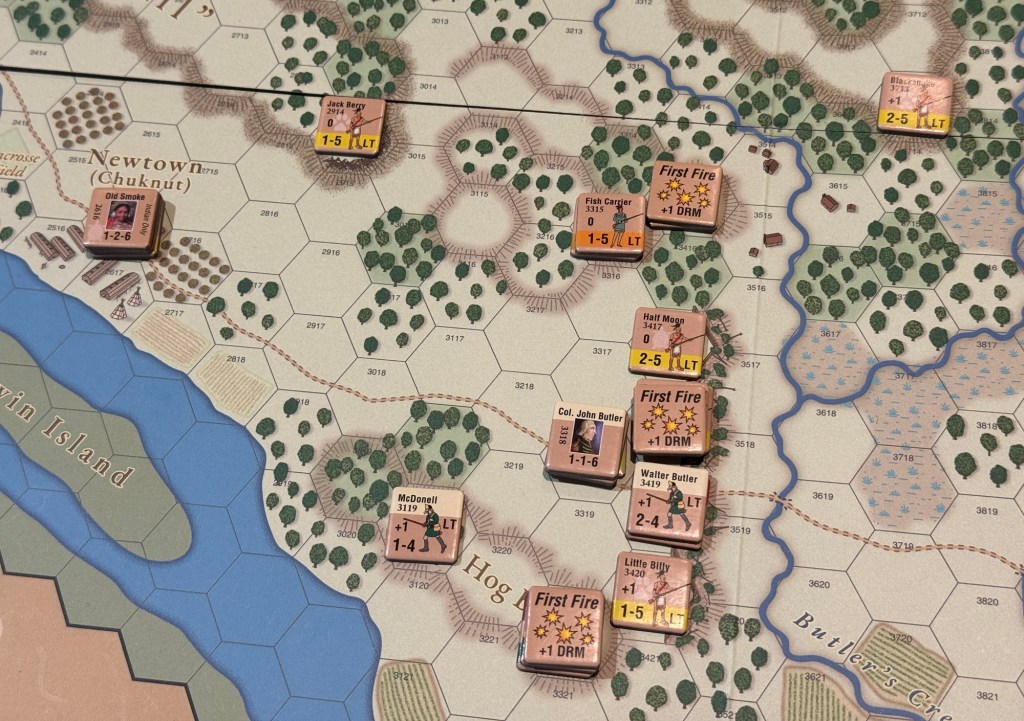
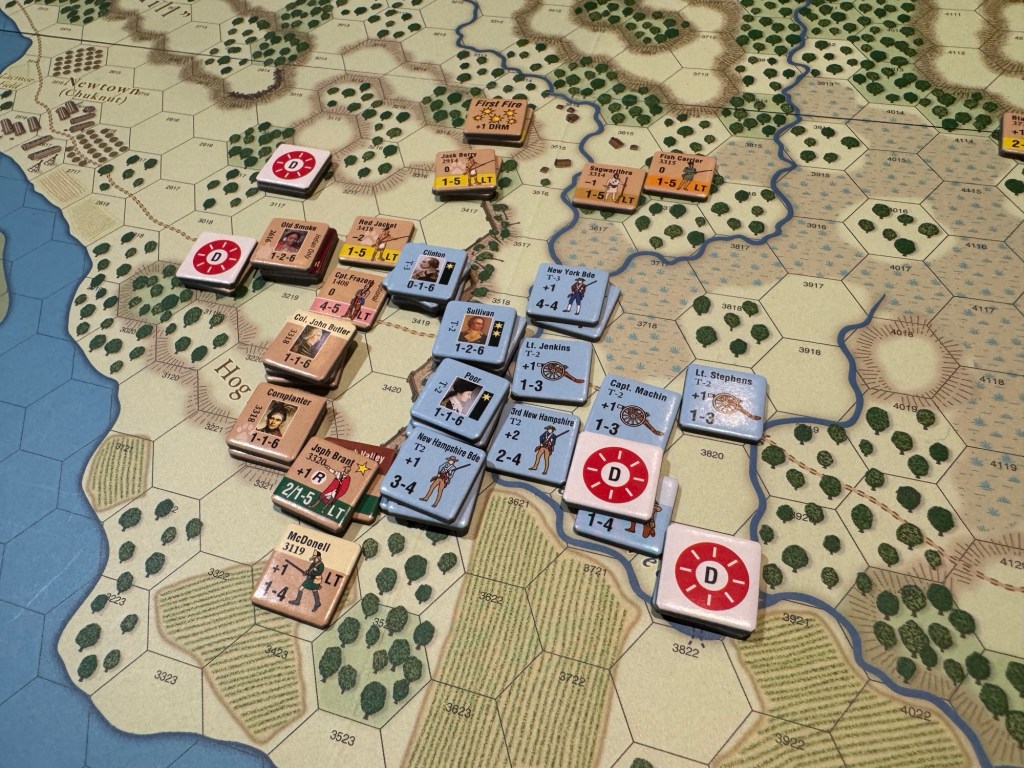
The Movement and Activation System simulates the decentralized, individual nature of Indian warfare, where small war parties act on their own initiative rather than rigid command structures which is represented with a chit pull mechanic. In the chit pull cup are each of the Indian formations along with a single combat chit. When formations are pulled they can move and if the combat chit is pulled only those formations that have already moved and are adjacent to Patriot units may then attack. Formations pulled after this bit can move but cannot fight. This was very chaotic and created some task challenges for Alexander.

The Indians are lined up behind fortifications at the start of the game and will await the approaching Patriot troops from the protection of these improvements.

The game also includes Opportunity cards that adds a layer of hand management and tactical unpredictability as the cards act as one-off events or provide bonuses. The game also includes custom rules for Indian honor, ferocity, evasion and their specific resolve when facing artillery fire and have a chance to break. Just a very interesting game and I am glad that we played it.

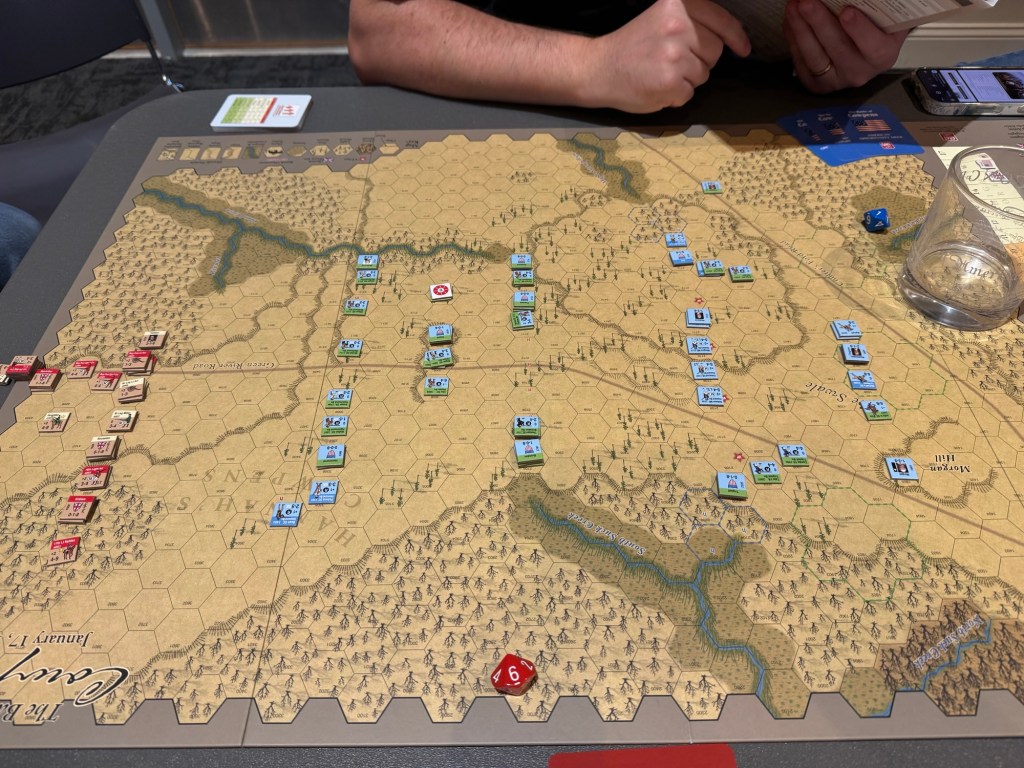
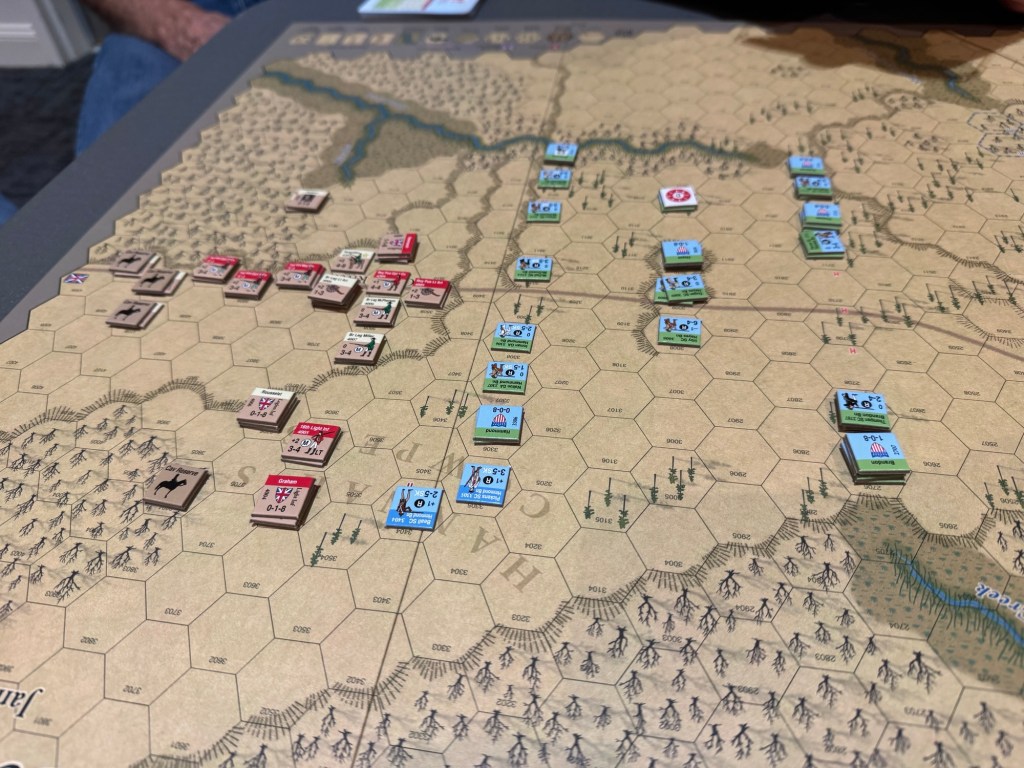
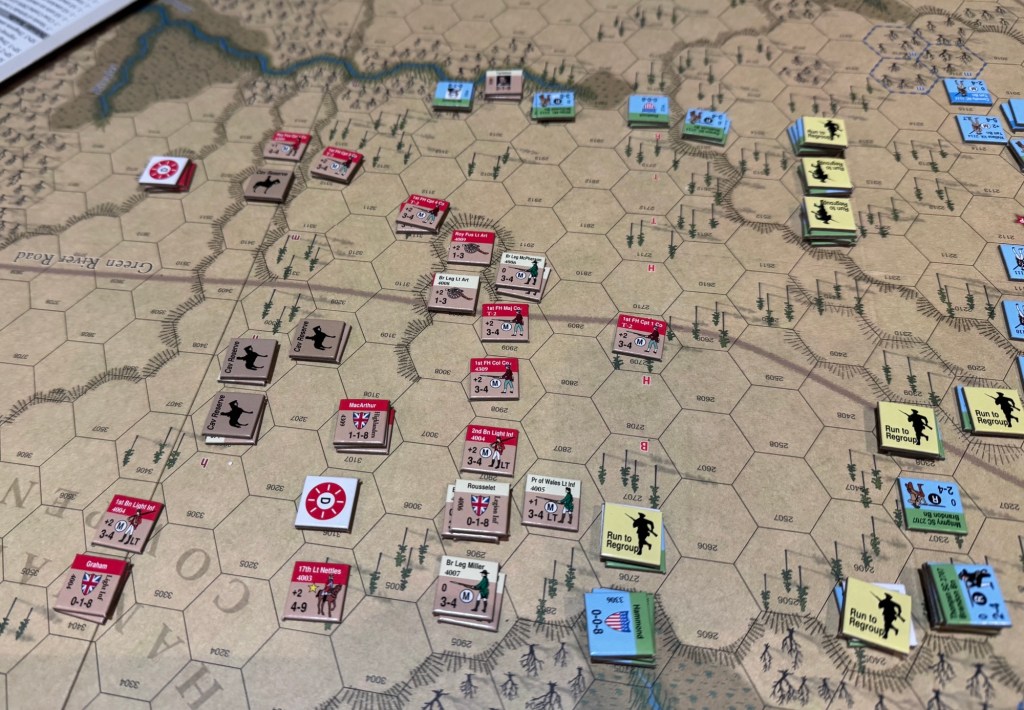
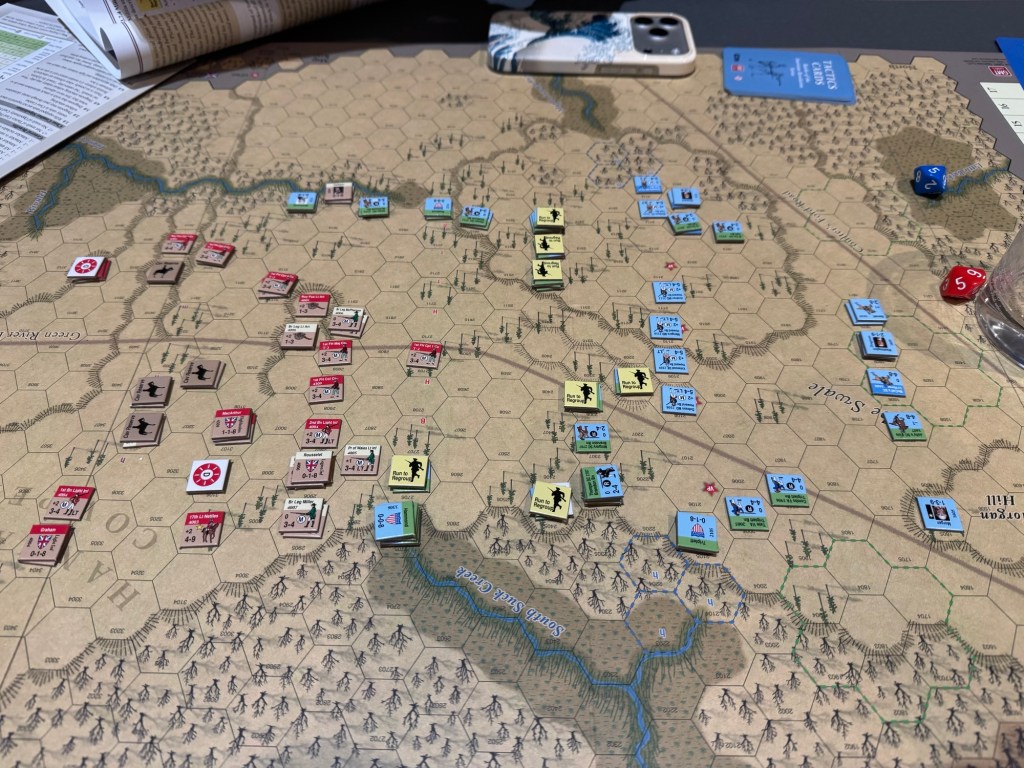
To end the evening we got the chance to sit down with designer Bruno Sinigaglio and play his new game called Small BoAR The Battle of Cowpens.

The aim of the Small BoAR design concept is to include small and critical battles that otherwise do not fit the scale of the Battles of the American Revolution (BoAR) system designed by Mark Miklos. This new system was designed by Bruno Sinigaglio working closely with Mark Miklos to preserve the continuity and popularity of the original system. It feels very familiar to the original but takes the scale in a new direction. From 25 yard hexes vs 200 yards in BoAR, the scale change gives players the chance to try new tactics with rifle and musket fire as these are now up to 8 hexes range for rifles and 3 hexes for muskets while artillery is now up to 24 hexes.

The game also highlights the importance of cavalry and their tactics as their proper use on the battlefield can lead to devastating results.

We had a great time with this one and while we only played 5 full turns there is more to explore and we can’t wait to get our hands on a copy. We have been told it should be releasing in mid to late October.

That was it for today and we are now finished with the gaming portion of the trip. Tomorrow we are going to leave early and travel to 3 battlefields in the area on our way to Columbia and the airport in Buford’s Massacre in the Waxhaws, King’s Mountain and Cowpens.

-Grant

  •  

Gaming the American Revolution – Camden 250 Event Daily Debrief Series – Day 2

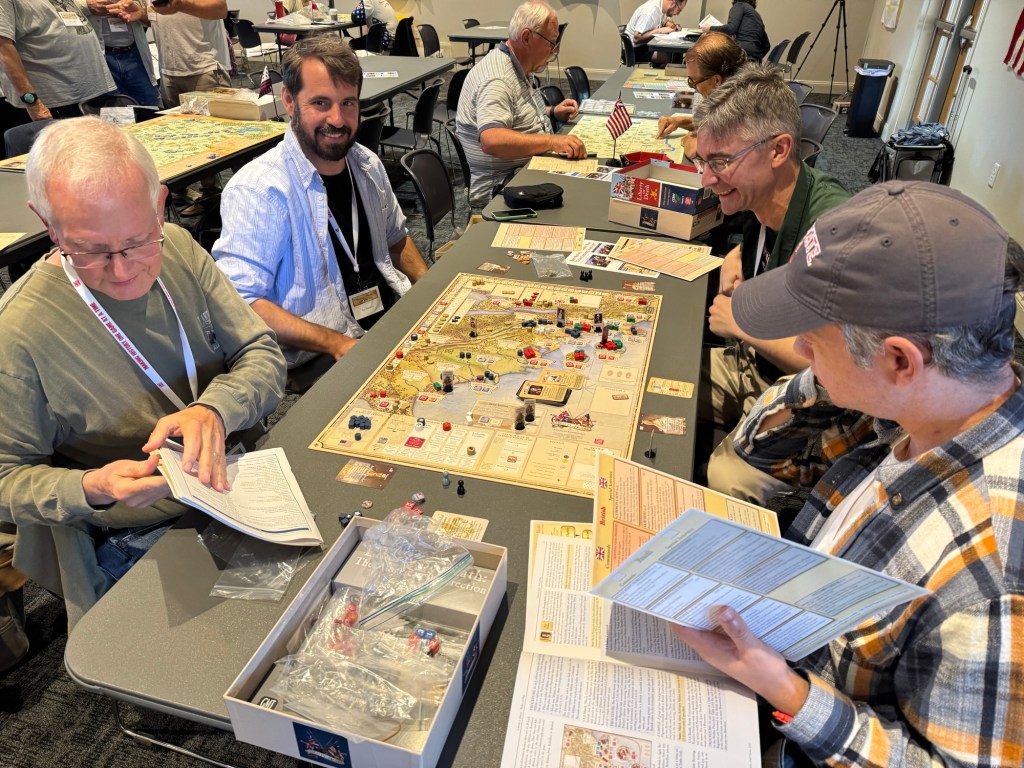
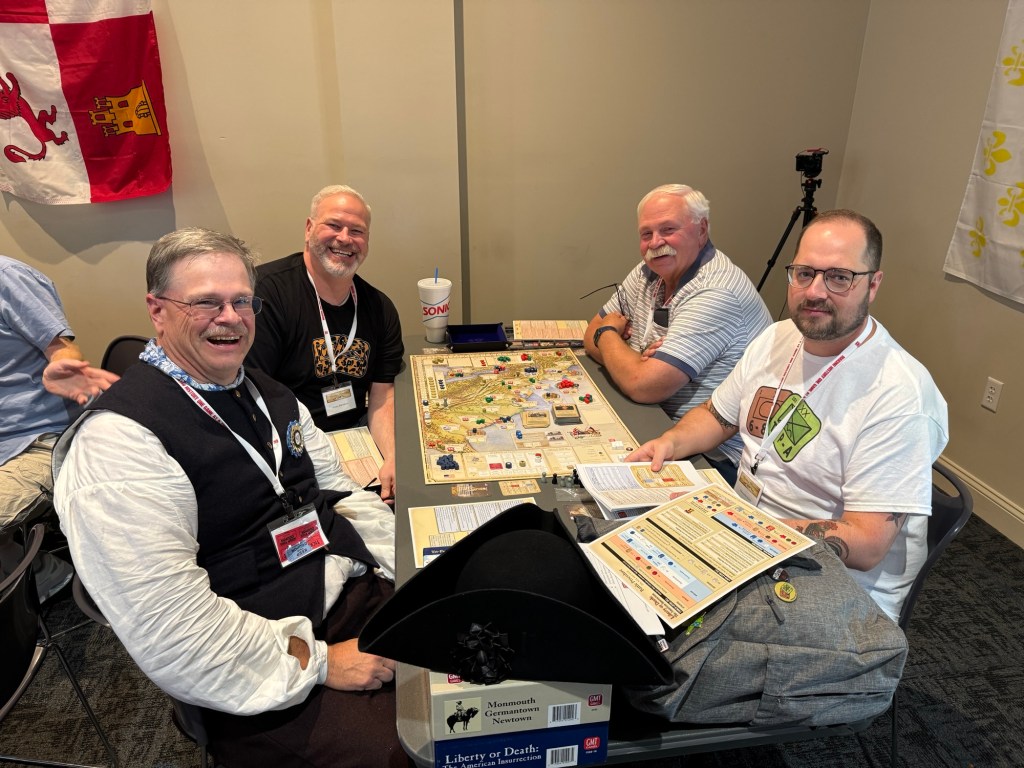
Day 2 dawned early with a morning gathering at the Camden Revolutionary War Visitor Center to receive instruction on the days events and schedule. As you can see in the picture below, there were about 50 gamers who showed up early to get a good start on the gaming.

We entered the gaming hall and I was very surprised as it was very nice and cozy and felt roomy with lots of tables setup to choose from. We chose a corner in the back and began setting up to play Battles of the American Revolution Oriskany from the American Revolution Tri-Pack #2 from GMT Games.

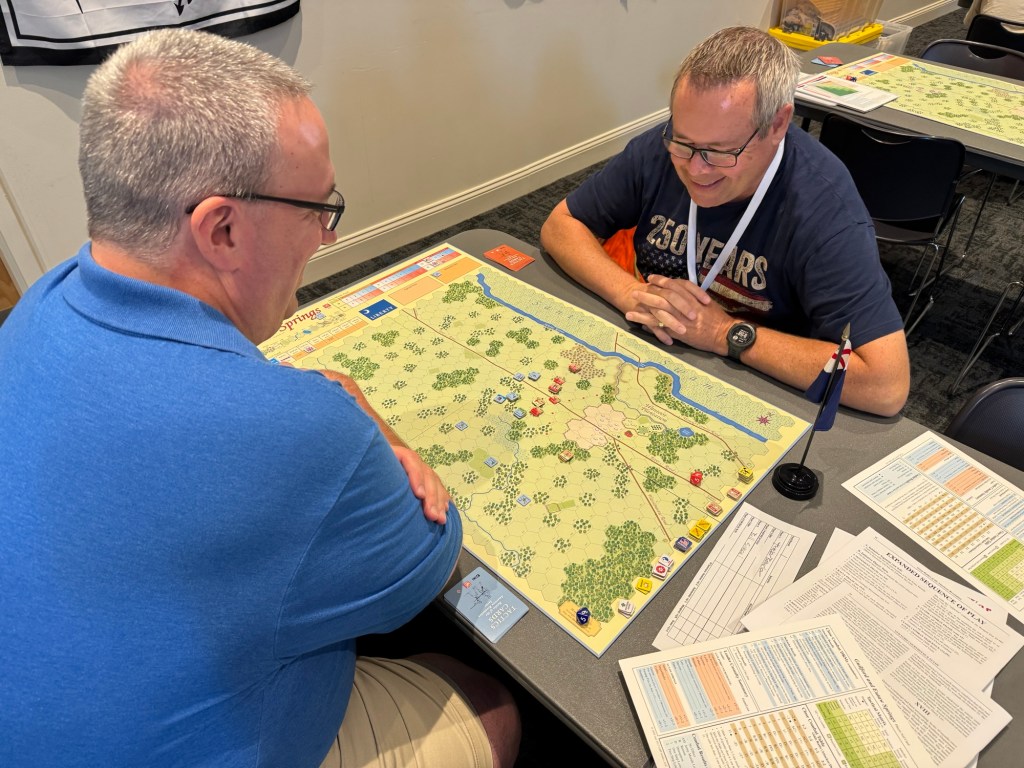
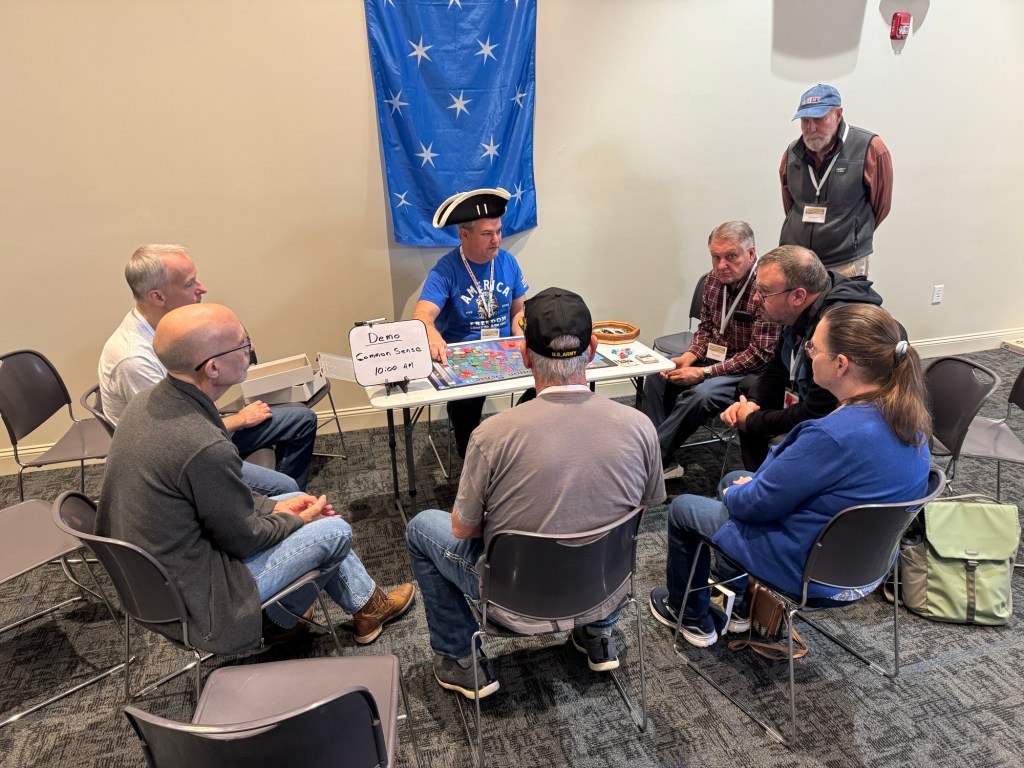
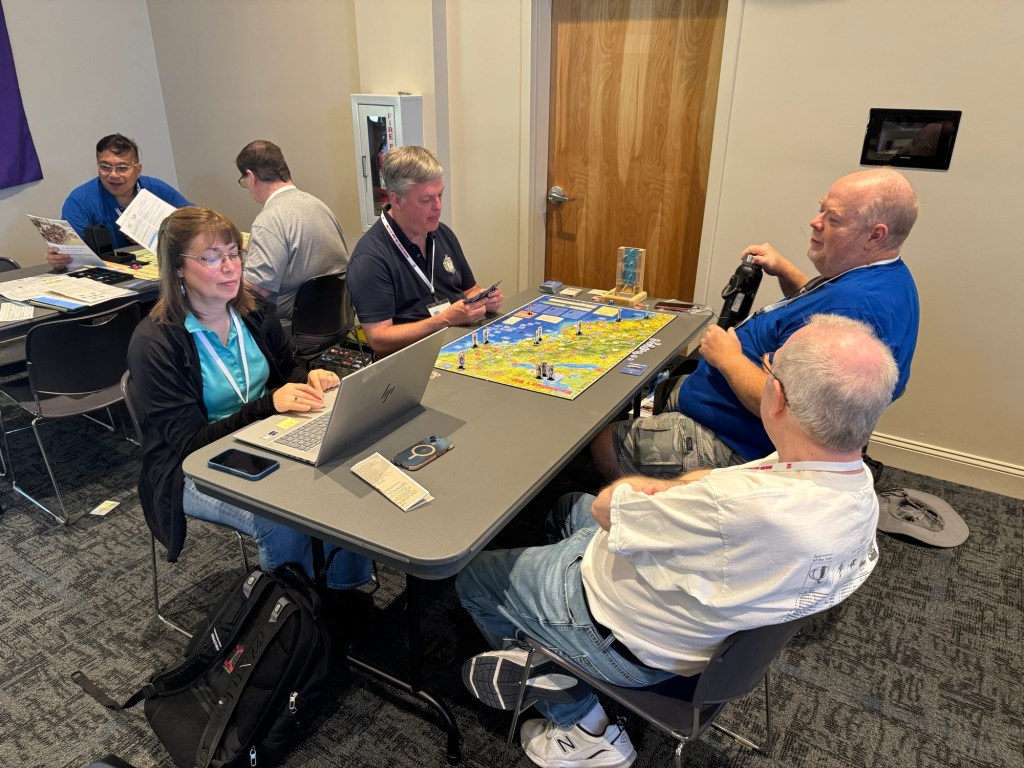
There were a lot of different games being played including BoAR, Washington’s War, Liberty or Death and Common Sense as well as a BoAR Eutaw Springs tournament going on.

Bill Simoni and designer Trevor Bender playing in the Eutaw Springs tournament.
A demo of the upcoming Common Sense by designer Sam London.
Washington’s War.
Liberty or Death.

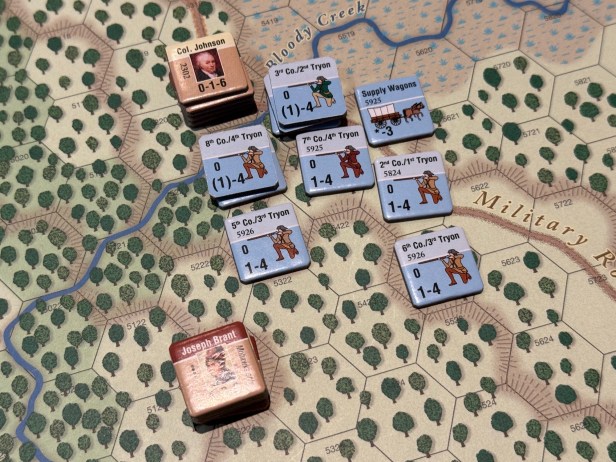
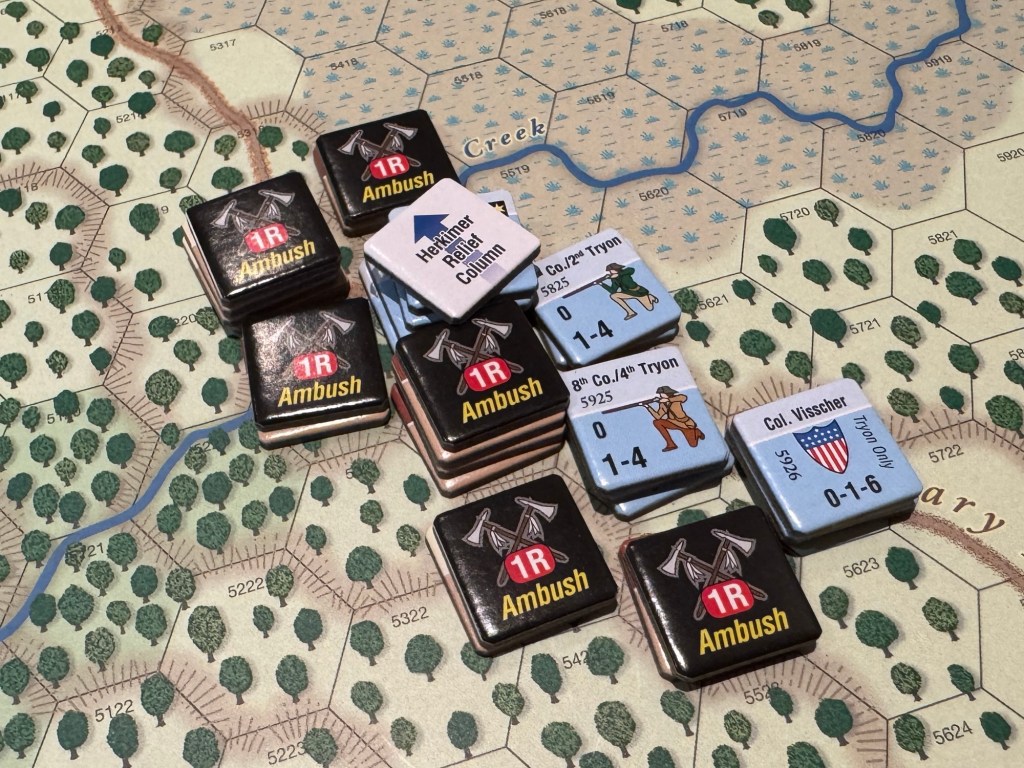
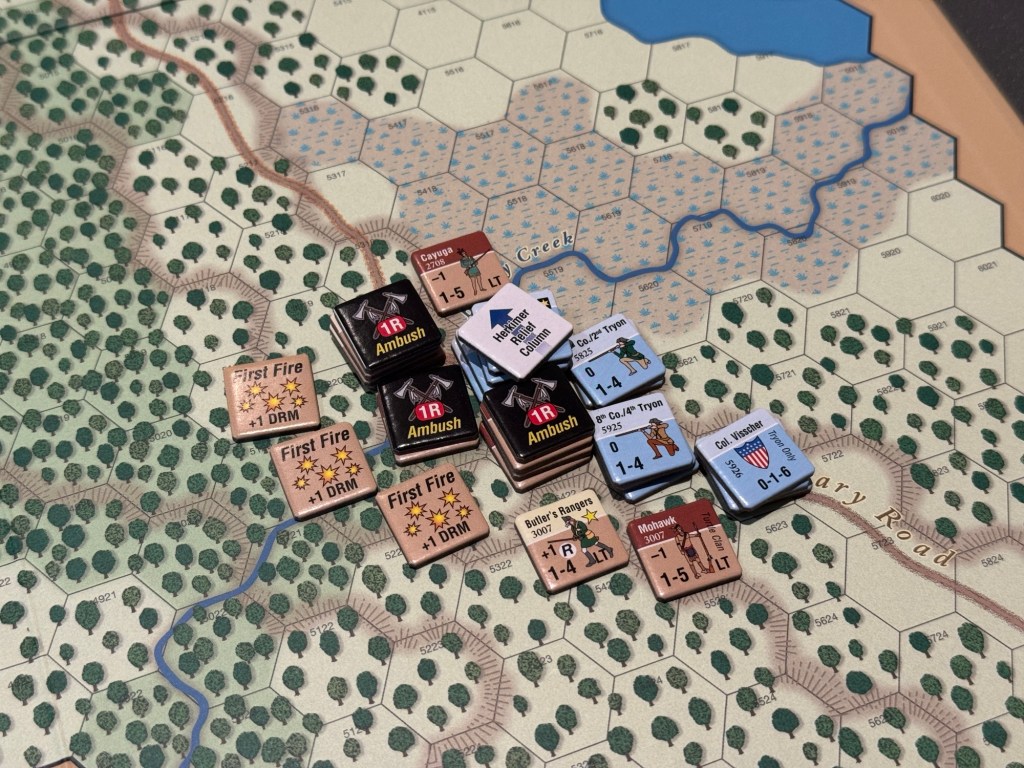
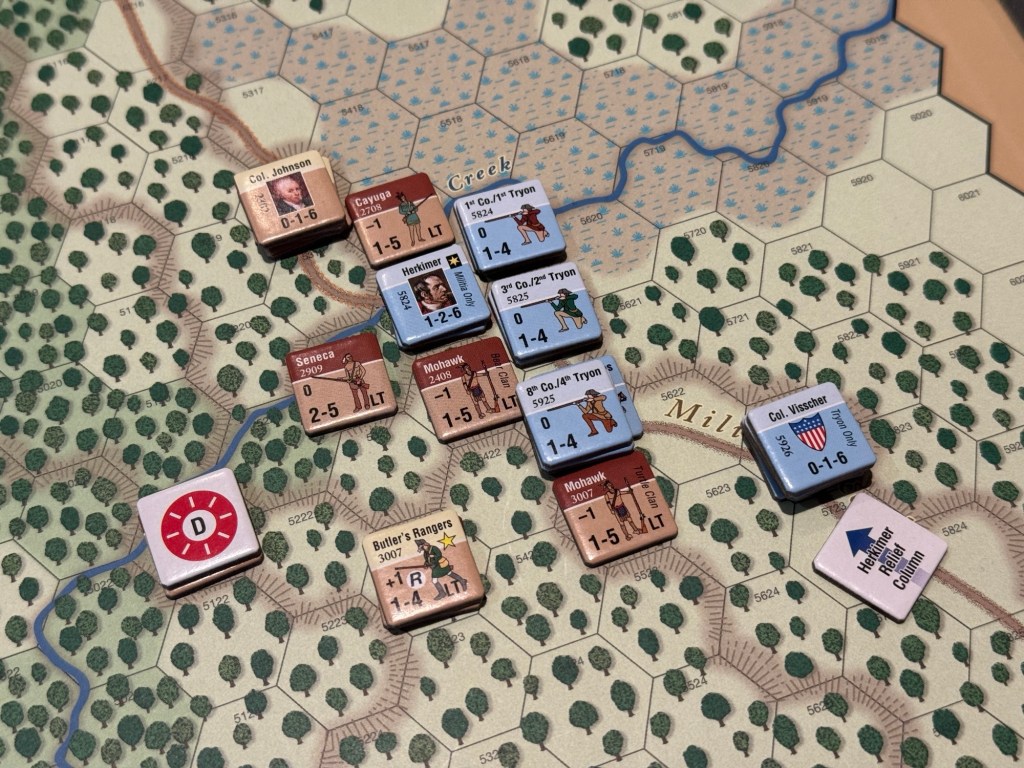
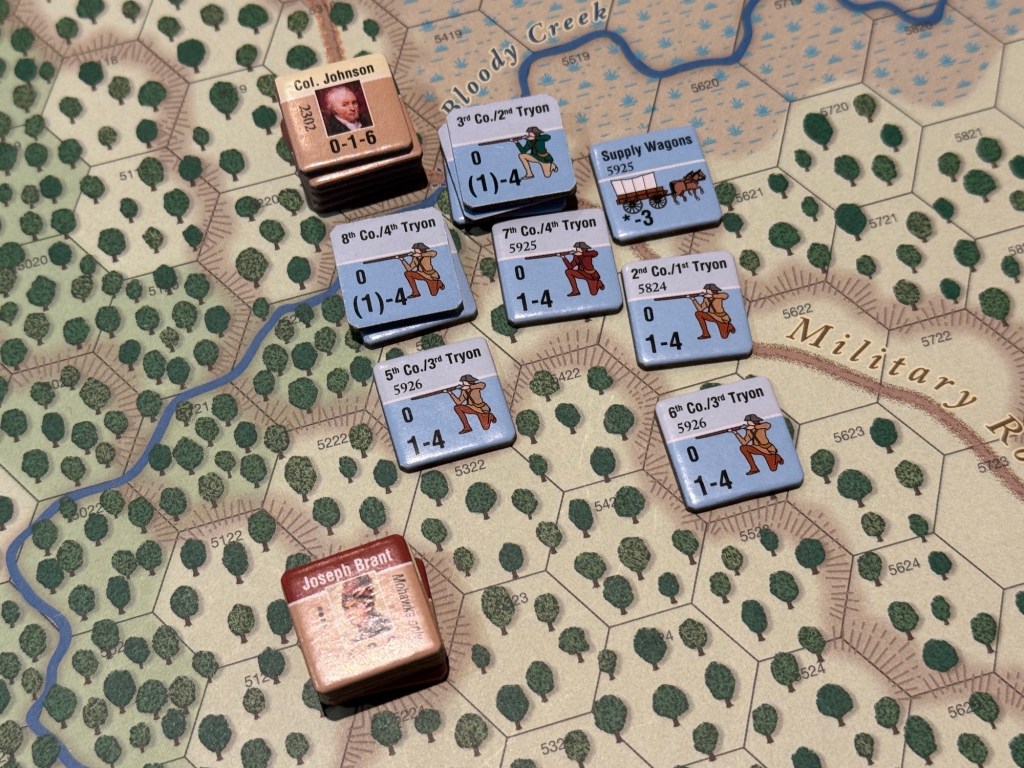
We decided to play the historical scenario for Oriskany which is a 6-turn game focusing on the August 6, 1777 ambush as General Nicholas Herkimer’s relief column is trying to make their way up the Military Road to Fort Stanwix.

The game starts with the British player having to set up their units in an ambush that has to be connecting contiguous units adjacent to the Patriots and they get an Ambush marker placed on them which will grant a 1 column shift to their attack if they can successfully make the ambush roll.

Alexander didn’t roll well so several of his units were detected and lost their element of surprise. You can see that 3 of his units lost their Ambush markers and this would prove to be a boon to the Patriots.

We spent the next 3-4 turns beating ourselves as our planned attacks were not working well and we basically rolled poorly and did damage to ourselves. Very odd but it was fun. But the best part of the system is the Tactics cards that create a bluff type of mind game.

The Tactics cards options are split into tiers with the 4 basic tactics always eligible to be chosen whereas advanced maneuvers require a commanding leader present and sometimes specific adjacent vacant hexes to execute. Common tactical choices include attacking in echelon, turning flanks, frontal assaults or attempting to withdraw. I very much enjoy this aspect because it adds a psychological tension that castes players to anticipate and bluff. Just a really neat addition to the game.

In the end, Alexander’s British and Indian allies ended up killing 2 of my leaders and also reduced 3 of my units and I was unable to advance the relief column to the point needed. He won the scenario with 4 VP to my zero. We had fun and I am glad we had a chance to play this one.

A leaderless rabble was defeated.

We then got in a game of Liberty or Death which is my 2nd favorite volume in the COIN Series.

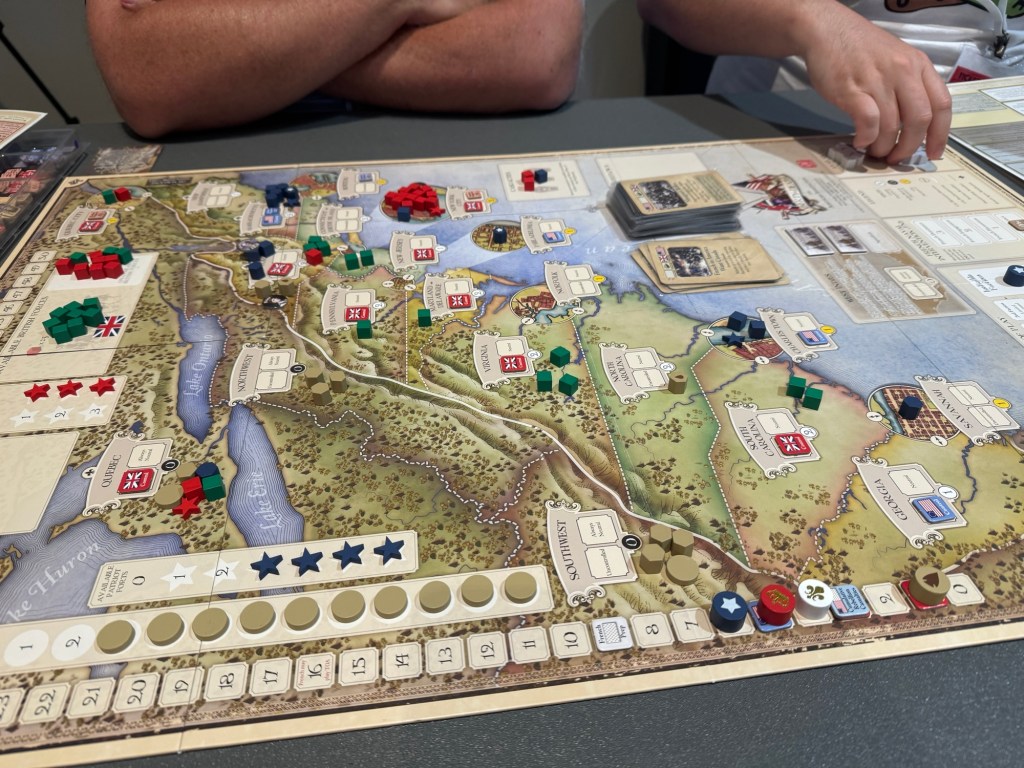
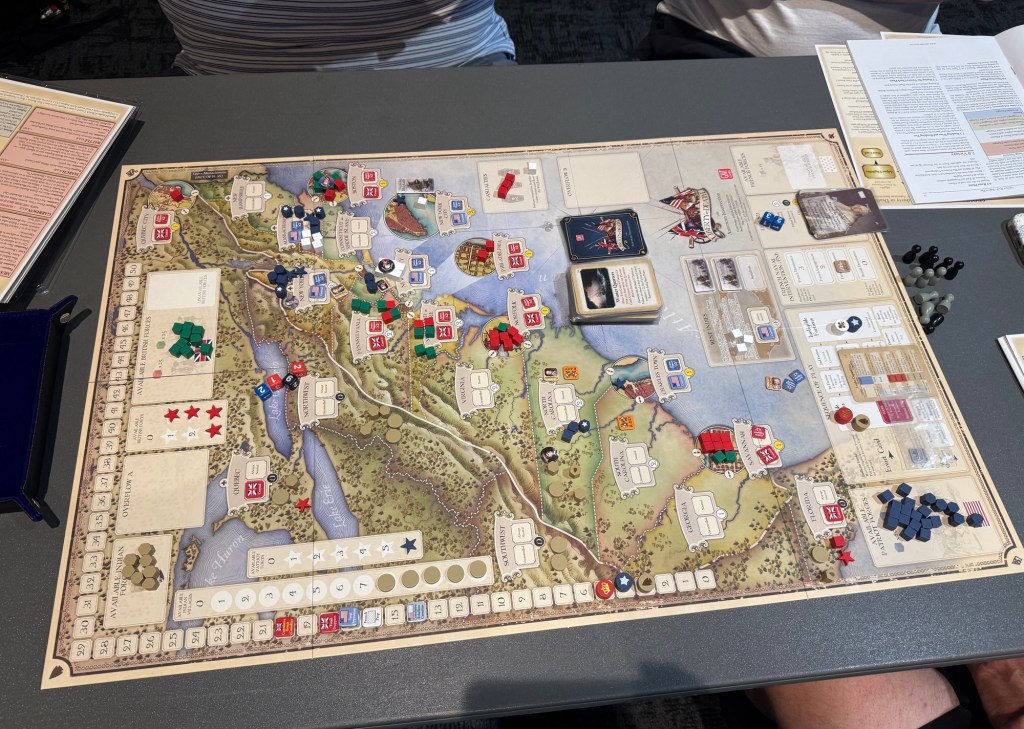
I played as the Indians and Alexander took the French. I worked on building Villages and then started Plundering the Patriots of their resources. Meanwhile the French did a great job of getting into the war early by the end of 1777 and then worked well with the Patriots to attack the British in New York and New York City driving them out of both. This put a great deal of pressure on the Indians as I had to continually Raid into these areas trying to keep their level of Opposition low.

In the end, Alexander’s French earned victory at the end of 1779 (5th deck) with the finals scores being French -5, Indians (Grant) -10, Patriots (Shane) -10 and British (Mark) -15.

I saw something I have not seen before as my Indians got skipped multiple times on my turns due to Brilliant Stroke cards, Winter Quarters and some inopportune passing. Just weird that I lost 3-4 turns and also got into a cycle of only getting Limited Commands due to the eligibility on cards.

We next took a few minutes to walk around the grounds at the Camden site. My favorite part was the redoubt.

The British redoubt.

I was very interested in the ditch in front of the redoubt wall and its formidable defense as sharpened wooden stakes called fraises are placed horizontally projecting straight out from the earthen parapet. Their primary purpose was to prevent attacking infantry from climbing up the exterior wall.

We had a long discussion about how effective these would have been as infantry would have to run this gauntlet to get at the defenders all the while taking rifle fire and cannon fire. Just diabolical really.

Once inside there are several protected covered areas for storage of arms and supplies as well as to offer some additional protection to defenders.

Just a really cool experience being able to get inside this fortification and experience the history.

We ended the night with a group dinner at a local brewery. We sat with our friend Bill Simoni and Mike from My Own Worst Enemy.

Tomorrow we are taking part in a 3+ hour guided tour of the Camden battlefield as well as nearby Hobkirk’s Hill. We are then going to play a few games including BoAR Newtown and possibly the new Small BoAR Cowpens.

-Grant

  •  

Gaming the American Revolution – Camden 250 Event Daily Debrief Series – Day 1

What a long day! Made up mostly of travel but I’m exhausted. We left my house this morning at 8:30am via an Uber to the airport where we made it through security and to our gate for a 10:15am flight from Indianapolis to Chicago where we transferred over with a 2-hour layover to a 1:30pm flight to Columbia, South Carolina.

We landed in Columbia at 4:30pm, grabbed our luggage and picked up our rental car to make the 35 minute drive to Camden, South Carolina on I-20.

We checked into the hotel and made our way over to the Camden Revolutionary War Visitor Center for the opening social event where we gathered with about 60 fellow wargamers who have all made the effort to travel here to play games over their weekend and also to tour the historic sites in and around Camden. If you didn’t know, Camden was pivotal to the story of the Southern Campaign during the American Revolutionary War with two battles fought within 6 miles of each other, bracketing the British occupation of the town. The Battle of Camden in 1780 was a decisive British victory that crushed the American Southern Army and brought disgrace to American General Horatio Gates. The Battle of Hobkirk’s Hill in 1781 was a British tactical victory that proved to be a strategic defeat.

Lord Charles Cornwallis’ Headquarters in Camden during the British occupation.
The British redoubt at Camden that has been restored.

We were able to catch up with lots of viewers of our videos and friends we have known for a long time as well as several designers, including Sam London and Justin Fassino. I also got a chance to chat with Gene Billingsley from GMT Games for about 30 minutes on a number of topics including gaming, publishing games, life and the event. I want to say that I took this opportunity to beg Gene to see about making a Deluxe Edition of Here I Stand as they have done with other games such as Combat Commander and For the People with new updated art, components and boards. He was not spilling any beans on the subject and wouldn’t give me an indication if it was either in the works or planned fur the future. Bummer but I made my pitch.

We then had a fantastic introduction on the event and the commemoration of America’s 250th Anniversary from Battles of the American Revolution Series designer Mark Miklos and Gene Billingsley. There were a lot of very touching and patriotic words spoken by these 2 and I truly felt great pride in our nation and the experiment that created it and has kept us strong these past 250 years.

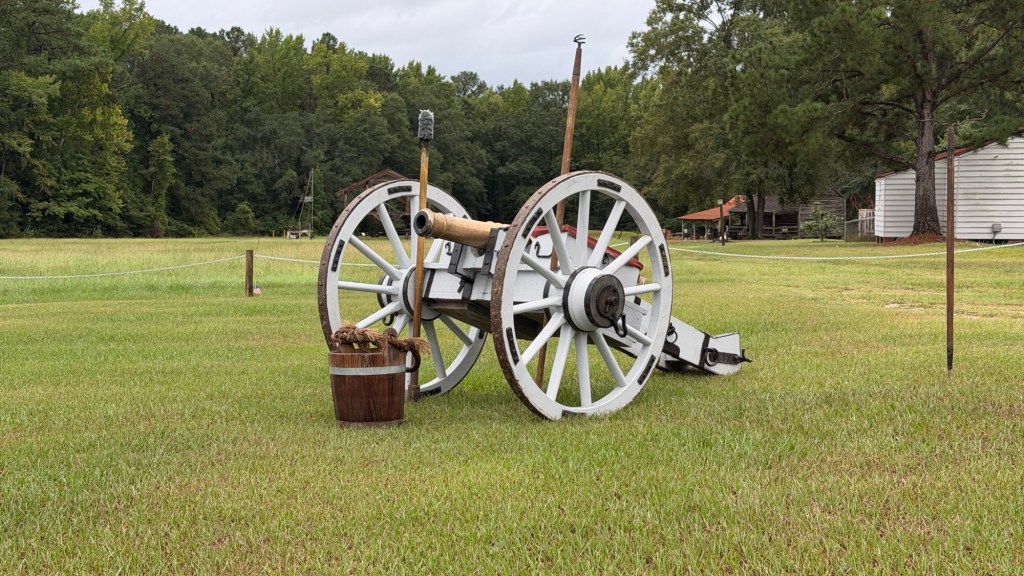
We then were treated to a live artillery firing by local volunteers of a period 1-pounder and it was quite impressive. When it was fired, it was past sunset and quite dark and the explosion was quite impressive and very loud.

Here are 2 videos we took of the firing with one being in real speed and the other in slow motion.

That was our evening and I’m very excited for tomorrow as there is an opening ceremony at 8:30am followed by open gaming. Alexander and I will be playing Oriskany, which is a bonus game included in Newtown from the American Revolution Tri-Pack #2, followed by a 4-player game of Liberty or Death. The evening will conclude with a group dinner.

-Grant

  •  

Gaming the American Revolution – Camden 250 Event Daily Debrief Series

If you have been following our blog for a while now, you know of my affinity for the history of the American Revolutionary War. I am a proud American, believe deeply in the principles of our land and the Constitution that governs it and am grateful to God every single day that our country was successful in our fight for its freedom in order to create a better society and to assist all peoples with protecting their “unalienable rights” endowed by a Creator, which include “Life, Liberty and the pursuit of Happiness”. I enjoy playing wargames on the American Revolutionary War and very much enjoy learning about the history and its key battles. There are many out there that feel the same as I do and they have designed lots of these type of games and with 2026 being our 250th Anniversary of the Declaration of Independence, there are events that are planned to celebrate it.

One of which is an event put on by GMT Games and Mark Miklos called Gaming the American Revolution – Camden 250 being held in Camden, South Carolina September 24-27th. The event includes 3 days of gaming centered on American Revolutionary Wargames produced and published by GMT Games but also includes several events, gatherings and historic tours of the Camden Battlefield.

We are attending and at the time of the posting of this are already on a flight on our way to Columbia, South Carolina via a short stop in Chicago, Illinois. We are very much looking forward to the event and have plans to play at least 2 games from the Battles of the American Revolution Tri-Pack II including Newtown and Oriskany, as well as any other opportunity that presents itself. We also are going to participate in the various tours of the Camden Revolutionary War Visitor Center and nearby battlefield and also plan to drive to a few others sites on our way home to the airport namely Waxhaws and Cowpens.

At the end of each day, I will be putting together a short summary of what we did that day at the convention. I would like to keep this to just a few paragraphs with several pictures to give you an idea of the games we played that day, people we talked with and other activities we participated in. We will still work on doing multiple videos as well that will be released on the YouTube Channel over the next few months but this written coverage will supplement the videos. This summary will most likely not be posted until near midnight EST each night so you might be checking it out the next morning which is fine.

Finally, if you are at the event please feel free to find us and say hello. I believe that we are very friendly and accessible and love to make connections with our fans and followers. In fact, we have TPA buttons and stickers to give away so just ask. We also would like to take a picture with you so we can document it in our writings.

Please check back each day for a summary of the days exploits. Thanks for following along.

Because this is a wargaming blog, I am going to share below some of our content we have made regarding AmRev War games for your review:

Gaming the American Revolution – Ranking the Games We Have Played – 2025 Edition

Interview with Mark Miklos Designer of Battles of the American Revolution Volume XI: The Battle of Green Spring: Prelude to Yorktown, July 6, 1781 from GMT Games

Interview with Mark Miklos Designer of Battles of the American Revolution Vol. 10 Battle of White Plains from GMT Games

The Beautiful Boards of Wargaming! – Battles of the American Revolution Volume II: Brandywine from GMT Games

The Beautiful Boards of Wargaming! – Liberty or Death: The American Insurrection from GMT Games

My Favorite Wargame Cards – A Look at Individual Cards from My Favorite Games – Card #59: Sullivan Expedition vs. Iroquois and Tories from Liberty or Death: The American Insurrection from GMT Games

My Favorite Wargame Cards – A Look at Individual Cards from My Favorite Games – Card #53: The World Turned Upside Down from Liberty or Death: The American Insurrection from GMT Games

My Favorite Wargame Cards – A Look at Individual Cards from My Favorite Games – Card #48: George Rogers Clark Leads a Western Offensive from Washington’s War from GMT Games

My Favorite Wargame Cards – A Look at Individual Cards from My Favorite Games – Card #33: Benedict Arnold from Liberty or Death: The American Insurrection from GMT Games

My Favorite Wargame Cards – A Look at Individual Cards from My Favorite Games – Card #22: The Gamecock Thomas Sumter from Liberty or Death: The American Insurrection from GMT Games

My Favorite Wargame Cards – A Look at Individual Cards from My Favorite Games – Card #13: Common Sense from Liberty or Death: The American Insurrection from GMT Games

COIN Workshop: Liberty or Death: The American Insurrection from GMT Games – Indian Faction

Turning the [Wargaming] World Upside Down – A Review of Liberty or Death: The American Insurrection by GMT Games

Best 3 Games with…The American Revolution!

“The Revolution was effected before the War commenced. The Revolution was in the minds and hearts of the people…” – A Review of Washington’s War from GMT Games

Guest Blog: The Battles of the American Revolution (BoAR) Tournament at the 2026 World Boardgaming Championships – After Action Report by Mark Miklos

Interview with Sam London Designer of Common Sense: An American Revolution, 1775-1783 from GMT Games

Interview with Javier Romero Designer of Battle of Pensacola 1781 in Strategy & Tactics Magazine #358 from Decision Games

My Favorite Wargame Cards – A Look at Individual Cards from My Favorite Games – Card #81: Baron von Steuben Trains the Continental Army from Washington’s War from GMT Games

Video Review for Battles of the American Revolution Tri-Pack II: Germantown:

Video Review for Battles of the American Revolution: Savannah with Mark Miklos:

Video Interview with Sam London Designer of Common Sense (as of yet unreleased):

Video Interview with Bruno Sinigaglio and Dave Stiffler Designers of Small BoaR Series: Battle of Cowpens:

-Grant

  •  

Interview with Yoni Goldstein Designer of The Nights of King Ludd: The Luddite War on Industry, 1811-? from The Dietz Foundation Currently on Kickstarter – Part II

The Dietz Foundation has a new game from Yoni Goldstein on Kickstarter called The Nights of King Ludd: The Luddite War on Industry, 1811-? (the game has already funded). The Nights of King Ludd is a 2-4 player game that deals with direct oath-sworn secret societies of English Luddites at the dawn of the Industrial Revolution in the English Midlands. Working together, players will build a secret network of saboteurs, ferry provisions and weapons on the black market, assemble raiding parties, and if all goes as planned, smash those “dark satanic mills” to cinders. Here is Part II of our interview with Yoni.

If you are interested in The Nights of King Ludd, you can back the project on the Kickstarter page at the following link: https://www.kickstarter.com/projects/dietzfoundation/the-nights-of-king-ludd

Grant: What is the layout of the board and the different locations?

Yoni: The board is divided into three panels. On the left, you will see the two card pools. The top row is where you place the “Regency” Cards, reactionary forces from London sent to quash the Luddite revolts. Below London are three cards representing the “Commons,” a shifting market of dual-use cards helpful to the players.

The central panel features the mills and enclosures. This is where players place their pieces (Weavers sympathizing with the Luddite cause), and the local Militia (the knight piece). The map depicts the “Luddite Triangle:” the West Riding of Yorkshire, Nottinghamshire, and Lancashire. 

The right panel holds the Manufacturer’s House (and the current Manufacturer), the pool of Employed Weavers, and the Stocking Market to track wages and productivity in the mills. On the far right panel, is the Australia space for weavers punished by transportation, and the “Saboteur Dice Pool.”

A ribbon at the bottom of the board displays His Royal Majesty’s Army progress toward the Luddite Holdout. This is effectively the round track, if the Luddites are unable to sabotage the three mills by the end of the third round, the game ends in collective defeat.

Grant: How does the game use cards? What different type of cards are included?

Yoni: In The Nights of King Ludd players build a collective card engine by acquiring dual use cards from the “Commons” to upgrade their actions (aka “Conspiracies” – more on those below). The main pool of cards is called “The Commons” which, as the name suggests, represents a mutual aid network of provisions, tactics, and personalities that the Luddites may draw from in the course of their clandestine operations.

“Commons” cards are dual use and drawn from the Draw Deck. They are beneficial in two ways: the top of the card displays a persistent upgrade to any Conspiracy action and is locked into the player board to form a tableau. The bottom of the card displays a “Raiding Party” effect, a one time effect that can be triggered when a Raiding Party is formed and dispatched to a local mill.

The antithesis of the Commons is the “Regency,” a deck of cards reflecting the alignment of the aristocracy in London with an ascendent industrial class against the Luddite cause. They are drawn whenever the Luddites make themselves known in public: fomenting a mob, carrying out an assassination, or setting a factory on fire. When drawn, they set the machines of industry into motion; driving up productivity, plummeting wages, and calling the local constabulary to police the countryside. 

Once more than three cards are in the “London” track above the Commons, a nasty event is resolved. These effects will intensify the game’s challenges. Sympathetic weavers will be exiled to Australia, the militia will sweep into the local mill to root out hidden raiders, and  the Commons will be parceled off and sold to the highest bidder.

Grant: What is the role of the Persona Cards? Who are these figures?

Yoni: As mentioned in Part I of this interview, each player represents a secret society of Luddites organized around a particular “persona.” These personae introduce a special ability, as well as their their own victory condition, aka a “Motivation”, and a unique “Woe” – a card shuffled into the Draw Deck at setup that will, inevitably, undermine their efforts. There are six persona to choose from.

In clockwise order, they are:

  • Mary Molyneux, 19, and Lydia Molyneux, 15, were two sisters who, in 1812, stormed a steam-driven cotton mill outside Bolton shouting, “Now Lads!” – encouraging the mob to set the building afire (and they steadfastly did so).
  • Lady Ludd: “The “Lady Ludd Riots” took place in 1812 when a group of women and young lads – “distressed” by the precipitous rise in corn prices – marched through Leeds, assaulting merchants and “beating up for a mob.” They were led by a disguised person “who was dignified by the title of LADY LUDD.”
  • George Gordon Byron, 6th Baron Byron, “a young poet with the chiselled good looks, the oddly deformed club foot, and an obscure and very prestigious peerage,” was an eloquent Romantic dandy who rose to defend the Luddites before the House of Lords in 1812. Byron sympathized with the weavers near his home north of Nottingham; “the real cause of their misery [was] the destructive warfare of the last eighteen years, which has destroyed their comfort, your comfort, all men’s comfort.”
  • Elizabeth Studham was one of seven women tried for arson during the Swing Riots of 1829-30, an echo of the Luddite rebellion. At the age of 19 she set fire to an East Kent workhouse, demanding a wage increase for farmers threatened by threshing machines. Studham was deported and served 14 years and two months in Van Diemen’s Land (Tasmania) during which time she gave birth to two children of whom records are sparse. She would later be sentenced for 10 offences, primarily for bad language.
  • Lt. George Mellor was a Cropper and Yorkshire Luddite known to the movement as General Ludd’s Right-Hand Man. A strong willed and roguish machine-wrecker, he eventually faced a hanging sentence for the murder of a wealthy mill owner whom he shot in the groin. Eventually, Mellor was arrested in October of 1812. It is said he raised his hands in shackles and shouted “Three cheers for General Ludd!” 
  • John Baines the elder was an “intelligent Hatter” and president of the local Republican Club of St. Crispin. Baines dreamt that Luddism would one day blossom into a democratic revolution;  “Let the people now rise and rid themselves of this vile brood who flung upon them the sole taxation of the country and reduced them to the condition of galley slaves!” He was found guilty at the York Special Commission of administering illegal oaths and died on board a prison hulk in a Portsmouth harbour, on December 21st, 1814. 

Grant: What is the purpose of the Manufacturer Card?

Yoni: At the beginning of each game, one of the three Manufacturer Cards is selected at random and placed face up in the “Manufacturer’s House” space on the board. The initial effect (tuck 6 cards from the draw deck beneath the manufacturer) represents the nascent industrial class’ emphasis on extracting from the commons, resolving at the start of each round. In practical terms, this prunes away the players’ available card pool over the course of play as well as ambiguates the composition of the draw deck. When a manufacturer is assassinated, all the cards tucked beneath are discarded (and will shuffle back into the Draw Deck) and the Manufacturer Card is flipped to reveal a more reactionary and dangerous side.

Grant: What are Conspiracy Actions?

Yoni: At the beginning of the game, each player has five conspirators (four for Lord Byron) at their command. Spending a conspirator allows the player to activate one of the four following Conspiracy actions (per turn):

Rally Local Weavers: either place a weaver from the supply pool at your presence pawn, or move your pawn and any weavers to another enclosure on the map.

Trade in the Commons: pick up a card from the Commons and tuck into one of the columns on your player board. That card allows for secondary actions whenever that matching Conspiracy is activated.

Assemble a Raiding Party: a two step action, move one or more weavers from an Enclosure (spaces on the map adjacent to Mills) into a Mill. This sets up a future sabotage action. Then, activate one of the Raiding Party effects in the Commons. This is the primary means of building your Saboteur Dice Pool. The more raiders you have at the Mill, the more dice you are permitted to roll during a Sabotage operation.

Lastly, you may Incite a Mob, placing a Mob Tile next to an adjacent Mill. For a sabotage roll to be successful, the die rolls must match an icon depicted on the Mob tile – hammer, gun, or torch.

Grant: What type of secondary effects come from cards tucked into the Column on Player Boards?

Yoni: Once you use a Trade conspiracy to move a card from the Commons to your tableau (your “Secret Society”), you can activate it, along with any other card in that same column on your player board, every time you resolve that conspiracy action. This allows for chaining and sequencing a series of effects that may have significant impact on your objective to destroy the mills.

Grant: Can you show us a few examples and explain their use?

Yoni: For example, let’s say you are George Mellor and you are seeking to assassinate the manufacturer. You resolve the Trade conspiracy to take “Dispatch Delegates to Neighbouring Counties” and place it in your Trade column, meaning it will be available to you immediately after this primary action. In previous turns you’ve already acquired an ongoing ability, “Mellor Takes a Shot at Mr. Horsfall!”, giving you an extra die for Assassination roles (helpful, since these operations are so risky!). You activate “Dispatch Delegates…” to activate a Raiding Party effect (the bottom of the card) in the Commons, which happens to be your partner in crime, “Martha Mellor Defends the Accused.” She allows you to roll for Assassination, but will be removed from play once that effect is resolved.

Grant: How does Sabotage and Assassinations work in the game?

Yoni: At various points in the game, players may elect to roll for Sabotage or Assassination. Of course, certain maneuvers must take place for these brazen attacks to succeed. Sabotages are larger scale events and are aimed at the Mills. You must have assembled a raiding party at the Mill and incited a Mob to spurn them on. As mentioned above, you roll one die per weaver cube at the Mill and attempt results matching the icons on the Mobs you’ve placed. The dice are D6s with the following faces: 3 blanks (a miss), 1 Torch, 1 Gun, and 1 Hammer. So with one Mob tile matching one of those icons, each die you roll has a 1 in 6 chance of hitting. If all three Mobs are in place, the odds climb to 1 in 2 per die. 

An assassination is a similar roll, but only one die may be cast and hits are only the gun or hammer. Beware, the Regency will respond with a draw from its deck for both sabotage and assassination rolls!

Grant: What are you most pleased about with the design?

Yoni: As Dan Thurot noted, “The Nights of King Ludd points toward a more experimental direction than Chicago ‘68 and I feel it reflects a degree of growth and maturation as a designer. It’s a game that seeks to capture both the panoramic view of a people’s struggle as well as sketching out the personal incentives that motivate individual participation in (and sometimes sacrifice for) a collective cause”. 

Grant: What other games are you currently working on?

Yoni: I am currently working on a commission for an international art exhibition on “sociopolitical freefall.” This will be a smaller box game and will also be developed by Joe Dewhurst. I’m also co-designing a project about Mai ‘68 with Fred Serval. This game is about the French experience of student and labor riots in 1968. While it shares the themes of Chicago ‘68 it’s driven by a completely new system.

If you are interested in The Nights of King Ludd, you can back the project on the Kickstarter page at the following link: https://www.kickstarter.com/projects/dietzfoundation/the-nights-of-king-ludd

-Grant

  •  

Unboxing Video: Battles of the American Revolution Tri-Pack II: Monmouth, Germantown and Newtown from GMT Games

Battles of the American Revolution Tri-Pack II: Monmouth, Germantown and Newtown is the second compilation of earlier releases from GMT Games’ Battles of the American Revolution Series. These are tactical level battles at the regimental level with a map scale of approximately 200 yd/hex.

Additions to the original releases include:

  • maps are hard-mounted
  • packaged in a GMT “deep box”, which is a 3″ box
  • rules and player aids printed in color
  • all replacement counters that have been issued since the games’ original releases
  • a new one page matrix-style play aid to assist the First Nations player in Newtown
  • Joel Toppen’s Solitaire Tactics Card play aid
  • a significantly upgraded Germantown rulebook addressing errata and ambiguities

-Grant

  •  

Interview with Yoni Goldstein Designer of The Nights of King Ludd: The Luddite War on Industry, 1811-? from The Dietz Foundation Currently on Kickstarter – Part I

As you know, I do love me a good Card Driven Game….or a game that uses cards….multi-use cards. I love cards because it allows for the designer to keep a game going while using a vehicle that incorporates special rules that fit a historical situation but also to be able to use bits of the history itself to teach the players about the topic. A few months ago, I caught wind that The Dietz Foundation was working again with Yoni Goldstein on his second game called The Nights of King Ludd: The Luddite War on Industry, 1811-? that recently launched on Kickstarter (the game has already funded). The Nights of King Ludd is a 2-4 player game that deals with direct oath-sworn secret societies of English Luddites at the dawn of the Industrial Revolution in the English Midlands. Working together, players will build a secret network of saboteurs, ferry provisions and weapons on the black market, assemble raiding parties, and if all goes as planned, smash those “dark satanic mills” to cinders. I reached out to Yoni to get a bit more information about the design and he was more than willing to share.

If you are interested in The Nights of King Ludd, you can back the project on the Kickstarter page at the following link: https://www.kickstarter.com/projects/dietzfoundation/the-nights-of-king-ludd

Grant: Yoni welcome back to our blog. What have been your feelings about the reception of your great game Chicago ‘68?

Yoni: I’ve joked that I’ve taught this game now more than I’ve played it (of course this is only true if one just counts the last couple years!). Since 2024, I’ve taught it to a diverse and intergenerational cohort of non gamers, grognards, peace activists, veterans, and even a few spooks. Inevitably players relate the experience they are having on the board to what they see in their neighborhoods: protests and tear gas, troops deployed into cities, election interference, and so on. Those conversations are still ongoing and I’m heartened that Chicago ‘68 is facilitating a space for that.

Grant: What lessons did you learn from that experience that have helped you with your new game?

Yoni: I’m grateful that Joe Dewhurst, who developed both Chicago ‘68 and the upcoming The Nights of King of Ludd, guided me through the design, testing, and development processes. Ludd is my second game and it went through a number of iterations, but this time we had a proper methodology in place. Likewise, The Dietz Foundation was very transparent with the manufacturing and publishing side of things, which gave me a deeper understanding of the timeline and proofing / editing process that accompanies those final stages of production.

Grant: What is your new upcoming game The Nights of King Ludd about?

Yoni: The Nights of King Ludd is a collaborative game for 2-4 players about the Luddite revolts in the English Midlands. Set roughly around 1811, the game tells the story of local workers in the textile industry (“weavers”) forming secret societies and leading armed raids against mills and factories in their communities. Players command an oath-sworn organization of conspirators working with the Luddites to achieve the collective goal of machine wrecking while also attempting to meet their individual motivations (which may include assassinating the local manufacturer, spurring a republican revolution, or just avoiding an Australian exile).

In terms of game mechanics, you are building a dice pool while also maneuvering pieces and collecting multi-use cards to modify your roles. Collectively you are building a tableau and operating it together to mount a series of raids against the three Mills on the map.

Grant: What is the meaning of the title of the game? What should it convey to players about the game and the history it represents?

Yoni: The title of the game is borrowed from a chapter in Gavin Mueller’s book from 2021, Breaking Things at Work. Mueller is among a cohort of authors, including Kirkpatrick Sales (Rebels Against the Future), Brian Merchant (Blood in the Machine) and Cory Doctorow, who are working to reconsider the Luddites’ reputation in the age of AI and the gig economy. Rather than seeing them as misguided revolts against the inevitability of technological progress, these writers appraise the Luddites in their historical context as severely desperate labor movements against tech oligarchies. The Luddites’ aims were, ultimately, to raise the minimum wage, cease child labor, and to maintain a higher standard of craftsmanship and quality in the production of textile goods. At every point their appeals to authority were spurned. So they turned to mob justice. “You may call the people a mob,” remarked Lord Byron before Parliament, “but do not forget that a mob too often speaks the sentiments of the people.”

The subtitle of the game, “The Luddite War on Industry, 1811-?” is also a cheeky nod to Volko’s Labyrinth: The War on Terror, 2001 – ?. While these games don’t share a mechanical similarity, they both explore the ongoing and unpredictable nature of insurgencies. 

Grant: Why was this a subject you wanted to focus on?

Yoni: My area of interest in game design, broadly speaking, is movement politics on an operational scale. As with Chicago ‘68, the Luddite war on industry feels an under-explored subject matter in historical gaming. While there are certainly titles about the Industrial Revolution from the perspective of barons and magnates (especially in the Euro game niche), little is mentioned about the social, political, and ecological costs of these endeavors for progress. 

Moreover, the story of the Luddites and their “secret societies” is about the tensions of modernity. New technologies combined with extensive wars abroad drove a rise in food costs and detonated an affordability crisis in the imperial homeland. Communication media (handbills, newspaper editorials, and pseudonymous letters) was an instrument of persuasion, vitriol, and threats. Suspected Luddites and their sympathizers were surveilled by the state, which increasingly saw its interests entwined with industrial capital. We’ve seen this all before! 

Grant: What are the unique features with the system used for the game?

Yoni: The Nights of King Ludd has a unique framework for collaborative engine building. Initially, players draw from “The Commons” (a shifting card pool) where each card has the same “trade cost.” On your turn, you may activate a Conspirator (spending an action point) to draw a card into one of the columns in your tableau. Each column upgrades your actions with a permanent ability. If you specialize your actions, you can harmonize a collective strategy between players and hone in on the steps you need to take to sabotage the mills. 

In the Commons we are evoking the notion of a shared economy. But this may shift dramatically when decreasing wages and increasing productivity converge. Then, the Commons transforms into the “Common Market.” Now, players are building their tableaux with an increasing cost, similar to the Pax Series (for example, Pax Pamir or Pax Renaissance). Each player is now facing a decision: overwork their cabal of conspirators or draw on the labor power of the workers in the textile industry (which drains their militant power on the map).

Grant: What does the collaborative portion of the subtitle mean for the game? How do the players cooperate?

Yoni: I choose “collaborative” not “cooperative” as a descriptor to emphasize the multi-victor nature of the game. In The Nights of King Ludd, each player chooses not only their persona and their role in the Luddite struggle (with asymmetric abilities and effects), they also put forward a “Motivation.” Motivations are personal victory conditions that unlock if the collective win condition (destroying all three mills on the map) is met. This gives shape to the degree of player friction in the game. For example, Lord Byron’s motivation is to turn down the heat from the ruling Regency. His motivation is in conflict with George Mellor’s, the famed assassin, whose attempts at the Manufacturer’s life will ratchet up the crown’s crackdown. But pair John Baines, a republican agitator, with the Molyneux sisters, two young women destined to labor in the mills, and the gameplay will tilt more toward cooperation. In this case, Baines is working to regulate the industriousness of the mill (keeping productivity low and wages high) while the Sisters are interested in keeping workers employed. So the degree of cooperation is up to the players, and as often happens, someone may have to make a noble sacrifice for the collective good.

Grant: What did you need to model regarding the English Luddites at the dawn of the Industrial Revolution?

Yoni: As EP Thompson (The Making of the English Working Class) notes, the history of the Luddites is, at best, “opaque.” We are grappling with a story about secret societies in an era where workers associations were illegal and damaging weaving frames was a capital offence. As such, we have dubious claims from government spies, confessions before “hanging judges,” and pseudonymous letters and handbills. Consequently, the model had to be expansive enough to capture the granular nature of these conspiratorial operations, but also open enough to allow for the plausibility of a broad range of player actions.

For example, one of the core actions is to “rally local weavers,” which is a form of recruitment. In game terms, this means moving one of the Employed Weaver cubes into an Enclosure where they can contribute to your force strength. This action may represent members of your secret society swearing in sympathetic workers in local pubs, or calling a clandestine meeting in the nearby woods. We don’t know precisely how the Luddites organized themselves, so the language has to be inclusive of these possibilities. Players then “assemble a raiding party”, which is to move the cubes from the enclosure into a nearby Mill. Each cube in the Mill space adds a die to the Sabotage roll (which is the primary means of wrecking machines). So here is a group of raiders hiding in the hedge and awaiting the signal from King Ludd. They are spurred on by the Mobs who have surrounded the site, represented by these Mob tiles. Matching a die roll to the symbol on the Mob Tile is how you roll a “hit.” The intention is to shape a series of amorphous and difficult to historicize chain of events into a familiar wargaming mechanism: rolling a handful of dice representing an “attack” and applying modifiers to the results.

Grant: What is your design goal with the game?

Yoni: My overall aim was to develop a system that could express a relationship between an abstract economic system, worker uprisings, and the coming together of industry and aristocracy to form a ruling class. But on a purely design level, I wanted to work within the framework of a Pax Series style market that you encounter in games like Pax Pamir and Pax Renaissance. That is, a shifting market of cards that players can purchase and place into their tableau. It’s an evocative description of history as a bazaar of possibilities and counterfactuals. The Nights of King Ludd tweaks this vision of history as somewhere between a commons (a gift economy) and a market (which costs worker power as in-game resources).

But really, I want this to be a “raiding party game.” Beneath the heady layers of history and theory is a brisk experience featuring dice odds, clever combos, and cooperation with your friends (while slyly pushing your own agenda!).

Grant: What other games did you use as inspiration?

Yoni: John Company from Wehrlegig Games is certainly one of the biggest inspirations, taking place in a similar era of British imperial economic imperialism (Ludd is at the tail end of JoCo’s later scenarios) and drawing on the satirical printworks of the time. Like John Company, players are asked to intervene in an existing ecosystem. In both games, player actions accelerate a system that will simultaneously reward and punish everyone at the table. How this is doled out is uneven, so players have to weave and dodge to make best of a collapsing infrastructure. 

Grant: What sources did you consult about the history?

Yoni: An invaluable resource for all things Luddite is the Luddite Bicentenary curated by Richard Holland. This is a comprehensive digital archive of historical ephemera devoted to Luddism, including handbills, court transcripts, and other images and texts. I also quote extensively from Rebels Against the Future by Kilpatrick Sale and The Risings of the Luddites: Chartists and Plug-Drawers by Frank Peel, E.P. Thompson, as well as The Making of the English Working Class also by E.P. Thompson.

Other reference texts include: 

Writings of the Luddites edited by Kevin Binfield

Ben o’ Bill’s, The Luddite: A Yorkshire Tale by Daniel Frederick Edward Sykes, George Henry Walker

Breaking Things at Work: The Luddites Are Right About Why You Hate Your Job by Gavin Mueller

The Luddite Rebellion by Brian Bailey

Blood in the Machine by Brian Merchant

Women in Protests 1800-1850 by Malcolm Thomis

Convict Lives at the Launceston Female Factory (A swing rioter: Elizabeth Studham by Keryn Rivett), edited by Lucy Frost & Meredith Hodgson,

Grant: What is the dice pool building mechanic and how does it work in the design?

Yoni: At the core of the game is a fairly straightforward dice mechanic for resolving raids against the three mills on the map. Throughout the course of the round, players add “saboteur dice” to the dice pool, representing the Luddite’s militant capacity. These are D6’s with the following icons: gun, hammer, and torch (matching the “mobs tiles” – armed rabble surrounding the mill). The remaining three sides are blank and always result in a miss.

When a sabotage operation is initiated, the number of dice rolled is determined by the number of raiders you’ve positioned at the mill and what constitutes a possible hit is determined by the matching icons on the nearby mob tiles (again; gun, hammer, or torch). All misses are returned to supply but if at least one hit is rolled, you may push on and carry out multiple raids, striking at other mills as well.  

As your readers can deduce, the purpose of the tableau building and the card engine is to modify the odds of the roll in your favor, i.e. the more raiders you assemble the more dice you will roll, and the more mobs you’ve fomented the more likely you are to roll a hit.

Grant: What is the general Sequence of Play?

Yoni: As neighboring societies of Luddites, you have three rounds before the Crown musters its army and crushes the revolts. Each round is structured the same: 

  1. Dawn: Industry Operates – at the beginning of the second and third round your adversaries in London will take actions against you, sending the militia on patrols and accelerating industrial production.
  1. Day: The Manufacturer Speculates – during this phase, the local manufacturer will take an action, depleting the Commons of its resources.
  1. Night: The Luddites Conspire – this is the main phase of the game, where each player takes turns resolving a Conspiracy action by spending a Ready Conspirator cube on their boards. Each player takes a primary Conspiracy Action and resolves any secondary effects on Cards tucked into the Column of that Conspiracy on their Player Boards. In this phase, players can attempt a sabotage roll to destroy the Mills.
  2. Round’s End – when there are no Ready Conspirators (or all players pass) players reset the components for the next round. 

Thank you for your time in answering our questions Yoni! I am very much interested in this game and its efforts to tell this very interesting story of resistance. While this is not a traditional wargame, in my opinion it certainly merits a serious look from wargamers who are interested in CDG’s and games that use cards and that are interested in seeing these type of non-traditional historical subjects represented. I have backed the project and look forward to getting my copy next year!

If you are interested in The Nights of King Ludd, you can back the project on the Kickstarter page at the following link: https://www.kickstarter.com/projects/dietzfoundation/the-nights-of-king-ludd

In Part II of the interview, we will dive more into the makeup and uses of the card, concepts of Breaking the Oath, profit and market manipulation.

-Grant

  •  

Interview with Sam London Designer of Common Sense: An American Revolution, 1775-1783 from GMT Games

In November 2024, while attending the SDHistCon, we sat down with designer Sam London to play his upcoming game called Common Sense (it was originally called Absolved from All Allegiance), which was announced on GMT Games P500 last year. The game is an American Revolutionary War Strategic Level game that uses trick taking and is a struggle over the Will to Fight Track that measures the level of commitment by both sides to the fight. We recently reached out to Sam to get some more details to share about the design and he was very glad to oblige our request.

If you are interested in Common Sense: An American Revolution, 1775-1783, you can pre-order a copy for $58.00 from the GMT Games website at the following link: https://www.gmtgames.com/p-1217-common-sense-an-american-revolution-1775-1783.aspx

*Keep in mind that the design is still undergoing playtesting and development and that any details or component pictures shared in this interview are for prototype purposes and will definitely change prior to final publication as they enter the art department.

Grant: Sam welcome back to the blog. How are your other announced game projects coming along?

Sam: Thanks for having me back! Things are going well. I am hands off on Firefight Tactical at this point. All of the content art is complete and we are just working on things like rulebook layouts. I am very much looking forward to getting it out the door and into people’s hands. Microverse has most of the art complete. I am doing a few tweaks to the bot still to get it to a point I am happy with it, but in truth it is not tracking far behind Firefight Tactical. They both have been wonderful experiences from a development and production stand point and I cannot speak highly enough of the various teams I have worked with at GMT on these games.

Grant: How have you changed as a designer over the past few years?

Sam: This is an awesome question and I am grateful to be asked it as it forced me to do some introspection. To explain I will have to make some references to film making. As I have stated previously I have been designing games for a couple of decades at this point and only started trying to get my designs out there after Covid. The truth is that while this gave me lots of opportunities to refine my design chops, it was ultimately just me learning in a bubble. Coming into the hobby as a designer rather than a gamer, I fancied myself as a sort of auteur designer. For those not familiar with the term in the context of film making, this is an approach to creative endeavor where everything is made to conform precisely to one person’s specific vision. After getting to work with so many fantastic people, decidedly outside of my bubble, I have taken a bit of a 180. While I still own the ultimate vision, I now recognize that the odds that I understand the optimal route to get to that destination are unlikely, and that pretending I do will often result in an inferior game. This isn’t to say that I am going to incorporate every bit of feedback I receive into my designs. It does mean that I am more able to recognize weaknesses in my designs as conceived and solicit feedback from others to get around my blind spots. 

Grant: What specific lessons have you learned about design?

Sam: The big one would be about systems pruning. Most people, myself included, understand academically that design complexity for complexity’s sake is not good. Putting that principle into practice, especially retroactively, is far more challenging. Every mechanism in the game has to serve the player’s enjoyment without making the cost of entry too daunting. This can often mean cutting mechanisms that I am particularly passionate about, but for which I am the sole audience (or close to it). This is especially difficult for me because I consider myself a systems designer, and I virtually always approach the mechanics of a design first.

Grant: What is your newest project Common Sense about?

Sam: Common Sense: An American Revolution, 1775-1783 is a card driven strategic level wargame covering the American Revolution. It attempts to offer a comprehensive view of the conflict, all the way from the battlefield to the halls of the Continental Congress and British Parliament.

Grant: Why was this a subject that drew your interest?

Sam: I always knew I would want to do an American Revolution game. The problem was that I needed a system that would fit my thesis of the conflict. A few years back I was working on a Barbarossa game and every step of the way I was thinking I would rather do that system in the American Revolution. The more passionate I became about that, the more I started to flesh out the system in ways that didn’t make sense for Barbarossa. Eventually that game ended up in the trash bin and Common Sense got my attention instead. I think the American Revolution is such a fascinating subject because it’s a real David and Goliath story. I of course am keenly aware that in reality it was more of David vs Goliath while Goliath is arm wrestling another giant while also trying to solve a Rubik’s cube, but there is still a lot of inherent heroic optimism to that history. Also, everyone loves a good underdog story.

Grant: What is your design goal with the game?

Sam: My design goal for the system was to see how much personality I could give to the belligerents without making their asymmetries require too much rules overhead. We have all played asymmetrical games where you feel like after you read your rulebook you need to read the other player’s rulebook to have a comprehensive understanding of the game. Here, while there are some mechanisms that are specific to each side, the asymmetry is more in terms of each player’s strategic concerns rather than their tools to execute upon them. All of these relate back to this unifying concept of “resolve” which is an abstraction that allows us to relate the varying strategic concerns into a single mechanism.

Grant: How did you focus on creating asymmetry on each side? What are some basic examples of these differences?

Sam: As noted above, I viewed each side in terms of what was unique about their concerns and what was unique about their tools to address them. For the British as an example, they are tremendously constrained by supply. It isn’t just a supply line (though it is that too), it’s a currency they spend to move and battle with units. Obviously historically supply was a concern for the Colonials as well, but it did not hamstring them to the same degree, so the Colonials don’t have to worry about it at all. What’s more, this opens up strategic opportunities for the Colonial player to attack the British in other areas to force the British player to split their limited resources. An example for the Colonial player is Attrition Combat. Each time the Colonials battle in a space they control on their turn, they have the option to resolve Attrition Combat, in which they cede control of that space to the British but as a result can resolve the battle without risking return fire. At the beginning of the game this must be used strategically and sparingly, but as certain key personalities in the Colonial Deck, from George Washington to Francis Marion enter play it becomes far more powerful.

Grant: How does the game use trick taking? Why was this a good choice for your vision of the game?

Sam: I am actually trying to get away from that term, as I think it causes people to think that Common Sense is a lighter game than it is. It invokes pithy card games rather than sweeping strategic affairs played out on a map. The final rulebook will likely make no reference to standard trick taking terms. I chose it as a core mechanism though for a variety of reasons. One I will cover in a future question, but the other reason is because I became very interested in the question of card balance. If I have a card driven game with a variety of card effects, and I want them to vary in their power, they have to be balanced in some way. The most common way this is handled in game design is to make them have a proportionate cost to play using some in-game currency. I was more interested in making the powerful cards more difficult to play. In fact, I wanted to take a step beyond that and say that not only are they more difficult to play, but they are never guaranteed. This gave me a simple way to inject far more personality into the cards and make some have a tangible weight to them when they manage to enter play. “Ha ha, I play King George. You’re in trouble now.” Trick taking was a natural fit for this as the rules overhead for it is comparatively light and the cards come with their own intrinsic value based on the ease with which they can be used to win tricks.  

Grant: What is the makeup of the cards? Can you share a few examples with us and explain their use?

Sam: Each year players will begin their turn with a ten card hand. They can perform a strategic mulligan of up to 5 cards each year. This is not in case a player got a “bad hand” but rather so they can try to postpone getting cards that do not fit their strategic objectives at the start of the year. The year is then played out over a series of ten “clashes” in which the initiative player plays a card face up and then the other player does the same. The initiative player’s card sets the suit for the clash and the non-initiative player must follow the suit of that played card if able. Then the player who played the card with the higher initiative value (ties going to the non-initiative player) resolves their card. 

In this example (all placeholder art at this point in the game’s development by the way), the Colonial player has initiative and plays the Artemis Ward card into the clash who is a 6 value of the Battle suit. The British player then plays Battle of Quebec into the clash which is a 7 value of the Battle suit. Battle of Quebec then resolves.

The British player immediately gains a supply (the orange wagon in the upper right corner). This is a special bonus effect present on some cards. The equivalent effect for the Colonials is to go up on the Continental Congress Track. They now have the option to cancel the resolution of the card to perform any one of their available actions. If they choose to continue to resolve the card they resolve its event first. Battle of Quebec’s event is of the type “special action,” which offers additional effects to the action on the card. In this case, if the Battle action is used to resolve a battle north of the Winter Line, the Colonial player must reroll all their successful hit dice once. The last piece is the yellow star under the Battle suit icon which indicates Battle has “advantage” over the Special suit. This means that if the non-initiative player does not have a card of the clash’s suit to play into the clash, any Battle card will always beat a Special card.

Grant: What different suits are included? What use does each have for players?

Sam: There are three common suits which are universals and one special suit which is player specific. The three common suits are March, Battle, and Recruit. March is used to move armies about the board, Battle is used to fight, and Recruit is used to get more units to fight with. There are asymmetries in how these resolve but the goals of their use are the same, which is why they are considered the common suits. 

Grant: What is different about the Special Suit? How does it benefit players?

Sam: The Special suit is different for a couple of reasons. First all of the actions contained in the Special suit cards are unique to that player. The Colonial player can train their militia units into the Continental Army and negotiate with the French, eventually bringing in and performing actions with French pieces once they enter the conflict. The British player can recruit, move, fight, and raid with Native units and move and battle with the British navy. A lot of the flavor of the two sides are contained in the Special suit. The other thing that is different about the suit is that the Special suit allows you to resolve any combination of these actions. For example a Battle x 3 card allows you to resolve up to three Battle actions. A Colonial Special x 3 on the other hand will allow them to perform a mix of any 3 train and French actions which offers flexibility.

Grant: What is the purpose of the Resolve Track?

Sam: I mentioned the Resolve Track earlier when I was describing how most of the asymmetrical concerns of the players coalesce into a singular concept. The Resolve Track serves three purposes. Firstly, it is the game clock. While the game can end in the event that you completely resolve the year 1783, it will more commonly end when the British and Colonial Resolve markers cross. Each player’s Resolve marker starts on opposite ends of the track and moves towards the other end as they lose resolve. Once they cross, the year is completed and final scoring occurs.  

Grant: How do players manipulate this track? What benefits or detriments does it provide to players?

Sam: This is where the other functions of the Resolve Track come in. The second purpose is that many of the points for determining final score and victory come from the Resolve Track. Finally, resolve has a tremendous impact on both sides’ ability to recruit new units, the Colonials in particular. This is another demonstration of the game’s asymmetries actually, as the Colonials are far more impacted by resolve loss both from a scoring perspective and a recruitment perspective than the British. In regards to how the track is manipulated, common track manipulations only cause a loss of resolve. There are several ways resolve is regained, but they are all due to specific card effects. The British primarily lose resolve by losing British Regulars in battle and by being overcommitted to the American conflict at the expense of their other global conflicts. They can also lose resolve by overusing Hessian mercenaries, who are good and reliable but cost money that parliament is loath to spend. The Colonials on the other hand will lose resolve mostly due to the British seizing control of colonies, Winter Attrition, and failure of the Continental Congress to offer a believable alternative as a governing power to the crown.

Grant: What is dynamic about the initiative system?

Sam: I said I would come back to this when I was describing why I went with trick taking as a core mechanism. Essentially, you are the active (initiative) player for as long as you continue to win subsequent clashes. For the duration the other player is what I would consider a “reactive” player. They still have choices to make of course, for example which card to play into clashes, whether to resolve combat as a siege or not in fortified spaces, how much supply to commit to a protracted battle, etc. The point however is that while by sheer odds you are guaranteed to eventually get your turns in, the duration of the runs of turns is strongly connected to the skill of the player and their familiarity with the game. This is very much a game where a player will become far better after repeated plays. The other cool thing about this is that the events on cards require skill and forethought to combo them together. You may have the thought that if cards A, B, and C resolve in order you will have all but won the game, only to lose the clash for card C and have to pivot. This dynamism does a lot to keep the game fresh and challenging rather than thinking “I have cards A, B, and C so I already know how I will play this out.”

Grant: What different unit types does each player have access to? How does each type benefit them?

Sam: Again pursuing asymmetry I wanted to give each unit type its own character. Each unit has a potency and a resilience but this is just the tip of the iceberg. Militia are able to pop up virtually anywhere and are able fire first in battles where they are the aggressor, but they are poorly trained and can’t leave where they are recruited unless they are picked up by an army. British navies can contribute to naval sieges and amphibious assaults while they are also required end points for British supply lines. French regulars are able to operate as a distinct force while also being able to launch coordinated actions with the Continental Army, offering them incredible command flexibility. British Field Artillery is powerful, but is unable to retreat quickly when the battle is lost, meaning it will be commandeered by the Colonials (and may exchange hands several times over the course of the war). There are also Continental Army, Native Warband, Hessian Mercenary, French Navy, Tory Loyalist, Colonial Artillery, and British Ranger units. Each has its own complement of traits to figure out how to employ them optimally. 

Grant: How does combat work in the design?

Sam: As I have alluded to, there are a variety of special combat resolutions possible like Attrition Combat, Sieges, Naval Bombardment, Raids, and Surprise Attacks. I will just be describing the standard battle procedure here though. Each unit has a number of dice they grant during battles. The British player will have to pay a supply for each unit they want to activate to gain dice this way. Players then roll all their dice simultaneously. Dice come in three flavors, red, white, and blue (see what I did there?). Red dice hit on 3 or better, blue on 4 or better, and white on 5 or better. No matter the die color, a 6 counts as 2 hits. The other player then takes as many dice as they have incoming hits (at this point color doesn’t matter) and rolls them. For each 6 they roll, they discard the lowest die among their rolled dice. They then go from their lowest rolled die to their highest, assigning dice to their units if possible. Each unit has a limited range of dice values they can be assigned which represents their morale. For example, the British and French Regulars are a professional army and so they can only be assigned 1s and 2’s. The Colonial Militia and Tory Loyalists on the other hand can be assigned anything from a 1 to a 4. After all dice have been assigned or there are no more rolled dice that can be assigned to any units legally, all units with a die assigned to them are eliminated. Then, if the resolving card grants additional Battle actions, the initiative player can choose to either resolve another round of battle in this space, or not, potentially beginning to resolve another battle in a different space. If no further battle rounds will occur in the current space, the total number of casualties is compared. If one side took fewer casualties and did not control the space, they gain control of the space. Then, if the side that took more casualties lost at least as many units as half the size of their army (stack), they are forced to retreat from the space.

Grant: What is the British Commitment Check? How does it work?

Sam: The British player uniquely tracks the number of clashes they win each year on their own “British Perception” Track. At the end of the year, they add their current level on this track to the number of British Regular and Navy units outside of the American Colonies available to fight the French and the Spanish. If this total is less than 10, they lose 1 level of resolve for each point of shortfall. This means that if they have run the table the entire year, they are free to overcommit to the colonies, thematically because the optics are good back home. If however they have a rough year, they may have to hold some forces back to avoid the war being cut short by Parliament because opinions have turned against it. 

Grant: What is the Continental Congress Level? How does it work?

Sam: On average, every card in the Colonial deck is one initiative value lower than every card in the British deck. However, every card in the Recruit suit grants the Colonial players levels on the Continental Congress Track. Levels can be spent from the track as cards are played to increase the initiative value of the played card. The problem is that at the end of the year, the Colonial player is expected to have an ever increasing level on the Continental Congress track or they will lose resolve equal to the shortfall. This obligation is an even bigger potential headache for the Colonial player as the Continental Congress isn’t just a track on the board, it’s also a piece on the map. If the Continental Congress is forced to relocate (retreat) because their current space falls into British control, the Continental Congress levels reset to 0. Done later in the war this can be devastating to the Colonial player. Even worse, if the Continental Congress would have to retreat, but it has no valid place to do so since it is surrounded by British Controlled spaces, the Congress surrenders and the Colonial player loses the game outright with no points counted. 

Grant: I have seen where you describe the game as a sandbox. What does this mean and how does it benefit the design?

Sam: I think this can best be demonstrated by the card I showed earlier, Battle of Quebec. Now of course, the Battle of Quebec occurred when Richard Montgomery and Benedict Arnold attempted to siege Quebec City on December 31, 1775. The Colonials suffered heavy losses and were soundly defeated by the elements as well as the British. Nowhere in that card does it specify that the battle needs to occur on a specific date, or at a specific location, just that it must be north of the Winter Line for the event to have an effect. There have been plenty of times in playtests where the card has been resolved in 1775 in Canada, but also many times where it hasn’t. This approach enables me to inject historicity into the game without shackling the player to recreate historical decisions. I think many historical gamers want experiences where they can recreate history, but they are not obligated to do so. Roughly paraphrasing what Gene Billingsley said about the game, “all the events are there, all the major players, and the outcomes, even though potentially very different from history, are entirely conceivable.” Put differently, it’s like the game hands you a toy box filled with American Revolution action figures to play with as you will. There will of course be some players who will miss some rigidity holding them to a more strictly historical course. However, I think this sandbox approach offers an opportunity to sink your teeth into the history and better appreciate the moving parts by seeing the different ways they could have fit together.

Grant: What are some general strategies for both sides?

Sam: From a general strategy perspective things are very historical. The British want a quick war. The fastest way to do this is to take the more valuable northern colonies which will tank the Colonial resolve and secure most of the significant strategic locations. By doing this they can force the Continental Army to suffer brutal winters away from the cities and put enough pressure on the Continental Congress that their resolve rapidly drains and they are forced to surrender. The Colonials want the opposite. They just want to hold out long enough using delaying tactics to organize a proper army, get the French into the war, and retake whatever key fortified locations they ceded to the British in the early war so they can force the British to the bargaining table. 

Grant: What is the layout of the board? 

Sam: Again, this map is placeholder art. The game uses point to point movement, with some spaces representing precise fortified locations and some representing large tracts of land (even entire colonies in some cases). Spaces are grouped into colonies that each have an associated hit to Colonial resolve if they are lost. There is also a British “in Europe” area and a number of tracks tied to the various game mechanics.

Grant: Why did you feel point to point movement was best?

Sam: The only two contenders here were point to point vs area based movement. Given the level of abstraction the system uses, any sort of hexed based representation was never an option. I decided to go with point to point because the game’s focus is really on the narrative more than anything else. An area based map would have forced me to have the visual importance of areas be at least somewhat to scale by the size of the colony. Instead by doing point to point I can give a colony as many spaces and fortifications as are thematically appropriate for the importance of that colony in the actual conflict. 

Grant: What type of an experience does the game create?

Sam: The game is punchy. It is very competitive and intentionally so. You are only able to achieve so much on a given turn, and at the end of each turn you have another clash and a chance for your opponent to seize the initiative. The elation when the other player plays a card out and you realize you can beat it and put out Benjamin Franklin when you thought you weren’t going to get a turn for at least 2 more clashes is fantastic. It also plays very quickly for a game of its weight. Most games between players who know how to play will be under 2 hours.

Grant; What are you most pleased about with the design?

Sam: I would say three things. First, because it’s top of mind as I just finished it, the solo play. I knew how I wanted the solo to feel, but I wasn’t quite sure how I was going to make it happen mechanically. I will be putting out some videos soon showing how it works, but suffice it to say for the moment that I am very pleased with it. Second, every game I design, I design to create stories at the table. If it always tells the same story it isn’t memorable. If there are never any surprises it isn’t memorable. Common Sense succeeds in both of these areas to a tremendous degree. Each time I catch up with a player I have played Common Sense with before they are able to remind me of our whole game by invoking strange or exciting moments from our game a year ago like it happened yesterday. Finally, when I design a new game I generally try to think about what aspects of it are specific to the topic and which could be modified slightly to make it work for other topics. I have my own plans for a Vietnam War version of this system that I am very excited about. What surprised me though was how many great designers have been inspired by the system and want to do their own designs with it. At the moment I am only at liberty to say that Ananda Gupta wants to do a French Revolution game with the system, which is such an incredible honor since Twilight Struggle is the primary inspiration for it. 

Grant: What other designs are you working on?

Sam: I am always working on something. I have a non-historical game I am working on that has been picked up but I cannot talk about it yet. I have a train game that I may be able to talk about more publicly soon and an American Civil War game that I will be debuting at HistCon North. Oh, and I have a Sengoku Jidai wargamer’s party game that I am tooling around with. There are more, but that’s enough of a teaser. Thanks for the interview!

Thank you Sam for your thoughts on your game and for the effort you have obviously put into it. Having played the game while attending SDHistCon ta few years ago, I can say that we had a great time with the game, felt all of the aspects you discussed and very much enjoyed the way cards were played, how the initiative kept with the winner and the various frustrations of the asymmetry of each of the sides. I think that this one will be a winner and I look forward to playing it further in the future!

For a bit more information, we posted a quick video interview with Sam while at SDHistCon and you can view that at the following link:

If you are interested in Common Sense: An American Revolution, 1775-1783, you can pre-order a copy for $58.00 from the GMT Games website at the following link: https://www.gmtgames.com/p-1217-common-sense-an-american-revolution-1775-1783.aspx

-Grant

  •  

Wilhelm Marx (Weimar Chancellor Ratings, #2)

We’ve been assessing the merits of political leaders in (more or less) democratic countries on this blog for a few years now. Today, we’re looking at the longest-serving chancellor of the Weimar Republic, Germany’s first attempt at parliamentary government – Wilhelm Marx. And which game could be more appropriate for him than Weimar (Matthias Cramer, Capstone Games/Skellig Games/Spielworxx)?

If you want to read more ratings of historical leaders like this, I strongly recommend you subscribe to the blog – all new posts in your inbox right when they go live!

The Rating System

Some caveats ahead: The chancellors will be rated by the knowledge of their time. If they or their contemporaries could not have known about the effects of something, I will not use my hindsight to mark it as a mistake of theirs. The assessment is focused on their conduct as chancellor.

Now, to the system itself: There are three policy field categories (foreign, domestic, and economic policy) and three more general ones (vision, pragmatism, integrity). A chancellor can earn from one to five stars in each category (for a total sum of up to 30). In detail, the chancellor is assessed as follows:

Foreign policy: Did the chancellor increase German influence in the world and the security of Germans at home? Did the chancellor wield German power responsibly and with positive results for the regions affected?

Domestic policy: Did the chancellor increase the liberty of Germans to express themselves and to participate in the political process? Did the chancellor promote domestic security and shape the framework for fair justice dealing with offenses?

Economic policy: Did the chancellor facilitate the prosperity and economic security of Germans (including in the mid- and long-term)? Was the chancellor’s economic policy based on mutual benefit of those involved or did it unduly burden one side?

Vision: Did the chancellor have an idea of what Germany and Europe (the latter counting for more in times of German influence being great) should look like beyond the immediate future? Did the chancellor’s policies steer Germany (and, if applicable, Europe) in this direction?

Pragmatism: Did the chancellor succeed in seeing their policy through from inception to completion? How well did the chancellor manage the support from parliament, society, the administration, the media?

Integrity: Did the chancellor understand the office as a means to benefit themselves, special interest groups, the entire country, or another community? Did the chancellor respect the boundaries of the office?

Note: If you have read my UK prime minister or US president ratings, you will remember that I rated them on the global impacts of their vision as well. As the rating system is only really applicable to democratic leaders and no democratic German leader ever had the chance to conduct a truly global policy, I only assess their vision on national and European grounds.

Early Life: The Catholic Man of Duty

Wilhelm Marx was born in 1863 in Cologne, then a part of the Rhine Province of the Kingdom of Prussia, soon to be part of the united Germany. No one could have foreseen in his boyhood that he would rise to the chancellorship – he was the son of a mere schoolteacher, and a part of the Catholic minority which was always suspected of possibly disloyalty by the Protestant Prussian state. The young Wilhelm Marx was one of many who set out to prove that he could be just as patriotic as any Protestant: He studied law and entered public service. His Catholic faith, however, would always be the guiding star in his life.

He was first elected to the Prussian parliament in 1899 on the ticket of the Catholic Zentrum (Center) party – one of the four player factions in Weimar. By the time Marx was elected, he had been active for nine years in the Volksverein für das katholische Deutschland (People’s Association for Catholic Germany), an organization dedicated to improving the social conditions especially of the poorer Catholics. Social and cultural issues, especially the expansion of Catholic schooling, would remain close to his heart: In 1910, he founded the Katholische Schulorganisation (Catholic School Organization), a grassroots lobbying organization dedicated to the matter.

The same year, he was elected to the German parliament – his first electoral success on the national level after two campaigns in hopeless districts with very few organized Catholics which he had only undertaken out of duty to the party. In parliament as well as in his electoral campaigns, he aimed to form an alliance with the Protestant bourgeois parties against the burgeoning SPD (Sozialdemokratische Partei Deutschlands, Social Democratic Party of Germany), the second player faction of Weimar. However, this strategy failed when cross-confessional bourgeois solidarity eroded in the more confrontational cultural climate from 1911 on.

World War and Revolution

These divisions faded into the background with the beginning of World War I. Despite the pre-eminence of military and diplomatic action then, Marx’s political activity remained limited to domestic issues. From his papers, we cannot discern if he even formed an opinion on many of the pressing issues in those other realms (say, unrestricted u-boat warfare). He did, however, change his mind about cooperation with the SPD, with whom the Zentrum (and the liberal parties) partnered from 1917 on in their quest to place the imperial government on a more parliamentary basis.

While the National Assembly was no breakout for Marx, it established him as one of the more experienced politicians of the Zentrum. Card “National Assembly in Weimar”, ©Capstone Games/Skellig Games/Spielworxx.

The revolution of 1918/1919 took Marx by surprise. Once more, he placed his powers at the disposal of his party, and was elected to both the Prussian and the German constitutional assemblies. The National Assembly in Weimar developed a constitution which included many long-held dreams of his, as the Catholic church, Catholic associations, and individual Catholics finally had their rights guaranteed. The short period of cooperation with the Social Democrats (and, to a lesser degree, the progressive liberals of the DDP (Deutsche Demokratische Partei, German Democratic Party) had achieved what years of negotiation with the Protestant conservatives of the Empire had not. This early alliance between Zentrum and SPD is the starting point of any Weimar game.

Yet the new German republic was unpopular with the numerous conservative, monarchist Zentrum members, and cooperation with the Social Democrats doubly so. Marx thus spent much of his political energy advocating for the constitution among his fellow Catholics.

At the time, Marx considered leaving politics altogether in favor of focusing on social work: From 1919 to 1921, he acted as director for the Volksverein (but proved unsuited to implement the sweeping changes necessary to improve the Volksverein’s faltering popularity in the Catholic milieu).

The Zentrum‘s base were rural Catholic voters, conscious of their second-class citizen status in Imperial Germany, but often personally conservative. The rapid changes of democratization and industrialization put a strain on party unity. Card “Keeper of Tradition”, ©Capstone Games/Skellig Games/Spielworxx.

Parliamentary Leader in the Republic

Yet once more duty called: As many of the old Zentrum parliamentary leaders died, Marx was one of the most experienced politicians his party could field. And his conciliatory, even-handed manner was just what the Zentrum needed when the party was so deeply divided against itself on the question of supporting the republic or restoring the monarchy as well as if to cooperate with the Social Democrats or the Protestant nationalists of the DNVP (Deutschnationale Volkspartei, German Nationalist People’s Party), the third Weimar player faction.

Marx was thus called on to hold the diverging wings together: He was elected head of the parliamentary group of the Zentrum and then also party chairman in late 1921. As the Zentrum’s governing partner SPD merged with the more left-leaning USPD (Unabhängige Sozialdemokratische Partei Deutschlands, Independent Social Democratic Party of Germany), Marx advanced a closer cooperation with the two liberal parties DDP (in government) and DVP (Deutsche Volkspartei, German People’s Party, in opposition) – the two minor parties which the Zentrum can control in Weimar. Yet Chancellor Joseph Wirth’s attempt to entice the DVP into a government of all democratic parties (a Grand Coalition) failed in late 1922. As a consequence, the SPD left the government as well. The parliamentary basis for the government shrunk.

The following year, Germany was shaken by the French occupation of the Ruhr which exacerbated the already galloping inflation. Under these circumstances, the Grand Coalition of all democratic parties became reality, led by DVP chancellor Gustav Stresemann. While it tackled these huge tasks rather successfully, the government could not maintain its internal cohesion: The right wing of the DVP (under its parliamentary leader Ernst Scholz) wanted to use the crisis to abolish the eight-hour workday and expand the government to the right by including the DNVP. The SPD refused and left the government. Marx’s conciliating manner helped with bringing both of them back to the negotiating table and a new Grand Coalition was formed.

This one was even shorter-lived: When federal forces broke up the socialist state governments of Saxony and Bavaria, but (doubting the loyalty of the army) refused to act against the right-wing coup in Bavaria, the SPD once more went into opposition. Without a parliamentary majority, Stresemann was soon unseated as chancellor. As the SPD’s appetite for government responsibility was sated, a bourgeois minority cabinet would be formed. That would be straight-up impossible in Weimar – unlike left-wing or right-wing coalitions, the Weimar Coalition (with SPD and Zentrum as the player factions and the DDP as a minor party which is always attached to one of the two) cannot refuse to govern, and so SPD and Zentrum are often stuck with each other if they want it or not. Historically, the SPD was not quite as keen on governing as the party is in Weimar.

To get anything done without a parliamentary majority would require special skills at winning friends and not making enemies. Marx, the skilled mediator, was just the right man for the time. He was elected chancellor on November 30, 1923. The weighty issues facing him were Bavaria’s continued insurrection, the implementation of the measures against hyperinflation, and an agreement with the Allies on the reparations issue which had set off the entire crisis of 1923.

A full hand of cards, leading the government (chancellor token in the top left), both liberal minor parties aligned (bottom right) – a comfortable situation for the Zentrum in Weimar, but not so much in history.

The First and Second Chancellorships

Marx’s cabinet nominations sent a signal to Bavaria that he was willing to improve the relationship between the fractious state and the Reich: He made the Bavarian Eduard Hamm (DDP) Minister for the Economy, and, for the first time in the history of the republic, included a member of the BVP (Bayerische Volkspartei, Bavarian People’s Party) whose more radical members had been behind the coup in Bavaria (Erich Emminger as Minister of Justice). His discreet negotiations with the Bavarian coupists would come to fruition in spring 1924: They resigned and opened the way for parliamentary government again. Bavaria, however, would retain some special privileges and be exempt from federal oversight.

The BVP had played an ambiguous role in the anti-republican insurrection in Bavaria. While the party cooperated with the Zentrum in national politics, its leader Gustav von Kahr had also been behind the coup of September 1923. This playtest version of the “Bayerische Volkspartei” card strengthens the Zentrum in parliament, but also allows the DNVP to recruit a dissolved unit – the latter effect was removed in the final version of the game.

Both the reparations negotiations with the Allies and the massive financial and economic reform package which would solidify the end of inflation required Marx to gather parliamentary support far beyond his minority coalition’s meager base. As there were constitutional changes involved (for example, in merging the various state railway companies into a federal railway), he even needed a two-thirds majority. Marx’s parliamentary skills and his reputation as an honest broker who would not abuse his power came together in securing an Enabling Act which would allow his government to gain the respective legislative powers despite their parliamentary minority. Equipped with such power, Marx set out to do the necessary, but unpopular steps forward. The cuts to public expenses which were to flank the currency reform massively reduced the number and salary of public employees and all but expropriated most pensioners.

The bitter taste of Marx’s domestic reforms was lessened by the negotiations with the Allies. Not even France had the stomach to force another confrontation after the chaos of 1923. They were thus inclined to negotiate a payment schedule which suited both sides. American bankers were to provide the loans with which Germany would cover a large part of the payments.

The electorate, however, was unimpressed. In the May 1924 parliamentary elections, Marx’s Zentrum held firm, but his DDP and DVP partners collapsed, as did the SPD. The right-wing parties were triumphant. Yet with no viable alternative to the bourgeois minority coalition, Marx was soon confirmed for his second chancellorship.

Unlike most other foreign policy cards, the Dawes Plan does not strengthen the DNVP when the government attempts to negotiate it – only upon success. This may reflect the DNVP’s internal divisions over supporting the plan. Card “Dawes Plan”, ©Capstone Games/Skellig Games/Spielworxx.

In the second tenure, he concluded the negotiations with the Allies. The final agreement would become known as the Dawes Plan after the chief Allied negotiator, American banker Charles G. Dawes. Once more, Marx needed a broad parliamentary majority. In addition to his government coalition, the SPD was sure to support the plan. The DNVP publicly railed against the Dawes Plan (which confirmed the infamous war guilt clause of the Treaty of Versailles), but DNVP chairman Oskar Hergt offered his support in return for policy concessions and the DNVP’s inclusion in government. Otherwise, he threatened that the Dawes Plan would fail in parliament. Marx, however, knew that the DNVP was internally divided on the matter and that a large number of DNVP members of parliament either saw the necessity of the plan for German economic revival or at least did not want to take the blame for the failure. Thus, he called the parliamentary vote without giving in to Hergt’s demands. The motion passed, as most DNVP members abstained.

Marx’s policy successes had not broadened his parliamentary base. As he kept refusing the DNVP’s inclusion in government in favor of a more centrist approach, new elections were called for December 1924. These did not change the parliamentary balance of power much. Marx resigned and was succeeded by Hans Luther, who formed a technocratic government based on the centrist and right-wing parties including the DNVP.

Parliament includes a lot of Zentrum members… but not enough for a majority.

Prussian Intermezzo, Presidential Election

Marx could not enjoy being relieved of his duties for long. When the Prussian DVP, as much a loose cannon as its federal counterpart, forced the end of the Grand Coalition in Prussia, Germany’s largest state, and demanded a right-wing government including the DNVP like in the Reich, Marx was called on to solve the government crisis. He was elected Prussian Prime Minister with the votes of the Weimar Coalition (SPD, Zentrum, DDP) on February 18, 1925, yet just two days after was toppled when renegades in his own party refused to support him in a parliamentary vote of confidence. Marx resigned, his appetite for politics lessened and his trust in the party damaged.

No-confidence votes toppled many national and state governments of the Weimar Republic… though most of them lasted longer than two days. The respective card in Weimar can cut a round short and thwart the plans of anyone who planned on big moves with their Party Cards late in the round. Card “No-Confidence Vote”, ©Capstone Games/Skellig Games/Spielworxx.

Still, Marx was one of the few Zentrum politicians who were well-known and had a good enough reputation to field in national elections. When President Friedrich Ebert (SPD) died, he was thus the natural candidate for the next presidential elections. The death of Ebert is a turning point in many Weimar games: The office allows its holder to play one card per round for two uses instead of just one. So, it is in essence a one-card bonus. As you normally only hold five cards, this is a huge boon. The presidential elections will thus be hotly contested and usually also serve as a check on who seems to be in the lead and must be reined in… sometimes in surprising coalitions.

In the first round, Marx gained 14% of the vote, the third-best showing after Duisburg mayor Karl Jarres (DVP, 39%) and the new Prussian prime minister Otto Braun (SPD, 29%). Now the coalition-building began. The SPD withdrew Braun, knowing that bourgeois voters almost never supported a working-class candidate in runoff elections. Instead, Marx was nominated as the joint candidate of the Weimar Coalition parties (People’s Bloc). Together, their candidates had received 49% of the vote in the first round. The right-leaning parties knew that Jarres, a man with no national standing, stood no chance in the second round. However, it was legal to field a candidate in the second round who had not stood in the first. They produced the old imperial field marshal Paul von Hindenburg – the “Victor of Tannenberg”.

Now the bickering for support in the second round begins! Unlike in history, parties in Weimar may support candidates which are ideologically opposed to them (usually to prevent a runaway leader or as part of a bigger political deal).

Marx might have been a more attractive candidate for centrist and bourgeois voters than Braun, but he still failed to attract votes beyond the Weimar Coalition. Conservative Protestants did not vote for him, and even his more conservative Catholic brothers and sisters in faith deserted him in favor of Hindenburg. Despite their Catholic fundament and Bavarian particularism, the BVP supported the Protestant Prussian marshal. Hindenburg was elected on April 26, 1925, with 48% of the vote (Marx carried 45%).

The Third and Fourth Chancellorships

The centrifugal forces within the Zentrum intensified. The party’s right wing blamed the defeat at the presidential election on Marx’s refusal as chancellor to form a coalition with the DNVP. The existing coalition under Luther fell apart when the DNVP refused to consider an agreement with the Allies which would confirm the post-Versailles borders in Western Europe. In December 1925, Luther formed a bourgeois minority coalition supported by Zentrum, DVP, DDP, and BVP in which Marx headed both the Ministry of Justice and the Ministry for the Occupied Territories.

The next inevitable call of duty came when Chancellor Luther resigned in May 1926. When the Zentrum once more turned to Marx to fill the post, he wrote to his wife, “Now they’ve found their idiot again”. Like the first two times, Marx’s cabinet based on Zentrum, DVP, DDP, and BVP had no parliamentary majority, so he had to look for outside support. While the SPD bumbled in the Princes’ Expropriation campaign, it could be relied upon to continue the foreign policy of rapprochement with the Allies, and thus Marx was able to negotiate the admittance of Germany into the League of Nations in 1926 – in Weimar, one of the most difficult, but also most valuable foreign policy successes of a government.

Four Victory Points, two Prosperity markers, and two crisis rolls for the DNVP (which will likely take the DNVP’s gains from the upper part of the event away) – getting Germany into the League of Nations is a crowning achievement for any Weimar government. Card “Germany in the League of Nations”, ©Capstone Games/Skellig Games/Spielworxx.

Marx’s government was toppled by a vote of no confidence over the military’s secret cooperation with the Soviet Union in February 1927. By now, the right wing of the Zentrum was clearly ascendant, and the party pushed for a coalition with the DNVP. Marx opposed the notion, but felt compelled to give in to his party’s wishes. Thus, his fourth cabinet included DNVP ministers for the first time – no fewer than four of them. Despite this new right-wing bent, the new government implemented a major piece of social security with the introduction of unemployment insurance.

Marx’s special ability in Weimar allows him to swap two issues on the debate track: He might, for example, bring the attractive Unemployment Insurance issue to the Zentrum area of the track – and instead give the SPD the Stab in the Back issue which would have them face the dilemma between either weakening their own position or strengthening the DNVP.

However, infighting increased both in the Zentrum (between its republican and its conservative wings) and the government coalition at large. Marx attempted to pacify the former by pushing for legislation which would please both by appealing to their shared Catholicism – and which was dear to his own heart: A federal school law should codify the equality of confessional schools (with religious instruction only in the corresponding faith) with “simultaneous schools” (with both Protestant and Catholic religious instruction on offer). While that improved cohesion in the Zentrum, it put a strain on the coalition: The liberal parties DVP and DDP opposed the measure. Marx was unable to find a compromise. As the coalition disintegrated and the Zentrum’s right-wing gained ever more traction, the subsequent electoral defeat of May 1928 was almost a relief for Marx. A new Grand Coalition, led by chancellor Hermann Müller (SPD), was formed.

After Politics

After the election, Marx withdrew from politics. His centrist course was abandoned by his ever more right-leaning party which ended the Grand Coalition in 1930, operated a minority cabinet without parliamentary support strictly via presidential emergency decrees, and finally even voted in favor of the Enabling Act of 1933 which transferred the legislative power on the freshly elected Nazi government.

Marx himself limited his public activities to umbrella organization of Catholic student associations which he chaired. When the organization was to be Nazified in 1933, he let himself be pushed aside without a fight.

Marx’s old acquaintances shunned him after the Nazi takeover, as nobody wanted to be perceived to be close to an exponent of the democratic system. He lived a private life on very limited means and was fortunate to be left alone by the Nazis. When the post-war political system was formed in Germany, Marx joined the CDU (Christlich-Demokratische Union, Christian Democratic Union), the new cross-confessional Christian party. Soon after, Wilhelm Marx died on August 5, 1946.

Weimar Germany’s longest-serving chancellor is today all but forgotten.

The Rating

Foreign Policy

Marx’s foreign policy was neither original – Hermann Müller had outlined it as foreign minister and chancellor in the early 1920s – nor entirely his own – Gustav Stresemann, who served as foreign minister in all of Marx’s cabinets, carried out a good deal of it. It was, however, successful, as both the Dawes Plan and the admittance to the League of Nations show. Sometimes, the soft-spoken, conciliatory Marx also enjoyed advantages over the brash Stresemann – tough talk would not have finalized the Dawes Plan.

Rating: 4 out of 5.

Domestic Policy

Marx had been reared to champion the cause of Catholic cultural equality from his early years on. His tragedy is that most of the disadvantages Catholics faced in the Protestant German Empire were removed by the Weimar Constitution, and those which remained – for example, that Catholic civil servants were less likely to be promoted – had no simple legislative solutions. Yet such solutions Marx kept pursuing, as with his ill-fated school law (despite the fact that 85% of Catholic schoolchildren already attended Catholic confessional schools). This practical non-issue has not even made it into the Weimar game – neither as an event card nor as a debate issue. Marx squandered political capital in the pursuit of an object which was neither useful nor attainable.

Rating: 1 out of 5.

Economic Policy

The ambitious anti-inflation reforms of 1923 and 1924 had been initiated by Stresemann, a friend of decisive action. Yet their actual implementation fell to the more measured Marx – probably a lucky stroke. Neither of them attempted to curtail the social effects of the reforms, and thus many pensioners and former as well as current civil servants fell into poverty, often alienating them from the republic.

Winning the “Rentenmark” issue will remove all inflation markers and prevent them being added in the future, but it also adds two poverty to the board. Political successes in Weimar rarely come without a price. Card “Rentenmark”, ©Capstone Games/Skellig Games/Spielworxx.

Similarly, the introduction of unemployment insurance was a great step forward for social security – but it was underfunded in the relatively prosperous years of the beginning, and when unemployment and thus costs exploded after the crash of 1929, the system proved to be both a burden on the national budget and insufficient to alleviate the hardship of the many.

Rating: 4 out of 5.

Vision

Marx was content to be placed wherever his party or the country needed him and do what he thought was required of him. He did not shape politics as much as answer to calls of duty.

Rating: 1 out of 5.

Pragmatism

Considerable parliamentary skill and his negotiation as an honest broker allowed Marx to gain him the majorities for his Enabling Act (1923) as well as the ratification of the Dawes Plan (1924). His mastery in that mere year contrasts unfavorably with his constant inability (despite his best attentions and efforts) to control the direction of his party (or at least keep the renegades under control), most markedly in the Prussian fiasco of 1925. His willingness to go along with any situation and answer any call of duty weakened his negotiating power, and forced him to repeatedly carry out political operations with whose premises he did not agree.

The Zentrum, a firm bridge over the abyss of extremists fighting (you can see the whole election poster here). While the poster used for the card is from 1930, this kind of centrist messaging would have resonated with Marx who spent much of his time in politics to align DVP and DDP more closely to the Zentrum (the topmost effect of this agenda card). Card “We Are the Center”, ©Capstone Games/Skellig Games/Spielworxx.

Rating: 3 out of 5.

Integrity

Marx was personally incorruptible. He managed to be both a committed party man, but govern with all of his country in mind. However, the Enabling Act set a dangerous precedent for the erosion of the constitution.

Rating: 4 out of 5.

Overall

In his first and second chancellorship, Wilhelm Marx rose to the challenge of implementing the solutions to the great crisis of the republic. In his later tenures, he performed markedly worse despite the much-improved situation. His biggest successes are holding the course in foreign and economic policy in 1924, his biggest failure his inability to develop and implement a long-term plan for his party and the republic.

  1. Abraham Lincoln 28/30
  2. Franklin D. Roosevelt 25/30
  3. Friedrich Ebert 25/30
  4. Winston Churchill 25/30
  5. Robert Walpole 24/30
  6. Willy Brandt 23/30
  7. Konrad Adenauer 22/30
  8. Harry S. Truman 21/30
  9. John F. Kennedy 17/30
  10. Hermann Müller 17/30
  11. Wilhelm Marx 17/30
  12. Woodrow Wilson 15/30
  13. Ludwig Erhard 12/30
  14. Paul von Hindenburg 10/30

How would you rate Marx? Let me know in the comments!

Further Reading

For short overview essays on all German chancellors from Bismarck on, see Sternburg, Wilhelm von: Die deutschen Kanzler. Von Bismarck bis Merkel [The German Chancellors. From Bismarck to Merkel], Aufbau-Verlag, Berlin 2006 (in German).

The only full-length biography of Marx is Hehl, Ulrich von Wilhelm Marx: 1863—1946. Eine politische Biographie [Wilhelm Marx: 1863—1946. A Political Biography], Matthias-Grünewald-Verlag, Mainz 1987. Its somewhat dry style is made up for by its detailed, source-rich research.

For the broader context, see: Herbert, Ulrich: A History of Twentieth-Century Germany, Oxford University Press, Oxford 2019.

  •  

Hermann Müller (Weimar Chancellor Ratings, #1)

We’ve been assessing the merits of political leaders in (more or less) democratic countries on this blog for a few years now. Today, we’re returning to German chancellors… but not the way you know it. After a few chancellors from the Federal Republic of Germany (founded in 1949), we’re assessing for the first time a chancellor from the Weimar Republic, Germany’s first attempt at parliamentary government – Hermann Müller. And which game could be more appropriate for him than Weimar (Matthias Cramer, Capstone Games/Skellig Games/Spielworxx)?

The Rating System

Some caveats ahead: The chancellors will be rated by the knowledge of their time. If they or their contemporaries could not have known about the effects of something, I will not use my hindsight to mark it as a mistake of theirs. The assessment is focused on their conduct as chancellor.

Now, to the system itself: There are three policy field categories (foreign, domestic, and economic policy) and three more general ones (vision, pragmatism, integrity). A chancellor can earn from one to five stars in each category (for a total sum of up to 30). In detail, the chancellor is assessed as follows:

Foreign policy: Did the chancellor increase German influence in the world and the security of Germans at home? Did the chancellor wield German power responsibly and with positive results for the regions affected?

Domestic policy: Did the chancellor increase the liberty of Germans to express themselves and to participate in the political process? Did the chancellor promote domestic security and shape the framework for fair justice dealing with offenses?

Economic policy: Did the chancellor facilitate the prosperity and economic security of Germans (including in the mid- and long-term)? Was the chancellor’s economic policy based on mutual benefit of those involved or did it unduly burden one side?

Vision: Did the chancellor have an idea of what Germany and Europe (the latter counting for more in times of German influence being great) should look like beyond the immediate future? Did the chancellor’s policies steer Germany (and, if applicable, Europe) in this direction?

Pragmatism: Did the chancellor succeed in seeing their policy through from inception to completion? How well did the chancellor manage the support from parliament, society, the administration, the media?

Integrity: Did the chancellor understand the office as a means to benefit themselves, special interest groups, the entire country, or another community? Did the chancellor respect the boundaries of the office?

Note: If you have read my UK prime minister or US president ratings, you will remember that I rated them on the global impacts of their vision as well. As the rating system is only really applicable to democratic leaders and no democratic German leader ever had the chance to conduct a truly global policy, I only assess their vision on national and European grounds.

Müller’s Early Life

Hermann Müller was born in Mannheim (in the southwest of Germany) on May 18, 1876. His father ran a small sparkling wine company, but died when Hermann was still a teenager. Thus, instead of taking over the company or going to university, the young Hermann Müller trained to become a clerk. He soon became involved with the socialist movement and joined the Social Democratic Party of Germany (SPD) in 1893. After some years working for social democratic newspapers, he was elected to the leadership board of the SPD in 1906. Müller was often charged with liaisons to other socialist parties in Europe – including a doomed trip to Paris in July 1914, trying to negotiate a joint refusal of French and German socialists to support their respective countries’ impending war with each other.

Müller was elected to Imperial Germany’s parliament in a by-election in 1916. Soon after, the German Social Democrats split between the Majority Social Democrats (MSPD, including Müller) who supported the war effort, and the Independent Social Democrats (USPD), who did not. When the war was lost in November 1918 and the monarchy swept away by revolutionary soldiers and workers, the MSPD soon took control of the revolution and steered a moderate course towards parliamentary democracy.
The Compiègne card (referring to the armistice between Germany and the Allies on November 11, 1918) contains the setup instructions for Weimar. Look at all the orange crisis tokens to be placed! Image ©Capstone Games/Skellig Games/Spielworxx.

The New Republic

The revolution of 1918/1919 transformed the (M)SPD from the pariah party of Imperial Germany to the most important pillar of the new republic. As the Social Democrats were no longer barred from the positions of power, they needed scores of cadres to fill them. The general upswing also brought a promotion for Müller, who was elected co-chairman of the MSPD in 1919. Government came with its own challenges: The lost war, the ongoing Allied naval blockade, and the weak position of the new government made it imperative to conclude a peace treaty with the Allied powers. The provisions of the Treaty of Versailles, with which the Allies presented Germany, seemed unacceptable to most Germans – including many Social Democrats. Chancellor Philipp Scheidemann resigned rather than take responsibility for the treaty. He was succeeded by Gustav Bauer (also SPD) whose new administration Müller joined as foreign minister in June 1919. In this role, it fell to him to sign the treaty. From there, Müller sketched the outlines of a new foreign policy – one in which Germany would cooperate with the Allies, use its economic and cultural rather than its military strength to influence world events, and thus overturn the harsh provisions of the Treaty of Versailles.

The Treaty of Versailles is not too attractive for the first government parties in Weimar, as it strengthens their nationalist (DNVP) rivals (black icons)… but at some time, you will have to bite the bullet to remove the Allied blockade which might otherwise topple the republic. Image ©Capstone Games/Skellig Games/Spielworxx.

The Bauer administration resigned after the Kapp-Lüttwitz coup of March 1920. Müller took over the chancellorship as a caretaker – elections were scheduled for June 1920. He was unable to tackle most of the many challenges which beset Germany (chiefly the agreement with the Allies on the details of the German reparations, the tensions over the German-Polish border, and the threat of right-wing terrorism and insurgency (as in the Kahr coup in Bavaria)). The only crisis which was dispelled during his time in office was the dissolution of the Red Ruhr Army, a left-wing militia which had formed in opposition to the Kapp-Lüttwitz coup and, after its failure, had continued their struggle for a council republic on the Ruhr. Their uprising was put down by army and Freikorps units and over a thousand workers (with more or less connection to the uprising) summarily executed.

The Red Ruhr Army can give the Communists a powerful push in the game… and make the Republican parties more forgiving of the Nationalists taking over army units (black units in Essen).

The first one and a half years of democratic government in Germany had proven a disappointment for many voters, including those who generally were in favor of the new republic. The three government parties (the SPD, the Catholic Center (Zentrum), and the liberal German Democratic Party (DDP)) all suffered heavy losses in the 1920 election. The SPD was particularly hard hit, as its handling of the Kapp-Lüttwitz coup and the Ruhr Uprising disenchanted many left-leaning workers. Both the USPD and the pro-business, conservative-liberal German People’s Party (DVP) gained a lot of votes.

With the majority for the government coalition lost, Müller attempted to broaden the government by including the USPD. Due to his handling of the aftermath of the Kapp-Lüttwitz coup, he was brusquely rebuffed. As he did not see potential to cooperate with the DVP, he led the SPD into opposition.

The Opposition agenda card in Weimar strengthens the SPD in parliament and allows the party to (re-)gain a minor ally (the USPD or DDP).

Opposition and Return to Government

Müller’s own inclination was to return to government responsibility, but he prioritized first the reunification of the SPD with the USPD (concluded in 1922) and then the prevention of another rupture. However, the SPD supported the bourgeois minority government (Zentrum, DDP, and DVP) in matters of foreign policy, which was conducted by the guidelines which Müller had laid out as foreign minister and chancellor in 1919 and 1920.

The reparations issue, however, remained unresolved. As tensions over it with the Allies heated up, France occupied the Ruhr again, to which the government responded with encouraging the population of the Ruhr to cease cooperation with the occupiers. This “passive resistance” relied on the national government funding the livelihood of millions of people and thus fueled inflation. As these interconnected crises escalated, it became clear that the government did not have the parliamentary and public support to deal with them. Government needed to rest on a broad basis. The first “Grand Coalition”, led by DVP chancellor Gustav Stresemann and including SPD, Zentrum, DDP, and DVP was inaugurated in August 1923. Four Social Democrats became ministers. Hermann Müller, however, was none of them as he was deemed indispensable to maintain control of the fractious SPD parliamentary group (whose vote to join the government had been on the narrowest of margins).

Stresemann’s re-roll ability makes him an excellent ally in any kind of crisis – coups, foreign policy, presidential elections.

While the Stresemann government successfully ended both the passive resistance (and French occupation) and the inflation crisis, the way there was rocky. It included challenges from both the left wing in Saxony and Thuringia (which were put down by the armed forces once the Communist Party entered a parliamentary government) and the right wing (a nationalist power grab in Bavaria was left unanswered as the loyalty of the army to the republic seemed suspect; an attempt to radicalize Bavaria even further led by a young demagogue named Adolf Hitler collapsed when it met resistance by the nationalist authorities). This uneven treatment convinced the SPD to leave government after only three months. Stresemann, thus without a majority, soon was toppled as chancellor, but remained foreign minister.

The SPD, despite being the largest party in parliament (and being confirmed in this status in 1924), would spend the next five years in opposition. Attempts to form another Grand Coalition failed in 1924 and 1925 (because the DVP preferred to cooperate with the nationalist DNVP and the new, monarchist, president Paul von Hindenburg), and in 1926, because Müller’s SPD engaged in the fool’s quest of pursuing a plebiscite to expropriate the former princes – the plebiscite failed to meet the quorum as expected, but it set the SPD on a path of confrontation with the bourgeois parties which ruled out any cooperation with them.

“Fürstenenteignung” (Princes’ Expropriation) is a Communist card in Weimar, reflecting that it was the KPD which initiated the plebiscite. Should the SPD player get too embroiled in it, it might damage their relationship with the Zentrum. Image ©Capstone Games/Skellig Games/Spielworxx.

That did not mean that cooperation was impossible: The SPD continued to back the cooperative-revisionist foreign policy of the government, and also supported budget compromises. Thus, the party agreed to a budget for the year 1928 which included a first payment for new armored cruisers to modernize the navy. It then campaigned for the March 1928 elections on the slogan “Meals for Children instead of the Armored Cruiser”. The electorate returned the SPD with its best showing since 1919. Müller was able to form a government (once more including Zentrum, DDP, and DVP) and was elected chancellor for the second time.

Müller at work in his preferred arena – that of parliamentary debate, not of street action. His event often allows the SPD player to shift the issues decisively in their favor.

The Second Chancellorship

The contradiction between parliamentary action and campaign promises immediately backfired for Müller. The budget for the new fiscal year was due, and as agreed, included funds for the naval modernization. Müller belatedly realized that the decision had been made already, that the SPD had agreed to it, and that his government partners would expect the SPD to stick to its previous course. While Müller and the SPD ministers voted in favor of the budget in cabinet, the SPD parliamentary group revolted against the budget and forced them to vote against it in parliament. It did the rebels no good, as they could not find another majority for an alternative budget, but the revolt was a catastrophe for Müller’s authority.

The Armored Cruiser event/issue is likely to sow discord between Zentrum and SPD. Only a very trusting partnership between the two can allow each to shine. Image ©Capstone Games/Skellig Games/Spielworxx.

The economic situation was similarly unpromising: When the trade unions of the Ruhr heavy industry proposed a pay raise by 15 pennies per hour, the employers responded by pre-emptively handing hundreds of thousands of workers their notice. Unions and employers then agreed on mediation, but when the employers did not like the result, they backtracked and disputed the legality of the process. Thus, 240,000 iron workers were laid off. Müller had a second mediator make a new proposal, which was suitably employer-friendly (with pay raises ranging from one to six pennies per hour). The employers contentedly saw that playing hardball paid off. Their confrontational stance would increase with the growing unemployment after the 1929 stock market crash.

The good times are over: The 1929 stock market crash marks the beginning of the tumultuous last two rounds of Weimar. Government, once a coveted source of victory points, will now be less fruitful, and, at the same time more detrimental to the involved parties’ parliamentary strength. Image ©Capstone Games/Skellig Games/Spielworxx.

For the time being, Müller enjoyed the greatest success of his tenure: He negotiated a new reparations agreement (without Stresemann, who died in October 1929), the Young Plan (named after Owen D. Young, who represented the American side). The negotiations were a great step forward for Germany (as the reparations were much reduced and payment put on a realistic basis), but a mixed blessing for Müller: On the one hand, the agreement was very unpopular (as it stipulated German payments for the next 58 years) and thus maligned by the right wing (which campaigned against it on the slogan “Enslaved for three generations). On the other, the combination of the undoubted necessity of the negotiations and their unpopularity meant that the moderate right-wing parties held off their assault on Müller for the moment, as they wanted him to take the blame.

The combo of the Young Plan and the petition against it may place up to three new crisis markers on the board. Müller really threaded the needle by successfully negotiating the reparations agreement and then fending off the referendum against it.

It was only a short reprieve. By January 1930, the Young Plan negotiations were concluded. The same month, the DVP, not being held back by the pro-government Stresemann anymore, had secretly decided to break the coalition if the SPD did not agree to radical pro-business reforms. The party had received encouragement from president Hindenburg, who also intimated to Zentrum leader Heinrich Brüning that he would support a Brüning-led bourgeois minority cabinet with presidential executive orders.

A key legislative initiative for the SPD: The Unemployment Insurance event gives victory points in the short run and (via the Unemployment Insurance society token, yellow square) will reduce poverty over a few rounds, thus providing a major boost to the SPD’s program. Image ©Capstone Games/Skellig Games/Spielworxx.

The showdown came in March 1930 over the reform of unemployment insurance. Müller had negotiated a compromise with Paul Moldenhauer (DVP), the minister of finance. However, the DVP parliamentary group refused to accept the compromise. Müller then tasked Brüning to work out another proposal which would be acceptable to all parties in government. Brüning’s suggestion – which would have postponed the issue by another year without solving it – found agreement in the DVP, Zentrum, and DDP parliamentary groups, but, despite Müller’s urging, not that of the SPD. The second Müller administration thus ended on March 27, 1930.

The stern look of a-parliamentary government. Image ©Capstone Games/Skellig Games/Spielworxx.

Müller had hoped that president Hindenburg would support an SPD-led minority government with executive orders. Instead, Hindenburg turned to Brüning whose chancellorship began the slide into government not backed by parliamentary majorities. The SPD, however, supported Brüning on key issues of economic and foreign policy lest the president find excuses to turn even more authoritarian. It was to no avail: Hindenburg and his camarilla got tired of Brüning in 1932 and replaced him in turn with Franz von Papen and Kurt von Schleicher who enjoyed even less parliamentary support, before it seemed like a smart move to them to ally their nationalist elites to the popular movement of the Nazis in January 1933, ending German democracy altogether. Müller did not live to see his democratic republic destroyed: He had never been of strong health, had campaigned and governed against the advice of his doctors who counselled rest, and died on March 20, 1931.

The Rating

Foreign policy

Müller developed Weimar’s foreign policy in his first term in government (as foreign minister and chancellor), which aimed at proving to the Allies by faithful cooperation that Germany was willing to do its part in reconciliation (but had economic limits in what it could do) and would thus be re-admitted on an equal footing to the international community, which would allow the country to revise key portions of the Treaty of Versailles. While the theory was sound, its application ran into practical problems – for Müller as well as the other chancellors and foreign ministers of the Weimar Republic: French revisionism of the Treaty (France felt short-changed in the matters of annexations and would have liked to incorporate the entire left bank of the Rhine as under Napoleon), and the constant charges from the German right that international cooperation under the Treaty of Versailles was akin to betrayal of the nation.

Rating: 4 out of 5.
Müller’s foreign policy provided the basis for that of the Weimar Republic up to 1932… but it was always vulnerable to nationalist attacks on it. Image ©Capstone Games/Skellig Games/Spielworxx.

Domestic policy

Müller never gave much attention to the existing inequities during his two terms as chancellor. That he was aware of them is proven by his record as foreign minister, in which he massively overworked the diplomatic service (which had been almost exclusively staffed by nobles heretofore), opening it for applicants from all backgrounds. Similar reforms of the judiciary or the military, two other institutions still personally and mentally clinging to Imperial Germany, did not make it to Müller’s chancellor agenda, even though the atrocities committed on the Ruhr in 1920 while the army could not be used to deal with the Bavarian regime at all showed the necessity of these institutional changes.

Rating: 2 out of 5.
Think this might justify removing anti-democratic elements from the army? Image ©Capstone Games/Skellig Games/Spielworxx.

Economic policy

Müller’s handling of economic policy was incremental and cooperative – a bad fit to deal with his counterparts in business and the government (DVP) who wanted radical changes through confrontation. Müller’s stance may have been the more reasonable. But Müller lost.

Rating: 2 out of 5.

Vision

Müller’s vision of a Germany based on constructive parliamentary debate and government compromise, cooperating with other countries on an equal footing, is compelling. However, Müller was not always successful in advancing these goals, as he prioritized party unity over compromise with others at times.

Rating: 3 out of 5.
The illustration for the State Visit event card of the SPD is Müller’s second cabinet. Müller himself is seated, second from the left. Image ©Capstone Games/Skellig Games/Spielworxx.

Pragmatism

Müller failed to see most of his policy initiatives through. He kept neither his coalition nor his own parliamentary group in check. However, Müller prevented another rupture of his party, and as a skilled electoral campaigner, achieved the first place for the SPD in every national election with him at the helm of the party.

Rating: 2 out of 5.
The SPD was generally successful at the ballot box, but the party – and Müller – often failed to parlay this popular support into policy success. Image ©Capstone Games/Skellig Games/Spielworxx.

Integrity

Müller was fair and even-handed in his conduct as a chancellor. As a Social Democrat, he considered the workers his natural constituency, but was always willing to include the interests of other groups in the compromises he forged. His only fault was to hope for the a-parliamentary executive order minority government which, in the end, was given not to him, but Brüning.

Rating: 4 out of 5.

Overall

Hermann Müller’s chancellorship is traditionally considered a failure based on the collapse of the Weimar Republic soon after. Yet the Republic did not end with his tenure, and it was destroyed not by his actions, but by those of others. Müller’s most enduring contribution was the invention of the Weimar formula of foreign policy, his biggest weakness his inability to impose authority on his friends, partners, rivals, and foes. He failed because he was a middling chancellor in a hostile world.

  1. Abraham Lincoln 28/30
  2. Franklin D. Roosevelt 25/30
  3. Friedrich Ebert 25/30
  4. Winston Churchill 25/30
  5. Robert Walpole 24/30
  6. Willy Brandt 23/30
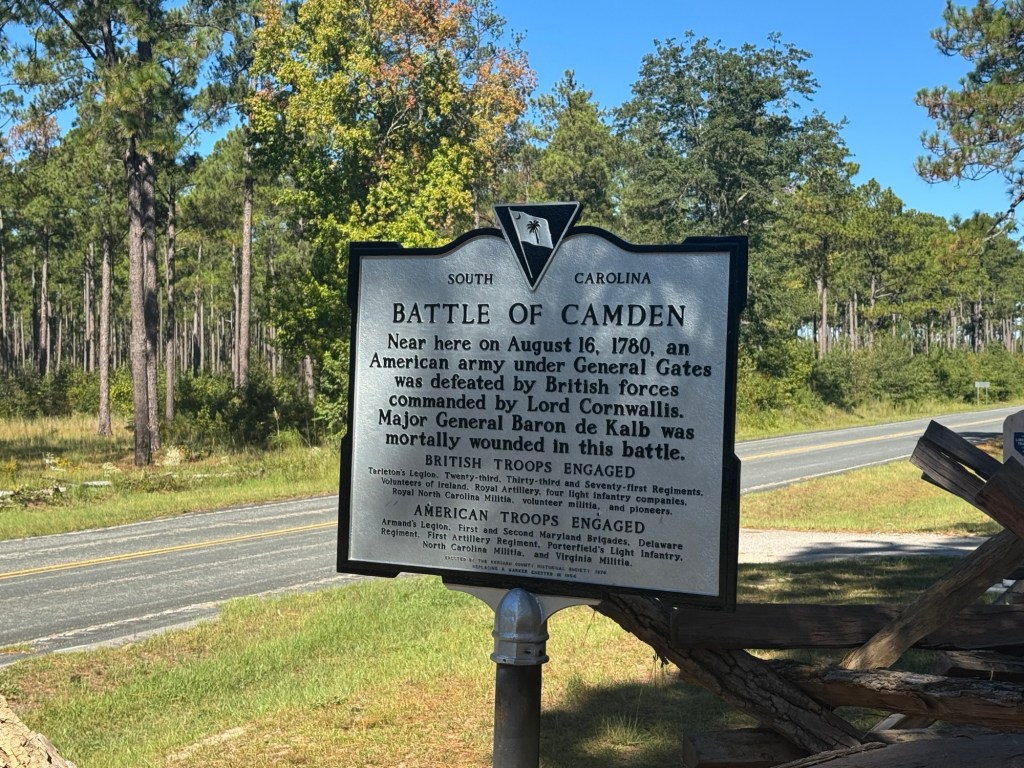
  7. Konrad Adenauer 22/30

  8. Harry S. Truman 21/30
  9. John F. Kennedy 17/30
  10. Hermann Müller 17/30
  11. Wilhelm Marx 17/30
  12. Woodrow Wilson 15/30
  13. Ludwig Erhard 12/30
  14. Paul von Hindenburg 10/30

How would you rate Müller? Let me know in the comments!

Further Reading

For short overview essays on all German chancellors from Bismarck on, see Sternburg, Wilhelm von: Die deutschen Kanzler. Von Bismarck bis Merkel [The German Chancellors. From Bismarck to Merkel], Aufbau-Verlag, Berlin 2006 (in German).

The only full-length biography of Müller is Reichel, Peter: Der tragische Kanzler [The Tragic Chancellor], dtv, Munich 2018 (in German). Unfortunately, the book suffers from the author’s misguided attempt to assign blame for the end of the republic on the SPD for an alleged lack of willingness to compromise, which runs through the entire book.

A revisionist, but insightful short treatment of Müller is Behring, Rainer: Hermann Müller (1876—1931) und die Chancen der Weimarer Republik [Hermann Müller (1876—1931] and the Chances of the Weimar Republic], in: Brandt, Peter/Lehnert, Detlef: Sozialdemokratische Regierungschefs in Deutschland und Österreich. 1918—1983, Dietz, Bonn 2017 (in German).

For the broader context, see: Herbert, Ulrich: A History of Twentieth-Century Germany, Oxford University Press, Oxford 2019.

  •  

Khrushchev and the Pivot from Stalinism (Reform in the Soviet Union, #2)

The Soviet Union was one of the great dictatorships of the 20th century. It applied an immense amount of coercion on its own citizens as well as many of its neighboring countries. Yet the almost seventy years between the Soviet Union’s founding from the ashes of the Russian Civil War in 1922 and its fragmentation into 15 nation-states in 1991 are no monolith of unfreedom. There were two distinct periods of liberalization around a generation apart from each other – one that began under General Secretary Nikita Khrushchev in the 1950s, and one that began under General Secretary Mikhail Gorbachev in the 1980s. Let’s look at them, beginning with Khrushchev’s thaw, in terms of domestic, foreign, and economic policy. The post on Gorbachev’s reforms will follow in two weeks. As always, there will be board games along the way.

Freedom of Thought, Speech, and Political Expression

Joseph Stalin’s Soviet Union curtailed its citizens’ expression dramatically. Historiography has recounted Stalin’s reign of terror in detail, yet the best-known expression of the totalitarian control to which the Soviet Union aspired from the 1930s on is George Orwell’s dystopian novel 1984: Its one-party state does not only control citizens’ access to information (they are being exposed to constant propaganda and expected to keep up with its frequently changing, often contradictory contents), but demands active participation in the daily reconstruction of the system, ranging from institutionalized “two-minute hate” against political enemies to unlimited devotion to the “Big Brother” at the top of the pyramid.

The Soviet equivalent to the “Big Brother,” of course, was Stalin who was exalted in an official cult of personality as a wise and infallible leader, working tirelessly for the security and well-being of the Soviet Union. Whatever went wrong on the Soviet Union’s inexorable march of progress was the fault of an inept underling or a shadowy enemy.

Twilight Struggle (Ananda Gupta/Jason Matthews, GMT Games) has only few events referencing domestic policy, but the paranoia on both sides has made it in as the “Red Scare/Purge” double event which can cripple an opponent’s turn. Of course, the victims of McCarthy’s persecution only lost their jobs and reputations, not their lives like the victims of Stalinist purges. ©GMT Games.

When Stalin died, his lieutenants fought briefly, but viciously over his succession. Nikita Khrushchev emerged victorious. Khrushchev had been as loyal to Stalin as his chief rivals and immediatly used Stalinist methods to depose Lavrentiy Beria, the powerful Minister of Internal Affairs (and thus chief of the domestic security services). Beria was charged with treason, put through a mock trial, and executed.

Khrushchev’s skillful power politics could also swing the other way, though. He prepared a report on Stalin’s crimes which he delivered to a stunned audience at the 20th Congress of the Communist Party of the Soviet Union on February 25, 1956. For four hours, Khrushchev detailed Stalin’s party purges, his deportation of whole peoples deemed unloyal, and, most of all, how Stalin had established a cult of personality in which he was almost worshipped like a god.
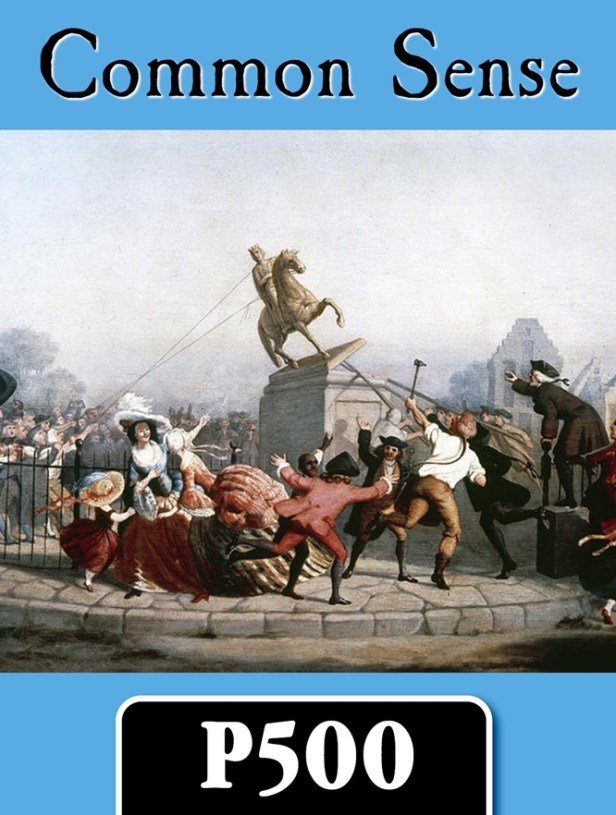
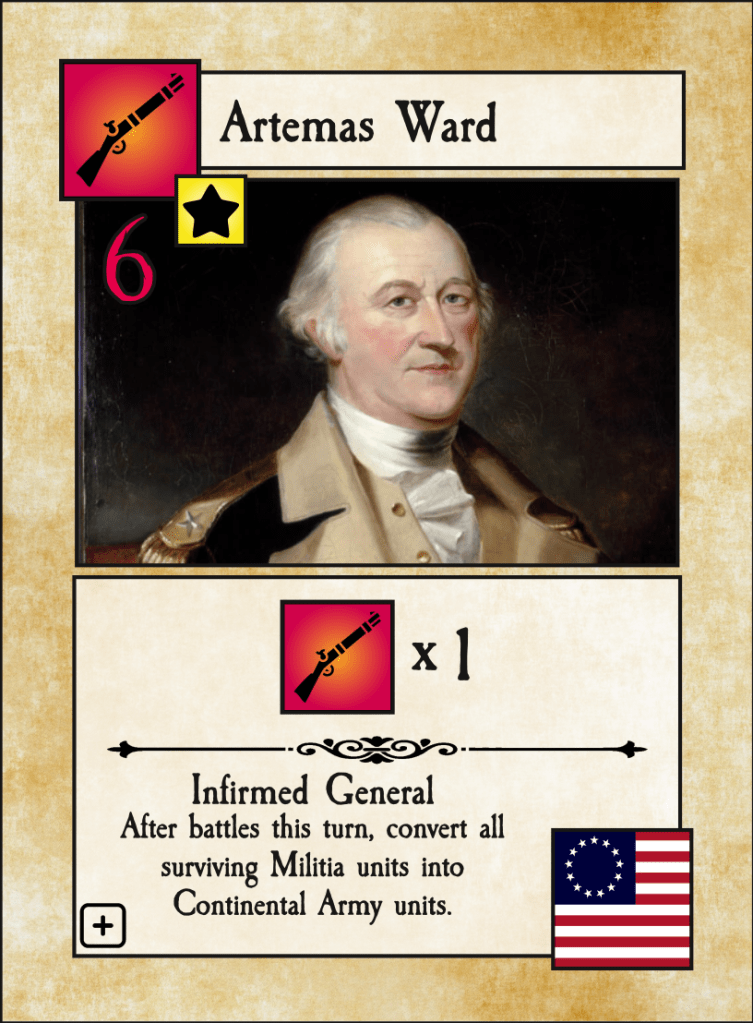
Khrushchev’s de-Stalinization drive did not stop at mere proclamations. The late 1950s and early 1960s saw a lessening of censorship: Alexander Solzhenitsyn was allowed to publish his Gulag novel One Day in the Life of Ivan Denisovitch.

There were limits, however: Criticism of Stalin’s Gulags was one thing, criticism of the October Revolution another. Boris Pasternak’s Doctor Zhivago was not published in the USSR. When Pasternak won the Nobel Prize in literature for it, he and his family were threatened by agents of the state. Cowed, Pasternak did not travel to Stockholm to accept the prize.

Still, Khrushchev’s pivot represented an important turn in the state’s relationship with violence. While Soviet citizens were still routinely surveilled and subjected to coercion, it was neither with the overwhelming force of Stalinism nor with its unpredictability. The age of escalating purges, in which the accusers of today would be the accused of tomorrow was over.

Peaceful Coexistence and Khrushchev’s Many Other Schemes

Khrushchev’s 1956 speech was meant to remain secret, known only to its direct recipients and the allied Communist governments in Eastern Europe, but a member of the Polish Communist party smuggled a copy abroad via the Israeli embassy in Warsaw. From there, it soon gained wide circulation, and while Khrushchev had intended it to be a domestic power play only (it delegitimized his rivals Georgy Malenkov and Vyacheslav Molotov), he now also reaped benefits abroad: The post-Stalinist Soviet Union was naturally a more attractive ally and role model for both the socialist movements in Europe and the decolonizing and freshly independent nations in Africa and Asia.

If you draw this card as the US player: Hold it until turn 3 and then space it. If you draw it as the USSR player: ¡Bienvenido a Sudamérica, camarada! Card De-Stalinization from Twilight Struggle. ©GMT Games.

This unintended benefit is the focus of the foreign-policy heavy Twilight Struggle‘s De-Stalinization card: The Soviet player may move up to four points of influence around on the globe. That may seem like a zero-sum game – after all, the influence is not added, but only moved. But the Soviet Union typically has a lot of spare influence in Eastern Europe after the first one or two turns, and De-Stalinization is the earliest and best way to gain access to faraway continents, chiefly South America (and, to a lesser degree, Africa).

Even before Khrushchev’s speech was leaked, his approach to foreign policy markedly differed from Stalin’s last years. When the relationship with the Soviet Union’s erstwhile allies had deteriorated after the end of World War II, Stalin had adopted a confrontational stance based on the assumption that the world was split in two hostile camps. Khrushchev, on the other hand, approached the western powers under the new motto of peaceful coexistence. Socialism and capitalism could both inhabit the same world. Of course, Khrushchev as a convinced Communist believed that his system would eventually triumph. Until then, peaceful coexistence would not only foster peace, but also make socialism more attractive, and free up resources for economic development and consumer goods (more on that below).

The economic (factory icon) and especially ideological (socialist – man with flat cap icon) bonuses are nice, but what sets the Peaceful Coexistence event in Wir sind das Volk! – 2+2 (Richard Sivél/Peer Sylvester, Histogame) apart is the ability to advance peace (dove icon) – indispensable when the world is sliding toward nuclear war!

Khrushchev was always better at initiating things than at seeing them through. Peaceful coexistence gave way to other projects – be that the support of nationalist movements in the global south or a re-newed competition with the West over Central Europe. And while Khrushchev thought that the Soviet Union and the western powers could live next to one another, that tolerance did not extend to heterodox socialist ideas within his own sphere of influence: When the Hungarian Socialist Workers’ Party announced to withdraw the country from the Warsaw Pact and hold free elections, Khrushchev had the reform movement quashed by Soviet tanks.

Let’s break with Stalin! …no, not like that! The Hungarian revolutionaries and Khrushchev would not become fast friends. Image from Days of Ire (Katalin Nimmerfroh/Dávid Turczi/Mihály Vincze, Cloud Island).

Consumer Goods, (Non-)Communal Apartments, …Corn?

The Soviet economy under Stalin had been tuned to increase heavy industrial output to achieve a fast industrialization on the one hand and provide the basis for the country’s military security. This approach was validated by the country’s survival of the Nazi invasion and its eventual military victory in 1945. The proponents of this economic policy which usually went together with ideological mobilization and a confrontational foreign policy were called to adhere to politika. Yet after Stalin’s death, the rival faction of tekhnika gained ground: Its advocates favored a less aggressive foreign policy, less ideological mobilization, and, most of all, more market elements in the economy which would then produce more consumer goods.

Khrushchev positioned himself in the middle: Heavy industry would have priority (the Soviet Union was in a nuclear arms race with the United States whose economy was around three times as large as the Soviet, after all), but more attention would be given to consumer goods than before. Soviet citizens enjoyed a limited amount of prosperity with radios, washing machines, and sometimes even cars. Khrushchev saw this also as an instrument in the systemic competition of the Cold War: Material comfort and personal lifestyles would influence people’s allegiances as much as military strength or ideological treatises.

Khrushchev’s confidence in that regard led him to agree with the United States on mutual national exhibitions which would showcase their respective country to the citizens of the other. The confidence, however, was not quite justified: The Soviet exhibition in New York aroused curiosity, but the American one in Moscow was positively overrun. It also produced one of the iconic pictures of the Cold War with Nikita Khrushchev and US Vice President Richard Nixon debating the merits of their respective systems surrounded by American household appliances – the “Kitchen Debate.”

Richard Nixon stabbing his finger at Nikita Khrushchev (and thus putting himself into the race for the 1960 presidential election). Not pictured: The hottest new kitchen gadgets from America. Card Kitchen Debates from Twilight Struggle. ©GMT Games.

Some Soviet citizens might have dreamed of living in America, but their personal lifestyles already became more akin to those of Americans under Khrushchev. Even more important than the new consumer goods were their living conditions: Housing in big Soviet cities had been dominated by kommunalkas – large apartments from pre-revolutionary times which had been split to accommodate several families, each living in a single room and sharing the kitchen and bathroom with the others. These crammed living spaces afforded their inhabitants no privacy whatsoever. Only the elites of Stalin’s Soviet Union had apartments to themselves. Khrushchev started an ambitious housing program based on prefabricated, concrete-paneled apartment buildings which allowed millions of Soviet citizens to move into an apartment just for their own family for the first time.

As with foreign policy, Khrushchev started more economic reform projects than he saw through. The ambitious “Virgin Lands” campaign which aimed at alleviating Soviet food shortages by cultivating vast swathes of Siberia and northern Kazakhstan petered out after a few years. His scheme to introduce an Iowa-style corn belt fared even worse, discrediting both corn and Khrushchev in the Soviet Union.

Khrushchev’s Ouster

The economic starts and shifts of Khrushchev’s tenure undermined his position, as did his foreign policy unpredictability ranging from arms control to confronting the United States over Cuba. Most damaging to him, however, were his constant shuffles in the Communist Party. Disaffected cadres who feared they might lose their offices overthrew Khrushchev in October 1964. They installed the less fickle Leonid Brezhnev as new General Secretary of the Communist Party of the Soviet Union. The conservative Brezhnev would tone down some of Khrushchev’s domestic reforms, resulting in a more restricted cultural and literary climate, but stuck with Khrushchev’s economic reforms and conducted foreign policy along the lines of détente with the West.

Not everything about Khrushchev was as cuddly as this bear which he received when visiting an East German electronics factory, but his rule made the Soviet Union a better place to live and furthered its international power and prestige. Image from Wir sind das Volk! – 2+2.

In the end, Khrushchev himself was one of the beneficiaries of the liberalization he had pushed: Unlike the victims of the purges of the 1930s (or even Beria), he was not subjected to a mock trial and executed. Instead, he officially resigned for health reasons and was allowed to live out his days at a comfortable dacha in the countryside.

Games Referenced

Twilight Struggle (Ananda Gupta/Jason Matthews, GMT Games)

Wir sind das Volk: 2+2 (Richard Sivél/Peer Sylvester, Histogame)

Days of Ire (Katalin Nimmerfroh/Dávid Turczi/Mihály Vincze, Cloud Island)

Further Reading

The authoritative biography remains Taubman, William: Khrushchev. The Man and His Era, Norton, New York City, NY 2004.

A magisterial mosaic of Soviet social, economic, and cultural life is Schlögel, Karl: The Soviet Century. Archaeology of a Lost World, Princeton University Press, Princeton, NJ 2023.

On the suppression of the Hungarian revolution and its impact on Soviet and western foreign policy, see Békés, Csaba: The 1956 Hungarian Revolution and World Politics, (Cold War International History Project Working Paper No. 16), Washington, D.C. 1996.

On the politika/tekhnika split, see Priestland, David: Cold War Mobilization and Domestic Politics: the Soviet Union, in: Leffler, Melvyn P./Westad, Odd Arne (eds.): The Cambridge History of the Cold War. Volume I. Origins, 5th edition, Cambridge University Press, Cambridge 2013, pp. 442-463.

  •  

Khrushchev and the Pivot from Stalinism (Reform in the Soviet Union, #1)

The Soviet Union was one of the great dictatorships of the 20th century. It applied an immense amount of coercion on its own citizens as well as many of its neighboring countries. Yet the almost seventy years between the Soviet Union’s founding from the ashes of the Russian Civil War in 1922 and its fragmentation into 15 nation-states in 1991 are no monolith of unfreedom. There were two distinct periods of liberalization around a generation apart from each other – one that began under First Secretary Nikita Khrushchev in the 1950s, and one that began under General Secretary Mikhail Gorbachev in the 1980s. Let’s look at them, beginning with Khrushchev’s thaw, in terms of domestic, foreign, and economic policy. The post on Gorbachev’s reforms will follow in two weeks. As always, there will be board games along the way.

Freedom of Thought, Speech, and Political Expression

Joseph Stalin’s Soviet Union curtailed its citizens’ expression dramatically. Historiography has recounted Stalin’s reign of terror in detail, yet the best-known expression of the totalitarian control to which the Soviet Union aspired from the 1930s on is George Orwell’s dystopian novel 1984: Its one-party state does not only control citizens’ access to information (they are being exposed to constant propaganda and expected to keep up with its frequently changing, often contradictory contents), but demands active participation in the daily reconstruction of the system, ranging from institutionalized “two-minute hate” against political enemies to unlimited devotion to the “Big Brother” at the top of the pyramid.

The Soviet equivalent to the “Big Brother,” of course, was Stalin who was exalted in an official cult of personality as a wise and infallible leader, working tirelessly for the security and well-being of the Soviet Union. Whatever went wrong on the Soviet Union’s inexorable march of progress was the fault of an inept underling or a shadowy enemy.

Twilight Struggle (Ananda Gupta/Jason Matthews, GMT Games) has only few events referencing domestic policy, but the paranoia on both sides has made it in as the “Red Scare/Purge” double event which can cripple an opponent’s turn. Of course, the victims of McCarthy’s persecution only lost their jobs and reputations, not their lives like the victims of Stalinist purges. ©GMT Games.

When Stalin died, his lieutenants fought briefly, but viciously over his succession. Nikita Khrushchev emerged victorious. Khrushchev had been as loyal to Stalin as his chief rivals and immediatly used Stalinist methods to depose Lavrentiy Beria, the powerful Minister of Internal Affairs (and thus chief of the domestic security services). Beria was charged with treason, put through a mock trial, and executed.

Khrushchev’s skillful power politics could also swing the other way, though. He prepared a report on Stalin’s crimes which he delivered to a stunned audience at the 20th Congress of the Communist Party of the Soviet Union on February 25, 1956. For four hours, Khrushchev detailed Stalin’s party purges, his deportation of whole peoples deemed unloyal, and, most of all, how Stalin had established a cult of personality in which he was almost worshipped like a god.

Khrushchev’s de-Stalinization drive did not stop at mere proclamations. The late 1950s and early 1960s saw a lessening of censorship: Alexander Solzhenitsyn was allowed to publish his Gulag novel One Day in the Life of Ivan Denisovitch.

There were limits, however: Criticism of Stalin’s Gulags was one thing, criticism of the October Revolution another. Boris Pasternak’s Doctor Zhivago was not published in the USSR. When Pasternak won the Nobel Prize in literature for it, he and his family were threatened by agents of the state. Cowed, Pasternak did not travel to Stockholm to accept the prize.

Still, Khrushchev’s pivot represented an important turn in the state’s relationship with violence. While Soviet citizens were still routinely surveilled and subjected to coercion, it was neither with the overwhelming force of Stalinism nor with its unpredictability. The age of escalating purges, in which the accusers of today would be the accused of tomorrow was over.

Peaceful Coexistence and Khrushchev’s Many Other Schemes

Khrushchev’s 1956 speech was meant to remain secret, known only to its direct recipients and the allied Communist governments in Eastern Europe, but a member of the Polish Communist party smuggled a copy abroad via the Israeli embassy in Warsaw. From there, it soon gained wide circulation, and while Khrushchev had intended it to be a domestic power play only (it delegitimized his rivals Georgy Malenkov and Vyacheslav Molotov), he now also reaped benefits abroad: The post-Stalinist Soviet Union was naturally a more attractive ally and role model for both the socialist movements in Europe and the decolonizing and freshly independent nations in Africa and Asia.

If you draw this card as the US player: Hold it until turn 3 and then space it. If you draw it as the USSR player: ¡Bienvenido a Sudamérica, camarada! Card De-Stalinization from Twilight Struggle. ©GMT Games.

This unintended benefit is the focus of the foreign-policy heavy Twilight Struggle‘s De-Stalinization card: The Soviet player may move up to four points of influence around on the globe. That may seem like a zero-sum game – after all, the influence is not added, but only moved. But the Soviet Union typically has a lot of spare influence in Eastern Europe after the first one or two turns, and De-Stalinization is the earliest and best way to gain access to faraway continents, chiefly South America (and, to a lesser degree, Africa).

Even before Khrushchev’s speech was leaked, his approach to foreign policy markedly differed from Stalin’s last years. When the relationship with the Soviet Union’s erstwhile allies had deteriorated after the end of World War II, Stalin had adopted a confrontational stance based on the assumption that the world was split in two hostile camps. Khrushchev, on the other hand, approached the western powers under the new motto of peaceful coexistence. Socialism and capitalism could both inhabit the same world. Of course, Khrushchev as a convinced Communist believed that his system would eventually triumph. Until then, peaceful coexistence would not only foster peace, but also make socialism more attractive, and free up resources for economic development and consumer goods (more on that below).

The economic (factory icon) and especially ideological (socialist – man with flat cap icon) bonuses are nice, but what sets the Peaceful Coexistence event in Wir sind das Volk! – 2+2 (Richard Sivél/Peer Sylvester, Histogame) apart is the ability to advance peace (dove icon) – indispensable when the world is sliding toward nuclear war!

Khrushchev was always better at initiating things than at seeing them through. Peaceful coexistence gave way to other projects – be that the support of nationalist movements in the global south or a re-newed competition with the West over Central Europe. And while Khrushchev thought that the Soviet Union and the western powers could live next to one another, that tolerance did not extend to heterodox socialist ideas within his own sphere of influence: When the Hungarian Socialist Workers’ Party announced to withdraw the country from the Warsaw Pact and hold free elections, Khrushchev had the reform movement quashed by Soviet tanks.

Let’s break with Stalin! …no, not like that! The Hungarian revolutionaries and Khrushchev would not become fast friends. Image from Days of Ire (Katalin Nimmerfroh/Dávid Turczi/Mihály Vincze, Cloud Island).

Consumer Goods, (Non-)Communal Apartments, …Corn?

The Soviet economy under Stalin had been tuned to increase heavy industrial output to achieve a fast industrialization on the one hand and provide the basis for the country’s military security. This approach was validated by the country’s survival of the Nazi invasion and its eventual military victory in 1945. The proponents of this economic policy which usually went together with ideological mobilization and a confrontational foreign policy were called to adhere to politika. Yet after Stalin’s death, the rival faction of tekhnika gained ground: Its advocates favored a less aggressive foreign policy, less ideological mobilization, and, most of all, more market elements in the economy which would then produce more consumer goods.

Khrushchev positioned himself in the middle: Heavy industry would have priority (the Soviet Union was in a nuclear arms race with the United States whose economy was around three times as large as the Soviet, after all), but more attention would be given to consumer goods than before. Soviet citizens enjoyed a limited amount of prosperity with radios, washing machines, and sometimes even cars. Khrushchev saw this also as an instrument in the systemic competition of the Cold War: Material comfort and personal lifestyles would influence people’s allegiances as much as military strength or ideological treatises.

Khrushchev’s confidence in that regard led him to agree with the United States on mutual national exhibitions which would showcase their respective country to the citizens of the other. The confidence, however, was not quite justified: The Soviet exhibition in New York aroused curiosity, but the American one in Moscow was positively overrun. It also produced one of the iconic pictures of the Cold War with Nikita Khrushchev and US Vice President Richard Nixon debating the merits of their respective systems surrounded by American household appliances – the “Kitchen Debate.”

Richard Nixon stabbing his finger at Nikita Khrushchev (and thus putting himself into the race for the 1960 presidential election). Not pictured: The hottest new kitchen gadgets from America. Card Kitchen Debates from Twilight Struggle. ©GMT Games.

Some Soviet citizens might have dreamed of living in America, but their personal lifestyles already became more akin to those of Americans under Khrushchev. Even more important than the new consumer goods were their living conditions: Housing in big Soviet cities had been dominated by kommunalkas – large apartments from pre-revolutionary times which had been split to accommodate several families, each living in a single room and sharing the kitchen and bathroom with the others. These crammed living spaces afforded their inhabitants no privacy whatsoever. Only the elites of Stalin’s Soviet Union had apartments to themselves. Khrushchev started an ambitious housing program based on prefabricated, concrete-paneled apartment buildings which allowed millions of Soviet citizens to move into an apartment just for their own family for the first time.

As with foreign policy, Khrushchev started more economic reform projects than he saw through. The ambitious “Virgin Lands” campaign which aimed at alleviating Soviet food shortages by cultivating vast swathes of Siberia and northern Kazakhstan petered out after a few years. His scheme to introduce an Iowa-style corn belt fared even worse, discrediting both corn and Khrushchev in the Soviet Union.

Khrushchev’s Ouster

The economic starts and shifts of Khrushchev’s tenure undermined his position, as did his foreign policy unpredictability ranging from arms control to confronting the United States over Cuba. Most damaging to him, however, were his constant shuffles in the Communist Party. Disaffected cadres who feared they might lose their offices overthrew Khrushchev in October 1964. They installed the less fickle Leonid Brezhnev as new First Secretary of the Communist Party of the Soviet Union (an office soon to be re-named to General Secretary, like under Stalin). The conservative Brezhnev would tone down some of Khrushchev’s domestic reforms, resulting in a more restricted cultural and literary climate, but stuck with Khrushchev’s economic reforms and conducted foreign policy along the lines of détente with the West.

Not everything about Khrushchev was as cuddly as this bear which he received when visiting an East German electronics factory, but his rule made the Soviet Union a better place to live and furthered its international power and prestige. Image from Wir sind das Volk! – 2+2.

In the end, Khrushchev himself was one of the beneficiaries of the liberalization he had pushed: Unlike the victims of the purges of the 1930s (or even Beria), he was not subjected to a mock trial and executed. Instead, he officially resigned for health reasons and was allowed to live out his days at a comfortable dacha in the countryside.

Games Referenced

Twilight Struggle (Ananda Gupta/Jason Matthews, GMT Games)

Wir sind das Volk: 2+2 (Richard Sivél/Peer Sylvester, Histogame)

Days of Ire (Katalin Nimmerfroh/Dávid Turczi/Mihály Vincze, Cloud Island)

Further Reading

The authoritative biography remains Taubman, William: Khrushchev. The Man and His Era, Norton, New York City, NY 2004.

A magisterial mosaic of Soviet social, economic, and cultural life is Schlögel, Karl: The Soviet Century. Archaeology of a Lost World, Princeton University Press, Princeton, NJ 2023.

On the suppression of the Hungarian revolution and its impact on Soviet and western foreign policy, see Békés, Csaba: The 1956 Hungarian Revolution and World Politics, (Cold War International History Project Working Paper No. 16), Washington, D.C. 1996.

On the politika/tekhnika split, see Priestland, David: Cold War Mobilization and Domestic Politics: the Soviet Union, in: Leffler, Melvyn P./Westad, Odd Arne (eds.): The Cambridge History of the Cold War. Volume I. Origins, 5th edition, Cambridge University Press, Cambridge 2013, pp. 442-463.

  •  

Farewell 2025 – Best on the Blog!

Now the year truly comes to a close. Let’s look back at the eighth full year of this blog.

You can read all of the Farewell 2025 posts here:

The overall blog statistics are pretty meaningless – both last year and this year are skewed by WordPress sending my Farewell 2024 – Historical Fiction! post out to a bajillion people (from Dec 26 to Jan 8), which makes it easily the most popular post of each year (providing more than a fourth of my total views this year). If you factor that out, 2025 has been a good year on the blog, but slightly behind the (organic) record of 2023.

The posts doing particularly well have been the usual suspects, that is, the Most Anticipated Historical Board Games post in January, and the evergreen strategy posts for several games published over the last year. It was nice to see that a few of my research-intensive posts in the American Revolution and the Wallenstein series also did well.

Most of my readers come from the United States (also skewed by the Historical Fiction anomaly, but not entirely), as well as other Anglophone (UK, Canada, Australia) or European (Germany, the Netherlands, Spain, and France) countries. Especially the Dutch have made a leap up… maybe because of my post on the history of Amsterdam? Welkom, anyway.

New arrivals in the top 10 of the countries from which most views stem are Sweden and Poland in a joint Baltic effort.

If you compare views with population numbers, there are possibly no more loyal readers of this blog than the fine people of Ireland, closely followed by Hong Kong, whose views eclipse those of huge countries like Japan, Brazil, or India. The Irish have been devoted to history, board games, and history in board games for some years now, for which I am grateful. The Hongkongers are new in their excitement for the blog – welcome! If you are from Hong Kong, leave a comment below!

I can only speculate what brought people to this blog (but maybe you can enlighten me with a comment, especially if read this blog, but don’t comment often or ever). Here is, however, what I think was the finest which I published this year – as per usual, with six instead of three entries, and without crowning a winner. Let’s go!

“Give Me Liberty, or Give Me Death!” (American Revolution, #2)

Most of the history articles on this blog are about what people in the past did – the politicians, merchants, soldiers of times past. Yet I also like to dwell on what they thought, and thus I’m very happy to have written this post on the political philosophy of the American Revolution, its core value of liberty, and the promise and limitation of that idea. It was also an opportunity to engage with the still-compelling documents of the Revolution – Common Sense and the Declaration of Independence.

Tariffs, Onshoring, and the Board Game Industry

It’s been a wild year politically. Almost forgotten by now is the Great Tariff Rollercoaster of April 2025, in which the American federal government announced tariffs on imports from almost all other countries and then engaged in a flurry of raising, lowering, and holding off on them that made everyone’s head spin. By now, the 145% tariff on Chinese goods imported by US buyers is long gone, but at the time it seemed like an existential threat to US board game companies manufacturing their games in China (so, almost all of them), and given that the current US administration will still be in office for another three years, one worth revisiting.

Wallenstein: Rise

This blog often gives me the opportunity to learn about new subjects. Wallenstein was one of them. I approached the post about his life with not more than a general knowledge about his role in the Thirty Years’ War… and then was sucked into a research rabbit hole in which I read over 2,000 pages about the guy. The result is a four-part series and the longest, most detailed board game assisted biography I have ever written about anyone.

Frederick the Great. A Military Life / Friedrich

…and this blog also allows me to re-visit topics and games with which I have engaged for years (and sometimes decades) now. Frederick II of Prussia is such a person, and Friedrich (Richard Sivél, Histogame) such a game. Reflecting on their insights on Frederick’s campaigns, the command and control exercised, and Frederick’s psychology was a delight.

Amsterdam in History and Board Games

Amsterdam is one of the iconic cities of the world. It is a symbol of art, commerce, and progress, and unique in its canal-structured urban layout. Unsurprisingly, these characteristics have also inspired board game designers. I have told Amsterdam’s 750-year history through the lens of the many board games set in Amsterdam – which gives a glimpse into what the city stands for in the popular imagination. As both this and my earlier Venice post were so much fun to write, I should do more city histories!

Immersive Weimar Playlist

One of my brighter new ideas was to link historical board games to period music. Of course, that works particularly well from the 20th century on – the age of the music record. I started with an immersive playlist for your next game of Weimar (Matthias Cramer, Capstone Games/Skellig Games/Spielworxx), full of everything that was hot at the time – from traditional songs to jazz, from movie tunes to workers’ songs. It will surely not remain the only such playlist.

And thus concludes the year 2025 on this blog. I hope you had as much fun reading it as I had writing.

I wish you all an excellent year 2026, full of joy, health, and success!

  •  
❌