Normale Ansicht

Wilhelm Marx (Weimar Chancellor Ratings, #2)

26. Juli 2026 um 17:49

We’ve been assessing the merits of political leaders in (more or less) democratic countries on this blog for a few years now. Today, we’re looking at the longest-serving chancellor of the Weimar Republic, Germany’s first attempt at parliamentary government – Wilhelm Marx. And which game could be more appropriate for him than Weimar (Matthias Cramer, Capstone Games/Skellig Games/Spielworxx)?

If you want to read more ratings of historical leaders like this, I strongly recommend you subscribe to the blog – all new posts in your inbox right when they go live!

The Rating System

Some caveats ahead: The chancellors will be rated by the knowledge of their time. If they or their contemporaries could not have known about the effects of something, I will not use my hindsight to mark it as a mistake of theirs. The assessment is focused on their conduct as chancellor.

Now, to the system itself: There are three policy field categories (foreign, domestic, and economic policy) and three more general ones (vision, pragmatism, integrity). A chancellor can earn from one to five stars in each category (for a total sum of up to 30). In detail, the chancellor is assessed as follows:

Foreign policy: Did the chancellor increase German influence in the world and the security of Germans at home? Did the chancellor wield German power responsibly and with positive results for the regions affected?

Domestic policy: Did the chancellor increase the liberty of Germans to express themselves and to participate in the political process? Did the chancellor promote domestic security and shape the framework for fair justice dealing with offenses?

Economic policy: Did the chancellor facilitate the prosperity and economic security of Germans (including in the mid- and long-term)? Was the chancellor’s economic policy based on mutual benefit of those involved or did it unduly burden one side?

Vision: Did the chancellor have an idea of what Germany and Europe (the latter counting for more in times of German influence being great) should look like beyond the immediate future? Did the chancellor’s policies steer Germany (and, if applicable, Europe) in this direction?

Pragmatism: Did the chancellor succeed in seeing their policy through from inception to completion? How well did the chancellor manage the support from parliament, society, the administration, the media?

Integrity: Did the chancellor understand the office as a means to benefit themselves, special interest groups, the entire country, or another community? Did the chancellor respect the boundaries of the office?

Note: If you have read my UK prime minister or US president ratings, you will remember that I rated them on the global impacts of their vision as well. As the rating system is only really applicable to democratic leaders and no democratic German leader ever had the chance to conduct a truly global policy, I only assess their vision on national and European grounds.

Early Life: The Catholic Man of Duty

Wilhelm Marx was born in 1863 in Cologne, then a part of the Rhine Province of the Kingdom of Prussia, soon to be part of the united Germany. No one could have foreseen in his boyhood that he would rise to the chancellorship – he was the son of a mere schoolteacher, and a part of the Catholic minority which was always suspected of possibly disloyalty by the Protestant Prussian state. The young Wilhelm Marx was one of many who set out to prove that he could be just as patriotic as any Protestant: He studied law and entered public service. His Catholic faith, however, would always be the guiding star in his life.

He was first elected to the Prussian parliament in 1899 on the ticket of the Catholic Zentrum (Center) party – one of the four player factions in Weimar. By the time Marx was elected, he had been active for nine years in the Volksverein für das katholische Deutschland (People’s Association for Catholic Germany), an organization dedicated to improving the social conditions especially of the poorer Catholics. Social and cultural issues, especially the expansion of Catholic schooling, would remain close to his heart: In 1910, he founded the Katholische Schulorganisation (Catholic School Organization), a grassroots lobbying organization dedicated to the matter.

The same year, he was elected to the German parliament – his first electoral success on the national level after two campaigns in hopeless districts with very few organized Catholics which he had only undertaken out of duty to the party. In parliament as well as in his electoral campaigns, he aimed to form an alliance with the Protestant bourgeois parties against the burgeoning SPD (Sozialdemokratische Partei Deutschlands, Social Democratic Party of Germany), the second player faction of Weimar. However, this strategy failed when cross-confessional bourgeois solidarity eroded in the more confrontational cultural climate from 1911 on.

World War and Revolution

These divisions faded into the background with the beginning of World War I. Despite the pre-eminence of military and diplomatic action then, Marx’s political activity remained limited to domestic issues. From his papers, we cannot discern if he even formed an opinion on many of the pressing issues in those other realms (say, unrestricted u-boat warfare). He did, however, change his mind about cooperation with the SPD, with whom the Zentrum (and the liberal parties) partnered from 1917 on in their quest to place the imperial government on a more parliamentary basis.

While the National Assembly was no breakout for Marx, it established him as one of the more experienced politicians of the Zentrum. Card “National Assembly in Weimar”, ©Capstone Games/Skellig Games/Spielworxx.

The revolution of 1918/1919 took Marx by surprise. Once more, he placed his powers at the disposal of his party, and was elected to both the Prussian and the German constitutional assemblies. The National Assembly in Weimar developed a constitution which included many long-held dreams of his, as the Catholic church, Catholic associations, and individual Catholics finally had their rights guaranteed. The short period of cooperation with the Social Democrats (and, to a lesser degree, the progressive liberals of the DDP (Deutsche Demokratische Partei, German Democratic Party) had achieved what years of negotiation with the Protestant conservatives of the Empire had not. This early alliance between Zentrum and SPD is the starting point of any Weimar game.

Yet the new German republic was unpopular with the numerous conservative, monarchist Zentrum members, and cooperation with the Social Democrats doubly so. Marx thus spent much of his political energy advocating for the constitution among his fellow Catholics.

At the time, Marx considered leaving politics altogether in favor of focusing on social work: From 1919 to 1921, he acted as director for the Volksverein (but proved unsuited to implement the sweeping changes necessary to improve the Volksverein’s faltering popularity in the Catholic milieu).

The Zentrum‘s base were rural Catholic voters, conscious of their second-class citizen status in Imperial Germany, but often personally conservative. The rapid changes of democratization and industrialization put a strain on party unity. Card “Keeper of Tradition”, ©Capstone Games/Skellig Games/Spielworxx.

Parliamentary Leader in the Republic

Yet once more duty called: As many of the old Zentrum parliamentary leaders died, Marx was one of the most experienced politicians his party could field. And his conciliatory, even-handed manner was just what the Zentrum needed when the party was so deeply divided against itself on the question of supporting the republic or restoring the monarchy as well as if to cooperate with the Social Democrats or the Protestant nationalists of the DNVP (Deutschnationale Volkspartei, German Nationalist People’s Party), the third Weimar player faction.

Marx was thus called on to hold the diverging wings together: He was elected head of the parliamentary group of the Zentrum and then also party chairman in late 1921. As the Zentrum’s governing partner SPD merged with the more left-leaning USPD (Unabhängige Sozialdemokratische Partei Deutschlands, Independent Social Democratic Party of Germany), Marx advanced a closer cooperation with the two liberal parties DDP (in government) and DVP (Deutsche Volkspartei, German People’s Party, in opposition) – the two minor parties which the Zentrum can control in Weimar. Yet Chancellor Joseph Wirth’s attempt to entice the DVP into a government of all democratic parties (a Grand Coalition) failed in late 1922. As a consequence, the SPD left the government as well. The parliamentary basis for the government shrunk.

The following year, Germany was shaken by the French occupation of the Ruhr which exacerbated the already galloping inflation. Under these circumstances, the Grand Coalition of all democratic parties became reality, led by DVP chancellor Gustav Stresemann. While it tackled these huge tasks rather successfully, the government could not maintain its internal cohesion: The right wing of the DVP (under its parliamentary leader Ernst Scholz) wanted to use the crisis to abolish the eight-hour workday and expand the government to the right by including the DNVP. The SPD refused and left the government. Marx’s conciliating manner helped with bringing both of them back to the negotiating table and a new Grand Coalition was formed.

This one was even shorter-lived: When federal forces broke up the socialist state governments of Saxony and Bavaria, but (doubting the loyalty of the army) refused to act against the right-wing coup in Bavaria, the SPD once more went into opposition. Without a parliamentary majority, Stresemann was soon unseated as chancellor. As the SPD’s appetite for government responsibility was sated, a bourgeois minority cabinet would be formed. That would be straight-up impossible in Weimar – unlike left-wing or right-wing coalitions, the Weimar Coalition (with SPD and Zentrum as the player factions and the DDP as a minor party which is always attached to one of the two) cannot refuse to govern, and so SPD and Zentrum are often stuck with each other if they want it or not. Historically, the SPD was not quite as keen on governing as the party is in Weimar.

To get anything done without a parliamentary majority would require special skills at winning friends and not making enemies. Marx, the skilled mediator, was just the right man for the time. He was elected chancellor on November 30, 1923. The weighty issues facing him were Bavaria’s continued insurrection, the implementation of the measures against hyperinflation, and an agreement with the Allies on the reparations issue which had set off the entire crisis of 1923.

A full hand of cards, leading the government (chancellor token in the top left), both liberal minor parties aligned (bottom right) – a comfortable situation for the Zentrum in Weimar, but not so much in history.

The First and Second Chancellorships

Marx’s cabinet nominations sent a signal to Bavaria that he was willing to improve the relationship between the fractious state and the Reich: He made the Bavarian Eduard Hamm (DDP) Minister for the Economy, and, for the first time in the history of the republic, included a member of the BVP (Bayerische Volkspartei, Bavarian People’s Party) whose more radical members had been behind the coup in Bavaria (Erich Emminger as Minister of Justice). His discreet negotiations with the Bavarian coupists would come to fruition in spring 1924: They resigned and opened the way for parliamentary government again. Bavaria, however, would retain some special privileges and be exempt from federal oversight.

The BVP had played an ambiguous role in the anti-republican insurrection in Bavaria. While the party cooperated with the Zentrum in national politics, its leader Gustav von Kahr had also been behind the coup of September 1923. This playtest version of the “Bayerische Volkspartei” card strengthens the Zentrum in parliament, but also allows the DNVP to recruit a dissolved unit – the latter effect was removed in the final version of the game.

Both the reparations negotiations with the Allies and the massive financial and economic reform package which would solidify the end of inflation required Marx to gather parliamentary support far beyond his minority coalition’s meager base. As there were constitutional changes involved (for example, in merging the various state railway companies into a federal railway), he even needed a two-thirds majority. Marx’s parliamentary skills and his reputation as an honest broker who would not abuse his power came together in securing an Enabling Act which would allow his government to gain the respective legislative powers despite their parliamentary minority. Equipped with such power, Marx set out to do the necessary, but unpopular steps forward. The cuts to public expenses which were to flank the currency reform massively reduced the number and salary of public employees and all but expropriated most pensioners.

The bitter taste of Marx’s domestic reforms was lessened by the negotiations with the Allies. Not even France had the stomach to force another confrontation after the chaos of 1923. They were thus inclined to negotiate a payment schedule which suited both sides. American bankers were to provide the loans with which Germany would cover a large part of the payments.

The electorate, however, was unimpressed. In the May 1924 parliamentary elections, Marx’s Zentrum held firm, but his DDP and DVP partners collapsed, as did the SPD. The right-wing parties were triumphant. Yet with no viable alternative to the bourgeois minority coalition, Marx was soon confirmed for his second chancellorship.

Unlike most other foreign policy cards, the Dawes Plan does not strengthen the DNVP when the government attempts to negotiate it – only upon success. This may reflect the DNVP’s internal divisions over supporting the plan. Card “Dawes Plan”, ©Capstone Games/Skellig Games/Spielworxx.

In the second tenure, he concluded the negotiations with the Allies. The final agreement would become known as the Dawes Plan after the chief Allied negotiator, American banker Charles G. Dawes. Once more, Marx needed a broad parliamentary majority. In addition to his government coalition, the SPD was sure to support the plan. The DNVP publicly railed against the Dawes Plan (which confirmed the infamous war guilt clause of the Treaty of Versailles), but DNVP chairman Oskar Hergt offered his support in return for policy concessions and the DNVP’s inclusion in government. Otherwise, he threatened that the Dawes Plan would fail in parliament. Marx, however, knew that the DNVP was internally divided on the matter and that a large number of DNVP members of parliament either saw the necessity of the plan for German economic revival or at least did not want to take the blame for the failure. Thus, he called the parliamentary vote without giving in to Hergt’s demands. The motion passed, as most DNVP members abstained.

Marx’s policy successes had not broadened his parliamentary base. As he kept refusing the DNVP’s inclusion in government in favor of a more centrist approach, new elections were called for December 1924. These did not change the parliamentary balance of power much. Marx resigned and was succeeded by Hans Luther, who formed a technocratic government based on the centrist and right-wing parties including the DNVP.

Parliament includes a lot of Zentrum members… but not enough for a majority.

Prussian Intermezzo, Presidential Election

Marx could not enjoy being relieved of his duties for long. When the Prussian DVP, as much a loose cannon as its federal counterpart, forced the end of the Grand Coalition in Prussia, Germany’s largest state, and demanded a right-wing government including the DNVP like in the Reich, Marx was called on to solve the government crisis. He was elected Prussian Prime Minister with the votes of the Weimar Coalition (SPD, Zentrum, DDP) on February 18, 1925, yet just two days after was toppled when renegades in his own party refused to support him in a parliamentary vote of confidence. Marx resigned, his appetite for politics lessened and his trust in the party damaged.

No-confidence votes toppled many national and state governments of the Weimar Republic… though most of them lasted longer than two days. The respective card in Weimar can cut a round short and thwart the plans of anyone who planned on big moves with their Party Cards late in the round. Card “No-Confidence Vote”, ©Capstone Games/Skellig Games/Spielworxx.

Still, Marx was one of the few Zentrum politicians who were well-known and had a good enough reputation to field in national elections. When President Friedrich Ebert (SPD) died, he was thus the natural candidate for the next presidential elections. The death of Ebert is a turning point in many Weimar games: The office allows its holder to play one card per round for two uses instead of just one. So, it is in essence a one-card bonus. As you normally only hold five cards, this is a huge boon. The presidential elections will thus be hotly contested and usually also serve as a check on who seems to be in the lead and must be reined in… sometimes in surprising coalitions.

In the first round, Marx gained 14% of the vote, the third-best showing after Duisburg mayor Karl Jarres (DVP, 39%) and the new Prussian prime minister Otto Braun (SPD, 29%). Now the coalition-building began. The SPD withdrew Braun, knowing that bourgeois voters almost never supported a working-class candidate in runoff elections. Instead, Marx was nominated as the joint candidate of the Weimar Coalition parties (People’s Bloc). Together, their candidates had received 49% of the vote in the first round. The right-leaning parties knew that Jarres, a man with no national standing, stood no chance in the second round. However, it was legal to field a candidate in the second round who had not stood in the first. They produced the old imperial field marshal Paul von Hindenburg – the “Victor of Tannenberg”.

Now the bickering for support in the second round begins! Unlike in history, parties in Weimar may support candidates which are ideologically opposed to them (usually to prevent a runaway leader or as part of a bigger political deal).

Marx might have been a more attractive candidate for centrist and bourgeois voters than Braun, but he still failed to attract votes beyond the Weimar Coalition. Conservative Protestants did not vote for him, and even his more conservative Catholic brothers and sisters in faith deserted him in favor of Hindenburg. Despite their Catholic fundament and Bavarian particularism, the BVP supported the Protestant Prussian marshal. Hindenburg was elected on April 26, 1925, with 48% of the vote (Marx carried 45%).

The Third and Fourth Chancellorships

The centrifugal forces within the Zentrum intensified. The party’s right wing blamed the defeat at the presidential election on Marx’s refusal as chancellor to form a coalition with the DNVP. The existing coalition under Luther fell apart when the DNVP refused to consider an agreement with the Allies which would confirm the post-Versailles borders in Western Europe. In December 1925, Luther formed a bourgeois minority coalition supported by Zentrum, DVP, DDP, and BVP in which Marx headed both the Ministry of Justice and the Ministry for the Occupied Territories.

The next inevitable call of duty came when Chancellor Luther resigned in May 1926. When the Zentrum once more turned to Marx to fill the post, he wrote to his wife, “Now they’ve found their idiot again”. Like the first two times, Marx’s cabinet based on Zentrum, DVP, DDP, and BVP had no parliamentary majority, so he had to look for outside support. While the SPD bumbled in the Princes’ Expropriation campaign, it could be relied upon to continue the foreign policy of rapprochement with the Allies, and thus Marx was able to negotiate the admittance of Germany into the League of Nations in 1926 – in Weimar, one of the most difficult, but also most valuable foreign policy successes of a government.

Four Victory Points, two Prosperity markers, and two crisis rolls for the DNVP (which will likely take the DNVP’s gains from the upper part of the event away) – getting Germany into the League of Nations is a crowning achievement for any Weimar government. Card “Germany in the League of Nations”, ©Capstone Games/Skellig Games/Spielworxx.

Marx’s government was toppled by a vote of no confidence over the military’s secret cooperation with the Soviet Union in February 1927. By now, the right wing of the Zentrum was clearly ascendant, and the party pushed for a coalition with the DNVP. Marx opposed the notion, but felt compelled to give in to his party’s wishes. Thus, his fourth cabinet included DNVP ministers for the first time – no fewer than four of them. Despite this new right-wing bent, the new government implemented a major piece of social security with the introduction of unemployment insurance.

Marx’s special ability in Weimar allows him to swap two issues on the debate track: He might, for example, bring the attractive Unemployment Insurance issue to the Zentrum area of the track – and instead give the SPD the Stab in the Back issue which would have them face the dilemma between either weakening their own position or strengthening the DNVP.

However, infighting increased both in the Zentrum (between its republican and its conservative wings) and the government coalition at large. Marx attempted to pacify the former by pushing for legislation which would please both by appealing to their shared Catholicism – and which was dear to his own heart: A federal school law should codify the equality of confessional schools (with religious instruction only in the corresponding faith) with “simultaneous schools” (with both Protestant and Catholic religious instruction on offer). While that improved cohesion in the Zentrum, it put a strain on the coalition: The liberal parties DVP and DDP opposed the measure. Marx was unable to find a compromise. As the coalition disintegrated and the Zentrum’s right-wing gained ever more traction, the subsequent electoral defeat of May 1928 was almost a relief for Marx. A new Grand Coalition, led by chancellor Hermann Müller (SPD), was formed.

After Politics

After the election, Marx withdrew from politics. His centrist course was abandoned by his ever more right-leaning party which ended the Grand Coalition in 1930, operated a minority cabinet without parliamentary support strictly via presidential emergency decrees, and finally even voted in favor of the Enabling Act of 1933 which transferred the legislative power on the freshly elected Nazi government.

Marx himself limited his public activities to umbrella organization of Catholic student associations which he chaired. When the organization was to be Nazified in 1933, he let himself be pushed aside without a fight.

Marx’s old acquaintances shunned him after the Nazi takeover, as nobody wanted to be perceived to be close to an exponent of the democratic system. He lived a private life on very limited means and was fortunate to be left alone by the Nazis. When the post-war political system was formed in Germany, Marx joined the CDU (Christlich-Demokratische Union, Christian Democratic Union), the new cross-confessional Christian party. Soon after, Wilhelm Marx died on August 5, 1946.

Weimar Germany’s longest-serving chancellor is today all but forgotten.

The Rating

Foreign Policy

Marx’s foreign policy was neither original – Hermann Müller had outlined it as foreign minister and chancellor in the early 1920s – nor entirely his own – Gustav Stresemann, who served as foreign minister in all of Marx’s cabinets, carried out a good deal of it. It was, however, successful, as both the Dawes Plan and the admittance to the League of Nations show. Sometimes, the soft-spoken, conciliatory Marx also enjoyed advantages over the brash Stresemann – tough talk would not have finalized the Dawes Plan.

Rating: 4 out of 5.

Domestic Policy

Marx had been reared to champion the cause of Catholic cultural equality from his early years on. His tragedy is that most of the disadvantages Catholics faced in the Protestant German Empire were removed by the Weimar Constitution, and those which remained – for example, that Catholic civil servants were less likely to be promoted – had no simple legislative solutions. Yet such solutions Marx kept pursuing, as with his ill-fated school law (despite the fact that 85% of Catholic schoolchildren already attended Catholic confessional schools). This practical non-issue has not even made it into the Weimar game – neither as an event card nor as a debate issue. Marx squandered political capital in the pursuit of an object which was neither useful nor attainable.

Rating: 1 out of 5.

Economic Policy

The ambitious anti-inflation reforms of 1923 and 1924 had been initiated by Stresemann, a friend of decisive action. Yet their actual implementation fell to the more measured Marx – probably a lucky stroke. Neither of them attempted to curtail the social effects of the reforms, and thus many pensioners and former as well as current civil servants fell into poverty, often alienating them from the republic.

Winning the “Rentenmark” issue will remove all inflation markers and prevent them being added in the future, but it also adds two poverty to the board. Political successes in Weimar rarely come without a price. Card “Rentenmark”, ©Capstone Games/Skellig Games/Spielworxx.

Similarly, the introduction of unemployment insurance was a great step forward for social security – but it was underfunded in the relatively prosperous years of the beginning, and when unemployment and thus costs exploded after the crash of 1929, the system proved to be both a burden on the national budget and insufficient to alleviate the hardship of the many.

Rating: 4 out of 5.

Vision

Marx was content to be placed wherever his party or the country needed him and do what he thought was required of him. He did not shape politics as much as answer to calls of duty.

Rating: 1 out of 5.

Pragmatism

Considerable parliamentary skill and his negotiation as an honest broker allowed Marx to gain him the majorities for his Enabling Act (1923) as well as the ratification of the Dawes Plan (1924). His mastery in that mere year contrasts unfavorably with his constant inability (despite his best attentions and efforts) to control the direction of his party (or at least keep the renegades under control), most markedly in the Prussian fiasco of 1925. His willingness to go along with any situation and answer any call of duty weakened his negotiating power, and forced him to repeatedly carry out political operations with whose premises he did not agree.

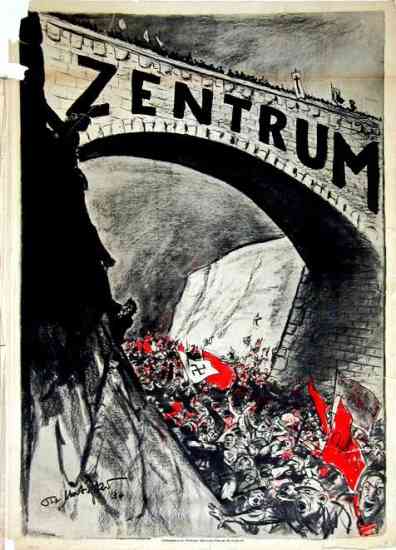
The Zentrum, a firm bridge over the abyss of extremists fighting (you can see the whole election poster here). While the poster used for the card is from 1930, this kind of centrist messaging would have resonated with Marx who spent much of his time in politics to align DVP and DDP more closely to the Zentrum (the topmost effect of this agenda card). Card “We Are the Center”, ©Capstone Games/Skellig Games/Spielworxx.

Rating: 3 out of 5.

Integrity

Marx was personally incorruptible. He managed to be both a committed party man, but govern with all of his country in mind. However, the Enabling Act set a dangerous precedent for the erosion of the constitution.

Rating: 4 out of 5.

Overall

In his first and second chancellorship, Wilhelm Marx rose to the challenge of implementing the solutions to the great crisis of the republic. In his later tenures, he performed markedly worse despite the much-improved situation. His biggest successes are holding the course in foreign and economic policy in 1924, his biggest failure his inability to develop and implement a long-term plan for his party and the republic.

  1. Abraham Lincoln 28/30
  2. Franklin D. Roosevelt 25/30
  3. Friedrich Ebert 25/30
  4. Winston Churchill 25/30
  5. Robert Walpole 24/30
  6. Willy Brandt 23/30
  7. Konrad Adenauer 22/30
  8. Harry S. Truman 21/30
  9. John F. Kennedy 17/30
  10. Hermann Müller 17/30
  11. Wilhelm Marx 17/30
  12. Ludwig Erhard 12/30
  13. Paul von Hindenburg 10/30

How would you rate Marx? Let me know in the comments!

Further Reading

For short overview essays on all German chancellors from Bismarck on, see Sternburg, Wilhelm von: Die deutschen Kanzler. Von Bismarck bis Merkel [The German Chancellors. From Bismarck to Merkel], Aufbau-Verlag, Berlin 2006 (in German).

The only full-length biography of Marx is Hehl, Ulrich von Wilhelm Marx: 1863—1946. Eine politische Biographie [Wilhelm Marx: 1863—1946. A Political Biography], Matthias-Grünewald-Verlag, Mainz 1987. Its somewhat dry style is made up for by its detailed, source-rich research.

For the broader context, see: Herbert, Ulrich: A History of Twentieth-Century Germany, Oxford University Press, Oxford 2019.

Hermann Müller (Weimar Chancellor Ratings, #1)

17. Mai 2026 um 17:04

We’ve been assessing the merits of political leaders in (more or less) democratic countries on this blog for a few years now. Today, we’re returning to German chancellors… but not the way you know it. After a few chancellors from the Federal Republic of Germany (founded in 1949), we’re assessing for the first time a chancellor from the Weimar Republic, Germany’s first attempt at parliamentary government – Hermann Müller. And which game could be more appropriate for him than Weimar (Matthias Cramer, Capstone Games/Skellig Games/Spielworxx)?

The Rating System

Some caveats ahead: The chancellors will be rated by the knowledge of their time. If they or their contemporaries could not have known about the effects of something, I will not use my hindsight to mark it as a mistake of theirs. The assessment is focused on their conduct as chancellor.

Now, to the system itself: There are three policy field categories (foreign, domestic, and economic policy) and three more general ones (vision, pragmatism, integrity). A chancellor can earn from one to five stars in each category (for a total sum of up to 30). In detail, the chancellor is assessed as follows:

Foreign policy: Did the chancellor increase German influence in the world and the security of Germans at home? Did the chancellor wield German power responsibly and with positive results for the regions affected?

Domestic policy: Did the chancellor increase the liberty of Germans to express themselves and to participate in the political process? Did the chancellor promote domestic security and shape the framework for fair justice dealing with offenses?

Economic policy: Did the chancellor facilitate the prosperity and economic security of Germans (including in the mid- and long-term)? Was the chancellor’s economic policy based on mutual benefit of those involved or did it unduly burden one side?

Vision: Did the chancellor have an idea of what Germany and Europe (the latter counting for more in times of German influence being great) should look like beyond the immediate future? Did the chancellor’s policies steer Germany (and, if applicable, Europe) in this direction?

Pragmatism: Did the chancellor succeed in seeing their policy through from inception to completion? How well did the chancellor manage the support from parliament, society, the administration, the media?

Integrity: Did the chancellor understand the office as a means to benefit themselves, special interest groups, the entire country, or another community? Did the chancellor respect the boundaries of the office?

Note: If you have read my UK prime minister or US president ratings, you will remember that I rated them on the global impacts of their vision as well. As the rating system is only really applicable to democratic leaders and no democratic German leader ever had the chance to conduct a truly global policy, I only assess their vision on national and European grounds.

Müller’s Early Life

Hermann Müller was born in Mannheim (in the southwest of Germany) on May 18, 1876. His father ran a small sparkling wine company, but died when Hermann was still a teenager. Thus, instead of taking over the company or going to university, the young Hermann Müller trained to become a clerk. He soon became involved with the socialist movement and joined the Social Democratic Party of Germany (SPD) in 1893. After some years working for social democratic newspapers, he was elected to the leadership board of the SPD in 1906. Müller was often charged with liaisons to other socialist parties in Europe – including a doomed trip to Paris in July 1914, trying to negotiate a joint refusal of French and German socialists to support their respective countries’ impending war with each other.

Müller was elected to Imperial Germany’s parliament in a by-election in 1916. Soon after, the German Social Democrats split between the Majority Social Democrats (MSPD, including Müller) who supported the war effort, and the Independent Social Democrats (USPD), who did not. When the war was lost in November 1918 and the monarchy swept away by revolutionary soldiers and workers, the MSPD soon took control of the revolution and steered a moderate course towards parliamentary democracy.

The Compiègne card (referring to the armistice between Germany and the Allies on November 11, 1918) contains the setup instructions for Weimar. Look at all the orange crisis tokens to be placed! Image ©Capstone Games/Skellig Games/Spielworxx.

The New Republic

The revolution of 1918/1919 transformed the (M)SPD from the pariah party of Imperial Germany to the most important pillar of the new republic. As the Social Democrats were no longer barred from the positions of power, they needed scores of cadres to fill them. The general upswing also brought a promotion for Müller, who was elected co-chairman of the MSPD in 1919. Government came with its own challenges: The lost war, the ongoing Allied naval blockade, and the weak position of the new government made it imperative to conclude a peace treaty with the Allied powers. The provisions of the Treaty of Versailles, with which the Allies presented Germany, seemed unacceptable to most Germans – including many Social Democrats. Chancellor Philipp Scheidemann resigned rather than take responsibility for the treaty. He was succeeded by Gustav Bauer (also SPD) whose new administration Müller joined as foreign minister in June 1919. In this role, it fell to him to sign the treaty. From there, Müller sketched the outlines of a new foreign policy – one in which Germany would cooperate with the Allies, use its economic and cultural rather than its military strength to influence world events, and thus overturn the harsh provisions of the Treaty of Versailles.

The Treaty of Versailles is not too attractive for the first government parties in Weimar, as it strengthens their nationalist (DNVP) rivals (black icons)… but at some time, you will have to bite the bullet to remove the Allied blockade which might otherwise topple the republic. Image ©Capstone Games/Skellig Games/Spielworxx.

The Bauer administration resigned after the Kapp-Lüttwitz coup of March 1920. Müller took over the chancellorship as a caretaker – elections were scheduled for June 1920. He was unable to tackle most of the many challenges which beset Germany (chiefly the agreement with the Allies on the details of the German reparations, the tensions over the German-Polish border, and the threat of right-wing terrorism and insurgency (as in the Kahr coup in Bavaria)). The only crisis which was dispelled during his time in office was the dissolution of the Red Ruhr Army, a left-wing militia which had formed in opposition to the Kapp-Lüttwitz coup and, after its failure, had continued their struggle for a council republic on the Ruhr. Their uprising was put down by army and Freikorps units and over a thousand workers (with more or less connection to the uprising) summarily executed.

The Red Ruhr Army can give the Communists a powerful push in the game… and make the Republican parties more forgiving of the Nationalists taking over army units (black units in Essen).

The first one and a half years of democratic government in Germany had proven a disappointment for many voters, including those who generally were in favor of the new republic. The three government parties (the SPD, the Catholic Center (Zentrum), and the liberal German Democratic Party (DDP)) all suffered heavy losses in the 1920 election. The SPD was particularly hard hit, as its handling of the Kapp-Lüttwitz coup and the Ruhr Uprising disenchanted many left-leaning workers. Both the USPD and the pro-business, conservative-liberal German People’s Party (DVP) gained a lot of votes.

With the majority for the government coalition lost, Müller attempted to broaden the government by including the USPD. Due to his handling of the aftermath of the Kapp-Lüttwitz coup, he was brusquely rebuffed. As he did not see potential to cooperate with the DVP, he led the SPD into opposition.

The Opposition agenda card in Weimar strengthens the SPD in parliament and allows the party to (re-)gain a minor ally (the USPD or DDP).

Opposition and Return to Government

Müller’s own inclination was to return to government responsibility, but he prioritized first the reunification of the SPD with the USPD (concluded in 1922) and then the prevention of another rupture. However, the SPD supported the bourgeois minority government (Zentrum, DDP, and DVP) in matters of foreign policy, which was conducted by the guidelines which Müller had laid out as foreign minister and chancellor in 1919 and 1920.

The reparations issue, however, remained unresolved. As tensions over it with the Allies heated up, France occupied the Ruhr again, to which the government responded with encouraging the population of the Ruhr to cease cooperation with the occupiers. This “passive resistance” relied on the national government funding the livelihood of millions of people and thus fueled inflation. As these interconnected crises escalated, it became clear that the government did not have the parliamentary and public support to deal with them. Government needed to rest on a broad basis. The first “Grand Coalition”, led by DVP chancellor Gustav Stresemann and including SPD, Zentrum, DDP, and DVP was inaugurated in August 1923. Four Social Democrats became ministers. Hermann Müller, however, was none of them as he was deemed indispensable to maintain control of the fractious SPD parliamentary group (whose vote to join the government had been on the narrowest of margins).

Stresemann’s re-roll ability makes him an excellent ally in any kind of crisis – coups, foreign policy, presidential elections.

While the Stresemann government successfully ended both the passive resistance (and French occupation) and the inflation crisis, the way there was rocky. It included challenges from both the left wing in Saxony and Thuringia (which were put down by the armed forces once the Communist Party entered a parliamentary government) and the right wing (a nationalist power grab in Bavaria was left unanswered as the loyalty of the army to the republic seemed suspect; an attempt to radicalize Bavaria even further led by a young demagogue named Adolf Hitler collapsed when it met resistance by the nationalist authorities). This uneven treatment convinced the SPD to leave government after only three months. Stresemann, thus without a majority, soon was toppled as chancellor, but remained foreign minister.

The SPD, despite being the largest party in parliament (and being confirmed in this status in 1924), would spend the next five years in opposition. Attempts to form another Grand Coalition failed in 1924 and 1925 (because the DVP preferred to cooperate with the nationalist DNVP and the new, monarchist, president Paul von Hindenburg), and in 1926, because Müller’s SPD engaged in the fool’s quest of pursuing a plebiscite to expropriate the former princes – the plebiscite failed to meet the quorum as expected, but it set the SPD on a path of confrontation with the bourgeois parties which ruled out any cooperation with them.

“Fürstenenteignung” (Princes’ Expropriation) is a Communist card in Weimar, reflecting that it was the KPD which initiated the plebiscite. Should the SPD player get too embroiled in it, it might damage their relationship with the Zentrum. Image ©Capstone Games/Skellig Games/Spielworxx.

That did not mean that cooperation was impossible: The SPD continued to back the cooperative-revisionist foreign policy of the government, and also supported budget compromises. Thus, the party agreed to a budget for the year 1928 which included a first payment for new armored cruisers to modernize the navy. It then campaigned for the March 1928 elections on the slogan “Meals for Children instead of the Armored Cruiser”. The electorate returned the SPD with its best showing since 1919. Müller was able to form a government (once more including Zentrum, DDP, and DVP) and was elected chancellor for the second time.

Müller at work in his preferred arena – that of parliamentary debate, not of street action. His event often allows the SPD player to shift the issues decisively in their favor.

The Second Chancellorship

The contradiction between parliamentary action and campaign promises immediately backfired for Müller. The budget for the new fiscal year was due, and as agreed, included funds for the naval modernization. Müller belatedly realized that the decision had been made already, that the SPD had agreed to it, and that his government partners would expect the SPD to stick to its previous course. While Müller and the SPD ministers voted in favor of the budget in cabinet, the SPD parliamentary group revolted against the budget and forced them to vote against it in parliament. It did the rebels no good, as they could not find another majority for an alternative budget, but the revolt was a catastrophe for Müller’s authority.

The Armored Cruiser event/issue is likely to sow discord between Zentrum and SPD. Only a very trusting partnership between the two can allow each to shine. Image ©Capstone Games/Skellig Games/Spielworxx.

The economic situation was similarly unpromising: When the trade unions of the Ruhr heavy industry proposed a pay raise by 15 pennies per hour, the employers responded by pre-emptively handing hundreds of thousands of workers their notice. Unions and employers then agreed on mediation, but when the employers did not like the result, they backtracked and disputed the legality of the process. Thus, 240,000 iron workers were laid off. Müller had a second mediator make a new proposal, which was suitably employer-friendly (with pay raises ranging from one to six pennies per hour). The employers contentedly saw that playing hardball paid off. Their confrontational stance would increase with the growing unemployment after the 1929 stock market crash.

The good times are over: The 1929 stock market crash marks the beginning of the tumultuous last two rounds of Weimar. Government, once a coveted source of victory points, will now be less fruitful, and, at the same time more detrimental to the involved parties’ parliamentary strength. Image ©Capstone Games/Skellig Games/Spielworxx.

For the time being, Müller enjoyed the greatest success of his tenure: He negotiated a new reparations agreement (without Stresemann, who died in October 1929), the Young Plan (named after Owen D. Young, who represented the American side). The negotiations were a great step forward for Germany (as the reparations were much reduced and payment put on a realistic basis), but a mixed blessing for Müller: On the one hand, the agreement was very unpopular (as it stipulated German payments for the next 58 years) and thus maligned by the right wing (which campaigned against it on the slogan “Enslaved for three generations). On the other, the combination of the undoubted necessity of the negotiations and their unpopularity meant that the moderate right-wing parties held off their assault on Müller for the moment, as they wanted him to take the blame.

The combo of the Young Plan and the petition against it may place up to three new crisis markers on the board. Müller really threaded the needle by successfully negotiating the reparations agreement and then fending off the referendum against it.

It was only a short reprieve. By January 1930, the Young Plan negotiations were concluded. The same month, the DVP, not being held back by the pro-government Stresemann anymore, had secretly decided to break the coalition if the SPD did not agree to radical pro-business reforms. The party had received encouragement from president Hindenburg, who also intimated to Zentrum leader Heinrich Brüning that he would support a Brüning-led bourgeois minority cabinet with presidential executive orders.

A key legislative initiative for the SPD: The Unemployment Insurance event gives victory points in the short run and (via the Unemployment Insurance society token, yellow square) will reduce poverty over a few rounds, thus providing a major boost to the SPD’s program. Image ©Capstone Games/Skellig Games/Spielworxx.

The showdown came in March 1930 over the reform of unemployment insurance. Müller had negotiated a compromise with Paul Moldenhauer (DVP), the minister of finance. However, the DVP parliamentary group refused to accept the compromise. Müller then tasked Brüning to work out another proposal which would be acceptable to all parties in government. Brüning’s suggestion – which would have postponed the issue by another year without solving it – found agreement in the DVP, Zentrum, and DDP parliamentary groups, but, despite Müller’s urging, not that of the SPD. The second Müller administration thus ended on March 27, 1930.

The stern look of a-parliamentary government. Image ©Capstone Games/Skellig Games/Spielworxx.

Müller had hoped that president Hindenburg would support an SPD-led minority government with executive orders. Instead, Hindenburg turned to Brüning whose chancellorship began the slide into government not backed by parliamentary majorities. The SPD, however, supported Brüning on key issues of economic and foreign policy lest the president find excuses to turn even more authoritarian. It was to no avail: Hindenburg and his camarilla got tired of Brüning in 1932 and replaced him in turn with Franz von Papen and Kurt von Schleicher who enjoyed even less parliamentary support, before it seemed like a smart move to them to ally their nationalist elites to the popular movement of the Nazis in January 1933, ending German democracy altogether. Müller did not live to see his democratic republic destroyed: He had never been of strong health, had campaigned and governed against the advice of his doctors who counselled rest, and died on March 20, 1931.

The Rating

Foreign policy

Müller developed Weimar’s foreign policy in his first term in government (as foreign minister and chancellor), which aimed at proving to the Allies by faithful cooperation that Germany was willing to do its part in reconciliation (but had economic limits in what it could do) and would thus be re-admitted on an equal footing to the international community, which would allow the country to revise key portions of the Treaty of Versailles. While the theory was sound, its application ran into practical problems – for Müller as well as the other chancellors and foreign ministers of the Weimar Republic: French revisionism of the Treaty (France felt short-changed in the matters of annexations and would have liked to incorporate the entire left bank of the Rhine as under Napoleon), and the constant charges from the German right that international cooperation under the Treaty of Versailles was akin to betrayal of the nation.

Rating: 4 out of 5.
Müller’s foreign policy provided the basis for that of the Weimar Republic up to 1932… but it was always vulnerable to nationalist attacks on it. Image ©Capstone Games/Skellig Games/Spielworxx.

Domestic policy

Müller never gave much attention to the existing inequities during his two terms as chancellor. That he was aware of them is proven by his record as foreign minister, in which he massively overworked the diplomatic service (which had been almost exclusively staffed by nobles heretofore), opening it for applicants from all backgrounds. Similar reforms of the judiciary or the military, two other institutions still personally and mentally clinging to Imperial Germany, did not make it to Müller’s chancellor agenda, even though the atrocities committed on the Ruhr in 1920 while the army could not be used to deal with the Bavarian regime at all showed the necessity of these institutional changes.

Rating: 2 out of 5.
Think this might justify removing anti-democratic elements from the army? Image ©Capstone Games/Skellig Games/Spielworxx.

Economic policy

Müller’s handling of economic policy was incremental and cooperative – a bad fit to deal with his counterparts in business and the government (DVP) who wanted radical changes through confrontation. Müller’s stance may have been the more reasonable. But Müller lost.

Rating: 2 out of 5.

Vision

Müller’s vision of a Germany based on constructive parliamentary debate and government compromise, cooperating with other countries on an equal footing, is compelling. However, Müller was not always successful in advancing these goals, as he prioritized party unity over compromise with others at times.

Rating: 3 out of 5.
The illustration for the State Visit event card of the SPD is Müller’s second cabinet. Müller himself is seated, second from the left. Image ©Capstone Games/Skellig Games/Spielworxx.

Pragmatism

Müller failed to see most of his policy initiatives through. He kept neither his coalition nor his own parliamentary group in check. However, Müller prevented another rupture of his party, and as a skilled electoral campaigner, achieved the first place for the SPD in every national election with him at the helm of the party.

Rating: 2 out of 5.
The SPD was generally successful at the ballot box, but the party – and Müller – often failed to parlay this popular support into policy success. Image ©Capstone Games/Skellig Games/Spielworxx.

Integrity

Müller was fair and even-handed in his conduct as a chancellor. As a Social Democrat, he considered the workers his natural constituency, but was always willing to include the interests of other groups in the compromises he forged. His only fault was to hope for the a-parliamentary executive order minority government which, in the end, was given not to him, but Brüning.

Rating: 4 out of 5.

Overall

Hermann Müller’s chancellorship is traditionally considered a failure based on the collapse of the Weimar Republic soon after. Yet the Republic did not end with his tenure, and it was destroyed not by his actions, but by those of others. Müller’s most enduring contribution was the invention of the Weimar formula of foreign policy, his biggest weakness his inability to impose authority on his friends, partners, rivals, and foes. He failed because he was a middling chancellor in a hostile world.

  1. Abraham Lincoln 28/30
  2. Franklin D. Roosevelt 25/30
  3. Friedrich Ebert 25/30
  4. Winston Churchill 25/30
  5. Robert Walpole 24/30
  6. Willy Brandt 23/30
  7. Konrad Adenauer 22/30
  8. Harry S. Truman 21/30
  9. John F. Kennedy 17/30
  10. Hermann Müller 17/30
  11. Wilhelm Marx 17/30
  12. Ludwig Erhard 12/30
  13. Paul von Hindenburg 10/30

How would you rate Müller? Let me know in the comments!

Further Reading

For short overview essays on all German chancellors from Bismarck on, see Sternburg, Wilhelm von: Die deutschen Kanzler. Von Bismarck bis Merkel [The German Chancellors. From Bismarck to Merkel], Aufbau-Verlag, Berlin 2006 (in German).

The only full-length biography of Müller is Reichel, Peter: Der tragische Kanzler [The Tragic Chancellor], dtv, Munich 2018 (in German). Unfortunately, the book suffers from the author’s misguided attempt to assign blame for the end of the republic on the SPD for an alleged lack of willingness to compromise, which runs through the entire book.

A revisionist, but insightful short treatment of Müller is Behring, Rainer: Hermann Müller (1876—1931) und die Chancen der Weimarer Republik [Hermann Müller (1876—1931] and the Chances of the Weimar Republic], in: Brandt, Peter/Lehnert, Detlef: Sozialdemokratische Regierungschefs in Deutschland und Österreich. 1918—1983, Dietz, Bonn 2017 (in German).

For the broader context, see: Herbert, Ulrich: A History of Twentieth-Century Germany, Oxford University Press, Oxford 2019.

Konrad Adenauer (Chancellor Ratings, #3)

15. September 2024 um 18:23

You know the drill: We’re assessing a (democratic) leader, illustrated with a single board game! Today’s subject is another German chancellor – Konrad Adenauer, the first chancellor of the Federal Republic of Germany. And which game could be more appropriate for him than Wir sind das Volk! (Richard Sivél/Peer Sylvester, Histogame) plus the 2+2 expansion?

After an introduction to the rating system, we’ll survey Adenauer’s life – from his early years over his tenure as mayor of Cologne to his election as chancellor, and, of course, what he did in office – the foreign policy successes, the domestic agenda, and the decline of his later years – before coming to the rating. Let’s go!

The Rating System

Some caveats ahead: The chancellors will be rated by the knowledge of their time. If they or their contemporaries could not have known about the effects of something, I will not use my hindsight to mark it as a mistake of theirs. The assessment is focused on their conduct as chancellor, but includes their life after holding the office (in which they will still be regarded in the public eye as (ex-)chancellors).

Now, to the system itself: There are three policy field categories (foreign, domestic, and economic policy) and three more general ones (vision, pragmatism, integrity). A chancellor can earn from one to five stars in each category (for a total sum of up to 30). In detail, the chancellor is assessed as follows:

Foreign policy: Did the chancellor increase German influence in the world and the security of Germans at home? Did the chancellor wield German power responsibly and with positive results for the regions affected (the latter counting for a greater deal in times of German power being great)?

Domestic policy: Did the chancellor increase the liberty of Germans to express themselves and to participate in the political process? Did the chancellor promote domestic security and shape the framework for fair justice dealing with offenses?

Economic policy: Did the chancellor facilitate the prosperity and economic security of Germans (including in the mid- and long-term)? Was the chancellor’s economic policy based on mutual benefit of those involved or did it unduly burden one side?

Vision: Did the chancellor have an idea of what Germany and Europe (the latter counting for more in times of German influence being great) should look like beyond the immediate future? Did the chancellor’s policies steer Germany (and, if applicable, Europe) in this direction?

Pragmatism: Did the chancellor succeed in seeing their policy through from inception to completion? How well did the chancellor manage the support from parliament, society, the administration, the media (the latter counting for more in more recent years)?

Integrity: Did the chancellor understand the office as a means to benefit themselves, special interest groups, the entire country, or another community? Did the chancellor respect the boundaries of the office?

Note: If you have read my UK prime minister or US president ratings, you will remember that I rated them on the global impacts of their vision as well. As the rating system is only really applicable to democratic leaders and no democratic German leader ever had the chance to conduct a truly global policy, I only assess their vision on national and European grounds.

Adenauer’s Life

Early Years

Konrad Adenauer was born on January 5, 1876, in a Rhenish bourgeois family. He and his brothers were the first in the family to attend a university. After a few years working in public service and at a law firm, Adenauer turned to local politics. As he had a foot in both confessional/political camps (his own family was devoutly Catholic, his wife came from one of the old liberal Protestant families), Adenauer secured a broad majority for his election as Deputy Mayor of Cologne in 1906.

Adenauer rose quickly in municipal administration, both by his diligent, energetic service and his family connections – his wife’s uncle Ludwig Wallraf had been elected Lord Mayor in 1907.  When Wallraf was called to serve in the Reich administration in 1917, Adenauer was elected Lord Mayor of Cologne.

Lord Mayor of Cologne

His years at the helm of the city were turbulent. Just a year after his election, the double quake of Germany’s defeat in World War I and the German Revolution of 1918/19 sent shockwaves through the country. Adenauer himself put out tentative feelers to France, if the west of Germany could become an independent country (giving the French a buffer state to Germany). The Allies, however, forged a different agreement in their negotiations at Versailles. During the crisis year of 1923, Adenauer made another attempt at Rhenish separatism, which faltered as the crises were resolved by Gustav Stresemann’s government.

Adenauer was an energetic Lord Mayor whose legacy can still be seen and felt in Cologne – the “green belt” of parks around the city center (formerly a ring of fortifications), the university, and one of the bridges over the Rhine are his creations. He used a pragmatic government style, adding to his own power base of the Catholic Zentrum (Center) party whichever other factions would give him a majority for his projects – Liberals, Social Democrats, and in the case of the bridge even the Communists.

Adenauer’s many expensive projects put Cologne in a financial squeeze when the Great Depression reduced revenue and cut off access to international credit. He applied himself to bettering the city’s financial situation with mixed success.

When the Nazis took power in 1933, they removed him from his post. Adenauer, now aged 57, entered private life. For the next twelve years, he would distance himself both from the Nazis and the anti-Nazi resistance.

The Path to the Chancellorship

In 1945, the Allies had need of men like Adenauer – experienced in government, not a Nazi, and a reliable proponent of democracy and market economy. He was reinstated as Lord Mayor of Cologne. His tenure, however, was cut short, when the British authorities (in whose occupation zone Cologne lay) found out about his contacts with the French on the matter of – once more – establishing a separate Rhenish state.

Letting go of the mayorship was not too hard for Adenauer. It freed him up for the work of establishing a new party which was to shed the confessional limitations of the old Zentrum in favor of an all-Christian approach – the CDU (Christlich-Demokratische Union, Christian Democratic Union). Adenauer also was tapped to head the Parliamentary Council working on the Basic Law, a quasi-constitution for the new German state to be founded. Adenauer, never much of a conceptual thinker, was barely involved in the drafting, yet his political acumen was instrumental in forging the compromises behind the Basic Law.

Adenauer’s relationship to Berlin was always frosty – it was Prussian, it was dominated by Social Democrats, and, worst of all, it was within reach of the menacing Soviet Union. He refused to go there from 1945 to 1949, and only visited very rarely as chancellor. Image ©Histogame.

When the Soviet Union lifted the Berlin Blockade in May 1949, the path for a German state made out of the three western occupation zones was free. The first free elections in the new Federal Republic of Germany gave no one a clear majority, but Adenauer’s CDU (plus its Bavarian allies, the CSU [Christlich-Soziale Union, Christian Social Union] came in first. In a tactically masterful campaign, Adenauer convinced his party (and then its partners) not to form a “grand coalition” with the Social Democrats, and instead govern with several smaller bourgeois parties (the liberal FDP [Freie Demokratische Partei, Free Democratic Party] as well as the nationalist DP [Deutsche Partei, German Party]). Adenauer himself was elected Chancellor on September 15, 1949.

Foreign Policy Successes

Adenauer’s first task as Chancellor was the re-integration of (West) Germany into the international community. As a first step, he negotiated the Petersberg Agreement (1949) with the Allied High Commissioners which granted the new West German state limited sovereignty. His further negotiations with the Allies were crowned by the General Treaty (1955) which made West Germany a sovereign country for most intents and purposes – special rights for the four Allied powers (Soviet Union, United States, United Kingdom, France) notwithstanding. Consequently, West Germany would have an army again, and become a member of NATO.

Adenauer’s crowning foreign policy achievement: Only ten years after Germany’s total defeat in World War II, the country shedded its pariah status and became a (mostly) sovereign nation again – an economic as well as symbolic victory, and an event I always like playing as West Germany in Wir sind das Volk! Image ©Histogame.

Adenauer’s approach of integration through giving up control did not only work for regaining sovereignty, but also in European affairs: France’s anxiety about the German heavy industry (and the French desire to gain access to more coal and steel) resulted in the formation of the European Coal and Steel Community which placed the heavy industry of the two countries (plus Italy and the Benelux countries) under supranational control – the first international agreement of that kind, and the first step toward the European Union.

While Adenauer used the opportunities presented to him, he also recognized the traps: Thus, when Stalin offered German reunification as a neutral country (with only the vaguest allusions to the nature of such a unified Germany) in 1952, Adenauer refused to take the bait and dismissed the note in concert with the Western Allies.

Wir sind das Volk! embraces ambiguity – many events can be beneficial to both sides, depending on how they are played. Yet the Stalin Note card is unambiguously a “red” event, from which only the USSR and East Germany benefit. If you are playing one of the Western powers, do it like Adenauer and play the event for the action points before the Eastern powers snatch it!

All this time, Adenauer had to contend with the opposition of the nationalist Germans and the SPD who felt that the Chancellor had become an instrument of the Western Allies, both of them grossly misjudging Germany’s negotiation position. Adenauer’s shrewd realism prevailed.

Adenauer was skilled at fusing values and interests in negotiations. While he was personally committed to German reparations to the newly-founded state of Israel for Nazi Germany’s persecution and murder of the European Jews, he did not just announce them. Instead, he had the negotiations on them run in parallel to those on Germany’s foreign debt (mostly from Marshall Plan loans, but also still from the reparations after World War I). The moral impetus of the negotiations with Israel carried over to the debt negotiations, as only an economically strong Germany could give meaningful support to the Jewish state, and so a large part of the debt repayments were postponed or cancelled altogether.

Stepping out of the shadow of the war was not only a question of reparations. Millions of Germans had been taken prisoner by the Allies. Most of them were released in the years immediately after the war, but the Soviet Union kept several thousand in camps  until Adenauer negotiated their release in 1955. While he did not encounter much resistance from Soviet leader Khrushchev, the “Return of the Ten Thousand”, as the contemporary writers called it (borrowing from Xenophon) was often cited as Adenauer’s prime achievement by the Germans who lived through his administration – a symbolic end to the war.

An ambiguos event: The release of the German prisoners of war removes unrest in West Germany and increases West German prestige, but it also adds 1 to the budget of the USSR (due to the economic agreements made) and tilts the balance between the superpowers in favor of the USSR.

The Domestic Agenda

Millions of Germans had lost their homes and livelihoods in the war – be that by destruction or when they were expelled from the German East. If and how these losses should be compensated was the subject of intense public debate. Adenauer opted for a tax of fifty percent of the value of property of owners who had not suffered any losses, payable in instalments over thirty years (Lastenausgleich [Burden Equalization]). The funds raised were paid out in various programs to those who had suffered material losses. While there was intense resentment on the part of property owners from the relatively untouched German West, the scheme helped integrate the millions of refugees while preserving the pre-war social order.

In the meantime, the West German economy had taken off – fuelled by the European integration as well as the increased demand for German consumer goods as the outbreak of the Korean War oriented the American economy towards war materiel, but also because the economic course of Adenauer’s administration proved successful: A generally liberal market economy was tempered by sporadic government intervention (soziale Marktwirtschaft [social market economy]).

One of the strongest cards of the first decade: The Wirtschaftswunder (Economic Miracle) adds no fewer than three build points for West Germany, removes one unrest there and (due to envy of the unequal economic development in the East) adds one unrest in East Germany. Image ©Histogame.

Adenauer’s second large social project concerned retirement pensions. Retirees, already not particularly well off on the whole, had not partaken in the dynamic wage growth of the 1950s. They remained poor in an ever-wealthier society. Adenauer (against the position of the cabinet majority) pushed for pensions to be paid out of the premiums of the currently-employed (instead of those the retirees had paid themselves). When the reform was implemented in 1957, pensions were significantly increased and old-age poverty all but eliminated.

The chancellor’s willingness to atone for the crimes of his country’s past in foreign policy contrasted with his selection of staff and ministers at home: Hans Globke, whose work at the Ministry of the Interior’s Office of Jewish Affairs during Nazi times had seen him actively involved in the legal discrimination and persecution of Jews, continued his career as Chief of Staff at Adenauer’s chancellery. Adenauer’s Minister for Displaced Persons, Refugees, and War Victims, Theodor Oberländer, had even participated in Hitler’s Beer Hall Putsch of 1923 and had later advocated for the ethnic cleansing of Poland. Both selections were controversial, but Adenauer kept faith with them – Oberländer had to resign under public pressure in 1960, Globke stayed on until Adenauer’s own resignation.

Adenauer masterfully parlayed his domestic and foreign policy successes into ever-larger electoral victories in 1953 (when CDU and CSU had the majority together with the DP, but joined with the FDP in addition as well) and 1957 (when CDU and CSU won a one-party majority for the first and only time in the history of German democracy). Both times, Adenauer’s skill and ruthlessness as a campaigner were instrumental in the victories.

The Decline

After 1957, Adenauer seemed to lose his touch. His negotiations ensuring German re-armament had been masterful, but there was a gaping hole between the ambitious plans for the German army and the haphazard way in which a much more modest force was established. At the same time, Adenauer kept calling for Germany’s nuclear armament, a demand which was sure to be rejected by the Western Allies and exploited by the Soviets as a sign of the return of aggressive German militarism. Adenauer’s casual, sometimes careless treatment of the subject (he referred to tactical nuclear weapons as nothing more than an “advancement in artillery”) also increased the fear of a new, even more devastating, war within the German population.

Did I talk of “best cards”? Well, this is it – in the unlikely form of the Göttingen 18, scientists protesting against the nuclear armament of West Germany. The best card of the first decade, and whoever gets it will have a leg up. The two unrest in West Germany can turn a province into a hotbed of rebellion for the rest of the game, and the two prestige shifts in favor of the East might put them into the driver’s seat just as long. Image ©Histogame.

At the same time, Adenauer’s erstwhile foreign policy acumen – and willingness to confront the Soviets – seemed to have withered. When Khrushchev threatened West Berlin again from 1958, Adenauer was half disinterested, half willing to give in. Only French, and later American firmness on the matter prevented West Berlin being turned into a neutral “free city.” Adenauer’s detached behavior – most evident after the building of the Berlin Wall in 1961 – contrasted starkly with the principled stand of Willy Brandt, Mayor of West Berlin, and Adenauer’s Social Democratic challenger in the 1961 elections.

Building the Berlin Wall redefined the German question… and Adenauer’s reaction was to do nothing. Image ©Histogame.

It was somewhat surprising that Adenauer even stood for reelection in 1961 – after all, he was alreadyy 85 at the time. Two years before, he had toyed with abandoning the chancellorship and succeeding Theodor Heuss as Federal President – an office which had been designed to be largely ceremonial in the constitution, but which Adenauer wanted to turn into the political center of gravity (following de Gaulle’s example) of Germany. After Adenauer’s ambitions had damaged the office of the president, the plan was dashed by his own party, which was increasingly less willing to put up with everything Adenauer decreed.

Once more, Adenauer’s CDU/CSU won the elections, but the significant losses at the ballot box meant Adenauer had to form a coalition with the FDP again – and to promise that he would step down during the term. Before that came to happen, Adenauer and the ebullient civil society of the German democracy had their starkest clash: When news magazine Der Spiegel (The Mirror) reported on the botched rearmament, Adenauer authorized his minister of defense Franz-Josef Strauß (CSU) to push for charges of treason against the editor and journalists of the magazine. The newsroom was searched for evidence and several journalists arrested – a gross violation of the freedom of the press. Unsurprisingly, the charges had to be dropped.

Visual condensation: The image alludes to a title page of the Spiegel magazine – but instead of the actual title of the respective issue, it shows the two principal opponents of the affair: Minister of Defense Strauß and editor Rudolf Augstein. Image ©Histogame.

Adenauer’s last initiative was an improvement of the relationship with Germany’s western neighbor France. Since the founding of the German nation-state less than a century before, the two countries had fought three devastating wars (plus countless wars between France and the German principalities before Germany’s national unification). If there was someone to bridge this “inherited enmity”, it was Adenauer – after all, he had sounded out the French about founding a French-aligned separate Rhenish state no less than three times before he took over national office, and he had cultivated a good relationship with French president Charles de Gaulle since 1958 (based on both men’s instinctive feeling that they did not receive everything that was due to them from their Anglo-American allies). Adenauer and de Gaulle concluded the Élysée Treaty in January 1963, proclaiming the friendship between the two countries (which has since taken root in a plethora of local initiatives and city twinnings). De Gaulle’s and Adenauer’s goal to challenge Anglo-American leadership of the West with the Franco-German alliance, however, failed, as Adenauer’s party only accepted the treaty once it was couched in a preamble stressing the importance of the transatlantic relationship and support for the United Kingdom joining the budding integrated Europe.

At this point, Adenauer had lost his party. While he tried to maneuver for a succession to his liking, the party’s parliamentary group was not willing anymore to accept his authority. Of the four men considered chancellor material, they selected the one least to Adenauer’s liking – Minister of the Economy Ludwig Erhard. Adenauer resigned on October 15, 1963.

While retired from the chancellorship, he remained party chairman of the CDU. He spent his last years writing his memoirs and – behind the curtain as well as publicly – undermining his unloved successor, whose resignation in 1966 he still lived to see. Konrad Adenauer died on April 19, 1967, aged 91.

The Rating

Foreign policy

Foreign policy was always Adenauer’s focus – he even acted as his own Foreign Secretary from 1951 to 1955. The immense successes of the early years – Germany’s shedding of its pariah status, its firm integration into the West, and the foundations for European integration – are arguably the most impressive feat in the history of German foreign policy. Yet Adenauer’s later foreign policy seemed fickle and his resolve weakened. The chaotic nature of the rearmament process also wasted potential for increased security. Even his last success – the Élysée Treaty – was a mirage, as the personal (instead of institutional) framework of the agreement was quickly dashed by his successor.

Rating: 4 out of 5.
Rearmament was never popular (unrest in West Germany), but it stood for West Germany’s integration into the western alliance (prestige shift in favor of West Germany). Image ©Histogame.

Domestic policy

Konrad Adenauer was the first chancellor of the newly democratic Germany. Yet his own position to democratic values was distanced, at times tactical. The reappearance of former Nazi officials in high government positions and his unwillingness to confront the Nazi crimes domestically meant that wrongs continued to go unchecked – for example in the law courts, which, supported by Adenauer’s government, quickly re-established their old personnel. Adenauer saw personal liberties as subject to the state’s (or the government’s interests) – most clearly evidenced in the Spiegel scandal. The societal climate of Adenauer’s Germany fell behind the more liberal Weimar Republic decades before.

Rating: 1 out of 5.

Economic policy

The best economic course was subject to intense debate in the mid-20th century: Adenauer’s own party adopted a platform of nationalizing banks and heavy industry in 1946; most of the cabinet members (including the pro-business FDP and Minister for the Economy Ludwig Erhard) favored a pure private-business market economy. Adenauer steered a middle course against tough opposition, establishing a dynamic market economy tempered by comprehensive social reforms. This admirably successful model has since shown weaknesses of its own (especially due to the demographic development), but none that could have been apparent at the time of its creation.

Rating: 5 out of 5.

Vision

Adenauer was a tactician rather than a strategist, seizing opportunities as they arose. Yet in 1949 he was the right man for the time whose unorthodox thinking was just right for the situation. Thus, he was able to establish many of the fundamental tenets of the new state which persist until today – from integration into the West and a particularly close relationship with France to the commitment to Israel. He also shaped the way in which politics are conducted in Germany – then as now focused on the chancellor.

Rating: 5 out of 5.
Who would have believed at the liberation of Auschwitz in 1945 that only seven years later a German chancellor would sign an agreement with a Jewish state? Image ©Histogame.

Pragmatism

When Adenauer’s name was mentioned as a potential first chancellor and his fellow CDU members wondered if he was not too old at 73, Adenauer told them that his doctor had assured him he would still be fit for office for “another two or three years”. In the end, he ruled Germany for 14. During that time, he dominated the political process in the country in an almost-continuous loop of parlaying political success into electoral victories and electoral victories into domination over issues and allies alike. Only in his very last years did his grip over party and electorate wane – as evidenced by his weaker electoral performance in 1961 and his party choosing the successor he liked the least.

Rating: 5 out of 5.
Adenauer used the East German uprising of June 1953 to remind the West Germans of his status as the defender against socialist incursions… and won a landslide electoral victory in September 1953. Image ©Histogame.

Integrity

Adenauer’s electoral success was not only due to his eager adoption of the new methods of polling and his deft use of electoral promises – he was not beneath regularly smearing his opponents, from personal attacks (like mentioning Willy Brandt’s birth out of wedlock) over absurd exaggerations (“All Paths of Marxism Lead to Moscow,” a dig at the (strictly anti-communist!) Social Democrats) to outright inventions (Adenauer was fond of alleging that SPD candidates had accepted bribes from East Germany). At the same time, he used the German intelligence service to spy on the SPD leadership. At one point, he even funneled government money into a campaign (at the referendum for the future of the Saar). Still, in the politically fluid years of the early Federal Republic of Germany he never attempted to outright undermine democracy.

Rating: 2 out of 5.
The Saar Protectorate, a de facto French proxy state, was never meant to last. Adenauer, however, attempted to turn the Saar into the first supranationally governed part of Europe, and covertly supported that position with more than ten million marks of public funds. His motion, however, was soundly defeated in a referendum, and the Saar returned to Germany. Image ©Histogame.

Summary

Adenauer combines stunning successes with great political and personal flaws. If Adenauer had stepped down from the chancellorship in 1957, he would go down as one of the greatest democratic leaders in history. His lackluster last years in office tarnished the greatness exhibited before, and so he places slightly behind the very top.

  1. Abraham Lincoln 28/30
  2. Franklin D. Roosevelt 25/30
  3. Friedrich Ebert 25/30
  4. Winston Churchill 25/30
  5. Robert Walpole 24/30
  6. Willy Brandt 23/30
  7. Konrad Adenauer 22/30
  8. Harry S. Truman 21/30
  9. John F. Kennedy 17/30
  10. Hermann Müller 17/30
  11. Wilhelm Marx 17/30
  12. Ludwig Erhard 12/30
  13. Paul von Hindenburg 10/30

How would you rate Adenauer? Let me know in the comments!

Further Reading

For short overview essays on all German chancellors from Bismarck on, see Sternburg, Wilhelm von: Die deutschen Kanzler. Von Bismarck bis Merkel [The German Chancellors. From Bismarck to Merkel], Aufbau-Verlag, Berlin 2006 (in German).

For a classic, albeit somewhat hagiographic biography, see Schwarz, Hans-Peter: Adenauer (two volumes), DVA, Stuttgart 1986/1991 (in German).

The combative counter-point to Schwarz, depicting Adenauer as a shrewd tactician rather than a visionary saint, is Köhler, Henning: Adenauer. Eine politische Biographie [Adenauer. A Political Biography], Propyläen, Frankfurt am Main/Berlin 1994 (in German).

For the context of Germany’s tumultuous history, see Herbert, Ulrich: A History of Twentieth-Century Germany, Oxford University Press, Oxford 2019.

Willy Brandt (Chancellor Ratings, #2)

28. April 2024 um 18:42

Three years ago, I have inaugurated an irregular series on my blog assessing the merits of UK prime ministers (illustrated through the lens of a single board game each). The rating system seemed robust enough to apply it to other countries/leaders (at least if they are more or less democratic). Thus, we branched out to American presidents and a German chancellor. Today’s subject is another German chancellor – Willy Brandt, the architect of Ostpolitik (West Germany’s détente). And which game could be more appropriate for him than Wir sind das Volk! (Richard Sivél/Peer Sylvester, Histogame)?

The Rating System

Some caveats ahead: The chancellors will be rated by the knowledge of their time. If they or their contemporaries could not have known about the effects of something, I will not use my hindsight to mark it as a mistake of theirs. The assessment is focused on their conduct as chancellor, but includes their life after holding the office (in which they will still be regarded in the public eye as (ex-)chancellors).

Now, to the system itself: There are three policy field categories (foreign, domestic, and economic policy) and three more general ones (vision, pragmatism, integrity). A chancellor can earn from one to five stars in each category (for a total sum of up to 30). In detail, the chancellor is assessed as follows:

Foreign policy: Did the chancellor increase German influence in the world and the security of Germans at home? Did the chancellor wield German power responsibly and with positive results for the regions affected (the latter counting for a greater deal in times of German power being great)?

Domestic policy: Did the chancellor increase the liberty of Germans to express themselves and to participate in the political process? Did the chancellor promote domestic security and shape the framework for fair justice dealing with offenses?

Economic policy: Did the chancellor facilitate the prosperity and economic security of Germans (including in the mid- and long-term)? Was the chancellor’s economic policy based on mutual benefit of those involved or did it unduly burden one side?

Vision: Did the chancellor have an idea of what Germany and Europe (the latter counting for more in times of German influence being great) should look like beyond the immediate future? Did the chancellor’s policies steer Germany (and, if applicable, Europe) in this direction?

Pragmatism: Did the chancellor succeed in seeing their policy through from inception to completion? How well did the chancellor manage the support from parliament, society, the administration, the media (the latter counting for more in more recent years)?

Integrity: Did the chancellor understand the office as a means to benefit themselves, special interest groups, the entire country, or another community? Did the chancellor respect the boundaries of the office?

Note: If you have read my UK prime minister or US president ratings, you will remember that I rated them on the global impacts of their vision as well. As the rating system is only really applicable to democratic leaders and no democratic German leader ever had the chance to conduct a truly global policy, I only assess their vision on national and European grounds.

Brandt’s Life

Willy Brandt was born on December 18, 1913, as Herbert Frahm. He adopted the name under which he would become famous in his Norwegian exile, after he had fled Germany to escape the Nazi persecution of socialists. Brandt returned to Germany after World War II – and also to German politics. He was elected a member of German parliament in 1949 and mayor of Berlin in 1957.

As mayor, Brandt was on the frontline of the Cold War. He weathered the Berlin Crisis of 1958 and the building of the Berlin Wall in 1961, each time acting as a symbolic bulwark of liberty against Soviet encroachment. His party, the Social Democratic SPD, nominated him for the chancellorship in the elections of 1961 and 1965. While Brandt lost each time to the Christian Democratic incumbent (first Konrad Adenauer, then Ludwig Erhard), the SPD’s share of the vote increased each time he ran.

When the coalition between the Christian Democrats and the pro-business Liberals fell apart in 1966, Brandt’s Social Democrats finally entered the federal government as part of a “grand coalition” with the Christian Democrats. Brandt became vice chancellor and foreign minister. Three years later, after another strong Social Democratic showing at the election, Brandt formed a coalition with the Liberals and was elected chancellor – the first Social Democrat since the late days of the Weimar Republic.

The new alliance with the Liberals was based on two pillars: First, both parties sought domestic reform after two decades of socially conservative Christian Democratic chancellors which had been increasingly out of touch with their modernizing, sometimes rebellious, society. Brandt was particularly sensitive to these social currents and incorporated them into his administration’s agenda, labelled “Mehr Demokratie wagen” (Take a Chance on More Democracy).

The “Take a chance on more democracy” is especially valuable for the West player if West Germany is shaken by unrest in the 1960s – usually as a byproduct of the 1968 student movement – thus referencing Brandt’s role in re-integrating the rebels into the fold of parliamentary democracy. Image ©Histogame.

Second, Brandt had a less misty-eyed look at the division of Germany and Germany’s post-war situation than many of his contemporaries. He accepted the division as an undeniable fact and the German territories incorporated into the Soviet Union and Poland after World War II as irretrievably lost. On this basis, he sought a new understanding with the Soviet Union and East Germany as well as Poland, Nazi Germany’s first victim in World War II. This new approach – (Neue) Ostpolitik ((New) Eastern Policy), as it was called – was to bring tangible benefits to the inhabitants of both German states and effect a long-term change, which would keep the door for German reunification open and help to re-admit Germany into the international community. Brandt accompanied the treaties he made with symbolic gestures – most spectacularly, his kneeling at the Memorial of the Warsaw Ghetto Uprising, widely understood to be a recognition of Germany’s guilt, symbolically taken on by a man who had not been personally guilty.

Brandt’s new foreign policy was controversial. The Christian Democratic opposition charged him with selling out the fatherland for his recognition of Germany’s post-war territorial losses. They motioned for a vote of no confidence, but failed to rally a parliamentary majority around their preferred candidate for chancellor, Rainer Barzel. Brandt called for snap elections which he turned into a plebiscite on him and his foreign policy. The electorate responded enthusiastically. Both Social Democrats and Liberals fared better than in 1969, and Brandt was returned as chancellor with an enlarged majority.

Brandt’s Basic Treaty with East Germany (ratified in 1973) was seen as an implicit recognition of East Germany – both by his domestic opponents and the East German leadership. The resulting increase in East German standing is reflected in the (double!) prestige advance for the East this event brings (plus improved access to western currency). West Germany’s advantage from the treaty was rather long-term: Increased East-West relations eroded East German from within, and the framework of cooperation between the two countries weakened the East German leadership’s resolve to suppress the 1989 popular uprising. These intra-Eastern factors are left out of the event card. Instead, it provides another opportunity for West Germany to get rid of the unrest it might have incurred from left-wing fringe activities in the country. Image ©Histogame.

The 1972 was the high-water mark of Brandt’s chancellorship. Disagreement in the coalition about economic and fiscal policy after the end of the Bretton Woods system, during which Brandt seemed to be aloof even though two ministers of finance resigned (eventually, the ambitious Helmut Schmidt took the post), was exacerbated by the 1973 oil crisis. The increased energy costs further fueled inflation (which had been high before already), and the resulting demands for wage hikes threatened to send the country into a wage-price spiral (and, in the case of West Germany’s millions of public employees, directly affect public spending).

The 1973 Oil Crisis event in Wir sind das Volk! is a nuisance if West Germany is well prepared and domestically quiet… or a knock-out blow if West Germany isn’t. Image ©Histogame.

The coup de grace for Brandt’s chancellorship came from another direction, though. When Brandt’s aide Günter Guillaume was exposed as an East German spy, Brandt resigned on May 6, 1974. His cabinet ministers and the SPD parliamentary group did not lift a finger to stop him. Helmut Schmidt was elected chancellor, continuing the coalition with the Liberals.

In addition to some unrest in West Germany and a prestige shift to the West’s disadvantage, the Guillaume Affair event in Wir sind das Volk! provides a unique advantage (middle icon): The East player may look either at the West’s hand or the draw deck and exchange or discard one of the two cards inspected. This massive advantage seems slightly out of proportion for the relatively low-level information Guillaume conveyed to the East German secret service (most of which concerned activities of the Social Democratic party and the trade unions). The different scales with which the games treats Western and Eastern events is discussed by the designers in the design notes for the game. Image ©Histogame.

Brandt remained chairman of the Social Democratic Party, in which he was still tremendously popular, until 1987. He was elected Chairman of the Socialist International in 1976 and revived this forum of the democratic socialist parties of the world.

Brandt’s foreign policy as chancellor would see itself crowned with success when the Berlin Wall came down in 1989 and Germany was reunited the year after. The intra-German détente had been instrumental in the East German leadership’s decision to quietly step down instead of cracking down on the protests as the Chinese Communists had done. Brandt was content to see it. He died on October 8, 1992, in the united Germany he had helped bring about, in the democratic Germany he had shaped.

The Rating

Foreign policy:

Brandt’s Ostpolitik was equally daring and successful. He threw out tenets of West Germany foreign policy like the iron rule of no direct talks with the East German government and the claim to the former eastern territories of Germany and instead established a new foreign policy world of German negotiations across Cold War borders. Brandt’s approach tangibly improved the life of Germans on both sides of the Wall through eased transit regulations while laying a foundation for further peaceful exchange – borders were declared inviolable (but not immutable!) – which kept the door for reunification open. At the same time, Brandt improved West Germany’s standing in the world, which helped with the country’s admittance to the United Nations in 1973 and netted Brandt the Nobel Peace Prize in 1971. Finally, Brandt re-started the Franco-German Rapprochement which resulted in the enlargement of the European Community (1973) and paved the way for the founding of the European Union.

Rating: 5 out of 5.
Politics with positive effects on everyday life: Brandt’s Transit Agreement with East Germany eased the flow of goods and people. Germans on both sides of the Wall benefitted from it. Image ©Histogame.

Domestic policy:

Brandt’s far-reaching domestic reform program was ambitious. Some of his more notable projects:

  • The legal (and voting) age was lowered from 21 to 18, levelling the gap between civic rights and civic duties (the conscription age had already been 18)
  • Divorce did not require assigning guilt to one spouse anymore
  • Abortion was decriminalized (while technically still forbidden), a delicate compromise which persists until today
  • Democracy was extended from the purely political to other spheres of life, most notably by strengthening institutionalized labor representatives in companies (Betriebsräte, work councils)

The reform agenda did not only increase civic liberties, it was also crucial for integrating most of the rebellious youth of 1968 into German society. The few that turned to revolutionary violence were successfully opposed by Brandt with the centralization of the police which was instrumental to the arrest of the first generation of the RAF terrorists. In some respects, Brandt’s measures to defend democracy against radicals went too far, though: His “Radicals Decree” mandated extensive background checks on all (prospective) public servants. While theoretically ideologically neutral, the decree targeted only leftists in practice and was in stark contrast to the many former Nazi officials who had continued their careers with nary a dent after 1945.

Rating: 4 out of 5.
Brandt’s police reforms led to the arrest of the first generation of the RAF terrorists. Their epigones fought on, mostly to obtain the release of their imprisoned comrades-in-arms, but with no chance to win the German population for their cause. Image ©Histogame.

Economic policy:

Brandt’s economic record is mixed: On the one hand, his strengthening of labor representation in companies contributed to West Germany weathering the crisis of the mid- to late 1970s better than most other industrialized economies, and with fewer rifts in the social fabric. This mixed record is neatly exemplified by the cards representing the 1970s steel crisis on the one hand and the boom of the German car industry on the other – West Germany’s economy in the 1970s can go either way!

Despite this overall success, Brandt’s individual economic decisions were not always sound: He expanded public expenses when classical liberal, budding monetarist, and even Keynesian economics would have called for budget cuts to combat inflation. Germans were haunted by the specter of 1923. He meddled in collective bargaining, calling on the trade unions to forgo wage increases in an age of high inflation and high corporate profit increases (and, unsurprisingly, failed, further damaging his reputation in 1974).

Brandt’s economic policy is best captured in his decision to flexibilize the retirement age: While that improved the well-being of those able to retire earlier (and would help to keep unemployment in check in the economically anemic 1970s and 1980s), it put a cost on the working population and the taxpayers who had to shoulder higher expenses for pensions.

Brandt, however, offered a vision out of the economic woes: In his 1972 inauguration address, he favored improving the “quality of life” over growth or GDP numbers. This post-materialistic outlook was ahead of its time.

Rating: 3 out of 5.

Vision:

Brandt envisioned a broadly democratic, unified Germany. His domestic reform agenda helped to bring the former closer to perfection; his foreign policy laid the groundwork for the latter. Neither would have been realistically imaginable to an observer in the 1960s.

Rating: 5 out of 5.
One gesture, a myriad of consequences: Brandt’s kneeling in Warsaw opened up avenues of détente with Poland, helped re-integrate Germany into the international community, and led the way for Europe to step out of the shadow of World War II. Image ©Histogame.

Pragmatism:

Brandt enjoyed a complex relationship with his sources of power. As West Germany’s first real media chancellor, he enjoyed a veritable hype during his first term, before the press dropped him in the second. He was popular with the electorate and able to form a lasting government coalition (which endured for another eight years after his resignation), but could not hold on to the reins under pressure: He left challenges to his leadership from the SPD parliamentary party and his ministers unchecked, something which his challengers interpreted as weakness. When he needed allies during the Guillaume affair, he had none willing to fight for him.

Rating: 2 out of 5.

Integrity:

Brandt earnestly attempted to improve life for all Germans on both sides of the Wall. His government engaged in fewer give-and-take with the traditional interest groups of West Germany (the farmers’ associations, the churches, the employers, and even the traditional trade union allies of the Social Democrats) than those of his predecessors. Still, the increased public spending of his government enabled many left-leaning liberals to carve out a niche for themselves at state-sponsored projects dear to their heart. Even though Brandt had been harshly attacked by his political opponents for having been in exile and was left in the lurch by his allies, he treated his political partners reliably and collegially, careful not to exceed the boundaries of his office. When they went low, he went high.

Rating: 4 out of 5.

Summary

Brandt’s impact much exceeds his relatively short time in office. His domestic reforms let Germany catch up with the social changes, his new foreign policy was quietly extended even by the Christian Democrats after their return to power. His shortcomings, especially his casual handling of the office, precluded a longer Brandt chancellorship and thus his chance to fully shape an era. He thus places in the top group of ranked leaders, but slightly behind the leaders of the pack.

  1. Abraham Lincoln 28/30
  2. Franklin D. Roosevelt 25/30
  3. Friedrich Ebert 25/30
  4. Winston Churchill 25/30
  5. Robert Walpole 24/30
  6. Willy Brandt 23/30
  7. Konrad Adenauer 22/30
  8. Harry S. Truman 21/30
  9. John F. Kennedy 17/30
  10. Hermann Müller 17/30
  11. Wilhelm Marx 17/30
  12. Ludwig Erhard 12/30
  13. Paul von Hindenburg 10/30

How would you rate Brandt? Let me know in the comments!

Further Reading

For short overview essays on all German chancellors from Bismarck on, see Sternburg, Wilhelm von: Die deutschen Kanzler. Von Bismarck bis Merkel [The German Chancellors. From Bismarck to Merkel], Aufbau-Verlag, Berlin 2006 (in German).

A concise biography of Willy Brandt is Marshall, Barbara: Willy Brandt. A Political Biography, Macmillan, London 1997.

For the context of Germany’s tumultuous history, see Herbert, Ulrich: A History of Twentieth-Century Germany, Oxford University Press, Oxford 2019.

Ludwig Erhard (Chancellor Ratings, #1)

01. Mai 2022 um 23:10

Last year, I have inaugurated a new irregular series on my blog assessing the merits of UK prime ministers (illustrated through the lens of a single board game each). The rating system seemed robust enough to apply it to other countries/leaders (at least if they are more or less democratic). Thus, I’m branching out! After our first US president earlier this year, we now do a German chancellor – Ludwig Erhard, nicknamed “The Father of the Economic Miracle”. After a quick introduction to the rating system and an overview of Erhard’s life, we go straight into the rating. The accompanying game will be Wir sind das Volk! (Richard Sivél/Peer Sylvester, Histogame).

The Rating System

Some caveats ahead: The chancellors will be rated by the knowledge of their time. If they or their contemporaries could not have known about the effects of something, I will not use my hindsight to mark it as a mistake of theirs. The assessment is focused on their conduct as chancellor, but includes their life after holding the office (in which they will still be regarded in the public eye as (ex-)chancellors).

Now, to the system itself: There are three policy field categories (foreign, domestic, and economic policy) and three more general ones (vision, pragmatism, integrity). A chancellor can earn from one to five stars in each category (for a total sum of up to 30). In detail, the chancellor is assessed as follows:

Foreign policy: Did the chancellor increase German influence in the world and the security of Germans at home? Did the chancellor wield German power responsibly and with positive results for the regions affected (the latter counting for a greater deal in times of German power being great)?

Domestic policy: Did the chancellor increase the liberty of Germans to express themselves and to participate in the political process? Did the chancellor promote domestic security and shape the framework for fair justice dealing with offenses?

Economic policy: Did the chancellor facilitate the prosperity and economic security of Germans (including in the mid- and long-term)? Was the chancellor’s economic policy based on mutual benefit of those involved or did it unduly burden one side?

Vision: Did the chancellor have an idea of what Germany and Europe (the latter counting for more in times of German influence being great) should look like beyond the immediate future? Did the chancellor’s policies steer Germany (and, if applicable, Europe) in this direction?

Pragmatism: Did the chancellor succeed in seeing their policy through from inception to completion? How well did the chancellor manage the support from parliament, society, the administration, the media (the latter counting for more in more recent years)?

Integrity: Did the chancellor understand the office as a means to benefit themselves, special interest groups, the entire country, or another community? Did the chancellor respect the boundaries of the office?

Note: If you have read my UK prime minister or US president ratings, you will remember that I rated them on the global impacts of their vision as well. As the rating system is only really applicable to democratic leaders and no democratic German leader ever had the chance to conduct a truly global policy, I only assess their vision on national and European grounds.

Erhard’s Life

Ludwig Erhard was born on February 4, 1897. His parents owned a clothing store in Fürth, a city in the south of Germany. Erhard was initially destined to follow them in the business, but came back from World War I badly wounded and unable to stand for an extended period of time (as we would have had to as a store owner). He thus turned to academia and studied business. After graduating, he managed his parents’ store for a short time before it went bankrupt in 1928. Erhard then succeeded in following his academic aspirations and worked at various institutes and universities. Erhard was no supporter of the Nazi regime which took power in 1933, but conducted advisory research for them. In 1942, he failed in a bid to head his university’s institute for economics (losing to a member of the Nazi party) and was soon after forced out of the institute. He then set up his own one-man think tank, writing on how to re-build Germany’s economy after the war.

These studies – and Erhard’s relative distance from the Nazi regime – recommended him to the post-war authorities. After quick stints on the local and regional level, he was appointed Head of the Special Office for Money and Credit (and soon after Director of Economics) of the Anglo-American occupation zone in Germany. When he was informed by the Allied authorities of their decision to introduce a new currency (the Deutsche Mark) in the three western occupation zones, Erhard went ahead and also announced the lifting of price-fixing and production controls for most goods.

A zoomed-out view of the monetary reform: It provides three (!) builds (factory icons) and removes one unrest token (crossed-out fist icon) in West Germany. In the short term, there was rather unrest added – the trade unions called for a general strike in November 1948, in which almost 80% of the West German workforce participated. As a consequence, West German politicians committed themselves to a wide social security net to balance out the forces of the market. Card “Monetary reform in the West” from Wir sind das Volk!, ©Histograme.

Economically speaking, the monetary reform and abolition of state control over the economy were not an immediate success. Prices shot up (while wages were still fixed) and unemployed quadrupled to 12%, thus, unrest (leading to a general strike) spread in West Germany. However, the abolition of price-fixing all but abolished the previously ubiquitous black markets. Erhard’s reputation thus was stellar, and the newly formed big-tent center-right party CDU (Christlich-Demokratische Union, Christian Democratic Union) invited Erhard to join forces with them. Erhard, who personally was more of a classical liberal than a conservative, joined with the intent of committing a large party to his ideas of free markets, and successfully ran for parliament on the CDU ticket in West Germany’s first national elections in 1949. Erhard then became Minister for the Economy in the new administration, a post he would hold for the next fourteen years.

Early in Erhard’s tenure, economic success blossomed: The outbreak of the Korean War in 1950 re-committed the American economy to war production – and West Germany seized the opportunity to produce the civilian goods not made in America anymore. The West German economy boomed. Unemployment fell. Wages rose. Exports grew manifold. And Erhard, who steadfastly (but not always successfully) defended his liberal economic principles against any attempts to introduce more state intervention, became the lucky charm of the German “economic miracle”.

The West German economy was humming like the motor of this VW Beetle, the iconic car of the post-war “economic miracle”. Similar to the “Monetary reform” card above, this one provides build icons and reduces unrest in West Germany – and it adds unrest in East Germany (red fist icon) as the East Germans enviously look at the prosperity in the rest of Germany. Card “The Wirtschaftswunder” from Wir sind das Volk!, ©Histogame.

Erhard’s corresponding popularity made him a natural contender for the succession of West Germany’s first chancellor Konrad Adenauer. When Adenauer finally resigned in 1963 (aged 87), the CDU and its allies in government elected Erhard as the new chancellor. Erhard, never a politician’s politician, refrained from domestic initiatives. His foreign policy was based on the attempt to align West Germany closer with the United States and Great Britain at the expense of the cordial Franco-German relationship his predecessor had built. Erhard won a resounding electoral victory in 1965, but his relationship with his own party remained frail. When a mild recession hit West Germany and the budget was threatened by Erhard’s earlier commitment to payments to the United States and Britain to make up for the spending of their troops stationed in Germany (the “offset arrangement”), his government broke down (1966). Erhard was forced to resign. The new government which was based on the CDU and the long-time oppositional Social Democrats elected Kurt Georg Kiesinger as his successor. Erhard retired to a quiet life, but remained a member of parliament until his death on May 5, 1977.

The Rating

Foreign policy:

Erhard’s only field of ambition during his chancellorship – and also the area of his most obvious failure. His pivot away from France damaged the Franco-German relationship and European integration (which he, against his general economic principles, did not seek anyway). On the other hand, Erhard could not make good on his aim to improve German-American relationships – his professed dislike for France took any kind of lever out his hand, and his willingness to accede to American demands (like promising full payment in the offset arrangement) did not result in any favors in return from the United States (the key prize would have been if America had continued to seek a Multilateral Force with nuclear weapons – which would have resulted in Germany’s nuclear sharing).

Rating: 1 out of 5.
Symptomatic: The agreement on short-term visas for Berliners to visit their relatives over Christmas was negotiated between East Germany and West Berlin – not with the West German government. Erhard’s own policy initiatives on the “German question” did not yield any results. The card “Short term Berlin visas” depicts the agreement as easing societal pressures on both sides (crossed-out fist icons) and easier access to western currency for East Germany (dollar icon and arrow). ©Histogame.

Domestic policy:

Erhard did not start any domestic policy initiatives and ignored the growing societal pressures beyond his favorite topic of the economy. In the rare cases that such topics were forced onto him, Erhard, to his credit, deviated from the previous course of German policy which had been to largely ignore the Nazi crimes: When he found out that his Minister for Displaced Persons, Refugees, and War Victims had been an active Nazi party functionary, Erhard forced his resignation (in a striking difference to his predecessor Adenauer, who kept his Chief of Staff for ten years despite the man’s well-known involvement in drafting the Nazis’ laws prosecuting German Jews).

The 1960s saw a heightened public discourse over the Nazi crimes in West Germany. One catalyst for this development were the high-profile trials against SS members involved in the genocide committed at Auschwitz and other concentration camps. While the trials were hotly debated within Germany (unrest icon), they also contributed to the improved international standing of West Germany as a country taking responsibility for its past (two prestige arrows in West Germany’s favor). Erhard’s unwillingness to gloss over Nazi crimes aligned with this shift. Card “Frankfurt Auschwitz Trials” from Wir sind das Volk!, ©Histogame.

As German law knew a statute of limitation preventing criminal prosecution after twenty years, all Nazi crimes would have gone unpunished from 1965 on. Erhard was in the minority of government members who wanted to extend the period of prosecution. Parliament passed an extension with a mixed-party majority – Erhard, however, had nor been able to convince his own government colleagues and was not instrumental in securing this majority.

Rating: 2 out of 5.

Economic policy:

Another policy field of Erhard inaction – this time, however, by design. Erhard’s liberal economic credo kept him from intervening in the economy. That was defensible in the narrow view – economic activity in the short term – but defective otherwise: Erhard knew (more than a year before the budgetary crisis of 1966) that the economic downswing lowered public revenue while his promises concerning the offset arrangement would raise expenses. Erhard thus brought the budgetary crisis, over which he’d fall, onto himself. In the longer term, Erhard’s torpedoing of European integration denied the German economy export markets and delayed the innovation stimulus of increased competition.

Rating: 2 out of 5.

Vision:

Erhard’s overarching vision in life was to allow free individuals to pursue their ambitions in a market economy – but when he entered office, he felt the preconditions for that were already achieved (a debatable claim). Thus, his policy mostly consisted of staying the course. He did pitch a foreign policy plan to refuse the Soviet Union loans and then “buy” German reunification when the Soviet economy collapsed, but was met with (justified) bewilderment by both his domestic and foreign interlocutors. Domestically, his only contribution which went beyond the immediate needs was his idea of a “Formed-Up Society” in which both egoism and pluralism would be overcome – an idea that he brought up during the 1965 election campaign and did not return to afterward.

Rating: 2 out of 5.

Pragmatism:

Likely Erhard’s weakest suit. While he did not attempt much, what he attempted usually fell flat because Erhard was unable to secure support for it (or because he wavered and dropped it in the face of resistance). He had lost his own party’s support for his foreign policy within his first year in office. Their support for his domestic activities (or, rather, the lack thereof) withered soon after. Particularly instructive is the aftermath of Erhard’s 1965 electoral victory: Erhard squandered this testament of his popularity with the voters within weeks. He had intended to downsize the cabinet (and thus to get rid of ministers appointed by his predecessor and unfriendly to him) but waited too long to begin that process. In the end, the parliamentary parties of the coalition partners CDU, its Bavarian sister party CSU, and the pro-business FDP prevailed in securing all the posts for ministers they wanted. Erhard was forced to accept a virtually unchanged cabinet. Only one year after his electoral victory, the remainder of his political capital was spent and he resigned.

Rating: 1 out of 5.

Integrity:

Erhard came into office planning to abolish his predecessor’s “democracy of favors” which was based on securing the support of powerful interest groups like the churches, the farmers’ associations, the employers’ associations, or the trade unions by passing legislation and channeling government funding in their favor. While Erhard was not above combatting European economic integration (against his liberal credo of open markets and the benefits of competition) to protect the German farmers from their French competitors, he doled out distinctly fewer favors than his predecessor. He also confined himself to the limits the constitution spelled out and did not attempt to shape the state offices to his liking (as Adenauer had done when he tried to move from the chancellorship into the presidency – but, of course, turning the presidency into the more important office). Finally, Erhard’s more collegial government style confirmed that Germany had moved beyond authoritarianism.

Rating: 4 out of 5.

Erhard is the rare case of a politician not defined by the highest office he attained: He took the decisive action of his life as Director of Economics for the Bizone. He is best remembered by the public as Minister for the Economy. Looking at his chancellorship, it’s easy to see why: During this short period in office, Erhard did not attempt much, and what he attempted usually failed. His successors were left to respond to pressures resulting from the changing civil society and to repair the damage done to Franco-German relations (only achieved around ten years later). Erhard positions himself on the lower rungs of the leaders rated.

Full ratings so far:

  1. Abraham Lincoln 28/30
  2. Franklin D. Roosevelt 25/30
  3. Friedrich Ebert 25/30
  4. Winston Churchill 25/30
  5. Robert Walpole 24/30
  6. Willy Brandt 23/30
  7. Konrad Adenauer 22/30
  8. Harry S. Truman 21/30
  9. John F. Kennedy 17/30
  10. Hermann Müller 17/30
  11. Wilhelm Marx 17/30
  12. Ludwig Erhard 12/30
  13. Paul von Hindenburg 10/30

How would you rate Erhard? Let me know in the comments!

Further Reading

For short overview essays on all German chancellors from Bismarck on, see Sternburg, Wilhelm von: Die deutschen Kanzler. Von Bismarck bis Merkel [The German Chancellors. From Bismarck to Merkel], Aufbau-Verlag, Berlin 2006 (in German).

For a recent English-language biography (or, rather, a hagiography), see Mierzejewski, Alfred C.: Ludwig Erhard. A Biography, University of North Carolina press, Chapel Hill, NC 2005.

The standard, primary-source based, scholarly biography (which is a bit vitriolic, but generally sound in its judgment) is Hentschel, Volker: Ludwig Erhard. Ein Politikerleben [Ludwig Erhard. A Politician’s Life], Olzog, Munich 1996 (in German).

❌