Im Marvel-Universum gibt es einige Großmächte, die Teile des Weltalls beherrschen. Doch irgendjemand spielt ein Spiel mit ihnen und zwingt sie in den Krieg. Jonathan Hickman bringt Hulk, Black Panther, Star-Lord und Nova in ein intergalaktisches Abenteuer bei dem nie klar ist, wer auf welcher Seite steht.
Oh man, oh man, it’s time that we ask you (yes, you) to tell us (yes, us) what your favourite games are, because for one time a year, it doesn’t matter what we think about games, but you better be ready to tell us what you think about games. A lot of you did, so here it is, the listener top 20! Before we ask you to do all the work, we talk about Emberheart, Gods & Mortals, and Feya’s Swamp.
If you don’t want to miss an episode, please subscribe on Apple Podcasts/Google Podcasts/Stitcher/Spotify, or add our RSS feed to your favourite app. Reviews and subscriptions really help us and would be greatly appreciated! To download the episode directly, click here.
If you’d like to discuss anything in the episode, please do so in the comments below, visit our BoardGameGeek guild, join our Discord, or Facebook Group! Any feedback is also always helpful. If you’d like to show your support for the show, we also have a Patreon with some fun rewards, and a merch store!
Timecodes:
01:30 – Emberheart 14:11 – Gods & Mortals 23:46 – Feya’s Swamp 33:38 – Listener Top 20 37:14 – A Feast for Odin 37:55 – Agricola 38:32 – Terraforming Mars 39:17 – Guards of Atlantis II 40:09 – Concordia 42:05 – Tigris & Euphrates 43:16 – Blood on the Clocktower 44:00 – El Grande 44:47 – The Castles of Burgundy 46:12 – Inis 47:38 – Race for the Galaxy 48:06 – Arcs 49:08 – Ark Nova 49:30 – Root 50:06 – Innovation 51:11 – Spirit Island 52:05 – Ra 52:51 – Brass: Birmingham 53:26 – Dune: Imperium 54:04 – Hansa Teutonica
Thank you to Heart Society for generously letting us use What’s On Your Mind, Kid? from their album Wake the Queens.
Beiseite mit dem Kleingartenbesteck. Wer 2023 bei BONSAI noch mit dem Schäufelchen hantierte, braucht in KOI einen Bagger. Statt Miniatur-Botanik im Topf steht Gartenlandschaftsbau auf dem Programm. Ich fand BONSAI zwar nur nett, aber die durchsichtigen Acryl-KOI-Plättchen sahen auf dem Tisch so hübsch aus, dass ich den Garten unbedingt einmal umgraben wollte.
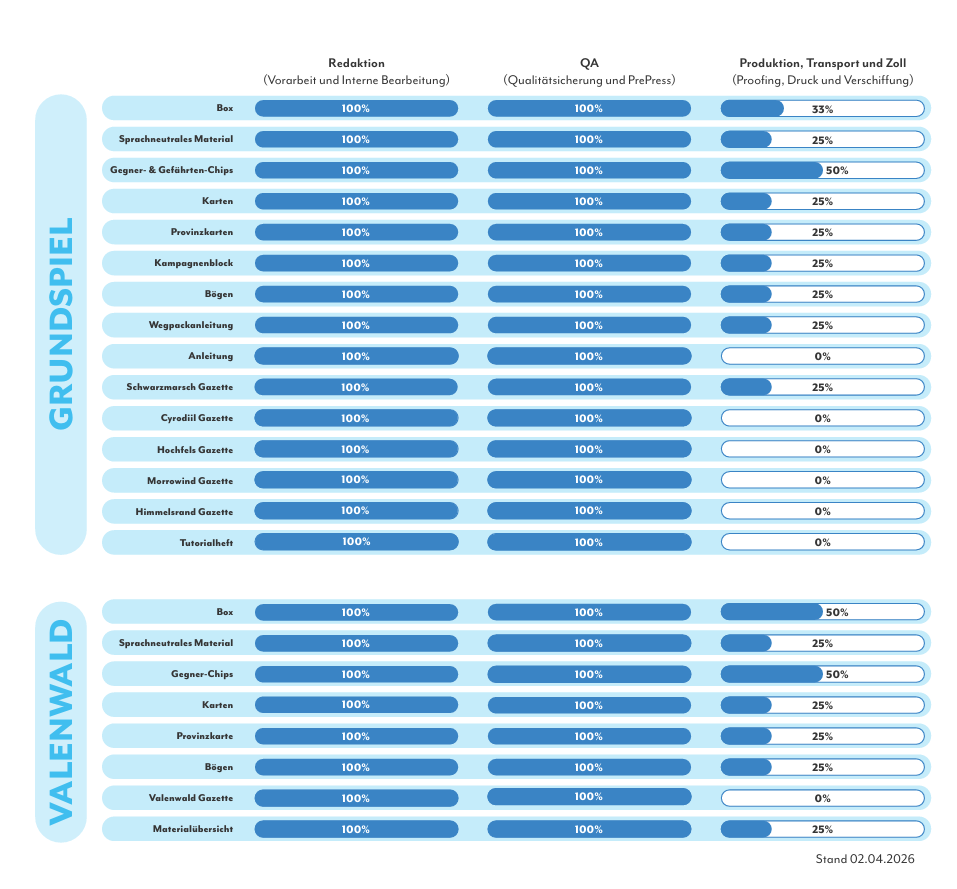
Seit dieser Woche befinden sich alle Files im Approval! Das heißt: Wir warten jetzt auf die Freigabe durch unseren Partner und bessern gegebenenfalls nach, wo es nötig ist. Gleichzeitig haben wir für erste Files bereits E-Proofs erhalten und gesichtet – ein notwendiger letzter Freigabeschritt unsererseits, damit diese Komponenten in die Produktion gehen können.
Greyhawkins, ein idyllischer Ort. Doch lauern dort viele Gefahren, mit denen es die Held*innen aufnehmen müssen. Sie folgen körperlosen Stimmen, stellen sich dunklen, überwucherten Tunneln und schmieden Pakte mit Teufeln. Gespielt werden dabei D&D-Charaktere, die aus der Netflix-Serie Stranger Things bekannt sind.
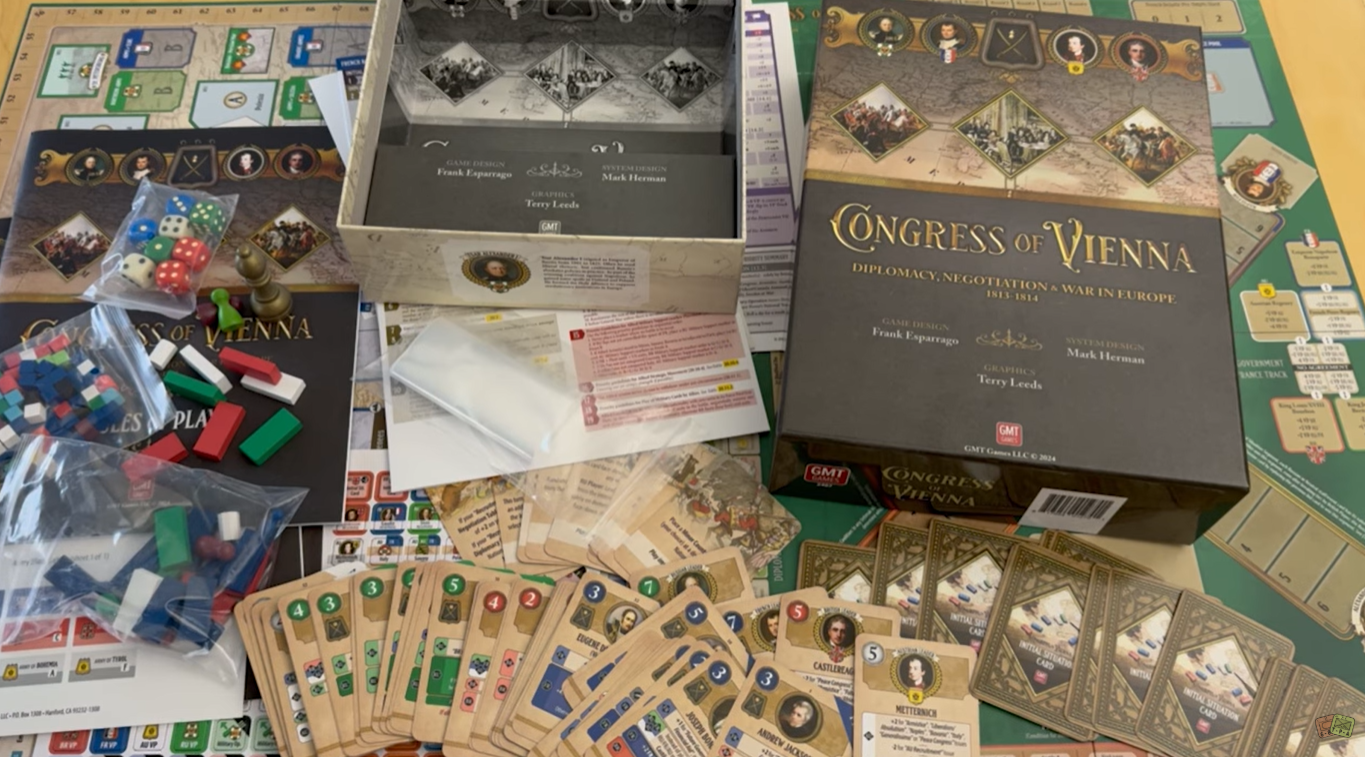
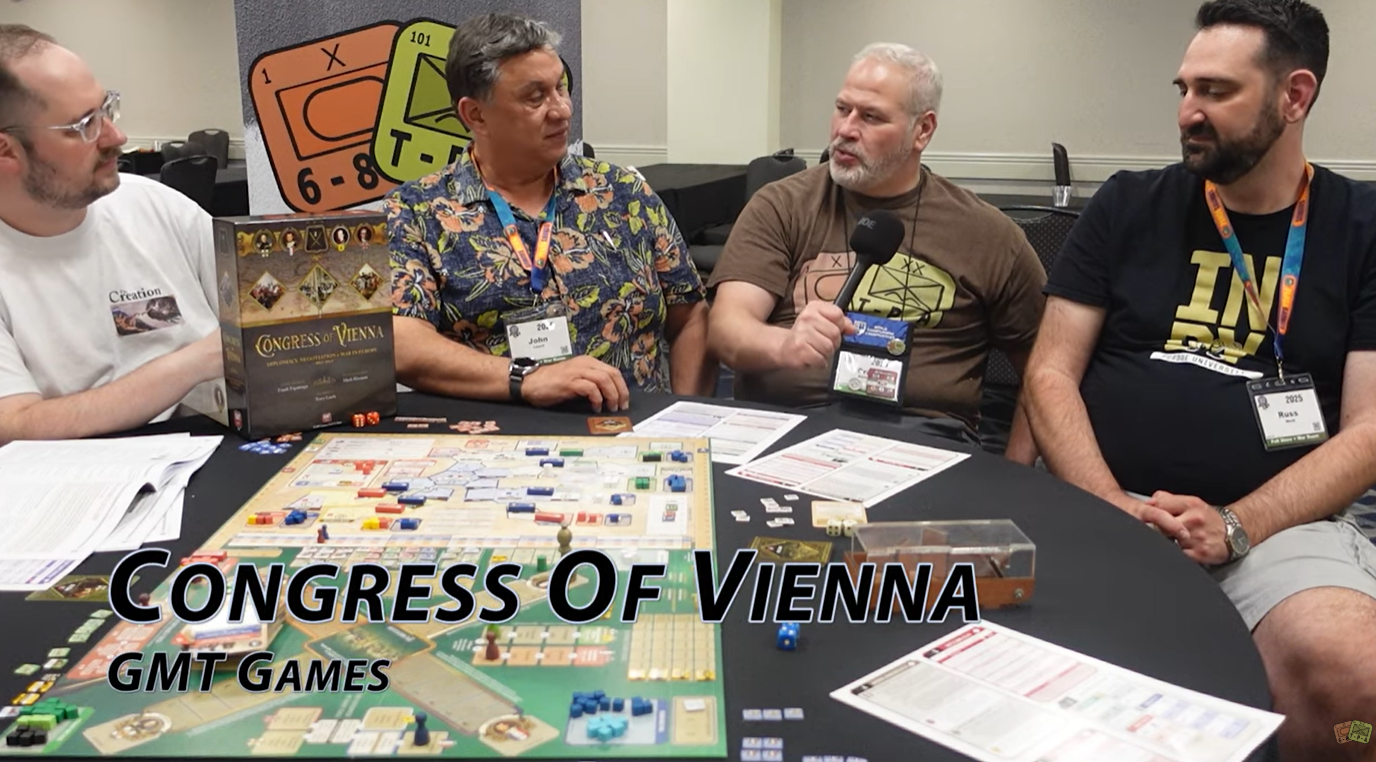
A few years ago, after playing all of the games in the Great Statesmen Series, we heard of a new game in the series from a designer not named Mark Herman and I was immediately interested and intrigued as we have had so much fun with Churchill, Pericles and Versailles 1919. Congress of Vienna from GMT Games is a diplomatic card driven wargame based on Churchill and is the 4th game in the Great Statesmen Series. The game is set during the years of 1813-1814 and sees players take on the role of the main characters of the struggle between the Napoleonic Empire and the coalition of Russia, Austria, and Great Britain with their Prussian, Spanish, Portuguese, and Swedish allies. We played the game recently while attending Buckeye Game Fest and then played a full campaign again while attending the World Boardgaming Championships and absolutely were amazed at the changes and innovations to the system introduced by the designer Frank Esparrago.
With this My Favorite Wargame Cards Series, I hope to take a look at a specific card from the various wargames that I have played and share how it is used in the game. I am not a strategist and frankly I am not that good at games but I do understand how things should work and be used in games. With that being said, here is the next entry in this series.
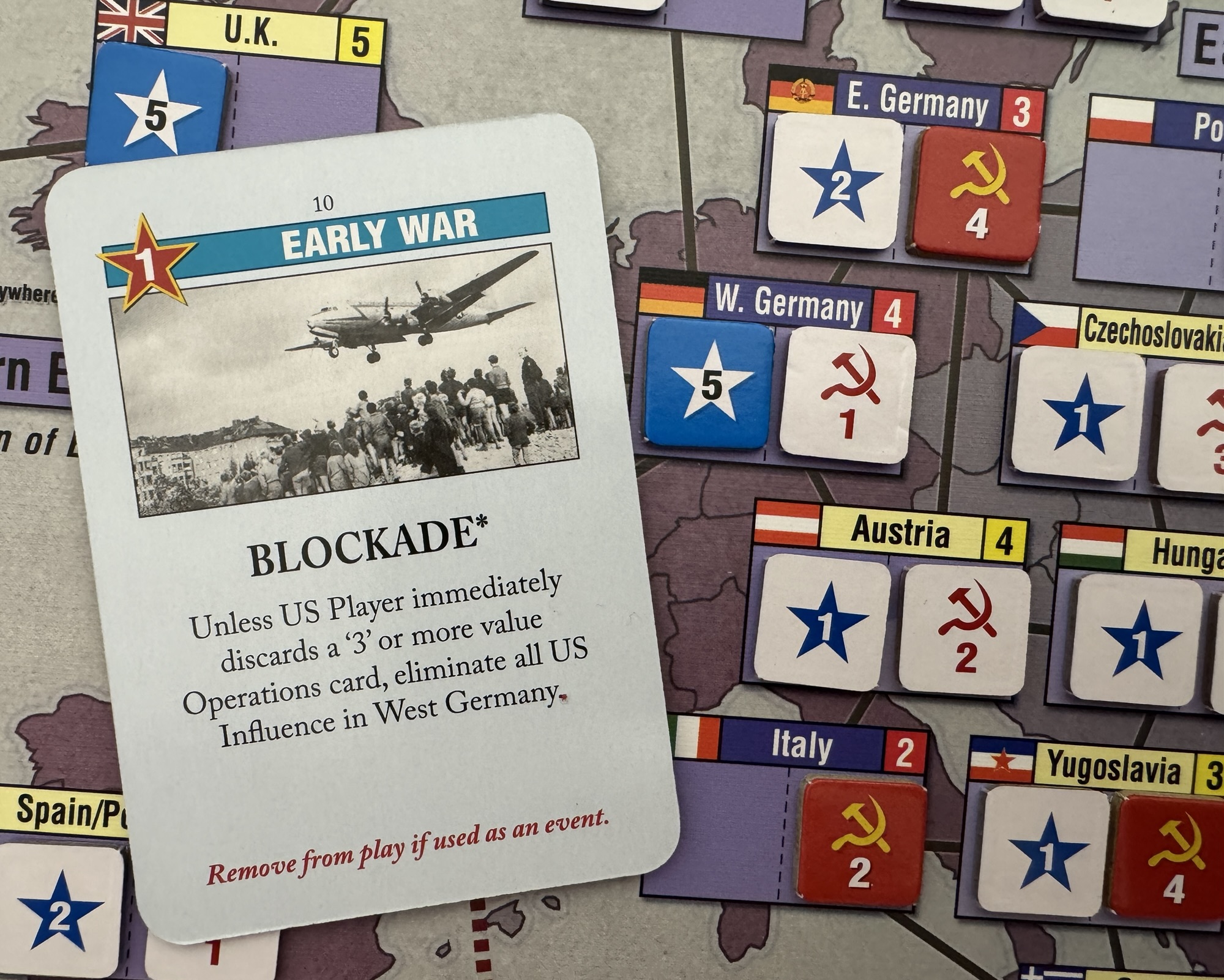
#69: Blockade from Twilight Struggle: The Cold War, 1945-1989 from GMT Games
Twilight Struggle is a 2-player game simulating the forty-five year ideological struggle known as the Cold War between the Soviet Union and the United States which can be played in 2-3 hours. The entire world is the stage on which these two countries “fight” to make the world safe for their own ideologies and way of life. The game starts right after the end of World War II in the midst of the ruins of Europe as the two new “superpowers” of the world squabble over what is left and ends in 1989, when only the United States remained standing.
The map is a world map of the period, where players move units and exert influence in attempts to gain allies and control for their superpower. The beauty of the CDG system used here is that each decision of whether to use a card for the event or the operations value is a struggle as if it is the other side’s event, it might go off hurting you very badly. There are mechanics to allow for the ignoring or cancelling of some of the best cards for your opponent in a side game within the game called The Space Race as well as nuclear tensions, with the possibility of game-ending global thermonuclear war (Shall we play a game, anyone?). I have played TS about 30 times and love it more and more with each sitting. The game makes me sweat, cringe, jump with joy and bite my fingernails. To me, a game that can do all of that in one sitting is worth the price.
One of my favorite type of cards from the game are those that force an action upon your opponent, such as discarding a card, reducing the Ops from card plays or causing them to have to make other plans than what they were working toward. These type of cards are more reactionary but definitely cause issues and mimic the various non-military focused strategies and tactics used during the Cold War. One of the most famous events from the early history of the Cold War is that of the Berlin Blockade. And there is a specific card that pays homage to the event in the game called Blockade. Blockade is an Early War Soviet Card that has an Ops Value of 1, which makes the card more valuable to be used for the printed event versus for the Ops.
When played, the card requires the US Player to immediately discard a 3 Ops or more value card from their hand or the consequence of not doing so will see all US Influence being removed from West Germany. This is a tough choice. Being early in the game, it is possible for the US to rebuild in West Germany and replace the lost influence over time if they do not wish to discard such as high value card. But, herein lies the real key to the Blockade cards use. The Soviet Player, who should be paying attention to not only their hand but also the card plays of the US Player, should try to use this card later in a turn once the US Player has played a majority of their cards in order to ensure that the event text can be realistically be achieved. If played quickly during a turn, the chances of the US Player being able to discard the required 3 Ops or great value card is higher and the card play will not generate any meaningful difference on the board state. I also would recommend a 2 card strategy here as the Soviet Player should be holding in their hand a high Ops card to be able to follow up this action with the placement of Influence into West Germany on their very next play. But, the real value to a card such as Blockade is that it forces the US Player to consider what cards are out there and to play around their negative effects as much as possible. Due to the nature of the game, and the randomness of card draws, having an expendable high Ops card ready and able to be discarded just in case of the play of Blockade is not really feasible. Also, remember that in Twilight Struggle that opponent events on cards that you play will go off and Blockade being drawn by the US Player can be bad as it will require them to play the event as you cannot discard a 1 Ops card to get rid of its negative effect in the Space Race Track due to the minimum requirement being a 2 Ops card. So the moral of the story here is that both players need to consider and plan for the play of or the mitigation of damage from Blockade.
The Berlin Blockade, which lasted from June 1948–May 1949, was a major Cold War crisis where the Soviet Union blocked all land and water access to West Berlin to attempt to force Western Allies out. The Soviet Union was taking this action as a means of retaliation against the introduction of the new Deutschmark currency. The US and Britain responded with the massive Berlin Airlift, flying over 2.3 million tons of food, fuel and supplies to the city. At the peak of the Airlift, a plane landed in West Berlin every 30 seconds. The blockade failed and the Soviets lifted it on May 12, 1949, after realizing the Allied Airlift could sustain the city for an extended period of time, marking a significant victory for the West in the ideological struggle. This event led to the acceleration of the division of Germany into East and West and the deepening of Cold War tensions.
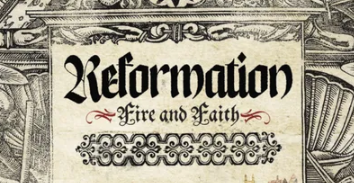
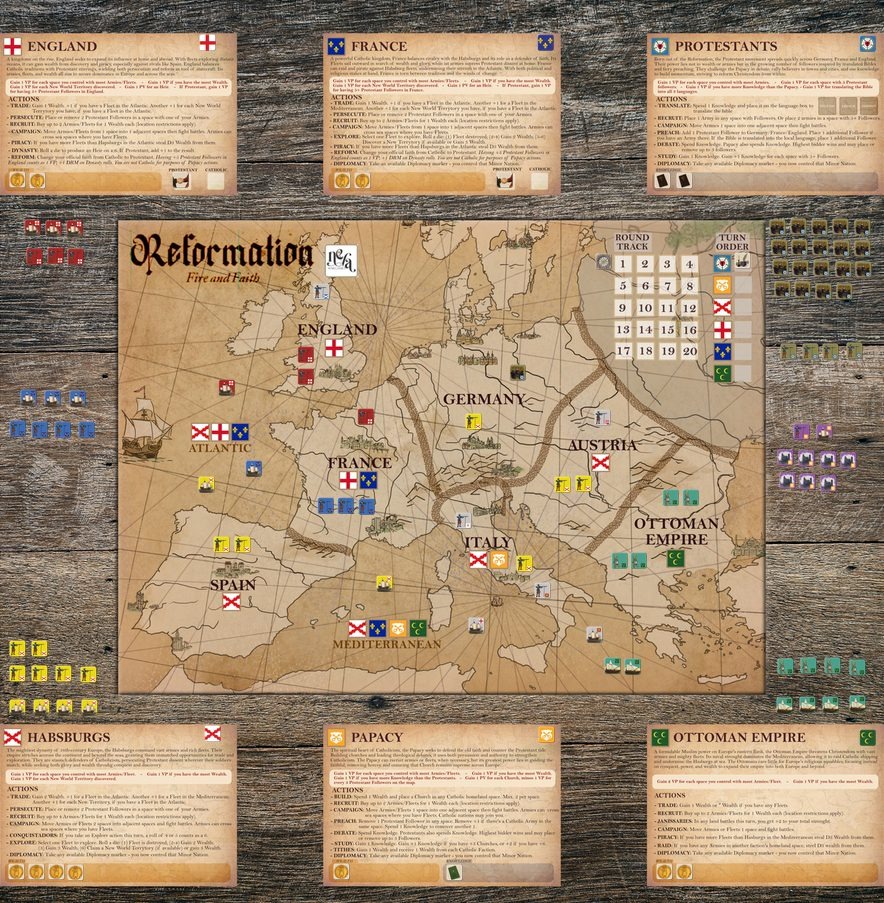
Neva Game Press is really exploring the space of wargame publishing and have games that are being worked on spanning all of history including modern and ancient. They also are looking at non-traditional topics to cover such as the Reformation. Their newest pre-order offering is called Reformation: Fire and Faith and is designed by Clint Warren-Davey. I am keenly interested in this one and have been working with Clint on this interview and maybe a series of other articles on strategies.
Grant: Welcome back to the blog Clint. With 4 published games to your credit what lessons have you learned about the design process and been able to put into practice?
Clint: Thanks for having me back guys! Yes I have learned a lot. Mainly, my iterative loop has become faster. I use mainly digital prototypes on PowerPoint and can get a prototype up and running pretty fast. This means I don’t need to print components and then reprint when things change. I also have a larger “toolbox” of ideas to draw from as I’ve played a wider variety of games. I still have a core design philosophy though – I want games that give players lots of meaningful decisions and a minimum of busywork, plus I generally prefer a high level of player interaction and interdependence.
Grant:How do you pitch games to publishers? What is your approach?
Clint: First I make sure the game is ready. I play-test the game myself a minimum of 20 times. Then I give it to external play-testers (basically my followers on Twitter/X). I keep refining it and make sure all the rules are nailed down. Once I have a fully functional and viable digital prototype, I send an email to a lot of different publishers to see who wants the game. So far, I’ve usually found at least one publisher who will accept each game.
Grant: What is your new game upcoming game Reformation: Fire and Faith about?
Clint: It’s about the wars and religious struggles that tore Europe apart during the Reformation, from 1517 (Martin Luther nailing the 95 Theses to the door of Wittenberg cathedral) to 1555 (the Peace of Augsburg). This is during the “pike and shot” era, which I love. It also includes a lot of political, religious and military conflict that is fascinating on multiple levels. It’s the perfect setting for an asymmetric wargame.
Grant: What image and feeling did you want to convey to players with the subtitle “Fire and Faith”?
Clint: Well this subtitle was decided by my publisher, Jose Neva of Neva Game Press. He wanted to convey both religious and military struggle in the title of the game, hence fire and faith. Before that the game title was undecided – it was either going to be just “Reformation” or “One Hour Reformation” – though upon further development it was clear this game doesn’t really fit with my other “One Hour” games.
Grant: Why was this a game you were inspired to design?
Clint: I am fascinated by the Reformation – both from a religious and a historical perspective. When I converted to Christianity about 10 years ago I had to choose which church to join, which forced me to read more on this time period, and read the arguments put forward by Protestant and Catholic apologists, then and now. I should state here that although I decided upon Catholicism, I hold no ill-feeling towards Protestantism and I understand the impetus behind it.
I was also drawn in by the fascinating geopolitics and tactical level military transformations of the time. The struggles between the French, Habsburgs, English, Ottomans, Venice, Scotland, Hungary, the Papacy and many other much smaller states were kaleidoscopic in their complexity but endlessly entertaining. To take one example of the political maneuvering of the time – the French lost the battle of Pavia to the Habsburgs, partially because 5,000 of their Swiss mercenaries just left and went home to defend their own cantons from rampaging German Landsknechts. Losing Pavia meant that King Francis I was captured. This in turn meant the English sensed weakness and struck in north-eastern France.
Seeking allies against this double threat, the French turned to the one great power that might help them – the Islamic Ottoman Empire! This outraged the Habsburg Emperor Charles V, who had his hands full containing the spread of Protestantism in Germany. The Saxons, Hessians and Brandenburgers following Luther’s lead would be much better used to help defend Vienna from the Turks, but instead both the Pope and the Emperor found themselves facing a full-scale religious revolt at the same time as renewed Ottoman offensives in the Balkans and the Mediterranean. This was all taking place against the backdrop of a military revolution in which pike and shot, and artillery, were replacing feudal levies of armoured knights.
Grant: What other Reformation games did you study for inspiration?
Clint: The complexity of this time period, and the sensitivity of religion as a topic, has meant that few game designers have been willing to tackle it. The exception is Here I Stand, the classic 6-player card-driven game by Ed Beach. This game is a well-renowned and even genre-defining title that managed to cram tons of inter-faction dynamics and historical chrome into the CDG system invented by Mark Herman (who made the first such CDG – We the People). It is absolutely brilliant in so many ways. Baroque, intricate, full of theme. It is almost like a historical equivalent of Twilight Imperium – one of my other favorite games.
The problem? It takes way too long to play for most gamers. Ever since playing Here I Stand many years ago, I had kept the idea of a simplified version at the back of my mind. Then, when I started teaching religious history at a Catholic school, I found myself teaching the Reformation. A classroom game on the topic would sure come in handy. So, in 2024 I made one. The images below give an idea of this, including my very basic graphics made in PowerPoint and Word. In 2025, I revisited the idea and thought it might be worth making into a serious game, still using the basic concepts and inter-faction dynamics borrowed from Here I Stand.
Early prototype version of the board.
Grant: What is your design goal with the game?
Clint: To make a game with 6 asymmetric factions that shows the inter-factional dynamics and key decisions of the period, all with mechanics that are simple enough to be used in a high school classroom AND simple enough for non-wargamers to pick up. Also, a game that players of Here I Stand would enjoy – especially when they are pressed for time. I believe I have succeeded in this goal but time will tell.
Grant: What main mechanics are used in the design?
Clint: The core gameplay loop is very simple. Each faction has a list of actions to choose from. Each turn, each faction will choose two actions. That’s it. But these vary greatly. They include everything from exploring the New World to translating the Bible to raising armies to piracy and everything in between.
All the factions have some actions in common – like Recruit (placing military units) and Campaign (moving and fighting). The two religious factions – the Protestants and the Papacy – are set apart from the others by having most of their actions focus on non-military functions.
Early prototype version of the Papacy Player Board.
The Protestants are trying to convert people to their new faith (or rather, in their terms, restore an older and more purified form of the Christian religion). As such, their overriding focus is placing Followers on the map. As a rough approximation, each Follower piece represents 5-10% of the population converting to Protestantism. What the Protestant faction is aiming for is gaining a majority, or a near-majority, in the countries of Europe. So, their main way of earning Victory Points is by having 5 or more Followers in as many spaces as possible. Now, the Reformation did not initially take hold everywhere. Geographically it was concentrated in Germany above all, then England, then in scattered pockets throughout France. In the game this is basically where the Protestants will be focusing all of their efforts. They start with only 1 Follower on the map in Germany – this represents Martin Luther and the nascent reform movement that started to gather around him in 1517. From this humble beginning, I wanted the Protestants to build up and expand, sometimes rapidly, across the map.
To speed up their placement of Followers, the Protestants can translate the Bible into local languages – German, English and French. This is an idea I took directly from Here I Stand and of course from the actual history of the Reformation. Having the Bible in the vernacular language, and spread by the printing press, was key to the spread of Luther’s ideas. Bible translation is a simple, two-step process in the game. First you need to accumulate “Knowledge” through the Study action and then use the Translate action to place Knowledge markers on the three Bible language spots on the Protestant faction sheet. Initially, this was the only purpose of Knowledge. But then I expanded it to other uses – especially the Debate action, which is a competitive bid against the Papacy that can score a valuable “Issue” token worth a precious VP. These Issue tokens represent the points of dispute in the Reformation, like the role of Scripture, Tradition and authority of the Magisterium. I liked the idea of carefully studying to build up knowledge in preparation for a debate – it’s a case of the game language matching the theme.
Near final look at the board and player boards.
The Papacy works in a similar way to the Protestants – but in reverse. The Pope is trying to remove Protestant Followers, through Preach and Debate actions. Every 3 Protestant Followers is minus 1 Victory Point for the Papacy, so they are incentivized to contain the spread of the Reformation. The Papacy also has ways of building up their own points, through Churches. This general term refers to all the infrastructure of the Catholic religion – not just beautiful cathedrals (like St. Peter’s, which was being built during the Reformation) but also schools, Jesuit universities, seminaries, monasteries, trained clergymen and church councils. I was originally going to have a track or chart on the Papacy faction sheet to measure this but later decided to have it as pieces on the map – the Churches you see in the game.
This was because I wanted the Papacy to have some of physical presence on the map like the other factions. This was loosely inspired by the building tokens in games like Root or the resources placed on the map in Scythe. It has the advantage of opening up the Papacy’s primary victory metric to attacks from the other factions. Just like Protestant Follower pieces, papal Church pieces can be attacked and removed. This represents iconoclasm and persecution of Catholic clergy, as well as periodic waves of destruction like the Sack of Rome in 1527. Unlike Protestant Followers, I had the Papacy’s Churches cost Wealth. This Wealth is gained entirely through the Tithe action – which takes money from any nations that are still Catholic. Early in the game this includes three out of the six factions: Habsburgs, England and France. But England and France might convert to Protestantism, and a greedy Pope constantly demanding their money might hasten this on!
Grant: What are the playable factions? How did you differentiate them?
Clint: There are 6 factions in the game: Protestants, Papacy, Habsburgs, England, France and Ottoman Empire. Each one has a faction sheet, like the one below, which summarizes their victory conditions and available actions.
The Protestants and Papacy are religious-focused factions. They do have military forces, but they are relatively few in number and are not the main priority. The Protestants are trying to build up their knowledge of the Bible and translate it into vernacular languages, preach to the masses and debate the Catholics to spread their ideas. Their main goal is getting their Followers on the map. The Papacy is trying to contain the spread of Protestant Followers and remove them from the map as much as possible, plus place their own Churches. Both Churches and Followers are immobile and do not count as military units. But they can be attacked and persecuted off the map.
The other factions – the Habsburgs, England, France and the Ottomans – function more like the nations in a wargame. Amassing armies and fleets, fighting battles, aiming for control of spaces on the map. There are plenty of differences though. The English, French and Habsburgs have the option of Explore action – sending their Atlantic Fleets to explore the New World, gaining varying amounts of Wealth or a valuable New World colony (at the risk of losing the Fleet). This provides a great way for factions to gamble early on in the game in a high-stakes race for colonies. Two tweaks were made to the Explore action during the design process. First, my co-designer Ed Farren suggested that New World colonies should provide extra income during the Trade action if the owner has a Fleet in the Atlantic.
I loved this idea and implemented it immediately. I later thought that the Habsburgs should have a distinct advantage in exploring the New World, what with Hernan Cortez and Francisco Pizarro active during this time. I gave the Habsburgs a way to boost their Explore action with “Conquistadors” – effectively tripling their chance of finding a colony at the cost of an additional action. This means the Habsburgs will be raking in more money. But there are a lot of ways for the other factions to steal it! The English, French and Ottomans can all use the Piracy action to get that Spanish silver, and the Ottomans can also Raid on land if their Armies make it through to Austria.
The relationship between the military/political factions and the religious factions is also fascinating. I kept the Habsburgs as a staunchly Catholic faction – they can’t change their allegiance and will act as the strong right arm of the Holy See throughout the game. But England and France are a different story. England needed a historically-rooted incentive to convert to Protestantism, and this was solved in two ways. First, if England officially converts, they will earn 1 VP if England itself contains at least 5 Protestant Followers. This also gives 1 VP to the Protestant player, so there would be strong reasons for both players to work together in the conversion for England. I also wanted some of the high drama of Henry VIII and his wives without an entire sub-system and chart like Here I Stand. This became the “Dynasty” action – a simple die roll to gain a VP by producing a viable heir to the throne.
If England is Catholic, they need a 6 for this. But converting to Protestantism offers success on a 5 or a 6, as Henry can start divorcing his infertile wives. England can therefore grab 2 VP quite easily by ushering in the Anglican faith, which is handy because their opportunities for expansion on the continent are quite limited. France can also earn VP by converting to Protestantism and having at least 5 Protestant Followers in France. For both England and France, converting to the new faith costs an action – which Ed quite appropriately labelled “Reform”. This could be a wasted action if Protestantism doesn’t end up spreading in that nation or if the Dynasty action still fails. But it’s a live issue. Among experienced players, I expect that the Papacy player and the Protestant player will spend a lot of their table talk trying to convince England and France to side with them in religious terms.
Grant: What is the layout of the board?
Clint: I made the map as simple as possible. There are 7 land spaces: Spain, France, Germany, England, Austria, Italy and the Ottoman Empire. There are 2 sea spaces: the Atlantic and the Mediterranean. And that’s it! But you will find that this still provides plenty of interesting strategic choices, as there are 6 factions crammed into these 9 spaces. So, like the proverbial “knife fight in a telephone booth,” players are stuck in fierce competition from the very beginning. For example, the Papacy, France and Habsburgs all have some presence in Italy in the game’s set up. Plus, there are pieces from neutral nations there – like Venice and Florence. So inevitably there be some conflict there!
Grant: Why did you feel area movement was the best approach? What strategic decisions are forced upon the players by the layout?
Clint: Honestly, I didn’t want this to be game about operational level maneuver, more about strategic level decisions and inter-faction dynamics. The map is very heavily abstracted. But you can see it this way. Every faction has a “homeland” space. The Habsburgs, being the hegemon of Europe, have two (Spain and Austria). Each faction will usually be aiming to keep its homeland secure while pushing into 1 or 2 other spaces. Taking control of a space is a big deal and will involve good timing, negotiation and applying just enough force. Some spaces – like Germany and Italy – will usually become battleground spaces with multiple factions vying for control.
Grant:What is the counter anatomy? What different units are included?
Clint: Like the map, the counter anatomy is as simple as possible. There is really no information on the counters other than their type. There are Armies and Fleets – which are the only military units in the game. There are also two religious “units” – Churches for the Papacy and Followers for the Protestants. These don’t fight and can’t move, but they are essential for the two religious factions to build up their influence and victory points. There are also counters for many other things – New World Territories, the Royal Heir for England, the Issues that can be won in a Debate, Knowledge, Wealth and a few other things.
Grant: What is the scale of the game?
Clint: There’s no specific ground or time scale as many things have been heavily abstracted. But very roughly you could say that each turn represents about 2-3 years and each army piece represents 5,000-10,000 men.
Grant: What actions do players have each turn?
Clint: Players can choose two actions per turn. As explained above, they are different for each faction. But there are some similarities. I will give a list of the actions for each faction.
Many of these are self-explanatory but I will explain some of my favourite ones. Diplomacy means getting a Minor Nation on your side, or pulling one away from an enemy. These Minor Nations include Venice, Florence, Genoa, Hungary and Scotland and they have their own Armies or Fleets or both.
Piracy means using your Fleets to steal money from the enemy. Explore means trying to find a valuable New World Territory – worth VP and more income during Trade actions if you have a Fleet in the Atlantic.
The Persecute action means placing or removing Protestant Followers. The Reform action – available only to England and France – means officially converting your nation to Protestantism.
Dynasty is unique to England and represents Henry VIII trying to get an Heir (worth a VP). It’s a dice roll, but it’s easier when you’re Protestant to represent Henry being able to divorce and try with a different woman.
Janissaries is unique to the Ottomans and gives them a valuable +2 bonus in battle that turn. Conquistadors is unique to the Habsburgs and gives them a bonus on their Explore rolls – making it more likely that they will grab a New World Territory.
Grant: How does combat work in the design?
Clint: Very simple – add up your Armies/Fleets, add a D3 roll, the highest score wins. If there were a total of 7 or more units in the battle, the winner suffers 1 loss and the loser suffers 2 losses. Otherwise, the loser suffers 1 loss.
Clint: How do players obtain victory?
Clint: Every faction can score Victory Points (VP) in multiple ways. The margins here are very tight – typically the winning faction will score 5 or 6 VP while second and third place will have 4-5. So, a single point really matters. Every faction can score VP for control of spaces – this is hard to pull off as you need more Armies or Fleets in the space than all other factions combined. So, you might retain control of your own homeland, but taking control of another space is hard. Aside from control, each faction has other ways of getting VP:
The Protestants earn 1 VP for translating the Bible into all 3 languages (French, English and German), 1 VP for each space on the map with 5 or more Followers, 1 VP for each Issue you win in a Debate and 1 VP for having more Knowledge than the Papacy. So the Protestants need to focus on their religious actions – studying, translating and preaching.
The Papacy earns 1 VP for each Church they have on the map MINUS 1 for every 3 Protestant Followers on the map. They also earn 1 VP for having more Knowledge than the Protestants, 1 VP for each Issue they win in a Debate and 1 VP for having more Wealth than any other faction. So, the Pope also needs to focus more on his religious goals – but can also use the Tithe action to build up Wealth (for building Churches) and maybe get a point for rolling in cash.
The Habsburgs earn VP for each New World Territory they discover – and they are better at it than other factions because of their Conquistadors. They also earn VP for having 2 or more Churches in their homelands (Spain and Austria) and can earn VP for having the most Wealth.
The English earn VP for New World Territories and for having the most Wealth. They can also earn 1 VP for producing an Heir with their Dynasty action. The Dynasty action represents Henry VIII’s efforts to produce a legitimate male heir for his throne, and is easier if England becomes Protestant. England earns 1 VP if it converts to Protestantism and has 5 or more Protestant Followers in England. If it stays Catholic, it earns 1 VP for having 2 Churches in England.
France is basically like England but doesn’t have the Dynasty action. They will focus on military action, exploration and building up Wealth. If they stay Catholic they will want the Pope to build up Churches in France, if they go Protestant they earn VP for having 5+ Protestant Followers in France.
The Ottomans are the most straightforward – they can earn 1 VP for having the most Wealth but mostly they just get VP for control of spaces – they earn 2 per space instead of 1. They are an expansionist juggernaut and don’t care about the religious squabbles in Europe.
Grant: What type of an experience does the game create?
Clint: I think it gives you an understanding of the key inter-factional dynamics of the Reformation era using mechanics that are simple to understand and easy to enact.
Grant: What are you most pleased about with the design?
Clint: The asymmetry, the simplicity and the interaction between the players. I’m also really happy with the “bot” rules which allow you to play at anything from 1 to 6 players, with non-player-controlled factions run by a simple dice-based action sheet.
Grant:What has been the response of playtesters?
Clint: Very positive. Every play-tester has said the game is really fun and easy to learn, their only suggestions have been refinements to improve the balance between the 6 factions. For example, one play-tester noticed that the Debate action was under-powered and that the Protestants and Papacy were scoring fewer VP than the other factions on average. Changing the Debate action to winning “Issue” markers (worth 1 VP each) solved both problems. This is why play-testers are so valuable!
Grant: What other designs are you working on?
Clint: A lot! I will share a few of them with you.
First, there is One Hour Napoleon and One Hour WW1, sequels to my game One Hour WW2. Napoleon should be out this year, WW1 next year.
Then there is Messiah – my “Jesus COIN game” which is set in 1st century Roman-occupied Israel and lets you play as the Christians, Zealots, Pharisees or Romans. Similarly, there is “Testament” – my card drafting game on the entire Old Testament, inspired by 7 Wonders. These are still in development but they have a publisher and will certainly be made.
Anyone interested in my designs should follow me on X at @Clint_Davey1 to keep up to date with all the new releases. Thanks for having me on again!
If you have followed us for a while now, you know how we feel about Here I Stand: Wars of the Reformation from GMT Games. And, you know that we enjoy multi-player wargames. So, this one really seems to b simple and take in the concepts of negotiation and the asymmetry of each of the factions. I think that this game will be a good quick playing substitute for the longer and more involved Here I Stand experience. I cannot wait to get this one hopefully this year.
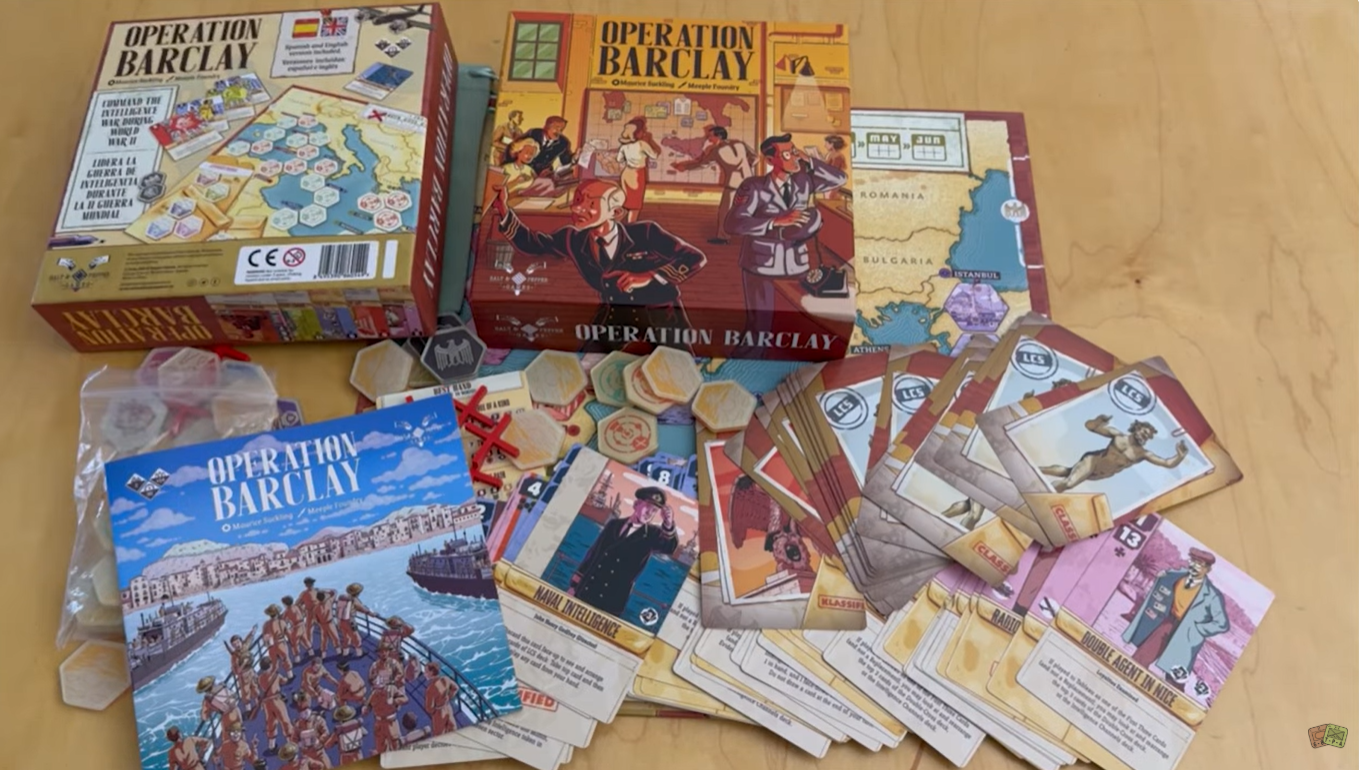
Operation Barclay is a 2-player game of low/medium complexity about the intelligence war between the Allies and their Abwehr counterparts in the Mediterranean Theater of WWII in 1942-1943. Operation Barclay puts players in the shoes of competing military intelligence directors who are attempting to mask or learn the truth about the Allied invasion plans for 1943. The Abwehr must attempt to learn where the Allies intend to land next. The London Controlling Section (LCS), the core intelligence agency responsible for Allied intelligence, must prevent the Abwehr from discovering the truth.
The LCS player uses a variable set-up, placing tiles face down to establish where in the Mediterranean a primary and a secondary offensive will occur. Over the course of the six game months, the Abwehr player attempts to win sufficient evidence tokens to be able to turn enough of these tiles face-up to reveal where the Allied offensives will come.
To win evidence tokens, players build hands of five cards to take tricks, similar to poker. While having the best hand will secure two evidence tokens, correctly betting after each player reveals the first three cards of each hand on who will have the best five-card hand is worth three evidence tokens.
Further, players have ways to manipulate the decks from which they draw. They may create a double-cross deck, allowing them to leave cards useful to them face down in a deck to draw from when they choose later — unless the other player takes those cards instead…but perhaps the player who planted those cards was bluffing and hoping the other player would waste their draw on a useless card. Alternatively, players may draw from their own dedicated deck to augment their hands with unique abilities inspired by historical figures, events, and capabilities. The LCS has access to Ultra — decrypts of German codes — but this alone will not be enough if it’s not used carefully.
A new company on the scene recently is Ingenioso Hidalgo which was created by Paolo Mori. Yes, that Paolo Mori who has designed such interesting little wargames as Blitzkrieg! World War II in 20 Minutes, Caesar!: Seize Rome in 20 Minutes amongst others. He has partnered with Alessandro Zucchini on a new design, which is Ingenioso Hidalgo’s first game, called Battlefields of the Napoleonic Wars. We reached out to these two to get some insight into the design and they were more than glad to share.
Grant: Paolo and Alessandro, welcome to our blog. First off please tell us a little about yourself. What are your hobbies? What’s your day job?
Alessandro: I live in Modena, in Northern Italy, where I work as an Energy Manager in a steel factory. My hobbies are strictly related to games. I love studying Military History and Philosophy and playing wargames. I also like board games (in the past I have designed quite a few) and RPG’s. I’ve been playing Dungeons & Dragons with my friends for 40 years now.
Paolo: I live not far away (about an hour drive) from Alessandro, in the wooded hills near Parma, with my wife and two children. My job is to take care of digital communications for the local university, but in reality I have been on leave for three years to focus solely on game design (and, since last year, on the Ingenioso Hidalgo publishing venture ). In addition to board games, I have a passion for history.
Grant: What motivated you to break into game design? What have you enjoyed most about the experience thus far?
Paolo: Those who know us know that we have worked on very different types of games, and that is what we like to do most: explore different genres and themes. Lately, we have developed a passion for historical games, and we have found that designing a game is an excellent way to study and to spark curiosity and interest in players.
Grant: What is your upcoming game Battlefields of the Napoleonic Wars about?
Paolo: To tell the truth, the game is no longer ‘upcoming’. It was published in April 2025, and we are working on a first reprint (the first print run sold out) which should be available between April and May. Battlefields of the Napoleonic Wars is a game system that allows you to recreate the battles of the era, from small skirmishes with a few thousand men on each side to decisive pitched battles. The aim of the game is to be accessible, both in terms of the complexity of the rules and the length of the game, but also faithful to the specific elements of Napoleonic warfare. Ultimately, it aims to be a fun game to play!
Grant: What is the scale of the game? Force structure of units?
Paolo: The scale of the counters depends on the battle chosen, and can vary from one counter for every 1,000 men to one for every 4,000 for infantry, while for cavalry and artillery the scale is naturally different. The maps can be of three different sizes, and the scale also varies from one hexagon (they are large hexagons of almost two inches) for every 400 yards to one for every 800 yards.
Grant: How are the units represented? What is the layout of the counters?
Paolo: This is one of the first original features of the game. Each unit on the battlefield is represented by two rectangular counters, which, depending on their mutual arrangement within the hexagon, indicate at a glance the type of formation that the unit takes: column, line, or square (or disordered).
The counters have no numbers or values, only two icons (one on the back) that generically represent the type of unit: infantry, cavalry, or artillery. The color of the icons indicates the ‘quality’ of the unit: gold for heavy cavalry or elite infantry, silver for medium cavalry or light infantry, white for light cavalry or line infantry. Each of these units has some simple special rules that govern how they move or fight. Finally, the background of the counters can only be one of two colors. Blue for the French army or its allies. Red for the opposing coalition army.
Grant: Why was this a subject you wanted to create a game on?
Alessandro: I have always been passionate about wargames, especially Napoleonic wargames, and I had already enjoyed creating alternative rules or other regulations for playing certain battles in the past, often trying to simplify or make the rules of some particularly complex games more interesting. That’s why I challenged Paolo to create a wargame together.
Paolo: On the contrary, I have never been a wargame player, even though I have always been fascinated by them. But the commitment required in studying the rules and the playing time has always been overwhelming for me. That’s why I accepted Alessandro’s challenge. The aim was to make a wargame that I could finally play. For me, it was also a very stimulating way to study a historical period that I had never explored in depth.
Grant: What are the unique features with the system used for the game?
Paolo: There are essentially three distinctive features of the game. The first, which we have already mentioned, is the formation system, which is not only very visually appealing but also has an impact on how these units behave on the battlefield. The second feature is the unit activation system, which we will discuss in more detail later. The third is a combat system that uses special dice, which does not use tables but retains all the necessary depth.
Finally, as an extra, the format of the game is also unique. The ‘generic’ counters are associated with many different battlefields, each of which is represented by its own map and a folder containing this map, which is used during the game as a ‘board’ containing all the special rules and information necessary to manage the battle.
Grant: What is your design goal with the game?
Paolo: The idea was to create a game that both groups would enjoy! In other words, a game that would appeal to experienced wargamers looking for a ‘refreshing’ experience that could be enjoyed in an evening, as well as board game players who had always wanted to try historical wargaming but had never da
Grant: What unique elements of the Napoleonic Wars Era did you want highlight in the game?
Paolo: We wanted to emphasize the different formations, which move and attack in very different ways. The lines are not very mobile but are useful for firing and mowing down opponents. The columns move more quickly and are useful for breaking through enemy positions and throwing the enemy into disarray. Finally, the squares…are squares. Immobile, but very useful for defending against cavalry assaults.
For the rest, we have tried to convey all – or almost all – the subtleties of the battles of the time within a very straightforward set of rules.
Grant: What various unit types are included in the game? What is unique about these units?
Paolo: The units represent the three main ‘arms’ of Napoleonic warfare: infantry, cavalry, and artillery, but each unit is further characterized by a color that indicates its type. So we have light, medium, and heavy cavalry (each with specific movement or combat bonuses, with cuirassiers, for example, resembling early tanks); regular, veteran, and elite infantry (the famous guard that never breaks ranks). At present, there are no ‘national’ peculiarities for the various armies (apart from the special rules included in some battles).
Grant: How does activation work? What are the Order Tokens used for?
Paolo: The activation uses a somewhat unusual system, which betrays our background as board game designers. Players take turns placing their Order tokens on the Order spaces on a board positioned next to the battlefield. By placing the Order token, the player decides what type of unit and formation to move (e.g., infantry in column or artillery) or what special action to perform (e.g., maneuver or activate units near a leader). The same space cannot be used more than once by a player. When the Order tokens are exhausted – or when the player believes it is necessary to do so – a Rally order must be executed, which allows the player to reorder their units and recover the Order tokens so that they can be used again.
Grant: What different actions can be chosen?
Paolo: Some actions allow you to move specific units and formations, such as “Infantry in Column,” “Infantry in Line,” “Cavalry,” and “Artillery.” Others allow you to perform specific actions, choosing which units to activate. For example, “Maneuver” allows you to move units twice their capacity, but without attacking. “Leader Action” allows you to choose units adjacent to one of your Leaders. “Elite Units” allows you to give an ‘extra activation’ to cuirassiers or guards. Finally, Rally is the ‘recovery’ action, which allows you to re-form disordered or broken units, move leaders on the battlefield, and bring in any reinforcements, but at the cost of earning victory points for your opponent, in a sort of ‘inertia’ of battle.
Grant: How does combat work in the game?
Paolo: As we said, there are no tables in the game. Combat is resolved using special dice, which have a sort of built-in CRT. Instead of thinking about the modifiers to apply before rolling, in combat you will always roll two dice (one if the opposing unit is in a space that provides cover), and only after rolling will you check the outcome of the attack. Each side of the dice shows a requirement that you must meet for that side to be considered a ‘success’. Some examples of requirements are having a Leader near the attacking unit; attacking with a higher quality unit; firing on a unit in column; assaulting with cavalry, etc. If that condition is met in the attack, that face is valid, and its effect is verified, which can be a casualty or a retreat, which also makes the attacked unit disordered. It is a streamlined but refined system that saves a lot of time in calculations and in finding the perfect strength ratio.
Grant: How do you differentiate fire versus assault combat? What was this important?
Paolo: We have taken this concept to the extreme. Units in line (infantry or artillery) can only fire, while units in column (infantry or cavalry) can only charge. The two types of attack use different colored dice, which have different requirements and effects. For example, an assault will be more effective against a line unit, or if carried out by cavalry, and its main effect will be to push the opponent away and throw them into disarray. Fire, on the other hand, will be more effective against a column or if carried out by artillery, and its main effect is to reduce the strength of the target.
Grant: How do units respond to attacks? What results are possible and how can units evade or respond to certain attacks?
Paolo: Of course, there are the classic reactions of Napoleonic battles! Infantry can react to a cavalry charge by forming a square, just as cavalry can react by evading the infantry charge. Furthermore, if the unit being charged is in line, it can always fire back in the hope of throwing the attackers into disorder and nullifying the attack.
Grant: What is the makeup of the special dice?
Paolo: The dice for assault and fire have already been described…But one is missing! When attacking, a player can always decide to add the Black Hazard Die to their dice. This is a special die because its sides never have a requirement, and its results tend to be positive, but…with some risk involved. It is possible that the attacking unit will be thrown into disarray or suffer a loss. It is a die that can change the outcome of the battle, useful when you really need to push forward, perhaps to recapture a village or a valuable hill.
Grant: How do Leaders affect the actions of units?
Paolo: Leaders are represented by wooden pawns on the battlefield. Their presence is extremely important because they make the attacks of adjacent friendly units more effective, and above all because they allow these units to be activated through a type of additional order, thus making them extremely versatile and efficient.
Grant: What different scenarios are included?
Paolo: The box contains four battlefields: one small (Hagelberg 1813), two medium (La Coruna 1809 and Rivoli 1797) and one large (Austerlitz 1805). An additional Battlefields Pack has already been released, with three more battlefields: Saalfeld 1806 (Small), Quatre Bras 1815 (Medium), and Aspern Essling 1809 (Large). We are working on the second pack, which we hope to release in late spring!
Grant: Who is the artist for the game? How has there efforts improved the experience of players?
Paolo: The actual artists are two illustrators who left us long ago (and whose works are now in the public domain): Frenchman Jacques Onfroy de Bréville (who created the cover image, for example) and German Richard Knotel (who created the cover images for the various Battlefield folders). The counters and dice icons are the work of Fabio Maiorana, who did an excellent job of making the system of requirements and effects understandable. Finally, the maps are by Paolo…they differ slightly from the more popular style of Napoleonic maps, but we like them.
Grant: What optional rules are included? How complex is the game and how do these optional rules change the game?
Paolo: The game is fairly simple (the rules are just over 12 pages long, with lots of illustrations), but in the end we added a small section of optional rules, which we left out of the basic rules to keep it more ‘straightforward’. Just a few things: ways to manage units that have strayed too far from their command, to make leaders more efficient, or to feint cavalry charges against enemy squares. But knowing the grognard audience, we’re sure they’ll contribute other small house rules to add detail or flavor!
Grant: What do you feel the game models well?
Paolo: Every historical game is always the result of a compromise between recounting and simulating an event and making it playable and unpredictable. We believe we have achieved a good result in this direction, one that can satisfy different tastes. In addition to conveying the importance of formations on the battlefield, the game is able to explain how battles of that period were often more chaotic than we imagine today, with certain focal points on the battlefield around which the action was concentrated.
Grant: What has been the experience of your playtesters?
Paolo: The reception was unexpectedly good, especially from those ‘grognards’ who might have turned up their noses at something a little out of the ordinary. Instead, everyone found the game very exciting and also very ‘historical’. This gave us courage, and indeed the reception was confirmed among those who now have the published game in their hands.
Grant: What are you most pleased about with the design?
Paolo: Everything! We’re joking… but since it’s a truly ‘homemade’ creation (Ingenioso Hidalgo, the publishing house that released the game, was created by Paolo specifically to publish this wargame), we are incredibly satisfied with how it turned out. There are certainly things we will adjust with a second reprint, or that some people would have liked to be different, but overall, it turned out just as we hoped.
Grant: What other designs are you contemplating or already working on?
Paolo: There are always lots of projects! Regarding Battlefields of the Napoleonic Wars, we are working on new map packs, and we are starting to work on a project to bring the Battlefields System to other historical periods. We hope to have some more updates in the coming months!
We posted the following unboxing video on our YouTube Channel and you can check that out at the following link:
Zum Spiel Leben in Reterra (Eric M. Lang, Ken Gruhl, herausgekommen 2024 bei Avalon Hill/Hasbro) erschien 2025 die Erweiterung Mondaufgang. In dieser Besprechung geht es um diese Erweiterung, doch da…
I am very tired of the cold and dreary days of winter. I want it to be warm soon but we are realistically a few months away from consistently nice weather. But, this month, even though the weather has been brutally cold, we saw a warming trend with historical wargames. This month for the Wargame Watch I was able to find 33 games (including the 3 games from our sponsor Bellica Third Generation). Interestingly though this was a cooler month for crowdfunding as I only found 4 games featured on Kickstarter or Gamefound.
This month again we have a sponsor for the Wargame Watch in Bellica Third Generation, or Bellica 3G for short, owned by designer Francisco Ronco. I asked him to write up a summary of his company and their core values and he has provided the following:
Bellica Third Generation is a group of players with many games played between them and a longstanding and deep interest in everything related to Military History. Our members come from Cadiz and Seville (Spain) and we are proud to have started this Andalusian and Spanish project in the field of strategy and simulation games.
Please let us introduce ourselves:
Francisco Ronco Poce (1969).
Game designer and producer. A Napoleonic fan for over 45 years. He is both the heart and manager of the team. And has designed the four first game series that our company will start developing shortly.
Reyes Gallardo Gutiérrez (1978)
Our newest gamer. A military history enthusiast as a hobby and teacher of physics at a secondary school by trade. She is an outstanding playtester, with a critical and analytic mind.
Ramón López Martín (1973).
An experienced gamer. Game designer and play tester. Well known for his skill eliminating all game counters in play; both his and his opponent’s…
What do we do?
Strategy and simulation games. In fact they are “cardboard simulators”. Computer and video games based on the simulation of car races, first person adventures, aircraft -or spacecraft flight- or tank driving are both widely accepted and successful. Now we propose something similar; our games strive to make the player confront the experiences that historical commanders and leaders lived. Facing the same situations, managing resources and making decisions about a hardly predictable outcome.
The main attributes of a simulation as we understand it are:
Resource management
Essential role of logistics
Game centred on decision marketing
Uncertainty and fog of war
All of them are present in every one of our games. With the firm intent of achieving this with the least possible number of rules. We do not feel that elaborate and complex rules are necessary if the internal dynamics of a game system can produce the desired effect. Likewise, it is our intention to follow an editorial line based on game SERIES, thus the players may learn a new game effortlessly having to deal with just a negligible number of new special rules. In our view, the games will contain a “Series Rulebook” dealing with all the elements forming the game system and another “Special Rulebook” containing those rules that reflect the peculiarities of a given scenario.
Our commitment is to offer the player a maximum of playability and variability for their money without an unnecessary effort or learning rules. Our simulations are fun to play, both for those who are already versed in Military History – since they are simulation models – and for the uninitiated looking for a good opportunity to learn the hobby.
After years playing war games of all kinds, periods and scales (from World War II to Ancient Rome, including XVIII century or Napoleonic tactical games) we are convinced that there are basically two different approaches to war gaming; one is game oriented while the other emphasizes simulation. To reach an equilibrium between these two tendencies is not an easy task. There are games whose mechanics and effects might equally apply to a Panzer Division or a Roman Legion. These games are usually easy to learn and are nicely presented, essentially they provide competitive play, are fun and quick paced. Others try to accurately portray a period, campaign or battle where the player must play the role of a corporal firing a machine gun and –at the same time- that of the Army Corps Commander; sometimes they have plenty of rules, exceptions and an alleged “realism”. Quite often, this double perspective has presented “playability” as opposed to “realism”. Quite often, this double perspective has presented “playability” as opposed to “realism”. We think that this approach completely misses the point; We rather see it as a question of “game” vs “simulation”.
We make games:
Rules systems that allow players to perform certain actions while forbid others; with goals that all participants may and want to reach. But our desire is to provide “simulations”; our rules try to establish a framework as close as possible to the one that historical participants faced so that the goals that players must achieve correspond to their historical counterparts, then it is up to the players to find the means.
We have produced not only in-house designs but also designs from other designers. Recently, we have released An Impossible War from David Gómez Relloso -designer of the famous Crusade & Revolution from Compass Games.
An Impossible War is a game about the decisive years of the First Carlist War in the North. Infantry and cavalry are represented by blocks, which introduce fog of war into operations. There are also artillery counters (field and mountain artillery) and logistics units (supply trains and backpacks).
The main map is a point-to-point board covering the northern theater of operations: Navarre, the Basque Country, and surrounding areas of La Rioja, Burgos, and Cantabria. In addition to provincial capitals, major towns and other localities are shown, along with primary and secondary routes of communication. There is also a smaller map of the rest of peninsular Spain, showing the regions affected by the Carlist uprising and allowing expeditions being launched from the North.
Each turn, players compete for initiative and carry out a variable number of actions. There is also a card deck for each side, including historical, operational, and tactical events. The cards add background and unpredictability to the game, helping make each session different. This is NOT a card-driven game, but one assisted by cards.
An Impossible War simulates the historical conflict, which featured numerous skirmishes, few major battles, and significant siege warfare. It is an asymmetric game in which each side has strengths and weaknesses. Players must exploit their advantages and mitigate their disadvantages to achieve victory.
The Carlist player must make use of superior mobility and unit quality to consolidate territory, wear down the enemy, and threaten cities. The Liberal player must contain and suppress the insurrection; they have more troops, but of lower quality and plagued by logistical nightmares. Additionally, they must quell uprisings and chase down Carlist expeditions across the rest of Spain.
We produced the games fully in Spanish and English versions, this game also had an Italian version.
Now we are preparing the reprint of our small but well-known Santa Cruz 1797, the forefather of Von Manstein’s Triumph and Castelnuovo 1539. And the soon to be released Volume IV of the Campaign Commander Series: White Sea, which covers the Spanish-Ottoman struggle in the Mediterranean from 1565 to 1574.
Both of these games are planned to be released later this year.
In summary, here is a look at a sampling of Bellica Third Generation’s games from their website. Many of these are out of print but can be found on the secondary market at places like Noble Knight Games. Click the image below to be taken to the Bellica Third Generation selection of games at NKG.
But now onto the games for March!
Pre-Order
1. Combat! 4: Eastern Front from Compass Games
This month we had another one of the huge downloading of a large amount of new pre-order games from Compass Games that I have affectionately referred to in the past as “Pre-Order Palooza”. The first game that I am highlighting here is the next volume in the highly thought of Combat! Series of solitaire wargames. These games represent man to man combat on the battlefields of World War II where typically each of the counters on the board represent a single soldier. This small tactical scale is one of my favorite wargaming modes as I just enjoy the decisions required regarding movement, the use of tactical strategy such as scoot and shoot, throwing smoke for cover, suppressing fire and the like. I have yet to play any of the previous 3 volumes, even though I own all 3, but they are high on my want to play list and I am very much interested in this system.
The newest volume is called Combat! 4: Eastern From and deals with the fierce fighting on the East Front of World War II during Operation Barbarossa in 1941-1943.
From the game page, we read the following:
Combat! is a solitaire game series of man-to-man combat in World War II. This is the fourth game in the series. The system uses a unique AI to make for intense combat situations as well as unlimited replayability. You will stand on the defense against a relentless foe. Can you hold on?
Combat! Eastern Front is a solitaire game of man-to-man combat on the Eastern Front in WWII. The player can command a squad of German or Soviet soldiers in various engagements. This game includes the all-new Series Rules, which have been clarified and streamlined from the original rules, and now enable players to control either nationality in this game.
There are 11 tense scenarios across 4 full-size maps ranging from forest partisan warfare, to urban fighting in Stalingrad, to desperate battles on the steppes. A comprehensive random scenario generator further expands the possibilities and will create a limitless supply of unique scenarios. In addition, the included campaign game allows the player to lead a squad of men through 10 battles.
One of the things that I do like about this system and the various volumes is that it is not just cookie cutter churning out new games but each game has their own unique elements modeled into the game play as special rules or changes to account for the history of the setting. Here is a look at the changes in this new volume:
Soviet and German OOB’s contrast the crude but determined Red Army with the efficient Wehrmacht.
City fighting with demolition charges, factories, upper stories, fortress buildings, and other forms of close-quarter fighting.
Light Mortars are long-range nuisances able to saturate an enemy position with explosives.
Weather and Fire add flavor and realism to any battle.
Artillery is now a frightful weapon with a new and accurate placement process.
Confidence rules ensure that a side will not fight to the last man, but may retreat or waver if they sustain too many casualties.
2. Man of War: Fleet Combat in the Age of Sail, 1775-1815 from Compass Games
I have only ever played a few Age of Sail games but have always been interested in the era and the concept of gaming that out on the tabletop. One of the recent pre-order offerings from Compass Games is Man of War: : Fleet Combat in the Age of Sail, 1775-1815 designed by Stephen Newberg. The game looks very interesting and I am definitely looking forward to seeing what it has to offer.
From the game page, we read the following:
Man of War is a game of naval combat between sailing ships from 1775 to 1815. Turns are of variable length and represent up to 4 minutes. Ships are represented individually, but the concentration of the game system is on actions involving a number of ships on each side, that is, squadron and fleet level actions.
Rules cover wind speed and direction, which affect movement. The firing broadsides with crews rated for their proficiency ranging from green to excellent. It is possible to board enemy ships, have them strike the colors, and take them as a prize!
You take command from the viewpoint of a fleet commander.
The game is scenario based and it offers a total of 12 historical playable scenarios as follows:
• USHANT, 27 July, 1778
• DOGGER BANK, 5 August 1781
• CHESAPEAKE BAY, 5 September 1781
• MADRAS, 17 February 1782
• THE SAINTS, 12 April 1782
• THE GLORIOUS FIRST OF JUNE, 1794
• CAPE ST. VINCENT, 14 February 1797
• CAMPERDOWN, 11 October 1797
• CABRITA POINT, 12 July 1801
• TRAFALGAR, 21 October 1805
• SAN DOMINGO, 5 February 1806
• LISSA, 14 March 1811
I think that one of the most interesting parts of the way this is designed is that there is an ability to create custom scenarios to play out “what-if” scenarios or to create larger battles with tons of ships just because you can.
As I said above, I have not had the chance to play any of the games in the Combat! Series but am interested in them and own the 1st 3 volumes. This month, Compass Games released information on their next volume following Combat! 4: Eastern Front, which was just announced as well, called Combat! Crete. Combat! Crete is a stand-along game that can be played without any other games in the series. When I saw this I was immediately taken as I have played a few smaller scale tactical games on the ground combat in Crete but was excited to see this subject come to a solitaire system. And the opportunity to play as the British Tommies against the German Fallschirmjäger is always a welcome opportunity on my gaming table!
From the game page, we read the following:
Combat! Crete is a stand-alone solitaire game of man-to-man combat in WWII. The player commands a squad of British Tommies or German Fallschirmjäger in various engagements. The included scenarios are set on the islands of Crete and Leros, but full-war OOB’s are included for both factions.
The comprehensive Random Scenario generator further expands your gaming possibilities. With this tool, players can generate a limitless supply of unique scenarios for Combat! Crete or combine their game with Combat! Eastern Front and/or Combat! Tunisia & Sicily to create an even more expansive gaming experience.
In addition, the included Campaign Game allows the player to lead a squad of men through 10 battles, gaining experience along the way.
One of the things that I do like about this system and the various volumes is that it is not just cookie cutter churning out new games but each game has their own unique elements modeled into the game play as special rules or changes to account for the history of the setting. Here is a look at the changes in this new volume:
Off Board Artillery rules including air support (Stukas!).
New Terrain types including Vineyards, Weapon Pits, and an Airfield.
Parachute Drops, with a massive four map paradrop scenario.
Scenarios with Australian, New Zealand, and Maori troops.
Scenarios on Leros which feature Fallschirmjägers with FG42s.
Competitive Play rules for head-to-head battles!
Armed Cretan Civilians give the Fallschirmjägers a nasty welcome.
I have played a few games from Joe Miranda over the years and have always found them to be good and well designed games. This month, Compass released a 2-pack of a few of his interesting card driven games called Imperial Wars. This box set includes 2 games in the card-driven Imperial Wars System—Sikh War and Caucasus Campaign. Both become a contest between great powers fighting for control of regions with wider strategic implications. With multiple scenarios for each game, Imperial Wars provides you with many opportunities to alter the course of history on far-flung and lesser gamed frontiers. This box set really looks unique and I am very much intrigued and will be reaching out to Joe to see if I can get a designer interview completed to share.
From the game page, we read the following:
Sikh Wars covers the 1845-46 conflict between the British Indian Empire and the Sikh Kingdom of the Punjab. Roth powers were expanding in northwest India, and their armies clashed from the Sutlej River to the outskirts of Afghanistan. The war led to the later expansion of British India to what became the Northwest Frontier.
Caucasus Campaign has the Russian and Ottoman Empires fighting for control of the mountainous region between the Black and Caspian Seas as part of the wider Crimean War. This campaign had a considerable impact on the future of the Middle East.
Players command armies composed of regiments, brigades, and divisions, which fight using battle and skirmish combat results tables. Certain units have elite status, giving them greater resiliency in combat. The many imponderables of leadership, expeditionary warfare, and chaotic political situations are accounted for in each player’s deck of Campaign cards. Astute play of cards can decide a battle or spark an uprising deep within enemy territory.
Both games have multiple scenarios. There are also options for bringing in additional forces, which can swing the tide of a campaign. Each game becomes a contest between great powers fighting for control of regions with wider strategic implications. Imperial Wars provides the opportunity to alter the course of history on far-flung frontiers
We have played several of Adam Starkweather’s games and systems and have very much enjoyed them, particularly the Company Scale System or CSS. He is a very solid designer and his newest game coming from Compass Games is Warriors of Mexico, which deals with the Mexican-American War of 1846-1848. The game looks to be pretty good and uses the system first seen in Warriors of America and Warriors of Politics, adapted to the unique military situation that existed in 1846.
From the game page, we read the following:
Warriors of Mexico is a fast-playing game of the conflict between the United States and Mexico from 1846 to 1848, using a similar system to the one used in Warriors of America and Warriors of Politics, but adapted to the unique military situation that existed in 1846. As was the case in those times, image and perception are as important as military success. Players will navigate the treacherous waters of time and yet fulfill America’s ambitious land expansion.
6. The Battles of Burgoyne’s Campaigns from Compass Games
Several years ago, while attending Buckeye Game Fest in Columbus, Ohio, we met a new designer named Ken Repel and got a chance to take a look at a few of his games including 1812! War on the Great Lakes Frontier from Compass Games and The Battles ofBurgoyne’s Campaign that was announced this past month from Compass Games. The summer and fall of 1777 was a major turning point in the fate of the American Colonies and the Revolutionary War and this game captures the action at 3 of those key battles including the Battle of Hubbardton, the Battle of Bennington and the Battle of Freeman’s Farm.
From the game page, we read the following:
During the sweltering summer of 1777, the American Revolution reached a turning point in the rugged terrain of upstate New York where the Saratoga Campaign unfolded. Led by General John Burgoyne, the British Army marched south from Canada aiming to cleave the American colonies in two by defeating General Horatio Gates’ Continental Army, capturing the Hudson River Valley and gaining control of Albany.
The Battles of Burgoyne’s Campaign is a 2-sided historical board game with one player commanding the Gates’ Continental Army and the other player commanding Burgoyne’s British Army. The game depicts three critically important battles fought during the Saratoga Campaign of 1777, The Battle of Hubbardton, The Battle of Bennington, and The Battle of Freeman’s Farm. Each contest presents the players with a unique tactical situation: Hubbardton is a rearguard action, Bennington a surprise attack, and Freeman’s Farm a meeting engagement.
While attending Buckeye Game Fest in the Spring of 2023, we shot the following video that contains a discussion about this game. You can watch that at the following link:
I was once told that you cannot understand warfare until you under naval warfare and how important it is to the overall scope of the tactics. Well, a new game called Lords of the Seas appears to examine strategic naval warfare during the 5th Century through the 16th Century AD. The game is designed by Stephen Newberg, who has done several naval focused wargames, and is set in the Mediterranean Sea.
From the game page, we read the following:
Lords of the Seas is an uncomplicated 2-player war game centered on the naval campaigns during the era when rowed warships vied for dominance of the Great Middle Sea, the Mediterranean.
The game depicts this conflict at a strategic level, with most operational and tactical details represented by fast and easy-to-play systems, rather than intricate mechanisms.
Players take the part of the commanding leadership of opposing States in historically-based scenarios. The intent of the game is to provide a broad overview of the historical events while being fun to play.
The object of the game is for each player to use their naval forces to keep open the trade routes of their State while also controlling the coastal sea areas needed for the land forces operations of their respective States.
The specifics of these objectives are set out in each scenario, as well as the forces involved, any reinforcements arriving, and the time frame of the scenario or campaign. The time scale of the game is 2 turns per year.
Both players must obtain their objectives by deploying their naval resources into the sea areas on the map and engaging in combats that are resolved on the Battle Board.
Victory points are earned for sea areas and trade routes under their control at the end of each turn of the scenario, as well as for inflicting hits on opposing units in combat. Each represents an individual State as indicated by the scenario.
The Boer War is a conflict that I have never really played a game on. I know that there are several out there but I have just not had a chance but maybe that will change with this beauty called simply Boer War from Compass Games.
From the game page, we read the following:
The Boers, white settlers of Dutch and French descent, started to colonize the shores of what would become Cape Town in 1652. Over time, British settlers and pressure forced them inland, where they founded the Orange Free State and Transvaal, isolated areas rich in gold and diamonds. The British continued to try to subdue the Boers in the Transvaal War of 1881 and the Jameson Raid of 1895. Anticipating a third attempt by a feared invasion, the Boers decided to invade the British colonies first in October of 1899. It is here that the game begins.
Boer War is a 1-2 player game split into two phases, the Conventional War Phase and the Guerrilla Phase. It is played in 6 turns, with each player alternating between spending Action Points and playing Event Cards. With unique victory conditions and Event Cards for each phase, and the Guerrilla Phase being playable as a separate scenario, players get two games in one box. As the British try to keep up their Morale and the Boers destroy and plunder through Guerrilla warfare, who will be the one in control when no one is left standing?
9. Historical Advanced Squad Leader (HASL) ModulePrelude to War: Marco Polo Bridge, 8 July, 1937 from Multi-Man Publishing
Last year, I finally played ASL! As you may have seen, I wrote my First Impressions post about the Advanced Squad Leader Starter Kit #4: Pacific Theater of Operations after playing a scenario with a friend I had a very enjoyable time. I still have lots to learn and lots to experience but at least that first plunge is done. And I definitely want to play more! So this month, I saw that they are bringing back a few things including ASL Prelude to War: Marco Polo Bridget, 8 July, 1937.
From the game page, we read the following:
Prelude To War: Marco Polo Bridge is a Historical Advanced Squad Leader (HASL) module depicting the battle outside the walled town on Wanping, China on July 8, 1937 when Chinese troops resisted Japanese attempts to force their way into town on the pretext of finding a lost soldier. This precipitated the War of Resistance Against Japanese Aggression, commonly called the Second Sino-Japanese War, which was the start of WWII. The battle focuses on the key railroad bridge over the Yongding River just outside the walled town.
Prelude To War: Marco Polo Bridge comes with a historically accurate 22″ x 34″ map of the area outside the walled town crafted by designer Ken Dunn and artist Charlie Kibler. There are five stand-alone scenarios on the map recreating portions of the battle. Then there is the Campaign Game covering the entire action, with the calendar day divided into five Campaign Game scenarios separated by a special Refit Phase that allows players to regroup and reposition their forces. The Campaign Game starts with the Japanese attacking onto the map to capture the bridge, followed by the desperate Chinese defense of the bridge and the Dragon Temple (a prominent feature east of the river), the possibility of a Japanese river assault in boats, and concludes with a Chinese night assault by special broad-sword equipped Volunteer units. The only other ASL modules needed to play are Beyond Valor and Rising Sun.
If you are interested in Historical Advanced Squad Leader (HASL) ModulePrelude to War: Marco Polo Bridge, 8 July, 1937, you can pre-order a copy for $33.00 from the Multi-Man Publishing website at the following link: https://mmpgamers.com/asl-prelude-to-war-marco-polo-bridge-p-455
10. Advanced Squad Leader Starter Kit Historical Module (HASLSK) Prelude to War: Marco Polo Bridge from Multi-Man Publishing
And along with the regular ASL Historical Module for Marco Polo Bridge, they also offered their Starter Kit version of the game on pre-order. I will be picking this one up this summer at WBC hopefully and add it to my ASL Starter Kit #4 box.
From the game page, we read the following:
Prelude To War: Marco Polo Bridge (SK) is the second Advanced Squad Leader Starter Kit Historical Module and covers the battle outside the walled town on Wanping, China on July 8, 1937 when Chinese troops resisted Japanese attempts to force their way into town on the pretext of finding a lost soldier. This precipitated the War of Resistance Against Japanese Aggression, commonly called the Second Sino-Japanese War, which was the start of WWII. The battle focuses on the key railroad bridge over the Yongding River just outside the walled town.
Prelude To War: Marco Polo Bridge (SK) comes with a historically accurate 22″ x 34″ map of the area outside the walled town crafted by designer Ken Dunn and artist Charlie Kibler. There are five stand-alone scenarios on the map recreating portions of the battle. Then there is the Campaign Game covering the entire action, with the calendar day divided into five Campaign Game scenarios separated by a special Refit Phase that allows players to regroup and reposition their forces. The Campaign Game starts with the Japanese attacking onto the map to capture the bridge, followed by the desperate Chinese defense of the bridge and the Dragon King Temple (a prominent feature east of the river), and concludes with a Chinese night assault by special broad-sword equipped Volunteer units. All the necessary counters for Chinese units are included. ASL Starter Kit #4 (Japanese) is required to play.
Prelude To War: Marco Polo Bridge (SK) contains:
one box and lid
one 22″ x 34″ map sheet
two counter sheets
five scenarios
one Campaign Game rules booklet, with all of the new rules needed to play the scenarios and the Campaign Game, including rules for rivers, railroads, bridges, hedges, roadblocks, offboard artillery, night combat, and special broad-sword equipped Chinese Volunteer units.
one page Data Chart
one reduced-size copy of the map sheet
If you are interested in Historical Advanced Squad Leader (HASL) ModulePrelude to War: Marco Polo Bridge, 8 July, 1937, you can pre-order a copy for $33.00 from the Multi-Man Publishing website at the following link: https://mmpgamers.com/asl-prelude-to-war-marco-polo-bridge-p-455
11. Peking: 55 Days of Fury from Neva Game Press
Neva Games Press (formerly Neva Wargames) is a new publisher who has appeared on the scene in the past couple of years. When I started seeing their posts on Twitter and Facebook, I was immediately impressed with their interesting topic choices for their upcoming games as well as the fact that they are trying to make small footprint wargames that pack a punch. And the art is also very appealing and brings an aesthetically pleasing and attractive look to their games! Their next set of pre-order games is ready to launch in mid-March and the first game that I will highlight here is Peking: 55 Days of Fury that deals with the Boxer Rebellion in China in 1900.
From the game page, we read the following:
Peking: 55 Days of Fury is a tactical wargame that places players in the heart of the 1900 Boxer Rebellion. Players choose to command either the besieged Eight-Nation Alliance or the attacking Chinese forces, each with unique objectives and strategies.
The game is designed for 1-2 players and offers a tense, immersive experience lasting approximately 1.5 hours. In solo play, players take control of the beleaguered Eight-Nation Alliance.
Each turn represents roughly 11 days of the siege. The game board depicts the International Legations, divided into four main areas. Players use a combination of event cards and operation points to execute actions, such as firefights, raids, artillery attacks, and barricade repairs.
The game begins with an initiative phase, determining the order of play. The player with the initiative initiates a mandatory firefight, followed by the other player. Players then play event cards to trigger various effects, supported by additional cards if conditions are met.
Next, the eight nation alliance player must manage supplies, with shortages potentially leading to epidemics or desertions. In the operation phase, players use remaining cards as operation points to perform actions. Finally, the maintenance phase involves checking victory conditions, handling fog of war cards, and preparing for the next turn.
A distinctive fog-of-war mechanic sets this games apart. Mastering this element is key to outmaneuvering opponents.
Will you be able to withstand the siege and protect the International Legations?
Experience the intensity of the Boxer Rebellion in this tactical wargame.
I am currently working on a designer interview with the designer José Manuel Neva (who is also the owner of the company) and hope to have that out in the next few weeks.
12. Reformation: Fire and Faith from Neva Game Press
The 2nd game of Neva’s new release pre-order phase is the interesting looking Reformation: Fire and Faith designed by Clint Warren-Davey. I am keenly interested in this one and have been working with Clint to do an interview and maybe a series of other articles on strategies.
From the game page, we read the following:
Reformation: Fire and Faith is a game about the wars and religious struggles that raged in Europe from 1517 to 1555. This time saw the Protestant Reformation sparked by the renegade monk Martin Luther and the subsequent wars of religion in Germany and elsewhere, as Christianity was shaken to its core on. It saw numerous wars between the great powers of Europe regardless of religious affiliation. The Ottoman Empire was at its height and threatened the Christian world from the south-east, while at the same time new lands were discovered in the Americas that started a race for colonial expansion. In this game, 1 to 6 players will use their Armies, Fleets, Followers and Churches in an attempt to achieve their victory conditions and attain the most Victory Points (VP). It plays in about 60-90 minutes. The rules are very simple and easy to teach as the game was originally designed for use in a high school setting by the highly experienced game designer and teacher, Clint Warren-Davey. The game includes 6 unique Factions that are all competing for dominance in their own way
A few years ago, while attending SDHistCon we sat down with Sam London and played his new upcoming game called Common Sense (it was originally called Absolved from All Allegiance), which was recently announced on GMT Games P500. The game is an American Revolutionary War Strategic Level game that uses trick-taking and is a struggle over the Will to Fight Track that measures the level of commitment by both sides to the fight. We very much enjoyed playing the prototype and really could see what the design was trying to do and that it did it very well.
From the game page, we read the following:
Common Sense is an asymmetrical trick-taking card driven wargame. One player will take control of the 13 colonies in their fight for independence while the other uses the might of the British crown to quash the rebellion. The game revolves around the Will to Fight Track which tracks both sides’ willingness to continue to fight the war. As it is an asymmetrical game, both sides have different problems they will have to manage to resist the decline of their Will to Fight. The colonies are primarily concerned with morale and their ability to believe that they could potentially win their independence. Losing control of colonies and failures of the Continental Congress to galvanize the colonies will have the heaviest impact on their conviction. The British on the other hand never had hearts and minds to begin with, as the war was never popular at home. Instead, their Will to Fight represents parliament’s willingness to continue to fund the war. Poor results relative to commitment of forces as well as losses of British Regulars can spell a speedy exit from the war for them. The game will end when both player’s Will to Fight markers converge on the track, or rarely at the end of 1783, with position on the track determining much of the game’s scoring.
Common Sense is played with 2 unique 36 card decks. Each card in a player’s deck is also unique, and represents a key personality, battle, event, or concept from the American Revolution. Cards are divided into 4 suits, which are Battle, Mobilize, Recruit, and Special. Since the game is asymmetrical, while Battle, Mobilize, and Recruit serve similar purposes for both players, their actual executions vary in some ways. Battles let you engage in fights with the enemy in the same space, Mobilize lets you move your armies between spaces, and Recruit lets you bolster your forces. The Special suit on the other hand varies radically and really showcases differences between the two sides. The Colonial Special suit governs training of militia into the Continental Army as well as all interactions with the French. The British Special suit on the other hand manages native led operations as well as the might of the British navy. Each card grants a certain number of actions of a specific type, as well as a historical themed event. Events can be one off effects, powerful action modifiers for the current turn, or remain in play for multiple turns granting powerful abilities or changing core rules. Each card also has a numbered value that is used for the trick taking.
The game is played over a series of 10 card hands (each hand is considered a year of the war). Each year consists of 10 tricks, wherein the winner of the trick is given the chance to perform actions. The lead player chooses and plays a card from their hand face up. The other player then plays a card from their hand based on what their opponent played. If they have at least one card that matches the suit of the card their opponent played, they must play one of those cards. If not, they can play any card that they wish. If the card they played matched the suit of the lead player’s card and was the same value or higher, they win the trick and will get to take the turn and become the new lead player. Otherwise, the lead player gets the turn. If the responding player does not have a card of the matching suit they could also win by playing the highest value card they have of the trump suit that corresponds to the lead suit. In any case, the player who wins the trick gets to resolve the event on the card and perform the actions on the card. Alternatively, the player can always choose not to resolve the winning card to perform any one action of their choice.
Here is a link to a designer interview and discussion with Sam London regarding Common Sense at SDHistCon in 2024:
14. Iron Triangle: Search and Destroy Operations in the Vietnam War from GMT Games
A new series, and we have seen how well series have done at GMT GMT Games, a new designer and a new concept to wargaming (lane battler), I think that this game has great potential and it happens to be focused on one of my most liked wars to game – the Vietnam War. Iron Triangle: Search and Destroy Operations in the Vietnam War is designed by Darren McGuire takes a look at the struggle between the United States military and the Viet Cong insurgents as they fight over control of three key “lanes” or key regions. I am very much excited about this one and will be reaching out soon to Darren for some additional information.
From the game page, we read the following:
Iron Triangle opens the new Lines of ConflictSeries with a focused and tense asymmetric lane battler set during the Vietnam War search and destroy operations from 1966 up to the Tet Offensive in 1968. Two players assume opposing roles: the Viet Cong, leveraging concealment, mobility, and disruption, and the United States, applying sustained pressure and attritional tactics to limit insurgent influence. Across three rounds, players commit action cards to search and destroy operations along three lanes, contesting control of three key regions in III Corps: War Zone C, War Zone D, and the infamous Iron Triangle.
Each faction employs distinct tactical systems. The Viet Cong may deploy cards in three states—tunnelled (face down), concealed (face down and rotated), or exposed (face up)—and, through careful resource management, can flip and rotate these cards to conduct hit and run attacks and ambushes, lay booby traps, and establish Tunnel Bases to accelerate gains or blunt U.S. advances. The U.S. player focuses on revealing and eliminating insurgent units by exposing tunnelled and concealed Viet Cong cards with Tunnel Rats, restricting movement and concealment through tools such as Defoliation and ADSIDs (Air Delivered Seismic Intrusion Devices), or or employing more forceful measures such as napalm, saturation bombing, and zippo raids, which, while effective at disrupting Viet Cong support networks, also undermine the stability of urban areas like Saigon.
At the end of each round, players evaluate operational outcomes and their impact on control across the three areas, adjusting regional stability and tracking the resulting shifts in South Vietnamese public opinion. Players can achieve victory if the Viet Cong drives Public Opinion low enough or if the U.S. accomplishes its body count objective while stabilising the region. Otherwise, the conflict culminates in the Tet Offensive—a final chit-pull from a bag shaped by the position of control markers on the area tracks, remaining Viet Cong Tunnel Bases, and the scale of the refugee crisis—where each Tet chit drawn represents a stronger offensive that further erodes Public Opinion toward U.S failure.
I am all in on this concept and the new series and very much look forward to what might be included in future conflicts and how the series grows.
15. Levy & Campaign Ost Bot Solitaire System from GMT Games
One of the more active series out there today is the Levy & Campaign Series from GMT Games from the mind of Volko Ruhnke. The series had its start with Nevsky: Teutons & Rus in Collision, 1240-1242 and then followed that up with Almoravid: Reconquista and Riposte in Spain, 1085-1086. Since that time, there have been multiple other games published including Inferno: Guelphs and Ghibellines Vie for Tuscany, 1259-1261 and the most recent Plantagenet: Cousins’ War for England, 1459 – 1485. In addition to the released volumes, there are many others on the P500 with at least another dozen (or more) that have yet to be announced but are being developed and playtested. With such a popular series and with solitaire gaming becoming a mandatory part of any new wargame, I am very glad to see that GMT has prioritized this new offering and released it on the P500. The Levy & Campaign Ost Bot Solitaire System is designed by Jan Arvanitakis and Christophe Correia, who have significant experience in developing the L&C Series and I couldn’t be more excited about this offering.
From the game page, we read the following:
Introducing Ost, a solitaire system for the acclaimed Levy and Campaign Series that allows you to play 5 Volumes in the series against a non-player opponent.
The system eases the tedium of bot upkeep and simplifies the implementation of the bot’s turn so that you can concentrate on your move.
Your opponent will complete the game’s signature Levy & Campaign phases of each turn—including Arts of War, Muster, & Call To Arms. On its turn, a Non-Player Active Actions flowchart will dictate the bot’s main action—March, Siege, Storm, Sally, Tax, etc. Then, a dedicated chart for each action will briskly lead the player through a number of simple Yes/No questions until the action’s full resolution. The system thus sidesteps the need to evaluate complex priorities and check for conditions each turn.
The bot does not use any assets, such as Provender and Coin, nor Levies Capabilities, further easing the burden of bot upkeep. Yet key Capabilities are incorporated as part of the bot’s actions, Battle, & Storm. The system features special rules for automating non-player Lords’ Service shifts on the Calendar, as well as preparing the bot’s Campaign Plan.
Ost will present you with an unpredictable and challenging, yet easy to implement opponent that is responsive to your moves and the current game state. It offers a realistic simulation of the moves a human player would make—like approaching your Lords in the field, laying siege to your Strongholds, blocking Supply Routes, and marching to friendly ground before an upcoming Levy phase.
Ost is named after the service d’ost, the French feudal military service owed by vassals to a Lord. It is an allusion to one of the game’s underlying concepts. The service d’ost, or ost, often lasted around 40 days per year and was imposed on all free men, vassals, and vavasors (a vassal’s vassal).
16. Next War: Korea 2nd Edition, 2nd Printing from GMT Games
The Next War Series of wargames from GMT is very popular and also very large and detailed. We still have been unable to get our copy of Next War: Korea to the table yet but one day we will. But, for now there is a 2nd Edition being offered on the P500.
From the game page we read the following:
This reprint edition includes all known errata (including counters) as well as updated counters for the US, Chinese, Russian, and Japanese Orders of Battle. The map has changed slightly as we bring both the bridging rules from Next War: India-Pakistan back to this game, which necessitates noting which hex sides can’t be bridged, as well as defining Beaches and Invasion Hexes a la Next War: Taiwan, which actually takes us back to the original Crisis: Korea 1995 map. The Series Rules and Player Aid Cards will be brought up to the latest standards, and, of course, the Game Specific Rules will have to be changed to incorporate all of the above.
From Pyongyang in North Korea to Pusan in the South, the war rages. In a scene reminiscent of the first attack by the In Min Gun in 1950, the North Korean People’s Army surges across the Demilitarized Zone and penetrates deep into South Korea. Special Operations Forces from both sides conduct raids, interdiction, and reconnaissance missions behind enemy lines while airborne, air assault, and amphibious forces strike far behind those lines attempting to outflank the main army forces of both sides. In the air, both sides wage a heated campaign in an effort establish superiority over the skies of Korea. With rough terrain and the full ferocity of modern armor, airmobile, airborne, and marine warfighting capabilities, there is no safe haven in the lethal cauldron of battle which has engulfed the Korean Peninsula.
While North and South battle for a quick, decisive victory, the world awaits the response of the two military superpowers in the region: the United States of America and the People’s Republic of China. Will the United States, stung by high casualties among the soldiers of its 2nd Infantry Division near the DMZ during the surprise artillery barrages and initial assaults on the first day of the war, be able to reinforce the South quickly enough, and, if so, how and in what strength? Will the Communist Chinese again react to a massive US response and intervene, thus widening the conflict? As the situation evolves, choices are made, forces are committed, and the security of Japan and the future of the two Koreas hangs in the balance.
Next War: Korea, Game #1 in our Next War series, allows players to fight a near future war on the Korean peninsula. In this updated and improved version of the previously-released Crisis: Korea 1995, players have access to virtually all military assets of North and South Korea, as well as large forces from the USA and the PRC. The integrated, easy to learn air-land combat system allows for unit efficiency, armor effects, light infantry, attack helicopters, Close Air Support, Cruise Missiles, and the particularly tough terrain of Korea.
Make no mistake: Next War: Korea is not an Introductory wargame. Rather, we have intended herein to create a system (and a series) that will allow detailed study of modern warfare in various venues as well as engaging gameplay. That said, the Standard Game rules encompass a fairly straightforward ruleset that will, we think, be considered pretty “easy to learn” by experienced wargamers. So players who choose to play Standard Game scenarios can have a relatively quick game when that’s what suits them. The real flavor of a war in the theatre, though, comes through in the Advanced Game, where you get much more control over airpower and can more clearly see each side’s strengths and weaknesses. For players who want a “mini-monster game” experience, playing the Advanced Game Campaign Scenarios with some or all of the optional rules will definitely “deliver.”
So our hope is that we have created a game with enough variety and scaling of complexity that you can find an engaging and maybe even enlightening experience whether you want to play a fast two-player game, a longer monster game, or an ongoing solitaire study. We intend to provide tools for online game play as well (a Vassal module is being created now for use during
17. Révolutions! France 1820-1880 from Fellowship of Simulations Coming to Kickstarter Soon
We have played and enjoyed several of the games offered by Fellowship of Simulations with my 3 favorite being Verdun 1916: Steel Inferno, Wars of Religion France 1562-1598 and Napoléon’s Conquests. They recently announced their next project that deals with the French Revolution called Révolutions! France 1820-1880, which is coming to Kickstarter soon.
From the game page, we read the following:
Révolutions – France 1820-1880 is an immersive political simulation for 3, 4 or 5 players.
Get ready to relive 60 years of political conflicts, civil wars and major societal choices. Whether in the Chamber of Deputies or on the barricades, Ultras, Orleanists, Bonapartists, Republicans or Socialists clash to ensure the triumph of their ideals. Each faction has its own starting situation, objectives and assets.
You’ll need to constantly adapt your strategy to the situation at hand, and convince allies to impose your vision of society.
Each turn, players begin by taking their action cards, which represent their supporters. They use them to develop their influence in six Society zones: Songs, Newspapers, Notables, Peasants, Workers and Clergy. They can also modify Social Tensions, which determine the stability of the government.
If the regime is stable, a Chamber of Deputies is elected. Players take advantage of the influence they have acquired in the Society zones to obtain votes. These votes give access to the best seats in the Chamber. Players receive political influence tokens according to their posi¬tion. Political influence is the «currency» that enables legislative action to change the current regime.
If social tensions become too great, Paris will rise up, and a civil war will begin. Players mobilize Society zones to support the government or fuel the insurrection. If the revolution triumphs, the victorious insurgents can make more radical changes to the state.
If you are interested in Révolutions! France 1820-1880, you can learn more about the project on the Kickstarter preview page at the following link: Révolutions! by Walter Vejdovsky — Kickstarter
18. Pacific War Games (including 1943: Race to Rabaul and Tora Tora Tora!) from PHALANX
PHALANX does some really great games and they have 2 new games that have been recently placed on pre-order in a 2-pack called Pacific War Games. This package includes 1943: Race to Rabaul designed by Volko Ruhnke and Tora Tora Tora! designed by Wataru Horiba.
From the game page, we read the following:
1943: Race to Rabaul
In 1943 the Allied push across the Pacific reached a critical phase. Every step toward Rabaul demanded nerve, planning and a constant fight with the limits of supply. 1943: Race to Rabaul puts you right in the middle of that pressure.
This time the series introduces opposed play. You can play as a team or head-to-head, with one or two players commanding the Japanese side and one or two leading the Americans. Both fronts chase momentum, both struggle with logistics and both try to outthink the other before their plans run dry. The map is wide, resources are tight and every choice has weight.
The result is a game where ambition always meets resistance, and the path to Rabaul is never straightforward.
Tora Tora Tora!
Tora Tora Tora! is a two-player strategic game that presents a holistic and dynamic view of the Pacific War. Rather than focusing on individual historical battles, the game captures the broader struggle for control across the theater, emphasizing tempo, positioning, and resource management.
Players take command of either Japan or the Allies, each operating under a different economic logic. Japan pays to expand across areas of the map, while the Allies pay per unit regardless of distance. This fundamental asymmetry shapes every decision, forcing each side to approach movement, expansion, and confrontation in a distinct way.
Actions require limited resources, and battles involve hidden commitments before resolution, creating tension even before dice are rolled. Overextending can leave forces undersupplied and vulnerable, so players must constantly balance immediate gains against long-term sustainability. The game rewards careful pressure, territorial control, and forcing the opponent into inefficient responses.
The game ends after a fixed number of rounds, and victory is determined by strategic control of key areas and overall position on the map. Winning is less about a single decisive clash and more about managing tempo, preserving strength, and gradually exhausting the opponent’s options.
If you are interested in Pacific War Games (including Race to Rabaul 1943 and Tora Tora Tora!), you can pre-order one or both of the games at the Gamefound page located at the following link: Pacific War Games by PHALANX – Gamefound
19. Fix Bayonets! Volume II1809: Talavera from Tactical Workshop Currently on Gamefound
Last year, I caught wind of a new edition of a very interesting looking Napoleonics wargame getting a second edition. The game was 1811: Albuera Second Edition from Tactical Workshop, which was originally released in 2020 designed by Frederic Delstanches. Now, he is seeking crowdfunding for the next game in the series called 1809: Talavera.
From the game page, we read the following:
1809: Talavera is the second volume in the Fix Bayonets! Series of Napoleonic tactical wargames. It covers, at the battalion level, the two days of the battle with one player in charge of the Anglo-Spanish armies and the other leading the French forces. The game allows players to recreate the eponymous battle of the Peninsular War, face to face with another player or as a solitaire experience.
Take command of the French army under Joseph, Napoleon’s older brother, and shatter the nascent Anglo-Spanish Alliance standing their ground near the town of Talavera! Alternatively, you can lead the Allied armies and attempt to hold the line with your disparate force. Can you equal the tactical victory achieved by the future Duke of Wellington and his Spanish ally general Cuesta or will the bloody engagement result in the rout of your armies?
As of March 1st, the Gamefound campaign has funded and raised $7,322 toward its $7,000 funding goal with 99 backers. The campaign will conclude on April 1, 2026 at 1:00am EST.
New Release
1. 2025 Errata Counter Sheet from GMT Games
Errata is a fact of life with all publishers and all games! No matter what, a mistake will always slip through and cause us gamers a bit of angst. This is where GMT Games stands head and shoulders above the competition though as they admit to their mistakes and more importantly try to make them right. We have seen this time and time again. So they have a solution for errata found on counters in their new games this year that makes a lot of sense and makes it economically very easy to acquire: a replacement countersheet.
From the P500 page, we read the following:
We are happy to announce today that we have created a 2025 Replacement Countersheet that includes all of the counter updates that we and the designers know of as errata for games from 2025. We’re setting this up as a P500 item like we did last year—except that it’s already approved to print. We just need to know how many of you want the item. Please get your order in over the coming few weeks so we can get these in your hands by year-end.
The price for this item will be $5 for US customers and $10 for non-US customers. Note that the cost INCLUDES shipping. Clearly, we’re supplementing most of the cost on these, which we think is only fair, in that these counters represent mostly errata that we missed when we produced the games the counters belong to.
The games with counters on the sheet are:
By Swords & Bayonets
Here I Stand NOTE: These are the same as the 2024 versions but not everyone got theirs so we’re printing them again.
2. Silent Victory: U.S. Submarines in the Pacific, 1941-45 3rd Printing from GMT Games
One of my favorite movies of all time is Das Boot. I know that this is a movie about a German submarine and I am using it as the introduction to a post about American submarines but it is simply so good and really helped to give me an understanding of the absolute hell that those submariners endured in the depths in a slender metal tube being depth charged to death. I remember the scene where the Chief Machinist Johann loses it and has to be restrained. As we follow along on the patrol of the U-96, we grow to understand the difficulty with which those men had to deal as they did their job and took the punishment. As you know, the movie ends when they are in a sub base and are bombed by Allied planes and we see the Captain and most of the crew shot up and dying as they watch the U-96 slip under the water. After playing Silent Victory, where the player takes the helm of an American submarine in the Pacific Ocean during World War II, I could understand (not physically or psychologically) emotionally how they felt, just a bit, as my boat was depth charged mercilessly and I simply could not get away from the Escort. Eventually, I did get away but not before I lost a few crew to injuries and basically nearly sank myself by deciding to go past test depth to escape.
From the game page, we read the following:
Silent Victory is a solitaire tactical level game placing you in command of an American submarine during WWII in the Pacific. Your mission is to destroy as much Japanese shipping and as many warships as possible while advancing your crew quality and decorations – all while remembering you have to make it home.
Silent Victory is purposely designed to deliver a brisk yet intensive gaming experience that forces many decisions upon you as you take command of one of the major U.S. Fleet submarine types in service. Patrols will take you to differing parts of the Pacific as time progresses in the war. The most successful commanders will be those that can manage the risks they take while prosecuting as many targets as possible.
The game engine is built upon the successful The Hunters design and has proven to be a solid, playable experience. All the major U.S. Fleet boat types are accounted for with every level of detail including period of service, armaments, crew makeup, damage capacity, and more.
As a Fleet submarine commander, you will be confronting many decisions during your patrols. To begin with, seven U.S. Fleet submarines are profiled and available for you to choose from. Patrol zones reflect the changing operational areas as the war progresses, from the Philippines to Midway, the Solomons, and even patrols to the waters just off the coast of Japan and China.
Conducting patrols is the heart of the system, as you will be resolving encounters against individual ships, convoys, or even enemy aircraft and submarines. Situations you face and decisions you make suddenly come in quick succession:
How will you engage a convoy once spotted?
Do you close the initial target range at increased risk of detection for a more lethal attack?
If your engagement is at night, will you conduct a surface attack?
Do you launch one or two fire salvos, and how many torpedoes do you fire?
Will you try to follow a convoy or ship to engage in additional rounds of combat?
How will you slip away from escorts to avoid or minimize damage?
3. The Hunters: German U-Boats at War, 1939-1943 4th Printing from GMT Games
Another fantastic solitaire submarine game designed by the incomparable Gregory M. Smith is The Hunters and they are now releasing the 4th Printing version of the game. 4 printings should tell you something about the game and how good it is!
From the game page, we read the following:
The Hunters is a solitaire tactical level game placing you in command of a German U-boat during WWII. Your mission is to destroy as much Allied Shipping and as many Capital ships as possible while advancing your crew quality and increasing your commander rank culminating in special decoration ‒ all while remembering you have to make it home.
The Hunters is purposely designed to deliver a brisk yet intensive gaming experience that forces many decisions upon you as you will take command among the major German U-boat models in service during WWII, and try to complete an entire tour. If you ultimately survive all patrols from 1939 to 1943, you will be transferred to the U-boat Training Command for the remainder of the war, having successfully carried out your service for the Fatherland.
Those familiar with the classic Avalon Hill game title, B-17: Queen of the Skies, will come to enjoy the same type of gaming experience of the German U-boat War. All major U-boat models are accounted for with every level of detail including period of service, armaments, crew make-up, damage capacity, and more.
As U-Boat commander, you will be confronting many decisions during your patrol. To begin with, eight German U-Boat models are profiled and available for you to choose from. Patrol zones reflect the time period during the war at sea and will shift as the war progresses. All stages of the U-Boat campaign are represented as missions become increasingly more difficult as your adversary makes advances in anti-submarine warfare.
Conducting patrols is the heart of the system as you will be resolving encounters against individual ships, convoys, or even enemy aircraft. Situations you face and decisions you make suddenly come in quick succession:
How will you engage a convoy once spotted?
Do you close the initial target range at increased risk of detection for a more lethal attack?
If your engagement is at night, will you conduct a surface attack?
Do you launch one or two fire salvos, and how many torpedoes do you fire?
Will you try to follow a convoy or ship to engage in additional rounds of combat?
How will you slip away from escorts to avoid or minimize damage?
What evasive maneuvers do you undertake?
The major German U-Boat models are represented and accurately profiled for the patrols you will undertake:
Type VII A
Type VII B
Type VII C
Type VII D
Type VII FlaK
Type IX A
Type IX B
Type IX C
Patrol Assignments include:
Atlantic
British Isles
Spanish Coast
Mediterranean
Norway
West African Coast
North America
Arctic
Caribbean
The game delivers an historical narrative as 350+ ship targets are uniquely identified (including tonnage) with their historical counterparts that were sunk during the war, including freighters, tankers, and American ships.
4. COIN Series Multi-Pack #2 The Guerilla Generation: Cold War Insurgencies in Latin America from GMT Games
Stephen Rangazas has been active behind the scenes over the past few years with his development work on Fall of Saigon: A Fire in the Lake Expansion. He used his background and research capabilities to great effect as he did the background work on the Event cards for that game. From that experience, he has now come forward with a few of his own designs in The British Way: Counterinsurgency at the End of Empire, which was announced in 2021 as well as Sovereign of Discord announced in 2022. Now, his most recent work on a new COIN Series Multi-Pack that deals with insurgencies in Latin America during the height of the Cold War called The Guerrilla Generation is shipping.
From the game page, we read the following:
The Guerrilla Generation: Cold War Insurgencies in Latin America is the second COINMulti-Pack, containing four separate games exploring a series of thematically related insurgencies. Building on the The British Way, this new multipack allows players to explore variations in insurgent groups’ organizational structures, strategies, and relationship with civilians, across four insurgencies in Central and South America between 1968 and 1992. During this part of the Cold War era, Latin America experienced an incredible number of different insurgent groups, many inspired by the Cuban Revolution featured in Cuba Libre, ranging from popular backed rural insurgencies, flexible urban guerrillas, externally sponsored raiders, and brutal ideologically rigid groups. This multipack features a game exemplifying each of these types of insurgencies, to offer players the chance to compare different approaches to rebellion highlighted in the quote by scholar Jeremy Weinstein above. The Guerrilla Generation also offers four longer and more complex individual games than those found in The British Way, as well as an entirely different approach to the linked campaign scenario, which combines two games into a simultaneous side-by-side experience.
This Multi-Pack includes four full games in one box, which is a fantastic value that will allow players to explore four different conflicts set during the height of Cold War Latin America between 1968 and 1992. Each game uses a unique ruleset building on the same general mechanical structure, ensuring that they are easy to pick up while still offering a distinctive experience.
I also love these Multi-Packs because they have a small board footprint with each of the 4 games playing in under 2 hours and taking place on a single 17” x 22” board. But, the game doesn’t just treat these games as individual as they are designed to experience at least a portion of the full span of the period and be used to learn more about these insurgencies.
There is also a “Resisting Reagan” Campaign designed into the game. A linked campaign scenario allowing up to 4 players to play El Salvador and Nicaragua side-by-side, with new mechanisms to represent the Central American peace and solidarity movement’s efforts to resist the Reagan Administration’s aid to both the Salvadoran government and the Contra insurgency, by influencing Congress and American public opinion.
5. Battle of the Bismarck Sea from War Diary Publications
As I was recently trolling the internet, I came across a new solitaire game from the guys over at War Diary Publications. The game is called Battle of the Bismarck Sea and is designed by Allyn Vannoy.
From the game page, we read the following:
Battle of the Bismarck Sea is a solitaire wargame that uses individual ships and flights/squadrons of aircraft. The Player assumes the role of General George Kenney, Commander of the 5th U.S. Army Air Force, with the mission of intercepting the Japanese effort to reinforce its ground forces on the island of New Guinea. The Player must utilize the limited resources available and then determine how best to apply them within specific time constraints. The results of these efforts will be borne out in the effectiveness of air operations.
This design by Allyn Vannoy contains: one 22″ x 32″ Mapsheet, a 16-page rulebook, one Player Aid Card, and 114 oversized laser-cut counters.
6. Souls to Waste: The Battle of An Bao, May 5, 1968 from High Flying Dice Games
Paul Rohrbaugh is a designer I love to follow. He is always doing games on smaller or lesser known conflicts and I just find his work to be superb and really draws me in. He has done a line of games dealing with different battles from the Vietnam War and always names them after popular songs of the time including games like Long Cruel Woman: The Attack on Firebase Mary Ann, March 28, 197, No Satisfaction: Operation Hump November 5-8, 1965 and As Tears Go By: Operation StarliteAugust 1965. Recently I saw one of their newest games on the Battle of An Bao called Souls to Waste and I guess it might be named after the Rolling Stone’s song Sympathy for the Devil (Souls to Waste).
From the game page, we read the following:
Souls to Waste portrays the epic fight waged between the 1st Battalion, 50th Infantry Regiment of the 173rd Airborne Brigade and tanks and the 1/69th Tank Battalion against three Battalions of the 22nd Regiment, 3rd PAVN (People’s Army of Vietnam) Infantry Division.
The NVA laid a trap in the hills to the west of three firebases maintained by the 173rd Infantry Brigade. The NVA’s 22nd Infantry Regiment was recently deployed to the area and well-armed with the latest Soviet weaponry, especially new Rocket-Propelled Grenades (RPGs) that could easily penetrate the armor of the American’s M-113 Armored Personnel Carriers (APCs), as well as mortars and heavy machine guns. The goal was to lure one of the US troop companies into an ambush, and then either inflict more casualties on any relief force that would come to their aid, or fall back and do it again at a time and place of their choosing.
Each turn represents 30 minutes of time. An inch on the map corresponds to about 100 yards in actual distance. Infantry type units are platoons, and armored units represent 1 or 2 vehicles.
If you are interested in Souls to Waste: The Battle of An Bao, May 5, 1968, you can order a copy for $22.95 from the High Flying Dice Games website at the following link: https://www.hfdgames.com/anbao.html
7. Death or Glory: The Battle of Rorke’s Drift from Art of Wargames
Solitaires games are plentiful this month and another one that I found was Death or Glory: The Battle of Rorke’s Drift from Art of Wargames. This one looks pretty interesting and has some really interesting mechanics to it. Plus, it is a solitaire game on one of the most known and greatest battles of history.
From the game page, we read the following:
Dive into history and Heroism in Death or Glory: The Battle of Rorke’s Drift, a war game that immerses you in the heart of this legendary clash. Relive the valiant stand of 150 British soldiers as they defend a mission station against a Zulu “impi” numbering in the thousands, during the Anglo-Zulu War of 1879.
As the clock strikes 4:30 PM, the earth trembled with the thundering chant of “Usuthu!” – the Zulu battle cry. Masses of warriors surged forward in wave after wave, their horns echoing across the plains and their assegai spears flashing in the sun. The British defenders, entrenched in the makeshift redoubt, met the onslaught with unwavering resolve and disciplined volleys of rifle fire.
When the dust settled, the battlefield lied eerily quiet, strewn with hundreds of casualties. Eleven British heroes will be awarded the Victoria Cross for their extraordinary bravery.
8. And the War Came: American Civil War 1861-1865 from Pinkerton Games
Add this one to the publisher that I didn’t know about until now category but this game looks to be very interesting. And the War Came: American Civil War 1861-1865 from Pinkerton Games is a strategic level look at the American Civil War and looks to be well made with good solid components.
From the game page, we read the following:
Civil war came to the United States on April 12, 1861, and finally ended 4 bloody Aprils later in 1865. And The War Came is a strategic level boardgame on that conflict, the American Civil War. Play either the side of the United States, attempting to restore the Union; or the rebelling Confederate States of America attempting to gain southern independence.
The game is “We Go” turn based. In the same three-month seasonal turn, both players recruit and mobilize replacement units, promote and reassign generals, play orders cards to activate corps sized units to conduct area movement and engage in combat, and perform logistics functions.
By both land and naval movement, or successful combat actions, players gain victory points by seizing areas or taking victory points away from the enemy. Generals may command units in combat and movement, and higher ranked generals can command more units-but generals may also be killed, wounded or captured. To create fog of war and uncertainty there are covers that hide unit strength and type from the opposing side until committed to combat.
There are four short length yearly scenarios (1861 through 1864), two multi-year campaign scenarios, (1861-1863, and 1863-1865) and the entire war scenario. Select a Scenario, deploy your troops, and prepare for action!
VUCA Simulations is a new company on the scene the last few years and they are coming out with some really great looking games. We have played several of their games and always have a great experience with them. One of their newest pre-order offerings is called Operation Overlord designed by Clem. It covers the D-Day invasion and as usual looks to be of the highest quality and production.
From the game page, we read the following:
Operation Overlord is a deep, historically grounded strategic wargame that simulates the Normandy invasion and the critical battles that followed from June to August 1944. One player commands the Allied SHAEF forces, planning and executing the largest amphibious operation in history, while the opposing player takes the role of Oberbefehlshaber West, defending the Atlantic Wall and attempting to delay the Allied advance long enough to alter the course of the war.
Rather than focusing on tactical skirmishes, Operation Overlord operates at the operational–strategic level, where timing, logistics, intelligence, and command structure are decisive. Players maneuver divisions and army corps across a detailed map of Normandy, manage supply networks and reinforcements, execute historical and fictional operations, and influence battles through doctrine, supports, and event cards.
Each month begins with high-level planning: the Allied player secretly schedules strategic and special operations, while the German player designates key cities as Festungen, to be held at all costs. Weekly turns then unfold through intelligence gathering, supply allocation, reinforcement arrivals, and alternating unit activations that combine maneuver and combat into a tense, fluid system. Fog of war is maintained through hidden unit values and simultaneous combat card reveals, ensuring constant uncertainty and meaningful decision-making.
Victory is not measured simply by territory, but by time and consequences. The German player is unlikely to drive the Allies back into the sea—but every week gained has far-reaching implications for morale, resources, and other fronts of the war. Likewise, an Allied breakthrough ahead of schedule can dramatically reshape history. Each scenario and campaign outcome includes historically reasoned consequences that frame the result within the broader context of World War II.
With multiple scenarios (June, July, August, and a full campaign), robust asymmetry, and a strong emphasis on planning and operational art, Operation Overlord offers a demanding and rewarding experience for players seeking a serious, historically informed wargame.
If you are interested in Operation Overlord, you can order a copy for €119,99 ($141.68 in US Dollars) from the VUCA Simulations website at the following link: https://vucasims.com/products/operation-overlord
10. Hold the Line: Hannibal from Worthington Publishing
Love me some Ancients and particularly if those Ancients include elephants! Such is the case with the newest game from Worthington Publishing called Hold the Line: Hannibal. The Hold the Line Series is a series of historical wargames by Worthington Publishing focused typically on horse-and-musket era combat, specifically the American Revolution. The game features quick-playing, tactical, hex-based scenarios and the series uses custom dice for combat.
From the game page, we read the following:
Hold the Line: Hannibal is a grand tactical two-player game covering 10 of the greatest battles of the Punic Wars. Following in the footsteps of Richard Borg’s Commands and Colors system and more directly Worthington’s Hold the Line series, Hannibal includes the same standard size map board, 13 hexes wide and 9 hexes deep. Combat is resolved with custom dice.
The scale is 300-400 meters per hex, 90 minutes per turn and units of 3-6,000 infantry, 2-4,000 cavalry and 15-25 war elephants. The units are mainly of 4-steps and include four types of infantry: elite, regular, barbarian and light; three types of cavalry: regular, barbarian and light; and, of course, war elephants. Some units have missile capability, which enhances lethality in combat.
Hold the Line: Hannibal, features 10 battles of the Punic Wars between Carthage and Rome.
As usual, thanks so much for reading along and sticking with me this month as I navigated through the many websites and game pages looking for new and interesting games to share.
Finally, thanks once again to this month’s sponsor Bellica 3rd Generation!
Der Weltraum, unendliche Weiten. Wir schreiben das Jahr 2026. Dies sind die Abenteuer von zwei Weltraumbewohnern, die sich duellieren um ein für alle mal festzustellen, wer den größten hat. Den…
Lust auf eine Tauchexpedition? Dann könnt ihr euch bei Velmohra von Hamlet (Denkriesen) in die Tiefe begeben, um eine geheimnisvolle Grotte zu erforschen. Eine alte Seekarte dient euch als Orientierung.…
Das Hellboy-Franchise ist vor allem durch die beiden Kinofilme von Guillermo del Toro bekannt. Nach dem erfolglosen David-Harbour-Reboot von 2019 wagt The Crooked Man einen weiteren Versuch: Diesmal nicht als Blockbuster, sondern als kleinerer Horrorfilm, der sich nah an der Vorlage orientieren will. Klappt der Neustart beim zweiten Versuch?
We picked up Churchill back in 2014 when it first was printed. From what I could tell at the time was that it wasn’t getting a lot of buzz amongst board gamers on BGG and there were only 2 YouTube videos about the game where we could learn a little more (one from Mark Herman and his wife, the other from Stuka Joe). I realize now that I was wrong to a large extent about the presumptive popularity of the game. First, we had bought it while it was brand new so the buzz was just getting started in a major way. Secondly, Churchill is viewed by many as a wargame and as such many euro gamers are hesitant to give it the try it so rightly deserves. But the game system and what it is trying to do is just fantastic with its debating over issues, seeing those issues translate to action on the board in the further prosecution of the war and then the way that people work to coordinate their actions. Just a really solid system.
A few years ago, after playing all of the games in the Great Statesmen Series, we heard of a new game in the series from a designer not named Mark Herman and I was immediately interested and intrigued as we have had so much fun with Churchill, Pericles and Versailles 1919. Congress of Vienna from GMT Games is a diplomatic card driven wargame based on Churchill and is the 4th game in the Great Statesmen Series. The game is set during the years of 1813-1814 and sees players take on the role of the main characters of the struggle between the Napoleonic Empire and the coalition of Russia, Austria, and Great Britain with their Prussian, Spanish, Portuguese, and Swedish allies. We played the game recently while attending Buckeye Game Fest and then played a full campaign again while attending the World Boardgaming Championships and absolutely were amazed at the changes and innovations to the system introduced by the designer Frank Esparrago.
Batman gehört zu DC, Deadpool zu Marvel… und doch treffen die beiden in Deadpool/Batman und Batman/Deadpool aufeinander! Zum ersten Mal seit 21 Jahren gibt es ein Crossover der beiden größten US-Comicverlage – mehr als Grund genug, hineinzuschauen. Währenddessen verbindet New Gods 1: Die Prophezeiung kosmische Comic-Action mit Manga-Einflüssen. Gelingt das Experiment?
Ein Autor, der sich über Jahrzehnte bewährt hat. Geleitet von einem der renommiertesten Redakteure Deutschlands. Dazu ein Verlag, der für ausgewählte Kennerkost steht. Was soll da bitte schön noch schiefgehen? Leider eine ganze Menge, wie ich in meiner Erstpartie erlebt habe. Kommt mit auf meine Spurensuche nach den Ursachen, die durchaus subjektiv begründet sein könnten.
The Druids of Edora wurde im Oktober 2025 bei Alea veröffentlicht. Ein multilingualer Titel, der mit Anleitungen in sechs Sprachen daherkommt und vom Spielmaterial völlig sprachneutral ist. Für mich ein redaktioneller Fehler, aber dazu später mehr. Stefan Feld hat sich dieses reinrassige Eurogame mit Würfelkomponenten ausgedacht. Aber keine Panik, liebe Würfel-Allergiker, Ihr werdet nur ein einziges Mal und das beim Spielaufbau Eure Würfel werfen und damit Euer Schicksal für diese Partie vorbestimmen. Zu dieser Vorbestimmung gesellt sich noch eine Steintafel, die spielmechanisch einen Auftrag darstellt, und schon wisst Ihr, in welchen Grenzen Ihr agieren könnt.
Stefan Brück hat die redaktionelle Verantwortung für diesen Titel übernommen, der bei mir völlig aus dem Fokus gefallen ist. Im Vorfeld der SPIEL 2025 habe ich schlicht alles dazu übersehen und auch nach der Messe wurde es in meinem Umfeld merkwürdig ruhig um die Alea-Neuheit. Dabei ist Alea doch die Nobelmarke von Ravensburger und selbsterklärt kniffligen Strategiespielen für Erwachsene mit hohem strategischem Anspruch und Wiederspielreiz verpflichtet. Nach meiner angespielten Erstpartie in entspannter Zweierrunde habe ich da bei The Druids of Edora so meine Zweifel. Leider, denn gerne hätte ich einen Nachmittag mit einem Brettspiel verbracht, das mich hätte begeistern können. Erlebt habe ich hingegen das Gegenteil: Vorbestimmte Spielzüge, die sich von selbst ergaben. Eine Iconsprache, die mir den Spieleinstieg unnötig schwer gemacht hat. Fast nur altbekannte und schon zu oft gesehene Mechanismen. Kein wirklicher Spannungsbogen, weil ich mich wie an Strippen gespielt fühlte. Schade, denn von den beiden Stefans hatte ich mehr erwartet.
Oder bin ich gar nicht die Zielgruppe? Die Spielerzahl von zwei eher ungünstig? Die Erstpartie nur zum reinen Kennenlernen gedacht, bevor dann die Varianten zum Standardspiel werden? War es schlicht das falsche Spiel zur falschen Zeit und meine Erwartungen viel zu hoch, die deshalb gar nicht erfüllt werden konnten? Haben wir gar entscheidende Spielfehler gemacht, die alles hier in Zweifel ziehen? Kann alles sein, allerdings kann ich auch nur von dem erzählen, was ich erlebt habe und das, was in Summe leider nur absolutes Mittelmaß ist. Meine einzige Motivation, The Druids of Edora nochmals zu spielen, ist der Unglaube, was ich da erlebt habe, dass es bitte besser sein sollte.
Ok, versuchen wir meine Kritikpunkte einzeln aufzudröseln und Ihr könnt für Euch selbst entscheiden, ob Ihr Euch meine Sichtweise anschließt oder eben auch nicht, was völlig in Ordnung ist. Spielegeschmäcker sind eben verschieden. Redaktionelle Entscheidungen lassen sich hingegen nicht wegdiskutieren, da ist dann nur die Frage, wie gravierend die Ihr für Euch einschätzt. Und nachgeschoben noch ein Vorweg angemerkt: The Druids of Edora ist rein spielmechanisch solide, keineswegs ein schlechtes Spiel. In Schulnoten ausgedrückt eine Drei Minus (3-). Nur reicht das für mich längst nicht mehr aus, um als Spiel relevant zu sein, wenn es so viele bessere Spiele gibt.
Zu Spielbeginn werfen wir unsere 13 Würfel. Die ersten vier davon nutzen wir aktiv in unserem Spielerpool. Die anderen neun Würfel bilden unseren Nachschub, den wir erstmal zur Nutzung freischalten müssen. Meine Mitspielerin hatte durchweg hohe Augenzahlen gewürfelt, ich weitaus niedriger, was sich besonders in diesen ersten vier Würfeln zeigte. Unsere Erwartungen waren, dass niedrige wie auch hohe Augenzahlen ihren Vorteil haben, nur eben an anderen Stellen. Ja, denn niedrige Augenzahlen verbrauchen entsprechend weniger Proviant, sodass dieser länger vorhält und weniger dringend besorgt werden muss. Ansonsten sahen wir nur Nachteile und rieben uns deshalb verwundert die Augen. Denn hohe Augenzahlen schlagen im Wettstreit mit den Mitspielerwürfeln an einem Ort niedrige Werte und bringen Bonus-Prestigepunkte ein, die thematisch umkleidete Siegpunkte sind. Zudem bekommt in der Endabrechnung der jeweilige höchste Würfel an einem Ort einen Sack voll Punkte zugeschoben – je mehr, desto mehr dort vorhanden und gebaut wurde.
Ich fühlte mich mit meinen niedrigen Würfelwerten klar im Nachteil und konnte dem nur ausweichen, weil meine Mitspielerin nicht die direkte Konfrontation suchte und fern meiner eigenen Position startete. So konnte ich den hohen fremden Würfeln zunächst aus dem Weg gehen und erhoffte mir durch diverse Effekte, später meine Würfelwerte doch noch nachträglich zu manipulieren. Wer einmal zu Spielbeginn „gut würfelt“, braucht sich diese Gedanken nicht machen, sondern nur sehen, ausreichend Proviant heranzuschaffen, wozu es ebenso diverse Effekte gibt, die man dann aber auch ergreifen sollte, sofern diese überhaupt in Greifreichweite liegen.
Dann gibt es eine persönliche Sichelleiste, auf der zufällig verteilt diverse Kräuter liegen, die uns diverse Effekte und Vorteile bei Aktionen bieten. Nur entscheidet der Zufall, welche Effekte zuerst und welche erst später freigeschaltet werden können. Manch einen Effekt hätte ich gerne vorab genutzt, konnte ich aber nicht oder nur sehr umständlich empfunden über Alternativwege. Mancher Effekt macht zu Spielbeginn auch mehr spielerischen Sinn als gegen Ende der Partie. Erst durch eine Variante am Ende des Regelheftes wird der Zufall der Kräuterverteilung ausgeglichen. Im Standardspiel muss ich mich hingegen meiner persönlichen Zufallsverteilung ergeben und meine Pläne und Spielweise dem unterordnen.
Kommen wir zu den Spielmechanismen. Es muss ja nicht immer neu sein, wie mir SETI eindrucksvoll gezeigt hat. Die Summe der einzelnen Mechaniken sollte allerdings im Idealfall ein großes Ganzes ergeben und damit einen Spannungsbogen erzeugen und begeistern können. In The Druids of Edora habe ich bis auf eine einzige Ausnahme nur spannungsarme Elemente erlebt. Wir erfüllen Aufträge und sammeln neue davon ein, um unsere weiteren Züge auf diese Ziele zu fokussieren. Schalten zudem durch Ressourcen in Kombination mit Aktionen und dem Voranrücken auf Leisten diverse Fähigkeiten und Bonuseffekte frei. Die werden zwar Kräuter und Zaubertränke genannt, aber spielerisch sind das die in jeder Parte gleichen Dauer- wie auch Einmalvorteile. Wir besuchen Orte und versuchen, Feuerstellen durch Ortsbesuche rundherum zu entzünden. Wir verbinden entfernt auseinanderliegende Spielplanränder, um weitere Siegpunkte einzusammeln.
Da wir nur 13 Orte besuchen können, schränkt das unseren Bewegungsradius ein, die sowieso durch teils verschlungene Wege nicht immer auf dem direktesten Weg erreichen. So hatte ich den Auftrag zufällig zugeteilt bekommen, fünf Steintische einzusammeln. Also mindestens drei farbig passende Dolmen am Spielfeldrand zu verbinden. Dafür brauchte ich einen ständigen Nachschub an freigeschalteten Würfeln und ebenso ausreichend Proviant. Möchte ich einen Tempoverlust und Notfallzüge vermeiden oder zumindest minimieren, die uns einen Würfel und etwas Nahrung bereitstellen, bin ich gezwungen, auf dem Weg von Dolmen zu Dolmen Aktionen mit meinen Würfeln zu belegen, die mir neue Würfel und Proviant einbringen. Für meinen zweiten Auftrag, diesmal selbst gezogen und damit aktiv dafür entschieden, sollte ich sechs Kräuter freischalten, was nur möglich ist, wenn ich meine Sichel-Leiste voranschreite. Also Aktionen mitnehmen, die mir Sichel-Schritte einbringen und im Idealfall dabei noch verstärkende Effekte nutzen, die mich zügiger Kräuter ernten lassen. Nach der Anfangsphase kannte ich somit meine nächsten sechs Aktionen und musste die nur noch wie vorgedacht nachspielen und abspulen. Spannend wäre anders gewesen.
Damit hier nicht nur Kritik steht, auch mal was Positives. Beim paarweisen Kräutersammeln muss ich mich entscheiden, welches Kraut ich für den Rest der Partie verwenden und welches ich ebenso für den Rest der Partie entwerten möchte. Diese schwerwiegende Entscheidung hat mir gefallen. Gerne hätte ich mehr Spielzüge mit solcher echten Relevanz erlebt. Stattdessen fühlte ich mich viel zu oft gespielt, weil es eindeutig beste Züge in der jeweiligen Situation gab, die zudem recht trivial zu finden waren, weil in den zu erfüllenden kurz- und mittelfristigen Anforderungen begründet waren.
Kommen wir abschließend zur redaktionellen Ebene von The Druids of Edora. Verlag oder Redaktion hat sich entschieden, das Spiel in einer multilingualen Version zu veröffentlichen. Deshalb wurde das Spielmaterial frei von jeglichen Texten gestaltet und ausschließlich auf Icons gesetzt. Kann funktionieren, wie in manchen anderen Spielen gesehen, wenn zumindest eine persönliche Spielübersicht beiliegt, in der jeder für sich nachschlagen und die Icon-Sprache verinnerlichen kann. The Druids of Edora lagert die Erklärungen in die sprachspezifische Anleitung und ein zweites Anleitungsheft mit allen Sprachen aus. Für mich war das eine unnötige Hürde. Viel lieber hätte ich unter den Icon-Leisten der Aktionen und Fortschritte wie auch Effekte einen reduziert erklärenden Satz in meiner Muttersprache gelesen. Einfach möglich wäre das bei der Kräuter-Tafel und der Auslage der Zaubertränke gewesen. Gibt es aber nicht.
Double-Layer-Boards werdet Ihr ebenso vergeblich suchen. Stattdessen hat sich Alea für Ausstanzungen in den Spielertableaus entschieden, sodass Euer Spieltisch durch die Löcher lugt. Schön ist anders. Das restliche Spielmaterial wir auch die Holzwürfel wirkten auf mich hingegen wertig und haptisch gut. Die Icons der Feuerstellen hätten hingegen gerne etwas größer gedruckt sein dürfen, es ist doch ausreichend Platz drumherum. In Summe nichts Halbes und auch nichts Ganzes. Deshalb erweckte dieses Alea-Spiel in mir den unguten Eindruck, abgespeckt worden zu sein, um am internationalen Markt mit minimiertem Material bestehen zu können. Für die dafür aufgerufenen rund 50 Euro im Handel erwarte ich allerdings mehr. Mehr von den beiden Stefans und auch von Alea als anspruchsvolle Kennerspiele aus dem Hause Ravensburg.
Können die offiziellen Varianten The Druids of Edora für mich retten? Oder sollte ich es mal lieber in Vollbesetzung spielen? Weiß ich nicht. Ausprobieren würde ich es schon. Allerdings nur bei einem Mitspiel-Exemplar fernab der Zwangsoptimierung mit Denkpausen. Selbst möchte ich bis dahin für eine reine Hoffnung kein Geld ausgeben. Denn dafür gibt es für mich ausreichend viele andere Spiele, die mir im Erstkontakt besser gefallen und mich nicht in Ratlosigkeit zurückgelassen und stattdessen einen perfekten Spannungsbogen geliefert haben.
European board game distributor and fulfillment company Meeples Group is continuing its rapid expansion since its launch operating out of attic five years ago, with a move to a huge new warehouse in the wake of soaring numbers of orders last year.
Company co-founder Floris Toorenburg told BoardGameWire the company handled 14-times the number of orders in December 2025 that it did 12 months earlier, and estimated the business will ship about 118,000 packages and pallets this year across e-commerce fulfillment, crowdfunding fulfillment and its own sales channels.
Toorenburg said the business had “exploded in a positive way” since the summer of 2024, bolstering its clientele by signing deals with publishers including Steamforged Games, Academy Games, Magpie Games, Arcane Wonders and IV Studio.
He said, “I think in 2025 we managed to get our company out of the start-up phase and into the scale-up phase. We still have many things to improve, and we keep expanding our team with valuable members that add value to both our clients and our company.
“We feel we are now a settled company within the board game industry, and people know how to find us. For me personally, the most exciting thing in 2025 was the release of our own distribution platform. On this platform we have connected publishers with retailers, while we still take charge of the infrastructure, shipping, and payments. Our publishers can upload their own products on the platform, track their sales live, and decide on their own how to market them and how to price them.
“All retailers can see the products of the publishers and the contact details of the publishers. This way, they can order from all our partner publishers in smaller quantities, while if they would like to buy in bigger quantities, they can still reach out to the publisher to make a purchase directly at the publisher instead of through us. When this happens, we just ship it out and all parties win.
“What makes the platform even more special is that we give a referral code to all our publishers. If they share this with retailers and the retailers order with that code, the publisher gets rewarded with a 5% cashback on the total order value for as long as the retailer uses this code.
“With this concept, our local publishers from, for example, Latvia can promote brands of all other small publishers and big publishers next to selling their own products and earn a little bit on the side. The reward is then given from our commission on the sale as a thank you.”
Toorenburg added that the Netherlands-based business was currently looking into a ‘test case’ operation in Canada, beginning with Terraria from recent new client Paper Fort Games, and was also exploring setting up a consolidation warehouse in China together with an unnamed partner from the industry and long-time partner Maersk, the Denmark-based shipping giant.
Meeples Group co-founder Floris Toorenburg
He said the China-based space would allow the company to consolidate all freight for its publishers, “which will create a lot of extra value and lower freight prices”.
Toorenburg added, “Our biggest challenge is keeping up with the scaling that is needed for our growth. We started our company without any external investments and are still doing it on our own. Because of this, we need to be careful while building our team and be smart when hiring and expanding it.
“From our warehouse department, the scaling is going very well, but in our office department this has been a bit more of a struggle to find the right personnel that fit our company’s standards. We are really happy that our team is forming a more stable base now, but this has definitely been a challenge and will continue to be a challenge as long as we grow the way we are growing.
“The positive thing is that we feel our office and operations team will be fully thriving by April 2026, with some really good new people on board. This, in combination with some new innovations that we will be launching soon, will create the base where we can speed up our growth and create stability at the same time.”
Toorenburg told BoardGameWire that volatility around last year’s US tariff war with China saw rising publisher attention focused on the EU market, and “somewhat less” of a focus on the US.
But he added, “Now, after a year, we see that the market has cooled down and that publishers are planning ahead again.
“Based on our understanding, tariffs are currently around 30% on the production price. When comparing this to the VAT system in, for example, The Netherlands, which applies 21% on the total order value, it remains a relatively manageable cost.
“With proper planning, including thoughtful pricing strategies, this can be effectively incorporated into the overall business model and still result in a healthy and sustainable business case.”
Toorenburg said, “There are two risks that can happen and that we are cautious about. One of them is that we need to keep up with the scaling. If we can’t keep up the pace, both on our systems side and on the personnel side, it will be a very challenging year. This is the biggest focus that both my co-founder, Rients-Auke [Rienstra], and I have.
“Next to that, we do have some concerns regarding the geopolitical situation in the world. We feel that tensions are increasing quickly and that economic instability is growing. We already saw this reflected in the difference between the dollar and the euro in 2025.
“If these tensions continue to increase, it is difficult to predict what the impact will be on a hobby-driven market such as the board game industry. Unfortunately, this is not something we have under our control, and we hope that the global situation will stabilize again in the near future.”
As you know, we very much enjoy multi-player wargames and anytime there is a new multi-player game coming out we very much sit up and take notice. In early 2024, Columbia Games launched a Kickstarter for a game on the Napoleonic Wars called Alliance: Multiplayer Napoleonic Wargame. Alliance is billed as a 1-7 player strategic level game of diplomacy and warfare in the Napoleonic Era with a Columbia Block System twist. The game is huge and plays best with more players. The players take on the roles of different nations during the time and you can play as Austria, England, France, Prussia, Russia, Spain, or the Ottomans. We recently played a full 7-player game and had a grand old time. While the game is not perfect, and there are some quirks that you must get past, the game is really pretty fun and interesting and could be one of those main staples at gaming conventions where you need a lot of players.

 Anmelden


 Im Marvel-Universum gibt es einige Großmächte, die Teile des Weltalls beherrschen. Doch irgendjemand spielt ein Spiel mit ihnen und zwingt sie in den Krieg. Jonathan Hickman bringt Hulk, Black Panther, Star-Lord und Nova in ein intergalaktisches Abenteuer bei dem nie klar ist, wer auf welcher Seite steht.