With this My Favorite Wargame Cards Series, I hope to take a look at a specific card from the various wargames that I have played and share how it is used in the game. I am not a strategist and frankly I am not that good at games but I do understand how things should work and be used in games. With that being said, here is the next entry in this series.
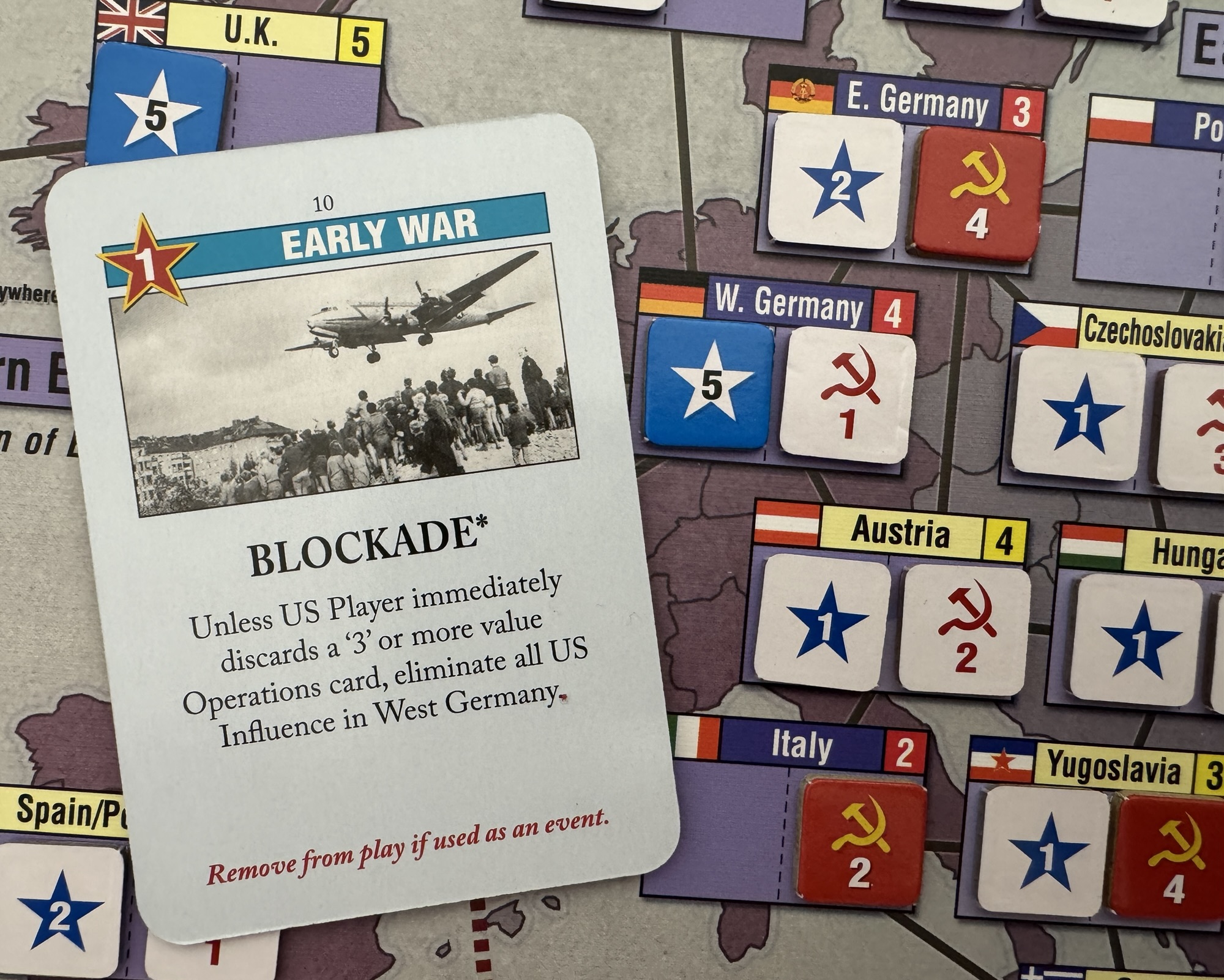
#69: Blockade from Twilight Struggle: The Cold War, 1945-1989 from GMT Games
Twilight Struggle is a 2-player game simulating the forty-five year ideological struggle known as the Cold War between the Soviet Union and the United States which can be played in 2-3 hours. The entire world is the stage on which these two countries “fight” to make the world safe for their own ideologies and way of life. The game starts right after the end of World War II in the midst of the ruins of Europe as the two new “superpowers” of the world squabble over what is left and ends in 1989, when only the United States remained standing.
The map is a world map of the period, where players move units and exert influence in attempts to gain allies and control for their superpower. The beauty of the CDG system used here is that each decision of whether to use a card for the event or the operations value is a struggle as if it is the other side’s event, it might go off hurting you very badly. There are mechanics to allow for the ignoring or cancelling of some of the best cards for your opponent in a side game within the game called The Space Race as well as nuclear tensions, with the possibility of game-ending global thermonuclear war (Shall we play a game, anyone?). I have played TS about 30 times and love it more and more with each sitting. The game makes me sweat, cringe, jump with joy and bite my fingernails. To me, a game that can do all of that in one sitting is worth the price.
One of my favorite type of cards from the game are those that force an action upon your opponent, such as discarding a card, reducing the Ops from card plays or causing them to have to make other plans than what they were working toward. These type of cards are more reactionary but definitely cause issues and mimic the various non-military focused strategies and tactics used during the Cold War. One of the most famous events from the early history of the Cold War is that of the Berlin Blockade. And there is a specific card that pays homage to the event in the game called Blockade. Blockade is an Early War Soviet Card that has an Ops Value of 1, which makes the card more valuable to be used for the printed event versus for the Ops.
When played, the card requires the US Player to immediately discard a 3 Ops or more value card from their hand or the consequence of not doing so will see all US Influence being removed from West Germany. This is a tough choice. Being early in the game, it is possible for the US to rebuild in West Germany and replace the lost influence over time if they do not wish to discard such as high value card. But, herein lies the real key to the Blockade cards use. The Soviet Player, who should be paying attention to not only their hand but also the card plays of the US Player, should try to use this card later in a turn once the US Player has played a majority of their cards in order to ensure that the event text can be realistically be achieved. If played quickly during a turn, the chances of the US Player being able to discard the required 3 Ops or great value card is higher and the card play will not generate any meaningful difference on the board state. I also would recommend a 2 card strategy here as the Soviet Player should be holding in their hand a high Ops card to be able to follow up this action with the placement of Influence into West Germany on their very next play. But, the real value to a card such as Blockade is that it forces the US Player to consider what cards are out there and to play around their negative effects as much as possible. Due to the nature of the game, and the randomness of card draws, having an expendable high Ops card ready and able to be discarded just in case of the play of Blockade is not really feasible. Also, remember that in Twilight Struggle that opponent events on cards that you play will go off and Blockade being drawn by the US Player can be bad as it will require them to play the event as you cannot discard a 1 Ops card to get rid of its negative effect in the Space Race Track due to the minimum requirement being a 2 Ops card. So the moral of the story here is that both players need to consider and plan for the play of or the mitigation of damage from Blockade.
The Berlin Blockade, which lasted from June 1948–May 1949, was a major Cold War crisis where the Soviet Union blocked all land and water access to West Berlin to attempt to force Western Allies out. The Soviet Union was taking this action as a means of retaliation against the introduction of the new Deutschmark currency. The US and Britain responded with the massive Berlin Airlift, flying over 2.3 million tons of food, fuel and supplies to the city. At the peak of the Airlift, a plane landed in West Berlin every 30 seconds. The blockade failed and the Soviets lifted it on May 12, 1949, after realizing the Allied Airlift could sustain the city for an extended period of time, marking a significant victory for the West in the ideological struggle. This event led to the acceleration of the division of Germany into East and West and the deepening of Cold War tensions.
Last day. We have had a great time and got 14 different games played! I’m exhausted but it’s a good exhaustion, if there is such a thing. Our final day was filled with 3 more great games as well as a lot of quality time with friends and fellow wargamers.
The day started with our first play of a brand new game called Imperial Elegy: The Road to the Great War 1850-1920 from VUCA Simulations. Imperial Elegy is a card driven game that blends diplomacy, warfare, and statecraft and feels a bit akin to games like Here I Stand and Virgin Queen from GMT Games. Grand scale sweeping epics that play multiplayers and take a day to play. Players play as 1 of 6 unique major powers in the game including Germany/Prussia, the United Kingdom, France, Austria-Hungary, Russia and the Ottoman Empire.
The game takes place over 7 turns, with each turn representing approximately a decade. If the Great War breaks out, the game can be extended by an additional 6 shorter turns.A turn in the game consists of numerous player impulses that is driven by the play of action cards for their Command Points or the printed events. Players will use CP and events to take actions like colonize, conduct diplomacy with minor nations, fight wars, as well as hinder their opponents by playing events that take away their actions or resources. A turn will end once all players have consecutively passed or when all players run out of cards.
Here is a look at the German player board which tracks a lot of information including current Stability, which decides whether various actions like war can be taken or if there are various positive or negative modifiers, the available Manpower that will determine how many armies can be built, Industry that tells how many action pointed you will have to spend during war to maneuver units, attack and replace losses. The focus of the game is about the control of territories both on the Minsk and of Europe as well colonies abroad and there is an automatic victory if a certain target number is met, in the case of Germany 15.
Here is a quick look at the Russia player board for comparison’s sake as each faction is unique and has various starting levels and abilities.
We only played the first full turn and it took us about 90 minutes including an hour of setup and rules overview and discussion as only one of us at the table had player previously (John Lapham). But we very much enjoyed the experience and found lots to like. We are going to try to put together another full game in the next several months and will have more to report on after that. But suffice it to stay everyone at the table was impressed with the design and everyone had a good time with it.
The 2nd game of the day was Bretwalda from PHALANX. This is such a beautiful game but is also a very good design in the area control/dudes on a map realm.
Bretwalda attempts to do what Civ Builders do but do it in a novel and different way…and also finds a way to incentivize combat, which was really a breath of fresh air for me. Bretwalda from PHALANX is a game for 1-4 players that plays in around 2 1/2 hours. Each player takes charge of one of the kingdoms of medieval England, including Northumbria, Mercia, Wessex and East Anglea, and each of these kingdoms has unique leaders and abilities. The goal is to be crowned the Bretwalda of England and victory will be achieved through a combination of controlling key areas with victory points, completing Chronicle cards in the form of hidden objectives and also focusing on building various buildings such as Abbeys.
The game has very little assymetry and I initially thought that this would be a bad thing for the design but really enjoyed how they did make each kingdom feel different, also how they provided unique choices in the area of Kingdom Tiles and the development of your kingdom. The Kingdoms differ in three main aspects. First, they are located in different areas on the map. Now this might not seem very important but there are advantages to each of these locations. East Anglea has access to several Areas that produce Food. This is very good as you have to feed your soldiers at the start of each Winter Phase and you will always be on the lookout for how to get more Food. This is a very good advantage but the tradeoff is that they are very open and spread-out on the map in the east and have more areas susceptible to attack which requires more troops for defense. Northumbria is located in the north of England up against Hadrian’s Wall which provides some form of protection as it provides extra defense if attacked. They can also conquer the area to the north of their kingdom and have very little worry about any threat from that side so they can focus on defending other areas.
Second, each kingdom has its own permanent, unique special rule that provides them with an advantage. East Anglea starts with 3 Food in their capital while other kingdoms start with just 1 and they also obtain 2 Food at the start of each Spring Season. Wessex will draw one extra Lordship Card after winning a battle. This is very important as these cards are very versatile special benefit cards that can be used in battle to do several things like reroll dice, add reinforcements, bring back a destroyed unit, etc. They also though have other uses through other phases of the game including scouting your opponents stash of cards before attacking, cancelling played card effects, gaining additional Gold, amongst other benefits. Mercia is able to Recruit 1 additional land unit when they take the Fyrd (Recruit) action. This gives them access to larger armies more quickly than other kingdoms so you have to watch out for them to be aggressive early. Finally, Northumbria may build Abbeys for 1 less Gold. This is probably the most simple benefit but Gold is at a premium and this really helps them to get more Gold as Abbeys give victory points (called Dalcs) as well as provide 1 additional Gold during the Collect Action. These benefits are not massive or game breaking but really add some flavor to each kingdom. Third and finally, as already discussed in the point above, each of the kingdoms has a set of its own unique historical Rulers, each with a different ability. I wont say anymore about this here but I really liked this part of the assymetry and thought it worked really well without breaking the game or making it more difficult than it had to be.
The area that I really wanted to cover in this part though was the Kingdom Tiles. During the Development Action, each player can pay 3 Gold and place 1 Kingdom Tile on their board. These Kingdom Tiles are divided into 4 different categories (you can see the four categories on the Kingdom Board shown above) tied to the four available Actions for players, including Development, Collection, Fyrd (Recruit) and Movement. The surprising thing about these tiles was that they are all the same for each kingdom. At first I thought maybe this was a missed opportunity but then after playing I saw that each having the same access to the same tiles was smarter as it gave the game balance. Also, each of the categories offers 3 possible Kingdom Tiles to develop and each player only has 2 spots on their board so you cannot develop all 3 in each category and each player will have to choose what makes the most sense for them at the time. I have seen this done in several of the Lite Civ Dudes on a Map Area Control games but they tend to overcomplicate it and make it clunky whereas in Bretwalda it is streamlined and simple yet there are options and paths to develop.
Bretwalda is a unique game amongst the many Lite Civ Building Dudes on a Map Area Control games out there. I had a great time playing the game and enjoyed the very interesting and fun combat system with custom dice for each unit type and Lordship Cards that add special abilities. This game is special and beautiful and thematic and earns a spot on my shelf as a game that I want to play again and again.
The wrap up event was annual roleplaying game and this year Cullen prepared a session of a new RPG called War Stories, which is set during the World War II. With it, players take the roles of heroic soldiers parachuting into Normandy during Operation Overlord in June of 1944.
As an RPG players will have characters with various special focuses across 4 abilities including Strength, Agility, Intelligence and Empathy. Each time a skill is to the checked you find the matching ability and roll that number of six sided dice looking fur 6’s which mean success. If multiple successes are rolled you can earn special tokens called Lucky Strikes that can be saved and used as successes on future rolls. The players will have to decide if they roll their dice again and will remove any 1’s from the pool and roll the remaining dice again. If they fail this time though the GM will gain a FUBAR token that can be used to cause a failure on a rolled success in the future. This really created some cinematic moments and was a very interesting way to handle a check.
Our friend Cullen was the GM and did a fantastic job guiding us through our first experience with the system. His good explanation and clear understanding and familiarity with the system really made our first experience an enjoyable one.
We were tasked with taking a hardpoint on D-Day behind enemy lines to assault and take out several gun emplacements shelling the upcoming landing beaches. We went through a series of rolls and checks on the flight in on the Dakota C-47 and then had to bail out over flak filled skies taking hits and losing gear or our musette bags.
When we landed we had to gather up, create a plan and then execute that plan to maneuver through German held positions under fire and take out the emplacements. There were lots of heroic actions, good sniper shots, daring orders and of course explosions and we had a great time with the game.
In the end we were successful and only lost a few of the men under our command. I look forward to playing more in the future. Thanks to Cullen for his preparation and time devoted to teaching us the system
We finished up at about 9:00pm and we then gathered up all of our games, equipment and items and said goodbye to friends who we hope to see next year. This week was a major success as we played 14 different games and had a very good time. Thank you so much for following along in my daily posts and look ahead to the videos we did appearing on the YouTube Channel over the next month.
Day 4 dawned early and we are really tired. I actually felt like I had slept, although I didn’t fall asleep last night until about 1:30am, but just didn’t feel refreshed and had very little energy. I am a Wargamer and I simply sucked it up and got downstairs where we had breakfast with friends including Russ, Cullen and Hermann Luttmann. We imbibed in the buffet eating more pieces of bacon than someone should in a fortnight and made it to the War Room a bit before 9:00 where we started setting up for our annual 6-player game of Here I Stand from GMT Games.
Playing with us was Russ (France), Cullen (Ottomans), Bill Simoni (Papacy), James (England) with me (Protestants) and Alexander (Hapsburgs).
Not sure what Russ was doing with his hand and Alexander never smiles!
We simply love Here I Stand and have played the game at least 15 times and it just gets better every single time. If you don’t know, Here I Stand: Wars of the Reformation, 1517–1555 is a grand-scale Card Driven Game that simulates the political and religious struggles in Europe during the period covering 1517-1555 referred to as the Reformation. It is designed primarily for six players, each controlling a major power with unique, asymmetric goals and mechanics and is best with max players.
The game takes place over up to 9 turns, but for us a majority of our plays have lasted 4-5 turns with our longest play being today as we finished the game in 6 turns. Each of the turns represent approximately 4 years of historical time. The game utilizes a Card-DrivenGamesystem where players spend cards for their Command Points to perform actions like moving armies or building fleets or for the unique historical event described on the text of the card.
The game is very asymmetrical in its gameplay as each of the factions plays a different game based on its historical role and will win via amassed VP’s that are earned in vastly different ways such through piracy (Ottomans), building of chateaus (France), New World Exploration (England, Hapsburgs, France) and through battles. The Papacy and Protestants will wage a religious war over the souls of European Christians to either sway spaces to Catholicism or Protestantism. But one of my favorite parts is the Diplomacy and making of secret deals between the players to help out their goals.
With that being said our game started off with the nailing of the 95 Theses to the door of the church at Wittenberg and as the Protestants I have never seen a worse opening as I was only able to switch 3 spaces in Wittenberg, Brandenburg and Leipzig. Not a good start at all for the Protestants but I was undaunted, although I said many curses under my breath and to the gamers at the table, and quickly got my self under control and was determined to recover.
A look at one of the poorest starts of all time for the Protestants.
I worked hard over the next few turns to spread the faith and was quickly able to get most of Germany under control and take over 4 of the Electorates which gave me units that would help me continue to spread toward France and England.
It was amazing to see Bill Simoni and the Papacy and I go at it as we held many theological debates, ultimately each of us disgracing a debater and gaining VP, and for me to have the full Bible translated into German during Turn 2 quickly followed by the translation into English by Turn 3. I had made a deal with England for him to play a card that favored me in exchange for a concerted effort to get the Protestant faith rooted in England so he could gain some VP.
Meanwhile the Ottomans got out the Barbary Pirates card early and had built a sizable fleet of corsairs causing France and England to loan the Hapsburgs several boats to combat this green menace in the Mediterranean.
Also several colonies were formed in the New World and ultimately Alexander’s Hapsburgs were able to circumnavigate the globe and score several important VP.
During this time, the Protestants and Papacy were fighting tooth and nail but my dice rolling, and innate ability to win ties, allowed me to build a sizable lead in the religious war. I was in very good shape when the Schmalkaldic League card was played turning the Protestants into a military power and then changing the other players focus to then declare war one and begging to attack my fortified Electorates to take away VP I had earned by having both religious and political control in 5 of the 6.
As we came into turn 5, I was at 24 VP and ultimately came up shy of a victory by 1 point at the time. I had been able to take over the entirety of England and change every space and also get about 5-6 spaces in France. but now the Papal Bull came to play and Bill fought me back and forth with him taking over 3-4 spaces followed by me reclaiming 3-4 spaces. It was beautiful game of back and forth and I used every tool at my disposal to fight him including The Wartburg card to stop the untimely excommunication of Luther before he could attempt to embarrass one of my lesser debaters.
Then England gained ground as a healthy Edward was born and he gained 5 VP and then took over a key from France to get close to my score going into Tuen 6.
At that point it was dog pile the winner as everyone declared war on the Protestants and came after my Electorates but I was able to stave them off and ultimately never lost down to lower than 4 controlled which retained 8 VP for me and allowed me to finish the Bible translation in French and take a sizable lead in VP.
The game came down to the last card play as England and my Protestants tied at 25 VP and I won on tiebreakers as I had the most VP in the turn prior. What a fantastic game that took us over 9 hours to play!
We were all wasted and went to dinner at a nearby bar called The Flat Iron Grill and had a very enjoyable meal. We decided to not play the WWII RPG War Stories and might till tomorrow night as we were all a bit brain dead.
We played about 5 scenarios of the beautiful and very fun trick taking game called The Lord of the Rings Trick Taking Game: The Two Towers from Office Dog. This is a standalone continuation to The Lord of the Rings: The Fellowship of the Ring Trick-Taking Game, with several play modes including solo, 2-player, and 4-player and we did the 4-player version. It is a cooperative card game that follows the narrative of J.R.R. Tolkien’s second book through 18 unique, story-driven chapters.
The game functions as a “must-follow” trick-taker, where players must play a card of the led suit if they have one; otherwise, the highest card of the led suit wins the trick. Unlike many traditional trick-taking games, players work together to meet individual character goals simultaneously to progress through the story. And they s game is very tough with the new edition adding in several very tough challenges as the addition or orc cards that have no function but if lead because you have no other choice lead to a loss. Just great and thinky fun that is very relaxing and frankly very fun to play.
Examples of 2 characters which each have a unique goal that must be completed during the scenario.
This was a perfect way to end the day and we actually made it back to our room at 9:30pm allowing me time to write this post and get in near before midnight.
Tomorrow is our last day and we have big plans as we will be playing Imperial Elegy from VUCA Simulations (a kind of Here I Stand style CDG on the rise and fall of European empires from the 1850’s through WWII), Bretwalda from PHALANX (an Ameritrash combat game set in medieval England) and then a night cap of the RPG War Stories that we didn’t get to this evening. See you tomorrow night!
With this My Favorite Wargame Cards Series, I hope to take a look at a specific card from the various wargames that I have played and share how it is used in the game. I am not a strategist and frankly I am not that good at games but I do understand how things should work and be used in games. With that being said, here is the next entry in this series.
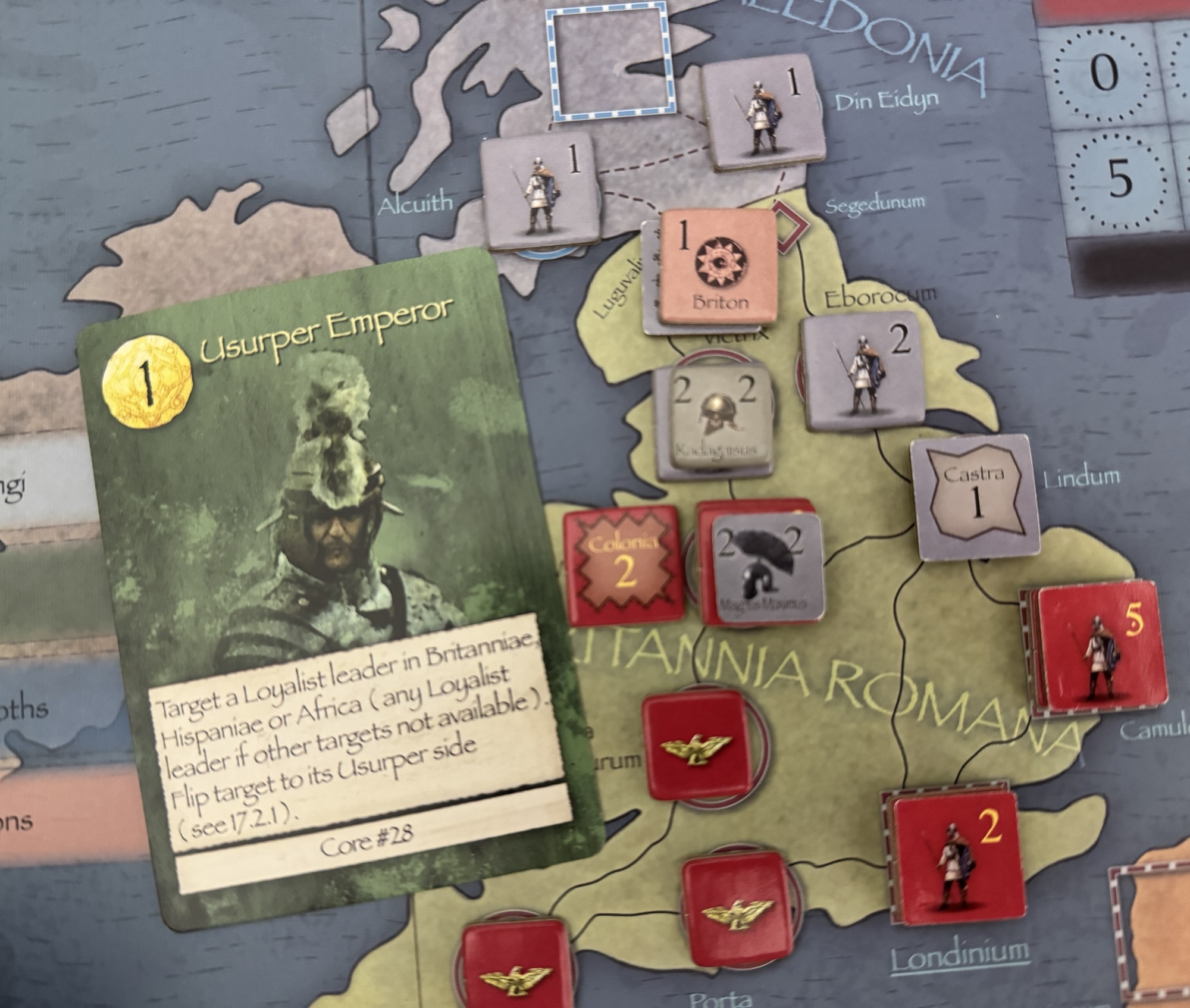
Card #68: Usurper Emperor from Barbarians at the Gates, The Decline and Fall of the Western Roman Empire 337 – 476 from Compass Games
Barbarians at the Gates, The Decline and Fall of the Western Roman Empire 337 – 476 from Compass Games is a Card Driven Game for two players set during the final hundred plus years of the Western Roman Empire as the Barbarian tribes in the north came down with a vengeance as they clashed with civilization and carved out their place amongst it. The time period covered in the game is from the death of Constantine the Great (337 AD) to the deposition of the last Western Roman Emperor by Odoacer in 476 AD. The Roman player will command the Roman Legions loyal to the failing central authority and those Germanic peoples who have settled peacefully inside the Roman Empire, while the Barbarian player leads Usurper Emperors, and controls the migrations of the Germanic peoples, who are the Barbarians at the Gates. This game is really quite good and feels very much like a wargame even though it is a Card Driven Game. There are lots of opportunities for troop movement, combat and maneuver. And I really liked that. The game is a Card Driven Game and the use of cards is all important and very well done. Each player has their own unique deck of cards that are used and these cards are sometimes removed from those decks when played for an event and also new cards will be added to the deck after each turn. The cards played during a player’s impulse which are not used for the Event are then used for their Operation Points value. These Operation Points can be used for many purposes including Activating a leader, Forced Marches, Raiding, Reinforcement, Migration and Successful Usurpation.
The real trick to the cards is to plan out how you are going to use them to your advantage but also how best to use them. Activating Leaders is very important as you can then move them to attack, defend, change control of areas and other actions. Activating a leader depends on their strategy rating (the lower the strategy rating, the better). When a leader activates from a card, they receive a number of Action Points which can be used for movement (1 over highway, 2 over rough or river connections, 3 over strait or for naval movement), continuation after battle (a kind of advance after combat), changing control over unfortified spaces and sieges of fortified spaces. But the cards also are very mean spirited. What do I mean by this? Well, in our first play, I was carefully using my cards to build up my armies to fend off the initial attacks of the Barbarian hordes. I also had begun to build somewhat of a super stack as well to attempt to foray into England and take on the Barbarians there. As I did this building up, I was unaware of the nasty nature of some of the cards. Some of the cards, both for the Barbarians and Romans, allow a play that will turn a single leader and their entire stack into either a Usurper or a Pacified Barbarian Settlement. Both are equally nasty and you have to keep in mind that you can have your best armies simply taken from you and turned to your enemy.
Some of the cards, both for the Barbarians and Romans, allow a play that will turn a single leader and their entire stack into either a Usurper or a Pacified Barbarian Settlement. Both are equally nasty and you have to keep in mind that you can have your best armies simply taken from you and turned to your enemy. Because of this, the Roman player has to decide whether they will group Combat Units under a single leader in order to face the mighty Barbarian challengers at the Gates in which case he risks that leader to Usurp, or to disperse these troops over several stacks never allowing a single leader to amass too many CU but on the other hand also never having a true striking force to attack with. There is an exception here though as an Emperor leader cannot Usurp and you don’t have to worry about that but this is also dangerous as you can lose that Emperor.
Likewise, once they have an Usurper leader on the board the Barbarian player will try to group all Usurper CU with this leader (in order to keep this force strong and in order to allow their Barbarian CU, leader and tribes to march unopposed into the Empire). This creates a very real and historical danger as the Barbarian player is incentivized to do what an Usurper would historically have done and empty the border garrisons in order to march on Rome.
These type of cards are extremely strong and a situation can occur in which most of the Romans still on the board are Usurper leaders and CU. But there is an action that allows for the Roman player to counter these cards and that is the Successful Usurpation action. If the Barbarian player over does it with the Usurper powers, the Roman player can simply steal these conquests by swapping the Roman power for the Usurper power. This in effect has the Usurpation process succeed and the former Usurper leader now becomes the true Emperor!
Usurper emperors in history, particularly in Ancient Rome, were rulers who seized their power illegitimately, often times via a military rebellion rather than legal succession, and were labeled “tyrants” if defeated, or emperors if successful. They were most common during crises and times of turmoil, such as the “Year of the Four Emperors” in 69 AD following the suicide of Nero, often relying on legionary support and issuing their own coins to legitimize authority.
Emperor Galba by Paulus Moreelse (left); with Emperor Marcus Salvius Otho by Gerrit van Honthorst (center left); with Emperor Vitellius by Hendrick Goltzius (center-right); and Emperor Vespasian (far right).
Usurpation was common during the whole imperial era; virtually all imperial dynasties rose to power through usurpation and conspiracies. The “imperial office” established by Augustus never defined an stable system of succession, and emperors often had to rely solely on military power to survive.
In the Eastern Roman Empire (395–1453), rebellion and usurpation were so notoriously frequent as compared to medieval West, where usurpation was rare, that the modern term “byzantine” became a byword for political intrigue and conspiracy.
Here is a look at our unboxing video:
We also did a video review and you can watch that at the following link:
I am very tired of the cold and dreary days of winter. I want it to be warm soon but we are realistically a few months away from consistently nice weather. But, this month, even though the weather has been brutally cold, we saw a warming trend with historical wargames. This month for the Wargame Watch I was able to find 33 games (including the 3 games from our sponsor Bellica Third Generation). Interestingly though this was a cooler month for crowdfunding as I only found 4 games featured on Kickstarter or Gamefound.
This month again we have a sponsor for the Wargame Watch in Bellica Third Generation, or Bellica 3G for short, owned by designer Francisco Ronco. I asked him to write up a summary of his company and their core values and he has provided the following:
Bellica Third Generation is a group of players with many games played between them and a longstanding and deep interest in everything related to Military History. Our members come from Cadiz and Seville (Spain) and we are proud to have started this Andalusian and Spanish project in the field of strategy and simulation games.
Please let us introduce ourselves:
Francisco Ronco Poce (1969).
Game designer and producer. A Napoleonic fan for over 45 years. He is both the heart and manager of the team. And has designed the four first game series that our company will start developing shortly.
Reyes Gallardo Gutiérrez (1978)
Our newest gamer. A military history enthusiast as a hobby and teacher of physics at a secondary school by trade. She is an outstanding playtester, with a critical and analytic mind.
Ramón López Martín (1973).
An experienced gamer. Game designer and play tester. Well known for his skill eliminating all game counters in play; both his and his opponent’s…
What do we do?
Strategy and simulation games. In fact they are “cardboard simulators”. Computer and video games based on the simulation of car races, first person adventures, aircraft -or spacecraft flight- or tank driving are both widely accepted and successful. Now we propose something similar; our games strive to make the player confront the experiences that historical commanders and leaders lived. Facing the same situations, managing resources and making decisions about a hardly predictable outcome.
The main attributes of a simulation as we understand it are:
Resource management
Essential role of logistics
Game centred on decision marketing
Uncertainty and fog of war
All of them are present in every one of our games. With the firm intent of achieving this with the least possible number of rules. We do not feel that elaborate and complex rules are necessary if the internal dynamics of a game system can produce the desired effect. Likewise, it is our intention to follow an editorial line based on game SERIES, thus the players may learn a new game effortlessly having to deal with just a negligible number of new special rules. In our view, the games will contain a “Series Rulebook” dealing with all the elements forming the game system and another “Special Rulebook” containing those rules that reflect the peculiarities of a given scenario.
Our commitment is to offer the player a maximum of playability and variability for their money without an unnecessary effort or learning rules. Our simulations are fun to play, both for those who are already versed in Military History – since they are simulation models – and for the uninitiated looking for a good opportunity to learn the hobby.
After years playing war games of all kinds, periods and scales (from World War II to Ancient Rome, including XVIII century or Napoleonic tactical games) we are convinced that there are basically two different approaches to war gaming; one is game oriented while the other emphasizes simulation. To reach an equilibrium between these two tendencies is not an easy task. There are games whose mechanics and effects might equally apply to a Panzer Division or a Roman Legion. These games are usually easy to learn and are nicely presented, essentially they provide competitive play, are fun and quick paced. Others try to accurately portray a period, campaign or battle where the player must play the role of a corporal firing a machine gun and –at the same time- that of the Army Corps Commander; sometimes they have plenty of rules, exceptions and an alleged “realism”. Quite often, this double perspective has presented “playability” as opposed to “realism”. Quite often, this double perspective has presented “playability” as opposed to “realism”. We think that this approach completely misses the point; We rather see it as a question of “game” vs “simulation”.
We make games:
Rules systems that allow players to perform certain actions while forbid others; with goals that all participants may and want to reach. But our desire is to provide “simulations”; our rules try to establish a framework as close as possible to the one that historical participants faced so that the goals that players must achieve correspond to their historical counterparts, then it is up to the players to find the means.
We have produced not only in-house designs but also designs from other designers. Recently, we have released An Impossible War from David Gómez Relloso -designer of the famous Crusade & Revolution from Compass Games.
An Impossible War is a game about the decisive years of the First Carlist War in the North. Infantry and cavalry are represented by blocks, which introduce fog of war into operations. There are also artillery counters (field and mountain artillery) and logistics units (supply trains and backpacks).
The main map is a point-to-point board covering the northern theater of operations: Navarre, the Basque Country, and surrounding areas of La Rioja, Burgos, and Cantabria. In addition to provincial capitals, major towns and other localities are shown, along with primary and secondary routes of communication. There is also a smaller map of the rest of peninsular Spain, showing the regions affected by the Carlist uprising and allowing expeditions being launched from the North.
Each turn, players compete for initiative and carry out a variable number of actions. There is also a card deck for each side, including historical, operational, and tactical events. The cards add background and unpredictability to the game, helping make each session different. This is NOT a card-driven game, but one assisted by cards.
An Impossible War simulates the historical conflict, which featured numerous skirmishes, few major battles, and significant siege warfare. It is an asymmetric game in which each side has strengths and weaknesses. Players must exploit their advantages and mitigate their disadvantages to achieve victory.
The Carlist player must make use of superior mobility and unit quality to consolidate territory, wear down the enemy, and threaten cities. The Liberal player must contain and suppress the insurrection; they have more troops, but of lower quality and plagued by logistical nightmares. Additionally, they must quell uprisings and chase down Carlist expeditions across the rest of Spain.
We produced the games fully in Spanish and English versions, this game also had an Italian version.
Now we are preparing the reprint of our small but well-known Santa Cruz 1797, the forefather of Von Manstein’s Triumph and Castelnuovo 1539. And the soon to be released Volume IV of the Campaign Commander Series: White Sea, which covers the Spanish-Ottoman struggle in the Mediterranean from 1565 to 1574.
Both of these games are planned to be released later this year.
In summary, here is a look at a sampling of Bellica Third Generation’s games from their website. Many of these are out of print but can be found on the secondary market at places like Noble Knight Games. Click the image below to be taken to the Bellica Third Generation selection of games at NKG.
But now onto the games for March!
Pre-Order
1. Combat! 4: Eastern Front from Compass Games
This month we had another one of the huge downloading of a large amount of new pre-order games from Compass Games that I have affectionately referred to in the past as “Pre-Order Palooza”. The first game that I am highlighting here is the next volume in the highly thought of Combat! Series of solitaire wargames. These games represent man to man combat on the battlefields of World War II where typically each of the counters on the board represent a single soldier. This small tactical scale is one of my favorite wargaming modes as I just enjoy the decisions required regarding movement, the use of tactical strategy such as scoot and shoot, throwing smoke for cover, suppressing fire and the like. I have yet to play any of the previous 3 volumes, even though I own all 3, but they are high on my want to play list and I am very much interested in this system.
The newest volume is called Combat! 4: Eastern From and deals with the fierce fighting on the East Front of World War II during Operation Barbarossa in 1941-1943.
From the game page, we read the following:
Combat! is a solitaire game series of man-to-man combat in World War II. This is the fourth game in the series. The system uses a unique AI to make for intense combat situations as well as unlimited replayability. You will stand on the defense against a relentless foe. Can you hold on?
Combat! Eastern Front is a solitaire game of man-to-man combat on the Eastern Front in WWII. The player can command a squad of German or Soviet soldiers in various engagements. This game includes the all-new Series Rules, which have been clarified and streamlined from the original rules, and now enable players to control either nationality in this game.
There are 11 tense scenarios across 4 full-size maps ranging from forest partisan warfare, to urban fighting in Stalingrad, to desperate battles on the steppes. A comprehensive random scenario generator further expands the possibilities and will create a limitless supply of unique scenarios. In addition, the included campaign game allows the player to lead a squad of men through 10 battles.
One of the things that I do like about this system and the various volumes is that it is not just cookie cutter churning out new games but each game has their own unique elements modeled into the game play as special rules or changes to account for the history of the setting. Here is a look at the changes in this new volume:
Soviet and German OOB’s contrast the crude but determined Red Army with the efficient Wehrmacht.
City fighting with demolition charges, factories, upper stories, fortress buildings, and other forms of close-quarter fighting.
Light Mortars are long-range nuisances able to saturate an enemy position with explosives.
Weather and Fire add flavor and realism to any battle.
Artillery is now a frightful weapon with a new and accurate placement process.
Confidence rules ensure that a side will not fight to the last man, but may retreat or waver if they sustain too many casualties.
2. Man of War: Fleet Combat in the Age of Sail, 1775-1815 from Compass Games
I have only ever played a few Age of Sail games but have always been interested in the era and the concept of gaming that out on the tabletop. One of the recent pre-order offerings from Compass Games is Man of War: : Fleet Combat in the Age of Sail, 1775-1815 designed by Stephen Newberg. The game looks very interesting and I am definitely looking forward to seeing what it has to offer.
From the game page, we read the following:
Man of War is a game of naval combat between sailing ships from 1775 to 1815. Turns are of variable length and represent up to 4 minutes. Ships are represented individually, but the concentration of the game system is on actions involving a number of ships on each side, that is, squadron and fleet level actions.
Rules cover wind speed and direction, which affect movement. The firing broadsides with crews rated for their proficiency ranging from green to excellent. It is possible to board enemy ships, have them strike the colors, and take them as a prize!
You take command from the viewpoint of a fleet commander.
The game is scenario based and it offers a total of 12 historical playable scenarios as follows:
• USHANT, 27 July, 1778
• DOGGER BANK, 5 August 1781
• CHESAPEAKE BAY, 5 September 1781
• MADRAS, 17 February 1782
• THE SAINTS, 12 April 1782
• THE GLORIOUS FIRST OF JUNE, 1794
• CAPE ST. VINCENT, 14 February 1797
• CAMPERDOWN, 11 October 1797
• CABRITA POINT, 12 July 1801
• TRAFALGAR, 21 October 1805
• SAN DOMINGO, 5 February 1806
• LISSA, 14 March 1811
I think that one of the most interesting parts of the way this is designed is that there is an ability to create custom scenarios to play out “what-if” scenarios or to create larger battles with tons of ships just because you can.
As I said above, I have not had the chance to play any of the games in the Combat! Series but am interested in them and own the 1st 3 volumes. This month, Compass Games released information on their next volume following Combat! 4: Eastern Front, which was just announced as well, called Combat! Crete. Combat! Crete is a stand-along game that can be played without any other games in the series. When I saw this I was immediately taken as I have played a few smaller scale tactical games on the ground combat in Crete but was excited to see this subject come to a solitaire system. And the opportunity to play as the British Tommies against the German Fallschirmjäger is always a welcome opportunity on my gaming table!
From the game page, we read the following:
Combat! Crete is a stand-alone solitaire game of man-to-man combat in WWII. The player commands a squad of British Tommies or German Fallschirmjäger in various engagements. The included scenarios are set on the islands of Crete and Leros, but full-war OOB’s are included for both factions.
The comprehensive Random Scenario generator further expands your gaming possibilities. With this tool, players can generate a limitless supply of unique scenarios for Combat! Crete or combine their game with Combat! Eastern Front and/or Combat! Tunisia & Sicily to create an even more expansive gaming experience.
In addition, the included Campaign Game allows the player to lead a squad of men through 10 battles, gaining experience along the way.
One of the things that I do like about this system and the various volumes is that it is not just cookie cutter churning out new games but each game has their own unique elements modeled into the game play as special rules or changes to account for the history of the setting. Here is a look at the changes in this new volume:
Off Board Artillery rules including air support (Stukas!).
New Terrain types including Vineyards, Weapon Pits, and an Airfield.
Parachute Drops, with a massive four map paradrop scenario.
Scenarios with Australian, New Zealand, and Maori troops.
Scenarios on Leros which feature Fallschirmjägers with FG42s.
Competitive Play rules for head-to-head battles!
Armed Cretan Civilians give the Fallschirmjägers a nasty welcome.
I have played a few games from Joe Miranda over the years and have always found them to be good and well designed games. This month, Compass released a 2-pack of a few of his interesting card driven games called Imperial Wars. This box set includes 2 games in the card-driven Imperial Wars System—Sikh War and Caucasus Campaign. Both become a contest between great powers fighting for control of regions with wider strategic implications. With multiple scenarios for each game, Imperial Wars provides you with many opportunities to alter the course of history on far-flung and lesser gamed frontiers. This box set really looks unique and I am very much intrigued and will be reaching out to Joe to see if I can get a designer interview completed to share.
From the game page, we read the following:
Sikh Wars covers the 1845-46 conflict between the British Indian Empire and the Sikh Kingdom of the Punjab. Roth powers were expanding in northwest India, and their armies clashed from the Sutlej River to the outskirts of Afghanistan. The war led to the later expansion of British India to what became the Northwest Frontier.
Caucasus Campaign has the Russian and Ottoman Empires fighting for control of the mountainous region between the Black and Caspian Seas as part of the wider Crimean War. This campaign had a considerable impact on the future of the Middle East.
Players command armies composed of regiments, brigades, and divisions, which fight using battle and skirmish combat results tables. Certain units have elite status, giving them greater resiliency in combat. The many imponderables of leadership, expeditionary warfare, and chaotic political situations are accounted for in each player’s deck of Campaign cards. Astute play of cards can decide a battle or spark an uprising deep within enemy territory.
Both games have multiple scenarios. There are also options for bringing in additional forces, which can swing the tide of a campaign. Each game becomes a contest between great powers fighting for control of regions with wider strategic implications. Imperial Wars provides the opportunity to alter the course of history on far-flung frontiers
We have played several of Adam Starkweather’s games and systems and have very much enjoyed them, particularly the Company Scale System or CSS. He is a very solid designer and his newest game coming from Compass Games is Warriors of Mexico, which deals with the Mexican-American War of 1846-1848. The game looks to be pretty good and uses the system first seen in Warriors of America and Warriors of Politics, adapted to the unique military situation that existed in 1846.
From the game page, we read the following:
Warriors of Mexico is a fast-playing game of the conflict between the United States and Mexico from 1846 to 1848, using a similar system to the one used in Warriors of America and Warriors of Politics, but adapted to the unique military situation that existed in 1846. As was the case in those times, image and perception are as important as military success. Players will navigate the treacherous waters of time and yet fulfill America’s ambitious land expansion.
6. The Battles of Burgoyne’s Campaigns from Compass Games
Several years ago, while attending Buckeye Game Fest in Columbus, Ohio, we met a new designer named Ken Repel and got a chance to take a look at a few of his games including 1812! War on the Great Lakes Frontier from Compass Games and The Battles ofBurgoyne’s Campaign that was announced this past month from Compass Games. The summer and fall of 1777 was a major turning point in the fate of the American Colonies and the Revolutionary War and this game captures the action at 3 of those key battles including the Battle of Hubbardton, the Battle of Bennington and the Battle of Freeman’s Farm.
From the game page, we read the following:
During the sweltering summer of 1777, the American Revolution reached a turning point in the rugged terrain of upstate New York where the Saratoga Campaign unfolded. Led by General John Burgoyne, the British Army marched south from Canada aiming to cleave the American colonies in two by defeating General Horatio Gates’ Continental Army, capturing the Hudson River Valley and gaining control of Albany.
The Battles of Burgoyne’s Campaign is a 2-sided historical board game with one player commanding the Gates’ Continental Army and the other player commanding Burgoyne’s British Army. The game depicts three critically important battles fought during the Saratoga Campaign of 1777, The Battle of Hubbardton, The Battle of Bennington, and The Battle of Freeman’s Farm. Each contest presents the players with a unique tactical situation: Hubbardton is a rearguard action, Bennington a surprise attack, and Freeman’s Farm a meeting engagement.
While attending Buckeye Game Fest in the Spring of 2023, we shot the following video that contains a discussion about this game. You can watch that at the following link:
I was once told that you cannot understand warfare until you under naval warfare and how important it is to the overall scope of the tactics. Well, a new game called Lords of the Seas appears to examine strategic naval warfare during the 5th Century through the 16th Century AD. The game is designed by Stephen Newberg, who has done several naval focused wargames, and is set in the Mediterranean Sea.
From the game page, we read the following:
Lords of the Seas is an uncomplicated 2-player war game centered on the naval campaigns during the era when rowed warships vied for dominance of the Great Middle Sea, the Mediterranean.
The game depicts this conflict at a strategic level, with most operational and tactical details represented by fast and easy-to-play systems, rather than intricate mechanisms.
Players take the part of the commanding leadership of opposing States in historically-based scenarios. The intent of the game is to provide a broad overview of the historical events while being fun to play.
The object of the game is for each player to use their naval forces to keep open the trade routes of their State while also controlling the coastal sea areas needed for the land forces operations of their respective States.
The specifics of these objectives are set out in each scenario, as well as the forces involved, any reinforcements arriving, and the time frame of the scenario or campaign. The time scale of the game is 2 turns per year.
Both players must obtain their objectives by deploying their naval resources into the sea areas on the map and engaging in combats that are resolved on the Battle Board.
Victory points are earned for sea areas and trade routes under their control at the end of each turn of the scenario, as well as for inflicting hits on opposing units in combat. Each represents an individual State as indicated by the scenario.
The Boer War is a conflict that I have never really played a game on. I know that there are several out there but I have just not had a chance but maybe that will change with this beauty called simply Boer War from Compass Games.
From the game page, we read the following:
The Boers, white settlers of Dutch and French descent, started to colonize the shores of what would become Cape Town in 1652. Over time, British settlers and pressure forced them inland, where they founded the Orange Free State and Transvaal, isolated areas rich in gold and diamonds. The British continued to try to subdue the Boers in the Transvaal War of 1881 and the Jameson Raid of 1895. Anticipating a third attempt by a feared invasion, the Boers decided to invade the British colonies first in October of 1899. It is here that the game begins.
Boer War is a 1-2 player game split into two phases, the Conventional War Phase and the Guerrilla Phase. It is played in 6 turns, with each player alternating between spending Action Points and playing Event Cards. With unique victory conditions and Event Cards for each phase, and the Guerrilla Phase being playable as a separate scenario, players get two games in one box. As the British try to keep up their Morale and the Boers destroy and plunder through Guerrilla warfare, who will be the one in control when no one is left standing?
9. Historical Advanced Squad Leader (HASL) ModulePrelude to War: Marco Polo Bridge, 8 July, 1937 from Multi-Man Publishing
Last year, I finally played ASL! As you may have seen, I wrote my First Impressions post about the Advanced Squad Leader Starter Kit #4: Pacific Theater of Operations after playing a scenario with a friend I had a very enjoyable time. I still have lots to learn and lots to experience but at least that first plunge is done. And I definitely want to play more! So this month, I saw that they are bringing back a few things including ASL Prelude to War: Marco Polo Bridget, 8 July, 1937.
From the game page, we read the following:
Prelude To War: Marco Polo Bridge is a Historical Advanced Squad Leader (HASL) module depicting the battle outside the walled town on Wanping, China on July 8, 1937 when Chinese troops resisted Japanese attempts to force their way into town on the pretext of finding a lost soldier. This precipitated the War of Resistance Against Japanese Aggression, commonly called the Second Sino-Japanese War, which was the start of WWII. The battle focuses on the key railroad bridge over the Yongding River just outside the walled town.
Prelude To War: Marco Polo Bridge comes with a historically accurate 22″ x 34″ map of the area outside the walled town crafted by designer Ken Dunn and artist Charlie Kibler. There are five stand-alone scenarios on the map recreating portions of the battle. Then there is the Campaign Game covering the entire action, with the calendar day divided into five Campaign Game scenarios separated by a special Refit Phase that allows players to regroup and reposition their forces. The Campaign Game starts with the Japanese attacking onto the map to capture the bridge, followed by the desperate Chinese defense of the bridge and the Dragon Temple (a prominent feature east of the river), the possibility of a Japanese river assault in boats, and concludes with a Chinese night assault by special broad-sword equipped Volunteer units. The only other ASL modules needed to play are Beyond Valor and Rising Sun.
If you are interested in Historical Advanced Squad Leader (HASL) ModulePrelude to War: Marco Polo Bridge, 8 July, 1937, you can pre-order a copy for $33.00 from the Multi-Man Publishing website at the following link: https://mmpgamers.com/asl-prelude-to-war-marco-polo-bridge-p-455
10. Advanced Squad Leader Starter Kit Historical Module (HASLSK) Prelude to War: Marco Polo Bridge from Multi-Man Publishing
And along with the regular ASL Historical Module for Marco Polo Bridge, they also offered their Starter Kit version of the game on pre-order. I will be picking this one up this summer at WBC hopefully and add it to my ASL Starter Kit #4 box.
From the game page, we read the following:
Prelude To War: Marco Polo Bridge (SK) is the second Advanced Squad Leader Starter Kit Historical Module and covers the battle outside the walled town on Wanping, China on July 8, 1937 when Chinese troops resisted Japanese attempts to force their way into town on the pretext of finding a lost soldier. This precipitated the War of Resistance Against Japanese Aggression, commonly called the Second Sino-Japanese War, which was the start of WWII. The battle focuses on the key railroad bridge over the Yongding River just outside the walled town.
Prelude To War: Marco Polo Bridge (SK) comes with a historically accurate 22″ x 34″ map of the area outside the walled town crafted by designer Ken Dunn and artist Charlie Kibler. There are five stand-alone scenarios on the map recreating portions of the battle. Then there is the Campaign Game covering the entire action, with the calendar day divided into five Campaign Game scenarios separated by a special Refit Phase that allows players to regroup and reposition their forces. The Campaign Game starts with the Japanese attacking onto the map to capture the bridge, followed by the desperate Chinese defense of the bridge and the Dragon King Temple (a prominent feature east of the river), and concludes with a Chinese night assault by special broad-sword equipped Volunteer units. All the necessary counters for Chinese units are included. ASL Starter Kit #4 (Japanese) is required to play.
Prelude To War: Marco Polo Bridge (SK) contains:
one box and lid
one 22″ x 34″ map sheet
two counter sheets
five scenarios
one Campaign Game rules booklet, with all of the new rules needed to play the scenarios and the Campaign Game, including rules for rivers, railroads, bridges, hedges, roadblocks, offboard artillery, night combat, and special broad-sword equipped Chinese Volunteer units.
one page Data Chart
one reduced-size copy of the map sheet
If you are interested in Historical Advanced Squad Leader (HASL) ModulePrelude to War: Marco Polo Bridge, 8 July, 1937, you can pre-order a copy for $33.00 from the Multi-Man Publishing website at the following link: https://mmpgamers.com/asl-prelude-to-war-marco-polo-bridge-p-455
11. Peking: 55 Days of Fury from Neva Game Press
Neva Games Press (formerly Neva Wargames) is a new publisher who has appeared on the scene in the past couple of years. When I started seeing their posts on Twitter and Facebook, I was immediately impressed with their interesting topic choices for their upcoming games as well as the fact that they are trying to make small footprint wargames that pack a punch. And the art is also very appealing and brings an aesthetically pleasing and attractive look to their games! Their next set of pre-order games is ready to launch in mid-March and the first game that I will highlight here is Peking: 55 Days of Fury that deals with the Boxer Rebellion in China in 1900.
From the game page, we read the following:
Peking: 55 Days of Fury is a tactical wargame that places players in the heart of the 1900 Boxer Rebellion. Players choose to command either the besieged Eight-Nation Alliance or the attacking Chinese forces, each with unique objectives and strategies.
The game is designed for 1-2 players and offers a tense, immersive experience lasting approximately 1.5 hours. In solo play, players take control of the beleaguered Eight-Nation Alliance.
Each turn represents roughly 11 days of the siege. The game board depicts the International Legations, divided into four main areas. Players use a combination of event cards and operation points to execute actions, such as firefights, raids, artillery attacks, and barricade repairs.
The game begins with an initiative phase, determining the order of play. The player with the initiative initiates a mandatory firefight, followed by the other player. Players then play event cards to trigger various effects, supported by additional cards if conditions are met.
Next, the eight nation alliance player must manage supplies, with shortages potentially leading to epidemics or desertions. In the operation phase, players use remaining cards as operation points to perform actions. Finally, the maintenance phase involves checking victory conditions, handling fog of war cards, and preparing for the next turn.
A distinctive fog-of-war mechanic sets this games apart. Mastering this element is key to outmaneuvering opponents.
Will you be able to withstand the siege and protect the International Legations?
Experience the intensity of the Boxer Rebellion in this tactical wargame.
I am currently working on a designer interview with the designer José Manuel Neva (who is also the owner of the company) and hope to have that out in the next few weeks.
12. Reformation: Fire and Faith from Neva Game Press
The 2nd game of Neva’s new release pre-order phase is the interesting looking Reformation: Fire and Faith designed by Clint Warren-Davey. I am keenly interested in this one and have been working with Clint to do an interview and maybe a series of other articles on strategies.
From the game page, we read the following:
Reformation: Fire and Faith is a game about the wars and religious struggles that raged in Europe from 1517 to 1555. This time saw the Protestant Reformation sparked by the renegade monk Martin Luther and the subsequent wars of religion in Germany and elsewhere, as Christianity was shaken to its core on. It saw numerous wars between the great powers of Europe regardless of religious affiliation. The Ottoman Empire was at its height and threatened the Christian world from the south-east, while at the same time new lands were discovered in the Americas that started a race for colonial expansion. In this game, 1 to 6 players will use their Armies, Fleets, Followers and Churches in an attempt to achieve their victory conditions and attain the most Victory Points (VP). It plays in about 60-90 minutes. The rules are very simple and easy to teach as the game was originally designed for use in a high school setting by the highly experienced game designer and teacher, Clint Warren-Davey. The game includes 6 unique Factions that are all competing for dominance in their own way
A few years ago, while attending SDHistCon we sat down with Sam London and played his new upcoming game called Common Sense (it was originally called Absolved from All Allegiance), which was recently announced on GMT Games P500. The game is an American Revolutionary War Strategic Level game that uses trick-taking and is a struggle over the Will to Fight Track that measures the level of commitment by both sides to the fight. We very much enjoyed playing the prototype and really could see what the design was trying to do and that it did it very well.
From the game page, we read the following:
Common Sense is an asymmetrical trick-taking card driven wargame. One player will take control of the 13 colonies in their fight for independence while the other uses the might of the British crown to quash the rebellion. The game revolves around the Will to Fight Track which tracks both sides’ willingness to continue to fight the war. As it is an asymmetrical game, both sides have different problems they will have to manage to resist the decline of their Will to Fight. The colonies are primarily concerned with morale and their ability to believe that they could potentially win their independence. Losing control of colonies and failures of the Continental Congress to galvanize the colonies will have the heaviest impact on their conviction. The British on the other hand never had hearts and minds to begin with, as the war was never popular at home. Instead, their Will to Fight represents parliament’s willingness to continue to fund the war. Poor results relative to commitment of forces as well as losses of British Regulars can spell a speedy exit from the war for them. The game will end when both player’s Will to Fight markers converge on the track, or rarely at the end of 1783, with position on the track determining much of the game’s scoring.
Common Sense is played with 2 unique 36 card decks. Each card in a player’s deck is also unique, and represents a key personality, battle, event, or concept from the American Revolution. Cards are divided into 4 suits, which are Battle, Mobilize, Recruit, and Special. Since the game is asymmetrical, while Battle, Mobilize, and Recruit serve similar purposes for both players, their actual executions vary in some ways. Battles let you engage in fights with the enemy in the same space, Mobilize lets you move your armies between spaces, and Recruit lets you bolster your forces. The Special suit on the other hand varies radically and really showcases differences between the two sides. The Colonial Special suit governs training of militia into the Continental Army as well as all interactions with the French. The British Special suit on the other hand manages native led operations as well as the might of the British navy. Each card grants a certain number of actions of a specific type, as well as a historical themed event. Events can be one off effects, powerful action modifiers for the current turn, or remain in play for multiple turns granting powerful abilities or changing core rules. Each card also has a numbered value that is used for the trick taking.
The game is played over a series of 10 card hands (each hand is considered a year of the war). Each year consists of 10 tricks, wherein the winner of the trick is given the chance to perform actions. The lead player chooses and plays a card from their hand face up. The other player then plays a card from their hand based on what their opponent played. If they have at least one card that matches the suit of the card their opponent played, they must play one of those cards. If not, they can play any card that they wish. If the card they played matched the suit of the lead player’s card and was the same value or higher, they win the trick and will get to take the turn and become the new lead player. Otherwise, the lead player gets the turn. If the responding player does not have a card of the matching suit they could also win by playing the highest value card they have of the trump suit that corresponds to the lead suit. In any case, the player who wins the trick gets to resolve the event on the card and perform the actions on the card. Alternatively, the player can always choose not to resolve the winning card to perform any one action of their choice.
Here is a link to a designer interview and discussion with Sam London regarding Common Sense at SDHistCon in 2024:
14. Iron Triangle: Search and Destroy Operations in the Vietnam War from GMT Games
A new series, and we have seen how well series have done at GMT GMT Games, a new designer and a new concept to wargaming (lane battler), I think that this game has great potential and it happens to be focused on one of my most liked wars to game – the Vietnam War. Iron Triangle: Search and Destroy Operations in the Vietnam War is designed by Darren McGuire takes a look at the struggle between the United States military and the Viet Cong insurgents as they fight over control of three key “lanes” or key regions. I am very much excited about this one and will be reaching out soon to Darren for some additional information.
From the game page, we read the following:
Iron Triangle opens the new Lines of ConflictSeries with a focused and tense asymmetric lane battler set during the Vietnam War search and destroy operations from 1966 up to the Tet Offensive in 1968. Two players assume opposing roles: the Viet Cong, leveraging concealment, mobility, and disruption, and the United States, applying sustained pressure and attritional tactics to limit insurgent influence. Across three rounds, players commit action cards to search and destroy operations along three lanes, contesting control of three key regions in III Corps: War Zone C, War Zone D, and the infamous Iron Triangle.
Each faction employs distinct tactical systems. The Viet Cong may deploy cards in three states—tunnelled (face down), concealed (face down and rotated), or exposed (face up)—and, through careful resource management, can flip and rotate these cards to conduct hit and run attacks and ambushes, lay booby traps, and establish Tunnel Bases to accelerate gains or blunt U.S. advances. The U.S. player focuses on revealing and eliminating insurgent units by exposing tunnelled and concealed Viet Cong cards with Tunnel Rats, restricting movement and concealment through tools such as Defoliation and ADSIDs (Air Delivered Seismic Intrusion Devices), or or employing more forceful measures such as napalm, saturation bombing, and zippo raids, which, while effective at disrupting Viet Cong support networks, also undermine the stability of urban areas like Saigon.
At the end of each round, players evaluate operational outcomes and their impact on control across the three areas, adjusting regional stability and tracking the resulting shifts in South Vietnamese public opinion. Players can achieve victory if the Viet Cong drives Public Opinion low enough or if the U.S. accomplishes its body count objective while stabilising the region. Otherwise, the conflict culminates in the Tet Offensive—a final chit-pull from a bag shaped by the position of control markers on the area tracks, remaining Viet Cong Tunnel Bases, and the scale of the refugee crisis—where each Tet chit drawn represents a stronger offensive that further erodes Public Opinion toward U.S failure.
I am all in on this concept and the new series and very much look forward to what might be included in future conflicts and how the series grows.
15. Levy & Campaign Ost Bot Solitaire System from GMT Games
One of the more active series out there today is the Levy & Campaign Series from GMT Games from the mind of Volko Ruhnke. The series had its start with Nevsky: Teutons & Rus in Collision, 1240-1242 and then followed that up with Almoravid: Reconquista and Riposte in Spain, 1085-1086. Since that time, there have been multiple other games published including Inferno: Guelphs and Ghibellines Vie for Tuscany, 1259-1261 and the most recent Plantagenet: Cousins’ War for England, 1459 – 1485. In addition to the released volumes, there are many others on the P500 with at least another dozen (or more) that have yet to be announced but are being developed and playtested. With such a popular series and with solitaire gaming becoming a mandatory part of any new wargame, I am very glad to see that GMT has prioritized this new offering and released it on the P500. The Levy & Campaign Ost Bot Solitaire System is designed by Jan Arvanitakis and Christophe Correia, who have significant experience in developing the L&C Series and I couldn’t be more excited about this offering.
From the game page, we read the following:
Introducing Ost, a solitaire system for the acclaimed Levy and Campaign Series that allows you to play 5 Volumes in the series against a non-player opponent.
The system eases the tedium of bot upkeep and simplifies the implementation of the bot’s turn so that you can concentrate on your move.
Your opponent will complete the game’s signature Levy & Campaign phases of each turn—including Arts of War, Muster, & Call To Arms. On its turn, a Non-Player Active Actions flowchart will dictate the bot’s main action—March, Siege, Storm, Sally, Tax, etc. Then, a dedicated chart for each action will briskly lead the player through a number of simple Yes/No questions until the action’s full resolution. The system thus sidesteps the need to evaluate complex priorities and check for conditions each turn.
The bot does not use any assets, such as Provender and Coin, nor Levies Capabilities, further easing the burden of bot upkeep. Yet key Capabilities are incorporated as part of the bot’s actions, Battle, & Storm. The system features special rules for automating non-player Lords’ Service shifts on the Calendar, as well as preparing the bot’s Campaign Plan.
Ost will present you with an unpredictable and challenging, yet easy to implement opponent that is responsive to your moves and the current game state. It offers a realistic simulation of the moves a human player would make—like approaching your Lords in the field, laying siege to your Strongholds, blocking Supply Routes, and marching to friendly ground before an upcoming Levy phase.
Ost is named after the service d’ost, the French feudal military service owed by vassals to a Lord. It is an allusion to one of the game’s underlying concepts. The service d’ost, or ost, often lasted around 40 days per year and was imposed on all free men, vassals, and vavasors (a vassal’s vassal).
16. Next War: Korea 2nd Edition, 2nd Printing from GMT Games
The Next War Series of wargames from GMT is very popular and also very large and detailed. We still have been unable to get our copy of Next War: Korea to the table yet but one day we will. But, for now there is a 2nd Edition being offered on the P500.
From the game page we read the following:
This reprint edition includes all known errata (including counters) as well as updated counters for the US, Chinese, Russian, and Japanese Orders of Battle. The map has changed slightly as we bring both the bridging rules from Next War: India-Pakistan back to this game, which necessitates noting which hex sides can’t be bridged, as well as defining Beaches and Invasion Hexes a la Next War: Taiwan, which actually takes us back to the original Crisis: Korea 1995 map. The Series Rules and Player Aid Cards will be brought up to the latest standards, and, of course, the Game Specific Rules will have to be changed to incorporate all of the above.
From Pyongyang in North Korea to Pusan in the South, the war rages. In a scene reminiscent of the first attack by the In Min Gun in 1950, the North Korean People’s Army surges across the Demilitarized Zone and penetrates deep into South Korea. Special Operations Forces from both sides conduct raids, interdiction, and reconnaissance missions behind enemy lines while airborne, air assault, and amphibious forces strike far behind those lines attempting to outflank the main army forces of both sides. In the air, both sides wage a heated campaign in an effort establish superiority over the skies of Korea. With rough terrain and the full ferocity of modern armor, airmobile, airborne, and marine warfighting capabilities, there is no safe haven in the lethal cauldron of battle which has engulfed the Korean Peninsula.
While North and South battle for a quick, decisive victory, the world awaits the response of the two military superpowers in the region: the United States of America and the People’s Republic of China. Will the United States, stung by high casualties among the soldiers of its 2nd Infantry Division near the DMZ during the surprise artillery barrages and initial assaults on the first day of the war, be able to reinforce the South quickly enough, and, if so, how and in what strength? Will the Communist Chinese again react to a massive US response and intervene, thus widening the conflict? As the situation evolves, choices are made, forces are committed, and the security of Japan and the future of the two Koreas hangs in the balance.
Next War: Korea, Game #1 in our Next War series, allows players to fight a near future war on the Korean peninsula. In this updated and improved version of the previously-released Crisis: Korea 1995, players have access to virtually all military assets of North and South Korea, as well as large forces from the USA and the PRC. The integrated, easy to learn air-land combat system allows for unit efficiency, armor effects, light infantry, attack helicopters, Close Air Support, Cruise Missiles, and the particularly tough terrain of Korea.
Make no mistake: Next War: Korea is not an Introductory wargame. Rather, we have intended herein to create a system (and a series) that will allow detailed study of modern warfare in various venues as well as engaging gameplay. That said, the Standard Game rules encompass a fairly straightforward ruleset that will, we think, be considered pretty “easy to learn” by experienced wargamers. So players who choose to play Standard Game scenarios can have a relatively quick game when that’s what suits them. The real flavor of a war in the theatre, though, comes through in the Advanced Game, where you get much more control over airpower and can more clearly see each side’s strengths and weaknesses. For players who want a “mini-monster game” experience, playing the Advanced Game Campaign Scenarios with some or all of the optional rules will definitely “deliver.”
So our hope is that we have created a game with enough variety and scaling of complexity that you can find an engaging and maybe even enlightening experience whether you want to play a fast two-player game, a longer monster game, or an ongoing solitaire study. We intend to provide tools for online game play as well (a Vassal module is being created now for use during
17. Révolutions! France 1820-1880 from Fellowship of Simulations Coming to Kickstarter Soon
We have played and enjoyed several of the games offered by Fellowship of Simulations with my 3 favorite being Verdun 1916: Steel Inferno, Wars of Religion France 1562-1598 and Napoléon’s Conquests. They recently announced their next project that deals with the French Revolution called Révolutions! France 1820-1880, which is coming to Kickstarter soon.
From the game page, we read the following:
Révolutions – France 1820-1880 is an immersive political simulation for 3, 4 or 5 players.
Get ready to relive 60 years of political conflicts, civil wars and major societal choices. Whether in the Chamber of Deputies or on the barricades, Ultras, Orleanists, Bonapartists, Republicans or Socialists clash to ensure the triumph of their ideals. Each faction has its own starting situation, objectives and assets.
You’ll need to constantly adapt your strategy to the situation at hand, and convince allies to impose your vision of society.
Each turn, players begin by taking their action cards, which represent their supporters. They use them to develop their influence in six Society zones: Songs, Newspapers, Notables, Peasants, Workers and Clergy. They can also modify Social Tensions, which determine the stability of the government.
If the regime is stable, a Chamber of Deputies is elected. Players take advantage of the influence they have acquired in the Society zones to obtain votes. These votes give access to the best seats in the Chamber. Players receive political influence tokens according to their posi¬tion. Political influence is the «currency» that enables legislative action to change the current regime.
If social tensions become too great, Paris will rise up, and a civil war will begin. Players mobilize Society zones to support the government or fuel the insurrection. If the revolution triumphs, the victorious insurgents can make more radical changes to the state.
If you are interested in Révolutions! France 1820-1880, you can learn more about the project on the Kickstarter preview page at the following link: Révolutions! by Walter Vejdovsky — Kickstarter
18. Pacific War Games (including 1943: Race to Rabaul and Tora Tora Tora!) from PHALANX
PHALANX does some really great games and they have 2 new games that have been recently placed on pre-order in a 2-pack called Pacific War Games. This package includes 1943: Race to Rabaul designed by Volko Ruhnke and Tora Tora Tora! designed by Wataru Horiba.
From the game page, we read the following:
1943: Race to Rabaul
In 1943 the Allied push across the Pacific reached a critical phase. Every step toward Rabaul demanded nerve, planning and a constant fight with the limits of supply. 1943: Race to Rabaul puts you right in the middle of that pressure.
This time the series introduces opposed play. You can play as a team or head-to-head, with one or two players commanding the Japanese side and one or two leading the Americans. Both fronts chase momentum, both struggle with logistics and both try to outthink the other before their plans run dry. The map is wide, resources are tight and every choice has weight.
The result is a game where ambition always meets resistance, and the path to Rabaul is never straightforward.
Tora Tora Tora!
Tora Tora Tora! is a two-player strategic game that presents a holistic and dynamic view of the Pacific War. Rather than focusing on individual historical battles, the game captures the broader struggle for control across the theater, emphasizing tempo, positioning, and resource management.
Players take command of either Japan or the Allies, each operating under a different economic logic. Japan pays to expand across areas of the map, while the Allies pay per unit regardless of distance. This fundamental asymmetry shapes every decision, forcing each side to approach movement, expansion, and confrontation in a distinct way.
Actions require limited resources, and battles involve hidden commitments before resolution, creating tension even before dice are rolled. Overextending can leave forces undersupplied and vulnerable, so players must constantly balance immediate gains against long-term sustainability. The game rewards careful pressure, territorial control, and forcing the opponent into inefficient responses.
The game ends after a fixed number of rounds, and victory is determined by strategic control of key areas and overall position on the map. Winning is less about a single decisive clash and more about managing tempo, preserving strength, and gradually exhausting the opponent’s options.
If you are interested in Pacific War Games (including Race to Rabaul 1943 and Tora Tora Tora!), you can pre-order one or both of the games at the Gamefound page located at the following link: Pacific War Games by PHALANX – Gamefound
19. Fix Bayonets! Volume II1809: Talavera from Tactical Workshop Currently on Gamefound
Last year, I caught wind of a new edition of a very interesting looking Napoleonics wargame getting a second edition. The game was 1811: Albuera Second Edition from Tactical Workshop, which was originally released in 2020 designed by Frederic Delstanches. Now, he is seeking crowdfunding for the next game in the series called 1809: Talavera.
From the game page, we read the following:
1809: Talavera is the second volume in the Fix Bayonets! Series of Napoleonic tactical wargames. It covers, at the battalion level, the two days of the battle with one player in charge of the Anglo-Spanish armies and the other leading the French forces. The game allows players to recreate the eponymous battle of the Peninsular War, face to face with another player or as a solitaire experience.
Take command of the French army under Joseph, Napoleon’s older brother, and shatter the nascent Anglo-Spanish Alliance standing their ground near the town of Talavera! Alternatively, you can lead the Allied armies and attempt to hold the line with your disparate force. Can you equal the tactical victory achieved by the future Duke of Wellington and his Spanish ally general Cuesta or will the bloody engagement result in the rout of your armies?
As of March 1st, the Gamefound campaign has funded and raised $7,322 toward its $7,000 funding goal with 99 backers. The campaign will conclude on April 1, 2026 at 1:00am EST.
New Release
1. 2025 Errata Counter Sheet from GMT Games
Errata is a fact of life with all publishers and all games! No matter what, a mistake will always slip through and cause us gamers a bit of angst. This is where GMT Games stands head and shoulders above the competition though as they admit to their mistakes and more importantly try to make them right. We have seen this time and time again. So they have a solution for errata found on counters in their new games this year that makes a lot of sense and makes it economically very easy to acquire: a replacement countersheet.
From the P500 page, we read the following:
We are happy to announce today that we have created a 2025 Replacement Countersheet that includes all of the counter updates that we and the designers know of as errata for games from 2025. We’re setting this up as a P500 item like we did last year—except that it’s already approved to print. We just need to know how many of you want the item. Please get your order in over the coming few weeks so we can get these in your hands by year-end.
The price for this item will be $5 for US customers and $10 for non-US customers. Note that the cost INCLUDES shipping. Clearly, we’re supplementing most of the cost on these, which we think is only fair, in that these counters represent mostly errata that we missed when we produced the games the counters belong to.
The games with counters on the sheet are:
By Swords & Bayonets
Here I Stand NOTE: These are the same as the 2024 versions but not everyone got theirs so we’re printing them again.
2. Silent Victory: U.S. Submarines in the Pacific, 1941-45 3rd Printing from GMT Games
One of my favorite movies of all time is Das Boot. I know that this is a movie about a German submarine and I am using it as the introduction to a post about American submarines but it is simply so good and really helped to give me an understanding of the absolute hell that those submariners endured in the depths in a slender metal tube being depth charged to death. I remember the scene where the Chief Machinist Johann loses it and has to be restrained. As we follow along on the patrol of the U-96, we grow to understand the difficulty with which those men had to deal as they did their job and took the punishment. As you know, the movie ends when they are in a sub base and are bombed by Allied planes and we see the Captain and most of the crew shot up and dying as they watch the U-96 slip under the water. After playing Silent Victory, where the player takes the helm of an American submarine in the Pacific Ocean during World War II, I could understand (not physically or psychologically) emotionally how they felt, just a bit, as my boat was depth charged mercilessly and I simply could not get away from the Escort. Eventually, I did get away but not before I lost a few crew to injuries and basically nearly sank myself by deciding to go past test depth to escape.
From the game page, we read the following:
Silent Victory is a solitaire tactical level game placing you in command of an American submarine during WWII in the Pacific. Your mission is to destroy as much Japanese shipping and as many warships as possible while advancing your crew quality and decorations – all while remembering you have to make it home.
Silent Victory is purposely designed to deliver a brisk yet intensive gaming experience that forces many decisions upon you as you take command of one of the major U.S. Fleet submarine types in service. Patrols will take you to differing parts of the Pacific as time progresses in the war. The most successful commanders will be those that can manage the risks they take while prosecuting as many targets as possible.
The game engine is built upon the successful The Hunters design and has proven to be a solid, playable experience. All the major U.S. Fleet boat types are accounted for with every level of detail including period of service, armaments, crew makeup, damage capacity, and more.
As a Fleet submarine commander, you will be confronting many decisions during your patrols. To begin with, seven U.S. Fleet submarines are profiled and available for you to choose from. Patrol zones reflect the changing operational areas as the war progresses, from the Philippines to Midway, the Solomons, and even patrols to the waters just off the coast of Japan and China.
Conducting patrols is the heart of the system, as you will be resolving encounters against individual ships, convoys, or even enemy aircraft and submarines. Situations you face and decisions you make suddenly come in quick succession:
How will you engage a convoy once spotted?
Do you close the initial target range at increased risk of detection for a more lethal attack?
If your engagement is at night, will you conduct a surface attack?
Do you launch one or two fire salvos, and how many torpedoes do you fire?
Will you try to follow a convoy or ship to engage in additional rounds of combat?
How will you slip away from escorts to avoid or minimize damage?
3. The Hunters: German U-Boats at War, 1939-1943 4th Printing from GMT Games
Another fantastic solitaire submarine game designed by the incomparable Gregory M. Smith is The Hunters and they are now releasing the 4th Printing version of the game. 4 printings should tell you something about the game and how good it is!
From the game page, we read the following:
The Hunters is a solitaire tactical level game placing you in command of a German U-boat during WWII. Your mission is to destroy as much Allied Shipping and as many Capital ships as possible while advancing your crew quality and increasing your commander rank culminating in special decoration ‒ all while remembering you have to make it home.
The Hunters is purposely designed to deliver a brisk yet intensive gaming experience that forces many decisions upon you as you will take command among the major German U-boat models in service during WWII, and try to complete an entire tour. If you ultimately survive all patrols from 1939 to 1943, you will be transferred to the U-boat Training Command for the remainder of the war, having successfully carried out your service for the Fatherland.
Those familiar with the classic Avalon Hill game title, B-17: Queen of the Skies, will come to enjoy the same type of gaming experience of the German U-boat War. All major U-boat models are accounted for with every level of detail including period of service, armaments, crew make-up, damage capacity, and more.
As U-Boat commander, you will be confronting many decisions during your patrol. To begin with, eight German U-Boat models are profiled and available for you to choose from. Patrol zones reflect the time period during the war at sea and will shift as the war progresses. All stages of the U-Boat campaign are represented as missions become increasingly more difficult as your adversary makes advances in anti-submarine warfare.
Conducting patrols is the heart of the system as you will be resolving encounters against individual ships, convoys, or even enemy aircraft. Situations you face and decisions you make suddenly come in quick succession:
How will you engage a convoy once spotted?
Do you close the initial target range at increased risk of detection for a more lethal attack?
If your engagement is at night, will you conduct a surface attack?
Do you launch one or two fire salvos, and how many torpedoes do you fire?
Will you try to follow a convoy or ship to engage in additional rounds of combat?
How will you slip away from escorts to avoid or minimize damage?
What evasive maneuvers do you undertake?
The major German U-Boat models are represented and accurately profiled for the patrols you will undertake:
Type VII A
Type VII B
Type VII C
Type VII D
Type VII FlaK
Type IX A
Type IX B
Type IX C
Patrol Assignments include:
Atlantic
British Isles
Spanish Coast
Mediterranean
Norway
West African Coast
North America
Arctic
Caribbean
The game delivers an historical narrative as 350+ ship targets are uniquely identified (including tonnage) with their historical counterparts that were sunk during the war, including freighters, tankers, and American ships.
4. COIN Series Multi-Pack #2 The Guerilla Generation: Cold War Insurgencies in Latin America from GMT Games
Stephen Rangazas has been active behind the scenes over the past few years with his development work on Fall of Saigon: A Fire in the Lake Expansion. He used his background and research capabilities to great effect as he did the background work on the Event cards for that game. From that experience, he has now come forward with a few of his own designs in The British Way: Counterinsurgency at the End of Empire, which was announced in 2021 as well as Sovereign of Discord announced in 2022. Now, his most recent work on a new COIN Series Multi-Pack that deals with insurgencies in Latin America during the height of the Cold War called The Guerrilla Generation is shipping.
From the game page, we read the following:
The Guerrilla Generation: Cold War Insurgencies in Latin America is the second COINMulti-Pack, containing four separate games exploring a series of thematically related insurgencies. Building on the The British Way, this new multipack allows players to explore variations in insurgent groups’ organizational structures, strategies, and relationship with civilians, across four insurgencies in Central and South America between 1968 and 1992. During this part of the Cold War era, Latin America experienced an incredible number of different insurgent groups, many inspired by the Cuban Revolution featured in Cuba Libre, ranging from popular backed rural insurgencies, flexible urban guerrillas, externally sponsored raiders, and brutal ideologically rigid groups. This multipack features a game exemplifying each of these types of insurgencies, to offer players the chance to compare different approaches to rebellion highlighted in the quote by scholar Jeremy Weinstein above. The Guerrilla Generation also offers four longer and more complex individual games than those found in The British Way, as well as an entirely different approach to the linked campaign scenario, which combines two games into a simultaneous side-by-side experience.
This Multi-Pack includes four full games in one box, which is a fantastic value that will allow players to explore four different conflicts set during the height of Cold War Latin America between 1968 and 1992. Each game uses a unique ruleset building on the same general mechanical structure, ensuring that they are easy to pick up while still offering a distinctive experience.
I also love these Multi-Packs because they have a small board footprint with each of the 4 games playing in under 2 hours and taking place on a single 17” x 22” board. But, the game doesn’t just treat these games as individual as they are designed to experience at least a portion of the full span of the period and be used to learn more about these insurgencies.
There is also a “Resisting Reagan” Campaign designed into the game. A linked campaign scenario allowing up to 4 players to play El Salvador and Nicaragua side-by-side, with new mechanisms to represent the Central American peace and solidarity movement’s efforts to resist the Reagan Administration’s aid to both the Salvadoran government and the Contra insurgency, by influencing Congress and American public opinion.
5. Battle of the Bismarck Sea from War Diary Publications
As I was recently trolling the internet, I came across a new solitaire game from the guys over at War Diary Publications. The game is called Battle of the Bismarck Sea and is designed by Allyn Vannoy.
From the game page, we read the following:
Battle of the Bismarck Sea is a solitaire wargame that uses individual ships and flights/squadrons of aircraft. The Player assumes the role of General George Kenney, Commander of the 5th U.S. Army Air Force, with the mission of intercepting the Japanese effort to reinforce its ground forces on the island of New Guinea. The Player must utilize the limited resources available and then determine how best to apply them within specific time constraints. The results of these efforts will be borne out in the effectiveness of air operations.
This design by Allyn Vannoy contains: one 22″ x 32″ Mapsheet, a 16-page rulebook, one Player Aid Card, and 114 oversized laser-cut counters.
6. Souls to Waste: The Battle of An Bao, May 5, 1968 from High Flying Dice Games
Paul Rohrbaugh is a designer I love to follow. He is always doing games on smaller or lesser known conflicts and I just find his work to be superb and really draws me in. He has done a line of games dealing with different battles from the Vietnam War and always names them after popular songs of the time including games like Long Cruel Woman: The Attack on Firebase Mary Ann, March 28, 197, No Satisfaction: Operation Hump November 5-8, 1965 and As Tears Go By: Operation StarliteAugust 1965. Recently I saw one of their newest games on the Battle of An Bao called Souls to Waste and I guess it might be named after the Rolling Stone’s song Sympathy for the Devil (Souls to Waste).
From the game page, we read the following:
Souls to Waste portrays the epic fight waged between the 1st Battalion, 50th Infantry Regiment of the 173rd Airborne Brigade and tanks and the 1/69th Tank Battalion against three Battalions of the 22nd Regiment, 3rd PAVN (People’s Army of Vietnam) Infantry Division.
The NVA laid a trap in the hills to the west of three firebases maintained by the 173rd Infantry Brigade. The NVA’s 22nd Infantry Regiment was recently deployed to the area and well-armed with the latest Soviet weaponry, especially new Rocket-Propelled Grenades (RPGs) that could easily penetrate the armor of the American’s M-113 Armored Personnel Carriers (APCs), as well as mortars and heavy machine guns. The goal was to lure one of the US troop companies into an ambush, and then either inflict more casualties on any relief force that would come to their aid, or fall back and do it again at a time and place of their choosing.
Each turn represents 30 minutes of time. An inch on the map corresponds to about 100 yards in actual distance. Infantry type units are platoons, and armored units represent 1 or 2 vehicles.
If you are interested in Souls to Waste: The Battle of An Bao, May 5, 1968, you can order a copy for $22.95 from the High Flying Dice Games website at the following link: https://www.hfdgames.com/anbao.html
7. Death or Glory: The Battle of Rorke’s Drift from Art of Wargames
Solitaires games are plentiful this month and another one that I found was Death or Glory: The Battle of Rorke’s Drift from Art of Wargames. This one looks pretty interesting and has some really interesting mechanics to it. Plus, it is a solitaire game on one of the most known and greatest battles of history.
From the game page, we read the following:
Dive into history and Heroism in Death or Glory: The Battle of Rorke’s Drift, a war game that immerses you in the heart of this legendary clash. Relive the valiant stand of 150 British soldiers as they defend a mission station against a Zulu “impi” numbering in the thousands, during the Anglo-Zulu War of 1879.
As the clock strikes 4:30 PM, the earth trembled with the thundering chant of “Usuthu!” – the Zulu battle cry. Masses of warriors surged forward in wave after wave, their horns echoing across the plains and their assegai spears flashing in the sun. The British defenders, entrenched in the makeshift redoubt, met the onslaught with unwavering resolve and disciplined volleys of rifle fire.
When the dust settled, the battlefield lied eerily quiet, strewn with hundreds of casualties. Eleven British heroes will be awarded the Victoria Cross for their extraordinary bravery.
8. And the War Came: American Civil War 1861-1865 from Pinkerton Games
Add this one to the publisher that I didn’t know about until now category but this game looks to be very interesting. And the War Came: American Civil War 1861-1865 from Pinkerton Games is a strategic level look at the American Civil War and looks to be well made with good solid components.
From the game page, we read the following:
Civil war came to the United States on April 12, 1861, and finally ended 4 bloody Aprils later in 1865. And The War Came is a strategic level boardgame on that conflict, the American Civil War. Play either the side of the United States, attempting to restore the Union; or the rebelling Confederate States of America attempting to gain southern independence.
The game is “We Go” turn based. In the same three-month seasonal turn, both players recruit and mobilize replacement units, promote and reassign generals, play orders cards to activate corps sized units to conduct area movement and engage in combat, and perform logistics functions.
By both land and naval movement, or successful combat actions, players gain victory points by seizing areas or taking victory points away from the enemy. Generals may command units in combat and movement, and higher ranked generals can command more units-but generals may also be killed, wounded or captured. To create fog of war and uncertainty there are covers that hide unit strength and type from the opposing side until committed to combat.
There are four short length yearly scenarios (1861 through 1864), two multi-year campaign scenarios, (1861-1863, and 1863-1865) and the entire war scenario. Select a Scenario, deploy your troops, and prepare for action!
VUCA Simulations is a new company on the scene the last few years and they are coming out with some really great looking games. We have played several of their games and always have a great experience with them. One of their newest pre-order offerings is called Operation Overlord designed by Clem. It covers the D-Day invasion and as usual looks to be of the highest quality and production.
From the game page, we read the following:
Operation Overlord is a deep, historically grounded strategic wargame that simulates the Normandy invasion and the critical battles that followed from June to August 1944. One player commands the Allied SHAEF forces, planning and executing the largest amphibious operation in history, while the opposing player takes the role of Oberbefehlshaber West, defending the Atlantic Wall and attempting to delay the Allied advance long enough to alter the course of the war.
Rather than focusing on tactical skirmishes, Operation Overlord operates at the operational–strategic level, where timing, logistics, intelligence, and command structure are decisive. Players maneuver divisions and army corps across a detailed map of Normandy, manage supply networks and reinforcements, execute historical and fictional operations, and influence battles through doctrine, supports, and event cards.
Each month begins with high-level planning: the Allied player secretly schedules strategic and special operations, while the German player designates key cities as Festungen, to be held at all costs. Weekly turns then unfold through intelligence gathering, supply allocation, reinforcement arrivals, and alternating unit activations that combine maneuver and combat into a tense, fluid system. Fog of war is maintained through hidden unit values and simultaneous combat card reveals, ensuring constant uncertainty and meaningful decision-making.
Victory is not measured simply by territory, but by time and consequences. The German player is unlikely to drive the Allies back into the sea—but every week gained has far-reaching implications for morale, resources, and other fronts of the war. Likewise, an Allied breakthrough ahead of schedule can dramatically reshape history. Each scenario and campaign outcome includes historically reasoned consequences that frame the result within the broader context of World War II.
With multiple scenarios (June, July, August, and a full campaign), robust asymmetry, and a strong emphasis on planning and operational art, Operation Overlord offers a demanding and rewarding experience for players seeking a serious, historically informed wargame.
If you are interested in Operation Overlord, you can order a copy for €119,99 ($141.68 in US Dollars) from the VUCA Simulations website at the following link: https://vucasims.com/products/operation-overlord
10. Hold the Line: Hannibal from Worthington Publishing
Love me some Ancients and particularly if those Ancients include elephants! Such is the case with the newest game from Worthington Publishing called Hold the Line: Hannibal. The Hold the Line Series is a series of historical wargames by Worthington Publishing focused typically on horse-and-musket era combat, specifically the American Revolution. The game features quick-playing, tactical, hex-based scenarios and the series uses custom dice for combat.
From the game page, we read the following:
Hold the Line: Hannibal is a grand tactical two-player game covering 10 of the greatest battles of the Punic Wars. Following in the footsteps of Richard Borg’s Commands and Colors system and more directly Worthington’s Hold the Line series, Hannibal includes the same standard size map board, 13 hexes wide and 9 hexes deep. Combat is resolved with custom dice.
The scale is 300-400 meters per hex, 90 minutes per turn and units of 3-6,000 infantry, 2-4,000 cavalry and 15-25 war elephants. The units are mainly of 4-steps and include four types of infantry: elite, regular, barbarian and light; three types of cavalry: regular, barbarian and light; and, of course, war elephants. Some units have missile capability, which enhances lethality in combat.
Hold the Line: Hannibal, features 10 battles of the Punic Wars between Carthage and Rome.
As usual, thanks so much for reading along and sticking with me this month as I navigated through the many websites and game pages looking for new and interesting games to share.
Finally, thanks once again to this month’s sponsor Bellica 3rd Generation!
New Cold War: 1989-2019 is a Card-Driven Game based in the most important geopolitical events from 1989 to 2019. Players lead one of the four great powers (Russia, China, US, EU) in their fight for the new world order. Initially, the confrontation is between the red bloc, consisting of Russia and China and the blue bloc, comprising the United States and the European Union. However, each player must also prioritize their own strategy, as only one power can emerge victorious at the end of the game. Therefore, this game starts with cooperation between allied powers in the early stages but becomes entirely competitive as the moment of final victory approaches.
New Cold War utilizes a Card-Driven game mechanic. Players strive to attain victory by gaining international prestige, dominating the media and increasing their control of countries and different regions of the world. Other key factors to manage include military force and United Nations Security Council vetoes. Players’ strategies are determined by a series of hidden objectives they must pursue to achieve victory.
The game accommodates three or two-player versions and includes a solitaire mode through a system of bots.
Time of Wars: Eastern Europe 1590-1660 is a card-driven multiplayer game in which players assume the roles of rulers of five superpowers in Eastern Europe – the Polish-Lithuanian Commonwealth, the Empire of Russia, the Ottoman Empire, the Kingdom of Sweden and the Holy Roman Empire. There are also smaller states – Denmark, Brandenburg, Moldova, Wallachia, Transylvania and the Crimean Khanate. They can be the basis of strong competition between players or the source of internal problems.
The game presents the turn of the 16th and 17th centuries. This period was full of famous figures (rulers and commanders) and critical events – for example Great Sadness in Russia, Thirty Years’ War in the German Reich, “Swedish Deluge” in the Polish-Lithuanian Commonwealth. All of this and more are elegantly integrated into the gameplay.
At the heart of the game are five decks of cards – one for each superpower. Each time a player uses a specific card, he has to make a difficult decision – play the card as Operations Points or as an Event. The background of the choice is the need to develop one’s own country or weaken the enemy’s position.
There is a lot of interaction between players during the game. They can declare wars or form alliances through secret negotiations. Winning battles and wars are important, but players must also keep their countries healthy. The game shows factors such as economy, domestic politics, military level and religion. All of them can affect specific player actions.
The game has many options for each player, and each country has its own problems and advantages. Despite this, the gameplay is extremely well-balanced. Moreover, the random factor is reduced to the necessary minimum. As a result, players feel that the fate of Eastern Europe is in their hands and depends on their decisions.
With this new My Favorite Wargame Cards Series, I hope to take a look at a specific card from the various wargames that I have played and share how it is used in the game. I am not a strategist and frankly I am not that good at games but I do understand how things should work and be used in games. With that being said, here is the next entry in this series.
#67: Frederick Douglas from Votes for Women from Fort Circle Games
Votes for Women is a very interesting card-driven game that covers the American Women’s Suffrage Movement from 1848-1920, culminating in the ratification of the Nineteenth Amendment which granted women the right to vote. The game is a 2-player game, that has a fully developed solitaire mode with an “Oppobot” and offers a cooperative mode for those who don’t wish to play as they Opposition. The Suffragist player will have to push Congress to propose the Nineteenth Amendment, and then focus on campaigning to have a minimum of 36 states to ratify the Amendment. The Opposition side will try to prevent Congress from proposing the amendment and failing that to have 13 states reject the amendment.
The game uses cards in a fairly traditional CDG way as there are events that can be be taken or the cards can be played to do things like Campaign, Organize or Lobby Congress. Each card has a specific Card Era that is used to create of the each players’ Draw Decks. Late cards will be on the bottom of the deck, Middle cards will be in the middle of the deck and Early cards will be on the top of the deck. The Suffragist and Opposition decks each have one Start card that will be placed in the player’s hand at the start of the game. Some Event Cards have a prerequisite and some of the cards require a player to roll a 6-sided die and only take the the action on a roll of 3-6. Otherwise, the Event Card is discarded with no effect. The cards in this game are also steeped in historical details, from the name of the events that tie back to specific individuals or happenings, to major moments in the struggle. This game is about the history of the struggle for the right to vote and it is very good!
I like to see Votes for Women as a game primarily as it uses some really fun and lite methods to determine the majority control in various states. One of the goals of the game is for either side to place out their influence cubes in the states in order to collect State cards that provide unique and sometimes very powerful free ways to add more influence or otherwise change the level of influence in states. This goal also leads all the way to the end game as if when the 19th Amendment is ratified in Congress because the Suffragist player used their cards to place out support cylinders in Congress each of the states can have their support for the amendment decided at that time if there are 4 or more influence cubes of either side in that state. If there are 4 cubes in a state at that time either a green check mark will be placed, representing support for the 19th Amendment or an orange X will be placed meaning the state voted against.
The Frederick Douglas card is one of these methods used to shake things up a bit and give the Suffragist player a chance to push their luck and roll the die to see how many influence cubes they can place. The card text instructs the player to roll a D8 (the game uses D6’s, D8’s and D12’s) and then add that number of influence cubes in the Northeast region, which includes states such as New York, New Jersey, Vermont, New Hampshire, Maine, Massachusetts, Rhode Island and Connecticut. The key limiter here though is that no more than 1 cube per state can be placed. The other thing about placing these influence cubes is that you can use 1 cube to remove a cube of the opposing player. This action does not allow you to then place one of your cubes in the state if that action would remove the only Opposition cube in the state…but nice try!
Frederick Douglass was a staunch, lifelong advocate for women’s suffrage, viewing it as an essential component of human equality, famously declaring “Right is of no sex”. As a key ally to suffragists like Susan B. Anthony and Elizabeth Cady Stanton, he supported the cause for over four decades, including crucial support at the 1848 Seneca Falls Convention.
In an issue of the North Star published shortly after the convention, Douglass wrote:
In respect to political rights, we hold woman to be justly entitled to all we claim for man. We go farther, and express our conviction that all political rights which it is expedient for man to exercise, it is equally so for women. All that distinguishes man as an intelligent and accountable being, is equally true of woman; and if that government is only just which governs by the free consent of the governed, there can be no reason in the world for denying to woman the exercise of the elective franchise, or a hand in making and administering the laws of the land. Our doctrine is, that “Right is of no sex.”
Douglass continued to support the cause of women after the 1848 convention. In 1866 Douglass, along with Stanton and Anthony, founded the American Equal Rights Association, an organization that demanded universal suffrage. Though the group disbanded just three years later due to growing tension between women’s rights activists and Africa-American rights activists, Douglass remained influential in both movements, championing the cause of equal rights until his death in 1895.
Here is a link to our full video review of the game:
With this My Favorite Wargame Cards Series, I hope to take a look at a specific card from the various wargames that I have played and share how it is used in the game. I am not a strategist and frankly I am not that good at games but I do understand how things should work and be used in games. With that being said, here is the next entry in this series.
Card #66: Harwood’s Intuition from The Hunt from Salt & Pepper Games
I have played several hidden movement games over the years and enjoyed them all. Some of these titles have included wargames such as They Come Unseen from Osprey Games, Sniper Elite: The Board Game from Rebellion Unplugged and Bomber Command from GMT Games as well as a few board games including Hunt for the Ring from Ares Games. The concept of moving cautiously, attempting to evade pursuers, all while trying to locate and acquire or destroy objectives makes for a very interesting gaming experience. These situations can make for some really tense games that cause your head to ache and your wits to be tested. But they rely on some bluffing as well. Trying to force your opponent to anticipate where they think you should be and then trying not to be there. A really great mechanic in board games but not always easy to pull off and make for a very playable and interesting game. In 2022, we played a new design from Matthias Cramer and Engin Kunter that took this hidden movement concept and put it into a historically based game about the struggle over control of the South Atlantic between the British Royal Navy and the German Kriegsmarine during the early years of World War II called The Hunt from Salt & Pepper Games.
The Hunt is a Card Driven Game where the German player has to attempt to stay hidden while trying to sink merchant shipping as the Royal Navy hunts for them throughout the South Atlantic. The players each have asymmetric actions to use to accomplish their missions and each has a tough time doing what they have to do. But, if they manage their cards wisely, using them as effectively as possible, they can successfully either evade their pursuer or catch their prey.
In today’s post, we will take a look at the very useful British card Harwood’s Intuition. Harwood’s Intuition is a 5 Ops card, which makes it a very important card in the British deck as it allows for the taking of 2-3 actions in a single turn, but for which there is an even more important use as an ambush by playing it as a Reaction to a German action. If the German player ever searches for a Freight Ship in a space where there is a British Task Force, and Harwood’s Intuition is played as a reaction, the British will get a free Search action with a +1 DRM to the roll. Normally, a Search requires a 5+ on a d6 to be successful, but with this bonus +1 that will mean success on a 4+ which is a 50/50 proposition. And remember, the point of the game for the British is to find and sink the Graf Spee at the Battle of the River Plate. Such as tasty surprise card for the British! I know that when I play as the Germans, I have to always keep in the back of my mind that this card exists and that if there is a Force present, I have a risk of being ambushed. This is one of the elements that makes this game so good.
The Battle of the River Plate was fought in the South Atlantic on December 13, 1939 and was officially the first British naval battle of World War II. In the months leading up to this infamous date, due to several successful sinkings of merchant shipping by the Graf Spee, the Royal Navy was ordered by Admiral Sir Henry Harwood Harwood to keep observation between Medanos and Cape San Antonio located off the coast of Argentina south of the River Plate estuary. In the lead up to the climactic final battle, following various raider-warning radio messages from the merchantman Doric Star, which was sunk by Admiral Graf Spee off South Africa, Harwood suspected that the raider would try to strike next at the merchant shipping off the River Plate estuary between Uruguay and Argentina. He ordered his squadron to steam toward the position 32° south, 47° west. Harwood chose that position, according to his dispatch, because it was the most congested part of the shipping routes in the South Atlantic and therefore the point at which a raider could do the most damage to enemy shipping. A Norwegian freighter saw Admiral Graf Spee practicing the use of her searchlights and radioed that her course was toward South America; the three available cruisers of Force G rendezvoused off the estuary on December 12th and conducted maneuvers.
Though generally considered a river, the River Plate has been considered by some geographers as a large bay or a marginal sea of the South Atlantic. Principally this is due to the River Plates enormous width, if we are considering it a river the widest in the world, with a maximum width of about 140 miles. Acting as the marine border between Argentina and Uruguay, the River Plate was a main artery of maritime trade and a gateway into the interior of the South American continent.
It was here that Harwood predicted the German raider would strike and his assumption made sense. The River Plate’s Estuary acted as a natural bottleneck for ships with perilous tides and sandbanks additionally hampering any ability for a British Merchant vessel to escape the guns of a German raider. So it was near the Estuary of the River Plate that Harwood’s H.M.S Exeter, Ajax and Achilles would make their stand. With their force concentrated here, on December 12th preparations were made and tactics drawn up in anticipation for an arriving adversary and to spring the trap and catch the elusive Admiral Graf Spee off-guard and send her to the bottom.
Here also is a link to our full video review of the game:

 Anmelden