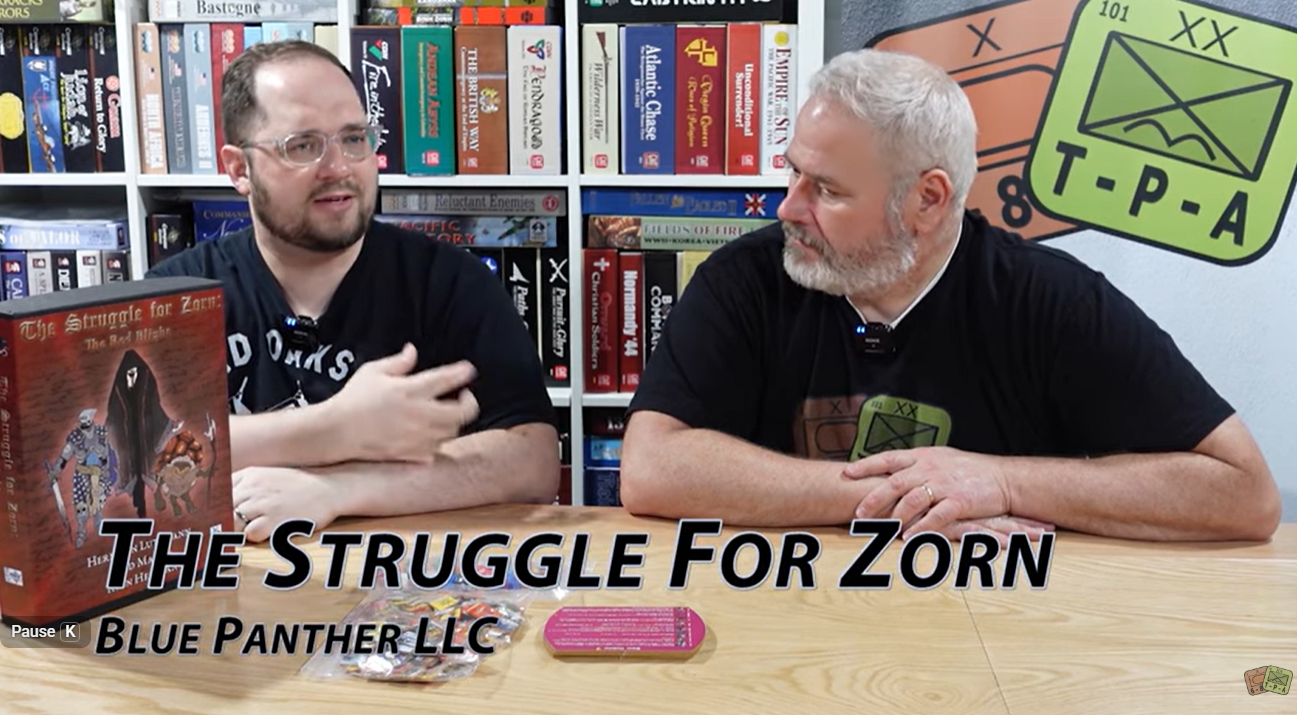
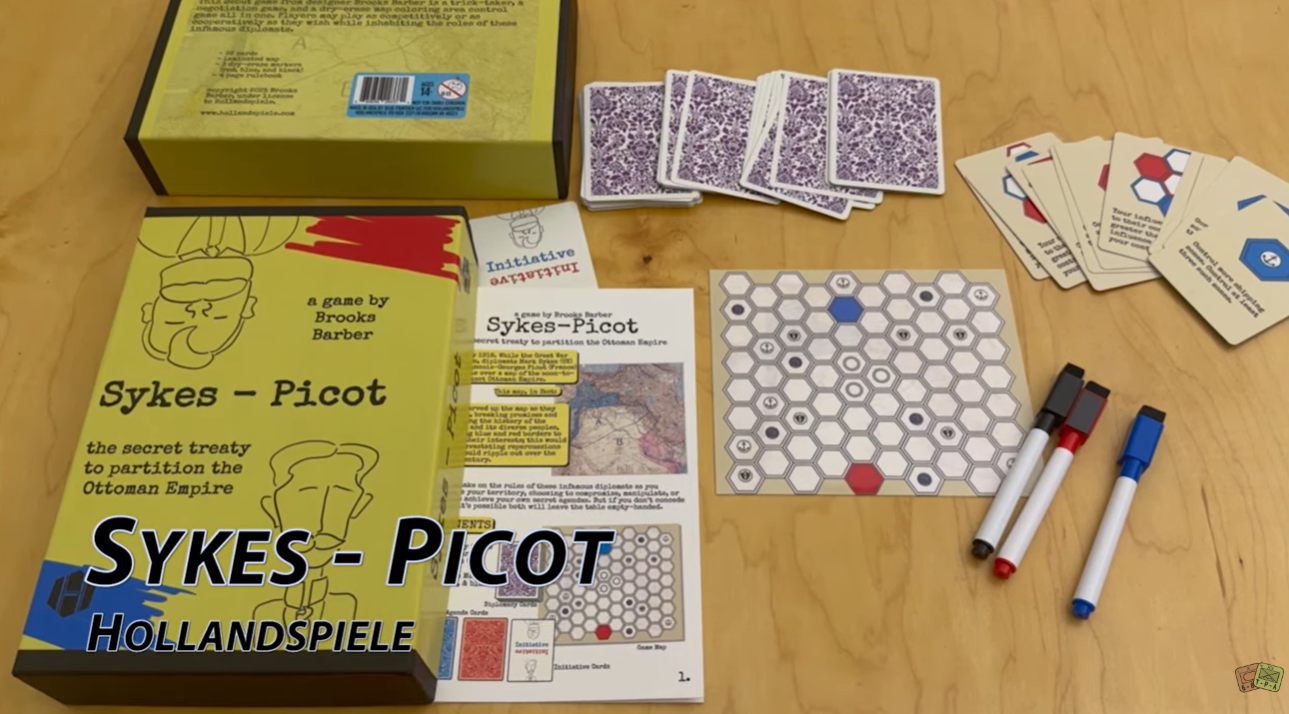
The July 2026 Monthly Debrief Video, which is the 7th episode in Season 6 of this series, saw us discussing Vietnam Wargames. One of my favorite wars to game is that of the Vietnam War. Part of that is because I was born in the early 1970’s and heard a lot about this war for the rest of that decade and throughout my teenage years. I remember watching the short lived television series Tour of Duty. I also read the graphic novel series The ‘Nam from Marvel Comics. But, my interest really grew after watching movies such as Apocalypse Now and Platoon. I always asked myself, how are you expected to fight a war where you don’t know who the enemy is? But also part of the attraction for me is that the war is anything but conventional. We share several big and well known games and some that are more niche.
Also, as usual, we covered the games we played in July as well as the games we plan to play in August.
We will remind you here that we are fortunate to be continuing our relationship with Noble Knight Games as the sponsor for our Monthly Debrief Video series. In case you don’t know, Noble Knight Games specializes in hard to find games but also carry all the new releases. But what makes them truly unique is that you can find some of the rarest games, long out of print games, hand made games, imported games from overseas, etc. Thanks to them for their sponsorship and we hope that you will consider them first when looking for the games we cover.
With this My Favorite Wargame Cards Series, I hope to take a look at a specific card from the various wargames that I have played and share how it is used in the game. I am not a strategist and frankly I am not that good at games but I do understand how things should work and be used in games. With that being said, here is the next entry in this series.
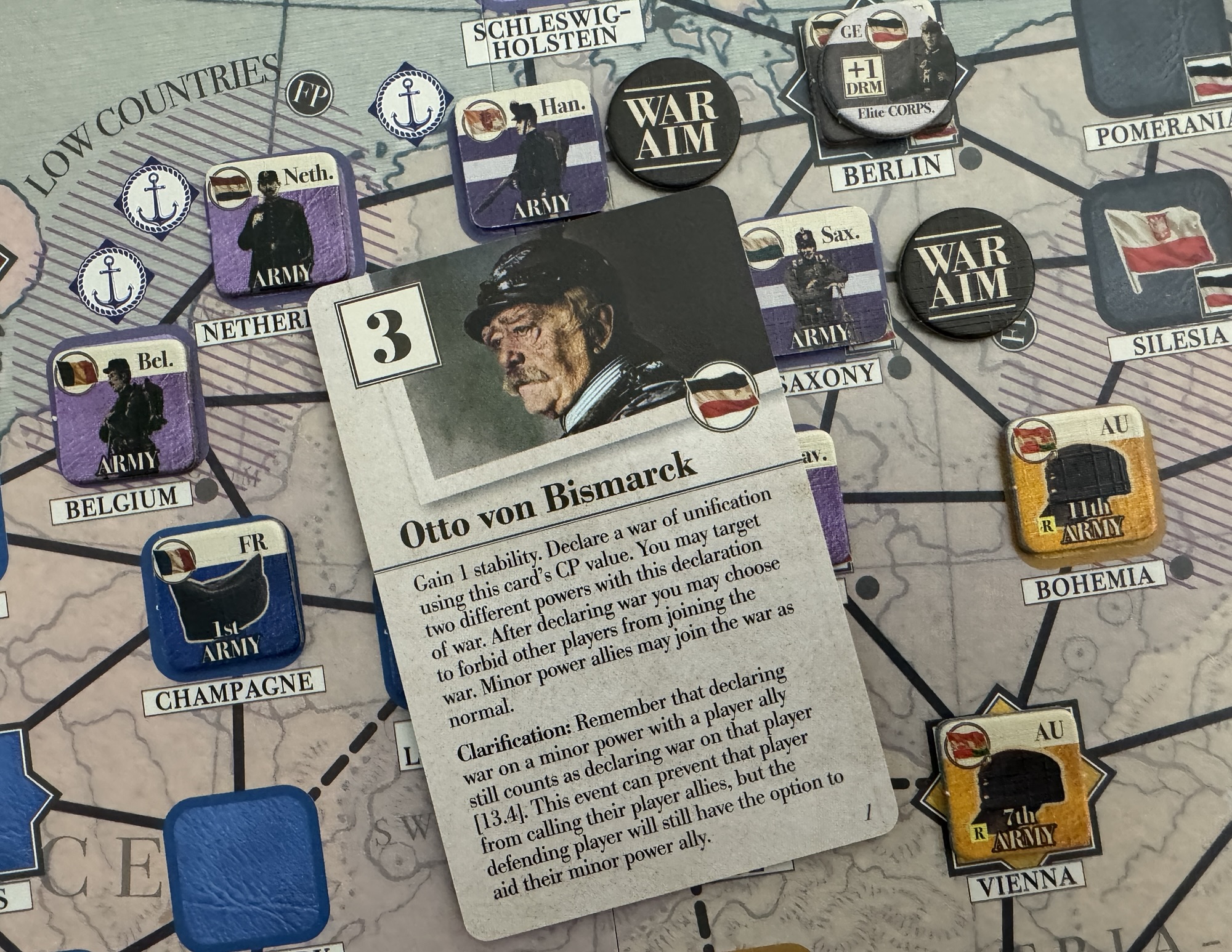
#93: German Home Card Otto von Bismarck from Imperial Elegy: The Road to the Great War 1850-1920 from VUCA Simulations
Imperial Elegy: The Road to the Great War 1850-1920 is a massive card driven game that blends diplomacy, warfare, and statecraft and feels a bit akin to games like Here I Stand and Virgin Queen from GMT Games, which are both grand scale sweeping epics that play multiplayers and take a day to play. Players play as 1 of 6 major powers in the game including Germany/Prussia, the United Kingdom, France, Austria-Hungary, Russia and the Ottoman Empire. The game is quite grand and ambitious as it covers 70 years near the end of the Victorian Era and the Progressive Ear and sees quite a lot of global change and competition between the great powers of the time. The game is a Card Driven Game and uses Action Cards as a type of currency to spend for their Command Points or the printed event to take actions such as recruiting armies and navies, industrialize, moving fleets and armies around the globe, influencing minor powers and establish colonies in Africa, India and the Pacific Ocean. The cards are all tied to the history of the period but the game can be played very much as a sandbox allowing players to explore strategies by trailblazing new horizons or following history.
In Imperial Elegy: The Road to the Great War 1850-1920, the Otto von Bismarck Card is a powerful and extremely important German Home Card. Rather than being shuffled into the common Action Card Deck, it belongs exclusively to the Prussian/German player’s unique toolkit to represent the historical trajectory of German state-building. The card is mechanically tied to the first few turns of the grand 7-decade timeline and acts as a get started quickly card for the German player as they begin the long and somewhat difficult task of attempting to unify the Germanic peoples under one banner. The German player can choose to execute it on Turn 1 to abstractly simulate Bismarck’s rapid real-world rise to power and kickstart early diplomatic maneuvers or wars. Playing as Germany, the player should be focused on attempting the Unification of Germany and will most likely choose the Unification National Goal card as a standard at the beginning of games. The Bismarck Home Card is the primary historical vehicle used to achieve this unification and simulates driving the annexations or alliances needed to claim crucial minor regions including Saxony, Schleswig-Holstein, Denmark and Alsace Lorraine. And like standard Action Cards in Imperial Elegy, the card presents a choice. The German player can either choose between using its high Command Point (CP) Value of 3 for a massive push focusing on industrial development or military actions, or using the card for its printed Event text. One of the really nice parts of the card is the way that it effects Stability in the game. Stability is a core national resource and rating that measures a major power’s internal political health, structural integrity and capacity to wage war or absorb setbacks such as economic downtown and social upheaval. Typically, when you declare war, your Stability will degrade but not in the case of a War of Unification. And with Bismarck, Germany will gain 1 Stability when they declare a War of Unification. This is such a powerful effect for the early game as it will allow the German state to build up their capacity and increase Stability to be able to perform later in the game.
1871 portrait of Otto von Bismarck, the first Chancellor of the German Empire. He is depicted wearing his signature Prussian military uniform, including the distinct Pickelhaube (spiked helmet).
Otto Eduard Leopold, Prince of Bismarck, Duke of Lauenburg, known as Otto von Bismarck, was a conservative German statesman who masterminded the unification of Germany in 1871 and served as its first chancellor until 1890, in which capacity he dominated European affairs for two decades. He had previously been Minister President of Prussia from 1862–1890 and Chancellor of the North German Confederation from 1867–1871. He provoked three short, decisive wars, against Denmark, Austria, and France.
Following the victory against Austria, he abolished the supranational German Confederation and instead formed the North German Confederation as the first German national state, aligning the smaller North German states behind Prussia, and excluding Austria. Receiving the support of the independent South German states in the Confederation’s defeat of France, he formed the German Empire – which also excluded Austria – and united Germany.
With Prussian dominance accomplished by 1871, Bismarck skillfully used balance of power diplomacy to maintain Germany’s position in a peaceful Europe. To historian Eric Hobsbawm, Bismarck “remained undisputed world champion at the game of multilateral diplomatic chess for almost twenty years after 1871, and devoted himself exclusively, and successfully, to maintaining peace between the powers”. However, his annexation of Alsace-Lorraine (Elsaß-Lothringen) gave new fuel to French nationalism and Germanophobia. Bismarck’s diplomacy of Realpolitik and powerful rule at home gained him the nickname the “Iron Chancellor”. German unification and its rapid economic growth was the foundation to his foreign policy. He disliked colonialism but reluctantly built an overseas empire when it was demanded by both elite and mass opinion. Juggling a very complex interlocking series of conferences, negotiations and alliances, he used his diplomatic skills to maintain Germany’s position.
A master of complex politics at home, Bismarck created the first welfare state in the modern world, with the goal of gaining working-class support that might otherwise go to his Socialist opponents. In the 1870s, he allied himself with the low-tariff, anti-Catholic Liberals and fought the Catholic Church in what was called the Kulturkampf (“culture struggle”). He lost that battle as the Catholics responded by forming the powerful German Centre Party and using universal male suffrage to gain a bloc of seats. Bismarck then reversed himself, ended the Kulturkampf, broke with the Liberals, imposed protective tariffs, and formed a political alliance with the Centre Party to fight the Socialists. A devout Lutheran, he was loyal to his king, Wilhelm I, who argued with Bismarck but in the end supported him against the advice of his wife Queen Augusta and his heir Crown Prince Frederick William. While Germany’s parliament was elected by universal male suffrage, it did not have much control of government policy. Bismarck distrusted democracy and ruled through a strong, well-trained bureaucracy with power in the hands of a traditional Junker elite that consisted of the landed nobility in eastern Prussia. He largely controlled domestic and foreign affairs, until he was removed by the young new headstrong Kaiser Wilhelm II. He retired to write his memoirs.
This historic image shows Chancellor Prince Otto von Bismarck (center) with diplomatic envoys and plenipotentiaries of the Federal Council (Bundesrat) inside the Berliner Reichstag in 1889.
We have put out several pieces of content covering Imperial Elegy and find it to be a fantastic game. These include written posts and videos. You can visit those by following the links below:
Unboxing Video:
Video Review:
Summary of Solitaire Bots presented by our friend James:
There are a few words in our English language that have the ability to assist us with time travel. Traveling back not in physical form but back in our memory vault to a time and place that has long passed and that we have forgotten all of the gory details about. This word is nostalgia and in my opinion the word can bring both a positive and negative response. Nostalgia is simply a bittersweet emotional longing for a past period, person, thing or place in someone’s life. We all have it from time to time and it is a good thing. In fact, I often think back to the “good old guys” of growing up on the farm, high school and my college days. These seemed to be the best times of my life and I have carried those memories and the feelings they engender with me over the years to take me away from my current cares and strife. Nostalgia offers benefits such as a mood boost, fostering deeper social and emotional connection with family and friends and improving our outlook and optimism about our current situation and the world. But, there are also negative side effects as well such as triggering sadness or a longing, causing unhealthy rumination and more often than not idealizing the past and glazing over the hard parts and holding onto only the good. In the end, nostalgia is good but it can distract us from the reality of things and even cause angst or sorrow over the fact that the past won’t return to us. In this edition of The Love/Hate Relationship, I want to share what I love and hate about nostalgia and particularly wargame nostalgia.
Love
There is a lot to love about wargame nostalgia. While my childhood experience with wargames is very different from many of you, I still have very fond memories of my hours upon hours playing Axis & Allies with my brothers. We would always go to the ends of the Earth to finish a game and no one ever wanted to surrender. There was always a chance…that you would roll nothing but 6’s and hit with every attack and they would miss with every one of theirs. I still have those discussions with my brothers from time to time and I think that this is one of my favorite parts about this shared nostalgia. We all can be teleported back to a moment in time and remember where we were, how we were feeling and what the world was like at the time…based on a shared memory of something that we liked. This boosts our mood, as we typically remember only the good parts of the experience, and also deepens and strengthens bonds with family and friends. This is a real mood stabilizer and improver and I very much love that about nostalgia.
I also realize that sometimes when we think back, and have good feelings about a game we played, that it was really the memories created from the play experience and the people that we played with and not necessarily the game. The game could have been good, maybe even great but when revisited it just feels different somehow. And that difference is the people you played it with and the memories you created….with them. Nostalgia. That doesn’t mean the feelings are not valid and that the thing associated with them wasn’t good just that there is more there than just the thing we experienced.
I also very much love how wargame nostalgia can help you build your own taste pallet for games and help you to identify what it is that you liked. Is this a subjective remembrance of the game? Probably, as the play experience is always subjective and is influenced by the people and personalities you are playing it with. But it still can form you and your views on wargaming. What works, what doesn’t and what you liked and disliked.
Finally, I love that nostalgia can be a positive tool to use as you search for and attempt to indoctrinate your friends and prospective players. If you speak favorably about the game or system, and liked it or at least remember that you liked it, the other participants will pick up on your energy and vibe about the game and start the experience out with a positive first impression. After all, you seemed to like it in the past and have convinced them to give it a try. How bad can it be? I think that this is one of the more positive aspects of wargame nostalgia. The transference of feelings and emotions. I think that even Alexander and I can be influenced by each other after a play experience. As we think about and discuss the game, whether we liked it or not and what that was, we can begin to see things from another perspective that we either missed or just didn’t initially pick up, and then it can cause us to see things similarly. After all, what are wargamers if not pushers of a doctrine or system and continually on the hunt from some unsuspecting idiot to throw it at….
Hate
Now that you see what I love about wargame nostalgia, let’s take a look at what I hate. Hate is such a strong word for me but there are many things that are very displeasing about wargame nostalgia. First off, nostalgia leads to a continual comparison of our memories in the past and the reality of today. Nostalgia causes us to ruminate and to get stuck in our own personal echo chamber about certain games or systems. We then dwell too much on the “good old days” and that fondly thought or time and experience and this can lead to unrealistic expectations of a new game. In fact, it can be so strong that we may never give another game in that same line a chance. This can lead to what I call wargame bitterness or a way of thinking that lumps all devotees or followers of other systems into a negative light. This can lead to us not wanting to engage with them because they “think [insert game name] is a bad game” and can lead to us personally self isolate and not being able to make new friends and acquaintances to share games with. In extreme cases, it can lead to feelings of despair and depression about the current state of the hobby and even with your current gaming choices.
I have not experienced these feelings but as a relative newcomer to wargaming have definitely felt judged. Case in point, our experience with Advanced Squad Leader. Not a system that I had ever played until a few years ago and that first experience was with a seasoned ASL gamer who had played it since he was in 7th grade. He loves the system, even though he has some problems with certain rules, and he compares every tactical level wargame against his experience. That is fair but it doesn’t represent the feelings of others. I for one, love Combat Commander! And there are a few main reasons that this game holds such high regard, and in my humble opinion, is the best tactical level game ever created. One is that it is a card-driven strategy game. The cards are what you rely on to take actions, and if you do not wisely manage those cards, you may not have the card you need, such as a fire or advance in your hand when you need it! Some would complain that this is randomness and doesn’t belong in a strategy game but I disagree. I have never been in the service nor had to participate in a battle, but I can only imagine that there is chaos. This chaos changes all of the best laid battle plans and there are certain factors that contribute to that chaos, such as running out of ammo, your guns jamming, being pinned down by a sniper or having your units morale drop leaving them hugging the ground and keeping their heads down, that make battle difficult. The cards represent this part of the chaos and is a genius addition to the game. I also enjoy the way the designer chose to address rolling using the dice printed at the bottom of each order card. This is a very solid way of handling this necessary random determination of combat.
The other favorite part for me with Combat Commander is the narrative that is told as the battles unfold! As I have played Combat Commander, I imagine that I can feel what the squads felt in combat. I have felt as if I was Sergeant Kaminsky trying to inspire his men to move up on a well defended building to engage the enemy and knock them out of that fortification. I have experienced the disappointment of Sergeant Ganz as his troops were forced to retreat to try to repel the Russians who were threatening the German troops in the buildings. I have felt the disgust in my unit’s performance when a very powerful infantry gun or heavy artillery continues to miss its targets. The narrative is the best part and allows my mind to participate in the battle, even though I am not there. It is a similar feeling to a well written book that forces you to take the role of characters and experience their feelings as you read the pages. If a game can do all that, it is definitely good!
And with ASL, I get some of that but just feel too all knowing and too much in control. My friend just thinks it is more realistic and true to the rigors of combat. He also personally hates the cards in CC and cannot stand that he cannot do what he wants because he doesn’t have the right card in his hand. And I get it. But, to me, this is an example of the real problem with wargame nostalgia. The comparisons. Every system out there has its strengths and flaws. There is no perfect system and we just need to accept that our old games, and those positive memories that have formed our opinion of that game, are not the be-all-end-all of wargaming and others can have a different opinion as well as their own struggles with nostalgia.
Finally, I do hate that wargame nostalgia tends to view the past through rose-tinted glasses, filtering out the bad or things we didn’t like or agree with to highlight only the good. This is also human nature and something that we all do and I am not sure we have the capacity to not partake in this reminiscing. But, it is not a good side effect of nostalgia and I wish that we could get away from that. In fact, we have seen a resurgence of what I would call “nostalgia grabs” over the past couple of years from publishers who take an old game, and one that people hold onto the nostalgic memories of playing when they were kids, and then slap “designer signature edition”, “deluxe edition” or “new and improved mechanics” labels on them and then place them on Kickstarter for unsuspecting crazed nostalgia-filled wargamers who know better but bite anyways. A few of these examples recently were the Divine Right Kickstarter in 2023 from Pungo Games (Worthington Publishing) and the more recent Ace of Aces Powerhouse SeriesDeluxe Edition Kickstarter in 2024 from Mr. B Games. Don’t get me wrong, there is something to both of these games and people really have great memories of them. But, I have played both, and with Divine Right, I am not sure there is a real game there. It is a hollow exercise in fantasy wargaming that just doesn’t work very well and has no real soul. There are symbols on the board that are not used and almost are trying to lure us into buying any future expansion like a Great Northern Pike chases after a shiny lure even though he is not really hungry!
Ace of Aces is fine for what it is, a flip book game with some great concepts and very much upgraded components, but in this present day of modern wargame design it just doesn’t hold a candle to other games that I would rather play. Now both of these games did very well on Kickstarter. Divine Right made $114,609 with 936 backers and Ace of Aces Powerhouse Series Deluxe Edition made $189,374 with 3,247 backers. That is a lot of nostalgia buying! But, Divine Right did a 2nd crowdfunding campaign for the Divine Right X: The Omega Expansion and it did even better with $144,896 in funding from 1,099 backers. Mr. B Games is readying their next Kickstarter Ace of Aces: Handy Rotary & Flying Machines Deluxe Editions that launches this month.
In summary, wargame nostalgia is a real, tangible thing that has a mind of it’s own and causes us to do things that we probably normally wouldn’t do. From buying overpriced reissues of our favorite games to putting other games and systems down with great passion and omniscient thinking about what is right and wrong, good and bad, worthy and not worthy! But, it is not all bad and I think that nostalgia is good in moderation and with some real introspection to get past the initial overreaction and mis-remembrance we have when thinking about and discussing our favorite pet games from yesteryear. Don’t leap before you look….you might end up with a nice shiny turd in a box! What are your thoughts on wargame nostalgia? What do you love and hate about the concept? Is there a real place for this feeling in our hobby?
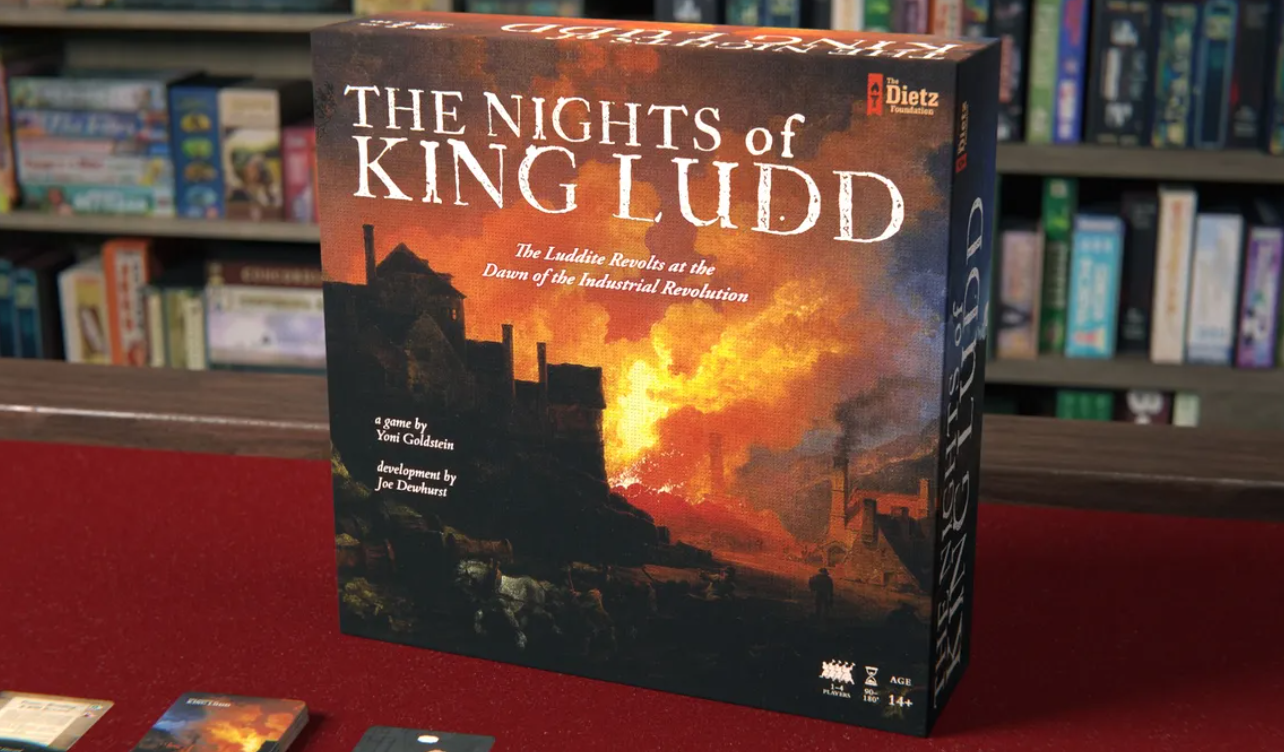
As you know, I do love me a good Card Driven Game….or a game that uses cards….multi-use cards. I love cards because it allows for the designer to keep a game going while using a vehicle that incorporates special rules that fit a historical situation but also to be able to use bits of the history itself to teach the players about the topic. A few months ago, I caught wind that The Dietz Foundation was working again with Yoni Goldstein on his second game called The Nights of King Ludd: The Luddite War on Industry, 1811-? that recently launched on Kickstarter (the game has already funded). The Nights of King Ludd is a 2-4 player game that deals with direct oath-sworn secret societies of English Luddites at the dawn of the Industrial Revolution in the English Midlands. Working together, players will build a secret network of saboteurs, ferry provisions and weapons on the black market, assemble raiding parties, and if all goes as planned, smash those “dark satanic mills” to cinders. I reached out to Yoni to get a bit more information about the design and he was more than willing to share.
Grant: Yoni welcome back to our blog. What have been your feelings about the reception of your great game Chicago ‘68?
Yoni: I’ve joked that I’ve taught this game now more than I’ve played it (of course this is only true if one just counts the last couple years!). Since 2024, I’ve taught it to a diverse and intergenerational cohort of non gamers, grognards, peace activists, veterans, and even a few spooks. Inevitably players relate the experience they are having on the board to what they see in their neighborhoods: protests and tear gas, troops deployed into cities, election interference, and so on. Those conversations are still ongoing and I’m heartened that Chicago ‘68 is facilitating a space for that.
Grant: What lessons did you learn from that experience that have helped you with your new game?
Yoni: I’m grateful that Joe Dewhurst, who developed both Chicago ‘68 and the upcoming The Nights of King of Ludd, guided me through the design, testing, and development processes. Ludd is my second game and it went through a number of iterations, but this time we had a proper methodology in place. Likewise, The Dietz Foundation was very transparent with the manufacturing and publishing side of things, which gave me a deeper understanding of the timeline and proofing / editing process that accompanies those final stages of production.
Grant: What is your new upcoming game The Nights of King Ludd about?
Yoni:The Nights of King Ludd is a collaborative game for 2-4 players about the Luddite revolts in the English Midlands. Set roughly around 1811, the game tells the story of local workers in the textile industry (“weavers”) forming secret societies and leading armed raids against mills and factories in their communities. Players command an oath-sworn organization of conspirators working with the Luddites to achieve the collective goal of machine wrecking while also attempting to meet their individual motivations (which may include assassinating the local manufacturer, spurring a republican revolution, or just avoiding an Australian exile).
In terms of game mechanics, you are building a dice pool while also maneuvering pieces and collecting multi-use cards to modify your roles. Collectively you are building a tableau and operating it together to mount a series of raids against the three Mills on the map.
Grant: What is the meaning of the title of the game? What should it convey to players about the game and the history it represents?
Yoni: The title of the game is borrowed from a chapter in Gavin Mueller’s book from 2021, Breaking Things at Work. Mueller is among a cohort of authors, including Kirkpatrick Sales (Rebels Against the Future), Brian Merchant (Blood in the Machine) and Cory Doctorow, who are working to reconsider the Luddites’ reputation in the age of AI and the gig economy. Rather than seeing them as misguided revolts against the inevitability of technological progress, these writers appraise the Luddites in their historical context as severely desperate labor movements against tech oligarchies. The Luddites’ aims were, ultimately, to raise the minimum wage, cease child labor, and to maintain a higher standard of craftsmanship and quality in the production of textile goods. At every point their appeals to authority were spurned. So they turned to mob justice. “You may call the people a mob,” remarked Lord Byron before Parliament, “but do not forget that a mob too often speaks the sentiments of the people.”
The subtitle of the game, “The Luddite War on Industry, 1811-?” is also a cheeky nod to Volko’s Labyrinth: The War on Terror, 2001 – ?. While these games don’t share a mechanical similarity, they both explore the ongoing and unpredictable nature of insurgencies.
Grant: Why was this a subject you wanted to focus on?
Yoni: My area of interest in game design, broadly speaking, is movement politics on an operational scale. As with Chicago ‘68, the Luddite war on industry feels an under-explored subject matter in historical gaming. While there are certainly titles about the Industrial Revolution from the perspective of barons and magnates (especially in the Euro game niche), little is mentioned about the social, political, and ecological costs of these endeavors for progress.
Moreover, the story of the Luddites and their “secret societies” is about the tensions of modernity. New technologies combined with extensive wars abroad drove a rise in food costs and detonated an affordability crisis in the imperial homeland. Communication media (handbills, newspaper editorials, and pseudonymous letters) was an instrument of persuasion, vitriol, and threats. Suspected Luddites and their sympathizers were surveilled by the state, which increasingly saw its interests entwined with industrial capital. We’ve seen this all before!
Grant: What are the unique features with the system used for the game?
Yoni: The Nights of King Ludd has a unique framework for collaborative engine building. Initially, players draw from “The Commons” (a shifting card pool) where each card has the same “trade cost.” On your turn, you may activate a Conspirator (spending an action point) to draw a card into one of the columns in your tableau. Each column upgrades your actions with a permanent ability. If you specialize your actions, you can harmonize a collective strategy between players and hone in on the steps you need to take to sabotage the mills.
In the Commons we are evoking the notion of a shared economy. But this may shift dramatically when decreasing wages and increasing productivity converge. Then, the Commons transforms into the “Common Market.” Now, players are building their tableaux with an increasing cost, similar to the Pax Series (for example, Pax Pamir or Pax Renaissance). Each player is now facing a decision: overwork their cabal of conspirators or draw on the labor power of the workers in the textile industry (which drains their militant power on the map).
Grant: What does the collaborative portion of the subtitle mean for the game? How do the players cooperate?
Yoni: I choose “collaborative” not “cooperative” as a descriptor to emphasize the multi-victor nature of the game. In The Nights of King Ludd, each player chooses not only their persona and their role in the Luddite struggle (with asymmetric abilities and effects), they also put forward a “Motivation.” Motivations are personal victory conditions that unlock if the collective win condition (destroying all three mills on the map) is met. This gives shape to the degree of player friction in the game. For example, Lord Byron’s motivation is to turn down the heat from the ruling Regency. His motivation is in conflict with George Mellor’s, the famed assassin, whose attempts at the Manufacturer’s life will ratchet up the crown’s crackdown. But pair John Baines, a republican agitator, with the Molyneux sisters, two young women destined to labor in the mills, and the gameplay will tilt more toward cooperation. In this case, Baines is working to regulate the industriousness of the mill (keeping productivity low and wages high) while the Sisters are interested in keeping workers employed. So the degree of cooperation is up to the players, and as often happens, someone may have to make a noble sacrifice for the collective good.
Grant: What did you need to model regarding the English Luddites at the dawn of the Industrial Revolution?
Yoni: As EP Thompson (The Making of the English Working Class) notes, the history of the Luddites is, at best, “opaque.” We are grappling with a story about secret societies in an era where workers associations were illegal and damaging weaving frames was a capital offence. As such, we have dubious claims from government spies, confessions before “hanging judges,” and pseudonymous letters and handbills. Consequently, the model had to be expansive enough to capture the granular nature of these conspiratorial operations, but also open enough to allow for the plausibility of a broad range of player actions.
For example, one of the core actions is to “rally local weavers,” which is a form of recruitment. In game terms, this means moving one of the Employed Weaver cubes into an Enclosure where they can contribute to your force strength. This action may represent members of your secret society swearing in sympathetic workers in local pubs, or calling a clandestine meeting in the nearby woods. We don’t know precisely how the Luddites organized themselves, so the language has to be inclusive of these possibilities. Players then “assemble a raiding party”, which is to move the cubes from the enclosure into a nearby Mill. Each cube in the Mill space adds a die to the Sabotage roll (which is the primary means of wrecking machines). So here is a group of raiders hiding in the hedge and awaiting the signal from King Ludd. They are spurred on by the Mobs who have surrounded the site, represented by these Mob tiles. Matching a die roll to the symbol on the Mob Tile is how you roll a “hit.” The intention is to shape a series of amorphous and difficult to historicize chain of events into a familiar wargaming mechanism: rolling a handful of dice representing an “attack” and applying modifiers to the results.
Grant: What is your design goal with the game?
Yoni: My overall aim was to develop a system that could express a relationship between an abstract economic system, worker uprisings, and the coming together of industry and aristocracy to form a ruling class. But on a purely design level, I wanted to work within the framework of a Pax Series style market that you encounter in games like Pax Pamir and Pax Renaissance. That is, a shifting market of cards that players can purchase and place into their tableau. It’s an evocative description of history as a bazaar of possibilities and counterfactuals. The Nights of King Ludd tweaks this vision of history as somewhere between a commons (a gift economy) and a market (which costs worker power as in-game resources).
But really, I want this to be a “raiding party game.” Beneath the heady layers of history and theory is a brisk experience featuring dice odds, clever combos, and cooperation with your friends (while slyly pushing your own agenda!).
Grant: What other games did you use as inspiration?
Yoni: John Company from Wehrlegig Games is certainly one of the biggest inspirations, taking place in a similar era of British imperial economic imperialism (Ludd is at the tail end of JoCo’s later scenarios) and drawing on the satirical printworks of the time. Like John Company, players are asked to intervene in an existing ecosystem. In both games, player actions accelerate a system that will simultaneously reward and punish everyone at the table. How this is doled out is uneven, so players have to weave and dodge to make best of a collapsing infrastructure.
Grant: What sources did you consult about the history?
Yoni: An invaluable resource for all things Luddite is the Luddite Bicentenary curated by Richard Holland. This is a comprehensive digital archive of historical ephemera devoted to Luddism, including handbills, court transcripts, and other images and texts. I also quote extensively from Rebels Against the Future by Kilpatrick Sale and The Risings of the Luddites: Chartists and Plug-Drawers by Frank Peel, E.P. Thompson, as well as The Making of the English Working Class also by E.P. Thompson.
Other reference texts include:
Writings of the Luddites edited by Kevin Binfield
Ben o’ Bill’s, The Luddite: A Yorkshire Tale by Daniel Frederick Edward Sykes, George Henry Walker
Breaking Things at Work: The Luddites Are Right About Why You Hate Your Job by Gavin Mueller
The Luddite Rebellion by Brian Bailey
Blood in the Machine by Brian Merchant
Women in Protests 1800-1850 by Malcolm Thomis
Convict Lives at the Launceston Female Factory (A swing rioter: Elizabeth Studhamby Keryn Rivett), edited by Lucy Frost & Meredith Hodgson,
Grant: What is the dice pool building mechanic and how does it work in the design?
Yoni: At the core of the game is a fairly straightforward dice mechanic for resolving raids against the three mills on the map. Throughout the course of the round, players add “saboteur dice” to the dice pool, representing the Luddite’s militant capacity. These are D6’s with the following icons: gun, hammer, and torch (matching the “mobs tiles” – armed rabble surrounding the mill). The remaining three sides are blank and always result in a miss.
When a sabotage operation is initiated, the number of dice rolled is determined by the number of raiders you’ve positioned at the mill and what constitutes a possible hit is determined by the matching icons on the nearby mob tiles (again; gun, hammer, or torch). All misses are returned to supply but if at least one hit is rolled, you may push on and carry out multiple raids, striking at other mills as well.
As your readers can deduce, the purpose of the tableau building and the card engine is to modify the odds of the roll in your favor, i.e. the more raiders you assemble the more dice you will roll, and the more mobs you’ve fomented the more likely you are to roll a hit.
Grant: What is the general Sequence of Play?
Yoni: As neighboring societies of Luddites, you have three rounds before the Crown musters its army and crushes the revolts. Each round is structured the same:
Dawn: Industry Operates – at the beginning of the second and third round your adversaries in London will take actions against you, sending the militia on patrols and accelerating industrial production.
Day: The Manufacturer Speculates – during this phase, the local manufacturer will take an action, depleting the Commons of its resources.
Night: The Luddites Conspire – this is the main phase of the game, where each player takes turns resolving a Conspiracy action by spending a Ready Conspirator cube on their boards. Each player takes a primary Conspiracy Action and resolves any secondary effects on Cards tucked into the Column of that Conspiracy on their Player Boards. In this phase, players can attempt a sabotage roll to destroy the Mills.
Round’s End – when there are no Ready Conspirators (or all players pass) players reset the components for the next round.
Thank you for your time in answering our questions Yoni! I am very much interested in this game and its efforts to tell this very interesting story of resistance. While this is not a traditional wargame, in my opinion it certainly merits a serious look from wargamers who are interested in CDG’s and games that use cards and that are interested in seeing these type of non-traditional historical subjects represented. I have backed the project and look forward to getting my copy next year!
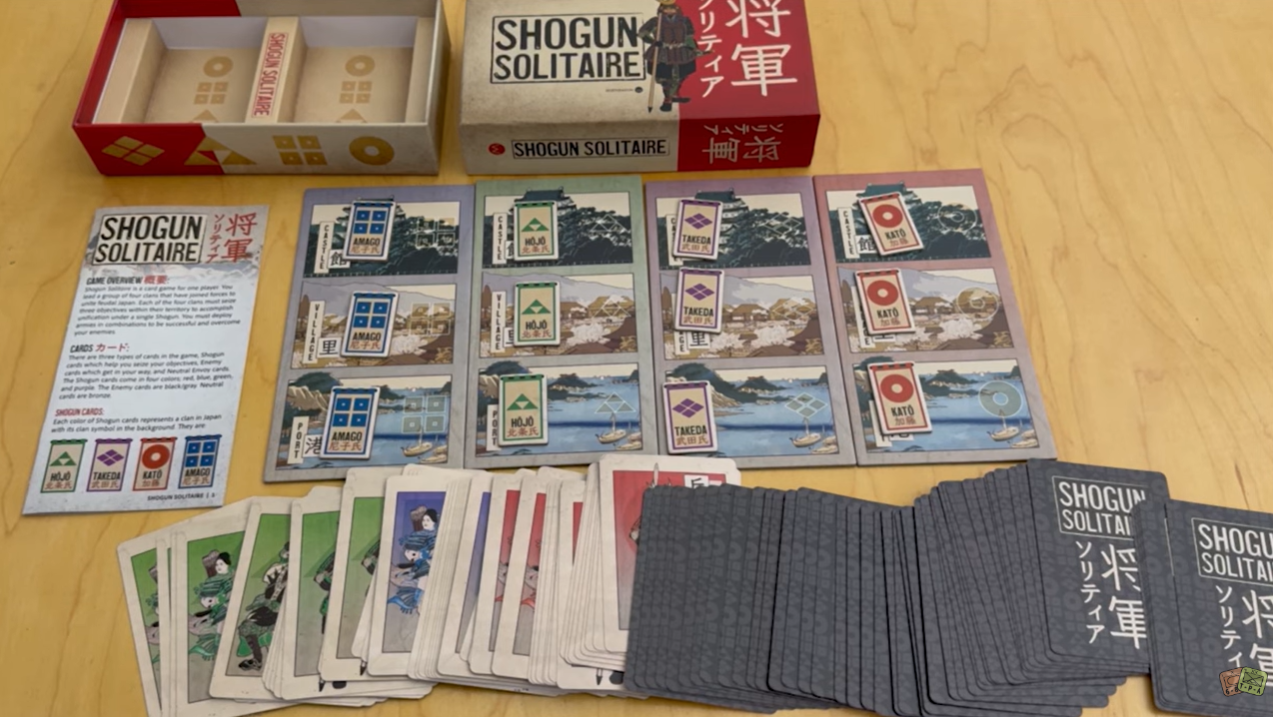
Shogun Solitaire is a card game for one player. Your mission in Shogun Solitaire is to lead a coalition of four clans to unite feudal Japan. Each clan must secure three objectives within their territory to achieve unification under a single Shogun. To accomplish this, you’ll need to deploy armies in strategic combinations, outsmarting your enemies. The game’s object is to become the Shogun by unifying all the clans of feudal Japan.
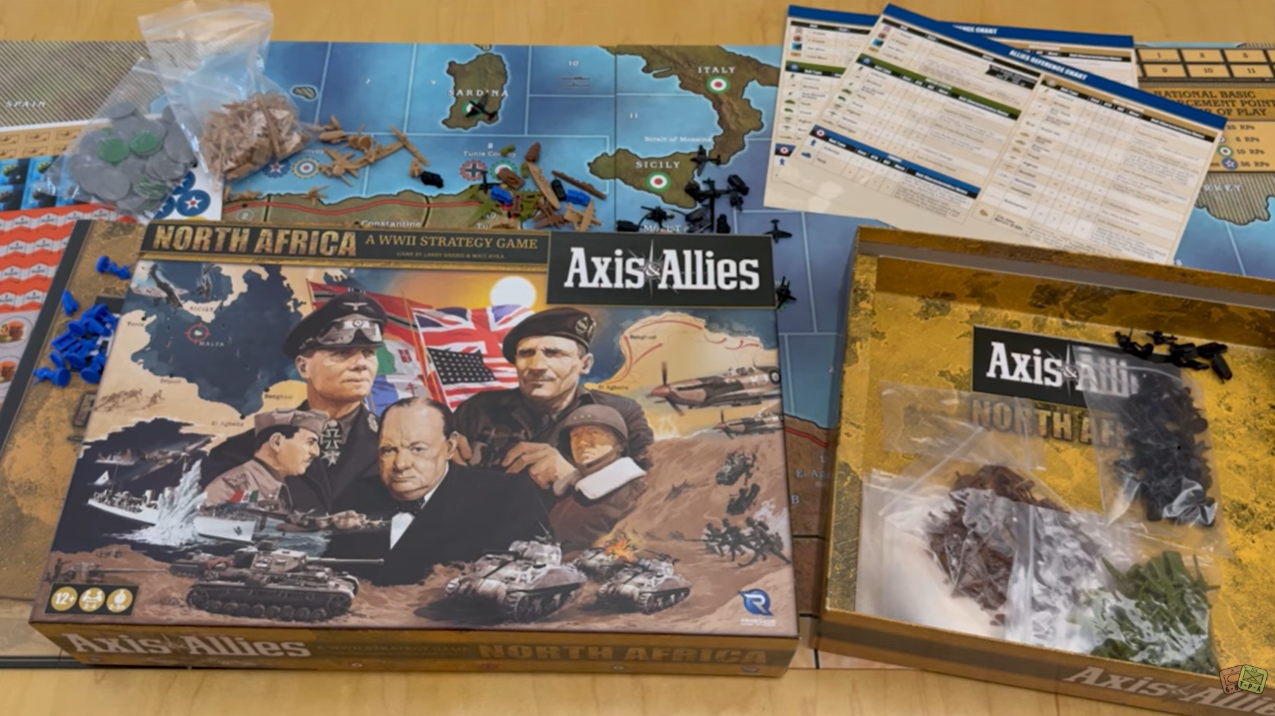
The fighting in North Africa was unlike any other in World War II. In Axis & Allies: North Africa, you will command the forces of either the Axis (Germany and Italy) or the Allies (the United Kingdom and, eventually, the United States) in a campaign that may again capture the imagination of the entire world. Intercept enemy convoys headed to the ports of North Africa…while protecting your own. Prove your logistical prowess by keeping your forces supplied. Most of all, show your ingenuity as a general, and you may change the course of history and ultimately gain the respect of your opponents.
Axis & Allies: North Africa contains 2 scenarios: Rommel’s Last Push and Operation Torch, over 250+ plastic miniatures, including 6 new units: SdKfz 231, Panzer IV Tank, 6-pounder AT Gun, CMP Truck, SOMUA S35 Tank, and LRDG Jeep.
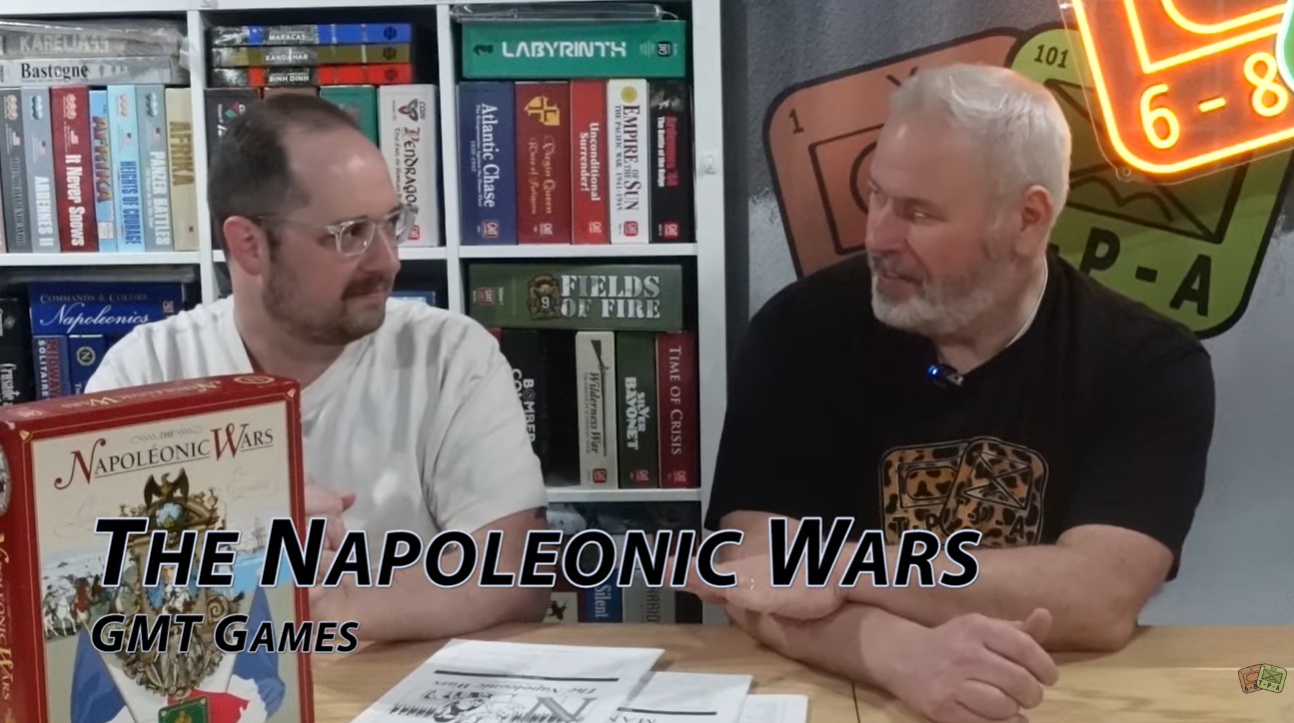
The Napoleonic Wars, 1805 – 1815, brings you a fast-paced, tension-filled, card-driven wargame using a point-to-point movement system that pushes the envelope in a new direction for this pivotal period of history. Having a simple-to-learn strategic system and short rulebook, The Napoleonic Wars, can be played in an evening as the cards and Diplomatic Track make for tough decision-making in the face of everchanging enemy threats.
Set in 1805 Europe, you must weigh the strategic dilemmas facing the two alliances in mortal conflict. Napoleon’s France enjoys a superb army, central position, superior leadership, and a useful, if not powerful, ally in Spain. However, she faces three foes.
I love a different style and focus of wargame. A game that takes a look at an important but somewhat obscure or rarely addressed historical topic, such as espionage or intelligence, and creates a gaming experience tailored around the events to highlight and evoke the difficulties and tension that would have been present. In January 2026, GMT Games announced such a game in Checkpoint Charlie, which is a solo or cooperative game focused on SIS espionage missions in Berlin in the 1960’s designed by Russell Brown. We have posted an interview with Russel and it was very well received and he has now agreed to create a series of History Behind the Cards to highlight the events of the 1960’s Cold War struggle in West Germany but also to share aspects about the game play and how it models the history.
*Note: The cards highlighted in this series and their event text, as well as any pictures used showing any of the various components, are still in the design and development process and as such event effects and text might still change prior to final development and publication.Also the art and layout of the cards are only for playtest purposes at this point and the game will enter the art department as it nears publication.
History Behind the Cards – Checkpoint Charlie from GMT Games – Card #6: General Clay Steps In
US General Lucious D. Clay was appointed as military governor of the United States zone of Berlin from 1945 until 1949. He was best known, especially to the people of Berlin, as the person responsible for the Berlin Airlift, which fed and supplied the people of Berlin from the air when the Soviets cut off all access to the city for eleven months, from June 1948 to May 1949. Without the airlift, the west would have been left with two terrible options – allow West Berlin to be starved into submission and annexation, or invade East Germany to open a supply corridor, almost certainly starting an all-out war with the Soviets.
In the early 1960’s, US President Kennedy turned to the now retired General Clay and called on him to deal with serious issues that arose in Berlin, like the faceoff between tanks at Checkpoint Charlie (card #4). Clay understood Berlin and had the respect of its people, so Kennedy brought him along on his famous visit to the city, during which the president gave his “Ich bin ein Berliner” speech (card #7).
The General Clay Steps In card in Checkpoint Charlie represents the retired general being sent by Kennedy to resolve issues in West Berlin. Playing the card removes an event marker from the city and is the only way many of the event markers can be removed during a mission. It is especially useful for removing the Faceoff marker or a troublesome Stasi Stakeout.
In the next article in this series, we will take a look at Ich bin ein Berliner Speech by President John F. Kennedy.
In my opinion, this game looks extremely interesting and I am very much excited to learn more about it. I am appreciative to Russell and his efforts to bring us these cards and to write these entries to share with our readers. I am also very glad that this topic is being covered in a game and look forward to playing this one day soon.
With this My Favorite Wargame Cards Series, I hope to take a look at a specific card from the various wargames that I have played and share how it is used in the game. I am not a strategist and frankly I am not that good at games but I do understand how things should work and be used in games. With that being said, here is the next entry in this series.
#92: Castelnau and Voie Sacrée from Verdun 1916: Steel Inferno from Fellowship of Simulations
Over the past several years, we have played quite a few World War I games with our focus on the Guns of August events every summer. We have really played some fantastic games including some of the true classics on the genre such as Paths of Glory from GMT Games and The Lamps are Going Out from Compass Games but also some real hidden gems like At All Costs from Hollandspiele, Devil Dogs from Worthington Publishing and Decisive Victory 1918: Soissons from Legion Wargames. A game that we very much liked was Verdun 1916: Steel Infernofrom Fellowship of Simulations. The game is a Card Driven Game that uses cards with events and operation points to tell the grim story of the year long fighting around the French city of Verdun. The game uses a bucket of dice approach to the initial bombardments in a battle and then players choose whether to follow that with an infantry assault that doesn’t use any dice to determine hits. The game is very much a wargame but I think the cover highlights a key fact about the game by calling it a “Strategy Game” namely that it is a game as there are wildly powerful events based in history, with lots of dependence on dice not just for bombardments but also for playing certain offensives Event Cards where Victory Points are earned based on the higher numbers rolled. The game is very well done, is truly interesting and surprisingly deep with its tactical choices and decisions.
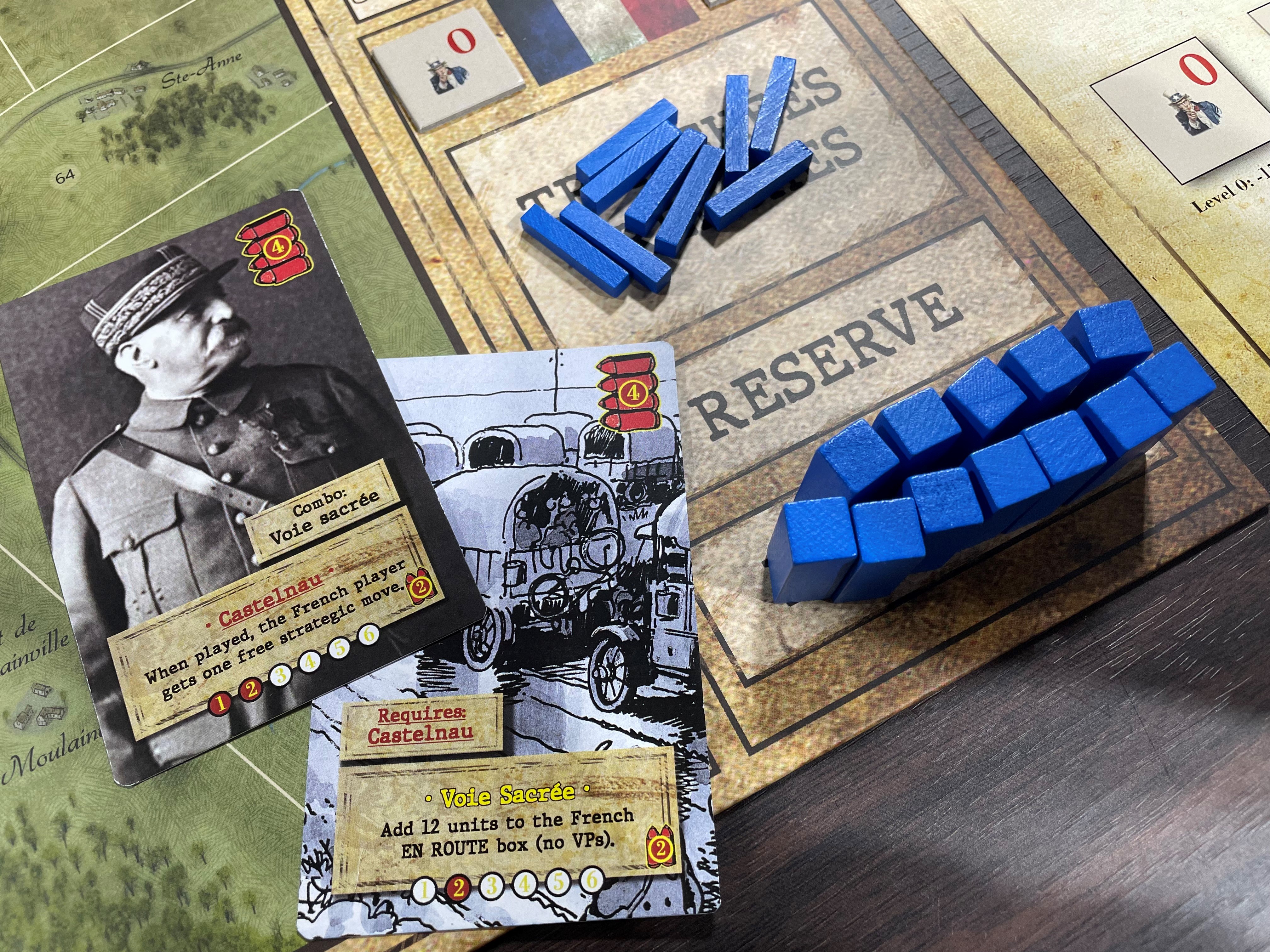
Some cards cannot be played as an Event until a specific named card has been played by the player. This is indicated on the card with a small “requires” box above the title of the card which shows the card that must already be in play as a Permanent Event to allow the new event to be triggered. Also, these Required Cards also have a small “combo” box above the title of the card to remind players which card they will allow to be played as a Permanent Event. Sometimes this concept of Combos must be planned for and may take a few rounds to get lined up to be able to play.
A perfect example of this is the Castelnau/Voie Sacrée Combo. Castelnau is an Event Card that must be played down on the table as a Permanent Event and is available during Turns 1 and 2. Once it is played, then that unlocks the play of Voie Sacrée and allows a very powerful Combo to go into effect by allowing the French player to place 12 units into the En Route Box on the board meaning they will be available for placement during the next Turn. This is so very powerful as in order to get that many units to use, the French player has to sacrifice a total of 12 VP (1 VP per unit added as Reinforcements). With this Combo, you sacrifice no VP’s and get 12 units to place on the board to plug the inevitable holes that will be created by the powerful German Barrages and assaults. There are other Combos as well including several specified Offensives (Russian Offensives and the Somme Offensive) that take several Turns to accomplish with multiple cards to get an opportunity to roll dice to gain VP’s. This was a very novel idea for the CDG mechanic and really worked well to create some portion of the game that required planning and an investment.
The Voie Sacrée, which is French for Sacred Way or Sacred Road, is a road that connects Bar-le-Duc to Verdun, France. It was given its name because of the vital role it played during the Battle of Verdun in World War I. After March 1916, along the 45 miles of the Voie Sacrée, transport vehicles were on the move day and night, ferrying troops, armaments, and supplies to the Verdun battlefield. During the initial crisis of February 21st through March 22nd, 600 trucks per day had already delivered 48,000 tons of ammunition, 6,400 tons of other materiel and 263,000 men to the battlefield. Beginning on February 21st, all horse-drawn traffic and troop movements on foot had been ordered off the road, leaving it open for truck and motorcar traffic only. After March 1916, one truck passed every 14 seconds, submitting the road to considerable wear and tear. Quarries had to be opened nearby to supply the road with crushed stone. Over the course of ten months, 16 labour battalions worked to keep the road in good shape and order. The road had been recognised since 1915 as the only reliable vehicular road that remained in existence to supply Verdun safely. All the standard-gauge railway lines that could reach Verdun had already been interrupted by German forces in late 1914. To compensate for this precarious situation, the road had been widened to 23 ft during 1915, so it could accommodate the continuous up and down flow of two lines of truck traffic. This preemptive roadway improvement in 1915, plus success in organizing the transport system on the road (a mission supervised by Colonel Maurice de Barescut, the Chief of Staff of the French Second Army), is what ultimately saved Verdun in 1916.
The Voie Sacrée still exists, but it has been paved over and is now an active secondary road. In 2006, the route was renumbered RD1916, a reference to the road’s most critical year. From 1923, the Voie Sacrée was marked by a borne every kilometer along the route. Each borne is topped with a sculpture of an Adrian helmet, the helmet worn by French soldiers during the Battle of Verdun.
The town hall in the village of Souilly, on the Voie Sacrée, served as headquarters to Generals Philippe Pétain and Robert Nivelle during the Battle of Verdun. A large, well-preserved, two-story stone building fronting on the Voie Sacrée, the Souilly town hall is still in official use today. Several plaques on its facade remind the visitor of the historic role it played in 1916 during the Battle of Verdun and, later in 1918, during the Meuse–Argonne offensive.
The year is quickly fading as we are nearing the start of the 4th quarter of 2026. Man the year has just gone by so quickly and I still have so many great games awaiting us to give them the attention they deserve. But there are always new games and they are also equally deserving. This month, I was able to find 19 games to share (including 6 games from our sponsor). I was also able to find 3 games being offered on Crowdfunding through Kickstarter and Gamefound.
Again this month, we have a sponsor for the Wargame Watch post in Neva Game Press. This is Neva’s 3rd time sponsoring this post and they are very busy as they have a ton of new games upcoming. Neva Game Press is a new publisher who appeared on the scene 2 years ago. When I started seeing their posts on Twitter and Facebook, I was immediately impressed with their interesting topic choices for their upcoming games as well as the fact that they are trying to make small footprint wargames that pack a punch. And the art is also very appealing and brings an aesthetically pleasing and attractive look to their games!
Big Experiences, Small Footprint: New from Neva Game Press
At Neva Game Press, we believe great games don’t require massive boxes. Our ‘Hardcover Book’ box policy delivers premium components and deep, innovative mechanics in a shelf-friendly format—without compromising playability. We recently rebranded from Neva Wargames to Neva Game Press to reflect our expansion into thematic titles, though our commitment to wargaming remains stronger than ever.
End-of-Year Releases
We are closing 2026 on a high note with two major releases. After the rapid sell-out of Iwo Jima: Hell on Earth—the first volume of our Blind Valor Series—we are thrilled to bring it back as a Revised Edition, and we are grateful for the community’s support. We are also releasing an Iwo Jima: Hell on Earth Update Kit for owners of the original 1st Edition. Finally, we are launching our new tactical wargame, Peking: 55 Days of Fury—the first volume in our Breach Point Series.
Peking immerses 1–2 players in the 1900 Boxer Rebellion for a tense, 90-minute experience. Whether defending the International Legations or leading the attack, you’ll need to master our unique fog-of-war mechanic and hybrid system (featuring event cards and operation points split into two phases) to secure victory.
Our commitment to the community continues with an ambitious slate for 2027, featuring: Valls: Battle of the Goi Bridge, Spartacus: Rome under Threat, 1806: The Elbe Campaign and Reformation: Fire and Faith.
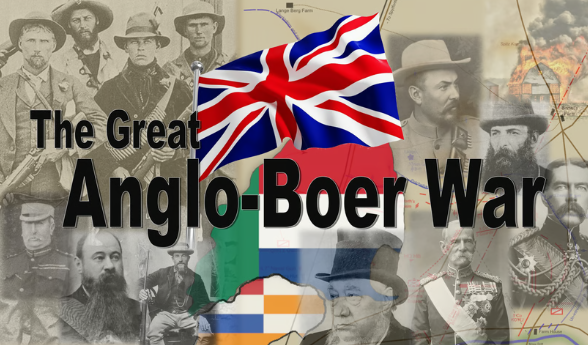
They recently announced their next Kickstarter project that would take their system to the Anglo-Boer War called The Great Anglo-Boer War: The Battle for South Africa 1899-1902. The game is currently on Kickstarter and appears to be a very important addition to the many games on the period.
From the game page, we read the following:
The Great Anglo-Boer War is a grand-strategic level game of the war between the British Empire and the Boer Republics in South Africa from 1899 to 1902. The Boers were armed like no other adversary the Empire had ever faced. By October 1899, war had become inevitable—and both sides were equipped for the first ‘modern’ conflict. Both sides had rifled breech-loading artillery, machine guns, bolt-action magazine rifles, trenches, barbed wire, and more.
The war started as a conventional contest but morphed into the first modern guerrilla war of the 20th century. In the end, the Empire overwhelmed the Boers, but by 1910 all of South Africa (including the contested republics of 1899) was granted self-government as a Crown Dominion, with Louis Botha as the Prime Minister. The Boers can be said to have lost the war but won the peace. A fascinating bit of history but an even more interesting study in military history.
The game places you in the position of the military commanders of both armies. Political events are largely beyond your control, but may influence what you are allowed to do. There are three scenarios – the Conventional War, the Guerrilla War, and the Grand Campaign Game. The full campaign is THE ULTIMATE BOER WAR EXPERIENCE – from the first desperate siege defenses of 1899 to the treaty of Vereeniging (or maybe not?) – and everything tactical and otherwise in between. Battles, blockhouses, farm-burnings, evasions, escapes, raids, concentration camps, sieges, drives, armoured trains, 1-pdr automatic “pom-poms”, surrenders, entrenchments, typhoid, barbed-wire, native spies, night marches, supply wagons and more. If it was part of the real Boer war – it is in the game. If you know about the war – this is the one you’ve been hoping someone would make, and if you are learning about it – this IS THE GAME for that. With a 44×34 map at 9 miles/hex scale, monthly game turns and an accurate order of battle, this is a game that truly does justice to the topic.
As of September 1st, the Kickstarter campaign has raised $7,389 toward its $12,900 funding goal with 86 backers. The campaign will conclude on Tuesday, October 20th at 1:38pm EDT.
2. Combat! Vietnam from Compass Games
This month we had another pretty big downloading of new pre-order games from Compass Games that I have affectionately referred to in the past as “Pre-Order Palooza”. This one was not their normal 6-10 new titles but there were 4 new games offered and they all looked very good. The first game that I am highlighting here is the next volume in the highly thought of Combat! Series of solitaire wargames. These games represent man to man combat where typically each of the counters on the board represent a single soldier. They have focused exclusively on World War II previously but now they have announced this new game set during the Vietnam War called Combat! Vietnam. I have yet to play any of the previous volumes in the series, even though I own 4 of them, but they are high on my want to play list and I am very much interested in this system because I love Tactical level games, very much enjoy man to man combat in games and also enjoy games that are set in during the Vietnam War.
From the game page, we read the following:
Combat! Vietnam is a stand-alone solitaire game of man-to-man combat in the Vietnam War, covering the years from 1965 to 1972. This game depicts the countless small actions that were fought during those years, with the player commanding a squad of American, Communist, or South Vietnamese soldiers. In the 11 scenarios, the fighting rages across the widely varied terrain of Vietnam, from dense jungles to city streets.
The comprehensive Random Scenario Generator (and Campaign Game) further expands your gaming possibilities. With this tool, players can generate a limitless supply of unique scenarios for Combat! Vietnam.
Combat! Vietnam also includes Armor rules, allowing the player to relive iconic scenes such as T-54 tanks charging south during the Easter Offensive or Marine Patton tanks battling through Hué.
3. Viking Dawn: A Game of Viking Exploration & Expansion 800-1040 A.D. from Compass Games
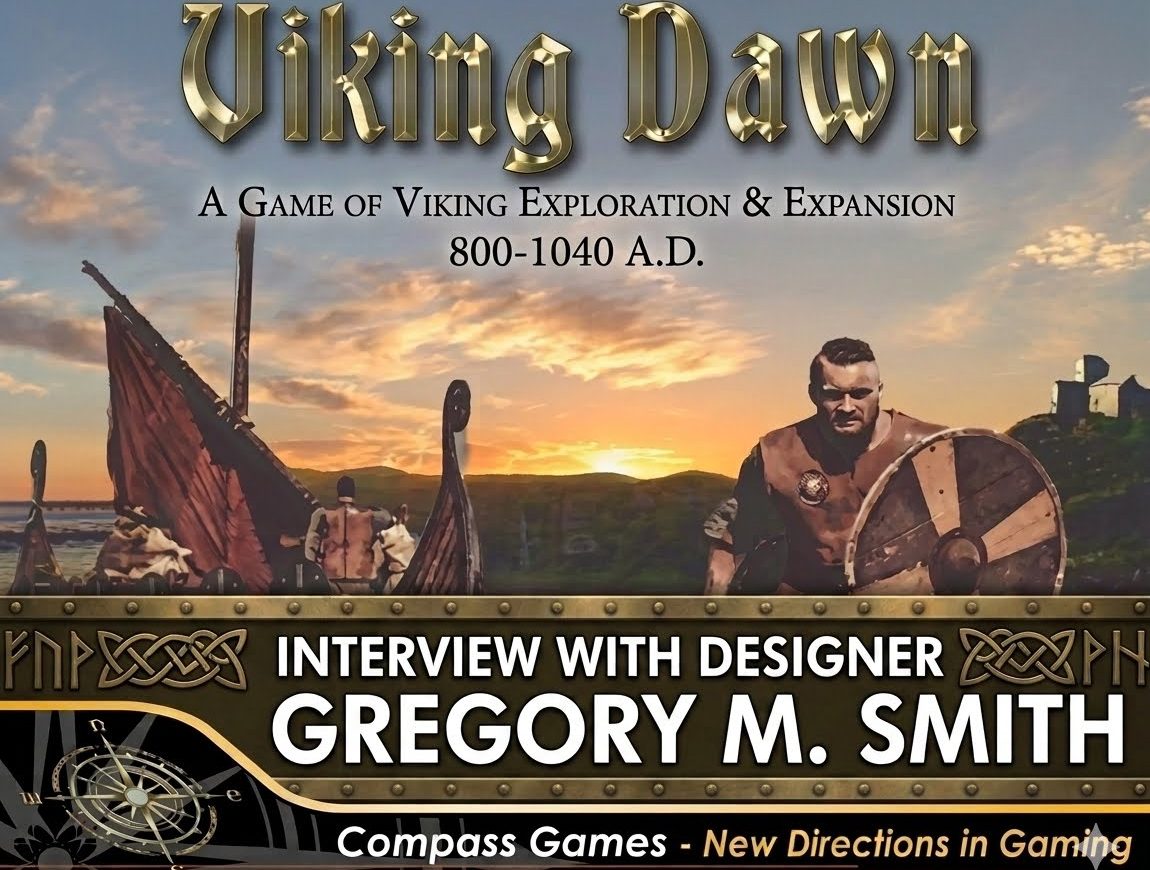
The 2nd game from Compass Games today is a good one. And I know that because I have played it. But, our friend Gregory M. Smith is a solitaire game designing genius and has done many of these solo, narrative driven style wargames that we have all enjoyed for hours on end while we have been unable to find an opponent or just because we want to play a game on our timeline. We have interviewed him many times for his games such as Zeppelin Raider, Interceptor Ace, The Hunted, Western Front Ace, Amerika Bomber, Defending America, American Tank Ace, British Tank Ace, Rebel Tide, Sinking Yamato and most recently for a magazine wargame called B-52D Linebacker II. But Greg is a versatile designer and also has done many great 2-player games as well. He always has something cooking in his game design kitchen and recently we spoke with him about his new design with Kevin McPartland called Viking Dawn: A Game of Viking Exploration & Expansion 800-1040 A.D. from Compass Games. I was able to play this 1-4 player game while at the World Boardgaming Championships last month and you can read about my experience at the following link: https://theplayersaid.com/2026/07/27/world-boardgaming-championships-2026-daily-debrief-series-day-3/
From the game page, we read the following:
Viking Dawn is a low-complexity strategic game, with rules for two, three, or four players, each controlling a faction of Vikings (Norse, Swede, Dane, and optionally Geat). Inspired by SPI’s game Conquistador! from the 1970’s, Viking Dawn has exploration, trade (both internal and external), and minor leaders. The game also contains rules for solitaire play with the Danes or Norse.
Faction descriptions:
Norse – closest to the New World, they have the additional advantage of two Explorers, Erik the Red and Leif Eriksson.
Danes – closest to the lucrative raiding and settlement targets of England, they also have the advantage of having several early leaders.
Swedes – although further from England, they are closest to several Russian settlement areas, and river portage routes to the east and Constantinople.
Geats – ostensibly the weakest faction, as they must pay tribute to the Swedes for protection, they have the best trading advantage in the game.
Players compete to raid lucrative settlements and explore the world with longships and warbands. Each faction has named historical leaders, who have an impact on combat and exploration. Players may trade with each other or nonplayer-controlled areas and establish settlements. Includes rules for settlements gaining independence, leader burials, and establishment of the Varangian Guard.
If you are interested in Viking Dawn: A Game of Viking Exploration & Expansion 800-1040 A.D., you can pre-order a copy for $54.00 from the Compass Games website at the following link: https://www.compassgames.com/product/viking-dawn-pay-later/
4. Tunnel Rats: The Vietnam War Underground from Compass Games
Game 3 in this month’s mini-Pre-Order Palooza from Compass Games is another very interesting looking game set during the Vietnam War called Tunnel Rats: The Vietnam War Underground. This game is a solitaire game, which I think makes a lot of sense historically and thematically and actually gets me very excited for the possibilities, and I very much look forward to seeing how this one works. I have great hope for this one. The designer is Lisa Smedman who has done several recent popular solo games including Trench Raid.
From the game page, we read the following:
Tunnel Rats is a single-player game set during the Vietnam War. You will control two American “tunnel rats” who have been tasked with exploring an underground tunnel complex created by the Viet Cong. This complex is made up of tiles representing tunnels and underground rooms in which the enemy may be lurking. In this claustrophobic environment, the tunnel rats need to be as quiet as possible to avoid alerting the enemy. Tense firefights and hand-to-hand combat feature a unique initiative system, and encounters are fast and furious.
With a procedurally generated map, nine tunnel rat characters to choose from, and a variety of weapon and equipment load-outs, each “run” will provide a new and dynamic challenge. Your team’s objective will vary, shifting the focus of play depending upon which lieutenant is in command of the team. Tunnel Rats also includes rules for campaign play, allowing surviving tunnel rats to gradually hone their skills over time – if they survive.
Be on your guard, as the tunnel rats never know what they will encounter down in “the black”. It might be a hidden punji stake pit, a Viet Cong command center filled with valuable documents, a venomous snake slithering along a tunnel, or a water trap they must swim through without drowning!
5. Against the Reich Deluxe Edition from Compass Games
Game 4 from the Compass Games mini Pre-Order Palooza is a classic hex and counter operational level wargame set in World War II called Against the Reich Deluxe Edition designed originally by Joseph Balkoski.
From the game page, we read the following:
In June of 1944, the world held its breath as land and naval forces of six Allied nations launched the largest amphibious assault ever attempted. The long-awaited second front, the Western Front, was finally open. The Allies had to force the unconditional surrender of Nazi Germany by crossing the great Rhine River into the Reich itself. Adolf Hitler was confident that the battered but undefeated Wehrmacht could hold two enormous fortified zones (the Atlantic and Westwalls) and repulse any attempt to cross into the German homeland. Against the Reich is the first game in years to cover the entire Western Front campaign. The players are in the positions of Eisenhower and Hitler, making the grand decisions that control the course of the campaign.
A Quick-Playing Simulation: Designer Joseph M. Balkoski, whose specialty is the Western Front, has provided an accurate, realistic simulation that plays like a game. With short and long campaign games, you can choose the length of the simulation.
Headquarters and Supplies are Realistically Linked: Players must decide where to concentrate their resources. Limited supplies make the placement of headquarters and depots a critical factor in the campaign.
Choice of Invasion Sites: The Allied player must decide where to invade – do you strike a lightly defended area and accept a long, grinding ground campaign, or strike close to the Rhine and risk quick destruction?
Historical Overview: Russel F. Weigley, author of Eisenhower’s Lieutenants, the definitive history of the Western Front, has analyzed the strategic options facing Eisenhower and Hitler – and the players.
Loaded with other Features: A short “Battle of the Bulge” scenario, Second Invasion, Flooding Holland, Port Repair, The Roer Dams, Rail Movement, Mediterranean Front Reinforcements, Amphibious and Airborne Assaults, and much more.
6. Enlightenment Empires: Power and Politics in Eastern Europe, 1725-1795 from GMT Games
One of my favorite parts about historical wargaming is that I get exposed to and am able to learn about some of the more obscure parts of our world’s history. Now you might be saying to me that the subject of power politics in Eastern Europe form 1725-1795 is not obscure and I think that you would be correct if I was from Eastern Europe. But as I am from the United States, this is not a period or locale that we learned much about in grade school. That being said, I am very much interested in this concept and history and am glad to see Brian Asklev taking another crack at a topic that focuses on some of the history from his neck of the woods. When Enlightenment Empires: Power and Politics in Eastern Europe, 1725-1795 was first announced a few weeks ago, I was immediately interested because I do love games where several nations have to compete economically, politically, diplomatically and through force of arms. I also recently played Brian’s Baltic Empires at WBC and very much enjoyed that game and this one appears to be in a similar style and uses the very interesting Dramatis Personae cards to inject historical characters with their abilities into the game play.
From the game page, we read the following:
Enlightenment Empires is an approachable 2-5 player strategy game about conflicts between the states of Central and Eastern Europe region during the Enlightenment era, a transformative period of political upheaval, large-scale warfare, and constant struggles for power. Players will have to develop their economy, decide their internal policies on the ideas of individual liberty and effective governance, secure trade deals and financial assistance within the context of the global rivalry between Britain and France, and finally build armies to become the dominant power of Central and Eastern Europe. Russia, Poland-Lithuania, Prussia, Austria, and the Ottoman Empire will fight for hegemony, using variable victory conditions that reflect their respective historical objectives.
Building on the solid foundation provided by Baltic Empires, highlights of Enlightenment Empires include:
Five new asymmetric factions with unique abilities and objectives, including a new “Constitution” objective reflecting the pinnacle of Enlightenment political ideals.
Another highly thematic deck of historical Dramatis Personae to constitute your royal court, now also including random events that can disrupt players’ plans…or present them with new opportunities.
A simplified, yet still deep and political, economic system that forces players to make tough decisions regarding their state’s internal policies (serfdom, noble privileges, and military spending) and its diplomatic relations to the superpowers of the period, England and France.
The same streamlined battle system based on custom dice per unit type, now modified by military reforms.
More detailed minor powers that players may form alliances with.
Variable player counts (from 2 to 5 players), with scenarios ranging from a tight duel to a tense multiplayer conflict replete with alliances and betrayals.
If there is a word that could define the whole of 18th century, it would be the Enlightenment. The philosophical thought that applied reason to all spheres of life guided the social and political developments of the 1700s, and intellectuals, scientists, politicians, and rulers alike acted either in support of it or against it. And while in Western Europe the republican ideals of enlightenment brought about the French Revolution, in Central and Eastern Europe enlightenment became a tool for state-building for the absolutist monarchs, including the Holy Roman Emperor and Archduke of Austria Joseph II, King Frederick II of Prussia, or Empress Catherine the Great of Russia. The mid-18th century period was formative for these powers, with Prussia and Russia continuing to struggle to establish their dominance in the region, while Austria and the Ottoman Empire fought to preserve their status, and the weakened state of Poland-Lithuania struggled to reform its constitution before meeting an unlucky demise. Three of the traditional “pentarchy“ of Great European Powers (namely, Russia, Prussia, and Austria) were Eastern powers that achieved this status during the 18th century. Their dominance in the region was forged by the work of bureaucrats and reformers, as much as by the soldiers and generals on the fields of the Seven Years‘ War.
Keep in mind that these type of games can sometimes be very complex and have lots of moving parts. And I am not saying that this doesn’t have them but Brian has said that the game is very approachable.
Enlightenment Empires presents these political and military conflicts in a fun and accessible format, while also doing justice to the fascinating history of the region during this period. The game features five asymmetric factions with different strengths, internal political conditions, military forces, and historical objectives, along with the capacity to develop their states by conducting reforms along (or against) Enlightenment ideals, investing in economic infrastructure, and recruiting key historical characters that offer unique game effects. The game also includes several scenarios for variable player counts and durations, offering additional flexibility and replayability.
7. The Last Hundred Yards Volume 6: The Forgotten Hell from GMT Games
If you didn’t know we really enjoyed The Last Hundred Yards as well as Volume 2: Airborne Over Europe. The system is extremely interesting for a tactical game and uses some novel elements in regards to how victory points are scored including a focus on time to complete missions as well as the casualties incurred. Really an excellent system with lots of crunch and potential! Now, even though there are a total of 5 other volumes that have been released, Mike Denson has forged ahead with the next entry in the series which gives us a look at the operations in New Guinea and the Northern Solomon Islands during WWII with The Last Hundred Yards Volume 6: The Forgotten Hell.
From the game page, we read the following:
The Last Hundred Yards: The Forgotten Hell is Volume 6 in The Last Hundred Yards Series. This game examines the Allied campaigns against Japan in 1942, focusing on U.S. operations on Guadalcanal and Australian fighting in Papua New Guinea.
In New Guinea, Australian militia and the Australian Imperial Force troops fought a brutal and desperate delaying campaign along the Kokoda Track from Port Moresby to Buna, Battling through jungle, mountains, rain, mud, hunger, disease, and exhaustion, they resisted repeated Japanese advances and flanking attacks. Their stubborn defense slowed the enemy, shielded Port Moresby, and eventually helped reverse the campaign. At Milne Bay, Australian forces pushed the Japanese back and shattered the belief that the Imperial Japanese Army was invincible.
On Guadalcanal, U.S. Marines and Army troops fought equally savage battles, destroying Ichiki’s force at Alligator Creek and later assaulting entrenched Japanese positions around Mount Austen. There, the enemy used caves, rocky ridges, and concealed strongpoints to prolong the struggle.
Together, these engagements reveal the intensity of jungle warfare in the Southwest Pacific, where endurance, small-unit leadership, and relentless attacks under terrible conditions shaped the early Allied offensive against Japan. These actions also showed how terrain, logistics, and morale could decide campaigns as surely as firepower across the battlefields of the Solomons and New Guinea alike.
8. Shenandoah: Jackson and Sheridan in the Valley, 1862 – 1864 (Stonewall in the Valley and Sheridan in the Shenandoah) from Multi-Man Publishing
A BIG and well respected American Civil War operational system is what Great Campaigns of the American Civil War (GCACW) is and the newest volume in the series is called Shenandoah: Jackson and Sheridan in the Valley, 1862 – 1864. One of the things that I very much appreciate about this system is the fact that they use some of the best art out there for their covers.
From the game page, we read the following:
Shenandoah: Jackson and Sheridan in the Valley, 1862 – 1864 is the latest design in the award-winning Great Campaigns of the American Civil War(GCACW) Series. It contains both a complete redesign of the Stonewall in the Valley (SIV) game covering Stonewall Jackson’s 1862 valley campaign and a completely new game module Sheridan in the Shenandoah that depicts Sheridan’s 1864 valley campaign. The game is designed by Joe Balkoski (the original GCACW Series creator) and Chris Withers. The original SIV game maps have been upgraded to contain the latest GCACW map features, with map design executed by artist Charlie Kibler—whose work on the series dates to its creation in 1992.
Shenandoah: Jackson and Sheridan in the Valley, 1862 – 1864 uses the latest version of the GCACW Standard Basic Game Rules, which also apply to all other games in the series, and these rules are now printed at an increased 11-point font size instead of 9-point. After more than a quarter-century of refinement, these rules are extremely well organized and relatively easy to learn, even for series newcomers. The Advanced Game rules cover situations specifically applicable to these unique campaigns such as “The Burning” that depicts the desolation of the valley by Union cavalry in 1864.
Stonewall in the Valley includes one new Basic Game scenario, the four original Basic Scenarios rebalanced, and the original Advanced Game campaign scenario extensively revised:
The Battle of Kernstown (March 23, 1862; 1 turn): Introductory scenario on the battle of Kernstown – ideal for beginners.
My Last Council of War (March 10 to March 23, 1862; 14 turns): Heavily outnumbered, Jackson moves south from Winchester thru Strasburg to Mt. Jackson. A Union force of three divisions follows to Strasburg while sending two divisions out of the Valley to reinforce McClellan. Jackson races back north and attacks the remaining Union division at Kernstown but loses the battle.
God Blessed Our Arms at McDowell (April 30 to May 11, 1862; 12 turns): Historically, Jackson moves west from Staunton and causes the Union force at McDowell to retreat north to Franklin. He briefly pursues them but then returns to the Valley. This scenario postulates what might have happened had Ewell’s division and Banks’ two divisions become involved in the McDowell campaign instead of holding fast in their camps in the south of the Valley.
Rebel Blitzkrieg (May 21 to June 2, 1862; 13 turns): Jackson and Ewell advance north on the Luray Pike and surprise the small Union force at Front Royal. A Union division entrenched at Strasburg to the west belatedly discovers it is in danger of being cut off and just beats Jackson north to Winchester. Jackson defeats the Union at the first battle of Winchester and pursues to Harpers Ferry. Meanwhile strong Union forces are moving in behind Jackson from both the east and the west. Jackson turns south, marching to Strasburg and then Mt. Jackson and barely avoids the trap.
Our Beautiful Valley Will be Cleansed (June 6 to June 11, 1862; 6 turns); Two Union columns, separated by the Shenandoah River, pursue Jackson south from Strasburg. Fremont’s force engages the Confederates at Harrisonburg and then two days later battles them at Cross Keys. Meanwhile Shields’ division advances into Jackson’s rear and almost captures his wagon train. Jackson turns his army from Fremont to Shields and defeats Shields in the battle of Port Republic causing both Union forces to pull back north.
Jackson’s Shenandoah Valley Campaign (March 7 to June 19, 1862; 105 turns): The entire Valley campaign is covered in this scenario. Both sides typically have forces moving all over all three maps in exciting maneuvers and with forces coming and going due to external events. The scenario plays quite fast due to lulls where sets of 5 turns are skipped. The original advanced rules have been simplified, and the scenario has been extensively playtested and re-balanced.
Sheridan in the Shenandoah includes twelve Basic Game scenarios and two Advanced Game campaign scenarios, all extensively playtested:
Second Winchester (June 13 to June 15, 1863; 3 turns): Ewell’s corps leads the Confederate army thru the Valley to invade Pennsylvania and routed the Union division at Winchester. The Rebels cut off the Union retreat and captured most of the Union division. The route was now clear for Lee’s invasion of the north.
The Battle of New Market (May 15, 1864; 1 turn): Introductory scenario on the battle of New Market – ideal for beginners.
Piedmont (June 4 to June 6, 1864; 3 turns): Picking up the after Sigel’s debacle at New Market, Union General David Hunter marches south from Winchester. With Breckinridge, Confederate hero of New Market, aiding Lee at Cold Harbor, defense of the Valley falls to a ragtag collection of troops that are rushed to the area under General W. E. “Grumble” Jones. The forces battle at Piedmont, Jones is killed, the Rebels are routed, and the Union captures Staunton.
In the Valley Again (July 23 to August 5, 1864; 14 turns): Early’s army moved back into the Valley in mid-July after retreating from the outskirts of Washington, D.C. On July 23, Confederate scouting revealed that Early was only opposed by Crook’s forces and not the VI and XIX corps, which had returned to D.C. Early attacked Crook at Kernstown and routed the Union forces which retreated across the Potomac. Confederate infantry destroyed the B&O RR at Martinsburg and threatened to invade north. Two Confederate cavalry brigades advanced north towards Chambersburg, burned it, and were chased by 2 Union cavalry divisions. Meanwhile, the VI and XIX corps had been recalled to the Valley, but then along with Crook’s force, moved east to protect against an assumed invasion again by the Confederates. The Union force soon countermarched back to Harpers Ferry and the Confederates retreated south.
Second Kernstown (July 24, 1864; 1 turn): A simple scenario covering the second battle of Kernstown – ideal for beginners.
Sheridan Takes Command (August 10 to August 14, 1864; 5 turns): Sheridan took command of all forces in the region on August 7th. His orders were “wherever the enemy goes let our troops go also”. The plan was to trap the Confederate infantry in the northern valley, but Early knew the danger and moved south just ahead of the Union. Both sides marched rapidly south until the Confederates setup a strong line at the Fisher’s Hill. Sheridan prepared to attack but halted his plans when a strong force under Anderson entered the Valley at Front Royal.
You Must Be Cautious (August 17 to August 21, 1864; 5 turns): With the Union infantry camped along Cedar Creek and the Confederates entrenched in a strong line at Fisher’s Hill just to the south, Sheridan learned of the approach of Kershaw’s division. This elicited a new directive from Grant warning Sheridan he “must be cautious and act on the defensive until movements … force them to detach” troops. Therefore, Sheridan conducted a night march to Winchester. From there the Union briefly defended at Berryville and then at Charlestown. The Confederates pursued and eventually tried to bring on a battle at Charlestown. However, Sheridan was cautious and followed the new defensive strategy and disengaged to retreat into a strong, compact line at Halltown, just in front of Harpers Ferry.
Third Winchester (September 19, 1864; 1 turn): This scenario depicting the third battle of Winchester is only one turn but still features lots of maneuver and combat.
From Winchester to Fisher’s Hill (September 19 to September 22, 1864; 4 turns): This scenario encompasses two significant battles in the valley campaign. The Union army attacked the Confederate defensive line just east of Winchester and eventually drove the Rebels back to Winchester. This final Confederate line collapsed, and they retreated south all the way to a formidable defensive position at Fisher’s Hill, just south of Strasburg. The Union pursued and then rolled the west flank of this line and routed the Confederates.
Early’s About Played Out (September 23 to September 26, 1864; 4 turns): After the battle of Fisher’s Hill the Confederates retreated south. The Union pursued with their entire army, but the action for the next few days was limited to cavalry and rear-guard skirmishes. The Confederates safely made it to Brown’s Gap, while the Union infantry stopped at Harrisonburg and Union cavalry started burning the countryside.
Tom’s Brook (October 9, 1864; 1 turn): This solitaire scenario is filled with cavalry action and is an excellent learning scenario for beginners.
The Battle of Cedar Creek (October 19, 1864; 1 turn): While this is only a 1-turn scenario it is filled with the action that took place in the battle of Cedar Creek. The Confederate player starts with a Night March and a Surprise Attack. The Union responds with a special “Sheridan’s Ride” action to enable counterattacks.
Sheridan Moves South (September 19 to October 20, 1864; 32 turns): This scenario spans the battles in the campaign from when Sheridan attacked the Confederates at Winchester, to when the Confederates were defeated at the battle of Cedar Creek. This campaign can be easily played in a weekend.
The Last Valley Campaign (July 21 to October 20, 1864; 92 turns): This scenario encompasses the entire campaign from when Early’s army returned to the Valley after his raid on Washington, to when he was defeated at the battle of Cedar Creek. There is maneuver and combat all over all three maps in this scenario. The action often starts with a Confederate offensive and advance to the Potomac. The Union then gets significant reinforcements to launch counteroffensives.
9. Okinawa: The Last Battle of WWII Reprint from Best with 1
I love a new and interesting way to tell the story of a key battle and I found a very interesting one called Okinawa: The Last Battle of WWII from Best with 1 earlier this year. This is a solitaire only game and for each game the player will draw four objectives from a possible 12 that you must survive and capture before time runs out. On your turn, the player will roll special dice and then spend those to take actions such as movement, attack and take special actions from different unit action cards that will be set up in a square from from 1 to 10. The numbers coincide with the dice of the attacking Japanese and as the player moves through the rondel they will be able to activate and use their different soldiers to attack the Japanese defenders or use their special abilities to gain tokens that can be used for rerolls or healing of wounds
I think that the best part of the game is the concept of resource management as you have to use the dice appropriately to move and fight and also to manage your troops as you can upgrade certain cards as you pass the midway point of the round as well as when special actions are granted via the special resource chits. Upgrading units is very important as this will unlock things like heavy weapons in the form of bazookas, a Sherman tank and planes to be able to take out the Japanese armor units defending the island. The game is about efficiency of movement and doing the most with what you have. The dice determine what you can and can’t do and movement is optional as you don’t have to move unless you feel it is advantageous. But remember, that you have to defeat the defenders and the various objectives to be able to advance to your final objective and sitting in one space too long is not advisable.
The different units have various functions including attack, such as the Rifleman, Machine Gun Team and Sniper but also have secondary functions to remove the fog of war, heal your damaged units or gain additional resources. The Japanese defenders are well hidden and also have various defenses such as pill boxes and caves that will require the player to defeat these before moving to attack the units located inside.
In the end the game is about defeating the Japanese defenders while doing so in a set amount of revolutions around the rondel setup. This can be as few as 2 times around or as many as 4 and knowing when to use your resources to reroll your dice, as you either didn’t get the run of consecutive numbers you were looking for or just need a specific number, you will run out of resources quickly and you must plan them out as best you can to win the game. This one is really fun and I have played it about a dozen times winning about 70% of the time. The game plays in about an hour and the action is fast and furious and you are immediately beset by the staunch Japanese defenders and must act quickly.
You do not have to buy the Hero Bound game but can order the game as an Add On.
10. Tank Clash: Eastern Front from Ameba Games
I love to highlight these little campaigns that I find on Kickstarter and this month there is a new company, or at least that I am not familiar with, called Ameba Games that is offering a small game called Tank Clash: Eastern Front. This games appears to be the 2nd game in the series with the 1st being called Tank Clash: Western Front.
From the game page, we read the following:
Tank Clash is back with new iconic World War 2 tanks!
The Red Army is spearheaded by the powerful Soviet armoured units like the T34, SU100 and IS2. Germany pins its hopes on the last of the panzer divisions to halt the Soviet advance. The Wehrmacht fields its fearsome tanks like the Stug III, Nashorn and Tiger II for the coming battle.
The stage is set for the largest clash of late-war heavy armour.
Tank Clash: Eastern Front is a standalone tactical tank warfare game for 2 players, designed for both newcomers and seasoned strategists. Easy to learn yet rich in tactical choices, it combines its signature checkers-style armour tracking system with dice rolling and hand management for intense skirmish battles.
Already own Tank Clash: Western Front?
Built with modularity in mind, Eastern Front is fully compatible with its predecessor. Combine both games to command 12 unique tank types across expansive battlefields with up to 4 players. Eastern Front’s new features – including new missions, battlefield tokens, event cards and enhanced gameplay elements can also be incorporated into Western Front for an even richer combat experience.
I know what you might be thinking, as the art is a bit cartoony, but I am going to give this one a chance. I think that any wargamer likes to use tanks and this one appears to be focused on these metal monsters and I am going to give it a go. Plus the components are really nice, including some very well made poker chips that are used on the board, and frankly the price of $40 is probably worth what you re getting.
As of September 1st, the Kickstarter campaign has funded and raised $9,054 toward its $3,928 funding goal with 108 backers. The campaign will conclude on Wednesday, September 16th at 9:00pm EDT.
New Release
1. A Hellish Fight: The Battle of Fort Sumter – 1863 from High Flying Dice Games
I love lesser gamed subjects. Or even sometimes games that have never seen the light of day and never touched certain subjects. It is always nice to play something unique and interesting while learning new parts of history. High Flying Dice Games does this exceptionally well as they have made their living on doing lesser (or even totally) unknow battles in their small format games. This month they have released a game that focuses on the 2nd siege of Fort Sumter in Charleston, South Carolina in 1863 called A Hellish Fight: The Battle of Fort Sumter – 1863. This one looks pretty interesting and appears to focus on the iron clad battles and bombardment of the ruins of the fort that were still held by the Confederates.
From the game page, we read the following:
Following the capture of Fort Wagner on September 7th, and the protracted bombardment of Fort Sumter by the Union navy’s ironclads as well as army land batteries, an assault to take the fort’s ruins was planned. Admiral Dahlgren and General Gilmore both felt that securing Fort Sumter’s capture would not only lead to Charleston’s surrender, but send a clear signal that the Confederacy’s days were numbered.
If you are interested in A Hellish Fight: The Battle of Fort Sumter – 1863, you can order a copy for $18.95 from the High Flying Dice Games website at the following link: https://www.hfdgames.com/sumter.html
2. Guadalcanal: The Battle for Henderson Field, Oct 23-26, 1942 from Dan Verssen Games
The Valiant Defense Series designed by David Thompson has been one of my favorite solitaire wargame series of the past nearly 10 years. Each of the volumes in the game address very specific situations and always have a very interesting take with fun mechanics, great art and fantastic production. The torch for the series though has been passed to a new designer in Vincent Cooper. He has designed Volume 5 Guadalcanal: The Battle for Henderson Field, Oct 23-26, 1942 and it has finally fulfilled off of Kickstarter.
From the game page, we read the following:
Take command of the valiant Marines of the 1st Marine Division, supported by Soldiers of the 164th Infantry Regiment, desperately defending Henderson Field against waves of Japanese troops. Guadalcanal: The Battle for Henderson Field is a solitaire and cooperative tactical wargame published by Dan Verssen Games (DVG) as Volume V in the Valiant Defense Series.
Here is a bit of a designer diary/commentary from the designer Vincent Cooper:
This all started about 3 1/2 years ago when I first played Pavlov’s House. I say played. I ‘played’ the game for about 10 minutes…and then I sat there in stunned disbelief at how a game could be sooooo good!!!!
By the time I finished there were two very clear ideas for games fully formed. I contacted DVG to see if there was any interest and they put me in touch with David Thompson. I didn’t hold much hope. There was no reason for him to trust his IP to me, a person he didn’t know.
But I gave it a try and David, it turns out, is one of the nicest people you can ever come into contact with. After some back and forth, the idea for Guadalcanal – The Battle for Henderson Field was born (not, in fact, one of the original ideas, but we’ll see what the future holds for them…).
The game has been through various stages of development and now stands ready to KS!! I will be giving more details in the future about the various variant play options, but have no fear: This will keep you scratching your head looking for the right decision for MONTHS!!
Art by the supremely talented Nils Johansson
Thank you to all the play testers, and in particular Glenn Saunders, Shane Freshwater and Martin Fenwick Charlesworth Much more to come from out design team in the near future!!!
A few years ago, Road to the Rhine designed by Frank Chadwick was announced and it is now ready to ship.
From the game page, we read the following:
In the cataclysmic battle of the Falaise Pocket, the Allied forces defeated the German army and drove them back across France in disorder. In the south of France, American and French troops of the 6th Army Group have stormed ashore and driven the remnants of the German 19th Army north toward the border.
Road to the Rhine covers the Allied pursuit of the German Army following the Normandy breakout through fierce fighting at the West Wall and bridging the Rhine River. The campaign game covers the period from September 1944 through April 1945, while separate shorter scenarios include Operation Market-Garden and the Battle of the Bulge. The game includes two battle games (one-turn scenarios), two longer scenarios, and one full campaign game. The game also includes extensive designer notes from original game designer Frank Chadwick and a historical play-through of the Bulge battle game.
Road to the Rhine is another classic by Game Designers’ Workshop, re-mastered by Compass Games. Originally designed by Frank Chadwick, this edition pays tribute to the classic by honoring the original game system while introducing many enhancements for gameplay purposes. In terms of presentation, we upgraded all components, including completely new full-color maps, new reinforcement and new unit displays, expanded turn and supply tracks, enhanced charts, a rulebook with incorporated errata, and larger counters.
This one does have two 22″x34″ maps but with only 2 countershafts so it is large in scope but not necessarily in scale as it appears to be fairly low counter density. One to keep an eye on though as it is designed by Frank Chadwick and is a remastering of the classis GDW release in 1979.
As usual, thanks so much for reading along and sticking with me this month as I navigated through the many websites and game pages looking for new and interesting games to share.
Finally, thanks once again to this month’s sponsor Neva Game Press!
They recently announced their next Kickstarter project that would take their system to the Anglo-Boer War called The Great Anglo-Boer War: The Battle for South Africa 1899-1902. The game is currently on Kickstarter and I reached out to my contact there Kevin Talley who acts as one of the Developers on the team for his input into the design to give us a better picture of how this new game plays.
Grant: What is the focus of your new upcoming game called The Great Anglo-Boer War?
Kevin:The Great Anglo-Boer War is a grand-strategic level game of the war between the British Empire and the Boer Republics in South Africa from 1899 to 1902.
Grant: Who is the designer and what is their goal with the game?
Kevin: As with all of our designs, R.J. Mills is the designer. He has always been fascinated with the Boer War and the goal was to make a really good hex-and-counter wargame to cover the whole conflict.
Grant: What is important to model from the history of the Anglo-Boer War?
Kevin: Well, the Boer War was very unique. It began as an asymmetric conventional contest in 1899 between the relatively small citizen militia forces of the two Boer Republics (they had no standing professional armies) and nearly the entire army of the British Empire! Then, once the Empire had captured both Boer capitals in 1900, the Boers refused to surrender and instead decided to fight a guerrilla war (and that went on for 2 more years). So, given the dynamics of this truly unique conflict, making a realistic game presented some serious design challenges. The design had to accurately simulate the conventional period, where the fractional Boer forces soundly defeated the British in several key battles during the early months, and it also had to credibly represent the guerrilla phase of the war, where very small numbers of Boers roamed (often unseen) and raided (always with surprise) throughout a vast area nearly twice the size of Texas. For this phase, the Empire forces had 250,000 troops deployed unsuccessfully trying to defeat 20,000 guerrillas! It all ended (finally) 31 May, 1902, with the Treaty of Vereeniging.
Grant: What other games inspired this design?
Kevin: We had not intended to make a Boer War game here at Cadet until after we started seeking a good grand-strategic/operational game about the Boer War to play. We got the “Boer War bug” playing Geoff Noble’s Redver’s Reverse: The Battle of Colenso, 1899 from Legion Games and decided we wanted to play a game of the whole war. We had pledged the KS Campaign for Joseph Miranda’s The Boer War from Canvas Temple Publishing and were hopeful, but it wasn’t what we’d hoped for in the end. Then we tried all the other Boer War games out there, or at least those we knew about, but there just wasn’t a good, realistic, strategic level/operational game of the whole war – especially not with the kind of depth we were looking for. We wanted something more like Nick Karp’s Vietnam: 1965-1975 from Victory Games – but for the Boer War – something with that kind of simulative value, historical chrome and especially guerrilla war operational mechanics. The closest thing we found was the old 3W game from 1991 (Eric Faust and Lew Fisher) called The Boer War. It had a lot of what we were looking for, but it was under-developed, errata-riddled and had too many issues to list. Still, that game had some brilliant design ideas, so we decided to start with that framework and make our own game. We were surprised that this topic didn’t have more published games already.
Grant: How did warfare change during the Victorian Age? How did you capture these changes?
Kevin: The British Army was fighting in drill book formations all the way through the 19th century. Consider that, just a year before in 1898 at Omdurman, the infantry stood in close order (just like in the movie Zulu), easily repelling the 50,000-strong army of the Khalifa with Lee-Metford volleys, Maxims and quick-firing breech loading artillery. This all worked very well when the enemy had swords, spears or primitive firearms. But the Boers had Mausers. And Krupps. And Maxims! Tactics had to evolve to meet this new level of lethality and the British Army was not initially prepared to face an enemy that was equipped with the same weapons as they. And an enemy that chose trenches and concealment – inflicting severe losses on British troops in drill formations. The combat system in the game realistically models the advantages of entrenchments, terrain, unit formation posture, night marches and even artillery effects. The Boers on defense can be very tough. A typical attack will be costly. Best to use open order and artillery to great effect – even better to use maneuver and avoid the prepared defense altogether. It took the British some time to learn their lessons.
Grant: What sources were consulted for the historical details?
Kevin: The bibliography for the game is included in section 26 of the rulebook. We used 20+ books on the topic to get the information for the design, and of course those include all the most important works published about the war: Rayne Kruger, Pakenham, Farwell, Arthur Conan Doyle (who was there), Barthorp, Reitz (a famous Boer Journal of the war), Maurice’s official history, Amery (Times history) and more. Someone who has researched the war and knows the historiography will truly appreciate this game.
Grant: What is the scale of the game? Force structure of units?
Kevin: The map scale is 9 miles to a hex. The map is huge. 34″ x 44″ on the table. The unit scale can be as little as a half battalion on the Empire side (500 men) and a single commando element of as few as 333 for the Boers. But the system is so flexible that a single leader’s counter in a hex on the map could represent as many as 30,000 Empire soldiers (with supporting artillery) and up to 13,320 Boers with several batteries of their guns as well. The game scale works for both large conventional battles (early war) and small guerrilla actions (later war).
Grant: What is the layout and anatomy of the counters?
Kevin: The counters are the typical ½” variety, printed on both sides. There are Entrenchment markers that, when flipped, double as “Scorched Earth” markers; Rail markers (early war) that also double as Blockhouse Line markers (guerrilla phase); Boer Control markers that can also be used as Strength Point counters; Number markers that flip to various increments; dozens of Empire Detachment markers which flip to show either Infantry or Cavalry or Artillery Strength Points (and the rotated position of these markers indicates the detachment strength in the hex); Armoured Train unit counters; Supply Wagon unit counters; Unit Status markers for multiple conditions like Retreated, Disordered, Demoralized, Invasion VP’s and more; and of course the Empire and Boer Leader counters, which are the basic units of maneuver in the game.
Grant: What different types of units are available to both sides?
Kevin: A Leader counter on the map typically indicates a ‘Force’ (which is a leader and the Strength Points of soldiers and artillery in their command) for both sides. These Forces are the maneuver units that move around on the map. There are also Detachments, which are Strength Points of soldiers and artillery without a leader (these secure and patrol an area, with a ZOC but without the counter moving). The Empire Strength Points can be Infantry, Cavalry or Artillery, with each point equating to 500 soldiers or a battery of field guns. The Boers are basically all mounted infantry militia, with each Strength Point representing 333 Boers or one battery of their artillery. The Empire also has Armoured Train units (we kept the English spelling), which function as ‘line of communication’ forces that police Empire-controlled rail lines. The Boers also have their Republic Presidents (Steyn and Kruger) and their small government staffs, which serve to score Victory Points by avoiding capture and maintaining their presence as head of state, either in their capitals or out on the veldt.
Grant: What is the off-map Arrow/Wheel used for?
Kevin: There are “Unit Displays” for both sides. These typically show a small picture of the Leader next to a pair of Strength Point numbered ‘wheels’. The players use counters with little arrows on them to indicate on the ‘wheels’ how many SP’s of soldiers are in a Leader’s Force, with any artillery batteries indicated by using a number marker. This keeps the counter-density on the map low, since the battalions, regiments, batteries or commandos are indicated using these off-map strength displays, and only the Leader’s counter moves on the map.
Grant: What was the inspiration for this mechanism?
Kevin: This came from the 3W game. Some players dislike this method for managing unit strength, and it took some getting used to, but we eventually decided it was the best mechanic we had seen in any design for this aspect of the game. Now we love it. Especially because of the flexibility it allows once the war changes from conventional to guerrilla. Historically the forces changed from divisions and brigades fighting large Boer commandos to much smaller columns of Empire troops chasing small Boer units of a few hundred all over the map.
Grant: How does it show the importance of Leaders in the game?
Kevin: I think this whole method of organizing the armies of both sides by each “Leader’s Force” really works perfectly to simulate the Boer War. It matches the real history. Everything a Force does boils down to the influence and command capabilities of the Leader. And forces of widely varying strength and unit composition were assigned to different leaders on both sides at different times throughout the conflict.
Grant: What is the Leader specific initiative rating system? How does it aid in your telling of the Anglo-Boer War?
Kevin: A Leader has to ‘roll for initiative’ to do most actions. Each Leader has an initiative rating which either helps or hurts their odds of a successful die roll, and the ratings are based on the historical performance of that Leader. This represents more than simply a Leader’s tendency to act decisively or not, but also his relative command influence for scarcity of resources, typical Victorian-era officer rivalries, orders and communications variables, bad intelligence and other typical “frictions” of war. The history of the war is full of instances where orders didn’t get communicated, sometimes weren’t given at all, or were ignored. Battles were lost many times because this leader or that failed to act on their own initiative or had some other priority override their commander’s intent. There are some Leaders whose rating is so good, they can nearly always do anything the player wants (and those are almost exclusively Boers). Other Leaders are reliably ineffective, and special care must be taken by the players to choose the right missions for these people. The realism of the design is greatly enhanced by this aspect – a player might have a great plan, but there is no guarantee that their Leaders will enact it. As Lord Roberts said after the battle at Poplar Grove, “In war you can’t expect everything to come out right.”
Grant: What is the layout of the game board?
Kevin: The Game Map contains almost all of the area of the war, from the eastern Transvaal and much of Swaziland and Zululand all the way to the Kalahari desert in the west; from 150 miles west of Port Elizabeth on the coast all the way up past Durban in Natal – and all of the mountains, ridges, rough and veldt of South Africa contained therein. It is a very large area and the map scale is 9 miles per hex. Using .625 hexes (for standard ½” counters), the map is 34″ x 44″ on the table.
Grant: What key terrain features are included and how do they affect maneuver and tactics?
Kevin: The terrain types for hexes include mountain, rough and veldt. Special hexside types can be ridge or river, bridge or rail. The mountain ranges are all there, as are the ridgelines and heights, rivers and rail, towns, ports and capitals. Even the passes and “neks” are indicated. The actual escarpment of the Drakensberg are all mountain hexes, but the Biggarsberg north of Ladysmith, as an example, is treated as ridge-type hexsides with rough terrain hexes. There is a real distinction between mountains and typical rough country/hills. The geography of South Africa was a serious factor in the conduct of the war and the terrain effects for both movement and combat are significant in the game.
A Force attacking across a river hexside is reduced by 50%; a Force attacking across a ridge or into mountains is reduced by 25%; a Force defending in mountain terrain is doubled; a Cavalry Force crossing a river pays 2 extra movement points to do so, while an Infantry Force pays 3; a veldt hex costs 1 point to enter, a rough hex 2, a mountain hex 4, and crossing a ridge hexside adds 2 points. Geography is key. Often, the only way to effectively dislodge an enemy Force from a position is to maneuver them out of it, because the odds for a successful attack are slim based on the terrain. The Tugela River line in Natal is a famous example of a natural fortress, and so it is with the game. To get past a competent Boer defense there, it will take an Empire player who understands the map and the combat system (plus some good dice and a card or two).
Grant: What type of cards are included? Can you share a few examples.
Kevin: The cards are great. Mostly they modify the combat odds or DR’s by providing for an odds-column shift or a DR mod for one of the many on the Battle Board (the Empire Attack Scouting Effect, the Artillery Effect or the actual combat DR). But there are also many cards that influence very specific game actions – like evasions or recruiting, siege surrender extensions or supply situations, armoured trains or movement or initiative effects. Some cards influence the unit formation or entrenchment posture during a battle, while some may determine the outcome of night marches. Some are related to intelligence and reveal hidden enemy units or prevent unknown strength in a combat event. Others influence scouting and observation, signals and orders, escapes and ambushes…I could go on.
All the cards were created based on actual events that happened during the war. Here is an excerpt from the Campaign language and the “design notes” section of the rulebook: “The game cards are designed to build historic realism into the game, especially for the combat system. As in all wars, small instances of chance – moments of decisive leadership (or not) – a thunderstorm – an oil-less signals lamp – a wire fence – a flooded drift – a poorly drawn map – a mistaken guide – an enemy surprise…all these historic events and elements of chance are represented in our design by game cards for both sides. We think this adds to the design immensely, since these can account for odds column shifts and DR mods that the players cannot anticipate. Like their historical counterparts, the players cannot know exactly what their odds are until the battle is joined and the card(s) are revealed!”
Grant: How does combat work?
Kevin: The combat system uses an odds-based CRT and a combat die roll to determine battle results, so it is fairly typical of a hex-and-counter wargame. What gives the system the right depth is that combat can happen during the movement as well as the combat phases. Combat can also be initiated by the non-phasing player using a reaction mechanism – so it isn’t nearly as simple or predictable as “I go / You go”. Based on the history, we felt the combat system (even at this scale) needed to incorporate strength ratios, unit tactical formations, weather, visibility, unknown Boer strength, artillery strength and effects for both sides, leadership, scouting and intelligence, terrain, night march outcomes, unit morale, “dummy” defensive positions, entrenchments and more.
Grant: How does the Battle Board work?
Kevin: There are so many effects and modifiers that contribute to the combat system that we decided the only way to keep everything straight was to have a Battle Board. For example, an Empire attack vs. a defending Boer Force would look like this: First, the Force attacking commits their desired number of Strength Points to the battle using the Attacker’s SP display, then the defending Boer unit’s SPs are indicated on their display. Any unit status particulars (Disordered, Demoralized, Retreated) are also indicated. The next step is to see how many unknown Boer SPs there are, so a die is rolled and that number goes on the Board (usually the Empire player cannot know their exact combat odds until after they commit their SPs to the attack because of this “unknown SP” die roll). Then any terrain or supply state modifiers are applied (there are markers for these) for both sides to establish the initial combat odds, and a counter for that ratio is placed in the appropriate box on the odds track (always rounded in favor of the defender). Next, any factors that modify the combat odds are noted and applied (entrenchments, the Empire Attack Scouting Effect DR, any other enemy units in the attacker’s ZOC, a Demoralized defender, any cards – attacker first). Now a marker is placed for the final combat odds on the final odds track. The last bit is to calculate what modifier (if any) is going to apply to the combat DR. The Artillery Effect is determined with a DR, if the Empire is using a night march there is another DR, the Empire Force’s Leader combat rating is applied, if the attack is made from a rail-move ZOC it matters, and finally any cards that modify the DR – attacker first. Once the Battle Board has been completely and correctly configured, the combat die is rolled and the CRT consulted to determine the result. The Battle Board is really essential to keep track of all of it.
Grant: What role does scouting and intelligence play in the game?
Kevin: The British generals were famously ignorant of the Boer dispositions in the early battles, for they had almost no intelligence organization in their army corps and they were especially short on mounted troops for effective scouting. The Empire Attack Scouting Effect is built into the combat system to reflect this. If the “E.A.S.E.” DR is greater than the number of Cavalry SP’s in the attacking Force, there is an odds-column shift to the left for the combat on the CRT. Later in the guerrilla phase, there is a “mystery movement” dynamic which keeps the Empire player guessing about which Boer commando markers are real units and which are only decoys. Some of the game cards confer valuable intelligence by allowing the Empire player to reveal a “mystery” commando of their choice (and native spies can help both sides).
Grant: How is artillery used?
Kevin: There is an Artillery Effect Track on the Battle Board which compares the arty strength of the two sides in a battle – whomever wins this comparison gets a modifier that applies to the combat DR. The Boers get a DR to add to their battery count, so even an Empire Force with 8 batteries of guns might not win the Arty Effect Bonus if there are 3 Boer batteries (if they roll a 6, they have 9). This “Boer Arty Effect” DR does not necessarily represent additional unknown batteries/guns, but more simulates the Boer tendency to use superior artillery tactics, multiple prepared positions, gun re-positioning during a battle, indirect fires and hidden gun positions with range and target fire preparation. In addition, the British firepower was often wasted against cunningly prepared “dummy” trenches and positions such that seemingly impressive preparatory fires were completely ineffective. The Boer Arty DR serves to simulate both aspects. The Empire has far greater potential weight of fire, but qualitatively the Boer Arty is superior (as with the historical truth). There are cards for both sides that impact the Artillery Effect for a battle.
Grant; What is the role of Scorched Earth?
Kevin: As the Boers turned more towards guerrilla tactics, the Empire forces began burning farms and killing or confiscating livestock (and especially horses) as reprisals for Boer attacks and to destroy potential shelter and supply sources for the guerrillas. This often resulted in the re-settlement of the Boer women and children in concentration camps, where thousands perished from disease and hunger. There are several game mechanics during the guerrilla phase that simulate this aspect of the war, and one is the “Scorched Earth” program. If the Empire player chooses, they may assign Forces during a game turn to “Scorch” one or more district areas in the Boer Republics. A marker is placed, and Boer movement point costs in that district are doubled, while guerrilla recruiting is halved. Once “Scorched”, a district can no longer provide Boer VP’s during the District Control segment of the VP interphase. But there is a potential cost to this kind of “scorched earth” policy: every turn this is done the Boer rolls a die – if the result is equal to or less than the number of newly “scorched” districts for the turn, the Boers get 5 VP for each. These VP’s reflect negative public opinion, parliamentary outrage and press coverage back in England, as well as increased Boer resentment and dedication to fight to the bitter end to avenge the destruction of their homes and families. The Empire player must balance the military benefits against the possible consequences of the policy (and be careful).
Grant: How does the Attrition Phase work?
Kevin: There is a lot going on during the Attrition and VP interphase. Hundreds of the Boers in just about every Force will simply leave to go home (they are all volunteer militia, not regulars); The Empire may have thousands of losses to typhoid (it was a big deal during the war); Boer family deaths in the concentration camps may cause desertions in the commandos (and uproar back in Britain); Besieged Empire garrisons may suffer losses or surrender; Railheads may advance or be pushed back: Forces might entrench; Unit statuses (like Demoralized units) get updated; VP’s for the game turn are tallied and losses counted, and the totals for the war (or scenario) are arrived at. It gets even busier if a Boer capital has been captured during the turn, as this can drastically increase the number of Boers who choose to “take leave” and go home (low morale). At the end of the phase, the players advance the game turn marker and start the next month of the war.
Grant: How is victory determined?
Kevin: Victory Points are awarded to both sides for all kinds of events. Mostly major or minor battle victories, but also for siege outcomes (relief or surrender), Boer invasions of Empire territory, capture of Leaders and capitals, control of districts, consequences from the scorched earth policy and concentration camps, and even penalties for over-stacking. There is a VP table on the back of the rulebook so the players can double-check during the VP interphase, and there are handy player-turn and interphase record sheets to use as well. Whoever has the most VP’s at the end of the scenario wins, unless an automatic victory for either side ends the contest early.
Grant: What different scenarios are included in the design?
Kevin: There are three scenarios – the Conventional War, the Guerrilla War, and the Grand Campaign Game. Here’s an excerpt from the Campaign language: “The full campaign is the ultimate Boer War experience – from the first desperate siege defenses of 1899 to the treaty of Vereeniging (or maybe not?) – and everything tactical and otherwise in between: Battles, blockhouses, farm-burnings, evasions, escapes, raids, concentration camps, sieges, drives, armoured trains, 1-pdr automatic “pom-poms”, surrenders, entrenchments, typhoid, barbed-wire, native spies, night marches, supply wagons and more. If it was part of the real Boer war – it is in the game.”
Grant: What does the game do well in modeling the Anglo-Boer War?
Kevin: We feel the game succeeds in modeling just about every aspect of the war, but there are a few particulars. Again, from the Campaign language: “For our design, we wanted a more granular scale of both movement and combat than any other strategic-level Boer War game yet published. Rayne Kruger, in chapter 23 of his “Good-Bye Dolly Gray” pointed out that, perhaps more than any other Boer advantage, the Empire was fighting “a war against space.” We ended up having two 22″ x 34″ map sections at 9 miles/hex to pull this off. A very large game on the table – but very typically “Cadet.” As it goes here, bigger is better. More hexes = more realism.”
Also, the Empire forces during the war were especially dependent on the rail lines for supply, while the Boer forces were far less dependent on any supply system to keep their forces in the field. The supply rules in the game really do justice to history, as everything the Empire player wants to do will be substantially constrained by their proximity to a rail line. In fact, some remote districts simply cannot be effectively garrisoned by Empire forces or detachments, because those units will be out of supply. Moreover, the scarcity of draft animals (oxen and mules) during the war meant only a handful of supply wagon units were available to extend an Empire LOS away from any rail line, and so it is with the game. These few substantial wagon convoys are also prime targets for the marauding Boers (as with countless examples from the war).
Grant: What has been the experience of playtesters?
Kevin: The game plays very well, indeed, but there were a few unexpected outcomes from the initial design, especially the combat system. In our first run of the conventional war scenario, we discovered that the “Boer unknown SP DR” mechanic needed a change. The Boers simply fought too well. Every time the Empire committed SP’s to an attack, the Boers would essentially be ‘reinforced’, owing to their unknown SP die roll. It always added SP’s to the Boer Force, since it wasn’t designed to subtract them. True, this kept the Empire player uncertain as to the combat odds until the forces were joined, but it had the effect of representing the Boers as ahistorically disciplined regular troops – prepared to fight to the death and hold their ground even when attacked by 15, 20, or even 30,000 British with 50+ field guns. The Boers just didn’t do that. There are far more examples of the Boer volunteers fleeing in droves from large Empire forces (in spite of exhortations and even threats by their leaders and even presidents) than examples where they stood their ground. In many ways this tendency served to preserve their forces and denied the Empire the showdown battles they hoped for during the second phase of the conventional war. A small rearguard of hardcore Burghers (farmers) would usually hold off the exponentially larger Empire forces, allowing their thousands of fleeing comrades to make their escape. They traded ground for time and blood, almost always avoiding any decisive loss.
So, we amended the rule so the DR can go either way, depending on the size of the attacking Empire force and on another DR modified by the Boer Leader rating of the defending force. This solution made a huge difference and resulted in the historical outcomes we wanted. If you attack Botha with a large Empire Force, he will likely motivate several hundred more Burghers to join the defense. Attack Prinsloo, though, and he’s likely to have several hundred of them (or more) run away before the battle is joined. There is a card in the Empire deck that prevents the unknown SP DR altogether, and now freshly retreated or Demoralized defenders don’t roll either.
Grant: When can we expect the game to be fulfilled?
Kevin: We are optimistic that the community will support our Campaign for this one (gotta get successfully funded first), and we will start the production sample and the rest of the process immediately afterward. Our anticipated timeline is to have the games shipping to the backers by August of next year.
Grant: What projects are in the near future for Cadet Games?
Kevin: We would really like to get our Hamburger Hill game produced. The design is 100% done and it is a really detailed sim of that famous battle. We ran it on Gamefound back in 2025 but it didn’t hit the goal. So, we will likely run that one again to see if we can’t get that produced here sometime soon. We have a ton of other projects in the works, one of which is a solo design covering the Mayaguez incident and the battle for Koh Tang Island from May, 1975. We have been really immersed in the Boer War since the middle of last year, so this one has had almost all of our attention (and still does for now, since we are playing through multiple rounds of the guerrilla phase and all of its intricacies)! We also have Barbarossa ’41 on deck for our Armies & Alliances Series of WWII ‘miniatures and monster map’ designs. Thanks again for helping us get the word out about our passion for military history and wargames!
Thank you for your time in answering our questions Kevin and for the great care you guys are taking with these games to tell a fun and interesting part of history.
Bravery in the Sand is a 2-player game that covers the major part of the battle known as Operation Crusader in North Africa during World War II. Covering the period from November 20 to December 3, 1941, players assume the roles of the Axis and Commonwealth generals to determine who will be victorious in this battle. One player controls the Commonwealth force (British, South African, New Zealand, and Indian), and the other player the Axis force (German and Italian). Players activate formations via chit draw, and combat is of the roll-to-hit variety. Includes rules for battlefield recovery, replacements, fortifications, Rommel and more.
About a month ago, I started a new feature on the blog called Discussion Thread where I pose a question or a situation and seek your input and comments on the issue to gain greater understanding and to encourage thoughtful feedback. The response to the first post about In-Game Retribution was positive and there were a lot comments and opinions shared. I now wanted to do another post in the series but focus on the subject of Zones of Control and their importance in wargames.
A Zone of Control, typically referred to as ZOC, is the area immediately surrounding a military unit that exerts tactical influence over adjacent spaces, which in turn restricts enemy movement, closes up gaps in a line preventing enemy units from moving through, forces combat or triggers some sort of reactive action such as opportunity fire or engagement without the passive player needing to occupy those hexes or take any actions. They are designed to create some sort of resistance to enemy units as they approach. Mimicking real world combat and adding in this concept of awareness of enemy movement.
I think that everyone has an opinion on the subject of ZOC’s and these opinions are mixed regarding complexity, the type, being rigid or sticky, and their in-game effects, but there is a consensus that they simulate well the concept of military friction and holding frontline positions. Let’s take a quick look at the different types of ZOC’s and I will share my thoughts on each.
First up, is the rigid/locking ZOC where units must halt their movement the moment they enter a space where an enemy unit is exerting a Zone of Control. The ZOC in this case forces the moving unit to terminate its movement for that turn. I very much prefer these type of ZOC’s as I think that they really simulate the concept of prepared and even sometimes dug-in troops have the advantage and can force advancing units to stop trough interlocking fields of fire or heavy gun projection on the area such as off-board artillery.
Next, we have the soft ZOC where advancing enemy units can move through enemy ZOC influenced spaces, but suffer some sort of movement point penalties, attrition, or extra costs. I also really like this concept as it typically functions similarly to more rigid ZOC’s by costing a +2 or +3 movement cost which typically ends a units movement but not always. I have seen moving units have to take a step loss to take an extra move or more simply extra movement costs such as the placing of a disrupted marker or the like. This type really focuses on the pressures and cost of moving into and through these Zones of Control but are simpler than the more rigid variety.
Finally, I have seen more fluid ZOC’s such as when units can pass adjacent to enemies, but doing so might trigger attacks of opportunity or reactive fire at a disadvantage such as providing the units projecting the ZOC a positive DRM in their attacks or attacking with a column shift on the Combat Results Table. This concept is that moving or advancing units have less cover, less caution and open themselves up to attack more so than those that are forced to stop.
I think that all 3 of these types have their merits and downsides but their use typically depends on the situation represented in the design, the mindset or experience of the designer and the varying historical troop quality and fire power of the units. A line of tanks dug in is much more fearsome and demands a different level of respect in their ZOC projection than say a small arms squad of soldiers who do not have heavy weapons such as LMG’s. And I think that all are viable in design.
Then there is the lack of Zones of Control. I am not a fan of this concept at all but have found that it is typically used in more introductory wargames that are less complex and focuses on being less of a simulation than a traditional hex and counter affair. Many years ago, and at a time when we were still early in our wargame learning journey, I played a game called Paul Koenig’s Market-Garden: Arnhem Bridge from Victory Point Games. I think that I was attracted to it because of the subject of Market-Garden and the inclusion of Allied airborne units. In looking at the game, the main focus and goal is to move toward the bridge and capture it. The path to move to the bridge is through fairly dense urban hexes with a road leading right to the on-ramps.
Strategically, a German commander would have lined the streets with their best units to prevent the enemy from simply riding right down the middle of the street to the bridge. This commander would have given orders to fire on anything approaching and would have had reserve units located in the buildings to the left and right of the streets to prevent small unit interdiction through the back alleys. These units would have taken up positions to bring heavy fire upon any approach hex and this is typically simulated in other games through the use of a Zone of Control. This ZOC would typically cause advancing units to stop while taking fire from an adjacent unit but in this design, the units just kind of ride on by, waving to the nasty MG-42 nests on the 2nd floor of the buildings and blowing kisses to the Panzers hidden in or behind the piles of rubble!
In reviewing the history of the campaign, one of the major problems the British had in advancing on the bridge was that relatively small German forces had taken up positions in the woods and on the outskirts of the city and effectively pinned down most of the advance of British forces toward Arnhem. This, in my opinion, is a major design flaw and should be house-ruled or cause a redesign of an otherwise fun and good playing game. I have illustrated this point with the pictures below where the British 4-6 Infantry unit simply moves right down the street between 4 better groups of units (an 8-9 Tank, three 6-8 Mobile Infantry and a crack 6-6 SS unit) without taking fire or being stopped! Seems silly doesn’t it?!?
I really tend to prefer the sticky/rigid/locking Zones of Control that seem to be found in most of the hex and counter wargames we play. I am more ok with the less restrictive soft or fluid ZOC’s in a tactical wargame where I can hold actions to then inflict opportunity fire on advancing units. But, as I said before, once you introduce the big guns in the form or tanks or heavy artillery, I really like the sticky/rigid/locking Zones of Control. Is this a taste thing or am I in the minority?
So what are your thoughts on the importance of Zones of Control? Can you enjoy and play a game that doesn’t have them? What is your preference in their stickiness/level of exerted influence in a game? What games do them best? Thanks for reading and for sharing your thoughts. I will come up with a few more of these posts over the next few months to share and I hope to see lots of comments and reaction.
With this My Favorite Wargame Cards Series, I hope to take a look at a specific card from the various wargames that I have played and share how it is used in the game. I am not a strategist and frankly I am not that good at games but I do understand how things should work and be used in games. With that being said, here is the next entry in this series.
#91: DoD Contractors from Andean Abyss: Insurgency and Counterinsurgency in Colombia from GMT Games
The first game in the COIN Series called Andean Abyss is a 1-4 player multifaction treatment of the campaign for control of Colombia with different factions such as the the Government, FARC (Fuerzas Armadas Revolucionarias de Colombia), AUC (Autodefensas Unidas de Colombia) and the Cartels. The game focuses on all of the facets of the conflict including guerrillas and police, kidnapping and the drug war, military sweeps and terror. The factions deploy distinct capabilities and tactics to influence Colombian affairs and achieve differing goals. Andean Abyss creates an opportunity to get a feel for this model of insurgency and counterinsurgency in Colombia.
In this entry, we will take a look at the interesting and fairly powerful DoD Contractors. The card pays homage to the efforts by the Department of Defense to pay independent contractors to provide pilots for crop spraying over FARC-held territory and for reconnaissance flights to pinpoint the locations of guerrillas and their bases of operation. Patrolling FARC guerrillas in 2003 shot down one such flight along the western slopes of Caquetá and took three US personnel hostage, setting off a Colombian Army manhunt. The event gives the Government player the opportunity in a single Department to Activate all underground Guerillas and also to remove all Cartels Bases. Typically, to perform this type of action is a multi-turn investment with the Government having to mobilize and move Troops and Police into a Department and then perform a Sweep operation to uncover them. Then on a following turn, they can Assault and do things likes Air Strikes to attempt to eliminate these units. But this is very hard to do as the FARC and Cartel player can just use their next action to send their units back Underground or to Rally additional units in the space to safeguard their assets and Bases. On the other side, the Insurgents can use the event to remove up to 3 Government Troop Cubes and also mark both the Government and FARC ineligible through the next turn which means they will lose a turn. This effect is tied to the manhunt by the Government looking for the downed hostages as their resources and efforts are tied up preventing them from taking their normal actions. This can be really powerful and allow the insurgents to recover and get their units on the move or bring in more. Depending upon the time of the game that this is played, and around whatever circumstances are going on, this can really be a powerful card either way and I love how it reflects the US efforts to smoke out these drug lords in their war on drugs.
In 1978, Baton Rouge pilot Barry Seal, who flew commercial jets for TWA, is recruited by CIA case officer Monty Schafer. He asks Seal, who has been smuggling Cuban cigars into the country to make a little money, to fly reconnaissance missions over Central America using an Aerostar 600, outfitted with aerial surveillance cameras. Seal accepts the job, but hides it from his wife, Lucy.
In the 1980’s, Schafer asks Seal to act as a courier between the CIA and General Noriega in Panama. During a mission, the Medellín Cartel picks Seal up and asks him to fly cocaine on his return flights to the US. Seal accepts and flies the cartel’s cocaine to Louisiana, airdropping the drug in the countryside.
The CIA turns a blind eye to the drug smuggling, but the DEA tracks Seal down. To avoid the authorities, Seal and his family relocate to Mena, Arkansas and his wife comes to accept the wealth generated by his side job. The small town becomes wealthy as the hub of US cocaine trafficking.
Later, Schafer asks Seal to run guns to the Nicaraguan Contras in Honduras. Realizing the Contras are not serious about the war and just want to get rich, Seal starts trading the guns to the cartel. The CIA sets up a Contra training base in Mena and Seal flies the Contras in, but many of them escape as soon as they arrive.
Seal makes so much money he buries it in suitcases in the backyard. The FBI catches wind of the sudden exuberance on the streets of Mena. Eventually, the CIA shuts down the program and abandons Seal, who is arrested by the FBI, DEA, ATF and Arkansas State Police simultaneously.
Seal escapes prosecution by making a deal with the White House, which wants evidence of the Sandinistas being drug traffickers. They ask him to get photos that tie the Medellín Cartel to the Nicaraguan Sandinistas. Seal manages to get them, but the White House releases them as propaganda against the Sandinistas. Seal is prominently shown in the pictures, which leads to his indictment by the crusading state attorney general and the cartel plotting revenge.
Seal is convicted but sentenced to only 1,000 hours of community service. Moving from motel to motel making video recordings detailing his experiences, Seal expects an explosion any time he starts his car. As his community service is performed at the same Salvation Army building every night, Seal cannot hide from the cartel and is shot dead by an assassin. The CIA destroys all evidence connecting them to Seal and continues smuggling, instead using Iran to get guns to the Contras, as proposed by Schafer.
While this example is a bit more than crop dusting, the operation is part of the same deal and shows the US Government’s reliance on private commercial aircraft pilots during the war on drugs.
Our friend Gregory M. Smith is a solitaire game designing genius and has done many of these solo, narrative driven style wargames that we have all enjoyed for hours on end while we have been unable to find an opponent or just because we want to play a game on our timeline. We have interviewed him many times for his games such as Zeppelin Raider, Interceptor Ace, The Hunted, Western Front Ace, Amerika Bomber, Defending America, American Tank Ace, British Tank Ace, Rebel Tide, Sinking Yamato and most recently for a magazine wargame called B-52D Linebacker II. But Greg is a versatile designer and also has done many great 2-player games as well. He always has something cooking in his game design kitchen and recently we spoke with him about his new design with Kevin McPartland called Viking Dawn: A Game of Viking Exploration & Expansion 800-1040 A.D. from Compass Games. I was able to play this 1-4 player game while at the World Boardgaming Championships last month and you can read about my experience at the following link: https://theplayersaid.com/2026/07/27/world-boardgaming-championships-2026-daily-debrief-series-day-3/
I reached out to Greg recently to get a bit more information about the design to share with you and he was more than willing to talk with me about this new game.
Grant: Greg welcome back to the blog. What is your new upcoming game Viking Dawn about?
Greg: Hey Grant, a pleasure as always. I still think back to the first few of these interviews we did many years ago and laugh. Good times! [Editor’s note: When I reach out to Greg about doing one of these interviews, he is always willing to respond but often adds “don’t get medieval on my ass!” meaning he hopes that my questions are reasonable in number. He has a separate life to game design evidently.]
But, to business – Viking Dawn is an operational/strategic level look at the Viking raids and explorations in Europe, the New World and even into the Mediterranean and North Africa from roughly 800 to 1,000 A.D. 1-4 players will attempt to build a legacy for their faction, including the Swedes, Danes, Norwegians or Geats, by amassing Victory Points through wealth acquisition, exploration, area control, founding and growth of colonies and elaborate Leader burials. The game is playable in 4-5 hours with each of its 8 turns spanning a period of 20-40 years.
Grant: Why did you feel inspired to make this game?
Greg: One of my favorite games in college was Conquistador: The Age of Exploration 1425-1600 from Strategy & Tactics Press and one evening I was watching Vikings (the recent series from the History Channel) and I thought, hey, I should make a Viking version of Conquistador. There’s nothing quite as dramatic as a game that covers 200+ years.
Grant: What sources did you consult to get the historical details correct?
Greg: As you might imagine, there was NO shortage of research materials, which is great on one hand, but on the other, can be daunting. I thought the most scholarly and overall excellent of the bunch was Johannes Brøndsted’s The Vikings. Another great overall look was Robert Ferguson’s The Vikings. Another similar book was Jonathan Clements’ The Vikings. (Nobody hesitates to use that name, you might notice.) The best resource with pictures of artifacts, drawings, and maps included was a book by Richard Hall titled The World of The Vikings.
Grant: I understand you have a design partner in Kevin McPartland. How did this partnership come about?
Greg: It was quite hilarious actually. Kevin is an accomplished designer in his own right, but a couple years back I brought the first prototype of Viking Dawn to the Compass Con and explained how the idea originated. The light bulbs went on in his head, because he ALSO loved Conquistador back in the day and was upset he hadn’t thought of this first! We laughed, then after playing the prototype, he was making nonstop suggestions (and historical corrections and additions). He so improved the prototype I felt I had to have him as co-designer, to which he graciously agreed.
Grant: What was the division of labor between you two?
Greg: Well, I did most of the initial design work, but every time we got together he had some fixes, tweaks, historical corrections, and additions. I’d say he almost acted more as a developer, but he came up with enough mechanics I think co-designer is probably more accurate.
Grant: What other games inspired your design approach?
Greg: As mentioned, Conquistador was the primary inspiration for the overall theme of raiding and exploration, with leaders that last a turn or two before dying (typically of old age, with 20 year turns).
Grant: What is the players goal in the game?
Greg: As with many games, the goal is to amass the most Victory Points, which will determine the winner. Unlike many games, this is achieved through exploration, pillaging, looting, building settlements, and my favorite element through lavish burials for your deceased Leaders. They may have accomplished great deeds in life but if you don’t bury them with gold they aren’t really truly memorable.
Grant: What does a victory look like in the game?
Greg: That is a bit hard to define, as there are many paths to victory, but the most likely path to victory involves settlement income, exploration Victory Points and burial income. If you don’t develop your network of settlements and establish your economy, you will not be able to generate the needed funds to pursue further exploration and settlement and will also not be able to afford to keep your empire going at the end of each turn as you have to pay upkeep on Warbands and Longships.
Grant; What was important to include or model about Vikings in the game?
Greg: Despite the operational/strategic nature of the game, we had to have pillaging and looting or it wouldn’t really be a game about Vikings as this was one of things they are best known for historically and the reason that they were greatly feared in Europe. Just as important (in my mind) was to model the exploration aspects of their seafaring, and this is encouraged by getting Victory Points by being the first to explore various far reaching corners of the map including Russia, Constantinople, Persia and the New World.
Grant: What was your greatest design challenge to overcome?
Greg: The game was too long in its initial versions, and it took some creative editing to chop it down to a more manageable eight turns. It was fun at 12 turns, but just took an inordinate amount of time (6+ hours). I really dislike games that take too long.
Grant: What is the time scale of the game? Why was this important?
Greg: Unlike games about more recent conflicts, the Viking heyday was several hundred years. This was a serious design challenge, but we finally decided on the first two turns being 40 years each <!> and the rest of the turns 20 years each. This sounds crazy, but it actually works, and allowed us to cover the main historical time frame in a playable system.
Grant: What are the different Viking factions in the game?
Greg: You can have 1-4 players, with the Danes, Norse, Swedes and Geats, an offshoot of the Swedes. Think of the Geats as the Portuguese from Conquistador.
Grant: How do factions gain new Leaders? How historical are these Leaders represented?
Greg: The Leaders in the game are mainly the more famous/notorious of the Viking faction they represent. They arrive on the Turn Track via their historical arrival dates, and depart via the same (most last only a single turn, some survive for two turns.) However, each player may spend silver and purchase temporary Leaders and Explorers if they don’t have one arriving for awhile. Leaders give a bonus in combat, and Explorers give a bonus in seafaring, so they can be significant. Part of the asymmetrical build of the game is map location, but also Leader arrival times. The Danes have early advantage, but the Swedes and Norse are stronger later in the game.
Grant: Can you share a few examples of these leaders with us?
Greg: For example, these are the Norse Leaders. They have arrival/departure turns (which is sometimes the same turn) and the specialized Explorers have the circular symbol denoting that status.
Grant: What is the general Sequence of Play?
Greg: In general, you receive income, buy units, send out expeditions in turn order, pillage, establish settlements, return home with exploration VP’s, and bury your dead Leaders. There’s more to it than that, but that’s the basic gist of things.
Grant: What different units types are available to each side?
Greg: The basic combat unit is the Warband. The basic transport is the Longship. The basic “civilian” unit is a Settler.
Grant: How does combat and raiding work? How is it Press Your Luck?
Greg: Combat is mainly a combination of how many Warbands you have, modified by Leaders and/or Berserker chits. There isn’t much of a Press Your Luck aspect to combat (exploration, yes, trading, yes, but combat, no.) However, there is a CRT so you have to know your odds. Trying to pillage with only a 50/50 chance of success is risky and should be avoided.
Grant: What actions does each player have access to?
Greg: Players have almost complete freedom in what they want to do – but should obviously focus on doing things that earn Victory Points (making silver, or being the first to explore an area and return home to tell about it). Basically, the actions are external trade, exploration, creating settlements, pillaging, raiding, even demanding ransom. Players can send out multiple expeditions even, with the caveat they have to be able to afford it.
Grant: What is the layout of the board? Who is your artist?
Greg: Here’s the map, being basically most of the places the Vikings went (which was a challenge to show!) Nadir Elfarra, my favorite artist, did the work.
Fun story about the map, I showed an earlier version to my wife, Cindy, and the first thing out of her mouth was “Where are the Sea Monsters???” So we corrected that
Grant: How does trade work?
Greg: Internal trade happens automatically with your settlements, assuming you’ve paid for their upkeep. External trade, on the other hand, is a decision the player makes via the External Trade Chart. It requires you to risk a silver and a Longship, and you decide which column to use.
Grant: How are colonies established and how do they grow?
Greg: If you have successfully pillaged a green (habitable area suitable to be settled) you can drop off Settler(s) if you brought any. Each area has a Growth/Attrition number and also a Size Cap. At the end of each turn, you roll to see if the settlement grows (up to the size cap) or suffers attrition. Obviously, England has less attrition and a larger size cap than, say, Greenland. One fun problem is that when areas reach their size cap, they roll to break away and become independent from the homeland.
Grant: How does Longship travel work? What dangers are involved?
Greg: You may travel a maximum of three legs (each leg being six areas or fraction thereof). This makes the theoretical maximum 18 areas. However, the further you go, the more likely you are to lose Longships and/or your entire expedition. Explorers can mitigate these risks, but there are very few explorers in the game. So there is definitely risk in exploration.
Grant: What type of experience does the game create for players?
Greg; I would like to think of Viking Dawn as a “historical Euro” for lack of a better term. It’s certainly more of a game than an attempt at perfecting simulating all the historical events of the time. Kevin’s fantastic knowledge really helped to make it better historically, and I think it does a really good job of doing a “broad brush” rendering of the Viking age.
Grant: What are you most pleased about with the design?
Greg: I really thought the turn order mechanic made it very tense. Everybody secretly purchases Warbands and Longships, but turn order (a huge advantage to go first early in the game) is determined by who has the most silver remaining after purchases. If you buy a lot, you can do a lot, BUT you’re probably low on silver and going last in the turn. So determining turn order by remaining silver turned out to be a great mechanic.
Grant: What has been the feedback of your playtesters?
Greg: Anybody who knows me knows that I’m my own biggest cheerleader, BUT seriously, we had a great time playing this the last several years at Compass Con. It’s just fun multiplayer, especially when bad things happen. I am very happy with the design, and especially since Kevin McPartland made it ten times better with his involvement.
Grant: When can we expect to see the game released?
Greg: I refuse to answer this question on the grounds I’m never right but if pressed, I’d have to say early 2027. It’s done and at the printers.
Grant: What other designs are you currently working on?
Greg: I’ve got a few irons in the fire. Solo Banner (Burning Banners dungeon crawler), Western Desert Ace (North Africa WW2 version of Western Front Ace), Soviet Tank Ace, B-52D Linebacker II (magazine game), Gotha Raiders (magazine game), Project Z (Japanese hypothetical heavy bombers 1947), Ground Attack Ace (Stukas and Sturmoviks), Korean Tide (1950-53 Tide Series), Star-Spangled Tide (War of 1812 with Kevin McPartland again), a B-36 game, and a few others. Trust me I’m staying busy!
Thanks as always, enjoyed chatting.
If you are interested in Viking Dawn: A Game of Viking Exploration & Expansion 800-1040 A.D., you can pre-order a copy for $54.00 from the Compass Games website at the following link: https://www.compassgames.com/product/viking-dawn-pay-later/
The Struggle for Zorn: The Red Blight is a 1-5 player semi-cooperative fantasy wargame. Players will represent the various Houses of the fictional Kingdom of Zorn, and these Houses have joined together to defeat the rising threat of the vile Red Blight. The Red Blight is an evil entity that has just launched an invasion of peaceful Slumbering Troll Valley, the northern-most province of the kingdom. The monsters of the Red Blight are now holding the citizens of the valley hostage and have absconded with the province’s valuables, treasures, and vital resources. The Houses have been summoned by King Rufus V of Zorn to launch a Royal Crusade to free the valley and rid it of this blight.
The game’s players will each control a Commander, a Magic User, and a House Army, made up of various types of military units. Each player attempts to defeat enemy units and capture Treasure Tokens, and by so doing earn Glory Points. The player scoring the most Glory Points will be awarded with the title “Hand of the Crown” and win the game. However, players must cooperate and assist each other as well. If the Red Blight achieves certain conditions, all the players lose the game, regardless of their situation or amount of Glory Points. If players can stave off The Red Blight’s attempt to exploit the valley for four full days, the monsters will lose access to the malignant power that sustains them. If this evil has been successfully thwarted, peace and freedom will be restored once again to the valley and one of the intrepid Houses will gain the ultimate royal reward.
During the First World War, the British and French made a secret agreement to carve up the Ottoman Empire – literally drawing on a map in red and blue ink – without respect to the peoples, culture, or history of the region. This would have devastating effects over the next century.
In Sykes-Picot, two players take on the roles of infamous diplomats Mark Sykes and Francois Georges-Picot, using red and blue markers to carve out territories to control and to influence on a dry-erase map. Trick-taking card play and table-talk negotiations drive the proceedings, with the winner of each trick choosing one of the two cards to implement, and the loser consoling themselves with the remaining card. Each player has a set of hidden objectives they’re trying to achieve. Players may be as co-operative or as competitive as they wish in pursuit of these goals.
Tonally, the game is light, reflecting the distance and cavalier attitude of these imperialist powers. We feel there’s something horrifying in that, and this approach captures some of that horror.
HISPANIA from Draco Ideas is a slick little small box game with a big punch that sees the player controlling the Roman Empire and attempting to subjugate and put down resistance in the provinces of Hispania from 198 to 18BC. The game is extremely flexible and may be played cooperatively by 2-3 players, competitively with 4 players or as a solo game. The game is somewhat of a resource management game as the players must use their limited funds in the form of Denarii wisely to attack and put down revolts springing up around the country as local armies rally support for the resistance to Roman rule.
I love a different style and focus of wargame. A game that takes a look at an important but somewhat obscure or rarely addressed historical topic, such as espionage or intelligence, and creates a gaming experience tailored around the events to highlight and evoke the difficulties and tension that would have been present. In January 2026, GMT Games announced such a game in Checkpoint Charlie, which is a solo or cooperative game focused on SIS espionage missions in Berlin in the 1960’s designed by Russell Brown. We have posted an interview with Russel and it was very well received and he has now agreed to create a series of History Behind the Cards to highlight the events of the 1960’s Cold War struggle in West Germany but also to share aspects about the game play and how it models the history.
*Note: The cards highlighted in this series and their event text, as well as any pictures used showing any of the various components, are still in the design and development process and as such event effects and text might still change prior to final development and publication.Also the art and layout of the cards are only for playtest purposes at this point and the game will enter the art department as it nears publication.
History Behind the Cards – Checkpoint Charlie from GMT Games – Card #5: Berlin Film Festival
Every summer since 1951, Berlin had hosted the international Berlin Film Festival (the Berlinale) and awarded the Golden Bear to the best film in each of five categories. Venues in both East and West Berlin were used for screening of films. As summer approached in 1962, Berlin found itself cut in two by the Berlin Wall amid growing tensions between East and West. It seemed there were any number of events that could trigger a war over the city. And yet, the Film Festival was held, entirely in West Berlin this time. The festival drew thousands of visitors to the city, including Hollywood stars like Jimmy Stewart and Tony Curtis. Screenings took place in venues throughout the city and, we can assume, brought a much-needed sense of normalcy and continuity to the residents of West Berlin and perhaps a sense of what was lost to those in the east.
The festival took place every year throughout the Cold War, and after reunification it once again began film screenings in the former East Berlin. The festival continues and this year the Golden Bear award for best film went to “Yellow Letters.”
The Berlin Film Festival card in Checkpoint Charlie assumes the Berlin Hilton is full up with visitors and cannot function as a Honey Trap. The card also assumes that the extra traffic in the city, including thousands of additional pedestrians trying to get a glimpse of celebrities, negates any Ongoing Card Effects that allow additional movement during the Movement step.
In the next article in this series, we will take a look General Clay Steps In as he is appointed by President Kennedy to resolve issues in West Berlin.
In my opinion, this game looks extremely interesting and I am very much excited to learn more about it. I am appreciative to Russell and his efforts to bring us these cards and to write these entries to share with our readers. I am also very glad that this topic is being covered in a game and look forward to playing this one day soon.
For those that don’t know, the World Boardgaming Championships (WBC) takes place every year in late summer and is held at the beautiful Seven Springs Mountain Resort in southwestern Pennsylvania. WBC is a national, even international, event where players come together to play games both competitively and for fun with other gamers. The competitive side of the games include everything from tiddly winks, to Robo Rally, Diplomacy and to heavy wargames including many from one of our favorite publishers GMT Games including games such as Combat Commander, Empire of the Sun and Panzer. Also at this convention, the initiates of the Battles of the American Revolution Series gather to hold a competitive tournament competing for the Golden Tricorne (this award doesn’t exist as I just made it up but maybe Mark Miklos will figure out how to get this accomplished!).
Each year, series designer Mark Miklos writes a fairly in-depth and lengthy After Action Report that he posts in various locations on the interwebs including on Facebook, the Consimworld Forum folder for BoAR and on GMT’s website on their InsideGMT blog. This year, Mark has again agreed to share his AAR with us to post here on the blog for our readers to enjoy.
This was a special year for American Revolutionary War gaming at the World Boardgamiong Championships. Our Battles of the American Revolution event nearly drew record attendance. Thirty three players, one short of the all-time high, battled across eight classic Rev War battlefields. Our numbers included seven new players from among the fifteen who attended our demo on Sunday evening. In addition to the gaming itself, this year’s BoAR event included three special activities to celebrate America’s 250th anniversary: a seminar, a trivia game and a party. Each will be described below.
We were given a dedicated space for the entire week in the Foggy Brews unlike in year’s past when we had to compete for table space in Winterberry. This year we hung flags and banners, played period music, and in general had an 18th century refuge to further enhance the special mood and vibe.
Two heats were played on Monday. Heat 1 was the Chatterton Hill scenario from the Battle of White Plains. Twenty two players competed as we kicked off the week. Because White Plains is the most recent volume in the BoAR Series it has a short competitive record. Nevertheless, the outcomes this year were telling. Each side scored four decisive victories with the British adding another three substantial ones. This is a 57% winning percentage for the British which closely approximates the 60% edge that the British have had in this scenario based thus far on twenty four tournament games.
Heat 2 was the old classic, Saratoga. Sixteen players squared off in this one. We played the campaign game with this year’s British players dominating. They scored four substantial victories to two. Each side added one marginal win as well. Ten players returned on Tuesday morning to face off in the full Brandywine Creek campaign. The optional “Muddying the Waters” intel rules were not used. It was great to see this big battle on the table. I took the approach this year of selecting larger games that typically are used for a final and instead used them during the heats. Outcomes in this battle were comparable with the Americans earning one decisive and one substantial victory while the British earned two substantial and one marginal win.
Eleven players showed up for the Battle of Germantown on Wednesday morning necessitating the first and only bye in this year’s tournament. It was given to yours truly as last year’s champion according to standard WBC protocol. The remaining ten players earned one American substantial victory, one British substantial victory and one British marginal victory. The other two games witnessed the first draws in this year’s tournament as John Vasilakos and Bruno Sinigaglio completed a game of maneuver in which neither earned a VP. The match between Chris Mlynarczyk and Frank Sinigaglio was a little more robust with Chris’ British earning two VP’s and Frank’s Americans earning three.
Our final heat, played on Thursday, was the full Monmouth Courthouse campaign. This is another big game which was nice to see played by twelve players. The British swept the field with one decisive, one substantial, and one marginal victory. The other three games ended in a draw: Charles Orndorff and Bob Jamelli (3 VP’s each), Tim Miller and Randy Collard (3.5 VP’s to 1 with Tim missing a marginal win by one-half VP), and John Vasilakos and Father Eric Tolentino (1 VP to none respectively). After the heats we advanced the top eight players to single elimination beginning with a quarter final round. The top seeds were Miklos (17 tournament points), Father Todd Carter (15 TP and 83 cumulative army morale points), John Vasilakos (15 TP and 10 cumulative AM), Young Rob Doane “The Good” (10 TP), Tim Miller (7 TP), Charles Orndorff (4 TP, 74 AM), Chris Mlynarczyk (4 TP, 49 AM), and Bruce Cota (4 TP, 20 AM). Bruce was unable to play and so the eighth seed was offered to the first alternate, Jim Dauphinais (4 TP, 19 AM). Jim was also unavailable and our second alternate, Jeff Lange graciously stepped up (2 TP, 32 AM).
The game was the first day at the Battle of Newport. The full two-day battle of Newport had been played three previous times as a final with the Americans winning all three. Interestingly, in the Day 1 action, it was the British who won three, two decisively and one substantially, while the Americans managed one substantial victory when Father Todd’s Americans defeated Chris Mlynarczyk. It was now on to the semifinals. To fit the semi-final and the final into a single day I selected short games which were welcomed after the string of long contests at Brandywine, Germantown, Monmouth and Newport.
Thus, our semifinal was the Guilford Courthouse historical scenario. Here John Vasillakos’ British won a solid marginal victory over Father Todd’s Americans, 5.5 VP’s to 1. Meanwhile, Rob Doane’s Americans won marginally over my British. In our match the VP’s were tied at 3 each, but the British need a margin of +2 VP’s to win, otherwise the Americans do.
The stage was set for the final pitting John Vasilakos against Rob Doane at the Battle of Eutaw Springs. Over the course of 225 competitive games of Eutaw Springs, the Americans have won 89 times, the British 90 times, and 46 contests have ended in a draw. Since this was the final, however, victory in a draw would be awarded to the player with superior army morale at game’s end. There was no bid as each player got their preferred side, John the British and Rob the Americans. John formed his line forward, anchoring it between swampy ground on his left and the blackjack oak on his right. Rob’s approach took advantage of surprise, initiative, morale, and momentum and he was able to capture a British Regular plus Major Marjoribanks. This gave Rob 2 VP’s to John’s 3 for holding the British encampment. Rob’s gambit was then to slowly fall back, preserving the draw and his now superior army morale, which would be all he would need for victory. John, of course, pursued. In the end each player scored 4 VP’s, but John’s army morale had fallen to 8 while Rob maintained a robust 14 army morale points. Victory for the Americans marked a fitting conclusion in a year of celebration for the 250th anniversary of independence. Congratulations to both Rob and John for an exceptional week of competition and a hard fought final contest. I finished 3rd, Father Todd finished 4th, Tim Miller was 5th and Charles Orndorff rounded out the top six. This year’s final was videotaped by WBC. An overhead camera rig was set up above the Eutaw Springs big board game set prior to play. Audio was recorded. We are all anxious about the chance to watch it when it becomes available and I will share that information with those who may be interested.
Custom “Gaming the American Revolution WBC” Dice Tray made by John Olson awarded as an extra prize for the tournament winner.
We let out all the stops this year in honor of the 250th. First up, on Tuesday evening, we enjoyed a one hour talk by designer Bruno Sinigaglio who spoke to us about the Battle of Cowpens. Cowpens is the first game in our new series, Small Battles of the American Revolution or Small BoAR. Bruno described the battle in detail and how he adopted its elements into the new design wherein he lowered the scale to 1/8 that of a full BoAR game; making a hex 25 yards instead of 200 and a strength point 12 men instead of 100. At that scale, muskets as well as rifles have ranged fire and artillery can fire across the board. This level of granularity allowed Bruno to introduce other elements as well such as placing cavalry in a reserve status that enables them to charge after the normal movement phase has ended. Bruno had an audience of twenty two who paid rapt attention while he shared several PowerPoint slides to enhance his talk. The timing was perfect because we were able to announce that Bruno and I were receiving our proof copies that very week which would be waiting for us to review upon returning home from WBC. This means all those who preordered on GMT’s P-500 will very shortly be receiving order fulfillments. It was a fitting way to kick off our agenda of special events for the week. On Wednesday evening we played Rev War trivia pitting the Bloody Backs against the Yankee Doodles. We had 11 players on each team plus several interested observers who came just for the fun. A spokesperson for each team was asked to put on a uniform, British Regular or Continental courtesy of our friend and reenactor, Chris Mlynarczyk. In each round they would come forward with their team’s written answer on a whiteboard. Nine rounds were played, corresponding to the years 1775-1783, followed by a bonus round. Questions for each round progressed in point value and difficulty. In the bonus round the teams were allowed to bid from among their accumulated points. It was nip and tuck for a while until the British broke through earning a 5 point answer that put them in the lead. They would never look back. In the bonus round the Americans bid it all while the British bid conservatively to protect their lead. Every member of the winning British team received a first day of issue, commemorative envelope from the USPS that featured a postmark of April 19, 2026 stamped Concord, Massachusetts. Each envelope also had affixed to it a commemorative stamp from the five battle series designed for the 250th by the USPS: Lexington & Concord, Bunker Hill, Saratoga, Valley Forge, or Yorktown. It was a lot of fun and a great way to rev things up for our final event, our 250th anniversary celebration and party on Thursday night.
Thanks to Ken Guttermuth, we had signage located around the Seven Springs campus advertising our special events. All were welcome. Participation in the BoAR tournament was not a prerequisite. There were attendees at Bruno’s talk and at our trivia game who were not BoAR players. Likewise, over 50 people came to our party, several of whom saw our signs and were inspired to participate. We served an enormous cake, once again courtesy of Ken Guttermuth. A cash bar was opened directly adjacent to our venue in Foggy Brews just for the occasion. We had period music, remarks, readings, and a reminiscence to our fallen comrades who were not there to celebrate with us. There was a rousing three cheers for General Washington, and even a bit of a sing along where we repeated the refrain, “Hurrah, our country forever hurrah” to the song “An American Frigate” about John Paul Jones and his victory over Serapis in the English Channel. They could hear us in 1776! It was a terrific night, every morsel of cake was eaten, and one or two attendees even got emotional, and we wouldn’t have had it any other way. This was a terrific WBC. Forty two total games of BoAR were played, likely enough to maintain our status as a Century event at the convention. Special thanks to all those who helped to make this year’s event memorable: Ken Guttermuth for the space, the signs, the cake, and all his full-throated support along the way, my AGMs Dave Stiffler and Rob Doane, Dave doing double duty by reciting and leading the cheer for Washington during our party, Jeff Lange for running a companion event in our Rev War space, Freeman’s Farm 1777 by Worthington Publishing, Tim Miller for designing our Gaming the American Revolution logo and banner, Chris for the use of the uniforms at trivia, Bruno for agreeing to break away from his GM duties to give his talk, and to my wife Darlene who was our hostess at the party.
One more thanks must be mentioned. Grant with The Players’ Aid dropped by one afternoon to interview me. He took videos of our decorated room and we discussed several things. I was able to elaborate on our special 250th events. We discussed Volume 11 in the BoAR Series, The Battle of Green Spring. I had my prototype with me, did a short show and tell, and updated the status of the project. We discussed GMT’s upcoming Rev War 250th anniversary event in Camden, South Carolina in September. Grant was also kind enough to inquire about my book, Liberty! A Military History Survey of the American Revolution which incidentally has just gone to the printer as of this writing. Grant is such a gracious host and so easy to talk to. We laughed a lot and probably digressed too much but once we get going, the sky is the limit. It was very kind of him to fit us into his demanding schedule at WBC and to give BoAR so much publicity. At some point soon this video along with his entire WBC 2026 exposé will be up on YouTube for anyone interested. Two down, one to go. We pulled out all the stops at RevCon during Prezcon in Charlottesville last February. Now, at WBC we once again gave it our all to celebrate the 250th. We have one last event on the horizon in Camden in September and I hope to see many of you there. “Hurrah, our country forever hurrah!”
Thank you to Mark for this great insight into the tournament. We appreciate the work he puts into this tournament each year and for his grace in meeting with me while I was at WBC this year. I look forward to the upcoming Rev War 250th Anniversary Event in Camden, South Carolina in September.

 Anmelden