Normale Ansicht

Gooey-Free Classification

20. August 2026 um 20:23

Aliens are not good at sorting books. Everyone knows this.

Two years might not seem like enough of an interval to warrant a second edition, but Connor Wake’s Out of Sorts is not your average board game. Actually, it’s become something of a counterpoint for me. While Wilmot’s Warehouse has become the proof of concept for what a modern memory game can accomplish, to such a degree that I have played it something like fifty times, Out of Sorts is that but bizarre, that but frightening, that but even more unwilling to guide its players by the hand. Because it is weird, my appreciation is even more boundless.

How weird is it? Here’s the premise: You’ve been abducted by an alien and put to work categorizing their spacefaring library. Presumably the delay of lightspeed means they’ve only recently learned of Melvil Dewey’s book classification system. “There are less racist alternatives!” one might protest. Yes. We have more pressing problems at the moment, but too true. Unfortunately, the alien doesn’t know about those Dewey-free alternatives. All it knows is that humans are good at sorting books. And it owns a lot of books.
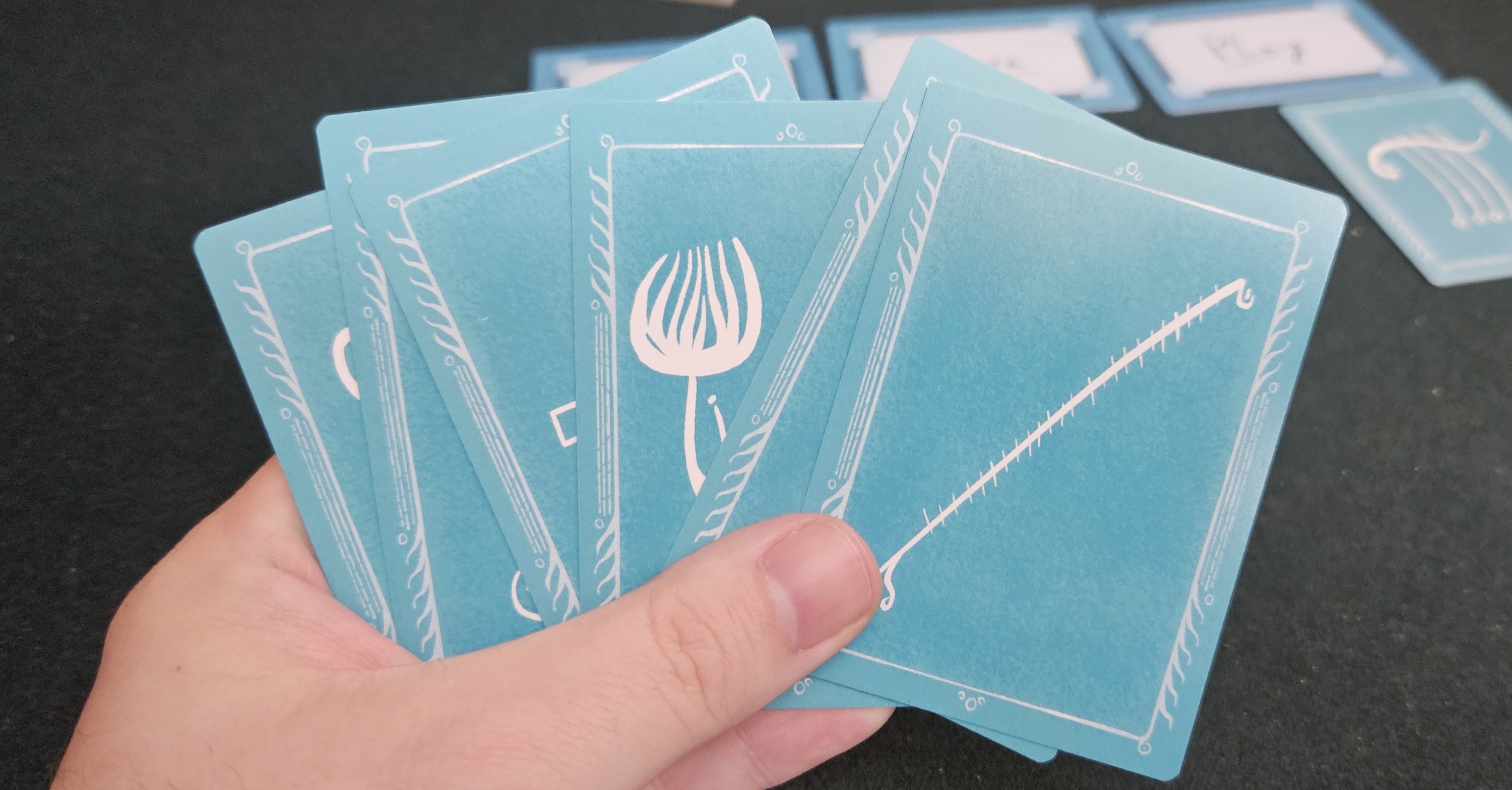
why, that's none other than the thistle-down hair of the thistle-down hair guy from that one book

What’s this nonsense?

So you sort. And sort. And sort.

I’ve always found it beautiful, our human tendency to see shapes in foliage and gods in static. We are thing-ordering machines, if you want to go that way, with such a talent for hearing music and witnessing divine geometries that we sometimes drive ourselves mad. When we look at the cards Wake has illustrated, we don’t see nonsensical scribbles. We see — so many things. Little projections of our selves. Examinations of our private pareidolia. Here is a hand-tied fly, ready to be cast into the river. There is a tadpole bopping along to a song. Which song? “Barbara Ann” by the Beach Boys. It could be none other.

When the game begins, we receive three categories. These, like everything else in Out of Sorts, have been retouched from the original edition. Perhaps we have been tasked by our alien overlord to organize their xenic scrawl into Death, Math, and Art History. Or perhaps Royalty, Life, and Rituals. Some combinations are easier than others. Some seem impossible. What’s the crucial visual distinction between Reptiles and Monsters? How about Thermodynamics versus Cosmos? Best of luck. We’re gonna need it.

There are two roles. One player is the Sorter, responsible for shelving these cards. In game terms, assembling them into a hand. Everyone else is a Finder. They find the cards, both at the beginning of each round and then when the alien decides to check our homework.

This latter portion is the game’s version of a pop quiz. One by one, the Finders reveal cards from the deck and put them into an order that matches the hand built by the Sorter. It’s analogous to diving into a card catalog for some random book, then immediately identifying where in your personal ordering system you’ve decided to place it. Structural Dynamics of Flow, easy, that’s in the middle. Noblesse Oblige & Other Obsoletions, that goes after the first one. Wheels: The Denunciation. Uh oh, that’s in the same category as the previous title. Fortunately, we created a sub-category that lands it squarely before that one.

Except here we’re faced with alien squiggles rather than readily-identifiable classics of the Western Canon. Sometimes the symbols collapse into a mental mishmash. Other times we spark the magic that is our capacity to organize even the most nebulous of concepts. Within a century, pedants will grouse at one another over which category is truer than the other. Mostly, we’re spinning these categories on the fly, terrified of being fed out the airlock.
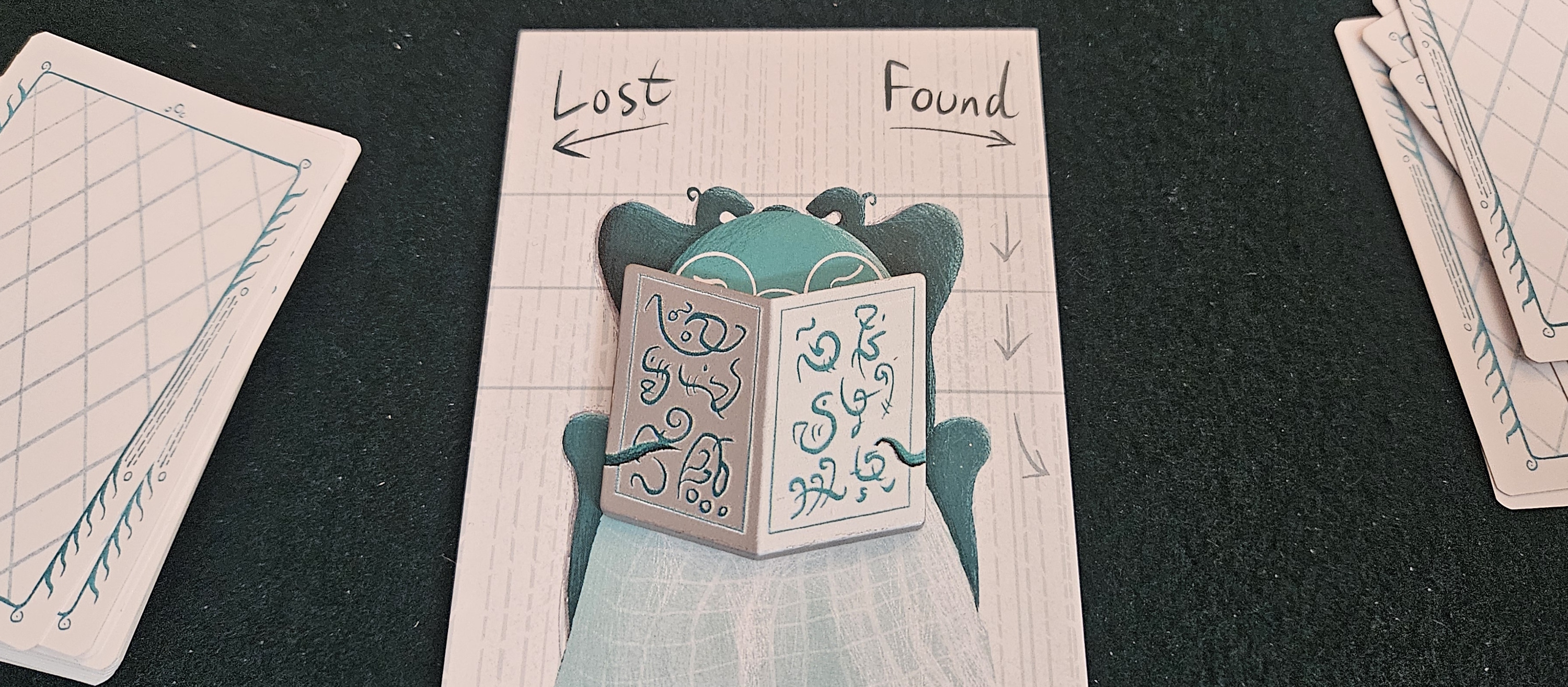
get outta my town, Flock

These surveillance measures are getting out of hand.

Where this latter edition departs from the original is in its open-ended nature and overall fluidity. The original, if you haven’t played it, was a march to a finish line that probably never arrived. Victory required passing through every one of the game’s checks. Nine in total. I’ve never managed it. Frankly, I’m not actually sure it was possible for normies to accomplish.

This time around, Wake has grown more playful. As before, the game begins with a twenty-minute timer, followed by escalating requests from the alien. Only this time, rather than hoping you’ll make it through all nine rounds, the game assumes you’ll falter. Maybe we’ll deplete our limited supply of minutes. Or maybe the alien will notice the errors in our categorization system. (Adorably, it peeks suspiciously from behind its alien magazine. What we cannot know is that its reading material is smut.)

Either way, we’re given one last chance to sort the deck we’ve created, ordering the entire thing in a panic. The more checks we passed previously, the more we have to sort, but also the longer the alien gives us to accomplish our task. Our performance awards us a final score, tallied for every card we put into its correct place. As conclusions go, it’s far smoother than what Out of Sorts provided before, more of a crescendo than an abrupt termination.

But that’s not all. While our score matters, Wake also rips a page from Jon Perry’s Hot Streak by assigning our rank a post-script to this whole debacle, a one-sentence note right out of a ’90s sports flick. “Bobby went on to play in the Majors. Tom married Queenie. Jerry died of lung cancer at 34 from smoking eight packs a day.” That sort of thing. Only more likely to involve airlocks.

These changes make the new edition gentler in some ways, more approachable, but this isn’t to say it’s been defanged. If anything, the game has been given a rounder shape, one that suits its gameplay so perfectly that it’s hard to imagine it ever occupied a different vessel. In fact, I’d half-convinced myself that it was always this way. I had to go back to the original rulebook to make sure I wasn’t imagining a slightly worse version of the same game.

There are other little additions. The biggest is a variant that sees the alien librarian occasionally interjecting its own recommendations. Sometimes these are helpful, like having the Sorter flip a card around so everybody can see it. More often, they’re petty annoyances, like tossing a book onto the front of the stack or having the Finders assign a title in the Sorter’s place. It’s a small alteration, but worthwhile in how it forces your squad of unwilling astro-librarians to adapt to further impositions.

"How about you stop sucking" GEE THANKS ALIEN

There’s now an ultra-mean variant where the alien proposes ideas.

All told, Out of Sorts is every bit as good as I remember. Partly that’s because it’s such an improvement that it retroactively persuaded me that this is how the game was always played, a suitable trick for a game about both the fuzziness and indefatigability of creative memory.

But the real reason is because it’s still that same weird memory game, only improved in nearly every way from Wake’s earlier effort. For a game about alien libraries, Out of Sorts is defiantly human. Its illustrations are hand-drawn, its design is iterative, and its central spark is the same promethean fire that is our human capability to organize and imagine. I love its squiggles and crotchety alien kidnapper. I love even more what it reveals about our human capacity to index a shelf of shame.


A complimentary copy of the new version of Out of Sorts was provided by the designer/publisher.

(If what I’m doing at Space-Biff! is valuable to you in some way, please consider dropping by my Patreon campaign or Ko-fi. Right now, supporters can read the next installment in my series Talking About Games, this time tackling the topic of what makes a good list! Naturally, the piece includes a list.)


Ares Games considers extra website protection after suffering multi-day DDoS attack

20. August 2026 um 16:14

Ares Games is considering bolstering its website protection after suffering its first ever DDoS attack, which it says left its site inaccessible for about 10 hours across three days of difficulties.

The Italy-based War of the Ring publisher said thousands of fake requests repeatedly saturated its server bandwidth and CPU earlier this week, temporarily preventing some customers from reaching its main website and e-commerce site, which is also used for preorders and crowdfunding pledge management.

Ares director of production Roberto di Meglio told BoardGameWire no customer data was compromised during the cyber attack, adding that he was inclined to believe the company was targeted randomly rather than specifically.

He said, “It’s difficult to assess the exact monetary loss in terms of missed orders. We can assume most of the potential customers affected by the issue will probably come back at a later moment, so the revenue should be delayed but not lost – especially if the customer was visiting for something specific, like a pre-order or pledge manager.”

Ares’ e-commerce infrastructure supports ordinary direct sales alongside preorders and crowdfunding activity. The publisher has continued to use crowdfunding extensively, with its 16th Kickstarter project, Mega Empires: The Far East, completing its campaign earlier this year.

The DDoS attack comes after Ares said last year that it was developing its direct sales business to help offset reduced profits through traditional distribution channels amid the US tariff volatility.

Di Meglio told BoardGameWire at the time that the company planned a combination of reduced inventories, increased prices and product selection alongside “developing our direct sales to make up for the loss of profit through the traditional distribution tiers”.

While Ares has experienced other hacking attempts previously, Di Meglio said this was the publisher’s first DDoS attack. Its server administrators introduced additional security rules in response, and Ares is now considering whether to add further protection such as a DNS proxy service like Cloudflare.

But he added, “The main concern is that every rule or system you implement to stop this type of ‘swarm’ attack potentially might stop or slow down a regular visitor, so you have to find the best compromise between keeping danger out and allowing customers in.”

The incident comes as DDoS attacks have become more numerous and larger across the internet. Web application security and performance giant Cloudflare recently said it detected a 519% increase in hyper-volumetric DDoS attacks across its network during the first half of 2026.

The post Ares Games considers extra website protection after suffering multi-day DDoS attack first appeared on .

All Flesh Is Grass

20. August 2026 um 00:28

Today's title comes from an old anonymous poem: The steed bit his master; how came this to pass? He heard the good pastor cry, "All flesh is grass!"

One of my favorite games ever designed is getting a new edition. Apart from some component upgrades and better availability, nothing has changed. Which is precisely what this title needed.

So come on in. The tea’s hot and the fire is crackling. HA HA. You just scalded your tongue. That means I’m the winner. It also means today’s game is Schadenfreude, the most joyously nasty trick-taker out there.

Ah, so I'm in total control, but I'm also not going to score anything. Cool.

If you know Schadenfreude, you know this is one wacky hand.

I’m convinced that Schadenfreude is the best “pure” trick-taker ever crafted. Designed by the mysterious ctr, historically this one has been hard to nab. Not so any longer, because the new edition is coming via Office Dog, the same studio that brought us the Lord of the Rings trick-takers, Fellowship and Two Towers, both of which are lovely.

As I noted in my original review, Schadenfreude unfurls like a joke that keeps on giving. It’s comparatively bare of ornamentation, nothing like some of my personal favorites of the genre. The tricks are must-follow. The triumphs are nonexistent. There are two special cards, a zero and a ten that can match with any suit, but I suspect they’re mostly there to round out the card count.

The gimmick, such as it is, is that the player in second place wins the trick. At the level of sheer utility, this does a lot for the usual reliability of high-value cards. You’re holding a nine? Too bad. You’ll never get it into your scoring pile. At best, it’s a way to push an eight into somebody else’s score pile. Unless somebody is holding that wild ten, anyway. Then the nine might be your undoing. But now I’m getting ahead of myself.

Looks great, still simple. Perfect.

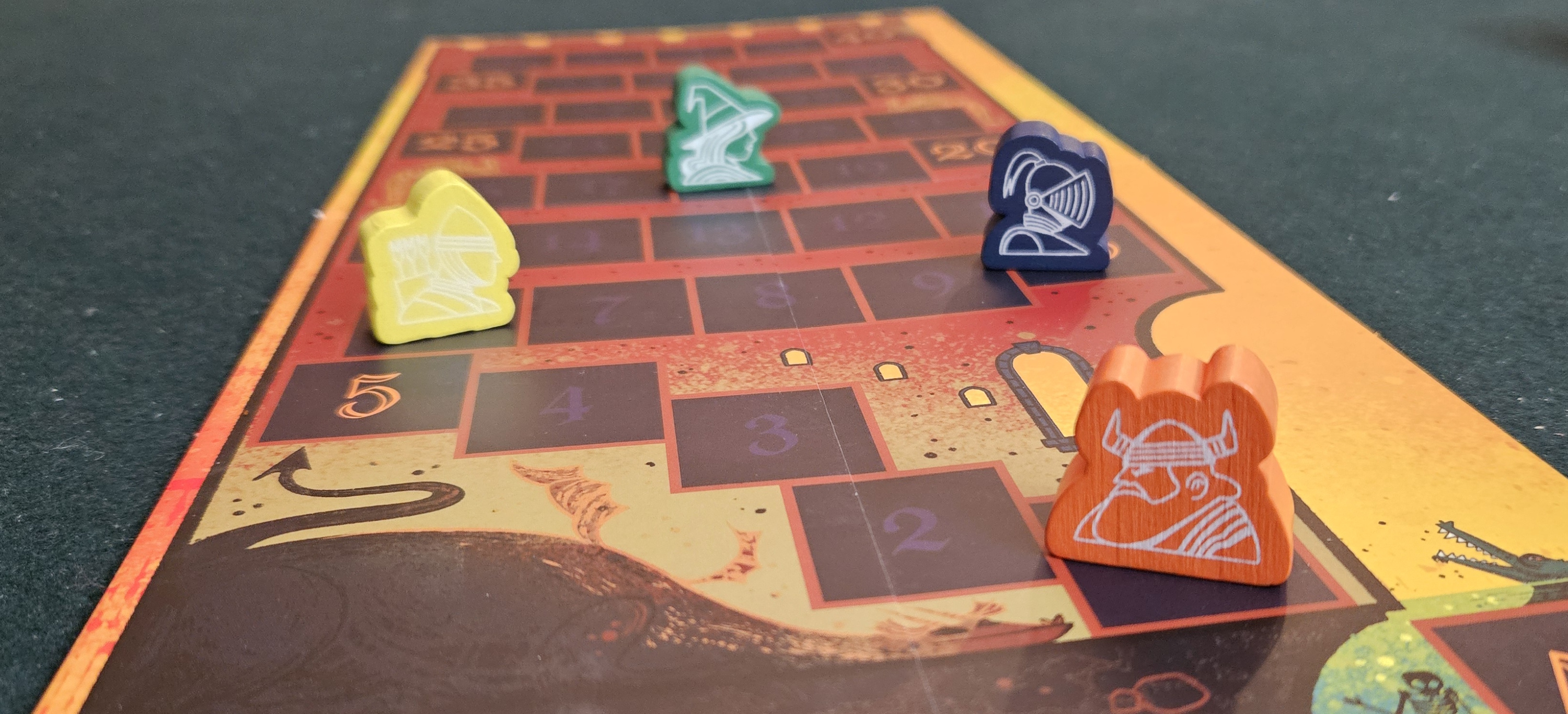
The score tracker is more than just cards and meeples!

Schadenfreude’s shenanigans extend to the entire scoring rubric. Whenever you win a trick, you claim the winning card plus anything played off-suit. These cards then sit in your score pile, where they’re worth points at the end of the hand. Unless you later win a duplicate. Then any duplicated cards obliterate one another like those two guys in Time Cop.

Avoid duplicates, check. Easy, right?

Except you don’t necessarily want to score, at least not too much or too often. The game only ends once somebody breaks past forty points. But this isn’t a threshold for victory. Oh no. It’s a threshold for losing like a chump. Anybody over forty is ineligible to win. Whoever’s sitting at the highest score after that game-concluding bust becomes the winner in their place. Provided not everybody busted on the same round. Which, yes, can absolutely happen. It’s never not hilarious.

Between this rubric and the game’s restraint — only four suits, no special powers or rules exceptions — Schadenfreude provides tremendous range to strategize. It’s the sort of game where every play might force-feed a poison pill to a rival. Maybe even three poison pills at once. Early on, it’s common for somebody to gobble up as many cards as possible, only to realize their comfortable lead puts them in very real danger of busting. Suddenly their play grows conservative. Only now everybody else wants them to choke on as many cards as possible.

Also, the card corners aren't sharp edges. Which wasn't the case for every printing of the original game, but I did have one copy where the corners were perfect finger-slitting points.

It’s now easier to tell the suits apart.

Above all else, it’s funny. Lots of trick-takers are funny, but I don’t think any one of them has made me laugh as hard as this one. Some have called the game “themeless,” except it’s a perfect expression of an emotive theme rather than a physical setting. Schadenfreude is about schadenfreude, about the joy that comes from watching somebody topple from their high horse. Which is probably why the cover art is now a knight taking a head-dive from his noble steed. I hope he dents his helmet and spends the whole evening scrubbing grass stains from his coat. Git.

Ahem. Anyway, this is more of an announcement than a proper review, and for that I’m sorry. But Schadenfreude is a wonderful little artifact, the rare sort of game that’s not only a joy to play but also to explain. I’ve yet to see it flub at the table.


A complimentary copy of the new version of Schadenfreude was provided by the publisher. Which was very kind of them, considering I’d bought the damn thing three times previously, twice at great expense because it was impossible to actually find anywhere reasonable.

(If what I’m doing at Space-Biff! is valuable to you in some way, please consider dropping by my Patreon campaign or Ko-fi. Right now, supporters can read the next installment in my series Talking About Games, this time tackling the topic of what makes a good list! Naturally, the piece includes a list.)
“Our attempts to do things ‘different from the others’ came back to bite us”: Plaid Hat’s Colby Dauch on The Monolith’s Kickstarter failure and rapid turnaround

19. August 2026 um 20:30

Plaid Hat Games launched its Kickstarter for The Monolith in June with a trio of successful crowdfunding campaigns under its beltonly to pull the project three days after launch when pledges unexpectedly ground to a halt, despite quickly beating its $20,000 goal. Less than two months later the revamped campaign is back, and has already pulled in almost four-times the amount the cancelled campaign managed in the same amount of time. In this first-person piece for BoardGameWire, Plaid Hat founder and CEO Colby Dauch explains why The Monolith exposed flaws the publisher’s previous campaigns had masked, what he believes it got wrong, and why the changes made for the relaunch appear to be working.

Plaid Hat Games is relatively new to crowdfunding and we’ve experience our first major setback in that arena. We launched our fourth ever crowdfunding campaign back in June, this time for a new game called The Monolith.

By the second day of the campaign the pledges had fully stalled out. It was self-evident that we had made mistakes, so we pulled the campaign with the intention to relaunch it after analyzing what had gone wrong, and doing what we could to address it.

As I write this article, I don’t know if our hunches will turn out to be correct. This article is scheduled to be posted as we relaunch the campaign, so I suppose we are all going to find out together! I’m more than a little nervous. Allow me to provide some background essential in understanding how we’ve come to make the choices we’ve made.

Plaid Hat founder and CEO Colby Dauch

We’ve been around since 2009 and watched from the sidelines as crowdfunding took hold and grew into a large part of the board game industry.

For many years we swore off crowdfunding. Internally we were critical of it for a number of reasons. My biggest reservation was that it felt dishonest to me that an established company would tell its customers “we need your help to make this product”, when they had already proven previously that they were capable of putting together the funding necessary to launch a new product onto the market, without requiring the customer to buy said product a year or more in advance of its release.

However, things have changed over the years in more ways than one and honestly, it has been a bad business decision to hold out on the crowdfunding model for as long as I have.

When we did finally enter the crowdfunding space a couple of years ago I told myself, and others, that there was clearly no longer an expectation that the companies going to crowdfunding needed to be there. I believed it to be understood that it was more akin to a pre-order system and that the consumer knows that. I even said as much in the article I was interviewed for on this very site, posted on June 30th, about us pulling the Monolith from Kickstarter. It’s not true. I had only convinced myself that it was.

I’m in the midst of reflecting on every decision I’ve made that led to a failed campaign, and what that failure means for my company, the people I employ and my family, if I’m not able to correct course. The reality is that we moved to crowdfunding because the things that made us successful in the past aren’t working anymore and we were growing desperate for a solution.

Getting attention on a board game release announcement isn’t free anymore. It’s not news. At best it’s a bullet point on a long list of new release announcements for the week. The traditional method we’ve long employed of selling to distributors who sell to retailers who sell to players, sadly seems to be falling apart for us, and I suspect for most publishers.

So we found ourselves trying to incorporate crowdfunding into our business model while simultaneously telling ourselves we could do it different – better. Our approach:

  • We will severely limit the use of exclusives. We don’t want people feeling like they HAVE to buy the product now or they will be missing out.
  • We aren’t seeking to punish the people who have long supported their local board game shop by purchasing our products through them.
  • Most of all we don’t want to manipulate our customers by preying on their fear of missing out.
  • We will reduce the long wait between the time you back a game and the time you get that game by being fully ready to go to production at the time of the Kickstarter.

There were flaws in this approach. Flaws that I believe were masked in our first three campaigns because they all had something else big going for them.

Wandering Galaxy was the latest installment in a series of games we had released that had gotten a lot of attention for their amazing storytelling and voice acting (in a companion app).

Ashes Ascendency was a reinvigoration for a game that has ten years worth of glowing reviews to put in front of people and a dedicated fanbase.

Super Auto Pets Card Battle was based on an amazing and charming digital game, and we were able to rely on the attention of fans from that.

The Monolith had no predecessor.

The Monolith || Kickstarter image

This is why I believe our attempts to do things ‘different from the others’ has come back to bite us:

We wanted to limit FOMO.

A crowdfunding campaign must be compelling beyond the presentation of the game itself. You are asking the customer to pay for a game long before they can expect to have it in their hands. We need to give them a compelling reason to do that.

In the Super Auto Pets Card Battle campaign, the most popular pledge was by far the ALL-IN pledge, because it was the most compelling. You got all of the sets, all of the add-ons and in a storage box that would organize it all and only be available during the campaign.

I took away the wrong lesson. What I decided was that what those results were telling me was just that people want all the stuff, so with The Monolith let’s just make the core product all of the stuff.

We wanted to reduce the wait time on the game.

This is the one where I really messed up with The Monolith. As I established, the reality is that we needed to make changes to how we were doing things and I allowed myself to miss out on a key advantage to crowdfunding: measuring demand.

In an effort to shorten the window on how quickly we could deliver on a campaign, and further spurred on by a yearning to have a line at our booth for a new game release at GenCon or Essen (that feeling is the highest of highs), I started having plastic molds for the game well before the campaign so that they wouldn’t delay production – and remember this game was going to have all the upgrades packed in, so it was a lot of plastics and a lot of mold costs.

Further compounding the issue was that the mold costs were so high, to get the cost per unit down, I felt like I needed to be prepared to produce 10,000 copies. And like the molds, I got that production started before the campaign even started.

It was the exact kind of risk we had always needed to take when producing a game, but crowdfunding should have given me a chance to mitigate that risk, and in doing so really been a fulfillment of the core concept of crowdfunding to begin with: Asking the player to help be a part of bringing the game to the market.

So here is what we are doing differently with the relaunch of The Monolith campaign to try to address what went wrong with the initial campaign:

  • Creating a 1-2 player mini-expansion.
  • Lowering the retail price of the game and offering a larger discount on that already lower price for backers.
  • Creating a 6th shaman character add-on.
  • Creating glass blood tokens add-on.
  • Creating a metal first player and surge tokens add-on.
  • Creating an All-In tier with all of the add-ons included at a lower price than purchasing them separately.
  • Different marketing partner and strategy.

Finally, here are my take aways for how we will do campaigns differently in the future:

  • When possible, create a version of the game that focuses on lower price and a version that focuses on maximum bling.
  • Be more willing to compete with the price point that we and everyone else knows online retailers are going to put on our games.
  • Give the campaign a chance to communicate what the demand is. We will still be production ready, but I won’t be putting the cart directly in front of the horse again.
  • Better leverage the community-based systems that already exist to support crowdfunding.

Follow Up

As I write THIS bit, the campaign has relaunched about 24 hours ago and is doing much better this time!  By a large margin, backers are opting for the pledge level that includes all the add-ons. So I believe this supports the theory that the add-ons were essential for a successful campaign. 

It is hard to quantify exactly how much each of our changes contributed to the better result, but overall, the adjustments seem to be working.  I’m so grateful to everyone who has backed.

The Kickstarter for The Monolith, which is designed by Phil Gross, is set to run until September 17.

The post “Our attempts to do things ‘different from the others’ came back to bite us”: Plaid Hat’s Colby Dauch on The Monolith’s Kickstarter failure and rapid turnaround first appeared on .

Unstable Unicorns maker launches new studio led by rising star designer Marceline Leiman

18. August 2026 um 16:18

Unstable Unicorns publisher Unstable Games has launched a new studio led by rising tabletop designer Marceline Leiman, who will shape its creative direction and design every game it releases for at least the next few years.

Ordinary Magic plans to publish light strategy board and card games set within a single expanding world, with Leiman telling BoardGameWire the studio is looking to put out designs “offering whimsical, magical moments of the everyday” alongside high interaction.

The move comes nine years after Unstable Games owner TeeTurtle’s hugely successful Kickstarter campaign for light card game Unstable Unicorns, which raised more than $1.8m from over 33,000 backers – and went on to sell more than a million copies worldwide by 2023.

The success of that release led to t-shirt maker TeeTurtle creating its dedicated tabletop studio Unstable Games, which has sold millions across its debut title and follow-up releases such as Here to Slay, Happy Little Dinosaurs, Casting Shadows and Twisted Cryptids.

Ordinary Magic’s arrival comes hot on the heels of Unstable Games completing by far its biggest crowdfunding campaign yet, with Here to Slay Dungeons raising more than $6.6m on Gamefound in April.

Leading the new studio continues a rapid rise for Leiman, a 2025 Diana Jones Emerging Designer Program winner whose published designs include High Tide, Wildberries and Dino Racer – the latter of which picked up significant buzz at Gen Con this year, and is currently ranked at number two in the BoardGameGeek Hotness.

Ordinary Magic studio lead Marceline Leiman

Her route into professional board game design began with the 2023 release of her solo mode for North Star Games titles Oceans, which led to a part-time developer position at Underdog Games, as well as client work for Office Dog, WizKids, Allplay, Button Shy Games and Maestro Media, according to her website.

But Ordinary Magic represents her first full-time job in the industry, with Leiman saying the roots of the venture going back to the period immediately following the downsizing of Underdog in April 2025, when the publisher laid off almost its entire staff as it attempted to weather the impact of US tariffs.

She told BoardGameWire that Underdog president Nick Bentley, who was also let go by the company at that time, quickly introduced her to Unstable Games, with the pair initially planning to build the new operation together.

Bentley ultimately went in another direction before that arrangement was finalised and is now director of game design at Taco Cat Games, which rebranded from Dolphin Hat Games in May to reflect the huge success of its standout title.

Leiman said, “We both were fully intending to start up a new studio within Unstable Games. The proposition was always that they were going to do sort of an incubator program, is the way that they proposed it to us.”

She added, “My role within the studio was always going to be the capacity of being a game designer. Only now with Nick no longer part of the project, it has allowed me to take more of a formal leadership role.”

Leading the line

The resulting structure puts Leiman’s work at the centre of the studio, rather than positioning Ordinary Magic as a conventional publisher or imprint sourcing games from a roster of designers.

She told BoardGameWire, “Every single game that comes out of Ordinary Magic is a design of mine. I am the designer of each of the games coming from the studio, and you should expect that at least for the next several years.

“That does not mean that you won’t ever see a game from anyone else besides me from Ordinary Magic. But think of me as the shepherd of the studio.

“I am leading the direction of the design behind Ordinary Magic and the types of games you should expect, and the feelings from the games that you should expect. But I am absolutely open to that changing; it’s not a hard rule.”

Leiman added that although she is not currently accepting game pitches, she is “always interested in learning what designers are working on, both those I am familiar with and unfamiliar with”.

She told BoardGameWire, “I love sharing ideas, and I think the spirit of design is still very much open in terms of the way I like to talk with other designers. I always want to consider whether or not in the future, an opportunity is available between Ordinary Magic and a designer looking to pitch their games.

“However, I cannot promise at this time that we are accepting any pitches that we might receive. If I were to look at any pitches, what I’ve described in the past is that Ordinary Magic is looking for games that are offering whimsical, magical moments of the everyday. Not high magic, not combative, though highly interactive.

“I think if someone wanted to pitch to me a game with a theme that was more focused on a curious bit of a real-life moment that inspired them, that would interest me more than somebody who’s coming to me with a pitch purely with a magical concept. I am much more interested in the grounded reality of this world rather than the high fantasy.”

Finding direction

Leiman said the studio’s creative direction would be to create interactive games which give “meaningful reason for other players to be at the table with you”, but added that would likely not extend to full “take-that”-style designs.

She said, “What you should expect from us is strategy-light strategy style games, sometimes card games, sometimes board games. I am also very interested in exploring the realms of cooperation as well as indirect player interaction, or both direct and indirect forms of player interaction.

“Something that you’ll find from me is that I am very interested in sort of passive aggression in games, where the decisions I am making might be to block you or to prevent you from getting something before me. A very old-school style of interaction, German old-school I think some people would think about.”

Ordinary Magic’s first three titles are set to launch together on Gamefound this autumn, taking players to a bookshop, hotel and corner café through The Curious Little Bookshop and two as-yet-unrevealed titles.

Leiman said the original plan had been to launch the games individually, but that Unstable ultimately proposed putting all three into the same campaign after their development schedules aligned – a situation which partly arose due to Leiman’s rapid work rate.

The Curious Little Bookshop || Gamefound image

She told BoardGameWire, “The method that I was taught game design was very much under the tutelage of my professors at NYU Game Center, and there we worked very much within a fast-paced work environment.

“Joining this studio very much is like returning back to that environment, which I am very comfortable being in. The way that I’ve worked within the studio is quite fast, is quite rapid, I guess, in relation to other people’s speeds.

“But for me, within a short amount of time, what I am looking to do is try out many ideas and fail with many ideas as quickly as possible, so I could find the core of what is fun, what is interesting, what is memorable about a game.

“It just so happened to align with our release schedule that I would have these three games. Our original plan was to release them one by one, but just with the way that scheduling worked out, we decided that it would be best to put our best foot forward with this new studio by showing the strength of our design, with the strength of our art, and production capabilities.”

Operationally, however, Ordinary Magic is currently far less separate from its parent studio than its distinct branding might suggest.

“The only difference between Ordinary Magic and Unstable Games in terms of operation is me,” Leiman told BoardGameWire.

She added, “Everything that you’ve come to expect from me – my work ethic, my taste, my voice – you should expect to be part of these games.

“Not to say that I don’t work with the Unstable Games team as well. We actually do cross-pollinate a lot in terms of our playtesting, in terms of our conversations, in terms of problem-solving.

“So it’s not like I’m totally in a silo or and neither are they from me. There’s definitely a lot of creative support going back and forth between the two studios. And as the studio continues to develop and grow in size, naturally Ordinary Magic will change with it.”

Speaking about the shared world envisaged by Ordinary Magic for all of its releases, Leiman told BoardGameWire, “You should not expect to see any games released from Ordinary Magic that are not part of this world.

“We’ve talked a lot about what that means in terms of building the IP, sort of what direction could it go in the future? Does it open us to different forms of media, different forms of games, or are they all going to be board games and card games?

“We’re leaving that station open right now. But we’re definitely open to exploring what it means to have this IP as we look forward to the future.

“As for recurring characters and locations, I would say keep your eyes open for the GameFound campaign, and I think you’ll be very excited to see some crossover moments between them.”

Ordinary Magic’s debut Gamefound campaign is currently scheduled to launch in the autumn.

The post Unstable Unicorns maker launches new studio led by rising star designer Marceline Leiman first appeared on .

arsEdition tapped Asmodee for toy trade distribution after launching its board game line last year

17. August 2026 um 16:38

German children’s book, gifts and stationery publisher arsEdition has confirmed it has tasked Asmodee with distributing its fledgling board game range to specialist toy retailers and some wholesalers, after making its first significant move into tabletop games just under a year ago.

Asmodee has been distributing the Bonnier-owned publisher’s games under the agreement since the beginning of 2026, creating a split-channel model that sees arsEdition continue to handle distribution within the book trade and major book retail chains.

The pair said the move gives retailers improved availability, clear product range structures and coordinated support across both distribution channels – with an aim of sustainably increasing the visibility of arsEdition games in the market and generate further momentum in the family games segment.

arsEdition launched a dedicated games programme last September focused on family-weight games for ages 6, 8, and 10 and up, with an opening slate of seven titles including Reiner Knizia designs Oshiya Tokio and Guardian of the Treasure, and Sophia Wagner’s Twilight Watch.

The board game unit lead, Volker Hirsch, previously spent six years as creative director at Amigo Spiele until 2001, and has also since worked as head of product development at Ravensburger Digital, and as a partner at former Games Workshop collectible card games subsidiary Sabretooth Games.

Some of arsEdition’s debut line of board game releases

arsEdition publisher Dagmar Becker-Göthel said when the range was unveiled last year that games represented a growing category in the toy trade, while also becoming increasingly important for booksellers – providing the rationale for developing a range capable of operating across both channels.

The publisher said at the time it planned to release new games twice a year.

Rebecca Roscher, commercial director at arsEdition, said, “We are currently putting a great deal of energy into the development and production of exceptional family games for ages eight and above, which are characterised by innovative mechanics, strong brands and unique design.

“With Asmodee as our partner, we can now position our games even more strategically and comprehensively across the relevant distribution channels.”

Upcoming releases from arsEdition include include Toshi, a 1-4 player tile-laying game from Friedemann Friese scheduled for September, and Cat and the Tower, a cooperative dexterity game from Masakazu Takizawa.

Box cover for Toshi, designed by Friedemann Friese

The company also continues to work with prominent designer Reiner Knizia, with its website currently listing seven products from the storied creator.

For Asmodee Germany, arsEdition adds another outside publishing partner to a distribution operation that has continued to broaden its third-party portfolio.

Last year it agreed to add selected Moose Toys games to its distribution network in Germany, Austria and Switzerland, and in June 2025 struck a wholesale distribution agreement covering a large part of German publisher Frosted Games’ range.

Asmodee Germany managing director Udo Fischer said the arsEdition deal brought together the companies’ different areas of expertise.

“The trusting collaboration between Asmodee and arsEdition brings together two distinct perspectives – expertise from the book trade combined with many years’ experience in board and card games – which complement each other perfectly,” he said.

“By entering the world of board games, arsEdition is providing a strong additional impetus in the family segment.”

arsEdition is part of Bonnier Media Deutschland, which also owns publishers including Carlsen, Piper, Ullstein and Thienemann-Esslinger. The wider group reported net sales of €336m in 2025, sold 75.5 million books across all formats and employed an average of 795 full-time staff.

Bonnier Media Deutschland describes itself as the largest German book publishing group, with particularly strong positions in children’s publishing, comics and illustrated formats.

The post arsEdition tapped Asmodee for toy trade distribution after launching its board game line last year first appeared on .

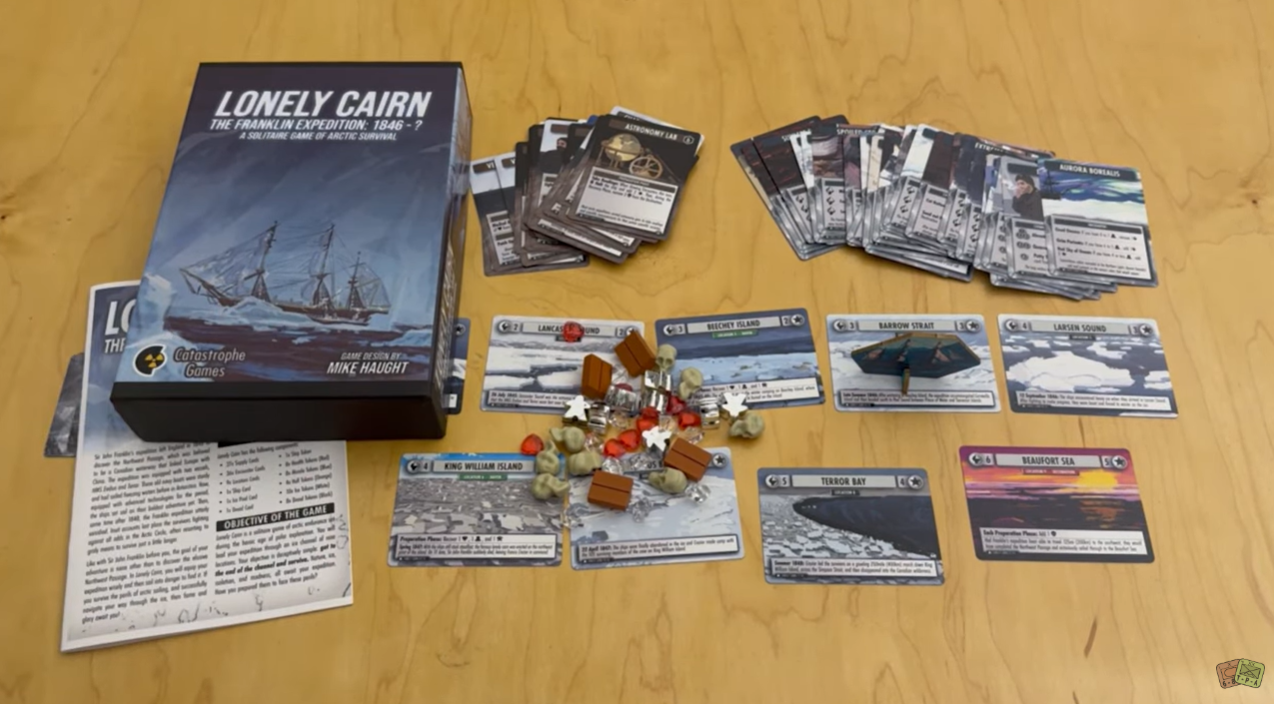
Unboxing Video: Lonely Cairn: The Franklin Expedition 1846-? from Catastrophe Games

Von: Grant
15. August 2026 um 14:00

There are a million ways to die in the Arctic, so carefully choose your supplies and read the ice well, and you just might secure the coveted prize of discovering the fabled Northwest Passage.

Lonely Cairn is a solitaire game about finding the Northwest Passage in the mid 1800’s. Modelled and based upon the ill-fated Franklin Expedition, players will need to equip their expedition and carefully chose what to take with them into the arctic. They will then sail though a channel of icy locations, facing deadly encounters along the way. They must reach the exit by the end of 8 turns, or face being locked in the ice forever.

-Grant

Africa’s longest-running board game convention eyes grants for local designers as part of 10th anniversary crowdfund

14. August 2026 um 14:29

Africa’s longest-running board game convention is hoping to use its tenth anniversary to put more direct support behind the continent’s emerging designers, with plans for a new grant programme if its latest crowdfunding campaign reaches $20,000.

Nigeria’s African Boardgames Convention (AB Con) has set a $14,000 target to support its November event – more than 50% above the $9,000 goal it set last year – as it prepares to return to a two-day format for the first time since 2023.

The November 27 and 28 event in Abuja will include prototype playtesting, workshops, industry discussions, networking and a marketplace alongside its consumer-facing game demonstrations and tournaments, according to organiser NIBCARD Games.

But potentially more significant for Africa’s developing board game industry are the additions AB Con hopes to unlock if the campaign moves beyond its base target.

Reaching $20,000 would launch an AB Con Designers Grant, providing financial support and mentorship to African tabletop designers to develop prototypes, improve their games and showcase them at future editions of the convention.

A $22,000 stretch goal would introduce an Impact Award recognising people and organisations helping develop the continent’s tabletop ecosystem, while $30,000 would extend this year’s convention from two days to three.

The campaign describes the designer grant as an attempt to create “more opportunities for African games to reach local and international audiences”.

That represents another step in a decade-long attempt by AB Con and organiser NIBCARD to build infrastructure around what was an extremely small modern tabletop design community when the convention began.

AB Con says there were fewer than 10 known indigenous tabletop games and only three published game designers in Nigeria before it launched in 2016, with few places available for people to regularly play modern board games.

BoardGameWire reported last year that the number of known modern games from Nigerian designers had since passed 100, while the number of designers had grown to 25.

AB Con has provided a crucial meeting point and catalyst during that expansion, bringing together designers and publishers alongside manufacturers, retailers, educators and players.

Gamers, publishers, designers and organisers at AB Con 2025 || Photo Credit: AB Con

Nigerian board game company NIBCARD’s role in developing that ecosystem was recognised with the Diana Jones Award for Excellence in Gaming in 2021.

The award committee described the company as being “the multi-faceted company at the heart of the nascent Nigerian games industry”, highlighting its work publishing games, manufacturing for other companies, mentoring designers, running a game café and organising AB Con.

NIBCARD itself says it has now designed more than 70 tabletop games since being founded in 2013, while its activities have expanded across publishing, manufacturing, education and digital games.

While those efforts have proved a pillar of the region’s hobby gaming growth, NIBCARD and AB Con founder Kenechukwu ‘KC’ Ogbuagu told BoardGameWire there were still large challenges around getting Nigerian and African designers and games to break into North American and European markets.

He said, “It’s a combination of several factors, but I would highlight visibility, access, finance, and market access.

“There is a significant lack of visibility for African games and designers. Publishers often don’t get to see the games being created here, while designers have very limited opportunities to meet and build relationships with publishers.

NIBCARD and AB Con founder Kenechukwu ‘KC’ Ogbuagu

“I have experienced this personally. I once received fully funded support to attend Spiel Essen, but was denied a visa. Last year, I was invited to GothCon on a fully funded trip, but I couldn’t even secure an interview date for my visa application.

“Finance is another major barrier. Even when a game is ready, designers need money to market it, work with content creators and reviewers, attend international conventions, and run crowdfunding campaigns such as Kickstarter or Gamefound.

“And for those who choose to self-publish, international shipping can make African games extremely expensive and difficult to compete with in global markets.”

He added, “One of our mission is to see African designers creating games that are enjoyed globally and, ultimately, seeing African-designed games recognised among the best games in the world.

“We have already started working towards this. Last year, with support from the Spiel Foundation, we showcased games from three African designers at SPIEL Essen 2025. We also started a game studio as a way to bring African games to light.

“But even as we build, from over 10 years of experience doing this, a lot of the impact are limited due to lack of funding.

“We are intentionally building AB Con to become a platform where African designers, games, publishers, distributors, and international industry professionals can connect.

“We want publishers from North America and Europe to see AB Con as a place to discover new designers and games from Africa, explore licensing and publishing partnerships, and build long-term relationships with the African tabletop industry.

“This is one reason we are committed to maintaining a two-day convention going forward, with the goal of eventually growing it into a four-day event. We want to create enough time and space for meaningful meetings, playtesting, networking, showcases, and publisher scouting.”

The growing scope of AB Con has repeatedly run up against the economics of staging the convention, however.

The event previously raised more than $23,700 through its 2021 Kickstarter campaign, and self-funded for the following two years – but was forced to return to crowdfunding in 2024 after soaring inflation in Nigeria weighed heavily on its finances.

That year’s campaign raised about $16,000 from 225 backers against a roughly $8,000 target – and AB Con increased its target to $9,000 for 2025, ultimately raising more than $11,000 from 144 backers.

Its new $14,000 base target represents another substantial increase. Organisers said the higher figure reflects both inflation and the cost of restoring AB Con’s two-day format, and will be used for venue and production costs, volunteer support, logistics, marketing, accessibility and expanded programming.

Nigeria continues to experience significant price increases, despite inflation having eased substantially from the levels that prompted AB Con’s return to crowdfunding.

The country’s National Bureau of Statistics currently reports annual consumer price inflation of 15.9% – down markedly from an almost 30-year high of 34% when AB Con launched its 2024 campaign.

Last year’s AB Con campaign was initially intended to support ambitions for as many as 3,000 attendees, compared with roughly 1,300 at the 2024 event and about 1,000 in 2023. The 2025 convention ultimately took place as a one-day event on November 29.

At least seven Nigerian designers showcased projects at the 2025 convention, according to Nigeria’s Independent newspaper, while participating publishers included Althra Games, ICE Game and Jesus Native Games.

AB Con founder and lead convener Kenechukwu ‘KC’ Ogbuagu said, “When we hosted the first AB Con in 2016, our dream was bigger than organizing an event – we wanted to help build an industry.

“Ten years later, we’ve seen designers launch original games, communities grow across Africa, and more people recognize games as powerful tools for learning, culture, business, and connection.

“This anniversary is not only a celebration of how far we’ve come but an invitation for the world to help shape what comes next.”

The AB Con Kickstarter is live now, with the convention scheduled to take place in Abuja, Nigeria on November 27 and 28.

The post Africa’s longest-running board game convention eyes grants for local designers as part of 10th anniversary crowdfund first appeared on .

Asmodee UK more than doubles annual operating profit to £34m as TCG boom powers growth

13. August 2026 um 20:11

Asmodee‘s UK distribution business more than doubled its operating profit to £35.1m last year, with the company citing the booming trading card game market as the biggest driver.

The profit surge for Esdevium Games – which officially re-registered as Asmodee UK Limited last month – came on the back of an almost 60% rise in turnover to £224m according to its latest annual accounts.

Asmodee UK said TCGs had a very strong year and remained the “pre-eminent category” in the 12 months to the end of March 2026, specifically highlighting Pokémon, One Piece, Disney Lorcana and Star Wars Unlimited as all playing their part in the result.

The distributor said board games continued “steady performance” over the critical holiday period, and picked out Brick Like This and The Fellowship of the Ring: Trick-Taking Game as strong releases from the year.

Brick Like This was the debut release from Asmodee studio Dotted Games, which was launched in 2024 after the company inked a partnership deal with LEGO to create a dedicated design studio focused on making new LEGO board games.

That studio launch came a few months after The LEGO Group and Asmodee had announced their first jointly-crafted board game, Monkey Palace.

Asmodee UK’s figures reflect the transformation taking place across Asmodee globally, where rapid TCG growth has increasingly shifted its revenue mix towards distribution.

The global Asmodee Group reported €1.68bn of net sales for the same financial year across its publishing and distribution operations, up 23%, while operating profit was up about 43.6%.

Asmodee Group’s Jan-Mar 2026 and last financial year revenue figures, showing the huge dominance of TCGs

More than 72% of group revenue was generated by distributing games published by other companies, compared with 63% a year earlier – and TCGs accounted for about 60% of annual group net sales.

BoardGameWire reported in May that sales of Asmodee Group’s own board games actually fell 5.8% over the period, underlining how heavily the group’s overall growth was being powered by distribution.

That trend has continued into Asmodee’s Group’s new financial year. Its April-to-June revenue increased another 20.9% year-on-year to €422.1m, with TCGs responsible for more than two-thirds of quarterly revenue, while board game sales rose 16%.

Asmodee UK’s annual results follow the unit changing up its leadership structure to kick off 2025, with a trio of senior executives being given updated roles amid the company splitting its operation again into three separate channels, carving out e-commerce as its own line.

The move came just over four years after Asmodee UK had split its sales and marketing efforts into two separate categories – hobby and independent, and national retail.

Asmodee bought a majority stake in UK board game distributor Esdevium in 2010, and began using Asmodee UK as its trading name in 2017. The UK operation updated its registered company name to Asmodee UK Limited last month.

A statement from the business said, “Whilst we value our 30 year legacy in the UK hobby market under the Esdevium Games name, this decision reflects our pride in belonging to the wider Asmodee business and marks an important step in enhancing the UK footprint within the group.”

It added that its fellow UK distribution operation Coiledspring Games will continue to operate as a distinct trading division of the company under its own website. Asmodee bought Coiledspring in 2018.

Coiledspring focuses on family-weight board games, party games, logic puzzles, jigsaws and soft toys, while Asmodee UK distributes a wider range of hobby board games, TCGs, miniatures and accessories.

The post Asmodee UK more than doubles annual operating profit to £34m as TCG boom powers growth first appeared on .

Flapjacks, Magic Tricks, & Sputtering Torches

13. August 2026 um 19:56

Yes, yes, it's nice that you've shown us their form factor. But how much do they WEIGH.

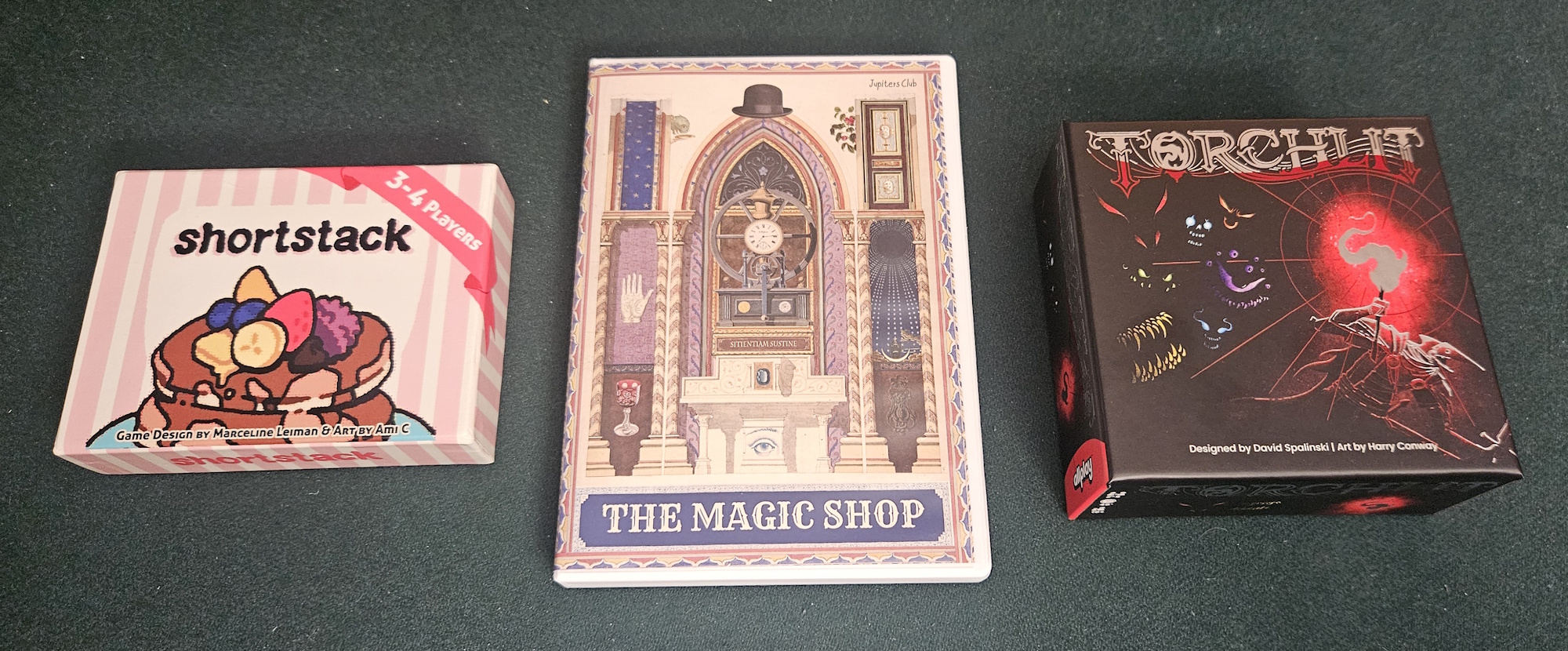
All I play anymore is trick-taking games. Fortunately, it’s an uncommonly smart genre. Today I’m covering three titles that highlight both the format’s breadth and what makes trick-taking one of tabletop’s most enduring pastimes — and one of its meanest.

In other words, these are trick-takers for jerkwads. Compliment intended.

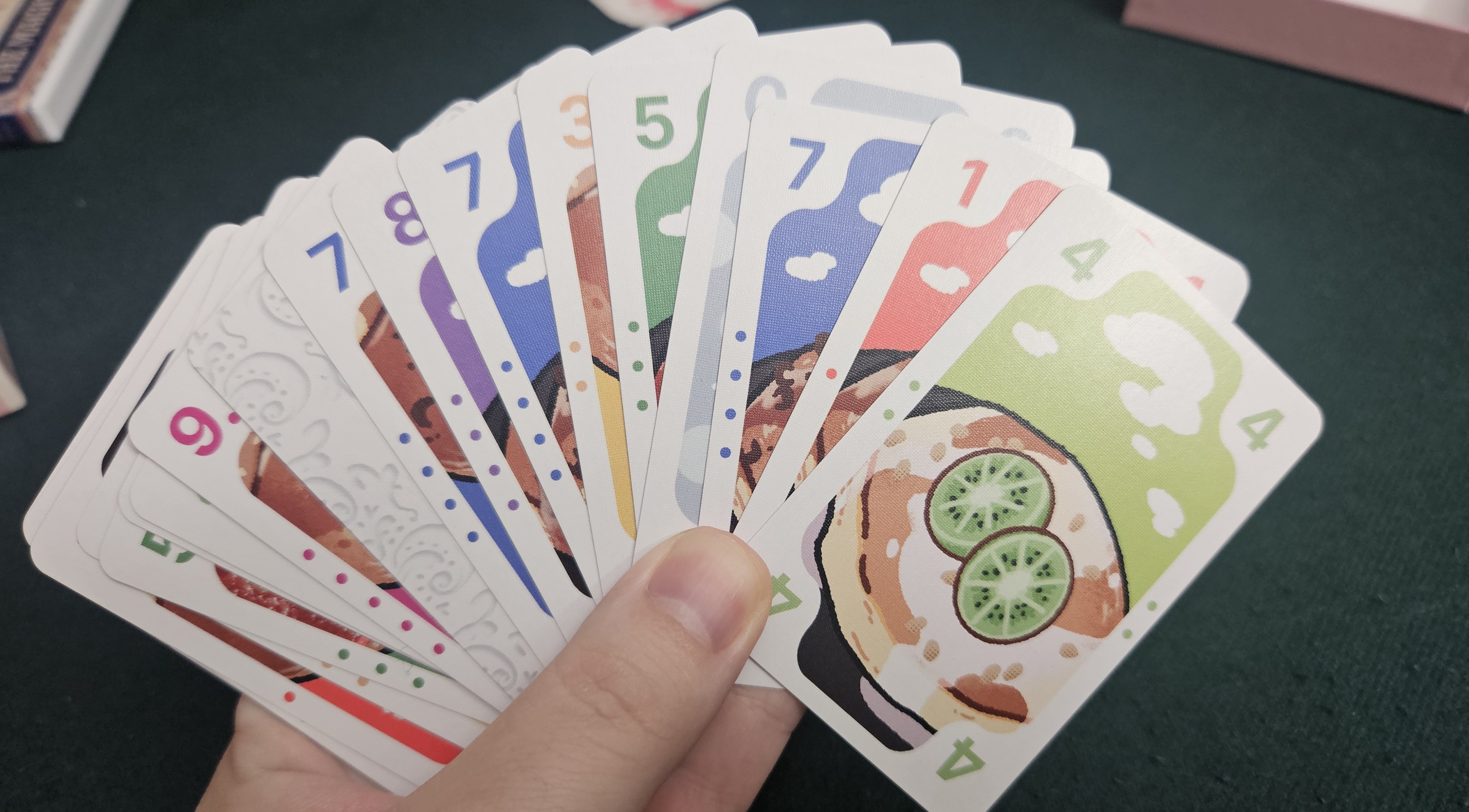
what kinda FREAK puts KIWIS on PANCAKES

I am not gonna review eating 18 pancakes.

Shortstack

Marceline Leiman has been busy. After the success of High Tide, it seems like her designs are popping up everywhere. (Pro tip: Dino Racer has the juice.) Most recently, Shortstack has been making the rounds.

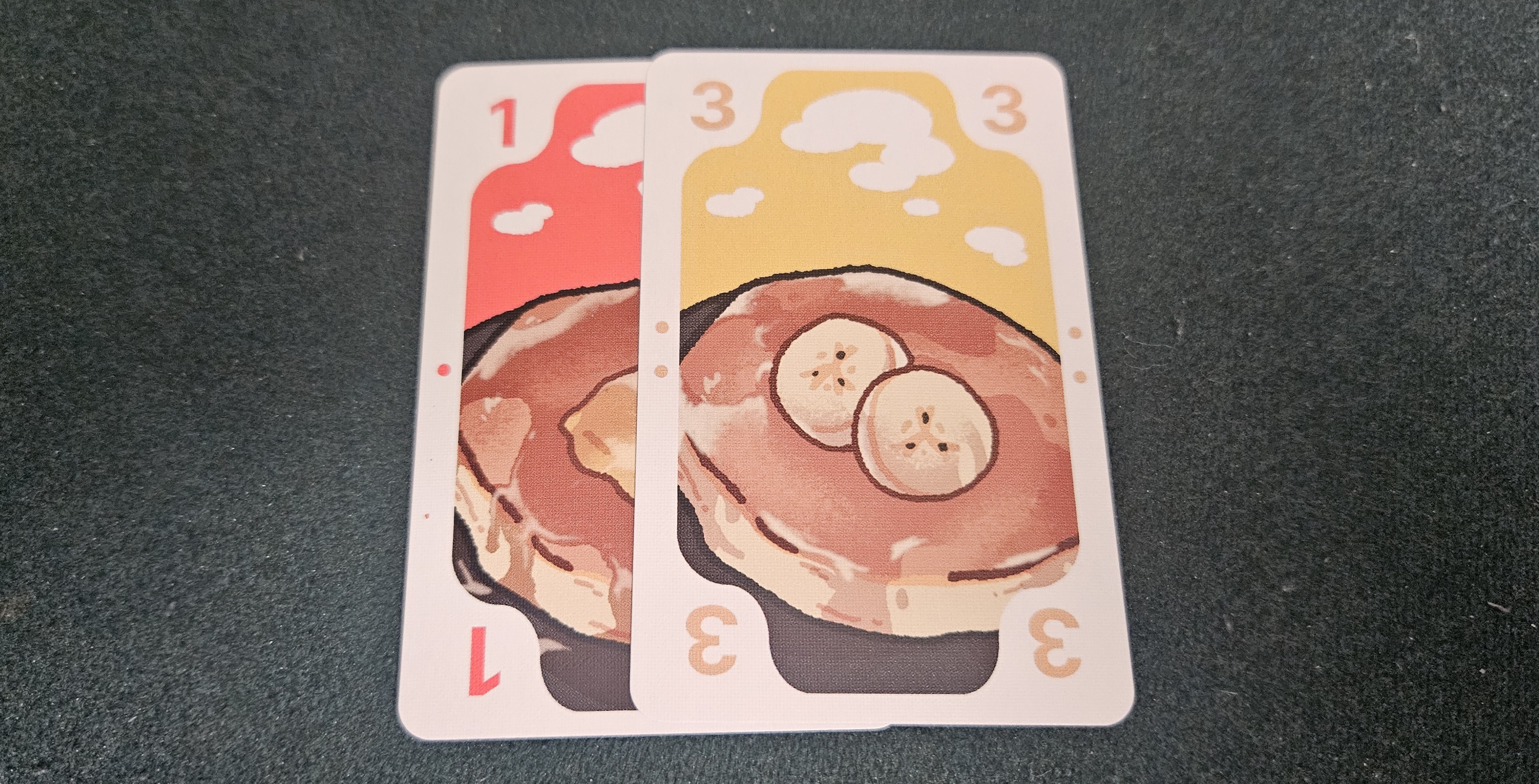
To begin, your hand is massive. Nine cards, then a “napkin” (also a card), then nine more cards. The reason for this division becomes clear right away. Rather than playing a single card, every trick is built from two separate components, one from the left side of the napkin and the other from the right. The first card’s number becomes the “suit” while the second becomes the “rank.”

Simple enough, and a wrinkle that constitutes the entire sub-genre of domino trick-takers. But two things set Shortstack apart from the pack. The first is that “perfect pancakes” — those where the rank and suit are identical — are outright winners. You’re still required to follow suit if possible, but your dichotomous hand makes it easier than usual to claim tricks at unexpected moments. This produces quite a bit of flexibility, important for claiming high-value tricks that will likely award a point at the end of the round.

as god intended

Now that’s more acceptable.

The other thing that’s different about Shortstack is even more impactful: if you eat too many pancakes, you’re gonna hurl. Leiman is too polite to actually state this outright, but we’re professional translators of subtext round these parts. If you take too many tricks, all your pancakes are “thrown out” (read: barfed), you score nothing, and everyone else at the table earns a point. Presumably because they’re laughing at your misfortune.

This alters Shortstack from straightforward into a nasty affair indeed. Your flexible hand makes it easier to claim tricks, but also offers little opportunities to nudge an opponent into chowing down on too many pancakes. It always seems like there are two or three rounds too many. While it’s technically possible, in the three-player game at least, to get through a hand without ejecting all that batter across the table, it isn’t likely.

The result isn’t my favorite short-form trick-taker; personally, I would rate this one alongside Nebular Colors, which I appreciated without wanting to come back to. But it’s still a simultaneously charming and vicious little thing. Like Marceline Leiman herself, perhapsI couldn’t tell you. I’ve never met her. But when she keeps producing such digestible razor blades, one starts to wonder.

also can be used as a frisbee or a coaster. truly, an all-inclusive component.

More games should use CDs as soundtracks and play surfaces.

The Magic Shop

More games should come in DVD cases with soundtracks on compact disc. Even better, those discs should double as game boards. Even bettah, those games should be adaptations of short stories from the turn of the century. And not this century. The one before that.

The Magic Shop, designed by Reader on Jupiter, calls to mind their previous title The Man Who Was Thursday not only for its packaging and soundtrack, but also its fascinating approach to adaptation. In this case, the work being reimagined is H.G. Wells’ 1903 short story “The Magic Shop,” and much like the story’s father and son, we’ve stumbled into a shop, found ourselves trapped, and must now accomplish increasingly bizarre feats of endurance and navigation in order to leave. Basically, it’s a 19th-century IKEA.

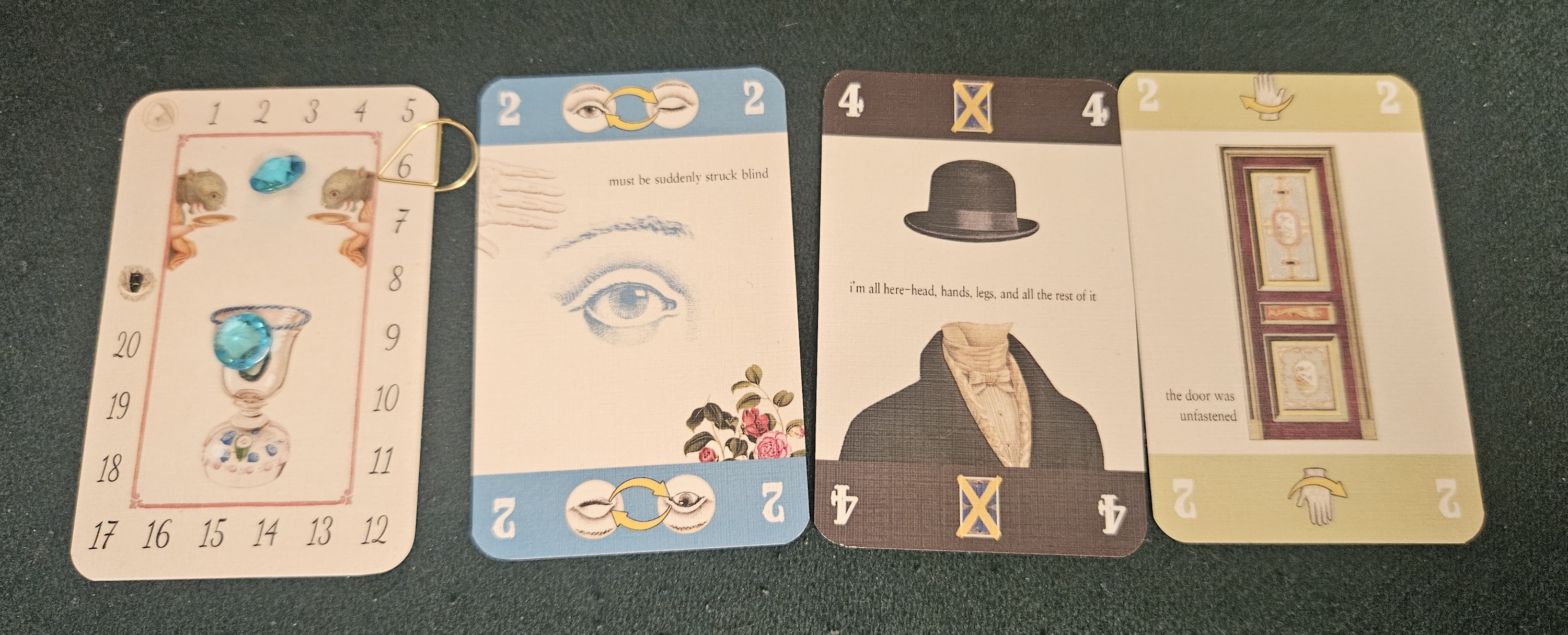
While it’s tempting to spend this entire time discussing the game as an adaptation, which is utterly delightful in its impressionism, capturing the whimsy and some measure of the story’s menace without recreating even a single narrative beat, we’re here to talk shop. For the most part, The Magic Shop’s trick-taking is relatively straightforward. You want to win tricks, but only as many as you’ve contracted. Your bid matches the rank of whatever card you devote at the start of the hand, but in a gesture of goodwill every card also allows a bid of either three or zero on its reverse side. In practice, this usually means shooting for either three tricks or none at all.

"When you play your card, you must read the H.G. Wells quote," I say to the table, insufferably.

As with Thursday, everything about this game is gorgeous.

Here’s where it gets wacky. Whenever a trick is taken, the winner also gets to perform a magic trick. These are tied to the suits, which limits what the winner is permitted to cast. Furthermore, while the winner is always free to use the suit of their own card, they also have the option of using any of the cards played into the trick — but only if they take a “thirst token” that awards additional points to any rival who meets their bid for the round.

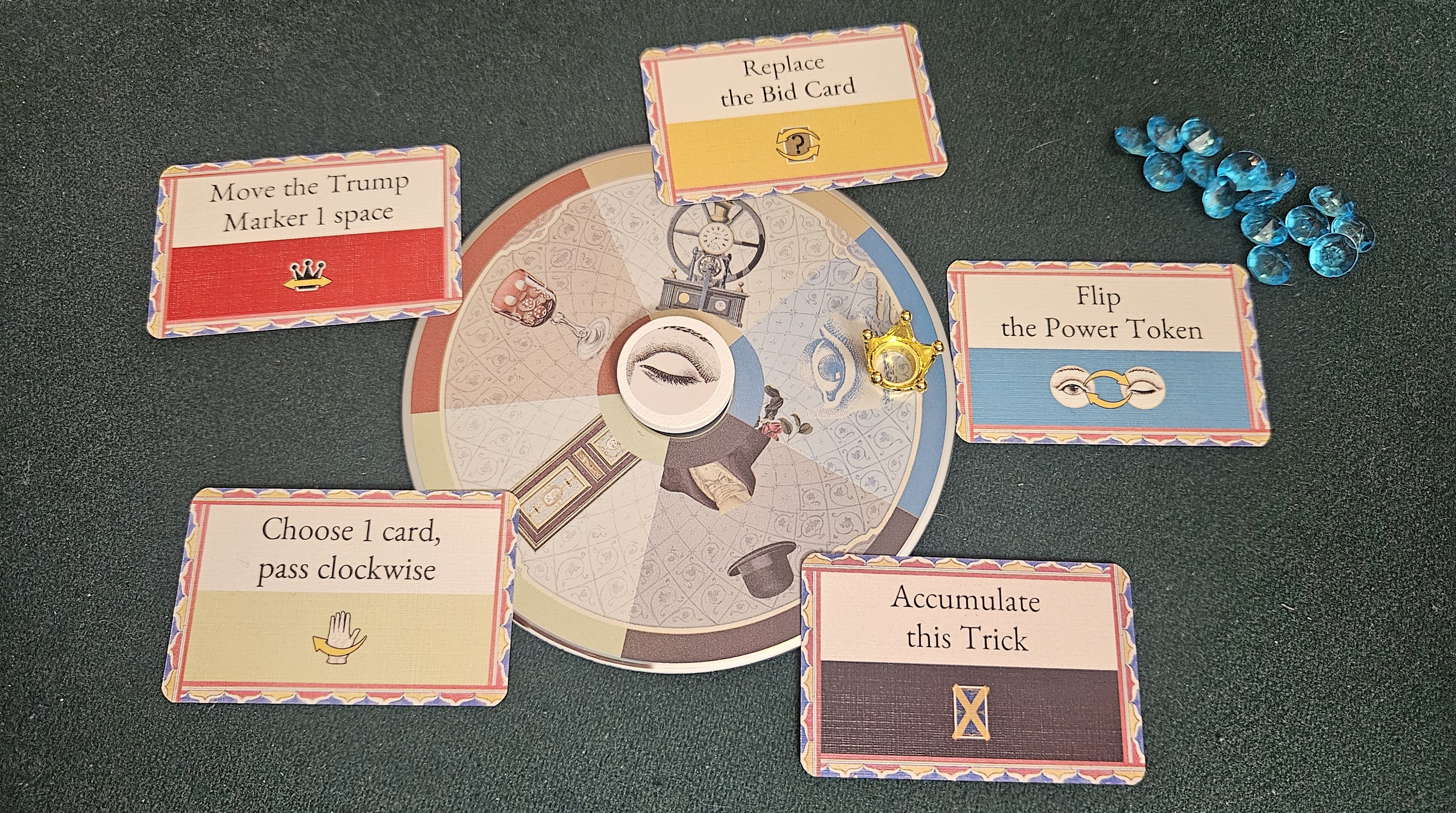
As for the actual magic tricks, these give The Magic Shop much of its flair. One of them changes the trump suit; another flips an eye token so that low ranks now outclass high ranks. Perhaps the meanest is the one that forces everybody at the table to pass a card clockwise, perfect for ruining bids. This can be ameliorated by the suit that lets you swap out your bid for another card from your hand (phew!), although this can be summarily wrecked by the one that forces the current trick to “accumulate.” This means that rather than awarding the trick, it instead sits off to the side to be claimed by whomever takes the next one. And yes, multiple accumulations can be strung together. Ever wanted to win four tricks at once? Probably not when your bid is set at three and you’ve already taken two.

You can probably already tell that The Magic Shop is a highly tactical trick-taker; its merger of exacting contracts and ongoing flux makes for quite the ride. I’m convinced it’s possible to play well, but I’ll be damned if I know how. Once again, I love what Reader on Jupiter is doing, but there’s really no separating my affection from the game’s aesthetic, approach to adaptation, and general mischief. Those who fear chaos really should avoid this one at all costs. Personally, I dig it.

You can't see it in the images, but there are little silver highlights on the pawns. They look amazing.

It feels like we’ve been here before…

Torchlit

Speaking of chaos, David Spalinski’s Torchlit is one of those games that first appears entirely uncontrolled. Don’t be deceived. This is a highly strategic trick-taker. It’s just that there’s room for some truly cruel plays, usually as a result of some jerk deciding you need to be taken down a peg.

Here, those jerks are adventurers. Dungeon delvers. Ruin ransackers. Your goal is to march into the current dungeon, earn some gold, and march out again. Gold mostly comes from looted corpses; at the end of the hand, every monster on your space is worth a coin. Two coins, if we’re talking about dragon cards.

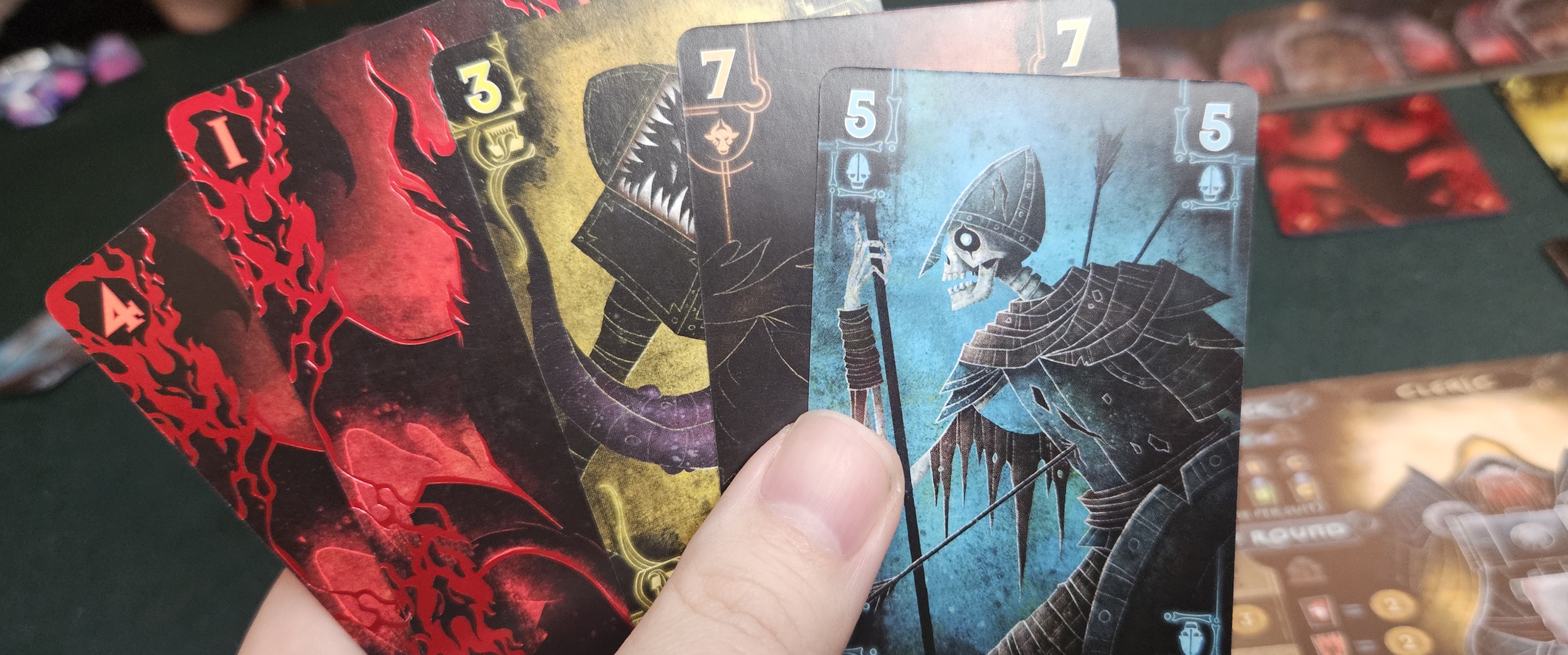
Wait, there’s more. At the start of the hand, you flip one of your cards face-down. This is your torch. Yes, it’s a — say it with me — contract bid! If you wind up on your chosen room, you earn some extra money. If not, your torch is added to its designated room, where it awards any other adventurers the gold instead.

Making matters significantly harder is the way you move through the dungeon. The winner of each trick moves forward… and so does anybody whose card rank matches theirs. So while it’s possible to piggyback on a hero’s success, it’s also possible to get piggybacked. As in, hauled up on a rival adventurer’s and dragged kicking and screaming past the room you bid on. Like you’re some kinda hobbit being taken to Isengard.

I'm of the opinion that Allplay might be overplaying their hand by publishing a zillion little games... but every so often they land something great.

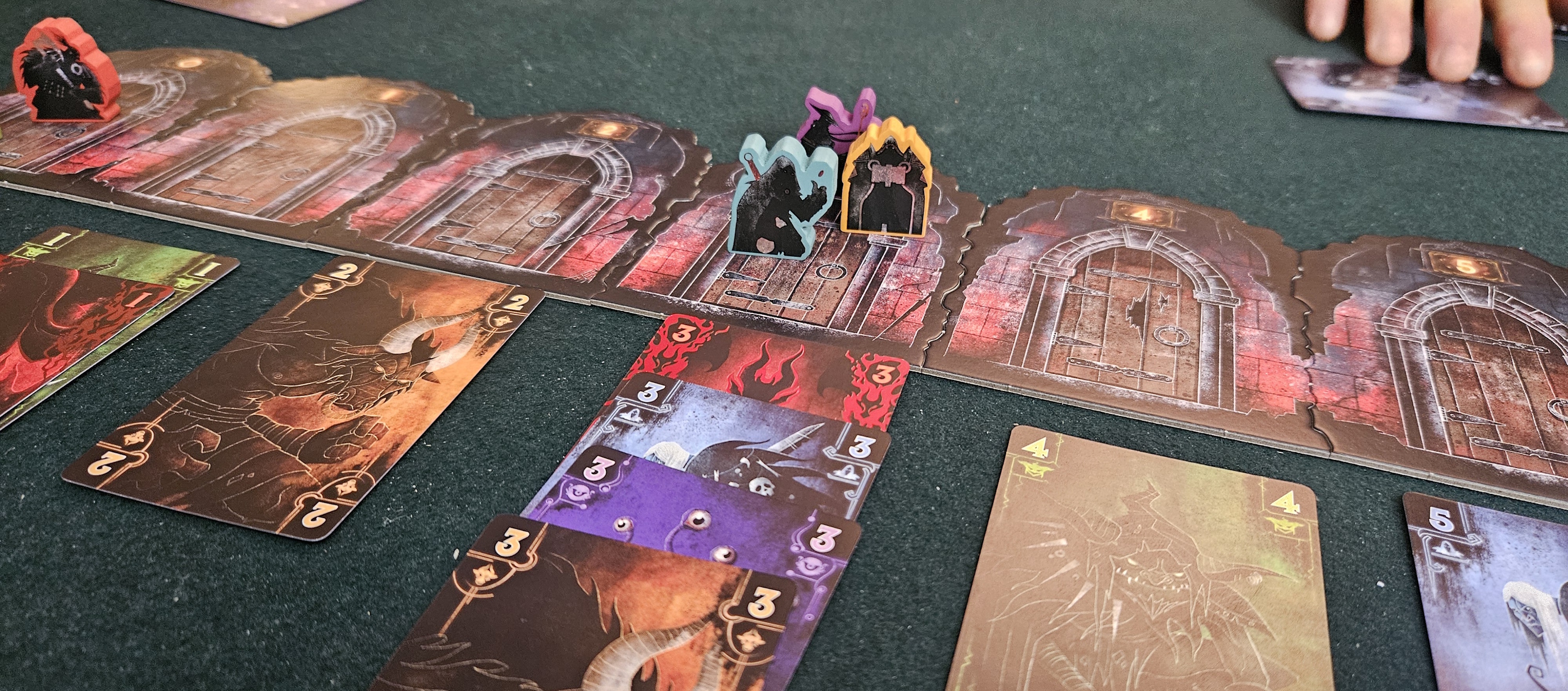
These monsters sure are sticky.

Meanwhile, the rooms are populated by monsters according to the cards that were played into the current trick, but they’re doled out by whomever deployed the lowest rank. This means there are two games going on: the death march through the dungeon as decided by the winner, but also the local cash piñatas as seeded by the loser. Unless those two happen to be the same player. Then that punk gets to decide everything. Which is entirely possible, especially if somebody sweeps a trick by winning with a low dragon card.

All told, these contrasting imperatives give Torchlit its venom-tipped fangs. When I wrote about its self-published version a while back, I argued that it was very nearly a hybrid trick-taker, as much about your position on the board as about the tricks themselves. The intervening years have only deepened that impression. Torchlit is something like a push-your-luck game, except it’s less about luck and more about dodging and/or taking advantage of your fellow dungeon divers. The new edition by Allplay is incredibly handsome, making it more widely available to those who aren’t able to gobble up the latest indie darling.

Of today’s titles, this is the strongest. Honestly, it might be one of my favorite trick-takers of the past few years. But make no mistake, it’s every bit as nasty as the others. It may not include regurgitated flapjacks or unexpected magic tricks, but there are plenty of little barbs to dig into your rivals’ plans. Between this and the similarly jerkwaddy Chasing Shadows, Spalinski is on a roll.


Complimentary copies of Shortstack, The Magic Shop, and Torchlit were provided by their designers/publishers.

(If what I’m doing at Space-Biff! is valuable to you in some way, please consider dropping by my Patreon campaign or Ko-fi. Right now, supporters can read the next installment in my series Talking About Games, this time tackling the topic of what makes a good list! Naturally, the piece includes a list.)

The Shortest Nineteenth Century

13. August 2026 um 02:33

The coloration makes me kinda see this in ANN IHI LAT ION mode. REV OLUT IONS.

According to one of my uncles, the terms “right” and “left” derive from the fact that conservatism is correct while liberalism is wrong. You know, because we say “that’s right” to mean “that’s correct” and “that’s left” when we’ve suffered a serious brain hemorrhage and don’t remember how words work.

In actuality, the right/left divide comes to us from the French Revolution of 1789, when the members of the National Assembly who supported the Ancien Régime would sit to the king’s right, while those in favor of the revolution sat to the left. Presto blammo: a rubric that would confuse dumb uncles for the next 240 years.

Still, it’s a helpful formulation for the rest of us, if often an overly simplistic one. When I introduce the five factions from Laurent Rix’s exceptional Revolutions: France 1820-1880, I lay them out from right to left. All the easier to explain their objectives. Often, players appreciate this gesture, especially for the factions in the middle, whose aims might seem alien to our modern minds. And some people say you can’t learn history from a board game.

There were no race cars yet.

I play on a big board with my wife.

The second thing I usually explain when teaching Revolutions is the timing of the whole thing. There are certain dates that stand out in the memory — the existence of the 1812 Overture is a good reminder that the game begins after Napoleon’s removal from power, but not everybody has internalized that particular mnemonic. And it makes sense that not everybody in my very American group would recognize this particular string of dates. 1820 to 1880? What even happened in there?

Why, these are the middle decades of the Long Nineteenth Century! Which is to say a whole lot happened, but it isn’t the sort of stuff that’s often taught in history classes in the United States, where Manifest Destiny and the Civil War loom large over everything else.

In our case, Revolutions casts us as five major factions, all of whom seized and held some measure of power over those six decades. Even if, for one of them, the furthest expression of that power was limited to two months in Paris.

Like how this faction, the Dorkasses, keep doing coups until the people just elect them to the presidency. ... uh oh

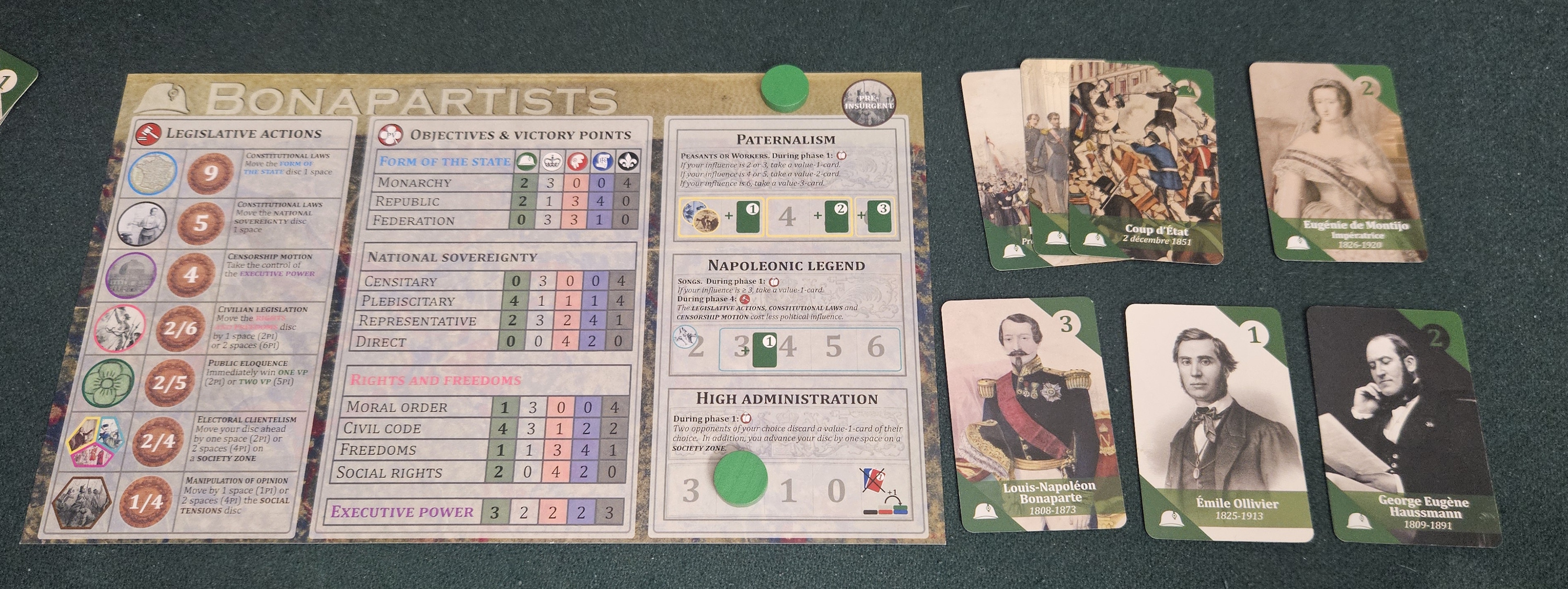
Each faction has their own objectives and perks.

Thus, our dramatis personae, from right to left:

First we have the Ultras, who are, as their name suggests, rather extreme in their dedication to a reconstituted monarchy and suppression of everything the previous revolution and eventual empire stood for.

A few centimeters to their left stand the Orleanists, willing to fly the Tricolor and speak the revolutionary tongue, but still invested in tradition and moral order.

The cult-of-personality Bonapartists make up the middle children of this family squabble; they appreciate a good monarch, but only when it’s their own guy on the throne, and will allow a few concessions to modern liberalism while also brutally suppressing it.

The Republicans are next, with their lofty ideals about freedoms and voting, not to mention a willingness to engage with urban populations and newspapers.

But even they pale next to the more extreme Socialists, who are about as far away from our starting point as it’s possible to get without earning a thinkpiece from the Atlantic about how they and the Ultras are really the same at heart.

Now that the cast has been listed, it’s time to… well, to debate, mostly.

The socialists are very very good at doing both. Sometimes. When they remember to stop fighting with their natural allies.

Sometimes you tally votes… and sometimes you count bullets.

What makes Revolutions special is the way Rix covers six decades of history, both legislative and revolutionary, without missing a beat. As board games go, this is a longue durée history that teases out the unlikely alliances, concessions, and sometimes bloodbaths that marked those years.

Most of the time, your faction wants to secure votes. Let’s say you’re a brash young Republican in the middle of a reconstituted monarchy enforced by a foreign Coalition. What exactly is your recourse? Early on, your goal will probably be to secure some measure of legislative power. So you curry favor, both on the table by bidding influence cards to various sectors of French society, and above it by trying to persuade your natural allies — the Socialists for now, but also the Bonapartists and maybe Orleanists, especially if the Ultras have spent too long on the throne — that it would be prudent to make a few adjustments to how votes are cast, who receives representation, or which privileges will be granted to citizens. Together you create a voting bloc, earn some political influence, and then squabble over whether to flex your limited power to enforce a plebiscitary or representative government.

But then, disaster. After all that effort, perhaps the Ultras will veto your motion. They’re quite happy with the vote going to the richest landholders, thank you very much. But this veto sets the streets of Paris into a flurry. Now, with social tensions on the rise, you begin to agitate.

Gawrsh, I love the art choices here.

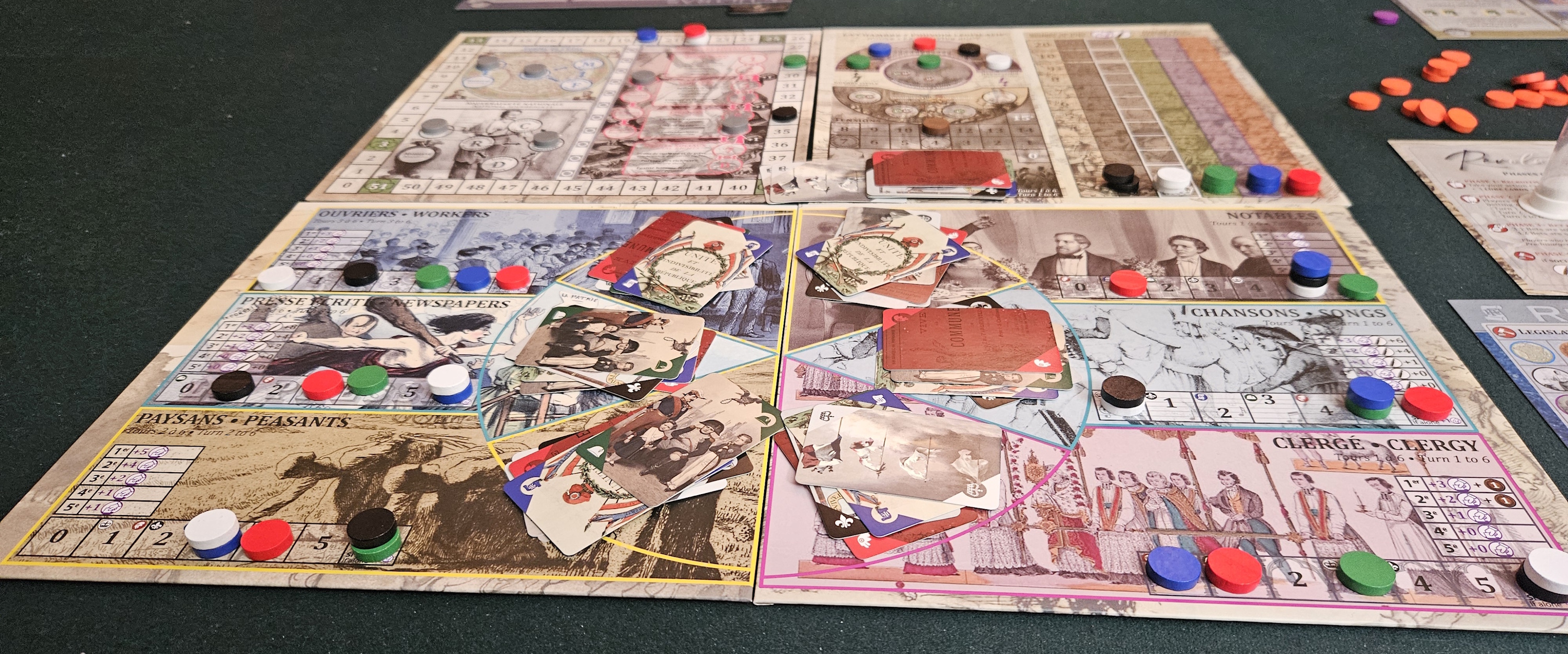
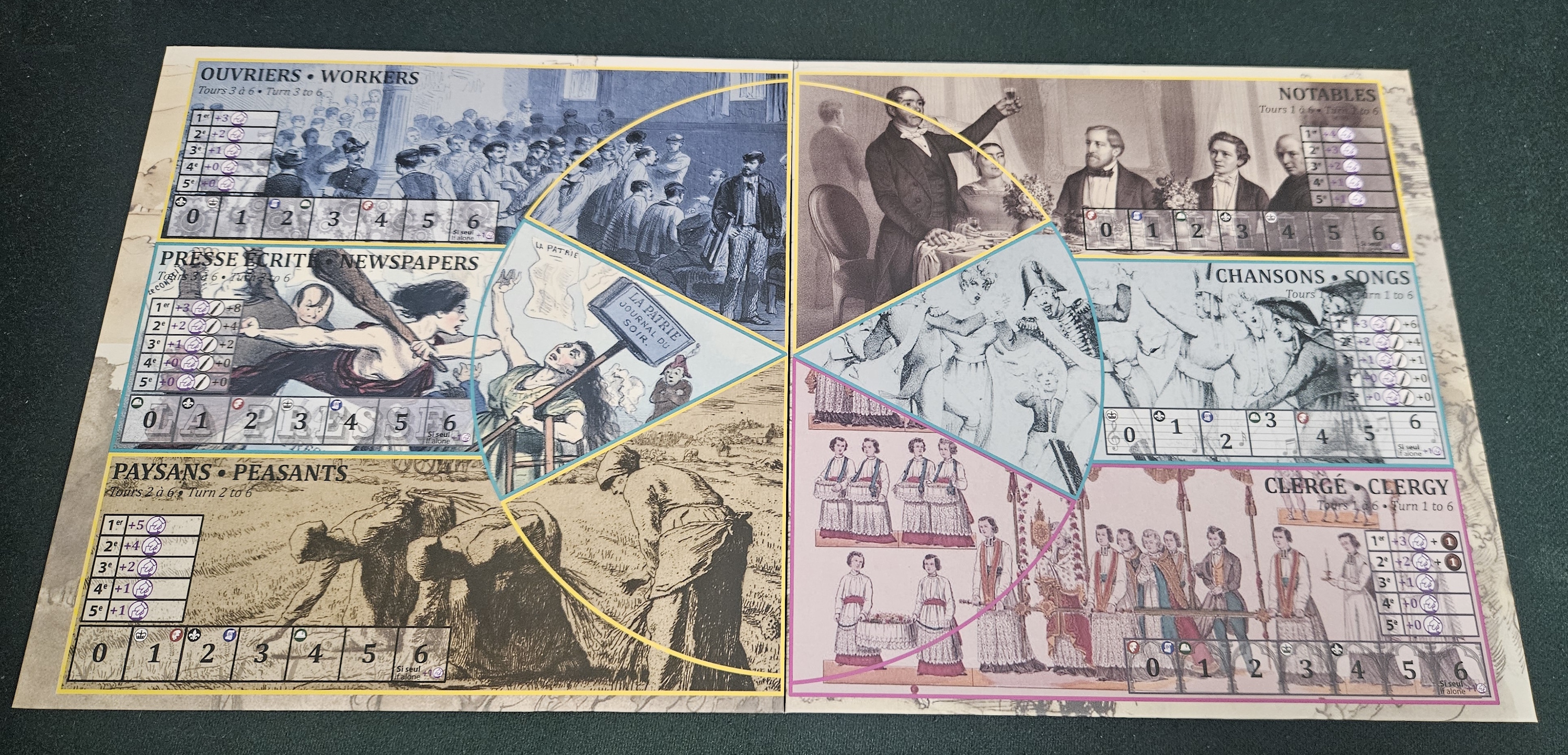
The six sectors that can eventually be manipulated for political advantage.

Over time, the political landscape undergoes seismic transformation. Rural populations become reachable. Newspapers begin to carry the public voice even more resoundingly than song. The working class begins to wake up to the fact that it’s a whole deal. Did I mention that Rix has folded the century’s gradual urbanization into his game? It’s quite the thing to behold. When Revolutions opens, the only people who can really be influenced are the notables and the clergy, and you can bet they aren’t taking calls from anyone grumbling about freedom of religion. But over the course of ensuing decades, new sectors open up, throwing the old order into a disarray from which it will never recover.

To be clear, Revolutions is never whiggish. Progress isn’t the straight line some would have us believe. When the peasantry enters the game, they’re hot for more Bonapartism, for the glory of the old days, not for equal representation. Newspapers, like tavern songs, can be written by gray-haired reactionaries as well as by sexy young revolutionaries.

Still, it becomes increasingly difficult for monarchism to keep its cold fingers wrapped around the national throat. There’s an arc here, even if it doesn’t have a foreordained slant.

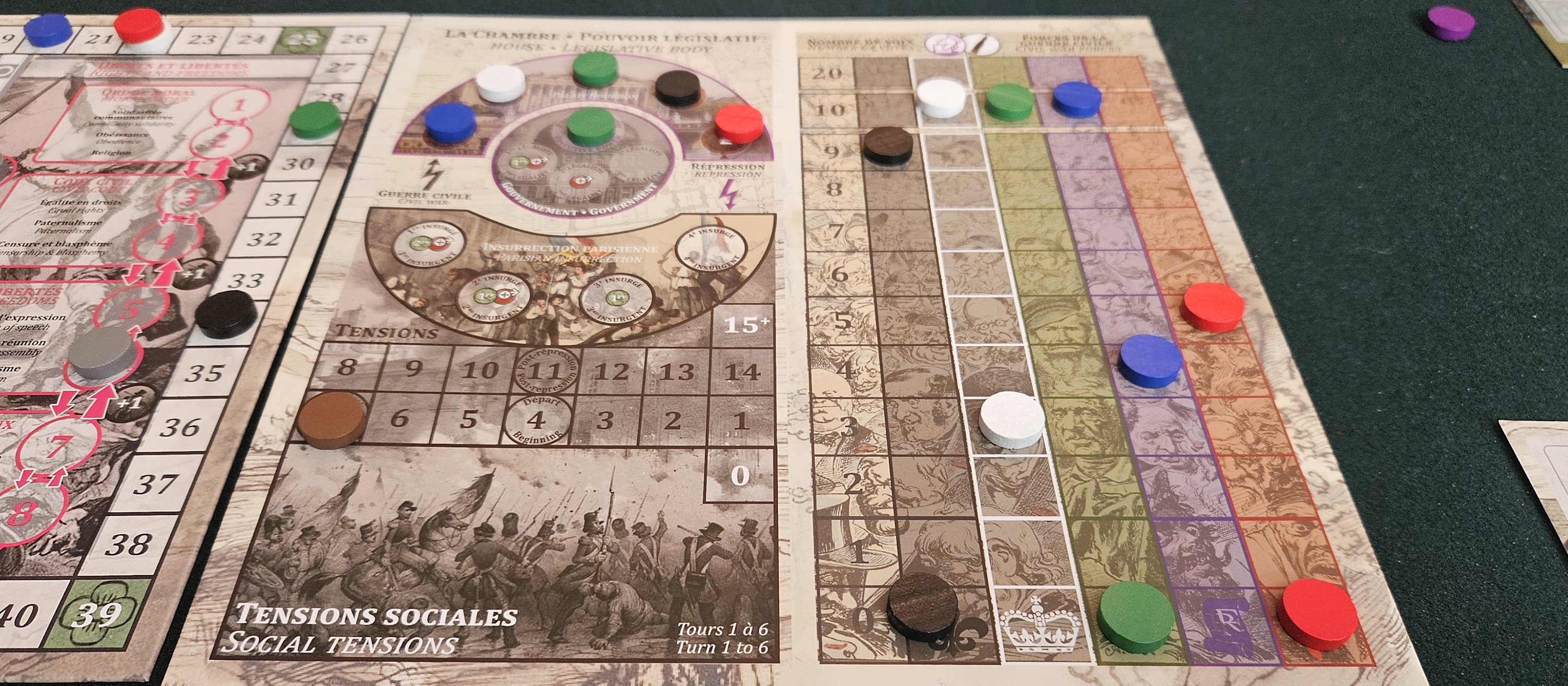
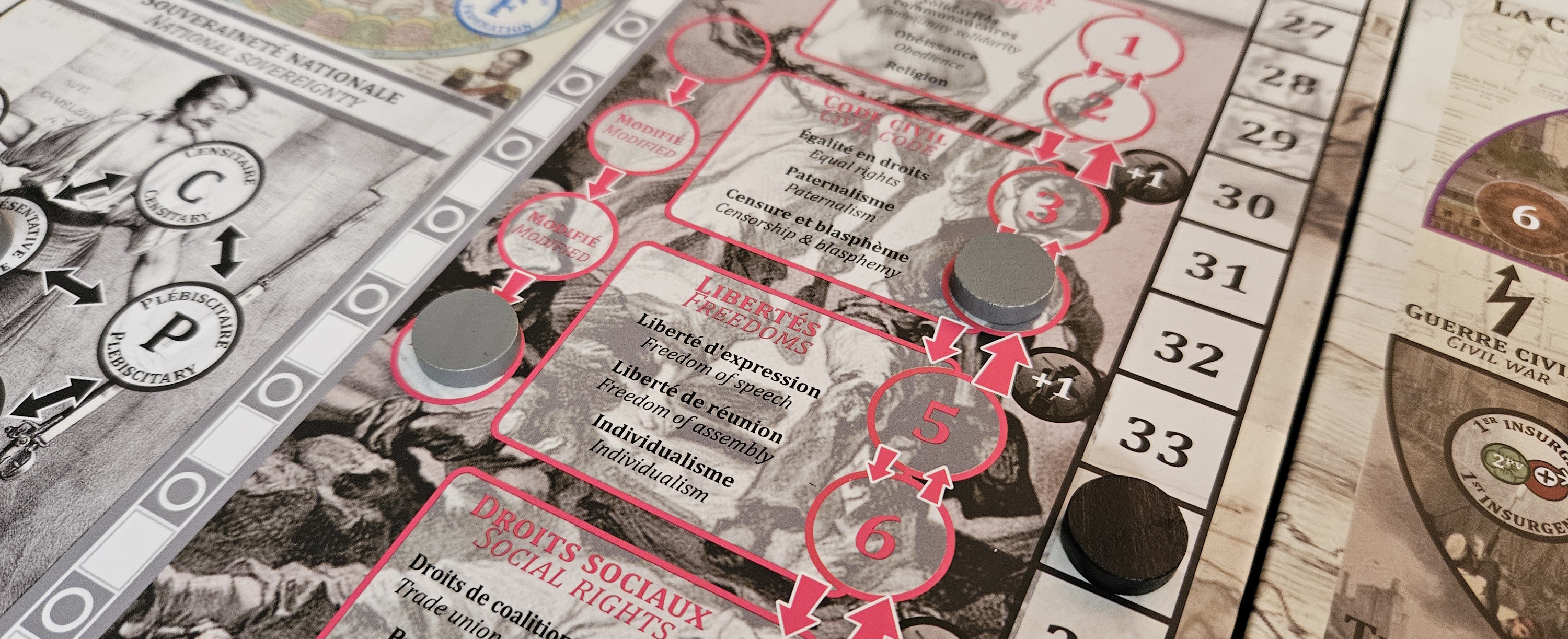
So you agitate. Eventually, the frustration of the population boils over into a full-blown conflict. Now factions are forced to pick sides, either sidling up to the established order in hopes of earning a concession or two, or joining the revolutionary bandwagon in an attempt to reshape society more dramatically. Like everything else in Revolutions, these are handled slickly. Tallying votes is as easy as checking everybody’s position on the game’s six tracks; counting manpower is much the same, with a few extra steps for those who are willing to erode their popular support to throw additional bodies at the problem. Revolutions are tense, but they’re never complicated.

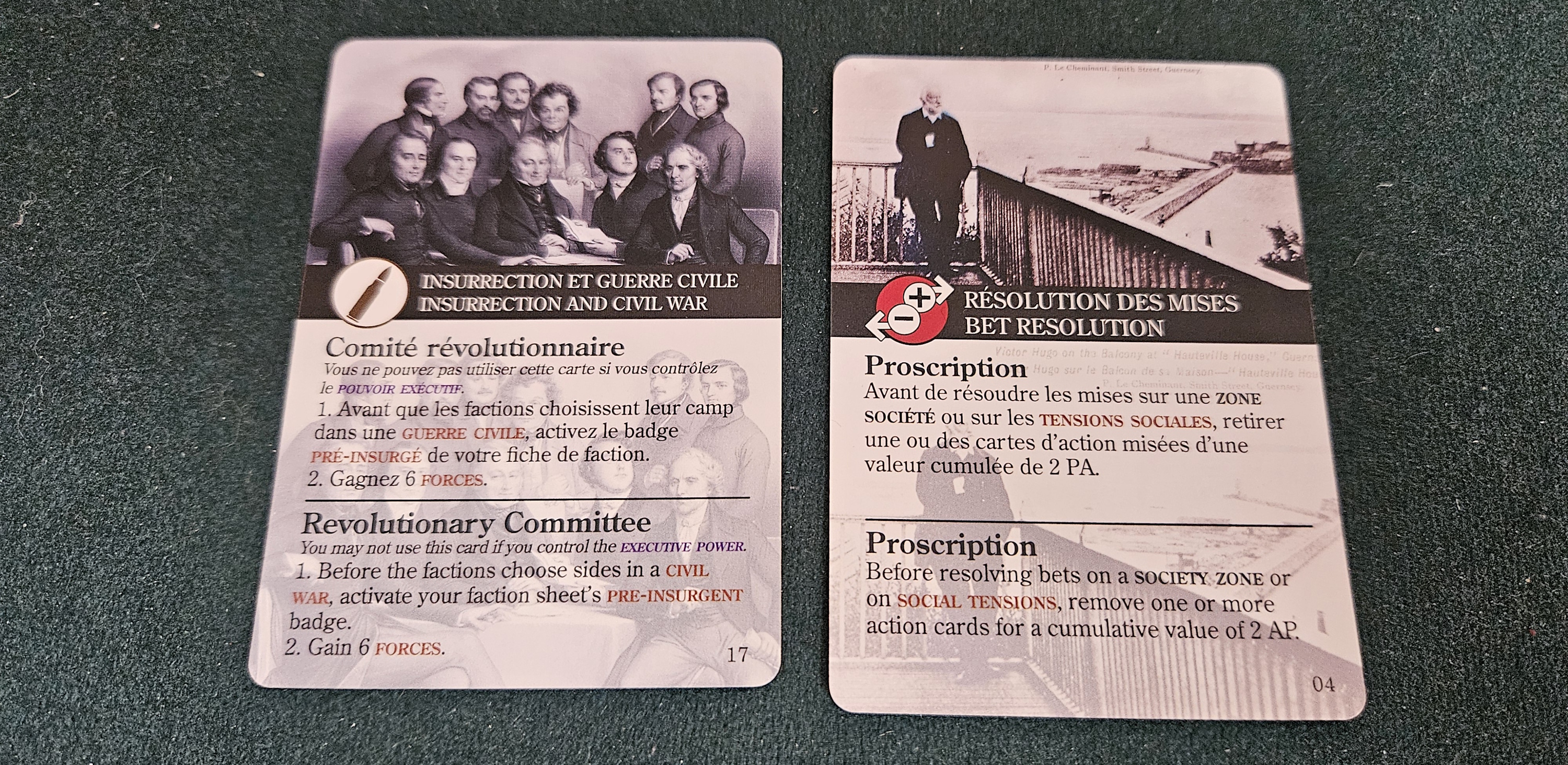
The game suffers a little from sometimes being a little too countable. The events mostly help with that by giving everybody a little bit of hidden information that they can spring on the table when it benefits them.

Event cards are optional, but add a lot to the experience.

Playing Revolutions is an illuminating experience. It calls to mind a few other titles, exemplars like Geoff Engelstein and Mark Herman’s Versailles 1919, with its uncomfortable alliances and shifting priorities, and Alex Knight’s Land & Freedom, about partners whose petty squabbles are so urgent that they argue themselves to death rather than combining to face a superior threat.

Like those games, Revolutions takes place in subtle theaters. One might even call them abstract. There are no battlefields here. Your successes and failures are measured on tracks, both those that measure your appeals to France’s social spheres and those that gauge the current status of national sovereignty and which rights are held by the people. Wars are a question of numerical superiority. Whichever side has the bigger number wins. Simple. Functional.

For all that, it’s gripping from start to finish. Rix imbues his social model with little eurekas. In our last session, we saw uncomfortable coalitions form, especially when factions who wouldn’t normally deign to spit on their rival’s flaming culottes were suddenly brought together to oppose a runaway tyrant. We also saw the peasantry undergo a shift in attitude after dear leader sacrificed them so casually to quell the next uprising. We watched as newspapers shifted from suspicious new media, the tool of republican rabble-rousers, to another appendage of the moneyed class. We observed how the erosion of rights could be accomplished in steps so that the populace only grumbled a little at a time.

Meanwhile, these occurrences required very little overhead. Like many new-wave historical titles, Revolutions prides itself not only on its model of culture in transition, but also on ease of play. For the most part, gameplay consists of bidding cards, tallying votes, and then spending influence to enact changes. Or, when that doesn’t work, mustering your forces for a bash in the streets of Paris. There are subtleties to these processes, but they never tip the scales into unnecessary chrome. Instead, the rules get out of the way, letting you focus on which side of the latest political headwind you want to tack into.

I will not stop advocating for greater human rights until I'm allowed to become an alien's kidney if that's my choice.

Keep pushing! Never stop pushing!

All told, Revolutions: France 1820-1880 is one of the finest examinations I’ve ever seen of a new society struggling to be born. In many ways it’s a game about not only history, but the way history is formed, the way people begin to see themselves as agents of history and authors of history, the way ideas are transmitted or obscured, the way change is enacted or smothered. It’s about the many birth pangs and postpartum twinges that accompany any transformation. Hopefully, it’s a reminder that the world can be recast into a new shape yet again.


A complimentary copy of Revolutions: France 1820-1880 was provided by the publisher.

(If what I’m doing at Space-Biff! is valuable to you in some way, please consider dropping by my Patreon campaign or Ko-fi. Right now, supporters can read the next installment in my series Talking About Games, this time tackling the topic of what makes a good list! Naturally, the piece includes a list.)
“We’ve been ready for this step!”: Allplay’s Joe Wiggins on its striking push into heavier games, bigger productions and new audiences

12. August 2026 um 12:41

Allplay is making its biggest strategic shift since its predecessor Boardgametables.com entered publishing in 2018 – launching a trio of new product lines aimed at markets well beyond the accessible, smaller-box strategy games that have defined it to date.

The publisher’s newly-announced Masterworks, Epics and Creations lines mark its expansion into heavyweight eurogames, large-scale adventure titles and licensed or fandom-driven games respectively – beginning with a remake of highly-regarded Chad Jensen design Dominant Species.

Allplay’s decision to broaden its portfolio into larger, more expensive productions stands out as one of the more ambitious publisher expansion plans announced this year – especially given many have been shifting towards smaller-box, lower risk releases amid ongoing cost pressures such as tariffs and rising manufacturing expenses.

The move represents a notable evolution for a company that has built its reputation around approachable strategy games with consistent box sizes and accessible price points, alongside carefully-produced new editions of established hobby titles such as Container. Notable titles from the publisher to date have included releases like River Valley Glassworks, Mountain Goats and Things in Rings.

“We’ve always made games with constraints – on principle”, Allplay COO Joe Wiggins said. “We’re proud of what we’ve been able to make with these constraints.

“The consistent box sizes, accessible price points, and simpler rulesets are great for families and gamers who want strategy without rules overhead.

“Those core products aren’t going away. But now that we’re eight years into publishing games, we’re ready to show what else we can do.”

Allplay began life as boardgametables.com in 2014, specialising in high-end, custom-built wooden gaming tables manufactured in the US, before dipping its toes into board game publishing four years later.

The business rebranded as Allplay at the beginning on 2023 to better reflect its expansion, having reached the point where it was also providing bags, playmats and shelves, in addition to having published 17 board games and eight expansions.

When asked what gave Allplay the confidence to expand its remit again given the current challenges in the hobby games environment, Wiggins told BoardGameWire, “In the last four years we have gone from eight titles to 75. We are not known for bad games or shoddy components, but rather timely deliveries and solid productions.

“We have a very strong team and system in place, and while this growth might mean bigger impacts we have been for three years producing over 20 games per year – and this will see us lowering to about 12 – 15. We’re opening bandwidth to allow for these projects.”

He added, “This wasn’t a decision we made lightly. It was very specific and thoughtful in how we wanted to grow”, and went on to point out: “In the last five years we’ve gone from four of us at Allplay to now hiring our 22nd full time person, with an army of freelancers helping as well. We’ve been ready for this step!”

The most eye-catching announcement was the launch of Masterworks, a heavyweight strategy line created in partnership with acclaimed graphic designer and artist Ian O’Toole, whose portfolio of work includes Voidfall, On Mars and Galactic Cruise.

Rather than simply commissioning artwork, Allplay said O’Toole will become a full partner in the Masterworks line, helping select projects as well as contributing to their development, graphic design and visual direction.

Wiggins told BoardGameWire, “We are seeking out the best heavy euros to bring to market and he is key in the selection, development, art, and graphic design. He isn’t a paid artist – he’s a full partner in the line. We fully believe each release will make a massive impact on the heavy euro scene.”

He added that despite kicking off with a high-profile established title in Dominant Species, almost all of the games in the three lines will be new designs.

Wiggins said, “We just had such an amazing opportunity to launch with Dominant Species, which is one of our favorite all time games and will make such an impact when this amazing game gets phenomenal art and graphics for a modern gaming audience. Don’t expect too many classics – though I do have my eye on one for later down the road in the Masterworks line.”

Alongside Masterworks, Allplay’s Epics line will be dedicated to larger-scale hobby games including Sail Legacy and new survival game Crash Landed, while Creations will focus on games built around recognisable fandoms and licensed intellectual property – beginning with John D Clair’s theme park-themed Have a Magical Day.

Box cover for John D Clair design Have a Magical Day, published by Allplay

Allplay has been clear that its existing publishing strategy will continue alongside the new initiatives, including a Kickstarter campaign in October for Through The Mountains – a sequel to Reiner Knizia’s Through the Desert, for which it ran a crowdfund at the end of 2023.

Wiggins told BoardGameWire that the company had been working on some of its expansion ideas since 2024 – adding that the commercial success of its Allplay partner programme had been key in giving the company the resources to expand its operations.

That partner programme has seen Allplay team up with more than 40 other publishers such as Bitewing Games, Kinson Key Games and Cardboard Alchemy, giving them access to its own infrastructure and providing services such as fulfillment for crowdfunding projects.

Wiggins told BoardGameWire, “As a group we are all stronger and can rely on each others success. Our partnership allows them to focus more on making more and better games and that lets them grow which lets us grow. It’s very symbiotic.”

That network will also help shape the company’s crowdfunding strategy for its new publishing lines, Wiggins said, giving it crucial information on how to successfully market different weights and styles of games.

He said, “When we launch Dominant Species we are able to key into audiences that liked Container and Galactic Cruise. When we launch Crash Landed we have access to the audiences of Tidal Blades 2 and Arydia, [and] when we launch Have A Magical Day we can speak to people who have loved Flamecraft and River Valley Glassworks.

“And people that come to us for Dominant Species will find Galactic Cruise… etc. We’re all working as a team and this is a big difference maker. Lifting each other up.”

Dominant Species, Crash Landed and Have a Magical Day are all set to come to Kickstarter in 2027.

The post “We’ve been ready for this step!”: Allplay’s Joe Wiggins on its striking push into heavier games, bigger productions and new audiences first appeared on .

Spylune

12. August 2026 um 01:37

but wait, hear me out: what if the dragon had a top hat... with gears

I never played Spyrium, William Attia’s 2013 game of steampunk factories, but I heard good things about its worker placement/removal system. Greylune, as near as I can tell, recaptures that title’s core appeal, while swapping the geared top hats for a more generic — but maybe more blandly appealing? — fantasy universe.

just steal that horse instead thanks

Your followers go into the market to buy goods… and steal gold? I think?

As expected, the best part has everything to do with the workers. The core system here is genuinely brilliant, a series of placements and eventual withdrawals that feel like direct assaults on one’s fellows at the table without ever laying a cross finger upon anyone’s shoulder.

The idea is that workers are placed into a marketplace to secure various goods. There are a few types of said goods: items and companions, both of which require purchasing, and amenities, which can be visited more than once. Their main commonality is that buying something from the market has two big restrictions. First, you can only purchase something by removing a worker — thus shifting yourself into the game’s second phase, which prevents you from placing any more workers until the next year — and second, the more workers there are surrounding something, the higher its cost.

The inverse is also true. Rather than pulling off a worker (teehee) to buy a card, their withdrawal can earn a pocketful of gold instead. This works by the same formula: you remove a worker, count how many other workers are next to the card in question, and then earn that many coins. They’re probably engaging in commerce or something. I preferred to pretend they were pickpockets.

As systems go, there’s no doubting its cleverness. Everything is wholly player-driven. It’s pretty rare that I’ll pay attention to how many coins a rival is holding, but here it’s common to tally someone’s holdings. Often, the placement of a single worker can drive up a price just beyond their reach, prompting them to first place another worker to earn the necessary cash, and thus providing a window to swoop in and nab whatever sword, horse, or buddy they were eyeing.

It’s a rather snitty game like that. Also a razor-taut one, every coin and card counted to its precise change.

There's some frustration to assessing whether a resource needs to be spent or merely held. So that's annoying.

Ah, an adventure!

The reason for all those fairly-gotten gains is to outfit your knight for adventure. Everything has its place: companions provide reactive abilities that make it easier to travel and survive encounters, while items generally serve to improve your skills or move your knight deeper into the wild. There are also two flavors of strength, cherry and blueberry, to represent swords and sorcery.

So you head out into the unknown to beat up a troll, help a hermit, or take part in a joust. You know. Hero stuff. But in my favorite twist, it isn’t enough to accomplish an objective. These encounters are tucked under your player board, where they then sit, doing nothing, until you get around to sending one of your followers to boast of your achievements in one of the local taverns. This requires more worker placement and removal, whether the following spring or because you’ve planned ahead.

It’s rather impressive to see in motion. Despite the removal of anything resembling steampunk, the game moves according to clockwork logic, everything feeding back into itself: workers outfit knights who bring back deeds for workers to boast about or resources for them to spend at the market, around and around, until you’ve exhausted everyone and it’s time to tuck in for the winter.

At the same time, it’s a game laden with regrets. It isn’t uncommon to move onto the next phase only to immediately see the gap in your plans. Or, more often, for another player to come along and do something that forces you to think more reactively. Encounters exist to be stolen; quests to be one-upped; jeweled idols to be purchased out from under another prospective client.

It feels good, though. Really good. Which makes me wish the game didn’t feel like it was left at eighty percent completion. There’s a big difference between replayability and variety, with lots of modern games leaning toward the latter. I would guess that Attia was designing for tightness of experience.

But also… Greylune needs some variety. Every session reveals nearly every card, both in the marketplace and the wild. There’s such a lovely sense of discovery to those first sessions that I found myself wishing I could go back and experience it again. Here, knowing what’s coming is much of the battle. On my second play, I knew I would buy the horse if it showed up. Then I knew I would try for a potion strategy. In the last round, which features no variance from play to play, it’s inevitable that a powerful tavern will appear, one that awards rather large quantities of points. So I planned from the very beginning to save most of my quests for the last moment and forego adventuring altogether. There were little hiccups, but the strategy worked well enough to lap most of my opponents. It felt good, to be sure. But it also felt sterile and mechanical.

I love buying DVDs. Physical media! The best! I've tried applying that same enthusiasm to replacing ancient air conditioning units or busted clothes washers, but so far it isn't working.

Everyone likes buying stuff, right?

Ultimately, Greylune both impressed me and left me chilly. Its core system is downright smart, and the set dressing around it feels good to handle. But it’s like handling a machine; a fidget toy, perhaps, or an orrery, spinning along its foreordained orbit. Pleasant but cold; beautiful but delicate. These days, I like my games to apply some force when they’re ramming their shield into my teeth, and Greylune’s touch is simply too dainty to cause so much as a wiggle.


A complimentary copy of Greylune was provided by the publisher.

(If what I’m doing at Space-Biff! is valuable to you in some way, please consider dropping by my Patreon campaign or Ko-fi. Right now, supporters can read the next installment in my series Talking About Games, this time tackling the topic of what makes a good list! Naturally, the piece includes a list.)
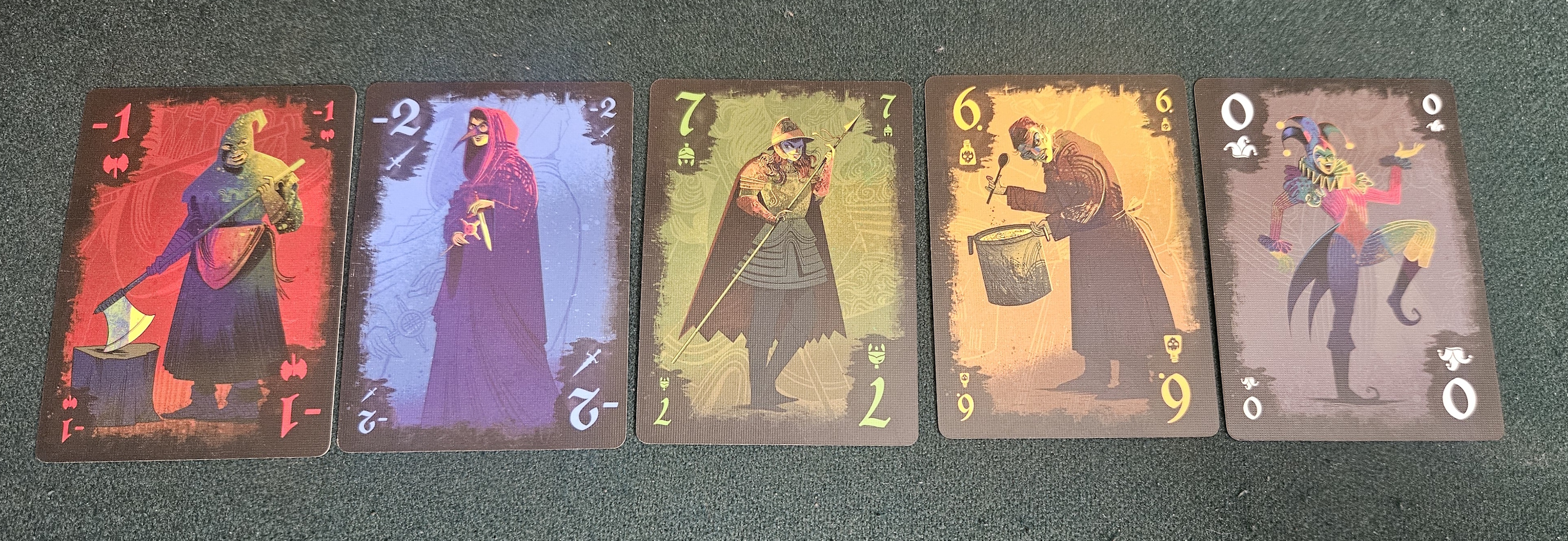
Gen Con hires The Dice Tower’s Camilla Cleghorn as head of events as show looks to scale beyond record attendance

12. August 2026 um 00:04

Gen Con has hired longtime The Dice Tower presenter and convention organiser Camilla Cleghorn as its new head of events, putting a familiar face from board game media in charge of planning and delivering one of the tabletop industry’s largest event programmes.

Cleghorn’s new role will see her lead Gen Con‘s events team and oversee the planning and execution of the massive convention’s event programming, while supporting the organisers responsible for the thousands of events run each year.

News of Cleghorn’s appointment came less than a week after the close of this year’s show, which continued a record-breaking run by drawing in more than 74,000 attendees.

That figure extends the show’s steady post-pandemic growth, following record crowds of 70,000 in 2023, 71,000 in 2024 and almost 72,000 last year – all of which broke the 2019 pre-pandemic high.

But the convention, which has sold out before opening for three consecutive years, is operating at a hard capacity ceiling at the Indiana Convention Centre – and is set for a significant floor space expansion next year alongside its 60th anniversary.

The expansion includes an extra 143,500 sq ft of floor space – roughly the size of 2.5 American football fields – and 800 new hotel rooms through the opening of a new Signia by Hilton hotel.

Cleghorn told BoardGameWire that growth would create both exciting opportunities and new challenges, adding, “The opportunity is finding ways to welcome more people and experiences while maintaining what makes the convention special. The challenge is making sure the systems, communication, and support behind that growth scale along with it.”

Gen Con 2026

She said, “From the publisher and exhibitor side, I’m fortunate to come in with experience working closely with many of those partners, but I don’t want to arrive with a list of things I think need to change before I’ve had the opportunity to listen and learn.

“Gen Con has an experienced team and a tremendous community of partners. My priority will be understanding what’s working well, where opportunities exist, and how we can continue to build on that together.”

Cleghorn confirmed that Gen Con’s veteran director of events Derek Guder would be “transitioning into an adjacent role” at the business, but said they would work closely together.

She joins Gen Con after several years as a prominent member of The Dice Tower team, filming reviews for its more than 360,000 YouTube subscribers as well as helping to grow Florida-based convention Dice Tower East and working on the show’s annual crowdfunding campaigns.

Cleghorn described her decision to leave the review channel as “bittersweet” in a Facebook announcement to fans.

She said, “I’m incredibly grateful to have been a part of The Dice Tower’s journey over the last several years, and I’ll always be thankful to Tom, the DT team, and all of you for giving me opportunities I never imagined I’d have.”

She told BoardGameWire, “One of the things I value most about my time with The Dice Tower is that I’ve had the opportunity to experience the hobby from a lot of different perspectives: publishers, designers, content creators, convention attendees, and the people working behind the scenes to make events happen.

“It’s taught me that each group has different needs, but ultimately they all want a great experience and clear communication.”

Cleghorn added, “The timing also felt right for me personally and professionally. I’m incredibly proud of my time with The Dice Tower and everything I’ve had the opportunity to be a part of there, and I’m excited to take what I’ve learned into this next chapter.”

BoardGameWire contacted The Dice Tower creator Tom Vasel to ask about the impact she has had at the reviews giant, her biggest achievements at the business and what he will miss most about her moving on, but did not receive a response.

He did briefly mention Cleghorn’s new role in the most recent episode of Dice Tower News, joking about Gen Con’s “thievery” before saying, “We’re excited for her, excited to see that happening”.

He added “You’ll still see here occasionally here on The Dice Tower but she’ll be really busy working for Gen Con.”

The post Gen Con hires The Dice Tower’s Camilla Cleghorn as head of events as show looks to scale beyond record attendance first appeared on .

Who has the fairest contracts in board games? TTGDA launches publisher benchmark to improve treatment of designers

11. August 2026 um 22:59

The Tabletop Game Designers Association has begun scoring and comparing the standard contracts board game publishers offer to designers, with the aim of improving how game creators are treated and paid.

TTGDA’s inaugural review of contracts from more than 50 board game publishers found “several critical areas where many standard publishing agreements fall short of fair practices”, such as 75% of publishers retaining rights to a game’s name after publication agreements end, and 40% able to develop expansions without consulting the original designer.

TTGDA – a professional organisation launched in 2024 to advocate for tabletop game creators in North America – has spent the last year creating what it calls its Contract Scoring Rubric, which assesses publisher contracts against 110 criteria covering advances, royalties, intellectual property, expansion rights and financial transparency.

While individual scores are available only to TTGDA members, the organisation has published industry-wide findings and identified its five highest-scoring publishers – adding that the benchmarking exercise had already prompted changes from publishers who scored less well.

TTGDA said several publishers have revised their standard contracts after receiving feedback during the review process, with some improving their scores by more than 20 points prior to the report being published.

The professional organisation identified 25th Century Games, Fireside Games, Lunarpunk Games, Plaid Hat Games and UP Games as the highest-scoring publishers (in alphabetical order) in its review – adding that the benchmark was intended to help designers negotiate stronger agreements rather than discourage them from working with particular companies.

TTGDA’s inaugural Tabletop Market Contract Analysis report stated, “There is still a wide disparity from publishing contract to publishing contract, and key clauses we believe should be standard are not included in many of them.

“Unfortunately, many first-time game designers are so excited to receive an offer they accept terms that may cause them serious creative and financial issues in the future.

“We encourage all designers, even those signing a game publishing agreement for the first time, to negotiate confidently for their contracts to guarantee fair payment, a formal say in the final presentation of their work, solid protection of intellectual property rights, and control of their names and likenesses in publication and marketing.”

TTGDA pointed to five key takeaways in the report, alongside commentary about why the findings are important to designers. They were:

  • Only two-thirds of publishers offer a baseline advance above the TTGDA-recommended minimum of $1,000. 20% don’t offer any advance at all
    TTGDA said, “The publisher should have some “skin in the game” at the start of the project. We have seen situations where the publisher doesn’t pay an advance and then doesn’t start on development or artwork on the game for years. An advance incentivizes the publisher to move toward publication. At least part of the advance should be non-returnable and can be considered minimum payment for the agreement, compensating the creator for tying up the work, even if the publisher ends up canceling the project.

    40% of publishers can make expansions without consulting the designer
    TTGDA: “The game concept is the designer’s intellectual property. The designer had a vision for the game and should have the opportunity to design any expansions or sequels, both for creative and financial reasons.

    10% of publishers have unusual deductions to revenue before calculating revenue, such as manufacturing or marketing expenses.
    TTGDA: “These types of deductions are very difficult for designers to predict, track, and audit. They leave too much room for the publisher to manipulate figures and unfairly reduce royalties paid.

    One third of publishers do not allow designers to audit their books.
    TTGDA: “Audits are rare, but they’re an important protection. Without the right to an accounting review of the publisher’s records, the designer has little recourse if they believe they are being underpaid, other than resorting to a lawsuit, which can be lengthy and costly.”

    75% of publishers hold onto the rights to the game name, even after the licensing
    agreement ends.

    TTGDA: “If the game gains any level of popularity, the designer being able to pitch the work to a new publisher under the same name will make it a much easier sale. Authors do not give up the titles to their books when they publish them, even if the publisher helped them retitle. The same should be true with game designs.”

The analysis also suggests designers often have limited approvals on the final product which bears their name.

None of the publisher contracts reviewed gave designers final approval over artwork or graphic design, while just 38% guaranteed designers the right to review production-ready files before manufacturing.

Only 10% allowed designers to remove their name from a game if they disagreed with creative decisions made during development.

TTGDA’s scoring rubric project was initiated over a year ago by its contract and grievance committee, consisting of industry veterans Geoff Engelstein, Elizabeth Hargrave, Matt Leacock, and James Lowder.

TTGDA co-founder and president Geoff Engelstein

Engelstein, president and co-founder of TTGDA, said, “These results are not a call to avoid specific publishers. Rather they are a tool for designers to negotiate terms that include fair payment, intellectual property protection, and a meaningful role in the final product.”

TTGDA vice president Sen-Foong Lim added, “Our intention is to shine a light on these industry practices and lead to more equitable standards.”

The organisation added that it would be releasing model contracts which adhere to the criteria established in its scoring rubric, to help designers and publishers work towards more equitable deals.

It also plans to release semi-annual updates to the Tabletop Market Contract Analysis as more contracts are reviewed and publishers revise their standard agreements.

The post Who has the fairest contracts in board games? TTGDA launches publisher benchmark to improve treatment of designers first appeared on .

Zed’s Dead — All Over Again

11. August 2026 um 07:36

cue the axe gang dance from Kung Fu Hustle

There was a run there, between the aughts and the teens of the current century, when Victory Point Games published multiple of the best solitaire board games ever. Banger after banger. Then it was sold and chopped up for parts.

Perhaps the best title to emerge from that golden age was Hermann Luttmann’s Dawn of the Zeds. This baby merged the strategic considerations of the States of Siege line with some cinematic flair. So much cinematic flair that its overstuffed third edition aped not only the dramatic beats of cinema but also the notion that it was a movie being directed by the player. A tonal mismatch if ever there was one.

Here’s the good news: Hermann Luttmann is back with a new version of Dawn of the Zeds. Dubbed the Designer Edition, and divorced from the vultures who gobbled up Victory Point, it’s a revamp of the system from top to bottom. It isn’t as good as I remember. It’s better.

better than Batman

The heroes we need. And deserve. And got. Cool.

Unlike any number of internet specialists, I have no idea what a “real” zombie apocalypse would look like. But the scenario presented by Dawn of the Zeds feels real enough, at least in the moment. It begins on the periphery, slowly, Farmingdale’s outlying communities stubbornly refusing to listen to reason. Then the levy breaks and the tidal wave comes all at once. Defenders panicking over the radio. Refugees crowded on the interstate. Infections concealed among the survivors, ready to bloom into a fresh horde of killers. It isn’t long before the bodies are piling against the barricades.

Drawing on its lineage from the States of Siege system, Dawn of the Zeds offers a bird’s eye perspective that lends it a certain credence. At a tangible level, you play as a specific group of survivors. There’s some wiggle room there, including a multiplayer mode, but the classic setup is four heroes selected at random from a generous pool. These heroes, to put it bluntly, are not created equal. One session might provide Professor Agee, already on the cusp of inventing an antidote, and Captain Piazza, the sniper whose ranged attacks and booby traps make her a force of nature at any range. Then the next will give you Pickles the dog. Poor dumb Pickles. He’s the best boy. Just not, you know, the best at zombie invasions.

But these inequalities — some might call them “imbalances” — are not only to be expected from Dawn of the Zeds; they’re the whole reason it works. Better get used to it, in any case. Every round begins with an event card that dictates not one but four phases. One of them, the RRRR phase, is really four phases folded into one, letting you usher refugees to safety, shove raiders across the countryside, and invite any passing Army Rangers to help your community. There’s a fourth R in there, but I’ll be damned if I can remember what it stands for. Compared to that, the actual action phase, which usually sees your characters taking a measly one action each, is often brisk. Certainly you’ll wish you had more time. What do you mean Emily Orozco, golf pro, can drive balls into an oncoming horde or shuttle defenders around in her golf cart, but not both?

The sense that you’re drowning in a rickety submarine, four new leaks springing each turn while you only have enough hands to patch three, has been the default state of solitaire and cooperative gameplay ever since Matt Leacock standardized it in Pandemic. But where Dawn of the Zeds excels is at making that formula feel more natural than elsewhere. Flipping an event card doesn’t merely present a problem; it hits you with a full-spectrum crisis. Whether refugees can retreat. The threshold for yet another outbreak that will bring new zombies onto the board. How far you can stretch your tins of beans. Whether your heroes can muster some extra oomph today, that little bit of extra effort to earn a more generous action allotment.

dice, mayhaps?

There’s nothing quite like an event deck.

Not least of all, which lanes will come under assault today. This being a glorified States of Siege game, the entire map is divided into four lanes that spiral around and eventually terminate at Farmingdale. If any zeds reach the town, it’s game over.

So you play football. Or tug of war. Some calorie-burning metaphor is appropriate. Each lane has its own tendencies, not to mention spaces that are crucial to your survival but which will very quickly succumb to the horde. The suburbs are defensible but populated with noncombatants who must be protected lest they turn into zombie chow. The interstate is mostly open but for the town’s nuclear plant. The mountains and farmlands both feature zones where food and ammunition can be harvested more readily, if only you can hold them. It doesn’t help that zombie territory must be painstakingly reclaimed lest any future zeds spawn that much closer to your town center.

For the most part, this turns Dawn of the Zeds into a game of fire response. One of your outlying settlements’ defenders falls too soon, so you send loony old Mister Johnson and his shotgun to help bushwhack the zeds back a few steps. Supplies are dwindling, so it’s time for Big Wheels Carter to plow through the crowd with his big rig to bring a few crates back home. Injuries are piling up, so Agent Carter retreats from the front lines to help out in the hospital. Too many zombies are at the gates, so Pickles runs out and ignores the zombies, but also doesn’t really help behind the lines either. Good job, Pickles. Who’s the best boy?

Fortunately, there are plenty of tools to aid in these efforts. Barricades can be erected. Refugees can be rearmed and turned into zed-killing professionals. Antidotes and super-weapons can be manufactured. Indeed, it’s now pretty rare to not leave at least one hero back in town, at least for the first half of the session, just to keep a handle on the hospital and laboratory.

also shown: extra dice and reroll tokens

The Designer Edition’s biggest change… dice.

In the meantime, the underlying logic has changed somewhat from the game’s previous incarnations. Since its earliest days, Dawn of the Zeds betrayed its wargaming roots by employing old-school combat results tables. The dreaded CRTs. Anytime zeds entered a space with humans, you would compare their relative values, then check those values against a table that would tell you the outcome. It was a question of sums. My defenders have two strength, plus one for defending a named location, plus another for that supporting unit, plus two for Colonel Kingman’s enhanced barricade… against the combined zed strength of three plus four… now check the table… and that means we inflict two hits and the zeds retreat one space, but we take two hits in return. Wait, since Deputy Schmidt is on the scene, we get a positive shift on the table. Even better. Except, wait, we were looking at the ranged table when we were in hand-to-hand combat.

In other words, the combat system was functional, but not always very exciting.

It seems Luttmann has learned a few tricks in the years since the third edition, perhaps courtesy of experiments like The Plum Island Horror. The CRTs are out. And I mean all the way out. Nowhere to be seen. Instead, zeds now deal a static attack value — usually two to five — that can be blocked with shields, while human forces roll dice to inflict injuries or trigger special abilities.

The consequences are far-reaching. First of all, hero abilities are more manageable. In the third edition, heroes had half a dozen abilities each, all written in long-form text, all necessary for using them to their fullest capacity. Now heroes have two passive abilities plus perks that trigger when they get the right results on their dice. It’s tidy by comparison, preventing those obnoxious “oh shoot, I forgot to do this one thing” moments that were so common in previous editions, but also ensuring everybody feels like their own member of the team.

More importantly, combat is no longer something that can be summed out in advance. No longer can you park the right cluster of heroes and town defenders on a space and trust the CRT to provide. Sometimes you’ll roll five dice and flub the whole set. Other times Pickles will pounce on a pair of chits and somehow obliterate the entire stack with his lone yellow die. This can be frustrating, and there’s a whole optional reroll system in there for those who are, like me, little brats about bad tumbles. But this also pushes the game in a direction that’s more organic, more freewheeling, with unexpected twists and turns. It feels more like a series of triumphs and catastrophes and less like we’re pausing every thirty seconds to look at another dang chart.

It helps, too, that combat now includes little moments of player agency, especially where retreats are concerned. Previously, the CRT was everything. Injuries, retreats, the CRT might as well be God handing down tablets from Mount Sinai. Now it’s up to you whether to retreat from a space to ignore an injury or suck it up and hold your ground. This still won’t save a squad from a total overrun, but it’s a nice decision to leave in the player’s hands. Will you absorb a few extra losses to hold onto that important district, or cut your losses and hopefully outrun the zeds? It’s a toughie.

gonna go nutso banano on them

Want to ambush a zombie horde?

To be clear, Dawn of the Zeds is still a cluttered design in some ways. There are still tables, just not combat results tables. You check separate rubrics to see if your hero succeeded at foraging, healing, or researching the zombie virus. Chits still show little letter codes that designate their special abilities. Above all, there are still absolute heaps of special modifiers that might be applied to units. What’s the difference between flaming zeds, smelly zeds, and beta zeds? That isn’t the start of a joke. Those are actual traits that might be added to a chit to modify the threat it poses to Farmingdale’s defenders.

For the most part, though, the beauty of the Designer Edition is that it hits the sweet spot between complexity and ease of entry. It’s a little easier than before, both complexity- and difficulty-wise. But for all its streamlining, there’s still texture here. Flaming zeds are incredibly dangerous, but they’re also self-damaging. Smelly zeds repel your defenders if they share a space after combat. Beta zeds move faster and hit harder. Now that you know those ones, what about infected vermin, dirty zeds, smart zeds? Most of these traits won’t appear in a single session. But the beauty of this system is that they might. This is still a kitchen sink design, but it’s a kitchen sink design by a kitchen sink designer who’s come to really know his kitchen sinks.

And what a kitchen sink it is. After all these years, I had some trepidation going back into Dawn of the Zeds. Like its comrades in the old Victory Point Games catalog, it was a product of its time. That second edition, arguably the high-water mark for the old versions, shipped in a folio-sized ziplock. Its cutouts smelled of wood smoke from the workshop laser cutter. The rules were scattered and frenetic, a little homebrew. Opening the box for this edition, I wasn’t exactly thrilled to discover that that’s apparently how Luttmann’s brain functions.

But even after all this time, Dawn of the Zeds feels fresh. Fresher, actually, now that the States of Siege titles are a thing of the past rather than regular attendees of the alternative wargaming scene. The closest comparison from the past few years is The Plum Island Horror, but while that game has left a few visible fingerprints on this one, the two are more like cousins than siblings. All in all, this has the hallmarks of the same game Luttmann designed fifteen years ago. It’s still weathered and wild-eyed, the buttons of its overcoat still loose, but it’s every bit as indomitable as ever.

"Not if I arrest you first!" Dr. Mabuse shouts. Both parties then stare, awkwardly. Dr. Mabuse has always ranked in the bottom fifth percentile for social interactions.

“You’re under arrest, Dr. Mabuse!”

At least I hope it is. Some part of me wonders if Dawn of the Zeds has grown too far out of step with the modern hobby scene. It’s challenging and woolly and random. Even more random thanks to the dice combat.

But it’s also one of the most exciting and interesting solitaire games of its age. Once a week over the past month or so, I’ve sat with it in the evening, watching my defenders fail or rally, my heroes dart from one peril to the next. And it was perhaps the most relaxed I’d been in as much time. It felt like coming home. Not to the janky and over-stuffed version that I’d grappled with when I reopened the third edition last year. Instead, a version that was still expansive in what could happen, but more manageable and vivid in the moment. The past as I remember it rather than the past as it was.

Even when Pickles showed up only to promptly hurl himself into an unwinnable fight. Especially then. Good boy, Pickles. Good game, Dawn of the Zeds.


A complimentary copy of Dawn of the Zeds: Designer Edition was provided by the publisher.

(If what I’m doing at Space-Biff! is valuable to you in some way, please consider dropping by my Patreon campaign or Ko-fi. Right now, supporters can read the next installment in my series Talking About Games, this time tackling the topic of what makes a good list! Naturally, the piece includes a list.)

TCGs drive PAX Aus tabletop expansion as organisers grow segment’s exhibition space by 7%

10. August 2026 um 22:24

Australia’s biggest gaming convention is growing its tabletop exhibition space yet again amid the ongoing global boom in TCGs.

Pax Aus has featured tabletop games since the Melbourne-based con was launched in 2013, with the segment having grown over the years to take up a significant share of the show’s floor space.

The convention’s event director Lauren Luciani told BoardGameWire Pax Aus is expanding its dedicated tabletop hall by 7% for this year’s show, which takes place from October 9 to 11 – adding that even with that extended footprint, a waiting list had emerged for tabletop exhibitors.

Luciani said about 70% of exhibitors from last year’s show were returning for 2026 – although she would not reveal overall exhibitor numbers, or even an overall attendance for last year’s event, describing both figures as “confidential”.

Pax Aus’ announcement of this year’s show was once again dominated by major TCG publishers, underscoring the huge and growing popularity of a swell of different collectible card games over the past few years.

Magic: The Gathering‘s new Reality Fracture set, Disney Lorcana, Riftbound: League of Legends TCG, Star Wars: Unlimited, One Piece Card Game, Dragon Ball Super Card Game, Flesh and Blood and the Cyberpunk TCG were all namechecked in a recent announcement from Pax Aus showcasing this year’s event.

On the board game side highlighted games were thinner on the ground, however, with Asmodee studio titles including The Lord of the Rings: The Two Towers Trick-Taking Game, Citadels Duel, Schadenfreude and party games from its Exploding Kittens studio the only non-TCGs namechecked in the announcement.

Asmodee ran a large booth at last year’s show, while other stands included board game distributors Let’s Play Games and Asmodee-owned VR Distribution (which rebranded to Asmodee in Australia last September), as well as a first-ever appearance from Warhammer publisher Games Workshop.

Other board game publishers with dedicated booths were few and far between in 2025, however, with much of the remaining tabletop section made up of retailers and a handful of stands for media outlets.

Update August 12, 2026: Pax Aus contacted BoardGameWire to add that TTRPG veteran Chaosium has just announced it will be attending, hosting free game sessions and showing off its co-op board game Horror on the Orient Express.

The event does include a large area for indie game developers on both the video and tabletop sides, however, called Pax Rising – expected to host more than 80 independent creators this year.

The Pax Rising section of Pax Aus 2025

That segment also includes an Indie Showcase competition to highlight games from Australia’s independent design scene.

Last year’s winners in the tabletop category were Conquest For The Capital by MountainSoul Gaming, Coffee Up! by ToToTam, Cartograph – Atlas Edition by The Ravensridge Emporium, Panda Party by Cheerfolk, Spacewreck Salvage by Aethermon Studios and Potion Society by The Murmuring Mystic.

When asked by BoardGameWire whether Pax Aus now sees TCGs as the primary growth area for the convention, Luciani said, “The trading card game category continues to experience significant growth globally, and PAX Aus is committed to reflecting the interests and passions of our community in the content and experiences we deliver.

“While TCG will have a strong presence at this year’s event, there are still a number of tabletop announcements to come, and attendees can expect a diverse range of tabletop gaming experiences on offer.”

This year’s event will include a segment where fans can meet Australian game designers Jay Bendixen, Ryan Boucher, Natalie Delaney-John and Cam Jasson during special sessions for Gretchen’s Garden and That Dicey Word Game.

Pax Aus also appears to be attempting to broaden its appeal to the collectibles market. eBay Australia returns as presenting sponsor of the Tabletop Hall for a second consecutive year, expanding its presence with the debut of eBay Live, live-streamed collector content and a dedicated Collectors Club programme.

Australia remains a long, expensive trip for European and North American attendees, of course. But for international publishers weighing whether the expense of exhibiting in Australia can be justified, Luciani argued that the value extends beyond direct sales.

“PAX Aus provides tabletop exhibitors with access to one of the largest and most engaged gaming communities in Australia,” she said. “Beyond direct sales opportunities, exhibitors benefit from brand exposure, community building, hands-on product experiences and the ability to engage with both existing fans and new players.

“As tabletop gaming continues to grow, PAX Aus remains a unique platform for publishers, retailers and creators to showcase their products alongside the broader gaming culture that brings tens of thousands of fans together each year.”

PAX Aus now forms part of Melbourne International Games Week, Australia’s largest annual games festival.

This year’s event takes place at the Melbourne Convention and Exhibition Centre from October 9 to 11.

The post TCGs drive PAX Aus tabletop expansion as organisers grow segment’s exhibition space by 7% first appeared on .

Crowdfunded euros from smaller publishers dominate Dice Tower Awards as Galactic Cruise claims game of the year

10. August 2026 um 14:46

Crowdfunded eurogames from smaller board game publishers had a banner year at the latest Dice Tower Awards, accounting for half of the wins at the high-profile prize ceremony.

The biggest success of the night was Kinson Key Games’ Galactic Cruise, which was crowned game of the year in addition to picking up gongs for best strategy game and best game from a new designer.

That triple win caps a two-year success story for Kinson Key’s first major release, which began with the title raising over $800,000 from more than 8,000 backers via its Kickstarter campaign.

Its Dice Tower Awards victories come three months after Galactic Cruise was named Heavy Game of the Year in BoardGameGeek’s similarly high-profile Golden Geek Awards, in addition to being named a runner-up in the artwork and presentation and thematic game categories.

Galactic Cruise, designed by TK King, Dennis Northcott and Koltin Thompson

Fellow indie publisher Paverson Games was also a standout winner in this year’s Dice Tower Awards, with its classical music-inspired title Luthier picking up awards for best theme, best production and best game from a small publisher.

Other crowdfunded titles honoured by the awards were mid-weight euro Critter Kitchen for best artwork thanks to the work of Sandara Tang, and 20 Strong: Tanglewoods Red for best solo game – the latter the only one which raised money through Gamefound rather than Kickstarter.

The string of crowdfunded successes is significant given the notable shifts which have taken place on Kickstarter and Gamefound in recent years, with a rise in larger publishers using the sites, and more campaigns focused around big-budget releases, miniatures heavy projects, deluxified components and major licensed IP.

Luthier, designed by Dave Beck and Abe Burson

Winners which did not originate through a crowdfunding campaign were The Lord of the Rings: The Fellowship of the Ring – Trick-Taking Game, which won best co-op game, FlipToons, which won best welcoming game, and CMYK’s reprint of Magical Athlete, which took best reprint.

CMYK scored a second success in this year’s awards with Hot Streak, which won best party game, while Stonemaier Games took the most innovative game prize with Vantage and Tag Team won best 2-player game.

Presented annually during Gen Con, the Dice Tower Awards are among the board game hobby’s highest-profile jury-voted honours, given the winning titles gain exposure with the veteran reviews giant’s more than 360,000 YouTube subscribers.

Winners are selected from the previous year’s games by a panel of more than 60 Dice Tower contributors, reviewers and content creators. The awards celebrates its 20th anniversary next year.

The Dice Tower also inducted 7 Wonders Duel, Codenames and Pandemic Legacy: Season 1 into its Hall of Fame this year.

Dice Tower Awards 2025 winners

Game of the Year
Galactic Cruise – designed by TK King, Dennis Northcott, and Koltin Thompson (Published by Kinson Key Games)

Best Welcoming Game
FlipToons – Jordy Adan and Renato Simões – (Thunderworks Games)

Best Artwork
Critter Kitchen – Alex Cutler, Peter C Hayard (Cardboard Alchemy)

Most Innovative Game
Vantage – Jamey Stegmaier (Stonemaier Games)

Best Cooperative Game
The Lord of the Rings: The Fellowship of the Ring – Trick-Taking Game – Bryan Bornmueller (Office Dog / Asmodee)

Best Reprint
Magical Athlete – Richard Garfield and Takashi Ishida (CMYK)

Best Strategy Game
Galactic Cruise – TK King, Dennis Northcott, Koltin Thompson (Kinson Key Games)

Best Board Game Production
Luthier – Dave Beck and Abe Burson (Paverson Games)

Best Game from a Small Publisher
Luthier – Dave Beck and Abe Burson (Paverson Games)

Best 2-Player Game
Tag Team – Gricha German and Corentin Lebrat (Scorpion Masque)

Best Game from a New Designer
Galactic Cruise – TK King, Dennis Northcott, Koltin Thompson (Kinson Key Games)

Best Party Game
Hot Streak – Jon Perry (CMYK)

Best Theme in a Game
Luthier – Dave Beck and Abe Burson (Paverson Games)

Best Solo Game
20 Strong: Tanglewoods Red – Josh J Carlson (Chip Theory Games)

The post Crowdfunded euros from smaller publishers dominate Dice Tower Awards as Galactic Cruise claims game of the year first appeared on .

No (Okay, Some) Ragrets

07. August 2026 um 21:24

hope you're into tentacles

As a natural melancholic, the idea of being drawn to the sea — to drown one’s regrets, whether figuratively or bodily — makes me glad there isn’t a significant body of water within six hundred miles. It isn’t that suicide holds appeal for its own sake. Rather, it’s a fire door in the back, rigged with an alarm but duly located in case of an emergency. Sometimes, when an elderly person goes missing in the mountains, I wonder if they disappeared because of forgetfulness, as the silver alerts would have us believe, or because they could no longer stop remembering.

Deep Regrets, like Judson Cowan’s forthcoming Personal Demons, wears its metaphor on its sleeve only to collar it in gameplay. Perhaps we went to the sea to forget, to scrape our hull free of the barnacles that have accreted there, only to find ourselves fouled with a fresh catch. To mount an escape is to be caught.

Okay, now I’m being melancholic. At least it’s a good fit for Cowan’s intended topic.

unfortunately, it isn't possible to win by hanging out in port all the time

Hanging out in port.

“On the surface” is a loaded term for Deep Regrets. That’s because Deep Regrets is about surfaces and what lies beneath them. In terms of character, the surface reading is that you’re a fisherman. Not the catch-and-release kind, but rather the my-livelihood-is-disappearing-with-the-depleting-abyss kind.

Which is what drives your bayman to trawl ever deeper. As the shoals close to the surface grow thin, you seek more benthic prey. It’s a solitary practice, both thematically and at the table. Turns don’t exist in complete isolation from those of your peers; this isn’t a total multiplayer solitaire experience. But as we will see, there’s a lidless membrane between you and your peers that’s never quite breached.

For the most part — on the surface — Cowan plays it straight. The entire game could be described in that hobbyist shorthand that sounds alien to outsiders. Fishing is a press-your-luck minigame that expends dice and other resources to land the best fish. Every turn is framed around either a day at sea or one in harbor, trading your catch for equipment. There are subsystems aplenty: permanent and temporary dice, rods and reels with variable benefits, fish both great and small.

I'm a star

Check out my cool shades. They conceal my squamous nature.

What’s interesting about these systems, though, is what they communicate about both the gameplay and your character.

Starting with gameplay, Deep Regrets is — on the surface — an incredibly chancy plaything. Early on, there are clues one can follow: the shadow beneath the water reveals whether a catch is small, middling, or large, and various depths translate to creatures that are increasingly dangerous to land-based mammals. Your bayman also has access to a few starting tools, such as a can of worms for peeking at a shoal’s face-down card and a lifeboat for beating a hasty retreat to port if your odds at sea turn south.

It isn’t long before it becomes apparent that Deep Regrets isn’t as aleatory as all that. Oh, there’s always a sense of risk. It isn’t uncommon for a cocksure hand to take one risk too many and invite the wrath of something truly monstrous. There are cards in the deck, whether the base deck or one of its multiple expansions, that can very much ruin your day.

Still, there’s so much mitigation at play that it’s hard to regard Deep Regrets as quite as chancy as some have made it out to be. Failing to catch a fish results in grabbing a “dink” — fishing slang, not lifestyle slang — which offers some benefit of its own, whether better fishing or some cash value, to offset the sting of failure. Even a cursory glance at the equipment shop reveals tools that will offset any number of flubs or miscasts. It isn’t enough to strip the game of its uncertainty altogether, but these are hardly uninformed decisions.

This is all good stuff, and would provide plenty to mull over. But, once again, this only brushes the surface.

yum

Not all catches are created equal.

It’s appropriate that where Deep Regrets expands its horizons is via the regret deck, a thick stack piled with all sorts of misgivings and heartbreaks. At regular intervals, your hapless fishers will land something special. A mermaid, perhaps, so shimmering with glory that it breaks your heart to haul her ashore. A leviathan, its mind linking to yours in its lashing final moments. Or maybe you’ll just sell something nasty at the fish market and feel bad about it. Regardless of the cause, these junctures see you drawing a regret.

Regrets matter in two senses. First, the number you hold in your hand determines your character’s current madness. The madder you become, the greater the risks you’ll take at sea and the weirder the creatures you’re willing to sell at market. Second, the sum of those cards determines which player is bitterest upon the game’s completion. This means tossing out your highest-scoring trophy.

What’s curious about regrets, though, is that they aren’t wholly undesirable. True enough, you would rather not have such terrible regrets that you fling your prize charybdis angrily into the sea. But a handful of regrets is… good, in fact. After a few days at sea, it won’t escape your notice that the deadlier deep shoals are packed with strange creatures. It also won’t escape your notice that these can be sold at higher prices and earn greater scores. But only if you’ve gone a little mad. Maybe even very mad. Not so mad that you ruin yourself. But mad enough to take the right risks and mount the right trophies.

Which is to say, Deep Regrets isn’t really about said regrets being bad, at least not always. In much the same way that Personal Demons doesn’t present fears as bad so much as things that need to be confronted, here one is invited to court regret, to dance with it, to dispel its worst excesses through clean living or self-medication or simple caution. Whatever works. But either way, a life without regrets hoists a lower ceiling, victory-wise.

I watched that movie about sailors who ate each other and then lived with the regret their whole lives. Boring. Hannibal Lecter never bellyached and he ate way more people.

Just some of the game’s many regrets.

Laid out like this, Deep Regrets’ messaging might come across as trite. Adolescent. As a species, we’ve told countless stories about how our regrets and failures are crucial stepping stones on the path to adulthood, from Picard being transformed into a timid science officer because he didn’t get shanked as a cocky ensign to the memory-erasing shenanigans of Eternal Sunshine of the Spotless Mind.

But Deep Regrets doesn’t come across as an adolescent musing. Its passage to success isn’t as straight as “regrets good.” Plenty of its regrets are well worth casting off. There’s a certain temporal wiggliness to the process; if you regret losing your arm or sacrificing your sister, I’m not wholly sure what it means when those regrets are discarded. Did we… forget? Get over it? Prevent its having happened through some demersal bargain? No idea. But the effect is one of curated regret, cautious regret, not wholesale acceptance or dismissal.

This makes Deep Regrets interesting rather than perfect. I wish the game had been pacier, but in some spots Cowan’s eagerness seems to have gotten the better of him. After the first few rounds, turns begin to bloat with extra dice, fish, equipment, and dinks. In the end, it isn’t the chanciness that’s the problem; it’s the replete tools for extending a turn and making outcomes more certain. As the game grows longer, its charms wear thin. Eventually, they rupture like aquatic flesh that’s gone too long without refrigeration.

I like to make guests scream when they look at my tumor-wall

Mounting my trophies, buoyed by regret.

Still, Deep Regrets is smarter than it looks. It’s a game that rewards peering beneath the surface, both in terms of gameplay and as a ludic examination of a life lived without too many guardrails. I can say this with complete certainty: I don’t regret the time I’ve spent with it. Not in the slightest.


Complimentary copies of Deep Regrets and its expansions were provided by the designer/publisher.

(If what I’m doing at Space-Biff! is valuable to you in some way, please consider dropping by my Patreon campaign or Ko-fi. Right now, supporters can read the next installment in my series Talking About Games, this time tackling the topic of what makes a good list! Naturally, the piece includes a list.)
Trio of board game industry veterans launch full-service agency Best in Play

07. August 2026 um 15:32

A trio of veteran board game industry professionals have launched a new tabletop gaming agency, with the aim of helping businesses within the hobby get their games developed and into the market.

Hues and Cues designer Scott Brady, Sagrada co-creator Daryl Andrews and Friendly Skeleton CEO Jacob Way said Best in Play will offer everything from interim executive leadership and designer representation to publisher submission management and crowdfunding strategy.

Brady said, “Best in Play was created to bring together people and opportunities that should already be working with one another.

“Great intellectual properties need the right designers and publishing partners, designers need better access to decision-makers, and companies sometimes need experienced leadership without the time or resources required to build an entire department.”

Best in Play says its five core service areas comprise IP matchmaking, crowdfunding consultation, interim replacement of key personnel, publisher-inventor relations and identifying publishers and licensing opportunities for individual games, multiple projects or designer catalogues.

The company announced at launch that it has already been hired as a consultant for an unspecified US-based “creator-brand merchandising and e-commerce company”, providing senior-level leadership and games-industry expertise while the client continues its search for a permanent head of games.

Best in Play said that project will run the gamut of product development, licensing, publishing, production, crowdfunding and portfolio strategy.

Andrews said of the assignment, “An important initiative should not lose six months of momentum because a key role is temporarily vacant.

“Our model gives clients access to an experienced team that can step in quickly, evaluate the situation and keep products, partnerships and internal teams moving forward.”

The company is also working on a tabletop project based on an unnamed “major video game intellectual property”, with a crowdfunding launch planned for early 2027.

Way said, “A recognizable property may attract attention, but a successful crowdfunding campaign still needs the right product, positioning, audience strategy and operational plan.

“Our goal is to build campaigns that respect the fans, communicate value clearly and create a foundation for success beyond the initial launch.”

As well as the founding trio of managing directors, the Best in Play team also includes strategic contributors David Gordon, the co-creator of Finspan, Eastar Game Manufacturing founder and CEO David Du, Legend of the Five Rings: The Card Game co-designer Erik Dahlman and Daniel Pesante.

The launch comes hot on the heels of Brady having unveiling his new publishing initiative Proof-of-Play late last month, which is designed to tackle one of the tabletop industry’s growing challenges: promising games sitting unpublished because publisher release schedules are already full.

Brady previously launched his development studio A Game Studio at the start of 2024, following the 2020 release of the big-selling Hues and Cues and the success of his cat-themed abstract strategy Boop in 2022.

Scott Brady’s breakout design Hues and Cues

He is also the co-founder of Play to Z, the publishing house led by former Z-Man Games founder Zev Shlasinger launched by a host of board game industry veterans in 2023.

Fellow Best in Play managing director Daryl Andrews is best known as the co-creator of award-winning tabletop game Sagrada, while his other co-designs include Batman: The Dark Knight Returns – The Game, Donald Duck in Happy Camper and Mistwind.

He previously spent two years as head of talent acquisition at Maestro Media, following several months working in investor relations, before leaving the company in early 2025.

Jacob Way, meanwhile, began his board game career as COO and co-founder of Deep Water Games, which for several years operated as a subsidiary of Ox Eye Media.

Deep Water, which is best known for sketching game MonsDRAWsity, spun out from Ox Eye as an independent business in 2022 under Way before rebranding as Friendly Skeleton.

The publisher is currently in the process of delivering the heavily delayed crowdfunding campaign for Monsdrawsity: Unusual Suspects, created in collaboration with renowned board game review site Shut Up and Sit Down, which was initially estimated to reach backers in May of 2022.

Anyone interested in getting in touch with the team can visit the Best in Play website or email info@thebestinplay.com.

The post Trio of board game industry veterans launch full-service agency Best in Play first appeared on .

❌