❌

Normale Ansicht

Personal Demons: Kickstarter mit deutscher Sprachversion

22. September 2026 um 16:39
Personal Demons: Kickstarter mit deutscher Sprachversion

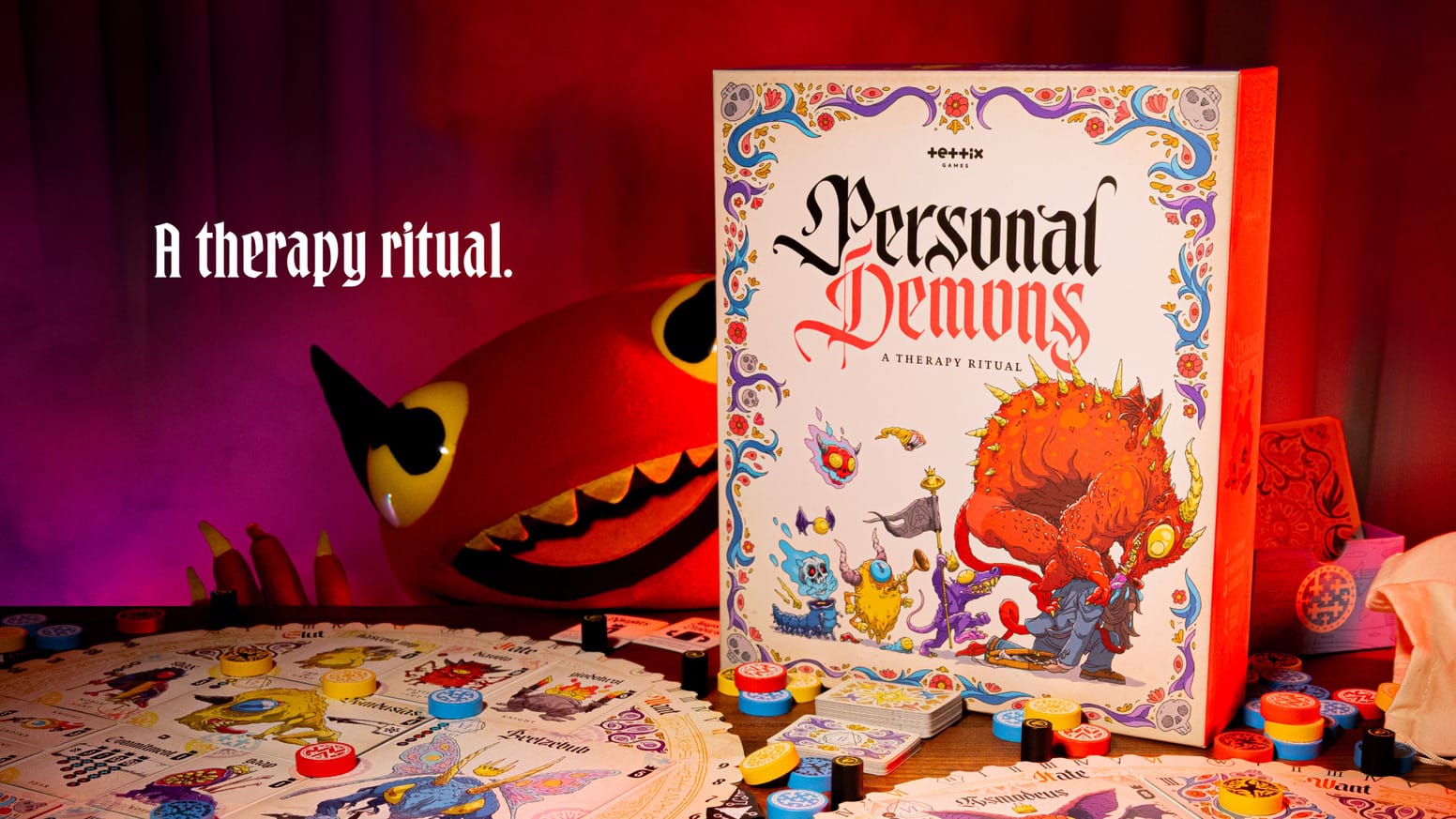
Der schottische Designer Judson Cowan hat am 22. September 2026 auf Kickstarter die Kampagne zu Personal Demons gestartet, einem Drafting- und Legespiel für 1 bis 4 Spielende aus seinem eigenen Studio Tettix Games. Innerhalb weniger Stunden hat die Kampagne ihr Ziel von 6.666 Pfund um mehr als das Siebenfache übertroffen: Bei Redaktionsschluss standen 47.514 Pfund und 841 Unterstützende auf der Uhr. Für deutsche Spielende ist vor allem eines relevant: Board Game Circus lokalisiert das Spiel. Die Sprache lässt sich später im Pledge-Manager zwischen Deutsch und Englisch wählen.

Wie funktioniert Personal Demons?

In Personal Demons beschwören die Spielenden reihum ihre inneren Dämonen und versuchen, sie durch vollständige Siegel zu bannen. Jede Partie läuft über drei Runden zu je sechs Zügen. Laut Board Game Circus handelt es sich dabei um echtes Hand-Drafting: Alle wählen aus ihrer Kartenhand verdeckt eine Karte, decken gleichzeitig auf und reichen den Rest im Uhrzeigersinn weiter, ähnlich wie bei Sushi Go oder 7 Wonders. Wer eine Karte behält, entzieht sie damit allen nachfolgenden Mitspielenden in der Passkette.

Vier Dämonenkarten der Farben Gelb, Rot, Blau oder Lila ergeben, in ihren Ecken kombiniert, ein vollständiges Siegel und bringen Punkte. Lila fungiert dabei laut Board Game Circus als Jokerfarbe, die jedes der drei anderen Siegel ergänzen kann. Dazu kommen Bonusaktionen wie das Stellen von Ängsten oder das Beschwören neuer Dämonen. Laut Herstellerbeschreibung lassen sich begonnene Siegel im Spielverlauf auch wieder aufbrechen und neu bilden, was fortlaufende Timing-Entscheidungen erzwingt.

Unterschiedliche Dämonen bringen laut BoardGameGeek jeweils eigene Effekte für alle Spielenden mit: Gesammelte Mut-Karten verleihen zusätzlich individuelle Fähigkeiten. Das soll für Varianz zwischen einzelnen Partien sorgen: Feste Zahlen zur Kartenvielfalt nennt die Kampagne bislang nicht. Die Kombination aus Hand-Drafting und Schichten-Legespiel auf einer persönlichen Tafel unterscheidet Personal Demons von reinen Set-Collection-Spielen, bei denen Karten nur gesammelt statt räumlich angeordnet werden. Ob die Dämonenkarten neben der Farbe zusätzliche Symbole oder Formen tragen und ob es eine Referenzkarte für die Siegel-Logik gibt, geht aus Kickstarter-Seite und Board-Game-Circus-Artikel bislang nicht hervor.

Kickstarter nennt eine Spieldauer von 45 Minuten: BoardGameGeek fasst sie mit 30 bis 60 Minuten etwas weiter. Freigegeben ist Personal Demons laut Kampagnenseite ab 14 Jahren. Die Grundbox ist für ein bis vier Spielende ausgelegt: Ein optionales Erweiterungs-Kit hebt die Höchstzahl auf sechs an. Der Solo-Modus bietet drei Schwierigkeitsstufen mit Zielwerten zwischen 75 und über 175 Punkten.

Companion zu Deep Regrets

Personal Demons ist als Begleitspiel zu Cowans Deep Regrets gedacht, das Würfelreich bereits getestet hat. Design und Illustration stammen ebenfalls komplett von Cowan selbst. Veröffentlicht wird über sein eigenes Studio Tettix Games mit Sitz in Edinburgh. Thematisch bilden beide Spiele einen Kontrast: Während Deep Regrets Reue anhäuft, geht es in Personal Demons um die spielerische Konfrontation und Bewältigung innerer Ängste.

Pledges und Erscheinungstermin

Der Basis-Pledge für Personal Demons kostet 33 Pfund und enthält eine Kopie in wählbarer Sprache. Das „Pandemonium“-Bundle für 70 Pfund bündelt Grundspiel, das 5-6-Spieler-Erweiterungskit sowie ein Kartenspiel-Deck mit Motiven aus dem Spiel. Das zugehörige Lore-Buch „Sol's Low-Key Guide to Demons“ bleibt dabei ausschließlich englischsprachig. Eine Händlerstufe für 199 Pfund bietet zwölf Exemplare mit Mengenrabatt, ebenfalls nur auf Englisch.

Kickstarter nennt August 2027 als Liefertermin. Die Kampagne selbst läuft noch bis zum 15. Oktober 2026. Einen Präzedenzfall gibt es bereits: Board Game Circus hatte die deutsche Version von Cowans vorherigem Spiel Deep Regrets nach eigenen Angaben ausgeliefert, kurz bevor Tettix Games Anfang Juni 2025 die erste große Erweiterung ankündigte.

Ob Board Game Circus als Lokalisierungspartner auch das Fulfillment für deutsche und EU-Unterstützende übernimmt oder der Versand aus Großbritannien erfolgt, nennt die Kampagnenseite bislang nicht. Eine Handelsausgabe nach Kampagnenende ist beim Vorgänger bereits Praxis: Deep Regrets ist inzwischen über den hauseigenen Shop Brettspielkiosk erhältlich, aktuell allerdings ausverkauft. Ob und wann Personal Demons denselben Weg geht, lässt die Kampagne offen. Das frühe Pledgen bleibt damit vor allem eine Frage von Preis und Wartezeit.

No (Okay, Some) Ragrets

07. August 2026 um 21:24

hope you're into tentacles

As a natural melancholic, the idea of being drawn to the sea — to drown one’s regrets, whether figuratively or bodily — makes me glad there isn’t a significant body of water within six hundred miles. It isn’t that suicide holds appeal for its own sake. Rather, it’s a fire door in the back, rigged with an alarm but duly located in case of an emergency. Sometimes, when an elderly person goes missing in the mountains, I wonder if they disappeared because of forgetfulness, as the silver alerts would have us believe, or because they could no longer stop remembering.

Deep Regrets, like Judson Cowan’s forthcoming Personal Demons, wears its metaphor on its sleeve only to collar it in gameplay. Perhaps we went to the sea to forget, to scrape our hull free of the barnacles that have accreted there, only to find ourselves fouled with a fresh catch. To mount an escape is to be caught.

Okay, now I’m being melancholic. At least it’s a good fit for Cowan’s intended topic.

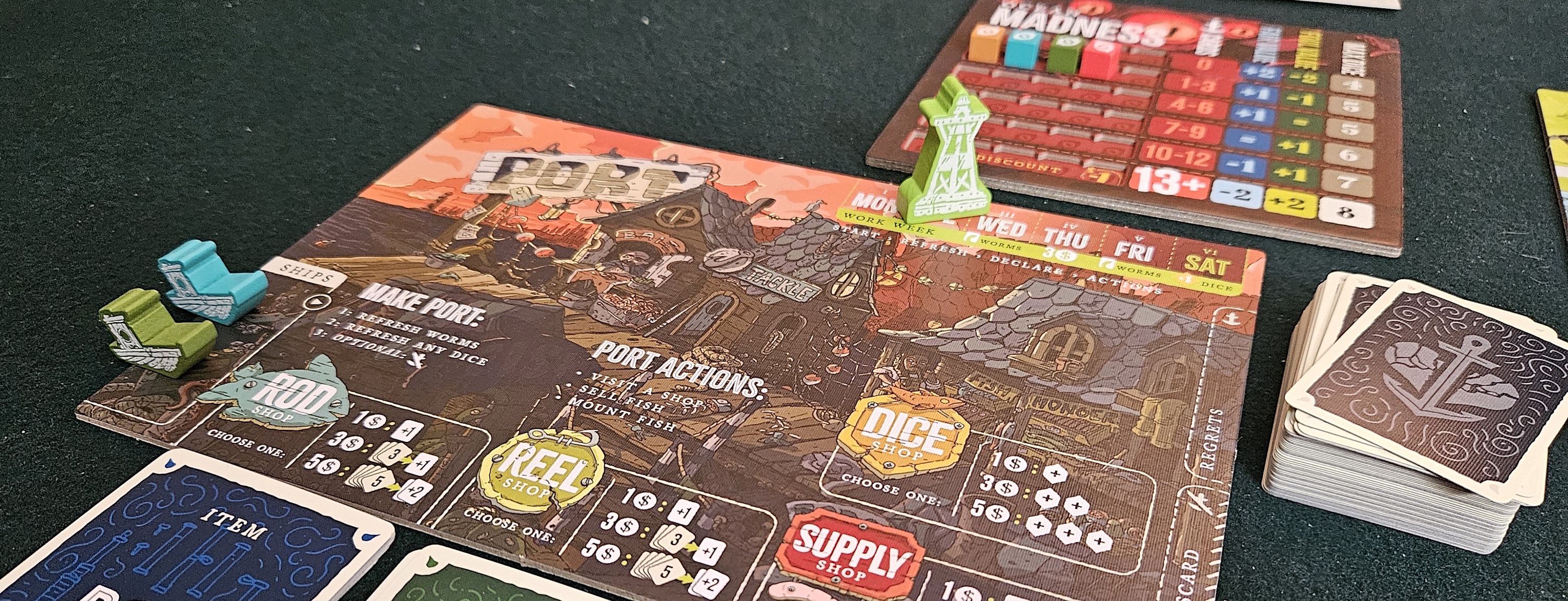
unfortunately, it isn't possible to win by hanging out in port all the time

Hanging out in port.

“On the surface” is a loaded term for Deep Regrets. That’s because Deep Regrets is about surfaces and what lies beneath them. In terms of character, the surface reading is that you’re a fisherman. Not the catch-and-release kind, but rather the my-livelihood-is-disappearing-with-the-depleting-abyss kind.

Which is what drives your bayman to trawl ever deeper. As the shoals close to the surface grow thin, you seek more benthic prey. It’s a solitary practice, both thematically and at the table. Turns don’t exist in complete isolation from those of your peers; this isn’t a total multiplayer solitaire experience. But as we will see, there’s a lidless membrane between you and your peers that’s never quite breached.

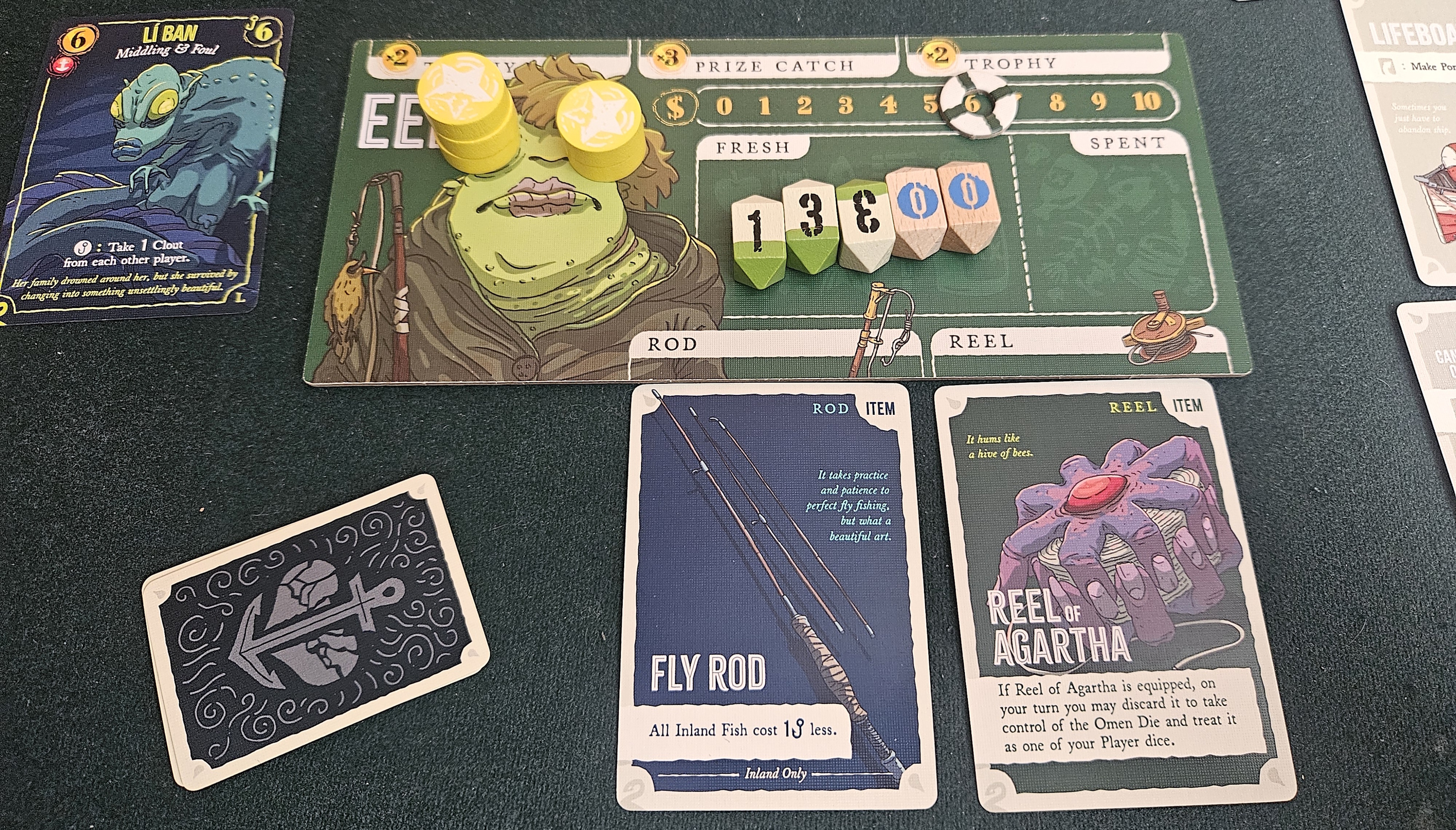
For the most part — on the surface — Cowan plays it straight. The entire game could be described in that hobbyist shorthand that sounds alien to outsiders. Fishing is a press-your-luck minigame that expends dice and other resources to land the best fish. Every turn is framed around either a day at sea or one in harbor, trading your catch for equipment. There are subsystems aplenty: permanent and temporary dice, rods and reels with variable benefits, fish both great and small.

I'm a star

Check out my cool shades. They conceal my squamous nature.

What’s interesting about these systems, though, is what they communicate about both the gameplay and your character.

Starting with gameplay, Deep Regrets is — on the surface — an incredibly chancy plaything. Early on, there are clues one can follow: the shadow beneath the water reveals whether a catch is small, middling, or large, and various depths translate to creatures that are increasingly dangerous to land-based mammals. Your bayman also has access to a few starting tools, such as a can of worms for peeking at a shoal’s face-down card and a lifeboat for beating a hasty retreat to port if your odds at sea turn south.

It isn’t long before it becomes apparent that Deep Regrets isn’t as aleatory as all that. Oh, there’s always a sense of risk. It isn’t uncommon for a cocksure hand to take one risk too many and invite the wrath of something truly monstrous. There are cards in the deck, whether the base deck or one of its multiple expansions, that can very much ruin your day.

Still, there’s so much mitigation at play that it’s hard to regard Deep Regrets as quite as chancy as some have made it out to be. Failing to catch a fish results in grabbing a “dink” — fishing slang, not lifestyle slang — which offers some benefit of its own, whether better fishing or some cash value, to offset the sting of failure. Even a cursory glance at the equipment shop reveals tools that will offset any number of flubs or miscasts. It isn’t enough to strip the game of its uncertainty altogether, but these are hardly uninformed decisions.

This is all good stuff, and would provide plenty to mull over. But, once again, this only brushes the surface.

yum

Not all catches are created equal.

It’s appropriate that where Deep Regrets expands its horizons is via the regret deck, a thick stack piled with all sorts of misgivings and heartbreaks. At regular intervals, your hapless fishers will land something special. A mermaid, perhaps, so shimmering with glory that it breaks your heart to haul her ashore. A leviathan, its mind linking to yours in its lashing final moments. Or maybe you’ll just sell something nasty at the fish market and feel bad about it. Regardless of the cause, these junctures see you drawing a regret.

Regrets matter in two senses. First, the number you hold in your hand determines your character’s current madness. The madder you become, the greater the risks you’ll take at sea and the weirder the creatures you’re willing to sell at market. Second, the sum of those cards determines which player is bitterest upon the game’s completion. This means tossing out your highest-scoring trophy.

What’s curious about regrets, though, is that they aren’t wholly undesirable. True enough, you would rather not have such terrible regrets that you fling your prize charybdis angrily into the sea. But a handful of regrets is… good, in fact. After a few days at sea, it won’t escape your notice that the deadlier deep shoals are packed with strange creatures. It also won’t escape your notice that these can be sold at higher prices and earn greater scores. But only if you’ve gone a little mad. Maybe even very mad. Not so mad that you ruin yourself. But mad enough to take the right risks and mount the right trophies.

Which is to say, Deep Regrets isn’t really about said regrets being bad, at least not always. In much the same way that Personal Demons doesn’t present fears as bad so much as things that need to be confronted, here one is invited to court regret, to dance with it, to dispel its worst excesses through clean living or self-medication or simple caution. Whatever works. But either way, a life without regrets hoists a lower ceiling, victory-wise.

I watched that movie about sailors who ate each other and then lived with the regret their whole lives. Boring. Hannibal Lecter never bellyached and he ate way more people.

Just some of the game’s many regrets.

Laid out like this, Deep Regrets’ messaging might come across as trite. Adolescent. As a species, we’ve told countless stories about how our regrets and failures are crucial stepping stones on the path to adulthood, from Picard being transformed into a timid science officer because he didn’t get shanked as a cocky ensign to the memory-erasing shenanigans of Eternal Sunshine of the Spotless Mind.

But Deep Regrets doesn’t come across as an adolescent musing. Its passage to success isn’t as straight as “regrets good.” Plenty of its regrets are well worth casting off. There’s a certain temporal wiggliness to the process; if you regret losing your arm or sacrificing your sister, I’m not wholly sure what it means when those regrets are discarded. Did we… forget? Get over it? Prevent its having happened through some demersal bargain? No idea. But the effect is one of curated regret, cautious regret, not wholesale acceptance or dismissal.

This makes Deep Regrets interesting rather than perfect. I wish the game had been pacier, but in some spots Cowan’s eagerness seems to have gotten the better of him. After the first few rounds, turns begin to bloat with extra dice, fish, equipment, and dinks. In the end, it isn’t the chanciness that’s the problem; it’s the replete tools for extending a turn and making outcomes more certain. As the game grows longer, its charms wear thin. Eventually, they rupture like aquatic flesh that’s gone too long without refrigeration.

I like to make guests scream when they look at my tumor-wall

Mounting my trophies, buoyed by regret.

Still, Deep Regrets is smarter than it looks. It’s a game that rewards peering beneath the surface, both in terms of gameplay and as a ludic examination of a life lived without too many guardrails. I can say this with complete certainty: I don’t regret the time I’ve spent with it. Not in the slightest.


Complimentary copies of Deep Regrets and its expansions were provided by the designer/publisher.

(If what I’m doing at Space-Biff! is valuable to you in some way, please consider dropping by my Patreon campaign or Ko-fi. Right now, supporters can read the next installment in my series Talking About Games, this time tackling the topic of what makes a good list! Naturally, the piece includes a list.)

❌