
Normale Ansicht

Crowdfunding-Wochenschau KW 35/2026: Geisterzug, blutiger Monolith und zwei Klassiker im Endspurt

24. August 2026 um 08:04
Crowdfunding-Wochenschau KW 35/2026: Geisterzug, blutiger Monolith und zwei Klassiker im Endspurt

Nach der Gen Con ist auf den drei großen Plattformen wenig los: Die Spieleschmiede hat in den vergangenen sieben Tagen kein neues Brettspiel gestartet, und die einzige neue Gamefound-Kampagne der Woche, eine Sonderedition von Mykerinos, erreicht keine der Auswahlschwellen dieser Ausgabe. Diese Wochenschau konzentriert sich daher auf vier Kickstarter-Kampagnen: zwei frisch gestartete Titel und zwei Klassiker-Neuauflagen, die in den kommenden Tagen enden. Alle Zahlen sind Momentaufnahmen vom 24. August 2026.

Spirit Train: ein Geisterzug für die letzte Reise

Spirit Train: The Final Journey von SweaterBear Games ist seit dem 18. August auf Kickstarter live und läuft noch bis zum 15. September. Am 24. August 2026 stehen 262.726 US-Dollar zu Buche, bei einem Ziel von 10.000 US-Dollar sind das 2.627 Prozent, getragen von 1.733 Unterstützenden. Die drei Pledge-Stufen werben mit 30, 20 und 32 Prozent Rabatt gegenüber dem späteren Ladenpreis. Versand, Steuern und Zoll rechnet die Kampagne nach eigenen Angaben separat nach Kampagnenende ab.

Designt haben das Spiel Casey Mattes und Zoey Mattes. Als Fährleute zwischen den Welten bauen 2 bis 4 Spielende in 60 bis 90 Minuten ihren Zug aus wechselnden Waggons, sammeln Geister ein und begleiten sie in ihr Jenseits. Mechanisch mischt Spirit Train Worker Placement mit einer Aktionsreihenfolge, die von der Stimmung der Geister abhängt. Einen Solo- und Koop-Modus bietet erst die oberste Pledge-Stufe mit der Zusatzkampagne „The Lost Soul“, laut Kampagnenbeschreibung acht Kapitel im Solo- oder Koop-Modus.

The Monolith: blutiges Opfer für einen außerirdischen Fels

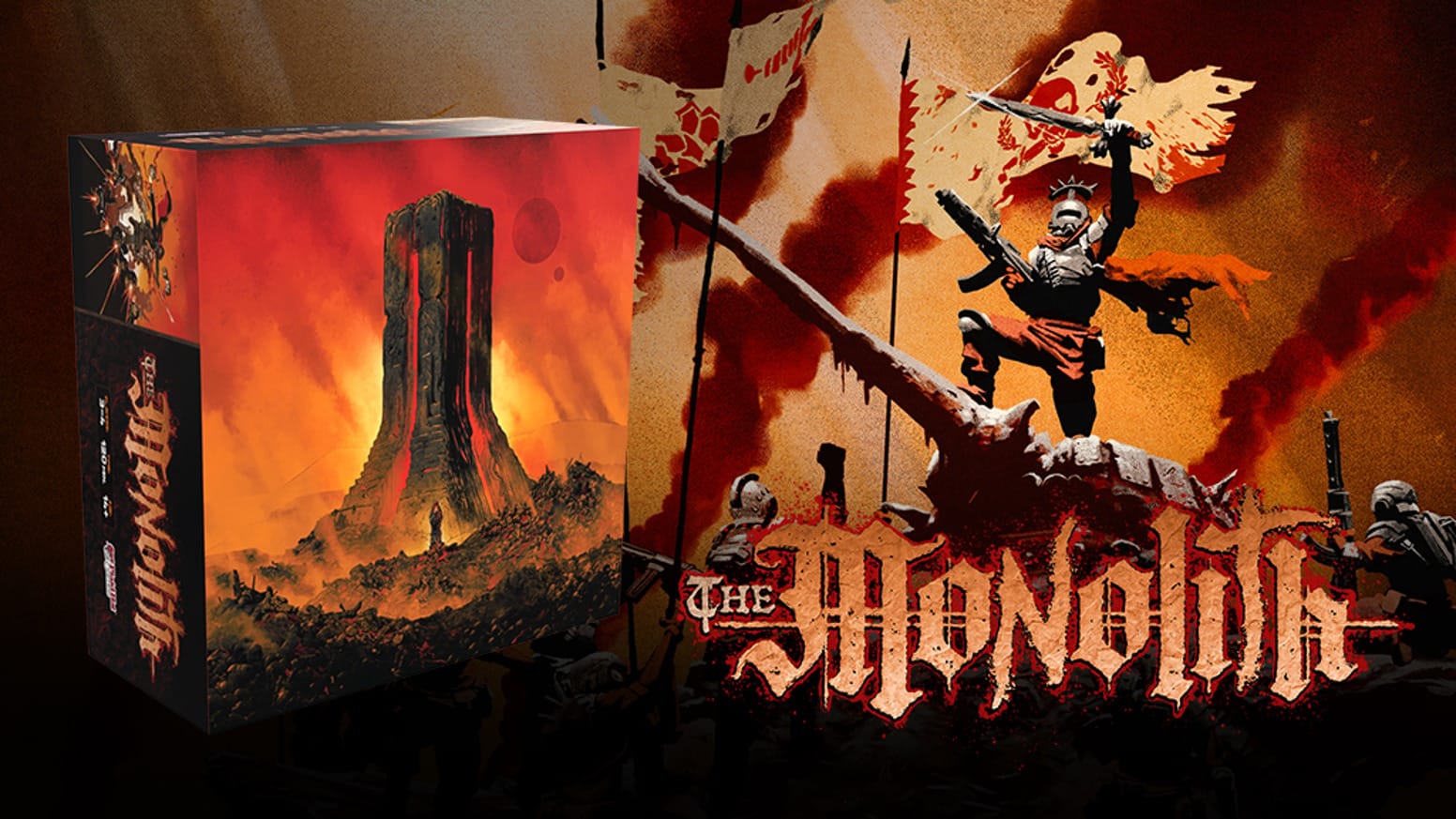
Auch The Monolith von Plaid Hat Games ist seit dem 18. August live, mit Laufzeit bis zum 17. September. Am 24. August 2026 sind 110.998 US-Dollar zusammengekommen, bei einem Ziel von 50.000 US-Dollar sind das 222 Prozent und 1.221 Unterstützende. Plaid Hat Games hatte eine erste Kampagne zum Spiel bereits im Juni gestartet und sie trotz erfolgreicher Finanzierung nach drei Tagen abgebrochen. Firmenchef Colby Dauch nannte im August gegenüber der Fachpresse den Grund: Die Zusagen seien bereits am zweiten Kampagnentag vollständig zum Stillstand gekommen, weshalb Plaid Hat Games den Neustart erst nach eingehender Analyse der Fehler plante.

Design stammt von Phil Gross. 3 bis 4 Spielende führen als Schamanen Krieger gegen rivalisierende Kulte, sammeln Herzen und opfern sie am Ende jeder Runde dem titelgebenden Monolithen, der daraufhin die Kampfaktionen der Partie bestimmt. Eine Partie dauert laut Verlag rund 120 Minuten. Das Grundspiel hat keinen Solo-Modus, gegen Aufpreis bringt ein Bot-Pack-Zukauf Unterstützung für 1 bis 2 Spielende.

Zu Versandkosten und Einfuhrabgaben für Unterstützende außerhalb der USA macht die Kampagne, anders als Spirit Train, keine Angabe. Die Reward-Texte nennen für alle Stufen nur einen weltweiten Versand ohne weitere Details.

Twilight City und Kalmár: Queen Games holt zwei Pierrot-Spiele zurück

Nur noch bis zum 27. August läuft die Kickstarter-Kampagne von Queen Games zu Twilight City und Kalmár: Merchants in Buda, zwei Spielen des ungarischen Designers Pierrot (Tamás Z. Marosi). Am 24. August 2026 stehen 9.026 Euro bei einem Ziel von 2.000 Euro, das sind 451 Prozent bei 59 Unterstützenden. Die Deluxe-Stufen nennen Ladenpreise von 79,99 Euro für Kalmár und 89,99 Euro für Twilight City, das Bundle beider Spiele kostet gegenüber einem Richtpreis von rund 180 Euro je nach Stufe 15 oder 25 Prozent weniger. Alle Deluxe-Stufen schließen laut Kampagne die deutsche und die EU-Mehrwertsteuer ein, die Bundle-Stufen liefern zusätzlich versandkostenfrei nach Deutschland und in die EU.

Twilight City schickt 1 bis 4 Spielende als Partisanen gegen ein diktatorisches Gouverneursregime in einer smoggeschwängerten Stadt, mit Tableau-Aufbau und rund 120 Minuten Spielzeit, und bringt einen eigenen Solo-Modus mit. Kalmár versetzt 2 bis 4 Spielende für 90 bis 150 Minuten als konkurrierende Kaufmannssöhne ins Buda des 15. Jahrhunderts, mit Warenhandel, Investitionen und einem eigenen Modus für zwei Personen, aber ohne klassischen Solo-Modus. Beide Spiele erschienen ursprünglich bei Private Moon Studios. Queen Games mit Sitz in Troisdorf bringt jetzt Deluxe-Neuauflagen beider Titel heraus.

Mexica, Bridges of Shangri-La, Gheos und Reel Rivals: vier Klassiker in letzter Minute

Der britische Verlag Play For Keeps beendet seine Sammelkampagne zu vier Euro-Klassikern bereits am 26. August. Am 24. August 2026 stehen 56.824 britische Pfund bei einem Ziel von 12.250 Pfund, das sind 464 Prozent, unterstützt von 814 Personen. Die Mexica-Stufe wirbt mit rund 7 Pfund Ersparnis gegenüber dem Ladenpreis, das Bundle aller vier Spiele mit rund 46 Pfund. Zu Mehrwertsteuer oder Zoll für Unterstützende in der EU äußert sich die Kampagne, anders als Queen Games bei Twilight City und Kalmár, nicht.

Das Zugpferd der Kampagne ist Mexica von Michael Kiesling und Wolfgang Kramer, der dritte Teil ihrer Masken-Trilogie aus dem Jahr 2002. 2 bis 4 Spielende ziehen in rund 90 Minuten Kanäle und Brücken durch Tenochtitlan und gründen Bezirke für Mehrheitspunkte, ein Solo-Modus fehlt. Dazu kommen die Neuauflagen von Bridges of Shangri-La, Gheos und Reel Rivals als weitere Titel im selben Bundle.

Diese Ausgabe teilt sich in der Mitte: Spirit Train und The Monolith sind komplett neue Spiele, Twilight City/Kalmár und das Mexica-Bundle bringen dagegen Bestehendes in neuer Auflage zurück. Wer an Twilight City, Kalmár oder den vier Play-For-Keeps-Titeln interessiert ist, hat nur noch wenige Tage Zeit. Die kommende Woche dürfte nach der Sommerpause wieder mehr Neustarts bringen.

“Our attempts to do things ‘different from the others’ came back to bite us”: Plaid Hat’s Colby Dauch on The Monolith’s Kickstarter failure and rapid turnaround

19. August 2026 um 20:30

Plaid Hat Games launched its Kickstarter for The Monolith in June with a trio of successful crowdfunding campaigns under its beltonly to pull the project three days after launch when pledges unexpectedly ground to a halt, despite quickly beating its $20,000 goal. Less than two months later the revamped campaign is back, and has already pulled in almost four-times the amount the cancelled campaign managed in the same amount of time. In this first-person piece for BoardGameWire, Plaid Hat founder and CEO Colby Dauch explains why The Monolith exposed flaws the publisher’s previous campaigns had masked, what he believes it got wrong, and why the changes made for the relaunch appear to be working.

Plaid Hat Games is relatively new to crowdfunding and we’ve experience our first major setback in that arena. We launched our fourth ever crowdfunding campaign back in June, this time for a new game called The Monolith.

By the second day of the campaign the pledges had fully stalled out. It was self-evident that we had made mistakes, so we pulled the campaign with the intention to relaunch it after analyzing what had gone wrong, and doing what we could to address it.

As I write this article, I don’t know if our hunches will turn out to be correct. This article is scheduled to be posted as we relaunch the campaign, so I suppose we are all going to find out together! I’m more than a little nervous. Allow me to provide some background essential in understanding how we’ve come to make the choices we’ve made.

Plaid Hat founder and CEO Colby Dauch

We’ve been around since 2009 and watched from the sidelines as crowdfunding took hold and grew into a large part of the board game industry.

For many years we swore off crowdfunding. Internally we were critical of it for a number of reasons. My biggest reservation was that it felt dishonest to me that an established company would tell its customers “we need your help to make this product”, when they had already proven previously that they were capable of putting together the funding necessary to launch a new product onto the market, without requiring the customer to buy said product a year or more in advance of its release.

However, things have changed over the years in more ways than one and honestly, it has been a bad business decision to hold out on the crowdfunding model for as long as I have.

When we did finally enter the crowdfunding space a couple of years ago I told myself, and others, that there was clearly no longer an expectation that the companies going to crowdfunding needed to be there. I believed it to be understood that it was more akin to a pre-order system and that the consumer knows that. I even said as much in the article I was interviewed for on this very site, posted on June 30th, about us pulling the Monolith from Kickstarter. It’s not true. I had only convinced myself that it was.

I’m in the midst of reflecting on every decision I’ve made that led to a failed campaign, and what that failure means for my company, the people I employ and my family, if I’m not able to correct course. The reality is that we moved to crowdfunding because the things that made us successful in the past aren’t working anymore and we were growing desperate for a solution.

Getting attention on a board game release announcement isn’t free anymore. It’s not news. At best it’s a bullet point on a long list of new release announcements for the week. The traditional method we’ve long employed of selling to distributors who sell to retailers who sell to players, sadly seems to be falling apart for us, and I suspect for most publishers.

So we found ourselves trying to incorporate crowdfunding into our business model while simultaneously telling ourselves we could do it different – better. Our approach:

  • We will severely limit the use of exclusives. We don’t want people feeling like they HAVE to buy the product now or they will be missing out.
  • We aren’t seeking to punish the people who have long supported their local board game shop by purchasing our products through them.
  • Most of all we don’t want to manipulate our customers by preying on their fear of missing out.
  • We will reduce the long wait between the time you back a game and the time you get that game by being fully ready to go to production at the time of the Kickstarter.

There were flaws in this approach. Flaws that I believe were masked in our first three campaigns because they all had something else big going for them.

Wandering Galaxy was the latest installment in a series of games we had released that had gotten a lot of attention for their amazing storytelling and voice acting (in a companion app).

Ashes Ascendency was a reinvigoration for a game that has ten years worth of glowing reviews to put in front of people and a dedicated fanbase.

Super Auto Pets Card Battle was based on an amazing and charming digital game, and we were able to rely on the attention of fans from that.

The Monolith had no predecessor.

The Monolith || Kickstarter image

This is why I believe our attempts to do things ‘different from the others’ has come back to bite us:

We wanted to limit FOMO.

A crowdfunding campaign must be compelling beyond the presentation of the game itself. You are asking the customer to pay for a game long before they can expect to have it in their hands. We need to give them a compelling reason to do that.

In the Super Auto Pets Card Battle campaign, the most popular pledge was by far the ALL-IN pledge, because it was the most compelling. You got all of the sets, all of the add-ons and in a storage box that would organize it all and only be available during the campaign.

I took away the wrong lesson. What I decided was that what those results were telling me was just that people want all the stuff, so with The Monolith let’s just make the core product all of the stuff.

We wanted to reduce the wait time on the game.

This is the one where I really messed up with The Monolith. As I established, the reality is that we needed to make changes to how we were doing things and I allowed myself to miss out on a key advantage to crowdfunding: measuring demand.

In an effort to shorten the window on how quickly we could deliver on a campaign, and further spurred on by a yearning to have a line at our booth for a new game release at GenCon or Essen (that feeling is the highest of highs), I started having plastic molds for the game well before the campaign so that they wouldn’t delay production – and remember this game was going to have all the upgrades packed in, so it was a lot of plastics and a lot of mold costs.

Further compounding the issue was that the mold costs were so high, to get the cost per unit down, I felt like I needed to be prepared to produce 10,000 copies. And like the molds, I got that production started before the campaign even started.

It was the exact kind of risk we had always needed to take when producing a game, but crowdfunding should have given me a chance to mitigate that risk, and in doing so really been a fulfillment of the core concept of crowdfunding to begin with: Asking the player to help be a part of bringing the game to the market.

So here is what we are doing differently with the relaunch of The Monolith campaign to try to address what went wrong with the initial campaign:

  • Creating a 1-2 player mini-expansion.
  • Lowering the retail price of the game and offering a larger discount on that already lower price for backers.
  • Creating a 6th shaman character add-on.
  • Creating glass blood tokens add-on.
  • Creating a metal first player and surge tokens add-on.
  • Creating an All-In tier with all of the add-ons included at a lower price than purchasing them separately.
  • Different marketing partner and strategy.

Finally, here are my take aways for how we will do campaigns differently in the future:

  • When possible, create a version of the game that focuses on lower price and a version that focuses on maximum bling.
  • Be more willing to compete with the price point that we and everyone else knows online retailers are going to put on our games.
  • Give the campaign a chance to communicate what the demand is. We will still be production ready, but I won’t be putting the cart directly in front of the horse again.
  • Better leverage the community-based systems that already exist to support crowdfunding.

Follow Up

As I write THIS bit, the campaign has relaunched about 24 hours ago and is doing much better this time!  By a large margin, backers are opting for the pledge level that includes all the add-ons. So I believe this supports the theory that the add-ons were essential for a successful campaign. 

It is hard to quantify exactly how much each of our changes contributed to the better result, but overall, the adjustments seem to be working.  I’m so grateful to everyone who has backed.

The Kickstarter for The Monolith, which is designed by Phil Gross, is set to run until September 17.

The post “Our attempts to do things ‘different from the others’ came back to bite us”: Plaid Hat’s Colby Dauch on The Monolith’s Kickstarter failure and rapid turnaround first appeared on .

Plaid Hat pulls funded The Monolith Kickstarter after pledges ‘stagnated’ on day two, plans post-Gen Con relaunch

30. Juni 2026 um 17:43

Plaid Hat Games has cancelled its successfully-funded Kickstarter for upcoming title The Monolith three days after launch, saying it failed to give prospective backers enough reasons to pledge rather than wait for retail.

The Monolith quickly beat its $20,000 funding goal after launching on June 25, but Plaid Hat CEO Colby Dauch told BoardGameWire pledges had “completely stagnated” by the second day of the campaign.

That led the publisher to scrap the crowdfund for the Phil Gross-designed game on day three, having collected $27,400 from 290 backers.

Dauch said Plaid Hat plans to relaunch the crowdfund shortly after Gen Con with additional content and more pledge tiers, while keeping the game’s existing delivery timeline intact – with manufacturing having already begun on the title.

That manufacturing process has included Plaid Hat spending $35,000 on plastic moulds alone, given the large amount of plastic components in the game – including the namesake monolith, a large plastic tower which sits at the centre of the board.

Dauch told BoardGameWire the company estimates it would have to sell 10,000 copies of the game in order to spread the mould cost widely enough that the retail price could be kept down, adding that the long lead times on making plastic moulds was a big motivator in starting manufacturing prior to the campaign – as well as a desire to launch the game at a convention this year.

Plaid Hat CEO Colby Dauch

Plaid Hat said in an update to Kickstarter backers, “While we hit our funding goal at a decent rate, almost as soon as we did, the pledges stopped. Another 24 hours passed, and the needle didn’t move.

“Of course, we had questions since we’ve run several campaigns now and this experience is completely new to us.

“What we found was that our visually striking campaign was drawing in lots of people, but they weren’t pledging.

“While there wasn’t a ton of feedback, one thing we heard on several occasions was, ‘Why pledge now? Why not just wait for retail?'”

“For everyone here who’s backed, you already know the answer to that question, but we must acknowledge the simple truth that along the way, we could have done better.”

The company added in a follow-up post on BlueSky, “We could have limped over the finish line, but it would have been such a disservice to a game worthy of so much more.”

Dauch told BoardGameWire that all of Plaid Hat’s prior Kickstarters had followed the common practice of setting a low goal amount which can be quickly celebrated as having been beaten, providing momentum for the campaign.

But after seeing The Monolith quickly fund before effectively flatlining, Dauch said reaching a funding target was no longer enough to demonstrate sufficient market demand.

The company has said it will revisit that practice in the wake of cancelling The Monolith, instead likely setting the target as costs plus a certain margin that would need to be crossed to indicate there is enough overall enthusiasm from backers.

Dauch told BoardGameWire, “I think it is just public knowledge that there are certain rules you have to follow to make a Kickstarter work.

“We’ve tried to challenge some of the rules – for example, as a company we try not to lean too hard on FOMO to get people to pledge.

“But we’ve accepted other rules for success as standard practice in a crowdfunding campaign. One of those rules is that you really want to set a low goal that you can blow past early.”

The Monolith || Kickstarter Image

Asked whether the game potentially suffered due to its $90 price point – not necessarily that it was too high, but that it fell between the extremes of ‘very affordable’ and ‘massive, multi-hundred dollar multibox crowdfund’ – Dauch told BoardGameWire:

“I think there is evidence that people want a variety of price points they can buy into, and we are exploring options to make that happen. I think that is more to blame than being in some middle ground.”

Plaid Hat has been making successful board games since 2009, when Dauch created the company to sell his highly-regarded card-based fantasy battler Summoner Wars.

The publisher scored another hit with animal-themed co-op adventure game Mice and Mystics in 2012, and followed that two years later with the hugely successful Dead of Winter, which scooped a string of awards – and big sales numbers – for its thematic mix of zombie survival, traitor mechanics and story-driven gameplay.

Plaid Hat was bought by Asmodee in 2015, but became a rarity five years later as one of just two studios which have gone on to become independent from the publishing and distribution giant.

The publisher only began running crowdfunding campaigns two years ago, having become free of a “first refusal” distribution deal with its former owner that had made experimenting with something like a Kickstarter campaign functionally impossible.

Dauch told BoardGameWire Plaid Hat had long delayed embracing Kickstarter because it was uncomfortable with some of the accepted conventions of crowdfunding, including the pressure to create artificial urgency.

He said, “The reality is that we held off on doing crowdfunding campaigns for a long time as a company because parts of them do feel artificial and we weren’t looking to deceive anyone.

“These large companies on Kickstarter don’t NEED the campaign funds in order to fund a project. It’s self-evident from the fact that a campaign must have a certain amount of polish and progress to even be taken seriously, which already represents a sizeable investment made to get a game to that state.

“Our decision to enter the crowdfunding arena was based on the belief that we were missing out on a portion of the market that enjoys getting their games through crowdfunding campaigns, not because we could no longer fun projects on our own.

“We felt that crowdfunding has been such a mainstay for so long, that most people who participate in them are aware that this is how many established companies use Kickstarter – as a sort of pre-order campaign.”

The post Plaid Hat pulls funded The Monolith Kickstarter after pledges ‘stagnated’ on day two, plans post-Gen Con relaunch first appeared on .

❌