We play a lot of games. Which is great, because a lot of games get made, and we get to play them … but it does come at the cost of always having to learn (and teach) something new, grappling with rules, and gets in the way of enjoying the game. Would it be better if we just devoted ourselves to one game? Before we join a Mahjong club, we talk about Wingspan Pocket, Greylune, and Marrakesh.
If you don’t want to miss an episode, please subscribe on Apple Podcasts/Google Podcasts/Stitcher/Spotify, or add our RSS feed to your favourite app. Reviews and subscriptions really help us and would be greatly appreciated! To download the episode directly, click here.
If you’d like to discuss anything in the episode, please do so in the comments below, visit our BoardGameGeek guild, join our Discord, or Facebook Group! Any feedback is also always helpful. If you’d like to show your support for the show, we also have a Patreon with some fun rewards, and a merch store!
Timecodes:
01:53 – Wingspan Pocket 09:16 – Greylune 19:11 – Marrakesh 36:53 – Sticking with one game
Thank you to Heart Society for generously letting us use What’s On Your Mind, Kid? from their album Wake the Queens.
I never played Spyrium, William Attia’s 2013 game of steampunk factories, but I heard good things about its worker placement/removal system. Greylune, as near as I can tell, recaptures that title’s core appeal, while swapping the geared top hats for a more generic — but maybe more blandly appealing? — fantasy universe.
Your followers go into the market to buy goods… and steal gold? I think?
As expected, the best part has everything to do with the workers. The core system here is genuinely brilliant, a series of placements and eventual withdrawals that feel like direct assaults on one’s fellows at the table without ever laying a cross finger upon anyone’s shoulder.
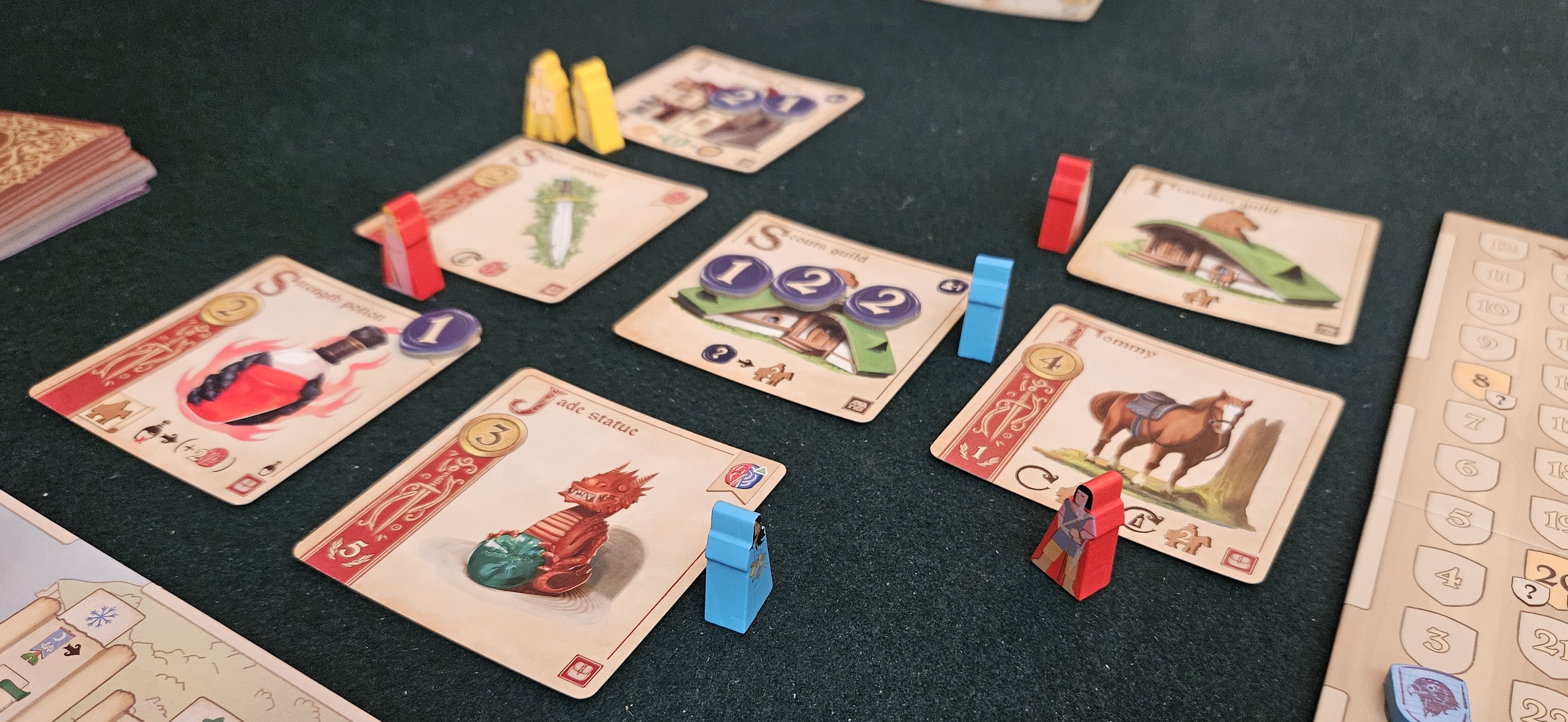
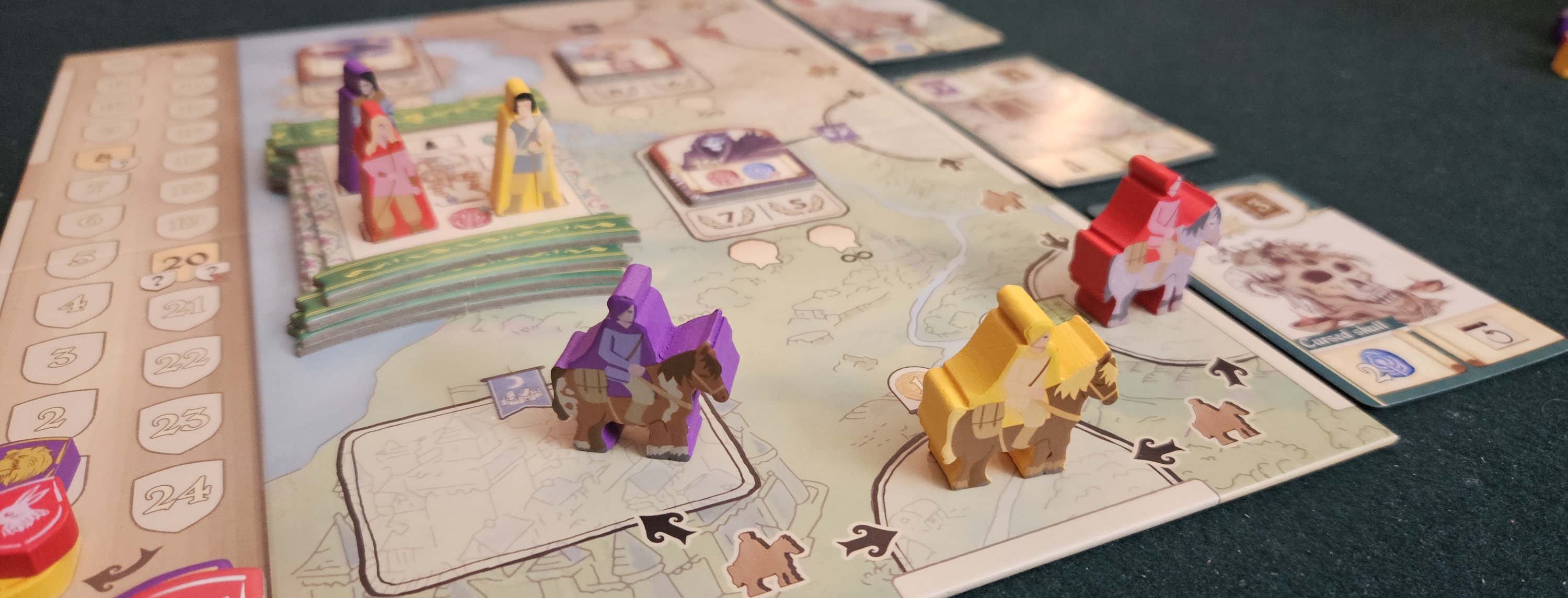
The idea is that workers are placed into a marketplace to secure various goods. There are a few types of said goods: items and companions, both of which require purchasing, and amenities, which can be visited more than once. Their main commonality is that buying something from the market has two big restrictions. First, you can only purchase something by removing a worker — thus shifting yourself into the game’s second phase, which prevents you from placing any more workers until the next year — and second, the more workers there are surrounding something, the higher its cost.
The inverse is also true. Rather than pulling off a worker (teehee) to buy a card, their withdrawal can earn a pocketful of gold instead. This works by the same formula: you remove a worker, count how many other workers are next to the card in question, and then earn that many coins. They’re probably engaging in commerce or something. I preferred to pretend they were pickpockets.
As systems go, there’s no doubting its cleverness. Everything is wholly player-driven. It’s pretty rare that I’ll pay attention to how many coins a rival is holding, but here it’s common to tally someone’s holdings. Often, the placement of a single worker can drive up a price just beyond their reach, prompting them to first place another worker to earn the necessary cash, and thus providing a window to swoop in and nab whatever sword, horse, or buddy they were eyeing.
It’s a rather snitty game like that. Also a razor-taut one, every coin and card counted to its precise change.
Ah, an adventure!
The reason for all those fairly-gotten gains is to outfit your knight for adventure. Everything has its place: companions provide reactive abilities that make it easier to travel and survive encounters, while items generally serve to improve your skills or move your knight deeper into the wild. There are also two flavors of strength, cherry and blueberry, to represent swords and sorcery.
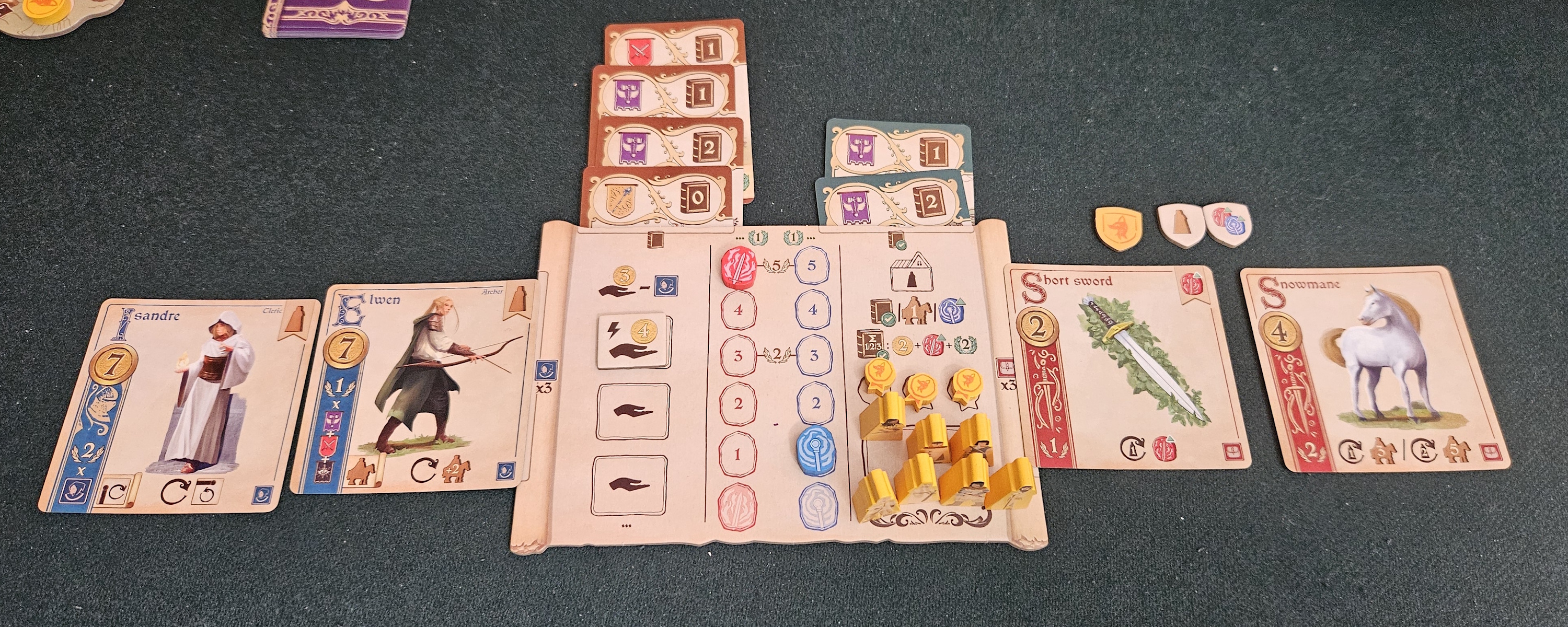
So you head out into the unknown to beat up a troll, help a hermit, or take part in a joust. You know. Hero stuff. But in my favorite twist, it isn’t enough to accomplish an objective. These encounters are tucked under your player board, where they then sit, doing nothing, until you get around to sending one of your followers to boast of your achievements in one of the local taverns. This requires more worker placement and removal, whether the following spring or because you’ve planned ahead.
It’s rather impressive to see in motion. Despite the removal of anything resembling steampunk, the game moves according to clockwork logic, everything feeding back into itself: workers outfit knights who bring back deeds for workers to boast about or resources for them to spend at the market, around and around, until you’ve exhausted everyone and it’s time to tuck in for the winter.
At the same time, it’s a game laden with regrets. It isn’t uncommon to move onto the next phase only to immediately see the gap in your plans. Or, more often, for another player to come along and do something that forces you to think more reactively. Encounters exist to be stolen; quests to be one-upped; jeweled idols to be purchased out from under another prospective client.
It feels good, though. Really good. Which makes me wish the game didn’t feel like it was left at eighty percent completion. There’s a big difference between replayability and variety, with lots of modern games leaning toward the latter. I would guess that Attia was designing for tightness of experience.
But also… Greylune needs some variety. Every session reveals nearly every card, both in the marketplace and the wild. There’s such a lovely sense of discovery to those first sessions that I found myself wishing I could go back and experience it again. Here, knowing what’s coming is much of the battle. On my second play, I knew I would buy the horse if it showed up. Then I knew I would try for a potion strategy. In the last round, which features no variance from play to play, it’s inevitable that a powerful tavern will appear, one that awards rather large quantities of points. So I planned from the very beginning to save most of my quests for the last moment and forego adventuring altogether. There were little hiccups, but the strategy worked well enough to lap most of my opponents. It felt good, to be sure. But it also felt sterile and mechanical.
Everyone likes buying stuff, right?
Ultimately, Greylune both impressed me and left me chilly. Its core system is downright smart, and the set dressing around it feels good to handle. But it’s like handling a machine; a fidget toy, perhaps, or an orrery, spinning along its foreordained orbit. Pleasant but cold; beautiful but delicate. These days, I like my games to apply some force when they’re ramming their shield into my teeth, and Greylune’s touch is simply too dainty to cause so much as a wiggle.
A complimentary copy of Greylune was provided by the publisher.
(If what I’m doing at Space-Biff! is valuable to you in some way, please consider dropping by my Patreon campaign or Ko-fi. Right now, supporters can read the next installment in my series Talking About Games, this time tackling the topic of what makes a good list! Naturally, the piece includes a list.)
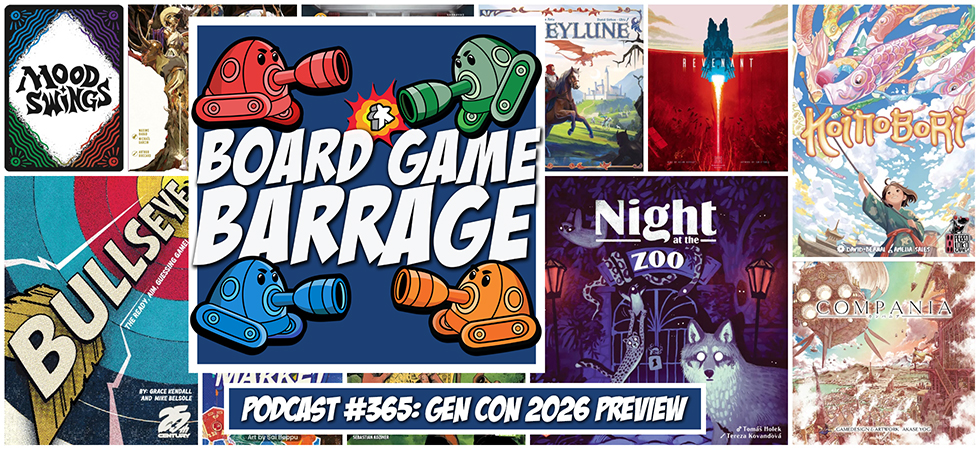
Gen Con is Gen Coming, so we’re looking in our wizard’s glasses to tell you what’s what. Whether you’re going or not, you’re gonna want to know what the hot games are, and we’ve got you covered. Before we Indianapolize, we talk about Koinobori, Compania, and Mood Swings.
If you don’t want to miss an episode, please subscribe on Apple Podcasts/Google Podcasts/Stitcher/Spotify, or add our RSS feed to your favourite app. Reviews and subscriptions really help us and would be greatly appreciated! To download the episode directly, click here.
If you’d like to discuss anything in the episode, please do so in the comments below, visit our BoardGameGeek guild, join our Discord, or Facebook Group! Any feedback is also always helpful. If you’d like to show your support for the show, we also have a Patreon with some fun rewards, and a merch store!
Timecodes:
02:32 – Koinobori 09:50 – Compania 19:52 – Mood Swings 25:39 – Gen Con preview 24:57 – Prague Unseen 28:27 – Triangulation 30:24 – All Mine! 32:25 – Hell of a Deal 34:51 – Night at the Zoo 36:22 – Stonk Market 39:45 – Bullseye 41:57 – Jibber Jabble 44:38 – The Lord of the Rings: Circle of Conflict 46:05 – Revenant 48:11 – FaeKin 49:32 – Mythologies 50:18 – World Order 52:28 – Greylune 57:22 – Corps of Discovery Duo
Thank you to Heart Society for generously letting us use What’s On Your Mind, Kid? from their album Wake the Queens.

 Anmelden