Während die SPIEL in Essen vor allem Dreh- und Angelpunkt für Brettspielfans aus ganz Europa ist, tummeln sich auch zunehmend mehr Tabletopherstellende unter den Aussteller:innen. Das zieht neben zahllosen anderen Tabletop-Begeisterten natürlich auch unseren Redakteur Geoffrey an, der hier zusammenfasst, worauf er sich am meisten freut.
Micro Art Studio aus Polen wird nicht müde und liefert in seiner für das Spiel Bolt Action lizensierten Reihe vorbedruckte Gebäude aus MDF für einen weiteren Schauplatz des Zweiten Weltkrieges. Nach der frostigen Ostfront geht es dieses Mal in sonnigere Gefilde. Das Thema ist Italien.
September has been really, really busy for me. We attended the Gaming the American Revolution Camden 250 Event in Camden, South Carolina and work was pretty busy as well. As such, I just feel like I have been unable to really give this post the time needed to make it as good as it can be. Don’t get me wrong…I am still writing it but I am not spending as much time searching this month. I also was unable to find a sponsor for the post so we are foregoing that this month as well.
This month, I was able to find 15 games to share. I was also able to find 5 games being offered on Crowdfunding through Kickstarter.
1. Battlegroup Clash: Baltics 2nd Printing from Sapper Studio
James Buckley is a name we all know in the wargaming space. He has worked with publishers like PHALANX and Nuts! Publishing and also is now a burgeoning designer as he published his first game in 2025 called Battlegroup Clash: Baltics from his new publishing company called Sapper Studio. The game has already sold out and they are currently offering up a 2nd Printing on pre-order
From the game page, we read the following:
Battlegroup Clash: Baltics is a two-to six-player tactical land warfare game that plays in two to three hours. It is a commercially-adapted version of a game recently developed for the British Army to help train its junior officers.
The game is set in Estonia and covers a hypothetical near-future Russian invasion of the country, and attempts by NATO land forces to repulse it. Each side has a maximum force size equivalent to a reinforced battalion, with individual unit sizes being platoons or sections.
It comes with six scenarios and has three play modes and optional rules, allowing for players to vary the level of realism and complexity of play. The Basic mode of play is equivalent to a light complexity commercial wargame. The Standard and Advanced modes are equivalent to a medium-light complexity game.
While the game mechanics and components will be familiar to anyone that has played a hex and counter wargame, there are several unique features about Battlegroup Clash: Baltics:
Preparation & Planning – In the Standard and Advanced modes of the game players will need to draft Orders for their forces. This happens at the start of the game. These Orders drive the actions individual units take in the game. This is a simplified version of the type of planning that would occur in real life. It presents both a challenge and opportunity to players, and greatly enhances the immersion of the game.
Drones and Electronic Warfare – Events in Ukraine have shown how much the use of drones has changed the modern battlefield. Reflecting this, in the game players use UAS drones for reconnaissance and FPV (‘kamikazi’) drones to attack enemy units. Each side can intercept their opponent’s electronic transmissions to improve targeting, and apply tactical Electronic Warfare effects such as jamming the enemy’s drone assets or crippling their GPS navigation.
Real World Mapping – The four maps in the game are based on satellite imagery from key locations in Estonia. Using computer aided design, that imagery has been turned into a highly realistic map. There are no hexes, just grid lines, the same as a real world map. Players must read the map terrain to determine key locations and terrain features, and assess how they fit into their battleplan and objectives.
If you are interested in Battlegroup Clash: Baltics2nd Printing, you can pre-order a copy for £69.00 ($92.38 in US Dollars) from the Sapper Studio website at the following link: Battlegroup Clash: Baltics (2nd printing) | Sapper Studio
2. VEKTYR: The Geopolitical Struggle for Central Asia, 1991-2020 from GMT Games
I love a good geopolitical wargame as well as a good multi-player wargame. And when these 2 are mixed, it can really make for a very interesting gaming experience with diplomacy, alliances, asymmetry and the like. This past month, GMT offered a game that have both in VEKTYR: The Geopolitical Struggle for Central Asia, 1991-2020 that takes a look at the ongoing struggle between the United States, Russia, and China. for influence and control in Central Asia. The game is designed by a new designer named Kyle Farrell so I am very interested in connecting with him to discuss the design and get more information about how it plays and what his vision and basis are for the game.
From the game page, we read the following:
VEKTYR is a 2-3 player geopolitical wargame that simulates the ongoing struggle for influence in Central Asia between the United States, Russia and China.
The game takes players from 1991 after the newly independent Central Asian nations – Kazakhstan, Kyrgyzstan, Tajikistan, Turkmenistan, and Uzbekistan – emerged from the collapse of the Soviet Union through 2020 when multiple international crises accelerated the global shift towards a multipolar world.
The extensive action deck covers over 120 distinct historical occurrences that have shaped Central Asia’s relationship with three global powers – the United States, Russia and China – as well as the rest of the world.
Over the five turns of the game, each player will have to bend history to their will in order to establish influence throughout Central Asia as well as periphery territories in the Caucasus, Türkiye, and Afghanistan. Your mission is to win hearts and minds, catch the ears of the region’s presidents, invest in critical industries and showcase your power’s prowess through military assistance.
In VEKTYR, players will accrue victory points by playing “Scoring” cards, playing event cards that award VP’s, or building pipelines for VP payouts. The game consists of 5 turns: 3 turns within the Post Independence epoch from 1991-2016 and 2 turns within the Central Asian “Renaissance” epoch from 2016-2020. Each turn consists of 6 rounds.
At the start of each turn, each player draws up to a hand size of 7 cards and plays one round in succession until every player has played 6 rounds. All of VEKTYR‘s cards have a dial in their upper left corner noting which global power the card’s event pertains to. Some cards are fully-neutral cards meaning any power can play them, others can be played by 2 of the 3 powers, and others still can only be played by a single power. Whenever a rival plays a card with an event pertaining to you, you’ll have the opportunity to resolve the event during your rival’s round. A delightful mechanic that keeps the game dynamic even when it’s not your go!
Every round, players either use their card’s event or action points to lay influence on the board, seize the ear of the region’s presidents, invest in industries, provide military assistance or build pipeline infrastructure. Much of the game centers around your ability to build influence in the Central Asian provinces as well as periphery countries. Players will use events and action points to gain a strategic foothold in these wide stretches of Eurasia. But how effective will your soft power be in fending off your rivals’ similarly enticing offers?
Also, what have you done for me lately? One of the mechanics that keeps the board fresh in VEKTYR is called “atrophy” and mimics the ephemerality of political popularity. Under this mechanic, at the end of every Turn, each player removes some of their influence from the board, opening up new possibilities for their opponents as they are forced to abandon specific countries or provinces.
I am very much interested in this title and would like to learn more about how it works and how it tries to simulate the complex situation and politics involved.
3. Empire of the Sun: China Expansion from GMT Games
Empire of the Sun is Mark Herman’s card driven design that takes a strategic level look at the entirety of World War II in the Pacific from the attack on Pearl Harbor until the surrender of Japan and is the first card driven game (CDG) to move the system closer to a classic hex and counter wargame, while retaining all of the tension and uncertainty people have come to expect from a CDG. Recently, GMT announced an expansion to the game that deals with the China Theater and the action that took place there between the combatants. The game comes with a new replacement map that will replace the China Front Track as well as some new cards. The game was dreamed up by a few Chinese designers, and fans of Empire of the Sun, named Ji So and Liu Zhijun.
From the game page, we read the following:
Empire of the Sun examines the China theater as a frontline ‘piston’ model that reprises its historical role as an Allied resource need based on the level of Japanese offensive efforts to force its surrender. We are now releasing a new expansion for the core game, which you will need to play this expansion that adds all of the ground and air forces to open up a path not really taken to include the eventual Soviet invasion of Manchuria.
About two years ago, two Chinese gamers contacted me that they had developed a China expansion for Empire of the Sun. I was certainly interested and what you hold in your hands is the product of my collaboration with Ji So, Liu Zhijun, and my developer Francisco Colmenares. What has changed is my original piston model China Front track has been replaced with a map and counters. There are a host of rules to handle this unique theater of operations, but what I have found at their core is how well we have gotten the new module to perform to history and the original track.
What you will find is if the Japanese play cards into China offensives, they will likely capture and control the rail lines plus the coastal ports. Achieving more is possible, and everyone is likely to try, but it is hard to get forward momentum as long as the Allies put some equivalent effort into defending Chungking. This is exactly how the original track worked, but what is very interesting is you more clearly see the connection between the China-Burma-India (hereafter CBI) theater and mainland China. In my various opposed playtests, I have found that in half the games there is some action in China and in others not much happens. I have also found that if the Japanese army strategy is followed, the US makes quicker progress across the Pacific. What this will give you is more control over how you decide to prosecute the war from the Japanese perspective. That said, every so often I have had spectacular success with a surprise Chinese offensive. More options, more strategy, and for me, more interesting game play.
Empire of the Sun: China Expansion comes with 33 new cards (18 Allied and 15 Japanese), a 22”x34” paper map (original map art with the China theater shown in detail), one counter sheet featuring new US, Nationalist Chinese, Communist Chinese, Japanese, and Soviet air, ground, and naval units, replacement player aids with the new rules added for China, PLUS an integrated rulebook with all rules integrated into the original core system. Empire of the Sun: China Expansion is now available for the low, low, low, low price of $35.
4. Pax Romana & Genesis Dual Pack Reprint Edition from GMT Games
I very much love these Deluxe Edition Multi-Packs from GMT Games. They are an insane value with multiple games included in the same box, typically with new components, updated rules and sometimes additional scenarios. A newly announced pack is the Pax Romana & Genesis Dual Pack, which contains 2 classic Ancients games in Pax Romana and Genesis designed by Richard Berg.
From the game page, we read the following:
GMT is proud to bring back into print Richard Berg’s Pax system games, Pax Romana and Genesis in a dual pack format. This printing of Pax Romana will be identical to the 2nd edition published in 2015 with all known errata incorporated along with additional editing where necessary to improve clarity. Similarly, this printing of Genesis will be identical to the 1st edition with the exception that Kingdom Displays will be enlarged to 8 ½ “ x 11”. All known errata will be addressed with additional editing where necessary to improve clarity. The games will share a back-printed mounted map and come in a 3” box.
Components
Pax Romana
One 22″ x 34″ back printed full-color mounted map board shared with Genesis
Three full-color die-cut counter sheets (1/2” counters, 280 counters per sheet)
One smaller full-color die-cut counter sheet (5/8” counters)
One smaller full-color die-cut counter sheet (round counters)
55 Event Cards
Four 8 ½ ” x11″ Player Mats
Two 11” x 17” Player Aid Cards (four sets of the two PACs)
Rule Book
Play Book
Two six-sided dice
Genesis
One 22″ x 34″ back printed full-color mounted map board shared with Pax Romana
Three full-color die-cut counter sheets (840 1/2” counters)
55 Event Cards
Two 11” x 17” Player Aid Cards (five sets of the two PACs)
Five 8 ½” x 11” Kingdom Display Cards
Rule Book
Play Book
Two six-sided dice
Pax Romana
How did Rome get to be Rome? Why did the Glory That Was Greece fade? What stopped Carthage from making an empire of the Mediterranean? Could the Seleucids really have conquered the western world?
These are a few of the questions you can explore in Pax Romana, designed for play by all levels of gamers, from the competition-oriented, one sitting players to the Let’s Recreate History on a grand scale afficionados.
Pax Romana covers the Europe from 300 BC through the end of the 1st century BC, when control of the Mediterranean was in a state of flux with four possible empires. And it does so with a scale and system that is filled with decision-making tension but also highly accessible and easy to play. The emphasis is on strategic operations, from raising armies to colonizing outlying areas, to fighting barbarian incursions, to maintaining political stability at home.
Pax uses a unique marker-oriented play sequence that provides surprise and opportunity, plus a deck of unusual cards that provide the historical background of events and calamities within which the players must operate. Each turn represents 25 years, with the movement of forces and the shifting of power occurring at a proportionately very large scale. Combat takes place throughout the game, but they, too, represent ongoing conflict as much as individual battles. But even here, subtleties are built-in: force composition matters – armies overbalanced by cheap light infantry suffer penalties, while cavalry can single-handedly make the difference between winning and losing – and knowing when and where to make a stand and when to withdraw to safer places can literally decide the fate of a power for an entire generation. And at this scale, of course, the best-laid plans frequently go awry.
Most important for gamers, though, is the wide variety of scenarios Pax provides, from fast-playing, one-sitting two-player games to vivid recreations of the entire era with four players. The game works well with 2, 3 or 4 players, and is designed to be playable solitaire for those interested in the historical view it provides. Scenarios range from The Punic Wars, through the Eastern Med conflicts between the Greeks and the Seleucids, all the way up to the entire 10 turn game, covering 300 years of history. In addition, there are two versions of Pax: the Standard Game, designed for fast play, and the Advanced version, which adds in much tangential history and allows for a more introspective examination of the era.
Genesis
Genesis is a campaign-level game covering the turbulent Late Bronze Age in the Middle East, where kingdoms rose and fell while establishing many of the systems and ways of life that underwrite Western Civilization. Much like its ancestor game, Pax Romana, Genesis is a game that provides the players with the historical dramatis personae and allows them to forge their own empires. It also has a great emphasis on the control of the important trade routes and commercial centers and the building of the spectacular monuments these civilizations left for posterity and wonder.
All the “high”-points of this era are included: lots of gods that have major effect on play (Astarte, Baal, Dagon, Marduk, et al), the rise of chariot warfare … peasants, slaves, and a host of historical kings: Thutmose, Akhenaten, Suppiluliuma, Mullatawi, Tushratta, Hammurabi, Agum III, Shalmaneser, Shamsi-Adad , and many more. . . even Sargon the Great (the world’s first great conqueror (2270-2215 BCE) … along with Sea Peoples, independent kingdoms (Canaanites, Arzawans) and pirates, and guys with great beards (see below):
There are several two-player scenarios for short-time play, an introductory scenario to get you into the system (featuring Sargon), and the big, 5-player multi, included all the major players – Egypt, The Hittites, the Mitanni, Assyria and Babylon – more color than a Crayola Factory and more fun chrome than a ‘57 Chevy. The main scenario can also be played with 3 or 4 players.
Of course, there are the cards (the game is not card-driven but card-augmented), such as:
The Begat Effect: Independent Expansion (2): The card player may move a Peasant unit from a friendly City space to any unoccupied independent City space within 4 spaces of where that Peasant starts. This card may be held in Hand until played.
Baal (2): It’s Time to Pay Baal … and all those priests running those temples. For every Monument he has in a Home Kingdom City, the card player must pay 2$. If he cannot pay, the player must remove the Monuments that he cannot pay for.
The Akhenaten Effect: If you are Egypt and your Pharaoh/King is Akhenaten, you do not pay anything; you simply remove all Monuments in your Home Kingdom cities. This card must be played when drawn.
5. Enemy Coast Ahead: The Dambuster Raid Mounted Map from GMT Games
One of my complaints about wargames is that that boards that you play the games on are paper. These are generally flimsy, have severe folds on them that disfigure the beauty of the boards and also are a bitch to get to lay flat without having humps in them that act as steep terrain and make it hard for me to line up my units. Now, once again, I want to say that I generally am ok with paper maps for multi-map hex and counter wargames where having a nice thick mounted map, or in the case of many maps, is infeasible for storage purposes. But, when the game is a different kind of game, such as Waro (Euro focused wargame), I very much like having a solid mounted mapboard. One of the offerings this month is a step in the right direction to fix a great game with a new Mounted Map for Enemy Coast Ahead.
From the game page, we read the following:
Based on positive feedback to our mounted mapboard releases, we are continuing to offer mounted maps for several of our most popular games as P500 items.
We are now offering a 22 x 34″ mounted map for Jerry White’s Enemy Coast Ahead: The Dambusters Raid. This is intended to ship separately along with the game’s 2nd printing. But note that it will work with either 1st or 2nd printing, so this will work just fine for those of you who want to get a mounted map for your original game. Enjoy!
6. In the Desert 1940–1943: WW2 in North Africa from Dissimula Edizioni Currently on Kickstarter
Several years ago, Sergio Schiavi broke onto the scene with his new company called Dissimula Edizioni with their first Kickstarter called Radetsky’s March: The Hundred Hours Campaign and that game was then followed a few years later by From Salerno to Rome: World War II – The Italian Campaign, 1943-1944 and their third game called Give Us Victories: The Chancellorsville Campaign. They also have a line of smaller, simpler games that started with 1943-1945 from a few years ago that dealt with the war for Italy during WWII. That game was fantastic and they have now worked on the 2nd entry in that series called In the Desert 1940–1943: WW2 in North Africa that is currently on Kickstarter.
From the game page, we read the following:
Between 1940 and 1943, North Africa was the theater of a war fought between the Axis forces and the British Commonwealth; numerically limited armies faced each other in a long sequence of offensives, retreats, and counterattacks. The clashes often took place in the desert, where mobility and the ability to maintain supply lines were as decisive as the strength of the weapons.
Behind the front loomed Malta, a strategic British base and a constant threat to the vital supplies heading toward Tripoli…
The game system used in In the Desert 1940–1943: WW2 in North Africa is derived from 1943–1945, but features significant differences. The game lasts eight turns, during which players alternate their operations by spending Supply Points (SP). Each activation requires careful decisions: commit your forces immediately or preserve them for later operations? Supply is essential: without a clear line to their own bases, units risk remaining engaged and vulnerable. Meanwhile, control of Malta constantly threatens Axis supplies. Special events allow players to alter the situation on the battlefield, recover forces, strengthen attacks, or create new strategic opportunities.
As of October 1st, the Kickstarter campaign has funded and raised $5,461 toward its $3,643 funding goal with 156 backers. The campaign will conclude on Wednesday, October 7th at 4:25am EDT.
7. Napoléon 1870: The Collapse of the Second French Empire from Shakos Currently on Kickstarter
I do love a good Napoleonics wargame and The Conquerors Series from Shakos is really very good as we have played a few games over the years. They have a new volume in that series on Kickstarter that is designed by a tandem of great designers in Brian Asklev (Baltic Empires from GMT Games and 1812: Napoleon’s Fateful March from VUCA Simulations) and Fred Serval (A Gest of Robin Hood and Red Flag Over Paris from GMT Games as well as A Very Civil Whist from PHALANX) called Napoléon 1870: The Collapse of the Second French Empire from Shakos. This game is set in a different period but uses the same system to tell the story of the collapse of the Second French Empire during the Franco-Prussian War of the 1870’s.
From the game page, we read the following:
In 1870, Napoleon III’s Second Empire was on the brink of collapse. After hastily declaring war on Bismarck’s Prussia, the French armies were overwhelmed and surrounded at Metz.
This is your opportunity to write something different.
Napoléon 1870 is the fourth instalment in the Napoleon Series, a series devoted to the great strategists of history. Following on from Napoléon 1806, Napoléon 1807 and Napoléon 1815, Napoléon 1870 brings its own unique challenges to this well-tried and highly acclaimed campaign system.
In Napoléon 1870, two players, assume the role of Napoleon III or Bismarck, making the key decisions that will shape the fate of Europe. In the role of Napoleon, will you manage to escape the trap set by your opponent and avoid being trapped in Metz, or, like Bismarck, will you succeed in taking the French armies by surprise and outflanking them? A variety of scenarios, lasting from 40 minutes to 2 hours and a half, will allow you to rewrite the battles along the borders right up to the final assault on Metz.
Napoléon 1870 is aimed at both seasoned grognards as well as enthusiastic young conscripts keen to understand how history is made. Thanks to a set of simple rules that remain faithful to historical reality, all the key aspects of the campaigns of the Napoleonic era are recreated so that players can engage with them. As events unfold, there will be scope for both subtle bluffing and the brutal use of overwhelming force.
Napoléon 1870 follows the rules of the Napoleon Series (also referred to as the Conquest Series) created by Denis Sauvage, but two designers wellknown to the general public have teamed up to produce this new installment:
• Fred Serval, a specialist in the Second Empire and author of Red Flag over Paris and A Gest of Robin Hood from GMT Games.
• Brian Asklev, an expert in Napoleonic strategy and operations, author of 1812: Napoleon’s Fateful March from VUCA Simulations.
As of October 1st, the Kickstarter campaign has funded and raised $32,894 toward its $17,079 funding goal with 294 backers. The campaign will conclude on Tuesday, October 13th at 2:00pm EDT.
8. Band of Brothers BLACK BULL: British 11th Armoured Division Bull from Worthington Publishing Currently on Kickstarter
There are some series out there that people really love and enjoy playing. This love leads to the series selling well and then expanding as the market is able to continue supporting the games. Band of Brothers from Worthington Publishing is such a series. A tactical level squad based game set in World War II, the series has expanded into several different theaters and has multiple stand-alone expansions. Recently, I saw news that there would be a new volume coming to Kickstarter called Black Bull, which focuses on the exploits of the British 11th Armoured Division during World War II.
From the game page, we read the following:
The Band of Brothers Series returns to Europe with BLACK BULL: British 11th Armoured Division, a new standalone game focusing on one of the British Army’s best-known armoured formations of World War II.
The British 11th Armoured Division was formed in 1941 and adopted the distinctive Charging Bull as its divisional emblem.
The game includes 14 scenarios following the 11th Armoured Division through its campaign in Northwest Europe.
The scenarios put the British player in command of the infantry, tanks and supporting weapons of the Black Bull against German forces in a variety of tactical situations.
As of October 1st, the Kickstarter campaign has funded and raised $19,020 toward its $500 funding goal with 267 backers. The campaign will conclude on Saturday, October 10th at 4:00pm EDT.
9. Aces of Aces: Handy Rotary & Flying Machines Deluxe Editions from Mr. B Games Currently on Kickstarter
A classic reborn is how I would classify the newest edition of Ace of Aces. With very unique mechanics trying to provide the experience of dueling it out with an enemy biplane over the fields of World War I, Ace of Aces is now making a comeback with the Powerhouse Series rebirth all the way from 1981. The newest edition include a look at 2 games in Aces of Aces: Handy Rotary & Flying Machines Deluxe Editions.
From the game page, we read the following:
We’re back with two more Ace of Aces books! We are giving our deluxe treatment to two more books, Ace of Aces: Flying Machines and Ace of Aces: Handy Rotary. We promised these during our Powerhouse Series Kickstarter campaign, and we’re excited to bring them to you now. Just as with our Ace of Aces: Powerhouse Deluxe Edition, these will both be redone in full color with the same slipcase design as the Powerhouse edition.
The Ace of Aces family of games uses two books to simulate a duel in the skies between two fighters in World War I. Using Alfred Leonardi’s innovative matrix system, players choose maneuvers in their book. Each maneuver leads to a page in the book that matches the first-person perspective of the pilot. Players maneuver to line up their planes so they can unload their guns on their opponent. Take too many shots, and you go down in flames!
Each of the Ace of Aces sets includes two books; these are the dogfighting books, as well as a rulebook and chart book, all in a beautiful slipcase! The slipcase also has an extra drawer to store dice and chips.
We’ve updated all the interior graphics with all new artwork. All in full color! These aren’t the final pages, but they are pretty close
As of October 1st, the Kickstarter campaign has funded and raised $162,075 toward its $50,000 funding goal with 1,335 backers. The campaign will conclude on Thursday, October 8th at 6:00pm EDT.
10. Afrika Korps 41 from Trafalgar Editions Currently on Kickstarter
Who doesn’t love a good North Africa wargame? No one says me and I am excited to share with you this new upcoming game called Afrika Korps 41 from Trafalgar Editions. The game is currently on Kickstarter and really looks to be pretty good.
From the game page, we read the following:
The North African desert, 1941. The armored columns of Rommel’s Afrika Korps and the British 8th Army clash in a brutal war of movement for strategic control of the Mediterranean theater.
Afrika Korps 41 puts you in supreme command of this legendary campaign. Featuring an intuitive, deeply challenging, and highly immersive gameplay system, it delivers the true grit and tactical depth of historical conflict—without the dense complexity of traditional wargames.
There are several games that recreate the North Africa campaign in World War II, but Afrika Korps 41 offers a unique experience thanks to its balance between accessibility and strategic depth.
Simple Rules, complex decisions – Unlike other denser wargames, here the rules are easy to learn, but mastering the game requires planing and efficient resource management
Area-based system – Forget about hexes. Movement and territorial control are resolved intuitively with clearly defined strategic areas.
Innovative combat chart – We’ve designed a combat resolution system that moves away from the traditional, offering dynamic and realistic results without relying on complex tables.
Clean map with integrated aids – Key information is incorporated directly onto the game board, facilitating quick reference and speeding up gameplay.
Three difficulty levels – From an introductory mode ideal for new players to advanced levels that will challenge even the most experienced.
Flexible experience – You can play the full campaign or choose between three historical scenarios of 30-40 minutes, in addition to the option of starting the campaign from different key moments of the conflict.
Solo mode – Perfect for those who want to enjoy the game without needing an opponent.
Larger counters (17 mm) – Greater comfort and visibility on the battlefield.
Afrika Korps 41 is designed to offer an immersive, strategic, and dynamic experience, with innovative mechanics that differentiate it from other games about the same campaign.
And the game comes designed with a fully functioning solitaire game mode for those that either prefer to play solitaire or have difficulty finding opponents.
Afrika Korps 41 features an advanced Artificial Intelligence (AI) system designed to deliver the full gameplay experience in solo play, allowing you to command either side (the Axis or the Allies). Both the full campaign and individual scenarios are completely playable without a human opponent, ensuring a tactical challenge that is as tense as it is dynamic.
Forget predictable automation. Our AI makes strategic decisions based on the actual, real-time context of the board. By evaluating the map situation and vital objectives, the system dynamically shifts between two core mentalities:
Offensive Posture (Attacker Mode): The AI aggressively seeks to breach your lines, pushes relentlessly toward strategic objectives, and exploits every single tactical blunder you make.
Defensive Posture (Defender Mode): The enemy digs in smartly, focusing on consolidating key positions, containing your advances, and efficiently deploying their reinforcements.
Infinite Replayability: Thanks to this adaptive behavior, no two solo games will ever play the same. The system immerses you in a war of attrition where your ability to counter the AI’s unpredictable maneuvers is your only path to victory.
As of October 1st, the Kickstarter campaign has funded and raised $12,704 toward its $7,932 funding goal with 151 backers. The campaign will conclude on Friday, October 16th at 6:00am EDT.
New Release
1. Colossus Stumbled: The Second Battle at Kharkov, May 12-23rd, 1942 from Three Crown Games
Three Crown Games is a great little company and their games really cover some great historical topics and also look the part as they are well produced, even though they are poly bag and not boxed games and are just plain desirable. This month, I noticed that they were shipping one of their new games called Colossus Stumbled: The Second Battle at Kharkov, May 12-23rd, 1942 and I very much wanted to share it with you.
From the game page, we read the following:
Colossus Stumbled is the title of the game that handles the first 12 intensive days of the second Battle of Kharkov (nowadays Kharkiv), 12 to 23, May 1942. On 12 May 1942, Soviet forces launched an offensive against the German 6th Army from a salient established during the winter counter-offensive. After a promising start, the offensive was stopped on 15 May by massive airstrikes and the Axis started their counter-offensive ‘Operation Fredericus’, in the region around Kharkov. Its objective was to eliminate the Izium bridgehead over Seversky Donets or the “Barvenkovo bulge” which was one of the Soviet offensive’s staging areas.
If you are interested in Colossus Stumbled: The Second Battle at Kharkov, May 12-23rd, 1942, you can order a copy for 49,50 € ($57.30 in US Dollars) from the Three Crown Games website at the following link: https://www.threecrownsgames.com/product-page/colossus-sumbled
2. Medieval Command: Battle of Varna, 1444 Print & Play from Solo Wargame
Martin Melbardis began his design career with Campaign: Fall Blau from Catastrophe Games. This was a very interesting little dice chucking solitaire game on Operation Barbarossa during WWII. Since that time, he has started his own independent wargame company called Solo Wargame and has designed 10 different and very interesting roll and write wargames on a plethora of subjects including World War I (Trench Tactics), World War II (Operation Barbarossa, Lone Wolf: U-Boat Command and War in the Pacific), Napoleonic Wars (Siege Works) and Ancient Rome (Rome Must Fall). His newest game called Medieval Command: Battle of Varna, 1444 starts a new series and is focused on the Crusade Battle of Varna and looks really interesting.
From the game page, we read the following:
On the fog-shrouded morning of 10 November 1444, the fate of southeastern Christendom hangs by a fraying thread as your heavily outnumbered Crusader army stands before the terrifying mass of Sultan Murad II’s Ottoman host near the Black Sea port of Varna. You are outnumbered nearly two to one; however, your heavy cavalry advantage can make the difference. Medieval Command: Battle of Varna 1444 is a solo Print & Play wargame that simulates the epic last ditch crusade attempt to free the Balkans from Ottoman rule. As the solo player, you play the role of Crusader, while the BOT handles your opponent, the Ottomans. You must master a tight dice-drafting system where GREEN dice power Ottoman attacks and Crusader defenses, while WHITE dice fuel your own offensives. Because you cannot win a war of attrition against these odds, your only hope is to tactically bank your dice to unleash devastating Boosted Actions like a thunderous, multi-die cavalry charge to smash the elite Janissary Wall before your lines crumble and the young King Władysław III is slain in the mud.
Here is a link to a playthrough video from the designer:
3. Thirty Years of Misery: The Thirty Years War 1618-1648 from VUCA Simulations
A couple of years ago, I came across a new designer named Brian Asklev and have done interviews with him covering Baltic Empires from GMT Games and 1812 – Napoleon’s Fateful March from VUCA Simulations. Brian is a pretty sharp designer and I very much like his approach to design as well as the choices in designs that he is doing. His new game is called Thirty Years of Misery: The Thirty Years War 1618-1648. The cover art is amazing, the topic looks great and the approach that he is taking seems to be very novel.
From the game page, we read the following:
Between 1618 and 1648, Europe was consumed by one of the longest and most destructive conflicts in its history. What began as a rebellion in Bohemia soon engulfed the Holy Roman Empire and drew nearly every major European power into a struggle over religion, dynastic ambition, and political supremacy. Millions perished as armies marched across Central Europe, cities were besieged, alliances shifted, and entire regions were devastated.
Thirty Years of Misery places you in command of the major powers that shaped this conflict. Lead the Imperial Habsburgs, the Catholic League, Sweden, or France as you fight to reshape Germany through military campaigns, religious influence, political maneuvering, and strategic diplomacy.
Victory requires more than battlefield success. You must secure electorates, protect your heartlands, influence the religious landscape of the Empire, and achieve your faction’s unique historical ambitions before peace is finally negotiated at Westphalia. Rather than recreating individual battles, Thirty Years of Misery captures the entire strategic conflict across three decades of war.
Every campaign combines:
Military operations
Religious conflict
Political objectives
Coalition warfare
Historical events
Dynamic diplomacy
Each round features a randomized turn order, ensuring that no two campaigns unfold the same way. Players must continually adapt to changing circumstances, unexpected interventions, and opportunities created by both allies and enemies.
4. The Far Seas: German Cruiser Operations at the Onset of WWI from VUCA Simulations
Another new order game from VUCA Simulations this month is The Far Seas: German Cruiser Operations at the Onset of WWI and I am always in for a naval focused wargame. I have not played that many and frankly not that many of the ones that I have played are that good but this one does look intriguing. I have also always been interested in the German efforts to solidify their place around the globe navally and with the founding of colonies in Africa and the South Pacific. So this one looks to fill that niche and looks to be really very interesting.
From the game page, we read the following:
At the outbreak of World War I, eight German cruisers were scattered across the globe—isolated, outnumbered, and cut off from home. What followed was a daring campaign of commerce raiding, evasion, and naval warfare that forced the British Empire to divert vast resources in pursuit.
The Far Seas puts you in command of this asymmetric naval struggle.
Take control of the German raiders or the Allied fleets in a tense operational-level game of hidden movement, search, and decisive engagements.
German player: Plan secretly, strike where the enemy is weak, raid merchant shipping, disrupt supply lines, and attempt the long journey home.
Allied player: Coordinate a superior fleet, protect trade routes, and hunt down elusive cruisers across the world’s oceans.
Every decision matters—overextend, and you risk destruction; hesitate, and the enemy slips away.
The system is built for fast turns, high tension, and meaningful choices:
Hidden movement and intelligence gaps create constant uncertainty
Elegant search and encounter mechanics lead to dynamic engagements
Combat resolves quickly but carries lasting consequences
Modular rules allow you to scale complexity to your preference
The core experience is accessible, yet layered with strategic depth for experienced players.
Beyond the core system, the game integrates historical realities that shaped naval warfare in 1914:
Coaling constraints force long-term planning
Convoy systems create high-risk, high-reward targets
Colonial operations add strategic pressure points
Special events introduce uncertainty and narrative moments
These elements enhance realism while preserving smooth gameplay.
If you are interested in The Far Seas: German Cruiser Operations at the Onset of WWI, you can order a copy for $99.99 from the VUCA Simulations website at the following link: https://vucasimulations.com/products/the-far-seas
5. In Fours to Heaven: The Invasion of Poland 1939 from VUCA Simulations
Last year, while trolling the interwebs, I came upon the In Development section of the VUCA Simulations website and saw a very interesting looking operational level wargame on the German invasion of Poland in 1939 to kickoff World War II called In Fours to Heaven. The subject caught my eye, the title caught my eye and the cover caught my eye and I am very much interested in this one. I know that this campaign is seen as very one sided and that the outcome was predetermined as there was really no way for the Polish army to stand against the might of the German war machine but this one takes a look at the situation and makes it a gameable effort.
From the game page, we read the following:
In Fours to Heaven places you at the operational command level of the German invasion of Poland in 1939—a campaign often considered decided, yet far more complex, chaotic, and uncertain than history suggests.
Will you execute a lightning campaign—or struggle against friction, supply, and coordination breakdowns? Will you delay the inevitable—or collapse under pressure?
This is not a scripted retelling. It is a dynamic operational simulation of the Polish Campaign—driven by uncertainty, command limitations, and morale.
The German player must achieve rapid operational success before time, logistics, and resistance slow the advance.
The Polish player fights a desperate but intelligent campaign of delay, coordination, and survival—where morale becomes a decisive factor.
As usual, thanks so much for reading along and sticking with me this month as I navigated through the many websites and game pages looking for new and interesting games to share.
Wie setzt man Spiele im Unterricht ein, ohne das Lernziel aus dem Blick zu verlieren? Und wie gehen wir damit um, wenn Schülerinnen und Schüler die Regeln selbst verändern oder […]
„Mein Charakter ist stark wie ein Ochse“. In einem klassischen Rollenspiel würde die Spielleitung nun nach dem genauen Wert fragen. Bei Legend in the Mist ist „stark wie ein Ochse“ der genaue Wert. Narrative Rollenspiele eröffnen den Spielenden neue Wege, spannende Abenteuer zu erleben… Oder aus Geburtstagsvorbereitungen solche zu machen.
Ukrainian board game studio Boardova has broken into US hobby distribution through ACD, four years after being launched by two volunteers who met while supporting refugees and Ukraine’s army in the wake of Russia’s invasion.
The move into US distribution continues a unique success story for Boardova, whose co-founder Volodymyr Kuznietsov told Wargamer earlier this year he had been forced to flee his home city of Sievierodonetsk for the second time amid Russia’s 2022 invasion.
Kuznietsov relocated more than 1,000km away to Lviv in western Ukraine, leaving behind possessions including his entire board game collection – which he described to Wargamer as being “occupied by Russia”.
He added that while volunteering to support refugees and the Ukrainian army he decided to change the status of those games on BoardGameGeek to “pre-owned” – a joke spotted by fellow volunteer and board game enthusiast Zholud “Acorn” Dobrovolskyy, sparking a conversation which led to the pair founding Boardova the same year.
The company’s first game, Aridnyk, draws on the mythology and traditions of the Hutsul people of the Carpathian Mountains. Boardova released the game in Ukraine in January 2024, before raising more than $132,000 from almost 1,600 backers – almost half from the US – via a Kickstarter campaign the following year.
1984: Unperson, meanwhile, is a semi-cooperative card game designed by Kuznietsov and Yaroslav Kifor inspired by George Orwell’s dystopian novel. The game sees players trying to fulfill collective directives handed down by a totalitarian regime, while also trying to achieve their own secret ambitions.
Directive cards from 1984: Unperson || Photo Credit: Boardova
Kuznietsov told Wargamer the subject had an unavoidable resonance for a Ukrainian studio, describing the dangers of blindly following government orders as a “painful and obvious topic while we are under attack from Russia”.
Boardova has also previously expanded into Germany, signing a localisation deal for Aridnyk with Koalla Spiele shortly after Spiel Essen last year.
ACD said it had separately added five titles from Los Angeles party game publisher McMiLLER to its catalogue, including Jolt, Dummeez and Fish Fight.
In Kalenderwoche 40 dominiert Gamefound das Bild: Gleich drei Kampagnen sind am 22. September gestartet und liegen allesamt weit über ihrem Finanzierungsziel. Bei Kickstarter läuft dazu ein kooperatives Ninja-Spiel, das seinen Fünftausend-Dollar-Erstwert um mehr als das Siebenfache übertroffen hat. Für die Spieleschmiede hat sich in dieser Woche kein neuer Brettspiel-Kandidat gefunden, der die Aufnahmekriterien dieser Ausgabe erfüllt.
Heroes of Might and Magic III: Factory, Bulwark & Forge Expansions
Mit den Erweiterungen Factory, Bulwark und Forge bringt Archon Studio drei weitere Fraktionen für Heroes of Might and Magic III: The Board Game. Factory und Bulwark stammen aus der Fan-Erweiterung Horn of the Abyss, die neue Fraktion Forge entstand in Zusammenarbeit mit Co-Designer Gregory Fulton nach einer jahrzehntealten, nie umgesetzten Konzeptidee aus der Videospielreihe. Das Grundspiel bleibt für alle drei Fraktionen erforderlich, gespielt wird weiterhin von einer bis vier Personen bei rund 120 Minuten Spielzeit. Ein eigenes Solo-Regelwerk nennt die Kampagnenseite nicht, das Grundspiel unterstützt aber bereits den Einzelspielmodus.
Die Gamefound-Kampagne lief bereits am ersten Kampagnentag voll und steht, Stand 28.09.2026, bei rund 1.068.000 Euro und 2137 Prozent des Ziels, unterstützt von mehr als 5500 Personen. Laut Brettspielbox ist zusätzlich zur englischen auch eine deutsche Ausgabe vorgesehen. Die Kampagne läuft noch bis zum 12. Oktober 2026.
Eine Pledge-Stufe beginnt bei 119 Euro für die drei neuen Fraktionen als eigenständige Erweiterungsboxen, das Gesamtpaket aller bisherigen Erweiterungen kostet 459 Euro. Einen Auslieferungstermin nennt die Kampagnenseite bislang nicht.
Gang Wars (+ Scarface 1920 Reprint)
Mit Gang Wars kehrt Redzen Games in die Welt von Scarface 1920 zurück, diesmal als eigenständiges Spiel ohne Grundbox-Pflicht. Ein bis vier Personen übernehmen rivalisierende Gangs im Chicago der Prohibition, verkaufen Alkohol über eigene Speakeasies und kämpfen um Stadtviertel, während Polizei und Ermittler Eliot Ness den Nachschub beschlagnahmen können. Das Spiel verbindet Deckbau mit Gebietskontrolle, dauert etwa 75 Minuten und bringt einen eigenen Solo-Modus mit. Über die Kampagne wird zugleich eine Neuauflage von Scarface 1920 samt der Erweiterung Bloody Business angeboten.
Die Gamefound-Kampagne startete am 22. September 2026 und steht, Stand 28.09.2026, bei rund 565.000 Euro und 869 Prozent des Ziels, getragen von knapp 2850 Unterstützenden. Welche Sprachen zur Wahl stehen, nennt die Kampagnenseite nicht. Gang Wars läuft noch bis zum 15. Oktober 2026.
Die günstigste Einstiegsstufe liegt bei 89 Euro für Grundspiel und Solo-Modus. Einen Auslieferungstermin nennt die Kampagnenseite bislang nicht.
Dale of Merchants: 10-year Anniversary
Zum zehnjährigen Jubiläum legt Snowdale Design seinen Deckbuilder Dale of Merchants von Sami Laakso komplett neu auf. Sechs eigenständige, miteinander kombinierbare Spiele bilden das Kernpaket, dazu kommen überarbeitete Illustrationen, neue Symbolik und ein umfassendes Rebalancing nahezu aller Decks. Erstmals gibt es einen offiziellen Solo-Modus, der mit sämtlichen Tierdecks funktioniert und eigene Karten mitbringt. Gespielt wird von einer bis vier Personen bei etwa 45 Minuten Spielzeit, die Vorgängerserie ist bereits über Board Game Arena digital spielbar.
Die Kampagne startete am 22. September 2026 und steht, Stand 28.09.2026, bei rund 113.500 Euro und 227 Prozent des Ziels, unterstützt von 873 Personen. Eine deutsche Sprachversion nennt die Kampagnenseite nicht. Dale of Merchants läuft noch bis zum 13. Oktober 2026.
Ein einzelnes Spiel aus der Serie kostet ab 19,95 Euro, das Gameplay-All-in mit allen sechs Teilen startet bei 119,95 Euro. Einen Auslieferungstermin nennt die Kampagnenseite bislang nicht.
Onryō: First Seal
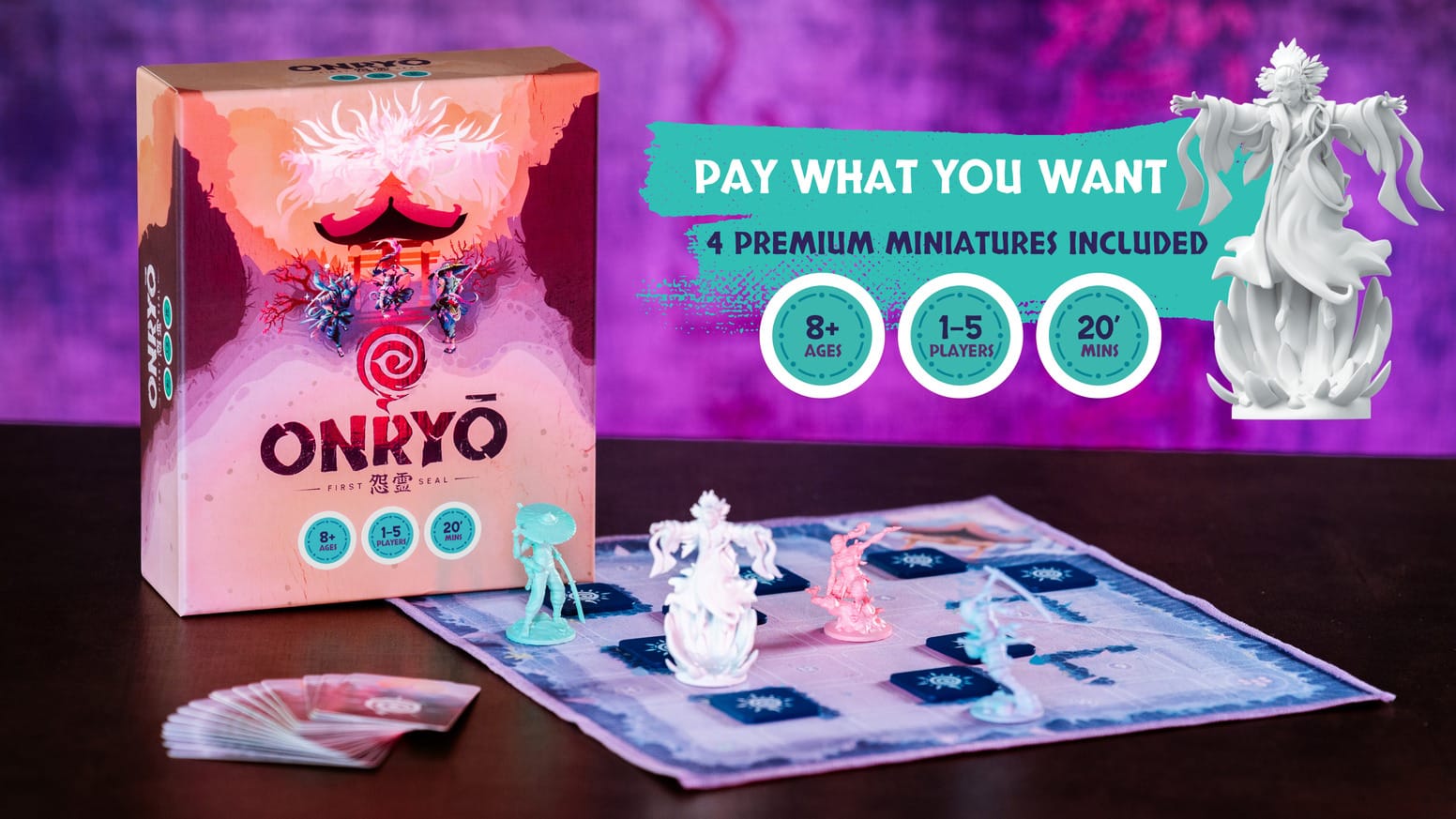
In Onryō: First Seal von Lemery Games steuern ein bis fünf Personen kooperativ drei Ninja-Clans durch ein zunehmend korrumpiertes Raster, um Yōkai-Geister zurückzudrängen und den rachsüchtigen Onryō zu versiegeln. Das taktische Spiel bildet die Vorgeschichte zum später geplanten Onryō: Seeking Solace, funktioniert aber vollständig eigenständig und lässt sich auch solo spielen. Eine Partie dauert 15 bis 30 Minuten, für eine höhere Schwierigkeit gibt es den zusätzlichen Tatari-Modus. Lemery Games finanziert das Spiel über ein flexibles Pledge-System ohne feste Preisstufe.
Die Kickstarter-Kampagne läuft bereits seit dem 14. September 2026 und steht, Stand 28.09.2026, bei rund 36.000 US-Dollar und 721 Prozent des Ziels von 5000 US-Dollar, getragen von über 2500 Unterstützenden. Eine deutsche Sprachversion nennt die Kampagnenseite nicht. Onryō: First Seal läuft noch bis zum 8. Oktober 2026.
Lemery Games nennt keine festen Preisstufen, empfiehlt auf der Pledge-Seite aber Beiträge zwischen 1 und 40 US-Dollar, produktionsnah ab 14 US-Dollar. Die Kampagne nennt März 2027 als geschätzte Auslieferung.
Star Wars ist (mal wieder) in aller Munde. Zahlreiche Serien und Filme haben die weit, weit entfernte Galaxis erneut ins Zentrum aller Aufmerksamkeit gerückt und auch am heimischen Rollenspieltisch rast der Falke wieder vorbei. Asmodee startet ins Rollenspielgeschäft und legt einen Klassiker neu auf, beginnend mit dem Einsteigerset.
Exploding Kittens has named chief commercial officer Joeri Hoste as its new head of studio, with the long-time game industry exec eyeing further expansion of the company’s namesake hit into a “long-lasting evergreen brand” beyond its big-selling card game.
Hoste joined Exploding Kittens to lead its international business in 2020, following multi-year stints at companies including Hong Kong based board game publisher and manufacturer Ooba Games, toy company BOTI and trading card and collectibles specialist Upper Deck.
Hoste said in a LinkedIn post that the past six years at Exploding Kittens had been the most rewarding of his career, adding that he was “ecstatic and humbled” to take responsibility for leading the company into the next stage of its development.
He said, “We’ll continue our mission of making great games and creating experiences that bring people together. Exploding Kittens is the game that built its namesake company, and our next challenge will be to develop the IP into a long-lasting evergreen brand that outgrows its original format.
“Exploding Kittens is unique within Asmodee as we combine deep commercial mass market expertise with publishing quirky and irreverent games that disrupt the games category.
“We did not get here by blending in. We succeed because of the talented team that’s willing to be different.”
Last year Exploding Kittens revealed it had sold more than 60 million games as it marked a decade in business – with the company’s growth having already extended well beyond the tabletop.
That has included a partnership with Netflix which expanded the property into mobile gaming and an animated series.
Asmodee bought a 55% majority stake in Exploding Kittens at the end of 2021, and exercised its option to purchase the remaining 45% minority stake last year.
Exploding Kittens has continued to stand out within Asmodee’s portfolio during a difficult period for parts of the US board game market.
The promotion comes as Asmodee is making a wider push into social and party games – a category where Exploding Kittens has been one of its strongest brands.
In March the company agreed to pay up to €250m for French social and party game publisher ATM Gaming, with Koegler saying the acquisition would combine ATM’s strength in Europe with Exploding Kittens’ strong position in the US. Asmodee has said it expects the social games category to grow at between 4% and 8% annually between 2025 and 2030, compared with about 4% for the broader board games market.
It also launched US party game studio Moodbox Games last year, a move de Barros described at the time as strengthening Asmodee’s presence in a category where Exploding Kittens and Zygomatic were already seeing strong success.
Catan is continuing to push into professional sport in a bid to reach new players, adding a season-long partnership with NHL team the Ottawa Senators and recruiting German handball star Juri Knorr as a brand ambassador.
Asmodee and Catan Studio have teamed with the Senators for a season-long partnership which they said will put the board game in front of hockey fans through arena advertising, “concourse activations” and social media competitions.
The deal will culminate in a dedicated Catan Night at the Senators’ Canadian Tire Centre on November 23, when the team faces the Calgary Flames – including themed decorations and activities, promotional giveaways and special ticket packages.
Senators VP of marketing Peter Shier said the team will be the only Canadian professional sports franchise, and the only NHL team, to host a Catan-themed game this year.
Catan Studio director of brand development Kevin Hovdestad said at the time the partnership highlighted how the game had become “woven into sports culture”, following years of reports of the game being played by professional athletes including members of the Green Bay Packers, Buffalo Bills, Kansas City Chiefs and Minnesota Twins.
Separately, German Catan publisher Kosmos has named international handball player Juri Knorr as a Catan brand ambassador ahead of the 2027 Handball World Championship, which will be held in Germany next January.
The campaign, running under the slogan Mein Spiel nach dem Spiel – ‘My Game After The Game’ – will feature Knorr prominently on branded retail displays and products, alongside a QR-code competition offering meet-and-play sessions with the handball star and Catan-branded adidas handball shirts.
The publisher is potentially tapping into a sizeable audience: 13 million people watched Germany play Denmark in the 2026 European Handball Championship final, according to Kosmos.
Knorr said, “Catan has been with me since my childhood and still captivates me today. For me, the game is a very good balance and complement to… highly focused competitive sport.
“The game offers a great opportunity to spend quality and intense time with friends and teammates. It involves spending time while also thinking strategically. That’s why I’m very pleased to represent Catan as a brand ambassador in this special campaign.”
The deals add to a growing collection of partnerships putting Catan in front of potential players outside of traditional board game retail and media – with the aim of expanding the audience for a game which has already sold more than 50 million copies and been translated into over 45 languages.
Kosmos is currently involved in one of the most striking examples through a McDonald’s Happy Meal promotion across Germany, Austria and Luxembourg, for which almost seven million specially adapted games have been produced.
Kosmos licensing content and entertainment head Julia Courmont said, “This collaboration is a huge milestone for us. The fact that Kosmos is represented here with eight exclusive titles confirms the great confidence in our brands and their relevance to a broad target group.
“It’s a fantastic opportunity to make these classic games accessible to millions of people and to create valuable shared gaming moments.”
Catan has since held a game night with Linkin Park and Warner Music in Hamburg, while a licensed crossover with children’s entertainment phenomenon Bluey is due to launch across several international markets in 2027.
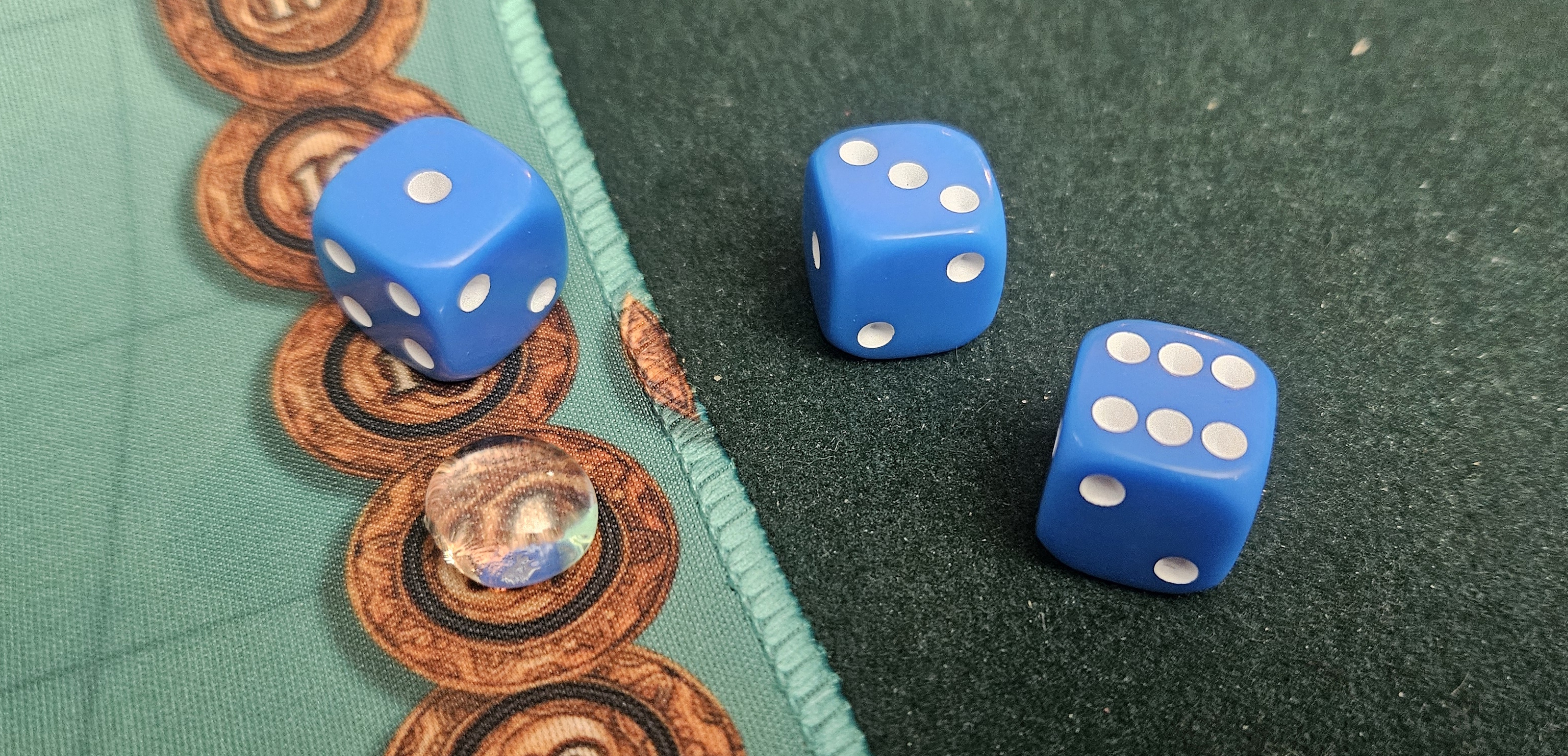
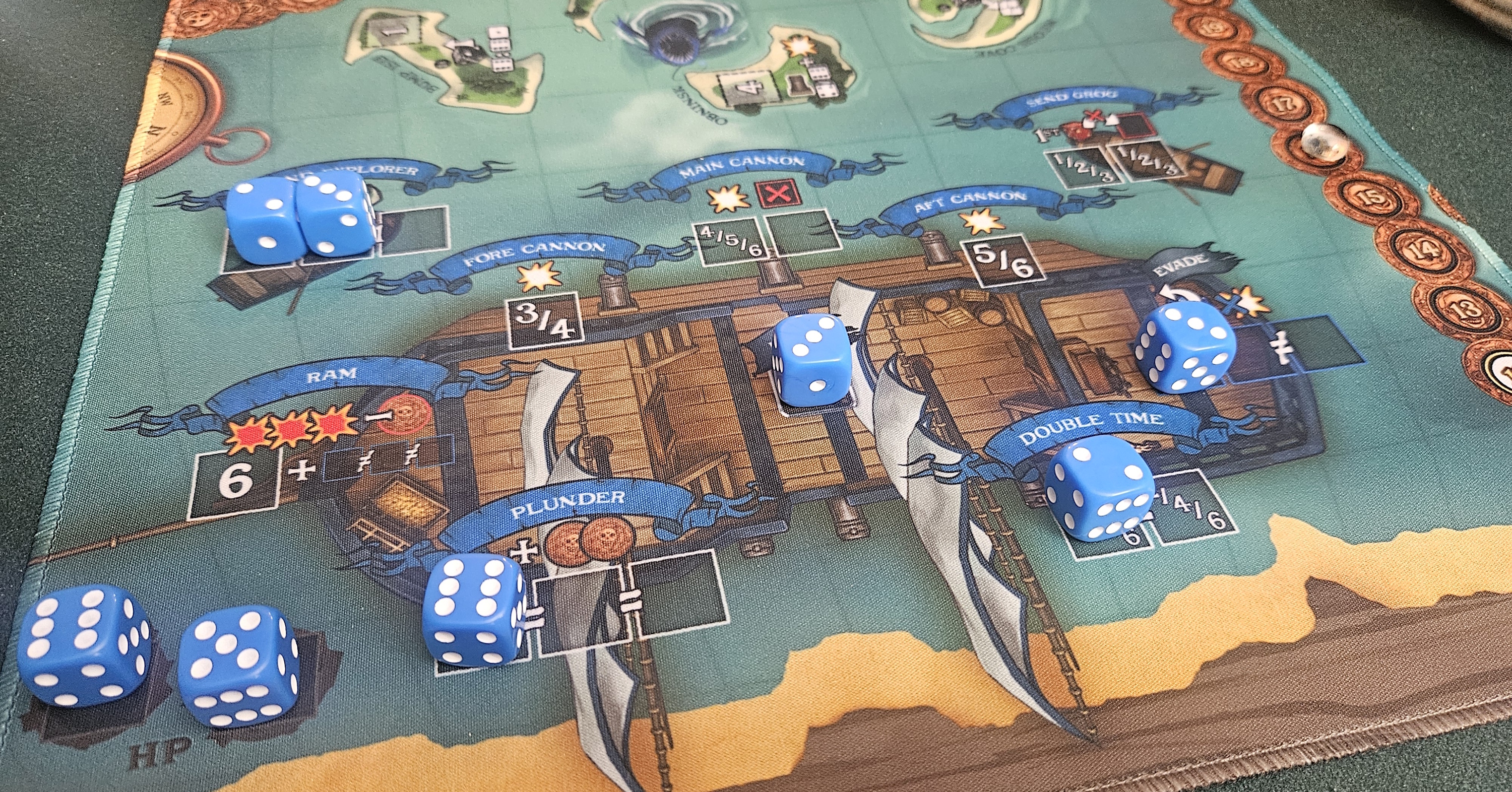
Ask my twelve-year-old about her favorite games and she’ll list a bunch of titles she consistently beats me at. Case in point: Six-Sided Seas. Inspired by the laminated game boards Chris Solis witnessed in Thailand board game cafes, this is a design by Kroze Kresky that limits itself to a single roll-up mat and a bunch of dice.
Forget inspirations. I keep losing to a child. A literal child. Twelve years of age, and already acquainted with an eyepatch and peg leg. She yearns for the galleon.
(sound: the distant thunder of a broadside)
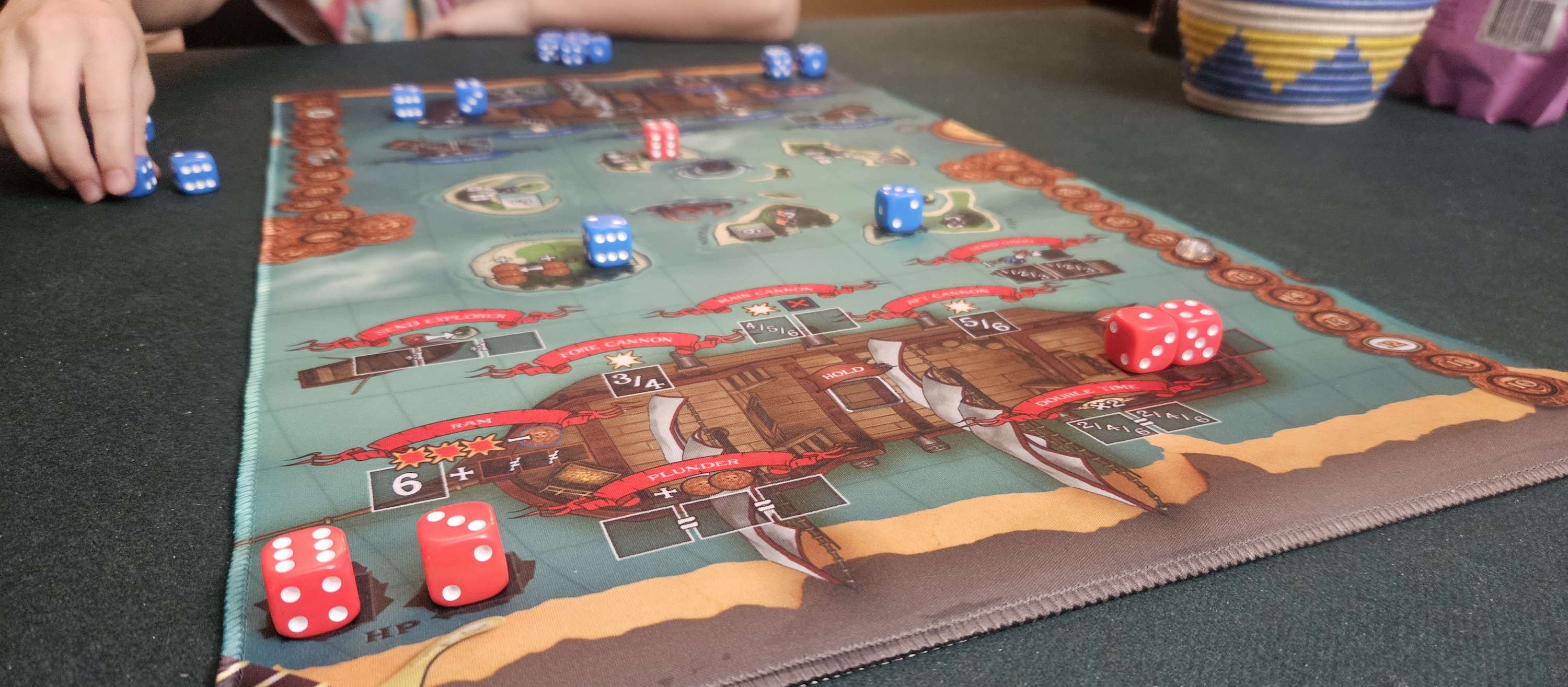
As befits Six-Sided Seas’ simple format, the gameplay is a rapid-fire exchange of cannon fire, island-hopping conquest, and desperate carpentry. The whole thing takes between ten and twenty minutes, depending on how poorly one fares. If my experience is anything to go by, it’s one of those games that demands two or even three sessions in sequence. If I wanted to be reductive, I’d call it Pirate Yahtzee. You roll dice and assign them to your ship’s various stations. Once a station is full, you can remove all the dice banked there to activate its ability. The whole thing is dead simple.
But there are unexpected complexities beneath the surface. The first has to do with the way dice operate. Your crew has a certain amount of plunder, which sets the ceiling for your rolls. You can throw as many dice as you like, but busting that number means assigning a few of them to your evasion pool and tossing the rest, a paltry pity prize indeed. Hitting your plunder number, on the other hand, lets you either bump it up a space or earn an extra roll for free, effectively stretching how much you can accomplish either this turn or in the future. So you’re always playing the odds, pushing your crew a little further, and then enjoying or suffering the consequences when they rise to the occasion — or snap under the pressure.
To roll or not to roll? ‘Tis the question.
Meanwhile, the actions themselves are nicely varied. There’s the usual cannon fire, of course, and a few disruptive abilities like one that sends a barrel of grog to the enemy ship to disable the first rolled die on their next turn or another that wipes out your defensive pool of evasion dice to ram the enemy ship for beaucoup damage. Three contrasting win conditions give these pursuits some edge. Sinking the enemy is the honest option, but even a limping vessel might earn enough plunder or secure four of the contested (and bonus-bestowing) islands in the middle to win without splintering an enemy timber.
It’s minor, but it was also designed to be minor, and its minorness is one of its greatest strengths. For example, I’m compelled to lament the ram action, which I believe is horribly overpowered, especially when doubled, but it’s a maneuver that requires multiple turns to set up, strips away your protection, and may be a reflection of my daughter’s favorite strategy more than an actual imbalance. Anyway, what’s an imbalance in a game that I’ve set a world record for by losing in four minutes? As soon as I’ve been scuttled, we’re halfway positioned for the next duel. This time I’ll ram her ship. (Spoiler: She rammed my ship twice and sent it to the bottom of the ocean.)
It takes fifteen, twenty minutes to sink one of these ships.
I don’t want to damn Six-Sided Seas with faint praise; its brevity belies a real understanding of what makes dice so joyous to handle. The decisions are micro-sized, but they matter. Should I seize the island that gives me an all-important reroll — one that might prevent an untimely bust — or double the impact of my cannons? If I’m falling behind, should I play it safe with my dice or push my crew as hard as possible? There are no easy answers.
So, yes, the format matters. Six-Sided Seas is small, brief, and in some respects limited, especially with its two-player count. But I’m impressed with what Kresky and Solis have done with said format. This one would feel right at home in a game cafe, on a picnic table, or beneath the dim light of a cramped starboard cabin.
A complimentary copy of Six-Sided Seas was provided by the publisher.
(If what I’m doing at Space-Biff! is valuable to you in some way, please consider dropping by my Patreon campaign or Ko-fi. Right now, supporters can read the next installment in my series Talking About Games, this time tackling the topic of what makes a good list! Naturally, the piece includes a list.)
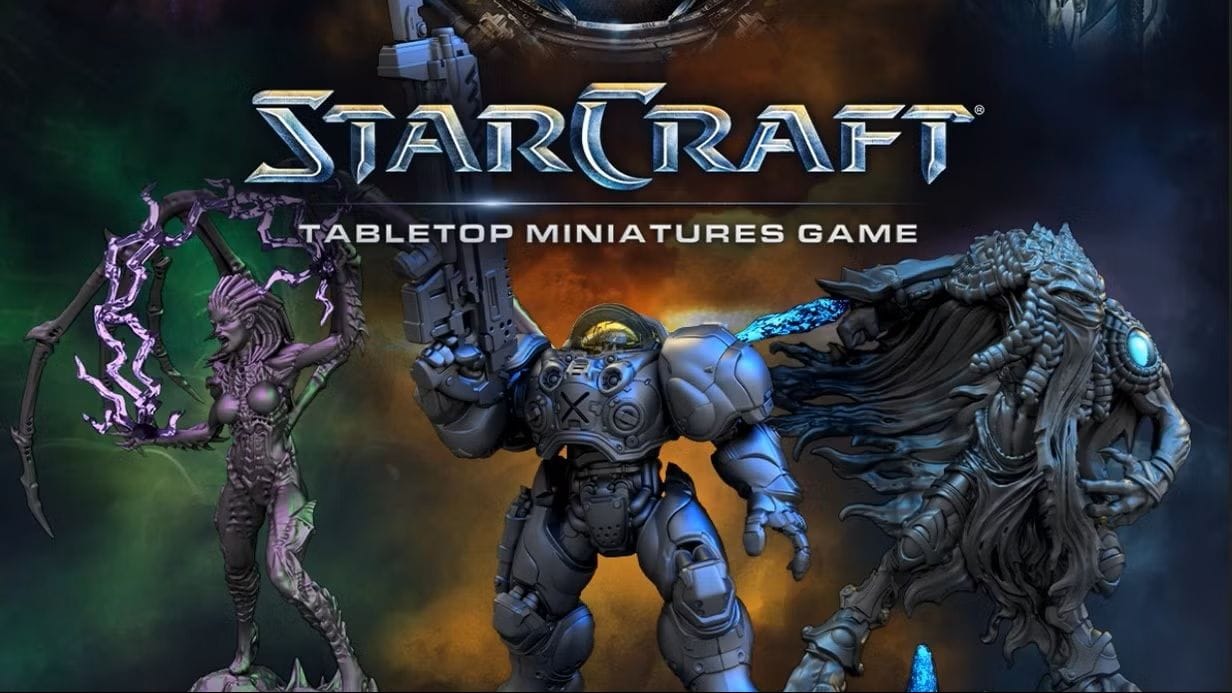
Archon Studio hat das StarCraft: Tabletop Miniatures Game offiziell in den Handel gebracht. Nach einer Vorverkaufsphase über Gamefound sind die Starter-Sets der Founders Edition sowie mehrere Erweiterungs- und Einheiten-Sets für Terraner, Protoss und Zerg jetzt beim deutschen Händler Fantasywelt erhältlich. Die Redaktion hatte die Lizenzpartnerschaft zwischen Archon Studio und Blizzard Entertainment bereits im März 2025 gemeldet, damals mit 2026 als Zieltermin für das Miniaturenspiel.
StarCraft erschien 1998 bei Blizzard Entertainment und gilt als eines der prägendsten Echtzeit-Strategiespiele überhaupt. Drei Fraktionen kämpfen im Koprulu-Sektor um die Vorherrschaft: die technisierten Terraner, die mit Psionik ausgestatteten Protoss und die schwarmartigen Zerg. Genau diese Asymmetrie überträgt Archon Studio auf den Tisch, die Spielenden befehligen ihre Armeen über Kommandokarten und Messbewegung statt über Mausklicks.
Eckdaten: 2 Spielende, ab 12 Jahren, 60 bis 120 Minuten Spielzeit, Design von Sławomir Aftarczuk, Jarek Ewertowski, Jacek Karpowicz, Aleksander Nowacki und Michał Pawlaczyk, erschienen bei Archon Studio.
Was das Spiel auf den Tisch bringt
Laut BoardGameGeek-Metadaten setzt der Titel auf Command Cards, Deck Construction, Würfelwürfe und variable Fraktionsfähigkeiten, ergänzt um ein Schere-Stein-Papier-Element für die Konfliktauslösung sowie Szenario- und Kampagnenmodi. Das Spiel ist strikt für zwei Spielende ausgelegt, einen Bereich wie 1 bis 4 gibt es nicht. BoardGameGeek führt zudem keine empfohlene Solo-Variante: In der noch sehr schmalen Spielerzahl-Auswertung der Community, gestützt auf nur eine abgegebene Stimme, gilt eine Partie zu eins als nicht empfehlenswert. Wer StarCraft: Tabletop Miniatures Game spielen will, braucht also eine Gegnerin oder einen Gegner am Tisch.
Laut BGG-Beschreibung umfasst eine Standardpartie bei den Terranern etwa 30 bis 40 Modelle pro Seite, bei den Protoss weniger und bei den Zerg deutlich mehr, was die zahlenmäßige Überlegenheit des Schwarms nachbildet.
Sets, Preise und Verfügbarkeit
Einstieg bietet das Two Player Starter Set Founders Edition mit zwei kompletten Armeen, bei Fantasywelt für 159,99 Euro gelistet (Stand: 26.08.2026). Ergänzend gibt es das Protoss Starter Set Founders Edition für 91,56 Euro. Beide Sets liegen in englischer Sprache vor, eine deutsche Lokalisierung ist bislang nicht angekündigt.
Dazu kommen Einheiten- und Helden-Sets für alle drei Fraktionen. Terraner: Marine, Marauder, Goliath und Medic sowie das Helden-Set Jim Raynor (Raynor’s Raiders). Protoss: Zealot, Stalker, Adept und Sentry sowie das Helden-Set Artanis (Hierarch). Zerg: Zergling, Hydralisk, Roach und Queen sowie das Helden-Set Kerrigan (Primal Kerrigan).
Ergänzt wird das Sortiment durch das Lost Temple Terrain Set. Die meisten Einheiten-Sets kosten bei Fantasywelt um die 38 Euro, die kleineren Sets Medic, Sentry, Queen, Zealot und Adept liegen zwischen 21 und 30 Euro. Bei den Helden-Sets reicht die Spanne von 29,40 Euro für Raynor bis 37,80 Euro für Artanis und Kerrigan, die beiden teureren liegen damit auf demselben Preisniveau wie die größeren Einheiten-Sets.
Für ein frisch gestartetes Miniaturenspiel ist die BGG-Bewertungsbasis noch dünn: 25 abgegebene Wertungen ergeben einen Schnitt von 8,46 von 10, und nur eine einzige Weight-Stimme liegt der Komplexitätsangabe von 2,0 von 5 zugrunde. Belastbare Aussagen zur tatsächlichen Regeltiefe lassen sich daraus noch nicht ableiten. Wie viel Unterstützende beim Vorverkauf über Gamefound ursprünglich für das Starter-Set zahlten, ist auf der Kampagnenseite inzwischen nicht mehr ausgewiesen.
California tabletop publisher and game development studio Solis Game Studio is expanding its reach into US hobby retail through a new distribution deal with Southern Hobby, following several years of building its own catalogue through crowdfunding and direct sales.
The Massive-Verse Fighting Card Game, designed by Brian McKay, from Solis Game Studio
Its contracting work has included projects such as the Cyberpunk TCG, with Solis having led game design and development of a prototype that secured licensing for a new game.
Solis also did development work on Emerson Matsuuchi-designed Metal Gear Solid: The Board Game, and last month announced it would be the developer for the official card game of battle royale video game PUBG.
The company said Southern Hobby will distribute new Solis release Six-Sided Seas, as well as Treat, Please! and The Massive-Verse Fighting Card Game, describing the deal as a “major step forward” for the business.
The publisher has previously used crowdfunding to bring several of its games to market, with its biggest success to date 2024’s licensed Massive-Verse Fighting Card Game, designed by Brian McKay, which raised just over $50,000 from about 800 backers.
Solis has also already been selling directly to retailers through its own wholesale programme.
The publisher’s newest release, push-your-luck worker placement game Six-Sided Seas, will enter US distribution on October 2 with a $24.95 MSRP.
The two-player pirate game, designed by Kroze Kresky, is built around an unusual component format, consisting of 32 dice and a 14in by 24in edge-stitched playmat which is rolled inside the game’s box – allowing the title to be presented vertically, horizontally, or with a collapsible hangtab in retail.
Solis has previously said the idea grew from a visit to game stores in Thailand, where Chris Solis saw a store employee laminating a game board to protect it and began considering whether the board itself could instead be made from playmat material.
He said in the blog post, “When I returned home I issued an internal design challenge to my community. What does a game that is a playmat and single component look like?
“We explored a ton of really interesting designs and even did a limited release for one of them but none captured me like Six-Sided Seas by Kroze.”
Solis launched the game at Gen Con earlier this month, and said it sold all the copies it brought to the convention. Several of its scheduled learn-to-play sessions at Gen Con also sold out, according to the convention’s event listings.
In addition to founder and owner Chris Solis, the studio’s team includes developer Bryan McKay, business operations specialist John Brieger, graphic designer Katherine Boils, marketing manager Courtney Shernan, convention manager Sara Jordan and community manager Antonio Gil.
Unstable Unicorns publisher Unstable Games has launched a new studio led by rising tabletop designer Marceline Leiman, who will shape its creative direction and design every game it releases for at least the next few years.
Ordinary Magic plans to publish light strategy board and card games set within a single expanding world, with Leiman telling BoardGameWire the studio is looking to put out designs “offering whimsical, magical moments of the everyday” alongside high interaction.
The move comes nine years after Unstable Games owner TeeTurtle’s hugely successful Kickstarter campaign for light card game Unstable Unicorns, which raised more than $1.8m from over 33,000 backers – and went on to sell more than a million copies worldwide by 2023.
The success of that release led to t-shirt maker TeeTurtle creating its dedicated tabletop studio Unstable Games, which has sold millions across its debut title and follow-up releases such as Here to Slay, Happy Little Dinosaurs, Casting Shadows and Twisted Cryptids.
Her route into professional board game design began with the 2023 release of her solo mode for North Star Games titles Oceans, which led to a part-time developer position at Underdog Games, as well as client work for Office Dog, WizKids, Allplay, Button Shy Games and Maestro Media, according to her website.
But Ordinary Magic represents her first full-time job in the industry, with Leiman saying the roots of the venture going back to the period immediately following the downsizing of Underdog in April 2025, when the publisher laid off almost its entire staff as it attempted to weather the impact of US tariffs.
She told BoardGameWire that Underdog president Nick Bentley, who was also let go by the company at that time, quickly introduced her to Unstable Games, with the pair initially planning to build the new operation together.
Bentley ultimately went in another direction before that arrangement was finalised and is now director of game design at Taco Cat Games, which rebranded from Dolphin Hat Games in May to reflect the huge success of its standout title.
Leiman said, “We both were fully intending to start up a new studio within Unstable Games. The proposition was always that they were going to do sort of an incubator program, is the way that they proposed it to us.”
She added, “My role within the studio was always going to be the capacity of being a game designer. Only now with Nick no longer part of the project, it has allowed me to take more of a formal leadership role.”
Leading the line
The resulting structure puts Leiman’s work at the centre of the studio, rather than positioning Ordinary Magic as a conventional publisher or imprint sourcing games from a roster of designers.
She told BoardGameWire, “Every single game that comes out of Ordinary Magic is a design of mine. I am the designer of each of the games coming from the studio, and you should expect that at least for the next several years.
“That does not mean that you won’t ever see a game from anyone else besides me from Ordinary Magic. But think of me as the shepherd of the studio.
“I am leading the direction of the design behind Ordinary Magic and the types of games you should expect, and the feelings from the games that you should expect. But I am absolutely open to that changing; it’s not a hard rule.”
Leiman added that although she is not currently accepting game pitches, she is “always interested in learning what designers are working on, both those I am familiar with and unfamiliar with”.
She told BoardGameWire, “I love sharing ideas, and I think the spirit of design is still very much open in terms of the way I like to talk with other designers. I always want to consider whether or not in the future, an opportunity is available between Ordinary Magic and a designer looking to pitch their games.
“However, I cannot promise at this time that we are accepting any pitches that we might receive. If I were to look at any pitches, what I’ve described in the past is that Ordinary Magic is looking for games that are offering whimsical, magical moments of the everyday. Not high magic, not combative, though highly interactive.
“I think if someone wanted to pitch to me a game with a theme that was more focused on a curious bit of a real-life moment that inspired them, that would interest me more than somebody who’s coming to me with a pitch purely with a magical concept. I am much more interested in the grounded reality of this world rather than the high fantasy.”
Finding direction
Leiman said the studio’s creative direction would be to create interactive games which give “meaningful reason for other players to be at the table with you”, but added that would likely not extend to full “take-that”-style designs.
She said, “What you should expect from us is strategy-light strategy style games, sometimes card games, sometimes board games. I am also very interested in exploring the realms of cooperation as well as indirect player interaction, or both direct and indirect forms of player interaction.
“Something that you’ll find from me is that I am very interested in sort of passive aggression in games, where the decisions I am making might be to block you or to prevent you from getting something before me. A very old-school style of interaction, German old-school I think some people would think about.”
Leiman said the original plan had been to launch the games individually, but that Unstable ultimately proposed putting all three into the same campaign after their development schedules aligned – a situation which partly arose due to Leiman’s rapid work rate.
The Curious Little Bookshop || Gamefound image
She told BoardGameWire, “The method that I was taught game design was very much under the tutelage of my professors at NYU Game Center, and there we worked very much within a fast-paced work environment.
“Joining this studio very much is like returning back to that environment, which I am very comfortable being in. The way that I’ve worked within the studio is quite fast, is quite rapid, I guess, in relation to other people’s speeds.
“But for me, within a short amount of time, what I am looking to do is try out many ideas and fail with many ideas as quickly as possible, so I could find the core of what is fun, what is interesting, what is memorable about a game.
“It just so happened to align with our release schedule that I would have these three games. Our original plan was to release them one by one, but just with the way that scheduling worked out, we decided that it would be best to put our best foot forward with this new studio by showing the strength of our design, with the strength of our art, and production capabilities.”
Operationally, however, Ordinary Magic is currently far less separate from its parent studio than its distinct branding might suggest.
“The only difference between Ordinary Magic and Unstable Games in terms of operation is me,” Leiman told BoardGameWire.
She added, “Everything that you’ve come to expect from me – my work ethic, my taste, my voice – you should expect to be part of these games.
“Not to say that I don’t work with the Unstable Games team as well. We actually do cross-pollinate a lot in terms of our playtesting, in terms of our conversations, in terms of problem-solving.
“So it’s not like I’m totally in a silo or and neither are they from me. There’s definitely a lot of creative support going back and forth between the two studios. And as the studio continues to develop and grow in size, naturally Ordinary Magic will change with it.”
Speaking about the shared world envisaged by Ordinary Magic for all of its releases, Leiman told BoardGameWire, “You should not expect to see any games released from Ordinary Magic that are not part of this world.
“We’ve talked a lot about what that means in terms of building the IP, sort of what direction could it go in the future? Does it open us to different forms of media, different forms of games, or are they all going to be board games and card games?
“We’re leaving that station open right now. But we’re definitely open to exploring what it means to have this IP as we look forward to the future.
“As for recurring characters and locations, I would say keep your eyes open for the GameFound campaign, and I think you’ll be very excited to see some crossover moments between them.”
In dieser Woche (KW 33) haben Gamefound und die Spieleschmiede keine frische Brettspiel-Kampagne mit echtem Neuigkeitswert nachgelegt. Auf Kickstarter dagegen laufen gleich drei Projekte aus derselben Startwelle vom 14. Juli auf ihr Ende am 13. August zu. Alle drei sind finanziert und decken ein leichtes bis mittleres Gewicht ab, vom Jahrmarkt-Spiel bis zum Spieleabend-Paket. Ein Hinweis vorab: Es handelt sich um US-Kampagnen in US-Dollar, für die aus dem DACH-Raum Versandkosten und Einfuhrabgaben anfallen.
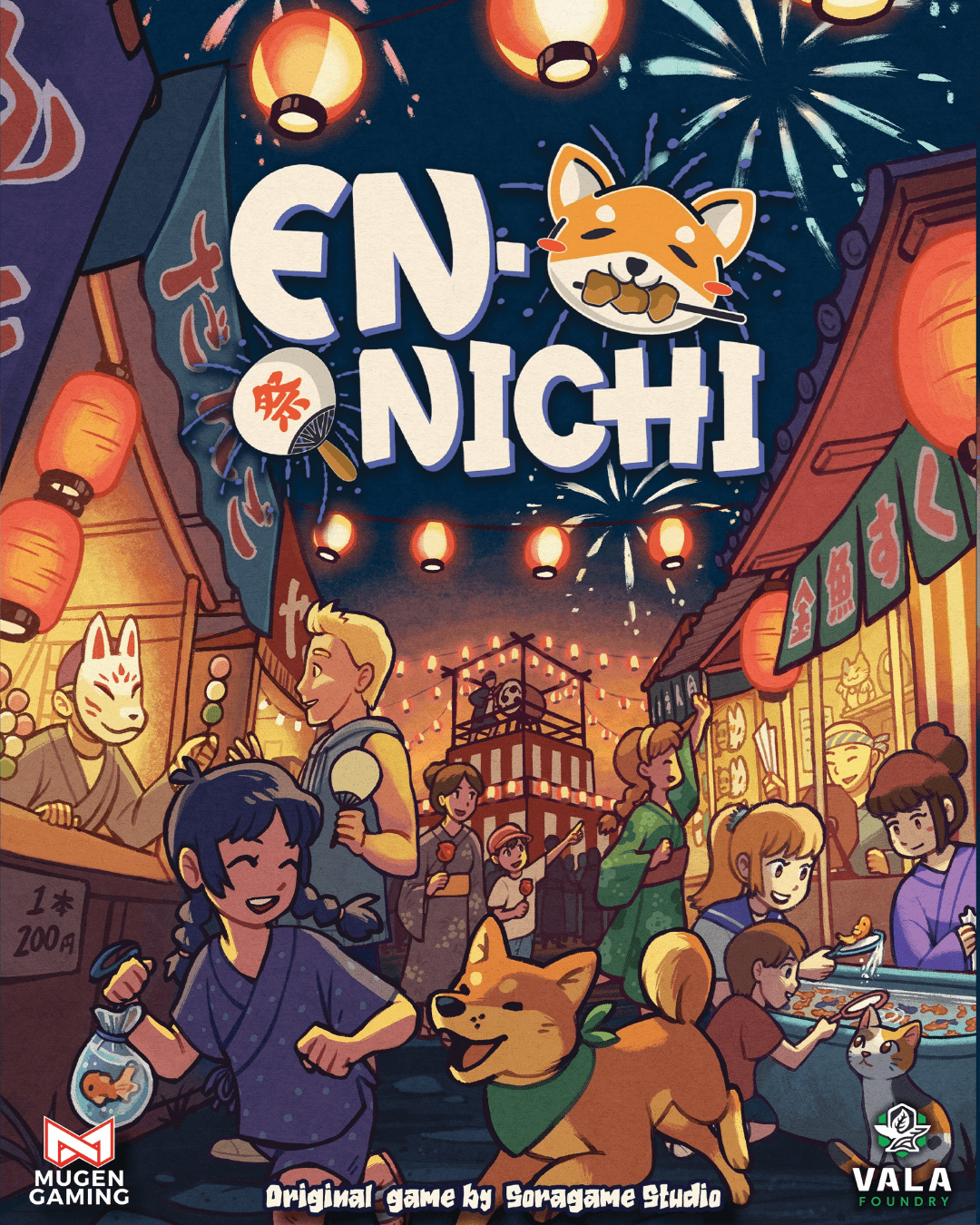
En-Nichi: Japanese Summer Festival
En-Nichi: Japanese Summer Festival. Bild: Mugen Gaming (via BoardGameGeek).
En-Nichi läuft noch bis zum 13. August auf Kickstarter und hat sein Ziel von 7.878 US-Dollar mit aktuell rund 112.831 US-Dollar auf etwa 1.432 Prozent gebracht, getragen von rund 1.035 Unterstützenden. Damit ist es der klare Volumen-Spitzenreiter dieser Ausgabe und erfüllt gleich zwei Aufnahmekriterien: kurz vor Ende und außergewöhnlich hohe Finanzierungsquote.
Thematisch wanderst du über ein japanisches Sommerfest von Stand zu Stand und spielst kleine Jahrmarkt-Minispiele wie Schießbude, Goldfisch-Fangen, Wasserballon-Angeln und Maskenstand. Mechanisch mischt das Spiel Würfeln, Push-your-Luck, ein Gedächtnis-Element und Set Collection: Du sammelst bunte Preise, um die Gunst der Dorfbewohner zu gewinnen. Wer genug Zuneigung sammelt, nimmt die Figuren mit ins große Finale.
Es spielen 2 bis 6 Personen ab 8 Jahren, eine Partie dauert 45 bis 60 Minuten. Verlag ist Mugen Gaming aus Kansas City. Einen Designer nennt weder die Kampagne noch der BoardGameGeek-Eintrag, hier bleibt die Urheberschaft offen.
Aufnahmekriterium: Kurz vor Ende (finanziert) und besonders interessant (Finanzierungsquote deutlich über 300 Prozent, Volumen über 100.000 US-Dollar).
How to Raise Your Kaiju
How to Raise Your Kaiju. Bild: Rose Gauntlet Entertainment (via BoardGameGeek).
How to Raise Your Kaiju läuft noch bis zum 13. August auf Kickstarter und steht mit rund 35.731 US-Dollar bei etwa 357 Prozent des Ziels von 10.000 US-Dollar, gestützt von rund 431 Unterstützenden. Hinter dem Projekt steht Rose Gauntlet Entertainment, das Design stammt von Isaac Vega, die Illustrationen von Alyssa Menold.
Du schlüpfst in die Rolle eines Kaiju-Elternteils und ziehst kleine Monster groß. In deinem Zug setzt du ein Baby-Kaiju auf eine Stadt und nimmst dir eine Fähigkeitenkarte. Anschließend kannst du Stadtzonen erobern, indem du Fähigkeitenkarten passend zu den Verteidigungs-Tokens abwirfst, was Erfahrungspunkte und Ressourcen einbringt. Sammelst du genug Erfahrung, verdient dein Kaiju einen Goldstern.
Alternativ schickst du dein Monster auf den Open-World-Pfad, wo weitere Strecke größere Belohnungen bringt. Eltern-Karten geben jeder Spielerin und jedem Spieler eigene Sonderfähigkeiten, sodass sich die Partien unterscheiden. Nach vier Runden gewinnt, wer die meisten Goldsterne gesammelt hat. Mechanisch verbindet das Spiel Worker Placement, Handmanagement und Set Collection für 1 bis 4 Personen ab 10 Jahren, bei 30 bis 60 Minuten Spielzeit.
Aufnahmekriterium: Kurz vor Ende (finanziert) und besonders interessant (Finanzierungsquote über 300 Prozent, etablierter Designer).
MILLRAT Pack!
MILLRAT Pack! Bild: MILLRAT Studio (via Kickstarter).
Das MILLRAT Pack läuft noch bis zum 13. August auf Kickstarter und hat mit rund 11.326 US-Dollar etwa 188 Prozent des Ziels von 6.030 US-Dollar erreicht, getragen von rund 191 Unterstützenden. Das Projekt bündelt vier eigenständige Spiele in einer Schachtel, gedacht für den Spieleabend, entwickelt von MILLRAT Studio (Nick und Adam) mit Artwork von Abby Ouellette.
Die Kampagne beschreibt das Paket als „etwas für jeden am Tisch", schlüsselt die vier Titel in den abrufbaren Kampagnendaten aber nicht einzeln nach Mechanik oder Spielerzahl auf. Was die Spiele konkret tun, bleibt damit auf Basis der reinen Eckdaten offen. Für den DACH-Raum ist außerdem wichtig: Der physische Versand ist auf die USA beschränkt, sinnvoll bestellbar ist von hier aus vor allem die Print-and-Play-Variante ab 8 US-Dollar.
Aufnahmekriterium: Kurz vor Ende (finanziert). Der Titel steht hier ausdrücklich mit dem Vorbehalt eingeschränkter DACH-Verfügbarkeit.
Kein frischer Start auf Gamefound und Spieleschmiede
Auf Gamefound sind die Kampagnen des Summer Feast von Ende Juli inzwischen überwiegend beendet, ein frisch gestartetes oder kurz vor Ende stehendes Brettspiel mit klarer DACH-Relevanz war in dieser Woche nicht darunter. In der Spieleschmiede läuft weiterhin das Zeitreise-Kennerspiel Restart von Giant Roc, das wir bereits in KW 31 und KW 32 vorgestellt haben und das daher hier keinen neuen Aufhänger bietet. Sobald auf diesen beiden Plattformen wieder etwas Neues mit Substanz startet, greifen wir es in der nächsten Ausgabe auf.
Egal in welchem Universum, die Zwerge sind bekannt für ihr handwerkliches Geschick, egal ob Techniker, Steinmetze oder Schmiede. Auch bei Warcrow ist die Nation von Mounthaven keine Ausnahme. Micro Art Studio bieten in ihrer Pre-Painted-Reihe nun passendes Gelände aus MDF an, das eines Zwergenbaumeisters würdig ist.
Die erste Welle des StarCraft: Tabletop Miniatures Game ist fast komplett ausgeliefert, die Modelle stehen auf den Tischen und die ersten Schlachten im Koprulu-Sektor laufen. Archon Studio legt bereits nach und kündigt für die zweite Welle neue Einheiten für Terraner, Protoss und Zerg an.
I find Realm of Reckoning, the latest title by Max Anderson, Zac Dixon, and Austin Harrison, to be fascinating. There’s the cosmological angle: an afterlife fallen into disrepair, now pieced back into working order through the clashing imperatives of feuding factions. Personally, I’d be a fanatical member of the Eat As Much Cake As You Like Without Getting Tummy Sick sect.
But more even than that, it carves out a new space in the whole “dudes on a map” genre. (Are we still saying that?) There are fingerprints of the greats all over the design. A splash of Blood Rage, some Inis, even a little bit of Arcs. It’s something of a mashup, and not every part works as smoothly as the others, but the result is a gripping struggle over an ashen landscape.
Clashing over the broken prairie of the afterlife.
Right away, there’s nothing typical about Realm of Reckoning. The factions are presented in gaudy colors. Or perhaps they’re only gaudy because the terrain is so smudged and dismal.
For all its aesthetic ruin, it’s really a rather simple space. The entire battlefield consists of five territories, each connected with a different flavor of influence. There are also five flavors of pillar, themselves coded to the assistance of gnomic wardens and tide-turning mercenaries, but maybe that’s more information than you strictly need to understand what’s going on here.
As for the rest of it, Realm of Reckoning structures itself around three rounds of drafting. This is where its similarities to Blood Rage seem most apparent, although if Veiled Fate, Pillars of Fate, and Scales of Fate are anything to go by, the folks at IV Studio really like their three-act structures. Each age is structured much the same: a hand of cards is dealt out, everyone picks one to resolve, and then the rest are passed around to repeat the process until there’s nothing left, at which point there’s a final battle before a quick tally of points.
It’s clean. At that mile-high remove, anyway.
Cards, both for action and battle, are drafted one at a time.
Down in the grit, affairs are a little more complicated.
Consider the cards. There are two types in the draft. The vast majority are action cards. These confer some resource — coins, wardens, soldiers for the battlefield, mercenaries to be spent and discarded — followed by a choice of where to tuck the card under your faction mat. This latter choice is more loaded than it initially appears, moving your marker along the corresponding influence track, but also providing icons that, at least on the first play, don’t bear immediate import.
The other type of card is the reckoning. There are only two of these shuffled into each age’s hand of cards. Their rarity marks them as major flashpoints. This is because reckonings trigger a battle in the indicated region. Not at the end of the round or even upon completing the current hand of drafted actions, but immediately, at the exact moment that the player who drafted it would normally take their resources and move along their chosen influence track.
Even when these reckonings are anticipated, such as when you’ve seen them coming from a hand of cards you passed along, they always come across as an intrusion. The usual cycle of gathering and positioning is interrupted. Now everyone picks up a dial and tallies in a number. This is how much they’re willing to spend to win. Four. Six. Eleven. More. Battles escalate as the game progresses, the result of all those extra arms everyone’s been amassing.
Some of the many things you’ll collect in Realm of Reckoning.
To be honest, the battles themselves are a mixed bag, the game at its strongest and weakest.
Strongest, because they’re nail-biters. Rather than simply winning or losing, players are vying for placement on a rewards card, a clever turn that might dictate how strongly you feel about the current contest. It’s even possible to accept a negative reward to avoid spending your bid, a maneuver that’s sometimes smarter than it might sound.
But battles are also frustrating. They’re a little too complicated for their own good. IV Studio has a reputation for games that contain “complicated counting,” and these tallies certainly qualify. Soldiers can be spent for a point of strength. Wardens also provide a point, but only if they match a pillar in the contested territory, and even then they can be spent instead to produce a bump of three. Mercenary cards matter, although again there’s some pillar-matching to consider, and coins too, although these are spent in increasing increments. Oh, and your influence in that region. It’s easy to forget that one, especially if you’re currently benefiting from that region’s power-boosting artifact.
All of this is to say that bids are fraught indeed, slowing the game dramatically but also producing… well, drama. High drama. Revealing one’s bid is as tense as it gets, as good as any round-robin antes in Inis. These are the hinges upon which Realm of Reckoning turns. Slowly, sometimes, with no small amount of creaking and groaning, but still.
Picking your reward for a reckoning.
For my part, I’m willing to accept the shortcomings of these reckonings for the boons they provide. The drama, yes, but also the way they feed into the game’s consideration of victory. Everything in Realm of Reckoning is building toward these moments of revelation.
And here, the revelation matters. Some players will claims points or cards or coins. Extra soldiers. Maybe a warden. But the real prize is the chance to designate which victory condition will score at the conclusion of every round hereafter. One player — usually the highest bidder in the reckoning but not always — takes a shrine, a statue that looks comically like Lady Liberty herself, and plops it onto one of the victory markers.
There’s no shortage of options. There are spaces for military domination over specific territories; others for economic advantage in coin or hired help. Some initiate struggles against your neighbors. Others provide groundswells of points that everyone can benefit from with some effort.
This is also where those icons come into play. The ones from earlier, on the cards, tucked beneath your player mat. You might find yourself racing to collect sets of gems, or vying to command the most purses of gold, or cursing because a rival chose to emphasize the closed-eye icon rather than the open peepers. Whatever the selection, it informs the game from that moment forward. It’s a little bit like Arcs in that regard, the players choosing what matters and then clashing over it, except these are permanent alterations. Early selections, before the factions have specialized, become exploratory, triggering multiple times before the game ends but also allowing players to adjust, while those added later are hotly contested because their outcome is less prone to adjustment.
Victory conditions are selected over the course of the struggle.
Perhaps there’s an irony to be dredged from all this fuss. For the second time, Realm of Reckoning hinges on a bunch of complicated counting.
But this is also where the designers manage to carve out their own niche in a crowded genre. And, as niches go, it’s closer to an alcove than a toehold. There’s such a variety to the objectives that there always seems to be something worth pursuing. There’s even a spot that awards points to whomever’s sitting in last place — a whole catch-up system, but one that asks the players whether they would like to switch it on or leave it untouched.
It’s smart, although in a way that demands its own attention rather than simply aping what’s gone before. Sure, it has drafting like some other titles. But where Blood Rage evoked a heavy boot smashing into your nose, where Inis was all tribal politics, where Arcs is… a lot of things, Realm of Reckoning is about currencies and auctions. Players gather resources to spend them, but only as carefully as possible, and then the outcomes of those auctions become longer-term auctions for absolute victory. In that respect, it feels like a smoother, more contemporary version of a lesser-known map-battler called Mezo. But, again, Realm of Reckoning provides such an emphasis on who can most cleverly accrue and spend coins of various denominations that it feels entirely new again.
Entirely new. Sometimes slow, especially at higher counts, and sometimes a little too tally-heavy. But still new, and smart, and bound up in calculations that feel shrewd rather than merely arithmetic.
War in heaven. Or hell. I dunno.
I can hear what you’re asking through the screen. “Dan, does this say anything about the afterlife?” Sorry, but no. It does not.
But it does say something about how great it is to smash somebody through superior tallies and bids. Combat in Realm of Reckoning isn’t visceral. Strictly speaking, you’re inflicting the casualties on yourself, not the other way around. But this is one smart cookie, ultra smooth in practice, and a delight to handle. It takes a play or two to get a handle on its particulars, but this is one afterlife worth pursuing — and then remaking in your own image.
A complimentary copy of Realm of Reckoning was provided by the publisher.
(If what I’m doing at Space-Biff! is valuable to you in some way, please consider dropping by my Patreon campaign or Ko-fi. Right now, supporters can read the next installment in my series Talking About Games, this time tackling the topic of what makes a good list! Naturally, the piece includes a list.)

 Anmelden


 Während die SPIEL in Essen vor allem Dreh- und Angelpunkt für Brettspielfans aus ganz Europa ist, tummeln sich auch zunehmend mehr Tabletopherstellende unter den Aussteller:innen. Das zieht neben zahllosen anderen Tabletop-Begeisterten natürlich auch unseren Redakteur Geoffrey an, der hier zusammenfasst, worauf er sich am meisten freut.