Anmelden


Six-Sided Review

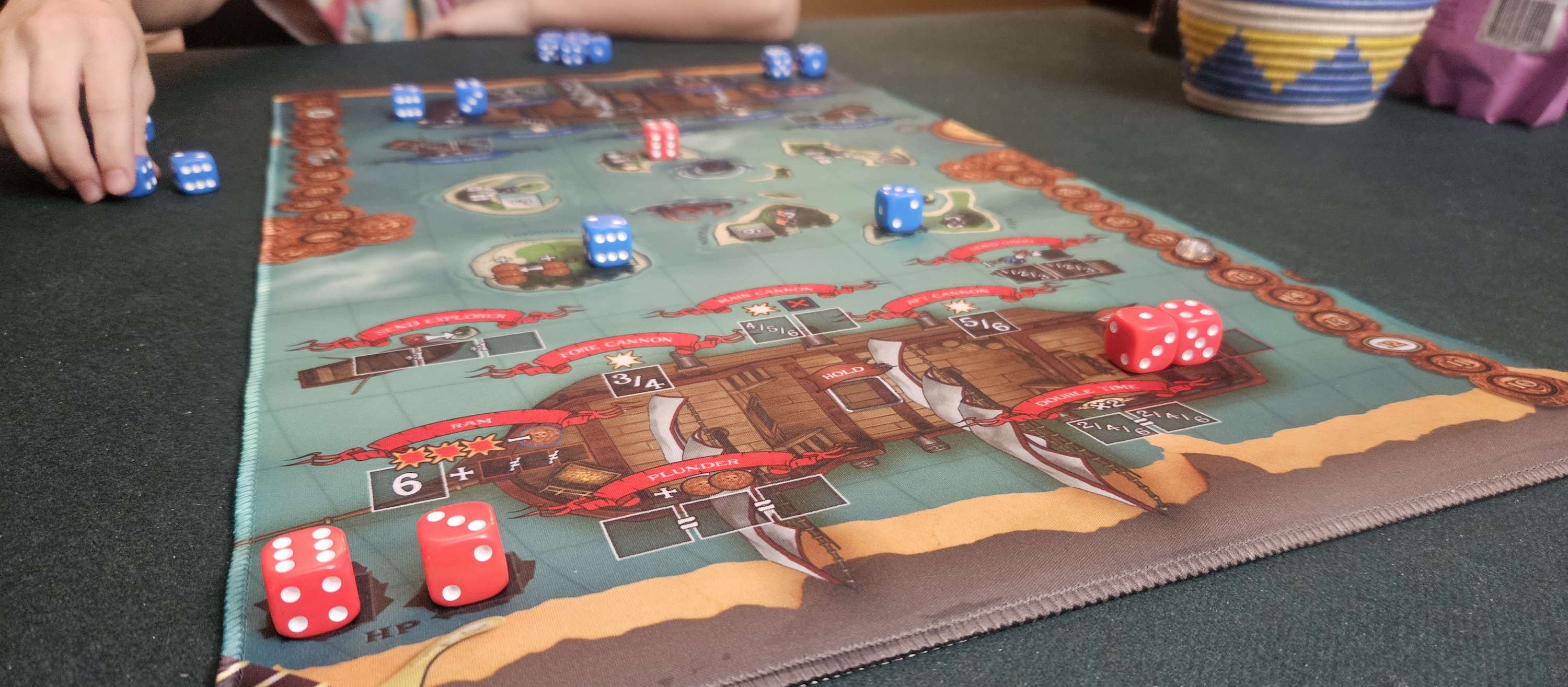
Ask my twelve-year-old about her favorite games and she’ll list a bunch of titles she consistently beats me at. Case in point: Six-Sided Seas. Inspired by the laminated game boards Chris Solis witnessed in Thailand board game cafes, this is a design by Kroze Kresky that limits itself to a single roll-up mat and a bunch of dice.
Forget inspirations. I keep losing to a child. A literal child. Twelve years of age, and already acquainted with an eyepatch and peg leg. She yearns for the galleon.
(sound: the distant thunder of a broadside)
As befits Six-Sided Seas’ simple format, the gameplay is a rapid-fire exchange of cannon fire, island-hopping conquest, and desperate carpentry. The whole thing takes between ten and twenty minutes, depending on how poorly one fares. If my experience is anything to go by, it’s one of those games that demands two or even three sessions in sequence. If I wanted to be reductive, I’d call it Pirate Yahtzee. You roll dice and assign them to your ship’s various stations. Once a station is full, you can remove all the dice banked there to activate its ability. The whole thing is dead simple.
But there are unexpected complexities beneath the surface. The first has to do with the way dice operate. Your crew has a certain amount of plunder, which sets the ceiling for your rolls. You can throw as many dice as you like, but busting that number means assigning a few of them to your evasion pool and tossing the rest, a paltry pity prize indeed. Hitting your plunder number, on the other hand, lets you either bump it up a space or earn an extra roll for free, effectively stretching how much you can accomplish either this turn or in the future. So you’re always playing the odds, pushing your crew a little further, and then enjoying or suffering the consequences when they rise to the occasion — or snap under the pressure.
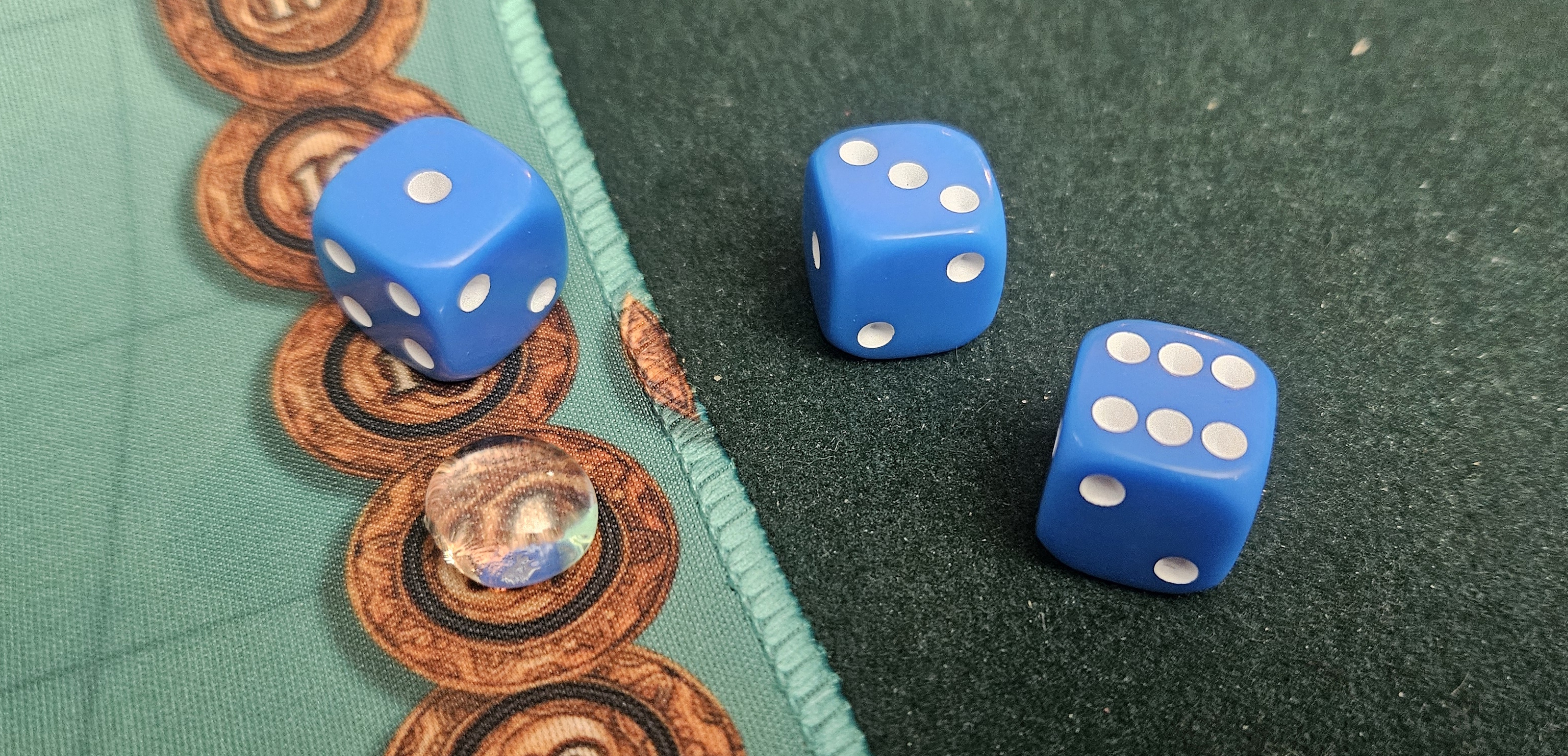
To roll or not to roll? ‘Tis the question.
Meanwhile, the actions themselves are nicely varied. There’s the usual cannon fire, of course, and a few disruptive abilities like one that sends a barrel of grog to the enemy ship to disable the first rolled die on their next turn or another that wipes out your defensive pool of evasion dice to ram the enemy ship for beaucoup damage. Three contrasting win conditions give these pursuits some edge. Sinking the enemy is the honest option, but even a limping vessel might earn enough plunder or secure four of the contested (and bonus-bestowing) islands in the middle to win without splintering an enemy timber.
It’s minor, but it was also designed to be minor, and its minorness is one of its greatest strengths. For example, I’m compelled to lament the ram action, which I believe is horribly overpowered, especially when doubled, but it’s a maneuver that requires multiple turns to set up, strips away your protection, and may be a reflection of my daughter’s favorite strategy more than an actual imbalance. Anyway, what’s an imbalance in a game that I’ve set a world record for by losing in four minutes? As soon as I’ve been scuttled, we’re halfway positioned for the next duel. This time I’ll ram her ship. (Spoiler: She rammed my ship twice and sent it to the bottom of the ocean.)
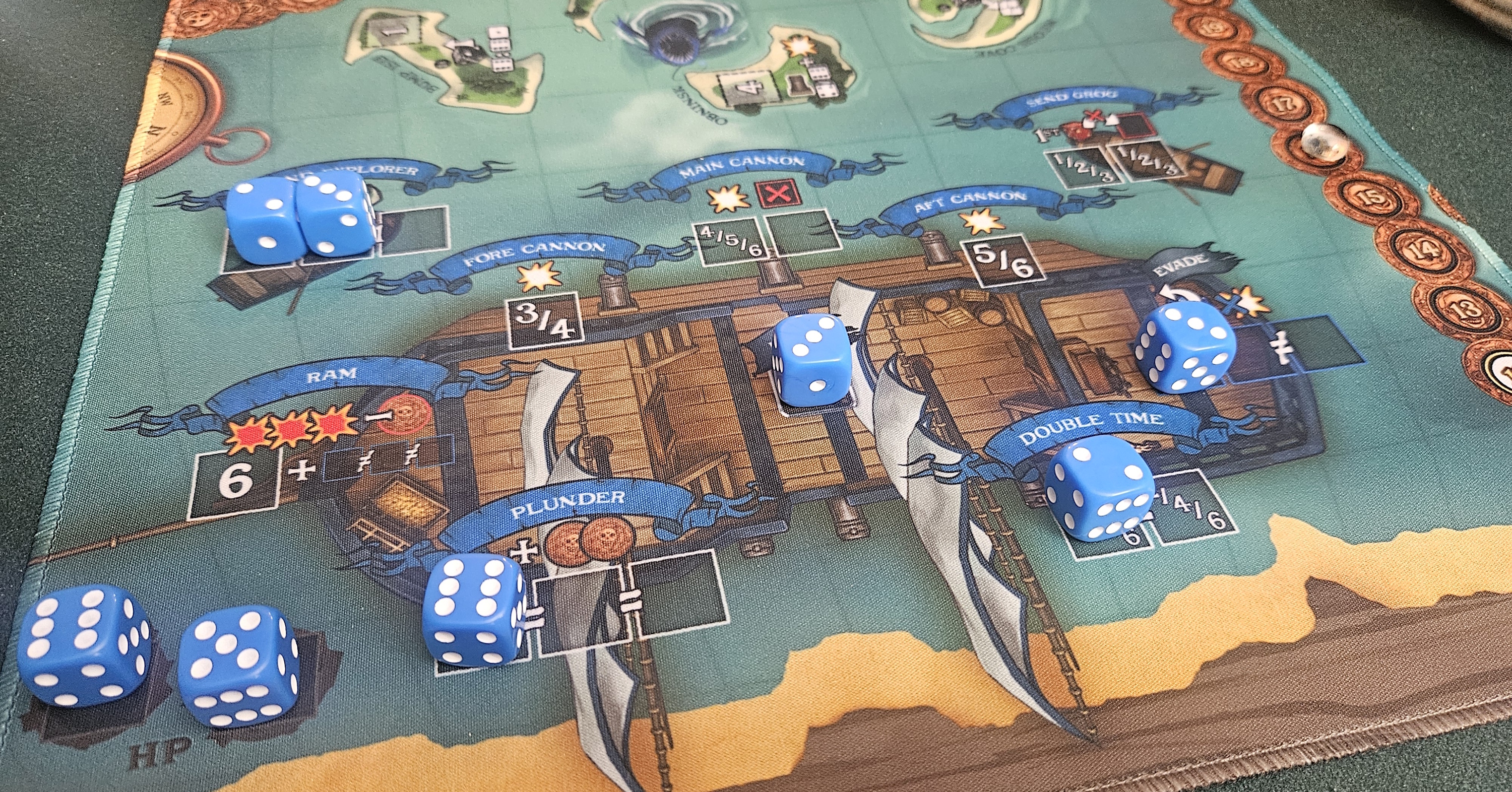
It takes fifteen, twenty minutes to sink one of these ships.
I don’t want to damn Six-Sided Seas with faint praise; its brevity belies a real understanding of what makes dice so joyous to handle. The decisions are micro-sized, but they matter. Should I seize the island that gives me an all-important reroll — one that might prevent an untimely bust — or double the impact of my cannons? If I’m falling behind, should I play it safe with my dice or push my crew as hard as possible? There are no easy answers.
So, yes, the format matters. Six-Sided Seas is small, brief, and in some respects limited, especially with its two-player count. But I’m impressed with what Kresky and Solis have done with said format. This one would feel right at home in a game cafe, on a picnic table, or beneath the dim light of a cramped starboard cabin.
A complimentary copy of Six-Sided Seas was provided by the publisher.
(If what I’m doing at Space-Biff! is valuable to you in some way, please consider dropping by my Patreon campaign or Ko-fi. Right now, supporters can read the next installment in my series Talking About Games, this time tackling the topic of what makes a good list! Naturally, the piece includes a list.)