At the beginning of 1793, after the execution of King Louis XVI, France was drawn into a war against a coalition of most European monarchies. On 24 February, the National Convention decreed the mass draft of 300,000 men to defend the eastern borders. Throughout the country, revolts broke out against this conscription, everywhere they were brutally repressed with success. However, an insurgent territory, called the “Vendée Militaire” resisted. Determined to engage in a trial of strength with the new revolutionary regime, the Vendéens gradually organized themselves until they formed a “Catholic and Royal Army”.
Vendée 93, a card driven two player wargame, takes you back to this particularly epic period in the French history, which pitted the young French Republic against the Royalist insurgents from March to October 1793.
“White” or “Blue”, choose your cause and take command of your troops! “White”: you will have to take the advantage quickly at the risk of seeing the Republican forces inexorably strengthen, forcing you into a sinister “Virée de Galerne”. “Blues”: time is on your side, resist the first assaults of the “brigands” to then be able to face the hell of the bocage in order to definitively extinguish the insurrection.
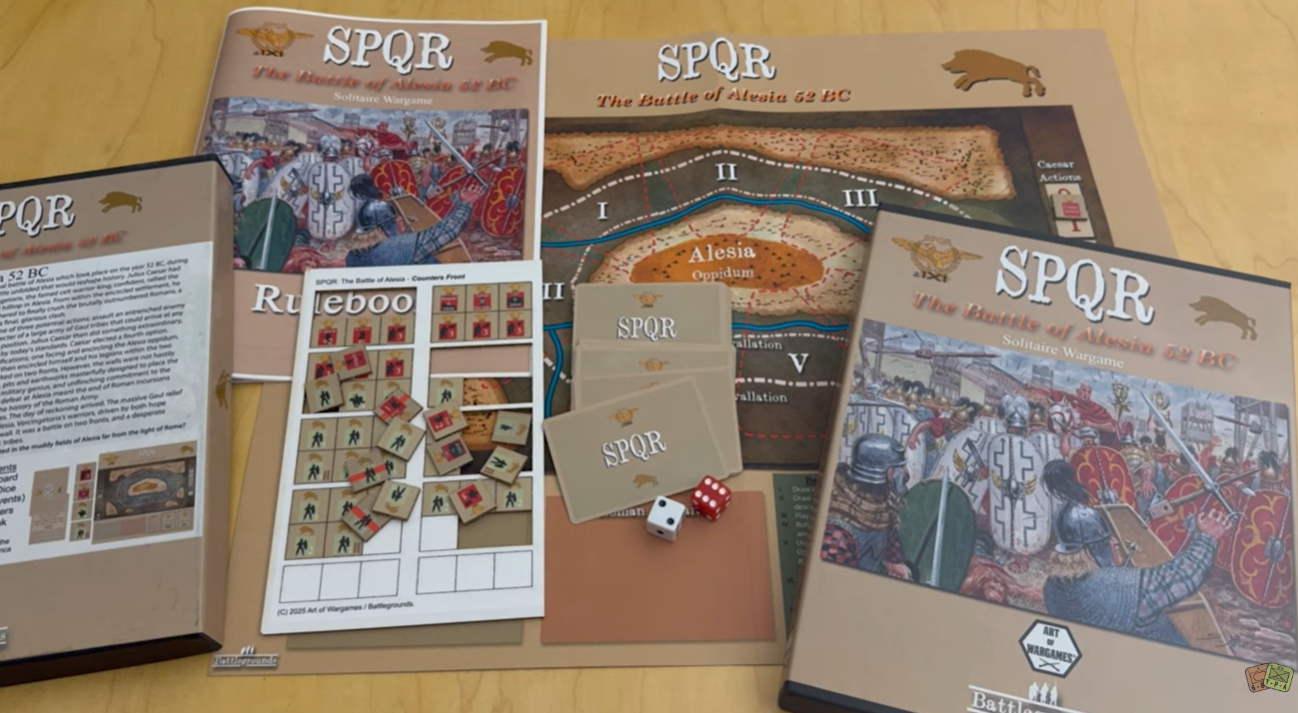
In SPQR: The Battle of Alesia 52 BC, you recreate the historical final battle of Alesia which took place in the year 52 B.C., during Caesar’s Conquest of Gaul. In the heart of the Gaul region, a battle unfolded that would reshape history. Julius Caesar had been carving a bloody path through the Gaul lands.
Vercingetorix, the famed and confident Celtic warrior-king, rallied the scattered tribes of Gaul into a desperate stand on a fortified hilltop in Alesia. From within the encircled settlement, he watched as a vast Gaul relief army of some 250,000 men gathered to finally crush the brutally outnumbered Romans, a storm cloud promising a final, glorious clash.
Will you lead the Roman Legions to glorious victory? Or will you face annihilation in the muddy fields of Alesia? The choice is yours…
A few years ago, after playing all of the games in the Great Statesmen Series, we heard of a new game in the series from a designer not named Mark Herman and I was immediately interested and intrigued as we have had so much fun with Churchill, Pericles and Versailles 1919. Congress of Vienna from GMT Games is a diplomatic card driven wargame based on Churchill and is the 4th game in the Great Statesmen Series. The game is set during the years of 1813-1814 and sees players take on the role of the main characters of the struggle between the Napoleonic Empire and the coalition of Russia, Austria, and Great Britain with their Prussian, Spanish, Portuguese, and Swedish allies. We played the game twice last year at Buckeye Game Fest and at the World Boardgaming Championships and absolutely were amazed at the changes and innovations to the system introduced by the designer Frank Esparrago.
With the Hammer is an asymmetric wargame covering the German Peasants War in Thuringia in 1525 along with the exploits of one of its most famous protagonists – Thomas Müntzer. With the Hammer comes with wooden pieces, counters, 2 rulebooks, and historical commentary by Professor Andrew Drummond, and a 22×17 inch map.
Each player is a peasant or a noble; the peasants win as a team, or the nobles win as a team. There is no true solitaire system, but like most wargames, it can be soloed two-handed.
Recently, I saw a post on X from one of my favorite designers Mark Herman. If you have to ask who then maybe this post is not for you. But he is one of the best and most prolific designers out there with nearly 100 designs to his credit. Hands down one of the best…and an amazing guy too. In fact, some of his designs are among my favorite wargames including titles like Empire of the Sun, Churchill, Pericles, Fire in the Lake, Washington’s War, Fort Sumter, Rebel Fury and more. Mark knows wargames and he knows how to tell the story of the historical event. Just a master really. The post was Mark highlighting a written review found on Board Game Geek about his newest game in the Civil War Heritage Series called Volume II Army of the Potomac: Campaigns of 1862 & 1864.
I read the review he mentioned and it is very comprehensive and well done. But this post somewhat triggered me. Why I am not sure but it did. I am not mad about it. Not hurt. Not overly concerned. And when I say triggered a more appropriate word would be caused my thinking juices to be stirred up. But I wanted to share my thoughts and opinion on what a wargame review is but also what it is not because I believe that a lot of gamers have a very different opinion about these things than I do.
When Alexander and I get together to play a game with the intent of doing some sort of review and sharing our thoughts on the design it does take a bit of preparation and time. We have to read the rules, and believe me, this can take hours, to truly get a feel for the game, its processes and the flow. But also to get an understanding of what the designers thesis is about the conflict modeled. I think that designers create games that they agree with and believe in. Not necessarily that are 100% a true modeling of the event. Their bias is inserted into the design and there really is no way around that. And I am fine with it because I know that each story of history has 2 (or more) viewpoints and perspectives. We also have to prepare the counters, which includes clipping them, sorting them and then storing them in counter trays or baggies. We then have to set up the game, and with wargames, this can take an hour or more to make sure you have the correct units, place them in the proper hexes and then check to see if there are any errata with the setup that we will need to change. Sometimes setting up the game wears me out…but then we have to give it a play.
Also keep in mind that the majority of games that we play are big wargames. These games have multiple maps, hundreds if not thousands of counters and a ton of different scenario options to choose from. Typically, a campaign game might take dozens of hours with shorter scenarios taking 6-10 hours. These are not light games that can be played in 45-60 minutes. And because of that, the reality of playing a game multiple times just isn’t feasible. We have never posited ourselves as full and thorough multiple playthrough guys. We just don’t have the time to sink that much time and effort into 1 game. Keep in mind that we only get to play 30-40 new wargames annually, which is a lot but not necessarily a lot for someone that attempts to give a good review of a game. But we always play a game until we are comfortable with the rules, understand the flow and get into a majority of the aspects of the game so we can confidently and accurately discuss them.
So, first let’s take a look at what I think that a review is not necessarily.
What They Are Not!…
Full Exploration
First off, I don’t see a review, or at least our brand of reviews, as a total and full exploration of a game or the system. As I stated above, we play a game until we are comfortable with the rules, the mechanics, the thesis of the game and the general flow. This can mean that we play through an entire scenario or even sometimes the campaign but that is not necessarily the case. In fact, more often than not, that isn’t the case. We also play these wargames to see if we like the system. Liking the system is a very different thing from totally dissecting and examining the system for its flaws, strengths and proving or challenging its thesis. Our focus in reviews is generally pretty simple…sharing the feeling of the game, its accessibility, meaning the clarity of the rules, and then a focus on how the game plays. We don’t always cover every aspect or mechanic but try to give an overall feel for what the game is. This approach stems from our stated goal with the blog and YouTube Channel, which is to give an overall impression of the game and create an environment that makes the viewer or reader feel that they are at the table with us just discussing the game after playing.
This is a big one that we are asked about a ton with our reviews. Is the game balanced? Does each side have a real chance of winning the game? And other similar questions. The answer to this is that these games, referring to wargames, are generally a look at the history and how it played out. This means that if one side had more and better troops, they are generally going to win the game as they did historically. But a good and skilled designer, will look beyond the numbers and attempt to create some realistic and achievable victory conditions for both sides. Something that if happens, could change the course of future battles and the overall outcome of the war. There is nothing more that I dislike as much as sitting for 4 hours and getting my teeth knocked in because I really have no chance at meeting some objective to say that I won a game.
Skilled designers will attempt to create balanced wargame victory conditions by avoiding certain things, such as simple point-based kill mechanics or even reaching a particular geographically significant spot on a board. Instead, they use scenario-specific objectives and asymmetric victory conditions to ensure that each side has its own unique path to success. These rules force players to focus on historical strategy rather than just duking it out and seeing who can kill more units. But, when we play these wargames, we generally are not necessarily able to devote the time to gain a true understanding of and to uncover whether the victory conditions are balanced. We typically go off a gut feeling and observation of time and distance covered in a historical push to see if the game is reasonable to win by either side. I love Holland ’44 from GMT Games. It is one of my favorite wargames of all time and is a titanic struggle between the Allies trying to run up Hell’s Highway to reach and capture 3 bridges along the way and the German defenders who are trying to do just enough to stop their advance and hold at least 1 of the 3 bridges. I have played this game a few times and found that I have a real tough time as the Allies making the appropriate level of progress over historical results to even get to the final bridge located at Arnhem. But that doesn’t mean that the game is broken or that it is imbalanced, it means that the history is well represented here as historically the Allies failed to reach the “Bridge too Far” and had to turn back.
Expositions on Historicity
Finally, I don’t feel that reviews are about expositions of historicity. I am not a true historian. I know enough to understand the basic events of major wars such as World War I, World War II, etc. but not necessarily the full details of the battles, the maneuvers used and the outcomes. One thing that I know we are asked a lot is about the Orders of Battle (OOB’s) for these wargames. An OOB is simply the makeup of each sides troops, including their historical units, numbers of troops, type of troops and their quality generally represented with movement values, combat factors and defense factors as well as morale values. And my answer typically is that I don’t know. I ask these designers these type of questions in our Designer Interview Series but am not able to verify or check their math because I don’t have the experience or knowledge to do so. And with just a single play will be unable to comment on this aspect of the design. Remember, that wargames somewhat function as interactive experiments intended to bring history to life for key battles. History is interpretive and sometimes facts about the makeup of troops, the terrain involved or even the weather at the time of the battle is sketchy and tough to piece together. But most of these games are attempts at telling the story as accurately as possible. But, keep in mind, that a good historical simulation wargame, will attempt to challenge players with the real limits, rules, and stresses that those commanders faced. Wargames test historical ideas by turning narratives into active problems and allowing users to explore “what if” scenarios. But I cannot necessarily always comment on the plausibility of a design because I usually lack the expertise or intimate knowledge to do so.
Sometimes I know that ours will be the only review on a game. And that worries me.
I do not think that reviews are what other people believe they are. I see them as insight into a game and how it plays, what can be expected and how it feels to experience the game. Not a full and insight filled thesis paper on the historical plausibility and outcome. But I do believe that our brand of reviews is useful…at least in my humble opinion. But it sometimes does worry me that our review may be the only content out there on a particular game and I have a real fear of misrepresenting something and causing others to turn away from that game. That definitely worries me and I do make sure that I understand what it is that I am going to say about a game before I say it. But keep in mind that our reviews are our opinions and you may have a totally different take on the game. And that is fine as well because in the end your opinion is the one that matters and that will be used to make a purchase decision. Your wallet is yours to protect and I respect that.
What They Are!…
Sharings on Perspective
In the end, any review is an opinion and is something that the creator has taken the time to write down (or video) to share with others. It is about attempting to describe the experience of the game and how it plays. This does mean that each reviewer may see things differently. May focus on different aspects that spoke to them. May decide not to share each and every aspect of the game. But will focus on the experience! And then share that with us. I for one love that there are people out there that are willing and able to do these reviews. It is work and takes time. But in the end, the real treat for us as consumers of these reviews is that we get a bit of insight into the game and an understanding of what it is. This perspective is the most valuable element of a review and is worth its weight in gold. A lot of times, people consume reviews because they have already played a game, made their mind up about that game and what it is and are simply looking for someone to corroborate their feeling. They don’t really care what the person has to think and whether their stance is well reasoned and supported by evidence form the game itself. They are simply reading or watching to validate their own opinion. They want to hear their thoughts come out of someone else’s mouth.
Recently, during one of our Monthly Debrief videos, we discussed games that we disagree on. There are not many games that Alexander and I disagree on…but there are some. As a part of that discussion, we dove into our conflicting thoughts about the venerable tactical level wargame series Advanced Squad Leader. We disagree on this game. I like parts of it, and the overall experience, but Alexander does not. And that is fine. But one of our viewers told us to “put the game back on the shelf” and that listening to us was “cringe”. Well, I do agree that we are cringe but this comment proves my point. We didn’t agree with him and so we are not correct. And that is fine.
Windows into Mechanics
I think that one of the most important parts of any review though is a window into the mechanics. Does this mean a full and detailed description of each and every mechanic, how they work, why they were chosen by the designer and how they reflect history? No…absolutely not. But understanding the base mechanics of a game is critical to understanding whether the game is for you or not. If you happen to really like block wargames and are watching a review on a block wargame such as An Impossible War from Bellica 3rd Generation you would like to know how the block wargame mechanic works. If you like Chit-Pull Activation and you are consuming a review about a Chit-Pull Activation game such as with Blind Swords: Gettysburg: The First Day from Revolution Games, you want there to be some discussion about how the Chit-Pull works. A review should have at least a mention about the mechanics and what is good about their implementation.
Gauges on Complexity
Wargames are generally complex affairs. They have a lot of rules, exceptions to those rules, rules variants or optional rules and sometimes have ambiguity in their explanation of these rules. This last part is really a problem with a lot of games, wargames and other types, but a designer sometimes gets “nose blind” to their own game and takes into account a lot of assumptions about how their description and instructions for the game will be received. I like to make sure that those consuming our reviews understand how complex or difficult to learn the game rules are. I also like to focus on player aids and how they affect the learning process and play so that those who may purchase the game and attempt to give it a play can get an idea of what their learning commitment will be with the rules. And remember, complexity and rules depth doesn’t equate to a good game. If you ultimately cannot get the game played because of the learning curve or the poorly written rules, then a review will do you no good.
A Look at the Fun Factor
In the end, while I play games for many reasons, I am mainly playing a game because I want to enjoy myself. I want to have a good time with the game and its efforts to tell the story of the event and enjoy my time with my opponent. I want to be able to focus on the game and get into the strategy and not have to worry about the rules, the mechanics or the production. And a good review will provide an insight into this aspect of the game. It doesn’t take multiple plays to understand whether a game is right for you or whether it matches your tastes. You can typically see that in just a single play and that is the way we approach things. We have played a lot of games and know when a game is not for us. But, that is not always the case for others and their experience with wargames. And that is fine. But that is a key part of what a review should be.
There you have it…my thought’s on what a review is and what it is not. I know that many will not agree with these points and that is fine. These are my opinions and I have developed them over the past 40+ years of playing games and 10+ years of covering games as The Players’ Aid. What are your thoughts on what a review is? How do you think they best serve the wargaming community? What would you change about our reviews? I look forward to hearing your thoughts and opinions on this matter. Thank you.
With this My Favorite Wargame Cards Series, I hope to take a look at a specific card from the various wargames that I have played and share how it is used in the game. I am not a strategist and frankly I am not that good at games but I do understand how things should work and be used in games. With that being said, here is the next entry in this series.
#86: LRRP from Fire in the Lake: Insurgency in Vietnam from GMT Games
The COIN Series uses cards in a very different way from other CDG’s. These cards are not necessarily the driver of the action but more assistive to the actions of the players by setting eligibility and also providing powerful events. The Event Cards are more often than not, very powerful. They either give you a continuing bonus on future Operations and Special Activities (as in the case of the volumes that include the various Capabilities) or allow you to take Operations and Special Activities more times that round than you would normally have been able to had you not chosen the Event and more often than not, at no cost! Also, because of the power of the cards and their ties to one or more factions, you can take the Event which allows you a huge advantage, only to see that very powerful Event reversed with the next Event or with a regular Operation. This is very frustrating but is one of the major reasons that I love the card-assisted element of the COIN Series. Today we are going to take a look at the LRRP Event Card.
The LRRP Event Card, with LRRP standing for Long-Range Reconnaissance Patrol, allows the US player to place 3 Irregulars outside the South then conduct a free Air Strike, that also allows for the removal of Bases first. Keep in mind that Irregulars are US Special Forces pieces, which are the hexagonal shaped cylinders not ARVN Rangers. “Outside the South” means any Laos or Cambodia Provinces. Seems pretty pedestrian but it is important to note that this card changes the rules when played as normally all other units in a space must be removed before Bases can be removed. A very powerful card that typically will be played by the US player when it comes up. But keep in mind that Air Strikes are a dual edged sword as you get rid of pesky enemy pieces but it will result in shifts of Support/Opposition but can also Degrade the Trail. On the bottom of the card, the text allows the VC or NVA to ambush these LRRP”s and remove 3 Irregulars from the map to Casualties. Then it gives an added benefit of shifting each space these removed Irregulars were in 1 level toward Active Opposition.
Image courtesy of Boxxer’s Blog.
A Long-Range Reconnaissance Patrol, or LRRP, is a small, well-armed and nimble recon team that is tasked with patrolling deep into enemy territory to identify or destroy key targets and gain recon on the enemy. The concept of scouting forces such as LRRP’s dates back to ancient warfare but also has been used in more modern and contemporary wars such as the French & Indian War where specialized Rangers, such as Rogers’ Rangers, were tasked with raiding Indian settlements, disrupting supply lines and reporting back to command on troop disposition and movement.
In Vietnam, veteran or specially trained forces often augmented with Vietnamese irregulars usually carried out Long Range Reconnaissance Patrols into enemy territory. The Studies and Observation Group (SOG) was the ground element of the US air war against the Ho Chi Minh Trail as illustrated by Project Tiger that spotted for and marked enemy trail activity for elimination by US air assets.
Here is a link to a very interesting summary of an LRRP and its mission on a Vietnam veteran run blog called Boxxer’s Blog: From the seat of a motorcycle: LRRPs: “—doing the impossible for the ungrateful.”
While attending Buckeye Game Fest in spring 2024, we met with a new designer named John Lapham. John had with him a new game called A More Perfect Union and we got a chance to play the game and chat about it with him. A More Perfect Union is a 2-player card driven game that simulates the public debate over the ratification of the Constitution that took place across the United States from 1787-1789. The game uses the same system as Twilight Struggle and 1960: The Making of the President but felt very fresh and unique to the situation. Catastrophe Games is planning a Kickstarter campaign in the near future and we reached out to John to see about getting some more insight into the design and he was more than willing to share.
Grant: John welcome to our blog. First off please tell us a little about yourself. What are your hobbies? What’s your day job?
John: Thanks so much for having me, Grant. My main hobbies will surprise no one – gaming and history. I also enjoy hiking, cooking, and theater. As for my day job, that is in the past. I’m retired now. Before that, I had jobs in both the legal and educational professions.
Grant: What motivated you to break into game design? What have you enjoyed most about the experience thus far?
John: I wanted a game on this topic and no one else seemed willing to oblige me—although Jason Matthews and Christian Leonhard came close with Founding Fathers. I enjoyed the beginning and end of the experience. I love historical research and pondering messy interpretive narratives and historical hypotheticals. So, I was not surprised by how much I enjoyed the front end of the design process. What surprised me was how much I enjoyed the collaboration that occurred near the end of the project, and the practical and artistic challenges of turning an idea into an actual, physical game. I had no experience with that process and enjoyed learning about it.
Grant: What is your upcoming game A More Perfect Union about?
John: A More Perfect Union is about the political struggle to ratify the U.S. Constitution in the thirteen states from 1787-1789. The game employs the popular card-driven mechanics of such well-known games as Twilight Struggle and 1960: The Making of the President.
Grant: Why was this a subject that drew your interest?
John: It was the subject of some of my earliest graduate school research in the late 1980’s (yeah, don’t ask, I’ve been around the block more than a few times). As a history educator, I was drawn to less well-known stories, involving people and events that popular and school histories have neglected. This is one such story, and it is an important one that has enduring relevance for understanding much of American history and our current turbulent moment.
Grant: What is your design goal with the game?
John: I had two main goals. I wanted the game to offer a window into the history of that moment and to spark interest in the topic. I also wanted it to be a fun, tense game that could be played in a couple hours but with enough complexity and variability to invite repeated plays.
Grant: What from the Constitutional Convention was most important to model?
John: Ok, that’s a hard one. I cannot give you just one. Several things were important to me.
First, I wanted the game to capture the intense war of words that occurred in the nationwide debate. America was on the leading edge of the first wave of mass media made possible by high literacy rates and the printing press. Americans of the period were highly literate, avid consumers of news, and intensely interested in politics. Ninety different newspapers and hundreds of presses across the country printed thousands of essays, letters, and pamphlets over the course of the debate.
Second, I wanted the game to capture the importance of political strategy in terms of grabbing and holding onto the initiative in the debate through the scheduling of the thirteen state conventions, as well as exploiting the momentum gained from successful outcomes in those conventions.
Third, I wanted to express the tension and uncertainty felt by the delegates during the actual conventions themselves. Delegates often went into these conventions uncertain of their outcomes.
Finally, and perhaps most importantly, I wanted players to come away with an understanding of the immense challenges faced by the new nation to come together and form a strong union that did not threaten the individual liberty that Americans prized at this time. It is in large part the work of the Anti-Federalists that delivered the country its Bill of Rights, a fact that is perhaps too often overlooked or forgotten by modern Americans.
Grant: What sources did you consult about the details of the history? What one must read source would you recommend?
John: Tremendous digital resources are available on the ratification debate thanks to the phenomenal work done by the Center for the Study of the American Constitution at the University of Wisconsin-Madison (https://csac.history.wisc.edu/). I encourage anyone interested in this topic to explore their website and the treasure trove of material available there.
For a more curated collection of primary source material, the Library of America has published an excellent two-volume collection of many of the most important essays, speeches, newspaper articles, pamphlets, and private letters, The Debate on the Constitution, which also includes a detailed chronology and biographical information on the participants in the debates.
For a single, narrative history of the entire series of events, the best choice is Pauline Maier’s Ratification: The People Debate the Constitution, 1787-1788, published in 2010. Reading that book was the last nudge that I needed to start designing the game.
Grant: What is the goal of the game? How do players go about trying to sway States to their way of thinking?
John: Fortunately for me as a designer, the main goal of the game was set out for me in the Constitution itself, which required nine states to ratify it to become binding on those states. Thus, the Federalists win the game immediately if nine states ratify the constitution without recommended amendments, and conversely the Anti-Federalists need five state conventions to reject the Constitution to win immediately. If enough states thread the needle of compromise and ratify the Constitution with recommended amendments, then victory is determined by the weight of the states on each side of the ledger.
The primary tools to convince voters in the states are direct campaign efforts, which involve the use of the campaign points in particular states, and the play of publication events. Publication events address one of three broad sets of issues that animated the debate – commerce, states rights, and individual rights. Each state in turn has a rating that reflects how important each of those sets of issues is to its voters. As a result, the effect of a publication will be more or less, depending on the state in which it appears.
Grant: What is the layout of the board?
John: The board includes several broad features – a map of the thirteen states with a state information and holding box for each state, turn and round tracks, a convention track, a state status track, and a table of information.
Grant: What information is contained in each State Box?
John: Each State Box has a number that reflects the maximum number of combined player cubes that can be present in the state, icons showing if either player starts with cubes in the state, numerical ratings for each of the publication issues, the convention value, and the momentum value of the state, and a spot for the state’s status marker, which shows if the state has scheduled or held its convention. Finally, the state boxes are color coded to show the section of the card deck in which the state’s convention card is seeded.
Grant: What are the 5 different words and corresponding values in these boxes mean? How are these elements connected to the cards?
John: The words “Commerce, States, and Individual” relate to the three publication issues and the numbers (0,1, or 2) next to them reflects the effect that a publication on that issue will have in the state – either adding or removing that number of player cubes in the state. The word “Convention” refers to the convention value of the state and the number next to that is the number of campaign points (CP) a player must expend either to call an early convention in the state or to attempt to take control of the State Status Marker through legislative maneuvering. The word “Momentum” refers to the campaign bonus a player will earn if they win the state’s convention.
The issues ratings connect directly to the publication event cards. The Convention ratings connect to the expenditure of CP gained from card play. The Momentum rating does not connect to the cards but instead relates to the outcome of the convention in the state.
Grant: What is the purpose of the State Factors Table and the State Issues Table?
John: This table summarizes in one place the information contained in the individual State Boxes, and it groups the states by their color codes to show players when they will draw the State Convention Cards over the course of the game.
Grant: What is the Back Room? What role does this play in the game?
John: Each player has a Back Room in which they can place a maximum of two cards. Cards in the Back Room are not part of a player’s hand, cannot be played during a player’s action round, and are not discarded at the end of the turn. Players can access the cards in their Back Room at three times – (1) during the card draw phase of each turn, when they can freely remove or add cards to the Back Room, (2) at the start of any convention, when they can remove, but not add, cards from their Back Room, and (3) during an action phase by playing a card for the sole purpose of adding or removing cards from their Back Room.
The Back Room plays two main roles in the game: (1) it provides a means by which players can hold onto powerful events that are not yet ripe to play – often convention events for conventions that will happen on a future turn, and (2) it provides a way to avoid playing a strong opponent’s event at an inopportune time.
Grant: How does the game use cards?
John: This a classic Card-Driven-Game. Each player is dealt a hand of cards each turn and plays one card each round either to spend the Campaign Points provided by the card or to implement an event described on the card.
Grant: What different types of cards are there? What is the purpose of these different types?
John: There are five different types of cards: State Convention Cards, Publication Events, Convention Events, Reaction Events, and General Events.
Each state in the game has a State Convention Card, which are mandatory events that must be played in the turn in which they are drawn. They grant the player cubes in the state and control of the State Legislature, and they schedule the state’s convention by placing the state’s status marker on the Convention Track.
Publication Events publish and distribute a publication addressing a particular issue in a particular state that and a few of its neighbors. Most of these events will specify the state in which they originate and the issue that they address. A few allow the player to pick the state and/or issue for the publication.
Convention Events can be played for their event only during a convention and will have some effect on the outcome of that convention.
Reaction Events are played in response to some other game effect.
General Events are a catch-all for any other type of event.
Grant: Can you share a few examples of cards and explain their use?
John: Sure, here is an example of a State Convention Card:
Each state has one of these cards and they all work the same way.
These cards trigger the scheduling of State Conventions.
They must be played on the same turn they are drawn and cannot be discarded or placed in a player’s Back Room.
They are seeded in a particular quarter of the draw deck at the start of the game, as indicated by the colored banner in the upper right corner of the card.
When played, you move the indicated state’s Status Marker from the map to Box 1 on the Convention Track and mark it with a cube of your color. This represents that you are in control of the state legislature and can spend CP to call an early convention in this state on a later turn. In addition, you may add or remove 2 cubes in the state.
Here is an example of a Publication Event:
These are the most involved events in the game but like the State Convention Cards they all work the same way. So, once you’ve done it a few times, it becomes straightforward.
The red star identifies this card as an Anti-Federalist Event.
The “3” in the star shows that this card is worth 3 CP.
The newspaper icon under the star shows that this card is a publication event, as do the words in the white banner running along the left side of the card.
When played for the event, publications are distributed in a number of states equal to the CP value of the card. In this case, that means 3 states. The first state the publication must be distributed in is the state identified by the postal code in the title of the card. In this case, it must be distributed in Virginia. In addition, the publication may be distributed in twoadditional states that are adjacent to Virginia for a total of 3 states.
The issue addressed by this publication is individual rights, which is indicated in text at the bottom of the card. The issue controls how many cubes the player will add or remove from each state based on that issue’s value (from 0-2) in each state. The individual rights value in Virginia, Pennsylvania, and North Carolina is 2, but it is only 1 in Maryland. That means that this publication with add or remove 2 cubes in Virginia, Pennsylvania or North Carolina, but will only add or remove only 1 cube in Maryland.
Grant: What happens if you play an opponent’s event? What type of thinking and strategy does this create?
John: Generally, the event triggers, although the player gets to decide whether the event happens before or after they use the card for campaign points. There are two ways to mitigate powerful opponent events. They can be played during the Initiative Phase of the turn to bid for initiative without triggering the event, although doing so often reduces the player’s chance of winning the initiative for the turn, which is costly in its own right. They can also be stored in the player’s Back Room for possible play on a future turn when the event might be less damaging. This too is costly as the Back Room can hold only two cards and those spaces can also be used to save your own events for a future turn when they will be more effective. Thematically, in both instances you are spending time and energy managing a potential problem rather than advancing your own agenda.
Grant: What is the general Sequence of Play?
John: Each turn has the following phases:
Card Draw – Slightly more involved than a standard CDG because each turn you can change the cards in your backroom, which is often a challenging decision.
Initiative Phase – This phase sets the initiative and the first player for the turn.
Action Phase – The heart of the game when players alternate playing cards from their hands.
Convention Phase – State Conventions are resolved or move closer to resolution.
Voter Apathy Phase – Some voters lose interest and players remove some cubes from the map.
Grant: What is a Convention and how does it work? What is the outcome of this process?
John: A Convention is when a state makes its final decision as to whether it will ratify the Constitution. Thematically, this is the moment that elected delegates meet, debate, and vote on the Constitution. To model the drama of these events, players have a final opportunity to play cards that can affect the outcome. After that, the player’s cube totals in the state are compared. If the Federalists have the most cubes, the state ratifies the Constitution. If the Antifederalists have the most, the state does not ratify. If the two factions have an equal number of cubes, the state ratifies with recommended amendments.
Grant: How does Campaigning work?
John: Each state has a set number of voters. This number puts a cap on the number of combined player cubes that may be placed in that state. Players can think of it this way: the voters in each state can have one of three states of mind – undecided, Federalist, or Antifederalist. At the start of the game, most voters are still undecided, which is reflected by the fact that only a few cubes are placed on the board during setup. Campaigning involves the expenditure of Campaign Points (CP) to persuade these votes to change their mind, represented by placing or removing cubes in the states. It costs 1 CP to place a cube in a state. It costs 2 CP to remove a cube from a state. If a state is already at its cube limit, the player will first have to spend points to remove an opponent’s cube before they can place their own cube. Thus, to replace an opponent’s cube with one of your own costs 3 CP. Cards range in CP from 1-4. So many cards will not grant the player enough CP to replace an opponent’s cube with one of their own.
Grant: How is victory achieved?
John: The Federalists gain an immediate victory if nine states ratify the Constitution without amendments. Conversely, the Antifederalists win if five states reject the Constitution. If neither player achieves these conditions before the end of the final turn of the game, at least one state has ratified the Constitution with recommended amendments. Victory at that point is determined by comparing the values of the states in each section of the State Status Track. Each state has a value that represents its political and economic importance – the larger the state the more it is worth. Each player gets full credit for each of the states in their column and the Antifederalists get partial credit (the Convention value) for each state that ratified with recommended amendments. Thematically, this represents a compromise situation, where the Constitution is ratified but with amendments. The stronger the opposition to the original Constitution, the more impactful those amendments will be. Strong amendments represent a partial victory for the Antifederalists. Historically, the Antifederalists efforts resulted in the adoption of the first ten amendments to the Constitution, including the Bill of Rights.
Grant: Which side has the tougher challenge to meet their goal?
John: The challenges faced by the two sides are different, but I hope they are roughly equal in difficulty.
Grant: What are some basic strategies the Federalist and the Anti-Federalist players?
John: The Federalists need to strive to win states quickly and build on that early momentum. They may need to consider making aggressive moves early in the game to take states off the board. They also must stay competitive is as many states as possible. They can only afford to lose four states, and the deck is stacked against them in two states – North Carolina and Rhode Island. The Antifederalist player has a wider range of strategic choices. They can focus on winning outright victory in one or two of the early states in an effort to reach the five states they need for an automatic victory, or they can build up their strength in several of the more valuable states that hold their conventions later in the game and improve their chances of winning the game on the basis of points at the end of the game. They cannot afford to compete with the Federalists in every state. They need to pick their battles carefully.
Grant: What type of an experience does the game create?
John: My hope is that it offers players challenging strategic and tactical decisions and creates dramatic moments of high tension where careful planning or bold action can alter the course of the game.
Grant: What are you most pleased about with the design?
John: Overall, I am pleased with the way it models the challenges and choices faced by the historical actors. With respect to the game play, I particularly like the Initiative, Back Room, and Convention mechanisms.
Grant: What other designs are you working on?
John: I’m working on a four-player game about the labor movement in Chicago, during the late 19th-century, and a solitaire game about the Civil War in which the player takes on the role of Lincoln and has to prosecute the war as commander-in-chief, while also navigating the challenges of domestic policy and political campaigning.
While attending Buckeye Game Fest in spring 2024, we met John Lapham and shot a video interview discussing the game and its mechanics:
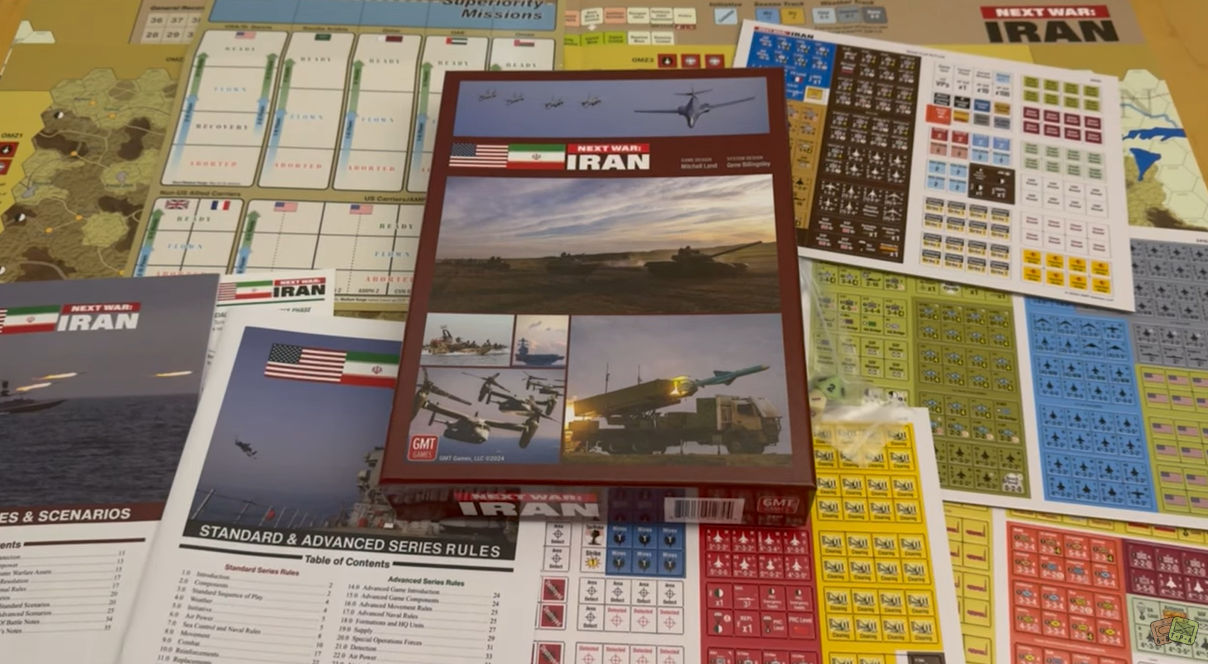
Next War: Iran is the sixth game in the Next War Series from GMT Games. It is unique in the series in that the Allied player has to do the attacking while the non-Allied player attempts to defend its territory against neo-imperial oppression. With a long logistical tail, few true allies in the region, and the menace of Iran’s A2AD capabilities, re-opening the Straits is a tall order.
A few years ago, while attending WBC, I had the chance to meet Wes Crawford who was demoing one of his new games called Engine Thieves: The Andrews Railroad Raid of 1862 from Compass Games. Wes is a great guy and this game is focused on a rarely, if ever, gamed historical subject in the 1862 Andrews Railroad Raid during the American Civil War. On April 12, 1862, the charismatic Union agent James Andrews and his band of raiders stole the train powered by the locomotive, “The General,” from under the noses of about 3,000 Confederate troops training at Big Shanty (Kennesaw), Georgia. Their risky mission was to cut telegraph wires, burn railroad bridges, and damage track between Atlanta and Chattanooga, thus severing communications, reinforcements, and supplies between the two cities. This was as Union General Mitchel advanced his forces upon Chattanooga with the aim of capturing it and splitting the Confederacy in two. The raiders needed to bluff their way through the Confederate railroad stations and even pass through Chattanooga to meet the advancing Union force in Bridgeport!
Engine Thieves covers this courageous Civil War raid. Play as the Union raiders in a solo game as you race against time, and the Confederate soldiers on your tail, to get to Bridgeport. With 2 players, one of you will play as the Confederates and try to stop your opponent from reaching Bridgeport or at least minimize their destructive sabotage. Follow the adventure and real path these raiders took on their daring ride north!
As the solo player in charge of Andrews and the Union raiders, you must accumulate at least 25 Victory Points by some combination of burning bridges, cutting telegraph wires, damaging track, bringing the stolen train to Bridgeport, and defeating Confederate units that get in your way, all while minimizing raider casualties. Reaching Bridgeport is a high priority since without that accomplishment, General Mitchel would likely call off his attack on Chattanooga. Mitchel might be otherwise unaware of the Raiders’ successes!
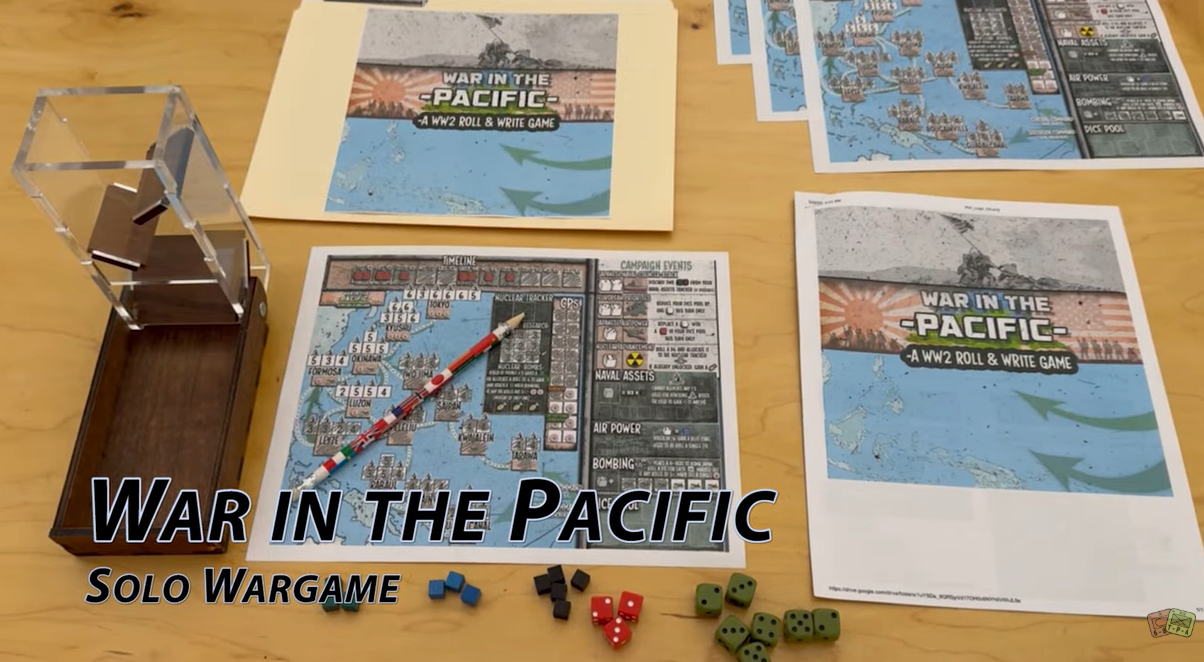
In War in the Pacific– A WW2 Roll & Write Game from Solo Wargame, players will allocate limited resources to launch attacks, conduct strategic bombing, maintain supply lines and seize key islands. Your strategy must be swift and decisive, targeting objectives like Guadalcanal, Iwo Jima, and Okinawa. As the war intensifies, you can divert critical resources to the Manhattan Project, researching and developing nuclear weapons. The race to build atomic bombs could be the key to ending the war. Can you balance the demands of the Manhattan Project with the immediate needs of your campaign?
Once you’ve gained a foothold, you’ll face a crucial choice: invade mainland Japan in a costly land assault, or use strategic bombing and nuclear weapons to force Japan’s surrender. Each option is risky as an invasion could end the war quickly, but at great cost, while bombing and nukes may hasten Japan’s surrender, but could come too late.
With fast-paced dice allocation, resource management, and mounting pressure, every decision could mean the difference between victory or failure in your quest to force Japan’s capitulation.
I love a different style and focus of wargame. A game that takes a look at an important but somewhat obscure or rarely addressed historical topic, such as espionage or intelligence, and creates a gaming experience tailored around the events to highlight and evoke the difficulties and tension that would have been present. In January 2026, GMT Games announced such a game in Checkpoint Charlie, which is a solo or cooperative game focused on SIS espionage missions in Berlin in the 1960’s designed by Russell Brown. We have posted an interview with Russel and it was very well received and he has now agreed to create a series of History Behind the Cards to highlight the events of the 1960’s Cold War struggle in West Germany but also to share aspects about the game play and how it models the history.
*Note: The cards highlighted in this series and their event text, as well as any pictures used showing any of the various components, are still in the design and development process and as such event effects and text might still change prior to final development and publication.Also the art and layout of the cards are only for playtest purposes at this point and the game will enter the art department as it nears publication.
History Behind the Cards – Checkpoint Charlie from GMT Games – Card #2: Cuban Missile Crisis
In response to the US placing nuclear missiles in the UK and Turkey, within range of Moscow, and in an effort to protect Cuba and keep it within the Soviet sphere of influence, Khrushchev made a deal with Castro in July of 1961 to base Soviet nuclear missiles in Cuba, within range of most of the southeastern United States.
The US knew the Soviet Union was training and supplying Castro’s army and inserting specialists, and CIA assets in Cuba had seen Soviet surface-to-air missiles. This led to suspicion that the Soviets were intending to place ballistic missiles in Cuba.
The best US assets for confirming the presence of these missiles were high-altitude U-2 Spy plane flyovers. However, the loss of Francis Gary Powers’s U-2 over the Soviet Union to a SAM missile (Event Card #12 The Powers Abel Exchange) created reluctance, since the US now knew the Soviets had deployed similar SAM’s to Cuba. U-2 flights were finally authorized in October of 1962, and it was these photos that confirmed the presence of Soviet nuclear-capable missiles.
The status of Berlin, halfway around the world, played an important role in the Cuban Missile Crisis. From 1958 until the discovery of the missiles, the relationship between the US and the Soviets was dominated by the “Berlin Crisis,” which consisted of a series of military and diplomatic moves by Khrushchev to outmaneuver the Americans and annex West Berlin into East Germany. The Cuban Missile Crisis not only brought the conflict over Cuba to a head, but also brought new attention on the status of Berlin. The two became linked. A ground invasion of Cuba might result in a military annexation of West Berlin by the Soviets, and it was not out of the question for the Americans to concede to the Soviets in Berlin to get the missiles out of Cuba.
President Kennedy avoided direct military conflict and responded with backchannel diplomacy and a naval blockade of ships coming into Cuba. The crisis continued for two weeks, with US ground forces readied for an invasion, Soviet ships attempting to run the blockade, and the US strategic nuclear forces going to Defcon 2. The tensions eased when Khrushchev agreed to remove the missiles in exchange for an agreement that the US would never invade Cuba. In addition, Kennedy secretly agreed to remove US nuclear missiles from Turkey.
In Checkpoint Charlie, the Cuban Missile Crisis is assumed to have diverted Soviet attention from espionage activities in Berlin. This card not only removes surveillance from any location of the player’s choice; it also reduces the number of available surveillance pawns for the rest of the mission.
In the next article in this series, we will take a look at Demonstrations and what effect these student run organizations had on operations in West Berlin and West Germany.
In my opinion, this game looks extremely interesting and I am very much excited to learn more about it. I am appreciative to Russell and his efforts to bring us these cards and to write these entries to share with our readers. I am also very glad that this topic is being covered in a game and look forward to playing this one day soon.
An Impossible War: The First Carlist War in the North, 1834-1838 from Bellica Third Generation is a block wargame that recreates the First Carlist War in the North of Spain which was a civil war between the Carlists who supported the succession of the late king’s brother Carlos de Borbón and the progressive and centralist supporters of the regent Maria Christina acting for Isabella II of Spain who were referred to as the Liberals. The game uses blocks representing units but also includes counters and uses cards. I was able to play the game about a month or so ago with Francisco Ronco who owns the publishing company Bellica Third Generation and very much enjoyed the game and how it represented this interesting struggle.
In Action Point 1, we took a look at the Game Map, discussing the point-to-point movement configuration, the various spaces and the delineation of the Carlist versus the Liberal Zones, as well as explained the use of the Rest of Spain smaller map. In Action Point 2, we examined the units available to both sides and covered the importance of Supply. In Action Point 3, we took a closer look at the Carlist Uprising Phase and what it means for the game. In Action Point 4, we examined the activation system and the use of Action Point Markers. In this Action Point, which is the conclusion to the series, we will take a look into how Battles work, focusing on the tactical aspect of combat with the use of the Battle Board.
Battle
One of my favorite parts of the game is the Battle mechanic. With Battle, I very much enjoy the use of the Battle Board but also like that there are several different types of combat. Battles focus on asymmetric combat rather than massive open field engagements and are typical of the First Carlist War. These Battles boil down to 3 primary types including Skirmishes, Battles and Assaults and each type have their benefits and uses and one of the important things about the game is the need to learn their best uses and then how to perform them. If both sides have at least 3 Infantry or Cavalry units in a contested space, then there is a Battle. Also if 1 or both sides has less than 3 Infantry and Cavalry units in the space, or only has Cavalry units, then there will be a Skirmish. And finally, in order to launch an Assault on a Fortress, the besieging player must have a Field Artillery unit of any value in the enemy Fortress space.
But before we take a look at these different types of Battle, I want to cover the Combat Cards. Combat Cards provide background events and assist tactical maneuvers without running the game on their own. Each player holds a distinct 36-card deck (Liberal or Carlist) representing historical, operational, and tactical modifiers. These cards simulate unpredictable elements, like sudden skirmishes, political shifts, or logistical hurdles. The Liberal Player generally leads larger, but lower-quality forces plagued by supply issues. Their Combat Cards tend to focus on maintaining order, quelling uprisings on the Rest of Spain Map and chasing Carlist expeditions. The Carlist Player will command smaller, high-quality troops. Their Combat Cards focus on exploiting superior mobility, terrain knowledge, and sudden strikes. Since this is an “impossible” war featuring guerrilla tactics, siege warfare, and frequent skirmishes rather than massive battles, the cards adapt to these asymmetric scenarios.
There are 3 types of cards found in the decks, including Event Cards, Operational Cards and Tactical Cards. Event Cards are played immediately when drawn and provide both positive and negative benefits to the players. Operational Cards can be played when the conditions stated on the card are met, during the player’s own Player Phase or sometimes during the opponent’s Player Phase. Tactical Cards can be played in combat as stated on the card. Each player can use a maximum of one tactical card in each Skirmish, Battle Round or Assault Round.
At the beginning of a player’s Player Phase each Turn, that player will take the top card from their draw deck. If it is an Event Card then it is applied immediately. If it is not an Event Card, the card is kept in the hand so that the other player cannot see it. A player can have up to 8 cards in their hand and these can be played as indicated on the card itself.
These cards are very well done and keep the game very interesting and tense as you just don’t know what type of cards your opponent has that they can spring on you in combat. These cards alter the conditions of the battle and cannot be planned for but must be kept in mind as players enter conflicts. From adding defenses that absorb hits (such as the Stone Walls Tactical Card) or provide additional Effectiveness Rating to units in battles when they are firing (such as the False Retreat Card), these cards make a difference and keep the game feeling like a game.
Now that we have looked at the cards, let’s now take a quick look at the various forms of Battle. A Skirmish consists of just 1 single round of fire. First the defender will fire and applies all hits to the attacking units, then the attacker will fire and applies hits to the defending units. There are no morale rolls in the game. In a Skirmish a player fires with a maximum of 3 Infantry and Cavalry units. The player must choose which units will fire with several limitations. maximum of 1 Cavalry unit in rough terrain and a maximum of 2 Cavalry units in open terrain. A player always fires with all Artillery units.
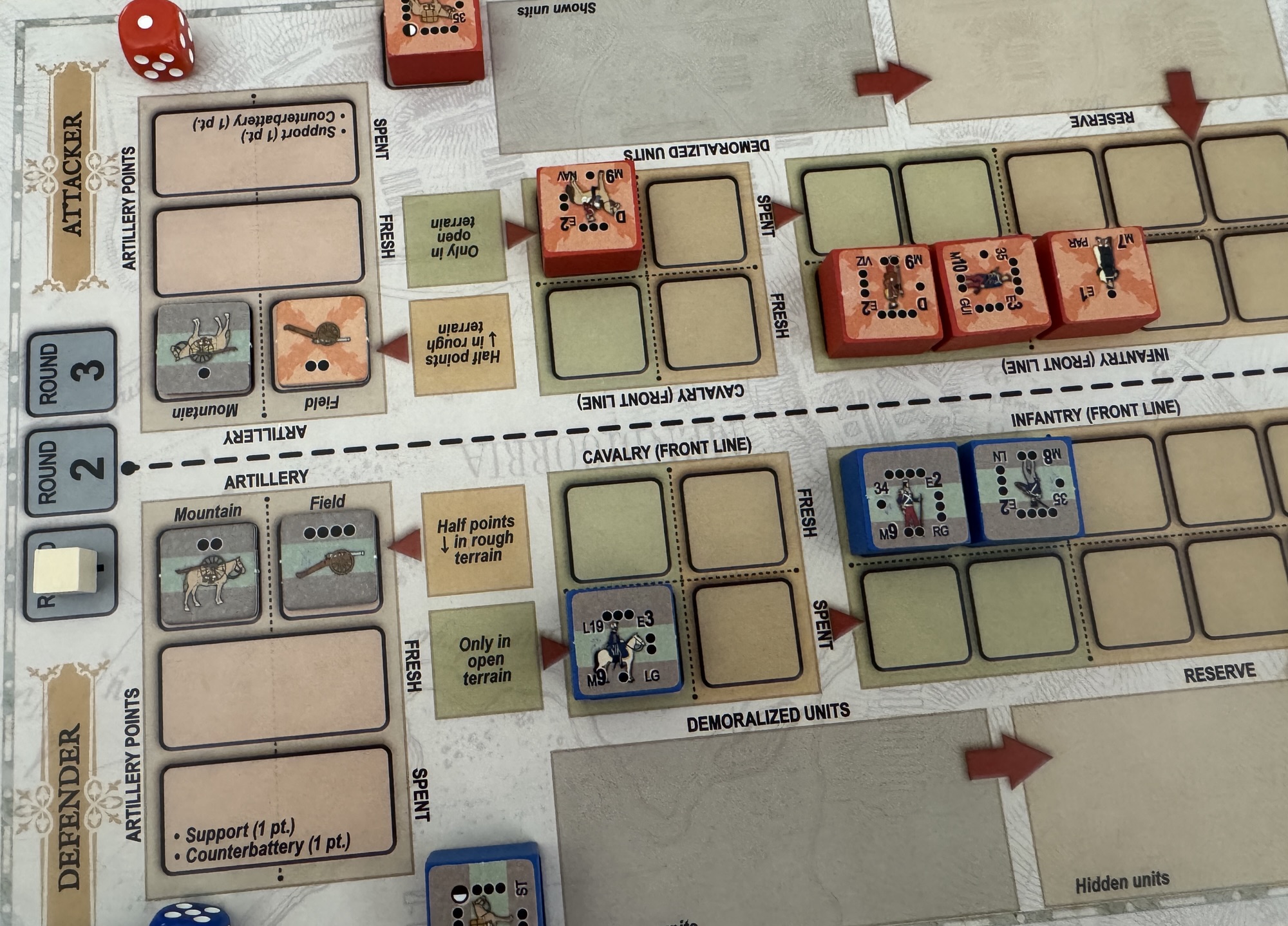
The Battle Board operates as a dedicated, zoomed-in tactical area where the details of combat are resolved. When opposing blocks meet on the main strategic map, units are moved to this board to fight out the encounter safely separated from global troop movements. When a Battle begins, players move their hidden army blocks from the main map onto the Battle Board. Depending on the terrain where the battle takes place (such as rough terrain for a city or plains for the countryside), players deploy their units into specific zones on the board. The Flanks are outside positions that trap or outmaneuver the enemy. The Front Line are the units taking the direct hits and dealing the damage to the enemy and the Reserve is where extra units are kept on standby to join the battle as losses are suffered.
Combat on the Battle Board happens in rounds. As a block wargame, the number of dice rolled by any unit is based on the number of pips shown on the block and the to hit number is equal to or less than their Effectiveness Rating printed on the block. Modifiers may be added from terrain or from the play of Combat Cards. Dice are then rolled and hits are determined with the defending units taking losses by reducing their pips by rotating the block counterclockwise. It is as simple as that.
The big difference in the types of Battle are the duration. A Skirmish last only 1 round while a Battle can last up to 3 rounds. The Battle ends immediately when 1 of the following situations arises. If the Battle lasts the full 3 round, when the 3rd Battle Round ends the defending player remains in the space and the attacking player retreats. There is no Rout or Pursuit A player has no Infantry units in the front line. The other player wins, gains 1 VP, and causes a Rout by the losing side, which will then retreat. Or, a player decides to retreat voluntarily in the End of Battle Round phase. The other player wins and can carry out Pursuit.
The Battle mechanic in An Impossible War captures perfectly the frustration of asymmetry in both competing sides and their troops. The name of the game is specifically reference to the the Liberals’ massive, clunky numbers versus the Carlists’ nimble, guerrilla style of warfare. 2 different armies with 2 different philosophies has created a situation where neither side can feel comfortable with the war and their chances at winning it. I frankly think that the designer David Gómez Relloso did an exceptional job at creating this asymmetry and creating a highly playable and engaging game. If you didn’t know, I chose to add An Impossible War to my Top 10 Wargames of 2025!. It landed at #8 on the list, and probably would have scored higher had I had a chance to play the game further and experience all of the parts of the design.
I also was able to shoot a fairly short video summary of my game play with Francisco Ronco who is the owner of Bellica Third Generation and you can watch that at the following link:
With this My Favorite Wargame Cards Series, I hope to take a look at a specific card from the various wargames that I have played and share how it is used in the game. I am not a strategist and frankly I am not that good at games but I do understand how things should work and be used in games. With that being said, here is the next entry in this series.
#85: Hydraulic Recoil from Imperial Elegy: The Road to the Great War 1850-1920 from VUCA Simulations
Imperial Elegy: The Road to the Great War 1850-1920 is a massive card driven game that blends diplomacy, warfare, and statecraft and feels a bit akin to games like Here I Stand and Virgin Queen from GMT Games, which are both grand scale sweeping epics that play multiplayers and take a day to play. Players play as 1 of 6 major powers in the game including Germany/Prussia, the United Kingdom, France, Austria-Hungary, Russia and the Ottoman Empire. The game is quite grand and ambitious as it covers 70 years near the end of the Victorian Era and the Progressive Ear and sees quite a lot of global change and competition between the great powers of the time. The game is a Card Driven Game and uses Action Cards as a type of currency to spend for their Command Points or the printed event to take actions such as recruiting armies and navies, industrialize, moving fleets and armies around the globe, influencing minor powers and establish colonies in Africa, India and the Pacific Ocean. The cards are all tied to the history of the period but the game can be played very much as a sandbox allowing players to explore strategies by trailblazing new horizons or following history.
As you might imagine, the game contains combat and wars of both unification and conquest as each of these empires attempt to grow and expand their borders and the game can end with the outbreak of the Great War. These combats are referred to as Land Battles or Sea Battles. Combat is a very well designed part of the game and involves lots of maneuvering of troops on the board to get into position to have a powerful 2 unit stack be the lead attack but also to be supported by adjacent armies providing strength in the land battle. Each nation has a limited number of armies and also has access to what are referred to as Elite Corps and Expeditionary Forces that can be used to supplement goals of conquest. These Elite Corps units are represented by circular counters and are placed atop an army counter they are attached to and provide a +1 Dice Roll Modifier in combat.
When the game hits the 1880’s, which is turn 4, the Hydraulic Recoil Mandatory Event Card will be added to the deck. When this card is drawn and played, the Mandatory Event will go off and become a permanent change to how combat works. First off, the asterisk and double asterisk printed on the Combat Results Table will now be in effect. The asterisks referenced are summarized as follows from the rules:
Only apply the * and ** portions of the combat results if the Hydraulic Recoil Mandatory Event has been played. *The victor may opt to inflict +1 loss to both sides. ** Both sides take +1 loss.
But other than just the additional losses and choices about how best to use them, there are other big changes that come as a result of the Hydraulic Recoil Mandatory Event. After its play, machine guns give non-rebel units a minimum die roll of a 3 in Land Battles (in other words, rolls of 1 or 2 are now 3’s). But also anytime an Elite Corps and its +1 DRM is used in a land battle, that unit will be eliminated. This automatic elimination cannot be taken as a loss inflicted by the CRT but is in addition to those losses. Big guns equipped with new hydraulic recoil mechanisms were, by far, the number one killer during the Great War, and machine guns made most pre-war tactics obsolete. Coupled together these two technologies made combat much more deadly and far less “swingy”. These mechanics are meant to model these technological shifts on a strategic level.
The hydraulic recoil mechanism in machine guns was pioneered by inventor Sir Hiram Stevens Maxim in the 1880’s. He developed it as part of his 1883 and 1884 patents for the world’s first fully automatic, recoil-operated machine gun called the Maxim gun. The Maxim gun has been called “the weapon most associated with imperial conquest” by historian Martin Gilbert and was heavily used by colonial powers during the “Scramble for Africa”. Afterwards, Maxim guns also saw extensive usage by different armies during the Russo-Japanese War, the First and Second World Wars, as well as in contemporary conflicts.
The Maxim gun featured one of the earliest recoil-operated firing systems in history. Energy from recoil acting on the breech block is used to eject each spent cartridge and insert the next one. Maxim’s earliest designs used a 360-degree rotating cam to reverse the movement of the block, but this was later simplified to a toggle lock. This made it vastly more efficient and less labor-intensive than previous manually operated rapid-firing guns, such as the manually cranked Mitrailleuse of 1851, the Gatling gun of 1861, the Gardner gun of 1874, or the Nordenfelt gun of 1873. The Maxim gun is water cooled, allowing it to sustain its rate of fire far longer than air-cooled guns. The extra weight and complexity this added, however, made it heavier and less flexible in use.
Trials demonstrated that the Maxim can fire 600 rounds per minute (equal to 60 riflemen at the time). Compared to modern machine guns, the Maxim is heavy, bulky, and awkward. A lone soldier can fire the weapon, but it was usually operated by a team of men, usually 4 to 6 in number. Apart from the gunner, other crew are needed to speed reload, spot targets, and carry and ready ammunition and water. Several men are needed to move or mount the heavy weapon.
The Maxim gun was greatly influential in the development of other machine guns, and it has multiple variants and derivatives, such as the Vickers, PM M1910 and MG 08. Some are still in service to the present-day, such as in the Russo-Ukrainian War.
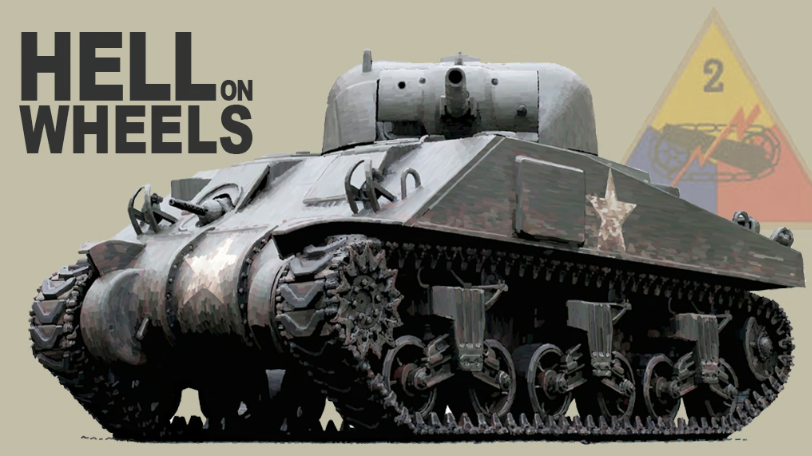
Over the past several years, we have done interviews with Matt White, publicized his games and played a few of them as well and he always has something cooking. Recently, I came across his newest offering on Kickstarter called Spearhead: Hell on Wheels – Tank Battles in Normandy. This game is a solitaire or 2-player print and play tactical game that allows players to take command of US tanks in German occupied France. I reached out to Matt and as always he was more than willing to share on the design.
Grant: What is your new project on Kickstarter called Spearhead: Hell on Wheels?
Matt: This is a brand new solitaire and co-op World War II print and play tactical wargame. In this game you are in command of a group of 3 US tanks in brutal and intense tank combat in enemy-occupied territory.
The players must lead their tanks, through unforgiving terrain, finding and then engaging the enemy in fierce fire fights. They must defeat any encountered enemy tanks and forces, whilst meeting the objectives as they move across the map.
Grant: What was your inspiration for the name? What do you want it to convey about the design?
Matt: My biggest inspiration was reading accounts from various US armored units. Keeping your tank crews alive and positioning your tanks whilst dealing with unexpected enemy positions is key to survival and success and truly seemed to be “Hell on Wheels”.
Grant: What about the battles during Normandy inspired you to make this game?
Matt: Basically I wanted to focus on and show the difficulties with the survivability of the armored crews and their vehicles during the D-Day invasion and the days after as the Allies broke out into France. That was the biggest point I wanted to make.
An American M10 Tank Destroyer.
Grant: What research did you do on the subject?
Matt: As with all my games, in trying to get the historical aspects correct both in the mechanics of the game as well as the look and feel of the art, I basically try to do lots and lots of reading! I read as much as I can on the subject, from various authors and viewpoints, and when I am not spending time playing games or making them, I basically read! This knowledge is part of the inspiration for my games as I draw upon things that I have rad and then translate them to the page.
Grant: As a tactical level wargame, what are the most important areas of focus for the design?
Matt: The positioning of your tanks in relation to where the enemy could be, and not only the tank hull but also the turret. Keeping your tank crews alive and positioning your tanks whilst dealing with unexpected enemy positions is key to survival and success. This game is point-to-point based where you must place your tank orientation and can aim the turret separately. Being able to keep the front of the hull forward towards the enemy tanks whilst hopefully being able to fire on their flank is critical.
Grant: How does the game differ in its 2 modes including solitaire and cooperative?
Matt: In the game you are in command of a number of US tanks – these can be split between players if you wish. Its quite unlike a number of solitaire WW2 tank games where you are in command of one tank. In this game you have a number which makes it really suitable for co-op play.
Grant: I know the design is a Print and Play offering. Why do you feel this model is best suited for your designs?
Matt: I like making print and play games as it forces you, as the designer, to make every component count and making the most of the physical space on a sheet of paper. I find that challenge one of the most interesting parts of the creative process. I also like the print and play model because it is very affordable for all parties, both me and the players, and allows the game to be available to anyone at anytime and on their terms.
Grant: I see that the board has a point-to-point movement layout. Why was this your chosen method of conveying information about the battlefield?
Matt: As much as I love traditional hex based games (and continue to play a lot of them), I also like point-to-point too. I like the way you can combine not only line of sight but also information about the environment in the game.
Grant: What is the meaning of the different symbols that appear on the board?
Matt: Movement is from point-to-point and where you move from a Position Point (the rectangle points) to an Observation Point (the circle points) where you will test for observation and perform the majority of combat. If combat is successful then you will be able to move to the next position point.
As you can see from the map there are multiple paths from Position Points to Observation Points and then onto other Position Points. Plus there are a variety of pros and cons to various paths to allow for a variety of terrain types and observation challenges. These paths are illustrated on the map in the shape of lines which are known as Movement & Observation Lines.
For each Movement & Observation Line there is a symbol at one end. The most common symbol is a black arrow, which denotes normal terrain and normal observation. There are other symbols which mean more difficult terrain or harder observation. These are:
Black Arrow – Normal Movement – Normal Observation
White Arrow – Normal Movement – Hard Observation
White Square – No Movement – Normal Observation
Black Circle – Difficult Movement – Normal Observation
White Circle – Difficult Movement – Hard Observation
Grant: What difficult decisions do players have to make in the game?
Matt: You will have to deal with enemies and you discover them but you don’t know where they are and so you must make some decisions based on information you do and don’t have. The player will also have several simultaneous objectives that must be obtained and will have to contend with both the German forces defending them that you know about and those that you do not.
“Lady luck” plays a part, as with any military operation, but your decisions and tactics are crucial, especially in how you position your tanks on the map when facing enemies as you cautiously roll through the environment.
A German Panther.
Grant: What dangers and threats meet the players on the battlefield?
Matt: There are a variety of dangers but not only the enemy forces as tank obstacles and mines can be a serious threat, combined with the environment itself.
Grant: What objectives does the player have to accomplish?
Matt: For each game session the objectives are randomly generated with Objective markers provided. All you have to do is safely get your tanks to those Objective markers, all the whilst dealing with the enemy!
Grant: How are hidden German units handled?
Matt: Every time you move your tanks you will need to check what they can observe and into which other points then can see. At this time you will roll on a couple of charts to see if you can see enemy units. However, just because you can’t see any doesn’t mean that they are not there.
Grant: What is the makeup of the Tank Cards? What information do they contain?
Matt: Using the Tank Cards you record the status of the major components of your tank such as the engine and tracks plus any gun jams. You also record the status of the various tank crew, all of which can have an impact in the game. Counters are provided to record all the status of both the tank and the crew.
Grant: What different types of tanks are included on both sides?
Matt: There are variety of tanks in the game with each tank having its own unique gameplay – for example the M10 tank destroyer has no hull machine gun (but does have a better anti-tank weapon). There are also Stuart M5A1 Tanks, StuG’s, Panzer IV’s, and many more.
Grant: How does combat work?
Matt: In the combat phase, you determine the order in which both your tanks and the enemy tanks fire. This is crucial to how the combat plays out as in real life WW2 tank combat, the results will favor the tank crew who can fire first on their target.
You will roll a few dice, depending on your tank positioning and other factors, and retain the highest number. You can increase your number of rolled dice by certain criteria – the more dice you roll the better! For example, if your tank turret is facing the enemy, the terrain type, the health of both the tank and the crew and if the enemy have been observed all are major factors. The enemy tanks will be doing the same, so factors such as successful enemy observation in the previous phase are crucial!
Grant: What is the goal of the game? How is victory obtained?
Matt: Your goal is to reach your various objectives on the map, whilst trying to keep your tanks and crew alive.
For each game session the objectives are randomly generated with Objective markers provided. All you have to do is safely get your tanks to those Objective markers, all whilst dealing with the enemy!
Grant: What are you most pleased about with the design?
Matt: I am most pleased to be coming to the end of the design and getting it ready for people to play! Finishing or coming close to it, is the hardest part of the development. In terms of the actual game, I really enjoy being able to get a game that has depth and is engaging that can be printed on just a few sheets of paper.
Grant: What kind of an experience does the game create?
Matt: I hope that the game creates a thoughtful representation of actual tank combat and how decisive it can be!
But that is not all. The game is modular and has several options included. As well as the map shown above, the game will also come complete with another map, additional counters and a rulebook which allows for you to create your own unique scenarios.
This map has the same points but where you will roll on tables to determine the various Movement & Observation Lines from each Position Point and Observation Point. There will be counters that you can place between the Position and Observation Points as an aid. You will be using various charts and tables to procedurally generate your map as you play, determining those gameplay elements as you progress. This type of game session will present you with a new challenge as you really have to deal with more unknown elements as you progress your tanks across the map.
Grant: What other designs are you currently working on?
Matt: I have a few games I am working on – currently working on something involving WW2 Mosquito aircraft!
For a YouTube video overview of the game, please check out Matt’s overview video here:
Thanks to Matt for his time in answering our questions and for his great little print and play games. I love it when one of these new games is brought to light as I get to oodle over the art and see what new things he has created!
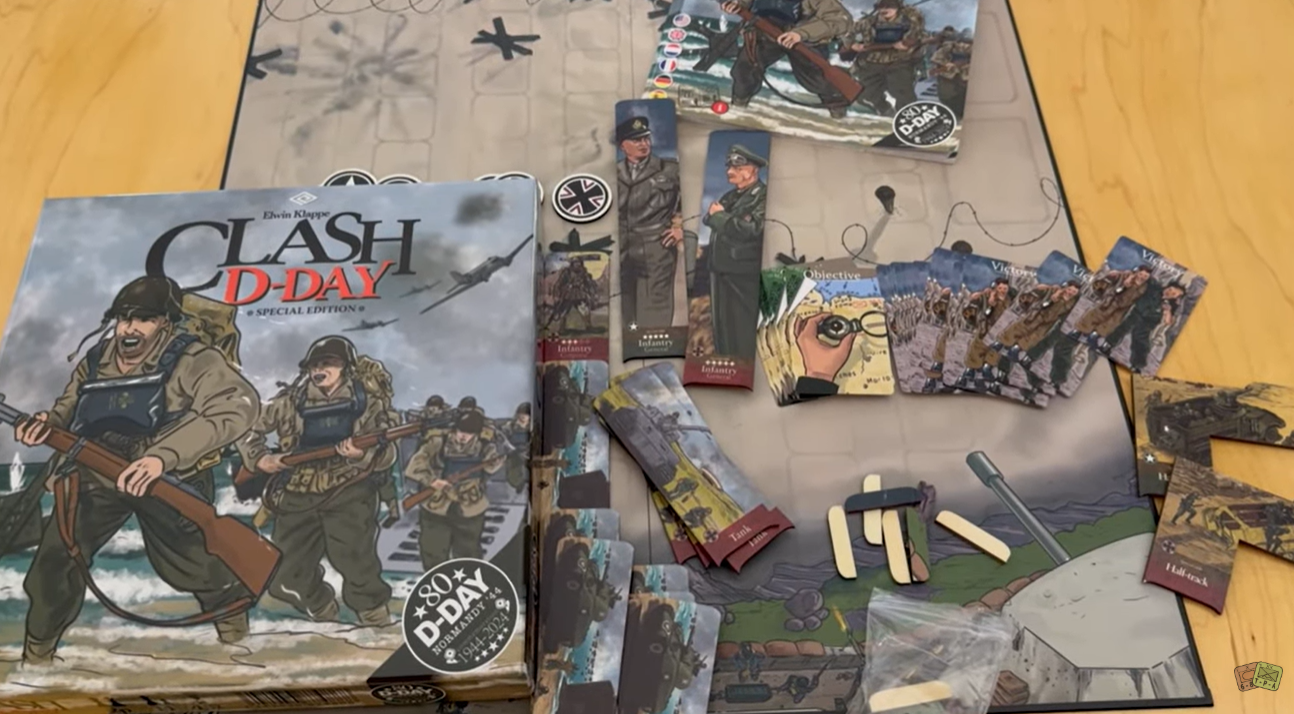
Clash D-Day Special edition is a turn-based board game that is set during the longest day in history: D-Day. Take control over the Allies and Axis forces and get ready to conquer the necessary beaches and areas. Outwit your enemy, make tactical decisions and think ahead. Prepare and take action in the greatest seaborne invasion that changed history on June the 6th, 1944! Clash D-Day is very easy to learn and there is no need for historical knowledge. Clash D-Day is based on the popular board game Clash of the Ardennes and is a stand alone version of the game. Use all of your (special) units wisely, because you will run out of units very quickly. Place them strategically and tactically on 1 of the 7 streets, always think ahead and try to reach your objective a little bit sooner than your opponent.
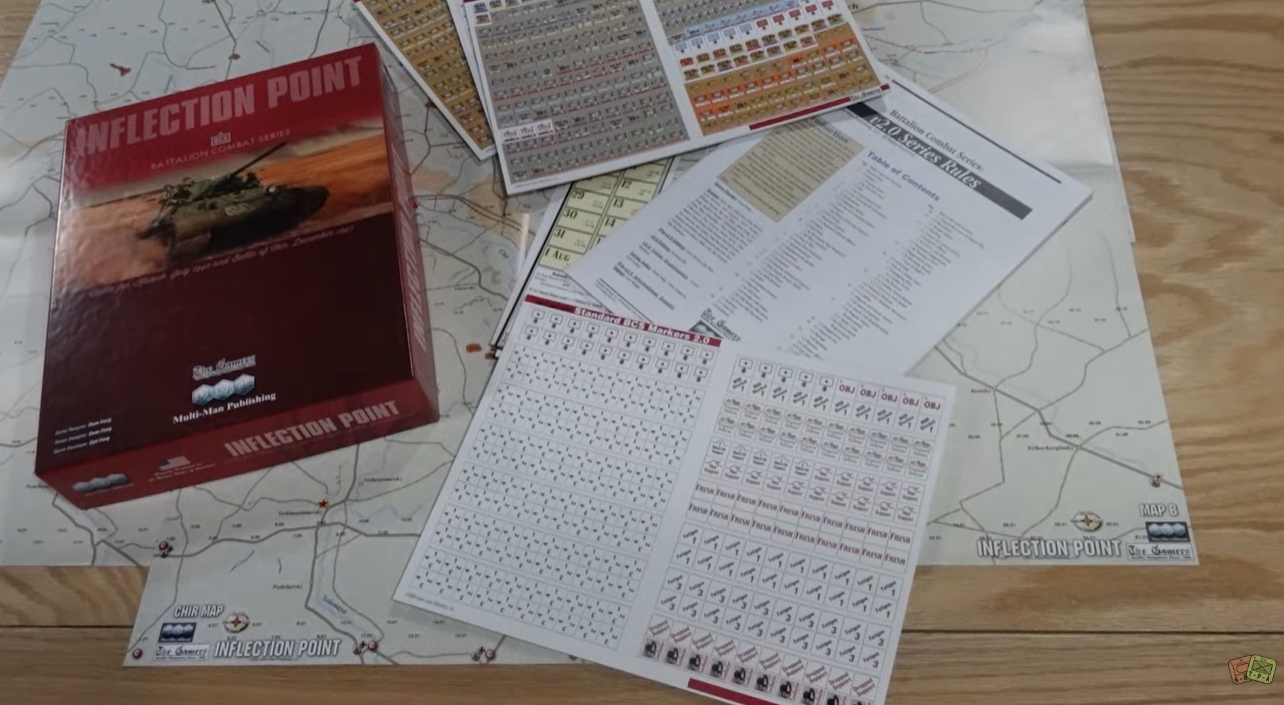
Inflection Point is a Battalion Combat Series (BCS) game depicting two important but relatively unknown battles before and after Stalingrad. The Battle for Kalach was fought in July 1942 following Case Blue, the successful drive into southern Russia. Paulus’ Sixth Army intended to encircle and destroy the Soviet Armies and walk into Stalingrad. The Soviets were still recovering from Operation Barbarossa the year before. The result of the battle set up the epic urban fight that was the turning point of the Eastern Front. By December 1942, the Sixth Army was trapped at Stalingrad by a more capable Red Army. In the Battle of Chir River, the Soviets looked to exploit their gains and prevent German relief operations over a portion of the Kalach battlefield. Initial success along the Chir River changed when the energetic 11th Panzer Division was thrust onto the scene. These two battles show the progression of the Red Army into an offensive army that could start fighting toe-to-toe against the invaders. For the Germans, the days of blitzkrieg successes were waning and were being put on the defensive. There was a marked inflection point around Stalingrad.
The game showcases this change in quality and capability between the armies. Units famed for fighting at Stalingrad are here – 24th Panzer and 100th Jäger Divisions as well as the 62nd Army. With rules on crucial air supply that was needed to sustain the German offensive, to stubborn Soviet command in the form of Colonel Konstantin Zhuravlev, players will be able to recreate these pivotal battles. The steppes of Southern Russia are accurately depicted, with rivers, balkas, and small hills being crucial in the otherwise flat terrain. With offensive and defensive possibilities for both sides in both battles, there’s tense decision making in order to win and change the fate on the Eastern Front.
Time of Wars: Eastern Europe 1590-1660 from Stratagemata is a multiplayer card driven game that is modeled after games like Here I Stand and Virgin Queen. Players take on the role of the head of superpowers in Eastern Europe including the Polish, the Lithuanian Commonwealth, the Tsardom of Russia, the Ottoman Empire, the Kingdom of Sweden and the Holy Roman Empire. Minor states are also present such as Denmark, Brandenburg, Moldova, Wallachia, Transylvania and Crimean Khanate.
The game covers the turn of the 16th and 17th centuries. The period was rich in famous characters (rulers and commanders) and critical events – for example the Time of Troubles in the Tsardom, the Thirty Years War in the Reich, Swedish “Deluge” in the Commonwealth. All these and much more are smoothly incorporated into gameplay.
The May 2026 Monthly Debrief Video, which is the 5th episode in Season 6 of this series, saw us discussing Games We Disagree On. Now this list is not overly long and includes only 6 games but the discussion was good and it was nice to have to think back over the years to the games we did feel differently about.
Also, as usual, we covered the games we played in May as well as the games we plan to play in June.
We will remind you here that we are fortunate to be continuing our relationship with Noble Knight Games as the sponsor for our Monthly Debrief Video series. In case you don’t know, Noble Knight Games specializes in hard to find games but also carry all the new releases. But what makes them truly unique is that you can find some of the rarest games, long out of print games, hand made games, imported games from overseas, etc. Thanks to them for their sponsorship and we hope that you will consider them first when looking for the games we cover.
It has been very hot lately….and the humidity is getting out of control here in our Area of Operations (Indianapolis, IN). It makes everything tougher but I still like it better than the negative temp spikes we experience in January and February and look forward to the rest of summer. In the wargaming world, there is also a lot of “heat” coming upon us in waves as this month for the Wargame Watch, I was able to find 30 games (including the single new game from our sponsor Bring it on Games). I was also able to find 9 games being offered on Crowdfunding through Gamefound and Kickstarter.
This month we have a sponsor for the Wargame Watch feature in a new publisher named Bring it on Games. Bring it on Games is owned by Adam Starkweather of Grand Tactical Series (GTS) and Company Scale System (CSS) fame. He has started this new company with several friends and compatriots as a “company run by gamers – not a company that publishes games”. I think that Adam is a great designer and he is now out on his own and is going to make the games that he wants to make.
On their website, they have said the following about their production schedule and plans for the near future:
We will only make two or three games every two years. Next up is ACSS: Utah: 10 Days in Normandy. But work has also started on Omaha, Market Garden, and Battleaxe for ACSS. But other games on different stuff using new systems has started too. Gettysburg, The War of the Atlantic, and other fun stuff. I just have to live to ninety to make everything I want to make.
While they are new and don’t have a published game to their credit as of yet, they appear to be working hard to build a brand that is solid and will hopefully be one that is a continual force in the wargaming hobby. Their current project that is up for pre-order is called Anzio: A Lost Opportunity and is a big, monster wargame. This game has a ton of maps (10 total) and a ton of counters (20 5/8th” Countersheets) as well as a ton of charts, tables and player aids. This is a MONSTER wargame…big, bad and beautiful…no doubt about it but it looks really good.
We have played several games designed by Adam Starkweather in his Company Scale System (CSS) published by Compass Games including Saipan: The Bloody Rock and The Enemy is at the Gates: The Batlte for Berlin. These games are really good solid chit draw systems that really puts some unknown in what groups of units can activate and even when they will activate. There are also events and if the chit cup runs dry before all of the units can activate due to the end round chit then you are just sore out of luck. You have to prepare for this inevitability and I love the concept of prioritizing your activations and making sure you activate what you absolutely have to before doing those units that would be beneficial to activate. The system is a highly accessible, streamlined approach to simulating tactical military operations while retaining strong decision-making depth. The CSS offers a “design-for-effect” combat system that effectively eliminates micro-management and makes the game a joy to play.
Anzio is the first game in a new series called the Advanced Company Scale System or ACSS. At this point, I am unsure what makes it advanced but will be working with the designer to get a better understanding of that in a designer interview for the blog.
In the mean time, you can download the rules and the scenario booklet from an online OneDrive and you can also get access to a Vassal module to try the game out. Here is the link to the OneDrive: OneDrive Link to Rules and Scenario Booklet
If you are interested in Advanced Company Scale System Game One:Anzio: A Lost Opportunity, you can pre-order a copy for $300.00 from the Bring It On Games website at the following link: https://bringitongames.com/shop/p/anzio-a-lost-opportunity
Pre-Order
1. OCSThe Hero City: The Battle of the Baltics, September 1943-April 1944 from Multi-Man Publishing
In late 2021, we posted an interview with Tony Birkett as designer and Chip Saltsman as developer covering his The Third Winter from Multi-Man Publishing, which covers the third winter on the Eastern Front during World War II and deals with German Army Group South as they retreat to the Dnieper River and then the Carpathian Mountains. This game is an entry in the Operational Combat Series and was followed up by his Crimea: Conquest & Liberation game that was promoted as a low-counter density, small OCS game. Since then, he has been hard at work on the next volume in the series called The Hero City: The Battle of the Baltics, September 1943-April 1944 that dives into the mid war battles in the Baltics between the Germans and the Russians.
From the game page, we read the following:
The Hero City depicts the desperate battles between late September 1943 and April 1944 in the Army Group North sector of the Russian front. Soviet priorities were to establish a rail connection into Leningrad, evict the Axis forces from the Leningrad Oblast, and force their way into the Baltic States. Well aware this hammer was about to fall, Army Group North prepared the Panther Line defensive belt along the borders of Estonia and Latvia. The Hero City covers the major engagements: the autumn attrition battles while the Soviets mass their forces, the fighting retreat as the Wehrmacht desperately tries to escape intact, and the crashing impact as Russian waves pound against the German Panther Line breakwater. In the north are the Finnish lines, which offer a completely different strategic opportunity, including a scenario for the Soviet Summer 1944 offensive into Karelia. The Axis forces managed—barely—to hold at the Panther line, but the situation could have spiraled into disaster. The campaign here laid the foundations for the drama during the summer of 1944, and many of the German units in The Hero City will end the war trapped in Courland.
The game area covers the Soviet Oblasts of Leningrad, Novgorod and Pskov, as well as Estonia, Latvia, and the northern part of Lithuania. The map extends north of Helsinki and Viipuri in Finland, south to Daugavpils and Tilsit, east to Valday and Volkhov and west to the Baltic Sea. The Hero City is fully playable with The Forgotten Battles, to create a combined massive gaming experience using campaign setups that start in September 1943 and January 1944.
The Soviet command and supply structure is modeled through Front HQ markers. Fronts are either in “Offensive” or “Regrouping” status, allowing for shifting axes of attack and the on/off nature of Soviet operational warfare during this time. Each Front has an assigned Air Force. The parallel fighting in Army Group Center is represented by a boundary marker that shifts as the war advances off map, and the Axis player must be careful to watch his off-map flanks.
The Hero City is a large-sized OCS game, with 1,400 combat units (five counter sheets) and a 44×66-inch map layout at a scale of 5-mile hex/3.5 days per turn. The full Campaign game is 63 turns long, and there are three campaign scenarios so players can start at different points in the action. Also included are several partial-map scenarios.
Special rules in this OCS game are carefully researched to model key aspects of this critical campaign:
Forces include German Wehrmacht, Luftwaffe and SS formations, as well as Soviet Guards, regular and Partisan units, plus Finnish, Estonian, Latvian, and Lithuanian units. The Prinz Eugen and German destroyers might put in an appearance.
Soviet Front HQ Markers which reflect their role in command and marshaling supply.
Soviet RVGK for coordinating strategic redeployment and rebuilding shattered mobile Corps.
Axis Army, Army Group and Kessel HQs, along with Kampfgruppe markers which portray Axis operational flexibility.
Random events similar to what are found in The Third Winter and The Forgotten Battles. The 26 possible events add historical flavor with minimal rules overhead, covering things like Guards Promotions, Fuel Shortages, Hitler’s intransigence, Soviet submarines Partisan Offensives, One-Turn Offensives, Battlefield Heroes, options for emergency reinforcements and unexpected Finnish offensives.
If you are interested in OCS The Hero City: The Battle of the Baltics, September 1943-April 1944, you can pre-order a copy for $90.00 from the Multi-Man Publishing website at the following link: https://mmpgamers.com/the-hero-city-p-468
2. Inferno in the Blue Grass: The Battle of Perryville, 8 October 1862 from Multi-Man Publishing
While attending Buckeye Game Fest this past March, we met with a fan of the channel named Leslie Jerome and had him introduce us to the Line of Battle Series with Volume 3 To Take Washington: Jubal Early’s Summer 1864 Campaign from Multi-Man Publishing. Line of Battle is a regimental-level American Civil War wargame system designed for fast-paced, non-stop action by eliminating excessive paperwork and combining fire phases with movement. I feel like this system is a highly playable classic ACW system with lots of very interesting mechanics including activation, order reception and relay, closing rolls, morale checks and close assault. In fact, I love how it creates a great narrative with some of the terminology and naming conventions such as the Blood Lust result for close assaults and the Cowardly Legs from broken units.
Recently, MMP put the next volume in the series up for pre-order called Inferno in the Blue Grass: The Battle of Perryville, 8 October 1862. I am very much anticipating this one and can’t wait to dive back into the series.
From the game page, we read the following:
Inferno in the Bluegrass brings The Gamer’s Line of Battle (LoB) Series into the Western Theater. The Battle of Perryville, the largest battle fought in Kentucky during the American Civil War, was the culminating engagement of the Heartland Campaign of 1862. This was the South’s attempt to invade the border state and garner support for its cause while simultaneously forcing Union armies in the west on the defensive. By October, the Army of the Ohio was on the move, poised to throw back the invaders. Bragg, confident that an initial Federal advance would focus elsewhere, was completely unaware that Don Carlos Buell was converging on his army in the small town of Perryville. As the sun rose on October 8th, 1862, neither army could have known that the coming engagement would ultimately determine the fate of Kentucky in the war.
The sheer scale of violence at Perryville factored heavily into the design, over 7,600 casualties were tallied – resulting in one of the larger casualties per hour rates of the war. Independent Command rule replicates Confederate commanders blurring the lines of command by fragmenting divisions into small, independent commands, creating confusion and limiting effectiveness. The Attack Commencement Chart limits the ability of the Confederate player to organize one massive assault. The Union, conversely, is hamstrung from the outset. The Union Alertness Table represents the phenomenon of an “acoustic shadow”, which caused Buell to be blissfully unaware of the overall tactical situation hours after the initial fighting had started. The map shows the parched land in meticulous detail, corroborated by the designer walking the battlefield to get a great feel of the ground.
This is Nick Roser’s first published design. His commitment and expertise on the battle shines through the design. Nick’s ancestor, Johann Christian Kurtz, fought in the battle, so his personal connection to Inferno in the Bluegrass is in his blood.
If you are interested in Inferno in the Blue Grass: The Battle of Perryville, 8 October 1862, you can pre-order a copy for $48.00 from the Multi-Man Publishing website at the following link: https://mmpgamers.com/inferno-in-the-bluegrass-p-467
3. Great Battles of the American Civil War: Battles for the Ozarks from GMT Games
This is one of those venerable series that we have not had the opportunity to play or experience. Great Battles of the American Civil War or GBACW (not to be confused with Great Campaigns of the American Civil War from Multi-Man Publishing) is a highly detailed, regimental-level wargame series originally created by Richard H. Berg. It is known for its interactive chit-pull mechanics that simulate the chaos, command difficulties and fatigue of 19th-century warfare. The newest volume in the series, which is Volume XI, was announced in late June and is called Battles of the Ozarks.
From the game page, we read the following:
The game presents five key battles that shifted the balance of power west of the Mississippi during the first two years of the war. Battles for the Ozarks concentrates on events on the Ozark Plateau of northern Arkansas and southwest Missouri and included are these battles from the first three campaigns of the war in the West. Each battle is portrayed in great detail allowing players to try alternate strategies.
Dead & Buried, The Battle of Wilson’s Creek, August 10, 1861 The first large battle west of the Mississippi. Federal General Nathaniel Lyon leads the Union forces in an attempt to bloody the nose of General Sterling Price’s Missouri State Guard and Ben McColluch’s Western Army that has arrived from Texas and Arkansas. Command the unusual forces that were arrayed in each army for this battle. As the Union, you’ll have Home Guard units, Regulars (including the famous 2nd Dragoons), and German American Missouri Volunteers from St. Louis. As Price and McCulloch, you’ll have everything from Missouri State Guard units armed with flintlocks and shotguns, to the South Kansas Texas Cavalry regiment and Arkansas State Militia.
Into The Night, The Battle of Dunagin’s Farm, February 17th, 1862 A lesser-known battle that occurred about a month before the much more famous battle of Pea Ridge. In north Arkansas along the Little Sugar Creek, the rear guard of McCulloch’s Army of the West, led by the capable Louis Hebert, tries to cover Sterling Price’s retreat from Springfield, Missouri. Hot on Price’s trail is Samuel Curtis’ Army of the Southwest. The advance cavalry of Curtis’ army collides with Hebert’s forces on farmer Dunagin’s field. What starts as a simple skirmish escalates into a full-blown fight that spills over into the evening, with both sides gradually feeding more troops into the battle.
Rush To Glory, The Battle of Pea Ridge, March 7th & 8th, 1862 Can you, as Earl Van Dorn, fall upon the rear and flank of the Federal army deployed north of the Little Sugar Creek before the more rested and organized enemy responds? Or can you, as General Samuel Curtis, repeat one of the few times in military history when an army reversed course, moved its supply train out of danger, and then engaged and defeated the enemy? A challenging battle for both sides; the Confederate army has been “Rushed to Glory” by Van Dorn in a snowstorm and is worn out, while the Union army is flanked by the CSA foe. The battle has a two-map and a three-map version (the largest presentation of the battle ever done).
Iron Men, The Battle of First Newtonia, September 30th, 1862 Probably the most unusual and desperate of all the battles included in Battles for the Ozarks. First Newtonia was fought before the Battle of Prairie Grove in Blunt’s campaign. The advance units of the two armies meet at the small hamlet of Newtonia in southwest Missouri. A CSA force comprised of the Indian Command, a brigade of Texas cavalry, and part of Jo Shelby’s Iron Brigade attempt to stop the forward movement of BG Fredrick Salomon’s 1st Kansas Division. With warriors of the First Nations on both sides, First Newtonia steps into new territory for GBACW. Also command part of the Western “Iron Brigade” in its first battle. One of the most desperate fought battles in the Trans-Mississippi.
Blunted Again, The Battle of Prairie Grove, December 7th, 1862 Take the role of the headstrong Union General James Blunt and see if you can move the CSA forces led by Thomas Hindman off the Fayetteville Road. As the Union commander, you will have superior artillery that can win the day. Or as the Confederate commander, you’ll hold the strong defensive position between the two Union wings along “The Bench”. You have the Napoleonic central position, and it is held by Joe Shelby’s Iron Brigade! Will it be enough?
Ready for a new experience in your War Between the States gaming? Battles for the Ozarks is the 11th installment in the award-winning Great Battles of the American Civil War Series. The game has rules that satisfy both experienced and new players, with a Simple Version that offers an easier, faster gaming experience. New optional rules are also introduced! New skirmish rules catch the ebb and flow of open order combat between the battle lines, and the Peoples of the First Nations make their first appearance in the GBACW Series. See how well these warriors fought at Prairie Grove or First Newtonia. New terrain types, such as Heavy and Light woods, are introduced, along with Rifle Pits and Entrenchments. With over twelve scenarios, including two on their own half maps, there is something for everyone.
4. Bataan! The Battle for the Philippines 1942 2nd Edition from Consim Games/GMT Games
Classic wargames always do well, either because of nostalgia and a longing for the past or because the game was really good. I don’t know which one this fits into but GMT Games announced a new 2nd Edition of a classic wargame called Bataan!. I say GMT Games but the game is actually published by Consim Games, as they have entered a new partnership with GMT as they have in the past to publish their own line of games.
From the game page, we read the following:
Bataan! 2nd Edition is the much-anticipated, updated grand-tactical-level treatment of WWII battles on the Bataan Peninsula in the Philippines, which took place from January through April 1942. Game designer and Charles S. Roberts Award recipient Vance von Borries has drawn on his game design experience to create a game engine capable of portraying the tense jungle fighting that took place on Bataan. While the system is based on his popular Roads to Leningrad game, the changes needed to simulate the fighting on Bataan make for a unique gaming experience. For history enthusiasts and wargamers, this is a nuanced, in-depth exploration of a specific, underrepresented aspect of WWII history. This all-new 2nd Edition does not simply address all official errata from the original edition, but also delivers new game components and a major game system update, with the rules rewritten to further advance this popular game system.
Gameplay is both tense and interactive, based on an alternating activation sequence in which both sides conduct operations. This second edition features streamlined game mechanics to improve and help speed gameplay, all based on player feedback. The game also captures air and naval operations, though the focus is on ground warfare and specialized unit capabilities.
Special rules model key historical facets of the campaign include: movement classes of units, artillery, air power, air missions, strategic movement, infiltration movement, disruption, contested hexes, unit formations, attack coordination, lead unit losses, efficiency and lead units, HQ units and capabilities, initiative and activation, hasty and deliberate activations, momentum, supply, fortifications, withdrawals, Japanese emergency supply, Campaign supply, general attrition, forage, naval operations, amphibious invasion, special situations and events, special units, Philippine Scouts, and more! Five scenarios are included. The three quick-playing opening scenarios require fewer rules to play. You can complete them in a single sitting, focusing on the core game system, and they include At the Pearly Gates: Layac (intro scenario), Abucay Line, and Mauban Line. These scenarios provide a clear and accessible entry point for players new to the system, allowing them to learn the core mechanics before tackling the full complexity of the campaign game. The two full campaign game scenarios add detail by introducing campaign supply, naval operations, amphibious invasions, special situations, and events. While intended for two players, the game is also suitable for solitaire play.
5. When Titans Clashed: The Eastern Front in WW2 from Consim Games/GMT Games
And the 2nd game offered on pre-order this past month in this new Consim Games/GMT Games partnership is called When Titans Clashed: The Eastern Front in WW2 designed by Michael Resch. This is a new game design but pays homage to the original Jedko Games edition of the classic The Russian Campaign designed by John Edwards. I know that we all very much enjoy a good romp on the Eastern Front of World War II and the tank clashes and and I am sure that this game will be a fantastic representation of the genre and give us hours and hours of hex and counter goodness.
From the game page, we read the following:
When Titans Clashed is a game covering the epic campaign fought in Eastern Europe during World War II. Game designer Michael Resch offers this tribute to the original 1974 Jedko Games edition of The Russian Campaign by John Edwards. This new design seeks to balance the classic game’s attractive aspects while introducing modern design concepts unheard of at that time. The map and counters use a vintage style to honor the 1974 Jedko edition, but beyond this, the designer presents a new, modernized design approach to the classic game.
Gameplay is fast-paced and intense for both sides, as the initiative can shift through significant maneuvers and battle outcomes. For both sides, each turn features a double-impulse sequence that rewards the player who, in a disciplined fashion, plans for the possibilities the double-impulse sequence can create. Such planning may enable battlefield gains to be solidified or, conversely, allow recovery from disaster along an expansive front. Players must also plan for reinforcements, replacements, and upgrades, as well as various strategic considerations and political events that will influence the campaign.
While the game system itself is relatively low in complexity, special rules help capture the campaign’s historical narrative. Political events include the Warsaw Uprising and the Romanian coup d’état. Special rules include Axis Ally Limitations, German Heavy Panzers, Air Power, Stalin, Fortified Areas, Coastal Army, Sea Invasion, Soviet artillery, partisans, workers, oilfields, and more! The game, while designed for two players, plays very well solitaire, and one can finish the full campaign in a single sitting.
6. Combat Commander Battle Pack Nr. 1: Paratroopers 4th Printing from GMT Games
I have played a ton of Combat Commander over the years, including from Combat Commander: Europe, Combat Commander: Mediterranean and Combat Commander: Pacific as well as several of the Battle Packs and absolutely love the narrative that the game creates. I love the cards and how they are used for combat, there are no dice in CC, activations and events. The system is just full of chaos and fun. This month they have announced the 4th Printings of a few of the classic Battle Packs including Battle Pack Nr. 1: Paratroopers, which allows players access to elite American/Russian/German troops with some nifty abilities that can really turn the tide of battle and boost the capabilities of your soldiers.
From the game page, we read the following:
Combat Commander: Battle Pack Nr. 1 – Paratroopers is the first of many themed scenario packs for use with the Combat CommanderSeries of games. The theme of this first Pack is focused on the exploits of American, German and even Russian Airborne forces. CC-Paratroopers features eleven new scenarios printed on cardstock, as well as four new maps.
The scenarios included in CC-Paratroopers are:
“Fields of Fire” and “Fields of Blood” set at Lanzerath, Germany, 16 December 1944 – both morning and afternoon attacks (using a new map #25)
“Turnbull Turns ’em” at Neuville-au-Plain, France, 6 June 1944 (using a new map #26)
“Carentan Causeway” at Carentan, France, 10 June 1944 (using a new map #27)
“No Ingouf Around” at Carentan, France, 11 June 1944 (using a new map #28)
“Operation Repulse” at Bastogne, Belgium, 27 December 1944
“Red Skies at Night” at Veliki Bukrin Bridgehead, Russia, 25 September 1943
“Blizzard Baptism” at Flamierge, Belgium, 4 January 1945
“Look Mom, No Tanks!” near Trois Ponts, Belgium, 24 December 1944
“We Go!” at St. Mere Eglise, France, 6 June 1944″Encircled at Hill 30″ at Caponnet, France, 8 June 1944
CC Battle Packs are NOT stand-alone games and will require ownership of one or more Combat Commander boxed games in order to be played. CC-Paratroopers requires ownership of Combat Commander: Europe or the Combat Commander: Europe/Med 20th Anniversary Edition.
Overall, this is a great expansion for the base game and all true Combat Commander fans should include this in their collection. The only concern or complaint that I had about the Battle Pack was that the American Forces colors on the scenario cards are almost all different. Some appear as Lime Green, others are Olive Drab and more yet are Forest Green! I don’t know if this is simply my copy’s problem or the entire run during the printing. Not a major issue and it definitely doesn’t change my opinion about this expansion. The scenarios are printed on thick card stock and are very durable and as usual the Situation Reports are some of my favorite parts as they set the tone for the scenario by giving historical analysis of the happenings. Great stuff that you simply must own!
7. Combat Commander Battle Pack Nr. 2: Stalingrad 4th Printing from GMT Games
They also have announced the 4th Printing of Battle Pack Nr. 2: Stalingrad and I know that this one has been out of print for a while now. I own a copy but have yet to get any of the scenarios played at this point.
From the game page, w read the following:
Combat Commander: Battle Pack Nr. 2 Stalingrad is the second themed collection of scenarios for use with the Combat CommanderSeries of games. The theme of this second Battle Pack shifts to the East Front in late 1942 as German and Soviet forces clash in and around the vaunted city of Stalingrad. CC–Stalingrad features eleven new scenarios printed on cardstock — one of which is a new style of multi-scenario Campaign Game — as well as eight new maps and dozens of new counters.
Numerous additional rules relevant to the dense urban fighting characteristic of the struggle for Stalingrad are also included:
Factories
Urban Snipers
Ongoing Melee
Rubble, Debris & Craters
Underground Sewer Movement
and the “Ampulomet” Molotov Launcher
The scenarios included in CC–Stalingrad are:
“Spartakovka Salient” set at Spartakovka, 23 August 1942
“Sea Devils” set at the Grain Elevator, 18 September 1942
“Dom 31”, behind the Barrikady, 27 October 1942
“Not One Step Back!” set at Dolgyi Gully, 1 October 1942
“Fortresses of Blood and Iron” set near the Volga River, 1 October 1942
“Into the Breach” set at the Barrikady’s Great Assembly Hall, 17 October 1942
“The Commissar’s House” as fought on 13 November 1942
“Shootout at Obliskaya” seeing the Rumanians fighting for Obliskaya Airfield, 1 December 1942
“Lyudnikov’s Island” near the Fuel Tank Area, 22 December 1942
“Stalingrad of the North” set at Veliki Luki, 14 January 1943
The “Stand and Die” multi-scenario Campaign Game recreating the battle for Mamayev Kurgan, late September 1942
NOTE: CC–Stalingrad is not a complete game and requires ownership of both Combat Commander: Europe and Combat Commander: Mediterranean OR the Combat Commander Europe/Med 20th Anniversary Edition to play.
Designed by John Foley and Chad Jensen with additional scenario designs in this second Pack courtesy of Mark Kalina, Bryan Collars, Kai Jensen, and Will Green.
8. Battle Line: Medieval-Themed Edition 2nd Printing from GMT Games
Following on in this reprint trend this month, Battle Line: Medieval is getting a 2nd Printing. This is one of those famous classic wargames designed by Reiner Knizia that is very well thought of but that is a smaller, card based game that is portable and very approachable.
From the game page, we read the following:
Now in its 12th GMT printing, designer Reiner Knizia’s Battle Line is our #2 all-time best-selling game! This new re-themed version of Battle Line is a two-player strategy card game built around the theme of Medieval warfare. This Medieval-themed version of Battle Line features 60 beautiful new cards by illustrator Roland MacDonald, as well as 10 full-color tactics “wildcards” that give players extra flexibility and choices and help make each new battle wildly different from the last.
Battle Line: Medieval takes about 30 minutes to play. To win, you must create powerful formations along your side of the line of battle that are superior to those of your enemy. Victory goes to the player who wins 5 of the 9 battle flags (an envelopment) or three adjacent flags (a breakthrough). Based on Reiner Knizia’s original design published in Germany as Shotten-Totten,Battle Line: Medieval enhances and expands that game system to give players even more tactical options and gut-wrenching decisions.
Battle Line: Medieval is a beautiful game that will delight competitive strategy game players and also serve as an great introductory game for new or young gamers.
9. Spearhead: Hell on Wheels – Tank Battles in Normandy from Matt White Currently on Kickstarter
Over the past several years, we have done interviews with Matt White, publicized his games and played a few of them as well and he always has something cooking. Recently, I came across his newest offering on Kickstarter called Spearhead: Hell on Wheels – Tank Battles in Normandy. This game is a solitaire or 2-player print and play tactical game that allows players to take command of US tanks in German occupied France.
From the game page, we read the following:
Welcome to Spearhead: Hell on Wheels – Tank Battles in Normandy” a brand new solitaire and co-op World War II print and play tactical wargame. In this game you are in command of a group of 3 US tanks in brutal and intense tank combat in enemy-occupied territory.
You must lead your tanks, through unforgiving terrain, finding and then engaging the enemy in fierce fire fights. You must defeat any encountered enemy tanks and forces, whilst meeting the objectives as you cross the map.
Keeping your tank crews alive and positioning your tanks whilst dealing with unexpected enemy positions is key to survival and success. This game is point-to-point based where you must place your tank orientation and can aim the turret separately. Being able to keep the front of the hull forward towards the enemy tanks whilst hopefully being able to fire on their flank is critical.
This is a standalone game in my series of WW2 print and play games. All of the digital PDF files are included (you simply print it out, provide yourself with a couple of regular six sided dice and a pencil).
The game is quick to setup and play, with a scenario taking around a hour to play and requires very little space.
As of July 1st, the Kickstarter campaign has funded and raised $2,485 toward its modest $171 funding goal with 88 backers. The campaign will conclude on Thursday, July 9th at 3:22pm EDT.
10. ’65: Squad Level Combat in the Jungles of Vietnam Strategy Guide from Flying Pig Games Currently on Kickstarter
Several years ago, Alexander and I played ’65 when it was originally released on Kickstarter. For a look at all the various bits and pieces in the box we made an unboxing video that shows all of the KS stretch goals as well that can be picked up, of which there were many! I’m always impressed by Mark Walker’s games because he packs so much in the box, and your hard earned cash can take you really far. The rules themselves are pretty light for a squad level tactical game, especially a Vietnam game with all of the potential complexities from that war. That made ’65 quite accessible and I’d recommend it for those looking to enter the tactical side of the hobby, as well as those who are looking for a game that is high on the fun side, and low on the dreary sense of impending doom when you lose side.
Recently, Flying Pig Games announced a new Strategy Guide Kickstarter campaign for the game and it looks like this is a very comprehensive booklet on the game and how to play it well.
From the game page, we read the following:
The ’65 Strategy Guide, launching on Kickstarter by Flying Pig Games, is a tactical handbook for the ’65: Squad Battles in the Jungles of Vietnam wargame. It features in-depth analyses of game mechanics, unit profiles, and faction-specific strategies, along with a detailed table of contents.
As of July 1st, the Kickstarter campaign has funded and raised $10,287 toward its $1,500 funding goal with 172 backers. The campaign will conclude on Thursday, July 9th at 12:00pm EDT.
11. Assault Red Horizon ’41 – Revised Edition from Assault Games / Sound of Drums Currently on Gamefound
A few years ago, I came across a new designer named Wolfgang Klein (no relation to Alexander Klein) and his new company Assault Games. They create fantastic tactical level wargames and we have played several of them and also got a chance to meet both Wolfgang and his friend and partner Erich Rankl last fall while attending Spiel Essen in Germany.
They have been working on a new edition of their first game called Assault – Red Horizon ’41: Revised Edition and they are ready now to take it to Gamefound.
From the game page, we read the following:
Assault – Red Horizon 41: Revised Edition marks the relaunch of the acclaimed tactical war game that immerses players in the dramatic early stages of Operation Barbarossa (June–October 1941). A clash of titans – the German Wehrmacht and the Soviet Red Army locked in a desperate struggle with infantry, artillery, and armored forces.
This new edition refines the system and significantly expands the experience, combining historical depth with playability, streamlined rules, and enhanced components.
The Revised Edition has optimised rules v2.5: Comprehensive revisions ensure smoother play, faster resolution, and greater clarity. The core mechanics remain familiar but have been refined for balance and accessibility. Find a draft version and changelog on our website here.
As well as expanded Game Material: New elements such as fortifications, obstacles, and minefields provide fresh tactical challenges. Tactical air support and off-board artillery support are now fully integrated into the ruleset, adding depth and variety to battlefield engagements.
Completely Redesigned Artwork: All visual elements have been thoroughly overhauled, delivering a sharper, more immersive presentation on both counters and maps. Additional we developed and upgraded the map boards with important symbols to aid the players during their actions.
As of July 1st, the Gamefound campaign has funded and raised €46,856 ($53,357 in US Dollars) toward its €15,000 ($17,119 in US Dollars) with 390 backers. The campaign will conclude on Monday, July 6th at 6:00pm EDT.
12. Imperial Elegy: The Imperial World at War 1850-1920Revised First Edition from VUCA Simulations
VUCA Simulations is a new company on the scene the last few years and they are coming out with some really great looking games. We have played several of their games and always have a great time with them. One of their newest offerings is called Imperial Elegy: The Imperial World at War 1850-1920 designed by Mike Lorino and they are doing a reprint of sorts and are calling it a Revised First Edition. This is a fantastic game that we have played twice now and looks at the time period covering 1850-1920 and the start of the Great War.
From the game page, we read the following:
Steam and steel redraw the map as telegrams outpace cavalry and dreadnoughts cast long shadows on distant straits. Imperial Elegy lets you steer a great power through seven decades of brinkmanship—industrial booms, colonial crises, and alliances that never sit still. Each turn spans a decade; the Great War may erupt…or be averted—depending on how you play your hand.
Your engine of statecraft is a hand of Action Cards. Spend them as command points to recruit, industrialize, move fleets and armies, influence minors, set war aims and build reach—or unleash their events to bend history at exactly the right moment. Control the pace by dominating flashpoints—the Low Countries, the Balkans, and global Power Projection—to draw more cards and roll your industry forward. At sea, ports and bases across linked naval boxes determine how far your influence can travel; chokepoints like the Suez Canal and the Dardanelles can open or close entire theaters.
Alliances breathe. Political shifts and crisis checks can flip blocs, sometimes twice in a single step. If the guns do speak, the game changes cadence: fixed wartime budgets, trenches, reserves and naval interceptions make every decision tighter—and every loss sting—until winter closes the campaign.
Victory wears many faces. If peace holds to the end, reveal National Goals and tally your triumphs. If the Great War crowns a side, alliance victory (with room for a canny neutral to slip through) decides the outcome. On rare occasions, sheer territorial conquest ends it early.
13. The Far Seas: German Cruiser Operations at the Onset of WWI from VUCA Simulations
Another new pre-order game from VUCA Simulations this month is The Far Seas: German Cruiser Operations at the Onset of WWI and I am always in for a naval focused wargame. I have not played that many and frankly not that many of the ones that I have played are that good but this one does look intriguing. I have also always been interested in the German efforts to solidify their place around the globe navally and with the founding of colonies in Africa and the South Pacific. So this one looks to fill that niche and looks to be really very interesting.
From the game page, we read the following:
At the outbreak of World War I, eight German cruisers were scattered across the globe—isolated, outnumbered, and cut off from home. What followed was a daring campaign of commerce raiding, evasion, and naval warfare that forced the British Empire to divert vast resources in pursuit.
The Far Seas puts you in command of this asymmetric naval struggle.
Take control of the German raiders or the Allied fleets in a tense operational-level game of hidden movement, search, and decisive engagements.
German player: Plan secretly, strike where the enemy is weak, raid merchant shipping, disrupt supply lines, and attempt the long journey home.
Allied player: Coordinate a superior fleet, protect trade routes, and hunt down elusive cruisers across the world’s oceans.
Every decision matters—overextend, and you risk destruction; hesitate, and the enemy slips away.
The system is built for fast turns, high tension, and meaningful choices:
Hidden movement and intelligence gaps create constant uncertainty
Elegant search and encounter mechanics lead to dynamic engagements
Combat resolves quickly but carries lasting consequences
Modular rules allow you to scale complexity to your preference
The core experience is accessible, yet layered with strategic depth for experienced players.
Beyond the core system, the game integrates historical realities that shaped naval warfare in 1914:
Coaling constraints force long-term planning
Convoy systems create high-risk, high-reward targets
Colonial operations add strategic pressure points
Special events introduce uncertainty and narrative moments
These elements enhance realism while preserving smooth gameplay.
If you are interested in The Far Seas: German Cruiser Operations at the Onset of WWI, you can pre-order a copy for $89.99 from the VUCA Simulations website at the following link: https://vucasimulations.com/products/the-far-seas
14. In Fours to Heaven: The Invasion of Poland 1939 from VUCA Simulations
Last year, while trolling the intervebs, I came upon the In Development section of the VUCA Simulations website and saw a very interesting looking operational level wargame on the German invasion of Poland in 1939 to kickoff World War II called In Fours to Heaven. The subject caught my eye, the title caught my eye and the cover caught my eye and I am very much interested in this one. I know that this campaign is seen as very one sided and that the outcome was predetermined as there was really no way for the Polish army to stand against the might of the German war machine but this one takes a look at the situation and makes it a gameable effort.
From the game page, we read the following:
In Fours to Heaven places you at the operational command level of the German invasion of Poland in 1939—a campaign often considered decided, yet far more complex, chaotic, and uncertain than history suggests.
Will you execute a lightning campaign—or struggle against friction, supply, and coordination breakdowns? Will you delay the inevitable—or collapse under pressure?
This is not a scripted retelling. It is a dynamic operational simulation of the Polish Campaign—driven by uncertainty, command limitations, and morale.
The German player must achieve rapid operational success before time, logistics, and resistance slow the advance.
The Polish player fights a desperate but intelligent campaign of delay, coordination, and survival—where morale becomes a decisive factor.
If you are interested in In Fours to Heaven: The Invasion of Poland 1939, you can pre-order a copy for $214.99 from the VUCA Simulations website at the following link: https://vucasimulations.com/products/in-fours-to-heaven
15. Sovereign: Shōgun from PHALANX Currently on Gamefound
Big, beautifully produced wargames is what PHALANX specializes in and they have a new offering on Gamefound called Sovereign: Shōgun that fits that bill.
From the game page, we read the following:
Sovereign: Shōgun is a competitive strategy game set in feudal Japan, where rival daimyos struggle for political dominance, military strength, and imperial legitimacy. Each player leads an asymmetric clan with unique advantages, competing to shape the future of the realm while a young heir sits at the center of shifting power.
On their turn, players select a single action using a River-style action track. Actions grow stronger the longer they remain unchosen, creating constant tension between acting early at lower strength or waiting for greater impact while risking that another player claims the opportunity first.
Core actions include Harvest to generate income from developed lands, Move to reposition armies, Develop to expand infrastructure and territories, Mastery to recruit and strengthen military forces, and Diplomacy to gain favor with temples and increase influence. Timing, positioning, and reading opponents are just as important as raw military strength.
The game ends when a player reaches the required threshold on either the Points or Glory track, or when a Harvest-related condition triggers the endgame. Victory belongs to the clan that best balances economic growth, military power, and political influence.
As of July 1st, the Gamefound campaign has funded and raised €222,770 ($253,662 in US Dollars) towards its €30,000 ($32,241 in US Dollars) funding goal with 930 backers. The campaign will conclude on Thursday, July 16th at 3:30pm EDT.
16. Russia ’41/Germany ’45 + Battle of the Bulge 1944Reprint from Worthington Publishing Currently on Kickstarter
From the game page, we read the following:
3 Hex and Counter wargames of 3 Classic Campaigns of World War II brought to life by designer Dan Fournie.
The 3 Games:
All 3 games in this series uses the same game play with modifications made on the campaigns. Each game has it’s own dynamic scenarios, and special rules modifications based on the historical situation.
All games may be played by 2 players but are very solitaire friendly by the player playing both sides to the best of their ability (there are varying resource points per turn making knowing what your opponent will receive difficult).
Further, Germany ’45 has 2, 3, and 4 player scenarios including the Western Allies attacking Russia to prevent communist domination of Europe!!!
Each side gets a set number of resource points to move and have combat, each move or combat costing a resource point. But you can do these in any order, so attack with an adjacent unit, create a hole, and then race through with another unit, which can then attack! Then move the initial unit that attacked to create the hole…the decisions are yours!
Breakthroughs will occur, having the right units in position to expoit your opportunities is critical.
Russia ’41
The game of the East Front from 1941 to 1945. As the German player you must push rapidly east trying to capture the key cities of Leningrad, Moscow and Stalingrad, not only fighting the Russian army but the winter as well. And as the Russian player you must withstand the German sledgehammer attacks as you trade ground for time, marshalling your forces for the counterattack that will drive the enemy backwards. 4 Scenarios starting and ending at different times of the conflict, plus a campaign from 1941 to 1945 all playable in 1 to 3 hours. Russia ended up winning but history did not have to end like this, can you do better?
Germany ’45
The game of the drive through Germany by the Western Allies and Russia in 1945. The game has scenarios for single front action (Germans vs Russians / Germans vs Western Allies) East and West Front Action, could the Western Allies have beaten Russia to Berlin? With 4 scenarios including a hypothetical scenario confrontation between the Western Allies against Russia as Churchill persuades Truman to prevent communist domination of Europe!
Designed by Dan Fournie this fast playing Bulge game will give you hours of game play. With fewer than 50 counters per side, and 8 pages of rules, you’ll be up and playing in 15 minutes, and finishing games in 2 hours or less.
As of July 1st, the Gamefound campaign has funded and raised $16,913 towards its $1,945 funding goal with 118 backers. The campaign will conclude on Saturday, July 11th at 4:00pm EDT.
17. Warriors of America from Compass Games Currently on Kickstarter
You had me at American Revolution and Adam Starkweather! I absolutely and supremely am interested in this offering, although I am not a fan of the title. Just doesn’t’ seem to fit with the history but that is a horse of a different color! It is actually named that as it uses a similar system to Warriors of God. Warriors of America is a new low complexity American Revolution hex and counter wargame. Not much information was shared but I do enjoy Adam Starkweather’s designs (favorite is Saipan – The Bloody Rock) and look forward to this one for sure!
From the game page, we read the following:
Warriors of America is a fast-playing game on the American War of Independence, inspired by the well-received game Warriors of God. It features the leaders, soldiers, fleets, and events that were pivotal in this war. The map is focused on the colonized coastal regions while reaching west to Indiana and north into Canada. Major events will shape each season and both sides will call on their allies; the French, Spanish, and Dutch rallying to the Americans, and Hessian mercenaries coming to the aid of the British. The American player must raise money and an army that, while less trained, is highly motivated to prevent the British player – commanding perhaps the greatest army in the world – from putting out a revolutionary fire that is about to change history.
As of July 1st, the Kickstarter campaign has funded and raised $4,457 towards its $2,500 funding goal with 46 backers. The campaign will conclude on Sunday, July 12th at 9:48am EDT.
18. Politik from Black Yeti Games Currently on Gamefound
I love a good geo-political game that focuses on nation building, conquest and economic growth and development. If that game is also a card based game more the better. And this month, I found a new game being offered on Gamefound called Politik from Black Yeti Games. Black Yeti is a new company and this is their first game so just be aware of that but what they are showing on the Gamefound page and on Boardgame Geek looks both interesting and encouraging. I am definitely interested in this one and am going to take the leap and back the game.
From the game page, we read the following:
Politik is a dynamic strategy game of military, political, and corporate control for 2–6 players. Representing any of 12 nations, players develop distinct identities during their struggle for global supremacy. They seize territories, orchestrate propaganda campaigns, and pilot companies to conquer markets. 500+ unique cards provide the landscapes, propaganda, companies, assets, and events for each nation to forge its path to power.
Following the Great Collapse, the world is fragmented but finding its way after decades of Imperial disinformation. Ascending from those ashes, pirate signals entangle the airwaves. Deserted broadcast stations spark back to life, trumpeting new anthems. With right and wrong blurred, a disoriented world yearns for truth. And one nation will decide it.
From the Gamefound page, we can see that the game is a tableau builder that uses multi-use cards that is focused on area control and action selection. If a game has all 4 of these things it definitely has my interest and I believe will appeal to wargamers.
As of July 1st, the Kickstarter campaign has raised $113,402 towards its $100,000 funding goal with 891 backers. The campaign will conclude on Wednesday, July 29th at 9:00pm EDT.
New Release
1. Rommel in Italy, 1943-1944: A Counter Factual Simulation from War Diary Publications
Recently I saw from War Diary Publications that they were printing one of Ty Bomba’s What If? style alternative history games called Rommel in Italy, 1943-1944: A Counter-Factual Simulation, which supposes Field Marshal Erwin Rommel had taken command of German forces in Northern Italy rather than being sent to help with the defense of France against the expected Allied invasion. The game is a bagged game and is very affordable.
From the game page, we read the following:
This new game from Ty Bomba supposes Field Marshal Rommel had taken command of German forces in Northern Italy rather than being sent to help with the defense of France against the expected Allied invasion.
Rommel in Italy is a fast-playing game of low-complexity, capable of being played to completion in an evening. The game includes a 23.5″ x 33″ mapsheet, 104 laser-cut counters, one Player Aid Card, and a 16-page rulebook. The game is presented in ziplock format.
2. Volume VI of the Warrior Kings Campaign Series: Alfred the Great: War of the Five Kings, 892 AD from High Flying Dice Games
Small format wargames on lesser gamed subjects are always welcome at my table. High Flying Dice Games seems to specialize in these type of games and this month have a very interesting looking game on Alfred the Great.
The game is called Volume VI of the Warrior Kings Campaign Series: Alfred the Great: War of the Five Kings, 892 AD.
From the game page, we read the following:
By 892 AD, Vikings had been in the Daneland areas of East Anglia, Mercia, and Northumbria for 27 years. These local warriors comprised a formidable army, and formed alliance with another Viking Army that pillaged Frankia and arrived on the shores of Britain in two divisions led by the legendary Hasten.
Alfred, who showed a mind that thought both strategically and tactically, not only reformed his Fyrd (local militia) but had also created the Burh system of defense in depth. The southern Welsh kingdoms, who for so long were a natural foe of the Saxons and who had battled vigorously with the Saxons of Mercia, had through strategic necessity and Alfred’s diplomatic entrees, become fi rm allies with Alfred in what could only be described as a diplomatic master class for this greatest of Saxon kings.
The Viking strength was in their professional and aggressive soldiery skills. Their weaknesses were often in the re-supply of their fighting men from overseas. However, with the local Viking Army drawn from the Daneland region of Britain this was changing the re-supply dynamic and creating new challenges for the Saxons and Welsh.
If you are interested in Volume VI of the Warrior Kings Campaign Series: Alfred the Great: War of the Five Kings, 892 AD, you can order a copy for $24.95 from the High Flying Dice Games website at the following link: https://www.hfdgames.com/5Kings.html
3. The Alamo: The Battle of the Alamo 1836 from Art of Wargames
Solitaires games are plentiful recently and another one that I found was The Alamo: The Battle of the Alamo 1836 from Art of Wargames. This one looks pretty interesting and has some really interesting mechanics to it. Plus, it is a solitaire game on one of the greatest stories of the growth of America.
From the game page, we read the following:
“Remember the Alamo!”
Dive into history and heroism with The Alamo 1836, a solitaire war game that lets you experience the last stand of the Texian Militia at the Alamo Mission. Relive the courages stand of 250 Texians led by Davy Crocket, James Bowie, and William Travis as they defend The Alamo against a professional Mexican Army numbering around three thousand soldiers.
On the morning of March 6th, 1836, the Mexican Army under General Santa Anna’s command began their final assault. Texian sharpshooters, including the legendary Davy Crockett, took their toll on the attacking force, picking off officers and disrupting formations. Hand-to-hand combat erupted as Mexican soldiers swarmed over the southern wall. The Texians, fighting for their lives and their fledgling republic, used muskets, knives, and even cannons loaded with scrap metal to repel the invaders.
The fighting was fierce and unrelenting. Though outnumbered and outgunned, the Texians fought with courage and doomed desperation. However, as the battle progressed, the tide turned. Mexican soldiers, in wave after wave, breached the Alamo’s defenses, pushing the Texians back into the interior of the compound.
The fighting devolved into a brutal close-quarters struggle, with every doorway and building a desperate battleground. By mid-morning, overwhelmed and surrounded, the last Texian defenders perished. Santa Anna, in a brutal display of power, ordered the execution of any survivors, including those who had surrendered. Can you hold onto The Alamo?
If you are interested in The Alamo: The Battle of the Alamo 1836, you can order a copy for $35.00 from the Blue Panther website at the following link: https://www.bluepantherllc.com/products/the-alamo
4. Rebel Tide: Rebel Tide: The U.S. Civil War, 1861-1865 from Compass Games
There is no secret that we really enjoy Gregory M. Smith designs and we also count him as a close friend so take that for what it is worth. He is a great designer and has put together some of our favorite narrative-driven solitaire wargames, such as Silent Victory, The Hunters and The Hunted, but also has done some great 2-player strategic level wargames on various historical periods such as Imperial Tide, covering WWI, and Pacific Tide, taking on the Pacific Theater of WWII. His new game in the Tide Series deals with the American Civil War and is called Rebel Tide.
From the game page, we read the following:
Rebel Tide: The U.S. Civil War, 1861-1865 is a two-player strategic level game that places you in command of either the USA (Union) or CSA (Confederacy) during the Civil War. Each turn consists of a year, during which multiple card plays occur. These give the players movement, combats, entrenchments, and other actions. At the end of each year, players must make critical decisions on which cards to re-buy in an attempt to win the war outright or to win by placing the other side in a disadvantageous position by 1865. Rebel Tide is based on the popular, action-packed Imperial Tide/Pacific Tidegame system by Gregory M. Smith, with many combat and strategic decisions to challenge players in just a single evening’s game.
The core of the game is the unique card re-buy system, in which players take their annual production (adjusted for blockades and blockade runners) and decide which cards they need for the upcoming year. Cards not only provide for reinforcements, but allow for movement, combat, and entrenchment. Which cards to rebuy is without question one of the key decisions the player must make to prepare for next year’s operations.
The game has infantry units for all of the major participants, cavalry, and artillery units. Naval operations are mainly abstracted, although the Confederate player must worry about Farragut invading a port from the sea. Besides the focus on card play, the game features a small footprint (one standard map) and also is designed to be played in just a single evening – estimated at 3 hours for experienced players to fight the entire war.
But don’t worry because the game is not just a reskin of the same system used in those other two games, although the system is really interesting, but instead attempts to create new mechanics and elements to tell the proper story of the struggle for the soul of the country in the 1860’s.
One new mechanic in Rebel Tide is the Political Track, which is an abstract measure of the support of England and/or France to the Confederacy. If this track reaches the maximum early in the war, it can trigger an early CSA victory.
Another new key mechanic in the game system is the addition of historical Leaders, who range in ability from excellent (5) to poor (2). Bad leaders may be “sacked” and removed from the game and randomly replaced by the expenditure of a movement action. Leaders are vital in advancing after combat and also can add strength to an attack’s total combat power.
While attending WBC a few summers ago, we had a chance to sit down with Gregory M. Smith to cover a few of his upcoming designs and Rebel Tide was included in that discussion. Here is a look at our video interview with Greg:
5. Warfighter War: The WWII Europe Strategic Combat Card Game from Dan Verssen Games
The Warfighter system from Dan Verssen Games is a card based game designed for 1 to 6 players. You can play solo or cooperatively against the AI to complete World War II squad-level combat missions set in the North Africa and Mediterranean Theatre of Operations. One of my favorite parts of the game is at the start of each mission, you will select one or more Player Soldiers, equip them with skills, weapons, and combat gear within the mission’s Resource limit. You then fight your way through hostile territory and engage enemy soldiers, as you attempt to reach and complete your mission objective. Every mission is a stand-alone game. You build your Soldiers, select your Gear, and then run your mission. Within 30 to 60 minutes you will have succeeded or failed. We simply love the system and prefer the WWII focused modules (we really hated Fantasy!) and are very excited to see this offering as I think that it will offer a new and expanded view of the history. Their newest expansion into the system takes it into the Strategic Warfare realm where you are looking at entire campaigns and the war as a whole in Warfighter War.
From the game page, we read the following:
Warfighter War takes the solitaire (also plays great in cooperative mode with one or more other players) Warfighter tactical design to the strategic level. In Warfighter tactical, a unit card is an individual soldier. In Warfighter War, a unit card is a brigade, regiment, battalion, or company. In tactical, each location is roughly 50 to 400 yards. In War, each location is roughly 10 to 50 miles.
In the tactical game, you fought way through streets, buildings, and other tactical locations. In War, you’ll command your forces as they capture cities, forests, and other strategic objectives.
The general rule framework of War is based on the Warfighter Tactical System that has been in print, and refined, over the past decade. If you know how to play Warfighter, you’ll be able to jump right in to War.
So, what makes War different? What does War do that is beyond the scope of tactical?
War adds Supplies to both your friendly units, as well as to the Hostile units. Supplies play a key role in the success of your mission. You must expend supplies from units to gain the special abilities noted on their cards. In some cases you must expend supplies for a unit to perform specified actions. For example, armor units must expend supplies to move, and artillery units must expend supplies to attack.
War also streamlines the rules used for both friendly and hostile forces. Both sides now use the same move and attack combat actions. This means that if a hostile force starts within range of a friendly unit, it will be able to attack twice.
War has two types of friendly units: Player Armies and Support Armies. Player Armies are similar to Player Soldiers in that they hold a hand of Action cards. Support Armies are similar to Squad Soldiers, and they do not hold Action cards.
In War, both friendly and hostile forces have their attack charts built into their cards, there is no need to equip weapons.
Instead of equipping weapons and other gear, your forces will instead attach support forces, such as infantry, artillery, armor, or engineering units to aid them in their mission.
War uses a much more interactive Sequence of Play. In tactical, all friendly soldiers act, and then all hostile soldiers act. In War, one friendly unit acts, then one hostile unit acts, and so on. This gives a better feel of two large forces maneuvering and engaging in combat.
War Missions also offer more flexibility. You can now run Missions with a large force attempting to overcome an Objective that is only a few Location cards deep, as well as a small force going against an Objective deep in enemy territory.
In addition, we streamlined the rules be removing Hand-to-Hand combat, since War takes place on a strategic level.
War also adds the important role of engineers to the game. Some locations and hostile units present engineering challenges. If your engineering units are able to overcome these obstacles, you will gain advantages, or not suffer penalties.
Hostile forces are made up of a wide variety of unit types, including infantry, armor, mechanized, artillery, scout, engineering, and more
While the core aspects of War are same as traditional tactical Warfighter, War adds many new elements that make for an entirely different experience!
The core provides all the materials you need to play the game. The core game includes US friendly forces, German hostile forces, and the Missions, Locations, and Objectives for resolving battles following the D-Day landings in June of 1944.
The campaign also offers 7 total expansion packs that can be purchased that typically include 56 cards including Player Armies, Hostile Armies and an assortment of Location, Attachment, Skill, and other cards.
I think that every single wargamer knows the name Volko Ruhnke. He has designed several great series including the COIN Series, that has now stretched to a full 15 volumes (not all designed by Volko), and then more recently the Levy & Campaign Series. He can make a good game for sure! One of our first experiences in wargaming and the first Volko design we played was Wilderness War. He is now at it again with a new design that uses hide and seek elements to tell the story of the Allied intelligence teams versus the Japanese in the Pacific during WWII. The game is called Coast Watchers: Allied Field Intelligence in the South Pacific, 1942-1943 and looks to be very interesting.
From the game page, we read the following:
Coast Watchers takes you into this struggle between Allied intelligence teams and Japanese hunters. Standup blocks hide coastwatching stations, guerrillas, refugees, and stranded Allied crew. The gameboard recesses hold the blocks snug. Facedown counters hide the buildup of Japanese forces, which the coastwatchers seek to observe and report to headquarters. Other counters show where Japanese patrols are searching for coastwatchers or go into and get drawn from a cup to run Japanese searches and Allied delivery missions.
Hidden information using blocks. I like this. Facedown counters that hide the number of Japanese units amassing. This is even better. Hidden information is a very good mechanic but it is difficult to make it good and I have every confidence that Volko will do just that.
Each side has Mission cards. Allied Missions assign side tasks to the coastwatchers. Japanese Missions lay out secret military objectives for victory points, including air and sea operations against which the coastwatchers are to warn Allied forces. By hunting coastwatchers while building up military readiness and guiding operations, the Japanese player seeks to slip through the enemy intelligence net. Players also draw Asset cards: special abilities to augment actions and perhaps add victory points.
The game will contain 15 standalone “Situations” or scenarios plus 4 campaigns to link all of these situations together. The Situations cover the early-1942 Japanese incursion into the South Pacific to the ultimate neutralization of their base at Rabaul by the end of 1943. This one just sounds very interesting and I look forward to doing some more research.
If you are interested in Coast Watchers, you an order a copy for $102.00 ($65.00 if you get your order in quickly before they start shipping at the beginning of July) from the GMT Games website at the following link: https://www.gmtgames.com/p-1102-coast-watchers.aspx
7. North Africa ’40: The 1940 Expansion to North Africa ’41 from GMT Games
I love a good North Africa wargame! To me, the reasons that I love it are several but the focus on supply and how difficult it was in this theater as well as the various elements of infrastructure used to perform that supply, such as shipping, ports, trucks, etc. are always good fun. I also love the scope and scale of the North African Theater. The front covered an area over 2,000 or so miles stretching from Morocco on the western coast of the Atlantic, through Algeria, Libya and onto Egypt. Names such as Tunis, Kasserine Pass, Tripoli, Benghazi, Tobruk, El Alamein, Malta (I realize not a part of Africa but an important cog in this theater) and Alexandria. There is something about this theater and the games we have played that we have absolutely loved.
Also, when you pair this interesting theater with a great system in the ’40X Series and a great designer in Mark Simonitch, you have a recipe for a really tasty treat!
Now comes an expansion to North Africa ’41 called North Africa ’40.
From the game page, we read the following:
The legend continues with North Africa ’40, the prequel expansion to North Africa ’41. This expansion covers September 1940 to December 1941. Scenarios cover both Operazione E (the Italian invasion of Egypt; 12 turns) and the Allied counter-offensive, Operation Compass (6 turns). Both scenarios can be extended through December 1941 for an Operazione E full campaign (32 turns) or an Operation Compass full campaign (26 turns).
Can you as the Allied commander bag the Italian 10th Army? Will you be ready for theater whiplash, the Middle East Command operational shift to Greece in February 1941? Will you be prepared for the entry of Rommel and the German panzers?
And the game is not just taking advantage of a very good system that has been well received. There is plenty that is new to the system to make the situation come to life. New rules cover all the significant aspects of the 1940 campaign in North Africa including General O’Connor, Italian Camps, Civilian Evacuees/Stragglers, Tank Reliability, Italian Saharan Forces, Libyan Tank Command, Sollum Port and Post-Operation Compass Refit.
We recently played and loved North Africa ’41 and you can check out our video review at the following link:
If you are interested in North Africa ’40: The 1940 Expansion to North Africa ’41, you can order a copy for $49.00 ($29.00 if you get your order in quickly before they start shipping in early July) from the GMT Games website at the following link: https://www.gmtgames.com/p-1106-north-africa-40.aspx
Be aware that North Africa ’40 is not a complete game and ownership of North Africa ’41 is required to play.
8. No Turning Back: The Battle of the Wilderness, 5-6 May, 1864 from Multi-Man Publishing
American Civil War is an up and coming gaming experience with us as Alexander has really been bitten by the bug because he has been reading various books on the subject (Shelby Foote’s The Civil War: A NarrativeSeries). I have always had interest in the conflict but just have not played all that many games in the setting. With this new offering called No Turning Back: The Battle of the Wilderness, 5-6 May, 1864 we are definitely more interested now than ever and very much looking forward to this!
From the game page, we read the following:
No Turning Back is the next game in The Gamers’ Line of Battle (LoB) Series covering the first epic confrontation between Grant and Lee, the Battle of the Wilderness in May 1864. The battle is a very misunderstood battle with the general narrative that both armies were stumbling to find each other in the thick woods. Units get lost and confusion reigns. While the precepts of this confused melee are generally true, there is much more to this battle that No Turning Back will showcase based on extensive design and research. There was maneuver at the operational level as both commanders prodded their forces forward to hit an open flank. Grant was seeking a general offensive to bring to bear the entire weight of his large army. Lee was not looking for a general engagement in the Wilderness, but had no choice when the shooting started and deftly engaged his outnumbered army. What is not often known is that both sides had multiple chances of obtaining victory only to be undone by the tide of fortune at the last minute. Do you have the dogged determination as Grant or Lee to snatch victory in the bloody thickets?
Game specific rules to handle the terrain that dictated how the forces fought include: WIlderness terrain type, command & communication difficulties, different trail types, and guides. Unique command situations are likewise represented in the game with Grant’s chain of command with Meade’s Army of the Potomac and Burnside’s independent corps, Hancock’s pseudo-wing command, Lt. Col. Sorrel’s ad hoc division, Ewell’s stoutness then passiveness on successive days, and A.P. Hill’s inability to get his men dug in which nearly spelt disaster for him. While cavalry action was minimal, the actions of two cavalry regiments, the 1st NC and 5th NY, proved pivotal and their exploits are captured in the rules.
The map is accurately rendered from a survey conducted immediately following the war that laid out the myriad of trails that led the armies astray. The Order of Battle is presented with accurate regimental strengths with contributions from a leading Civil War scholar. No Turning Back will show the Wilderness in incredible detail at the regimental scale.
If you are in interested in No Turning Back: The Battle of the Wilderness, 5-6 May, 1864, you can order a copy for $120.00 from the Multi-Man Publishing website at the following link: https://mmpgamers.com/no-turning-back-p-420
9. Fallschirmjaeger: The Airborne Assault on Fortress Holland May 10 to 14, 1940 from Multi-Man Publishing
I am a fan of any game that deals with airborne operations as these games are always unique and interesting. One of the volumes in the Standard Combat Series that has eluded us until recently is Fallschirmjaeger: The Airborne Assault on Fortress Holland May 10 to 14, 1940 as I got a second hand copy from our friends at Noble Knight Games. But, it appears that MMP knew this and has now released the game in a new edition.
From the game page, we read the following:
Fallschirmjaeger: The Airborne Assault on Fortress Holland May 10 to 14, 1940, simulates the German May, 1940 capture of Rotterdam and The Hague (Den Haag).
In the spring of 1940, the German military machine turned west to convert the Phoney War into a real one. Fresh from his victory in Poland, Hitler planned a blow that would knock France out of the war. Key to this plan was a knife-like attack through the Ardennes to the English Channel which would split the Allied forces moving north to block the expected replay of 1914 and the Maginot Line forces immobile in the south. To add to the trap, the Germans planned the first massive airborne operation of the war. This attack would capture the hinterland of Holland, pave the way for subordinate German Armored thrusts crossing the Maas, and to continue to lure the Allies northward.
Fallschirmjaeger covers this bait. The German player plops down an airborne invasion force with the goal of fighting off all-comers until relieved by advancing ground forces. The Dutch, all but abandoned by their French and British Allies, put up a fight for the record books. The German air bridge held on by its fingernail. While the main German drive was never in doubt, these scattered paratroopers had the fight of their lives against a small nation unwilling to succumb without giving the fight everything.
In the end, the Dutch government had to be evacuated along with the Dutch Gold Reserve, to form a government in exile. They would return after liberation.
The player must do all these things, or smash the German paratroopers before they are rescued by the Panzers, to win. Any German player thinking he’ll have an easy time, must be reminded his is not Nazi Germany’s main effort and that he must make-do on a shoestring.
If you are interested in Fallschirmjaeger: The Airborne Assault on Fortress Holland May 10 to 14, 1940, you can order a copy for $52.00 from the Multi-Man Publishing website at the following link: https://mmpgamers.com/fallschirmjaeger-p-419
As usual, thanks so much for reading along and sticking with me this month as I navigated through the many websites and game pages looking for new and interesting games to share.
Finally, thanks once again to this month’s sponsor Bring it on Games!
With this My Favorite Wargame Cards Series, I hope to take a look at a specific card from the various wargames that I have played and share how it is used in the game. I am not a strategist and frankly I am not that good at games but I do understand how things should work and be used in games. With that being said, here is the next entry in this series.
#84: Marconi Transmitter from The Hunt from Salt & Pepper Games
I have played several hidden movement games over the years and enjoyed them all. Some of these titles have included wargames such as They Come Unseen from Osprey Games, Sniper Elite: The Board Game from Rebellion Unplugged and Bomber Command from GMT Games as well as a few board games including Hunt for the Ring from Ares Games. The concept of moving cautiously, attempting to evade pursuers, all while trying to locate and acquire or destroy objectives makes for a very interesting gaming experience. These situations can make for some really tense games that cause your head to ache and your wits to be tested. But they rely on some bluffing as well. Trying to force your opponent to anticipate where they think you should be and then trying not to be there. A really great mechanic in board games but not always easy to pull off and make for a very playable and interesting game. In 2022, we played a new design from Matthias Cramer and Engin Kunter that took this hidden movement concept and put it into a historically based game about the struggle over control of the South Atlantic between the British Royal Navy and the German Kriegsmarine during the early years of World War II called The Hunt from Salt & Pepper Games.
The Hunt is a Card Driven Game where the German player has to attempt to stay hidden while trying to sink merchant shipping as the Royal Navy hunts for them throughout the South Atlantic. The players each have asymmetric actions to use to accomplish their missions and each has a tough time doing what they have to do. But, if they manage their cards wisely, using them as effectively as possible, they can successfully either evade their pursuer or catch their prey.
In today’s post, we will take a look at the very useful German card Marconi Transmitter. Marconi Transmitter is a 5 Ops card, which makes it a very important card in the German deck as it allows for the taking of 2-3 actions in a single turn, but for which there is an even more important use as a means of setting yourself up for that easy score to sink a merchant vessel. In the game, the British have multiple Task Forces that will search the South Atlantic for the Graf Spee attempting to find her, engage her and sink her to the bottom. As a Hidden Movement game, the German player has surprise on their side and must use tactics that manipulate and change things for the British player making their searches much more difficult and time consuming. The Marconi Transmitter allows the German player to move a British Task Force up to 3 hexes away and then to choose a Freight Ship and then place that ship back onto its starting location on the board. This card has the ability to clear the way of enemy ships searching for the Graf Spee but then follows that up with the relocation of an unsuspecting Freight Ship to place it within striking distance of the pocket battleship for an easy kill. I just love these kind of cards that manipulate things and provide means to change up the current situation.
Marconi transmitters were pioneering early radio devices developed by Guglielmo Marconi in the late 1890’s. Primarily consisting of spark-gap transmitters, they generated radio waves that allowed ships and continents to communicate via Morse code without wires, paving the way for modern broadcasting and other telecommunications. This advancement was used by the Allies to hunt for the Graf Spee in the South Atlantic and caused the German pocket battleship to change some of its operating procedures. The Admiral Graf Spee did not elude the Marconi radio transmitters through electronic jamming. Instead, her commanding captain, Hans Langsdorff, successfully evaded Allied interception by using strict radio silence and executing aggressive threats to ensure merchant vessels never broadcasted their distress calls.
When the Graf Spee intercepted a merchant ship, she used her speed and imposing silhouette to intercept before a signal could be sent. The standard British raider defense was to use their Marconi-equipped transmitters to call for help. However, as soon as a merchant ship began transmitting a warning, the Graf Spee would flash a signal demanding they cease transmission immediately, threatening to open fire with her devastating main armament. Outgunned and at the mercy of the German ship, the merchant crews complied, shutting off their wireless.
Because the Graf Spee traveled thousands of miles across the remote South Atlantic and Indian oceans, she remained unseen by simply avoiding the heavy shipping lanes. Captain Langsdorff further deceived Allied forces by utilizing visual camouflage. By attaching fake turrets and a dummy funnel, and flying false colors, he bypassed merchant shipping unmolested while maintaining strict radio silence to keep his location hidden.
Here is a link to our full video review of the game:

 Anmelden