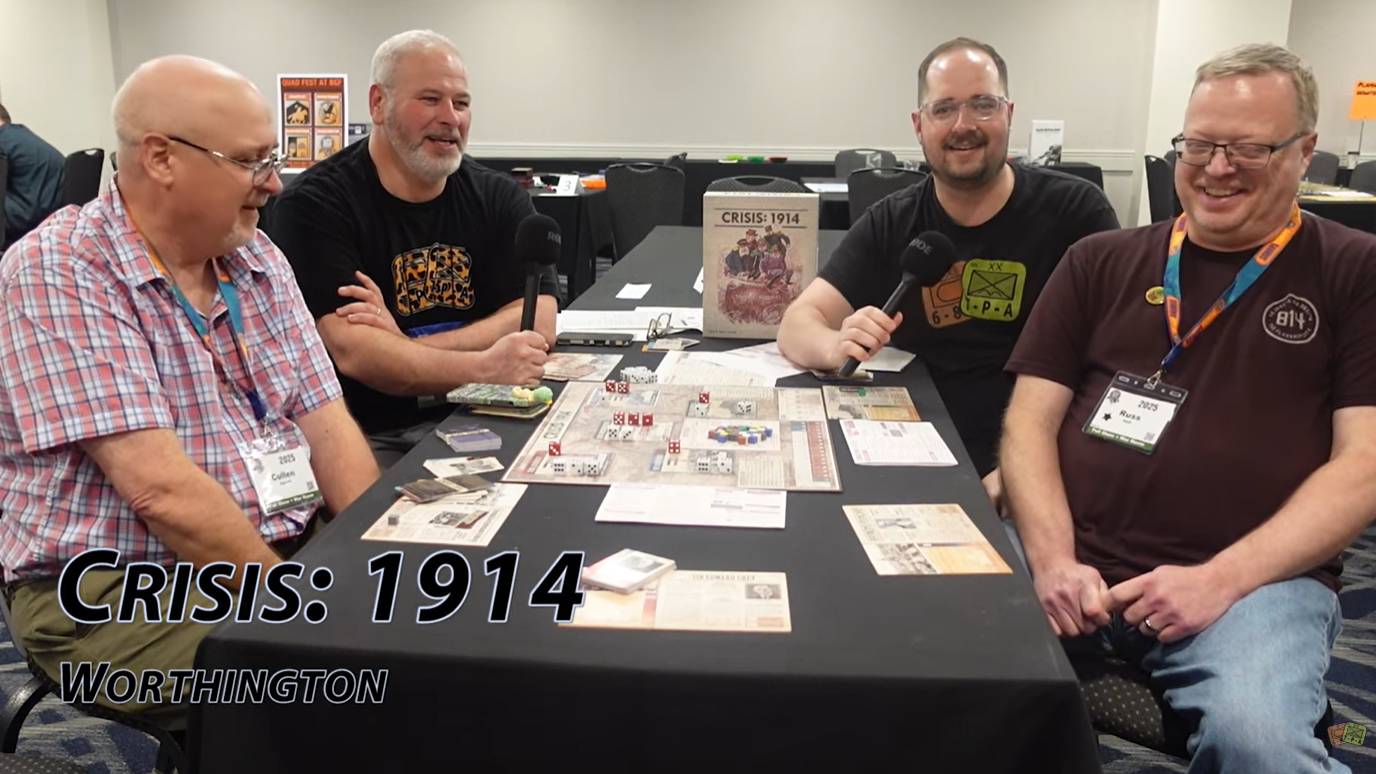
We arrived safely on Tuesday afternoon at around 4:00pm and got checked in, unpacked, organized and off to the War Room to get setup and see what was happening. The War Room is back in its original location in the Taft C room which is great because it’s a bit larger than last years room. When we entered there were about 20 people already there and playing and I was immediately excited. I love conventions and BGF is just about my favorite!
Upon entering and getting setup we were approached by a fan of the channel named Leslie Jerome who drove all the way from Lawrence, Kansas. Such a nice guy and his wife was with him and they were a fantastic couple. Leslie has a special talent that he shared with us as he showed off his handiwork which involves creating 3-D boards for his favorite games such as To Take Washington: Jubal Early’s Summer 1864 Campaign from Multi-Man Publishing from the Line of Battle Series…..and…..
…..Stonewall’s Sword: The Battle of Cedar Mountain from Revolution Games….and…
….and A Most Fearful Sacrifice: The Three Days of Gettysburg from Flying Pig Games.
These maps are just amazing and each one of them has such great detail showing the different elevations on the game board. Leslie said each one takes him multiple weeks to create and involves a lot of detail and precision cutting and gluing as well as shading the edges of the elevating terrain with colored pencils. We were really impressed and are hoping to play a few turns of To Take Washington with him tomorrow morning.
After that, our 1st game of the day was Danger Forward: The Battle of Gela, July 1943 from Multi-Man Publishing which is found in the Battalion S3 Operations and Training Magazine Issue #1. This magazine is new and arrived just last week so Alexander was able to read the rules, clip the counters and also read the 40-page magazine which is filled with of strategy and tips n how to play the Battalion Combat Series.
The game is a fantastic entry point to the BCS and was specifically designed as an accessible, entry-level game as a gateway to the series with 1 map, 5 scenarios, and approximately 176 counters.
We played for about 2 1/2 hours and finished the 3-turn scenario and really had a great time with the game. While it is introductory, we still had plenty of opportunity for maneuver, combat and some really great narrative emerged.
As the Americans landing on the beaches, I had about eight 82nd Airborne Units that went through a drop procedure at the start of the game with many of them scattering all over the board and even a few drifted and landed on several German and Italian units which meant they were instantly killed. But the best bit was when one the units, against all odds and totally outnumbered and outclassed, was able to hold a mountain pass road the entire 3 turns during multiple German attacks. They were able to hold them back allowing the 45th Infantry to move up and secure the objective there.
The next game up was Blind Swords Volume 12: Gettysburg: The First Day from Revolution Games. We played the Barlow’s Folly scenario which is a smaller 7-turn affair.
I was the Union, who were in a defensive posture and had few opportunities to activate and make attacks, and frankly didn’t enjoy the scenario we chose. There were a few reasons for that other than the fact that I was getting steamrolled. My commanders had terrible Command Ratings while Alexander’s Confederate leaders were much better. In Blind Swords, players draw chits, which represent specific brigades, divisions, or command events.If a Division or Brigade chit is drawn, the player usually rolls a die and compares it to the Command Rating on the chit to determine if it is a Full or Limited Activation. If the roll fails (or a “Limited Activation” is triggered), the brigade can only perform limited actions, such as firing, instead of full movement and combat. This happened to my brigades over and over. In fact, in turn 2 I failed all 5 activation rolls and most of my units were unable to do anything as they were not in range to do a fire attack.
I also struggled with the difference in strengths of the units as most of the Union units had 4-5 strength as compared to 6-9 for the CSA units. This meant my chances of scoring hits on the multi-step combat process was very poor.
For me, I just think we chose a poor scenario and we are going to continue tomorrow morning a bit and see if we can choose a more balanced scenario. We shall see!
With that, we returned to the hotel room at around 11:30pm to get some sleep as we are going to breakfast at 8:00am and then getting back to the War Room to play several games tomorrow like afew turns of To Take Washington, Chicago ‘68 from The Dietz Foundation,Werwolf: Insurgency in Occupied Germany, 1945 – 1948 from Legion Wargames and some other stuff.
Good morning our faithful readers! As this post uploads this morning, we will be traveling to beautiful Columbus, Ohio to attend the best little game convention in the Midwest called Buckeye Game Fest. We have raved about this convention for years and always look forward to attending as it is such a great place to play games, meet great people and enjoy the glory that is our hobby of wargaming! This year will be our 6th time attending and we have been invited back as Guests of Honor, which means we have agreed to host events and help to promote and advertise the convention. BGF is a multi-day convention that has two different parts. We are going to be a part of the War Room at Buckeye Game Fest which is open from Monday, March 9th through Sunday, March 15th. This year, we will only be attending from the late afternoon of Tuesday, March 10th through Sunday. Our 5+ days at the convention will be filled with gaming events, designer interview videos, looks at new prototypes, and of course visiting with friends, the publishers who are there including Catastrophe Games and Blue Panther and various designers including guys like Hermann Luttmann, David Thompson and Tim Densham. But most importantly, we attend conventions to play games! We love to get together and do lots of multiplayer games and we are very much excited to get to playing.
At the end of each day, I will be putting together a short summary of what we did that day at the convention. I would like to keep this to just a few paragraphs with several pictures to give you an idea of the games we played that day, people we talked with and other activities we participated in. We will still work on doing multiple videos as well that will be released on the YouTube Channel over the next few months but this written coverage will supplement the videos. This summary will most likely not be posted until after midnight EST each night, if not a bit later, so you might be checking it out the next morning which is fine.
We have at least a few things planned that are official including an impromptu teaching session for the rules of the Battalion Combat Series (BCS) from Multi-Man Publishing, our annual play of a full table of Here I Stand: Wars of the Reformation from GMT Games, War Stories RPG from Firelock Games being run by our friend Cullen Farrell and a few other things. Should be a lot of fun! We also will be bringing along lots of other multi-player games to hopefully play including China’s War from GMT Games, Imperial Elegy from VUCA Simulations, Hubris from GMT Games, Neither King Nor God from Sound of Drums, Proxy War from Amoral Games, Black Orchestra: Resistance from Starling Games, Bretwalda from PHALANX, Wunderwaffen from Ares Games and Werwolf: Insurgency in Occupied Germany, 1945-1948 from Legion Wargames. Our general philosophy of gaming at conventions is big multi-player games and each of the games we are bringing plays anywhere from 3-6 players. No 2-player games at BGF for us although I have asked Russ Wetli from Cardboard Conflicts to play We Are Coming, Nineveh from Nuts! Publishing.
We also have plans to sit down with Hermann Luttmann to get a look at some of his upcoming projects and play some games including his new edition of his Dawn of the Zeds: Designer’s Edition from Blue Panther being published this summer and also get video interviews with some designers who are willing to dish on their in-process designs. Should be a busy few days and a lot of fun.
Finally, if you are attending Buckeye Game Fest please feel free to find us and say hello. I believe that we are very friendly and accessible and love to make connections with our fans and followers. In fact, we have TPA buttons and stickers to give away so just ask. We also would like to take a picture with you so we can document it in our writings.
Please check back each day for a summary of the days exploits. Thanks for following along.
While I have not played a bunch of games focused on the Punic War, the few that I have played are very good and I am always interested in a good Ancients combat game. Last fall, GMT Games announced a new 2nd Punic War game called Punicus: The Second Punic War designed by a newcomer in Carlos Oliveras. I have been very eager to learn more about this game and reached out to Carlos recently for an interview and he graciously accepted.
*Keep in mind that the design is still undergoing playtesting and development and that any details or component pictures shared in this interview may change prior to final publication as they enter the art department.
Grant: Carlos welcome to our blog. First off please tell us a little about yourself. What are your hobbies? What’s your day job?
Carlos: Thank you for supporting the hobby in these times. As for me, I’m a guy—well, more like a man with presbyopia now—who’s starting to struggle to read the counters without glasses. I’m into the same things most people of my generation grew up with: films, books, and music, plus a hobby that wasn’t nearly as widespread in Spain in the ’80s and ’90s: games—Eurogames, role-playing, video games, and above all, wargames. And to pay for all that, I work as a naval architect.
Grant: What has motivated you to break into game design? What have you enjoyed most about the experience thus far?
Carlos: I’ve been involved in wargames for quite a while. For instance, I was the rules editor for Mark Simonitch’s Stalingrad ’42, I put together the player aids for Craig Besinque’s Conquest & Consequence, and I translated Successors into Spanish—so I suppose the next natural step was this: designing my own game.
There are a lot of fun parts to creating a game, but there’s one aspect that may not be strictly “design” and yet is genuinely enriching: working with so many people from so many different places. You realize that despite differences in countries, cultures, and ways of being, people—if they want to—can understand each other, and we’re not as different as we sometimes think. If there were more wargames, there’d be less war. Coming away with that conviction leaves you with something genuinely positive.
Grant: What is your upcoming game Punicus about?
Carlos: I haven’t exactly found some untouched topic that no one has ever made a wargame about — honestly, I wasn’t that original. It’s another Second Punic War game: Hannibal, Scipio, and the whole cast. It’s a block wargame with cards of medium complexity, designed to be playable in an afternoon.
Grant: What games gave you used in inspiration for your design? Why?
Carlos: Punicus is built on Craig Besinque’s HellenesSystem, one of my all-time favorite games—one of Craig’s real gems. I’ve played it so much that I always wanted to see it applied to other settings: the Second Punic War, the Gallic Wars…I kept hoping Craig would eventually design something along those lines. In the end, I got over my hesitation and decided to do it myself.
Grant: What is the scale of the game? Force structure of units?
Carlos: Because this war is so long, if I want the game to be playable in an afternoon it has to take a very strategic, high-level view. Each turn represents one year. As for the units, given how diverse (and sometimes contradictory) the sources are, I’ve adapted the order of battle to what produced the best balance during playtesting. For example, even though it seems Hannibal began the war with more elephants than his brother, in the game they both start with the same number of elephants.
Grant: How are the units represented? What is the layout of the blocks?
Carlos: The units are essentially wooden blocks with stickers. In short, the sticker shows the unit type (infantry, auxilia, cavalry, etc.); its Combat Value (the number of dice it rolls in combat); its Combat Rating, which determines when it attacks (in alphabetical order) and what it hits on or uses to cause routs; its Movement Rating; and, very importantly, its Home Box, which tells you where that unit can be recruited.
Grant: What advantage do blocks offer the design?
Carlos: Basically, it’s the fog of war. And not just because you don’t know what unit is in a given block—you also don’t know its exact strength state, since a single block can have up to four step levels. On top of that, there’s the physical feel of handling something solid like wood, which—without taking anything away from cardboard counters—is simply satisfying. I know that’s not strictly a design point, but it matters. If I have the choice, I’ll always prefer playing Punicus on the table rather than on Vassal.
Grant: Why was this a subject you wanted to create a game on?
Carlos: I love history, and I have to admit that when I was a kid, Hannibal’s campaign really blew my mind—elephants, crossing the Alps…to me it was like a movie, with the extra thrill that it had actually happened. Years later I was lucky enough to play Mark Simonitch’s Hannibal, and it made me feel like a kid again. So when I found myself with the chance to create a Second Punic War game using the Hellenes engine, I didn’t hesitate. And yes—designing it has been just as fun as discovering who the Carthaginians were back then, and as fun as playing Hannibal years later.
Grant: What are the unique features with the system used for the game?
Carlos: If we compare it to Hellenes, what sets Punicus apart is basically three things. First, the addition of non-combat units such as Generals and Catapults. Generals, for example, improve the units they are stacked with, and if that general also happens to be an active leader for their side, they can apply their special ability. For instance, Marcellus’s special ability improves the assault capabilities of the units with him. Second, new actions like production, piracy, and diplomacy—yes, you can take cities by sending ambassadors and persuading their citizens they’ll be better off with you. And third, the addition of a personal player board where each side can invest Supplies into researching projects, letting you shape your long-term strategy.
Grant: What unique elements of the Punic Wars did you want highlight in the game?
Carlos: I’d like the game to capture two things. First, the asymmetry between the sides. Carthage starts with tremendous striking power, but its enemy is far away. Rome is a sleeping giant: it loses battles, but it keeps standing—unyielding, impossible to discourage. You know it will wake up; how long it takes, and what form that awakening takes, will shape the rest of the war. Second, I wanted to reflect how the war evolves. Early on, players have fewer options, but as the campaign advances new possibilities open up to explore—investing in projects, diplomacy, piracy, and so on. The idea is that turns shouldn’t feel repetitive as the game goes on.
Grant: What various unit types are included in the game? What is unique about these units?
Carlos: There are three classes of units: Civians, Barbarians, and non-combat units. Civians represent the era’s city-based forces: Infantry, Auxilia, Cavalry, Elephants, and Fleets. Each unit type has something that makes it distinct. For example, Cavalry can perform a special attack called Harrying. Elephants are a powerful arm, but with the drawback that they can panic your own troops. Barbarians are slow but hard-hitting units, with the key trait that they dissolve in Winter—unless they are with Hannibal. Finally, there are the non-combat units: Generals and Catapults. They cannot operate on their own, but they can significantly influence battles.
Grant: How are cards used in the design? What are Action Points?
Carlos: The game is played in Years. At the start of each Year, each player is dealt six cards. In each of the seasons that make up the Year, players choose one of their cards face down and reveal them simultaneously. The card’s orientation determines whether the player will resolve its event or use its Action Points—one or the other. Each Action Point allows you to take one action, chosen from: Movement Actions (from standard Maneuvers to Piracy actions), Building Actions (recruiting and reinforcing), Production and Diplomacy.
Grant: Can you share a few examples of the cards?
Carlos: Yes, of course. Here is the “Hannibal Leads Carthage” Card and its key features. This card starts on the Carthaginian player board. It is a Leader card: while it remains on the player board, it grants its player its Leader Value (additional Action Points) and also gives Hannibal’s block a Virtus, or special ability—in this case, it means that any Barbarians with him do not dissolve in Winter. You can also see a value labeled Damage. When a unit crosses a mountain border, or a Fleet runs into a storm, you draw a card to see whether it takes damage.
Grant: How are cards used for research?
Carlos: At the start of the Year, players still play their cards either as events or for Action Points, but in this segment those Action Points are not used to take actions. Instead, they are used either to make an offering to a god (which will allow future appeals to that god to do things like reroll dice) or to invest Supplies in projects. This is the only time projects can be researched. That means that if, in the previous Year, a player didn’t produce Supplies—or spent them on maintaining troops during Winter—they may have no opportunity to research at all.
Grant: What different research options are available and what are their benefits?
Carlos: There are basically three branches: one that boosts production, one that increases naval power, and one that benefits land forces. It’s also worth noting that the projects for each side are not 100% symmetrical, which further differentiates how Rome and Carthage play.
Grant: How does activation work?
Carlos: Units don’t activate on their own; players have to spend their cards’ Action Points to move them. In other words, if a player plays a card as an Event, they won’t be able to move their units that season—the only combat they might still carry out is siege attrition from sieges established in earlier turns. Likewise, if a player plays a card for Action Points but it only provides 1 AP and they spend it on something other than movement—for example, using that AP to produce—then their troops won’t move that season. So each turn you have to think carefully about what you do, because your Action Points are limited: if you do one thing, you can’t do another. It’s that Twilight Struggle feeling of always being short on points—more or less.
Grant: What is the layout of the player boards?
Carlos: The player boards are dual-layer boards, so units and Supply cubes can sit neatly recessed in place. Each player board has a Praetorium, an area that holds units the player cannot recruit at the start of the game; these units will enter play later through Diplomacy Actions or Events. There is also the Proiecta section, where players invest and accumulate Supply cubes while researching projects. At the top, there are slots to hold groups of blocks in case the stack becomes too large to keep on the main map. At the bottom of the player board are the Rostra, where each side places the cards of its active leaders.
Grant: What key choices are forced upon the players?
Carlos: Each season, the player has to ask themselves which card to use and how to use it: for Action Points or for the Event. On top of that, the decision must factor in that the number of Action Points has a direct impact on initiative—who will act first that season. In principle, you don’t know in advance whether you will go before your opponent or not, so even what you intended to do with your Action Points when you committed the card may have to change, because your opponent has altered the board situation. That card-use choice is a recurring one every turn, but there are more decisions. For example, when you are besieging a city and the battle phase arrives, you have to decide what to do: attrition or assault. And for the defending side, when you are assaulted you have the option to capitulate—you lose the city, but in a less dishonorable way than if you were to lose the assault. Also, in battles a side can always choose to withdraw at the start of its round to execute an ordered retreat and limit losses.
Grant: How does combat work?
Carlos: It’s fairly straightforward. In a battle, blocks are revealed and sorted alphabetically by their Combat Rating. Blocks attack in letter order (A/B/C/D…), with defenders acting before attackers when the letter is the same. A block attacks with a number of dice equal to its printed Combat Value, and it scores hits and routs according to its Combat Rating. For example, an A2 block would attack first because it’s an “A” unit, scoring hits on 1–2 and causing routs on 5–6. Each hit reduces the strongest opposing block, and each rout forces the weakest opposing block to leave the battle. When all blocks in the combat have attacked, the Combat Round ends. Combat Rounds repeat until one side is eliminated or retreats. Combat also changes depending on the battle type. For example, in an Assault, the forces inside the city are treated as A2 blocks and they also receive a defensive bonus.
Grant: How is victory achieved?
Carlos: There are different types of victory. A Decisive Victory requires reaching 15 points and controlling an enemy Core City. A Negotiated Victory can be achieved with only 12 points. If neither of those victory conditions is met and the game reaches the end of its campaign years (which, in principle, players also won’t know in advance), a final comparison determines who wins—or whether the game ends in a draw.
Grant: What do you feel the game models well?
Carlos: What I think the game models well is the overall course of the war. It’s not that it perfectly models individual battles or grand strategic movements, because the game is somewhat sandbox in that respect. It’s more about the feeling that, with the sides being so different, both players are under constant pressure to perform at their best—because one mistake can swing the whole game. It feels like a war, not just a series of skirmishes. For example, Carthage starts with an impressive striking force, but its native recruitment base is far away and the war is long, so there’s constant pressure: victory can’t rely on a single great general forever. Rome, on the other hand, knows its potential is enormous, but it has to survive long enough to actually bring that potential online before its opponent brings it down.
I have come to Italy not to make war on the Italians, but to aid the Italians against Rome. – Hannibal Barca
Grant: What has been the experience of your playtesters?
Carlos: I think they’re having a good time. The fact that they want to play it again means the game has them hooked. And beyond that, their help has been invaluable—adding rules that turned out to be fundamental, or even almost creating cards like Mutiny. We’ll most likely put out a call for a new round of playtesters in an upcoming GMT newsletter, so if anyone’s interested, keep an eye out.
Grant: What are you most pleased about with the design?
Carlos: What I’m enjoying most is that the playtesters (including the developer, Joe Dewhurst) have had very few questions about the rulebook wording. It also helps that I started from a very polished manual like Hellenes.
Grant: What other designs are you contemplating or already working on?
Carlos: Right now, almost all my time goes into Punicus, but I have rough outlines for a block game about the Spanish Civil War (something like Spain Front, maybe) and a solo game about a certain Julius Caesar.
I love a good block wargame! And, in my opinion, this game looks extremely interesting and I am very much excited to learn more about it. I also very much like the idea of investing in technology and projects. Just such as neat addition to any wargame as you have to balance investing in replacements for your lost troops or new abilities and strength.
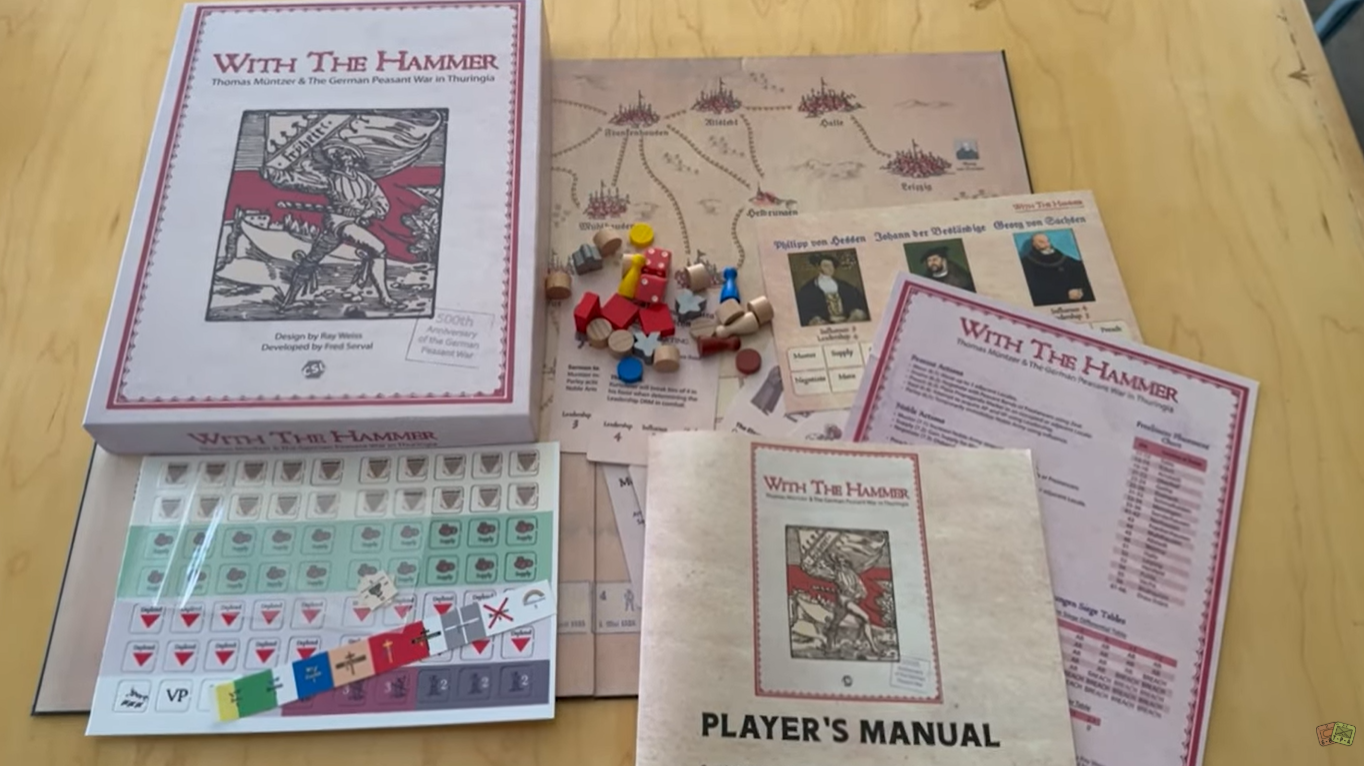
With the Hammer is an asymmetric wargame covering the German Peasants War in Thuringia in 1525 along with the exploits of one of its most famous protagonists – Thomas Müntzer. With the Hammer comes with wooden pieces, counters, 2 rulebooks, and historical commentary by Professor Andrew Drummond, and a 22×17 inch map.
Each player is a peasant or a noble; the peasants win as a team, or the nobles win as a team. There is no true solitaire system, but like most wargames, it can be soloed two-handed.
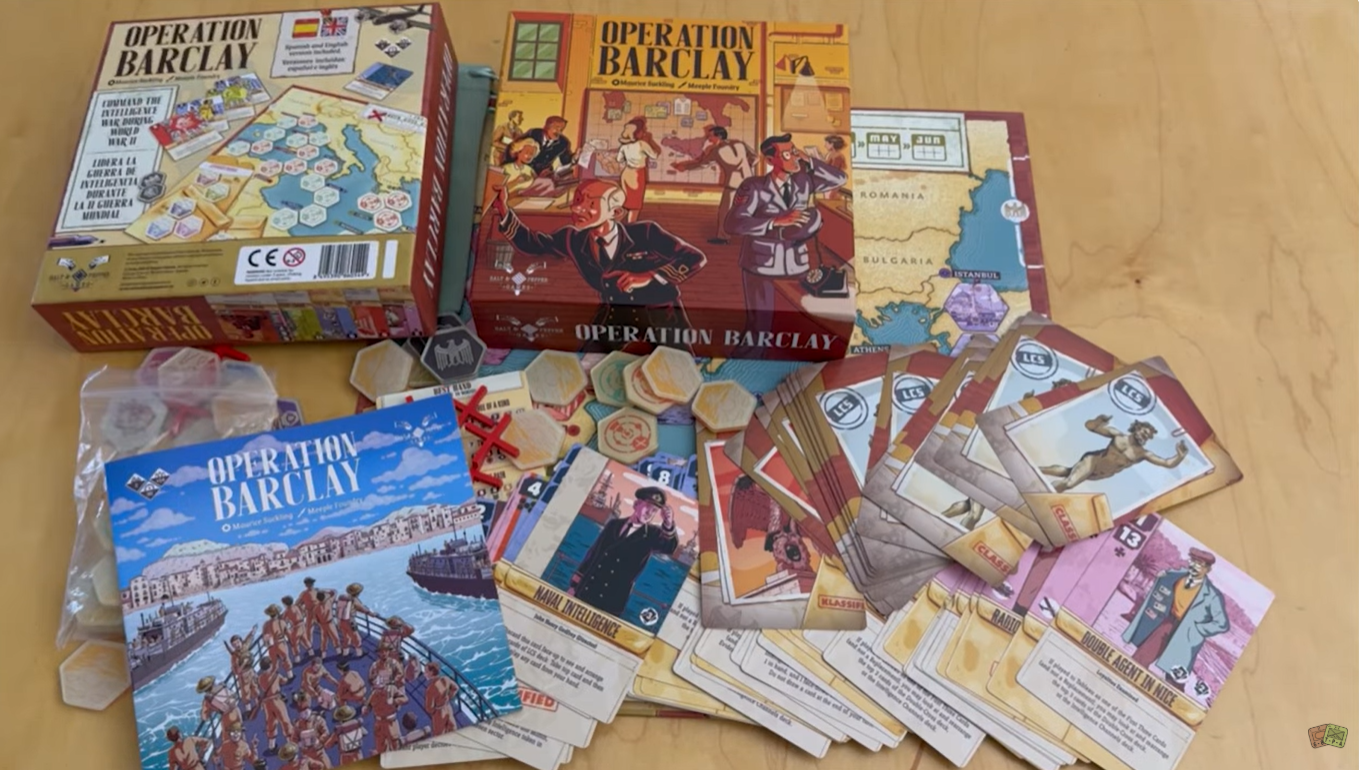
Operation Barclay is a 2-player game of low/medium complexity about the intelligence war between the Allies and their Abwehr counterparts in the Mediterranean Theater of WWII in 1942-1943. Operation Barclay puts players in the shoes of competing military intelligence directors who are attempting to mask or learn the truth about the Allied invasion plans for 1943. The Abwehr must attempt to learn where the Allies intend to land next. The London Controlling Section (LCS), the core intelligence agency responsible for Allied intelligence, must prevent the Abwehr from discovering the truth.
The LCS player uses a variable set-up, placing tiles face down to establish where in the Mediterranean a primary and a secondary offensive will occur. Over the course of the six game months, the Abwehr player attempts to win sufficient evidence tokens to be able to turn enough of these tiles face-up to reveal where the Allied offensives will come.
To win evidence tokens, players build hands of five cards to take tricks, similar to poker. While having the best hand will secure two evidence tokens, correctly betting after each player reveals the first three cards of each hand on who will have the best five-card hand is worth three evidence tokens.
Further, players have ways to manipulate the decks from which they draw. They may create a double-cross deck, allowing them to leave cards useful to them face down in a deck to draw from when they choose later — unless the other player takes those cards instead…but perhaps the player who planted those cards was bluffing and hoping the other player would waste their draw on a useless card. Alternatively, players may draw from their own dedicated deck to augment their hands with unique abilities inspired by historical figures, events, and capabilities. The LCS has access to Ultra — decrypts of German codes — but this alone will not be enough if it’s not used carefully.
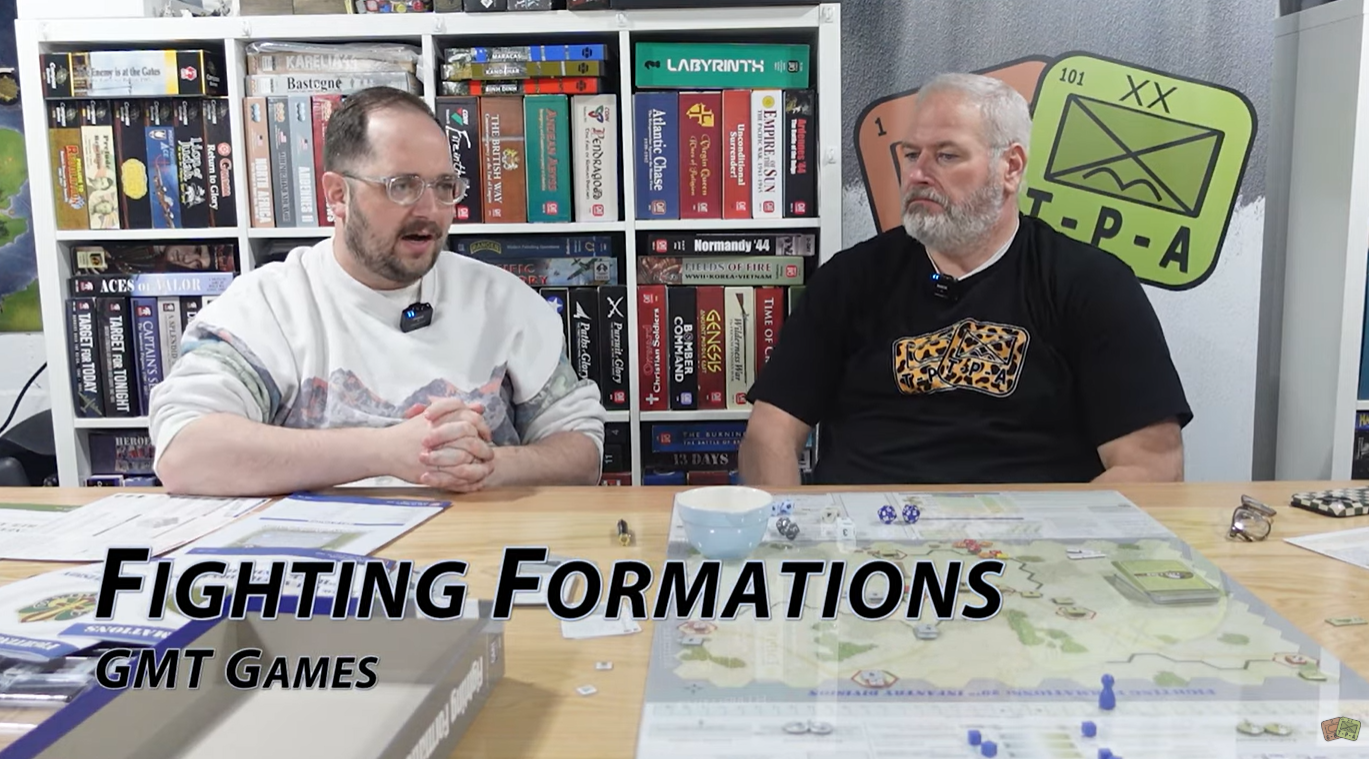
Fighting Formations is intended to be an ongoing series of wargames covering WWII tactical combined-arms combat at the platoon and squad levels. Each game in the series will feature a distinct combat unit, highlighting battles in which that unit participated as well as its particular order of battle and fighting characteristics. In this second volume of Fighting Formations, we feature the US 29th Infantry Division—“Blue and Gray”—as it fought from just after D-Day in June of 1944 to the end of the year.
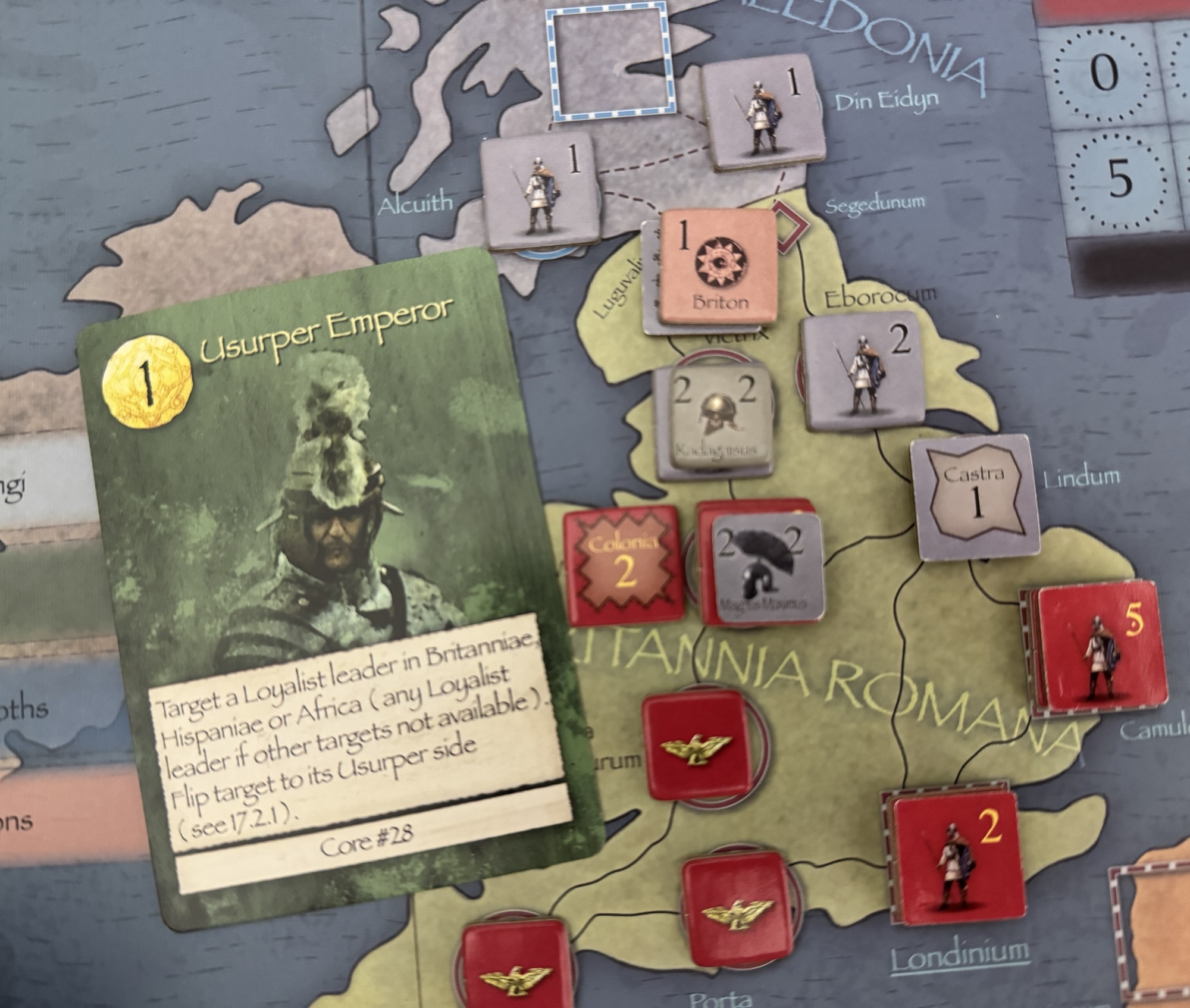
With this My Favorite Wargame Cards Series, I hope to take a look at a specific card from the various wargames that I have played and share how it is used in the game. I am not a strategist and frankly I am not that good at games but I do understand how things should work and be used in games. With that being said, here is the next entry in this series.
Card #68: Usurper Emperor from Barbarians at the Gates, The Decline and Fall of the Western Roman Empire 337 – 476 from Compass Games
Barbarians at the Gates, The Decline and Fall of the Western Roman Empire 337 – 476 from Compass Games is a Card Driven Game for two players set during the final hundred plus years of the Western Roman Empire as the Barbarian tribes in the north came down with a vengeance as they clashed with civilization and carved out their place amongst it. The time period covered in the game is from the death of Constantine the Great (337 AD) to the deposition of the last Western Roman Emperor by Odoacer in 476 AD. The Roman player will command the Roman Legions loyal to the failing central authority and those Germanic peoples who have settled peacefully inside the Roman Empire, while the Barbarian player leads Usurper Emperors, and controls the migrations of the Germanic peoples, who are the Barbarians at the Gates. This game is really quite good and feels very much like a wargame even though it is a Card Driven Game. There are lots of opportunities for troop movement, combat and maneuver. And I really liked that. The game is a Card Driven Game and the use of cards is all important and very well done. Each player has their own unique deck of cards that are used and these cards are sometimes removed from those decks when played for an event and also new cards will be added to the deck after each turn. The cards played during a player’s impulse which are not used for the Event are then used for their Operation Points value. These Operation Points can be used for many purposes including Activating a leader, Forced Marches, Raiding, Reinforcement, Migration and Successful Usurpation.
The real trick to the cards is to plan out how you are going to use them to your advantage but also how best to use them. Activating Leaders is very important as you can then move them to attack, defend, change control of areas and other actions. Activating a leader depends on their strategy rating (the lower the strategy rating, the better). When a leader activates from a card, they receive a number of Action Points which can be used for movement (1 over highway, 2 over rough or river connections, 3 over strait or for naval movement), continuation after battle (a kind of advance after combat), changing control over unfortified spaces and sieges of fortified spaces. But the cards also are very mean spirited. What do I mean by this? Well, in our first play, I was carefully using my cards to build up my armies to fend off the initial attacks of the Barbarian hordes. I also had begun to build somewhat of a super stack as well to attempt to foray into England and take on the Barbarians there. As I did this building up, I was unaware of the nasty nature of some of the cards. Some of the cards, both for the Barbarians and Romans, allow a play that will turn a single leader and their entire stack into either a Usurper or a Pacified Barbarian Settlement. Both are equally nasty and you have to keep in mind that you can have your best armies simply taken from you and turned to your enemy.
Some of the cards, both for the Barbarians and Romans, allow a play that will turn a single leader and their entire stack into either a Usurper or a Pacified Barbarian Settlement. Both are equally nasty and you have to keep in mind that you can have your best armies simply taken from you and turned to your enemy. Because of this, the Roman player has to decide whether they will group Combat Units under a single leader in order to face the mighty Barbarian challengers at the Gates in which case he risks that leader to Usurp, or to disperse these troops over several stacks never allowing a single leader to amass too many CU but on the other hand also never having a true striking force to attack with. There is an exception here though as an Emperor leader cannot Usurp and you don’t have to worry about that but this is also dangerous as you can lose that Emperor.
Likewise, once they have an Usurper leader on the board the Barbarian player will try to group all Usurper CU with this leader (in order to keep this force strong and in order to allow their Barbarian CU, leader and tribes to march unopposed into the Empire). This creates a very real and historical danger as the Barbarian player is incentivized to do what an Usurper would historically have done and empty the border garrisons in order to march on Rome.
These type of cards are extremely strong and a situation can occur in which most of the Romans still on the board are Usurper leaders and CU. But there is an action that allows for the Roman player to counter these cards and that is the Successful Usurpation action. If the Barbarian player over does it with the Usurper powers, the Roman player can simply steal these conquests by swapping the Roman power for the Usurper power. This in effect has the Usurpation process succeed and the former Usurper leader now becomes the true Emperor!
Usurper emperors in history, particularly in Ancient Rome, were rulers who seized their power illegitimately, often times via a military rebellion rather than legal succession, and were labeled “tyrants” if defeated, or emperors if successful. They were most common during crises and times of turmoil, such as the “Year of the Four Emperors” in 69 AD following the suicide of Nero, often relying on legionary support and issuing their own coins to legitimize authority.
Emperor Galba by Paulus Moreelse (left); with Emperor Marcus Salvius Otho by Gerrit van Honthorst (center left); with Emperor Vitellius by Hendrick Goltzius (center-right); and Emperor Vespasian (far right).
Usurpation was common during the whole imperial era; virtually all imperial dynasties rose to power through usurpation and conspiracies. The “imperial office” established by Augustus never defined an stable system of succession, and emperors often had to rely solely on military power to survive.
In the Eastern Roman Empire (395–1453), rebellion and usurpation were so notoriously frequent as compared to medieval West, where usurpation was rare, that the modern term “byzantine” became a byword for political intrigue and conspiracy.
Here is a look at our unboxing video:
We also did a video review and you can watch that at the following link:
Over the past couple years, we have played a few venerated and respected series games from Multi-Man Publishing for the first time that frankly I had initially turned my nose up at for various reasons. These reasons were not really anything important or truly about the design or mechanics but included things like price, graphic design, style and somewhat because of the complexity and reputation of complexity of those systems. These series included first the Standard Combat Series (SCS) with our first game being Rostov ’41 and now the Battalion Combat Series (BCS) with our first game being Arracourt and since we have played several other volumes including Brazen Chariots and Baptism by Fire. I must admit here that I am actually embarrassed that I hadn’t played those series and readily admit that I just discounted and dismissed them out of hand. I am so very glad that we repented of our stubbornness and found this system because it really is very, very good at what it is trying to teach and demonstrate about warfare at this scale.
So what is the Battalion Combat Series? The Battalion Combat Series is a system designed to model combat at the grand tactical scale from late World War I to the present day. The system has seven published games including Last Blitzkrieg: Wacht am Rhein The Battle of the Bulge (2016), Baptism By Fire: The Battle of Kasserine (2017), Brazen Chariots: Battles for Tobruk, 1941 (2019), Panzers Last Stand: Battles for Budapest, 1945 (2021), Arracourt (2022), Valley of Tears: The Yom Kippur War, 1973 (2023) and now Inflection Point: The Battle for Kalach and the Battle of Chir (2025) and was created to in some ways fill the gap that existed between the operational and the tactical. In my limited experience, the system truly feels much like a smaller scale game, as it deals with various support units and stacking limits are enforced to just a few combat units. The system is fairly crunchy, meaning there are lots of DRM’s and combat modifiers, and attempts to model accurately combat and the importance of both supply on the one hand and command and control on the other. The hallmark of the system is that the games in the series are very playable. I am no expert but this system is made for the gamer while some of the others from MMP, such as OCS, appear to be more for the accurate modeling of warfare on an operational scale. Still playable, but maybe only after the gamer has gained experience with other systems to draw upon that knowledge to assist in digesting the more complex nuances. In this post, I would like to cover some of the basics of the system and deal with things like the way it handles supply, combat, combined arms, activation and air power as well as give you a taste for what this volume in the series has to offer. Overall, I have been very impressed with BCS and have very much enjoyed playing it. In fact, I am really starting to love the series and believe it might be taking over my love of the Standard Combat Series from MMP.
One of the best parts about this new volume in the series is that it is actually 2 games in the same box. One game which is smaller, with fewer counters and formations and that uses a smaller version of the board included in the game and one that is the full campaign with more counters and formations, a larger board and is much more involved. Overall, I would say that the BCS is a fairly straightforward series even for someone who is a beginner and has less experience with the BCS system like me. I think that I thought they were designing Arracourt as the entry to the series, and I still think that is the case, but this volume has some of the same flexibility and approachability that some of the larger titles don’t necessarily have. I feel that players can cut their teeth on this one using the smaller scenario while getting comfortable with the rules and system before you attempt the larger scenarior or even other larger games in the series. I also feel that the game requires somewhat of a paradigm shift before playing. What I mean by that is really two fold.
First, I really feel that usually these big hex and counter wargames are set in their combat methods, namely focused on odds based Combat Results Tables and counting up combat factors to get the perfect odds, and require a bit of calculation. But BCS doesn’t use a traditional CRT but breaks the combat down into more of a collection of DRM’s based on many factors.
Second, the game also has very low counter density, with the scenario we played having about 40 counters per side on the map at any given time, and stacking limits are just 2 combat units with other counters also allowed such as support units or HQ’s. There are not enough counters here to create the long contiguous line or wall of units that are typical in some of the larger systems, which lends this one to a bit more maneuvering of units to get into good position while using terrain to attempt to isolate and cut off units from supply or to prevent the enemy from doing the same to your units. This created somewhat of a back and forth dance for us that kept my focus and attention and was really quite entertaining. Supply is important to the system but not as focused on it as say the Operational Combat Series (OCS). The players must manage their HQ’s and their combat trains to keep their units in full supply and this becomes somewhat of a different type of dance that sees players cautiously keeping their units in a loose perimeter to prevent a freak breakthrough or run around to get to the back of the formations to take out supply sources and cut off units. I really liked the scale and feeling of this BCS system and had a very good time in trying to learn and understand it and also trying to figure out the best strategies to engage.
The counters included in BCS Inflection Point are dual sided but the back side is not to show a reduced unit as is normal with these wargames. The front side is the unit’s move side while the back side is its deployed side. Each of these stances is very important and must be used by each player to get the most out of their units and to take it to their opponent.
Let’s take a closer look at a few examples of counters involved in the game. First off you will notice that the counters are pretty standard using NATO symbols to identify units type with various numbers listed on the top of the counter to include their Battalion, as well as whether they are a two step unit and have breakdown units that are held off map. The units have a colored band shown at the bottom of the counters that identify them as units of a certain formation which will be activated when their activation marker is chosen by the player as this game is Chit-Pull. The 3 numbers printed on the bottom of the counter include from left to right Combat Factors, Action Rating and then Movement, which consists of three different values and two different types. The Red value shown on the armor and mechanized units is the TAC (Tactical) movement, which is significantly better than other movements. White value movement (not shown in the picture below) represents leg unit movement and Black movement is truck movement. Truck movement can get 1/4 movement on primary roads so they can be used to get units up to the front quickly to react and fill holes or vulnerable spots on the front.
Another very important numeric value shown on the counters is their Action Rating, which is shown under the NATO symbol above the combat and movement values. This value represents such items as the unit’s leadership, training, morale, and other soft qualities. On some counters the Action Rating doesn’t change when the unit is flipped for movement or deployment. This value is compared against enemy units in combat and provides a DRM if the attacker is superior to the defender’s value. This rating is very important and we learned quickly to make sure our good units were leading our most important attacks. One other point of note, armor units typically have their Engagement Range increased when they flip from Movement to Deployed. This is a very specific armor on armor combat bonus.
One other important aspect of the counters is the concept of a Combat Train, which is each of the Combat Commands’ mobile supply source that stretches back to the identified main supply source. In BCS, these Combat Train counters are represented by an individual formation counter that has wheels shown on the bottom and then lists the Combat Command number. The placement of these Combat Trains is a very interesting and somewhat precarious part of the design that we really enjoyed. Each Combat Command can only place their Combat Trains in or adjacent to hexes of the various yellow highlighted roads shown on the map. Their resulting Main Supply Route or MSR must then follow along the highlighted road back to one of the various Supply Sources shown on the map and identified in the specific scenario setup. This concept is very important and in my mind really shows the focus of supply on combat and activation as this will add a DRM to the activation SNAFU roll that precedes each unit’s activation to see if they can perform a full action or just a partial.
The really interesting thing about activation in the game was this concept of Fatigue. A formation will track its Fatigue Level with a set of numbered Fatigue markers. The Fatigue level will progress from Fresh through various Fatigue Levels including 0 (which is not considered Fresh), 1, 2, 3 and 4. Fatigue 0 is considered normal (but remember that this is not considered Fresh as Fresh is better than normal) while Fatigue 4 is considered to be exhausted. These Fatigue levels will affect the players SNAFU rolls and will equate to a negative DRM equal to its level. For example, Fatigue 2 is a -2 DRM. Fresh Fatigue gives a +1 DRM but don’t expect much help here as combat and even movement can wear your soldiers down effecting their coordination and cohesion resulting in the addition of a higher number Fatigue marker which will cause a much more difficult time in activating. This Fatigue is tracked by keeping the appropriate Fatigue level marker with the HQ counter so you know where you stand.
The way you will increase Fatigue is interesting as it takes a roll of the die only when certain actions are taken. Each of these actions that can cause Fatigue to increase include placing an Objective Marker (which is like choosing what you are going to attack, barrage or to take control of Victory hexes), conducting any type of engagements or fire attacks, executing a second activation or a full or partial SNAFU. Basically, everything that a formation can do can cause Fatigue. You get to roll a die and consult the Fatigue Increase Table and this table is based upon what type of action you just took as to how likely it is that the result will cause additional Fatigue counters to be added to your HQ. I really liked this part of the system as it just felt really interesting and was a very unique way of handling this concept of battle weariness and effectiveness. As we know, as soldiers fight, they get wounded, run low on ammo, get tired and ultimately become combat ineffective and all commanders must monitor this and make sure that their forces are not pushed beyond their capability. When Fatigue gets too bad, the formation can simply commit to conducting a Fatigue Recovery action when it is activated. No roll needed. The player just reduces the fatigue number down one spot toward Fresh.
I know that a lot of you really love the dense and involved hex and counter games and love your stacks of units lined up in neat lines stretching across the board forming the front. I am not in that group and would much prefer a tight and low counter density game because of the reasons of playability. See my fingers are like small smoked sausage links and I have the finger dexterity of an elephant so playing around stacks of 4-10 counters really makes me nervous ad invariably I will lose grip on my tweezers or just brush up against a stack and cause pandemonium. For me, I really liked the lower counter density of BCS and the scenario of Inflection Point that we chose to play.
The other benefit that I saw from this lower counter density was the concept of trying to scrape too little butter over a large piece of bread. There just never seemed to be enough counters at my disposal to truly cover the battlefield from all avenues of approach and angles and I really found myself searching the terrain and crossroads to select the perfect spots to intercept advancing Soviet units as they moved on the victory hexes that I was tasked with defending. It really caused me to study the board and situation to find the weak or vulnerable parts of my defensive plan and look for ways to improve or back up those weaker areas with reserves or a second line of defense.
To also combat this counter density issue and to keep your formations and stacks all organized, we have purchased counter sled cards that are available online to buy or you can find them on Board Game Geek for several of the volumes that you can print off. These typically hold your conditions like your Fatigue counters, your Prepared Defense posture counter and and any available Support Points. These are a life saver and I highly recommend them. You can get a glimpse of the cards in the above and below pictures. You can purchase these at Make Playing Cards dot com: https://www.makeplayingcards.com/search/search.aspx?ne=inflection%20point
Chrome. We all like it when it is included in the games and this is the case with Inflection Point. In the game, there is a single German tank unit that is radio controlled and is somewhat of a glass cannon as it does some damage but if attacked will not stand up for long. The counter represents a Funklenk Tiger, which was a radio controlled tank that was remotely operated to drive up to a target and open its bins that had a bunch of explosives then drive away and the explosives would be remotely detonated. Mid-war Tigers were used because of their thick armor (prior to that Panzer III’s and StuG’s had been used). Characterized by additional bins, and large radio antennae, the interior of the Tiger would be stripped of heavy ammunition and other unnecessary equipment to make room for the explosives and RC controls.
Finally, I really liked how this game in the series was presented. There are actually 2 separate but related games contained in the box. A smaller game covering Kalach and then the larger game covering both Kalach and Chir River.
Quoting from the game page, we read the following:
Inflection Point is a BCS game depicting two important but relatively unknown battles before and after Stalingrad. The Battle for Kalach was fought in July 1942 following Case Blue, the successful drive into southern Russia. Paulus’ Sixth Army intended to encircle and destroy the Soviet Armies and walk into Stalingrad. The Soviets were still recovering from Operation Barbarossa the year before. The result of the battle set up the epic urban fight that was the turning point of the Eastern Front. By December 1942, the Sixth Army was trapped at Stalingrad by a more capable Red Army. In the Battle of Chir River, the Soviets looked to exploit their gains and prevent German relief operations over a portion of the Kalach battlefield. Initial success along the Chir River changed when the energetic 11th Panzer Division was thrust onto the scene. These two battles show the progression of the Red Army into an offensive army that could start fighting toe-to-toe against the invaders. For the Germans, the days of blitzkrieg successes were waning and were being put on the defensive. There was a marked inflection point around Stalingrad.
They took this history and designed a smaller mini-game on the Battle of Kalach and then the larger game dealing with the whole enchilada or the Battle of Kalach and the Battle of Chir River. The smaller game uses counters that represent the same units that you will find in the larger game but that have special markings on them identifying them as belonging to this game. You will not use these specific counters in the larger game, as it has its own set of counters and a larger map that contains the area of operations around Kalach. I thought that this approach was sheer genius and really hope that people can use this game as a jumping on point for the series. I still think that Arracourt is the prime first game in the series but this one also provides that in a novel and very attractive way.
As is usually the case with these posts, there are a lot of additional parts of the game and series that I didn’t get to cover, but I wanted to give you my first impressions and identify the parts of the design that really spoke to me. This game was a real wargame. An enjoyable wargame at that. A game that used lots of familiar concepts, along with some that were new, such as the dreaded SNAFU roll, but created a game that was very playable yet meaty enough to fulfill my hunger for a good old fashioned hex and counter game. The combat was not odds based so that was also very different and it was really refreshing to be able to play a system that I feel wasn’t simply a clone of other successful systems out there but that attempted to try some new things and do them in a unique and interesting way.
If you are interested, we posted the following unboxing video on the YouTube Channel a few months ago:
Thank you so much for following along and I hope that I was able to do this game the justice it deserves.
A new company on the scene recently is Ingenioso Hidalgo which was created by Paolo Mori. Yes, that Paolo Mori who has designed such interesting little wargames as Blitzkrieg! World War II in 20 Minutes, Caesar!: Seize Rome in 20 Minutes amongst others. He has partnered with Alessandro Zucchini on a new design, which is Ingenioso Hidalgo’s first game, called Battlefields of the Napoleonic Wars. We reached out to these two to get some insight into the design and they were more than glad to share.
Grant: Paolo and Alessandro, welcome to our blog. First off please tell us a little about yourself. What are your hobbies? What’s your day job?
Alessandro: I live in Modena, in Northern Italy, where I work as an Energy Manager in a steel factory. My hobbies are strictly related to games. I love studying Military History and Philosophy and playing wargames. I also like board games (in the past I have designed quite a few) and RPG’s. I’ve been playing Dungeons & Dragons with my friends for 40 years now.
Paolo: I live not far away (about an hour drive) from Alessandro, in the wooded hills near Parma, with my wife and two children. My job is to take care of digital communications for the local university, but in reality I have been on leave for three years to focus solely on game design (and, since last year, on the Ingenioso Hidalgo publishing venture ). In addition to board games, I have a passion for history.
Grant: What motivated you to break into game design? What have you enjoyed most about the experience thus far?
Paolo: Those who know us know that we have worked on very different types of games, and that is what we like to do most: explore different genres and themes. Lately, we have developed a passion for historical games, and we have found that designing a game is an excellent way to study and to spark curiosity and interest in players.
Grant: What is your upcoming game Battlefields of the Napoleonic Wars about?
Paolo: To tell the truth, the game is no longer ‘upcoming’. It was published in April 2025, and we are working on a first reprint (the first print run sold out) which should be available between April and May. Battlefields of the Napoleonic Wars is a game system that allows you to recreate the battles of the era, from small skirmishes with a few thousand men on each side to decisive pitched battles. The aim of the game is to be accessible, both in terms of the complexity of the rules and the length of the game, but also faithful to the specific elements of Napoleonic warfare. Ultimately, it aims to be a fun game to play!
Grant: What is the scale of the game? Force structure of units?
Paolo: The scale of the counters depends on the battle chosen, and can vary from one counter for every 1,000 men to one for every 4,000 for infantry, while for cavalry and artillery the scale is naturally different. The maps can be of three different sizes, and the scale also varies from one hexagon (they are large hexagons of almost two inches) for every 400 yards to one for every 800 yards.
Grant: How are the units represented? What is the layout of the counters?
Paolo: This is one of the first original features of the game. Each unit on the battlefield is represented by two rectangular counters, which, depending on their mutual arrangement within the hexagon, indicate at a glance the type of formation that the unit takes: column, line, or square (or disordered).
The counters have no numbers or values, only two icons (one on the back) that generically represent the type of unit: infantry, cavalry, or artillery. The color of the icons indicates the ‘quality’ of the unit: gold for heavy cavalry or elite infantry, silver for medium cavalry or light infantry, white for light cavalry or line infantry. Each of these units has some simple special rules that govern how they move or fight. Finally, the background of the counters can only be one of two colors. Blue for the French army or its allies. Red for the opposing coalition army.
Grant: Why was this a subject you wanted to create a game on?
Alessandro: I have always been passionate about wargames, especially Napoleonic wargames, and I had already enjoyed creating alternative rules or other regulations for playing certain battles in the past, often trying to simplify or make the rules of some particularly complex games more interesting. That’s why I challenged Paolo to create a wargame together.
Paolo: On the contrary, I have never been a wargame player, even though I have always been fascinated by them. But the commitment required in studying the rules and the playing time has always been overwhelming for me. That’s why I accepted Alessandro’s challenge. The aim was to make a wargame that I could finally play. For me, it was also a very stimulating way to study a historical period that I had never explored in depth.
Grant: What are the unique features with the system used for the game?
Paolo: There are essentially three distinctive features of the game. The first, which we have already mentioned, is the formation system, which is not only very visually appealing but also has an impact on how these units behave on the battlefield. The second feature is the unit activation system, which we will discuss in more detail later. The third is a combat system that uses special dice, which does not use tables but retains all the necessary depth.
Finally, as an extra, the format of the game is also unique. The ‘generic’ counters are associated with many different battlefields, each of which is represented by its own map and a folder containing this map, which is used during the game as a ‘board’ containing all the special rules and information necessary to manage the battle.
Grant: What is your design goal with the game?
Paolo: The idea was to create a game that both groups would enjoy! In other words, a game that would appeal to experienced wargamers looking for a ‘refreshing’ experience that could be enjoyed in an evening, as well as board game players who had always wanted to try historical wargaming but had never da
Grant: What unique elements of the Napoleonic Wars Era did you want highlight in the game?
Paolo: We wanted to emphasize the different formations, which move and attack in very different ways. The lines are not very mobile but are useful for firing and mowing down opponents. The columns move more quickly and are useful for breaking through enemy positions and throwing the enemy into disarray. Finally, the squares…are squares. Immobile, but very useful for defending against cavalry assaults.
For the rest, we have tried to convey all – or almost all – the subtleties of the battles of the time within a very straightforward set of rules.
Grant: What various unit types are included in the game? What is unique about these units?
Paolo: The units represent the three main ‘arms’ of Napoleonic warfare: infantry, cavalry, and artillery, but each unit is further characterized by a color that indicates its type. So we have light, medium, and heavy cavalry (each with specific movement or combat bonuses, with cuirassiers, for example, resembling early tanks); regular, veteran, and elite infantry (the famous guard that never breaks ranks). At present, there are no ‘national’ peculiarities for the various armies (apart from the special rules included in some battles).
Grant: How does activation work? What are the Order Tokens used for?
Paolo: The activation uses a somewhat unusual system, which betrays our background as board game designers. Players take turns placing their Order tokens on the Order spaces on a board positioned next to the battlefield. By placing the Order token, the player decides what type of unit and formation to move (e.g., infantry in column or artillery) or what special action to perform (e.g., maneuver or activate units near a leader). The same space cannot be used more than once by a player. When the Order tokens are exhausted – or when the player believes it is necessary to do so – a Rally order must be executed, which allows the player to reorder their units and recover the Order tokens so that they can be used again.
Grant: What different actions can be chosen?
Paolo: Some actions allow you to move specific units and formations, such as “Infantry in Column,” “Infantry in Line,” “Cavalry,” and “Artillery.” Others allow you to perform specific actions, choosing which units to activate. For example, “Maneuver” allows you to move units twice their capacity, but without attacking. “Leader Action” allows you to choose units adjacent to one of your Leaders. “Elite Units” allows you to give an ‘extra activation’ to cuirassiers or guards. Finally, Rally is the ‘recovery’ action, which allows you to re-form disordered or broken units, move leaders on the battlefield, and bring in any reinforcements, but at the cost of earning victory points for your opponent, in a sort of ‘inertia’ of battle.
Grant: How does combat work in the game?
Paolo: As we said, there are no tables in the game. Combat is resolved using special dice, which have a sort of built-in CRT. Instead of thinking about the modifiers to apply before rolling, in combat you will always roll two dice (one if the opposing unit is in a space that provides cover), and only after rolling will you check the outcome of the attack. Each side of the dice shows a requirement that you must meet for that side to be considered a ‘success’. Some examples of requirements are having a Leader near the attacking unit; attacking with a higher quality unit; firing on a unit in column; assaulting with cavalry, etc. If that condition is met in the attack, that face is valid, and its effect is verified, which can be a casualty or a retreat, which also makes the attacked unit disordered. It is a streamlined but refined system that saves a lot of time in calculations and in finding the perfect strength ratio.
Grant: How do you differentiate fire versus assault combat? What was this important?
Paolo: We have taken this concept to the extreme. Units in line (infantry or artillery) can only fire, while units in column (infantry or cavalry) can only charge. The two types of attack use different colored dice, which have different requirements and effects. For example, an assault will be more effective against a line unit, or if carried out by cavalry, and its main effect will be to push the opponent away and throw them into disarray. Fire, on the other hand, will be more effective against a column or if carried out by artillery, and its main effect is to reduce the strength of the target.
Grant: How do units respond to attacks? What results are possible and how can units evade or respond to certain attacks?
Paolo: Of course, there are the classic reactions of Napoleonic battles! Infantry can react to a cavalry charge by forming a square, just as cavalry can react by evading the infantry charge. Furthermore, if the unit being charged is in line, it can always fire back in the hope of throwing the attackers into disorder and nullifying the attack.
Grant: What is the makeup of the special dice?
Paolo: The dice for assault and fire have already been described…But one is missing! When attacking, a player can always decide to add the Black Hazard Die to their dice. This is a special die because its sides never have a requirement, and its results tend to be positive, but…with some risk involved. It is possible that the attacking unit will be thrown into disarray or suffer a loss. It is a die that can change the outcome of the battle, useful when you really need to push forward, perhaps to recapture a village or a valuable hill.
Grant: How do Leaders affect the actions of units?
Paolo: Leaders are represented by wooden pawns on the battlefield. Their presence is extremely important because they make the attacks of adjacent friendly units more effective, and above all because they allow these units to be activated through a type of additional order, thus making them extremely versatile and efficient.
Grant: What different scenarios are included?
Paolo: The box contains four battlefields: one small (Hagelberg 1813), two medium (La Coruna 1809 and Rivoli 1797) and one large (Austerlitz 1805). An additional Battlefields Pack has already been released, with three more battlefields: Saalfeld 1806 (Small), Quatre Bras 1815 (Medium), and Aspern Essling 1809 (Large). We are working on the second pack, which we hope to release in late spring!
Grant: Who is the artist for the game? How has there efforts improved the experience of players?
Paolo: The actual artists are two illustrators who left us long ago (and whose works are now in the public domain): Frenchman Jacques Onfroy de Bréville (who created the cover image, for example) and German Richard Knotel (who created the cover images for the various Battlefield folders). The counters and dice icons are the work of Fabio Maiorana, who did an excellent job of making the system of requirements and effects understandable. Finally, the maps are by Paolo…they differ slightly from the more popular style of Napoleonic maps, but we like them.
Grant: What optional rules are included? How complex is the game and how do these optional rules change the game?
Paolo: The game is fairly simple (the rules are just over 12 pages long, with lots of illustrations), but in the end we added a small section of optional rules, which we left out of the basic rules to keep it more ‘straightforward’. Just a few things: ways to manage units that have strayed too far from their command, to make leaders more efficient, or to feint cavalry charges against enemy squares. But knowing the grognard audience, we’re sure they’ll contribute other small house rules to add detail or flavor!
Grant: What do you feel the game models well?
Paolo: Every historical game is always the result of a compromise between recounting and simulating an event and making it playable and unpredictable. We believe we have achieved a good result in this direction, one that can satisfy different tastes. In addition to conveying the importance of formations on the battlefield, the game is able to explain how battles of that period were often more chaotic than we imagine today, with certain focal points on the battlefield around which the action was concentrated.
Grant: What has been the experience of your playtesters?
Paolo: The reception was unexpectedly good, especially from those ‘grognards’ who might have turned up their noses at something a little out of the ordinary. Instead, everyone found the game very exciting and also very ‘historical’. This gave us courage, and indeed the reception was confirmed among those who now have the published game in their hands.
Grant: What are you most pleased about with the design?
Paolo: Everything! We’re joking… but since it’s a truly ‘homemade’ creation (Ingenioso Hidalgo, the publishing house that released the game, was created by Paolo specifically to publish this wargame), we are incredibly satisfied with how it turned out. There are certainly things we will adjust with a second reprint, or that some people would have liked to be different, but overall, it turned out just as we hoped.
Grant: What other designs are you contemplating or already working on?
Paolo: There are always lots of projects! Regarding Battlefields of the Napoleonic Wars, we are working on new map packs, and we are starting to work on a project to bring the Battlefields System to other historical periods. We hope to have some more updates in the coming months!
We posted the following unboxing video on our YouTube Channel and you can check that out at the following link:
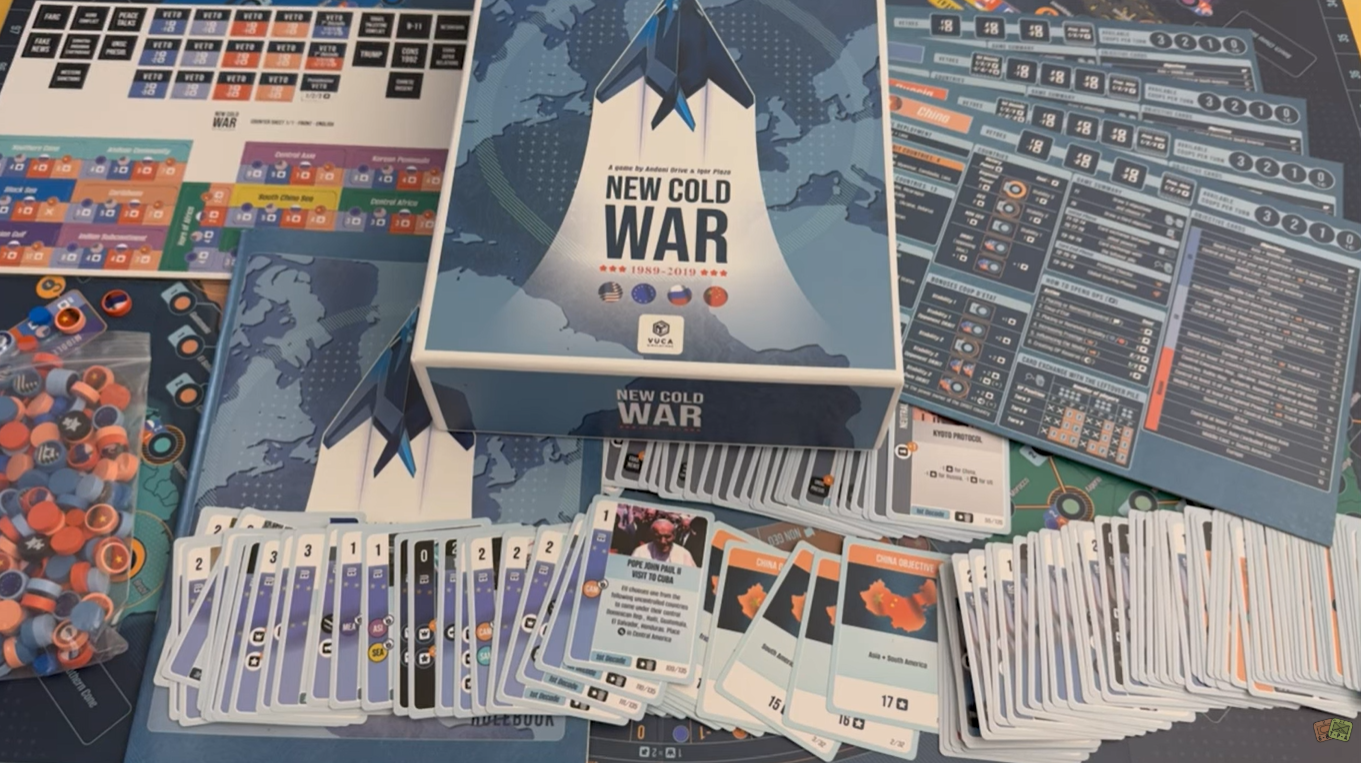
I am very tired of the cold and dreary days of winter. I want it to be warm soon but we are realistically a few months away from consistently nice weather. But, this month, even though the weather has been brutally cold, we saw a warming trend with historical wargames. This month for the Wargame Watch I was able to find 33 games (including the 3 games from our sponsor Bellica Third Generation). Interestingly though this was a cooler month for crowdfunding as I only found 4 games featured on Kickstarter or Gamefound.
This month again we have a sponsor for the Wargame Watch in Bellica Third Generation, or Bellica 3G for short, owned by designer Francisco Ronco. I asked him to write up a summary of his company and their core values and he has provided the following:
Bellica Third Generation is a group of players with many games played between them and a longstanding and deep interest in everything related to Military History. Our members come from Cadiz and Seville (Spain) and we are proud to have started this Andalusian and Spanish project in the field of strategy and simulation games.
Please let us introduce ourselves:
Francisco Ronco Poce (1969).
Game designer and producer. A Napoleonic fan for over 45 years. He is both the heart and manager of the team. And has designed the four first game series that our company will start developing shortly.
Reyes Gallardo Gutiérrez (1978)
Our newest gamer. A military history enthusiast as a hobby and teacher of physics at a secondary school by trade. She is an outstanding playtester, with a critical and analytic mind.
Ramón López Martín (1973).
An experienced gamer. Game designer and play tester. Well known for his skill eliminating all game counters in play; both his and his opponent’s…
What do we do?
Strategy and simulation games. In fact they are “cardboard simulators”. Computer and video games based on the simulation of car races, first person adventures, aircraft -or spacecraft flight- or tank driving are both widely accepted and successful. Now we propose something similar; our games strive to make the player confront the experiences that historical commanders and leaders lived. Facing the same situations, managing resources and making decisions about a hardly predictable outcome.
The main attributes of a simulation as we understand it are:
Resource management
Essential role of logistics
Game centred on decision marketing
Uncertainty and fog of war
All of them are present in every one of our games. With the firm intent of achieving this with the least possible number of rules. We do not feel that elaborate and complex rules are necessary if the internal dynamics of a game system can produce the desired effect. Likewise, it is our intention to follow an editorial line based on game SERIES, thus the players may learn a new game effortlessly having to deal with just a negligible number of new special rules. In our view, the games will contain a “Series Rulebook” dealing with all the elements forming the game system and another “Special Rulebook” containing those rules that reflect the peculiarities of a given scenario.
Our commitment is to offer the player a maximum of playability and variability for their money without an unnecessary effort or learning rules. Our simulations are fun to play, both for those who are already versed in Military History – since they are simulation models – and for the uninitiated looking for a good opportunity to learn the hobby.
After years playing war games of all kinds, periods and scales (from World War II to Ancient Rome, including XVIII century or Napoleonic tactical games) we are convinced that there are basically two different approaches to war gaming; one is game oriented while the other emphasizes simulation. To reach an equilibrium between these two tendencies is not an easy task. There are games whose mechanics and effects might equally apply to a Panzer Division or a Roman Legion. These games are usually easy to learn and are nicely presented, essentially they provide competitive play, are fun and quick paced. Others try to accurately portray a period, campaign or battle where the player must play the role of a corporal firing a machine gun and –at the same time- that of the Army Corps Commander; sometimes they have plenty of rules, exceptions and an alleged “realism”. Quite often, this double perspective has presented “playability” as opposed to “realism”. Quite often, this double perspective has presented “playability” as opposed to “realism”. We think that this approach completely misses the point; We rather see it as a question of “game” vs “simulation”.
We make games:
Rules systems that allow players to perform certain actions while forbid others; with goals that all participants may and want to reach. But our desire is to provide “simulations”; our rules try to establish a framework as close as possible to the one that historical participants faced so that the goals that players must achieve correspond to their historical counterparts, then it is up to the players to find the means.
We have produced not only in-house designs but also designs from other designers. Recently, we have released An Impossible War from David Gómez Relloso -designer of the famous Crusade & Revolution from Compass Games.
An Impossible War is a game about the decisive years of the First Carlist War in the North. Infantry and cavalry are represented by blocks, which introduce fog of war into operations. There are also artillery counters (field and mountain artillery) and logistics units (supply trains and backpacks).
The main map is a point-to-point board covering the northern theater of operations: Navarre, the Basque Country, and surrounding areas of La Rioja, Burgos, and Cantabria. In addition to provincial capitals, major towns and other localities are shown, along with primary and secondary routes of communication. There is also a smaller map of the rest of peninsular Spain, showing the regions affected by the Carlist uprising and allowing expeditions being launched from the North.
Each turn, players compete for initiative and carry out a variable number of actions. There is also a card deck for each side, including historical, operational, and tactical events. The cards add background and unpredictability to the game, helping make each session different. This is NOT a card-driven game, but one assisted by cards.
An Impossible War simulates the historical conflict, which featured numerous skirmishes, few major battles, and significant siege warfare. It is an asymmetric game in which each side has strengths and weaknesses. Players must exploit their advantages and mitigate their disadvantages to achieve victory.
The Carlist player must make use of superior mobility and unit quality to consolidate territory, wear down the enemy, and threaten cities. The Liberal player must contain and suppress the insurrection; they have more troops, but of lower quality and plagued by logistical nightmares. Additionally, they must quell uprisings and chase down Carlist expeditions across the rest of Spain.
We produced the games fully in Spanish and English versions, this game also had an Italian version.
Now we are preparing the reprint of our small but well-known Santa Cruz 1797, the forefather of Von Manstein’s Triumph and Castelnuovo 1539. And the soon to be released Volume IV of the Campaign Commander Series: White Sea, which covers the Spanish-Ottoman struggle in the Mediterranean from 1565 to 1574.
Both of these games are planned to be released later this year.
In summary, here is a look at a sampling of Bellica Third Generation’s games from their website. Many of these are out of print but can be found on the secondary market at places like Noble Knight Games. Click the image below to be taken to the Bellica Third Generation selection of games at NKG.
But now onto the games for March!
Pre-Order
1. Combat! 4: Eastern Front from Compass Games
This month we had another one of the huge downloading of a large amount of new pre-order games from Compass Games that I have affectionately referred to in the past as “Pre-Order Palooza”. The first game that I am highlighting here is the next volume in the highly thought of Combat! Series of solitaire wargames. These games represent man to man combat on the battlefields of World War II where typically each of the counters on the board represent a single soldier. This small tactical scale is one of my favorite wargaming modes as I just enjoy the decisions required regarding movement, the use of tactical strategy such as scoot and shoot, throwing smoke for cover, suppressing fire and the like. I have yet to play any of the previous 3 volumes, even though I own all 3, but they are high on my want to play list and I am very much interested in this system.
The newest volume is called Combat! 4: Eastern From and deals with the fierce fighting on the East Front of World War II during Operation Barbarossa in 1941-1943.
From the game page, we read the following:
Combat! is a solitaire game series of man-to-man combat in World War II. This is the fourth game in the series. The system uses a unique AI to make for intense combat situations as well as unlimited replayability. You will stand on the defense against a relentless foe. Can you hold on?
Combat! Eastern Front is a solitaire game of man-to-man combat on the Eastern Front in WWII. The player can command a squad of German or Soviet soldiers in various engagements. This game includes the all-new Series Rules, which have been clarified and streamlined from the original rules, and now enable players to control either nationality in this game.
There are 11 tense scenarios across 4 full-size maps ranging from forest partisan warfare, to urban fighting in Stalingrad, to desperate battles on the steppes. A comprehensive random scenario generator further expands the possibilities and will create a limitless supply of unique scenarios. In addition, the included campaign game allows the player to lead a squad of men through 10 battles.
One of the things that I do like about this system and the various volumes is that it is not just cookie cutter churning out new games but each game has their own unique elements modeled into the game play as special rules or changes to account for the history of the setting. Here is a look at the changes in this new volume:
Soviet and German OOB’s contrast the crude but determined Red Army with the efficient Wehrmacht.
City fighting with demolition charges, factories, upper stories, fortress buildings, and other forms of close-quarter fighting.
Light Mortars are long-range nuisances able to saturate an enemy position with explosives.
Weather and Fire add flavor and realism to any battle.
Artillery is now a frightful weapon with a new and accurate placement process.
Confidence rules ensure that a side will not fight to the last man, but may retreat or waver if they sustain too many casualties.
2. Man of War: Fleet Combat in the Age of Sail, 1775-1815 from Compass Games
I have only ever played a few Age of Sail games but have always been interested in the era and the concept of gaming that out on the tabletop. One of the recent pre-order offerings from Compass Games is Man of War: : Fleet Combat in the Age of Sail, 1775-1815 designed by Stephen Newberg. The game looks very interesting and I am definitely looking forward to seeing what it has to offer.
From the game page, we read the following:
Man of War is a game of naval combat between sailing ships from 1775 to 1815. Turns are of variable length and represent up to 4 minutes. Ships are represented individually, but the concentration of the game system is on actions involving a number of ships on each side, that is, squadron and fleet level actions.
Rules cover wind speed and direction, which affect movement. The firing broadsides with crews rated for their proficiency ranging from green to excellent. It is possible to board enemy ships, have them strike the colors, and take them as a prize!
You take command from the viewpoint of a fleet commander.
The game is scenario based and it offers a total of 12 historical playable scenarios as follows:
• USHANT, 27 July, 1778
• DOGGER BANK, 5 August 1781
• CHESAPEAKE BAY, 5 September 1781
• MADRAS, 17 February 1782
• THE SAINTS, 12 April 1782
• THE GLORIOUS FIRST OF JUNE, 1794
• CAPE ST. VINCENT, 14 February 1797
• CAMPERDOWN, 11 October 1797
• CABRITA POINT, 12 July 1801
• TRAFALGAR, 21 October 1805
• SAN DOMINGO, 5 February 1806
• LISSA, 14 March 1811
I think that one of the most interesting parts of the way this is designed is that there is an ability to create custom scenarios to play out “what-if” scenarios or to create larger battles with tons of ships just because you can.
As I said above, I have not had the chance to play any of the games in the Combat! Series but am interested in them and own the 1st 3 volumes. This month, Compass Games released information on their next volume following Combat! 4: Eastern Front, which was just announced as well, called Combat! Crete. Combat! Crete is a stand-along game that can be played without any other games in the series. When I saw this I was immediately taken as I have played a few smaller scale tactical games on the ground combat in Crete but was excited to see this subject come to a solitaire system. And the opportunity to play as the British Tommies against the German Fallschirmjäger is always a welcome opportunity on my gaming table!
From the game page, we read the following:
Combat! Crete is a stand-alone solitaire game of man-to-man combat in WWII. The player commands a squad of British Tommies or German Fallschirmjäger in various engagements. The included scenarios are set on the islands of Crete and Leros, but full-war OOB’s are included for both factions.
The comprehensive Random Scenario generator further expands your gaming possibilities. With this tool, players can generate a limitless supply of unique scenarios for Combat! Crete or combine their game with Combat! Eastern Front and/or Combat! Tunisia & Sicily to create an even more expansive gaming experience.
In addition, the included Campaign Game allows the player to lead a squad of men through 10 battles, gaining experience along the way.
One of the things that I do like about this system and the various volumes is that it is not just cookie cutter churning out new games but each game has their own unique elements modeled into the game play as special rules or changes to account for the history of the setting. Here is a look at the changes in this new volume:
Off Board Artillery rules including air support (Stukas!).
New Terrain types including Vineyards, Weapon Pits, and an Airfield.
Parachute Drops, with a massive four map paradrop scenario.
Scenarios with Australian, New Zealand, and Maori troops.
Scenarios on Leros which feature Fallschirmjägers with FG42s.
Competitive Play rules for head-to-head battles!
Armed Cretan Civilians give the Fallschirmjägers a nasty welcome.
I have played a few games from Joe Miranda over the years and have always found them to be good and well designed games. This month, Compass released a 2-pack of a few of his interesting card driven games called Imperial Wars. This box set includes 2 games in the card-driven Imperial Wars System—Sikh War and Caucasus Campaign. Both become a contest between great powers fighting for control of regions with wider strategic implications. With multiple scenarios for each game, Imperial Wars provides you with many opportunities to alter the course of history on far-flung and lesser gamed frontiers. This box set really looks unique and I am very much intrigued and will be reaching out to Joe to see if I can get a designer interview completed to share.
From the game page, we read the following:
Sikh Wars covers the 1845-46 conflict between the British Indian Empire and the Sikh Kingdom of the Punjab. Roth powers were expanding in northwest India, and their armies clashed from the Sutlej River to the outskirts of Afghanistan. The war led to the later expansion of British India to what became the Northwest Frontier.
Caucasus Campaign has the Russian and Ottoman Empires fighting for control of the mountainous region between the Black and Caspian Seas as part of the wider Crimean War. This campaign had a considerable impact on the future of the Middle East.
Players command armies composed of regiments, brigades, and divisions, which fight using battle and skirmish combat results tables. Certain units have elite status, giving them greater resiliency in combat. The many imponderables of leadership, expeditionary warfare, and chaotic political situations are accounted for in each player’s deck of Campaign cards. Astute play of cards can decide a battle or spark an uprising deep within enemy territory.
Both games have multiple scenarios. There are also options for bringing in additional forces, which can swing the tide of a campaign. Each game becomes a contest between great powers fighting for control of regions with wider strategic implications. Imperial Wars provides the opportunity to alter the course of history on far-flung frontiers
We have played several of Adam Starkweather’s games and systems and have very much enjoyed them, particularly the Company Scale System or CSS. He is a very solid designer and his newest game coming from Compass Games is Warriors of Mexico, which deals with the Mexican-American War of 1846-1848. The game looks to be pretty good and uses the system first seen in Warriors of America and Warriors of Politics, adapted to the unique military situation that existed in 1846.
From the game page, we read the following:
Warriors of Mexico is a fast-playing game of the conflict between the United States and Mexico from 1846 to 1848, using a similar system to the one used in Warriors of America and Warriors of Politics, but adapted to the unique military situation that existed in 1846. As was the case in those times, image and perception are as important as military success. Players will navigate the treacherous waters of time and yet fulfill America’s ambitious land expansion.
6. The Battles of Burgoyne’s Campaigns from Compass Games
Several years ago, while attending Buckeye Game Fest in Columbus, Ohio, we met a new designer named Ken Repel and got a chance to take a look at a few of his games including 1812! War on the Great Lakes Frontier from Compass Games and The Battles ofBurgoyne’s Campaign that was announced this past month from Compass Games. The summer and fall of 1777 was a major turning point in the fate of the American Colonies and the Revolutionary War and this game captures the action at 3 of those key battles including the Battle of Hubbardton, the Battle of Bennington and the Battle of Freeman’s Farm.
From the game page, we read the following:
During the sweltering summer of 1777, the American Revolution reached a turning point in the rugged terrain of upstate New York where the Saratoga Campaign unfolded. Led by General John Burgoyne, the British Army marched south from Canada aiming to cleave the American colonies in two by defeating General Horatio Gates’ Continental Army, capturing the Hudson River Valley and gaining control of Albany.
The Battles of Burgoyne’s Campaign is a 2-sided historical board game with one player commanding the Gates’ Continental Army and the other player commanding Burgoyne’s British Army. The game depicts three critically important battles fought during the Saratoga Campaign of 1777, The Battle of Hubbardton, The Battle of Bennington, and The Battle of Freeman’s Farm. Each contest presents the players with a unique tactical situation: Hubbardton is a rearguard action, Bennington a surprise attack, and Freeman’s Farm a meeting engagement.
While attending Buckeye Game Fest in the Spring of 2023, we shot the following video that contains a discussion about this game. You can watch that at the following link:
I was once told that you cannot understand warfare until you under naval warfare and how important it is to the overall scope of the tactics. Well, a new game called Lords of the Seas appears to examine strategic naval warfare during the 5th Century through the 16th Century AD. The game is designed by Stephen Newberg, who has done several naval focused wargames, and is set in the Mediterranean Sea.
From the game page, we read the following:
Lords of the Seas is an uncomplicated 2-player war game centered on the naval campaigns during the era when rowed warships vied for dominance of the Great Middle Sea, the Mediterranean.
The game depicts this conflict at a strategic level, with most operational and tactical details represented by fast and easy-to-play systems, rather than intricate mechanisms.
Players take the part of the commanding leadership of opposing States in historically-based scenarios. The intent of the game is to provide a broad overview of the historical events while being fun to play.
The object of the game is for each player to use their naval forces to keep open the trade routes of their State while also controlling the coastal sea areas needed for the land forces operations of their respective States.
The specifics of these objectives are set out in each scenario, as well as the forces involved, any reinforcements arriving, and the time frame of the scenario or campaign. The time scale of the game is 2 turns per year.
Both players must obtain their objectives by deploying their naval resources into the sea areas on the map and engaging in combats that are resolved on the Battle Board.
Victory points are earned for sea areas and trade routes under their control at the end of each turn of the scenario, as well as for inflicting hits on opposing units in combat. Each represents an individual State as indicated by the scenario.
The Boer War is a conflict that I have never really played a game on. I know that there are several out there but I have just not had a chance but maybe that will change with this beauty called simply Boer War from Compass Games.
From the game page, we read the following:
The Boers, white settlers of Dutch and French descent, started to colonize the shores of what would become Cape Town in 1652. Over time, British settlers and pressure forced them inland, where they founded the Orange Free State and Transvaal, isolated areas rich in gold and diamonds. The British continued to try to subdue the Boers in the Transvaal War of 1881 and the Jameson Raid of 1895. Anticipating a third attempt by a feared invasion, the Boers decided to invade the British colonies first in October of 1899. It is here that the game begins.
Boer War is a 1-2 player game split into two phases, the Conventional War Phase and the Guerrilla Phase. It is played in 6 turns, with each player alternating between spending Action Points and playing Event Cards. With unique victory conditions and Event Cards for each phase, and the Guerrilla Phase being playable as a separate scenario, players get two games in one box. As the British try to keep up their Morale and the Boers destroy and plunder through Guerrilla warfare, who will be the one in control when no one is left standing?
9. Historical Advanced Squad Leader (HASL) ModulePrelude to War: Marco Polo Bridge, 8 July, 1937 from Multi-Man Publishing
Last year, I finally played ASL! As you may have seen, I wrote my First Impressions post about the Advanced Squad Leader Starter Kit #4: Pacific Theater of Operations after playing a scenario with a friend I had a very enjoyable time. I still have lots to learn and lots to experience but at least that first plunge is done. And I definitely want to play more! So this month, I saw that they are bringing back a few things including ASL Prelude to War: Marco Polo Bridget, 8 July, 1937.
From the game page, we read the following:
Prelude To War: Marco Polo Bridge is a Historical Advanced Squad Leader (HASL) module depicting the battle outside the walled town on Wanping, China on July 8, 1937 when Chinese troops resisted Japanese attempts to force their way into town on the pretext of finding a lost soldier. This precipitated the War of Resistance Against Japanese Aggression, commonly called the Second Sino-Japanese War, which was the start of WWII. The battle focuses on the key railroad bridge over the Yongding River just outside the walled town.
Prelude To War: Marco Polo Bridge comes with a historically accurate 22″ x 34″ map of the area outside the walled town crafted by designer Ken Dunn and artist Charlie Kibler. There are five stand-alone scenarios on the map recreating portions of the battle. Then there is the Campaign Game covering the entire action, with the calendar day divided into five Campaign Game scenarios separated by a special Refit Phase that allows players to regroup and reposition their forces. The Campaign Game starts with the Japanese attacking onto the map to capture the bridge, followed by the desperate Chinese defense of the bridge and the Dragon Temple (a prominent feature east of the river), the possibility of a Japanese river assault in boats, and concludes with a Chinese night assault by special broad-sword equipped Volunteer units. The only other ASL modules needed to play are Beyond Valor and Rising Sun.
If you are interested in Historical Advanced Squad Leader (HASL) ModulePrelude to War: Marco Polo Bridge, 8 July, 1937, you can pre-order a copy for $33.00 from the Multi-Man Publishing website at the following link: https://mmpgamers.com/asl-prelude-to-war-marco-polo-bridge-p-455
10. Advanced Squad Leader Starter Kit Historical Module (HASLSK) Prelude to War: Marco Polo Bridge from Multi-Man Publishing
And along with the regular ASL Historical Module for Marco Polo Bridge, they also offered their Starter Kit version of the game on pre-order. I will be picking this one up this summer at WBC hopefully and add it to my ASL Starter Kit #4 box.
From the game page, we read the following:
Prelude To War: Marco Polo Bridge (SK) is the second Advanced Squad Leader Starter Kit Historical Module and covers the battle outside the walled town on Wanping, China on July 8, 1937 when Chinese troops resisted Japanese attempts to force their way into town on the pretext of finding a lost soldier. This precipitated the War of Resistance Against Japanese Aggression, commonly called the Second Sino-Japanese War, which was the start of WWII. The battle focuses on the key railroad bridge over the Yongding River just outside the walled town.
Prelude To War: Marco Polo Bridge (SK) comes with a historically accurate 22″ x 34″ map of the area outside the walled town crafted by designer Ken Dunn and artist Charlie Kibler. There are five stand-alone scenarios on the map recreating portions of the battle. Then there is the Campaign Game covering the entire action, with the calendar day divided into five Campaign Game scenarios separated by a special Refit Phase that allows players to regroup and reposition their forces. The Campaign Game starts with the Japanese attacking onto the map to capture the bridge, followed by the desperate Chinese defense of the bridge and the Dragon King Temple (a prominent feature east of the river), and concludes with a Chinese night assault by special broad-sword equipped Volunteer units. All the necessary counters for Chinese units are included. ASL Starter Kit #4 (Japanese) is required to play.
Prelude To War: Marco Polo Bridge (SK) contains:
one box and lid
one 22″ x 34″ map sheet
two counter sheets
five scenarios
one Campaign Game rules booklet, with all of the new rules needed to play the scenarios and the Campaign Game, including rules for rivers, railroads, bridges, hedges, roadblocks, offboard artillery, night combat, and special broad-sword equipped Chinese Volunteer units.
one page Data Chart
one reduced-size copy of the map sheet
If you are interested in Historical Advanced Squad Leader (HASL) ModulePrelude to War: Marco Polo Bridge, 8 July, 1937, you can pre-order a copy for $33.00 from the Multi-Man Publishing website at the following link: https://mmpgamers.com/asl-prelude-to-war-marco-polo-bridge-p-455
11. Peking: 55 Days of Fury from Neva Game Press
Neva Games Press (formerly Neva Wargames) is a new publisher who has appeared on the scene in the past couple of years. When I started seeing their posts on Twitter and Facebook, I was immediately impressed with their interesting topic choices for their upcoming games as well as the fact that they are trying to make small footprint wargames that pack a punch. And the art is also very appealing and brings an aesthetically pleasing and attractive look to their games! Their next set of pre-order games is ready to launch in mid-March and the first game that I will highlight here is Peking: 55 Days of Fury that deals with the Boxer Rebellion in China in 1900.
From the game page, we read the following:
Peking: 55 Days of Fury is a tactical wargame that places players in the heart of the 1900 Boxer Rebellion. Players choose to command either the besieged Eight-Nation Alliance or the attacking Chinese forces, each with unique objectives and strategies.
The game is designed for 1-2 players and offers a tense, immersive experience lasting approximately 1.5 hours. In solo play, players take control of the beleaguered Eight-Nation Alliance.
Each turn represents roughly 11 days of the siege. The game board depicts the International Legations, divided into four main areas. Players use a combination of event cards and operation points to execute actions, such as firefights, raids, artillery attacks, and barricade repairs.
The game begins with an initiative phase, determining the order of play. The player with the initiative initiates a mandatory firefight, followed by the other player. Players then play event cards to trigger various effects, supported by additional cards if conditions are met.
Next, the eight nation alliance player must manage supplies, with shortages potentially leading to epidemics or desertions. In the operation phase, players use remaining cards as operation points to perform actions. Finally, the maintenance phase involves checking victory conditions, handling fog of war cards, and preparing for the next turn.
A distinctive fog-of-war mechanic sets this games apart. Mastering this element is key to outmaneuvering opponents.
Will you be able to withstand the siege and protect the International Legations?
Experience the intensity of the Boxer Rebellion in this tactical wargame.
I am currently working on a designer interview with the designer José Manuel Neva (who is also the owner of the company) and hope to have that out in the next few weeks.
12. Reformation: Fire and Faith from Neva Game Press
The 2nd game of Neva’s new release pre-order phase is the interesting looking Reformation: Fire and Faith designed by Clint Warren-Davey. I am keenly interested in this one and have been working with Clint to do an interview and maybe a series of other articles on strategies.
From the game page, we read the following:
Reformation: Fire and Faith is a game about the wars and religious struggles that raged in Europe from 1517 to 1555. This time saw the Protestant Reformation sparked by the renegade monk Martin Luther and the subsequent wars of religion in Germany and elsewhere, as Christianity was shaken to its core on. It saw numerous wars between the great powers of Europe regardless of religious affiliation. The Ottoman Empire was at its height and threatened the Christian world from the south-east, while at the same time new lands were discovered in the Americas that started a race for colonial expansion. In this game, 1 to 6 players will use their Armies, Fleets, Followers and Churches in an attempt to achieve their victory conditions and attain the most Victory Points (VP). It plays in about 60-90 minutes. The rules are very simple and easy to teach as the game was originally designed for use in a high school setting by the highly experienced game designer and teacher, Clint Warren-Davey. The game includes 6 unique Factions that are all competing for dominance in their own way
A few years ago, while attending SDHistCon we sat down with Sam London and played his new upcoming game called Common Sense (it was originally called Absolved from All Allegiance), which was recently announced on GMT Games P500. The game is an American Revolutionary War Strategic Level game that uses trick-taking and is a struggle over the Will to Fight Track that measures the level of commitment by both sides to the fight. We very much enjoyed playing the prototype and really could see what the design was trying to do and that it did it very well.
From the game page, we read the following:
Common Sense is an asymmetrical trick-taking card driven wargame. One player will take control of the 13 colonies in their fight for independence while the other uses the might of the British crown to quash the rebellion. The game revolves around the Will to Fight Track which tracks both sides’ willingness to continue to fight the war. As it is an asymmetrical game, both sides have different problems they will have to manage to resist the decline of their Will to Fight. The colonies are primarily concerned with morale and their ability to believe that they could potentially win their independence. Losing control of colonies and failures of the Continental Congress to galvanize the colonies will have the heaviest impact on their conviction. The British on the other hand never had hearts and minds to begin with, as the war was never popular at home. Instead, their Will to Fight represents parliament’s willingness to continue to fund the war. Poor results relative to commitment of forces as well as losses of British Regulars can spell a speedy exit from the war for them. The game will end when both player’s Will to Fight markers converge on the track, or rarely at the end of 1783, with position on the track determining much of the game’s scoring.
Common Sense is played with 2 unique 36 card decks. Each card in a player’s deck is also unique, and represents a key personality, battle, event, or concept from the American Revolution. Cards are divided into 4 suits, which are Battle, Mobilize, Recruit, and Special. Since the game is asymmetrical, while Battle, Mobilize, and Recruit serve similar purposes for both players, their actual executions vary in some ways. Battles let you engage in fights with the enemy in the same space, Mobilize lets you move your armies between spaces, and Recruit lets you bolster your forces. The Special suit on the other hand varies radically and really showcases differences between the two sides. The Colonial Special suit governs training of militia into the Continental Army as well as all interactions with the French. The British Special suit on the other hand manages native led operations as well as the might of the British navy. Each card grants a certain number of actions of a specific type, as well as a historical themed event. Events can be one off effects, powerful action modifiers for the current turn, or remain in play for multiple turns granting powerful abilities or changing core rules. Each card also has a numbered value that is used for the trick taking.
The game is played over a series of 10 card hands (each hand is considered a year of the war). Each year consists of 10 tricks, wherein the winner of the trick is given the chance to perform actions. The lead player chooses and plays a card from their hand face up. The other player then plays a card from their hand based on what their opponent played. If they have at least one card that matches the suit of the card their opponent played, they must play one of those cards. If not, they can play any card that they wish. If the card they played matched the suit of the lead player’s card and was the same value or higher, they win the trick and will get to take the turn and become the new lead player. Otherwise, the lead player gets the turn. If the responding player does not have a card of the matching suit they could also win by playing the highest value card they have of the trump suit that corresponds to the lead suit. In any case, the player who wins the trick gets to resolve the event on the card and perform the actions on the card. Alternatively, the player can always choose not to resolve the winning card to perform any one action of their choice.
Here is a link to a designer interview and discussion with Sam London regarding Common Sense at SDHistCon in 2024:
14. Iron Triangle: Search and Destroy Operations in the Vietnam War from GMT Games
A new series, and we have seen how well series have done at GMT GMT Games, a new designer and a new concept to wargaming (lane battler), I think that this game has great potential and it happens to be focused on one of my most liked wars to game – the Vietnam War. Iron Triangle: Search and Destroy Operations in the Vietnam War is designed by Darren McGuire takes a look at the struggle between the United States military and the Viet Cong insurgents as they fight over control of three key “lanes” or key regions. I am very much excited about this one and will be reaching out soon to Darren for some additional information.
From the game page, we read the following:
Iron Triangle opens the new Lines of ConflictSeries with a focused and tense asymmetric lane battler set during the Vietnam War search and destroy operations from 1966 up to the Tet Offensive in 1968. Two players assume opposing roles: the Viet Cong, leveraging concealment, mobility, and disruption, and the United States, applying sustained pressure and attritional tactics to limit insurgent influence. Across three rounds, players commit action cards to search and destroy operations along three lanes, contesting control of three key regions in III Corps: War Zone C, War Zone D, and the infamous Iron Triangle.
Each faction employs distinct tactical systems. The Viet Cong may deploy cards in three states—tunnelled (face down), concealed (face down and rotated), or exposed (face up)—and, through careful resource management, can flip and rotate these cards to conduct hit and run attacks and ambushes, lay booby traps, and establish Tunnel Bases to accelerate gains or blunt U.S. advances. The U.S. player focuses on revealing and eliminating insurgent units by exposing tunnelled and concealed Viet Cong cards with Tunnel Rats, restricting movement and concealment through tools such as Defoliation and ADSIDs (Air Delivered Seismic Intrusion Devices), or or employing more forceful measures such as napalm, saturation bombing, and zippo raids, which, while effective at disrupting Viet Cong support networks, also undermine the stability of urban areas like Saigon.
At the end of each round, players evaluate operational outcomes and their impact on control across the three areas, adjusting regional stability and tracking the resulting shifts in South Vietnamese public opinion. Players can achieve victory if the Viet Cong drives Public Opinion low enough or if the U.S. accomplishes its body count objective while stabilising the region. Otherwise, the conflict culminates in the Tet Offensive—a final chit-pull from a bag shaped by the position of control markers on the area tracks, remaining Viet Cong Tunnel Bases, and the scale of the refugee crisis—where each Tet chit drawn represents a stronger offensive that further erodes Public Opinion toward U.S failure.
I am all in on this concept and the new series and very much look forward to what might be included in future conflicts and how the series grows.
15. Levy & Campaign Ost Bot Solitaire System from GMT Games
One of the more active series out there today is the Levy & Campaign Series from GMT Games from the mind of Volko Ruhnke. The series had its start with Nevsky: Teutons & Rus in Collision, 1240-1242 and then followed that up with Almoravid: Reconquista and Riposte in Spain, 1085-1086. Since that time, there have been multiple other games published including Inferno: Guelphs and Ghibellines Vie for Tuscany, 1259-1261 and the most recent Plantagenet: Cousins’ War for England, 1459 – 1485. In addition to the released volumes, there are many others on the P500 with at least another dozen (or more) that have yet to be announced but are being developed and playtested. With such a popular series and with solitaire gaming becoming a mandatory part of any new wargame, I am very glad to see that GMT has prioritized this new offering and released it on the P500. The Levy & Campaign Ost Bot Solitaire System is designed by Jan Arvanitakis and Christophe Correia, who have significant experience in developing the L&C Series and I couldn’t be more excited about this offering.
From the game page, we read the following:
Introducing Ost, a solitaire system for the acclaimed Levy and Campaign Series that allows you to play 5 Volumes in the series against a non-player opponent.
The system eases the tedium of bot upkeep and simplifies the implementation of the bot’s turn so that you can concentrate on your move.
Your opponent will complete the game’s signature Levy & Campaign phases of each turn—including Arts of War, Muster, & Call To Arms. On its turn, a Non-Player Active Actions flowchart will dictate the bot’s main action—March, Siege, Storm, Sally, Tax, etc. Then, a dedicated chart for each action will briskly lead the player through a number of simple Yes/No questions until the action’s full resolution. The system thus sidesteps the need to evaluate complex priorities and check for conditions each turn.
The bot does not use any assets, such as Provender and Coin, nor Levies Capabilities, further easing the burden of bot upkeep. Yet key Capabilities are incorporated as part of the bot’s actions, Battle, & Storm. The system features special rules for automating non-player Lords’ Service shifts on the Calendar, as well as preparing the bot’s Campaign Plan.
Ost will present you with an unpredictable and challenging, yet easy to implement opponent that is responsive to your moves and the current game state. It offers a realistic simulation of the moves a human player would make—like approaching your Lords in the field, laying siege to your Strongholds, blocking Supply Routes, and marching to friendly ground before an upcoming Levy phase.
Ost is named after the service d’ost, the French feudal military service owed by vassals to a Lord. It is an allusion to one of the game’s underlying concepts. The service d’ost, or ost, often lasted around 40 days per year and was imposed on all free men, vassals, and vavasors (a vassal’s vassal).
16. Next War: Korea 2nd Edition, 2nd Printing from GMT Games
The Next War Series of wargames from GMT is very popular and also very large and detailed. We still have been unable to get our copy of Next War: Korea to the table yet but one day we will. But, for now there is a 2nd Edition being offered on the P500.
From the game page we read the following:
This reprint edition includes all known errata (including counters) as well as updated counters for the US, Chinese, Russian, and Japanese Orders of Battle. The map has changed slightly as we bring both the bridging rules from Next War: India-Pakistan back to this game, which necessitates noting which hex sides can’t be bridged, as well as defining Beaches and Invasion Hexes a la Next War: Taiwan, which actually takes us back to the original Crisis: Korea 1995 map. The Series Rules and Player Aid Cards will be brought up to the latest standards, and, of course, the Game Specific Rules will have to be changed to incorporate all of the above.
From Pyongyang in North Korea to Pusan in the South, the war rages. In a scene reminiscent of the first attack by the In Min Gun in 1950, the North Korean People’s Army surges across the Demilitarized Zone and penetrates deep into South Korea. Special Operations Forces from both sides conduct raids, interdiction, and reconnaissance missions behind enemy lines while airborne, air assault, and amphibious forces strike far behind those lines attempting to outflank the main army forces of both sides. In the air, both sides wage a heated campaign in an effort establish superiority over the skies of Korea. With rough terrain and the full ferocity of modern armor, airmobile, airborne, and marine warfighting capabilities, there is no safe haven in the lethal cauldron of battle which has engulfed the Korean Peninsula.
While North and South battle for a quick, decisive victory, the world awaits the response of the two military superpowers in the region: the United States of America and the People’s Republic of China. Will the United States, stung by high casualties among the soldiers of its 2nd Infantry Division near the DMZ during the surprise artillery barrages and initial assaults on the first day of the war, be able to reinforce the South quickly enough, and, if so, how and in what strength? Will the Communist Chinese again react to a massive US response and intervene, thus widening the conflict? As the situation evolves, choices are made, forces are committed, and the security of Japan and the future of the two Koreas hangs in the balance.
Next War: Korea, Game #1 in our Next War series, allows players to fight a near future war on the Korean peninsula. In this updated and improved version of the previously-released Crisis: Korea 1995, players have access to virtually all military assets of North and South Korea, as well as large forces from the USA and the PRC. The integrated, easy to learn air-land combat system allows for unit efficiency, armor effects, light infantry, attack helicopters, Close Air Support, Cruise Missiles, and the particularly tough terrain of Korea.
Make no mistake: Next War: Korea is not an Introductory wargame. Rather, we have intended herein to create a system (and a series) that will allow detailed study of modern warfare in various venues as well as engaging gameplay. That said, the Standard Game rules encompass a fairly straightforward ruleset that will, we think, be considered pretty “easy to learn” by experienced wargamers. So players who choose to play Standard Game scenarios can have a relatively quick game when that’s what suits them. The real flavor of a war in the theatre, though, comes through in the Advanced Game, where you get much more control over airpower and can more clearly see each side’s strengths and weaknesses. For players who want a “mini-monster game” experience, playing the Advanced Game Campaign Scenarios with some or all of the optional rules will definitely “deliver.”
So our hope is that we have created a game with enough variety and scaling of complexity that you can find an engaging and maybe even enlightening experience whether you want to play a fast two-player game, a longer monster game, or an ongoing solitaire study. We intend to provide tools for online game play as well (a Vassal module is being created now for use during
17. Révolutions! France 1820-1880 from Fellowship of Simulations Coming to Kickstarter Soon
We have played and enjoyed several of the games offered by Fellowship of Simulations with my 3 favorite being Verdun 1916: Steel Inferno, Wars of Religion France 1562-1598 and Napoléon’s Conquests. They recently announced their next project that deals with the French Revolution called Révolutions! France 1820-1880, which is coming to Kickstarter soon.
From the game page, we read the following:
Révolutions – France 1820-1880 is an immersive political simulation for 3, 4 or 5 players.
Get ready to relive 60 years of political conflicts, civil wars and major societal choices. Whether in the Chamber of Deputies or on the barricades, Ultras, Orleanists, Bonapartists, Republicans or Socialists clash to ensure the triumph of their ideals. Each faction has its own starting situation, objectives and assets.
You’ll need to constantly adapt your strategy to the situation at hand, and convince allies to impose your vision of society.
Each turn, players begin by taking their action cards, which represent their supporters. They use them to develop their influence in six Society zones: Songs, Newspapers, Notables, Peasants, Workers and Clergy. They can also modify Social Tensions, which determine the stability of the government.
If the regime is stable, a Chamber of Deputies is elected. Players take advantage of the influence they have acquired in the Society zones to obtain votes. These votes give access to the best seats in the Chamber. Players receive political influence tokens according to their posi¬tion. Political influence is the «currency» that enables legislative action to change the current regime.
If social tensions become too great, Paris will rise up, and a civil war will begin. Players mobilize Society zones to support the government or fuel the insurrection. If the revolution triumphs, the victorious insurgents can make more radical changes to the state.
If you are interested in Révolutions! France 1820-1880, you can learn more about the project on the Kickstarter preview page at the following link: Révolutions! by Walter Vejdovsky — Kickstarter
18. Pacific War Games (including 1943: Race to Rabaul and Tora Tora Tora!) from PHALANX
PHALANX does some really great games and they have 2 new games that have been recently placed on pre-order in a 2-pack called Pacific War Games. This package includes 1943: Race to Rabaul designed by Volko Ruhnke and Tora Tora Tora! designed by Wataru Horiba.
From the game page, we read the following:
1943: Race to Rabaul
In 1943 the Allied push across the Pacific reached a critical phase. Every step toward Rabaul demanded nerve, planning and a constant fight with the limits of supply. 1943: Race to Rabaul puts you right in the middle of that pressure.
This time the series introduces opposed play. You can play as a team or head-to-head, with one or two players commanding the Japanese side and one or two leading the Americans. Both fronts chase momentum, both struggle with logistics and both try to outthink the other before their plans run dry. The map is wide, resources are tight and every choice has weight.
The result is a game where ambition always meets resistance, and the path to Rabaul is never straightforward.
Tora Tora Tora!
Tora Tora Tora! is a two-player strategic game that presents a holistic and dynamic view of the Pacific War. Rather than focusing on individual historical battles, the game captures the broader struggle for control across the theater, emphasizing tempo, positioning, and resource management.
Players take command of either Japan or the Allies, each operating under a different economic logic. Japan pays to expand across areas of the map, while the Allies pay per unit regardless of distance. This fundamental asymmetry shapes every decision, forcing each side to approach movement, expansion, and confrontation in a distinct way.
Actions require limited resources, and battles involve hidden commitments before resolution, creating tension even before dice are rolled. Overextending can leave forces undersupplied and vulnerable, so players must constantly balance immediate gains against long-term sustainability. The game rewards careful pressure, territorial control, and forcing the opponent into inefficient responses.
The game ends after a fixed number of rounds, and victory is determined by strategic control of key areas and overall position on the map. Winning is less about a single decisive clash and more about managing tempo, preserving strength, and gradually exhausting the opponent’s options.
If you are interested in Pacific War Games (including Race to Rabaul 1943 and Tora Tora Tora!), you can pre-order one or both of the games at the Gamefound page located at the following link: Pacific War Games by PHALANX – Gamefound
19. Fix Bayonets! Volume II1809: Talavera from Tactical Workshop Currently on Gamefound
Last year, I caught wind of a new edition of a very interesting looking Napoleonics wargame getting a second edition. The game was 1811: Albuera Second Edition from Tactical Workshop, which was originally released in 2020 designed by Frederic Delstanches. Now, he is seeking crowdfunding for the next game in the series called 1809: Talavera.
From the game page, we read the following:
1809: Talavera is the second volume in the Fix Bayonets! Series of Napoleonic tactical wargames. It covers, at the battalion level, the two days of the battle with one player in charge of the Anglo-Spanish armies and the other leading the French forces. The game allows players to recreate the eponymous battle of the Peninsular War, face to face with another player or as a solitaire experience.
Take command of the French army under Joseph, Napoleon’s older brother, and shatter the nascent Anglo-Spanish Alliance standing their ground near the town of Talavera! Alternatively, you can lead the Allied armies and attempt to hold the line with your disparate force. Can you equal the tactical victory achieved by the future Duke of Wellington and his Spanish ally general Cuesta or will the bloody engagement result in the rout of your armies?
As of March 1st, the Gamefound campaign has funded and raised $7,322 toward its $7,000 funding goal with 99 backers. The campaign will conclude on April 1, 2026 at 1:00am EST.
New Release
1. 2025 Errata Counter Sheet from GMT Games
Errata is a fact of life with all publishers and all games! No matter what, a mistake will always slip through and cause us gamers a bit of angst. This is where GMT Games stands head and shoulders above the competition though as they admit to their mistakes and more importantly try to make them right. We have seen this time and time again. So they have a solution for errata found on counters in their new games this year that makes a lot of sense and makes it economically very easy to acquire: a replacement countersheet.
From the P500 page, we read the following:
We are happy to announce today that we have created a 2025 Replacement Countersheet that includes all of the counter updates that we and the designers know of as errata for games from 2025. We’re setting this up as a P500 item like we did last year—except that it’s already approved to print. We just need to know how many of you want the item. Please get your order in over the coming few weeks so we can get these in your hands by year-end.
The price for this item will be $5 for US customers and $10 for non-US customers. Note that the cost INCLUDES shipping. Clearly, we’re supplementing most of the cost on these, which we think is only fair, in that these counters represent mostly errata that we missed when we produced the games the counters belong to.
The games with counters on the sheet are:
By Swords & Bayonets
Here I Stand NOTE: These are the same as the 2024 versions but not everyone got theirs so we’re printing them again.
2. Silent Victory: U.S. Submarines in the Pacific, 1941-45 3rd Printing from GMT Games
One of my favorite movies of all time is Das Boot. I know that this is a movie about a German submarine and I am using it as the introduction to a post about American submarines but it is simply so good and really helped to give me an understanding of the absolute hell that those submariners endured in the depths in a slender metal tube being depth charged to death. I remember the scene where the Chief Machinist Johann loses it and has to be restrained. As we follow along on the patrol of the U-96, we grow to understand the difficulty with which those men had to deal as they did their job and took the punishment. As you know, the movie ends when they are in a sub base and are bombed by Allied planes and we see the Captain and most of the crew shot up and dying as they watch the U-96 slip under the water. After playing Silent Victory, where the player takes the helm of an American submarine in the Pacific Ocean during World War II, I could understand (not physically or psychologically) emotionally how they felt, just a bit, as my boat was depth charged mercilessly and I simply could not get away from the Escort. Eventually, I did get away but not before I lost a few crew to injuries and basically nearly sank myself by deciding to go past test depth to escape.
From the game page, we read the following:
Silent Victory is a solitaire tactical level game placing you in command of an American submarine during WWII in the Pacific. Your mission is to destroy as much Japanese shipping and as many warships as possible while advancing your crew quality and decorations – all while remembering you have to make it home.
Silent Victory is purposely designed to deliver a brisk yet intensive gaming experience that forces many decisions upon you as you take command of one of the major U.S. Fleet submarine types in service. Patrols will take you to differing parts of the Pacific as time progresses in the war. The most successful commanders will be those that can manage the risks they take while prosecuting as many targets as possible.
The game engine is built upon the successful The Hunters design and has proven to be a solid, playable experience. All the major U.S. Fleet boat types are accounted for with every level of detail including period of service, armaments, crew makeup, damage capacity, and more.
As a Fleet submarine commander, you will be confronting many decisions during your patrols. To begin with, seven U.S. Fleet submarines are profiled and available for you to choose from. Patrol zones reflect the changing operational areas as the war progresses, from the Philippines to Midway, the Solomons, and even patrols to the waters just off the coast of Japan and China.
Conducting patrols is the heart of the system, as you will be resolving encounters against individual ships, convoys, or even enemy aircraft and submarines. Situations you face and decisions you make suddenly come in quick succession:
How will you engage a convoy once spotted?
Do you close the initial target range at increased risk of detection for a more lethal attack?
If your engagement is at night, will you conduct a surface attack?
Do you launch one or two fire salvos, and how many torpedoes do you fire?
Will you try to follow a convoy or ship to engage in additional rounds of combat?
How will you slip away from escorts to avoid or minimize damage?
3. The Hunters: German U-Boats at War, 1939-1943 4th Printing from GMT Games
Another fantastic solitaire submarine game designed by the incomparable Gregory M. Smith is The Hunters and they are now releasing the 4th Printing version of the game. 4 printings should tell you something about the game and how good it is!
From the game page, we read the following:
The Hunters is a solitaire tactical level game placing you in command of a German U-boat during WWII. Your mission is to destroy as much Allied Shipping and as many Capital ships as possible while advancing your crew quality and increasing your commander rank culminating in special decoration ‒ all while remembering you have to make it home.
The Hunters is purposely designed to deliver a brisk yet intensive gaming experience that forces many decisions upon you as you will take command among the major German U-boat models in service during WWII, and try to complete an entire tour. If you ultimately survive all patrols from 1939 to 1943, you will be transferred to the U-boat Training Command for the remainder of the war, having successfully carried out your service for the Fatherland.
Those familiar with the classic Avalon Hill game title, B-17: Queen of the Skies, will come to enjoy the same type of gaming experience of the German U-boat War. All major U-boat models are accounted for with every level of detail including period of service, armaments, crew make-up, damage capacity, and more.
As U-Boat commander, you will be confronting many decisions during your patrol. To begin with, eight German U-Boat models are profiled and available for you to choose from. Patrol zones reflect the time period during the war at sea and will shift as the war progresses. All stages of the U-Boat campaign are represented as missions become increasingly more difficult as your adversary makes advances in anti-submarine warfare.
Conducting patrols is the heart of the system as you will be resolving encounters against individual ships, convoys, or even enemy aircraft. Situations you face and decisions you make suddenly come in quick succession:
How will you engage a convoy once spotted?
Do you close the initial target range at increased risk of detection for a more lethal attack?
If your engagement is at night, will you conduct a surface attack?
Do you launch one or two fire salvos, and how many torpedoes do you fire?
Will you try to follow a convoy or ship to engage in additional rounds of combat?
How will you slip away from escorts to avoid or minimize damage?
What evasive maneuvers do you undertake?
The major German U-Boat models are represented and accurately profiled for the patrols you will undertake:
Type VII A
Type VII B
Type VII C
Type VII D
Type VII FlaK
Type IX A
Type IX B
Type IX C
Patrol Assignments include:
Atlantic
British Isles
Spanish Coast
Mediterranean
Norway
West African Coast
North America
Arctic
Caribbean
The game delivers an historical narrative as 350+ ship targets are uniquely identified (including tonnage) with their historical counterparts that were sunk during the war, including freighters, tankers, and American ships.
4. COIN Series Multi-Pack #2 The Guerilla Generation: Cold War Insurgencies in Latin America from GMT Games
Stephen Rangazas has been active behind the scenes over the past few years with his development work on Fall of Saigon: A Fire in the Lake Expansion. He used his background and research capabilities to great effect as he did the background work on the Event cards for that game. From that experience, he has now come forward with a few of his own designs in The British Way: Counterinsurgency at the End of Empire, which was announced in 2021 as well as Sovereign of Discord announced in 2022. Now, his most recent work on a new COIN Series Multi-Pack that deals with insurgencies in Latin America during the height of the Cold War called The Guerrilla Generation is shipping.
From the game page, we read the following:
The Guerrilla Generation: Cold War Insurgencies in Latin America is the second COINMulti-Pack, containing four separate games exploring a series of thematically related insurgencies. Building on the The British Way, this new multipack allows players to explore variations in insurgent groups’ organizational structures, strategies, and relationship with civilians, across four insurgencies in Central and South America between 1968 and 1992. During this part of the Cold War era, Latin America experienced an incredible number of different insurgent groups, many inspired by the Cuban Revolution featured in Cuba Libre, ranging from popular backed rural insurgencies, flexible urban guerrillas, externally sponsored raiders, and brutal ideologically rigid groups. This multipack features a game exemplifying each of these types of insurgencies, to offer players the chance to compare different approaches to rebellion highlighted in the quote by scholar Jeremy Weinstein above. The Guerrilla Generation also offers four longer and more complex individual games than those found in The British Way, as well as an entirely different approach to the linked campaign scenario, which combines two games into a simultaneous side-by-side experience.
This Multi-Pack includes four full games in one box, which is a fantastic value that will allow players to explore four different conflicts set during the height of Cold War Latin America between 1968 and 1992. Each game uses a unique ruleset building on the same general mechanical structure, ensuring that they are easy to pick up while still offering a distinctive experience.
I also love these Multi-Packs because they have a small board footprint with each of the 4 games playing in under 2 hours and taking place on a single 17” x 22” board. But, the game doesn’t just treat these games as individual as they are designed to experience at least a portion of the full span of the period and be used to learn more about these insurgencies.
There is also a “Resisting Reagan” Campaign designed into the game. A linked campaign scenario allowing up to 4 players to play El Salvador and Nicaragua side-by-side, with new mechanisms to represent the Central American peace and solidarity movement’s efforts to resist the Reagan Administration’s aid to both the Salvadoran government and the Contra insurgency, by influencing Congress and American public opinion.
5. Battle of the Bismarck Sea from War Diary Publications
As I was recently trolling the internet, I came across a new solitaire game from the guys over at War Diary Publications. The game is called Battle of the Bismarck Sea and is designed by Allyn Vannoy.
From the game page, we read the following:
Battle of the Bismarck Sea is a solitaire wargame that uses individual ships and flights/squadrons of aircraft. The Player assumes the role of General George Kenney, Commander of the 5th U.S. Army Air Force, with the mission of intercepting the Japanese effort to reinforce its ground forces on the island of New Guinea. The Player must utilize the limited resources available and then determine how best to apply them within specific time constraints. The results of these efforts will be borne out in the effectiveness of air operations.
This design by Allyn Vannoy contains: one 22″ x 32″ Mapsheet, a 16-page rulebook, one Player Aid Card, and 114 oversized laser-cut counters.
6. Souls to Waste: The Battle of An Bao, May 5, 1968 from High Flying Dice Games
Paul Rohrbaugh is a designer I love to follow. He is always doing games on smaller or lesser known conflicts and I just find his work to be superb and really draws me in. He has done a line of games dealing with different battles from the Vietnam War and always names them after popular songs of the time including games like Long Cruel Woman: The Attack on Firebase Mary Ann, March 28, 197, No Satisfaction: Operation Hump November 5-8, 1965 and As Tears Go By: Operation StarliteAugust 1965. Recently I saw one of their newest games on the Battle of An Bao called Souls to Waste and I guess it might be named after the Rolling Stone’s song Sympathy for the Devil (Souls to Waste).
From the game page, we read the following:
Souls to Waste portrays the epic fight waged between the 1st Battalion, 50th Infantry Regiment of the 173rd Airborne Brigade and tanks and the 1/69th Tank Battalion against three Battalions of the 22nd Regiment, 3rd PAVN (People’s Army of Vietnam) Infantry Division.
The NVA laid a trap in the hills to the west of three firebases maintained by the 173rd Infantry Brigade. The NVA’s 22nd Infantry Regiment was recently deployed to the area and well-armed with the latest Soviet weaponry, especially new Rocket-Propelled Grenades (RPGs) that could easily penetrate the armor of the American’s M-113 Armored Personnel Carriers (APCs), as well as mortars and heavy machine guns. The goal was to lure one of the US troop companies into an ambush, and then either inflict more casualties on any relief force that would come to their aid, or fall back and do it again at a time and place of their choosing.
Each turn represents 30 minutes of time. An inch on the map corresponds to about 100 yards in actual distance. Infantry type units are platoons, and armored units represent 1 or 2 vehicles.
If you are interested in Souls to Waste: The Battle of An Bao, May 5, 1968, you can order a copy for $22.95 from the High Flying Dice Games website at the following link: https://www.hfdgames.com/anbao.html
7. Death or Glory: The Battle of Rorke’s Drift from Art of Wargames
Solitaires games are plentiful this month and another one that I found was Death or Glory: The Battle of Rorke’s Drift from Art of Wargames. This one looks pretty interesting and has some really interesting mechanics to it. Plus, it is a solitaire game on one of the most known and greatest battles of history.
From the game page, we read the following:
Dive into history and Heroism in Death or Glory: The Battle of Rorke’s Drift, a war game that immerses you in the heart of this legendary clash. Relive the valiant stand of 150 British soldiers as they defend a mission station against a Zulu “impi” numbering in the thousands, during the Anglo-Zulu War of 1879.
As the clock strikes 4:30 PM, the earth trembled with the thundering chant of “Usuthu!” – the Zulu battle cry. Masses of warriors surged forward in wave after wave, their horns echoing across the plains and their assegai spears flashing in the sun. The British defenders, entrenched in the makeshift redoubt, met the onslaught with unwavering resolve and disciplined volleys of rifle fire.
When the dust settled, the battlefield lied eerily quiet, strewn with hundreds of casualties. Eleven British heroes will be awarded the Victoria Cross for their extraordinary bravery.
8. And the War Came: American Civil War 1861-1865 from Pinkerton Games
Add this one to the publisher that I didn’t know about until now category but this game looks to be very interesting. And the War Came: American Civil War 1861-1865 from Pinkerton Games is a strategic level look at the American Civil War and looks to be well made with good solid components.
From the game page, we read the following:
Civil war came to the United States on April 12, 1861, and finally ended 4 bloody Aprils later in 1865. And The War Came is a strategic level boardgame on that conflict, the American Civil War. Play either the side of the United States, attempting to restore the Union; or the rebelling Confederate States of America attempting to gain southern independence.
The game is “We Go” turn based. In the same three-month seasonal turn, both players recruit and mobilize replacement units, promote and reassign generals, play orders cards to activate corps sized units to conduct area movement and engage in combat, and perform logistics functions.
By both land and naval movement, or successful combat actions, players gain victory points by seizing areas or taking victory points away from the enemy. Generals may command units in combat and movement, and higher ranked generals can command more units-but generals may also be killed, wounded or captured. To create fog of war and uncertainty there are covers that hide unit strength and type from the opposing side until committed to combat.
There are four short length yearly scenarios (1861 through 1864), two multi-year campaign scenarios, (1861-1863, and 1863-1865) and the entire war scenario. Select a Scenario, deploy your troops, and prepare for action!
VUCA Simulations is a new company on the scene the last few years and they are coming out with some really great looking games. We have played several of their games and always have a great experience with them. One of their newest pre-order offerings is called Operation Overlord designed by Clem. It covers the D-Day invasion and as usual looks to be of the highest quality and production.
From the game page, we read the following:
Operation Overlord is a deep, historically grounded strategic wargame that simulates the Normandy invasion and the critical battles that followed from June to August 1944. One player commands the Allied SHAEF forces, planning and executing the largest amphibious operation in history, while the opposing player takes the role of Oberbefehlshaber West, defending the Atlantic Wall and attempting to delay the Allied advance long enough to alter the course of the war.
Rather than focusing on tactical skirmishes, Operation Overlord operates at the operational–strategic level, where timing, logistics, intelligence, and command structure are decisive. Players maneuver divisions and army corps across a detailed map of Normandy, manage supply networks and reinforcements, execute historical and fictional operations, and influence battles through doctrine, supports, and event cards.
Each month begins with high-level planning: the Allied player secretly schedules strategic and special operations, while the German player designates key cities as Festungen, to be held at all costs. Weekly turns then unfold through intelligence gathering, supply allocation, reinforcement arrivals, and alternating unit activations that combine maneuver and combat into a tense, fluid system. Fog of war is maintained through hidden unit values and simultaneous combat card reveals, ensuring constant uncertainty and meaningful decision-making.
Victory is not measured simply by territory, but by time and consequences. The German player is unlikely to drive the Allies back into the sea—but every week gained has far-reaching implications for morale, resources, and other fronts of the war. Likewise, an Allied breakthrough ahead of schedule can dramatically reshape history. Each scenario and campaign outcome includes historically reasoned consequences that frame the result within the broader context of World War II.
With multiple scenarios (June, July, August, and a full campaign), robust asymmetry, and a strong emphasis on planning and operational art, Operation Overlord offers a demanding and rewarding experience for players seeking a serious, historically informed wargame.
If you are interested in Operation Overlord, you can order a copy for €119,99 ($141.68 in US Dollars) from the VUCA Simulations website at the following link: https://vucasims.com/products/operation-overlord
10. Hold the Line: Hannibal from Worthington Publishing
Love me some Ancients and particularly if those Ancients include elephants! Such is the case with the newest game from Worthington Publishing called Hold the Line: Hannibal. The Hold the Line Series is a series of historical wargames by Worthington Publishing focused typically on horse-and-musket era combat, specifically the American Revolution. The game features quick-playing, tactical, hex-based scenarios and the series uses custom dice for combat.
From the game page, we read the following:
Hold the Line: Hannibal is a grand tactical two-player game covering 10 of the greatest battles of the Punic Wars. Following in the footsteps of Richard Borg’s Commands and Colors system and more directly Worthington’s Hold the Line series, Hannibal includes the same standard size map board, 13 hexes wide and 9 hexes deep. Combat is resolved with custom dice.
The scale is 300-400 meters per hex, 90 minutes per turn and units of 3-6,000 infantry, 2-4,000 cavalry and 15-25 war elephants. The units are mainly of 4-steps and include four types of infantry: elite, regular, barbarian and light; three types of cavalry: regular, barbarian and light; and, of course, war elephants. Some units have missile capability, which enhances lethality in combat.
Hold the Line: Hannibal, features 10 battles of the Punic Wars between Carthage and Rome.
As usual, thanks so much for reading along and sticking with me this month as I navigated through the many websites and game pages looking for new and interesting games to share.
Finally, thanks once again to this month’s sponsor Bellica 3rd Generation!
New Cold War: 1989-2019 is a Card-Driven Game based in the most important geopolitical events from 1989 to 2019. Players lead one of the four great powers (Russia, China, US, EU) in their fight for the new world order. Initially, the confrontation is between the red bloc, consisting of Russia and China and the blue bloc, comprising the United States and the European Union. However, each player must also prioritize their own strategy, as only one power can emerge victorious at the end of the game. Therefore, this game starts with cooperation between allied powers in the early stages but becomes entirely competitive as the moment of final victory approaches.
New Cold War utilizes a Card-Driven game mechanic. Players strive to attain victory by gaining international prestige, dominating the media and increasing their control of countries and different regions of the world. Other key factors to manage include military force and United Nations Security Council vetoes. Players’ strategies are determined by a series of hidden objectives they must pursue to achieve victory.
The game accommodates three or two-player versions and includes a solitaire mode through a system of bots.
Time of Wars: Eastern Europe 1590-1660 is a card-driven multiplayer game in which players assume the roles of rulers of five superpowers in Eastern Europe – the Polish-Lithuanian Commonwealth, the Empire of Russia, the Ottoman Empire, the Kingdom of Sweden and the Holy Roman Empire. There are also smaller states – Denmark, Brandenburg, Moldova, Wallachia, Transylvania and the Crimean Khanate. They can be the basis of strong competition between players or the source of internal problems.
The game presents the turn of the 16th and 17th centuries. This period was full of famous figures (rulers and commanders) and critical events – for example Great Sadness in Russia, Thirty Years’ War in the German Reich, “Swedish Deluge” in the Polish-Lithuanian Commonwealth. All of this and more are elegantly integrated into the gameplay.
At the heart of the game are five decks of cards – one for each superpower. Each time a player uses a specific card, he has to make a difficult decision – play the card as Operations Points or as an Event. The background of the choice is the need to develop one’s own country or weaken the enemy’s position.
There is a lot of interaction between players during the game. They can declare wars or form alliances through secret negotiations. Winning battles and wars are important, but players must also keep their countries healthy. The game shows factors such as economy, domestic politics, military level and religion. All of them can affect specific player actions.
The game has many options for each player, and each country has its own problems and advantages. Despite this, the gameplay is extremely well-balanced. Moreover, the random factor is reduced to the necessary minimum. As a result, players feel that the fate of Eastern Europe is in their hands and depends on their decisions.
La Der des Ders – The War to End War from Hexasim is a 1-2 player slightly abstracted strategic level look at World War I. The game allows the players to relive the First World War at a strategic level, with each player controlling one of the 2 sides either the Entente, consisting of France, England, Russia, Serbia and other minor nations or the Central Powers including Germany, Austria-Hungary, the Ottoman Empire and a few minors. La Der des Ders can also be played solo, with a dedicated solitaire bot called “Athena” who utilizes special Cornflower Cards to make decisions about what technologies to invest in, where to undertake offensives and how to utilize limited resources and reinforcements. Each turn, players gain an amount of Resource Points dependent on what nations are in the war, which they can allocate to different areas to guide their overall strategy. Victory is achieved by launching offensives that drain the morale of enemy nations, forcing them out of the conflict through collapse.
In Action Point 1, we looked at the Game Board, discussing the Collapse Tracks, Trade Tracks, Russian Revolution Track and Naval Control Table and other various on-board tables and offensive spaces. In Action Point 2, we covered the Technology Phase and the Technology Tree and Technological Improvement Boards. In this Action Point, we will take a look at the Event Cards and how they inject the historical narrative into the gameplay and also alter the conditions of the game.
Event Cards
La Der des Ders has used the vehicle of Event Cards to inject the historical events and happenings of World War I into the game. This choice makes a lot of sense and plays into some of the game’s mechanics such as the Air Raid Technology that we discussed in the last post. At the outset of each turn, the players will be instructed to draw 3 Event Cards from the Event Deck. These are the 3 cards that will be in effect for this portion of the year as each of the years are divided into 3 separate turns representing roughly 4 months, with the exception of 1914 which represents the period of August through end of December that year. At setup, the player will divide the Event Cards by year to make 5 piles (1914, 1915, 1916, 1917 and 1918). Then they will take the 1914 Deck, shuffle it and place it on the game board, in its dedicated box. Place the other decks on the right of the game board, near their respective boxes on the Turn Track.
The 4 Event Cards for 1914.
Some of the Events are applied immediately when drawn, while others take effect later in the turn. This is all typically based upon the color of the symbols found on the cards in the bottom right hand corner and the symbol that coincides with a specific phase, such as the Resource Phase or Offensives Phase. In the picture below, you can see different examples of these cards and their color and symbols. These are Event Cards from 1914 on the left all the way through 1918. Also, some of the Events are only applicable in 1914. These Events will be marked with a blue corner. In the picture above you can see the 4 different 1914 Event Cards and their blue corners. Some Events have effects that apply until the end of the game, while others until they are cancelled. The text found on the cards is generally self-explanatory and I only found maybe 1 instance where I had to really think over what the card was trying to tell me to do. If you need additional information about the meaning of the cards and to find a bit of clarity, you can refer to the Events List in the rule book for more information.
Blue corners mean that the effect is no longer applicable after the year 1914. Red corners mean that this card can never be cancelled by using the Air Raid Technology. I found that this was the thing that I missed the most in my plays. Green corners mean this card may be cancelled with the Air Raid Technology but only under certain conditions. Most of the Event Cards do things like allow for additional Offensives that turn at no cost, add a +1 DRM to Offensive rolls, or make Offensives cause more losses (but at a cost as that Offensive will cause you to lose troops as well) and the like. They are not game breaking but do inject some very interesting bonuses into the mix that will cause you to think about your plan for the use of of your Resource Points for that turn.
One final thing that I want to point out about some of the Event Cards. Some of the Events will instruct the player to place out a marker onto the board. On the board, there are several dashed boxes with small white numbers printed in them in specific locations. These are the Event Boxes and act as a reminder of the effects of various Event Cards when they are pulled. When Event Cards happen, some will provide the players with a counter that should be placed in these boxes to remind them of the effects of the historical events. These act as an mnemonic device and are very helpful.
These include the introduction of specific characters from history, special Events that occurred that changed the course of the war or had an effect on countries and their allegiance or that simply allow one of the many minor nations on the board, such as Italy, Romania, Bulgaria and Greece, to join either the Entente or the Central Powers. Here is a list of those special Events:
• #6 – Von Lettow in Africa • #10 – The Lusitania Torpedoed • #15 – Major German Defeat (Battle of Jutland) • #16 – Wilson Intervenes! • #23 – Unrestricted Submarine Warfare • #24 – Zimmermann Telegram • #35 – Unified Command • #36 – Louis Franchet d’Espèrey • #41 – Pariser Kanonen
I mentioned the characters that are introduced by Event Cards and one of my favorite is the Von Lettow in Africa Event Card. This card refers to Paul von Lettow-Vorbeck who was a German General who commanded the Schutztruppe (colonial forces) in East Africa. Leading a small force of 3,000 Germans and 11,000 African Askari, he fought a brilliant guerrilla campaign against superior Allied forces (up to 300,000 men), never losing a battle and surrendering only after the 1918 armistice. The effects of this Event are that any Offensives by the Central Powers undertaken in Africa will not cost any Resource Points. This card will not appear until 1915 but can be a real boon to the CP player as they can continue hammering on the African Entente trying to get them to Collapse and no longer contribute their Production Value to the Entente war effort.
One of the major events that are covered by the Event Cards include the likes of the sinking of the Lusitania by the German U-Boats. On May 7, 1915, a German U-Boat torpedoed and sank the British ocean liner RMS Lusitania off the Irish coast. The ship sank in just 18–20 minutes, killing 1,198 of the 1,959 people on board, including 128 Americans. The attack spurred international outrage and shifted U.S. public opinion against Germany, contributing to the eventual American entry into the war. The effects of the is card include the placement of the Lafayette Marker above the Merchant Navy Track and indicates the number of additional Resource Points awarded to the Entente for the current turn. This support was basically from the United States of America as their citizens were killed in the tragedy and can be a very tough pill to swallow for the Central Powers as it is a death knell due to additional resources to bring more troops and focus more attention on Technology and the launching of Offensives.
The Event Cards are a key part of the game and really make it different from play to play as events might come out in a different order giving the player new opportunities to exploit or new dilemmas to plan for and deal with.
In Action Point 4, we will go through an example of an Offensive and take a closer look at the combat procedure.
The January 2026 Monthly Debrief Video, which is the 1st episode in Season 6 of this series, saw us discussing the games of The Lord of Rings. We both love the writings of J.R.R. Tolkien and The Lord of the Rings Series including The Hobbit and other books such as The Silmarillion and Unfinished Tales. As we thought about this topic, we were very surprised by the number of games set in Middle Earth and were quite excited to share them.
Also, as usual, we covered the games we played in January, as well as the games we plan to play in February.
We will remind you here that we are fortunate to be continuing our relationship with Noble Knight Games as the sponsor for our Monthly Debrief Video series. In case you don’t know, Noble Knight Games specializes in hard to find games but also carry all the new releases. But what makes them truly unique is that you can find some of the rarest games, long out of print games, hand made games, imported games from overseas, etc. Thanks to them for their sponsorship and we hope that you will consider them first when looking for the games we cover.
With this new My Favorite Wargame Cards Series, I hope to take a look at a specific card from the various wargames that I have played and share how it is used in the game. I am not a strategist and frankly I am not that good at games but I do understand how things should work and be used in games. With that being said, here is the next entry in this series.
#67: Frederick Douglas from Votes for Women from Fort Circle Games
Votes for Women is a very interesting card-driven game that covers the American Women’s Suffrage Movement from 1848-1920, culminating in the ratification of the Nineteenth Amendment which granted women the right to vote. The game is a 2-player game, that has a fully developed solitaire mode with an “Oppobot” and offers a cooperative mode for those who don’t wish to play as they Opposition. The Suffragist player will have to push Congress to propose the Nineteenth Amendment, and then focus on campaigning to have a minimum of 36 states to ratify the Amendment. The Opposition side will try to prevent Congress from proposing the amendment and failing that to have 13 states reject the amendment.
The game uses cards in a fairly traditional CDG way as there are events that can be be taken or the cards can be played to do things like Campaign, Organize or Lobby Congress. Each card has a specific Card Era that is used to create of the each players’ Draw Decks. Late cards will be on the bottom of the deck, Middle cards will be in the middle of the deck and Early cards will be on the top of the deck. The Suffragist and Opposition decks each have one Start card that will be placed in the player’s hand at the start of the game. Some Event Cards have a prerequisite and some of the cards require a player to roll a 6-sided die and only take the the action on a roll of 3-6. Otherwise, the Event Card is discarded with no effect. The cards in this game are also steeped in historical details, from the name of the events that tie back to specific individuals or happenings, to major moments in the struggle. This game is about the history of the struggle for the right to vote and it is very good!
I like to see Votes for Women as a game primarily as it uses some really fun and lite methods to determine the majority control in various states. One of the goals of the game is for either side to place out their influence cubes in the states in order to collect State cards that provide unique and sometimes very powerful free ways to add more influence or otherwise change the level of influence in states. This goal also leads all the way to the end game as if when the 19th Amendment is ratified in Congress because the Suffragist player used their cards to place out support cylinders in Congress each of the states can have their support for the amendment decided at that time if there are 4 or more influence cubes of either side in that state. If there are 4 cubes in a state at that time either a green check mark will be placed, representing support for the 19th Amendment or an orange X will be placed meaning the state voted against.
The Frederick Douglas card is one of these methods used to shake things up a bit and give the Suffragist player a chance to push their luck and roll the die to see how many influence cubes they can place. The card text instructs the player to roll a D8 (the game uses D6’s, D8’s and D12’s) and then add that number of influence cubes in the Northeast region, which includes states such as New York, New Jersey, Vermont, New Hampshire, Maine, Massachusetts, Rhode Island and Connecticut. The key limiter here though is that no more than 1 cube per state can be placed. The other thing about placing these influence cubes is that you can use 1 cube to remove a cube of the opposing player. This action does not allow you to then place one of your cubes in the state if that action would remove the only Opposition cube in the state…but nice try!
Frederick Douglass was a staunch, lifelong advocate for women’s suffrage, viewing it as an essential component of human equality, famously declaring “Right is of no sex”. As a key ally to suffragists like Susan B. Anthony and Elizabeth Cady Stanton, he supported the cause for over four decades, including crucial support at the 1848 Seneca Falls Convention.
In an issue of the North Star published shortly after the convention, Douglass wrote:
In respect to political rights, we hold woman to be justly entitled to all we claim for man. We go farther, and express our conviction that all political rights which it is expedient for man to exercise, it is equally so for women. All that distinguishes man as an intelligent and accountable being, is equally true of woman; and if that government is only just which governs by the free consent of the governed, there can be no reason in the world for denying to woman the exercise of the elective franchise, or a hand in making and administering the laws of the land. Our doctrine is, that “Right is of no sex.”
Douglass continued to support the cause of women after the 1848 convention. In 1866 Douglass, along with Stanton and Anthony, founded the American Equal Rights Association, an organization that demanded universal suffrage. Though the group disbanded just three years later due to growing tension between women’s rights activists and Africa-American rights activists, Douglass remained influential in both movements, championing the cause of equal rights until his death in 1895.
Here is a link to our full video review of the game:
I love a different style and focus of wargame. A game that takes a look at an important but somewhat obscure or rarely addressed topic such as espionage or intelligence. And this past month, GMT Games announced such a game in Checkpoint Charlie, which is a solo or cooperative game focused on SIS espionage missions in Berlin in the 1960’s designed by Russell Brown. I have reached out to Russell and he was more than willing to provide some great insight into his design.
*Keep in mind that the design is still undergoing playtesting and development and that any details or component pictures shared in this interview may change prior to final publication as they enter the art department.
Grant: Russ welcome to our blog. First off please tell us a little about yourself. What are your hobbies? What’s your day job?
Russell: Happy to be here to talk about Checkpoint Charlie! My wife and I live in a lovely town called Waukesha, just outside Milwaukee. I retired a little early from a career as a software developer and went back to the University of Wisconsin to study creative writing. That led to my main hobby, which is writing science fiction novels. On most days, I leave my house, walk to downtown Waukesha, and write at a local university library or public library or down at my favorite coffee shop. Basically, I’m livin’ the dream.
Grant: What motivated you to break into game design? What have you enjoyed most about the experience thus far?
Russell: I’ve done a lot of freelance writing for tabletop RPG publishers, but what got me interested in historical game design was solitaire bots. A couple years ago, I found a bot for Command and Colors: Ancients created by Paulo Miranda, and I had a blast playing against it. I expanded it for Samurai Battles and had fun with that. I decided to create a full bot, with no decisions made by the player, for one of my favorite games, Here I Stand. It took months, but I ended up with deck-based bots for each power that had their own personality and did some basic negotiating with the players and the other bots. In my last game against them, as France, I came in fourth. After that, I made full bots for Talon and Combat Commander: Europe. The next step was to develop a solitaire game from scratch, and the idea of a game about espionage in Berlin had been bouncing around in my head for decades. What have I enjoyed most about the experience? The answer is strange, but I think I actually miss being a programmer. Game development uses those same parts of my brain. It’s very different than writing novels.
Grant: What is your upcoming game Checkpoint Charlie about?
Russell:Checkpoint Charlie is about managing British Secret Intelligence Service espionage missions in early 1960’s Berlin. You play as a case officer, a mastermind if you will, not an individual agent. It’s inspired as much by the fictional works of authors like John le Carré as it is by accounts of actual espionage operations. If you’re familiar with le Carré’s novels, you play as George Smiley, not one of his field agents.
Grant:What games have you used as inspiration for your design?
Russell: That’s a tough one. I struggled to find a game mechanic that evokes the feel I want, a lack of complete control over agents and the situation. I’ve probably been more inspired by computer games with simultaneous movement, maybe something like RimWorld, than by any particular boardgame.
Grant: What is important to model or include in a game about the British Secret Intelligence Service?
Russell: The first question is, who is the player supposed to be? I didn’t want to model the experience of an individual field agent. What fascinated me most about accounts of these missions, including faithful fictional accounts, is the way all the assets work together and adapt to a changing situation. I want the player to experience that, all within the context of secrecy, of trying to not be discovered and compromised. To fully experience that, the player has to be a case officer, a person leading and coordinating the mission. What that means, however, is that the player doesn’t have full control of every individual action taken by every agent.
Grant: What challenges did the subject cause for the design? How have you overcome them?
Russell: I’ll limit my answer to what I think were the two biggest challenges. The first was creating a game in which the player doesn’t have complete control, but still has enough agency to successfully complete a tough mission and feel like they did something amazing. We’re working on an article about this for the Inside GMT blog, but the solution mostly comes down to the card draw movement mechanic. Most of the movement and actions that take place on the map of Berlin happen based on which card the player chooses from the draw area. That one choice triggers the movement of up to five assets and KGB agents and also affects where surveillance and intel appear on the map. The second challenge was making a game about missions taking place in secret over hours or days, with fictional agents, feel at least somewhat historical. I hope we accomplished this by using actual locations on the map and including historical events to anchor the missions in this period.
Grant: What type of missions do players undertake?
Russell: I hope Checkpoint Charlie will be perceived as a “toolkit” game. For me that means there are enough components there, and enough interacting mechanics to be able to create many different missions that feel unique. Specifically, there are missions that are basically pick up and deliver with a KGB agent on your tail, missions where you set a trap for a KGB agent by planting a piece of tempting intelligence, a mission where you have to cross the Berlin Wall to deliver instructions to a dissident Russian scientist, and a mission where you have to protect a Soviet defector and get him safely to the airport with identification papers in hand. If you play Checkpoint Charlie in campaign mode, you’ll uncover evidence of a mole in your station and run another mission to get them to expose themselves. Every mission requires you to worry about the basics of moving assets around on the map, but beyond that each mission is unique. There are twelve missions included, and so far, we haven’t run out of interesting ways to combine all the elements provided in the game.
Grant: How does the game work in its cooperative mode?
Russell: When playing solitaire, the player has four cards in their hand. With two players, each player gets three cards, and with three players, only two. However, each player contributes one of their cards to a shared hand available to all players. In this way, each player always has four cards to choose from. This also helps reduce the issue of a player holding a card that’s important for the mission, but it isn’t their turn when it’s needed. The game also includes optional secure communications rules, where players cannot discuss plans or strategy or future game states except when they exhaust a meeting token to pause the game and have a discussion.
Grant: How do players work together?
Russell: The players are all working toward the same mission objectives, taking turns going through the turn sequence. They work together by having the same plan so they’re not working against each other. They work together by being smart about which cards they contribute to the shared hand. In secure communications mode, players have to save their meeting tokens for those critical moments when they’re presented with a new challenge or it’s clear that the existing plan has gone off the rails. The cards contributed to the shared hand are even more important in secure communications mode, because they can signal basic agreement on a plan without having to call a meeting.
Grant: As a solitaire game how does the bot work? What are its priorities and how does it make decisions?
Russell: The opposition basically emerges from two mechanics in the game. The first is the surveillance pawns placed in locations around the map. These appear when a surveillance card is drawn from the mission deck and they are placed based on which cards are showing in the draw area. When an asset moves into a location under surveillance and fails a save roll, they become detected, along with any items they carry. The second mechanic is the movement of KGB agents on the map. They move around based on which card the player takes from the draw area, in the same way that the player’s asset’s move. Running into a KGB agent almost guarantees an asset will be detected. In addition, when an asset or item is detected, every KGB agent gets a free move every turn and converges on that asset or item. If a detected asset or item is ever in the same location as a KGB agent at the end of a player turn, they are compromised and removed from the mission. There are some very simple priority rules governing which location KGB agents will move to if they have a choice, but otherwise the logic of how they move is the same as for the player’s own assets.
Grant: What type of experience does the game create for players?
Russell: I think the word is “constrained,” or maybe “desperate.” The game is designed to make players feel like they don’t have much control of the situation, when in fact they do have enough to successfully complete the missions. Toward the end of a mission, when the players look at the cards in their hands and the draw area and see that there is a path to victory, despite the fact that their key agent has been detected and KGB agents are closing in, I want them to breathe out and realize they haven’t truly relaxed for thirty minutes.
Grant: What decision points face players?
Russell: Good question. Players will feel, with good reason, that the most important decision they make each turn is which of the two cards they take from the draw area. That decision effects so many parts of the game, and often involves making difficult tradeoffs. But players also make many other decisions each turn. When assets and KGB agents move, they often have a choice of two destination locations, and the player can usually decide between them. The player also must decide which card to play at the start of their turn, and this can significantly impact the outcome of everything that follows. The player can spend Intel cubes to look ahead at the next card, or to improve the odds of a detection save. They decide when an asset picks up or drops an item. In a multi-player game, they choose cards to add to the shared hand and decide when it’s necessary to call a secret meeting.
Grant: What is the layout of the board?
Russell: First, I need to point out that this is all just my own prototype artwork for playtesting. The two most important areas on the board are the map of Berlin and the card draw area. The map is roughly a five by four grid of iconic locations connected by travel lines. It’s made up of sixteen locations in West Berlin and four in East Berlin, on the other side of the Berlin Wall. The player’s assets will move around this map, gathering intel, interacting with items and other assets to complete the mission, and hopefully avoiding detection. The KGB agents also move around this map and are the players’ primary adversaries. Below the map is the card draw area, a row of five face-up cards representing locations, items or assets. Above each card location is a spot for a chit representing one of the moving tokens on the map – the assets and KGB agents. The draw area is the core mechanic of the game, determining where assets and KGB agents move, where surveillance and intel cubes are placed, and even where some historical events take place. In addition to these two areas, the board also contains locations for intel collected by either side, as well as unused surveillance pawns available to the KGB.
Grant: Why was a point to point layout of locations your choice for the board?
Russell: Checkpoint Charlie evolved from a smaller card game in which the player built up the map of Berlin by placing cards in a grid, so I think that led to a point to point map. It’s also important for the paths between locations to be immediately clear and easy to process for the players, since they’re often calculating which is the shortest path between two locations. Perhaps the main reason we’ve stuck with this layout, instead of say, going to an actual map of the city divided into regions, is that it allows us to highlight iconic locations Instead of entire neighborhoods. Assets move from Checkpoint Bravo to the Berlin Hilton, or from Café Adler to the Tiergarten. It allowed us to give the whole game a more narrative feel.
Grant: What is the purpose of the draw area at the bottom of the board?
Russell: The basic mechanic is that players can only draw one of the two cards on the ends of this row of five cards, and then all the other cards shift before refilling the empty position. No card stays in the same location from turn to turn. This is important, because these cards are used to determine where tokens move on the map. Each card location can have a chit above it corresponding to an asset or KGB agent on the map, and every turn, after the cards shift, that asset or KGB agent moves toward the location, item, or asset depicted on the card below their chit. In this example, the Dentist token will move to Mehringplatz, because that’s the card below her chit. Jester will move one location closer to Checkpoint Charlie, and Svetlova, the KGB agent, will move one location closer to the 1958 Rambler item currently at RAF Gatow. In addition to their role in moving tokens on the map, each card also has an effect printed on the bottom that applies whenever that card is showing in the draw area. As cards are drawn and new cards replace them, these effects come and go and can have significant impacts on the mission. Finally, the five cards in the draw area are also used to determine where surveillance pawns and intel cubes are placed.
Grant: How does the game use cards?
Russell: Cards are used for a few different systems in the game. When they are showing in the draw area, they determine where assets and KGB agents move, apply special effects to their depicted location, item or asset, and are used to place surveillance and intel. When a card is in a player’s hand, or in the shared hand in a cooperative game, they are only used for the played effect printed at the top of the card. There are also cards in the mission deck used to trigger historical events and the placement of surveillance pawns and intel cubes.
Grant: What types of cards are included?
Russell: The three most important types of cards, and the only cards that will ever end up in the draw area or a player’s hand, are location, item, and asset cards. The draw deck for the mission, referred to as the mission deck, contains one card for each of the twenty locations on the map, plus one card for each asset and item involved in the mission. The mission deck will also include a variable number of surveillance cards, intel cards and event cards, depending on the mission.
Grant: Can you provide us with a few examples of the cards and explain their uses?
Russell: Certainly. Let’s start with the location card for Checkpoint Bravo. On the map you’ll find the Checkpoint Bravo location at the bottom left. In reality, this was the main entry point for road traffic coming into West Berlin from West Germany, and it was actually a much busier crossing than Checkpoint Charlie. The name and the image on the card make it easy to match it to its corresponding location on the map. At the top of the card is the played effect. This is what happens when the player plays the card at the start of their turn, and it generally isn’t optional. At the bottom of the card is another printed effect. This is the active effect and applies as long as the card is showing in the draw area. The Checkpoint Bravo card is actually quite powerful. It moves a KGB Agent of the player’s choice one location closer to Checkpoint Bravo. The active effect of this card is very good, as well. As long as the card is showing in the draw area, the player may spend an intel cube to make a detected asset entering Checkpoint Bravo become undetected.
Next let’s look at the Papers card, arguably one of the most important items in the game. This card will only appear on missions that include the Papers item marker. If a detected asset has picked up this item and is carrying it, playing this card can make them undetected. For some missions, the active effect at the bottom of this card is even more important. Dotted travel lines on the map cross over the Berlin Wall and assets normally can’t traverse them, but while this card is showing in the draw area, an asset carrying this item can cross into East Berlin, or back.
Finally, let’s look at an event card. This is the Powers Abel Exchange card. It represents the 1962 CIA prisoner exchange of Soviet spy Rudolph Abel for captured U.S. U-2 aircraft pilot Francis Gary Powers at Glienicke Bridge, as depicted in the movie Bridge of Spies. When this card is drawn, it has the printed effect and then is set aside for reference. Event cards never stay in the draw area or go into a player’s hand.
Grant: What types of missions confront the players?
Russell: I’ve mentioned a few, but others include transferring intelligence documents through a dead drop to throw off enemy agents, making sure a West German Stasi agent finds evidence that the KGB has infiltrated the West German secret police, using radio receivers and any means necessary to gather intel from East Berlin, and planting a bug on the other side of the Berlin Wall.
Grant: What happens when a mission fails or succeeds?
Russell: If you’re playing a single mission, completing the objectives of the mission means you’ve won. There are no victory points, just success or failure. If you’re playing through missions as part of the campaign, then whether you win or lose a mission may determine which missions you’re assigned in the future. If you successfully deliver instructions to the dissident Russian scientist, then at some point you’ll be assigned a mission to cross into East Berlin and extract him to the West. If you failed to deliver the instructions, you’ll be assigned a different mission. Most importantly, your score in the campaign game is based on how many of your eight missions you complete successfully. Losing a mission also typically implies that one or more of your assets were compromised, which may limit their availability for future missions.
Grant: How is victory obtained in the game?
Russell: Each mission has one or more specific objectives that must be completed. As soon as those conditions are satisfied, the players immediately win. Conversely, there are one or more conditions that immediately end the mission in failure. In the campaign game, the player is rated based on how many missions they completed successfully.
Grant: What role do intel cubes play? How are they acquired and what do they offer?
Russell: Intel cubes represent intelligence available in the city that is pertinent to the mission. This could be coded signals, special documents, or known informants. Missions typically start with a couple intel cubes already on the map, and every time an intel card is drawn from the mission deck, an intel cube is placed on the location represented by the rightmost card in the draw area. Whenever one of the player’s assets moves into a location with an intel cube, the cube is collected and can be spent by any player during their turn for various benefits. For example, spending a cube allows the player to look at the next card in the mission deck. When a KGB agent enters a location with an intel cube, that cube is placed in the next box of the numbered KGB Intel track, and mission-specific events are triggered when specific numbers are filled. For instance, a mission may specify that another KGB agent is added to the map when the KGB Intel track reaches space 3.
Grant:What role does surveillance play?
Russell: Each time a surveillance card is drawn during a mission, a location in the draw area is placed under surveillance, signified by a red surveillance pawn. This means KGB surveillance resources have been allocated to that location. Some card effects remove surveillance pawns, while others place locations under surveillance. Each mission has a limited number of surveillance pawns, so when surveillance is added in one location, it may be removed from somewhere else. When an asset moves into a location under surveillance, they must roll a 10-sided die and pass a save or become detected. Some locations improve this roll, as do some items, and some assets are just better at avoiding detection. Some event markers, like demonstrations, also affect this save. As I mentioned earlier, once an asset is detected, KGB agents will move toward them and they will soon find themselves compromised and removed from the mission.
Grant:How does the campaign system work?
Russell: Players undertake eight of the twelve missions and are rated based on how many are successful. The set of missions assigned depends on success or failure of some of the earlier missions. Some of the intel cubes gathered during one mission may carry over to the next, and compromised assets may have to sit out a mission or two. Any historical events that occur are also removed from the campaign so they’re not repeated in later missions.
Grant: What do you feel the game models well?
Russell: I think Checkpoint Charlie shows that the mission is going to move forward one way or another. You have to guide it and use what resources you have to nudge it back on track when it strays. You can try to force it by drawing cards that always move your favorite asset to their best location, but that probably means your other assets are going to stumble into a KGB agent, or the KGB agents are going to gather too much intel and trigger some unwanted event. This is a game about making intelligent tradeoffs and using what control you do have to mitigate the bad effects when there aren’t any good choices.
Grant: What has been the experience of your playtesters?
Russell: The pleasant surprise for me has been how quickly they adapt to the way their assets and the KGB agents move. Compared to other games with movement points or action points or an activation system, Checkpoint Charlie is very different. They’ve figured out the whole draw, shift, move process within a couple turns. It is different, but it’s actually fairly simple. It has also been fun to see them view the components of the game, and particular card events, as part of a narrative. The game is telling a story.
Grant: What are you most pleased about with the design?
Russell: I’ve played this game a lot, in all of its iterations. I’ve been through all of the missions many times, and then played through them all again to make sure we didn’t break them after we adjusted some rule or changed the effects on a couple cards. What pleases me most is that when I play this game, even after playing it all those times, I still really enjoy it.
Grant: What other designs are you contemplating or already working on?
Russell: I’m working on solitaire bots for Virgin Queen and for Combat Commander: Pacific. I have three board game designs in various stages. The first and farthest along is Allied Advance, a small, one-hour solitaire game where the player commands allied forces in Europe from the capture of Monte Cassino to the fall of Berlin. The second is Gilgamesh, a three-player game of Mesopotamia’s Early Dynastic Period, where the winner is the ruler whose reign inspires the most memorable epic. The third is Bletchley Park, a two-player game that spans all of World War II in Europe, with one player as the axis commanders encoding the details of large military operations, and the other as allied observers and codebreakers trying to undermine those operations without revealing which codes they’ve broken. It’s going to be a lot of fun figuring out the bot for that one.
Thank you. I’m grateful that I had this chance to answer your questions.
In my opinion, this game looks extremely interesting and I am very much excited to learn more about it. I am so glad that this topic is being covered here and look forward to playing this one day soon.
La Der des Ders – The War to End War from Hexasim is a 1-2 player slightly abstracted strategic level look at World War I. The game allows the players to relive the First World War at a strategic level, with each player controlling one of the 2 sides either the Entente, consisting of France, England, Russia, Serbia and other minor nations or the Central Powers including Germany, Austria-Hungary, the Ottoman Empire and a few minors. La Der des Ders can also be played solo, with a dedicated solitaire bot called “Athena” who utilizes special Cornflower Cards to make decisions about what technologies to invest in, where to undertake offensives and how to utilize limited resources and reinforcements. Each turn, players gain an amount of Resource Points dependent on what nations are in the war, which they can allocate to different areas to guide their overall strategy. Victory is achieved by launching offensives that drain the morale of enemy nations, forcing them out of the conflict through collapse.
In Action Point 1, we looked at the Game Board, discussing the Collapse Tracks, Trade Tracks, Russian Revolution Track and Naval Control Table and other various on-board tables and offensive spaces. In this Action Point, we will cover the Technology Phase and the Technology Tree and Technological Improvement Boards.
Technology Phase
One of the best parts of La Der de Ders, and typically the best part of any strategic level wargame, is the Technology Phase and the player’s ability to spend their limited resources on various types of technologies to improve their performance on the battlefield and in the economic war. But, keep in mind that there is a risk here as resources are limited and you have to pay to develop these technologies and there is no guarantee of success as it is up to dice roll, albeit a modified one at that. Each of the players has their own Technology Tree board that is used to track their technological progress over the course of the game. There are a total of 6 different Technologies that can be researched including Attack, Defence, Artillery, Aviation, Naval, and Air Raid.
The Entente Technology Tree.
Each of the different technologies are important and the failure to develop them can lead to a quick and ignominious defeat. I also really like the concept of keeping up with your enemy as sometimes you are simply investing not to gain ground but just not to lose it! This is particularly the case with the Attack and Defence Technologies as if one side gets too far ahead that +1 or -1 difference can make a huge impact on attacks and can lead to significant losses which creates a whole new problem and a sink for those scarce resources.
The Central Powers Technology Tree.
As you look at the Technology Trees you will see that each box on the Tree represents a level of technology. Each level contains important information about its name, the available date when the technology can be researched, the target number needed to unlock it denoted as a number with a + that means equal to or greater than the number and the bonus that is granted when it is discovered. Each time a level of technology is unlocked, the player will move their Technology marker to the box corresponding to that level. Each level of technology provides a specific bonus which only applies to sectors that have implemented that level. Implemented means having paid for the implementation as you actually pay first to discover the technology and then must spend resources to grant its ability to your different nations.
In addition to the Technology Tree Boards, each player has a board with Improvement Tracks that indicate which sectors or nations belong to their side. For each sector, the tracks correspond to Attack, Defence, Artillery, and Aviation technologies. When a level of Technology is unlocked on the Technology Tree, the relevant side can implement it in the sectors of its choice so that these sectors can benefit from the bonuses this level provides. This will require the expenditure of Resource Points and then the Technological Improvement cylinder on the Improvement Track is then moved accordingly.
Keep in mind that it is possible to attempt to unlock a level of technology only if the year shown on that technology’s row has been reached. The dates that each of the Technologies is available is shown on the outer edges of the level of Technology in large black letters. It can be overlooked from time to time so check during each of the Technology Phases to makes sure you can spend resources on the tech you desire. Also, an attempt to unlock the Technology may only be attempted if the previous level of Technology has been unlocked during a previous turn’s Technology Phase. And finally, keep in mind that for each of the various Technology types, only one level can be unlocked per turn.
Now let’s take a look at ways to improve your chances when rolling the dice to unlock the Technologies. The cost for each attempt at unlocking a Technology is 1 Resource Point. But there is a key decision point at this time as before rolling the die to unlock a level of Technology, the player may decide to spend additional Resource Points. Each additional 1 Resource Point spent provides a +1 bonus for this attempt. This can be very important during the game as it can be the difference between getting the Technology needed to push you over the top for the turn or not and this decision is very important. The more Resource Points you spend on Technology, the fewer you will have to move forward with Offensives to weaken your opponent and break them or even the less Reinforcements you will be able to afford to shore up your defenses.
Machine Guns are unlocked by the Entente in 1914 with a die roll of 4. The Machine Guns grant a -1 DRM to enemy Attack rolls.
If the attempt is failed, the player receives a Technological Research Cube which they will place in the box of the level they just tried to unlock. On future attempts this white cube will grant a +1 DRM to die roll per cube accumulated through failed rolls. Ultimately, you will unlock these Technology levels, either through blind luck, your persistence or due to the over expenditure and over commitment of Resource Points. But that is what makes this part of the game so good as it is all about choices and the management of risk along with your resources. You cannot do everything that you wish to each turn and you will have to manage these things as best as you can to taste victory.
The Technological Research Cubes grant a +1 DRM per cube to an unlock attempt. In this case, a die roll of 3 would normally fail to unlock the Heavy Artillery advancement for the Artillery Technology but the +2 DRM makes it a 5 which is a success.
In my opinion, the 3 most important Technologies are the first 3 listed on the Technology Tree being Attack, Defence and Artillery. This game is mostly about the planning and execution of Offensives to weaken and ultimately break the will of your opponent by causing their nations to reach collapse on their Collapse Track. Attack gives a positive modifier to each of the attack dice rolled. Typically a nation must roll a 4 (Germany), 5 (France, Russia, the Ottoman Empire, Middle East, Romania, Bulgaria, Africa both sides and Serbia) or a 6 (Greece) and this +1-+3 for attacks will make a huge. A lot of the times though having a good Attack modifier will be lessened our counteracted due to a good Defence value but this is where keeping up the pace with the enemy is a key decision. The Artillery dice are a special animal. For each level of the Artillery Technology, typically each nation will gain an additional Artillery Die (black) to roll along with their Attack Dice (white). These Artillery Dice are not modified by the Attack Technology but are an additional free chance to score a hit. These dice can also be rerolled through the Aviation Technology which will allow for an Artillery Die reroll per level shown on the Technology Tree.
The Naval Technology and Air Raid Technology represent these 2 important miliary advancements in the struggle for the economic aspect of the war. The Naval Technology will for the Central Powers moves the Naval Control Cube one space to the right on its track. With the exception of Level 1, each level of Technology unlocked by the Entente moves the Naval Control Cube one space to the left. As mentioned in Action Point 1, the Naval Control Table is used to represent the efforts of the German U-Boat attacks on commerce and mimic the associated receipt of foreign support by the Entente from the United States of America. At the outset of each turn, a die is rolled and the table referred to in order to determine a possible number of lost Resource Points. There are 2 rows on the table, 1 being the U-Boat for the Central Powers and the other the effects of the Blockade for the Entente.
The Table located under the Naval Control Table indicates the modifier that will be applied to the Central Powers’ Naval Control die rolls. It takes into account the Naval Technology levels of the Central Powers and that of the Entente. At the start of the game, only the Central Powers can carry out a Naval Control die roll. You may notice the small gray box with a lock linked to the Naval Control Table that indicates that the Entente cannot carry out a Naval Control die roll yet. Only once it has unlocked Naval Technology Level 1, can the Entente perform Naval Control die rolls.
And finally, the Air Raid Technology allows the Central Powers player (and them alone) to influence the course of Events, depending on the difference with the Entente’s level of Air Raid Technology. This advantage will allow the CP to cancel an event or more that is beneficial to their enemy or that will harm their efforts.
The Air Raid Technology is based on the difference between the Technology level of the CP as compared to the level of the Entente.
I feel that the inclusion of the Technology Advancement in La Der de Ders was a stroke of genius and I very much like how the designer Arnauld Della Siega made it have a Press Your Luck aspect to it. This forces some very critical decision points on the players but also keeps the game a game and gives it a really nice feel of hope.
In Action Point 3, we will take a look at the Event Cards and how they inject the historical narrative into the gameplay and also alter the conditions of the game.
With this My Favorite Wargame Cards Series, I hope to take a look at a specific card from the various wargames that I have played and share how it is used in the game. I am not a strategist and frankly I am not that good at games but I do understand how things should work and be used in games. With that being said, here is the next entry in this series.
Card #66: Harwood’s Intuition from The Hunt from Salt & Pepper Games
I have played several hidden movement games over the years and enjoyed them all. Some of these titles have included wargames such as They Come Unseen from Osprey Games, Sniper Elite: The Board Game from Rebellion Unplugged and Bomber Command from GMT Games as well as a few board games including Hunt for the Ring from Ares Games. The concept of moving cautiously, attempting to evade pursuers, all while trying to locate and acquire or destroy objectives makes for a very interesting gaming experience. These situations can make for some really tense games that cause your head to ache and your wits to be tested. But they rely on some bluffing as well. Trying to force your opponent to anticipate where they think you should be and then trying not to be there. A really great mechanic in board games but not always easy to pull off and make for a very playable and interesting game. In 2022, we played a new design from Matthias Cramer and Engin Kunter that took this hidden movement concept and put it into a historically based game about the struggle over control of the South Atlantic between the British Royal Navy and the German Kriegsmarine during the early years of World War II called The Hunt from Salt & Pepper Games.
The Hunt is a Card Driven Game where the German player has to attempt to stay hidden while trying to sink merchant shipping as the Royal Navy hunts for them throughout the South Atlantic. The players each have asymmetric actions to use to accomplish their missions and each has a tough time doing what they have to do. But, if they manage their cards wisely, using them as effectively as possible, they can successfully either evade their pursuer or catch their prey.
In today’s post, we will take a look at the very useful British card Harwood’s Intuition. Harwood’s Intuition is a 5 Ops card, which makes it a very important card in the British deck as it allows for the taking of 2-3 actions in a single turn, but for which there is an even more important use as an ambush by playing it as a Reaction to a German action. If the German player ever searches for a Freight Ship in a space where there is a British Task Force, and Harwood’s Intuition is played as a reaction, the British will get a free Search action with a +1 DRM to the roll. Normally, a Search requires a 5+ on a d6 to be successful, but with this bonus +1 that will mean success on a 4+ which is a 50/50 proposition. And remember, the point of the game for the British is to find and sink the Graf Spee at the Battle of the River Plate. Such as tasty surprise card for the British! I know that when I play as the Germans, I have to always keep in the back of my mind that this card exists and that if there is a Force present, I have a risk of being ambushed. This is one of the elements that makes this game so good.
The Battle of the River Plate was fought in the South Atlantic on December 13, 1939 and was officially the first British naval battle of World War II. In the months leading up to this infamous date, due to several successful sinkings of merchant shipping by the Graf Spee, the Royal Navy was ordered by Admiral Sir Henry Harwood Harwood to keep observation between Medanos and Cape San Antonio located off the coast of Argentina south of the River Plate estuary. In the lead up to the climactic final battle, following various raider-warning radio messages from the merchantman Doric Star, which was sunk by Admiral Graf Spee off South Africa, Harwood suspected that the raider would try to strike next at the merchant shipping off the River Plate estuary between Uruguay and Argentina. He ordered his squadron to steam toward the position 32° south, 47° west. Harwood chose that position, according to his dispatch, because it was the most congested part of the shipping routes in the South Atlantic and therefore the point at which a raider could do the most damage to enemy shipping. A Norwegian freighter saw Admiral Graf Spee practicing the use of her searchlights and radioed that her course was toward South America; the three available cruisers of Force G rendezvoused off the estuary on December 12th and conducted maneuvers.
Though generally considered a river, the River Plate has been considered by some geographers as a large bay or a marginal sea of the South Atlantic. Principally this is due to the River Plates enormous width, if we are considering it a river the widest in the world, with a maximum width of about 140 miles. Acting as the marine border between Argentina and Uruguay, the River Plate was a main artery of maritime trade and a gateway into the interior of the South American continent.
It was here that Harwood predicted the German raider would strike and his assumption made sense. The River Plate’s Estuary acted as a natural bottleneck for ships with perilous tides and sandbanks additionally hampering any ability for a British Merchant vessel to escape the guns of a German raider. So it was near the Estuary of the River Plate that Harwood’s H.M.S Exeter, Ajax and Achilles would make their stand. With their force concentrated here, on December 12th preparations were made and tactics drawn up in anticipation for an arriving adversary and to spring the trap and catch the elusive Admiral Graf Spee off-guard and send her to the bottom.
Here also is a link to our full video review of the game:
Martin Melbardis began his design career with Campaign: Fall Blau from Catastrophe Games. This was a very interesting little dice chucking solitaire game on Operation Barbarossa during WWII. Since that time, he has started his own independent wargame company called Solo Wargame and has designed 13 different and very interesting roll and write wargames on a plethora of subjects including World War I (Trench Tactics), World War II (Operation Barbarossa, Lone Wolf: U-Boat Command and War in the Pacific), Napoleonic Wars (Siege Works), the Crusades (Crusade: Road to Jerusalem) and Ancient Rome (Rome Must Fall). His newest game called Fliegerkorps is focused on the airwar during WWII and looks really interesting and I reached out to Martin to get a bit more information about the game.
Grant: Welcome back to the blog. What is your new game Fliegerkorps about?
Martin: Hello everyone, great to be back! Fliegerkorps, my newest game, is a solo operational air war game where you command a German Fliegerkorps (air corps) across one of three historical campaigns, The Battle of Britain, Barbarossa, or the Mediterranean. At the very beginning of the game you build your Fliegerkorps by choosing a commander to lead them and choose four aircraft cards to make up your air corps. During each of the fixed 12-turn campaigns, you manage your aircraft, fuel, and squadrons under mounting enemy pressure from air, land, and sea. You must complete enough missions to rack up Victory Points (VP) to influence the campaign before attrition grinds you down.
Grant: Why was this a subject that drew your interest?
Martin: I’ve always been in love with military aircraft for as long as I can remember, but honestly, it started with late-night YouTube rabbit holes on the Battle of Britain with those grainy clips of Spitfires vs. 109’s which got me hooked on the subject recently. After a few days, I came to the realization that I’ve never seen a wargame about managing an entire air corps. I’ve seen plenty of games about dogfighting or perhaps controlling a squadron of aircraft…but never at the corps level where you must deal with logistics, maintenance and planning sorties. I soon came to the realization that I wanted to design something that felt like you were commanding from a smoky ops room in 1940, watching your force slowly bleed out through attrition and sorties while high command demands more. One night I sketched a rough game design document on the idea and couldn’t sleep until I had the basics down.
Grant: What is your design goal with the game?
Martin: My goal was to create a light-to-medium operational solitaire air game that feels tense but stays streamlined and abstracted. I wanted players rolling dice, making meaningful decisions, and constantly weighing risk versus sustainability. Most importantly, I wanted to capture that operational rhythm of launching, suffering losses, refitting, and launching again.
Grant: What sources did you consult to get the historical details correct?
Martin: Core was the Rand McNally encyclopedia of World War II for consulting on general WWII aircraft histories, campaign overviews of the Battle of Britain, Barbarossa, and the Mediterranean Theater, as well as aircraft production and deployment timelines.
I’ll admit that I’m a total visual guy, and that shapes everything I design. YouTube documentary dives into Battle of Britain dogfights, early air war chaos, and Luftwaffe ops kept me fired up, motivated and increasingly informed on the subject throughout the entire Fliegerkorps development.
Grant: What battles are included in the game?
Martin: Battles in Fliegerkorps are more or less abstracted into missions rather than recreated tactically. For example, something like the potential invasion of Malta is represented through a Campaign Mission rather than a detailed operational scenario.
The game includes three campaigns: the Battle of Britain (1940), which focuses on an air supremacy grind, Barbarossa (1941), which blends air and land operations on the Eastern Front and the Mediterranean (1942), centered around convoy strikes, the siege of Malta and desert support. Each campaign has its own mission structure and pressure profile, so while the core system remains the same, the overall challenges change depending on the theater.
Grant: What elements from the early air battles of WWII did you need to model in the design?
Martin; I wanted this game to lean heavily into the simulation aspects of controlling an air corps in WWII and leave out much of the unit tactics involved in battles. Several key elements needed to be represented in the design were aircraft rotation between the Operational and Refit rows, logistical limitations, and escalating enemy pressure tracked through the Air, Land, and Sea Campaign Dice. I also wanted the game to reflect the reality that these campaigns were multi-domain efforts. Air operations rarely existed in isolation, they influenced and were influenced by events on land and at sea. It was important for me that the player could meaningfully affect the larger campaign across all three theaters: Air, Land, and Sea.
Grant: How does the player have to balance their missions, fuel, aircraft losses and worsening strategic conditions?
Martin: In the Mission Phase, all existing mission timers are reduced by one (if they reach zero, you fail the mission) and so missions can’t be ignored for long. If you allow timers to expire, penalties escalate with VP losses, Campaign Dice increases, or additional enemy cubes entering play. If you choose to engage those missions, it will cost fuel and you risk aircraft losses. Launching aircraft costs fuel and after attacking, you move the squadrons to the Refit Row on the aircraft card for maintenance. Larger aircraft like bombers take longer to recover than lighter fighters. So every turn becomes a balancing act. The tension builds steadily over the 12 turns, and that operational pressure is really what the game is about.
Meanwhile, Campaign Dice track strategic pressure in the Air, Land, and Sea sections. As missions and events accumulate, those values can possibly creep up. If a Campaign Die ever reaches 5+, Saturation penalties will apply and certain section-specific restrictions will come into play. This will reduce your options and make future attacks on that section even tougher.
Grant: How does campaign pressure from air, land and sea campaigns affect the player?
Martin: All Campaigns have on their gamesheet containing three Campaign Sections…Air (red for enemy fighters), Land (green for ground forces, AA, and infrastructure), and Sea (blue for convoys, naval logistics, and supply lines). Each one has its own Campaign Die that tracks how bad things are getting in that section. The higher the number, the worse conditions are getting for the Germans. Things such as more enemy pressure, tougher challenges, and nastier effects kick in. If a section becomes Saturated, it seriously lowers your effectiveness when dealing with that Campaign section. In addition, that sections’ specific penalty applies (like in the Battle of Britain, where the Land die at 5+ blocks any chance of rerolls.) Ignore any section too long, and the pressure snowballs across turns.
There is also the chance of a Campaign Collapse which happens if any two of those dice ever hit 6 at the same time (Air + Land, Sea + Air, whatever), the whole campaign falls apart and you lose immediately. No VP tally…it’s game over. It’s a tipping point where one front collapses and drags everything down with it.
Grant: What is the dynamic mission system? How does it work?
Martin: Missions are the central heartbeat of Fliegerkorps, popping up fresh each turn right in the Mission Phase. Each Mission has a die as a timer that you tick down by -1 each turn and meaning no mission lasts forever, and can expire if not completed in time. This does really well to reflect history by adding a sense of urgency to each mission.
Usually Missions are generated by rolling a 1D6 on the Standard Mission table for routine ops like fighter sweeps or convoy strikes and deploy enemy cubes in the section. However, if you land on a green spot on the Timeline? You Skip the roll and generate a Campaign Mission with bigger risks, but juicier rewards. Campaign Missions are unique, historical operations like the London Blitz or the Encirclement of Kiev.
Grant: What choices does the player have for building their Fliegerkorps?
Martin: I absolutaly wanted to include some sort of customization or army building mechanic in the game to allow players to build their own Fliegerkorps using a tight 25 Victory Point (VP) budget.
Before each game you start by choosing a Commander card and pay its VP cost. Commanders simply provide a single, but powerful, special ability. An aggressive option like Richthofen boosts offensive output, while others may reward efficiency or control. Always choose one that matches your style.
Next, choose exactly four Aircraft cards, keeping in mind theater and year restrictions. A mix of fighters, bombers and some Recon aircraft is usually best.
If you have unspent VP, you can always buy extra black Fuel cubes or white Iron Cross cubes (for clutch rerolls.) In Campaign-mode, after each Campaign, you get a chance to further upgrade your Fliegerkorps by buying upgrade cards, or exchanging aircraft cards as new aircraft become available in later campaigns.
Grant: What does an aircraft card look like?
Martin: Aircraft cards are the real stars of Fliegerkorps, they include fighter, dive-bomber, recon, bomber, or even heavy fighter wings, with 2-4 grey cubes each to track the strength of the squadrons that make them up. I honestly think one of my best design decisions for the game was to have an airfield diaroma on the top half of each of the aircraft cards which is further divided into the Operational Row for launch-ready aircraft cubes and the Refit Row, just below, for beat-up aircraft nursing wounds, maintenance and parts.
Each card also has attack ratings vs. Air, Land, or Sea, plus a special ability that will help you during the Campaign. In addition, each card also lists if it’s a Large or Small aircraft type (which affects some actions, the reasoning behind this is that bombers are much more “hangar queens” than small fighters.) Finally, all cards have a VP cost to buy them in your 25 VP build, a year availability and sometimes icons for Recon.
Grant: What is the ultimate player goal for the game?
Martin: The goal is all about how well you balanced your aircraft sorties to complete as many important missions as possible before time runs out. At the end of an intense 12-turn campaign it really boils down to pushing aggressive launches and attack tempo, against refit, recovery and the logistical limitations of WWII Germany. At the end of the game, you tally up those hard-earned VP’s from mission completions and lowering Campaign dice enough and check them against the Victory threshold table on your game sheet.
Grant: What is the layout of the Game Sheet?
Martin: The Game Sheet in Fliegerkorps is laid out so everything’s visible at a glance. I always try to make it as easy as possible for solo play without over-complicated charts or even flipping pages. The top left has the Timeline with 12 slots or turns. Green spots on the Timeline for triggering those rare high-stakes Campaign Missions and with the VP thresholds just above the Timeline.
The center is dominated by the three Campaign Sections (Air: red fighters, Land: green AA/ground, Sea: blue convoys and naval forces) while the top right lays out the Standard Mission and the Campaign mission tables. Finally, the Bottom right has the all-important Action Boxes.
Grant: How are Action Cubes used by the player?
Martin: In the Luftwaffe Phase each turn, you grab four Action Cubes (think of them as your command orders), and allocate them one by one into any empty slot inside any of the Action Boxes at the bottom-right of the game sheet. Slots are limited on certain actions and some slots cost more Fuel or gives less options than others. For example, the Logistic action allows you to pick three options such as recover a loss aircraft or gain fuel. However, using the same action a second time limits you to picking only two options. I felt that adding diminishing returns for repeated use of the same action would help prevent players from spamming certain actions.
Grant: How is the number of Action Cubes available determined each round?
Martin: Action Cubes are fixed at four Action Cubes every Luftwaffe Phase. Campaign effects, Commander abilities or upgrade cards can sometimes alter the available actions in a turn, but for the most part you will always be given four Action Cubes per turn.
Grant: What different orders does the player have access to? How do they affect the game?
Martin: Orders, or Actions, are where the player get’s a chance to react to the evolving Campaign. Some actions require Fuel and each action resolves immediately once placed. The available actions are:
Launch/Attack: Launch aircraft from the Operational Row of one Aircraft card to target a Campaign Section. Successful rolls remove enemy cubes, which may be placed on Mission objectives if possible. After resolving the attack, those squadrons move to the Refit Row.
Recon: Use Recon-capable aircraft to gain Recon points, which can be spent to re-roll dice, ignore Saturation, gain an extra action, or adjust missions and events.
Refit: Moves squadrons from the Refit Row back to Operational status. Larger aircraft recover more slowly than smaller fighters.
Martin: At the end of the 12-turn campaign in Fliegerkorps, you simply total your VPs from completed Missions and any Campaign Die bonuses earned for keeping pressure under control. You then compare that total to the Victory threshold. Each campaign has its own required totals. The difference between Victory and Brilliant Victory is simply a matter of having a few extra VP’s to upgrade your Fliegerkorps at the end of the campaign (not to mention bragging rights)
In Campaign Mode (or Linked-Campaigns), any VP earned carries forward and can be spent on upgrades for your Fliegerkorps, such as additional Fuel or Iron crosses as starting resources, upgrade cards or exchanging aircraft cards .
Grant: What are the loss conditions?
Martin: You lose in one of two ways…First, if at the end of the 12-turn campaign your total VPs fall below the required threshold of Victory listed on the Game Sheet. For example, in the Battle of Britain you need at least 11 VP to achieve Victory. Anything below that is a loss.
Second, you lose immediately if a Campaign Collapse occurs. This happens if any two Campaign Dice reach 6 at the same time. For example, the Air and Land Campaign sections both maxing out. When that tipping point is reached, the campaign ends instantly. This reflects the idea that sustained pressure across multiple fronts can overwhelm theoverall campaign of yourFliegerkorps. Ignore one theater too long, and the consequences will cascade quickly.
Grant: What type of experience does the game create for the player?
Martin: I’ve always enjoyed fast-playing management-style games where you’re juggling resources and trying to prevent systems from spiraling out of control. That feeling was something I really wanted to reflect with Fliegerkorps. At its core, the game is a compact operational simulation themed around running a WWII Luftwaffe air corps. Each playthrough runs about 30 to 40 minutes. I also added options for different force builds and campaign theaters to try and create strong replay value.
Grant: What other topics are you planning to create games for in the future?
Martin: Firstly, some big news… Catastrophe Games will soon be launching a boxed edition of my game, Campaign: Bagration on Kickstarter. It’s the direct sequel to Campaign: Fall Blau, but this time you’re on the Soviet side in 1944.
I’ve also begun designing a new game called Shock & Awe, centered on the 1991 Coalition air campaign against Iraq’s integrated air defense network. I’ve also been exploring something completely different, a fast, arcade-style air combat experience centered on piloting a single Cold War-era fighter such as an F-15, MiG-29, or F-16. It’s still in the conceptual stage but the idea will evolve.
Beyond that…my solo print-and-play pipeline always remains active where I’m planning to continue my epic WWII Roll & Write series, focusing next on a North African campaign or possibly D-Day. Smaller games like this allow me to finish them relatively quickly while keeping the designs accessible and portable. I may also put out a voting poll to backers soon to help shape ideas for a future project. There are simply so many wars and time periods still worth exploring, and to me, community input is always valuable. As you can probably tell, I have far more game ideas than time to fully develop them all!
Crisis: 1914 is a game of international brinkmanship – if you back down too soon, you lose. If you back down too late you lose. But you have hawks and doves in your cabinet and in your government, and out of these conflicting views you must somehow formulate a coherent response to the crisis to win the day and prevent war.
There are 3 interrelated concepts at the heart of Crisis: 1914: Prestige, Tension, and Diplomatic Pressure (DP). Diplomatic Pressure (DP) is how you score Prestige. Tension is how you lose. Every card has a DP value. You apply DP by playing cards. The player with the most Diplomatic Pressure at the end of a turn earns Prestige points. There are other ways of scoring Prestige points too, but this is the most important one. Prestige is how you win. The player with the most Prestige at the end of the game is the winner.
While this game is not necessarily a wargame, but more of a war themed Euro game with a bit of negotiation and tension as you build your tableau of cards, we had a great time with it and really feel that the game is a bit under the radar of folks and should be one of those games that is played at conventions as it seats up to 5 players and is really quite good.

 Anmelden