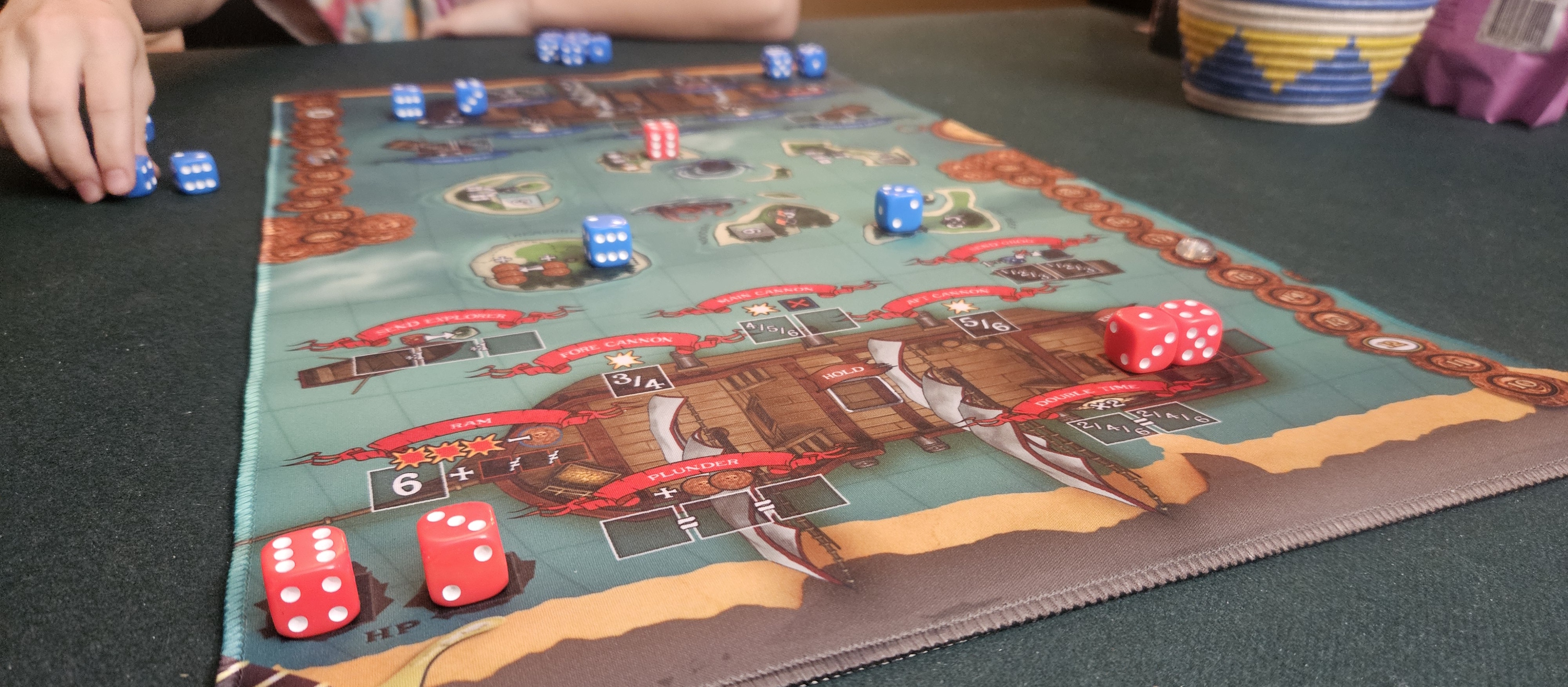
Ask my twelve-year-old about her favorite games and she’ll list a bunch of titles she consistently beats me at. Case in point: Six-Sided Seas. Inspired by the laminated game boards Chris Solis witnessed in Thailand board game cafes, this is a design by Kroze Kresky that limits itself to a single roll-up mat and a bunch of dice.
Forget inspirations. I keep losing to a child. A literal child. Twelve years of age, and already acquainted with an eyepatch and peg leg. She yearns for the galleon.
(sound: the distant thunder of a broadside)
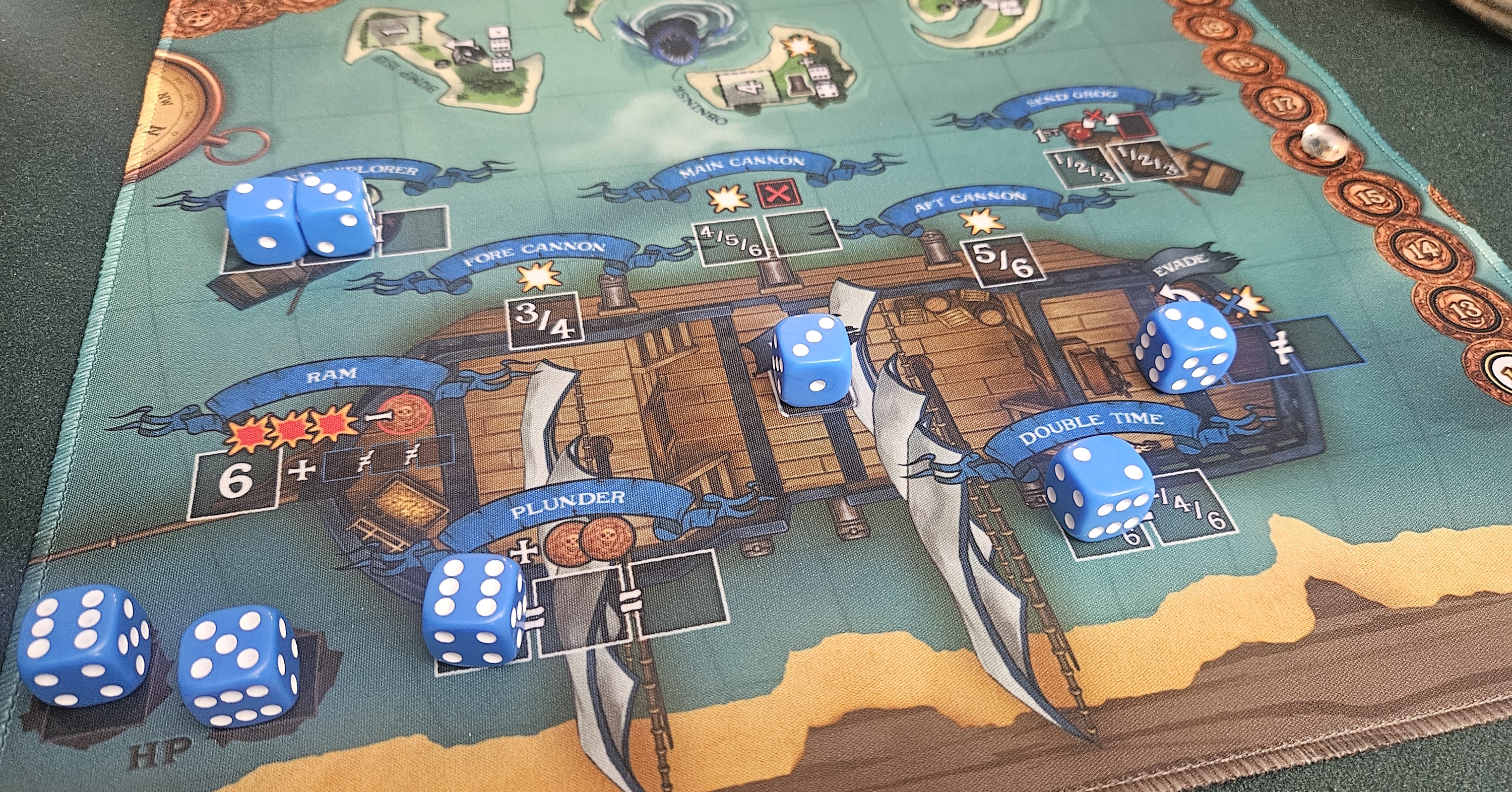
As befits Six-Sided Seas’ simple format, the gameplay is a rapid-fire exchange of cannon fire, island-hopping conquest, and desperate carpentry. The whole thing takes between ten and twenty minutes, depending on how poorly one fares. If my experience is anything to go by, it’s one of those games that demands two or even three sessions in sequence. If I wanted to be reductive, I’d call it Pirate Yahtzee. You roll dice and assign them to your ship’s various stations. Once a station is full, you can remove all the dice banked there to activate its ability. The whole thing is dead simple.
But there are unexpected complexities beneath the surface. The first has to do with the way dice operate. Your crew has a certain amount of plunder, which sets the ceiling for your rolls. You can throw as many dice as you like, but busting that number means assigning a few of them to your evasion pool and tossing the rest, a paltry pity prize indeed. Hitting your plunder number, on the other hand, lets you either bump it up a space or earn an extra roll for free, effectively stretching how much you can accomplish either this turn or in the future. So you’re always playing the odds, pushing your crew a little further, and then enjoying or suffering the consequences when they rise to the occasion — or snap under the pressure.
To roll or not to roll? ‘Tis the question.
Meanwhile, the actions themselves are nicely varied. There’s the usual cannon fire, of course, and a few disruptive abilities like one that sends a barrel of grog to the enemy ship to disable the first rolled die on their next turn or another that wipes out your defensive pool of evasion dice to ram the enemy ship for beaucoup damage. Three contrasting win conditions give these pursuits some edge. Sinking the enemy is the honest option, but even a limping vessel might earn enough plunder or secure four of the contested (and bonus-bestowing) islands in the middle to win without splintering an enemy timber.
It’s minor, but it was also designed to be minor, and its minorness is one of its greatest strengths. For example, I’m compelled to lament the ram action, which I believe is horribly overpowered, especially when doubled, but it’s a maneuver that requires multiple turns to set up, strips away your protection, and may be a reflection of my daughter’s favorite strategy more than an actual imbalance. Anyway, what’s an imbalance in a game that I’ve set a world record for by losing in four minutes? As soon as I’ve been scuttled, we’re halfway positioned for the next duel. This time I’ll ram her ship. (Spoiler: She rammed my ship twice and sent it to the bottom of the ocean.)
It takes fifteen, twenty minutes to sink one of these ships.
I don’t want to damn Six-Sided Seas with faint praise; its brevity belies a real understanding of what makes dice so joyous to handle. The decisions are micro-sized, but they matter. Should I seize the island that gives me an all-important reroll — one that might prevent an untimely bust — or double the impact of my cannons? If I’m falling behind, should I play it safe with my dice or push my crew as hard as possible? There are no easy answers.
So, yes, the format matters. Six-Sided Seas is small, brief, and in some respects limited, especially with its two-player count. But I’m impressed with what Kresky and Solis have done with said format. This one would feel right at home in a game cafe, on a picnic table, or beneath the dim light of a cramped starboard cabin.
A complimentary copy of Six-Sided Seas was provided by the publisher.
(If what I’m doing at Space-Biff! is valuable to you in some way, please consider dropping by my Patreon campaign or Ko-fi. Right now, supporters can read the next installment in my series Talking About Games, this time tackling the topic of what makes a good list! Naturally, the piece includes a list.)
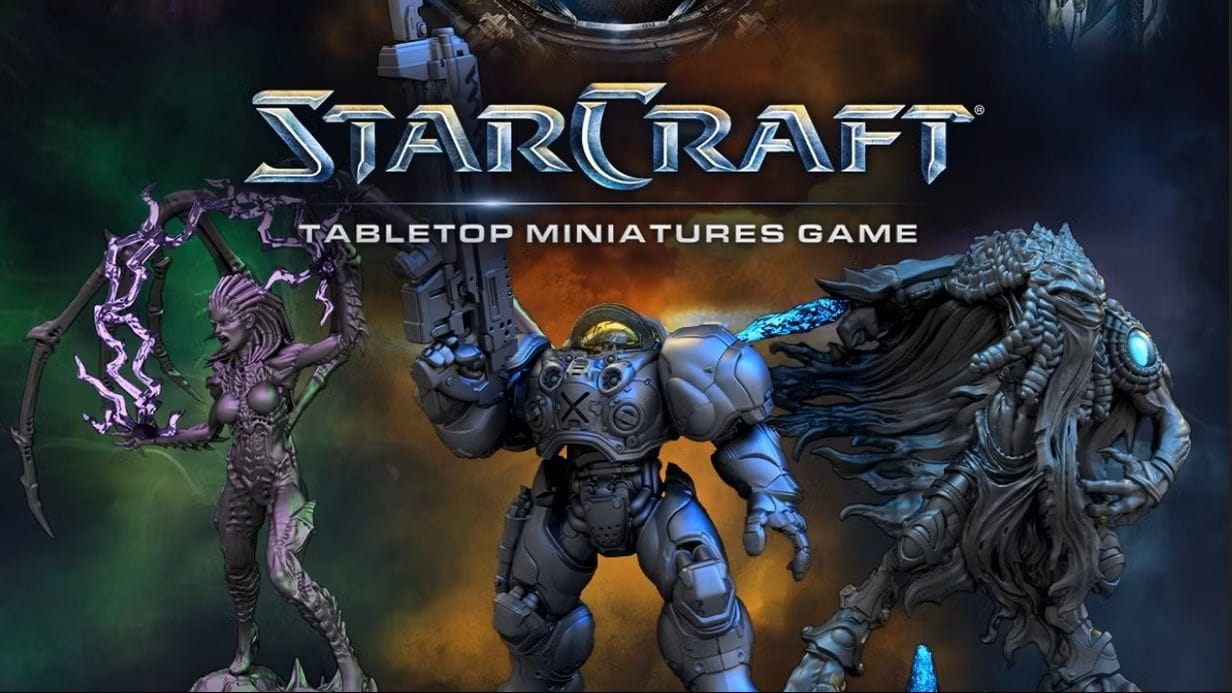
Archon Studio hat das StarCraft: Tabletop Miniatures Game offiziell in den Handel gebracht. Nach einer Vorverkaufsphase über Gamefound sind die Starter-Sets der Founders Edition sowie mehrere Erweiterungs- und Einheiten-Sets für Terraner, Protoss und Zerg jetzt beim deutschen Händler Fantasywelt erhältlich. Die Redaktion hatte die Lizenzpartnerschaft zwischen Archon Studio und Blizzard Entertainment bereits im März 2025 gemeldet, damals mit 2026 als Zieltermin für das Miniaturenspiel.
StarCraft erschien 1998 bei Blizzard Entertainment und gilt als eines der prägendsten Echtzeit-Strategiespiele überhaupt. Drei Fraktionen kämpfen im Koprulu-Sektor um die Vorherrschaft: die technisierten Terraner, die mit Psionik ausgestatteten Protoss und die schwarmartigen Zerg. Genau diese Asymmetrie überträgt Archon Studio auf den Tisch, die Spielenden befehligen ihre Armeen über Kommandokarten und Messbewegung statt über Mausklicks.
Eckdaten: 2 Spielende, ab 12 Jahren, 60 bis 120 Minuten Spielzeit, Design von Sławomir Aftarczuk, Jarek Ewertowski, Jacek Karpowicz, Aleksander Nowacki und Michał Pawlaczyk, erschienen bei Archon Studio.
Was das Spiel auf den Tisch bringt
Laut BoardGameGeek-Metadaten setzt der Titel auf Command Cards, Deck Construction, Würfelwürfe und variable Fraktionsfähigkeiten, ergänzt um ein Schere-Stein-Papier-Element für die Konfliktauslösung sowie Szenario- und Kampagnenmodi. Das Spiel ist strikt für zwei Spielende ausgelegt, einen Bereich wie 1 bis 4 gibt es nicht. BoardGameGeek führt zudem keine empfohlene Solo-Variante: In der noch sehr schmalen Spielerzahl-Auswertung der Community, gestützt auf nur eine abgegebene Stimme, gilt eine Partie zu eins als nicht empfehlenswert. Wer StarCraft: Tabletop Miniatures Game spielen will, braucht also eine Gegnerin oder einen Gegner am Tisch.
Laut BGG-Beschreibung umfasst eine Standardpartie bei den Terranern etwa 30 bis 40 Modelle pro Seite, bei den Protoss weniger und bei den Zerg deutlich mehr, was die zahlenmäßige Überlegenheit des Schwarms nachbildet.
Sets, Preise und Verfügbarkeit
Einstieg bietet das Two Player Starter Set Founders Edition mit zwei kompletten Armeen, bei Fantasywelt für 159,99 Euro gelistet (Stand: 26.08.2026). Ergänzend gibt es das Protoss Starter Set Founders Edition für 91,56 Euro. Beide Sets liegen in englischer Sprache vor, eine deutsche Lokalisierung ist bislang nicht angekündigt.
Dazu kommen Einheiten- und Helden-Sets für alle drei Fraktionen. Terraner: Marine, Marauder, Goliath und Medic sowie das Helden-Set Jim Raynor (Raynor’s Raiders). Protoss: Zealot, Stalker, Adept und Sentry sowie das Helden-Set Artanis (Hierarch). Zerg: Zergling, Hydralisk, Roach und Queen sowie das Helden-Set Kerrigan (Primal Kerrigan).
Ergänzt wird das Sortiment durch das Lost Temple Terrain Set. Die meisten Einheiten-Sets kosten bei Fantasywelt um die 38 Euro, die kleineren Sets Medic, Sentry, Queen, Zealot und Adept liegen zwischen 21 und 30 Euro. Bei den Helden-Sets reicht die Spanne von 29,40 Euro für Raynor bis 37,80 Euro für Artanis und Kerrigan, die beiden teureren liegen damit auf demselben Preisniveau wie die größeren Einheiten-Sets.
Für ein frisch gestartetes Miniaturenspiel ist die BGG-Bewertungsbasis noch dünn: 25 abgegebene Wertungen ergeben einen Schnitt von 8,46 von 10, und nur eine einzige Weight-Stimme liegt der Komplexitätsangabe von 2,0 von 5 zugrunde. Belastbare Aussagen zur tatsächlichen Regeltiefe lassen sich daraus noch nicht ableiten. Wie viel Unterstützende beim Vorverkauf über Gamefound ursprünglich für das Starter-Set zahlten, ist auf der Kampagnenseite inzwischen nicht mehr ausgewiesen.
California tabletop publisher and game development studio Solis Game Studio is expanding its reach into US hobby retail through a new distribution deal with Southern Hobby, following several years of building its own catalogue through crowdfunding and direct sales.
The Massive-Verse Fighting Card Game, designed by Brian McKay, from Solis Game Studio
Its contracting work has included projects such as the Cyberpunk TCG, with Solis having led game design and development of a prototype that secured licensing for a new game.
Solis also did development work on Emerson Matsuuchi-designed Metal Gear Solid: The Board Game, and last month announced it would be the developer for the official card game of battle royale video game PUBG.
The company said Southern Hobby will distribute new Solis release Six-Sided Seas, as well as Treat, Please! and The Massive-Verse Fighting Card Game, describing the deal as a “major step forward” for the business.
The publisher has previously used crowdfunding to bring several of its games to market, with its biggest success to date 2024’s licensed Massive-Verse Fighting Card Game, designed by Brian McKay, which raised just over $50,000 from about 800 backers.
Solis has also already been selling directly to retailers through its own wholesale programme.
The publisher’s newest release, push-your-luck worker placement game Six-Sided Seas, will enter US distribution on October 2 with a $24.95 MSRP.
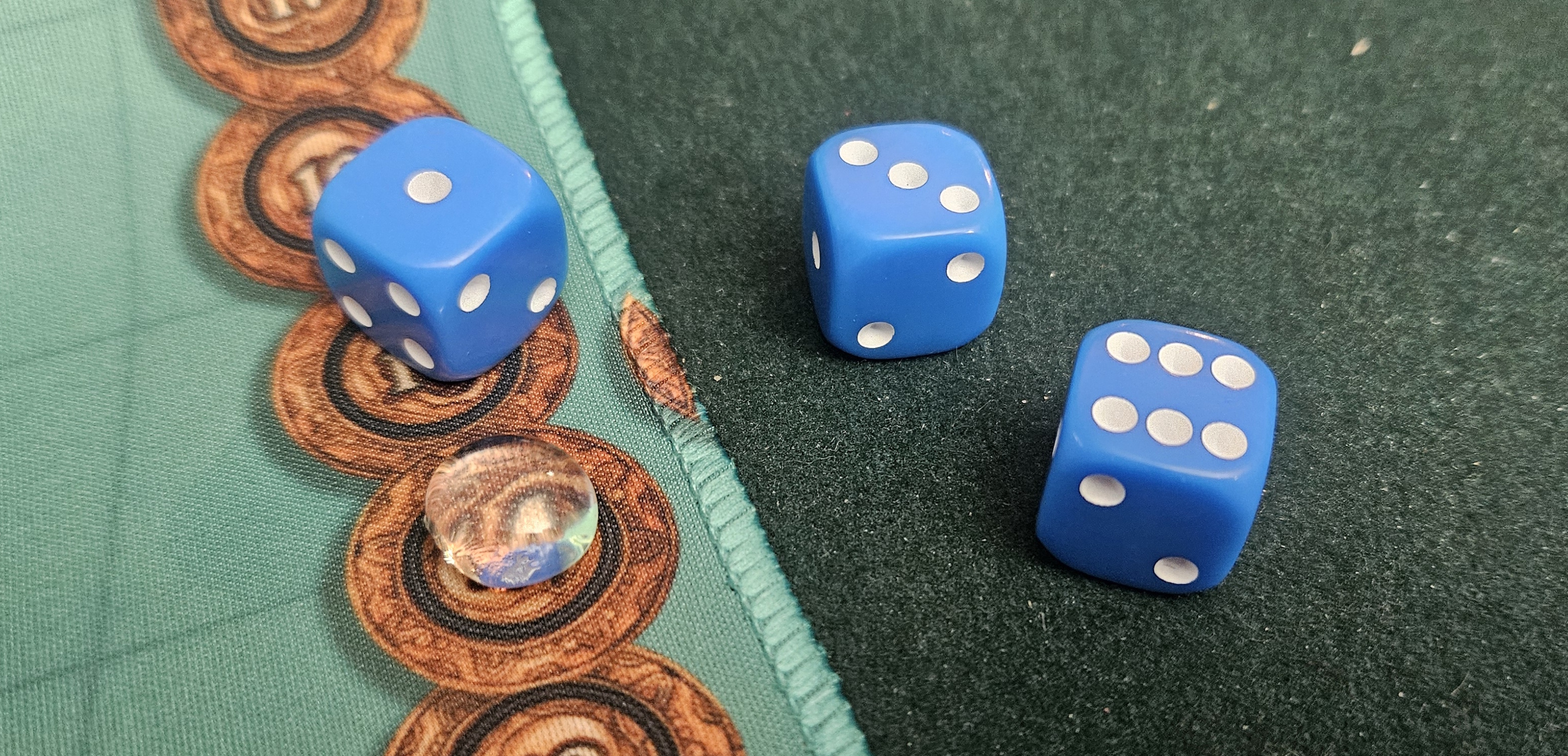
The two-player pirate game, designed by Kroze Kresky, is built around an unusual component format, consisting of 32 dice and a 14in by 24in edge-stitched playmat which is rolled inside the game’s box – allowing the title to be presented vertically, horizontally, or with a collapsible hangtab in retail.
Solis has previously said the idea grew from a visit to game stores in Thailand, where Chris Solis saw a store employee laminating a game board to protect it and began considering whether the board itself could instead be made from playmat material.
He said in the blog post, “When I returned home I issued an internal design challenge to my community. What does a game that is a playmat and single component look like?
“We explored a ton of really interesting designs and even did a limited release for one of them but none captured me like Six-Sided Seas by Kroze.”
Solis launched the game at Gen Con earlier this month, and said it sold all the copies it brought to the convention. Several of its scheduled learn-to-play sessions at Gen Con also sold out, according to the convention’s event listings.
In addition to founder and owner Chris Solis, the studio’s team includes developer Bryan McKay, business operations specialist John Brieger, graphic designer Katherine Boils, marketing manager Courtney Shernan, convention manager Sara Jordan and community manager Antonio Gil.
Unstable Unicorns publisher Unstable Games has launched a new studio led by rising tabletop designer Marceline Leiman, who will shape its creative direction and design every game it releases for at least the next few years.
Ordinary Magic plans to publish light strategy board and card games set within a single expanding world, with Leiman telling BoardGameWire the studio is looking to put out designs “offering whimsical, magical moments of the everyday” alongside high interaction.
The move comes nine years after Unstable Games owner TeeTurtle’s hugely successful Kickstarter campaign for light card game Unstable Unicorns, which raised more than $1.8m from over 33,000 backers – and went on to sell more than a million copies worldwide by 2023.
The success of that release led to t-shirt maker TeeTurtle creating its dedicated tabletop studio Unstable Games, which has sold millions across its debut title and follow-up releases such as Here to Slay, Happy Little Dinosaurs, Casting Shadows and Twisted Cryptids.
Her route into professional board game design began with the 2023 release of her solo mode for North Star Games titles Oceans, which led to a part-time developer position at Underdog Games, as well as client work for Office Dog, WizKids, Allplay, Button Shy Games and Maestro Media, according to her website.
But Ordinary Magic represents her first full-time job in the industry, with Leiman saying the roots of the venture going back to the period immediately following the downsizing of Underdog in April 2025, when the publisher laid off almost its entire staff as it attempted to weather the impact of US tariffs.
She told BoardGameWire that Underdog president Nick Bentley, who was also let go by the company at that time, quickly introduced her to Unstable Games, with the pair initially planning to build the new operation together.
Bentley ultimately went in another direction before that arrangement was finalised and is now director of game design at Taco Cat Games, which rebranded from Dolphin Hat Games in May to reflect the huge success of its standout title.
Leiman said, “We both were fully intending to start up a new studio within Unstable Games. The proposition was always that they were going to do sort of an incubator program, is the way that they proposed it to us.”
She added, “My role within the studio was always going to be the capacity of being a game designer. Only now with Nick no longer part of the project, it has allowed me to take more of a formal leadership role.”
Leading the line
The resulting structure puts Leiman’s work at the centre of the studio, rather than positioning Ordinary Magic as a conventional publisher or imprint sourcing games from a roster of designers.
She told BoardGameWire, “Every single game that comes out of Ordinary Magic is a design of mine. I am the designer of each of the games coming from the studio, and you should expect that at least for the next several years.
“That does not mean that you won’t ever see a game from anyone else besides me from Ordinary Magic. But think of me as the shepherd of the studio.
“I am leading the direction of the design behind Ordinary Magic and the types of games you should expect, and the feelings from the games that you should expect. But I am absolutely open to that changing; it’s not a hard rule.”
Leiman added that although she is not currently accepting game pitches, she is “always interested in learning what designers are working on, both those I am familiar with and unfamiliar with”.
She told BoardGameWire, “I love sharing ideas, and I think the spirit of design is still very much open in terms of the way I like to talk with other designers. I always want to consider whether or not in the future, an opportunity is available between Ordinary Magic and a designer looking to pitch their games.
“However, I cannot promise at this time that we are accepting any pitches that we might receive. If I were to look at any pitches, what I’ve described in the past is that Ordinary Magic is looking for games that are offering whimsical, magical moments of the everyday. Not high magic, not combative, though highly interactive.
“I think if someone wanted to pitch to me a game with a theme that was more focused on a curious bit of a real-life moment that inspired them, that would interest me more than somebody who’s coming to me with a pitch purely with a magical concept. I am much more interested in the grounded reality of this world rather than the high fantasy.”
Finding direction
Leiman said the studio’s creative direction would be to create interactive games which give “meaningful reason for other players to be at the table with you”, but added that would likely not extend to full “take-that”-style designs.
She said, “What you should expect from us is strategy-light strategy style games, sometimes card games, sometimes board games. I am also very interested in exploring the realms of cooperation as well as indirect player interaction, or both direct and indirect forms of player interaction.
“Something that you’ll find from me is that I am very interested in sort of passive aggression in games, where the decisions I am making might be to block you or to prevent you from getting something before me. A very old-school style of interaction, German old-school I think some people would think about.”
Leiman said the original plan had been to launch the games individually, but that Unstable ultimately proposed putting all three into the same campaign after their development schedules aligned – a situation which partly arose due to Leiman’s rapid work rate.
The Curious Little Bookshop || Gamefound image
She told BoardGameWire, “The method that I was taught game design was very much under the tutelage of my professors at NYU Game Center, and there we worked very much within a fast-paced work environment.
“Joining this studio very much is like returning back to that environment, which I am very comfortable being in. The way that I’ve worked within the studio is quite fast, is quite rapid, I guess, in relation to other people’s speeds.
“But for me, within a short amount of time, what I am looking to do is try out many ideas and fail with many ideas as quickly as possible, so I could find the core of what is fun, what is interesting, what is memorable about a game.
“It just so happened to align with our release schedule that I would have these three games. Our original plan was to release them one by one, but just with the way that scheduling worked out, we decided that it would be best to put our best foot forward with this new studio by showing the strength of our design, with the strength of our art, and production capabilities.”
Operationally, however, Ordinary Magic is currently far less separate from its parent studio than its distinct branding might suggest.
“The only difference between Ordinary Magic and Unstable Games in terms of operation is me,” Leiman told BoardGameWire.
She added, “Everything that you’ve come to expect from me – my work ethic, my taste, my voice – you should expect to be part of these games.
“Not to say that I don’t work with the Unstable Games team as well. We actually do cross-pollinate a lot in terms of our playtesting, in terms of our conversations, in terms of problem-solving.
“So it’s not like I’m totally in a silo or and neither are they from me. There’s definitely a lot of creative support going back and forth between the two studios. And as the studio continues to develop and grow in size, naturally Ordinary Magic will change with it.”
Speaking about the shared world envisaged by Ordinary Magic for all of its releases, Leiman told BoardGameWire, “You should not expect to see any games released from Ordinary Magic that are not part of this world.
“We’ve talked a lot about what that means in terms of building the IP, sort of what direction could it go in the future? Does it open us to different forms of media, different forms of games, or are they all going to be board games and card games?
“We’re leaving that station open right now. But we’re definitely open to exploring what it means to have this IP as we look forward to the future.
“As for recurring characters and locations, I would say keep your eyes open for the GameFound campaign, and I think you’ll be very excited to see some crossover moments between them.”
In dieser Woche (KW 33) haben Gamefound und die Spieleschmiede keine frische Brettspiel-Kampagne mit echtem Neuigkeitswert nachgelegt. Auf Kickstarter dagegen laufen gleich drei Projekte aus derselben Startwelle vom 14. Juli auf ihr Ende am 13. August zu. Alle drei sind finanziert und decken ein leichtes bis mittleres Gewicht ab, vom Jahrmarkt-Spiel bis zum Spieleabend-Paket. Ein Hinweis vorab: Es handelt sich um US-Kampagnen in US-Dollar, für die aus dem DACH-Raum Versandkosten und Einfuhrabgaben anfallen.
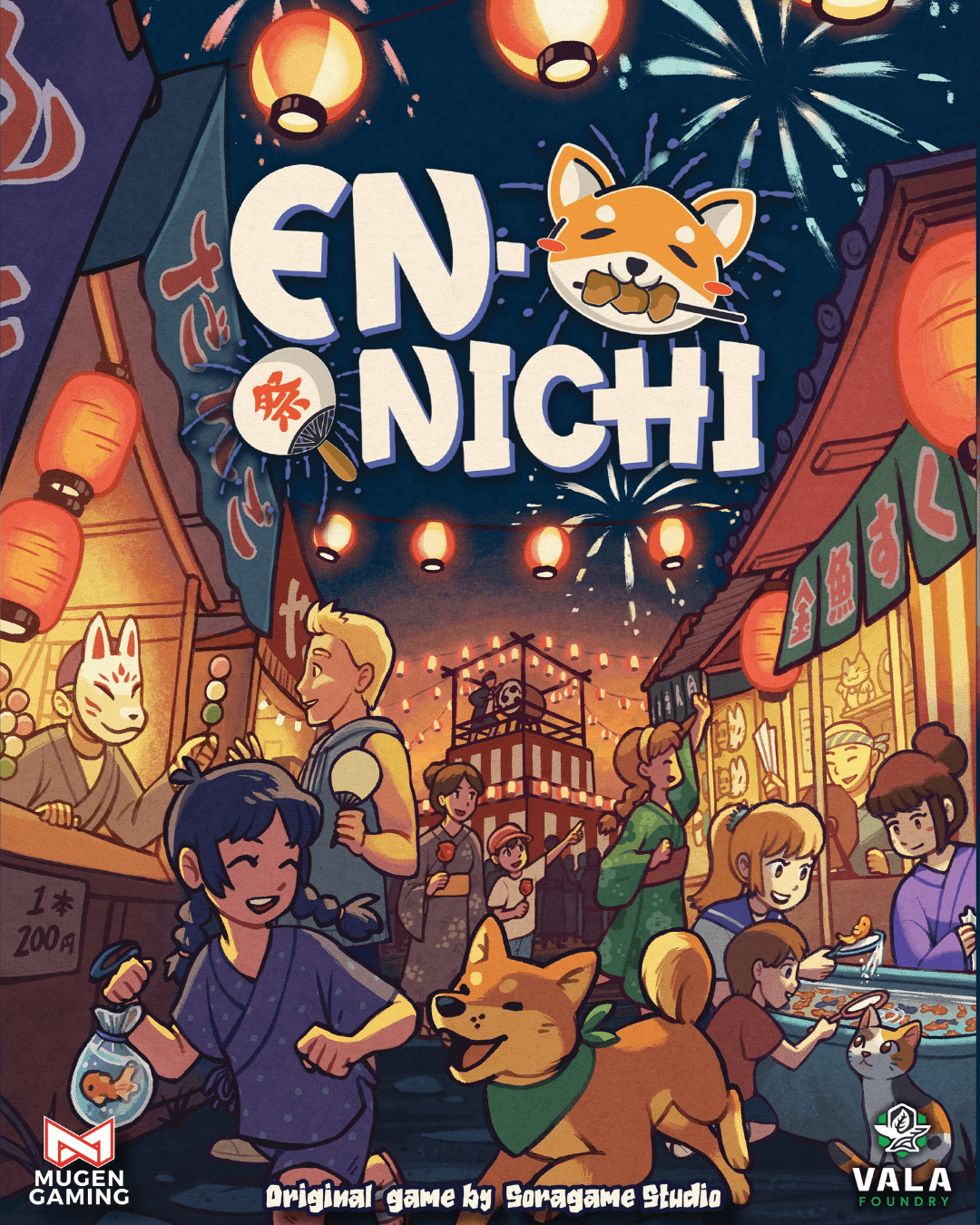
En-Nichi: Japanese Summer Festival
En-Nichi: Japanese Summer Festival. Bild: Mugen Gaming (via BoardGameGeek).
En-Nichi läuft noch bis zum 13. August auf Kickstarter und hat sein Ziel von 7.878 US-Dollar mit aktuell rund 112.831 US-Dollar auf etwa 1.432 Prozent gebracht, getragen von rund 1.035 Unterstützenden. Damit ist es der klare Volumen-Spitzenreiter dieser Ausgabe und erfüllt gleich zwei Aufnahmekriterien: kurz vor Ende und außergewöhnlich hohe Finanzierungsquote.
Thematisch wanderst du über ein japanisches Sommerfest von Stand zu Stand und spielst kleine Jahrmarkt-Minispiele wie Schießbude, Goldfisch-Fangen, Wasserballon-Angeln und Maskenstand. Mechanisch mischt das Spiel Würfeln, Push-your-Luck, ein Gedächtnis-Element und Set Collection: Du sammelst bunte Preise, um die Gunst der Dorfbewohner zu gewinnen. Wer genug Zuneigung sammelt, nimmt die Figuren mit ins große Finale.
Es spielen 2 bis 6 Personen ab 8 Jahren, eine Partie dauert 45 bis 60 Minuten. Verlag ist Mugen Gaming aus Kansas City. Einen Designer nennt weder die Kampagne noch der BoardGameGeek-Eintrag, hier bleibt die Urheberschaft offen.
Aufnahmekriterium: Kurz vor Ende (finanziert) und besonders interessant (Finanzierungsquote deutlich über 300 Prozent, Volumen über 100.000 US-Dollar).
How to Raise Your Kaiju
How to Raise Your Kaiju. Bild: Rose Gauntlet Entertainment (via BoardGameGeek).
How to Raise Your Kaiju läuft noch bis zum 13. August auf Kickstarter und steht mit rund 35.731 US-Dollar bei etwa 357 Prozent des Ziels von 10.000 US-Dollar, gestützt von rund 431 Unterstützenden. Hinter dem Projekt steht Rose Gauntlet Entertainment, das Design stammt von Isaac Vega, die Illustrationen von Alyssa Menold.
Du schlüpfst in die Rolle eines Kaiju-Elternteils und ziehst kleine Monster groß. In deinem Zug setzt du ein Baby-Kaiju auf eine Stadt und nimmst dir eine Fähigkeitenkarte. Anschließend kannst du Stadtzonen erobern, indem du Fähigkeitenkarten passend zu den Verteidigungs-Tokens abwirfst, was Erfahrungspunkte und Ressourcen einbringt. Sammelst du genug Erfahrung, verdient dein Kaiju einen Goldstern.
Alternativ schickst du dein Monster auf den Open-World-Pfad, wo weitere Strecke größere Belohnungen bringt. Eltern-Karten geben jeder Spielerin und jedem Spieler eigene Sonderfähigkeiten, sodass sich die Partien unterscheiden. Nach vier Runden gewinnt, wer die meisten Goldsterne gesammelt hat. Mechanisch verbindet das Spiel Worker Placement, Handmanagement und Set Collection für 1 bis 4 Personen ab 10 Jahren, bei 30 bis 60 Minuten Spielzeit.
Aufnahmekriterium: Kurz vor Ende (finanziert) und besonders interessant (Finanzierungsquote über 300 Prozent, etablierter Designer).
MILLRAT Pack!
MILLRAT Pack! Bild: MILLRAT Studio (via Kickstarter).
Das MILLRAT Pack läuft noch bis zum 13. August auf Kickstarter und hat mit rund 11.326 US-Dollar etwa 188 Prozent des Ziels von 6.030 US-Dollar erreicht, getragen von rund 191 Unterstützenden. Das Projekt bündelt vier eigenständige Spiele in einer Schachtel, gedacht für den Spieleabend, entwickelt von MILLRAT Studio (Nick und Adam) mit Artwork von Abby Ouellette.
Die Kampagne beschreibt das Paket als „etwas für jeden am Tisch", schlüsselt die vier Titel in den abrufbaren Kampagnendaten aber nicht einzeln nach Mechanik oder Spielerzahl auf. Was die Spiele konkret tun, bleibt damit auf Basis der reinen Eckdaten offen. Für den DACH-Raum ist außerdem wichtig: Der physische Versand ist auf die USA beschränkt, sinnvoll bestellbar ist von hier aus vor allem die Print-and-Play-Variante ab 8 US-Dollar.
Aufnahmekriterium: Kurz vor Ende (finanziert). Der Titel steht hier ausdrücklich mit dem Vorbehalt eingeschränkter DACH-Verfügbarkeit.
Kein frischer Start auf Gamefound und Spieleschmiede
Auf Gamefound sind die Kampagnen des Summer Feast von Ende Juli inzwischen überwiegend beendet, ein frisch gestartetes oder kurz vor Ende stehendes Brettspiel mit klarer DACH-Relevanz war in dieser Woche nicht darunter. In der Spieleschmiede läuft weiterhin das Zeitreise-Kennerspiel Restart von Giant Roc, das wir bereits in KW 31 und KW 32 vorgestellt haben und das daher hier keinen neuen Aufhänger bietet. Sobald auf diesen beiden Plattformen wieder etwas Neues mit Substanz startet, greifen wir es in der nächsten Ausgabe auf.
Egal in welchem Universum, die Zwerge sind bekannt für ihr handwerkliches Geschick, egal ob Techniker, Steinmetze oder Schmiede. Auch bei Warcrow ist die Nation von Mounthaven keine Ausnahme. Micro Art Studio bieten in ihrer Pre-Painted-Reihe nun passendes Gelände aus MDF an, das eines Zwergenbaumeisters würdig ist.
Die erste Welle des StarCraft: Tabletop Miniatures Game ist fast komplett ausgeliefert, die Modelle stehen auf den Tischen und die ersten Schlachten im Koprulu-Sektor laufen. Archon Studio legt bereits nach und kündigt für die zweite Welle neue Einheiten für Terraner, Protoss und Zerg an.
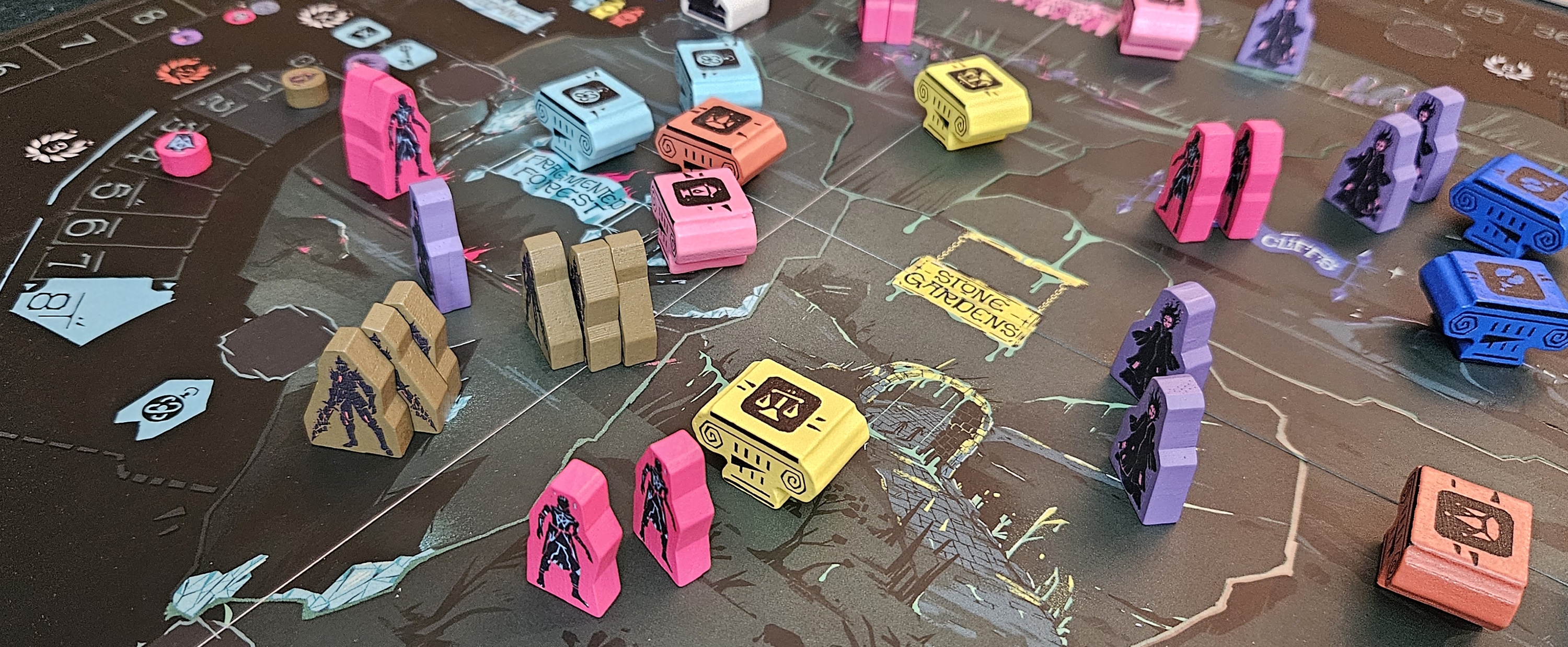
I find Realm of Reckoning, the latest title by Max Anderson, Zac Dixon, and Austin Harrison, to be fascinating. There’s the cosmological angle: an afterlife fallen into disrepair, now pieced back into working order through the clashing imperatives of feuding factions. Personally, I’d be a fanatical member of the Eat As Much Cake As You Like Without Getting Tummy Sick sect.
But more even than that, it carves out a new space in the whole “dudes on a map” genre. (Are we still saying that?) There are fingerprints of the greats all over the design. A splash of Blood Rage, some Inis, even a little bit of Arcs. It’s something of a mashup, and not every part works as smoothly as the others, but the result is a gripping struggle over an ashen landscape.
Clashing over the broken prairie of the afterlife.
Right away, there’s nothing typical about Realm of Reckoning. The factions are presented in gaudy colors. Or perhaps they’re only gaudy because the terrain is so smudged and dismal.
For all its aesthetic ruin, it’s really a rather simple space. The entire battlefield consists of five territories, each connected with a different flavor of influence. There are also five flavors of pillar, themselves coded to the assistance of gnomic wardens and tide-turning mercenaries, but maybe that’s more information than you strictly need to understand what’s going on here.
As for the rest of it, Realm of Reckoning structures itself around three rounds of drafting. This is where its similarities to Blood Rage seem most apparent, although if Veiled Fate, Pillars of Fate, and Scales of Fate are anything to go by, the folks at IV Studio really like their three-act structures. Each age is structured much the same: a hand of cards is dealt out, everyone picks one to resolve, and then the rest are passed around to repeat the process until there’s nothing left, at which point there’s a final battle before a quick tally of points.
It’s clean. At that mile-high remove, anyway.
Cards, both for action and battle, are drafted one at a time.
Down in the grit, affairs are a little more complicated.
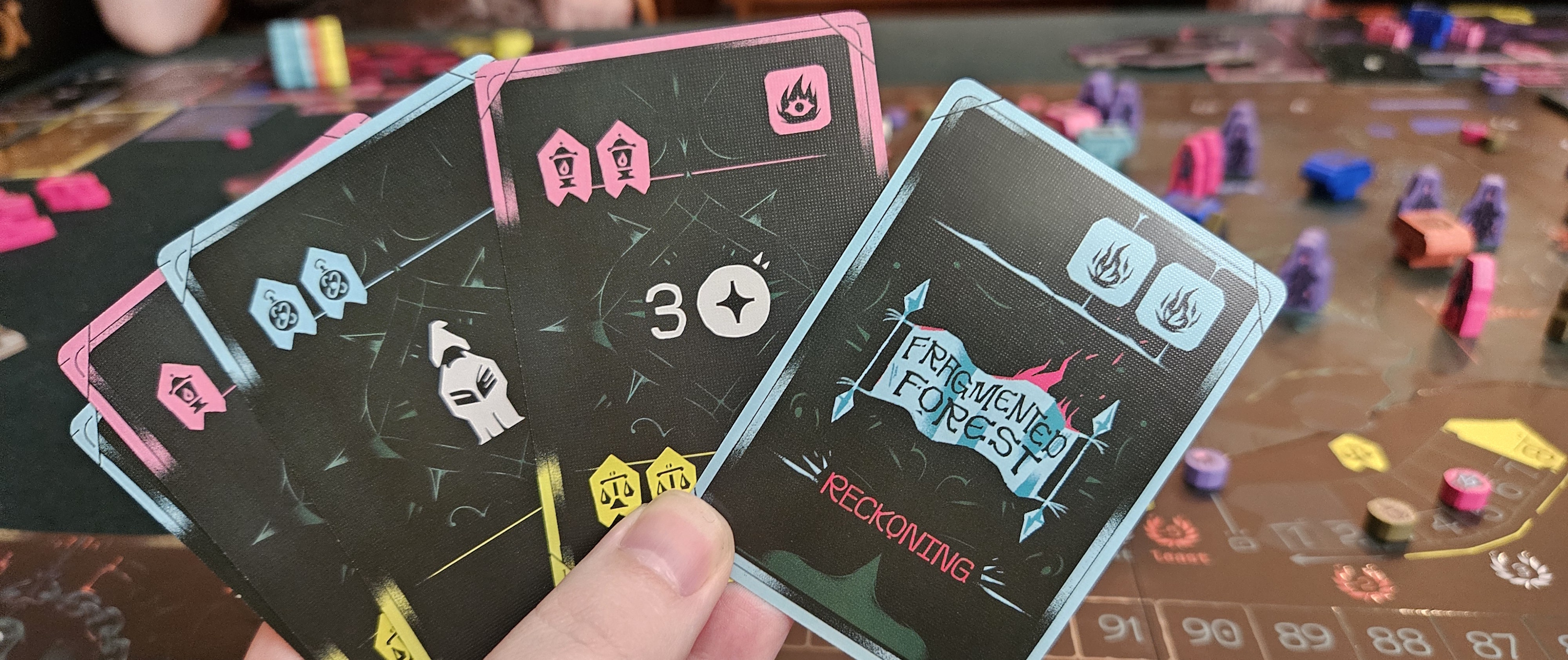
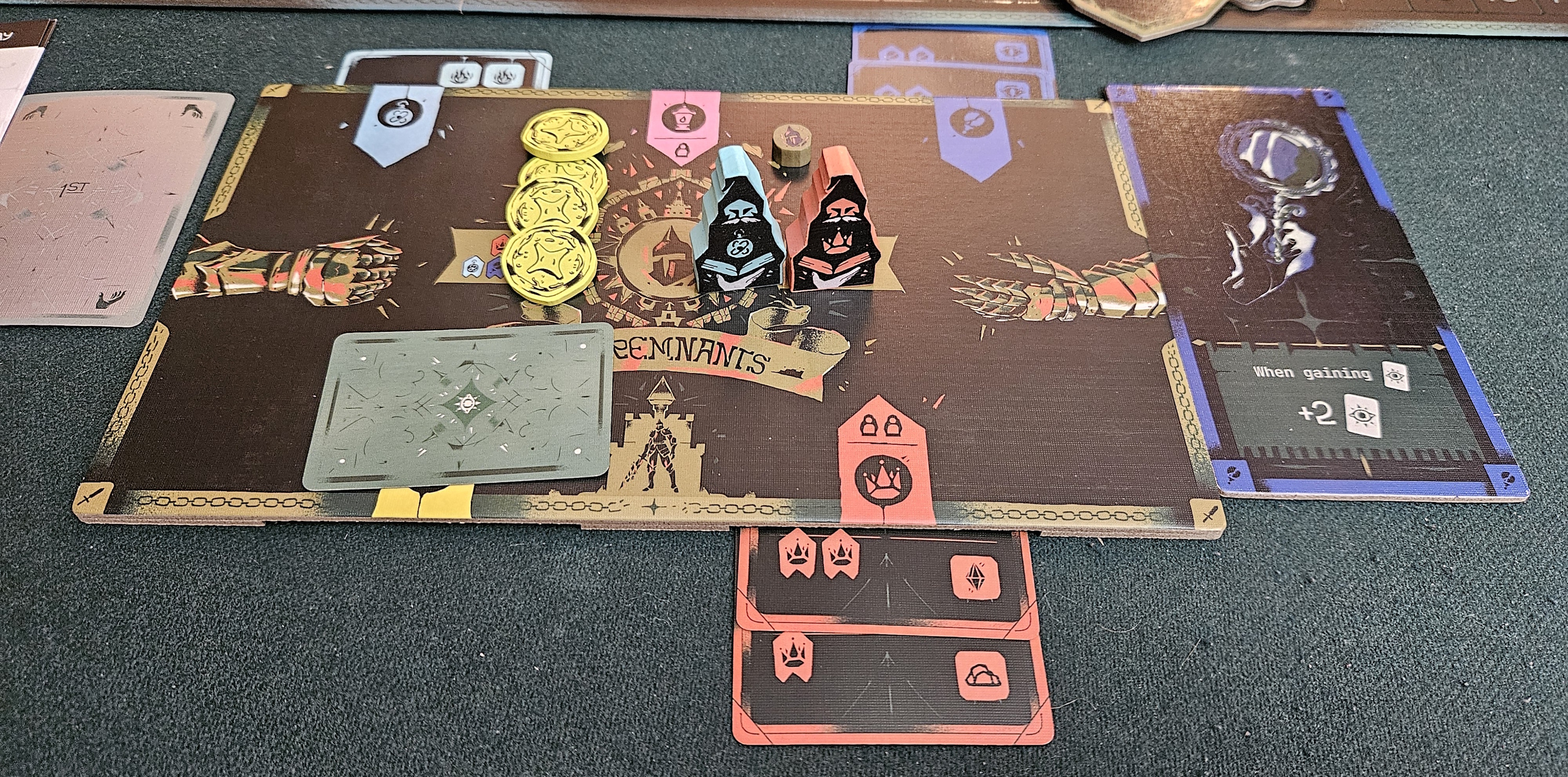
Consider the cards. There are two types in the draft. The vast majority are action cards. These confer some resource — coins, wardens, soldiers for the battlefield, mercenaries to be spent and discarded — followed by a choice of where to tuck the card under your faction mat. This latter choice is more loaded than it initially appears, moving your marker along the corresponding influence track, but also providing icons that, at least on the first play, don’t bear immediate import.
The other type of card is the reckoning. There are only two of these shuffled into each age’s hand of cards. Their rarity marks them as major flashpoints. This is because reckonings trigger a battle in the indicated region. Not at the end of the round or even upon completing the current hand of drafted actions, but immediately, at the exact moment that the player who drafted it would normally take their resources and move along their chosen influence track.
Even when these reckonings are anticipated, such as when you’ve seen them coming from a hand of cards you passed along, they always come across as an intrusion. The usual cycle of gathering and positioning is interrupted. Now everyone picks up a dial and tallies in a number. This is how much they’re willing to spend to win. Four. Six. Eleven. More. Battles escalate as the game progresses, the result of all those extra arms everyone’s been amassing.
Some of the many things you’ll collect in Realm of Reckoning.
To be honest, the battles themselves are a mixed bag, the game at its strongest and weakest.
Strongest, because they’re nail-biters. Rather than simply winning or losing, players are vying for placement on a rewards card, a clever turn that might dictate how strongly you feel about the current contest. It’s even possible to accept a negative reward to avoid spending your bid, a maneuver that’s sometimes smarter than it might sound.
But battles are also frustrating. They’re a little too complicated for their own good. IV Studio has a reputation for games that contain “complicated counting,” and these tallies certainly qualify. Soldiers can be spent for a point of strength. Wardens also provide a point, but only if they match a pillar in the contested territory, and even then they can be spent instead to produce a bump of three. Mercenary cards matter, although again there’s some pillar-matching to consider, and coins too, although these are spent in increasing increments. Oh, and your influence in that region. It’s easy to forget that one, especially if you’re currently benefiting from that region’s power-boosting artifact.
All of this is to say that bids are fraught indeed, slowing the game dramatically but also producing… well, drama. High drama. Revealing one’s bid is as tense as it gets, as good as any round-robin antes in Inis. These are the hinges upon which Realm of Reckoning turns. Slowly, sometimes, with no small amount of creaking and groaning, but still.
Picking your reward for a reckoning.
For my part, I’m willing to accept the shortcomings of these reckonings for the boons they provide. The drama, yes, but also the way they feed into the game’s consideration of victory. Everything in Realm of Reckoning is building toward these moments of revelation.
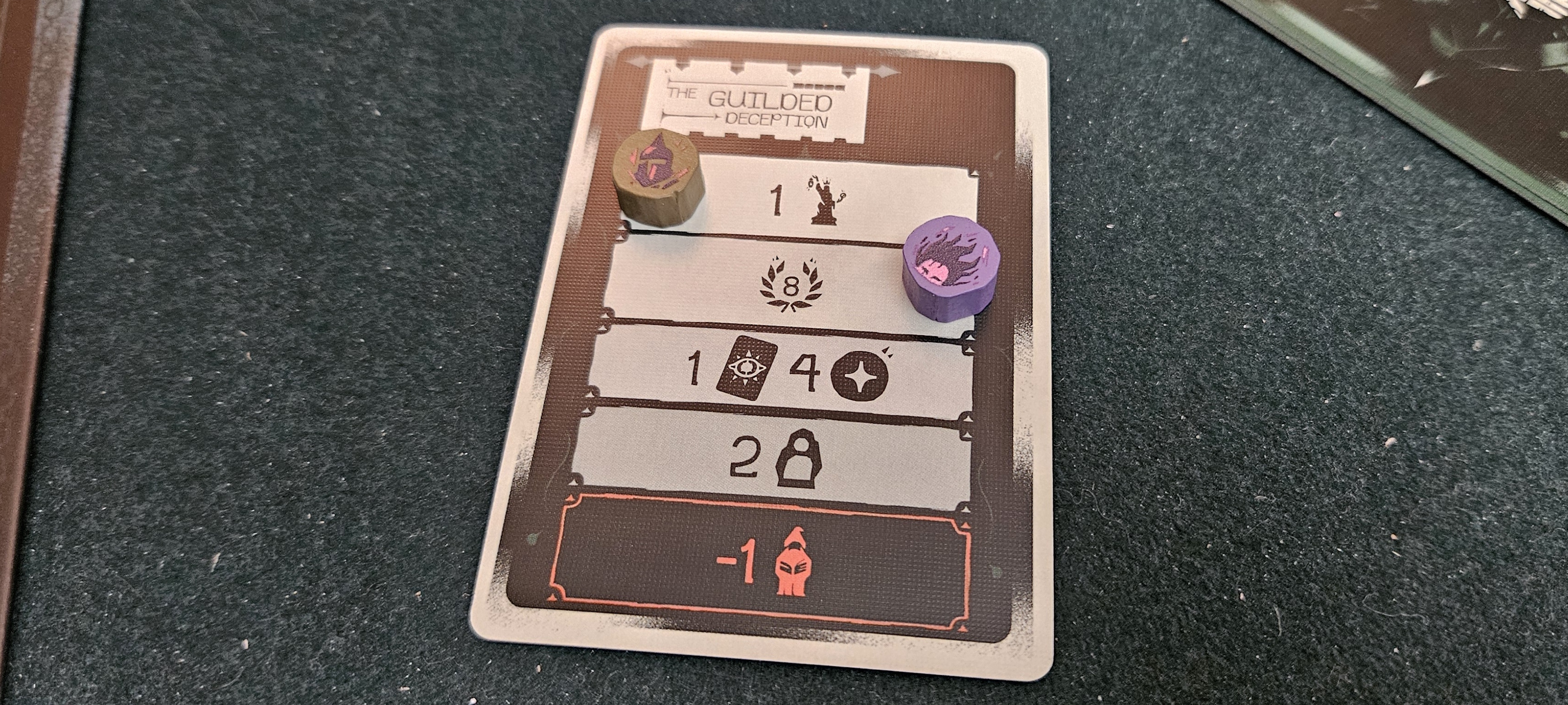
And here, the revelation matters. Some players will claims points or cards or coins. Extra soldiers. Maybe a warden. But the real prize is the chance to designate which victory condition will score at the conclusion of every round hereafter. One player — usually the highest bidder in the reckoning but not always — takes a shrine, a statue that looks comically like Lady Liberty herself, and plops it onto one of the victory markers.
There’s no shortage of options. There are spaces for military domination over specific territories; others for economic advantage in coin or hired help. Some initiate struggles against your neighbors. Others provide groundswells of points that everyone can benefit from with some effort.
This is also where those icons come into play. The ones from earlier, on the cards, tucked beneath your player mat. You might find yourself racing to collect sets of gems, or vying to command the most purses of gold, or cursing because a rival chose to emphasize the closed-eye icon rather than the open peepers. Whatever the selection, it informs the game from that moment forward. It’s a little bit like Arcs in that regard, the players choosing what matters and then clashing over it, except these are permanent alterations. Early selections, before the factions have specialized, become exploratory, triggering multiple times before the game ends but also allowing players to adjust, while those added later are hotly contested because their outcome is less prone to adjustment.
Victory conditions are selected over the course of the struggle.
Perhaps there’s an irony to be dredged from all this fuss. For the second time, Realm of Reckoning hinges on a bunch of complicated counting.
But this is also where the designers manage to carve out their own niche in a crowded genre. And, as niches go, it’s closer to an alcove than a toehold. There’s such a variety to the objectives that there always seems to be something worth pursuing. There’s even a spot that awards points to whomever’s sitting in last place — a whole catch-up system, but one that asks the players whether they would like to switch it on or leave it untouched.
It’s smart, although in a way that demands its own attention rather than simply aping what’s gone before. Sure, it has drafting like some other titles. But where Blood Rage evoked a heavy boot smashing into your nose, where Inis was all tribal politics, where Arcs is… a lot of things, Realm of Reckoning is about currencies and auctions. Players gather resources to spend them, but only as carefully as possible, and then the outcomes of those auctions become longer-term auctions for absolute victory. In that respect, it feels like a smoother, more contemporary version of a lesser-known map-battler called Mezo. But, again, Realm of Reckoning provides such an emphasis on who can most cleverly accrue and spend coins of various denominations that it feels entirely new again.
Entirely new. Sometimes slow, especially at higher counts, and sometimes a little too tally-heavy. But still new, and smart, and bound up in calculations that feel shrewd rather than merely arithmetic.
War in heaven. Or hell. I dunno.
I can hear what you’re asking through the screen. “Dan, does this say anything about the afterlife?” Sorry, but no. It does not.
But it does say something about how great it is to smash somebody through superior tallies and bids. Combat in Realm of Reckoning isn’t visceral. Strictly speaking, you’re inflicting the casualties on yourself, not the other way around. But this is one smart cookie, ultra smooth in practice, and a delight to handle. It takes a play or two to get a handle on its particulars, but this is one afterlife worth pursuing — and then remaking in your own image.
A complimentary copy of Realm of Reckoning was provided by the publisher.
(If what I’m doing at Space-Biff! is valuable to you in some way, please consider dropping by my Patreon campaign or Ko-fi. Right now, supporters can read the next installment in my series Talking About Games, this time tackling the topic of what makes a good list! Naturally, the piece includes a list.)
The designer of hit mass-market board game Hues and Cues has launched a new publishing initiative to tackle one of the tabletop industry’s growing challenges: promising games sitting unpublished because publisher release schedules are already full.
Scott Brady believes many outstanding games never reach players not because they lack quality, but because publishers must plan their release schedules years in advance – and with only so many publishing slots available each year, excellent games are often left waiting for an opportunity that may never come.
Brady told BoardGameWire his Proof-of-Play model will make ‘limited edition’ runs of between 1,500 and 3,000 copies for previously unpublished games, in the hope a quick burst of sales will persuade larger publishers to take a chance on them and accelerate a wider retail release.
Scott Brady’s breakout design Hues and Cues || Photo Credit: The Op Games
He said the editions sold through his company A Game Studio would be offered direct to consumers and specialty retailers through channels such as B2B wholesale marketplace Faire, allowing each title to generate real-world sales, player feedback, and retail validation before presentation to larger publishing partners.
Brady added that the full license for the games – which will mostly be mass-market-friendly family titles – would remain with A Game Studio, which will sub-license the titles to other publishers.
He said, “Our goal isn’t to compete with traditional publishers, but to support them. Publishers make difficult decisions years in advance, and that is simply the reality of today’s market.
“Proof-of-Play gives great games the opportunity to prove themselves through actual customer demand, giving publishers more confidence and less risk when considering a wider release.”
The initiative launches with two games from external designers – area control card game Lock & Chain, and number combination card game Perfect 10 – with Brady telling BoardGameWire they helped inspire the concept after struggling to find homes with publishers despite being “amazing products”. “The timing wasn’t right”, he added.
Although Brady said he had not discussed the concept with publishers before launching the initiative, he believes it reflects a process that already happens informally across the tabletop industry, in which publishers hunt for successful games with tiny distribution and then take it larger – citing Qork as one example of that approach.
That game, which was initially self-published by designer Birger Norup as PlayProp back in 2015, was released as a Walmart exclusive by The Op in May this year – and has become something of a viral hit on social media sites such as Instragram and TikTok.
Birger Norup’s design Qork, published by The Op Games
Asked how he plans to help Proof-of-Play titles with the problem faced by publishers across the hobby – how to stand out among a vast number of releases – Brady told BoardGameWire, “I am personally staking my reputation on the games I choose to help.
“I do not need to invest in full marketing etc as the goal is to simply get the games out there and let their quality do the selling.
“By bypassing traditional distribution and relying on organic social media, my personal network and word-of-mouth, I hope this becomes a platform for many budding designers who would like to see their game on retail shelves.”
While some publishers make use of crowdfunding sites to validate demand before going into production, Brady said his model would be a better fit for the style of mass-market games he is targeting.
He said, “Crowdfunding is great for a $50-plus game looking to reach a hobby audience. This is for games with wider appeal. The games I choose will sell on their own merit and not because of crowdfunding hype.”
Brady launched his development studio A Game Studio at the start of 2024, following the 2020 release of the big-selling Hues and Cues and the success of his cat-themed abstract strategy Boop in 2022.
Brady’s own board game releases this year are set to include If Then, Wee Folk – which is co-designed by Stefano Di Maria and Rosa Linda Romano – Size Wise, Boop Shuffle and an expansion for Caution Signs, the fast-paced sketching game he co-designed with Danielle Reynolds.
Puh, sitzt du da so zu Hause in Florenz, hast in der Renaissance jetzt alles gebaut, was so zu bauen war, und überlegst, was du als Nächstes machen kannst, während du aus dem Fenster auf eine riesige freie Fläche glotzt. So ein fetter Dom wäre doch mal was? Also schickst du eine Brieftaube an deine Handwerker-Kollegen, alle haben Bock und ab geht’s!
Falls du dich wunderst, warum du von dem Spiel bisher noch nichts gehört hast: Ludus Magnus Studio hat uns vorab eine Review-Version zur Verfügung gestellt, die mal abgesehen von der Anleitung und dem Appendix bereits dem finalen Spiel entspricht. Die Express-Kampagne dazu startet im September auf Gamefound. Obwohl sie uns das Spiel zum Testen zur Verfügung gestellt haben, hatten wir freie Hand und mussten keine bestimmten Vorgaben befolgen. Dieses Review spiegelt also meine tatsächliche Meinung wider.
In Opera Magna schlüpfen wir nicht in die Rollen von feinen Prinzen oder arroganten Star-Architekten. Nein, wir gehen dahin, wo noch richtig gearbeitet wird. In die staubigen, verrauchten Werkstätten. Friedrich Merz wäre glücklich. Ich steige hier erstmal wieder mit ein paar historischen Hintergrundinfos ein. Also falls du da keinen Bock drauf hast und nur spielen willst, spring einfach direkt zur nächsten Überschrift.
Hintergrund
Der Originalbau des gesamten Doms von Florenz hat insgesamt schlanke 140 Jahre gedauert, wobei ein Großteil der Zeit allein für die gewaltige Kuppel draufging. Der Bau stand sogar jahrelang einfach komplett still, weil es schlichtweg keinen realisierbaren Plan gab, wie man dieses Monster von einer Kuppel überhaupt hochziehen sollte. 1436 war es dann aber doch so weit und das Monumentalgebäude stand in seiner vollen Pracht.
Ganz so lange dauert es in Opera Magna zum Glück nicht. Eher im Gegenteil. Das Spiel spielt sich je nach Spielerzahl in flotten 60 bis 90 Minuten angenehm geschmeidig runter. Als meisterhafte Handwerker schubsen wir gierige Händler über das Mittelmeer, feilschen um jeden staubigen Brocken Marmor und versuchen verzweifelt, unsere chronisch ineffizienten Betriebe auf Vordermann zu bringen.
Bevor ich aber direkt ins Spielgeschehen grätsche, noch ein paar Worte zum Titel und den beiden definitiv nicht unbekannten Autoren. Tommaso Battista ist wohl hauptsächlich bekannt durch Wasserkraft und das für mich absolut großartige und unterrepräsentierte D.E.I. – Divide et Impera. Aktuell lief sogar eine weitere Express-Kampagne zu seinem neuen Spiel Entropy. Nummer zwei im Bunde ist etwas vielfältiger unterwegs, aber so den ganz großen Über-Hit hat Stefano Castelli noch nicht auf die Menschheit losgelassen. Potion Explosion gehört wahrscheinlich zu seinen bekanntesten Werken, er hat aber mit Chamber of Wonders auch schon für den Publisher Ludus Magnus Studio entwickelt.
Der Titel Opera Magna ist dabei ein cleveres Wortspiel, das sich gar nicht so leicht ins Deutsche übertragen lässt. Mit einer Oper hat das Ganze jedenfalls schon mal überhaupt nichts zu tun. Klassisch würde man es wohl mit „Großes Werk“ übersetzen, was ja wie die Faust aufs Auge zur Cattedrale Metropolitana di Santa Maria del Fiore passt. Aber Opera lässt sich eben auch mit Arbeit, Taten oder Mühe übersetzen, was definitiv für unsere armen, schuftenden Handwerker zutrifft. Vielleicht könnte man das Spiel im Deutschen also am besten mit „Scheiß harte Arbeit, um ein monumentales Bauwerk hochzuziehen“ übersetzen. Nicht ganz so catchy, bleiben wir also besser bei Opera Magna.
Spielprinzip
Was ist Opera Magna eigentlich? Vorweg kann ich schon mal sagen, dass dieses Spiel wunderbar elegant designt ist. Das ist endlich mal wieder ein Titel, zu dem das altgediente „Leicht zu lernen, schwer zu meistern“ einfach hervorragend passt. Die Regeln sind absolut zugänglich und auf entspannten 10 Seiten erklärt. Das habe sogar ich ohne geistigen Ausflug nach Walhalla hinbekommen.
Jeder von uns bekommt ein Werkstatt-Tableau, das eine von vier klassischen Handwerkszünften darstellt: Zimmermann, Steinmetz, Glaserei oder Schmied. Die Boards sind leicht asymmetrisch und geben dir immer einen kleinen Rabatt auf die zu deiner Zunft passende Ressource. Also Holz beim Zimmermann, Marmor beim Steinmetz, Blei beim Schmied und Sand für die Glaserei. Diese Rohstoffe lassen sich im Spielverlauf zu Planken, Säulen, Glocken und schicken Fenstern veredeln. Halt genau das Zeug, das man eben braucht, um so einen Dom zusammenzuzimmern (oder auch andere Gebäude).
Auf dem Tisch liegen außerdem 3 Märkte: Venedig, Antwerpen und Konstantinopel. Jeder Markt hat einen oberen und einen unteren Bereich mit jeweils 3 Karten. Oben liegt die Kosten- und unten die Profitseite. Und dann geht der Spaß auch schon los!
Die drei Städte Venedig, Antwerpen und Konstantinopel
Phase 1: Die Händlerphase (Der Markt regelt das)
Jetzt ist es Zeit, einen deiner Händler in die Spur zu schicken! Du nimmst einen deiner drei Jungs (oder Mädels) und schubst ihn auf ein Stadt-Tableau deiner Wahl. Aber Achtung: Das geht nur, wenn da nicht schon ein anderer deiner Händler rumlungert. Auf der gewählten Zone rutschen alle Handels-Karten brav ein Feld nach links. Die Karte ganz links fliegt gnadenlos auf den Müll, und du ballerst eine neue Karte aus deiner Hand ganz rechts in die Lücke. Herzlichen Glückwunsch, du hast gerade aktiv den Markt reguliert! Du hast dabei immer 3 Karten auf der Hand. Auf der oberen Hälfte der Karten sind immer Basis-Rohstoffe zu sehen, auf der unteren können es sowohl Rohstoffe als auch bereits veredelte Güter sein.
Phase 2: Stadtaktivierungsphase (Bezahlen und abkassieren)
Nun wird die Stadt, in die du deinen Händler gerade reingegrätscht hast, auch direkt aktiviert. Das läuft wie am Fließband in drei Schritten:
Blechen: Schau dir die Symbole in der Kosten-Zone genau an und zahle die geforderten Rohstoffe. Das Ganze wird elegant auf deinem Werkstatt-Tableau abgewickelt, indem du einfach die Ressourcen-Marker nach links schiebst. Deine Zunft-Rabatte darfst du natürlich abziehen. Geht dir die Puste aus und ein Rohstoff-Marker steht schon auf der 0, musst du stattdessen deine weißen Zertifikate opfern. Sind die auch am Limit, kostet dich das eiskalt Siegpunkte! Manchmal muss man mit seinem guten Namen zahlen.
Kassieren: Jetzt gibt’s die Belohnung aus der Profit-Zone! Rohstoffe lassen deine Holz-Marker auf der Leiste wieder entspannt nach rechts wandern und veredelte Waren werden oberhalb des Tableaus platziert.. Sollte dein Rohstoff-Marker dabei punktgenau auf deinem Zertifikats-Marker landen, wird dieser kostenlos gleich mit nach rechts geschoben. Vorzüglich!
Sonderboni abgreifen: Falls sich dein Händler in der oberen Kosten-Zone befindet, darfst du zusätzlich noch die Spezialfähigkeit der jeweiligen Stadt nutzen, die zu Beginn der Partie zufällig bestimmt wurde. Das können praktische Effekte wie Ressourcentausch oder einfach nur schnöde Siegpunkte sein. Diese Fähigkeit kannst du jederzeit, aber nur ein einziges Mal in deinem Zug, einlösen.
Die dunklen Karten oberhalb sind die Kosten für die Waren auf den unteren Karten. Falls du deinen Händler oben platzierst, gibt es hier noch 2 Siegpunkte dazu.
Phase 3: Veredeln & Verballern
Frisch veredelte Waren sind in Opera Magna wie offener Wein. Sie halten sich nicht bis zur nächsten Runde und müssen sofort verheizt werden! Am Ende dieser Phase verfällt gnadenlos alles, was du auf deinem Tableau gebunkert hast. Aber keine Sorge, du hast reichlich Möglichkeiten, deine Beute loszuwerden und kannst folgende Aktionen beliebig oft miteinander kombinieren:
Gebäude zimmern: Pack deine frisch gesammelten veredelten Güter auf deine beiden ausliegenden Baustellen-Karten. Sobald alle erforderlichen Güter auf einer Karte liegen, ist das Ding fertig. Du schiebst das fertige Gebäude dann entweder links oder rechts unter dein Werkstatt-Tableau. Links bringt es dir dauerhafte Rabatte und coole neue Tausch-Aktionen, rechts schaltest du fette Spezialeffekte und zusätzliche Transport-Karren frei. Schönes einfaches Engine-Building.
Den Dom-Bau vorantreiben: Such dir eine der 12 Baustellen auf dem großen Hauptplan aus. Wenn du die passenden Waren und das geforderte Zertifikats-Level auf deinem Board hast, darfst du pro freigeschaltetem Karren ein veredeltes Gut direkt zur Baustelle schicken. Das bringt dir am Spielende nochmals Siegpunkte und wer als Erster an einer Baustelle liefert, schnappt sich zudem noch einen köstlichen Sofort-Bonus!
Waren downgraden: Falls du am Ende doch noch veredeltes Zeug nutzlos rumliegen hast und es droht, zu verfallen, kannst du es in den jeweiligen Ursprungsrohstoff zurückverwandeln. Das fühlt sich zwar ein bisschen an wie ein Rückschritt, ist aber zumindest ein kleines Trostpflaster für schwache Planer.
Auf dem Opera Board sind die 12 Baustellen ausgelegt. Wenn du das passende Zertifikat hast, darfst du dort Güter zum Bau hinschicken. Unten ist die Gebäudeauslage. Wenn du ein Gebäude bauen willst, brauchst du die Ressourcen die in der Mitte.
Phase 4: Ende deines Zugs (Aufräumen und Nachtanken)
Der Vorhang fällt für deinen Zug. Wenn wir uns noch nicht in der allerletzten Runde befinden, machst du nur noch fix zwei Handgriffe. Hast du weniger als zwei unfertige Gebäude vor dir liegen, ziehst du aus der Auslage nach, bis du wieder zwei Baustellen hast. Die Auslage auf dem Tisch wird direkt vom Deck wieder aufgefüllt. Danach suchst du dir eine neue Handkarte vom Markt-Board aus und bezahlst sie mit deinen Rohstoffen (Achtung! Deine Zunft-Rabatte gelten hier nicht). Wenn du pleite bist oder einfach geizig sein willst, nimmst du dir einfach die Karte ganz links. Die ist nämlich immer gratis. Danach rutscht der Markt nach und eine neue Karte wird aufgedeckt.
Der Clou: Die Karten auf dem Markt sind perfekt abgezählt. Sobald der Stapel leer ist, wird das Finale eingeläutet und alle wissen exakt, dass jetzt die letzten drei Runden beginnen. Dann geht´s daran noch einmal alles aus der eigenen Engine rausquetschen! Ein simples, aber extrem vorbildliches Timing-System.
Das sind quasi auch schon alle Regeln! Dadurch entsteht ein wunderbar flüssiges Spielgefühl und niemand muss stundenlang auf seinen nächsten Zug warten. Opera Magna spielt sich sowohl zu zweit, zu dritt als auch zu viert ganz hervorragend, wobei sich mit mehreren Spielern die Dynamik in den Kosten und Profit-Zonen der Städte natürlich deutlich spürbarer verändert. Die Interaktion am Tisch ist rein indirekter Natur und beschränkt sich auf die Manipulation der Märkte. Wer direkte Spielerinteraktion bevorzugt, wird hier eher nicht fündig.
Du musst hier wirklich an allen Ecken und Enden vorausplanen. Wo setze ich meine Händler hin, ohne mir in den nächsten Zügen selbst im Weg zu stehen? Wie jongliere ich meine knappen Ressourcen, ohne bankrottzugehen? Und wann lohnt es sich vielleicht sogar, bewusst Siegpunkte zu opfern, um an einer anderen Baustelle den entscheidenden Bonus abzuräumen? Dazu kommt die ständige Frage beim Ausbau deiner kleinen Werkstatt mit Gebäuden. Nehme ich den dauerhaften Rabatt oder doch lieber den starken Spezialeffekt? Es fühlt sich einfach rundum gut an. Ein ganz, ganz wunderbares Spieldesign, das sich auch nach mehreren Runden nicht abnutzt. Durch den modularen Aufbau und die sich ständig verändernden Märkte kannst du hier auch definitiv nicht in jeder Partie dieselbe Standard-Strategie runterbeten.
Ich habe tatsächlich auch kaum etwas am Spiel auszusetzen. Die drei Handelsmetropolen auf dem Tisch tragen zwar schicke, unterschiedliche Namen, doch mechanisch hätten sich die Städte ruhig etwas mehr unterscheiden können. Die Warenkarten rutschen nämlich völlig beliebig in die Märkte. Es gibt also zum Beispiel nicht thematisch passend mehr Marmor in Konstantinopel, und wenn doch mal eine Ladung dort landet, ist das reiner Zufall. Der einzige echte Unterschied ist der jeweilige Stadt-Bonus im oberen Feld, den du beim Aktivieren abgreifen kannst. Davon gibt es pro Stadt zwar zwei verschiedene Plättchen, von denen zu Spielbeginn eins zufällig platziert wird, aber da wäre thematisch sicher noch etwas mehr Würze drin gewesen.
Auch an einer anderen Stelle knirscht es thematisch ein klein wenig im Getriebe: Jeder Spieler hat ja seine asymmetrische Ausrichtung, denn die eigene Zunft-Ressource ist billiger und sobald man über Gebäude auf der linken Seite die Tausch-Funktionen freischaltet, kann man die drei anderen Ressourcen einfach in das äquivalente veredelte Gut eintauschen. Aber Moment mal… wieso kann ich als Schmied zum Beispiel nicht einfach Glocken aus Blei ertauschen, alle anderen Spieler am Tisch aber schon? Vom reinen Spieldesign-Standpunkt aus verstehe ich die Entscheidung für die Balance natürlich absolut, aber irgendeinen thematischen Hintergrund wird sich der Autor dabei ja (hoffentlich) gedacht haben. Ich habe da beim Verlag mal nachgehakt. Falls ich eine Antwort bekomme, aktualisiere ich diesen Text natürlich nochmal. Ob man das jetzt als echten Kritikpunkt sehen will, sei mal dahingestellt. Abgesehen von dieser kleinen thematischen Logik-Lücke funktioniert das Spiel mechanisch einfach einwandfrei. Vielleicht seh ichs aber auch einfach falsch.
Die linken Scheiben geben die Anzahl der aktuellen Rohstoffe an, die weißen das jeweilige Zertifikat der Zunft. Du musst dieses erst erhöhen, Stellst du ein Gebäude unten links mit 3 Fenstern fertig, kannst du es links für einen permanenten Rabatt von 2 auf Holz oder rechts für 3 Siegpunkte am Ende für jedes deiner grünen Gebäude einschieben.
Unboxing
Beim Öffnen des Kartons lachen uns 4 Spielertableaus, 3 Städtetableaus, 1 Markttableau und das große Opera-Tableau entgegen. Sehr cool: Die Spieler- und Städtetableaus kommen allesamt als fette Double-Layer-Boards daher! Dadurch lassen sich die Ressourcen wunderbar schubsen, ohne zu verrutschen, und die Markt-Karten können ganz bequem unter die Kanten der Städte geschoben werden. Auch gesleeved passen sie unter das Board, nur leicht schwieriger. Die beiden anderen Boards (Markt und Dom) kommen auf etwas dünnerer Pappe daher, was aber völlig in Ordnung geht.
Das Spielmaterial besteht aus farblich passenden Holzscheiben für die Leisten, den 4 Zertifikatsmarkern für das eigene Board, einem Siegpunktmarker mit bedrucktem Renaissance-Portrait und 3 beidseitig bedruckten Händler-Figuren pro Spieler. Richtig schick: Jeder Händler sieht individuell aus, sogar über die verschiedenen Spielerfarben hinweg! Hier schiebt man also keine seelenlosen Standard-Meeple durch die Städte, sondern standgerecht gekleidete Meeple. Alles ist aus Holz gefertigt. Dazu gibt es noch einen kleinen Stanzbogen mit den Bonusmarkern für die Baustelle und die Städte sowie rund 100 Karten im platzsparenden Mini-Euro-Format.
Das beiliegende Papp-Insert ist bunt bedruckt und hat in den Fächern kleine Symbole, sodass jedes Material seinen festen Platz hat. Vom Aufbau her erinnert das ein bisschen an die klassischen U-förmigen Graben-Inlays, nur dass es hier zwei separate Fächer gibt. Es ist kein hochkomplexes Gametrayz-Wunder und füllt am Ende des Tages vor allem viel Luft im Karton. Der hätte sicher auch etwas flacher ausfallen können, wobei er auch so schon nicht übergroß ist und gut ins Regal flutscht.
Das Spielmaterial selbst ist komplett sprachneutral. Die Anleitung wird es zum Start allerdings erst mal nur auf Englisch und Italienisch geben. Auf Nachfrage, ob auch eine deutsche Version oder andere Sprachen geplant sind, kam vom Verlag: „Soon more Info“. Eine Lokalisierung ist also wohl nicht gänzlich ausgeschlossen und es müsste ja wirklich nur die nicht allzu umfangreiche Anleitung und das kleine Appendix übersetzt werden.
Auch wenn es auf dem ersten Blick in den Karton nicht so aussieht, braucht das Spierl durch die vielen Tableus und Kartenauslagen doch schon einiges an Platz auf dem Tisch.
Opera Magna ist ein rundum gelungenes und vergleichsweise flott gespieltes Eurogame, bei dem mechanisch einfach alles nahtlos ineinanderfließt. Für die veranschlagten ~49 € ist das Spiel auch noch preislich eine echte Ansage. Vor allem, wenn man bedenkt, dass man hier bedruckte Holzfiguren und hervorragende Double-Layer-Boards bekommt. Von mir gibt es hier jedenfalls eine ganz klare Empfehlung!
Im September startet das Spiel auf Gamefound als Express-Kampagne. Das bedeutet: Die Boxen sind dann bereits fertig produziert und liegen quasi schon versandbereit im Lager. Und wo gibt es heute im Crowdfunding-Dschungel noch ein neues Brettspiel, das schlanke 49 € kostet und auch noch kurze Zeit nach Kampagnenende direkt bei dir auf dem Tisch landet? Richtig! Genau hier. Also schnapp dir deinen Holzhammer, regulier den Markt und zeig den alten Renaissancelern mal, wie man eine Baustelle analog rockt, ohne dass direkt 140 Jahre vergehen!
Nun ist auch das Aufbau- und Regelvideo Online, welches du hier findest.
(c) Copyright Ludus Magnus Studio
Grafik(en) und Bild(er) von analog rockt
Das Spiel ist ein Rezensionsexemplar. Diese Rezension ist unentgeltlich durchgeführt worden und spiegelt meine persönliche Meinung wider.
Dito! von Martin Ang – erschienen bei Game Factory Ganz entgegen meiner Gewohnheit beginne ich mit einem Zitat. Der französische Moralist und Essayist meinte einst: "Nichts wirkt so eintönig wie ständige Zustimmung." Der gute Mann hat niemals DITO! gespielt und dabei die unheimliche Freude der Übereinstimmung gefühlt. Thema: Auch wenn das Cover Ufo, Taco, Spiegelei und die […]

 Anmelden