Der Spieleverlag Wise Wizard Games, bekannt für das Deckbuilding-Spiel Star Realms, hat in einem aktuellen Update erhebliche finanzielle Schwierigkeiten eingeräumt. Das Unternehmen will bis zur vollständigen Auslieferung aller bestehenden Kampagnen keine neuen physischen Crowdfunding-Projekte mehr starten.
Kostensenkung und schrittweise Auslieferung
In einer Nachricht an die Backer erklärte CEO Robert Dougherty, dass das Unternehmen an Maßnahmen zur Kostensenkung und Umsatzsteigerung arbeite. Um Mittel zu generieren, setzt Wise Wizard Games auf den Verkauf bereits existierender Spiele sowie digitaler Produkte. Diese Einnahmen sollen helfen, die ausstehenden Kampagnen zu finanzieren und abzuschließen.
Konkret betroffen ist unter anderem die Kickstarter-Kampagne zur „Star Realms Deluxe Colonial Collection", die im Dezember 2023 mit rund 307.000 US-Dollar von etwa 2.570 Unterstützern finanziert wurde. Die Auslieferung an die „Deluxe Colonial"-Backer soll nun in kleinen Chargen wieder aufgenommen werden, beginnend in den USA. Dieser Prozess werde jedoch Zeit in Anspruch nehmen, da der laufende Betrieb und andere Projekte parallel verwaltet werden müssen. Auch die Kampagne zu „Robot Quest Arena" ist von den Verzögerungen betroffen.
Reaktionen und Hintergründe
Dass es bei Wise Wizard Games finanzielle Schwierigkeiten gibt, ist seit Längerem bekannt. In der Community, insbesondere auf Reddit, sorgte das jüngste Update dennoch für Besorgnis. Einzelne Nutzer äußerten die Vermutung, dass die Probleme bereits vor den aktuellen US-Zöllen bestanden haben könnten, diese die Lage aber zusätzlich verschärft hätten.
Dougherty betonte in seiner Nachricht, dass die Belieferung aller Unterstützer das oberste Ziel bleibe. Ob und wann sämtliche Backer ihre Belohnungen erhalten, bleibt abzuwarten.
I struggled with The Lord of the Rings: The Fellowship of the Ring - Trick-Taking Game. For all the inventiveness on display, as passionate a love letter to trick-taking as it was, Bryan Bornmueller’s commercial triumph left me cold. Too often, I said, that cooperative card game would leave players in the lurch, handing them combinations of characters and cards that were not winnable. Unlike its close cousin The Crew, something like half the hands in TLotR:TFotR-TTG proved unwinnable from the jump, save for an act of providence. I don’t want cooperative games to be easy, but I do want continuous losing to feel like a skill issue rather than RNG.
That’s the long and the short of it, anyway. And for what it’s worth, my criticisms of The Lord of the Rings: The Two Towers - Trick-Taking Game are almost exactly the same as my criticisms of the first game. Critical decisions are made without crucial information. A lot of hands are dead from the jump and there’s nothing you can do about it. A few of the chapters here even sharpen my criticisms. It would be easy to get bogged down in an even more negative review, to dig into all the ways in which I continue to think Bornmueller’s game doesn’t work.
The Lord of the Rings: Trick-Taking Game – The Two Towers Game Review appeared first on Meeple Mountain.
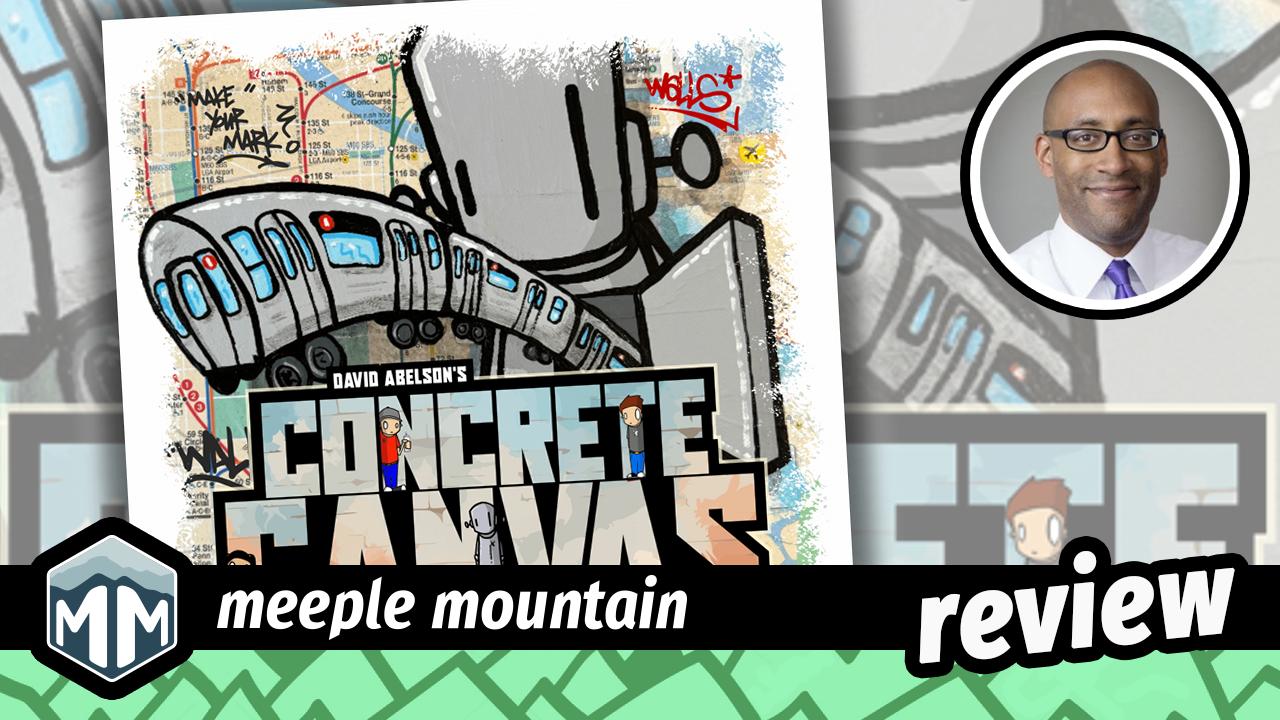
“I LOVE the style of this artist,” my 12-year-old said while admiring some of the painting cards from the upcoming limited movement and order fulfillment game Concrete Canvas, available on crowdfunding right now.
I had to agree. The art, by real-life street artist Chris RWK, is fantastic, and this style carries into the playable character tokens, the subway tiles used to dictate each player’s movement, and the milk crate player boards used to store paint cans as players move their tokens around New York City in an attempt to tag more locations than their opponents.
Designer David Abelson’s game does a great job of capturing the look and feel of something straight out of Beat Street, or any of the other break-dancing, street jive 80s films I grew up on. Even video games like Jet Grind Radio (or Jet Set Radio, depending on where you grew up) feel like an influence here.
Then the game starts…when Concrete Canvas reveals itself to be the opposite of dynamic.
Up and Down
Concrete Canvas is an order fulfillment, area majority game for 2-4 players. Players will spend most of their turns moving one of their two character tokens through different parts of New York via subway tiles that are adjacent to…
Da Brass Birmingham eines meiner langjährigen Lieblingsspiele ist, war ich natürlich von Beginn an daran interessiert, aber auch durchaus skeptisch, was das Spiel betrifft. Aber auch Brass Birmingham (2018) war ja bereits eine Weiterentwicklung des Ur-Brass (2007), welches dann bei Roxley in einer optisch stark überarbeiteten Version als Brass Lancashire (2018) neu aufgelegt wurde.
Brass Pittsburgh ist damit übrigens das 4. Spiel der „Brass-Reihe“. Hier wird gerne das Spiel Age of Industry (2010) vergessen, welches die 1. Weiterentwicklung von Brass war. Age of Industry hatte die Besonderheit, dass es hierfür weitere Karten als Erweiterung gab. Das ursprüngliche Spiel spielt hier in Neu England und ist ein gestreamlintes Brass.
Die Entwicklung von Brass 2007 bis 2018
Aber nun zu Brass Pittsburgh. Ich habe mir in den letzten Wochen einige Videos von us-amerikanischen Youtube-Kanälen zu diesem Spiel angesehen, um mir eine Meinung dazu zu bilden. Vor allem das Let’s Play von Before you Play hat mit hier geholfen einen Überblick über die Änderungen zu den Vorgängern zu bekommen.
Und das sind doch einige. Es gibt in Pittsburgh keine Kanäle mehr, aber nach wie vor 2 Ären. Und auch hier werden die 1er Industrien und ein guter Teil der Transportmittel (welche hier ausschließlich Züge sind) abgeräumt. In dem Spiel gibt es jetzt leichte und schwere Züge. Beim Bau der leichten Züge benötigt man Kohle, beim Bau der schweren Züge Stahl, das zusammen mit Koks eine der neuen Ressourcen im Spiel ist. Die schweren Züge bleiben auch über das Ende von Ära 1 auf dem Spielplan, alle leichten Züge werden entfernt.
Auch hat man zu Beginn des Spieles nur 2 schwere Züge zur Verfügung, alle weiteren muss man sich erst freispielen, indem man Industrien baut oder mit Entwicklung von seinem Spielertableau entfernt.
Es gibt auch jede Menge neue Industrien, wie z. B. Kerosin, Stahlwerke, Koks, ein Generator, eine Ölstadt, Produktionsstätten für schwere Züge und Autos und außerdem noch Wolkenkratzer. Neu ist auch, dass man manche Industrien zwingend überbauen muss, um das nächste Level davon zu bauen. Auch werden wohl jetzt die Siegpunkte von Industrien gewertet, die man überbaut, was bei Birmingham und Lancashire nicht der Fall ist.
Neu sind auch die Ressourcen Stahl und Koks und die „dezentralen“ Ressourcenmärkte, die zudem unterschiedliche Preise für die Ressourcen. Da muss man auch immer aufpassen, von welchem Markt man kauft oder an welchen Markt man verkauft, wenn man mit mehreren davon verbunden ist. Zudem gibt es in Brass Pittsburgh die Möglichkeit Ressourcen von Cornelius Vanderbilt zu kaufen. Dazu muss man auch mit keinem Markt verbunden sein, man zahlt jedoch kräftige Aufschläge.
Statt Bier, wie in Birmingham, benötigt man in Pittsburgh jetzt Öl zum Verkaufen. Dazu muss man zuerst Pipelines zu Ölfeldern bauen. Wenn diese genutzt werden, erhält man zusätzlich einen Bonus (Geld, Einkommensschritte, Siegpunkte). Zu Spielbeginn hat man nur 1 dieser Pipelines, die man bauen kann, weitere muss man erst über sein Spielertableau und das Bauen von Industrien freischalten, genau wie die schweren Züge. Ein Ölfeld kann man immer über mindestens 2 Wege anbinden. Es gibt aber auch die Möglichkeit einen dieser Wege zu blockieren, damit die Mitspieler gezwungen sind über die eigene Pipeline auf das Öl zuzugreifen.
Neu sind auch die einmaligen Bauboni, die man durch das Bauen von Zugverbindungen und Pipelines erhält. Und last, but not least, gibt es in dem Spiel jetzt Whiskey. Diesen kann man Einsetzen, um eine seiner Orts- oder Industriekarten zu einer Jokerkarte zu machen. Eine weitere Option ist das Abgeben von Whisky, um die neuen Premium Aufträge (Quality Rewards) zu erfüllen. Für diese muss man Güter verkaufen, auf deren Industrieplättchen Sterne abgebildet sind. Für einen fehlenden Stern kann man 1 Flasche Whiskey abgeben. Die 3 Premium Aufträge können jeweils nur 1x in der Partie erfüllt werden und bringen Siegpunkte, Einkommenssschritte, Geld oder Whiskey.
Es gibt noch ein paar weitere Besonderheiten, wie z. B. Industrien, die man nicht verkauft sondern nur überbaut, oder die Wolkenkratzer, die sofort nach dem Errichten eine zusätzliche Verkaufsaktion bringen.
Vor Ende der Gamefound-Kampagne soll auch noch die Anleitung zur Verfügung gestellt werden (Stand 08.04.26 war diese leider noch nicht verfügbar). Auch soll noch ein Playthrough von Heavy Cardboard, mit dem aktuellsten Prototypen und dem letzten Stand der Anleitung kommen.
Heavy Cardboard hatte in den letzten Wochen bereits Playthroughs von den bisherigen Brass-Versionen, inklusive Age of Industry, gestreamt.
Es gab auch noch eine Abstimmung welches Cover die Collector’s Edition von Brass Pittsburgh erhalten soll. 3 Cover standen dabei zur Wahl. Gewonnen hat das Cover mit dem Stahlwerk (Auch mein persönlicher Favorit). Allerdings kann man in der Kampagne auch noch die beiden anderen Cover für die Collector’s Edition auswählen.
Fazit: Ich habe mich entschieden in die Kampagne einzusteigen und die Brass Pittsburgh Collector’s Edition zu unterstützen, auch weil ich natürlich nicht gefeit bin vor nettem Chichi, wie z. B. den Synth-Karten, den hölzernen Industrieplättchen, den metallenen Ölfässern oder den schicken Ressourcenwürfeln.
Das mit den Double Layer Spielertableaus ist insofern etwas doof, da man auch in Brass Pittsburgh Industrieplättchen übereinanderstapelt und diese in der Höhe dann über das Tableau hinausragen, auch wenn es nicht so viele sind wie bei Brass: Birmingham oder Lancashire. Auch den nicht spiegelnden Spielplan bräuchte ich persönlich nicht und statt der zugegebenermaßen schicken geprägten Blechdosen hätte ich viel lieber ein Insert, in welches ich die Industrieplättchen in der richtigen Reihenfolge einsortieren könnte.
Alles in allem haben mich die Playthrough Videos aber angefixt und ich würde das Spiel gerne spielen. Und wenn es dann am Ende doch nicht so oft auf den Tisch kommt, dann kann ich es bestimmt auch wieder zu einem vernünftigen Preis weiterverkaufen.
Es gibt aber auch 2 Punkte, die mich bei der neuen Brass-Version nicht überzeugen. Das sind die Bauboni, die man für manche (nicht alle) Zugstrecken oder Ölpipelines bekommt und das sind die 3 Quality Rewards, die jeweils nur 1 Spieler erlangen kann. Für mich passt das nicht so recht zum sonst sehr eleganten Brass Spielablauf. Es wirkt für mich eher so, als wollte man hier noch ein, zwei neue „Gimmicks“ einbauen. Es sind übrigens auch die einzigen Wege, außer dem Bau der Güter-Fabrikation Stufe IV, um an Whiskey zu kommen. Da hätte ich mir auch noch einen anderen Weg gewünscht.
Nur die neuen Metallmünzen kann sich Roxley wirklich behalten. Zum einen bin ich ein großer Fan von Pokerchips und zum anderen habe ich auch Bedenken hinsichtlich des Designs. Ich bin mir nämlich ziemlich sicher, dass sich in diesen „Münzen“ am Ende einiges an Dreck sammeln wird und das die dazu prädestiniert sind, den Spielplan zu verkratzen.
Board Game Arena hat in der vergangenen Woche zwei neue Titel ins Programm aufgenommen. Mit Scythe kommt ein moderner Klassiker des Strategiegenres auf die Plattform. Charuma bringt dagegen ein kompaktes Stichspiel mit ungewöhnlichem Bietmechanismus an den digitalen Tisch.
Scythe – Strategie im alternativen Europa der 1920er
Scythe von Designer Jamey Stegmaier erscheint bei Stonemaier Games und gehört seit seiner Erstveröffentlichung 2016 zu den bekanntesten Strategiespielen weltweit. Auf BoardGameGeek belegt der Titel Platz 26 im Gesamtranking und erreicht eine Bewertung von 8,10 aus 10 Punkten bei über 92.000 abgegebenen Stimmen. Das Komplexitätsgewicht liegt bei 3,45 von 5.
Das Spiel versetzt 1–5 Personen in ein alternatives Europa der 1920er-Jahre, in dem gefallene Reiche um Ressourcen und Territorien konkurrieren. Im Kern verbindet Scythe Engine-Building, Ressourcenmanagement und Gebietskontrolle. Jede Fraktion startet mit eigenen Fähigkeiten und einer individuellen Position auf der Karte. Trotz der militärischen Optik liegt der Schwerpunkt auf wirtschaftlicher Effizienz und dem geschickten Ausbau des eigenen Tableaus.
Eine Partie dauert laut BoardGameGeek rund 115 Minuten, auf Board Game Arena liegt der Durchschnitt bei etwa 58 Minuten. Für die Illustrationen zeichnet Jakub Różalski verantwortlich, dessen Dieselpunk-Ästhetik maßgeblich zur Bekanntheit des Spiels beigetragen hat. Im deutschsprachigen Raum ist das physische Spiel über Feuerland Spiele erhältlich. Für diesen Titel wird ein Premium-Abo benötigt.
Charuma – Stichspiel mit Bietphase
Charuma stammt von Designer Takashi Saito und erscheint beim Verlag Darucat. Das Kartenspiel für 2–5 Personen kombiniert klassisches Stichspiel mit einer vorgeschalteten Auktionsphase. Vor jeder Runde bieten die Spielenden mit ihren eigenen Siegpunkten auf offen ausliegende Karten und bestimmen so selbst, mit welcher Hand sie in die Stichphase gehen.
Das Deck besteht aus nur zwei Farben mit Werten von 1 bis 10, jeweils doppelt vorhanden. Besondere Regeln sorgen für taktische Tiefe: Wird eine identische Karte gespielt, schlägt die zuletzt gespielte die erste. Treffen Ass und 10 derselben Farbe aufeinander, gewinnt das Ass. Paare können erzwungen werden, was weitere Entscheidungen verlangt.
Eine Partie dauert laut BoardGameGeek zwischen 20 und 45 Minuten. Auf der Plattform wurde Charuma bislang 47 Mal bewertet und kommt auf einen Durchschnitt von 6,00 Punkten. Die Illustrationen stammen von Simon Caruso. Das Spiel lässt sich ohne Premium-Abo spielen.
Vorbemerkungen: Beim Spiel Skybridge von Michael Rienecke und Franz Vohwinkel aus dem Verlag Deep Print Games bzw. durch den Vertrieb von Pegasus Spiele tauchen wir in eine Fantasiewelt ein. Wir stehen…
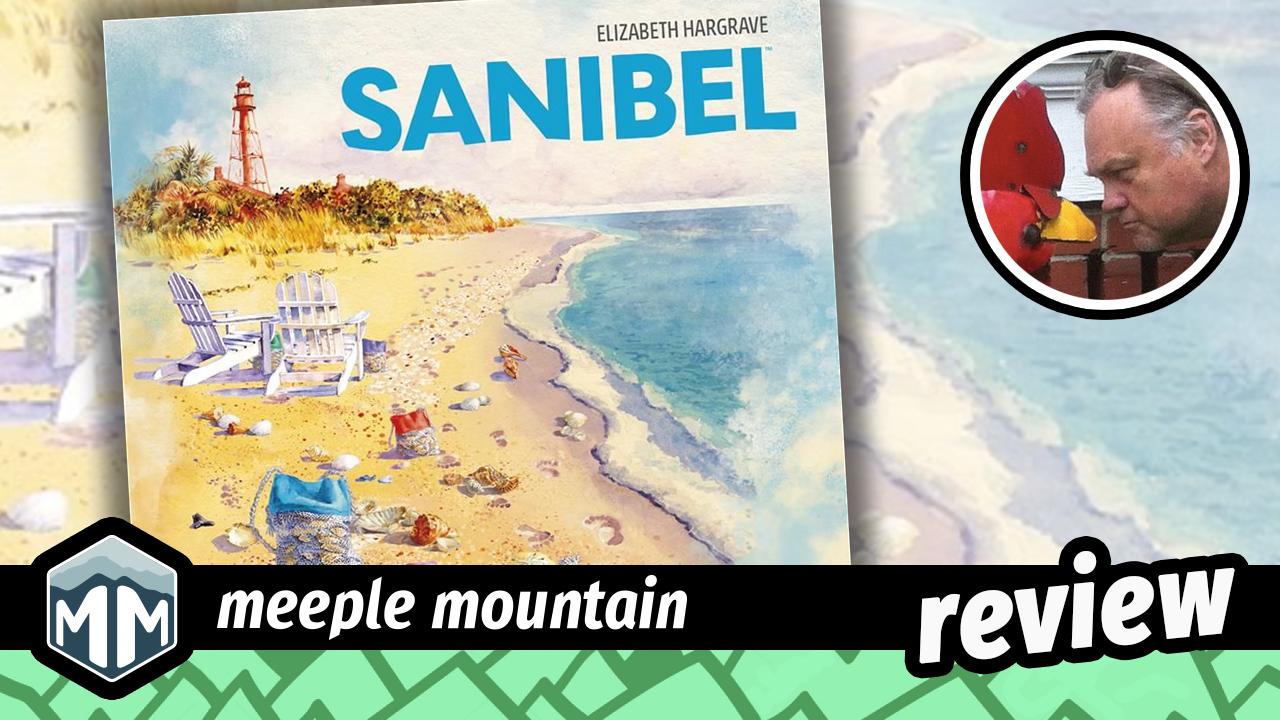
In Elizabeth Hargrave’s latest game, Sanibel, players take turns walking down the beach and stopping to collect a variety of shells and shark teeth. You’ll score points by dropping these treasures into your bag so they ‘fall’ in alignment with other items already there. Have the most points at the end of the walk, and you win the game.
Setup
To start, unfold and line up the three sections of the board. On the left, place the section with the beach chairs; to the right, place the section with the lighthouse. The section without a special area at either end goes in between these two.
Players then take a token of their chosen color and the corresponding board with a bag printed on it. You’ll place everyone’s tokens in random order in the upper left corner of the central board on the right, just above the beach chairs. Place the Wave token to the far left of the player tokens.
Shuffle the zig-zag-shaped pieces and deal two to each player. These are your Lighthouse tiles and will offer additional scoring opportunities once you reach the Lighthouse midway through the game. Read these carefully, as they may help you determine which shells you want to concentrate on.
French board game publisher Fentasy Games has launched a new platform aimed at providing publishers with a more affordable way to get their higher complexity titles into the hands of retailers and gamers.
Company founder and CEO Florian Gigot told BoardGameWire Fentasy had scored several successes since launching towards the end of 2024, including localisations of complex titles El Burro and Stephens – but said its major challenge in that time had been “the structural reality of the traditional distribution model”.
He said, “We realised that for a small publisher, a ‘critical success’ doesn’t always translate to a ‘financial success’ once the middlemen take their cut. The same applies to many of my partners around the world.
“…between squeezed margins, production costs, and trade discounts, even a popular game can become a financial failure. For an independent publisher, this means increasing difficulty in funding subsequent projects – and ultimately, a real risk of going out of business.
“In this context, profitability is no longer a secondary objective, but a condition for survival.”
Gigot hopes newly launched platform BoardGameCommerce will give publishers of higher complexity games with smaller print runs – of between 500 and 1,000 units – a more sustainable financial option than the traditional board game industry distribution model.
Gigot said BGC differs, however, in that Fentasy commits to producing the game the moment it goes onto the platform, saying, “We don’t ask the community to carry the industrial risk – we carry it ourselves because we believe in the project.”
He said that model helps Fentasy and other publishers measure real demand for their titles, as well as giving visibility to game makers that might not be possible amid the plethora of new games battling it out through traditional distribution.
Gigot added that BGC also offers retailers “a professional interface to secure limited stock with high margins of up to 55%”, with no payment required until the game is ready to ship.
He told BoardGameWire, “I absolutely see this growing. In fact, BGC is designed to be an agnostic platform. We are already in talks with other small publishers who face the same ‘strangulation’ within traditional distribution.
“We want to offer them the same resilience we built for ourselves – bringing everyone together on a single, global platform. It makes it much easier for gamers and retailers to find exactly what they are looking for in one place.
“The icing on the cake is that all publishers using the BGC platform have access to a shared licensing ecosystem. For example, if Publisher A adds a game to BGC and is looking for a partner to localise it, Publisher B can check the available licenses for their country and initiate a business discussion immediately.
“BGC takes 0% commission on these deals – the goal is simply to be stronger together.”
Gigot said Fentasy aims to release between three and five titles each year, with about half going through BGC and half, such as its localisation of Animal Rescue Team and upcoming strategy title Microlonies, through traditional distribution.
The BoardGameCommerce platform
The publisher’s first release through BGC is Iron Games’ Mesopotamia-themed territory builder Papyria, with future titles set to arrive on the platform before the end of next year including Martin Wallace space exploration design Casus Belli and Masaki Suga’s chocolate industry strategy title Bean to Bar.
Other Iron Games releases available through BGC include Discordia and its Magna expansion, Pandoria and Ploc, while Fentasy’s French localisation of Uwe Rosenberg design Kanal – previously Oranienburger Kanal – is also present on the platform.
But Gigot added, “Titles like Animal Rescue Team and Microlonies will still follow the traditional distribution model. We aren’t abandoning big distribution – we are simply choosing the right tool for the right game.
“There is no ‘hostility’ toward the traditional model – it just isn’t built to sustain niche titles effectively.”
Gigot said Fentasy’s biggest successes since its late 2024 launch have included Kikai – Bricolage Heads, which he said moved more than 4,000 copies “in a short window for a game of its complexity”.
He added that 2026 release Microlonies “is following the same successful path. It proved that a hungry audience exists for deep, high-production-value games”.
Fentasy’s success to date has persuaded Gigot – who runs the company as “a small, agile core team of one person” – to expand its scope internationally, with him telling BoardGameWire the business is moving towards a 60% international / 40% France split.
He said, “We are always looking for new partners to localize our games in their countries and to localise their games into French.
“Our goal for 2027 is to achieve a synchronized BGC launch for our expert line across Europe (Germany, Poland, Italy, Spain) and Canada, China, allowing local publishers / retailers to bypass the heavy costs of international imports.”
Kein Tabletop-Spieltisch kommt ohne passendes Gelände aus. Das Star-Wars-Universum hat einen eigenen Stil, was Gebäude und Landschaften angeht und somit will auch stimmungsvolles Gelände für Star Wars: Legion gut gewählt sein. Atomic Mass Games bieten darum jetzt ein Starter Set mit großen und kleinen Geländeelementen.
Bombastic was first explained to me as advanced tic-tac-toe. It is a two-player-only abstract game played using 9 tiles laid out face-down in a 3x3 grid. Four of the tiles show a circle, another four a cross, and the last one a bomb. Each player is assigned an icon, circle or cross. Your goal is to reveal exactly three of your icon in a row on your turn. Beware. If you ever reveal the
I like weird games (derogatory) almost as much as I like weird games (complimentary).
Belinda’s Big Bonus is a weird game (weird).
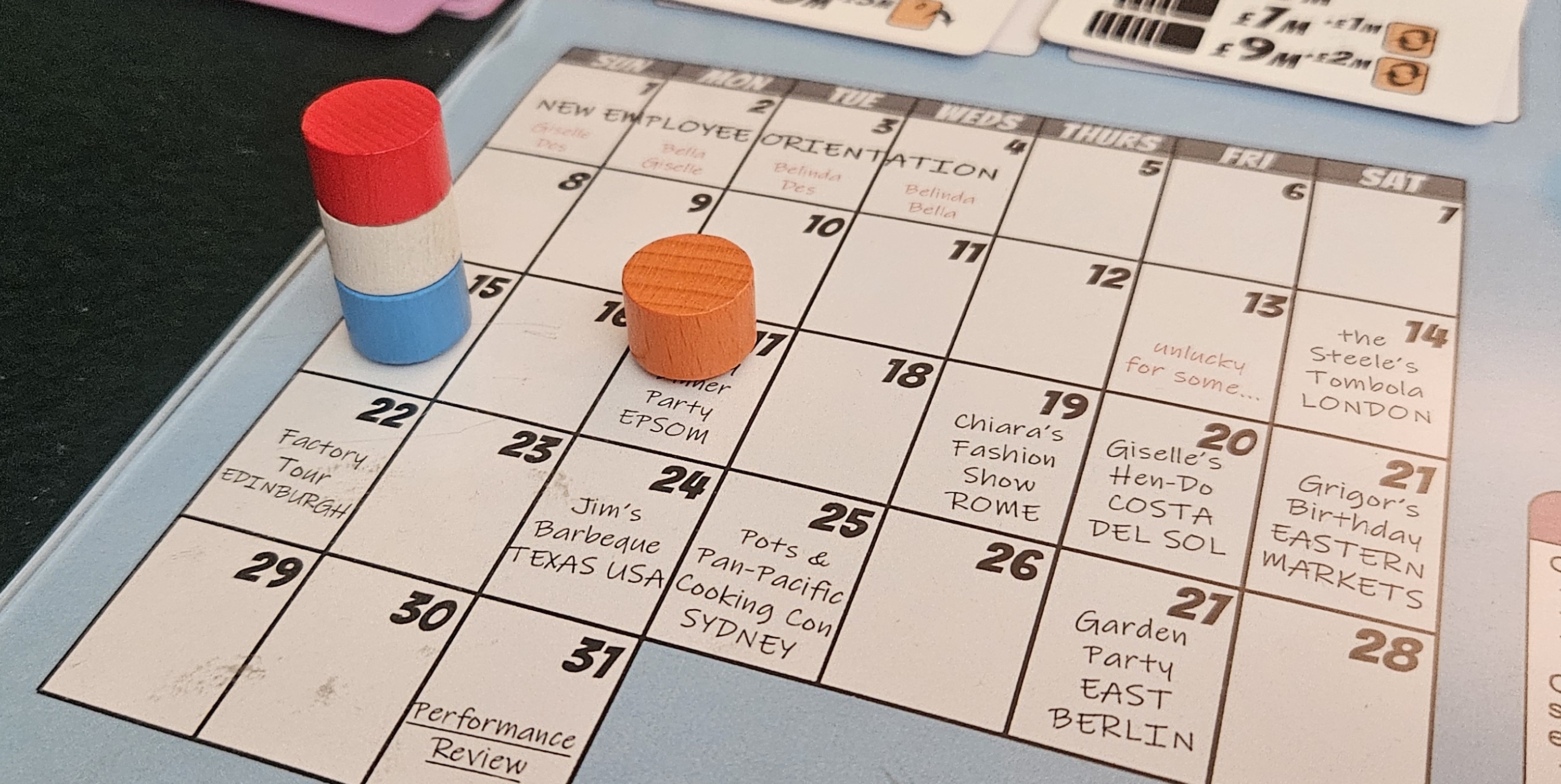
Having your game designed by Amabel Holland sets certain expectations, despite any difficulties in pinning her down to a single genre or register. Similarly, basing a game on an erotic novel series, in this case Belinda Blinked by Rocky Flintstone, also sets certain expectations. Yet Belinda’s Big Bonus isn’t especially erotic. I wouldn’t call it funny, either, although it’s possible I’m just not in on the joke. Neither does it strike me as “so bad it’s good.” Mostly, it’s twice as complicated as one would expect from a licensed game. It reminds me of nothing so much as one of those business guys whose entire life is conducted through Google Calendar invites.
There is travel, but this is not a travel game.
First of all, we should open with a disclaimer. I know very little about Belinda Blinked. I considered reading the first one as research for this review — “research,” I say — but decided against it. Sometimes knowing less is knowing more. That’s our motto here in the United States. It’s written on our dollars and everything. While scant few people are going to play this thing sans foreknowledge, I happen to be one of them, and if there’s any one quality a critic requires, it’s the resolute belief that one’s experiences are valid no matter how uninformed. Here I stand.
Which is to say, perhaps Belinda Blinked is about managing one’s schedule, suffering from jet-lag, and mixing up which actions cost which payment. Maybe. In which case, may I offer my deepest apologies to Holland, Flintstone, and Belinda herself. Forgive this prude, for he knows not what he do.
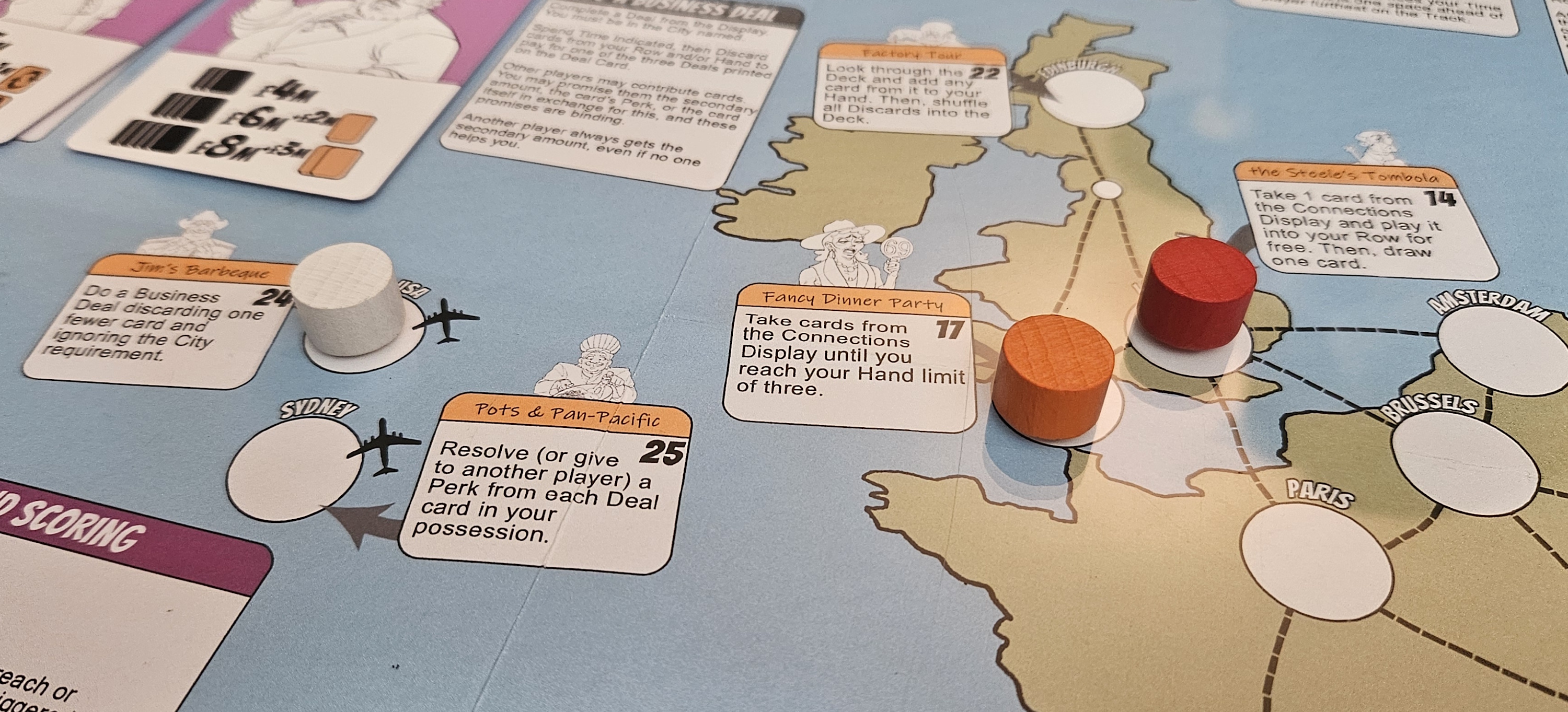
At the game’s outset, players step into the not-yet-broken-in business shoes of interns at Steele’s Pots and Pans. Their task is to earn some millions of pounds for the company. They do this by…
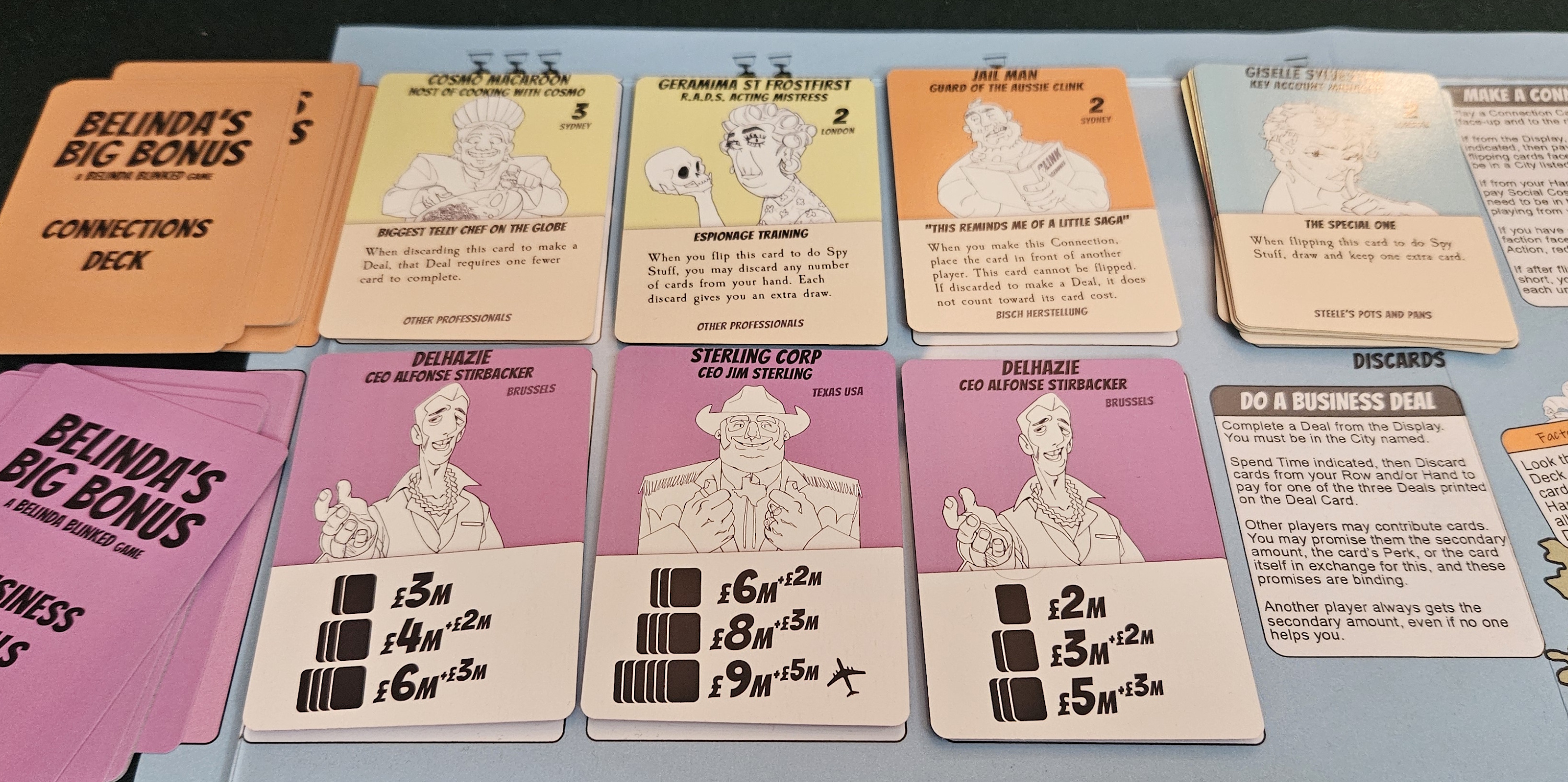
Look, this is the first problem with Belinda’s Big Bonus, and it’s a doozy. As any gaming evangelical knows, it’s hard enough describing a board game to newcomers, and Belinda’s Big Bonus is no board game for newcomers. There are mechanisms aplenty in this trunk, packed together like someone mixed the first-aid kit with the snack bag. There’s a calendar timekeeping system, the kind popularized by Martin Wallace titles, and cards that may exist either in a market, your hand, or a tableau, with interactions dependent on their current source — except sometimes they can be spent from two of those places, and the rulebook is conversational and, although it’s amusing, this doesn’t lend itself to learning the damn thing.
Scheduling, but this is not a scheduling game.
Here’s the short version. Turns are variable, conducted by whomever is farthest back on the calendar. On those turns, you spend some amount of time to make connections — which is to say, put cards into your tableau from either the market or your hand — do spy stuff — gain cards into your hand, from the deck this time — rest to refresh the cards in your tableau, make a business deal by throwing away the cards you painstakingly contacted or spied upon — and, in the process, try to persuade your fellow players to spend some of their cards instead, because these business deals are often collaborative and dole out benefits to multiple players — or perhaps visit a calendar event on the appointed date to gain some advantage.
If that sounds confusing, try teaching it. I’m no stranger to Holland’s more tangled designs, but this one found the most uncomfortable spot on the seesaw between complexity and anticipation: the fulcrum. Belinda’s Big Bonus feels like it should be a light game, looks like a light game, has that licensed light-game air to it, and then, kapow, but a kapow more like a punch to the schnoz than something erotic, it smacks you with a clutter of ideas.
For all that, there is an interesting game in here. The gist is that you need to build out your tableau and hand in order to spend those same cards to make business deals. Along the way, your characters provide something like an engine.
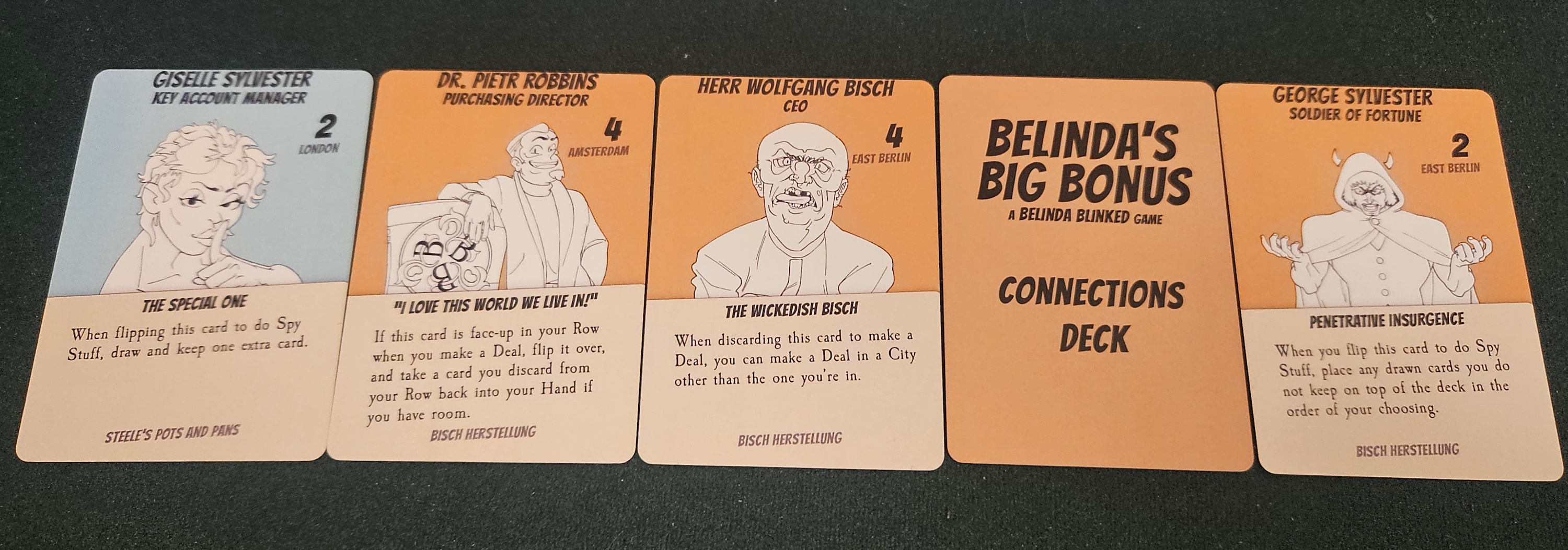
There’s even a narrative to the whole thing. Sir James Godwin makes it easier to attract Bella Ridley to your work group. Meanwhile, James Spooner, the Laird of Gretna Green, brings Cosmo Macaroon into the fold through some act of espionage. Later, your connections to Bella and Cosmo will help you make a deal in Texas, USA for nine million pounds sterling. Unfortunately, that same deal enriches a rival intern by five million pounds, so you try to squeeze some contribution from so-and-so at the table rather than merely handing the commission to whichever competitor is sitting in last place.
Odd people, but this is not an odd people game… well, scratch that. It’s an odd people game.
Those are genuine dramatic and narrative beats! Along the way, though, Belinda’s Big Bonus is burdened by bloated bits. It’s easy to paint oneself into a corner, for instance, by spending too many cards on an eager deal. This can leave one player sitting around with very little to do but play catch-up. And, hey, that’s their fault, right? If we were playing one of Holland’s cube-rail games, such a possibility would act as evidence of the game’s forthrightness. But here, the possibility comes across less like an honest appraisal of the perils of betting everything on some bad stock tips, and more like an unexpected heel-turn on the game’s part.
Here’s another example. Belinda’s Big Bonus includes the possibility of a traitor moment. When the game concludes, the player in last place might reveal that they now hold the majority of connections to Steele’s rival firm, Bisch Herstellung. This turns them into “the special one” and wins the game in a sudden coup. Cool!
Except, like everything else in Belinda’s Big Bonus, the rules governing the reveal are so text-heavy that it doesn’t feel like an amusing capstone. It’s closer to checking a technical manual to see if you’ve successfully told a joke. It isn’t hard, exactly. Nothing in the game is hard. But it’s less fluid than it ought to be, keeping everybody’s attention on these mismatched processes rather than on the parade of characters and situations strutting across the table.
Buncha great hangs.
Then again, maybe I’m not in on the joke. Maybe a Belinda Blinked game should be more complicated than most licensed titles. Maybe it should buck common sense by being an erotic game with no eroticism, a business game with no head for business, a whimsy with lots of rules printed on the board. Maybe it should be a big meta-joke at my expense. Maybe this game doesn’t exist for anyone but me, and it was sent to me solely so that everybody could point and laugh and say, ha ha, you took our prank earnestly, you big stupid fool, you moron, you lame-o.
That would be okay. I don’t mind. In the game’s cast of characters, I feel most like the guy anxiously cleaning a stain from his tie. I don’t need to get everything. Sometimes, I even revel in how little I understand. For example, I’ve had a lovely time not understanding Belinda’s Big Bonus. Maybe you’ll have a lovely time not understanding it as well. Just don’t say I didn’t warn you.
A complimentary copy of Belinda’s Big Bonus was provided by the publisher.
(If what I’m doing at Space-Biff! is valuable to you in some way, please consider dropping by my Patreon campaign or Ko-fi. Right now, supporters can read about which films I watched in 2025, including some brief thoughts on each. That’s 44 movies! That’s a lot, unless you see, like, 45 or more movies in a year!)
The German branch of high IQ society Mensa has unveiled its full slate of nominees for this year’s MinD Spielepreis.
Mensa in Deutschland has run the awards contest since 2009, and has operated a ‘shorter games’ category for more than a decade and lighter two-player games prize since 2019.
This year’s ‘shorter games’ category will be fought over by titles including 2025 Spiel des Jahres nominee Krakel Orakel, as well as Grégory Grard and Mathieu Roussel’s design Zenith and Take Time from Alexi Piovesan and Julien Prothière.
Word chaining game Next by Verena Wiechens and Lukas Setzke is also up for the shorter game prize – which focuses on titles that play in well under an hour – as is Maldón’s design El Camarero (published in Germany as Chaosteria), and Wilmot’s Warehouse from David King, Ricky Haggett and Richard Hogg.
In the two-player games category, Bruno Cathala’s design Kamon is up against Niwashi, from Gautier de Cottreau and Baptiste Laurent, Junghee Choi’s Orapa and Tobias Tesar’s Perfect Murder.
Playball, designed by David Florsch, will also compete in that category, as will Strategeti by Ignasi Ferré and Suna Valo, designed by Andreas Odendahl (who goes by ode.).
Jochen Tierbach, who has been organising the MinD Game Award for 16 years, said at the time, “There are already various awards and prizes for family and connoisseur games.
“But for expert games, the really tough ones, there is no such thing in Germany yet. And we feel that the industry wants it.”
The long list of more than 20 expert-level titles was whittled down to six challengers for the complex games award this year: Galactic Cruise, Luthier, Shackleton Base, Speakeasy, Thebai and Thesauros, all of which have been released in Germany since Spiel Essen last October.
Last year’s MinD award for complex games saw Tomáš Holek’s space exploration eurogame SETI add to its array of prizes, while Simone Luciani and Dávid Turczi’s Nucleum triumphed in 2024.
A few years ago, I came across a new designer named Wolfgang Klein (no relation to Alexander Klein) and his new company Assault Games. They create fantastic tactical level wargames and we have played several fo them and also got a chance to meet both Wolfgang and his friend and partner Erich Rankl. They are currently working on a new edition of their first game called Assault – Red Horizon ’41: Revised Edition and they readying it for a Gamefound campaign yet this spring. I reached out to Wolfgang to get some information about the revisions and changes to the game and he was more than willing to provide a lot of great information.
Wolfgang: Over the past 5 years, Red Horizon ’41 has evolved significantly through continuous development, community feedback, and extensive gameplay experience. What began with Rulebook 1.0 has gradually been refined into a much more mature and developed system. The new revised edition incorporates years of player feedback, integrates content from various expansions, and improves clarity, balance, and presentation across the entire game.
Over the past 5 years, RH41 has developed considerably, both in terms of the Assault System rules and its graphical presentation. In particular, with Sicily ’43 – Gela Beachhead (Rulebook version 2.0) and its expansion Primosole Bridge, we feel that we gained valuable experience that directly influenced the design of this revised edition and that will assist us in future volumes as well to improve the player experience and simulation value of the game.
Most of all, however, we are grateful for the intensive exchange we have had with our Assault fans over many years. We have remained very active in our forums on BoardGameGeek, and it is there that we have gathered, discussed, and evaluated a huge amount of positive and constructive feedback. With all the great ideas and contributions from our players, we have continued refining the rules step by step.
As far as version 2.5 is concerned, the door for feedback will remain open until the end of the upcoming Gamefound campaign.
In concrete terms, rules have been refined, adjusted, expanded, or removed. All texts have been revised to make them easier and more efficient to read. We have also made a clear step forward in wording and terminology. However, we have not changed the core gameplay mechanics. So players familiar with version 1.0 should still find it easy to get back into the system.
Wolfgang: The upcoming version is referred to as a Revised Edition of Assault: Red Horizon ’41. It is not simply a reprint, but a comprehensive refinement of the system.
Major changes to the game and the Assault System include the following:
A box inlay designed for the safe storage of all game components
Overall, the revised edition reflects everything we have learned about the system from our players and through continual play on our end since the original release. I do believe that the system will continue to evolve as other rule clarifications or needed changes come to light.
Wolfgang: After the original edition sold out, interest in the game continued to grow. At the same time, years of development, playtesting, and community feedback had accumulated.
In addition, RH41 is something like the core game for the Eastern Front within the Assault System. Our plan is to design an entire series of modules focused on the Eastern Front, and Red Horizon ’41 is the natural foundation for that planned series.
This created the perfect opportunity to bring the game back in a fully refined and improved edition rather than simply reprinting the original version.
Wolfgang: I would describe it as a very special journey. We have now been working in cooperation with Sound of Drums for 3 years.
What makes this collaboration different from the traditional designer–publisher model is that we at Assault Games work with Sound of Drums on equal footing while maintaining our own independence.
The goal of this cooperation was to free ourselves from the typical publishing tasks such as production, logistics, and distribution, so that we could focus more fully on developing the Assault System and expanding into future opportunites. In many respects, this has worked very well. In other areas, there are still things that can be improved.
Sound of Drums, and Uwe Walentin in particular, has worked very hard to keep our backs free for designing by carrying the responsibility for taking care of the worldwide distribution network, logistics, and shipping. From my point of view, that works very well. Uwe is also a highly knowledgeable and perceptive figure when it comes to wargame design, and he has become an important advisor for us. His experience in the games industry helps us do things the right way — and focus on the right things.
One area of the cooperation where we have made major progress is in the structuring and preparation of our print files. I would especially like to thank Marc von Martial (Art Director at Sound of Drums) on this point. Thanks to his templates, we are now able to turn our designs into print-ready files in a much shorter time. That has been a tremendous help for Sicily 43, Primosole Bridge, and now also RH41 Revised Edition.
In the end, I would say that our journey is not over yet. Sound of Drums, like us, is still a young company, so there are new challenges every day. But as the saying goes: “Everything will be fine at the end of the road. If it is not fine yet, then the road is not over.”
Wolfgang: We started the Assault System a long time ago as a new tactical game system, and from the very beginning it was clear that both the rules and the content would continue to evolve over time. Other systems refer to their rulebooks as “Living Rules,” and that is very much how we see the Assault System rules and the game as a whole.
At the same time, it is important to us that we do not do this alone. We want to actively involve our player base in the further development of the system so that it can become the best game system possible. Standing still is simply not an option for us.
Many of the changes were driven by years of gameplay feedback from the community and by our own experience with the system. Over time, we identified:
areas where rules could be streamlined
components that could be improved or added
visual elements that could be made clearer
The goal was always to improve clarity, usability, and gameplay flow without changing the core identity of the system.
Wolfgang: The most visible aspect of the game’s development is undoubtedly the graphical redesign and the addition of new visual features. Michael Grillenberger, supported by Marc from Martial, once again did outstanding work, just as they did on Sicily ’43 and Primosole Bridge. I would like to thank them both once again for that work.
The map artwork in particular will immediately catch the eye. We have raised it to the same high standard seen in Sicily ’43 and Primosole Bridge, which creates an even greater sense of immersion.
Overall, the graphic design has been significantly refined compared to the first edition. Maps, symbols, counters, and other visual elements have been redesigned to improve readability and consistency. Vehicle artwork has also been updated, and the game’s entire visual language has been unified to create a stronger overall identity.
Wolfgang: The visual style supports the core philosophy of the system: clarity, immersion, and functionality.
The artwork strikes a balance between historical authenticity and tabletop readability, which is essential in a tactical wargame where players need to process information quickly. In that sense, the artwork helps reduce the players’ workload so they can focus fully on the game and on the tactical situation on the battlefield.
Wolfgang: One major improvement is the integration of visual symbols directly onto the maps. Last year, we conducted a survey among our players because it was important for us to understand what they thought about the idea of including symbols on the map boards. The result was extremely close.
Many players were concerned that such symbols might reduce immersion. Because we take those concerns seriously, we decided on a more subtle compromise. Elevation levels and some terrain rules are now represented with discreet graphical indicators, allowing players to understand the battlefield layout more quickly without constantly consulting the rulebook.
That, in turn, makes things much easier for the players.
Wolfgang: Quite simply, these changes make the Assault System much more accessible and easier to play. The need to search for information is reduced, and the overall handling of the game becomes smoother.
In particular, readability, gameplay flow, and ease of learning have all improved. Players can now interpret terrain and elevation at a glance, which speeds up play and reduces rule lookups.
Wolfgang: The vehicle illustrations have been updated and refined, providing clearer identification and a more consistent visual style across all units. I think Michael also worked on them simply because he really enjoyed doing so.
These changes enhance both the historical feel and the table presence of the game.
Wolfgang: The revised edition introduces several new terrain types:
Wheat and crop fields
Steep slopes
Covered trails
These elements are closely tied to the historical landscape of the Eastern Front, particularly the region around Białystok in the summer of 1941. Large expanses of wheat and crop fields dominated the countryside and often influenced visibility and movement for advancing troops. During the opening phase of Operation Barbarossa, German and Soviet forces frequently fought across agricultural land where tall grain could provide concealment but also limit observation.
Steep slopes and covered trails reflect the natural terrain features of the area, which included rolling ground, wooded ridges, and narrow rural tracks. Such features often shaped the movement of infantry and vehicles, creating opportunities for ambushes or concealed manoeuvres.
Including these terrain types allows the game to better represent the tactical realities soldiers faced during the early battles around Białystok, while also expanding the range of strategic options available to players.
Wolfgang: The system now includes additional fortifications and obstacle elements, allowing players to represent defensive battlefield preparations more realistically. These counters reflect the kinds of improvised and field-built defenses commonly used by Soviet forces in the border regions during the first days of Operation Barbarossa.
In June 1941, Soviet units attempted to delay the rapid German advance by establishing temporary defensive lines, often using field entrenchments, tank barricades, and hastily constructed obstacles. Barricaded roads and reinforced firing positions were typical features in defensive positions around key crossroads and villages. Although many of these defences were incomplete because of the speed of the German attack, they nevertheless influenced the course of local engagements.
By incorporating such fortifications and obstacles, the game is able to reflect the defensive measures historically present on the battlefield. These new counters expand the tactical possibilities in scenarios and campaigns, while also helping to recreate the atmosphere of the chaotic and desperate fighting that characterised the opening days of the campaign around Białystok.
Wolfgang: The revised edition features an improved box design, including:
A box inlay designed for sleeved cards
A transparent lid for better organisation and visibility of components
These changes were made to improve both storage and usability for players. Many players prefer to sleeve their cards to protect them during repeated play, particularly in games with frequent handling such as card-driven tactical systems. The redesigned inlay ensures that sleeved cards fit comfortably inside the box without bending or compressing them, allowing players to keep their components protected while still maintaining a compact storage solution.
The transparent lid also helps players organise and identify the different components more easily. Counters, cards, and markers can be seen at a glance, which speeds up setup and makes it easier to keep the game organised during play. For a system that may include multiple scenarios and campaign elements, quick access to components is especially useful.
Overall, the improved box design reflects feedback from players of the original edition. By making the storage solution more practical and user-friendly, the new edition aims to make preparation, transport, and long-term storage of the game more convenient.
Wolfgang: The rules have evolved from Rulebook 1.0 to version 2.5, and possibly eventually to 3.0.
Key changes include:
Integrated expansion content
Clarified rules
Streamlined mechanics
Improved structure and organisation
Since the release of the original rulebook, the system has gradually developed through playtesting, player feedback, and the addition of expansion material. Earlier supplements introduced new mechanics and scenario elements that are now fully integrated into the core rules, allowing players to access the complete system without needing to consult multiple documents.
Another important goal of the revision was to clarify rules that had previously caused questions during play. Certain mechanics have been rewritten with clearer wording and additional examples, making it easier for players to understand how the system works in practice. This also reduces ambiguity during gameplay and allows players to focus more on tactical decision-making rather than rule interpretation.
The revised rulebook also streamlines several mechanics. While the core gameplay remains unchanged, some procedures have been simplified to maintain the fast-paced flow of the system. The intention was not to make the game less detailed, but rather to ensure that its mechanics remain intuitive and efficient during play.
Finally, the overall structure of the rulebook has been improved. Sections are now organized more logically, making it easier to locate specific rules during a game. Together, these changes reflect the natural evolution of the system and aim to provide both new and experienced players with a clearer and more accessible ruleset.
Over the years, extensive playtesting and feedback from players helped identify areas where the original rules could be improved. Ambiguities in certain mechanics were clarified, and procedures that occasionally slowed down gameplay were simplified. As a result, the revised rulebook presents the system in a more accessible and consistent way, allowing new players to learn the game more quickly while still preserving the depth that experienced players expect.
The streamlined mechanics also improve the overall flow of play. Turns progress more smoothly, and players can focus more on tactical decisions rather than consulting the rulebook. This is particularly important in a fast-moving tactical system set during the opening stages of Operation Barbarossa, where battlefield situations changed rapidly and decisions had to be made under pressure.
In addition, the revisions helped refine the balance of the system. Through years of scenario testing and community feedback, certain interactions between units, terrain, and combat mechanics were adjusted to ensure that engagements feel both challenging and historically plausible. Together, these improvements create a more polished and engaging gameplay experience while remaining faithful to the original design of the system.
As mentioned before, feedback on Rulebook version 2.5 will remain open until the end of that campaign.
Our goal is to use this period to gather final community input, complete the last refinements, and move the project into production in the best possible shape. A more precise release timeline will be shared as soon as the campaign and production planning are finalised.
Wolfgang: Well, I think Assault Games might become a never-ending story. We will keep working on it as long as we continue to enjoy it—and that could still take a very long time.
Joking aside, we are very active when it comes to new ideas. I actually talked about some of this in our most recent SITREP (a bit of self-promotion here):
We have started publishing a development roadmap so that everyone can see what we are currently working on and what might be coming in the future. Of course, the roadmap only shows the official topics we want to share publicly—and yes, there are also a few unofficial ideas we are exploring behind the scenes.
To give you a small glimpse of what might be ahead, you can already see a draft cover for our upcoming Normandy journey. And that’s not all—there are several other things in development.
Thank you so much for your time in answering our questions Wolfgang and I look forward to future games from Assault Games and Sound of Drums.
This is a board game blog. Board games are a medium which can help us understand – for example, they can provide a uniquely active perspective on history. Yet which other medium can provide a fresh perspective on board games? – This is where novels come in handy. Today, we’re going to look at The Third Reich (Roberto Bolaño), a study in obsession as well as gaming and history.
Spain in the 1980s. Udo Berger, a young German, has just arrived in a small seaside town for a vacation with his girlfriend Ingeborg. Yet Udo’s mind is not on the beach. He has just won the national championship at the wargame The Third Reich (clearly based on Rise and Decline of the Third Reich (Don Greenwood/John Prados, Avalon Hill)) and plans to use his vacation to write an article on his new strategy for the Axis. Ingeborg, however, has more traditional vacation activities in mind, and so they spend some of their swimming, tanning, and partying, through which they befriend another German couple, some locals, and the enigmatic paddleboat renter who is only known as El Quemado (The Burned One) for the burn marks which cover his body. When the vacation comes to an end, Udo remains in Spain, supposedly to help in the case of an acquaintance lost at sea windsurfing… yet the real reason is the game of Third Reich which he plays against El Quemado.
Chilean novelist Roberto Bolaño wrote the novel in 1989. Since he turned his hand-written first draft into a typoscript (and later typed the first 20% into his first computer), it is assumed that he wanted to eventually publish it, but he didn’t do so before his death in 2003. When the novel was found among his papers, it was posthumously published in 2010. In addition to the original Spanish (El Tercer Reich), the book has been widely translated. I read the German translation.
Warning: Spoilers for the plot of The Third Reich ahead – but frankly, this is not a book you read for plot, you read it for the vibes.
Obsession: Conquest, Validation, Control
Udo Berger is wargame-obsessed, but the book is not a study of how an outsider has outsider fixations. On the one hand, Berger’s obsession with conquest and domination sets him by no means apart from his peers – just that they usually direct their respective urges to amorous exploits. On the other, our protagonist does not only want to conquer in the game either. In addition to his girlfriend, he also pursues the hotel manager Frau Else (who has been his crush when he was vacationing in Spain as a teen), and the underage chambermaid Clarita. And maybe most of all, Berger is fixated on being respected by his wargame peers, which he can only imagine obtaining by finding strategies (and publishing articles about them) which will obliterate all conventional wisdoms about the game.
As Berger is acutely aware of his lack of linguistic sophistication, he decides to practice by writing a diary during his vacation (which is what we read in the novel). The development of this diary reflects the changes in the writer: Originally, his daily entries are very structured (one per day, headlined by the date), and mostly concerned with banal reports on what he did, what he ate, and what he has in mind for the game/article). As Berger is drawn more and more into his duel with El Quemado, the diary gets more confused: He jumps from one level of narration to another within the same paragraph, extensive passages are solely dedicated to what’s happening in the game (down to which counters are placed on which individual hex numbers on the board), and the chapters are not only named after the dates, but also entitled “With El Lobo and El Cordero [his Spanish acquaintances]”, “Spring 1942” or “My Favorite Generals”.
Berger’s inability to focus also dooms his conquests (ludic and erotic): He sets out to prove that opening a second front early is not a liability, but an asset, and enthusiastically reports early in the game to a friend at home that it’s “Blitzkrieg on all fronts”. Yet as he conducts an amphibious assault of Britain at the same time as he invades the Soviet Union, his forces are overstretched and his Axis collapses before the historical date. And broadcasting his erotic attention over Ingeborg, Frau Else, and Clarita, does not further his relationship with either of them.
As things slide out of his grip, his attitude to control changes: Initially, Berger is fixated on the superior strategy. He notes down the exact moves – which corps need to occupy which hex in which turn to win. This chess-like approach collapses after the turning point of the game: Once El Quemado begins his counter-attack, Berger mentions for the first times that there are die rolls in the game (and how they favor his opponent) – not unlike many board gamers I have seen.
Gaming and History
Besides the main theme of obsession, the novel also offers many glimpses on gaming, history, and the relation between the two.
Berger arrives in Spain with his life compartmentalized between the gaming and the “normal” part – his girlfriend and the office job. This compartmentalization is already eroding with his plan to write the strategy article (which immediately chafes against the confines of a conventional vacation – the hotel employees are bewildered by his request for a large table to be set up in his room, and Ingeborg demands he come to the beach) and fully collapses over the course of the book, when he even unilaterally extends his vacation to play the game (and gets fired for it).
The shadow of history hangs over Berger. Our protagonist does not only play games about World War II, he also reads “patriotic” literature of the era, knows about the lives and deeds of the German generals (especially those of the SS), and the only of his wargamer friends for whom he has a certain reverence is a veteran of World War II. Despite this clear fascination for the history of Nazi Germany, Berger twice disavows being a Nazi himself (having been asked by El Quemado and Clarita). Once he even calls himself an “opponent of the Nazis”, but does not expound on it. His personal politics do not factor into the novel – Berger, having been born around 1960 in democratic, liberal, prosperous post-war Germany enjoys the luxury of only engaging with history at his leisure. He thus remains at the surface of it…
…unlike his gaming opponent. El Quemado comes from South America, and it is rumored among his Spanish acquaintances that the scars he bears are the result of torture (by one of the many right-wing regimes which took power in the 1970s). History has thus seeped into his body and gives him the strength to withstand the ludic assault of the experienced player Berger.
Bolaño himself was arrested after the 1973 coup in Chile and, to his own wonder, was released after eight days without having been tortured (he ascribed it to two of the detectives having attended school with him). He then emigrated to Spain where he worked odd jobs in the tourism industry like El Quemado.
Another allusion to Chile is made in a much-misunderstood scene: On September 11, everyone is out at the beach to celebrate the Catalan national holiday. Yet when a plane flies overhead, an eerie sense of dread overcomes the spectators. Many reviewers see this as a revision which Bolaño must have made after the September 11, 2001 terrorist attacks (or, as an odd coincidence) – but I think the likeliest reason for the scene is that the coup in Chile began on September 11, 1973 with the rebelling air force bombarding the presidential palace in Santiago.
Verdict
Roberto Bolaño’s The Third Reich starts with the innocent concept of a beach vacation. As it grows darker, the novel develops a hypnotic pull. The author’s own deep knowledge of wargames allows him to paint a vivid picture of the game itself – and of the hold it can have over its players.
From the rulebook: “Shadera is no ordinary world. A great cataclysm has shattered the world of the fairy creatures. Where once there were no borders, an impenetrable veil now divides the home of the gnomes, wolper-squirrels and mermaids into many different Shard Worlds. In order to be able to continue to exchange raw materials, make trade agreements, and visit old friends, the Portal Guild was created — an association of all those magicians who can use their magic to open portals between the worlds.
You are part of this guild: adepts who, after long and thorough training, have come together today to prove their skills. Your master has decided that you will compete against each other in a duel to show that you can gather enough energy to open portals through the veil to the Shard Worlds. The first person to complete 20 tasks will be awarded Shadera’s highest honor, the title of Portal Guard.”
If, having just read all that, you’re crossing your eyes trying to make sense of it, you’re not alone. The story is nonsensical. Somehow, though, it seems appropriate because Portals is a game that defies easy explanation, especially if you try to attach a story to it.
How It Works
Published in 2024, Uwe Rosenberg’s Portals puts the players in the roles of Portal…
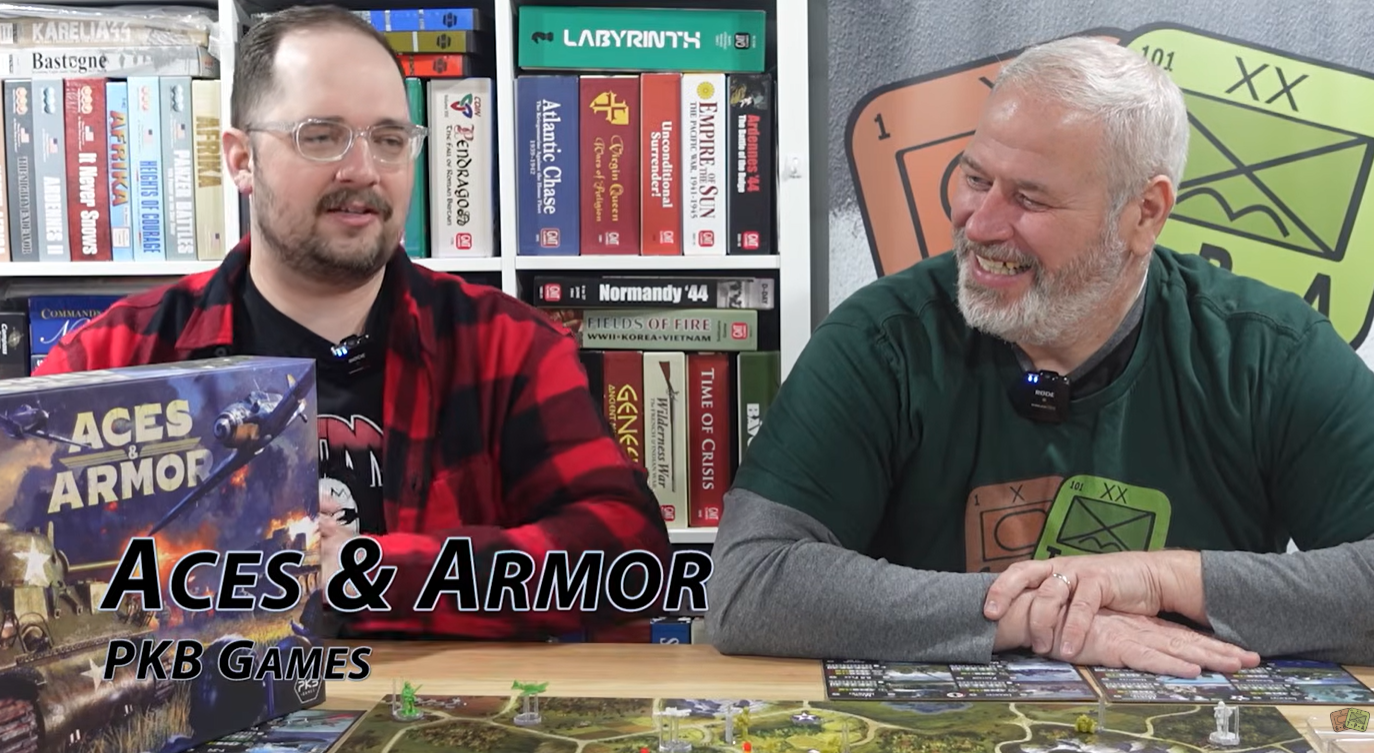
In Aces & Armor from PKB Games players take the role of a general (United States, Russia or Germany) in this complex (but easy to learn) strategy game. In addition to attack strength and armor of your troops, their tactical setup, combat experience, damage and terrain have a decisive influence on the outcome of the battle. Since each unit brings its own strengths, you must cleverly assemble your army to win the victory over your opponents. The game can be played either cooperatively or competitively and has a dedicated solitaire mode. The game uses detailed miniatures with many different unit types and has a high re-playability due to the variable start setup. The combat system is involved and a bit complex and depends on type of unit, combat damage, experience, strategic formation, terrain and armor (known from highly rated game Trench Club).
Was habe ich gespielt? boardgamearena.com: Dice Missions, Perfect Words Fantasy Ink Stapelsalat Piratatak Schatz der Mumie Strike Formidabel Just One Siderische Konfluenz Pili Pili
boardgamearena.com: Dice Missions, Perfect Wordsboardgamearena.com: Dice Missions, Perfect WordsFantasy InkStapelsalatPiratatakSchatz der MumieStrikeFantasy InkFantasy InkFormidabelJust OneSiderische KonfluenzSiderische KonfluenzPili Pili
In unserem Format „Tipp um Tipp“ laden wir euch ein, mit uns zu quizzen. Wir beschreiben Euch einmal pro Woche in 15 bis 20 Hinweisen ein Brettspiel. Wie schnell bekommt Ihr es heraus? Am Ende gibt es direkt die Auflösung.
Schreibt uns gerne, wie Euch das Quiz gefällt oder sagt einfach hallo.… [Weiterlesen]
There was a point after my first lap around the South Africa track, one of the two new tracks in Heat: Rocky Roads, when I realized that it might be my favorite track in all of Heat. Nothing else in the extended Heataverse feels quite as rewarding of great play. South Africa isn’t as punishing of poor play or bad luck as España, nor is it a source of the same adrenalized fun that comes with ripping down the straightaways in Italia or Nederlands, but a skilled player in South Africa can do some incredible things. And for the record, I came to this realization while I was getting absolutely walloped.
What is it that makes the track so good? It isn’t the gimmick. The only special rule is that any player who finishes their move on a gravel space has to pay a heat if they have one. If you’re on gravel and you don’t have any heat, it don’t hurt you none. This is a perfectly fine addition to the game, one that will occasionally make you second-guess taking advantage of an opportunity to slipstream, but it doesn’t add so much to the game that it would change the feel of an entire track.
It’s the corners. South Africa is jam-packed with delicious, surprisingly slow corners, and…
Skara Brae brings us to the Orkney Islands in prehistoric
Scotland. You manage a growing settlement. As more and more people flock to
your settlement, you need to make sure you gather enough resources, build
shelter, and cook enough food to feed everyone. At the same time you need to
manage the waste generated by the settlement. There is a message about
sustainability here

 Anmelden