Im Rahmen meiner Nostalgie-Serie habe ich bereits Scotland Yard vorgestellt. Ich habe auch Labyrinth Chronicles ausgeliefert bekommen und wir arbeiten gerade daran, die Kampagne zum ersten Mal abzuschließen. Mit meinem Sohn habe ich allerdings noch ein anderes Spiel aus dem Regal gezaubert. Er wollte neulich unbedingt Schach lernen und dabei ist mir eingefallen, dass ich noch Stratego besitze. Das habe ich früher ziemlich häufig gespielt. Kann das noch was? Kommt man als 8‑Jähriger da rein? Wir haben einen Versuch gestartet.
Bei der Recherche zu dem Artikel musste ich dann erst einmal feststellen, dass es über 40 Millionen Mal verkauft wurde. Damit kennt es wahrscheinlich jeder? Ist das so? Lasst es mich gern mal wissen! Was ich auch nicht wusste: dass es bereits 1942 lizenziert und es beweisbar ab 1946 produziert wurde. Die Lizenz gehört immer noch Jumbo und Hasbro ist der Lizenznehmer und Produzent der Spiele.
Für alle, die sich wie ich nicht vor Künstlicher Intelligenz fürchten, dürften daran interessiert sein, dass die Zugvielfalt bei Stratego komplexer ist als bei Go oder Schach. Erst 2022 hat die Software DeepNash mit großer Wahrscheinlichkeit zuverlässig Spitzenspielende besiegt.
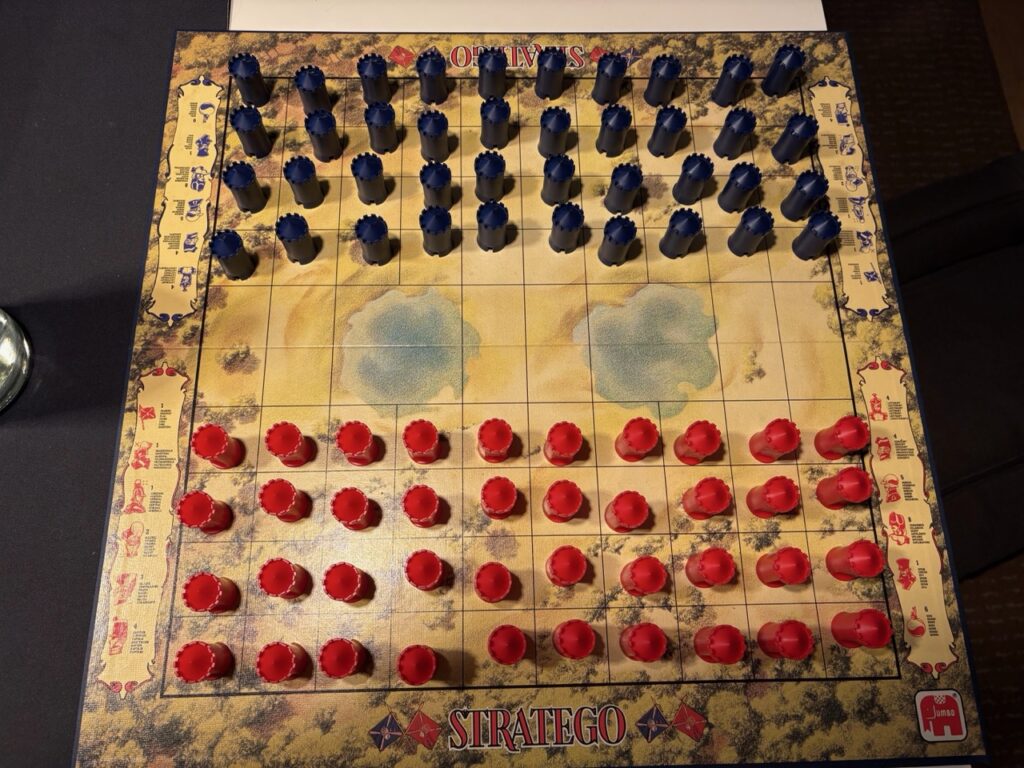
Das Schlachtfeld steht zum Duell bereit.
Spielprinzip
Die Spielfläche gibt sich schachähnlich mit 10 × 10 Feldern. Beim Spielaufbau platzieren die beiden Spielenden ihre jeweils 40 Figuren auf ihrer eigenen Seite auf zehn Feldern mit vier Reihen. Die Figuren sind an militärische Ränge angelehnt. Es gibt einen Feldmarschall, Hauptmänner, Unteroffiziere und weitere. Dabei gibt es eine strikte Schlagreihenfolge. Der Feldmarschall, schlägt alle Figuren. Der Vier-Sterne-General ist unterhalb des Marschalls angesiedelt und kann daher nur von diesem geschlagen werden. Dann folgt der Drei-Sterne-Oberst und so weiter.
Es gibt noch ein paar Sonderfiguren: die Fahne, die Bomben und den Spion. Ziel des Spiels ist es, die unbewegliche Fahne der gegnerischen Armee zu finden oder die andere Seite zur Aufgabe zu zwingen, wenn kein Zug mehr möglich ist. Dies kann passieren, sobald man nur noch unbewegliche Figuren hat. Neben der Fahne gibt es noch die Bomben, die fest an ihrem Platz verharren. Berührt man mit einer Figur die Bombe, wird die Figur aus dem Spiel genommen. Nur Mineure (sonst relativ unten in der Hackordnung) können die Bomben entschärfen. Die interessanteste Figur ist der Spion. Er wird von allen Figuren geschlagen, aber er ist die einzige Figur, die den Feldmarschall schlagen kann.
Die Reihenfolge der ersten Garde
Wie laufen die Züge nun ab? Nach dem Spielaufbau stehen sich zwei Armeen gegenüber. Die Figuren werden so gedreht, dass die Spielenden von der eigenen Armee die Vorderseite – also den Rang – sehen können und von der gegnerischen Armee nur die blanke Rückseite. Immer abwechselnd wird eine Figur orthogonal um ein Feld gezogen. Dabei ist jede Richtung erlaubt. Ein Überspringen von Figuren ist nicht möglich. Landet man bei dem eigenen Zug auf einer gegnerischen Figur, zeigen sich beide gegenseitig die Vorderseite und es wird aufgrund des Ranges entschieden, welche Figur das Spielfeld verlassen muss. Danach wird die überlebte Figur wieder mit der Vorderseite wie vorher abgestellt. Dadurch muss sich die gegnerische Person ab jetzt merken, was sich hinter dieser Figur verbirgt. Sind beide vom selben Rang, müssen beide Figuren das Feld verlassen.
Beim Aufbau lohnt es sich eine Trennwand aufzubauen.
Unboxing und Varianten
Ich habe viele Versionen von Stratego gespielt. In der für mich schönsten Version bestehen die blauen und roten Spielfiguren aus Plastik-Türmchen, die auf einer Seite begradigt sind und dort mit weißen Linien die Ränge darauf gedruckt haben. Außerdem gibt es ein Inlay bei dem die Figuren einsortiert werden. Die Spielbretter sind immer ganz schön gestaltet.
Früher hatte ich selbst noch ein Spiel mit Figurplatten, die in einen Ständer gestellt wurden. Das geht grundsätzlich auch, führt aber bei einer unsachgemäßen Berührung dazu, dass sie sich ungewollt umdreht.
Capture the Flag – ist das Ziel.
Solltet ihr Stratego noch nicht in eurem Besitz haben und es wieder neu erwerben, dann findet ihr in der aktuellen Version noch Kampfkarten („Battle Cards“). Dabei werden weniger Figuren genutzt. Die Karten erlauben besondere Züge, andere Angriffe und so weiter. Obendrein sind in der neuen Version wahlweise noch drei Figuren als weibliche Figuren spielbar. Das gilt im Übrigen auch für die 65‑Jahre-Jubiläums-Edition.
Es gibt noch eine Mini-Version mit nur zehn Figuren. Ich dachte, dass es sich dabei um eine Reisevariante handelt, und war sehr enttäuscht beim Auspacken. Tatsächlich fehlt mir bei der Variante auch die taktische Tiefe. Das ist gleich wieder aus dem Haus ausgezogen.
Es gibt noch Junior-Varianten mit Dinos oder Disney-Motiven. Meiner Meinung nach braucht es das nicht, aber das muss jede Person selbst entscheiden.
Bewertung
Stratego hat eine unerwartete taktische Tiefe. Je häufiger das Spiel auf dem Tisch landet, desto besser wird das eigene Spiel. Schon beim Aufbau gibt es viel zu entscheiden. Wird die Fahne eher frei platziert oder von Bomben umschlossen? Sind die höheren Ränge an vorderster Front oder sichern sie die Fahne? Stellt man die Bomben so auf, dass sie einen beim Ausspielen behindern?
Für Eltern ist vielleicht die größte Herausforderung, dass man den Mitspielenden nicht so einfach gewinnen lassen kann. Vielleicht liegt es an dem Brettspiel-Haushalt: Bei uns gewinnt immer die Person, die am besten spielt. „Keine Gnade“. Wir haben Stratego schon über zehnmal gespielt und mein Sohn hat noch keine Partie gegen mich gewonnen. Aber man merkt, dass er jedes Mal geschickter und taktischer spielt. Und es vergeht kein Kampf, nachdem er nicht sofort eine Revanche fordert.
Die Regeln hat er super schnell verstanden. Es kommt zugute, dass die Ränge auf dem Spielbrett abgedruckt sind und er sich zu Beginn nicht merken musste, wer wen schlägt. Mittlerweile weiß er das auswendig.
Ersetzt Stratego nun Schach? Nein, das würde ich nicht sagen, aber es ist ein guter Einstieg. Es hat eben andere Aspekte, wie Bluffen und die Notwendigkeit, dass man sich die Figuren des Gegenübers merken muss.
Ich war schon früher ein großer Fan von dem Spiel, obwohl ich sonst keine Kriegsspiele in meiner Sammlung mag. Ähnlich wie Scotland Yard wurde Stratego im Familienkreis wieder entstaubt und erfährt seinen zweiten Frühling. Für mich war es immer schon ein geniales Spiel. Es inzwischen mit meinem Sohn zu erleben, ist einfach nur grandios. Angesichts dessen zu Recht ein goldener Meeple.
Ein neues Spiel auspacken, die Regeln lesen und sofort losspielen – für viele Spielebegeisterte gehört das zu einem Spieleabend dazu. Für gehörlose Menschen kann doch genau das bereits zu einer Herausforderung werden.
Das Projekt DGS-Spiele hat es sich zur Aufgabe gemacht genau diese Barrieren abzubauen. Mitbegründer Tim Krenke spielt selbst gerne und stand schon des Öfteren vor genau dieser Herausforderung. Wenn Tim neue Spiele lernen wollte, haben die Regeln oft nur noch mehr Fragen aufgeworfen. Auch Erklärvideos im Internet waren oft keine große Hilfe – denn auf YouTube gab es nur wenige Spielanleitungen in Deutscher Gebärdensprache (DGS). Als gehörloser Mensch und Vater zweier gehörloser Kinder suchte Tim nach einer Möglichkeit Spieleregeln für Gehörlose einfacher verständlich zu machen.
Gemeinsam mit 8 Freunden entwickelte Tim die Idee für „DGS-Spiele“ und mit der Hilfe der „Aktion Mensch“ konnten die ersten Erklärvideos online gehen. Die Resonanz darauf war durchweg positiv und zeigte, wie groß der Bedarf war.
Wenn die Spieleerklärung fehlt
Eine Spieleanleitung besteht oft aus längeren Texten sowie komplizierten Formulierungen. Auch die Videos auf YouTube helfen bei der Suche nach Erläuterungen meist nicht weiter. Denn die Untertitel sind nicht immer korrekt und lassen ebenfalls Fragen offen. Noch schwieriger wird es laut Tim bei Spieletreffs: Während sich hörende Menschen ein neues Spiel einfach von einer anderen Person erklären lassen können, fehlt gehörlosen Spieler*innen meist diese Möglichkeit.
„Es ist, als würde man die Spiele einfach nicht erklärt bekommen“, beschreibt Tim die Situation.
DGS-Spiele setzt genau an diesem Punkt an. Auf ihrer Website veröffentlichen sie Erklärvideo in Deutscher Gebärdensprache. Und nicht nur die tragen zum Verständnis bei – auch die Videos der Beispielrunden helfen die Spiele einfacher zu verstehen. Bei der Auswahl der Spiele setzt das Team unter anderem auf Empfehlungen aus der Community, Bewertungen und Rankings. Besonders interessant sind Spiele, die wenig Text benötigen sowie einen verständlichen Spielablauf haben.
Spieleverlage können ebenfalls dazu beitragen die Barrieren bei Gesellschaftsspielen zu reduzieren, meint Tim. Verständliche, kurze Sätze sowie Bilder und Beispiele können schon viel bewirken. Auch Symbole auf den Spielmaterialien, auf die in den Anleitungen Bezug genommen wird, können gut für das Verständnis sein. Barrierefreiheit beginnt bereits bei der Entwicklung des Spiels.
Große Begeisterung in der Community
Dass die Begeisterung für Gesellschaftsspiele groß ist, erlebt das Team regelmäßig. Neun Menschen engagieren sich aktuell bei DGS-Spiele. Außerdem finden im Gehörlosen Zentrum in Bremen regelmäßig Spieletreffen statt. Bei den größeren Veranstaltungen kommen mehr als 100 Menschen zusammen – teilweise sogar aus München und Berlin. Damit noch mehr Spiele in DGS erklärt werden können, braucht das Projekt Unterstützung. Die Förderung durch die Aktion Mensch ist inzwischen ausgelaufen. Deshalb ist DGS-Spiele auf Spenden angewiesen.
Wenn auch ihr helfen möchtet, dann klickt auf den Link. So können auch zukünftig Spiele in Deutscher Gebärdensprache erklärt werden.
Denn Spielen sollte keine Frage der Hörfähigkeit sein. Es geht um Gemeinschaft, Spaß und darum, gemeinsam eine gute Zeit zu haben.
Tangram ist kein Spiel im eigentlichen Sinne – eher eine Philosophie, eine Lebenseinstellung. Dabei kommt es mit nur sieben geometrischen Holzteilen aus, bildet aber mit ausreichend Kreativität und Vorstellungsvermögen tausendfache sinnvolle Kombinationen, die eine scheinbar kleine Welt des Mosaiks in immer wieder erstaunlichen Bildcollagen verwandeln. Ohne Tangram gäbe es auch kein Ubongo & Co.
Schmidt Spiele hat es nicht erfunden und deshalb fehlt auch der Autor auf der kleinen Metallbox voller Fingerabdrücke, in der Tangram aktuell zum Taschengeldpreis erhältlich ist. Erstmalig erwähnt wurde es unter dem Namen „sieben Bretter der Weisheit“ in chinesischen Schriften um 1813. Dort tauchten dann auch Rätselbücher auf, deren Vorlagen man aus den nur sieben Teilen passgenau nachlegen soll. Im 19. Jahrhundert wanderte es dann als Tangram nach Europa. Brettspielkenner wird die Tangram-Form als Quadrat zusammengelegt zudem arg bekannt vorkommen. Die SPIEL Essen hat es im Logo und steht dort für spielerische Vielfalt. Ich selbst habe Tangram in der alten Pappschachtel-Ausgabe allerdings beim Ergotherapeuten kennengelernt. Dort ist es im Einsatz, um visuelle Wahrnehmung, Raum-Lage-Verständnis, Feinmotorik sowie Auge-Hand-Koordination zu trainieren und zu verbessern.
Es ist schon erstaunlich, wie viele unterschiedliche Formen wie auch komplex-abstrakte Abbildungen damit möglich sind. Wer sich die sieben lackierten Holzteile genauer anschaut, der erkennt, dass sich einzelne Teile zu den größeren Formen auslegen lassen und das auffällige Parallelogramm damit gerne in seiner Grundform maskiert werden kann. Und genau da liegt die Herausforderung im Solo-Spiel: Erkenne aus einer nicht maßstabsgetreuen Abbildung ohne Trennlinien, wie dieses Objekt aus den sieben Formen zusammengebaut ist und baue es nach. Gerne einfach spontan probiert, gedreht und gewendet und erste irreführende Ideen wieder verworfen. Die Schmidt Spiele Ausgabe bringt dazu 800 Bildvorlagen mit. Wer ganz verzweifelt ist oder zu wenig Geduld hat, schaut bei den Auslösungen nach und wird erstaunt sein. Freies wie kreatives Spiel ist ebenso möglich. Wer weiß, eventuell entdeckt Ihr eine noch nie dagewesene Kombination?
Ohne Tangram als Urvater der geometrischen Form-Puzzles, würde es wohl auch kein Ubongo geben. Vom schwedischen Spieleautor Grzegorz Rejchtman 2003 erfunden, nutzt es die von Tetris bekannten Polyominos, macht ein Echtzeit-Wettrennen im Wettstreit mit zeitgleich puzzelnden Mitspielern daraus und landet einen Welthit. Seit 2005 bei Kosmos als lokalisierte Version erhältlich. Fünfzehn verschiedene Varianten listet Kosmos auf: von Ubongo 3D bis zum diesjährigen Ubongo Flex, das mich bei meiner ersten Mitspielpartie fast zum Wahnsinn getrieben hat. Wo das Ubongo gezielt Hektik verbreiten will, ist die Solo-Beschäftigung mit Tangram eher eine Quelle der Ruhe – sofern man irgendwann auf die Lösung kommt.
Zwei neue Titel sind seit der letzten Ausgabe auf Board Game Arena spielbar geworden: das Push-Your-Luck-Würfelspiel Tally Up! und die gemütliche Bäckerei-Simulation Got What It Bakes?
Tally Up!
Tally Up! von Eric Olsen (Messy Table Games, 2026) ist ein Push-Your-Luck-Würfelspiel für 2 bis 10 Spielende. Reihum würfelt eine aktive Person mit drei von sechs wählbaren Risiko-Würfeln, alle anderen entscheiden nach jedem Wurf, ob sie mit ihrem Punktestand aussteigen oder weiter mitgehen und riskieren, bei zwei gewürfelten Sternen leer auszugehen. Wer zuerst 2.500 Punkte erreicht, gewinnt. Auf Board Game Arena unterstützt die Umsetzung 2 bis 10 Spielende, eine Partie dauert im Schnitt rund 10 Minuten.
Got What It Bakes?
Got What It Bakes? von Marianna Béres und Anikó Sajgó (Myam Games, 2025) ist ein Roll-and-Write für 1 bis 4 Spielende, in dem die Teilnehmenden über drei Runden eine eigene Bäckerei führen. Gewürfelte Zutaten werden gedraftet, um Rezepte zu erfüllen und die Backstube auszubauen, ein riskanterer „Bake if You Dare!“-Zug verspricht mehr Ertrag bei höherem Fehlschlagrisiko. Neben dem Solo-Modus gegen einen Bot gibt es einen kooperativen und einen kompetitiven Modus. Auf Board Game Arena unterstützt die Umsetzung 1 bis 4 Spielende, eine Partie dauert im Schnitt rund 41 Minuten.
We’re downsizing, imagining a brigher future where we don’t have hundreds of games to fret about not playing, but a very slight, extremely manageable twenty. Some say it can’t be done, but that’s never stopped us before. Before we get low, we talk about After you, Betobeto-san, Skull Queen, and Star Trek: Captain’s Chair – To Boldly Go.
If you don’t want to miss an episode, please subscribe on Apple Podcasts/Google Podcasts/Stitcher/Spotify, or add our RSS feed to your favourite app. Reviews and subscriptions really help us and would be greatly appreciated! To download the episode directly, click here.
If you’d like to discuss anything in the episode, please do so in the comments below, visit our BoardGameGeek guild, join our Discord, or Facebook Group! Any feedback is also always helpful. If you’d like to show your support for the show, we also have a Patreon with some fun rewards, and a merch store!
Timecodes:
01:53 – After you, Betobeto-san 09:11 – Skull Queen 17:21 – Star Trek: Captain’s Chair – To Boldly Go 28:12 – Minimalist board game collections
Thank you to Heart Society for generously letting us use What’s On Your Mind, Kid? from their album Wake the Queens.
Amigo lädt am 12. und 13. September 2026 zum Spielefest ins Capitol in Dietzenbach. Auf dem Programm stehen fünf Deutsche Meisterschaften und, zum ersten Mal, eine Halli-Galli-Vereinsmeisterschaft.
Deutsche Meister werden in Wizard, Saboteur, 6 nimmt!, 3 Chapters und Piraten Kapern ermittelt. Die Turniere zu 3 Chapters und Piraten Kapern stehen allen Interessierten offen, eine vorherige Qualifikation ist nicht nötig. Wer sich für Saboteur oder 6 nimmt! noch nicht qualifiziert hat, bekommt am Samstag im Nachqualifikationsturnier eine letzte Chance. Die Sieger und Zweitplatzierten in Wizard, Saboteur oder 6 nimmt! dürfen Deutschland anschließend bei der jeweiligen Weltmeisterschaft vertreten, die Reisekosten übernimmt laut Amigo der Verlag, dazu gibt es Reisetrolleys von travelite.
Neu: Halli-Galli-Vereinsmeisterschaft
Erstmals treten am 13. September Vereinsteams in einer Halli-Galli-Vereinsmeisterschaft gegeneinander an. Der Siegerverein erhält laut Amigo ein großes Spielepaket sowie Unterstützung für weitere Spieleabende. Die Anmeldung läuft nach Verlagsangaben noch.
Herbstneuheiten und Rahmenprogramm
Neben den Turnieren können Besucherinnen und Besucher die Amigo-Herbstneuheiten 2026 testen. Am Samstagnachmittag zeichnet Illustrator Jan Bintakies individuelle Kunstwerke im Stil der Herbstneuheit Strange Creatures. Dazu kommen eine Hüpfburg, eine Fotobox und eine Tombola zugunsten der CFI Kinderhilfe.
Wer an der Halli-Galli-Vereinsmeisterschaft teilnehmen möchte, sollte sich zeitnah anmelden: Der Termin liegt nur noch gut zwei Wochen entfernt, die Anmeldung ist laut Amigo aber weiterhin offen.
Der Ravensburger Verlag übernimmt ab dem Frühjahrsprogramm 2027 den Vertrieb ausgewählter LEGO-Bücher des polnischen Verlags AMEET für Deutschland, Österreich und die Schweiz. Das teilten beide Unternehmen in einer Pressemitteilung vom 19. August 2026 mit.
Im Zentrum der Vereinbarung stehen Beschäftigungsbücher zu den Marken LEGO Ninjago, LEGO Star Wars und LEGO Minecraft. Für das kommende Jahr plant Ravensburger rund 40 Neuerscheinungen sowie rund 60 Bestandstitel aus dem AMEET-Programm, verkauft über den Buch- und Spielwarenhandel. Erste Titel sind bereits seit August 2026 als Aktionsware in den eigenen Endkundenshops von Ravensburger erhältlich, vor dem offiziellen Vertriebsstart im kommenden Frühjahr.
Dr. Anuschka Albertz, Group Managing Director Books+ bei Ravensburger, begründet den Schritt mit der Sortimentsbreite: „Wir freuen uns darauf, unseren Händlern durch die neue Zusammenarbeit ein noch vielfältigeres Buchsortiment bieten zu können und mit den fantastischen LEGO Büchern weitere Zielgruppen für Bücher zu begeistern.“
AMEET-Geschäftsführer Piotr Modlinski sieht in Ravensburger einen strategischen Partner für die eigene Expansion: „Mit dem Ravensburger Verlag haben wir einen starken Partner gewonnen, der unsere Präsenz in allen Vertriebskanälen weiter ausbauen wird. Dadurch können wir uns künftig noch stärker auf unsere internationale Expansion konzentrieren, unser Portfolio mit weiteren Marken ausbauen und gleichzeitig den deutschen Markt nachhaltig stärken.“
Welche der rund 40 Neuerscheinungen zuerst in den Handel kommen und zu welchen Preisen, nennt die Mitteilung nicht. Details dazu sollen im Rahmen des Frühjahrsprogramms 2027 folgen.
6 Jahre hat sie pausiert – jetzt findet sie wieder statt: Die Wizard-Schweizermeisterschaft erhält 2026 eine Neuauflage. Organisiert wird der Anlass von „Wädi spielt“ in Zusammenarbeit mit AMIGO. Teilnehmende aus der Schweiz haben sich bisher an den Weltmeisterschaften immer gut
Beim Stichspiel Matter Matters stellen wir das Gleichgewicht im Universum her. Thematisch ist das eine grosse Bürde, doch eigentlich müssen wir einfach gleich viele Stiche in den beiden Spielfarben einfahren, um zu Pluspunkten zu gelangen. Es handelt sich also eher
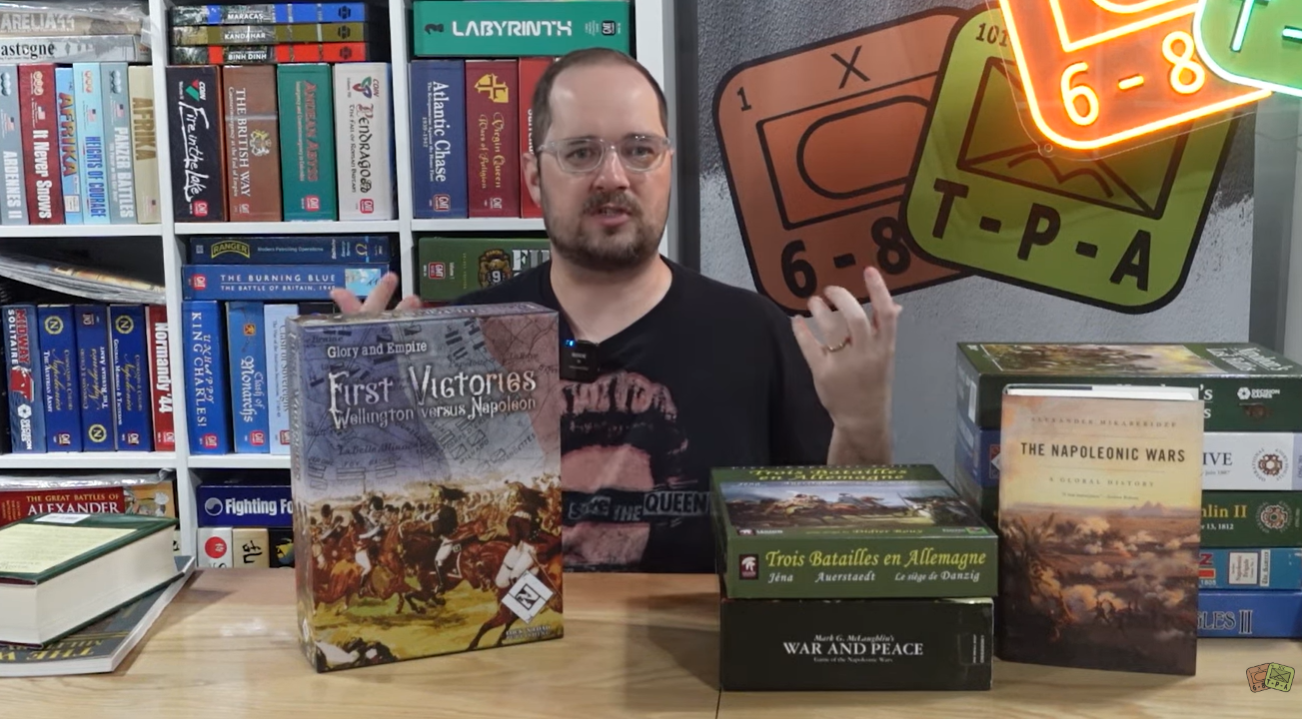
We have an ongoing video series on our YouTube Channel called From Cover to Cover where we read a book on a subject and then pair that with a discussion of the book while covering a few games also on the subject. In this 14th entry in the series, Alexander takes a look at The Napoleonic Wars: A Global History by Alexander Mikaberidze. He then discusses a few games on the subject including Congress of Vienna from GMT Games, Imperial Struggle from GMT Games, Alliance from Columbia Games, Commands & Colors: Napoleonics from GMT Games and The Napoleonic Wars from GMT Games. amongst many others
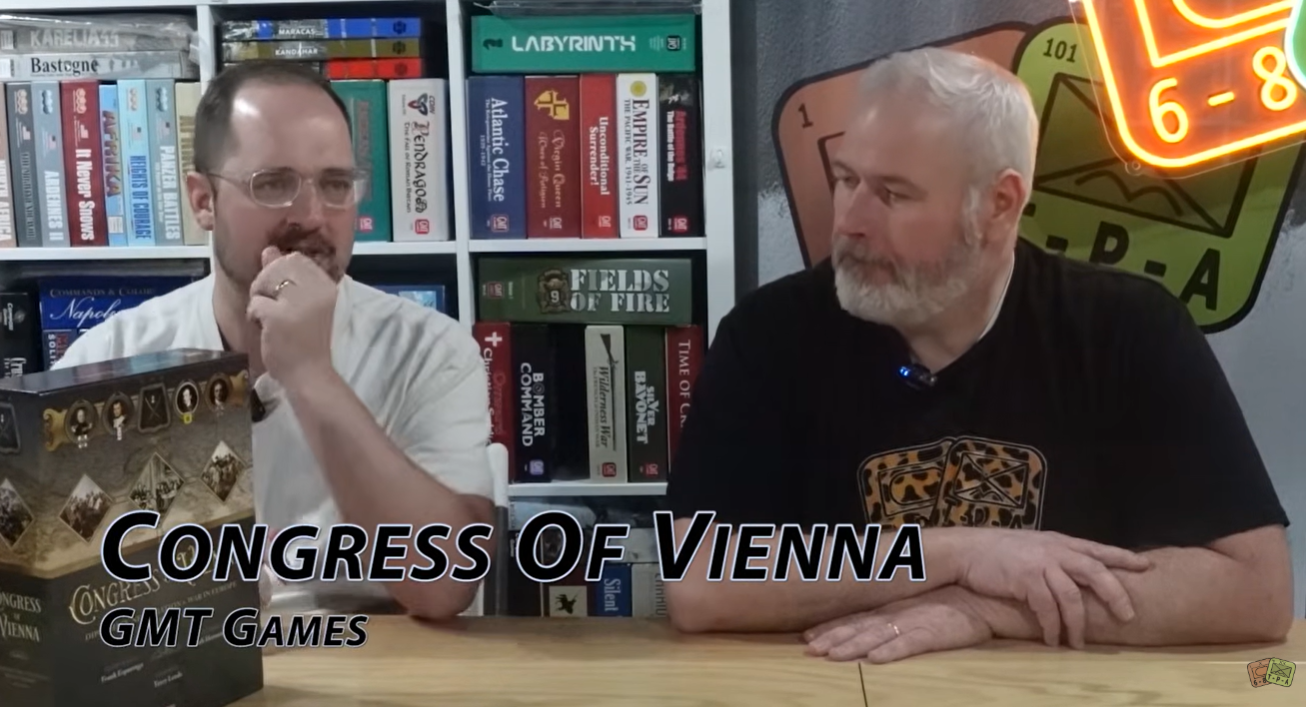
A few years ago, after playing all of the games in the Great Statesmen Series, we heard of a new game in the series from a designer not named Mark Herman and I was immediately interested and intrigued as we have had so much fun with Churchill, Pericles and Versailles 1919. Congress of Vienna from GMT Games is a diplomatic card driven wargame based on Churchill and is the 4th game in the Great Statesmen Series. The game is set during the years of 1813-1814 and sees players take on the role of the main characters of the struggle between the Napoleonic Empire and the coalition of Russia, Austria, and Great Britain with their Prussian, Spanish, Portuguese, and Swedish allies. We played the game twice last year at Buckeye Game Fest and at the World Boardgaming Championships and absolutely were amazed at the changes and innovations to the system introduced by the designer Frank Esparrago.
„Das Spiel war in Dortmund DER Renner“, so wurde mir das Rezensionsexemplar von Axel feierlich überreicht. Naja, eigentlich feierlich vor die Türe gelegt, aber das ist eine andere Geschichte. Und…
Wir waren zu Gast im LEGOLAND Discovery Centre Oberhausen! Asmodee hat uns zum Presseevent eingeladen, um das neue LEGO NINJAGO Brettspiel „Destiny’s Bounty Adventures“ unter die Lupe zu nehmen.
In diesem Video zeigen wir euch unsere ersten Eindrücke vom Spiel, wie wir gemeinsam die Destiny’s Bounty verteidigt haben und warum das Spiel nicht nur für kleine Ninja-Fans ein Highlight ist. Außerdem haben wir endlich die Lücke geschlossen und eine Runde „Monkey Palace“ gespielt – inklusive einer spannenden Punktejagd und jeder Menge LEGO-Spaß!
Zum Schluss werfen wir noch einen kurzen Blick in das Discovery Centre selbst – einen Indoorspielplatz für Familien.!
!disclaimer: Wir wurden von Asmodee zu dem Event eingeladen
Vier Stämme duellieren sich um die Shadow Cards. In einem Stichspiel treffen wir unsere Vorhersagen und spielen uns danach zu Punkten. Rein thematisch holt das Spiel wenig heraus, spannender ist die Sache mit der Wertung, die man ganz bewusst angehen
Every so often, a game system not only gets a second try, but entirely wallops its original incarnation. That’s the case with Quinn Brander’s Rebuilding Chicago, which remakes Rebuilding Seattle with such aplomb that I called it “pretty much perfect.” (I called it that to myself, right now, so I could quote it.) For today’s Space-Cast!, we’re joined by Quinn to discuss how he improved a game that’s still on store shelves, what some folks might prefer about the original, and the little touches that go into making a successful sequel.
Listen here or download here. Timestamps can be found after the jump.
TIMESTAMPS
3:45 — introducing Rebuilding Seattle and Rebuilding Chicago
7:11 — the origins of a hybrid city-builder and polyomino game
10:15 — a dual-layer polyomino puzzle
16:45 — modeling happiness and amenities
19:27 — balancing an in-game market
22:53 — using events to manage tempo
34:43 — why decide to revisit a game system?
45:37 — Gone to Gaia
(If what I’m doing at Space-Biff! is valuable to you in some way, please consider dropping by my Patreon campaign or Ko-fi. Right now, supporters can read my first-quarter update of 2026: the best board games, movies, books, and more!)
With this My Favorite Wargame Cards Series, I hope to take a look at a specific card from the various wargames that I have played and share how it is used in the game. I am not a strategist and frankly I am not that good at games but I do understand how things should work and be used in games. With that being said, here is the next entry in this series.
#83: British Leader Wellington from Congress of Vienna from GMT Games
Congress of Vienna from GMT Games is a diplomatic card driven wargame based on Churchill and is the 4th game in the Great Statesmen Series. The game is set during the years of 1813-1814 and sees players take on the role of the main characters of the struggle between the Napoleonic Empire and the coalition of Russia, Austria, and Great Britain with their Prussian, Spanish, Portuguese, and Swedish allies. Congress of Vienna has two different but related phases including the conference table where players first debate over the control of issues germane to the factions and the period of the war and second these issues are then used on the battlefield to recruit units, attack and take overall command of battles. The players will be playing cards from their hands to “debate” over the various issues that were placed on the table, which include all types of things such as Military Operations, Recruitment, who will lead the combined Coalition forces (Generalissimo), Future of French Government, British Financial Aid, Liberalism vs. Absolutism, Austrian Neutrality and several other issues, and then later the players will use their accumulated Resources gained from the issues to enact action on the Military Map and do things like mobilize troops, place Military Support Markers and the ultimately to conduct warfare.
The game relies on cards and cards can be used to negotiate, i.e. move an issue to your National Track. Cards can provide a particular issue with positive and negative DRM’s depending on which nation plays them and can also be traded with another player during the Diplomacy Phase. Certain cards are better than others for debating an issue moved by another player; and finally, if they are saved for the War Phase, staff cards can be used to modify dice rolling in battles. These are very versatile cards and the players will have to learn them and their benefits in order to be effective at the game.
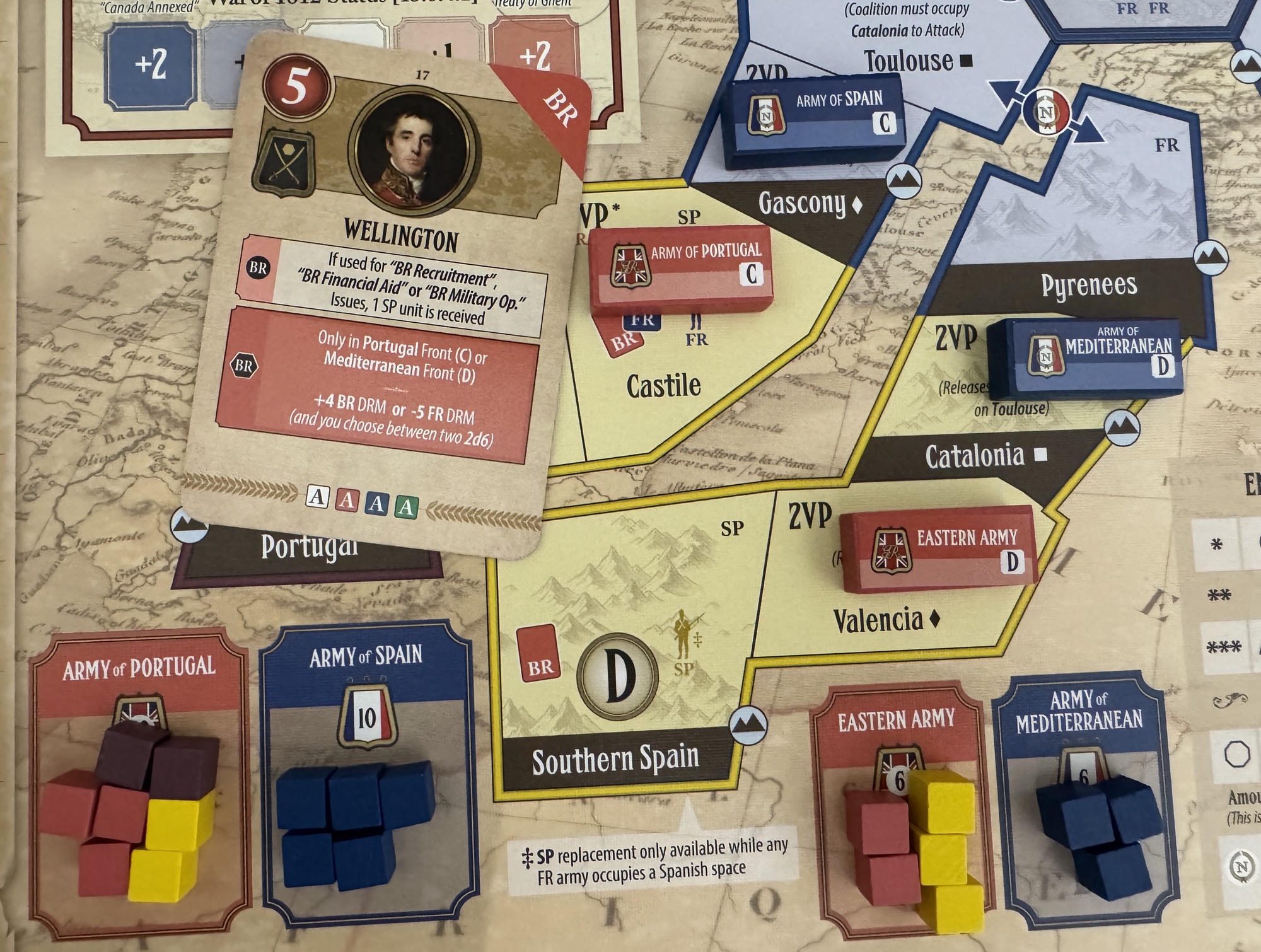
In this entry, we are going to take a look at the British Leader Wellington card. The Wellington card is the most powerful British military asset available and the British player should work hard to make sure that they get the card either by luck of the draw or by attempting to trade cards with other players. The major benefit of the card is during the War Phase, as it provides multiple benefits that can make combat much easier for the British. The bottom part of the card gives a boost during combat by granting an impressive +4 DRM in battles or to make the French have a -5 DRM. This is a very important decision and will mainly come into play to ensure losses are greater for the French or to make sure that a battle can we won. The combat benefit can only be used in the Portugal or Mediterranean Fronts but that is fine as this is where a majority of the British military actions will occur. But even more important than the DRM’s is the re-roll of the combat dice for the British. The other part of the combat benefit shown on the card is that the British player will get to roll 2d6 twice and then select the highest result during battles, greatly mitigating their risks of rolling poorly. Just a very powerful card for battles and I would definitely recommend its use in this fashion.
But, the top part of the card is also very important, particularly in the early part of the game, as when the card is used to move a British Recruitment, Financial Aid or Military Op Issue at the negotiating table they will gain a 1 SP unit that can be placed in the future into Fronts. This extra unit recruitment allows the British to slowly build up their forces without having to solely focus on choosing Recruitment Issues. This gives them the opportunity to focus on other Issues which can be very beneficial and give them a more well rounded approach.
Field Marshal Arthur Wellesley, 1st Duke of Wellington was a British Army officer and statesman who was one of the leading military and political figures in Britain during the early 19th century, twice serving as Prime Minister. He was one of the British commanders who ended the Anglo-Mysore wars by defeating Tipu Sultan in 1799, and was among those generals who ended the Napoleonic Wars in a major Coalition victory when the Seventh Coalition defeated Napoleon at the Battle of Waterloo in 1815.
Wellesley was born into a Protestant Ascendancy family in Dublin, in the Kingdom of Ireland. He was commissioned as an ensign in the British Army in 1787, serving in Ireland as aide-de-camp to 2 successive lords lieutenant of Ireland. He was also elected as a member of Parliament in the Irish House of Commons. Rising to the rank of colonel by 1796, Wellesley served in the Flanders campaign before being sent to India, where he fought in the Fourth Anglo-Mysore War, ending the conflict with a victory at Seringapatam in 1799. He was appointed governor of Seringapatam and Mysore and, as a newly appointed major general, won a decisive victory over the Maratha Confederacy at the Battle of Assaye in 1803.
Rising to prominence as a general officer during the Peninsular War, Wellesley was promoted to field marshal after leading British-led forces to victory against a French army at the Battle of Vitoria in 1813. Following Napoleon’s first exile in 1814, he served as the British ambassador to France and was made Duke of Wellington. During the Hundred Days campaign in 1815, Wellington commanded another British-led army which, together with a Prussian army under Field Marshal Gebhard von Blücher defeated Napoleon at Waterloo.
After the end of his active military career, Wellington returned to politics, becoming a prominent member of the British Tory party. He served as prime minister from 1828 to 1830, as well as on an interim basis for a little less than a month in 1834. Wellington oversaw the passage of the Roman Catholic Relief Act 1829 and opposed the Reform Act 1832. He continued to be one of the leading figures in the House of Lords until his retirement in 1846 and remained Commander-in-Chief of the Forces until his death in 1852.
Portrait of the Duke of Wellington by Sir Thomas Lawrence, c. 1815–1816.
We have done 2 videos on this game including the following RAW Video after out 1st play at Buckeye Game Fest in May 2025:
We then did the following full Review Video after our 2nd play at WBC last July:
I know it is now June….I am usually done with this post by mid-March but this year we had a bunch of great games that came out in November and December and we just had to get several of them to the table before we shut 2025 down. Our opportunity to do so with full tables as there were several multi-player games in that bunch, was during Buckeye Game Fest in mid-March where we played lots of great games including Werwolf: Insurgency in Occupied Germany, 1945-1948 from Legion Wargames, Cross Bronx Expressway from GMT Games and Imperial Elegy: The Road to the Great War 1850-1920 from VUCA Simulations to name just a few. And now, with those final games getting played, comes the impossible task of distilling an entire year’s worth of gaming down to a list of the 10 games that we most enjoyed. I hate doing this. I love writing about, thinking about and sharing my experiences about the games we have played but hate having to make somewhat objective choices about which is better and which games should even be considered for the list. The first comment I would have is that not all games are the same. Not the same scale, the same play time, the same mechanically or even historically. Each game is unique and in my opinion, all games have something objectively good about them. Secondly, we didn’t get around to playing some of the new releases in 2025. I say some but we actually didn’t play a lot of the new releases and did the best that we could to play as many as possible. So we might leave off a game that you thought was very good and deserving and it probably is but we either didn’t get around to playing it or it just didn’t hit with us. But, in the end, I have to make this list and this is my best effort at doing just that!
In 2025, we played 33 unique titles from 22 different publishers. Some were operational, strategic or tactical scale and in the list this year I didn’t include any solitaire games. Some used counters. Some used cards. Some used wooden bits and some used miniatures. Some were only card games with no other components and some were cooperative. At the end of the day, in 2025 we played a lot of games! And here I present to you my list of the Top 10 Wargames of 2025!
10. China’s War: 1937-1941 from GMT Games
This is a game that I have been awaiting for a long, long time. Really since it was announced nearly 7 years ago in 2019. Yes you read that right…2019! And I am happy to report that the wait was definitely worth it as the game feels fresh and is a very worthy addition to the COIN Series. China’s War: 1937-1941 from GMT Games, which is volume 13 in the well respected and venerable COIN Series, examines the first five years of the 2nd Sino-Japanese conflict, when China stood alone against the whole of the Japanese Empire. Each player takes on the role of 1 of 4 Factions seeking to attack or defend the Republic of China including the aggressive and powerful Japanese, the harried Government represented by the Guomindang party, the rebellious Chinese Communist Party, or the unruly and fractious Warlords who are obedient when convenient but have their eye on gaining state power. Using military, political, and economic actions and exploiting various events, players will build and maneuver forces to influence or control the population, extract resources, or otherwise achieve their Faction’s goals and victory conditions. As with all COIN Series games that are Card Assisted rather than Card Driven Games, the deck of cards will regulate turn order, inject historical events into the game with major benefits or consequences, cause victory checks and other in game processes.
China’s War feels like a classic COIN Series game but in my opinion has 3 insurgent style factions against the powerful Japanese who don’t really act like the large Government factions in previous entries in the series. The focus really centers on the control of the Lines of Communication or LoC’s on the game board, which was a very refreshing approach that created some really interesting interplay and caused me to think differently about how I would go about achieving my Victory Conditions.
We find that Brian Train’s designs are just fantastic. I think that sometimes they can be a bit opaque, meaning that their true genius cannot be seen with just a few plays but will be unlocked over 4 or 5 plays as we have found with A Distant Plain, which has continually moved up on my list of favorite COIN Series games with each play that now numbers around 5. But China’s War was just special. It is totally unique as to its take on insurgency within the COIN Series, is really frenetic and active and gives the feeling of classic COIN while really turning things a bit upside down with the way the powerful faction works in the Japanese as they really only care about maintaining and cleaning off their Lines of Communication. In fact, they are so unique that they are the faction that will place Terror on the board, which is typically reserved for the insurgent factions to sway Support and Opposition.
We very much enjoyed the game and had a good time with it. We had a newer COIN Series player and they seemed to take to the game quickly and understood what it was that they were supposed to be doing. With that being said, with only the 1 play, I am sure that there are lots of things that we didn’t experience and will be able to discover those in future gaming opportunities. Suffice it to say that we can’t wait to play the game again and I am planning to bring this one along with me to the World Boardgaming Championships at the end of July.
We recently shot a First Impression/review video and you can watch that at the following link:
9. Imperial Elegy: The Road to the Great War 1850-1920 from VUCA Simulations
This spring, while attending Buckeye Game Fest in Columbus, Ohio, we were able to coordinate a 6-player game of Imperial Elegy: The Road to the Great War 1850-1920 from VUCA Simulations. Imperial Elegy is a card driven game that blends diplomacy, warfare, and statecraft and feels a bit akin to games like Here I Stand and Virgin Queen from GMT Games. Grand scale sweeping epics that play multiplayers and take a day to play. Players play as 1 of 6 unique major powers in the game including Germany/Prussia, the United Kingdom, France, Austria-Hungary, Russia and the Ottoman Empire.
Imperial Elegy is a fantastically themed game that takes place over 7 turns, with each of the turns representing approximately a decade. If the Great War breaks out due to the World Tension Track reaching a certain level, the game can be extended by an additional 6 shorter turns. A turn in the game consists of player impulses that is driven by the play of action cards for their Command Points or for the printed events. Players will use CP and events to take actions like colonize, conduct diplomacy with minor nations, fight wars, as well as hinder their opponents by playing events that take away their actions or resources. A turn will end once all players have consecutively passed or when all players run out of cards.
The game is somewhat of a sandbox style game as you have so many options and choices about what to do during the course of the game. Obviously, your faction has some direction about what you should be doing but really it is up the player to spend their resources how they will to accomplish their ultimate goals and score Victory Points. I truly love that aspect about this game and as we played we saw that sandbox and the asymmetry between the various factions. Particularly at the start, each country has some specific goals that they have drawn from the National Goals Deck that are a source of Victory Points, in fact a major source of Victory Points, and players will need to prioritize these cards and decide which ones to attempt to go after from the start. With only 7 turns, they will have to make progress on these National Goals if they have any hope of actually achieving them.
Each of the represented nations in the game have their own special player board that contains various tracks that keep various information readily available to the players. Here is a look at the German player board. I very much enjoyed that they have gone to a great deal of effort to make these player boards and also that they gave each of the nation’s Stability, which decides whether various actions like war can be taken or if there are various positive or negative modifiers, the available Manpower that will determine how many armies can be built, Industry that tells how many action pointed you will have to spend during war to maneuver units, attack and replace losses. The focus of the game is about the control of territories both in Europe as well as colonies abroad and there is an automatic victory if a certain target number is met, in the case of Germany 15.
As we played, I started to realize that the key focus of the overall world stability and things like the Domestic Stability Tracks, which are focused of both the internal and external pressures faced by the powers. I really very much liked this thematic inclusion as no one wants to start a major global conflagration and there are steps that players have to take to skirt the inevitable troubles that result in their own actions and how they are seen by the other players in the game. But in our limited play, I never really felt threatened by this concept. Either our group was super skilled at avoiding the inevitable increase in tension or due to our short play we didn’t really experience some of the events that would have tipped this over the edge. I think that we say small increases in our full turn play but nothing that seemed unmanageable and we actually had an event that lowered it so it never became an issue. The game is about spending your resources wisely, in the form of your cards and your aspects like Stability, and to use your cards to do the events that could increase tension didn’t seem to be in our best interest, at least not in the 1st decade of the game. But maybe that will come later.
8. An Impossible War: The First Carlist War in the North, 1834-1838 from Bellica Third Generation
Earlier this year, I was able to host Francisco Ronco at my home to play a few games together. One of the games we played was published by his company Bellica Third Generation and was called An Impossible War. An Impossible War: The First Carlist War in the North, 1834-1838 is a block wargame that recreates the First Carlist War in the North of Spain which was a civil war between the Carlists who supported the succession of the late king’s brother Carlos de Borbón and the progressive and centralist supporters of the regent Maria Christina acting for Isabella II of Spain who were referred to as the Liberals. The game uses blocks representing units but also includes counters and uses cards.
An Impossible War is a fantastic design that attempts to capture the historical aspects of this titanic struggle for the throne of Spain in the mid 19th century. Historically, the Carlist forces who were defenders of traditional monarchy, regional privileges, and the Catholic Church, were a minority faction fighting an overwhelmingly larger, richer liberal government. The uprising phase reflects how the Carlists compensated for this disparity by forcing the Liberal government to fight on multiple fronts and suffer from logistical nightmares across hostile terrain. The Carlist Uprising Phase, and the use of its auxiliary Rest of Spain regional map, forces some really tough dilemmas on the Liberal player. They must attempt to divide their forces between the main Game Map and the Rest of Spain Map to prevent the opposition Carlist forces from overwhelming the home territory in the north. It serves as a vital strategic balancing act for the Liberal player that cannot be ignored and must be dealt with systematically and somewhat evenly. Too much focus on the Rest of Spain Map and the situation on the Game Map will quickly snowball and they will lose control. Focus on the situation on the Game Map and the protection of Cities and Towns and the Carlist Expeditions will gain momentum and turn the countryside red. While the primary war centers on the rugged terrain of northern Spain (Navarre and the Basque Provinces), the uprising mechanic abstractly models scattered insurgencies across the rest of the country. And as you know, insurgencies can be very unpredictable and difficult to contain. You stamp out one area only to see a fire start in another. The Liberal player must divert troops and supply resources to the secondary map to quell these localized rebellions and hunt down Carlist expeditions originating from the north. And, the important thing for the Carlist player and the expansion of the uprisings and the success of their expeditions is the possible generation of generation of Prestige and Victory Points, which is really crucial to their path to victory.
I very much enjoyed the asymmetry between the Carlist and Liberal forces in the game. It made for a very interesting tactical challenge for both sides as they have to play to their strengths and not get too overly concerned with the numbers. The Carlists will be much more mobile in their defense and look to exploit every gap in a supply line to move around and stay away from the numerically superior Liberal forces, whereas the Liberal player will have to move more methodically to take outlying towns and settlements to be able to shore up their lines and create less opportunities for end arounds by the Carlists. The disparity in the forces was a very interesting choice by the designer David Gómez Relloso and I am sure is reflective of the historical reality of the First Carlist War.
I very much enjoyed An Impossible War, even though I played just a few turns of a smaller scenario with Francisco Ronco. He was a master at the game, as obviously as the publisher and a playtester he is intimately familiar with the rules and strategies, and I learned a lot from him about how the game should be played. I am looking forward to future plays as the game is just very good and has some interesting aspects that create a very tense and interesting game of maneuver and strategy. The Game Map is very well done, from an aesthetic perspective as well as functionally, and the board makes playing the game easier.
I also was able to shoot a fairly short video summary of my game play with Francisco Ronco who is the owner of Bellica Third Generation and you can watch that at the following link:
Also I have embarked on a series of written Action Point post highlighting the various aspects of the game. Those published to date are as follows:
If you are interested in An Impossible War: The First Carlist War in the North, 1834-1838, you can purchase a copy for 120,00 € ($139.08 in US Dollars) from the Bellica Third Generation website at the following link: https://bellica3g.com/en/product/una-guerra-imposible/
7. Blue & Gray Deluxe Edition from Decision Games
If you like classic wargames, and by that I mean simple I Go You Go Hex and Counter games from the 70’s and 80’s, then you are going to love Blue & Gray Deluxe Edition, which is a new updated version of 2 classic quadrigames from SPI covering several key battles from the American Civil War. Blue & Gray Deluxe Edition consists of the original eight games from the SPI Blue & Gray I & II Quadrigames but with massively upgraded components and counters and some better written rules. The key battles depicted are among the most important of the American Civil War and include Shiloh, Antietam, Fredericksburg, Chancellorsville, Gettysburg, Chickamauga, Chattanooga and The Battle of the Wilderness.
The Deluxe Edition part of the title is really just a few changes including a mounted board that is really gorgeous and pretty sturdy. The counters have been slightly enlarged and there are a few additional optional rules including things like night turns, fatigue, leader casualties. There also were some optional unit counters that could be used but overall this was an artist and layout reissue of the game with some other nice additions such as period fonts and a very solid choice of colors for the maps and the counters as they really compliment each other well. But the game is really extremely playable meaning that is doesn’t take long to pick up the rules and the system is very standard fair. The game mechanics used are based on the Borodino/Napoleon at Waterloo system and frankly are very easy to grock and to get into. I did very much like the back and forth of the scenarios as the players will tend to clash over control of certain key areas that have defensible terrain and that are only approachable from a few areas. But the game does have a few concerns for me such as generally no fog of war and no difficulty in activating any and all of your stacks. But that is what the system is and it will truly appeal to those that are looking for that nostalgic feeling from their childhoods.
But it plays well, fast and is solid and any good solid wargame is good with me.
6. Fighting Formations: US 29th Infantry Division from GMT Games
One of my favorite tactical systems of all time is Combat Commander designed by the late Chad Jensen. I had yet to play his other tactical combined-arms series called Fighting Formations until the newest release came out in 2025 called Fighting Formations: US 29th Infantry Division. Fighting Formations is intended to be an ongoing series of wargames covering WWII tactical combined-arms combat at the platoon and squad levels. Each game in the series will feature a distinct combat unit, highlighting battles in which that unit participated as well as its particular order of battle and fighting characteristics. In this second volume of Fighting Formations, GMT features the US 29th Infantry Division—“Blue and Gray”—as it fought from just after D-Day in June of 1944 to the end of the year.
The core mechanics from the original Fighting Formations remain unchanged in this volume. The difference from the original game is in the way the units will fight. The different costs on the matrix place an emphasis on certain actions and assets for the 29th ID that were different than the others games way of approaching a battle. This game is far from Combat Commander though as it uses cards but they are not the engine of the game. The game also has a very interesting and unique activation system where each of the orders cost a different amount of Initiative and tuns into and impulse-type back and forth where the various Orders carry with them a certain cost in Initiative. The game has a pool of 40 Initiative that is spent to give these orders and then to activate units for those orders. At the end of every order, the player with the most Initiative is able to give the next order. In response, the opponent can also spend Initiative to conduct both Opportunity Fire or Reactive Fire which keeps the game very dynamic and fluid. Just a really great way to approach this and if you have played Downfall from GMT Games you will notice similarities with the system.
The game also tells a great narrative of the differences between the US and German troops as the 29th had access to more battlefield support than their German counterparts and the card deck is tailored to that experience as well. The US player in the new game has access to more cards and at lower initiative costs, bringing artillery and air support to the forefront in a way that we have not seen before.
We did a RAW video after our 1st play and you can watch that at the following link:
The Rock of Chickamauga is the 2nd entry in the Black Swan Series from Flying Pig Games designed by Hermann Luttmann and follows closely on the heels of A Most Fearful Sacrifice. Using the same game system, which is based on the well received Blind Sword Series, The Rock of Chickamauga covers the entire Battle of Chickamauga, fought from September 18th through the 20th, 1863 in northern Georgia. The Union Army of the Cumberland, under William Rosecrans, is driving south from Chattanooga, hoping to envelop and trap Braxton Bragg’s Confederate Army of Tennessee. But Bragg anticipates the maneuver, pulls back and then counterattacks the overextended Union forces. They meet along Chickamauga Creek, nicknamed the “River of Death”, in an epic struggle.
The Black Swan Series uses a card-draw activation system that functions similarly to a traditional chit-pull system. This system is a core mechanic for introducing uncertainty, friction, and the fog of war into the gameplay. The cards themselves contain specific game information and orders, which streamlines play and reduces the need to look up rules or charts, saving time compared to traditional chit-pull systems.
I also very much liked how the confusion and true fog of war that existed at the battlefield was included in the game play. Not only do to the commanders’ lack precise information about their opponent but also the physical nature of the battlefield. Both sides basically went into battle stumbling and bumbling through the woods, searching out what they thought was the enemy’s flank and actually being way off in their assumptions. The woods themselves were so uniquely characteristic in that they were mostly thickly grouped with little undergrowth (being cleared by the local farmers and millers), but still displaying significant canopies. This canopy functioned like a tropical jungle “roof” and trapped smoke and dust within it. To add to that, there had been little rain in the area and the trails, lanes, and roads were exceedingly dry and produced clouds of dust. My main concern therefore was replicating all that confusion and ignorance of the location of opposing forces and thankfully, that’s what the entire Blind Swords/Black Swan System is modeled to reflect. Therefore, I just doubled-down on the inherent “chaos” elements of the core system and made those factors even more prevalent.
I also love how the system models the units and their fighting prowess referred to as Cohesion. The Cohesion Rating of a unit is essentially a catch-all for its morale, training and experience and includes what the unit’s intangible fighting qualities are, other than just sheer number of men. It is probably the most important aspect of the game engine as it is the key element that will determine how well a unit will fight – and survive – during the battle. It is used throughout the game to measure a unit’s ability to fight and endure on the battlefield. The CR will fluctuate during the entire game, and it will do so often. Units that are Shaken or Battleworn will have their CR suffer. Units can also raise their CR temporarily through the use of various events or by providing them with Unit Support. A low CR makes units more vulnerable and increases their risk during a Break Test, which will cause them to leave the game if they fail. You have to focus on this aspect or you will be unable to consistently move your attacks forward.
Just such a great system and I love Hermann’s attention to the historical details and the way he tells these ACW stories. I love this Black Swan Series and look forward to future volumes.
4. BCS Inflection Point: The Battle for Kalach and the Battle of Chir from Multi-Man Publishing
Over the past couple years, we have played a few venerated and respected series games from Multi-Man Publishing for the first time that frankly I had initially turned my nose up at for various reasons. These reasons were not really anything important or truly about the design or mechanics but included things like price, graphic design, style and somewhat because of the complexity and reputation of complexity of those systems. These series included first the Standard Combat Series (SCS) with our first game being Rostov ’41 and now the Battalion Combat Series (BCS) with our first game being Arracourt and since we have played several other volumes including Brazen Chariots and Baptism by Fire. I must admit here that I am actually embarrassed that I hadn’t played those series and readily admit that I just discounted and dismissed them out of hand. I am so very glad that we repented of our stubbornness and found this system because it really is very, very good at what it is trying to teach and demonstrate about warfare at this scale.
One of the best parts about this new volume in the series is that it is actually 2 games in the same box. One game which is smaller, with fewer counters and formations and that uses a smaller version of the board included in the game and one that is the full campaign with more counters and formations, a larger board and is much more involved. Overall, I would say that the BCS is a fairly straightforward series even for someone who is a beginner and has less experience with the BCS system like me. I think that I thought they were designing Arracourt as the entry to the series, and I still think that is the case, but this volume has some of the same flexibility and approachability that some of the larger titles don’t necessarily have. I feel that players can cut their teeth on this one using the smaller scenario while getting comfortable with the rules and system before you attempt the larger scenarior or even other larger games in the series. I also feel that the game requires somewhat of a paradigm shift before playing. What I mean by that is really two fold.
First, I really feel that usually these big hex and counter wargames are set in their combat methods, namely focused on odds based Combat Results Tables and counting up combat factors to get the perfect odds, and require a bit of calculation. But BCS doesn’t use a traditional CRT but breaks the combat down into more of a collection of DRM’s based on many factors.
Second, the game also has very low counter density, with the scenario we played having about 40 counters per side on the map at any given time, and stacking limits are just 2 combat units with other counters also allowed such as support units or HQ’s. There are not enough counters here to create the long contiguous line or wall of units that are typical in some of the larger systems, which lends this one to a bit more maneuvering of units to get into good position while using terrain to attempt to isolate and cut off units from supply or to prevent the enemy from doing the same to your units. This created somewhat of a back and forth dance for us that kept my focus and attention and was really quite entertaining. Supply is important to the system but not as focused on it as say the Operational Combat Series (OCS). The players must manage their HQ’s and their combat trains to keep their units in full supply and this becomes somewhat of a different type of dance that sees players cautiously keeping their units in a loose perimeter to prevent a freak breakthrough or run around to get to the back of the formations to take out supply sources and cut off units. I really liked the scale and feeling of this BCS system and had a very good time in trying to learn and understand it and also trying to figure out the best strategies to engage.
The counters included in BCS Inflection Point are dual sided but the back side is not to show a reduced unit as is normal with these wargames. The front side is the unit’s move side while the back side is its deployed side. Each of these stances is very important and must be used by each player to get the most out of their units and to take it to their opponent.
We also did a review video and you can watch that at the following link:
If you are interested in BCS Inflection Point: The Battle for Kalach and the Battle of Chir, you can order a copy for $112.00 from the Multi-Man Publishing website at the following link: https://mmpgamers.com/inflection-point-p-418
3. Close Quarter Battles: Waterloo from Lock ‘n Load Publishing
Close Quarter Battles: Waterloo was such a surprise of the year for us. It is a tactical level wargame that is truly intense and chaotic that attempts to, and does a fantastic job of accomplishing, the brutal, up-close engagements of Napoleonic warfare. The game puts players in command of elite British, French, or Prussian forces as they fight for control of key battlefield positions. The designer has chosen to center on the two strongpoints of the battle of Waterloo including the La Haye Sainte farm and the Hougoumont Farm. First off, the game is just gorgeous and the maps are stunning. In fact, they are so good that I am going to highlight them in an upcoming entry on the blog in the Beautiful Boards of Wargaming Series. But, the Waterloo battles here are skirmishes around and for the taking of these two farms. The game uses a grand tactical system that works to attempt to to simulate the interactions between infantry skirmishers of small groups, artillery sections and cavalry in a fortified area. This leads to the game being uber violent and bloody as assaults are common but difficult particularly for the attackers who will have to scale formidable walls and then take on the awaiting crack troops inside. Officers and generals are very important to the battle as they will influence the battlefield with their command range and other attributes to add DRM’s to the troops by issuing orders, rallying troops, and trying their best to maintain discipline.
I really like this one as it is really a game. Meaning that the rules are simple yet impactful and the game provides each of the players with a deck of cards that act as events to provide bonuses, allow for greater movement distance or to perform heroic acts. They also provide the chance to attack and eliminate leaders with sniper fire to cause even further chaos and blood.
We did a review video and you can watch that at the following link:
2. All Are Brothers: Solferino, 1859 from Legion Wargames
We very much enjoy the Blind Swords Series originally designed by Hermann Luttmann. We love it for its chaos, unpredictability and for is crunchy combat system. This past year, a new designer Bryan Armor took up the call and took this Blind Swords System and put it into action in the Second Italian War of Independence. All Are Brothers: Solferino, 1859 simulates the decisive battle of the Second Italian War of Independence at the Brigade-level, with some additional Regimental-size and smaller detachments included.
And the other part that is so good about this system and the game itself is the activation chit pull system. The chit pull mechanic also very much aids in solitaire play, as does variable activation rules and reinforcement tables but it really makes for a lot of uncertainty about how and what units will activate. No battle is in your full control and this system really reinforces that truth about the battlefield.
One of the best parts is the morale system. Each corps has an associated Corps Morale marker on the Morale Track. Each Corps Morale marker will be reduced by one when they activate including movement and fire attacks but also when Leaders take casualties or break tests are failed. This can all lead to the corps becoming demoralized which means they will be unable to offensively move and attack and will be relegated to a defensive posture. So you really have to make good choices about what units and when they will activate. You cannot just wholesale activate each formation every turn but must look at their status to decide how best to manage this aspect that was a very interesting and nice addition to an all ready proven and very good system. This means that units are also prone to attrition and need to be covered or supported by artillery fire. They can be used most effectively if massed at certain points. The chits also effected the corps’ stance switching between aggressive or defensive and this is a choice that must be made with a full understanding of a plan of attack.
Just a very solid and playable game that felt like a big wargame that played fairly quickly and easily and didn’t get bogged down too much.
We did a review video and you can watch that at the following link:
If you are interested in All Are Brothers: Solferino, 1859, you can order a copy for $58.00 from the Legion Wargames website at the following link: https://www.legionwargames.com/legion_AAB.html
1. Congress of Vienna from GMT Games
I am a big fan of the Great Statesman Series from GMT Games and several of its volumes including Churchill and Pericles are among my favorite wargames. But Congress of Vienna is a really great game, probably the best of the bunch, and has matured the system laid out by its found Mark Herman. Congress of Vienna has two different but related phases including the conference table where players first debate over the control of issues germane to the factions and the period of the war and second these issues are then used on the battlefield to recruit units, attack and take overall command of battles. The players will be playing cards from their hands to “debate” over the various issues that were placed on the table, which include all types of things such as Military Operations, Recruitment, who will lead the combined Coalition forces (Generalissimo), Future of French Government, British Financial Aid, Liberalism vs. Absolutism, Austrian Neutrality and several other issues, and then later the players will use their accumulated Resources gained from the issues to enact action on the Military Map and do things like mobilize troops, place Military Support Markers and the ultimately to conduct warfare.
The interesting thing about this mechanic is that sometimes the other players will win your issues by having them rest on their side of the conference table at the conclusion of the phase. In this case, the winning player will gain control of that issue and then will get the opportunity to choose where the issues will be placed on the Military Map, but the owner of the issue will still pay for it and must do where the placement is telling them to do, such as attack on a certain front. There also is a small area on the board where the Russian player must turn their effort to fight in Asia. This action has no real in game effect or benefit other than causing Russia to lose the choice of what they wanted to do in favor of doing something else. This can be a great tactic for the French player, or even for other Coalition players to spoil the plans of the Russian player and possibly box them out of gaining VP for military victories on various tracks.
The game relies on cards and cards can be used to negotiate, i.e. move an issue to your National Track. Cards can provide a particular issue with positive and negative DRM’s depending on which nation plays them and can also be traded with another player during the Diplomacy Phase. Certain cards are better than others for debating an issue moved by another player; and finally, if they are saved for the War Phase, staff cards can be used to modify dice rolling in battles. These are very versatile cards and the players will have to learn them and their benefits in order to be effective at the game.
But even though the game relies on cards and has an important Diplomacy Phase, without a doubt CoV is a wargame with DRM’s for units and military leaders, terrain, military support, a Casualties Table, retreat and advancing after battle, etc. However, both Phases are inversely related and if players use their Character Cards in the form of generals and military leaders for the Diplomacy Phase you will not have them available for the Military Phase. If you do not win enough issues during the Diplomacy Phase, you will not have recruiting or military operations where they are most important to your power.
I would say that the game is very involved and will take a few plays to really get comfortable with. I don’t want anyone to take this to mean that the game is overly complex and difficult to play. That is not the case. It is a very approachable system and game once you get the basics down through the play of a few turns. I would also say that there is a ton of differences and asymmetry with the nations and learning all of them well and understanding their tactics will take some time. But that is a good thing in my opinion and means that there is depth to the game and replayabilty is huge. And in my opinion, this was the best game that I played from 2025. Just fantastic!
Each year I feel compelled to tack on some games to this list just because they were so very interesting or dealt with unique settings that I feel they are worthy of mentioning. While they didn’t make the Top 10 list, they are each good games in their own right.
Alliance: Multi-Player Napoleonic Wargame from Columbia Games
All in all, we had a great time with Alliance. I think that we felt that the game was solid, with some great mechanics such as the card play and the block combat system, but was just missing some things. I would like to see what the community comes up with as far as variants and other changes over the next year. But the game delivers on its promise of a sandbox strategic level Napoleonic wargame with a focus on alliance building and maintenance. There is a lot to like and we plan to play this one again.
We also did a full video review and you can watch that at the following link:
If you are interested in Alliance: Multi-Player Napoleonic Wargame, you can order a copy for $99.98 from the Columbia Games website at the following link: https://secure.columbiagames.com/products/3221
Werwolf: Insurgency in Occupied Germany, 1945-1948 from Legion Wargames
Werwolf: Insurgency in Occupied Germany, 1945-1948 is a COIN Series adjacent game designed by Clint Warren-Davey and Benjamin Feine and is an alternate history game, but the story that is presented is entirely plausible. Werwolf was a real underground guerrilla group, comprised of SS and Hitler Youth members. It was intended to lead an insurgency against the invading Allies and Soviets when it became clear that Germany was losing the war in a conventional sense in the mid-1940’s. They did in fact have a few successes and American intelligence officer Frank Manuel said that the Werwolves were prepared “to strike down the isolated soldier in his jeep, the MP on patrol, the fool who goes a-courting after dark, the Yankee braggart who takes a back road.” The game allows players to take on the role of the occupying Soviets and Western Allies along with this Werwolf insurgency and the Edelweiss insurgency.
This game was very good and frankly was a breath of fresh air in the COIN Series or COIN Series adjacent arena. This game was very kinetic and each faction had a ton of combat and had to engage each other to accomplish their goals. The cards were fantastic and the additions to the system such as Research Tokens, Heavy Weapons in the form of leftover tanks, Wunder-waffen and the Cold War Tension Track, were really fresh and well integrated into the game play. I loved the game and would play it again in a heart beat!
If you are interested in Werwolf: Insurgency in Occupied Germany, 1945-1948, you can order a copy for $106.00 from the Legion Wargames website at the following link: https://www.legionwargames.com/legion_WER.html
Verdun from Dragon Dawn Productions
Verdun is a card game that is focused on the famous siege of Verdun during World War I. As player’s hands dwindle down as they play 2 cards per round but only draw 1, players will also have to play cards that help the other side, timing it strategically to minimize their own casualties. The teams alternate being the Attacker, and each card played leads to more and more deaths. You are fighting over positive victory points from trying to win several positions through over the top attacks that are worth a set amount of VP but that are hidden from view until they are taken so you never know if you are going for the high VP area or the low ones until you blow the whistle to initiate the attack.
A game of Verdun lasts about 16 rounds as players start with 12 cards, which they then play in a series of 12 tricks. When you win the trick, you gain the VP for the position but the winner will lose their lowest valued cards while the loser will lose their highest value cards to the dead pile representing mounting casualties. Low cards have fewer skulls on them representing deaths while higher cards have more. So even in victory you will be accumulating negative VP’s and this is one of the key aspects of the game…managing those deaths! Just like the high command.
In the end, the player with the highest score will win and this number will be very low or can even be negative. In our play of the game, my French defeated Alexander’s Germans by a final score of 3 VP to -14 VP. What a great little trick taking game! The really interesting part about the late game is that your hand has dwindled to being full of your worst cards as you have most likely used the good cards earlier to win tricks or cause losses to your opponent. The last few card plays just seem brutal and you are just hoping to not have to take a lot of skulls. This felt very fruitless and mimics the despair of commanders as they had to issue orders that they knew were not going to result in any positive gains but only the loss of life.
We did a full video review and you can watch that at the following link:
Drop Zone: Southern France from Worthington Publishing
Drop Zone: Southern France is a company-level wargame covering the Allied airborne assault that spearheaded Operation Dragoon, which was the invasion of Southern France or the Second D-Day on August 15, 1944. The history behind this operation is really very interesting as early on the morning of D-Day, the allied First Airborne Task Force (1st ABTF) parachuted a dozen miles behind the Riviera landing beaches to seize key towns and road junctions, to prevent the German occupation forces from counter-attacking the amphibious landing, and to facilitate the advance of Allied forces. The 4:00 AM parachute drop was badly scattered due to an unexpected dense fog bank that blanketed the battlefield. Drop Zone: Southern France covers the first two days of this airborne operation in six game turns, when the American and British paratroopers and glider-men fought surrounded and alone, supported only by French resistance bands. This game is very good and is just a solid wargame.
This game is surprisingly good and we had a great time playing it! There are just so many interesting elements to consider including the various operations, objectives and paths to take for the Allies to attempt to capture their objectives as planned. We found the game to be imminently playable and were very pleased with the strategy and planning required to do well. This one is a winner and I would recommend it highly as an introductory wargame that plays in 90-120 minutes but gives some real meat to chew on.
We did a full video review and you can watch that at the following link:
Chicago ’68 pits revolutionary spectacle against civil order at the Democratic National Convention riots of 1968. Players take the role of either the Establishment, consisting of the Chicago PD and Mayor Daley, or the Demonstrators, including the Yippies and MOBE, and is a fast-paced game of street battles and political maneuvers.
Each side plays from two asymmetric decks of action cards. The Establishment positions tactical forces and police platoons to co-ordinate mass arrests while working the convention floor. The Demonstrators, on the other hand, can pivot from direct clashes to radical street theater; their tactics can be reactive and unpredictable, allowing for wild cat-and-mouse chases and mischief-making across the tear-gassed avenues of downtown Chicago.
This game is an area control/area influence game that uses cards to take a predetermined set of actions that can be upgraded and replayed with better actions as the game progresses. Each player will fight for control of the delegates to the convention as well as exposure to the nation through the media. Just a very well designed game that was a ton of fun to play.
There I am finally done. My list of the Top 10 Wargames published in 2025. I had fun playing them and putting this list together as I got to revisit each of the games and think about why they were included on this list.
Please let me know what your top games of the year were and what you think of my choices and what games you would have placed on such a list.
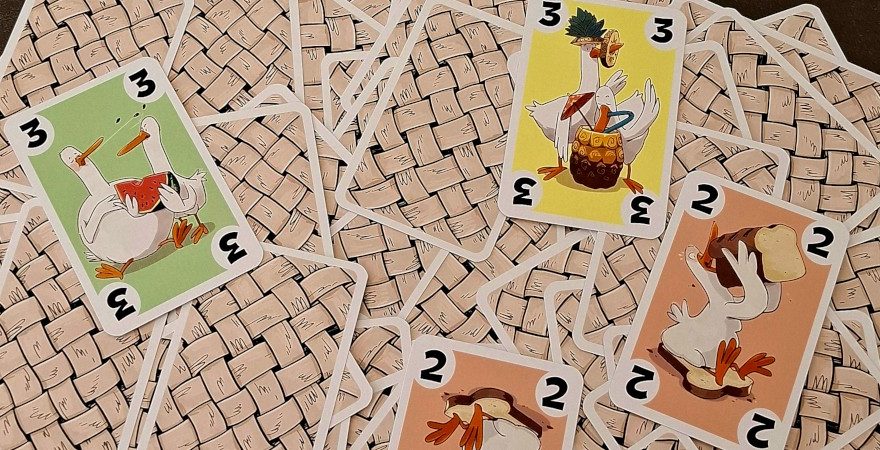
Vorbereitungen braucht es kaum bei Greedy Goose. Schmeisst die Karten auf den Tisch und los geht’s! Ein schnelles Push your luck-Spiel mit eingängigem Mechanismus. Nur zu gierig sollte man bei diesem Kartensammelspiel einfach nicht sein. Die Karten verdeckt auf dem
Keine Angst, ich werde Euch hier nicht die neueste Neuheit vom Autor Reiner Knizia in der Form zerlegen, die Euch jeden Grund nehmen wird, dieses Amigo-Kartenspiel selbst erleben zu wollen. Stattdessen tauche ich ein in die Schönheit eines Spielkonzeptes, das an scheinbarer Einfachheit kaum zu schlagen ist, dabei aber eine enorme Tiefe bildet. Und genau an der Grenzlinie dieses scheinbaren Widerspruchs entsteht der Spielspaß.
Braucht es mehr, um Spielspaß zu erzeugen? Reiner Knizia meint nein und gönnt der Amigo-Neuheit aus dem Sommer 2025 mal eben 144 illustrierte Spielkarten, 44 Minus-Chips aus Pappe, 1 Startfigur in Person von Meister Makatsu aus drei Pappteilen und 1 Spielanleitung, die eine typische Kartenspiel-Länge aufweist. Verpackt in einer Schachtel, die allerdings das Volumen der üblichen Amigo-Kartenspiele deutlich übertrifft und auf der Größe von Falsche Schlangen liegt. Nur knapp kleiner als ein One Round? Ja, aber das sind nur Äußerlichkeiten, denn wie üblich in Knizia-Spielen steckt die Faszination in einem kleinen Kniff versteckt, der so trivial wirkt, dass dieses Kartenspiel doch nur banal sein kann.
Könnte man aus einer überheblichen wie unwissenden Perspektive meinen und läge mal so richtig falsch. Meister Makatsu für zwei bis sechs Spieler gibt es alle die gleichen Voraussetzungen in Form von 24 Karten. Jeweils acht Zahlenkarten mit den Werten 1 bis 8 in drei verschiedenen Farben. Wir spielen drei Durchgänge mit unserem Kartendeck und jeder folgende Durchgang besteht nur noch aus halb so vielen Runden wie der Durchgang zuvor. Details, die Ihr Euch weder merken braucht noch mitzählen müsst, sondern direkt an Eurem persönlichen Nachziehstapel erkennt. Denn in jeder dieser Runden ziehen wir vier Handkarten. Die sind im Vergleich zu unseren Mitspielern unterschiedlich, denn wir haben unser Kartendeck vor jedem Durchgang gut gemischt. Wir kennen also das Potenzial unseres Decks, aber eben nicht, wann diese Potenziale auch auf unsere Hand kommen. Manche nennen das Zufall, aber genau diesen Zufall werden wir durch eigene Entscheidungen im Laufe der Partie immer weiter minimieren.
Damit es vorangeht, spielen wir von unseren vier Handkarten reihum genau zwei davon aus. Eine nach der anderen reihum und beginnend mit dem Startspieler, der die Meister-Makatsu-Figur als optische Erinnerungshilfe vor sich stehen hat. Es gibt keinerlei Bedienzwang und es geht auch nicht um Stiche. Ihr seid stets völlig frei, welche Karte Ihr ausspielt. Nur eben begrenzt auf Eure Kartenhand. Das schafft ungewohnte Freiheiten und wirkte auf mich zunächst ungewohnt bis folgenlos. Ganz im Gegenteil. Denn hier entfaltet sich die Magie eines Reiner Knizia. Wir schauen uns anschließend die ausgespielten Karten an und zeichnen die Spieler aus, welche innerhalb einer Farbe den höchsten Wert gespielt haben. Das hagelt dann Minuspunkte-Chips. In der Farbe Blau genau einen Chip, in Gelb die doppelte Anzahl von zwei Chips. Und bei lila gibt es ebenso einen Chip, aber zeitgleich werde ich noch neuer Startspieler. Die zwei nicht ausgespielten Handkarten lege ich beiseite, weil die sammle ich für den nächsten Durchgang.
Pah, ist doch völlig klar: Ich möchte den höchsten Wert in einer ausgespielten Farbe vermeiden, also bleibe ich einfach immer in der Deckung einer höheren Mitspielerkarte dieser Farbe. In einer auf einen selbst optimierten Welt würde das wohl funktionieren, nur haben die lieben Mitspieler etwas dagegen und versuchen sich ebenfalls mit ihren Farbwerten wegzuducken. Und dann gibt es ja noch die eigene Kartenhand, von der ich die Hälfte meiner Karten ausspielen muss. Ob ich will oder nicht. Deshalb ist der Startspieler einer Runde immer einen kleinen Blindflug ausgesetzt.
Welche Farbe spiele ich nun an und sind meine Mitspieler eventuell durch ihre Kartenhand gezwungen einen höheren Wert abzuwerfen, sodass ich diese Minuspunkte-Chips vermeiden kann? Oder nehme ich ganz absichtlich den einen Minus-Chip in Gelb in Kauf, kann meine zweite Karte selbst dahinter verstecken und werde hoffentlich den Startspieler los, um ohne diese Ungewissheit meine Karten auszuspielen? Das sind nur zwei der vielen Fragen, die mir durch den Kopf geschossen sind. Auf einmal war dieses kleine Kartenspiel keineswegs banal.
Ihr habt allerdings noch nicht das komplette Bild von Meister Makatsu bekommen. Zwei entscheidende Regeln fehlen noch, die den besonderen Kniff des Spiels ausmachen. Haben mehrere Spieler den höchsten Wert in einer Farbe ausgespielt, also zweimal die 8 in Gelb, dann erhält der Mitspieler die Minus-Chips, der diese Karte zuletzt ausgespielt hat. Bedeutet konkret, dass ich mit einer ausgespielten 8, die ja keiner vom Zahlenwert übertreffen kann, aber ja auch irgendwo in seinem Deck hat, eventuell sogar ungeschoren durchkomme, wenn jemand nach mir ebenfalls eine 8 in dieser Farbe spielt. In solchen Situationen ist es wieder gut, wenn ich Startspieler einer Runde bin. Eventuell möchte ich auch lieber Startspieler werden, weil damit nur ein Minus-Chip verbunden ist und nicht deren zwei, wenn ich stattdessen die höchste Karte in Gelb in der Mitte liegen habe?
Zurück zur finalen offenen Regel: In jeder der drei Durchgänge zählen die Minuspunkte-Chips mehr. Erkennbar an ihrem Aufdruck. So hangelt es im ersten Durchgang nur einen Minuspunkt pro Chip, während es sich der Minuspunkte-Regen im Durchgang zwei schon verdoppelt und im finalen dritten Durchgang pro Minus-Chip direkt drei Minuspunkte zählt. Zwar werden die einzelnen Durchgänge immer kürzer, weil wir eben nur mit den weggelegten Karten des vorherigen Durchgangs weiterspielen, aber ein Chip im Durchgang drei ist eben dreimal so viel wert wie noch im ersten Durchgang.
Also einfach alle hohen Kartenwerte im Durchgang eins ausspielen, die paar Minus-Chips kassieren und unbesorgt mit einem durchweg niedrigen Kartendeck in die nächsten zwei Durchgänge gehen? Könnte klappen, wenn da nicht die Mitspieler wären und der Zufall, was ich aus meinem Deck auf die Hand bekomme. Und wäre es nicht besser, wenn ich mit meiner gelben 7 so lange warte, bis ich mich hinter der gelben 8 eines Mitspielers verstecken kann? Eventuell habe ich mir grob gemerkt, dass die noch gar nicht ausgespielt worden sind.
Wer ein wenig den Überblick der selbst gespielten Karten behält, wird seine Ausgangslage für die kommenden Durchgänge kennen. Weil das ist genau der Rest, den wir zur Seite gelegt haben. Somit nimmt der Zufall immer mehr ab und die Kontrolle gewinnt die Oberhand. Oder wir lassen uns einfach jedes Mal von den eigenen Möglichkeiten der Kartenhand überraschen. Meister Makatsu gibt uns die Denktiefe nicht vor. Zwischen entspannt bei Kaffee und Kuchen ein paar Karten kloppen oder sich belauernd und auch ein wenig schadenfroh wissend die Mitspieler ins Verderben spielen, alles davon ist möglich und hängt von der Mitspielerrunde ab, die sich hier für knapp 30 Minuten zusammengefunden hat.
Es gibt aber noch einen letzten Ausweg aus dem Dilemma, ins eigene Messer zu laufen und Minuspunkte-Chips nehmen zu müssen. Von unseren anfangs 24 Karten werden wir aus unserer allerletzten Kartenhand nur zwei Karten ausspielen und somit zwei davon unausgewertet weglegen. Im Idealfall sind das zwei Karten, die uns gehörig Minuspunkte eingebrockt hätten. Wenn es nicht so gut läuft, sind das Karten, die wir locken vorab ohne Konsequenzen ausspielen können. So oder so, am Ende vergleichen wir unsere Minuspunkte und wer dann die wenigsten davon hat, der darf sich Sieger dieser Spielpartie nennen und für den Moment feiern lassen. Zumindest bis zur Revanche, denn das nächste Mal wird das Versteckspiel vor Meister Makatsu sicher besser laufen? Das Fragezeichen dazu macht für mich den Wiederspielreiz aus.
Wer sich bis hierhin wundert, dass ich mal so gar nicht aufs Thema eingegangen bin, wobei ich doch ein Freund von thematischen Spielen bin, dem sei gesagt, dass Meister Makatsu seine Hintergrundgeschichte in einem kurzen Absatz erzählt. Ein Thema, das mich im Spielverlauf nicht gestört hat und von den Illustrationen aus der Feder von Sonja Müller sogar gelungen ist. Denn wir sind Ninjas und müssen uns vor dem großen Meister Makatsu beweisen in den Prüfungen, die uns an drei Tagen bevorstehen. Je höher der Zahlenwert, desto größer das gezeichnete Missgeschick, das so viel Aufmerksamkeit auf sich zieht, sodass sich die lieben Mitspieler bestens dahinter verstecken können. Missgeschicke werden durch Minuspunkte bestraft. Soweit die Story, die durchaus ein wenig Kopfkino auslösen kann und damit ein eigentlich abstraktes Spiel über die reine Spielmechanik einen Erinnerungsanker gibt.
Meister Makatsu scheint vom Regelwerk unscheinbar bis banal wirken. Bei genauerer Betrachtung zeigt sich allerdings eine vorhandene Spieltiefe, die Ihr nicht ausschöpfen müsst, aber durch könnt. Durch die Einfachheit auf seiner spielmechanischen Ebene, die völlig ohne Sonderregeln auskommt und sogar auf den Karten selbst angibt, wie viele Minus-Chips drohen und wer durch welche Farbe neuer Startspieler wird, könnt Ihr Euch voll und ganz aufs Spielgeschehen fokussieren. In weniger als fünf Minuten erklärt und dann direkt losgespielt. Spielspaß hat für mich mal so gar nichts mit der Komplexität der Spielregeln zu tun, ganz im Gegenteil. Und genau deshalb kann ich Euch Meister Makatsu nur empfehlen – für Wenigspieler sowieso bis Experten, die einen nicht trivialen Absacker suchen. Für 15 bis runter unter 10 Euro im Handel zu finden. Nicht nur gut, sondern auch noch vergleichbar günstig.
All of this has happened before and will happen again. Everything comes back around, including games you could swear you’ve played before. Whether they’re remakes, reimplimentations, or rejuvenations, we’re tackling the world of board game revivals. Before what’s old is new, we talk about Agent Avenue,7 Empires, and Stellar Ventures.
If you don’t want to miss an episode, please subscribe on Apple Podcasts/Google Podcasts/Stitcher/Spotify, or add our RSS feed to your favourite app. Reviews and subscriptions really help us and would be greatly appreciated! To download the episode directly, click here.
If you’d like to discuss anything in the episode, please do so in the comments below, visit our BoardGameGeek guild, join our Discord, or Facebook Group! Any feedback is also always helpful. If you’d like to show your support for the show, we also have a Patreon with some fun rewards, and a merch store!
Timecodes:
02:24 – Agent Avenue 07:25 – 7 Empires 18:26 – Stellar Ventures 33:52 – Remakes 39:01 – Blood on the Clocktower 40:55 – Zoo Vadis 48:03 – Dune Imperium – Uprising 54:14 – A Feast for Odin
Thank you to Heart Society for generously letting us use What’s On Your Mind, Kid? from their album Wake the Queens.

 Anmelden