Last December, I review an excellent storage solution for Dune: Imperium – Uprising created by a new gaming accessories company – PlayMode. Their goal was (and is!) to create inserts that work to store the game AND also make it … Continue reading →
This article was updated 6.30pm on November 23, to include criticism of Steamforged from Terra Mystica publisher Feuerland Spiele.
Steamforged Games says it is in “positive” talks with a potential investor amid unveiling an £8.6m annual loss – while its auditors warn they have been “unable to determine whether the company will be able to generate sufficient cash flows to meet its liabilities”.
The UK-based publisher, which made a name converting high-profile video game IPs to the tabletop, has faced mounting criticism from crowdfunding backers in recent months over unresolved refunds and dwindling updates across its undelivered projects – which raised almost £19m including late pledges.
That criticism was added to today by Terra Mystica publisher Feuerland Spiele, which said it had “lost trust” in Steamforged over its handling of the £1m Terra Mystica Special Edition crowdfunding campaign, and fears the game may never be delivered.
Steamforged’s accounts for the year to March 2025 – finally published today, almost five months after their filing deadline – reveal a 23% fall in revenue to £10.4m, a 71% plunge in cash reserves to £1.1m and a heavy rise in net liabilities, from £5m to £13.6m.
That sharp financial deterioration was accompanied by Steamforged’s auditors, Sumer Auditco, saying they could not determine whether the company could generate sufficient cash to meet liabilities and continue operating as a going concern.
They found that Steamforged’s trading performance since March 2025 had been “substantially below forecast levels”, with “losses being incurred rather than the profits anticipated”.
Those concerns contributed to the auditors taking the serious step of issuing a “disclaimer of opinion” on the accounts – meaning they were unable to obtain sufficient evidence to determine whether the financial statements prepared by Steamforged’s directors presented a true and fair picture of the business.
A disclaimer of opinion is one of the most serious outcomes of a financial audit, issued when auditors are unable to obtain sufficient evidence to form an opinion on a company’s accounts and believe the potential impact of undetected misstatements could be both “material and pervasive”, according to the Financial Reporting Council’s auditing standards – although it does not necessarily mean the accounts are inaccurate, or that the company is insolvent.
The auditors also said they were unable to verify the valuation of £1.6m in remaining intellectual property assets – principally trademarks – because the directors’ assessment of their value relied on future sales forecasts which had already proved unreliable. They could not determine whether further write-downs were necessary, and were also unable to establish whether adequate accounting records had been maintained.
The newly-published accounts represent a significant escalation in the financial concerns surrounding Steamforged, which cut about a third of its workforce earlier this year as it moved to reduce its reliance on board game crowdfunding and concentrate on the growth of its Warmachine miniatures business.
Much of its £8.6m loss in the 2024/25 financial year came from £5.7m in exceptional charges relating to the reduced value of IP, game development costs and equipment – but the publisher also recorded a £2.9m operating loss before those charges, compared with a £1.3m operating profit the previous year.
The accounts reveal that Steamforged has decided to discontinue an unspecified number of games and product lines after their sales either stopped altogether, fell significantly or continued at levels which were no longer commercially viable. Those decisions, made after the March 2025 year-end, were cited as further evidence for the write-down of development costs and equipment.
The publisher’s crowdfunding revenue fell 38% to £5.35m, with Steamforged blaming fewer campaign launches, delays to planned releases and weaker demand in parts of the tabletop market. Direct sales revenue edged up from £4.86m to £5.08m, but higher production and shipping costs across the business pushed its gross profit margin down from 38.9% to 27.1%.
The scale of Steamforged’s financial difficulties had already been flagged earlier this year by investor Foresight, which slashed the valuation of its holdings in the company by almost 74% during the first half of 2026, from £3.68m to just over £960,000, across two of its investment vehicles.
Foresight, which invested £5m in Steamforged in 2019 across three funds, said in June that the publisher had suffered “a few disappointing crowdfunding campaigns over the last 12 months” and was looking to shift towards its higher-margin Iron Kingdoms business, which includes Warmachine.
Steamforged has not launched a new crowdfunding campaign since Terra Mystica Special Edition, which raised just over £1m in November last year.
Terra Mystica publisher Feuerland Spiele publicly criticised Steamforged today, saying it had repeatedly been assured that this year’s redundancies and restructuring would not affect the game’s special edition, which was originally scheduled for delivery in April 2027.
It said a promised campaign update had remained unpublished for several weeks, despite Feuerland having already seen a draft.
“As a result, we have lost trust in Steamforged,” Feuerland said. “Unfortunately, we share the concern of some backers that the Terra Mystica Special Edition will never see the light of day.”
Feuerland stressed that Steamforged alone had collected the campaign funding, but said the situation was already damaging its own reputation and affecting perceptions of its separate Gamefound campaign for The Danes.
“We put our reputation in other hands and while Steamforged alone collected the funding, this situation is already damaging our brand,” it said.
The accounts show Steamforged had about £12.4m in deferred crowdfunding revenue at the end of March 2025, up from £11.8m a year earlier, reflecting money received for projects for which the company had yet to meet its obligations. About £9.3m of that amount was classified in the report as falling beyond the subsequent 12 months.
Despite its cutback in new board game crowdfunding activity, Steamforged’s latest financial forecasts still factor in receipts from future campaigns – although its co-founders and directors Rich Loxam and Mat Hart acknowledge that both the timing and amount of that income remain uncertain.
The newly-published accounts also reveal that Steamforged is in discussions with an unnamed investor over additional funding for its operations and future growth.
Loxam and Hart said those discussions had “progressed positively”, but acknowledged that no binding agreement had been reached and there was no certainty a transaction would go ahead.
The pair nevertheless maintained that Steamforged could continue operating as a going concern, citing its future trading plans, ongoing financial support from parent company Steamforged Holdings and the prospect of securing new investment.
The accounts show Steamforged owed fellow group companies £3m in March 2025 – a figure which has remained virtually unchanged since March 2023.
Steamforged Holdings has repeatedly indicated it will not seek repayment until the publisher’s cash flow allows – an assurance the directors have relied on in their assessments of Steamforged’s ability to continue operating for at least the past two years.
The financial uncertainty also comes amid a major shake-up of parent business Steamforged Holdings, which has lost four of its seven directors since July – three of those since the start of November.
Those departures were Robert Michael Jones, an investment manager associated with Foresight who served as an investor director at Steamforged, former Steamforged commercial director Toby Davies, who joined Tycoon Games, games industry veteran Ron Ashtiani and Xiaowen Guan.
The changes leave Loxam, Hart and Simon Spalding, a former Hasbro and DreamWorks executive, as the holding company’s only remaining directors. The reasons for the departures have not been disclosed.
The largest is Monster Hunter World: Iceborne, which raised almost £6.3m including late pledges from close to 15,000 backers, and was originally expected to be delivered in November 2024.
Steamforged said in January this year that it was aiming to deliver the game to all regions by July, but has provided just two campaign updates since – the latter, in July, apologising for the lack of communication and saying it was waiting for information from partners before it could provide a concrete fulfilment update. No further update has been posted.
BoardGameWire reported in October that backers across several campaigns had complained about waiting weeks or months for responses to refund requests, with some turning to PayPal disputes and credit card chargebacks to recover their money.
Steamforged has continued delivering some projects, including non-US fulfilment of Horizon Forbidden West: Seeds of Rebellion and Euthia: Cruel Frost, as well as the pre-order campaign for 6: Siege – The Board Game, which it acquired from collapsed publisher Mythic Games.
But the redundancies and subsequent reduction in communication have raised concerns among backers about whether the publisher has the resources needed to complete its remaining projects.
Steamforged told BoardGameWire in June that the “vast majority” of creative work on its crowdfunded board games was complete and that it retained the internal resources and external capabilities needed to fulfil its commitments.
The publisher also said revenue from Warmachine and P3 Paints had tripled over the preceding 21 months, with production capacity expanded substantially to meet demand.
BoardGameWire made repeated attempts to contact CEO Rich Loxam across August, September and October about unresolved refunds, delivery schedules and the impact of the redundancies on Steamforged’s outstanding projects, without receiving a response.
Speaking to BoardGameWire during the Terra Mystica Special Edition campaign in November last year, Loxam said Steamforged had never failed to deliver a crowdfunding project in more than a decade of running campaigns.
He also said the publisher had strong retail and distribution channels, adding that “we’re not dependent on crowdfunding to survive”.
BoardGameWire has approached Steamforged for comment following the new accounts filing, and will update this article or run a new piece if we receive a reply.
Chaosium has halted development of its crowdfunded Forbidden Stars remake, Old Ones Origins, after its designer Samuel Bailey was convicted of multiple child sex offences.
The conviction comes more than three years after criminal charges were first filed against Bailey, during which time he remained active in the board game industry – including demonstrating Old Ones Origins at Chaosium’s Gen Con booth in August this year. Court records show Bailey repeatedly sought and received permission to travel out of state while awaiting trial.
Samuel Bailey, left, demonstrating Old Ones Origins during Gen Con 2026
Chaosium told crowdfunding backers of the $770,000 Old Ones Origins campaign yesterday that it only learned of criminal proceedings against Bailey on Friday, November 13, which BoardGameWire understands occurred when a parent of one of the children alerted them via email.
The update to Gamefound backers said, “These are very serious crimes, and have significant legal implications on the Old Ones Origins board game, beyond the serious moral implications. We have stopped all development on this project.
“So please bear with us as we work with our legal counsel as to how move forward [sic]. We will be updating this as we get further confirmations.”
Chaosium has not yet provided answers to BoardGameWire’s questions about whether Bailey has already received payments for his design work, whether he remains entitled to royalties or other compensation following his conviction, or what contractual rights the company has to continue developing the game without him.
Company co-owner Michael O’Brien did confirm to BoardGameWire, “We just found about these criminal convictions and have stopped all development on this project. We are talking with legal counsel about next steps. We’ll have more to say in due course.”
The situation has thrown the future of the game into doubt for the campaign’s almost 3,000 backers – some of whom have demanded refunds and called for Bailey to be removed from the project so development can continue. Chaosium had initially planned to reopen the campaign for late pledges today.
Old Ones Origins || Crowdfunding image
The publisher said on Sunday that it had instructed Gamefound to halt scheduled Stretch Pay instalments, but warned that some payments might still be processed. Several backers subsequently reported that their payments had gone through as scheduled.
One parent of a child affected by the case, who cannot be named in order to protect the identity of the children, told BoardGameWire they believed Chaosium were also “in part a victim” of Bailey.
They said, “I believe Sam deceived them like he deceived most people in his life. He took advantage of his standing in the board game community knowing that most companies would not perform thorough background checks and see he had active charges for child rape and molestation.
“Sam had to get permission from the court to go to these conventions. Due to that I don’t 100% fault Chaosium for sending him all over the country. They were deceived and the courts approved him going, so he was able to keep up the deception.”
The parent added, “I believe it is immoral at this point knowing what they know to continue to receive funds for the game designed by Sam. I ask they do the right thing insofar as they can. I don’t want them to go bankrupt because of this nor do anything to try and make things right that would bankrupt them.
“However, they need to do everything in their power to remove Sam’s name and contributions from the game and any other products he collaborated with them on.”
They continued, “I know it is not common practice to perform background checks in this industry on independent contractors. Especially on established board game designers. That needs to change.
“Sam was out on bail for 3.5 years. These charges were publicly available. I want to see a real change. A great first starting point for the industry is thorough background checks on all people involved with the company.
“It does cost money to perform them, but it is a negligible cost at the end of the day given how small some of these companies are. They need to especially be done on people they plan on sending to conventions.
“I truly believe Chaosium would not be in this situation right now had they performed a thorough background check.”
Bailey’s conviction comes after months of Chaosium promoting his involvement in Old Ones Origins, highlighting his work as one of the designers of Fantasy Flight Games’ highly regarded 2015 Warhammer 40,000 strategy game Forbidden Stars – which was discontinued just two years later following the end of the publisher’s licensing agreement with Games Workshop.
Forbidden Stars || Photo Credit: Fantasy Flight Games
Bailey was one of three credited designers of Forbidden Stars, alongside Corey Konieczka and James Kniffen. The game was itself a reworking of Fantasy Flight’s 2007 release StarCraft: The Board Game, co-designed by Konieczka and Twilight Imperium creator Christian Petersen.
Chaosium formally unveiled Old Ones Origins the day before this year’s Gen Con, describing it as an “enhanced reimplementation” of Forbidden Stars set in the Cthulhu Mythos, retaining the original game’s asymmetric strategy gameplay while introducing new mechanics, factions and expansions.
Bailey personally demonstrated the game’s prototype at the convention, with Chaosium subsequently publishing photographs of him at its booth and promoting his role in the project.
As recently as October 14, during the campaign’s final 24 hours, Chaosium published an extensive collection of questions and answers attributed to Bailey, covering his approach to redesigning Forbidden Stars, gameplay balance, playtesting and potential future expansions.
Chaosium had been targeting January 2028 for delivery of English-language copies of Old Ones Origins, with translated editions expected to follow in July that year.
Bailey worked in board game retail before joining Fantasy Flight Games in 2013, working on expansions for Talisman, Elder Sign and Mansions of Madness before the release of Forbidden Stars two years later.
He left FFG in 2016 to become a freelance board game designer, but did not release a published design after FFG until Lawyer Up!, his co-design with Mike Gnade, in 2021.
Bailey was involved in a public dispute with Root publisher Leder Games in 2018, after the publisher cancelled development of his asymmetric science-fiction strategy game Deep: Enemy Frontier.
He accused Leder of breaching its contract and alleged that Root, the publisher’s forthcoming game designed by Cole Wehrle, had borrowed elements of his work.
Wehrle strongly rejected the allegations, saying that “no mechanical element of Root was taken from Deep. None.” He acknowledged having played and worked on elements of Bailey’s game, but said he had deliberately taken Root in a different direction to avoid overlapping with it, drawing on geopolitics and historical wargames rather than Deep’s science-fiction and 4X influences.
He accused Bailey at the time of misrepresenting the circumstances of Deep’s cancellation, but declined to detail the problems encountered during development, saying he did not want to damage Bailey’s prospects of finding another publisher.
BoardGameWire has approached Chaosium with multiple questions about the situation with Bailey, and will update this article or run a follow-up piece if they respond with more detail.
Striking Flint is a cooperative game that recreates the 1937 United Auto Workers (UAW) strike in Flint, Michigan.
John du Bois recreates a pivotal episode in American Labor History in Striking Flint. The 1937 sit-down strike in Flint, Michigan forced General Motors to address the abysmal working and living conditions of their employees, and to recognize the newly-formed United Auto Workers union.
In this cooperative game, players control five committees each with their own advantages, disadvantages, and prerogatives. GM has considerable resources at their disposal, including city authorities, deep pockets, hired thugs, and the sympathies of the press. To force them to make concessions, you’ll need to work together to weather the forces arrayed against you – fending off attempts at eviction, the effects of exhaustion, and the presence of strikebreakers – while occupying factories in the plant complex. Here, the game cleverly subverts the worker placement paradigm: by placing workers, you do not cause actions to take place, but prevent them.
With a deck of events each based on a real headline from contemporary reporting, this game for one to five players is both a compelling co-op gaming experience and a meditation on protest and solidarity – themes that are more resonant and important today than they were nearly eighty years ago.
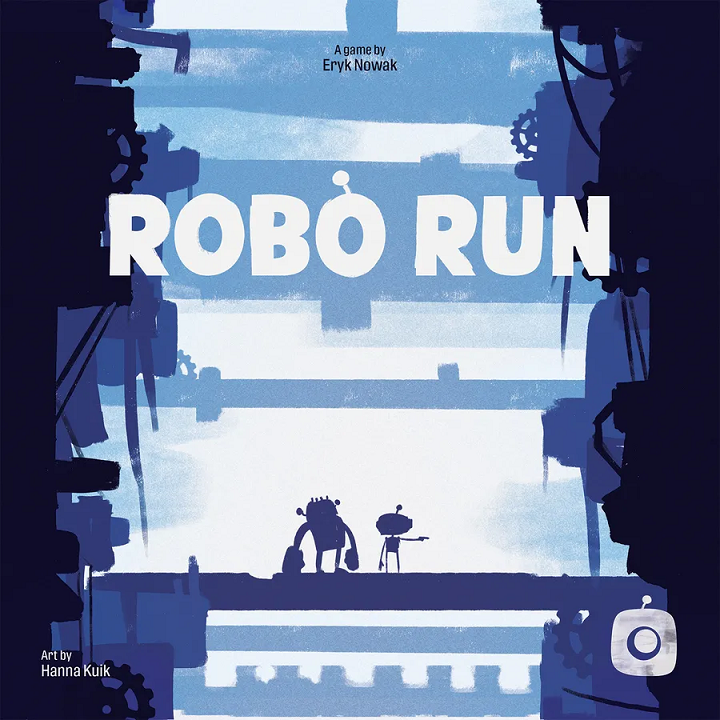
I spend a lot of time playing games whose existence is attributable to a trend. Certain titles like The Crew and Ganz Schön Clever created cracks in the pavement for others to sprout from and flourish. Robo Run is the latest germination, a seedling fighting for some of the light established by the Spiel des…
With this My Favorite Wargame Cards Series, I hope to take a look at a specific card from the various wargames that I have played and share how it is used in the game. I am not a strategist and frankly I am not that good at games but I do understand how things should work and be used in games. With that being said, here is the next entry in this series.
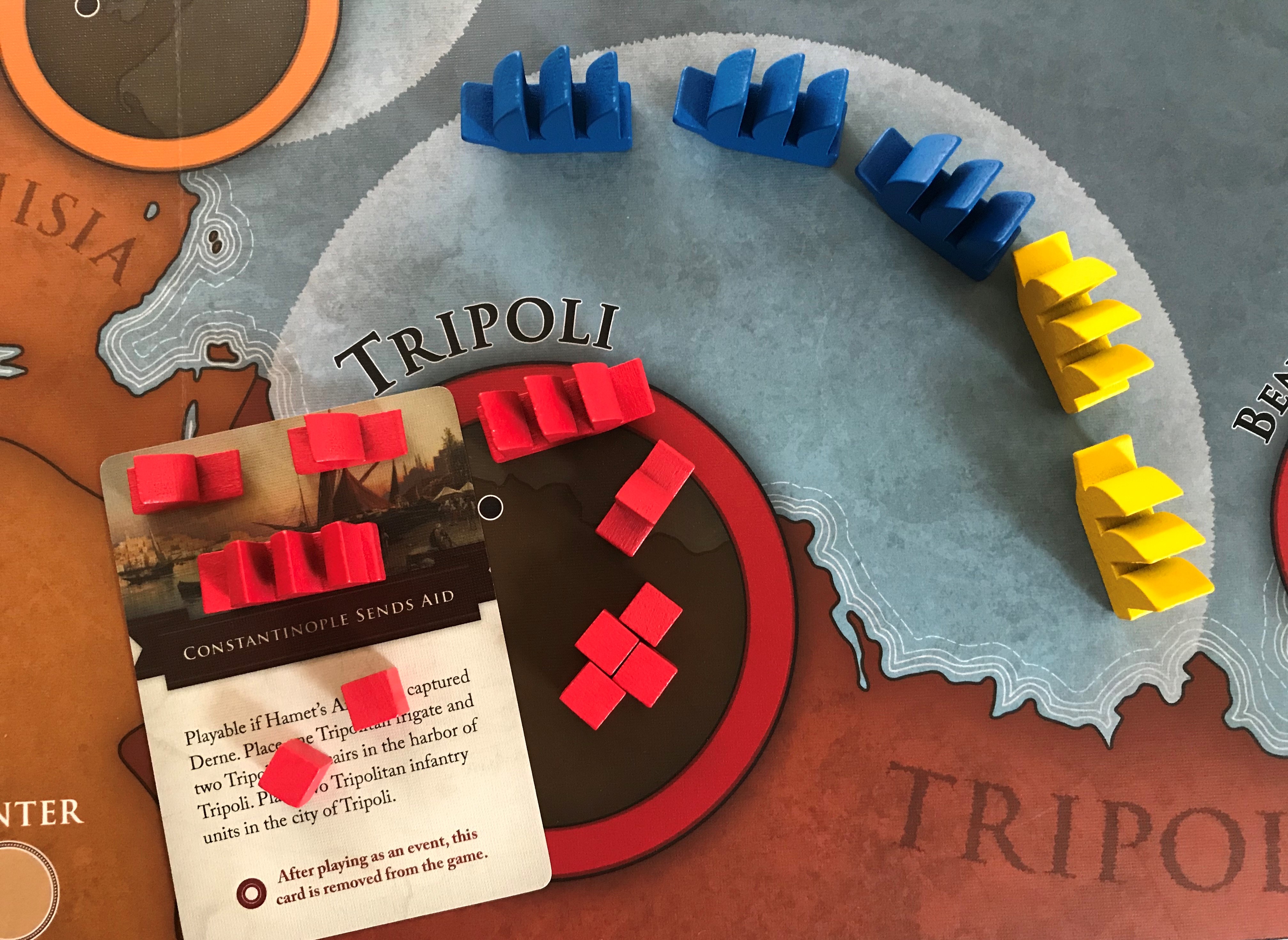
#101: Constantinople Sends Aid Core Event from The Shores of Tripoli from Fort Circle Games
I have never played a historical wargame on the First Barbary War, which if you didn’t know was one of the first major wars the young United States of America participated in that was situated far outside their sphere of influence in North and South America. Shortly after the end of the American Revolutionary War, commercial vessels of the United States were being attacked and raided by the pirates of the Barbary coast in the Mediterranean Sea. In 1801, newly inaugurated President Thomas Jefferson was eager to put an end to this threat and sent a “squadron of observation” to the Mediterranean to deal with the threat. The Shores of Tripoli covers this conflict and does so using a card driven game mechanic that works really well in this instance. The game is a little deceiving, as at first it appears to be pretty introductory with simple rules and mechanics, but the depth for the game lies in the strategy for each side and the fact that their victory conditions are asymmetric.
There are two decks of cards in the game and each is unique for the side that is using it. The American Card Deck is blue-backed with a picture of President Thomas Jefferson and the Tripolitan Card Deck is red-backed with a picture of Yusuf Qaramanli. Each deck consists of a total of 27 cards and this is divided up between 21 Event Cards and 6 Battle Cards. The Tripolitan Deck also includes 3 additional cards that are used only for solitaire play. There are three different types of Event Cards included in the decks. These include Core Events, Unique Events, and Common Events. Each player has the same number of each of these type of cards with the only difference being that the Americans have only 10 Common Events and 2 special cards that are called Victory Event Cards.
Core Event Cards begin the game face-up in front of the player and do not count against the eight-card hand limit. Core Cards may be played in place of a card in hand at any time during the player’s turn for their event and then are permanently removed from the game. The Constantinople Sends Aid Core Event Card has a condition that must be met in order to be played and that is that Hamet’s Army has captured the city of Derne. This means that this card will have to wait to be played until at least after the Spring of 1804 or even later as the American player must play their Hamet’s Army Created Core Event Card and then invade Derne which will take a turn or two after the Core Event Card is played. This card is a last ditch effort to stop the Americans as they make their eventual drive on Tripoli. The addition of 1 Tripolitan Frigate and 2 Corsairs will beef up the naval defense of the port and the addition of the 2 Tripolitan Infantry in the city of Tripoli will aid in staving off Hamet’s Army.
The Constantinople Sends Air Core Event Card is somewhat of an ahistorical event, meaning that it was possibly available if necessary but the anticipated invasion of Tripoli Harbor by the forces of Hamet never occurred. Following the fall of Derne, Hamet Karamanli’s forces held the city and planned to press onward toward Tripoli, which put immense psychological and political pressure on the ruling Bashaw Yusuf Karamanli. But, before a full-scale assault on Tripoli could take place, U.S. Consul General Tobias Lear negotiated and signed a peace treaty with Yusuf Karamanli in June 1805 effectively ending the First Barbary War. The treaty secured the release of American hostages from the USS Philadelphia in exchange for a ransom, ending the military campaign. U.S. forces secretly evacuated Derne, abandoning Hamet Karamanli’s push to take Tripoli and returning him to exile.
Lieutenant Presley O’Bannon at Derne. Painting by Charles Waterhouse.
In the next entry in this series, we will take a look at Austrian Leader Klemens von Metternich from Congress of Vienna from GMT Games.
Netflix has reportedly brought in two writers behind this year’s $200m Masters of the Universe film to write and direct its live-action Catan movie, in the first major development since the streaming giant secured sweeping adaptation rights to the 50 million-selling board game last year.
Brothers Aaron and Adam Nee have been tapped to bring the landmark Klaus Teuber design to the screen according to Deadline, which cited sources it said were familiar with the project.
The news comes just over a year after Netflix struck an agreement with Asmodee and Catan Studio for the exclusive worldwide rights to develop live-action and animated films, scripted and unscripted television series and video games based on Catan.
That deal was followed by a string of other high-profile moves by Asmodee aimed at expanding its best-selling board game brands beyond the tabletop.
Fellow Asmodee title Exploding Kittens has already made the transition to the screen, with Netflix launching an adult animated series based on the hit card game in 2024.
Asmodee has already seen evidence that screen adaptations can translate into increased revenue from its physical games, with sales of The Werewolves of Miller’s Hollow surging 150% year-on-year during the launch week of Loups-Garous in 2024.
Company CEO Thomas Koegler made clear in an earnings call earlier this year that its primary goal from film and television licensing deals was to boost awareness and sales of its physical games, rather than generate significant revenue from the adaptations themselves.
He said, “It’s really the brand exposure and the ability for consumers to enjoy their favorite brands in various ways of entertainment.”
Catan is already one of the few modern hobby board games to have broken out into wider popular culture, attracting a following among celebrities and professional athletes, making appearances in popular television shows and becoming a regular pastime for players across several major US sports leagues.
Players from NFL teams including the Green Bay Packers, Buffalo Bills and Kansas City Chiefs, as well as baseball’s Minnesota Twins, have all been reported as playing the game.
Netflix’s Catan adaptation is being produced by Asmodee’s Darren Kyman, Catan Studio’s Pete Fenlon, Klaus Teuber’s sons Guido and Benjamin Teuber, and Roy Lee of Vertigo Entertainment.
The Nee brothers’ other previous work has included directing 2022 action comedy The Lost City, starring Sandra Bullock and Channing Tatum, and writing an upcoming Netflix spy film starring Kevin Hart and Henry Cavill.
Other publishers exploring adaptations based on their games include CMYK, which launched US television game show The Perfect Line last year, inspired by Wolfgang Warsch’s Illusion. That show proved successful enough to return for a second season in September this year.
CMYK CEO Alex Hague previously told BoardGameWire that the company had received dozens of approaches each year about developing a TV version of its million-selling party game Wavelength.
Editor’s note: GAMA is one of the sponsors of the BoardGameWire newsletter and an advertiser on the site.
Hobby games trade body GAMA has moved swiftly to appoint Foam Brain Games boss Andrew Zorowitz as acting executive director, just nine days after interim head Melinda Prickett revealed she was leaving the organisation.
Zorowitz’s appointment came in the wake of a “rapid response meeting” called by GAMA’s board on October 26 after it learned of Prickett’s impending departure – which left the association facing another unexpected leadership change amid its ongoing struggle to appoint a permanent executive director.
GAMA said Zorowitz will take on the role for six months, overseeing day-to-day operations and preparations for both GAMA Expo and Origins Game Fair while the organisation’s board continues its search for a permanent executive director.
His appointment marks a departure from GAMA’s approach to executive leadership over almost two decades, during which its two long-serving executive directors, John Ward and John Stacy, and more recent interim heads Prickett and Zaria Davis all had backgrounds outside the tabletop games industry.
He has also been closely involved in GAMA’s events for several years, contributing to educational programming at both GAMA Expo and Origins, and serving on the GAMA Expo Site Selection Committee which helped decide on the trade show’s move to Baltimore.
GAMA said Zorowitz would step away from many of his responsibilities at Foam Brain Games during his tenure, although it has not specified which duties he will retain or what arrangements, if any, will govern potential conflicts between his two roles.
The organisation’s elected board is responsible for selecting the executive director, rather than the appointment being determined through a vote of GAMA’s wider membership.
GAMA has not said whether Zorowitz was selected through a competitive process, whether he will be eligible for the permanent position, or whether his six-month appointment could be extended.
Zorowitz’s term as acting executive director is currently due to end in early May 2027, after GAMA Expo’s debut show in its new Baltimore home, but before Origins Game Fair takes place in June.
His appointment came two days before Prickett’s scheduled departure on November 6 – less than 14 months after she joined GAMA as its first chief operating officer, and just under six months after she stepped up to become interim executive director.
GAMA’s former interim executive director and COO Melinda Prickett
Zorowitz’s arrival means GAMA has now had four people leading its executive operations in the space of a year, following Stacy’s departure, the appointment of leadership consultant Zaria Davis as interim executive director in November, and Prickett’s subsequent assumption of the role in May. GAMA initially said it expected to find a permanent replacement for Stacy by spring 2026.
GAMA board president Meredith Placko and secretary Tiffany Reid told BoardGameWire last week that the board was working through a short list of people to bring in a new interim executive director “very soon”, adding that the goal was to “make sure GAMA Expo and Origins are a success, and the overall day to day running of the organization is met”.
They added that the board had also interviewed “a strong candidate” for the permanent position and had been in negotiations with them, but said that “ultimately it did not work out”.
“Because of that we will need to begin the search again”, they said, adding that the board was seeking RFPs from firms specialising in hiring executives in the trade association and member organization sectors.
The pair said at the time that they could not comment on why Prickett’s notice period was so short, or whether she had been a formal candidate for the permanent executive director role.
Zorowitz’s appointment comes at a particularly important time for GAMA’s two major conventions.
The organisation’s professional trade show, GAMA Expo, has experienced rapid growth in recent years and is in the midst of preparations for its first show in a larger venue in Baltimore after three years in Louisville, Kentucky.
Origins Game Fair, which is set to return to Columbus in June, has struggled to recover its pre-pandemic attendance, however, with visitor numbers falling 2.5% this year to 18,700 – the show’s first annual decline since Covid-19, and still below its 2019 record of 20,642.
That event could face further pressure next year from the launch of PAX Unplugged Houston, a new tabletop gaming convention scheduled to take place just 12 days after Origins, which could potentially force publishers and exhibitors to choose between the two shows.
Zorowitz said of his new role, “I’m excited to work with the GAMA team and support two shows that have been an important part of my own experience in this industry.
“GAMA Expo and Origins both mean a lot to me, and I know they mean equally as much to our members. I’m looking forward to helping make GAMA Expo’s move to Baltimore a success, prepare for Origins and support a strong transition when a full-time executive director is hired.
“I’ve had the pleasure of working with many of the fantastic GAMA staff members over the past several years, and I am excited to help lead them as the board looks for a new permanent executive director.
“I think Melinda and the board have built a great foundation of what this organization should strive to be, and I am glad I get to continue to help keep the ship moving forward steadily in the interim.”
GAMA’s latest leadership shake-up on the executive side also follows a period of significant change for the organisation’s elected board.
Ross Thompson, who was elected as vice president following Placko’s elevation to president, has now also resigned from the board after just over six months in the position.
Thompson only joined GAMA’s board in October last year, winning a special election to replace former secretary Monica Rasso, who had stepped down after five years as a director.
His resignation means the organisation will now hold its second special election for the same Media & Events board seat in little more than a year.
I love a different style and focus of wargame. A game that takes a look at an important but somewhat obscure or rarely addressed historical topic, such as espionage or intelligence, and creates a gaming experience tailored around the events to highlight and evoke the difficulties and tension that would have been present. In January 2026, GMT Games announced such a game in Checkpoint Charlie, which is a solo or cooperative game focused on SIS espionage missions in Berlin in the 1960’s designed by Russell Brown. We have posted an interview with Russel and it was very well received and he has now agreed to create a series of History Behind the Cards to highlight the events of the 1960’s Cold War struggle in West Germany but also to share aspects about the game play and how it models the history.
*Note: The cards highlighted in this series and their event text, as well as any pictures used showing any of the various components, are still in the design and development process and as such event effects and text might still change prior to final development and publication.Also the art and layout of the cards are only for playtest purposes at this point and the game will enter the art department as it nears publication.
History Behind the Cards – Checkpoint Charliefrom GMT Games – Card #10 Moscow Rules
“Moscow rules meant watch your back. London rules meant cover your arse.”
This quote from Mick Herron’s book, Slow Horses, may be what many people think of when the term Moscow Rules is used today, but there’s a bit more to it than that. Moscow rules were an unwritten set of procedures – spycraft protocols – to keep in mind when operating on the KGB’s home turf. Moscow Rules may have also been used as a cautionary declaration, a spy’s call to arms. In John Le Carrè’s spy novels, George Smiley lets his colleagues know that exceptional caution is warranted just by saying, “Moscow Rules.”
Moscow Rules could include communicating with extra caution, or in code. It could mean keeping a better eye out for someone following you, or being ready to defend yourself. But at its core, it meant that you were effectively operating in enemy territory and could no longer trust the people and places you once took for granted.
In Checkpoint Charlie, the Moscow Rules Event Card puts all of your assets on high alert, giving them a Tradecraft Marker if they don’t already have one. It also adds the Papers Item to the Mission, assuming that your assets dig deeper into their resources, perhaps pulling out old false identities reserved for emergencies. If you’re playing the campaign game, the Moscow Rules Card is not removed when it occurs, so it can show up on almost any mission.
In the next article in this series, we will take a look at ________.
In my opinion, this game looks extremely interesting and I am very much excited to learn more about it. I am appreciative to Russell and his efforts to bring us these cards and to write these entries to share with our readers. I am also very glad that this topic is being covered in a game and look forward to playing this one day soon.
Big month of games incoming! I was able to easily find games to share with you and I am excited for you to get this one in your inboxes. This month, I was able to find 37 games to share (including the 3 from our sponsor PHALANX and with 1 entry including 2 games), with 20 of those being newly announced pre-orders and 14 being new releases. I was also able to find 5 games being offered on Crowdfunding platforms Gamefound and Kickstarter.
Again this month, we have a sponsor for the Wargame Watch post in PHALANX, who is the maker of fantastic wargames such as U-BOOT, Hannibal & Hamilcar, Freedom!, Purple Haze, Total Domination, Iron, Blood, Snow and Mud,A Very Civil Whist, 1944: Race to the Rhine, Fire in the Sky and more. We have really never had a bad experience with any of their games and have really loved many of them!
They have a lot of great games upcoming and in the pipeline and are always developing new titles for pre-order or funding on Gamefound.
One of their more exciting recent offerings is a group of similar subject games set in the Pacific Theater of Operations during World War II. I personally love PTO wargames and these both look extremly interesting. These include 2 separate titles 1943: Race to Rabaul and Tora Tora Tora!. We did an interview with Volko Ruhnke who designed 1943: Race to Rabaul earlier this summer and you can check that out on the blog at the following link: https://theplayersaid.com/2026/06/15/interview-with-volko-ruhnke-designer-of-1943-race-to-rabaul-from-phalanx/
Both of these games are beautiful and look very good and you are in luck as both can still be pre-ordered on the Gamefound page listed in the interview or by clicking the picture to the right.
They also have Sovereign: Shōgun, which is a new game in the Sovereign Series that includes one of my favorites in Bretwalda. This game was funded on Gamefound earlier this year and is a massive undertaking with a ton of content and add-ons that can create a massive game, both in its playability and replayability as well as its options for players. You can also still pre-order on the Gamefound page by clicking the picture below.
They have several other projects in the works including Independence, Saga, Lords of the North, Dust in the Wind and Lords of Heaven all planned for near future pre-order/crowdfunding campaigns or fulfillment.
One more thing before we get to this month’s games. Bill Molyneaux does this fundraising calendar of the Battlefield museums and historical sites on the East Coast for Toys for Tots and I wanted to share that with you so you can look at buying one.
1. The Great Escape from Sound of Drums Currently on Gamefound
If you like historical themed games that focus on challenging objectives, cooperative play and teamwork then I have a great game to introduce you to this month. I have known about this game’s existence for a while now. In fact, I saw a prototype last fall while attending Spiel Essen, but recently it was officially announced on Gamefound with a campaign kickoff of October 20th. The game is called The Great Escape and is designed by Philip duBarry, the designer of one of my favorite cooperative historical games in Black Orchestra. The Great Escape is based on a true story and shares the account of the escape attempt by Allied soldiers from the infamous Stalag Luft III POW Camp during WWII. The game is a cooperative or solitaire experience for 1-5 players and is just beautifully produced.
From the game page, we read the following:
On the moonless night of March 24, 1944, Allied prisoners emerged from a tunnel ending outside the fence of Stalag Luft III. They silently crawled the remaining feet over frozen ground to the cover of the surrounding forest. The men who escaped wore carefully-tailored civilian clothes and carried suitcases, intricate identification papers, German money to purchase train tickets, and several days of food.
76 prisoners escaped before the German guards sounded the alarm. A furious effort to recapture the prisoners ensued, and all but three were found. In an unprecedented move and in clear violation of the Geneva Conventions, Hitler ordered 50 of the recaptured prisoners to be secretly executed. The escape cost the Germans hundreds of thousands of man hours and countless resources meant for the war, delivering a devastating blow to German morale.
Now the wire waits again. The ground is stark and cold, the guards are watchful, and the forest beyond the fences offers both salvation and deadly risk. Will you dig far enough, plan carefully enough, and seize the right moment before the alarm sounds?
Behind the barbed wire of Stalag Luft III, time is measured in whispered plans, and the constant threat of discovery. In The Great Escape, you and your fellow Allied air force officers must organize the camp, gather scarce materials, craft civilian clothes and forged papers, dig secret tunnels beneath the perimeter, invent ingenious devices, and carefully time your escapes—all while guards conduct ever-more-ruthless searches and the Gestapo tightens its grip. Draw on the unique skills of legendary officers, trade with compromised guards, execute daring Escape Plans, and keep the tunnels hidden. Every action risks drawing Trouble. If the Gestapo locks down the camp before twelve soldiers slip into the forest under cover of night, the attempt has failed. Outsmart the search parties. Carry on the war from behind the wire. Help twelve men escape, and you will have struck a blow that echoes far beyond the fences of Stalag Luft III.
The Great Escape is a cooperative board game for 1–5 players, designed by Philip duBarry. Play time is 60–90 minutes and is recommended for ages 12 and up.
As of November 1st, the Kickstarter campaign has funded and raised €34,416 ($38,601 in US Dollars) toward its €12,500 ($13,942 in US Dollars) funding goal with 598 backers. The campaign will conclude on Monday, November 9th at 6:00pm EDT.
2. Fix Bayonets! Volume III: 1806: Auerstädt from Tactical Workshop Currently on Gamefound
Last year, I became aware of a new edition of a very interesting looking Napoleonics game series called Fix Bayonets! designed by Frederic Delstanches. That game was 1811: Albuera Second Edition from Tactical Workshop, which was originally released in 2020. Since that time, Frederic has been busy and designed the 2nd volume in that series called 1809: Talavera. Due to the success of these efforts, Tactical Workshop now is embarking on a new project in the series called 1806: Auerstädt that covers the Battle of Jena–Auerstädt fought on October 14, 1806, near Jena and Auerstädt, Germany being the decisive engagement of the War of the Fourth Coalition.
From the game page, we read the following:
1806: Auerstädt is a tabletop wargame that allows you to recreate this astounding asymmetrical battle of the War of the Fourth Coalition, face to face with another player or as a solitaire experience.
Take command of the French III Corps under Maréchal Davout, one of Napoléon’s best commanders, and attempt to reproduce his astounding victory against a vastly superior force! If you like a challenge, you can instead lead the Prussian Royal Army and rewrite history, overcoming your poor leadership and frail morale, by overwhelming an opponent half your size with your mighty manpower and cavalry superiority.
I want you know the backstory of this new boutique publisher and will share that here:
Tactical Workshop is a small, family owned and operated entity that started as non-profit and that we expanded into a small business last year with the success of 1811: Albuera. We are established as a LLC in Orlando, Florida and have an antenna in Yokohama, Japan. We started using the “print on demand” model in 2019 by publishing play aids for various other games then designing our first two boxed games: 1811: Albuera and 1810: Bussaco. Despite good reviews, the games were not selling well due to the very high prices required by the model. The only way to expand was to produce our games using a professional game printer. We successfully launched and funded 1811: Albuera Second Edition in 2025 and 1809: Talavera here on Gamefound. This is our third professionally printed game in the series.
I own the first 2 volumes in the series, and while I have yet to play them because we just received them, I can attest to the production quality and the great amount of components that come in the box.
As of November 1st, the Kickstarter campaign has funded and raised $8,553 toward its $6,000 funding goal with 145 backers. The campaign will conclude on Monday, November 30th at 12:00am EDT.
3. Aces & Armor – Spitfire: Battle of Britain & North Africa from PKB Games Currently on Kickstarter
A few years back, we backed a very interesting looking miniatures based board game set in World War II called Aces & Armor from PKB Games. We played it last year and very much enjoyed the combat system as well as the way units gain experience and become more effective. That game did very well on Kickstarter and PKB Games is back with a new addition to the series called Aces & Armor – Spitfire: Battle of Britain & North Africa that is currently on Kickstarter.
From the game page, we read the following:
Aces & Armor – Spitfire: Battle of Britain & North Africa is a tactical World War II strategy game set across Britain, France, and the North African desert. Players command combined forces of aircraft, tanks, and infantry, including iconic units such as the Supermarine Spitfire, and must use the strengths of their different units and the battlefield terrain to their advantage.
During the game, players maneuver their forces, engage enemy units in combat, and develop experienced units over the course of the battle. Combat takes into account factors such as unit type, attack strength, armor, damage, experience, formation, and terrain, making the positioning and composition of an army an important part of each engagement.
I think that the most interesting part of this new entry into the Aces & Armor Series is the ability to play this entry with the original.
Spitfire can be played as a standalone game for one or two players, or combined with the original Aces & Armor to create larger battles with up to five players. Players compete or cooperate according to the chosen scenario, and win by completing its specified victory objectives before the opposing side does.
The production is also top notch and the miniatures are very well done. I will add here that there is an option to have them pre-painted so they will look that much better.
As of November 1st, the Kickstarter campaign has funded and raised $184,526 toward its $11,172 funding goal with 1,035 backers. The campaign will conclude on Thursday, November 12th at 2:59am EST.
4. Dragon Ships & Iron Knights: Three Battles from the Year 1066 from Legion Wargames
I have always loved the games that come from small boutique publisher Legion Wargames. Their offerings are always on interesting and lesser gamed topics and they always seem to have great looking art as well. I also know that when I buy one of their games, I am supporting a great guy in owner Randy Lein and also the stable of great designers that they have relationships with. This month, I saw a new pre-order game offered in their Customer Pre-Order Program called Dragon Ships & Iron Knights:Three Battles from the Year 1066, which takes a look at 3 separate battles in England and Scotland that had major impacts on the course of those countries. The game is designed by Norm Smith and is a hex and counter game that appears to be more on the tactical level.
From the game page, we read the following:
Dragon Ships & Iron Knights is set of three, 2-player, tactical level wargames covering the battles that shaped the future of England for centuries to come. The game includes the following battles:
The Battle of Hastings
The Battle of Stamford Bridge
The Battle of Gate Fulford
Each battle includes its own map and rulebook and comes with 3 maps measuring 17″ x 22″, 3 sheets of unit counters/markers and 3 player aids.
If you are interested in Dragon Ships & Iron Knights: Three Battles from the Year 1066, you can pre-order a copy for $53.00 from the Legion Wargames website at the following link: https://www.legionwargames.com/legion_DGS.html
5. Traces of Tunisia from VUCA Simulations
This month we get 2 new pre-order games from VUCA Simulations. The first of these is Traces of Tunisia and I am always in the mood for a good North African Theater wargame. The games I have played on this theater are always very, very good and I love the struggle with the harsh North African terrain and the importance of supply. Traces of Tunisia is a part of the Traces of Series of operational level wargames that have included titles such as Traces of War, Traces of Hubris and Traces of Victory. This system works really well and is a chit-pull activation system that keeps you on your toes and always fretting over the order of the chits during any given round.
From the game page, we read the following:
At the conclusion of the North African campaign, German and Italian forces found themselves squeezed into the mountainous, canalized terrain of Tunisia. Facing advancing Anglo-American and Free French forces from the west and British veterans from the east, the Axis fought a desperate campaign of operational counter-strikes and delaying actions to hold the Mediterranean gateway.
Traces of Tunisia puts you in command of this critical operational struggle.
Take control of the Axis bridgehead forces or the Allied armies in a tense operational-level game of command activation, logistics tracing, and maneuvering across compartmentalized terrain.
Allied player: Coordinate multinational forces, leverage expanding air power, manage supply lines, and push rapidly toward Tunis and Bizerte before time runs out.
Axis player: Utilize inner lines, mount dangerous armored counter-offensives, destroy infrastructure, and prolong the campaign to deny the Allies an early springboard into Europe.
Every decision matters—overextend into mountain choke points without logistics, and your spearheads will be isolated; hesitate, and enemy air superiority will paralyze your operations.
The game is designed for fans of Operational level wargames, WWII North African history, chit-pull activation systems and players who value clarity of rules combined with strong thematic immersion.
6. Gateway to Falaise – Caen-Normandy 1944 from VUCA Simulations
The 2nd new pre-order game offered this month from VUCA Simulations is another dandy. The first thing that caught my eye was the beautiful yet simple cover and the way that the smoke and other elements form a camouflage pattern. Just gorgeous! The game is called Gateway to Falaise: Caen-Normandy 1944 and is a part of the Formation Series. The game is designed by Andrew Glenn.
From the game page, we read the following:
Following the D-Day landings, the Allies faced a desperate, grinding war of attrition in the bocage and open fields of Normandy. To break the deadlock and trap the German forces, the British, Canadian, and Allied forces launched a series of high-stakes operational pushes aimed at capturing the strategic hubs of Caen and Falaise.
Gateway to Falaise puts you in command of this crucial campaign—the second installment in the Formation Series.
Command the Allied forces attempting to smash through entrenched defenses, or take control of the German defenders fighting desperately to hold the line and delay the Allied advance.
Allied player: Plan concentrated armored and mechanized pushes, deploy massive artillery and air support, navigate restrictive terrain, and strain the Axis defenses to force a complete breakout.
German player: Utilize superior tactical positions, manage precious armor and elite formations, execute timed counterattacks, and inflict maximum casualties to stall the Allied momentum.
Every decision matters—overextend into prepared anti-tank zones, and your spearhead will be wiped out; hesitate, and the opportunity to trap the enemy slips away.
Built on an engaging formation-based system, the game balances strategic planning with operational friction:
Dynamic formation activation keeps both players constantly engaged and simulates the uncertainty of command.
Combined arms warfare seamlessly integrates infantry, armor, engineering assets, heavy artillery, and air/naval support.
Fast-resolving combat maintains high tension while reflecting realistic unit attrition and tactical consequences.
Streamlined operational rules allow for swift gameplay without sacrificing historical depth.
7. Eagles of 1807 – Volume I: Winter from Fellowship of Simulations
A good Napoleonic wargame is always welcome at my table. The grandiose uniforms, fantastic cavalry charges, focus on experience of soldiers and the like are what I have always thought of first when I think about the subject. Fellowship of Simulations has a new offering this month that is a part of their Eagles of France Series called Eagles of 1807 – Volume I: Winter. This game focuses on 3 major engagements during the winter of 1807 including Pultusk, Golymin and Eylau.
From the game page, we read the following:
The Eagles of France Series is back in force! This master box covers 3 battles. Pultusk and Golymin: December 26th 1806, the two armies are struggling in a sea of mud. They collided in two locations. At Pultusk, Lannes engaged a larger force. At Golymin, the Russians played a delaying action.
Then came Eylau and the bloodbath in the snow.
The game includes these 3 battles, including historical variations and what ifs.
In addition, the full order of battle of both armies for winter 1806 is available. This will allow even more flexibility to test alternative scenarios. Also, unused counters might be used for future expansions with additional battles.
If you are interested in Eagles of 1807 – Volume I: Winter, you can pre-order a copy for €99,00 ($110.29 in US Dollars) from the Fellowship of Simulations website at the following link: https://www.fsimgames.com/en/eagles-of-1807-winter-box/
8. Peace 1905: Ending the Russo-Japanese War from Fort Circle Games
In 2023, while attending SDHistCon in San Diego, we sat down with Maurice Suckling to get a look at his new game called Peace 1905: Ending the Russo-Japanese War from Fort Circle Games. We have enjoyed many of Maurice’s designs including Hidden Strike: American Revolution, Chancellorsville 1863, 1565 Siege of Malta and Crisis: 1914 and very much enjoy how his mind takes a historical event and wraps mechanics around it to create an experience that helps players in understanding the situation. Peace 1905 deals with the negotiations between the Japanese and Russians at the end of the Russo-Japanese War. The game was very good and plays in about 30-45 minutes.
From the game page, we read the following:
By August 1905 the Russo-Japanese War had been raging for 18 months, with over a million soldiers, sailors, and engineers in arms, it had cost the lives of between 100,000 to 200,000 participants and brought death and destruction to civilians. The war had seen the sinking of the Russian Pacific and Baltic fleets, and the great sieges at Port Arthur and Mukden. The world was shaken by the emphatic rise of Imperial Japan as a land and naval power. Russia had been blooded and humiliated.
But Russia was not yet done. Although both sides were financially exhausted it was Russia who continued to funnel troops into the war, while Japan’s manpower reserves were depleted. The war might yet continue, with further loss of life and property, and protracted instability in the Far East. With this would come the risk of further Russian humiliation. Both sides needed a way out. The door to that way out was opened by US President Theodore Roosevelt when he invited delegations of both sides to Portsmouth, New Hampshire – to a peace conference through August 1905. But with the sides so far apart on numerous key issues – the Russian Czar had stipulated no territorial concessions or reparation payments, and the Japanese Emperor wanted exactly those things and much more – what real hope was there that both sides could find a mutually satisfactory resolution?
In history, the answer is found in the Treaty of Portsmouth, a complex and significant diplomatic achievement, for which, for his part in facilitating and assisting, President Roosevelt was the first American to receive the Nobel Peace Prize. In Peace 1905, you – the players – will have Roosevelt’s assistance, but the work of successfully negotiating is down to you. Will you end the war, and bring a peace your governments approve of, or will the conference end in failure, and the war ignite again?
Here is a link to our interview with Maurice Suckling designer of Peace 1905 from Fort Circle Games during our trip to SDHistCon in 2023:
If you are interested in Peace 1905: Ending the Russo-Japanese War, you can pre-order a copy for $60.00 from the Fort Circle Games website at the following link: https://www.fortcircle.com/peace-1905/
9. Commands & Colors: American Civil War from GMT Games
The Commands and Colors Series is a simplified and introductory wargaming system designed by Richard Borg. The system is fairly simple and uses a deck of Command Cards, which can be classified as Section cards and Tactics cards, that are used to take actions with various groups of units on a hex board that is divided into 3 sections, including the Left, Center and Right. There are also custom Battle Dice that represent hits, retreats and special actions. The units on the field of battle are made up of figures or blocks. The series have volumes representing various different historical periods, including both modern and ancient, and I have found that there is something to like in the series for anyone’s taste. We have played every volume in the series and very much had a good time with the series and its mechanics. It is just a very solid and easy to play system for new wargamers and old. Recently, GMT announced a new entry to the series focused on the American Civil War called Commands & Colors: American Civil War designed by series mastermind Richard Borg.
From the game page, we read the following:
By design, Commands & Colors: American Civil War is not overly complex. Although this version does have slightly more detail than its earlier brothers, the Classic Battle Cry board game from 1999 or Battle Cry 150th Civil War Anniversary Edition released in 2010, yet at its heart, the game is still not overly complex. If you are already familiar with the core game from one or both of these earlier editions, you will recognize most of the rules and game play. Yet, over 25 years since the original design, we have taken the opportunity to once again enhance the game’s historical feel in order to immerse players even more fully in the experience of moving and fighting troops on a stylized American Civil War battlefield.
The game is based on the highly successful Commands & Colors game system, where the Command cards drive movement while creating a “fog of war,” and the battle dice resolve combat quickly and efficiently. Commands & Colors: American Civil War, however, introduces a number of new game concepts and has slightly modified some rule sections, all of which will add additional historical depth. All these enhancements plus the new deck of Civil War Combat cards will provide even the most veteran Battle Cry player with many new play experiences and challenges.
The scale of the game fluctuates, which allows players to effectively portray some of the larger American Civil War battles, as well as smaller size skirmish actions. In some scenarios, an infantry unit may represent an entire brigade, while in others a unit may only represent a few companies of soldiers. Still the tactics of the period that you will need to execute to gain victory conform remarkably well to the advantages and limitations inherent to Civil War Armies of the day and the battlefield terrain features on which they fought.
The battles showcased in the core game scenario battle booklet feature a stylized battlefield map that emphasizes the important terrain features and highlight the historical deployment of forces in scale with the game system. There are 70 new scenarios that complement the group of updated 30 Battle Cry scenarios previous presented.
A word of advice, if I may be so bold. Even the previously-presented scenarios, now with the rule updates and a new deck of combat cards, are totally worth revisiting.
10. The Napoleonic Wars 25th Anniversary Edition from GMT Games
Over the past couple of years, GMT Games has had a focus on bringing back and upgrading several of their most classic games in either Deluxe Editions or the Anniversary Editions. These are not just straight reprints and typically involved new and upgraded components, cover art, board art and rules changes, corrections or upgrades. I own and have played several including For the People 25th Anniversary Edition, SPQR Deluxe Edition and Silver Bayonet 25th Anniversary Edition. These volumes are a great way to get older classic and out of print wargames back into the hands of players both old and new. Recently, GMT announced their newest Anniversary Edition; The Napoleonic Wars 25th Anniversary Edition designed by Mark McLaughlin.
From the game page, we read the following:
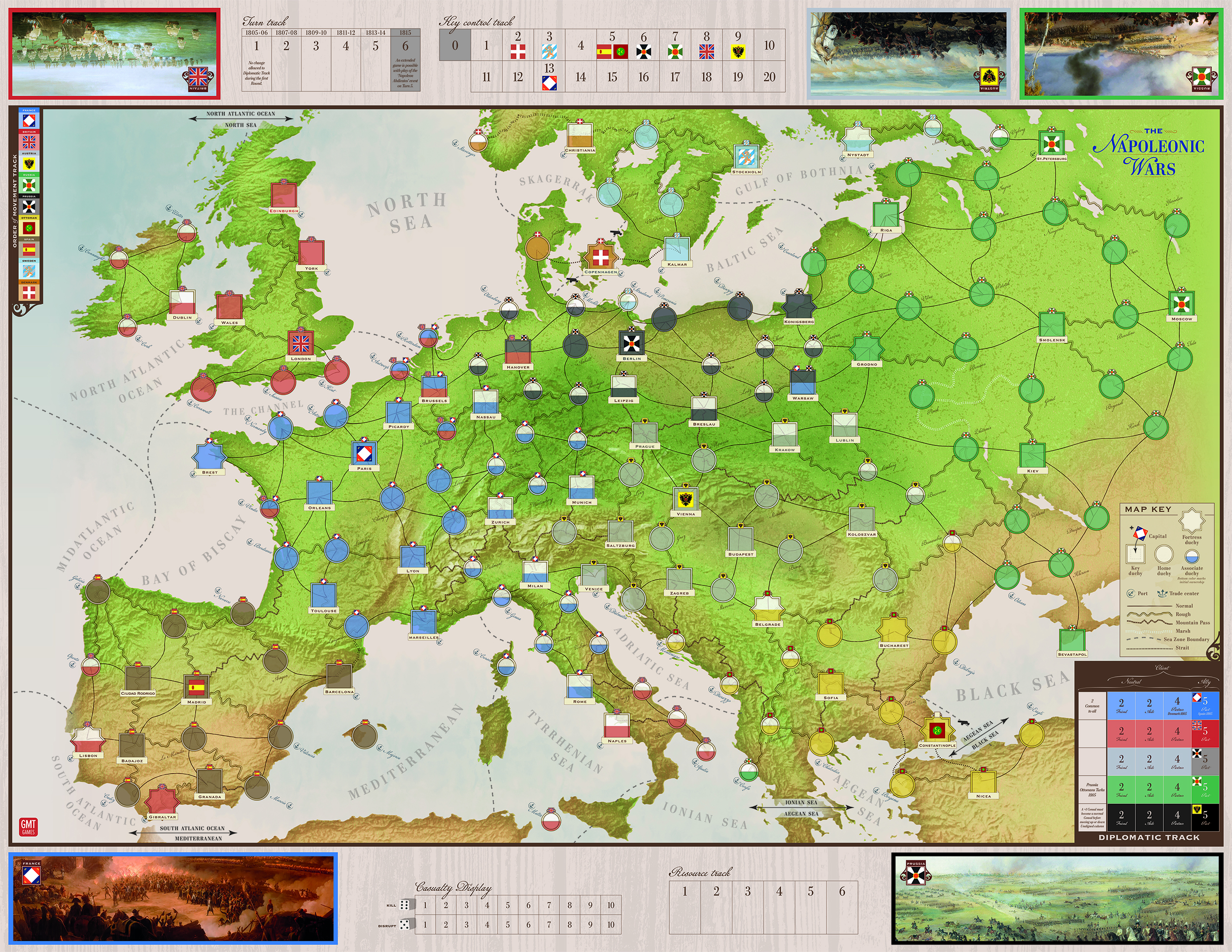
The first edition of The Napoleonic Wars was published in 2002. A second edition was published six years later and a double-sized, two-cardboard-map was made available in between. Now, thanks to the tireless work of developer Gareth Williams, who GM’ed the WBC tournament for over a decade, we are ready to bring you a 25th Anniversary Edition that will put an exclamation mark on this game’s history.
Over two hundred competitive games have been analyzed to give birth to what will be the 3rd edition of the rulebook. Likewise, about a third of the cards have been edited for clarity or balance. Six brand-new cards were also added. What hasn’t changed though is the possibility to relive the epics of Napoleon’s conquests at a strategic level with up to five players, each trying to carve up a place for their nation when 1815 comes around or when the infamous Peace Roll succeeds!
A complete graphics redesign by Wouter Schoutteten brings the game to modern standards. We are pulling out all the stops and making no compromises to production quality. The goal has always been clear: this is a deluxe edition, not an overpriced collector’s edition. We want each and every one of you to be able to enjoy this Mark McLaughlin classic at its best.
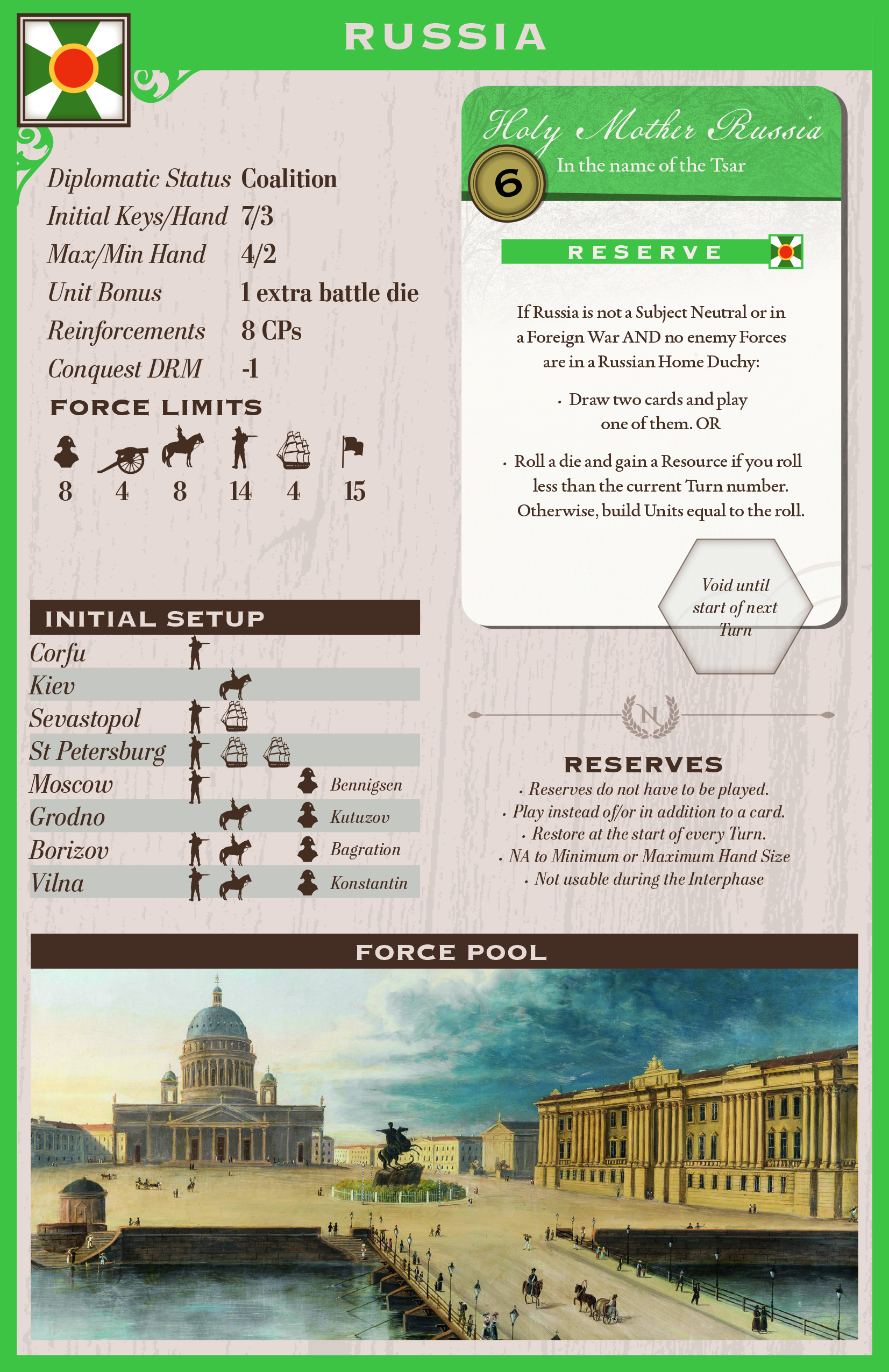
The HQ Displays now include a setup visual aid on the back. Each also features a force pool with a painting of their nation’s capital, to remind players of what they are ultimately defending!
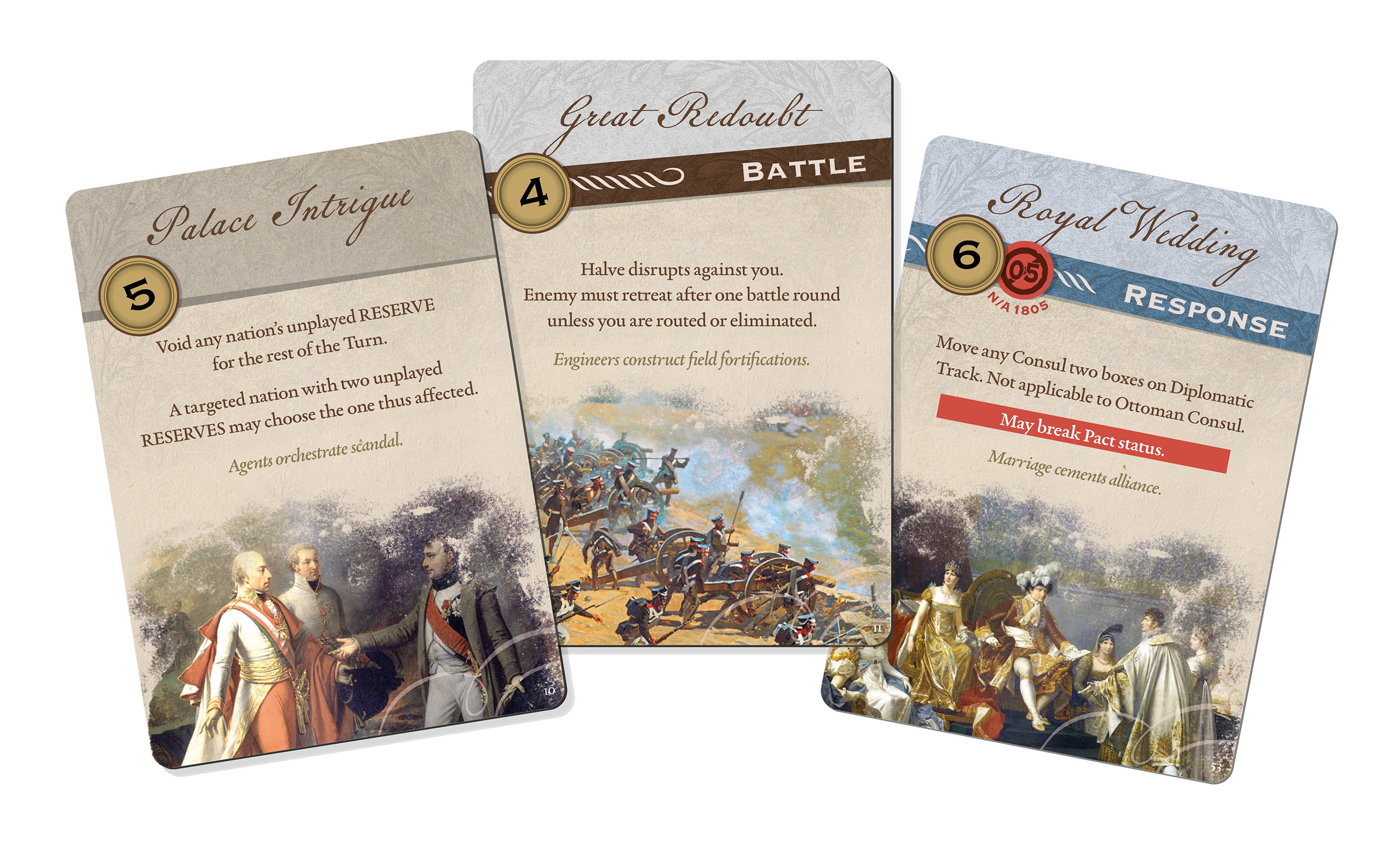
While the black and white had its charm, cards now feature full-color artwork from the painting masterpieces of the era.
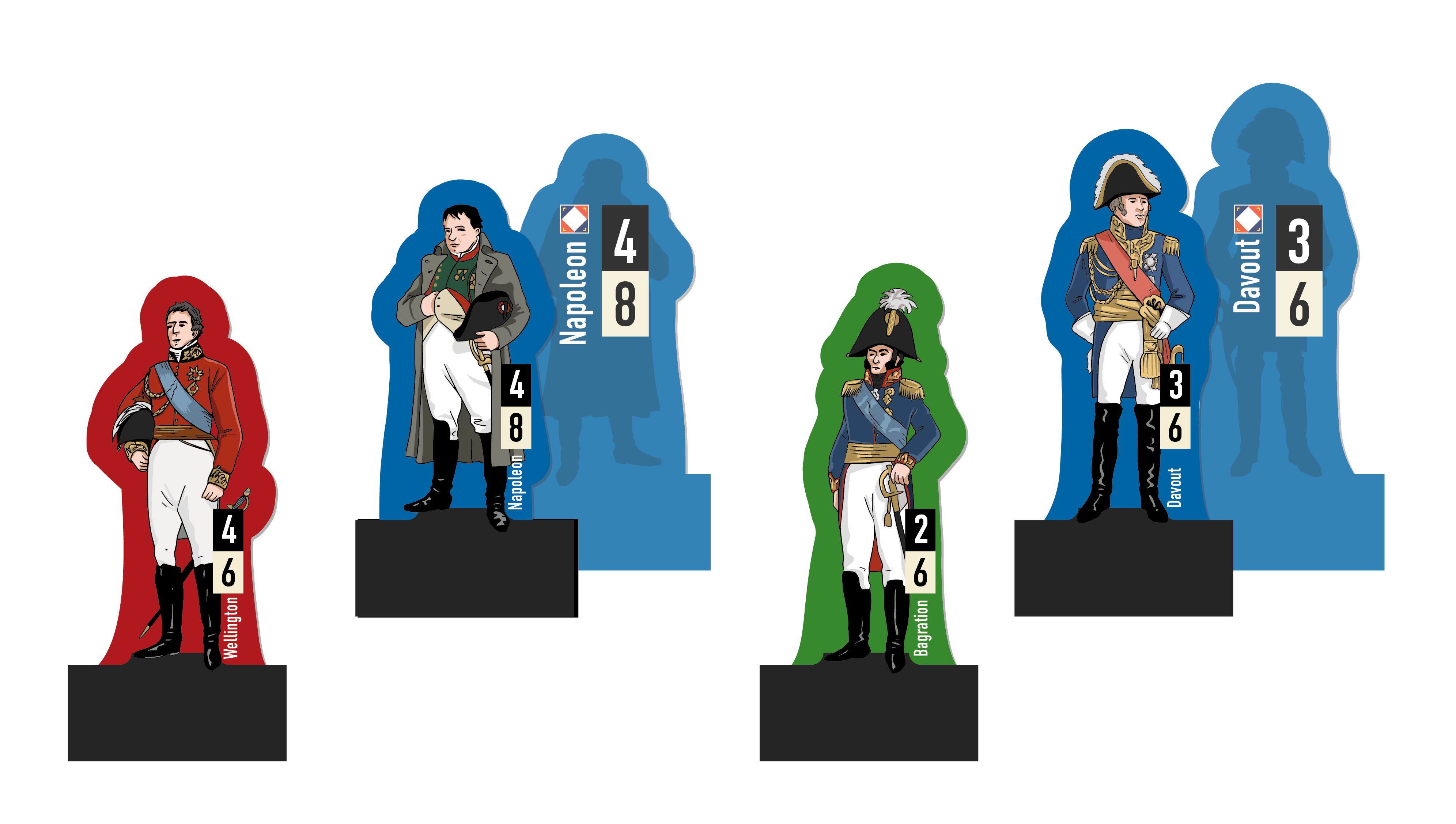
Nine major leaders such as Blücher, Davout and Bagration join Napoleon and Wellington in having a unique portrait for both their counter and standee. Oh and these leader standees will now be custom-cut!
Whether you’re a veteran of The Napoleonic Wars or you have been waiting a long time for us to reprint it, don’t miss out on your chance to get this acclaimed multiplayer game! Hours of fun await rewriting history!
I am truly impressed by this version of an Anniversary Edition and very much look forward to seeing it in real life. We have played this game once and very much enjoyed it although the balance seems a bit questionable in my mind as France, understandably, is very powerful.
11. Commands & Colors: Ancients Expansion 1: Greece & Eastern Kingdoms 4th Printing from GMT Games
This is the 2nd entry that deals with the Commands & Colors Series and is just a straight reprint, with known errata included as well. And any wargame has made it to 4th Printing should tell you something about the quality of that game. Commands & Colors: Ancients Expansion 1: Greece & Eastern Kingdoms 4th Printing is the next entry in the venerable series to get another reprint and Ancients is one of my favorite entries.
From the game page, we read the following:
Some of you have already discovered that Commands & Colors: Ancients is much more than a game. It is an expandable game system that allows players to fight a host of historical Ancient battles.
The Greeks & Eastern Kingdoms is the first expansion to Commands & Colors: Ancients. The armies of Philip, Alexander and the Successors meet the hosts of Persians, Scythians and Indians to the east. In this expansion, you will find historical scenarios that focus on the hoplites of classical Greece fighting off the invading Persian army at Marathon and Plataea; epic battles from the Peloponnesian War, the rise of Macedon and Alexander’s battles of Gaugamela, Issus and Granicus against the Persians; and battles involving Alexander’s successors. With your Greeks you will be able to turn west and battle the Carthaginians in Sicily, or as King Pyrrhus at Heraclea and Ausculum, battle the Romans.
In this first expansion, we showcase over 20 scenarios (the package includes over 300 new unit blocks and stickers you need to fight out these battles). Now, that is a lot of history, but we can do this because Commands & Colors: Ancients is, by design, a unique historical game system that will allow players to effectively portray stylized Ancient battles that play to a conclusion in less than an hour.
The battle dice resolve combat quickly and the command cards provide an element of luck that creates a fog of war and presents players with both challenges and opportunities for victory. Yet the tactics you need to execute conform remarkably well to the advantages and limitations inherent to the various Ancient units, their weapons, terrain and the history.
12. Commands & Colors: Napoleonics Expansion 1: The Spanish Army 5th Printing from GMT Games
My favorite volume in the Commands & Colors Series is C&C: Napoleonics hands down. I think that the reason for this is the unit variety represented in the game as well as the various extra army expansion packs that were released after the base game came to market. The 2nd Commands & Colors Series reprint offered this month is Commands & Colors: Napoleonics Expansion 1: The Spanish Army 5th Printing
From the game page, we read the following:
The Spanish Army is the first expansion for Commands & Colors: Napoleonics.
At the time of the Napoleonic Wars, Spain was only a shadow of its former power. Spanish troops and leaders, as many Napoleonic historians point out, performed badly on a large number of occasions. Yet there are a number of battles, Bailen, Tamames, Alcaniz and San Marcial where the Spaniards fought valiantly and gained victory. Ironically, the point most historians overlook is the fact that the Spanish armies constituted a threat that the French simply could not ignore. As good as Wellington’s Anglo-Portuguese field army was, that army faced multiple French armies. They could only defeat one French army at a time. The Spanish Armies and the accompanying guerrilla warfare against French troops tied down the remainder, allowing the Anglo-Portuguese army to ultimately emerge victorious.
In this expansion you will find 18 historical scenarios that focus on Peninsular battles fought by the Spanish army from 1808 to 1813, plus all the new units you’ll need to field for these engagements.
1808
Bailén – July 19 1808 Zornoza – October 31, 1808 Gamonel – November 7, 1808 Espinosa – November 11, 1808 Somosierra – November 30, 1808
1809
Medellin – March 28, 1809 Alcaniz – May 23, 1809 Maria – June 6, 1809 Talavera (Spanish Flank) – July 28, 1809 Tamames – October 13, 1809 Ocano (Cavalry Action) – November 18, 1809 Ocano – November 19, 1809 Alba de Tormes – November 28, 1809
1811
Barrosa (French Attack) – March 5, 1811Albuera – May 16, 1811
1813
Vitoria (Hill’s Attack) – June 21, 1813 San Marcial – August 31, 1813 Ordal Cross – September 13, 1813
The quality of Spanish troops varied, from very poor to good, and the Spanish National Unit Reference Card presents a wealth of subtle unit characteristics that set the Spanish Army apart from all other Coalition armies that opposed Napoleon. Command of the Spanish Army, therefore, will truly challenge even the most experienced Commands & Colors: Napoleonics player.
13. Labyrinth 3″ Game Box 2026-27 Reprint from GMT Games
One of the problems with a successful game series is the concept of growth. As a game does well, and more and more copies are sold and the buzz continues to build and grow, the inevitable happens and expansions come out for that game. These expansions not only add new and interesting mechanics and content to an already great game but they add stuff that you must store in the game box. And this stuff can multiply and get out of hand really quickly outgrowing the box that the original game was published in. Such is the case with Labyrinth as it has now had 2 published expansions, including The Awakening and The Forever War, and about a year ago we got the 3rd expansion The Rise of Al-Qaeda announced. 3 game expansions will add up and will not fit into the 2″ original box. So, GMT has offered a reprint of their Labyrinth 3″ Game Box on P500…and the price is very, very affordable.
From the game page, we read the following:
We’ve listened to those of you who asked us to put the Labyrinth 3″ Box back up on the P500 list to help you with storage of the game’s modules. So to accomodate you, and all those players who own earlier editions of Labyrinth and would like to get a deeper box, we are now reprinting a 3″ deep box via P500.
14. SCSDrive on Kharkov: Gallop, Star and the Backhand Blow from Multi-Man Publishing
One of my favorite hex and counter wargame series is the Standard Combat Series from Multi-Man Publishing. The series is a classic with simple rules, typically 6-10 pages of exclusive rules, solid move and fight mechanics and good solid design that always creates and fun and interesting way to take a look at operational level wargames typically set in World War II. We have played about 8 of the games in the series and own many more but it is a staple on our shelves and recently MMP announced the newest volume in the series called Drive on Kharkov. Drive on Kharkov takes a look at 3 separate but related battles on the East Front including the Soviet twin offensives, Operation Gallop and Operation Star, as well as the German counter-offensive referred to as von Manstein’s “Backhand Blow”. Once announced, I couldn’t mash the pre-order button any quicker and you should do the same.
From the game page, we read the following:
Drive on Kharkov is a Standard Combat Series (SCS) game covering the Soviet twin offensives, Operation Gallop and Operation Star, as well as the German counter-offensive (von Manstein’s “Backhand Blow”) that ended the Soviet winter offensive of 1942-43. Intended to cut off retreating Axis divisions in the south and capture Kharkov and the Donbas region, Operations Gallop and Star initially met with good success. However, the hasty nature of the offensives coupled with a poor supply situation slowed progress, and the Axis forces recovered and finally unleashed a counteroffensive that retook substantial ground and set the stage for Kursk, the last Axis offensive on the Eastern Front.
The game covers this pivotal post-Stalingrad dueling offensives at the operational scale. Each turn represents 2-3 days. Each hex is 5 kilometers wide. Soviet units are generally brigades and regiments with cavalry divisions. Axis units are mostly battalions with a few Kampfgruppen (KG) and regiments.
Game specific rules include HQs at the Soviet Army and German Corps level, artillery and air strikes, divisional refits, and mud that hampered operations late in the campaign. This famous battle comes alive with SCS where you can see if you can do as well as a Field Marshal von Manstein or Colonel General Vatutin.
If you are interested in SCSDrive on Kharkov: Gallop, Star and the Backhand Blow, you can pre-order a copy for $45.00 from the Multi-Man Publishing website at the following link: https://mmpgamers.com/drive-on-kharkov-p-471
15. BCS The Breaking Point: Battle of France and Belgium, May, 1940 from Multi-Man Publishing
As affectionate as I am about the Standard Combat Series, I may have a greater love for the Battalion Combat Series as the scale of the game and the way it integrates and connects positioning and supply into the results of combat is just superb. And those dreaded SNAFU Rolls that will get you if you don’t watch out or if you push your troops too far. MMP also announced a new entry to this series called The Breaking Point: Battle of France and Belgium, May, 1940
From the game page, we read the following:
The Breaking Point is a Battalion Combat Series (BCS) game depicting the critical point in the Battle of France. The Phoney War between France and Germany ended abruptly when panzers raced through the Ardennes Forest. France replied, executing their Dyle Plan, by advancing into their neighboring neutral countries to meet the threat . Believing it would take the Germans a week to cross the wooded and rough terrain, the French advanced their reserves hoping to form a cohesive defensive line. The Germans emerged from the Ardennes in two days, setting up a race to the Meuse River. Who will get there first? Will the French arrive in force and stop the enemy from crossing? Will the Germans vault over the river into the French heartland? The decisions and actions ultimately decided the fate of France and Belgium.
The game covers this unique and often misunderstood campaign in splendid detail. Not just focusing on Sedan where Guderian crossed, the game covers the length of the main German drive. It spans from the armored feint north of the Meuse River leading to the biggest tank battle to date at Hannut; to the crossing at Dinant where Erwin Rommel’s initial exploits were demonstrated; to Monthermé where a panzer division was held up by French Colonial troops; and finally to Sedan the French finally met its breaking point leading to the struggle for Stonne, and ultimately the breakout to the English Channel. Game specific rules capture important aspects like bridge blowing, bridge construction, tank breakdowns, Dyle Defensive Plans, and French Battle Doctrine. The intent is to reflect the historic capabilities and limitations of both sides without heavy handed rules or one built on myths.
Extensive research was done, including original French and German sources, to correctly depict the forces involved as well as how each sides’ doctrines drove how they could be used effectively. The French and Belgians fought bravely and were executing a post-WWI defensive strategy. This was compared to the dynamic tactics of the Germans, where brashness and sometimes outright insubordination wasn’t necessarily the winning factor, but rather luck. This fascinating and complex campaign can be explored by players in the way that only BCS can show.
If you are interested in BCS The Breaking Point: Battle of France and Belgium, May, 1940, you can pre-order a copy for $90.00 from the Multi-Man Publishing website at the following link: https://mmpgamers.com/the-breaking-point-p-472
16. Until the Bitter End 3 Print ‘n Play Wargame from Matt White Currently on Kickstarter
Several years ago, we posted an interview with Matt White, who is a very talented graphic artist and budding game designer, that focused on his artistic talents and love of tanks. He has since designed several very interesting small scale print and play wargames, with his most recent series being a World War II tactical wargame series for 1-2 Until the Bitter End. He has had multiple entries in the series including British Airborne versus the German Wehrmacht called Until the Bitter End, Until the Bitter End – US Airborne and Until the Bitter End – Tanks. His most recent offering in the series is called Until the Bitter End 3 and is currently being crowdfunded on Kickstarter.
From the game page, we read the following:
Welcome to Until the Bitter End 3, a World War 2 wargame. This is the third and latest game in the series and a print and play game for solitaire and two-players. This is a standalone game in my series of WW2 print and play games. You don’t need to have played the first games – everything is included (you simply need to print it all out and need a regular six sided dice and a pencil).
The game is quick to setup and play, it takes around 30 minutes to play a game and requires very little space.
Example of the game setup ready to play – one of the smaller scenarios on just one map, with only a few counters needed.
The game sets a small squad of American Airborne against their German enemies in a series of small skirmish scenarios. The game’s counters (or chits) each represent an actual soldier with the gameplay being in the thick of man-to-man combat.
American forces preparing to assault the German defended church.
Key Features
Each counter represents an individual soldier with unique artwork.
Rules and multiple scenarios for 2 player and separate unique rules and scenarios for Solitaire play.
Geomorphic maps and scenarios so you can decide the gameplay length from 30 minutes to a couple of hours.
Third release in the series with a robust and play tested core rule set, with easy to learn mechanics that have depth of tactical play.
Easy to print out and construct with just a few sheets of paper and only a few counters needed to start.
This is a print and play game with the PDF containing all the rules, scenarios, maps, player aids and counters required to play. You’ll need to print them out, mount the maps and counters to card and provide your own pencil and a regular six sided dice. We have kept the maps and counters to a few sheets (of either Letter or A4 size) so very inexpensive and quick to print out and mount.
One of the best parts of these print ‘n play games designed by Matt is the art. He has a real skill and creates some very memorable counters, drawings and maps that create a great deal of thematic immersion into the battles and makes it very nice to simply look at. The games are also great but his art is superb!
As of November 1st, the Kickstarter campaign has funded and raised $1,615 toward its $172 funding goal with 63 backers. The campaign will conclude on Tuesday, November 17th at 4:00pm EST.
17. The Struggle for Union from Compass Games
A good sweeping Grand Strategic wargame is always welcome on my table! I love the experience of managing armies and entire fronts and the decisions that come with that including supply, logistics, politics and even war production and economic issues. And when the game is set during the American Civil War, I am very interested. One of Compass Games new offerings on pre-order is The Struggle for Union designed by Mark Melenovsky.
From the game page, we read the following:
Command the armies of the Union or Confederacy in a sweeping Civil War simulation that blends grand strategy, operational maneuver, and battlefield tactics. Build armies, manage production, and pursue your own path to victory as history unfolds across an open-ended sandbox campaign. Uncertainty reigns supreme. Fog of War conceals enemy intentions, Activation Chits create the friction and delays of command, and distant armies may “March to the Sound of the Guns” to reinforce a desperate battle underway.
When armies collide, the action shifts to an immersive Battle Board where leadership, terrain, reserves, and timing determine victory or defeat. Every battle becomes a dramatic test of skill, nerve, and command. The result is a richly historical Civil War experience where no two campaigns unfold the same way.
The Struggle for Union provides players with more of a sandbox approach to a Civil War simulation. To that end, Basic Resource Points (or Production Points) allow players to build their forces as they see fit and craft their own approaches to winning the game and have fun going down different force pool paths. Another fundamental decision was to enable players to accomplish the historical progress of the war with the least amount of rule exceptions. It was an important aspect of the design to have common rules and tables that governed most game elements, so once players learn them, they can be applied to most game situations.
Best played by 2–4 players, each playing a combination of Union and Confederate Eastern and Western Theaters.
18. Ten Years of Glory: The Tide Turns Against Philip II, 1589-1598 from Compass Games
The No Peace without Spain Series is a very interesting series from Compass Games, which is a family of card-driven, strategic-level wargames designed by Don Herndon and other contributors such as Kris Van Beurden that sets out to simulate major early-modern European conflicts from the late 17th through the mid-18th centuries. There is now a new volume in the series called Ten Years of Glory: The Tide Turns Against Philip II, 1589-1598 that was just announced and it is designed by Kris Van Beurden.
From the game page, we read the following:
Ten Years of Glory is a two-player, card-driven wargame using the No Peace without Spain system, depicting the turn of the tide in the Eighty Years’ War. During ten years (from 1589 to 1598), while the Spanish Empire was distracted by events in France, the Dutch Republic conquered territories which even today are still part of the Netherlands. One player represents the Habsburg family, while the other player represents the Anti-Habsburg Alliance.
The point-to-point map covers the Netherlands and Northern France, the traditional “cockpit” of Europe. Will Henri IV defeat the Catholic League and end the French Wars of Religion once and for all? Will Maurice of Nassau reunite the Netherlands? Where will Philip II send his most trusted and capable general, the Duke of Parma? It is up to you to answer all these questions and more!
During the designer’s research for No Peace for Thirty Years and the Eighty Years’ War (a personal favorite period of history) in general, his eyes were drawn to this little-known period of time, the Ten Years. Immediately prior to this period, the Dutch Revolt had almost been eradicated, and the Dutch Republic reduced to little more than the province of Holland, while after ten Anni Mirabiles, its Stadtholder Mauritz was able to give the Netherlands (almost) its current borders with Germany and Belgium.
Meanwhile, following the assassination of the French King Henri III, his protestant heir Henri of Navarre faces opposition from the Catholic League in a land weakened by the seven previous Wars of Religion. In between these two theaters, the Duke of Parma is governor of the Spanish Netherlands and receives conflicting orders from the Spanish King Philip II, who wants him both to support the Catholic League and defeat the Dutch Revolt. Ten Years of Glory is an asymmetric game. The Alliance player begins with a small section of the map while, historically, they ended with three quarters of the map in their hands. For this reason, the Alliance player is forced to win an Automatic Victory in order to win the game in a grand manner.
19. Brotherhood & Unity: War in Bosnia and Herzegovina 1992-1995 Reprint from Compass Games
Not many games out there that cover the Bosnian War of 1992-1995 and this one is a very good game that does just that. Brotherhood & Unity: War in Bosnia and Herzegovina 1992-1995 Reprint is now available to pre-order a gain and this game really is worth it. To me, this is a perfect CDG that is made for 2-3 players and should be played by 3 for the best and most immersive exprience.
From the game page, we read the following:
Brotherhood & Unity is a 2-3 player card driven wargame which depicts the war in Bosnia and Herzegovina from 1992-1995 (“Bosnian War”). The game shows all of the major events: from the siege of Sarajevo (shown in separate, detailed map), to the ferocious battles for the Posavina corridore, and desperate defense of the Bosniak enclaves. Main features are: Point-To-Point movement system, play driven by Strategy Cards, quick combat resolution (no CRT), streamlined rules and fast gameplay. Interaction between warring sides (Bosniaks, Serbs and Croats) creates an intensive and exciting gameplay experience.
Player’s military strength fluctuates based on historical facts, with Serbs starting superior in all aspects, and Bosniaks struggling to organize an effective fighting formation. Military units represent Brigades – standard military formations of the time, ranging from 1500-2000 soldiers. They have different combat and movement values (based on historical data), which forces players to use different tactics for different opponents. Majority of these units are non-motorized infantry formations (moving only several spaces per round), but with the use of special offensive cards players can increase their mobility and surprise the opponents.
The game simulates three distinct sides in the war: Bosniaks, Serbs and Croats – with no clear border separating them. That provides an interesting set of choices to players: to attack or to fortify, whom to ally with, and when to change sides. That leads to many turnarounds and pragmatical alliances with former enemies – as was historically the case.
Each player gets a deck of Strategy Cards, simulating a variety of historical events. The player starts an action round by playing a Strategy Card from his hand. A card can be played as an event (Combat Card, Offensive, Interrupt, Foreign Units and Other) or as one of the game actions (Movement, Attack, Strategic Redeployment, Diplomatic Action or Reinforcement). The events and card values have been carefully created to mimic the historical events and choices. Since each game uses only a part of the available card deck, players can’t be certain which cards will be drawn during the game. That creates a “card fog-of-war” and makes the game more replayable.
Game uses Strategic Will point system to keep track of the victories and losses, and to determine the final score. It is affected by a number of things: capturing or losing regions, capturing or losing key spaces, eliminating or losing units, and as a result of events. One of the most important aspects of the game is capturing player’s own key regions – which were different for each side, and which reflects the different aims the each side had.
20. Eastern Front Operational Battles from Compass Games Currently on Kickstarter
The classic qadrigame is a solid way of getting lots of content into a box and also packaging similar battles with the same rules set in an easy and accessible method. I love these quads and am very glad to see they are still alive and kicking. This month, Compass Games launched a quad designed by John Thiessen called Eastern Front Operational Battles and it includes Pincers, Operation Fridericus, Orel Salient and Operation Rumaiantsev.
From the game page, we read the following:
In May of 1942, portions of the Red Army were to attack the German 6th Army, as mandated by Stalin. This was to be a pincers type attack, enveloping Kharkov. The Germans coincidentally were planning an assault in May against the salient which formed the southern base of the Soviet May offensive. The Red Army struck first, and five days later the German attack commenced. These double offensives are what are covered in “Pincers” and “Operation Fredericus”. As the German Zitadelle offensive of 1943 was winding down, the Soviets launched a major attack of their own on the northern part of the Kursk area. Then on August 3 the Soviets attacked the southern part of the Kursk area. “Orel Salient” and “Operation Rumiantsev” cover these actions.
Eastern Front Operational Battles use the same basic rule set in all four games as one would expect in a quad game. The rules are accessible and straight forward for playability, and at the same time, all aspects, such as movement rates, combat outcomes, and so on, are based on historical analysis. All of the games play at the operational level. Units are mostly regiments/brigades and divisions in the 1942 games, and divisions and corps in the 1943 games.
There are also a few interesting small units in the mix. In the 1943 games, the Germans have a small number of the “animal” units available: Hornisse, Tiger, Brummbar, as well as Ferdinands (later called Elefants). There are a few Hungarian, Romanian, and Italian units that take part in the action. Both sides have a number of armored, motorized, and cavalry units in their orders of battle, so that movement and breakthroughs are frequent possibilities. Headquarters allow units within range to benefit from a number of characteristics. Airpower is represented with players able to give CRT column shifts and to attack various ground targets. Some randomized special events affect play. The system isn’t complex, and there are a few optional rules that are available if players want to add some chrome.
Gamers should find that ease of play and realistic modeling coexist in this system. All four games in Eastern Front Operational Battles can be for two players, and they are also readily accessible for solitaire play.
As of November 1st, the Kickstarter campaign has funded and raised $6,139 toward its $2,500 funding goal with 67 backers. The campaign will conclude on Thursday, November 10th at 8:10pm EST.
New Release
1. Fragile Crown, Hard Battle – Battle of Shrewsbury: July 21, 1403 from High Flying Dice Games
As you have heard me say before, small format wargames on lesser gamed subjects are always welcome at my table. High Flying Dice Games seems to specialize in these type of games and this month have 2 very interesting looking games on vastly different subjects.
The first is Fragile Crown, Hard Battle – Battle of Shrewsbury: July 21, 1403, which takes a look at the Battle of Shrewsbury between rebel forces of the Percy’s and Lancastrian’s.
From the game page, we read the following:
The rule of Lancastrian King Henry IV was precarious following his overthrow of his cousin, King Richard II in 1399. Richard had assumed the English crown at a young age following the sudden death of his father, the Black Prince, leading to Richard becoming the heir to the English throne following the death of his grandfather, Edward III. However, his regency fed the young king’s paranoia and narcissism, turning Richard II into a feared tyrant that bankrupted the realm and brought it to the brink of civil war. Henry’s usurpation of his cousin’s rule was seen as a liberation by many. However, the Percy family resented the Lancastrian house’s rise to power, as well as King Henry IV’s seeming reluctance to support them in the face of growing Scottish incursions and damaging raids into their estates.
Henry Percy, nicknamed “Hotspur”, at first supported Henry IV’s takeover of the English throne and was a long friend of his eldest son and now Prince of Wales, Henry V. In 1402 Hotspur won a major victory against the Scots, capturing many of their nobles and the Scottish King. King Henry IV demanded that all the Scottish nobles and King be turned over to him so he could arrange some sort of peace treaty. Hotspur, who had not been paid by either Richard II or Henry IV for his part in defending the realm (the monarchy was broke and Parliament reluctant to pay the bills), badly needed the ransoms his high-born prisoners would fetch from the Scots. By the summer of 1403, Hotspur’s patience was at an end and Hotspur and his supporters rose in revolt. The rebel forces of the Percy’s (about ten thousand) and Lancastrian’s (about fourteen thousand) met near the town of Shrewsbury and fought in one of the bloodiest battles in English history. Can you do as well or better than your historical counterpart?
If you are interested in Fragile Crown, Hard Battle – Battle of Shrewsbury: July 21, 1403, you can order a copy for $20.95 from the High Flying Dice Games website at the following link: https://www.hfdgames.com/shrew.html
2. Falling Skies – Operation Rolling Thunder March-December, 1965 from High Flying Dice Games
The 2nd game offered this month from High Flying Dice Games is a modern wargame that deals with airpower and the bombing campaign in Vietnam called Falling Skies – Operation Rolling Thunder March-December, 1965. I just love these type of airwar games that focus on routes and avoiding SAM’s and the like as they always create a very tense and interesting experience as you go about trying your best to avoid detection and attack.
From the game page, we read the following:
After the Gulf of Tonkin Resolution was passed on August 10, 1964, full American intervention in the Vietnam Conflict was inevitable. The Joint Chiefs of Staff and Secretary of Defense, Robert McNamara, believed they had a war winning strategy with massive air strikes against targets in North Vietnam and the “Ho Chi Minh Trail”, the route through Laos and Cambodia that funneled men and material to Communist forces in South Vietnam. Dubbed Operation Rolling Thunder, phased airstrikes against targets that progressively worked their way closer to Hanoi and Haiphong, would convince the North Vietnamese government of the futility of waging war against South Vietnam and encourage them to seek a negotiated peace settlement.
Trusting that the policy of regulated and judicious use of force that was used successfully in the Cuban Missile Crisis would also lead to victory here in Vietnam, Operation Rolling Thunder was launched weeks before the first US ground troops were to land at Danang. However, the historical result was far from what was anticipated in Washington, DC, and presaged the frustration and tragedy of a war that would last another ten years, America’s defeat and humiliation, and the fall of South Vietnam.
If you are interested in Falling Skies – Operation Rolling Thunder March-December, 1965, you can order a copy for $20.95 from the High Flying Dice Games website at the following link: https://www.hfdgames.com/skies.html
3. First Man in Rome – Strategikon Book II: The Civil War and the Fall of the Republic from Thin Red Line Games
If you are a monster wargame fan then you are probably familiar with Thin Red Line Games and the genius behind the madness Fabrizio Vianello. They are a small but passionate publisher and my favorite thing about them is that Fabrizio speaks in his military jargon so fluently that it is such a thematic boost to the games they produce. Over the past couple of years, we have posted interviews with Fabrizio covering their Cold War Gone Hot games called Die Festung Hamburg and In a Dark Wood as well as the first game in a new Ancients series called The Fate of All: Alexander’s Campaign Against the Persian Empire. Following along in that Strategikon Series is the new volume called First Man in Rome that was recently published.
From the game page, we read the following:
Citizens, the creation of the great mosaic depicting the beleagured civil war between Caius Iulius Caesar and Cneo Pompeius Magnus continues!
As already discussed in the Senate, we intend to represent the entire civil war, from the crossing of the Rubicon in 49BC to the defeat of the last Pompeian forces in Spain in 45BC. So it’s not just a glimpse of this epic confrontation, but the whole struggle for the greater good of the Res Publica.
I can now share some details on the map, almost at its conclusion. The map will be probably divided in six parts, each one with the size of a “standard” map. Due to the enormous extension of the conflict, the scale has been increased from 30km to 60km per hex, and the rules will be adjusted accordingly.
If you are interested in First Man in Rome– Strategikon Book II: The Civil War and the Fall of the Republic, you can order a copy for €150.00 ($167.19 in US Dollars) from the Thin Red Line Games website at the following link: https://trlgames.com/prodotto/first-man-in-rome/
4. Song for War: Mediterranean Theater from Invicta Rex Games
While attending Buckeye Game Fest in the spring of 2022, we met two new designers who had a very cool looking prototype copy of their new game setup in the War Room called Song for War: Mediterranean Theater. Chris Helm and Seth Stigliano were really nice guys who obviously had put a ton of time into their game and it was immediately evident that this was going to be a different experience. Unfortunately, because of our crazy schedule of events and already committed to games, we were unable to sit down and play the game but got a crash course into the design as well as a good look at the awesome components.
The game had an initial Kikcstarter that they pulled and made some changes to with a 2nd Kickstarter in April 2025. The campaign funded and it is now available for purchase. I got my copy last week and it looks really great.
From the game page, we read the following:
Song for War is a tabletop strategy game based in the contested regions of southern Europe, north Africa, and the Mediterranean Sea during World War II. Representing one of four nations, players must work together as the Allies (US or Great Britain) or Axis (Germany or Italy). Players have the option to set strategy, move units, attack and defend as individual nations or simultaneously as the Allied or Axis team. Innovative mechanics allow players to deploy their land, sea, and air units strategically as combined forces, with faster units moving first and more often, followed by heavy units with stronger firepower. Take strategic objectives, control shipping lanes and resupply, deploy new technologies and units, and recreate historical events to defeat the enemy and win the day.
One of the best parts is the asymmetry built into the design for each of the nations. This gives the game some feeling of reality versus everyone just having the exact same units with the exact same abilities. I also am really interested in each nations’ special units and want to see how these things work and feel as the game is played.
Fellow content creator Zilla Blitz did a preview for the game in 2023 and you can check that out at the following link:
If you are interested in Song for War: Mediterranean Theater, you can learn more about the project on the game page at the Invicta Rex Games website at the following link: https://www.invictarex.com/songforwar
Be aware that the link wasn’t working as of yet but should be functional shortly.
5. 1066: Year of Destiny from Legion Wargames
As mentioned above, I love Legion Wargames and their games as they are just good! The 2nd game they had this month was called 1066: Year of Destiny and covers the chaotic wars around successors to King Edward in January 1066.
From the game page, we read the following:
1066: Year of Destiny is a three player game covering the various claimants to the crown of England following the death of Edward the Confessor in January 1066.
The players fulfill the roles of Harald Hardrada, Harold Godwinson and William of Normandy. The game is split into 4 phases each of which is designed to illustrate a key component in determining who takes the crown.
Firstly there is a Pre-Invasion Political Event phase (PIPE) which is designed to showcase the political intrigue that took place prior to the death of Edward. During this phase the players can gain additional support from other leaders and regions and, crucially, they can gain additionally legitimacy from various monarchs, religious bodies and events. Many events are outside their control; death of the Aethling, Scandinavian Wars and the activities of Tostig but they will also be crucial. This simple game preamble will provide an infinite variety of starting points to be played out on the map itself. In addition this phase can be a time of acquiring operational and tactical chits to use advantageously later.
Legitimacy is central to the game. Unless a player gains an automatic victory then a players legitimacy level will be key in determining who has won the war. As well as during the PIPE phase it can also be changed by winning and losing battles and by taking controlling of areas on the map.
However before the Operational phase there are the perils of the sea crossings. When to sail is a crucial decision by both William and Hardrada. Go early and the weather should be kinder, go later and you can recruit more troops. Lady luck, in the form of stormy seas can destroy the best laid plans, in addition the prevailing winds can prevent you invading, even when you are ready to go (as occurred to William). If a crossing goes badly wrong, or you lose an early decisive battle your claim lies in shreds. Don’t despair – ‘Become a Dane’. A player can abandon their attempt, as William or Hardrada, and instead take up the cause of Sweyn of Denmark and try and gain the throne for the Danes (they historically invaded in 1069). It won’t be easy winning as the Danes but it means you are still in the game.
The first week in September is a dangerous time for Harold as the Fyrd stand down to collect the harvest, is this the time to strike? , will the weather conditions be in your favour. In the operational players move around the map of England to gain control of areas and improve their legitimacy as well as deciding when to strike to win a decisive battle against one of the two opponents. The operational phase is a real ‘rock, paper, scissors’ problem. How to square the problems of keeping your forces concentrated to win battles, spreading them out to take control of areas whilst keeping them feed without turning areas into wastelands.When battle is joined them the action is transferred to a battle board where the individual characteristics of the differing armies is highlighted. The longer you stay on the battlefield the bigger the loss if you are defeated; often the losses from pursuit are greater than the losses from the battle itself. Winning and losing battles result in big legitimacy swings which can decide the game.
Never before has this iconic campaign been gamed with all four key facets illustrated (politics, invasion, operational campaign and battles). There are a number of very good battle games but not much for the operational phase and nothing showing the political interplay or the perils of the sea crossings themselves. The victory conditions for each player differ slightly, requiring differing strategies for each side. Sweyn of Denmark is waiting in the wings. The game system will determine if he arrives or not. Leave London inadequately protected and he will take it and without it neither William or Harold can win a decisive victory.
6. Bear Trap: The Soviet-Afghan War, 1979-1989 from GMT Games
A few years ago, GMT announced a very cool looking game designed by Paul Daniels covering the Soviet-Afghan War from 1979-1989 called Bear Trap. The game was described as a block wargame that used a similar system to what was used in the design for Sekigahara: The Unification of Japan.
From the game page, we read the following:
Bear Trap is a quick-playing, low-complexity 2-player block wargame covering the Soviet-Afghan War (1979-1989).
In the Soviet–Afghan war, Insurgent groups—including the mujahideen—fought a guerrilla war against the Soviet 40th Army and the Democratic Republic of Afghanistan (DRA) government. The game begins shortly after “Operation Storm-333” was executed at the end of 1979—in this coup, Hafizullah Amin (General Secretary of the People’s Democratic Party of Afghanistan) was killed, and Babrak Karmal, a Soviet loyalist, replaced him. By putting the Brezhnev Doctrine into practice, the Soviets sought to prop up the sympathetic local government and “solve the Russian Ice-lock Problem” while the Insurgents sought to expel the secularist government and foreign invaders.
Although the two sides in this conflict were fundamentally different in a variety of ways, they also faced some parallel challenges. For instance, they struggled to maintain loyalty. For the Soviets and the DRA, the DRA armed forces merely offered an opportunity for a paycheck, and there were cases where conscripts in the Soviet Army defected to the Mujahideen (e.g. Kazbek Hudalov). For the Insurgents, propaganda, threats, and promises to family drew would-be combatants away, as did injuries suffered from landmines and attacks on villages. Both sides also struggled to puncture the fog of war, not being able to secure reliable intel about force deployment and strength. And both faced various challenges around supply, communication, and coordination. Both sides needed to react to shifting strategies and developments over this decade long Cold War proxy war, where the landscape upon which it was fought presented many unique challenges.
Bear Trap is a spiritual successor to Sekigahara—building on the same core system. In both games, each player has their own deck of cards; players spend cards from their hand to activate areas or in combat to commit units to battle. This means fans of Sekigahara will find learning Bear Trap easy, but the feel and experience of the games are highly divergent. In addition to the difference in topics covered, other differences include:
In Bear Trap, forces are represented by blocks, stickered side hidden from the opponent, and the orientation of a block determines its disposition (i.e. the orientation of a block dictates whether it’s mobilized, fortified, disordered, poised to offer fire support to a battle initiated by friendly units, or ready to ambush enemy units). The orientation of a block also determines which battles it can join, whether card play is required to commit it to battle, and whether it can be moved or activated.
Bear Trap features an area-based map, rather than the point-to-point style found in Sekigahara.
The sequential combat system popularized in Sekigahara is utilized in Bear Trap, adapted to suit the setting. This includes the use of ‘loyalty challenges,’ making Bear Trap simulate the proneness of (for instance) Afghan forces to defect.
Bear Trap is, like Sekigahara, first and foremost a 2-player game—but Bear Trap includes a unique solo mode, built around a card assisted flowchart bot.
Bear Trap has fewer blocks than Sekigahara, and each player has fewer card types (‘suits’) in their decks.
Bear Trap introduces ‘strategy’ cards—powerful event cards. Although it would be misleading to label Bear Trap a deck-building game, players will add 2 cards from a pool specific to their side each time they reshuffle their deck.
Bear Trap is not a “clone” of Sekigahara—they are very different games with differences in topic, feel, and mechanism, despite having an underlying shared game system. Bear Trap is also a more asymmetric game than Sekigahara. Although Bear Trap is a slight step up in complexity (relative to Sekigahara), the mechanics remain simple, and Bear Trap can be completed in 2-3 hours.
7. Battle Line: Medieval 2nd Printing from GMT Games
Following on in this reprint trend this month, Battle Line: Medieval2nd Printing is now shipping. This is one of those famous classic wargames designed by Reiner Knizia that is very well thought of but that is a smaller, card based game that is portable and very approachable.
From the game page, we read the following:
Now in its 12th GMT printing, designer Reiner Knizia’s Battle Line is our #2 all-time best-selling game! This new re-themed version of Battle Line is a two-player strategy card game built around the theme of Medieval warfare. This Medieval-themed version of Battle Line features 60 beautiful new cards by illustrator Roland MacDonald, as well as 10 full-color tactics “wildcards” that give players extra flexibility and choices and help make each new battle wildly different from the last.
Battle Line: Medieval takes about 30 minutes to play. To win, you must create powerful formations along your side of the line of battle that are superior to those of your enemy. Victory goes to the player who wins 5 of the 9 battle flags (an envelopment) or three adjacent flags (a breakthrough). Based on Reiner Knizia’s original design published in Germany as Shotten-Totten,Battle Line: Medieval enhances and expands that game system to give players even more tactical options and gut-wrenching decisions.
Battle Line: Medieval is a beautiful game that will delight competitive strategy game players and also serve as an great introductory game for new or young gamers.
I own the Deluxe Edition of this one, which was released in 2018 and it is a beautiful monster with around 6 full counter sheets and 6 double sided maps with 19 scenarios. There is a lot of game here! I have only played the game on Vassal though with a few of the scenarios and have really enjoyed it. I must admit that this one is very deep and there are a lots of rules and exceptions based on the different units that are included in each scenario. I do feel that the rules could use some work but that concern does not sway me away from saying this system and the game itself are fantastic!
The game system really emphasizes the important role of command on the ancients battlefield. Leaders are the most important counters in the game and consequently without leader’s order, the player will find that their very powerful and important phalanx and legions will not be able to take any actions, even moving closer to the enemy.
One of my favorite rules from the game is the all important initiative. When in battle, the player will hold the initiative if you force your opponent to act first and can react on every move. Also, leaders are activated in their initiative rating order from lowest to highest. Leaders can issue individual orders up to their initiative rating to the units in command radius, or if specifically called for in the scenario, activate a whole line of units. Leader may also gain momentum, trying to take turn after the turn if passing their initiative checks. The game is really very playable, with some exceptions for rules that just are not as clear as they need to be, but this system takes into account what was most important on the battlefields of the ancient world.
From the game page, we read the following:
We are proud to bring SPQR back in print in a new and expanded 5th Edition. This edition will not only include the scenarios from the Barbarian module but also the six scenarios of The Hammer of God module published in C3i magazine and an updated version of the Battle of Pydna originally published in the SPQR Player’s Guide. Perhaps the most significant change to the original SPQR and Scenario Pack scenarios is the inclusion of the setups to play with the Simple GBoH 2nd Edition rules!
The game will feature a new edition of the rulebook incorporating all known errata and numerous clarifications based on player feedback. Known errata on the Player Aid cards have been addressed. The Game Turn Track Display will be replaced by a Rout Point Tracking card (which includes a Game Turn Track) in the same style as that in Great Battles of Julius Caesar. There are no changes to the maps. Minor errata on a few of the counters will be addressed and the counters associated with the early C3i Marathon scenario will be replaced with counters for the Pydna scenario along with additional counters to eliminate several counter substitutions.
Due to the increased content, the most significant change to the components is a restructuring of the previous edition’s three scenario/module books into three scenario books arranged chronologically.
I will play SPQR at anytime and I know that there are other games out there that have a better following but for me Herman and Berg were a magnificent team to create these very interesting and unique scenarios.
9. SPQR Deluxe 5th Edition Update Kit from GMT Games
If you already own SPQR (and let me tell you that you should and we will need to talk later), and feel that you are going to miss out with these improvements, then never fear! GMT Games has you covered with their SPQR Deluxe 5th Edition Update Kit.
From the game page, we read the following:
The SPQR Deluxe 5th Edition Update Kit allows owners of the 2008 and 2018 printings of SPQR Deluxe Edition to use the maps and counters from those games with the new content (see the SPQR Deluxe 5th Edition listing for details).
Components:
One Rulebook
Three Chronological Scenario Books (The Rise of Rome, The 2nd Punic War, and Rome and the Successors)
10. Small Battles of the American Revolution Volume I: The Battle of Cowpens from GMT Games
While attending the World Boardgaming Championships 2 years ago, I was able to meet up with Dave Stiffler (acting as Developer on the project) and Bruno Sinigaglio who is the designer to get an early look at the upcoming debut release in the Small BoAR Series called The Battle of Cowpens.
I didn’t get any pictures because they didn’t have the components along to show but learned a lot about the design and how it changes the Battles of the American Revolution Series from GMT Games. First off, the scale is the major difference as it is 1/8th of the scale used in the normal series. This means 25 yard hexes and 2-3 men per counter. They also have included both rifle fire and musket fire which is a change as musket fire is simply an abstracted part of the close combat mechanic in BoAR. They also have added some new mechanics to account better for things like morale and being shaken or even shattered.
But then recently I got a chance to play the game in its final form while attending the Gaming the American Revolution 250 Camden Event put on by GMT Games and it was absolutely golrious.
From the game page, we read the following:
Two critical battles were considered turning points in the American Revolutionary War: the Battle of Saratoga in New York and the Battle of Cowpens in South Carolina. The Battle of Cowpens was a catalyst to a series of events that led eventually to the surrender of the British at Yorktown. Small BoAR Volume I, The Battle of Cowpens, puts players directly into the milieu of this decisive contest.
The goal of the Small BoAR design concept is to include small yet critical battles that otherwise do not fit the scale of the historically simulating and highly successful Battles of the American Revolution (BoAR) system designed by Mark Miklos. This new system, aptly termed Small Battles of the American Revolution (Small BoAR), was designed by Bruno Sinigaglio working closely with Mark Miklos to preserve the continuity and popularity of the original Battles of the American Revolution game system.
Although extremely important to the history of the Revolutionary War, the Battle of Cowpens involved slightly over 1000 participants per side. In the Battles of the American Revolution system, which represents 100 men per strength point, this would equate to only ten or so combat factors per side. The scale for the battle of Cowpens, on the other hand, is 12 men per strength point, or one-eighth that of the BoAR system. The map scale is also correspondingly reduced to 25 yards per hex from the BoAR scale of 200 yards per hex. The time scale is approximately four minutes per turn as compared with one hour per turn in BoAR.
I think that one of the best parts of this new series, aside from the size and scope of the battles covered being smaller, is that they have not just rested on their laurels and reproduced the BoAR System but have added new mechanics and elements to better deal with these battles and to model the smaller scale battles.
Although Army Morale, the game-within-the-game in BoAR, is faithfully preserved in Small BoAR, and the Small BoAR sequence of play resembles that of BoAR and will look familiar to anyone who has played games in the original series, certain novel elements appropriate to the new scaling have been added. These include:
The ability to designate cavalry units in reserve
Artillery Fire conducted both offensively and defensively
Simultaneous ranged musket Fire as a complement to ranged rifle fire
A Cavalry Reserve Phase where units designated in Reserve may charge after the normal Close Combat Phase
And Opportunity Card Management
We recently did a video interview with designer Bruno Sinigaglio and here is a link to that video:
If you are interested in Small Battles of the American Revolution Volume I: The Battle of Cowpens, you can order a copy for $75.00 from the GMT Games website at the following link: https://www.gmtgames.com/p-1140-the-battle-of-cowpens.aspx
11. Cards & Command: The Western Front – United Kingdom vs. Germany and Cards & Command: The European Theater – United States vs. Germany from Jason Smith (Self-Published)
As I was finishing up this post, and still looking through the internet for anything I could find, I came upon a really interesting looking little WWII card based wargame called Cards & Command. I love a good card based game and started to check out their shop and it looked to be really pretty good and I very much loved the art style and graphic design. The game is designed by Jason Smith and self published so you won’t find any big website with glitz and glamor. But, the game does look really pretty interesting and there are 2 separate games including Cards & Command: The Western Front – United Kingdom vs. Germany and Cards & Command: The European Theater – United States vs. Germany. I bought copies of both of the games and they should arrive here in about 10 days.
From the game page, we read the following:
A World War II strategy card game designed for ages 14+. Take command of a World War II battlefield as you lead either the German or British forces in an intense battle of strategy, tactics, and firepower. Deploy infantry, tanks, artillery, and air support, outthink your opponent with clever manoeuvres, and make every dice roll count as you fight to eliminate the enemy commander.
With quick setup, fast-paced turns, and endless strategic possibilities, Cards & Command delivers the thrill of commanding a WWII army without the complexity of a lengthy war game.
Cards & Command is the ultimate WWII strategy card game — and the perfect gift for any history buff or board game lover.
Game Features
– Fast-paced gameplay — sessions typically last 15 minutes to 1 hour
– 2–4 players — battle head-to-head in Germany vs. the United Kingdom, or team up for 2v2 warfare
– Compact box — easy to take anywhere and play on the move
– Authentic WWII-inspired units — command iconic tanks, aircraft, infantry, and specialist troops
– Tactical depth — combine unit abilities, positioning, reinforcements, and dice-based combat to outmanoeuvre your opponent
Choose Your Army
United Kingdom
Command British forces and deploy iconic WWII units, including the legendary Spitfire, the formidable Churchill tank, and elite Special Air Service troops.
Germany
Lead German forces into battle with powerful units such as the fearsome Tiger tank, the Bf 109 fighter aircraft, and Fallschirmjäger paratroopers.
United States
Lead American forces into battle with iconic WWII units, including the versatile Sherman tank, the powerful P-51 Mustang fighter aircraft, and elite US Army Rangers. Use American firepower, tactical coordination, and combined-arms warfare to take control of the battlefield.
Germany
Command German forces and deploy formidable WWII units, including the fearsome Tiger tank, the Bf 109 fighter aircraft, and Fallschirmjäger paratroopers. Use powerful units and calculated tactics to break through enemy defences and eliminate the opposing commander.
Choose your side, build your army, and prepare for battle. Every unit has a role to play, and every decision could turn the tide of war.
If you are interested in Cards & Command: The Western Front – United Kingdom vs. Germany and Cards & Command: The European Theater – United States vs. Germany, you can order copies for $39.00 each from the Cards & Command Etsy Shop at the following link: Cards and Command
12. Firepower Strike Volume 1: The Siege of Midpoint Station Hammer Bastion from Blue Panther
In July 2019, in the “Before the Plague Times” when life was simpler, I had the pleasure of meeting designer Keith Tracton at the World Boardgaming Championships in Pennsylvania. He was showing off his new game at the time World At War 85: Storming the Gap and it was a thing of beauty! Since that time, we have seen Keith design a follow up effort to World at War 85 in the Blood and FuryExpansion and he has a Sci-Fi wargame called Raider Drop Zone. Recently I caught wind that he was working on another Sci-Fi wargame with Blue Panther called Firepower Strike Volume 1: The Siege of Midpoint Station Hammer Bastion, which is set in the same universe as his Raider Drop Zone.
From the game page, we read the following:
The Firepower Strike Series offers epic-scale two-player stand alone science fiction ground combat games. The series, set in the Firepower Pass universe, pits ground forces of the Terran Corporate Consolidation against the aggressive Procyonese Concordat and their alien allies, the Kraken.
Hammer Bastion shows one quadrant of the assault on the crucial walled-and-shielded starport of Midpoint Station, currently enduring its third siege–this time by the Procyonese Concordat First Line Army forces aided by curtain-wall-climbing, Kraken “Dragoon” warriors.
As the Terran command your mission is to simply defend the northwestern walls of Midpoint Station, centered on the Hammer Bastion.
As the Procyonese commander, you must coordinate a massive ground force to assault and overcome the Hammer Bastion’s formidable defenses, with the ultimate objective of destroying the station’s central spire containing the station’s critical shield-projecting tower.
If you are interested in Firepower Strike Volume 1: The Siege of Midpoint Station Hammer Bastion, you can order a copy for $85.00 from the Blue Panther website at the following link: https://www.bluepantherllc.com/products/hammer-bastion
13. Flames Across the Valley 2nd Edition from Bill Molyneaux Games
There is a need for introductory wargames in our hobby that can be used to teach the concepts of wargames to new players. Very few designers focus on this area but Bill Molyneaux is one of those as he has designed several very good introductory wargames over the years including Bloody Mohawk from Lock ‘n Load Publishing, Savage Wilderness from Lock ‘n Load Publishing, Battle of Brandywine from Fast Play Wargames, Horns of the Buffalo from Fast Play Wargames and most recently The Battle of Wyse Fork from Bill Molyneaux Games (with codesigner Kim Meints). Recently, he has worked on a 2nd Edition of one of his early games from 1993 with a new designer named Ron Toelke called Flames Across the Valley 2nd Edition.
From the game page, we read the following:
October 1780. The American rebels and the British army battle for control of Scholarie, New York. Whoever captures this settlement can turn the tide of the war. The fate of New York is in your hands.
The New York frontier, a place of peaceful valleys and rich farms, has been the scene of savage warfare since the beginning of the American Revolution. British soldiers, dispossessed Loyalists, and their Indian Allies seek to bring fear and ruin to the “breadbasket” of the rebellious American colonies. The settlers and their families, with the aid of some Continental soldiers, struggle to preserve their homes from the invaders.
Flames Along the Valley recreates the raid on the Schoharie Valley in October, 1780, by British forces under Sir John Johnson. Three forts guard the valley, places of refuge and defense. Can the forts be taken and destroyed, the defenders scattered? Will the militia and Continental troops stand fast against the enemies of liberty? Can the invaders be prevented from burning every barn and house in sight? Return to the cold and snowy day of October 17,1780 to once more do battle.
Flames Across the Valley: Second Edition is a reworking of the game that was first released in 1993 by Chatham Hill games and Ron Toelk. This “second edition” was started by Bill Molyneaux and the late historian Paul A. Supley, whom this game is dedicated to. Mr. Molyneaux would like to thank Mr. Ron Toelk for the right to use his work for this updated version.
As usual, thanks so much for reading along and sticking with me this month as I navigated through the many websites and game pages looking for new and interesting games to share.
Finally, thanks once again to this month’s sponsor PHALANX!
If you want to read more ratings of historical leaders like this, I strongly recommend you subscribe to the blog – all new posts in your inbox right when they go live!
Some caveats ahead: The presidents will be rated by the knowledge of their time. If they or their contemporaries could not have known about the effects of something, I will not use my hindsight to mark it as a mistake of theirs. The assessment is focused on their conduct as president, but includes their life after holding the office (in which they will still be regarded in the public eye as (ex-)presidents).
Now, to the system itself: There are three policy field categories (foreign, domestic, and economic policy) and three more general ones (vision, pragmatism, integrity). A president can earn from one to five stars in each category (for a total sum of up to 30). In detail, the president is assessed as follows:
Foreign policy: Did the president increase US influence in the world and the security of Americans at home? Did the president wield US power responsibly and with positive results for the regions affected (the latter counting for a greater deal in times of US power being great)?
Domestic policy: Did the president increase the liberty of Americans to express themselves and to participate in the political process? Did the president promote domestic security and shape the framework for fair justice dealing with offenses?
Economic policy: Did the president facilitate the prosperity and economic security of Americans (including in the mid- and long-term)? Was the president’s economic policy based on mutual benefit of those involved or did it unduly burden one side?
Vision: Did the president have an idea of what the United States and the world (the latter counting for more in times of US influence being great) should look like beyond the immediate future? Did the president’s policies steer the United States (and, if applicable, the world) in this direction?
Pragmatism: Did the president succeed in seeing his policy through from inception to completion? How well did the president manage the support from Congress, society, the administration, the media (the latter counting for more in more recent years)?
Integrity: Did the president understand the office as a means to benefit himself, special interest groups, the entire country, or another community? Did the president respect the boundaries of the office?
Wilson’s Life
Receiving and Providing Education
Thomas Woodrow Wilson was born on December 28, 1856 as the son of a Presbyterian pastor in Staunton, Virginia. Wilson grew up in several states of the American South before, during, and after the Civil War. He would be the only American president who had been a citizen of the Confederacy.
Wilson became a lawyer, but found it not to his liking. Instead, he pursued graduate studies in political science with a dissertation on Congressional government at Johns Hopkins University. His PhD, awarded in 1886, makes him to this day the only US president with such an academic distinction. Even though Wilson had never bothered to take a trip from Baltimore to Washington, D.C., to see the object of his study in action, his dissertation was well received. Atypically for a southerner, he advocated for a strong federal government. At the end of his graduate studies, Wilson married Ellen Louise Axson, who came from a southern clergy family like himself.
Wilson’s academic career led him to teach at several universities. Eventually, he became president of Princeton University in 1902. He took the university out of the grip of Presbyterian traditionalists, appointed the first Catholic and Jewish professors, but worked vigorously against the enrolment of Black students. Wilson turned Princeton into one of America’s leading teaching and research institutions, fueled by the large contributions of outside donors which he attracted. At the same time, Wilson advocated – in often fiery rhetoric – for the independence of the university; a contradiction he could never resolve. Both his administrative reforms and his powerful oratory aroused interest in him political circles; and Wilson put out feelers to the Democratic Party.
To the Presidency
The Democrats, perennially shut out of national office since the Civil War, were in dire need of fresh candidates. Wilson seemed like an ideal fit to party bosses due to his reputation as a natural conservative with progressive credentials. He ran for governor of New Jersey in 1910 and was the first Democrat to be elected to the office in 18 years.
Woodrow Wilson was consistent in his support for labor reforms.
Anyone who believed Wilson to be a conservative at heart was swiftly disabused of the notion once he took office. He directed his energy to labor, electoral, and education reform. Within his first two years in office, Wilson had gained nationwide fame as a progressive leader.
That made him a contender for the 1912 presidential election. His campaign was ably run by the Texas businessman Edward M. House, and Wilson entered the 1912 Democratic National Convention second only to Speaker of the House James “Champ” Clark. When Clark gained the support of New York’s Tammany Hall political machine, that threw the liberal wing of the party, led by three-time presidential nominee William Jennings Bryan, into Wilson’s arms. Wilson gained his party’s nomination and went on to run against a split Republican Party in the general election: Incumbent president William H. Taft represented the party’s conservative wing, former president Theodore Roosevelt mounted a progressive challenge. As the Republican vote split, Wilson’s 42% of the popular vote were enough to give him a landslide victory in the electoral college.
Edward M. House ran Wilson’s election campaign, would conduct European diplomacy on Wilson’s behalf during and after World War I. He took great liberties in his diplomatic assignments and would be summarily sacked.
Reforms and Interventions
Wilson started the presidency where he had left off the governorship – with an ambitious domestic reform program. To clinch the reforms, he broke with the tradition that separated the executive and legislative branches of the American government: Wilson was the first president to appear before Congress since John Adams, a precedent which has since become standard practice. In another momentous move, Wilson focused his efforts to build legislative majorities on mobilizing his own party (which held both the Senate and the House), ignoring the Republican opposition. With these measures, Wilson enacted far-reaching economic reforms:
He replaced tariffs with a federal income tax as the chief source of federal revenue.
He established the Federal Reserve system to stabilize the heretofore decentralized, fragile American finance world.
His Antitrust Act clarified that unions and collective bargaining did not constitute a breach of freedom of contract.
Other Wilsonian reforms were less progressive: Wilson introduced segregation in several federal institutions including the Navy Department and the Post Office.
The worst imaginable day for Woodrow Wilson: Having to speak not one, but two people of color with opinions!
Wilson’s belief in a racial hierarchy also carried over into his foreign policy. During his presidency, the United States intervened in Mexico (twice), Nicaragua, the Dominican Republic, and Haiti (where a new constitution imposed on the country reintroduced the forced labor of corvée). The most momentous of these interventions took place in Mexico, where a US-backed coup had brought the authoritarian Victoriano Huerta to the presidency shortly before Wilson’s own accession to power. Wilson opposed Huerta and first imposed an arms embargo on Mexico, then landed forces in the Mexican port of Veracruz. The intervention did not shift the political situation in Mexico, and US forces left Veracruz after seven months of occupation in November 1914.
Wilson’s rhetoric accompanying the intervention was based on lofty principles, but he applied them rather flexibly: He argued both for imposing and for lifting the arms embargo with the “standards of neutrality”; and he justified both beginning and ending the intervention on moral grounds – the former with his commitment to constitutional government, the latter with Mexico’s right to national self-determination.
Self-determination – easy to define in the Americas (no intervention in other countries’ domestic affairs), but a thorny issue in the often ethnically diverse European countries at the Versailles peace negotiations.
Neutrality, Honor, and Prosperity
While the United States had been busy in Mexico, a much bigger conflict had erupted in Europe – the Great War. Over the next years, Wilson pursued a course which would allow the United States to maintain three competing objectives – neutrality, honor, and prosperity.
Wilson was driven by an honest desire to keep the United States out of the war. That did not mean that he was indifferent to its outcome. His sympathies lay clearly with the Allies. Every few months, his administration launched a peace initiative which would invariably come to nothing as they demanded very different things from the belligerents: The Allies were given the idea that Wilson wanted them to win victories before a peace should be negotiated, the Central Powers presented with unacceptable demands (like the cession of Alsace-Lorraine from Germany to France as a precondition for a peace conference).
Honor was an even trickier business than neutrality. Wilson demanded that the belligerent parties adhered to the London Declaration concerning the Laws of Naval War (which none of them had ratified), but in practice complied with the British violations of the Declaration – the harassment of neutral (including American) trade and the blockade of the German coast – while he denounced the German violations – submarine warfare. When a German submarine sunk the British ocean liner Lusitania shortly before it arrived in Liverpool with its cargo of ammunition for the Western front as well as over a thousand passengers – 128 of them American citizens – Wilson was outraged. He declared in a note to the German government that he would hold Germany responsible for any damages to American citizens and property. Secretary of State William Jennings Bryan resigned after the incident, believing Wilson endangered American neutrality with his hardline insistence on German (but not British) respect for trade rights.
“Global Trade” is a mildly isolationist strategy card in Versailles 1919: You focus on industrial growth (icon to the left), your own national happiness (third icon from the left), and try to not have the world blow up (bonus for regions with low unrest, icon to the right).
That brings us the third leg on which Wilson’s stool rested: While he never mentioned prosperity (much unlike neutrality and honor), it was a major motive for his wartime policies. In August 1914, Wilson had publicly opposed bonds for the Allies to be raised by American banks, but when the banks started issuing them, he did not contest it. Consequently, the American economy was effectively mobilized for the Allied cause: US goods were bought with money from US bonds. Allied victory thus became a national interest for the United States to see the bonds repaid.
In the short term, Wilsons’s hard line was successful. He forced Germany to comply with his notions of naval law while the American economy boomed from the war trade to the Allies. America reaped all the benefits of the war at none of the costs.
That made Wilson a strong contender for re-election in 1916. The Democratic Party touted his foreign policy success with “He Kept Us Out of the War” (a slogan which had been adopted without consulting Wilson). Still, Wilson’s main advantage of 1912 – the split Republican field – had evaporated. To beat his Republican opponent Charles Evans Hughes, he had to make inroads in states where Democrats had not fared well over the last decades. As Wilson feared that the new women voters in many of the western and midwestern states might take objection to his marriage to Edith Bolling Galt – just a year after his first wife Ellen had died – he tried to balance it out with publicly supporting women’s suffrage. While we do not have electoral statistics by gender for 1916, Wilson’s strong showing (for a Democrat) in the West and Midwest indicates that his strategy worked. In the end, Wilson’s victory in California by the hair’s breadth of 3,773 voters decided the presidential contest in his favor.
Women’s suffrage remained in the waiting room for a long time thanks to Wilson.
Into the War
In Wilson’s second term, his three-way balancing act between neutrality, honor, and prosperity became ever more precarious. One of them had to give – and the most likely candidate seemed neutrality, whose meaning Wilson had stretched beyond recognition anyway. Ironically, that happened just as Wilson made his first attempt to put pressure on the Allies (by withholding bonds if they did not agree to a peace conference).
Germany, unaware of any rifts between the US and the Allies, played the elephant in the diplomatic China shop again in January 1917: The German Foreign Secretary Arthur Zimmermann secretly instructed the German embassy in Mexico to sound out the Mexicans for an alliance in case the United States entered the war. Two weeks later, Germany resumed unrestricted submarine warfare in the British home waters again. Wilson felt he could not honorably back down from his hardline position of American trade and travel rights which he had taken in 1915, and broke off all diplomatic relations to Germany. A few days later, British naval intelligence relayed the contents of the “Zimmermann Telegram” to Wilson. Its release helped inflame American public opinion against Germany, but the essential decision had been made already: America would enter the war as an “associated power” on the Allied side. Congress voted in favor of a declaration of war at Wilson’s request on April 6, 1917.
Militarily, the United States was a dwarf in 1917. Safe itself due to large oceans and weak neighbors, its armed forces had been minuscule since the end of the Civil War. Expanding and training them would take time. And economically, the awesome might of America had been mobilized for the Allied cause anyway. Thus, the American war entry mattered little for the course of the war in the short term.
It did, however, have immediate domestic repercussions: On the one hand, government spending exploded. The expenses which the federal government accrued in the 19 months of war from April 1917 to November 1918 would exceed those of almost 130 years since the founding of the country. And Wilson cracked down on perceived opponents of the war: The Espionage Act made interference with military operations or recruitment illegal, which in practice meant that any kind of anti-war activism could – and often did – send the protester to prison. “Illoyal” publications were banned from postal transport which made them practically unavailable at any distance from their printing.
Preparing for the Post-War World
In the meantime, the war raged on. Wilson’s initial lofty rhetoric of a “war without victory” by which the world would be “made safe for democracy” had been largely superseded by the gritty requirements of military buildup and diplomatic compromises with the Allies. The day-to-day realpolitik of the Allies suffered a heavy blow when the October Revolution took Russia out of the Allied coalition in late 1917; and Wilson was subsequently also replaced as the leading visionary by a certain Vladimir Lenin whose radical rejection of imperialist war (along with capitalism as a whole) proved popular with the European masses after three years of carnage – and they set Russia to seal a deal with Germany and leave the war for good.
The second-worst imaginable day for Woodrow Wilson: Having to speak to a person of color with opinions and being usurped as the leading thinker on peace!
Wilson countered by laying out his vision for the post-war world before Congress on January 8, 1918: The Fourteen Points contained a mix of specific territorial changes and universal principles – the freedom of navigation and trade, disarmament, the rejection of secret diplomacy, and the founding of a “general association of nations”.
Wilson’s views condensed into one strategy card: Bonuses for containing Germany, self-determination to various nations, having Japan and Italy sign the Treaty of Versailles (and presumably joining the League of Nations), and for controlling issues pertaining to the League of Nations.
By summer 1918, American forces had arrived in Europe in substantial numbers. They contributed to turning the tide on the Western Front, and their ever-growing numbers (which matched the British and neared the French) and excellent supply situation convinced the German High Command that the war could not be won anymore. The German generals abandoned the sinking ship. Their civilian successors applied for a peace on the basis of the Fourteen Points.
Wilson, meanwhile, urged the American voters to consider the 1918 midterm elections as a plebiscite on his policies, especially the post-war order he had formulated. The voters soundly rejected him by giving majorities in both houses to the Republicans for the first time in eight years.
Germany and the Allies agreed to an armistice on the Western Front on November 11, 1918. While Germany’s new parliamentarian leaders dealt with the turmoil in their new republic, the Allies met on the outskirts of Paris to negotiate the peace treaty, chief of them the “Big Four” France, Britain, Italy, and the United States. Wilson attended the Versailles negotiations in person, which made him the first US president to leave the country on official business. After he had alienated the Republicans by his adversarial rhetoric before the 1918 midterms, he snubbed them even further by not including a single Republican senator in his delegation.
All of Wilson’s political goals merged at the Versailles peace negotiations. He wanted a new world order which would provide for long-term peace: “I am playing for a hundred years hence”, he told those who asked him why he would forgo short-term American gains. And the US was indeed different as the country did not angle for territorial enlargement – unlike the other major countries, which sought colonial expansion (especially Britain and France in the Middle East and Africa) or direct annexations of regions bordering their mainland (especially France along the Rhine and Italy in the Alps and on the Dalmatian coast). Wilson held mixed views on the territorial changes in Europe, but supported colonial expansion, especially where it benefitted European imperial powers rather than imperial Japan (another expression of his racial views).
Japan, the only non-white major nation at the Versailles peace conference, pushed hard to include a racial equality clause in the League of Nations. Wilson would have none of it.
Make no mistake: The US had direct material interests at stake as well. On the one hand, Wilson’s interest in free trade aligned with American business wanting to sell goods in the European markets, on the other, American finance expected the war bonds to be repaid. In the view of the European debtors, that required large reparations from Germany, so that the vanquished would pay for the costs of the war.
The Iron Bank… er, J.P. Morgan will have its due.
Wilson’s most cherished goal, however, was the establishment of that “association of nations” outlined in the Fourteen Points. In an ironic repudiation of the other principles of the Fourteen Points, Wilson engaged in the secret diplomacy horse-trading of Versailles, making large concessions to the wishes of the other Big Four nations for territorial enlargement, to get them to agree to what would become the League of Nations.
Here the card does not quite grab the nuances of the issue: The “One State, One Vote” camp at least partially had a special notion of it – Britain pushed hard (and eventually was confirmed) in securing a vote not only for its European part, but also for the four settler dominions Canada, Australia, New Zealand, and South Africa, as well as for its colonial possession India. Wilson, a supporter of the British Empire, was sympathetic to this arrangement.
In June 1919, the negotiations were concluded and the Treaty of Versailles presented to Germany. The Germans engaged in some naïve protests and then signed anyway, as the only alternative of resuming hostilities was utterly impossible for the country. Wilson’s task now was to convince his own countrymen that America must join the League of Nations.
The Struggle for Ratification
Initially, popular support for the League was high in America. However, the Senate which needed to ratify the Treaty for America to join the League was not on board with Wilson:
A small part of the senators, the “Irreconcilables”, was adamantly against the Treaty. Some of the Irreconcilables were adherents to America’s traditional isolationist foreign policy, others came from (or were supported by) groups which had been against the United States’s entry into the war (chiefly German-Americans and Irish-Americans), a third subset were Republicans eager to get back at Wilson for the hostility he had shown them at least since 1918.
A larger, but not sufficiently large group were Wilson’s loyal supporters, who wanted ratification of the Treaty without any changes.
Lastly, the largest group were not opposed to the Treaty as such, but wanted changes which would confirm Congress’s sovereignty on foreign policy decisions, ensure that no territorial mandates could be forced on the United States, and that the Monroe Doctrine would be confirmed and its interpretation left to the United States alone.
The fear that America could be forced into militarily intervening on behalf of the League enraged the skeptics of the Treaty of Versailles, but Wilson was adamant on the issue.
Wilson once more relied on public pressure. He embarked on a speaking tour to advocate for the Treaty. When a bipartisan majority of senators, led by Republican Henry Cabot Lodge, put forward a proposal for a Treaty with amendments in November 1919, Wilson rejected it, and the proposal could not find a two-thirds majority in the senate against Wilson’s allies and the Irreconcilables. By then, Wilson had suffered a stroke and was physically unable to partake in competition for hearts and minds in either the Senate or the public arena. The Treaty of Versailles would never be ratified, and America never joined the League of Nations.
The Final Years
Wilson prepared for another presidential run in 1920 (the Twenty-second Amendment limiting presidents to two terms would only be passed under Harry S. Truman). His party, however, had enough of him and chose Ohio governor James M. Cox as their candidate – a mixture of a turn from Wilson’s policies and the simple truth that his poor health made him barely able to discharge the duties of his office in the present, let alone for another four years. Wilson, undeterred by his defeats in 1918 and 1919, framed the 1920 election once more as a plebiscite on his policies, specifically the League of Nations. The American voters had enough of them and gave the Republican party in the person of Warren G. Harding the presidency and enlarged its majorities in both the House and the Senate. The end of Wilson’s presidency also marked the end of the Progressive Era of sweeping in the United States.
Isolationism, or, as Wilson’s successor Warren G. Harding phrased it, “normalcy”, consisted in a retreat to domestic happiness (right), a booming economy (left), and not getting too involved with other countries (bonus VP for self-determination icons and Japan and Italy not signing the Treaty). Notice that Self-Determination appears both on this strategy card and the 14 Points one, which represent diametrically opposed views within American politics.
Four years later, Woodrow Wilson considered another presidential run. Yet just a few days after he had laid out his program, he died on February 3, 1924.
The Rating
Foreign policy:
Woodrow Wilson really pushed America on the global stage with the entry into World War I. From then on, no matter of great importance in the world has been decided without the United States, very much in line with Wilson’s programmatic thinking. His practical policies, however, were disjointed. His interventionism in Latin America infringed on the locals’ freedoms (up to the point of practically reintroducing slave labor in Haiti), but did not come at a high cost for the United States. The entry into World War I, on the other hand, prioritized export opportunities and especially the travel rights of the affluent few over the lives of the American soldiers who then had to defend those rights and opportunities. Despite all these costs, it is hard to find a positive foreign policy outcome for the United States besides its increased global stature.
Rating: 2 out of 5.
John Maynard Keynes is well-known for his scathing criticism of the economic provisions in the Treaty of Versailles, but he also had a few choice words for Wilson’s negotiating skills at Versailles: “[T]he President had thought out nothing; when it came to practice his ideas were nebulous and incomplete. He had no plan, no scheme, no constructive ideas whatever for clothing with the flesh of life the commandments which he had thundered from the White House. He could have preached a sermon on any of them or have addressed a stately prayer to the Almighty for their fulfillment; but he could not frame their concrete application to the actual state of Europe. […] [H]is mind was slow and unadaptable. […] There can seldom have been a statesman of the first rank more incompetent than the President in the agilities of the council chamber.”
Domestic policy:
By 1920, most Americans were less free than they had been eight years before. Wilson’s expansion of segregation shut down opportunities for African Americans, his wartime policies of censorship and oppression limited the traditional American freedom of expression. Women’s suffrage, the great enfranchisement, was brought about during Wilson’s time, but his support for the cause was minimal.
Rating: 1 out of 5.
Economic policy:
Wilson’s early economic reforms (federal income tax replacing tariffs, the Federal Reserve System, and the Antitrust Act) benefitted consumers, workers, and the economy as a whole. Later, Wilson’s interpretation of neutrality meant that the United States enjoyed a long war boom as a supplier of goods to the Allies. This prosperity came with risks, as it relied on the Allies winning the war and eventually being able to repay their loans, which would become a major matter of contentment after the war and endanger both the American and the global economy.
Rating: 4 out of 5.
Vision:
Wilson redefined the presidency. He strengthened the executive and established the president as lawmaker-in-chief, a change which has held up until today.
He looked far beyond the day-to-day issues of politics. While his idea of a liberal internationalist global order was discredited when he left office, and remained so for the next twenty years, it was rehabilitated by Franklin D. Roosevelt and Harry S. Truman. As these later presidents had more political common sense than Wilson, they were able to form them into a bipartisan consensus which only eroded in recent years.
Rating: 4 out of 5.
Pragmatism:
Wilson parlayed his electoral triumph in 1912 into a sweeping reform agenda, which he got through Congress by mobilizing his own party and cowing the opposition with the force of his public oratory. He later found out that there were limits to speaking from the bully pulpit. His electoral success ran out in 1918, and his stubborn intransigence made it impossible for him to reach compromise in Congress. Wilson would rather be right and achieve none of his goals than concede a little and receive a lot – a distinctly unpolitical trait for a politician.
Rating: 2 out of 5.
Integrity:
Wilson was driven by an honest commitment to better his country, and through the means of it, the world. His practical politics were not always this clean. His appointments were often based on loyalty rather than merit, he treated his political opponents as enemies and traitors, and he clung to power even when his health limited his ability to discharge the duties of his office to the point that even his cabinet pondered if to declare him unfit.
Rating: 2 out of 5.
Overall:
Woodrow Wilson was one of the greatest visionaries in the White House. The completion of his visions was left to others due to his own lack of political skills. The great principles for which he strove – prosperity for all, free trade, eternal peace – were mixed with his authoritarian tendencies and his hostility to his political opponents as well as non-whites. His presidency contains the sublime and the ignoble, and calling it middling is charitable.
How would you rate Wilson? Let me know in the comments!
Further Reading
The most recent full-length biography of Wilson is O’Toole, Patricia: The Moralist. Woodrow Wilson and the World He Made, Simon & Schuster, New York City, NY 2018.
For a snappy, but nuanced biography, see Berg, Manfred: Woodrow Wilson. Amerika und die Neuordnung der Welt. Eine Biographie [Woodrow Wilson. America and the Reshaping of the World. A Biography], C.H. Beck, Munich 2017 (in German).
As always when it comes to American presidents of the 20th century, see the respective chapter in Leuchtenburg, William E.: The American President. From Teddy Roosevelt to Bill Clinton, Oxford University Press, Oxford 2015, pp. 70-116.
The Twelfth Battle is a solitaire wargame that simulates the Central Powers offensive in Italy that began on October 24, 1917, with an all-out assault around the town of Caporetto. Using gas and stormtroopers, German and Austro-Hungarian formations assaulted the Italian defensive lines along the Isonzo River and around the town of Caporetto, creating a huge breach in their positions. Hundreds of thousands of Italian troops, demoralized and fatigued from the first eleven attritional battles along the Isonzo, were made casualties or surrendered.
With this My Favorite Wargame Cards Series, I hope to take a look at a specific card from the various wargames that I have played and share how it is used in the game. I am not a strategist and frankly I am not that good at games but I do understand how things should work and be used in games. With that being said, here is the next entry in this series.
#100: KSM from Labyrinth: The War on Terror, 2001-? from GMT Games
Labyrinth: The War on Terror, 2001-? from GMT Games is a 2-player asymmetrical Card Driven Game that pits the mighty and powerful United States military and all of its various antiterrorist agencies against the Jihadists in the Middle East whose sole goal is to spread terror, sow the seeds of deceit and ultimately destroy Western civilization. The game is a Card Driven Game where the cards contain Operation Points or Events and each turn the player must strategize and use their cards to their best ability in order to effect the state of the board and further their individual and asymmetric victory conditions. But the game is raw and is tied to the actual events of the early 2000’s as the United States was reeling to recover from the terrorist attacks in New York.
In the game, the Jihadist player is working to destabilize the Middle East through a series of clandestine activities such as destroying stability, toppling governments and forcing the US to react to their actions. One of their biggest strategies is to work to place what are called Plots out on the board in order to destabilize but also to generate local support and funding for their activities from the populace. If left alone, these Plots will go off at the end of a round and cause trouble that will then have to be cleaned up by the US player over the next turn. In order to uncover these Plots, the US player will have to play a 3 Ops card to take the Alert Action and different from most other actions there is no die roll required and the the Plot removal is automatic. But, the cost is steep as a 3 Ops card is pretty rare and spending it on this action is very painful. Jihadists use these Plots to force the US player to have to stamp out fire after fire rather than working to reform and stabilize governments to create allies. And when these Plots appear, the player’s long-term strategy will have to be put aside and a focus will have to change from managing regime change and the Global War on Terror (GWOT) posture to dealing with urgent plots. The KSM card is a very powerful tool in this game as it allows for the US player to remove Plots from an Ally or non-Muslim country but also to replace this investment with drawing 2 cards to replace it. This is specifically tied to the intel that was obtained from the capture of Khalid Sheik Mohammad and how it was then used to defuse several ongoing plots. The Jihadist player also gains a pretty large benefit as they will be allowed to place a Plot Marker into a non-Islamist Rule country with a cell. The process of successfully placing a Plot can be very challenging for the Jihadist player as it takes the play of a card for Operations points, uncovering a cell in a country and then rolling a die equal to or less than that country’s Governance Level to then place a face-down Plot Marker. This takes the need for a roll away and makes the placement of a Plot an automatic success.
I think that one of the other important distinctions and differences with the KSM card is that it is a 3 Ops Neutral Card that can be played by either side but when played by the US player for the event, it will be removed from the game while when being played for the Jihadist portion of the event it will remain and be able to be used in a later turn when it is drawn again. This reflects the important role that KSM played in al-Qaeda’s plans and if allowed to stay at large he will continue to plan and execute plots across the globe.
Khalid Sheik Mohammed was a member of Osama bin Laden’s militant organization al-Qaeda, and was specifically in charge of leading al-Qaeda’s propaganda operations from around 1999 until late 2001. Mohammed was captured on March 1, 2003 in the Pakistani city of Rawalpindi by a combined operation of the U.S. Central Intelligence Agency (CIA) and Pakistan’s Inter-Services Intelligence (ISI). Immediately after his capture, Mohammed was taken to secret CIA prison sites in Afghanistan, then Poland, where he was interrogated by U.S. operatives. By December 2006, he had been transferred to military custody at Guantanamo Bay detention camp. Sensationally nabbed in Pakistan, alleged 9/11 mastermind Khalid Sheikh Mohammed was photographed for the world in a disheveled state immediately after his capture—symbolizing an apparent laying low of the once mighty al-Qaeda network. According to his US captors, he later provided information that thwarted other attacks.
Mohammed is widely regarded as the chief planner of the September 11 attacks. The United States government has alleged that he further participated in planning Richard Reid’s shoe bombing attempt to attack an airliner, the 2002 Bali bombings in Indonesia, the 1993 World Trade Center bombing, the murder of Daniel Pearl and various foiled attacks as well as numerous other crimes. These claims have been criticised by others, such as military prosecutor Moe Davis and journalist Andrew Brown, as inadmissible due to being obtained through torture. He was charged in February 2008 with war crimes and murder by a U.S. military commission at the Guantanamo Bay detention camp, which could carry the death penalty if convicted. A 2008 decision by the United States Supreme Court had also drawn into question the legality of the methods used to gain such admissions and the admissibility of such admissions as evidence in a criminal proceeding.
This image shows Khalid Sheikh Mohammed, the self-proclaimed mastermind of the September 11 terrorist attacks, photographed shortly after his capture during a joint raid in Rawalpindi, Pakistan, on March 1, 2003.
In the next entry in this series, we will take a look at Constantinople Sends Aid Core Event from The Shores of Tripoli from Fort Circle Games.
I love a different style and focus of wargame. A game that takes a look at an important but somewhat obscure or rarely addressed historical topic, such as espionage or intelligence, and creates a gaming experience tailored around the events to highlight and evoke the difficulties and tension that would have been present. In January 2026, GMT Games announced such a game in Checkpoint Charlie, which is a solo or cooperative game focused on SIS espionage missions in Berlin in the 1960’s designed by Russell Brown. We have posted an interview with Russel and it was very well received and he has now agreed to create a series of History Behind the Cards to highlight the events of the 1960’s Cold War struggle in West Germany but also to share aspects about the game play and how it models the history.
*Note: The cards highlighted in this series and their event text, as well as any pictures used showing any of the various components, are still in the design and development process and as such event effects and text might still change prior to final development and publication.Also the art and layout of the cards are only for playtest purposes at this point and the game will enter the art department as it nears publication.
History Behind the Cards – Checkpoint Charlie from GMT Games – Card #9 Daily Military Train
This is one of the cards I added to Checkpoint Charlie based on conversations with my local coffee shop spy, John (see Card #7). I had assumed most significant traffic from West Germany to Berlin used the autobahn corridor from Checkpoint Alpha at Helmstedt, across East Germany, to Checkpoint Bravo in Berlin. However, the military trains, of which there were three – American, French and British – ran every day, back and forth along roughly the same corridor as the automobile traffic. The US Military Duty Train, which my friend John rode, let out at the station in Charlottenburg and is the basis for this Event Card. It was primarily used by US military personnel, but other people associated with the military could get permission to ride.
Cars full of East German police, or vopos, kept vigilant watch over the autobahn access route, but it was more difficult to keep track of the train and whether western passengers were jumping off illegally somewhere in East Germany, or East German citizens were boarding the train as it slowed for one of its scheduled stops along the way, getting free passage into West Berlin. To solve this problem, all doors on the train were chained and padlocked for the duration of the four-hour journey across East Germany. In Checkpoint Charlie, the Daily Military Train Event assumes that the KGB has been tipped off to the arrival of some interesting person or item on the next train and move to intercept. Charlottenburg Safehouse is placed under surveillance and the Nugget Marker, already detected, is placed there. This can be a useful diversion for your assets, or it can draw KGB agents right into the center of your mission.
The Berlin Military Train operated by the Royal Corps of Transport.
In the next article in this series, we will take a look at Moscow Rules.
In my opinion, this game looks extremely interesting and I am very much excited to learn more about it. I am appreciative to Russell and his efforts to bring us these cards and to write these entries to share with our readers. I am also very glad that this topic is being covered in a game and look forward to playing this one day soon.
UK-based Osprey Games has let go of its entire board and card game development team and cancelled its booth at the upcoming Spiel Essen game fair, five months after parent company Bloomsbury began searching for a buyer for the operation.
Osprey revealed in May that multinational book giant Bloomsbury had made the “difficult decision” to sell the board and card game segment as part of a wider “strategic refocusing” on book publishing, which would see Osprey concentrate on its wargame and RPG lines.
Two sources with knowledge of the matter told BoardGameWire at the time that Bloomsbury hoped to find a buyer willing take on the existing board and card game team in addition to its catalogue, which includes acclaimed titles such as the Undaunted and Imperium lines.
But a Bloomsbury spokesperson has now confirmed to BoardGameWire that “all our colleagues who exclusively worked on creating and manufacturing our board and card games have now left the company”.
Multiple sources spoken to by BoardGameWire said those exits were in the form of redundancies at the end of September, although the company declined to say exactly how many staff were affected.
The departures mean Bloomsbury is now seeking a buyer solely for the board and card game catalogue, rather than the department as a whole – but questions remain over exactly how the rights to its portfolio of games could be sold on to a new owner.
Undaunted: Normandy from Osprey Games, designed by Trevor Benjamin and David Thompson
BoardGameWire understands that some Osprey designer contracts include restrictions governing the transfer of publishing rights to third parties, which could complicate the sale efforts – with some agreements seeming to limit transfers to buyers acquiring all or substantially all of the imprint’s titles.
Asked about that situation by BoardGameWire, a Bloomsbury spokesperson said, “The contractual arrangements relating to Osprey Games are confidential, so we’re not able to share details of specific terms or comment on potential outcomes.
“We appreciate that these questions are important to designers and other partners, and we’ll share further information with those directly involved as soon as we’re able to.”
The spokesperson also confirmed that Osprey has multiple unreleased board and card game projects under contract at “various stages of development”, but did not say whether those titles would be published by Osprey or transferred to another buyer.
They said, “As with our published games, we will share information about the future of those projects with the relevant designers as soon as we are able to.”
Osprey’s existing games remain “well stocked”, the spokesperson said, adding that the company had no current plans for reprints “but will continue to review the situation as we move forwards”.
They said, “We remain committed to supporting our fantastic range of board and card games with sales, marketing and licensing efforts and each of our games remains available to purchase.
“Our upcoming games, Undaunted 2200: Revolution from David Thompson and Trevor Benjamin, and Upland & Prairie from Peer Sylvester will be released as planned this month.
“We are, as ever, incredibly grateful to our brilliant in-house team, to our wonderful designers and illustrators, and to everyone who has supported Osprey Games over the years.”
Upland & Prairie from Osprey Games, designed by Peer Sylvester
Osprey Games was launched in 2015 as part of Bloomsbury arm Osprey Publishing, which had a decades-long history of creating military and historical information and reference books before beginning to publish wargaming rulebooks in 2008.
The gaming arm’s early successes included Peer Sylvester’s The King is Dead and The Lost Expedition, as well as popular titles such as Hal Duncan and Ruth Veevers’ design Cryptid and the second edition of Martin Wallace’s London.
Those releases were followed by the high-profile success of the Undaunted series of deckbuilding wargames from David Thompson and Trevor Benjamin and the Imperiumgames from Nigel Buckle and Dávid Turczi.
Osprey also gained a reputation for taking chances on a range of titles with intriguing mechanisms and designs, such as Sylvester’s area control and trick-taking hybrid Brian Boru, highly asymmetric area control title Crescent Moon, card-based strategic wargame Battalion: War of the Ancients and small-box, quick-playing conflict title General Orders: World War II.
The publisher has continued releasing games in the wake of the sale process announcement, including Threaded, Flip Pick Towers and Rattlesnake earlier this year and CRAB RAGE! last month.
Bloomsbury has not specified a timetable for completing the sale, with the spokesperson telling BoardGameWire that conversations were “ongoing”.
They added, “I’m sure you’ll appreciate that this is a very complex situation, and the timelines are based around confidential conversations. We will provide updates when we can do so.”
Osprey parent Bloomsbury, which has a stock market valuation of more than £500m, announced in April that it was “streamlining its structure for further growth” – which included a reorganisation of the company’s editorial divisions and the loss of about 55 jobs. No mention of Osprey was made in the restructuring announcement.
Bloomsbury has seen its profits almost double in the last five financial years, and confirmed at its July annual meeting that it expects annual revenue of more than £350m and was on track for record adjusted pre-tax profits of £49.9m, according to Publishers Weekly.
During the summer of 2019, we were introduced to Maurice Suckling and his very interesting design Freeman’s Farm 1777 from Worthington Publishing and really enjoyed the mechanics and how they all came together to create an interactive and interesting look at the Battle of Saratoga during the American Revolution. I was very impressed with Maurice and his appraoch to design and we have followed him every since and played many of his great designs. including Hidden Strike: American Revolution, Chancellorsville 1863 and 1565 Siege of Malta and Crisis: 1914. In this entry in the Best 3 Games with…Series I wanted to highlight the games of Maurice Suckling and share those that I have had the best experience with.
3. Freeman’s Farm 1777 from Worthington Publishing
Freeman’s Farm 1777 is the first in the Battle Formations Series from Worthington Publishing that are designed for both solitaire and two players. The focus of the system is on the individual formations that appeared on the battlefield and places the players in the role of overall commander to make decisions about which formations to activate and how to use those formations to position themselves to attack the enemy. The key to these decisions is the morale of those formations as each command utilizes one of their levels of morale and if pushed too far, through attacking or being attacked, the formation will be forced to take a morale test to see if it will break.
There are a couple of things that I really liked about this one as I felt it told the story of the style of fighting of the time and incorporated some elements that were very important. This series has centered the focus on formations and how they can interact with each other on the battlefield. It simply looks at how the relative positioning of the formations opens up opportunities for attack or provides advantages or disadvantages to one side or the other. If you are above an enemy formation on high ground or have a superior firing angle on a formation in battle, shouldn’t you gain an advantage? And furthermore, if you are relatively inexperienced green forces and are facing the smoking gun barrels of your enemy’s cannons, don’t you think that your attempts to return fire will be less effective than if firing with hardened troops from cover? This spatial element is a major inclusion in the design and really feels right and makes your choices as commander that much more difficult as you decide how to activate your troops to take advantage of the situation. I really have enjoyed this spatial relationship during my plays of the game and think that the approach is very novel.
The other element that I really enjoyed was the concept of morale. The design has the player controlling several different Formation Cards that represent their troops on the battlefield and each has their own set of actions they are able to take. The key for these Formation Cards is that each time they are activated through the play of the corresponding Activation Card they have to pay for this activation. The payment comes in the form of paying 1 point of Morale from the Morale Track by moving the cube marker down one space. The formation may also lose Morale as they attack and are attacked throughout the game. The moment that a formation’s morale reaches 5 on the Morale Track they have to conduct a Morale Test to see if they will break and leave the field. This Morale Test is conducted by rolling a single d6 with any modifiers from Tactics Cards that the player controls and then comparing that result to the current Morale of the formation (i.e. where the Morale marker is currently on the Morale Track). If the die roll is higher than the marker location, the formation has failed the test and becomes broken. If the roll is equal to or less than the marker location, the formation passes the test and remains on the battlefield. Each successive reduction in the Morale of that formation will trigger another test which will be harder and harder to pass as the number decreases. Soldiers spend their strength and will to fight in each skirmish and as they are pushed more and more, and in the face of losses and exhaustion, reach a point where their will to fight is gone and they break. I like how the design dealt with this issue and it feels right.
The game uses wooden cubes, disks and sticks to mark formations on the board and it looks like those pictures in text books showing the location of troops during these historical battles. This was a nice thematic touch for me and helped me to get into the mind set of a Revolutionary War battle.
I wrote a series of Action Point posts covering the various aspects of the game. You can read those at the following links:
Action Point 1 – Game board that represents the locations and roles of both sides’ formations as well as their relative positions on the battlefield.
Action Point 2 – Formation Cards and how the Activation Cards are used to command and how Morale Tests work.
Action Point 3 – Momentum Cubes and how they are used to purchase the all important Tactics Cards.
Action Point 4 – Examples of combat and discuss the way the dice are used.
Here is a look at our video review of the game:
2. Chancellorsville 1863 from Worthington Publishing
While the next game on this list uses the same system, this entry in the series is definitely improved and matured and I very much liked the blind movement aspect which was added. Chancellorsville 1863 covers the Battle of Chancellorsville during the American Civil War using a similar system to Freeman’s Farm1777.
At the start of the game some units on each side are visible, which is mostly because they are adjacent (units adjacent to enemy units are always visible on the main map.) Other units are hidden, placed on spaces on their respective mini map hidden behind a screen, in one of a variety of spaces. The mini map is a smaller representation of the main map, with the same movement arrows and nexus points but with the same scale for ‘spaces’ so the same blocks fit on both maps. Each side has their own mini map. If units move into a space on the mini map that is adjacent to a space occupied by a unit on the main map, that unit becomes visible and is transferred to the main map.
There are also some spaces found deep inside the enemy’s lines of communication and moving onto those spaces on the mini map compels an immediate transfer to the main map. In addition, there are some spaces where the lead Union units are visible. This represents Jeb Stuart’s cavalry tracking the Union advance on the Confederate left. This added aspect really makes the game and creates a sense of tension for the players as they simply don’t know where all of the enemy units are located and have to play for those units coming up on their rear even as they are engaged in major battles along the front lines.
Activations are also slightly different from the Freeman’s Farm game as each side only has 15 activations per game but each activation card identifies at least 2 commanders to activate and move. This is very necessary because the Union side has more units to move, and farther to move them to put pressure on objective locations. This has been balanced with the addition of fortifications that allow the defender to set one die per combat at the number desired. This makes for some very interesting decisions about whether to attack or not and how. I have really enjoyed this one as the system is obviously evolving and introducing new elements. I am glad that the designer has decided to take the system to the next level as there are lots of opportunities and applications to various battles for the system.
Crisis: 1914 is a game of international brinkmanship meaning if you back down too soon, you lose. If you back down too late you lose. But you have hawks and doves in your cabinet and in your government, and out of these conflicting views you must somehow formulate a coherent response to the crisis to win the day and prevent war. The game is played with players building a tableau of event cards that will score them a certain number of points, some building off of each of the type of cards played, with some of the cards increasing the Tension level of Europe at the time. If the Tension gets too high The Great War will break out and the player causing it by the play of a card will lose with the others winning based on their total Prestige Points. It sounds really simple, and the game is not overly complex, but there is a lot of strategy to how you play your cards, when you play them and how are you are willing to push your luck each round.
There are 3 concepts at the heart of Crisis: 1914 including Prestige, Tension and Diplomatic Pressure. Diplomatic Pressure is how you score Prestige and reflects the skill at which you play your cards to keep your faction moving ahead of the others while simultaneously balancing the level of Tension. Tension is how you lose. Every card has a DP value and you apply DP by playing cards. The player with the most Diplomatic Pressure at the end of a turn earns Prestige points. There are other ways of scoring Prestige points too, but this is the most important one. Prestige is how you win. The player with the most Prestige at the end of the game is the winner.
I have played this one 3 times now and and I cannot wait for the next opportunity to play. It is best with 5-players so make sure you get the right group and give yourselves a chance to really learn the game as each faction’s deck is completely asymmetrical and repeated plays will help you understand each faction’s strengths and strategies. While this game is not necessarily a wargame, but more of a war themed Euro game with a bit of negotiation and tension as you build your tableau of cards, we had a great time with it and really feel that the game is a bit under the radar of folks and should be one of those games that is played at conventions as it seats up to 5 players and is really quite good.
Here is a link to a RAW video we did after our 2nd play while attending Buckeye Game Fest in 2024:
There you have it. My Best 3 Games with…Designer Maurice Suckling! He has done so many good games and the narrative and historical immersion of all of them are top notch. He is definitely a designer to keep an eye on and I know that he has multiple games currently in design including Rebellion: Britannia from GMT Games, Peace 1905 from Fort Circle Games (we played a prototype of this one at SDHistCon a few years ago and it is top notch) and The Emperor’s Choice from Worthington Publishing (I played a short game of this at WBC and it is very good).
What are your favorite games from Maurice Suckling?
Steamforged Games is facing mounting criticism from crowdfunding backers over unresolved refunds and dwindling updates across its undelivered projects, in the wake of the publisher cutting about a third of its workforce and refocusing towards its Warmachine miniatures line earlier this year.
That left Steamforged with nine campaigns with outstanding fulfilment obligations, which together raised almost £19m including late pledges. The biggest of those is Monster Hunter World: Iceborne, which pulled in almost £6.3m from almost 15,000 backers and was originally estimated to be delivered almost two years ago, in November 2024.
Steamforged said in a Kickstarter update in January this year that it was aiming to deliver the title to all regions in July, but has provided just two updates since.
The first, in April, said things were “back up and running following Chinese New Year” and promising “more substantial updates” in the coming months, while another at the end of July read:
“We’d like to start by apologising for the lack of a formal update recently. We had intended to have concrete fulfilment information ready for you this month, but this update is waiting on some key information from partners which is still pending.
“In the meantime, we wanted to let you know we are working hard behind the scenes and will have an update to share as soon as we possibly can.”
Steamforged’s sparse status updates have led to rising discontent from backers across the comment sections of its crowdfunds and on its official Discord channel, which members say has been abandoned by company staff since the refocus towards Warmachine.
Backers across those channels are now questioning whether their games will ever arrive, with some reporting waits of weeks or months for responses to refund requests. Multiple backers have now turned to PayPal disputes and credit card chargebacks to recover their money.
At least one of Steamforged’s commercial partners has also expressed concerns. Hearts of Iron IP owner Paradox Interactive confirmed in June that it was in contact with Steamforged and working to ensure customers received their games as soon as possible.
A spokesperson for Paradox told BoardGameWire earlier this week, “Paradox has been closely tracking the progress of the Hearts of Iron board game. We are in talks with Steamforged Games to find the best way to get the game completed.
“We are not ready to comment on or commit to a specific course of action on the situation at Steamforged.”
Hearts of Iron: The Board Game || Gamefound campaign image
A spokesperson for Feuerland Games, the publisher of Terra Mystica which teamed up with Steamforged for the special edition crowdfund, declined to comment on the situation to BoardGameWire.
Multiple sources who spoke to BoardGameWire in June on condition of anonymity said the latest Steamforged staff cuts affected departments including the creative, game design, production, project management, QA, marketing and commercial teams – adding that they feared the cutbacks would lead to problems delivering long-term projects.
But Steamforged told BoardGameWire at the time that the “vast majority” of creative work on its crowdfunded board games was complete, described the staff reduction as “carefully considered”, and said the company “retain[s] both the internal resource and the external capabilities needed to deliver on our commitments”.
BoardGameWire has attempted to contact Steamforged CEO Rich Loxam multiple times across August, September and October about the ongoing situation at the publisher, and to ask questions about refunds, production and delivery schedules and whether the restructuring had affected the company’s ability to complete its existing projects – but has received no response.
Terra Mystica Special Edition || Gamefound campaign image
Loxam previously told BoardGameWire during Steamforged’s Terra Mystica Special Edition campaign last November that “backers need to feel heard, valued, and understood, which is why we spend so much time in the comments”.
Reflecting on the difficult fulfilment of Dark Souls: The Board Game, Loxam said in a 2022 blog post that one of Steamforged’s “bigger mistakes” had been handling problems “behind closed doors” and only speaking publicly when it felt there was something important to say.
“We were wrong,” he wrote, adding that Steamforged had “learned the hard way that transparency with supporters, backers, and fans is always the right choice”, and promising to communicate as much as possible to build trust and its reputation.
Steamforged signalled a change in its approach following June’s disclosure of the redundancies, telling BoardGameWire that “in the past, we would post updates once-a-month even during quieter periods for a project”.
“Moving forward, our focus is on providing key updates,” it added.
But the sharp decline in communication has extended beyond crowdfunding updates, with several of Steamforged’s public community channels now restricted or, like the Discord, no longer actively used by staff.
Comments are disabled on Steamforged’s YouTube videos – although the company has not uploaded anything to the channel for eight months – while posts on its Facebook page currently carry a notice saying it has “limited who can comment on this post”.
Despite the absence of staff activity on the Steamforged Discord channel, employees have remained active in the company’s dedicated Warmachine server – where the company has told users not to raise questions about its outstanding crowdfunds.
In a September 23 message on the Warmachine Discord, Steamforged’s head of marketing Chynna-Blue Perkins acknowledged that crowdfunding backers were turning to the server for answers, but said it was not the appropriate place to discuss the company’s outstanding projects.
She wrote, “As much as I understand going where you can to seek answers, I am going to have to draw a line under future Kickstarter queries in this server.
“Everyone’s been respectful considering the topic at hand, and I appreciate that, but this is a Warmachine server and it isn’t the right place for crowdfunding queries.
“The campaign pages are where any and all updates will be shared. I wish I could give you more information, but even if I could, this wouldn’t be the place for it.”
The reduction in communication has left backers increasingly having to divine for themselves exactly what is happening at Steamforged, with discussions in its Discord ranging from questions about whether to withdraw from campaigns and advice on procuring refunds, to speculation about the company’s financial stability.
Backer concerns around the latter were exacerbated at the beginning of last month when Companies House, the UK government agency responsible for company registrations, began compulsory strike-off proceedings against Steamforged Games and its parent company due to their overdue accounts, which were due on June 30.
We’re aware some of you have seen a First Gazette notice relating to Steamforged Games, and we’re sorry for any concern it’s caused.
This is a routine notice Companies House issues when a filing is overdue. Our filing was delayed as a result of the company restructuring work we announced earlier this year and is now being resolved.
To be clear, all business activities are continuing as normal.
While the publisher’s latest accounts remain unavailable, data from Steamforged investor Foresight offers some insight into the company’s recent performance.
The investment house cut the valuation of its Steamforged holdings by almost 74% in the first half of 2026 across its Foresight VCT and Enterprise VCT investment vehicles, from £3.68m to just over £960,000 – although that does not represent the valuation of Steamforged as a whole.
Foresight, which invested £5m in Steamforged in 2019 across those vehicles and a third investment fund, said in an end of June update that the publisher had experienced “a few disappointing crowdfunding campaigns over the last 12 months” and was looking to transition away from that part of the market to focus on its higher-margin Iron Kingdoms business.
Steamforged picked up Warmachine – which is set in the Iron Kingdoms IP – P3 Paints and the Iron Kingdoms RPG from Privateer Press in 2024.
A spokesperson for Steamforged told BoardGameWire in June that Warmachine and P3 Paints revenue had tripled in the prior 21 months, despite significant stock constraints in its first year of ownership due to heavy demand.
They said at the time “Demand has been high and we’ve scaled production to meet it. Our US production capacity for Warmachine has increased by 70% since last March, with a 25% increase in Europe since August and new production facilities introduced in the UK in February 2026.”
But communication problems have also extended to P3 Paints. Backers of the Wave 2 crowdfund have complained about a lack of updates and unanswered refund requests, after Steamforged revealed in May that production problems with metallic colours had pushed expected fulfilment from June 2026 into 2027.
Steamforged has so far completed non-US fulfilment of Horizon Forbidden West: Seeds of Rebellion and Euthia: Cruel Frost this year, as well as the pre-order campaign for 6: Siege – which it picked up from now-liquidated crowdfunding major Mythic Games early last year.
The last crowdfunding campaigns substantially or fully completed by the publisher are all from last year, including Elden Ring: The Board Game, the original P3 Paints campaign and the Iron Kingdoms-set Strangelight Workshop RPG.
With this My Favorite Wargame Cards Series, I hope to take a look at a specific card from the various wargames that I have played and share how it is used in the game. I am not a strategist and frankly I am not that good at games but I do understand how things should work and be used in games. With that being said, here is the next entry in this series.
#97: Prudence from 1989: Dawn of Freedom from GMT Games
1989: Dawn of Freedom is a fast paced game simulating the end of the Cold War in 1989 as the Berlin Wall fell under pressure from the people as during this year a series of democratic revolutions ended the 40 year Soviet empire in Eastern Europe. 1989 simulates the political, social and economic aspects of these revolutions using a card-driven system similar to Twilight Struggle. I have really very much enjoyed my plays of 1989 and those plays are increasing as the game has been placed on the very cool and user friendly online platform Rally the Troops!
Any game that has cards is focused somehow on attacking those cards or at least minimizing access to them or to taking a turn away from your opponent by causing them to have to discard one of their cards or to do something else with that card. But there are some type of cards that will limit your opponent’s cards and their effectiveness by imposing a penalty on them. That is the case with our next card in this series from 1989: Dawn of Freedom called Prudence. The card is very simple as it imposes a -1 Ops penalty on all cards played by your opponent for the Operations Points for the remainder of the turn. All cards still will retain at least a 1 Op value but others will be reduced. The play of this card as an Event or for the juicy 4 Ops that it conveys is a real choice and players need to understand the value in the card. If played as the first card play of a turn, the penalty can impose up to a -6 Ops loss to your opponent over the course of the turn. So you have to somewhat do a cost-benefit analysis when you play the card and decide if it is best played for the Event or for the Ops. The later the turn goes, the less impact and utility the Event will have and you must gain a return from this valuable card if used for the Event. 4 Ops cards are rare and you must come out on top or your game will suffer.
President George H.W. Bush frequently used the word “prudence” to describe his cautious, restrained approach to foreign policy during the historic collapse of the Soviet bloc and the end of the Cold War. Prudence meant calculating risks and weighing long-term consequences rather than reacting with flashy, immediate emotion. When the Berlin Wall fell in 1989, Bush famously refused to publicly dance on the wall or gloat, despite pressure from political rivals like Senator George Mitchell. This was a measured and conscious choice to deescalate the tensions and fall out from the fall of the Berlin Wall as Bush feared that openly humiliating Soviet leaders or the Soviet military might provoke a hardline backlash or cause Moscow to halt troop withdrawals from Eastern Europe.
As you may know, comedian Dana Carvey popularized a famous caricature of George H.W. Bush on Saturday Night Live, using the catchphrase “Not gonna do it. Wouldn’t be prudent” to lampoon the President’s cautious speech patterns and deliberate style. While critics sometimes mocked his caution as a lack of a grand vision and understanding of his place as the Leader of the free world, historians often credit his prudent diplomacy with managing a peaceful transition out of the Cold War.
I very much enjoy the thematic connection of this card with the Event. The play of this card, which is a choice as it has a 4 Ops value and could be used in a different manner to forward the player’s interests on the game board, mimics the restraint and choices before President Bush. I think that in today’s world, this type of restraint is sorely lacking and if present at the time of the fall of the Berlin Wall, could have sparked further decades of struggle as the Cold War would have continued to freeze the 2 Super Powers into an ongoing and pointless ideological fight.
We posted a full review video and you can watch that at the following link:
A new series, and we have seen how well series have done at GMT Games, a new designer and a new concept to wargaming (lane battler), I think that this game has great potential and it happens to be focused on one of my most favorite wars to game – the Vietnam War. Iron Triangle: Search and Destroy Operations in the Vietnam War is designed by Darren McGuire and takes a look at the struggle between the United States military and the Viet Cong insurgents as they fight over control of three key “lanes” or regions. I am very much excited about this one and reached out to designer Darren McGuire for some additional information.
*Note: The pictures used in this interview showing the various components and cards, are still in the design and development process and as such rules,event effects and text might still change prior to final development and publication.Also the art and layout of the cards are only for playtest purposes at this point and the game will enter the art department as it nears publication.
Grant: Darren welcome to our blog. First off please tell us a little about yourself. What are your hobbies? What’s your day job?
Darren: Hi Grant, I live not too far from Glasgow in Scotland, which is a board gamer’s delight, by which I mean, plenty of rainy days and dark evenings. By day, I work as a Quantity Surveyor (Cost Engineer) on major water infrastructure projects, dealing with cost control, commercial management and contractual disputes, so it’s excitement all round! Away from work, my wife and four children keep me more than busy.
As you may have guessed, my main hobby is board gaming, which has now expanded into board game design. Unfortunately, my best ideas seem to arrive in the middle of the night rather than at my desk. When I’m not thinking about games, you’ll usually find me following Glasgow Celtic, the best football (soccer) team in the world…well, Scotland at least. Other interests include noodling away on my guitar and getting out for the occasional hike.
Grant: What motivated you to break into game design? What have you enjoyed the most about the experience thus far?
Darren: I am relatively new to board gaming, having played regularly for only four or five years. My growing interest in historical games was sparked by Rodney Smith’s discussion of Cuba Libre in the Discovering the COIN series. After learning and playing the game, and later watching a documentary on the Cuban Revolution, I became fascinated by how game mechanics can represent the political, military and social dimensions of historical events.
This experience led me to appreciate game design not just as entertainment but as a way of communicating history. My interest in creating games developed further through roleplaying games, particularly the Basic Roleplaying system, which inspired me to write and run a Second World War-themed scenario. Seeing others enjoy something I had created was highly rewarding and encouraged me to pursue game design more seriously.
What I enjoy most about design is the iterative process, watching an idea evolve through testing, refining it based on feedback, and carrying lessons learned from one project into the next.
Grant: What is your upcoming Game Iron Triangle about?
Darren: Iron Triangle is a 2-player card battler game about the struggle between US and Viet Cong forces in the III Corps region of South Vietnam during the Vietnam War. Players compete across a series of Operations while also managing the wider military, political and social factors that shaped the conflict.
The US player must balance military success with the need to maintain stability and support for the South Vietnamese government. The VC player, meanwhile, seeks to undermine government authority through guerrilla warfare, hidden infrastructure, and the careful preparation of the Tet Offensive. While battles are fought over individual Operations, success ultimately depends on how effectively players manage resources, control territory, influence Public Opinion and pursue their broader strategic objectives.
Rather than focusing solely on military confrontation, Iron Triangle aims to capture the asymmetrical nature of the war, where political legitimacy could be just as important as success on the battlefield. The result is a fast-paced experience in which decisions can have consequences beyond the immediate fight.
Grant: Why was this a subject that drew your interest?
Darren: I have always been fascinated by David versus Goliath conflicts, where a seemingly weaker side challenges a much stronger opponent. The Vietnam War particularly captured my interest because it was a conflict I initially knew very little about. Like many people, my early perceptions were shaped largely by Hollywood films, but after becoming interested in historical conflict through board gaming, I began to realize there was far more nuance and complexity to the war than popular culture suggests. The more I explored the subject, the more intrigued I became by the political, military and human factors that shaped the conflict.
Grant: What is your design goal of the game?
Darren: My goal is to create a fun and engaging game that feels thematic within what is traditionally quite an abstract genre. I want the mechanics and player decisions to reflect the realities of the conflict, so that the theme is expressed through gameplay rather than simply through artwork or historical flavor text.
Beyond providing an enjoyable experience, I hope players come away with a greater appreciation of the unique challenges faced by both sides in this part of the Vietnam War. The conflict was not decided solely by battlefield success. Political support, public opinion, hidden infrastructure and competing strategic priorities all played important roles. Capturing these tensions within an accessible and entertaining game has been one of the central objectives of the design.
Grant: What from Search and destroy missions in Vietnam was most important to model?
Darren: Two aspects were at the forefront of my mind. The first was capturing the cat-and-mouse nature of search and destroy operations through the card play. These missions were rarely straightforward engagements; instead, they involved a constant struggle to locate, pursue and evade the enemy.
Equally important was ensuring that the tactical outcomes of these operations were connected to their wider political and societal consequences. In Vietnam, success on the battlefield did not always translate into strategic success. Capturing that tension between military achievement and its broader impact on public opinion, political will, and the course of the war was therefore a key design objective.
Grant: What sources did you consult about the details of the history? What one must read source would you recommend?
Darren: The principal sources I consulted were:
The Vietnam War: An Intimate History by Geoffrey C. Ward and Ken Burns
Vietnam: An Epic Tragedy, 1945-1975 by Max Hastings
The Tunnels of Cu Chi by Tom Mangold and John Penycate
Of these, I would recommend The Tunnels of Cu Chi as essential reading. The book argues that the Cu Chi tunnel network became one of the most powerful symbols of Viet Cong resilience and ingenuity, demonstrating why overwhelming American military superiority alone could not guarantee victory. That theme had a significant influence on the design of the game. Mechanics such as tunneled cards, Tunnel Bases, and the creation and use of caches are intended to reflect the hidden infrastructure that enabled the Viet Cong to survive, recover and at times overwhelm a conventionally stronger opponent. Capturing this asymmetry between military power and insurgent resilience was one of the central goals of the design.
Grant: What is the goal of the game?
Darren: The VC player seeks to undermine the local population’s trust in the South Vietnamese government. To achieve this, they must win Operations, carefully manage their resources, and, most importantly, plan and execute a successful Tet Offensive.
The US player, meanwhile, has two paths to victory. The first is through attrition, exposing and neutralizing enemy forces. The second is through pacification, placing pacification chits on regional tracks to strengthen government influence. Whichever strategy they pursue, they must contend with the fallout of scorched-earth tactics, maintain control of pacified areas and disrupt the enemy’s Tet Offensive preparations whenever possible.
Grant: What is the layout of the board?
Darren: The operations are divided across three regions, with players contesting one operation in each region during every round. Running alongside these battles is a strategic layer represented on the board, which tracks the overall situation across the theatre. This includes the level of control within each region, regional stability, public opinion, and refugee generation. As a result, success in individual operations can have far-reaching consequences, forcing players to balance short-term military objectives against their broader strategic and political impact.
Grant: What are the “lanes” and how do they work?
Darren: The three lanes represent the key operational regions north of Saigon: War Zone C, War Zone D and the Iron Triangle. Each lane contains a dedicated deck of Operation Cards representing historical Search and Destroy missions conducted in that region during the period.
During each round, players will contest one Operation from each region, fighting simultaneous battles across all three lanes. The outcome of these Operations will influence the wider conflict, affecting the various tracks and areas of the main board. Success on the battlefield can shift regional control, impact public support, alter available resources and shape each side’s broader strategic objectives.
Grant: How does the game use cards? How are the player decks asymmetrical?
Darren: Each player commands a unique deck of cards representing the units, tactics and capabilities available to their side. These cards are committed to Operations, where players compete for control and the rewards those Operations provide. Every card has a strength value and a special action that can be utilized when played.
The game’s real asymmetry lies in how the VC player can deploy their cards. VC cards may be played in one of three states: Exposed (face-up), Concealed (face-down) or Tunnelled (face-down and rotated). This system forces the VC player to balance protection against flexibility. A Tunnelled card, for example, is much harder for the US player to expose and inflict attrition upon, but it requires additional effort from the VC player to reveal and activate its ability.
These mechanics give the VC player multiple strategic options. They can bluff with hidden forces, launch surprise attacks, prepare units for future engagements or hide powerful cards for the decisive end-of-round reveal. The US player, meanwhile, is rarely certain of the strength or composition of the forces they are facing, creating a constant risk that an attack may not go as planned.
To counter this uncertainty, the US player can resort to scorched-earth tactics, exposing and neutralising enemy forces through attrition. However, this approach has consequences. Such actions generate refugees, a resource that can ultimately be exploited by the VC player to advance their own objectives.
The card system is therefore central to how the game’s theme is reflected in its mechanics. Through hidden information, bluffing and the constant tension between searching for the enemy and avoiding detection, it captures the cat-and-mouse nature of the conflict and the uncertainty faced by US forces throughout the war.
Grant: What different type of cards are included?
Darren: There are several types of cards in the game. The Operation Decks form the core of the conflict, with each card detailing the rewards available for successfully completing that mission. These rewards can include gaining regional control, destroying enemy caches or bases, reducing public opinion or generating refugees, all of which contribute to the wider strategic situation on the main board.
Each faction also has its own unique deck containing units and tactics, with cards featuring different strength values and special abilities. These decks reflect the contrasting approaches employed by the US and VC forces and provide players with meaningful tactical decisions throughout the game.
Currently in development are Commander Cards, which can be employed throughout the course of the game. Each commander provides powerful advantages but also introduces specific drawbacks, requiring players to carefully consider who is best suited to lead their forces at any given stage of the conflict.
Also in development is a dedicated solo mode, being designed by Joe Dewhurst. This system includes a bespoke bot deck for each faction, aiming to deliver a challenging and thematic opponent that captures the strategic priorities and character of both sides.
Grant: Can you show us a few examples of cards and describe how they work?
Darren: Here are a few examples that highlight the key decisions and interactions players will encounter during a round.
Operation Cards
Players battle over three Operation cards during each round. The rewards gained depend on the final Strength differential between the opposing sides.
For example, on the Operation shown above, if the VC player ends the round with a Strength differential of 3 or more, they move the control marker on the Warzone C Region Track one space toward Saigon and remove one US Firebase.
Action Cards
Infrastructure symbols indicate that the Operation takes place in a populated area. When the US player uses Scorched Earth actions, such as Zippo Raids, Refugees are generated as a result of the destruction.
In this example, the Zippo Raids Card generates two Refugees for each Infrastructure symbol shown on the Operation Card and allows the US player to destroy two Caches from the VC supply.
The card also gives the US player the option of playing it rotated to its lower-strength Pacification side. When played this way, the US player may place one Pacification chit on a Region Track if the Tet Offensive has not yet occurred, or two Pacification chits if it has.
This creates an important strategic decision for the US player. They can use the card’s high Strength value to help win the Operation, potentially generating Refugees that the VC can later exploit, or they can focus on Pacification to reduce the effectiveness of VC Tax actions and move closer to their alternative victory condition.
The Ambush Card from the VC Deck illustrates the different states in which a card can be played. It may be played face-down (Concealed or Tunnelled) or face-up (Exposed).
The Attrition symbol represents a key objective for the US player, who seeks to expose and exploit these cards as part of their Attrition victory condition. The US Activation symbol indicates that the card’s action may also be triggered when it is exposed by a US card effect.
This gives the VC player meaningful agency. They can play the card face-up to gain the action immediately, play it face-down and activate it later in the round, or use it as a bluff to lure the US player into exposing it.
These are just a few examples of how the decks interact. The game includes numerous ways for players to influence and counter each other’s cards. K9 Units can negate the US Activation effect, Hueys can move cards and place Firebases, Tunnel Rats can flush out Tunnelled cards and locate Caches, Booby Traps can eliminate Tunnel Rats and Supply cards can place Caches on Operations to increase Strength.
Together, these layered interactions ensure that every card choice can have lasting consequences, creating a tense and highly interactive contest between the US and VC players.
Grant: How are the cards concealed by the VC player? What does this represent?
Darren: VC cards feature symbols indicating whether they can be played face up, face down, or either. Face-down cards represent concealed forces, while rotated cards represent units operating through tunnel networks.
The VC player must use Action Cards, such as Manoeuvre, to flip or rotate cards already committed to a lane. This creates a constant balancing act between revealing powerful effects, such as Ambushes and Night Raids, and protecting the valuable Attrition symbols contained on those cards.
These mechanics also enable bluffing. For example, a low-value Booby Trap Card can be tunnelled, encouraging the US player to believe it is a high-strength Support Card with significant Attrition potential. The uncertainty forces the US player to carefully consider where to commit resources and when to challenge concealed threats.
The VC player must also decide whether to play a card face up and immediately benefit from its effect but exposing it to US attack, or instead commit it face down from the outset and save its reveal for a decisive moment later in the round. This flexibility reflects the hidden nature of VC operations and rewards careful planning and deception.
Grant: What challenges for the US are created by this concealment?
Darren: Attrition is a key US victory path, but many VC Attrition symbols remain hidden on concealed or tunnelled cards. To succeed, the US player must reveal and engage these forces while making difficult decisions with incomplete information, risking costly overcommitment if hidden threats prove stronger than expected.
Military operations can expose VC units, destroy bases and uncover caches, but they often generate Refugees, which the VC can exploit to gain cards, add Tet tokens or reduce Regional Stability. As a result, the US player must constantly balance immediate military success against longer-term political consequences. These mechanics create a tense contest of information and deception, with the VC concealing their strength while the US works to uncover and eliminate hidden assets before they can affect the wider war.
Grant: What is the Tet Offensive draw bag? How is it built?
Darren: The Tet Offensive was the watershed moment of the Vietnam War. Although it did not bring the conflict to an immediate end, it fundamentally altered US strategy and set the conditions for the gradual withdrawal of American forces. Capturing the importance of this moment was a key design goal.
The Tet Bag is one of the most important systems in the game. Following recent design changes, it no longer acts as a simple end-game decider but instead serves as a mechanism that can greatly influence the course of the war. At the start of each round, the VC player secretly decides whether to launch the Tet Offensive by selecting one of two cards: one commits to the Offensive and the other acts as a bluff. This creates uncertainty from the outset of the round, as the US player must react without knowing whether a major offensive is truly imminent. The VC player may retract their decision during the round, but doing so becomes increasingly expensive as the cost in Caches rises with each turn that passes.
The bag begins with three US tokens and two VC tokens, but its contents constantly evolve throughout the game. The VC can add tokens through Infiltrate actions and by exploiting Refugees created by US operations. The US player, meanwhile, can remove tokens through Round-Up actions and through Attrition in an attempt to limit the impact of any future Offensive.
The primary way for the VC to influence the draw is through the accumulation of Caches. These can be generated through Tax Actions or received as end-of-round supply from the North. When the offensive is launched, the number of available Caches determines how many Tet tokens can be added to the bag, while Tunnel Bases deployed to region tracks act as multipliers, increasing the number of tokens generated from those Caches. Control of key regional spaces provides additional opportunities, with certain track positions allowing a player to add Tet tokens at the end of a round if the Offensive is launched.
If the VC player commits to the Tet Offensive, the appropriate tokens are added to the bag at the end of the round and five tokens are drawn at random. Each VC token drawn reduces Public Opinion by one step, while each US token drawn increases Attrition by one step. This can create a dramatic swing in the strategic situation. Even if neither victory condition is immediately met, the outcome of the draw can significantly alter the state of the war and shape the decisions available to both players in subsequent rounds.
The timing of the Offensive is therefore a critical consideration. The VC player must decide whether to launch early with limited preparation or delay in order to strengthen the bag’s odds while risking discovery or disruption. The US player, meanwhile, must balance efforts to contain the insurgency on the ground against the need to manage the growing threat represented by the Tet Bag. This creates a constant strategic tension that mirrors the historical conflict.
Grant: What is Public Opinion? How is it changed?
Darren: Public Opinion represents the local population’s perception of the South Vietnamese Government and, by extension, the effectiveness of the US-backed war effort. Managing Public Opinion is crucial, as it forms one of the key strategic battlegrounds in the game.
The primary driver of Public Opinion is Regional Stability, which is determined by the position of Control markers on the regional tracks. As the VC expands its influence and gains control across a region, Stability declines, reflecting a population that increasingly doubts the government’s ability to maintain order and security. Conversely, government control and stability reinforce confidence in the existing regime.
Beyond regional control, both players have additional means of influencing Public Opinion. The VC can erode support for the government by achieving decisive victories in key Operations, demonstrating its strength and undermining confidence in official authority. A successful Tet Offensive can also significantly damage Public Opinion, representing the political shock caused by the scale and visibility of the attacks.
The US player is not without tools of their own. Through Pacification actions, they can improve conditions within contested areas, securing spaces on the regional tracks and creating opportunities to increase Public Opinion. By achieving key objectives and restoring Stability, the US player can demonstrate progress and strengthen support for the South Vietnamese Government.
Grant: What is urban infiltration?
During the build-up to the Tet Offensive, the Viet Cong infiltrated towns and cities across South Vietnam, embedding cadres among the local population. These operatives remained hidden until called upon to conduct terror attacks, sabotage missions, or support the wider offensive once it began. Their ability to operate covertly within urban areas was a key factor in the scale and surprise of the 1968 Tet Offensive.
This aspect of the conflict is represented in the game through a dedicated VC Action card. When played, the card allows the VC player to add a Tet token to the Tet Bag, reflecting the gradual preparation and expansion of the underground network in advance of the Offensive. While the immediate effect may seem modest, repeated use of these actions can significantly alter the balance of the eventual draw.
Grant: How are bases used and what benefits do they bring?
Darren: Bases are another important asymmetrical element of the game. While both factions use bases to influence control of the battlefield, there are significant differences between VC Tunnel Bases and US Fire Bases that reflect their distinct approaches to the war.
In general, bases are deployed to a Regional Track adjacent to a Control marker through the use of Action Cards. Once in play, they allow a player to either reinforce their position or exploit success in an Operation.
A base can be placed defensively on a Region Track between the player and the Control marker. In this position, it acts as a buffer against enemy advances. If the opposing player wins an Operation and would move the Control marker towards their side of the track, the base absorbs one of those control shifts before being removed and returned to its home space. This allows players to protect hard-won gains and makes regional control more difficult to reverse.
Alternatively, a base can be deployed aggressively between the Control marker and an opponent’s side of the track. This represents a player anticipating success and positioning assets to exploit a breakthrough. If the Operation is won, the Control marker effectively leapfrogs the base, allowing it to advance further than it otherwise would. In this role, the base accelerates territorial gains, helping a player press their advantage.
When a VC Tunnel Base is used offensively, it is flipped to its exposed side, representing increased activity and a greater risk of detection. Exposed bases are significantly easier for the US player to locate and destroy.
This creates an important strategic dilemma for the VC player. Tunnel Bases are not only valuable for influencing regional control but also contribute to the Tet Offensive system by acting as multipliers for Tet tokens generated through Caches. Committing them aggressively can produce short-term gains on the board, but doing so risks losing assets that could have a major impact on a future Tet Offensive. The VC player must therefore balance the need to consolidate territorial gains against the benefits of preserving their network for a decisive political strike later in the war.
Grant: What role do refugees play in the game?
Darren: Refugees represent one of the key consequences of the counterinsurgency strategies employed during the war. Population displacement was frequently used to separate the VC from the rural population and disrupt their support networks, creating both military opportunities and political challenges.
The US player has access to powerful Scorched Earth Action Cards. These are high-strength cards that can be used to destroy VC Caches and generate Attrition, helping the US pursue one of its victory conditions. However, such operations can also displace civilians, creating Refugees as local communities are caught up in the fighting.
When a Scorched Earth Card is played, Refugees are generated based on the concentration of the local population in the targeted area, represented by infrastructure symbols on the Operation cards. For each Refugee generated, a Refugee token is placed in Saigon.
While these operations can successfully disrupt VC activity, the resulting Refugees create opportunities for the VC player. On their turn, Refugee tokens can be spent in several ways:
Recruit – Draw additional cards,
Infiltrate – Add a Tet token to the Tet Bag, helping prepare future offensives.
Destabilise – Reduce Regional Stability, further undermining confidence in the South Vietnamese Government.
This creates a difficult strategic dilemma for the US player. Aggressive operations may achieve important military objectives by destroying enemy resources and inflicting Attrition, but they can also generate conditions that the VC can exploit for political and organisational gain.
To counter this, the US player has access to Resettlement Action Cards, which reduces the number of Refugees in Saigon. These actions represent efforts to restore stability, provide support for displaced civilians, and mitigate the wider consequences of military operations.
The Refugee mechanic reinforces one of the game’s central themes: success on the battlefield does not always translate into strategic success. Players must consider not only the immediate impact of their actions, but also the longer-term political and social consequences that can shape the course of the war.
Grant: How is victory achieved?
Darren: For the VC, victory is achieved by reducing Public Opinion to the bottom space of its track. This is accomplished through the rewards gained from winning Operations and by successfully planning and executing the Tet Offensive.
The US player has two possible routes to victory. The first is Attrition, achieved by exposing VC forces, revealing Attrition symbols on their cards, and capitalising on those symbols. Successfully pacifying individual regions and repelling the Tet Offensive also support this strategy.
The second route is Pacification. If the US player can fill all the spaces on the lower half of each regional track with Pacification chits, they have successfully stabilised the countryside and strengthened support for the South Vietnamese government. Achieving this level of security and political control results in a US victory.
Grant: What type of experience does the game create?
Darren: The aim is to create a fast-paced and tense experience in which both players must balance the military, political and social aspects of the conflict. While Operations provide the focus for direct confrontation, victory depends on managing a range of competing priorities rather than simply overpowering an opponent.
The game is not intended to be a straightforward tug-of-war over territory. Players must constantly weigh short-term gains against long-term objectives, deciding when to commit resources, when to accept setbacks, and when to focus on the wider strategic situation. Success comes from understanding how the different systems interact and adapting to an ever-changing battlefield, creating a game that rewards careful planning while still maintaining a constant sense of pressure and uncertainty.
Grant: What are you most pleased with about the design?
Darren: I am most pleased with how I have taken a relatively abstract style of game and made it as thematic as possible, capturing not only the military aspects of the conflict but also the political and social factors that shaped it. I am also very happy with the recent design changes, which have expanded the game’s scope and increased the decision space for both players. In particular, turning the Tet Offensive into a flexible strategic option rather than a fixed endgame event has created more meaningful choices for the VC player, while adding greater uncertainty and tension throughout the game. Overall, these changes have made for a richer and more engaging experience without losing sight of the historical themes I wanted to explore.
Grant: What other designs are you working on?
Darren: I have several other card battler designs at various stages of development, covering topics such as the Eastern Front, the Arctic Convoys of the Second World War, the Napoleonic Wars, and the Russo-Chechen War, the latter of which served as a precursor to Iron Triangle. Each design approaches its subject in a very different way, and I am hopeful that the lessons I have learned during the development of Iron Triangle will help me refine and strengthen these projects.
I’d just like to finish by saying thanks for taking the time to reach out and for the opportunity to talk about Iron Triangle.
September has been really, really busy for me. We attended the Gaming the American Revolution Camden 250 Event in Camden, South Carolina and work was pretty busy as well. As such, I just feel like I have been unable to really give this post the time needed to make it as good as it can be. Don’t get me wrong…I am still writing it but I am not spending as much time searching this month. I also was unable to find a sponsor for the post so we are foregoing that this month as well.
This month, I was able to find 15 games to share. I was also able to find 5 games being offered on Crowdfunding through Kickstarter.
1. Battlegroup Clash: Baltics 2nd Printing from Sapper Studio
James Buckley is a name we all know in the wargaming space. He has worked with publishers like PHALANX and Nuts! Publishing and also is now a burgeoning designer as he published his first game in 2025 called Battlegroup Clash: Baltics from his new publishing company called Sapper Studio. The game has already sold out and they are currently offering up a 2nd Printing on pre-order
From the game page, we read the following:
Battlegroup Clash: Baltics is a two-to six-player tactical land warfare game that plays in two to three hours. It is a commercially-adapted version of a game recently developed for the British Army to help train its junior officers.
The game is set in Estonia and covers a hypothetical near-future Russian invasion of the country, and attempts by NATO land forces to repulse it. Each side has a maximum force size equivalent to a reinforced battalion, with individual unit sizes being platoons or sections.
It comes with six scenarios and has three play modes and optional rules, allowing for players to vary the level of realism and complexity of play. The Basic mode of play is equivalent to a light complexity commercial wargame. The Standard and Advanced modes are equivalent to a medium-light complexity game.
While the game mechanics and components will be familiar to anyone that has played a hex and counter wargame, there are several unique features about Battlegroup Clash: Baltics:
Preparation & Planning – In the Standard and Advanced modes of the game players will need to draft Orders for their forces. This happens at the start of the game. These Orders drive the actions individual units take in the game. This is a simplified version of the type of planning that would occur in real life. It presents both a challenge and opportunity to players, and greatly enhances the immersion of the game.
Drones and Electronic Warfare – Events in Ukraine have shown how much the use of drones has changed the modern battlefield. Reflecting this, in the game players use UAS drones for reconnaissance and FPV (‘kamikazi’) drones to attack enemy units. Each side can intercept their opponent’s electronic transmissions to improve targeting, and apply tactical Electronic Warfare effects such as jamming the enemy’s drone assets or crippling their GPS navigation.
Real World Mapping – The four maps in the game are based on satellite imagery from key locations in Estonia. Using computer aided design, that imagery has been turned into a highly realistic map. There are no hexes, just grid lines, the same as a real world map. Players must read the map terrain to determine key locations and terrain features, and assess how they fit into their battleplan and objectives.
If you are interested in Battlegroup Clash: Baltics2nd Printing, you can pre-order a copy for £69.00 ($92.38 in US Dollars) from the Sapper Studio website at the following link: Battlegroup Clash: Baltics (2nd printing) | Sapper Studio
2. VEKTYR: The Geopolitical Struggle for Central Asia, 1991-2020 from GMT Games
I love a good geopolitical wargame as well as a good multi-player wargame. And when these 2 are mixed, it can really make for a very interesting gaming experience with diplomacy, alliances, asymmetry and the like. This past month, GMT offered a game that have both in VEKTYR: The Geopolitical Struggle for Central Asia, 1991-2020 that takes a look at the ongoing struggle between the United States, Russia, and China. for influence and control in Central Asia. The game is designed by a new designer named Kyle Farrell so I am very interested in connecting with him to discuss the design and get more information about how it plays and what his vision and basis are for the game.
From the game page, we read the following:
VEKTYR is a 2-3 player geopolitical wargame that simulates the ongoing struggle for influence in Central Asia between the United States, Russia and China.
The game takes players from 1991 after the newly independent Central Asian nations – Kazakhstan, Kyrgyzstan, Tajikistan, Turkmenistan, and Uzbekistan – emerged from the collapse of the Soviet Union through 2020 when multiple international crises accelerated the global shift towards a multipolar world.
The extensive action deck covers over 120 distinct historical occurrences that have shaped Central Asia’s relationship with three global powers – the United States, Russia and China – as well as the rest of the world.
Over the five turns of the game, each player will have to bend history to their will in order to establish influence throughout Central Asia as well as periphery territories in the Caucasus, Türkiye, and Afghanistan. Your mission is to win hearts and minds, catch the ears of the region’s presidents, invest in critical industries and showcase your power’s prowess through military assistance.
In VEKTYR, players will accrue victory points by playing “Scoring” cards, playing event cards that award VP’s, or building pipelines for VP payouts. The game consists of 5 turns: 3 turns within the Post Independence epoch from 1991-2016 and 2 turns within the Central Asian “Renaissance” epoch from 2016-2020. Each turn consists of 6 rounds.
At the start of each turn, each player draws up to a hand size of 7 cards and plays one round in succession until every player has played 6 rounds. All of VEKTYR‘s cards have a dial in their upper left corner noting which global power the card’s event pertains to. Some cards are fully-neutral cards meaning any power can play them, others can be played by 2 of the 3 powers, and others still can only be played by a single power. Whenever a rival plays a card with an event pertaining to you, you’ll have the opportunity to resolve the event during your rival’s round. A delightful mechanic that keeps the game dynamic even when it’s not your go!
Every round, players either use their card’s event or action points to lay influence on the board, seize the ear of the region’s presidents, invest in industries, provide military assistance or build pipeline infrastructure. Much of the game centers around your ability to build influence in the Central Asian provinces as well as periphery countries. Players will use events and action points to gain a strategic foothold in these wide stretches of Eurasia. But how effective will your soft power be in fending off your rivals’ similarly enticing offers?
Also, what have you done for me lately? One of the mechanics that keeps the board fresh in VEKTYR is called “atrophy” and mimics the ephemerality of political popularity. Under this mechanic, at the end of every Turn, each player removes some of their influence from the board, opening up new possibilities for their opponents as they are forced to abandon specific countries or provinces.
I am very much interested in this title and would like to learn more about how it works and how it tries to simulate the complex situation and politics involved.
3. Empire of the Sun: China Expansion from GMT Games
Empire of the Sun is Mark Herman’s card driven design that takes a strategic level look at the entirety of World War II in the Pacific from the attack on Pearl Harbor until the surrender of Japan and is the first card driven game (CDG) to move the system closer to a classic hex and counter wargame, while retaining all of the tension and uncertainty people have come to expect from a CDG. Recently, GMT announced an expansion to the game that deals with the China Theater and the action that took place there between the combatants. The game comes with a new replacement map that will replace the China Front Track as well as some new cards. The game was dreamed up by a few Chinese designers, and fans of Empire of the Sun, named Ji So and Liu Zhijun.
From the game page, we read the following:
Empire of the Sun examines the China theater as a frontline ‘piston’ model that reprises its historical role as an Allied resource need based on the level of Japanese offensive efforts to force its surrender. We are now releasing a new expansion for the core game, which you will need to play this expansion that adds all of the ground and air forces to open up a path not really taken to include the eventual Soviet invasion of Manchuria.
About two years ago, two Chinese gamers contacted me that they had developed a China expansion for Empire of the Sun. I was certainly interested and what you hold in your hands is the product of my collaboration with Ji So, Liu Zhijun, and my developer Francisco Colmenares. What has changed is my original piston model China Front track has been replaced with a map and counters. There are a host of rules to handle this unique theater of operations, but what I have found at their core is how well we have gotten the new module to perform to history and the original track.
What you will find is if the Japanese play cards into China offensives, they will likely capture and control the rail lines plus the coastal ports. Achieving more is possible, and everyone is likely to try, but it is hard to get forward momentum as long as the Allies put some equivalent effort into defending Chungking. This is exactly how the original track worked, but what is very interesting is you more clearly see the connection between the China-Burma-India (hereafter CBI) theater and mainland China. In my various opposed playtests, I have found that in half the games there is some action in China and in others not much happens. I have also found that if the Japanese army strategy is followed, the US makes quicker progress across the Pacific. What this will give you is more control over how you decide to prosecute the war from the Japanese perspective. That said, every so often I have had spectacular success with a surprise Chinese offensive. More options, more strategy, and for me, more interesting game play.
Empire of the Sun: China Expansion comes with 33 new cards (18 Allied and 15 Japanese), a 22”x34” paper map (original map art with the China theater shown in detail), one counter sheet featuring new US, Nationalist Chinese, Communist Chinese, Japanese, and Soviet air, ground, and naval units, replacement player aids with the new rules added for China, PLUS an integrated rulebook with all rules integrated into the original core system. Empire of the Sun: China Expansion is now available for the low, low, low, low price of $35.
4. Pax Romana & Genesis Dual Pack Reprint Edition from GMT Games
I very much love these Deluxe Edition Multi-Packs from GMT Games. They are an insane value with multiple games included in the same box, typically with new components, updated rules and sometimes additional scenarios. A newly announced pack is the Pax Romana & Genesis Dual Pack, which contains 2 classic Ancients games in Pax Romana and Genesis designed by Richard Berg.
From the game page, we read the following:
GMT is proud to bring back into print Richard Berg’s Pax system games, Pax Romana and Genesis in a dual pack format. This printing of Pax Romana will be identical to the 2nd edition published in 2015 with all known errata incorporated along with additional editing where necessary to improve clarity. Similarly, this printing of Genesis will be identical to the 1st edition with the exception that Kingdom Displays will be enlarged to 8 ½ “ x 11”. All known errata will be addressed with additional editing where necessary to improve clarity. The games will share a back-printed mounted map and come in a 3” box.
Components
Pax Romana
One 22″ x 34″ back printed full-color mounted map board shared with Genesis
Three full-color die-cut counter sheets (1/2” counters, 280 counters per sheet)
One smaller full-color die-cut counter sheet (5/8” counters)
One smaller full-color die-cut counter sheet (round counters)
55 Event Cards
Four 8 ½ ” x11″ Player Mats
Two 11” x 17” Player Aid Cards (four sets of the two PACs)
Rule Book
Play Book
Two six-sided dice
Genesis
One 22″ x 34″ back printed full-color mounted map board shared with Pax Romana
Three full-color die-cut counter sheets (840 1/2” counters)
55 Event Cards
Two 11” x 17” Player Aid Cards (five sets of the two PACs)
Five 8 ½” x 11” Kingdom Display Cards
Rule Book
Play Book
Two six-sided dice
Pax Romana
How did Rome get to be Rome? Why did the Glory That Was Greece fade? What stopped Carthage from making an empire of the Mediterranean? Could the Seleucids really have conquered the western world?
These are a few of the questions you can explore in Pax Romana, designed for play by all levels of gamers, from the competition-oriented, one sitting players to the Let’s Recreate History on a grand scale afficionados.
Pax Romana covers the Europe from 300 BC through the end of the 1st century BC, when control of the Mediterranean was in a state of flux with four possible empires. And it does so with a scale and system that is filled with decision-making tension but also highly accessible and easy to play. The emphasis is on strategic operations, from raising armies to colonizing outlying areas, to fighting barbarian incursions, to maintaining political stability at home.
Pax uses a unique marker-oriented play sequence that provides surprise and opportunity, plus a deck of unusual cards that provide the historical background of events and calamities within which the players must operate. Each turn represents 25 years, with the movement of forces and the shifting of power occurring at a proportionately very large scale. Combat takes place throughout the game, but they, too, represent ongoing conflict as much as individual battles. But even here, subtleties are built-in: force composition matters – armies overbalanced by cheap light infantry suffer penalties, while cavalry can single-handedly make the difference between winning and losing – and knowing when and where to make a stand and when to withdraw to safer places can literally decide the fate of a power for an entire generation. And at this scale, of course, the best-laid plans frequently go awry.
Most important for gamers, though, is the wide variety of scenarios Pax provides, from fast-playing, one-sitting two-player games to vivid recreations of the entire era with four players. The game works well with 2, 3 or 4 players, and is designed to be playable solitaire for those interested in the historical view it provides. Scenarios range from The Punic Wars, through the Eastern Med conflicts between the Greeks and the Seleucids, all the way up to the entire 10 turn game, covering 300 years of history. In addition, there are two versions of Pax: the Standard Game, designed for fast play, and the Advanced version, which adds in much tangential history and allows for a more introspective examination of the era.
Genesis
Genesis is a campaign-level game covering the turbulent Late Bronze Age in the Middle East, where kingdoms rose and fell while establishing many of the systems and ways of life that underwrite Western Civilization. Much like its ancestor game, Pax Romana, Genesis is a game that provides the players with the historical dramatis personae and allows them to forge their own empires. It also has a great emphasis on the control of the important trade routes and commercial centers and the building of the spectacular monuments these civilizations left for posterity and wonder.
All the “high”-points of this era are included: lots of gods that have major effect on play (Astarte, Baal, Dagon, Marduk, et al), the rise of chariot warfare … peasants, slaves, and a host of historical kings: Thutmose, Akhenaten, Suppiluliuma, Mullatawi, Tushratta, Hammurabi, Agum III, Shalmaneser, Shamsi-Adad , and many more. . . even Sargon the Great (the world’s first great conqueror (2270-2215 BCE) … along with Sea Peoples, independent kingdoms (Canaanites, Arzawans) and pirates, and guys with great beards (see below):
There are several two-player scenarios for short-time play, an introductory scenario to get you into the system (featuring Sargon), and the big, 5-player multi, included all the major players – Egypt, The Hittites, the Mitanni, Assyria and Babylon – more color than a Crayola Factory and more fun chrome than a ‘57 Chevy. The main scenario can also be played with 3 or 4 players.
Of course, there are the cards (the game is not card-driven but card-augmented), such as:
The Begat Effect: Independent Expansion (2): The card player may move a Peasant unit from a friendly City space to any unoccupied independent City space within 4 spaces of where that Peasant starts. This card may be held in Hand until played.
Baal (2): It’s Time to Pay Baal … and all those priests running those temples. For every Monument he has in a Home Kingdom City, the card player must pay 2$. If he cannot pay, the player must remove the Monuments that he cannot pay for.
The Akhenaten Effect: If you are Egypt and your Pharaoh/King is Akhenaten, you do not pay anything; you simply remove all Monuments in your Home Kingdom cities. This card must be played when drawn.
5. Enemy Coast Ahead: The Dambuster Raid Mounted Map from GMT Games
One of my complaints about wargames is that that boards that you play the games on are paper. These are generally flimsy, have severe folds on them that disfigure the beauty of the boards and also are a bitch to get to lay flat without having humps in them that act as steep terrain and make it hard for me to line up my units. Now, once again, I want to say that I generally am ok with paper maps for multi-map hex and counter wargames where having a nice thick mounted map, or in the case of many maps, is infeasible for storage purposes. But, when the game is a different kind of game, such as Waro (Euro focused wargame), I very much like having a solid mounted mapboard. One of the offerings this month is a step in the right direction to fix a great game with a new Mounted Map for Enemy Coast Ahead.
From the game page, we read the following:
Based on positive feedback to our mounted mapboard releases, we are continuing to offer mounted maps for several of our most popular games as P500 items.
We are now offering a 22 x 34″ mounted map for Jerry White’s Enemy Coast Ahead: The Dambusters Raid. This is intended to ship separately along with the game’s 2nd printing. But note that it will work with either 1st or 2nd printing, so this will work just fine for those of you who want to get a mounted map for your original game. Enjoy!
6. In the Desert 1940–1943: WW2 in North Africa from Dissimula Edizioni Currently on Kickstarter
Several years ago, Sergio Schiavi broke onto the scene with his new company called Dissimula Edizioni with their first Kickstarter called Radetsky’s March: The Hundred Hours Campaign and that game was then followed a few years later by From Salerno to Rome: World War II – The Italian Campaign, 1943-1944 and their third game called Give Us Victories: The Chancellorsville Campaign. They also have a line of smaller, simpler games that started with 1943-1945 from a few years ago that dealt with the war for Italy during WWII. That game was fantastic and they have now worked on the 2nd entry in that series called In the Desert 1940–1943: WW2 in North Africa that is currently on Kickstarter.
From the game page, we read the following:
Between 1940 and 1943, North Africa was the theater of a war fought between the Axis forces and the British Commonwealth; numerically limited armies faced each other in a long sequence of offensives, retreats, and counterattacks. The clashes often took place in the desert, where mobility and the ability to maintain supply lines were as decisive as the strength of the weapons.
Behind the front loomed Malta, a strategic British base and a constant threat to the vital supplies heading toward Tripoli…
The game system used in In the Desert 1940–1943: WW2 in North Africa is derived from 1943–1945, but features significant differences. The game lasts eight turns, during which players alternate their operations by spending Supply Points (SP). Each activation requires careful decisions: commit your forces immediately or preserve them for later operations? Supply is essential: without a clear line to their own bases, units risk remaining engaged and vulnerable. Meanwhile, control of Malta constantly threatens Axis supplies. Special events allow players to alter the situation on the battlefield, recover forces, strengthen attacks, or create new strategic opportunities.
As of October 1st, the Kickstarter campaign has funded and raised $5,461 toward its $3,643 funding goal with 156 backers. The campaign will conclude on Wednesday, October 7th at 4:25am EDT.
7. Napoléon 1870: The Collapse of the Second French Empire from Shakos Currently on Kickstarter
I do love a good Napoleonics wargame and The Conquerors Series from Shakos is really very good as we have played a few games over the years. They have a new volume in that series on Kickstarter that is designed by a tandem of great designers in Brian Asklev (Baltic Empires from GMT Games and 1812: Napoleon’s Fateful March from VUCA Simulations) and Fred Serval (A Gest of Robin Hood and Red Flag Over Paris from GMT Games as well as A Very Civil Whist from PHALANX) called Napoléon 1870: The Collapse of the Second French Empire from Shakos. This game is set in a different period but uses the same system to tell the story of the collapse of the Second French Empire during the Franco-Prussian War of the 1870’s.
From the game page, we read the following:
In 1870, Napoleon III’s Second Empire was on the brink of collapse. After hastily declaring war on Bismarck’s Prussia, the French armies were overwhelmed and surrounded at Metz.
This is your opportunity to write something different.
Napoléon 1870 is the fourth instalment in the Napoleon Series, a series devoted to the great strategists of history. Following on from Napoléon 1806, Napoléon 1807 and Napoléon 1815, Napoléon 1870 brings its own unique challenges to this well-tried and highly acclaimed campaign system.
In Napoléon 1870, two players, assume the role of Napoleon III or Bismarck, making the key decisions that will shape the fate of Europe. In the role of Napoleon, will you manage to escape the trap set by your opponent and avoid being trapped in Metz, or, like Bismarck, will you succeed in taking the French armies by surprise and outflanking them? A variety of scenarios, lasting from 40 minutes to 2 hours and a half, will allow you to rewrite the battles along the borders right up to the final assault on Metz.
Napoléon 1870 is aimed at both seasoned grognards as well as enthusiastic young conscripts keen to understand how history is made. Thanks to a set of simple rules that remain faithful to historical reality, all the key aspects of the campaigns of the Napoleonic era are recreated so that players can engage with them. As events unfold, there will be scope for both subtle bluffing and the brutal use of overwhelming force.
Napoléon 1870 follows the rules of the Napoleon Series (also referred to as the Conquest Series) created by Denis Sauvage, but two designers wellknown to the general public have teamed up to produce this new installment:
• Fred Serval, a specialist in the Second Empire and author of Red Flag over Paris and A Gest of Robin Hood from GMT Games.
• Brian Asklev, an expert in Napoleonic strategy and operations, author of 1812: Napoleon’s Fateful March from VUCA Simulations.
As of October 1st, the Kickstarter campaign has funded and raised $32,894 toward its $17,079 funding goal with 294 backers. The campaign will conclude on Tuesday, October 13th at 2:00pm EDT.
8. Band of Brothers BLACK BULL: British 11th Armoured Division Bull from Worthington Publishing Currently on Kickstarter
There are some series out there that people really love and enjoy playing. This love leads to the series selling well and then expanding as the market is able to continue supporting the games. Band of Brothers from Worthington Publishing is such a series. A tactical level squad based game set in World War II, the series has expanded into several different theaters and has multiple stand-alone expansions. Recently, I saw news that there would be a new volume coming to Kickstarter called Black Bull, which focuses on the exploits of the British 11th Armoured Division during World War II.
From the game page, we read the following:
The Band of Brothers Series returns to Europe with BLACK BULL: British 11th Armoured Division, a new standalone game focusing on one of the British Army’s best-known armoured formations of World War II.
The British 11th Armoured Division was formed in 1941 and adopted the distinctive Charging Bull as its divisional emblem.
The game includes 14 scenarios following the 11th Armoured Division through its campaign in Northwest Europe.
The scenarios put the British player in command of the infantry, tanks and supporting weapons of the Black Bull against German forces in a variety of tactical situations.
As of October 1st, the Kickstarter campaign has funded and raised $19,020 toward its $500 funding goal with 267 backers. The campaign will conclude on Saturday, October 10th at 4:00pm EDT.
9. Aces of Aces: Handy Rotary & Flying Machines Deluxe Editions from Mr. B Games Currently on Kickstarter
A classic reborn is how I would classify the newest edition of Ace of Aces. With very unique mechanics trying to provide the experience of dueling it out with an enemy biplane over the fields of World War I, Ace of Aces is now making a comeback with the Powerhouse Series rebirth all the way from 1981. The newest edition include a look at 2 games in Aces of Aces: Handy Rotary & Flying Machines Deluxe Editions.
From the game page, we read the following:
We’re back with two more Ace of Aces books! We are giving our deluxe treatment to two more books, Ace of Aces: Flying Machines and Ace of Aces: Handy Rotary. We promised these during our Powerhouse Series Kickstarter campaign, and we’re excited to bring them to you now. Just as with our Ace of Aces: Powerhouse Deluxe Edition, these will both be redone in full color with the same slipcase design as the Powerhouse edition.
The Ace of Aces family of games uses two books to simulate a duel in the skies between two fighters in World War I. Using Alfred Leonardi’s innovative matrix system, players choose maneuvers in their book. Each maneuver leads to a page in the book that matches the first-person perspective of the pilot. Players maneuver to line up their planes so they can unload their guns on their opponent. Take too many shots, and you go down in flames!
Each of the Ace of Aces sets includes two books; these are the dogfighting books, as well as a rulebook and chart book, all in a beautiful slipcase! The slipcase also has an extra drawer to store dice and chips.
We’ve updated all the interior graphics with all new artwork. All in full color! These aren’t the final pages, but they are pretty close
As of October 1st, the Kickstarter campaign has funded and raised $162,075 toward its $50,000 funding goal with 1,335 backers. The campaign will conclude on Thursday, October 8th at 6:00pm EDT.
10. Afrika Korps 41 from Trafalgar Editions Currently on Kickstarter
Who doesn’t love a good North Africa wargame? No one says me and I am excited to share with you this new upcoming game called Afrika Korps 41 from Trafalgar Editions. The game is currently on Kickstarter and really looks to be pretty good.
From the game page, we read the following:
The North African desert, 1941. The armored columns of Rommel’s Afrika Korps and the British 8th Army clash in a brutal war of movement for strategic control of the Mediterranean theater.
Afrika Korps 41 puts you in supreme command of this legendary campaign. Featuring an intuitive, deeply challenging, and highly immersive gameplay system, it delivers the true grit and tactical depth of historical conflict—without the dense complexity of traditional wargames.
There are several games that recreate the North Africa campaign in World War II, but Afrika Korps 41 offers a unique experience thanks to its balance between accessibility and strategic depth.
Simple Rules, complex decisions – Unlike other denser wargames, here the rules are easy to learn, but mastering the game requires planing and efficient resource management
Area-based system – Forget about hexes. Movement and territorial control are resolved intuitively with clearly defined strategic areas.
Innovative combat chart – We’ve designed a combat resolution system that moves away from the traditional, offering dynamic and realistic results without relying on complex tables.
Clean map with integrated aids – Key information is incorporated directly onto the game board, facilitating quick reference and speeding up gameplay.
Three difficulty levels – From an introductory mode ideal for new players to advanced levels that will challenge even the most experienced.
Flexible experience – You can play the full campaign or choose between three historical scenarios of 30-40 minutes, in addition to the option of starting the campaign from different key moments of the conflict.
Solo mode – Perfect for those who want to enjoy the game without needing an opponent.
Larger counters (17 mm) – Greater comfort and visibility on the battlefield.
Afrika Korps 41 is designed to offer an immersive, strategic, and dynamic experience, with innovative mechanics that differentiate it from other games about the same campaign.
And the game comes designed with a fully functioning solitaire game mode for those that either prefer to play solitaire or have difficulty finding opponents.
Afrika Korps 41 features an advanced Artificial Intelligence (AI) system designed to deliver the full gameplay experience in solo play, allowing you to command either side (the Axis or the Allies). Both the full campaign and individual scenarios are completely playable without a human opponent, ensuring a tactical challenge that is as tense as it is dynamic.
Forget predictable automation. Our AI makes strategic decisions based on the actual, real-time context of the board. By evaluating the map situation and vital objectives, the system dynamically shifts between two core mentalities:
Offensive Posture (Attacker Mode): The AI aggressively seeks to breach your lines, pushes relentlessly toward strategic objectives, and exploits every single tactical blunder you make.
Defensive Posture (Defender Mode): The enemy digs in smartly, focusing on consolidating key positions, containing your advances, and efficiently deploying their reinforcements.
Infinite Replayability: Thanks to this adaptive behavior, no two solo games will ever play the same. The system immerses you in a war of attrition where your ability to counter the AI’s unpredictable maneuvers is your only path to victory.
As of October 1st, the Kickstarter campaign has funded and raised $12,704 toward its $7,932 funding goal with 151 backers. The campaign will conclude on Friday, October 16th at 6:00am EDT.
New Release
1. Colossus Stumbled: The Second Battle at Kharkov, May 12-23rd, 1942 from Three Crown Games
Three Crown Games is a great little company and their games really cover some great historical topics and also look the part as they are well produced, even though they are poly bag and not boxed games and are just plain desirable. This month, I noticed that they were shipping one of their new games called Colossus Stumbled: The Second Battle at Kharkov, May 12-23rd, 1942 and I very much wanted to share it with you.
From the game page, we read the following:
Colossus Stumbled is the title of the game that handles the first 12 intensive days of the second Battle of Kharkov (nowadays Kharkiv), 12 to 23, May 1942. On 12 May 1942, Soviet forces launched an offensive against the German 6th Army from a salient established during the winter counter-offensive. After a promising start, the offensive was stopped on 15 May by massive airstrikes and the Axis started their counter-offensive ‘Operation Fredericus’, in the region around Kharkov. Its objective was to eliminate the Izium bridgehead over Seversky Donets or the “Barvenkovo bulge” which was one of the Soviet offensive’s staging areas.
If you are interested in Colossus Stumbled: The Second Battle at Kharkov, May 12-23rd, 1942, you can order a copy for 49,50 € ($57.30 in US Dollars) from the Three Crown Games website at the following link: https://www.threecrownsgames.com/product-page/colossus-sumbled
2. Medieval Command: Battle of Varna, 1444 Print & Play from Solo Wargame
Martin Melbardis began his design career with Campaign: Fall Blau from Catastrophe Games. This was a very interesting little dice chucking solitaire game on Operation Barbarossa during WWII. Since that time, he has started his own independent wargame company called Solo Wargame and has designed 10 different and very interesting roll and write wargames on a plethora of subjects including World War I (Trench Tactics), World War II (Operation Barbarossa, Lone Wolf: U-Boat Command and War in the Pacific), Napoleonic Wars (Siege Works) and Ancient Rome (Rome Must Fall). His newest game called Medieval Command: Battle of Varna, 1444 starts a new series and is focused on the Crusade Battle of Varna and looks really interesting.
From the game page, we read the following:
On the fog-shrouded morning of 10 November 1444, the fate of southeastern Christendom hangs by a fraying thread as your heavily outnumbered Crusader army stands before the terrifying mass of Sultan Murad II’s Ottoman host near the Black Sea port of Varna. You are outnumbered nearly two to one; however, your heavy cavalry advantage can make the difference. Medieval Command: Battle of Varna 1444 is a solo Print & Play wargame that simulates the epic last ditch crusade attempt to free the Balkans from Ottoman rule. As the solo player, you play the role of Crusader, while the BOT handles your opponent, the Ottomans. You must master a tight dice-drafting system where GREEN dice power Ottoman attacks and Crusader defenses, while WHITE dice fuel your own offensives. Because you cannot win a war of attrition against these odds, your only hope is to tactically bank your dice to unleash devastating Boosted Actions like a thunderous, multi-die cavalry charge to smash the elite Janissary Wall before your lines crumble and the young King Władysław III is slain in the mud.
Here is a link to a playthrough video from the designer:
3. Thirty Years of Misery: The Thirty Years War 1618-1648 from VUCA Simulations
A couple of years ago, I came across a new designer named Brian Asklev and have done interviews with him covering Baltic Empires from GMT Games and 1812 – Napoleon’s Fateful March from VUCA Simulations. Brian is a pretty sharp designer and I very much like his approach to design as well as the choices in designs that he is doing. His new game is called Thirty Years of Misery: The Thirty Years War 1618-1648. The cover art is amazing, the topic looks great and the approach that he is taking seems to be very novel.
From the game page, we read the following:
Between 1618 and 1648, Europe was consumed by one of the longest and most destructive conflicts in its history. What began as a rebellion in Bohemia soon engulfed the Holy Roman Empire and drew nearly every major European power into a struggle over religion, dynastic ambition, and political supremacy. Millions perished as armies marched across Central Europe, cities were besieged, alliances shifted, and entire regions were devastated.
Thirty Years of Misery places you in command of the major powers that shaped this conflict. Lead the Imperial Habsburgs, the Catholic League, Sweden, or France as you fight to reshape Germany through military campaigns, religious influence, political maneuvering, and strategic diplomacy.
Victory requires more than battlefield success. You must secure electorates, protect your heartlands, influence the religious landscape of the Empire, and achieve your faction’s unique historical ambitions before peace is finally negotiated at Westphalia. Rather than recreating individual battles, Thirty Years of Misery captures the entire strategic conflict across three decades of war.
Every campaign combines:
Military operations
Religious conflict
Political objectives
Coalition warfare
Historical events
Dynamic diplomacy
Each round features a randomized turn order, ensuring that no two campaigns unfold the same way. Players must continually adapt to changing circumstances, unexpected interventions, and opportunities created by both allies and enemies.
4. The Far Seas: German Cruiser Operations at the Onset of WWI from VUCA Simulations
Another new order game from VUCA Simulations this month is The Far Seas: German Cruiser Operations at the Onset of WWI and I am always in for a naval focused wargame. I have not played that many and frankly not that many of the ones that I have played are that good but this one does look intriguing. I have also always been interested in the German efforts to solidify their place around the globe navally and with the founding of colonies in Africa and the South Pacific. So this one looks to fill that niche and looks to be really very interesting.
From the game page, we read the following:
At the outbreak of World War I, eight German cruisers were scattered across the globe—isolated, outnumbered, and cut off from home. What followed was a daring campaign of commerce raiding, evasion, and naval warfare that forced the British Empire to divert vast resources in pursuit.
The Far Seas puts you in command of this asymmetric naval struggle.
Take control of the German raiders or the Allied fleets in a tense operational-level game of hidden movement, search, and decisive engagements.
German player: Plan secretly, strike where the enemy is weak, raid merchant shipping, disrupt supply lines, and attempt the long journey home.
Allied player: Coordinate a superior fleet, protect trade routes, and hunt down elusive cruisers across the world’s oceans.
Every decision matters—overextend, and you risk destruction; hesitate, and the enemy slips away.
The system is built for fast turns, high tension, and meaningful choices:
Hidden movement and intelligence gaps create constant uncertainty
Elegant search and encounter mechanics lead to dynamic engagements
Combat resolves quickly but carries lasting consequences
Modular rules allow you to scale complexity to your preference
The core experience is accessible, yet layered with strategic depth for experienced players.
Beyond the core system, the game integrates historical realities that shaped naval warfare in 1914:
Coaling constraints force long-term planning
Convoy systems create high-risk, high-reward targets
Colonial operations add strategic pressure points
Special events introduce uncertainty and narrative moments
These elements enhance realism while preserving smooth gameplay.
If you are interested in The Far Seas: German Cruiser Operations at the Onset of WWI, you can order a copy for $99.99 from the VUCA Simulations website at the following link: https://vucasimulations.com/products/the-far-seas
5. In Fours to Heaven: The Invasion of Poland 1939 from VUCA Simulations
Last year, while trolling the interwebs, I came upon the In Development section of the VUCA Simulations website and saw a very interesting looking operational level wargame on the German invasion of Poland in 1939 to kickoff World War II called In Fours to Heaven. The subject caught my eye, the title caught my eye and the cover caught my eye and I am very much interested in this one. I know that this campaign is seen as very one sided and that the outcome was predetermined as there was really no way for the Polish army to stand against the might of the German war machine but this one takes a look at the situation and makes it a gameable effort.
From the game page, we read the following:
In Fours to Heaven places you at the operational command level of the German invasion of Poland in 1939—a campaign often considered decided, yet far more complex, chaotic, and uncertain than history suggests.
Will you execute a lightning campaign—or struggle against friction, supply, and coordination breakdowns? Will you delay the inevitable—or collapse under pressure?
This is not a scripted retelling. It is a dynamic operational simulation of the Polish Campaign—driven by uncertainty, command limitations, and morale.
The German player must achieve rapid operational success before time, logistics, and resistance slow the advance.
The Polish player fights a desperate but intelligent campaign of delay, coordination, and survival—where morale becomes a decisive factor.
As usual, thanks so much for reading along and sticking with me this month as I navigated through the many websites and game pages looking for new and interesting games to share.

 Anmelden