Watergate is a two player game about the Watergate scandal involving President Nixon. One player is the newspaper editor trying to gather evidence, link them to Nixon and expose the scandal. The other player is the Nixon administration, trying to prevent this and attempting to win by lasting till the end of the presidential term.
The game board is a network of links with
In Cold City kämpfen Agent*innen einer internationalen Behörde im Berlin der Nachkriegszeit gegen Monster. Doch nicht alle Gefahren sind übernatürlicher Natur. In einer Stadt, in der alle ihre eigenen Ziele verfolgen und jede*r ein*e Spion*in sein könnte, weiß man nie, wem man trauen kann, schon gar nicht den eigenen Kolleg*innen.
Origin Story stellt die Entstehungsgeschichte eines Superhelden in den Mittelpunkt. Über mehrere Kapitel hinweg entwickelt sich die eigene Figur vom unbekannten Charakter hin zu einem Helden mit individuellen Fähigkeiten, Stärken und Schwächen. Dabei entstehen nicht nur spielerische Kombinationen, sondern auch
With this My Favorite Wargame Cards Series, I hope to take a look at a specific card from the various wargames that I have played and share how it is used in the game. I am not a strategist and frankly I am not that good at games but I do understand how things should work and be used in games. With that being said, here is the next entry in this series.
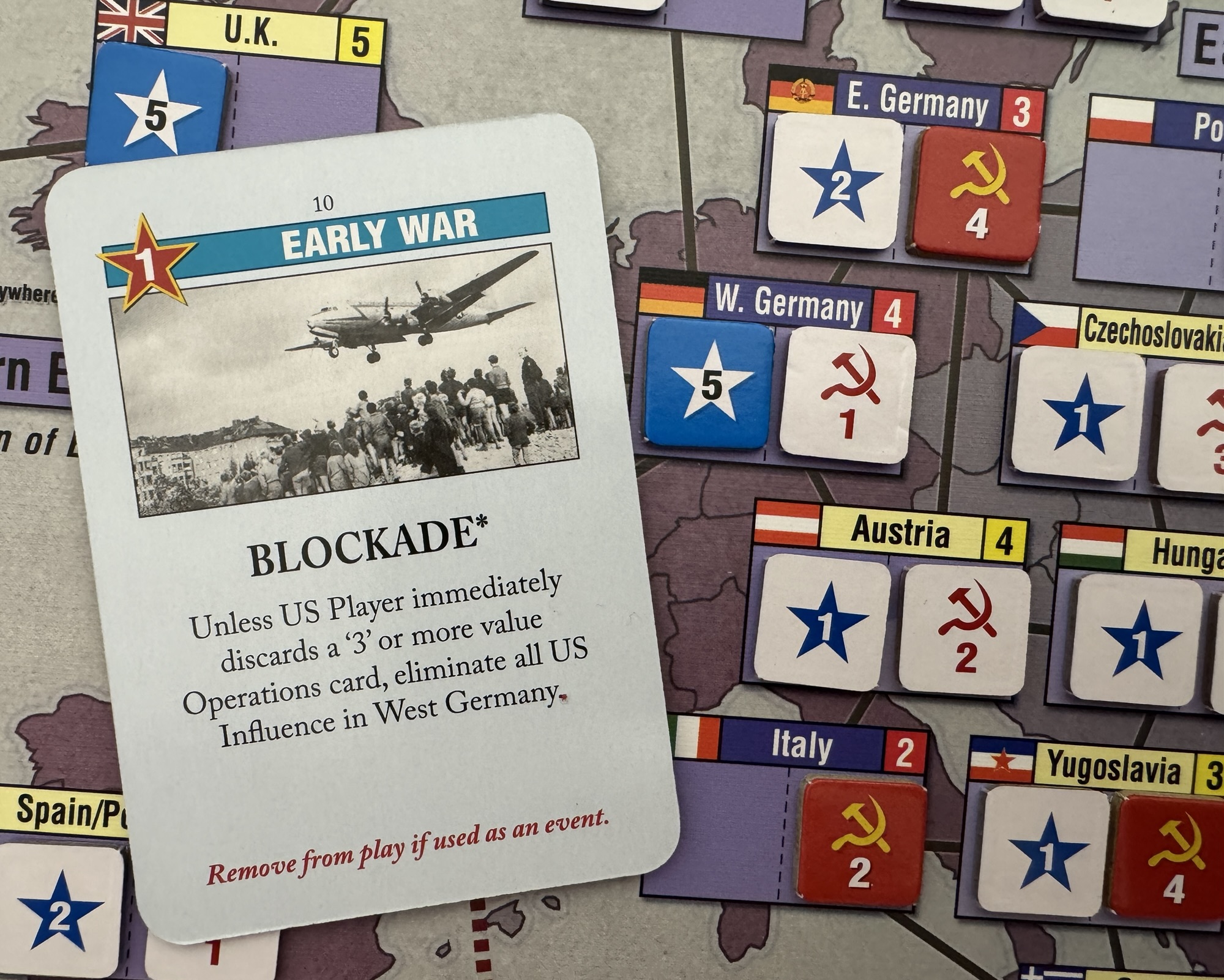
#69: Blockade from Twilight Struggle: The Cold War, 1945-1989 from GMT Games
Twilight Struggle is a 2-player game simulating the forty-five year ideological struggle known as the Cold War between the Soviet Union and the United States which can be played in 2-3 hours. The entire world is the stage on which these two countries “fight” to make the world safe for their own ideologies and way of life. The game starts right after the end of World War II in the midst of the ruins of Europe as the two new “superpowers” of the world squabble over what is left and ends in 1989, when only the United States remained standing.
The map is a world map of the period, where players move units and exert influence in attempts to gain allies and control for their superpower. The beauty of the CDG system used here is that each decision of whether to use a card for the event or the operations value is a struggle as if it is the other side’s event, it might go off hurting you very badly. There are mechanics to allow for the ignoring or cancelling of some of the best cards for your opponent in a side game within the game called The Space Race as well as nuclear tensions, with the possibility of game-ending global thermonuclear war (Shall we play a game, anyone?). I have played TS about 30 times and love it more and more with each sitting. The game makes me sweat, cringe, jump with joy and bite my fingernails. To me, a game that can do all of that in one sitting is worth the price.
One of my favorite type of cards from the game are those that force an action upon your opponent, such as discarding a card, reducing the Ops from card plays or causing them to have to make other plans than what they were working toward. These type of cards are more reactionary but definitely cause issues and mimic the various non-military focused strategies and tactics used during the Cold War. One of the most famous events from the early history of the Cold War is that of the Berlin Blockade. And there is a specific card that pays homage to the event in the game called Blockade. Blockade is an Early War Soviet Card that has an Ops Value of 1, which makes the card more valuable to be used for the printed event versus for the Ops.
When played, the card requires the US Player to immediately discard a 3 Ops or more value card from their hand or the consequence of not doing so will see all US Influence being removed from West Germany. This is a tough choice. Being early in the game, it is possible for the US to rebuild in West Germany and replace the lost influence over time if they do not wish to discard such as high value card. But, herein lies the real key to the Blockade cards use. The Soviet Player, who should be paying attention to not only their hand but also the card plays of the US Player, should try to use this card later in a turn once the US Player has played a majority of their cards in order to ensure that the event text can be realistically be achieved. If played quickly during a turn, the chances of the US Player being able to discard the required 3 Ops or great value card is higher and the card play will not generate any meaningful difference on the board state. I also would recommend a 2 card strategy here as the Soviet Player should be holding in their hand a high Ops card to be able to follow up this action with the placement of Influence into West Germany on their very next play. But, the real value to a card such as Blockade is that it forces the US Player to consider what cards are out there and to play around their negative effects as much as possible. Due to the nature of the game, and the randomness of card draws, having an expendable high Ops card ready and able to be discarded just in case of the play of Blockade is not really feasible. Also, remember that in Twilight Struggle that opponent events on cards that you play will go off and Blockade being drawn by the US Player can be bad as it will require them to play the event as you cannot discard a 1 Ops card to get rid of its negative effect in the Space Race Track due to the minimum requirement being a 2 Ops card. So the moral of the story here is that both players need to consider and plan for the play of or the mitigation of damage from Blockade.
The Berlin Blockade, which lasted from June 1948–May 1949, was a major Cold War crisis where the Soviet Union blocked all land and water access to West Berlin to attempt to force Western Allies out. The Soviet Union was taking this action as a means of retaliation against the introduction of the new Deutschmark currency. The US and Britain responded with the massive Berlin Airlift, flying over 2.3 million tons of food, fuel and supplies to the city. At the peak of the Airlift, a plane landed in West Berlin every 30 seconds. The blockade failed and the Soviets lifted it on May 12, 1949, after realizing the Allied Airlift could sustain the city for an extended period of time, marking a significant victory for the West in the ideological struggle. This event led to the acceleration of the division of Germany into East and West and the deepening of Cold War tensions.
It’s Women’s Day! A great opportunity to look pair a book and a game on the American women’s suffrage struggle: The Woman’s Hour (Elaine Weiss) and Votes for Women (Tory Brown, Fort Circle).
The Woman’s Hour was published in 2018 by Viking Press. It focuses on the campaigns for and against Tennessee to ratify the 19th Amendment which enshrined women’s suffrage in the US constitution – as the 36th, and decisive, state to do so.
Votes for Women was published in 2022. It is Tory Brown’s first published board game. The card-driven game can be played in a solo or cooperative mode with the player(s) representing the American suffrage movement from 1848 to 1920 against an automated opposition, or with two to four players facing off against each other (half of them for, the other against women’s suffrage). In either case, the suffrage players must win 36 states (either by shoring them up decisively during the game, or in the final vote on ratification of the federal amendment) to win.
Connections & Conclusions
At first look, book and game seem to have very different scopes. After all, Votes for Women sets in with the Seneca Falls Convention (at which women’s suffrage was first voiced as a political demand in the United States) in 1848 and covers the following 72 years, whereas The Woman’s Hour begins with the arrival of activists Carrie Chapman Catt, Sue White, and Josephine Pearson at the Nashville station in the sweltering summer of 1920. Yet as the narrative progresses, background stories are woven into the tapestry – on the context of the 1920 presidential election, suffragists’ previous efforts to gain voting rights for women in the states and to lobby for a federal amendment, the women’s suffrage movement’s relationship with abolitionism, and all the way back to Seneca Falls (and a little bit of Abigail Adams’s “Remember the Ladies”). If you have played Votes for Women, you will recognize many of the people and events on the cards from the early and middle periods of the game when reading The Woman’s Hour.
The Seneca Falls Convention is the Start card for the suffragist player with which any game of Votes for Women kicks off, following the tradition laid out by protagonist Elizabeth Cady Stanton that this was the starting point of the American women’s suffrage movement.
What unites book and game is their focus on procedural politics. Historical change does not simply happen, nor is momentarily decided upon. Instead, it is brought into effect by the “strong, slow drilling into hardwood boards with passion as well as sound judgment” (Max Weber). The drills used come in both cases from the toolbox of political activism:
The Woman’s Hour details how suffragists (suffs) and anti-suffragists (antis) lobbied the Tennessee lawmakers, how they organized in associations and clubs to channel their activists’ time, funds, and energy, and, of course, how they campaigned for public opinion to win the hearts and minds of the American people with newspaper articles, public speeches, great processions, and all kinds of civil disobedience.
Votes for Women makes these the three actions from which the players choose on a given turn: Lobbying (for and against the 19th Amendment in Congress), organizing (to gain the crucial buttons which are the currency for some powerful in-game effects and die re-rolls), and campaigning (which spreads influence cubes and thus eventually decides if enough states come out in favor of ratification of the 19th Amendment or not).
Early in the game: There are still a lot of orange Opposition cubes, but the women’s suffrage movement has made some inroads (yellow and purple cubes). The large round buttons represent the movement’s organizational strength, the white columns (one already placed on the track under the picture of the Capitol) the willingness of Congress to pass the women’s suffrage amendment.
As we’ve mentioned civil disobedience already: The women’s suffrage movement was no monolithic bloc. One of the great dividing lines was that of styles: The more conventional part of the movement, organized in the late 19th and early 20th century in the National American Women’s Suffrage Association (NAWSA) led by Carrie Chapman Catt, paid close attention to appear as respectable as possible (knowing full well that their demand for equal suffrage was enough of a provocation to the male public opinion of the time). Others adopted a more radical style, inspired by the British suffragettes: The Women’s Party, led by Alice Paul (and represented in Tennessee by Sue White) referred to the president as “Kaiser Wilson” in reference to the German war enemy, burned him in effigy, and (successfully) provoked the police into arresting activists over minor infractions. The dainty young women and respectable matrons who served some prison time then embodied the injustice of depriving women of their vote.
The Woman’s Hour details these fractions within the movement, as NAWSA and the Women’s Party led entirely separate campaigns for Tennessee’s ratification of the 19th Amendment. While infighting was avoided, the reader is left to wonder if the movement could have been more effective if not for these parallel structures – or if the split between a more moderate and a more radical wing was able to compel a broader spectrum of audiences by working in parallel.
Votes for Women depicts the multifaceted character of the women’s suffrage movement by splitting the suffragist player into campaigner figures and influence of cubes of two colors (yellow/gold, the traditional color of the American women’s suffrage movement, and purple, a color which Alice Paul had coopted from the British suffrage movement). As several Opposition event cards target the highest concentration of one or the other color, the Suffragist player is well-advised to aim for an even spread of colors in the individual states.
The pluralism of the women’s suffrage movement is exemplified by the two colors… and a plethora of Opposition events which target only one or the other.
Votes for Women also tackles another split in the women’s suffrage movement which is outside the scope of The Woman’s Hour – that on strategy. After the initial push for women’s suffrage as a part of a great campaign for equal suffrage regardless of sex and race had failed in the aftermath of the Civil War, the suffragists disagreed on how to proceed: Some pushed for a federal amendment to the Constitution (like the 15th Amendment had codified the voting rights of black men), others wanted to win voting rights in the individual states first. While the struggle for women’s voting rights was eventually won with the ratification of the 19th Amendment in Tennessee, the voting rights advances in the individual states had laid the groundwork: Wyoming had established women’s suffrage as early as 1869, Montana sent Jeannette Rankin as the first woman to Capitol Hill, and by 1917, women in 19 states – mostly in the West and Midwest – had won the right to vote (sometimes only in a limited fashion, like voting in local elections).
Votes for Women’s stance is that it needs both – after all, the game is lost for the suffragist player if their lobbying fails to get the federal amendment through Congress, but to win, they need the strength amassed in dozens of local campaigns to have the amendment ratified in enough states. The game, however, makes a statement about timing: While it is possible for the suffragist to have Congress pass the 19th Amendment in the mid-game already, that is a decidedly risky strategy which gives the Opposition a lot of opportunity to snatch individual states and rack up the necessary 13 rejections which mean the failure of the amendment. The ideal move for the suffragist is to build up the strength in the states as much as possible before pushing Congress into action as late as possible. While that is not without its risks (Opposition can still try to throw wrenches in the wheels of congressional action), it spreads them more evenly between federal and local action.
As mentioned above, equal suffrage spread from the American West and Midwest. It had a much harder time in the Northeast and in southern states – like Tennessee. The southern states were not only more conservative in general, suffragists also faced specific obstacles there: Many southern whites remained committed to the cause of white supremacy after the defeat of the Confederacy in the Civil War. Enfranchising women would give the right to vote to black as well as white women, and in the mind of the white supremacists, white women would be much less likely to actually exercise it (be it because they, as “proper” women, would rely on their men to represent them, or because they would not go to a polling station where they might meet with Black Americans). Others, while generally in favor of women’s suffrage, resented the method: After the Civil War, the 13th, 14th, and 15th Amendments had enshrined certain rights (including male voting) for Black Americans in the Constitution. Federal amendments were thus unpopular with many southern whites.
As The Woman’s Hour details, this provided for a lot of traction for the anti movement in Tennessee. Activists like Nina Pinckard and Josephine Pearson railed against carpet-bagging outsiders swooping down from the North to meddle with Tennessee’s affairs, warned of impending “negro domination”, and appealed to the chivalry of southern men to rescue their women from being thrown into the dirty cesspit of politics. That they themselves were knee-deep in that cesspit – after all, they were political activists! – bothered them as much as modern-day “tradwives” are bothered by the fact that their plea for women to be submissive to and dependent on their men is at odds with their often successful social media enterprises.
Somewhat counter-intuitively, many women opposed women’s suffrage on moral or political grounds. Votes for Women does a great job in showing the multi-facetedness of the anti movement beyond the male political and business establishment.
Inherent contradictions aside, the antis’ arguments needed to be countered by the suffs. Many of the white suffragists were willing to make rhetorical or substantial compromises: One of NAWSA’s most-cited statistics in the Tennessee campaign was that the number of white women in the south exceeded that of black men and women combined. Enfranchising women, so the more-or-less subtle subtext, would thus not threaten white supremacy – it might even strengthen it. In the end, the tacit agreement was like that found after the Reconstruction amendments designed to protect Black Americans’ rights in the South: The women’s suffrage amendment made its way into the constitution. Yet voting rights were overseen by the individual states, and federal institutions looked the other way about the blatant disenfranchisement of black voters in the South until the Voting Rights Act almost half a century later.
Neither The Woman’s Hour nor Votes for Women shies away from this uncomfortable part of the women’s suffrage movement: The protagonists of the movement are not portrayed as infallible saints in the book. While they held wildly progressive views for their time on women’s suffrage, their stances on issues of race and class were often more in keeping with those of their contemporaries. They also made tactical mistakes, like Carrie Chapman Catt railing against outsiders trying to influence Tennessee – a charge that was immediately turned against her, a Northerner herself, and restricted her visibility for the remainder of the campaign. And most of them were willing to make compromises for the cause of women’s suffrage – sometimes with themselves (Carrie Chapman Catt supported the US effort in World War I against her pacifist convictions lest the women’s suffrage movement be branded unpatriotic), and sometimes at the expense of others. In short, they were human.
Would the 19th Amendment have passed in Tennessee if the suffragists had been less willing to assuage the fears of southern whites about “black domination”? – Probably not – maybe another state could have become the decisive 36th then, but all likely options had been exhausted before. Did the Black Americans in the South, men and women, suffer from the continued disenfranchisement after 1920? – Undoubtedly.
The South is notoriously tough for the suffragists. Placing a ton of cubes there (plus some additional perks) is a tempting proposition.
Suffragist players in Votes for Women face the same strategic and ethical question (of course, with infinitely lower stakes): One of the most powerful cards in the game is The Southern Strategy which places an immense amount of suffragist influence in the South (representing the union between suffragists and white supremacists). It does open the suffragist for some counter-plays from the opposition, though. Savvy suffragist players might hold the card from turn to turn to play it as late as possible, as an uncounterable stratagem in the final struggle for women’s suffrage. Victories won that way have an odd aftertaste, I assure you.
Since Votes for Women has been released, it’s been in the top 5 of games I have played most often. And while I rarely re-read books, especially non-fiction (because there are always intriguing new books to read), I have come back to The Woman’s Hour and have now both read the physical book and listened to the (excellent) audiobook production. Besides all their worthy exploration and analysis of history, that speaks to both the game and the book being excellently crafted, incredibly engaging pinnacles of their respective medium.
If you have been following our blog for a while now, you know of my affinity for the history of the American Revolutionary War. I am a proud American, believe deeply in the principles of our land and the Constitution that governs it and am grateful to God every single day that our country was successful in our fight for its freedom in order to create a better society and to assist all peoples with protecting their “unalienable rights” endowed by a Creator, which include “Life, Liberty and the pursuit of Happiness”. I play wargames on the American Revolutionary War and very much enjoy learning about the history and its key battles. There are many out there that feel the same as I do and they have designed lots of these type of games and with 2026 being our 250th Anniversary of the Declaration of Independence, there are events that are planned to celebrate it.
One of which is an event put on by GMT Games and Mark Miklos called Gaming the American Revolution 250 Camden, South Carolina. We are planning to attend and have already marked off the date on our calendar and we would love to see many of you there for 3 days of gaming centered on American Revolutionary Wargames produced and published by GMT Games.
The details of the event are as follows:
The Occasion: Three days of AmRev gaming on the campus of the Camden Revolutionary War Visitor Center located in Camden, South Carolina. Camden was pivotal to the story of the Southern Campaign with two battles fought within 6 miles of each other, bracketed by a British occupation of the town. The Battle of Camden in 1780 was a decisive British victory that crushed the American Southern Army and brought disgrace to American General Horatio Gates. The Battle of Hobkirk’s Hill in 1781 was a British tactical victory that proved to be a strategic defeat.
Holding a dedicated AmRev War game event in Camden is GMT’s way of recognizing not only the 250th anniversary in our nation’s history but also those in our hobby for whom gaming the American Revolution holds a special place in their heart. Perhaps most importantly, the energy that we will bring to the occasion ensures that the people and the events showcased in these excellent games will not be forgotten. As the proverb says, “As long as you speak my name I shall live forever.”
Dates: September 24-27, 2026. (Thursday through Sunday)
Location: Camden, South Carolina.
Venues: Liberty Hall, Camden Revolutionary War Visitor Center and Historic Camden.
Registration: $76.00
Travel:
If flying, Columbia, S.C. is 35 miles away, Charlotte, N.C. is 88 miles away, Charleston, S.C. is 127 miles away, and Greenville/Spartanburg, S.C. is 134 miles away.
If driving, connect to East-West Interstate 20 and take exit 98 for US 521 toward Camden. Several hotels are at the exit. Our venue is 1-mile away, toward town, and downtown Camden is perhaps one mile further on.
Lodging: There is no official event hotel. Lodging is on your own. Select from a list of nearby hotels to be published on the launch website.
Meals: Meals are on your own, with some hotels serving an included breakfast. See below for a possible group dinner on Saturday. Local restaurants will be listed on the event website.
Games: This event will feature an exclusively-GMT line up of American Revolutionary War games: Battles of the American Revolution Series, Liberty or Death and Washington’s War. In addition, we anticipate having current prototypes of games in development including The Battle of Cowpens, The Battle of Green Spring, and Common Sense available to play. Players are asked to bring their own copies of the GMT Rev War games they hope to play to ensure availability. A limited number of house games will also be available. Respectfully, please leave games by other publishers at home.
Game Schedule: Friday, 9:00 a.m. until 11:00 p.m. Saturday, 9:00 a.m. until 11:00 p.m. Sunday, 9:00 a.m. until 3:00 p.m.
Format: Open gaming; play with a friend or make a new one.
BoAR Eutaw Springs Tournament: For any BoAR players who may want to mark the occasion with competitive play, there will be a single-elimination Eutaw Springs tournament. The winner will receive a theme-appropriate prize.
Attendees: Maximum attendance will be 125. Attending will be Gene and Rachel Billingsley and several GMT designers and developers. Content creators and podcasters will also be in attendance.
Event registration includes the following non-gaming activities:
Thursday – On arrival day we are planning an evening Meet & Greet at the historic McCaa Tavern, a restored 18th century tavern on the campus of Historic Camden. We will gather at approximately 6:00 p.m. for light refreshments and period entertainment. At sunset, we will light the cressets and adjourn to the back lawn for brief remarks, culminating with two rounds of artillery fire in full darkness.
Friday – Gather at 8:30 a.m. on the lawn in front of Liberty Hall for some brief period entertainment preceding the start of gaming. On this day there will be photo opportunities for those wishing a picture in period dress. All attendees will have access to the grounds of Historic Camden featuring several restored period buildings including the Kershaw-Cornwallis House (HQ for Lords Cornwallis and Rawdon during the British occupation) and a reconstructed British redoubt. The Rev War museum at the Visitor Center will also be available.
Saturday – Today we will offer two departures by chartered school buses to the Camden battlefield (approx. 8-miles away) where we will enjoy private battlefield tours conducted by Rick Wise, Executive Director of the South Carolina Battleground Preservation Trust. Tours will be conducted at 10:00 a.m. and 2:00 p.m. with departures scheduled accordingly. Each departure will be limited to bus capacities and sign up will be on-site at registration on a first come, first served basis. The grounds of Historic Camden and the museum will be available today as well.
We are currently trying to arrange a private dinner for Saturday night. Reservations will be required and there will be an upcharge to the $76 event price for those wishing to attend. Arrangements may not be completed by the time event tickets go on sale on February 19th. In that case, we will notify all registered players later with information about the dinner, (location, cuisine, cost, time, etc.) and the opportunity to reserve space.
Sunday – Gaming ends at 3:00 p.m. Last chance to visit the sites of Historic Camden, The Old Presbyterian Graveyard, and the Quaker Cemetery, final resting places for several Revolutionary War soldiers. Depart for onward travel.
Agenda for non-registered players: We are working to compile a list of points of interest and other activities for those coming to Camden but who will not be registering to play. This list will include at least one antebellum home open to the public, the National Steeplechase Museum, the Camden Horse & Hound Weekend, antique stores and boutique shops, etc. Entry fees, if any, will be the responsibility of each individual.
More information will be forthcoming soon and the event website where you can register will be available on February 19th.
I am very excited about this opportunity and Alexander and I are already making plans to attend. We look forward to playing several games of the Battles of the American Revolution Series, as we have really only played a few including Brandywine, Savannah and Germantown, as well as talking with fellow devotees to the historical period and seeing the sights. I have been to Camden in the past, but didn’t get a chance to see all of the sites in the area and look forward to learning more about the period and setting.
Because this is a wargaming blog, I am going to share below some of our content we have made regarding AmRev War games for your review:
With this My Favorite Wargame Cards Series, I hope to take a look at a specific card from the various wargames that I have played and share how it is used in the game. I am not a strategist and frankly I am not that good at games but I do understand how things should work and be used in games. With that being said, here is the next entry in this series.
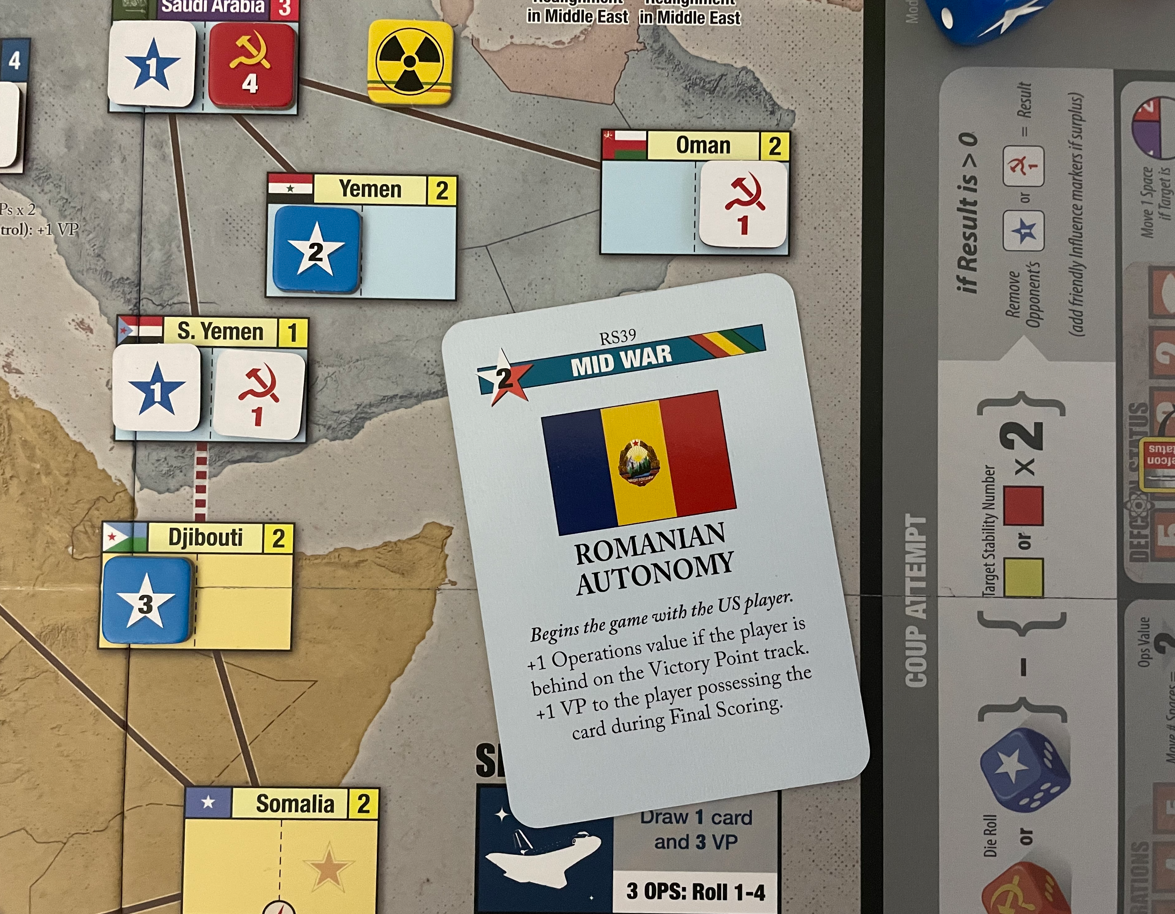
#62: Romanian Autonomy from Twilight Struggle: Red Sea – Conflict in the Horn of Africa from GMT Games from GMT Games
We all love Twilight Struggle….and if you say you don’t, you really do but just want to be different or are a contrarian! The game is phenomenal and has done very well for GMT Games with 8 Printings as well as the Turn Zero Expansion and now a series of smaller geographically focused spin off games starting with Twilight Struggle: Red Sea – Conflict in the Horn of Africa. Twilight Struggle: Red Sea deals with just two regions located in the Horn of Africa including Africa and the Middle East. The game uses the familiar Twilight Struggle formula of Cards with both Events and Operations Points that can be used by players to perform Coups, do Realignment Rolls or place Influence in an effort to gain control of the most Countries in the Regions to score Victory Points and win the game. The game is fast, furious and only lasts 2 hands of cards (unless you choose to play the special 3 Turn variant) so there isn’t a lot of time to mess around and players must be focused on what they are trying to accomplish. The best thing about the game is that it plays in 45 minutes as compared to 3-4 hours for Twilight Struggle.
The next card we will take a look at in this series is the special Romanian Autonomy, which is a unique card that doesn’t play from the deck but starts with the US player and resembles one of the classic cards from the original Twilight Struggle called The China Card. And if you have played Twilight Struggle, you know about the China Card. The China Card is a 4 Ops Value Card that can be held by the player in addition to their hand limit thereby giving them an extra card to use. But the card also has a special ability where if the player uses the card for 4 Ops to place Influence only in Asia, it will grant the player +1 Ops Value to use in placing one additional Influence. The China Card also grant’s the player who holds the card at the end of Turn 10 a +1 VP bonus.
In Twilight Struggle: Red Sea, the China Card has been replaced by the Romanian Autonomy Card. This card is not as powerful as the China Card but definitely creates some new opportunities and challenges for the player playing the card. The Romanian Autonomy Card can effect their Ops Value from cards by +1 during the Turn that they play it if they are behind on the Victory Point Track and also grants +1 VP to the player holding the card during Final Scoring. I think this is a really interesting concept and I think was included as a sort of catchup mechanic due to the short nature of the game. I look forward through more plays to seeing how its addition changes things and whether it is overpowered or just right. Once again, a small and subtle change to the game to create a new and interesting experience for the avid fan of Twilight Struggle or players who are new to the system.
Nicolae Ceaușescu visiting Africa during the Cold War.
During the Cold War, particularly under Nicolae Ceaușescu (1965–1989), Romania maintained a distinct, active presence in Africa, including the Horn of Africa, as part of a strategy to distance itself from Soviet influence, gain international prestige, and foster economic exchanges. While major powers like the Soviet Union and Cuba directly intervened in regional conflicts (such as the Ogaden War), Romania focused on building “fraternal” socialist relations through diplomatic, economic, and technical assistance, often operating with a degree of autonomy from the Warsaw Pact. Romania’s actual African strategy in the Horn of Africa, outlined in its 2023 Africa Strategy, emphasizes partnership, peace, development, education, and security cooperation, not territorial autonomy. Romania aimed to be a bridge between Europe and Africa, strengthening ties through cultural exchange, economic projects, and increased diplomatic presence in strategic capitals like Addis Ababa and Nairobi. Under its former communist regime, Socialist Republic Romania pursued economic independence and influenced African nations, but this was distinct from seeking autonomy within Africa. The phrase “Romanian autonomy in the Horn of Africa” is a game term with strategic implications within the game, while Romania’s real-world engagement with Africa is about broader diplomatic and economic partnerships
Vor uns liegt ein Jahr an der berühmtesten Akademie der Splitterlande. Natürlich gehören wir nicht zur reichen Elite, sondern wohnen im Turm der Bettler und müssen die Münzen für die kommende Schulgebühr in den Tiefen des Kraters erarbeiten. Ausgerüstet mit Waffen und Würfeln wagen wir das Adventure in a Box!
Manchmal frage ich mich, was Andor-Held*innen eigentlich beruflich machen, wenn gerade mal keine Bedrohung aufzieht. Urlaub? Wellness im Rietburg-Spa? Vermutlich nicht.Denn kaum hat man sich durch die ewige Kälte geschlagen (wobei selbst das schon mehr als 2 Jahre her ist – Wahnsinn) und gedacht, mit Andor ist es nun zu Ende, geht es schon wieder los: Neue Karte, neue Legenden, neues Unheil im fernen Land.
Ja, Andor lebt. Und auch Das ferne Land bringt uns mal wieder eine neue Map mit frischen Legenden, eigenen Heldinnen und der gewohnten Portion „Lasst uns ausrechnen, was der beste Weg ist“. Wer schonmal ein Andor gespielt hat (und die Welt, die Mechanik oder das Spiel an sich mag), wird sich hier sofort heimisch fühlen. Zu den grundsätzlichen Regeln von Andor möchte ich hier aber nicht noch einmal referieren und verweise daher gerne hierhin oder dahin oder dorthin. Gleiches gilt für die positiven wie auch negativen Punkte zum Spiel. Denn rein mechanisch gleichen sich die Andor-Teile vielleicht nicht wie ein Ei dem anderen, aber doch wie zweieiige Zwillinge. Unterschiede sieht man nur im Detail oder aber im „persönlichen“ Hintergrund.
Denn auch thematisch ist die Welt ebenfalls dort, wo sie schon immer war: klassische „High-Fantasy“ mit Wendungen und viel zu wenig Zeit (bzw. Spielrunden). Es ist das (alt)bekannte Andor-Gefühl: gemeinsam planen/rechnen, hetzen, lachen, fluchen – und am Ende entweder heldenhaft siegen oder die Legende eben neustarten. Im Kern also alles beim Alten und genau das, was Fans wollen, eine Fantasy-Geschichte im oberen Familienspielbereich. Direkt losspielen, ohne Anleitung-Lesen.
Und wie immer ist es natürlich ein toller Fanservice für die vielen Do it yourself-Abenteuer, die es im Andor-Multiversum ja zahlreich gibt. Wer eigene Legenden schreiben will, findet hier frisches Material zum Austoben. Neue Gegner, neue Figuren, neue Orte. Wer Andor liebt, bekommt hier mehr vom Guten: vertrautes Spielgefühl, starke Storys, frisches Material. Wer bisher eher gelangweilt auf den Erzähler gestarrt hat, wird auch diesmal nicht bekehrt – selbst wenn die Geschichten diesmal (so wie meistens) wirklich gelungen sind. Für mich ein rundes Comeback und ein weiterer Beweis: Andor ist noch lange nicht am Ende des Weges angekommen.
Was passiert, wenn ein Staat versagt – und die Zivilgesellschaft beginnt, sich zu wehren? Rise Against Repression ist ein kooperatives Kartenspiel für 3–5 Spieler:innen ab 12 Jahren, das diese Frage auf spannende, herausfordernde Weise erfahrbar macht. In sechs Runden (Monaten) versuchen die Spielenden, durch gemeinsames Handeln Hoffnung in der Bevölkerung zu stärken – bevor die Repression überwiegt.
Ein autoritäres Regime klammert sich an die Macht: durch Angst, Lügen und Gewalt. Die Bevölkerung ist erschöpft, überwacht und misstrauisch. Doch eine Bewegung beginnt – heimlich, mutig, entschlossen.
Die Spieler:innen übernehmen die Rollen von Bürger:innen, die sich im Untergrund organisieren: mit Flugblättern, Protesten, (geheimen) Netzwerken. Dabei treffen sie auf Dilemmata, Risiken – und müssen sich ohne offene Kommunikation koordinieren. Jede Entscheidung zählt. Hoffnung und Repression werden kontinuierlich abgewogen.
Entwickelt habe ich das Spiel im Rahmen der Centropa Summer Academy, die dieses Jahr in Budapest und Belgrad stattfand. Das Spiel basiert auf historischen Entwicklungen – etwa am Ende des Kommunismus in Osteuropa – und greift auch aktuelle Themen wie staatliche Desinformation, Korruption oder internationale Medienwirkung auf. Ereigniskarten stellen reale Entwicklungen abstrahiert dar, ohne konkrete Länder zu nennen.
Im Spiel wird deutlich: Demokratische Veränderungen entstehen nicht einfach – sie müssen erkämpft werden. Und: Zivilgesellschaft ist kein Selbstläufer. Sie lebt von Mut, Zusammenhalt und Entscheidungskraft.
Rise Against Repression eignet sich für den Einsatz in der politischen Bildung, in Geschichts- oder Sozialkunde sowie in Projekttagen zur Demokratiebildung. Das Spiel kann in pädagogischen Kontexten Diskussionen anstoßen, historische Parallelen aufzeigen und demokratische Werte erlebbar machen und sollte entsprechend eingebettet werden..
Es macht komplexe politische Prozesse emotional erfahrbar, fördert Urteilsvermögen und moralische Reflexion und erlaubt Anpassungen an verschiedene historische oder politische Szenarien (z. B. Simulation stärkerer Repression durch andere Startbedingungen). Durch die Erweiterungen mit Informantenkarten lassen sich zusätzliche Dynamiken wie Misstrauen und Verrat simulieren.
Anleitung und Karten sind aufgrund des Entstehungkontextes auf der Sommer Akademie von Centropa auf Englisch und können hier heruntergeladen werden:
Hinweis: Die Bilder auf den Karten stammen von pixabay und und game-icons.net (CC BY 3.0).
What happens when a state fails – and civil society begins to fight back?
Rise Against Repression is a cooperative card game for 3–5 players aged 12 and up that brings this question to life in a thrilling and challenging way. Over six rounds (representing six months), players work together to strengthen hope among the population – before repression takes over.
An authoritarian regime clings to power: through fear, lies, and violence. The population is exhausted, surveilled, and distrustful. But a movement is beginning – secretly, courageously, determinedly.
Players take on the roles of citizens organising underground: with leaflets, protests, and secret networks. Along the way, they encounter dilemmas and risks – and must coordinate without open communication. Every decision matters. Hope and repression are constantly weighed against each other.
I developed the game as part of the Centropa Summer Academy, which took place this year in Budapest and Belgrade. The game draws on historical developments – such as the fall of communism in Eastern Europe – and also addresses current issues such as state disinformation, corruption, and the influence of international media. Event cards present abstracted real-world developments without naming specific countries.
The message is clear: democratic change doesn’t just happen – it must be fought for. And civil society is not a given. It depends on courage, solidarity, and the ability to act decisively.
Rise Against Repression is well suited for use in political education, history or social studies classes, and project days focused on democracy. In educational settings, it can spark discussion, highlight historical parallels, and make democratic values tangible. For best results, it should be used as part of a broader learning context.
The game makes complex political processes emotionally accessible, promotes critical thinking and moral reflection, and can be adapted to various historical or political scenarios (e.g., simulating harsher repression through different starting conditions). Optional informant cards introduce additional dynamics such as mistrust and betrayal.
The rules and cards are in English, as the game was developed during the Centropa Summer Academy, and can be downloaded here:
We haven’t had a game-assisted biography on this blog for two years! Let’s rectify that with one of the most legendary and mysterious generals of all time – Wallenstein, the emperor’s chief commander in the first half of the Thirty Years’ War. Wallenstein, the mercenary. Wallenstein, the astrology addict. Wallenstein, the traitor. …or was he all of these things? We’ll find out!
The early 17th century was a time of barely contained tension in Europe. Four fundamental conflicts would provide the spark, the oxygen, and the fuel for the great conflagration of the Thirty Years’ War:
Since Luther’s 95 Theses had brought forth a new interpretation of the Christian faith, Protestantism, the Catholic church and Catholic princes had aimed to extinguish it. The denominations had reached a tenuous compromise in the mid-16th century based on the principle that the princes could set the religion for their dominions (cuius regio, eius religio). Yet shifts in the balance of religious power since then – mostly in favor of the Catholic counter-reformation, with the notable exception of the lands of the Crown of Saint Wenceslas (Bohemia, Moravia, and Silesia), where the Protestant nobles forming the estates gained in power – threatened the compromise.
The Holy Roman Empire had traditionally been a state where power was shared between the emperor and the princes (most importantly, the seven electors which, as the name indicates, elected the emperor). Other states Spain, France, and England saw a centralization of power around their respective kings. Such a centralization – a true monarchy – also appealed to the emperor.
The Holy Roman Empire in 1618 with its many principalities (note the many coats-of-arms on the map). Bohemia, Moravia, and Silesia are in the center-east. Map of Holy Roman Empire (Mark McLaughlin, 3W).
In the north, the Holy Roman Empire bordered the Baltic Sea. Whoever controlled its shorelines, liberally dotted with merchant cities which had gotten rich in the trade with timber, grain, fish, and many other valuable commodities, would hold the dominium Maris Baltici – the command of the Baltic Sea. The chief contenders in the early 17th century were the Polish-Lithuanian Commonwealth, the Kingdom of Denmark-Norway, and the Kingdom of Sweden… yet others would surely be interested, if only they could gain a foothold on the shores of the Baltic Sea.
The emperor came from the House of Habsburg (or Hapsburg, as it is sometimes spelled in English). Half a century before Wallenstein’s birth, Emperor Charles V had ruled not only the Habsburg possessions in the Holy Roman Empire (including Austria and the Crown of Saint Wenceslas), but had also been King of Spain and held extensive territories in Italy and Burgundy (in modern-day France and the Benelux countries). Charles had split the Habsburg holdings between his brother Ferdinand who succeeded him as Holy Roman Emperor and his son Philip who had inherited all the lands and titles in Spain, Italy, and Burgundy (as well as Spain’s overseas colonies). Individually, the two Habsburg branches were powerful. And together, they were on the verge of European hegemony.
Bohemian, Noble, Soldier, Convert
Wallenstein was born on September 24, 1583, in the Bohemian village Heřmanice, as Albrecht von Waldstein, a scion of an old, but poor Bohemian noble family. While the family name (in either the original Waldstein or Wallenstein’s own preferred Wallenstein spelling) may sound Germanic, Wallenstein’s native tongue was Czech. However, his education in Silesia and Franconia taught him German and Latin, his subsequent European tour as a young man Italian as well as a dose of French and Spanish.
Wallenstein had been orphaned at the age of eleven. As a young nobleman and landholder, he had to chart his own path in life. His lands were neither extensive enough for a comfortable income nor to command his full attention. For a fruitful ecclesial career, Wallenstein was too lowborn. Instead, he resorted to the third suitable career paths for nobles – war – and enlisted in the imperial army for two years in the Long Turkish War.
Wallenstein returned from the war aged 23. Over the next years, he made several momentous decisions. The most important – and least understood – is his conversion. Wallenstein had been raised Protestant like most Bohemians, but converted to Catholicism around the end of his military service. While we cannot search Wallenstein’s heart for his religious convictions, we know that he never displayed particular religious zeal later – and he was remarkably tolerant of other faiths, and regularly entrusted Protestants with important positions under him. From a more worldly perspective, Wallenstein’s conversion isolated himself from most of his Bohemian peers. It was in that regard, though, that his conversion proved fruitful a few years later: When the wealthy Catholic widow Lucretia of Víckov sought to remarry, Wallenstein was one of the few eligible Catholic nobles in the region. He thus came to manage her extensive holdings in Moravia, and, when she died in 1614, the inheritance turned him into one of the richest landholders sworn to the Crown of Saint Wenceslas.
Finally, these years saw another event which would be of great importance to Wallenstein’s biographers (but not so much to him): Following the fashions of the time, he requested a horoscope from the leading astronomer of the time, Johannes Kepler. As horoscopes go, it foretold some things which would happen (albeit at different times than predicted, like his marriage to a wealthy woman), others which wouldn’t (an interest in alchemy and sorcery), and a good deal of vague fluff which could be applied to most people.
Rise in the Conflagration
In 1617, Wallenstein went to war again. This time, he paid out of his own pocket for a cavalry company to join the war against Venice commanded by Ferdinand of Habsburg, Emperor Matthias’s appointed successor. Soon after Wallenstein had joined the fray, Matthias fell seriously ill and Ferdinand was recalled to ensure a smooth transition of power as both the Crown of Saint Wenceslas and the imperial crown were elective. Despite Ferdinand’s reputation as an ardent Catholic counter-reformer (he had forced the conversion of his Protestant subjects in Styria and Carinthia as one of his first acts as an adult ruler), the Protestant-majority Bohemian estates elected Ferdinand king in an act of doubtful strategic vision.
Ferdinand was careful not to violate Protestant rights too flagrantly, yet the estates soon found out that he retained his counter-reformatory spirit when he decided any arising small property disputes in favor of Catholic claimants. Redoubling on their strategic ineptitude, the Bohemian estates now defied the king they had accepted as legitimate just one year before: They threw three of Ferdinand’s counselors out of a window (all of them miraculously survived the fall) on May 23, 1618, and rose in armed rebellion. As their new king they chose Frederick V, elector of the Palatinate and the son-in-law to King James I of England. When Matthias died in 1619, Frederick would be the only of the seven electors not voting for Ferdinand II to become Holy Roman Emperor – a devastating setback for the Bohemians who had hoped that Frederick’s second vote as King of Bohemia would be acknowledged, and that the Protestant electors of Saxony and Brandenburg would also support Frederick.
The Bohemian estates (blue) had a mobilization advantage over the imperial forces and their Catholic German allies (yellow) in 1618. The westernmost blue stack is led by Frederick V in his native Palatinate, the easternmost (in Moravia) by Count Thurn, ready to threaten Vienna (Wien), the seat of Habsburg power in the Holy Roman Empire. Setup for the campaign game of Cuius Regio: The Thirty Years War (Francisco Gradaille, GMT Games, forthcoming) – playtest art.
Wallenstein had been born in Bohemia, but the estate inherited from his wife lay in Moravia. The Moravian estates delayed their commitment to the Bohemian cause which suited Wallenstein well – he had no sympathy for the rebellion. As one of the chief military officials of Moravia, he raised a cavalry regiment which he offered to Ferdinand. Push came to shove when one of the Bohemian armies under Count Matthias of Thurn marched into Moravia in 1619 to rouse the Moravians into supporting the Bohemian rebellion. Wallenstein attempted to spirit his regiment away (knowing the soldiers’ and officers’ sympathies for their Bohemian neighbors). When the major in charge of logistics attempted to swing the regiment in favor of the rebellion, Wallenstein slew him on the spot with his saber. Then he brought the regiment to the emperor’s seat Vienna, and with it, the war chest of the Moravian estates – a welcome present to the always cash-strapped emperor.
Wallenstein had gained the emperor’s favor. While he was not personally involved in the decisive imperial victory over the Bohemian forces at White Mountain (albeit some of his soldiers served under the commander of the Catholic League’s army, Johann Tserclaes, Count of Tilly), that favor gave him access to the inevitable spoils of victory. And here his genius first showed.
Wallenstein became a part of the imperial coin consortium tasked to supply silver and mint debased coins to pay for the emperor’s war efforts. That was a mildly profitable endeavor in itself, but more importantly, it got Wallenstein in touch with men of finance, chiefly the Dutch banker Hans de Witte. Wallenstein used his new-found access to credit to take out huge loans with which he purchased vast estates in Bohemia confiscated from the defeated rebels, and as so much land was auctioned at the same time by the imperial crown, Wallenstein paid bargain prices to became one of the chief Bohemian magnates.
The loans still needed to be repaid. Wallenstein expended most of his energy on developing his estates in the following years, and turned them into an efficiently administered, wealthy domain, for which he was granted the title of Prince of Friedland. Wallenstein’s activities as a landed aristocrat are represented in the most famous game featuring him, Wallenstein (Dirk Henn, Queen Games), which has up to five players (one of them Wallenstein) build markets, churches, and palaces in their holdings… and make some war on the other players should good opportunities arise.
Wallenstein remarried in 1623. His wife Isabel was the daughter of the imperial count Karl of Harrach from the emperor’s inner circle of advisors, giving Wallenstein access to inner workings of the imperial court. Yet despite his successes, Wallenstein was anxious.
His holdings were not secure as long as the exiled Bohemian rebels had hopes of recovering them. Wallenstein thus needed peace, peace on the Emperor’s terms. Yet while the imperial armies had won one victory after another, not only crushing the Bohemian rebels but also invading the Palatinate homeland of their erstwhile King Frederick, the emperor did not know how to make peace. He found himself unable to deal with the roaming armies of Protestant warlords like Ernst of Mansfeld or Christian of Halberstadt. And instead of extending an olive branch to the princes fearing imperial domination, he deposed Frederick and gave the title of elector to his ally Maximilian, Duke of Bavaria – an unthinkable breach of princely privileges.
As Ferdinand also seemed on the verge of rolling back Protestantism in central and northern Germany, the Protestant princes and the powers of the Baltic Sea grew concerned. King Christian IV of Denmark was anxious on both accounts. If he opposed Ferdinand, he could certainly count on the Protestant warlords and Bohemian exiles, and he sounded out eventual allies
among the northern German princes,
the Protestant Dutch (embroiled in their own struggle with for independence from the Spanish Habsburgs),
the English (whose King James I resented the snub to his son-in-law Frederick), and even
Denmark’s rival Sweden, a rising Protestant power in the north.
Nobody knew how big the Protestant intervention from the north would be. Yet it was almost certain that it would come. And the imperial region closest to Denmark was Bohemia. Wallenstein despaired over the emperor’s lack of preparation (caused both by the eternally empty imperial coffers and Ferdinand’s anxiety that raising an army would cause the Protestants to take measures of their own, thus causing the war he wanted to avoid). Wallenstein became convinced that he needed to take the security of his principality into his own hands. He offered to raise and equip an army for the emperor, paying for it up front. After long delaying, Ferdinand accepted his offer.
Ferdinand made Wallenstein chief imperial general in the Holy Roman Empire (contrary to the traditional title of lieutenant general based on the fiction that the actual commander was the monarch himself), created him Duke of Friedland lest he be outranked by other aristocratic commanders, and tasked him to raise his army. Wallenstein would apply himself to the task with his characteristic energy… in the next instalment of this series.
A recent biography which succeeds at dispelling the Wallenstein myth is Mortimer, Geoff: Wallenstein. The Enigma of the Thirty Years’ War, Palgrave Macmillan, London 2010.
For an older, more encompassing biography with literary aspirations, see Mann, Golo: Wallenstein. His Life Narrated, Holt, Rinehart, and Winston, New York City, NY 1976.
On the reception of Wallenstein and his changing image from his contemporaries all the way through the 20th century, see Bahlcke, Joachim/Kampmann, Christoph: Wallensteinbilder im Widerstreit: Eine historische Symbolfigur in Geschichtsschreibung und Literatur vom 17. bis zum 20. Jahrhundert [Conflicting Conceptions of Wallenstein: A Symbolic Figure from History in Historiography and Literature from the 17th to the 20th Century], Böhlau, Cologne/Weimar/Vienna 2011 [in German].
For a short introduction to the Thirty Years’ War, see Schmidt, Georg: Der Dreißigjährige Krieg [The Thirty Years’ War], C.H. Beck, Munich 2010 [in German].
A magisterial monography on the entire war is Wilson, Peter H.: Europe’s Tragedy. A New History of the Thirty Years’ War, Penguin, London 2009.
You’ll find a short discussion of the various origins of the war in Gutmann, Myron P.: The Origins of the Thirty Years‘ War, in: Journal of Interdisciplinary History 18, 4, 1988, p. 749—770, online here (free registration required).

 Anmelden