
Normale Ansicht

My Favorite Wargame Cards – A Look at Individual Cards from My Favorite Games – Card #73: Russian Leader Tsar Alexander I from Congress of Vienna from GMT Games

Von: Grant
15. April 2026 um 14:00

With this My Favorite Wargame Cards Series, I hope to take a look at a specific card from the various wargames that I have played and share how it is used in the game. I am not a strategist and frankly I am not that good at games but I do understand how things should work and be used in games. With that being said, here is the next entry in this series.

#73: Russian Leader Tsar Alexander I from Congress of Vienna from GMT Games

Congress of Vienna from GMT Games is a diplomatic card driven wargame based on Churchill and is the 4th game in the Great Statesmen Series. The game is set during the years of 1813-1814 and sees players take on the role of the main characters of the struggle between the Napoleonic Empire and the coalition of Russia, Austria, and Great Britain with their Prussian, Spanish, Portuguese, and Swedish allies. Congress of Vienna has two different but related phases including the conference table where players first debate over the control of issues germane to the factions and the period of the war and second these issues are then used on the battlefield to recruit units, attack and take overall command of battles. The players will be playing cards from their hands to “debate” over the various issues that were placed on the table, which include all types of things such as Military Operations, Recruitment, who will lead the combined Coalition forces (Generalissimo), Future of French Government, British Financial Aid, Liberalism vs. Absolutism, Austrian Neutrality and several other issues, and then later the players will use their accumulated Resources gained from the issues to enact action on the Military Map and do things like mobilize troops, place Military Support Markers and the ultimately to conduct warfare.

The game relies on cards and cards can be used to negotiate, i.e. move an issue to your National Track. Cards can provide a particular issue with positive and negative DRM’s depending on which nation plays them and can also be traded with another player during the Diplomacy Phase. Certain cards are better than others for debating an issue moved by another player; and finally, if they are saved for the War Phase, staff cards can be used to modify dice rolling in battles. These are very versatile cards and the players will have to learn them and their benefits in order to be effective at the game.

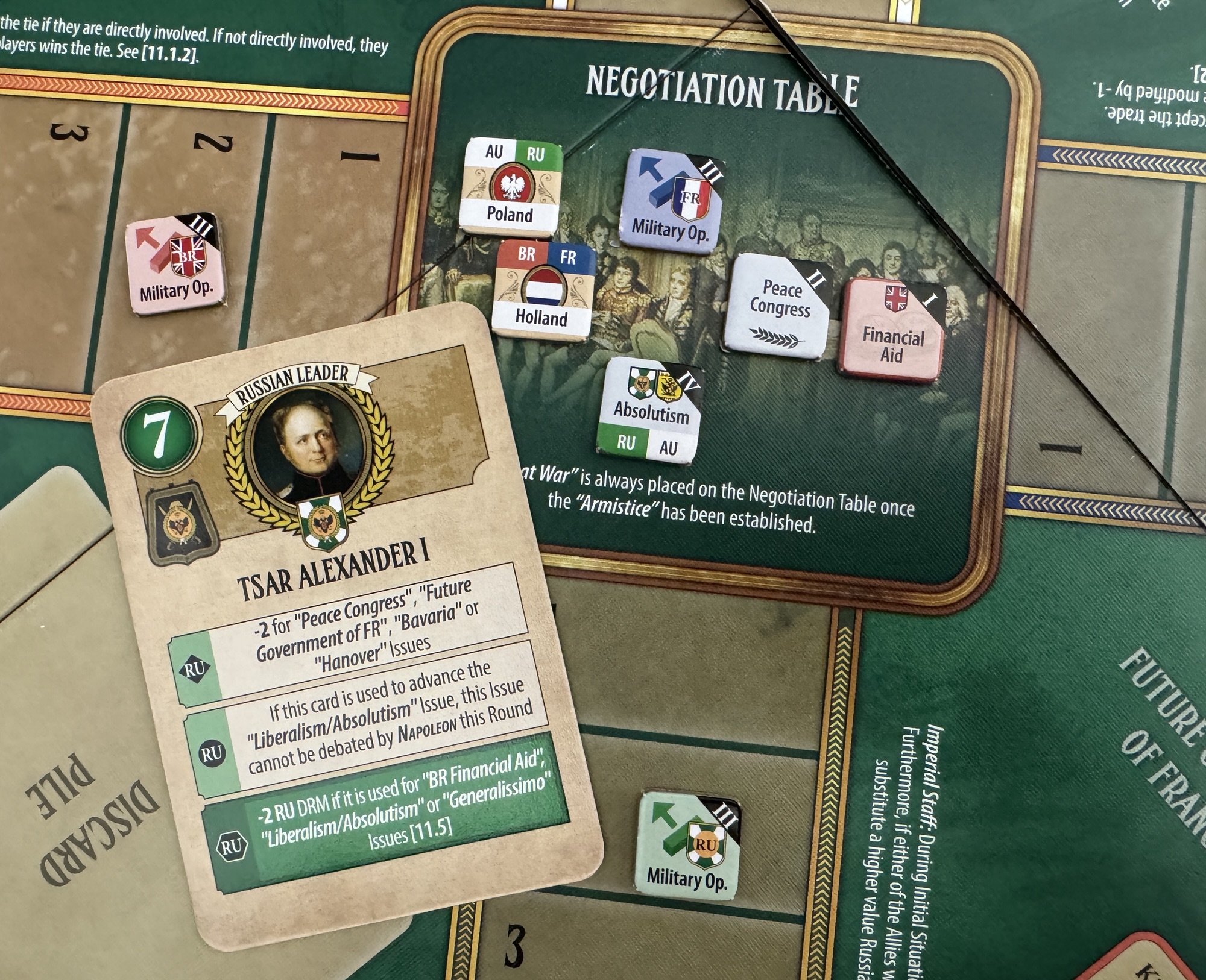
In this entry, we are going to take a look at the Russian Leader Tsar Alexander I card. The fist thing that you may notice about this Leader Card is that is that it has no benefit for military operations, meaning that Tsar Alexander is watching the war from the sidelines and not directly involved like Napoleon, but does have a potential negative effect if used on certain Issues. But his power lies in the ability to utilize his 7 value to influence issues significantly on the Negotiating table. Particularly, Tsar Alexander I is an ardent believer in the philosophy of Absolutism and wants to retain his crown as the leader of Russia. This concept is played out in the game between the great powers of the time, including Russia and Austria for Absolutism, and the more democratic players including Britain and France for Liberalism. On the board appears this Liberalism/Absolutism Track, which provides the players an opportunity to debate over the Liberalism/Absolutism Issue and gain various advantages and Victory Points from the track. On this Liberalism/Absolutism Track, Europe’s post-war governing philosophy is fought over. This is a double track in green and red with a common At Start area for the use of 2 pawns. Tracks for Liberalism (red: Britain/France) and Absolutism (green: Russia/Austria) each have four boxes and an assigned total Victory Point amount. In order to score the VP from this track though, the player scoring must have their philosophical leaning portion of the track occupying a space at least 1 box ahead of their opponent. Also, if they want to score the maximum Victory Points listed at the top, they have to occupy the top box and their opponent cannot occupy theirs. For the Russia player, this should be a huge part of their strategy as 5VP is nothing to sneeze at in this game. But, in order to do that they will most likely have to try to go first and use Tsar Alexander and his 7 value to try and move that Issue up the track to end under their control. If an Issue every reaches a Track’s Seat, meaning the 7th space, or more after any declared debate is calculated in, then that Issue is considered to be secured and can no longer be moved through negotiation during future rounds. This reminds me a bit of the way that I always plan to use Joseph Stalin in Churchill, to go first and then bring the hammer down on the A-Bomb Research Issue. Getting control of this Absolutism/Liberalism Issue at least 4 times is very important for the Russian player and they will need to utilize this ability as much as possible. But remember that there is a penalty called the “Meddling Tsar” Rule where if Tsar Alexander is used for the negotiation of the British Financial Aid, Liberalism/Absolutism or the Generalissimo Issues, it will inflict a -2 DRM on all battles involving 1 or more Russian units during the upcoming War Phase. This is quite a cost and the player should carefully consider if and when they use the ability throughout the game. If the turn is expected to contain little to no combat for Russian units, then it is safe to use but if France is being aggressive and pushing on Poland and Prussia you might want to consider not going after the Liberalism/Absolutism Issue this turn and instead focus on Recruitment and Military Operation Issues.

The other part of this ability is that if Tsar Alexander I is used to move the Liberalism/Absolutism Issue then Napoleon cannot be used to Debate that movement. I would say that this is not an issue though as typically the France player will be using Napoleon on the battlefield for his DRM abilities.

I also like the historical and personality connection between this card and the game. At the top of the card you will notice that if you use Tsar Alexander I to negotiate the Peace Congress, Future Government of France, Bavaria or Poland Issues, that you will gain a -2 on his value bringing it from a 7 down to a 5. I think that this ability really highlights the philosophy and view of the Tsar regarding the time. He doesn’t believe that France should get to continue to exist as a main player in the power structure of the time and definitely doesn’t want to see France become more democratic. But, he also has a feeling that Bavaria and Poland are Russian vassals and should not be allowed to be turned to any other side’s allegiance. If he has to be used in this manner to defend or negotiate these issues I feel like the -2 Value penalty really shows that leaning in his thinking and probably causes him to be more brunt and less diplomatic thereby losing some of his influence in the court of opinion. Ultimately, Tsar Alexander I thought that monarchy is a noble and viable alternative to the crude and materialistic mob mentality of republicanism and the abilities of his Leader Card definitely cement that view.

After playing now a few times, I am here to say that Congress of Vienna is probably my favorite game in the Great Statesmen Series. I believe that this game has matured the system and made it something that is more than where it started. Congress of Vienna is very much more like a true wargame and was extremely interesting. We are still learning and need to keep playing this one but I did enjoy what it was that we were doing.

Alexander I, nicknamed “the Blessed”, was Emperor of Russia from 1801, the first King of Congress Poland from 1815, and the Grand Duke of Finland from 1809 to his death in 1825. He ruled Russia during the chaotic period of the Napoleonic Wars.

The eldest son of Emperor Paul I and Sophie Dorothea of Württemberg, Alexander succeeded to the throne after his father was murdered. As prince and during the early years of his reign, he often used liberal rhetoric but continued Russia’s absolutist policies in practice. In the first years of his reign, he initiated some minor social reforms and in 1803–04 major liberal educational reforms, such as building more universities. Alexander appointed Mikhail Speransky, the son of a village priest, as one of his closest advisors. The over-centralized Collegium ministries were abolished and replaced by the Committee of Ministers, State Council, and Supreme Court to improve the legal system. Plans were made, but never consummated, to set up a parliament and sign a constitution. In contrast to his westernizing predecessors such as Peter the Great, Alexander was a Russian nationalist and Slavophile who wanted Russia to develop on the basis of Russian rather than European culture.

In foreign policy, he changed Russia’s position towards France four times between 1804 and 1812, shifting among neutrality, opposition, and alliance. In 1805 he joined Britain in the War of the Third Coalition against Napoleon, but after suffering massive defeats at the battles of Austerlitz and Friedland, he switched sides and formed an alliance with Napoleon in the Treaty of Tilsit and joined Napoleon’s Continental System. He fought a small-scale naval war against Britain between 1807 and 1812 and took Finland from Sweden in 1809 after Sweden’s refusal to join the Continental System. Alexander and Napoleon hardly agreed, especially regarding Poland, and the alliance collapsed by 1810. Alexander’s greatest triumph came in 1812 when Napoleon’s invasion of Russia descended into a catastrophe for the French. As part of the winning coalition against Napoleon, he gained territory in Poland. He formed the Holy Alliance to suppress the revolutionary movements in Europe, which he saw as immoral threats to legitimate Christian monarchs.

During the second half of his reign, Alexander became increasingly arbitrary, reactionary, and fearful of plots against him; as a result, he ended many of the reforms he had made earlier on in his reign. He purged schools of foreign teachers, as education became more religiously driven as well as politically conservative. Speransky was replaced as advisor with the strict artillery inspector Aleksey Arakcheyev, who oversaw the creation of military settlements. Alexander died of typhus in December 1825 while on a trip to southern Russia. He left no legitimate children, as his two daughters died in childhood. Neither of his brothers wanted to become emperor. After a period of great confusion (that presaged the failed Decembrist revolt of liberal army officers in the weeks after his death), he was succeeded by his younger brother, Nicholas I.

We have done 2 videos on this game including the following RAW Video after out 1st play at Buckeye Game Fest in May 2025:

We then did the following full Review Video after our 2nd play at WBC last July:

In the next entry in this series, we will take a look at Open Borders from 2024: An American Insurgency from Compass Games.

-Grant
My Favorite Wargame Cards – A Look at Individual Cards from My Favorite Games – Card #68: Usurper Emperor from Barbarians at the Gates, The Decline and Fall of the Western Roman Empire 337 – 476 from Compass Games

Von: Grant
05. März 2026 um 14:00

With this My Favorite Wargame Cards Series, I hope to take a look at a specific card from the various wargames that I have played and share how it is used in the game. I am not a strategist and frankly I am not that good at games but I do understand how things should work and be used in games. With that being said, here is the next entry in this series.

Card #68: Usurper Emperor from Barbarians at the Gates, The Decline and Fall of the Western Roman Empire 337 – 476 from Compass Games

Barbarians at the Gates, The Decline and Fall of the Western Roman Empire 337 – 476 from Compass Games is a Card Driven Game for two players set during the final hundred plus years of the Western Roman Empire as the Barbarian tribes in the north came down with a vengeance as they clashed with civilization and carved out their place amongst it. The time period covered in the game is from the death of Constantine the Great (337 AD) to the deposition of the last Western Roman Emperor by Odoacer in 476 AD. The Roman player will command the Roman Legions loyal to the failing central authority and those Germanic peoples who have settled peacefully inside the Roman Empire, while the Barbarian player leads Usurper Emperors, and controls the migrations of the Germanic peoples, who are the Barbarians at the Gates. This game is really quite good and feels very much like a wargame even though it is a Card Driven Game. There are lots of opportunities for troop movement, combat and maneuver. And I really liked that. The game is a Card Driven Game and the use of cards is all important and very well done. Each player has their own unique deck of cards that are used and these cards are sometimes removed from those decks when played for an event and also new cards will be added to the deck after each turn. The cards played during a player’s impulse which are not used for the Event are then used for their Operation Points value. These Operation Points can be used for many purposes including Activating a leader, Forced Marches, Raiding, Reinforcement, Migration and Successful Usurpation.

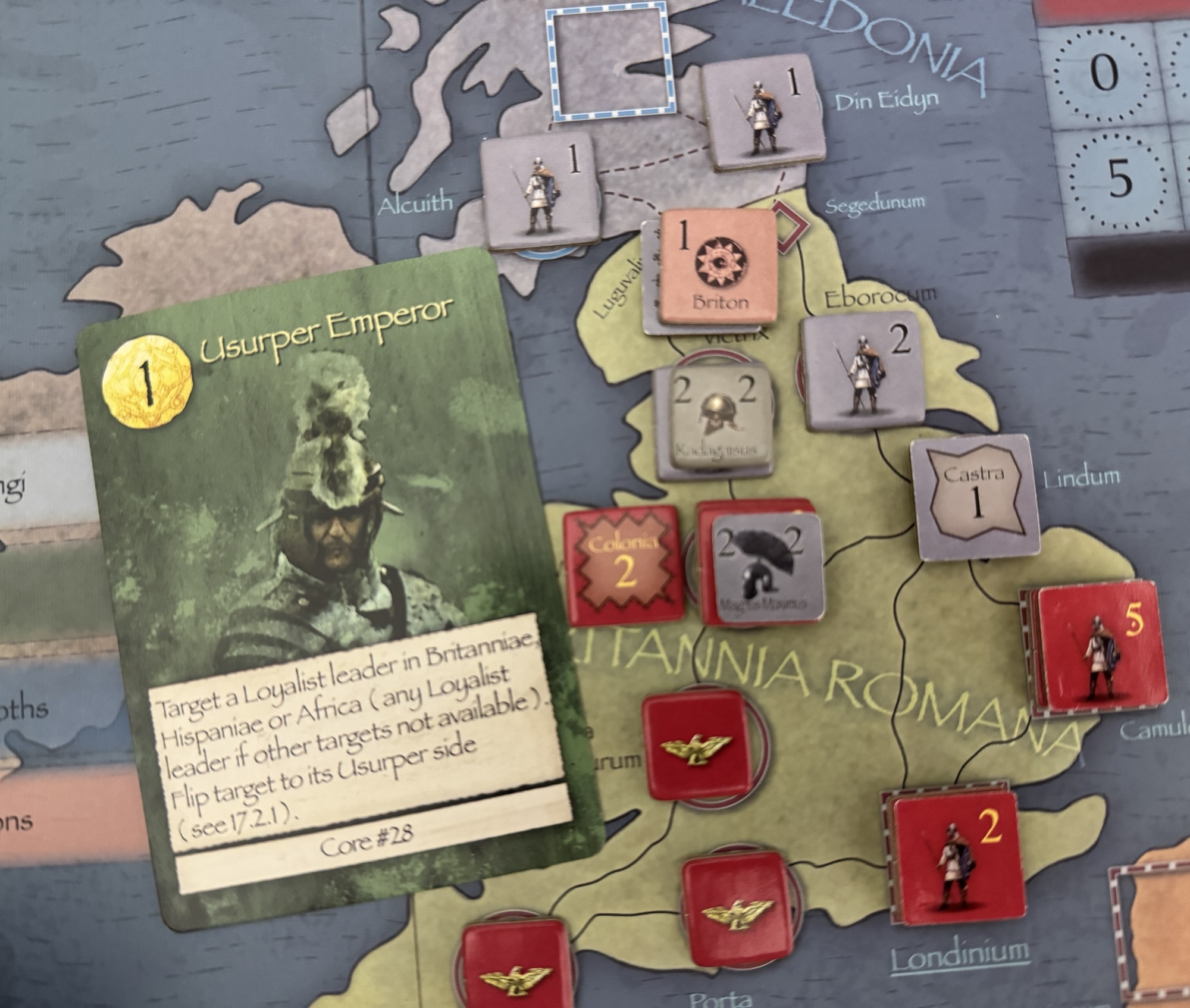
The real trick to the cards is to plan out how you are going to use them to your advantage but also how best to use them. Activating Leaders is very important as you can then move them to attack, defend, change control of areas and other actions. Activating a leader depends on their strategy rating (the lower the strategy rating, the better). When a leader activates from a card, they receive a number of Action Points which can be used for movement (1 over highway, 2 over rough or river connections, 3 over strait or for naval movement), continuation after battle (a kind of advance after combat), changing control over unfortified spaces and sieges of fortified spaces. But the cards also are very mean spirited. What do I mean by this? Well, in our first play, I was carefully using my cards to build up my armies to fend off the initial attacks of the Barbarian hordes. I also had begun to build somewhat of a super stack as well to attempt to foray into England and take on the Barbarians there. As I did this building up, I was unaware of the nasty nature of some of the cards. Some of the cards, both for the Barbarians and Romans, allow a play that will turn a single leader and their entire stack into either a Usurper or a Pacified Barbarian Settlement. Both are equally nasty and you have to keep in mind that you can have your best armies simply taken from you and turned to your enemy.

Some of the cards, both for the Barbarians and Romans, allow a play that will turn a single leader and their entire stack into either a Usurper or a Pacified Barbarian Settlement. Both are equally nasty and you have to keep in mind that you can have your best armies simply taken from you and turned to your enemy. Because of this, the Roman player has to decide whether they will group Combat Units under a single leader in order to face the mighty Barbarian challengers at the Gates in which case he risks that leader to Usurp, or to disperse these troops over several stacks never allowing a single leader to amass too many CU but on the other hand also never having a true striking force to attack with. There is an exception here though as an Emperor leader cannot Usurp and you don’t have to worry about that but this is also dangerous as you can lose that Emperor.

Likewise, once they have an Usurper leader on the board the Barbarian player will try to group all Usurper CU with this leader (in order to keep this force strong and in order to allow their Barbarian CU, leader and tribes to march unopposed into the Empire). This creates a very real and historical danger as the Barbarian player is incentivized to do what an Usurper would historically have done and empty the border garrisons in order to march on Rome.

These type of cards are extremely strong and a situation can occur in which most of the Romans still on the board are Usurper leaders and CU. But there is an action that allows for the Roman player to counter these cards and that is the Successful Usurpation action. If the Barbarian player over does it with the Usurper powers, the Roman player can simply steal these conquests by swapping the Roman power for the Usurper power. This in effect has the Usurpation process succeed and the former Usurper leader now becomes the true Emperor!

Usurper emperors in history, particularly in Ancient Rome, were rulers who seized their power illegitimately, often times via a military rebellion rather than legal succession, and were labeled “tyrants” if defeated, or emperors if successful. They were most common during crises and times of turmoil, such as the “Year of the Four Emperors” in 69 AD following the suicide of Nero, often relying on legionary support and issuing their own coins to legitimize authority. 

Emperor Galba by Paulus Moreelse (left); with Emperor Marcus Salvius Otho by Gerrit van Honthorst (center left); with Emperor Vitellius by Hendrick Goltzius (center-right); and Emperor Vespasian (far right).

Usurpation was common during the whole imperial era; virtually all imperial dynasties rose to power through usurpation and conspiracies. The “imperial office” established by Augustus never defined an stable system of succession, and emperors often had to rely solely on military power to survive.

In the Eastern Roman Empire (395–1453), rebellion and usurpation were so notoriously frequent as compared to medieval West, where usurpation was rare, that the modern term “byzantine” became a byword for political intrigue and conspiracy. 

Here is a look at our unboxing video:

We also did a video review and you can watch that at the following link:

I also wrote a First Impressions post on the game and you can read that at the following link: https://theplayersaid.com/2022/11/08/first-impressions-barbarians-at-the-gates-the-decline-and-fall-of-the-western-roman-empire-337-476-from-compass-games/

In the next entry in this series, we will take a look at Blockade from Twilight Struggle: The Cold War, 1945-1989 from GMT Games.

-Grant

Wallenstein: Rise (The Life & Games of Wallenstein, #1)

13. Juli 2025 um 15:07

We haven’t had a game-assisted biography on this blog for two years! Let’s rectify that with one of the most legendary and mysterious generals of all time – Wallenstein, the emperor’s chief commander in the first half of the Thirty Years’ War. Wallenstein, the mercenary. Wallenstein, the astrology addict. Wallenstein, the traitor. …or was he all of these things? We’ll find out!

In this first part, we’ll cover the fundamental conflicts in Wallenstein’s world, his own youth, and his meteoric rise at the beginning of the Thirty Years’ War. Let’s go!

You can read all posts in the series here:

The Conflicts of the Time

The early 17th century was a time of barely contained tension in Europe. Four fundamental conflicts would provide the spark, the oxygen, and the fuel for the great conflagration of the Thirty Years’ War:

  • Since Luther’s 95 Theses had brought forth a new interpretation of the Christian faith, Protestantism, the Catholic church and Catholic princes had aimed to extinguish it. The denominations had reached a tenuous compromise in the mid-16th century based on the principle that the princes could set the religion for their dominions (cuius regio, eius religio). Yet shifts in the balance of religious power since then – mostly in favor of the Catholic counter-reformation, with the notable exception of the lands of the Crown of Saint Wenceslas (Bohemia, Moravia, and Silesia), where the Protestant nobles forming the estates gained in power – threatened the compromise.
  • The Holy Roman Empire had traditionally been a state where power was shared between the emperor and the princes (most importantly, the seven electors which, as the name indicates, elected the emperor). Other states Spain, France, and England saw a centralization of power around their respective kings. Such a centralization – a true monarchy – also appealed to the emperor.
The Holy Roman Empire in 1618 with its many principalities (note the many coats-of-arms on the map). Bohemia, Moravia, and Silesia are in the center-east. Map of Holy Roman Empire (Mark McLaughlin, 3W).
  • In the north, the Holy Roman Empire bordered the Baltic Sea. Whoever controlled its shorelines, liberally dotted with merchant cities which had gotten rich in the trade with timber, grain, fish, and many other valuable commodities, would hold the dominium Maris Baltici – the command of the Baltic Sea. The chief contenders in the early 17th century were the Polish-Lithuanian Commonwealth, the Kingdom of Denmark-Norway, and the Kingdom of Sweden… yet others would surely be interested, if only they could gain a foothold on the shores of the Baltic Sea.
The Baltic Sea and its surroundings. Note the “Habsburg Lands” in the southwest – not adjacent to the Baltic Sea, but just one determined campaign away! Playtest map (not final art) of Baltic Empires: The Northern Wars of 1558-1721 (Brian Berg Asklev Hansen, GMT Games, forthcoming).
  • The emperor came from the House of Habsburg (or Hapsburg, as it is sometimes spelled in English). Half a century before Wallenstein’s birth, Emperor Charles V had ruled not only the Habsburg possessions in the Holy Roman Empire (including Austria and the Crown of Saint Wenceslas), but had also been King of Spain and held extensive territories in Italy and Burgundy (in modern-day France and the Benelux countries). Charles had split the Habsburg holdings between his brother Ferdinand who succeeded him as Holy Roman Emperor and his son Philip who had inherited all the lands and titles in Spain, Italy, and Burgundy (as well as Spain’s overseas colonies). Individually, the two Habsburg branches were powerful. And together, they were on the verge of European hegemony.

Bohemian, Noble, Soldier, Convert

Wallenstein was born on September 24, 1583, in the Bohemian village Heřmanice, as Albrecht von Waldstein, a scion of an old, but poor Bohemian noble family. While the family name (in either the original Waldstein or Wallenstein’s own preferred Wallenstein spelling) may sound Germanic, Wallenstein’s native tongue was Czech. However, his education in Silesia and Franconia taught him German and Latin, his subsequent European tour as a young man Italian as well as a dose of French and Spanish.

Wallenstein had been orphaned at the age of eleven. As a young nobleman and landholder, he had to chart his own path in life. His lands were neither extensive enough for a comfortable income nor to command his full attention. For a fruitful ecclesial career, Wallenstein was too lowborn. Instead, he resorted to the third suitable career paths for nobles – war – and enlisted in the imperial army for two years in the Long Turkish War.

Wallenstein returned from the war aged 23. Over the next years, he made several momentous decisions. The most important – and least understood – is his conversion. Wallenstein had been raised Protestant like most Bohemians, but converted to Catholicism around the end of his military service. While we cannot search Wallenstein’s heart for his religious convictions, we know that he never displayed particular religious zeal later – and he was remarkably tolerant of other faiths, and regularly entrusted Protestants with important positions under him. From a more worldly perspective, Wallenstein’s conversion isolated himself from most of his Bohemian peers. It was in that regard, though, that his conversion proved fruitful a few years later: When the wealthy Catholic widow Lucretia of Víckov sought to remarry, Wallenstein was one of the few eligible Catholic nobles in the region. He thus came to manage her extensive holdings in Moravia, and, when she died in 1614, the inheritance turned him into one of the richest landholders sworn to the Crown of Saint Wenceslas.

Finally, these years saw another event which would be of great importance to Wallenstein’s biographers (but not so much to him): Following the fashions of the time, he requested a horoscope from the leading astronomer of the time, Johannes Kepler. As horoscopes go, it foretold some things which would happen (albeit at different times than predicted, like his marriage to a wealthy woman), others which wouldn’t (an interest in alchemy and sorcery), and a good deal of vague fluff which could be applied to most people.

Rise in the Conflagration

In 1617, Wallenstein went to war again. This time, he paid out of his own pocket for a cavalry company to join the war against Venice commanded by Ferdinand of Habsburg, Emperor Matthias’s appointed successor. Soon after Wallenstein had joined the fray, Matthias fell seriously ill and Ferdinand was recalled to ensure a smooth transition of power as both the Crown of Saint Wenceslas and the imperial crown were elective. Despite Ferdinand’s reputation as an ardent Catholic counter-reformer (he had forced the conversion of his Protestant subjects in Styria and Carinthia as one of his first acts as an adult ruler), the Protestant-majority Bohemian estates elected Ferdinand king in an act of doubtful strategic vision.

Ferdinand was careful not to violate Protestant rights too flagrantly, yet the estates soon found out that he retained his counter-reformatory spirit when he decided any arising small property disputes in favor of Catholic claimants. Redoubling on their strategic ineptitude, the Bohemian estates now defied the king they had accepted as legitimate just one year before: They threw three of Ferdinand’s counselors out of a window (all of them miraculously survived the fall) on May 23, 1618, and rose in armed rebellion. As their new king they chose Frederick V, elector of the Palatinate and the son-in-law to King James I of England. When Matthias died in 1619, Frederick would be the only of the seven electors not voting for Ferdinand II to become Holy Roman Emperor – a devastating setback for the Bohemians who had hoped that Frederick’s second vote as King of Bohemia would be acknowledged, and that the Protestant electors of Saxony and Brandenburg would also support Frederick.

The Bohemian estates (blue) had a mobilization advantage over the imperial forces and their Catholic German allies (yellow) in 1618. The westernmost blue stack is led by Frederick V in his native Palatinate, the easternmost (in Moravia) by Count Thurn, ready to threaten Vienna (Wien), the seat of Habsburg power in the Holy Roman Empire. Setup for the campaign game of Cuius Regio: The Thirty Years War (Francisco Gradaille, GMT Games, forthcoming) – playtest art.

Wallenstein had been born in Bohemia, but the estate inherited from his wife lay in Moravia. The Moravian estates delayed their commitment to the Bohemian cause which suited Wallenstein well – he had no sympathy for the rebellion. As one of the chief military officials of Moravia, he raised a cavalry regiment which he offered to Ferdinand. Push came to shove when one of the Bohemian armies under Count Matthias of Thurn marched into Moravia in 1619 to rouse the Moravians into supporting the Bohemian rebellion. Wallenstein attempted to spirit his regiment away (knowing the soldiers’ and officers’ sympathies for their Bohemian neighbors). When the major in charge of logistics attempted to swing the regiment in favor of the rebellion, Wallenstein slew him on the spot with his saber. Then he brought the regiment to the emperor’s seat Vienna, and with it, the war chest of the Moravian estates – a welcome present to the always cash-strapped emperor.

While the Palatinate and Hungary supported Bohemia in the rebellion (blue), Moravia initially remained loyal to the emperor (yellow). From the setup of the campaign game of Thirty Years War: Europe in Agony, 1618-1648 (David A. Fox/Michael Welker, GMT Games).

Wallenstein had gained the emperor’s favor. While he was not personally involved in the decisive imperial victory over the Bohemian forces at White Mountain (albeit some of his soldiers served under the commander of the Catholic League’s army, Johann Tserclaes, Count of Tilly), that favor gave him access to the inevitable spoils of victory. And here his genius first showed.

Wallenstein became a part of the imperial coin consortium tasked to supply silver and mint debased coins to pay for the emperor’s war efforts. That was a mildly profitable endeavor in itself, but more importantly, it got Wallenstein in touch with men of finance, chiefly the Dutch banker Hans de Witte. Wallenstein used his new-found access to credit to take out huge loans with which he purchased vast estates in Bohemia confiscated from the defeated rebels, and as so much land was auctioned at the same time by the imperial crown, Wallenstein paid bargain prices to became one of the chief Bohemian magnates.

The loans still needed to be repaid. Wallenstein expended most of his energy on developing his estates in the following years, and turned them into an efficiently administered, wealthy domain, for which he was granted the title of Prince of Friedland. Wallenstein’s activities as a landed aristocrat are represented in the most famous game featuring him, Wallenstein (Dirk Henn, Queen Games), which has up to five players (one of them Wallenstein) build markets, churches, and palaces in their holdings… and make some war on the other players should good opportunities arise.

Wallenstein as typically depicted (based on the Anthonis van Dyck/Pieter de Jode copper engraving from 1645/1646): High forehead, pointy beard, determined gaze, wearing a cuirass. The map to which he is pointing is based on the game board, reinforcing the allure of the game “putting the player in Wallenstein’s shoes” by giving both Wallenstein and the player the same interface (map) through which to navigate strategic challenges. Behind Wallenstein, we see a wooded hill (alluding to his name, “Waldstein” meaning “wooded rock”), rich fields and a city symbolizing rich holdings – but also the tent of an army camp with its implied threat of war. Cover of Wallenstein, ©Queen Games.

Wallenstein remarried in 1623. His wife Isabel was the daughter of the imperial count Karl of Harrach from the emperor’s inner circle of advisors, giving Wallenstein access to inner workings of the imperial court. Yet despite his successes, Wallenstein was anxious.

His holdings were not secure as long as the exiled Bohemian rebels had hopes of recovering them. Wallenstein thus needed peace, peace on the Emperor’s terms. Yet while the imperial armies had won one victory after another, not only crushing the Bohemian rebels but also invading the Palatinate homeland of their erstwhile King Frederick, the emperor did not know how to make peace. He found himself unable to deal with the roaming armies of Protestant warlords like Ernst of Mansfeld or Christian of Halberstadt. And instead of extending an olive branch to the princes fearing imperial domination, he deposed Frederick and gave the title of elector to his ally Maximilian, Duke of Bavaria – an unthinkable breach of princely privileges.

As Ferdinand also seemed on the verge of rolling back Protestantism in central and northern Germany, the Protestant princes and the powers of the Baltic Sea grew concerned. King Christian IV of Denmark was anxious on both accounts. If he opposed Ferdinand, he could certainly count on the Protestant warlords and Bohemian exiles, and he sounded out eventual allies

  • among the northern German princes,
  • the Protestant Dutch (embroiled in their own struggle with for independence from the Spanish Habsburgs),
  • the English (whose King James I resented the snub to his son-in-law Frederick), and even
  • Denmark’s rival Sweden, a rising Protestant power in the north.

Nobody knew how big the Protestant intervention from the north would be. Yet it was almost certain that it would come. And the imperial region closest to Denmark was Bohemia. Wallenstein despaired over the emperor’s lack of preparation (caused both by the eternally empty imperial coffers and Ferdinand’s anxiety that raising an army would cause the Protestants to take measures of their own, thus causing the war he wanted to avoid). Wallenstein became convinced that he needed to take the security of his principality into his own hands. He offered to raise and equip an army for the emperor, paying for it up front. After long delaying, Ferdinand accepted his offer.

Ferdinand made Wallenstein chief imperial general in the Holy Roman Empire (contrary to the traditional title of lieutenant general based on the fiction that the actual commander was the monarch himself), created him Duke of Friedland lest he be outranked by other aristocratic commanders, and tasked him to raise his army. Wallenstein would apply himself to the task with his characteristic energy… in the next instalment of this series.

Games Referenced

Holy Roman Empire (Mark McLaughlin, 3W)

Baltic Empires: The Northern Wars of 1558—1721 (Brian Berg Asklev Hansen, GMT Games, forthcoming)

Cuius Regio: The Thirty Years War (Francisco Gradaille, GMT Games, forthcoming)

Thirty Years War: Europe in Agony, 1618—1648 (David A. Fox/Michael Welker, GMT Games)

Wallenstein (Dirk Henn, Queen Games)

Further Reading

A recent biography which succeeds at dispelling the Wallenstein myth is Mortimer, Geoff: Wallenstein. The Enigma of the Thirty Years’ War, Palgrave Macmillan, London 2010.

For an older, more encompassing biography with literary aspirations, see Mann, Golo: Wallenstein. His Life Narrated, Holt, Rinehart, and Winston, New York City, NY 1976.

On the reception of Wallenstein and his changing image from his contemporaries all the way through the 20th century, see Bahlcke, Joachim/Kampmann, Christoph: Wallensteinbilder im Widerstreit: Eine historische Symbolfigur in Geschichtsschreibung und Literatur vom 17. bis zum 20. Jahrhundert [Conflicting Conceptions of Wallenstein: A Symbolic Figure from History in Historiography and Literature from the 17th to the 20th Century], Böhlau, Cologne/Weimar/Vienna 2011 [in German].

For a short introduction to the Thirty Years’ War, see Schmidt, Georg: Der Dreißigjährige Krieg [The Thirty Years’ War], C.H. Beck, Munich 2010 [in German].

A magisterial monography on the entire war is Wilson, Peter H.: Europe’s Tragedy. A New History of the Thirty Years’ War, Penguin, London 2009.

You’ll find a short discussion of the various origins of the war in Gutmann, Myron P.: The Origins of the Thirty Years‘ War, in: Journal of Interdisciplinary History 18, 4, 1988, p. 749—770, online here (free registration required).

❌