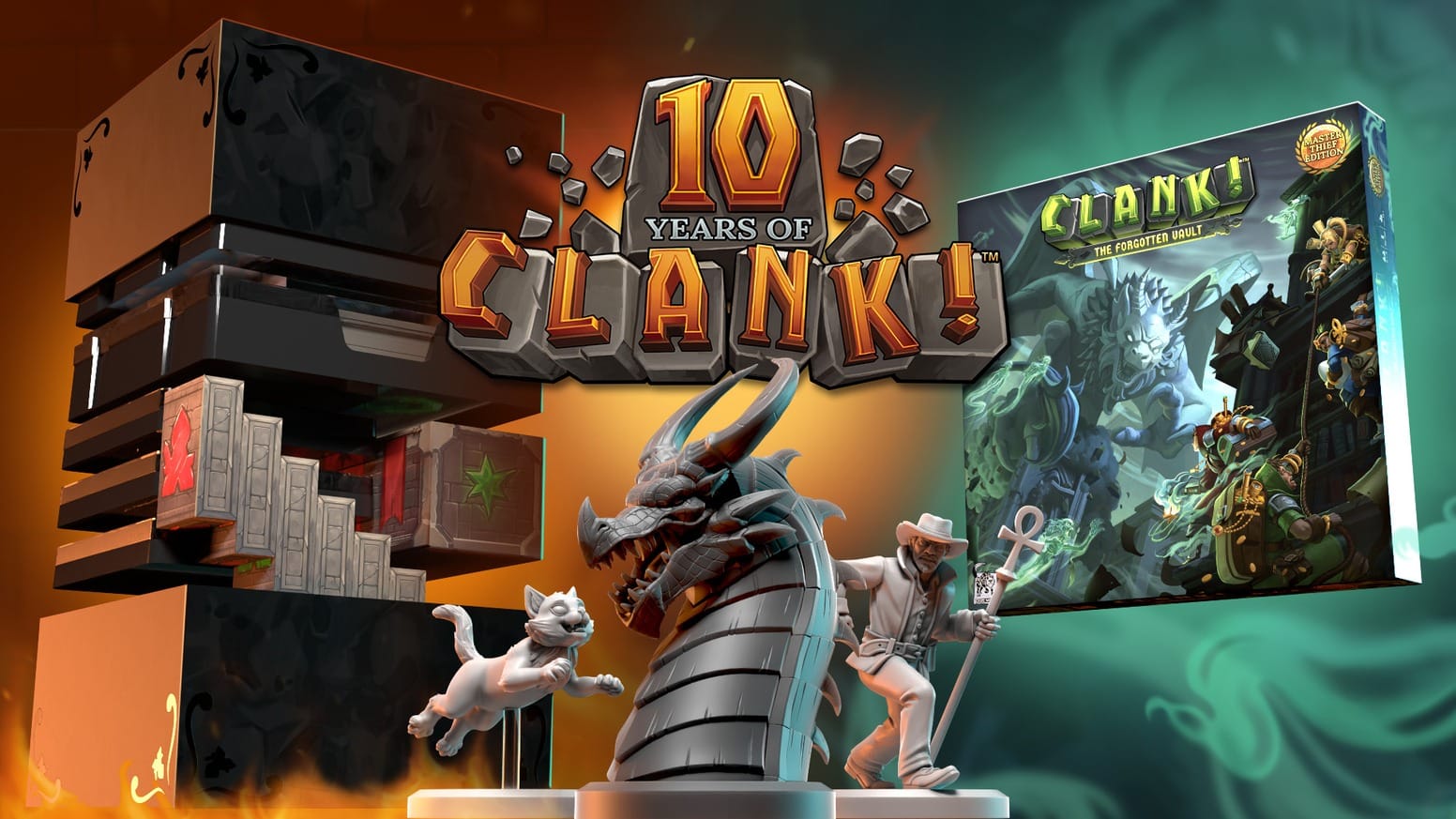
Dire Wolf startet zum zehnjährigen Jubiläum von Clank! eine Kickstarter-Kampagne für „Cube of Holding and The Forgotten Vault“: eine neue Erweiterung, eine Deluxe-Aufbewahrungsbox für die Sammlung und aktualisierte Karten und Komponenten zur Master Thief Edition. Die Kampagne läuft vom 3. bis 29. September 2026, bei einem Ziel von 50.000 US-Dollar steht sie bereits am ersten Tag bei 327 Prozent (163.700 Dollar, 593 Unterstützende, Stand: 3. September 2026). Kickstarter selbst hat das Projekt zusätzlich als „Staff Pick“ ausgezeichnet, eine redaktionelle Plattform-Auswahl, kein unabhängiges Qualitätsurteil.
Clank!: A Deck-Building Adventure von Paul Dennen (Dire Wolf/Renegade Game Studios, 2016) ist ein Deckbuilder für 2 bis 4 Spielende ab 12 Jahren, eine Partie dauert 30 bis 60 Minuten. Wer sich in die Höhle eines Drachen schleicht, sammelt Artefakte, während jedes laute Manöver den Zorn des Drachen steigert.
Was „The Forgotten Vault“ bringt
„The Forgotten Vault“ führt in die verwunschenen Ruinen einer alten Bibliothek: Zwei neue Spielpläne, „The Ancient Archive“ und „The Clocktower“, versetzen laut Verlag den Dungeon in Bewegung, etwa über Pendel und Seile, in Study Rooms lassen sich mit Secret Tomes dauerhafte Verbesserungen freischalten, dazu spuken Geister durch die Gänge. Wie viele Erweiterungen die Cube of Holding tatsächlich fasst, beziffert die Kampagne nicht näher. Zu einer deutschen Lokalisierung von Erweiterung oder Cube of Holding äußert sich die Kampagne bisher nicht.
Pledges und Lieferung
Die Pledges umfassen, mit den von Dire Wolf angegebenen Ersparnissen gegenüber dem Einzelkauf: Birthday Wish ab 10 Dollar (individuelles Baukasten-Paket über BackerKit), A Journey Continues für 115 Dollar (Cube plus neue Erweiterung, 8 Prozent), Dungeon Delver für 205 Dollar (zusätzlich das komplette Master-Thief-Edition-Set, 9 Prozent), The Treasure Chest für 210 Dollar (11 Prozent) sowie Dragon's Hoard für 435 Dollar beziehungsweise 395 Dollar ohne Basisspiel, das größte Paket mit 21 Prozent. Nur bei Dragon's Hoard unterscheidet die Kampagne explizit zwischen den Varianten mit und ohne Grundspiel, bei den übrigen Stufen bleibt offen, ob das Basisspiel jeweils enthalten ist. Der BackerKit-Baukasten soll im Dezember 2026 geliefert werden, alle übrigen Pledges im August 2027.
Zum Versand nach Deutschland äußert sich die Kampagne nur allgemein: Laut FAQ zählt die EU zu den regulär belieferten Regionen, der Versand erfolgt dort aus einem Fulfillment-Zentrum innerhalb der EU. Eine Liste einzelner Länder nennt die Kampagne nicht.
Der deutsche Solo-Entwickler Andreas Sperling startet mit Jurassic Crisis eine Gamefound-Kampagne für ein Survival-Brettspiel im Stil von ARK: Survival Evolved, mit Dinosauriern, Basisbau und wählbarem Koop- oder Kompetitiv-Modus. Schon am ersten Kampagnentag ist das Projekt mit 216 Prozent des Fördersziels deutlich überfinanziert: 108.370 statt der veranschlagten 50.000 Euro, getragen von 443 Unterstützenden.
Modi und Spieldaten
Gespielt wird wahlweise PvE, kooperativ oder solo, oder PvPvE im kompetitiven Modus mit asymmetrischen Rollen und Informationen. Auf einem Hexfeld errichten die Spielenden Basen, zähmen Dinosaurier, verwalten Ressourcen und schließen laut Kampagnenbeschreibung auch Bündnisse. Jurassic Crisis ist für 1 bis 4 Spielende ab 12 Jahren ausgelegt, die Regelhefte sollen laut Ankündigung jeweils rund 50 Seiten umfassen. Zur Spieldauer widersprechen sich die Quellen: Gamefound nennt 90 Minuten, BGG dagegen 90 bis 360 Minuten, welche Angabe für eine einzelne Partie gilt, lässt sich aus der Kampagnenseite nicht eindeutig klären.
Der PvE-Modus ist laut Kampagnenseite ausdrücklich auch solo spielbar. Ob der Koop-Modus zu echter Absprache zwischen den Spielenden führt oder eher zu parallelen Einzelbasen, beschreibt die Kampagnenseite nicht genauer.
Inhaltlich gliedert die Kampagnenseite das Spiel in mehrere Themenbereiche: „Ride a Dino“ für das Zähmen und Reiten der Dinosaurier, „Structures“ für den Aufbau und Ausbau der eigenen Basis, „Food & Rations“ für die Versorgung von Spielfigur und Dinosauriern mit Nahrung. Wie eine einzelne Spielrunde konkret abläuft, welche Kosten das Zähmen hat oder wie der Konflikt zwischen Spielenden im PvPvE-Modus im Detail funktioniert, zeigt die Kampagnenseite überwiegend in Bildern und einem Video statt in beschreibendem Fließtext, Details dazu dürften erst die verlinkten Regelhefte liefern.
Pledges: von Core Game bis Community-Paket
Das Core Game kostet 99 Euro. Das Gameplay Bundle (Core Game plus zwei Erweiterungen) kostet 143 statt regulär 163 Euro, das Ultimate Collector’s All-In mit sämtlichem Zubehör 229 statt 282 Euro, beides zusätzlicher Spielinhalt zum Vorteilspreis. Die Creator Supporter Limited Edition für 499 Euro (nur 100 Stück, nur auf Englisch) enthält die komplette All-In-Ausgabe plus exklusive Unterstützer-Extras, das ist vor allem Sammlerwert statt neuer Mechanik. Der Community Pledge liefert sechs Exemplare des Core Game für 475 Euro, gedacht für Spielgruppen und Vereine.
An Zusatzoptionen gibt es die 4-Spieler-Erweiterung (35 Euro) und die Redwood-Survivors-Erweiterung (29 Euro) als neuen Spielinhalt, dazu reine Komponenten-Aufwertungen wie eine Neopren-Spielmatte (33 Euro), ein Deluxe-Insert von Poland Games (40 Euro) und zwei Holzmarker-Sets (25 beziehungsweise 29 Euro).
Holzmarker-Set (145 Teile) als Zusatzoption zum Core GameDeluxe-Insert von Poland Games als Zusatzoption
Eine Stretch-Goal-Leiter hat Sperling Spiele bislang nicht veröffentlicht, die Kampagne läuft erst seit heute. Es ist laut eigener Angabe die erste Crowdfunding-Kampagne von Andreas Sperling, eine Liefer- oder Kampagnenbilanz aus früheren Projekten gibt es entsprechend nicht. Jurassic Crisis selbst sei nach eigenen Worten ein rund zehn Jahre altes Projekt, das nun endlich umgesetzt werde. Die Lieferung ist laut Kampagnenseite zwischen Oktober 2027 und Februar 2028 vorgesehen.
Grimspire startet zwei Kampagnen gleichzeitig auf der Spieleschmiede: „Dice Throne 2026“ bringt sechs neue Helden für das Duell-System, „Dice Throne: Adventures (2. Auflage)“ legt den kooperativen Dungeon-Ableger neu auf. Grimspire ist laut eigener Kampagnenseite der Ersteller beider Aktionen und bringt als deutscher Partner von Originalverlag Roxley die deutschen Ausgaben der Reihe heraus. Beide Aktionen laufen seit dem 1. September 2026, jeweils 28 Tage, ohne festes Fundingziel. Einen Liefertermin nennt keine der beiden Kampagnenseiten.
Dice Throne 2026: Sechs neue Helden
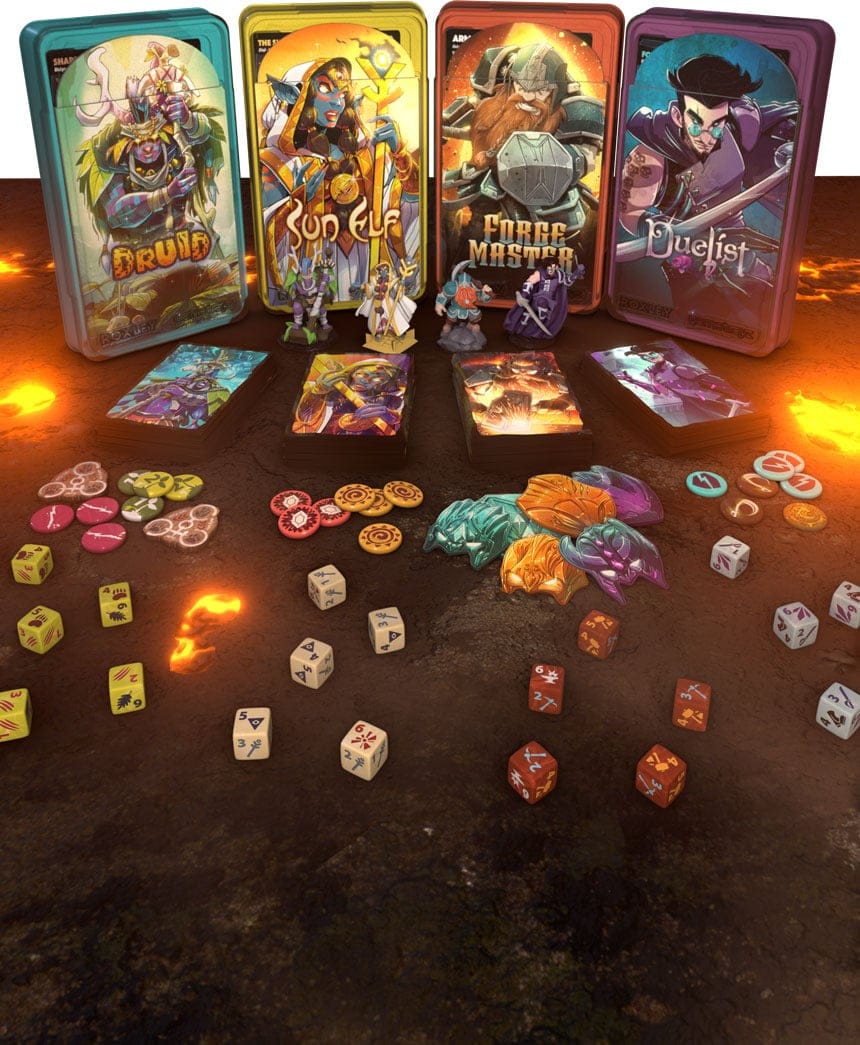
Im Duell-System von Dice Throne treten 2 bis 6 Spielende gegeneinander an: einzeln im 1-gegen-1, in Teams wie 2-gegen-2 oder 3-gegen-3, oder im Free-for-all. Jede Figur greift mit einem eigenen Fünf-Würfel-Set an und aktiviert Fähigkeiten über Karten, gespielt wird ab 8 Jahren, eine Partie dauert rund 30 Minuten, einen Solo-Modus gibt es nicht. Neu sind vier Helden aus der Vanguard-Reihe (Druid, Duelist, Forgemaster, Sun Elf) sowie zwei eigenständige Charaktere (Alchemist, Mystic Brawler), alle auf Deutsch. Ein Grundspiel-Kasten ist für die neuen Packs laut BGG nicht nötig, für ein Duell reichen zwei beliebige Heldenpacks aus jeder Season.
Die sechs Helden unterscheiden sich deutlich im Spielstil: Druid wechselt zwischen Bär-Form zum Einstecken und Katze-Form für kraftvolle Angriffe, Forgemaster rüstet sich und Verbündete mit Ausrüstung auf, und Mystic Brawler setzt auf reine Wucht. Duelist weicht mit einem neuen „Footwork“-System aus und kontert, Sun Elf heilt oder greift mit Sonnenenergie an, und Alchemist wirkt mit Tränken offensiv wie defensiv. Ob die neuen Helden das bestehende Kräfteverhältnis verschieben, sagt die Kampagnenseite nicht, mit dem Footwork-System bringt zumindest der Duelist ein neues Subsystem mit.
Wer einzelne Helden will, zahlt 15 Euro pro Pack, reiner Spielinhalt ohne Extras. Der Sixpack „Neue Helden Pur“ bündelt alle sechs für 90 Euro, ebenfalls ohne Zusatzmaterial. Der Sixpack „Neue Helden Deluxe“ kostet 220 Euro und legt zu den sechs Helden noch die passenden Accessory Packs sowie eine leere Strongbox obendrauf. Die Accessory Packs bringen laut Kampagnenbildern pro Held eine Miniatur, Premium-Kartenhüllen und Acryltoken, das ist reine Komponenten-Aufwertung, kein zusätzlicher Spielinhalt.
Dice Throne Adventures: Der Koop-Ableger kommt zurück
Dice Throne: Adventures nutzt die bereits vorhandenen Helden aus Season 1, Season 2 oder den Marvel-Sets für eine kooperative Kampagne: Bis zu 4 Spielende ziehen gemeinsam durch mehrere Szenarien, kämpfen gegen Bosse und rüsten ihre Decks von Partie zu Partie auf. Gespielt wird ab 10 Jahren, eine Partie dauert 60 bis 120 Minuten. Anders als das Duell-Grundspiel, das in der BGG-Spieleranzahl-Umfrage für eine Person kaum empfohlen wird, ist Adventures ausdrücklich solo spielbar und kommt dort für eine Person ganz ohne Ablehnungen aus.
Der Hauptpledge kostet 115 Euro für die zweite deutsche Auflage. Dazu kommen bemalte Miniaturen für Staffel 1 und Staffel 2 (je 50 Euro, laut Kampagnenseite nur noch begrenzt verfügbar), reine Optik ohne neue Spielinhalte. Besitzerinnen und Besitzer der Erstauflage können außerdem ein Errata-Pack (5 Euro) und eine Mini-Erweiterung mit Promo-Errata (6 Euro) dazubuchen.
Eine Stretch-Goal-Leiter gibt es bei keiner der beiden Kampagnen: Beide sind als Vorbestellaktion ohne Fundingziel angelegt. Das Dice-Throne-System stammt ursprünglich von Nate Chatellier, Aaron Hein und Manny Trembley, Adventures entstand zusätzlich mit Gavan Brown. Würfelreich hat die Reihe bereits mehrfach begleitet.
„Du bist nur ein Stück Dreck. Nein stimmt nicht, du bist weniger als Dreck. Du bist eine Ameise!“ Diese Worte von Hopper dem Grashüpfer könnte einem in den Sinn kommen, wenn ich an Ameisen denke. Bis jetzt, denn Antzeit bietet eine völlig neue Perspektive auf das „Große Krabbeln“.
They recently announced their next Kickstarter project that would take their system to the Anglo-Boer War called The Great Anglo-Boer War: The Battle for South Africa 1899-1902. The game is currently on Kickstarter and I reached out to my contact there Kevin Talley who acts as one of the Developers on the team for his input into the design to give us a better picture of how this new game plays.
Grant: What is the focus of your new upcoming game called The Great Anglo-Boer War?
Kevin:The Great Anglo-Boer War is a grand-strategic level game of the war between the British Empire and the Boer Republics in South Africa from 1899 to 1902.
Grant: Who is the designer and what is their goal with the game?
Kevin: As with all of our designs, R.J. Mills is the designer. He has always been fascinated with the Boer War and the goal was to make a really good hex-and-counter wargame to cover the whole conflict.
Grant: What is important to model from the history of the Anglo-Boer War?
Kevin: Well, the Boer War was very unique. It began as an asymmetric conventional contest in 1899 between the relatively small citizen militia forces of the two Boer Republics (they had no standing professional armies) and nearly the entire army of the British Empire! Then, once the Empire had captured both Boer capitals in 1900, the Boers refused to surrender and instead decided to fight a guerrilla war (and that went on for 2 more years). So, given the dynamics of this truly unique conflict, making a realistic game presented some serious design challenges. The design had to accurately simulate the conventional period, where the fractional Boer forces soundly defeated the British in several key battles during the early months, and it also had to credibly represent the guerrilla phase of the war, where very small numbers of Boers roamed (often unseen) and raided (always with surprise) throughout a vast area nearly twice the size of Texas. For this phase, the Empire forces had 250,000 troops deployed unsuccessfully trying to defeat 20,000 guerrillas! It all ended (finally) 31 May, 1902, with the Treaty of Vereeniging.
Grant: What other games inspired this design?
Kevin: We had not intended to make a Boer War game here at Cadet until after we started seeking a good grand-strategic/operational game about the Boer War to play. We got the “Boer War bug” playing Geoff Noble’s Redver’s Reverse: The Battle of Colenso, 1899 from Legion Games and decided we wanted to play a game of the whole war. We had pledged the KS Campaign for Joseph Miranda’s The Boer War from Canvas Temple Publishing and were hopeful, but it wasn’t what we’d hoped for in the end. Then we tried all the other Boer War games out there, or at least those we knew about, but there just wasn’t a good, realistic, strategic level/operational game of the whole war – especially not with the kind of depth we were looking for. We wanted something more like Nick Karp’s Vietnam: 1965-1975 from Victory Games – but for the Boer War – something with that kind of simulative value, historical chrome and especially guerrilla war operational mechanics. The closest thing we found was the old 3W game from 1991 (Eric Faust and Lew Fisher) called The Boer War. It had a lot of what we were looking for, but it was under-developed, errata-riddled and had too many issues to list. Still, that game had some brilliant design ideas, so we decided to start with that framework and make our own game. We were surprised that this topic didn’t have more published games already.
Grant: How did warfare change during the Victorian Age? How did you capture these changes?
Kevin: The British Army was fighting in drill book formations all the way through the 19th century. Consider that, just a year before in 1898 at Omdurman, the infantry stood in close order (just like in the movie Zulu), easily repelling the 50,000-strong army of the Khalifa with Lee-Metford volleys, Maxims and quick-firing breech loading artillery. This all worked very well when the enemy had swords, spears or primitive firearms. But the Boers had Mausers. And Krupps. And Maxims! Tactics had to evolve to meet this new level of lethality and the British Army was not initially prepared to face an enemy that was equipped with the same weapons as they. And an enemy that chose trenches and concealment – inflicting severe losses on British troops in drill formations. The combat system in the game realistically models the advantages of entrenchments, terrain, unit formation posture, night marches and even artillery effects. The Boers on defense can be very tough. A typical attack will be costly. Best to use open order and artillery to great effect – even better to use maneuver and avoid the prepared defense altogether. It took the British some time to learn their lessons.
Grant: What sources were consulted for the historical details?
Kevin: The bibliography for the game is included in section 26 of the rulebook. We used 20+ books on the topic to get the information for the design, and of course those include all the most important works published about the war: Rayne Kruger, Pakenham, Farwell, Arthur Conan Doyle (who was there), Barthorp, Reitz (a famous Boer Journal of the war), Maurice’s official history, Amery (Times history) and more. Someone who has researched the war and knows the historiography will truly appreciate this game.
Grant: What is the scale of the game? Force structure of units?
Kevin: The map scale is 9 miles to a hex. The map is huge. 34″ x 44″ on the table. The unit scale can be as little as a half battalion on the Empire side (500 men) and a single commando element of as few as 333 for the Boers. But the system is so flexible that a single leader’s counter in a hex on the map could represent as many as 30,000 Empire soldiers (with supporting artillery) and up to 13,320 Boers with several batteries of their guns as well. The game scale works for both large conventional battles (early war) and small guerrilla actions (later war).
Grant: What is the layout and anatomy of the counters?
Kevin: The counters are the typical ½” variety, printed on both sides. There are Entrenchment markers that, when flipped, double as “Scorched Earth” markers; Rail markers (early war) that also double as Blockhouse Line markers (guerrilla phase); Boer Control markers that can also be used as Strength Point counters; Number markers that flip to various increments; dozens of Empire Detachment markers which flip to show either Infantry or Cavalry or Artillery Strength Points (and the rotated position of these markers indicates the detachment strength in the hex); Armoured Train unit counters; Supply Wagon unit counters; Unit Status markers for multiple conditions like Retreated, Disordered, Demoralized, Invasion VP’s and more; and of course the Empire and Boer Leader counters, which are the basic units of maneuver in the game.
Grant: What different types of units are available to both sides?
Kevin: A Leader counter on the map typically indicates a ‘Force’ (which is a leader and the Strength Points of soldiers and artillery in their command) for both sides. These Forces are the maneuver units that move around on the map. There are also Detachments, which are Strength Points of soldiers and artillery without a leader (these secure and patrol an area, with a ZOC but without the counter moving). The Empire Strength Points can be Infantry, Cavalry or Artillery, with each point equating to 500 soldiers or a battery of field guns. The Boers are basically all mounted infantry militia, with each Strength Point representing 333 Boers or one battery of their artillery. The Empire also has Armoured Train units (we kept the English spelling), which function as ‘line of communication’ forces that police Empire-controlled rail lines. The Boers also have their Republic Presidents (Steyn and Kruger) and their small government staffs, which serve to score Victory Points by avoiding capture and maintaining their presence as head of state, either in their capitals or out on the veldt.
Grant: What is the off-map Arrow/Wheel used for?
Kevin: There are “Unit Displays” for both sides. These typically show a small picture of the Leader next to a pair of Strength Point numbered ‘wheels’. The players use counters with little arrows on them to indicate on the ‘wheels’ how many SP’s of soldiers are in a Leader’s Force, with any artillery batteries indicated by using a number marker. This keeps the counter-density on the map low, since the battalions, regiments, batteries or commandos are indicated using these off-map strength displays, and only the Leader’s counter moves on the map.
Grant: What was the inspiration for this mechanism?
Kevin: This came from the 3W game. Some players dislike this method for managing unit strength, and it took some getting used to, but we eventually decided it was the best mechanic we had seen in any design for this aspect of the game. Now we love it. Especially because of the flexibility it allows once the war changes from conventional to guerrilla. Historically the forces changed from divisions and brigades fighting large Boer commandos to much smaller columns of Empire troops chasing small Boer units of a few hundred all over the map.
Grant: How does it show the importance of Leaders in the game?
Kevin: I think this whole method of organizing the armies of both sides by each “Leader’s Force” really works perfectly to simulate the Boer War. It matches the real history. Everything a Force does boils down to the influence and command capabilities of the Leader. And forces of widely varying strength and unit composition were assigned to different leaders on both sides at different times throughout the conflict.
Grant: What is the Leader specific initiative rating system? How does it aid in your telling of the Anglo-Boer War?
Kevin: A Leader has to ‘roll for initiative’ to do most actions. Each Leader has an initiative rating which either helps or hurts their odds of a successful die roll, and the ratings are based on the historical performance of that Leader. This represents more than simply a Leader’s tendency to act decisively or not, but also his relative command influence for scarcity of resources, typical Victorian-era officer rivalries, orders and communications variables, bad intelligence and other typical “frictions” of war. The history of the war is full of instances where orders didn’t get communicated, sometimes weren’t given at all, or were ignored. Battles were lost many times because this leader or that failed to act on their own initiative or had some other priority override their commander’s intent. There are some Leaders whose rating is so good, they can nearly always do anything the player wants (and those are almost exclusively Boers). Other Leaders are reliably ineffective, and special care must be taken by the players to choose the right missions for these people. The realism of the design is greatly enhanced by this aspect – a player might have a great plan, but there is no guarantee that their Leaders will enact it. As Lord Roberts said after the battle at Poplar Grove, “In war you can’t expect everything to come out right.”
Grant: What is the layout of the game board?
Kevin: The Game Map contains almost all of the area of the war, from the eastern Transvaal and much of Swaziland and Zululand all the way to the Kalahari desert in the west; from 150 miles west of Port Elizabeth on the coast all the way up past Durban in Natal – and all of the mountains, ridges, rough and veldt of South Africa contained therein. It is a very large area and the map scale is 9 miles per hex. Using .625 hexes (for standard ½” counters), the map is 34″ x 44″ on the table.
Grant: What key terrain features are included and how do they affect maneuver and tactics?
Kevin: The terrain types for hexes include mountain, rough and veldt. Special hexside types can be ridge or river, bridge or rail. The mountain ranges are all there, as are the ridgelines and heights, rivers and rail, towns, ports and capitals. Even the passes and “neks” are indicated. The actual escarpment of the Drakensberg are all mountain hexes, but the Biggarsberg north of Ladysmith, as an example, is treated as ridge-type hexsides with rough terrain hexes. There is a real distinction between mountains and typical rough country/hills. The geography of South Africa was a serious factor in the conduct of the war and the terrain effects for both movement and combat are significant in the game.
A Force attacking across a river hexside is reduced by 50%; a Force attacking across a ridge or into mountains is reduced by 25%; a Force defending in mountain terrain is doubled; a Cavalry Force crossing a river pays 2 extra movement points to do so, while an Infantry Force pays 3; a veldt hex costs 1 point to enter, a rough hex 2, a mountain hex 4, and crossing a ridge hexside adds 2 points. Geography is key. Often, the only way to effectively dislodge an enemy Force from a position is to maneuver them out of it, because the odds for a successful attack are slim based on the terrain. The Tugela River line in Natal is a famous example of a natural fortress, and so it is with the game. To get past a competent Boer defense there, it will take an Empire player who understands the map and the combat system (plus some good dice and a card or two).
Grant: What type of cards are included? Can you share a few examples.
Kevin: The cards are great. Mostly they modify the combat odds or DR’s by providing for an odds-column shift or a DR mod for one of the many on the Battle Board (the Empire Attack Scouting Effect, the Artillery Effect or the actual combat DR). But there are also many cards that influence very specific game actions – like evasions or recruiting, siege surrender extensions or supply situations, armoured trains or movement or initiative effects. Some cards influence the unit formation or entrenchment posture during a battle, while some may determine the outcome of night marches. Some are related to intelligence and reveal hidden enemy units or prevent unknown strength in a combat event. Others influence scouting and observation, signals and orders, escapes and ambushes…I could go on.
All the cards were created based on actual events that happened during the war. Here is an excerpt from the Campaign language and the “design notes” section of the rulebook: “The game cards are designed to build historic realism into the game, especially for the combat system. As in all wars, small instances of chance – moments of decisive leadership (or not) – a thunderstorm – an oil-less signals lamp – a wire fence – a flooded drift – a poorly drawn map – a mistaken guide – an enemy surprise…all these historic events and elements of chance are represented in our design by game cards for both sides. We think this adds to the design immensely, since these can account for odds column shifts and DR mods that the players cannot anticipate. Like their historical counterparts, the players cannot know exactly what their odds are until the battle is joined and the card(s) are revealed!”
Grant: How does combat work?
Kevin: The combat system uses an odds-based CRT and a combat die roll to determine battle results, so it is fairly typical of a hex-and-counter wargame. What gives the system the right depth is that combat can happen during the movement as well as the combat phases. Combat can also be initiated by the non-phasing player using a reaction mechanism – so it isn’t nearly as simple or predictable as “I go / You go”. Based on the history, we felt the combat system (even at this scale) needed to incorporate strength ratios, unit tactical formations, weather, visibility, unknown Boer strength, artillery strength and effects for both sides, leadership, scouting and intelligence, terrain, night march outcomes, unit morale, “dummy” defensive positions, entrenchments and more.
Grant: How does the Battle Board work?
Kevin: There are so many effects and modifiers that contribute to the combat system that we decided the only way to keep everything straight was to have a Battle Board. For example, an Empire attack vs. a defending Boer Force would look like this: First, the Force attacking commits their desired number of Strength Points to the battle using the Attacker’s SP display, then the defending Boer unit’s SPs are indicated on their display. Any unit status particulars (Disordered, Demoralized, Retreated) are also indicated. The next step is to see how many unknown Boer SPs there are, so a die is rolled and that number goes on the Board (usually the Empire player cannot know their exact combat odds until after they commit their SPs to the attack because of this “unknown SP” die roll). Then any terrain or supply state modifiers are applied (there are markers for these) for both sides to establish the initial combat odds, and a counter for that ratio is placed in the appropriate box on the odds track (always rounded in favor of the defender). Next, any factors that modify the combat odds are noted and applied (entrenchments, the Empire Attack Scouting Effect DR, any other enemy units in the attacker’s ZOC, a Demoralized defender, any cards – attacker first). Now a marker is placed for the final combat odds on the final odds track. The last bit is to calculate what modifier (if any) is going to apply to the combat DR. The Artillery Effect is determined with a DR, if the Empire is using a night march there is another DR, the Empire Force’s Leader combat rating is applied, if the attack is made from a rail-move ZOC it matters, and finally any cards that modify the DR – attacker first. Once the Battle Board has been completely and correctly configured, the combat die is rolled and the CRT consulted to determine the result. The Battle Board is really essential to keep track of all of it.
Grant: What role does scouting and intelligence play in the game?
Kevin: The British generals were famously ignorant of the Boer dispositions in the early battles, for they had almost no intelligence organization in their army corps and they were especially short on mounted troops for effective scouting. The Empire Attack Scouting Effect is built into the combat system to reflect this. If the “E.A.S.E.” DR is greater than the number of Cavalry SP’s in the attacking Force, there is an odds-column shift to the left for the combat on the CRT. Later in the guerrilla phase, there is a “mystery movement” dynamic which keeps the Empire player guessing about which Boer commando markers are real units and which are only decoys. Some of the game cards confer valuable intelligence by allowing the Empire player to reveal a “mystery” commando of their choice (and native spies can help both sides).
Grant: How is artillery used?
Kevin: There is an Artillery Effect Track on the Battle Board which compares the arty strength of the two sides in a battle – whomever wins this comparison gets a modifier that applies to the combat DR. The Boers get a DR to add to their battery count, so even an Empire Force with 8 batteries of guns might not win the Arty Effect Bonus if there are 3 Boer batteries (if they roll a 6, they have 9). This “Boer Arty Effect” DR does not necessarily represent additional unknown batteries/guns, but more simulates the Boer tendency to use superior artillery tactics, multiple prepared positions, gun re-positioning during a battle, indirect fires and hidden gun positions with range and target fire preparation. In addition, the British firepower was often wasted against cunningly prepared “dummy” trenches and positions such that seemingly impressive preparatory fires were completely ineffective. The Boer Arty DR serves to simulate both aspects. The Empire has far greater potential weight of fire, but qualitatively the Boer Arty is superior (as with the historical truth). There are cards for both sides that impact the Artillery Effect for a battle.
Grant; What is the role of Scorched Earth?
Kevin: As the Boers turned more towards guerrilla tactics, the Empire forces began burning farms and killing or confiscating livestock (and especially horses) as reprisals for Boer attacks and to destroy potential shelter and supply sources for the guerrillas. This often resulted in the re-settlement of the Boer women and children in concentration camps, where thousands perished from disease and hunger. There are several game mechanics during the guerrilla phase that simulate this aspect of the war, and one is the “Scorched Earth” program. If the Empire player chooses, they may assign Forces during a game turn to “Scorch” one or more district areas in the Boer Republics. A marker is placed, and Boer movement point costs in that district are doubled, while guerrilla recruiting is halved. Once “Scorched”, a district can no longer provide Boer VP’s during the District Control segment of the VP interphase. But there is a potential cost to this kind of “scorched earth” policy: every turn this is done the Boer rolls a die – if the result is equal to or less than the number of newly “scorched” districts for the turn, the Boers get 5 VP for each. These VP’s reflect negative public opinion, parliamentary outrage and press coverage back in England, as well as increased Boer resentment and dedication to fight to the bitter end to avenge the destruction of their homes and families. The Empire player must balance the military benefits against the possible consequences of the policy (and be careful).
Grant: How does the Attrition Phase work?
Kevin: There is a lot going on during the Attrition and VP interphase. Hundreds of the Boers in just about every Force will simply leave to go home (they are all volunteer militia, not regulars); The Empire may have thousands of losses to typhoid (it was a big deal during the war); Boer family deaths in the concentration camps may cause desertions in the commandos (and uproar back in Britain); Besieged Empire garrisons may suffer losses or surrender; Railheads may advance or be pushed back: Forces might entrench; Unit statuses (like Demoralized units) get updated; VP’s for the game turn are tallied and losses counted, and the totals for the war (or scenario) are arrived at. It gets even busier if a Boer capital has been captured during the turn, as this can drastically increase the number of Boers who choose to “take leave” and go home (low morale). At the end of the phase, the players advance the game turn marker and start the next month of the war.
Grant: How is victory determined?
Kevin: Victory Points are awarded to both sides for all kinds of events. Mostly major or minor battle victories, but also for siege outcomes (relief or surrender), Boer invasions of Empire territory, capture of Leaders and capitals, control of districts, consequences from the scorched earth policy and concentration camps, and even penalties for over-stacking. There is a VP table on the back of the rulebook so the players can double-check during the VP interphase, and there are handy player-turn and interphase record sheets to use as well. Whoever has the most VP’s at the end of the scenario wins, unless an automatic victory for either side ends the contest early.
Grant: What different scenarios are included in the design?
Kevin: There are three scenarios – the Conventional War, the Guerrilla War, and the Grand Campaign Game. Here’s an excerpt from the Campaign language: “The full campaign is the ultimate Boer War experience – from the first desperate siege defenses of 1899 to the treaty of Vereeniging (or maybe not?) – and everything tactical and otherwise in between: Battles, blockhouses, farm-burnings, evasions, escapes, raids, concentration camps, sieges, drives, armoured trains, 1-pdr automatic “pom-poms”, surrenders, entrenchments, typhoid, barbed-wire, native spies, night marches, supply wagons and more. If it was part of the real Boer war – it is in the game.”
Grant: What does the game do well in modeling the Anglo-Boer War?
Kevin: We feel the game succeeds in modeling just about every aspect of the war, but there are a few particulars. Again, from the Campaign language: “For our design, we wanted a more granular scale of both movement and combat than any other strategic-level Boer War game yet published. Rayne Kruger, in chapter 23 of his “Good-Bye Dolly Gray” pointed out that, perhaps more than any other Boer advantage, the Empire was fighting “a war against space.” We ended up having two 22″ x 34″ map sections at 9 miles/hex to pull this off. A very large game on the table – but very typically “Cadet.” As it goes here, bigger is better. More hexes = more realism.”
Also, the Empire forces during the war were especially dependent on the rail lines for supply, while the Boer forces were far less dependent on any supply system to keep their forces in the field. The supply rules in the game really do justice to history, as everything the Empire player wants to do will be substantially constrained by their proximity to a rail line. In fact, some remote districts simply cannot be effectively garrisoned by Empire forces or detachments, because those units will be out of supply. Moreover, the scarcity of draft animals (oxen and mules) during the war meant only a handful of supply wagon units were available to extend an Empire LOS away from any rail line, and so it is with the game. These few substantial wagon convoys are also prime targets for the marauding Boers (as with countless examples from the war).
Grant: What has been the experience of playtesters?
Kevin: The game plays very well, indeed, but there were a few unexpected outcomes from the initial design, especially the combat system. In our first run of the conventional war scenario, we discovered that the “Boer unknown SP DR” mechanic needed a change. The Boers simply fought too well. Every time the Empire committed SP’s to an attack, the Boers would essentially be ‘reinforced’, owing to their unknown SP die roll. It always added SP’s to the Boer Force, since it wasn’t designed to subtract them. True, this kept the Empire player uncertain as to the combat odds until the forces were joined, but it had the effect of representing the Boers as ahistorically disciplined regular troops – prepared to fight to the death and hold their ground even when attacked by 15, 20, or even 30,000 British with 50+ field guns. The Boers just didn’t do that. There are far more examples of the Boer volunteers fleeing in droves from large Empire forces (in spite of exhortations and even threats by their leaders and even presidents) than examples where they stood their ground. In many ways this tendency served to preserve their forces and denied the Empire the showdown battles they hoped for during the second phase of the conventional war. A small rearguard of hardcore Burghers (farmers) would usually hold off the exponentially larger Empire forces, allowing their thousands of fleeing comrades to make their escape. They traded ground for time and blood, almost always avoiding any decisive loss.
So, we amended the rule so the DR can go either way, depending on the size of the attacking Empire force and on another DR modified by the Boer Leader rating of the defending force. This solution made a huge difference and resulted in the historical outcomes we wanted. If you attack Botha with a large Empire Force, he will likely motivate several hundred more Burghers to join the defense. Attack Prinsloo, though, and he’s likely to have several hundred of them (or more) run away before the battle is joined. There is a card in the Empire deck that prevents the unknown SP DR altogether, and now freshly retreated or Demoralized defenders don’t roll either.
Grant: When can we expect the game to be fulfilled?
Kevin: We are optimistic that the community will support our Campaign for this one (gotta get successfully funded first), and we will start the production sample and the rest of the process immediately afterward. Our anticipated timeline is to have the games shipping to the backers by August of next year.
Grant: What projects are in the near future for Cadet Games?
Kevin: We would really like to get our Hamburger Hill game produced. The design is 100% done and it is a really detailed sim of that famous battle. We ran it on Gamefound back in 2025 but it didn’t hit the goal. So, we will likely run that one again to see if we can’t get that produced here sometime soon. We have a ton of other projects in the works, one of which is a solo design covering the Mayaguez incident and the battle for Koh Tang Island from May, 1975. We have been really immersed in the Boer War since the middle of last year, so this one has had almost all of our attention (and still does for now, since we are playing through multiple rounds of the guerrilla phase and all of its intricacies)! We also have Barbarossa ’41 on deck for our Armies & Alliances Series of WWII ‘miniatures and monster map’ designs. Thanks again for helping us get the word out about our passion for military history and wargames!
Thank you for your time in answering our questions Kevin and for the great care you guys are taking with these games to tell a fun and interesting part of history.
Nach der Gen Con ist es rund um Kickstarter, Gamefound und Spieleschmiede spürbar ruhiger geworden. In den vergangenen sieben Tagen (24. bis 31. August 2026) erreichen nur zwei neue Kampagnen die Auswahlkriterien dieser Redaktion, die deutsche Spieleschmiede liefert in diesem Zeitraum keinen neuen Brettspiel-Kandidaten. Dafür kehrt bei Gamefound ein kooperatives Tower-Defense-Spiel mit Reprint und zwei Erweiterungen zurück, während ein Kickstarter-Projekt auf einen fremden Planeten führt.
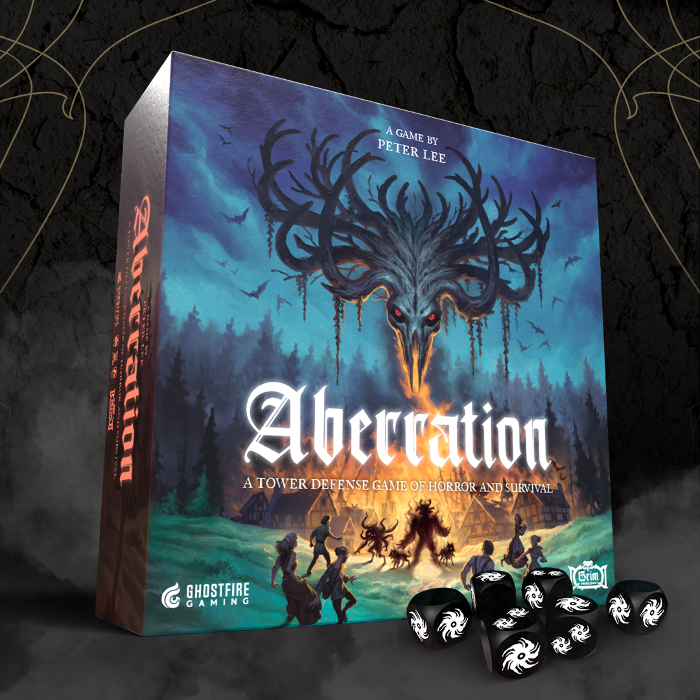
Aberration: Oblivion's Embrace
Der australische Verlag Ghostfire Gaming hat die Kampagne zu Aberration: Oblivion's Embrace Expansion & Reprint am 26. August 2026 auf Gamefound gestartet, Stand 31. August 2026 bei rund 794 Prozent des Ziels von 20.000 US-Dollar (158.823 US-Dollar). Design stammt von Andy Collins und Peter Lee, Letzterer bekannt für Lords of Waterdeep, Tyrants of the Underdark und Horrified.
Ein bis vier Spielende verteidigen kooperativ das Dorf Bürach gegen eine wachsende Bedrohung aus Monstern und Verderbnis im Grim-Hollow-Setting des Verlags. Mechanisch verbindet das Tower-Defense-Spiel Worker Placement, Bag Building und asymmetrische Heldenfähigkeiten mit einem Fog-of-War-System, das Teile der Gefahr zunächst verdeckt hält. Die Kampagne bringt neben einem Reprint des Grundspiels zwei neue Erweiterungen: Oblivion's Embrace mit zwei wiederholt spielbaren Roguelike-Kampagnen und Arcanists & Abominations mit vier neuen Zauberklassen. Eine Partie dauert laut Kampagnenseite rund 90 Minuten, ausgelegt für ein bis vier Spielende ab 14 Jahren.
Ein Solo-Modus ist enthalten, die Kampagne läuft noch bis zum 17. September 2026. Ghostfire Gaming hat mit dem gleichnamigen Grundspiel Aberration bereits eine erste, eigene Kampagne durchlaufen, die laut Gamefound bereits vollständig produziert und ausgeliefert wurde. Eine deutsche Lokalisierung nennt die Kampagnenseite bislang nicht.
Orbitstar: Expedition to Darwin IV
Das neuseeländische Studio Arkus Games hat Orbitstar: Expedition to Darwin IV am 25. August 2026 auf Kickstarter gestartet, Stand 31. August 2026 bei rund 216 Prozent des Ziels von 30.000 Neuseeland-Dollar (64.712 Neuseeland-Dollar). Design stammt von Bobby Hill, Welt und Artwork gestaltete Illustrator Wayne Barlowe nach seinem eigenen Buch „Expedition“. Arkus Games hat seit der Studiogründung 2020 bereits mehrere Kickstarter-Kampagnen realisiert, darunter Shelfie Stacker, Storm Raiders und Dreadful Meadows.
Ein bis vier Spielende schlüpfen im Jahr 2358 in die Rolle von Forschenden, die den fremden Planeten Darwin IV erkunden und laut Verlag insgesamt 49 außerirdische Spezies dokumentieren. Dabei kommen Bag Building, Bewegung über verschiedene Biome und der Ausbau der eigenen Hovercone-Fahrzeuge zum Einsatz, während Wetter und Raubtiere die Expedition erschweren. Eine Partie ist laut BGG für ein bis vier Spielende ab 14 Jahren ausgelegt und dauert rund 90 Minuten.
Ein Solo-Modus ist vorhanden, Details zum genauen Ablauf nennt die Kampagnenseite nicht. Die Kampagne läuft noch bis zum 16. September 2026, der Versand ist laut Kickstarter weltweit vorgesehen, die Auslieferung für September 2027 geplant. Eine deutsche Lokalisierung ist bislang nicht angekündigt.
Beide Kampagnen sind reine Nischenprodukte für den deutschen Markt: englischsprachig, ohne angekündigte Lokalisierung, mit den üblichen Kickstarter- und Gamefound-typischen Zusatzkosten für Versand und Einfuhr nach Deutschland. Wer auf deutschsprachige Neuheiten wartet, muss sich diese Woche gedulden. Die Spieleschmiede blieb in den vergangenen sieben Tagen ohne neuen Brettspiel-Kandidaten.
Angekündigt: Neu: Updates: Zur Zeit ist eher „Saure Gurkenzeit“ im Crowdfundingbereich. Rund um die Gen Con sind kaum neue Projekte gestartet worden. Daher auch nur kleinere Updates und ein paar neue Live-Projekte. ANGEKÜNDIGT In der kommenden Woche im Crowdfunding: Sommerpause. Es sind einige wenige Projekte angekündigt. Hier der Überblick über die kommende Woche und den […]
California tabletop publisher and game development studio Solis Game Studio is expanding its reach into US hobby retail through a new distribution deal with Southern Hobby, following several years of building its own catalogue through crowdfunding and direct sales.
The Massive-Verse Fighting Card Game, designed by Brian McKay, from Solis Game Studio
Its contracting work has included projects such as the Cyberpunk TCG, with Solis having led game design and development of a prototype that secured licensing for a new game.
Solis also did development work on Emerson Matsuuchi-designed Metal Gear Solid: The Board Game, and last month announced it would be the developer for the official card game of battle royale video game PUBG.
The company said Southern Hobby will distribute new Solis release Six-Sided Seas, as well as Treat, Please! and The Massive-Verse Fighting Card Game, describing the deal as a “major step forward” for the business.
The publisher has previously used crowdfunding to bring several of its games to market, with its biggest success to date 2024’s licensed Massive-Verse Fighting Card Game, designed by Brian McKay, which raised just over $50,000 from about 800 backers.
Solis has also already been selling directly to retailers through its own wholesale programme.
The publisher’s newest release, push-your-luck worker placement game Six-Sided Seas, will enter US distribution on October 2 with a $24.95 MSRP.
The two-player pirate game, designed by Kroze Kresky, is built around an unusual component format, consisting of 32 dice and a 14in by 24in edge-stitched playmat which is rolled inside the game’s box – allowing the title to be presented vertically, horizontally, or with a collapsible hangtab in retail.
Solis has previously said the idea grew from a visit to game stores in Thailand, where Chris Solis saw a store employee laminating a game board to protect it and began considering whether the board itself could instead be made from playmat material.
He said in the blog post, “When I returned home I issued an internal design challenge to my community. What does a game that is a playmat and single component look like?
“We explored a ton of really interesting designs and even did a limited release for one of them but none captured me like Six-Sided Seas by Kroze.”
Solis launched the game at Gen Con earlier this month, and said it sold all the copies it brought to the convention. Several of its scheduled learn-to-play sessions at Gen Con also sold out, according to the convention’s event listings.
In addition to founder and owner Chris Solis, the studio’s team includes developer Bryan McKay, business operations specialist John Brieger, graphic designer Katherine Boils, marketing manager Courtney Shernan, convention manager Sara Jordan and community manager Antonio Gil.
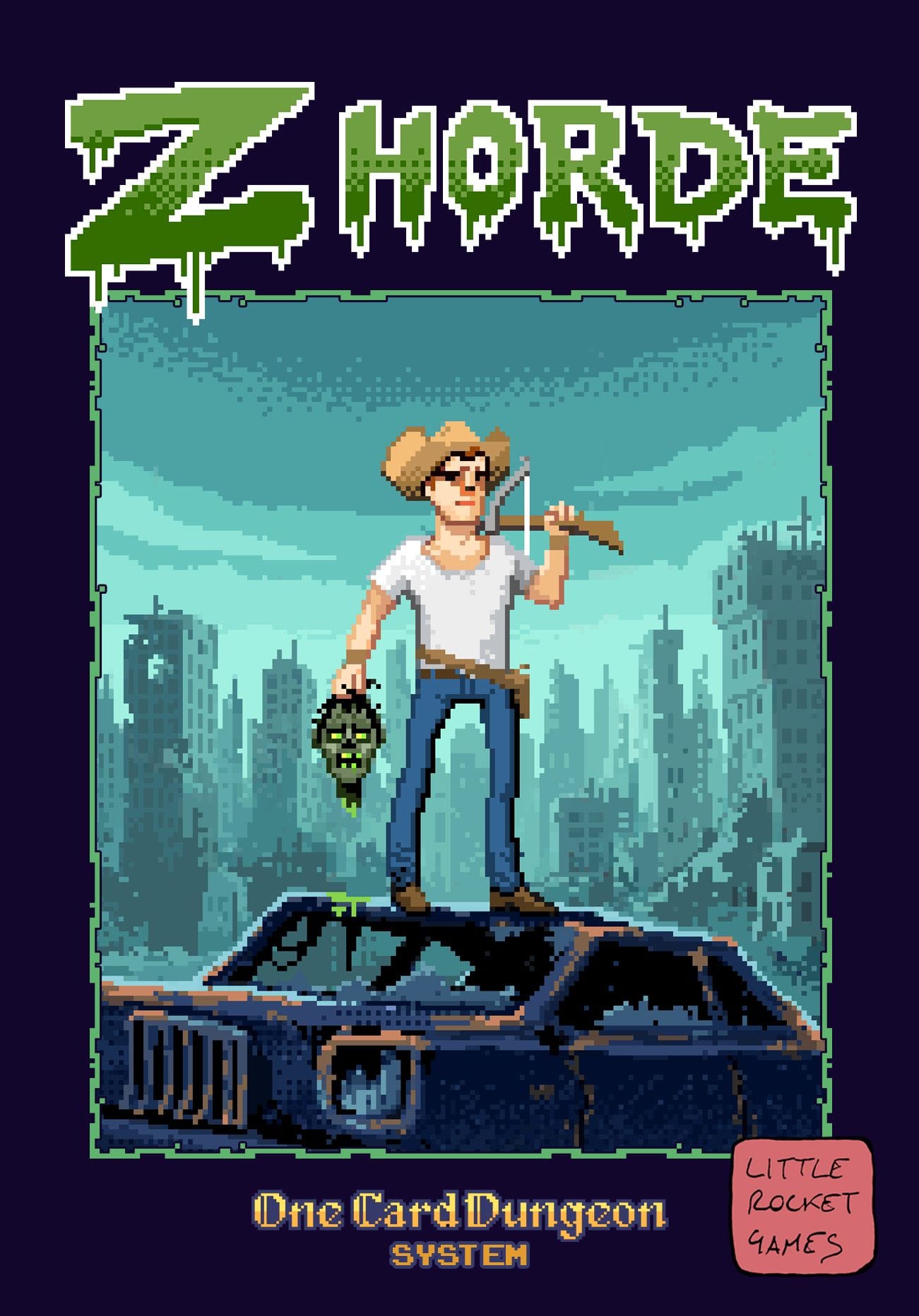
Little Rocket Games, der Verlag hinter dem Solo-Kartenspiel One Card Dungeon, kündigt auf Kickstarter mit „Z Horde“ einen eigenständigen Dungeoncrawler im Zombie-Setting an. Das Spiel nutzt das One-Card-Dungeon-System als Basis, kommt aber mit eigenem Setting, eigenen Mechaniken und einer 12-stufigen Kampagne.
In der Solo-Partie weisen Spielende laut Verlagsbeschreibung auf BGG in jeder Runde Energiewürfel den Bereichen Bewegung, Angriff und Verteidigung zu und müssen dabei taktische Kompromisse eingehen. Fünf spielbare Überlebende, ein Marktsystem zwischen den Levels, wiederverwendbare Waffen und verbrauchbare Gegenstände sollen für Abwechslung über die gesamte Kampagne sorgen. Design stammt von Giampaolo Razzino, der zuvor bereits an der Erweiterung One Card Dungeon: M'Guf-yn Returns mitgearbeitet hat, Illustrationen kommen erneut von Marco Salogni. Z Horde ist für 1 Spielenden ausgelegt, dauert 30 bis 60 Minuten und ist ab 14 Jahren freigegeben.
Die Kickstarter-Seite zu Z Horde ist aktuell eine reine Ankündigungsseite, in den Titel-Metadaten steht „Coming soon: Z Horde“. Weder Kampagnenstart noch Enddatum, Finanzierungsziel oder Pledge-Stufen sind bislang hinterlegt, auch ein Beschreibungstext fehlt noch. Wer sich für den Titel interessiert, kann sich derzeit nur benachrichtigen lassen, eine laufende Kampagne mit Preisen oder Stretch-Goals gibt es noch nicht.
Der BGG-Eintrag listet Z Horde bislang nur unter den kommenden Neuheiten, ohne Bewertungen oder weitere Community-Daten. Würfelreich verfolgt die Ankündigung und meldet sich, sobald Kickstarter konkrete Zahlen zu Laufzeit und Zielsumme veröffentlicht.
Nach der Gen Con ist auf den drei großen Plattformen wenig los: Die Spieleschmiede hat in den vergangenen sieben Tagen kein neues Brettspiel gestartet, und die einzige neue Gamefound-Kampagne der Woche, eine Sonderedition von Mykerinos, erreicht keine der Auswahlschwellen dieser Ausgabe. Diese Wochenschau konzentriert sich daher auf vier Kickstarter-Kampagnen: zwei frisch gestartete Titel und zwei Klassiker-Neuauflagen, die in den kommenden Tagen enden. Alle Zahlen sind Momentaufnahmen vom 24. August 2026.
Spirit Train: ein Geisterzug für die letzte Reise
Spirit Train: The Final Journey von SweaterBear Games ist seit dem 18. August auf Kickstarter live und läuft noch bis zum 15. September. Am 24. August 2026 stehen 262.726 US-Dollar zu Buche, bei einem Ziel von 10.000 US-Dollar sind das 2.627 Prozent, getragen von 1.733 Unterstützenden. Die drei Pledge-Stufen werben mit 30, 20 und 32 Prozent Rabatt gegenüber dem späteren Ladenpreis. Versand, Steuern und Zoll rechnet die Kampagne nach eigenen Angaben separat nach Kampagnenende ab.
Designt haben das Spiel Casey Mattes und Zoey Mattes. Als Fährleute zwischen den Welten bauen 2 bis 4 Spielende in 60 bis 90 Minuten ihren Zug aus wechselnden Waggons, sammeln Geister ein und begleiten sie in ihr Jenseits. Mechanisch mischt Spirit Train Worker Placement mit einer Aktionsreihenfolge, die von der Stimmung der Geister abhängt. Einen Solo- und Koop-Modus bietet erst die oberste Pledge-Stufe mit der Zusatzkampagne „The Lost Soul“, laut Kampagnenbeschreibung acht Kapitel im Solo- oder Koop-Modus.
The Monolith: blutiges Opfer für einen außerirdischen Fels
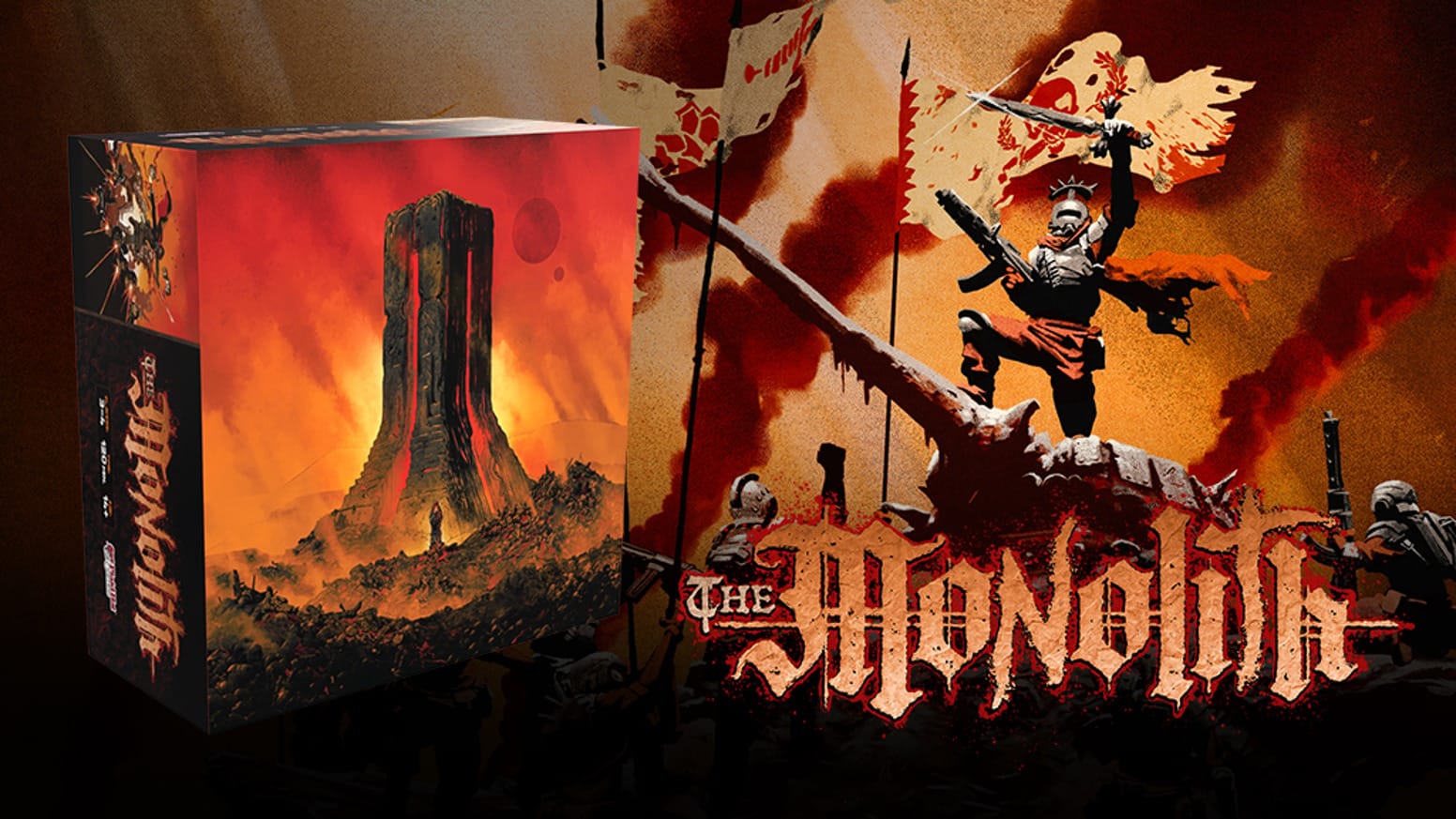
Auch The Monolith von Plaid Hat Games ist seit dem 18. August live, mit Laufzeit bis zum 17. September. Am 24. August 2026 sind 110.998 US-Dollar zusammengekommen, bei einem Ziel von 50.000 US-Dollar sind das 222 Prozent und 1.221 Unterstützende. Plaid Hat Games hatte eine erste Kampagne zum Spiel bereits im Juni gestartet und sie trotz erfolgreicher Finanzierung nach drei Tagen abgebrochen. Firmenchef Colby Dauch nannte im August gegenüber der Fachpresse den Grund: Die Zusagen seien bereits am zweiten Kampagnentag vollständig zum Stillstand gekommen, weshalb Plaid Hat Games den Neustart erst nach eingehender Analyse der Fehler plante.
Design stammt von Phil Gross. 3 bis 4 Spielende führen als Schamanen Krieger gegen rivalisierende Kulte, sammeln Herzen und opfern sie am Ende jeder Runde dem titelgebenden Monolithen, der daraufhin die Kampfaktionen der Partie bestimmt. Eine Partie dauert laut Verlag rund 120 Minuten. Das Grundspiel hat keinen Solo-Modus, gegen Aufpreis bringt ein Bot-Pack-Zukauf Unterstützung für 1 bis 2 Spielende.
Zu Versandkosten und Einfuhrabgaben für Unterstützende außerhalb der USA macht die Kampagne, anders als Spirit Train, keine Angabe. Die Reward-Texte nennen für alle Stufen nur einen weltweiten Versand ohne weitere Details.
Twilight City und Kalmár: Queen Games holt zwei Pierrot-Spiele zurück
Nur noch bis zum 27. August läuft die Kickstarter-Kampagne von Queen Games zu Twilight City und Kalmár: Merchants in Buda, zwei Spielen des ungarischen Designers Pierrot (Tamás Z. Marosi). Am 24. August 2026 stehen 9.026 Euro bei einem Ziel von 2.000 Euro, das sind 451 Prozent bei 59 Unterstützenden. Die Deluxe-Stufen nennen Ladenpreise von 79,99 Euro für Kalmár und 89,99 Euro für Twilight City, das Bundle beider Spiele kostet gegenüber einem Richtpreis von rund 180 Euro je nach Stufe 15 oder 25 Prozent weniger. Alle Deluxe-Stufen schließen laut Kampagne die deutsche und die EU-Mehrwertsteuer ein, die Bundle-Stufen liefern zusätzlich versandkostenfrei nach Deutschland und in die EU.
Twilight City schickt 1 bis 4 Spielende als Partisanen gegen ein diktatorisches Gouverneursregime in einer smoggeschwängerten Stadt, mit Tableau-Aufbau und rund 120 Minuten Spielzeit, und bringt einen eigenen Solo-Modus mit. Kalmár versetzt 2 bis 4 Spielende für 90 bis 150 Minuten als konkurrierende Kaufmannssöhne ins Buda des 15. Jahrhunderts, mit Warenhandel, Investitionen und einem eigenen Modus für zwei Personen, aber ohne klassischen Solo-Modus. Beide Spiele erschienen ursprünglich bei Private Moon Studios. Queen Games mit Sitz in Troisdorf bringt jetzt Deluxe-Neuauflagen beider Titel heraus.
Mexica, Bridges of Shangri-La, Gheos und Reel Rivals: vier Klassiker in letzter Minute
Der britische Verlag Play For Keeps beendet seine Sammelkampagne zu vier Euro-Klassikern bereits am 26. August. Am 24. August 2026 stehen 56.824 britische Pfund bei einem Ziel von 12.250 Pfund, das sind 464 Prozent, unterstützt von 814 Personen. Die Mexica-Stufe wirbt mit rund 7 Pfund Ersparnis gegenüber dem Ladenpreis, das Bundle aller vier Spiele mit rund 46 Pfund. Zu Mehrwertsteuer oder Zoll für Unterstützende in der EU äußert sich die Kampagne, anders als Queen Games bei Twilight City und Kalmár, nicht.
Das Zugpferd der Kampagne ist Mexica von Michael Kiesling und Wolfgang Kramer, der dritte Teil ihrer Masken-Trilogie aus dem Jahr 2002. 2 bis 4 Spielende ziehen in rund 90 Minuten Kanäle und Brücken durch Tenochtitlan und gründen Bezirke für Mehrheitspunkte, ein Solo-Modus fehlt. Dazu kommen die Neuauflagen von Bridges of Shangri-La, Gheos und Reel Rivals als weitere Titel im selben Bundle.
Diese Ausgabe teilt sich in der Mitte: Spirit Train und The Monolith sind komplett neue Spiele, Twilight City/Kalmár und das Mexica-Bundle bringen dagegen Bestehendes in neuer Auflage zurück. Wer an Twilight City, Kalmár oder den vier Play-For-Keeps-Titeln interessiert ist, hat nur noch wenige Tage Zeit. Die kommende Woche dürfte nach der Sommerpause wieder mehr Neustarts bringen.
Angekündigt: Neu: Updates: Zur Zeit ist eher „Saure Gurkenzeit“ im Crowdfundingbereich. Rund um die Gen Con sind kaum neue Projekte gestartet worden. Daher auch nur kleinere Updates und ein paar neue Live-Projekte. ANGEKÜNDIGT In der kommenden Woche im Crowdfunding: Sommerpause. Es sind einige wenige Projekte angekündigt. Hier der Überblick über die kommende Woche und den […]
Ares Games is considering bolstering its website protection after suffering its first ever DDoS attack, which it says left its site inaccessible for about 10 hours across three days of difficulties.
The Italy-based War of the Ring publisher said thousands of fake requests repeatedly saturated its server bandwidth and CPU earlier this week, temporarily preventing some customers from reaching its main website and e-commerce site, which is also used for preorders and crowdfunding pledge management.
Ares director of production Roberto di Meglio told BoardGameWire no customer data was compromised during the cyber attack, adding that he was inclined to believe the company was targeted randomly rather than specifically.
He said, “It’s difficult to assess the exact monetary loss in terms of missed orders. We can assume most of the potential customers affected by the issue will probably come back at a later moment, so the revenue should be delayed but not lost – especially if the customer was visiting for something specific, like a pre-order or pledge manager.”
Ares’ e-commerce infrastructure supports ordinary direct sales alongside preorders and crowdfunding activity. The publisher has continued to use crowdfunding extensively, with its 16th Kickstarter project, Mega Empires: The Far East, completing its campaign earlier this year.
Di Meglio told BoardGameWire at the time that the company planned a combination of reduced inventories, increased prices and product selection alongside “developing our direct sales to make up for the loss of profit through the traditional distribution tiers”.
While Ares has experienced other hacking attempts previously, Di Meglio said this was the publisher’s first DDoS attack. Its server administrators introduced additional security rules in response, and Ares is now considering whether to add further protection such as a DNS proxy service like Cloudflare.
But he added, “The main concern is that every rule or system you implement to stop this type of ‘swarm’ attack potentially might stop or slow down a regular visitor, so you have to find the best compromise between keeping danger out and allowing customers in.”
Plaid Hat Games launched its Kickstarter for The Monolith in June with a trio of successful crowdfunding campaigns under its belt – only to pull the project three days after launch when pledges unexpectedly ground to a halt, despitequickly beating its $20,000 goal.Less than two months later the revamped campaign is back, and has already pulled in almost four-times the amount the cancelled campaign managed in the same amount of time.In this first-person piece for BoardGameWire, Plaid Hat founder and CEO Colby Dauch explains why The Monolith exposed flaws the publisher’s previous campaigns had masked, what he believes it got wrong, and why the changes made for the relaunch appear to be working.
Plaid Hat Games is relatively new to crowdfunding and we’ve experience our first major setback in that arena. We launched our fourth ever crowdfunding campaign back in June, this time for a new game called The Monolith.
By the second day of the campaign the pledges had fully stalled out. It was self-evident that we had made mistakes, so we pulled the campaign with the intention to relaunch it after analyzing what had gone wrong, and doing what we could to address it.
As I write this article, I don’t know if our hunches will turn out to be correct. This article is scheduled to be posted as we relaunch the campaign, so I suppose we are all going to find out together! I’m more than a little nervous. Allow me to provide some background essential in understanding how we’ve come to make the choices we’ve made.
Plaid Hat founder and CEO Colby Dauch
We’ve been around since 2009 and watched from the sidelines as crowdfunding took hold and grew into a large part of the board game industry.
For many years we swore off crowdfunding. Internally we were critical of it for a number of reasons. My biggest reservation was that it felt dishonest to me that an established company would tell its customers “we need your help to make this product”, when they had already proven previously that they were capable of putting together the funding necessary to launch a new product onto the market, without requiring the customer to buy said product a year or more in advance of its release.
However, things have changed over the years in more ways than one and honestly, it has been a bad business decision to hold out on the crowdfunding model for as long as I have.
When we did finally enter the crowdfunding space a couple of years ago I told myself, and others, that there was clearly no longer an expectation that the companies going to crowdfunding needed to be there. I believed it to be understood that it was more akin to a pre-order system and that the consumer knows that. I even said as much in the article I was interviewed for on this very site, posted on June 30th, about us pulling the Monolith from Kickstarter. It’s not true. I had only convinced myself that it was.
I’m in the midst of reflecting on every decision I’ve made that led to a failed campaign, and what that failure means for my company, the people I employ and my family, if I’m not able to correct course. The reality is that we moved to crowdfunding because the things that made us successful in the past aren’t working anymore and we were growing desperate for a solution.
Getting attention on a board game release announcement isn’t free anymore. It’s not news. At best it’s a bullet point on a long list of new release announcements for the week. The traditional method we’ve long employed of selling to distributors who sell to retailers who sell to players, sadly seems to be falling apart for us, and I suspect for most publishers.
So we found ourselves trying to incorporate crowdfunding into our business model while simultaneously telling ourselves we could do it different – better. Our approach:
We will severely limit the use of exclusives. We don’t want people feeling like they HAVE to buy the product now or they will be missing out.
We aren’t seeking to punish the people who have long supported their local board game shop by purchasing our products through them.
Most of all we don’t want to manipulate our customers by preying on their fear of missing out.
We will reduce the long wait between the time you back a game and the time you get that game by being fully ready to go to production at the time of the Kickstarter.
There were flaws in this approach. Flaws that I believe were masked in our first three campaigns because they all had something else big going for them.
Wandering Galaxy was the latest installment in a series of games we had released that had gotten a lot of attention for their amazing storytelling and voice acting (in a companion app).
Ashes Ascendency was a reinvigoration for a game that has ten years worth of glowing reviews to put in front of people and a dedicated fanbase.
Super Auto Pets Card Battle was based on an amazing and charming digital game, and we were able to rely on the attention of fans from that.
The Monolith had no predecessor.
The Monolith || Kickstarter image
This is why I believe our attempts to do things ‘different from the others’ has come back to bite us:
We wanted to limit FOMO.
A crowdfunding campaign must be compelling beyond the presentation of the game itself. You are asking the customer to pay for a game long before they can expect to have it in their hands. We need to give them a compelling reason to do that.
In the Super Auto Pets Card Battle campaign, the most popular pledge was by far the ALL-IN pledge, because it was the most compelling. You got all of the sets, all of the add-ons and in a storage box that would organize it all and only be available during the campaign.
I took away the wrong lesson. What I decided was that what those results were telling me was just that people want all the stuff, so with The Monolith let’s just make the core product all of the stuff.
We wanted to reduce the wait time on the game.
This is the one where I really messed up with The Monolith. As I established, the reality is that we needed to make changes to how we were doing things and I allowed myself to miss out on a key advantage to crowdfunding: measuring demand.
In an effort to shorten the window on how quickly we could deliver on a campaign, and further spurred on by a yearning to have a line at our booth for a new game release at GenCon or Essen (that feeling is the highest of highs), I started having plastic molds for the game well before the campaign so that they wouldn’t delay production – and remember this game was going to have all the upgrades packed in, so it was a lot of plastics and a lot of mold costs.
Further compounding the issue was that the mold costs were so high, to get the cost per unit down, I felt like I needed to be prepared to produce 10,000 copies. And like the molds, I got that production started before the campaign even started.
It was the exact kind of risk we had always needed to take when producing a game, but crowdfunding should have given me a chance to mitigate that risk, and in doing so really been a fulfillment of the core concept of crowdfunding to begin with: Asking the player to help be a part of bringing the game to the market.
So here is what we are doing differently with the relaunch of The Monolith campaign to try to address what went wrong with the initial campaign:
Creating a 1-2 player mini-expansion.
Lowering the retail price of the game and offering a larger discount on that already lower price for backers.
Creating a 6th shaman character add-on.
Creating glass blood tokens add-on.
Creating a metal first player and surge tokens add-on.
Creating an All-In tier with all of the add-ons included at a lower price than purchasing them separately.
Different marketing partner and strategy.
Finally, here are my take aways for how we will do campaigns differently in the future:
When possible, create a version of the game that focuses on lower price and a version that focuses on maximum bling.
Be more willing to compete with the price point that we and everyone else knows online retailers are going to put on our games.
Give the campaign a chance to communicate what the demand is. We will still be production ready, but I won’t be putting the cart directly in front of the horse again.
Better leverage the community-based systems that already exist to support crowdfunding.
Follow Up
As I write THIS bit, the campaign has relaunched about 24 hours ago and is doing much better this time! By a large margin, backers are opting for the pledge level that includes all the add-ons. So I believe this supports the theory that the add-ons were essential for a successful campaign.
It is hard to quantify exactly how much each of our changes contributed to the better result, but overall, the adjustments seem to be working. I’m so grateful to everyone who has backed.
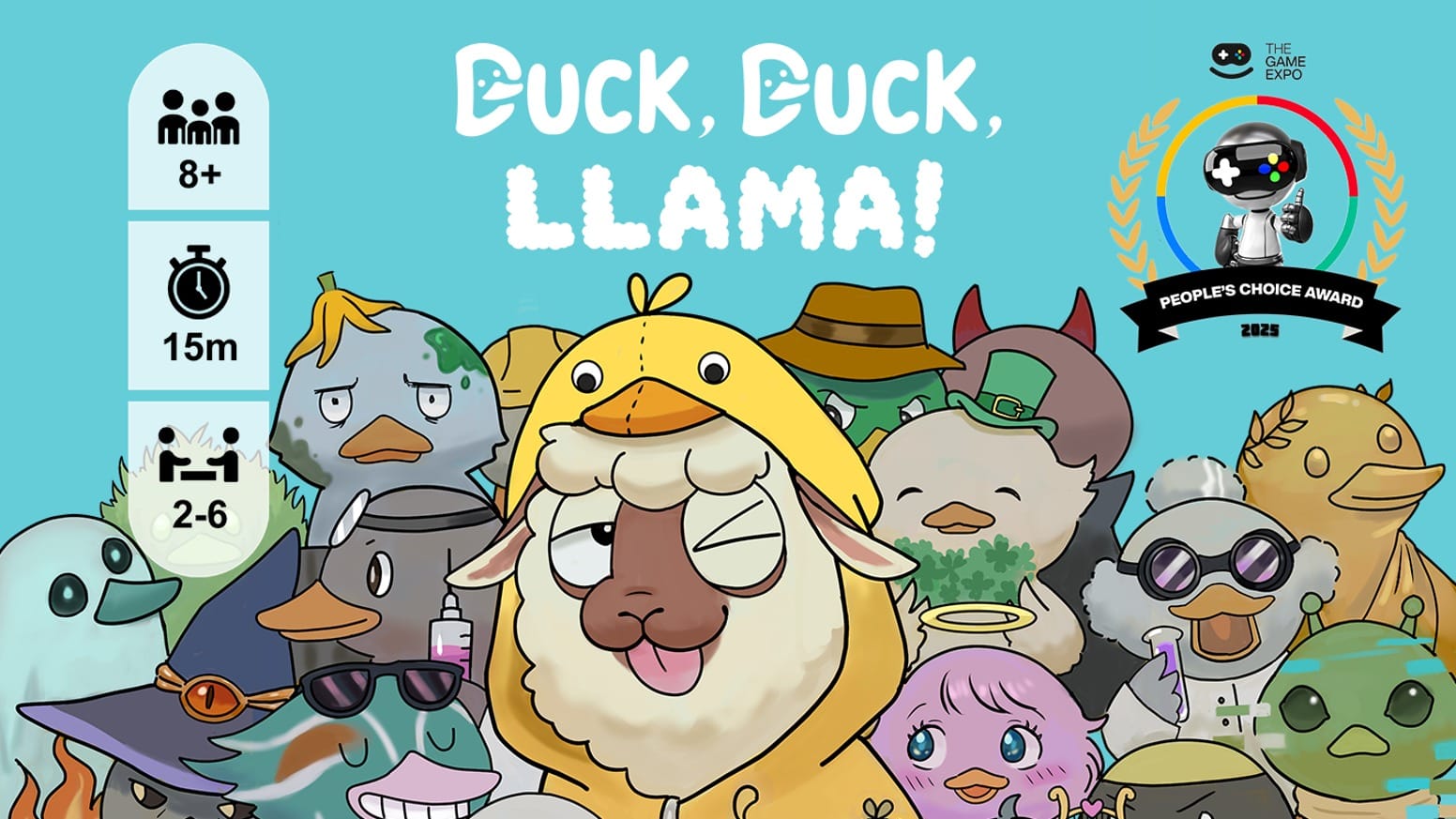
Die Kickstarter-Kampagne zu „Duck, Duck, Llama!“ endet heute, am 20. August 2026 um 17:01 Uhr MESZ (15:01 Uhr UTC). Das australische Studio Bizarre Studios aus Melbourne hat mit dem Party-Kartenspiel sein Finanzierungsziel von 10.000 AUD deutlich übertroffen: Stand jetzt stehen 19.639 AUD zusammen, das sind 196 Prozent des Ziels, getragen von 272 Unterstützenden.
Hot Potato mit Ablenkungsmanöver
Gespielt wird nach einem Hot-Potato-Prinzip mit mathematischem Dreh. Karten erhöhen oder senken „The Count“, die Anzahl der Enten im Spiel. Wer seinen Zug bei einem Count von 10 oder mehr beginnt, wird „angeklagt“ und muss sich mit einer passenden Karte freispielen oder eine Ablenkung auslösen, sonst fliegt die Person als Llama aus der laufenden Runde. Den Zusatz „The Party Game with No Eliminations“ trägt das Spiel nicht ohne Grund: Wer als Llama enttarnt wird, kann sich in einer der folgenden Runden zurückspielen, indem er selbst jemanden erfolgreich anklagt. Nach drei Runden gewinnen die verbliebenen „Ducktectives“.
Duck, Duck, Llama! ist ein Kartenspiel für 2 bis 6 Personen, dauert 10 bis 20 Minuten und ist ab 8 Jahren freigegeben, Familientauglichkeit ist erklärtes Ziel. Ein einzelner Lead Designer wird in der Kampagne nicht namentlich genannt, als Urheber tritt durchgehend das Studio Bizarre Studios auf. Wer nach einem weiteren chaotischen Kartenspiel für den Spieleabend sucht: Joking Hazard 2 lief erst kürzlich auf der Spieleschmiede.
Pledge-Stufen und Lieferung
Die Kampagne bietet vier Pledge-Stufen. „The Duck“ (27 AUD) bringt das Basisspiel mit 10 Prozent Rabatt plus digitalem Making-of-Booklet. „The Quacken“ (42 AUD) legt eine Anstecknadel und eine Folienkarte drauf. „The Llama“ (150 AUD) fügt weitere Folienkarten, eine limitierte Sammelkarte (1 von 110) und einen handschriftlichen Dankesbrief der Designer hinzu. Die Förderer-Stufe „The Chaz“ (2.500 AUD) richtet sich an Sammler und künftige Unterstützer weiterer Bizarre-Studios-Projekte. Der Versand geht weltweit, Kickstarter weist ausdrücklich darauf hin, dass Versandkosten, Steuern und Zoll erst nach Kampagnenende berechnet werden, das gilt auch für Backer in Deutschland. Die Auslieferung ist für Oktober 2026 angepeilt.
Auf BoardGameGeek (ID 462638) liegen bislang nur zwei Bewertungen vor, für eine Einschätzung der Spielqualität ist das zu dünn, ein Ranking gibt es entsprechend nicht. Eine deutschsprachige Ausgabe ist derzeit nicht bekannt. Als Kickstarter Staff Pick ist die Kampagne nicht ausgezeichnet.
Wer ein kurzes, chaotisches Partyspiel ohne Ausscheiden sucht und noch mitziehen will: Die Kampagne schließt heute, am 20. August 2026 um 17:01 Uhr MESZ. Danach ist nur noch der reguläre Handel eine Option, ein Termin dafür ist bislang nicht bekannt. Wer laufende Kampagnen im Blick behalten will, findet mehr davon in unserer Crowdfunding-Wochenschau.
Unstable Unicorns publisher Unstable Games has launched a new studio led by rising tabletop designer Marceline Leiman, who will shape its creative direction and design every game it releases for at least the next few years.
Ordinary Magic plans to publish light strategy board and card games set within a single expanding world, with Leiman telling BoardGameWire the studio is looking to put out designs “offering whimsical, magical moments of the everyday” alongside high interaction.
The move comes nine years after Unstable Games owner TeeTurtle’s hugely successful Kickstarter campaign for light card game Unstable Unicorns, which raised more than $1.8m from over 33,000 backers – and went on to sell more than a million copies worldwide by 2023.
The success of that release led to t-shirt maker TeeTurtle creating its dedicated tabletop studio Unstable Games, which has sold millions across its debut title and follow-up releases such as Here to Slay, Happy Little Dinosaurs, Casting Shadows and Twisted Cryptids.
Her route into professional board game design began with the 2023 release of her solo mode for North Star Games titles Oceans, which led to a part-time developer position at Underdog Games, as well as client work for Office Dog, WizKids, Allplay, Button Shy Games and Maestro Media, according to her website.
But Ordinary Magic represents her first full-time job in the industry, with Leiman saying the roots of the venture going back to the period immediately following the downsizing of Underdog in April 2025, when the publisher laid off almost its entire staff as it attempted to weather the impact of US tariffs.
She told BoardGameWire that Underdog president Nick Bentley, who was also let go by the company at that time, quickly introduced her to Unstable Games, with the pair initially planning to build the new operation together.
Bentley ultimately went in another direction before that arrangement was finalised and is now director of game design at Taco Cat Games, which rebranded from Dolphin Hat Games in May to reflect the huge success of its standout title.
Leiman said, “We both were fully intending to start up a new studio within Unstable Games. The proposition was always that they were going to do sort of an incubator program, is the way that they proposed it to us.”
She added, “My role within the studio was always going to be the capacity of being a game designer. Only now with Nick no longer part of the project, it has allowed me to take more of a formal leadership role.”
Leading the line
The resulting structure puts Leiman’s work at the centre of the studio, rather than positioning Ordinary Magic as a conventional publisher or imprint sourcing games from a roster of designers.
She told BoardGameWire, “Every single game that comes out of Ordinary Magic is a design of mine. I am the designer of each of the games coming from the studio, and you should expect that at least for the next several years.
“That does not mean that you won’t ever see a game from anyone else besides me from Ordinary Magic. But think of me as the shepherd of the studio.
“I am leading the direction of the design behind Ordinary Magic and the types of games you should expect, and the feelings from the games that you should expect. But I am absolutely open to that changing; it’s not a hard rule.”
Leiman added that although she is not currently accepting game pitches, she is “always interested in learning what designers are working on, both those I am familiar with and unfamiliar with”.
She told BoardGameWire, “I love sharing ideas, and I think the spirit of design is still very much open in terms of the way I like to talk with other designers. I always want to consider whether or not in the future, an opportunity is available between Ordinary Magic and a designer looking to pitch their games.
“However, I cannot promise at this time that we are accepting any pitches that we might receive. If I were to look at any pitches, what I’ve described in the past is that Ordinary Magic is looking for games that are offering whimsical, magical moments of the everyday. Not high magic, not combative, though highly interactive.
“I think if someone wanted to pitch to me a game with a theme that was more focused on a curious bit of a real-life moment that inspired them, that would interest me more than somebody who’s coming to me with a pitch purely with a magical concept. I am much more interested in the grounded reality of this world rather than the high fantasy.”
Finding direction
Leiman said the studio’s creative direction would be to create interactive games which give “meaningful reason for other players to be at the table with you”, but added that would likely not extend to full “take-that”-style designs.
She said, “What you should expect from us is strategy-light strategy style games, sometimes card games, sometimes board games. I am also very interested in exploring the realms of cooperation as well as indirect player interaction, or both direct and indirect forms of player interaction.
“Something that you’ll find from me is that I am very interested in sort of passive aggression in games, where the decisions I am making might be to block you or to prevent you from getting something before me. A very old-school style of interaction, German old-school I think some people would think about.”
Leiman said the original plan had been to launch the games individually, but that Unstable ultimately proposed putting all three into the same campaign after their development schedules aligned – a situation which partly arose due to Leiman’s rapid work rate.
The Curious Little Bookshop || Gamefound image
She told BoardGameWire, “The method that I was taught game design was very much under the tutelage of my professors at NYU Game Center, and there we worked very much within a fast-paced work environment.
“Joining this studio very much is like returning back to that environment, which I am very comfortable being in. The way that I’ve worked within the studio is quite fast, is quite rapid, I guess, in relation to other people’s speeds.
“But for me, within a short amount of time, what I am looking to do is try out many ideas and fail with many ideas as quickly as possible, so I could find the core of what is fun, what is interesting, what is memorable about a game.
“It just so happened to align with our release schedule that I would have these three games. Our original plan was to release them one by one, but just with the way that scheduling worked out, we decided that it would be best to put our best foot forward with this new studio by showing the strength of our design, with the strength of our art, and production capabilities.”
Operationally, however, Ordinary Magic is currently far less separate from its parent studio than its distinct branding might suggest.
“The only difference between Ordinary Magic and Unstable Games in terms of operation is me,” Leiman told BoardGameWire.
She added, “Everything that you’ve come to expect from me – my work ethic, my taste, my voice – you should expect to be part of these games.
“Not to say that I don’t work with the Unstable Games team as well. We actually do cross-pollinate a lot in terms of our playtesting, in terms of our conversations, in terms of problem-solving.
“So it’s not like I’m totally in a silo or and neither are they from me. There’s definitely a lot of creative support going back and forth between the two studios. And as the studio continues to develop and grow in size, naturally Ordinary Magic will change with it.”
Speaking about the shared world envisaged by Ordinary Magic for all of its releases, Leiman told BoardGameWire, “You should not expect to see any games released from Ordinary Magic that are not part of this world.
“We’ve talked a lot about what that means in terms of building the IP, sort of what direction could it go in the future? Does it open us to different forms of media, different forms of games, or are they all going to be board games and card games?
“We’re leaving that station open right now. But we’re definitely open to exploring what it means to have this IP as we look forward to the future.
“As for recurring characters and locations, I would say keep your eyes open for the GameFound campaign, and I think you’ll be very excited to see some crossover moments between them.”
Die Kalenderwoche 34 fällt mitten in die Sommerpause, und das merkt man dem Crowdfunding-Kalender an. Zwischen Gen Con und Messevorbereitung haben Gamefound und die Spieleschmiede in den vergangenen sieben Tagen keine frische Brettspiel-Kampagne mit echtem Neuigkeitswert nachgelegt. Auf Kickstarter dagegen sind zwei sehr unterschiedliche Titel neu an den Start gegangen: ein akten-getriebenes Horror-Ermittlungsspiel und ein Beutelbau-Strategiespiel um einen verwunschenen Wald. Wir sortieren, was sich lohnt, und benennen, wo diese Woche schlicht nichts Neues zu holen ist.
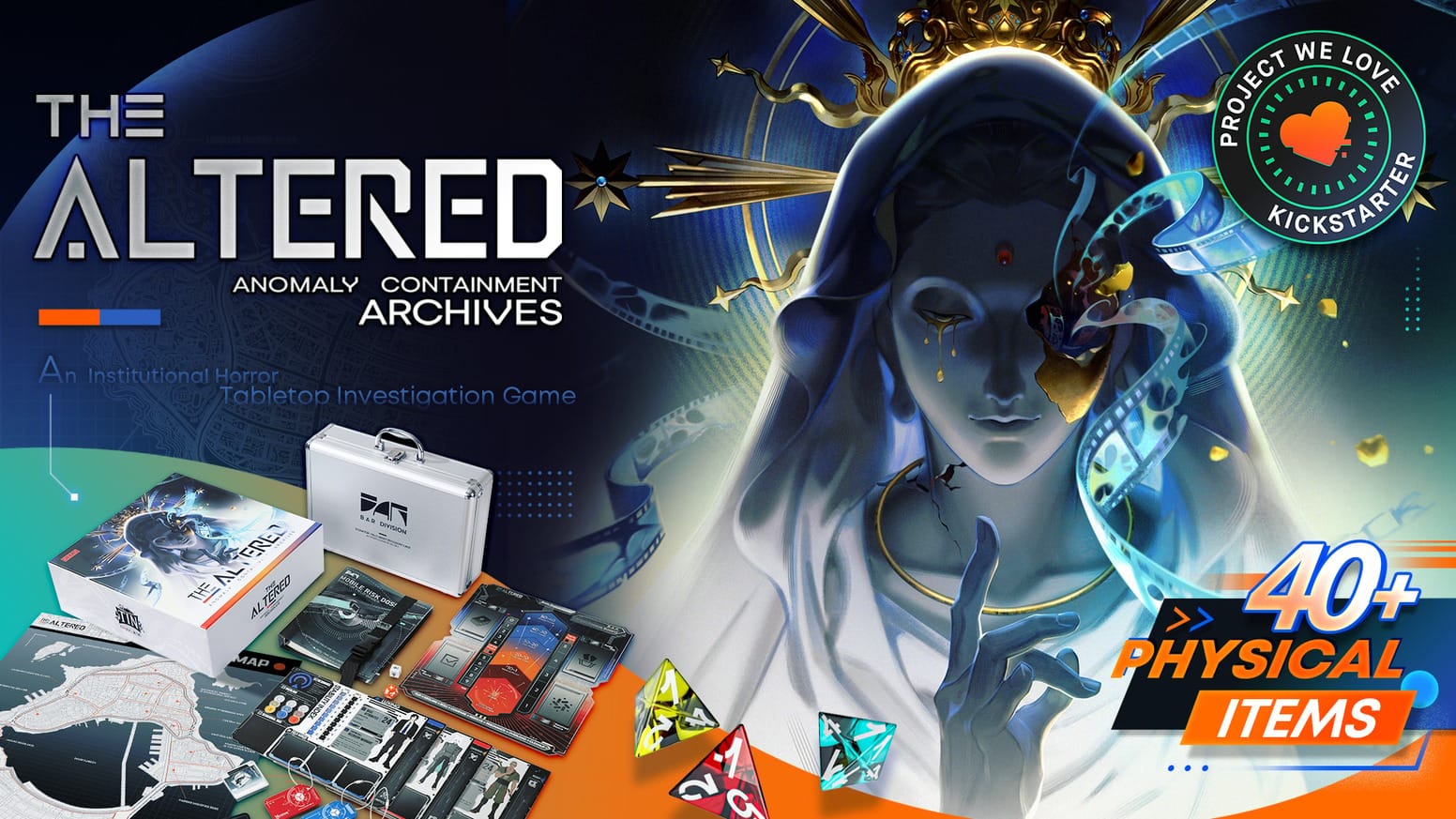
The Altered: Anomaly Containment Archives
The Altered: Anomaly Containment Archives ist seit dem 11. August live und hat sein Ziel um mehr als das 25-Fache übertroffen: rund 2 Millionen Hongkong-Dollar (umgerechnet etwa 230.000 Euro) von knapp 900 Unterstützern. Die Kampagne läuft noch bis zum 10. Oktober.
Im Kern ist The Altered ein kooperatives Dossier-Spiel für einen bis vier Spieler. Ihr schlüpft in die Rolle von Prüfkommissaren einer Behörde und öffnet nacheinander sieben verschlossene Fallakten. Ihr untersucht physische Beweisstücke, gleicht widersprüchliche Aussagen ab, entschlüsselt versteckte Informationen und rekonstruiert das Leben von Personen, die mit einem unerklärlichen Vorfall verbunden sind.
Am Ende jedes Falls fällt ihr ein bindendes Urteil: Wer ist noch Mensch, wer gilt als „verändert" und was muss weggesperrt werden. Diese Entscheidungen sind keine Sackgassen. Über verzweigte Wege und eine Beutelverwaltung mit verdeckten Marken tragen sich die Folgen eurer Urteile in spätere Fälle. Kommt es zu einem Ausbruch, wird er über taktisches Kartenspiel aufgelöst, einen Spielleiter braucht es nicht.
Für den deutschen Markt gibt es bislang keine Angabe zu einer Lokalisierung. Das Spiel setzt stark auf Texte und Ephemera, eine deutsche Ausgabe wäre also Voraussetzung für einen Sprachwechsel. Die Kampagne schweigt dazu, wir tragen das nach, sobald es Neues gibt.
Eckdaten:
Verlag: Tin Universe
Autor: Theo Z. Zhao
Spieleranzahl: 1 bis 4
Spielzeit: 45 bis 60 Minuten
Alter: ab 14 Jahren
Genre: kooperatives Ermittlungs- und Horror-Spiel mit Kampagne
Finanzierung: rund 2 Mio. HKD, etwa 2.547 Prozent des Ziels (Stand 17. August)
Aufnahmekriterium: neu gestartet in den letzten sieben Tagen und mit über 2.500 Prozent des Ziels deutlich überfinanziert.
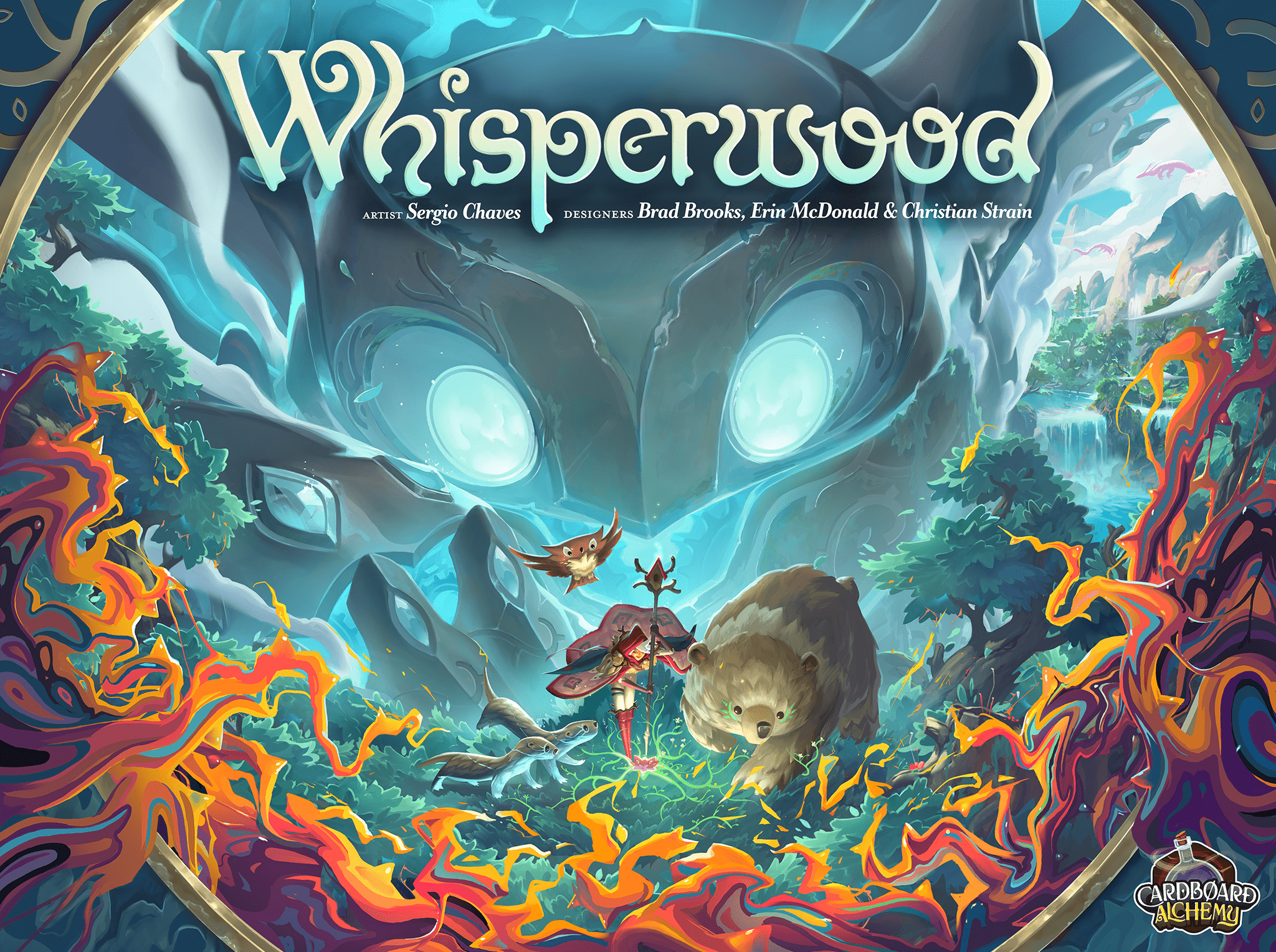
Whisperwood
Whisperwood von Cardboard Alchemy ist der zweite Neustart der Woche, ebenfalls seit dem 11. August live und aktuell bei rund 405 Prozent (etwa 405.000 US-Dollar, über 2.000 Unterstützer). Die Kampagne läuft noch bis zum 2. September.
In Whisperwood zieht ein Rat von Druiden in einen Wald, den ein dunkler Zauberer verdorben hat, und reinigt ihn Stück für Stück. Spielerisch ist das ein Beutelbau für einen bis vier Spieler: Ihr zieht Marken aus eurem Beutel, baut ihn planvoll aus und müsst zugleich mit einer störenden Verderbnis im Beutel umgehen.
Wir haben Whisperwood diese Woche bereits ausführlich vorgestellt. Mechanik, Eckdaten und eine Einordnung findest du in unserem eigenen Artikel zur Kampagne.
Aufnahmekriterium: neu gestartet in den letzten sieben Tagen, über 400 Prozent finanziert und mit mehr als 100.000 US-Dollar Volumen relevant.
Was auf Gamefound und der Spieleschmiede fehlt
Zur Einordnung gehört auch, was nicht läuft. Auf Gamefound sind die Sommer-Kampagnen inzwischen überwiegend abgeschlossen, und ein frisch gestartetes Brettspiel mit klarer Relevanz für deutsche Spieler war in dieser Woche nicht darunter. Die Spieleschmiede hat in den vergangenen sieben Tagen keine neue Kampagne nachgelegt, die zuletzt dort geförderten Titel sind bereits beendet. Beides ist saisonüblich: Zwischen Gen Con und der Vorbereitung auf die Herbstmesse halten sich viele Verlage mit Starts zurück.
Ausblick auf die kommende Woche
Ganz ruhig bleibt es nicht. Garphill Games kündigt für den 18. August eine gemeinsame Kickstarter-Kampagne für zwei Erweiterungen an: Omens und Headlands zu „Raiders of Scythia" und „Skara Brae". Beide Grundspiele gibt es auf Deutsch, entsprechend dürften die Erweiterungen auch hierzulande ein Thema werden. Wir schauen sie uns in der nächsten Ausgabe an.
Angekündigt: Neu: Updates: Zur Zeit ist eher „Saure Gurkenzeit“ im Crowdfundingbereich. Rund um die Gen Con sind kaum neue Projekte gestartet worden. Daher auch nur kleinere Updates und ein paar neue Live-Projekte. ANGEKÜNDIGT In der kommenden Woche im Crowdfunding: Sommerpause. Es sind einige wenige Projekte angekündigt. Hier der Überblick über die kommende Woche und den […]
Ein Rat von Druiden zieht in einen Wald, den ein dunkler Zauberer verdorben hat, und soll ihn Stück für Stück reinigen. Whisperwood von Cardboard Alchemy setzt diese Geschichte als Beutelbau-Spiel um, das aktuell auf Kickstarter läuft, und richtet sich an Kennerspieler und Vielspieler, die ihren Beutel planvoll aufbauen und zugleich mit einer störenden Verderbnis umgehen wollen.
Was man in Whisperwood tut
Im Kern ist Whisperwood ein Beutelbau-Spiel (im Original Bag-Builder). Wie beim verwandten Deckbau ziehen Sie nicht Karten aus einem Stapel, sondern Chips aus einem Beutel, verbessern diesen Vorrat über die Partie und versuchen, ihn Runde für Runde schlagkräftiger zu machen. Die zentrale Spannung sitzt dabei im Thema: Der Wald ist von Verderbnis (im Original corruption) durchsetzt, und diese Verderbnis müssen Sie aufnehmen und reinigen. Wer zu viel davon mit sich herumträgt, schwächt die eigenen Fähigkeiten. Der Beutel ist also kein reines Aufwerten, sondern eine laufende Abwägung, wie viel Belastung man sich zumutet, um den Wald voranzubringen.
Rund um den Beutel legt Cardboard Alchemy weitere Systeme. Laut der Mechanik-Auflistung auf BGG kombiniert Whisperwood geschlossenes Drafting (Closed Drafting), simultane Aktionswahl, Tech-Trees beziehungsweise Fortschrittsleisten, einen variablen Aufbau und Boni in der Endwertung. Thematisch erwecken die Druiden Wächter-Golems und stellen Flora und Fauna wieder her; wer im Rat am meisten leistet, wird am Ende zum Primus gekürt. Die simultane Aktionswahl deutet darauf hin, dass alle Mitspielenden zugleich planen, was die Wartezeiten zwischen den Zügen kurz halten dürfte.
Verlag und Designer hinter Whisperwood
Verantwortlich ist der US-Verlag Cardboard Alchemy aus Burbank, Kalifornien. Als Designer nennt die Kampagne Brad Brooks, Erin McDonald und Christian Strain. Die Illustration stammt von Sergio Chaves und Sandara Tang.
Eckdaten zu Whisperwood
Punkt
Angabe
Spielerzahl
1 bis 4 (laut Kampagne inklusive Solo-Modus)
Spielzeit
rund 50 bis 200 Minuten
Alter
ab 14 Jahren
Genre
Beutelbau-Strategiespiel
Verlag
Cardboard Alchemy (USA)
Zwei Punkte gehören offen benannt. Erstens die Spielerzahl: Die laufende Kampagne bewirbt 1 bis 4 Spielende samt Solo-Modus, ein älterer Beschreibungstext auf BGG spricht dagegen von 2 bis 4. Wir richten uns nach der aktuellen Kampagnen-Angabe. Konkrete Details, wie der Solo-Modus funktioniert, nennt die uns vorliegende Quellenlage allerdings nicht; wer allein spielen möchte, findet dazu bislang keine belastbare Beschreibung. Zweitens die Spielzeit: Die Spanne von 50 bis 200 Minuten ist sehr weit und dürfte stark von der Spielerzahl abhängen, eine genauere Staffelung liegt uns nicht vor.
Die Kickstarter-Kampagne: Stand und Pledge-Stufen
Zum Snapshot am 14. August 2026 hat Whisperwood sein Finanzierungsziel klar übertroffen: Bei einem Ziel von 100.000 US-Dollar standen rund 351.000 US-Dollar zu Buche, das sind etwa 351 Prozent, getragen von 1.761 Unterstützenden. Kickstarter führt das Projekt als Staff-Pick. Die Kampagne läuft nach Angaben der Seite bis zum 2. September 2026, die geplante Auslieferung nennt der Verlag für April 2028. Solche Crowdfunding-Zahlen sind ein Signal für Aufmerksamkeit, aber kein Gütesiegel für die spätere Spielqualität; ausgeliefert wird erst in gut anderthalb Jahren.
Bei den Pledge-Stufen trennt Cardboard Alchemy klar zwischen Umfang und Ausstattung. Die Standardversion OWL beginnt bei 99 US-Dollar und liefert das Grundspiel. OTTER ab 149 US-Dollar ist die Deluxe-Variante mit hochwertigerer Ausstattung. BEAR ab 299 US-Dollar bündelt die Deluxe-Version mit Add-ons und Golem-Miniaturen und zielt damit auf Sammler. Wer zunächst nur reservieren möchte, kann über ein Retail-Deposit von 50 US-Dollar einsteigen. Der spielerische Kern ist in allen Stufen derselbe; oberhalb von OWL zahlen Sie vor allem für Material und Extras, nicht für zusätzliche Regeln.
Was für deutsche Leser offen bleibt
Für deutsche Spielerinnen und Spieler bleiben zwei Fragen ungeklärt. Ob es eine deutschsprachige Ausgabe oder Lokalisierung gibt, geht aus den vorliegenden Quellen nicht hervor. Und der Versand ist laut Kampagne auf bestimmte Länder beschränkt, ohne dass die uns vorliegenden Daten belegen, ob Deutschland dazugehört. Wer mitfinanzieren will, sollte vor dem Pledge die Versand- und Sprachangaben direkt auf der Kampagnenseite prüfen. Auch bei den Stretch Goals gilt Zurückhaltung: Die Kampagne unterscheidet zwar zwischen Gameplay-Stretch-Goals, die die Mechanik erweitern, und Deluxe-Stretch-Goals, die Komponenten aufwerten. Welche einzelnen Ziele bereits freigeschaltet sind, geht aus den uns vorliegenden Daten jedoch nicht hervor.
Unser Ersteindruck
Whisperwood verbindet einen vertrauten Motor, den Beutelbau, mit einer thematisch verankerten Bremse, der Verderbnis, und genau in dieser Abwägung liegt der Reiz. Ob das System auf Dauer trägt und wie fordernd der Solo-Modus ausfällt, lässt sich vor dem Erscheinen nicht beurteilen. Für deutsche Interessenten ist der wichtigste offene Punkt schlicht, ob Spiel und Versand hierzulande überhaupt ankommen. Ein Blick auf die Kampagnenseite vor dem Pledge lohnt sich in jedem Fall.
Africa’s longest-running board game convention is hoping to use its tenth anniversary to put more direct support behind the continent’s emerging designers, with plans for a new grant programme if its latest crowdfunding campaign reaches $20,000.
The November 27 and 28 event in Abuja will include prototype playtesting, workshops, industry discussions, networking and a marketplace alongside its consumer-facing game demonstrations and tournaments, according to organiser NIBCARD Games.
But potentially more significant for Africa’s developing board game industry are the additions AB Con hopes to unlock if the campaign moves beyond its base target.
Reaching $20,000 would launch an AB Con Designers Grant, providing financial support and mentorship to African tabletop designers to develop prototypes, improve their games and showcase them at future editions of the convention.
A $22,000 stretch goal would introduce an Impact Award recognising people and organisations helping develop the continent’s tabletop ecosystem, while $30,000 would extend this year’s convention from two days to three.
The campaign describes the designer grant as an attempt to create “more opportunities for African games to reach local and international audiences”.
That represents another step in a decade-long attempt by AB Con and organiser NIBCARD to build infrastructure around what was an extremely small modern tabletop design community when the convention began.
AB Con says there were fewer than 10 known indigenous tabletop games and only three published game designers in Nigeria before it launched in 2016, with few places available for people to regularly play modern board games.
BoardGameWire reported last year that the number of known modern games from Nigerian designers had since passed 100, while the number of designers had grown to 25.
AB Con has provided a crucial meeting point and catalyst during that expansion, bringing together designers and publishers alongside manufacturers, retailers, educators and players.
Gamers, publishers, designers and organisers at AB Con 2025 || Photo Credit: AB Con
Nigerian board game company NIBCARD’s role in developing that ecosystem was recognised with the Diana Jones Award for Excellence in Gaming in 2021.
The award committee described the company as being “the multi-faceted company at the heart of the nascent Nigerian games industry”, highlighting its work publishing games, manufacturing for other companies, mentoring designers, running a game café and organising AB Con.
NIBCARD itself says it has now designed more than 70 tabletop games since being founded in 2013, while its activities have expanded across publishing, manufacturing, education and digital games.
While those efforts have proved a pillar of the region’s hobby gaming growth, NIBCARD and AB Con founder Kenechukwu ‘KC’ Ogbuagu told BoardGameWire there were still large challenges around getting Nigerian and African designers and games to break into North American and European markets.
He said, “It’s a combination of several factors, but I would highlight visibility, access, finance, and market access.
“There is a significant lack of visibility for African games and designers. Publishers often don’t get to see the games being created here, while designers have very limited opportunities to meet and build relationships with publishers.
NIBCARD and AB Con founder Kenechukwu ‘KC’ Ogbuagu
“I have experienced this personally. I once received fully funded support to attend Spiel Essen, but was denied a visa. Last year, I was invited to GothCon on a fully funded trip, but I couldn’t even secure an interview date for my visa application.
“Finance is another major barrier. Even when a game is ready, designers need money to market it, work with content creators and reviewers, attend international conventions, and run crowdfunding campaigns such as Kickstarter or Gamefound.
“And for those who choose to self-publish, international shipping can make African games extremely expensive and difficult to compete with in global markets.”
He added, “One of our mission is to see African designers creating games that are enjoyed globally and, ultimately, seeing African-designed games recognised among the best games in the world.
“We have already started working towards this. Last year, with support from the Spiel Foundation, we showcased games from three African designers at SPIEL Essen 2025. We also started a game studio as a way to bring African games to light.
“But even as we build, from over 10 years of experience doing this, a lot of the impact are limited due to lack of funding.
“We are intentionally building AB Con to become a platform where African designers, games, publishers, distributors, and international industry professionals can connect.
“We want publishers from North America and Europe to see AB Con as a place to discover new designers and games from Africa, explore licensing and publishing partnerships, and build long-term relationships with the African tabletop industry.
“This is one reason we are committed to maintaining a two-day convention going forward, with the goal of eventually growing it into a four-day event. We want to create enough time and space for meaningful meetings, playtesting, networking, showcases, and publisher scouting.”
The growing scope of AB Con has repeatedly run up against the economics of staging the convention, however.
Its new $14,000 base target represents another substantial increase. Organisers said the higher figure reflects both inflation and the cost of restoring AB Con’s two-day format, and will be used for venue and production costs, volunteer support, logistics, marketing, accessibility and expanded programming.
Nigeria continues to experience significant price increases, despite inflation having eased substantially from the levels that prompted AB Con’s return to crowdfunding.
The country’s National Bureau of Statistics currently reports annual consumer price inflation of 15.9% – down markedly from an almost 30-year high of 34% when AB Con launched its 2024 campaign.
Last year’s AB Con campaign was initially intended to support ambitions for as many as 3,000 attendees, compared with roughly 1,300 at the 2024 event and about 1,000 in 2023. The 2025 convention ultimately took place as a one-day event on November 29.
At least seven Nigerian designers showcased projects at the 2025 convention, according to Nigeria’s Independent newspaper, while participating publishers included Althra Games, ICE Game and Jesus Native Games.
AB Con founder and lead convener Kenechukwu ‘KC’ Ogbuagu said, “When we hosted the first AB Con in 2016, our dream was bigger than organizing an event – we wanted to help build an industry.
“Ten years later, we’ve seen designers launch original games, communities grow across Africa, and more people recognize games as powerful tools for learning, culture, business, and connection.
“This anniversary is not only a celebration of how far we’ve come but an invitation for the world to help shape what comes next.”
The AB Con Kickstarter is live now, with the convention scheduled to take place in Abuja, Nigeria on November 27 and 28.
Ein unabhängiges Studio will das Gefühl klassischer Echtzeit-Strategie auf den Spieltisch holen: Basisbau, Ressourcenabbau, Tech-Baum und Superwaffen. Red Alert: New World Order von Wolf Storm Entertainment läuft auf Gamefound und ist ein ambitioniertes Miniaturen-Wargame, das viel verspricht und noch mitten in der Umsetzung steckt.
Worum es geht
Das Spiel entwirft ein alternatives Szenario des Zweiten Weltkriegs. Ein Bündnis aus Allianz-Nationen tritt gegen einen Sowjetblock an, angereichert mit Science-Fiction-Technologie: Tesla-Waffen, Aurora-Bomber und eine Iron-Shield-Verteidigung. Thematisch bewegt sich der Titel zwischen Wargame, Miniaturenspiel und einem Hauch Videospiel-Nostalgie. Auf Boardgamegeek ist Red Alert: New World Order mit Erscheinungsjahr 2026 gelistet.
Wichtig für die Einordnung: Der Eintrag zeigt bislang null Community-Bewertungen. Es handelt sich also um einen Vorschau-Titel, nicht um ein etabliertes Spiel mit belastbarem Urteil der Spielerschaft. Was hier steht, beruht auf den Angaben des Verlags und der Kampagne, nicht auf breiter Spielerfahrung.
Was man am Tisch tut
Mechanisch setzt Red Alert: New World Order auf ein Geflecht bekannter Wargame-Bausteine. Laut Boardgamegeek gehören dazu Würfeln mit Symbolauswertung, Rasterbewegung auf dem Spielfeld, ein Einkommens- und Ressourcensystem, mehrere Spielpläne (Multiple Maps), Kontrollzonen (Zone of Control), Spielereliminierung sowie eine rollenbasierte Zugreihenfolge. Über allem liegt ein Tech-Baum, über den Sie im Spielverlauf stärkere Einheiten und Technologien freischalten.
Der rote Faden ist das Echtzeit-Strategie-Vorbild in Brettspielform: Sie bauen eine Basis auf, fördern Ressourcen (in der Kampagne sind Seltene Erden ein Thema), steigen im Tech-Baum auf und setzen am Ende Superwaffen ein. Jede Nation bringt laut Kampagne einen eigenen Passivbonus von zehn Prozent mit, etwa schnellere Produktion oder mehr Feuerkraft. Das soll die Fraktionen asymmetrisch machen. Wie stark diese zehn Prozent eine Partie wirklich prägen, worauf genau sie sich beziehen und ob daraus echte strategische Unterschiede entstehen, sagt die Kampagne bislang nicht. Ob hinter dem Bonus mehr als ein dekorativer Vorteil steckt, lässt sich vor einem Pledge nicht sicher beurteilen.
Beeindruckend fällt vor allem der Materialrahmen aus. Die Kampagne wirbt mit sehr großen Spielplänen von bis zu rund 47,2 mal 31,5 Zoll, doppelseitigen Schlachtfeldern, zerstörbaren Brücken, Städten, Schnee-Gelände und Seegefechten bis hin zu einer Europa-Kampagne. Dazu kommen viele Miniaturen. Das ist der Reiz und zugleich das Risiko dieses Projekts, dazu unten mehr.
Wie sich eine Partie zwischen zwei und sechs Spielern verschiebt, bleibt bislang offen. Die Spanne von 90 bis 300 Minuten deutet auf sehr unterschiedliche Szenarien hin, eine klare Orientierung für die Dauer einer typischen ersten Partie gibt die Kampagne aber nicht. Auch zur Wartezeit zwischen den Zügen in voller Besetzung schweigt sie.
Eckdaten
Verlag: Wolf Storm Entertainment (unabhängiges Studio)
Designer: Krešimir Turčić
Spielerzahl: 1 bis 6
Spielzeit: 90 bis 300 Minuten
Alter: ab 14 Jahren
Modi: kompetitiv, kooperativ, solo
Erscheinungsjahr laut Boardgamegeek: 2026
Solo-Modus und Kooperativ-Modus
Boardgamegeek führt neben dem kompetitiven Spiel ausdrücklich auch einen Solo- und einen kooperativen Modus. Einen Solo-Modus gibt es also. Wie er konkret funktioniert, welche Gegner-KI oder welches Szenario-Gerüst ihn trägt, kommuniziert die Kampagne bislang nicht in verwertbarer Textform. Diese Lücke benennen wir hier offen, statt einen Ablauf zu erfinden. Wer vor allem allein oder kooperativ spielen will, sollte den Solo-Modus als offene Frage behandeln und vor einem Pledge gezielt beim Verlag nachfragen.
Die Nähe zu Command & Conquer: Red Alert
Titel und Motive erinnern deutlich an das Videospiel-Franchise Command & Conquer: Red Alert von Electronic Arts: Allianz gegen Sowjets, Tesla-Waffen, Aurora-Bomber, das ganze Echtzeit-Strategie-Gefühl. Diese Nähe ist offensichtlich, und der Verlag spricht sie selbst an. Laut einem Kampagnen-Update vom 15. Mai 2025 seien vertrauliche Gespräche mit Electronic Arts einvernehmlich abgeschlossen worden; das Spiel bleibe ein eigenständiges Werk von Wolf Storm Entertainment. Wir geben das neutral und als Verlagsaussage wieder. Eine eigene rechtliche Bewertung nehmen wir nicht vor. Festhalten lässt sich nur: Die Anlehnung an das bekannte Vorbild ist gewollt sichtbar, und der Verlag stellt sie nicht in Abrede. Videospiel-Marken den Sprung auf den Tisch versuchen zu lassen, ist kein Einzelfall: Zuletzt kündigte sich eine andere Videospiel-Umsetzung auf Gamefound an.
Eine warme Randnotiz liefert der Studioname. Wolf war laut Verlag ein Alaskan Malamute, also der Hund des Teams, und Namensgeber des Studios. Ein eigenes Update ist ihm als Hommage gewidmet. Mehr Bedeutung muss man dem Detail nicht geben, sympathisch ist es trotzdem.
Ambitioniert und noch im Werden
Red Alert: New World Order ist ein Projekt mit langer, holpriger Kampagnen-Historie. Es gab Relaunch-Phasen (unter anderem ein Update mit dem Titel "COMMANDERS, WE ARE BACK") und fortlaufende Enthüllungen einzelner Spielpläne bis ins Jahr 2026. Ein unabhängiges Studio, das sehr viele Miniaturen und ausladende Spielpläne stemmen will, trägt ein spürbares Umsetzungs- und Lieferrisiko. Wie viel Logistik in solchen Miniaturen-Projekten steckt, zeigt etwa eine ebenso miniaturenlastige Gamefound-Kampagne. Das ist keine Wertung gegen das Team, sondern die nüchterne Beschreibung dessen, was hier vorliegt: ein großer Wurf, der sich noch beweisen muss. Auch zum Designer Krešimir Turčić und seiner bisherigen Ludografie liegen uns keine gesicherten Angaben vor, was den Titel zusätzlich als weitgehend unbeschriebenes Blatt einordnet.
Zum Redaktionszeitpunkt liegen uns keine zuverlässigen Funding-Zahlen vor. Finanzierungsstand, Zahl der Unterstützer, Zielsumme, Laufzeit und die Pledge-Preise waren über die Gamefound-Seite nicht sauber auslesbar. Wir verzichten bewusst auf Schätzungen. Auch die konkrete Liste der Stretch Goals können wir nicht verifizieren. Wo Sie solche Ziele prüfen, lohnt der zweite Blick, ob es sich um mechanisch relevante Inhalte (neue Einheiten, Regeln, Szenarien) oder um reine Komponenten-Aufwertungen (hochwertigere Marker, zusätzliche Minis) handelt. Beides hat Wert, aber nur das Erste verändert das Spiel am Tisch.
Was das für deutsche Spieler heißt
Eine bestätigte deutsche Ausgabe gibt es nach unserem Kenntnisstand nicht. Zu deutscher Lokalisierung, zum Vertrieb im deutschen Handel und zu einem Preis in Euro liegen keine gesicherten Angaben vor. Wer hierzulande mitliest, sollte den Titel derzeit als englischsprachiges Projekt behandeln und eine deutsche Fassung nicht voraussetzen.
Unser Ersteindruck: Red Alert: New World Order ist ein reizvolles Versprechen für alle, die große Wargames und das Echtzeit-Strategie-Gefühl mögen. Die Mischung aus Basisbau, Tech-Baum und asymmetrischen Fraktionen klingt stimmig, der Materialumfang ist enorm. Genau dieser Umfang macht aber auch vorsichtig: Bei einem unabhängigen Projekt mit dieser Ambition entscheidet die Umsetzung über alles. Interessierte sollten offene Punkte (Solo-Modus, Funding-Status, Lieferplan, deutsche Fassung) vor einem Pledge klären und die Hotness des Titels nicht mit einem fertigen Urteil verwechseln. Wir behalten weitere Gamefound-Kampagnen im Blick.

 Anmelden