Toriki ist ein interaktives Familienabenteuer auf der Insel. Mitmachen können 1-4 Personen ab 8 Jahren. Es stammt von Wojciech Grajkowski und ist bei Mirakulus erschienen. Worum geht es bei Toriki?…
Es gab eine Zeit, da war der schriftliche Brettspieljournalismus die einzige Möglichkeit, sich unabhängig über Brettspiele zu informieren. Angefangen mit EUGEN OKERS Spielerezensionen in der ZEIT ab 1964, schossen ab Ende der 1970er/Anfang der 1980er Zeitschriften und Zines aus dem Boden. Play by Mail erlaubte Partien mit Gleichgesinnten auch über große Distanzen. Mit der Etablierung des Internets…
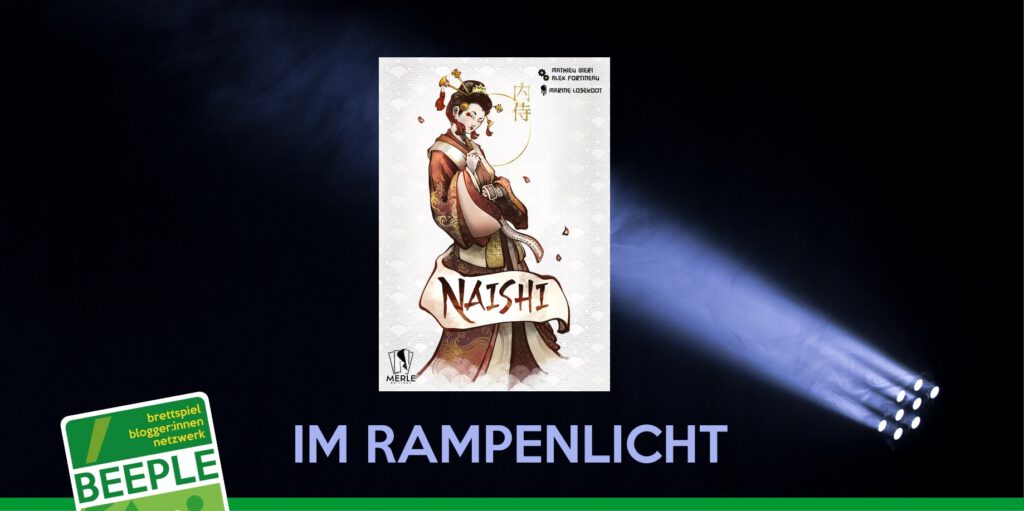
Naishi | Mathieu Bieri & Alex Fortineau | 20 Minuten | 2 Personen | Board Game Circus
In Naishi werden die Spielenden versuchen, ihren japanischen Staat so effizient wie möglich zu verbessern. Sie können die Position ihrer Karten jedoch nicht beliebig ändern. Sie müssen die Karten in ihrer Hand und in ihrem Tableau durch Karten aus dem zentralen Fluss ersetzen und dabei ihre Position respektieren. Sie haben auch die Möglichkeit, ihre Abgesandten zu schicken, um Staaten neu zu organisieren, neue Möglichkeiten zu schaffen oder die gegnerische Person zu einem Handel zu zwingen. Zwei-Personen-Spiele sind in den letzten Jahre stärker in den Fokus gerückt und zu einem kleinen Trend in der Szene geworden. Warum Naishi aus diesen durchaus heraussticht, erklären einige Mitglieder des Beeple Netzwerks im aktuellen Rampenlicht.
Oli (Alles außer Toplisten) In Naishi gilt: Was im Raster liegt, das liegt und bringt Punkte. Die eigentliche Aufgabe ist es somit, die unterschiedlichen Karten mit den verschiedenen Wertungen an ihre beste Position zu tauschen. Das japanische Thema, das um das 2-Personen-Spiel gestrickt wurde, macht mich in dem Gerangel um die meisten Punkte zwar nicht zur namensgebenden Hofdame, sorgt aber dafür, dass ich das Duell mit meinem Gegenüber durchaus einen Touch von historischem Fernost spüre.
Frederik (Boardcast) Naishi begeistert mich mit ganz viel Spiel in einer kleinen Schachtel. Der Kniff, dass ich einen Teil der Auslage meines Gegenübers kenne und somit eine Idee habe, was er oder sie vorhat, gleichzeitig aber die Hand eben nicht kenne, bringt taktische Tiefe und spannende Entscheidungen. Die Aktionsplättchen, die mich Karten innerhalb einer Auslage und miteinander tauschen lassen, sind immens wichtig und hier braucht es ein gutes TIming, um oft entscheidende Karten auf der Hand zu bunkern und erst spät in die offene Auslage zu bringen. Ich habe etliche Partien gespielt und freue mich auf jede weitere. Mit diesem Spiel konnte ich schon einige Kennerspieler:innen begeistern und habe es schnell zur Hand, wenn ich eine spannende Zweierpartie spielen möchte. Herausheben möchte ich noch die exzellente graphische Gestaltung und die Bildsprache, die – nach anfänglichem Kennenlernen – schnell keine Fragen mehr offen lässt. Auch mit kleiner Erweiterung im Kartenbooster ein Kleinod des aktuellen Jahrgangs.
Dafne (Bretter Late Than Never) Naishi ist ein großartiges 2-Spieler-Spiel, das zeigt, dass gute Spiele kein großes Format brauchen. Trotz der kleinen Schachtel fühlt es sich wie ein „richtiges“ Spiel an und bietet jedes Mal ein rundes Spielerlebnis. Die Regeln sind einfach und schnell erklärt, und da es keinen Text auf den Karten gibt, kann man sofort losspielen – ganz ohne Sprachbarrieren. Es ist klar, direkt und schnell aufgebaut, bietet aber trotzdem genug Entscheidungen für ein spannendes Spiel.
Fabian (Bretter Late Than Never) Naishi ist ein 2-Personen-Duell-Spiel, das seinesgleichen sucht. Nicht nur, weil es ein außergewöhnlich gutes Spiel ist, sondern auch, weil es einfach ein sehr außergewöhnliches Spiel ist. Die Art und Weise, wie die Regeln die Spieler*innen einschränkt, führt dazu, das sich jeder Zug entscheidend anfühlt. Im richtigen Moment die Taktik anpassen, eine der wertvollen Zusatzaktionen auslösen oder doch dem Gegner die für seine Strategie wichtige Karte vor der Nase wegschnappen: Naishi bietet kleine, aber wertige Entscheidungen in einer ca. 15-minütigen Partie, auf die nicht selten eine zweite und dritte folgen.
Jürgen (spielbar.com) Tja, in 2026 müsste die Jury für das Spiel des Jahres eigentlich eine eigene Empfehlungsliste für 2-Personen-Spiele veröffentlichen, so viele tolle Sachen gab es da in dieser Saison… Und Naishi? Das wäre in solch einer Liste weit oben mit dabei. Vielleicht sogar an der Spitze vertreten. Jeder Spielzug und jede Entscheidung tragen zum Ergebnis bei. Damit fühlt sich jeder Spielzug wichtig an. Das Kribbeln steigert sich dann noch massiv, wenn die Sonderfunktionen im Spielverlauf in Betracht gezogen werden. Naishi ist feinste Kost für Kennerspieler und gehört in jede Sammlung.
Ihr überlegt noch, welche Mythwind-Inhalte ihr außer dem Grundspiel bestellen möchtet? Dann ist hier ein kleiner Ratgeber, was am besten zu euch passen könnte ...
Alliance Open House, the tabletop publisher and retailer networking event launched more than 25 years ago by Alliance Game Distributors, has rebranded to Universal Summit US in the wake of Alliance’s takeover by Canada’s Universal Distribution.
Universal said it is waiving all registration fees to celebrate the inaugural US Universal Summit, which will continue its predecessor’s slate of game demos, panels and workshops, vendor exhibit hall and networking opportunities.
This year’s event will be held at the Grand Wayne Convention Center in Fort Wayne, Indiana between August 27 and 29, with registration required by May 15.
Universal Distribution CEO Angelo Exarhakos told ICv2 last July that the company intended to invest “a fair bit” in expanding the event and “making it more welcoming to both retailers, and especially the vendors”.
He added, “We generally, at the Universal level, don’t charge vendors to attend these shows. We think this is a very good marketing expense for us and a good investment, to be able to bring our vendors close to our retail partners, so you’re going to see us invest and expand that show.”
Alliance Game Distributors was a perennial heavyweight of US board game distribution since it was created through the merger of Chessex and The Armory in 1998, with both companies already major players in the sector before the deal was signed.
The company had maintained its strong position since being bought by Diamond in 2000, despite the woes of its parent business in recent years.
Universal will also be holding its regular Canadian summit on September 13 and 14 this year, at the Sheraton Laval in Montreal, Quebec. Registration for that event is also due by May 15.
Dunkelheit legt sich über Amanaar: Orly muss Verbündete um sich scharen, um das verlorene Licht zu retten. Dabei werden Vertraute plötzlich zu Rival*innen. Lost Lights verspricht ein taktisches Gebietsringen für zwei Personen, bei dem jede Karte über Sieg und Niederlage entscheidet.
Das kooperative Kartenablege-Spiel aus dem Hause Libellud wird seit Monaten als mächtiger Spiel des Jahres Kandidat gehandelt. Ich selbst habe den Titel auf der letztjährigen SPIEL in Essen verpasst, danach war der ausverkauft und nun hatte ich auf dem SpieleWahnsinn in Herne endlich die Anspielchance. Denn einen Blindkauf in diesem doch speziellen Genre wollte ich dann doch nicht wagen. Leider bin ich fast so ratlos wie zuvor.
Meine Ausgangsfragen sind eigentlich ganz einfach: Taugt Take Time als Spiel für meine diversen Spielrunden? Macht es gemeinsam Spaß, sodass es wiederholt auf den Tisch kommt? Kann ich es mit unterschiedlichen Mitspielern weiterspielen oder benötige ich doch eher eine feste Gruppe, die sich den aufsteigenden Herausforderungen stellt? Finden Neueinsteiger auch in komplexeren Aufgaben ins Spiel, ohne dabei zum Bremsklotz oder gar Sündenbock zu werden? Meine Erstpartie auf dem SpieleWahnsinn 2026 in Herne sollte mir die Antworten dazu liefern. Der Spieleinstieg war denkbar einfach, weil bestens durch unsere Erklärerin vor Ort vermittelt und hier per Audio-Mitschritt festgehalten:
Die allererste von 40 Aufgaben der der Autoren Alexi Piovesan und Julien Prothièreaus lag vor uns aus. Zukunftsmusik waren hingegen die restlichen 39 Herausforderungen, die aufgeteilt in zehn Kapiteln, jeweils einen neuen Umschlag mit geheimnisvollem Inhalt mitbringen. Und ganz am Ende winkt noch ein „Zeitsprung“-Bonusumschlag, der das Spielgeschehen verlängern soll. Aber wir hatten erstmal genug mit Aufgabe 1 zu tun. Mal eben die zwölf verteilten Karten rund um die Uhr auslegen, sodass am Ende aufsteigende Zahlenwerte dort stehen und zwei kleine Sonderregeln beachtet sind, das sollte doch ein Kinderspiel werden. So dachten wir hochmütig. In der Auflösungsphase kam nach der zweiten aufgedeckten Karte schon die gemeinsame Niederlage für uns. Also doch nicht so einfach und deshalb gleich noch mal probiert. Diesmal klappte es besser und ich zumindest fühlte durchaus den Nervenkitzel, verdeckte Karten abzulegen, ohne sich in dieser Phase gegenseitig absprechen zu können.
Es geht also um Vertrauen untereinander und das Vertrauen darauf, dass jeder von uns weiß, was er zu tun und zu unterlassen hat. Dazu gibt es extra eine taktische Vorbesprechung, nachdem verdeckt zwölf Karten unter uns ausgeteilt worden sind. Blöd, dass die Hälfte des Kartenstapels beiseite gelegt wird und wir mal so gar keine Ahnung haben, welche Zahlenverteilung wir bei uns und bei unseren Mitspielern vorfinden werden. Einzig wissen wir anhand der Kartenrückseite, ob wir schwarze oder weiße Karten bekommen haben. Bei drei weißen Karten in unserer entspannten Viererrunde war mir somit klar, dass ich zwingend drei unterschiedliche Werte haben werde. Hilft das? Keine Ahnung, aber wir haben zumindest in Herausforderung 1 noch beliebig Zeit, das gemeinsam zu diskutieren. Und genau da sind wir eventuell bei dem Knackpunkt des ganzen Spiels angekommen.
Denn diese taktische Vorbesprechung zu Beginn einer Herausforderung entlarvt Mitspieler, die gerne den Takt vorgeben oder schlicht gemeinsame Pläne entwickeln. Eigentlich sollte an diesem Punkt des Spiels eine Diskussion entstehen, wie die kommende Aufgabe bewältigt werden könnte. Schließlich wollen wir kooperativ gewinnen und da ist der beste Plan, der von allen bevorzugte Plan. Aber wer sich überhaupt und wie intensiv daran beteiligen mag, liegt an den Mitspielenden selbst. Alphaspieler wird hierbei Tür und Tor geöffnet, sofern die späteren Herausforderungen die Planungsphase nicht weiter einschränken. Wer sich als Ideengeber oder nur Befehlsempfänger versteht, muss die Spielrunde unter sich ausmachen. Manch einem liegt die eine oder die andere Rolle auch mehr. Solange sich alle damit zurechtfinden können, ist doch alles gut. Und wenn nicht, liegt es dann an dem Spiel mit seinem kooperativen Charakter oder an Einzelnen, die kooperieren mit bestimmen verwechseln?
Somit steht und fällt Take Time mit der Spielrunde. Haben alle am Tisch den gleichen Ehrgeiz, sich in die Herausforderung reinzudenken? Ein einziger Spieler reicht aus, der das alles nicht recht verstanden hat oder auch nur weniger Lust verspürt, mitzuplanen und im späteren Ausspielen auch mitzudenken, um die Herausforderung für alle scheitern zu lassen. Spielrunden, die hier Schuldzuweisungen verteilen, sind wohl ebenso die falsche Zielgruppe wie solche, die sich nur Schulter zuckend anschauen und den eigentlichen Spielreiz in Take Time nicht sehen.
Wir in unserer Viererrunde hatten im zweiten Anlauf diese allererste und einfachste Aufgabe gelöst. Ich fand das durchaus spannend, schloss mich in unserer Nachbesprechung aber der Mehrheitsmeinung an, dass im direkten Vergleich Bomb Busters doch besser und gehaltvoller wäre. Den potenziellen Kauf hatte ich zu dem Zeitpunkt abgeschrieben. Nur wollte mich Take Time in den kommenden Stunden nicht so recht loslassen. Da hat irgendwas an meinem Spielernerv genagt, der mir zuflüsterte, dass dieses kooperative Kartenablege-Spiel noch mindestens eine weitere Chance verdient hätte. Und genau deshalb bin ich nun auf der Suche nach dem besten Angebot für Take Time, obwohl vorab so vieles dagegen sprach. Spricht das doch für einen potenziellen Spiel des Jahres Kandidaten?
Den aktuellen Aphorismus des Monats (2026–05) könnte man auch sicherlich auch irgendwie mit "sprachlos" ganz ähnlich formulieren. Im Endeffekt geht es aber immer um das Gleiche: Eine stabile Haltung ist ganz wichtig! Es ist schon gemein,daß wir meist dann blaß werden,wenn wir Farbe bekennen müssen. Nikolaus Cybinski
Lucky Duck Games, the board game publisher behind European localisations of major hits such as Dune Imperium and Cascadia, is scaling back that side of its operations to prioritise development of its own designs.
Scott Morris, the company’s global brand director, told BoardGameWire that while localisation had been an important part of the business over the years it was “resource intensive” and dependent on external factors – adding that developing in-house titles provided “more opportunity for long-term value”.
Lucky Duck has become a varied operator in the modern hobby games industry since it was founded in 2016, growing from a small design studio running Kickstarter campaigns into a global publisher, localiser and distributor with offices across Poland, the US, France, Italy and the UK.
That localisation activity has been centred most heavily around Lucky Duck’s home of Poland and early expansion country France, with the company becoming known for local language version of strategy titles and big-selling games such as Too Many Bones, Flamecraft and The Isle of Cats.
But Lucky Duck has a big hitter of its own in the Chronicles of Crime series of games, which have sold more than one million copies worldwide, and Morris told BoardGameWire the company was also “very confident” in its other recent releases Borealis: Arctic Expeditions, Purrramid and Oakspire.
He said, “We also have several games in development we have not announced yet, but we are very excited about. The team knows how to make fun and engaging games, which, at the end of the day, focus on our goal: bringing smiles to gamers everywhere.”
The French edition of Too Many Bones from Chip Theory Games, localised by Lucky Duck Games
Lucky Duck was bought by Rummikub manufacturer Goliath two years ago – and Morris said the global distribution opportunity offered by such a high-profile mass market player was part of the reason behind the strategy shift.
He said, “Since the acquisition, there has been a focus on leveraging Goliath’s global distribution network and operational scale. This includes expanding access to new retail channels and improving production and logistics capabilities.
“These changes are ongoing, but they are already opening new opportunities for our titles to reach wider audiences. We have seen significant growth in these new channels and are excited to continue to introduce our games to new retailers and customers.”
He said, “I can understand how the announcement was received that way and we will work to make our announcements clearer in the future.
“We have decided to not localize some items we originally planned to, and we’re working with those partners to find the best solutions for everyone, in those situations. The decision is part of a broader strategic evolution, rather, and is not a France-specific decision.
“We are refining how we approach the different markets, with a greater emphasis on publishing and developing our own titles globally, while continuing to work with partners where the right opportunities exist.”
Some of those planned localisations which will now not go ahead include the French localisation of Cascadia Alpine Lakes, published by Flatout Games, which was only announced by Lucky Duck a few weeks ago.
Cascadia: Alpine lakes || Kickstarter image
Morris said the strategic shift did not affect the company’s Global Publishing Network operation, which is a separate business unit that acts as a localisation agency, connecting publishers and distribution buyers who localize in their regions.
It might appear that developing and publishing home-grown designs is a much riskier proposition than localising already popular titles which gamers are keen to get hold of in their language – but Morris said both approaches carry different types of risk.
He told BoardGameWire, “With the support of Goliath’s global infrastructure, we are in a stronger position to manage risks effectively. While localization benefits from existing demand, original publishing allows us to build long-term value, strengthen our own brand identity, and deeper our engagement with the players.
“We have a very talented design and development team in Poland, led by Michal Szewczyk, that has produced award winning games.
He added, “By prioritizing internally developed titles, we have greater control over product development, timelines, and long-term brand building.”
Goliath CEO Jochanan Golad said at the time of the Lucky Duck takeover that it saw two major growth areas in games: adult party games and strategy games – but some publishers have begun to move away from larger box, complex titles and towards lighter, smaller games recently amid the fallout from last year’s US tariffs chaos.
Morris confirmed to BoardGameWire that strategy games “remain a key area of growth”, saying, “Our strategy reflects confidence in that segment, alongside opportunities in other categories.
“The Lucky Duck brand is focused primarily on strategy games… we’re both very happy with our recent releases, the reception they have seen, and our upcoming titles to announce soon!”
He added, “Tariffs have added significant pressure across the entire industry, affecting production costs and pricing strategies. It has been extremely hard to see our industry hit so negatively, and see so many people’s livelihoods, and in some cases, life’s work, stretched to, and beyond their breaking points.
“Like many publishers, we’ve had to adapt by optimizing supply chains and planning more carefully around manufacturing and distribution decisions.
“I strongly believe that our acquisition by Goliath could not have been timed better with regards to the tariff situation. Their global supply chain and logistics management helped us navigate the waters better than we could have prior to the acquisition.”
Chronicles of Crime: Beyond Doubt || Kickstarter image
Lucky Duck continues to run Kickstarter campaigns for its own designs – most recently with Oakspire, which has raised just over €133,000 with about seven days of the campaign left to run, and Chronicles of Crime: Beyond Doubt, which pulled in about €373,500 last November.
The company has hit choppy water with some of its unfulfilled Kickstarter campaigns, however, with heavy delays for €1m-raising The Dark Quarter – which was initially expected to deliver to backers in October 2023 – and Into the Godsgrave, which was slated for fulfillment in December 2024.
Morris said of Into The Godsgrave, “As with many large-scale projects, with unique designs, timelines can shift due to the complexity of production, logistics, and ensuring the final product meets expectations.
“The team has prioritized quality and delivery experience, which has contributed to the revised timeline. Our team, specifically Ben Poole our community manager, has worked hard to keep everyone updated through our project updates as to the status and milestones.
“We’re excited to get that game into players hands and on their tables. It’s a very fun and unique experience that I believe will impress.”
Regarding The Dark Quarter, he added, “Similar factors applied here, particularly around production and app development, plus global logistics challenges. Goliath’s strengths here will help us mitigate those risks in the future.
“We’ve worked hard to ensure the final product met the standard expected by backers, even if that required additional time and we have seen many positive responses as fulfillment progressed.
“I’m paraphrasing a famous quote, but as a wise man once said, a delayed game can be eventually good but a rushed game can be forever bad.”
We have done quite a few board game assisted biographies on this blog. Today, we are going farther back in time than ever to cover the life & games of the Roman statesman whose life is half shrouded in myth: Quintus Fabius Maximus Verrucosus. You might know him as Fabius Cunctator – Fabius the Delayer. Without further delay, we’ll get right into the first part of his life – his origins, early career, and, when he was already one of the pre-eminent Roman statesmen of his time, the defining event of his life: The war against Hannibal in which he took on an extraordinary office. Let’s go!
If you want to read more posts of this kind, I strongly recommend you subscribe to the blog – all new posts in your inbox right when they go live!
You may have wondered about Fabius’s long name above. This is a good opportunity to look at Roman naming customs, which tell us a little about Fabius, and a lot about the Romans. Quintus was his given name (the Romans used only around 20 given names for boys, and the five most common names (Quintus being one of them) already made up more than three quarters). Fabius was his family name, marking him as a member of the gens Fabia. The three remaining names were various kinds of nicknames – Maximus (“the greatest”) was a name he had inherited from an ancestor, Verrucosus (“the warty one”) he had received himself for a wart on his upper lip, and Cunctator (“the Delayer”) he earned for… well, we’ll get to that.
The Romans were big on family, and so the second name would have been the most important one to them. We’ll thus stick to calling our protagonist Fabius. He might have been even prouder of his family than the average Roman, as his was the patrician gens Fabia, one of Rome’s great aristocratic families. From his birth around 280-275 BCE on, Fabius was thus destined for a political and military career.
We do not know much about his early life. Fabius’s ancient biographers assert that he was deliberate to the point of slowness, but this seems like projecting his later fame of “delaying” back to his youth to maintain unity of character. In any case, Fabius was anything but slow in his career.
Young Roman nobles were expected to gain some military experience. Fabius could do so in the First Punic War, a protracted struggle (264-241 BCE) with Carthage over the control of Sicily and Sardinia. Rome won, mostly due to the almost bottomless manpower from which it could recruit – in addition to the city itself, Rome had founded many colonies all over Italy, and was allied to almost every other city on the Italian mainland. Fabius’s insights into generalship and Rome’s system of alliances would come in handy later.
Well-born Roman men with ambitions could not but go into politics. The Republic offered several elected offices for which they competed. Usually, these were taken one after another in a fixed sequence (the cursus honorum (“course of honors”)), but the rules were not as fixed in Fabius’s 3rd century BCE as they would become later. Thus, Fabius was elected to the lowest office (the quaestorship, responsible for financial administration) twice (first in 237), but, after climbing the second rung on the ladder (the aedilate), he skipped the third (the praetorship) altogether. Instead, he ran the highest office (the consulate) only four years after his quaestorship. The people of Rome elected him consul for the year 233. Fabius had fulfilled all ambitions which a regular Roman noble could have.
Yet Fabius was not content to be just any Roman noble. While his domestic pursuits were unremarkable – he unsuccessfully opposed a law introduced by the tribune of the plebs Gaius Flaminius which distributed lands in northern Italy to military colonists – he defeated the Ligurians during his consulate and was awarded a triumph for it. That was an extraordinary honor, rarely bestowed. Given that his victory was won against a rather minor enemy, that spoke of Fabius’s political clout.
The triumph was the greatest honor that could be bestowed on a victorious Roman general – and it affirmed the Roman belief in the righteousness and victoriousness of their cause.
Fabius left his consulate as one of the first men in Rome. He consolidated his political power even further, attaining the censorship (an office elected only every five years and correspondingly rare, even amongst former consuls) in 230 BCE, and, in contradiction to traditions prohibiting the repetition of high offices, became consul again in 228. Then, he used his good contacts to the Greek world to ensure that Romans could, for the first time, participate in the Isthmian Games. Two consulates and a censorship would ensure Fabius’s political primacy for the rest of his life.
Ten years after the end of his second consulate, Hannibal invaded Italy.
Invasion: Hannibal in Italy
Carthaginian-Roman relations had remained difficult after the end of the First Punic War. With Rome in control of the islands, the Carthaginians had diverted their energy to Spain. Their leading family, the Barcids, had carved out a large and prosperous colonial empire there. To avoid conflict with Rome, the two empires agreed on a division of spheres of influence. When the Carthaginians clashed with the city of Saguntum, it applied to Rome for help. The Romans resolved to aid Saguntum, even though the city lay in Carthage’s sphere of influence. Some of the ancient authors report that Fabius led a senate faction which favored negotiations over war with Carthage, others – like the generally reliable Polybius – oppose this interpretation. In any case, the hawks prevailed and war was declared on Carthage. The Romans sent an army to Spain, but the Barcid commander Hannibal seized the initiative by skirting the Roman force and crossing the Alps into Italy. Hannibal defeated a Roman army under Publius Cornelius Scipio (the father of Scipio Africanus) at the Trebia river and allied himself with the Gallic tribes in upper Italy. Fabius counseled that Rome avoid engagement with Hannibal and instead rest on its superior strength to wear him out.
In the second year of the war, the two Roman consuls (one of them Gaius Flaminius, Fabius’s opponent from his first consulate) each awaited the Carthaginian army in defensive positions on either side of the Apennine mountains, ready to support each other. Yet Hannibal snuck through the mountains, got into Flaminius’s back, and annihilated his army in a surprise attack on the shores of Lake Trasimene.
Setup for the Lake Trasimene scenario from Commands & Colors: Ancients (Richard Borg, GMT Games): You can see the Romans pinned against the shores of the Lake when the Carthaginians began to emerge from their covered positions in the hills and forests north of the lake. Image from CommandsAndColors.net.
One of Rome’s consuls was dead, the other cut off from the city by Hannibal’s army. The Romans resorted to this leadership crisis with an emergency measure: There was one office whose holder did not have to consult with a colleague – the dictator. Now was the time for such a man.
Dictator: Fabius vs. Hannibal
Traditionally, a dictator would be appointed by the two consuls. Yet one of them was dead and the other cut off from Rome. The remaining senators took matters into their own hands and had the popular assembly elect Fabius dictator. Having an additional experienced general in a crisis offers some advantages, as the Roman player in Hannibal & Hamilcar (Jaro Andruszkiewicz/Mark Simonitch, Phalanx) can attest: The Dictator event places an additional general (whose requirement of a strategy/battle rating of 3-3 makes it likely that it will be Fabius, as there is only one other general of this kind in the game) in Rome, and, as the advantages of unified command are lost in a game which has unified command (the player) anyway, also gives three combat units as a boon.
Another perspective on the office is found in The Republic of Rome (Richard Berthold/Don Greenwood/Robert Haines, Avalon Hill): As all players represent individual Roman factions, putting a dictator in charge can save the Republic from all too many military challenges – but it also runs the risk of making the dictator too powerful to be contained in the political competition of the republic.
Fabius, for one, was all taken up by the current crisis when he was named dictator. He identified the crisis as not only military, but also psychological: The catastrophe at Lake Trasimene had shaken the Romans’ confidence that they would eventually win through their own courage, the help of their allies, and the benevolence of the gods. Fabius began at the latter end. As the highest public official, he was also responsible for attending to religious rites, and he made sure to give them immaculate attention. His ostentatious piety included vowing large public sacrifices to the gods in the coming season, and personally, he promised to build a temple to Venus Erycina, a goddess associated with the gens Fabia.
The religious aspect of Roman life is rarely well understood by modern, secularized, audiences. Board games also don’t get it right very often. The Republic of Rome includes priesthoods which can be conferred on characters (the historical Fabius was a member of the priesthood colleges of both the augurs and the pontifices), but the in-game effect is abstract – it just increases their voting power. Only the pontifex maximus (Rome’s highest priest, literally the “greatest bridge-builder”) has an additional function, as he can veto political proposals (on the grounds that the omens are not favorable). Omens are also the only way in which religion features in Hannibal & Hamilcar: The Good Omen event allows the player to manipulate a die roll.
Religion, the foundation of ancient culture, as a one-time effect.
The two games thus present two differing interpretations: Republic of Rome’s priests are – much like any other Roman aristocrat, from whose ranks they are recruited – concerned with the political advancement of their faction and will use their religious powers as an other tool in this political competition. Hannibal & Hamilcar’s recipient of “good omens” seems to be in fact blessed by the gods (as the omens can manipulate the impact of crossing a difficult mountain pass or the likelihood that a Carthaginian fleet carries reinforcements over the Mediterranean Sea). Neither the former opportunism nor the latter true belief captures the social and cultural importance of ancient religion (without subscribing to the particular Roman form of polytheism) fully, pointing to a certain blind spot in board games.
Fabius’s religious restoration has found less attention among modern readers than his military response to the crisis at hand. In short, after the defeats at the Trebia and Lake Trasimene, Fabius refused to meet Hannibal in a pitched battle. Instead, his army shadowed Hannibal’s, hoping to chip away at his supplies. Such a gradualist, but tenacious approach continues to be referred to as a “Fabian strategy” until today.
Despite Rome’s bad experiences with field battles against Hannibal, the strategy was unpopular. Romans were used to fighting – and winning – battles. Refusing them smacked of defeatism, if not straight-up cowardice. Fabius’s nickname Cunctator (“the Delayer”) stems from the early days of his dictatorship, and it wasn’t meant as a compliment.
The strategy was also initially not successful. Closely observing Hannibal’s army from unattackable positions did nothing to the counter the desolation the Carthaginians visited on the lands of Rome’s allies whose loyalty to Rome now faded. And the one time when Fabius had Hannibal cornered at the plains of Ager Falernus (in September 217 BCE), the Romans were duped: Hannibal feigned a nocturnal attack on the pass by tying wooden torches to the horns of 2,000 oxen, lightly guarded by some of his troops. which resembled an advancing army at night. The Romans, led by Fabius’s second-in-command Marcus Minucius Rufus, engaged in a confused melee in the dark (against Fabius’s explicit command) while Hannibal slipped away by another route with his main force.
Fabius’s reputation reached its nadir after the battle of Ager Falernus. Minucius Rufus was among the Dictator’s many critics. Fabius’s tenuous political position is evidenced by the senate practically appointing Minucius Rufus his co-dictator with an independent command of part of the army – but both parts were to operate in conjunction. Minucius Rufus eschewed Fabius’s careful positioning of the army on the hills to avoid battle and moved into the plains at Geronium to engage Hannibal. He got his wish… but not the way he wanted: Hannibal’s small force at Geronium turned out to be bait, and the reinforcements which Hannibal had hidden nearby started mauling Minucius Rufus’s army. Fabius swept down from the hills with his army. Now Hannibal was under attack from both sides and retreated. While Minucius Rufus’s army had suffered outsized casualties, the battle had not turned into a third disaster.
With Minucius Rufus taken down a few notches – he had to come to Fabius’s camp after the battle and hail him as his second father for the gift of his life – the challenge to Fabius’s authority was met. Yet Fabius was still not popular, and after his six-month term as dictator expired, he returned to private life.
Plutarch’s biography of Fabius (which prizes unity of character over historical accuracy) can be found in an English translation here.
Polybius’s Histories which deal with the rise of Rome in the Mediterranean including the Second Punic War are online in an English translation here.
Fabius has found remarkably little attention by modern biographers. If you read German, I recommend this short, but insightful piece on him: Beck, Hans: Quintus Fabius Maximus. Musterkarriere ohne Zögern [Quintus Fabius Maximus. Model Career without Delaying], in: Hölkeskamp, Karl-Joachim/Stein-Hölkeskamp, Elke: Von Romulus zu Augustus. Große Gestalten der römischen Republik [From Romulus to Augustus. Great Characters of the Roman Republic], Beck, Munich 2000.
Eine neue Kampagne für das Wohlfühl-Horror-Rollenspiel Vaesen führt Charaktere nach Stockholm. Dort, in der schwedischen Hauptstadt des 19. Jahrhunderts, wird gerade die Autorität des Königs infrage gestellt. Die Charaktere aber haben ganz andere Sorgen, denn sie wurden gerufen, um einen Mörder zu fangen, dem die Polizei nicht habhaft werden kann.
Hokus Pictus ist ein magisches Mal- und Ratespiel, das Kinder und Erwachsene mit einfachen Regeln, gutem Spielmechanismus und magnetischem Zauberstab verzaubern möchte. Ist das Janet Kneisel und HUCH! gelungen? Unsere…
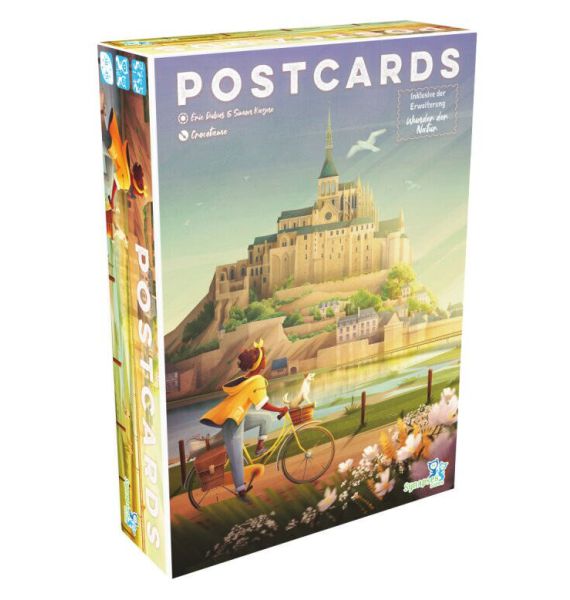
Postcards von Eric Dubus und Simon Kayne – erschienen bei Elznir Games Im Jahr 2025 beförderte die Deutsche Post rund 96 Millionen Postkarten. Als Vergleich dazu: im Jahr 2017 waren es rund 195 Millionen Postkarten. Das ist einerseits ein enormer Rückgang, andererseits bin ich aber überrascht, dass überhaupt noch so viele Postkarten versendet werden. Somit besitzt POSTCARDS also […]
Ich muss sagen, ich habe eine schier endlose wirkende Odyssee des Wartens auf dieses Spiel hinter mir (Horst und Björn können mein Klagelied wahrscheinlich mittlerweile auswendig mitsingen), als hätte ich auf die Sonnenfinsternis durch die Zwillingsmonde selbst gewartet – was natürlich eine Anspielung auf das Namensgebende Ereignis des Spiels ist. Dieses erreichte mich mehr als ein Jahr nach Erscheinen der englischen Version und damit fast ein viertel Jahr nach Beginn der deutschen Auslieferung. Daher lautet nun die Frage: Kann es mich noch immer überzeugen? Konnte es das überhaupt von Anfang an? Kann es meine Erwartungen erfüllen, wenn ich dafür auf einen Einstieg in das Magic-System verzichtet habe und man einen Pokémon-Ableger erwartet? Schauen wir uns mal meine Ersteindrücke an!
Steckbrief
Spiel
Dragon Eclipse
Verlag
Awaken Realms
Veröffentlichung
2025
Idee
Andrzej Betkiewicz, Kamil ‚Sanex‘ Ciesla, Wojciech Frelich
Illustration
Bozena Cadzyriska, Lukasz Cywinski, +8 mehr
Rating (BGG)
8,4 (ca. 1.300 Ratings)
Komplexität (BGG)
Kennerspiel
Spielweise
Kooperativ oder Solo (wohl der Spielkern), Kompetitiv
Die Welt wurde niedlich gezeichnet und wird narrativ ebenso süß dargestellt. Man stellt einen der vielen Bändiger von Kreaturen dar, die in etwa der Welt von Pokémon entspringen könnten. Bei dem Hauptspiel handelt sich im Kampagnenmodus den man alleine spielt mit der Möglichkeit kooperativ zu zweit im Kampf gegen andere Kreaturen, sogenannte Mystlinge anzutreten. Wobei die zum Teil fluffig-niedlich illustrierten Gegner gegen ein Spieler-Duo natürlich um einiges stärker sind. Allerdings bemerkt man an allen Ecken und Enden, dass die Welt eigentlich für nur einen Bändiger geschrieben wurde, gehen die Texte doch immer nur auf eine Person ein. Ich stelle es mir aber auch beinhart vor, einen romanlangen Text zu schreiben der sowohl per Du wie auch im Plural funktioniert ohne dabei seltsam gestellt zu wirken. Also Schwamm drüber, das ist schon in Ordnung. Mit dieser kleinen Einschränkung kann man sich doch arrangieren.
In der Kampagne ist man also wie angedeutet sehr viel Text ausgeliefert. Ich mag das persönlich gerne, aber man muss sich klar darüber sein, dass die zum Teil sehr langen Passagen einen Großteil der Spielzeit ausmachen. Immer wieder kommt man auf wirklich schön gestaltete Kartenelemente mit Verweisen in das Skript, zum Untersuchen des Standortes und lösen von kleineren Rätselelementen. Kleine Talentproben tauchen immer mal wieder auf. Sie folgen dabei stets einem mechanisch recht einfachen Muster, ohne Bezug auf irgendwelche Eigenschaften, die man auch einfach nicht besitzt. Es handelt sich dabei eher um ein Push-Your-Luck-Element, das man mit der Ausrüstung gelegentlich beeinflussen können.
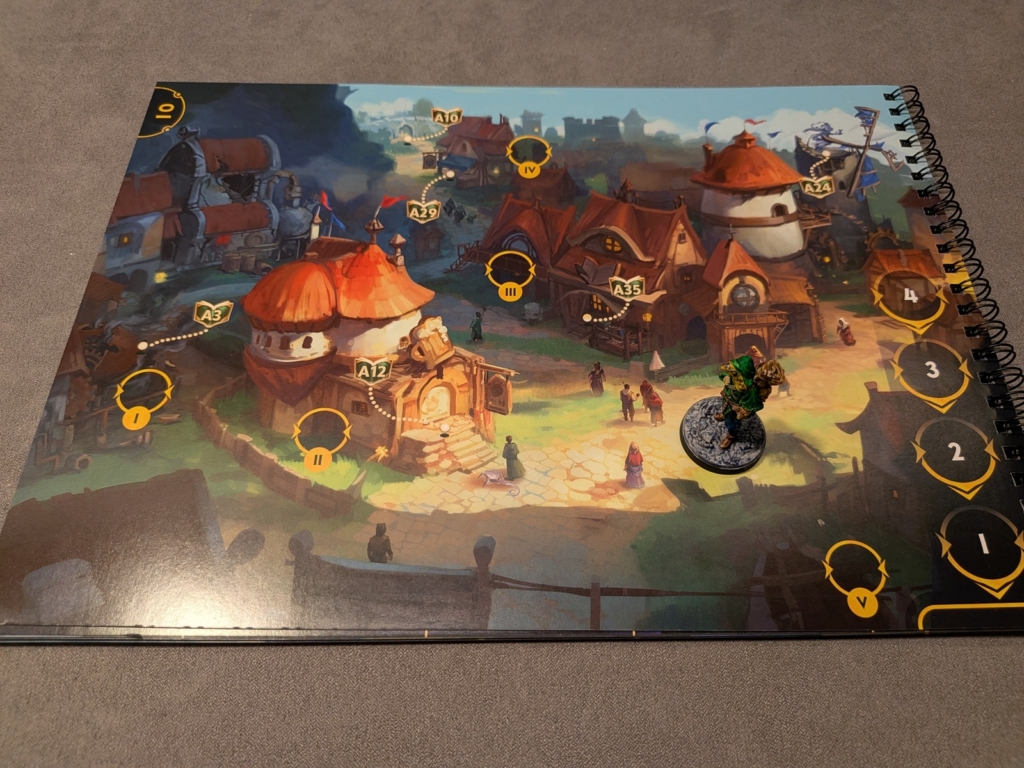
Caerberg, unsere niedliche Heimatstadt – der erste Ort. Hier beginnt das Spiel
Das Mechanisch wichtigste Elemente, welches den Kern des Spiels ausmacht, ist jedoch die Arena. In der Geschichte treffen wir dabei immer auf verängstigte oder ihr Revier verteidigende Mystlinge, welche dann gegen unsere gebändigte Lieblingskreatur antreten muss. Der Kampf folgt dabei einem recht einfachen Kartenmechanismus: Man hat stets drei Karten auf der Hand und zieht am Anfang der Runde eine Karte und nimmt Kraftpunkte, welche in genügender Anzahl z.B. die Sonderfähigkeiten unseres Schützlings auslösen können. Danach spielt man eine Karte aus. Diese haben eine große Menge an unterschiedlichen Effekten. Wer Spiele wie Pokémon oder Magic kennt, wird sich hier recht schnell wiederfinden. Es gibt bislang stets drei mögliche Enden eines solchen Kampfes: man verliert, man gewinnt oder das Wesen kann gebändigt werden. Letzteres will man natürlich erreichen, da so die Bandbreite der zur Verfügung stehenden Mystlinge vergrößert wird.
Die Kartenauslage einer spielenden Person.
Wie bei Awaken Realms wohl üblich, wird das Spiel mit einer übergroßen Box und weiteren Spielmodi ausgeliefert. Es gibt den reinen PvP-Arenamodus, in dem zwei Spieler jeweils eine der bislang freigestalteten Kreaturen gegeneinander antreten lassen. Hierbei fühlt man sich den genannten Trading-Card-Spielen wohl am Nächsten. Dazu kommt noch ein Rouge-Lite-Modus, hier muss man alleine einem Pfad folgen und so vielen Kämpfe wie möglich siegreich hinter sich bringen, wie man kann.
Groupie auf Tour
Die Geschichte erscheint eher generisch ist aber gut geschrieben. Es wird wohl nicht sehr episch sondern beschreibt eher den Weg durch die Welt um einen Mystling nach dem anderen freizuschalten und dabei dessen Fähigkeiten kennenzulernen. Daran wird sich wohl kaum etwas ändern, zumindest gehe ich nicht davon aus. Aber es regt meine Neugier ausreichend an um es wieder und wieder spielen zu wollen, besonders, da es das Spielinteresse meine jüngeren Tochter wieder aktiviert hat, was mich doch sehr glücklich macht. Die Arenakämpfe benötigen ausreichend Taktik um Spannung am Tisch zu erzeugen. Eine ausführlichere Rezension wird wahrscheinlich aber nicht folgen. Ich habe oben bereits fast alles zur Mechanik gesagt und alles weitere birgt nur eine Gefahr von Spoilern der Geschichte.
Kurzfazit: Das Spiel gefällt meiner Tochter und mir tatsächlich gut und wird weitergespielt. Der Nachfolger, ein eigenständiges Spiel mit neuer Story aber der selben Mechanik wurde auf Gamefound bereits von mir unterstützt.
Konzertmitschnitte
Sich vergrößernde WeltkarteSpielerauslageUnsere beiden HaudegenKampfpanoramaDer Emberling gegen das FirpleGegnerkartenCaerberg – Startumgebung
With this My Favorite Wargame Cards Series, I hope to take a look at a specific card from the various wargames that I have played and share how it is used in the game. I am not a strategist and frankly I am not that good at games but I do understand how things should work and be used in games. With that being said, here is the next entry in this series.
#72: Commodus from The Wars of Marcus Aurelius: Rome 170-180CE from Hollandspiele
TheWars of Marcus Aurelius: Rome 170-180CE is a solitaire only game that uses cards similarly to a CDG to simulate the strategic level struggle of the Romans led by Marcus Aurelius to stave off the invasions of Germanic tribes and Sarmatian raiders as they encroach on Roman territory across the Danube River. That’s the history. And it is really well integrated. The game play is very fun, strategic, with lots of decision points about what to do and what cards to use, and it is really challenging.
In the game, the Roman player has a deck of Roman Cards that can be used for the printed events for various effects or that can be discarded to take any number of actions such as attack a Barbarian army or Off-Map Conflict enemy, advance the marker on the Imperium Track, add two Level 1 Forts to any eligible map spaces, flip one Level 1 Fort to a Level 2 Fort among several other actions. Sometimes the printed events in the game are just more powerful than discarding a card for just 1 action so you have to pay attention to this economy and make sure you get the most out of your cards. Now, keep in mind, sometimes discarding a good card whose ability is not right for the current situation you find yourself in is part of the game but you have to use these cards wisely to do well in the game.
The game uses two separate decks of cards including the Barbarian Deck (Green) and The Roman Deck (Red). Both of the decks are made up of 50 cards each but each have very different purposes. The Barbarian Deck is used to determine the actions of the invading Germanic tribes as well as events that effect the war effort including mutinies, plague and the will of the people. While the Roman Deck provides the resources and events that are used by the Roman player to mount a defense against the invasions and to fight back each of the different barbarian tribes. There are unique cards called Late War Cards in the deck that will be held out until the start of the 175CE turn at which time they will be mixed in with the cards to form a new Late War Deck. There are also special cards that are marked with an asterisk that if played for the event will be discarded from the game to form what is called a History Pile.
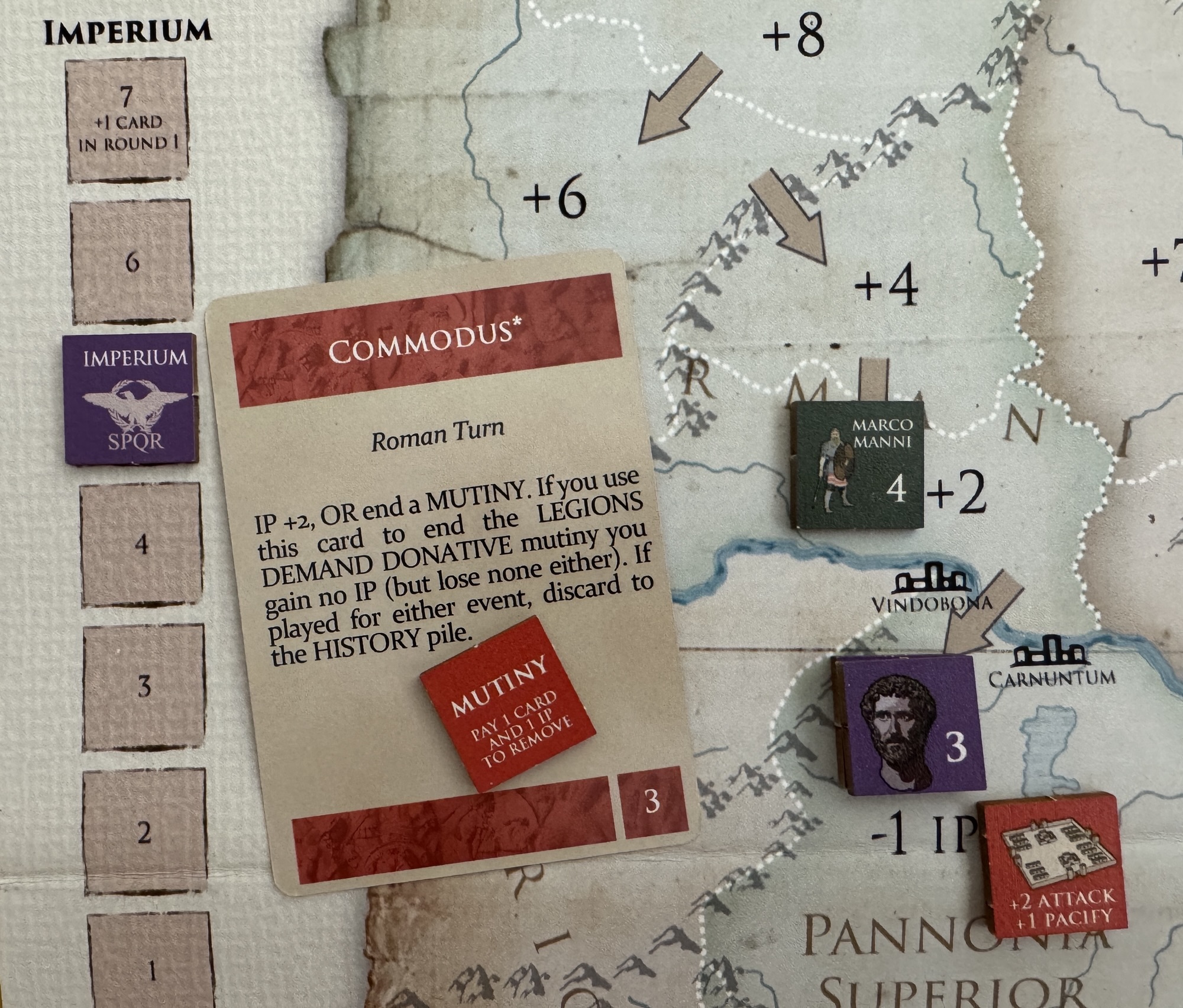
In this entry, we will focus on the Roman Card Commodus, which provides some opportunity to shore up your failing Imperium Points or even cancel an ongoing Mutiny of your troops on the board. In my first 5 or 6 plays of the game, the most common way that I lost was by allowing the Imperium Point Track to reach zero, which results in Marcus Aurelius being usurped and the player immediately losing the game. I was confounded and very frustrated about why I couldn’t prevent this from happening! I could see the end coming but struggled with keeping that Track above water. There are a few cards included in the Roman Deck that provide increases to the Imperium Track and I highly recommend you take these type of events when they come into your hand rather than discarding these cards to take another action, that might seem important at the time, but in the end these events are just too efficient to pass on. Commodus will provide you an option. This option is taking the +2 IP or another type of action such as ending a Mutiny (very important as it usually takes you discarding a card and losing an IP) or drawing two cards to add to your hand (imagine if you can only draw that Local Guides card you have been looking for or the Ambush that you need to take on the Quadi in their Home space). It becomes a choice of “either/or” and I am here to tell you the only reason the “or option” is provided is to lure you away from the real prize in that of gaining the +2 IP. Please listen to my advice and take the +2 IP. You will thank me in the end! Remember, that the concept of Imperium Points (IP) represent the Emperor’s overall political authority and stability in Rome. If the IP track ever reaches zero, the player immediately loses due to usurpation. Points are lost from specific card events, barbarian surges, and certain combat results, requiring players to prioritize special events to gain them back
Commodus was Roman emperor from 177 to 192AD, first serving as nominal co-emperor under his father Marcus Aurelius and then ruling alone from 180AD. Commodus’s sole reign is commonly thought to mark the end of the Pax Romana, a golden age of peace and prosperity in the history of the Roman Empire.
Commodus accompanied his father during the Marcomannic Wars in 172AD and on a tour of the Eastern provinces in 176AD. The following year, he became the youngest emperor and consul up to that point, at the age of 16. His solo reign saw less military conflict than that of Marcus Aurelius, but internal intrigues and conspiracies abounded, goading Commodus to an increasingly dictatorial style of leadership. This culminated in his creating a deific personality cult, including his performances as a gladiator in the Colosseum. Throughout his reign, Commodus entrusted the management of daily routine affairs to his palace chamberlain and praetorian prefects, namely Saoterus, Perennis, and Cleander. Roman soldiers and the general populace generally liked Commodus during his reign, largely because he was popular with the masses and focused on lavish spending rather than costly foreign wars. He was adored for presenting himself as a masculine, gladiatorial Hercules, though the Senate despised him
Commodus was assassinated by the wrestler Narcissus in 192AD, ending the Nerva–Antonine dynasty. He was succeeded by Pertinax, the first claimant in the tumultuous Year of the Five Emperors.
I shot a playthrough video for the game and you can watch that at the following link:
I also followed that up with a full video review sharing my thoughts:
I like weird games (derogatory) almost as much as I like weird games (complimentary).
Belinda’s Big Bonus is a weird game (weird).
Having your game designed by Amabel Holland sets certain expectations, despite any difficulties in pinning her down to a single genre or register. Similarly, basing a game on an erotic novel series, in this case Belinda Blinked by Rocky Flintstone, also sets certain expectations. Yet Belinda’s Big Bonus isn’t especially erotic. I wouldn’t call it funny, either, although it’s possible I’m just not in on the joke. Neither does it strike me as “so bad it’s good.” Mostly, it’s twice as complicated as one would expect from a licensed game. It reminds me of nothing so much as one of those business guys whose entire life is conducted through Google Calendar invites.
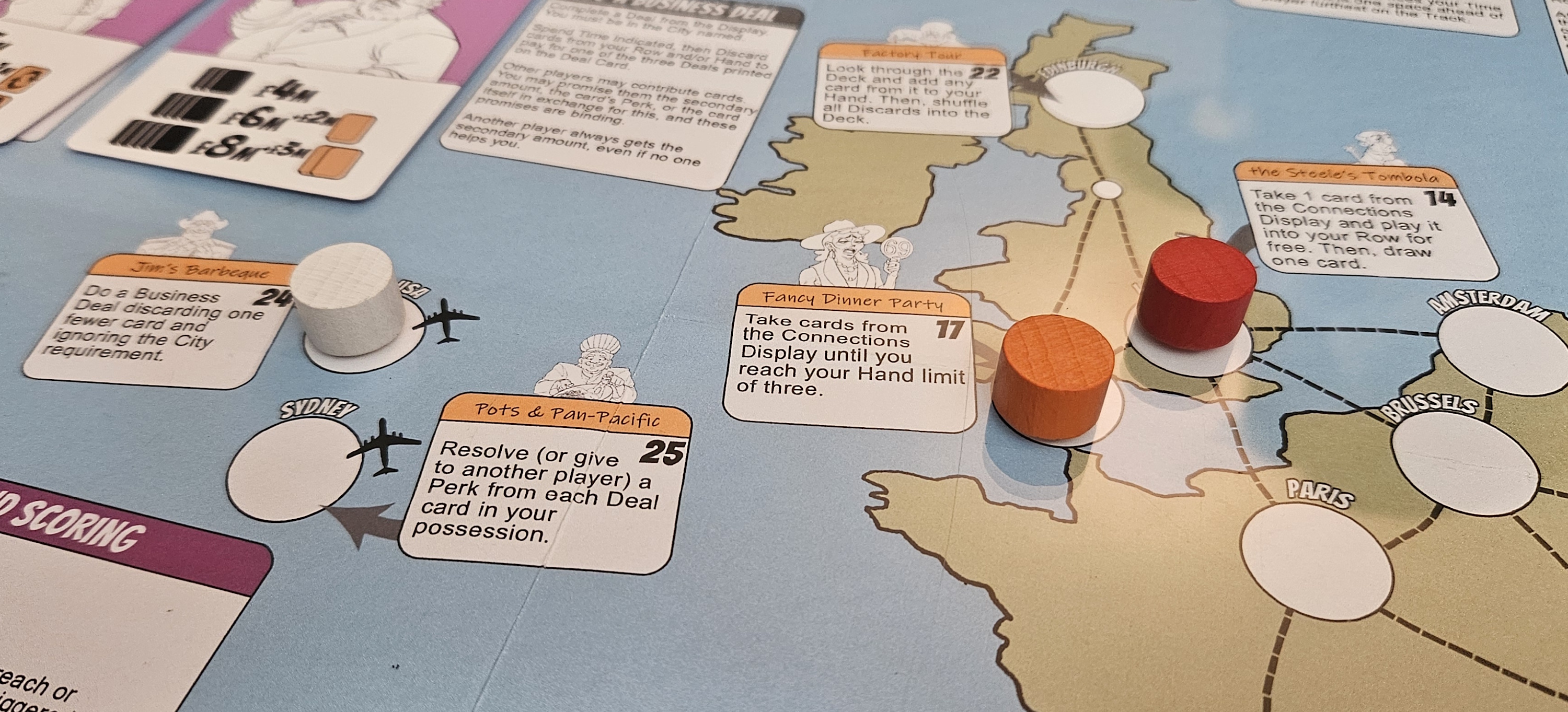
There is travel, but this is not a travel game.
First of all, we should open with a disclaimer. I know very little about Belinda Blinked. I considered reading the first one as research for this review — “research,” I say — but decided against it. Sometimes knowing less is knowing more. That’s our motto here in the United States. It’s written on our dollars and everything. While scant few people are going to play this thing sans foreknowledge, I happen to be one of them, and if there’s any one quality a critic requires, it’s the resolute belief that one’s experiences are valid no matter how uninformed. Here I stand.
Which is to say, perhaps Belinda Blinked is about managing one’s schedule, suffering from jet-lag, and mixing up which actions cost which payment. Maybe. In which case, may I offer my deepest apologies to Holland, Flintstone, and Belinda herself. Forgive this prude, for he knows not what he do.
At the game’s outset, players step into the not-yet-broken-in business shoes of interns at Steele’s Pots and Pans. Their task is to earn some millions of pounds for the company. They do this by…
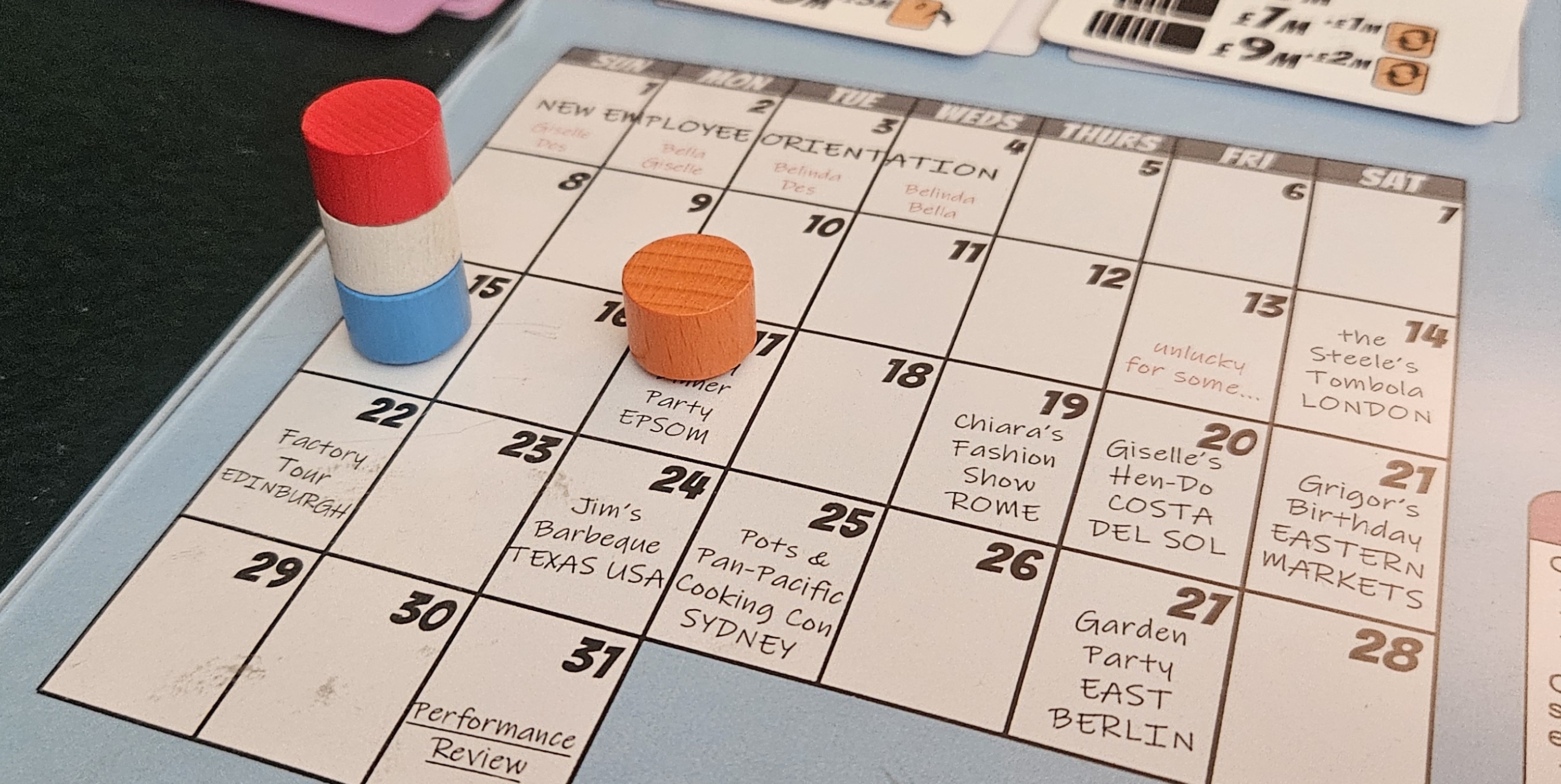
Look, this is the first problem with Belinda’s Big Bonus, and it’s a doozy. As any gaming evangelical knows, it’s hard enough describing a board game to newcomers, and Belinda’s Big Bonus is no board game for newcomers. There are mechanisms aplenty in this trunk, packed together like someone mixed the first-aid kit with the snack bag. There’s a calendar timekeeping system, the kind popularized by Martin Wallace titles, and cards that may exist either in a market, your hand, or a tableau, with interactions dependent on their current source — except sometimes they can be spent from two of those places, and the rulebook is conversational and, although it’s amusing, this doesn’t lend itself to learning the damn thing.
Scheduling, but this is not a scheduling game.
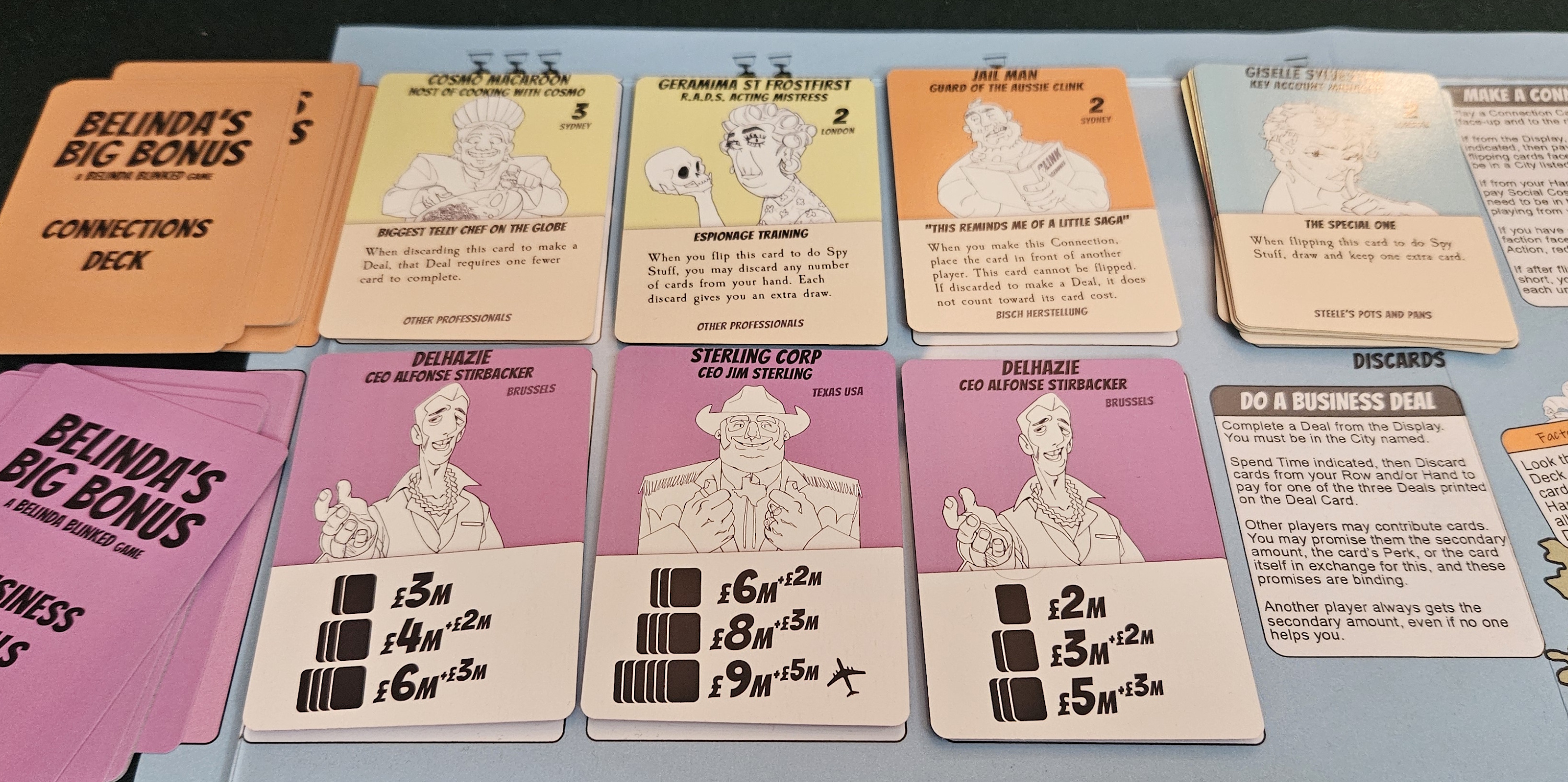
Here’s the short version. Turns are variable, conducted by whomever is farthest back on the calendar. On those turns, you spend some amount of time to make connections — which is to say, put cards into your tableau from either the market or your hand — do spy stuff — gain cards into your hand, from the deck this time — rest to refresh the cards in your tableau, make a business deal by throwing away the cards you painstakingly contacted or spied upon — and, in the process, try to persuade your fellow players to spend some of their cards instead, because these business deals are often collaborative and dole out benefits to multiple players — or perhaps visit a calendar event on the appointed date to gain some advantage.
If that sounds confusing, try teaching it. I’m no stranger to Holland’s more tangled designs, but this one found the most uncomfortable spot on the seesaw between complexity and anticipation: the fulcrum. Belinda’s Big Bonus feels like it should be a light game, looks like a light game, has that licensed light-game air to it, and then, kapow, but a kapow more like a punch to the schnoz than something erotic, it smacks you with a clutter of ideas.
For all that, there is an interesting game in here. The gist is that you need to build out your tableau and hand in order to spend those same cards to make business deals. Along the way, your characters provide something like an engine.
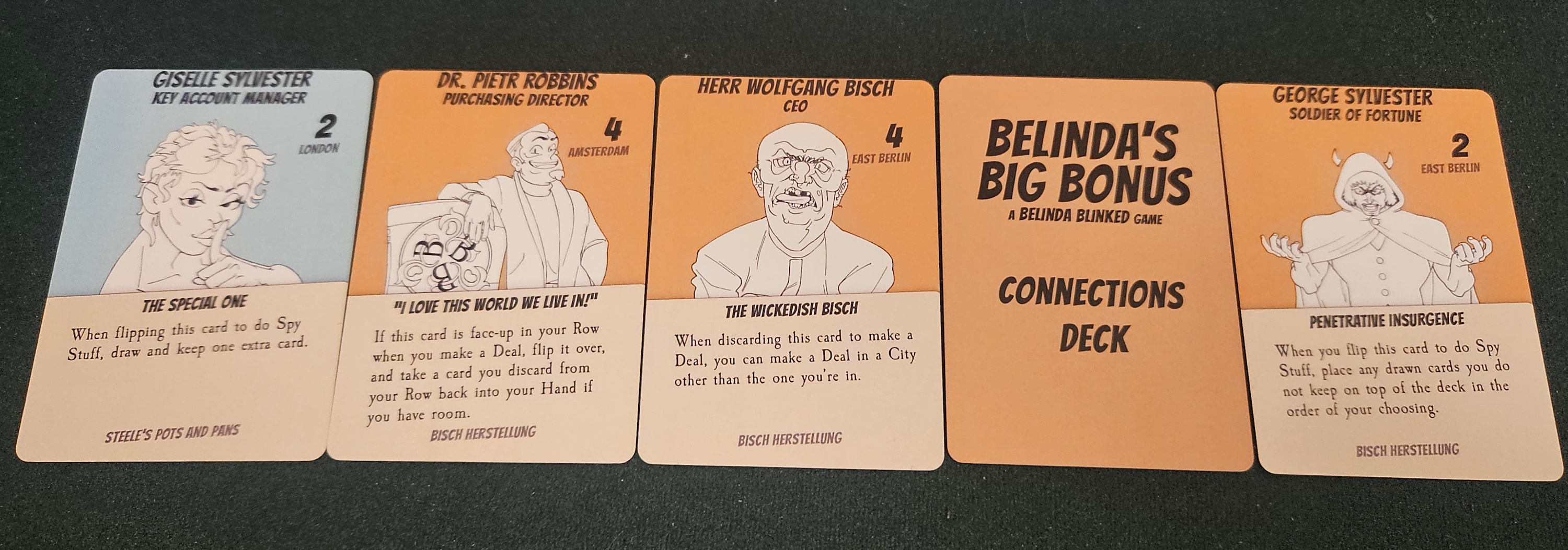
There’s even a narrative to the whole thing. Sir James Godwin makes it easier to attract Bella Ridley to your work group. Meanwhile, James Spooner, the Laird of Gretna Green, brings Cosmo Macaroon into the fold through some act of espionage. Later, your connections to Bella and Cosmo will help you make a deal in Texas, USA for nine million pounds sterling. Unfortunately, that same deal enriches a rival intern by five million pounds, so you try to squeeze some contribution from so-and-so at the table rather than merely handing the commission to whichever competitor is sitting in last place.
Odd people, but this is not an odd people game… well, scratch that. It’s an odd people game.
Those are genuine dramatic and narrative beats! Along the way, though, Belinda’s Big Bonus is burdened by bloated bits. It’s easy to paint oneself into a corner, for instance, by spending too many cards on an eager deal. This can leave one player sitting around with very little to do but play catch-up. And, hey, that’s their fault, right? If we were playing one of Holland’s cube-rail games, such a possibility would act as evidence of the game’s forthrightness. But here, the possibility comes across less like an honest appraisal of the perils of betting everything on some bad stock tips, and more like an unexpected heel-turn on the game’s part.
Here’s another example. Belinda’s Big Bonus includes the possibility of a traitor moment. When the game concludes, the player in last place might reveal that they now hold the majority of connections to Steele’s rival firm, Bisch Herstellung. This turns them into “the special one” and wins the game in a sudden coup. Cool!
Except, like everything else in Belinda’s Big Bonus, the rules governing the reveal are so text-heavy that it doesn’t feel like an amusing capstone. It’s closer to checking a technical manual to see if you’ve successfully told a joke. It isn’t hard, exactly. Nothing in the game is hard. But it’s less fluid than it ought to be, keeping everybody’s attention on these mismatched processes rather than on the parade of characters and situations strutting across the table.
Buncha great hangs.
Then again, maybe I’m not in on the joke. Maybe a Belinda Blinked game should be more complicated than most licensed titles. Maybe it should buck common sense by being an erotic game with no eroticism, a business game with no head for business, a whimsy with lots of rules printed on the board. Maybe it should be a big meta-joke at my expense. Maybe this game doesn’t exist for anyone but me, and it was sent to me solely so that everybody could point and laugh and say, ha ha, you took our prank earnestly, you big stupid fool, you moron, you lame-o.
That would be okay. I don’t mind. In the game’s cast of characters, I feel most like the guy anxiously cleaning a stain from his tie. I don’t need to get everything. Sometimes, I even revel in how little I understand. For example, I’ve had a lovely time not understanding Belinda’s Big Bonus. Maybe you’ll have a lovely time not understanding it as well. Just don’t say I didn’t warn you.
A complimentary copy of Belinda’s Big Bonus was provided by the publisher.
(If what I’m doing at Space-Biff! is valuable to you in some way, please consider dropping by my Patreon campaign or Ko-fi. Right now, supporters can read about which films I watched in 2025, including some brief thoughts on each. That’s 44 movies! That’s a lot, unless you see, like, 45 or more movies in a year!)
Die neuen Miniaturen von Games Workshop bringen frischen Wind auf das Schlachtfeld. Chaos Space Marines, Adeptus Mechanicus und Imperiale Ritter erhalten spannende Ergänzungen, deren Profile bereits vielversprechend wirken. Lohnt sich hier ein Kauf oder sollte man hier doch lieber auf die nächste Charge der Manufakturen warten?
Durch die Gassen von Innsmouth, Kingsport und Arkham stehlen sich in finsterer Nacht üble Gestalten. Bewohner verschwinden mysteriöserweise und rituelle Gesänge dringen aus den Häusern. In Chants for the Old Ones beobachten wir dieses unheilige Werk nicht: Wir übernehmen die Rolle der ergebenen Kultist*innen, um die Großen Alten zu erwecken!
Ich weiß nicht, warum mir beim Aphorismus des Monats 2026-04 insbesondere eine aktuelle deutsche Regierungspartei in den Sinn kommt, welche in der Vergangenheit die größten Steuerdebakel produziert hat (hust ... Maut ... Masken...hust) und sich nun über Politikverdrossenheit wundert? Dass niemand mehr Ideale habe,beklagen am lautesten diejenigen,die sie zerstört haben. Jacques Wirion

 Anmelden