This is a board game blog. Board games are a medium which can help us understand – for example, they can provide a uniquely active perspective on history. Yet which other medium can provide a fresh perspective on board games? – This is where novels come in handy. Today, we’re going to look at The Third Reich (Roberto Bolaño), a study in obsession as well as gaming and history.
Spain in the 1980s. Udo Berger, a young German, has just arrived in a small seaside town for a vacation with his girlfriend Ingeborg. Yet Udo’s mind is not on the beach. He has just won the national championship at the wargame The Third Reich (clearly based on Rise and Decline of the Third Reich (Don Greenwood/John Prados, Avalon Hill)) and plans to use his vacation to write an article on his new strategy for the Axis. Ingeborg, however, has more traditional vacation activities in mind, and so they spend some of their swimming, tanning, and partying, through which they befriend another German couple, some locals, and the enigmatic paddleboat renter who is only known as El Quemado (The Burned One) for the burn marks which cover his body. When the vacation comes to an end, Udo remains in Spain, supposedly to help in the case of an acquaintance lost at sea windsurfing… yet the real reason is the game of Third Reich which he plays against El Quemado.
Chilean novelist Roberto Bolaño wrote the novel in 1989. Since he turned his hand-written first draft into a typoscript (and later typed the first 20% into his first computer), it is assumed that he wanted to eventually publish it, but he didn’t do so before his death in 2003. When the novel was found among his papers, it was posthumously published in 2010. In addition to the original Spanish (El Tercer Reich), the book has been widely translated. I read the German translation.
Warning: Spoilers for the plot of The Third Reich ahead – but frankly, this is not a book you read for plot, you read it for the vibes.
Obsession: Conquest, Validation, Control
Udo Berger is wargame-obsessed, but the book is not a study of how an outsider has outsider fixations. On the one hand, Berger’s obsession with conquest and domination sets him by no means apart from his peers – just that they usually direct their respective urges to amorous exploits. On the other, our protagonist does not only want to conquer in the game either. In addition to his girlfriend, he also pursues the hotel manager Frau Else (who has been his crush when he was vacationing in Spain as a teen), and the underage chambermaid Clarita. And maybe most of all, Berger is fixated on being respected by his wargame peers, which he can only imagine obtaining by finding strategies (and publishing articles about them) which will obliterate all conventional wisdoms about the game.
As Berger is acutely aware of his lack of linguistic sophistication, he decides to practice by writing a diary during his vacation (which is what we read in the novel). The development of this diary reflects the changes in the writer: Originally, his daily entries are very structured (one per day, headlined by the date), and mostly concerned with banal reports on what he did, what he ate, and what he has in mind for the game/article). As Berger is drawn more and more into his duel with El Quemado, the diary gets more confused: He jumps from one level of narration to another within the same paragraph, extensive passages are solely dedicated to what’s happening in the game (down to which counters are placed on which individual hex numbers on the board), and the chapters are not only named after the dates, but also entitled “With El Lobo and El Cordero [his Spanish acquaintances]”, “Spring 1942” or “My Favorite Generals”.
Berger’s inability to focus also dooms his conquests (ludic and erotic): He sets out to prove that opening a second front early is not a liability, but an asset, and enthusiastically reports early in the game to a friend at home that it’s “Blitzkrieg on all fronts”. Yet as he conducts an amphibious assault of Britain at the same time as he invades the Soviet Union, his forces are overstretched and his Axis collapses before the historical date. And broadcasting his erotic attention over Ingeborg, Frau Else, and Clarita, does not further his relationship with either of them.
As things slide out of his grip, his attitude to control changes: Initially, Berger is fixated on the superior strategy. He notes down the exact moves – which corps need to occupy which hex in which turn to win. This chess-like approach collapses after the turning point of the game: Once El Quemado begins his counter-attack, Berger mentions for the first times that there are die rolls in the game (and how they favor his opponent) – not unlike many board gamers I have seen.
Gaming and History
Besides the main theme of obsession, the novel also offers many glimpses on gaming, history, and the relation between the two.
Berger arrives in Spain with his life compartmentalized between the gaming and the “normal” part – his girlfriend and the office job. This compartmentalization is already eroding with his plan to write the strategy article (which immediately chafes against the confines of a conventional vacation – the hotel employees are bewildered by his request for a large table to be set up in his room, and Ingeborg demands he come to the beach) and fully collapses over the course of the book, when he even unilaterally extends his vacation to play the game (and gets fired for it).
The shadow of history hangs over Berger. Our protagonist does not only play games about World War II, he also reads “patriotic” literature of the era, knows about the lives and deeds of the German generals (especially those of the SS), and the only of his wargamer friends for whom he has a certain reverence is a veteran of World War II. Despite this clear fascination for the history of Nazi Germany, Berger twice disavows being a Nazi himself (having been asked by El Quemado and Clarita). Once he even calls himself an “opponent of the Nazis”, but does not expound on it. His personal politics do not factor into the novel – Berger, having been born around 1960 in democratic, liberal, prosperous post-war Germany enjoys the luxury of only engaging with history at his leisure. He thus remains at the surface of it…
…unlike his gaming opponent. El Quemado comes from South America, and it is rumored among his Spanish acquaintances that the scars he bears are the result of torture (by one of the many right-wing regimes which took power in the 1970s). History has thus seeped into his body and gives him the strength to withstand the ludic assault of the experienced player Berger.
Bolaño himself was arrested after the 1973 coup in Chile and, to his own wonder, was released after eight days without having been tortured (he ascribed it to two of the detectives having attended school with him). He then emigrated to Spain where he worked odd jobs in the tourism industry like El Quemado.
Another allusion to Chile is made in a much-misunderstood scene: On September 11, everyone is out at the beach to celebrate the Catalan national holiday. Yet when a plane flies overhead, an eerie sense of dread overcomes the spectators. Many reviewers see this as a revision which Bolaño must have made after the September 11, 2001 terrorist attacks (or, as an odd coincidence) – but I think the likeliest reason for the scene is that the coup in Chile began on September 11, 1973 with the rebelling air force bombarding the presidential palace in Santiago.
Verdict
Roberto Bolaño’s The Third Reich starts with the innocent concept of a beach vacation. As it grows darker, the novel develops a hypnotic pull. The author’s own deep knowledge of wargames allows him to paint a vivid picture of the game itself – and of the hold it can have over its players.
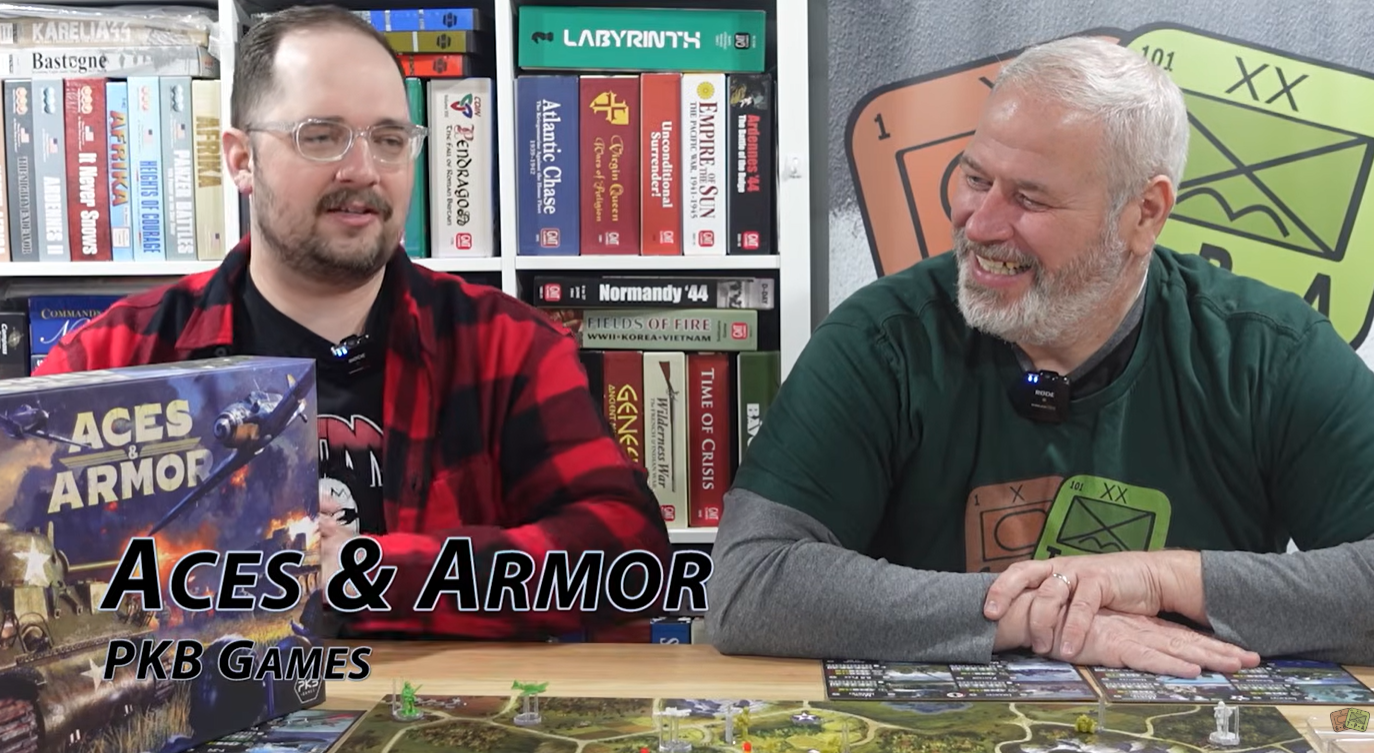
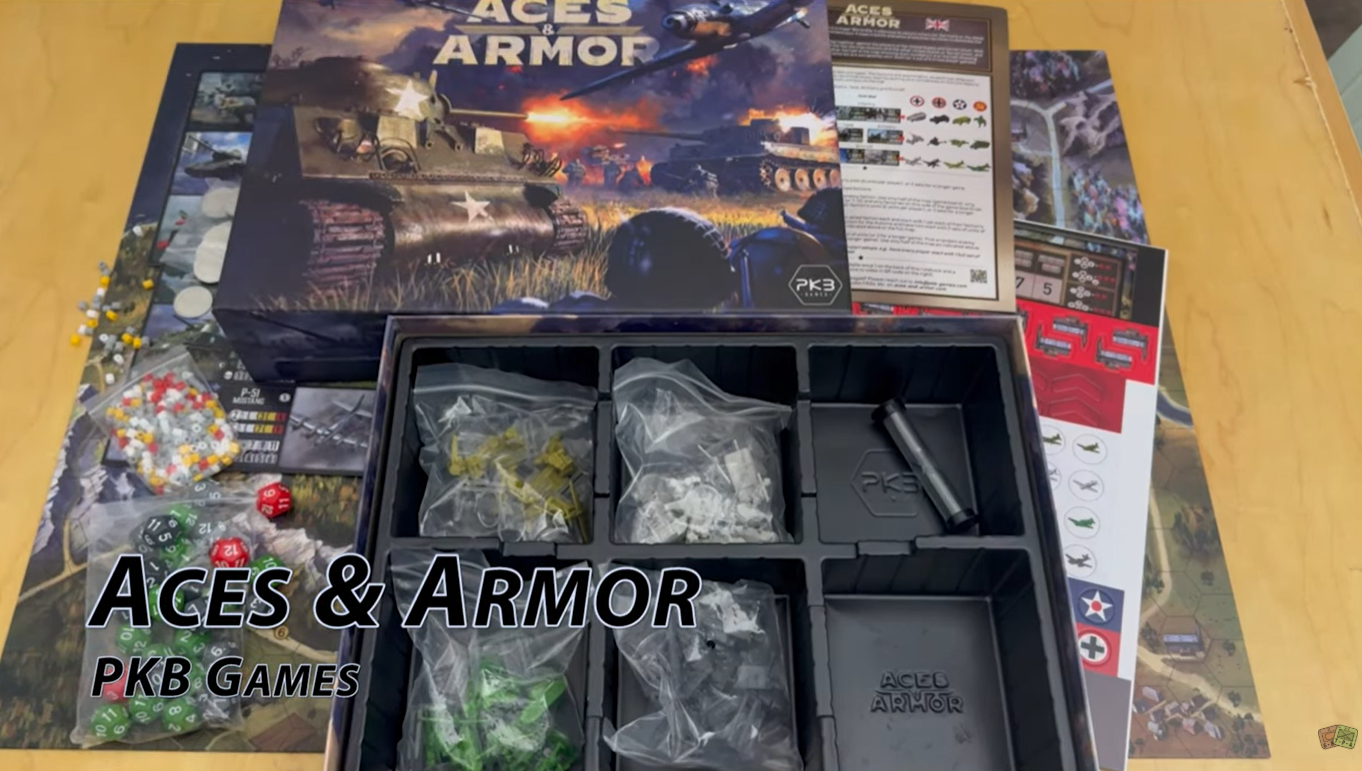
In Aces & Armor from PKB Games players take the role of a general (United States, Russia or Germany) in this complex (but easy to learn) strategy game. In addition to attack strength and armor of your troops, their tactical setup, combat experience, damage and terrain have a decisive influence on the outcome of the battle. Since each unit brings its own strengths, you must cleverly assemble your army to win the victory over your opponents. The game can be played either cooperatively or competitively and has a dedicated solitaire mode. The game uses detailed miniatures with many different unit types and has a high re-playability due to the variable start setup. The combat system is involved and a bit complex and depends on type of unit, combat damage, experience, strategic formation, terrain and armor (known from highly rated game Trench Club).
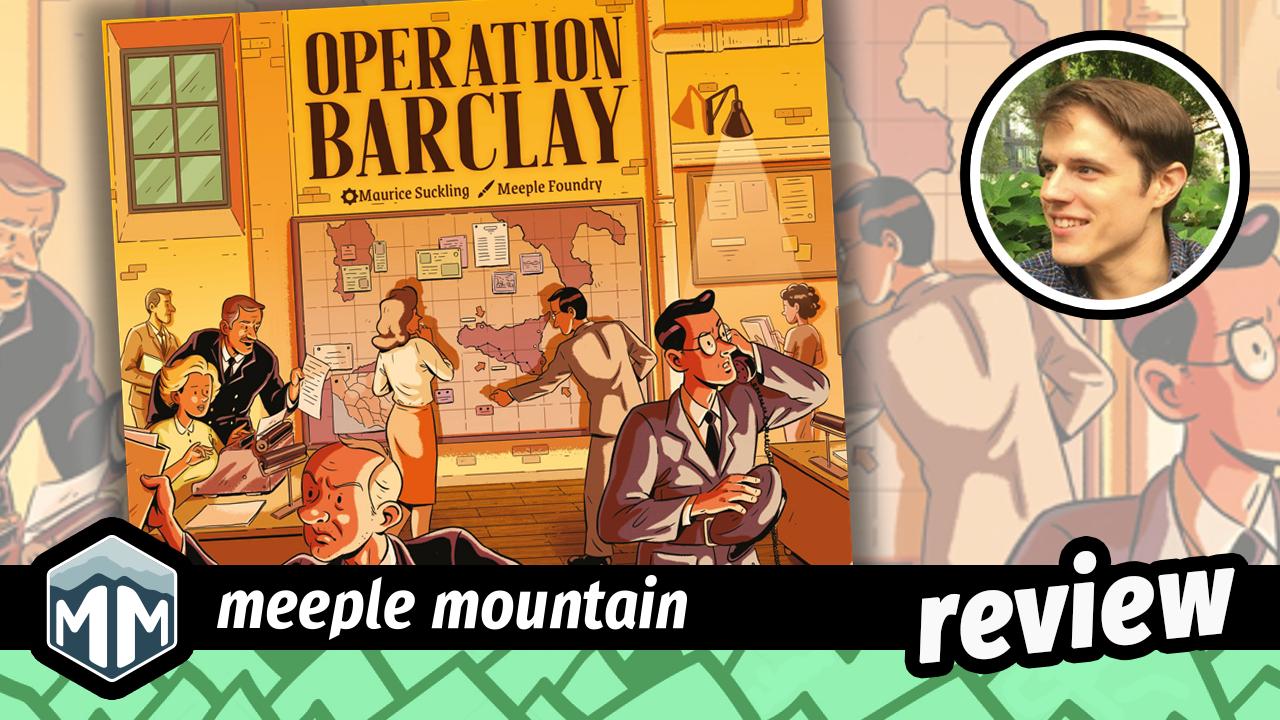
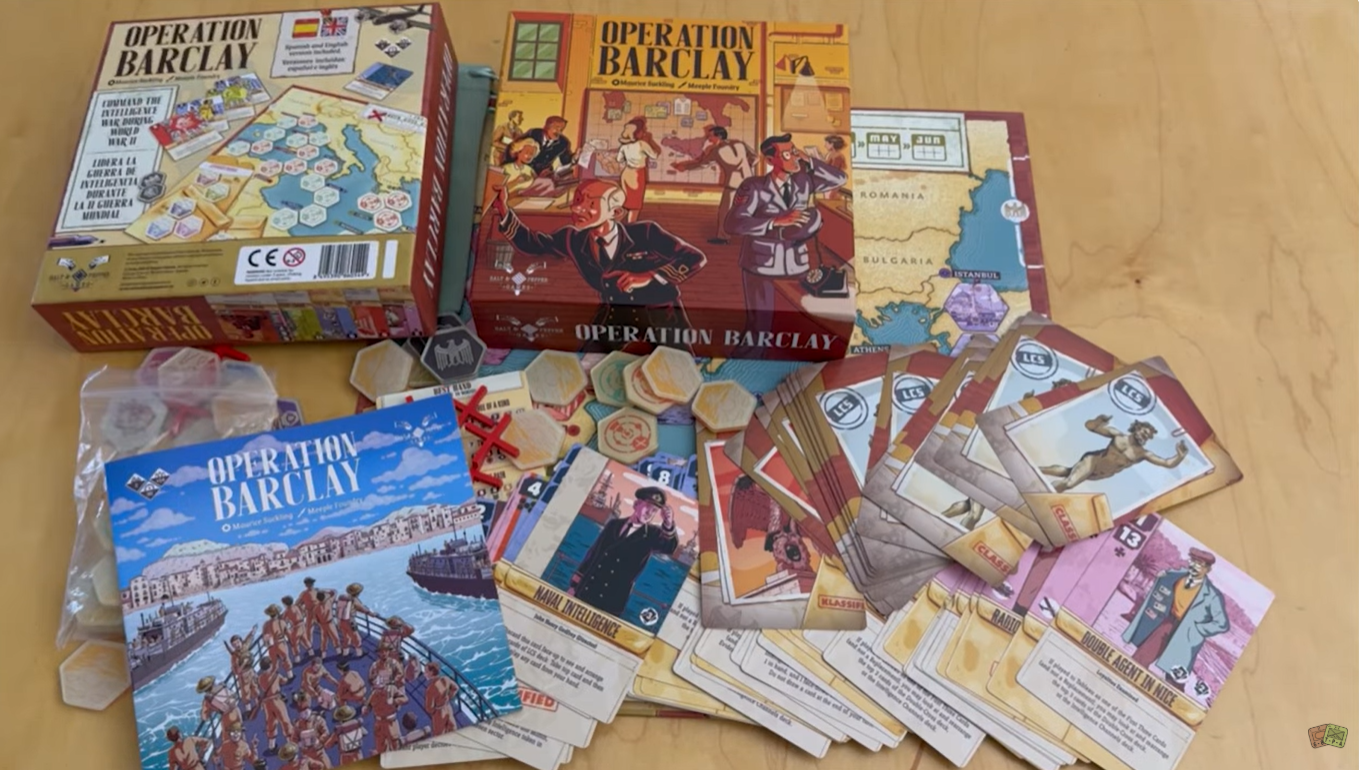
Operation Barclay is one of the most inspired marriages of setting and mechanic that I’ve ever had the pleasure of experiencing. How did designer Maurice Suckling get the idea to pair the story of Operation Barclay, the Allied plan to feed the Axis false information about an upcoming Mediterranean invasion, with poker and a shell game? It’s such a remarkable idea, such a perfect idea. Most game designers would sacrifice body parts in exchange for an idea this good.
While the real Operation Barclay was about convincing the Axis that the Allies would invade Greece when they were in fact planning to invade Sicily, Operation Barclay the game gives us a bit more ambiguity than that. There are five possible areas of attack, stretching from Morocco-to-France and Egypt-to-Turkey. The Allied player places wooden Intelligence tokens into each of them. One lane, whichever the Allied player decides to make the Primary Offensive Sector, gets four positive Intelligence tokens and one negative. The Secondary Offensive Sector gets three of the first and two of the second, and the other three Sectors, red herrings all, get two and three.
[caption id="attachment_329516" align="alignnone" width="1024"]Operation Barclay Game Review appeared first on Meeple Mountain.
Last month, as I was trolling the internet, I came across a new solitaire game from the guys over at War Diary Publications called Battle of the Bismarck Sea designed by Allyn Vannoy. Battle of the Bismarck Sea is a solitaire wargame that uses individual ships and flights/squadrons of aircraft. The Player assumes the role of General George Kenney, Commander of the 5th U.S. Army Air Force, with the mission of intercepting the Japanese effort to reinforce its ground forces on the island of New Guinea. I am always into a good Pacific Theater of Operations game and I reached out to Allyn to get some inside information about the design.
Grant: Allyn welcome to our blog. First off please tell us a little about yourself. What are your hobbies? What’s your day job?
Allyn: I’m retired, having worked 18 years for Intel as a program manager. Presently, I work for a minor league baseball team in the summer, an affiliate of the Arizona Diamond Backs, and volunteer two days a week at the Evergreen Aviation and Space Museum in McMinnville, Oregon, both in the Archives and giving tours of Howard Hughes’ Spruce Goose; I also write (freelance) for a number of military history and gaming magazines.
Grant: What motivated you to break into game design? What have you enjoyed most about the experience thus far?
Allyn: During Covid, I started getting back into gaming, having become interested in Avalon Hill games in the 60’s and as an early subscriber to S&T Magazine. I enjoy the challenge of trying to turn history into a game—a teaching tool—in the process I learn more and hopefully, understand more.
Grant: What is your new game Battle of the Bismarck Sea about?
Allyn: The Battle of the Bismarck Sea, 1943, was the 5th Air Force’s attempt to interrupt the Japanese effort to reinforce its ground forces on the island of New Guinea. The Player must utilize the limited resources available and determine their application over the 10-week period that operations are conducted. The results of these efforts will be borne out in the effectiveness of air operations.
Grant: What games gave you used for inspiration for your design?
Allyn: I hadn’t seen anything like this design; I wanted to make something new and hopefully unique.
Grant: What is important to model or include in a game about the Air Naval combat in the Pacific during WWII?
Allyn: The most important thing to understand is how to organize and implement an air strike force to accomplish the mission given.
Grant: What type of research did you do to get the historical details correct? What one must read source would you recommend?
Allyn: I tried to locate good and detailed sources:
Arbon, J. and Christensen, Chris. The Bismarck Sea Ran Red; Walsworth Press, Marceline, MO, 1979.
Birdsall, Steve. Flying Buccaneers: The Illustrated Story of Kenney’s Fifth Air Force; Doubleday, NY, 1977.
Henebry, John P. The Grim Reapers at Work in the Pacific Theater: The Third Attack Group of the U.S. Fifth Air Force; Pictorial Histories Publishing Company, Missoula, MT, 2002.
Jablonski, Edward. Outraged Skies; Doubleday and Co., Inc., Garden City, NY. 1971.
McAulay, Lex. Battle of the Bismarck Sea; St. Martin’s Press, NY, 1991.
Recommendation: McAulay’s book, Battle of the Bismarck Sea.
Grant: What challenges did the subject cause for the design? How have you overcome them?
Allyn: The design initially focused just on the single action that occurred on March 2-4, 1943, but there was a larger struggle that began in January 1943—that Allied commanders realized they needed to adapt and change their forces and tactics if they were to meet the challenge they faced. Once the design was expanded to a 10-week time frame it became more complex, but also more interesting. This also required more research into the changes that took place within the 5th Air Force.
Grant: What is the scale of the game?
Allyn: Unit scale: single ships and flights (3-10 planes) of aircraft.
Time scale: 10 Command/Support turns, each of one week; 13 Operational turns, over a two day period.
Ground units represent 200-300 personnel.
Grant: What are the different units that the player has control over?
Allyn: The Japanese units include transport ships, destroyers, ground units (presenting the troops and equipment carried on the transports), and fighter aircraft. These are controlled by the Bot. The player controls the Allied units: a mix of aircraft—reconnaissance, heavy bombers, medium bombers, and fighters, and also PT boats.
Grant: What does the concept of Endurance mean for the player? What does this model from the 1943 campaign?
Allyn: Endurance is the amount of time that aircraft can remain airborne. This models the range of aircraft from their bases to the target area. In the initial design, a series of range arcs were used for the individual aircraft types. It was quickly realized this would make for a very complex game. To address playability, aircraft range was changed to consolidate to a single arc (a line on the map) for medium bombers and P-38 fighters, and set Operational turns to 3-hour periods.
Grant: What decisions do they have to make about their assets use and management over the campaign?
Allyn: The game is conducted in two parts: a Command/Support Sequence and an Operational Turn Sequence.
The Command/Support Sequence is a one week period that allows the Allies to receive resource points and reinforcements, then decide how to apply the resource points—rebuilding units, modifying tactics, and determining how to find a convoy at sea.
The Operational Turn Sequence is a two day period where the convoy is moving along convoy routes as the Allies attempt to identify it and then determine the organization of strike forces in an effort to sink it and prevent Japanese forces from reaching Lae, New Guinea.
Grant: As a solitaire wargame how does the Bot behave? What are its priorities and decision points?
Allyn: The Convoy, when dispatched from Rabaul, advances towards its destination (Lae), with random events impacting its progress. The rules introduce the Fog of War that the player must overcome in order to first find the Convoy and then disrupt and attempt to destroy it.
As for decision points, there are several. How are resource points to be spent? When and how to go after a convoy? What assets to use in a given sortie?
Grant: What type of an experience does the Bot create?
Allyn: Designing a solitaire versus a 2-player game presents a whole different set of challenges. Can you design a Bot that will maintain the player’s interest and also challenge them? It should create variety; i.e., when and where will a convoy attempt to make a run; as well as a certain level of anxiety as certain elements are unknown until they can be revealed.
Grant: What are Resource Points and what do they represent?
Allyn: Resource points are the player’s currency and represent personnel, equipment (aircraft), and training.
Grant: What are Resource Points used for?
Allyn: The Resource Points are used by the player to improve tactics, provide replacements for losses, strengthen forces with personnel and equipment, and to launch air attacks. They are the real currency of the game and the player has to use them wisely to do well.
Grant: What is the layout of the board?
Allyn: The board includes the map (the area between New Britain and New Guinea); the turns tracks (for both Command/Support and Operational Turns); the Convoy Display (for air-sea combat); displays for the ships (transports and destroyers) and for tracking victory points and resource points.
Grant: How does combat work?
Allyn: Combat is based on the attack strength of the units for air combat, air-to-surface, and surface combat. The result of a die roll is compared to a unit’s combat strength, and if it’s equal to less than that number (combat strength), a hit is made on the opposing force.
Grant: How are bombers and fighters used in combat?
Allyn: Bombers are used to try and sink the ships of the Convoy. Heavy bombers operate separately from medium bombers, as they drop their bomb loads from altitude, with limited chance of success, while medium bombers engage Japanese ships at low altitude (mast-high approach). Fighters are used to engage the Combat Air Patrol aircraft that the Japanese dispatched to provide air cover for the Convoy.
Grant: How is victory obtained in the game?
Allyn: Victory is based on the number of Japanese troops that fail to reach Lae—by sinking the ships and their cargo of personnel and equipment, they are removed from participation in combat operations on New Guinea.
Grant: What do you feel the game models well?
Allyn: The fog of war; the challenge to figure out how to build and prepare the needed forces, and then how to employ them to accomplish the mission (sink the enemy shipping).
Grant: What has been the experience of your playtesters?
Allyn: Comments led to a major change in design—moving from a single mission to a 10-week campaign and all the elements associated with that larger picture/time frame.
Grant: What are you most pleased about with the design?
Allyn: That it offers two layers to the player experience – organizing and building forces, then utilizing them to execute missions.
Grant: What other designs are you contemplating or already working on?
Allyn: Operation Tidal Wave, the USAAF Ninth Air Force strike on Ploesti, Romania, August 1, 1943.
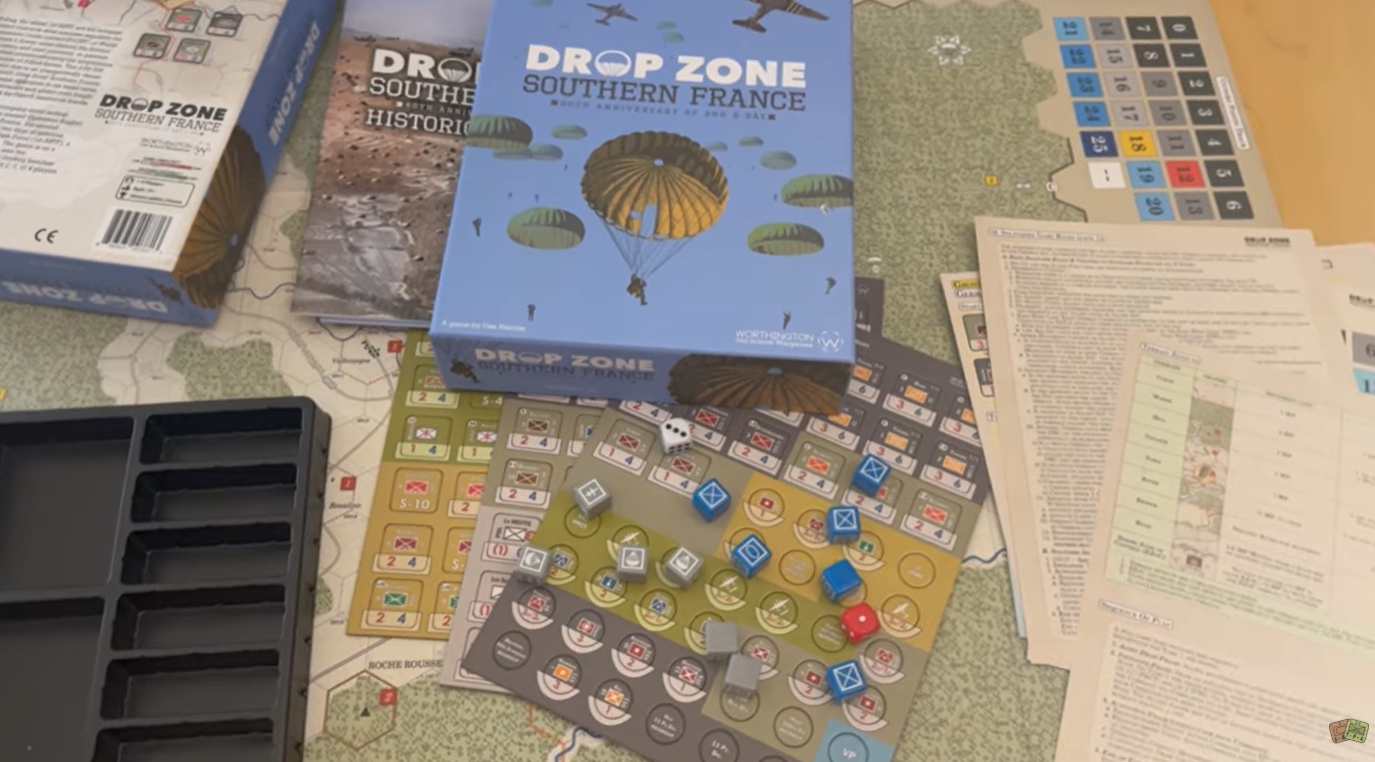
Drop Zone: Southern France is a company-level wargame covering the Allied airborne assault that spearheaded Operation Dragoon, which was the invasion of Southern France or the Second D-Day on August 15, 1944. The history behind this operation is really very interesting as early on the morning of D-Day, the allied First Airborne Task Force (1st ABTF) parachuted a dozen miles behind the Riviera landing beaches to seize key towns and road junctions, to prevent the German occupation forces from counter-attacking the amphibious landing, and to facilitate the advance of Allied forces. The 4:00 AM parachute drop was badly scattered due to an unexpected dense fog bank that blanketed the battlefield. Drop Zone: Southern France covers the first two days of this airborne operation in six game turns, when the American and British paratroopers and glider-men fought surrounded and alone, supported only by French resistance bands. This game is very good and is just a solid wargame.
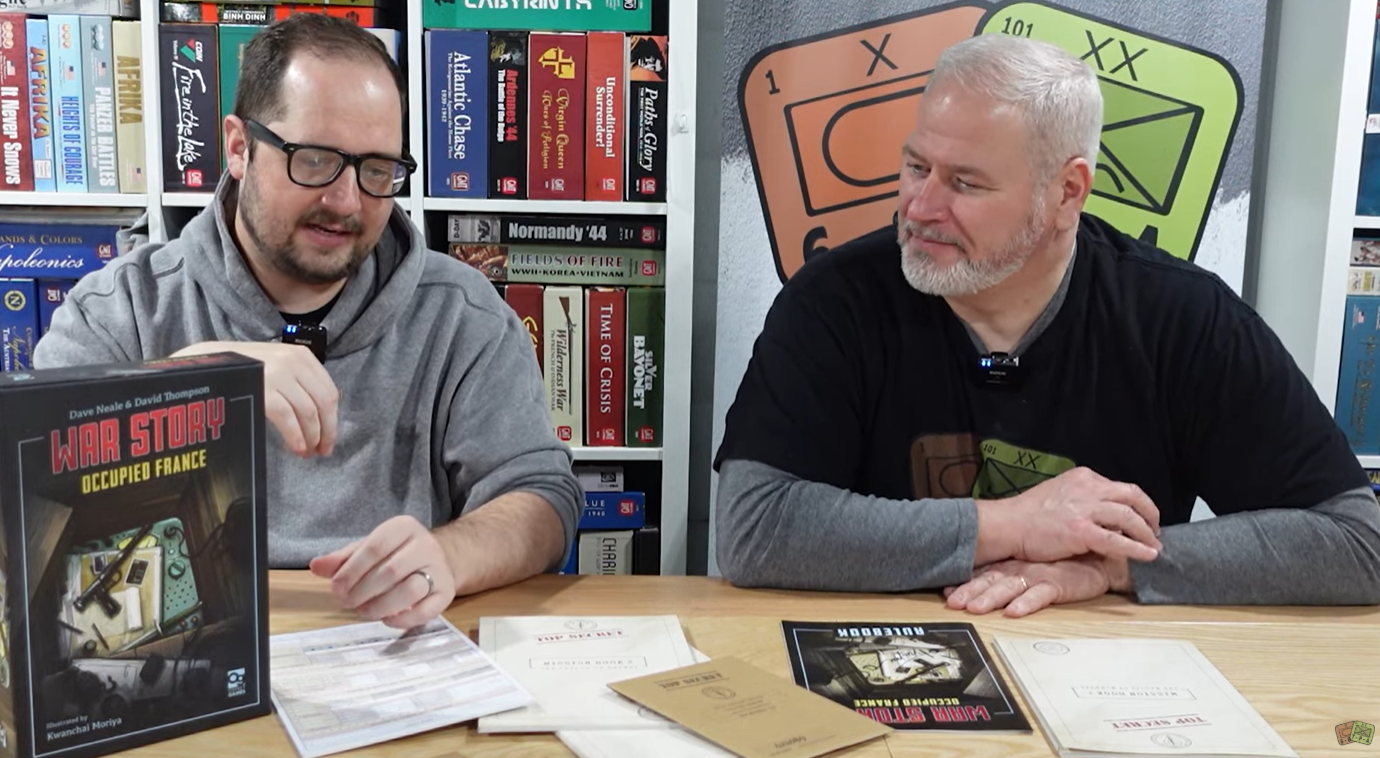
War Story: Occupied France is a co-operative narrative game for one to six players set in World War II occupied France that captures the stakes and tension of espionage and resistance warfare. Your team of covert operatives is all that stands between the infamous German officer Heidenreich and the systematic destruction of French Resistance forces in Morette.
Through three replayable story missions, you must exploit the specialties of your chosen agents to uncover information, enlist allies, and obtain weaponry. Engage occupying forces on tactical encounter maps where careless positioning could cost your agents’ lives. Remember, no plan survives contact with the enemy…and time is running out.
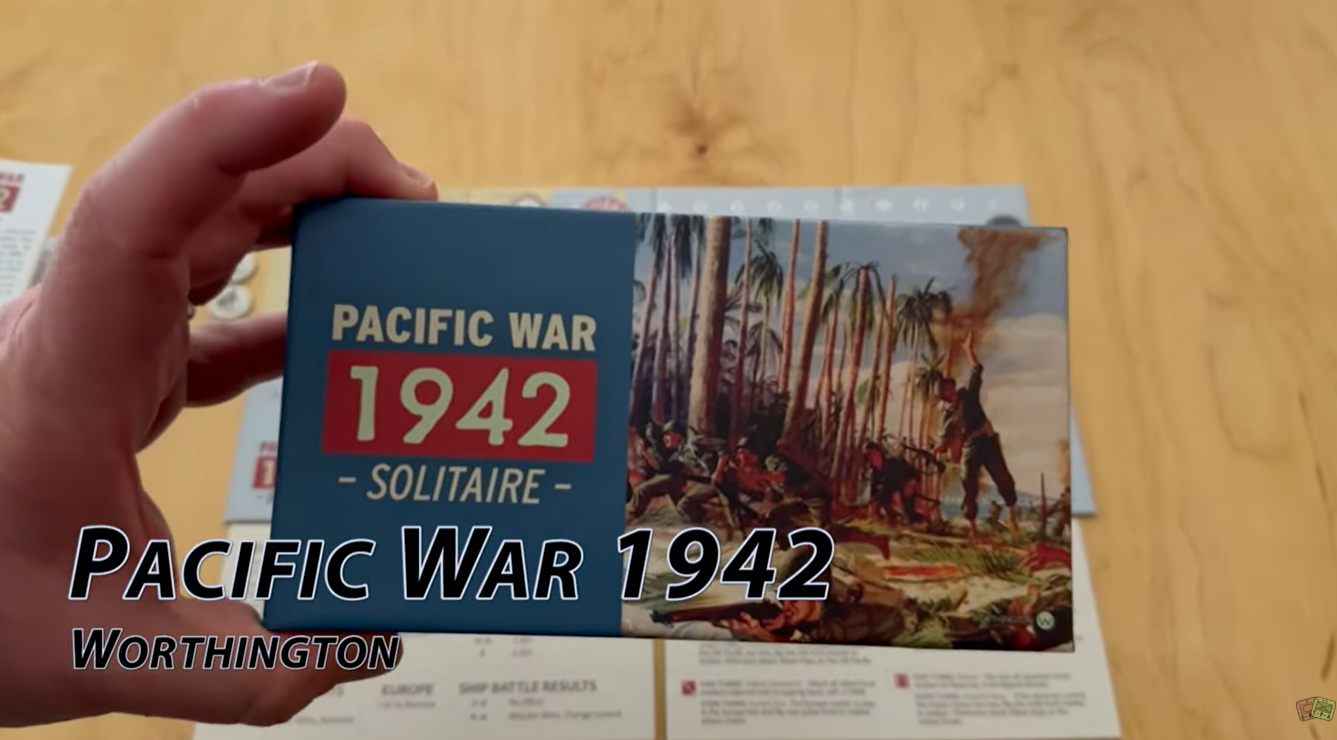
In early 2024, Worthington Publishing announced a unique 2-pack of games on Kickstarter that were marketed as easy to play travel friendly solitaire games. And you know that I love a good solitaire wargame! And when I heard that these games were small, even portable, then I was even more interested. One of the games covered the Pacific Theater of WWII called Pacific War 1942 Solitaire and the other covers the War of 1812 called (you guessed it) War of 1812 Solitaire. These games are designed by Mike and Grant Wylie and each game has 4 pages of rules, a beautiful mounted board and double sided counters. I played both and really very much enjoyed the experience.
Day 2 dawned early and we were out the door by 7:45am for breakfast and made it to the War Room around 8:30am where we finished up our game of Blind Swords Volume 12: Gettysburg: The First Day from Revolution Games. We should a video review and then I walked around the War Room to see all the games that people were playing. I saw Battle Britain from PSC Games, which is a fun beer and pretzels air war game with cool little plastic minis, Littoral Commander: The Baltic from The Dietz Foundation, Company of Heroes: The Board Game from Bad Crow Games, which is a fun and lite miniatures based wargame based on the successful video game franchise, and a new and interesting looking prototype game called Arsenal of Democracy.
Battle of Britain from PSC Games.
Littoral Commander: The Baltic from The Dietz Foundation.
Company of Heroes: The Board Game from Bad Crow Games.
With the prototype, no one was at the table though and I found out that the designer had been here but had to leave for the day but would be back later. The game looks to be a card based game that deals with the production of armaments for the war effort during World War II. I am keenly interested and will definitely want to get a closer look at this one soon.
We then sat down with Leslie Jerome to have him introduce us to the Line of Battle Series with Volume 3 To Take Washington: Jubal Early’s Summer 1864 Campaign from Multi-Man Publishing.
Line of Battle is a regimental-level American Civil War wargame system designed for fast-paced, non-stop action by eliminating excessive paperwork and combining fire phases with movement. I feel like this system is a highly playable classic ACW system with lots of very interesting mechanics including activation, order reception and relay, closing rolls, morale checks and close assault. In fact, I love how it creates a great narrative with some of the terminology and naming conventions such as the Blood Lust result fur close assaults and the Cowardly Legs from broken units.
Just a really solid system and we hope to explore more of it in the near future. We do have the next volume in the series on pre-order called No Turning Back: The Battle of the Wilderness.
We then sat down with Steve Jones (aka Steve Panther or Steve Blue as we affectionately refer to him) with Blue Panther Games and did a summary of all of their upcoming projects and fakes incurring getting an early look at Dawn of the Zeds Designer Edition designed by Hermann Luttmann.
This one looks awesome and is a revision of the original game with some added content and rules that realize Hermann’s true vision for the game.
We are playing this with Hermann and Steve tomorrow afternoon and I cannot wait. It’ll be damn good old fashioned gaming fun!
After lunch, we broke out Chicago ‘68 from The Dietz Foundation. Chicago ’68 pits revolutionary spectacle against civil order at the Democratic National Convention riots of 1968. Players take the role of either the Establishment, consisting of the Chicago PD and Mayor Daley, or the Demonstrators, including the Yippies and MOBE, and is a fast-paced game of street battles and political maneuvers.
Each side plays from two asymmetric decks of action cards. The Establishment positions tactical forces and police platoons to co-ordinate mass arrests while working the convention floor. The Demonstrators, on the other hand, can pivot from direct clashes to radical street theater; their tactics can be reactive and unpredictable, allowing for wild cat-and-mouse chases and mischief-making across the tear-gassed avenues of downtown Chicago.
This game is an area control/area influence game that uses cards to take a predetermined set of actions that can be upgraded and replayed with better actions as the game progresses. Each player will fight for control of the delegates to the convention as well as exposure to the nation through the media. Just a very well designed game that was a ton of fun to play.
In the end, Alexander’s Yippies/Mobe coalition won the exposure battle and took home the victory. Very tight game though that came down to the last few card plays. What a great area control/area influence political style tug of war. Loved it!
Our final game of the evening was the long anticipated China’s War: 1937-1941 from GMT Games, which is volume 13 in the COIN Series. China’s War examines the first five years of the conflict, when China stood alone against the Japanese Empire. Each player takes the role of a Faction seeking to attack or defend the Republic of China: the aggressive Japanese, the harried Government (represented by the Guomindang party), the rebellious Chinese Communist Party, or the unruly, fractious Warlords who are obedient when convenient but have their eye on gaining state power. Using military, political, and economic actions and exploiting various events, players build and maneuver forces to influence or control the population, extract resources, or otherwise achieve their Faction’s aims. A deck of cards regulates turn order, events, victory checks, and other processes. The rules can run non-player Factions, enabling solitaire, 2-player, or multi-player games.
This feels like a classic COIN Series game with 3 insurgent style factions against the powerful Japanese. But the focus really centers on the control of the Lines of Communication or LoC’s, which was a very refreshing approach that created some really interesting interplay.
In the end my Japanese were able to bully the other 3 factions and control the LoC’s to take home the victory in an early 3rd Propaganda card . The scores were Japan +3, Nationalists +1, CPC -3 and Warlords -4.
We very much enjoyed ourselves and can’t wait to play again soon.
A great day where we played 3 full games, shot 5 videos and had a lot of fun. Tomorrow is already booked and we are playing Cross Bronx Expressway from GMT Games, Battlefields of the Napoleonic Wars from Ingenioso Hidalgo, Dawn of the Zeds Designer Edition from Blue Panther and then a 4-player game of War of the Ring: The Card Game from Ares Games.
We arrived safely on Tuesday afternoon at around 4:00pm and got checked in, unpacked, organized and off to the War Room to get setup and see what was happening. The War Room is back in its original location in the Taft C room which is great because it’s a bit larger than last years room. When we entered there were about 20 people already there and playing and I was immediately excited. I love conventions and BGF is just about my favorite!
Upon entering and getting setup we were approached by a fan of the channel named Leslie Jerome who drove all the way from Lawrence, Kansas. Such a nice guy and his wife was with him and they were a fantastic couple. Leslie has a special talent that he shared with us as he showed off his handiwork which involves creating 3-D boards for his favorite games such as To Take Washington: Jubal Early’s Summer 1864 Campaign from Multi-Man Publishing from the Line of Battle Series…..and…..
…..Stonewall’s Sword: The Battle of Cedar Mountain from Revolution Games….and…
….and A Most Fearful Sacrifice: The Three Days of Gettysburg from Flying Pig Games.
These maps are just amazing and each one of them has such great detail showing the different elevations on the game board. Leslie said each one takes him multiple weeks to create and involves a lot of detail and precision cutting and gluing as well as shading the edges of the elevating terrain with colored pencils. We were really impressed and are hoping to play a few turns of To Take Washington with him tomorrow morning.
After that, our 1st game of the day was Danger Forward: The Battle of Gela, July 1943 from Multi-Man Publishing which is found in the Battalion S3 Operations and Training Magazine Issue #1. This magazine is new and arrived just last week so Alexander was able to read the rules, clip the counters and also read the 40-page magazine which is filled with of strategy and tips n how to play the Battalion Combat Series.
The game is a fantastic entry point to the BCS and was specifically designed as an accessible, entry-level game as a gateway to the series with 1 map, 5 scenarios, and approximately 176 counters.
We played for about 2 1/2 hours and finished the 3-turn scenario and really had a great time with the game. While it is introductory, we still had plenty of opportunity for maneuver, combat and some really great narrative emerged.
As the Americans landing on the beaches, I had about eight 82nd Airborne Units that went through a drop procedure at the start of the game with many of them scattering all over the board and even a few drifted and landed on several German and Italian units which meant they were instantly killed. But the best bit was when one the units, against all odds and totally outnumbered and outclassed, was able to hold a mountain pass road the entire 3 turns during multiple German attacks. They were able to hold them back allowing the 45th Infantry to move up and secure the objective there.
The next game up was Blind Swords Volume 12: Gettysburg: The First Day from Revolution Games. We played the Barlow’s Folly scenario which is a smaller 7-turn affair.
I was the Union, who were in a defensive posture and had few opportunities to activate and make attacks, and frankly didn’t enjoy the scenario we chose. There were a few reasons for that other than the fact that I was getting steamrolled. My commanders had terrible Command Ratings while Alexander’s Confederate leaders were much better. In Blind Swords, players draw chits, which represent specific brigades, divisions, or command events.If a Division or Brigade chit is drawn, the player usually rolls a die and compares it to the Command Rating on the chit to determine if it is a Full or Limited Activation. If the roll fails (or a “Limited Activation” is triggered), the brigade can only perform limited actions, such as firing, instead of full movement and combat. This happened to my brigades over and over. In fact, in turn 2 I failed all 5 activation rolls and most of my units were unable to do anything as they were not in range to do a fire attack.
I also struggled with the difference in strengths of the units as most of the Union units had 4-5 strength as compared to 6-9 for the CSA units. This meant my chances of scoring hits on the multi-step combat process was very poor.
For me, I just think we chose a poor scenario and we are going to continue tomorrow morning a bit and see if we can choose a more balanced scenario. We shall see!
With that, we returned to the hotel room at around 11:30pm to get some sleep as we are going to breakfast at 8:00am and then getting back to the War Room to play several games tomorrow like afew turns of To Take Washington, Chicago ‘68 from The Dietz Foundation,Werwolf: Insurgency in Occupied Germany, 1945 – 1948 from Legion Wargames and some other stuff.
Operation Barclay is a 2-player game of low/medium complexity about the intelligence war between the Allies and their Abwehr counterparts in the Mediterranean Theater of WWII in 1942-1943. Operation Barclay puts players in the shoes of competing military intelligence directors who are attempting to mask or learn the truth about the Allied invasion plans for 1943. The Abwehr must attempt to learn where the Allies intend to land next. The London Controlling Section (LCS), the core intelligence agency responsible for Allied intelligence, must prevent the Abwehr from discovering the truth.
The LCS player uses a variable set-up, placing tiles face down to establish where in the Mediterranean a primary and a secondary offensive will occur. Over the course of the six game months, the Abwehr player attempts to win sufficient evidence tokens to be able to turn enough of these tiles face-up to reveal where the Allied offensives will come.
To win evidence tokens, players build hands of five cards to take tricks, similar to poker. While having the best hand will secure two evidence tokens, correctly betting after each player reveals the first three cards of each hand on who will have the best five-card hand is worth three evidence tokens.
Further, players have ways to manipulate the decks from which they draw. They may create a double-cross deck, allowing them to leave cards useful to them face down in a deck to draw from when they choose later — unless the other player takes those cards instead…but perhaps the player who planted those cards was bluffing and hoping the other player would waste their draw on a useless card. Alternatively, players may draw from their own dedicated deck to augment their hands with unique abilities inspired by historical figures, events, and capabilities. The LCS has access to Ultra — decrypts of German codes — but this alone will not be enough if it’s not used carefully.
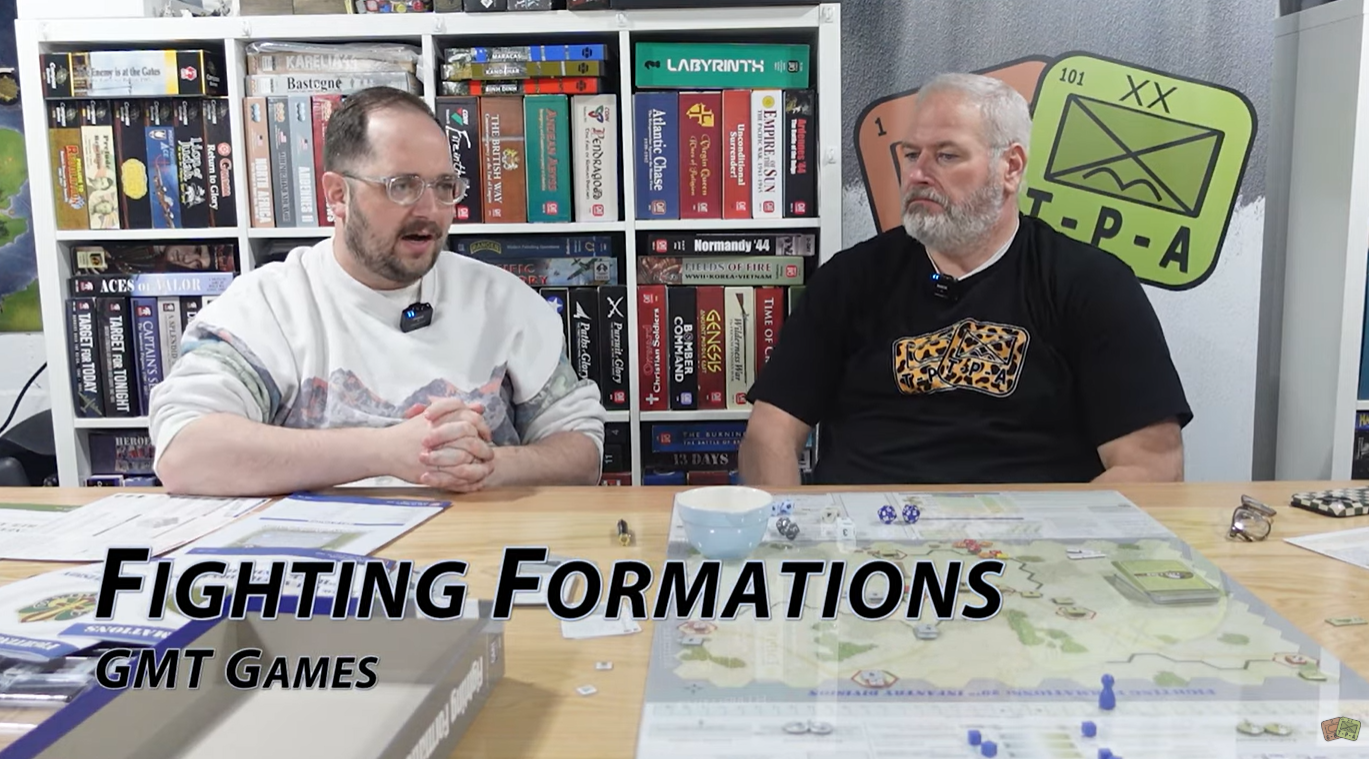
Fighting Formations is intended to be an ongoing series of wargames covering WWII tactical combined-arms combat at the platoon and squad levels. Each game in the series will feature a distinct combat unit, highlighting battles in which that unit participated as well as its particular order of battle and fighting characteristics. In this second volume of Fighting Formations, we feature the US 29th Infantry Division—“Blue and Gray”—as it fought from just after D-Day in June of 1944 to the end of the year.
Over the past couple years, we have played a few venerated and respected series games from Multi-Man Publishing for the first time that frankly I had initially turned my nose up at for various reasons. These reasons were not really anything important or truly about the design or mechanics but included things like price, graphic design, style and somewhat because of the complexity and reputation of complexity of those systems. These series included first the Standard Combat Series (SCS) with our first game being Rostov ’41 and now the Battalion Combat Series (BCS) with our first game being Arracourt and since we have played several other volumes including Brazen Chariots and Baptism by Fire. I must admit here that I am actually embarrassed that I hadn’t played those series and readily admit that I just discounted and dismissed them out of hand. I am so very glad that we repented of our stubbornness and found this system because it really is very, very good at what it is trying to teach and demonstrate about warfare at this scale.
So what is the Battalion Combat Series? The Battalion Combat Series is a system designed to model combat at the grand tactical scale from late World War I to the present day. The system has seven published games including Last Blitzkrieg: Wacht am Rhein The Battle of the Bulge (2016), Baptism By Fire: The Battle of Kasserine (2017), Brazen Chariots: Battles for Tobruk, 1941 (2019), Panzers Last Stand: Battles for Budapest, 1945 (2021), Arracourt (2022), Valley of Tears: The Yom Kippur War, 1973 (2023) and now Inflection Point: The Battle for Kalach and the Battle of Chir (2025) and was created to in some ways fill the gap that existed between the operational and the tactical. In my limited experience, the system truly feels much like a smaller scale game, as it deals with various support units and stacking limits are enforced to just a few combat units. The system is fairly crunchy, meaning there are lots of DRM’s and combat modifiers, and attempts to model accurately combat and the importance of both supply on the one hand and command and control on the other. The hallmark of the system is that the games in the series are very playable. I am no expert but this system is made for the gamer while some of the others from MMP, such as OCS, appear to be more for the accurate modeling of warfare on an operational scale. Still playable, but maybe only after the gamer has gained experience with other systems to draw upon that knowledge to assist in digesting the more complex nuances. In this post, I would like to cover some of the basics of the system and deal with things like the way it handles supply, combat, combined arms, activation and air power as well as give you a taste for what this volume in the series has to offer. Overall, I have been very impressed with BCS and have very much enjoyed playing it. In fact, I am really starting to love the series and believe it might be taking over my love of the Standard Combat Series from MMP.
One of the best parts about this new volume in the series is that it is actually 2 games in the same box. One game which is smaller, with fewer counters and formations and that uses a smaller version of the board included in the game and one that is the full campaign with more counters and formations, a larger board and is much more involved. Overall, I would say that the BCS is a fairly straightforward series even for someone who is a beginner and has less experience with the BCS system like me. I think that I thought they were designing Arracourt as the entry to the series, and I still think that is the case, but this volume has some of the same flexibility and approachability that some of the larger titles don’t necessarily have. I feel that players can cut their teeth on this one using the smaller scenario while getting comfortable with the rules and system before you attempt the larger scenarior or even other larger games in the series. I also feel that the game requires somewhat of a paradigm shift before playing. What I mean by that is really two fold.
First, I really feel that usually these big hex and counter wargames are set in their combat methods, namely focused on odds based Combat Results Tables and counting up combat factors to get the perfect odds, and require a bit of calculation. But BCS doesn’t use a traditional CRT but breaks the combat down into more of a collection of DRM’s based on many factors.
Second, the game also has very low counter density, with the scenario we played having about 40 counters per side on the map at any given time, and stacking limits are just 2 combat units with other counters also allowed such as support units or HQ’s. There are not enough counters here to create the long contiguous line or wall of units that are typical in some of the larger systems, which lends this one to a bit more maneuvering of units to get into good position while using terrain to attempt to isolate and cut off units from supply or to prevent the enemy from doing the same to your units. This created somewhat of a back and forth dance for us that kept my focus and attention and was really quite entertaining. Supply is important to the system but not as focused on it as say the Operational Combat Series (OCS). The players must manage their HQ’s and their combat trains to keep their units in full supply and this becomes somewhat of a different type of dance that sees players cautiously keeping their units in a loose perimeter to prevent a freak breakthrough or run around to get to the back of the formations to take out supply sources and cut off units. I really liked the scale and feeling of this BCS system and had a very good time in trying to learn and understand it and also trying to figure out the best strategies to engage.
The counters included in BCS Inflection Point are dual sided but the back side is not to show a reduced unit as is normal with these wargames. The front side is the unit’s move side while the back side is its deployed side. Each of these stances is very important and must be used by each player to get the most out of their units and to take it to their opponent.
Let’s take a closer look at a few examples of counters involved in the game. First off you will notice that the counters are pretty standard using NATO symbols to identify units type with various numbers listed on the top of the counter to include their Battalion, as well as whether they are a two step unit and have breakdown units that are held off map. The units have a colored band shown at the bottom of the counters that identify them as units of a certain formation which will be activated when their activation marker is chosen by the player as this game is Chit-Pull. The 3 numbers printed on the bottom of the counter include from left to right Combat Factors, Action Rating and then Movement, which consists of three different values and two different types. The Red value shown on the armor and mechanized units is the TAC (Tactical) movement, which is significantly better than other movements. White value movement (not shown in the picture below) represents leg unit movement and Black movement is truck movement. Truck movement can get 1/4 movement on primary roads so they can be used to get units up to the front quickly to react and fill holes or vulnerable spots on the front.
Another very important numeric value shown on the counters is their Action Rating, which is shown under the NATO symbol above the combat and movement values. This value represents such items as the unit’s leadership, training, morale, and other soft qualities. On some counters the Action Rating doesn’t change when the unit is flipped for movement or deployment. This value is compared against enemy units in combat and provides a DRM if the attacker is superior to the defender’s value. This rating is very important and we learned quickly to make sure our good units were leading our most important attacks. One other point of note, armor units typically have their Engagement Range increased when they flip from Movement to Deployed. This is a very specific armor on armor combat bonus.
One other important aspect of the counters is the concept of a Combat Train, which is each of the Combat Commands’ mobile supply source that stretches back to the identified main supply source. In BCS, these Combat Train counters are represented by an individual formation counter that has wheels shown on the bottom and then lists the Combat Command number. The placement of these Combat Trains is a very interesting and somewhat precarious part of the design that we really enjoyed. Each Combat Command can only place their Combat Trains in or adjacent to hexes of the various yellow highlighted roads shown on the map. Their resulting Main Supply Route or MSR must then follow along the highlighted road back to one of the various Supply Sources shown on the map and identified in the specific scenario setup. This concept is very important and in my mind really shows the focus of supply on combat and activation as this will add a DRM to the activation SNAFU roll that precedes each unit’s activation to see if they can perform a full action or just a partial.
The really interesting thing about activation in the game was this concept of Fatigue. A formation will track its Fatigue Level with a set of numbered Fatigue markers. The Fatigue level will progress from Fresh through various Fatigue Levels including 0 (which is not considered Fresh), 1, 2, 3 and 4. Fatigue 0 is considered normal (but remember that this is not considered Fresh as Fresh is better than normal) while Fatigue 4 is considered to be exhausted. These Fatigue levels will affect the players SNAFU rolls and will equate to a negative DRM equal to its level. For example, Fatigue 2 is a -2 DRM. Fresh Fatigue gives a +1 DRM but don’t expect much help here as combat and even movement can wear your soldiers down effecting their coordination and cohesion resulting in the addition of a higher number Fatigue marker which will cause a much more difficult time in activating. This Fatigue is tracked by keeping the appropriate Fatigue level marker with the HQ counter so you know where you stand.
The way you will increase Fatigue is interesting as it takes a roll of the die only when certain actions are taken. Each of these actions that can cause Fatigue to increase include placing an Objective Marker (which is like choosing what you are going to attack, barrage or to take control of Victory hexes), conducting any type of engagements or fire attacks, executing a second activation or a full or partial SNAFU. Basically, everything that a formation can do can cause Fatigue. You get to roll a die and consult the Fatigue Increase Table and this table is based upon what type of action you just took as to how likely it is that the result will cause additional Fatigue counters to be added to your HQ. I really liked this part of the system as it just felt really interesting and was a very unique way of handling this concept of battle weariness and effectiveness. As we know, as soldiers fight, they get wounded, run low on ammo, get tired and ultimately become combat ineffective and all commanders must monitor this and make sure that their forces are not pushed beyond their capability. When Fatigue gets too bad, the formation can simply commit to conducting a Fatigue Recovery action when it is activated. No roll needed. The player just reduces the fatigue number down one spot toward Fresh.
I know that a lot of you really love the dense and involved hex and counter games and love your stacks of units lined up in neat lines stretching across the board forming the front. I am not in that group and would much prefer a tight and low counter density game because of the reasons of playability. See my fingers are like small smoked sausage links and I have the finger dexterity of an elephant so playing around stacks of 4-10 counters really makes me nervous ad invariably I will lose grip on my tweezers or just brush up against a stack and cause pandemonium. For me, I really liked the lower counter density of BCS and the scenario of Inflection Point that we chose to play.
The other benefit that I saw from this lower counter density was the concept of trying to scrape too little butter over a large piece of bread. There just never seemed to be enough counters at my disposal to truly cover the battlefield from all avenues of approach and angles and I really found myself searching the terrain and crossroads to select the perfect spots to intercept advancing Soviet units as they moved on the victory hexes that I was tasked with defending. It really caused me to study the board and situation to find the weak or vulnerable parts of my defensive plan and look for ways to improve or back up those weaker areas with reserves or a second line of defense.
To also combat this counter density issue and to keep your formations and stacks all organized, we have purchased counter sled cards that are available online to buy or you can find them on Board Game Geek for several of the volumes that you can print off. These typically hold your conditions like your Fatigue counters, your Prepared Defense posture counter and and any available Support Points. These are a life saver and I highly recommend them. You can get a glimpse of the cards in the above and below pictures. You can purchase these at Make Playing Cards dot com: https://www.makeplayingcards.com/search/search.aspx?ne=inflection%20point
Chrome. We all like it when it is included in the games and this is the case with Inflection Point. In the game, there is a single German tank unit that is radio controlled and is somewhat of a glass cannon as it does some damage but if attacked will not stand up for long. The counter represents a Funklenk Tiger, which was a radio controlled tank that was remotely operated to drive up to a target and open its bins that had a bunch of explosives then drive away and the explosives would be remotely detonated. Mid-war Tigers were used because of their thick armor (prior to that Panzer III’s and StuG’s had been used). Characterized by additional bins, and large radio antennae, the interior of the Tiger would be stripped of heavy ammunition and other unnecessary equipment to make room for the explosives and RC controls.
Finally, I really liked how this game in the series was presented. There are actually 2 separate but related games contained in the box. A smaller game covering Kalach and then the larger game covering both Kalach and Chir River.
Quoting from the game page, we read the following:
Inflection Point is a BCS game depicting two important but relatively unknown battles before and after Stalingrad. The Battle for Kalach was fought in July 1942 following Case Blue, the successful drive into southern Russia. Paulus’ Sixth Army intended to encircle and destroy the Soviet Armies and walk into Stalingrad. The Soviets were still recovering from Operation Barbarossa the year before. The result of the battle set up the epic urban fight that was the turning point of the Eastern Front. By December 1942, the Sixth Army was trapped at Stalingrad by a more capable Red Army. In the Battle of Chir River, the Soviets looked to exploit their gains and prevent German relief operations over a portion of the Kalach battlefield. Initial success along the Chir River changed when the energetic 11th Panzer Division was thrust onto the scene. These two battles show the progression of the Red Army into an offensive army that could start fighting toe-to-toe against the invaders. For the Germans, the days of blitzkrieg successes were waning and were being put on the defensive. There was a marked inflection point around Stalingrad.
They took this history and designed a smaller mini-game on the Battle of Kalach and then the larger game dealing with the whole enchilada or the Battle of Kalach and the Battle of Chir River. The smaller game uses counters that represent the same units that you will find in the larger game but that have special markings on them identifying them as belonging to this game. You will not use these specific counters in the larger game, as it has its own set of counters and a larger map that contains the area of operations around Kalach. I thought that this approach was sheer genius and really hope that people can use this game as a jumping on point for the series. I still think that Arracourt is the prime first game in the series but this one also provides that in a novel and very attractive way.
As is usually the case with these posts, there are a lot of additional parts of the game and series that I didn’t get to cover, but I wanted to give you my first impressions and identify the parts of the design that really spoke to me. This game was a real wargame. An enjoyable wargame at that. A game that used lots of familiar concepts, along with some that were new, such as the dreaded SNAFU roll, but created a game that was very playable yet meaty enough to fulfill my hunger for a good old fashioned hex and counter game. The combat was not odds based so that was also very different and it was really refreshing to be able to play a system that I feel wasn’t simply a clone of other successful systems out there but that attempted to try some new things and do them in a unique and interesting way.
If you are interested, we posted the following unboxing video on the YouTube Channel a few months ago:
Thank you so much for following along and I hope that I was able to do this game the justice it deserves.
With this My Favorite Wargame Cards Series, I hope to take a look at a specific card from the various wargames that I have played and share how it is used in the game. I am not a strategist and frankly I am not that good at games but I do understand how things should work and be used in games. With that being said, here is the next entry in this series.
Card #66: Harwood’s Intuition from The Hunt from Salt & Pepper Games
I have played several hidden movement games over the years and enjoyed them all. Some of these titles have included wargames such as They Come Unseen from Osprey Games, Sniper Elite: The Board Game from Rebellion Unplugged and Bomber Command from GMT Games as well as a few board games including Hunt for the Ring from Ares Games. The concept of moving cautiously, attempting to evade pursuers, all while trying to locate and acquire or destroy objectives makes for a very interesting gaming experience. These situations can make for some really tense games that cause your head to ache and your wits to be tested. But they rely on some bluffing as well. Trying to force your opponent to anticipate where they think you should be and then trying not to be there. A really great mechanic in board games but not always easy to pull off and make for a very playable and interesting game. In 2022, we played a new design from Matthias Cramer and Engin Kunter that took this hidden movement concept and put it into a historically based game about the struggle over control of the South Atlantic between the British Royal Navy and the German Kriegsmarine during the early years of World War II called The Hunt from Salt & Pepper Games.
The Hunt is a Card Driven Game where the German player has to attempt to stay hidden while trying to sink merchant shipping as the Royal Navy hunts for them throughout the South Atlantic. The players each have asymmetric actions to use to accomplish their missions and each has a tough time doing what they have to do. But, if they manage their cards wisely, using them as effectively as possible, they can successfully either evade their pursuer or catch their prey.
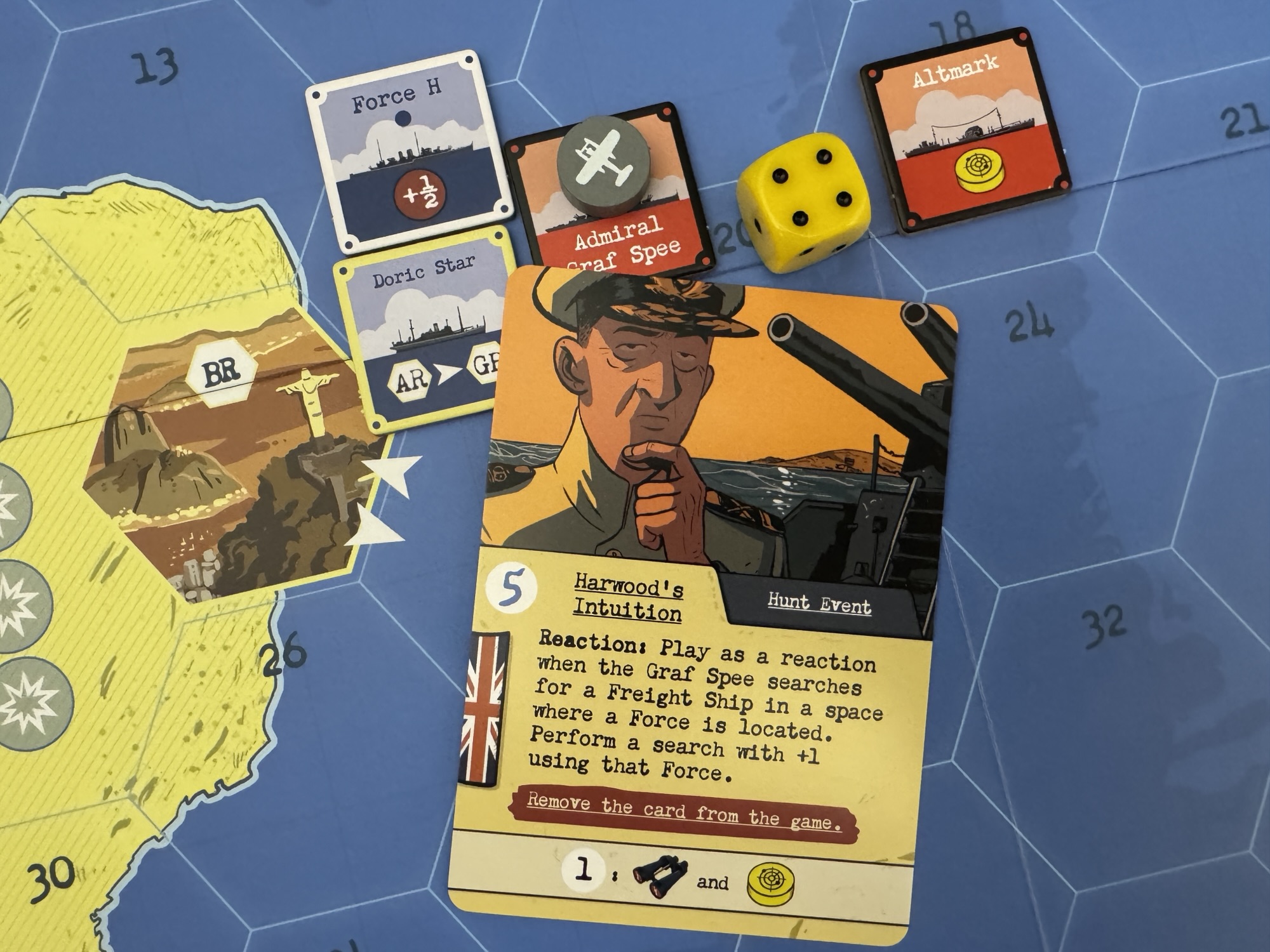
In today’s post, we will take a look at the very useful British card Harwood’s Intuition. Harwood’s Intuition is a 5 Ops card, which makes it a very important card in the British deck as it allows for the taking of 2-3 actions in a single turn, but for which there is an even more important use as an ambush by playing it as a Reaction to a German action. If the German player ever searches for a Freight Ship in a space where there is a British Task Force, and Harwood’s Intuition is played as a reaction, the British will get a free Search action with a +1 DRM to the roll. Normally, a Search requires a 5+ on a d6 to be successful, but with this bonus +1 that will mean success on a 4+ which is a 50/50 proposition. And remember, the point of the game for the British is to find and sink the Graf Spee at the Battle of the River Plate. Such as tasty surprise card for the British! I know that when I play as the Germans, I have to always keep in the back of my mind that this card exists and that if there is a Force present, I have a risk of being ambushed. This is one of the elements that makes this game so good.
The Battle of the River Plate was fought in the South Atlantic on December 13, 1939 and was officially the first British naval battle of World War II. In the months leading up to this infamous date, due to several successful sinkings of merchant shipping by the Graf Spee, the Royal Navy was ordered by Admiral Sir Henry Harwood Harwood to keep observation between Medanos and Cape San Antonio located off the coast of Argentina south of the River Plate estuary. In the lead up to the climactic final battle, following various raider-warning radio messages from the merchantman Doric Star, which was sunk by Admiral Graf Spee off South Africa, Harwood suspected that the raider would try to strike next at the merchant shipping off the River Plate estuary between Uruguay and Argentina. He ordered his squadron to steam toward the position 32° south, 47° west. Harwood chose that position, according to his dispatch, because it was the most congested part of the shipping routes in the South Atlantic and therefore the point at which a raider could do the most damage to enemy shipping. A Norwegian freighter saw Admiral Graf Spee practicing the use of her searchlights and radioed that her course was toward South America; the three available cruisers of Force G rendezvoused off the estuary on December 12th and conducted maneuvers.
Though generally considered a river, the River Plate has been considered by some geographers as a large bay or a marginal sea of the South Atlantic. Principally this is due to the River Plates enormous width, if we are considering it a river the widest in the world, with a maximum width of about 140 miles. Acting as the marine border between Argentina and Uruguay, the River Plate was a main artery of maritime trade and a gateway into the interior of the South American continent.
It was here that Harwood predicted the German raider would strike and his assumption made sense. The River Plate’s Estuary acted as a natural bottleneck for ships with perilous tides and sandbanks additionally hampering any ability for a British Merchant vessel to escape the guns of a German raider. So it was near the Estuary of the River Plate that Harwood’s H.M.S Exeter, Ajax and Achilles would make their stand. With their force concentrated here, on December 12th preparations were made and tactics drawn up in anticipation for an arriving adversary and to spring the trap and catch the elusive Admiral Graf Spee off-guard and send her to the bottom.
Here also is a link to our full video review of the game:
Martin Melbardis began his design career with Campaign: Fall Blau from Catastrophe Games. This was a very interesting little dice chucking solitaire game on Operation Barbarossa during WWII. Since that time, he has started his own independent wargame company called Solo Wargame and has designed 13 different and very interesting roll and write wargames on a plethora of subjects including World War I (Trench Tactics), World War II (Operation Barbarossa, Lone Wolf: U-Boat Command and War in the Pacific), Napoleonic Wars (Siege Works), the Crusades (Crusade: Road to Jerusalem) and Ancient Rome (Rome Must Fall). His newest game called Fliegerkorps is focused on the airwar during WWII and looks really interesting and I reached out to Martin to get a bit more information about the game.
Grant: Welcome back to the blog. What is your new game Fliegerkorps about?
Martin: Hello everyone, great to be back! Fliegerkorps, my newest game, is a solo operational air war game where you command a German Fliegerkorps (air corps) across one of three historical campaigns, The Battle of Britain, Barbarossa, or the Mediterranean. At the very beginning of the game you build your Fliegerkorps by choosing a commander to lead them and choose four aircraft cards to make up your air corps. During each of the fixed 12-turn campaigns, you manage your aircraft, fuel, and squadrons under mounting enemy pressure from air, land, and sea. You must complete enough missions to rack up Victory Points (VP) to influence the campaign before attrition grinds you down.
Grant: Why was this a subject that drew your interest?
Martin: I’ve always been in love with military aircraft for as long as I can remember, but honestly, it started with late-night YouTube rabbit holes on the Battle of Britain with those grainy clips of Spitfires vs. 109’s which got me hooked on the subject recently. After a few days, I came to the realization that I’ve never seen a wargame about managing an entire air corps. I’ve seen plenty of games about dogfighting or perhaps controlling a squadron of aircraft…but never at the corps level where you must deal with logistics, maintenance and planning sorties. I soon came to the realization that I wanted to design something that felt like you were commanding from a smoky ops room in 1940, watching your force slowly bleed out through attrition and sorties while high command demands more. One night I sketched a rough game design document on the idea and couldn’t sleep until I had the basics down.
Grant: What is your design goal with the game?
Martin: My goal was to create a light-to-medium operational solitaire air game that feels tense but stays streamlined and abstracted. I wanted players rolling dice, making meaningful decisions, and constantly weighing risk versus sustainability. Most importantly, I wanted to capture that operational rhythm of launching, suffering losses, refitting, and launching again.
Grant: What sources did you consult to get the historical details correct?
Martin: Core was the Rand McNally encyclopedia of World War II for consulting on general WWII aircraft histories, campaign overviews of the Battle of Britain, Barbarossa, and the Mediterranean Theater, as well as aircraft production and deployment timelines.
I’ll admit that I’m a total visual guy, and that shapes everything I design. YouTube documentary dives into Battle of Britain dogfights, early air war chaos, and Luftwaffe ops kept me fired up, motivated and increasingly informed on the subject throughout the entire Fliegerkorps development.
Grant: What battles are included in the game?
Martin: Battles in Fliegerkorps are more or less abstracted into missions rather than recreated tactically. For example, something like the potential invasion of Malta is represented through a Campaign Mission rather than a detailed operational scenario.
The game includes three campaigns: the Battle of Britain (1940), which focuses on an air supremacy grind, Barbarossa (1941), which blends air and land operations on the Eastern Front and the Mediterranean (1942), centered around convoy strikes, the siege of Malta and desert support. Each campaign has its own mission structure and pressure profile, so while the core system remains the same, the overall challenges change depending on the theater.
Grant: What elements from the early air battles of WWII did you need to model in the design?
Martin; I wanted this game to lean heavily into the simulation aspects of controlling an air corps in WWII and leave out much of the unit tactics involved in battles. Several key elements needed to be represented in the design were aircraft rotation between the Operational and Refit rows, logistical limitations, and escalating enemy pressure tracked through the Air, Land, and Sea Campaign Dice. I also wanted the game to reflect the reality that these campaigns were multi-domain efforts. Air operations rarely existed in isolation, they influenced and were influenced by events on land and at sea. It was important for me that the player could meaningfully affect the larger campaign across all three theaters: Air, Land, and Sea.
Grant: How does the player have to balance their missions, fuel, aircraft losses and worsening strategic conditions?
Martin: In the Mission Phase, all existing mission timers are reduced by one (if they reach zero, you fail the mission) and so missions can’t be ignored for long. If you allow timers to expire, penalties escalate with VP losses, Campaign Dice increases, or additional enemy cubes entering play. If you choose to engage those missions, it will cost fuel and you risk aircraft losses. Launching aircraft costs fuel and after attacking, you move the squadrons to the Refit Row on the aircraft card for maintenance. Larger aircraft like bombers take longer to recover than lighter fighters. So every turn becomes a balancing act. The tension builds steadily over the 12 turns, and that operational pressure is really what the game is about.
Meanwhile, Campaign Dice track strategic pressure in the Air, Land, and Sea sections. As missions and events accumulate, those values can possibly creep up. If a Campaign Die ever reaches 5+, Saturation penalties will apply and certain section-specific restrictions will come into play. This will reduce your options and make future attacks on that section even tougher.
Grant: How does campaign pressure from air, land and sea campaigns affect the player?
Martin: All Campaigns have on their gamesheet containing three Campaign Sections…Air (red for enemy fighters), Land (green for ground forces, AA, and infrastructure), and Sea (blue for convoys, naval logistics, and supply lines). Each one has its own Campaign Die that tracks how bad things are getting in that section. The higher the number, the worse conditions are getting for the Germans. Things such as more enemy pressure, tougher challenges, and nastier effects kick in. If a section becomes Saturated, it seriously lowers your effectiveness when dealing with that Campaign section. In addition, that sections’ specific penalty applies (like in the Battle of Britain, where the Land die at 5+ blocks any chance of rerolls.) Ignore any section too long, and the pressure snowballs across turns.
There is also the chance of a Campaign Collapse which happens if any two of those dice ever hit 6 at the same time (Air + Land, Sea + Air, whatever), the whole campaign falls apart and you lose immediately. No VP tally…it’s game over. It’s a tipping point where one front collapses and drags everything down with it.
Grant: What is the dynamic mission system? How does it work?
Martin: Missions are the central heartbeat of Fliegerkorps, popping up fresh each turn right in the Mission Phase. Each Mission has a die as a timer that you tick down by -1 each turn and meaning no mission lasts forever, and can expire if not completed in time. This does really well to reflect history by adding a sense of urgency to each mission.
Usually Missions are generated by rolling a 1D6 on the Standard Mission table for routine ops like fighter sweeps or convoy strikes and deploy enemy cubes in the section. However, if you land on a green spot on the Timeline? You Skip the roll and generate a Campaign Mission with bigger risks, but juicier rewards. Campaign Missions are unique, historical operations like the London Blitz or the Encirclement of Kiev.
Grant: What choices does the player have for building their Fliegerkorps?
Martin: I absolutaly wanted to include some sort of customization or army building mechanic in the game to allow players to build their own Fliegerkorps using a tight 25 Victory Point (VP) budget.
Before each game you start by choosing a Commander card and pay its VP cost. Commanders simply provide a single, but powerful, special ability. An aggressive option like Richthofen boosts offensive output, while others may reward efficiency or control. Always choose one that matches your style.
Next, choose exactly four Aircraft cards, keeping in mind theater and year restrictions. A mix of fighters, bombers and some Recon aircraft is usually best.
If you have unspent VP, you can always buy extra black Fuel cubes or white Iron Cross cubes (for clutch rerolls.) In Campaign-mode, after each Campaign, you get a chance to further upgrade your Fliegerkorps by buying upgrade cards, or exchanging aircraft cards as new aircraft become available in later campaigns.
Grant: What does an aircraft card look like?
Martin: Aircraft cards are the real stars of Fliegerkorps, they include fighter, dive-bomber, recon, bomber, or even heavy fighter wings, with 2-4 grey cubes each to track the strength of the squadrons that make them up. I honestly think one of my best design decisions for the game was to have an airfield diaroma on the top half of each of the aircraft cards which is further divided into the Operational Row for launch-ready aircraft cubes and the Refit Row, just below, for beat-up aircraft nursing wounds, maintenance and parts.
Each card also has attack ratings vs. Air, Land, or Sea, plus a special ability that will help you during the Campaign. In addition, each card also lists if it’s a Large or Small aircraft type (which affects some actions, the reasoning behind this is that bombers are much more “hangar queens” than small fighters.) Finally, all cards have a VP cost to buy them in your 25 VP build, a year availability and sometimes icons for Recon.
Grant: What is the ultimate player goal for the game?
Martin: The goal is all about how well you balanced your aircraft sorties to complete as many important missions as possible before time runs out. At the end of an intense 12-turn campaign it really boils down to pushing aggressive launches and attack tempo, against refit, recovery and the logistical limitations of WWII Germany. At the end of the game, you tally up those hard-earned VP’s from mission completions and lowering Campaign dice enough and check them against the Victory threshold table on your game sheet.
Grant: What is the layout of the Game Sheet?
Martin: The Game Sheet in Fliegerkorps is laid out so everything’s visible at a glance. I always try to make it as easy as possible for solo play without over-complicated charts or even flipping pages. The top left has the Timeline with 12 slots or turns. Green spots on the Timeline for triggering those rare high-stakes Campaign Missions and with the VP thresholds just above the Timeline.
The center is dominated by the three Campaign Sections (Air: red fighters, Land: green AA/ground, Sea: blue convoys and naval forces) while the top right lays out the Standard Mission and the Campaign mission tables. Finally, the Bottom right has the all-important Action Boxes.
Grant: How are Action Cubes used by the player?
Martin: In the Luftwaffe Phase each turn, you grab four Action Cubes (think of them as your command orders), and allocate them one by one into any empty slot inside any of the Action Boxes at the bottom-right of the game sheet. Slots are limited on certain actions and some slots cost more Fuel or gives less options than others. For example, the Logistic action allows you to pick three options such as recover a loss aircraft or gain fuel. However, using the same action a second time limits you to picking only two options. I felt that adding diminishing returns for repeated use of the same action would help prevent players from spamming certain actions.
Grant: How is the number of Action Cubes available determined each round?
Martin: Action Cubes are fixed at four Action Cubes every Luftwaffe Phase. Campaign effects, Commander abilities or upgrade cards can sometimes alter the available actions in a turn, but for the most part you will always be given four Action Cubes per turn.
Grant: What different orders does the player have access to? How do they affect the game?
Martin: Orders, or Actions, are where the player get’s a chance to react to the evolving Campaign. Some actions require Fuel and each action resolves immediately once placed. The available actions are:
Launch/Attack: Launch aircraft from the Operational Row of one Aircraft card to target a Campaign Section. Successful rolls remove enemy cubes, which may be placed on Mission objectives if possible. After resolving the attack, those squadrons move to the Refit Row.
Recon: Use Recon-capable aircraft to gain Recon points, which can be spent to re-roll dice, ignore Saturation, gain an extra action, or adjust missions and events.
Refit: Moves squadrons from the Refit Row back to Operational status. Larger aircraft recover more slowly than smaller fighters.
Martin: At the end of the 12-turn campaign in Fliegerkorps, you simply total your VPs from completed Missions and any Campaign Die bonuses earned for keeping pressure under control. You then compare that total to the Victory threshold. Each campaign has its own required totals. The difference between Victory and Brilliant Victory is simply a matter of having a few extra VP’s to upgrade your Fliegerkorps at the end of the campaign (not to mention bragging rights)
In Campaign Mode (or Linked-Campaigns), any VP earned carries forward and can be spent on upgrades for your Fliegerkorps, such as additional Fuel or Iron crosses as starting resources, upgrade cards or exchanging aircraft cards .
Grant: What are the loss conditions?
Martin: You lose in one of two ways…First, if at the end of the 12-turn campaign your total VPs fall below the required threshold of Victory listed on the Game Sheet. For example, in the Battle of Britain you need at least 11 VP to achieve Victory. Anything below that is a loss.
Second, you lose immediately if a Campaign Collapse occurs. This happens if any two Campaign Dice reach 6 at the same time. For example, the Air and Land Campaign sections both maxing out. When that tipping point is reached, the campaign ends instantly. This reflects the idea that sustained pressure across multiple fronts can overwhelm theoverall campaign of yourFliegerkorps. Ignore one theater too long, and the consequences will cascade quickly.
Grant: What type of experience does the game create for the player?
Martin: I’ve always enjoyed fast-playing management-style games where you’re juggling resources and trying to prevent systems from spiraling out of control. That feeling was something I really wanted to reflect with Fliegerkorps. At its core, the game is a compact operational simulation themed around running a WWII Luftwaffe air corps. Each playthrough runs about 30 to 40 minutes. I also added options for different force builds and campaign theaters to try and create strong replay value.
Grant: What other topics are you planning to create games for in the future?
Martin: Firstly, some big news… Catastrophe Games will soon be launching a boxed edition of my game, Campaign: Bagration on Kickstarter. It’s the direct sequel to Campaign: Fall Blau, but this time you’re on the Soviet side in 1944.
I’ve also begun designing a new game called Shock & Awe, centered on the 1991 Coalition air campaign against Iraq’s integrated air defense network. I’ve also been exploring something completely different, a fast, arcade-style air combat experience centered on piloting a single Cold War-era fighter such as an F-15, MiG-29, or F-16. It’s still in the conceptual stage but the idea will evolve.
Beyond that…my solo print-and-play pipeline always remains active where I’m planning to continue my epic WWII Roll & Write series, focusing next on a North African campaign or possibly D-Day. Smaller games like this allow me to finish them relatively quickly while keeping the designs accessible and portable. I may also put out a voting poll to backers soon to help shape ideas for a future project. There are simply so many wars and time periods still worth exploring, and to me, community input is always valuable. As you can probably tell, I have far more game ideas than time to fully develop them all!
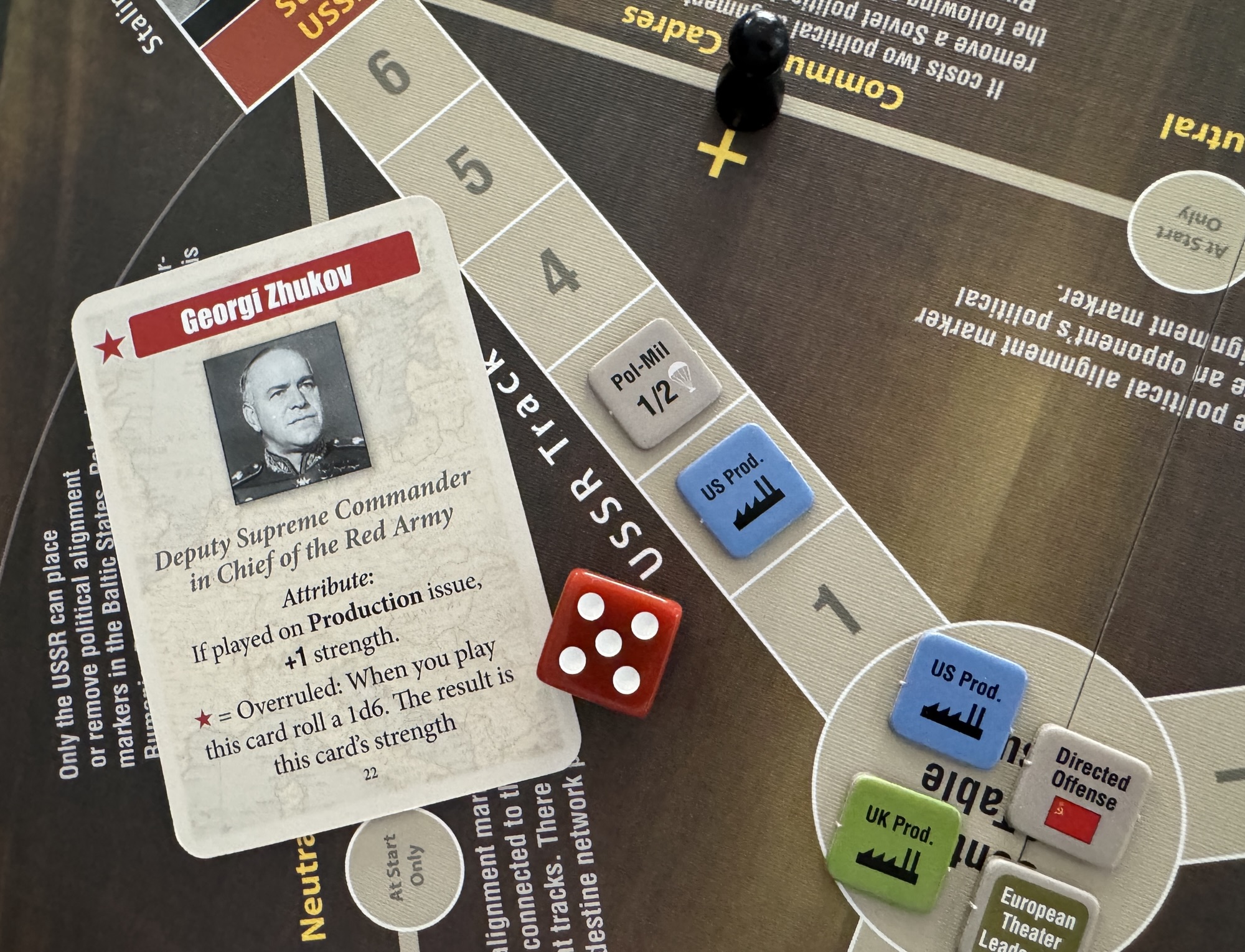
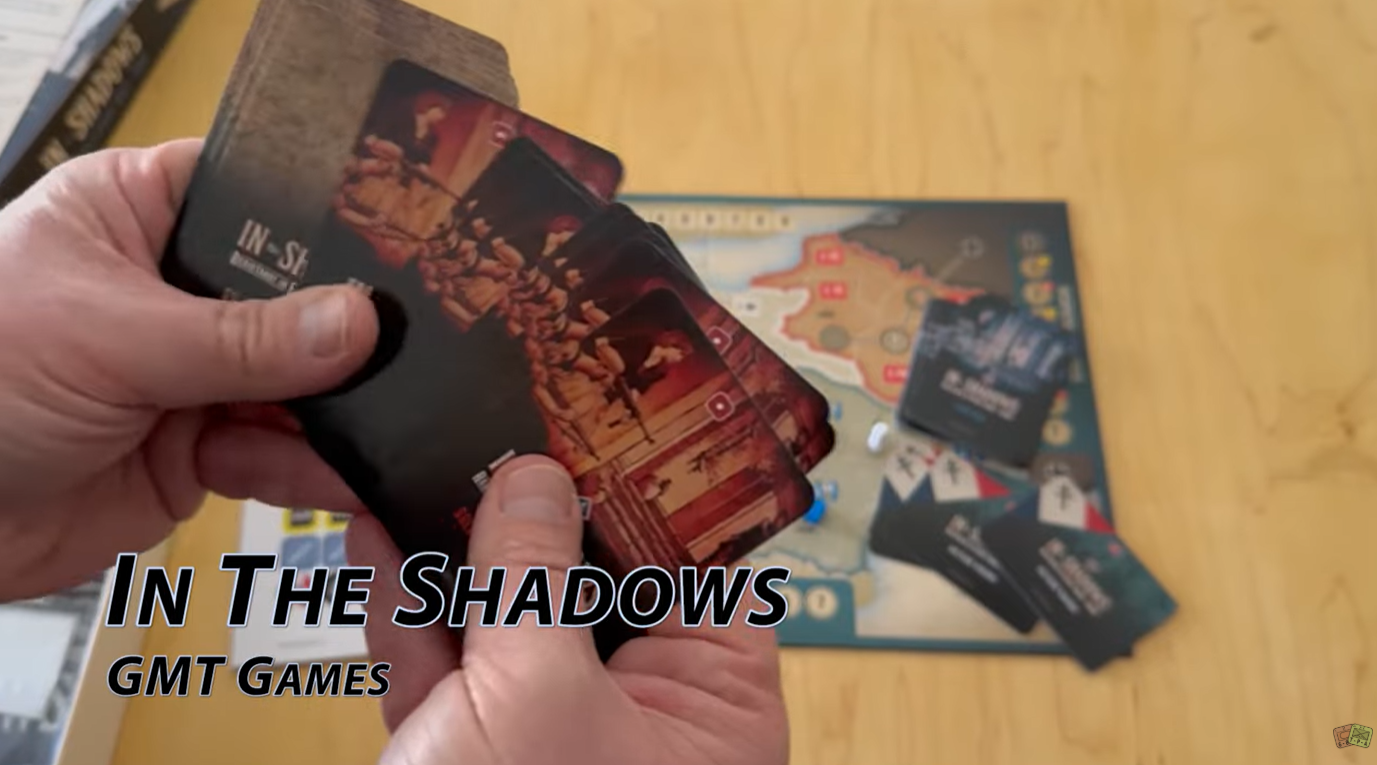
Anticipation! Something that we feel for things that we are interested in, whether it be family trips, sporting events, time off, holidays or hobbies. Anticipation keeps our minds focused on something that we feel and hope will be a good thing that brings us great joy. I feel anticipation each year for the new wargames that we are going to get to play many of which we will have been waiting upon….sometimes for years. Each year since year 3 of the blog (having been started in 2016), I have posted this list highlighting my most anticipated wargames for the upcoming year. The list has grown each year with the first entry consisting of 11 games in 2018, then growing to 12 games in 2019 and 2020, ballooning to 18 games in 2021 and then settling on just 10 games in 2022, 2023 and 2024 and then 11 games in 2025. This year, I will focus on 15 games because I cannot help myself! In case you missed my post from last year, you can read that here: Most Anticipated Wargames of 2025!
Once again the same as I did last year, I wanted to put this caveat out there. The games chosen for this list might not fit your definition of a wargame. I feel that historical and wargames are somewhat interchangeable terms because of the quote from Clausewitz “war is a mere continuation of politics by other means”. Wargames to me are a broad category not simply relegated to hexes, counters and a CRT. Don’t get me wrong. I really like hexes, counters and a CRT. But wargames can include none of these three things and be considered wargames to me. But that is probably a debate for another time. Once this post is shared, I expect many comments and questioning statements from you our audience and I have come to actually “anticipate” reading these. So sit back, relax and get ready to have your paradigm about what a wargame is shifted!
Battle Commander: Volume I – Napoleon’s Italian Campaigns from Sound of Drums
I have been following this project for the past couple of years after it had a very successful Gamefound campaign in November 2024. I just really like the way the game looks to be laid out and executed and frankly anything designed by Carl Paradis has been good such as the No Retreat Series. Another tactical Napoleonics game sounds like something that I am very much in need of and am hotly anticipating this title. Battle Commander: Napoleon’s Italian Campaigns is at the Brigade/Division scale, is supposedly very playable, with no downtime or complex computations or mechanics. Because it is being published by Sound of Drums, the package will be super-deluxe, using a very large box, allowing the 2-sided mounted maps to be folded only once, game pieces will be painted-on wood blocks of different shapes, so no annoying stickers to apply, you’ll have a couple dozen blocks per side in a game, often less. Also, no dice, almost no markers, and the emphasis is on the gameplay!
The crux of the game engine will be the deck of event cards, that will also take care of all the combat results and other dice functions and the cube-pull mechanism, that will manage player unit activations, but also turn end, when combat and rally happens, and other similar game happenstances. It’s all a very granular affair. The whole package has a definite “Kriegspiel” look, with all the graphics done in a contemporary Napoleonic style, with a very different way of maneuvering units on the field of battle compared to other Napoleonic games.
From the game page, we read the following:
Battle Commander intends to recreate historical 18th-19th century battles. It features a fresh framework focused on providing two key aspects: command decision and maximum playability.
In Volume I, you act as Army Commander in a series of six dramatic Battles fought during Napoleon’s two Italian campaigns. Volume II will cover engagements of the Second and Third Coalitions, including Austerlitz and the Battle of the Pyramids.
In Battle Commander, you struggle against the chaos of battle, making meaningful high-level decisions, not micro-managing your troops: that’s your colonels’ job! Good card play is paramount for Battle success, but make no mistake: this is not a card-driven, but a card enhanced game.
Cube-pull activation is used to manage game phases (movement, combat, rally, card draws etc.), and cards for the interactive combat system and events, allowing for a myriad of possibilities and solitaire-friendly gaming. No dice, no complex odds counting, no markers, no play downtimes, no sure thing!
A persona card represents each Commander, his specific abilities and your Army’s resources; the all-important Subordinate Leaders are integrated in an innovative multi-role card system.
Morale and troop skill are a core mechanic: demoralizing the enemy goes a long way towards winning the fight, with Armies slowly degrading in performance, until the breaking point! Casualties are managed effortlessly, and a correct “Battlefield Look” maintained at all times. With a game piece count similar to Chess, you’ll be able to assess your going in one quick “coup d’oeuil”.
This one looks to be interesting! And Carl Paradis is a very good designer as we have played lots of his No Retreat! Series games and enjoyed them.
I am 100% confident that Battle Commander Volume I: Napoleon’s Italian Campaigns will be out this year and I am very much looking forward to playing it.
Valiant Defense Series Volume V: Guadalcanal: The Battle for Henderson Field, Oct 23-26, 1942 from Dan Verssen Games
The Valiant Defense Series originally designed by David Thompson has been one of my favorite solitaire wargame series of the past 8 years. Each of the volumes in the game addresses very specific situations and always have a very interesting take with fun mechanics, great art and fantastic production. The torch for the series though appears to be passing to a new designer in Vincent Cooper. He has been working on Guadalcanal: The Battle for Henderson Field, Oct 23-26 1942 for the past few years and it had a successful Kickstarter campaign in July 2024.
From the game page, we read the following:
Valiant Defense Series Volume V: Guadalcanal: The Battle for Henderson Field (Oct 23-26, 1942) from Dan Verssen Games is a solitaire wargame where players command US forces defending a fixed perimeter against waves of Imperial Japanese Army troops. It focuses on the pivotal four-day battle, utilizing card-driven AI to simulate intense, often nocturnal, combat, similar to Pavlov’s House.
Players will command the 1st Marine Division and the 164th Infantry Regiment, defending the Lunga perimeter against the Japanese 17th Army’s major October offensive. Similar to Pavlov’s House, you manage multiple layers of defense, including the Cactus Air Force (Wildcats and SBD’s), supply lines from Task Force 62, and the 11th Marine Artillery Regiment. The game emphasizes the “Night” setting of Guadalcanal’s jungle warfare, utilizing unique card illustrations to show Japanese columns advancing through the dense foliage toward your perimeter.
This all started about 3 1/2 years ago when I first played Pavlov’s House. I say played. I ‘played’ the game for about 10 minutes…and then I sat there in stunned disbelief at how a game could be sooooo good!!!! By the time I finished there were two very clear ideas for games fully formed. I contacted DVG to see if there was any interest and they put me in touch with David Thompson. I didn’t hold much hope. There was no reason for him to trust his IP to me, a person he didn’t know.
But I gave it a try and David, it turns out, is one of the nicest people you can ever come into contact with. After some back and forth, the idea for Guadalcanal – The Battle for Henderson Field was born (not, in fact, one of the original ideas, but we’ll see what the future holds for them…).
Art by the supremely talented Nils Johansson
Thank you to all the play testers, and in particular Glenn Saunders, Shane Freshwater and Martin Fenwick Charlesworth Much more to come from out design team in the near future!!!
The most recent update on this one’s progress says that the game was sent to the printer in December 2025 and that this process could take “months”. With that being said, my guess is that this will shipping in the spring, probably around April.
Volume II Civil War Heritage Series – Army of the Potomac: Campaigns of 1862 & 1864 from GMT Games
Several years ago, Mark Herman designed a very unique and simple American Civil War game called Gettysburg that appeared in C3i Magazine #32. That game became the basis for his new Civil War Heritage Series with the first volume being Rebel Fury that focused on five battles from the Chancellorsville and Chickamauga Campaigns. He has been working on the follow-up to that game and we finally will get it with Army of the Potomac.
From the game page, we read the following:
Army of the Potomac: Campaigns of 1862 & 1864 is the second volume in the Civil War HeritageSeries and the follow-up game to the innovative and acclaimed Rebel Fury. Army of the Potomac uses the same core rules as Rebel Fury, so players familiar with Rebel Fury will be able to jump right into the action. Each battle in Army of the Potomac is quick-set-up, quick-playing, and deeply interactive. The density of counters in each scenario is low, allowing you to see and experience the big picture of the battle.
Army of the Potomac covers the battles of Spotsylvania II, North Anna River, Cold Harbor, and the entire Seven Days battle (McClellan vs. Lee), including the prelude Seven Pines (McClellan vs. Johnson) when Johnson’s wounding brought Lee into the command of the Army of Northern Virginia. Each battle places you, the player, in the role of the Army Commander (Grant, McClellan, Lee, Johnson). You maneuver your army to find the enemy’s flanks, concentrate your forces for an attack, and determine where to commit your artillery assets.
I think that one of the most interesting parts is that this new game can be played with Rebel Fury as also included are two bonus scenarios to allow owners of Rebel Fury to fight Spotsylvania II and begin the Campaign scenario from Wilderness to Cold Harbor using their original Rebel Fury map.
While attending the WBC last summer, me sat down with Mark Herman and he gave us an overview and insight into the game and its focus. You can watch that interview at the following link:
If you are interested in Volume II Civil War Heritage Series Army of the Potomac: Campaigns of 1862 & 1864, you can pre-order a copy for $49.00 from the following link: https://www.gmtgames.com/p-1108-army-of-the-potomac.aspx
The most recent update from GMT Games from late January was that Army of the Potomac is currently at the printer but doesn’t have an expected shipping date as of yet. My guess is this one will be on our tables sometime in early summer.
First Man in Rome – Strategikon Book II: The Civil War and the Fall of the Republic from Thin Red Line Games
If you are a monster wargame fan then you are probably familiar with Thin Red Line Games and the genius behind the madness Fabrizio Vianello. They are a small but passionate publisher and my favorite thing about them is that Fabrizio speaks in his military jargon so fluently that it is such a thematic boost to the games they produce. Over the past couple of years, we have posted interviews with Fabrizio covering their Cold War Gone Hot games called Die Festung Hamburg and In a Dark Wood as well as the first game in a new Ancients series called The Fate of All: Alexander’s Campaign Against the Persian Empire. Following along in that Strategikon Series is the new volume called First Man in Rome that was announced during the fall of last year.
From the game page, we read the following:
Citizens, the creation of the great mosaic depicting the beleagured civil war between Caius Iulius Caesar and Cneo Pompeius Magnus continues!
As already discussed in the Senate, we intend to represent the entire civil war, from the crossing of the Rubicon in 49BC to the defeat of the last Pompeian forces in Spain in 45BC. So it’s not just a glimpse of this epic confrontation, but the whole struggle for the greater good of the Res Publica.
I can now share some details on the map, almost at its conclusion. The map will be probably divided in six parts, each one with the size of a “standard” map. Due to the enormous extension of the conflict, the scale has been increased from 30km to 60km per hex, and the rules will be adjusted accordingly.
If you are interested in First Man in Rome– Strategikon Book II: The Civil War and the Fall of the Republic, you are encouraged by the designer to reserve a copy immediately by writing a votive tablet (email) to info@TRLGames.com! Don’t miss your chance to join the Legions and defend the Res Publica!
Rising Dragon: Platoon Level Combat in 2034 from Flying Pig Games
Several years ago, we played a very fresh and innovative wargame called Armageddon War, which is a platoon level scenario based game set in the near future. The game focuses on the Mid-East, pitting Israelis, Russians, and Americans against age-old adversaries. The game felt very fresh and new as it adds a few new tricks to a tried and true hex and counter tactical wargame system. And Flying Pig Games pulled out all of the stops on production with huge hexes, beautifully large counters and custom dice. Now, finally, Flying Pig Games and Greg Porter are unveiling the next volume in this series called Rising Dragon: Platoon Level Combat in 2034 and it looks awesome!
From the game page, we read the following:
October 1, 2034 marks the beginning of the conflict that unfolds in Rising Dragon, a standalone game and campaign setting for the Armageddon WarSystem. With the United States turning inward in the wake of the catastrophic ‘Armageddon War’, China seizes the moment to assert its territorial claims, letting the world know that it is now the unchallenged power in the region. This sets the stage for a military showdown that spans East Asia, with Taiwan at the epicenter.
Platoon Level
Scale of 150 meters per hex
15 minutes per turn
Continuous Chit-pull Activation
18 stamped dice for combat resolution
Naval, amphibious, and urban conflicts
Age: 14+
Players: 2
Playing Time: 1-3 Hours
Scenario based
The game introduces cutting-edge technologies, including hypersonic missiles, advanced amphibious operations, and features detailed maps that bring the battlegrounds of Taiwan and the wider region to life. Scenarios include the Chinese invasion of Taiwan, where hypersonic missile systems like the PRC Heaven Sword devastate Taiwanese defenses.
OPLAN 5027 Supplement
OPLAN 5027 expands the conflict further, introducing North and South Korean hostilities, where players can engage in both the defense and offense of Korea’s border zones. With Rising Dragon, players can immerse themselves in a fast-paced, near-future conflict, where technological advancements and strategic decision-making determine the fate of East Asia.
Gameplay is continuous and fluid. There are no turns, just continuous activations. The intensity of a unit’s close combat modifier is determined not only by its weapons but also by the tactics you choose to use for the assault or defense, and when you fire on a unit, it has the option of taking cover or returning fire. The number of dice and the color of dice rolled, determine the number of hits.
Formations are activated by chit draw (nothing new there), but returned to the draw cup not at the end of a turn, but rather in a continuous manner. When chosen, a formation marker is placed on the activation track, to the right of the last-drawn formation. When only one chit remains in the cup, the two leftmost chits are returned to the draw cup. Simple, continuous.
I am unsure if this title will be ready this year but am hoping that it it. The Kickstarter campaign was funded in November and I see no reason why this cannot be fulfilled by the end of the year.
Rebel Tide: The American Civil War, 1861-1865 from Compass Games
There is no secrete that we really enjoy Gregory M. Smith designs and we also count him as a close friend so take that for what it is worth. He is a great designer and has put together some of our favorite narrative-driven solitaire wargames, such as Silent Victory, The Hunters and The Hunted, but also has done some great 2-player strategic level games on various historical periods including Imperial Tide, covering WWI, and Pacific Tide, taking on the Pacific Theater of WWII. His new game in the system deals with the American Civil War and is called Rebel Tide.
From the game page, we read the following:
Rebel Tide: The U.S. Civil War, 1861-1865 is a two-player strategic level game that places you in command of either the USA (Union) or CSA (Confederacy) during the Civil War. Each turn consists of a year, during which multiple card plays occur. These give the players movement, combats, entrenchments, and other actions. At the end of each year, players must make critical decisions on which cards to re-buy in an attempt to win the war outright or to win by placing the other side in a disadvantageous position by 1865. Rebel Tide is based on the popular, action-packed Imperial Tide/Pacific Tidegame system by Gregory M. Smith, with many combat and strategic decisions to challenge players in just a single evening’s game.
The core of the game is the unique card re-buy system, in which players take their annual production (adjusted for blockades and blockade runners) and decide which cards they need for the upcoming year. Cards not only provide for reinforcements, but allow for movement, combat, and entrenchment. Which cards to rebuy is without question one of the key decisions the player must make to prepare for next year’s operations.
The game has infantry units for all of the major participants, cavalry, and artillery units. Naval operations are mainly abstracted, although the Confederate player must worry about Farragut invading a port from the sea. Besides the focus on card play, the game features a small footprint (one standard map) and also is designed to be played in just a single evening – estimated at 3 hours for experienced players to fight the entire war.
But don’t worry because the game is not just a reskin of the same system used in those other two games, although the system is really interesting, but instead attempts to create new mechanics and elements to tell the proper story of the struggle for the soul of the country in the 1860’s.
One new mechanic in Rebel Tide is the Political Track, which is an abstract measure of the support of England and/or France to the Confederacy. If this track reaches the maximum early in the war, it can trigger an early CSA victory.
Another new key mechanic in the game system is the addition of historical Leaders, who range in ability from excellent (5) to poor (2). Bad leaders may be “sacked” and removed from the game and randomly replaced by the expenditure of a movement action. Leaders are vital in advancing after combat and also can add strength to an attack’s total combat power.
While attending WBC a few summers ago, we had a chance to sit down with Gregory M. Smith to cover a few of his upcoming designs and Rebel Tide was included in that discussion. Here is a look at our video interview with Greg:
As of February, Rebel Tide was the 4th next game to be published according to Compass Games website so I would think that this will be in our hands early summer.
Brandywine 1777 – A Time for Heroes from Les 3 Zouaves
As you know, I love a good game about the American Revolution and last fall (September) month I noticed a new game going to Gamefound on the Battle of Brandywine Creek on September 11, 1777. The game is from a new company that I don’t know much about called Les 3 Zouaves but looks really great.
From the game page, we read the following:
The smoke of musket fire hangs in the air. The Brandywine River glistens behind your lines. Across the field, redcoats are on the move — and one bold decision could tip the balance of the entire Revolution.
You hold command.
Will you outwit your enemy? Will you strike with daring precision, or hold the line against impossible odds?
Play as General Howe or General Washington in a tense, card-driven clash of minds.
Every decision matters. Every move could rewrite history.
And only one can emerge victorious.
Brandywine 1777 is more than a battle: It’s your chance to prove you are a true tactician… a hero of the Revolutionary Wars.
In Brandywine 1777, you assume the role of George Washington, facing a bold and elusive enemy. Activation Cards are your principal tool —used to commit your forces at just the right moment… if you can anticipate the British plan.
But it’s never that simple. Each card lists several potential formations—some real, some misleading—and you’ll never have enough activations to do everything you need to do. Choose wisely, bluff cleverly, and stay one step ahead.
You’ll be balancing:
Major activations – few in number, but vital,
Minor activations – flexible but limited,
And Bonus activations, which cost precious cohesion but can turn the tide when used effectively.
This one is a stretch to add to this post but once again I am being optimistic.
Limits of Glory Campaign V: Donning the Sacred Heart from Form Square Games
A few years ago, we became acquainted with Andrew Rourke through his Coalitions design from PHALANX that went on to a successful crowdfunding campaign and is a game that I am very much looking forward to and have been since that time. He has since been a busy guy with starting his own publishing company called Form Square Games and also publishing the first 3 designs in a new series called Limits of Glory that will take a look at the campaigns of Napoleon and other contemporary conflicts. In Campaign I, which is called Bonaparte’s Eastern Empire, the game is focused on the campaign of the French in Egypt between 1798 and 1801. Campaigns II, III and IV are Maida 1806 and Santa Maura & Capri. Last year, they ran a successful crowdfunding campaign for the fifth campaign and volume in the Limits of Glory Series and it is set during the French Revolution and the Civil War in the Vendée in 1793 and is called Donning the Sacred Heart. I very much have enjoyed our plays of this series with its use of Glory and chance in managing your leaders and their inherent elan and leadership.
From the game page, we read the following:
The French Revolution was not welcomed by all in France. The staunchly Catholic and Royalist leaning Vendée Militaire was a region unwilling to sacrifice its youth to the voracious appetite of the Republic’s military conscription machine, and the people of the Vendée were prepared to fight to defend their beliefs. Donning the Sacred Heart covers the vicious Civil War in the Vendée from March until December, 1793. All combatants and significant commanders are included and the game causes Multiple strategic decisions every turn. Your decisions will decide victory or defeat, the easy to play mechanics produce a subtle game with full player agency. Complete player engagement throughout.
Tension builds as the Event Clock drives the game, neither player being able to depend on events going their way, or knowing when the game will end.
I would expect this one to be fulfilled in late summer as the most recent update in late January was that the games would be shipping soon.
An Impossible War: The First Carlist War in the North, 1834-1838 from Bellica 3rd Generation
A few years ago, we did an interview with David Gómez Relloso covering his well thought of Crusade and Revolution: The Spanish Civil War, 1936-1939 from Compass Games that was getting a deluxe edition and on Kickstarter at the time. Since that time, we have played the game and really enjoyed it. Recently, I spoke with Francisco Ronco and he informed me that his company Bellica 3rd Generation was doing a new game by David called An Impossible War. That game covers The First Carlist War in the North of Spain and is currently in the process of being fulfilled so it won’t be long now.
From the game page, we read the following:
An Impossible War is a game about the decisive years of the First Carlist War in the North. Infantry and cavalry are represented by blocks, which introduce fog of war into operations. There are also artillery counters (field and mountain artillery) and logistics units (supply trains and backpacks).
The main map is a point-to-point board covering the northern theater of operations: Navarre, the Basque Country, and surrounding areas of La Rioja, Burgos, and Cantabria. In addition to provincial capitals, major towns and other localities are shown, along with primary and secondary routes of communication. There is also a smaller map of the rest of peninsular Spain, showing the regions affected by the Carlist uprising and allowing expeditions being launched from the North.
Each turn, players compete for initiative and carry out a variable number of actions. There is also a card deck for each side, including historical, operational, and tactical events. The cards add background and unpredictability to the game, helping make each session different. This is NOT a card-driven game, but one assisted by cards.
An Impossible War simulates the historical conflict, which featured numerous skirmishes, few major battles, and significant siege warfare. It is an asymmetric game in which each side has strengths and weaknesses. Players must exploit their advantages and mitigate their disadvantages to achieve victory.
The Carlist player must make use of superior mobility and unit quality to consolidate territory, wear down the enemy, and threaten cities. The Liberal player must contain and suppress the insurrection; they have more troops, but of lower quality and plagued by logistical nightmares. Additionally, they must quell uprisings and chase down Carlist expeditions across the rest of Spain.
If you are interested in An Impossible War: The First Carlist War in the North, 1834-1838, you can order a copy for 120,00 € from the Bellica 3rd Generation website at the following link: https://bellica3g.com/en/product/una-guerra-imposible/
This game just recently became available and I actually own a copy and am in the process of doing an unboxing video0 and learning the rules to play it with Francisco Ronco (owner of Bellica 3 G) at the end of the month.
Song for War: Mediterranean Theater from Invicta Rex Games
While attending Buckeye Game Fest in the spring of 2022, we met two new designers who had a very cool looking prototype copy of their new game setup in the War Room called Song for War: Mediterranean Theater. Chris Helm and Seth Stigliano were really nice guys who obviously had put a ton of time into their game and it was immediately evident that this was going to be a different experience. Unfortunately, because of our crazy schedule of events and already committed to games at the convention, we were unable to sit down and play the game but did get a quick overview and crash course into the design as well as a good look at the awesome components.
The game was funded on Kickstarter in 2025 and we have been told that the game will be available by the end of 2026.
From the game page, we read the following:
Song for War is a tabletop strategy game based in the contested regions of southern Europe, north Africa, and the Mediterranean Sea during World War II. Representing one of four nations, players must work together as the Allies (US or Great Britain) or Axis (Germany or Italy). Players have the option to set strategy, move units, attack and defend as individual nations or simultaneously as the Allied or Axis team. Innovative mechanics allow players to deploy their land, sea, and air units strategically as combined forces, with faster units moving first and more often, followed by heavy units with stronger firepower. Take strategic objectives, control shipping lanes and resupply, deploy new technologies and units, and recreate historical events to defeat the enemy and win the day.
One of the best parts is the asymmetry built into the design for each of the nations. This gives the game some feeling of reality versus everyone just having the exact same units with the exact same abilities. I also am really interested in each nations’ special units and want to see how these things work and feel as the game is played.
Fellow content creator Zilla Blitz did a preview for the game in 2023 and you can check that out at the following link:
If you are interested in Song for War: Mediterranean Theater, you can pre-order the game at the Invicta Rex Games website at the following link: https://www.invictarex.com/songforwar
The Lions of El Alamein from VentoNuovo Games
Last year, while perusing the internet, I found mention of an upcoming block wargame on the battles in and around El Alamein in World War II from VentoNuovo Games. The game covers the Axis and Commonwealth Forces clash in the North African Theater in Egypt during 1942 and really looks to be pretty interesting. The game is called The Lions of El Alamein and was successfully funded on Kickstarter.
From the game page, we read the following:
What is The Lions of El Alamein? North Africa, 1942.The Battles of El Alamein were a series of battles fought in Egypt between Axis and Commonwealth forces between July and November 1942.
The terrain of El Alamein, close to the Qattara Depression, was chosen by the British after the Tobruk rout because it was the only geographical segment that could offer a defense in depth capable of protecting the Nile Delta and the Suez Canal. The game offers five scenarios to play all the battles fought at El Alamein from July to November 1942.
A turn is made of Impulses and each turn represents a month of real time. Each hex represents a distance of about six kilometers from side to side. Units vary from brigades to battalions, most of them HQ’s, armored, artillery, motorized, or infantry. The game employs the newly developed SLIT engine.
Complexity depends on the scenario played and the optional modules applied, thus varying from 2 to 4 out out of 5. Average game duration is less than a hour for the short battles, and about 1-4 hours for the three major battles.
There was supposed to be a series of these small interviews in a run up to the Kickstarter but there was a language misunderstanding (that I still cannot figure out) and I believe that I offended the parties involved and the series was cut short after just one entry. Shame really as I was liking what I was seeing and hoping to bring more of it to you!
I recently received a shipping notice on that one and would expect it to arrive by the end of February.
Model’s Counterattack: The Battle of Radzymin and Bagration’s End from Dissimula Edizioni
A few years ago, Sergio Schiavi broke onto the scene with his new company called Dissimula Edizioni with their first Kickstarter called Radetsky’s March: The Hundred Hours Campaign and that game was then followed a few years later by From Salerno to Rome: World War II – The Italian Campaign, 1943-1944 and then their third game called Give Us Victories: The Chancellorsville Campaign. Now, they have launched a very interesting looking East Front wargame during the summer of 1944, after Soviet forces launched a series of offensives that annihilated much of the German army but Field Marshal Model rallied some intact forces and counterattacked managing to halt temporarily the Soviet forces. This game is called Model’s Counterattack: The Battle of Radzymin and Bagration’s End and is currently available.
From the game page, we read the following:
In the summer of 1944, Soviet forces launched a series of offensives that annihilated much of the German army. During their advance they went as far as the Vistula, arriving near Warsaw. Field Marshal Model, by rallying some relatively intact forces and counterattacking, managed to halt, at least temporarily, the Soviet forces. While all this was happening east of the Vistula, the city of Warsaw rose up behind it…
The game lasts a total of ten turns; during each turn both players, altering each other, move and fight with their forces on the map, trying to conquer or defend key positions. During the course of the game some particular historical events may occur such as the arrival of reinforcements or the Warsaw uprising. At the end of the game, the victory conditions are checked and victory is awarded to the player who scores the most points.
Each hex on the map represents a distance of approximately two kilometers, side to side. Each turn represents one day of real time; units vary from brigades to battalions. The map represents the area where the main bales took place, east of Warsaw. Above it is printed a hexagonal grid which serves to regulate some aspects of the game. Warsaw is considered as a single area, an area where only German forces can transit or mass. Tables and tracks are printed on the map and are used to record and regulate some game functions:
Game Turn Track
Track for the Warsaw Uprising
Track for the allocation of German forces in Magnuszew
If you are interested in Model’s Counterattack: The Battle of Radzymin and Bagration’s End, you can purchase a copy for 59 € on the Dissimula Edizioni website at the following link: https://www.dsimula.com/model
COIN Series Multi-Pack IIThe Guerrilla Generation: Cold War Insurgencies in Latin America from GMT Games
Stephen Rangazas has been active behind the scenes over the past few years with his development work on Fall of Saigon: A Fire in the Lake Expansion. He used his background and research capabilities to great effect as he did the background work on the Event cards for that game. From that experience, he has now come forward with a few of his own designs in The British Way: Counterinsurgency at the End of Empire, which was announced in 2021 as well as Sovereign of Discord announced in 2022. Now, he is working on a new COIN Series Multi-Pack that deals with insurgencies in Latin America during the height of the Cold War called The Guerrilla Generation.
From the game page, we read the following:
The Guerrilla Generation: Cold War Insurgencies in Latin America is the second COINMulti-Pack, containing four separate games exploring a series of thematically related insurgencies. Building on the The British Way, this new multipack allows players to explore variations in insurgent groups’ organizational structures, strategies, and relationship with civilians, across four insurgencies in Central and South America between 1968 and 1992. During this part of the Cold War era, Latin America experienced an incredible number of different insurgent groups, many inspired by the Cuban Revolution featured in Cuba Libre, ranging from popular backed rural insurgencies, flexible urban guerrillas, externally sponsored raiders, and brutal ideologically rigid groups. This multipack features a game exemplifying each of these types of insurgencies, to offer players the chance to compare different approaches to rebellion highlighted in the quote by scholar Jeremy Weinstein above. The Guerrilla Generation also offers four longer and more complex individual games than those found in The British Way, as well as an entirely different approach to the linked campaign scenario, which combines two games into a simultaneous side-by-side experience.
This Multi-Pack includes four full games in one box, which is a fantastic value that will allow players to explore four different conflicts set during the height of Cold War Latin America between 1968 and 1992. Each game uses a unique ruleset building on the same general mechanical structure, ensuring that they are easy to pick up while still offering a distinctive experience.
I also love these Multi-Packs because they have a small board footprint with each of the 4 games playing in under 2 hours and taking place on a single 17” x 22” board. But, the game doesn’t just treat these games as individual as they are designed to experience at least a portion of the full span of the period and be used to learn more about these insurgencies.
There is also a “Resisting Reagan” Campaign designed into the game. A linked campaign scenario allowing up to 4 players to play El Salvador and Nicaragua side-by-side, with new mechanisms to represent the Central American peace and solidarity movement’s efforts to resist the Reagan Administration’s aid to both the Salvadoran government and the Contra insurgency, by influencing Congress and American public opinion.
In the most recent GMT Games update from January, the game was listed as being at sea, meaning that it has been printed and is in transit to the warehouse. Hoping that this one sees our table in April/May.
Small Battles of the American Revolution, Volume I: The Battle of Cowpens
While attending the World Boardgaming Championships in July 2024, I was able to meet up with Dave Stiffler (acting as Developer on the project) and Bruno Sinigaglio who is the designer to get an early look at the upcoming debut release in the Small BoAR Series called The Battle of Cowpens.
I didn’t get any pictures because they didn’t have the components along to show but learned a lot about the design and how it changes the Battles of the American Revolution Series from GMT Games. First off, the scale is the major difference as it is 1/8th of the scale used in the normal series. This means 25 yard hexes and 2-3 men per counter. They also have included both rifle fire and musket fire which is a change as musket fire is simply an abstracted part of the close combat mechanic in BoAR. They also have added some new mechanics to account better for things like morale and being shaken or even shattered.
I have known about this game for a while now, actually nearly a few years or so, but am very excited to see this one see the light of day and hope that the reception is great and that the game does well because I would like to see more small battles covered in future volumes.
From the game page, we read the following:
Two critical battles were considered turning points in the American Revolutionary War: the Battle of Saratoga in New York and the Battle of Cowpens in South Carolina. The Battle of Cowpens was a catalyst to a series of events that led eventually to the surrender of the British at Yorktown. Small BoAR Volume I, The Battle of Cowpens, puts players directly into the milieu of this decisive contest.
The goal of the Small BoAR design concept is to include small yet critical battles that otherwise do not fit the scale of the historically simulating and highly successful Battles of the American Revolution (BoAR) system designed by Mark Miklos. This new system, aptly termed Small Battles of the American Revolution (Small BoAR), was designed by Bruno Sinigaglio working closely with Mark Miklos to preserve the continuity and popularity of the original Battles of the American Revolution game system.
Although extremely important to the history of the Revolutionary War, the Battle of Cowpens involved slightly over 1000 participants per side. In the Battles of the American Revolution system, which represents 100 men per strength point, this would equate to only ten or so combat factors per side. The scale for the battle of Cowpens, on the other hand, is 12 men per strength point, or one-eighth that of the BoAR system. The map scale is also correspondingly reduced to 25 yards per hex from the BoAR scale of 200 yards per hex. The time scale is approximately four minutes per turn as compared with one hour per turn in BoAR.
I think that one of the best parts of this new series, aside from the size and scope of the battles covered being smaller, is that they have not just rested on their laurels and reproduced the BoAR System but have added new mechanics and elements to better deal with these battles and to model the smaller scale battles.
Although Army Morale, the game-within-the-game in BoAR, is faithfully preserved in Small BoAR, and the Small BoAR sequence of play resembles that of BoAR and will look familiar to anyone who has played games in the original series, certain novel elements appropriate to the new scaling have been added. These include:
The ability to designate cavalry units in reserve
Artillery Fire conducted both offensively and defensively
Simultaneous ranged musket Fire as a complement to ranged rifle fire
A Cavalry Reserve Phase where units designated in Reserve may charge after the normal Close Combat Phase
And Opportunity Card Management
As mentioned earlier, I had the honor of sitting down with Bruno Sinigaglio and Dave Stiffler to discuss this new series and The Battle of Cowpens. Here is a link to that video interview:
If you are interested in Small Battles of the American Revolution, Volume I: The Battle of Cowpens, you can pre-order a copy for $48.00 from the P500 game page at the following link: https://www.gmtgames.com/p-1140-the-battle-of-cowpens.aspx
In the most recent GMT Games update from January, the game was listed as going through final art and proofreading so production should be in the next few months and possibly this one will be ready in the fall.
Imperial Borders – The Congress of Vienna from Nightingale Games
Put this game in the expensive, overproduced, huge, Ameritrashy wargame section if you are looking for a categorization of what it is but Imperials Borders: The Congress of Vienna from Nightingale Games is designed by Larry Harris (he of Axis & Allies fame) and is somewhat of an alternative history game that includes a system of written orders that is really very cool as we played this system with War Room a few years ago. The game is nearing finalization and shipping after successful Kickstarter campaign last year.
From the game page, we read the following:
Imperial Borders – The Congress of Vienna is an alternative historical board game designed by Larry Harris (designer of Axis & Allies) that lasts about 4 to 6 hours.
PREMISE – What if the Congress of Vienna failed to establish peace? 2 to 6 players control the major nations of Europe during the aftermath of war with Napoleon. Establish a dominating presence of power and wealth through clever diplomacy and strategic warfare…
THE HEART OF THE GAME – Establish a dominating presence of power and wealth through clever diplomacy and strategic warfare…Plotting, scheming, deal-making, and backstabbing are fundamental to winning the game. The timing of exactly when to make your play for domination of Europe is a most challenging dilemma.
HOW TO WIN – Each Nation’s final score is their sum of Prestige points gained gradually over the entire game and the value of all their controlled Territories and Elite Forces in the last Game Round. The highest total score wins the game.
END GAME – Starting in the 5th Game Round, the Congress of Vienna convenes. A blind vote is held as to whether to settle for peace or to continue the conflict. Each subsequent Game Round the results are weighted more heavily towards peace.
This game is very highly produced, with hundreds of plastic miniature units (including infantry, cavalry, artillery and ships of the line) and an absolutely huge and stunning looking board. This one is for sure going to become a game we play at conventions and with large groups of friends. We backed the game and are very much looking forward to playing it!
If you are interested in Imperial Borders: The Congress of Vienna, you can pre-order the game from the Nightingale Games website at the following link: https://www.nightingale-games.com/imperial-borders
With a quick look at their website, it appears that they are readying the game for delivery and then retail sale this summer. You will want to keep your eye out on that page to get information and learn more about the game.
Whew! I am wiped out now. I hope that you have enjoyed reading this list (I know I had a good time writing it!) and I hope that you have a good financing plan to purchase all the gaming goodness coming soon. Let me know what games you are looking forward to in 2026 as I always like to hear your thoughts. With so many good games upcoming it is really hard to cover them all!
With this My Favorite Wargame Cards Series, I hope to take a look at a specific card from the various wargames that I have played and share how it is used in the game. I am not a strategist and frankly I am not that good at games but I do understand how things should work and be used in games. With that being said, here is the next entry in this series.
#65: Georgi Zhukov from Churchill: Big 3 Struggle for Peace from GMT Games
The players in Churchill: Big Three Struggle for Peace take on the roles of Churchill, Roosevelt, or Stalin during World War II as they maneuver against each other over the course of 10 Conferences that determine who will lead the Allied forces, where those military forces will be deployed, and how the Axis will be defeated. The player whose forces collectively have greater control over the surrendered Axis powers will win the peace and the game.
Churchill is not necessarily a wargame, but more of a political conflict of cooperation and competition. Over the course of the 10 historical conferences from 1943 till the end of the war this mechanic and much of the design should not be taken literally. Before and after each conference small groups of advisors and senior officials moved between the Allied capitals making the deals that drove the post war peace. These advisors and senior officials are represented by cards with an assigned numeric value that represents an amount of influence. Each conference sees one of a group of issues nominated for inclusion in the conference for debating and discussion. The issues categories include: Theater leadership changes, directed offensives, production priorities, clandestine operations, political activity, and strategic warfare (A-bomb). Each of the historical conference cards independently puts some number of issues, such as directed offensives or production priorities, metaphorically on the table, while the players nominate an additional 7 issues. The best part of the design is the conference table and stress and tension that comes from fighting over each and every issue. No one issue is a game breaker and no one issue will outright win the peace for you. But, each issue is key to the game as they unfold and change the landscape across which you are battling. Not landscape of terrain and defenses, but pit falls, traps and dead ends.
As I have mentioned, the Staff Cards are the engine for the game and the players must utilize their asymmetric abilities to the best of their ability in order to come out on top of the heap at the end of the game. These Staff Cards represent real period personalities of advisors, political officers and generals, who had the ear of the leaders and could go about working behind the scenes to move an issue into the limelight. Each player will utilize these cards to win those issues and each card provides either a bonus for a specific attribute or, in rare occasions, a negative modifier.
Today, we will take a look at one of my favorite type of cards from the game in the Chief of Staff Cards and specifically look at the Soviet Chief of Staff Georgi Zhukov who was the Deputy Supreme Commander in Chief of the Red Army. Each of the Chief of Staff Cards have a random numeric value in addition to a bonus for a certain attribute. The random numeric value is determined from rolling a 6 sided die and then using that number as the card’s base value. In Zhukov’s case, he is good with Production Issues and will grant a +1 strength toward moving these issues on the conference table. I like to think that this random determination of the Chief of Staff Card’s strength represents the internal power struggle with each of the nations leaders and those closest to them. In the case of Soviet Premier Stalin and his relationship with Zhukov they maintained a tense, professional, and ultimately strained relationship defined by mutual need during World War II, followed by postwar jealousy and suspicion. While Stalin relied on Zhukov as his top military commander to secure victory on the battlefield, he grew paranoid of the Marshal’s immense popularity and influence, leading to his ultimate demotion. And this random nature of the card’s strength reflects this well as sometimes they would agree and they could make great progress while other times they did not and there was tension and difficulty in their cooperation.
Georgy Konstantinovich Zhukov was born on December 1, 1896 and was a Soviet military leader who served as a top commander during World War II and achieved the rank of Marshal of the Soviet Union. During World War II, Zhukov served as deputy commander-in-chief of the armed forces under leader Joseph Stalin, and oversaw some of the Red Army’s most decisive victories. He also served at various points as Chief of the General Staff, Minister of Defence and a member of the Presidium of the Communist Party (Politburo).
Born to a poor peasant family near Moscow, Zhukov was conscripted into the Imperial Russian Army and fought in World War I. He served in the Red Army during the Russian Civil War, after which he quickly rose through the ranks. In summer 1939, Zhukov commanded a Soviet army group to a decisive victory over Japanese forces at the Battles of Khalkhin Gol, for which he won the first of his four Hero of the Soviet Union awards, and in 1940 he commanded the Soviet invasion of Bessarabia and Northern Bukovina in Romania. In February 1941, Stalin appointed Zhukov as chief of the General Staff of the Red Army.
Following the German invasion of the Soviet Union in June 1941, Zhukov lost his post as chief of staff after disagreeing with Stalin over the defense of Kiev. Zhukov, often in collaboration with Aleksandr Vasilevsky, was subsequently involved in the Soviet actions at Leningrad, Moscow, Stalingrad, and Kursk. He held the title of deputy commander-in-chief of the armed forces from August 1942, and was promoted to Marshal of the Soviet Union in January 1943. He participated in the planning of Operation Bagration in 1944, and in 1945 commanded the 1st Belorussian Front as it led the Vistula–Oder Offensive into Germany, where he oversaw the Soviet victory at the Battle of Berlin. In recognition of Zhukov’s key role in the war, he was chosen to accept the German Instrument of Surrender and to inspect the 1945 Moscow Victory Parade. He also served as the first military governor of the Soviet occupation zone in Germany from 1945 to 1946.
After the war, Zhukov’s popularity caused Stalin to see him as a potential threat. Stalin stripped him of his positions and relegated him to military commands of little strategic significance. After Stalin’s death in 1953, Zhukov supported Nikita Khrushchev’s bid for leadership, and in 1955, he was appointed Defense Minister and made a member of the Presidium. In 1957, Zhukov lost favor again and was forced to retire. He never returned to a top post, and died in 1974. Zhukov is remembered as one of the greatest Russian and Soviet military leaders of all time.
In the Shadows: Resistance in France, 1943-1944 from GMT Games is a 2-player card-driven game about the desperate struggle of the French Resistance against the occupying Nazi and collaborating French forces between January 1943 and June 1944. In the game you will play as either the Resistance or the Occupation in a fight over the hearts and minds of the French People. The game strives to have players better understand the nuances of the resistance and the clandestine nature of the fight that led to the founding of the fourth French Republic.
The gameplay of In the Shadows is driven by Event cards and Actions based on suits. The game relies on three different suits (the Resistance Cross, the Victory Cross, and the Iron Cross) to determine the cost and effectiveness of your Actions. Narratively, this is meant to represent the vital importance of local networks and resources. You may be working with resources in Paris but need to perform Sabotage Actions in Vichy. In this way, the game can better replicate the choices that the leaders of the Occupation and Resistance needed to make.
Take the role of a general (United States, Russia or Germany) in Aces & Armor, which is a complex (but easy to learn) strategy game. In addition to attack strength and armor of your troops, their tactical setup, combat experience, damage and terrain have a decisive influence on the outcome of the battle. Since each unit brings its own strengths, you must cleverly assemble your army to win the victory over your opponents.
Cooperative or competitive
Solo mode
Detailed miniatures with many different unit types
High re-playability due to the variable start setup
Complex combat system that depends on type of unit, combat damage, experience, strategic formation, terrain and armor (known from highly rated game Trench Club)
Invasion Normandy by Historical Board Gaming, designed by Kirt Purdy, is a historically accurate D-Day board game developed over three years of design and playtesting. This WWII strategy game immerses players in the Allied invasion of Normandy, featuring a detailed map in three sizes, battleboards for combat resolution, wire-bound rulebooks, reference sheets, and cardstock roundels and markers for strategic gameplay. Plastic pieces are not included, allowing players to use their own game components.
Experience the challenge of commanding forces during one of the most pivotal battles of World War II!
In an effort to keep our content varied and most importantly interesting, we have in the past reached out to Graphic Design Artists to provide them an opportunity to talk about their craft and their works. I for one love a good looking game as much as a well designed game and feel that the visual element to wargames can make them successful or hold them back. Prior interviews with Graphic Design Artists that have appeared on our blog have included Antonio Pinar Peña, Nicolás Eskubi, Ilya Kudriashov, Ania Ziolkowska, Matt White and Iván Cáceres. In this interview, we talk to an up and coming artist who has actually done a lot of really great looking graphics for several wargames over the recent years in Wouter Schoutteten.
Grant: First off Wouter, please tell us a little about yourself. Where do you live? What are your hobbies and interests? What types of games do you enjoy playing?
Wouter: I’m Wouter Schoutteten, I live in Belgium, I’m married with 2 kids. I have many interests and hobbies! Gardening, reading, grilling, walking, baking sourdough bread, drawing and being creative all around, collecting music… But my main interest is playing board games. I play all kinds: I play a lot of wargames obviously, but I also play Euro games and last year I really got into TTRPG’s as well. I play a lot solo too – almost every evening, something I enjoy a lot.
I really appreciate games that are very tight, that have limited mechanics. Games where every decision just is really important. The White Castle is one I like a lot.
As for wargames, ironically I have more affinity with history before WWII. Though I play WWII games too, and mostly on a tactical scale.
I’m now diving a bit into the ACW and one game that really stood out for me is Mark Herman’s Rebel Fury. What a clever game, one that I’m blessed to play with my 8-year old.
Grant: What is your full time profession? How did you get into wargame graphic design?
Wouter: I work as a graphic designer and illustrator. I do a lot of illustration in the field of branding and marketing. I’ve been working independent close to 10 years now.
One day during holiday, I was reflecting on my career as an artist and about the kind of jobs I did so far.
I always feel like an artist should set his own goals and should create something he wants to create. You know, something you as an artist would like to put into the world. And it dawned on me I could probably involve my hobby in my profession. I mean, I loved spending time tinkering with boardgames, making my own stuff, laying out little playaids I shared on BGG… But is there such a thing as an artist working in the wargame niche? I felt it would enable me to create something myself and at the same time give something back to the hobby.
So I first created the art for Corvette Command, got in touch with Allen Eagle (the designer) next and presented the art to a couple of publishers and that got the ball rolling!
Grant:What is your favorite part about the graphic design/art process? Conversely, what do you struggle with or find to be the greatest challenge?
Wouter: My favorite part about it is really pretty early on in the process. Reading up, doing the research and spending a couple of days diving into the topic, looking for documentaries, listening to podcasts and get some understanding of what the topic is about. Something I did with Volko Ruhnke when we were starting on Coast Watchers – We sat together and played a single turn of the game, just so I got an understanding of the basic ideas and hearing from the designer what he is trying to convey, what he thinks the ideal experience for the player should be like.
So what is my greatest challenge? In 2025 I started taking on more and more commissions, which was very exciting. I did a lot more work in the war game space than I ever did before. Then I learned that mapping the workload and working out my schedule really is a nightmare! These games can take a long time to develop. There’s a lot of going back and forth and to get everybody on the same line, that could mean a lot of iterations. So working on my planning skills this year!
Grant: If you are given strict design parameters for a specific game, does this stifle your creativity?
Wouter: Not really! As long as the parameters aren’t really about the look and feel of the game, I’m okay with that. Usually being creative is easier within constraints. Starting from a blank canvas, that’s often a bit paralyzing. It’s nice to have some parameters like “we are looking to bring this kind of a feeling” or “this one should really feel like 1600”. These kinds of parameters work really well to spark creativity.
Grant: How long does it usually take to fully design the graphics for a wargame? What is the starting point for the whole process?
Wouter: The starting point really is doing research, reading up on the topic, talking with the designer about his vision, what he’s trying to convey, what the players should experience while playing the game. Once I have that, I start with mood boarding, looking for inspirational or similar graphics that I like. Also digging into the whole BGG catalog, looking for other games on the same topic, taking inspiration out of that. Then usually I design a couple of components to get a general look and feel. Then I hope to get the green light from both publisher and designer. Once we have that, I work out everything and usually there’s a couple of iterations that are going back and forth between me, the publisher and the designer.
Grant: Where do you obtain information from to ensure the accuracy of your subjects, whether it be uniforms, insignia, equipment, maps, terrain, etc.?
Wouter: So when I say mood boarding it’s more than just finding an esthetic. It’s also about collecting reference images from the appropriate period, so that I will be working on the right uniform, the right insignia and things like that. I like to have at least a couple of different sources. Online groups with miniature painters for exemple are excellent for this, these guys are experts. Also museums, books, documentaries,…
Wargamers can be really picky about details. And rightly so. I remember a talk from Adrian Goldsworthy, the historian, on historical accuracy in movies. But the same applies to games as well: We create these visuals as a representation of history and they are passed from generation to generation and we expect them to be accurate. Now there’s a big risk in that if we make something inaccurate, not many people will be able to tell. So it’s important for us to try and tell the history as accurately as possible. I like to think of wargames as another form of education, a way of studying history. But also as a way of preserving stories and keeping them alive.
1920: Nest of Eagles from PHALANX.
Grant: What role does a good map play in a proper wargame? How does it help tell the narrative of the battle depicted?
Wouter: One of the things a map does is conveying the feeling of the era. It can also tell a part of the story in itself. Like the board I did for 1812: Napoleon’s Fateful March from VUCA Simulations, if you look to the right top corner, where Moscow is, you will see the colors there are paler and they’re almost white, as opposed to the lower left, where the colors are more green-ish. This is because the French invasion started from these countries with a more mild climate. And as the French marched on toward Moscow, winter was setting in. Once they retreated from Moscow, they had to do so in terrible conditions, freezing severely. For this game, we couldn’t create two maps just for the sake of the narrative. So I worked with this color gradient so the French player would feel, the more he’s moving towards Moscow, the harsher the terrain is, the harsher the conditions are becoming.
Another one is the map for the upcoming Merville Battery from Dan Verssen Games that I am working on. For the raid on that French coast battery during D-Day, British paratroopers were dropped very early in the morning. By the time they attacked the battery, the sun was almost coming up, so the sun would have created these very long shadows. I visited the site of the battery in person to see how the site looked, but also what kind of colors we have there. I also checked with photo’s from tourists there that were taken early dawn, to really simulate those colors. In my first designs I tried dark blue tones to give it that night ambiance, but we settled for a version with a lot of dark greens with some pastel-like hues, some pink and soft purple. A peculiar color scheme, but one that gives that sense of early dawn on the map.
Grant: How does the design process for counters compare to the process for maps? What is your goal with the look of counters?
Wouter: Oh I enjoy drawing counters! I make illustrations based on reference images like photos from miniatures. Counters are drawn by hand. Usually I do a couple of tests to see if they work well when printed small. They have to be clear when used so very tiny. One thing I like about counters when placed on the map is when they really pop out. That’s something I keep in mind, to keep the colors of the map rather subdued and work with brighter colors for the counters.
Personally, I like if the counters are a bit of a narrative as well. I’m not a fan of NATO symbols because I feel they are too abstract and I lose that emotional connection with the people that were involved in the action.
Nightfighter Command from War Diary Publications.
Grant: What wargame companies have you worked with in the past? What games have you been involved with?
Wouter: I’ve been blessed to work with a very wide roster of publishers in such a short time. Lately I’ve been working with GMT, with VUCA Simulations and with Sound of Drums. But I also work with DVG, Nuts! Publishing and have worked for PHALANX, Fort Circle and War Diary Publications.
Grant: What games have you been involved with?
Wouter: 1812: Napoleon’s Fateful March, 1920: Nest of Eagles, Assault Red Horizon 41: Revised Edition and Primosole Bridge Expansion, Corvette Command, Nightfighter Command, Merville Battery, Coast Watchers: Allied Field Intelligence in the South Pacific, 1942-1943 (to be released), The Far Seas (to be released), 1813: Napoleon’s Struggle for Germany (to be released), A House Divided: Designer Edition (to be released) and my own Dreaded Flags: Naval Conflict in the Age of Piracy 1568-1720.
Grant: How would you classify or describe your distinct graphics style?
Wouter: I try to inject little bits of innovation in my art, something a bit different at least for the wargame scene. I like clear iconography, clear typography. I’m not a big fan of a lot of drop shadows and special effects. So I think you would classify it more as a bold, flat, very graphic style with some elements of the Franco-Belge comic, DIY and print techniques such as screenprinting, copier effects and lithography. I think these are some common elements you’ll find with other European artists as well. Is there something as a European wargame look?
Grant: What game’s graphics are you most proud of? Is there one game that you would like another crack at to improve or simply do differently?
Wouter: I really like the whole package of 1812 and how everything in that box works together. I’m also pretty proud at the humble Corvette Command. It’s published by War Diary Publications and it’s a game by Alan Eagle and more of a narrative-style game in the line of B-17: Queen of the Skies. Usually in these games, you haven’t many visual components in front of you. So for this type of game, I really wanted to create something different, something new, a strong visual game. I like the box art of Corvette Command. I tried a couple of new techniques in there.
Grant: What graphic designers/artists out there have influenced your style? Do you spend a lot of time studying other’s work?
Wouter: No, I try not to look too much to other artists. I’m a bit of a perfectionist, prone to tinkering with my own art. And, like many artists, I struggle with the infamous ‘imposter syndrome’. Nothing is ever good enough, especially if you compare it to work made by people who are way more experienced than me. “Comparison is the thief of joy” is a mantra I need daily. Of course, there are artists I admire a lot and if I buy a game, usually it’s because I like the look of it! Work by Nils Johansson, Marc Von Martial, Iván Cáceres, Roland MacDonald, Donal Hegarty, Rick Barber, Albert Monteys, Javi de Castro… Sure, I’m now forgetting many… So many talented artists.
Grant: What games are you currently working on?
Wouter: We have the Kickstarter running for Merville Battery by Vince Cooper for DVG. I’m also finishing up Coast Watchers with GMT Games before I start working on A House Divided. I’m also working on 1813 which is the follow-up on 1812, and the next volume in that series. There is this big rework of The Far Seas I’m finishing for Vuca. With Sound of Drums I’m working on their ‘Assault’ line and with Nuts! on a game on the Battle of Borodino. And some other as well, but that’s too early to say anything about!
Grant: Where do you see your wargaming graphic design career in 5 years?
Wouter: Difficult question because honestly I didn’t think there was such a thing as an artist career in wargames, because it’s so niche. Something I started to realize is that working in a niche industry is incredibly valuable. It’s very powerful for an artist to find a niche, one where you feel welcome and validated. It gives you focus in your artistic choices and it gives your work longevity. But that being said, I’m incredibly grateful for being able to work in this space and I didn’t expect it to go that fast. Something I really like to do in the future is to be able to work on a medieval or ancients game, because it would be so different to work on. And perhaps break in the TTRPG scene because there are a lot of illustrations used there.
Grant: What type of software and hardware do you use for design?
Wouter: Part of my work is deliberately done analog, pen and paper style. Most of the work however is done on computer in Photoshop, Illustrator and some InDesign. Drawings I do analog and a lot on iPad as well. At the moment I’m trying a couple of new things. I’m trying to introduce my scanner and my analog work back into the digital space, combining it with photobashing, which is a very exciting technique to create fast but unique visuals that sit somewhere between photograhpy and illustration.
Thank you Grant, for taking the time to listen to me. And thanks a lot to you and Alexander for doing The Players’ Aid these past 10 years or so. I think it’s one of the pillars of the hobby and of this wonderful community. I’ve been following the blog for as long as I can remember. It’s how I have been staying in touch with new games, how I discovered a lot of games and the joy of solo gaming too. The blog and YouTube channel has given me so much joy in this hobby. Thank you!
Thanks for your time Wouter. I know that you are busy working on several new projects but appreciate that you were willing to share your story and give us a little bit of insight into the life of a graphic designer. You have a very impressive list of games that you have done graphics for and I look forward to enjoying your work for years to come.

 Anmelden