With this My Favorite Wargame Cards Series, I hope to take a look at a specific card from the various wargames that I have played and share how it is used in the game. I am not a strategist and frankly I am not that good at games but I do understand how things should work and be used in games. With that being said, here is the next entry in this series.
#79: Culper Ring from Liberty or Death: The American Insurrection from GMT Games
In case you didn’t know, I love Liberty or Death: The American Insurrection! This is my 2nd favorite volume in the COIN Series and is such a fantastic game filled with the history of my favorite historical period the American Revolutionary War. Liberty or Death was the COIN Series’ first foray into non-modern warfare and takes us to the 18th Century and the days of the Brown Bess musket, the 18 pound siege cannon and nice and tidy formations better suited for a gentleman’s war. The focus of the game is the struggle of the American Patriots against their mother British government as they have made their intentions clear to become independent with the Declaration of Independence. The game is a multi-faction treatment of the American Revolution, which includes the Patriots and their allies the French against the British and their reluctant allies the Indians.
Liberty or Death is a 1 to 4 player game focused on all aspects of the struggle including financing operations with Rabble Rousing, infiltrating British held cities to Skirmish, blockading major cities with the mighty French fleet, Raiding the frontiers with the Indian nations, the spread of propaganda to build support for the revolution, fort building and small scale battles. So, with this short description you can see that this game is not a “traditional” wargame but does contain some armed conflict. So a game about the American Revolution that isn’t focused on battle you say? How can that be? Well, I will tell you that this game is probably a perfect representation of the multifaceted struggle that wasn’t necessarily decided on the field of combat, but by the little actions of many behind the scenes characters. Yes battle will decide the control of major areas of the board and decide the fate of troops as they must be concerned about being in supply through a network of forts but the game is so much more than just rolling some dice and consulting a CRT!
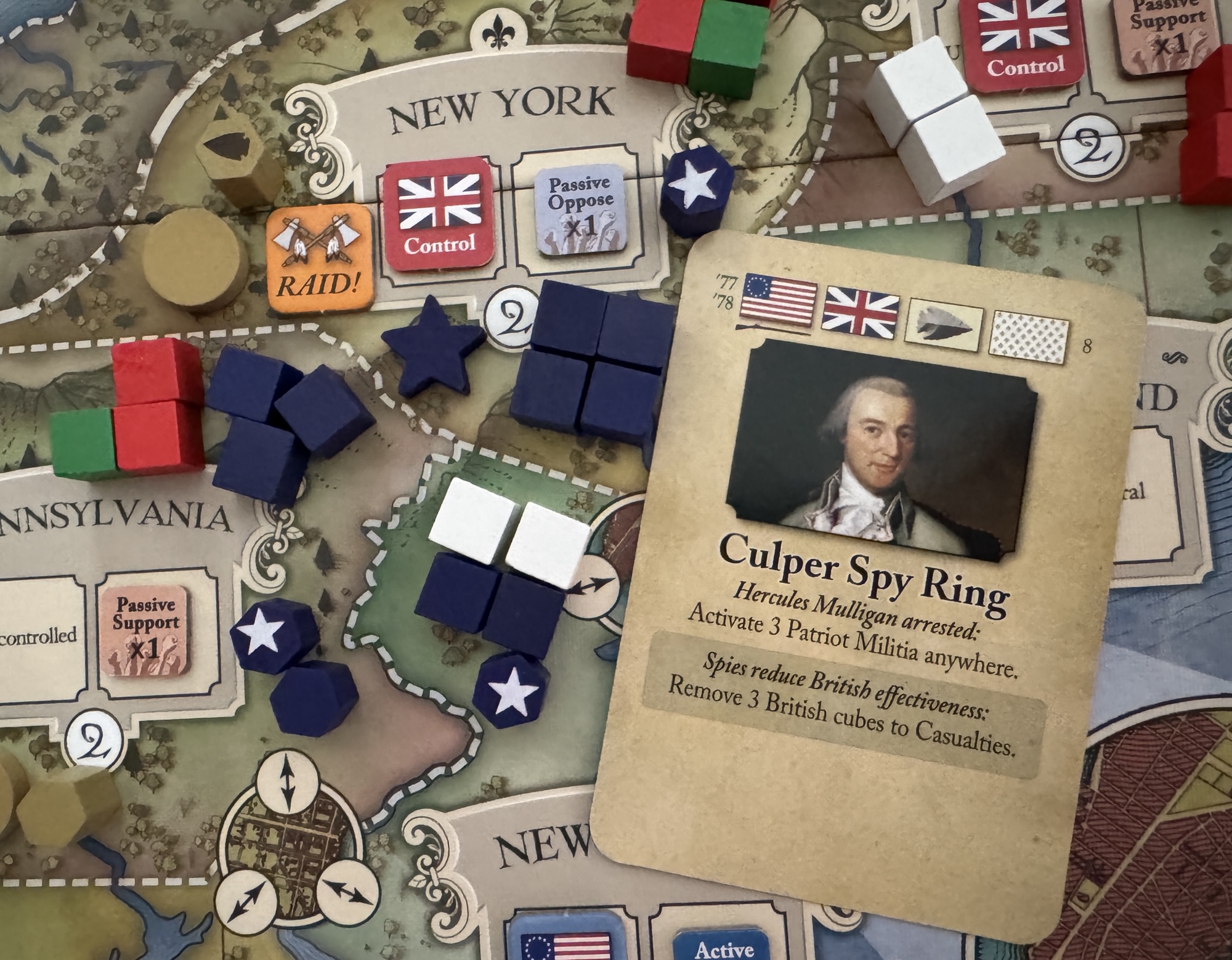
In today’s entry, we are going to take a look at a very interesting card called Culper Spy Ring. I very much enjoy the connection of this card to the history of the American Revolution as it deals with one of the more important aspects of the war being that of reconnaissance and spying to gain intel on the enemy’s plans and the makeup and disposition of their forces. The Culper Spy Ring card allows the British/Indian players to Activate 3 Patriot Militia pieces anywhere on the board. These pieces do not have to be located together in the same space but can be in 3 different spaces if the players chooses. This is a very powerful event as the Patriot Militia are generally only able to perform their actions if they are Underground meaning hidden from the British. Typically their Commands and Special Activities for things such as Rabble Rousing (create Opposition to Crown rule), Persuasion (get Resources) and Partisans (attack Royalist pieces), require at least 1 Underground Militia piece be in the space and typically requires that they be Activated or turned face up with their embossed star icon showing. The process of turning up these Militia pieces normally involves a British March Command into a space with Underground Militia but the process of removing them requires an additional step by taking either a Skirmish Special Activity or a Battle Command. This card allows for these turncoats to be discovered and then removed in a later action. If you also read the card above the action description you will notice that it says “Hercules Mulligan arrested”. Hercules Mulligan was an Irish-American tailor, spy, and founding member of the Sons of Liberty. Operating in British-occupied New York City, he used his high-end tailor shop to befriend British officers, gather critical intelligence, and covertly pass military secrets to General George Washington. Mulligan is credited with twice saving General Washington from capture or ambush. He sent secret messages, often via his trusted assistant Cato, warning Washington of planned British traps. I love the history here and am very glad that the design and development team gave a shout out to this little known American hero who risked his life to perform these spy activities in New York City.
The bottom half of the event is for the Patriot/French player and has an immediate powerful effect that can change the odds of an upcoming Battle or wrest control of a key province from the British at an inopportune time. The event simply allows the removal of 3 British Cubes from the board, consisting of British Regulars or Tories, and then placing them into the Casualties Box. This is a key action because it can cause the shifting of the delicate balance for the British between Combined Rebellion Casualties (CRC) versus Combined British Casualties (CBC). This difference is 1 of the 2 parts of the British Victory Condition and the CRC must be higher than the CBC. I also love the text above this benefit as it states “Spies reduce British effectiveness”. This is an homage to the critical work of these spy rings as they often lead to more beneficial and favorable Patriot outcomes to Battles as they were better prepared or knew the British plans before the battle event took place.
Major Benjamin Tallmadge.
The Culper Spy Ring was an American intelligence network established in 1778 by Major Benjamin Tallmadge and General George Washington. Operating primarily in British-occupied New York City and Setauket, Long Island, the ring provided vital reconnaissance on British troop movements, notably exposing Benedict Arnold’s treasonous plot to surrender West Point. The network utilized a chain of trusted individuals rather than trained military spies from all walks of life. Some of the more famous spies in this vital ring included:
Agent 355: An anonymous female member within the ring whose true identity remains unknown, though she is credited with providing crucial insights
Benjamin Tallmadge (alias “John Bolton”): The spymaster and director of intelligence who managed the flow of information.
Abraham Woodhull (alias “Samuel Culper Sr.”): The primary gatherer of intelligence in Setauket, who oversaw the ring’s daily operations.
Robert Townsend (alias “Samuel Culper Jr.”): A Manhattan merchant and journalist who operated within British circles, collecting firsthand intelligence on the enemy.
Caleb Brewster: A daring whaleboat captain who transported the messages across the treacherous Long Island Sound.
Austin Roe: A Setauket tavern keeper who acted as the primary courier, frequently riding the 55 miles between Setauket and New York City.
The Culper Spy Ring is widely considered one of the most successful intelligence networks of the American Revolution. Its greatest achievements included preventing a surprise British ambush on incoming French forces in Rhode Island and securing the intelligence that led to the capture of British spy master John André. The secrecy maintained by Tallmadge was so effective that the true identities of the spies were not discovered by historians until the 20th century.
This Culper spy network was the feature of a television series on AMC called TURИ: Washington’s Spies that aired from April 2016 through August 2017 and spanned a total of 40 episodes.
The story of the drama covers events from 1776 to 1781 and features a farmer from Setauket, New York and his childhood friends who form an unlikely group of spies called the Culper Ring, which eventually helps to turn the tide during the American Revolutionary War. The series begins in October 1776, shortly after British victories, including the recapturing of Long Island and the Port of New York for the Crown, leaving General George Washington’s army in dire straits. The first episode opens with the following introductory text:
Autumn 1776. Insurgents have declared war against the Crown. Following a successful naval landing, His Majesty’s Army has forced Washington’s rebels into the wilderness. New York City serves as a military base of operations for the British. The Loyalists of nearby Long Island keep vigilant watch out for sympathizers and spies.
I very much enjoyed the tv show and loved watching each episode to see the hidden historical details of the Culper Spy Ring be revealed that have been discovered over the past few hundred years since the events of the American Revolution. Just an amazing example of a grass roots and loosely organized group of Patriots who risked their lives and families to ensure that the cause of Liberty prevailed.
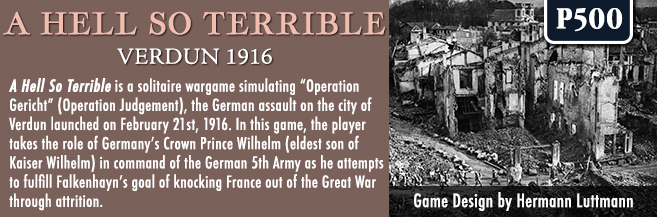
Hermann Luttmann is a great designer and I just love his solitaire takes on historical battles. His newest design is a solitaire game called A Hell So Terrible: Verdun 1916 from GMT Games that focuses on the German assault on the city of Verdun in 1916 during World War I. Keep in mind that Hermann is a very creative designer and uses lots of very interesting and chaotic design elements to create a very interesting and satisfying gaming experience. Also, most of his games are just that, with very engaging gameplay and a lot of the unknown that will hit you in the face from time to time! I just love his games. We reached out to Hermann and as always he was more than willing to share more about the design.
*Keep in mind that the design is still undergoing playtesting and development and that any details or component pictures shared in this interview are for prototype purposes and will definitely change prior to final publication as they enter the art department.
Grant: Hermann welcome back to the blog. What is your upcoming game A Hell So Terrible about?
Hermann: Thanks so much for having me back again! This is getting to be a bad habit. A Hell So Terrible is currently on the GMT P500 list and covers the German assault on Verdun during World War I. The offensive was launched on Feb. 21, 1916, and its ultimate goal was, as Chief of Staff Erich von Falkenhayn infamously stated, to “bleed France white”. This design sets up the solitaire player commanding the German army at Verdun. The player must push the various German Corps forward along nine different tracks across three main sectors, all of which converge on the city of Verdun and its last ring of fortresses. But the player only has a limited amount of time to close the noose around Verdun, as at the start of July, the Allies will be launching their huge offensive along the Somme River and vital German resources will need to be diverted to defend that front. So, this game design combines a little bit of push-your-luck with a little bit of tower-offense (reverse States of Siege, if you will), and a dab of historically-weighted chaos, to give you a nice flavorful stew of military simulation and game play fun.
Grant: What is the meaning of the title? What did you hope to convey about the game to the players?
Hermann: We actually went through a number of different titles, and I had this one neat quote I found:
“Humanity is mad! It must be mad to do what it is doing. What a massacre! What scenes of horror and carnage! I cannot find words to translate my impressions. Hell cannot be so terrible. Men are mad!”— Second Lieutenant Alfred Joubaire in his diary during the Battle of Verdun (May 23, 1916).
The BBC also used a version of this quote for the Verdun chapter of their special Great War TV series – “Hell Cannot Be So Terrible”. Gene Billingsley came up with the final, truncated version for the game’s title. I take great pride in my game’s titles, and this is no exception. I want the titles to be poetic, artistic, and memorable and thus are usually portions of famous quotes, book chapter titles, etc. By doing so, the title has a meaning and conveys to the player a hint of what the game is about. In this case, as you may surmise, it is supposed to be a bit depressing and gloomy, preparing the player for a difficult Great War grind. The player will experience, in abstract and harmless form of course, the tough slog and frustrating pace of a WWI offensive against an entrenched enemy.
Grant: I see that you described it as a “tower offense” game. What does this mean?
Hermann: This clever twist on the “tower defense” label was created by the game’s developer, Marco Poutre, and I just love it. A tower defense game traditionally means that a player is located in the relative center of the game board, and they are required to defend that center from a foe advancing from multiple directions. Lose the center and lose the game. A Hell So Terrible flips that dynamic around 180 degrees. You are the approaching German attacker moving along multiple axes of advance and the French enemy “bot” is the central defender, trying desperately to keep you away from Verdun.
A prototype copy of the board with counters. Not final art.
Grant: Furthermore, the player takes on the role of the attacker. How did this change your design focus?
Hermann: Primarily, the game design must provide the player with strategies of offense and exploitation, rather than that of defense and blocking. The game’s mechanics are structured to offer ways and means for the Germans to conduct actions against the enemy, rather than offer just reactions to enemy moves. You are the instigator and thus drive the action with your play. But that’s not to say that the French “bot” sits idly by…it will counterattack and it will generally do that in the spot which least suits you and your plans.
Grant: Why was this a subject that drew your interest?
Hermann: Well, as you may or may not know, World War I has always been a primary interest of mine. It is just so rich with gaming opportunities because there are so many interesting fighting fronts featuring many different armies. The war is loaded with fairly obscure yet fascinating battles and campaigns and making them each “gameable” is a real challenge. Designing a playable game out of trench warfare was one of my earliest self-inflicted gaming challenges and that all lead directly to the In Magnificent Style push-your-luck style system, which has now come full circle to A Forlorn Hope from Wharf Rat Games (which actually does cover trench warfare). In the A Hell So Terrible game design, that aspect of pushing your troops ”against the wind” of enemy fire (but at an operational scale now) seemed to fit really well with what a game about Verdun should simulate.
Grant: What is your ultimate design goal with the game?
Hermann: Simply, to provide the player with as much angst and anxiety as possible! This operation is perfect for the push-your-luck and tower offense approach. The player is placed under a severe time constraint, so the requirement to not only keep moving forward (even when it seems unwise to do so) but also the need to harbor the few resources you have available in the game (more on that later) is a perfect combination of game play juggling. The player must pick the best spots to attack, when to attack, and with what expenditure of assets. And to keep all these moving parts in a playable, accessible format that doesn’t overstay its welcome is the design goal.
Grant: What from trench warfare during WWI and the numerous attacks on Verdun was most important to model?
Hermann: Well, there are quite a few factors that I really wanted to get into the design to make it feel right. Obviously, the French defensive positions are deep, layered, and unpredictable. There are multiple chains of trenches, forts, and terrain features that must be overcome. How do you, as the attacking Germans, go about penetrating these defenses and inflicting as many casualties as you can on the defending French? Well….planning, logistics, bombardment, flanking, reconnaissance, and determination are the tools to overcome those traditional WWI obstacles. Using a design-for-effect principle, there are simple mechanics built into the game that allow the player access to each of those tools, but at the same time, they are not always available and certainly aren’t limitless.
The player must assess each phase of the game and play it to their best ability, utilizing these historic tools to pry loose the French defenses. So, all these factors are important to model to get the best full experience of attacking in WWI.
One other critical thing I wanted to model is the unknown. What I mean is, the French defenses were mostly hidden and they were deep. Though the player can see the French units on the game board, their strengths are unknown until engaged and even the effect of your artillery bombardments is unknown until you actually have units enter those spaces. This is a huge aspect to WWI trench warfare – you are just never sure what the enemy is doing nor what kind of shape they are in. This fog of war really creates a high level of tension and requires the player to try their luck sometimes, even when it might not seem advisable. And the game will constantly be changing the state and makeup of the French defenses, including allowing them to hit back at unexpected times with counterattacks. All these aspects of WWI warfare are critical to include to give the proper experience, and they are all found in this game.
Grant: What sources did you consult about the details of the history? What one must read source would you recommend?
Hermann: The Price of Glory by Alistair Horne is my “must read” source.
Verdun 1916: They Shall Not Pass from Osprey Publishing.
Verdun: The Longest Battle of the Great War from Oxford University Press by Paul Jankowski.
And in addition to published books, I reviewed various online articles and video documentaries.
Grant: What other games did you draw inspiration from?
Hermann: Honestly, none. I know you guys have covered a number of the other Verdun games and I know that there are some really good ones. But A Hell So Terrible is, I feel, a unique wargame approach to this campaign and as such, I don’t like to be influenced by other games when I begin a design. That goes for most of my other designs as well, by the way. Again, that’s not to say that other game designs aren’t great games – most are. But I don’t want to allow myself to be subconsciously swayed one way or the other by another designer’s approach, unless I’m actually using an operating system as my core engine (like States of Siege, for example). That’s not to say that I won’t read the background and historical information that is contained in other games or read the associated historical articles in a game magazine. But for the most part, I do not consult other games to get design ideas.
Grant: What are the Activation dice and how do they work?
Hermann: One of the driving inspirations for this game’s design approach was the idea of using an activation dice mechanic in a wargame. This is a relatively new game mechanic, at least in my experience, and I first encountered it in the Claustrophobia game series. I’ve come to appreciate the fact that it is an almost perfect blend of randomization and player decision making, all in one simple mechanic. You roll a bunch of dice – the random part – and you must then assign those dice to particular tasks – the decision part. My twist on that concept is that I marry that idea with the ability to change the kind of dice you roll and then apply the entire push-your-luck concept on top of that. There are two types of dice – Movement and Casualty – and after all dice are rolled, one of each is assigned to an activated unit. This will tell you how far a unit can move and how many casualties it will suffer just from moving (i.e., representing the constant enemy “wall of fire”).
Grant: How has the dice activation streamlined the game? Why does this work so well?
Hermann: The dice activation system not only tells you how you can move your units but also resolves the persistent enemy fire without needing the player to resolve a dozen separate combats. There are two categories of activation dice – Movement and Casualty. The Movement dice come in two types – Advance (green dice) and Infiltration (black dice) while the Casualty dice also come in two types – Friction (orange dice) and Suppression (red dice).
The Advance die allows normal movement results and is the default movement die unless the player opts to spend Command Points to upgrade one or more of these dice to Infiltration dice. The Infiltration dice represent the deployment of Stosstruppen, highly skilled and specially equipped assault troops, and as such these dice allow more movement. Because Command Points are a limited resource, the player must make that critical decision whether to spend those points to get the more efficient Infiltration dice.
The Friction die is assigned to a unit to represent the amount of enemy fire it is receiving and it is the default die unless the assigned unit has its Support marker (representing the supply trains and supporting local artillery) nearby. If the marker is with or adjacent to the activated unit, the player may automatically substitute the Suppression die for the Friction die. The Suppression die represents the tactical artillery (present with the Support marker) bombarding the enemy and thus suppressing the enemy troops and their defensive fire. The problem is that Support markers are hard to move and rarely are able to keep pace with their associated German unit.
Thus, the player is left with some interesting command decisions, even though a unit’s movement and vulnerability is randomly determined by a simple die roll.
Grant: What time pressure is felt by the player?
Hermann: Like all game designs that have any kind of push-your-luck aspect to them, time has to be of the essence. If there is no time pressure, there is no reason to push and take chances. In this game, each turn is half-a-month and the player must accomplish the German goals by the end of the 10th Game Turn, which is the end of June, 1916. The Somme offensive starts at the beginning of July and this marks the point where the Germans must have achieved a victory at Verdun in order to compromise that offensive. The player will find that it is a long slog to capture the ring of French fortresses and get to the outskirts of Verdun in time. So, they will be compelled to push hard and take risks to get to the inner sanctum before the end of the game.
Grant: What type of experience does this create? What are the toughest decisions forced on the players?
Hermann: The experience will hopefully be, as I said before, one of anxiety and fun all mixed into one package! And despite the random events and numerous dice rolls, there is a parade of tactical and strategic decision-making the player must navigate each and every turn. Just to list the toughest and most critical…
Which Activation dice do you assign to which unit?
In what order do you activate the units? This matters because you can maneuver your units to create flank attack benefits.
How do you spend your limited Command Points?
Where do you place your Bombardment and Big Bertha markers?
How far do you push your combat units forward before you have to slow them down to allow the Support markers to catch up?
Do I spend precious time to do a Reconnaissance before attacking?
Grant: How does the solitaire bot for the French function? How does the AI prioritize its decisions?
Hermann: The French bot works mostly through the Event Cards, though as stated before the French firepower is also inherent in the Casualty dice effect. The events are almost all based on things that actually happened or could have happened during the Battle of Verdun and though they won’t occur in exactly the same order chronologically, many are weighted to have different effects depending on the month in which the card is drawn. The French are always tenaciously defending, but the cards dictate when reinforcements arrive, the deployment of fighter aces, the bombarding of German units, the appearance of random patrols, and the launching of counterattacks. And the location of many of those counterattacks is often influenced by how much progress German units are making on their tracks… r in other words, how close they are to Verdun itself.
Grant: What is the flow of the game?
Hermann: Each Game Turn begins with the draw of an Event Card and this card can affect any position or area across the game board. The player determines if they receive any additional Command Points and then resolve a dogfight procedure to determine which side has Air Superiority this turn. Then the player conducts any desired Artillery Bombardment, placing such markers face down on French units. The player selects which of three sectors to activate – left, center, or right. Before activating units in each sector, another Event Card is drawn and often, its effects apply just to the chosen sector (but not always). Units of the chosen sector move and fight until all are Spent for the turn. Then another eligible sector is chosen, another Event Card is drawn, and its units move and fight until Spent. Once all units on the map are Spent, the player calculates any Victory Points earned, and resets for the next turn.
Grant: What are the Events that start a turn? What are some examples of these events?
Hermann: The Event Card that is drawn to start the turn (during the Initial Event Phase) is the same as the others – they all come from the same deck. But this first card may affect the game differently. If it does, it will say so right at the top of the card. So, for example, the “Shell Shock & Attrition” card is especially devastating if drawn as the Initial Event. If drawn at the start of a Sector activation, it requires the German units of that Sector (only) to each take an immediate Morale Test (which could result in their becoming Spent before they even get to activate). If this card is drawn during the Initial Event Phase, it affects all the German units on the game map and every unit must take an immediate Morale Test!
Grant: How are Command Points used? How are they earned?
Hermann: Command Points (CP) are the currency with which the player can do some really cool bonus actions or get gameplay benefits. Using CP to the best of your ability is a key to winning the game. The player gets 15 CP to start the game and then earns some more each turn, but fewer and fewer as the game progresses. This is an abstract way to simulate the breakdown of communications between German headquarters and the troops, as well as reflecting the degrading of confidence in the operation, especially by Crown Prince Wilhelm himself. Certain Event Cards also grant additional CP. Command Points are used throughout the game to do a number of special actions, including purchasing Infiltration dice, re-rolling combat dice, replacing losses, using Attack Momentum (see below), redeploying units, etc. All powerful tools when used at the right moment in the game.
Grant: What is the need for the dogfighting step? How does this play out?
Hermann: The Dogfight Step is a part of the Air Campaign Phase, which just generally reflects what is happening in the skies above the Verdun battlefield.
The Dogfight is a simple competitive dice roll, with the side who has Dogfight Advantage at the time (as listed on the Turn Record Track) getting to roll two dice and use the higher roll. The winner gets to bump the Air Superiority marker one box in their direction. Who has Air Superiority at any point in the game can affect some events, but most importantly for the player, if the Germans have Air Superiority, they have more Bombardment and Big Bertha markers available to use in the turn (simulating that the German Drachen – balloons – are free to fly to observe and guide artillery fire). Again, a simple thematic mechanic that reflects a complex issue.
Grant: How does heavy bombardment work?
Hermann: During the Heavy Artillery Bombardment Phase, the player deploys a certain number of Bombardment and/or Big Bertha markers onto the game map. At the very start of the game, there is a special step called the Trommelfeuer Step which allows the player to place 20 Bombardment and 5 Big Bertha markers around the map. This is to simulate the massive preliminary barrage the Germans conducted before the assault. During all the other game turns, the player gains a certain number of Bombardment Points, based on where the Air Superiority marker is located. Bombardment Points are spent to purchase Bombardment and Big Bertha markers to place face down on French units or into the special Voie Sacree (Sacred Way) area, which was the logistical lifeline for the French forces. The markers each have variable effects on their back sides, ranging from no effect to utter destruction. But these markers are randomized and the player does not know what effect applies to the targeted French units until a German unit enters their space for combat or the player takes the time to conduct a Reconnaissance action to reveal and apply the marker immediately. A Big Bertha marker placed in the Voie Sacree area can interdict that area and delay French supplies and reinforcements, which is enacted by nerfing certain Event Cards.
Grant: What is the layout of the board?
Hermann: The boards shows the entire area around the Verdun fortress complex. There are nine movement tracks and each track has a dedicated German unit and Support marker. Each of these tracks are made up of a series of eight spaces. Most spaces have a terrain feature associated with them – clear, forest, hills, fortress, or trench. There are also a number of landmark spaces that have special game effects (ex: Fort Douaumont). The tracks are also divided into three Sectors, each representing a major segment of the German army attack zone. The left Sector has only two tracks, the center Sector is the main attack zone with four tracks, and the right Sector has three tracks and is the left bank of the Meuse River, which was manned by the Bavarian Corps. Every German unit starts in its own trench area and must move up the track toward Verdun, encountering and hoping to defeat French units along the way.
A prototype copy of the board. Not final art.
Grant: What dangers are present for the advancing Germans?
Hermann: My goodness…there’s a myriad of dangers for the German player. The French can not only offer a stubborn defense of their trenches and forts, causing you casualties and loss of time, but they can also bombard your units and whittle them down from afar. Logistical considerations are numerous, as the player needs to carefully use the Command Points in the right spots and must have the Support markers keep a steady pace to support their associated German fighting units. The air war has to be won consistently to maximize artillery bombardment. The player is going to be severely curtailed by Event Cards and coping with those while also taking advantage of the few good Event Cards is essential. Finally, the most dangerous factor of all is the passing of time. The player only has ten turns to accomplish a lot and every minute lost during those ten turns can make all the difference between victory and defeat.
Grant: How does Fog of War work? Why was this important to include?
Hermann: Well, as with most of my games, I love dabbling with the three F’s of War…the Fog of War, the Friction of War, and the Fortunes of War. And this design has all those elements in it. The player of course has to deal with the uncertainty of the Activation dice rolls and the unknown of the combat dice rolls (see below). Along with that, the Event Cards are always throwing a new, unexpected wrench into the works. In fact, the player does not even know definitively how effective their artillery bombardment has been! On top of all that, French units are deployed face down and their exact strengths are not revealed until contact is made or until the player spends time to scout out the units with the Reconnaissance action. These are all important elements to include in the game because these are exactly the same challenges the German army and its commanders had to face at Verdun. And as with all games that lean on the historically-weighted chaos theory of design, having this level of Fog of War in a game design not only makes it more realistic, but it makes it a more fun game as well.
Grant: How does combat and losses work?
Hermann: Combat in this game is pretty straightforward. Each side in a combat totals up their SP and rolls a D10 which is added to their SP to get a Combat Score. The French get an extra die to roll (using the higher result) and/or additions to their Combat Score if located in certain terrain. The German units can get re-rolls and/or an extra die if they are using an Infiltration die for their activation, or spend a Command Point, or have a flanking unit. Some Event Cards can affect combat as well. Each side gets a total Combat Score and inflicts Hits on the opponent based on that score…the higher the score, the more casualties are inflicted. This yields interesting combat results as both units scoring high means huge casualties for both sides, regardless of who wins. Then the side with the higher score wins the combat, and the opponent must retreat. The actual difference in scores can affect units differently. For example, if a German unit wins a combat by only one point, it will hold the position as the winner but it will become Spent, meaning it is done for the turn! Too many of these kinds of wins can spell doom for the German player. A large margin win will allow the German unit to choose pursuing the enemy and continuing forward or consolidating and bringing its Support marker up one space. Tough choices!
Grant: What is the concept of Attack Momentum?
Hermann: Ah, that’s my sly little “gamey” mechanic for this design. I wanted to add another twist to the Activation dice assignment mechanic that also acts as a mitigation against bad luck – or in this case, technically a mitigation for good luck. So, the idea is that if the player assigns two good Activation dice to a unit, instead of having to re-roll those dice the next Game Turn, the player can instead spend a Command Point and keep those dice with that unit but must count down each die by one number. So, for example, if you assign a “6” Movement die and a “5” Casualty die for a unit, you could spend a CP and activate that unit again with a “5” Movement die and a “4” Casualty die (assuming the unit was not Spent during its first activation). So, good dice stay with the unit, but lose their potency over time. Historically, this simulates a commander seeing a unit performing well and then directing assets and leadership to that unit to exploit their superior performance.
Grant: How do you model German Command Efficiency?
Hermann: Well, in games where there is significant dice rolling, I do like to use the “doubles = something special” mechanic, because you know that the odds will produce a certain number of doubles rolls during the course of the game. As such, I like to make something special happen when they are rolled that the player can exploit, and in this game the use of a doubles Activation dice roll is actually more in the control of the player because the doubles can be “created”. What do I mean? For example, if you are rolling Activation dice for the right Sector (three tracks, so three German units), you’ll roll a total of six dice – three Movement dice (Advance and/or Infiltration) and three Casualty dice (Friction and/or Suppression). This creates a pool of dice results from which you will assign two dice per German unit – one Movement and one Casualty die for each. Thus, if you have two matching dice, you can grab those two and create a doubles result for that unit. An assigned doubles result triggers German Command Efficiency and it allows you some options for activating that unit. You have one of three options you can apply – increase the Movement result by one type (ex: change the result from Move 1 to Move 2); reduce the strength point loss from the Casualty die by one; or move the unit’s Support marker up one space. The chosen benefit is applied, along with the normal dice roll results, when the unit is activated. Again, a simple bonus to reflect the superior abilities of the German officer corps.
Grant: What type of an experience does the game create?
Hermann: I’m hoping that the game creates an intense gaming experience. One in which the player can exercise tactical and strategic options in an effort to carry out a particular plan, but coupled with the excitement of the unexpected challenges by – and sometimes, assistance from – the Gods of War. This should be a gaming experience of tough decisions and of taking calculated risks. And ultimately, I think this will inevitably come down to a nail biting ending.
Grant: What are you most pleased about with the design?
Hermann: I’m really proud of the fact that I think I got almost every crucial element of simulating the early stages of the Battle of Verdun down to workable and accessible mechanics. The game’s core mechanics and use of historically-based Event Cards drives a narrative that draws the player directly into this era and into the drama of this particular battle. To be able to do that and still keep the game accessible and easily playable is, for me, the ultimate goal and I think A Hell So Terrible achieves that goal.
Grant: What other designs are you working on?
Hermann: My, my… t’s a busy year for sure! Here we go:
They March Against Us: Leipzig 1813: This is the first game in the Bonaparte’s Sword Series, which will essentially be Napoleonic Blind Swords. Roger and Richard at Revolution Games are playtesting it right now and so far, so good. It should be available this year.
A Forlorn Hope: This game is Wharf Rat Games’ first published design and just finished a very successful crowdfunding campaign. We’re now working on getting it all finished up and designing the stretch goals that were achieved. This one is going to be a real beauty and I can’t wait until people actually get to play it.
Dawn of the Zeds: Designer Edition: Yes, Dawn of the Zeds is back and this is the newly redesigned version of the classic. I’ve updated the mechanics, especially the combat system. It will have the traditional map layout and characters of the previous three editions, but I’ve also added a ton of new stuff as well. This is published by Blue Panther and I think (hope) will be a huge hit.
A Primitive Madness: Antietam 1862: The third Black Swan Series game by Flying Pig Games will indeed cover the Battle of Antietam. This one will be a bit different, as the scale has changed to accommodate the smaller battlefield. This will have the same huge maps and elite production of the other games.
At Any Cost: Metz 1870: This game will be republished by Hexasim sometime this year. I am reviewing the original game and probably updating a chunk of mechanics to allow the game to play more smoothly and quickly. And it will have all new artwork.
Kill All Fermitians!: A republication of an older game (Volters Lead the Way!), this is going to be published by Flying Pig Games as a deluxe push-your-luck science fiction game. The new artwork with this one is amazing!
Nemto: A big, multiplayer, cooperative science fiction wargame that will be published by Nuts Publishing. This is going through all original artwork right now and even some professional background story telling to add to the game. It tells the story of human mercenary companies sent to an alien planet to lay claim to its powerful natural element – pinnaclium.
More Brains!: Have you ever wanted to play as a zombie? Of course you have! Well, here’s your chance. Another new company, Jackl Games (run by Randy Lein from Legion Wargames) is going to publish this multiplayer game that I co-designed with Ryan Heilman. Each player controls a team of Alpha Zeds, zombies who are accumulating brain power and with each new brain, a new skill. Very different and very fun.
Thanks so much to Grant and Alex for allowing me to write about A Hell So Terrible! I hope gamers enjoy it. All the best! Hermann
As always it was a pleasure speaking with you Hermann. I am very excited about this one as it sounds very interesting and is a gaming subject that I have a great interest in as you mentioned. I am looking forward to our next opportunity to meet up and play some games!
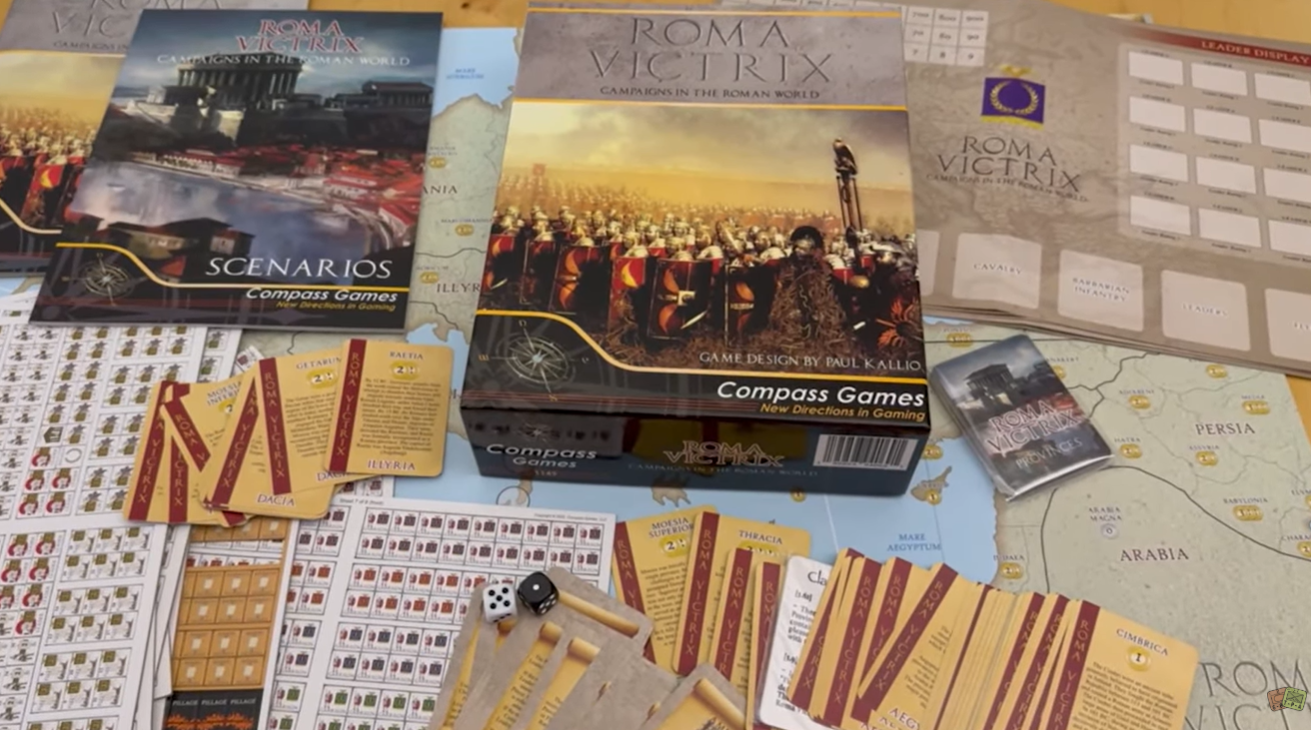
Roma Victrix is a grand strategic, moderate complexity wargame covering a time period ranging from 218 BC to 533 AD in twenty separate historical and hypothetical scenarios.
Roma Victrix is a game which endeavors to re-create the conflicts between Rome and her neighbors to achieve and maintain that dominance. A simple interactive sequence of play guides each player through the process of revenue collection, recruiting and maintaining military forces, conducting land and naval operations, diplomacy, field battles and sieges. Special rules are included to emphasize the importance and effects of leadership, cavalry superiority, mobility and attrition. Random events are also represented, adding an element of unpredictability to even the best laid plans and the likelihood that no scenario will ever play the same.
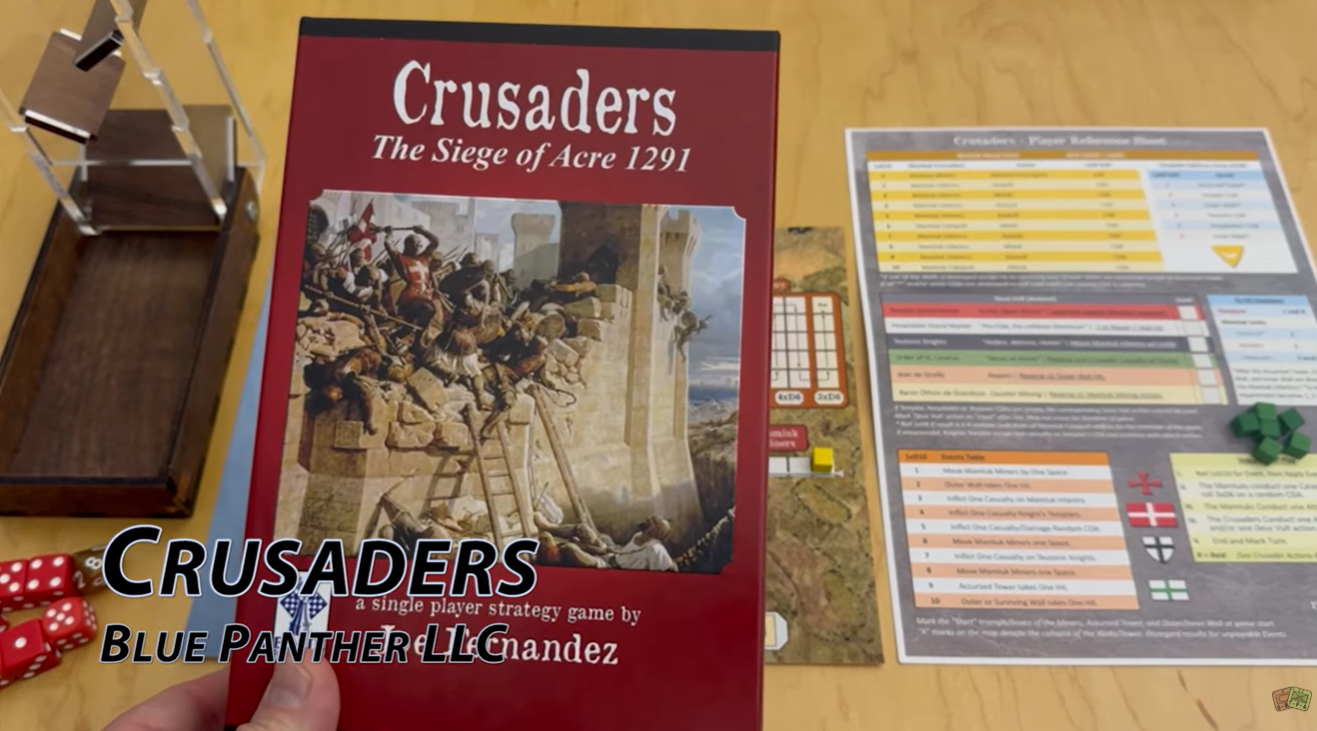
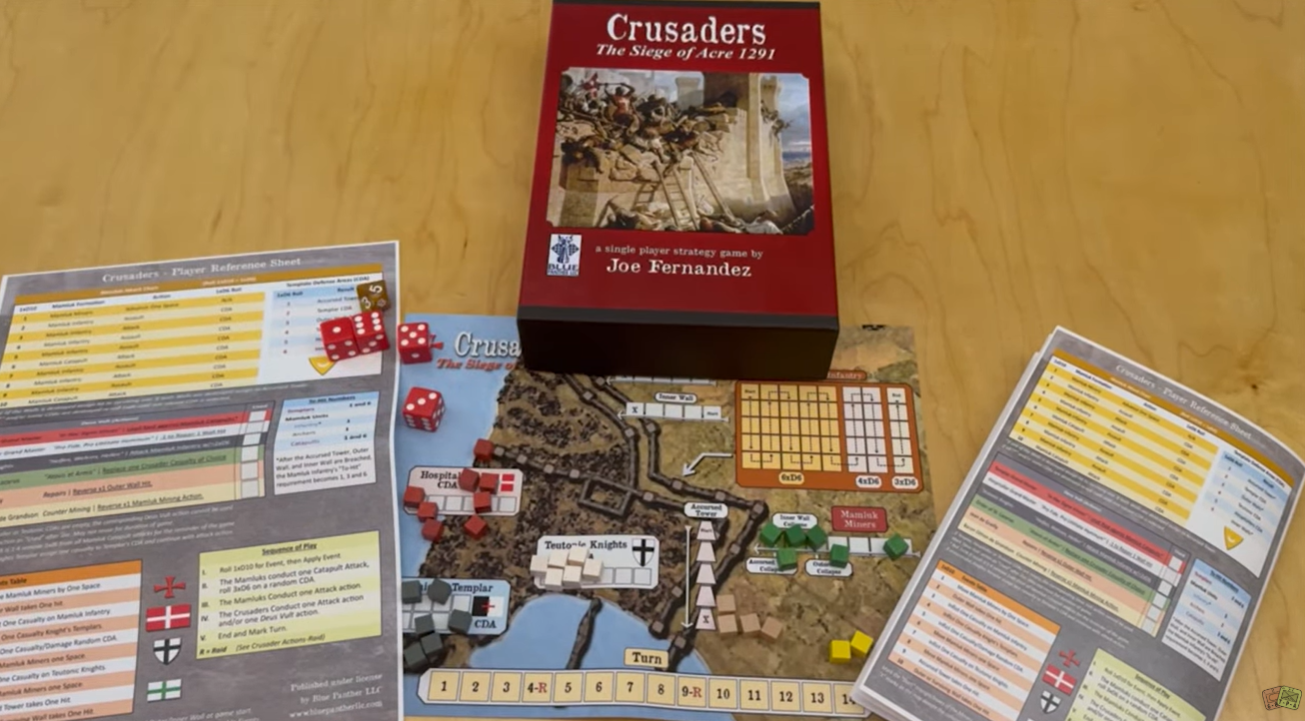
“In Signo Hoc Vinces”. Dive into history and heroism with Crusaders: The Siege of Acre 1291, a Tactical level Solitaire-Only board-wargame that immerses you and lets you experience the last stand of the Knights Templar and the Crusaders in the Holy Land. Relive the courageous stand of some 15,000 Crusader soldiers, Knights Templars, Teutonic Knights, and Hospitallers as they defend Acre, the critical port city in the Holy Land, against a massive Mamluk army of some 80,000 soldiers armed with siege engines and catapults during the Ninth Crusade.
Crusaders is a dice rolling, tower defense, solitaire game. Players take the role of Crusaders and try to defend Acre from the Mamluk attackers. Players win or lose depending on if the walls are breached and enough defenders survive.
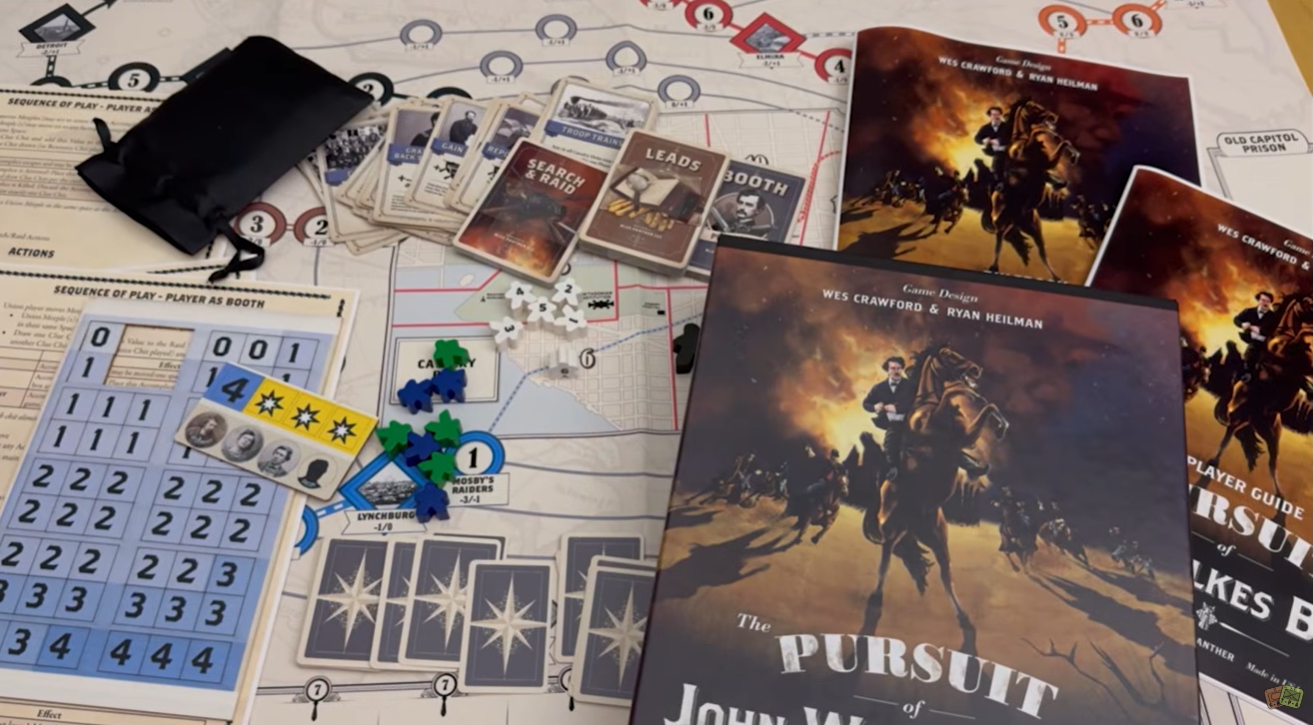
A few years ago, while attending the WBC, I had the chance to meet Wes Crawford who was demoing his upcoming game Engine Thieves. He was a very nice guy and his game was pretty interesting as well. Since that time, he has another game that has been released designed in partnership with Ryan Heilman in The Pursuit of John Wilkes Booth published by Blue Panther. I had a chance to play the game solitaire (with Wes overseeing the game and giving me guidance and pointers) at WBC in 2024 and have since played the game on my own several times and had a really great time with it. Great little solo game with several other modes where the player uses resources like police and detectives to search for clues in the hunt for Lincoln’s assassin after the events at Ford’s Theater on the evening of April 14, 1865. Definitely not a subject that has been gamed before and it is really refreshing to be able to experience this history in an interesting and engaging game. There really is a lot to like with the way that clues are found and chits are blindly drawn to verify clues from a bag. There is also a great little movement mechanic with police and detectives to try to acquire more clues.
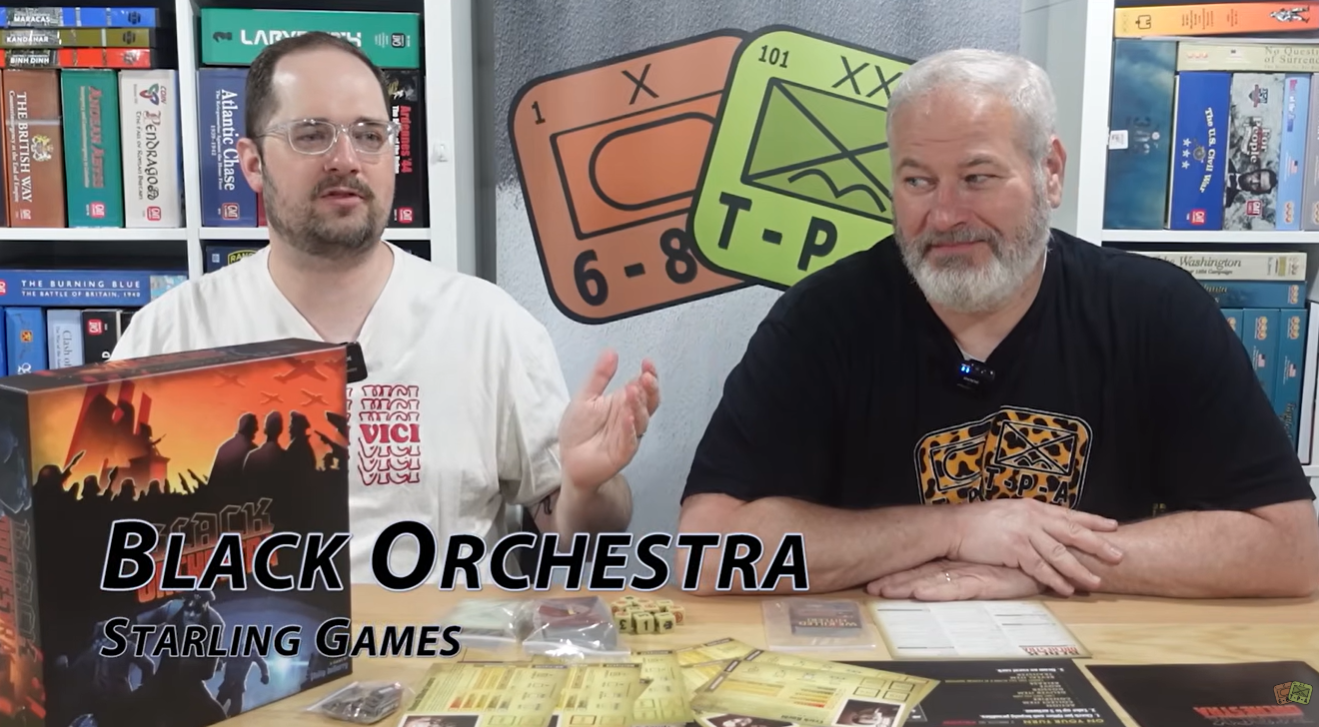
Black Orchestra begins with each player choosing a historic figure involved in the conspiracy against Hitler. In this dark and dangerous pursuit, motivation is perhaps your greatest weapon. If you can stay true to your convictions in the face of overwhelming threat and inspire your comrades, then you will be able to use your special ability, attempt plots, and even become zealous (necessary for some extremely daring plots).
But every move you make may also increase the suspicion of the authorities. The Gestapo will make routine sweeps, and any players with high suspicion will be arrested and interrogated (possibly resulting in other players being arrested). If you are all arrested or if the Gestapo finds your secret papers, you lose. And the suspicion placed on each conspirator will increase the chances their plots are detected.
On a turn, players may take three actions, such as moving, searching for an item, or drawing a card; or, at the cost of one action per die, roll the dice in an attempt to gain even more actions — at the risk of attracting the suspicion of the gestapo. This dice rolling “Conspire” action allows players to make bold moves when most needed.
Continuing along in this series devoted to the best looking boards found in the wargaming world where I will highlight the art and layout of a different board in a wargame that we have played to show you the various talents of the artists and graphic designers involved. In my humble opinion, a well designed and attractive board can make all the difference in the world to me enjoying a wargame. Don’t get me wrong, the game has to be good, but if it’s also good looking it always is a better experience. A board can draw me in. Can make me feel that I’m there. Can set the stage for the thematic immersion that we all crave. And I have found many of these type of boards and I want to make sure that I share them with you.
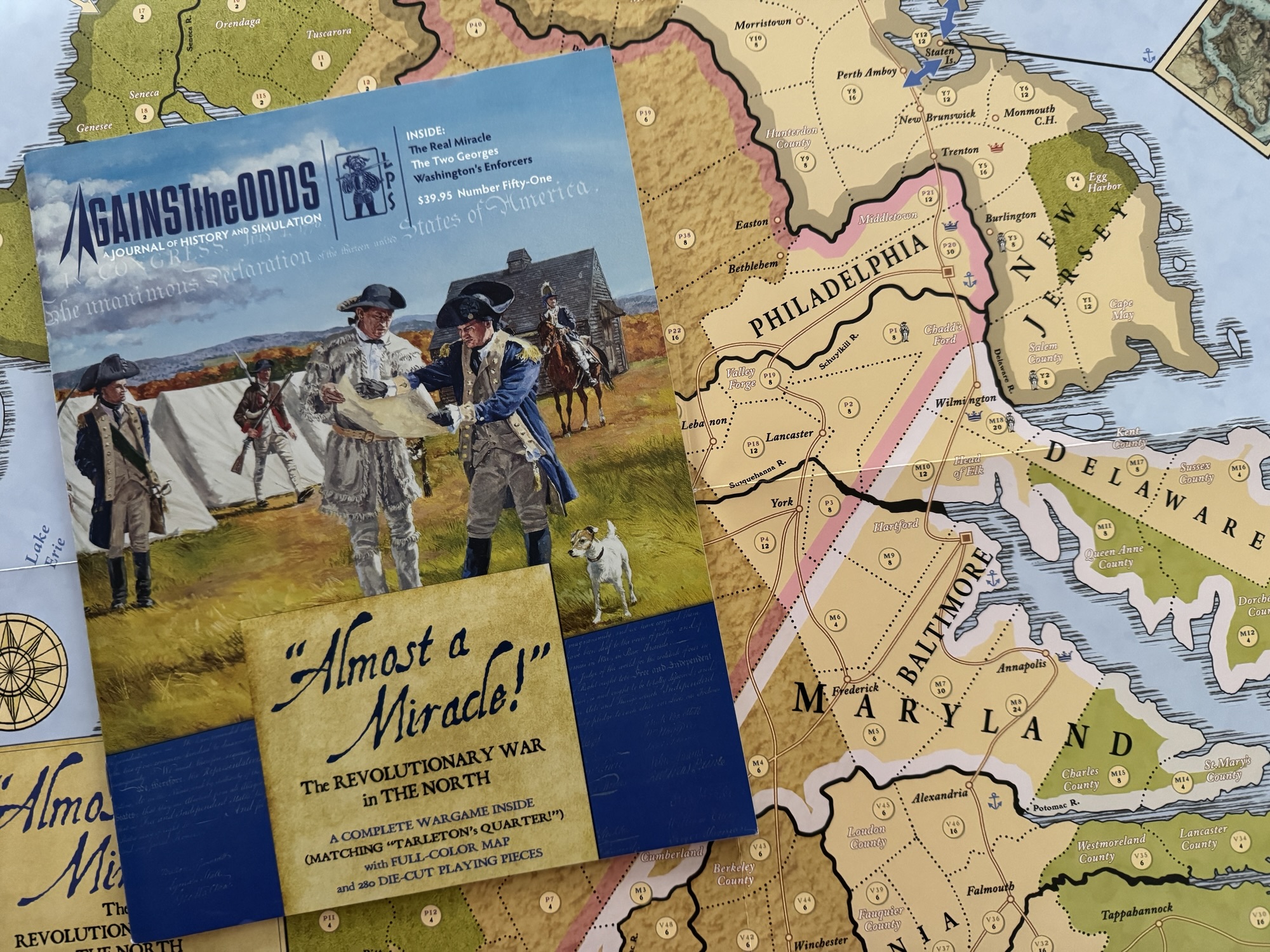
In this entry in the series, we will be taking a look at the fantastic looking board for Almost a Miracle!: The Revolutionary War in the North found in Against the Odds Magazine #51 from LPS, Inc. The board is illustrated by the very talented Mark Mahaffey whose board from Stilicho: Last of the Romans we have already covered in this series. Now typically, Magazine Wargames are nothing special. Both in their game play but also in their component quality and in the area of art and graphic design. But LPS takes great pride in the games found in their flagship magazine Against the Odds. And Almost a Miracle is such a beautiful example of great graphic design and art but also the board is absolutely a piece of art worthy of being framed and hung on a wall.
The board is illustrated by Mark Mahaffey who is a very accomplished full time artist who has done art for nearly 200 games including Celles: The Ardennes, December 23-27, 1944 (2012) from Revolution Games, The Dark Valley (2013) from GMT Games and Stilicho: Last of the Romans (2020) from Hollandspiele to name just a few. I think that Mark has a real talent for making a board coherent, easy to reference upon first glance and pleasing to look at during play, but I would not say that a lot of his boards are over the top beautiful but that is definitely the case with his effort for Almost a Miracle!.
The board represents mostly the Northern Theater of the American Revolutionary War but also includes Virginia and Maryland in addition to Pennsylvania, New Jersey, Delaware, New York and an area identified as New England which encompasses Massachusetts, New Hampshire and Connecticut. Canada is also represented at the top of the board. The map comes in 2 separate parts that join together in New England and that measures 22″ x 51″ total when combined. The interesting thing about these 2 maps is that one is significantly smaller than the other one. I would say about 75% of the playable board is found on the larger of the 2 sections with the northern tier only covering 25%.
My only real issue with the 2 parts of the board is that they join together fine but the way the map was folded created a really defined white seam in the board that really stands out. You can see it located to the right of the words New England and it runs from Penobscot to the top of the board ending in Canada around the top of Acadia. Not a huge issue but more of a distraction from the beauty that the board offers.
But the board is really quite beautiful and really provides a fantastic backdrop for the game itself. As you can see, the color palette chosen focuses on various shades of green and brown and they really give the game a natural and wild feel to it. With these American Revolutionary War games, I always keep in mind that the majority of the area of each colony, outside of a few larger population centers such as New York City, Baltimore and Philadelphia, are farmland and wilderness timber. Not a lot of development and definitely a land rich in natural resources in the form of wild game, furs, fish, lumber and ore. This “natural” color scheme of greens and browns really sets the tone of the period and provides a ready conduit into the theme and setting of the war.
Let’s focus on the southern portion of the board that includes Virginia, Maryland, Delaware, Pennsylvania and New Jersey. First off, I very much love the inclusion of the title box in the bottom left hand corner of the board with the game title and the various contributors including the designer David Jones and Mike Joslyn (who designed Tarleton’s Quarter which covers the Southern Theater) and the graphic design and art teams. These additions are always nice as they feel period to me and almost as if I am looking at a map of the region created at the time.
One thing that I want to point out is the use of lines to mark the various counties in each of the colonies. These lighter dotted lines are not as prominent as the other more important colony boundaries, roads and rivers. You will also notice that each of the colony boundaries are a different color because they touch and are easier to differentiate with the use of colors. Pennsylvania’s boundary is pink as it comes into contact with New York, New Jersey, Maryland and Virginia. Then the boundary of New Jersey is gray and New York is brown as they both touch Pennsylvania. This was a very nice touch and is important to understand the colony boundaries for recruitment and reinforcement purposes. This visually aids in distinguishing the various locations and to assist in grounding you in the geography.
Foraging is also a major part of the game and when troops are out campaigning they rely on baggage trains and supply depots for food and ammunition but also can forage the countryside which is hit or miss. These foraging results are found on a table and are influenced by the terrain type that the troops are located in. So knowing what the terrain in any given area is important and these colors quickly identify the type.
The other very nice feature on the board is the use of lines to mark the shorelines of the various bodies of water including lakes, bays and oceans. In the picture below, we get a look at the shoreline of New Jersey, Delaware, Maryland and Virginia and you can see the deft use of these horizontal dark lines to mark the water as it comes in contact with the shoreline. I also really like the small islands that are sprinkled in the midst of these lines and they add some real depth to the feature. You can also see in this picture the names of each of the counties in each of the colonies. You may also notice the nice use of the silhouettes of soldiers on the boards in some of these counties. These are the starting positions for your forces and I very much like the way they did this.
You may also notice the blue crown icons found on the board near major cities. In this picture you can see the blue crown icon at several places including: Wilmington in Delaware and Annapolis in Maryland. These blue crown icons denote the capitals of each of the colonies and some of the larger ones have multiple capitals. This has to do with victory at the end of the game for the British as if they control the colony capitals and there are no Colonial Regulars or Militia present in the colony they can then place the Colonial Governor and declare “the King’s Peace” in at least 2 colonies to end the campaign game.
As we move to the north of the map, and enter the less populated and definitely more wild areas of the colonies, including northern Massachusetts and the wilderness of Canada, the board changes quite a lot as there are less roads, less markings and frankly more green on the board. It still looks really good and the use of lines for water features is continued particularly in several of the larger lakes in the area.
In the picture above, you can see a good example of the Holding Boxes for troops in the larger metropolitan areas. Here we get a look at the Montreal Holding Box and I very much like the way that they have drawn the outline of the city itself with some of the streets, buildings and homes. This is a very nice touch to the board itself and there are several of these Holding Boxes found on the board including those shown in the picture below such as the Newport Holding Box, New York Holding Box and Staten Island Holding Box. These are very nice additions to the board itself and they look really good and add a layer of depth as well as playability to the game.
The game aids and tracks that are printed directly onto the board are very useful and well done. These use calligraphy like cursive writing that really feels period and adds to the thematic immersion of the player into the American Revolutionary War period. These boxes include the Continental Baggage Train Box and the British Baggage Train Box and shows the game’s focus on Supply. In these boxes, there is an available and an expended section that are used. There also is a Prisoners of War Track that is very period as well as these pitched battles were never fights to the death but represented the fighting style of the period which lead to many different forms of losses including deaths, injuries and prisoners taken.
Finally, there are Captured Boxes for Continental and British Leaders that aid the players in playing the game. These administrative aids are very well done from a graphics standpoint but I love that this game included them on the very large board as it eases play and cuts down on the need to continually refer back to the rules.
Almost a Miracle! was a game chosen for our Shelf of Shame Dust-Off Event in 2024 and we very much enjoyed the game and the history. The game is focused on the American Revolutionary War in the North and is named Almost a Miracle! because when asked about it years after the war ended, George Washington said that the American victory was “little short of a standing miracle.” Almost a Miracle! uses the Tarleton’s Quarter!System as a game engine starting point to bring the Northern “half” of the American Revolution into play.
I think that the best part of this game though is the board. It is just gorgeous and is an odd shape to take into account the entire northern colonies. I think that one of the strengths of this game is that it truly shows the difficulty of maneuvering armies around the colonies and the terrain as well as having to search for forage to feed those armies.
If you are interested, here is a link to our video review:
The next board that we will take a look at in the series is Great Campaigns of the American Civil War: Thunder On the Mississippi: Grant’s Vicksburg Campaign, April-July, 1863 from Multi-Man Publishing.
Here are links to the previous entries in the series:
With this My Favorite Wargame Cards Series, I hope to take a look at a specific card from the various wargames that I have played and share how it is used in the game. I am not a strategist and frankly I am not that good at games but I do understand how things should work and be used in games. With that being said, here is the next entry in this series.
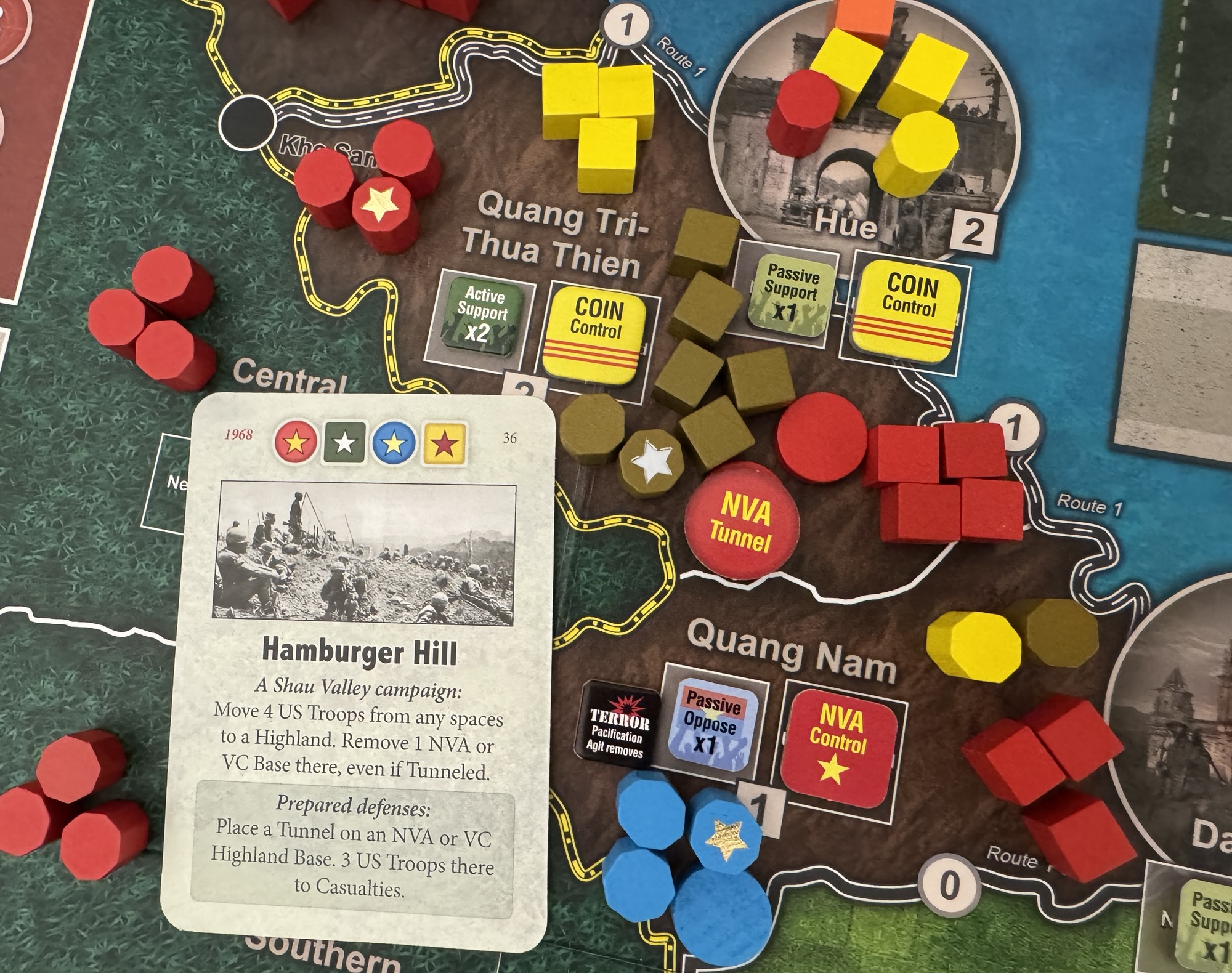
#78: Hamburger Hill from Fire in the Lake: Insurgency in Vietnam from GMT Games
The COIN Series uses cards in a very different way from other CDG’s. These cards are not necessarily the driver of the action but more assistive to the actions of the players by setting eligibility and also providing powerful events. The Event Cards are more often than not, very powerful. They either give you a continuing bonus on future Operations and Special Activities (as in the case of the volumes that include the various Capabilities) or allow you to take Operations and Special Activities more times that round than you would normally have been able to had you not chosen the Event and more often than not, at no cost! Also, because of the power of the cards and their ties to one or more factions, you can take the Event which allows you a huge advantage, only to see that very powerful Event reversed with the next Event or with a regular Operation. This is very frustrating but is one of the major reasons that I love the card-assisted element of the COIN Series. Today we are going to take a look at the Hamburger Hill Event Card.
But first an aside. Along with the movie Platoon, my introduction to the fierce fighting in the Ashau Valley of Vietnam was mainly from the movie Hamburger Hill starring Dylan McDermott as Lt. Frantz and Courtney Vance as Doc. The images from this movie will be forever burned in my mind and with the recent passing of the anniversary of the battle’s start on May 13th I thought it would be a perfect time to cover this card.
The Hamburger Hill Event Card has a top event and a bottom event, which is the case with all cards found in the decks of COIN Series games. The top event benefits the US/ARVN players while the bottom benefits the NVA/VC players. The top event allows the US player to move 4 US Troop Cubes from any spaces on the board to any Highland space, which are the brown colored regions representing less forgiving elevated terrain and mountainous areas. It then goes onto allow the removal of any NVA or VC base there, even if the base is currently Tunneled. This is a very powerful event as normally moving units requires an Air Lift Special Activity or a Train Operation to place new units into a space. Also, removing a Base, and especially a Tunneled Base, requires multiple turns and a focused approach of Patrol, Sweep and Assault to uncover hiding Insurgent pieces and then to destroy them allowing for a Base to be removed.
The Insurgent half of the event allows them to place a new Tunneled Based into a Highland space as well as remove 3 US Troop Cubes to Casualties. The Casualties Box is where these “dead” cubes are stored until the Coup Round where they will have negative effects on the United States player and then be available again for use in the next turn. This event is very powerful and is a major boon for the Insurgent player in taking control of and maintaining their presence in the Highland Provinces.
I also very much like the historical connection to the Battle of Hamburger Hill and think that the designers did a great job of creating this event with real game effects related to the battle and consequences that are felt from the play of the card. This Hamburger Hill Event is one that will be played by both sides often rather than taking their Operations and Special Activities. The effects are just too efficient and powerful to pass on unless the timing of the game dictates differently.
The Battle of Hamburger Hill was a major battle that lasted from May 13–20, 1969 was fought by United States Army and Army of the Republic of Vietnam (ARVN) forces against People’s Army of Vietnam (PAVN) forces during Operation Apache Snow of the Vietnam War. Though the heavily fortified Hill 937, a ridge of the mountain Dong Ap Bia in central Vietnam near its western border with Laos, had little strategic value, US command ordered its capture by a frontal assault, only to abandon it soon thereafter. The action caused a controversy among both the US armed services and the public back home, and marked a turning point in US involvement in Vietnam.
The battle was primarily an infantry engagement, with the US troops moving up the steeply sloped hill against well-entrenched troops. Attacks were repeatedly repelled by the PAVN defenses. Bad weather also hindered operations. Nevertheless, the Airborne troops took the hill through direct assault with heavy use of artillery and airstrikes, causing extensive casualties to the PAVN forces.
Local Degar tribesmen call the mountain Ap Bia, which means “the mountain of the crouching beast.” Official histories of the engagement refer to it as Hill 937 after the elevation displayed on US Army maps, but the US soldiers who fought there dubbed it “Hamburger Hill,” suggesting that those who fought on the hill were “ground up like hamburger meat.”
The quote was attributed to Sgt. James Spears who said, “Have you ever been inside a hamburger machine? We just got cut to pieces by extremely accurate machine gun fire…”.
US Army photographers climb Hill 937 at Dong Ap Bia after the battle, May 1969.
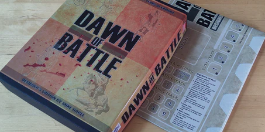
A few years ago, Worthington Publishing released a new game called Dawn of Battle designed by Mike Nagel. The game was HUGE size wise containing dozens of playable historic scenarios. The game allows players to refight various historical battles from 1500 BC to 1500 AD or a range of 3,000 years of combat. Players take the roles of the great commanders of history, including Xerxes, Alexander the Great, Julius Caesar, Saladin, and William Wallace. Since that time, Blue Panther has agreed to print the game in a new Designer’s Edition and also have added some new content to an already large amount of scenarios and counters. Recently they announced a new Scenario Pack Expansion, which includes MORE scenarios, called Dawn of Battle: Epic Combat! and well it appears to be pretty EPIC! We reached out to Mike to get some inside information about the expansion.
Grant: Mike welcome back to the blog. What is your new expansion Dawn of Battle: Epic Combat!?
Mike: I’m always happy to contribute. Thanks for the opportunity!
Dawn of Battle: Epic Combat! is the only true expansion for Dawn of Battle: Designer’s Edition. By that I mean that it comes with another map as well as more counters and terrain tiles. It’s likely the only expansion that the game is going to get as it fulfills the vision that I have for the game system. Beyond this, it’s all scenario packs…many, many scenario packs.
Grant: For those not familiar, what are the hallmarks of the Dawn of Battle Series?
Mike: Dawn of Battle is a game system of low to moderate complexity that allows players to recreate any battle from roughly 1500 BCE to 1500 CE, although I have strayed a bit further in both directions. As Alan Emrich described the game when he was helping me develop it, it covers everything from guts to gunpowder. The game was derived from my previous design Ancient Battles Deluxe (which Alan published with Victory Point Games). That game was inspired by the old Bill Banks game Ancients (published by Good Industries and 3W). While designing this latest iteration, I had several critical factors in mind. The first was accessibility. The game had to be relatively easy to get into in terms of rules density as well as setup time. The second was accuracy. Despite the scope of the game requiring a certain amount of abstraction, I still wanted to ensure that identifiably historical results could be achieved. The third was portability. The game, which is something of a “hobby in a box,” needed to be able to be pulled off a shelf and easily transported to a game club or convention. The fourth was relative affordability. Given the economic pressures of the day, I wanted to ensure that players really got their money’s worth. Finally, of course, the game has to be appealing and above all, fun to play. I believe I’ve nailed every factor with Dawn of Battle.
Grant: What do you hope to add to the series with the Epic Combat! Expansion?
Mike: One thing that Dawn of Battle cannot do out of the box are the massive battles you see teams of folks playing at conventions. It’s a 2-player game. The goal of Epic Combat! is to present both an option to play Dawn of Battle with up to eight players at a time, but also challenge two players to successfully fight out massive battles as well. Epic Combat! provides the components and structure to do that.
Grant: Why do you feel the system needs this addition?
Mike: A couple of reasons. First, and likely the most expected, is that an epic battles option is available for Richard Borg’s Command & Colors Series. Since Dawn of Battle is similar in scope and scale (but light years away in design and play), it makes sense to offer an option as well. The other reason is that the addition of additional units and terrain tiles allows for greater flexibility in scenario design for those who want to give their own favorite battles a whirl.
Grant: As a team focused game, how do teammates work together? What is the division of leadership between the players in this team approach?
Mike; Let’s assume a maximum load of four players per team. Three of the players are field commanders, represented on the map with their own leader unit. The fourth player acts as the commanding general. Each field commander gets his own action point during a turn to do with as he pleases. Any additional points are granted to the field commanders by the commanding general. The field commanders may not offer suggestions to other field commanders during play. The commanding general allow this, but at a cost.
Grant: What is the new map included in the expansion? What type of terrain is included?
Mike: The map is the same as the map in the base game. The two are mated along a short end to form the epic playing surface. If players ever wondered why one edge of the map had half-hexes rather than a pretty border, now you know. This was the plan from the outset. The terrain tiles are more of the same: woods, hills, rough, and enough rivers and streams to cross the entire length of two maps.
Grant: There are also additional counters. Are these more and different units or just more of those in the base game to create larger battles?
Mike: The counters are also more of the same, beefing up the inventory with a couple of twists. First is the addition of an ‘e’ indicator on each counter, which serves two purposes. One is to distinguish the expansion counters from those from the base game. The other is to allow these counters to be used in a different manner than their counterparts, according to a scenario special rule. Say a variety of Heavy Infantry that might be more mobile than other HI. This adds even more flexibility to scenario design. The second twist is the inclusion of several errata counters that correct misprints from the early printings.
Grant: What is the upgraded command system?
Mike: The command system is much the same, with action points being used to activate formations to perform specific tasks or enhance combat or die results. Where things differ a bit is in how command range works, since there are many more units spread over twice the area.
Grant: How are Command Cards used?
Mike: Command Cards are used by the commanding general. At the beginning of a battle, each commanding general can select a number of these cards to start with. The general is gambling on which cards might be the most useful. There is also a chance that additional cards may be acquired during play. Each card can be used for one of three purposes. The printed event can be used as noted, the card can be discarded as an extra action point, or it can be discarded as a “dispatch,” which allows play stop and players to confer (this is the only time field commanders can interact).
Grant: Can you share with us an example of these Command Cards and explain their layout and anatomy?
Mike: Pretty straightforward.
Grant: What are courageous heroes? How do they work?
Mike: Heroes are the solution to the real estate problem. With so many more units and space, how do you keep them under control? It seemed too clumsy to simply state that command radii were doubled. This made some leaders really strong while not making weaker leaders strong enough. What heroes do is extend a leader’s printed command radius so long as the hero is within that radius. Say a leader with a radius of 2 positions a hero two hexes away (still within the leader’s radius). The hero now inherits a command radius of 2, thus extending the leader’s radius out to 4 hexes. This allows leaders to manage much larger formations. A leader “spawns” a number of heroes equal to their command rating at the beginning of each turn. Heroes can also be used as individual leaders outside of a leader’s command, providing more flexibility of action during a turn.
Grant: Are these generic personas or based in history?
Grant: Like leaders, these are abstracted personalities. It’s up to the scenario background and the leader capabilities to dictate who’s who.
Grant: What epic-sized scenarios are included with this expansion?
Mike: There are 6 total epic-sized scanarios:
Qarqar, 853 BCE
Gaugamela, 331 BCE
Sentinum, 295 BCE
Raphia, 217 BCE
Pydna, 168 BCE
Pharsalus, 48 BCE
Grant: What errata corrections for cards and counters are included for the base game?
Mike: There are about a half dozen units (Light Infantry and Light Archers) that were improperly printed in the first several copies of the base game. Additionally there are about a half dozen cards that were reworded a bit for clarity, so not really errata per se, but still included. There is a chance that the replacement cards are not identical in size to the rest of the cards in the action deck, so unless the cards are sleeved, using them could be more trouble then they’re worth. Mileage may vary.
Grant: What do you feel the series models well?
Mike: I believe the series does a fantastic job at simulating ancient combat. From the clashing of shields to exploitation on the wings, it all works really well. It’s also a lot less luck-dependent than other ancient combat games. This is the game that ticks all of the proverbial boxes for me. That’s the best part of being a designer: making games I want to play!
Grant: What type of new experience does Epic Combat! create? What are you most pleased about with the expansion?
Mike: One of the things I noticed while designing and testing the expansion is that it provides even more of an (ahem) epic sweep to the battles by allowing the armies to spread out further. The heroes and Command Cards also really ramp up the command and control experience. Although I’ll mostly be sticking to standard scenario design going forward, when I want to really ramp things up and there’s space on my table, epic is a great time!
Grant: What other designs are you contemplating or already working on?
Mike: I’ve still got quite a few irons in the fire. Given its great success so far, I’ve started working on Off the Line, Volume II – Winter War that pits the Soviets against the Finns with some cool new features coming to the system. Of course, by the time this is posted, the fifth scenario pack for Dawn of Battle should be available (that’s 120 scenarios so far!). I’ve got a sci-fi skirmish game coming out soon called MASS Impact. Following that is a light dueling game called Have at You! All of these will be printed by Blue Panther. I also hope to have an ancient naval game called Navarchoi published by Legion Wargames soon(ish) and several Flying Colors games are on GMT’s pre-order list. Of course, I’ve also got several other projects on the design table, but more word on those later. I can’t give all my secrets away!
Now, back to the design table…thanks again for the opportunity to share.
Keep in mind that Dawn of Battle: Epic Combat! requires the base game of Dawn of Battle: Designer’s Edition to play, which is sold separately.
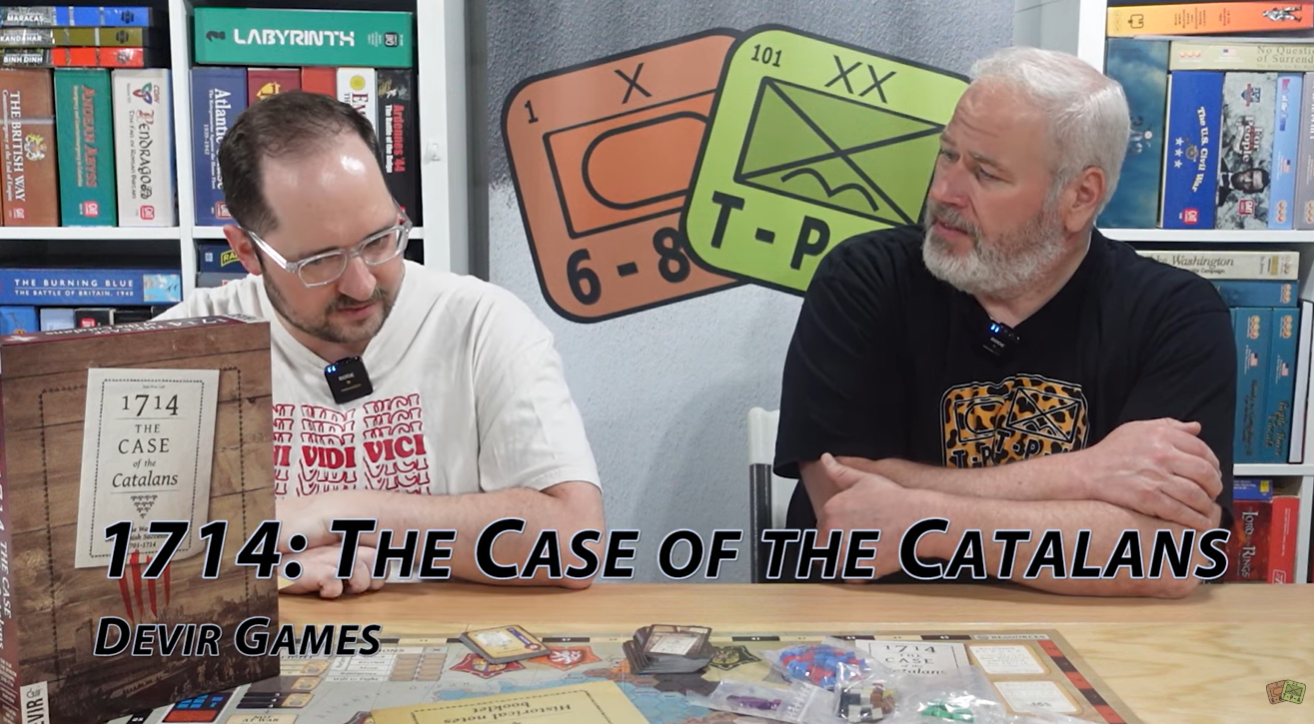
Europe, 1702. The death of king Charles II of Habsburg left the throne vacant and started a war all over Europe to settle the matter of the Spanish Succession. The Archduke Charles III of Austria, the Habsburg heir, was discarded by the last will of Charles II, signed almost on his deathbed, in favor of Phillip of Anjou, Louis XIV’s grandson, the Bourbon heir. The Grand Alliance has been formed, by the Treaty of Den Haag, by Great Britain, the Dutch Republic, Austria, Portugal and Savoy to preserve Europe’s balance of power and reclaim the throne for the Archduke Charles.
The players, representing the powers of the Grand Alliance, will fight the Bourbon forces composed by French, Castilian and Bavarian troops. Their goal, defined by a hidden agenda, is to obtain the best commercial and territorial concessions, and conquer the Bourbon territories. But this is no cooperative game: the winning player will need strategy and negotiation skills to achieve the best deals with the enemy and thus be the country with the most benefits thanks to the Peace of Utrecht.
In previous turn reverse order, each player decides how to play one of the seeded cards for the current turn. The players may pay from their resources to use the card’s text or may prefer to “sell” the card to execute one action. Each action is available only once for each turn and the players cannot execute the same action in two consecutive turns. The available actions are Recruit troops, Move them across the map or Attack the enemy in adjacent areas. Other choices include obtaining Resources or paying attention to their own countries Public Opinion (a.k.a. Will to Fight), for this will decide the order in which the new Concessions will be dealed. The card deck, composed by the most relevant battles, events and characters throughout the war, includes the exploits of the Bourbon armies to counter the player’s actions.
“In Signo Hoc Vinces”. Dive into history and heroism with Crusaders: The Siege of Acre 1291, a Tactical level Solitaire-Only board-wargame that immerses you and lets you experience the last stand of the Knights Templar and the Crusaders in the Holy Land. Relive the courageous stand of some 15,000 Crusader soldiers, Knights Templars, Teutonic Knights, and Hospitallers as they defend Acre, the critical port city in the Holy Land, against a massive Mamluk army of some 80,000 soldiers armed with siege engines and catapults during the Ninth Crusade.
Crusaders is a dice rolling, tower defense, solitaire game. Players take the role of Crusaders and try to defend Acre from the Mamluk attackers. Players win or lose depending on if the walls are breached and enough defenders survive.
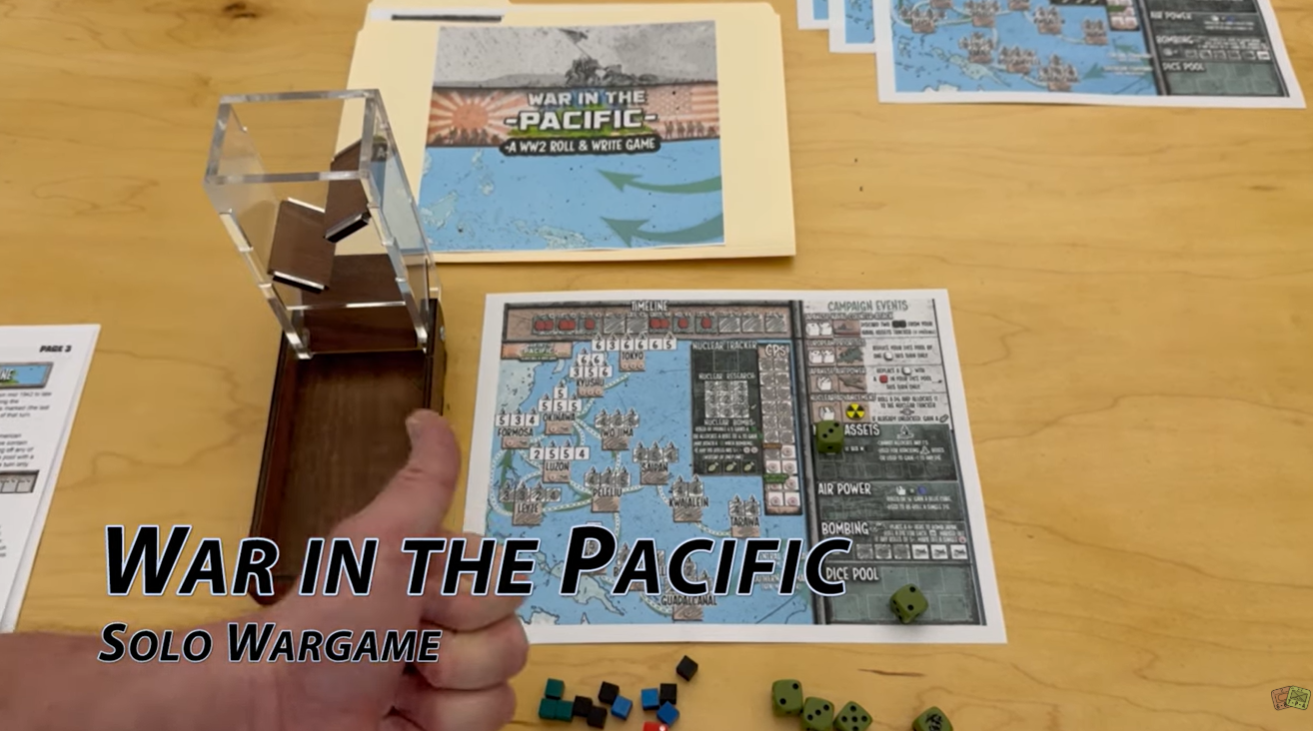
The year is 1942. Japan has rapidly expanded across the Pacific, bombing Pearl Harbor, capturing key territories, and threatening to dominate Asia. The United States, determined to halt this advance, begins a daring island-hopping campaign to weaken Japan’s hold and force their surrender. Can you lead the American forces to victory, or will the Japanese resistance force the United States to a negotiated settlement?
In War in the Pacific, you’ll allocate limited resources to launch attacks, conduct strategic bombing, maintain supply lines, and seize key islands. Your strategy must be swift and decisive, targeting objectives like Guadalcanal, Iwo Jima, and Okinawa. As the war intensifies, you can divert critical resources to the Manhattan Project, researching and developing nuclear weapons. The race to build atomic bombs could be the key to ending the war. Can you balance the demands of the Manhattan Project with the immediate needs of your campaign?
Once you’ve gained a foothold, you’ll face a crucial choice: invade mainland Japan in a costly land assault, or use strategic bombing and nuclear weapons to force Japan’s surrender. Each option is risky as an invasion could end the war quickly, but at great cost, while bombing and nukes may hasten Japan’s surrender, but could come too late.
With fast-paced dice allocation, resource management, and mounting pressure, every decision could mean the difference between victory or failure in your quest to force Japan’s capitulation.
The March 2026 Monthly Debrief Video, which is the 3rd episode in Season 6 of this series, saw us discussing the games of David Thompson. David Thompson burst onto the board game design scene with his 1st game released in 2018 called War Chest, followed closely by the release of Pavlov’s House. His actual first game designed was For What Remains, which is a tactical skirmish game set in a futuristic post-apocalyptic wasteland where factions fight each other for supremacy, but it was not released until 2020 after a successful Kickstarter. Pavlov’s House was his first foray into the historical board game genre and its success has spawned several follow-up games in the Valiant Defense Series. David is a very conscientious designer and wants to put the time in to make sure his games are not only realistic in their play but representative of the time period covered. David also established Digital Capricorn Studios to support his board game design habit and on that website you can learn more about his design philosophy and check out his numerous games.
Also, as usual, we covered the games we played in March, which included the 14 games we played at Buckeye Game Fest.
We will remind you here that we are fortunate to be continuing our relationship with Noble Knight Games as the sponsor for our Monthly Debrief Video series. In case you don’t know, Noble Knight Games specializes in hard to find games but also carry all the new releases. But what makes them truly unique is that you can find some of the rarest games, long out of print games, hand made games, imported games from overseas, etc. Thanks to them for their sponsorship and we hope that you will consider them first when looking for the games we cover.
One of my favorite wars to game is that of the Vietnam War. Part of that is because I was born in the early 1970’s and heard a lot about this war for the rest of that decade and throughout my teenage years. I remember watching the short lived television series Tour of Duty. I also read the graphic novel series The ‘Nam from Marvel Comics. But, my interest really grew after watching movies such as Apocalypse Now and Platoon. I always asked myself, how are you expected to fight a war where you don’t know who the enemy is? But also part of the attraction for me is that the war in anything but conventional. The combatants were diametrically different, the powerful and well funded United States of America and their technology and special forces versus the Viet Cong, a rag tag group of insurgents, and the mighty North Vietnamese Army funded and supported by the Chinese. This war also was set amongst the backdrop of social upheaval and cultural change at home with anti-war protests, freedom for all being sung as a marching song and desegregation and civil rights taking center stage. We have played plenty of games set in this conflict and I want to share my Best 3 Games with…Vietnam!
3. Hearts & Minds: Vietnam 1965-1975 from Worthington Publishing
We really enjoy Card Driven Games and try to play as many of them as we possibly can get our hands on. Also, as I said in the intro, we also enjoy Vietnam wargames. So, when we had a chance to play a CDG on the Vietnam War, it was a no brainer! I got this game for Christmas about 6 years ago and it was a used copy of the 1st Edition published by Worthington Publishing. There is a 2nd Edition out there but I really don’t know what the differences are. Since that time, there also is a new 3rd Edition from Compass Games and it looks really good. But that is neither here nor there.
In Hearts and Minds: Vietnam 1965-1975, players will play as either the US/ARVN forces (with some units from NATO as well as ROK) against the Communist forces which include NVA regulars and VC hidden units. The game has multiple scenarios and covers the entirety of the Vietnam War from 1965 all the way through 1975 as the U.S. forces left and only the ARVN remained to attempt to stem the red tide coming down into South Vietnam.
The ROK unit in Quang Ngai successfully Pacifies the province, placing a blue star marker that will factor in end round calculations for the dreaded Political Will Track.
Players have a hand of 5 cards each round from which they will play 4 that provide Resource Points to perform various actions including activating units to move up to their movement allowance, attacking enemy units, doing bombing missions, pacifying areas or forcing a political change. Each faction has their own deck, the Communist deck is red, the Allies is blue and then there are black cards that are neutral. Players will make their decks from their color and mix in half of the black cards. These cards represent the meat of the game and are the vehicle to make the game progress. The Resource Points are spent to perform the actions mentioned above and also can be used to buy the printed event on the card just played. Sometimes this event will have lasting effects for the entire game, such as the Commando Hunt card that allows Bomber missions to target Laotian border provinces and also allows more than 1 bomber to bomb any given province, or will have a one time effect such as Junction City, that allow you to spend more than one saved Resource Point in a given turn as long as all Battle and Political Control Change actions take place in Zone III. These cards are well done and the game boils down to the efficient use of the hand that you are dealt. Sometimes, you will be given cards with high RP’s of 4 or 5, which will allow you to make a lot of progress with various actions including moving forces, battling the opposition and making political changes. But, there will be times when your draws are not great and you have a hand full of low value RP cards but they might have interesting and very useful events that you must take advantage of. In essence, you have to play the cards you are dealt and make the best go of things. This can be both fun and frustrating but always keeps things interesting and requires that you plan and execute on that plan.
Battle is pretty simple as well as all the counters are pretty much the same for both sides. Each counter has an untried side and a veteran side (with either a 1-6 or 2-6 for ARVN and US troops or a 1-4 or 2-4 for NVA and typically a 1-1 for VC units) and then there are support units such as mortars, artillery, tanks and helicopter gunships. When a players units are located in a province with enemy units, a contested area is created where the players can fight by buying a battle round for the cost of 1 RP. If the battle doesn’t conclude, another battle round can be purchased with an additional RP until the player no longer has RP’s. Units in a province simply total up their battle factors (located in the bottom left corner of the counters), roll a die and consult their specific faction’s Battle Table. The results are the damage that must be applied and fire is considered simultaneous. The results include a specific number of units that must be eliminated but also sometimes has a capital R that means the player must either lose one unit or pay a saved RP. The blue table is slightly better than the red table, but not by much.
The really neat part about the battles is that units can evade before the battle starts with a roll, which becomes more difficult in certain terrain types and also has negative results for even attempting, such as the loss of a unit. This part can be very frustrating for the Allied player as he has finally corned the wily NVA and VC and they then slip right through his fingers with a favorable roll.
How does the game end? Well, players will be fighting each other for control of provinces and for casualties that will affect the will of the fighting powers and adjust the Political Will Track. This track factors in how each side feels about the war and their attitude to continued hostilities. Each scenario has a set level for an immediate victory, which frankly will never happen, and an end scenario number, which is more reachable. The Political Will Track really sums up the game for me and the feelings that many had about the Vietnam War. It seemed that escalation of bombing, more U.S. Troops on the ground and bloodshed didn’t equate to a victory. But simply meant the fighting would linger until one side or the other eventually would give in.
I recommend this game wholeheartedly for anyone that likes CDG’s and for anyone that is interested in a holistic approach and treatment of the Vietnam War. My only negative about this game is that it appears to be very hard for the Communists to win. That is probably an assessment after only one play as we both really didn’t know what we were doing but it is a concern of mine that I would like to see in future plays. It just felt very difficult to do anything that was meaningful with the resources they have and they are also outclassed in combat so that is a concern as battle is a big part of the game. Still a very solid representation of the Vietnam War and frankly a very interesting design by John Poniske.
2. Fire in the Lake: Insurgency in Vietnam from GMT Games
The COIN Series uses cards in a very different way from other CDG’s. These cards are not necessarily the driver of the action but more assistive to the actions of the players by setting eligibility and also providing powerful events. The Event Cards are more often than not, very powerful. They either give you a continuing bonus on future Operations and Special Activities (as in the case of the volumes that include the various Capabilities) or allow you to take Operations and Special Activities more times that round than you would normally have been able to had you not chosen the Event and more often than not, at no cost! Also, because of the power of the cards and their ties to one or more factions, you can take the Event which allows you a huge advantage, only to see that very powerful Event reversed with the next Event or with a regular Operation. This is very frustrating but is one of the major reasons that I love the card-assisted element of the COIN Series.
Fire in the Lake from GMT Games just really sums up the the Vietnam War experience to me and Volko’s magnum opus is Fire in the Lake, without a doubt, as it attempts to answer the question of who the enemy is and does a fantastic job. Fire in the Lake: Insurgency in Vietnam is Volume IV of the COIN Series and teams up two amazing designers in Volko and Mark Herman. The game is an asymmetric treatment of the Vietnam War and pits four players against each other, as even allies want to win the war, but win it in their way. The US Player has control of lots of powerful forces that can utilize Air Lift, Assaults and Sweeps to drive the insurgent guerilla forces of the Viet Cong and NVA back into the jungles but the VC and NVA have tools at their disposal to evade these heavy handed tactics such as tunneled bases, the terrain itself including jungles, rivers and mountains, and the Ho Chi Minh Trail. The US Player must also watch his own back as his ally, the ARVN, is more interested in patronage and lining their pockets with US dollars than necessarily winning the war through brute force. This game design takes into account all of the difficulties with this quagmire of a war and time, and through the cards used to assist the game moving forward, inserts key events such as drug use, protests at home, booby traps and the Tet Offensive.
The US forces are on the move to try to eradicate the VC stronghold in Tay Ninh province, which will not be an easy task as that tunneled VC base is really hard to kill.
If you haven’t played Fire in the Lake, please do yourself a favor, and do so. It is an exquisite experience that will test you on so many levels and leave you exhausted at the end of the effort while yearning for more. But, don’t go into it thinking it will be easy as it will not be and is sure to have you pulling your hair out as you attempt to win this war. Great theme. Great game play. High quality components and a well thought out design. To get a little more insight into why this game is so great, please read my article on Why I find the COIN Series to be Fantastic! I use several examples of the game play from Fire in the Lake to prove my point.
1. Silver Bayonet: The First Team in Vietnam, 1965 from GMT Games
I own and have read the book We Were Soldiers Once..and Young by Lt. Gen. Hal Moore and was fascinated by the story he told of his brave soldiers who fought the first major battle of the Vietnam War. How they went into the Ia Drang Valley and ran into nearly 2,500 NVA regulars who were spoiling for a fight and who outnumbered them 2.5/1 and how that fight lasted 5 days from November 14th through November 18th. I was also amazed at the new tactics used by the 7th Cavalry in using helicopters to jump from landing zone to landing zone to remain maneuverable enough to fight a conventional war that we were comfortable with against a non-conventional enemy in the Viet Cong and the North Vietnamese Army who didn’t want to fight our way. When the new 25th Anniversary Edition of Silver Bayonet was announced I was excited to experience this war and was glad when my friend Alexander P500’ed the game and we got a chance to play it.
So, this isn’t some monster game that covers the whole of the Vietnam conflict, but covers the entirety of the Silver Bayonet campaign. The initial landings of the 1st Cavalry Division are just 1 of 11 or 12 scenarios/campaign games included in the box. It covers 4 days and uses a handful of units in brutal close assaults.
NVA troops try to surround Free World Alliance forces and use numbers to overwhelm them.
Something that I was pleasantly surprised about was that a good number of the scenarios can be played solitaire because most of them don’t involve using the hidden aspects of the game (NVA hidden movement, US secret helicopter basing and staging, etc.). The complexity of the rules, and sub rules, as well as all of the different phases means that the game is very cerebral. There’s a lot to consider, and units/combats might not function in ways that you’re used to in other games. With one stack attacking another you are very unlikely to wipe the other player out. The CRT just isn’t built for that. If you use maneuver combat then the NVA will flee to the hills and then just come back at you. However, NVA assaulting American troops is also deadly, because in assaults the defender inflicts hits first. We found ourselves often in bloody stalemates, with the Americans just barely hanging on for dear life. The US had access to big artillery pieces as well as many points of airstrikes, which learned through hard experience need to be stacked all together in precision strikes in order to do any kind of damage. All of these things lead to just a fascinating, and in my opinion, extremely accurate representation of the type of combat, fought on the jungled hills of South Vietnam. This game felt real and as we played we could really begin to get into the narrative of the situation and even in some small manner, feel the same frustration and disappointment that the US must have felt in fighting an un-fightable enemy! For that alone, I am extremely impressed and cannot wait to play more and just explore the depth that the rest of the scenarios have to offer.
If you can’t tell, I love this game. It’s deep, rich, and flavorful, just like a good curry. There’s volume in the box, so much stuff to play with. The components are unbelievably good value. Something that didn’t feel too great was the importance of the coordination rolls. The NVA would have handed the US their ass early on day 3 if they hadn’t utterly failed this coordination roll. In failing, they were unable to attack with their best stacks that had been meticulously moved into position for the final assault to take LZ X-Ray. And while I understand what it represents, which is is great, but it seemed very ‘swingy’, because it happened on several of my activations during our plays. Coordinating the amount of NVA troops commanded in the jungles whilst being bombarded day and night isn’t an easy thing to do, but that it boiled down to a single d10 roll felt like a little bit of a let down. I might be house ruling a 2d6 method to make that roll less randomly distributed. I also get that over the course of a full campaign those kind of things would have evened themselves out, but in a short scenario like that it kind of felt like bad luck. That being said: It’s still a good model for the command situation, so there is that. Just maybe find a way to be less random?
Well, those are my 3 favorite games focused on the Vietnam War. I have played several others but feel that these 3 best demonstrate what it is like to be in an unwinnable and unmanageable situation that quickly spirals out of your control. What are your favorite Vietnam War games?
As an added bonus, here are links to a few Vietnam related posts that I did during the pandemic on the Music of the Vietnam War:
Post Publishing Edit: I was asked why Purple Haze from PHALANX didn’t make the list and here was my response:
Oh no. It was amazing. We absolutely love the theme and the feel of that game. Fantastic representation of the Vietnam War. Warfighter Vietnam from DVG is also very good.
A few other smaller games I have played and liked on the subject was Fortunate Sons from High Flying Dice Games, Long Cruel Woman from High Flying Dice Games and Dien Ben Phu from Legion Wargames (although not the US war in Vietnam but a great game). Just only wanted to spotlight 3. -Grant
With this My Favorite Wargame Cards Series, I hope to take a look at a specific card from the various wargames that I have played and share how it is used in the game. I am not a strategist and frankly I am not that good at games but I do understand how things should work and be used in games. With that being said, here is the next entry in this series.
#77: Schmalkaldic League from Here I Stand: Wars of the Reformation, 1517-1555 from GMT Games
Here I Stand: Wars of the Reformation 1517-1555 is an experience packaged in a game that attempts to boldly cover the political and religious conflicts of early 16th Century Europe. The game focuses on the struggle of religious reformers such as Martin Luther, John Calvin and Ulrich Zwingli as they battle the Papacy for changes in their views of God and religion. But it is more than just the Holy War as it deals with the other European countries involved in the affairs of the time including France, England, the mighty Hapsburg Empire and the Ottoman Empire in the east. They all played a role in the process of the Reformation and the design brilliantly weaves this all together into an interesting and engaging experience. The game also covers other plot lines and events of the period, including wars, marriages and ascendancies to thrones, using a unique Card Driven Game (CDG) system that models both the political and religious conflicts of the period.
Today, I want to take a look at a very interesting Mandatory Event card that really shakes things up for the Protestant player in the Schmalkaldic League. This Mandatory Event basically transforms the Protestant player and changes their focus slightly as they now become somewhat of a military power. I use the term “military power” here lightly as they really are not that powerful and this event is really more of a wet blanket thrown onto their spiritual bonfire as they now will have to worry about gearing up for attacks from their neighbors to try and take away their victory points through wresting control of their Electorates from them, which grant extra Victory Points. The Schmalkaldic League Mandatory Event is only triggered when the Protestant has religious influence in 12+ spaces from Turn 2 on, or if not, then automatically by the end of Turn 4.
The Protestant player gaining the ability to create and command military units, including both regulars and mercenaries, is somewhat of a boon as you can now move your troops around the board gaining additional dice for Conversion attempts if those units are adjacent and also the electorates under Protestant religious control, specifically those marked as Protestant home spaces, instantly come under Protestant political control and grant 2 VP for each Electorate up to a maximum of 12 VP total if all 6 are under control. Talk about a turning point…albeit a turning point with some difficulties. The leaders granted to the Protestants are also not very good and do not gain extra dice during combat and frankly cannot command large armies. These leaders include John Frederick and Philip of Hesse.
John Frederick I of Saxony by Lucas Cranach the Younger.
Frankly, I try my best to hope and pray that the Schmalkaldic League card doesn’t come out during the first 4 turns and then will be triggered only during the Winter Phase of Turn 4. This gives the Protestant player some time to expand and attempt to get all of those important VP generating Electorates under their control to set themselves up nicely. But once it happens you will find that you are spending your scarce resources in the form of Command Points on things like recruiting units, moving those units and preparing for attacks. This takes away from your ability to focus solely on spreading the faith and can be a real drag on that effort. But, you take the good with the bad in this game and I have learned to deal with it over the years and turn it into something that benefits me.
The Schmalkaldic League was a military alliance of Lutheran principalities and cities within the Holy Roman Empire during the mid-16th century. It received its name from the German town of Schmalkalden, where the group was founded in 1531. Although created for religious motives soon after the start of the Reformation, its members later came to have the intention that the League would replace the Holy Roman Empire as their focus of political allegiance. While it was not the first alliance of its kind, unlike previous formations, such as the League of Torgau, the Schmalkaldic League had a substantial military to defend its political and religious interests.
The League’s members agreed to provide 10,000 infantry and 2,000 cavalry for their mutual protection. They rarely provoked the Holy Roman Emperor Charles V directly but confiscated church land, expelled bishops and Catholic princes and helped spread Lutheranism throughout northern Germany.
Martin Luther planned to present to the League the Smalcald Articles, a stricter Protestant confession, during a meeting in 1537. He attended the critical meeting in 1537 but spent most of his time suffering from kidney stones. The rulers and princes even met in the home at which Luther was staying. Though Luther was asked to prepare the articles of faith that came to be known as the Smalcald Articles, they were not formally adopted at the time of the meeting, but in 1580, they were included in the Book of Concord.
While attending SPIEL Essen last fall, we became aware of a new narrative driven book wargame coming from PHALANX and designer José Luis Barca. We were supposed to get together with José to discuss the game but due to changes in our schedule and another meeting we just couldn’t break away to get over there. I felt bad about that, and want to apologize to their Marketing and Crowdfunding Director Adrian Turzański, but we did get copies and Alexander has since played it several times. In place of the sit down discussion, I reached out to José to see if he wanted to answer some questions in a designer interview. He was willing and that has led us her to this post.
Grant: José welcome to our blog. First off please tell us a little about yourself. What are your hobbies? What’s your day job?
José: Thank you, it’s a pleasure to be here. Okay. So, I’m a big fan of wargames, role-playing games, and board games who, three years ago, left my regular job to work as a freelancer in translation, layout, and writing for board games, role-playing games, and wargames—making a dream come true: working in a field I’m passionate about.
Grant: What motivated you to break into game design? What have you enjoyed most about the experience thus far?
José: Well, in addition to what I mentioned earlier, I’m a novelist. Right now I have three novels and two short story collections written. As part of my work, I translated gamebooks, so I wanted to try writing a different kind of “novel” that’s tied to the game. Also, on my Instagram, I interact with readers through “choose your own adventure”-style story games. All of this led me to the decision to write a gamebook in which the narrative aspect was the most important thing. From the very beginning, I really enjoyed the experience. Being able to give the main character choices was something that wasn’t possible in a normal novel, and I really enjoyed all the options, including killing him off in many different ways. It was something fresh for my writing.
Grant: What is your new game A Bridge Too Far about?
José: A Bridge Too Far depicts the war as seen through the eyes of a private. The protagonist is a Polish soldier from the 1st Polish Independent Brigade who will try to survive in Driel and Oosterbeek. His decisions will shape his future in the Battle of Arnhem, which was a military failure for the Allies. Thus, the gamebook explores the harshness and cruelty of combat in one of the bloodiest battles of World War II.
Grant: It is described as a paragraph-based game. What does this mean?
José: It’s another name for a gamebook, or, in this case, a wargamebook. The narrative unfolds through paragraphs that, depending on your choices regarding the options presented, lead you to other paragraphs. In this way, you aren’t reading a book in a linear fashion, as you would with a novel, but rather you have to follow the storyline through the paragraphs indicated by the game.
Grant: What is your design goal with the game?
José: The goal was to immerse the reader in the combat, allowing them to witness a battle and its various stages firsthand. It was also to explore the character’s psychology—how their morale and willpower gradually break down. In short, the aim is to paint a realistic picture of combat, or as realistic as possible using nothing but the pages of a book—something no one would ever want to experience.
Grant: What research did you do to get the historical details correct? What one must-read source would you recommend?
José: This was undoubtedly the hardest part. Most books today about the Battle of Arnhem cover the battle in general terms, without providing the level of detail needed for a novel or gamebook. Those of us who write historical fiction always face this problem. When we go into such detail in describing places, people, or objects, we run into a problem that no general overview can solve. For this book, I consulted the two most famous books: A Bridge Too Far by Cornelius Ryan and Arnhem, the Battle for the Bridges, 1944 by Antony Beevor. From the first, I drew some anecdotes about the fighting, and from the second, the general overview of the battle, but I needed something more to fully immerse myself in the epic story of the Poles. So I discovered The Pegasus Archive: The British Airborne Forces, 1940-1945, which contains the transcript of all the orders given by officers during the battle, hour by hour. This source was the definitive one for understanding what really happened to the Poles at Arnhem.
Grant: What role does the player take on in the game?
José: The player is a rank-and-file soldier in an elite unit of the British Army, which is where the Polish Brigade was integrated. As I mentioned earlier, your goal is to survive, and how you do that is up to you: whether you make it to Nijmegen safe, desert and go into hiding, or end up as a prisoner. If you don’t survive, there are plenty more options, hahaha.
Grant: What role does the player play in the creation of the soldier?
José: The character must be created at the beginning. You simply need to assign three numbers to its main attributes. The rest is set by default.
Grant: What are the three attributes focused on? What does each represent?
José: The soldier has the following attributes: Body, which indicates stamina, strength, and hand-to-hand combat ability; Mind, which reflects intelligence, reasoning, and the ability to use weapons; and Will, which reflects morale, willpower, courage, and sanity.
Grant: What does the phrase “choice-driven, demanding gameplay” mean?
José: Well, exactly what it says: every decision matters and could mean the difference between life and death. The player is presented with various choices from time to time and the story will branch off from those choices into a new direction.
Grant: How did you go about creating a tense and decision filled experience?
José: Well, that was my intention, but I’m not sure I pulled it off. It’s up to the readers to decide. But my writing style certainly helped. Many of my readers say I write as if I had a camera slung over my shoulder, and that my scenes are action-packed and very visual. You can easily picture the scene without needing lengthy descriptions. What some experts call “dynamic description.” My descriptions of the situation are woven into the dialogue or the character’s actions, as if the reader were watching a movie. These days, I think that’s the best way to write, since there are almost more viewers of movies and TV shows than readers of books.
Grant: How many different branching options are possible?
José: The book has about 20 alternate endings
Grant: How long did it take to make sure these were all consistent and that there weren’t loops?
José: That’s not enough. Let me explain. These days, there are tools available to help you with the process of checking for loops and errors when writing a gamebook. I used a program called “Librogame Creator,” where you type directly, just like in Word. The real benefit is that you can create the paragraphs within the program and link the choices to their respective paragraphs. In the end, you’re left with a paragraph map that makes it much easier to review and see if any are incomplete, if there are loops, and if any lead to a dead end. In any case, it’s not foolproof, and in a work of this type, errors are inevitable. I apologize in advance.
Grant: How are dice rolls handled for the game?
José: The game tells you when to roll the dice. Basically, you roll a number of dice equal to the designated attribute, and you need to roll (in at least one dice, unless otherwise specified) a total greater than the difficulty level specified in the text. It’s very easy and requires almost no rules.
Grant: Where did you get this idea from? How do you think it works?
José: The idea comes from another Spanish gamebook called Ulrica. I borrowed the core of the system with the authors’ permission and then had to adapt it from a fantasy setting to World War II.I think it’s a system simple enough to let the story take center stage. And that’s what convinced me to use it.
Grant: How does the player manage things like ammunition, morale and life points?
José: You have a character sheet where you can track your remaining ammunition, morale, and health points. You won’t go through much ammunition unless you start missing your rolls, of course. In any case, you’ll find more ammunition during the game to add to your inventory. You might have a harder time finding it in the second part, in Oosterbeek, because that’s exactly what happened there. Health is something that’s bound to go down. There are first-aid kits in the game that let you boost that value, but the risk of dying is real and very easy to reach. Morale is something the game really puts pressure on. That was my intention from the start. The player will be tempted to use those points at every turn, but I suggest using them only in matters of life and death. Because morale points rarely go up during the game
Grant: What is the layout of the character sheet at the back of the book?
José: On one side, you’ll find the stats you’ll use during the game: attributes, morale, health, diary, etc., and on the other side, you’ll find your inventory, which will also change as you acquire new items and/or weapons or lose them. I suggest printing it out for a better experience.
Grant: How is victory determined?
José: Victory points are determined by your diary entries. Depending on your actions in battle, you will be remembered and decorated—or you will end up as an anonymous soldier. Your final score depends on your decisions, not on how many fights you win or lose.
Grant: What do you feel the game models well?
José: I think what the game captures best is the intensity and morale in combat. You’ll see soldiers breaking down mentally, civilians suffering the consequences, and your character experiencing combat stress. I think that’s well reflected in the book
Grant: What are you most pleased about with the design?
José: The ammunition consumption system and large-scale combat are my favorite parts of what I’ve designed.
Grant: What other topics or engagements are you considering for use of this system?
José: Any setting from World War I or World War II, as well as all modern wars, is suitable for this system.With a few adjustments, this system can be used for any military conflict in history.
Grant: What other designs are you contemplating or already working on?
José: Right now I’m working on a different system. I call it a “bookgame,” the opposite of the current one. There are already games where the book itself serves as the game board, like Mike Lambo’s games, for example. Well, my next project will be in this format. I’ve created my own system with some familiar mechanics, which are integrated into the rules to add more gameplay to the narrative. Unlike Mike Lambo’s games, my new game will be much more narrative-driven, and its protagonist will be a historical warlord, I can’t say anything more, sorry. I want the historical aspect to be as accurate as it is in A Bridge Too Far. I hope to achieve that.
Thank you for your time in answering our questions José and we look forward to seeing more from you in the future.
Amateurs to Arms! is a historical simulation game of the War of 1812. One player assumes the role of the British (including Canadian) forces, and the other plays the Americans. This often-overlooked conflict ended in a draw historically, but this was not the only possible outcome. The Americans clearly wished to annex Canada to their young nation, while the British wanted to teach their former colonies a lesson. The game includes all of the theaters of battle from the war: the US/ Canadian border and the Great Lakes (of course) but also the wilderness of the old Northwest, the Atlantic coast of the US, the Civilized Indians of the south, and the site of the final conflict at New Orleans.
Each turn represents a few months of time (depending on the season). A typical turn consists of dealing out to each player the number of cards indicated on the turn track. The winter and spring turns require a few special tasks. The Americans will have more resources to commit to the war- until Napoleon is defeated in Europe, and the English player can focus more resources on their efforts in North America. Each card can be played for the event described on the card, or for the card’s Operations Points, to move Expeditions, build ships and fortifications, or raise troops.
Events on the cards and on the map will cause the markers on the Peace Track to move forward. This represents the war weariness of each side’s people: bad events will cause your people to demand peace. Most events push inexorably towards peace; only a few rally your people for a longer war. When the two markers meet on the Peace Track, the game proceeds to the negotiations at Ghent, and the winner is determined. Oh yes, and then each player plays one more card, while news of the peace travels across the Atlantic!
It has been about twelve years since The Battle for Normandy was originally released. Since that time, new research has been made available, and the game has been played countless times by many players around the world who have provided a wealth of feedback. The game system remains basically the same, allowing players to focus on planning and strategy and not an overbearing rules system. Based on that new research and feedback, many units have been adjusted, all of the maps have minor changes, and some whole rules sections have been revamped to better represent the historical reality, while minimizing further complexity. The original expansion is included in this Deluxe Edition (while remaining optional), and there are also new scenarios.
The Battle for Normandy Deluxe Edition Components (basically the original game and expansion combined with a few new components):
11 Countersheets (9 original, 2 from expansion; some of those dropped; the 70 errata counters are now incorporated into originals, plus some breakdowns dropped making room for the new counters) Many updates but the same graphics.
7 Mapsheets 22 x 34” (5 orig, 2 expansion) Many updates but same basic maps.
Rulebook 44 Pages
Scenario Book 68 pages
1 non-perm marker
3 D6 and 1 D10
2 Beach Landing aid cards 8-1/2 x 11
2 Terrain Effects Cards 8-1/2 x 11
2 CRT/Replacement tables 8-1/2 x 11
1 Allied Air Allocation log (laminated) 8-1/2 x 11
1 German Air Allocation log (laminated) 8-1/2 x 11
1 Turn Record Track 8-1/2 x 11
1 Utah Beach area map, cardstock (from original expansion) 8-1/2 x 11
New Components:
1 Random Events Table (8-1/2 x 11”) card stock
12 Interdiction level cards (2×3”, or regular card size)
The Battle for Normandy is a game that represents the climactic campaign in Normandy from D-Day, 6 June 1944 to the first week of August 1944 at primarily battalion level. Numerous scenarios are included to play out various smaller battles in Normandy. It is intended for 2 players or player teams.
New Cold War: 1989-2019 is a Card-Driven Game based in the most important geopolitical events from 1989 to 2019. Players lead one of the four great powers (Russia, China, US, EU) in their fight for the new world order. Initially, the confrontation is between the red bloc, consisting of Russia and China and the blue bloc, comprising the United States and the European Union. However, each player must also prioritize their own strategy, as only one power can emerge victorious at the end of the game. Therefore, this game starts with cooperation between allied powers in the early stages but becomes entirely competitive as the moment of final victory approaches.
New Cold War utilizes a Card-Driven game mechanic. Players strive to attain victory by gaining international prestige, dominating the media and increasing their control of countries and different regions of the world. Other key factors to manage include military force and United Nations Security Council vetoes. Players’ strategies are determined by a series of hidden objectives they must pursue to achieve victory.
The game accommodates three or two-player versions and includes a solitaire mode through a system of bots.
Recently, while attending Buckeye Game Fest in Columbus, Ohio, we were able to coordinate a 6-player game of Imperial Elegy: The Road to the Great War 1850-1920 from VUCA Simulations. Imperial Elegy is a card driven game that blends diplomacy, warfare, and statecraft and feels a bit akin to games like Here I Stand and Virgin Queen from GMT Games. Grand scale sweeping epics that play multiplayers and take a day to play. Players play as 1 of 6 unique major powers in the game including Germany/Prussia, the United Kingdom, France, Austria-Hungary, Russia and the Ottoman Empire. In this First Impressions post, I want to share a very brief overview of the game and the experience that we had with it.
Imperial Elegy is a fantastically themed game that takes place over 7 turns, with each of the turns representing approximately a decade. If the Great War breaks out due to the World Tension Track reaching a certain level, the game can be extended by an additional 6 shorter turns. A turn in the game consists of player impulses that is driven by the play of action cards for their Command Points or for the printed events. Players will use CP and events to take actions like colonize, conduct diplomacy with minor nations, fight wars, as well as hinder their opponents by playing events that take away their actions or resources. A turn will end once all players have consecutively passed or when all players run out of cards.
The game is somewhat of a sandbox style game as you have so many options and choices about what to do during the course of the game. Obviously, your faction has some direction about what you should be doing but really it is up the player to spend their resources how they will to accomplish their ultimate goals and score Victory Points. I truly love that aspect about this game and as we played we saw that sandbox and the asymmetry between the various factions. Particularly at the start, each country has some specific goals that they have drawn from the National Goals Deck that are a source of Victory Points, in fact a major source of Victory Points, and players will need to prioritize these cards and decide which ones to attempt to go after from the start. With only 7 turns, they will have to make progress on these National Goals if they have any hope of actually achieving them.
I actually thought that the National Goals was a really great part of the design and really sets it apart from the other games that have been used for inspiration such as Here I Stand and Virgin Queen. I partly feel this because of the options for replayability but also it forces players to change and adjust their strategy throughout the game keeping things fresh and interesting. It also causes players to have to think outside of the box and sometimes do things that their nation might not have prioritized but has been given an opportunity that they must capitalize on in order to earn their victory. Every 2 turns the players will draw 3 of these secret National Goal Cards and decide to keep just 1 of them, so their strategy must change and evolve with the board state and conditions found in the game at that time. This very key element of the design seems truly simple but it really has the benefit of rewarding those players who are extremely flexible and who can adjust on the fly, take some chances, change the course of their general overall strategy and adapt. I say this because I do feel that sometimes in games like Here I Stand or Virgin Queen, the same strategies and series of actions will generally be taken by each of the factions with just a modicum of variation. As you can see in the picture below, these National Goals are pretty variable and include things like preventing the outbreak of The Great War, gaining colonies in various parts or regions of the board and a focus on various alliances and diplomatic conditions.
The other aspect that I very much enjoyed was the Flashpoints, which represent key regions of competition amongst the great powers of the period including Italy, the Suez Canal, the Balkans, Qing China and more. Dominating flashpoints is sometimes one of the conditions to achieve and complete some of the National Goals but also provide players with certain benefits, including gaining additional cards each turn or even DRM’s. The specific Flashpoint that I thought was very interesting was the Power Projection Flashpoint which is a projection of the total naval supremacy across the globe through control of ports and naval bases in the various seas and oceans. The only downside here though is that this is an added part of record keeping that players will need to keep a handle on. Not overly burdensome but something that maybe should have been better represented on the player boards or the board itself.
Each of the represented nations in the game have their own special player board that contains various tracks that keep various information readily available to the players. Here is a look at the German player board. I very much enjoyed that they have gone to a great deal of effort to make these player boards and also that they gave each of the nation’s Stability, which decides whether various actions like war can be taken or if there are various positive or negative modifiers, the available Manpower that will determine how many armies can be built, Industry that tells how many action pointed you will have to spend during war to maneuver units, attack and replace losses. The focus of the game is about the control of territories both in Europe as well as colonies abroad and there is an automatic victory if a certain target number is met, in the case of Germany 15.
Here is a quick look at the Russia player board for comparison’s sake as each faction is unique and has various starting levels and abilities. These are very well laid out and assist tremendously in playing the game.
As we played, I started to realize that the key focus of the overall world stability and things like the Domestic Stability Tracks, which are focused of both the internal and external pressures faced by the powers. I really very much liked this thematic inclusion as no one wants to start a major global conflagration and there are steps that players have to take to skirt the inevitable troubles that result in their own actions and how they are seen by the other players in the game. But in our limited play, I never really felt threatened by this concept. Either our group was super skilled at avoiding the inevitable increase in tension or due to our short play we didn’t really experience some of the events that would have tipped this over the edge. I think that we say small increases in our full turn play but nothing that seemed unmanageable and we actually had an event that lowered it so it never became an issue. The game is about spending your resources wisely, in the form of your cards and your aspects like Stability, and to use your cards to do the events that could increase tension didn’t seem to be in our best interest, at least not in the 1st decade of the game. But maybe that will come later.
Keep in mind here that we only played the first full turn and it took us about 90 minutes including an hour of setup and rules overview and discussion as only one of us at the table had player previously (John Lapham). But we very much enjoyed the experience and found lots to like. We have scheduled a full count play of the game in mid June and I will have more to report on at that time but suffice it to stay everyone at the table was impressed with the design and everyone had a good time with it.
Thank you so much for following along and I hope that I was able to show off Imperial Elegy a bit and give it the justice it deserves because it really is something and I look forward to playing more in the future.

 Anmelden