Normale Ansicht

Interview with José Manuel Neva Designer of Peking: 55 Days of Fury from Neva Game Press

Von: Grant
23. März 2026 um 13:00

Neva Game Press (originally called Neva Wargames) is a new publisher who appeared on the scene in the past few years. When I started seeing their posts on Twitter and Facebook, I was immediately impressed with their interesting topic choices for their upcoming games as well as the fact that they are trying to make small footprint wargames that pack a punch. And the art is also very appealing and brings an aesthetically pleasing and attractive look to their games! Recently, they placed their next few games up for pre-order through their Incoming! Pre-Order System including Peking: 55 Days of Fury and I reached out to the owner of the company and design José to see if he could share some information about the design.

If you are interested in Peking: 55 Days of Fury, you can pre-order through the Incoming! Pre-Order System on the Neva Game Press website at the following link: https://nevagamepress.com/product/peking-55-days-of-fury/

Grant: José welcome back to our blog. What is your new upcoming game Peking: 55 Days of Fury about?

José: Thanks, Grant, it’s a pleasure to be here! I’d like to start by mentioning that we’ve recently rebranded from Neva Wargames to Neva Game Press. This change reflects our evolving catalog, as we’re excited to include more thematic games moving forward.

Today, I’m presenting one of my latest designs: Peking: 55 Days of Fury. It’s a 1-2 player game where one side commands the Chinese forces and the other leads the International Legations (an alliance of 8 nations). The game spans 6 turns—representing roughly 9 days each—where players fight to secure the most victory points by the end of the siege.

A full game typically lasts between 2 and 2 1/2 hours, making it perfect for a single session. Please keep in mind that we are still finalizing the artwork and graphic design, so the images shown here are not final.
Also, our second pre-order campaign, featuring both Reformation: Fire and Faith and Peking: 55 Days of Fury launched on March 15th. Don’t miss out on the Early Bird discount!

Grant: What does the subtitle “55 Days of Fury” mean and reference?

José: I imagine many of you have seen the classic film 55 Days at Peking—if not, I highly recommend it! It’s a fantastic movie and a core inspiration for this project. With the subtitle “55 Days of Fury”, I wanted to pay tribute to the original title while carving out its own identity. It reflects the sheer intensity of those 55 days of siege, and I wanted the name to capture that raw energy.

Grant: Why was this a subject you wanted to focus on?

José: I’ve always been fascinated by sieges throughout history, from ancient times to the modern era. Because of this, it’s very likely you’ll see more siege-themed titles from me in the future. I already have several compelling projects in mind, such as the 1453 Siege of Constantinople or the Siege of the Alcázar during the Spanish Civil War. There is so much tactical and human drama in a siege that I’m eager to explore the subject and see how to model the differences in each of the sieges and eras represented.

Grant: What are the unique features with the system used for the game?

José: Sieges are often associated with static gameplay—that’s just the nature of the conflict. However, I wanted to design a system that keeps the action fluid and engaging. To achieve this, the entire besieged area is streamlined into four main zones, allowing for a more dynamic experience.

Each side faces unique strategies and challenges, and that asymmetric touch gives the game immense replayability. At its heart, the cards are the engine of the game. It’s important to note how much depth they offer; your success depends entirely on how you plan and optimize your strategy based on card management.
I’ve also implemented a unique twist on Fog of War. Instead of these being ‘dead’ or useless cards, you’ll have to make tough tactical decisions about how to use the Fog of War cards you draw at the end of each turn. They could be a resource, not a penalty.

Grant: What must you model regarding the history in the design?

José: There is a wealth of historical detail in this design. From the unit stats to the card events and specialized mechanics, my goal was to represent the siege as authentically as possible without sacrificing a manageable playtime.

For example, the Boxer units have much lower Firepower than other factions, but they boast the highest Manpower values. This reflects their limited weaponry while highlighting their superior numbers—they have the strength to build and repair barricades quickly. In contrast, the Imperial Chinese Army units have better Firepower but generally lower Manpower.

On the other side, the International units are better armed but severely outnumbered. To represent this attrition, when a Chinese unit is defeated, it returns to the unit pool to potentially reappear later. However, injured International units are sent to the Infirmary instead.

The Infirmary is a critical mechanic; it honors the men and women who worked tirelessly to save lives during the siege. The International player must manage this correctly, or risk losing their limited forces for good.
Finally, I’ve included Diplomatic Relationships. Based on historical accounts, the International player will face diplomatic tensions between the allied nations. These tensions carry various penalties, forcing the player to balance military action with the need to restore diplomatic stability to avoid major setbacks.

Grant: What is your design goal with the game?

José: My main objective with this design was to prove that sieges don’t have to be limited to solitaire play. I wanted to turn them into a compelling, dynamic head-to-head experience where two players can truly feel the historical pressure and the weight of their consequences.

I want players to experience the unique hardships each side faced during the siege while navigating a system full of fresh ideas and meaningful choices. By providing so many strategic layers and branching paths, I’ve ensured that the game offers deep replayability every time it hits the table.

Grant: What other games did you use as inspiration?

José: While there are other games on the Boxer Rebellion, Peking: 55 Days of Fury offers a completely different perspective. I’ve taken a fresh approach to this fascinating siege, focusing on dynamics and mechanics that haven’t been explored this way before. That’s exactly what makes it so attractive—it fills a gap in the market by providing a unique experience that feels unlike anything else currently available on the subject.

Grant: What sources did you consult about the history?

José: In terms of research, my design was primarily informed by three key works:

The Boxer Rebellion by Diana Preston: This was my main reference—an incredibly comprehensive account full of the historical nuances that allowed me to build the game’s framework.
Peking 1900: The Boxer Rebellion by Peter Harrington (Osprey Publishing).
The Boxer Rebellion by Lynn E. Bodin.

While Preston’s book provided the narrative and thematic depth, the works by Harrington and Bodin were essential for the technical details. They helped me accurately determine the troop sizes for each nation and provided the visual references needed to correctly represent the uniforms and equipment of every soldier type.

Grant: What is the scale of the game? Force structure of units?

José: I’d classify this as a tactical-scale game. Each International military unit represents approximately 8 to 10 soldiers, highlighting the small, elite nature of the legation guards. In contrast, the Chinese units represent much larger groups of combatants. This difference in scale on the board really emphasizes the ‘few against many’ tension that defined the historical siege.

Grant: What are the differences between the playable factions of the Eight Nation Alliance and the Qing army and Boxers?

José: The asymmetry between both sides is woven into every aspect of the game. As a general overview, while the International forces possess superior weaponry, they are heavily outnumbered by the Chinese. Their logistics also differ significantly: the International player must struggle to manage dwindling supplies within the besieged legations, whereas the Chinese side operates under a completely different set of pressures. Key thematic elements like Diplomacy, the construction of Siege lines, repairing Barricades, the looming arrival of the Relief Column, and the management of the Infirmary all work together to ensure that playing each side requires a totally different mindset and strategy.

Grant: How did you differentiate them in their mechanics?

José: To give you a better idea of how this asymmetry translates to the table, here are some key differences in how each side operates:

• Unit Quality vs. Quantity: While International units are superior in combat, the Chinese player must compensate for this by effectively using artillery pieces, surveillance markers, and sheer numbers.
• The Detachment Display: The International player can have a larger detachment of up to 6 units ready for combat, whereas the Chinese side is limited to a smaller detachment of 3, requiring more frequent rotations or reinforcements.
• The Infirmary & Attrition: When International units are injured, they are moved to the Infirmary. If it becomes overcrowded, units will die, awarding Victory Points (VP’s) to the Chinese. Managing this by “installing beds” and healing soldiers is a vital survival sub-game.
• The Relief Column Mini-Map: The Chinese player manages a specific mini-map tracking the progress of the two Relief Columns marching toward Peking. Their goal is to stall this advance; the further they keep the rescuers at bay, the more VP’s they secure.
• Supply Lines: Logistics are a constant struggle for the besieged International side, whereas the Chinese side enjoys much more reliable access to supplies.
• Diplomacy & Defenses: The International player starts with fully built defenses but must navigate precarious diplomatic tensions. Conversely, the Chinese side must actively build and maintain their own barricades throughout the game to score VP’s.
• Unique Action Phases: Both sides have access to a distinct set of special actions and historical Fog of War cards, ensuring that no two turns feel the same.

Grant: How does the game use cards?

José: Cards are the primary engine of the game, and I designed them to be highly versatile. You don’t just ‘play’ a card; you have to decide how to use it across different phases:

• Initiative & Events: Cards can be used during the Initiative phase or played for their Main Event.
• Boosting Mechanics: You can even activate Secondary Events by ‘boosting’ a card with another from your hand, creating powerful combinations.
• Action Points: During the Action phase, cards can be spent for Action Points (AP) to perform essential maneuvers.
• Deck-Building Elements: As the game progresses, you can incorporate common cards into your hand to improve your deck—often depending on how you manage your Fog of War cards.

I deliberately split the card-driven mechanics into two distinct phases. I wanted to ensure that even if you draw a ‘difficult’ hand, you still have the Action Point phase to fall back on. This gives you the flexibility to spend those cards as AP, ensuring you always have agency over the situation. It’s all about hand optimization and adapting your strategy to the shifting tides of the siege.

Grant: Can you show us a few examples of these different type of cards?

José: In the cards you will find Faction cards, Common cards and Fog of War cards:

Faction Cards
Each side has nine Faction cards.

    1) Descriptive image of the event.
    2) AP value.
    3) Support icon – used to execute a Secondary Event during the Event Phase. A card can have a maximum of two different Support icons. Icons can be of the Lion, Heron, or Dragon type.).
    4) Initiative value.
    5) Event title. The color of the title indicates which side the card belongs to (blue = International, red = Chinese).
    6) Description of the Primary Event.
    7) Secondary Event Support icon requirement.
    8) Description of the Secondary Event.
    9) Card number (for identification purposes only; has no effect on the game).

    After a Faction Card is played, it is placed in the playing side’s discard pile. The discard pile is reshuffled to form a new draw deck if the existing deck is exhausted when drawing a new hand at the end of the Turn.

    Common Cards

    1. Side colors: red and blue. 2. Reminder to remove the card when its events are used.

    Fog of War Cards

    1. Fog of War Icon.
    2. Side color (red or blue).
    3. Reminder to remove the card when its events are used.

    Grant: What is the layout of the Board? Who is the artist?

    José: The central part of the board is where the heart of the action takes place. It features a detailed map of the International Legations and their surroundings, strategically divided into four key sectors. Surrounding this central battlefield, you’ll find various common and individual tracks, along with dedicated display areas for each player to manage their resources and units.

    As for the visuals, we are currently in the middle of the creative process. I’m thrilled to be working with a very talented team: David Prieto is handling the Graphic Design, while Germán Pasti and Moreno Paissan are the illustrators bringing the 1900s to life. Although the artwork is still a work-in-progress, we are striving for an immersive and historically evocative look.

    Grant: What is the purpose of the various Outer Zones?

    José: The board is designed for maximum clarity, with dedicated zones for each player. On the International side, the player manages their Morale and Supply tracks, along with the Detachment, Diplomacy, and Infirmary displays.

    The Chinese side also tracks their Morale and Supplies, but their side of the board features the unique Relief Expedition mini-map. This is where the tension builds as the International forces attempt to advance from Taku to Peking, and the Chinese player must do everything in their power to stall them.

    Grant: How is diplomacy and diplomatic relations used in the game? What benefits and detriments does it bring?

    José: After the Supply check, the International side performs a Diplomatic Status check. The International side rolls one die for each Diplomacy marker (in the Diplomacy area of the International section) on its Parchment side. On a roll of 1, the marker is flipped to its Tension side to indicate tensions between nations.

    When Tension occurs, the International side must apply the revealed effect in any Zone where MU of the nation(s) who’s flag is shown are present. If the first Diplomacy box is affected (with flags of Britain and Russia), only Map Zones with both British and Russian MU present are affected.

    Tension effects can be cumulative if multiple effects apply to the same Zone. There are several types of effects such as: Tactical dispute (reduces combat strength), Communication Breakdown (it is not possible to use modifiers), Conflicting Priorities (reduces manpower), Water hoarding (it makes it more difficult to extinguish a fire).

    Grant: What is the anatomy of the counters?

    José: Here is a look at a few of the counters.


    Military Units (MU)
    Each MU marker represents a group of soldiers.

      1) Illustration of the nation’s soldier.
      2) Flag of the nation.
      3) Combat Strength – Ranging from 1 to 3. During combat, the Combat Strength of all MU on each side are added together.
      4) Manpower Factor – Ranging from 0 to 3. Used by the International side to Repair Barricades, and by the Chinese side to Lay or Repair Siege Lines.

      Grant: How are units activated and chosen?

      José: Units are activated through specific actions, and I’ve designed a system that balances tactical planning with the Fog of War. While units are often drawn randomly from a bag, both sides have a dedicated Detachment Area. This acts as a pool of visible, ‘ready-to-deploy’ units that you can plan around. This means you have the flexibility to deploy known forces from your detachment in addition to the tension of drawing new reinforcements directly from the pool.

      Grant: What is the general Sequence of Play?

      José: The sequence of play is the following:

      Initiative
      • Both sides reveal one card from their hand, simultaneously.
      • Tie – the player who had the Initiative in the previous turn wins.
      • Tie on Turn 1 – the Chinese side wins.
      • The Initiative cannot be given away.
      • If Fog of War cards were played, execute the Events (Initiative side first).
      • Played cards are discarded (or removed if a Fog of War Card of the playing side).

      Initial Engagement
      • The Initiative side places their Engagement marker in any Zone. The non-Initiative side then does the same in another Zone.
      • The Initiative side resolves the Engagement in their chosen Zone, acting as the attacker.
      • The non-Initiative side then resolves the Engagement in their chosen Zone, acting as the attacker.
      • Note: If there are no MU present in the Zone, or only MU from one side, the Engagement does not occur.

      Events
      • The Initiative side plays two cards from their hand for their Events. They may play a third Support card to execute Secondary Events.
      • The non-Initiative side repeats the process.

      Maintenance
      • Both sides, starting with the Initiative side, perform two types of Maintenance checks.
      • International:
       Supply Status check (1 die).
       Roll of 1 to 4 – Lose two Supply levels.
       Roll of 5 to 6 – Lose one Supply level.
       Update the Supply Track.
       Any Supply Track effects are applied: MU are moved to the Infirmary.
       Diplomacy Status check (1 die per Diplomacy marker on its Parchment side).
       A result of 1 flips the Diplomacy marker to its Tension side.
       The revealed effect applies unless the marker is flipped back to its Parchment side via a Diplomacy Special

      Action.
      • Chinese:
      • Supply Status check (1 die).
       Roll of 1 to 2 – Lose two Supply levels.
       Roll of 3 to 4 – Lose one Supply level.
       Roll of 5 to 6 – No Supply loss.
       Update the Supply Track.
       Any Supply Track effects are applied: Morale level reduction.
       Relief Expedition roll: 1 die:
       Number of spaces Relief Expedition marker advances on the Relief Map: (1) = 1, (2-4) = 2, (5-6) = 3.

      Action
      • The Initiative side performs Actions with the APs on the remaining card in their hand.
      • The non-Initiative side repeats the process.
      • Two types of Actions:
       Basic: Common to both sides. Cost 1 AP. Can be repeated once per side per Turn.
       Special: Different for each side. Cost 2 action points. Cannot be repeated.

      Command
      • 6.1. Scoring & Victory Check:
       (Turns 3 & 6 only): Chinese side gains or loses VPs based on the position of the Relief Expedition marker on the Relief Map.
       (Turn 6 only): Both sides gain VPs based on their Intact Barricades (International) and Intact Siege Lines (Chinese).
      o Check for Automatic Victory (one side has 15+ VP advantage). If Turn 6, determine the winner of the game.

      Grant: What actions are available to players?

      José: Both players have access to a core set of Basic Actions to manage the conflict:

      • Combat: Including Engagements, Raids, and Artillery Fire.
      • Maneuver: Movement and Surveillance to gain the upper hand.
      • Logistics: Supplying forces and Repairing vital defenses.

      However, the true flavor of the game comes from the Specific Special Actions available to each side, reflecting their unique historical roles:

      • The International Player focuses on survival and rescue: Expanding the Infirmary, healing wounded units, advancing the Relief Expedition, managing Diplomacy, and increasing political Commitment or Morale.
      • The Chinese Player focuses on pressure and persistence: Laying Siege Lines, coordinating Artillery Support, increasing Commitment, and rallying their forces to Raise Morale.

      This structure ensures that while the basic rules are easy to learn, the strategy for each side is completely distinct.

      Grant: How is supply used in the game?

      José: Supply management is a cornerstone of the experience, especially for the International side. During the Maintenance Phase, both players must check their supply status. The consequences of failing to maintain logistics are severe and thematic:

      • The International Side: For the besieged, a lack of resources is devastating. Failing to meet supply requirements can force healthy units directly into the Infirmary due to exhaustion or starvation.
      • The Chinese Side: For the attackers, supply issues represent a loss of momentum and logistical strain, resulting in a direct hit to their Morale.

      This ensures that players cannot just focus on combat; they must spend precious actions and cards on the Supply action to keep their war machine running.

      Grant: How is victory achieved?

        José: To win a game of Peking: 55 Days of Fury you must get more victory points (VP’s) than your opponent. Each side has different ways of doing this:

        International Side

        • For each Chinese MU KIA +1 VP.
        • For each Chinese Artillery Unit Sabotaged: +1 VP.
        • For each Intact Barricade at the end of the game: +1 VP.

        Chinese Side

        • For each International MU KIA +1 VP.
        • For each Destroyed Barricade: +1 VP.
        • For every two (rounded down) Intact Siege Lines at the end of the game: +1 VP.

        If the Relief Expedition marker is held in a +1/+2 VP space on the Relief Map at the end of Turn 3, and again at the end of Turn 6 (it can be scored twice). If the marker is on a –1/-2 VP space, the Chinese sides lose that many VP’s at the end of Turn 3 and Turn 6.

        There is a case when the game can end automatically in the following cases:

        • If any side scores 30 VP’s, they are immediately declared the winner.
        • If at the end of any Turn a side has a 15 VP advantage or more over their opponent, they are declared the winner.

        Grant: What type of experience does the game create for players?

        José: The experience is defined by a shifting sense of pressure that is unique to each side. Since it is an asymmetrical game, the tension evolves differently for each player as the siege progresses. In the first half of the game, the International player often feels they have the situation under control, but as the turns pass, the weight of the siege begins to take its toll, and maintaining their position becomes increasingly desperate. Conversely, the Chinese player starts by testing the defenses, and their momentum builds as they tighten the noose around the legations.

        This ‘cross-fade’ of emotions—from early confidence to late-game survival for one, and from persistence to a final push for the other—ensures that the tension remains high from the very first turn until the final victory point is counted.

        Grant: What are you most pleased about with the design?

        José: I am truly proud of the system I’ve built for this game. My goal was to prove that a siege doesn’t have to feel static or repetitive, and I believe we’ve achieved a dynamic flow that will surprise players.

          If the community enjoys this system (Siege & Storm Series)—which I’m confident they will—I would love to adapt and implement it for other historical sieges in the future. I am always open to feedback and suggestions! Which historic siege would you like to see next? Let me know in the comments.

          Grant: What other games are you working on?

          José: Beyond Peking, I have several other exciting projects in the pipeline. I am currently putting the finishing touches on Spartacus: Rome Under Threat, a 1-2 player game focusing on the Third Servile War. I am also mid-way through the development of Cid Campeador: Warlord, a 1-4 player game. It spans the dramatic 15-year period from 1085 to 1099—a time defined by El Cid’s exile, the expansion of the Christian kingdoms, and the rising shadow of the Almoravids.

          Looking further ahead, I have plenty of ideas in the works, including a new thematic game centered on the Roman Empire and Volume II of our Blind Valor Series, which will utilize the system from Iwo Jima: Hell on Earth. There’s much more to come from Neva Game Press!

            José, thank you so much for your time and effort in responding to our request for this interview and for the great detail that you have given us about this game. I am very much interested in Peking: 55 Days of Fury and cannot wait for it to be available to play!

            If you are interested in Peking: 55 Days of Fury, you can pre-order through the Incoming! Pre-Order System on the Neva Game Press website at the following link: https://nevagamepress.com/product/peking-55-days-of-fury/

            -Grant
            Video Review: War Story: Occupied France from Osprey Games

            Von: Grant
            22. März 2026 um 13:00

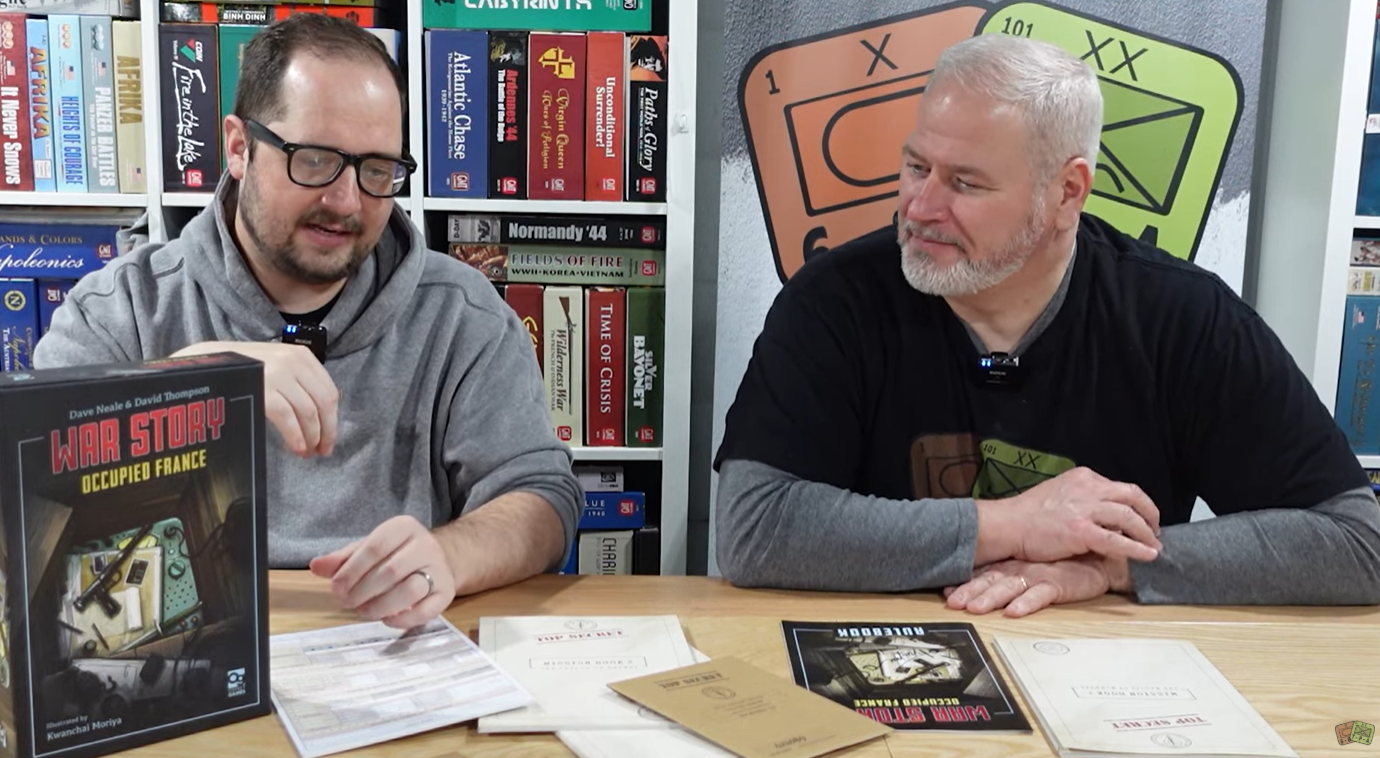
            War Story: Occupied France is a co-operative narrative game for one to six players set in World War II occupied France that captures the stakes and tension of espionage and resistance warfare. Your team of covert operatives is all that stands between the infamous German officer Heidenreich and the systematic destruction of French Resistance forces in Morette.

            Through three replayable story missions, you must exploit the specialties of your chosen agents to uncover information, enlist allies, and obtain weaponry. Engage occupying forces on tactical encounter maps where careless positioning could cost your agents’ lives. Remember, no plan survives contact with the enemy…and time is running out.

            I wrote a fairly in-depth First Impression post and you can read that on the blog at the following link: https://theplayersaid.com/2024/10/22/first-impressions-war-story-occupied-france-from-osprey-games/

            -Grant

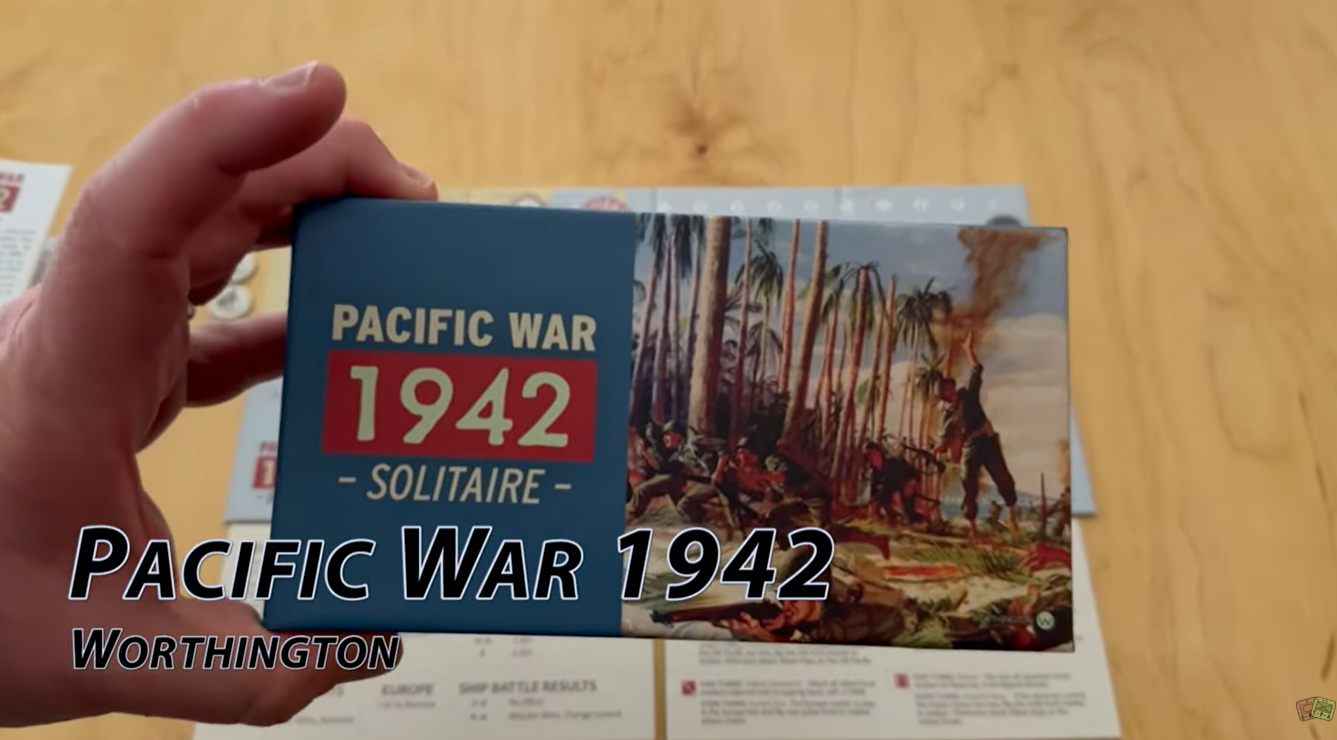
            Solitaire Video Review: Pacific War 1942 Solitaire Travel Game from Worthington Publishing

            Von: Grant
            21. März 2026 um 13:00

            In early 2024, Worthington Publishing announced a unique 2-pack of games on Kickstarter that were marketed as easy to play travel friendly solitaire games. And you know that I love a good solitaire wargame! And when I heard that these games were small, even portable, then I was even more interested. One of the games covered the Pacific Theater of WWII called Pacific War 1942 Solitaire and the other covers the War of 1812 called (you guessed it) War of 1812 Solitaire. These games are designed by Mike and Grant Wylie and each game has 4 pages of rules, a beautiful mounted board and double sided counters. I played both and really very much enjoyed the experience.

            I wrote a fairly in-depth First Impression post and you can read that on the blog at the following link: https://theplayersaid.com/2024/08/20/first-impressions-pacific-war-1942-solitaire-travel-game-from-worthington-publishing/

            -Grant

            Unboxing Video: Congress of Vienna from GMT Games

            Von: Grant
            20. März 2026 um 14:27

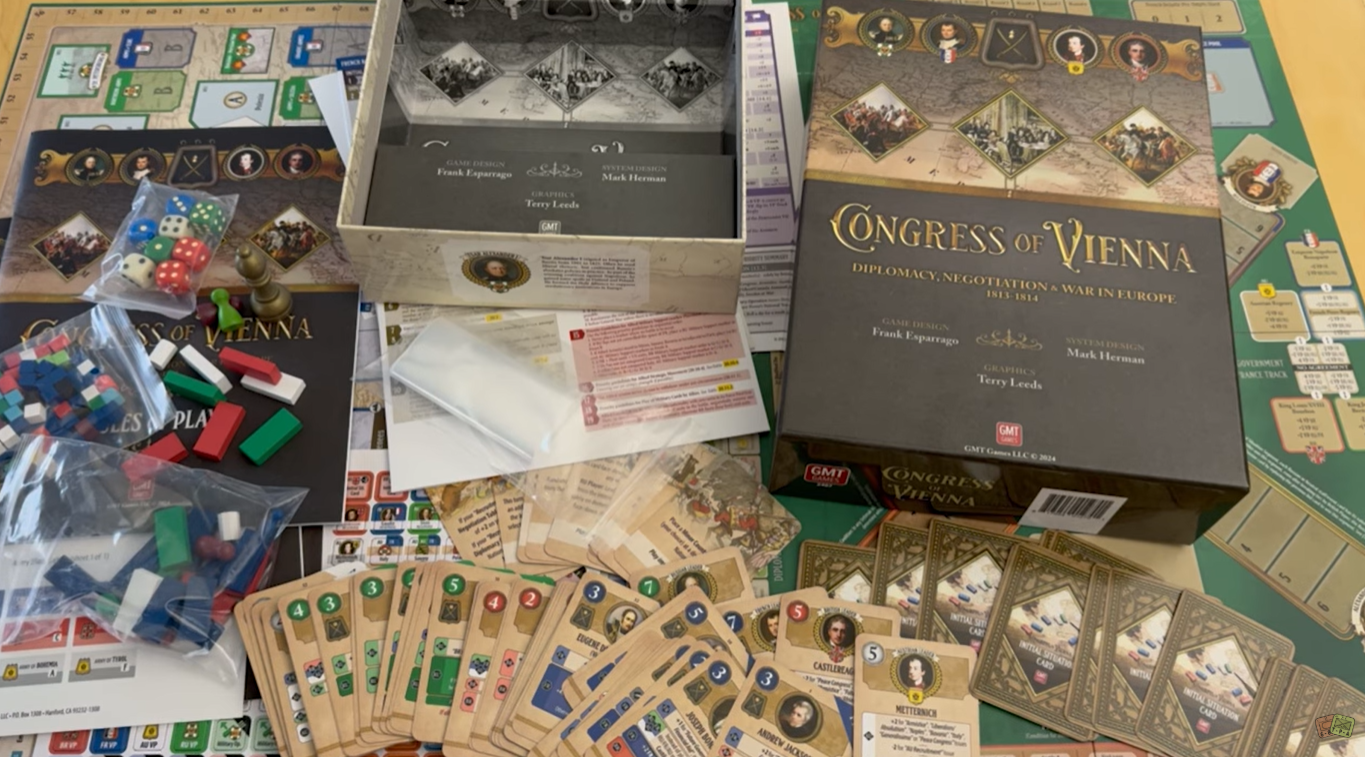
            A few years ago, after playing all of the games in the Great Statesmen Series, we heard of a new game in the series from a designer not named Mark Herman and I was immediately interested and intrigued as we have had so much fun with ChurchillPericles and Versailles 1919Congress of Vienna from GMT Games is a diplomatic card driven wargame based on Churchill and is the 4th game in the Great Statesmen Series. The game is set during the years of 1813-1814 and sees players take on the role of the main characters of the struggle between the Napoleonic Empire and the coalition of Russia, Austria, and Great Britain with their Prussian, Spanish, Portuguese, and Swedish allies. We played the game recently while attending Buckeye Game Fest and then played a full campaign again while attending the World Boardgaming Championships and absolutely were amazed at the changes and innovations to the system introduced by the designer Frank Esparrago.

            I posted a fairly in-depth overview of the game in my First Impression post and you can read that at the following link: https://theplayersaid.com/2025/08/06/first-impressions-congress-of-vienna-from-gmt-games/

            -Grant

            Top 10 Moments from Buckeye Game Fest 2026 – A Great Convention that Creates Great Memories!

            Von: Grant
            19. März 2026 um 15:22

            Last week, Alexander and I attended our 6th Buckeye Game Fest in Columbus, Ohio. Buckeye Game Fest is an annual gaming convention ran by Buckeye Game Festivals, which is a 501c4 non-profit committed to promoting the hobby of boardgaming by hosting an annual festival and pop-up gaming events within the local community. BGF also has a dedicated War Room where wargames are featured and the War Room runs from Monday (when the rest of the convention doesn’t start until Thursday) through Sunday every spring. The convention is typically held in mid to late April but this year due to conflicts the convention was very early and was held from Monday, March 9th through Sunday, March 15th. We attended from Tuesday afternoon March 10th through Sunday morning March 15th. As is usually the case, we had a fantastic time playing games, hanging with friends, discussing game releases with several publishers who attend, including Blue Panther, Catastrophe Games and this year Decision Games, and hanging out with designers such as Hermann Luttmann, Tim Densham, John Lapham, David Thompson and others. It is just a very small and intimate convention that never disappoints.

            While attending the convention, I wrote a series of detailed Daily Debriefs on the blog but wanted to do this piece to highlight the overall experience and show you why this convention is so good. So here are my Top 10 Moments from this year’s convention.

            10. Played 6 Wargames Published in 2025 to Finish up 2025

            2025 was somewhat challenging for us from a time standpoint. Alexander has received a promotion at work and has been traveling more than usual and also dealt with some non-serious health matters earlier in the year that cut into our gaming time. I also had a busy year at work and our 2 teenage daughters who are still at home have gotten involved in more time required activities at school which requires me and my wife to drive them to-and-fro from practices, concerts, attending competitions and the like so we were only able to get to 25 new published wargames from 2025….until we went to Buckeye Game Fest.

            We were able to play 6 wargames published in 2025 over the 5 days of the convention and they were all very good. We played Gettysburg: The First Day from Revolution Games, Chicago ‘68 from The Dietz Foundation, China’s War: 1937-1941 from GMT Games, Cross Bronx Expressway from GMT Games, Werwolf: Insurgency in Occupied Germany, 1945-1948 from Legion Wargames and Imperial Elegy: The Road to the Great War 1850-1920 from VUCA Simulations.

            This now has moved our total new 2025 published wargames played to 31, which is a very respectable number even if less than our usual number of new plays in any given year. This means we can now close the book on 2025 and put together our Top 10 lists for your consumption and then do a video.

            All of these games mentioned here are multi-player wargames, with the exception of Gettysburg: The First Day, which is a traditional 2-player hex and counter wargame. But we believe that conventions are ideally suited for multi-player games and that is what we bring and plan to play when attending. This year we were very successful in this endeavor and actually played 11 multi-player games! No 2-player games for us at conventions (except for Tuesday evening as there are never really that many folks who have arrived yet!).

            9. Breaking Bread with Hermann Luttmann

            Each day, we need sustenance when attending these conventions. Playing games, learning rule sets, chatting and cavorting take a lot out of a body. We almost always take our breakfasts in the hotel restaurant as they offer a full buffet with eggs, bacon, sausage, pancakes, biscuits and gravy, toast, fruit and cereals. But, we also like to visit the fantastic restaurants nearby and love to go along with friends. This year, we had 3 opportunities to break bread with our good friend Hermann Luttmann, who needs no introduction in wargaming circles, but has designed great games such as A Most Fearful Sacrifice from Flying Pig Games, The Plum Island Horror from GMT Games, At Any Cost from GMT Games and an upcoming zombie game that we all know and love Dawn of the Zeds Designer Edition from Blue Panther. While he has a bit of an aristocratic palate (he always orders eggs benedict!) and enjoys various Southern delicacies such as creamed spinach, he is a joy to eat with as we chat about all kinds of things including current events, game design, how contracts for designers work, the wargame market, his upcoming designs and lots of other interesting subjects. So eating with Hermann might cause a bit of indigestion due to all of the laughter and joking but is one of the highlights of any convention that he attends.

            The upcoming Dawn of the Zeds Designer Edition from Blue Panther.

            8. Annual Sit Down with Steve Jones AKA Steve Blue/ Panther Steve from Blue Panther

            Annually at BGF, we try to sit down with Steve Jones (aka Steve Blue or Steve Panther) with Blue Panther, LLC and do a video summarizing all of their upcoming projects and games from the publishers that they have a partnership with and print their games. Their list of clients is quite extensive and includes the likes of Hollandspiele, White Dog Games, Bill Molyneaux Games, Historic Wings, Catastrophe Games, Art of Wargames, Pinkerton Games, War Diary Publications, Lock ‘n Load Publishing, The Historical Game Company and Red Sash Games amongst others.

            Steve is a gentle giant of a man and is always fun to sit down and talk with as he has a rapier whit and deep knowledge of the gaming business. I sometimes feel bad as I always give him a hard time in the videos and this year I really felt saucy and was definitely giving him a what for! He was game though and took it in stride and punched back multiple times. I thought this video was especially good and was filled with lots of great upcoming games that you should keep an eye out for. We will post this video on our YouTube Channel in the next few weeks.

            Steve and his son Trevor standing in front of their upcoming Dawn of the Zeds Designer Edition.

            7. Playing Games with New Attendees

            We are really into growing Buckeye Game Fest and over the past few years as we have been working with them and promoting the con with our videos, blog posts and social media, we have seen it grow and had the chance to meet tons of new friends along the way. Now, while this year’s attendance was a bit down, partly due to the earlier than usual date (remember I said typically in mid to late April) and conflicts with spring breaks, we only had about 35-40 attendees in the War Room. But that didn’t mean there weren’t new attendees. In fact, there were at least 5 new attendees that we were able to meet and game with as well as some new designers who attended.

            I am not going to go into great depth or detail about each of these new folks but 3 that really stood out to us were Leslie Jerome from Kansas, Dave from Michigan and James also from Michigan.

            First up is Leslie. He taught us the Line of Battle Series of American Civil War Games from Multi-Man Publishing with the 3rd game in the series called To Take Washington: Jubal Early’s Summery 1864 Campaign. He was a very passionate gamer and just loves this ACW series for many reasons that we learned as we played the game. I will talk about this more later in the post but he also makes his boards 3-D by cutting out and taping on pieces of card board/card stock to show the elevations on the board. This creates a whole new experience and is also frankly amazing the look at. We were honored to both meet and play with Leslie and want to thank him for the teaching and for also playing China’s War from GMT Games with us later that evening, which was his first foray into the COIN Series and I saw where on Saturday he purchased one of my favorite volumes in Liberty or Death from the Decision Games booth. Thank you Leslie and we hope you will return in the future!

            Leslie Jerome teaching us the Line of Battle Series game To Take Washington: Jubal Early’s Summer 1864 Campaign from Multi-Man Publishing.

            Next was Dave from Michigan. Dave was a fantastic guy. A bit shy and reserved but a man that showed great resolve in how he ended up coming to be in attendance at the convention. See, each day I write those Daily Debrief Series posts recounting the events of the previous days plays and experiences and post them on the blog around or even after midnight each night. Well, he read my summary of Day 1 and just decided to drive down from Michigan, I think that he said it was a 4+ hour drive, and attend the convention. Just amazing and I was so glad that someone was reading the posts and that they encouraged them to attend. He agreed to play Werwolf: Insurgency in Occupied Germany, 1945-1948 from Legion Wargames with us and Gary from Ardwulf’s Lair and I think that he had a good time playing as the United States. Thanks for coming Dave and for showing such courage and spontaneity in just deciding to come from reading a blog post. Amazing!

            First time attendee Dave from Michigan playing We iwrwolf: Insurgency in Occupied Germany, 1945-1948 from Legion Wargames.
            First time attendee James from Michigan playing Bretwalda from PHALANX with us and our good friends Cullen and Russ.

            Finally, there was James. Now James is a Patron, which means he donates a few bucks per month to have access to our Slack Channel and discuss wargames, but he came this year and it was a great honor to meet him and to also play 3 games with him as he played Here I Stand with us on Friday and Imperial Elegy and Bretwalda with us on Saturday. He also went to dinner with us Saturday evening and even bought us a drink (I don’t drink alcohol so he bought me a diet Coke). He was a very smart and savvy game player and held his own with Here I Stand as he tied with me as the Protestants before I won on the tiebreaker. But it was a great experience meeting him and he left with at least 3 new games from Blue Panther’s booth that I convinced him to buy (it wasn’t like I had to twist his arm as he already had them in his arms and was going to buy them anyway!).

            But meeting new people is what conventions are all about and we have very much cherished these experiences and the friendships that we have built over the years.

            6. The Gorgeous 3-D Boards

            The 3-D boards made by Leslie. Oh man seeing these was simply amazing. Leslie has a special talent that he shared with us as he showed off his handiwork which involves creating 3-D boards for his favorite games such as To Take Washington: Jubal Early’s Summer 1864 Campaign from Multi-Man Publishing, A Most Fearful Sacrifice from Flying Pig Games and Stonewall’s Sword from Revolution Games.

            These boards are just amazing and each one of them has such great detail showing the different elevations on the battlefield. Leslie said each one takes him multiple weeks to create and involves a lot of detail and precision cutting and gluing as well as shading the edges of the elevating terrain with colored pencils. We were really impressed and when we got to play a few turns of To Take Washington with him the details of the board really made the game play that much deeper and richer.

            To Take Washington: Jubal Early’s Summer 1864 Campaign from Multi-Man Publishing from the Line of Battle Series…..and…..

            …..Stonewall’s Sword: The Battle of Cedar Mountain from Revolution Games….and…

            ….and A Most Fearful Sacrifice: The Three Days of Gettysburg from Flying Pig Games.

            At the end of the con, Leslie gifted us the To Take Washington board and we were honored to accept this gift as we plan to break them game out again in the near future and take it through its paces. Thanks to Leslie for the gift and for the chance to learn the series.

            5. Experiencing the Newest COIN Series Game

            We have been waiting for the final version of China’s War: 1937-1941 since it was announced in late 2019 and added to the P500. So, when we got a chance to play it at BGF, I knew it would be a memorable event. China’s War examines the first five years of the conflict in China from 1937-1941, when China stood alone against the Japanese Empire. Each player takes the role of a Faction seeking to attack or defend the Republic of China: the aggressive Japanese, the harried Government (represented by the Guomindang party), the rebellious Chinese Communist Party, or the unruly, fractious Warlords who are obedient when convenient but have their eye on gaining state power. Using military, political, and economic actions and exploiting various events, players build and maneuver forces to influence or control the population, extract resources, or otherwise achieve their Faction’s aims. A deck of cards regulates turn order, events, victory checks, and other processes. The rules can run non-player Factions, enabling solitaire, 2-player, or multi-player games.

            We find that Brian Train’s designs are just fantastic. I think that sometimes they can be a bit opaque, meaning that their true genius cannot be seen with just a few plays but will be unlocked over 4 or 5 plays as we have found with A Distant Plain, which has continually moved up on my list of favorite COIN Series games with each play that numbers around 5. But China’s War was just special. It is totally unique as to its take on insurgency within the COIN Series, is really frenetic and active and gives the feeling of classic COIN while really turning things a bit upside down with the way the powerful faction works in the Japanese as they really only care about maintaining and cleaning off their Lines of Communication. In fact, they are so unique that they are the faction that will place Terror on the board, which is typically reserved for the insurgent factions to sway Support and Opposition.

            Now we only played once, and there are things that we messed up, but it was a supremely interesting and engaging play experience and was actually so good that a new initiate to the system was able to grock the rules and be competitive in their very first play. Just an astounding example of a COIN Series game that has been well worth the wait to have it arrive on my table.

            4. World War II Roleplaying War Stories

            Our final event of the convention was our annual roleplaying game and this year Cullen prepared a session of a new RPG called War Stories from Firelock Games, which is set during World War II. With it, players take the roles of heroic airborne soldiers parachuting into Normandy during Operation Overlord in June of 1944.

            As an RPG, players will have characters with various special focuses across 4 abilities including Strength, Agility, Intelligence and Empathy. Each time a skill is to be checked you find the matching ability and roll that number of six sided dice looking for 6’s which mean success. If multiple successes are rolled you can earn special tokens called Lucky Strikes that can be saved and used as successes on future rolls. The players will also have a choice when they fail about whether they decide to reroll but will remove any 1’s from the pool and roll the remaining dice again. If they fail this time though the GM will gain a FUBAR token that can be used to cause a failure on a rolled success in the future. This really created some cinematic moments and was a very interesting way to handle a check.

            We played the game with a party of 5 characters with Tim Densham and Jim both with Catastrophe Games and Hermann Luttmann. I very much enjoy roleplaying but also enjoy the back and forth interactions between the players as we strategize, try desperately to execute and then watch as things simply don’t go as planned. It is always fun to see how to get ourselves out of a sticky situation and the hilarity that always ensues. This RFG was fun and engaging and really pretty simple but one comment I have is that it is a bit more difficult to play a game like this focused around soldiers and not take it seriously. I always feel like I am overstepping but I do know that the process of playing is in many ways paying homage to the men and their sacrifice.

            In the end, there were lots of heroic actions, good sniper shots, daring orders, risk taking and of course explosions and we all had a great time with the game. But more importantly we had a great time together and created some lasting memories!

            3. A Look at Dawn of the Zeds Designer Edition

            I think that you all know well the original Dawn of the Zeds from Victory Point Games. A States of Siege Series game where the player or players take on the roles of survivors in Farmington as hordes of nasty Zeds stream down the paths toward the center of town hell bent on eating some brains. The game is light, fun and difficult and is both a great solitaire and cooperative game. As we have mentioned, Hermann Luttmann was able to secure the rights to the game back from Tabletop Tycoon who had purchased them from Victory Point Games and is working with Steve Jones from Blue Panther to bring the game back to life with new art, a new combat system with custom dice and some new characters. The game will be available for pre-order in May and then should be shipping in late July.

            We had a chance to play the new version for about an hour with Steve Jones and Hermann and had a great time. There was lots of banter back and forth about our terrible rolls, the chances or lack thereof of a victory and lots of other things. One of the most memorable moments though was when Steve, who was playing a stealthy melee focused character, who liked to lay in ambush and await the Zeds to come into their space. Steve wasted about 3 turns just moving up and then moving back and doing…well nothing and we gave him hell for that. Ultimately in the end, he moved into a space and attacked the Zed and his rolls didn’t go well and his lightly armored character came within 1 hit of death before having to retreat and try to make it to the hospital to get healed. Just a total cluster that made the game very memorable.

            One of the other memorable moments was when we were trying to evacuate a group of refugees but there was an event where the bridge collapsed and we had to move out to repair it and place a ferry that could usher refugees and characters from one side to the other. We then moved the refugees to the ferry and loaded them on but the next random event that occurred forced the refugees to move back across the river to get friends who had been left behind. Well, the Zed behind them had made it the river and when they went back they ran right into its jaws and were torn apart. That is one thing that I have learned about this game is that you can do the right thing, place your characters and assets effectively to open up paths to victory and cruel lady luck can ignore your plans and drop a bomb. But that is what makes this game memorable and we had plenty of those from this short 1 hour session.

            2. A Glorious 9 Hour Marathon Game of Here I Stand

            Annually, we plan to play one of 2 games at BGF; either Here I Stand or Virgin Queen and this year it was Here I Stand. We always set the game for first thing on Friday morning, when we are good and tired and worn down after several days of fun and the experience never dissapoints.

            This year, we played with Russ (France), Cullen (Ottomans), Bill Simoni (Papacy), James (England) with me (Protestants) and Alexander (Hapsburgs). It had been a while since I had played as the Protestants but last year had played as the Papacy in a few games and had remembered several things that could aid me in fighting off the advances of the Pope.

            But, the game would not go well for the Protestants out of the gate. As is the usual, our game started off with the nailing of the 95 Theses to the door of the church at Wittenberg and as the Protestants I have never seen a worse opening as I was only able to switch 3 spaces in Wittenberg, Brandenburg and Leipzig. Not a good start at all for the Protestants but I was undaunted, although I said many curses under my breath and to the gamers at the table, and quickly got my self under control and was determined to recover.

            I worked hard over the next few turns to spread the faith and was quickly able to get most of Germany under control and take over 4 of the Electorates which gave me units that would help me continue to spread toward France and England. It was amazing to see Bill Simoni and the Papacy and I go at it as we held many theological debates, ultimately each of us disgracing a debater and gaining VP, and for me to have the full Bible translated into German during Turn 2 quickly followed by the translation into English by Turn 3. I had made a deal with England for him to play a card that favored me in exchange for a concerted effort to get the Protestant faith rooted in England so he could gain some VP from the effort.

            Meanwhile the Ottomans got out the Barbary Pirates card early and had built a sizable fleet of corsairs causing France and England to loan the Hapsburgs several boats to combat this green menace in the Mediterranean. Also several colonies were formed in the New World and ultimately Alexander’s Hapsburgs were able to circumnavigate the globe and score several important VP.

            During this time, the Protestants and Papacy continued their fight tooth and nail but my dice rolling, and innate ability to win ties, allowed me to build a sizable lead in the religious war. I was in very good shape when the Schmalkaldic League card was played turning the Protestants into a military power and then changing the other players focus to then declare war on and starting to attack my fortified Electorates to take away VP I had earned by having both religious and political control in 5 of the 6.

            As we came into turn 5, I was at 24 VP and ultimately came up shy of a victory by 1 point at the time. I had been able to take over the entirety of England and change every space and also get about 5-6 spaces in France. but now the Papal Bull came to play and Bill fought me back and forth with him taking over 3-4 spaces followed by me reclaiming 3-4 spaces. It was a beautiful game of back and forth and I used every tool at my disposal to fight him including The Wartburg card to stop the untimely excommunication of Luther before he could attempt to embarrass one of my lesser debaters.

            Then England gained ground as a healthy Edward was born and he gained 5 VP and then took over a key from France to get close to my score going into Tuen 6.

            At that point it was dog pile the winner as everyone declared war on the Protestants and came after my Electorates but I was able to stave them off and ultimately never lost down to lower than 4 controlled which retained 8 VP for me and allowed me to finish the Bible translation in French and take a sizable lead in VP.

            The best part of the game was that it all came down to the last few card plays as England and my Protestants tied at 25 VP and I won on tiebreakers as I had the most VP in the turn prior. What a fantastic game that took us over 9 hours to play!

            I simply love this game because of the player interaction, which includes making treaties, declaring war and also negotiations about what we desire other factions to do and how to go about their efforts to win. Cards can be traded in this game as part of these negotiations and I have always really liked this aspect. I say trading but the various events on these cards can also be trade bait as players can ask for or commit to either playing or not playing a certain card that would have a dramatic effect on an upcoming round. This take players who are comfortable with the system, the different factions and the victory conditions of the game but is such a juicy and exciting part of the design.

            I just love Here I Stand, for a multitude of reasons but as a CDG it is one of the best at creating an experience and this time a really great experience was had by all.

            1. Our Friends…And New Friends!

            The best part of any convention, not just Buckeye Game Fest, is the friends that we make and then see each year. I love the wargaming community and all of its members. Each time I meet and play with new people, I am amazed at how amazing each of them are. From their passion for history, to their generally easy going and fun personalities, I love to meet with other wargamers. Because we create content, making dozens of videos per month, you know our faces, and in some cases our voices as someone recently stated they had heard us and came to say hello. And we sincerely love it when you approach us at a convention to interact. We have always taken great pride in knowing our fans and will continue to try and meet as many of them as is possible.

            We have built some really great friendships over the past 6 years of attending Buckeye Game Fest. Names like Bill Simoni, Cullen, Russ (Bad), Russ (Good), and others. We tend to see these friends each year and when they are not present, which seemed to be the case this year at BGF, we truly miss them. But, we were able to meet new friends and play games together and this will be the start of new relationships that we hope will continue into the future.

            Well, I know I got a bit mushy there at the end, but we had a great time this year at Buckeye Game Fest and I hope you see what the experience is like at these conventions. We would encourage all of you to try to get to a convention and begin the process of making friends. I know it is not easy or convenient but I promise you it will be worth it.

            If you are interested, I did write a series of Daily Debrief posts summarizing each of the 5 days and you can read those at the following links:

            Daily Debrief Series Introduction

            Day 1 Daily Debrief

            Day 2 Daily Debrief

            Day 3 Daily Debrief

            Day 4 Daily Debrief

            Day 5 Daily Debrief

            We also did 11 different videos and will be sharing those on the YouTube Channel over the next month. Until next year!

            -Grant

            My Favorite Wargame Cards – A Look at Individual Cards from My Favorite Games – Card #69: Blockade from Twilight Struggle: The Cold War, 1945-1989 from GMT Games

            Von: Grant
            17. März 2026 um 16:31

            With this My Favorite Wargame Cards Series, I hope to take a look at a specific card from the various wargames that I have played and share how it is used in the game. I am not a strategist and frankly I am not that good at games but I do understand how things should work and be used in games. With that being said, here is the next entry in this series.

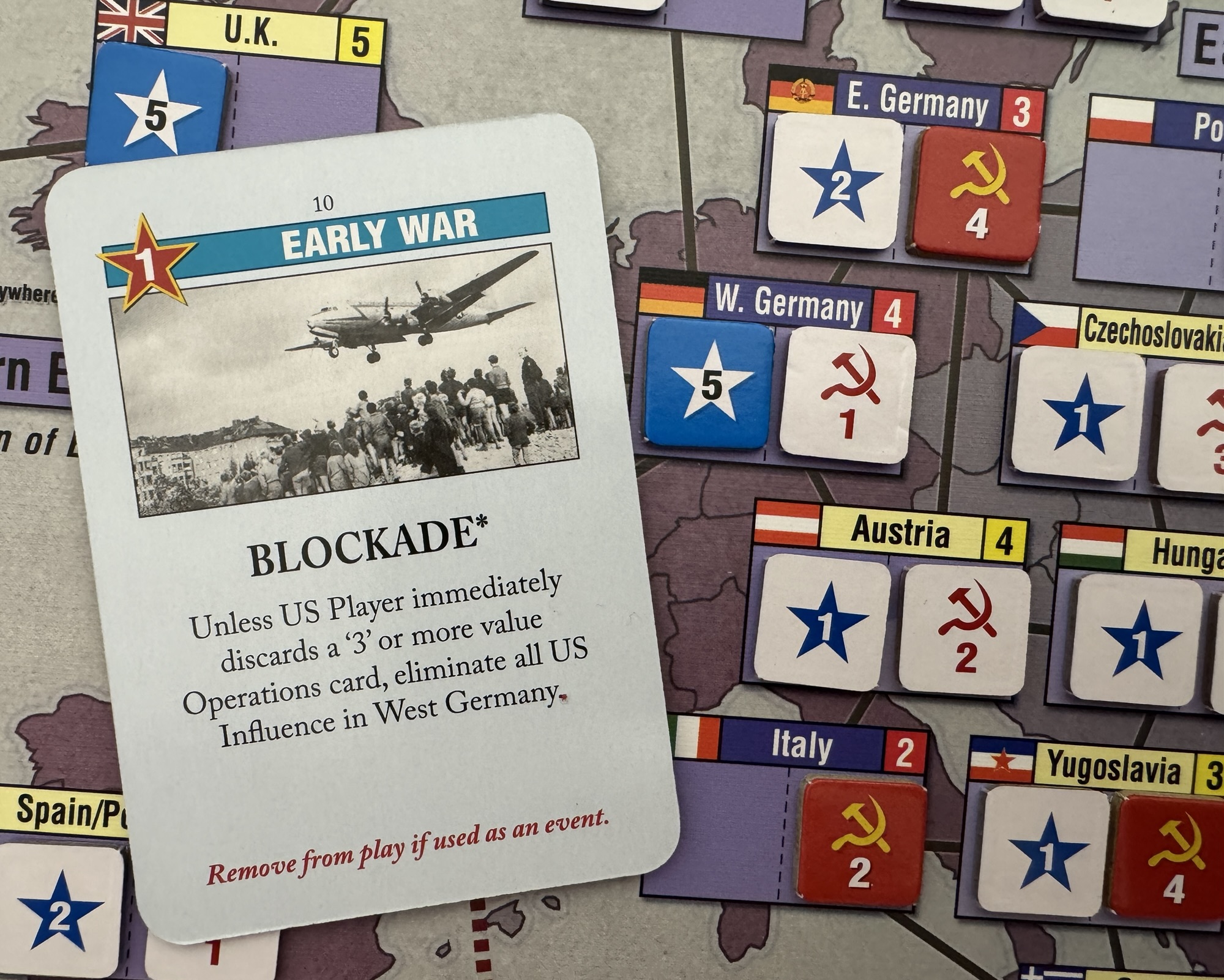
            #69: Blockade from Twilight Struggle: The Cold War, 1945-1989 from GMT Games

            Twilight Struggle is a 2-player game simulating the forty-five year ideological struggle known as the Cold War between the Soviet Union and the United States which can be played in 2-3 hours. The entire world is the stage on which these two countries “fight” to make the world safe for their own ideologies and way of life. The game starts right after the end of World War II in the midst of the ruins of Europe as the two new “superpowers” of the world squabble over what is left and ends in 1989, when only the United States remained standing.

            The map is a world map of the period, where players move units and exert influence in attempts to gain allies and control for their superpower. The beauty of the CDG system used here is that each decision of whether to use a card for the event or the operations value is a struggle as if it is the other side’s event, it might go off hurting you very badly. There are mechanics to allow for the ignoring or cancelling of some of the best cards for your opponent in a side game within the game called The Space Race as well as nuclear tensions, with the possibility of game-ending global thermonuclear war (Shall we play a game, anyone?). I have played TS about 30 times and love it more and more with each sitting. The game makes me sweat, cringe, jump with joy and bite my fingernails. To me, a game that can do all of that in one sitting is worth the price.

            One of my favorite type of cards from the game are those that force an action upon your opponent, such as discarding a card, reducing the Ops from card plays or causing them to have to make other plans than what they were working toward. These type of cards are more reactionary but definitely cause issues and mimic the various non-military focused strategies and tactics used during the Cold War. One of the most famous events from the early history of the Cold War is that of the Berlin Blockade. And there is a specific card that pays homage to the event in the game called Blockade. Blockade is an Early War Soviet Card that has an Ops Value of 1, which makes the card more valuable to be used for the printed event versus for the Ops.

            When played, the card requires the US Player to immediately discard a 3 Ops or more value card from their hand or the consequence of not doing so will see all US Influence being removed from West Germany. This is a tough choice. Being early in the game, it is possible for the US to rebuild in West Germany and replace the lost influence over time if they do not wish to discard such as high value card. But, herein lies the real key to the Blockade cards use. The Soviet Player, who should be paying attention to not only their hand but also the card plays of the US Player, should try to use this card later in a turn once the US Player has played a majority of their cards in order to ensure that the event text can be realistically be achieved. If played quickly during a turn, the chances of the US Player being able to discard the required 3 Ops or great value card is higher and the card play will not generate any meaningful difference on the board state. I also would recommend a 2 card strategy here as the Soviet Player should be holding in their hand a high Ops card to be able to follow up this action with the placement of Influence into West Germany on their very next play. But, the real value to a card such as Blockade is that it forces the US Player to consider what cards are out there and to play around their negative effects as much as possible. Due to the nature of the game, and the randomness of card draws, having an expendable high Ops card ready and able to be discarded just in case of the play of Blockade is not really feasible. Also, remember that in Twilight Struggle that opponent events on cards that you play will go off and Blockade being drawn by the US Player can be bad as it will require them to play the event as you cannot discard a 1 Ops card to get rid of its negative effect in the Space Race Track due to the minimum requirement being a 2 Ops card. So the moral of the story here is that both players need to consider and plan for the play of or the mitigation of damage from Blockade.

            The Berlin Blockade, which lasted from June 1948–May 1949, was a major Cold War crisis where the Soviet Union blocked all land and water access to West Berlin to attempt to force Western Allies out. The Soviet Union was taking this action as a means of retaliation against the introduction of the new Deutschmark currency. The US and Britain responded with the massive Berlin Airlift, flying over 2.3 million tons of food, fuel and supplies to the city. At the peak of the Airlift, a plane landed in West Berlin every 30 seconds. The blockade failed and the Soviets lifted it on May 12, 1949, after realizing the Allied Airlift could sustain the city for an extended period of time, marking a significant victory for the West in the ideological struggle. This event led to the acceleration of the division of Germany into East and West and the deepening of Cold War tensions.

            In the next entry in this series, we will take a look at Mohawks from Wilderness War: The French & Indian War, 1755-1760 from GMT Games.

            -Grant

            Interview with Clint Warren-Davey Designer of Reformation: Fire and Faith from Neva Game Press

            Von: Grant
            16. März 2026 um 13:00

            Neva Game Press is really exploring the space of wargame publishing and have games that are being worked on spanning all of history including modern and ancient. They also are looking at non-traditional topics to cover such as the Reformation. Their newest pre-order offering is called Reformation: Fire and Faith and is designed by Clint Warren-Davey. I am keenly interested in this one and have been working with Clint on this interview and maybe a series of other articles on strategies.

            Grant: Welcome back to the blog Clint. With 4 published games to your credit what lessons have you learned about the design process and been able to put into practice?

            Clint: Thanks for having me back guys! Yes I have learned a lot. Mainly, my iterative loop has become faster. I use mainly digital prototypes on PowerPoint and can get a prototype up and running pretty fast. This means I don’t need to print components and then reprint when things change. I also have a larger “toolbox” of ideas to draw from as I’ve played a wider variety of games. I still have a core design philosophy though – I want games that give players lots of meaningful decisions and a minimum of busywork, plus I generally prefer a high level of player interaction and interdependence.

            Grant: How do you pitch games to publishers? What is your approach?

            Clint: First I make sure the game is ready. I play-test the game myself a minimum of 20 times. Then I give it to external play-testers (basically my followers on Twitter/X). I keep refining it and make sure all the rules are nailed down. Once I have a fully functional and viable digital prototype, I send an email to a lot of different publishers to see who wants the game. So far, I’ve usually found at least one publisher who will accept each game. 

            Grant: What is your new game upcoming game Reformation: Fire and Faith about?

            Clint: It’s about the wars and religious struggles that tore Europe apart during the Reformation, from 1517 (Martin Luther nailing the 95 Theses to the door of Wittenberg cathedral) to 1555 (the Peace of Augsburg). This is during the “pike and shot” era, which I love. It also includes a lot of political, religious and military conflict that is fascinating on multiple levels. It’s the perfect setting for an asymmetric wargame.

            Grant: What image and feeling did you want to convey to players with the subtitle “Fire and Faith”?

            Clint: Well this subtitle was decided by my publisher, Jose Neva of Neva Game Press. He wanted to convey both religious and military struggle in the title of the game, hence fire and faith. Before that the game title was undecided – it was either going to be just “Reformation” or “One Hour Reformation”  – though upon further development it was clear this game doesn’t really fit with my other “One Hour” games.

            Grant: Why was this a game you were inspired to design?

            Clint: I am fascinated by the Reformation – both from a religious and a historical perspective. When I converted to Christianity about 10 years ago I had to choose which church to join, which forced me to read more on this time period, and read the arguments put forward by Protestant and Catholic apologists, then and now. I should state here that although I decided upon Catholicism, I hold no ill-feeling towards Protestantism and I understand the impetus behind it.

            I was also drawn in by the fascinating geopolitics and tactical level military transformations of the time. The struggles between the French, Habsburgs, English, Ottomans, Venice, Scotland, Hungary, the Papacy and many other much smaller states were kaleidoscopic in their complexity but endlessly entertaining. To take one example of the political maneuvering of the time – the French lost the battle of Pavia to the Habsburgs, partially because 5,000 of their Swiss mercenaries just left and went home to defend their own cantons from rampaging German Landsknechts. Losing Pavia meant that King Francis I was captured. This in turn meant the English sensed weakness and struck in north-eastern France.

            Seeking allies against this double threat, the French turned to the one great power that might help them – the Islamic Ottoman Empire! This outraged the Habsburg Emperor Charles V, who had his hands full containing the spread of Protestantism in Germany. The Saxons, Hessians and Brandenburgers following Luther’s lead would be much better used to help defend Vienna from the Turks, but instead both the Pope and the Emperor found themselves facing a full-scale religious revolt at the same time as renewed Ottoman offensives in the Balkans and the Mediterranean. This was all taking place against the backdrop of a military revolution in which pike and shot, and artillery, were replacing feudal levies of armoured knights.

            Grant: What other Reformation games did you study for inspiration?

            Clint: The complexity of this time period, and the sensitivity of religion as a topic, has meant that few game designers have been willing to tackle it. The exception is Here I Stand, the classic 6-player card-driven game by Ed Beach. This game is a well-renowned and even genre-defining title that managed to cram tons of inter-faction dynamics and historical chrome into the CDG system invented by Mark Herman (who made the first such CDG – We the People). It is absolutely brilliant in so many ways. Baroque, intricate, full of theme. It is almost like a historical equivalent of Twilight Imperium – one of my other favorite games.

            The problem? It takes way too long to play for most gamers. Ever since playing Here I Stand many years ago, I had kept the idea of a simplified version at the back of my mind. Then, when I started teaching religious history at a Catholic school, I found myself teaching the Reformation. A classroom game on the topic would sure come in handy. So, in 2024 I made one. The images below give an idea of this, including my very basic graphics made in PowerPoint and Word. In 2025, I revisited the idea and thought it might be worth making into a serious game, still using the basic concepts and inter-faction dynamics borrowed from Here I Stand.

            Early prototype version of the board.

            Grant: What is your design goal with the game?

            Clint: To make a game with 6 asymmetric factions that shows the inter-factional dynamics and key decisions of the period, all with mechanics that are simple enough to be used in a high school classroom AND simple enough for non-wargamers to pick up. Also, a game that players of Here I Stand would enjoy – especially when they are pressed for time. I believe I have succeeded in this goal but time will tell.

            Grant: What main mechanics are used in the design?

            Clint: The core gameplay loop is very simple. Each faction has a list of actions to choose from. Each turn, each faction will choose two actions. That’s it. But these vary greatly. They include everything from exploring the New World to translating the Bible to raising armies to piracy and everything in between.

            All the factions have some actions in common – like Recruit (placing military units) and Campaign (moving and fighting). The two religious factions – the Protestants and the Papacy – are set apart from the others by having most of their actions focus on non-military functions.

            Early prototype version of the Papacy Player Board.

            The Protestants are trying to convert people to their new faith (or rather, in their terms, restore an older and more purified form of the Christian religion). As such, their overriding focus is placing Followers on the map. As a rough approximation, each Follower piece represents 5-10% of the population converting to Protestantism. What the Protestant faction is aiming for is gaining a majority, or a near-majority, in the countries of Europe. So, their main way of earning Victory Points is by having 5 or more Followers in as many spaces as possible. Now, the Reformation did not initially take hold everywhere. Geographically it was concentrated in Germany above all, then England, then in scattered pockets throughout France. In the game this is basically where the Protestants will be focusing all of their efforts. They start with only 1 Follower on the map in Germany – this represents Martin Luther and the nascent reform movement that started to gather around him in 1517. From this humble beginning, I wanted the Protestants to build up and expand, sometimes rapidly, across the map.  

            To speed up their placement of Followers, the Protestants can translate the Bible into local languages – German, English and French. This is an idea I took directly from Here I Stand and of course from the actual history of the Reformation. Having the Bible in the vernacular language, and spread by the printing press, was key to the spread of Luther’s ideas. Bible translation is a simple, two-step process in the game. First you need to accumulate “Knowledge” through the Study action and then use the Translate action to place Knowledge markers on the three Bible language spots on the Protestant faction sheet. Initially, this was the only purpose of Knowledge. But then I expanded it to other uses – especially the Debate action, which is a competitive bid against the Papacy that can score a valuable “Issue” token worth a precious VP. These Issue tokens represent the points of dispute in the Reformation, like the role of Scripture, Tradition and authority of the Magisterium. I liked the idea of carefully studying to build up knowledge in preparation for a debate – it’s a case of the game language matching the theme.  

            Near final look at the board and player boards.

            The Papacy works in a similar way to the Protestants – but in reverse. The Pope is trying to remove Protestant Followers, through Preach and Debate actions. Every 3 Protestant Followers is minus 1 Victory Point for the Papacy, so they are incentivized to contain the spread of the Reformation. The Papacy also has ways of building up their own points, through Churches. This general term refers to all the infrastructure of the Catholic religion – not just beautiful cathedrals (like St. Peter’s, which was being built during the Reformation) but also schools, Jesuit universities, seminaries, monasteries, trained clergymen and church councils. I was originally going to have a track or chart on the Papacy faction sheet to measure this but later decided to have it as pieces on the map – the Churches you see in the game.

            This was because I wanted the Papacy to have some of physical presence on the map like the other factions. This was loosely inspired by the building tokens in games like Root or the resources placed on the map in Scythe. It has the advantage of opening up the Papacy’s primary victory metric to attacks from the other factions. Just like Protestant Follower pieces, papal Church pieces can be attacked and removed. This represents iconoclasm and persecution of Catholic clergy, as well as periodic waves of destruction like the Sack of Rome in 1527. Unlike Protestant Followers, I had the Papacy’s Churches cost Wealth. This Wealth is gained entirely through the Tithe action – which takes money from any nations that are still Catholic. Early in the game this includes three out of the six factions: Habsburgs, England and France. But England and France might convert to Protestantism, and a greedy Pope constantly demanding their money might hasten this on! 

            Grant: What are the playable factions? How did you differentiate them?

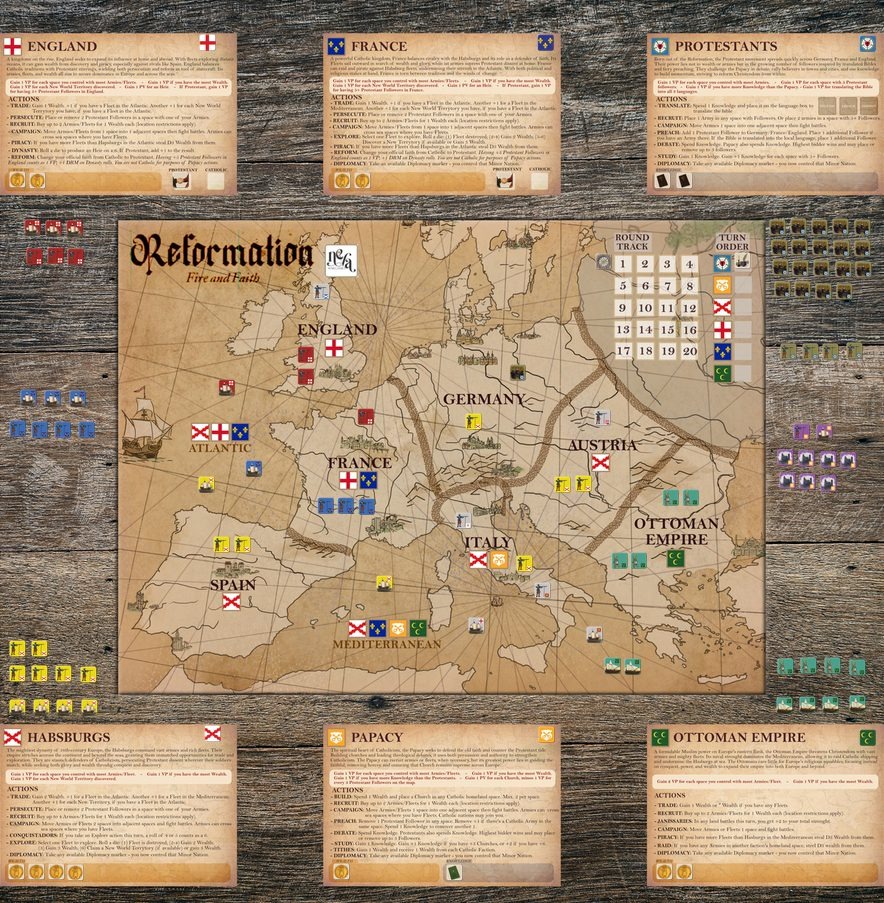
            Clint: There are 6 factions in the game: Protestants, Papacy, Habsburgs, England, France and Ottoman Empire. Each one has a faction sheet, like the one below, which summarizes their victory conditions and available actions.

            The Protestants and Papacy are religious-focused factions. They do have military forces, but they are relatively few in number and are not the main priority. The Protestants are trying to build up their knowledge of the Bible and translate it into vernacular languages, preach to the masses and debate the Catholics to spread their ideas. Their main goal is getting their Followers on the map. The Papacy is trying to contain the spread of Protestant Followers and remove them from the map as much as possible, plus place their own Churches. Both Churches and Followers are immobile and do not count as military units. But they can be attacked and persecuted off the map.

            The other factions – the Habsburgs, England, France and the Ottomans – function more like the nations in a wargame. Amassing armies and fleets, fighting battles, aiming for control of spaces on the map. There are plenty of differences though. The English, French and Habsburgs have the option of Explore action – sending their Atlantic Fleets to explore the New World, gaining varying amounts of Wealth or a valuable New World colony (at the risk of losing the Fleet). This provides a great way for factions to gamble early on in the game in a high-stakes race for colonies. Two tweaks were made to the Explore action during the design process. First, my co-designer Ed Farren suggested that New World colonies should provide extra income during the Trade action if the owner has a Fleet in the Atlantic.

            I loved this idea and implemented it immediately. I later thought that the Habsburgs should have a distinct advantage in exploring the New World, what with Hernan Cortez and Francisco Pizarro active during this time. I gave the Habsburgs a way to boost their Explore action with “Conquistadors” – effectively tripling their chance of finding a colony at the cost of an additional action. This means the Habsburgs will be raking in more money. But there are a lot of ways for the other factions to steal it! The English, French and Ottomans can all use the Piracy action to get that Spanish silver, and the Ottomans can also Raid on land if their Armies make it through to Austria.   

            The relationship between the military/political factions and the religious factions is also fascinating. I kept the Habsburgs as a staunchly Catholic faction – they can’t change their allegiance and will act as the strong right arm of the Holy See throughout the game. But England and France are a different story. England needed a historically-rooted incentive to convert to Protestantism, and this was solved in two ways. First, if England officially converts, they will earn 1 VP if England itself contains at least 5 Protestant Followers. This also gives 1 VP to the Protestant player, so there would be strong reasons for both players to work together in the conversion for England. I also wanted some of the high drama of Henry VIII and his wives without an entire sub-system and chart like Here I Stand. This became the “Dynasty” action – a simple die roll to gain a VP by producing a viable heir to the throne.

            If England is Catholic, they need a 6 for this. But converting to Protestantism offers success on a 5 or a 6, as Henry can start divorcing his infertile wives. England can therefore grab 2 VP quite easily by ushering in the Anglican faith, which is handy because their opportunities for expansion on the continent are quite limited. France can also earn VP by converting to Protestantism and having at least 5 Protestant Followers in France. For both England and France, converting to the new faith costs an action – which Ed quite appropriately labelled “Reform”. This could be a wasted action if Protestantism doesn’t end up spreading in that nation or if the Dynasty action still fails. But it’s a live issue. Among experienced players, I expect that the Papacy player and the Protestant player will spend a lot of their table talk trying to convince England and France to side with them in religious terms.  

            Grant: What is the layout of the board?

            Clint: I made the map as simple as possible. There are 7 land spaces: Spain, France, Germany, England, Austria, Italy and the Ottoman Empire. There are 2 sea spaces: the Atlantic and the Mediterranean. And that’s it! But you will find that this still provides plenty of interesting strategic choices, as there are 6 factions crammed into these 9 spaces. So, like the proverbial “knife fight in a telephone booth,” players are stuck in fierce competition from the very beginning. For example, the Papacy, France and Habsburgs all have some presence in Italy in the game’s set up. Plus, there are pieces from neutral nations there – like Venice and Florence. So inevitably there be some conflict there!

            Grant: Why did you feel area movement was the best approach? What strategic decisions are forced upon the players by the layout?

            Clint: Honestly, I didn’t want this to be game about operational level maneuver, more about strategic level decisions and inter-faction dynamics. The map is very heavily abstracted. But you can see it this way. Every faction has a “homeland” space. The Habsburgs, being the hegemon of Europe, have two (Spain and Austria). Each faction will usually be aiming to keep its homeland secure while pushing into 1 or 2 other spaces. Taking control of a space is a big deal and will involve good timing, negotiation and applying just enough force. Some spaces – like Germany and Italy – will usually become battleground spaces with multiple factions vying for control.

            Grant: What is the counter anatomy? What different units are included?

            Clint: Like the map, the counter anatomy is as simple as possible. There is really no information on the counters other than their type. There are Armies and Fleets – which are the only military units in the game. There are also two religious “units” – Churches for the Papacy and Followers for the Protestants. These don’t fight and can’t move, but they are essential for the two religious factions to build up their influence and victory points. There are also counters for many other things – New World Territories, the Royal Heir for England, the Issues that can be won in a Debate, Knowledge, Wealth and a few other things.

            Grant: What is the scale of the game?

            Clint: There’s no specific ground or time scale as many things have been heavily abstracted. But very roughly you could say that each turn represents about 2-3 years and each army piece represents 5,000-10,000 men.

            Grant: What actions do players have each turn? 

            Clint: Players can choose two actions per turn. As explained above, they are different for each faction. But there are some similarities. I will give a list of the actions for each faction.

            Protestants: Recruit, Campaign, Diplomacy, Preach, Study, Translate, Debate.

            Papacy: Recruit, Campaign, Diplomacy, Preach, Study, Debate, Tithe, Build.

            Habsburgs: Recruit, Campaign, Diplomacy, Conquistadors, Explore, Trade, Persecute.

            England: Recruit, Campaign, Diplomacy, Explore, Trade, Dynasty, Reform, Persecute, Piracy.

            France: Recruit, Campaign, Diplomacy, Explore, Trade, Reform, Persecute, Piracy.

            Ottomans: Recruit, Campaign, Diplomacy, Janissaries, Piracy, Trade.

            Many of these are self-explanatory but I will explain some of my favourite ones. Diplomacy means getting a Minor Nation on your side, or pulling one away from an enemy. These Minor Nations include Venice, Florence, Genoa, Hungary and Scotland and they have their own Armies or Fleets or both.

            Piracy means using your Fleets to steal money from the enemy. Explore means trying to find a valuable New World Territory – worth VP and more income during Trade actions if you have a Fleet in the Atlantic.

            The Persecute action means placing or removing Protestant Followers. The Reform action – available only to England and France – means officially converting your nation to Protestantism.

            Dynasty is unique to England and represents Henry VIII trying to get an Heir (worth a VP). It’s a dice roll, but it’s easier when you’re Protestant to represent Henry being able to divorce and try with a different woman.

            Janissaries is unique to the Ottomans and gives them a valuable +2 bonus in battle that turn. Conquistadors is unique to the Habsburgs and gives them a bonus on their Explore rolls – making it more likely that they will grab a New World Territory.

            Grant: How does combat work in the design?

            Clint: Very simple – add up your Armies/Fleets, add a D3 roll, the highest score wins. If there were a total of 7 or more units in the battle, the winner suffers 1 loss and the loser suffers 2 losses. Otherwise, the loser suffers 1 loss.

            Clint: How do players obtain victory?

            Clint: Every faction can score Victory Points (VP) in multiple ways. The margins here are very tight – typically the winning faction will score 5 or 6 VP while second and third place will have 4-5. So, a single point really matters. Every faction can score VP for control of spaces – this is hard to pull off as you need more Armies or Fleets in the space than all other factions combined. So, you might retain control of your own homeland, but taking control of another space is hard. Aside from control, each faction has other ways of getting VP:

            The Protestants earn 1 VP for translating the Bible into all 3 languages (French, English and German), 1 VP for each space on the map with 5 or more Followers, 1 VP for each Issue you win in a Debate and 1 VP for having more Knowledge than the Papacy. So the Protestants need to focus on their religious actions – studying, translating and preaching.

            The Papacy earns 1 VP for each Church they have on the map MINUS 1 for every 3 Protestant Followers on the map. They also earn 1 VP for having more Knowledge than the Protestants, 1 VP for each Issue they win in a Debate and 1 VP for having more Wealth than any other faction. So, the Pope also needs to focus more on his religious goals – but can also use the Tithe action to build up Wealth (for building Churches) and maybe get a point for rolling in cash.

            The Habsburgs earn VP for each New World Territory they discover – and they are better at it than other factions because of their Conquistadors. They also earn VP for having 2 or more Churches in their homelands (Spain and Austria) and can earn VP for having the most Wealth.

            The English earn VP for New World Territories and for having the most Wealth. They can also earn 1 VP for producing an Heir with their Dynasty action. The Dynasty action represents Henry VIII’s efforts to produce a legitimate male heir for his throne, and is easier if England becomes Protestant. England earns 1 VP if it converts to Protestantism and has 5 or more Protestant Followers in England. If it stays Catholic, it earns 1 VP for having 2 Churches in England.

            France is basically like England but doesn’t have the Dynasty action. They will focus on military action, exploration and building up Wealth. If they stay Catholic they will want the Pope to build up Churches in France, if they go Protestant they earn VP for having 5+ Protestant Followers in France.

            The Ottomans are the most straightforward – they can earn 1 VP for having the most Wealth but mostly they just get VP for control of spaces – they earn 2 per space instead of 1. They are an expansionist juggernaut and don’t care about the religious squabbles in Europe.

            Grant: What type of an experience does the game create?

            Clint: I think it gives you an understanding of the key inter-factional dynamics of the Reformation era using mechanics that are simple to understand and easy to enact.

            Grant: What are you most pleased about with the design?

            Clint: The asymmetry, the simplicity and the interaction between the players. I’m also really happy with the “bot” rules which allow you to play at anything from 1 to 6 players, with non-player-controlled factions run by a simple dice-based action sheet.

            Grant: What has been the response of playtesters?

            Clint: Very positive. Every play-tester has said the game is really fun and easy to learn, their only suggestions have been refinements to improve the balance between the 6 factions. For example, one play-tester noticed that the Debate action was under-powered and that the Protestants and Papacy were scoring fewer VP than the other factions on average. Changing the Debate action to winning “Issue” markers (worth 1 VP each) solved both problems. This is why play-testers are so valuable!

            Grant: What other designs are you working on?

            Clint: A lot! I will share a few of them with you.

            First, there is One Hour Napoleon and One Hour WW1, sequels to my game One Hour WW2. Napoleon should be out this year, WW1 next year.

            Then there is Messiah – my “Jesus COIN game” which is set in 1st century Roman-occupied Israel and lets you play as the Christians, Zealots, Pharisees or Romans. Similarly, there is “Testament” – my card drafting game on the entire Old Testament, inspired by 7 Wonders. These are still in development but they have a publisher and will certainly be made.

            Anyone interested in my designs should follow me on X at @Clint_Davey1 to keep up to date with all the new releases. Thanks for having me on again!

            If you have followed us for a while now, you know how we feel about Here I Stand: Wars of the Reformation from GMT Games. And, you know that we enjoy multi-player wargames. So, this one really seems to b simple and take in the concepts of negotiation and the asymmetry of each of the factions. I think that this game will be a good quick playing substitute for the longer and more involved Here I Stand experience. I cannot wait to get this one hopefully this year.

            If you are interested in Reformation: Fire and Faith, you can pre-order a copy for $49.00 from the Neva Game Press website at the following link: https://nevagamepress.com/product/reformation-fire-and-faith/

            -Grant

            Buckeye Game Fest 2026 Daily Debrief Series – Day 5

            Von: Grant
            15. März 2026 um 03:02

            Last day. We have had a great time and got 14 different games played! I’m exhausted but it’s a good exhaustion, if there is such a thing. Our final day was filled with 3 more great games as well as a lot of quality time with friends and fellow wargamers.

            The day started with our first play of a brand new game called Imperial Elegy: The Road to the Great War 1850-1920 from VUCA Simulations. Imperial Elegy is a card driven game that blends diplomacy, warfare, and statecraft and feels a bit akin to games like Here I Stand and Virgin Queen from GMT Games. Grand scale sweeping epics that play multiplayers and take a day to play. Players play as 1 of 6 unique major powers in the game including Germany/Prussia, the United Kingdom, France, Austria-Hungary, Russia and the Ottoman Empire.

            The game takes place over 7 turns, with each turn representing approximately a decade. If the Great War breaks out, the game can be extended by an additional 6 shorter turns.A turn in the game consists of numerous player impulses that is driven by the play of action cards for their Command Points or the printed events. Players will use CP and events to take actions like colonize, conduct diplomacy with minor nations, fight wars, as well as hinder their opponents by playing events that take away their actions or resources. A turn will end once all players have consecutively passed or when all players run out of cards.

            Here is a look at the German player board which tracks a lot of information including current Stability, which decides whether various actions like war can be taken or if there are various positive or negative modifiers, the available Manpower that will determine how many armies can be built, Industry that tells how many action pointed you will have to spend during war to maneuver units, attack and replace losses. The focus of the game is about the control of territories both on the Minsk and of Europe as well colonies abroad and there is an automatic victory if a certain target number is met, in the case of Germany 15.

            Here is a quick look at the Russia player board for comparison’s sake as each faction is unique and has various starting levels and abilities.

            We only played the first full turn and it took us about 90 minutes including an hour of setup and rules overview and discussion as only one of us at the table had player previously (John Lapham). But we very much enjoyed the experience and found lots to like. We are going to try to put together another full game in the next several months and will have more to report on after that. But suffice it to stay everyone at the table was impressed with the design and everyone had a good time with it.

            The 2nd game of the day was Bretwalda from PHALANX. This is such a beautiful game but is also a very good design in the area control/dudes on a map realm.

            Bretwalda attempts to do what Civ Builders do but do it in a novel and different way…and also finds a way to incentivize combat, which was really a breath of fresh air for me. Bretwalda from PHALANX is a game for 1-4 players that plays in around 2 1/2 hours. Each player takes charge of one of the kingdoms of medieval England, including Northumbria, Mercia, Wessex and East Anglea, and each of these kingdoms has unique leaders and abilities. The goal is to be crowned the Bretwalda of England and victory will be achieved through a combination of controlling key areas with victory points, completing Chronicle cards in the form of hidden objectives and also focusing on building various buildings such as Abbeys.

            The game has very little assymetry and I initially thought that this would be a bad thing for the design but really enjoyed how they did make each kingdom feel different, also how they provided unique choices in the area of Kingdom Tiles and the development of your kingdom. The Kingdoms differ in three main aspects. First, they are located in different areas on the map. Now this might not seem very important but there are advantages to each of these locations. East Anglea has access to several Areas that produce Food. This is very good as you have to feed your soldiers at the start of each Winter Phase and you will always be on the lookout for how to get more Food. This is a very good advantage but the tradeoff is that they are very open and spread-out on the map in the east and have more areas susceptible to attack which requires more troops for defense. Northumbria is located in the north of England up against Hadrian’s Wall which provides some form of protection as it provides extra defense if attacked. They can also conquer the area to the north of their kingdom and have very little worry about any threat from that side so they can focus on defending other areas. 

            Second, each kingdom has its own permanent, unique special rule that provides them with an advantage. East Anglea starts with 3 Food in their capital while other kingdoms start with just 1 and they also obtain 2 Food at the start of each Spring Season. Wessex will draw one extra Lordship Card after winning a battle. This is very important as these cards are very versatile special benefit cards that can be used in battle to do several things like reroll dice, add reinforcements, bring back a destroyed unit, etc. They also though have other uses through other phases of the game including scouting your opponents stash of cards before attacking, cancelling played card effects, gaining additional Gold, amongst other benefits. Mercia is able to Recruit 1 additional land unit when they take the Fyrd (Recruit) action. This gives them access to larger armies more quickly than other kingdoms so you have to watch out for them to be aggressive early. Finally, Northumbria may build Abbeys for 1 less Gold. This is probably the most simple benefit but Gold is at a premium and this really helps them to get more Gold as Abbeys give victory points (called Dalcs) as well as provide 1 additional Gold during the Collect Action. These benefits are not massive or game breaking but really add some flavor to each kingdom. Third and finally, as already discussed in the point above, each of the kingdoms has a set of its own unique historical Rulers, each with a different ability. I wont say anymore about this here but I really liked this part of the assymetry and thought it worked really well without breaking the game or making it more difficult than it had to be.

            The area that I really wanted to cover in this part though was the Kingdom Tiles. During the Development Action, each player can pay 3 Gold and place 1 Kingdom Tile on their board. These Kingdom Tiles are divided into 4 different categories (you can see the four categories on the Kingdom Board shown above) tied to the four available Actions for players, including Development, Collection, Fyrd (Recruit) and Movement. The surprising thing about these tiles was that they are all the same for each kingdom. At first I thought maybe this was a missed opportunity but then after playing I saw that each having the same access to the same tiles was smarter as it gave the game balance. Also, each of the categories offers 3 possible Kingdom Tiles to develop and each player only has 2 spots on their board so you cannot develop all 3 in each category and each player will have to choose what makes the most sense for them at the time. I have seen this done in several of the Lite Civ Dudes on a Map Area Control games but they tend to overcomplicate it and make it clunky whereas in Bretwalda it is streamlined and simple yet there are options and paths to develop.

            Bretwalda is a unique game amongst the many Lite Civ Building Dudes on a Map Area Control games out there. I had a great time playing the game and enjoyed the very interesting and fun combat system with custom dice for each unit type and Lordship Cards that add special abilities. This game is special and beautiful and thematic and earns a spot on my shelf as a game that I want to play again and again.

            The wrap up event was annual roleplaying game and this year Cullen prepared a session of a new RPG called War Stories, which is set during the World War II. With it, players take the roles of heroic soldiers parachuting into Normandy during Operation Overlord in June of 1944.

            As an RPG players will have characters with various special focuses across 4 abilities including Strength, Agility, Intelligence and Empathy. Each time a skill is to the checked you find the matching ability and roll that number of six sided dice looking fur 6’s which mean success. If multiple successes are rolled you can earn special tokens called Lucky Strikes that can be saved and used as successes on future rolls. The players will have to decide if they roll their dice again and will remove any 1’s from the pool and roll the remaining dice again. If they fail this time though the GM will gain a FUBAR token that can be used to cause a failure on a rolled success in the future. This really created some cinematic moments and was a very interesting way to handle a check.

            Our friend Cullen was the GM and did a fantastic job guiding us through our first experience with the system. His good explanation and clear understanding and familiarity with the system really made our first experience an enjoyable one.

            We were tasked with taking a hardpoint on D-Day behind enemy lines to assault and take out several gun emplacements shelling the upcoming landing beaches. We went through a series of rolls and checks on the flight in on the Dakota C-47 and then had to bail out over flak filled skies taking hits and losing gear or our musette bags.

            When we landed we had to gather up, create a plan and then execute that plan to maneuver through German held positions under fire and take out the emplacements. There were lots of heroic actions, good sniper shots, daring orders and of course explosions and we had a great time with the game.

            In the end we were successful and only lost a few of the men under our command. I look forward to playing more in the future. Thanks to Cullen for his preparation and time devoted to teaching us the system

            We finished up at about 9:00pm and we then gathered up all of our games, equipment and items and said goodbye to friends who we hope to see next year. This week was a major success as we played 14 different games and had a very good time. Thank you so much for following along in my daily posts and look ahead to the videos we did appearing on the YouTube Channel over the next month.

            -Grant

            Buckeye Game Fest 2026 Daily Debrief Series – Day 4

            Von: Grant
            14. März 2026 um 03:57

            Day 4 dawned early and we are really tired. I actually felt like I had slept, although I didn’t fall asleep last night until about 1:30am, but just didn’t feel refreshed and had very little energy. I am a Wargamer and I simply sucked it up and got downstairs where we had breakfast with friends including Russ, Cullen and Hermann Luttmann. We imbibed in the buffet eating more pieces of bacon than someone should in a fortnight and made it to the War Room a bit before 9:00 where we started setting up for our annual 6-player game of Here I Stand from GMT Games.

            Playing with us was Russ (France), Cullen (Ottomans), Bill Simoni (Papacy), James (England) with me (Protestants) and Alexander (Hapsburgs).

            Not sure what Russ was doing with his hand and Alexander never smiles!

            We simply love Here I Stand and have played the game at least 15 times and it just gets better every single time. If you don’t know, Here I Stand: Wars of the Reformation, 1517–1555 is a grand-scale Card Driven Game that simulates the political and religious struggles in Europe during the period covering 1517-1555 referred to as the Reformation. It is designed primarily for six players, each controlling a major power with unique, asymmetric goals and mechanics and is best with max players.

            The game takes place over up to 9 turns, but for us a majority of our plays have lasted 4-5 turns with our longest play being today as we finished the game in 6 turns. Each of the turns represent approximately 4 years of historical time. The game utilizes a Card-Driven Game system where players spend cards for their Command Points to perform actions like moving armies or building fleets or for the unique historical event described on the text of the card.

            The game is very asymmetrical in its gameplay as each of the factions plays a different game based on its historical role and will win via amassed VP’s that are earned in vastly different ways such through piracy (Ottomans), building of chateaus (France), New World Exploration (England, Hapsburgs, France) and through battles. The Papacy and Protestants will wage a religious war over the souls of European Christians to either sway spaces to Catholicism or Protestantism. But one of my favorite parts is the Diplomacy and making of secret deals between the players to help out their goals.

            With that being said our game started off with the nailing of the 95 Theses to the door of the church at Wittenberg and as the Protestants I have never seen a worse opening as I was only able to switch 3 spaces in Wittenberg, Brandenburg and Leipzig. Not a good start at all for the Protestants but I was undaunted, although I said many curses under my breath and to the gamers at the table, and quickly got my self under control and was determined to recover.

            A look at one of the poorest starts of all time for the Protestants.

            I worked hard over the next few turns to spread the faith and was quickly able to get most of Germany under control and take over 4 of the Electorates which gave me units that would help me continue to spread toward France and England.

            It was amazing to see Bill Simoni and the Papacy and I go at it as we held many theological debates, ultimately each of us disgracing a debater and gaining VP, and for me to have the full Bible translated into German during Turn 2 quickly followed by the translation into English by Turn 3. I had made a deal with England for him to play a card that favored me in exchange for a concerted effort to get the Protestant faith rooted in England so he could gain some VP.

            Meanwhile the Ottomans got out the Barbary Pirates card early and had built a sizable fleet of corsairs causing France and England to loan the Hapsburgs several boats to combat this green menace in the Mediterranean.

            Also several colonies were formed in the New World and ultimately Alexander’s Hapsburgs were able to circumnavigate the globe and score several important VP.

            During this time, the Protestants and Papacy were fighting tooth and nail but my dice rolling, and innate ability to win ties, allowed me to build a sizable lead in the religious war. I was in very good shape when the Schmalkaldic League card was played turning the Protestants into a military power and then changing the other players focus to then declare war one and begging to attack my fortified Electorates to take away VP I had earned by having both religious and political control in 5 of the 6.

            As we came into turn 5, I was at 24 VP and ultimately came up shy of a victory by 1 point at the time. I had been able to take over the entirety of England and change every space and also get about 5-6 spaces in France. but now the Papal Bull came to play and Bill fought me back and forth with him taking over 3-4 spaces followed by me reclaiming 3-4 spaces. It was beautiful game of back and forth and I used every tool at my disposal to fight him including The Wartburg card to stop the untimely excommunication of Luther before he could attempt to embarrass one of my lesser debaters.

            Then England gained ground as a healthy Edward was born and he gained 5 VP and then took over a key from France to get close to my score going into Tuen 6.

            At that point it was dog pile the winner as everyone declared war on the Protestants and came after my Electorates but I was able to stave them off and ultimately never lost down to lower than 4 controlled which retained 8 VP for me and allowed me to finish the Bible translation in French and take a sizable lead in VP.

            The game came down to the last card play as England and my Protestants tied at 25 VP and I won on tiebreakers as I had the most VP in the turn prior. What a fantastic game that took us over 9 hours to play!

            We were all wasted and went to dinner at a nearby bar called The Flat Iron Grill and had a very enjoyable meal. We decided to not play the WWII RPG War Stories and might till tomorrow night as we were all a bit brain dead.

            We played about 5 scenarios of the beautiful and very fun trick taking game called The Lord of the Rings Trick Taking Game: The Two Towers from Office Dog. This is a standalone continuation to The Lord of the RingsThe Fellowship of the Ring Trick-Taking Game, with several play modes including solo, 2-player, and 4-player and we did the 4-player version. It is a cooperative card game that follows the narrative of J.R.R. Tolkien’s second book through 18 unique, story-driven chapters.

            The game functions as a “must-follow” trick-taker, where players must play a card of the led suit if they have one; otherwise, the highest card of the led suit wins the trick. Unlike many traditional trick-taking games, players work together to meet individual character goals simultaneously to progress through the story. And they s game is very tough with the new edition adding in several very tough challenges as the addition or orc cards that have no function but if lead because you have no other choice lead to a loss. Just great and thinky fun that is very relaxing and frankly very fun to play.

            Examples of 2 characters which each have a unique goal that must be completed during the scenario.

            This was a perfect way to end the day and we actually made it back to our room at 9:30pm allowing me time to write this post and get in near before midnight.

            Tomorrow is our last day and we have big plans as we will be playing Imperial Elegy from VUCA Simulations (a kind of Here I Stand style CDG on the rise and fall of European empires from the 1850’s through WWII), Bretwalda from PHALANX (an Ameritrash combat game set in medieval England) and then a night cap of the RPG War Stories that we didn’t get to this evening. See you tomorrow night!

            -Grant

            Buckeye Game Fest 2026 Daily Debrief Series – Day 3

            Von: Grant
            13. März 2026 um 05:27

            Day 3 started off a bit slow as we dragged in the morning getting ready and didn’t get out the door till around 8:15am and after breakfast didn’t make it to the War Room until almost 9:00am. But, upon arrival we got right to gaming by setting up Cross Bronx Expressway from GMT Games with Russ Wetli from Cardboard Conflicts as our third.

            Cross Bronx Expressway is the 3rd game in the Irregular Conflicts Series and attempts to simulate the socio-economic processes of urban development, and the human costs that result, as a competitive city-builder with collective loss conditions in the South Bronx between 1940 and 2000, with their unique faction pursuing their own goals while cooperating to keep the borough viable. Through a card driven sequence of play, they will work to solve the economic challenges facing the area by building infrastructure and organizations, forming coalitions, mitigating the multitude of issues facing the vulnerable population, and managing resources to stay out of debt. 

            Cross Bronx Expressway is a very interesting and engaging way to learn about the history of American cities as an economic simulation of sorts. Players will have to deal with the conflicting incentives and complex factors shaping urban life and together determine the fate of the Bronx.

            We very much enjoyed this one and felt like it was very insightful and thematically connected with the subject and the times to create a very brain melting but interesting experience. I felt like I really had no idea what I was doing…but very much liked it.

            We ended up losing the game as it is semi-cooperative and players can lose together due to bankruptcy or the overcrowding of prisons that will lead to higher social difficulties. But we learned a lot and I very much look forward to playing this one again.

            We then played our 1st game of the interesting COIN Series like game Werwolf: Insurgency in Occupied Germany, 1945-1948 from Legion Wargames with Dave (a new friend from Michigan) and Gary of Ardwulf’s Lair. The game is designed by Clint Warren-Davey and Benjamin Feine and is an alternate history game, but the story that is presented is entirely plausible. Werwolf was a real underground guerrilla group, comprised of SS and Hitler Youth members. It was intended to lead an insurgency against the invading Allies and Soviets when it became clear that Germany was losing the war in a conventional sense in the mid-1940’s. They did in fact have a few successes and American intelligence officer Frank Manuel said that the Werwolves were prepared “to strike down the isolated soldier in his jeep, the MP on patrol, the fool who goes a-courting after dark, the Yankee braggart who takes a back road.”

            The game allows players to take on the role of the occupying Soviets and Western Allies along with this Werwolf insurgency and the Edwlweiss insurgency.

            After about 3 hours we finished 3 decks and the Werwolf Insurgency was declared the winner. All had a good time and I am looking forward to taking this to WBC in July and playing again.

            I then sat down with Tim Densham with Catastrophe Games and he gave me a look at several of their planned upcoming games. These will all go on Kickstarter in order to fund the publication.

            First was a look at War Cabinet, which is an economic and logistics focused take on WWII in the European Theater of Operation.

            Next was Afghanistan: Decades of Strife, which is an area control game in the Conflict of Wills Series.

            Then we got a look at Brothers of the Sword: Baltic Crusades which is set in 1100 AD.

            All of these games will be coming to Kickstarter in the next 6-8 months and I am very much interested in them all. I was able to shoot a 30 minute video interview with Tim with more details and that’ll be on the channel soon.

            We then sat down with Steve Jones from Blue Panther and Hermann Luttmann to play the new Dawn of the Zeds Designer Edition which will be available for pre-order in May and will be published at the end of July.

            You know well the original Dawn of the Zeds from Victory Point Games and this has now had the rights reacquired by Hermann who is working with Steve to bring it back to life with new art, a new combat system with custom dice and some new characters. We played for about an hour and had the same fun we have always had with the game and I am very much looking forward to this new edition.

            We shot a 20 minute video with Hermann and that’ll be up on the channel soon.

            We then played our final game of the night, a 4-player game of War of the Ring: The Card Game from Ares with Cullen and Bad Russ. This is a game that I have had on my shelf for a few years, even purchasing all of the various expansions to date, but just have not had a chance to get it played…until now.

            This was our 1st play and while it took us a good amount of time to get comfortable with the mechanics, and about 3 hours to play the entire game, we all had a great time and very much enjoyed what it was doing. The art in the game is just amazing and the game play is smart, with lots of bluffing and gamesmanship on how to play and manage your limited cards. Just a very solid multi-player card game.

            It is now well after midnight and I am tired. Sorry for the brevity of my comments about the games but it’s just too late.

            Tomorrow we have a full 6-player game of Here I Stand from GMT Games at 9:00am and then an evening role playing game with a WWII historical RPG called War Stories from Firelock Games. Should be a blast!

            -Grant

            Buckeye Game Fest 2026 Daily Debrief Series – Day 2

            Von: Grant
            12. März 2026 um 05:08

            Day 2 dawned early and we were out the door by 7:45am for breakfast and made it to the War Room around 8:30am where we finished up our game of Blind Swords Volume 12: Gettysburg: The First Day from Revolution Games. We should a video review and then I walked around the War Room to see all the games that people were playing. I saw Battle Britain from PSC Games, which is a fun beer and pretzels air war game with cool little plastic minis, Littoral Commander: The Baltic from The Dietz Foundation, Company of Heroes: The Board Game from Bad Crow Games, which is a fun and lite miniatures based wargame based on the successful video game franchise, and a new and interesting looking prototype game called Arsenal of Democracy.

            Battle of Britain from PSC Games.
            Littoral Commander: The Baltic from The Dietz Foundation.
            Company of Heroes: The Board Game from Bad Crow Games.

            With the prototype, no one was at the table though and I found out that the designer had been here but had to leave for the day but would be back later. The game looks to be a card based game that deals with the production of armaments for the war effort during World War II. I am keenly interested and will definitely want to get a closer look at this one soon.

            We then sat down with Leslie Jerome to have him introduce us to the Line of Battle Series with Volume 3 To Take Washington: Jubal Early’s Summer 1864 Campaign from Multi-Man Publishing.

            Line of Battle is a regimental-level American Civil War wargame system designed for fast-paced, non-stop action by eliminating excessive paperwork and combining fire phases with movement. I feel like this system is a highly playable classic ACW system with lots of very interesting mechanics including activation, order reception and relay, closing rolls, morale checks and close assault. In fact, I love how it creates a great narrative with some of the terminology and naming conventions such as the Blood Lust result fur close assaults and the Cowardly Legs from broken units.

            Just a really solid system and we hope to explore more of it in the near future. We do have the next volume in the series on pre-order called No Turning Back: The Battle of the Wilderness.

            We then sat down with Steve Jones (aka Steve Panther or Steve Blue as we affectionately refer to him) with Blue Panther Games and did a summary of all of their upcoming projects and fakes incurring getting an early look at Dawn of the Zeds Designer Edition designed by Hermann Luttmann.

            This one looks awesome and is a revision of the original game with some added content and rules that realize Hermann’s true vision for the game.

            We are playing this with Hermann and Steve tomorrow afternoon and I cannot wait. It’ll be damn good old fashioned gaming fun!

            After lunch, we broke out Chicago ‘68 from The Dietz Foundation. Chicago ’68 pits revolutionary spectacle against civil order at the Democratic National Convention riots of 1968. Players take the role of either the Establishment, consisting of the Chicago PD and Mayor Daley, or the Demonstrators, including the Yippies and MOBE, and is a fast-paced game of street battles and political maneuvers.

            Each side plays from two asymmetric decks of action cards. The Establishment positions tactical forces and police platoons to co-ordinate mass arrests while working the convention floor. The Demonstrators, on the other hand, can pivot from direct clashes to radical street theater; their tactics can be reactive and unpredictable, allowing for wild cat-and-mouse chases and mischief-making across the tear-gassed avenues of downtown Chicago.

            This game is an area control/area influence game that uses cards to take a predetermined set of actions that can be upgraded and replayed with better actions as the game progresses. Each player will fight for control of the delegates to the convention as well as exposure to the nation through the media. Just a very well designed game that was a ton of fun to play.

            In the end, Alexander’s Yippies/Mobe coalition won the exposure battle and took home the victory. Very tight game though that came down to the last few card plays. What a great area control/area influence political style tug of war. Loved it!

            Our final game of the evening was the long anticipated China’s War: 1937-1941 from GMT Games, which is volume 13 in the COIN Series. China’s War examines the first five years of the conflict, when China stood alone against the Japanese Empire. Each player takes the role of a Faction seeking to attack or defend the Republic of China: the aggressive Japanese, the harried Government (represented by the Guomindang party), the rebellious Chinese Communist Party, or the unruly, fractious Warlords who are obedient when convenient but have their eye on gaining state power. Using military, political, and economic actions and exploiting various events, players build and maneuver forces to influence or control the population, extract resources, or otherwise achieve their Faction’s aims. A deck of cards regulates turn order, events, victory checks, and other processes. The rules can run non-player Factions, enabling solitaire, 2-player, or multi-player games.

            This feels like a classic COIN Series game with 3 insurgent style factions against the powerful Japanese. But the focus really centers on the control of the Lines of Communication or LoC’s, which was a very refreshing approach that created some really interesting interplay.

            In the end my Japanese were able to bully the other 3 factions and control the LoC’s to take home the victory in an early 3rd Propaganda card . The scores were Japan +3, Nationalists +1, CPC -3 and Warlords -4.

            We very much enjoyed ourselves and can’t wait to play again soon.

            A great day where we played 3 full games, shot 5 videos and had a lot of fun. Tomorrow is already booked and we are playing Cross Bronx Expressway from GMT Games, Battlefields of the Napoleonic Wars from Ingenioso Hidalgo, Dawn of the Zeds Designer Edition from Blue Panther and then a 4-player game of War of the Ring: The Card Game from Ares Games.

            See you tomorrow night!

            -Grant

            Buckeye Game Fest 2026 Daily Debrief Series – Day 1

            Von: Grant
            11. März 2026 um 04:49

            We arrived safely on Tuesday afternoon at around 4:00pm and got checked in, unpacked, organized and off to the War Room to get setup and see what was happening. The War Room is back in its original location in the Taft C room which is great because it’s a bit larger than last years room. When we entered there were about 20 people already there and playing and I was immediately excited. I love conventions and BGF is just about my favorite!

            Upon entering and getting setup we were approached by a fan of the channel named Leslie Jerome who drove all the way from Lawrence, Kansas. Such a nice guy and his wife was with him and they were a fantastic couple. Leslie has a special talent that he shared with us as he showed off his handiwork which involves creating 3-D boards for his favorite games such as To Take Washington: Jubal Early’s Summer 1864 Campaign from Multi-Man Publishing from the Line of Battle Series…..and…..

            …..Stonewall’s Sword: The Battle of Cedar Mountain from Revolution Games….and…

            ….and A Most Fearful Sacrifice: The Three Days of Gettysburg from Flying Pig Games.

            These maps are just amazing and each one of them has such great detail showing the different elevations on the game board. Leslie said each one takes him multiple weeks to create and involves a lot of detail and precision cutting and gluing as well as shading the edges of the elevating terrain with colored pencils. We were really impressed and are hoping to play a few turns of To Take Washington with him tomorrow morning.

            After that, our 1st game of the day was Danger Forward: The Battle of Gela, July 1943 from Multi-Man Publishing which is found in the Battalion S3 Operations and Training Magazine Issue #1. This magazine is new and arrived just last week so Alexander was able to read the rules, clip the counters and also read the 40-page magazine which is filled with of strategy and tips n how to play the Battalion Combat Series.

            The game is a fantastic entry point to the BCS and was specifically designed as an accessible, entry-level game as a gateway to the series with 1 map, 5 scenarios, and approximately 176 counters.

            We played for about 2 1/2 hours and finished the 3-turn scenario and really had a great time with the game. While it is introductory, we still had plenty of opportunity for maneuver, combat and some really great narrative emerged.

            As the Americans landing on the beaches, I had about eight 82nd Airborne Units that went through a drop procedure at the start of the game with many of them scattering all over the board and even a few drifted and landed on several German and Italian units which meant they were instantly killed. But the best bit was when one the units, against all odds and totally outnumbered and outclassed, was able to hold a mountain pass road the entire 3 turns during multiple German attacks. They were able to hold them back allowing the 45th Infantry to move up and secure the objective there.

            The next game up was Blind Swords Volume 12: Gettysburg: The First Day from Revolution Games. We played the Barlow’s Folly scenario which is a smaller 7-turn affair.

            I was the Union, who were in a defensive posture and had few opportunities to activate and make attacks, and frankly didn’t enjoy the scenario we chose. There were a few reasons for that other than the fact that I was getting steamrolled. My commanders had terrible Command Ratings while Alexander’s Confederate leaders were much better. In Blind Swords, players draw chits, which represent specific brigades, divisions, or command events. If a Division or Brigade chit is drawn, the player usually rolls a die and compares it to the Command Rating on the chit to determine if it is a Full or Limited Activation. If the roll fails (or a “Limited Activation” is triggered), the brigade can only perform limited actions, such as firing, instead of full movement and combat. This happened to my brigades over and over. In fact, in turn 2 I failed all 5 activation rolls and most of my units were unable to do anything as they were not in range to do a fire attack.

            I also struggled with the difference in strengths of the units as most of the Union units had 4-5 strength as compared to 6-9 for the CSA units. This meant my chances of scoring hits on the multi-step combat process was very poor.

            For me, I just think we chose a poor scenario and we are going to continue tomorrow morning a bit and see if we can choose a more balanced scenario. We shall see!

            With that, we returned to the hotel room at around 11:30pm to get some sleep as we are going to breakfast at 8:00am and then getting back to the War Room to play several games tomorrow like a few turns of To Take Washington, Chicago ‘68 from The Dietz Foundation, Werwolf: Insurgency in Occupied Germany, 1945 – 1948 from Legion Wargames and some other stuff.

            A big day and I am looking forward to it!

            -Grant

            Buckeye Game Fest 2026 Daily Debrief Series Introduction

            Von: Grant
            10. März 2026 um 13:00

            Good morning our faithful readers! As this post uploads this morning, we will be traveling to beautiful Columbus, Ohio to attend the best little game convention in the Midwest called Buckeye Game Fest. We have raved about this convention for years and always look forward to attending as it is such a great place to play games, meet great people and enjoy the glory that is our hobby of wargaming! This year will be our 6th time attending and we have been invited back as Guests of Honor, which means we have agreed to host events and help to promote and advertise the convention. BGF is a multi-day convention that has two different parts. We are going to be a part of the War Room at Buckeye Game Fest which is open from Monday, March 9th through Sunday, March 15th. This year, we will only be attending from the late afternoon of Tuesday, March 10th through Sunday. Our 5+ days at the convention will be filled with gaming events, designer interview videos, looks at new prototypes, and of course visiting with friends, the publishers who are there including Catastrophe Games and Blue Panther and various designers including guys like Hermann Luttmann, David Thompson and Tim Densham. But most importantly, we attend conventions to play games! We love to get together and do lots of multiplayer games and we are very much excited to get to playing.

            At the end of each day, I will be putting together a short summary of what we did that day at the convention. I would like to keep this to just a few paragraphs with several pictures to give you an idea of the games we played that day, people we talked with and other activities we participated in. We will still work on doing multiple videos as well that will be released on the YouTube Channel over the next few months but this written coverage will supplement the videos. This summary will most likely not be posted until after midnight EST each night, if not a bit later, so you might be checking it out the next morning which is fine.

            We have at least a few things planned that are official including an impromptu teaching session for the rules of the Battalion Combat Series (BCS) from Multi-Man Publishing, our annual play of a full table of Here I Stand: Wars of the Reformation from GMT Games, War Stories RPG from Firelock Games being run by our friend Cullen Farrell and a few other things. Should be a lot of fun! We also will be bringing along lots of other multi-player games to hopefully play including China’s War from GMT Games, Imperial Elegy from VUCA Simulations, Hubris from GMT Games, Neither King Nor God from Sound of Drums, Proxy War from Amoral Games, Black Orchestra: Resistance from Starling Games, Bretwalda from PHALANX, Wunderwaffen from Ares Games and Werwolf: Insurgency in Occupied Germany, 1945-1948 from Legion Wargames. Our general philosophy of gaming at conventions is big multi-player games and each of the games we are bringing plays anywhere from 3-6 players. No 2-player games at BGF for us although I have asked Russ Wetli from Cardboard Conflicts to play We Are Coming, Nineveh from Nuts! Publishing.

            We also have plans to sit down with Hermann Luttmann to get a look at some of his upcoming projects and play some games including his new edition of his Dawn of the Zeds: Designer’s Edition from Blue Panther being published this summer and also get video interviews with some designers who are willing to dish on their in-process designs. Should be a busy few days and a lot of fun.

            Finally, if you are attending Buckeye Game Fest please feel free to find us and say hello. I believe that we are very friendly and accessible and love to make connections with our fans and followers. In fact, we have TPA buttons and stickers to give away so just ask. We also would like to take a picture with you so we can document it in our writings.

            Please check back each day for a summary of the days exploits. Thanks for following along.

            -Grant

            Interview with Carlos Oliveras Designer of Punicus: The Second Punic War from GMT Games

            Von: Grant
            09. März 2026 um 13:00

            While I have not played a bunch of games focused on the Punic War, the few that I have played are very good and I am always interested in a good Ancients combat game. Last fall, GMT Games announced a new 2nd Punic War game called Punicus: The Second Punic War designed by a newcomer in Carlos Oliveras. I have been very eager to learn more about this game and reached out to Carlos recently for an interview and he graciously accepted.

            *Keep in mind that the design is still undergoing playtesting and development and that any details or component pictures shared in this interview may change prior to final publication as they enter the art department.

            Grant: Carlos welcome to our blog. First off please tell us a little about yourself. What are your hobbies? What’s your day job?

            Carlos: Thank you for supporting the hobby in these times. As for me, I’m a guy—well, more like a man with presbyopia now—who’s starting to struggle to read the counters without glasses. I’m into the same things most people of my generation grew up with: films, books, and music, plus a hobby that wasn’t nearly as widespread in Spain in the ’80s and ’90s: games—Eurogames, role-playing, video games, and above all, wargames. And to pay for all that, I work as a naval architect.

            Grant: What has motivated you to break into game design? What have you enjoyed most about the experience thus far?

            Carlos: I’ve been involved in wargames for quite a while. For instance, I was the rules editor for Mark Simonitch’s Stalingrad ’42, I put together the player aids for Craig Besinque’s Conquest & Consequence, and I translated Successors into Spanish—so I suppose the next natural step was this: designing my own game.

            There are a lot of fun parts to creating a game, but there’s one aspect that may not be strictly “design” and yet is genuinely enriching: working with so many people from so many different places. You realize that despite differences in countries, cultures, and ways of being, people—if they want to—can understand each other, and we’re not as different as we sometimes think. If there were more wargames, there’d be less war. Coming away with that conviction leaves you with something genuinely positive.

            Grant: What is your upcoming game Punicus about?

            Carlos: I haven’t exactly found some untouched topic that no one has ever made a wargame about — honestly, I wasn’t that original. It’s another Second Punic War game: Hannibal, Scipio, and the whole cast. It’s a block wargame with cards of medium complexity, designed to be playable in an afternoon.

            Grant: What games gave you used in inspiration for your design? Why?

            Carlos: Punicus is built on Craig Besinque’s Hellenes System, one of my all-time favorite games—one of Craig’s real gems. I’ve played it so much that I always wanted to see it applied to other settings: the Second Punic War, the Gallic Wars…I kept hoping Craig would eventually design something along those lines. In the end, I got over my hesitation and decided to do it myself.

            Grant: What is the scale of the game? Force structure of units?

              Carlos: Because this war is so long, if I want the game to be playable in an afternoon it has to take a very strategic, high-level view. Each turn represents one year. As for the units, given how diverse (and sometimes contradictory) the sources are, I’ve adapted the order of battle to what produced the best balance during playtesting. For example, even though it seems Hannibal began the war with more elephants than his brother, in the game they both start with the same number of elephants.

              Grant: How are the units represented? What is the layout of the blocks?

                Carlos: The units are essentially wooden blocks with stickers. In short, the sticker shows the unit type (infantry, auxilia, cavalry, etc.); its Combat Value (the number of dice it rolls in combat); its Combat Rating, which determines when it attacks (in alphabetical order) and what it hits on or uses to cause routs; its Movement Rating; and, very importantly, its Home Box, which tells you where that unit can be recruited.

                Grant: What advantage do blocks offer the design?

                  Carlos: Basically, it’s the fog of war. And not just because you don’t know what unit is in a given block—you also don’t know its exact strength state, since a single block can have up to four step levels. On top of that, there’s the physical feel of handling something solid like wood, which—without taking anything away from cardboard counters—is simply satisfying. I know that’s not strictly a design point, but it matters. If I have the choice, I’ll always prefer playing Punicus on the table rather than on Vassal.

                  Grant: Why was this a subject you wanted to create a game on?

                    Carlos: I love history, and I have to admit that when I was a kid, Hannibal’s campaign really blew my mind—elephants, crossing the Alps…to me it was like a movie, with the extra thrill that it had actually happened. Years later I was lucky enough to play Mark Simonitch’s Hannibal, and it made me feel like a kid again. So when I found myself with the chance to create a Second Punic War game using the Hellenes engine, I didn’t hesitate. And yes—designing it has been just as fun as discovering who the Carthaginians were back then, and as fun as playing Hannibal years later.

                    Grant: What are the unique features with the system used for the game?

                      Carlos: If we compare it to Hellenes, what sets Punicus apart is basically three things. First, the addition of non-combat units such as Generals and Catapults. Generals, for example, improve the units they are stacked with, and if that general also happens to be an active leader for their side, they can apply their special ability. For instance, Marcellus’s special ability improves the assault capabilities of the units with him. Second, new actions like production, piracy, and diplomacy—yes, you can take cities by sending ambassadors and persuading their citizens they’ll be better off with you. And third, the addition of a personal player board where each side can invest Supplies into researching projects, letting you shape your long-term strategy.

                      Grant: What unique elements of the Punic Wars did you want highlight in the game?

                        Carlos: I’d like the game to capture two things. First, the asymmetry between the sides. Carthage starts with tremendous striking power, but its enemy is far away. Rome is a sleeping giant: it loses battles, but it keeps standing—unyielding, impossible to discourage. You know it will wake up; how long it takes, and what form that awakening takes, will shape the rest of the war. Second, I wanted to reflect how the war evolves. Early on, players have fewer options, but as the campaign advances new possibilities open up to explore—investing in projects, diplomacy, piracy, and so on. The idea is that turns shouldn’t feel repetitive as the game goes on.

                        Grant: What various unit types are included in the game? What is unique about these units?

                          Carlos: There are three classes of units: Civians, Barbarians, and non-combat units. Civians represent the era’s city-based forces: Infantry, Auxilia, Cavalry, Elephants, and Fleets. Each unit type has something that makes it distinct. For example, Cavalry can perform a special attack called Harrying. Elephants are a powerful arm, but with the drawback that they can panic your own troops. Barbarians are slow but hard-hitting units, with the key trait that they dissolve in Winter—unless they are with Hannibal. Finally, there are the non-combat units: Generals and Catapults. They cannot operate on their own, but they can significantly influence battles.

                          Grant: How are cards used in the design? What are Action Points?

                            Carlos: The game is played in Years. At the start of each Year, each player is dealt six cards. In each of the seasons that make up the Year, players choose one of their cards face down and reveal them simultaneously. The card’s orientation determines whether the player will resolve its event or use its Action Points—one or the other. Each Action Point allows you to take one action, chosen from: Movement Actions (from standard Maneuvers to Piracy actions), Building Actions (recruiting and reinforcing), Production and Diplomacy.

                            Grant: Can you share a few examples of the cards?

                              Carlos: Yes, of course. Here is the “Hannibal Leads Carthage” Card and its key features. This card starts on the Carthaginian player board. It is a Leader card: while it remains on the player board, it grants its player its Leader Value (additional Action Points) and also gives Hannibal’s block a Virtus, or special ability—in this case, it means that any Barbarians with him do not dissolve in Winter. You can also see a value labeled Damage. When a unit crosses a mountain border, or a Fleet runs into a storm, you draw a card to see whether it takes damage.

                              Grant: How are cards used for research?

                                Carlos: At the start of the Year, players still play their cards either as events or for Action Points, but in this segment those Action Points are not used to take actions. Instead, they are used either to make an offering to a god (which will allow future appeals to that god to do things like reroll dice) or to invest Supplies in projects. This is the only time projects can be researched. That means that if, in the previous Year, a player didn’t produce Supplies—or spent them on maintaining troops during Winter—they may have no opportunity to research at all.

                                Grant: What different research options are available and what are their benefits?

                                  Carlos: There are basically three branches: one that boosts production, one that increases naval power, and one that benefits land forces. It’s also worth noting that the projects for each side are not 100% symmetrical, which further differentiates how Rome and Carthage play.

                                  Grant: How does activation work?

                                    Carlos: Units don’t activate on their own; players have to spend their cards’ Action Points to move them. In other words, if a player plays a card as an Event, they won’t be able to move their units that season—the only combat they might still carry out is siege attrition from sieges established in earlier turns. Likewise, if a player plays a card for Action Points but it only provides 1 AP and they spend it on something other than movement—for example, using that AP to produce—then their troops won’t move that season. So each turn you have to think carefully about what you do, because your Action Points are limited: if you do one thing, you can’t do another. It’s that Twilight Struggle feeling of always being short on points—more or less.

                                    Grant: What is the layout of the player boards?

                                      Carlos: The player boards are dual-layer boards, so units and Supply cubes can sit neatly recessed in place. Each player board has a Praetorium, an area that holds units the player cannot recruit at the start of the game; these units will enter play later through Diplomacy Actions or Events. There is also the Proiecta section, where players invest and accumulate Supply cubes while researching projects. At the top, there are slots to hold groups of blocks in case the stack becomes too large to keep on the main map. At the bottom of the player board are the Rostra, where each side places the cards of its active leaders.

                                      Grant: What key choices are forced upon the players?

                                        Carlos: Each season, the player has to ask themselves which card to use and how to use it: for Action Points or for the Event. On top of that, the decision must factor in that the number of Action Points has a direct impact on initiative—who will act first that season. In principle, you don’t know in advance whether you will go before your opponent or not, so even what you intended to do with your Action Points when you committed the card may have to change, because your opponent has altered the board situation. That card-use choice is a recurring one every turn, but there are more decisions. For example, when you are besieging a city and the battle phase arrives, you have to decide what to do: attrition or assault. And for the defending side, when you are assaulted you have the option to capitulate—you lose the city, but in a less dishonorable way than if you were to lose the assault. Also, in battles a side can always choose to withdraw at the start of its round to execute an ordered retreat and limit losses.

                                        Grant: How does combat work?

                                          Carlos: It’s fairly straightforward. In a battle, blocks are revealed and sorted alphabetically by their Combat Rating. Blocks attack in letter order (A/B/C/D…), with defenders acting before attackers when the letter is the same. A block attacks with a number of dice equal to its printed Combat Value, and it scores hits and routs according to its Combat Rating. For example, an A2 block would attack first because it’s an “A” unit, scoring hits on 1–2 and causing routs on 5–6. Each hit reduces the strongest opposing block, and each rout forces the weakest opposing block to leave the battle. When all blocks in the combat have attacked, the Combat Round ends. Combat Rounds repeat until one side is eliminated or retreats. Combat also changes depending on the battle type. For example, in an Assault, the forces inside the city are treated as A2 blocks and they also receive a defensive bonus.

                                          Grant: How is victory achieved?

                                            Carlos: There are different types of victory. A Decisive Victory requires reaching 15 points and controlling an enemy Core City. A Negotiated Victory can be achieved with only 12 points. If neither of those victory conditions is met and the game reaches the end of its campaign years (which, in principle, players also won’t know in advance), a final comparison determines who wins—or whether the game ends in a draw.

                                            Grant: What do you feel the game models well?

                                              Carlos: What I think the game models well is the overall course of the war. It’s not that it perfectly models individual battles or grand strategic movements, because the game is somewhat sandbox in that respect. It’s more about the feeling that, with the sides being so different, both players are under constant pressure to perform at their best—because one mistake can swing the whole game. It feels like a war, not just a series of skirmishes. For example, Carthage starts with an impressive striking force, but its native recruitment base is far away and the war is long, so there’s constant pressure: victory can’t rely on a single great general forever. Rome, on the other hand, knows its potential is enormous, but it has to survive long enough to actually bring that potential online before its opponent brings it down.

                                              I have come to Italy not to make war on the Italians, but to aid the Italians against Rome. – Hannibal Barca

                                              Grant: What has been the experience of your playtesters?

                                                Carlos: I think they’re having a good time. The fact that they want to play it again means the game has them hooked. And beyond that, their help has been invaluable—adding rules that turned out to be fundamental, or even almost creating cards like Mutiny. We’ll most likely put out a call for a new round of playtesters in an upcoming GMT newsletter, so if anyone’s interested, keep an eye out.

                                                Grant: What are you most pleased about with the design?

                                                  Carlos: What I’m enjoying most is that the playtesters (including the developer, Joe Dewhurst) have had very few questions about the rulebook wording. It also helps that I started from a very polished manual like Hellenes.

                                                  Grant: What other designs are you contemplating or already working on?

                                                    Carlos: Right now, almost all my time goes into Punicus, but I have rough outlines for a block game about the Spanish Civil War (something like Spain Front, maybe) and a solo game about a certain Julius Caesar.

                                                    I love a good block wargame! And, in my opinion, this game looks extremely interesting and I am very much excited to learn more about it. I also very much like the idea of investing in technology and projects. Just such as neat addition to any wargame as you have to balance investing in replacements for your lost troops or new abilities and strength.

                                                    If you are interested in Punicus: The Second Punic War, you can pre-order a copy for $69.00 from the GMT Games website at the following link: https://www.gmtgames.com/p-1196-punicus-the-second-punic-war.aspx

                                                    -Grant

                                                    Unboxing Video: With the Hammer: Thomas Müntzer & The German Peasant War in Thuringia from Conflict Simulations Limited

                                                    Von: Grant
                                                    08. März 2026 um 13:00

                                                    With the Hammer is an asymmetric wargame covering the German Peasants War in Thuringia in 1525 along with the exploits of one of its most famous protagonists – Thomas Müntzer. With the Hammer comes with wooden pieces, counters, 2 rulebooks, and historical commentary by Professor Andrew Drummond, and a 22×17 inch map.

                                                    Each player is a peasant or a noble; the peasants win as a team, or the nobles win as a team. There is no true solitaire system, but like most wargames, it can be soloed two-handed.

                                                    We published an interview on the blog with the designer Raymond Weiss and you can read that at the following link: https://theplayersaid.com/2025/01/06/interview-with-raymond-weiss-designer-of-with-the-hammer-thomas-muntzer-the-german-peasant-war-in-thuringia-from-conflict-simulations-limited/

                                                    -Grant

                                                    Unboxing Video: Operation Barclay from Salt & Pepper Games

                                                    Von: Grant
                                                    07. März 2026 um 14:00

                                                    Operation Barclay is a 2-player game of low/medium complexity about the intelligence war between the Allies and their Abwehr counterparts in the Mediterranean Theater of WWII in 1942-1943. Operation Barclay puts players in the shoes of competing military intelligence directors who are attempting to mask or learn the truth about the Allied invasion plans for 1943. The Abwehr must attempt to learn where the Allies intend to land next. The London Controlling Section (LCS), the core intelligence agency responsible for Allied intelligence, must prevent the Abwehr from discovering the truth.

                                                    The LCS player uses a variable set-up, placing tiles face down to establish where in the Mediterranean a primary and a secondary offensive will occur. Over the course of the six game months, the Abwehr player attempts to win sufficient evidence tokens to be able to turn enough of these tiles face-up to reveal where the Allied offensives will come.

                                                    To win evidence tokens, players build hands of five cards to take tricks, similar to poker. While having the best hand will secure two evidence tokens, correctly betting after each player reveals the first three cards of each hand on who will have the best five-card hand is worth three evidence tokens.

                                                    Further, players have ways to manipulate the decks from which they draw. They may create a double-cross deck, allowing them to leave cards useful to them face down in a deck to draw from when they choose later — unless the other player takes those cards instead…but perhaps the player who planted those cards was bluffing and hoping the other player would waste their draw on a useless card. Alternatively, players may draw from their own dedicated deck to augment their hands with unique abilities inspired by historical figures, events, and capabilities. The LCS has access to Ultra — decrypts of German codes — but this alone will not be enough if it’s not used carefully.

                                                    We published an interview on the blog with the designer Maurice Suckling and you can read that at the following link: https://theplayersaid.com/2024/06/10/interview-with-maurice-suckling-designer-of-operation-barclay-from-salt-pepper-games-coming-to-gaemfound-june-7th/

                                                    -Grant

                                                    RAW Video: Fighting Formations US 29th Infantry Division from GMT Games

                                                    Von: Grant
                                                    06. März 2026 um 14:00

                                                    Fighting Formations is intended to be an ongoing series of wargames covering WWII tactical combined-arms combat at the platoon and squad levels. Each game in the series will feature a distinct combat unit, highlighting battles in which that unit participated as well as its particular order of battle and fighting characteristics. In this second volume of Fighting Formations, we feature the US 29th Infantry Division—“Blue and Gray”—as it fought from just after D-Day in June of 1944 to the end of the year.

                                                    -Grant

                                                    My Favorite Wargame Cards – A Look at Individual Cards from My Favorite Games – Card #68: Usurper Emperor from Barbarians at the Gates, The Decline and Fall of the Western Roman Empire 337 – 476 from Compass Games

                                                    Von: Grant
                                                    05. März 2026 um 14:00

                                                    With this My Favorite Wargame Cards Series, I hope to take a look at a specific card from the various wargames that I have played and share how it is used in the game. I am not a strategist and frankly I am not that good at games but I do understand how things should work and be used in games. With that being said, here is the next entry in this series.

                                                    Card #68: Usurper Emperor from Barbarians at the Gates, The Decline and Fall of the Western Roman Empire 337 – 476 from Compass Games

                                                    Barbarians at the Gates, The Decline and Fall of the Western Roman Empire 337 – 476 from Compass Games is a Card Driven Game for two players set during the final hundred plus years of the Western Roman Empire as the Barbarian tribes in the north came down with a vengeance as they clashed with civilization and carved out their place amongst it. The time period covered in the game is from the death of Constantine the Great (337 AD) to the deposition of the last Western Roman Emperor by Odoacer in 476 AD. The Roman player will command the Roman Legions loyal to the failing central authority and those Germanic peoples who have settled peacefully inside the Roman Empire, while the Barbarian player leads Usurper Emperors, and controls the migrations of the Germanic peoples, who are the Barbarians at the Gates. This game is really quite good and feels very much like a wargame even though it is a Card Driven Game. There are lots of opportunities for troop movement, combat and maneuver. And I really liked that. The game is a Card Driven Game and the use of cards is all important and very well done. Each player has their own unique deck of cards that are used and these cards are sometimes removed from those decks when played for an event and also new cards will be added to the deck after each turn. The cards played during a player’s impulse which are not used for the Event are then used for their Operation Points value. These Operation Points can be used for many purposes including Activating a leader, Forced Marches, Raiding, Reinforcement, Migration and Successful Usurpation.

                                                    The real trick to the cards is to plan out how you are going to use them to your advantage but also how best to use them. Activating Leaders is very important as you can then move them to attack, defend, change control of areas and other actions. Activating a leader depends on their strategy rating (the lower the strategy rating, the better). When a leader activates from a card, they receive a number of Action Points which can be used for movement (1 over highway, 2 over rough or river connections, 3 over strait or for naval movement), continuation after battle (a kind of advance after combat), changing control over unfortified spaces and sieges of fortified spaces. But the cards also are very mean spirited. What do I mean by this? Well, in our first play, I was carefully using my cards to build up my armies to fend off the initial attacks of the Barbarian hordes. I also had begun to build somewhat of a super stack as well to attempt to foray into England and take on the Barbarians there. As I did this building up, I was unaware of the nasty nature of some of the cards. Some of the cards, both for the Barbarians and Romans, allow a play that will turn a single leader and their entire stack into either a Usurper or a Pacified Barbarian Settlement. Both are equally nasty and you have to keep in mind that you can have your best armies simply taken from you and turned to your enemy.

                                                    Some of the cards, both for the Barbarians and Romans, allow a play that will turn a single leader and their entire stack into either a Usurper or a Pacified Barbarian Settlement. Both are equally nasty and you have to keep in mind that you can have your best armies simply taken from you and turned to your enemy. Because of this, the Roman player has to decide whether they will group Combat Units under a single leader in order to face the mighty Barbarian challengers at the Gates in which case he risks that leader to Usurp, or to disperse these troops over several stacks never allowing a single leader to amass too many CU but on the other hand also never having a true striking force to attack with. There is an exception here though as an Emperor leader cannot Usurp and you don’t have to worry about that but this is also dangerous as you can lose that Emperor.

                                                    Likewise, once they have an Usurper leader on the board the Barbarian player will try to group all Usurper CU with this leader (in order to keep this force strong and in order to allow their Barbarian CU, leader and tribes to march unopposed into the Empire). This creates a very real and historical danger as the Barbarian player is incentivized to do what an Usurper would historically have done and empty the border garrisons in order to march on Rome.

                                                    These type of cards are extremely strong and a situation can occur in which most of the Romans still on the board are Usurper leaders and CU. But there is an action that allows for the Roman player to counter these cards and that is the Successful Usurpation action. If the Barbarian player over does it with the Usurper powers, the Roman player can simply steal these conquests by swapping the Roman power for the Usurper power. This in effect has the Usurpation process succeed and the former Usurper leader now becomes the true Emperor!

                                                    Usurper emperors in history, particularly in Ancient Rome, were rulers who seized their power illegitimately, often times via a military rebellion rather than legal succession, and were labeled “tyrants” if defeated, or emperors if successful. They were most common during crises and times of turmoil, such as the “Year of the Four Emperors” in 69 AD following the suicide of Nero, often relying on legionary support and issuing their own coins to legitimize authority. 

                                                    Emperor Galba by Paulus Moreelse (left); with Emperor Marcus Salvius Otho by Gerrit van Honthorst (center left); with Emperor Vitellius by Hendrick Goltzius (center-right); and Emperor Vespasian (far right).

                                                    Usurpation was common during the whole imperial era; virtually all imperial dynasties rose to power through usurpation and conspiracies. The “imperial office” established by Augustus never defined an stable system of succession, and emperors often had to rely solely on military power to survive.

                                                    In the Eastern Roman Empire (395–1453), rebellion and usurpation were so notoriously frequent as compared to medieval West, where usurpation was rare, that the modern term “byzantine” became a byword for political intrigue and conspiracy. 

                                                    Here is a look at our unboxing video:

                                                    We also did a video review and you can watch that at the following link:

                                                    I also wrote a First Impressions post on the game and you can read that at the following link: https://theplayersaid.com/2022/11/08/first-impressions-barbarians-at-the-gates-the-decline-and-fall-of-the-western-roman-empire-337-476-from-compass-games/

                                                    In the next entry in this series, we will take a look at Blockade from Twilight Struggle: The Cold War, 1945-1989 from GMT Games.

                                                    -Grant

                                                    First Impressions: BCS Inflection Point: The Battle for Kalach and the Battle of Chir from Multi-Man Publishing

                                                    Von: Grant
                                                    04. März 2026 um 14:00

                                                    Over the past couple years, we have played a few venerated and respected series games from Multi-Man Publishing for the first time that frankly I had initially turned my nose up at for various reasons. These reasons were not really anything important or truly about the design or mechanics but included things like price, graphic design, style and somewhat because of the complexity and reputation of complexity of those systems. These series included first the Standard Combat Series (SCS) with our first game being Rostov ’41 and now the Battalion Combat Series (BCS) with our first game being Arracourt and since we have played several other volumes including Brazen Chariots and Baptism by Fire. I must admit here that I am actually embarrassed that I hadn’t played those series and readily admit that I just discounted and dismissed them out of hand. I am so very glad that we repented of our stubbornness and found this system because it really is very, very good at what it is trying to teach and demonstrate about warfare at this scale.

                                                    So what is the Battalion Combat Series? The Battalion Combat Series is a system designed to model combat at the grand tactical scale from late World War I to the present day. The system has seven published games including Last Blitzkrieg: Wacht am Rhein The Battle of the Bulge (2016), Baptism By Fire: The Battle of Kasserine (2017), Brazen Chariots: Battles for Tobruk, 1941 (2019), Panzers Last Stand: Battles for Budapest, 1945 (2021), Arracourt (2022), Valley of Tears: The Yom Kippur War, 1973 (2023) and now Inflection Point: The Battle for Kalach and the Battle of Chir (2025) and was created to in some ways fill the gap that existed between the operational and the tactical. In my limited experience, the system truly feels much like a smaller scale game, as it deals with various support units and stacking limits are enforced to just a few combat units. The system is fairly crunchy, meaning there are lots of DRM’s and combat modifiers, and attempts to model accurately combat and the importance of both supply on the one hand and command and control on the other. The hallmark of the system is that the games in the series are very playable. I am no expert but this system is made for the gamer while some of the others from MMP, such as OCS, appear to be more for the accurate modeling of warfare on an operational scale. Still playable, but maybe only after the gamer has gained experience with other systems to draw upon that knowledge to assist in digesting the more complex nuances. In this post, I would like to cover some of the basics of the system and deal with things like the way it handles supply, combat, combined arms, activation and air power as well as give you a taste for what this volume in the series has to offer. Overall, I have been very impressed with BCS and have very much enjoyed playing it. In fact, I am really starting to love the series and believe it might be taking over my love of the Standard Combat Series from MMP.

                                                    One of the best parts about this new volume in the series is that it is actually 2 games in the same box. One game which is smaller, with fewer counters and formations and that uses a smaller version of the board included in the game and one that is the full campaign with more counters and formations, a larger board and is much more involved. Overall, I would say that the BCS is a fairly straightforward series even for someone who is a beginner and has less experience with the BCS system like me. I think that I thought they were designing Arracourt as the entry to the series, and I still think that is the case, but this volume has some of the same flexibility and approachability that some of the larger titles don’t necessarily have. I feel that players can cut their teeth on this one using the smaller scenario while getting comfortable with the rules and system before you attempt the larger scenarior or even other larger games in the series. I also feel that the game requires somewhat of a paradigm shift before playing. What I mean by that is really two fold.

                                                    First, I really feel that usually these big hex and counter wargames are set in their combat methods, namely focused on odds based Combat Results Tables and counting up combat factors to get the perfect odds, and require a bit of calculation. But BCS doesn’t use a traditional CRT but breaks the combat down into more of a collection of DRM’s based on many factors.

                                                    Second, the game also has very low counter density, with the scenario we played having about 40 counters per side on the map at any given time, and stacking limits are just 2 combat units with other counters also allowed such as support units or HQ’s. There are not enough counters here to create the long contiguous line or wall of units that are typical in some of the larger systems, which lends this one to a bit more maneuvering of units to get into good position while using terrain to attempt to isolate and cut off units from supply or to prevent the enemy from doing the same to your units. This created somewhat of a back and forth dance for us that kept my focus and attention and was really quite entertaining. Supply is important to the system but not as focused on it as say the Operational Combat Series (OCS). The players must manage their HQ’s and their combat trains to keep their units in full supply and this becomes somewhat of a different type of dance that sees players cautiously keeping their units in a loose perimeter to prevent a freak breakthrough or run around to get to the back of the formations to take out supply sources and cut off units. I really liked the scale and feeling of this BCS system and had a very good time in trying to learn and understand it and also trying to figure out the best strategies to engage.

                                                    The counters included in BCS Inflection Point are dual sided but the back side is not to show a reduced unit as is normal with these wargames. The front side is the unit’s move side while the back side is its deployed side. Each of these stances is very important and must be used by each player to get the most out of their units and to take it to their opponent.

                                                    Let’s take a closer look at a few examples of counters involved in the game. First off you will notice that the counters are pretty standard using NATO symbols to identify units type with various numbers listed on the top of the counter to include their Battalion, as well as whether they are a two step unit and have breakdown units that are held off map. The units have a colored band shown at the bottom of the counters that identify them as units of a certain formation which will be activated when their activation marker is chosen by the player as this game is Chit-Pull. The 3 numbers printed on the bottom of the counter include from left to right Combat Factors, Action Rating and then Movement, which consists of three different values and two different types. The Red value shown on the armor and mechanized units is the TAC (Tactical) movement, which is significantly better than other movements. White value movement (not shown in the picture below) represents leg unit movement and Black movement is truck movement. Truck movement can get 1/4 movement on primary roads so they can be used to get units up to the front quickly to react and fill holes or vulnerable spots on the front.

                                                    Another very important numeric value shown on the counters is their Action Rating, which is shown under the NATO symbol above the combat and movement values. This value represents such items as the unit’s leadership, training, morale, and other soft qualities. On some counters the Action Rating doesn’t change when the unit is flipped for movement or deployment. This value is compared against enemy units in combat and provides a DRM if the attacker is superior to the defender’s value. This rating is very important and we learned quickly to make sure our good units were leading our most important attacks. One other point of note, armor units typically have their Engagement Range increased when they flip from Movement to Deployed. This is a very specific armor on armor combat bonus.

                                                    One other important aspect of the counters is the concept of a Combat Train, which is each of the Combat Commands’ mobile supply source that stretches back to the identified main supply source. In BCS, these Combat Train counters are represented by an individual formation counter that has wheels shown on the bottom and then lists the Combat Command number. The placement of these Combat Trains is a very interesting and somewhat precarious part of the design that we really enjoyed. Each Combat Command can only place their Combat Trains in or adjacent to hexes of the various yellow highlighted roads shown on the map. Their resulting Main Supply Route or MSR must then follow along the highlighted road back to one of the various Supply Sources shown on the map and identified in the specific scenario setup. This concept is very important and in my mind really shows the focus of supply on combat and activation as this will add a DRM to the activation SNAFU roll that precedes each unit’s activation to see if they can perform a full action or just a partial.

                                                    The really interesting thing about activation in the game was this concept of Fatigue. A formation will track its Fatigue Level with a set of numbered Fatigue markers. The Fatigue level will progress from Fresh through various Fatigue Levels including 0 (which is not considered Fresh), 1, 2, 3 and 4. Fatigue 0 is considered normal (but remember that this is not considered Fresh as Fresh is better than normal) while Fatigue 4 is considered to be exhausted. These Fatigue levels will affect the players SNAFU rolls and will equate to a negative DRM equal to its level. For example, Fatigue 2 is a -2 DRM. Fresh Fatigue gives a +1 DRM but don’t expect much help here as combat and even movement can wear your soldiers down effecting their coordination and cohesion resulting in the addition of a higher number Fatigue marker which will cause a much more difficult time in activating. This Fatigue is tracked by keeping the appropriate Fatigue level marker with the HQ counter so you know where you stand.

                                                    The way you will increase Fatigue is interesting as it takes a roll of the die only when certain actions are taken. Each of these actions that can cause Fatigue to increase include placing an Objective Marker (which is like choosing what you are going to attack, barrage or to take control of Victory hexes), conducting any type of engagements or fire attacks, executing a second activation or a full or partial SNAFU. Basically, everything that a formation can do can cause Fatigue. You get to roll a die and consult the Fatigue Increase Table and this table is based upon what type of action you just took as to how likely it is that the result will cause additional Fatigue counters to be added to your HQ. I really liked this part of the system as it just felt really interesting and was a very unique way of handling this concept of battle weariness and effectiveness. As we know, as soldiers fight, they get wounded, run low on ammo, get tired and ultimately become combat ineffective and all commanders must monitor this and make sure that their forces are not pushed beyond their capability. When Fatigue gets too bad, the formation can simply commit to conducting a Fatigue Recovery action when it is activated. No roll needed. The player just reduces the fatigue number down one spot toward Fresh.

                                                    I know that a lot of you really love the dense and involved hex and counter games and love your stacks of units lined up in neat lines stretching across the board forming the front. I am not in that group and would much prefer a tight and low counter density game because of the reasons of playability. See my fingers are like small smoked sausage links and I have the finger dexterity of an elephant so playing around stacks of 4-10 counters really makes me nervous ad invariably I will lose grip on my tweezers or just brush up against a stack and cause pandemonium. For me, I really liked the lower counter density of BCS and the scenario of Inflection Point that we chose to play.

                                                    The other benefit that I saw from this lower counter density was the concept of trying to scrape too little butter over a large piece of bread. There just never seemed to be enough counters at my disposal to truly cover the battlefield from all avenues of approach and angles and I really found myself searching the terrain and crossroads to select the perfect spots to intercept advancing Soviet units as they moved on the victory hexes that I was tasked with defending. It really caused me to study the board and situation to find the weak or vulnerable parts of my defensive plan and look for ways to improve or back up those weaker areas with reserves or a second line of defense.

                                                    To also combat this counter density issue and to keep your formations and stacks all organized, we have purchased counter sled cards that are available online to buy or you can find them on Board Game Geek for several of the volumes that you can print off. These typically hold your conditions like your Fatigue counters, your Prepared Defense posture counter and and any available Support Points. These are a life saver and I highly recommend them. You can get a glimpse of the cards in the above and below pictures. You can purchase these at Make Playing Cards dot com: https://www.makeplayingcards.com/search/search.aspx?ne=inflection%20point

                                                    Chrome. We all like it when it is included in the games and this is the case with Inflection Point. In the game, there is a single German tank unit that is radio controlled and is somewhat of a glass cannon as it does some damage but if attacked will not stand up for long. The counter represents a Funklenk Tiger, which was a radio controlled tank that was remotely operated to drive up to a target and open its bins that had a bunch of explosives then drive away and the explosives would be remotely detonated. Mid-war Tigers were used because of their thick armor (prior to that Panzer III’s and StuG’s had been used). Characterized by additional bins, and large radio antennae, the interior of the Tiger would be stripped of heavy ammunition and other unnecessary equipment to make room for the explosives and RC controls.

                                                    Finally, I really liked how this game in the series was presented. There are actually 2 separate but related games contained in the box. A smaller game covering Kalach and then the larger game covering both Kalach and Chir River.

                                                    Quoting from the game page, we read the following:

                                                    Inflection Point is a BCS game depicting two important but relatively unknown battles before and after Stalingrad. The Battle for Kalach was fought in July 1942 following Case Blue, the successful drive into southern Russia. Paulus’ Sixth Army intended to encircle and destroy the Soviet Armies and walk into Stalingrad. The Soviets were still recovering from Operation Barbarossa the year before. The result of the battle set up the epic urban fight that was the turning point of the Eastern Front. By December 1942, the Sixth Army was trapped at Stalingrad by a more capable Red Army. In the Battle of Chir River, the Soviets looked to exploit their gains and prevent German relief operations over a portion of the Kalach battlefield. Initial success along the Chir River changed when the energetic 11th Panzer Division was thrust onto the scene. These two battles show the progression of the Red Army into an offensive army that could start fighting toe-to-toe against the invaders. For the Germans, the days of blitzkrieg successes were waning and were being put on the defensive. There was a marked inflection point around Stalingrad.

                                                    They took this history and designed a smaller mini-game on the Battle of Kalach and then the larger game dealing with the whole enchilada or the Battle of Kalach and the Battle of Chir River. The smaller game uses counters that represent the same units that you will find in the larger game but that have special markings on them identifying them as belonging to this game. You will not use these specific counters in the larger game, as it has its own set of counters and a larger map that contains the area of operations around Kalach. I thought that this approach was sheer genius and really hope that people can use this game as a jumping on point for the series. I still think that Arracourt is the prime first game in the series but this one also provides that in a novel and very attractive way.

                                                    As is usually the case with these posts, there are a lot of additional parts of the game and series that I didn’t get to cover, but I wanted to give you my first impressions and identify the parts of the design that really spoke to me. This game was a real wargame. An enjoyable wargame at that. A game that used lots of familiar concepts, along with some that were new, such as the dreaded SNAFU roll, but created a game that was very playable yet meaty enough to fulfill my hunger for a good old fashioned hex and counter game. The combat was not odds based so that was also very different and it was really refreshing to be able to play a system that I feel wasn’t simply a clone of other successful systems out there but that attempted to try some new things and do them in a unique and interesting way.

                                                    If you are interested, we posted the following unboxing video on the YouTube Channel a few months ago:

                                                    Thank you so much for following along and I hope that I was able to do this game the justice it deserves.

                                                    -Grant

                                                    Interview with Paolo Mori and Alessandro Zucchini Designers of Battlefields of the Napoleonic Wars from Ingenioso Hidalgo

                                                    Von: Grant
                                                    03. März 2026 um 14:00

                                                    A new company on the scene recently is Ingenioso Hidalgo which was created by Paolo Mori. Yes, that Paolo Mori who has designed such interesting little wargames as Blitzkrieg! World War II in 20 MinutesCaesar!: Seize Rome in 20 Minutes amongst others. He has partnered with Alessandro Zucchini on a new design, which is Ingenioso Hidalgo’s first game, called Battlefields of the Napoleonic Wars. We reached out to these two to get some insight into the design and they were more than glad to share.

                                                    Grant: Paolo and Alessandro, welcome to our blog. First off please tell us a little about yourself. What are your hobbies? What’s your day job?

                                                    Alessandro: I live in Modena, in Northern Italy, where I work as an Energy Manager in a steel factory. My hobbies are strictly related to games. I love studying Military History and Philosophy and playing wargames. I also like board games (in the past I have designed quite a few) and RPG’s. I’ve been playing Dungeons & Dragons with my friends for 40 years now. 

                                                    Paolo: I live not far away (about an hour drive) from Alessandro, in the wooded hills near Parma, with my wife and two children. My job is to take care of digital communications for the local university, but in reality I have been on leave for three years to focus solely on game design (and, since last year, on the Ingenioso Hidalgo publishing venture ). In addition to board games, I have a passion for history.

                                                    Grant: What motivated you to break into game design? What have you enjoyed most about the experience thus far?

                                                    Paolo: Those who know us know that we have worked on very different types of games, and that is what we like to do most: explore different genres and themes. Lately, we have developed a passion for historical games, and we have found that designing a game is an excellent way to study and to spark curiosity and interest in players. 

                                                    Grant: What is your upcoming game Battlefields of the Napoleonic Wars about?

                                                    Paolo: To tell the truth, the game is no longer ‘upcoming’. It was published in April 2025, and we are working on a first reprint (the first print run sold out) which should be available between April and May. Battlefields of the Napoleonic Wars is a game system that allows you to recreate the battles of the era, from small skirmishes with a few thousand men on each side to decisive pitched battles. The aim of the game is to be accessible, both in terms of the complexity of the rules and the length of the game, but also faithful to the specific elements of Napoleonic warfare. Ultimately, it aims to be a fun game to play! 

                                                    Grant: What is the scale of the game? Force structure of units?

                                                    Paolo: The scale of the counters depends on the battle chosen, and can vary from one counter for every 1,000 men to one for every 4,000 for infantry, while for cavalry and artillery the scale is naturally different. The maps can be of three different sizes, and the scale also varies from one hexagon (they are large hexagons of almost two inches) for every 400 yards to one for every 800 yards.

                                                    Grant: How are the units represented? What is the layout of the counters?

                                                    Paolo: This is one of the first original features of the game. Each unit on the battlefield is represented by two rectangular counters, which, depending on their mutual arrangement within the hexagon, indicate at a glance the type of formation that the unit takes: column, line, or square (or disordered).

                                                    The counters have no numbers or values, only two icons (one on the back) that generically represent the type of unit: infantry, cavalry, or artillery. The color of the icons indicates the ‘quality’ of the unit: gold for heavy cavalry or elite infantry, silver for medium cavalry or light infantry, white for light cavalry or line infantry. Each of these units has some simple special rules that govern how they move or fight. Finally, the background of the counters can only be one of two colors. Blue for the French army or its allies. Red for the opposing coalition army. 

                                                    Grant: Why was this a subject you wanted to create a game on?

                                                    Alessandro: I have always been passionate about wargames, especially Napoleonic wargames, and I had already enjoyed creating alternative rules or other regulations for playing certain battles in the past, often trying to simplify or make the rules of some particularly complex games more interesting. That’s why I challenged Paolo to create a wargame together.

                                                    Paolo: On the contrary, I have never been a wargame player, even though I have always been fascinated by them. But the commitment required in studying the rules and the playing time has always been overwhelming for me. That’s why I accepted Alessandro’s challenge. The aim was to make a wargame that I could finally play. For me, it was also a very stimulating way to study a historical period that I had never explored in depth.

                                                    Grant: What are the unique features with the system used for the game?

                                                    Paolo: There are essentially three distinctive features of the game. The first, which we have already mentioned, is the formation system, which is not only very visually appealing but also has an impact on how these units behave on the battlefield. The second feature is the unit activation system, which we will discuss in more detail later. The third is a combat system that uses special dice, which does not use tables but retains all the necessary depth.

                                                    Finally, as an extra, the format of the game is also unique. The ‘generic’ counters are associated with many different battlefields, each of which is represented by its own map and a folder containing this map, which is used during the game as a ‘board’ containing all the special rules and information necessary to manage the battle.

                                                    Grant: What is your design goal with the game?

                                                    Paolo: The idea was to create a game that both groups would enjoy! In other words, a game that would appeal to experienced wargamers looking for a ‘refreshing’ experience that could be enjoyed in an evening, as well as board game players who had always wanted to try historical wargaming but had never da

                                                    Grant: What unique elements of the Napoleonic Wars Era did you want highlight in the game?

                                                    Paolo: We wanted to emphasize the different formations, which move and attack in very different ways. The lines are not very mobile but are useful for firing and mowing down opponents. The columns move more quickly and are useful for breaking through enemy positions and throwing the enemy into disarray. Finally, the squares…are squares. Immobile, but very useful for defending against cavalry assaults.

                                                    For the rest, we have tried to convey all – or almost all – the subtleties of the battles of the time within a very straightforward set of rules.

                                                    Grant: What various unit types are included in the game? What is unique about these units?

                                                    Paolo: The units represent the three main ‘arms’ of Napoleonic warfare: infantry, cavalry, and artillery, but each unit is further characterized by a color that indicates its type. So we have light, medium, and heavy cavalry (each with specific movement or combat bonuses, with cuirassiers, for example, resembling early tanks); regular, veteran, and elite infantry (the famous guard that never breaks ranks). At present, there are no ‘national’ peculiarities for the various armies (apart from the special rules included in some battles).

                                                    Grant: How does activation work? What are the Order Tokens used for?

                                                    Paolo: The activation uses a somewhat unusual system, which betrays our background as board game designers. Players take turns placing their Order tokens on the Order spaces on a board positioned next to the battlefield. By placing the Order token, the player decides what type of unit and formation to move (e.g., infantry in column or artillery) or what special action to perform (e.g., maneuver or activate units near a leader). The same space cannot be used more than once by a player. When the Order tokens are exhausted – or when the player believes it is necessary to do so – a Rally order must be executed, which allows the player to reorder their units and recover the Order tokens so that they can be used again. 

                                                    Grant: What different actions can be chosen?

                                                    Paolo: Some actions allow you to move specific units and formations, such as “Infantry in Column,” “Infantry in Line,” “Cavalry,” and “Artillery.” Others allow you to perform specific actions, choosing which units to activate. For example, “Maneuver” allows you to move units twice their capacity, but without attacking. “Leader Action” allows you to choose units adjacent to one of your Leaders. “Elite Units” allows you to give an ‘extra activation’ to cuirassiers or guards. Finally, Rally is the ‘recovery’ action, which allows you to re-form disordered or broken units, move leaders on the battlefield, and bring in any reinforcements, but at the cost of earning victory points for your opponent, in a sort of ‘inertia’ of battle.

                                                    Grant: How does combat work in the game?

                                                    Paolo: As we said, there are no tables in the game. Combat is resolved using special dice, which have a sort of built-in CRT. Instead of thinking about the modifiers to apply before rolling, in combat you will always roll two dice (one if the opposing unit is in a space that provides cover), and only after rolling will you check the outcome of the attack. Each side of the dice shows a requirement that you must meet for that side to be considered a ‘success’. Some examples of requirements are having a Leader near the attacking unit; attacking with a higher quality unit; firing on a unit in column; assaulting with cavalry, etc. If that condition is met in the attack, that face is valid, and its effect is verified, which can be a casualty or a retreat, which also makes the attacked unit disordered. It is a streamlined but refined system that saves a lot of time in calculations and in finding the perfect strength ratio.

                                                    Grant: How do you differentiate fire versus assault combat? What was this important?

                                                    Paolo: We have taken this concept to the extreme. Units in line (infantry or artillery) can only fire, while units in column (infantry or cavalry) can only charge. The two types of attack use different colored dice, which have different requirements and effects. For example, an assault will be more effective against a line unit, or if carried out by cavalry, and its main effect will be to push the opponent away and throw them into disarray. Fire, on the other hand, will be more effective against a column or if carried out by artillery, and its main effect is to reduce the strength of the target.

                                                    Grant: How do units respond to attacks? What results are possible and how can units evade or respond to certain attacks?

                                                    Paolo: Of course, there are the classic reactions of Napoleonic battles! Infantry can react to a cavalry charge by forming a square, just as cavalry can react by evading the infantry charge. Furthermore, if the unit being charged is in line, it can always fire back in the hope of throwing the attackers into disorder and nullifying the attack.

                                                    Grant: What is the makeup of the special dice?

                                                    Paolo: The dice for assault and fire have already been described…But one is missing! When attacking, a player can always decide to add the Black Hazard Die to their dice. This is a special die because its sides never have a requirement, and its results tend to be positive, but…with some risk involved. It is possible that the attacking unit will be thrown into disarray or suffer a loss. It is a die that can change the outcome of the battle, useful when you really need to push forward, perhaps to recapture a village or a valuable hill. 

                                                    Grant: How do Leaders affect the actions of units? 

                                                    Paolo: Leaders are represented by wooden pawns on the battlefield. Their presence is extremely important because they make the attacks of adjacent friendly units more effective, and above all because they allow these units to be activated through a type of additional order, thus making them extremely versatile and efficient. 

                                                    Grant: What different scenarios are included?

                                                    Paolo: The box contains four battlefields: one small (Hagelberg 1813), two medium (La Coruna 1809 and Rivoli 1797) and one large (Austerlitz 1805). An additional Battlefields Pack has already been released, with three more battlefields: Saalfeld 1806 (Small), Quatre Bras 1815 (Medium), and Aspern Essling 1809 (Large). We are working on the second pack, which we hope to release in late spring! 

                                                    Grant: Who is the artist for the game? How has there efforts improved the experience of players?

                                                    Paolo: The actual artists are two illustrators who left us long ago (and whose works are now in the public domain): Frenchman Jacques Onfroy de Bréville (who created the cover image, for example) and German Richard Knotel (who created the cover images for the various Battlefield folders). The counters and dice icons are the work of Fabio Maiorana, who did an excellent job of making the system of requirements and effects understandable. Finally, the maps are by Paolo…they differ slightly from the more popular style of Napoleonic maps, but we like them. 

                                                    Grant: What optional rules are included? How complex is the game and how do these optional rules change the game?

                                                    Paolo: The game is fairly simple (the rules are just over 12 pages long, with lots of illustrations), but in the end we added a small section of optional rules, which we left out of the basic rules to keep it more ‘straightforward’. Just a few things: ways to manage units that have strayed too far from their command, to make leaders more efficient, or to feint cavalry charges against enemy squares. But knowing the grognard audience, we’re sure they’ll contribute other small house rules to add detail or flavor!

                                                    Grant: What do you feel the game models well?

                                                    Paolo: Every historical game is always the result of a compromise between recounting and simulating an event and making it playable and unpredictable. We believe we have achieved a good result in this direction, one that can satisfy different tastes. In addition to conveying the importance of formations on the battlefield, the game is able to explain how battles of that period were often more chaotic than we imagine today, with certain focal points on the battlefield around which the action was concentrated. 

                                                    Grant: What has been the experience of your playtesters?

                                                    Paolo: The reception was unexpectedly good, especially from those ‘grognards’ who might have turned up their noses at something a little out of the ordinary. Instead, everyone found the game very exciting and also very ‘historical’. This gave us courage, and indeed the reception was confirmed among those who now have the published game in their hands. 

                                                    Grant: What are you most pleased about with the design?

                                                    Paolo: Everything! We’re joking… but since it’s a truly ‘homemade’ creation (Ingenioso Hidalgo, the publishing house that released the game, was created by Paolo specifically to publish this wargame), we are incredibly satisfied with how it turned out. There are certainly things we will adjust with a second reprint, or that some people would have liked to be different, but overall, it turned out just as we hoped. 

                                                    Grant: What other designs are you contemplating or already working on?

                                                    Paolo: There are always lots of projects! Regarding Battlefields of the Napoleonic Wars, we are working on new map packs, and we are starting to work on a project to bring the Battlefields System to other historical periods. We hope to have some more updates in the coming months! 

                                                    We posted the following unboxing video on our YouTube Channel and you can check that out at the following link:

                                                    If you are interested in Battlefields of the Napoleonic Wars, you can check out the game on the Ingenioso Hidalgo website at the following link: https://www.ingeniosohidalgo.com/prodotto/battlefields-of-the-napoleonic-wars/

                                                    Unfortunately, the game is out of stock but as was shared above with the game’s success out of the gate they are planning a reprint edition in 2026.

                                                    -Grant

                                                    ❌