In der menschlichen Sphäre des Infinity-Universums ist die künstliche Intelligenz ALEPH der Kit, der alles zusammenhält. Doch nicht alle sind glücklich mit diesem System und so hat sich mit den Nomads eine Fraktion gebildet, die ihre eigene künstliche Intelligenz verwendet. Dies birgt natürlich Konfliktpotenzial.
Um den brutalen Prinzen zu töten, muss Wei ein fast unmögliches Gedicht schreiben, denn nur wahre Verbundenheit ist stark genug, um die tödliche Magie zu wirken. Doch wie kann man seinem Peiniger nah genug kommen? Shen Taos Debütroman The Poet Empress beantwortet die Frage auf grausame Art und Weise.
Alle vier Jahre wieder: Wohnzimmer verwandeln sich in Stadien, ganze Nationen verfallen in einen kollektiven Ausnahmezustand, der ruhige Papa schreit plötzlich aus voller Kehle dem Fernseher zu, und der Lieblingsverein wird kurzzeitig durch die Nationalmannschaft ersetzt. Die Fußball-Weltmeisterschaft ist nicht einfach nur ein Turnier. Sie ist ein globales Phänomen, das Menschen zusammenbringt wie kaum etwas […]
The people demand takes, so get ’em while they’re hot. We’re weighing in on some possibly bad, certainly edgy opinions, and deciding where we land (spoiler: we’re always right). Before we get heated, we talk about Diplomacy: The Golden Blade, and Cozy Stickerville.
If you don’t want to miss an episode, please subscribe on Apple Podcasts/Google Podcasts/Stitcher/Spotify, or add our RSS feed to your favourite app. Reviews and subscriptions really help us and would be greatly appreciated! To download the episode directly, click here.
If you’d like to discuss anything in the episode, please do so in the comments below, visit our BoardGameGeek guild, join our Discord, or Facebook Group! Any feedback is also always helpful. If you’d like to show your support for the show, we also have a Patreon with some fun rewards, and a merch store!
Timecodes:
01:46 – Diplomacy: The Golden Blade 12:33 – Cozy Stickerville 25:41 – Hot takes! 26:11 – Co-op games are just single player games with an audience 32:01 – Catch Up mechanics ruin competitive integrity 37:39 – Legacy games are a predatory waste of money 41:22 – If a game takes more than 30 minutes to teach, it’s a bad design 45:56 – Player elimination is actually a good mechanism 47:36 – Hidden victory points are a cowardly design choice 51:38 – Gateway games Like Catan or Monopoly should be actively avoided 52:44 – House ruling a game means you bought the wrong game 53:10 – Theme is a myth 54:13 – Kickstarter deluxe editions are actively ruining the hobby
Thank you to Heart Society for generously letting us use What’s On Your Mind, Kid? from their album Wake the Queens.
I wouldn’t wish to inflict board game drama on anybody who wasn’t already saturated in the stuff, so I’ll keep the details sparse, but the past couple of weeks saw a minor authority figure on BoardGameGeek sharing his views on demonic possession with a potential customer. I try to stay away from such dust-ups, but I found myself compelled to weigh in. My resultant post discussed the textual development of an adversarial spirit in Judaism and Christianity and made an impassioned plea to anyone basing their decisions on the existence of otherworldly beings.
Over the coming days, I heard from a number of people. Some had been touched by what I’d written. Others were just glad to have encountered something informative on the internet. One or two were offended.
But what stood out to me the most were those who had, like me, encountered “demonic possession” in the wild. Not the real thing. Not actual demons clawing their way through the cracks in the world. I’m talking about the excuses, usually offered by pastors, who couldn’t explain some phenomenon, but who needed to be the authority figure on everything. The undiagnosed illnesses. The non-mainstream gender orientations. The people who wanted nothing to do with the good news.
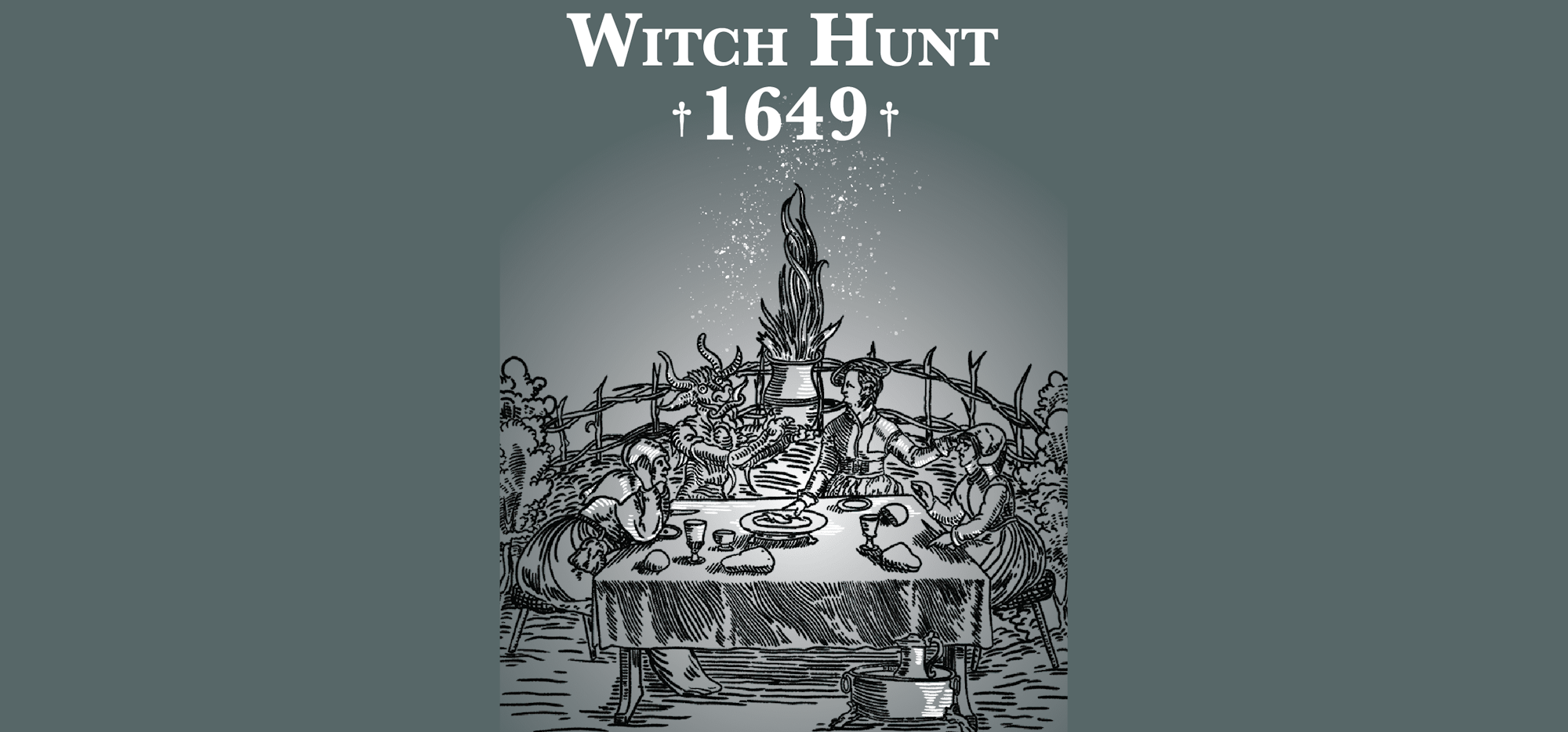
Playing Martha McGill’s Witch Hunt 1649, it was impossible to not mull over those thoughts all over again. It was impossible not to think back on the time I met a witch.
Living my worst life.
Statistically, you’ve already assumed that I’m talking about a woman.
Witch Hunt 1649 isn’t about the witch hunts that dominated my schooling. Those were New World witches, the result of mistrustful Puritans living on the edge of a world that seemed immune to their understanding. McGill’s telling predates Salem by half a century and takes place far across the sea. In the same year that Charles I lost his head and Oliver Cromwell prepared the New Model Army to march northward, villages in Scotland reacted to their uncertainty the same way that countless communities had done before: by blaming the women they didn’t like very much.
There were men witches, too. Not many. Just enough to ensure that nobody was above suspicion. Of the 3,800 Scots accused of witchcraft, eighty-nine percent were women.
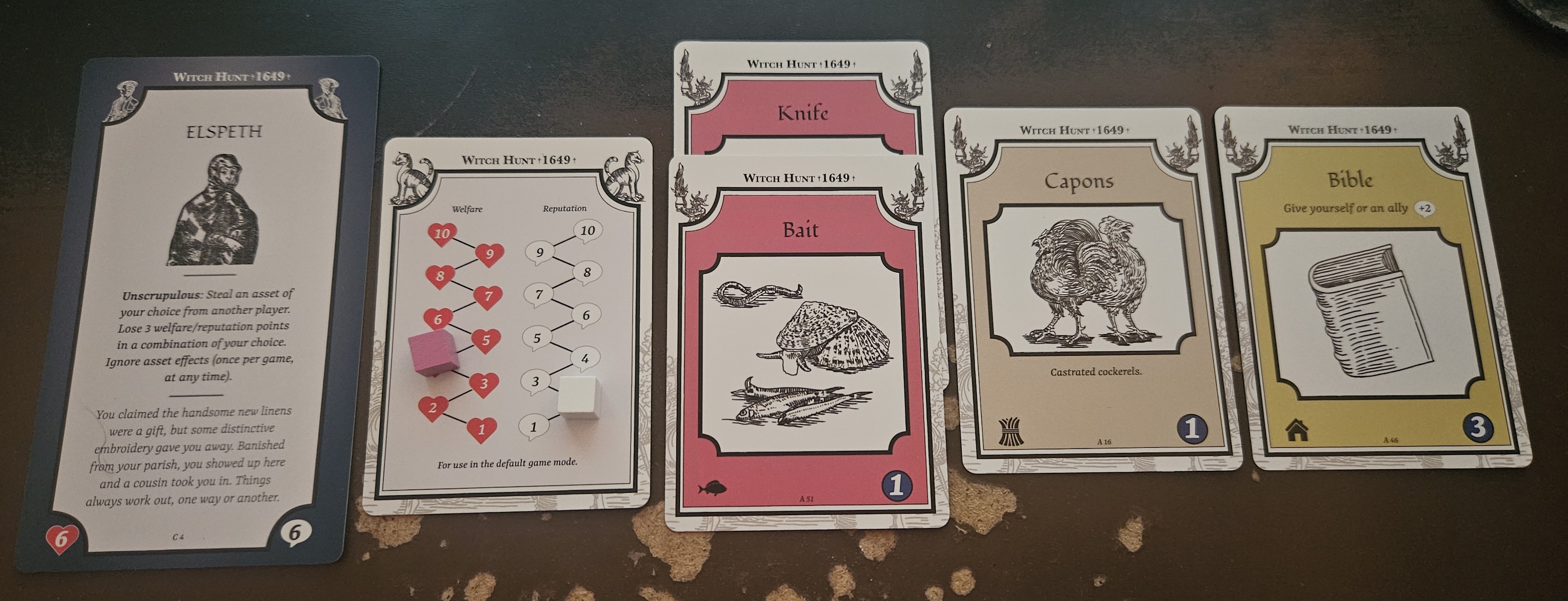
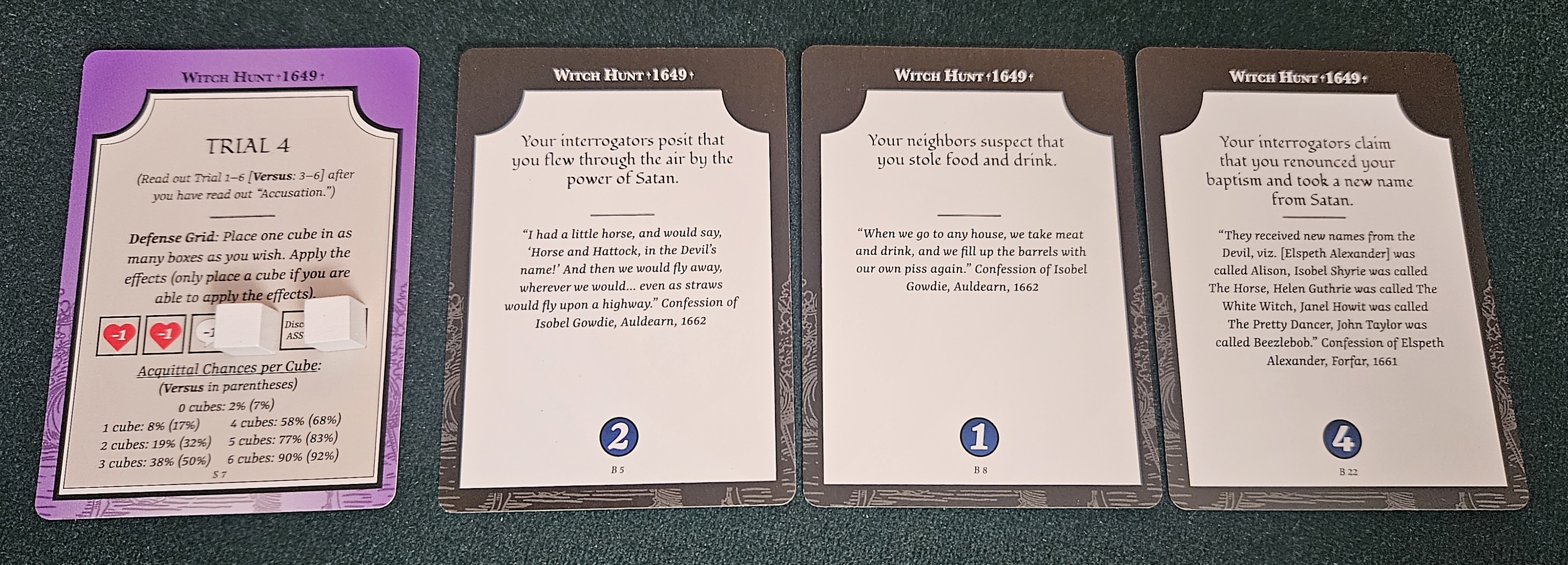
In the game, the figure is similarly skewed. At the start, everybody receives a character to embody. These cards offer only a few tidbits. A name. A woodcut illustration. A once-per-game special ability. And a small blurb that explains why these people are subject to suspicion. There’s Elspeth, who once nicked some nice linens. Agnes, who knows which herbs might ease a fever. Bessie, whose primary sin is that she’s a bit lazy. Janet, isolated after cutting the sheep-stealing cousins out of her family. William, who loves a ribald joke. Helen, over-eager to share her conversion experience with her neighbors.
Ordinary people, in other words. To most of us, it would be their neighbors who seemed too buttoned-up. Too prying. Too obsessive about the minutiae of everyone’s lives. Too willing to fling an accusation that might get one of their neighbors strangled with a cord and their stake-bound body charred to ashes.
Of the fifteen character cards, eleven are women. Seventy-three percent. If anything, Witch Hunt 1649 short-sells the divide.
Fate cards present ethical conundrums between suffering and suffering a different way.
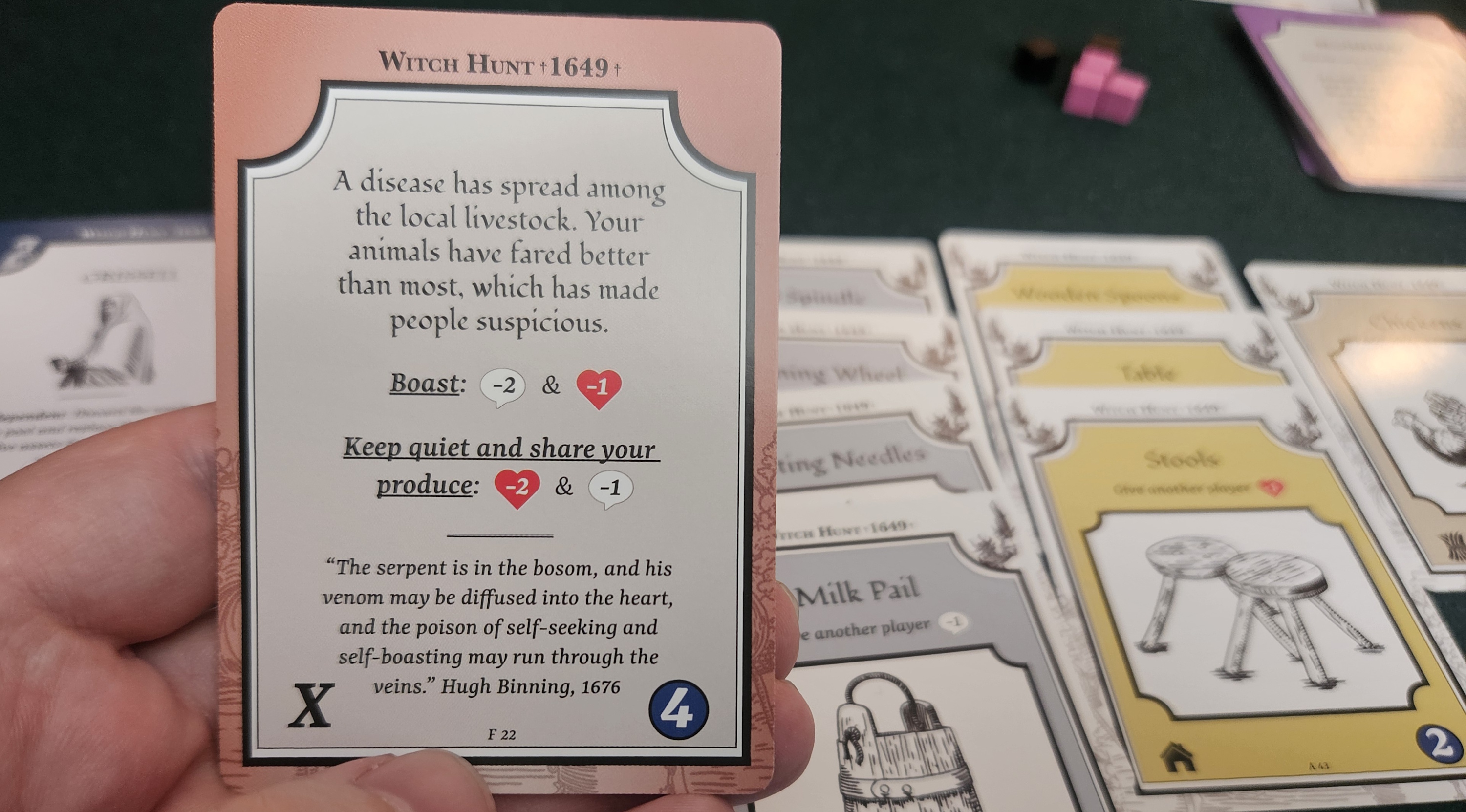
As a game, Witch Hunt 1649 is a simple thing. That’s to be expected. Published by Central Michigan University Press, this is closer to an educational tool than a hobbyist product. Like Greg Loring-Albright’s Keep the Faith from the same imprint, there’s an element of role-play, with most turns consisting of a single card-flip. This card presents some stroke of ill fortune that has befallen your character. Chronic headaches. Extra tithes. A cousin’s hasty marriage. The rumor that you’re a closet Catholic. You’re allowed to choose how to respond to these misfortunes, but there’s no such thing as coming away richer. Every choice is a Sophie’s choice. Waning physical welfare, waning standing in the community, or waning material goods. After a while, you begin to wonder why anybody bothers trying to be good.
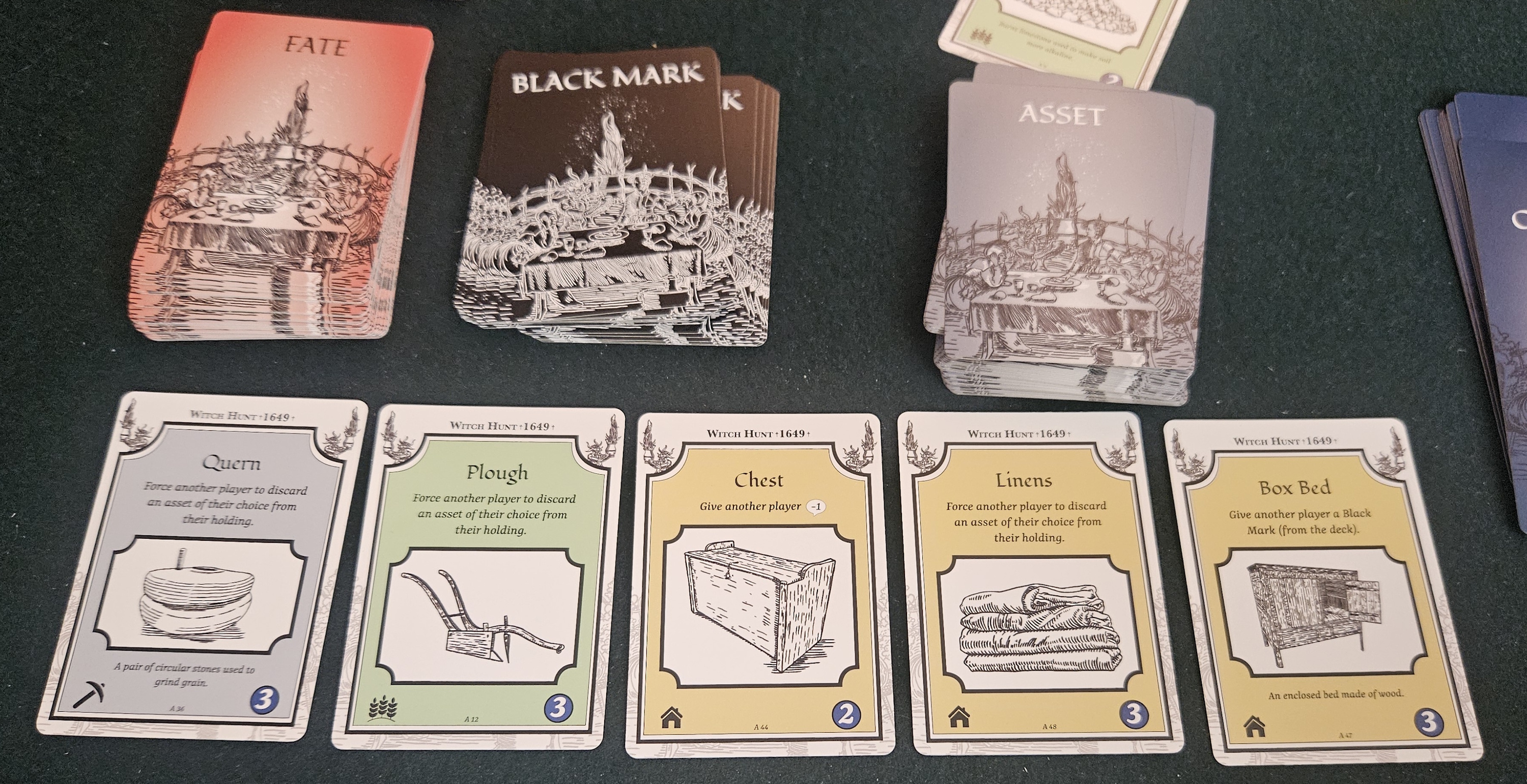
The one respite is that you’re still here, still alive, still capable of improving your situation. You take the card fate has dealt you and acquire something from the market. Like everything else in Witch Hunt 1649, these are meager possessions. Your goal, apart from survival, is to accrue enough to place yourself in high society. Higher society. One sickle and pair of shears at a time, one cow-shed and kiln, you construct a life.
As often as not, those possessions become anchors. That Bible improves your standing in town, but you might have to part with it to support the local poor. The local poorer. That basket helps you carry more fish from the stream, but it hurts all the worse to lose it. Other items, like creepy rams, are liable to trick some farmer into thinking they’re striking a pact with the devil. When the trial begins, everything becomes potential evidence.
The witch-trial is the centerpiece of the game. As soon as you have three black marks, you’re dragged before a council of fifteen propertied men and put to the test. Black marks, it must be noted, have nothing to do with your choices; either you gain them or you don’t, entirely irrespective of your decisions. They’re also drawn face-down. When the trial begins, you have no idea of the substance of the accusations against you. At times, they’re as harmless as a rumor. Other times, they’re as damning as a rumor.
To secure an acquittal, you spend your meager health, your meager reputation, your meager possessions. You try to persuade your friends and family to stand by you. You’re well aware that these are hard requests. If you’re found guilty, your relations will also stand trial. It isn’t until the accusations are revealed, flipped one by one, that your fate becomes clear. Even then, survival is only momentary. There’s nothing preventing you from being dragged before the council at a later date, no matter how much of your property you’ve parted with, no matter how many teeth you’ve lost to the stress.
Accrue three black marks and it’s time for a trial.
For the first few years after I came home, it wasn’t uncommon for someone to ask if I’d seen any demonic possessions out there. Possessions or skinwalkers or witches, anything like that. I’d served a portion of my two years as a Mormon missionary among the Crow Nation, and people were always quick to note how “Those folks are more spiritual than we are.”
In this case, “more spiritual” meant more susceptible to the beings that dwelled on the other side of the crack in the world. Spirits, demons, angels. Beings we never saw as white folk. Beings that only seemed to gather around those with brown skin, on land they’d been planted on by the government, or else in faraway places where people still practiced cannibalism and wife-burning and whatever else.
Whenever anybody asked the question, I thought about the witch.
I first heard about the witch from a guy in Hardin, the half-white, half-native port town on the edge of the reservation. We were set to baptize a man. Crow. Maybe already a member of the church, but records were spotty. On the scheduled day, he didn’t show up. “He was probably called away by that witch,” the guy said. I laughed, but he insisted that, no, he was being serious. “He’s taken up with a witch,” he said. “Those folks are more spiritual than we are. We can’t hear their call because we aren’t as spiritual,” he said. “We,” he said, meaning white folk. I asked if we should go find him. Find him and help him. If he was under thrall to a witch, surely that meant he needed us more than ever. Needed Jesus. Needed baptism. Needed something. “No, there’s nothing for it,” he said.
A mile or so outside Hardin.
I returned to the Crow Nation many months later, after many people had asked me about the spiritual folk out there, about whether I’d seen any possessions or skinwalkers or witches. It took some phone calls, but we found the witch’s address. We hopped in the truck and took off, the missionaries who now lived on the rez seated in front, talking excitedly about how they’d exorcise the witch’s demon or dust off their feet against her house.
When I met the witch, I was surprised. Not because she was a woman. (Eighty-nine percent of witches are women.) It was how ordinary she seemed. Her trailer looked like the other trailers that dotted the rez. Her dogs barked like the other dogs that barked on the rez. Her wind-chimes chimed like every other set that chimed on the rez. I asked if she’d seen our man. The one who’d skipped out on his baptism.
“Sure,” she said. “He comes around when he’s trying to get off the meth. He stays a few days, sweats it off, then he goes home again.”
Oh. Well. It wasn’t true, then, what I’d heard. Someone had told me she was a witch. Ha ha, what a mix-up.
“Sure,” she said, laughing brightly and rubbing at the sunspots on her forearm. “I’m a witch. I’m a witch at helping people get off the meth.” Then she told me about her degree in nursing, how the learning had come naturally. How she’d worked for years in addiction recovery. How she was, indeed, an actual witch, with a power for curing people of their killing habits.
On the drive back, as we talked about our encounter with the witch, two of the other missionaries bubbled first with excitement, then with righteous upset. We hadn’t done anything. No denunciations had been leveled. No demons had been cast out of their hosts. One told a story about how a devil had once held together a person’s broken leg, then the prophet had cast the devil out. This caused the leg to break again, because evil magic sometimes imitates good things. “We should go back,” he said. “No way,” his companion shot back. “What if she uses Satan’s priesthood on us? You know they’re more spiritual than us.”
I didn’t say much. Between this and my previous visit to the reservation, I was starting to harbor some serious doubts about the shape of the world. There was a crack in it, all right. A crack that ran right through it. But the crack wasn’t what I’d been told. It wasn’t us on the one side and evil spirits on the other. It seemed to me there were good people all over, lots of them, some with addictions or problems or sicknesses, and some who wanted to help. And then there was us. The people in the white shirts and ties. Telling stories about everyone else. Trying to square them so they looked the way we wanted. And then, when they wouldn’t be squared, pretending they must have widened the crack to the other side and beckoned something ugly into themselves.
I do want a nice box bed.
I no longer believe in witches any more than I believe in teenage boys being sent by Jesus to proclaim the restoration of an everlasting gospel that keeps changing on itself. But I do believe there are demons out there. There’s nothing supernatural about these demons. They look like us and dress like us. They eat our favorite foods and watch our favorite reality shows on television. They do pretty much whatever they want to do, and then they come up with compelling reasons why they were in the right to do it. Those are normal enough behaviors, but the way to tell a regular person from demon, I suspect, is that a regular person might come up with a reason why they were a good fit for nursing school. A demon, on the other hand, explains why they’re the chosen one who’s been endowed to save the world from itself. Whether anybody wants it or not. Whether they have to bind a person to a stake and flick a torch into the straw.
Witch Hunt 1649 pulls a lot of weight for such a small game. It shows how insular communities can curl in on themselves until they sour and curdle. It examines how people on the margins, women especially, become scapegoats for no greater sin than being marginal. It preserves the memory of the crimes against those people rather than letting us forget the cruelties we can unleash on our neighbors.
But for me, mostly, it gets me hoping that the only witch I’ve ever met has helped a bunch of people with their methamphetamine addictions.
A complimentary copy of Witch Hunt 1649 was provided by the publisher.
(If what I’m doing at Space-Biff! is valuable to you in some way, please consider dropping by my Patreon campaign or Ko-fi. Right now, supporters can read my first-quarter update of 2026: the best board games, movies, books, and more!)
So many games, but so little time! That is the way that I feel each and every month when I get to putting this Wargame Watch feature together. I am just always salivating at the possibilities and know that I can only play a few games out of the many that are offered. But, which ones are best? Well, that is not for me to decide for you. I just connect you with the information and you get to choose. This month for the Wargame Watch, I was able to find 28 games (including the 2 games from our sponsor Draco Ideas). I was also able to find 4 games being offered on Crowdfunding through Gamefound and Kickstarter.
They make really good quality and very playable games and really have a lot to offer to wargamers.
They also this month have a new Gamefound campaign kicking off that is sure to be a main stay on my table particularly at conventions where I need a few friends to play large multi-player games. This campaign is actually a 2 for 1 as its headliner game is called Dark Kingdoms but it also offers another game in the same series in a 2nd Edition called Reconquista. You can read more information in the Pre-Order section below.
1. Dark Kingdoms / Reconquista 2nd Edition from Draco Ideas Coming to Gamefound June 2nd
I love Ameritrash games, which includes lots of area control/area influence/dudes on a map style games and some of the classic wargames that we grew up on in the Gamemaster Series such as Axis & Allies. I just love the easy flow of these games and also love the direct player interaction with attacks, negotiation, alliances and some backstabbing as well. Plus these games typically have lots of shiny bits, great looking custom dice and are always well produced so I feel as if I have got value for my dollar. Recently, I heard about a new game coming from Draco Ideas called Dark Kingdoms, which takes a look at the chaos following the Roman withdrawal from Britannia in the early 5th century and the power vacuum being filled by various tribes. And it looks really good!
From the game page, we read the following:
After the Roman withdrawal in the early 5th century, Britannia was plunged into chaos. Saxons, Angles, Jutes, and Britons fought over land, resources, and glory. In this relentless struggle, only one people would emerge victorious and raise their banner over the island.
Dark Kingdoms is a strategy and conquest game for 2 to 4 players, set in 5th-century Britannia, at the height of the clash between the Celtic peoples and the Germanic invasions.
Each player leads a faction with its own king or leader:
The Saxons of Cerdic, in the south.
The Angles of Eomer, in the east.
Hengist’s Jutes in the north.
Vortigern’s Britons, the legitimate rulers in decline.
Build settlements, fortifications, and fleets, recruit troops, and expand your domain. Manage your resources wisely (wood, iron, stone, wheat, and gold) and face your rivals in battles, raids, and sieges.
In Dark Kingdoms, it’s not enough to resist: you must prove your power by accumulating Victory Points through conquest, fame, and construction.
But the campaign also features a new edition of another classic Ameritrash style wargame called Reconquista 2nd Edition from the same designer Marco Antonio del Campo. This game is equally as beautiful as Dark Kingdoms but covers the wars between Muslims and Christians in 11th-century Spain where each player assumes the role of one of the four kingdoms in competition to control the Iberian Peninsula: Castilla y León, Aragón, Sevilla or Zaragoza.
I am reaching out to the designer to get an interview going for the blog and hope to have that up in the next few weeks. These 2 games just look great and are sure to fill that lower complexity, dudes on a map style 90-120 minute gaming experience. I am going to back both of these games and look forward to carrying them to conventions to get them played.
The Gamefound campaign is set to launch on Tuesday, June 2nd.
2. Crown & Courage from Tompet Games Coming to Kickstarter June 2nd
We have played 2 of Tompet Games previously released games with the only one we haven’t playing being their first games called Kill the King from 2016. First was Donning the Purple, which is an asymmetrical king of the hill game with a bit of worker placement that deals with the players managing the glory of wealthy and powerful Roman families, and their second game called Halls of Hegra, which is a solitaire-only wargame in the same vein as Euro-based games such as Robinson Crusoe, This War of Mine and Dead of Winter. The mechanics include worker placement, bag building, and area control/tower defense and the goal of the game is to survive wave after wave of German troops as they assault the secluded mountain fortress at Hegra.
Both of these games are excellent and they are now embarking on their fourth game called Crown & Courage that tells the story of the German invasion of Norway in 1940 and the royal family’s defiance and ultimate escape from the country to avoid capture and funding of the German war machine.
From the game page, we read the following:
The Germans have invaded Norway. The royal family must escape across the rugged countryside, evading capture at every turn. Will the king defy German demands for surrender, or will he find a way to escape, inspiring hope for Norway’s freedom?
Crown & Courage is a solitaire-only game, bringing clever, low-randomness Eurogame-inspired mechanisms together with a fresh, new perspective provided by the best wargamer traditions of illustrating history’s unique challenges through evocative gameplay.
Step into a desperate race against time as Norway collapses under the pressure of the German invasion. Your goal is simple but brutal: guide the King to safety while evacuating as much of the nation’s gold as possible.
Balance bold actions like evacuation, sabotage, and mobilization against the relentless advance of German forces. But every decision comes at a cost: stress rises, morale falters, and the enemy grows stronger. The game constantly forces you into difficult trade offs where survival often means accepting the lesser of two disasters.
German counterattacks and demands push you closer to collapse. Resources and manpower are scarce. Every turn feels like a narrow escape, and only through clever planning, sacrifice, and a bit of courage can you carve a path to freedom.
The game engine is an Order Grid which is a 3 square by 3 square box where the player will choose and place orders that come up randomly to take actions to defend against the invading German troops, move the king away from the advancing Germans, improve their orders by upgrading them and also ambushing the invaders. Such as clever and amazing way to deal with the way the player plays the game. The experience is a very tough one with lots of odds stacked against the player but their is hope as good planning, proper placement of orders on the grid and manipulation of the outcome with sabotage of German infrastructure and forces can allow the king to slip away and stay one step ahead of his pursuers.
We played a prototype copy of the game cooperatively, even though it is designed as a solitaire wargame, and were very impressed with the maturation of the game mechanics and flow of the game. Here is a link to our preview video from that experience:
The Kickstarter campaign is set to launch on Tuesday, June 2nd.
3. Advanced Company Scale System Game One:Anzio: A Lost Opportunity from Bring It On Games
We have played several games designed by Adam Starkweather in his Company Scale System (CSS). These games are really good solid chit draw systems that really puts some unknown in what groups of units can activate and even when they will activate. There are also events and if the chit cup runs dry before all of the units can activate due to the end round chit then you are just sore out of luck. You have to prepare for this inevitability and I love the concept of prioritizing your activations and making sure you activate what you absolutely have to before doing those units that would be beneficial to activate. Now Adam has created his own publishing company called Bring It On Games and they have announced their first pre-order game in a new system called Advanced Company Scale System Game One:Anzio: A Lost Opportunity. This is a huge wargame and includes 10 large maps, 20 counter sheets and tons and tons of charts, tables and player aids. This is a MONSTER wargame…no doubt about it but it looks really good.
From the game page, we read the following:
The Battle of Anzio, commencing in January 1944, was akin to forcefully opening a doorway onto Italy’s western coast. Operation Shingle, as it was designated, sought to outflank the German Gustav Line and swiftly dismantle Axis defenses. The Allies landed on seemingly tranquil beaches, almost eerily unopposed, as if the land itself was holding its breath. Despite this opportunity for a bold thrust inland, the Allies succumbed to caution, forfeiting the chance to capitalize on the situation. The beachhead, broad and flat, became both a refuge and a trap. Open fields offered no shelter from the impending storm unleashed by the Germans.
Welcome to ACSS: Anzio. A Lost Opportunity, the inaugural game in the Advanced Company Scale System (or ACSS)
The game has a ton of content and also has a ton of different scenarios including the following:
Scenarios included with the final project: Introductory Scenarios (all played on one 8 1/2” by 11” map): Operation Mr. Black Operation Mr. Green The Rock The Battle for the Factory
Beginner Scenarios (all played on one 17” by 22” map): Could, Woulda, Shoulda The British are Coming, the British are Coming The US Calvary has Arrived
Intermediate Scenarios (all played on one 22” by 34” map) Keep Moving! Gotta Get Through Faster! Here They Come! Darby’s Gamble
Advanced Scenarios (all played on one 22” by 34” map) The Battle for the Thumb The Ace of Spades Take Campoleone!
Expert Scenarios (all played on two 22” by 34” maps) They are Everywhere! Operation Fischfang Operation Seitensprung Kesselring’s Final Roll of the Dice A Killer Whale
Campaign Games (played on all the maps) Operation Buffalo Operation Shingle The Campaign for Anzio
I did notice that you can download the rules and the scenario booklet from an online OneDrive and you can also get a Vassal mod to try the game out. Here is the link to the OneDrive: OneDrive Link to Rules and Scenario Booklet
If you are interested in Advanced Company Scale System Game One:Anzio: A Lost Opportunity, you can pre-order a copy for $300.00 from the Bring It On Games website at the following link: https://bringitongames.com/shop/p/anzio-a-lost-opportunity
4. Solo Command: Market Garden from Multi-Man Publishing
Ooooh! A solitaire Operation Market Garden game….yes please…and twice on Sundays! This month, Multi-Man Publishing has several new offerings up on pre-order but none as interesting to me as Solo Command: Market Garden designed by Tetsuya Nakamura. This one originally appeared on the Japanese wargame magazine called Game Journal Magazine as Monty’s Melancholy. There is not a lot of information on the game page but more is coming and I am going to attempt to work with the designer on an interview.
From the game page, we read the following:
A new solitaire game covering OPERATION MARKET GARDEN!
Solo Command: Market Garden allows you to take command of XXX Corps and the Allied paratroopers as you try to drive your armor over the bridges and into Arnhem. Will you get there in time, or will the German reinforcements overwhelm the airborne units in the ever increasingly desperate situation?
An innovate card mechanism, which uses the decision column of the previously played card, determines which units can activate with each play of the cards, and controls the actions of the German units as they move relentlessly to try and close down the highway and prevent XXX Corps from reaching its goal.
Originally published in Japan in Game Journal Magazine as Monty’s Melancholy this solitaire game gives you the opportunity to try and capture Arnhem and control all the bridges, in a quick playing game with low complexity rules.
Aside from the box back, they did have this picture of the board on the website as well as some of the counters (not shown).
5. Advanced Squad Leader (ASL) Action Pack #22: A World At War from Multi-Man Publishing
For those of you out there that are hopelessly addicted to Advanced Squad Leader and building your ever growing collections for one of the most highly thought of tactical WWII combat systems out there, here is a new module or Action Pack that offers a ton of newly designed scenarios by Jim “The Bishop Sez” Bishop and Gary “Fort” Fortenberry for release at a tournament. These scenarios appears to be varied and cover many different theaters of World War II to offer players new and interesting experiences within the established system. The Action Pack also comes with 3 new geomorphic and back compatible maps along with 12 totally new scenarios. I also thought it was interesting that they stated that this product was “designed for the [ASL] aficionado” so if you are one you will probably know exactly what this product is.
From the game page, we read the following:
A World at War, the 22nd Action Pack for Advanced Squad Leader, contains an eclectic mix of small unit actions from 1941 to 1945, ranging across many different theaters of World War II. Scenarios span the globe from the forested highlands of Ethiopia to the jungles of Papua, New Guinea, from the steppes of the Soviet Union to the snowy forests of the Ardennes. These 12 scenarios were designed by Jim “The Bishop Sez” Bishop and Gary “Fort” Fortenberry for release at a tournament and are intended to offer movement options and tough choices for both sides. Play times are designed for a typical tournament round, with the largest best used for the last round of the day. Three double-sided 11″ × 16″ maps, each designed by Fort and painted by Charlie Kibler, round out the package. These boards are completely geomorphic and fully compatible with previous ASL mapboards, allowing new and unique terrain configurations.
• AP237 Andiamo – 6½ turns, 4 March 1941, Chakara River, near Dembecha, Ethiopia (Ethiopian vs Italian)
• AP238 Italian Crescendo – 6 turns, 28 September 1941, Petrykivka, Ukraine (Russian vs Italian)
• AP239 Buna Mission – 6½ turns, 31 December 1942, Buna Mission, Papua New Guinea (Allies vs Japanese)
• AP240 The Army It Had – 6½ turns, 1 March 1943, Sevsk, Russia (Russian vs Hungarian/RONA)
• AP241 Moreh Melee – 6½ turns, 22 March 1944, Moreh, India (Commonwealth vs Japanese)
• AP242 Seton Block – 5½ turns, 2 June 1944, Kamaing, Mogaung Valley, Burma (Chinese vs Japanese)
• AP243 Hell’s Comin’ – 6½ turns, 10 July 1944, Hauts-Vents (American vs German)
• AP244 Heavy Metal Noise – 5½ turns, 13 August 1944, Oględów, Poland (Russian vs German)
• AP245 Villains at Ville-sur-Illon – 6½ turns, 13 September 1944, Ville-sur-Illon, France (Free French vs German)
• AP246 Stumbling In Place – 6½ turns, 19 November 1944, Apweiler, Germany (American vs German)
• AP247 General’s Orders – 5½ turns, 22 December 1944, Stoumont, Belgium (American vs German)
• AP248 Black Devils of Bure – 5½ turns, 6 January 1945, Bure, Belgium (Canadian vs German)
Designed for the aficionado, Action Pack #22: A World at War is not a complete product and assumes the buyer owns the core Advanced Squad Leader game system.
If you are interested in Advanced Squad Leader (ASL) Action Pack #22: A World At War, you can pre-order a copy for $36.75 from the Multi-Man Publishing website at the following link: https://mmpgamers.com/asl-action-pack-22-a-world-at-war-p-460
As you know, the Bible of ASL has had several overhauls over the years including small changes, errata fixes and better organization and they even put the voluminous rules into a binder to make for their carrying around easier (although this 2nd Edition offering doesn’t contain the binder, charts nor the handy dividers). They are now getting a 2nd Edition of these rules with the announcement of the Advanced Squad Leader (ASL) Rulebook 2nd Edition that was put up on pre-order in early May.
From the game page, we read the following:
Back in print, now also including Chapters F, G, and W, with all rules updated through January 2026.
410 hole-punched, 8.5” x 11” pages, intended to be supplemented with additional and replacement pages as future changes may require.
Chapter Dividers with charts and a three-ring binder are both available separately or in a combined package with the rules.
World War II Tactical Level Combat ASL. The premier game system of tactical-level World War II combat uniquely combines soundness of design with attention to detail and ease of play. Built on the popular Squad Leader system, ASL has long been the ultimate in tactical wargaming. Now, ASL has just gotten better with the introduction of the ASL RULES 2nd Edition. Not only are the Rules back in full color, but the 2nd Edition also benefits from all the fine-tuning accumulated over the past 15 years. The 2nd Edition also contains material not previously included in the basic Rules, such as: more examples of play throughout, the advanced rules of Chapter E (night, weather, boats, planes, skis, convoys, etc.), the beginner’s Training Manual in Chapter K, an expanded Index, and widely-acclaimed playing aids such as the Offboard Artillery Player’s Aid and the Overrun Flowchart.
Each chapter is in a larger font for ease of reading. And all without changing how this great game is played. The fruits of 15 years of “playtesting” can be seen here in the ASL RULES 2nd Edition which incorporates all previous errata and questions & answers. Great care has been taken to clear up ambiguities in the rules while keeping the game the same.
Although the ASL RULES 2nd Edition is not a complete game by itself, when combined with its add-on modules it allows the armchair warrior to simulate practically any small-unit action from 1935-1945, opening the gateway to hundreds of unique battles spanning the globe. Combined with the Beyond Valor game module, for instance, the Rules allow you to simulate battles between Finns, Germans, Russians, and partisans from 1939 to the capture of Berlin. Furthermore, ASL’s “Design Your Own” system helps you create “what-if” battles with forces and terrain of your own choosing. The Chapter H notes on vehicles and ordnance (German and Russian notes are included) are one of the best single sources of information on the armor, vehicles, and guns actually used in battle in World War II. Other game modules separately available bring you the complete orders of battle for U.S. Army and Marines, British, Italian, Japanese, Chinese, and French forces, as well as the Minor nations that fought with the Allies or the Axis. Hand-painted mounted geomorphic mapboards are available, providing innumerable terrain configurations. Historical modules use the Rules to simulate battles and special Campaign Games on map sheets depicting the actual terrain fought over.
If you are interested in the Advanced Squad Leader (ASL) Rulebook 2nd Edition, you can pre-order a copy $38.00 from the Multi-Man Publishing website at the following link: https://mmpgamers.com/asl-rules-2nd-edition-2026-p-462
7. Advanced Squad Leader (ASL) Chapter Dividers from Multi-Man Publishing
For those who are interested in the whole enchilada with their rulebook, this is how you can add to or even complete it with the purchase of the ASL Chapter Dividers. Remember, if you are purchasing the new Advanced Squad Leader (ASL) Rulebook 2nd Edition you will need to also purchase these Chapter Dividers as they will not be included with that product but are a separate purchase. As I looked at this offering, I would think that you would really want these nicer, thick printed accessories to help organize your ruleset and to aid in game play with the included charts.
From the game page, we read the following:
ASL Chapter Dividers 2026 includes all the chapter dividers and charts for the ASL Rules (updated with all the latest changes through January 2026 and including Chapter W) in an 8.5” x 11” spiral bound booklet.
Along with the ASL rules themselves, these charts are required to play ASL and are available separately or in a combined (discounted) bundle with the 8.5”x11” hole-punched rules and a three-ring binder.
Dividers & charts are included for Chapters A, B, C, D, E, F, G, H (German/Russian), & W (Korea), plus a Quick Reference Data Chart (QRDC), OBA Player Aid, and Overrun Flowchart, as well as the counter examples from the inside of the three-ring binder.
Printed on quality cardstock and carefully spiral bound, the ASL Chapter Dividers 2026 booklet is a comprehensive and handy table-side supplement to the core rules that no devoted ASL player should be without.
If you are interested in the Advanced Squad Leader (ASL) Chapter Dividers, you can pre-order a copy $15.00 from the Multi-Man Publishing website at the following link: https://mmpgamers.com/asl-chapter-dividers-2026-p-464
8. Advanced Squad Leader (ASL) Binder from Multi-Man Publishing
And for the true completionist out there you can also get the Advanced Squad Leader (ASL) Binder on this pre-order.
From the game page, we read the following:
Back in print to accompany the updated, hole-punched, 8.5” x 11” ASL Rules 2026, this rugged three-ring binder includes counter examples on its inside covers.
Available separately or in combination with the Rules and Chapter Dividers.
Need someplace to store all of Chapter H? The rules chapters for Historical modules? Just want a spare? The ASL Rules Binder is for you.
If you are interested in the Advanced Squad Leader (ASL) Binder, you can pre-order a copy $15.00 from the Multi-Man Publishing website at the following link: https://mmpgamers.com/asl-rulebook-binder-2026-p-463
9. Vae Victis Magazine – Last Glories 1813 (Dernières Gloires) from Cérigo Editions
One of the better wargame magazines out there is Vae Victis Magazine from French publisher Cérigo Editions. This month, there are offering a new magazine that includes a game called Last Glories 1813 (Dernières Gloires) designed by Frédéric Bey. I have perused the site and it looks really great! There is an English rules edition so make sure that you choose this option or you may have to learn French quickly to play once you get your copy.
From the game page, we read the following:
Last Glories brings together three battles from the 1813 German campaign, the 48th, 49th, and 50th in the Days of Glory Series. In terms of card size and number of counters, it is the largest volume in the entire series. Note: this game is a special edition and is not included in the subscription packages.
As you know, I am quite fond of Combat Commander. I have played all of the base games including Combat Commander: Europe, Combat Commander: Pacific and Combat Commander: Mediterranean as well as scenarios from several of the Battle Packs and absolutely love the narrative that the game creates. I love the cards and how they are used for combat, there are no dice in CC, activations and events. The system is just full of chaos and fun. But, I have often wanted to play the game alone with a fully dedicated solitaire system and now I am going to get that opportunity as GMT Games has announced their Solitaire System for the game called Combat Commander: Adversary. The solitaire system is designed by Francis K. Lalumière and I cannot wait to get this one to the table in the future.
From the game page, we read the following:
Combat Commander: Adversary is a solo system that allows a human player to fight their way through any of the 24 scenarios provided with the 20th Anniversary Edition of Combat Commander against a completely automated opponent – the adversary. (The adversary works just as well with all previous editions of Combat Commander: Europe and Combat Commander: Mediterranean.)
Through a combination of control logic and guided randomness, the adversary sets up its own forces (on any map you throw at it), activates units, determines targets, advances into melees, rushes towards objectives, and certainly won’t hesitate to interrupt your turn with opportunity fire or the play of an inconvenient wire.
The system was designed with a care towards maintaining the ebb and flow – the feel – of a typical CC engagement: simple action resolutions and quick turnarounds, with surprises galore. The adversary acts logically, implementing tactics that produce results without turning into a predictable automaton. Underestimate that guy at your own peril.
The beating heart of Combat Commander has always been the Fate Deck, and this addition to the game proves no different. The adversary sits at the table (on the table, if we’re getting technical) with one of six nation-specific Fate Decks of 72 tarot-sized cards, making it possible for you to face not only an American or British adversary, but also a French adversaire, a German Widersacher, a Russian противник, or an Italian avversario.
Not only does the adversary adopt a different play style according to its nationality and the Fate Deck on which it runs, it also prioritizes different battlefield elements depending on its posture and the game state. So while you can expect the adversary to display a penchant for forming fire groups while on the attack (and, conversely, prefer to fire individual units in the role of the defender), you can’t take anything for granted.
Flip the top card of the adversary deck: If the Order is applicable – according to a specific set of conditions – place it in the green row of the adversary playmat and resolve that Order (see below). If, on the other hand, the Order is not applicable, then place it in the red row of the playmat and do nothing. Keep revealing cards and resolving Orders until a) the green row holds a number of cards equal to the adversary’s Order limit, or b) you’ve placed on both rows of the playmat a total number of cards equal to the adversary’s hand size – at which point the adversary’s turn is over. Wipe the playmat clean of any cards and other military detritus, and let the human player take a shot. (I mean, you could conceivably watch two adversaries go at each other for a while, but product enjoyment is not currently being tested within those parameters.)
The adversary will never discard per se, but it sometimes spends an entire turn unable to play any Order, hence doing nothing – which, for all intents and purposes, achieves the same effect. And yes, that’s when you whip out a Hidden Unit or Demolitions, and catch the adversary with its mechanical pants down.
Once an Order is in play, unit activation (if required, of course) always follows the same path: Reveal an additional adversary card and look at the stack of gray boxes under the ‘Ordered Unit(s)’ header. The criteria found in the box that corresponds to the Order under consideration (Advance, Fire or Move) are then fed into a simple flowchart that sets one or more units in action, often forming groups under a Leader’s command.
Now take a look at the colored box matching the adversary’s posture – red for Attack, yellow for Recon, blue for Defend – on the played Order card: those criteria are in turn fed into their own flowchart in order to yield a destination or a target. As with most solo systems, flowcharts quickly become second nature over repeated plays and familiarity with the game itself.
Other Orders are handled in a similar manner, with the simpler ones, such as Recover and Rout, requiring no more than an ordered sequence of resolution.
When it comes to Actions, the system affords the adversary several ‘reaction windows.’ Those are specific moments (including when a player unit is moving…) at which the fighting is paused and the top adversary card revealed. If the Action listed on that card applies to the situation, it is implemented and the next adversary card is revealed, and so on, until an Action is revealed that is not applicable – at which time the reaction window closes and regular play resumes.
Itching for more? The adversary system dovetails into the Combat Commander random scenario generator without a snag, promising endless action against a tireless opponent.
I am very keenly interested in this offering and am going to do some more research and plan to reach out to the system designer Francis K. Lalumière to do one of our interviews to share.
The ’40X Series is not a formal series or category of games from GMT Games. However, typically the term is used to refer to a collection of games sharing certain key characteristics such as operational level WWII campaigns that have key concepts and mechanics such as the Zone of Control Bond or ZOC Bond, Desperate Defense and a few other aspects. Typically, these are designed by Mark Simonitch and some of the games included in this category are France ’40, Holland ’44, Ardennes ’44, Normandy ’44, Salerno ’43 and North Africa ’41 to name just a few. The system is really solid and are highly playable hex and counter wargames. We have played most of them, with the few holdouts being France ’40 and Ukraine ’43 as well as theas of yet unreleased titles including North Africa ’40. This past month, GMT announced the newest entry in the series called Dinant ’40, which is designed by Michael Gustavsson (designer of FAB: Golan ’73) and tells the story of the 1940 German invasion of France during WWII.
From the game page, we read the following:
On May 12th, two days after the start of Fall Gelb (Case Yellow), Guderian’s, Reinhardt’s, and Hoth’s Panzer Corps reach the Meuse River. The most northern of the Panzer Corps (Hoth’s) is composed of the 5th Panzer Division and Rommel’s 7th Panzer Divisions. They have reached the Meuse River near the town of Dinant. The French are caught by surprise by the rapid advance of the German Army through the Ardennes and the river is lightly defended.
The situation is set. Can you as the German player cross the Meuse and start the race across France? Or as the Allied player stop the enemy juggernaut?
Dinant ’40 is a simulation game covering the first 4 days of this critical battle. Rommel’s crossing at Houx and his subsequent dash across France was immensely helpful to Guderian’s breakthrough at Sedan further south and the breaking of the French army
Dinant ’40 uses the same game system as Mark Simonitch’s Ardennes ’44 including the use of Traffic markers and DCB’s for terrain effects. Most units are battalions with a sprinkling of regiments and companies. Each turn represents approximately 6 hours with 4 turns per day (Dawn, AM, PM, and Night). Special rules include: Night Turns, Rommel, Bridging Units, Hilltops, and Tank Ratings.
I am very much looking forward to a new entry to the series and am glad to see other designers carrying the torch of these classic systems like the ‘40X Series. I will be reaching out to Michal Gustavsson for an interview after having interviewed him in 2017 for his Fast Action Battle Series #4: Crusader North Africa 1941.
12. Great Battles of History Volume VII: War Galley Deluxe Edition from GMT Games
The Great Battles of HistorySeries is a very playable (especially if you use the Simple GBoH Rules) Ancients series designed by one of the best duos in the business in the late Richard Berg and Mark Herman and I am glad to see one of these classic entries into the series getting a Deluxe Edition. This past month, GMT announced that War Galley would be getting a new Deluxe Edition and it has already made the cut with over 500 P500 orders to date.
From the game page, we read the following:
We are proud to bring War Galley back into print in a new and expanded deluxe edition featuring 37 scenarios covering the entire Trireme era. This Deluxe Edition will include the scenarios from the Salamis module and the War Galley scenarios originally published in C3I magazine with new versions for some. As a bonus, the deluxe version will also include a new thematic module featuring all the major naval battles from the Peloponnesian War!
The War Galley 3rd edition rules have been enhanced with additional examples and an Extended Example of Play and brought to the new standards in the recent Great Battles of History reprints. We plan on two scenario books: one with the original, War Galley, Salamis, and C3I scenarios and one dedicated to the new Peloponnesian War scenarios with new historical commentary.
The original War Galley maps will be reprinted with updated art with the original Salamis map separated into two half-sized maps for ease of play. The new Peloponnesian War module will add three full size back printed maps featuring Syracuse’s Great Harbor, Pylos Harbor, and other key battle locations.
War Galley Deluxe will have 10 counter sheets with roughly 8 sheets of 1” galley counters and 2 sheets of ½” counters for Squadron Commanders and information markers. The generic Red/Green background colors will be replaced with eight different background colors to simplify setup and enhance visual appeal. The galley counters will be redesigned with new art to improve readability and utility.
Rounding out the package are two 11” x 17” Player Aid Cards (one for each player), one Victory Point/Game Turn Track Display, two six-sided dice and one ten-sided dice
The expanded War Galley Deluxe scenario book includes following 23 Ancient Naval battles:
Alalia, 535 BCE (New) – new version of the C3I scenario of the same name
Lade, 494 BCE (WG)
Artemisium, 480 BCE (Salamis)
Salamis, 480 BCE (Salamis)
Cumae, 474 BCE (New) – new version of the C3I scenario of the same name
Catana, 397 BCE (WG)
Cyprian Salamis (Cyprus), 306 BCE (WG)
Mylae, 260 BCE (C3I #11)
Cyprian Salamis (Cyprus), 306 BCE (WG)
Tyndaris, 257 BCE (C3I #11)
Ecnomus, 256 BCE (WG)
Drepanum, 249 BCE (WG)
Aegates Islands, 242 BCE (WG)
Ebro, 217 BCE (C3I #12)
Cape Pachynus, 212 BCE (C3I #17)
Sapriportis, 210 BCE (C3I #13)
Clupea, 208 BCE (C3I #12)
Chios, 201 BCE (WG)
Side, 190 BCE (WG)
Myonessus, 190 BCE (WG)
Tauris, 47 BCE (WG)
Naulochus, 36 BCE (WG)
Actium, 31 BCE (WG)
Ben Hur, circa 30 CE (C3I #11)
The new Peloponnesian War module booklet includes the following 14 battles:
Sybota Island, 433 BCE
Patras, 429 BCE
Naupactus, 429 BCE
Sybota Island (Corcyra), 428 BCE
Pylos, 426 BCE
Syracuse I, 413 BCE
Syracuse Great Harbor (4 battles), 413 BCE
Cynossema, 411 BCE
Abydos, 411 BCE
Cyzicus, 410 BCE
Lesbos, 409 BCE
Notium, 407 BCE
Arginusae, 406 BCE
Aegospotami, 405 BCE
That is a great deal of remastered content, in addition to some new content and the inclusion of other source content such as the scenarios from C3i Magazine, to keep any Ancients fan busy for a while.
Ok. We didn’t have a great experience with MBT when we played it several years ago. But, since that time, I think that we have increased our wargaming knowledge and experience from 100’s of games and also matured in our understanding and familiarity with key concepts. So, I am willing to give this system another look and go in the future. But, in the meantime, they have announced a new Tri-Pack for the series including the 3 released and out of print expansions MBT: BAoR, MBT: FRG and MBT: 4CMBG. This Tri-Pack does not include the base MBT game though so you either have to own it or find a copy on the open market.
From the game page, we read the following:
Because all three of the MBT expansions are sold out and have been for some time, we are offering this Tri-Pack which includes all of the maps, counters, player aids, and rules for the three expansions. It’s everything you need, given that you own the base MBT game, to enjoy LOTS more MBT content.
Details on the three expansions included in this Tri-Pack are below:
Expansion 1: The British Army of the Rhine. The British Army of the Rhine (BAOR) was formed at the conclusion of World War II from various units of the British 21st Army Group. Positioned on the North German Plain, it is the command element of NATO’s Northern Army Group (NORTHAG). BAOR has command authority over the British 1st Corps, as well as the West German 1st Corps, US III Corps, and the French, Belgium and Dutch contingents to NATO.
This MBT expansion focuses on BAOR’s armored and mechanized forces. Battle it out in 10 new scenarios. Combine the 4 new double-sided geomorphic maps with the MBT base game maps and even the MBT FRG Expansion for more exciting battles.
Includes detailed TO&Es for the British Forces.
Expansion 2: FRG. Poised in defense of the Fatherland from the looming Soviet invasion, the West German Army’s panzer and panzergrenadier divisions are not just ghosts of their World War II namesakes. This time it is Leopard tanks, Marder infantry fighting vehicles and Jaguar tank destroyers filling out their ranks. Its 1st Corps makes up part of NATO’s Northern Army Group (NORTHAG) along with BAOR while its 2nd and 3rd Corps stands alongside the US 7th Army in NATO’s Central Army Group (CENTAG).
This MBT expansion focuses on FRG’s armored and mechanized forces. Battle it out in 10 new scenarios. Combine the 4 new double-sided geomorphic maps with the MBT base game maps and even the MBT BAOR Expansion for more exciting battles.
Includes detailed TO&Es for the West German Forces.
Expansion 3: 4CMBG. The 4th Canadian Mechanized Brigade Group (4CMBG) is the forward element of Canadian Forces Europe. Positioned at Lahr in Southern West Germany, the brigade is poised to support VII (US) Corps and II (FRG) Corps against incursions from Soviet GSFG or CGF forces.
This MBT expansion focuses on Canada’s armored and mechanized forces. Battle it out in new scenarios and combine the 2 new double-sided geomorphic maps with the MBT base game maps and the BAOR and FRG Expansions for exciting battles.
Includes detailed TO&E for the Canadian Brigade.
IMPORTANT NOTE: In order to play this expansion, the MBT basic game is required.
14. Ukraine ’43 3rd Edition Mounted Map from GMT Games
One of my complaints about wargames is that sometimes once you put your counters into a nice tray after punching and clipping them, you can never fit the whole thing back in the box. This is especially true when those games come in just a 2″ box and also have thick mounted map boards. One of the offerings this month from GMT Games may not solve this problem for one of the ’40X Series games but a mice sturdy beautiful mounted mapboard is never a bad thing and there is now an option for one for Ukraine ’43 3rd Edition.
From the game page, we read the following:
Based on player requests, we are offering mounted maps for Mark Simonitch’s Ukraine ’43, 3rd Edition. Enjoy!
This ziplock package will include two 18.25 x 34 mounted maps.
15. Napoleon’s Defiance: The Final Campaigns 1814 from Europa Simulazioni
Big Napoleonic Era wargames are always a bit of fun. They have it all, and we get to ride and march along in the footsteps of one of the greatest battlefield generals in history Napoleon Bonaparte. There is a series of games called Napoleon’s Defiance that is published by Europa Simulazioni and they have announced the final entry to the series called Napoleon’s Defiance: The Final Campaigns 1814 and frankly it looks good but also is a bit surprising how cheap it is.
From the game page, we read the following:
It is the Winter of 1813. Defeated at Leipzig in October, the “Corsican Ogre” is on the run. The war is not yet over, however. Only by bearding the Ogre in his lair, the sacred soil of France, can the Allies achieve final victory. This will not be easy. Even though the Allies have overwhelming numerical superiority, they are a Coalition plagued by political machinations and mistrust. Facing them, a reinvigorated Napoleon is still the most brilliant commander of the age and, although a shadow of its former self, La Grande Armée is unwaveringly courageous and loyal.
The Final Campaigns 1814 allows players to explore one of the most fascinating campaigns in History. Like their historical counterparts, the Allied player must hold the Coalition together and maneuver its huge armies to crush the over-stretched French forces; while the French player must make the best use of meagre resources by defending strategic locations and launching stinging counter-attacks to shake the Coalition whenever the opportunity presents itself. This is a game to be studied as well as played.
The Final Campaigns 1814 is the third volume of a projected series of games at the same scale, covering all the major campaign of the Napoleonic Wars at a strategic level.
This installment benefits from all the feedback received during the years by gamers worldwide. Basic rules can retrofit previous games. Furthermore you can link it with the previous games for an exceptional longest campaigns.
If you are interested in Napoleon’s Defiance: The Final Campaigns 1814, you can pre-order a copy for 35 Euros ($41.94 in US Dollars) from the Europa Simulazioni website at the following link: https://italianwars.net/NewSite/1814_napoleons_defiance.html
16. The Great War Volume IV: Monte Grappa 1917, The Sacred Mountain from Europa Simulazioni
One more great looking pre-order game from Europa Simulazioni this month was The Great War Volume IV: Monte Grappa 1917 – The Sacred Mountain, which covers the retreat of the Italian Fourth Army after the fight at Caporetto.
From the game page, we read the following:
November 1917, three weeks have passed since the German and Austrian breakthrough at Caporetto. The Italian Fourth Army was to the left of the Italian front and had to fight its way back to avoid being cut off by the Austro-German troops advancing on its right. Now, the Italian forces still able to fight are forming a line of resistance on the Piave River. It is just the Fourth Army that must connect the Piave line with the Asiago Plateau, and it must do so on the Monte Grappa massif. Behind it lies the Veneto plain, giving in would lead to catastrophe. After two weeks of fierce fighting in the mountains surrounding Monte Grappa, amidst fog and the first snowfalls, the Italians held firm. The best German and Austrian troops failed to prevail. As the German General von Dellmensingen acknowledged at the end of his report, the Italians can rightfully declare Monte Grappa a sacred mountain to the homeland.
Driven by player feedback, this evolving game system focuses on the dynamic interplay of action and reaction between opposing brigades and regiments. It’s a deep, interactive experience that rewards strategic planning; though it may seem daunting at first glance, the depth is well worth the effort. Mastery of artillery and a keen eye on troop morale—which wavers under the strain of battle and exhaustion—are the keys to victory.
Monte Grappa 1917, The Sacred Mountain has three scenarios:
The first scenario is the battle of November 1917. The initial situation has only Italian units on the map, scattered but able to build a defense in depth in the mountains. Austro-German forces enter from the northern edge of the map and must pursue the Italians, preventing them from organizing. It is a battle of movement, in which both sides must ration and make the best use of their scarce resources.
The second scenario concerns the battle that, from December 11th to 18th, saw the Germans and Austrians in a final attempt to break through after advancing and positioning their artillery. But ammunition was still low, the Italians had significantly strengthened their forces, and winter had already arrived with its heavy snowfalls at high altitude.
The third scenario, an introductory one-turn scenario, depicts the reconquest of Mount Tomba by the French Alpine Hunters, during their active participation in the battle of Mount Grappa.
If you are interested in The Great War Volume IV: Monte Grappa 1917 – The Sacred Mountain, you can pre-order a copy for 55 Euros ($64.09 in US Dollars) from the Europa Simulazioni website at the following link: https://italianwars.net/NewSite/1814_napoleons_defiance.html
17. Imjin War: The Japanese Invasion of Korea 1592-1593 from Serious Historical Games Coming to Kickstarter June 6th
In 2022, I became aware of a new French publisher called Serious Historical Games and one of the games in particular caught my eye in Nagashino 1575 & Shizugatake 1583: Battles of the Sengoku Jidai. We purchased a copy and played it and really enjoyed the system, including the combat, the gorgeous cover and the fantastic counter graphics. That same publisher has published a few other games such as Lace Wars Series: Volume I The Wars of the Sun King 1648-1713 and now has a new game called Imjin War: The Japanese Invasion of Korea that is going to Kickstarter soon.
From the game page, we read the following:
Imjin War relates the story of one of the toughest conflicts in the end of the 16th century, depicting the invasion of the Joseon Kingdom of Korea by the Japanese. The Japanese must capture possibly the whole of the peninsula from their Busan foothold in the South. The Korean player must repel the invasion with the help of China…
The Japanese have very numerous land forces at the start of the game, but their navy, although numerous, is weak and poorly led and their goal is to conquer all of Korea in order to reach – and conquer – China. The Korean player must first hold desperately against the initial invasion and superior enemy troops, waiting for Chinese reinforcements, counting on local rebellion, and most of all his powerful navy to alter the course of events.
Seizing the main areas, winning land and naval battles, gaining allies will prove the decisive factor in winning this war.
The game events and tactical chits allow full replay ability thanks to the numerous various situations that their create on the diplomatic, military.
Scale: One combat unit counter represents 500 (samurais) to 2,000 men (soldiers and civilian servants) or cavalry on its front (full side) and half that on its back (reduced side).
One artillery/fire wagon/siege weapon counter represents about ten guns/rocket launcher/towers and half that on its back.
One naval unit counter represents 10 light ships, 5 medium ships or one heavy or super-heavy ship and half that or reduced on its back.
Turn length: One month in fair weather (March–October); two months in inclement periods (November–February).
There isn’t a lot of additional information out there right now, nor have I found a Kickstarter preview page to point you toward, but I will update this entry once I find that.
The Kickstarter campaign is supposed to start on Saturday, June 6th.
New Release
1. Midway Solitaire from Worthington Publishing
Over the past few years, Worthington Publishing has come out with these very cool, compact and interesting solitaire travel wargames. I have played several of them and very much love their strategic depth, interesting choice laden but random and dice relying games. One that just was published and began shipping was Midway Solitaire that covers the American carrier task forces in June 1942 in the lead up to the climactic Battle of Midway.
From the game page, we read the following:
Relive the pivotal carrier battle that turned the tide of the Pacific War. Command fleets, manage aircraft strikes, and anticipate the enemy’s next move. Every die roll could change history. Midway Solitaire places you in command of the American carrier task forces in June 1942. You’ll face an automated Japanese BOT representing the Imperial Navy. Your objective is to achieve your mission goals before Japanese invasion convoys reach their destinations — Midway, the Aleutian Islands, or Hawaii — and establish forward bases threatening the American homeland.
Your decisions—and your risks—determine whether Midway becomes a historic victory…or a disastrous defeat. This is a compact, fast-playing solo wargame designed for meaningful strategic play in just 15 to 30 minutes.
2. Pacific War 1942 Solitaire 2nd Edition from Worthington Publishing
I have very much enjoyed my plays of Pacific War 1942 Solitaire and War of 1812 Solitaire and truly love these games for what they are. Easy to setup, portable, fast playing and difficult to win solitaire games. And I encourage you to get a copy before they sell out…again. The new 2nd Edition has some minor changes including the addition of order cards for the Japanese rather than the chart and seems to be greatly improved from that points.
From the game page, we read the following:
Pacific War 1942 places you in command of the Allied naval and land forces in the Pacific during World War II. The Japanese AI tries to expand its empire early in the game and overwhelm the Allies. As the Allied player you must hold and then push the Japanese back to Japan. Both sides command armies and navies throughout the entire war in the Pacific. Further, control of the sea areas greatly influences land battles and progress in the Pacific.
The first edition of this great game sold out quickly. This is the second edition. It replaces the Japanese Action Chart with Japanese Action Cards and the rules sheet with a rules booklet. The second edition box is slightly different and the game board uses an Australian flag in Australia.
3. Tarawa 1943 Solitaire from Worthington Publishing
The final game that I am highlighting this month from Worthington Publishing is Tarawa 1943 Solitaire. This game is a travel sized version of the original CDG Tarawa 1943 and I very much love that game. This game though is a bit simpler and quicker to play but still retains the same difficult choices and tough Japanese bot.
From the game page, we read the following:
Tarawa 1943 Solitaire is a travel size version of the board game classic Tarawa 1943. Tarawa 1943 Solitaire will come with counters instead of the wooden blocks and a revised map. The game still comes with the same challenging game play and full size cards!
Tarawa 1943 Solitaire is a card driven game on the invasion of Japanese controlled Tarawa by the 2nd Marine Division. Join the 2nd Marine Division as you storm the beaches of Tarawa. Japanese commander Shibazaki and his men have had a year to prepare for this moment in time.
4. Operation Goodtime, The Battle for the Treasury Islands: October-November, 1943 from High Flying Dice Games
Paul Rohrbaugh and his company High Flying Dice Games is a designer I love to follow. He is always doing games on smaller or lesser known conflicts and I just find his work to be superb and really draws me in. Recently I saw where he was releasing a game on the battles for the Treasury Islands during World War II called Operation Goodtime, The Battle for the Treasury Islands: October-November, 1943. This one really looks pretty interesting and is definitely a unique subject for a game.
From the game page, we read the following:
Operation Goodtime is a moderate complexity level solitaire play game on the battle for the Treasury Islands. The player takes on the role of the commander of the New Zealand forces seeking to wrest control of key points of Mono and Stirling Islands. These islands were key to the Allied offensive in the Solomon Islands and isolating the Japanese fortress of Rabaul. Tasked with securing these islands was the 8th New Zealand Infantry Brigade. Their amphibious assault in late October 1943 was the first conducted by that nation’s military since the 1915 Gallipoli landings in WWI. The rules govern the actions and counterattacks taken by the Japanese defenders. As the New Zealand commander, you will be challenged in taking the islands as the Japanese forces fight in terrain well suited for the defense, and as possible reinforcements gather. Can you do as well or better?
If you are interested in Operation Goodtime, The Battle for the Treasury Islands: October-November, 1943, you can order a copy for $18.95 from the High Flying Dice Games website at the following link: https://www.hfdgames.com/good.html
5. YAAH! Magazine Issue #16(including ’83 Urgent Fury – A Squad Battles Starter Kit Game) from Flying Pig Games
YAAH! Magazine (I still have no idea how to say it) is back with a new issue with #16 that is full of great articles, various scenarios for published games as well as an original game called ’83 Urgent Fury – A Squad Battles Starter Kit Game. If you don’t know, the Squad Battles Series includes great games like ’65: Squad Level Combat in the Jungles of Vietnam and ’85: Graveyard of Empires.
From the game page, we read the following:
We’re back baby! Yaah! is back by popular demand and ready to dazzle your senses with some classic topics; wargaming, board games, and of course an included game with purchase, and some new topics never before broached; history, states of the industry, and multi-generational learning. Fear not dear readers, you will not be disappointed by the changes.
The featured piece for this issue is “Pass It On” by the always wonderful Clay Meyer. How do we get kids to look up from their phones for a little bit and maybe play a game or two with folks from different generations? Can history be cool? We’ve always wondered. Find out with Clay in this unique piece from your friends at Flying Pig Games.
Speaking of history; we’ve got that this go-around too! Providing some context for FIVE, count ‘em, FIVE bonus scenarios for everyone’s favorite Gettysburg wargame, A Most Fearful Sacrifice, certified civil war geek, Nick Musgrave has a beautiful piece on the 1st Minnesota. Hopefully these guys packed some hotdish because that’s quite a haul from the Land of 10,000 Lakes to Pennsylvania. Somehow we’ve got callouts to professional wrestling in this one as well, God bless the USA.
Our final cover article is from long-time contributor Norm Lunde. Littoral Commander: The Baltic gets an in-depth review from Mr. Lunde. Historic battles need to be balanced out by futuristic battles, right? Diving into the Baltic, you get a look at the specific Red Dawn scenario where Russia invades Estonia…again.
Other futuristic articles and scenarios include Greg Porter’s review of Rising Dragon, what if China actually invaded Taiwan? Read Greg’s review and just imagine what you would do with this board in front of yourself. You too can play through an almost certain precedent for World War III! Rising Dragon’s forebear, Armageddon War gets a new scenario from Mr. Porter as well.
The featured game for this edition of Yaah! is Urgent Fury: A Squad Battles Starter Kit
Ever wanted to take a Caribbean vacation? Take in the colonial architecture, enjoy the beach, lose yourself in the leisure of island time. Unfortunately, Urgent Fury does not let you do any of that. But, you do get to engage Cuban militants in some pretty sick combat during the height of the Cold War. Brought to you from the minds of Mark H. Walker and Dr. Arrigo Velicogna PhD.
Whew! That’s a lot right? Well guess what, THERE’S MORE.
In addition to the cover items for this issue, Nick O’Neil takes us to the tumultuous first four decades of the twentieth century with Hapsburg Eclipse and V Sabotage. Interestingly enough, neither of these games are your typical wargame. V Sabotage has the player attempting to sneak around and only engage enemies when totally necessary. Think Inglorious Basterds with fewer f-bombs. A few decades earlier, Hapsburg Eclipse puts you in the driver’s seat of the Austro-Hungarian Empire during its last few years of existence. The Hapsburg Dynasty ruled in Europe for almost nine centuries. With a general consensus that the house was established in 1020 CE, its dissolution in 1918 CE might even make you root for the Central Powers! Wouldn’t 900 years have been neat?
During the same decades we have another great review from Roger Leroux. Bell of Treason is a unique game focused on diplomacy, politics, and screaming nationalists. With no focus on direct tactics instead the player must wade into the world of public opinion, international cooperation (or lack there-of), and gasp the media. After a few playthroughs, who knows, maybe you’ll think blowing things up is more effective public policy. Wrapping up our traditional reviews we have Dr. Velicogna and Mr. Lunde reviewing Die Festung Hamburg and Spruance Leader respectively. Lob shots from different sides of the iron curtain on land or at sea.
With her debut piece “Failing Forward,” Flying Pig Games’ own Denver Walker discusses the frustrations and excitement of launching Relic Wars in 2025. We’re trying again in 2026, keep your browsers open and hearts attuned folks. Reflecting on the state of the industry, those familiar will have a ball reading this perspective.
Dear readers, would you believe there is still more? Papa Yaah is coming to town, because THERE IS!
In addition to Armageddon War and A Most Fearful Sacrifice we have three additional scenarios from the Walker Clan. ‘65 Squad Battles, ‘85 Graveyard, and The Long Road all get tasteful reimaginings in Yaah! 16.
A new contributor and standing in for Peter Perla’s constant column, Brant Guillory of Armchair Dragoon’s fame will be releasing his first column under the new Yaah! banner (shoutout to Aaron Wood for this reimagining).
Y’all are in for a treat. Thanks for the continued support. Hitting the shelves in November 2025 and your hearts forever. We are so back, folks.
Also included in the magazine is ’83 Urgent Fury a Squad Battles Starter Kit game that includes:
1 x 17×22′ MOUNTED Game Board Who does mounted game boards in their magazine games? We do!
1 x sheet of thick, 1″ square die-cut counters
1 x Deck of 54 cards to drive the game
1 x Rules and Player Aid in the magazine
Also this issue includes featured scenarios for the following games:
A Most Fearful Sacrifice
Armageddon War
The Long Road
’85 Afghanistan: Graveyard of Empires
’65: Squad Level Combat in the Jungles of Vietnam….and more!
6. Old School Tactical V5: Battle for France 1940 from Flying Pig Games
Old School Tactical from Flying Pig Games is a tactical combat system that focuses on World War II to date. The game focuses on the simulation of small unit combined arms engagements where historical units, weapons, armor and vehicles will duke it out on a beautifully crafted board full of hexes. During a turn, players will go back and forth using an Impulse Point System to activate units to either Move, Assault Move or Fire. The players will play through a predetermined amount of rounds and at the end, victory points and casualty points will determine which side is the victor.
The first volume in the series was Old School Tactical Volume 1 Eastern Front 1941/1942 and focused on battles between the Russians and Germans. Old School Tactical Volume 2 West Front 1944/1945 was a follow-up effort and focused on the titanic struggle in Europe following the D-Day landings in 1944 with battles between the Americans and Germans. Then came Old School Tactical Volume 3 Pacific 1942/1945 which includes battles between the Japanese and their Special Naval Landing Force and the American Marine Corps as well as Volume 4: The Italian Theater and now Volume 5 will cover the German invasion of France during 1940.
From the game page, we read the following:
OST V5 drops you into the early days of World War II when the German blitzkrieg shattered the illusions of the Allied armies.
It isn’t about the sweeping historical maneuvers, it’s about the granular, boots-on-the-ground chaos of small unit combat. Every hex is a decision, and every decision can mean life or death your troops.
The French side commands Regular army as well as Colonial troops. Also some of the best early war tanks, such as the Char B1bis and Somua S35, are under their control.
The German opposition fields highly mobile Motorcycle troops and armored cars, as well as an allotment of early panzers
This is war the ‘Old School’ way – fast turns, tight maps and brutal outcomes.
Each box includes:
3 sheets of unit, weapon, vehicle, and condition counters including Panzer II, II, IVC, French Char B1 bis, Hotchkiss H39, infantry, colonial troops, and much more.
A large (We are talking larger than the local diner’s tables) 30″ x 41″ mounted game map, hexes are 1″ 27 luck cards, such as One More Time, Duck, and Vive la France
36 unit data cards
Full-color Playbook with 14 scenarios, including Bonne Chance – retreating French skirmish with German armor from the 2nd Panzer, Unstoppable – Char B1 bis tanks battle a variety of German panzers, and A Question of Honor – German motorcycle troops versus a shaken French ambush force.
2 x player aid cards
Color rule book
Dice
Massive box drops you into the early days of World War II when the German blitzkrieg shattered the illusions of the Allied armies.
7. Old School Tactical V5: First to Fight Poland 1939Expansion from Flying Pig Games
And if you just want more to play with there is an expansion for the base OST Volume 5 game called First to Fight Poland 1939Expansion. This does look really great though and adds some very interesting looking units and challenges for players.
From the game page, we read the following:
This is an expansion, you must own Old School Tactical V5 to play First to Fight!
First to Fight – Battle for Poland 1939
In September 1939, the uneasy peace in Europe was shattered when Nazi Germany crossed the border into Poland.
First to Fight thrusts OST players into the early days of World War II, where disciplined Wehrmacht units face off against the valiant Polish army. This game captures the struggle for survival in the fields, forests and destroyed towns as the two militaries clash in a baptism of mechanized warfare.
Poland counters the fast, mechanized forces of the Germans with their own light armour as well as their mobile horse cavalry and even armoured trains.
Whether you’re leading the Wehrmacht’s rapid advance or orchestrating Poland’s fierce resistance, every turn in First to Fight captures the urgency and tension on World War II’s first battleground.
Includes:
Full Color Scenario Book(14 Scenarios)
2 sheets for a total 204 Counters(Including the RKM wz28 Light Machine Gun, the Bofors wz37 Troop Transport, the 75mm M1897 Gun, and more!)
8. Volume II Civil War Heritage Series Army of the Potomac: Campaigns of 1862 and 1864 from GMT Games
Several years ago, Mark Herman designed a very unique and simple American Civil War game called Gettysburg that appeared in C3i Magazine #32. That game became the basis for his new Civil War Heritage Series with the first volume being Rebel Fury that focused on five battles from the Chancellorsville and Chickamauga Campaigns. He has mentioned working on a follow-up to that game for years and a few years ago we finally got it with Army of the Potomac.
From the game page, we read the following:
Army of the Potomac: Campaigns of 1862 and 1864 is the second volume in the Civil War HeritageSeries and the follow-up game to the innovative and acclaimed Rebel Fury. Army of the Potomac uses the same core rules as Rebel Fury, so players familiar with Rebel Fury will be able to jump right into the action. Each battle in Army of the Potomac is quick-set-up, quick-playing, and deeply interactive. The density of counters in each scenario is low, allowing you to see and experience the big picture of the battle.
Army of the Potomac covers the battles of Spotsylvania II, North Anna River, Cold Harbor, and the entire Seven Days battle (McClellan vs. Lee), including the prelude Seven Pines (McClellan vs. Johnson) when Johnson’s wounding brought Lee into the command of the Army of Northern Virginia. Each battle places you, the player, in the role of the Army Commander (Grant, McClellan, Lee, Johnson). You maneuver your army to find the enemy’s flanks, concentrate your forces for an attack, and determine where to commit your artillery assets.
I think that one of the most interesting parts is that this new game can be played with Rebel Fury as also included are two bonus scenarios to allow owners of Rebel Fury to fight Spotsylvania II and begin the Campaign scenario from Wilderness to Cold Harbor using their original Rebel Fury map.
9. Baltic Empires: The Northern Wars of 1558-1721 from GMT Games
This one is very much anticipated by me and I feel like I have been waiting in it forever since its announcement in 2022. Baltic Empires is a grand looking game that focuses on the conflicts between the states of the Baltic region during the early modern era. The wait is now over as the game is shipping.
From the game page, we read the following:
Baltic Empires is an approachable 2-5 player strategy game about conflicts between the states of the Baltic region during the early modern era, a transformative period of religious conflict, large scale warfare, and constant struggles for power. Players will have to develop their economy, strengthen their administration, secure trade hubs, and finally build armies to become the dominant power of the Baltics. Denmark-Norway, Sweden, Russia, Poland-Lithuania, and Prussia will fight for hegemony, using variable victory conditions that reflect their respective historical objectives.
During the 16th & 17th centuries, religious conflicts between Protestants and Catholics swept Europe, vast colonies were established by the maritime powers, and a series of wars were fought against Louis XIV’s Kingdom of France to maintain the balance of power, eventually culminating in the War of Spanish Succession. While this history might be familiar to many, the related conflicts around the Baltic Sea that took place during these centuries are less well-known.
Where did the French, English, and Dutch acquire the materials they needed to build and maintain their vast navies that won them their colonial empires? Where did they acquire the food they needed to feed their sailors and growing populations? Where did the Swedish juggernaut that suddenly emerged and changed the course of the Thirty Years War come from, and why didn’t its great power status last? How did the Russian and Prussian Empires that became so powerful in later periods first emerge on the European stage? The Baltic region was crucial to the history of Europe, and the conflict for influence over the Baltic Sea was closely intertwined with the balance of power in Western Europe. The outcome of the wars and societal transformation in the Baltic region, from the collapse of the Teutonic Order in Livonia in 1558 to the end of the Great Northern War in 1721, shaped European and world history up until the present day.
Baltic Empires presents these less well-known conflicts in a fun and accessible format, while also doing justice to the fascinating history of the Baltic Sea region during this period. The game features 5 asymmetric factions with different strengths, forces, and historical objectives, along with the capacity to develop their states by investing in economic infrastructure and recruiting key historical characters that offer unique game effects. The game also includes several scenarios for variable player counts and durations, offering additional flexibility and replayability.
10. Three Days of Gettysburg Deluxe Edition from GMT Games
A very popular series featuring one of the most gamed battles of the American Civil War! Quite the combination. And to add to that, a Deluxe Edition treatment with new counters, some new rules, new and updated maps and lots of scenarios. This is a great value for any gamer who wants to game one of the most iconic battles of the American Civil War.
From the game page, we read the following:
GMT Games and the GBACW design team are proud to announce Three Days of Gettysburg Deluxe Edition, the ultimate edition of the definitive game on the Battle of Gettysburg. First published in 1995, 3DoG has stood the test of time as one of the most popular games of the Great Battles of the American Civil WarSeries.
This series is one of the hobby’s longest-lived design concepts, springing from the legendary regimental level Gettysburg game—Terrible Swift Sword (SPI)—designed by Richard Berg in 1976. Under GMT, the rules system has remained stable but has shown remarkable flexibility to allow each game to smoothly incorporate additional rules to reflect the historical battles. The series relies on interactive chit-pull mechanics to simulate the often-chaotic nature of the 19th Century battlefield at the regimental level.
Three Days of Gettysburg Deluxe Edition will include ten plus scenarios. They range from small Skirmisher contests on half sized maps to the ultimate Gettysburg experience on four full full-sized maps depicting the entire battle, including the East Cavalry Battlefield! Other scenarios will depict both the first and second day of the struggle. Experienced players will be able to play many of the scenarios in one sitting. The 3DoG Deluxe Edition will include many exclusive rules to represent the special situations at Gettysburg, including new Skirmisher rules. However, many of the rules are optional, allowing players to decide for themselves what level of complexity they want.
New components and exclusive rules include new cavalry counters, CSA dismounted cavalry counters, corrected artillery types, two types of skirmisher units, artillery sections for some scenarios (Calef’s battery on the first day!), and artillery overshoot. The new maps continue to use Mark Simonitch’s beautiful artwork but include stonewalls, the Devil’s Den, and sloping hexes to better represent the unique terrain at Gettysburg. The large rock formations are represented differently from earlier editions, and artillery will find moving up the slopes of Little Round Top as difficult in the game as it was in the battle.
And just take a look at this big beautiful map of the game….by the talented Mark Simonitch!
As usual, thanks so much for reading along and sticking with me this month as I navigated through the many websites and game pages looking for new and interesting games to share.
Finally, thanks once again to this month’s sponsor Draco Ideas!
Es ist im Grunde keine neue Erkenntnis – aber je länger man darüber nachdenkt, desto spannender wird es: Wenn ihr heute Abend ein Kartendeck in die Hand nehmt, haltet ihr ein kleines Stück Weltgeschichte in den Fingern. Eine Reise, die vermutlich in China begann, durch Persien und die arabische Welt führte, dann nach Europa schwappte […]
Kinder, Kindeskinder und Kindeskinderkinder, er steht vor der Tür! Der Tag, an dem in Deutschland (und vielen anderen Ländern der Welt) die Kleinsten in der großen Gesellschaft gefeiert werden: Der Kindertag! Manche von euch werden sicherlich wissend nicken, während andere panisch den Kalender prüfen. „Wie? Was? Wann? Jetzt schon? War das nicht erst im Herbst?“ […]
Ever wanted to play a game that would make you feel strange feelings about your childhood religion? Heyo, Greg Loring-Albright’s Keep the Faith is the title for you! In this conversation, Greg joins us to discuss whether board games or role-playing games are better, our respective religious traumas and hopes, and how a board game might prove illuminating of historical forces. You know, light chit-chat!
Honestly, there are no timestamps for this one. The conversation was rather stream-of-consciousness on my part, and I’d rather not break it into discrete portions. I’m sorry. =(
(If what I’m doing at Space-Biff! is valuable to you in some way, please consider dropping by my Patreon campaign or Ko-fi. Right now, supporters can read my first-quarter update of 2026: the best board games, movies, books, and more!)
‘Twas elegantly done — ignoring the fact that the cards are a downgrade from tiles — but were the graphic designers for the new AllPlay edition were trying to convey colorblindness to the rest of us? The five colors of money cards are “brown,” “beige,” “orangeish brown/beige” “purpleish brown” and “I’m not sure what it is … let’s call it … cocoa?”
Honestly, I’m not sure what the colors were, except all very similar. Seriously. Game looks beautiful, but ugh.
Matt Leacocks Tolkien-Koop ist zurück in der BGG-Hotness: Der Herr der Ringe: Das Schicksal der Gemeinschaft (Originaltitel The Lord of the Rings: Fate of the Fellowship) klettert nach den jüngsten Mittelerde-Ankündigungen wieder nach oben. Das Spiel erschien 2025 bei Z-Man Games, wird also nicht durch eine Neuauflage, sondern durch frisches Interesse rund um Asmodees Tolkien-Lizenz angeschoben.
Worum geht's?
Jede:r Spielende übernimmt zwei Figuren aus dem Umfeld der Gefährten und unterstützt Frodo auf seinem Weg zum Schicksalsberg. Schauplätze, Ereignisse und Gegner wechseln über 24 Szenarien hinweg, dazu kommen 14 Ereignisse und 13 spielbare Charaktere. Mechanisch verbindet Leacock vertraute Pandemic-DNA – Aktionspunkte, Kartenhand-Management, Würfelkonflikte – mit Set-Collection-Elementen und einer „Hoffnung"-Spur, die das Spielende bestimmt: Wer den Ring vor Frodos Verzweiflung ins Feuer wirft, gewinnt. Ein Solomodus ist enthalten.
Schnellfakten
Designer: Matt Leacock (Pandemic, Forbidden Island)
Illustration: Jared Blando, Cory Godbey
Verlag: Z-Man Games (Asmodee-Imprint)
Erscheinungsjahr: 2025
Spielerzahl: 1–5 (auf BGG bestens zu dritt)
Spielzeit: 60–150 Minuten
Altersempfehlung: ab 14 Jahren
Mechaniken: Kooperativ, Aktionspunkte, Würfeln, Handmanagement, Set Collection, variable Spielerfähigkeiten, Solo
BGG-Bewertung: 8,33 bei rund 8.900 Stimmen, BGG-Rang 87, Thematic-Rang 22 (Stand: Mai 2026)
DACH-Relevanz
Der deutsche Titel Der Herr der Ringe: Das Schicksal der Gemeinschaft ist bei BoardGameGeek bereits hinterlegt; die Veröffentlichung erfolgt über die Asmodee-Schiene mit Z-Man Games. Vor dem Hintergrund der jüngsten Partner-Ankündigungen rund um Asmodees Mittelerde-Lizenz dürfte das Spiel im deutschsprachigen Handel zusätzlichen Schub bekommen.
Unsere Einschätzung
Mit einem BGG-Rang in den Top 100 und einer Bewertung jenseits der 8,3 ist Schicksal der Gemeinschaft kein flüchtiges Hotness-Phänomen, sondern ein bestätigtes Koop-Schwergewicht. Wer auf erzählerische Pandemic-Verwandte steht und mit 60 bis 150 Minuten Spielzeit kein Problem hat, sollte das Spiel auf dem Schirm haben – gerade jetzt, wo Asmodee die Mittelerde-Pipeline öffnet.
Jacob Fryxelius dreht das Terraforming-Mars-Universum auf Kampagnenformat: The Legacy of Mars soll 2027 bei FryxGames erscheinen und tauscht die einzelne Partie gegen eine Mission-zu-Mission-Erzählung. Die Crowdfunding-Kampagne läuft auf Gamefound, das Spiel rangiert seit Tagen weit oben in der BGG-Hotness.
Worum geht's?
Statt eines abgeschlossenen Spielabends erwartet die Spielenden eine Kette aus Missionen, in denen unterschiedliche Planeten und neue Seiten des Mars terraformt werden. Wer eine Mission gewinnt, wird zum Gouverneur dieses Planeten – mit Zusatzpunkten für das finale Szenario, das den Gesamtsieger ermittelt. Mechanisch baut Fryxelius auf der bekannten Terraforming-Mars-Engine auf und ergänzt sie um Bevölkerung, Arbeiter, schmelzende Gletscher und einen wachsenden Pool an Innovations- und Entwicklungskarten. Jede Mission spielt mit neuen Parametern und einem eigenen Kartenpool – laut Designer „im Grunde mehrere Spiele in einer Schachtel".
Schnellfakten
Designer: Jacob Fryxelius
Illustration: Isaac Fryxelius
Verlag: FryxGames
Erscheinungsjahr: 2027 (Crowdfunding auf Gamefound)
Spielerzahl: 1–5 (inklusive Solo-Modus)
Spielzeit: 150–300 Minuten pro Mission
Altersempfehlung: ab 12 Jahren
Mechaniken: Kampagnen-/Szenariospiel, Closed Drafting, Handmanagement, Plättchenlegen, variable Spielerfähigkeiten, Solo
DACH-Relevanz
Die deutschsprachigen Ausgaben der Terraforming-Mars-Reihe betreut traditionell der Schwerkraft-Verlag. Eine offizielle deutsche Lokalisierung von The Legacy of Mars ist bislang nicht angekündigt – sollte FryxGames den eingespielten Weg gehen, ist Schwerkraft die naheliegende Adresse. Backerinnen und Backer aus dem DACH-Raum sollten bei der Gamefound-Kampagne genau auf den späteren deutschen Vertrieb achten.
Unsere Einschätzung
Ein Kampagnenformat auf Terraforming-Mars-Basis ist nach Ares Expedition und der jüngst angekündigten Terraforming Mars: The Big Box der nächste logische Schritt – und gleichzeitig der riskanteste. Die durchschnittliche BGG-Wertung von 4,7 spiegelt vor allem Crowdfunding-Skepsis und sehr wenige tatsächliche Stimmen wider; aussagekräftiger ist die Wunschlisten-Zahl. Wir verfolgen die Kampagne weiter und schauen besonders auf die Frage, ob die Missionen narrativ tragen oder am Ende doch nur Setup-Variationen bleiben.
Ein Museum voller Mammuts, Flugsaurier und Dinosaurier: Mit First Giants bringen Matthew Dunstan und Brett J. Gilbert ein kompaktes Kartenspiel auf den Tisch, das die Hotness-Liste von BoardGameGeek nach oben klettert. Verleger ist Space Cowboys, das Erscheinungsjahr 2026. Im Mittelpunkt steht ein Wettlauf um die prestigeträchtigste Ausstellung – mit dem typischen Kniff, dass jede ausgestellte Karte ihre Effekte verliert.
Worum geht's?
First Giants ist ein Set-Collection-Kartenspiel mit offenem Draft. Die Spielenden rekrutieren Karten, die Dinosaurier, Flugreptilien und prähistorische Säugetiere darstellen, und kombinieren deren Effekte zu einer Engine aus Bernstein, Siegpunkten und Ausstellungsmöglichkeiten. Der Twist: Ausgestellte Karten zählen Punkte, verlieren aber ihre Effekte. Wer wann seine besten Stücke aus dem Tableau in die Vitrine schiebt, entscheidet die Partie. Die Spielzeit liegt bei rund 30 Minuten, das Material zeichnen Maud Chalmel und Jessica Cognard.
Schnellfakten
Designer: Matthew Dunstan, Brett J. Gilbert
Illustration: Maud Chalmel, Jessica Cognard
Verlag: Space Cowboys (international), Hobby Japan (JP), Rebel (PL)
Erscheinungsjahr: 2026
Spielerzahl: 2–5 (auf BGG bestens zu dritt)
Spielzeit: ca. 30 Minuten
Altersempfehlung: ab 10 Jahren
Mechaniken: Set Collection, Open Drafting, Tableau-Aufbau
BGG-Bewertung: 6,6 bei 161 Stimmen (Stand: Mai 2026)
DACH-Relevanz
Space Cowboys ist ein Imprint der Asmodee-Gruppe; die deutschsprachige Distribution läuft erfahrungsgemäß über Asmodee Deutschland. Bei BoardGameGeek ist bereits ein deutscher Titel als Museum der Urzeitriesen hinterlegt. Eine offizielle Ankündigung für den deutschen Markt steht aktuell aus – wir behalten den Asmodee-Neuheitenkalender im Auge.
Unsere Einschätzung
Dunstan und Gilbert haben mit Elysium bereits gezeigt, wie elegant sich Set Collection mit einem „jetzt oder später"-Dilemma verschränken lässt – First Giants spielt offenbar in derselben Liga. Für 30 Minuten Spielzeit ist die Themenwahl ein willkommener Bruch mit dem ewigen Burgenbau, und die Kombination aus offenem Draft und Bernstein-Engine verspricht knackige Entscheidungen ohne Downtime.
Asmodee has agreed to buy the rights to party game Time’s Up! from R&R Games, continuing an expansion push predicated on social games being the fastest growing category of the board games market.
Time’s Up!, first published by R&R in 1999, is based on classic party game Celebrities, in which players write down names on pieces of paper, which teams then take turns guessing based on a single player’s descriptions.
The game increases in difficulty over two subsequent rounds, with players having to describe the same names using just a single word alongside actions and gestures, while in round three the describer cannot speak at all.
Time’s Up! Family, published by Asmodee studio Repos Production
Celebrities has been reworked into multiple different boxed releases from various companies over the years, with Peter Sarrett’s design Time’s Up! and Monikers from CMYK among the best known versions.
Asmodee has been a publisher of Time’s Up! since its 2020 acquisition of Repos Production, which had been putting out various versions of the game in Europe since 2004 through a licensing agreement with R&R.
Last year the board game giant shifted Time’s Up! to its Zygomatic studio alongside fellow small-box social games such as its bestselling Dobble range, Werewolves of Miller’s Hollow, the Timeline series and Jungle Speed.
Asmodee said the rights purchase cemented Time’s Up!’s presence as once of Zygomatic’s flagship titles, adding that the Zygomatic team would focus on focus on “expanding the IP and further strengthening its global reach particularly in English-speaking territories, where there is a significant growth potential for the brand”.
It added that it would undertake a “rationalisation and modernisation” of the Time’s Up! range in 2027, which will see it “streamline the product line, refresh the brand positioning, and ensure stronger competitiveness and accessibility across markets”.
Asmodee said Time’s Up! Express, which was launched in January, marked the first step in its refreshed strategy for the game – with its faster gameplay and broader accessibility reaching new audiences “while remaining faithful to the core experience that made the game successful”.
Asmodee said at the time that it expects a compound annual growth rate (CAGR) for social games of between 4% and 8% between 2025 and 2030, compared to about 4% for the wider board games market, citing mass market sales research for the US and ‘main European countries’ conducted by Arthur D Little.
Company CEO Thomas Koegler said in the company’s Q2 report last November that Asmodee had seen “good momentum” in its lower price-point products in the US mass market, singling out Exploding Kittens as a particularly strong performer in what he called a “challenging market”.
The ATM deal followed five other acquisitions from the past 12 months – including the buyout of Japon Brand from CMON, anchoring the board game giant’s push into a “currently untapped market” for the company.
Speaking about the Time’s Up! deal to Board Game Beat, R&R Games president Frank DiLorenzo reportedly said multiple companies had reached out over the years to inquire about buying the title or the entire business, but added that “most offers either didn’t align with our valuation or came from partners we felt would not fully honor and support what we’ve built”.
He said of the Asmodee buyout, “We’ve had a longstanding relationship with Asmodee, particularly following their acquisition of our European partner, Repos.
“They have a deep understanding of the game and a clear vision for maintaining its longevity and appeal. Their offer was both attractive and well balanced. We believe this agreement creates meaningful benefits for both companies and for the players who love the game.”
He added that R&R would transition out of publishing the game over the next few months, winding down its remaining stock through direct sales on its website.
„220 PS!“ … Erwartungsvoller Blick in die Runde. Inständiges Hoffen, dass niemand den Lamborghini auf der Hand hat. Kennt ihr das? Vielleicht, wenn ihr die PS-Zahl gegen Stockmaß, Alter, Preis oder Zylinder-Anzahl austauscht? Wem das bekannt vorkommt, der hat mit Sicherheit schon mal TOP ASS gespielt – vielleicht im Kinderzimmer, vielleicht auf langen Autofahrten oder […]
The Banana Ball League, which started in Savannah, is a new type of baseball where the entire focus is on entertaining fans. In fact, Fans First is the title of the book written by founder Jesse Cole, and across several examples it’s clear the extent to which he applies this ideology.
Here are my top 4 takeaways from Cole’s recent chat with Simon Sinek on the A Bit of Optimism podcast:
Every game might be someone’s first game. The Bananas have an incredibly long wait list to watch them play–over 4 million people. So when someone attends a Bananas game, there’s a good chance it is their first game. Knowing this, the Bananas approach every game like their first (and perhaps only) chance for every fan to have a great time. I think that’s a neat approach to tabletop games too: What if my game is someone’s first game? Or it ends up being the only game they play for a long time?
Fans can impact the outcome of the game. One of my favorite rules twists in Banana Ball is that if a fan catches a foul ball, it’s an out. In some ways, this is akin to crowdfunding, where backers can have a direct impact on a game’s final form. In others, it’s more like a game being a living entity that fans shape over time via fan-made content (like Wingspan’s promo birds) or lore-driven decisions (like what Thundergryph is doing with Etherstone).
The fan experience is prioritized over the sanctity of the game. I love sports, but I think sometimes long-standing, classic sports forget that they are ultimately a form of entertainment, and that means evolving with the times. A brilliant example from the Bananas is this rule: After a game reaches the 2-hour mark, no new inning can begin. This effectively puts a time limit on a sport that is notorious for dragging on, instead prioritizing the fan experience.
Look at the game through the eyes of the customer. The Bananas travel around the US to a variety of baseball stadiums, and whenever they arrive at a new place, the first thing they do is walk through the stadium and look at the field from various perspectives, including the most distant seats. They do this to see the game through the eyes of every fan, as they want to make sure they aren’t just serving those in the first few rows. I love this mentality, and it’s a great reminder for me to approach our platforms in a customer’s shoes (the content we create, our website, webstores, how our games appear at local retailers, etc).
Have you been to a Savannah Bananas game? I’m hoping to go someday, and I’d love to hear about your experience.
Financially-troubled board game publisher CMON is pinning its future on a push into video game development and blockchain-based projects, beginning with a $2.1m investment in NFT game maker Blissful Link.
CMON’s board said it planned to transition its titles such as Massive Darkness and Super Fantasy Brawl Reborn into “high-quality digital assets”, adding that it believed integrating its board games with digital and Web3 technologies “would enhance the long-term commercial value of the group’s portfolio”.
The company has kicked off that shift by agreeing to acquire a 2.2% stake in Blissful Link, which operates Capverse, a play-to-earn video game built on blockchain technology in which players buy NFT ‘Sumer’ characters to battle with online.
CMON’s investment values British Virgin Islands-incorporated Blissful Link at more than $95m. Blissful Link made a loss of about $197,000 in 2024, on revenues of just over $408,000, and had net liabilities of about $889,000, according to unaudited figures provided by CMON. It did not include finances for 2025.
A statement from CMON’s board supplied to the Hong Kong stock exchange, where the board game publisher is listed, said, “Over the years, traditional board and other table top games have merged with digital ones providing digital convenience, offering online multiplayers, automated rules and apps that enhance physical play.
“The company believes that in order to continue to be relevant in the games industry and to expand the group’s revenue stream, the group would need to conduct digital transitioning and venture into video game development and Web3 projects.
“Digital transitioning would have the benefits of enhanced visual effects, have apps that handle scoring, timing etc, would enable a diversified number of players and are more accommodating to players not within the same vicinity.
“Added to this, entering into Web3 projects often emphasise social responsibility and ethical practices such as transparency and fairness on decision marking. By participating in Web3 projects, the company can demonstrate its commitment to social responsibility and sustainability.
“However, the group would continue to supplement this digital transformation as physical games would still offer a ‘screen break’ for individuals as well as foster direct face to face interaction.”
Non-fungible tokens, or NFTs, are digital assets which represent specific items – such as an illustration, trading card or piece of music – each with an individual signature stored via blockchain technology, which includes information such as who created it, who owns it, who sold it and for how much.
Two years ago CCG project Wonders of the First had to pull a $1.4m campaign from Kickstarter after falling foul of the crowdfunding platform’s ban on NFTs. The game went on to raise about $1.2m after relaunching without NFT content.
CMON, a long-time heavyweight in board game crowdfunding thanks to games such as Zombicide, Blood Rage and Cthulhu: Death May Die, slumped to a loss of more than $3m in 2024 due to falling sales for its crowdfunding campaigns.
CMON’s $23m losses across 2024 and 2025 are now almost 5.5-times larger than its profits from the preceding nine years combined, and have pressed the company into a string of asset sales as it attempts to fulfill more than $14.3m of as-yet-undelivered crowdfunding campaigns.
Those IP sales included parting with its most famous and profitable title Zombicide – which has raised more than $40m on Kickstarter since its 2012 launch – to Asmodee, as well as Blood Rage, Rising Sun and Ankh to Tycoon Games.
Last month an independent auditor hired by the company questioned whether it CMON had the resources to stay in business for the foreseeable future, saying the publisher’s $19.9m annual loss, its net liabilities of more than $3.5m and contract liabilities of over $7.5m “indicate a material uncertainty which may cast significant doubt about the group’s ability to continue as a going concern.”
CMON’s directors had a different view, however, saying in the company’s 2025 financial report that it “should be able to continue as a going concern” thanks to a trio of factors.
They include financial support from some of the directors “sufficient to finance CMON’s working capital requirements”, the roughly $2.4m proceeds from selling its Singapore office that it received in January, and about $1.25m of gross proceeds from a successful share sale in February.
CMON’s hefty liabilities are largely due to its eight undelivered crowdfunding campaigns, which are not recognised as revenue on the company’s books until they are fulfilled to backers.
After playing 18CZ (again!), I was trying to pin down why I thought it was “OK” and not “Great.” Why does 1822 PNW make me want to get it back to the table, while CZ is merely a “Yeah, sure.” (I mean it’s still a positive feeling, but more “indifferent plus” than “suggest” or “enthusiastic“) and I think this comes down to one thing that I have touched upon a few times over the years, but bears repeating.
Entanglement — The (Not So) Secret Sauce
By their nature 18xx games are more entangled than most business games. In typical games, each player controls their own (single) corporation. What is good for the company is good for the player, and vice versa. In 18xx, a player can juggle multiple (competing) interests; it can be great to trash a company under your control (shifting its assets to a ‘better’ company).
This brings up the Principal-Agent Problem , but also Implicit Collusion because there might be other shareholders and they will want to know if the company is going to pay out or with-hold, and if it will be headed for a glorious future or Chapter 11.
It can be impossible to state the “right” play is for a company merely by looking at the board. You need to understand the stock split dynamics. Does the president own 60% (and 40% is in the IPO/Bank). Or is it a 40%/30%/30% (in a three player game). Treating those situations identically is a recipe for disaster.
So — The board position is entangled with the players’ stakes. That’s the “hook” of 18xx.
(Acquire also does this, and is rightly acknowledged as one of the greatest games of last century1. Its board play is much simpler, the stock entanglement does the heavy lifting. In Chicago Express the entire game play revolves around implicit collusion — getting the incentives right so that others make plays to your benefit)
Of course there are levels of entanglement, and ripples to the chaos.
How many companies (and which ones) will open?
If the same companies open in the same order every game, the game will likely start to feel the same (although various splits of minors still have interest)2. Varying how many companies (and which) provides variety because the “train rush” is triggered by that one additional company operating. In many games, there might be “semi-permanent” trains. If X companies open, they last. The X+1st company opens and they rust.
Some games (like the ’22 family) randomize the order that some companies show up in, this forces each play into a new line but also means that the number of viable companies might change, which has implications on the train rush.
More subtlety, 1846 achieves the same effect by having some dubious companies that frankly aren’t great. Is it worthwhile to open a second company? Uh, sometimes. For a long time the fact’ that the game’46 had mediocre companies puzzled me, but borderline companies are a ticking time bomb. If the incentives are right, someone will open them just to watch the world burn trains rust. The fact that their ROI isn’t great is borderline.
Thinking about this with 18CZ; I suspect that it does do better at this that I thought … but three players is not its sweet spot3. The train limit is a bit too generous at that count (at least in our meta). Again compare this against ’46, where the number of companies (and trains) varies based on player count to keep things tight.
How entangled is the board?
The game board should be small enough so that each company’s track plays have ripple effects.
The game that best exemplifies this is, naturally, Go. There are “joseki” — opening lines that theoritically should provide roughly equal chances for either side … in that particular corner. Professional players spend an inordinate amount of time on the first 20-30 moves (out of 150-250 ish) because the corners influence each other and the josekis will combine. Joseki A (in the NW corner) may be great if Joseki B is in the NE corner, but terrible if Joseki C is in the NE corner.
So you want to leave things in flux and arrange joseki(s) that work together in your favor.4
In our last few games of CZ, Eastern Side of the Board never impacted the Western Side … everyone met up at Prague, which held enough token slots that most companies could get through, and the ones that didn’t at the end had their runs on the appropriate side. Sure, there was jockeying between companies on each side, but the corners never impacted each other. (Again, might be a problem that is solved at more players).
Which is not to demand that “every company cares about every other company,” but there should be some tension and chokepoints; companies fighting to place track or station tiles. For example, ’46 has Chicago (and Toledo, and Indianapolis). PNW has Seattle and Portland literally fighting over growth.
CZ (at least with three) felt like it had walled off suburbs. My branch in the SE eventually merged with the NW companies (and the Northerner), but it was a minor event. Like finding a run worth an extra few dollars in share. A rounding error, not a bomb.
(1862 almost achieves “every company really cares about every other company”; because of merger opportunities but also because the board is so tight and different company charters will have very different track preferences).
And even companies far apart and destined to ne’er meet; they might compete over tiles. Every 18xx player knows the sinking feeling when you discover a needed tile is missing.56
What doesn’t interest me
Hunting out the extra dollar and operations minutiae all the time. (Hunting out extra money in the opening is the entire point of compound interest). Yes, sometimes that extra dollar really matters. A few bucks might make the difference between buying another certificate. In that case, the extra few dollars is a “bomb7” (a big deal).
Token wars, snatching up the right train, ownership battles, dumping companies … those are always bombs. If the few extra dollars is a bomb only 1% of the time, it can be simplified away. But I’ve learned that in order to entangle the board (and stock) you have to have the possibility of not entangling it. Sometimes even great games can have a relatively dull run.
There are other things that don’t interest me. (I’m no longer fond of the ’30 family’s script of “first company low, second company saves first.” Nothing wrong with that play … but I’ve seen it enough). But in general I’m looking for a reason to play an 18xx title and most of them give me plenty.
I owned 1835 back in …. ’92 or ’93, but never got to try it. I know it has its defenders and variants…. ︎
After writing this, I went and checked BGG and 4p is listed as best with 3p and 6p having the lowest recommended numbers. ︎
I don’t play Go well enough to know how to do this; but I played enough to know this is true. See the proverb “Memorizing Joseki loses two stones.” ︎
Yes, its a horribly gamey thing …. why should the fact that some company hundreds of miles away built a branch mean you can’t? Well, just imagine that they got a compliant politician to hose you. ︎
Also, I swear that 1846 is influenced by Coriolis rotation of the earth, because tiles that are mirror images with 4 each will have one set empty and the other set untouched. ︎
As I have done with my Top 10 Wargames of each year list I am going to do the same with the Top 10 Solitaire Wargames/Games that I played that were published in 2025. I played a total of 17 new published solo games in 2025 so take this list with a grain of salt as I didn’t play all the titles released in 2025 nor even all of the games that I purchased this past year. The games that I played include the following:
Okinawa: The Last Battle of WWII from Solo Game of the Month
Iwo Jima 1945 from Worthington Publishing
The Pursuit of John Wilkes Booth from Blue Panther
Operation Dragoon Travel Game from Worthington Publishing
Crusaders: The Siege of Acre 1291 from Art of Wargames and Blue Panther
SPQR: The Battle of Alesia 52 BC from Art of Wargames and Blue Panther
Siege Works: A Napoleonic Siege Roll & Write from Solo Wargame
War In The Pacific: A WW2 Roll & Write from Solo Wargame
Fields of Fire Deluxe 2nd Edition from GMT Games
Europe at War 1940 Solitaire from Worthington Publishing
Shogun Solitaire from Worthington Publishing
Black Skin Black Shirt: Ethiopia vs Fascist Italy 1935-1937 from White Dog Games
Empire of Grass from White Dog Games
Onoda from Salt & Pepper Games
Iwo Jima: Hell on Earth from Neva Game Press
La Der de Ders – The War to End War from Hexasim
Thermopylae: Last Stand from Solo Wargame
I have really grown to love my solo wargaming and it is partly because there are plenty of well designed and engaging games out there that continue to feed my curiosity and hunger for a tough challenge. Here I present to you my list of the Top 10 Solitaire Wargames of 2025!
10. Crusaders: The Siege of Acre 1291 from Art of Wargames and Blue Panther
A new solitaire game is always welcome on my table…and if that game is about the Crusades, even better! Earlier this year, Blue Panther released a new game designed by Joe Fernandez called Crusaders: The Siege of Acre 1291. The game is what I would call a lite dice-chucker with some very interesting aspects of a siege baked into the game. There are tracks on the board that track the condition of the outer wall, inner wall and accursed tower and the Crusader Knights, including Templars, Hospitallers and Teutonic Knights, inside the city of Acre have to defend against the Mamluk siege for 13 turns.
The game has a random event that kicks off each turn that will do damage to the city walls, kill knights and advance the Mamluk miners who are attempting to tunnel under the walls. There is just one event that if rolled can do a loss to the attackers but this occurs only on a roll of 3 on a 10-sided die.
The rules are very simple clocking in at 5 pages and are easy to understand and once read the game can be played only from the excellent player aid. I very much enjoyed the Deus Vult actions that are special actions that can be used to do things like repair a wall, reverse a Mamluk mining action or sally out of the city to offensively attack the besieging units. But, these actions can be nullified if certain conditions occur so you should use them while you have them and not wait too long or they might disappear.
I feel like this game really scratches that quick playing, easy to get into but intense and difficult game itch. The Crusaders have an uphill battle for sure as they really don’t have as many options or choices as I would like to see but what is there makes sense, is full of historical flavor and plays well. I have not been that successful with the game, meaning that I haven’t won very often, but despite that I still want to come back play after play and that should tell you something about the game and what it is. If your dice luck is really bad, this one can snowball quickly ending in a catastrophic defeat. I think that the other real attractive part of the game is that it is quick to set up, has good rules and plays quickly. This one will not blow your socks off but it is good for what it is and it comes in a small box that is very portable. In fact, I played it first while attending a work conference.
Staying in the small, travel sized wargame department is Shogun Solitaire from Worthington Publishing. I say wargame, but it is probably more of a strategy card game with a war theme being set in the period of the Sengoku Jidai. Shogun Solitaire is a card based dedicated solitaire game where the player is leading a coalition of four clans to unite feudal Japan. These clans are one of 4 different colors in the game including green (Hōjō), purple (Takeda), red (Katō) and blue (Amago). Each of the clans must secure 3 objectives within their territory to achieve unification under a single Shogun including the port, village and castle of that region. To accomplish this, you’ll need to deploy armies in the form of cards in strategic combinations to gain control of those objectives. These cards are built up in the players tableau and you must get a run of 3 same colored cards (not the same type of soldiers although you cannot play 2 of the same soldiers consecutively) played in order to win the next objective. But, there are Enemy cards colored black or gray that represent assassins, Ronin and raids. There are also neutral Envoy cards that are bronze colored that act as dead space in your tableau and represent the court responsibilities and diplomacy of the Shogun with allied clans and if you ever build up too many of them in the area you will have to take a breath and wipe the slate clean by sending them home.
The really great part of this game is that each of the different types of cards have different special abilities and you must deploy them properly in order to gain the greatest advantage before the 102 card deck runs out. There are six types of Shogun cards that represent the available forces that can be deployed to seize objectives. Samurai can protect and will cancel enemy cards before they can do damage. The Ninjas allow the player to search the top 4 cards of the deck and then reorder them in order to finish a run of the same color cards before bad things can happen. And one of the most important cards is that of the Leaders which act as a wild card that can be played like any Shogun card of its color. I found that trying to utilize these cards to their highest effect was very fun and tense and I found myself really trying to utilize each ability at the right time.
This game is fast playing, playing in 20-30 minutes, and is very fun. But it can be very luck dependent as when you draw bad cards a few hands in a row, there is not much that you can do and the game begins to pound you down and it can come to an end very quickly. But, this game is very good and well designed for what it is; a lite, card based, quick playing travel sized game that is also very beautifully produced with gorgeous period art, thick cards and a fantastic board that flips over to show a
A look at a very lucky win! Notice the back of the board turned over the reveal the beautiful art!
A few years ago, Worthington Publishing published their first game in the Island Fight Series called Tarawa 1943. That game was awesome and was truly difficult to win, as it should be. Now, they have published the 2nd volume in the series called Iwo Jima 1945 that covers the only island assault during the Pacific war that the attacking US forces would suffer worse casualties than the Japanese defenders. On February 19, 1945 the USMC would land 30,000 marines on the island against a Japanese defensive force that numbered roughly 21,000 Japanese soldiers. Facing a Japanese commander who had learned valuable lessons from the losses on other Japanese islands, the USMC would eventually land over 70,000 marines and suffer over 25,000 casualties during the 36 day campaign.
In this solitaire game, the player takes on the role of the USMC commander leading the invasion of Iwo Jima. The game system, driven by cards, will simulate the strategies of the Japanese defenders, often referred to as the Japanese AI, adding a layer of historical authenticity to your gaming experience. If you have played Tarawa 1943, you will be familiar with the system.
Iwo Jima’s play deck is larger than that of Tarawa’s, which provides a bit of breathing room in the game but doesn’t necessarily change the difficulty appreciably. There are also added mountain positions on the island where the attacking USMC will roll 1 less attack dice making it very challenging to overtake several of the key positions and that will need the player to use special cards to assist. The USMC player is allowed to play any number of the cards from their hand during their turn as opposed to just 3 from the previous entry in the series. The other rules are almost all the same, and you can begin playing with just a brief read of them.
I have played this one about 10 times and have not even come close to winning. It is tough and the way the dice system for combat works it is truly difficult for the Marines to score hits quickly enough to make significant progress, which is how it should be. But, the game is fun, tactically challenging as you have to manage your Cohesion as well as decide when to deploy and replace front line troops with fresh troops and plays pretty quickly. I have never had a bad play of this system and very much look forward to other entries in the series.
I am always on the lookout for an interesting and different type of historical game. And when that game is solitaire and allows the player to experience and gain insight into the life of a tragic figure then I am very interested. A few years ago, I came across this very interesting looking solitaire game designed by Francisco Gradaille called Onoda from Salt & Pepper Games. Onoda follows the tragic life of Hiroo Onoda who was a Japanese soldier who wouldn’t believe that Japan had lost World War II and stayed at his post on the island of Lubang in the Philippines from 1945-1974 when he finally surrendered after a visit from his commanding officer. I have played this one several times and can say the game is very interesting, educational and also gives the player an opportunity to learn and gain insight into the life of this person who is remembered as an insane criminal and a story of tragedy.
During 6 rounds of variable duration, the player has to obtain a number of resources represented by rice that will allow them to finish the round without suffering penalties, such as reduced health and morale. In each round, the player will have to undertake a series of missions, earning honor points for accomplishing them. During the game, the player will get to experience some of the events that the real-life Onoda had during his stay in Lubang as well as some of the tragedies. The missions includes things like sabotaging key infrastructure, gathering equipment and other useful items all the while trying to evade detection and capture. But the game goes deeper than that as the crux of the game is the management of morale and the level of insanity in the mind of the soldier due to paranoia, death of comrades or illness.
During these missions, the player will have to draw tokens from a draw bag that represent the level of alarm that is present on the island due to his shenanigans. Each time that a player has to perform a check to accomplish a mission or to avoid danger from the random events, the player must take a Resource/Resolution token from the bag and check its number side against the relevant level of alarm or paranoia in the are where the operation is being undertaken. These Checks are successfully passed when the token’s number is higher than the Alarm or Paranoia level so keeping these low and also moving around the island stealthily will spread out the alarm level and keep Onoda safer and more able to accomplish these missions. Failure will lead to negative effects and lost opportunities as the game has only 6 turns.
I very much enjoyed this game and also loved it because it made me think about this tragic “hero” and his motivations and life those 30 years on the island. What commitment he must have had as well as derangement and you have to respect that or at least give it some thought. Just a great little narrative generator with some very gamey mechanics that create an interesting experience.
6. Black Skin Black Shirt: Ethiopia vs Fascist Italy 1935-1937 from White Dog Games
I have really enjoyed my plays of several games designed by R. Ben Madison. He has a knack for including elements of the history into the gameplay while placing the events into the framework of his chosen system, which is usually the States of Siege Series…but not always. His newest offering called Black Skin Black Shirt: Ethiopia vs. Fascist Italy 1935-1937 from White Dog Games uses the States of Siege Series System and delves into pre-WWII conflict in Africa.
First off, this game is very challenging, as is to be expected as the Ethiopians are desperately outmanned and outgunned by the Fascists as they invaded to take over the oil rich area for their own purposes and I have not done well at it at all in my few plays. I normally would have played it a few more times before adding to the list but I just had such a good experience with it and the history that I felt that I needed to add it to the list. It uses the States of Siege Series but in a bit of a different layout as there are not tracks per se but there are paths that lead through various regions of the country of Ethiopia as they converge on the capital of Addis Ababa.
The game is chit pull and the chits that are pulled give instructions about the actions of the AI Italians as they move on each path. The player will also gain a number of action points that can be used to take actions such as attacking to drive back the invaders. I very much like the concept of support of the Fascist invasion as they have the ability to place their support focused bases on the map as they advance and this leads to the player no longer being able to drive them back to beyond that point so the pressure really ratchets up as the game goes along.
As is the case generally with these games, Black Skin Black Shirt is an easy-to-play, straightforward solitaire game that creates a very interesting historical narrative about how the conflict plays out. There are really lots of tough choices and the game is about the management of your resources and assets, such as your Ras warlords who can go out and make devastating ambush attacks but can also be killed in action and removed from the game, The game forces the player to take charge of the defenses, by calling up troops and marshalling resources as well as attempting to call on the League of Nations for aid and support.
Here is a link to my unboxing video:
If you are interested in Black Skin Black Shirt: Ethiopia vs Fascist Italy 1935-1937, you can order a copy for $56.00 from the White Dog Games website at the following link: https://www.whitedoggames.com/ethiopia
5. The Pursuit of John Wilkes Booth from Blue Panther
A few years ago, while attending the WBC, I had the chance to meet Wes Crawford who was demoing his upcoming game Engine Thieves. He was a very nice guy and his game was pretty interesting as well. Since that time, he has another game that has been released designed in partnership with Ryan Heilman in The Pursuit of John Wilkes Booth published by Blue Panther. I had a chance to play the game solitaire (with Wes overseeing the game and giving me guidance and pointers) at WBC in 2024 and have since played the game on my own several times and had a really great time with it. Great little solo game with several other modes where the player uses resources like police and detectives to search for clues in the hunt for Lincoln’s assassin after the events at Ford’s Theater on the evening of April 14, 1865. Definitely not a subject that has been gamed before and it is really refreshing to be able to experience this history in an interesting and engaging game. There really is a lot to like with the way that clues are found and chits are blindly drawn to verify clues from a bag. There is also a great little movement mechanic with police and detectives to try to acquire more clues.
I know that this is not a traditional wargame but the topic is just so very interesting and the variety of modes you can play in is also very cool. I think that this one is a game that will stay in my collection for years to come and I think that you will enjoy the chit pull, use of your special Stanton Cards that give special events or actions and the way that the movement, searching and raiding works when you find Booth.
4. Siege Works: A Napoleonic Siege Roll & Write from Solo Wargame
Until a year or so ago, I had literally never heard of the concept of a Roll & Write game. But, I started seeing these things pop up on Kickstarter from a new company called Solo Wargame and I was immediately intrigued as the topics for the games were so interesting and varied that I thought that there just might be something worth looking into. Since that time, I have played 2 of these Roll & Write games from Solo Wargame and really found that Siege Works: A Napoleonic Siege Roll & Write was my favorite. I say my favorite because who doesn’t like a siege game and a game set during the Napoleonic Wars is always fun!
Roll & Write Games are typically small and portable games, some are even Print ‘n Play games like Siege Works, that involve the player rolling dice and then marking the results on sheets of paper or sometimes erasable boards. These markings can mean several different things including goals being met, pre-requisites being completed or enemies defeated. The genesis or archetype for these Roll & Write Games is Yahtzee, where players roll a handful of dice looking for various combinations of results to mark off on their sheet that then score points in the end. But recently that game genre has started to include a bit more player agency and choice about how they go about reaching goals including dice selection from those that are rolled, choosing results that are needed at the time but may be less than optimal in the long run and in completing certain goals that will open the door for additional future beneficial options for the player. Don’t get me wrong. A Roll & Write Game is very simple and is not a traditional style of wargame with hexes, counters and Combat Results Tables. But the game tells a story of a siege and how it works. So I was initially skeptical about this form of game and just had to give it a try to see what it was about. I have actually played 2 of them and found them to be lite, fun and interesting. And Siege Works is a solitaire Roll & Write Game so I have played it by myself on my gaming table and had a good time with them.
The biggest plus to the game is the simple rules, easy setup and fast onboarding with learning and being able to get the game played. You can play this easily with a simple read of the rules and a bit of review of the Game Sheet before playing. The sequence of play is very good and easy to follow as well and I found that the game is pretty intuitive. My only issue with the rules was that I found that they sometimes needed just a few more words or an additional sentence for clarity. But this is combated somewhat by the fact that the rules contain a lot of good play examples for the different actions in the game.
3. La Der de Ders – The War to End War from Hexasim
La Der des Ders – The War to End War from Hexasim is a 1-2 player slightly abstracted strategic level look at World War I. The game allows the players to relive the First World War at a strategic level, with each player controlling one of the 2 sides either the Entente, consisting of France, England, Russia, Serbia and other minor nations or the Central Powers including Germany, Austria-Hungary, the Ottoman Empire and a few minors. La Der des Ders can also be played solo, with a dedicated solitaire bot called “Athena” who utilizes special Cornflower Cards to make decisions about what technologies to invest in, where to undertake offensives and how to utilize limited resources and reinforcements. Each turn, players gain an amount of Resource Points dependent on what nations are in the war, which they can allocate to different areas to guide their overall strategy. Victory is achieved by launching offensives that drain the morale of enemy nations, forcing them out of the conflict through collapse.
One of the best parts of La Der de Ders, and typically the best part of any strategic level wargame, is the Technology Phase and the player’s ability to spend their limited resources on various types of technologies to improve their performance on the battlefield and in the economic war. But, keep in mind that there is a risk here as resources are limited and you have to pay to develop these technologies and there is no guarantee of success as it is up to a dice roll, albeit a modified one at that. Each of the players has their own Technology Tree board that is used to track their technological progress over the course of the game. There are a total of 6 different Technologies that can be researched including Attack, Defence, Artillery, Aviation, Naval, and Air Raid.
The process of taking Offensives is really pretty simple as players take turns to activate one of their sectors that has not yet been activated this turn. The sector chosen will then be activated and must launch an Offensive against an adjacent enemy sector. There is a cost to the launching of Offensives though as the player will have to pay the appropriate cost by first choosing the size of their Offensive, which in game turns means the number of dice they will pay to roll in the Offensive. The size of the Offensive must be at least 1 and can be up to the current Operational Value of the attacking sector. The player launching the offensive then spends as many Resource Points as the size of the Offensive. Dice rolling is fun and the real key here is how to plan for an prioritize your chosen Offensives as you cannot just do one each turn or you will risk collapse and will be unable to do other things such as invest in technology development.
Victory in the game is well done and I very much like the concept of only calculating the value for those countries who have not Collapsed and who are still in the war when the end game is triggered. We all know that it is easier to negotiate a peace that is favorable to your side when you are still a threat and if too many nations of either side have collapsed then their Prestige Points will reflect this as those countries won’t contribute to the final value. And I also like the simplicity of the scoring system. If certain key countries like France and Germany surrender, then that equates to a victory for the side causing the surrender and if the game continues to grind on through the final turn, then there is this calculation that is really pretty simple and gives importance to each goal with a different value that can be earned. Just a solid method for determining victory that makes sense and fits with the historical aspect of the outcome of the Great War.
The Athena bot is the solitaire mode of the game and it is not just tacked on but is very well done and creates an interesting and challenging game. It is a really well designed system that removes most of the work by the player when playing solitaire. There will be times when you have to make a decision, such as the priority of how Offensives occur from the non-player side, but these decisions are easy and the hard work is done by the simple flipping of a card. I do want to point out one final thing. The sequence of play differs slightly from the 2-player game as it rearranges when the Athena bot does a few of the steps during the Spend Resource Points Phase as shown below. The human player will start by doing their Reinforcements first followed by their Technology investment. Athena will then go and do their Technology investment first followed by Reinforcements. Both players will then move into the Offensive Phase and the player with initiative as shown on the turn track will take the first Offensive of the turn.
I wrote a series of Action Point posts on the game and you can read those at the following links:
Neva Game Press (formerly Neva Wargames) is a new publisher who appeared on the scene 2 years ago. When I started seeing their posts on Twitter and Facebook, I was immediately impressed with their interesting topic choices for their upcoming games as well as the fact that they are trying to make small footprint wargames that pack a punch. And the art is also very appealing and brings an aesthetically pleasing and attractive look to their games! Recently, they released their first game called Iwo Jima: Hell on Earth which is a solitaire look at the amphibious invasion of the island of Iwo Jima in 1945 during the end of WWII.
Iwo Jima: Hell on Earth is the first game in their Neva Skirmish Line and it is a hex and counter wargame with some interesting mechanics for combat and a combination of secondary mechanics to keep the game fresh and replayable. This solitaire game lets you play as the U.S. Marines during Operation Detachment. It offers a challenge for both intermediate and experienced wargamers and is really very, very good. I have only played the game 1 time all the way through but as the year is getting away from me already I had to finish up and decided that this was a very good experience deserving of the position on this list. I hope to play again very soon and put together some video content to share more about the game.
One of the things that I really liked was the focus on the hidden Japanese units that play a significant role in the game. Collecting intelligence for the U.S. as they move up the beaches and onto the mainland ensures more strategic planning and greater success of attacks. Additionally, hidden units, combined with a randomized initial Japanese unit setup, enhance the game’s fog of war and replayability. No play will be the same and I think that is a good way to design a solitaire game. U.S. intelligence has some information about potential Japanese defenses, but it is important to verify on the map that there are actual units at those locations. Additionally, more information about those units should be gathered by revealing them to see their actual composition and plan a better attack. Units can be revealed through successful bombardment, combat or reconnaissance. Making a better attack means that the player has access to different type of weapons and attacking a tank unit with a heavy weapon will give modifiers that will not be gained if the asset is not present.
If you attack a hidden unit or if a hidden unit is supporting the attacked Japanese unit, you will draw Intelligence Chits that provide information about the unit and their combat support value. While attacking hidden units can be risky in certain situations, it is essential to continue advancing to achieve timely victory. Understanding when to attack hidden units or gather intelligence through reconnaissance actions is crucial for success and one of the better parts of the game.
Combat is varied and there is a lot of choice about how to go about attacking the defenders. A unit can engage in combat through Direct Attack, Indirect Attack, or a combination of both. In a Direct Attack (with a maximum of 2 U.S. units adjacent to the target), the combat factor value of these units is utilized. For an Indirect Attack (with a maximum of 3 U.S. units if conditions are met), the units’ combat support type and value are used to participate in the combat. Units involved in a Direct Attack may also be used for Indirect Attacks as needed. The next step of combat involves comparing the combat ratio to determine the appropriate table column for checking the die result. Die Roll Modifiers must then be determined, based on factors such as the type of Japanese defense units, which could include Trenches, Pillboxes, or Caves, the comparison between the combat support from the U.S. player and the Japanese side, and terrain effects. The combat is very crunchy and fairly involved and I will definitely classify this one as a good hex and counter wargame experience.
I need to get this one back to the table soon but this is a keeper and I cannot wait to play again.
1. Okinawa: The Last Battle of WWII from Best with 1
I love a new and interesting way to tell the story of a key battle and I found a very interesting one called Okinawa: The Last Battle of WWII from Best with 1 earlier this year. This is a solitaire only game and for each game the player will draw four objectives from a possible 12 that you must survive and capture before time runs out. On your turn, the player will roll special dice and then spend those to take actions such as movement, attack and take special actions from different unit action cards that will be set up in a square from from 1 to 10. The numbers coincide with the dice of the attacking Japanese and as the player moves through the rondel they will be able to activate and use their different soldiers to attack the Japanese defenders or use their special abilities to gain tokens that can be used for rerolls or healing of wounds
I think that the best part of the game is the concept of resource management as you have to use the dice appropriately to move and fight and also to manage your troops as you can upgrade certain cards as you pass the midway point of the round as well as when special actions are granted via the special resource chits. Upgrading units is very important as this will unlock things like heavy weapons in the form of bazookas, a Sherman tank and planes to be able to take out the Japanese armor units defending the island. The game is about efficiency of movement and doing the most with what you have. The dice determine what you can and can’t do and movement is optional as you don’t have to move unless you feel it is advantageous. But remember, that you have to defeat the defenders and the various objectives to be able to advance to your final objective and sitting in one space too long is not advisable.
The different units have various functions including attack, such as the Rifleman, Machine Gun Team and Sniper but also have secondary functions to remove the fog of war, heal your damaged units or gain additional resources. The Japanese defenders are well hidden and also have various defenses such as pill boxes and caves that will require the player to defeat these before moving to attack the units located inside.
In the end the game is about defeating the Japanese defenders while doing so in a set amount of revolutions around the rondel setup. This can be as few as 2 times around or as many as 4 and knowing when to use your resources to reroll your dice, as you either didn’t get the run of consecutive numbers you were looking for or just need a specific number, you will run out of resources quickly and you must plan them out as best you can to win the game. This one is really fun and I have played it about a dozen times winning about 70% of the time. The game plays in about an hour and the action is fast and furious and you are immediately beset by the staunch Japanese defenders and must act quickly.
Here is a link to our unboxing video:
Here is a link to my playthrough video:
Here also is a link to my video review:
If you are interested in Okinawa: The Last Battle of WWII, you can order a Print and Play copy from the Best with 1 website at the following link: https://bestwith1.com/product/okinawa-pnp/
There you have it. My list of the best solitaire wargames/games that I played in 2025! What a year. There were just so many great games but unfortunately only so much time. There were other games that I was unable to get played that I had acquired and I regret not getting to but there is only so much time.
What were your favorite solitaire wargames from 2025?

 Anmelden


 In der menschlichen Sphäre des Infinity-Universums ist die künstliche Intelligenz ALEPH der Kit, der alles zusammenhält. Doch nicht alle sind glücklich mit diesem System und so hat sich mit den Nomads eine Fraktion gebildet, die ihre eigene künstliche Intelligenz verwendet. Dies birgt natürlich Konfliktpotenzial.