❌

Lese-Ansicht

Buried

In a sense, this game is the opposite of ruins. We aren't excavating the ruins. We're adding more stuff to the ruins. Which is more like, I dunno, a junkyard or a county dump.

Ruins, the card-building, card-shedding game by John D. Clair, served to answer a question that’s been niggling at the back of my skull since I first played Mystic Vale almost a decade ago. Namely, why don’t I like these things?

Not John D. Clair games, to be clear. I like plenty of his games. Rather, these of his games, the ones about sliding inserts into sleeves to build custom cards. At a notional level, it’s a solid concept. Plenty of digital card games let you modify your cards. By using inserts and sleeves, these titles circle some of that bespoke nature back to its origin point. Yet none of Clair’s experiments with the form, whether Mystic Vale, Dead Reckoning, Unstoppable, or now Ruins — which is based on an earlier title, Custom Heroes — has really landed with me.

I now know why. It isn’t the sleeving that’s the problem. It’s that Clair doesn’t exhibit much trust in his own sleeves.

Tell the truth: did you realize these cards all had the same rank?

Custom cards are cool.

To start at the beginning, Ruins is a shedding game, which means that every round is a race to empty one’s hand of cards. You dump them either one at a time or as matching sets, and then one-up the competition with better offerings, around and around, until players’ hands start depleting. Going out first earns more points than going out later.

It’s such a basic setup that adding modifiers is one of those “oh duh” ideas, perfect in its simplicity. And Clair’s approach to drafting those modifiers is superb. The gist is that everybody begins with three resource tokens — campfires, but don’t worry about that, the setting is nonsense — which they can spend on various inserts. Most nudge the card’s rank upward. What was once a card with a value of nine becomes a fourteen, later the fourteen becomes a nineteen, that sort of thing. There are other abilities as well. Like, say, turning a card into a wild rank, ready-made for pairing with other cards. Or letting a card clone itself. Or rekindling your spent campfires. Or drawing and discarding extra cards in hope of picking up something that matches better with your hand. Or, only a few times per game, marking a card as permanently yours, ready to be plucked from a rival’s hand at the start of a new round.

This transforms Ruins into a highly reactive experience. Normally in a shedding game, somebody will play a tough set — for example, four 5s — and you’ll glance at your hand and go, “Oh, that’s impossible to follow, I’ll pass for now.” Shedding, like trick-taking, is generally more about long-term planning than moment-to-moment play. In Ruins, that tendency is flipped on its head. Up against that tough set, you’ll look at your hand and then at the market and go, “Okay, if I buy that +3 and that +6, and attach them to these other cards, now I can follow my opponent’s play by dropping four 13s.” You’re still playing the long game, since big plays tend to deplete your resources, not to mention burn options out of your hand. But the play is highly responsive, standing in contrast to what is customarily a more measured form of play.

At its best, this is exciting and immediate, and even at this level sometimes Ruins gets away from itself. Stuffed with modifiers, cards eventually become little math problems. It’s one thing to note that a card’s value is 11 plus 4. But how about 11 plus 4 plus 8 plus 7? Now keep those values sorted across all the cards in your hand. Now adjust those values by the modifiers in the market. By the game’s third round, the slowdown is noticeable. So much for “exciting and immediate.”

Even so, this core concept would make for a fine shedding game. It’s punchy. Lean. Feels distinct from other shedders. I’d even call it the best use of Clair’s inserts-in-sleeves gimmick.

Shame how he kept packing it with extra servings.

but no shoe inserts. poor plantar fascists.

The market offers all sorts of inserts.

For whatever reason, Clair determined that Ruins wasn’t done baking. The modifiers weren’t enough, so more stuff kept getting tossed in. Even as the game’s sleeved cards grew heftier with each added insert. Even as the deck’s bulk become noticeable with each shuffle. Even as its mathematical load grew more tedious. Even as the game’s cognitive load bulged outward with its overloaded sleeves.

So, for instance, we get cards that aren’t only moddable, but reversible. At the start of each round, you’re allowed to flip a card over to its opposite side. This tweaks its rank and perhaps adds a special ability. Okay, fine. This can help mitigate a bad draw.

But then there are all the special abilities, some of which slow down play even further. Like the insert that forces somebody to draw an extra card. Or the one that sees you drawing and discarding to fine-tune your hand. Early on, these are fine and dandy. Later on, when people are constantly pausing to evaluate their options, they become downright irritating.

But then there’s the skipping rule. Whenever somebody plays an exact duplicate of what was played before them, the next player in sequence must auto-pass. In a game that often revolves around passing, that can prove fatal. To get technical about it, this problem is compounded for a couple of reasons. First, Ruins sees card ranks ballooning at their upward ranges thanks to all those inserts; but second, thanks to the ability to modify cards on the fly, it’s often possible to craft a response that will force a pass. These combine to give leading players a strong edge. And if there’s anything Ruins did not need, it was a tendency to favor leading players even more.

But then there’s the way everybody but the final player needs to shed their entire hand. What happens when someone accomplishes this goal? The next person in clockwise order becomes the next leading player. In the game’s latter stages, when cards have gone through said ballooning and holding the lead has been thoroughly strengthened, it isn’t uncommon for this order to calcify. Player A goes out, the lead passes to Player B, Player B goes out, the lead passes to Player C, and so forth. There’s potential for disruption there, but the range of modifiers is so wild that it becomes nigh impossible to hit the right targets anymore.

But then — and this is the last one, I promise — there’s that awful conclusion. Ruins doesn’t just keep score. Oh no. Instead, it only ends when somebody reaches enough points and then goes out first in the next round. Barring that, Ruins asks for a final tiebreaker round solely between those who have reached its highest threshold. I hope you like waiting. I don’t. At least not enough to sit through another sluggish round of Ruins that I’m not even involved in.
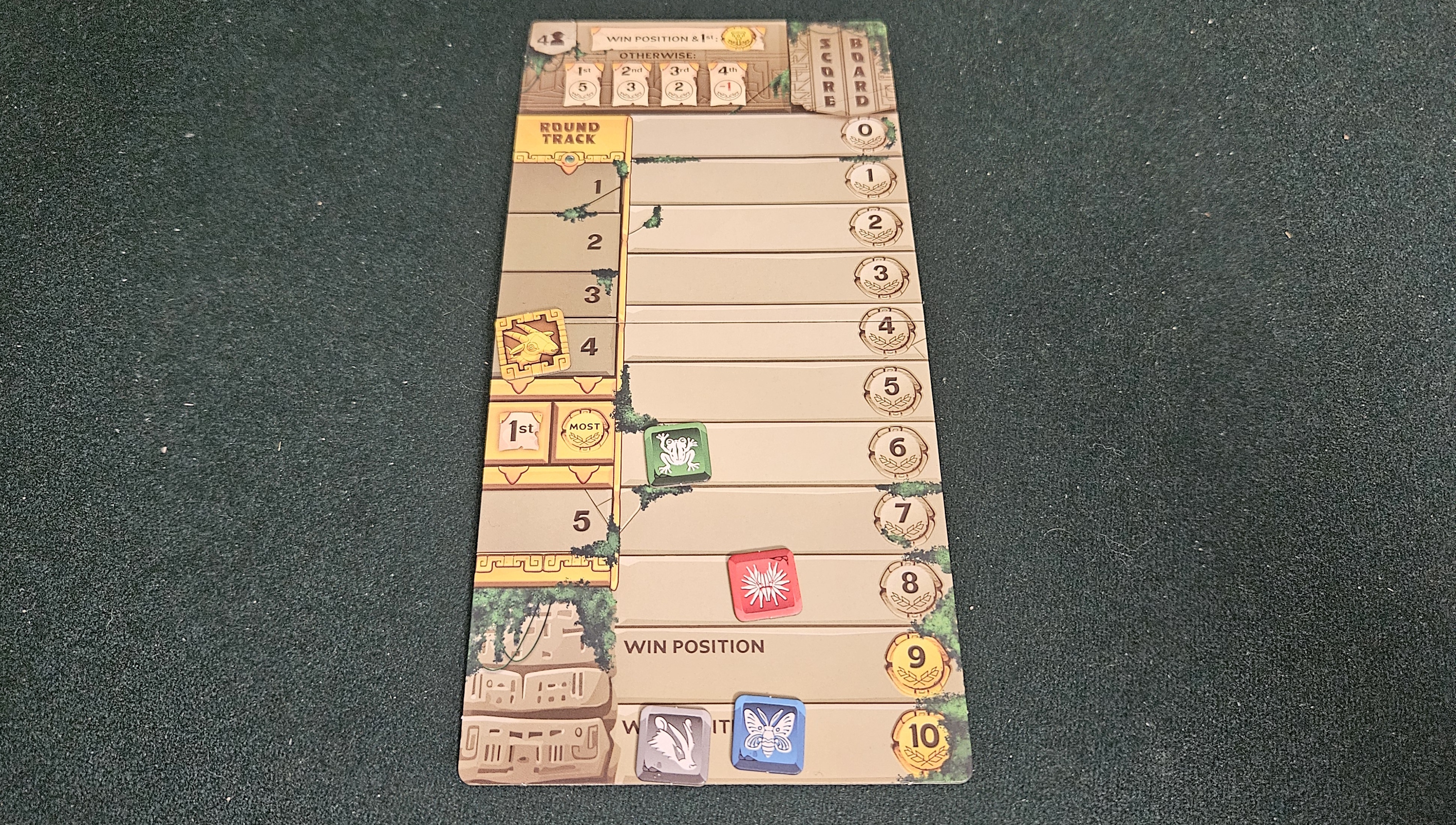
Just have people earn points. My gawrsh.

I genuinely don’t know what’s going on with this score track.

I know some of these points are overly technical, and I apologize for that. But I’m trying to illustrate a point. The point being that Ruins began with a crackerjack idea, only Clair kept adding more and more stuff, some of it useful and interesting, but much of it ill-considered and sluggish. Eventually, its basic idea got buried. The effect was not unlike lighting a battery of firecrackers — and then dumping a load of gravel over the top of the whole show.

There’s a good inserts-in-sleeves game in here. There was a good inserts-in-sleeves game in Dead Reckoning and Unstoppable. Someday, I hope Clair trusts those good inserts-in-sleeves games rather than burying them.


A complimentary copy of Ruins was provided by the publisher.

(If what I’m doing at Space-Biff! is valuable to you in some way, please consider dropping by my Patreon campaign or Ko-fi. Right now, supporters can read the next installment in my series Talking About Games, this time tackling the topic of what makes a good list! Naturally, the piece includes a list.)


  •  

Academic conference puts board game sustainability, environmental theming and more under the microscope

An academic conference exploring everything from publishers’ environmental claims and sustainable manufacturing to Pokémon card investing and onboarding new players is set to kick off tomorrow, as researchers examine the many interpretations of this year’s theme ‘Green’.

The free online Generation Analog 2026 event has been organised by Analog Game Studies, a quarterly journal dedicated to studying games with a substantial analogue component, and Game in Lab, an academic research grant programme co-created by Asmodee in 2018.

While many of this year’s presentations explore environmental issues, the conference’s broad ‘Green’ theme also encompasses topics including newcomer experiences, representation, identity, game history and design philosophy.

All of the talks are set to be recorded and made publicly available after the event, which takes place on July 15 and 16.

Example sessions include Plastic Dystopia: Ideas towards More Sustainable Miniaturing Practices, which aims to propose new ways of minimising the ecological footprint of the hobby, and How Green Is Green Play? Gamewashing in Analog Board Games, examines what the researchers describe as “gamewashing” – where environmental themes or sustainability messaging may not be reflected by a game’s actual mechanisms or player experience.

Several sessions examine how environmental themes are represented in commercial games, while Daybreak co-designer Matteo Menapace will be providing a keynote speech discussing the Kennerspiel des Jahres-winning title and how its realistic and utopian theme can be an antidote to capitalist realism.

Elsewhere, researchers from the University of York analyse five published climate change board games, arguing that many reinforce solutions rooted in existing economic assumptions rather than encouraging players to foster deeper engagement with the colonial and capitalist roots of the climate crisis, while another presentation explores how the relations between humans and animals are depicted in Uwe Rosenberg’s design Atiwa.

The full schedule for the conference is available here, and anyone interested in registering to view the panels and keynotes can do so here.

The post Academic conference puts board game sustainability, environmental theming and more under the microscope first appeared on .

  •  

Focused on Feld: Civolution – Acceptance Letter Expansion Game Review

Hello and welcome to ‘Focused on Feld’. In this series of reviews, I am working my way backwards through Stefan Feld’s entire catalogue. Over the years, I have hunted down and collected every title he has ever put out. Needless to say, I’m a fan of his work. I’m such a fan, in fact, that when I noticed that there were no active Stefan Feld fan groups active on Facebook, I created one of my own.

Today we’re going to talk about Civolution: Acceptance Letter, the much anticipated expansion for 2024’s Civolution, his 41st game.

This expansion includes three modules that can be added together or used separately. I’m not going to explain how the base game is played. This review assumes you already know. If not, you can check out my review of the Civolution base game.

Instead, we’re going to explore the new modules and discuss how they work and what I think about them. It is also my fervent hope that I’ll be able to answer the question you’ve asked yourself that, no doubt, led you here: is this an expansion that I need in my collection?

Module 1: Starting Attribute Chips

Civolution: Acceptance Letter includes six Starting Attribute chips. During setup, whether by random assignment or by drafting them, each player will…

The post Focused on Feld: Civolution – Acceptance Letter Expansion Game Review appeared first on Meeple Mountain.

  •  

My Favorite Wargame Cards – A Look at Individual Cards from My Favorite Games – Card #86: LRRP from Fire in the Lake: Insurgency in Vietnam from GMT Games

With this My Favorite Wargame Cards Series, I hope to take a look at a specific card from the various wargames that I have played and share how it is used in the game. I am not a strategist and frankly I am not that good at games but I do understand how things should work and be used in games. With that being said, here is the next entry in this series.

#86: LRRP from Fire in the Lake: Insurgency in Vietnam from GMT Games

The COIN Series uses cards in a very different way from other CDG’s. These cards are not necessarily the driver of the action but more assistive to the actions of the players by setting eligibility and also providing powerful events. The Event Cards are more often than not, very powerful. They either give you a continuing bonus on future Operations and Special Activities (as in the case of the volumes that include the various Capabilities) or allow you to take Operations and Special Activities more times that round than you would normally have been able to had you not chosen the Event and more often than not, at no cost! Also, because of the power of the cards and their ties to one or more factions, you can take the Event which allows you a huge advantage, only to see that very powerful Event reversed with the next Event or with a regular Operation. This is very frustrating but is one of the major reasons that I love the card-assisted element of the COIN Series. Today we are going to take a look at the LRRP Event Card.

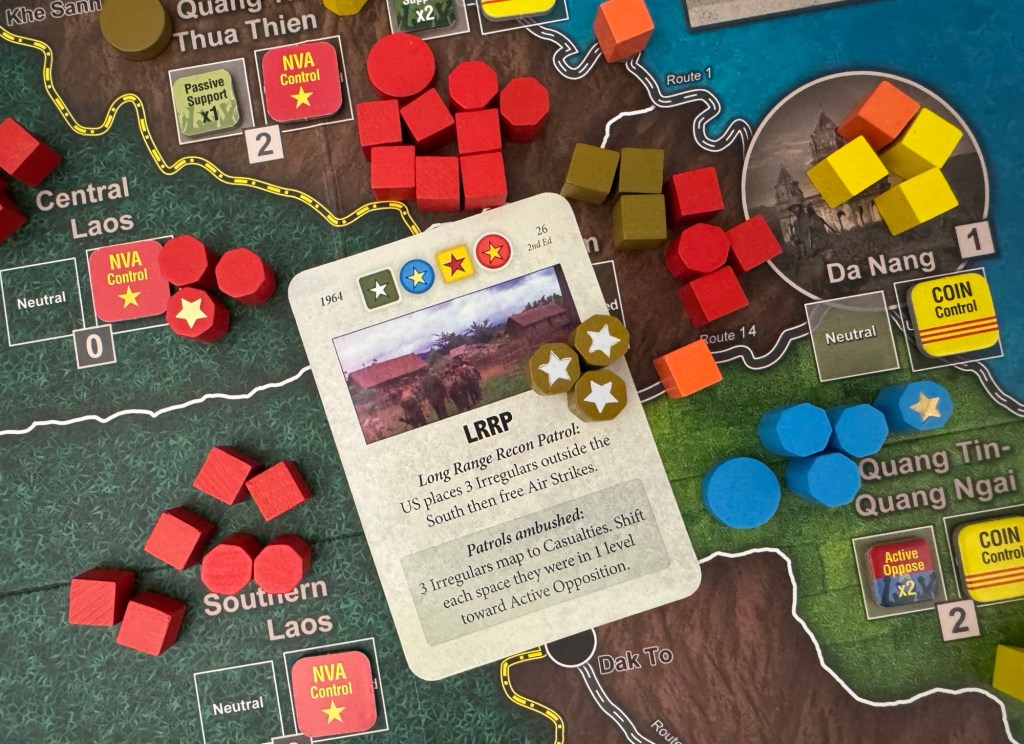
The LRRP Event Card, with LRRP standing for Long-Range Reconnaissance Patrol, allows the US player to place 3 Irregulars outside the South then conduct a free Air Strike, that also allows for the removal of Bases first. Keep in mind that Irregulars are US Special Forces pieces, which are the hexagonal shaped cylinders not ARVN Rangers. “Outside the South” means any Laos or Cambodia Provinces. Seems pretty pedestrian but it is important to note that this card changes the rules when played as normally all other units in a space must be removed before Bases can be removed. A very powerful card that typically will be played by the US player when it comes up. But keep in mind that Air Strikes are a dual edged sword as you get rid of pesky enemy pieces but it will result in shifts of Support/Opposition but can also Degrade the Trail. On the bottom of the card, the text allows the VC or NVA to ambush these LRRP”s and remove 3 Irregulars from the map to Casualties. Then it gives an added benefit of shifting each space these removed Irregulars were in 1 level toward Active Opposition.

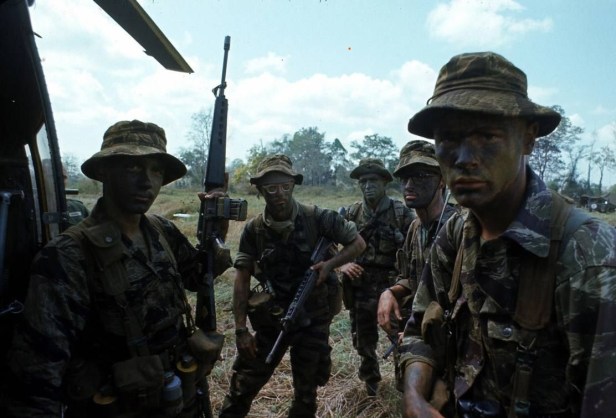
Image courtesy of Boxxer’s Blog.

A Long-Range Reconnaissance Patrol, or LRRP, is a small, well-armed and nimble recon team that is tasked with patrolling deep into enemy territory to identify or destroy key targets and gain recon on the enemy. The concept of scouting forces such as LRRP’s dates back to ancient warfare but also has been used in more modern and contemporary wars such as the French & Indian War where specialized Rangers, such as Rogers’ Rangers, were tasked with raiding Indian settlements, disrupting supply lines and reporting back to command on troop disposition and movement.

In Vietnam, veteran or specially trained forces often augmented with Vietnamese irregulars usually carried out Long Range Reconnaissance Patrols into enemy territory. The Studies and Observation Group (SOG) was the ground element of the US air war against the Ho Chi Minh Trail as illustrated by Project Tiger that spotted for and marked enemy trail activity for elimination by US air assets.

Here is a link to a very interesting summary of an LRRP and its mission on a Vietnam veteran run blog called Boxxer’s Blog: From the seat of a motorcycle: LRRPs: “—doing the impossible for the ungrateful.”

In the next entry in this series, we will take a look at Proletarian Revolution from The Republic’s Struggle: Battle for the Republic, Spain 1931-1939 from NAC Wargames.

-Grant

  •  

The Two Body Problem – design challenges of two-player only games (Topic Discussion)

Designing a board game that works well for exactly two players is a very different challenge from designing one that supports a range of player counts. Many games include a two-player mode, but board games such as 7 Wonders Duel, Patchwork, and Jaipur show that a dedicated head-to-head experience can be unique and not simply an adapted and reduced version of a game that is really aimed at larger player counts. In this article, I want to look at the design challenge these dedicated two-player-only games present.

The post The Two Body Problem – design challenges of two-player only games (Topic Discussion) appeared first on Tabletop Games Blog.

  •  

LUZ

LUZ is a trick-taking game. The twist here is you can’t see your own cards. You don’t know exactly what cards you have, but you can see everyone else’s cards. However you know the suits of your cards, because the cards have different coloured backs following their suits. At the start of a round, based on knowing everyone else’s cards and the suits of your own, you must predict

  •  

Clatter and Write

"A real beaut beaut you got there, huh?" —Matt Damon, playing the Portuguese cartographer who named Taiwan, with a sexually aggressive Bostonian accent

When the Portuguese charted the island of Taiwan, they named it Ilha Formosa, “beautiful island.” That’s the background behind the board game Formosa Formosa, which — and I’m not sure designer Kirk Beiser is aware of this — translates to “beautiful beautiful.” Kind of like when somebody calls a monster a were-person, which just means man-person, except “beautiful beautiful” is even more duplicative.

Appropriately, Formosa Formosa doubles down on its namesake. Designed by someone who has lived in Taiwan for fifteen years, printed in Taiwan, and ultimately about Taiwan, this is a drop-and-write game that’s as charming as it is combo-heavy.

I throw up my shoulders, attempting to intimidate the other players into forgetting their move.

This is how I look when a drop doesn’t go my way.

Welcome to Taiwan. Island of scenic waterfalls, breathtaking hikes, soaring shrines, and… dirty beaches. I’m not one hundred percent sure what we’re doing in Formosa Formosa, but it seems like a combination of sightseeing trip, litter collection, and greenhouse gas management. Travel across the island, but not too often. Visit the surrounding islets, but only sparingly. Hold your emissions while enjoying this scenic vista. Yes, those emissions as well, sir or madam.

For all its silliness, this isn’t all that far out for the genre, which often suffers from some disconnect where settings are concerned. And the puzzle it produces is a solid one, even when we interrupt our vacation to enthusiastically hoover up so much litter that we earn another jaunt up the nearby mountain.

At its most basic, Formosa Formosa is about ticking boxes. So far, so very roll/flip-and-write.

Right away, though, Beiser carves out a somewhat more unique identity than most of his game’s mechanical peers. Rather than rolling dice or flipping cards, selecting actions is all about chucking a bunch of cubes into the box lid. This produces a menu of potential destinations across the island’s four compass directions.

These destinations matter because you only occupy a single space at a time. You might, for example, be sitting pretty in the south, waiting for another chance to visit a shrine, only for the toss to result in a resplendency of activities everywhere but where you’re stationed. Bah, you might say. Bah and ruin, another hike. Another damnable waterfall. More beaches to clean.

More beach cleanups for me? What are the odds?

Dropped cubes determine which actions are available in which regions.

Except… therein lies the game’s central conundrum. You can travel to another locale, although this produces points-draining pollution. But you can also fulfill other activities, like the aforementioned beach cleanup or perhaps some island-hopping — itself a rather polluting activity — in order to generate bonus actions. These bonuses might then check off that all-important shrine. Or, after some consideration, see you abandoning that objective altogether for something more productive.

The result is a pleasant experience, one where every tick matters, but doesn’t matter so much that it detracts from the twenty or so minutes that it takes to complete the game. Clever players can parlay those cubes into self-replicating turns, one free action spilling into another. These sequences are breezy to track, certainly easier than some of the flip-and-writes we’ve covered here, while still allowing for the occasional turn where somebody absentmindedly chews on the end of their dry-erase pen (yuck) while contemplating their next mark.

If I haven’t made it clear, Formosa Formosa is a light experience all around. It occupies the same design space as any number of shorter something-and-writes, more about the joy of getting to pen three or four marks on the board instead of only two, rather than, say, mathing out the best possible move or even preempting the input. Because here there is no preempting the input. Sometimes a region will receive no cubes at all. Other times, nearly everything will cluster together in one spot. That’s the game, and while it lends a certain soothing air to the experience, one where no decision is your fault and the best you can do is ride it out, it shouldn’t be mistaken for decision-dense.

Still, there’s a lot to like here. The clever use of both the lid and the box bottom, one for the drop and the other for assigning the resultant spill to an action menu. The animal pawns that are used for tracking your location. The tension between shared contests and a personal goal. Again, this isn’t extreme tension. It’s a pleasant friction at best, a gentle tickle. But it’s enough to offer Formosa Formosa as an ultra-light clatter-and-write that doesn’t overstay its welcome.

I leave bus bonuses for others. Usually petrified gummy worms stuffed deep into the seats. True Christian charity.

Bus bonus!

Ultimately, Formosa Formosa offers a nice experience. It’s a bit straightforward, even somewhat forgettable. Like a back rub, I suppose, or a comfort movie. But also like a back rub, it’s warm and tingly and pleasant, and it’s a great deal more fun to chuck some cubes than roll dice or flip cards. For all I won’t remember it in a month, I’m happy to accept one in the moment.


A complimentary copy of Formosa Formosa was provided by the publisher.

(If what I’m doing at Space-Biff! is valuable to you in some way, please consider dropping by my Patreon campaign or Ko-fi. Right now, supporters can read the next installment in my series Talking About Games, this time tackling the topic of what makes a good list! Naturally, the piece includes a list.)

  •  

Crowdfunding Campaigns of the Week – 7/13/26

Crowdfunding Campaigns of the WeekWelcome to this week’s batch of crowdfunding campaigns. We have a variety of offerings here, so we hope you will find something that catches your eye. Also, if you want to chat with the BGQ team, join our Discord Server where we talk about games, movies, sports, and other fun stuff. Check it out and […]


Source

  •  

JinxO wins 2026 Spiel des Jahres, Rebirth secures historic triple for Reiner Knizia

Word association party game JinxO has been crowned the winner of this year’s hugely influential Spiel des Jahres award, on a night which also saw legendary game designer Reiner Knizia make history with his Kennerspiel award win.

Martin Ang’s design won over the judges ahead of Corey Konieczka’s Cozy Stickerville and Markus Slawitscheck’s Morty Sorty Magic Shop, becoming only the fourth word-focused game to win the 47-year-old prize after Barbarossa, Codenames and Just One.

JinxO’s win brings an end to a three-year run of cooperative games taking home the Spiel des Jahres prize, in the shape of Dorfromantik: The Board Game, Sky Team and Bomb Busters.

Indonesia-based Ang’s victory underscored the growing internationality of the venerable German award, which until last year’s triumph by Hisashi Hayashi’s Bomb Busters had never been won by an Asian designer.

The 2026 ceremony also delivered a historic first for veteran designer Reiner Knizia, whose tile-laying title Rebirth claimed the higher complexity Kennerspiel des Jahres prize.

JinxO designer Martin Ang with his Spiel des Jahres award || Photo Credit: Spiel des Jahres

That win made Knizia the first designer in history to complete the full set of Spiel des Jahres, Kinderspiel des Jahres and Kennerspiel des Jahres wins, having previously picked up awards for Keltis and the children-focused Whoowasit? in 2008.

Morty Sorty Magic Shop designer Markus Slawitscheck narrowly missed matching that feat this year after finishing runner up to JinxO, following his 2023 Kennerspiel victory with Challengers! and 2024 Kinderspiel win for Magic Keys.

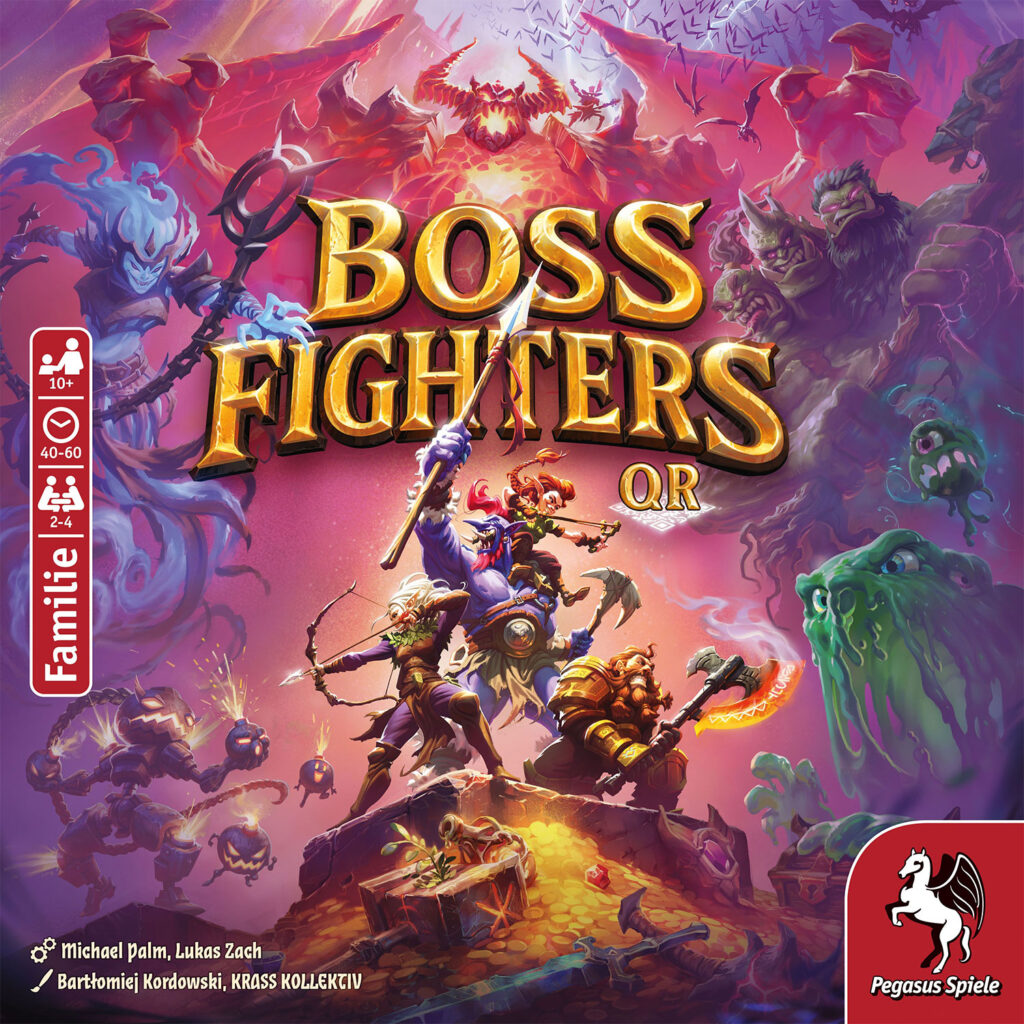
Rebirth contended with Michael Palm and Lukas Zach design Boss Fighters QR and Donald X Vaccarino’s Moon Colony Bloodbath in the final for this year’s Kennerspiel.

The children-focused Kinderspiel award this year was won by Florian Sirieix’s Mooki Island, ahead of his co-design with Benoit Turpin, Boo Party, and Verflixt Verzaubert, a localisation of Thomas Dagenais-Lespérance’s Mimose & Sam et le Voleur de Fruits.

Winning the Spiel des Jahres can transform the fortunes of games, designers and publishers alike, with Pegasus Spiele co-founder Karsten Esser previously telling BoardGameWire the award can increase sales by 10 to 20 times in the months following the ceremony, thanks to huge exposure in Germany’s mainstream retail market ahead of Christmas.

Receiving his trophy at the ceremony in Berlin, Ang thanked Swiss publisher Game Factory “for really believing in Dito! [the German-language localisation of JinxO] and in us”.

JinxO || Photo Credit: Tabletoys Games

He dedicated the victory to supporters across Asia, adding: “Thank you also to all the friends and publishers from Asia, especially from southeast Asia… finally we made it, and this is all for you also.”

Speaking separately during the ceremony, Ang said the game’s origins lay in Indonesia’s enthusiasm for social games.

“We made a party game because in Indonesia people really love to play party games,” he said. “It’s really famous in Indonesia right now and a lot of people like it, even the gamers also like it.”

Spiel des Jahres Association chairman Harald Schrapers said Ang’s success reflected the awards’ increasingly international reach.

He said, “We have had nominees from Japan and New Zealand in past years, but we always had a blind spot on the world map. We have never had a nominated author from the global south here on stage, and we are very proud of our Indonesian game author.

“Maybe there will also be a game from Africa or South America in the future. That is the great thing about playing – we play the same games here in Germany as they play in Indonesia.”

That geographic expansion has not been similarly reflected in the gender of nominated designers, however, with non-male designers once again heavily underrepresented.

The Spiel des Jahres jury looked at a record 571 games for this year’s awards – but just 2.3% of those games were from women designers, with male creators making up 94% of the cohort, and the rest being designed by mixed teams.

That figure has barely moved in recent years, having stood at 2% in 2025 and 2.6% in 2024 – an ongoing lack of diversity highlighted in great detail in this excellent feature by Wargamer’s Mollie Russell earlier this year.

The 440 titles reviewed across the Spiel and Kennerspiel categories was up 14% on last year, while the 92 games considered for the Kinderspiel marked a roughly 50% rise compared to the 61 from 2025. Another 39 titles were considered by judges across both the Spiel and Kinderspiel awards.

Number of games reviewed in recent Spiel des Jahres years – red is Spiel and Kennerspiel, blue is Kinderspiel, and purple is games which span both segments

JinxO’s victory marked a milestone for Zurich-based publisher Game Factory, which claimed its first Spiel des Jahres 18 years after being founded.

Game Factory previously won the Kinderspiel category with Magic Keys in 2024, and was also shortlisted for this year’s Kinderspiel through Verflixt Verzaubert.

The publisher had picked up a nominated for the Kennerspiel last year with viking-themed resource gathering game Looot.

Reiner Knizia’s win with Rebirth provided Germany publisher Frosted Games back-to-back Kennerspiel victories, having triumphed last year with its localisation of Endeavor: Deep Sea.

Accepting the award, Knizia – dressed in a kilt and tartans to reflect the Scottish map in Rebirth – paid tribute to his wife Margaret, whom he described as “the love of my life” and thanked for “giving me the space to fill my life with games”, before highlighting the importance of playtesters in modern game development.

Rebirth designer Reiner Knizia || Photo Credit: Spiel des Jahres

“Developing games, you cannot do alone,” he said. “You can’t develop games without playing them. No matter how much experience you have, you have to play, play, play.”

He added that his Munich testing group had made “a very significant contribution” to the game, saying playtesters should not be underestimated because “without them nothing is possible”.

Knizia also praised Rebirth’s graphic designers, who he said made a major contribution to designing the game – “it is about haptics, it is about the visuals” – and the game’s original, Malta-based publisher Mighty Boards.

He said, “We are not publishers, we create one handmade prototype, and then we need somebody who puts this into practice very professionally and who makes the game even better.

“And now you will ask me, ‘why do you then pick a publisher on Malta? What can they sell on Malta?’ Well, today things are different, today we have many localisation partners across the world – that said, it doesn’t really matter where the original publishing house is located.”

Knizia closed his long speech by urging players not to overlook the other nominees.

“In the end, it doesn’t matter who wins, because we carry the message about good games out to the people,” he said.

“There has to be one on top, but the top is amongst equals… Buy the other games, play them and honour the authors and all the contributors as much as the winners.”

The 2025 Spiel des Jahres Awards longlists:

Spiel des Jahres

WINNER: JinxO – designed by Martin Ang (Published by Game Factory / Tabletoys Games)

Nominated: Cozy Stickerville – Corey Konieczka (Unexpected Games)
Nominated: Morty Sorty Magic Shop – Markus Slawitscheck (Schmidt Spiele)

Recommended
Hot Streak by Jon Perry (Strohmann Games / CMYK)
Meister Makatsu by Reiner Knizia (Amigo)
Take Time by Alexi Piovesan and Julien Prothière (Libellud)
Toriki by Wojciech Grajkowski (Mirakulus / Lucky Duck Games)
Toy Battle by Paolo Mori and Alessandro Zucchini (Repos Production)
Wilmot’s Warehouse by David King, Ricky Haggett and Richard Hogg (CMYK)

Kennerspiel des Jahres

WINNER: Rebirth – Reiner Knizia (Frosted Games / Mighty Boards)

Nominated: Boss Fighters QR – Michael Palm and Lukas Zach (Pegasus Spiele)
Nominated: Moon Colony Bloodbath – Donald X Vaccarino (Alea / Rio Grande Games)

Recommended
Artengarten (Sanctuary) by Mathias Wigge (Feuerland / Capstone Games)
Frosted Blooms by Bruno Cathala and Ludovic Maublanc (Elznir Games / Synapses Games)
Grundstein von Metropolis (Foundations of Metropolis) by Emerson Matsuuchi (Kobold Spieleverlag / Arcane Wonders)
Tag Team by Gricha German and Corentin Lebrat (Kosmos / Scorpion Masqué)

Kinderspiel des Jahres

WINNER: Mooki Island – Florian Sirieix (Kosmos / Scorpion Masqué)

Nominated: BOO PARTY -Florian Sirieix and Benoit Turpin (Loki)
Nominated: Verflixt verzaubert – Thomas Dagenais-Lespérance (Game Factory / Locomuse)

Recommended
Kleiner Stinker (Little Stinker) by Elan Lee, Ken Gruhl and Quentin Weir (Kitten Games)
Magische Spiegel (Half-and-Seek) by Kseniya Kuznetsova (Ravensburger / Red Cat Games)
Paleolino by Marco Teubner and Peter Rustemeyer (Hans im Glück)

The post JinxO wins 2026 Spiel des Jahres, Rebirth secures historic triple for Reiner Knizia first appeared on .

  •  

A Carnivore Did It! Review – Is there meat on the bones?

A review copy was kindly provided by Zatu Distribution. Thoughts & opinions are my own. A Carnivore Did It! is best described as a box full of logic problems. If you grew up with the Labyrinth movie with its ‘guards on the door’ puzzle, or more recently the video game Blue Price with its chest-opening puzzles, then you know what to expect. A process of elimination, done against the clock.

Source

  •  

What Do We Really Want from a Sequel?

Taking a note from Hollywood, the tabletop game industry has been enamored with sequels for the last decade. It makes sense: If people already like X game, a way to serve that audience is to make X2.
I’m specifically talking about sequels, not new editions, spinoffs, or duel versions. Different game with the same core mechanisms and core theme. There’s a blurry, debatable line between sequels and spinoffs, but here’s a potential guidepost: I consider Wingspan Pocket a sequel to Wingspan, but I consider Wyrmspan and Finspan to be spinoffs.

Here are a few well-known sequels:

  • Frosthaven is a sequel to Gloomhaven
  • The 7th Citadel is a sequel to The 7th Continent
  • The Queen’s Dilemma is a sequel to The King’s Dilemma
  • Dune Imperium: Uprising is a sequel to Dune Imperium
  • Great Western Trail: New Zealand is a sequel to Great Western Trail
  • Age of Innovation is a sequel to Terra Mystica (as are, arguably, Gaia Project and Terra Nova)
  • Azul Summer Pavilion is a sequel to Azul
  • Ticket to Ride Europe is a sequel to Ticket to Ride
  • Mysterium Park is a sequel to Mysterium
  • Between Two Castles is a sequel to Between Two Cities
  • The Isle of Penguins is a sequel to The Isle of Cats

I could go on and on. There are way more new games than sequels, but there are still plenty of sequel examples to draw from.

This leads me to two questions:

  1. How does a publisher/designer know which games to select for sequels?
  2. What do people really want from a sequel?

How does a publisher/designer know which games to select for sequels?

I think there are a few overlapping factors here. One is the customer response to the original game. If your game brings joy to thousands of tabletops and those customers are still asking for more, that’s a good sign. Of course, you still have a choice between a sequel, a spinoff, or an expansion.

That’s where the second factor enters play: What are you excited to make, if anything? If you’re completely done with a game after creating it, that’s perfectly fine. Or maybe you’re only excited to make an expansion. Or perhaps you want to explore the same world but with new mechanisms (e.g., Expeditions as a spinoff of Scythe). You are the driving force behind this creation, and I think it’s worth listening to what you’re excited to make.

What do people want from a sequel?

This is the question I’m puzzling over the most, and I’ll say this up front: I don’t have a clear answer other than “it depends on the game.” A big reason for this uncertainty is the impact of the original game’s popularity on the data available for the sequel. In fact, I’m not aware of any sequels that have higher ownership stats on BoardGameGeek than the original game. Higher ratings offer some guidance, but I’m unsure as to how much weight to put on them. I’m interested in what people are actually playing time after time.

Here’s my experience: I’ve found in most cases that the sequels I play that offer bigger gameplay end up getting to the table much less than the original game. Rather, it’s the sequels with similar or streamlined gameplay that I enjoy time after time (and that don’t replace the original game).

I think there might be a tendency for designers to think they need to go big if they make a sequel. Going back to the first question, if you have more fun designing a bigger game, go for it. But please don’t overlook the option to offer a sequel of similar weight (as that’s what people gravitated towards in the first place) or even a lighter weight sequel (since the original weight already exists).

I’d love to hear what you think. What are a few of your favorite sequels that you actually play more frequently than the original games? And what’s one game you love for which you really want a sequel (and what do you want from that sequel)?


Also read: The Precarious Balance Between Past Successes and Future Experiments and 10 Brand Extension Strategies for Tabletop Games

If you gain value from the 100 articles Jamey publishes on this blog each year, please consider championing this content! You can also listen to posts like this in the audio version of the blog.

  •  

boop Shuffle Game Review

Maximum Booping Chaos Ahead

The basic idea of boop Shuffle is the same as the original boop. You're placing Kittens out on the board in hopes of getting three of your color in a row so that you can graduate them into the Cats necessary to win the game. However, as Cats and Kittens are being played onto the table, they boop the cards next to them into adjoining spaces, or possibly off the table altogether. In order to win, you must get three Cats of your color in a row, or have all eight of your Cats out on the board. These win conditions are the same for both versions. That’s where the similarities end.

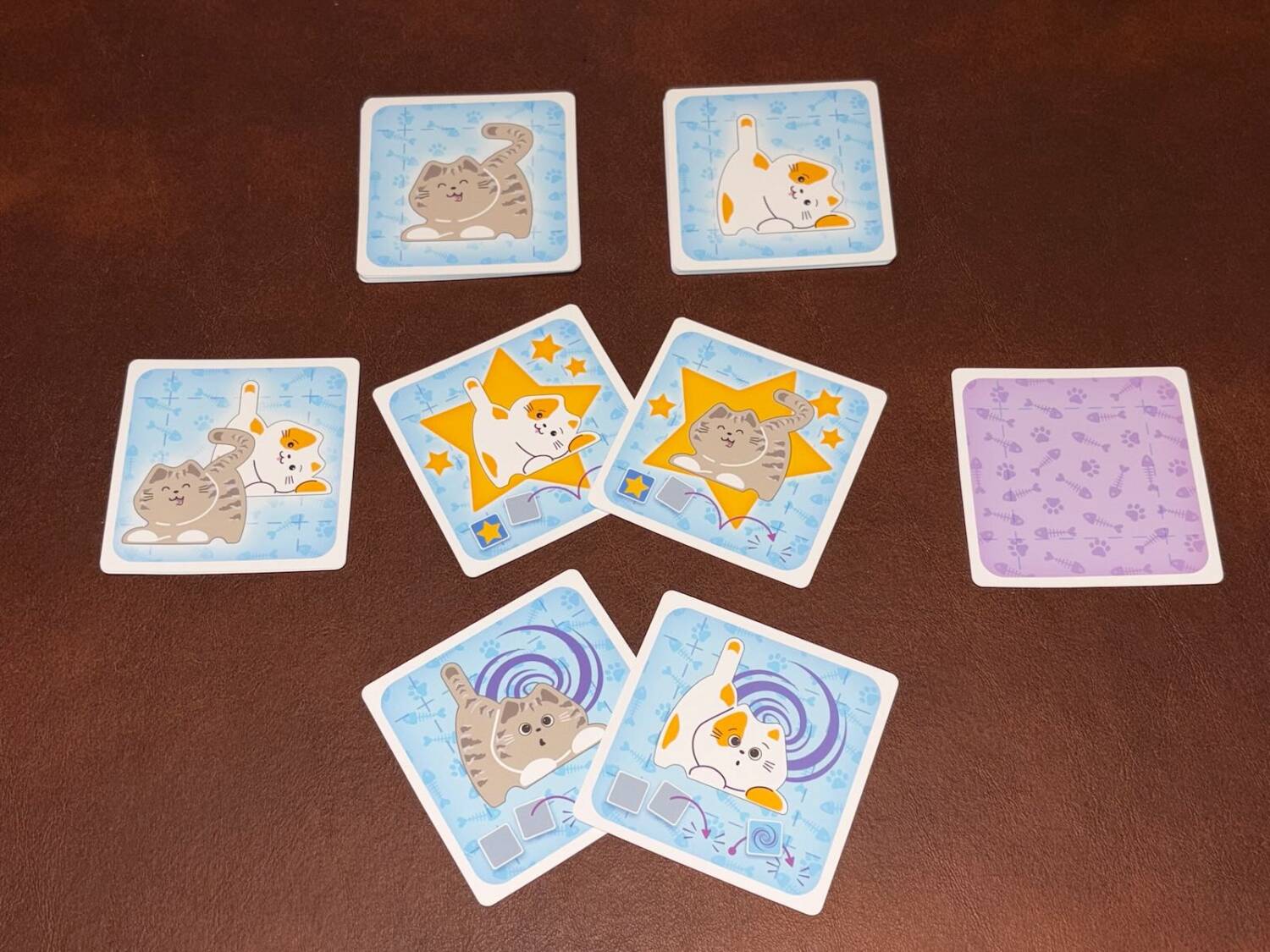
boop Shuffle is a card game, with cards taking the place of the cat meeples in the original. Each turn you will draw a card from the deck and place it into the 6x6 grid on the table. The placed card will boop any adjacent cards away from itself according to the rule of the placed card. If you run out of cards, reshuffle the discards and begin drawing again. 

[caption id="attachment_332475" align="aligncenter" width="1500"]Kitten cards Kitten cards and Blankie[/caption]
This isn’t simply a card game with the exact mechanisms of the original game, however.…

The post boop Shuffle Game Review appeared first on Meeple Mountain.

  •  
❌