Games tackling subjects ranging from the 1968 Democratic National Convention protests to the 30-year holdout of Japanese WW2 soldier Hiroo Onoda have been named as finalists in this year’s Summit Award, which aims to recognise historical game designs which have attracted new players or introduced new subjects or perspectives to the hobby.
The game puts players in the roles of the gender-defying mollies of early 18th century London, attempting to build community and joy while facing persecution by the Society for the Reformation of Manners.
Chicago ‘68, designed by Yoni Goldstein and published by the Dietz Foundation, was the most-selected title during the Summit Award’s public nomination process this summer.
Chicago ’68, designed by Yoni Goldstein || Photo Credit: Yoni Goldstein
The game explores the protests and police response surrounding the 1968 Democratic National Convention, dividing players between Establishment and Demonstrator factions including the mayor’s office, Chicago Police Department, Yippies and National Mobilization Committee To End The War In Vietnam.
Battlefields of the Napoleonic Wars, designed by Paolo Mori and Alessandro Zucchini and published by Ingenioso Hidalgo, uses four different battlefield maps to recreate engagements from the Napoleonic Wars in sessions lasting between 60 and 120 minutes.
The fourth finalist is Francisco “Pako” Gradaille’s Onoda, a 25-minute solo game published by Salt & Pepper Games which explores the experiences of Japanese soldier Hiroo Onoda, who continued guerrilla warfare on the Philippine island of Lubang until 1974. Judges praised the unusual subject and the way the game asks players to engage with Onoda’s story and decisions.
Onoda, designed by Francisco Gradaille || Photo Credit: Salt & Pepper Games
Winter Rabbit, which draws on traditional Cherokee animal stories and was created as a counterpoint to common colonial themes in games, was runner-up in the 2021 Zenobia Award and won the Light Strategy category at this year’s Origins Awards.
The Summit Award considers games across five criteria – ease of teaching, ease of play, uniqueness of topic, novelty of approach and effectiveness as a historical game.
SDHist, which was launched mainly as a local wargaming group in 2015, is led by wargaming experts including Liberty or Death: The American Insurrection designer Harold Buchanan.
The organisation’s board and board of advisors selected three of this year’s finalists following the public nomination process, which put Chicago ‘68 on the shortlist.
The same groups will select the winner, which is set to be announced at the SDHist Summit convention in San Diego in November.
Circle of Conflict is a really bad title. Just terrible. You know what would have been better? Anything. Ring of Conflict, maybe, seeing as how this is a Lord of the Rings shindig. Crud, just call it Circlet. That has an elegant chime, doesn’t it? Circlet.
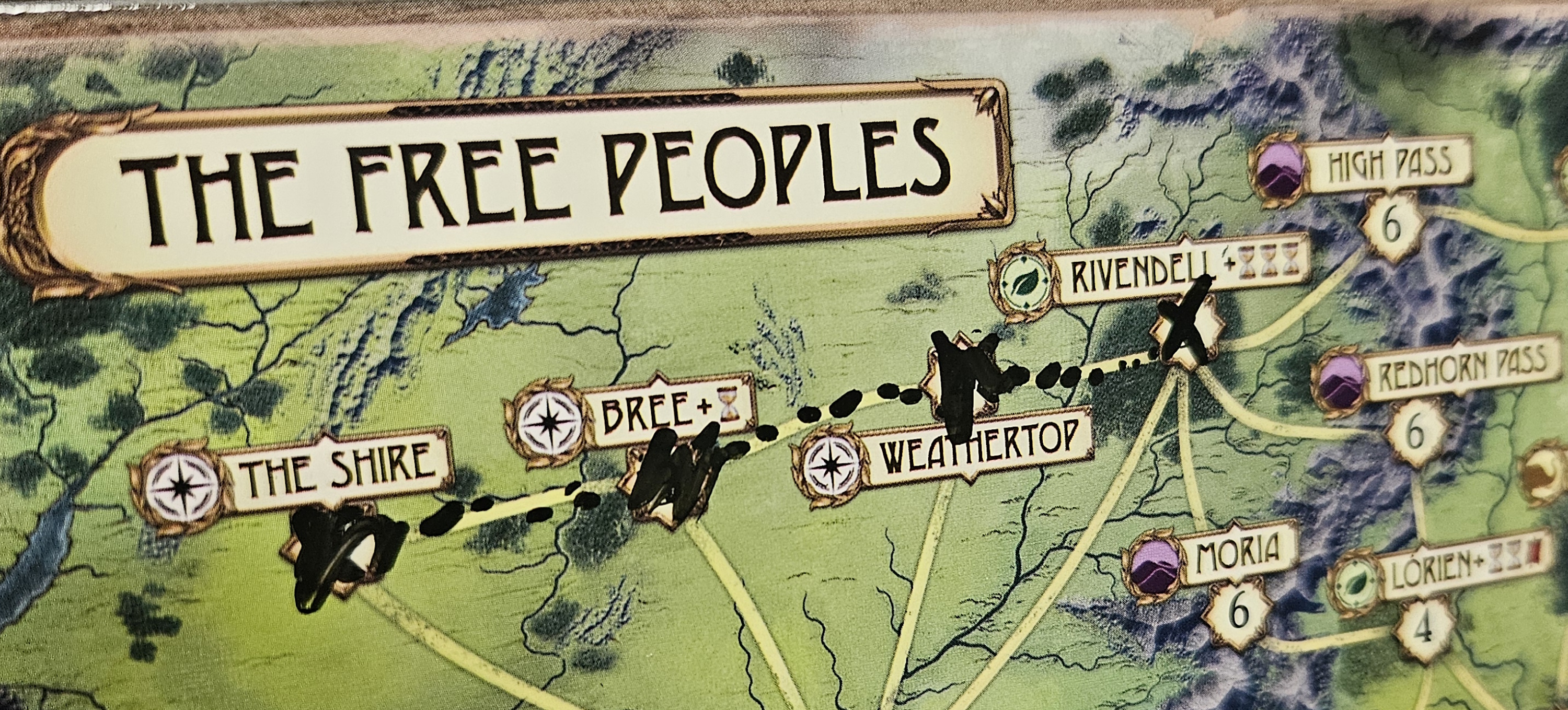
I imagine the thinking behind the title, which was designed by Geoff Engelstein and Stephen Buonocore, was that it’s descriptive. Because the game actually plops you right into the middle of a circle, you see, and that circle happens to be not a circle of harmony, but a circle of conflict. You’re reenacting the War of the Third Age from both perspectives, commanding the Free Peoples against the player to your left and Sauron & Friends against the player to your right. Thus the Circle. The Circle of Conflict.
The other rancid thing about the title is that… oh, what’s that? You want to hear about the game? Very well. It’s quite good. Not perfect, but good.
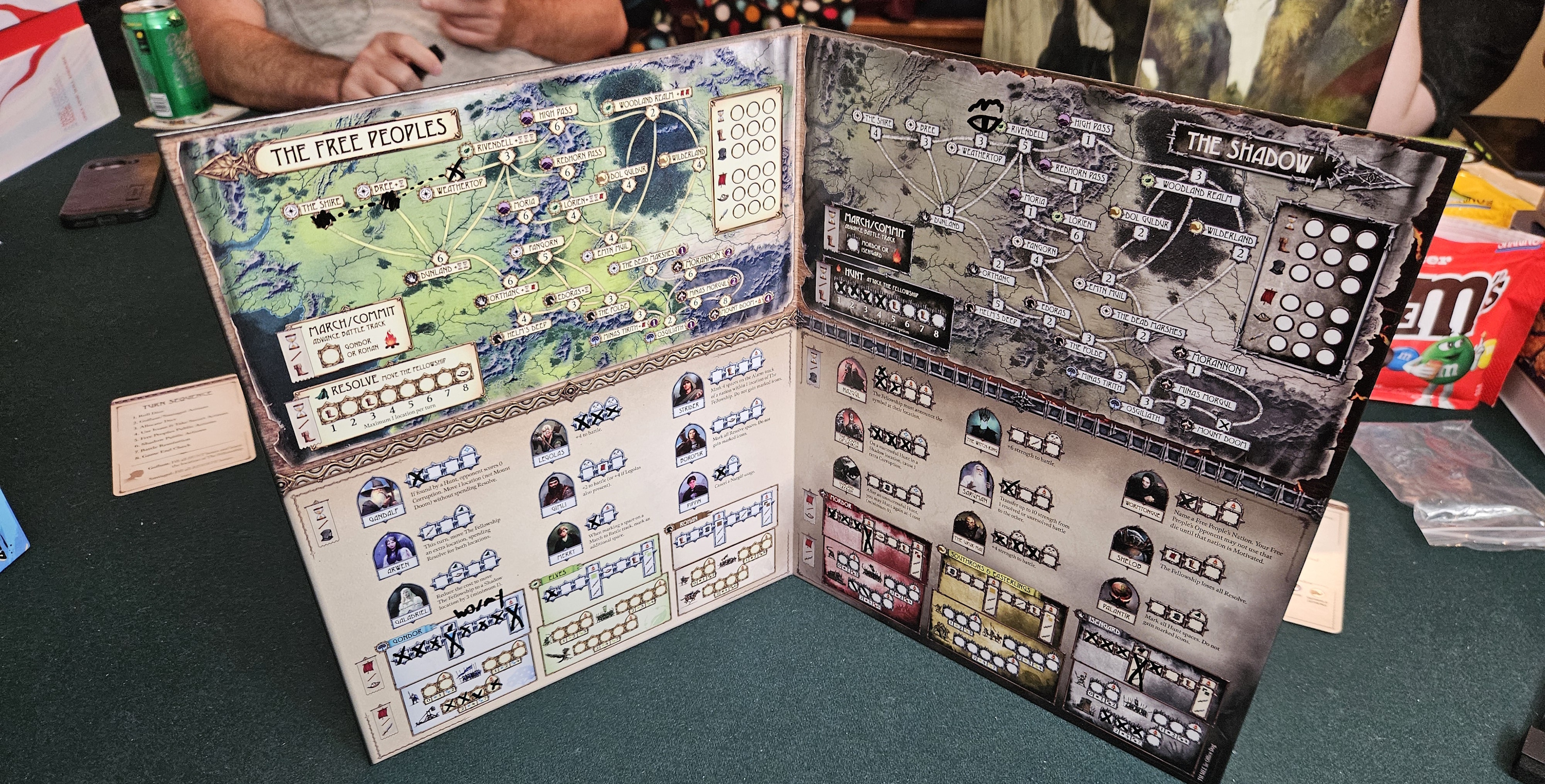
More board games should be in folders. For the lazy.
As gimmicks go, one could do a lot worse than Circle of Conflict. It’s like the inverse of its title: just a great idea from top to bottom. As the Free Peoples, you’re trying to safeguard the One Ring on its trip to Mount Doom, muster armies to defend Rohan and Gondor, and generally vouchsafe the hearts of men so they don’t falter. As the Shadow, you’re doing all that but exactly the opposite. Find the Ring, burn Rohan, burn Gondor, indulge every impulse.
And it works. Works well, in fact. Works too well, perhaps, in the sense that the system very quickly scurries out of the way and opens up the holistic design to any number of nitpicks.
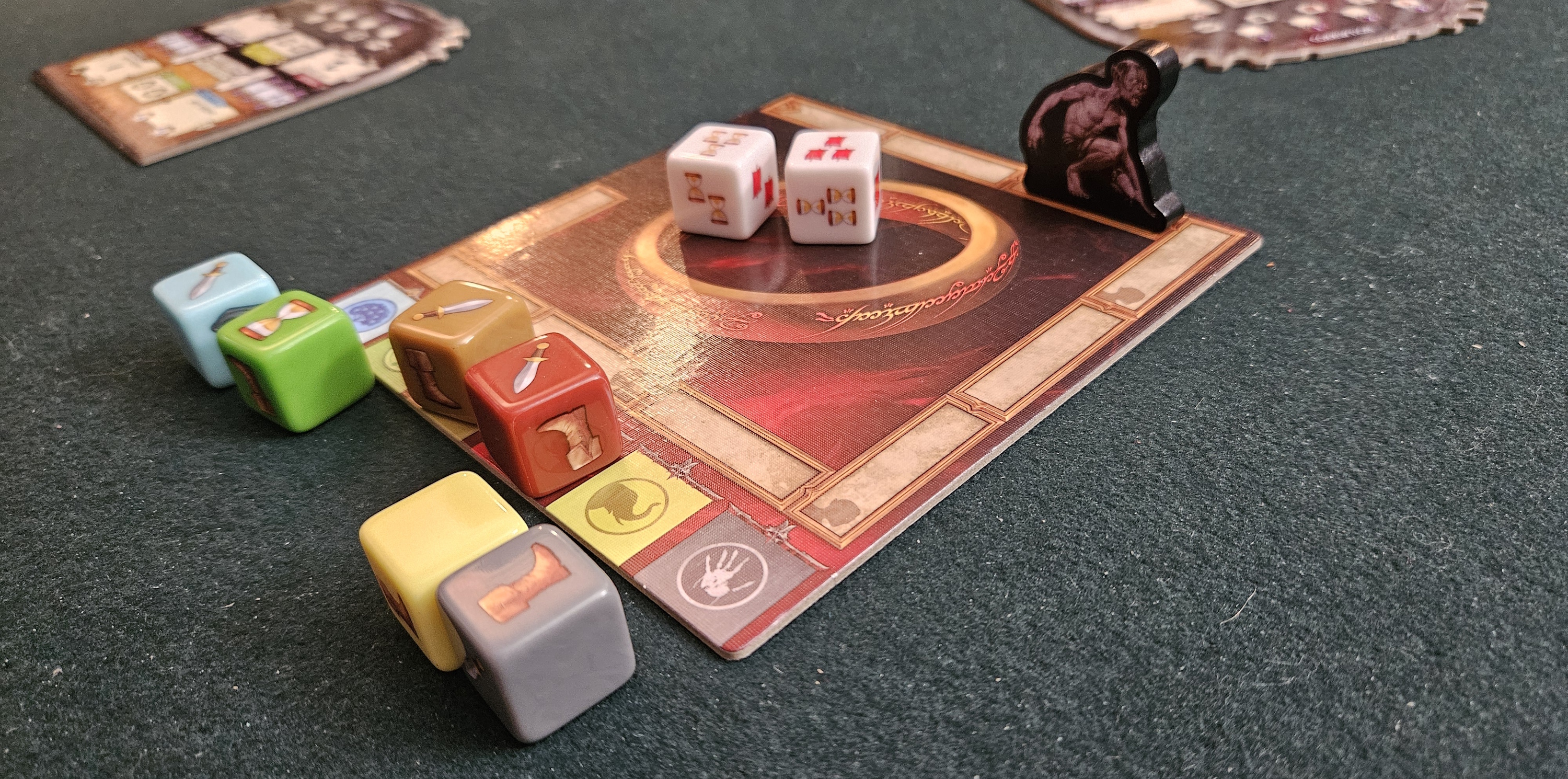
The baseline mechanism is roll-and-write, landing this in the long and not-often-successful lineage of titles that have tried to fashion a roll-and-write-but-bigger game. Every round — which is a mess of phases, just be warned — opens with a big handful of chunky dice getting rolled onto the table. When the game begins, only two of these dice are actually usable, and you’re required to divide them between the halves of your demesne. One for the Free Peoples, one for the Shadow.
I do love some nice dice. And a nice Sméagol, too.
It’s a simple enough decision, although of course there’s more to it than first meets the eye. It isn’t long before players begin to hear rumors from their neighbors. Perhaps the player to your left announces that they’ve rallied Isengard. This means they also gain the icons from the gray die, and may soon begin deploying troops to assault your version of Rohan. Meanwhile your Nazgul are hunting for the Ring somewhere around Weathertop; this initiates a call-and-response phase where you check your investigation against the player to your right, who reveals whether you’ve managed to corrupt their Ringbearer.
Point is, while you aren’t given total control over whether to go all-in on one side or the other, you’re afforded just enough authority to lather up some nice apprehension. At times, it can feel like both sides are pressing in on you while ignoring their neighbors on the opposite side. It’s a smart way of divvying up the action on Engelstein and Buonocore’s part. Some activities are concealed, others reveal essential breadcrumbs of military intelligence. Along the way, you hope you aren’t playing with cheaters. Or people who don’t really understand the rules and might interpret them in their favor.
At all times, this puts you in twin headspaces: hunter and hunted, army on the march and defenders under siege, Gollum and Sméagol. Actually, you’re only ever Gollum or Sméagol. There’s a special phase for that. Everyone chooses whether they’re the li’l guy’s good side or bad side, then reveals their decision and handles the fallout. If anything, Gollum’s madness seems like the one thing to collapse the game’s cosmological superposition. But that’s neither here nor there.
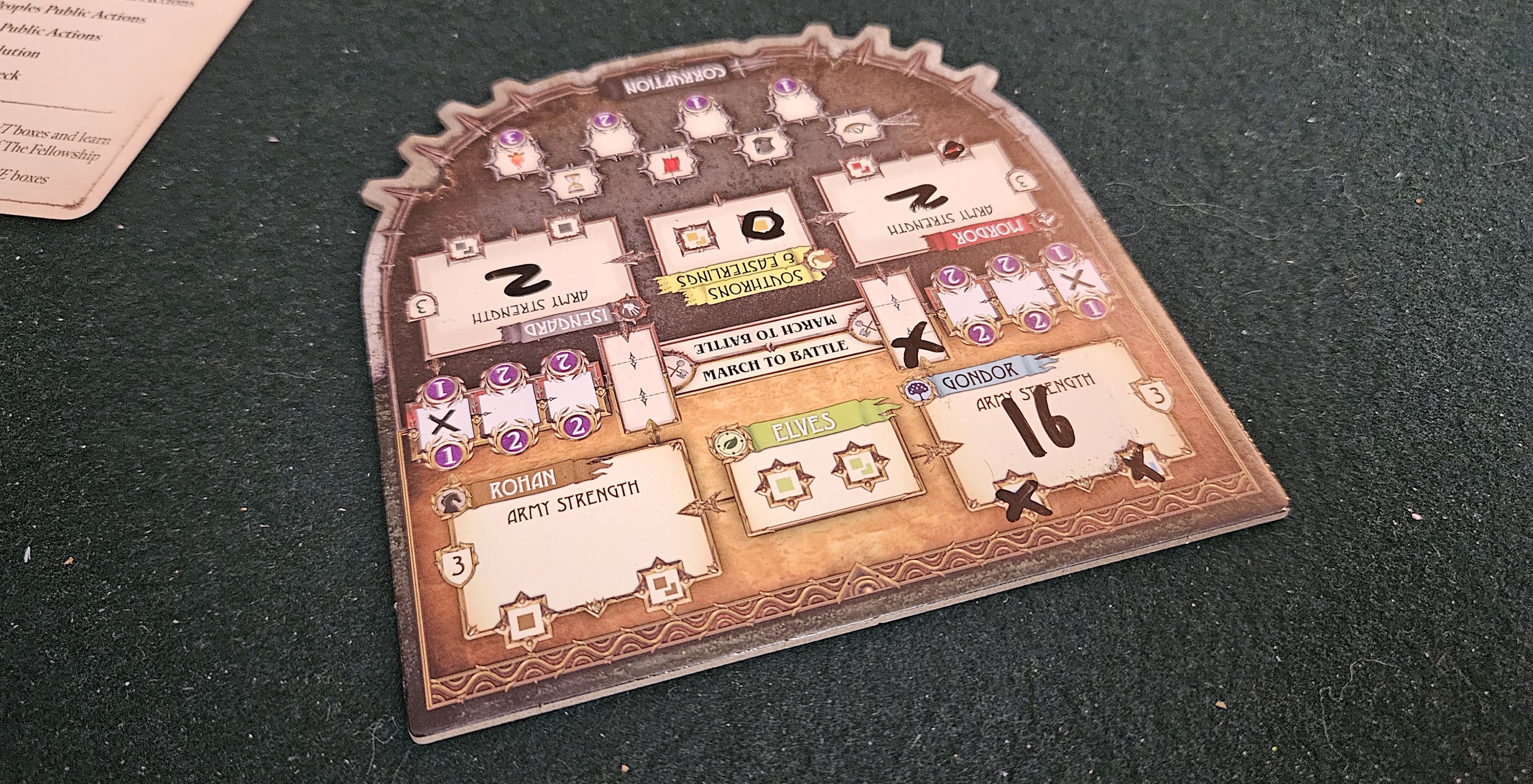
The battle board is, ahem, functional.
If anything, there are a few points where Circle of Conflict (ugh) seems to throw up its hands, as though Engelstein and Buonocore knew they were onto something great and realized they had to bring it back down lest they invent something too mind-expanding. There are a lot of the customary roll-and-write combos, for example, where you’ll be filling in one bubble that then awards another icon that lets you mark another bubble, and then that bubble lets you mark something else, and on and on until an ordinary turn has transformed into two or three turns’ worth of dry-erase daubs. In a game this distinct, these moments always feel like a throwback to the format’s puzzle-going past, more of a conundrum to solve than a dynamic contest between players.
And, yes, at times Circle of Conflict (hurk) feels like too much of a puzzle. After one or two sessions, you get a good sense for which combos will really let you whip along its tracks. Some early Boromir and Galadriel to secure the loyalty of Rohan toot suite, Wormtongue to tank the loyalty of whichever nation your right-ward neighbor embraces first, just enough Legolas Gimli to max out your battle value but no more. I don’t want to say it can be “solved”… but one of my opponents in our most recent session sure believed so.
Which isn’t to say this ruins the game. Not by a long shot. It’s just that Circle of Conflict (uruk-hai) is at its best when it leans into the suspense between neighboring players, but not every portion of the design is pitched toward maximizing that. The slow buildup of armies, with both sides growing stronger, closer, and more likely to win a bunch of points from the coming battle: incredible. The gradual chase and evasion of the Ring on both sides: wonderful. The occasional game-disturbing abilities from the heroes: appropriately enraging. Waiting around while somebody completes their tenth mark on a turn when you earned two or three: a bit of a downer.
Conducting the grand tour.
On the whole, I dig it. It calls to mind other experimental titles like Captain Sonar and The Anarchy in its willingness to tinker with the usual formula, even as it doesn’t quite reach their heights. Even so, there are little touches that make it especially considerable, like how the hobbits are tiny until suddenly they matter quite a lot, the occasional ability to move or hunt with greater efficacy, or, my favorite detail, the fact that the whole thing is presented as a single folder so you can lean back in your chair while you jot down your moves. One could do a lot worse.
A complimentary copy of The Lord of the Rings: Circle of Conflict was provided by the publisher.
(If what I’m doing at Space-Biff! is valuable to you in some way, please consider dropping by my Patreon campaign or Ko-fi. Right now, supporters can read the next installment in my series Talking About Games, this time tackling the topic of what makes a good list! Naturally, the piece includes a list.)
Catan is continuing to push into professional sport in a bid to reach new players, adding a season-long partnership with NHL team the Ottawa Senators and recruiting German handball star Juri Knorr as a brand ambassador.
Asmodee and Catan Studio have teamed with the Senators for a season-long partnership which they said will put the board game in front of hockey fans through arena advertising, “concourse activations” and social media competitions.
The deal will culminate in a dedicated Catan Night at the Senators’ Canadian Tire Centre on November 23, when the team faces the Calgary Flames – including themed decorations and activities, promotional giveaways and special ticket packages.
Senators VP of marketing Peter Shier said the team will be the only Canadian professional sports franchise, and the only NHL team, to host a Catan-themed game this year.
Catan Studio director of brand development Kevin Hovdestad said at the time the partnership highlighted how the game had become “woven into sports culture”, following years of reports of the game being played by professional athletes including members of the Green Bay Packers, Buffalo Bills, Kansas City Chiefs and Minnesota Twins.
Separately, German Catan publisher Kosmos has named international handball player Juri Knorr as a Catan brand ambassador ahead of the 2027 Handball World Championship, which will be held in Germany next January.
The campaign, running under the slogan Mein Spiel nach dem Spiel – ‘My Game After The Game’ – will feature Knorr prominently on branded retail displays and products, alongside a QR-code competition offering meet-and-play sessions with the handball star and Catan-branded adidas handball shirts.
The publisher is potentially tapping into a sizeable audience: 13 million people watched Germany play Denmark in the 2026 European Handball Championship final, according to Kosmos.
Knorr said, “Catan has been with me since my childhood and still captivates me today. For me, the game is a very good balance and complement to… highly focused competitive sport.
“The game offers a great opportunity to spend quality and intense time with friends and teammates. It involves spending time while also thinking strategically. That’s why I’m very pleased to represent Catan as a brand ambassador in this special campaign.”
The deals add to a growing collection of partnerships putting Catan in front of potential players outside of traditional board game retail and media – with the aim of expanding the audience for a game which has already sold more than 50 million copies and been translated into over 45 languages.
Kosmos is currently involved in one of the most striking examples through a McDonald’s Happy Meal promotion across Germany, Austria and Luxembourg, for which almost seven million specially adapted games have been produced.
Kosmos licensing content and entertainment head Julia Courmont said, “This collaboration is a huge milestone for us. The fact that Kosmos is represented here with eight exclusive titles confirms the great confidence in our brands and their relevance to a broad target group.
“It’s a fantastic opportunity to make these classic games accessible to millions of people and to create valuable shared gaming moments.”
Catan has since held a game night with Linkin Park and Warner Music in Hamburg, while a licensed crossover with children’s entertainment phenomenon Bluey is due to launch across several international markets in 2027.
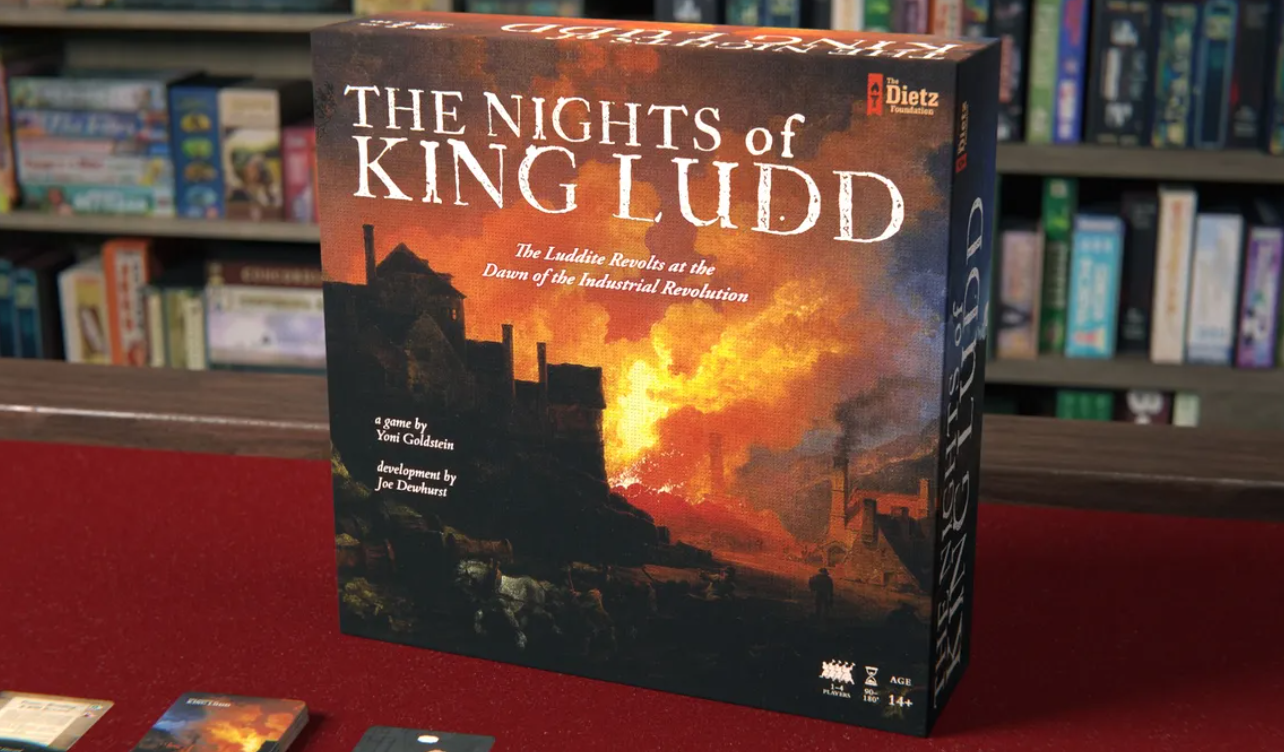
As you know, I do love me a good Card Driven Game….or a game that uses cards….multi-use cards. I love cards because it allows for the designer to keep a game going while using a vehicle that incorporates special rules that fit a historical situation but also to be able to use bits of the history itself to teach the players about the topic. A few months ago, I caught wind that The Dietz Foundation was working again with Yoni Goldstein on his second game called The Nights of King Ludd: The Luddite War on Industry, 1811-? that recently launched on Kickstarter (the game has already funded). The Nights of King Ludd is a 2-4 player game that deals with direct oath-sworn secret societies of English Luddites at the dawn of the Industrial Revolution in the English Midlands. Working together, players will build a secret network of saboteurs, ferry provisions and weapons on the black market, assemble raiding parties, and if all goes as planned, smash those “dark satanic mills” to cinders. I reached out to Yoni to get a bit more information about the design and he was more than willing to share.
Grant: Yoni welcome back to our blog. What have been your feelings about the reception of your great game Chicago ‘68?
Yoni: I’ve joked that I’ve taught this game now more than I’ve played it (of course this is only true if one just counts the last couple years!). Since 2024, I’ve taught it to a diverse and intergenerational cohort of non gamers, grognards, peace activists, veterans, and even a few spooks. Inevitably players relate the experience they are having on the board to what they see in their neighborhoods: protests and tear gas, troops deployed into cities, election interference, and so on. Those conversations are still ongoing and I’m heartened that Chicago ‘68 is facilitating a space for that.
Grant: What lessons did you learn from that experience that have helped you with your new game?
Yoni: I’m grateful that Joe Dewhurst, who developed both Chicago ‘68 and the upcoming The Nights of King of Ludd, guided me through the design, testing, and development processes. Ludd is my second game and it went through a number of iterations, but this time we had a proper methodology in place. Likewise, The Dietz Foundation was very transparent with the manufacturing and publishing side of things, which gave me a deeper understanding of the timeline and proofing / editing process that accompanies those final stages of production.
Grant: What is your new upcoming game The Nights of King Ludd about?
Yoni:The Nights of King Ludd is a collaborative game for 2-4 players about the Luddite revolts in the English Midlands. Set roughly around 1811, the game tells the story of local workers in the textile industry (“weavers”) forming secret societies and leading armed raids against mills and factories in their communities. Players command an oath-sworn organization of conspirators working with the Luddites to achieve the collective goal of machine wrecking while also attempting to meet their individual motivations (which may include assassinating the local manufacturer, spurring a republican revolution, or just avoiding an Australian exile).
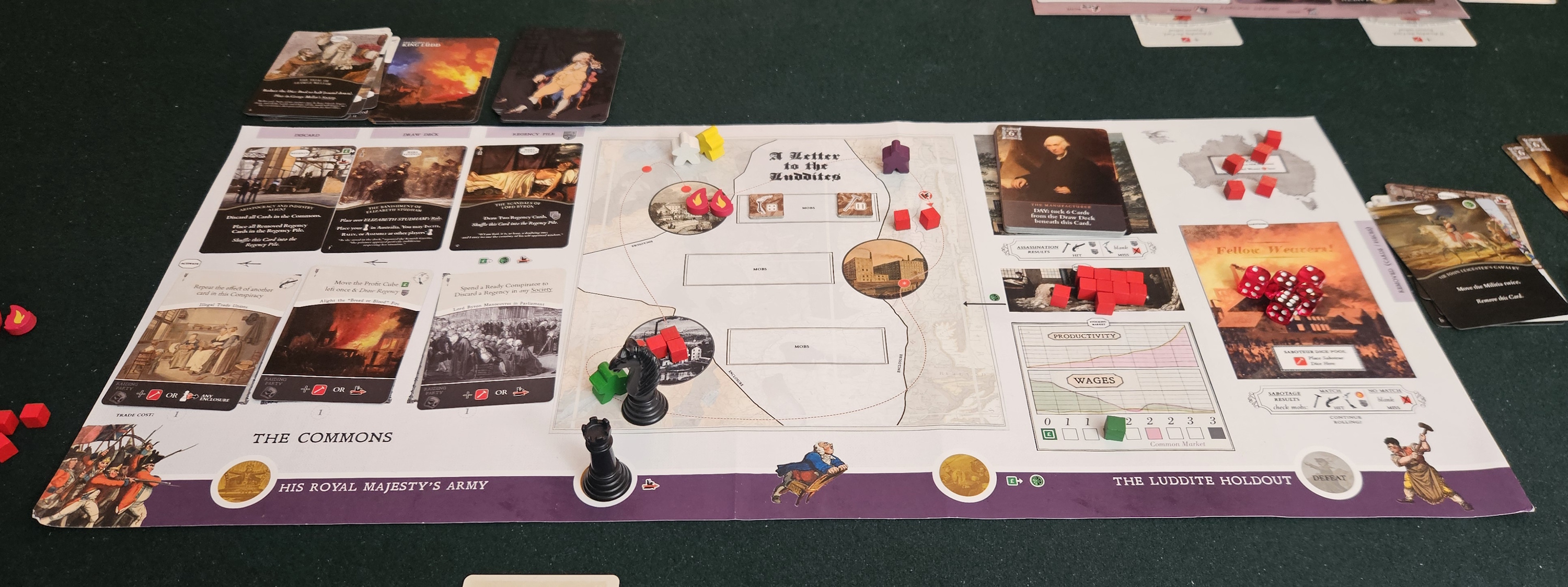
In terms of game mechanics, you are building a dice pool while also maneuvering pieces and collecting multi-use cards to modify your roles. Collectively you are building a tableau and operating it together to mount a series of raids against the three Mills on the map.
Grant: What is the meaning of the title of the game? What should it convey to players about the game and the history it represents?
Yoni: The title of the game is borrowed from a chapter in Gavin Mueller’s book from 2021, Breaking Things at Work. Mueller is among a cohort of authors, including Kirkpatrick Sales (Rebels Against the Future), Brian Merchant (Blood in the Machine) and Cory Doctorow, who are working to reconsider the Luddites’ reputation in the age of AI and the gig economy. Rather than seeing them as misguided revolts against the inevitability of technological progress, these writers appraise the Luddites in their historical context as severely desperate labor movements against tech oligarchies. The Luddites’ aims were, ultimately, to raise the minimum wage, cease child labor, and to maintain a higher standard of craftsmanship and quality in the production of textile goods. At every point their appeals to authority were spurned. So they turned to mob justice. “You may call the people a mob,” remarked Lord Byron before Parliament, “but do not forget that a mob too often speaks the sentiments of the people.”
The subtitle of the game, “The Luddite War on Industry, 1811-?” is also a cheeky nod to Volko’s Labyrinth: The War on Terror, 2001 – ?. While these games don’t share a mechanical similarity, they both explore the ongoing and unpredictable nature of insurgencies.
Grant: Why was this a subject you wanted to focus on?
Yoni: My area of interest in game design, broadly speaking, is movement politics on an operational scale. As with Chicago ‘68, the Luddite war on industry feels an under-explored subject matter in historical gaming. While there are certainly titles about the Industrial Revolution from the perspective of barons and magnates (especially in the Euro game niche), little is mentioned about the social, political, and ecological costs of these endeavors for progress.
Moreover, the story of the Luddites and their “secret societies” is about the tensions of modernity. New technologies combined with extensive wars abroad drove a rise in food costs and detonated an affordability crisis in the imperial homeland. Communication media (handbills, newspaper editorials, and pseudonymous letters) was an instrument of persuasion, vitriol, and threats. Suspected Luddites and their sympathizers were surveilled by the state, which increasingly saw its interests entwined with industrial capital. We’ve seen this all before!
Grant: What are the unique features with the system used for the game?
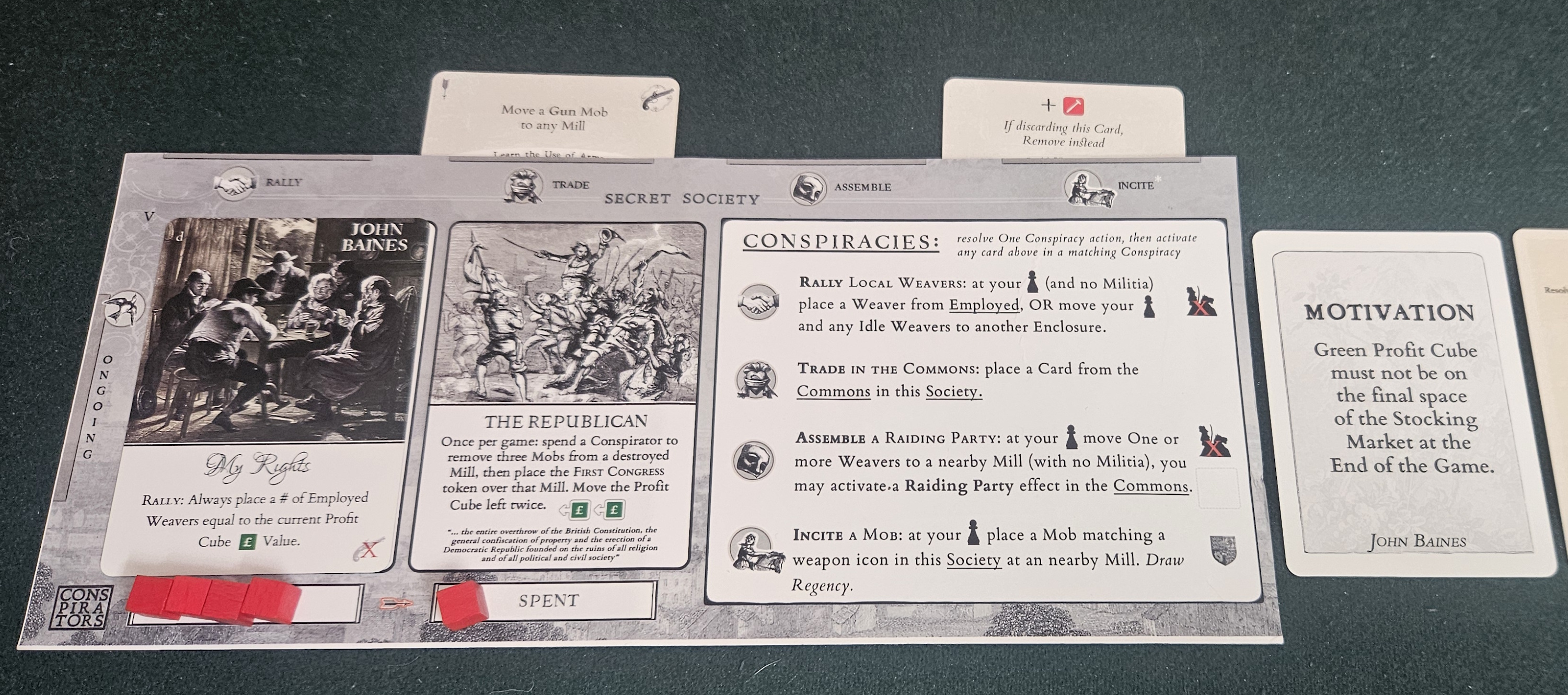
Yoni: The Nights of King Ludd has a unique framework for collaborative engine building. Initially, players draw from “The Commons” (a shifting card pool) where each card has the same “trade cost.” On your turn, you may activate a Conspirator (spending an action point) to draw a card into one of the columns in your tableau. Each column upgrades your actions with a permanent ability. If you specialize your actions, you can harmonize a collective strategy between players and hone in on the steps you need to take to sabotage the mills.
In the Commons we are evoking the notion of a shared economy. But this may shift dramatically when decreasing wages and increasing productivity converge. Then, the Commons transforms into the “Common Market.” Now, players are building their tableaux with an increasing cost, similar to the Pax Series (for example, Pax Pamir or Pax Renaissance). Each player is now facing a decision: overwork their cabal of conspirators or draw on the labor power of the workers in the textile industry (which drains their militant power on the map).
Grant: What does the collaborative portion of the subtitle mean for the game? How do the players cooperate?
Yoni: I choose “collaborative” not “cooperative” as a descriptor to emphasize the multi-victor nature of the game. In The Nights of King Ludd, each player chooses not only their persona and their role in the Luddite struggle (with asymmetric abilities and effects), they also put forward a “Motivation.” Motivations are personal victory conditions that unlock if the collective win condition (destroying all three mills on the map) is met. This gives shape to the degree of player friction in the game. For example, Lord Byron’s motivation is to turn down the heat from the ruling Regency. His motivation is in conflict with George Mellor’s, the famed assassin, whose attempts at the Manufacturer’s life will ratchet up the crown’s crackdown. But pair John Baines, a republican agitator, with the Molyneux sisters, two young women destined to labor in the mills, and the gameplay will tilt more toward cooperation. In this case, Baines is working to regulate the industriousness of the mill (keeping productivity low and wages high) while the Sisters are interested in keeping workers employed. So the degree of cooperation is up to the players, and as often happens, someone may have to make a noble sacrifice for the collective good.
Grant: What did you need to model regarding the English Luddites at the dawn of the Industrial Revolution?
Yoni: As EP Thompson (The Making of the English Working Class) notes, the history of the Luddites is, at best, “opaque.” We are grappling with a story about secret societies in an era where workers associations were illegal and damaging weaving frames was a capital offence. As such, we have dubious claims from government spies, confessions before “hanging judges,” and pseudonymous letters and handbills. Consequently, the model had to be expansive enough to capture the granular nature of these conspiratorial operations, but also open enough to allow for the plausibility of a broad range of player actions.
For example, one of the core actions is to “rally local weavers,” which is a form of recruitment. In game terms, this means moving one of the Employed Weaver cubes into an Enclosure where they can contribute to your force strength. This action may represent members of your secret society swearing in sympathetic workers in local pubs, or calling a clandestine meeting in the nearby woods. We don’t know precisely how the Luddites organized themselves, so the language has to be inclusive of these possibilities. Players then “assemble a raiding party”, which is to move the cubes from the enclosure into a nearby Mill. Each cube in the Mill space adds a die to the Sabotage roll (which is the primary means of wrecking machines). So here is a group of raiders hiding in the hedge and awaiting the signal from King Ludd. They are spurred on by the Mobs who have surrounded the site, represented by these Mob tiles. Matching a die roll to the symbol on the Mob Tile is how you roll a “hit.” The intention is to shape a series of amorphous and difficult to historicize chain of events into a familiar wargaming mechanism: rolling a handful of dice representing an “attack” and applying modifiers to the results.
Grant: What is your design goal with the game?
Yoni: My overall aim was to develop a system that could express a relationship between an abstract economic system, worker uprisings, and the coming together of industry and aristocracy to form a ruling class. But on a purely design level, I wanted to work within the framework of a Pax Series style market that you encounter in games like Pax Pamir and Pax Renaissance. That is, a shifting market of cards that players can purchase and place into their tableau. It’s an evocative description of history as a bazaar of possibilities and counterfactuals. The Nights of King Ludd tweaks this vision of history as somewhere between a commons (a gift economy) and a market (which costs worker power as in-game resources).
But really, I want this to be a “raiding party game.” Beneath the heady layers of history and theory is a brisk experience featuring dice odds, clever combos, and cooperation with your friends (while slyly pushing your own agenda!).
Grant: What other games did you use as inspiration?
Yoni: John Company from Wehrlegig Games is certainly one of the biggest inspirations, taking place in a similar era of British imperial economic imperialism (Ludd is at the tail end of JoCo’s later scenarios) and drawing on the satirical printworks of the time. Like John Company, players are asked to intervene in an existing ecosystem. In both games, player actions accelerate a system that will simultaneously reward and punish everyone at the table. How this is doled out is uneven, so players have to weave and dodge to make best of a collapsing infrastructure.
Grant: What sources did you consult about the history?
Yoni: An invaluable resource for all things Luddite is the Luddite Bicentenary curated by Richard Holland. This is a comprehensive digital archive of historical ephemera devoted to Luddism, including handbills, court transcripts, and other images and texts. I also quote extensively from Rebels Against the Future by Kilpatrick Sale and The Risings of the Luddites: Chartists and Plug-Drawers by Frank Peel, E.P. Thompson, as well as The Making of the English Working Class also by E.P. Thompson.
Other reference texts include:
Writings of the Luddites edited by Kevin Binfield
Ben o’ Bill’s, The Luddite: A Yorkshire Tale by Daniel Frederick Edward Sykes, George Henry Walker
Breaking Things at Work: The Luddites Are Right About Why You Hate Your Job by Gavin Mueller
The Luddite Rebellion by Brian Bailey
Blood in the Machine by Brian Merchant
Women in Protests 1800-1850 by Malcolm Thomis
Convict Lives at the Launceston Female Factory (A swing rioter: Elizabeth Studhamby Keryn Rivett), edited by Lucy Frost & Meredith Hodgson,
Grant: What is the dice pool building mechanic and how does it work in the design?
Yoni: At the core of the game is a fairly straightforward dice mechanic for resolving raids against the three mills on the map. Throughout the course of the round, players add “saboteur dice” to the dice pool, representing the Luddite’s militant capacity. These are D6’s with the following icons: gun, hammer, and torch (matching the “mobs tiles” – armed rabble surrounding the mill). The remaining three sides are blank and always result in a miss.
When a sabotage operation is initiated, the number of dice rolled is determined by the number of raiders you’ve positioned at the mill and what constitutes a possible hit is determined by the matching icons on the nearby mob tiles (again; gun, hammer, or torch). All misses are returned to supply but if at least one hit is rolled, you may push on and carry out multiple raids, striking at other mills as well.
As your readers can deduce, the purpose of the tableau building and the card engine is to modify the odds of the roll in your favor, i.e. the more raiders you assemble the more dice you will roll, and the more mobs you’ve fomented the more likely you are to roll a hit.
Grant: What is the general Sequence of Play?
Yoni: As neighboring societies of Luddites, you have three rounds before the Crown musters its army and crushes the revolts. Each round is structured the same:
Dawn: Industry Operates – at the beginning of the second and third round your adversaries in London will take actions against you, sending the militia on patrols and accelerating industrial production.
Day: The Manufacturer Speculates – during this phase, the local manufacturer will take an action, depleting the Commons of its resources.
Night: The Luddites Conspire – this is the main phase of the game, where each player takes turns resolving a Conspiracy action by spending a Ready Conspirator cube on their boards. Each player takes a primary Conspiracy Action and resolves any secondary effects on Cards tucked into the Column of that Conspiracy on their Player Boards. In this phase, players can attempt a sabotage roll to destroy the Mills.
Round’s End – when there are no Ready Conspirators (or all players pass) players reset the components for the next round.
Thank you for your time in answering our questions Yoni! I am very much interested in this game and its efforts to tell this very interesting story of resistance. While this is not a traditional wargame, in my opinion it certainly merits a serious look from wargamers who are interested in CDG’s and games that use cards and that are interested in seeing these type of non-traditional historical subjects represented. I have backed the project and look forward to getting my copy next year!
Three-year-old Dutch board game publisher DSV Games has continued its rapid rise by securing three nominations in this year’s Dutch game of the year awards, a year after picking up its first win in the contest.
DSV has landed a nomination in each of the three Nederlandse Spellenprijs categories with Reiner Knizia design Rebirth, Tomáš Holek’s Pondscape and Ants from Renato Ciervo and Andrea Robbiani – equalling veteran Dutch publisher White Goblin Games and industry giant Asmodee as the most-nominated company this year.
The entirety of this year’s nominations are split between those three publishers, with White Goblin selected for Grégory Grard and Mathieu Roussel’s design Castle Combo in the Family category, and Keith Piggott-created River of Gold and Hisashi Hayashi’s Yokohama among the Expert games.
The remaining nominations are from Asmodee studios: Alexi Piovesan and Julien Prothière’s Take Time from Libellud in Family, and Space Cowboys’ Dewan (Johannes Goupy, Yoann Levet) and Office Dog’s two The Lord of the Rings: Trick-Taking Game releases (Bryan Bornmueller), which were judged as a single title, completing the Connoisseurs’ game shortlist.
The result sees DSV and Asmodee join White Goblin and fellow Dutch board game publishing veteran 999 Games as the only publishers to score at least three nominations in a single year since the Nederlandse Spellenprijs moved to its current three-category format in 2020.
999 Games was the only company to secure two nominations last year, and ultimately won both categories it contested, with Hisashi Hayashi design Bomb Busters taking the Family award and Botanicus (Samuele Tabellini Ferrari, Vieri Masseini) triumphing among the Connoisseurs games. DSV won the remaining Expert award with Tomáš Holek’s SETI.
This year 999 Games has no nominees at all – a not unprecedented situation, with the publisher also having missed the shortlist in 2021, but one that marks a sharp turnaround from its five nominations across 2024 and 2025. They included Sky Team winning the Family award two years ago.
DSV Games was launched in 2023 by online shop De Spelletjes Vrienden, with a focus on visually appealing titles which offer exceptional gameplay – making use of “stunning artwork, high-quality components, and well-crafted mechanics”, according to its website.
Its debut release slate in 2024 comprised four games including Rats of Wistar, designed by Simone Luciani and Danilo Sabia, which secured the publisher its first Nederlandse Spellenprijs nomination. The publisher increased its output to nine releases in 2025, and put out another 11 releases between January and the end of June this year – the cut-off point for games eligible for the 2026 award.
DSV co-owner Marieke Kuit-van Woesik said after the Nederlandse Spellenprijs victory last year, “We are really proud that as a publisher, which has only been around for two years, we receive this wonderful confirmation that we are on the right track with our small team.”
DSV Games co-owner Marieke Kuit – van Woesik collects the Nederlandse Spellenprijs Expert Game award for SETI in 2025
This year’s nominations take DSV into territory previously reached under the current award system only by two of the most established names in Dutch-language board game publishing.
The Nederlandse Spellenprijs added its intermediate ‘Connoisseurs’ category in 2020, creating the current annual line-up of three nominees apiece across Family, Connoisseurs and Expert games.
999 Games took five of those nine nominations in 2020, with White Goblin taking three. White Goblin followed with four nominations in 2021, while 999 again reached three in 2024. No other publishers bar those had scored three nominations in one year under the current format prior to 2026.
More than 100 board and card games released for the Dutch market during this year’s eligibility period were played by the Nederlandse Spellenprijs jury, which selects its nominees with a focus on quality, playability and originality.
The winners of the Family, Connoisseurs and Expert categories are due to be announced on October 10 at BumbleBeez Spellenwinkel in Bergen op Zoom.
Nederlandse Spellenprijs nominees2026
Family Castle Combo – designed by Grégory Grard and Mathieu Roussel (Published by White Goblin Games) Rebirth – Reiner Knizia (DSV Games) Take Time – Alexi Piovesan and Julien Prothière (Libellud / Asmodee)
Connoisseurs Dewan – Johannes Goupy and Yoann Levet (Space Cowboys / Asmodee) Pondscape – designed by Tomáš Holek (Published by DSV Games) The Lord of the Rings: Trick-Taking Game (Fellowship of the Ring and The Two Towers) – designed by Bryan Bornmueller (Office Dog / Asmodee)
Experts Ants – Renato Ciervo and Andrea Robbiani (DSV Games) River of Gold – Keith Piggott (White Goblin Games) Yokohama – (White Goblin Games)
Gaming convention major PAX is doubling down on the success of its tabletop-focused Unplugged show by launching a second event in Houston, after growing the original into the second-largest tabletop gaming convention in the US after Gen Con.
PAX Unplugged Houston is set to take place at the George R Brown Convention Center from June 25 to 27 next year – marking the first expansion of the Unplugged brand since the dedicated tabletop convention debuted in Philadelphia in 2017.
Company event manager Sean Gonzalez told GamesBeat that PAX had considered several major cities while investigating the feasibility of a second Unplugged show, adding that Houston stood out based on infrastructure, demographics, data from other ReedPop events and demand from the industry.
“Most importantly though, Houston is where exhibitors wanted us to place the event,” he said.
PAX said in a separate announcement that Unplugged Houston will feature an expo floor for tabletop exhibitors alongside panels, tournaments and community events, although it is yet to reveal exhibitors, floor space, expected attendance or badge prices.
The show marks a return to Texas for the business, which previously ran PAX South in San Antonio from 2015 to 2020.
Gonzalez told GamesBeat Houston offered an opportunity to bring PAX back to the community which had attended PAX South, while giving the new event a more specific tabletop focus.
He added, “While we know that the current state of the economy impacts everyone, we are extremely confident based on the tremendous success we continue to see with the PAX events, particularly our Philadelphia PAX Unplugged, that the market will support PAX Unplugged Houston.”
PAX was launched by Penny Arcade web comic creators Jerry Holkins and Mike Krahulik in 2004 as the Penny Arcade Expo, after the pair decided they wanted a show exclusively to celebrate video gaming and game culture.
Attendees at PAX Unplugged in 2024 || Photo Credit: PAX/ReedPop
About 3,300 people attended the inaugural show, but that attendance had already soared to 58,500 by the 2008 event, leading to organiser to team up with New York Comic Con organiser ReedPop in 2009, and to launch a second con, PAX East, in 2010.
The company expanded again with PAX Australia in 2013 and the short-lived PAX South two years later, before launching the inaugural PAX Unplugged in 2017 after seeing the tabletop sections of its existing PAX conventions continue to expand.
PAX does not disclose precise attendance figures for PAX Unplugged, but says the Philadelphia event draws “tens of thousands” of visitors each year – believed to be north of the 30,000 mark. Its record 2024 show sold out all three days for the first time, filling all 528,000 sq ft of exhibition hall space with more than 350 exhibitors.
But Pax Unplugged’s success has seen it displace long-running peer Origins as the second-largest tabletop gaming convention in the US – and its decision to launch a second event just 12 days after Origins 2027 is due to take place puts further pressure on the latter event.
Origins has been rebuilding its attendance since the pandemic, but unlike other major tabletop conventions such as Gen Con, Spiel Essen and the UK Games Expo has yet to regain its pre-Covid record of about 20,600.
The show’s attendance fell 2.5% this year to 18,700 – its first annual decline since the pandemic, although the fall came as other measures of activity at Origins remained stable or continued to grow. Exhibitor numbers increased marginally from 410 in 2025 to 413 this year, while the number of scheduled events climbed about 10% from 7,810 to more than 8,600.
PAX has not overtly positioned Houston as a competitor to Origins, but publishers weighing whether to exhibit at both now face the prospect of getting their teams and products to two major US tabletop shows within less than two weeks, alongside the associated staffing, travel, freight and booth costs.
Badges for PAX Unplugged Houston are due to go on sale later this year, with applications for media and content creators also opening before the end of 2026.
The original PAX Unplugged returns to Philadelphia for its tenth show between December 4 and 6 this year.
What recourse is there for the public when their leaders will not listen, their employers have broken the compacts that bind society, and their bellies gnaw with hunger?
If two examples are sufficient to draw a motif, that seems to be the recurring question at the center of Yoni Goldstein’s work. Last year’s Chicago ’68 was a refreshing look at civil disobedience in the streets; now Goldstein and the Dietz Foundation are publishing The Nights of King Ludd, which raises similar questions about resistance and state repression despite being translocated across an ocean and 150 years.
Gettim, lads!
I’ve been twice called a Luddite. The second time was not that long ago, after publishing an article explaining why I wouldn’t be reviewing any board game that used non-human artwork. A few years before that, it was because I mentioned to a friend that I thought it was wrong for corporations to use programmed obsolescence to spur consumers to purchase replacement cell phones.
In both cases, the response felt similar. “Get with the times. You can’t fight progress. This technology is inevitable. Go with the tide or get washed away by it.”
At the turn of the 18th to 19th century, English stockingers and woolworkers were hearing similar sentiments. Their trade, which had been conducted by domestic labor for over a century, was facing upheaval. The stocking frame was not a new technology — it had been invented in Nottingham way back in 1589 — but gradual improvements, such as rotary-, water-, and steam-powered frames and Jebediah Strutt’s derby rib, made it possible to turn out greater quantities than ever before.
Now, I know what you’re thinking. Isn’t easier work better than harder work? In theory, absolutely. I’m as lazy as they come, so you won’t hear a peep out of me on that count.
But the people who made their living knitting stockings weren’t the ones who benefited from these improvements. Over the course of a few short decades, mill owners used one dirty trick after another to dispossess an entire class of laborer. They violated price-collaboration laws. They used enclosure acts to drive commoners from the lands they had occupied for centuries, producing hordes of desperate workers who would work for almost nothing. They used their superior access to parliament to lobby for frame-breaking protections and outlaw collective bargaining. They churned out cheaper but less durable products. They employed children with no care for the blood their amputated limbs left in the machines. They used war as a pretext to declare their industries essential and therefore in need of military protection.
With every peaceful recourse blocked off, some textile workers took matters in a different direction. They took up their hammers not to work the machine, but to break it. And they did so under the fictional name of Ned Ludd.
Roles are dynamic, with self-interested goals and unique abilities.
This is where The Nights of King Ludd deposits us. The mills are roaring. Thousands have already been displaced. It’s going to get a lot worse before it gets better.
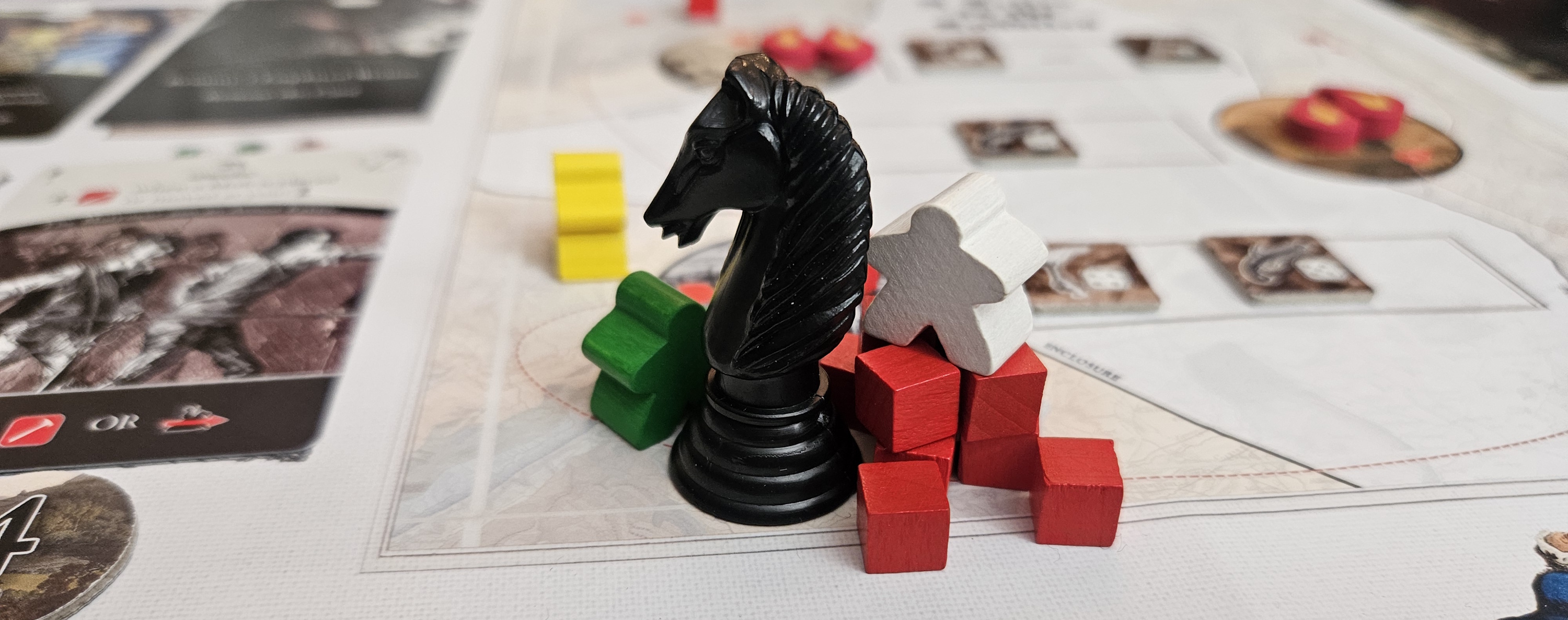
Goldstein presents the Luddite movement from two vantages. There’s the sky-high perspective, showing the three epicenters of Luddite activity in Nottinghamshire, Yorkshire, and Lancashire. This portion has the look of a traditional historical simulation game: there are enclosures for unemployed laborers, mills where workers or mobs can congregate, and a chess knight making the rounds to crack down on anyone threatening the supply of cheap stockings and lace.
But there’s another, more intimate perspective, and it’s here that Goldstein’s approach to the Luddite movement becomes clearer. Rather than embodying the Luddites as a faceless mass, as they’ve customarily been represented by the intervening two centuries of Oxford tut-tutting, here they’re given names and faces — and, above even those signifiers, personal aspirations and fears.
It works like this. When the game opens, everybody adopts an identity. You might become George Mellor, King Ludd’s “right-hand man” who infamously assassinated the wealthiest mill owner of Yorkshire and hanged for it. Everybody at the table loses the game together if they don’t burn the map’s three mills, but Mellor must also assassinate the manufacturer, a nasty piece of work who sits at the side of the board and hoovers up cards from the deck with each passing round. This is a dangerous proposition, liable to bring the military down on the movement’s head sooner than later, ensuring that Mellor’s appearance lends the session a riotous edge.
That’s the extreme end of things. The remaining identities provide other objectives, like sisters Mary and Lydia Molyneux’s desire to hold onto their family’s position in society and John Baines’ fear that the price of goods will collapse. These characters necessitate a more cautious approach, one that strives to keep as many weavers employed as possible rather than whipping everyone into a frenzy. These figures have been brought together by a manufactured crisis, but they have stark differences of opinion on the movement’s operation.
Crucially, these identities are more than clusters of special abilities and personal objectives. Each character seeds a woe into the deck, representing a personal problem that might rear its head at any moment. They also have personal lines they refuse to cross. Elizabeth Studham has joined the Luddites to save her home and community. Will she eventually become so impassioned — some would say radicalized — by the cause that she risks exile to the colonies? The celebrity parliamentarian Lord Byron is another option, his distance from the movement reflected by a weaker pool of conspirators. Will he throw away his standing in polite society to champion laborers who hold so little in common with him? These are the questions The Nights of King Ludd asks early and often, presenting the movement as a tangle of competing interests and concerns.
The Regency gets up to no good in response to the Luddites’ no good.
The Luddite movement has always eluded easy classification. Given the revolutionary fervor on the Continent, some historians portray it as a similar moment of English class consciousness. Others interpret it as the earliest stirrings of what would become later labor reform and even Marxism.
Perhaps it’s appropriate, then, that Goldstein presents the movement in such contradictory terms. Just as the game tells its story via two vastly different scopes, and just as its characters squabble over the appropriate course of action, the game itself is suspended between identities.
On the one hand, there are familiar elements of both card-driven wargames and paxgames. There’s the river-style market, which recalls Pax Porfiriana and its many successors, while the cards themselves are multitools that hew closer to the system found in Mark Herman’s We the People and popularized by Twilight Struggle. Much of the game revolves around figuring out which cards to purchase and when to deploy them, familiar fare for anyone who’s been involved in the historical gaming scene at any point over the past three decades.
But the cards play second fiddle to the game’s real core: its dice. At heart, The Nights of King Ludd is about building a pool of dice and then rolling them to determine whether your frame-breakers have successfully broken enough frames to put a mill out of commission. This is a multi-step process. First your conspirators must organize unemployed weavers, bringing them into the movement and assembling them at the sites where their agitation will do the most good. Then they must be persuaded to take up arms and occupy the mills — both of which are testy affairs, drawing ire from the Regency and the patrolling militia. All the while, you must assemble a pool of dice that can be spent for those workers, now suitably organized and positioned, to assault the mill.
If everything goes right, a mob of weavers will enter a mill, burn it down, and disappear back into the moonlight. No need for anybody to get hurt. No trials, no hangings, no masses of deportations to Australia. Some property will be ruined, but like the historical Luddite movement these attacks will shock authorities with their targeted precision.
The hitch, as you can probably discern for yourself, it that it is exceedingly rare for everything to go right.
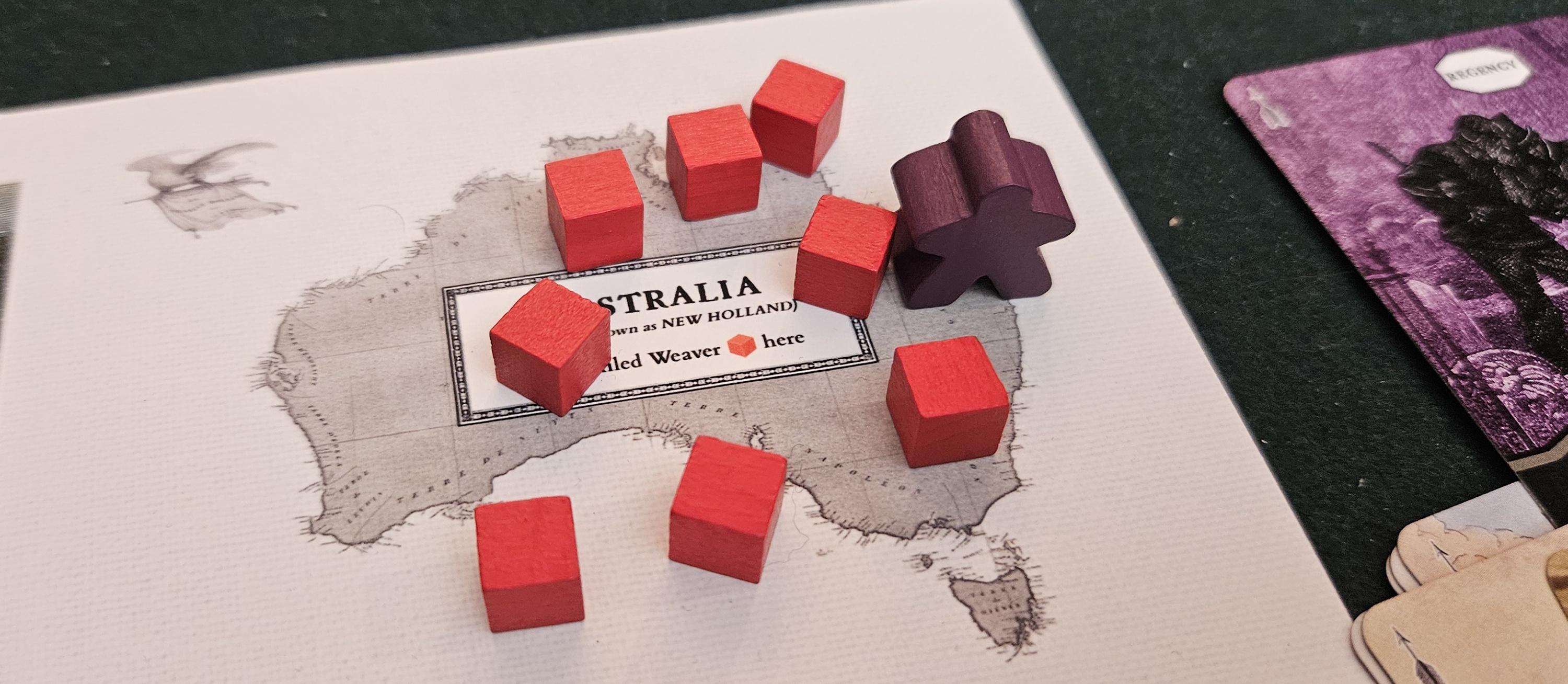
Hm. I knew those Aussies were up to something.
In practice, The Nights of King Ludd plays out like a jigsaw puzzle whose pieces keep getting hidden beneath the tablecloth, squirreled away by cranky uncles, and sometimes fed to the family dog.
Consider this. To wreck a mill, you must organize those unemployed weavers. But the passing militia will lock down entire counties at a time, sometimes for extended durations. This makes it near-impossible to organize with any precision, especially if your character is currently in hiding in the affected portion of the board. It may become necessary to wait out the occupation. Or even to bait the militia into removing itself to another region. Just be careful you don’t draw them toward a mill where your workers are on the verge of an uprising; that will exile the entire lot to Australia, severely limiting the movement’s access to manpower.
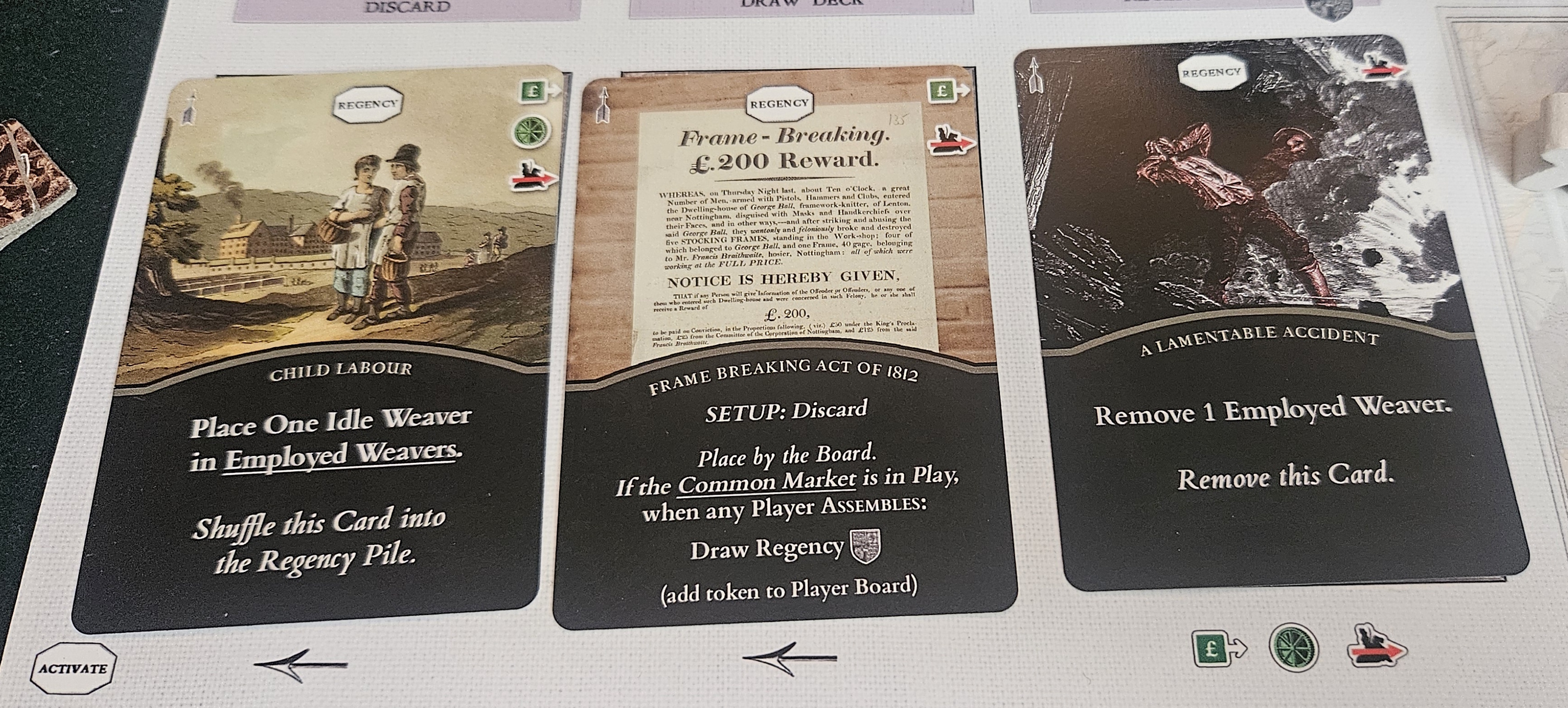
Okay, so you’re keeping an eye on the local garrison. But what about the Regency in London? Certain actions force you to draw a card from the Regency deck, and these cards are, to use the terminology of the day, a right burr in the arse. Their effects are far-ranging. Government spies tip off the authorities before a mob can act. Preemptive hangings permanently lower the ceiling on your dice pool. The cavalry show up to move the militia token two spaces instead of the usual one. Child labor and sixteen-hour workdays and workplace accidents ensure that laborers are too exhausted to resist their plight.
There are other, more transformative consequences as well. Somewhere in the game’s midsection, the card row shifts from a common pool to a laissez-faire market that’s open to those with capital — hint hint: Lord Byron still does okay — but not so much to those who actually produce its goods. This alters how players access cards. No longer is every card the same price. Now their values are tiered, requiring greater expenditures to purchase until they slide leftward in the market. It’s a remarkable flourish, illustrating the radical changes this industrializing generation underwent as food prices soared, their livelihoods were stripped, and their legal representatives were bought out by moneyed interests.
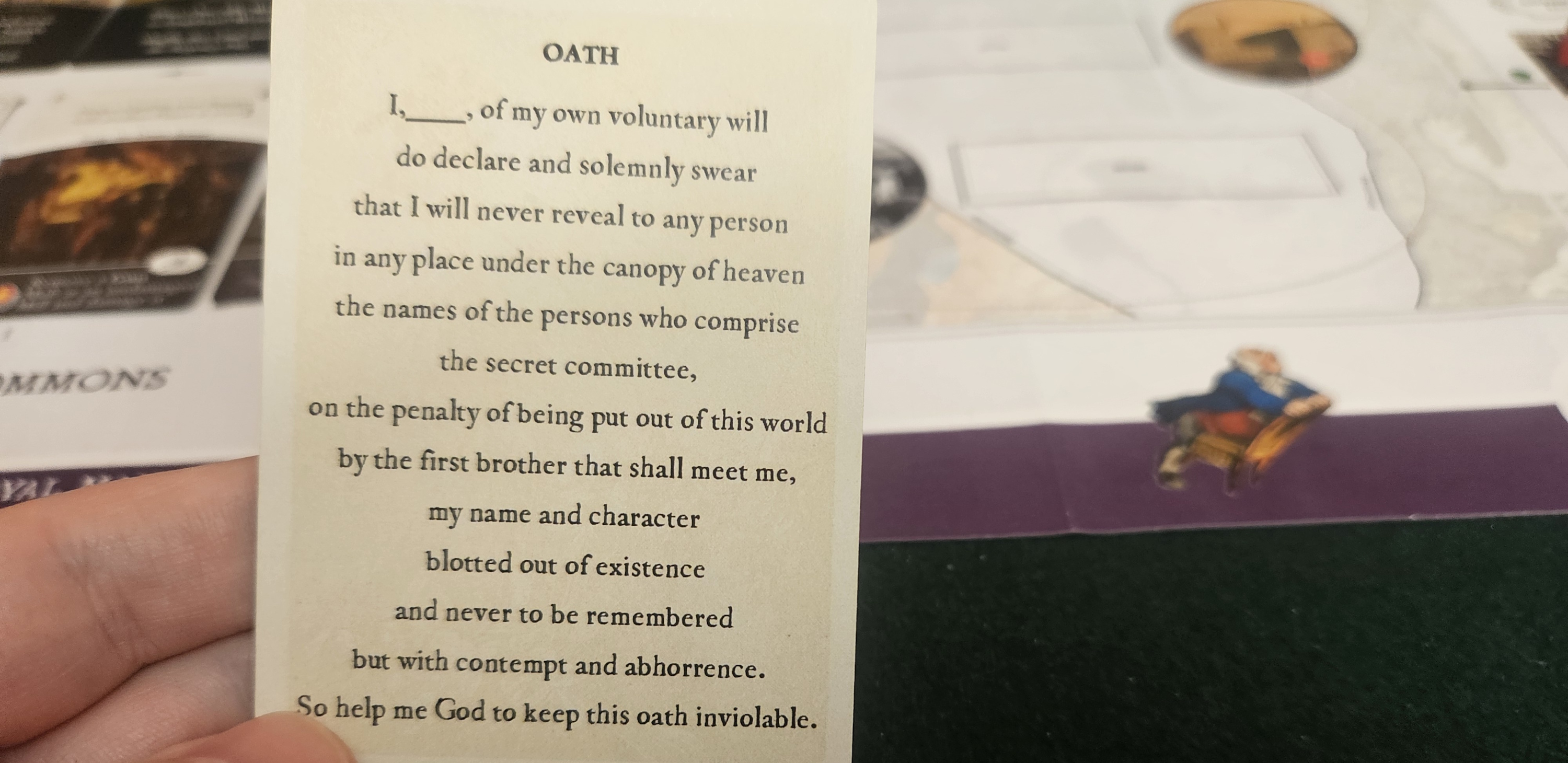
Swear me an oath!
Put together, these elements give the game the sensation of trying to keep a sinking ship afloat even as you commit mutiny. There are occasional refreshing breezes: an ambush that delays the militia’s approach, such a mass of unemployed workers that their grievances become impossible to ignore, even early attempts at establishing labor cooperatives. But make no mistake, what initially seems like a straightforward task will soon be stymied from all directions. Even when the movement’s success is secured, it often comes at the expense of a conspirator’s personal goal.
At times, it’s also an uneven task, and not only because the Regency is scrambling to protect the people with the most from having slightly less. Thanks to Goldstein’s hybrid system, The Nights of King Ludd can be tricky to operate. At any given moment, you’re operating along multiple vectors. There’s the strategic layer, with its emphasis on timing and positioning. The personal level, with its diverse objectives and abilities. The card market, always in flux, plus the gradual attentions of the Regency. Keeping in mind that I’ve only played a prototype, it’s a lot to unpick.
And then, of course, there are the dice. Goldstein provides opportunities to mitigate a flubbed roll, not to mention a few alternate tricks for damaging mills, but these options are few and far between. Most of the time, the only path forward is a healthy dice pool, a well-armed mob, and a prayer in one’s heart. There’s nothing as uniquely irksome as showing up to a mill-burning with torches and hammers, only to somehow roll all misses. Those who balked at John Company’s retirement rolls will likely find themselves similarly disappointed here.
It takes a village to burn a mill.
For my part, The Nights of King Ludd is a strange, evocative thing, as much a machine as those it seeks to break. It’s a more radical experiment than Chicago ’68, but Goldstein leverages it to similar ends, asking hard questions about who societies prioritize. Put somebody in a sack and don’t be surprised when they choose to fight their way out.
Were the Luddites doomed? Maybe. The textiles industry was transforming with or without powered mills and innovative knitting frames. Trousers were soon to supplant hosiery in popularity. Cotton and silk were growing more affordable. The United States was starting to throw their economic weight around. And, pardon my French, Napoleon was being a real butthole.
But some men chose to oil their machinery with blood. The response was fire and fury. And, yes, sometimes blood for blood. A few droplets pattered into an ocean. Once again, Goldstein has crafted a challenging, thought-provoking rumination on an oft-misplaced history, collective anger, and the depths power and capital will plumb to protect their interests. Stark, sobering, and sometimes hopeful, The Nights of King Ludd is an essential work for students of labor history and new-wave historical simulation.
A prototype of The Nights of King Ludd was temporarily provided by the designer. It is on Kickstarter right now.
(If what I’m doing at Space-Biff! is valuable to you in some way, please consider dropping by my Patreon campaign or Ko-fi. Right now, supporters can read the next installment in my series Talking About Games, this time tackling the topic of what makes a good list! Naturally, the piece includes a list.)
Spiel Essen has launched a dedicated B2B matchmaking system aimed at helping publishers, designers, retailers and other industry professionals find potential business partners and arrange meetings before arriving at the world’s biggest board game fair.
The new service, which is restricted to exhibitors and people with business visitor tickets, lets users create profiles detailing what they are looking for and what they can offer, send specific business inquiries, connect via chat and schedule appointments at the show using the built-in calendar.
Spiel said today that the system will be integrated directly into its dedicated app, adding that the move is intended to make networking between trade visitors, professionals and publishers “more targeted, simple, and effective”.
Business has long been an important part of Spiel despite its status as a public-facing convention, with major publishers operating their own dedicated B2B areas for meetings with retailers and other industry professionals.
B2B-specific companies such as manufacturers, crowdfunding services and trade organisations were still scattered across various halls in 2019, but that situation began to change after Spiel was taken over in 2022 by Merz Verlag – whose core event, Spielwarenmesse, is one of the world’s biggest B2B toy trade fairs.
Those companies began to be more concentrated in Hall 4 during the 2022 event – a move which intensified the following year amid a major reorganisation of the halls which attempted to more obviously split the fair into themed segments such as children’s games, family and light-to-medium games, expert games, tabletop and miniature games, roleplaying games and TCGs.
Florian Hess, managing director of Merz Verlag, said after last year’s record-breaking Spiel, “For exhibitors at the fair the focus is also on the joy of the games. At the same time, an incredible number of effective business developments emerge here – and this happens naturally alongside everything else.
“I don’t know of any other event that is as strong a springboard for a business’s launch as Spiel. I have met exhibitors who started here a few years ago with a small booth and are now occupying several hundred square meters and selling games internationally.
“Experiencing this kind of B2B rocket launch never ceases to fascinate me.”
Hall 3 at Spiel Essen 2025
The new system arrives as Spiel prepares for its biggest-ever event from October 22 to 25 this year – with an expansion into all eight main halls at the Messe Essen exhibition centre for the first time expected to see the event challenge its record 220,000 attendance set last year.
But despite the show bumping against its space limits at its long-time home, a Merz Verlag spokesperson told BoardGameWire in March, “We love Essen – as a venue and the city – and have no intention of leaving. For the foreseeable future SPIEL will remain in Essen as it has for more than 40 years now.”
The fair’s expansion into a seventh hall last year helped the four-day show to its record 220,000 attendance, outstripping the 209,000 visitor record it set just before the Covid-19 pandemic.
Spiel might have broken its attendance record in 2024 were it not for a self-imposed visitor cap, which limited the number of attendees each day to about 50,000 – a measure introduced alongside wider aisles post-pandemic to help visitors move around the often crowded halls more easily.
More than 920 exhibitors from 53 countries are expected at this year’s event, with Merz Verlag saying in March that demand had come both from long-term exhibitors keen to “significantly increase” their booth space, as well as an “impressive number” of first-time exhibitors hoping to attend this year.
About half of the available tickets for Thursday, Friday and Saturday have already been sold, seven weeks before the show opens, with Sunday sales currently “lagging slightly behind”, the show announced today.
Access to the matchmaking platform comes as part of Spiel’s €46 business visitor ticket, which compares with €25 for a standard adult day ticket.
Spiel Essen 2026 takes place at Messe Essen from October 22 to 25.
Galactic Cruise could extend its run of major award wins after being named a top-three finalist in this year’s Deutscher Spiele Preis, the biggest community-voted board game award in Germany.
The space tourism-themed worker placement title faces competition in the final from Ark Nova creator Mathias Wigge, who could win the award again with just his second major design – the similarly zoo-themed Sanctuary.
A win for Sanctuary would double down on Matthias Wigge’s success following the colossal performance of his debut design Ark Nova, which as well as becoming the second-highest ranked game on BoardGameGeek has been a sensation on digital gaming platform BoardGameArena, with more than 13 million games played since its online launch in May 2023..
That latter title, which made designer Reiner Knizia the first person to complete a clean sweep of the Spiel des Jahres, Kennerspiel des Jahres and Kinderspiel des Jahres awards, finished sixth in this year’s DSP vote.
The Lord of the Rings: Fate of the Fellowship, another game which has already enjoyed significant awards success this year, finished just outside the top three finalists in this year’s DSP.
Take Time, which won the Austrian game of the year and Swiss Gamers Award this year, took fifth place in the DSP, ahead of Rebirth, Cozy Stickerville, River of Gold, Star Trek: Captain’s Chair and Forest Shuffle – Dartmoor.
Asmodee-owned studios secured four places in the Top 10: Z-Man with Fate of the Fellowship, Libellud with Take Time, Unexpected Games with Cozy Stickerville and Lookout with Forest Shuffle – Dartmoore – although none managed to break into the top three.
Other recent DSP winners have included Planet Unknown in 2023, Ark Nova in 2022 and Lost Ruins of Arnak in 2021, following The Crew, Wingspan, Azul and Terraforming Mars among winners from the previous decade.
The 2026 DSP is open to standalone games released in German between May 1, 2025 and April 30 this year, with voting open to people living in Germany, Austria and Switzerland.
Merz Verlag, which has presented the award since 1990, said “many thousands” of people voted during the three-month voting period.
The children’s DSP has also named its top three finalists: Mooki Island from designer Florian Sirieix, Paleolino from Marco Teubner, and Toriki: The Castaway Island by Wojciech Grajkowski.
The smallest but most persistent indignity of our current digital age is the way we have all, every one of us, been press-ganged into service as human CAPTCHAs. You know, the Completely Automated Public Turing test to tell Computers and Humans Apart, as tortured an acronym as ever there was. How many bicycles are there in this image? Is that a stop sign or merely a reflection of a stop sign? Is this story real or fake? The computer can’t tell the difference. Which means you can’t ping your lost iPhone without decoding the golem’s underlying logic.
Kasper Lapp, it seems, fashions games with my discomfort as their first design principle. First it was That’s Not a Hat. Now it’s Totally Human.
I dislike Totally Human. But at least I dislike it for reasons that mark it as a very interesting game indeed.
Uh oh. I’m an alien. No worries. I’ll just have you for dinner.
Imagine this. Your society, previously flawed but functional enough in principle, has been overrun by aliens. Aliens who eat humans. These aliens look like us, talk like us, even make art like us. But these things made by aliens are not human in nature. Oh no. They are the regurgitated mass of all that is human. Always backward, never forward. Remixed, never created. Always the tiniest scooch off.
That’s because the aliens are ChatGPT, hahahaaaaaaaaa
Calm down, Dan. Sometimes an alien is an alien.
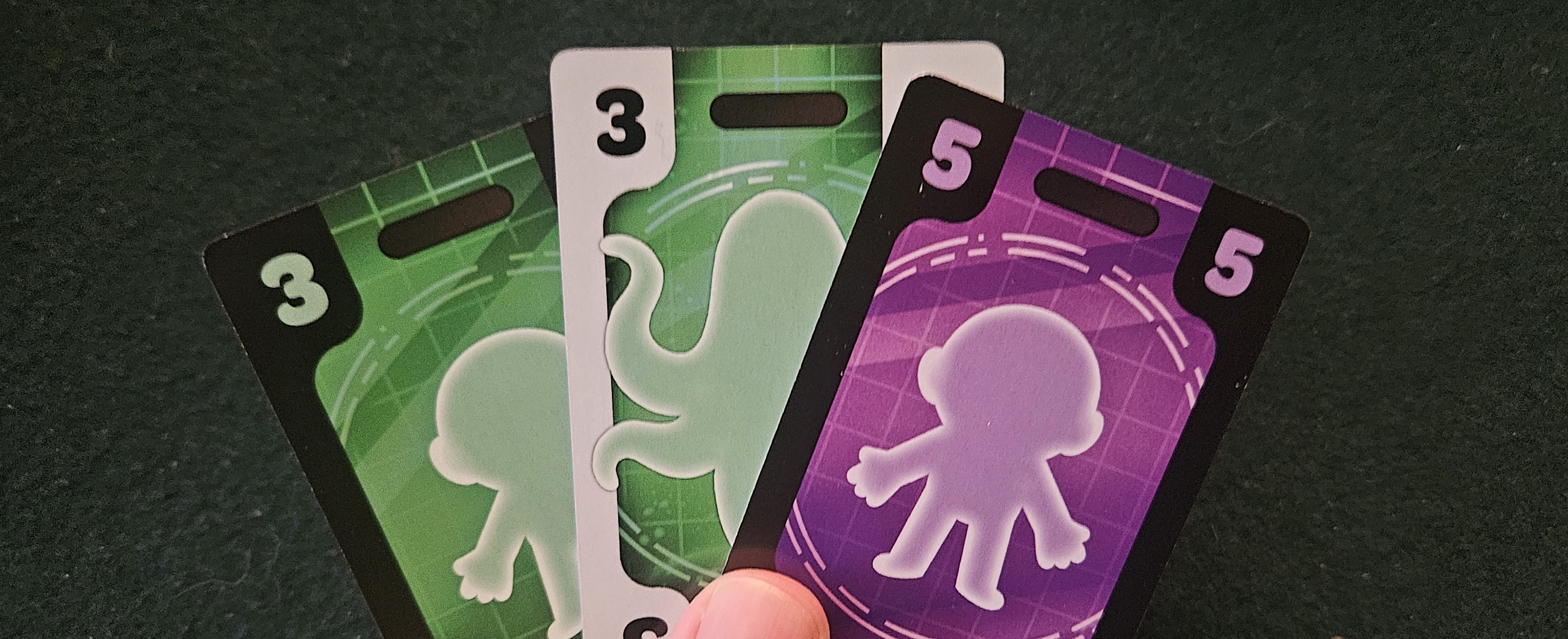
You draw three numbered cards. If the whole trio shows the outline of an ordinary human, congratulations, you are an ensouled being fashioned through millions of years of evolution and perhaps the consciousness of the universe itself. If, on the other hand, even a single one of these cards shows an alien, sorry, you’re an alien. Your sole purpose in life is to snack on humans.
Because of the alien invasion, the humans are boarding shuttles to start new colonies somewhere far from Earth. But first, they need to sort through who’s who, lest the colonists get eaten en route like the crew in that one movie (spoiler). How will they accomplish this — DNA scans? Deep behavioral analyses? Having the applicants draw a picture of a person that doesn’t look like a bizarre homunculus?
No. By answering three abstract questions that set the hairs on the back of our neck prickling. The world’s ending, and we’re gonna Voight-Kampff our way through to the other side.
So. What’s the answer? Punk.
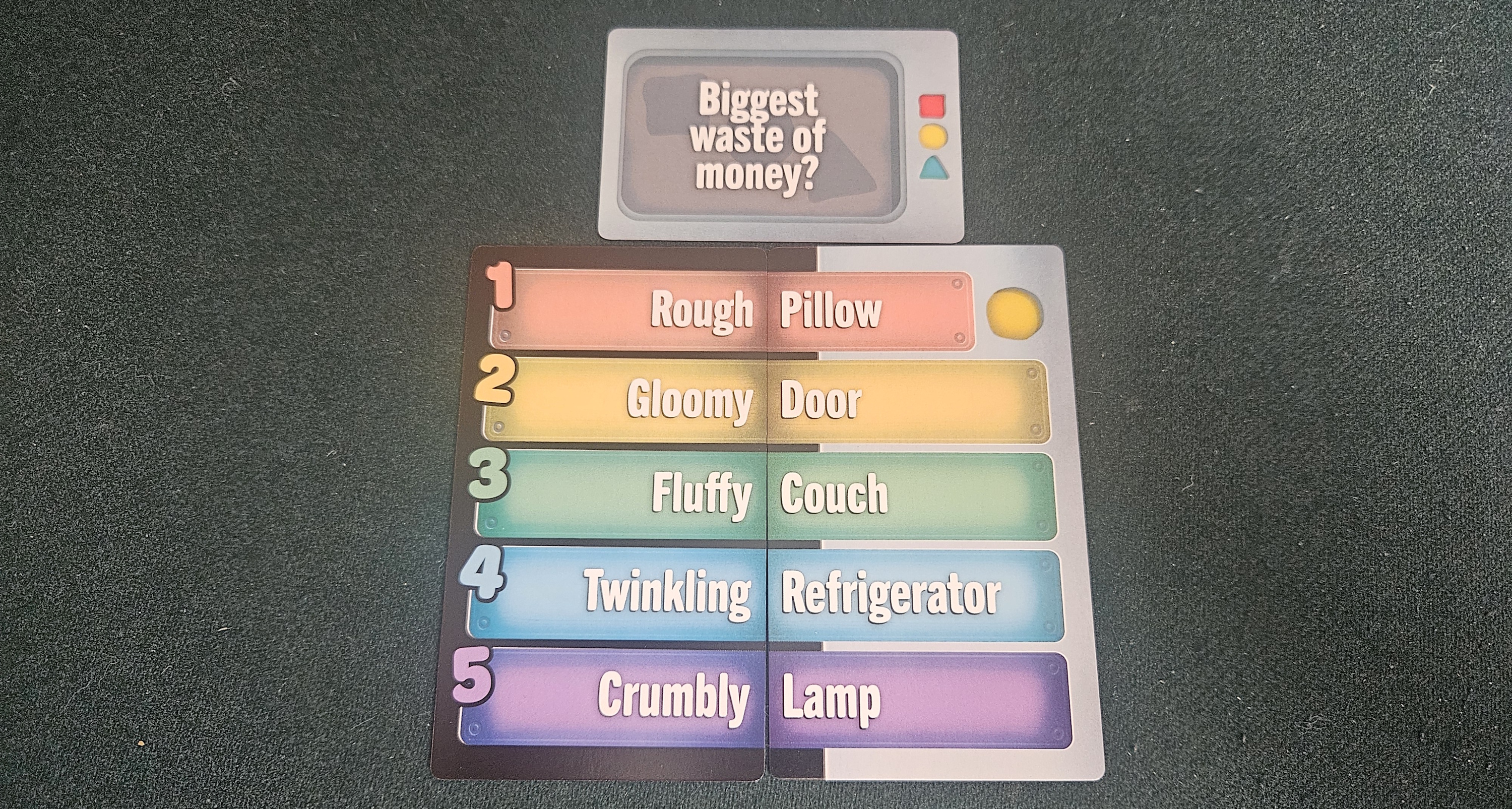
These questions are procedurally generated — not unlike a CAPTCHA. There are three components. First, the question. Second, a bunch of adjectives. Third, some nouns. This produces a five-fold multiple-choice test.
For example, you might be asked about the best name for a punk band. Is it (1) Slimy Cloud (2) Slow River (3) Unreliable Volcano (4) Well-Oiled Tree (5) Noisy Flower. Everybody simultaneously plays a card that reveals their chosen answer.
Here’s the catch that might force an alien to tip its tentacle. Humans can answer the questions however they like. But the aliens among us, they’re more limited. When they drew those three cards at the beginning, they received three numbers. Those are the digits they must use to answer the three questions posed by the game. They can choose the order they use the numbers, spending them like, I dunno, digital tokens or whatever, but they’re required to use those exact numbers.
In the case of the above question, the table’s answers will hopefully prove revealing. You’ll discover which of your friends listen to punk, those whose entire conception of punk is Green Day, and perhaps, if you aren’t so snobby that you airlock anyone who can sing all nine minutes of “Jesus of Suburbia,” which of your buddies is actually a stochastic nightmare that repeatedly consumes, vomits, and re-consumes humanity’s efforts at culture.
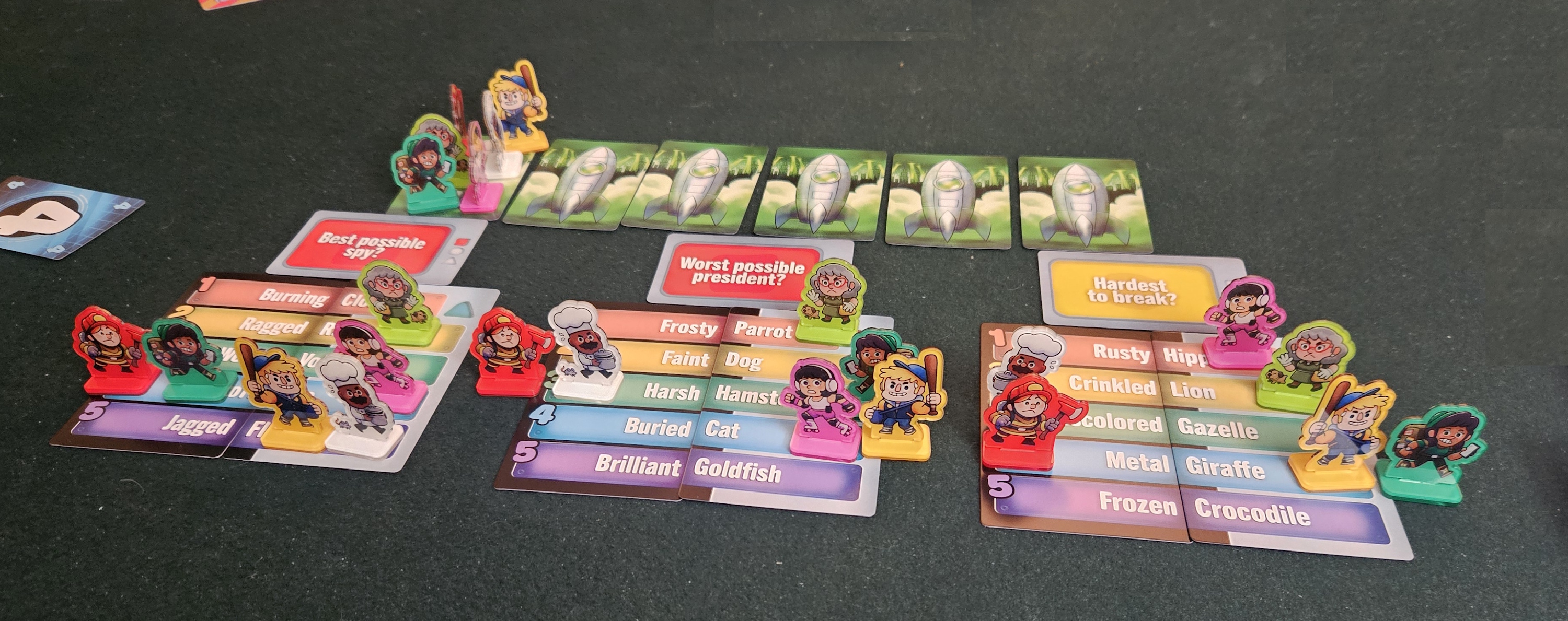
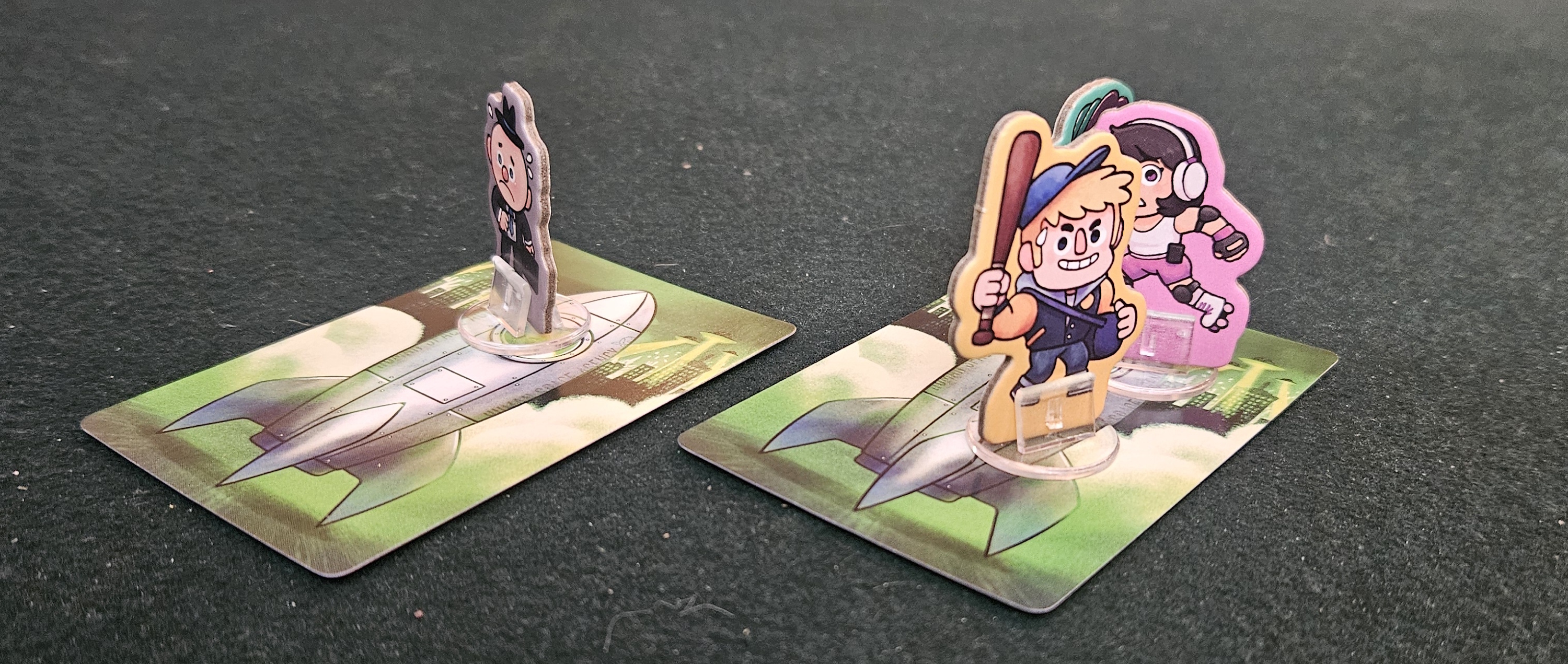
Once all three questions have been asked and answered, it’s time to climb aboard the rocket ships. Humans win by securing a spot on the most-populous colony ship. For genetic diversity in reproduction, obviously. Also, they would prefer to not be torn limb from limb. Aliens, meanwhile, win by eating a human. Usually this results in a spectrum of success, with a few humans blasting off into the cosmos while one or two aliens secure the necessary calories to survive for one more day.
Three questions. That’s all you get.
Conceptually, Totally Human is intriguing. It taps into that wonky space of our brains that’s more intuitive than logical, especially when it comes to in- and out-grouping. While some questions are more obvious than others, plenty are full of gray spaces for players to squabble over and, sometimes, to get lost in. Is it harder to break a rusty hippopotamus (because hippopotamuses are the sturdiest animal on land) or a metal giraffe (because it’s metal)? Is there really a “best” thing to put into a hundred-year time capsule? Is Green Day punk?
And then, when it comes time to load the rockets, the ensuing debates are also vibe-based, reaching into a rucksack of mammalian instincts. On Bluesky, there was recently some discussion about the value of small talk beyond allaying boredom at a social event, such as establishing to fellow apes that you’re a friend rather than an aggressor — and, as an extension of that, the way neurodivergent folks might feel alienated by such a state of affairs. Totally Human could function as a ludic expression of that entire conversation. When there are aliens in our ranks, it’s often better to move with the crowd than to have a good reason for why you stand slightly apart from baseline. When one is perhaps a little alien, the consequences can be severe no matter how benign the distinction.
This makes Totally Human interesting to talk about, but not always enjoyable to experience. And I don’t mean in the usual way for social deduction games, where deception sometimes rankles those who prefer forthrightness. Totally Human wrings the concealment angle of the genre into a sort of social deduction distillate. It’s about hiding in plain sight and little else. You’re given the option to discuss and defend the team’s Q&A sessions, but either the questions are so binary that folks either fit the metric or they don’t, or else they’re so vague that very little can be gleaned from them. In either case, either you hide with at least one of your fellows or you wind up on the outside looking in, human or no.
Blastoff! Hope you aren’t hobnobbing with a flesh-eating alien.
As a get-to-know-you game, there’s some value to be had here. Not only because you get to ask and answer silly questions, which provides an avenue for further insight into the socially anxious apes seated at your kitchen table, but also because those questions often lead down more interesting avenues. Provided you don’t shy away from all forms of small talk. In which case, you really should avoid this particular campfire.
For everyone else, Totally Human is totally fine. Personally, I wish its gameplay lived up to its premise. Beyond illustrating our tendency to cluster more closely with those who say the right words in the right sequences, there’s very little to see here. Maybe it’s a question of fatigue. In a world where every feed has become an extended CAPTCHA, it turns out I would rather not role-play as one, even for a mere quarter hour. My verdict: interesting but unsatisfying.
A complimentary copy of Totally Human was provided by the publisher.
(If what I’m doing at Space-Biff! is valuable to you in some way, please consider dropping by my Patreon campaign or Ko-fi. Right now, supporters can read the next installment in my series Talking About Games, this time tackling the topic of what makes a good list! Naturally, the piece includes a list.)
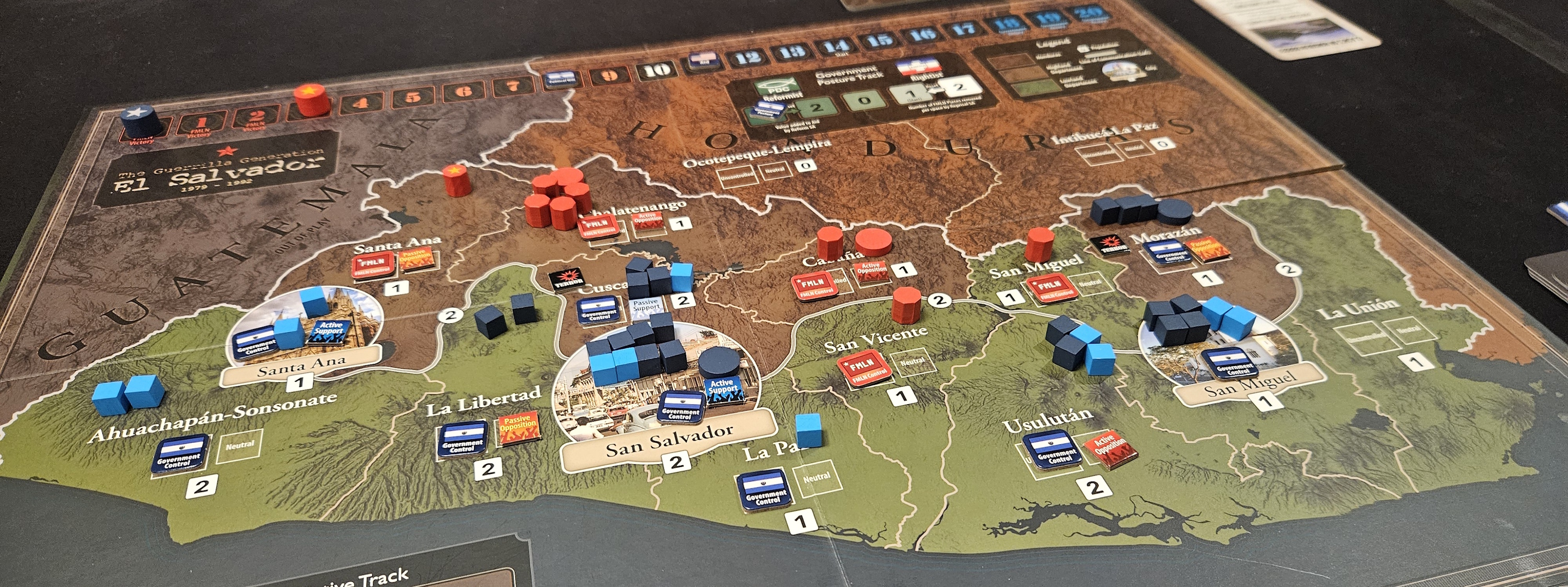
At long last, we’re nearing the end. After Uruguay, Peru, and Nicaragua, El Salvador is the fourth and final scenario in Stephen Rangazas’s The Guerrilla Generation. We’ve seen urban resistance movements that neglected to reach the people they were bent on liberating, a cult-of-personality communist party who went to any lengths to maintain their doctrines, and far-right death squads whose activities were so vicious that they became invaders of their own country. Now, in El Salvador, we’re going to see a little bit of everything as the FMLN launches its first offensive against the government in January 1981.
But the story doesn’t begin there. It never does. History is a story, and stories need beginnings. But reality is not a story. There are any number of root causes to this particular insurrection. We might begin with Farabundo Martí, from whom the FMLN drew its name. He was executed by firing squad in 1938 after his uprising of peasants was massacred by the government. Or we could start with that regime’s formation in 1931 through coup d’état and its repressive rule for more than four decades.
This time, however, the most suitable starting point is a priest: Óscar Romero.
One of the many murals of Óscar Romero.
Óscar Romero was appointed the fourth archbishop of San Salvador in 1977. A native Salvadoran, Romero was a social conservative, and indeed this was one of the reasons his appointment had been considered. The priesthood of El Salvador had long been divided along social lines, with some priests supporting stability while others favored “liberation theology.” This was a relatively new strain of Catholic thought, born out of the Latin American revolutions and foreign interventions of the ’60s. As with any issue of dogma, there were contrasting definitions of liberation theology, but the gist was that the poor and downtrodden were being deliberately kept in place by both individuals and systems, and that good Christians were therefore called upon to reflect the living ministry of Jesus Christ by rectifying their suffering. Priests who supported liberation theology, then, tended to be sympathetic toward Marxist thought and communist guerrillas, while those critical of it fell into the opposite camp. Romero’s appointment was accepted with relief by the regime. Unsurprisingly, the liberationists were bitterly disappointed.
(Sidenote: North American and European readers might note a similarity between liberation theology and the concept of “woke” as it originated among African-Americans in the Jim Crow-era United States. These strands of thought arose from different sources, but as a quick and dirty analog one could do a lot worse. Short version: you are being kept poor on purpose, the jackboots have it in for you, and it behooves young people to get woke to reality so they can survive this hostile state of affairs.)
Only a month after Romero’s appointment to San Salvador, one of his personal friends, the Jesuit priest Rutilio Grande, was assassinated. This came as a shock to Romero. After all, Grande had been one of the good ones. Despite speaking out against the government on certain issues, he had also argued for a pastoral ministry that was disconnected from Marxism. After every effort to walk a middle path, he had still been gunned down by state security forces only a few miles from where he had been born. Romero requested an investigation. He was met with silence.
Another mural.
In his own words, Romero became devoted to following Grande’s path. He spoke to the people via weekly radio broadcasts, his diocese newspaper, and his sermons, repeatedly listing the government’s killings, tortures, and disappearances. When the joint military-civilian Revolutionary Government Junta proved as brutal as the military dictatorship it had replaced, he appealed to President Jimmy Carter to halt the flow of U.S. military aid and Pope John Paul II to condemn the regime. Again, silence. Even as his popularity among the people grew, it seemed everybody with access to real power was content to ignore his pleas.
Despite his inability to effect change, somebody was listening. Because that’s always how it goes with those who live by the gun. One must not only be victimized. One must be grateful for their place in life. One must submit.
In March 1980, Archbishop Romero called upon Salvadoran soldiers to reject the government’s crimes against humanity. The next day, he was shot through the heart by a gunman as he delivered a sermon at a small chapel attached to Hospital de la Divina Providencia. His funeral was attended by a massacre in the streets. The shooters fired from rooftops with rifles and threw smoke bombs into the crowds of mourners. At least thirty were killed. In response, José Napoleón Duarte, four years in advance of his presidency, blamed both sides of the political spectrum for the violence, and used it as pretext to decline an official inquiry into Romero’s murder. The meddlesome Archbishop, whom the regime had welcomed only three years earlier, had been silenced for good.
The FMLN launches one of their offensives.
Nine months later, the FMLN launched its first offensive against the government.
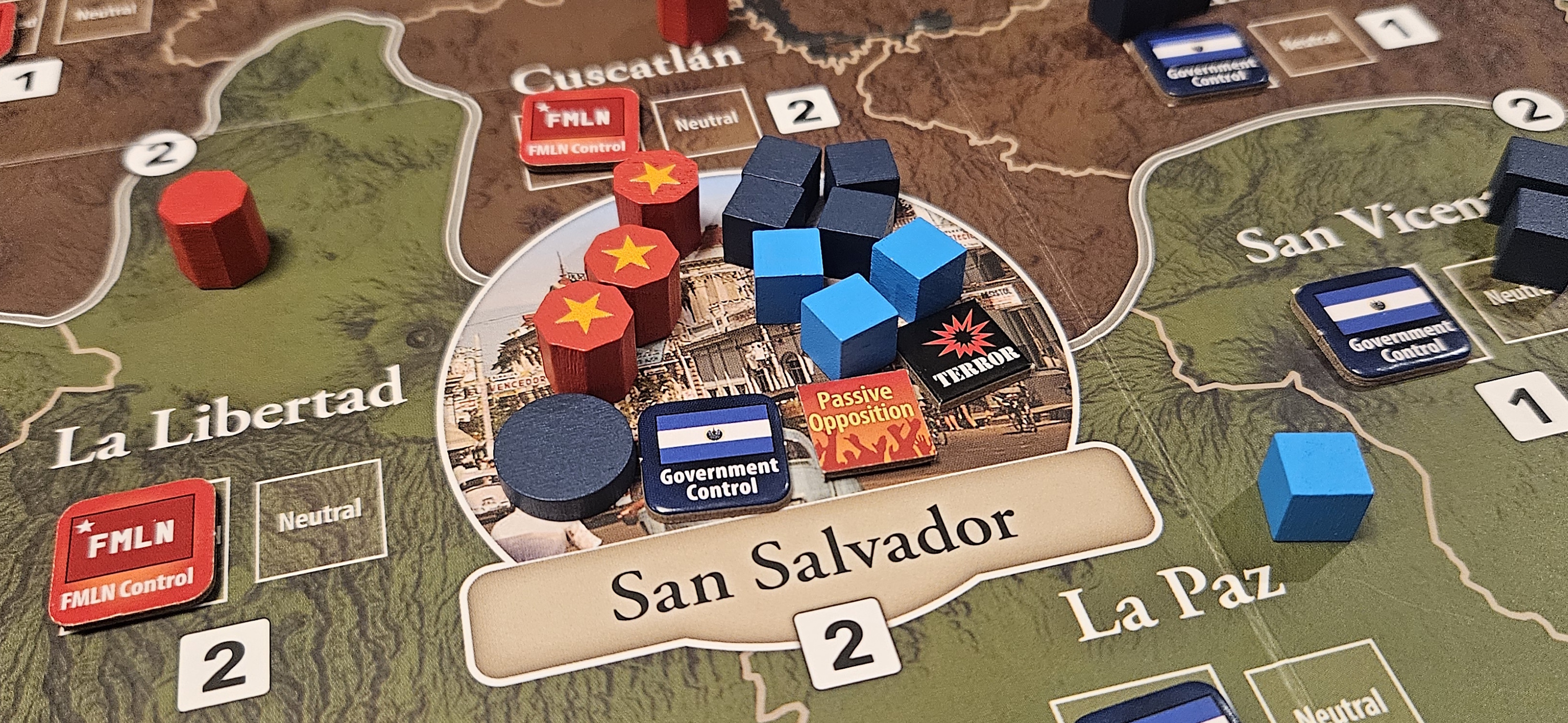
This is where the fourth scenario of The Guerrilla Generation begins. The FMLN, fed up with the government’s constant human rights abuses, rolls from the highlands into the coastal and urban portions of the country. Potentially, large numbers of blue government cubes will be removed in an instant and the guerrillas will possess large swaths of territory. For a system that usually portrays insurgent forces as incapable of such a concerted assault, it’s a shocking opening gambit.
To accomplish this, Rangazas takes cues from a handful of earlier titles, most notably the “pivotal event” cards that made their first appearance in Mark Herman’s Fire in the Lake. At the time, these were a profound departure for the series. For those who don’t know the COIN System very well, events are normally seeded at random throughout the deck. Thanks to their chaotic appearance, they represent occurrences that fall beyond the factions’ ability to set into motion, but which one of them might leverage to their advantage. When Volko Ruhnke designed Andean Abyss, the first volume in the series, it represented a change in the way card-driven wargames presented player agency. Rather than putting every event into players’ hands — both literally and figuratively — factions were now presented as reactive. Something would happen: a massacre, the death of a politician, an influx of war materiel from an interested third-party nation. And then you, the player, would decide whether that event was worth acting upon.
Fire in the Lake presented another option. Some events, Herman’s system argued, represented moments of clear player agency. It wouldn’t make any sense for the Tet Offensive to blindside the Viet Cong, for example. So each player was given a single pivotal event. One card in their hand, which could be used at the player’s discretion to cancel an ordinary event and launch a special action.
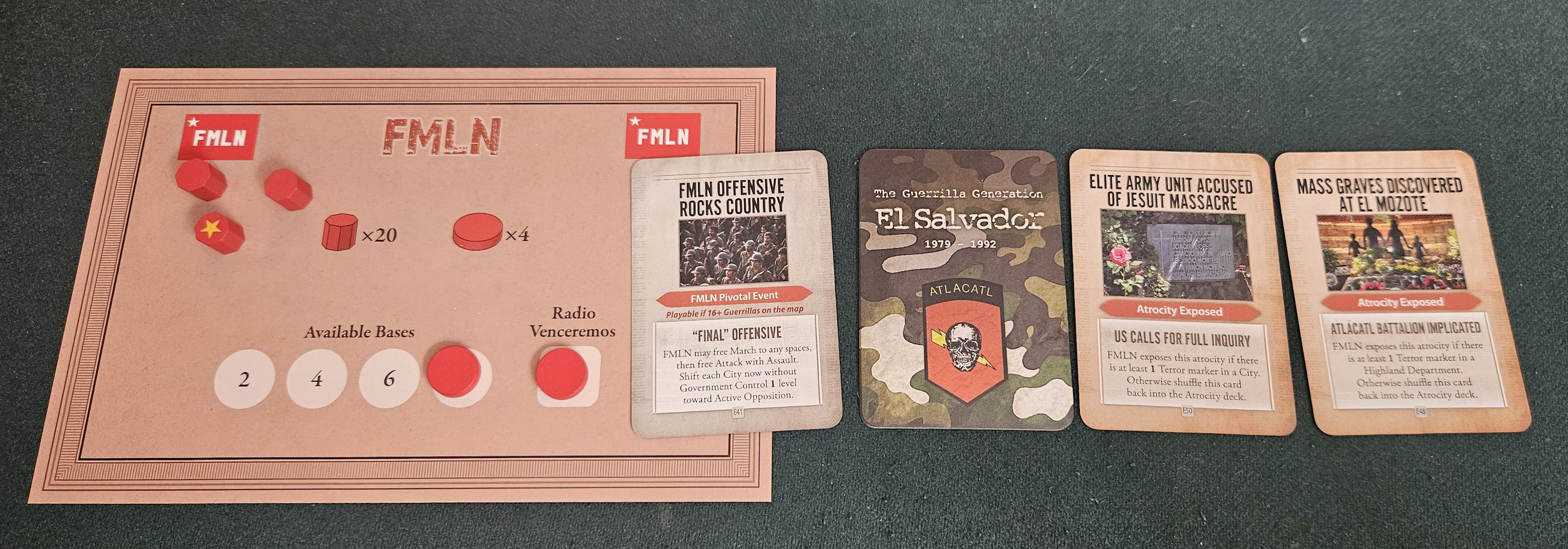
The El Salvador scenario begins with one such event. Only in this case, the event has already been played. “FMLN Offensive Rocks Country” starts on the table. All at once, the FMLN, which the game presumes is largely in its historical situation as of January 1981, undertakes a country-spanning sweep. It won’t be enough to topple the regime, as FMLN leaders had hoped historically. But it sets the tone for what’s to come. This is a knock-down drag-out fight. The FMLN is significantly tougher than most of the series’ insurgencies; the Government, significantly weaker. But the Government has a prize trainer in its corner. The United States. Duh. And the U.S. is currently packing the Government’s gloves with enough silver eagles for a knockout punch.
Uncovering the regime’s war crimes.
From there, the scenario settles back into the system’s usual rhythm of events and faction activities. It isn’t long before both sides begin to have money trouble. The FMLN isn’t as willing to extort the local populace as some of its peers in other volumes. Managing its finances is a slow process, requiring careful spending and hard tradeoffs between building local support or using local resources to maintain their momentum.
The Government, meanwhile, is similarly pressed. There simply isn’t enough in the coffers to resist the FMLN’s offensive. This is where the United States rears its head. As in many previous volumes, the Government’s resources are bolstered by an Aid marker. Rather than releasing a trickle of resources at pre-appointed intervals, however, here Aid functions as a secondary cash reserve, with the niggling problem that the Government can only avail themselves of this pool for certain operations. Basically, while the U.S. is happy to send endless bundles of cash to resupply Government forces in urban centers, Congress balks when a massacre shows up on the evening news. It’s a testy relationship, one that encourages the appearance of stability even as the FMLN claims additional territory outside the cities.
It’s also the COIN System at its most ideological. In the past, I’ve critiqued the series as being frustratingly “blind” when it comes to ideology — and by extension, of defaulting to a conservative position that elides the nuances that underpin these conflicts. Basically, COIN’s emphasis on procedure excels at “what” and “how,” but usually flubs the “why.” We see the outcomes of ideology — the tanks and planes, the massacres and coverups, the boots on the ground — but not so much the reason those tanks were delivered to faraway places, the regime’s need to conceal those massacres, or the half-truths that were sold to the public to convince them to sacrifice their young men and women to fight a war that has nothing to do with them. It’s not especially far-fetched to see in titles like Land and Freedom, Versailles 1919, and Revolutions an ideological intervention into a system that was, itself, a procedural intervention on the card-driven wargames that came before it.
“Reform” can be misleading.
I don’t know if Stephen Rangazas is the strongest designer to handle the COIN System to date, but he makes a good case for being the most clear-eyed. Both of El Salvador’s factions are uniquely hemmed in by ideological concerns. In addition to their desire to govern the populace, the FMLN must uncover and promulgate the reason for their offensive. The why to the what. They do this by revealing cards from a personal deck to demonstrate the Government’s crimes against its citizens. Crimes that would continue over the twelve-year course of the Civil War, with the post-war commission stating that security forces were responsible for eighty-five percent of civilian casualties. By revealing these crimes, the FMLN doesn’t bolster their position immediately, and even risks the occasional backfire when the wrong card is revealed. They are, in effect, building a case during wartime for how the peace will be conducted.
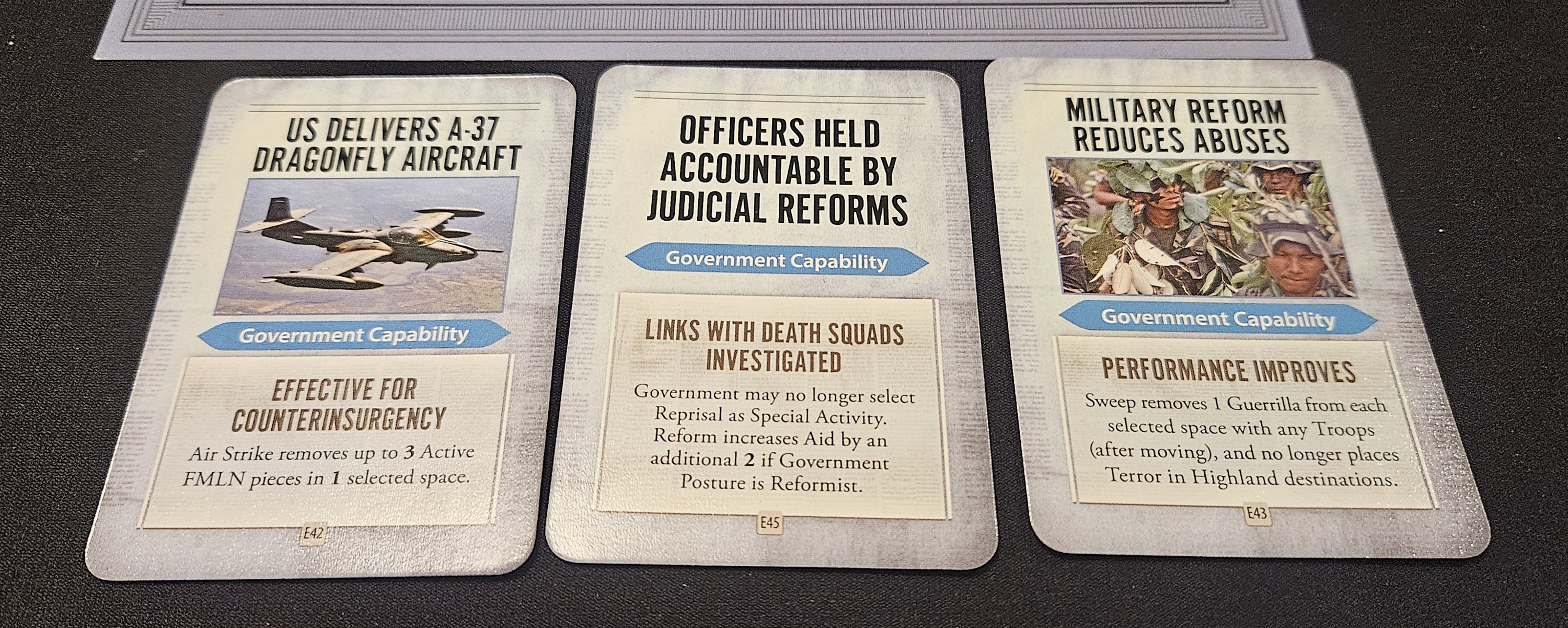
For the Government’s part, they’re asked to walk a tightrope between taking a hard rightist stance toward the insurgency or introducing reforms to rein in their troops. (And secure greater U.S. Aid, but surely that isn’t the prime motivator. Right?) As these reforms are embraced, it becomes harder to conduct reprisals. And the Government is positively horny to conduct reprisals. It’s the easiest way to batter the population into… well, not supporting the Government, but at least they won’t be supporting the FMLN either.
It isn’t long before El Salvador becomes a zombie state, completely bankrupted and in thrall to foreign funding. It’s a stark ludic representation of a regime that has bought its continued right to abuse its citizenry by indebting itself to a hemispheric hegemony whose interests shift with the wind. Or, in game terms, with a whole bunch of event cards.
In some ways, the scenario pulls up short. There is no card for Óscar Romero. Perhaps his assassination came too early for the game to model. Robert D’Aubuisson, the death squad commander who ordered Romero’s death, he has a card. It isn’t flattering, reflecting his antagonistic nature and inability to avoid controversy. That’s as close to the Archbishop as the game gets. His absence is a reminder that no simulation reaches every corner, no matter how long the broom’s handle.
I’m in there somewhere. Don’t look, though. Please don’t.
The one time I visited El Salvador, as a member of an ophthalmic surgical mission in early 2019, Óscar Romero was everywhere. We were hosted in Juayúa by a Catholic retreat, so the imagery of St. Romero was unsurprising, especially given his canonization only a few months earlier. But his visage appeared everywhere beyond the compound walls as well. On the streets of San Salvador, beside the walls of coffee plantations, inside coffee shops. A plaque marked where bullets had penetrated the wall during his funeral massacre.
Growing up, my Father was deeply conservative, but with a compassionate streak that suited his status as a medical doctor. When he began visiting Latin America to perform cataract surgeries — one eye per patient so the surgical team could double how many people they treated — he underwent a transformation. His nature grew more thoughtful; his veneration of Ronald Reagan and Teddy Roosevelt melted away. He began reading books about saints. Little by little, he started talking with more frustration and less condemnation about the state of the poor.
We also started getting along a bit better. But that’s neither here nor there.
I went with him in 2019 because he sensed this might be one of the last trips he had in him. The pandemic hadn’t been declared in our hemisphere yet, but the medical community could see the writing on the wall, and political changes were threatening to make El Salvador even harder to visit. So I accepted his invitation, renewed my expired passport in a panic, and off we went.
There’s no need to bore you with the details. The indigence was extreme, but all poverty has the same leanness. The defining moment came a few months after the trip, when I related how one of our fellow volunteers had called the people “lazy.” Dad, who all my life had complained about panhandlers and freeloaders and takers, suddenly roared, with such force that I think it surprised him as much as me, “They’re not lazy. They’re poor.”
I’ve always been proud of my Father. For his work ethic. For how much he reads. For putting up with a son who’s totally unlike him. But in that moment, I became proud of his ability to change.
It’s possible for the government to find their footing. But at what cost?
When it comes to the COIN Series, El Salvador and The Guerrilla Generation more broadly also represent a change. As a system, COIN has sometimes been insightful and sometimes been blinkered. Often it has been both things in the same volume. With Rangazas’s work in this multipack and The British Way, it becomes something else. It tells a slightly different story, one less about counterinsurgent procedures and more about the systems that brought about these insurgencies in the first place.
Or, as Óscar Romero put it in his second pastoral letter, delivered at the Feast of the Transfiguration shortly after his appointment to San Salvador and the murder of his friend Rutilio Grande: “The Church has, quite rightly, denounced sin. Certainly she has denounced personal sins, and she has also denounced the sin that perverts relationships between persons, especially at the family level. But she has begun to recall now something that, at the Church’s beginning, was fundamental: social sin — the crystallization of individual sins into permanent structures that keep sin in being, and make its force to be felt by the majority of the people.”
Next time, we’ll examine those systems from afar via The Guerrilla Generation’s meta-campaign, which combines Nicaragua and El Salvador in Resisting Reagan.
A complimentary copy of The Guerrilla Generation was provided by the publisher.
(If what I’m doing at Space-Biff! is valuable to you in some way, please consider dropping by my Patreon campaign or Ko-fi. Right now, supporters can read the next installment in my series Talking About Games, this time tackling the topic of what makes a good list! Naturally, the piece includes a list.)
Asmodee has continued its revived acquisitions spree by picking up the Welcome To… IP and game range from French publisher Blue Cocker.
The deal hands the board game publishing and distribution giant control of a flip-and-write series which has sold hundreds of thousands of copies since Benoit Turpin’s breakout design Welcome To Your Perfect Home was released in 2018.
Subsequent releases have included standalone sequels Welcome to the Moon and Welcome to New Las Vegas, while its implementation on online platform Board Game Arena has racked up more than 3 million played games, and averages over 3,000 unique players daily.
More new versions seem likely to be on the way following the acquisition, with Asmodee head of collections Mathieu Aubert saying, “This acquisition goes beyond bringing a strong IP into our portfolio. We see huge potential to expand the Welcome To… universe, and the team already has plenty of ideas to bring it to life. I look forward to sharing more about our projects in the coming month.”
Asmodee CEO Thomas Koegler said during the announcement of the revived M&A strategy that many of its targets were businesses it already knew “in and out” through existing commercial relationships.
Asmodee CEO Thomas Koegler
Hespecifically highlighted publishers behind successful games it already distributed as potential targets, alongside social and party game businesses and IPs, hobby game studios and local distributors.
Welcome To… fits withing that strategy, with Asmodee already handling Blue Cocker titles in markets including the UK and US. In Asmodee’s home market of France, however, Welcome To… and other Blue Cocker Games are currently distributed by Hachette subsidiary BlackRock.
The original game helped popularise the flip-and-write format, replacing dice rolls common to roll-and-write games with shared cards which allow players to make their choices simultaneously.
Asmodee SVP of tabletop games Benoit Clerc said, “Welcome To… established itself as landmark titles in modern board gaming, combining elegant game design with exceptional accessibility.
“We have tremendous respect for the work accomplished by the Blue Cocker team, Benoit Turpin, and everyone who contributed to the success of the game and their different iterations.
“We are excited to welcome this intellectual property into Asmodee’s portfolio and join our line-up of great family games and look forward to building its future.”
Blue Cocker founder Alain Balay added, “From the very beginning, our ambition was to create a game that would stand the test of time and bring people together around the table.
“We are incredibly proud of everything Welcome To… has achieved over the past years, and we are confident Asmodee will now carry the brand forward and introduce it to even more players around the world.”
Blue Cocker was launched by former aeronautical engineer Balay in 2013, and operated as a one-person business until the success of Welcome To… and the company’s international sales allowed it to expand to a five-person operation in 2019, he recently told French newspaper La Gazette du Midi.
He said exports accounted for 60% of Blue Cocker’s revenue at that point, but have since fallen to just 10% amid ongoing global financial and political uncertainty.
Balay added that despite that, the French market has held up well despite concerns about a resurgence in inflation in the country.
Blue Cocker’s remaining titles include 2014’s Medieval Academy, 2016 release Meeple War and 2025’s The Last Droids, while its main 2026 release so far has been corporate deckbuilder SAN.
The company’s 15th release, the two-player cooperative title Les Yeux Fermés designed by Antonin Boccara and Julien Prothière, is slated for a 2027 release according to its BoardGameGeek page.
Forthcoming Blue Cocker release Les Yeux Fermés, designed by Antonin Boccara and Julien Prothière
Asmodee has kept its potential acquisitions tightly under wraps, but has plenty of financial firepower for further deals.
The company’s net debt, meanwhile, stood at 1.6x adjusted EBITDA at the end of June, rising to 1.7 times once M&A commitments were included – down from 2.1 times a year earlier and comfortably below the company’s 2.5-times leverage target, given it significant headroom for M&A.
Despite Asmodee’s long-time image as a board game publishing heavyweight, more than 72% of its revenue now comes via its distribution of other companies’ games – up from an already hefty 63% in the previous financial year to March 31, 2025.
TCGs make up the lion’s share of Asmodee’s annual net sales – about 60% in the 2025/26 financial year, up from just over 50% across the preceding 12 month period.
The company’s own board game publishing operation, meanwhile, saw its net sales fall 5.8% in the last financial year – while net sales for the first quarter of this year were down 9.8% compared to the same period in 2025.
He said in response, “We have insisted a lot on the fact that one of the strengths of Asmodee is to be a publisher, but the first strength that we do have is our global reach across all categories, from TCGs and board games.
“That’s the superpower of Asmodee – and then being a very strong publisher is a way of accelerating performance.
“So I would say that there is no change, we continue to capture opportunities across the board wherever they come from… our aim is to be a dominant player, bringing all games to the market, anywhere they can.”
The move puts McGinnis into a hugely influential position within the tabletop industry. Asmodee’s chief product officer has responsibility for its studios, franchise development, licensing and studio marketing, according to the organisational structure the company published ahead of its stock market listing last year.
Ask my twelve-year-old about her favorite games and she’ll list a bunch of titles she consistently beats me at. Case in point: Six-Sided Seas. Inspired by the laminated game boards Chris Solis witnessed in Thailand board game cafes, this is a design by Kroze Kresky that limits itself to a single roll-up mat and a bunch of dice.
Forget inspirations. I keep losing to a child. A literal child. Twelve years of age, and already acquainted with an eyepatch and peg leg. She yearns for the galleon.
(sound: the distant thunder of a broadside)
As befits Six-Sided Seas’ simple format, the gameplay is a rapid-fire exchange of cannon fire, island-hopping conquest, and desperate carpentry. The whole thing takes between ten and twenty minutes, depending on how poorly one fares. If my experience is anything to go by, it’s one of those games that demands two or even three sessions in sequence. If I wanted to be reductive, I’d call it Pirate Yahtzee. You roll dice and assign them to your ship’s various stations. Once a station is full, you can remove all the dice banked there to activate its ability. The whole thing is dead simple.
But there are unexpected complexities beneath the surface. The first has to do with the way dice operate. Your crew has a certain amount of plunder, which sets the ceiling for your rolls. You can throw as many dice as you like, but busting that number means assigning a few of them to your evasion pool and tossing the rest, a paltry pity prize indeed. Hitting your plunder number, on the other hand, lets you either bump it up a space or earn an extra roll for free, effectively stretching how much you can accomplish either this turn or in the future. So you’re always playing the odds, pushing your crew a little further, and then enjoying or suffering the consequences when they rise to the occasion — or snap under the pressure.
To roll or not to roll? ‘Tis the question.
Meanwhile, the actions themselves are nicely varied. There’s the usual cannon fire, of course, and a few disruptive abilities like one that sends a barrel of grog to the enemy ship to disable the first rolled die on their next turn or another that wipes out your defensive pool of evasion dice to ram the enemy ship for beaucoup damage. Three contrasting win conditions give these pursuits some edge. Sinking the enemy is the honest option, but even a limping vessel might earn enough plunder or secure four of the contested (and bonus-bestowing) islands in the middle to win without splintering an enemy timber.
It’s minor, but it was also designed to be minor, and its minorness is one of its greatest strengths. For example, I’m compelled to lament the ram action, which I believe is horribly overpowered, especially when doubled, but it’s a maneuver that requires multiple turns to set up, strips away your protection, and may be a reflection of my daughter’s favorite strategy more than an actual imbalance. Anyway, what’s an imbalance in a game that I’ve set a world record for by losing in four minutes? As soon as I’ve been scuttled, we’re halfway positioned for the next duel. This time I’ll ram her ship. (Spoiler: She rammed my ship twice and sent it to the bottom of the ocean.)
It takes fifteen, twenty minutes to sink one of these ships.
I don’t want to damn Six-Sided Seas with faint praise; its brevity belies a real understanding of what makes dice so joyous to handle. The decisions are micro-sized, but they matter. Should I seize the island that gives me an all-important reroll — one that might prevent an untimely bust — or double the impact of my cannons? If I’m falling behind, should I play it safe with my dice or push my crew as hard as possible? There are no easy answers.
So, yes, the format matters. Six-Sided Seas is small, brief, and in some respects limited, especially with its two-player count. But I’m impressed with what Kresky and Solis have done with said format. This one would feel right at home in a game cafe, on a picnic table, or beneath the dim light of a cramped starboard cabin.
A complimentary copy of Six-Sided Seas was provided by the publisher.
(If what I’m doing at Space-Biff! is valuable to you in some way, please consider dropping by my Patreon campaign or Ko-fi. Right now, supporters can read the next installment in my series Talking About Games, this time tackling the topic of what makes a good list! Naturally, the piece includes a list.)
For today’s Space-Cast!, we’re revisiting some jerk’s nasty review from five years ago, investigating some excellent indie games, and discussing the ups and downs (but mostly ups) of self-publishing. Our guide for this journey is none other than Connor Wake, creator of Umbra Via, Out of Sorts, That’s the Spirit!, and many others.
Listen here or download here. Timestamps can be found after the jump.
TIMESTAMPS
1:05 — a reckoning with Umbra Via
28:49 — persisting through Hedged In and Hedge Mage
37:09 — Out of Sorts
58:16 — That’s the Spirit!
1:10:20 — self-publishing
(If what I’m doing at Space-Biff! is valuable to you in some way, please consider dropping by my Patreon campaign or Ko-fi. Right now, supporters can read the next installment in my series Talking About Games, this time tackling the topic of what makes a good list! Naturally, the piece includes a list.)
Every so often — although not as often as I’d like — a publisher will release a more affordable version of a beloved game, and it’s always interesting to see where they’re able to shave a buck off the original production. Cardboard becomes cardstock. Plastic miniatures lose detail or transform into standees. In the absolute worst cases, the game is streamlined. “Streamlined.” The doubt-quotes are important. Pared down, more like. Cut short. Decapitated.
Thunder Road: Ignition trails the lavish Thunder Road: Vendetta. In some ways, this is what you would expect from a product that’s more of the same but costs a third as much as the original box. Cardstock and single-injection molds. The usual.
What’s surprising about Ignition, though, is where it departs from the save-a-buck formula. It isn’t that I expected the folks at Restoration Games to churn out garbage. Far from it. But Ignition isn’t just Thunder Road Done Cheap. After only a handful of plays, my daughters, who had previously declared Vendetta one of their all-time faves, insisted Ignition was superior. To my own surprise, in many ways I agree with them.
Another day on the road.
Not that you’d know it right away. Thunder Road was a maximalist design. You could see it in every detail, even if you didn’t have access to the multi-tiered Maximum Chrome edition. The cars were assembled from multiple pieces. The helicopters had a spinning rotor. The boards and dice were chunky. And that’s before the expansions added trucks and motorcycles and super-weapons and a deathmatch arena.
By contrast, Ignition is smaller. Suitably so, but still smaller. As before, players command three vehicles as they race across the wasteland, dodging potholes and taking potshots at one another. The accoutrements are gone, none more fundamental than the original game’s whirlybirds, the toy helicopters that served to pursue anyone who broke away from the pack.
Honestly… I don’t miss all that stuff. At least not as much as I thought I would. Ignition is a return to basics. Which might present a problem if those basics weren’t superheated and accelerated to 2400 feet per second.
These are paper mats rather than heavy cardboard. There isn’t much difference.
First, the dice. The foundations are the same as before. Each round, everyone rolls four dice, then takes turns placing them one at a time on those various rigs to hurtle them down the highway. That last die could be used once per round to activate a special bonus, like weaving through traffic or sending your helicopter to bomb someone.
Very little has changed. For the most part, the dice-play is identical. Roll four. Spend three on movement. The last one goes toward a bonus action. It’s every bit as smooth and chancy as ever.
The first little differences only rear their heads once you look closer at those bonus actions. The helicopters are gone, replaced by an action that serves more or less the same purpose. This time it’s a missile, presumably launched from one of your cars, and capable of targeting anyone on the road. The only difference is that the missile doesn’t take up space on the road the way Vendetta’s helicopters did.
Or there’s the way nitro no longer moves a car by the value of the die placed on it. Instead, you get to roll the trick die and move that far. It’s a subtle but smart alteration, reducing the effect of a strong opening roll and making breakaway vehicles less likely to speed across a dozen spaces in a turn.
Or there’s the absence of the repair action. Now, if you know Thunder Road, that might sound as cracked as a wasteland warrior’s sense of self after their warlord has imparted some considerable brainwashing. No repairs? How will you keep your cars from being wrecked?
About that…
Checkpoints allow demolished vehicles to return to the race.
In Ignition, cars don’t get wrecked.
Oh, they can still crash. Or get machine-gunned to bits. Or have a missile turn them into a crater. Or speed across too much gravel after their transmission has been shredded by a landmine. Two hits and a car is out of commission.
But only for a while. Only until the next time you activate it with a die.
The answer is checkpoints. When a car is destroyed, it goes to the most recent checkpoint. From there, it reenters the race, albeit probably a little farther back then before. Also, it will be slower. It takes the car’s entire turn just to reappear on the road.
That is, unless you spend your bonus action on the option that stands in for the old repair action. Now, when you roll your car back onto the road, the jump-start action will allow it to make its full move. In most cases, this is enough to get back into the thick of things. And if not… well, maybe in those cases it’s smarter to save your bonus dice on heat-seeking missiles.
The curved roads look great and add a few new considerations.
The ramifications of this change from permanent destruction to temporary setback are far-reaching. First, I won’t pretend there aren’t any negatives. There are no more car wrecks. These were one of the original game’s coolest sights, the burnt-out husks of defeated racers turned into serious obstacles for the drivers behind them.
That said, this completely removes one of the system’s larger problems: that the back half of Vendetta’s races were considerably less interesting than their opening moments. As players lost their vehicles, turns grew shorter and more perfunctory. Fewer decisions were present. Usually the last third of the track felt like a foregone conclusion.
Now the victory condition has changed. This is a race, pure and simple, and whomever crosses the finish line with two cars is declared the winner. There’s no longer a situation — and a common situation at that — where you’ve lost so any cars that you no longer have anything to do with those remaining dice. Now you just wheel them back onto the track and keep going.
This eases some of the game’s chancier elements. Thunder Road has never been a serious game, but dulling the consequences helps to emphasize its better portions. Namely, that this is also a rather funny game. Smashing a tank into a dune buggy, only for the tank to get thrown into a wall of trash, is now wholly amusing rather than frustrating. By the same token, getting slapped with a missile right before you reach the next checkpoint offers a shadow of the finish-line blues, but its easier recovery means you haven’t lost the race. If anything, this adds some strategy to the game. Rather than investing every one of your best rolls into your fastest car, it’s often worthwhile to spread them around to ensure a damaged vehicle reaches the next checkpoint rather than getting booted back to the start of the track.
Which is all very clever. Because Ignition is definitely the smaller of these siblings, but it doesn’t feel short so much as lean and muscular. Its matches are focused and mean and hilarious. An improbable emotional blend, but one that works thanks to some ruthless development work.
Smoosh!
Everything else survives intact, at least if we’re starting from the baseline rather than the expansion stuff. The special dice, which oversee ramming and damage and shooting, are still a joy to contemplate and handle. The cars still feel distinct without needing any additional rules. The race… well, it’s still Thunder Road. Just better, in most ways.
As my seven-year-old put it, “It was so crazy when my car hit your car into the garbage!” Like the best of the recent resplendence of comedy racing games — Hot Streak, Magical Athlete, and Dino Racer — Thunder Road: Ignition feels like it was custom-built to appeal to everyone in my family, adult and child alike. Vroom vroom, sucka.
A complimentary copy of Thunder Road: Ignition was provided by the publisher.
(If what I’m doing at Space-Biff! is valuable to you in some way, please consider dropping by my Patreon campaign or Ko-fi. Right now, supporters can read the next installment in my series Talking About Games, this time tackling the topic of what makes a good list! Naturally, the piece includes a list.)
California tabletop publisher and game development studio Solis Game Studio is expanding its reach into US hobby retail through a new distribution deal with Southern Hobby, following several years of building its own catalogue through crowdfunding and direct sales.
The Massive-Verse Fighting Card Game, designed by Brian McKay, from Solis Game Studio
Its contracting work has included projects such as the Cyberpunk TCG, with Solis having led game design and development of a prototype that secured licensing for a new game.
Solis also did development work on Emerson Matsuuchi-designed Metal Gear Solid: The Board Game, and last month announced it would be the developer for the official card game of battle royale video game PUBG.
The company said Southern Hobby will distribute new Solis release Six-Sided Seas, as well as Treat, Please! and The Massive-Verse Fighting Card Game, describing the deal as a “major step forward” for the business.
The publisher has previously used crowdfunding to bring several of its games to market, with its biggest success to date 2024’s licensed Massive-Verse Fighting Card Game, designed by Brian McKay, which raised just over $50,000 from about 800 backers.
Solis has also already been selling directly to retailers through its own wholesale programme.
The publisher’s newest release, push-your-luck worker placement game Six-Sided Seas, will enter US distribution on October 2 with a $24.95 MSRP.
The two-player pirate game, designed by Kroze Kresky, is built around an unusual component format, consisting of 32 dice and a 14in by 24in edge-stitched playmat which is rolled inside the game’s box – allowing the title to be presented vertically, horizontally, or with a collapsible hangtab in retail.
Solis has previously said the idea grew from a visit to game stores in Thailand, where Chris Solis saw a store employee laminating a game board to protect it and began considering whether the board itself could instead be made from playmat material.
He said in the blog post, “When I returned home I issued an internal design challenge to my community. What does a game that is a playmat and single component look like?
“We explored a ton of really interesting designs and even did a limited release for one of them but none captured me like Six-Sided Seas by Kroze.”
Solis launched the game at Gen Con earlier this month, and said it sold all the copies it brought to the convention. Several of its scheduled learn-to-play sessions at Gen Con also sold out, according to the convention’s event listings.
In addition to founder and owner Chris Solis, the studio’s team includes developer Bryan McKay, business operations specialist John Brieger, graphic designer Katherine Boils, marketing manager Courtney Shernan, convention manager Sara Jordan and community manager Antonio Gil.
Hench is a strange, lovely beast. It’s as far as it gets from Edward Damon’s previous title, Rex Regnat, and not only because its Saturday morning cartoon vibe is a sharp contrast with that game’s public domain portraiture. They operate in distinct modes. Where Rex Regnat functioned best when everybody was attentive, Hench is a little sloppier. It’s raucous. It doesn’t mind getting grease on its shirt. It wants to throw stuff against the wall.
Players are, rather obviously, a supervillain’s henchmen. Henchpeople, according to union guidelines. It’s a role that rewards those who steal recognition for the most basic of tasks.
Observe my nefarious deeds.
When you get down to it, Hench is about a single question. Really, it’s the same question that undergirds much of modern society. On the one side, there are tangled and mutually beneficial incentives that allow us to have raspberries in winter and mass transit and airplanes that don’t fall immediately out of the sky. On the other, there’s the need to “get that bag,” as the kids say. To benefit yourself. To stay afloat at everybody else’s expense.
Perhaps Lord Nefarious, your supervillain overboss, is the stand-in for capitalism in this particular arrangement. Because in Hench, it’s necessary to work as a team to succeed. But in order to succeed succeed, you also need to stab that team in the back as often as possible.
Picture this: multiple missions, ranging from the banal (dry-clean the boss’s outfit, bully a child) to the labyrinthine (build a volcano lair, file the evil org’s taxes). Even the most trivial of these tasks requires investment from multiple henchpeople. Especially because those do-gooder heroes are always out foiling your plans, requiring regular confrontations that may well end with your face purpled and swollen, but at least you’ve kept Dr. Hero away from Evilcon East for the week.
But then, the problem. The real problem, because heroes are but the first hurdle on this particular marathon. (Marathons have hurdles now??) Everyone who contributes to a mission will earn Lord Nefarious’s esteem. But whomever contributes last to the task, the mook who’s putting the finishing touches on the job when the overboss slouches around — well, they get more credit than everybody else.
This social conundrum informs everything. Whether you bother to help a fellow henchperson fix the deathray. Whether you intercept a hero on the verge of tanking an objective. How obnoxious — how loud — you become at the table.
Everything, from the henchpeople to the heroes to the missions, are done in good humor.
For the most part, Damon leaves the answer to this question — really the answers, plural, because there’s no singular way to respond — up to the players. Hench is a restrained design in that regard. Turns, which are simultaneous, consist of picking cards and then, according to their initiative number, playing them to those various jobs. Within that rubric, there’s room to collaborate or to be as snide as possible. Even to sabotage a rival’s mission on the brink of its success. Hench isn’t proscriptive about it.
I will say, the center of this cake is a little doughy, and not only because we baked a saw into its midsection. Whether we’re talking about the missions, the heroes, or the limited henchperson powers, the tuning never feels entirely right. Hench feels like a game that would have benefited from wackier occurrences, the occasional landmine or salt-water taffy, to keep events lively.
The biggest example is the minions. Each character receives a passive ability and a couple of cards with special abilities. For a game with so much potential, it’s a limited approach. Not even the game’s cooldown system, which prevents any henchperson from playing the same one or two cards over and over again, can break its hold. Instead, players tend to play their best three cards over and over again. Some additional tinkering wouldn’t have gone amiss.
Still, I appreciate a design that keeps the focus where it’s due. Hench might not be the best imaginable version of itself, but there’s no denying that its attention never strays. The whole thing takes maybe half an hour, just long enough to let a few interoffice rivalries develop, but not so long that they grow stale. It’s a thought experiment written… not large, but big enough to illustrate its point. There’s no such thing as ethical collaboration under a dark lord. That’s my takeaway.
Nefarious deeds on cooldown.
Or maybe I just like hanging out with these weirdos. To be sure, the cast is colorful, and while their abilities are limited, they each gesture toward a more robust personality. There’s the Worm, who thrives on punishment and thus seeks out minor failures. The Brain, always out-thinking everybody around him. (Or at least imagining he is.) The Brute is a gigantic hippo. I don’t remember its abilities. But being a giant hippo’s got to count for something.
All in all, Hench is a minor but still appealing second act from an exciting up-and-comer. It isn’t as dense or piercing as Damon’s previous title, but still offers a tight half-hour experience that understands the virtue of getting out of its own way. Very much unlike a dark lord, come to think of it.
A complimentary copy of Hench was provided by the designer. It will be available at Pax West next week.
(If what I’m doing at Space-Biff! is valuable to you in some way, please consider dropping by my Patreon campaign or Ko-fi. Right now, supporters can read the next installment in my series Talking About Games, this time tackling the topic of what makes a good list! Naturally, the piece includes a list.)
Asmodee has named Exploding Kittens CEO Carly McGinnis as head of its global publishing operation, putting an executive who helped transform a record-breaking Kickstarter game into an international brand in charge of a portfolio including Catan, Ticket to Ride, 7 Wonders and Dobble/Spot It.
McGinnis has been appointed Asmodee’s chief product officer and EVP publishing to replace Jean-Sébastien de Barros, who leaves the board game giant after almost a decade at the company. She will report directly to CEO Thomas Kœgler and join Asmodee’s executive management team.
The move puts McGinnis into a hugely influential position within the tabletop industry. Asmodee’s chief product officer has responsibility for its studios, franchise development, licensing and studio marketing, according to the organisational structure the company published ahead of its stock market listing last year.
McGinnis’ promotion – Asmodee bought a 55% majority stake in Exploding Kittens at the end of 2021, and exercised its option to purchase the remaining 45% minority stake last year – also comes at an interesting point for Asmodee’s publishing business.
The company has enjoyed huge revenue growth over the past year, but much of that has been powered by its distribution operation and the booming trading card game market rather than sales of its own board games.
That picture improved during April to June, when Asmodee’s own published board game sales returned to growth – albeit by just 1.8% year-on-year – compared with a 16% increase for board games overall.
McGinnis brings to the role experience of helping build one of the board game industry’s most striking success stories of the past decade.
Last year Exploding Kittens revealed it had sold more than 60 million games as it marked a decade in business – with the company’s growth having extended well beyond the tabletop.
McGinnis helped develop Exploding Kittens’ partnership with Netflix, which expanded the property into mobile gaming and an animated series, and she was a co-executive producer on the latter.
That deal, which covers “scripted and unscripted projects” across film, television series, and other formats, came four months after Asmodee agreed a similar deal with Netflix for screen adaptations of its fellow bestseller Catan.
Netflix first teamed up with Asmodee in 2022, when the board game giant worked in the other direction to create a trio of titles based on Netflix shows Squid Game, Stranger Things and Ozark.
Those games have been followed by a Bridgerton-themed version of Love Letter, while Netflix brought Asmodee’s creations to screens for the first time in 2024 with French film Family Pack, which is based on the Werewolves of Miller’s Hollow card game.
McGinnis said of her new role, “I’ve spent the last decade building Exploding Kittens from one game into a global business, and I’m excited to bring what I’ve learned to the broader asmodee portfolio.
“We have incredible games, studios and people around the world, and I see a huge opportunity to build on those strengths, creating great new games while investing in the brands and franchises with the potential to grow for decades.”
Exploding Kittens has continued to stand out within Asmodee’s portfolio during a difficult period for parts of the US board game market.
The promotion comes as Asmodee is making a wider push into social and party games – a category where Exploding Kittens has been one of its strongest brands.
In March the company agreed to pay up to €250m for French social and party game publisher ATM Gaming, with Kœgler saying the acquisition would combine ATM’s strength in Europe with Exploding Kittens’ strong position in the US. Asmodee has said it expects the social games category to grow at between 4% and 8% annually between 2025 and 2030, compared with about 4% for the broader board games market.
It also launched US party game studio Moodbox Games last year, a move de Barros described at the time as strengthening Asmodee’s presence in a category where Exploding Kittens and Zygomatic were already seeing strong success.
McGinnis’ promotion is the latest in a string of senior personnel changes at the top of Asmodee.
In April Asmodee co-founder Philippe Mouret stepped back from his leadership role, with Julia Marcelin taking responsibility for five studios – Days of Wonder, Repos Production, Libellud, Next Move and Space Cowboys – while veteran Catan Studio head Pete Fenlon handed control of that business to former Spin Master executive Mike Bisogno.
Last November company COO Steve Buckmaster stepped down from his role driving the board game giant’s global distribution operation after almost 24 years with the company and its predecessor business in the UK, replaced by then deputy COO Marjolein Lubberman.
Asmodee said he had helped build its publishing capabilities, diversify its brand and IP portfolio and oversee the launch of what it described as its biggest trading card game to date, Star Wars: Unlimited.
Kœgler said, “I want to sincerely thank Jean-Sébastien de Barros for his instrumental leadership and contribution to asmodee over the years.
“As Chief Product Officer, he brought a strong strategic and structured approach to our product organization and built strong cross-functional teams along the way.
“With these elevated publishing capabilities of asmodee that Jean-Sébastien spearheaded, asmodee successfully launched its biggest trading card game to date and broadly diversified its brand and IP portfolios – laying an important foundation for our next phase of growth. I wish him all the best in his next chapter.”
He added, “It is with great pride that I welcome Carly to the position of chief product officer and EVP publishing, reflecting the strength of the talent within our company.
“Her product vision, international experience and collaborative leadership will be invaluable as we strengthen our global portfolio and partnerships.”
Asmodee is yet to announce McGinnis’ successor as CEO of Exploding Kittens.
2023 feels like a zillion years ago. That’s what I get for having the brain of an old-growth redwood. According to tradition, New Year, Old Year is how I revisit the titles that I declared to be the “best” in any given year. Best Week 2023 featured thirty titles over five days. Let’s see how they stack up today.
Day One! Family Stuff!
Aw. The first day of Best Week 2023 is a snapshot of a slightly younger family. These are all games I played with my kids, then aged four and nine, and it’s interesting to see which have survived the intervening two years and change.
In terms of family play, the big losers of the bunch are Fugitive and Race to the Raft, although not so much because the games aren’t good as because they’re too heady. I’d still be happy to play either of them, but their absence from my daily life is rather pronounced.
Somewhere in the middle, I would put Beacon Patrol and Lacuna. I’m actually pretty regretful that I passed along the former. Given how smitten with Blorp! my children are, despite being grossed out by its overabundance of orifices, I think they would appreciate Beacon Patrol’s gentler setting and more interesting placement puzzle. Lacuna, on the other hand, is still sitting on Cate’s shelf. She always gives it a place of priority when she rearranges her games, and insists she isn’t too old for it. I think it might be time to pull it down to see how it fares between her and her little sister. For whatever reason, though, it’s been cemented in her head as a game that’s worthwhile, something to be treasured, even if we haven’t played it in a good long while.
That leaves two titles. Fit to Print is such a banger. I wouldn’t say it’s appeared much at family time, but I tabled it again earlier this year to show some friends what could be accomplished with that Galaxy Trucker formula, and it was a hit all over again. This is another good candidate for reintroduction. (How’s that for a phrase that makes me sound like a mad scientist?) I think even the younger kiddo could now grasp the basics.
The undisputed leader of the pack is none other than Spots. Honestly, I’m not sure why I didn’t give it the number one position. Contrarianism, most likely. Cate recently introduced it to a group of friends at one of the game days she’s been hosting, and it warmed my heart to see yet another pack of children giggling over the cow that thinks it’s a dog. What a perfect game.
Road to Essen, a competition designed to showcase Vietnam’s burgeoning tabletop design scene at the world’s biggest board game fair, has returned for its second year – with organisers changing things up in the hope of helping turn publisher interest into commercial deals.
The contest was launched last year by Vietnamese board game publisher Everjoy Publishing and its global arm Everjoy Global, in an attempt to help designs from Vietnamese creators break out internationally.
Entrants receive access to workshops and playtesting, while later-stage contestants receive mentoring and jury feedback, with selected games ultimately presented to the international industry at the giant Spiel Essen board game fair in Germany.
Thinh LeHuu’s co-operative card game July, themed around Vietnam’s seventh lunar month and its Hungry Ghost festival, was named the inaugural champion last year from about 160 entries – winning over a judging panel that included Cascadia designer Randy Flynn with its “clever gameplay, polished design and cultural message”.
The 2026 competition is now under way with a theme of ‘Vietnamese Culture’, encouraging designers to draw on areas including the country’s history, legends, beliefs, festivals, folk arts, cuisine, crafts and architecture.
Rulebook cover for July, designed by Thinh LeHuu
But there is a significant change to the timetable this time around: rather than taking the winner to Spiel just weeks after the competition concludes, organisers have scheduled their next international showcase for Spiel Essen 2027.
Claire Ton, head of the organising committee for Road to Essen 2026, told BoardGameWire, “It’s a deliberate decision to give the work its best possible shot.
“A winner chosen in late 2026 can’t have a polished, publisher‑ready game on the Essen floor a few weeks later – and a rushed debut serves the designer least of all.
“Aiming this edition at SPIEL 2027 gives the winning team close to a full year to develop the game, act on the judges’ feedback, line up a publishing or distribution partner, and arrive ready to actually do business.
“It also lets us plan the Vietnamese presence at the fair properly. Getting a Vietnamese game to Essen was never really the goal – getting it there ready to sell is.”
The extra development period addresses one of the main barriers Road to Essen was created to tackle: getting games from Vietnam’s rapidly-growing community of local designers into a form that can be presented effectively to publishers and distributors outside the country.
Everjoy Global co-founder and CEO Ionah Nguyen told BoardGameWire in 2025 that Vietnam had experienced a roughly 400% increase in locally-designed games entering its market in just two years – but said designers continued to face a lack of international publishing and distribution connections, language differences, unfamiliarity with global supply chains and the cost of attending overseas shows.
Almost a year later, Ton told BoardGameWire, “The first edition did exactly what a first edition should: it put Vietnamese design in front of the world and proved there’s real appetite for it.
“We brought the games to SPIEL Essen 2025 and the response was genuinely exciting – our winning title, July, drew particular attention.
“That interest is now powering the next stage. Most of our finalists are deep in development, sharpening their games with everything they took from our international judges and from the fair floor.
“We’re building deliberately for lasting outcomes rather than quick headlines – the first publishing deals to come out of Road to Essen should be the right ones, and we’d rather bring a title to market ready to succeed than rush it out early.
“There’s a lot moving beneath the surface, and the next year is where it starts to show.”
Ton added, “We’re in the relationship‑building phase, and it’s an encouraging one. A lot of conversations were sparked at Essen – publishers wanting to understand the scene, see what’s emerging from Vietnam, and stay close to what comes next.
Thinh LeHuu collects his champion award at the Road to Essen competition in 2025
“What’s promising is that this feels less like one‑off interest in a single title and more like the early groundwork of lasting partnerships, which is exactly what a young design ecosystem needs to grow.
“The titles generating the most conversation share a clear profile: culturally distinctive, visually striking, and easy to pick up and play. Our focus this year is turning that momentum into concrete meetings and, ultimately, deals.”
That intermediary role directly addresses one of the problems Nguyen identified when Road to Essen launched: many Vietnamese designers lacked direct connections to international publishers and distributors.
She told BoardGameWire last year, “There’s no shortage of creativity in Vietnam. What we lack are bridges.”
But there are signs outside the competition that Vietnamese designers are beginning to find international publishing routes.
Mighty Boards edition of Yotei, designed by Huy Pham
Meanwhile Bunny 100 – designed by Hoang Vo and originally published by Everjoy Publishing – has secured a European release through Italian publisher DV Games.
Those developments come as designers elsewhere in Asia have had a striking 12 months in achieving recognition in the European market.
Ton said Vietnamese games’ biggest sales numbers nevertheless remain overwhelmingly driven by the country’s domestic market rather than exports, telling BoardGameWire research suggested Vietnam’s board game market reached about $100m last year at a roughly 10% growth rate.
She said, “Importantly, more of that is original Vietnamese design rather than imports, supported by a fast‑growing creator community and better retail distribution.”
Several Vietnamese-designed games are now reporting sales in the tens or hundreds of thousands of copies – like Bunny 100, Zodiac Rush and Galactic Super Beasts – thanks to the snowballing domestic market.
Ton told BoardGameWire, “The vast majority of those numbers come from Vietnam itself – and I’d argue that’s the most important part of the story, not a limitation.
“It proves there’s a large, real domestic market here: a home audience big enough to make original Vietnamese design commercially viable on its own. That’s the foundation everything else is built on.
“Export is the newer chapter – Bunny 100 into Europe through DV Games and across several Asian markets – and it’s growing, but the headline sales figures today are a signal of domestic strength first.”
This year’s contest will have an overall prize pool of about 500 million Vietnamese Dong – roughly $20,000 – split between the winner and a set of other award finalists.
They include awards for fan favourite board game, best visual design, most innovative board games, the game with most commercial potential, and best cultural representation – as well as categories for best junior creator (aged six to 15) and outstanding teen designer (ages 15 to 18).

 Anmelden