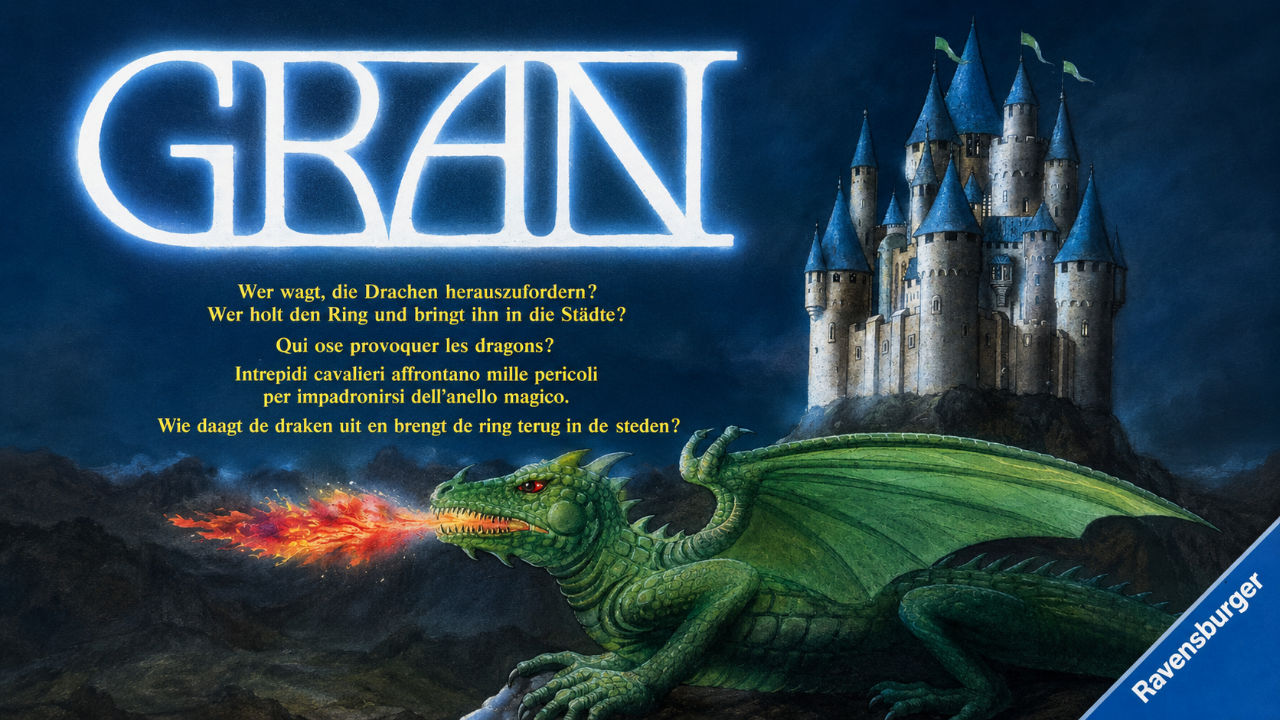
1985 haben viele in unserem Alter Herr der Ringe gelesen, Rollenspiele wie Dungeons & Dragons gespielt und Zinnfiguren angemalt.
Kurt Feyerabend und Tom Ring konnten Ravensburger überzeugen, ein Spiel in diesem Umfeld zu vermarkten. Dabei war es die Diplomarbeit von Tom zum Thema „Gestaltung eines Spieles und der begleitenden Materialien“. Ich finde es lobenswert, ein Spiel selber zu entwickeln und dann zu vermarkten. Und so merkt man dem Regelwerk und Spielfeld an, dass hier ständig weiter optimiert wurde und man aber irgendwann der Meinung war, so kann es bleiben. Acht Jahre nach diesem Werk hat Tom dann bei Ravensburger als Leiter des Produktionsdesigns begonnen.
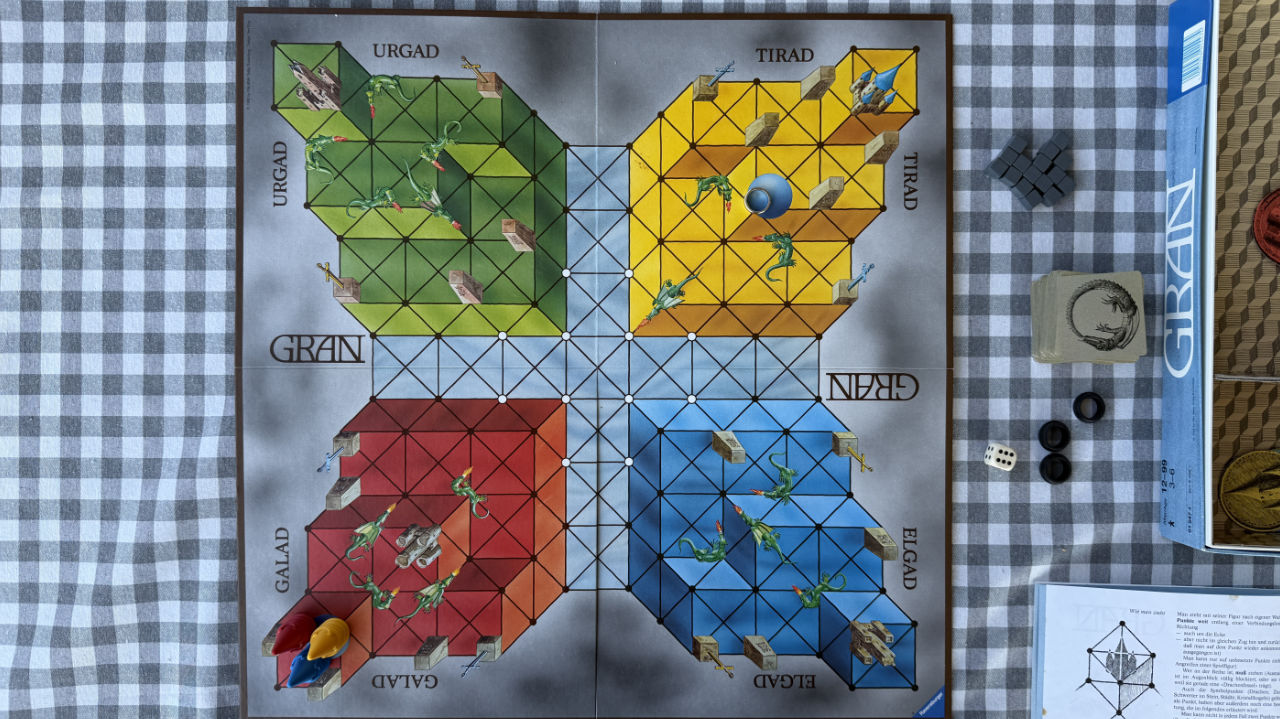
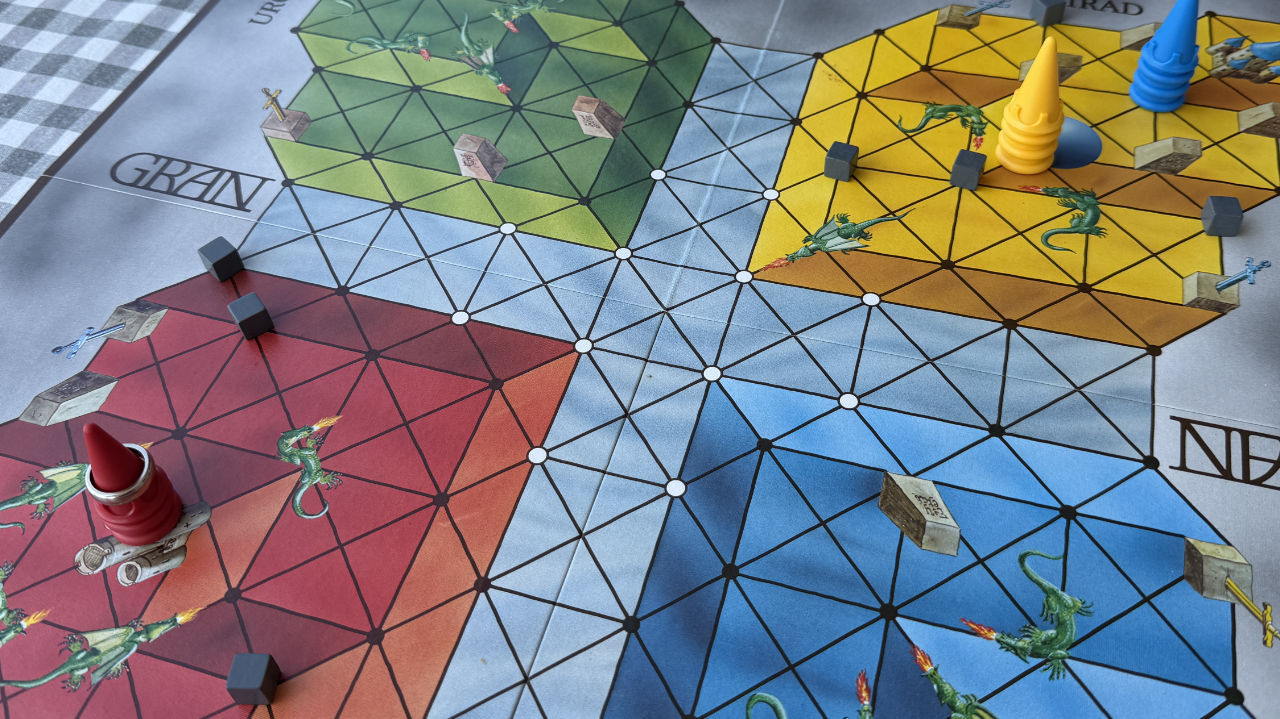
Bei Gran (im englisch gefällt mir QUEST besser) machen sich bis zu sechs Abenteurer auf den Weg über die Map, um den Ring zu ergattern und in verschiedenen Städten abzugeben. Hierzu ziehen sie ein oder zwei Felder weiter, kämpfen gegen Drachen, verbannen Mitspieler oder stellen Hindernisse auf, damit andere nicht so einfach voran kommen.
Der Spielaufbau kommt gut in 3D
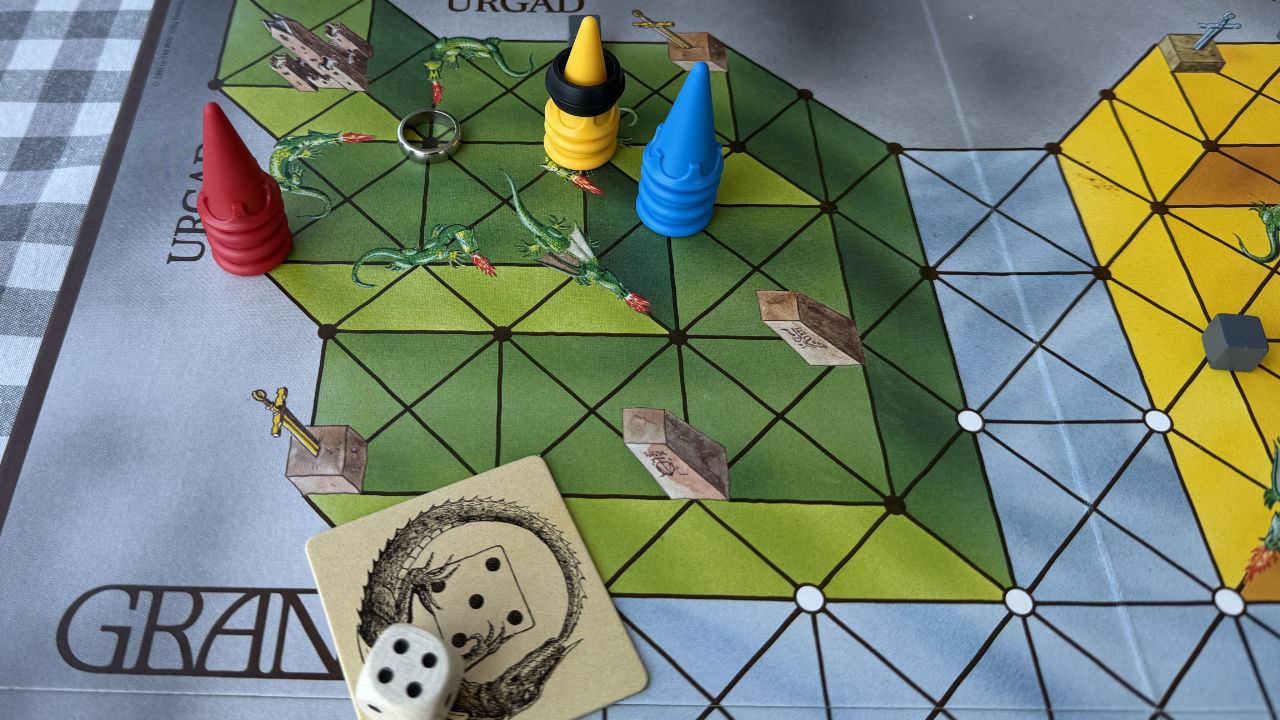
Die einzelnen Mechaniken waren damals aber überschaubar komplex. So ziehen wir beim Drachenkampf eine Karte mit Werten von Null bis Sechs und wir müssen dann mindestens diese Vorgabe erwürfeln. Natürlich muss man nicht zu den Drachen gehen, aber wenn man es schafft ist man gestärkt und kann zwei weitere Felder ziehen. Also ein push-your-luck zum schnell fortbewegen.
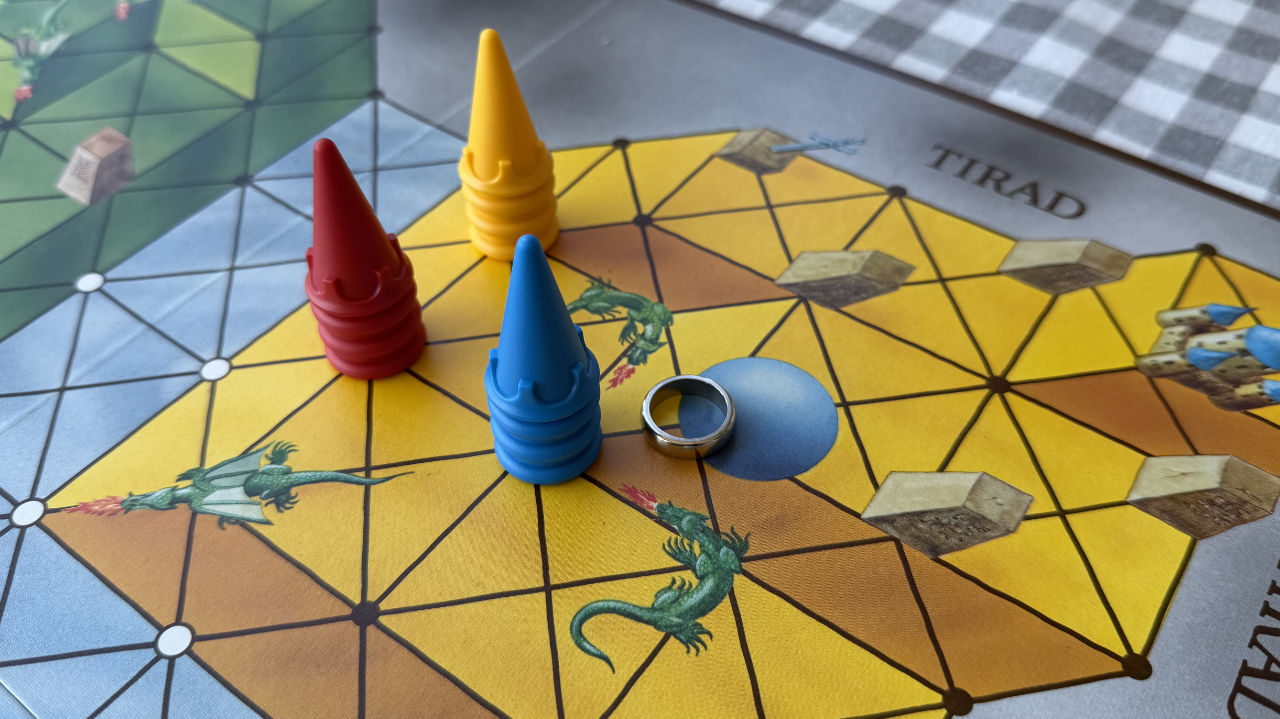
Nimmt sich blau den Ring, können die anderen aufschließen, den Spieler verbannen und den Ring klauen. Doch der nächste Spieler macht es nach.Der Drachenkampf: Da unter 5 gewürfelt wurde ist der Kampf verloren und man bekommt eine Drachenfessel (schwarzer Ring). In der nächsten Runde setzt man aus und die Drachenfessel wird entferntRot ist mit dem Ring in der Stadt und bekommt ein rotes Stadtsiegel.
Fazit:
Ich weiß nicht, ob mir das damals gefallen hätte. Schließlich gab es weniger Auswahl an Spielen und das Thema war schon cool. Auf jeden Fall ist es schlecht gealtert
Ein wenig strategisch kann man schon spielen. Die Glückskomponente Drachenkampf kann man überwiegend verhindern. Aber Spaß hat man bei dem Spiel nicht. Dafür ist der Ring als Beigabe ganz nett, so was gab es früher eher selten in einem Spiel.
The company has been one of tabletop crowdfunding’s biggest success stories over the past decade, raising tens of millions of pounds across campaigns based on major video game licences such as Resident Evil, Monster Hunter, Horizon Zero Dawn and Elden Ring.
About a third of the company’s employees are estimated to have been affected by this year’s restructure according to multiple sources who spoke to BoardGameWire on condition of anonymity – mirroring the scale of a previous round of redundancies Steamforged embarked on in 2023.
They said the staff cuts affected a range of departments across the business, including the creative, game design, production, project management, QA, marketing and commercial teams – adding that they feared the cutbacks would lead to problems delivering long-term projects.
Steamforged would not confirm the scale of the latest redundancies to BoardGameWire, but a spokesperson described the staff reduction as “carefully considered”, adding that the company “retain[s] both the internal resource and the external capabilities needed to deliver on our commitments”.
When asked for reassurance that those campaigns would be fulfilled despite the redundancies and strategic shift, a spokesperson for Steamforged told BoardGameWire, “Steamforged has never failed to fulfil a crowdfunding campaign, even during difficult times, or to make tough choices to deliver on commitments.
“Right now, 6: Siege – The Board Game is entering the final stages of production and will start shipping to supporters in July.”
Steamforged confirmed to BoardGameWire that the redundancies were part of a decision to “reduce new board game crowdfunding activity for the moment” amid the surging growth of Warmachine, the miniatures wargame line it bought from Privateer Press two years ago alongside P3 Paints and the Iron Kingdoms roleplaying series.
Warmachine miniatures || Photo credit: Steamforged Games
The spokesperson said Steamforged had tripled Warmachine and P3 Paints revenue in the last 21 months, despite facing significant stock constraints in the first year due to heavy demand.
They told BoardGameWire, “Demand has been high and we’ve scaled production to meet it. Our US production capacity for Warmachine has increased by 70% since last March, with a 25% increase in Europe since August and new production facilities introduced in the UK in February 2026.”
The spokesperson added, “Steamforged has always had two strong sides, both retail and crowdfunding, and was originally founded as a miniatures game company. Warmachine’s growth has shown clear demand over and above expectations and has become a core focus to support that growth.
“Our board game crowdfunding projects are currently in various stages of production with the vast majority of creative work complete.
“Our intention to reduce new board game crowdfunding activity for the moment while we focus on supporting Warmachine’s growth meant we needed to restructure accordingly, which included a confidential redundancy process in Q1 of 2026 that’s now complete.”
When asked how the strategic shift towards Warmachine would affect previously announced future crowdfunds such as Tyrant, the spokesperson said, “Steamforged has always looked several years into the future and our internal roadmaps reflect that.
“As with any company, particularly one that works with other studios the way we have, that means many potential projects have been put on ice over the years as opportunities change and emerge. Some of those came to fruition later, and others didn’t.
“Tyrant was an early announcement and was always intended to be a slow build. Given our strategic focus, it’s not something we intend to move forward with in the foreseeable future.”
Asked what they expected Steamforged Games to look like as a business over the next couple of years, the spokesperson concluded, “Over the next two years, we expect Warmachine will continue its strong growth supported by our dedicated team and launch plans in the miniatures and hobby categories.”
„Ich möchte so gern einmal Elben sehen, Herr. Ich wünschte, ich wüsste, wo sie wohnen“ Mit diesem
Buch kann die Spielleitung zumindest der eigenen Runde Samweis Gamdschies sehnlichsten Wunsch erfüllen. Neben Rivendell und Lothlorien wird auch das weniger geläufige Lindon genau vorgestellt.
With this My Favorite Wargame Cards Series, I hope to take a look at a specific card from the various wargames that I have played and share how it is used in the game. I am not a strategist and frankly I am not that good at games but I do understand how things should work and be used in games. With that being said, here is the next entry in this series.
#79: Culper Ring from Liberty or Death: The American Insurrection from GMT Games
In case you didn’t know, I love Liberty or Death: The American Insurrection! This is my 2nd favorite volume in the COIN Series and is such a fantastic game filled with the history of my favorite historical period the American Revolutionary War. Liberty or Death was the COIN Series’ first foray into non-modern warfare and takes us to the 18th Century and the days of the Brown Bess musket, the 18 pound siege cannon and nice and tidy formations better suited for a gentleman’s war. The focus of the game is the struggle of the American Patriots against their mother British government as they have made their intentions clear to become independent with the Declaration of Independence. The game is a multi-faction treatment of the American Revolution, which includes the Patriots and their allies the French against the British and their reluctant allies the Indians.
Liberty or Death is a 1 to 4 player game focused on all aspects of the struggle including financing operations with Rabble Rousing, infiltrating British held cities to Skirmish, blockading major cities with the mighty French fleet, Raiding the frontiers with the Indian nations, the spread of propaganda to build support for the revolution, fort building and small scale battles. So, with this short description you can see that this game is not a “traditional” wargame but does contain some armed conflict. So a game about the American Revolution that isn’t focused on battle you say? How can that be? Well, I will tell you that this game is probably a perfect representation of the multifaceted struggle that wasn’t necessarily decided on the field of combat, but by the little actions of many behind the scenes characters. Yes battle will decide the control of major areas of the board and decide the fate of troops as they must be concerned about being in supply through a network of forts but the game is so much more than just rolling some dice and consulting a CRT!
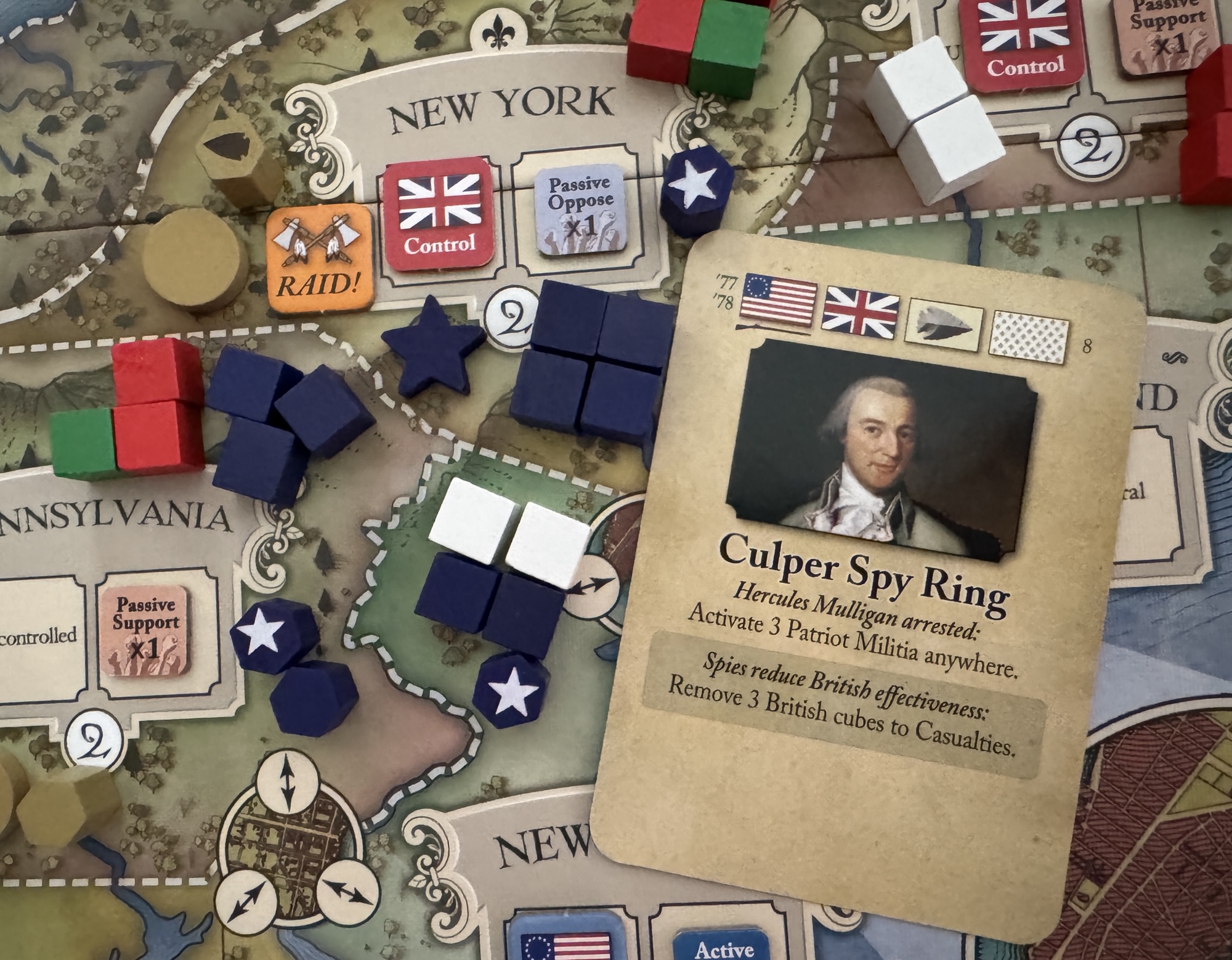
In today’s entry, we are going to take a look at a very interesting card called Culper Spy Ring. I very much enjoy the connection of this card to the history of the American Revolution as it deals with one of the more important aspects of the war being that of reconnaissance and spying to gain intel on the enemy’s plans and the makeup and disposition of their forces. The Culper Spy Ring card allows the British/Indian players to Activate 3 Patriot Militia pieces anywhere on the board. These pieces do not have to be located together in the same space but can be in 3 different spaces if the players chooses. This is a very powerful event as the Patriot Militia are generally only able to perform their actions if they are Underground meaning hidden from the British. Typically their Commands and Special Activities for things such as Rabble Rousing (create Opposition to Crown rule), Persuasion (get Resources) and Partisans (attack Royalist pieces), require at least 1 Underground Militia piece be in the space and typically requires that they be Activated or turned face up with their embossed star icon showing. The process of turning up these Militia pieces normally involves a British March Command into a space with Underground Militia but the process of removing them requires an additional step by taking either a Skirmish Special Activity or a Battle Command. This card allows for these turncoats to be discovered and then removed in a later action. If you also read the card above the action description you will notice that it says “Hercules Mulligan arrested”. Hercules Mulligan was an Irish-American tailor, spy, and founding member of the Sons of Liberty. Operating in British-occupied New York City, he used his high-end tailor shop to befriend British officers, gather critical intelligence, and covertly pass military secrets to General George Washington. Mulligan is credited with twice saving General Washington from capture or ambush. He sent secret messages, often via his trusted assistant Cato, warning Washington of planned British traps. I love the history here and am very glad that the design and development team gave a shout out to this little known American hero who risked his life to perform these spy activities in New York City.
The bottom half of the event is for the Patriot/French player and has an immediate powerful effect that can change the odds of an upcoming Battle or wrest control of a key province from the British at an inopportune time. The event simply allows the removal of 3 British Cubes from the board, consisting of British Regulars or Tories, and then placing them into the Casualties Box. This is a key action because it can cause the shifting of the delicate balance for the British between Combined Rebellion Casualties (CRC) versus Combined British Casualties (CBC). This difference is 1 of the 2 parts of the British Victory Condition and the CRC must be higher than the CBC. I also love the text above this benefit as it states “Spies reduce British effectiveness”. This is an homage to the critical work of these spy rings as they often lead to more beneficial and favorable Patriot outcomes to Battles as they were better prepared or knew the British plans before the battle event took place.
Major Benjamin Tallmadge.
The Culper Spy Ring was an American intelligence network established in 1778 by Major Benjamin Tallmadge and General George Washington. Operating primarily in British-occupied New York City and Setauket, Long Island, the ring provided vital reconnaissance on British troop movements, notably exposing Benedict Arnold’s treasonous plot to surrender West Point. The network utilized a chain of trusted individuals rather than trained military spies from all walks of life. Some of the more famous spies in this vital ring included:
Agent 355: An anonymous female member within the ring whose true identity remains unknown, though she is credited with providing crucial insights
Benjamin Tallmadge (alias “John Bolton”): The spymaster and director of intelligence who managed the flow of information.
Abraham Woodhull (alias “Samuel Culper Sr.”): The primary gatherer of intelligence in Setauket, who oversaw the ring’s daily operations.
Robert Townsend (alias “Samuel Culper Jr.”): A Manhattan merchant and journalist who operated within British circles, collecting firsthand intelligence on the enemy.
Caleb Brewster: A daring whaleboat captain who transported the messages across the treacherous Long Island Sound.
Austin Roe: A Setauket tavern keeper who acted as the primary courier, frequently riding the 55 miles between Setauket and New York City.
The Culper Spy Ring is widely considered one of the most successful intelligence networks of the American Revolution. Its greatest achievements included preventing a surprise British ambush on incoming French forces in Rhode Island and securing the intelligence that led to the capture of British spy master John André. The secrecy maintained by Tallmadge was so effective that the true identities of the spies were not discovered by historians until the 20th century.
This Culper spy network was the feature of a television series on AMC called TURИ: Washington’s Spies that aired from April 2016 through August 2017 and spanned a total of 40 episodes.
The story of the drama covers events from 1776 to 1781 and features a farmer from Setauket, New York and his childhood friends who form an unlikely group of spies called the Culper Ring, which eventually helps to turn the tide during the American Revolutionary War. The series begins in October 1776, shortly after British victories, including the recapturing of Long Island and the Port of New York for the Crown, leaving General George Washington’s army in dire straits. The first episode opens with the following introductory text:
Autumn 1776. Insurgents have declared war against the Crown. Following a successful naval landing, His Majesty’s Army has forced Washington’s rebels into the wilderness. New York City serves as a military base of operations for the British. The Loyalists of nearby Long Island keep vigilant watch out for sympathizers and spies.
I very much enjoyed the tv show and loved watching each episode to see the hidden historical details of the Culper Spy Ring be revealed that have been discovered over the past few hundred years since the events of the American Revolution. Just an amazing example of a grass roots and loosely organized group of Patriots who risked their lives and families to ensure that the cause of Liberty prevailed.
Der US-Spielwarenkonzern Hasbro hat seinen Bericht zum ersten Quartal 2026 nach einem Cyberangriff um knapp einen Monat verschoben. Trotz der Verzögerung rechnet das Unternehmen mit einem Umsatz von bis zu 985 Millionen US-Dollar, getragen vor allem von der anhaltenden Stärke des Sammelkartenspiels Magic: The Gathering. Den vollständigen Quartalsbericht will Hasbro nun am 20. Mai vorlegen.
Cyberangriff und vorläufige Q1-Zahlen
Foto: FlyD / Unsplash
Hasbro identifizierte am 28. März einen unautorisierten Zugriff auf das Unternehmensnetzwerk. Nach eigenen Angaben gilt der Vorfall mittlerweile als eingedämmt. Die Auslieferung und der Veröffentlichungsrhythmus von Magic seien davon nicht betroffen gewesen.
Für das erste Quartal erwartet das Unternehmen einen Umsatz zwischen 970 und 985 Millionen US-Dollar, ein Plus von 9 bis 11 Prozent gegenüber dem Vorjahreszeitraum. Der operative Gewinn soll bei 235 bis 245 Millionen US-Dollar liegen – ein Sprung von 38 bis 44 Prozent. Diese vorläufigen Werte sollen mit dem ausführlichen Bericht am 20. Mai bestätigt werden.
Die Folgen des Cyberangriffs werden sich laut Hasbro vor allem im Consumer-Products-Segment niederschlagen. Im zweiten Quartal seien dort Verzögerungen bei Auftragsabwicklung, Versand und Rechnungsstellung zu erwarten, was sich auf Umsatz und operativen Gewinn auswirken dürfte.
Magic als Wachstumsmotor
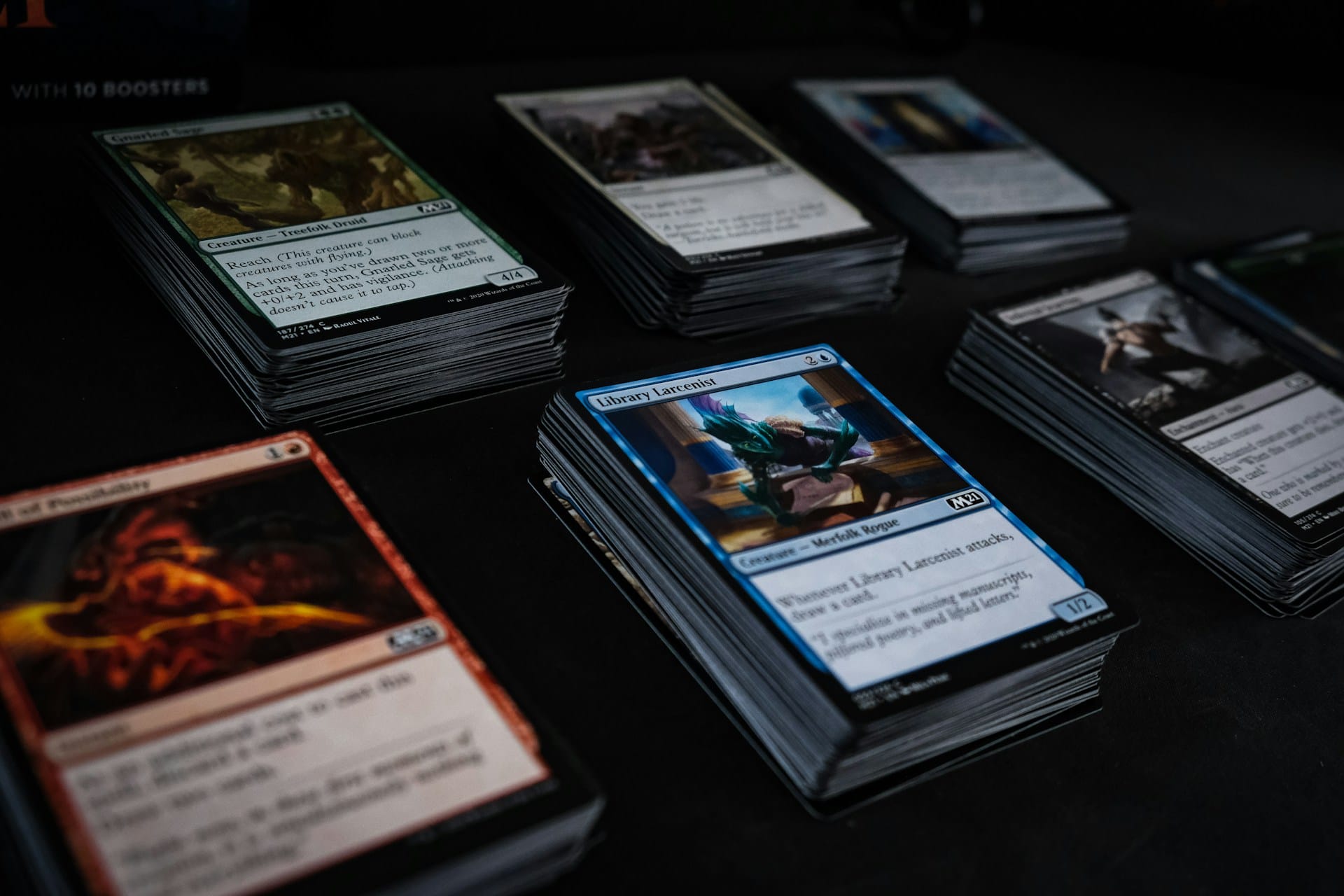
Magic: The Gathering bleibt der zentrale Treiber für Hasbros Geschäft. Im Geschäftsjahr 2025 stieg der Umsatz mit dem Trading Card Game um 59 Prozent und markierte damit das stärkste Jahresergebnis in der Geschichte des Spiels. Den Höhepunkt bildete das vierte Quartal mit einem Umsatzplus von 141 Prozent gegenüber Q4 2024, getragen durch die Sets zu Avatar: The Last Airbender und Final Fantasy.
Der Konzernumsatz wuchs 2025 insgesamt um knapp 14 Prozent auf 4,7 Milliarden US-Dollar. Treiber war erneut die Sparte Wizards of the Coast, die Magic, Dungeons & Dragons sowie das Digitalgeschäft umfasst und ein Plus von 45 Prozent verbuchte. Das Consumer-Products-Segment mit Marken wie Nerf, Transformers und Peppa Pig ging dagegen um vier Prozent zurück, was Hasbro auf makroökonomische Unsicherheiten und die Tarifankündigungen aus dem zweiten Quartal zurückführt.
Für das Gesamtjahr 2026 hält Hasbro an der Prognose fest, den Umsatz um drei bis fünf Prozent zu steigern. CFO und COO Gina Goetter rechnet damit, dass Wizards of the Coast ein Wachstum im mittleren einstelligen Bereich beisteuert, gestützt durch den geplanten Veröffentlichungsrhythmus und das anhaltende Engagement im Magic-Ökosystem
Toy and game maker Hasbro has delayed its quarterly results by almost a month after suffering a cyber attack, but said it expects to post Q1 revenues of up to $985m thanks to continued strong performance of Magic: The Gathering.
Hasbro said it identified “unauthorized access” to the company’s network on March 28, but believes that access has been “contained” – adding that Magic’s shipments and release cadence had continued unaffected.
The company expects Q1 revenue to be between $970m and $985m, a rise of between 9% and 11% compared to the same period last year – while operating profit is expected to reach $235m to $245m, a 38% to 44% jump.
Those preliminary results are expected to be solidified when Hasbro eventually releases its full Q1 financial report, which is now scheduled for May 20.
Hasbro saw its wider 2025 revenue rise almost 14% to $4.7bn, driven by a record 45% growth in its Magic, D&D and digital gaming division Wizards of the Coast, the company revealed in February.
Magic’s record-breaking year was capped off by a storming fourth quarter, which saw revenues from the game up 141% compared to Q4 2024 on the strength of the Avatar: The Last Airbender and Final Fantasy releases.
That stellar performance of Wizards, and Magic in particular, was in stark contrast to Hasbro’s consumer products segment – which includes Nerf guns, Transformers and Peppa Pig toys.
That segment saw revenues drop 4% last year “amongst macro and retailer volatility brought on by tariff announcements in Q2″ – and unlike for Magic, Hasbro said that the cyber incident would likely impact second quarter revenues and operating profit in consumer products due to expected order processing, shipping and invoicing delays.
Hasbro added that it still expects full-year revenues to rise between 3% and 5% in 2026. Hasbro CFO and COO Gina Goetter said in February that the company expects Wizards of the Coast to deliver mid-single-digit revenue growth in 2026, “supported by a healthy release cadence and continued engagement across the Magic ecosystem”.
Peter and Will are back with their most famous style of battle report – a War of the Ring one! Beer, laughs and banter ensue.
One day, when the Esoteric Order of Gamers finally comes to its natural end and all about it and concerning it is forgotten, one thing may be remembered – the battle report videos documenting games of War of the Ring between myself and my old gaming buddy, Will. It‘s been quite a while since I’ve had the opportunity to film one, but the day has finally arrived! So grab yourself your beverage of choice, get comfortable someplace where you won’t be interrupted by any non-gamer who just might not understand, relax, and enjoy this hugely fun new session of my favourite board game, War of the Ring!
Making high quality tabletop gaming content at the EOG takes time and money. Please consider becoming a Patreon supporter or making a donation so I can continue this work! Thankyou!
The overall blog statistics are pretty meaningless – both last year and this year are skewed by WordPress sending my Farewell 2024 – Historical Fiction! post out to a bajillion people (from Dec 26 to Jan 8), which makes it easily the most popular post of each year (providing more than a fourth of my total views this year). If you factor that out, 2025 has been a good year on the blog, but slightly behind the (organic) record of 2023.
The posts doing particularly well have been the usual suspects, that is, the Most Anticipated Historical Board Games post in January, and the evergreen strategy posts for several games published over the last year. It was nice to see that a few of my research-intensive posts in the American Revolution and the Wallenstein series also did well.
Most of my readers come from the United States (also skewed by the Historical Fiction anomaly, but not entirely), as well as other Anglophone (UK, Canada, Australia) or European (Germany, the Netherlands, Spain, and France) countries. Especially the Dutch have made a leap up… maybe because of my post on the history of Amsterdam? Welkom, anyway.
New arrivals in the top 10 of the countries from which most views stem are Sweden and Poland in a joint Baltic effort.
If you compare views with population numbers, there are possibly no more loyal readers of this blog than the fine people of Ireland, closely followed by Hong Kong, whose views eclipse those of huge countries like Japan, Brazil, or India. The Irish have been devoted to history, board games, and history in board games for some years now, for which I am grateful. The Hongkongers are new in their excitement for the blog – welcome! If you are from Hong Kong, leave a comment below!
I can only speculate what brought people to this blog (but maybe you can enlighten me with a comment, especially if read this blog, but don’t comment often or ever). Here is, however, what I think was the finest which I published this year – as per usual, with six instead of three entries, and without crowning a winner. Let’s go!
Most of the history articles on this blog are about what people in the past did – the politicians, merchants, soldiers of times past. Yet I also like to dwell on what they thought, and thus I’m very happy to have written this post on the political philosophy of the American Revolution, its core value of liberty, and the promise and limitation of that idea. It was also an opportunity to engage with the still-compelling documents of the Revolution – Common Sense and the Declaration of Independence.
It’s been a wild year politically. Almost forgotten by now is the Great Tariff Rollercoaster of April 2025, in which the American federal government announced tariffs on imports from almost all other countries and then engaged in a flurry of raising, lowering, and holding off on them that made everyone’s head spin. By now, the 145% tariff on Chinese goods imported by US buyers is long gone, but at the time it seemed like an existential threat to US board game companies manufacturing their games in China (so, almost all of them), and given that the current US administration will still be in office for another three years, one worth revisiting.
This blog often gives me the opportunity to learn about new subjects. Wallenstein was one of them. I approached the post about his life with not more than a general knowledge about his role in the Thirty Years’ War… and then was sucked into a research rabbit hole in which I read over 2,000 pages about the guy. The result is a four-part series and the longest, most detailed board game assisted biography I have ever written about anyone.
…and this blog also allows me to re-visit topics and games with which I have engaged for years (and sometimes decades) now. Frederick II of Prussia is such a person, and Friedrich (Richard Sivél, Histogame) such a game. Reflecting on their insights on Frederick’s campaigns, the command and control exercised, and Frederick’s psychology was a delight.
Amsterdam is one of the iconic cities of the world. It is a symbol of art, commerce, and progress, and unique in its canal-structured urban layout. Unsurprisingly, these characteristics have also inspired board game designers. I have told Amsterdam’s 750-year history through the lens of the many board games set in Amsterdam – which gives a glimpse into what the city stands for in the popular imagination. As both this and my earlier Venice post were so much fun to write, I should do more city histories!
One of my brighter new ideas was to link historical board games to period music. Of course, that works particularly well from the 20th century on – the age of the music record. I started with an immersive playlist for your next game of Weimar (Matthias Cramer, Capstone Games/Skellig Games/Spielworxx), full of everything that was hot at the time – from traditional songs to jazz, from movie tunes to workers’ songs. It will surely not remain the only such playlist.
And thus concludes the year 2025 on this blog. I hope you had as much fun reading it as I had writing.
I wish you all an excellent year 2026, full of joy, health, and success!
The overall blog statistics are pretty meaningless – both last year and this year are skewed by WordPress sending my Farewell 2024 – Historical Fiction! post out to a bajillion people (from Dec 26 to Jan 8), which makes it easily the most popular post of each year (providing more than a fourth of my total views this year). If you factor that out, 2025 has been a good year on the blog, but slightly behind the (organic) record of 2023.
The posts doing particularly well have been the usual suspects, that is, the Most Anticipated Historical Board Games post in January, and the evergreen strategy posts for several games published over the last year. It was nice to see that a few of my research-intensive posts in the American Revolution and the Wallenstein series also did well.
Most of my readers come from the United States (also skewed by the Historical Fiction anomaly, but not entirely), as well as other Anglophone (UK, Canada, Australia) or European (Germany, the Netherlands, Spain, and France) countries. Especially the Dutch have made a leap up… maybe because of my post on the history of Amsterdam? Welkom, anyway.
New arrivals in the top 10 of the countries from which most views stem are Sweden and Poland in a joint Baltic effort.
If you compare views with population numbers, there are possibly no more loyal readers of this blog than the fine people of Ireland, closely followed by Hong Kong, whose views eclipse those of huge countries like Japan, Brazil, or India. The Irish have been devoted to history, board games, and history in board games for some years now, for which I am grateful. The Hongkongers are new in their excitement for the blog – welcome! If you are from Hong Kong, leave a comment below!
I can only speculate what brought people to this blog (but maybe you can enlighten me with a comment, especially if read this blog, but don’t comment often or ever). Here is, however, what I think was the finest which I published this year – as per usual, with six instead of three entries, and without crowning a winner. Let’s go!
Most of the history articles on this blog are about what people in the past did – the politicians, merchants, soldiers of times past. Yet I also like to dwell on what they thought, and thus I’m very happy to have written this post on the political philosophy of the American Revolution, its core value of liberty, and the promise and limitation of that idea. It was also an opportunity to engage with the still-compelling documents of the Revolution – Common Sense and the Declaration of Independence.
It’s been a wild year politically. Almost forgotten by now is the Great Tariff Rollercoaster of April 2025, in which the American federal government announced tariffs on imports from almost all other countries and then engaged in a flurry of raising, lowering, and holding off on them that made everyone’s head spin. By now, the 145% tariff on Chinese goods imported by US buyers is long gone, but at the time it seemed like an existential threat to US board game companies manufacturing their games in China (so, almost all of them), and given that the current US administration will still be in office for another three years, one worth revisiting.
This blog often gives me the opportunity to learn about new subjects. Wallenstein was one of them. I approached the post about his life with not more than a general knowledge about his role in the Thirty Years’ War… and then was sucked into a research rabbit hole in which I read over 2,000 pages about the guy. The result is a four-part series and the longest, most detailed board game assisted biography I have ever written about anyone.
…and this blog also allows me to re-visit topics and games with which I have engaged for years (and sometimes decades) now. Frederick II of Prussia is such a person, and Friedrich (Richard Sivél, Histogame) such a game. Reflecting on their insights on Frederick’s campaigns, the command and control exercised, and Frederick’s psychology was a delight.
Amsterdam is one of the iconic cities of the world. It is a symbol of art, commerce, and progress, and unique in its canal-structured urban layout. Unsurprisingly, these characteristics have also inspired board game designers. I have told Amsterdam’s 750-year history through the lens of the many board games set in Amsterdam – which gives a glimpse into what the city stands for in the popular imagination. As both this and my earlier Venice post were so much fun to write, I should do more city histories!
One of my brighter new ideas was to link historical board games to period music. Of course, that works particularly well from the 20th century on – the age of the music record. I started with an immersive playlist for your next game of Weimar (Matthias Cramer, Capstone Games/Skellig Games/Spielworxx), full of everything that was hot at the time – from traditional songs to jazz, from movie tunes to workers’ songs. It will surely not remain the only such playlist.
And thus concludes the year 2025 on this blog. I hope you had as much fun reading it as I had writing.
I wish you all an excellent year 2026, full of joy, health, and success!
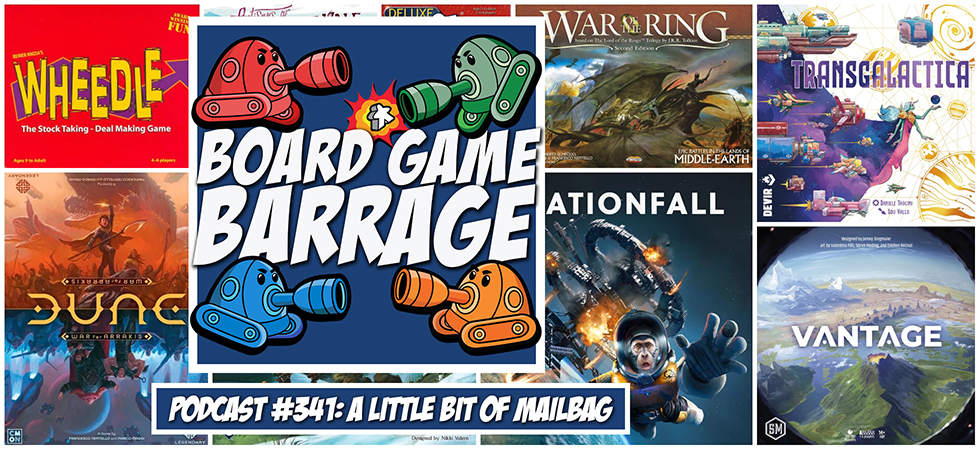
One, two, three, four, five, everybody in the car so come on let’s ride … to the mailbag! We’re answering your pressing questions – and oh how they press – about all manner of things: Crowdfunding ads! Narrative games! Getting jaded about board games! You wrote in because you had to know what we thought, and who are we to say no. Before we get covered in papercuts, we talk about Wheedle, Dune: War for Arrakis, and Transgalactica.
If you don’t want to miss an episode, please subscribe on Apple Podcasts/Google Podcasts/Stitcher/Spotify, or add our RSS feed to your favourite app. Reviews and subscriptions really help us and would be greatly appreciated! To download the episode directly, click here.
If you’d like to discuss anything in the episode, please do so in the comments below, visit our BoardGameGeek guild, join our Discord, or Facebook Group! Any feedback is also always helpful. If you’d like to show your support for the show, we also have a Patreon with some fun rewards, and a merch store!
Timecodes:
02:05 – Wheedle 09:31 – Dune: War for Arrakis 19:52 – Transgalactica 34:00 – Mailbag 34:39 – Kickstarter red and green flags? 43:36 – Narrative in board games? 51:23 – Do we get jaded?
Thank you to Heart Society for generously letting us use What’s On Your Mind, Kid? from their album Wake the Queens.
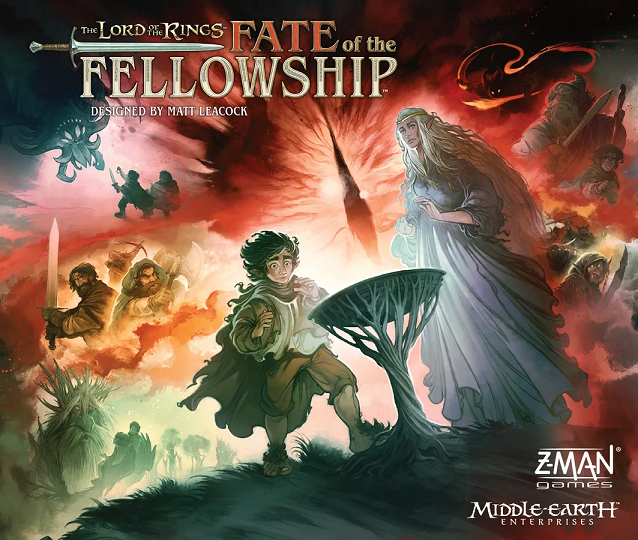
Somewhere, Matt Leacock is walking around, chained to a big goose as gold as the sun. For the love of God, someone let this man design something other than Pandemic. Not today. While not betrayed on the cover, The Lord of the Rings: Fate of the Fellowship is described as a Pandemic System game. And…

 Anmelden