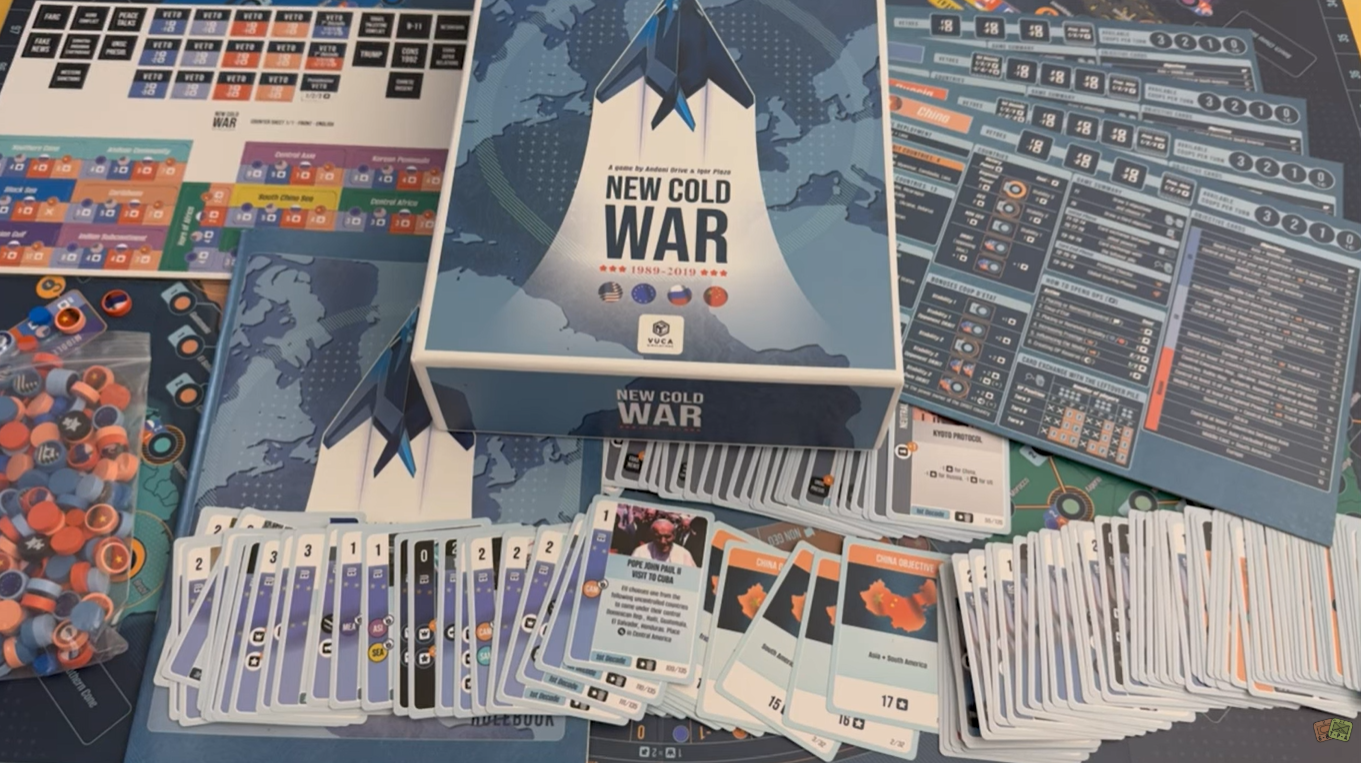
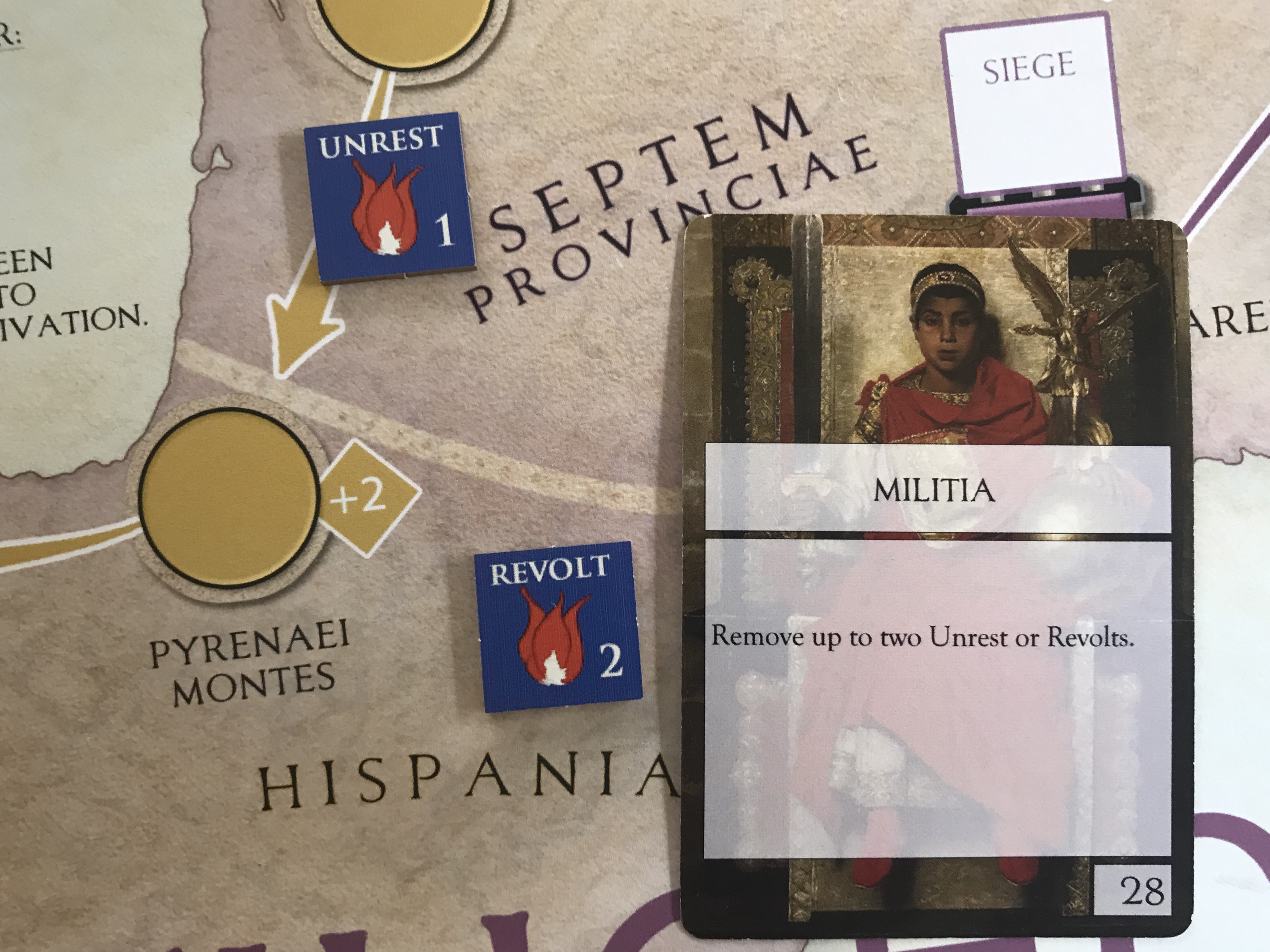
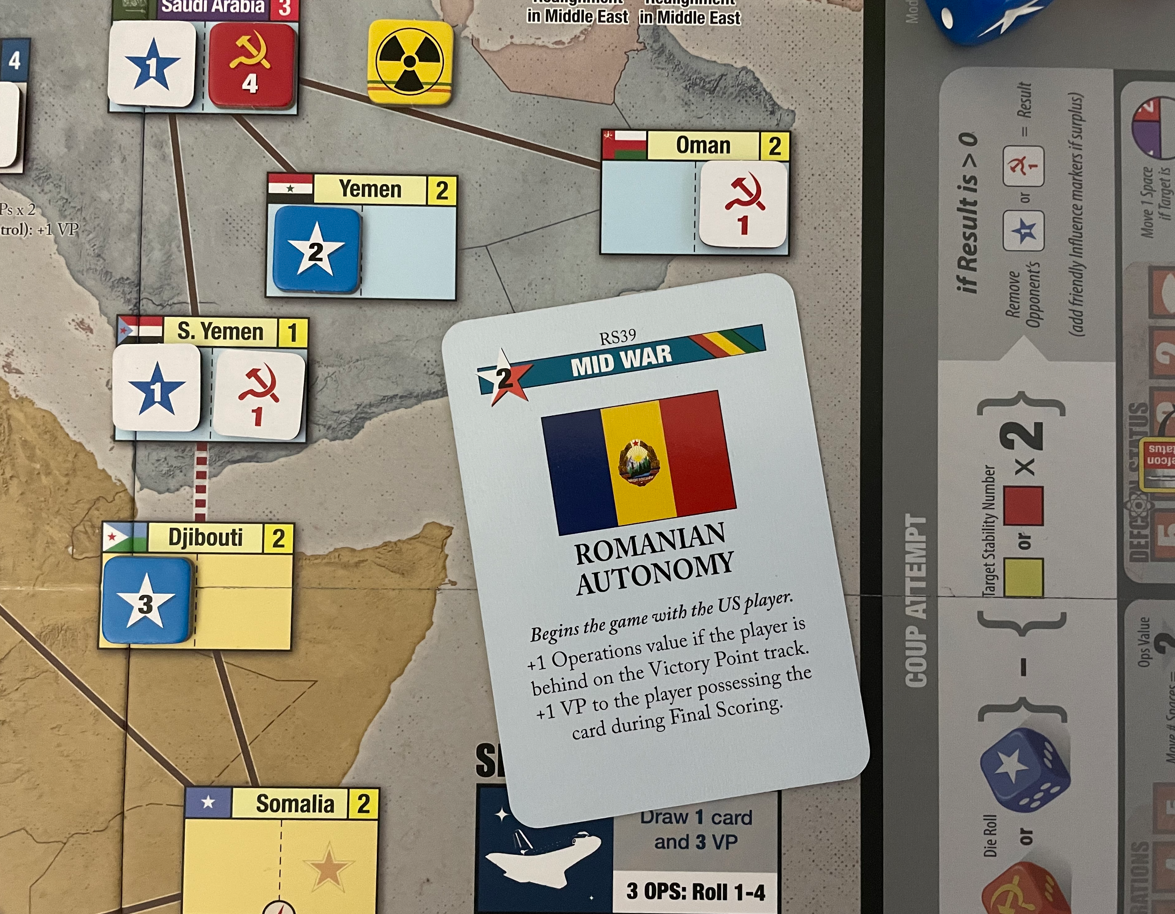
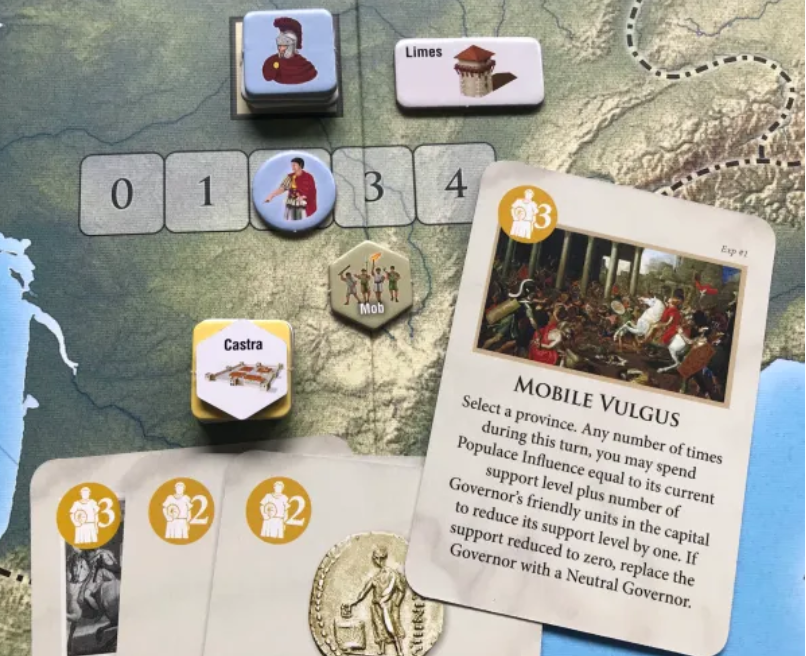
New Cold War: 1989-2019 is a Card-Driven Game based in the most important geopolitical events from 1989 to 2019. Players lead one of the four great powers (Russia, China, US, EU) in their fight for the new world order. Initially, the confrontation is between the red bloc, consisting of Russia and China and the blue bloc, comprising the United States and the European Union. However, each player must also prioritize their own strategy, as only one power can emerge victorious at the end of the game. Therefore, this game starts with cooperation between allied powers in the early stages but becomes entirely competitive as the moment of final victory approaches.
New Cold War utilizes a Card-Driven game mechanic. Players strive to attain victory by gaining international prestige, dominating the media and increasing their control of countries and different regions of the world. Other key factors to manage include military force and United Nations Security Council vetoes. Players’ strategies are determined by a series of hidden objectives they must pursue to achieve victory.
The game accommodates three or two-player versions and includes a solitaire mode through a system of bots.
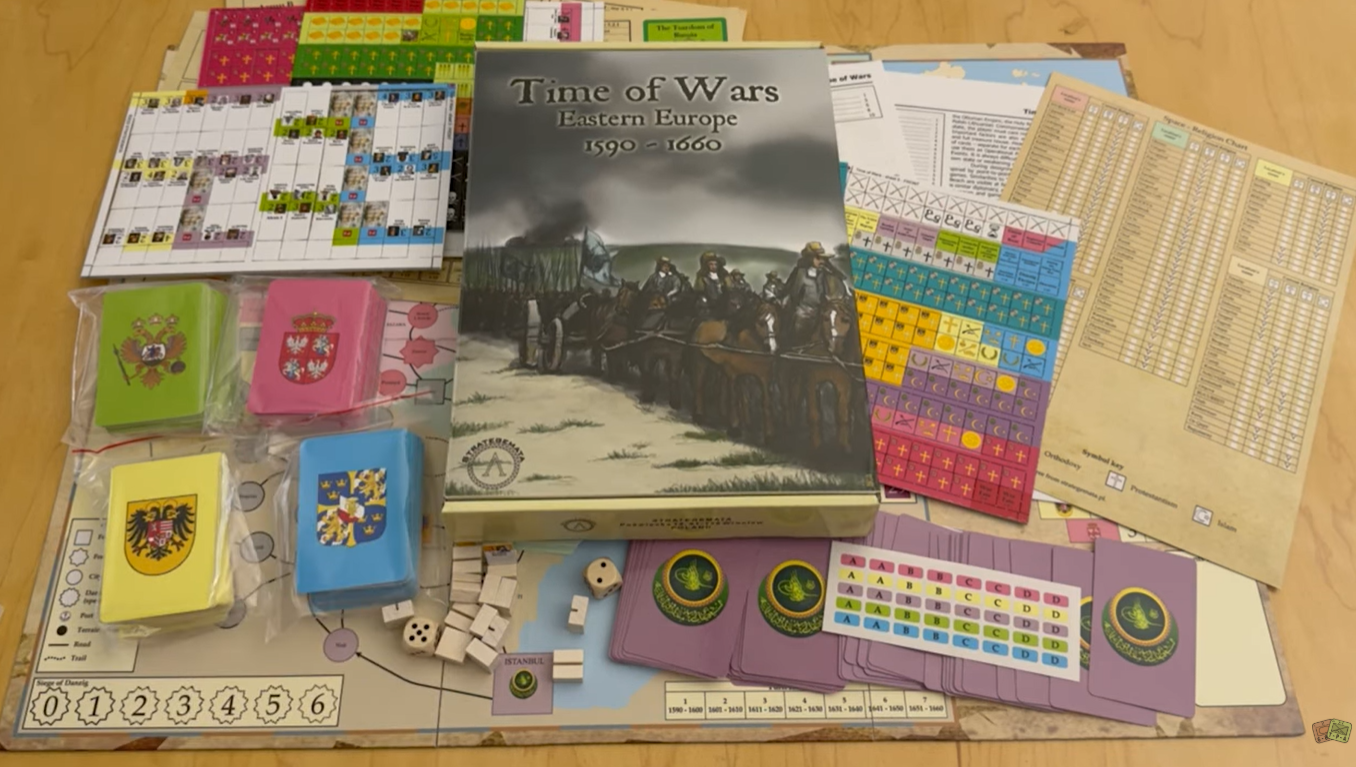
Time of Wars: Eastern Europe 1590-1660 is a card-driven multiplayer game in which players assume the roles of rulers of five superpowers in Eastern Europe – the Polish-Lithuanian Commonwealth, the Empire of Russia, the Ottoman Empire, the Kingdom of Sweden and the Holy Roman Empire. There are also smaller states – Denmark, Brandenburg, Moldova, Wallachia, Transylvania and the Crimean Khanate. They can be the basis of strong competition between players or the source of internal problems.
The game presents the turn of the 16th and 17th centuries. This period was full of famous figures (rulers and commanders) and critical events – for example Great Sadness in Russia, Thirty Years’ War in the German Reich, “Swedish Deluge” in the Polish-Lithuanian Commonwealth. All of this and more are elegantly integrated into the gameplay.
At the heart of the game are five decks of cards – one for each superpower. Each time a player uses a specific card, he has to make a difficult decision – play the card as Operations Points or as an Event. The background of the choice is the need to develop one’s own country or weaken the enemy’s position.
There is a lot of interaction between players during the game. They can declare wars or form alliances through secret negotiations. Winning battles and wars are important, but players must also keep their countries healthy. The game shows factors such as economy, domestic politics, military level and religion. All of them can affect specific player actions.
The game has many options for each player, and each country has its own problems and advantages. Despite this, the gameplay is extremely well-balanced. Moreover, the random factor is reduced to the necessary minimum. As a result, players feel that the fate of Eastern Europe is in their hands and depends on their decisions.
With this new My Favorite Wargame Cards Series, I hope to take a look at a specific card from the various wargames that I have played and share how it is used in the game. I am not a strategist and frankly I am not that good at games but I do understand how things should work and be used in games. With that being said, here is the next entry in this series.
#67: Frederick Douglas from Votes for Women from Fort Circle Games
Votes for Women is a very interesting card-driven game that covers the American Women’s Suffrage Movement from 1848-1920, culminating in the ratification of the Nineteenth Amendment which granted women the right to vote. The game is a 2-player game, that has a fully developed solitaire mode with an “Oppobot” and offers a cooperative mode for those who don’t wish to play as they Opposition. The Suffragist player will have to push Congress to propose the Nineteenth Amendment, and then focus on campaigning to have a minimum of 36 states to ratify the Amendment. The Opposition side will try to prevent Congress from proposing the amendment and failing that to have 13 states reject the amendment.
The game uses cards in a fairly traditional CDG way as there are events that can be be taken or the cards can be played to do things like Campaign, Organize or Lobby Congress. Each card has a specific Card Era that is used to create of the each players’ Draw Decks. Late cards will be on the bottom of the deck, Middle cards will be in the middle of the deck and Early cards will be on the top of the deck. The Suffragist and Opposition decks each have one Start card that will be placed in the player’s hand at the start of the game. Some Event Cards have a prerequisite and some of the cards require a player to roll a 6-sided die and only take the the action on a roll of 3-6. Otherwise, the Event Card is discarded with no effect. The cards in this game are also steeped in historical details, from the name of the events that tie back to specific individuals or happenings, to major moments in the struggle. This game is about the history of the struggle for the right to vote and it is very good!
I like to see Votes for Women as a game primarily as it uses some really fun and lite methods to determine the majority control in various states. One of the goals of the game is for either side to place out their influence cubes in the states in order to collect State cards that provide unique and sometimes very powerful free ways to add more influence or otherwise change the level of influence in states. This goal also leads all the way to the end game as if when the 19th Amendment is ratified in Congress because the Suffragist player used their cards to place out support cylinders in Congress each of the states can have their support for the amendment decided at that time if there are 4 or more influence cubes of either side in that state. If there are 4 cubes in a state at that time either a green check mark will be placed, representing support for the 19th Amendment or an orange X will be placed meaning the state voted against.
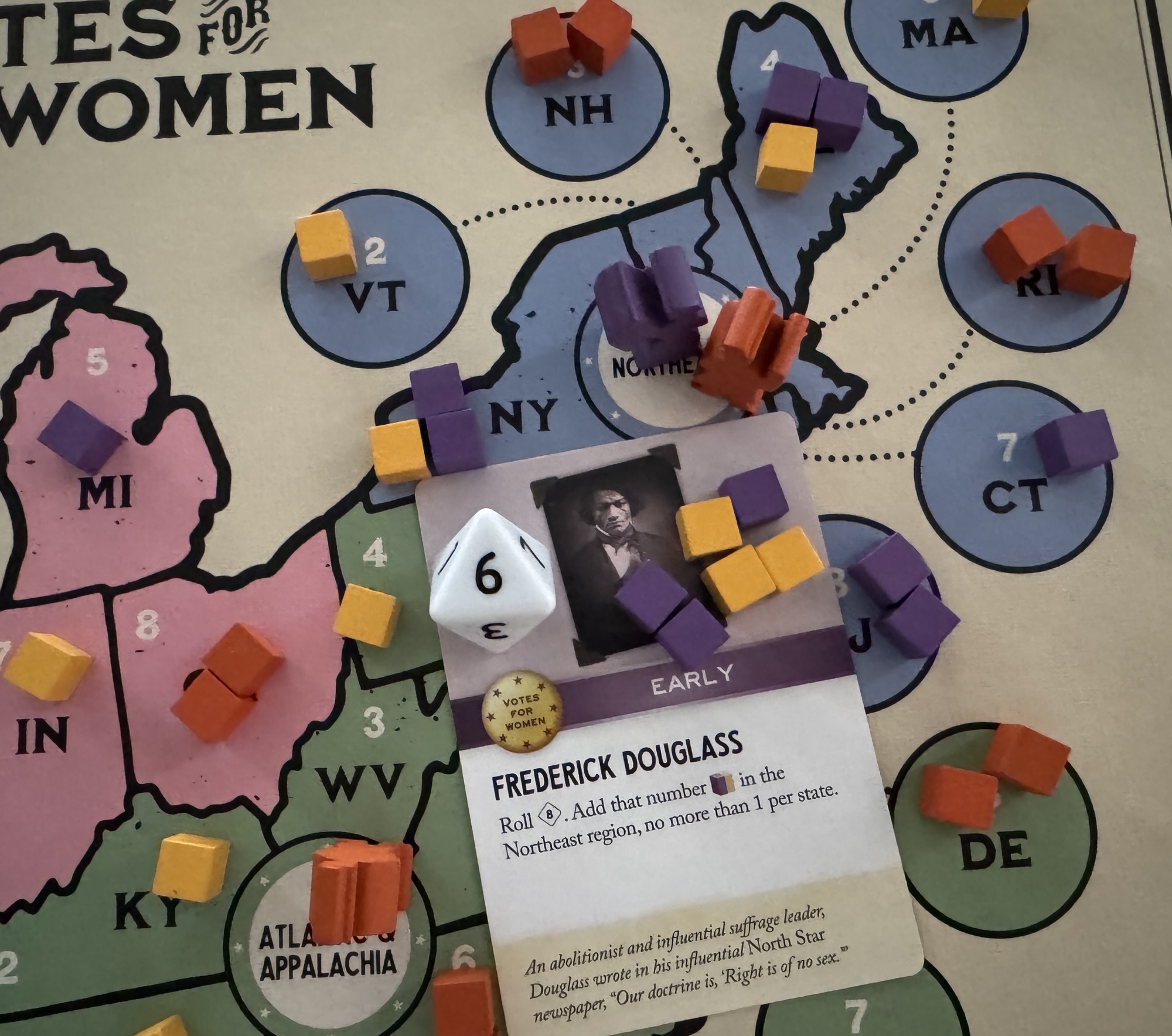
The Frederick Douglas card is one of these methods used to shake things up a bit and give the Suffragist player a chance to push their luck and roll the die to see how many influence cubes they can place. The card text instructs the player to roll a D8 (the game uses D6’s, D8’s and D12’s) and then add that number of influence cubes in the Northeast region, which includes states such as New York, New Jersey, Vermont, New Hampshire, Maine, Massachusetts, Rhode Island and Connecticut. The key limiter here though is that no more than 1 cube per state can be placed. The other thing about placing these influence cubes is that you can use 1 cube to remove a cube of the opposing player. This action does not allow you to then place one of your cubes in the state if that action would remove the only Opposition cube in the state…but nice try!
Frederick Douglass was a staunch, lifelong advocate for women’s suffrage, viewing it as an essential component of human equality, famously declaring “Right is of no sex”. As a key ally to suffragists like Susan B. Anthony and Elizabeth Cady Stanton, he supported the cause for over four decades, including crucial support at the 1848 Seneca Falls Convention.
In an issue of the North Star published shortly after the convention, Douglass wrote:
In respect to political rights, we hold woman to be justly entitled to all we claim for man. We go farther, and express our conviction that all political rights which it is expedient for man to exercise, it is equally so for women. All that distinguishes man as an intelligent and accountable being, is equally true of woman; and if that government is only just which governs by the free consent of the governed, there can be no reason in the world for denying to woman the exercise of the elective franchise, or a hand in making and administering the laws of the land. Our doctrine is, that “Right is of no sex.”
Douglass continued to support the cause of women after the 1848 convention. In 1866 Douglass, along with Stanton and Anthony, founded the American Equal Rights Association, an organization that demanded universal suffrage. Though the group disbanded just three years later due to growing tension between women’s rights activists and Africa-American rights activists, Douglass remained influential in both movements, championing the cause of equal rights until his death in 1895.
Here is a link to our full video review of the game:
With this My Favorite Wargame Cards Series, I hope to take a look at a specific card from the various wargames that I have played and share how it is used in the game. I am not a strategist and frankly I am not that good at games but I do understand how things should work and be used in games. With that being said, here is the next entry in this series.
Card #66: Harwood’s Intuition from The Hunt from Salt & Pepper Games
I have played several hidden movement games over the years and enjoyed them all. Some of these titles have included wargames such as They Come Unseen from Osprey Games, Sniper Elite: The Board Game from Rebellion Unplugged and Bomber Command from GMT Games as well as a few board games including Hunt for the Ring from Ares Games. The concept of moving cautiously, attempting to evade pursuers, all while trying to locate and acquire or destroy objectives makes for a very interesting gaming experience. These situations can make for some really tense games that cause your head to ache and your wits to be tested. But they rely on some bluffing as well. Trying to force your opponent to anticipate where they think you should be and then trying not to be there. A really great mechanic in board games but not always easy to pull off and make for a very playable and interesting game. In 2022, we played a new design from Matthias Cramer and Engin Kunter that took this hidden movement concept and put it into a historically based game about the struggle over control of the South Atlantic between the British Royal Navy and the German Kriegsmarine during the early years of World War II called The Hunt from Salt & Pepper Games.
The Hunt is a Card Driven Game where the German player has to attempt to stay hidden while trying to sink merchant shipping as the Royal Navy hunts for them throughout the South Atlantic. The players each have asymmetric actions to use to accomplish their missions and each has a tough time doing what they have to do. But, if they manage their cards wisely, using them as effectively as possible, they can successfully either evade their pursuer or catch their prey.
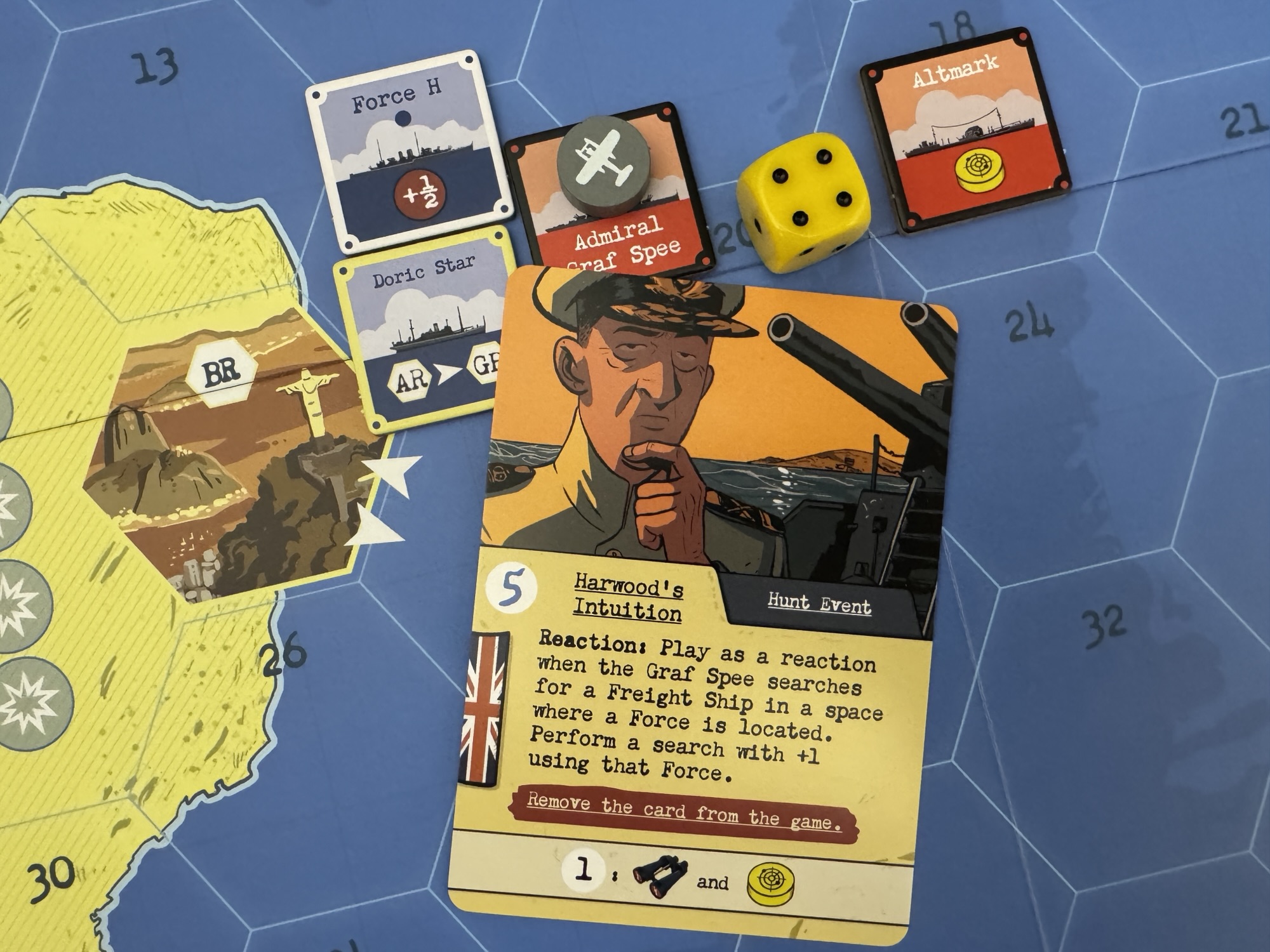
In today’s post, we will take a look at the very useful British card Harwood’s Intuition. Harwood’s Intuition is a 5 Ops card, which makes it a very important card in the British deck as it allows for the taking of 2-3 actions in a single turn, but for which there is an even more important use as an ambush by playing it as a Reaction to a German action. If the German player ever searches for a Freight Ship in a space where there is a British Task Force, and Harwood’s Intuition is played as a reaction, the British will get a free Search action with a +1 DRM to the roll. Normally, a Search requires a 5+ on a d6 to be successful, but with this bonus +1 that will mean success on a 4+ which is a 50/50 proposition. And remember, the point of the game for the British is to find and sink the Graf Spee at the Battle of the River Plate. Such as tasty surprise card for the British! I know that when I play as the Germans, I have to always keep in the back of my mind that this card exists and that if there is a Force present, I have a risk of being ambushed. This is one of the elements that makes this game so good.
The Battle of the River Plate was fought in the South Atlantic on December 13, 1939 and was officially the first British naval battle of World War II. In the months leading up to this infamous date, due to several successful sinkings of merchant shipping by the Graf Spee, the Royal Navy was ordered by Admiral Sir Henry Harwood Harwood to keep observation between Medanos and Cape San Antonio located off the coast of Argentina south of the River Plate estuary. In the lead up to the climactic final battle, following various raider-warning radio messages from the merchantman Doric Star, which was sunk by Admiral Graf Spee off South Africa, Harwood suspected that the raider would try to strike next at the merchant shipping off the River Plate estuary between Uruguay and Argentina. He ordered his squadron to steam toward the position 32° south, 47° west. Harwood chose that position, according to his dispatch, because it was the most congested part of the shipping routes in the South Atlantic and therefore the point at which a raider could do the most damage to enemy shipping. A Norwegian freighter saw Admiral Graf Spee practicing the use of her searchlights and radioed that her course was toward South America; the three available cruisers of Force G rendezvoused off the estuary on December 12th and conducted maneuvers.
Though generally considered a river, the River Plate has been considered by some geographers as a large bay or a marginal sea of the South Atlantic. Principally this is due to the River Plates enormous width, if we are considering it a river the widest in the world, with a maximum width of about 140 miles. Acting as the marine border between Argentina and Uruguay, the River Plate was a main artery of maritime trade and a gateway into the interior of the South American continent.
It was here that Harwood predicted the German raider would strike and his assumption made sense. The River Plate’s Estuary acted as a natural bottleneck for ships with perilous tides and sandbanks additionally hampering any ability for a British Merchant vessel to escape the guns of a German raider. So it was near the Estuary of the River Plate that Harwood’s H.M.S Exeter, Ajax and Achilles would make their stand. With their force concentrated here, on December 12th preparations were made and tactics drawn up in anticipation for an arriving adversary and to spring the trap and catch the elusive Admiral Graf Spee off-guard and send her to the bottom.
Here also is a link to our full video review of the game:
Anticipation! Something that we feel for things that we are interested in, whether it be family trips, sporting events, time off, holidays or hobbies. Anticipation keeps our minds focused on something that we feel and hope will be a good thing that brings us great joy. I feel anticipation each year for the new wargames that we are going to get to play many of which we will have been waiting upon….sometimes for years. Each year since year 3 of the blog (having been started in 2016), I have posted this list highlighting my most anticipated wargames for the upcoming year. The list has grown each year with the first entry consisting of 11 games in 2018, then growing to 12 games in 2019 and 2020, ballooning to 18 games in 2021 and then settling on just 10 games in 2022, 2023 and 2024 and then 11 games in 2025. This year, I will focus on 15 games because I cannot help myself! In case you missed my post from last year, you can read that here: Most Anticipated Wargames of 2025!
Once again the same as I did last year, I wanted to put this caveat out there. The games chosen for this list might not fit your definition of a wargame. I feel that historical and wargames are somewhat interchangeable terms because of the quote from Clausewitz “war is a mere continuation of politics by other means”. Wargames to me are a broad category not simply relegated to hexes, counters and a CRT. Don’t get me wrong. I really like hexes, counters and a CRT. But wargames can include none of these three things and be considered wargames to me. But that is probably a debate for another time. Once this post is shared, I expect many comments and questioning statements from you our audience and I have come to actually “anticipate” reading these. So sit back, relax and get ready to have your paradigm about what a wargame is shifted!
Battle Commander: Volume I – Napoleon’s Italian Campaigns from Sound of Drums
I have been following this project for the past couple of years after it had a very successful Gamefound campaign in November 2024. I just really like the way the game looks to be laid out and executed and frankly anything designed by Carl Paradis has been good such as the No Retreat Series. Another tactical Napoleonics game sounds like something that I am very much in need of and am hotly anticipating this title. Battle Commander: Napoleon’s Italian Campaigns is at the Brigade/Division scale, is supposedly very playable, with no downtime or complex computations or mechanics. Because it is being published by Sound of Drums, the package will be super-deluxe, using a very large box, allowing the 2-sided mounted maps to be folded only once, game pieces will be painted-on wood blocks of different shapes, so no annoying stickers to apply, you’ll have a couple dozen blocks per side in a game, often less. Also, no dice, almost no markers, and the emphasis is on the gameplay!
The crux of the game engine will be the deck of event cards, that will also take care of all the combat results and other dice functions and the cube-pull mechanism, that will manage player unit activations, but also turn end, when combat and rally happens, and other similar game happenstances. It’s all a very granular affair. The whole package has a definite “Kriegspiel” look, with all the graphics done in a contemporary Napoleonic style, with a very different way of maneuvering units on the field of battle compared to other Napoleonic games.
From the game page, we read the following:
Battle Commander intends to recreate historical 18th-19th century battles. It features a fresh framework focused on providing two key aspects: command decision and maximum playability.
In Volume I, you act as Army Commander in a series of six dramatic Battles fought during Napoleon’s two Italian campaigns. Volume II will cover engagements of the Second and Third Coalitions, including Austerlitz and the Battle of the Pyramids.
In Battle Commander, you struggle against the chaos of battle, making meaningful high-level decisions, not micro-managing your troops: that’s your colonels’ job! Good card play is paramount for Battle success, but make no mistake: this is not a card-driven, but a card enhanced game.
Cube-pull activation is used to manage game phases (movement, combat, rally, card draws etc.), and cards for the interactive combat system and events, allowing for a myriad of possibilities and solitaire-friendly gaming. No dice, no complex odds counting, no markers, no play downtimes, no sure thing!
A persona card represents each Commander, his specific abilities and your Army’s resources; the all-important Subordinate Leaders are integrated in an innovative multi-role card system.
Morale and troop skill are a core mechanic: demoralizing the enemy goes a long way towards winning the fight, with Armies slowly degrading in performance, until the breaking point! Casualties are managed effortlessly, and a correct “Battlefield Look” maintained at all times. With a game piece count similar to Chess, you’ll be able to assess your going in one quick “coup d’oeuil”.
This one looks to be interesting! And Carl Paradis is a very good designer as we have played lots of his No Retreat! Series games and enjoyed them.
I am 100% confident that Battle Commander Volume I: Napoleon’s Italian Campaigns will be out this year and I am very much looking forward to playing it.
Valiant Defense Series Volume V: Guadalcanal: The Battle for Henderson Field, Oct 23-26, 1942 from Dan Verssen Games
The Valiant Defense Series originally designed by David Thompson has been one of my favorite solitaire wargame series of the past 8 years. Each of the volumes in the game addresses very specific situations and always have a very interesting take with fun mechanics, great art and fantastic production. The torch for the series though appears to be passing to a new designer in Vincent Cooper. He has been working on Guadalcanal: The Battle for Henderson Field, Oct 23-26 1942 for the past few years and it had a successful Kickstarter campaign in July 2024.
From the game page, we read the following:
Valiant Defense Series Volume V: Guadalcanal: The Battle for Henderson Field (Oct 23-26, 1942) from Dan Verssen Games is a solitaire wargame where players command US forces defending a fixed perimeter against waves of Imperial Japanese Army troops. It focuses on the pivotal four-day battle, utilizing card-driven AI to simulate intense, often nocturnal, combat, similar to Pavlov’s House.
Players will command the 1st Marine Division and the 164th Infantry Regiment, defending the Lunga perimeter against the Japanese 17th Army’s major October offensive. Similar to Pavlov’s House, you manage multiple layers of defense, including the Cactus Air Force (Wildcats and SBD’s), supply lines from Task Force 62, and the 11th Marine Artillery Regiment. The game emphasizes the “Night” setting of Guadalcanal’s jungle warfare, utilizing unique card illustrations to show Japanese columns advancing through the dense foliage toward your perimeter.
This all started about 3 1/2 years ago when I first played Pavlov’s House. I say played. I ‘played’ the game for about 10 minutes…and then I sat there in stunned disbelief at how a game could be sooooo good!!!! By the time I finished there were two very clear ideas for games fully formed. I contacted DVG to see if there was any interest and they put me in touch with David Thompson. I didn’t hold much hope. There was no reason for him to trust his IP to me, a person he didn’t know.
But I gave it a try and David, it turns out, is one of the nicest people you can ever come into contact with. After some back and forth, the idea for Guadalcanal – The Battle for Henderson Field was born (not, in fact, one of the original ideas, but we’ll see what the future holds for them…).
Art by the supremely talented Nils Johansson
Thank you to all the play testers, and in particular Glenn Saunders, Shane Freshwater and Martin Fenwick Charlesworth Much more to come from out design team in the near future!!!
The most recent update on this one’s progress says that the game was sent to the printer in December 2025 and that this process could take “months”. With that being said, my guess is that this will shipping in the spring, probably around April.
Volume II Civil War Heritage Series – Army of the Potomac: Campaigns of 1862 & 1864 from GMT Games
Several years ago, Mark Herman designed a very unique and simple American Civil War game called Gettysburg that appeared in C3i Magazine #32. That game became the basis for his new Civil War Heritage Series with the first volume being Rebel Fury that focused on five battles from the Chancellorsville and Chickamauga Campaigns. He has been working on the follow-up to that game and we finally will get it with Army of the Potomac.
From the game page, we read the following:
Army of the Potomac: Campaigns of 1862 & 1864 is the second volume in the Civil War HeritageSeries and the follow-up game to the innovative and acclaimed Rebel Fury. Army of the Potomac uses the same core rules as Rebel Fury, so players familiar with Rebel Fury will be able to jump right into the action. Each battle in Army of the Potomac is quick-set-up, quick-playing, and deeply interactive. The density of counters in each scenario is low, allowing you to see and experience the big picture of the battle.
Army of the Potomac covers the battles of Spotsylvania II, North Anna River, Cold Harbor, and the entire Seven Days battle (McClellan vs. Lee), including the prelude Seven Pines (McClellan vs. Johnson) when Johnson’s wounding brought Lee into the command of the Army of Northern Virginia. Each battle places you, the player, in the role of the Army Commander (Grant, McClellan, Lee, Johnson). You maneuver your army to find the enemy’s flanks, concentrate your forces for an attack, and determine where to commit your artillery assets.
I think that one of the most interesting parts is that this new game can be played with Rebel Fury as also included are two bonus scenarios to allow owners of Rebel Fury to fight Spotsylvania II and begin the Campaign scenario from Wilderness to Cold Harbor using their original Rebel Fury map.
While attending the WBC last summer, me sat down with Mark Herman and he gave us an overview and insight into the game and its focus. You can watch that interview at the following link:
If you are interested in Volume II Civil War Heritage Series Army of the Potomac: Campaigns of 1862 & 1864, you can pre-order a copy for $49.00 from the following link: https://www.gmtgames.com/p-1108-army-of-the-potomac.aspx
The most recent update from GMT Games from late January was that Army of the Potomac is currently at the printer but doesn’t have an expected shipping date as of yet. My guess is this one will be on our tables sometime in early summer.
First Man in Rome – Strategikon Book II: The Civil War and the Fall of the Republic from Thin Red Line Games
If you are a monster wargame fan then you are probably familiar with Thin Red Line Games and the genius behind the madness Fabrizio Vianello. They are a small but passionate publisher and my favorite thing about them is that Fabrizio speaks in his military jargon so fluently that it is such a thematic boost to the games they produce. Over the past couple of years, we have posted interviews with Fabrizio covering their Cold War Gone Hot games called Die Festung Hamburg and In a Dark Wood as well as the first game in a new Ancients series called The Fate of All: Alexander’s Campaign Against the Persian Empire. Following along in that Strategikon Series is the new volume called First Man in Rome that was announced during the fall of last year.
From the game page, we read the following:
Citizens, the creation of the great mosaic depicting the beleagured civil war between Caius Iulius Caesar and Cneo Pompeius Magnus continues!
As already discussed in the Senate, we intend to represent the entire civil war, from the crossing of the Rubicon in 49BC to the defeat of the last Pompeian forces in Spain in 45BC. So it’s not just a glimpse of this epic confrontation, but the whole struggle for the greater good of the Res Publica.
I can now share some details on the map, almost at its conclusion. The map will be probably divided in six parts, each one with the size of a “standard” map. Due to the enormous extension of the conflict, the scale has been increased from 30km to 60km per hex, and the rules will be adjusted accordingly.
If you are interested in First Man in Rome– Strategikon Book II: The Civil War and the Fall of the Republic, you are encouraged by the designer to reserve a copy immediately by writing a votive tablet (email) to info@TRLGames.com! Don’t miss your chance to join the Legions and defend the Res Publica!
Rising Dragon: Platoon Level Combat in 2034 from Flying Pig Games
Several years ago, we played a very fresh and innovative wargame called Armageddon War, which is a platoon level scenario based game set in the near future. The game focuses on the Mid-East, pitting Israelis, Russians, and Americans against age-old adversaries. The game felt very fresh and new as it adds a few new tricks to a tried and true hex and counter tactical wargame system. And Flying Pig Games pulled out all of the stops on production with huge hexes, beautifully large counters and custom dice. Now, finally, Flying Pig Games and Greg Porter are unveiling the next volume in this series called Rising Dragon: Platoon Level Combat in 2034 and it looks awesome!
From the game page, we read the following:
October 1, 2034 marks the beginning of the conflict that unfolds in Rising Dragon, a standalone game and campaign setting for the Armageddon WarSystem. With the United States turning inward in the wake of the catastrophic ‘Armageddon War’, China seizes the moment to assert its territorial claims, letting the world know that it is now the unchallenged power in the region. This sets the stage for a military showdown that spans East Asia, with Taiwan at the epicenter.
Platoon Level
Scale of 150 meters per hex
15 minutes per turn
Continuous Chit-pull Activation
18 stamped dice for combat resolution
Naval, amphibious, and urban conflicts
Age: 14+
Players: 2
Playing Time: 1-3 Hours
Scenario based
The game introduces cutting-edge technologies, including hypersonic missiles, advanced amphibious operations, and features detailed maps that bring the battlegrounds of Taiwan and the wider region to life. Scenarios include the Chinese invasion of Taiwan, where hypersonic missile systems like the PRC Heaven Sword devastate Taiwanese defenses.
OPLAN 5027 Supplement
OPLAN 5027 expands the conflict further, introducing North and South Korean hostilities, where players can engage in both the defense and offense of Korea’s border zones. With Rising Dragon, players can immerse themselves in a fast-paced, near-future conflict, where technological advancements and strategic decision-making determine the fate of East Asia.
Gameplay is continuous and fluid. There are no turns, just continuous activations. The intensity of a unit’s close combat modifier is determined not only by its weapons but also by the tactics you choose to use for the assault or defense, and when you fire on a unit, it has the option of taking cover or returning fire. The number of dice and the color of dice rolled, determine the number of hits.
Formations are activated by chit draw (nothing new there), but returned to the draw cup not at the end of a turn, but rather in a continuous manner. When chosen, a formation marker is placed on the activation track, to the right of the last-drawn formation. When only one chit remains in the cup, the two leftmost chits are returned to the draw cup. Simple, continuous.
I am unsure if this title will be ready this year but am hoping that it it. The Kickstarter campaign was funded in November and I see no reason why this cannot be fulfilled by the end of the year.
Rebel Tide: The American Civil War, 1861-1865 from Compass Games
There is no secrete that we really enjoy Gregory M. Smith designs and we also count him as a close friend so take that for what it is worth. He is a great designer and has put together some of our favorite narrative-driven solitaire wargames, such as Silent Victory, The Hunters and The Hunted, but also has done some great 2-player strategic level games on various historical periods including Imperial Tide, covering WWI, and Pacific Tide, taking on the Pacific Theater of WWII. His new game in the system deals with the American Civil War and is called Rebel Tide.
From the game page, we read the following:
Rebel Tide: The U.S. Civil War, 1861-1865 is a two-player strategic level game that places you in command of either the USA (Union) or CSA (Confederacy) during the Civil War. Each turn consists of a year, during which multiple card plays occur. These give the players movement, combats, entrenchments, and other actions. At the end of each year, players must make critical decisions on which cards to re-buy in an attempt to win the war outright or to win by placing the other side in a disadvantageous position by 1865. Rebel Tide is based on the popular, action-packed Imperial Tide/Pacific Tidegame system by Gregory M. Smith, with many combat and strategic decisions to challenge players in just a single evening’s game.
The core of the game is the unique card re-buy system, in which players take their annual production (adjusted for blockades and blockade runners) and decide which cards they need for the upcoming year. Cards not only provide for reinforcements, but allow for movement, combat, and entrenchment. Which cards to rebuy is without question one of the key decisions the player must make to prepare for next year’s operations.
The game has infantry units for all of the major participants, cavalry, and artillery units. Naval operations are mainly abstracted, although the Confederate player must worry about Farragut invading a port from the sea. Besides the focus on card play, the game features a small footprint (one standard map) and also is designed to be played in just a single evening – estimated at 3 hours for experienced players to fight the entire war.
But don’t worry because the game is not just a reskin of the same system used in those other two games, although the system is really interesting, but instead attempts to create new mechanics and elements to tell the proper story of the struggle for the soul of the country in the 1860’s.
One new mechanic in Rebel Tide is the Political Track, which is an abstract measure of the support of England and/or France to the Confederacy. If this track reaches the maximum early in the war, it can trigger an early CSA victory.
Another new key mechanic in the game system is the addition of historical Leaders, who range in ability from excellent (5) to poor (2). Bad leaders may be “sacked” and removed from the game and randomly replaced by the expenditure of a movement action. Leaders are vital in advancing after combat and also can add strength to an attack’s total combat power.
While attending WBC a few summers ago, we had a chance to sit down with Gregory M. Smith to cover a few of his upcoming designs and Rebel Tide was included in that discussion. Here is a look at our video interview with Greg:
As of February, Rebel Tide was the 4th next game to be published according to Compass Games website so I would think that this will be in our hands early summer.
Brandywine 1777 – A Time for Heroes from Les 3 Zouaves
As you know, I love a good game about the American Revolution and last fall (September) month I noticed a new game going to Gamefound on the Battle of Brandywine Creek on September 11, 1777. The game is from a new company that I don’t know much about called Les 3 Zouaves but looks really great.
From the game page, we read the following:
The smoke of musket fire hangs in the air. The Brandywine River glistens behind your lines. Across the field, redcoats are on the move — and one bold decision could tip the balance of the entire Revolution.
You hold command.
Will you outwit your enemy? Will you strike with daring precision, or hold the line against impossible odds?
Play as General Howe or General Washington in a tense, card-driven clash of minds.
Every decision matters. Every move could rewrite history.
And only one can emerge victorious.
Brandywine 1777 is more than a battle: It’s your chance to prove you are a true tactician… a hero of the Revolutionary Wars.
In Brandywine 1777, you assume the role of George Washington, facing a bold and elusive enemy. Activation Cards are your principal tool —used to commit your forces at just the right moment… if you can anticipate the British plan.
But it’s never that simple. Each card lists several potential formations—some real, some misleading—and you’ll never have enough activations to do everything you need to do. Choose wisely, bluff cleverly, and stay one step ahead.
You’ll be balancing:
Major activations – few in number, but vital,
Minor activations – flexible but limited,
And Bonus activations, which cost precious cohesion but can turn the tide when used effectively.
This one is a stretch to add to this post but once again I am being optimistic.
Limits of Glory Campaign V: Donning the Sacred Heart from Form Square Games
A few years ago, we became acquainted with Andrew Rourke through his Coalitions design from PHALANX that went on to a successful crowdfunding campaign and is a game that I am very much looking forward to and have been since that time. He has since been a busy guy with starting his own publishing company called Form Square Games and also publishing the first 3 designs in a new series called Limits of Glory that will take a look at the campaigns of Napoleon and other contemporary conflicts. In Campaign I, which is called Bonaparte’s Eastern Empire, the game is focused on the campaign of the French in Egypt between 1798 and 1801. Campaigns II, III and IV are Maida 1806 and Santa Maura & Capri. Last year, they ran a successful crowdfunding campaign for the fifth campaign and volume in the Limits of Glory Series and it is set during the French Revolution and the Civil War in the Vendée in 1793 and is called Donning the Sacred Heart. I very much have enjoyed our plays of this series with its use of Glory and chance in managing your leaders and their inherent elan and leadership.
From the game page, we read the following:
The French Revolution was not welcomed by all in France. The staunchly Catholic and Royalist leaning Vendée Militaire was a region unwilling to sacrifice its youth to the voracious appetite of the Republic’s military conscription machine, and the people of the Vendée were prepared to fight to defend their beliefs. Donning the Sacred Heart covers the vicious Civil War in the Vendée from March until December, 1793. All combatants and significant commanders are included and the game causes Multiple strategic decisions every turn. Your decisions will decide victory or defeat, the easy to play mechanics produce a subtle game with full player agency. Complete player engagement throughout.
Tension builds as the Event Clock drives the game, neither player being able to depend on events going their way, or knowing when the game will end.
I would expect this one to be fulfilled in late summer as the most recent update in late January was that the games would be shipping soon.
An Impossible War: The First Carlist War in the North, 1834-1838 from Bellica 3rd Generation
A few years ago, we did an interview with David Gómez Relloso covering his well thought of Crusade and Revolution: The Spanish Civil War, 1936-1939 from Compass Games that was getting a deluxe edition and on Kickstarter at the time. Since that time, we have played the game and really enjoyed it. Recently, I spoke with Francisco Ronco and he informed me that his company Bellica 3rd Generation was doing a new game by David called An Impossible War. That game covers The First Carlist War in the North of Spain and is currently in the process of being fulfilled so it won’t be long now.
From the game page, we read the following:
An Impossible War is a game about the decisive years of the First Carlist War in the North. Infantry and cavalry are represented by blocks, which introduce fog of war into operations. There are also artillery counters (field and mountain artillery) and logistics units (supply trains and backpacks).
The main map is a point-to-point board covering the northern theater of operations: Navarre, the Basque Country, and surrounding areas of La Rioja, Burgos, and Cantabria. In addition to provincial capitals, major towns and other localities are shown, along with primary and secondary routes of communication. There is also a smaller map of the rest of peninsular Spain, showing the regions affected by the Carlist uprising and allowing expeditions being launched from the North.
Each turn, players compete for initiative and carry out a variable number of actions. There is also a card deck for each side, including historical, operational, and tactical events. The cards add background and unpredictability to the game, helping make each session different. This is NOT a card-driven game, but one assisted by cards.
An Impossible War simulates the historical conflict, which featured numerous skirmishes, few major battles, and significant siege warfare. It is an asymmetric game in which each side has strengths and weaknesses. Players must exploit their advantages and mitigate their disadvantages to achieve victory.
The Carlist player must make use of superior mobility and unit quality to consolidate territory, wear down the enemy, and threaten cities. The Liberal player must contain and suppress the insurrection; they have more troops, but of lower quality and plagued by logistical nightmares. Additionally, they must quell uprisings and chase down Carlist expeditions across the rest of Spain.
If you are interested in An Impossible War: The First Carlist War in the North, 1834-1838, you can order a copy for 120,00 € from the Bellica 3rd Generation website at the following link: https://bellica3g.com/en/product/una-guerra-imposible/
This game just recently became available and I actually own a copy and am in the process of doing an unboxing video0 and learning the rules to play it with Francisco Ronco (owner of Bellica 3 G) at the end of the month.
Song for War: Mediterranean Theater from Invicta Rex Games
While attending Buckeye Game Fest in the spring of 2022, we met two new designers who had a very cool looking prototype copy of their new game setup in the War Room called Song for War: Mediterranean Theater. Chris Helm and Seth Stigliano were really nice guys who obviously had put a ton of time into their game and it was immediately evident that this was going to be a different experience. Unfortunately, because of our crazy schedule of events and already committed to games at the convention, we were unable to sit down and play the game but did get a quick overview and crash course into the design as well as a good look at the awesome components.
The game was funded on Kickstarter in 2025 and we have been told that the game will be available by the end of 2026.
From the game page, we read the following:
Song for War is a tabletop strategy game based in the contested regions of southern Europe, north Africa, and the Mediterranean Sea during World War II. Representing one of four nations, players must work together as the Allies (US or Great Britain) or Axis (Germany or Italy). Players have the option to set strategy, move units, attack and defend as individual nations or simultaneously as the Allied or Axis team. Innovative mechanics allow players to deploy their land, sea, and air units strategically as combined forces, with faster units moving first and more often, followed by heavy units with stronger firepower. Take strategic objectives, control shipping lanes and resupply, deploy new technologies and units, and recreate historical events to defeat the enemy and win the day.
One of the best parts is the asymmetry built into the design for each of the nations. This gives the game some feeling of reality versus everyone just having the exact same units with the exact same abilities. I also am really interested in each nations’ special units and want to see how these things work and feel as the game is played.
Fellow content creator Zilla Blitz did a preview for the game in 2023 and you can check that out at the following link:
If you are interested in Song for War: Mediterranean Theater, you can pre-order the game at the Invicta Rex Games website at the following link: https://www.invictarex.com/songforwar
The Lions of El Alamein from VentoNuovo Games
Last year, while perusing the internet, I found mention of an upcoming block wargame on the battles in and around El Alamein in World War II from VentoNuovo Games. The game covers the Axis and Commonwealth Forces clash in the North African Theater in Egypt during 1942 and really looks to be pretty interesting. The game is called The Lions of El Alamein and was successfully funded on Kickstarter.
From the game page, we read the following:
What is The Lions of El Alamein? North Africa, 1942.The Battles of El Alamein were a series of battles fought in Egypt between Axis and Commonwealth forces between July and November 1942.
The terrain of El Alamein, close to the Qattara Depression, was chosen by the British after the Tobruk rout because it was the only geographical segment that could offer a defense in depth capable of protecting the Nile Delta and the Suez Canal. The game offers five scenarios to play all the battles fought at El Alamein from July to November 1942.
A turn is made of Impulses and each turn represents a month of real time. Each hex represents a distance of about six kilometers from side to side. Units vary from brigades to battalions, most of them HQ’s, armored, artillery, motorized, or infantry. The game employs the newly developed SLIT engine.
Complexity depends on the scenario played and the optional modules applied, thus varying from 2 to 4 out out of 5. Average game duration is less than a hour for the short battles, and about 1-4 hours for the three major battles.
There was supposed to be a series of these small interviews in a run up to the Kickstarter but there was a language misunderstanding (that I still cannot figure out) and I believe that I offended the parties involved and the series was cut short after just one entry. Shame really as I was liking what I was seeing and hoping to bring more of it to you!
I recently received a shipping notice on that one and would expect it to arrive by the end of February.
Model’s Counterattack: The Battle of Radzymin and Bagration’s End from Dissimula Edizioni
A few years ago, Sergio Schiavi broke onto the scene with his new company called Dissimula Edizioni with their first Kickstarter called Radetsky’s March: The Hundred Hours Campaign and that game was then followed a few years later by From Salerno to Rome: World War II – The Italian Campaign, 1943-1944 and then their third game called Give Us Victories: The Chancellorsville Campaign. Now, they have launched a very interesting looking East Front wargame during the summer of 1944, after Soviet forces launched a series of offensives that annihilated much of the German army but Field Marshal Model rallied some intact forces and counterattacked managing to halt temporarily the Soviet forces. This game is called Model’s Counterattack: The Battle of Radzymin and Bagration’s End and is currently available.
From the game page, we read the following:
In the summer of 1944, Soviet forces launched a series of offensives that annihilated much of the German army. During their advance they went as far as the Vistula, arriving near Warsaw. Field Marshal Model, by rallying some relatively intact forces and counterattacking, managed to halt, at least temporarily, the Soviet forces. While all this was happening east of the Vistula, the city of Warsaw rose up behind it…
The game lasts a total of ten turns; during each turn both players, altering each other, move and fight with their forces on the map, trying to conquer or defend key positions. During the course of the game some particular historical events may occur such as the arrival of reinforcements or the Warsaw uprising. At the end of the game, the victory conditions are checked and victory is awarded to the player who scores the most points.
Each hex on the map represents a distance of approximately two kilometers, side to side. Each turn represents one day of real time; units vary from brigades to battalions. The map represents the area where the main bales took place, east of Warsaw. Above it is printed a hexagonal grid which serves to regulate some aspects of the game. Warsaw is considered as a single area, an area where only German forces can transit or mass. Tables and tracks are printed on the map and are used to record and regulate some game functions:
Game Turn Track
Track for the Warsaw Uprising
Track for the allocation of German forces in Magnuszew
If you are interested in Model’s Counterattack: The Battle of Radzymin and Bagration’s End, you can purchase a copy for 59 € on the Dissimula Edizioni website at the following link: https://www.dsimula.com/model
COIN Series Multi-Pack IIThe Guerrilla Generation: Cold War Insurgencies in Latin America from GMT Games
Stephen Rangazas has been active behind the scenes over the past few years with his development work on Fall of Saigon: A Fire in the Lake Expansion. He used his background and research capabilities to great effect as he did the background work on the Event cards for that game. From that experience, he has now come forward with a few of his own designs in The British Way: Counterinsurgency at the End of Empire, which was announced in 2021 as well as Sovereign of Discord announced in 2022. Now, he is working on a new COIN Series Multi-Pack that deals with insurgencies in Latin America during the height of the Cold War called The Guerrilla Generation.
From the game page, we read the following:
The Guerrilla Generation: Cold War Insurgencies in Latin America is the second COINMulti-Pack, containing four separate games exploring a series of thematically related insurgencies. Building on the The British Way, this new multipack allows players to explore variations in insurgent groups’ organizational structures, strategies, and relationship with civilians, across four insurgencies in Central and South America between 1968 and 1992. During this part of the Cold War era, Latin America experienced an incredible number of different insurgent groups, many inspired by the Cuban Revolution featured in Cuba Libre, ranging from popular backed rural insurgencies, flexible urban guerrillas, externally sponsored raiders, and brutal ideologically rigid groups. This multipack features a game exemplifying each of these types of insurgencies, to offer players the chance to compare different approaches to rebellion highlighted in the quote by scholar Jeremy Weinstein above. The Guerrilla Generation also offers four longer and more complex individual games than those found in The British Way, as well as an entirely different approach to the linked campaign scenario, which combines two games into a simultaneous side-by-side experience.
This Multi-Pack includes four full games in one box, which is a fantastic value that will allow players to explore four different conflicts set during the height of Cold War Latin America between 1968 and 1992. Each game uses a unique ruleset building on the same general mechanical structure, ensuring that they are easy to pick up while still offering a distinctive experience.
I also love these Multi-Packs because they have a small board footprint with each of the 4 games playing in under 2 hours and taking place on a single 17” x 22” board. But, the game doesn’t just treat these games as individual as they are designed to experience at least a portion of the full span of the period and be used to learn more about these insurgencies.
There is also a “Resisting Reagan” Campaign designed into the game. A linked campaign scenario allowing up to 4 players to play El Salvador and Nicaragua side-by-side, with new mechanisms to represent the Central American peace and solidarity movement’s efforts to resist the Reagan Administration’s aid to both the Salvadoran government and the Contra insurgency, by influencing Congress and American public opinion.
In the most recent GMT Games update from January, the game was listed as being at sea, meaning that it has been printed and is in transit to the warehouse. Hoping that this one sees our table in April/May.
Small Battles of the American Revolution, Volume I: The Battle of Cowpens
While attending the World Boardgaming Championships in July 2024, I was able to meet up with Dave Stiffler (acting as Developer on the project) and Bruno Sinigaglio who is the designer to get an early look at the upcoming debut release in the Small BoAR Series called The Battle of Cowpens.
I didn’t get any pictures because they didn’t have the components along to show but learned a lot about the design and how it changes the Battles of the American Revolution Series from GMT Games. First off, the scale is the major difference as it is 1/8th of the scale used in the normal series. This means 25 yard hexes and 2-3 men per counter. They also have included both rifle fire and musket fire which is a change as musket fire is simply an abstracted part of the close combat mechanic in BoAR. They also have added some new mechanics to account better for things like morale and being shaken or even shattered.
I have known about this game for a while now, actually nearly a few years or so, but am very excited to see this one see the light of day and hope that the reception is great and that the game does well because I would like to see more small battles covered in future volumes.
From the game page, we read the following:
Two critical battles were considered turning points in the American Revolutionary War: the Battle of Saratoga in New York and the Battle of Cowpens in South Carolina. The Battle of Cowpens was a catalyst to a series of events that led eventually to the surrender of the British at Yorktown. Small BoAR Volume I, The Battle of Cowpens, puts players directly into the milieu of this decisive contest.
The goal of the Small BoAR design concept is to include small yet critical battles that otherwise do not fit the scale of the historically simulating and highly successful Battles of the American Revolution (BoAR) system designed by Mark Miklos. This new system, aptly termed Small Battles of the American Revolution (Small BoAR), was designed by Bruno Sinigaglio working closely with Mark Miklos to preserve the continuity and popularity of the original Battles of the American Revolution game system.
Although extremely important to the history of the Revolutionary War, the Battle of Cowpens involved slightly over 1000 participants per side. In the Battles of the American Revolution system, which represents 100 men per strength point, this would equate to only ten or so combat factors per side. The scale for the battle of Cowpens, on the other hand, is 12 men per strength point, or one-eighth that of the BoAR system. The map scale is also correspondingly reduced to 25 yards per hex from the BoAR scale of 200 yards per hex. The time scale is approximately four minutes per turn as compared with one hour per turn in BoAR.
I think that one of the best parts of this new series, aside from the size and scope of the battles covered being smaller, is that they have not just rested on their laurels and reproduced the BoAR System but have added new mechanics and elements to better deal with these battles and to model the smaller scale battles.
Although Army Morale, the game-within-the-game in BoAR, is faithfully preserved in Small BoAR, and the Small BoAR sequence of play resembles that of BoAR and will look familiar to anyone who has played games in the original series, certain novel elements appropriate to the new scaling have been added. These include:
The ability to designate cavalry units in reserve
Artillery Fire conducted both offensively and defensively
Simultaneous ranged musket Fire as a complement to ranged rifle fire
A Cavalry Reserve Phase where units designated in Reserve may charge after the normal Close Combat Phase
And Opportunity Card Management
As mentioned earlier, I had the honor of sitting down with Bruno Sinigaglio and Dave Stiffler to discuss this new series and The Battle of Cowpens. Here is a link to that video interview:
If you are interested in Small Battles of the American Revolution, Volume I: The Battle of Cowpens, you can pre-order a copy for $48.00 from the P500 game page at the following link: https://www.gmtgames.com/p-1140-the-battle-of-cowpens.aspx
In the most recent GMT Games update from January, the game was listed as going through final art and proofreading so production should be in the next few months and possibly this one will be ready in the fall.
Imperial Borders – The Congress of Vienna from Nightingale Games
Put this game in the expensive, overproduced, huge, Ameritrashy wargame section if you are looking for a categorization of what it is but Imperials Borders: The Congress of Vienna from Nightingale Games is designed by Larry Harris (he of Axis & Allies fame) and is somewhat of an alternative history game that includes a system of written orders that is really very cool as we played this system with War Room a few years ago. The game is nearing finalization and shipping after successful Kickstarter campaign last year.
From the game page, we read the following:
Imperial Borders – The Congress of Vienna is an alternative historical board game designed by Larry Harris (designer of Axis & Allies) that lasts about 4 to 6 hours.
PREMISE – What if the Congress of Vienna failed to establish peace? 2 to 6 players control the major nations of Europe during the aftermath of war with Napoleon. Establish a dominating presence of power and wealth through clever diplomacy and strategic warfare…
THE HEART OF THE GAME – Establish a dominating presence of power and wealth through clever diplomacy and strategic warfare…Plotting, scheming, deal-making, and backstabbing are fundamental to winning the game. The timing of exactly when to make your play for domination of Europe is a most challenging dilemma.
HOW TO WIN – Each Nation’s final score is their sum of Prestige points gained gradually over the entire game and the value of all their controlled Territories and Elite Forces in the last Game Round. The highest total score wins the game.
END GAME – Starting in the 5th Game Round, the Congress of Vienna convenes. A blind vote is held as to whether to settle for peace or to continue the conflict. Each subsequent Game Round the results are weighted more heavily towards peace.
This game is very highly produced, with hundreds of plastic miniature units (including infantry, cavalry, artillery and ships of the line) and an absolutely huge and stunning looking board. This one is for sure going to become a game we play at conventions and with large groups of friends. We backed the game and are very much looking forward to playing it!
If you are interested in Imperial Borders: The Congress of Vienna, you can pre-order the game from the Nightingale Games website at the following link: https://www.nightingale-games.com/imperial-borders
With a quick look at their website, it appears that they are readying the game for delivery and then retail sale this summer. You will want to keep your eye out on that page to get information and learn more about the game.
Whew! I am wiped out now. I hope that you have enjoyed reading this list (I know I had a good time writing it!) and I hope that you have a good financing plan to purchase all the gaming goodness coming soon. Let me know what games you are looking forward to in 2026 as I always like to hear your thoughts. With so many good games upcoming it is really hard to cover them all!
With this My Favorite Wargame Cards Series, I hope to take a look at a specific card from the various wargames that I have played and share how it is used in the game. I am not a strategist and frankly I am not that good at games but I do understand how things should work and be used in games. With that being said, here is the next entry in this series.
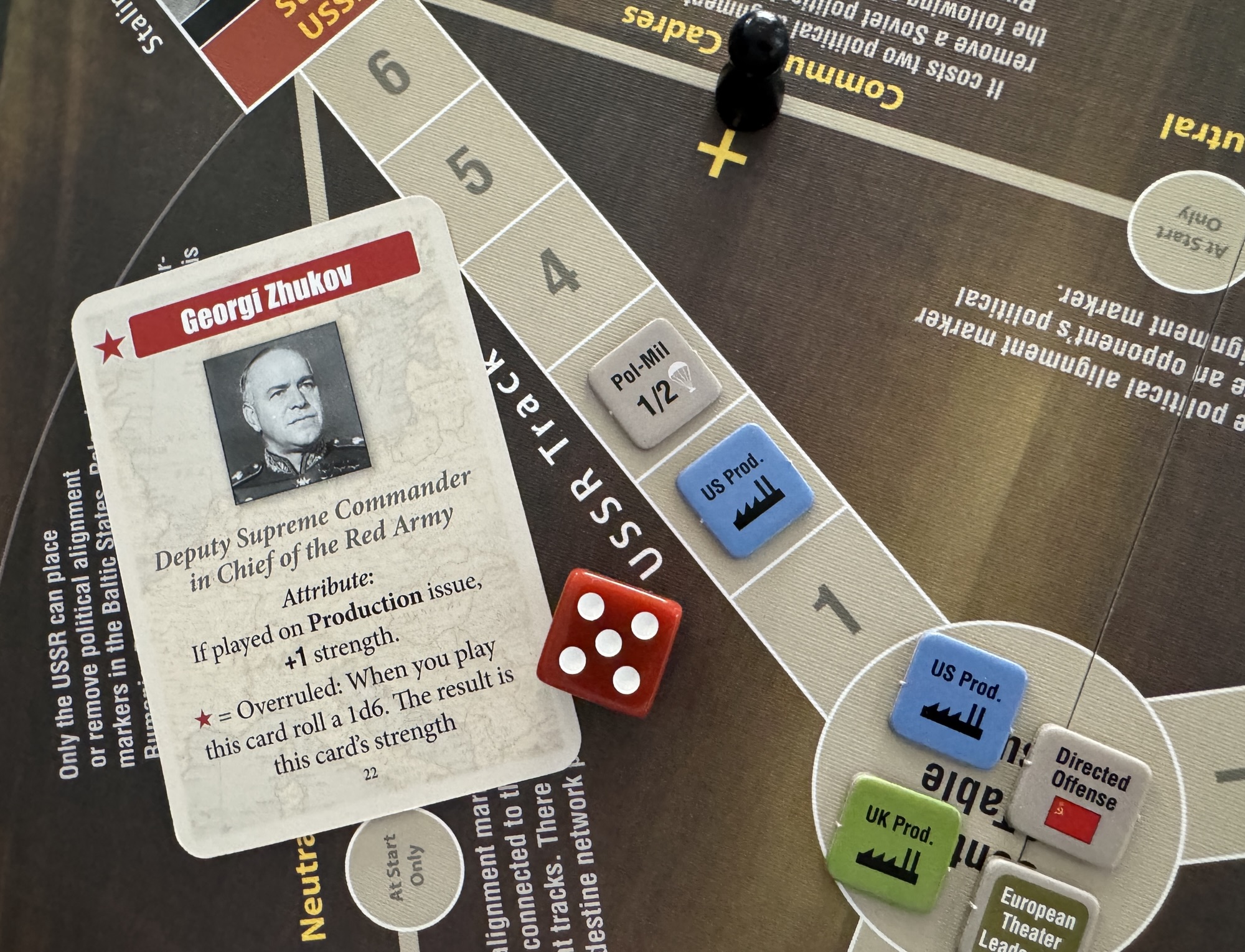
#65: Georgi Zhukov from Churchill: Big 3 Struggle for Peace from GMT Games
The players in Churchill: Big Three Struggle for Peace take on the roles of Churchill, Roosevelt, or Stalin during World War II as they maneuver against each other over the course of 10 Conferences that determine who will lead the Allied forces, where those military forces will be deployed, and how the Axis will be defeated. The player whose forces collectively have greater control over the surrendered Axis powers will win the peace and the game.
Churchill is not necessarily a wargame, but more of a political conflict of cooperation and competition. Over the course of the 10 historical conferences from 1943 till the end of the war this mechanic and much of the design should not be taken literally. Before and after each conference small groups of advisors and senior officials moved between the Allied capitals making the deals that drove the post war peace. These advisors and senior officials are represented by cards with an assigned numeric value that represents an amount of influence. Each conference sees one of a group of issues nominated for inclusion in the conference for debating and discussion. The issues categories include: Theater leadership changes, directed offensives, production priorities, clandestine operations, political activity, and strategic warfare (A-bomb). Each of the historical conference cards independently puts some number of issues, such as directed offensives or production priorities, metaphorically on the table, while the players nominate an additional 7 issues. The best part of the design is the conference table and stress and tension that comes from fighting over each and every issue. No one issue is a game breaker and no one issue will outright win the peace for you. But, each issue is key to the game as they unfold and change the landscape across which you are battling. Not landscape of terrain and defenses, but pit falls, traps and dead ends.
As I have mentioned, the Staff Cards are the engine for the game and the players must utilize their asymmetric abilities to the best of their ability in order to come out on top of the heap at the end of the game. These Staff Cards represent real period personalities of advisors, political officers and generals, who had the ear of the leaders and could go about working behind the scenes to move an issue into the limelight. Each player will utilize these cards to win those issues and each card provides either a bonus for a specific attribute or, in rare occasions, a negative modifier.
Today, we will take a look at one of my favorite type of cards from the game in the Chief of Staff Cards and specifically look at the Soviet Chief of Staff Georgi Zhukov who was the Deputy Supreme Commander in Chief of the Red Army. Each of the Chief of Staff Cards have a random numeric value in addition to a bonus for a certain attribute. The random numeric value is determined from rolling a 6 sided die and then using that number as the card’s base value. In Zhukov’s case, he is good with Production Issues and will grant a +1 strength toward moving these issues on the conference table. I like to think that this random determination of the Chief of Staff Card’s strength represents the internal power struggle with each of the nations leaders and those closest to them. In the case of Soviet Premier Stalin and his relationship with Zhukov they maintained a tense, professional, and ultimately strained relationship defined by mutual need during World War II, followed by postwar jealousy and suspicion. While Stalin relied on Zhukov as his top military commander to secure victory on the battlefield, he grew paranoid of the Marshal’s immense popularity and influence, leading to his ultimate demotion. And this random nature of the card’s strength reflects this well as sometimes they would agree and they could make great progress while other times they did not and there was tension and difficulty in their cooperation.
Georgy Konstantinovich Zhukov was born on December 1, 1896 and was a Soviet military leader who served as a top commander during World War II and achieved the rank of Marshal of the Soviet Union. During World War II, Zhukov served as deputy commander-in-chief of the armed forces under leader Joseph Stalin, and oversaw some of the Red Army’s most decisive victories. He also served at various points as Chief of the General Staff, Minister of Defence and a member of the Presidium of the Communist Party (Politburo).
Born to a poor peasant family near Moscow, Zhukov was conscripted into the Imperial Russian Army and fought in World War I. He served in the Red Army during the Russian Civil War, after which he quickly rose through the ranks. In summer 1939, Zhukov commanded a Soviet army group to a decisive victory over Japanese forces at the Battles of Khalkhin Gol, for which he won the first of his four Hero of the Soviet Union awards, and in 1940 he commanded the Soviet invasion of Bessarabia and Northern Bukovina in Romania. In February 1941, Stalin appointed Zhukov as chief of the General Staff of the Red Army.
Following the German invasion of the Soviet Union in June 1941, Zhukov lost his post as chief of staff after disagreeing with Stalin over the defense of Kiev. Zhukov, often in collaboration with Aleksandr Vasilevsky, was subsequently involved in the Soviet actions at Leningrad, Moscow, Stalingrad, and Kursk. He held the title of deputy commander-in-chief of the armed forces from August 1942, and was promoted to Marshal of the Soviet Union in January 1943. He participated in the planning of Operation Bagration in 1944, and in 1945 commanded the 1st Belorussian Front as it led the Vistula–Oder Offensive into Germany, where he oversaw the Soviet victory at the Battle of Berlin. In recognition of Zhukov’s key role in the war, he was chosen to accept the German Instrument of Surrender and to inspect the 1945 Moscow Victory Parade. He also served as the first military governor of the Soviet occupation zone in Germany from 1945 to 1946.
After the war, Zhukov’s popularity caused Stalin to see him as a potential threat. Stalin stripped him of his positions and relegated him to military commands of little strategic significance. After Stalin’s death in 1953, Zhukov supported Nikita Khrushchev’s bid for leadership, and in 1955, he was appointed Defense Minister and made a member of the Presidium. In 1957, Zhukov lost favor again and was forced to retire. He never returned to a top post, and died in 1974. Zhukov is remembered as one of the greatest Russian and Soviet military leaders of all time.
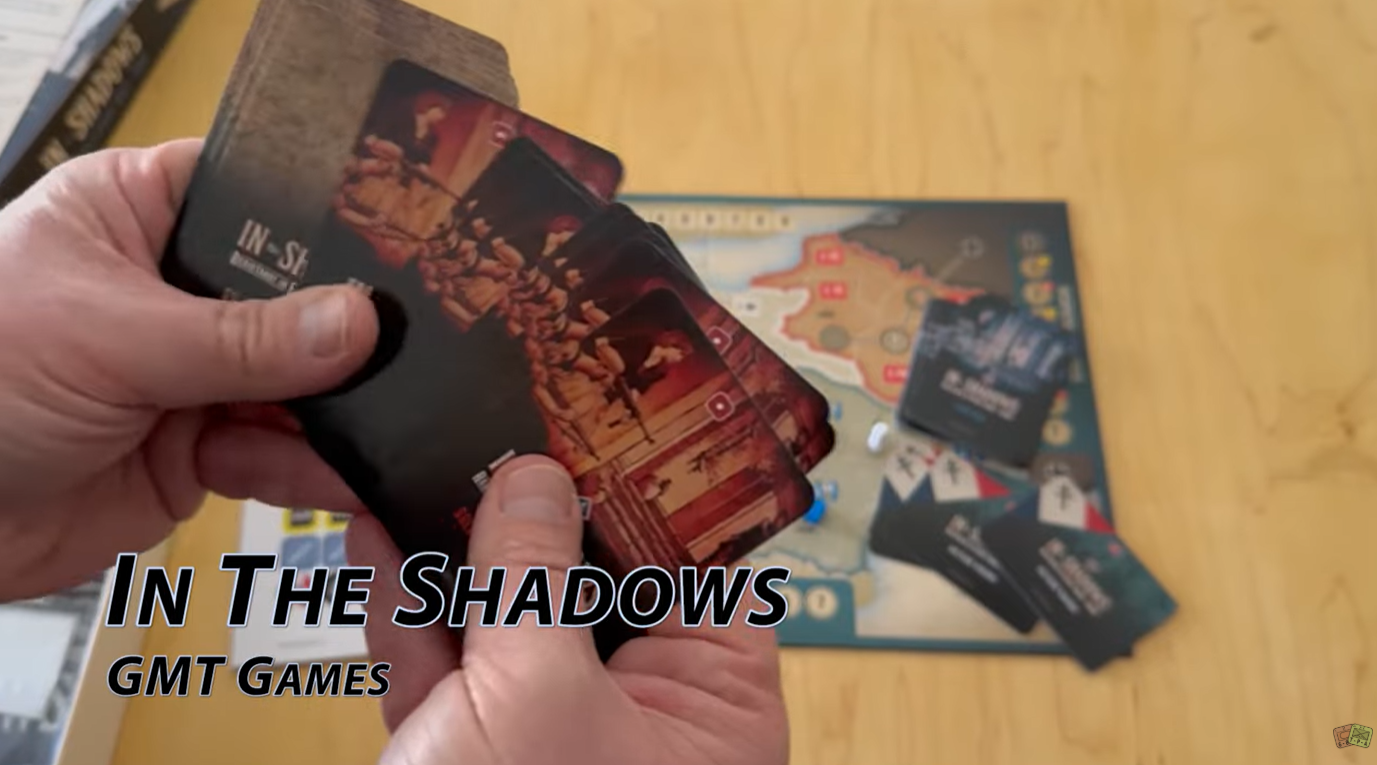
In the Shadows: Resistance in France, 1943-1944 from GMT Games is a 2-player card-driven game about the desperate struggle of the French Resistance against the occupying Nazi and collaborating French forces between January 1943 and June 1944. In the game you will play as either the Resistance or the Occupation in a fight over the hearts and minds of the French People. The game strives to have players better understand the nuances of the resistance and the clandestine nature of the fight that led to the founding of the fourth French Republic.
The gameplay of In the Shadows is driven by Event cards and Actions based on suits. The game relies on three different suits (the Resistance Cross, the Victory Cross, and the Iron Cross) to determine the cost and effectiveness of your Actions. Narratively, this is meant to represent the vital importance of local networks and resources. You may be working with resources in Paris but need to perform Sabotage Actions in Vichy. In this way, the game can better replicate the choices that the leaders of the Occupation and Resistance needed to make.
If you have been following our blog for a while now, you know of my affinity for the history of the American Revolutionary War. I am a proud American, believe deeply in the principles of our land and the Constitution that governs it and am grateful to God every single day that our country was successful in our fight for its freedom in order to create a better society and to assist all peoples with protecting their “unalienable rights” endowed by a Creator, which include “Life, Liberty and the pursuit of Happiness”. I play wargames on the American Revolutionary War and very much enjoy learning about the history and its key battles. There are many out there that feel the same as I do and they have designed lots of these type of games and with 2026 being our 250th Anniversary of the Declaration of Independence, there are events that are planned to celebrate it.
One of which is an event put on by GMT Games and Mark Miklos called Gaming the American Revolution 250 Camden, South Carolina. We are planning to attend and have already marked off the date on our calendar and we would love to see many of you there for 3 days of gaming centered on American Revolutionary Wargames produced and published by GMT Games.
The details of the event are as follows:
The Occasion: Three days of AmRev gaming on the campus of the Camden Revolutionary War Visitor Center located in Camden, South Carolina. Camden was pivotal to the story of the Southern Campaign with two battles fought within 6 miles of each other, bracketed by a British occupation of the town. The Battle of Camden in 1780 was a decisive British victory that crushed the American Southern Army and brought disgrace to American General Horatio Gates. The Battle of Hobkirk’s Hill in 1781 was a British tactical victory that proved to be a strategic defeat.
Holding a dedicated AmRev War game event in Camden is GMT’s way of recognizing not only the 250th anniversary in our nation’s history but also those in our hobby for whom gaming the American Revolution holds a special place in their heart. Perhaps most importantly, the energy that we will bring to the occasion ensures that the people and the events showcased in these excellent games will not be forgotten. As the proverb says, “As long as you speak my name I shall live forever.”
Dates: September 24-27, 2026. (Thursday through Sunday)
Location: Camden, South Carolina.
Venues: Liberty Hall, Camden Revolutionary War Visitor Center and Historic Camden.
Registration: $76.00
Travel:
If flying, Columbia, S.C. is 35 miles away, Charlotte, N.C. is 88 miles away, Charleston, S.C. is 127 miles away, and Greenville/Spartanburg, S.C. is 134 miles away.
If driving, connect to East-West Interstate 20 and take exit 98 for US 521 toward Camden. Several hotels are at the exit. Our venue is 1-mile away, toward town, and downtown Camden is perhaps one mile further on.
Lodging: There is no official event hotel. Lodging is on your own. Select from a list of nearby hotels to be published on the launch website.
Meals: Meals are on your own, with some hotels serving an included breakfast. See below for a possible group dinner on Saturday. Local restaurants will be listed on the event website.
Games: This event will feature an exclusively-GMT line up of American Revolutionary War games: Battles of the American Revolution Series, Liberty or Death and Washington’s War. In addition, we anticipate having current prototypes of games in development including The Battle of Cowpens, The Battle of Green Spring, and Common Sense available to play. Players are asked to bring their own copies of the GMT Rev War games they hope to play to ensure availability. A limited number of house games will also be available. Respectfully, please leave games by other publishers at home.
Game Schedule: Friday, 9:00 a.m. until 11:00 p.m. Saturday, 9:00 a.m. until 11:00 p.m. Sunday, 9:00 a.m. until 3:00 p.m.
Format: Open gaming; play with a friend or make a new one.
BoAR Eutaw Springs Tournament: For any BoAR players who may want to mark the occasion with competitive play, there will be a single-elimination Eutaw Springs tournament. The winner will receive a theme-appropriate prize.
Attendees: Maximum attendance will be 125. Attending will be Gene and Rachel Billingsley and several GMT designers and developers. Content creators and podcasters will also be in attendance.
Event registration includes the following non-gaming activities:
Thursday – On arrival day we are planning an evening Meet & Greet at the historic McCaa Tavern, a restored 18th century tavern on the campus of Historic Camden. We will gather at approximately 6:00 p.m. for light refreshments and period entertainment. At sunset, we will light the cressets and adjourn to the back lawn for brief remarks, culminating with two rounds of artillery fire in full darkness.
Friday – Gather at 8:30 a.m. on the lawn in front of Liberty Hall for some brief period entertainment preceding the start of gaming. On this day there will be photo opportunities for those wishing a picture in period dress. All attendees will have access to the grounds of Historic Camden featuring several restored period buildings including the Kershaw-Cornwallis House (HQ for Lords Cornwallis and Rawdon during the British occupation) and a reconstructed British redoubt. The Rev War museum at the Visitor Center will also be available.
Saturday – Today we will offer two departures by chartered school buses to the Camden battlefield (approx. 8-miles away) where we will enjoy private battlefield tours conducted by Rick Wise, Executive Director of the South Carolina Battleground Preservation Trust. Tours will be conducted at 10:00 a.m. and 2:00 p.m. with departures scheduled accordingly. Each departure will be limited to bus capacities and sign up will be on-site at registration on a first come, first served basis. The grounds of Historic Camden and the museum will be available today as well.
We are currently trying to arrange a private dinner for Saturday night. Reservations will be required and there will be an upcharge to the $76 event price for those wishing to attend. Arrangements may not be completed by the time event tickets go on sale on February 19th. In that case, we will notify all registered players later with information about the dinner, (location, cuisine, cost, time, etc.) and the opportunity to reserve space.
Sunday – Gaming ends at 3:00 p.m. Last chance to visit the sites of Historic Camden, The Old Presbyterian Graveyard, and the Quaker Cemetery, final resting places for several Revolutionary War soldiers. Depart for onward travel.
Agenda for non-registered players: We are working to compile a list of points of interest and other activities for those coming to Camden but who will not be registering to play. This list will include at least one antebellum home open to the public, the National Steeplechase Museum, the Camden Horse & Hound Weekend, antique stores and boutique shops, etc. Entry fees, if any, will be the responsibility of each individual.
More information will be forthcoming soon and the event website where you can register will be available on February 19th.
I am very excited about this opportunity and Alexander and I are already making plans to attend. We look forward to playing several games of the Battles of the American Revolution Series, as we have really only played a few including Brandywine, Savannah and Germantown, as well as talking with fellow devotees to the historical period and seeing the sights. I have been to Camden in the past, but didn’t get a chance to see all of the sites in the area and look forward to learning more about the period and setting.
Because this is a wargaming blog, I am going to share below some of our content we have made regarding AmRev War games for your review:
With this My Favorite Wargame Cards Series, I hope to take a look at a specific card from the various wargames that I have played and share how it is used in the game. I am not a strategist and frankly I am not that good at games but I do understand how things should work and be used in games. With that being said, here is the next entry in this series.
#64: Guns of August from Paths of Glory: The First World War, 1914-1918 from GMT Games
Paths of Glory is widely thought to be a masterpiece on WWI and after just a few plays of the game, both in person and online on the fabulous Rally the Troops!, I can definitely see why people feel that way. Even though we are novices, the game is just that good and really tells the story of the fruitless efforts of both the Entente and Central Powers as they bashed their heads against each other over control of Europe. The game is long and you generally are going to have to play this one over a long weekend to get it all in and enjoy it properly but it is just such as great tool to understand the complexities of the struggles of trench warfare, supply and the balance of attacking versus taking a breath and regrouping. I really enjoyed the mix of historical events and the choices that I had to wage the war in a way that I felt was appropriate. But, my message to everyone who plays this game is beware of supply. Even in our few plays, supply has been an issue and we have had to make sure we didn’t make a few fatal mistakes that would get us in trouble. I want it to be clear here. I am not good at this game…at all and the nuances of supply and how to play have just eluded me as I continue to make the same errors game after game. But it is really good and I look forward to each new play with enthusiasm and am excited about the chance to get to learn more about this fascinating war that was so very fruitless.
I am going to use snips of the board from Rally the Troops! in this post so it might look a bit different from my normal posts.
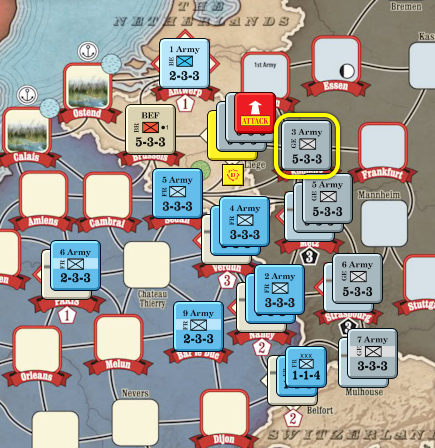
With that being said, generally in every single game the Central Powers will start out by playing their Guns of August card. Guns of August is a crucial, high-stakes opening event for the Central Powers on Turn 1, enabling an immediate, powerful, and historical offensive against France and Belgium.
The Guns of August is a 3/4 OPs card that is placed into the CP player’s hand at the outset and gives them the initiative immediately. First off, the card destroys the fortress at Liège and then gives a massive mobilization effort booster by moving 2 German Army counters from their starting spaces including the German 1st and 2nd Armies and then activating them both to attack along with the German 3rd Army who is located at the start of the game setup in Koblenz.
This gives the CP player 2 choices about how to start the war with this attack. They can focus on the British Expeditionary Force located in Brussels or the French 5th Army located in Sedan. The allows the CP to destroy the Liège fortress, advance armies, and immediately attack or pressure the British Expeditionary Force (BEF) and French forces. In my humble opinion, the BEF is the real target here as this unit cannot be replaced or rebuilt and its removal opens up the path for the Germans to take on the fortress at Antwerp.
While the Guns of August card play is an aggressive move, it does somewhat ensure Austria-Hungary can survive potential Russian pressure as the Allied player will have to quickly use their precious resources to fill the gaps created by this opening attack rather than using them to bolster the Russians in the east or to build up the Serbians a bit in the south to prolong the fall of Belgrade. Paths of Glory is a large part about resource management and the constant pressure to continue offensive momentum and rebuild troops through the use of Replacement Points and events to bring on additional troops is a major problem for both sides. You can only attack for so long before you will burn yourself out and will have to spend time to recover and get ready for the next turn’s offensives. Using the Guns of August cards efficiency will free up resources to use elsewhere.
There are alternative openings with the card that can be considered. If not using Guns of August for the event, the CP player can use 1 OP to destroy the Liège fort, allowing them to conserve the card for later or pivot to a more defensive strategy, such as defending the Rhine.
In the end, I would recommend the hammer approach versus any other use of the card as it will really put the pressure squarely on the Allies to do something about what you have just accomplished. In the picture to the right is the normal outcome of these attacks as you can see the BEF is reduced and the French 5th Army has broken and is now replaced by a smaller Corps counter that cannot really do anything offensively and is just there to protect the back side of the Maginot Line from being caught out of supply.
The Guns of August (published in the UK as August 1914) is a 1962 book centered on the first month of World War I written by Barbara W. Tuchman. After introductory chapters, Tuchman describes in great detail the opening events of the conflict. The book’s focus then becomes a military history of the contestants, chiefly the great powers.
The Guns of August provides a narrative of the earliest stages of World War I, from the decisions to go to war up until the start of the Franco-British offensive that stopped the German advance into France. This led to four years of trench warfare. The book discusses military plans, strategies, world events, and international sentiments before and during the war.
The book was awarded the Pulitzer Prize for General Nonfiction for publication year 1963, and proved very popular. Tuchman later returned to the subject of the social attitudes and issues that existed before World War I in a collection of eight essays published in 1966 as The Proud Tower: A Portrait of the World Before the War, 1890–1914.
With this My Favorite Wargame Cards Series, I hope to take a look at a specific card from the various wargames that I have played and share how it is used in the game. I am not a strategist and frankly I am not that good at games but I do understand how things should work and be used in games. With that being said, here is the next entry in this series.
#63: Militia from Stilicho: Last of the Romans from Hollandspiele
Stilicho: Last of the Romans is a very well designed and interesting solo experience that plays in 60-90 minutes. But, due to the unforgiving nature of the random card draws and its reliance on dice luck, that admittedly can be mitigated through cagey card play and proper decisions, the game can be over very quickly. In fact, my very first play a few years ago lasted only 2 rounds and was over in about 15 minutes. Remember that the historical Stilicho only made it to Round 3! The cards are at the heart of the game here and make it a very tense and decision filled experience. Having to analyze each card, measuring its utility against the board state and what pressing matters the player must address while also fretting over having to discard a good Event Card that just isn’t useful at this point in time to take an action can be really agonizing. I think that this design works even better than its predecessor Wars of Marcus Aurelius.
The cards are a form of multi-use cards, as most Card Driven Games are, as they can either be used for the printed events on the cards or simply to be discarded to take one of a number of actions available to the player. It is important to read every aspect of the card thoroughly as some cards have multiple effects, differing effects depending on what the state of the game is or whether one Barbarian has surrendered or may have several prerequisites to that card being allowed to be played.
There are some events that are too important to your efforts to ever discard to take an action as they provide you with such great benefit and are more efficient than taking individual actions. Don’t get me wrong though the playability of a card is always dependent on when in the course of the game the card is drawn. An example of what I am talking about is the Militia Roman Card.
During the game, some cards will cause Unrest Markers to be placed on the various tracks that wind their way through the provinces. These Unrest Markers represent the erosion and weakening of Roman control, the spread of fear throughout the populace due to the threat of usurpers and ultimate civil war as well as the logistical difficulties of defending against barbarian incursions. They act as a critical, accumulating threat that, if left unchecked, can lead to widespread revolts, which are one of the primary ways a player loses the game. Unrest Markers are placed in Dioceses when specific enemy cards (particularly the Vandals) are activated or reach the end of their movement tracks. If a Diocese already contains an Unrest Marker when a new one is triggered, it indicates increasing instability, requiring the player to flip an existing, lower-level Unrest Marker to its “Revolt” side. Unrest/Revolt Markers increase the difficulty of battles in that province. When attacking or defending in a affected Diocese, the marker adds to the enemy’s strength. Also, a major loss condition in the game is having too many Revolt Markers on the board simultaneously. Managing and removing these markers is essential for survival. Unrest Markers are placed in a specific order across the board—starting from Hispania and moving through Gallia to Italia—which dictates the geographic spread of the crisis. Players must spend valuable actions (usually by discarding cards) or use specific Event Cards such as the Militia card to remove these counters from the board.
Before the late 2nd century BC, Rome used a citizen militia or levy of property-owning men aged 16–46, serving unpaid during summer campaigns. Organized by wealth, they formed three lines—hastati, principes, triarii—and provided their own equipment. They were crucial for seasonal defense and expansion, as well as for patrolling and safeguarding supply lines, trade routes and newly conquered territories, ultimately transitioning to a professional army after 107 BC. The citizen troops were grouped into maniples based on age and wealth, with the poorest acting as light-armed skirmishers (velites). Service was typically restricted to the annual campaign season, often ending with the Festival of the October Horse on 19 October. The militia employed a three-line, checkerboard formation to allow for tactical flexibility. Due to many reasons, the militia system was phased out after 107 BC in favor of a full-time, professional army, although conscription remained as a, mostly unpopular, option for raising forces.
I wrote a series of Action Points on the various aspects of the game and you can read those at the following links:
Action Point 1 – the Mapsheet focusing on the three Fronts down which your enemies advance, but also covering the different spaces and boxes that effect play such as the Olympius Track, Game Turn Track, Army Box, Leader Box and Recovery Box
Action Point 2 – look at the cards that drive the game and examine the makeup of both the Enemy Deck and the Roman Deck.
Action Point 3 – look into the Roman Phase and examine how cards are discarded to take one of nine different actions.
Action Point 4 – look at a few examples of Battles and how they are resolved.
Action Point 5 – look at a few points of strategy that will help you do better in the game.
I shot a playthrough video for the game and you can watch that at the following link:
I also followed that up with a full video review sharing my thoughts:
With this My Favorite Wargame Cards Series, I hope to take a look at a specific card from the various wargames that I have played and share how it is used in the game. I am not a strategist and frankly I am not that good at games but I do understand how things should work and be used in games. With that being said, here is the next entry in this series.
#62: Romanian Autonomy from Twilight Struggle: Red Sea – Conflict in the Horn of Africa from GMT Games from GMT Games
We all love Twilight Struggle….and if you say you don’t, you really do but just want to be different or are a contrarian! The game is phenomenal and has done very well for GMT Games with 8 Printings as well as the Turn Zero Expansion and now a series of smaller geographically focused spin off games starting with Twilight Struggle: Red Sea – Conflict in the Horn of Africa. Twilight Struggle: Red Sea deals with just two regions located in the Horn of Africa including Africa and the Middle East. The game uses the familiar Twilight Struggle formula of Cards with both Events and Operations Points that can be used by players to perform Coups, do Realignment Rolls or place Influence in an effort to gain control of the most Countries in the Regions to score Victory Points and win the game. The game is fast, furious and only lasts 2 hands of cards (unless you choose to play the special 3 Turn variant) so there isn’t a lot of time to mess around and players must be focused on what they are trying to accomplish. The best thing about the game is that it plays in 45 minutes as compared to 3-4 hours for Twilight Struggle.
The next card we will take a look at in this series is the special Romanian Autonomy, which is a unique card that doesn’t play from the deck but starts with the US player and resembles one of the classic cards from the original Twilight Struggle called The China Card. And if you have played Twilight Struggle, you know about the China Card. The China Card is a 4 Ops Value Card that can be held by the player in addition to their hand limit thereby giving them an extra card to use. But the card also has a special ability where if the player uses the card for 4 Ops to place Influence only in Asia, it will grant the player +1 Ops Value to use in placing one additional Influence. The China Card also grant’s the player who holds the card at the end of Turn 10 a +1 VP bonus.
In Twilight Struggle: Red Sea, the China Card has been replaced by the Romanian Autonomy Card. This card is not as powerful as the China Card but definitely creates some new opportunities and challenges for the player playing the card. The Romanian Autonomy Card can effect their Ops Value from cards by +1 during the Turn that they play it if they are behind on the Victory Point Track and also grants +1 VP to the player holding the card during Final Scoring. I think this is a really interesting concept and I think was included as a sort of catchup mechanic due to the short nature of the game. I look forward through more plays to seeing how its addition changes things and whether it is overpowered or just right. Once again, a small and subtle change to the game to create a new and interesting experience for the avid fan of Twilight Struggle or players who are new to the system.
Nicolae Ceaușescu visiting Africa during the Cold War.
During the Cold War, particularly under Nicolae Ceaușescu (1965–1989), Romania maintained a distinct, active presence in Africa, including the Horn of Africa, as part of a strategy to distance itself from Soviet influence, gain international prestige, and foster economic exchanges. While major powers like the Soviet Union and Cuba directly intervened in regional conflicts (such as the Ogaden War), Romania focused on building “fraternal” socialist relations through diplomatic, economic, and technical assistance, often operating with a degree of autonomy from the Warsaw Pact. Romania’s actual African strategy in the Horn of Africa, outlined in its 2023 Africa Strategy, emphasizes partnership, peace, development, education, and security cooperation, not territorial autonomy. Romania aimed to be a bridge between Europe and Africa, strengthening ties through cultural exchange, economic projects, and increased diplomatic presence in strategic capitals like Addis Ababa and Nairobi. Under its former communist regime, Socialist Republic Romania pursued economic independence and influenced African nations, but this was distinct from seeking autonomy within Africa. The phrase “Romanian autonomy in the Horn of Africa” is a game term with strategic implications within the game, while Romania’s real-world engagement with Africa is about broader diplomatic and economic partnerships
With this My Favorite Wargame Cards Series, I hope to take a look at a specific card from the various wargames that I have played and share how it is used in the game. I am not a strategist and frankly I am not that good at games but I do understand how things should work and be used in games. With that being said, here is the next entry in this series.
#61: Mobile Vulgus from Time of Crisis: The Age of Iron and Rust Expansion from GMT Games
I really love Time of Crisis from GMT Games. This is a very light, introductory wargame that is just plain fun to play. I have been playing it a ton on the Rally the Troops! online platform and really enjoy it no matter what the outcome of those games are. One card that I enjoy using is called Mobile Vulgus, which is a 3 value Populace Card that really can be a devious way to usurp your enemies. This card was added to the game in The Age of Iron and Rust Expansion and is one of those cards that is very situational but very good.
As you know, Time of Crisis is a back and forth game that sees players pitted against each other for the control of provinces and ultimately a change in the player who wears the purple robes of Emperor and sits on the throne in Italia. This process is carried out as players play Populace cards to garner Influence points that are then used to Replace a sitting Governor. The problem with the process is the dice. Now, I know what you are saying. Typically, as long as you roll a 2+ on a d6 it is considered a success and garners you a vote but my luck dictates that I will roll multiple 1’s on a roll where you are looking for a number higher than 1. So, if you can somehow get the dice out of the equation, you are better off. Along comes the fantastically powerful card Mobile Vulgus.
Why exactly do I consider this card so good? Well, you don’t have to rely on rolling dice to get what you want…simple as that. The power is maybe not as efficient as I would like it to be, as you will have to take a Replace Governor Action later to seat your Governor, but it is guaranteed. First off, the card allows you to target a province in which you wish to Replace the current sitting Governor. You normally would play Populace cards to create a number of Influence Points that you would then use to roll 1d6 per point. With Mobile Vulgus you simply play a certain amount of Populace cards to create a total amount of Influence that allows you to overcome their current support level. In the picture above, you can see that the current support level for the Blue Governor in Gallia is at 2. You will also notice though that the Blue General is located in the Provincial Capital with a sizeable army. This army will add to the number of Influence points you will have to spend to reduce that support.
As we examine the Blue General’s stack of forces, we see that he has 3 units under his control, 2 full strength Legions (XIV Gemina and X Gemina) as well as a lone Militia. These 3 units will add to the amount of Populace Influence points that must be spent to effect the support level of the province. Because there are 3 units, we will add those 3 units to the current support level of 2 to bring our target to reduce to 5. In simpler terms 2 for the current support level + 3 for the units in the provincial capital. This then successfully reduces the support level to 1. Remember, that if using a normal Replace Governor action, you would have been rolling 5 dice (1d6 per Populace Influence point spent) and would have needed to roll 2+ and garner 7 votes (calculated by doubling the current support level and then adding in +1 vote needed for each unit in the capital). You couldn’t have possibly done that using only the two cards shown and would have had to play at least one more Populace card with at least 2 Influence points to get to roll 7 dice!
Mobile Vulgus is a Latin phrase that means “the fickle crowd”, referring to the changing nature, opinions and reactions of the general public or an audience, which is a derivation of the English word “mob”. It literally denotes a movable public, or the unstable crowd and recognizes the inconstancy of popular taste and the ease with which clever politicians can influence the great mass of voters. In game terms, the support of the people can sometimes falter as easily as it can be encouraged.

 Anmelden