With this My Favorite Wargame Cards Series, I hope to take a look at a specific card from the various wargames that I have played and share how it is used in the game. I am not a strategist and frankly I am not that good at games but I do understand how things should work and be used in games. With that being said, here is the next entry in this series.
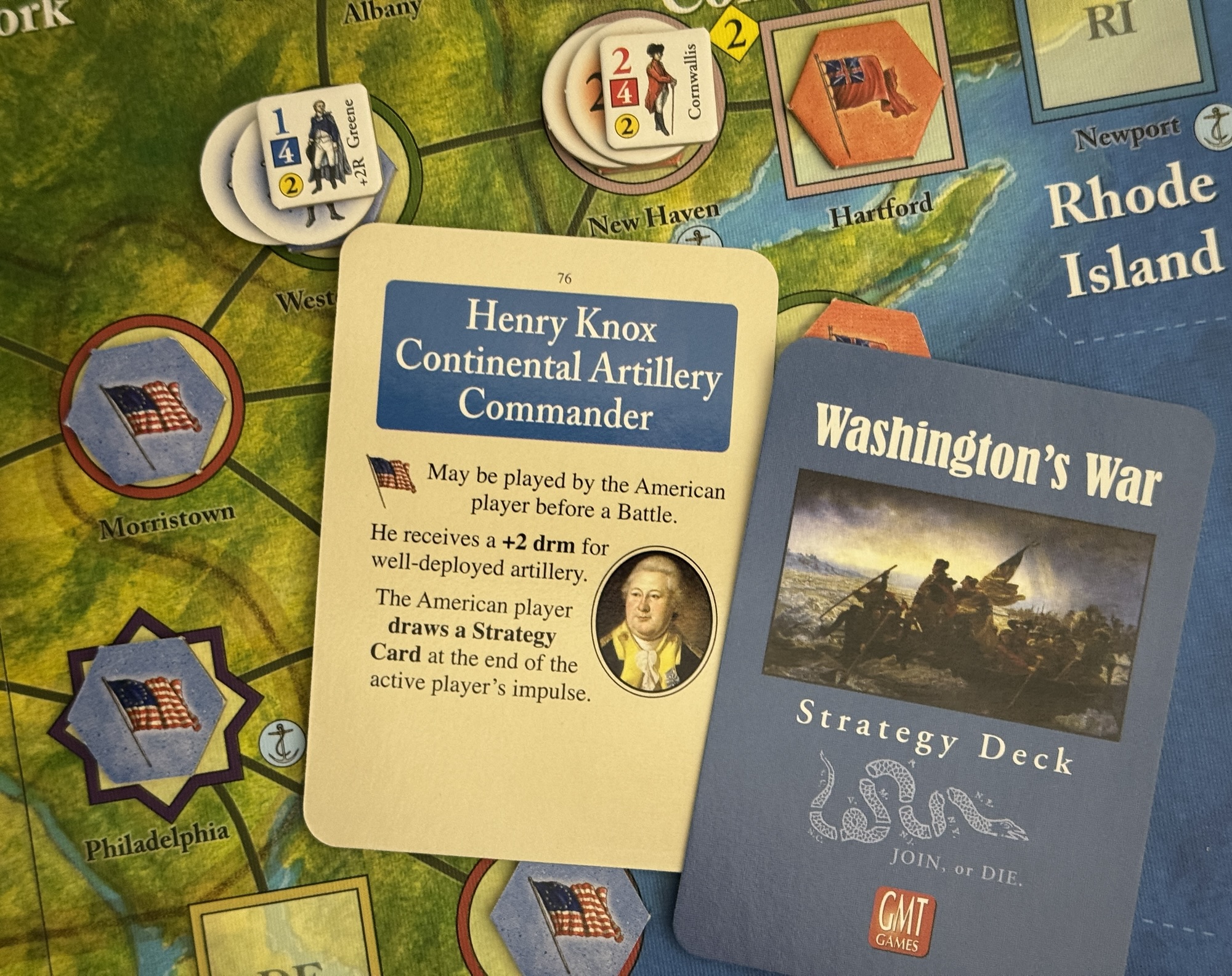
#96: Henry Knox Continental Artillery Commander from Washington’s War from GMT Games
Washington’s War is a war game, make no mistake about that. But, it is virtually impossible to win the game by focusing only on the field of battle. For that to happen, the Patriots need to completely drive the British forces out of the 13 colonies or the British need to wipe the American forces off the map. Both are extremely difficult and I would be surprised if any more than 1 out of 30 games ended in such a way. Rather, the ultimate goal of the game is to have political control of the colonies. If at the end of the game the Patriots control 7 colonies, while holding the British to control of less than 5, they win. If not, the British win. Simple as that. So, you can see that battle is not the main goal but control is. And more importantly political control.
I really like this about the design and feel that the real core of the American Revolution was the groundswell of patriotism and the desire to live free from the shackles of an overseas monarch who cared little for the American way of life. This desire led great men of the time to sacrifice themselves, their livelihood and their families to further the true cause of liberty and build a truly free and democratic nation where individual liberty and freedom was prioritized over anything else. And yes, I realize that this nation was not perfect, not without contradiction but the concept of liberty helped to form a country that would lead to the ultimate freedom of all people.
Washington’s War is a Card Driven Game, and as such, relies on cards to provide to players the actions needed to play the game. The cards contain OPS Points which can be used to drive various actions, including such things as activating leaders, who in turn will then move with forces to attack, and also contain written text in the form of events. These events can be played only by the side they are intended for and if drawn and played by the opposing side, they can only be thrown away while granting a few possible actions, such as placing or removing Political Control markers.
In Washington’s War, the Strategy Card Deck contains several different type of cards of which one is Battle Cards. Battle Cards are special event cards that provide a powerful +2 Die Roll Modifier (DRM) during combat and allow the user to draw a replacement card at the end of the turn. All of the Battle Cards offer a +2 DRM but each of them are tied to a different historical character or event. In this instance, the card’s effects reflect the work of Henry Knox who was a prominent Continental Artillery Commander during the Revolutionary War. There are only 9 total Battle Cards in the 110-card deck with the Patriot side having 5 cards, while the British side only has 4. I also want to point out that when these cards are used, they allow the using player to draw a replacement card at the end of the active player’s turn, keeping your hand size strong and not forcing you to sacrifice a card. And due to the fact that they swing combat odds significantly and also replace themselves with a draw, they are heavily prized and typically are saved in a player’s hand for those critical campaign-deciding clashes.
Henry Knox was an American military officer, politician, bookseller, and a Founding Father of the United States. Knox, born in Boston, became a senior general of the Continental Army during the Revolutionary War, serving as chief of artillery in all of George Washington’s campaigns. Following the war, he oversaw the War Department under the Articles of Confederation from 1785 to 1789. Washington appointed him the nation’s first Secretary of War, a position which he held from 1789 to 1794. He is well known today as the eponym of Fort Knox in Kentucky.
During the siege of Boston, the idea arose that cannon recently captured at the fall of forts Ticonderoga and Crown Point in upstate New York could have a decisive impact on its outcome. Knox is generally credited with suggesting the prospect to Washington, who placed him in charge of an expedition to retrieve them even though Knox’s commission as an officer had not yet arrived. Reaching Ticonderoga on December 5, 1775, Knox commenced what came to be known as the “noble train of artillery”, hauling 60 tons of cannon and other armaments by horse-drawn and ox-drawn sleds across some 300 miles of ice-covered rivers and snow-draped Berkshire Mountains to the Boston siege camps.
The region was lightly populated and Knox had to overcome difficulties hiring personnel and draft animals. On several occasions, cannon crashed through the ice on river crossings, but the detail’s men were always able to recover them. In the end, what Knox had expected to take just two weeks actually took more than six, and he was finally able to report the arrival of the weapons train to Washington on January 27, 1776. Historian Victor Brooks writes that this was “one of the most stupendous feats of logistics” of the entire war, and Knox’s effort is commemorated by a series of plaques marking the Henry Knox Trail in New York and Massachusetts.
The cannon were immediately deployed to fortify the Dorchester Heights recently taken by Washington. The battery’s position over Boston harbor led the British to evacuate Boston for Halifax, Nova Scotia. With the siege ended, Knox undertook the improvement of defenses in Connecticut, Rhode Island and New York in anticipation of a possible British assault. In New York he became friends with Alexander Hamilton, commander of the local artillery. He also established a close friendship with Massachusetts general Benjamin Lincoln.
A team of oxen hauls captured artillery toward Boston as part of the 1775-76 “Noble train of artillery”.
Here is a link to our full video review of the game:
In the next entry in this series, we will take a look at Prudence from 1989: Dawn of Freedom from GMT Games.
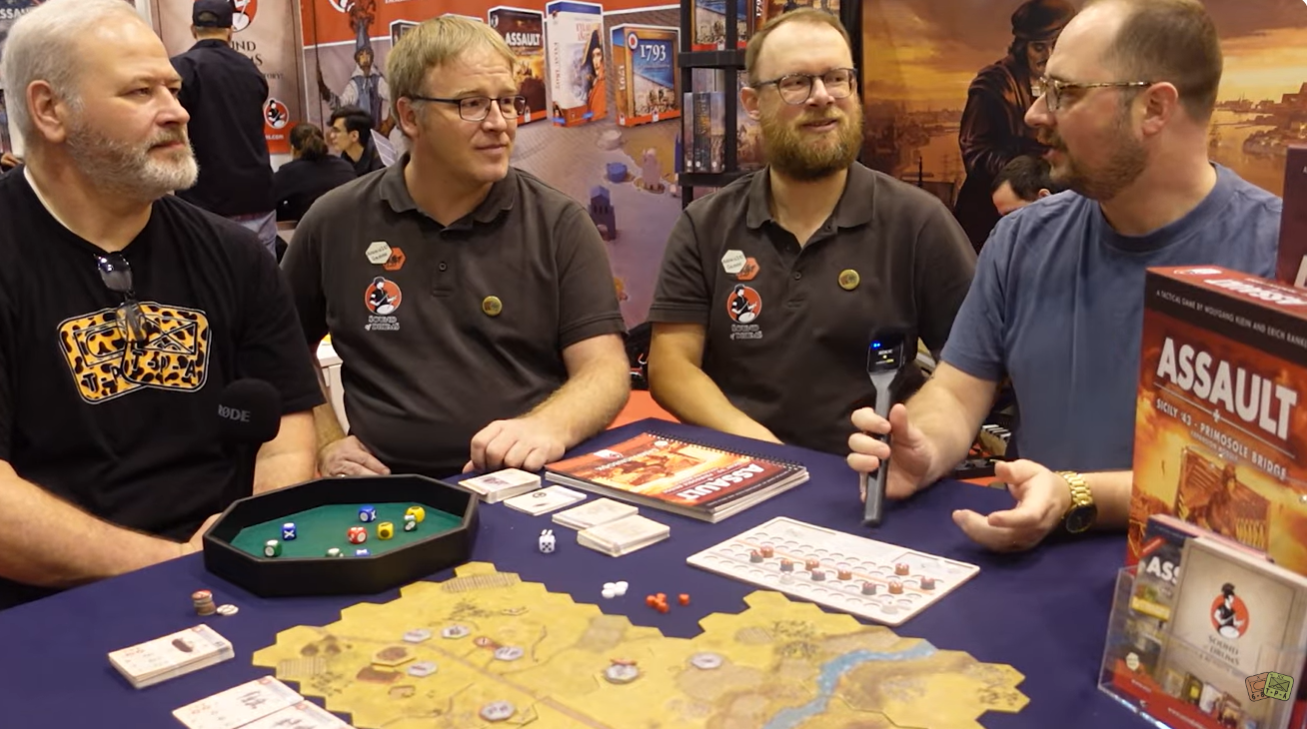
Last year, while attending SPIEL Essen in Germany, we had the chance to sit down separately with 3 wargaming designers in Wolfgang Klein/Erich Rankl with Assault! Games, Florent Coupeau with Nuts! Publishing and Uwe Walentin with Sound of Drums and shoot interview videos about their games and upcoming projects.
Day 4 was our site visiting day and we planned out an all day trip that would take us to 4 different American Revolution battlefield sites including Waxhaws (Buford’s Massacre), King’s Mountain, Cowpens and Musgrove Mill.
But first we visited the Battle of Waxhaws also known as Buford’s Massacre in Lancaster, South Carolina. The Battle of Waxhaws took place on May 29, 1780. British Lieutenant Colonel Banastre Tarleton overtook Colonel Abraham Buford’s regiment of 350 Virginian Continental troopsas they were attempting to relieve Charleston. The battle was short lived and saw over 113 Patriot soldiers killed in a brief but brutal engagement after a breakdown in surrender communications as the Patriot soldiers were attempting to give up under a white flag and the British bayoneted and sabred many of them earning Tarleton the infamous nickname “Bloody Ban”.
The site was very clean and well done with lots of landscaping and hardscape features and they had a sign board showing the timeline of improvements over time. The central ficus is the mass grave of the men who were killed there.
I very much enjoyed the various interpretive signage and especially those showing the battle lines and disposition of troops as it helps me to place the event on the site and better understand how it unfolded.
The mass grave memorial was very well done and has been improved over the years to its present day condition. The mass grave is marked by a large 10-foot tall white marble obelisk marker originally erected in 1860 and later replaced in 1955.
We then made our way to King’s Mountain and very much enjoyed this site which commemorates a Patriot victory over the British on October 7, 1780. The battle was fought on a very rocky ridge in western South Carolina, near the North Carolina border.Around 900 Patriot frontier militiamen known as the “Overmountain Men” were against an equivalent force of Loyalist militia led by British Major Patrick Ferguson.The battle lasted only65 minutes.
The Patriot forces consisted of frontier militia from the Carolinas, Virginia and Georgia who had tracked Ferguson’s Loyalist force to their camp on the protected high ground. The Patriots used their hunting skills and knowledge of the terrain to surround the hill and while moving up the rocky slope, Patriot riflemen picked off the exposed Loyalists.
A painting hanging in the visitor center of the battle.
The Patriots had fewer than 100 casualties (around 28 milled and 90 wounded)while the Loyalists incurred over 1,000 total casualties, including roughly 240 killed or wounded and more than 600 captured.
The Loyalist leader Major Ferguson was shot and killed after trying to lead a desperate charge and the remaining Loyalist forces quickly surrendered.
A monument to Major Ferguson.
This one took me by surprise as the Loyalists had the high ground and superior positioning but were unable to overcome the Patriots. Just very interesting! The defeat halted the British invasion of North Carolina and forced General Charles Cornwallis to retreat from his forward positions.
Looking down from the ridge you can see the brutally steep and difficult terrain the Patriots maneuvered across.
We then made it over to Cowpens which was the battlefield that I was most interested in seeing especially since we just had played the game and were somewhat familiar with the situation.
The Battle of Cowpens occurred on January 17, 1781 near the town of Cowpens, South Carolina. A Patriot army of nearly 2,000 regulars and militia under Brigadier General Daniel Morgan defeated a force of about 1,000 British and Loyalist troops commanded by Lieutenant-Colonel Banastre Tarleton and was the worst defeat suffered by the British in North America during the conflict following the 1777 Saratoga campaign.
After playing Small BoAR Cowpens, I was anxious to see the battlefield and the terrain to see how it compared. The setup of the units was spot on to what was shown at the site and I was guard to see that.
There were 3 lines of Patriot forces including skirmishes at the front, maim Continentals in the center and reserve cavalry in the back.
Then there was the actual terrain with the barren pines being somewhat present but most importantly the elevation change that would have obscured the Patriot trap.
There also was the cane break terrain that was found at the edges of the battlefield and that was pretty cool to see as it is very thick and darned near impassable.
Cane break at the edges of the battlefield.
A very enjoyable experience and we were able to walk the entire site in about an hour.
The final site we visited was the small battle at Musgrove Mill. Here Patriot forces outmaneuvered a larger Loyalist force and setup an ambush to even the odds. On the morning of August 19, 1780 mounted Patriots arrived near Musgrove Mill, the key to the local grain supply and the site of a Tory outpost. The Patriot force consisted of Georgians under Colonel Elijah Clarke, South Carolinians under Colonel James Williams and a group of “Over Mountain Men” from present-day Tennessee commanded by Colonel Isaac Shelby.
The Patriots revealed their presence when several of their scouts clashed with a Loyalist patrol. Two Rebels were wounded in the brief clash. Falling back, the Patriots encountered a friendly farmer who informed them that, contrary to their initial intelligence, the Tory garrison had been reinforced and now consisted of 500 men.
Outnumbered, and having lost the element of surprise, the Patriots formed up on a ridge top overlooking the road to Musgrove Mill and threw up a make-shift breastwork. A small detachment under the command of Captain Shadrach Inman was dispatched to lure the enemy into an ambush.
We walked the trail that followed the action ending in what was called an Indian hill where the Patriots drew in the Loyalists and waited to fire until they were within 30 yards to devastating effect. They could wait because of the elevation of the hill and the thick trees they were hiding behind.
Although the battle only lasted for an hour, the Loyalists suffered heavy casualties while the Patriots’ losses were fairly light. Before they could follow up on their success, however, the Patriot commanders learned of Horatio Gates’s defeat at Camdenand decided to disperse their forces. The Battle of Musgrove Mill signaled that resistance to British rule had not been snuffed out.
That was it. We did a ton of stuff in just 4 days including playing 4 games, visiting a total of 6 battlefields, shooting 4 videos and enjoying our time with other wargamers. It was a great convention and my thanks go out to all those that made this possible including Mark Miklos, Gene Billingsley and GMT Games as well as the good folks of the Camden Visitor Center and the South Carolina Battlefield Preservation Trust.
What a great time we have had at this convention! 2 fulls day of gaming in a fantastic historical setting here in Camden, South Carolina. But it hasn’t just been gaming though. Today started with a 3+ hour tour of the Camden battlefield and a demonstration at the Battle of Hobkirk’s Hill as well.
Rick Wise who is the Executive Director of the South Carolina Battlefield Preservation Trust gave us a 90 minute tour and discussion on the battle fought at Camden on August 16, 1780. The Patriots led by Horatio Gates and Baron DeKalb fielded about 4,000 muskets versus around 2,200 British soldiers led by Lord Charles Cornwallis and Lord Rowdon. The battle resulted in a major British victory with Cornwallis’ force suffering just over 300 casualties while Gates’ suffered almost 2,000.
Rick had a British Brown Bess musket and a French Charleville musket used by the Patriots that we were able to see fitted with bayonets and wielded by 2 lucky volunteers. These would have been truly terrifying to stand against and when wielded by trained soldiers were deadly weapons.
He also shared with us that archaeologists discovered the skeletal remains of 14 soldiers at the battlefield alongside period artifacts like musket balls and buttons.
Forensic and artifact analysis identified 12 Continental soldiers from Maryland and Delaware, one North Carolina Loyalist militia member (who was also Native American), and one British soldier from the 71st Regiment of Foot (Fraser’s Highlanders). They also were able to reveal that some of the Continental soldiers were teenagers, including two young men aged 16 to 19. It was truly sobering to see their unmarked grave and to find out that several were so young. Honor and bravery as well as the desire for freedom knows no age and these soldiers truly gave their lives for a cause they believed in.
There also was a nice monument to the sacrifice of de Kalb who commanded the American right wing during the engagement leading the premier units of the Delawareans and Marylanders. When the left and center of the American line disintegrated, de Kalb’s force had to beat a retreat before becoming completely surrounded. During this juncture of the fighting, the Baron’s horse was shot out from under him and he was thrown to the ground. Before he could gain his feet, he was hit with three musket balls and bayoneted multiple times by approaching British soldiers. The wounds would prove to be mortal.
Captured shortly thereafter by the British, the wounded general was picked up by General Lord Charles Cornwallis on his way to the rear. The British general, upon seeing de Kalb said the following: “I am sorry, sir, to see you, not sorry that you are vanquished, but sorry to see you so badly wounded.” Showing respect to the Baron though, Cornwallis reportedly, oversaw the dressing of the German’s wounds by his own surgeons. de Kalb would die 3 days later of his wounds.
We then made our way to the site of the Battle of Hobkirk’s Hill and were instructed by a US Army artillery officer on the use of Continental cannon. I was lucky to be chosen to act as the rammer or spongeman and very much enjoyed the activity where we trained to load and fire the cannon in under 15 seconds.
Here is a video of the firing of a musket but you will have to wait for the cannon video to come out on the YouTube Channel.
Such a great experience and I was very glad we took the time to participate in the tour. We then returned to the gaming area and setup BoAR Newtown from GMT Games.
I have wanted to play this for a while now as it is a unique and specialized entry to the BoAR Series. Newtown feels quite different from standard BoAR titles mainly because it replaces traditional line-infantry tactics with combat rules for the Indians that are very different.
The Movement and Activation System simulates the decentralized, individual nature of Indian warfare, where small war parties act on their own initiative rather than rigid command structures which is represented with a chit pull mechanic. In the chit pull cup are each of the Indian formations along with a single combat chit. When formations are pulled they can move and if the combat chit is pulled only those formations that have already moved and are adjacent to Patriot units may then attack. Formations pulled after this bit can move but cannot fight. This was very chaotic and created some task challenges for Alexander.
The Indians are lined up behind fortifications at the start of the game and will await the approaching Patriot troops from the protection of these improvements.
The game also includes Opportunity cards that adds a layer of hand management and tactical unpredictabilityas the cards act as one-off events or provide bonuses. The game also includes custom rules for Indian honor, ferocity, evasion and their specific resolve when facing artillery fire and have a chance to break. Just a very interesting game and I am glad that we played it.
To end the evening we got the chance to sit down with designer Bruno Sinigaglio and play his new game called Small BoAR The Battle of Cowpens.
The aim of the Small BoAR design concept is to include small and critical battles that otherwise do not fit the scale of the Battles of the American Revolution (BoAR) system designed by Mark Miklos. This new system was designed by Bruno Sinigaglio working closely with Mark Miklos to preserve the continuity and popularity of the original system. It feels very familiar to the original but takes the scale in a new direction. From 25 yard hexes vs 200 yards in BoAR, the scale change gives players the chance to try new tactics with rifle and musket fire as these are now up to 8 hexes range for rifles and 3 hexes for muskets while artillery is now up to 24 hexes.
The game also highlights the importance of cavalry and their tactics as their proper use on the battlefield can lead to devastating results.
We had a great time with this one and while we only played 5 full turns there is more to explore and we can’t wait to get our hands on a copy. We have been told it should be releasing in mid to late October.
That was it for today and we are now finished with the gaming portion of the trip. Tomorrow we are going to leave early and travel to 3 battlefields in the area on our way to Columbia and the airport in Buford’s Massacre in the Waxhaws, King’s Mountain and Cowpens.
Day 2 dawned early with a morning gathering at the Camden Revolutionary War Visitor Center to receive instruction on the days events and schedule. As you can see in the picture below, there were about 50 gamers who showed up early to get a good start on the gaming.
We entered the gaming hall and I was very surprised as it was very nice and cozy and felt roomy with lots of tables setup to choose from. We chose a corner in the back and began setting up to play Battles of the American Revolution Oriskany from the American Revolution Tri-Pack #2 from GMT Games.
There were a lot of different games being played including BoAR, Washington’s War, Liberty or Death and Common Sense as well as a BoAR Eutaw Springs tournament going on.
Bill Simoni and designer Trevor Bender playing in the Eutaw Springs tournament.
A demo of the upcoming Common Sense by designer Sam London.
Washington’s War.
Liberty or Death.
We decided to play the historical scenario for Oriskany which is a 6-turn game focusing on the August 6, 1777 ambush as General Nicholas Herkimer’s relief column is trying to make their way up the Military Road to Fort Stanwix.
The game starts with the British player having to set up their units in an ambush that has to be connecting contiguous units adjacent to the Patriots and they get an Ambush marker placed on them which will grant a 1 column shift to their attack if they can successfully make the ambush roll.
Alexander didn’t roll well so several of his units were detected and lost their element of surprise. You can see that 3 of his units lost their Ambush markers and this would prove to be a boon to the Patriots.
We spent the next 3-4 turns beating ourselves as our planned attacks were not working well and we basically rolled poorly and did damage to ourselves. Very odd but it was fun. But the best part of the system is the Tactics cards that create a bluff type of mind game.
The Tactics cards options are split into tiers with the 4 basic tactics always eligible to be chosen whereas advanced maneuvers require a commanding leader present and sometimes specific adjacent vacant hexes to execute. Common tactical choices include attacking in echelon, turning flanks, frontal assaults or attempting to withdraw. I very much enjoy this aspect because it adds a psychological tension that castes players to anticipate and bluff. Just a really neat addition to the game.
In the end, Alexander’s British and Indian allies ended up killing 2 of my leaders and also reduced 3 of my units and I was unable to advance the relief column to the point needed. He won the scenario with 4 VP to my zero. We had fun and I am glad we had a chance to play this one.
A leaderless rabble was defeated.
We then got in a game of Liberty or Death which is my 2nd favorite volume in the COIN Series.
I played as the Indians and Alexander took the French. I worked on building Villages and then started Plundering the Patriots of their resources. Meanwhile the French did a great job of getting into the war early by the end of 1777 and then worked well with the Patriots to attack the British in New York and New York City driving them out of both. This put a great deal of pressure on the Indians as I had to continually Raid into these areas trying to keep their level of Opposition low.
In the end, Alexander’s French earned victory at the end of 1779 (5th deck) with the finals scores being French -5, Indians (Grant) -10, Patriots (Shane) -10 and British (Mark) -15.
I saw something I have not seen before as my Indians got skipped multiple times on my turns due to Brilliant Stroke cards, Winter Quarters and some inopportune passing. Just weird that I lost 3-4 turns and also got into a cycle of only getting Limited Commands due to the eligibility on cards.
We next took a few minutes to walk around the grounds at the Camden site. My favorite part was the redoubt.
The British redoubt.
I was very interested in the ditch in front of the redoubt wall and its formidable defense as sharpened wooden stakes called fraises are placed horizontally projecting straight out from the earthen parapet. Their primary purpose was to prevent attacking infantry from climbing up the exterior wall.
We had a long discussion about how effective these would have been as infantry would have to run this gauntlet to get at the defenders all the while taking rifle fire and cannon fire. Just diabolical really.
Once inside there are several protected covered areas for storage of arms and supplies as well as to offer some additional protection to defenders.
Just a really cool experience being able to get inside this fortification and experience the history.
We ended the night with a group dinner at a local brewery. We sat with our friend Bill Simoni and Mike from My Own Worst Enemy.
Tomorrow we are taking part in a 3+ hour guided tour of the Camden battlefield as well as nearby Hobkirk’s Hill. We are then going to play a few games including BoAR Newtown and possibly the new Small BoAR Cowpens.
What a long day! Made up mostly of travel but I’m exhausted. We left my house this morning at 8:30am via an Uber to the airport where we made it through security and to our gate for a 10:15am flight from Indianapolis to Chicago where we transferred over with a 2-hour layover to a 1:30pm flight to Columbia, South Carolina.
We landed in Columbia at 4:30pm, grabbed our luggage and picked up our rental car to make the 35 minute drive to Camden, South Carolina on I-20.
We checked into the hotel and made our way over to the Camden Revolutionary War Visitor Center for the opening social event where we gathered with about 60 fellow wargamers who have all made the effort to travel here to play games over their weekend and also to tour the historic sites in and around Camden. If you didn’t know, Camden was pivotal to the story of the Southern Campaign during the American Revolutionary War with two battles fought within 6 miles of each other, bracketing the British occupation of the town. The Battle of Camden in 1780 was a decisive British victory that crushed the American Southern Army and brought disgrace to American General Horatio Gates. The Battle of Hobkirk’s Hill in 1781 was a British tactical victory that proved to be a strategic defeat.
Lord Charles Cornwallis’ Headquarters in Camden during the British occupation.
The British redoubt at Camden that has been restored.
We were able to catch up with lots of viewers of our videos and friends we have known for a long time as well as several designers, including Sam London and Justin Fassino. I also got a chance to chat with Gene Billingsley from GMT Games for about 30 minutes on a number of topics including gaming, publishing games, life and the event. I want to say that I took this opportunity to beg Gene to see about making a Deluxe Edition of Here I Stand as they have done with other games such as Combat Commander and For the People with new updated art, components and boards. He was not spilling any beans on the subject and wouldn’t give me an indication if it was either in the works or planned fur the future. Bummer but I made my pitch.
We then had a fantastic introduction on the event and the commemoration of America’s 250th Anniversary from Battles of the American Revolution Series designer Mark Miklos and Gene Billingsley. There were a lot of very touching and patriotic words spoken by these 2 and I truly felt great pride in our nation and the experiment that created it and has kept us strong these past 250 years.
We then were treated to a live artillery firing by local volunteers of a period 1-pounder and it was quite impressive. When it was fired, it was past sunset and quite dark and the explosion was quite impressive and very loud.
Here are 2 videos we took of the firing with one being in real speed and the other in slow motion.
That was our evening and I’m very excited for tomorrow as there is an opening ceremony at 8:30am followed by open gaming. Alexander and I will be playing Oriskany, which is a bonus game included in Newtown from the American Revolution Tri-Pack #2, followed by a 4-player game of Liberty or Death. The evening will conclude with a group dinner.
If you have been following our blog for a while now, you know of my affinity for the history of the American Revolutionary War. I am a proud American, believe deeply in the principles of our land and the Constitution that governs it and am grateful to God every single day that our country was successful in our fight for its freedom in order to create a better society and to assist all peoples with protecting their “unalienable rights” endowed by a Creator, which include “Life, Liberty and the pursuit of Happiness”. I enjoy playing wargames on the American Revolutionary War and very much enjoy learning about the history and its key battles. There are many out there that feel the same as I do and they have designed lots of these type of games and with 2026 being our 250th Anniversary of the Declaration of Independence, there are events that are planned to celebrate it.
One of which is an event put on by GMT Games and Mark Miklos called Gaming the American Revolution – Camden 250 being held in Camden, South Carolina September 24-27th. The event includes 3 days of gaming centered on American Revolutionary Wargames produced and published by GMT Games but also includes several events, gatherings and historic tours of the Camden Battlefield.
We are attending and at the time of the posting of this are already on a flight on our way to Columbia, South Carolina via a short stop in Chicago, Illinois. We are very much looking forward to the event and have plans to play at least 2 games from the Battles of the American Revolution Tri-Pack II including Newtown and Oriskany, as well as any other opportunity that presents itself. We also are going to participate in the various tours of the Camden Revolutionary War Visitor Center and nearby battlefield and also plan to drive to a few others sites on our way home to the airport namely Waxhaws and Cowpens.
At the end of each day, I will be putting together a short summary of what we did that day at the convention. I would like to keep this to just a few paragraphs with several pictures to give you an idea of the games we played that day, people we talked with and other activities we participated in. We will still work on doing multiple videos as well that will be released on the YouTube Channel over the next few months but this written coverage will supplement the videos. This summary will most likely not be posted until near midnight EST each night so you might be checking it out the next morning which is fine.
Finally, if you are at the event please feel free to find us and say hello. I believe that we are very friendly and accessible and love to make connections with our fans and followers. In fact, we have TPA buttons and stickers to give away so just ask. We also would like to take a picture with you so we can document it in our writings.
Please check back each day for a summary of the days exploits. Thanks for following along.
Because this is a wargaming blog, I am going to share below some of our content we have made regarding AmRev War games for your review:
Continuing along in this series devoted to the best looking boards found in the wargaming world where I will highlight the art and layout of a different board in a wargame that we have played to show you the various talents of the artists and graphic designers involved. In my humble opinion, a well designed and attractive board can make all the difference in the world to me enjoying a wargame. Don’t get me wrong, the game has to be good, but if it’s also good looking it always is a better experience. A board can draw me in. Can make me feel that I’m there. Can set the stage for the thematic immersion that we all crave. And I have found many of these type of boards and I want to make sure that I share them with you.
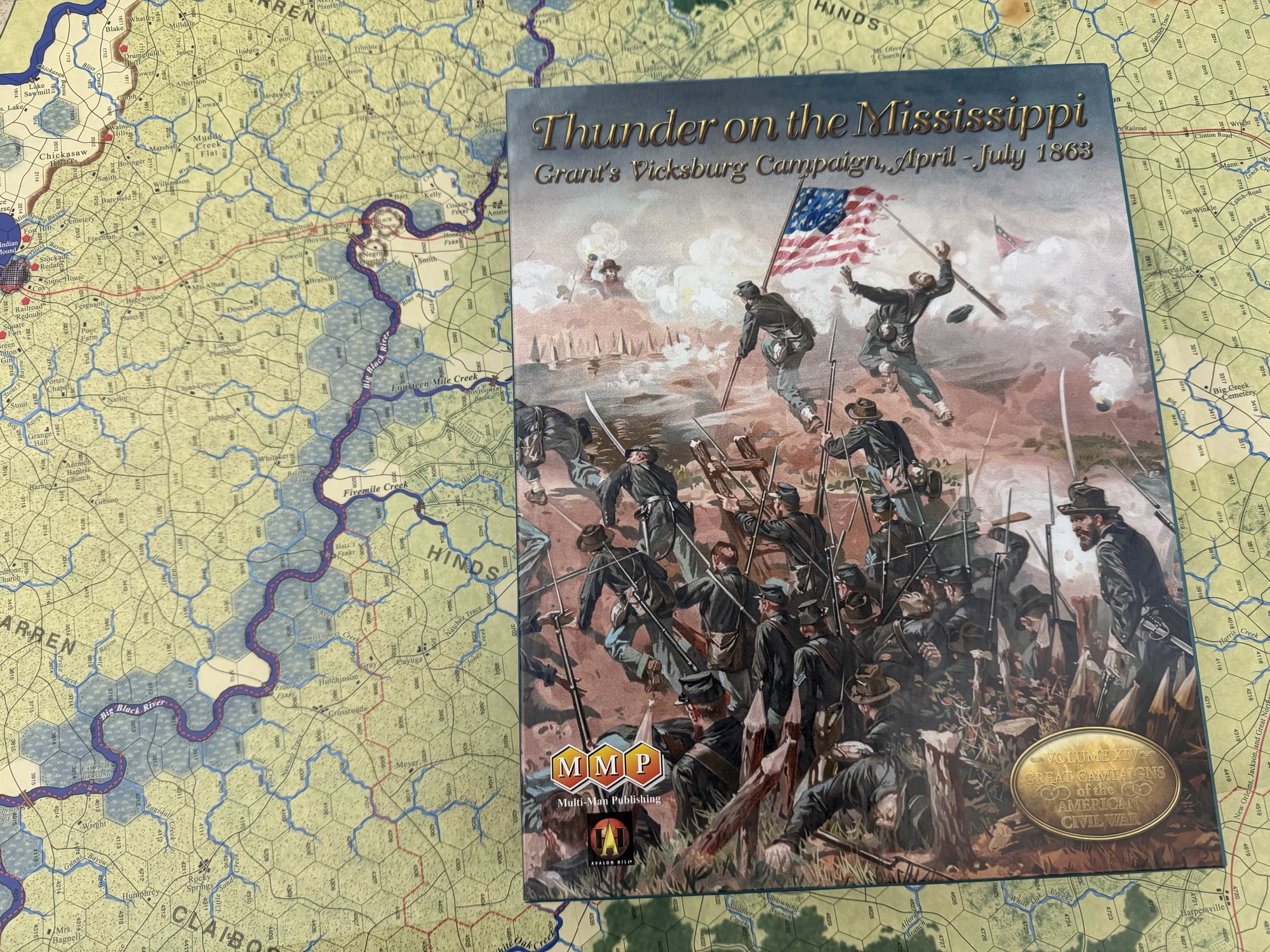
In this entry in the series, we will be taking a look at the fantastic looking board for Great Campaigns of the American Civil War: Thunder On the Mississippi: Grant’s Vicksburg Campaign, April-July, 1863 from Multi-Man Publishing. The board is illustrated by the very talented Charlie Kibler whose work on the Great Campaigns of the American Civil War Series dates back to its creation in 1992. He has done a ton of great looking boards including The Battle for Normandy (2009) from GMT Games, The Day Was Ours: First Bull Run (2021) from Revolution Games, Border Reivers (2023) from GMT Games recently as well as a slew of Advanced Squad Leader boards stretching back through the years and a lot of series games for GMT Games such as Great Battles of the American Civil War and Great Battles of the American Revolution. We have already highlighted a few of his boards in the past like Storm Over Jerusalem from MMP and Battles of the American Revolution Volume II: Brandywine from GMT Games. He is very effective at creating great looking terrain and weaving in very nice details to highlight the main functions of the board and I very much like the simplicity and accurateness of his boards.
The board consists of 2 separate 22″x 32″ full-color map sheets that when combined create a large playing surface. The borders of the board include off-board information that is related to the geography and locations in and around Vicksburg. When I first saw this, I wasn’t really quite sure how to take it but after playing and also thinking about this decision, I really like how it was used to frame up or provide a significant visual contrast to the main game board. The brown coloring really contrasts well with the colorful terrain features and create a clear distinction for the players. I initially thought this was a poor decision and felt that it was a missed opportunity but it works really well.
Here is a closeup of this part of the board so you can get a good feel for what I am talking about.
I always like to look at the game title box/area of the board and find these to be really great insights into the mindset and approach of the artist. On the board for Thunder on the Mississippi, we see Charlie used a washed out period look map for the background of this area. The really interesting part is how it transitions from the non-colored portion of the board title box to the game board itself. There is no connection between the 2 and the elements found on the board are not carried over or connected to the period map. I would maybe have liked to see there be a connection for an immersive approach but I understand that this was not the purpose of the use of the period map.
In Thunder on the Mississippi, there are 2 new terrain features unique to the Vicksburg region introduced including loess hills and coastal bluffs. Loess has not been featured before in GCACW Series games. Each loess hex is depicted with many small tan dots superimposed on an olive base color. This stippling gives it a sandy feel and I think really works well as loess is a fine-grained, powdery soil, a wide belt of which runs on the east side of the Mississippi on a southwest – northeast axis. Because loess is highly susceptible to erosion, it is marked by sharp, irregular ravines, many of which were so overgrown with vegetation as to be nearly impassable to military units.
In the game, loess hexes are identical to woods hexes in terms of Movement Point costs and MP penalties to enter a friendly-occupied hex. Also, loess hexsides untraversed by roads or railroads exert a restricted ZOC the same as woods hexsides similarly untraversed. I think that the type of terrain, and what it does to the units that enter, really mimics the soft soil type as it is always hard to run in sand. I very much like the color used as well and it serves to set this specific terrain type apart from the rest of the board. Here is a look at the western portion of the West Map that is up against the Mississippi River.
The other new terrain feature is that of coastal bluffs, which has also not been featured before in the series. Each coastal bluff hexside has a downhill side in which the light brown bluff line-pattern is uneven and an uphill side in which the bluff line-pattern is smooth. I know that it might be a bit hard to see in the below picture but the downhill side is found on the left side while the uphill side is on the right. Think of it this way…the uphill is simply a straight line border while the downhill side reflects the ravines from erosion and is made up of multi-length lines pointing out. I very much like this new terrain and also think that Charlie did a great job with the distinction even though it is a bit hard to distinguish from afar.
And that brings me to the portion of the board that I think is my favorite. Not because it is some revolutionary technique but because of the power and permanence that is offers the board, acting as an anchor and a framing of the action to be played out on it, and that is the Mississippi River itself. There is no real use of stylized marks or special features shown on the board but it is just a thick and dark blue line that meanders through the countryside. But the dark blue really gives a sense of size and scope and I very much feel that it is important to the board and what is to transpire on it.
I also very much like how Charlie decided to keep in the exact layout of the river and shows its many twists and turns and oxbows that are found along its length.
The board for Thunder on the Mississippi is really a visual masterpiece. It provides great transition from terrain type to terrain type, frames up the board itself very well and uses very smart and poignant color choices, including the loess terrain color and the dark blue of the Old Man, all to create a fantastic canvas upon which to play out this titanic struggle and key turning point of the American Civil War.
If you are interested, here is a link to our video review:
The next board that we will take a look at in the series is The Marianas Campaign: Volume One: Saipan – The Bloody Rock from Compass Games.
Here are links to the previous entries in the series:
With this My Favorite Wargame Cards Series, I hope to take a look at a specific card from the various wargames that I have played and share how it is used in the game. I am not a strategist and frankly I am not that good at games but I do understand how things should work and be used in games. With that being said, here is the next entry in this series.
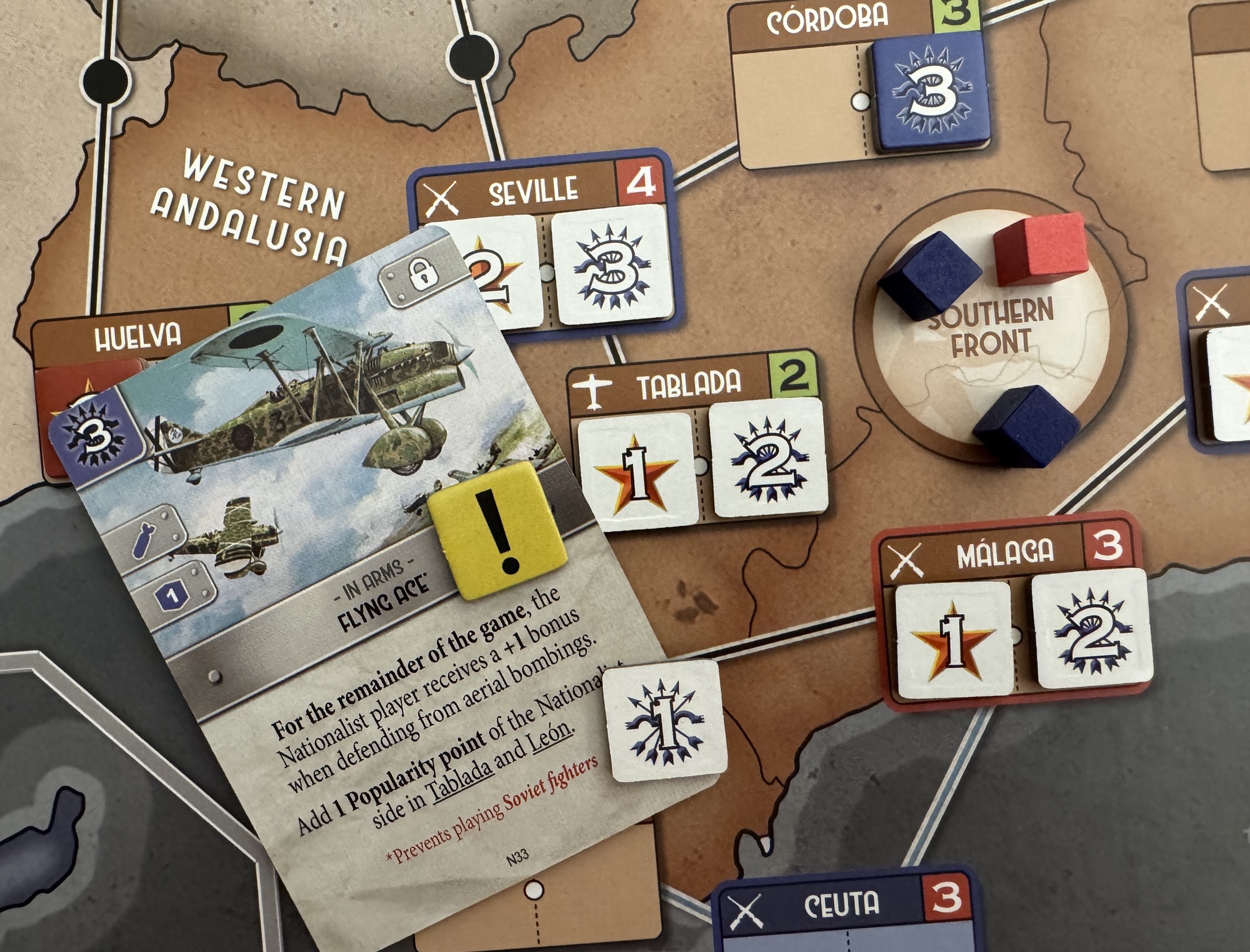
#95: Flying Ace from The Republic’s Struggle: Battle for the Republic, Spain 1931-1939 from NAC Wargames
The Republic’s Struggle is a thematic Card Driven Game that tells the story of the historical events that took place in Spain after the resignation to the throne of King Alfonso XIII, and the proclamation of the II Spanish Republic in 1931. With the creation of the new regime, the struggle for power between the different social, political and ideological sectors increased, which gave rise to continuous changes of political power, alterations of public order, armed uprisings and violent acts, carried out by the numerous ideological factions of the moment; which culminated in 1936, in a failed military uprising. The failure of this coup d’état was the origin for the Spanish Civil War.
The Republic’s Struggle is based on Twilight Struggle from GMT Games and uses the same concepts of area control while adding in some actual combat with units represented on the board. During the game, the Republican player and the National player, will be able to recreate events of the period to increase their popularity in the localities by carrying out political propaganda, recruiting troops or militias, generating revolts or assaults, establishing diplomatic relations or carrying out bombardments. All this will be done by playing their hand of cards in an alternative way, either by using the events or by playing the action points or icons to perform any of the other actions available to the players.
As you probably know, the Spanish Civil War was a bloody and vicious affair. With the advent of air planes and advancement of other weapons technology there was no army that couldn’t be touched. In The Republic’s Struggle players can use their cards and Operation Points to perform an aerial bombing on enemy units that are found on the various fronts. The Bombardment Process is executed by spending the Operation Points (OP’s) of a card, provided the card features a special bomb icon in the upper left hand corner near the Op Points. If a card displays both a bomb icon and a combatant cube icon, you may only choose to execute one of the options and not both. These Bombings target combatants located in specific Fronts, which are represented by circular spaces where army cubes may be placed through card play. In order to perform an aerial bombing, the player must have control of n Air Base Location on the Front that they wish to attack. The attacking player will add the Operation Points of the card played and adds a D6 while the defender will also roll a D6 but will add in the Defense Value that was determined at the outset of the turn by the play of a card and +1 for each of their cubes in the Front. If they have played a card such as Flying Ace, they will get to add a +1 to this total and then results are compared and a winner is determined and losses are the difference between the Attack and Defense Value.
That is the real power in the Flying Ace card as this +1 can be a huge boon in these aerial bombings and allow them to put up a stiffer defense and hold onto more of their units on these Fronts. The game instructs players to utilize the Exclamation Point markers to remind themselves of these type of benefits as the player should place the played card in front of them with the marker to be able to remember the benefit later in that turn.
But the Flying Ace Card provides another smaller but important benefit as it allows the Nationalist player to place 1 Popularity Point in Tablada and León to continue to build their influence and control of these key regions for scoring purposes. And finally, another benefit is that the play of the Flying Ace Card will prevent the Republican player from being able to play their Soviet Fighters Card which has a similar benefit. The thinking here is that the first player to get this card out controls the skies and has air superiority.
Aerial bombing during the Spanish Civil War marked a dark turning point in military history, serving as a lethal testing ground for the aerial terror tactics later unleashed in World War II. An estimated 15,000 people died from air raids during the conflict, with the vast majority of victims being civilians targeted by Nationalist forces backed by Nazi Germany and Fascist Italy. One of these horrific events was that of the Bombing of Guernica on April 26, 1937. Carried out by Nazi Germany’s Condor Legion and Fascist Italy’s Aviazione Legionaria, this raid destroyed a massive portion of the Basque town and killed hundreds of civilians. It became the ultimate global symbol of the brutality of war, immortalized by Pablo Picasso’s famous painting Guernica.
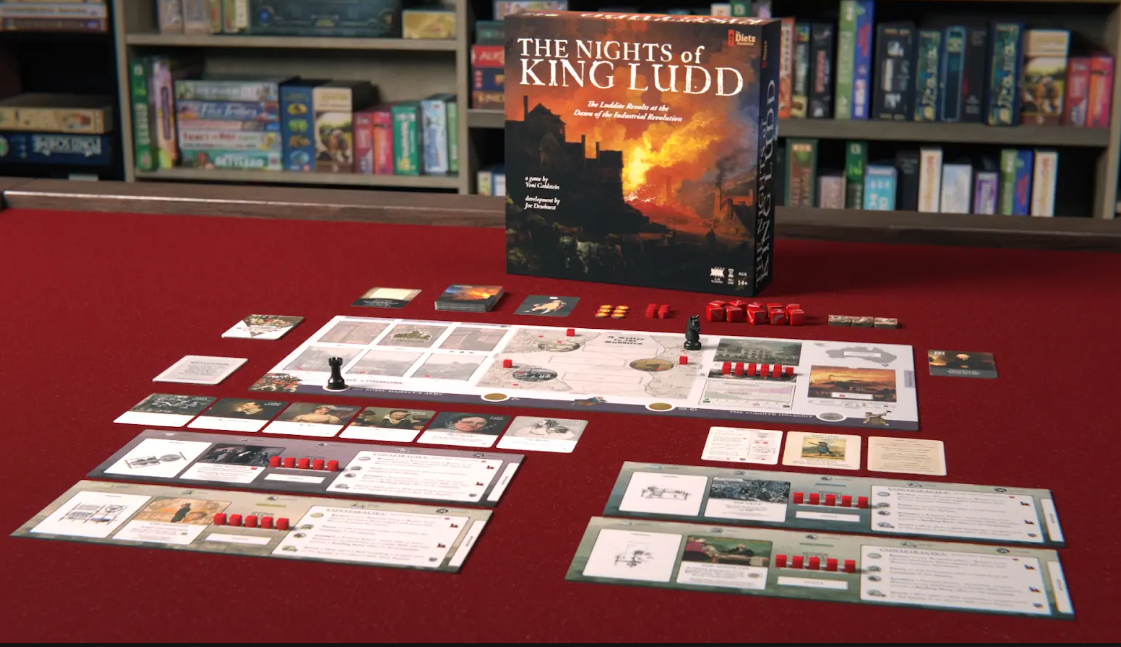
The Dietz Foundation has a new game from Yoni Goldstein on Kickstarter called The Nights of King Ludd: The Luddite War on Industry, 1811-? (the game has already funded). The Nights of King Ludd is a 2-4 player game that deals with direct oath-sworn secret societies of English Luddites at the dawn of the Industrial Revolution in the English Midlands. Working together, players will build a secret network of saboteurs, ferry provisions and weapons on the black market, assemble raiding parties, and if all goes as planned, smash those “dark satanic mills” to cinders. Here is Part II of our interview with Yoni.
Grant: What is the layout of the board and the different locations?
Yoni: The board is divided into three panels. On the left, you will see the two card pools. The top row is where you place the “Regency” Cards, reactionary forces from London sent to quash the Luddite revolts. Below London are three cards representing the “Commons,” a shifting market of dual-use cards helpful to the players.
The central panel features the mills and enclosures. This is where players place their pieces (Weavers sympathizing with the Luddite cause), and the local Militia (the knight piece). The map depicts the “Luddite Triangle:” the West Riding of Yorkshire, Nottinghamshire, and Lancashire.
The right panel holds the Manufacturer’s House (and the current Manufacturer), the pool of Employed Weavers, and the Stocking Market to track wages and productivity in the mills. On the far right panel, is the Australia space for weavers punished by transportation, and the “Saboteur Dice Pool.”
A ribbon at the bottom of the board displays His Royal Majesty’s Army progress toward the Luddite Holdout. This is effectively the round track, if the Luddites are unable to sabotage the three mills by the end of the third round, the game ends in collective defeat.
Grant: How does the game use cards? What different type of cards are included?
Yoni: In The Nights of King Ludd players build a collective card engine by acquiring dual use cards from the “Commons” to upgrade their actions (aka “Conspiracies” – more on those below). The main pool of cards is called “The Commons” which, as the name suggests, represents a mutual aid network of provisions, tactics, and personalities that the Luddites may draw from in the course of their clandestine operations.
“Commons” cards are dual use and drawn from the Draw Deck. They are beneficial in two ways: the top of the card displays a persistent upgrade to any Conspiracy action and is locked into the player board to form a tableau. The bottom of the card displays a “Raiding Party” effect, a one time effect that can be triggered when a Raiding Party is formed and dispatched to a local mill.
The antithesis of the Commons is the “Regency,” a deck of cards reflecting the alignment of the aristocracy in London with an ascendent industrial class against the Luddite cause. They are drawn whenever the Luddites make themselves known in public: fomenting a mob, carrying out an assassination, or setting a factory on fire. When drawn, they set the machines of industry into motion; driving up productivity, plummeting wages, and calling the local constabulary to police the countryside.
Once more than three cards are in the “London” track above the Commons, a nasty event is resolved. These effects will intensify the game’s challenges. Sympathetic weavers will be exiled to Australia, the militia will sweep into the local mill to root out hidden raiders, and the Commons will be parceled off and sold to the highest bidder.
Grant: What is the role of the Persona Cards? Who are these figures?
Yoni: As mentioned in Part I of this interview, each player represents a secret society of Luddites organized around a particular “persona.” These personae introduce a special ability, as well as their their own victory condition, aka a “Motivation”, and a unique “Woe” – a card shuffled into the Draw Deck at setup that will, inevitably, undermine their efforts. There are six persona to choose from.
In clockwise order, they are:
Mary Molyneux, 19, and Lydia Molyneux, 15, were two sisters who, in 1812, stormed a steam-driven cotton mill outside Bolton shouting, “Now Lads!” – encouraging the mob to set the building afire (and they steadfastly did so).
Lady Ludd: “The “Lady Ludd Riots” took place in 1812 when a group of women and young lads – “distressed” by the precipitous rise in corn prices – marched through Leeds, assaulting merchants and “beating up for a mob.” They were led by a disguised person “who was dignified by the title of LADY LUDD.”
George Gordon Byron, 6th Baron Byron, “a young poet with the chiselled good looks, the oddly deformed club foot, and an obscure and very prestigious peerage,” was an eloquent Romantic dandy who rose to defend the Luddites before the House of Lords in 1812. Byron sympathized with the weavers near his home north of Nottingham; “the real cause of their misery [was] the destructive warfare of the last eighteen years, which has destroyed their comfort, your comfort, all men’s comfort.”
Elizabeth Studham was one of seven women tried for arson during the Swing Riots of 1829-30, an echo of the Luddite rebellion. At the age of 19 she set fire to an East Kent workhouse, demanding a wage increase for farmers threatened by threshing machines. Studham was deported and served 14 years and two months in Van Diemen’s Land (Tasmania) during which time she gave birth to two children of whom records are sparse. She would later be sentenced for 10 offences, primarily for bad language.
Lt. George Mellor was a Cropper and Yorkshire Luddite known to the movement as General Ludd’s Right-Hand Man. A strong willed and roguish machine-wrecker, he eventually faced a hanging sentence for the murder of a wealthy mill owner whom he shot in the groin. Eventually, Mellor was arrested in October of 1812. It is said he raised his hands in shackles and shouted “Three cheers for General Ludd!”
John Baines the elder was an “intelligent Hatter” and president of the local Republican Club of St. Crispin. Baines dreamt that Luddism would one day blossom into a democratic revolution; “Let the people now rise and rid themselves of this vile brood who flung upon them the sole taxation of the country and reduced them to the condition of galley slaves!” He was found guilty at the York Special Commission of administering illegal oaths and died on board a prison hulk in a Portsmouth harbour, on December 21st, 1814.
Grant: What is the purpose of the Manufacturer Card?
Yoni: At the beginning of each game, one of the three Manufacturer Cards is selected at random and placed face up in the “Manufacturer’s House” space on the board. The initial effect (tuck 6 cards from the draw deck beneath the manufacturer) represents the nascent industrial class’ emphasis on extracting from the commons, resolving at the start of each round. In practical terms, this prunes away the players’ available card pool over the course of play as well as ambiguates the composition of the draw deck. When a manufacturer is assassinated, all the cards tucked beneath are discarded (and will shuffle back into the Draw Deck) and the Manufacturer Card is flipped to reveal a more reactionary and dangerous side.
Grant: What are Conspiracy Actions?
Yoni: At the beginning of the game, each player has five conspirators (four for Lord Byron) at their command. Spending a conspirator allows the player to activate one of the four following Conspiracy actions (per turn):
Rally Local Weavers: either place a weaver from the supply pool at your presence pawn, or move your pawn and any weavers to another enclosure on the map.
Trade in the Commons: pick up a card from the Commons and tuck into one of the columns on your player board. That card allows for secondary actions whenever that matching Conspiracy is activated.
Assemble a Raiding Party: a two step action, move one or more weavers from an Enclosure (spaces on the map adjacent to Mills) into a Mill. This sets up a future sabotage action. Then, activate one of the Raiding Party effects in the Commons. This is the primary means of building your Saboteur Dice Pool. The more raiders you have at the Mill, the more dice you are permitted to roll during a Sabotage operation.
Lastly, you may Incite a Mob, placing a Mob Tile next to an adjacent Mill. For a sabotage roll to be successful, the die rolls must match an icon depicted on the Mob tile – hammer, gun, or torch.
Grant: What type of secondary effects come from cards tucked into the Column on Player Boards?
Yoni: Once you use a Trade conspiracy to move a card from the Commons to your tableau (your “Secret Society”), you can activate it, along with any other card in that same column on your player board, every time you resolve that conspiracy action. This allows for chaining and sequencing a series of effects that may have significant impact on your objective to destroy the mills.
Grant: Can you show us a few examples and explain their use?
Yoni: For example, let’s say you are George Mellor and you are seeking to assassinate the manufacturer. You resolve the Trade conspiracy to take “Dispatch Delegates to Neighbouring Counties” and place it in your Trade column, meaning it will be available to you immediately after this primary action. In previous turns you’ve already acquired an ongoing ability, “Mellor Takes a Shot at Mr. Horsfall!”, giving you an extra die for Assassination roles (helpful, since these operations are so risky!). You activate “Dispatch Delegates…” to activate a Raiding Party effect (the bottom of the card) in the Commons, which happens to be your partner in crime, “Martha Mellor Defends the Accused.” She allows you to roll for Assassination, but will be removed from play once that effect is resolved.
Grant: How does Sabotage and Assassinations work in the game?
Yoni: At various points in the game, players may elect to roll for Sabotage or Assassination. Of course, certain maneuvers must take place for these brazen attacks to succeed. Sabotages are larger scale events and are aimed at the Mills. You must have assembled a raiding party at the Mill and incited a Mob to spurn them on. As mentioned above, you roll one die per weaver cube at the Mill and attempt results matching the icons on the Mobs you’ve placed. The dice are D6s with the following faces: 3 blanks (a miss), 1 Torch, 1 Gun, and 1 Hammer. So with one Mob tile matching one of those icons, each die you roll has a 1 in 6 chance of hitting. If all three Mobs are in place, the odds climb to 1 in 2 per die.
An assassination is a similar roll, but only one die may be cast and hits are only the gun or hammer. Beware, the Regency will respond with a draw from its deck for both sabotage and assassination rolls!
Grant: What are you most pleased about with the design?
Yoni: As Dan Thurot noted, “The Nights of King Ludd points toward a more experimental direction than Chicago ‘68 and I feel it reflects a degree of growth and maturation as a designer. It’s a game that seeks to capture both the panoramic view of a people’s struggle as well as sketching out the personal incentives that motivate individual participation in (and sometimes sacrifice for) a collective cause”.
Grant: What other games are you currently working on?
Yoni: I am currently working on a commission for an international art exhibition on “sociopolitical freefall.” This will be a smaller box game and will also be developed by Joe Dewhurst. I’m also co-designing a project about Mai ‘68 with Fred Serval. This game is about the French experience of student and labor riots in 1968. While it shares the themes of Chicago ‘68 it’s driven by a completely new system.
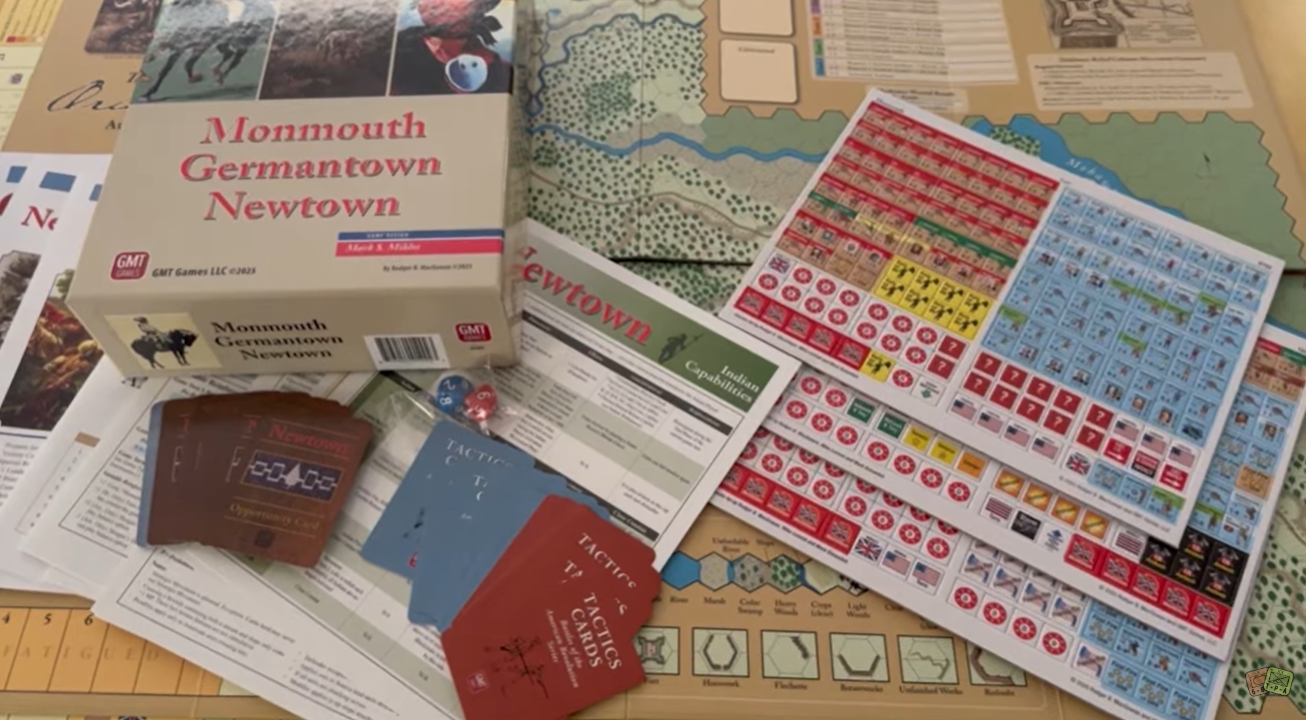
Battles of the American Revolution Tri-Pack II: Monmouth, Germantown and Newtown is the second compilation of earlier releases from GMT Games’ Battles of the American Revolution Series. These are tactical level battles at the regimental level with a map scale of approximately 200 yd/hex.
Additions to the original releases include:
maps are hard-mounted
packaged in a GMT “deep box”, which is a 3″ box
rules and player aids printed in color
all replacement counters that have been issued since the games’ original releases
a new one page matrix-style play aid to assist the First Nations player in Newtown
Joel Toppen’s Solitaire Tactics Card play aid
a significantly upgraded Germantown rulebook addressing errata and ambiguities
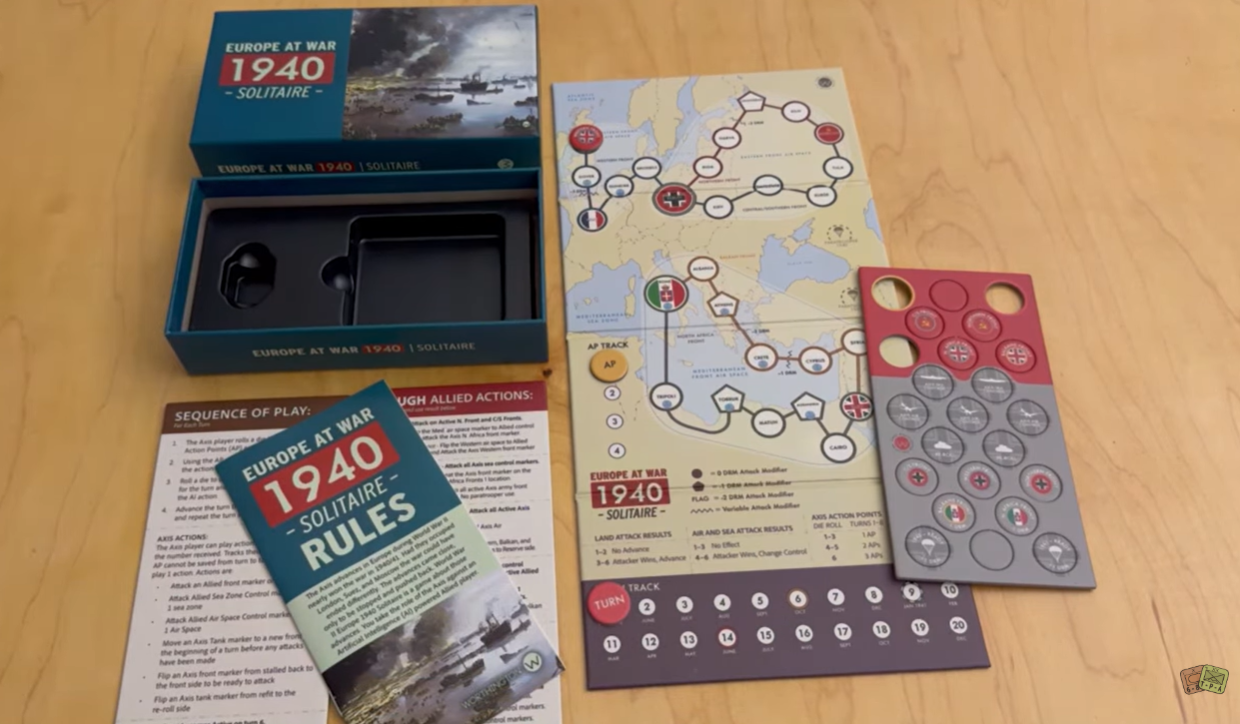
Europe at War 1940: Solitaire, the sister wargame to Pacific War 1942, places the player in the role of the Axis high command during the first 18 months of World War II and focuses on the European Theater of World War II.
The game introduces some new concepts important to the war in Europe. Each side has a limited number of tank units to add strength to some front armies. The axis has a paratrooper unit that can help with hazardous operations. Choosing when and where to place them can be a major decision. Also control of air spaces on fronts becomes an important factor. And, ports on sea zones are affected by sea zone control. Crossing bodies of waters on a front is a major effort.
As the axis do you try to take London before turning east against the Russians? Should you help out the Italians in the Balkans? Or do you turn your tanks loose in the deserts of North Africa?
The American Civil War was the bloodiest conflict and a defining event in the history of the United States. The tragedy of the conflict was amplified by the fact the battles were brutally fought with Napoleonic tactics while using new and more lethal weaponry. As a result, over the course of nearly four full years of war, roughly 700,000 Americans were wounded or killed in battle along with another 400,000 soldiers dying from disease.
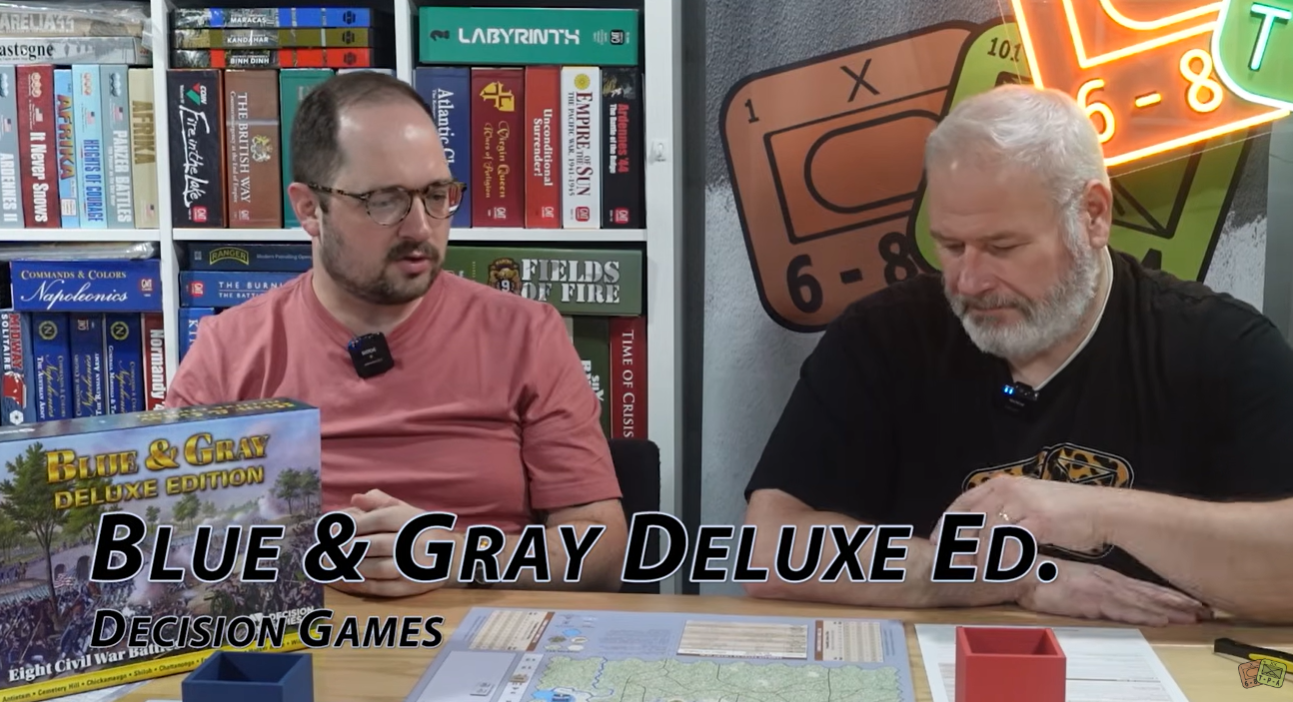
Blue & Gray Deluxe Edition consists of the original eight games from the SPI Blue & Gray I & II Quadrigames. The battles depicted are among the most important of the American Civil War: Shiloh, Antietam, Fredericksburg, Chancellorsville (Hooker & Lee), Gettysburg (Cemetery Hill), Chickamauga, Chattanooga, and The Battle of the Wilderness.
The game mechanics used in this series are based on the well-received Borodino/Napoleon at Waterloo system. Terrain is a significant factor, with everything from rolling farmland to untracked wilderness represented. Battles will often see a back-and-forth struggle for control of critical terrain. Rules for night turns are also provided. A standard set of rules are used, common to all eight games, while each game also has its own set of exclusive rules, historical set-ups, and player and design notes—all from the original SPI games.
Blue & Gray Deluxe Edition features new artwork, double-sided mounted game boards, enlarged counters, player aid cards, numerous optional rules gleaned from other game editions, and new variant counters and markers for use with several variants from Moves and Strategy & Tactics magazines. Reintroduce yourself to these classic games from SPI’s golden era and refight some of the best-known battles of the American Civil War which decided the fate of a nation at war with itself.
I love a different style and focus of wargame. A game that takes a look at an important but somewhat obscure or rarely addressed historical topic, such as espionage or intelligence, and creates a gaming experience tailored around the events to highlight and evoke the difficulties and tension that would have been present. In January 2026, GMT Games announced such a game in Checkpoint Charlie, which is a solo or cooperative game focused on SIS espionage missions in Berlin in the 1960’s designed by Russell Brown. We have posted an interview with Russel and it was very well received and he has now agreed to create a series of History Behind the Cards to highlight the events of the 1960’s Cold War struggle in West Germany but also to share aspects about the game play and how it models the history.
*Note: The cards highlighted in this series and their event text, as well as any pictures used showing any of the various components, are still in the design and development process and as such event effects and text might still change prior to final development and publication.Also the art and layout of the cards are only for playtest purposes at this point and the game will enter the art department as it nears publication.
History Behind the Cards – Checkpoint Charlie from GMT Games – Card #7: Ich Bin Ein Berliner
In the summer of 1963, the Berlin Wall had been in place for almost two years, the reality of a city split between east and west, between Soviet and Western influence, was impossible to deny. Politicians, military leaders, and the people living day-to-day in Berlin continued to argue about the lack of forceful response from the west, particularly the Americans, when the wall went up. Other than a modest buildup of US forces within and around the city, there had been precious little action to re-assure the people of Berlin that the west hadn’t abandoned them.
In June of that year, President Kennedy hoped to change that perception by personally visiting this western city in the center of Soviet-controlled East Germany. He received the reception and the reaction he was hoping for, driving through the city to crowds of cheering West Berliners, and giving his famous speech on the steps of the Rathhaus Shöneberg to a gathered crowd of over one hundred thousand. In a calculated risk, he referred to the city as West Berlin, officially acknowledging the split created by the wall. He introduced his “Fellow Americans” and at the mention of General Clay (Card #6), the crowd interrupted the speech for some heartfelt cheering for the man that saved their city during the Berlin Airlift. Kennedy’s famous line of solidarity, “Ich bin ein Berliner,” — I am a Berliner — came at the end of the speech and may have been a bit off-script.
So how would Kennedy’s speech affect a mission in Checkpoint Charlie? I’m going to answer that with a story.
I spend a lot of time at a wonderful coffee shop near my home, so much time that my iPhone has labeled the location as my “work.” The baristas there know me, and one day one of them asked me what I was working on. “Right now,” I said, I’m working on a board game about spies in Berlin in the 60’s.”
He laughed. “Have you met John?” He pointed to an older customer at one of the tables. “He was a spy in Berlin in the 60’s.” It was true.
Since then, I’ve had many conversations with John about his time in Berlin. He was Army Intelligence, keeping track of what was going on in the city. He was there when the wall went up. He interviewed the refugees that, for a time, still managed to find a way into West Berlin. And he was there during Kennedy’s speech.
I asked him about the speech and said that in the game it resulted in crowds (a Demonstrations marker) near Tempelhof. He shook his head. “Everywhere. Crowds everywhere. All over the city.”
I’m sorry to report that I’ve restrained the effects of this card and the speech for gameplay reasons, but I haven’t ignored John in every case. The Daily Military Train event (Card #9) exists solely because of his stories, and after removing the Refugees event (Card #13) from the game because I assumed the flow of refugees disappeared after the wall went up, I put it back in because John assured me that they were still coming – he had met and interviewed hundreds of them.
In the next article in this series, we will take a look at the ongoing propaganda efforts from both sides of the Berlin Wall with Loudspeaker Wars.
In my opinion, this game looks extremely interesting and I am very much excited to learn more about it. I am appreciative to Russell and his efforts to bring us these cards and to write these entries to share with our readers. I am also very glad that this topic is being covered in a game and look forward to playing this one day soon.
One of the more interesting topics to play a wargame on is that of a sustained siege. I am not talking about a game that has a siege mechanic that is used over the course of the game but a game that is based wholly around a specific historical siege. A siege requires a lot of different takes to be included in a wargame to make it work including things such as supplies, manpower, defenses such as walls, trenches and other fortifications, siege engines, morale and the ability and will to continue the fight. I really have very much enjoyed the siege based wargames that I have played over the years and I wanted to share 3 of my favorites in this post. So, without further adieu, here are my Best 3 Games with…Sieges!
I want to make one thing clear. I love the States of Siege Series of games and have played dozens of them. But I don’t consider those games in the same vein as these siege focused games that I am sharing.
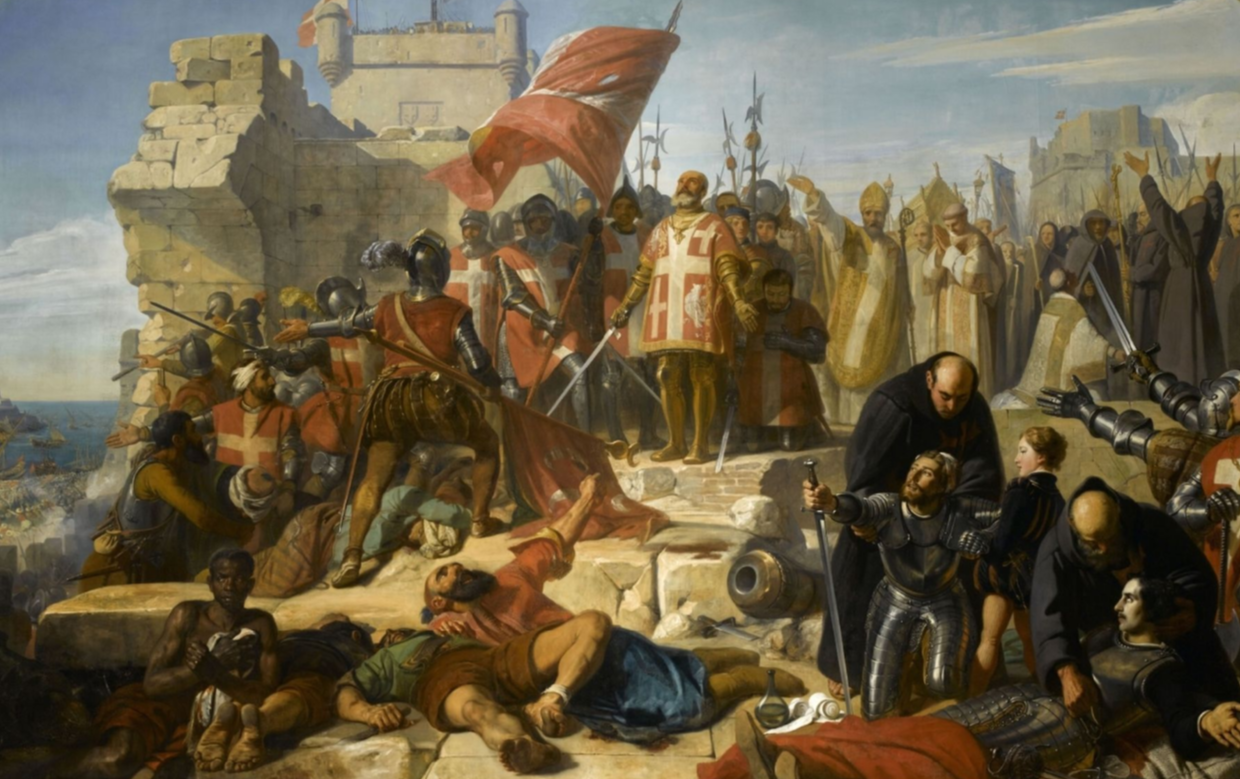
*The image used as the featured image for this post is called Lifting of the Siege of Malta painted by Charles-Philippe Lariviere.
3. Freedom! from PHALANX
Freedom! is a card driven siege game that pits the Greek freedom fighters and the besieging imperial forces of the Ottomans against each other. The siege is of the Greek Holy City of Messolonghi during the Greek War of Independence in 1825-1826. Freedom! features asymmetrical play with the goal of the invading forces being to manage to get inside the city before the end of the game or to force the citizens to abandon the cause by dropping their morale to zero while the defenders, on the other hand, try to withstand the siege and protect the city long enough for the invaders to abandon their attempt either by deciding to leave on their own or by having their morale dropped to zero. The actions of the players are driven by the cards in their hands, which highlight actual events and personalities of that time, while the combat is dice-driven to allow for quick and exciting game-play.
The rebel player is largely focused on grinding out a victory by surviving over the course of 6 rounds and are simply trying to hang on, unless of course they can somehow reduce the morale of the besieging units enough to where they give up and go home. However, nothing about this is a grind for the defending player and that is a problem that can be endemic with siege games. You as the defender, are as much a part of the action and must try to follow your own plan whenever possible to get a win. In other asymmetric siege games, the defender is often just reacting to the aggressor’s moves. As the insurgents, it never feels like you are simply reactionary and just along for the ride.
The really interesting thing about this one is that that there are actually two maps that are used to play the game. One of the maps shows the actual city and the forces involved in the siege while the other shows the surrounding areas, highlighting the support that each of them provides to both players. The art is gorgeous and this one is a game that we had a really good experience with. There also is a solitaire module that you have to buy separately but it works very well and provides an opportunity to play this game when you can’t find an opponent.
Players will find that they are competing for a number of nearby Greek regions on the board and there will be a tug-of-war played out by using various support actions that are focused on cutting off your opponent’s supplies. This is what I liked most about Freedom! It’s not just a continual back and forth trying to knock out your enemy’s units but there are multiple paths to victory, and all of them seem to be viable. By lowering your opponent’s morale and cutting them off from the supplies they need, you completely change their plans. Of course, there is nothing to stop you from pushing aggressively against the enemy’s walls.
Each side of the conflict really gives a different feel to the game and creates a new experience once you switch sides. As the Ottomans, you are generally going to undertake aggressive maneuver and attacks in an attempt to push forward and put pressure on the defenders and their walls of security. But when you play the Greeks there is a real feeling unpleasant feeling of desperation, which only gets worse with the arrival of Turkish reinforcements.
Here is a look at our unboxing video so you can get a good look at the components:
Here is our video review used for the Kickstarter campaign so you can understand our thoughts on the game:
If you are interested in Freedom!, you can purchase a copy for €69,00 ($80.00 in US Dollars) from the PHALANX website at the following link: https://phalanx.co.uk/games/freedom-board-game/
2. Storm Over Jerusalem: The Roman Siege from Multi-Man Publishing
The Storm Over Area Impulse Series has been around for a while and includes games such as Storm Over Arnhem (1981) from The Avalon Hill Game Company, Storm Over Stalingrad (2006) from Multi-Man Publishing and Storm Over Dien Bien Phu (2014) from Multi-Man Publishing amongst several others. The hallmark of the series is relatively low complexity for a wargame and a very simple combat system that calculates total attack versus total defense and adds a roll of 2d6. The losses from combat can be absorbed by either retreating from the attacked areas or destroying units. The game system has mostly been used to model more modern wars including the Franco-Prussian War, World War II and the French conflict at Dien Bien Phu in Vietnam.
Storm Over Jerusalem: The Roman Siege is a 2-player wargame that simulates the Roman siege of Jerusalem during 70 AD. One player controls the mighty Roman forces, who are truly master of siege warfare with their siege towers, ballista, battering rams and onagers, and the other player controls the Judean forces, which are divided into 2 separate factions with different leaders. The game is 8 turns long, but can be shortened by the play of a few event cards, at the end of which time the winner is determined by calculating victory points that come from overall losses, holding of certain VP areas and keeping the Romans out of the city.
We were very impressed by the game and its overall clarity of rules, quality components and interesting tactical choices and really had a good time learning and playing it. The Judeans are obviously outclassed by the powerful and skilled Roman Legions but they have several of their own tricks to use to hold out long enough to win the day. There is a lot to like here and I am really glad that we decided to give the system a try. There were some changes specially made to introduce the style of Ancient sieges to the Storm Over Series and this is where the game really shines. The Siege Towers were an evolution of the trenches found in Storm Over Dien Bien Phu game and are very important to the Roman efforts. The walls historically were such a physical presence in the city, and were a major impediment to the Roman efforts, that they had to come up with rules to cover them. The walls provide a defensive modifier against Roman Attacks and Assaults. This Defense Value starts at +4 and can be reduced over time by successful Roman Assaults. Since Judean units have a defense of 7 or 8 the bonus provided by the walls of +4 really helps hold onto areas. Once a wall is damaged from a successful attack though, the defensive modifier can be rebuilt by the Judean player but can never be increased to its full value of +4.
The Roman player also has specific cards (Catapult, Onager, and Battering Rams) that can be used to damage or breach the walls. Once breached, the walls don’t provide any defensive bonus and allow Roman troops to flood into the city. We found that the Romans tried to focus on a specific area of the walls and made their attacks there first in order to bring the maximum attacks possible each round to force the Judean player to have to spend their time and actions on fixing the walls and bringing up reinforcement to replace those lost in retreats. To repair a wall section, the Judean player can discard a card and use the Repair Value of that card to repair walls in an area. This action though requires a fresh unit in that area to be flipped to spent to complete the repair. Walls can only be repaired back up to +3, not the original +4. You can’t rebuild them completely.
I really enjoyed our play of Storm Over Jerusalem. The game was beautifully put together, with fantastic components, but also had some really amazing details and depth to the gameplay. This one is a winner and really has me interested in the other games in the series. I know that this game had a siege focus, which is not necessarily in each of the other games, but I really liked the simple combat system, great card play and very interesting tactical choices that were there for players to have to make.
Here is a link to our full unboxing showing off the beautiful components:
1. Dien Bien Phu: The Final Gamble from Legion Wargames
Dien Bien Phu: The Final Gamble from Legion Wargames is a 2-player wargame about the decisive battle of Dien Bien Phu in 1954 that not only ended the French Indochina War but also had political repercussions far outside the region itself. One player represents France and her colonial troops. The other player represents the armed force of Viet Minh, the communist/nationalist independence movement of Vietnam. This game is not a traditional wargame and has different victory conditions than normal and also some unique and interesting supply rules. The Viet Minh win by forcing the French troops to surrender and France wins by not surrendering.
The board covers the former village of Dien Bien Phu and surrounding areas. There is a small submap of the French strongpoint Isabelle further south in the valley. There are several groups of French strongpoints scattered around the map, each one with a female name, which are all named after the commander de Castries’ mistresses, according to lore. The map is divided into three divisional sectors. Each sector has several zones that represent Viet Minh trenches winding from the map edge towards the center of the map. Each hex represents 150 meters and each game turn covers three days. There are 21 turns in the game, but historically, it ended after 19 game turns with a Viet Minh victory. The scale allows stacking of three French units in a hex, but there are no stacking limits for Viet Minh battalions, which creates a chess like feel.
French supply is a bit of a mini-game within the game. As this battle took place far out in the wilderness of Vietnam and both sides had to adjust to the limited flow of supplies that could be brought forward, through the air to the French, and through vast forests to the Viet Minh. Supplies tend to be a lot less than wished for. There are several supply tracks on the map showing how much ammo, food & bullets, fuel & spares, medicine as well as the amount of truck transport available for the French. The process for doing this supply phase is really pretty interesting and fun. Each game turn air transports will bring in a mix of supplies together with replacements and reinforcements. This is done on a chart with a grid where a mix of supply markers are placed together with eventual reinforcements and replacements. Weather will then decide what will arrive and what will abort back to Hanoi. The French player will never know for sure what type of supplies and how much will arrive and has to take that into account as they plan out their turns. And this is one of the best parts of the game and kept me thinking about the struggle with keeping my efforts going with the French. This one is not an easy game for either side and I think that it keeps the game very balanced and interesting to play.
Here is a link to our full video review:
If you are interested in Dien Bien Phu: The Final Gamble, you can order a copy for $54.00 from the Legion Wargames website at the following link: https://www.legionwargames.com/legion_DBP.html
A few other games that I have played on the subject of sieges, and that I very much liked, were games such as Halls of Hegra from Tompet Games, 1565 Siege of Malta from Worthington Publishing, 414 BC Siege of Syracuse from Worthington Publishing, Keep Up the Fire! Deluxe Edition from Worthington Publishing, Castle Itter: The Strangest Battle of WWII from Dan Verssen Games, Siege Works: A Napoleonic Siege Roll & Write from Solo Wargame, Crusaders: The Siege of Acre 1291 from Blue Panther/Art of Wargames, Castelnuovo 1539 from Draco Ideas and The Alamo Remembered from Victory Point Games.
With this My Favorite Wargame Cards Series, I hope to take a look at a specific card from the various wargames that I have played and share how it is used in the game. I am not a strategist and frankly I am not that good at games but I do understand how things should work and be used in games. With that being said, here is the next entry in this series.
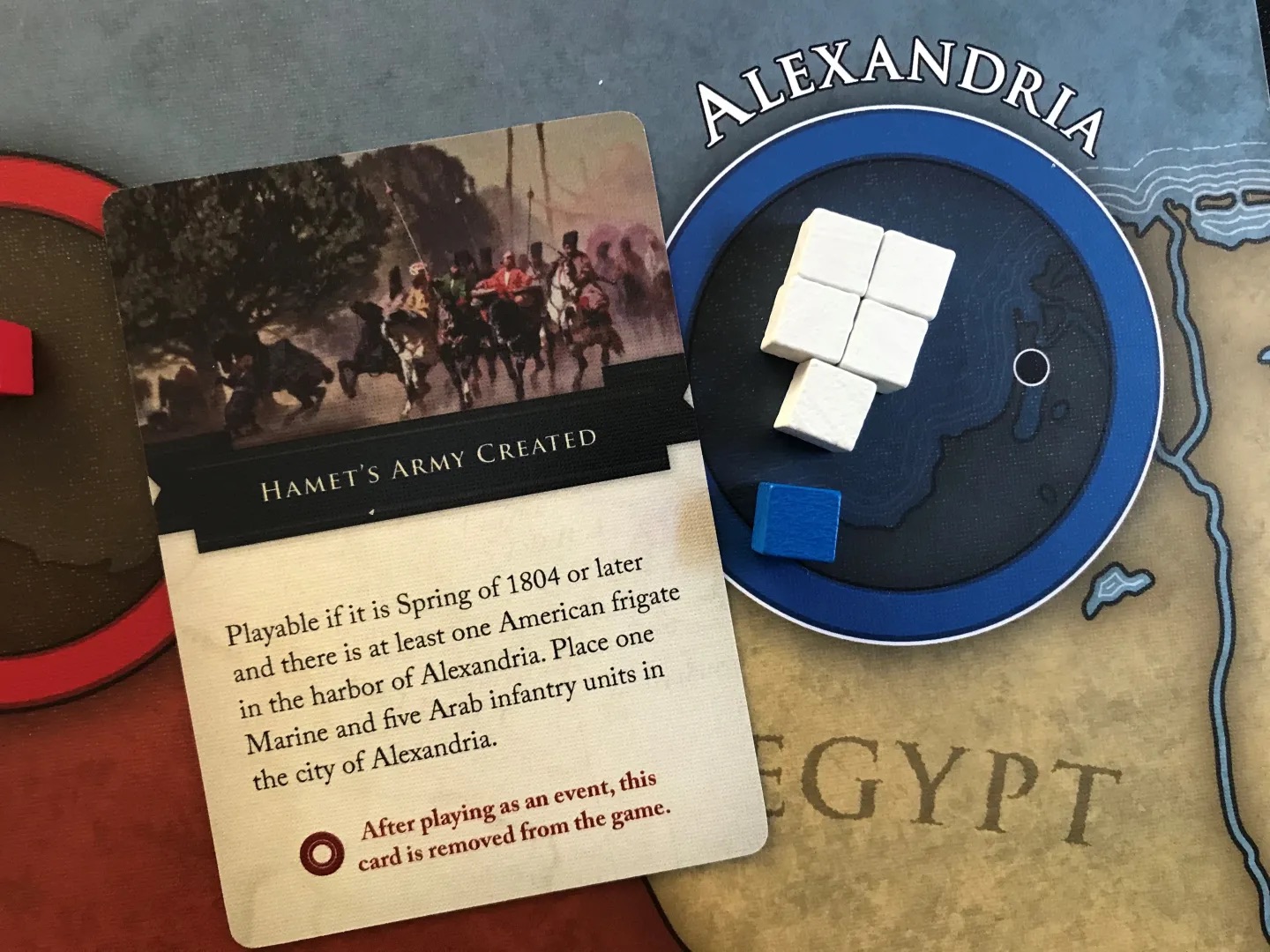
#94: Hamet’s Army Created from The Shores of Tripoli from Fort Circle Games
I have never played a historical wargame on the First Barbary War, which if you didn’t know was one of the first major wars the young United States of America participated in that was situated far outside their sphere of influence in North and South America. Shortly after the end of the American Revolutionary War, commercial vessels of the United States were being attacked and raided by the pirates of the Barbary coast in the Mediterranean Sea. In 1801, newly inaugurated President Thomas Jefferson was eager to put an end to this threat and sent a “squadron of observation” to the Mediterranean to deal with the threat. The Shores of Tripoli covers this conflict and does so using a card driven game mechanic that works really well in this instance. The game is a little deceiving, as at first it appears to be pretty introductory with simple rules and mechanics, but the depth for the game lies in the strategy for each side and the fact that their victory conditions are asymmetric.
While the main combatants in the game are naval units, there are ground units as well that must be used to try and take Tripoli to win the game. The American ground units consist of Hamet’s Army, which is a combined force of Arab and American infantry units that are dedicated to the mission of installing the pro-American Hamet Qaramanli on the Tripolitan throne. These ground units consist of white cubes that represent the Arab Infantry and blue cubes that represent American Marines. In Ground Combat, each Infantry unit rolls one die and it takes one hit for them to be eliminated.
Hamet’s Army will be created if the United States player plays the card Hamet’s Army Created for the Event. There are several conditions to the card being played though as it must be the Spring of 1804 or later and there has to be at least one American Frigate located in the Alexandria harbor. Once played to bring on Hamet’s Army the card is removed from the game and placed in the box. The newly created army will have to fight their way through 2 locations, Derna and Benghazi, for a final confrontation at Tripoli. I think that I very much enjoy this card because it is a necessary step in the game that the player has to plan for and be prepared to play when it does reveal itself. The player must be ready by using a portion of their limited actions to move at least 1 American Frigate to the harbor of Alexandria and then play this card for the printed event. Keep in mind that this is just the start though as there is a long way to go from here and many more things that must be completed to setup the final showdown.
Hamet Qaramanli’s army was a mixed mercenary force of several hundred Arab and Berber fighters, European cannoneers, and Greek infantry led by U.S. Army Captain William Eaton and U.S. Marine Lieutenant Presley O’Bannon during the First Barbary War. The goal of the expedition was to successfully march across the North African desert, capture the city of Derna, and depose the ruling Pasha of Tripoli, Yusuf Qaramanli in favor of his exiled older brother Hamet Qaramanli. In early 1805, the force marched roughly 500 to 600 miles across the Libyan Desert from Egypt to the Tripolitan border. The force consisted of 8 U.S. Marines, a small group of U.S. sailors, 26 Greek volunteers, a company of cannoneers and roughly 1,000 Arab and Berber mercenaries loyal or allied to Hamet. On April 27, 1805, aided by U.S. Navy warship bombardments, the force successfully stormed and captured the strategic port city of Derna in the Battle of Derna. But before Hamet’s army could advance further toward Tripoli, the United States signed a peace treaty with Yusuf Qaramanli, abandoning Hamet’s claim to the throne in exchange for freed American prisoners and an end to tributes.
Lieutenant O’Bannon and Marines advancing toward Tripoli. (Image from Merrill L. Bartlett and Jack Sweetman, The U.S. Marine Corps: An Illustrated History, (Naval Institute Press, Annapolis, MD: 2001), 30–31.)
We have played several games designed by Adam Starkweather in his Company Scale System (CSS). These games are really good solid chit draw systems that really puts some unknown in what groups of units can activate and even when they will activate. There are also events and if the chit cup runs dry before all of the units can activate due to the end round chit then you are just sore out of luck. You have to prepare for this inevitability and I love the concept of prioritizing your activations and making sure you activate what you absolutely have to before doing those units that would be beneficial to activate. Now Adam has created his own publishing company called Bring it on Games and they have announced their first pre-order game in a new system called Advanced Company Scale System Game One:Anzio: A Lost Opportunity. This is a huge wargame and includes 10 large maps, 20 counter sheets and tons and tons of charts, tables and player aids. This is a MONSTER wargame…no doubt about it but it looks really good. I reached out to Adam to see if he could provide us some additional insight into the game and he was more than willing to discuss with us.
If you are interested in Advanced Company Scale System Game One:Anzio: A Lost Opportunity, you can pre-order a copy for $350.00 from the Bring it on Games website at the following link: Shop — Bring it on Games
Grant: Adam welcome to our blog. First off please tell us a little about yourself. What are your hobbies? What’s your day job?
Adam: First off, my hearty thanks to The Players’ Aid crew for giving me the opportunity to introduce myself and tell you about my new adventure.
As my waistline will attest, my hobbies and interests are decidedly sedentary. I love watching basketball and baseball (go Knicks – had a great year). And several years ago, I decided to rekindle – ha! – my love of reading. For many years, for work, I read non-fiction. But now, every night before I crash, I read for fun for a half hour. Currently, I’m reading both for work and for fun as I am journeying through Stephen King’s multiverse with a goal of making a game on it. I have an inside to get to King, and I’m hoping I can get him to glance at it and spark some interest. It will be decidedly war gamey in its presentation.
Believe it or not, for over 20 years, I have been blessed that wargame design has been my main gig and what I do for work. With over 50 titles that I’ve designed, developed, or project managed, it has been a productive period for me in the hobby.
Grant:What motivated you to break into game design? What have you enjoyed most about the experience thus far?What have you learned about design over the years?
Adam: A day I remember well. 3 friends and I were playing SPI’s Highway to the Reich, and it just fell apart while we were playing it. Things were happening that just didn’t make sense, and it wasn’t balanced. Once that suspension of disbelief is done, we wargamers just bail on a game. We thought we could do better. All four of us started making a Market-Garden game, but only I kept with it, and my first design The Devil’s Cauldron, was the result 7 years later. As for enjoying what I do, there are occasional hiccups, of course, but I have a dream job. I’m like a professional NBA player – doing something that is tons of fun, and I get paid to do it. I’m the luckiest man in the world.
As for what I’ve learned, of course, I’ve learned how to design – often under tremendous time pressure, but if I had to name one thing, it is knowing what I’m good at and when I need help. I’m great at coming up with new concepts and innovative mechanics, but I can’t research worth a damn nor do I have the patience to rewrite rules again and again. With my new company Bring it on Games, I have both the time and assets to attack my weaknesses and focus on what I do well – and love doing. I have dedicated researchers, dedicated rules editors, and dedicated playtesters. I finally have the time to do a game the right way.
Grant: What is your upcoming game ACSS Anzio about?
Adam: My first game for my new company is on the Battle of Anzio. It is at company level and at 500 meters a hex. It has two campaign games in the box – one for Operation Shingle (the landing and advance inward to the furious German counterattack) and Operation Buffalo – the final breakout and advance to Rome. The middle months in which a World War One type situation happened is not in the game. Two massive campaign games and some 20 smaller scenarios are included.
Grant: What does the subtitle “A Lost Opportunity” represent from the history?
Adam: It is likely for such a famous operation that most people reading this know that Anzio presented an opportunity to end the Italian Front with an aggressive approach to the battle. Instead, the General in charge (Lucas) was tentative and did not advance with the aggression needed. In all my research, I have found that it wasn’t entirely his fault, but it wasn’t a time to be tentative. In the Campaign game, you can try and defeat the Germans with the hand you were historically dealt, or there is an alternative scenario (aptly called “Killer Whale”) where the restrictions on your aggressiveness are removed, and perhaps you can end the Italian battle in two weeks.
There were also missed opportunities in the second campaign in the box. The Allies went for the glory to capture Rome but allowed the Germans to retreat from the Gothic Line mostly intact. The war in Italy was allowed to continue, but again, it didn’t have to be that way. As with Operation Shingle, there is an alternative campaign game in which glory is set aside for a few weeks, and you as the Allies attempt to cut off the German forces and end the war in Italy.
“We were hurling a wild cat on the shore, but all we got was a beached whale.” -Winston Churchill
Grant: Why was this a subject that drew your interest?
Adam: Why Anzio? As is often the case, the subject matter of a game is about work that has already been done. Why start from scratch if months of work have already been done? My historian worked on a game for another designer several years ago and had a great Order of Battle for the game. There was plenty of game in the battle, so Anzio it became. Utah Beach is likely next up for my company as I’ve already made the Grand Tactical Series game on the battle. So I have a complete order of battle and map already made. After that, or before that, might be Salerno. A gamer has already made the game using another system, but the conversion would be easy enough. And of course, a game for ACSS will be on Market-Garden. I have already made a game at this scale. Years of work have already been done. This also gives me time to start fresh on new topics like Omaha Beach or Gela – they become the game with work already done and join the conga line.
Grant: What is your design goal with the game?
Adam: Oh that’s easy. I want to finally be able to make the best company level game I can make. GTS was made when I was a novice and CSS was made when I was under tremendous time pressure. I have both the expertise and the time to do it right this time.
Grant: How have you modified the Company Scale System to become “Advanced”?
Adam: I started work on this a few years back and called it ACSS. The name stuck with me, and I kept it. It keeps Eric Smith’s brilliant combat system and is a chit pull, but much has also been improved and changed. I think I answer much of the realism issues of both systems with ACSS.
I have the rules available online for anyone to read – simply go to rules and you can read it and see where we are at. 3-4 more edits still to go, but it is more complete than anything I’ve made before, even as it sits now.
As for new stuff and mechanics that my playtesters have said they’ve never seen in a game before – I have two standouts. Situational Awareness matters in this game as does an orders system that influences what and how you do things. They are in the above rules so I won’t go deeply into it – but it has a novel way of presenting Fog of War but still allows for solitaire play. There is much, much more that is new – but those two are mentioned by my playtesters the most.
Grant: What elements do you feel are most important to model from World War II and the Allied invasion of Italy?
Adam: I make wargames, so to me, the most important aspect is to get the history correct and honor those that fought and risked their lives to make a better world for me and my children to live. So the history has to be right and fully immersive. In addition, playing a game on a battle is a different, albeit as involved as reading a book on the battle – but it is also a game. It should have decisions and fun aspects in it to make it fun to play.
Grant: What sources did you consult for the historical details?
Adam: If you go to my website at https://bringitongames.com/, you’ll find everything you need to play an introductory scenario using my system – but if you have a look at the end of the scenario book you can download, you’ll see the extensive bibliography for the game. As an aside, over the last 25 or so years of game design, it is really interesting to see how the web has become indispensable in researching military topics.
Grant: What one must-read source would you recommend?
Adam: I asked this very question of my historian a few months ago. He suggested:
Anzio 1944, The beleaguered beachhead, Osprey Publishing Campaign #155, Steven J. Zaloga, 2008, ISBN 978-1-84176-913-4
Although I’m partial to:
Fatal Decision, Anzio and the Battle for Rome, Carlo D’Este, 2008, ISBN 978-0-06-057649-3
A more involved read and perhaps not as great for wargamers as the Osprey volume, but I think the added effort is worth the trouble.
Grant: What is the scale of the game? Force structure of units?
Adam: As with my other company level systems, ACSS is 500 meters a hex, mostly company level units, and each turn is 2 hours. It is a scale I’ve used for two decades and I’m comfortable at this level. In addition, I fell in love with this scale because it offers both tactical mechanics but you can play an entire battle (although you’ll need space and time of course).
The system uses a chit-draw method to activate units and this is at division level. You draw a chit and do things with an entire division and then move to the next chit.
Grant: What are the differences between the playable factions of the Allies and Axis powers?
Adam: At this level of company actions, the difference between the two armies is quite evident. The Germans have fantastic equipment but are brittle, while the Allies have so much firepower at their disposal. To show one example of what you can show at this scale: the Germans based their tactical dogma on their excellent MG 42 machine gun, while the Americans based their tactics on the excellent Garand rifle. They each operated differently – and I can show this at this scale. Many other aspects from more effective counter-battery fire to specialized tactics are also there. Check out the rulebook above and you’ll see.
Grant: What is the layout of the board?
Adam: Almost all monster games focus on the campaign game, and the scenarios are snippets of the larger campaign game. That is certainly true of my large games. For me at least, it was always a matter of speed. I could test scenarios while I tested the campaign game. My scenarios often started when the campaign game started. There are a few exceptions to this where the scenarios are the primary game, and the campaign game is the added bonus. Games like Pacific War by Victory Games are like this.
I, however, want to have both scenarios and the campaign games have equal importance. Each scenario has its own counter set and its own map. The map size goes from 8 1/2 inches for the introductory scenarios, to one map for the majority of intermediate and advanced scenarios, to two maps for a larger game experience. Finally, there are the two full campaign games, which each have 4 full-sized maps and two half maps – a total of 5 maps. But there are some ten double-sided maps in the game (a total of 20 maps) – this is a map for each scenario and a campaign game map.
“The Rock” Scenario map.
Grant: How are units activated? Why do you feel chit-pull is such an effective method?
Adam: I love chit-pull as a mechanic and have used it for decades. It has the advantage of being great for solo play. There is the drawback that if you have a lot of players, you might have to wait for your turn to come up – although there are ways around this that I talk about in the rulebook, I find the great advantage of board games over computer games is the social aspect of playing them.
Grant: What is the general Sequence of Play?
Adam: A great question. When I first open a game, there are two things I look at first. The Sequence of Play and the victory conditions. They tell me more about the general concepts behind the game than anything else. Of course, a far more complete Sequence of Play is in the rulebook that you can download, but the basic SoP that is used in the VASSAL module is:
But check out the rules for a much more exhaustive Sequence of Play.
As for victory conditions, I blatantly steal from great designers that have great victory conditions – in concept. Some designers just know how to make victory conditions that drive a game and allow for incredible excitement in play. There are some 21 scenarios in the game, and I use different types of victory conditions in each and every one. I did the same thing to a lesser degree in my Greatest Day game. But whatever type of game you like, I’ll have you covered in one or more of the scenarios and the campaign game.
As for how the basic mechanics work, I have a ton of examples in the game for you to have a read and see how things work. Check them out.
Grant: Tell me about Bring it on Games. How are you different from other game companies?
Adam: I changed The Players’ Aid’s last question to talk about this a bit. I take the slogan “A Game Company run by Gamers” seriously. As we have aged, what we expect from games has changed. The games are expensive, but while we all, hopefully, have more money now, we have less time and less patience. I used to love reading rules, but now it is like pulling teeth – it is painful to get into a game. This game and all that follow are about making the games convenient and easy to approach. It is expensive for sure for all of this added stuff that you haven’t seen before – but again, we have more money but less time. You’ll see things here that will make you wonder why all the companies don’t do this.
Also, I don’t want to be GMT or MMP. I want to make games. I won’t have a warehouse, so only orders will be printed. Once I go to press, the game will be out of print. I’ll also limit the total number of orders I will accept. I like making the games. I don’t want to spend my time with all the company stuff. Trust me when I tell you that the owners of all the game companies aren’t having as much fun in the hobby as you are – they are busy running a company, tracking inventory, and all that stuff. I don’t enjoy that very much. So I’ll give up selling games after they print and keep having fun.
I hope you’ll go to my website at www.bringitongames.com and download the sample rules and Vassal set – and see if it’s your thing. I’d love your support. You can also subscribe to my newsletter. And I apologize in advance if you, as more than a few gamers have said to me, “you’ve ruined GTS and CSS for me”.
If you have any questions or comments, you can reach me at:
Thanks so much for your time in answering our questions Adam. I am very much looking forward to this system and wish you the best of luck in bringing it across the finish line. I have very much enjoyed my experience with the Company Scale System (Saipan: The Bloody Rock and The Enemy is at the Gates: Battle for Berlin, 1985 both from Compass Games) as well as the Grand Tactical Series (Devil’s Cauldron and Where Eagle’s Dare both from Multi-Man Publishing) and very much enjoy the feel of the game and the combat system.
If you are interested in Advanced Company Scale System Game One:Anzio: A Lost Opportunity, you can pre-order a copy for $350.00 from the Bring it on Games website at the following link: Shop — Bring it on Games
A few years ago, Worthington Publishing published their first game in the Island Fight Series called Tarawa 1943. That game was awesome and was truly difficult to win, as it should be. Now, they have published the 2nd volume in the series called Iwo Jima 1945 that covers the only island assault during the Pacific war that the attacking US forces would suffer worse casualties than the Japanese defenders. On February 19, 1945 the USMC would land 30,000 marines on the island against a Japanese defensive force that numbered roughly 21,000 Japanese soldiers. Facing a Japanese commander who had learned valuable lessons from the losses on other Japanese islands, the USMC would eventually land over 70,000 marines and suffer over 25,000 casualties during the 36 day campaign.
In this solitaire game, the player takes on the role of the USMC commander leading the invasion of Iwo Jima. The game system, driven by cards, will simulate the strategies of the Japanese defenders, often referred to as the Japanese AI, adding a layer of historical authenticity to your gaming experience. If you have played Tarawa 1943, you will be familiar with the system.
A group of black-hat hackers known as POSIWID plots to hijack the moon Io and hold the entire Jovian power grid to ransom. Standing in their way are the ultra-corporate LFA, the constructors of the lunar energy facilities. Both sides have engaged a fleet of ROV – advanced remotely-operated robots — to battle across the treacherous landscape. The machines are activated. Initiate combat sequence. The battle for Io has begun.
Line of Fire: Burnt Moon is a standalone 2-player card game that fuses the lean deck-building of the award-winning UndauntedSeries with fast-paced lane battling. Sharp decision-making and clever positioning combine in a nail-bitingly tense, endlessly replayable, and lightning-fast experience.
Every year or so, we find out that our little blog has entered a list or climbed up a few ranks. I am always interested in these lists, as frankly I put a lot of time and effort into the blog, spending hours each week writing and editing content, and feel very proud of its presence on the internet and in our hobby and it is nice to receive some recognition for that work. About a week ago, I received an email from Feedspot that informed me that The Players’ Aid Blog had again appeared on their Top 100 Best Board Game Blogs to Follow list. As I opened the email, I found that we had moved into the #12 spot (moved up on the list since 2025 when we were found in the #20 spot). There are a lot of very well known and well followed blogs on that list and I was very surprised to see us move up to nearly the Top 10.
So what the heck is Feedspot? Feedspot is an online data base that categorizes global media outlets and content creators to make them easy to discover, follow and contact for those that utilize their services. From their site, you can access the creators by following them, emailing them or viewing their sites. Their lists cover things such as media outlets including blogs, podcasts, magazines and news websites as well as creators on platforms such as Instagram, Twitter, YouTube and TikTok.
Here is a look at a picture of the listing for The Players’ Aid:
As I was reviewing the list this year, I noticed a few things. First off, the data that they were using for our social media only included our Facebook, Twitter (X) and Instagram social media platforms. We also are active on Blue Sky and Mastodon. I also noticed that their reported numbers of subscribers was a bit off as we have 3,921 Followers on Facebook (they reported just 3.7K), 8,749 Followers on Twitter (X) (they reported 8.2K) and we have 1,258 Followers on Instagram (they reported a higher rounded off total of 1.3K). Not a big deal but not quite accurate!
Second, they referenced this concept of Domain Authority in their list and I had to do some research to better understand what this metric was measuring. What I found out was that Domain Authority (DA) is a metric that predicts how well a website will rank in search engine results pages (SERP’s) and is measured on a scale of 1 to 100 with higher scores indicating greater ranking potential. This DA is influenced by quality content that is shared and creates backlinks to the content. The Players’ Aid DA is currently at 37 (was at 36 in 2026). Some other relative DA scores on the post were Inside GMT at 36, Space Biff at 37, The Dice Tower at 49, Shut Up & Sit Down at 55 and Board Game Geek at 82.
The other wargame content creators that appeared on the list included Beyond Solitaire at #23 (great work Liz!), Clio’s Board Games at #40 (great work Clio!), The Boardgames Chronicles at #41 (great job Michael!), Big Board Gaming at #55 (I like your stuff Kevin especially the new WARNO feature!), Dude Take Your Turn! at #61 (way to go Dave!) and Board Game Meeple Lady at #62 (awesome BGML!).
I don’t put a lot of stock in these type of lists but was honored that we appeared on it. I know that I care greatly about our corner of the interweb and our little blog and love providing new and fresh content to be consumed by those that follow us. I also see what we do as somewhat of a service as I try to make sure that wargamers know about the products that are incoming and in spreading the news about new publishers, particularly smaller publishers, new games and new crowdfunding campaigns.

 Anmelden