❌

Normale Ansicht

San Diego Historical Games Convention (SDHistCon) 2026 Daily Debrief Series – Day 3

Von: Grant
09. November 2026 um 06:25

All good things must come to an end and here we are at the end of our 3 days of gaming at SDHistCon. We had a great time and ended up playing a total of 8 games, with some being full plays and others just having been several turns. But we gamed a lot and that is what we do. Play games!

One thing from last night that I wanted to mention was the Night Market, which allows small indie publishers to get their games out for sale. The inaugural Night Market featured 10 different independent designers selling limited-print-run, self-published historical board games and we had a look around and ultimately purchased Throw Down That Flag: The 1st Minnesota at Gettysburg designed by Liz Davidson and David Thompson. The game is a solo game that centers on the 1st Minnesota Volunteer Infantry Regiment during 2 pivotal days of the Battle of Gettysburg July 2 and July 3, 1863. I very much enjoyed this event and wish that I could have bought more but I didn’t have any more room in my luggage.

Now onto today’s events. The 3rd day started with a nice chat with Saul Sanchez from Mexican publisher Malinche Games. Saul is a great guy and we became acquainted with him in 2021 when they launched their first Kickstarter for Patria Libre: The Struggle for Mexican Independence 1810-1821. They are currently working on a reprint of their most popular title Tierra Y Libertad: The Mexican Revolution which I believe will be the 3rd Printing.

I love these small boutique publishers who have these special passion projects that cover lesser known history and allow them to demonstrate their pride for their country. And it’s always great to put a face to a name as we corresponded multiple times over the past 5 years. I wish Saul the best of luck moving forward and encourage you to give their games a look.

We only played 1 single game today but it was a big and long 5-hour experience as we took on The Other Side of the Hill 2nd Edition from NAC Wargames. So what is this game? Well it’s definitely something and is a bit controversial for some because of the subject matter. But it is a card focused board game designed by Carlos Márquez that attempts to simulate World War II from the perspective of internal political and military members and generals of the German High Command. The game starts in 1939 and at this early phase of the war things are pretty good fur the German war machine as they have plenty of resources and men to fight and annex territory to the east to restore Germany to its pre-WWI state and also develop satellite armies and governments in the Balkans, Italy, North Africa, Norway, Finland and the eastern bloc. But as the game wears on and the western Allies organize and enter the war they will attack in North Africa and Italy and then the Soviets will begin pushing back in the east. This will put a strain on resources and production capabilities as the effects of bombing campaigns and strategic warfare will impact production capabilities.

The players represent different political factions inside the Wehrmacht and must struggle for legitimacy and power as the war goes well earning the approval of the Hugh Command and Hitler earning Prestige Points. Germany after all cannot win World War II in the game. Instead, the central question is how long the regime can hold out against the advancing Soviet and Western Allied forces, and which player will come out best during the collapse.

Players will promote and assign historical German generals to different fronts on the board to use their special abilities to win battles and take territory. Victory in battle will earn Prestige, but a single defeat can result in a general’s dismissal. As the fortunes of Germany turn and the war turns sour, players will attempt to fulfill secret Agenda cards representing various factions, such as the Old Guard, Professionals or anti-Nazi Dissidents/Sympathizers. Players must balance cooperating against the Allies with sabotaging or undercutting each other to advance their faction’s hidden goals.

I very much like the thesis of this one and the unique approach to the subject matter. But in practice the game is very long. Almost too long and involved and really gets caught up in so much minutiae that it seems to be an exercise in following the steps of the sequence of play and trying to keep it all moving without missing things or making mistakes rather than a grand strategic look at the decisions of the High Command and the operation of the war. It’s just a lot and to me seemed to be a bit overwhelming. Now this was our first play and we only made it through a few turns in the 5 hours we played but I’m just not sure I’m going to get back to it.

The rules were fine but there were some lacking details and more clarity needed. I think the biggest problem with the components was the size of the text. It was very small and damn near unreadable. Now part of that is I’m old and I need my glasses but these were obviously put together by someone who didn’t have this problem.

Overall the game just seemed a bit much and I am afraid might not be worth the effort. Now I am willing to give it another try but am not sure when that will be.

I did very much like the internal competition and petitions of the players to have their particular generals included in the battles as this was a great opportunity to get victories and gain favor. But this changed as a few battles were lost and several generals were dismissed (probably by pistol shot to the head) and the war grew old. There didn’t seem to be as much interest in putting themselves out there and taking the risks. I very much liked this and with the right group this can be a very rewarding part of the game.

In the end we gave up and had a long discussion about the outcome and experience. I think that everyone agreed there was something there but maybe it was too deeply hidden and mired in the due process of the game.

We then went around and stated our goodbyes to friends and compatriots and it was bitter sweet. We are planning to come back next year and we will see them all again but I didn’t want this year to be over. Thank you to SDHistCon and their volunteers. A special thanks to Harold Buchanan as the main organizer and visionary for the con and for his friendship. And thank you to those we played games with over the 3 days. And finally thanks to you all for following along.

-Grant
Geek List: Gaming Opportunities at SDHistCon 2026 – November 6-9th

Von: Grant
08. Oktober 2026 um 17:31

4 weeks from today, we will be attending the San Diego Historical Games Convention (SDHistCon 2026) held in sunny San Diego, California. This convention will include 3 days (for us) filled with gaming, designer interviews, looks at new prototypes, visiting with friends, publishers and designers, and having a great time. This will be our 3rd trip to SDHistCon and I am really excited about attending as we had such a great time the last 2 times we have attended! The San Diego Historical Games Convention is set to be held from November 6th through 9th at the S.E.S. Portuguese Hall of San Diego. The convention is about 2 blocks from the San Diego harbor, just a few miles from the San Diego airport, and is surrounded by delicious restaurants and fairly affordable hotels and other accommodations.

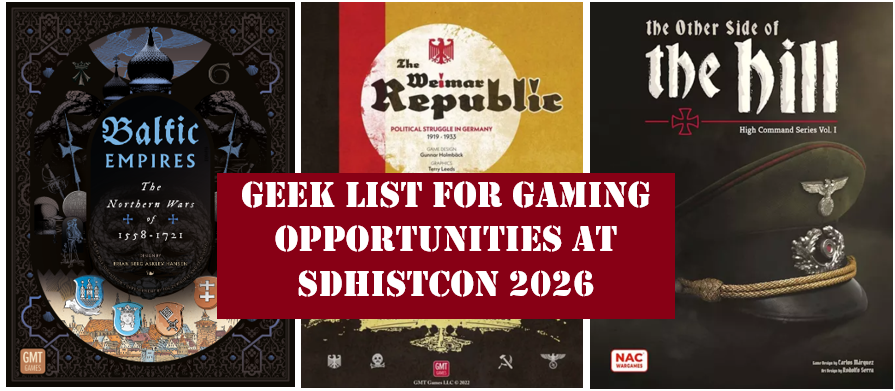
We have decided that we would at least like to play the following 4 multi-player wargames while there including Baltic Empires: The Northern Wars of 1558-1721 from GMT Games, The Weimar Republic: Political Struggle in Germany, 1919-1933 from GMT Games, The Other Side of the Hill from NAC Wargames and Thirty Years of Misery from VUCA Simulations. To facilitate the games, we have created a Geek List on Board Game Geek and I would encourage anyone who is attending to check it out and consider adding your name to the list. These lists are first-come-first-served and once full we will keep at least 1-2 alternates who are interested in case something happens that creates a vacancy. I will be looking at playing a few other games while there, including a few prototypes, but wanted to make sure that we got these big games scheduled at a minimum.

If you are interested in participating in one of our gaming opportunities or if you would like to add your own game entries on the list looking for players you can access the Geek List at the following link; https://boardgamegeek.com/geeklist/385692/gaming-opportunities-at-sdhistcon-2026-november-6

Please let me know if you have any questions and I look forward to seeing many of you at the con!

-Grant

My Favorite Wargame Cards – A Look at Individual Cards from My Favorite Games – Card #95: Flying Ace from The Republic’s Struggle: Battle for the Republic, Spain 1931-1939 from NAC Wargames

Von: Grant
22. September 2026 um 14:00

With this My Favorite Wargame Cards Series, I hope to take a look at a specific card from the various wargames that I have played and share how it is used in the game. I am not a strategist and frankly I am not that good at games but I do understand how things should work and be used in games. With that being said, here is the next entry in this series.

#95: Flying Ace from The Republic’s Struggle: Battle for the Republic, Spain 1931-1939 from NAC Wargames

The Republic’s Struggle is a thematic Card Driven Game that tells the story of the historical events that took place in Spain after the resignation to the throne of King Alfonso XIII, and the proclamation of the II Spanish Republic in 1931. With the creation of the new regime, the struggle for power between the different social, political and ideological sectors increased, which gave rise to continuous changes of political power, alterations of public order, armed uprisings and violent acts, carried out by the numerous ideological factions of the moment; which culminated in 1936, in a failed military uprising. The failure of this coup d’état was the origin for the Spanish Civil War.

The Republic’s Struggle is based on Twilight Struggle from GMT Games and uses the same concepts of area control while adding in some actual combat with units represented on the board. During the game, the Republican player and the National player, will be able to recreate events of the period to increase their popularity in the localities by carrying out political propaganda, recruiting troops or militias, generating revolts or assaults, establishing diplomatic relations or carrying out bombardments. All this will be done by playing their hand of cards in an alternative way, either by using the events or by playing the action points or icons to perform any of the other actions available to the players.

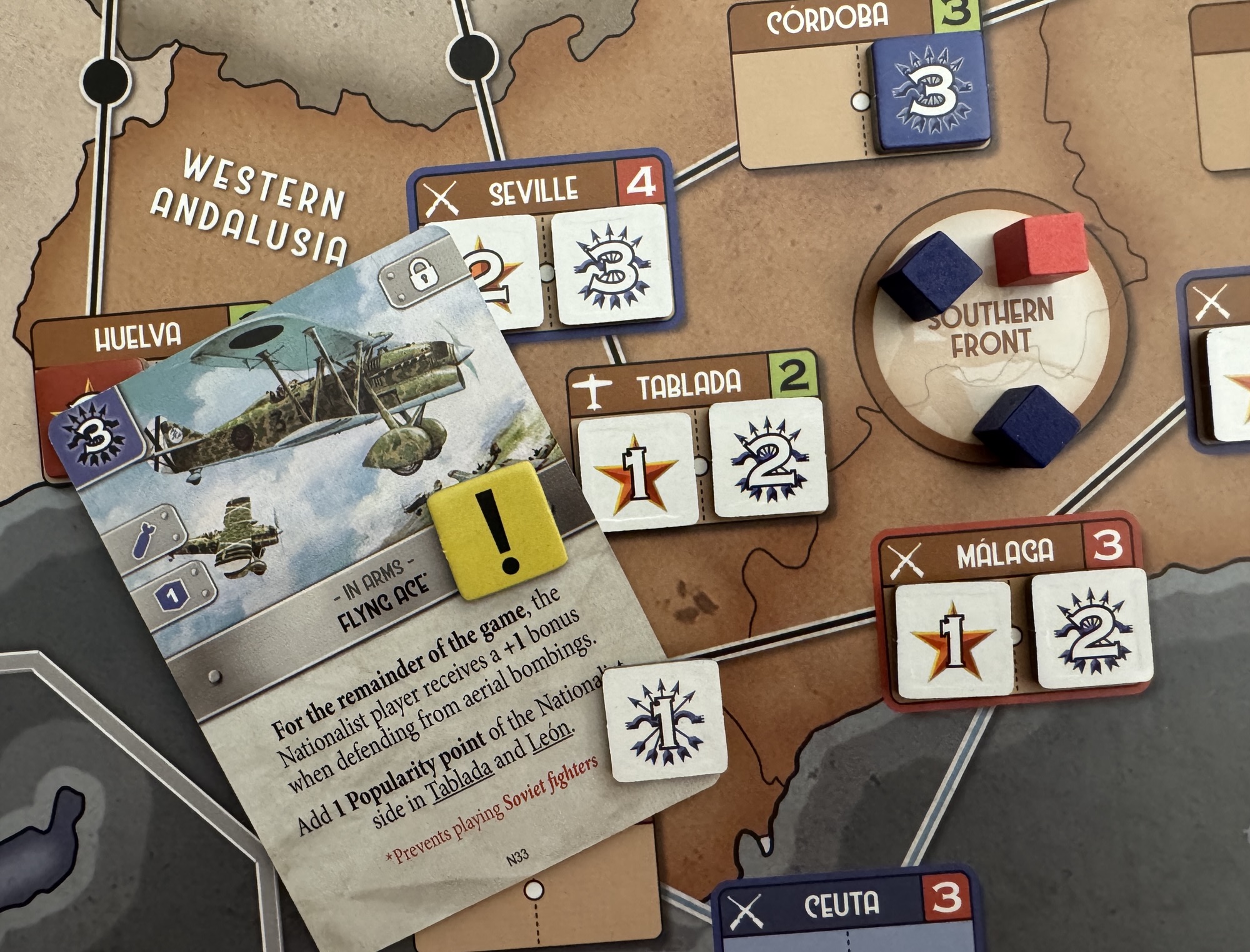
As you probably know, the Spanish Civil War was a bloody and vicious affair. With the advent of air planes and advancement of other weapons technology there was no army that couldn’t be touched. In The Republic’s Struggle players can use their cards and Operation Points to perform an aerial bombing on enemy units that are found on the various fronts. The Bombardment Process is executed by spending the Operation Points (OP’s) of a card, provided the card features a special bomb icon in the upper left hand corner near the Op Points. If a card displays both a bomb icon and a combatant cube icon, you may only choose to execute one of the options and not both. These Bombings target combatants located in specific Fronts, which are represented by circular spaces where army cubes may be placed through card play. In order to perform an aerial bombing, the player must have control of n Air Base Location on the Front that they wish to attack. The attacking player will add the Operation Points of the card played and adds a D6 while the defender will also roll a D6 but will add in the Defense Value that was determined at the outset of the turn by the play of a card and +1 for each of their cubes in the Front. If they have played a card such as Flying Ace, they will get to add a +1 to this total and then results are compared and a winner is determined and losses are the difference between the Attack and Defense Value.

That is the real power in the Flying Ace card as this +1 can be a huge boon in these aerial bombings and allow them to put up a stiffer defense and hold onto more of their units on these Fronts. The game instructs players to utilize the Exclamation Point markers to remind themselves of these type of benefits as the player should place the played card in front of them with the marker to be able to remember the benefit later in that turn.

But the Flying Ace Card provides another smaller but important benefit as it allows the Nationalist player to place 1 Popularity Point in Tablada and León to continue to build their influence and control of these key regions for scoring purposes. And finally, another benefit is that the play of the Flying Ace Card will prevent the Republican player from being able to play their Soviet Fighters Card which has a similar benefit. The thinking here is that the first player to get this card out controls the skies and has air superiority.

Aerial bombing during the Spanish Civil War marked a dark turning point in military history, serving as a lethal testing ground for the aerial terror tactics later unleashed in World War II. An estimated 15,000 people died from air raids during the conflict, with the vast majority of victims being civilians targeted by Nationalist forces backed by Nazi Germany and Fascist Italy. One of these horrific events was that of the Bombing of Guernica on April 26, 1937. Carried out by Nazi Germany’s Condor Legion and Fascist Italy’s Aviazione Legionaria, this raid destroyed a massive portion of the Basque town and killed hundreds of civilians. It became the ultimate global symbol of the brutality of war, immortalized by Pablo Picasso’s famous painting Guernica.

In the next entry in this series, we will take a look at Henry Knox Continental Artillery Commander from Washington’s War from GMT Games.

-Grant

❌