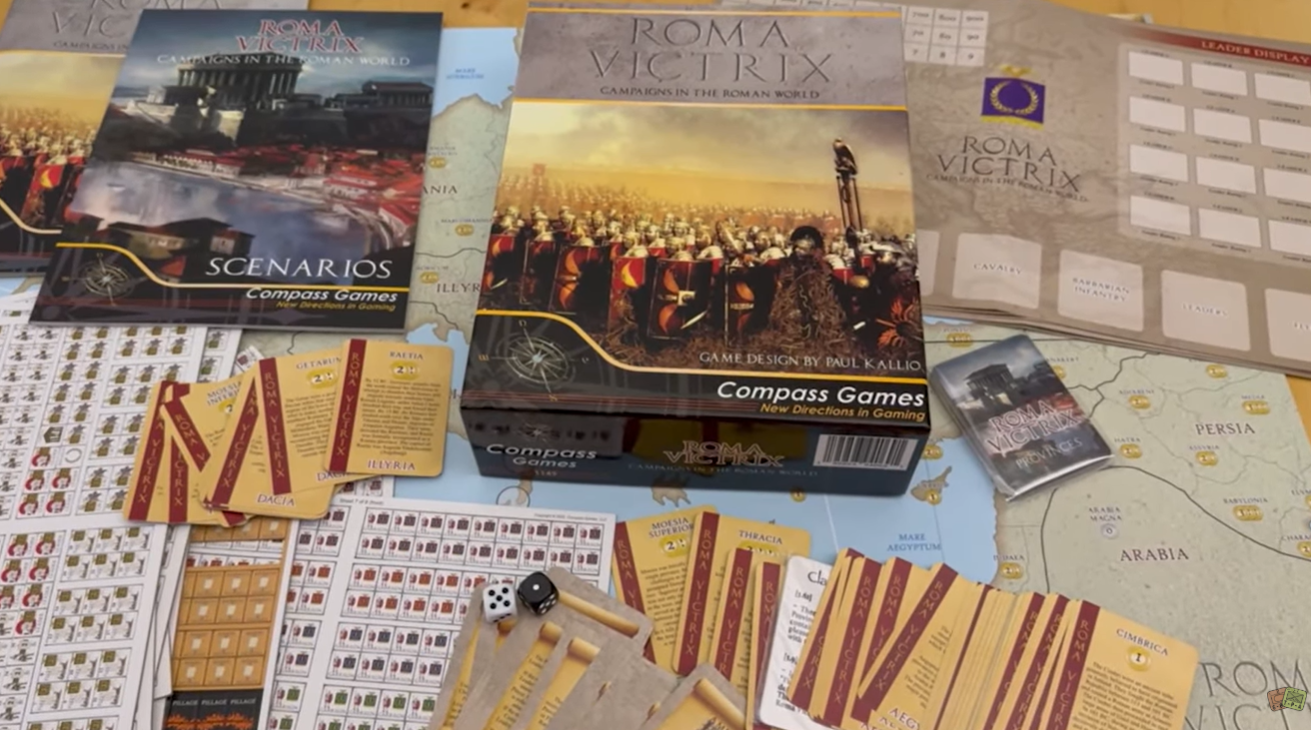
Roma Victrix is a grand strategic, moderate complexity wargame covering a time period ranging from 218 BC to 533 AD in twenty separate historical and hypothetical scenarios.
Roma Victrix is a game which endeavors to re-create the conflicts between Rome and her neighbors to achieve and maintain that dominance. A simple interactive sequence of play guides each player through the process of revenue collection, recruiting and maintaining military forces, conducting land and naval operations, diplomacy, field battles and sieges. Special rules are included to emphasize the importance and effects of leadership, cavalry superiority, mobility and attrition. Random events are also represented, adding an element of unpredictability to even the best laid plans and the likelihood that no scenario will ever play the same.
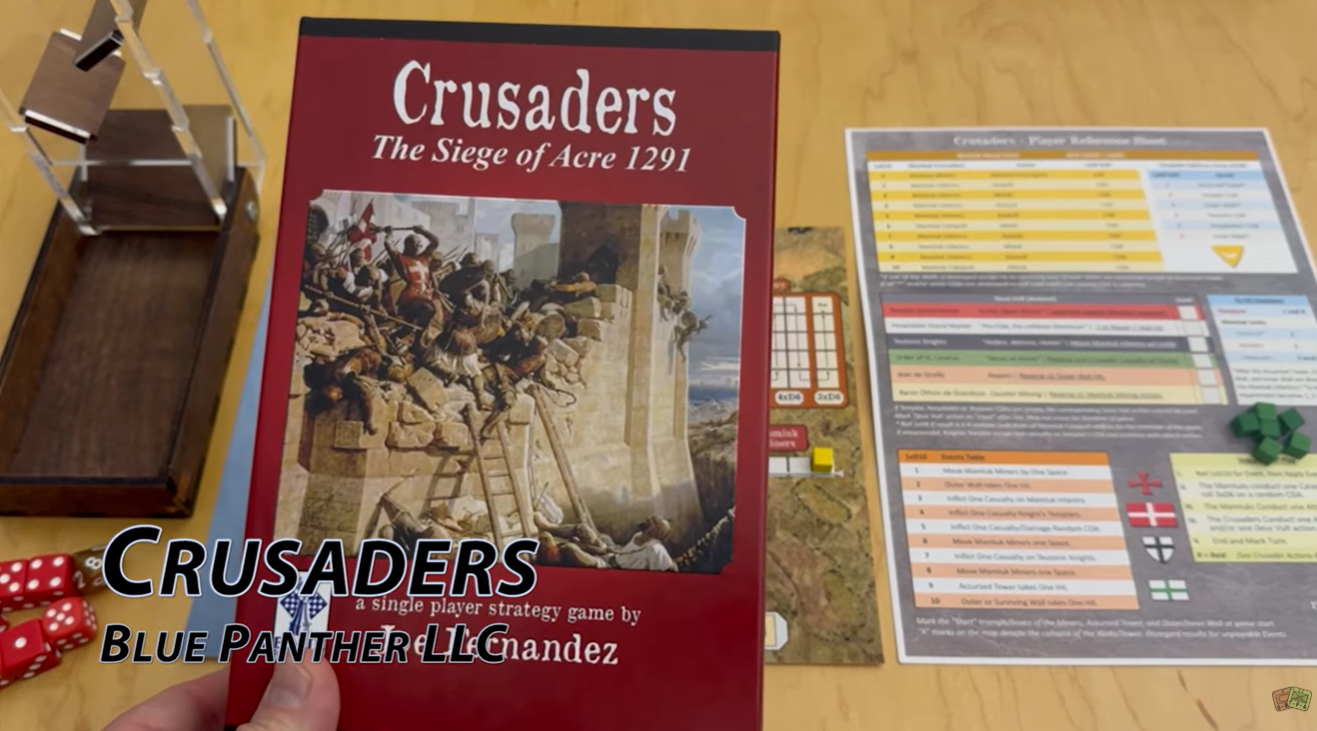
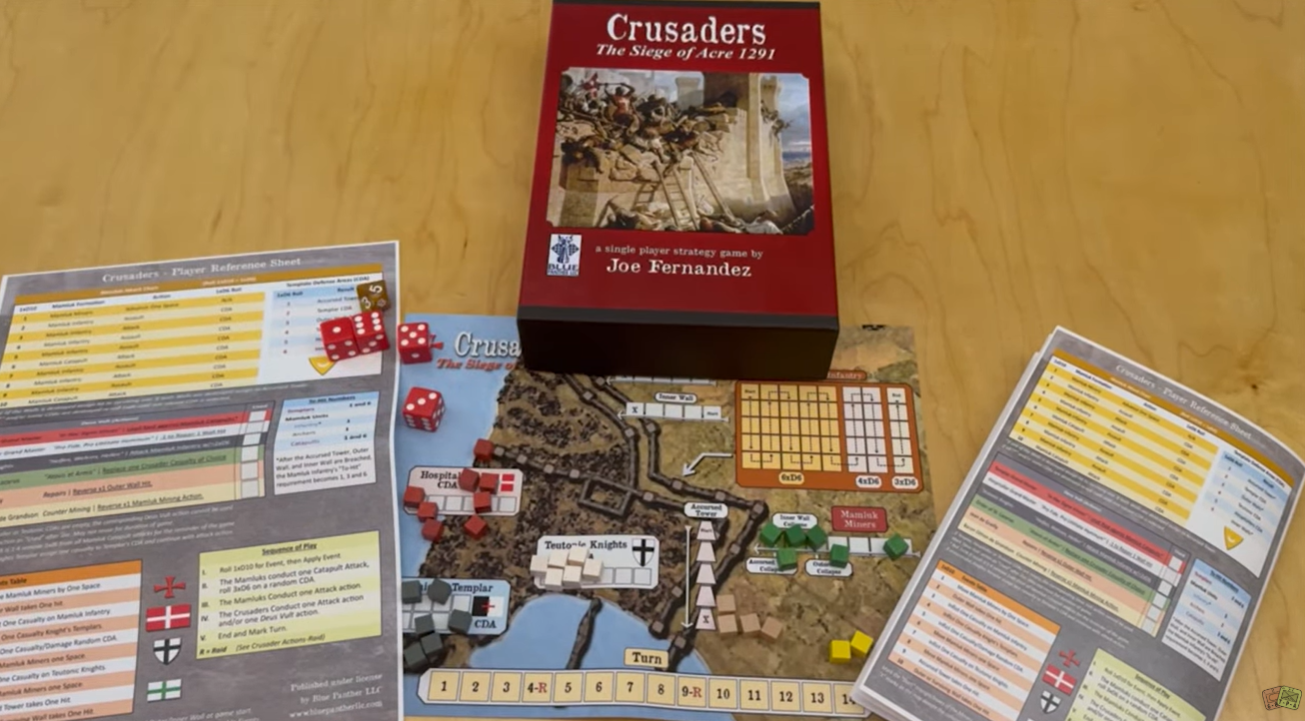
“In Signo Hoc Vinces”. Dive into history and heroism with Crusaders: The Siege of Acre 1291, a Tactical level Solitaire-Only board-wargame that immerses you and lets you experience the last stand of the Knights Templar and the Crusaders in the Holy Land. Relive the courageous stand of some 15,000 Crusader soldiers, Knights Templars, Teutonic Knights, and Hospitallers as they defend Acre, the critical port city in the Holy Land, against a massive Mamluk army of some 80,000 soldiers armed with siege engines and catapults during the Ninth Crusade.
Crusaders is a dice rolling, tower defense, solitaire game. Players take the role of Crusaders and try to defend Acre from the Mamluk attackers. Players win or lose depending on if the walls are breached and enough defenders survive.
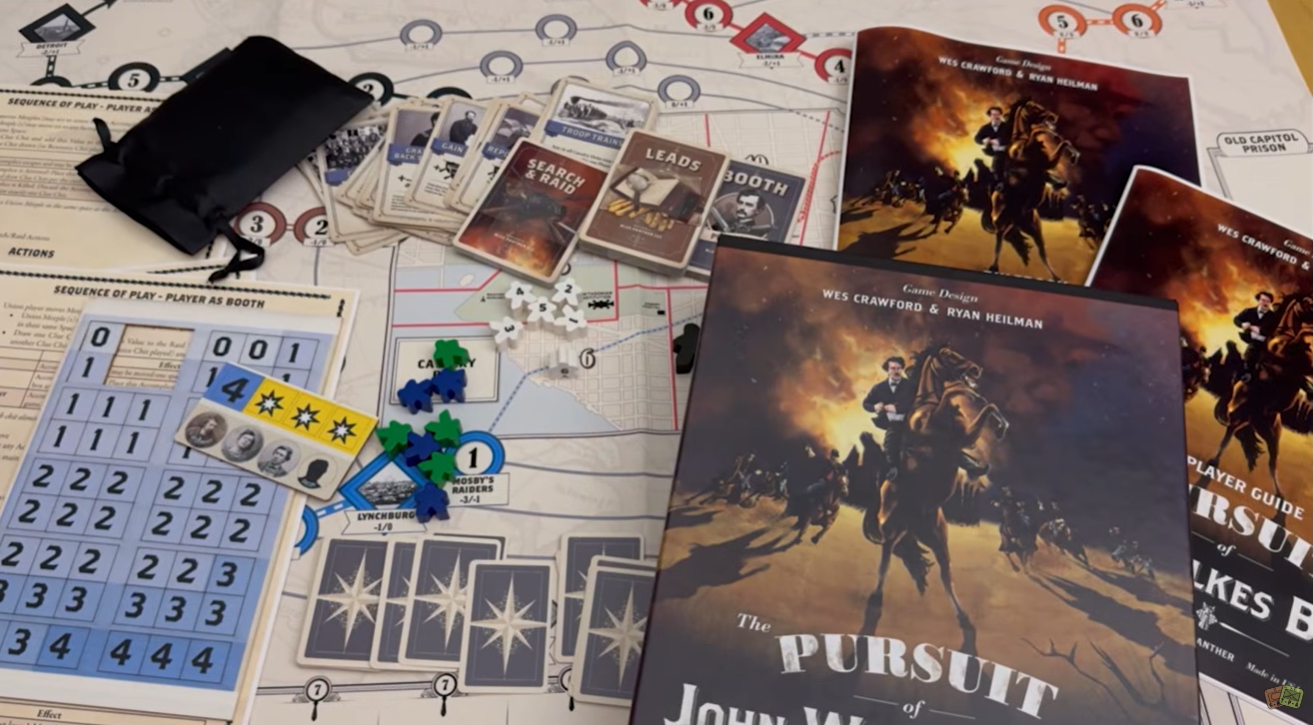
A few years ago, while attending the WBC, I had the chance to meet Wes Crawford who was demoing his upcoming game Engine Thieves. He was a very nice guy and his game was pretty interesting as well. Since that time, he has another game that has been released designed in partnership with Ryan Heilman in The Pursuit of John Wilkes Booth published by Blue Panther. I had a chance to play the game solitaire (with Wes overseeing the game and giving me guidance and pointers) at WBC in 2024 and have since played the game on my own several times and had a really great time with it. Great little solo game with several other modes where the player uses resources like police and detectives to search for clues in the hunt for Lincoln’s assassin after the events at Ford’s Theater on the evening of April 14, 1865. Definitely not a subject that has been gamed before and it is really refreshing to be able to experience this history in an interesting and engaging game. There really is a lot to like with the way that clues are found and chits are blindly drawn to verify clues from a bag. There is also a great little movement mechanic with police and detectives to try to acquire more clues.
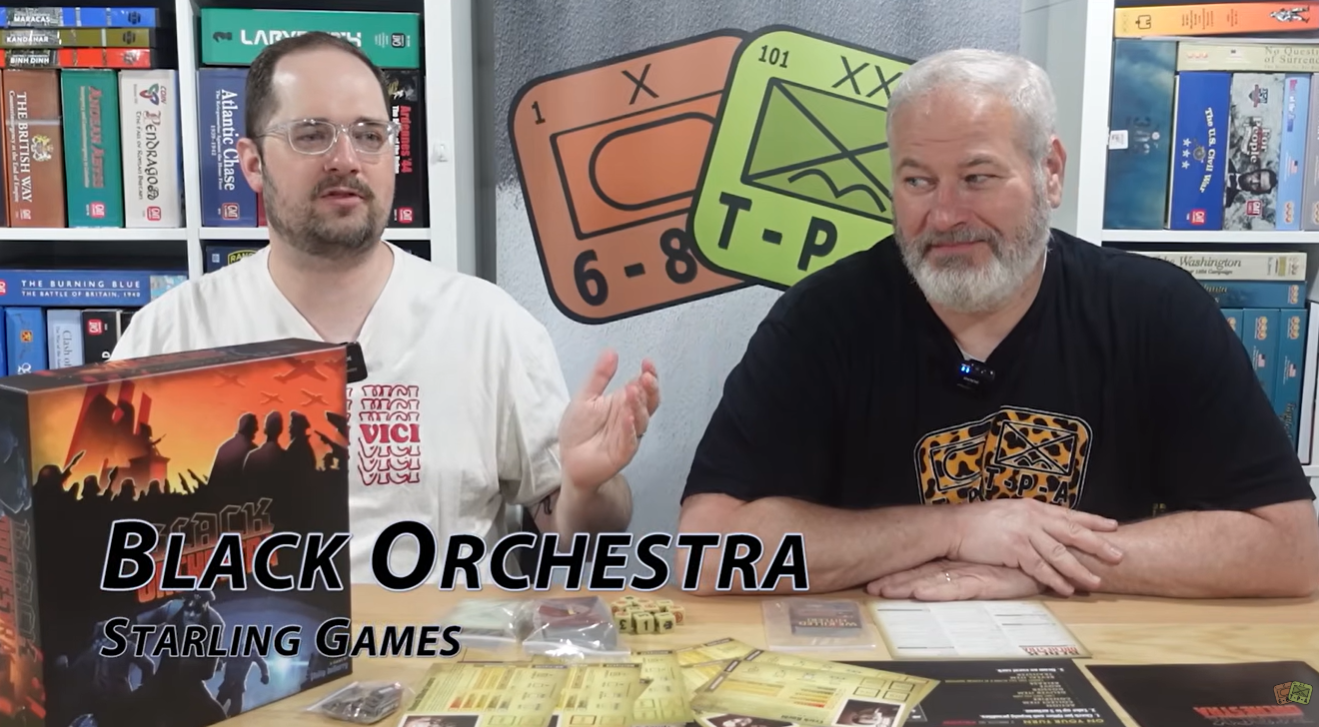
Black Orchestra begins with each player choosing a historic figure involved in the conspiracy against Hitler. In this dark and dangerous pursuit, motivation is perhaps your greatest weapon. If you can stay true to your convictions in the face of overwhelming threat and inspire your comrades, then you will be able to use your special ability, attempt plots, and even become zealous (necessary for some extremely daring plots).
But every move you make may also increase the suspicion of the authorities. The Gestapo will make routine sweeps, and any players with high suspicion will be arrested and interrogated (possibly resulting in other players being arrested). If you are all arrested or if the Gestapo finds your secret papers, you lose. And the suspicion placed on each conspirator will increase the chances their plots are detected.
On a turn, players may take three actions, such as moving, searching for an item, or drawing a card; or, at the cost of one action per die, roll the dice in an attempt to gain even more actions — at the risk of attracting the suspicion of the gestapo. This dice rolling “Conspire” action allows players to make bold moves when most needed.
Continuing along in this series devoted to the best looking boards found in the wargaming world where I will highlight the art and layout of a different board in a wargame that we have played to show you the various talents of the artists and graphic designers involved. In my humble opinion, a well designed and attractive board can make all the difference in the world to me enjoying a wargame. Don’t get me wrong, the game has to be good, but if it’s also good looking it always is a better experience. A board can draw me in. Can make me feel that I’m there. Can set the stage for the thematic immersion that we all crave. And I have found many of these type of boards and I want to make sure that I share them with you.
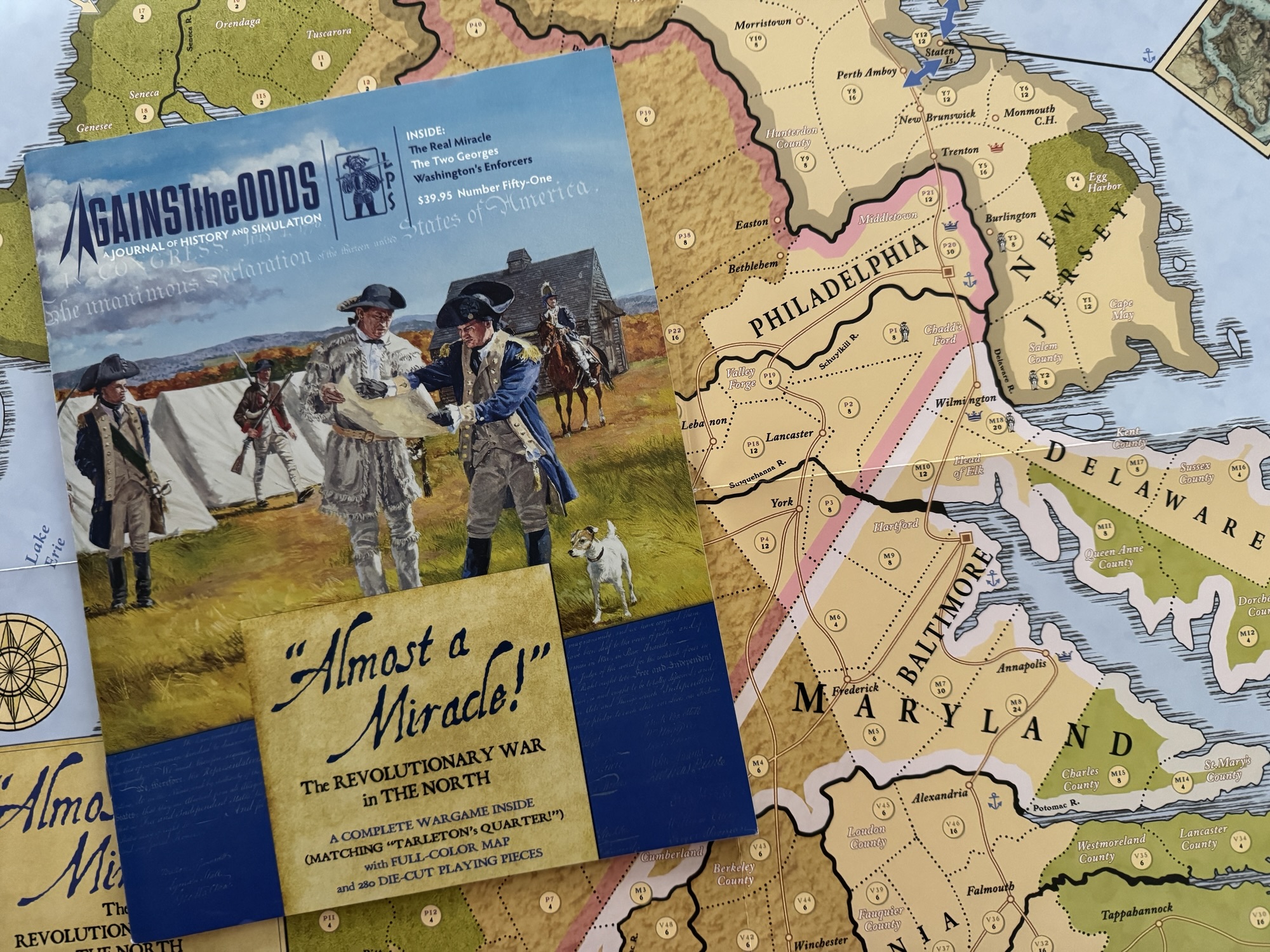
In this entry in the series, we will be taking a look at the fantastic looking board for Almost a Miracle!: The Revolutionary War in the North found in Against the Odds Magazine #51 from LPS, Inc. The board is illustrated by the very talented Mark Mahaffey whose board from Stilicho: Last of the Romans we have already covered in this series. Now typically, Magazine Wargames are nothing special. Both in their game play but also in their component quality and in the area of art and graphic design. But LPS takes great pride in the games found in their flagship magazine Against the Odds. And Almost a Miracle is such a beautiful example of great graphic design and art but also the board is absolutely a piece of art worthy of being framed and hung on a wall.
The board is illustrated by Mark Mahaffey who is a very accomplished full time artist who has done art for nearly 200 games including Celles: The Ardennes, December 23-27, 1944 (2012) from Revolution Games, The Dark Valley (2013) from GMT Games and Stilicho: Last of the Romans (2020) from Hollandspiele to name just a few. I think that Mark has a real talent for making a board coherent, easy to reference upon first glance and pleasing to look at during play, but I would not say that a lot of his boards are over the top beautiful but that is definitely the case with his effort for Almost a Miracle!.
The board represents mostly the Northern Theater of the American Revolutionary War but also includes Virginia and Maryland in addition to Pennsylvania, New Jersey, Delaware, New York and an area identified as New England which encompasses Massachusetts, New Hampshire and Connecticut. Canada is also represented at the top of the board. The map comes in 2 separate parts that join together in New England and that measures 22″ x 51″ total when combined. The interesting thing about these 2 maps is that one is significantly smaller than the other one. I would say about 75% of the playable board is found on the larger of the 2 sections with the northern tier only covering 25%.
My only real issue with the 2 parts of the board is that they join together fine but the way the map was folded created a really defined white seam in the board that really stands out. You can see it located to the right of the words New England and it runs from Penobscot to the top of the board ending in Canada around the top of Acadia. Not a huge issue but more of a distraction from the beauty that the board offers.
But the board is really quite beautiful and really provides a fantastic backdrop for the game itself. As you can see, the color palette chosen focuses on various shades of green and brown and they really give the game a natural and wild feel to it. With these American Revolutionary War games, I always keep in mind that the majority of the area of each colony, outside of a few larger population centers such as New York City, Baltimore and Philadelphia, are farmland and wilderness timber. Not a lot of development and definitely a land rich in natural resources in the form of wild game, furs, fish, lumber and ore. This “natural” color scheme of greens and browns really sets the tone of the period and provides a ready conduit into the theme and setting of the war.
Let’s focus on the southern portion of the board that includes Virginia, Maryland, Delaware, Pennsylvania and New Jersey. First off, I very much love the inclusion of the title box in the bottom left hand corner of the board with the game title and the various contributors including the designer David Jones and Mike Joslyn (who designed Tarleton’s Quarter which covers the Southern Theater) and the graphic design and art teams. These additions are always nice as they feel period to me and almost as if I am looking at a map of the region created at the time.
One thing that I want to point out is the use of lines to mark the various counties in each of the colonies. These lighter dotted lines are not as prominent as the other more important colony boundaries, roads and rivers. You will also notice that each of the colony boundaries are a different color because they touch and are easier to differentiate with the use of colors. Pennsylvania’s boundary is pink as it comes into contact with New York, New Jersey, Maryland and Virginia. Then the boundary of New Jersey is gray and New York is brown as they both touch Pennsylvania. This was a very nice touch and is important to understand the colony boundaries for recruitment and reinforcement purposes. This visually aids in distinguishing the various locations and to assist in grounding you in the geography.
Foraging is also a major part of the game and when troops are out campaigning they rely on baggage trains and supply depots for food and ammunition but also can forage the countryside which is hit or miss. These foraging results are found on a table and are influenced by the terrain type that the troops are located in. So knowing what the terrain in any given area is important and these colors quickly identify the type.
The other very nice feature on the board is the use of lines to mark the shorelines of the various bodies of water including lakes, bays and oceans. In the picture below, we get a look at the shoreline of New Jersey, Delaware, Maryland and Virginia and you can see the deft use of these horizontal dark lines to mark the water as it comes in contact with the shoreline. I also really like the small islands that are sprinkled in the midst of these lines and they add some real depth to the feature. You can also see in this picture the names of each of the counties in each of the colonies. You may also notice the nice use of the silhouettes of soldiers on the boards in some of these counties. These are the starting positions for your forces and I very much like the way they did this.
You may also notice the blue crown icons found on the board near major cities. In this picture you can see the blue crown icon at several places including: Wilmington in Delaware and Annapolis in Maryland. These blue crown icons denote the capitals of each of the colonies and some of the larger ones have multiple capitals. This has to do with victory at the end of the game for the British as if they control the colony capitals and there are no Colonial Regulars or Militia present in the colony they can then place the Colonial Governor and declare “the King’s Peace” in at least 2 colonies to end the campaign game.
As we move to the north of the map, and enter the less populated and definitely more wild areas of the colonies, including northern Massachusetts and the wilderness of Canada, the board changes quite a lot as there are less roads, less markings and frankly more green on the board. It still looks really good and the use of lines for water features is continued particularly in several of the larger lakes in the area.
In the picture above, you can see a good example of the Holding Boxes for troops in the larger metropolitan areas. Here we get a look at the Montreal Holding Box and I very much like the way that they have drawn the outline of the city itself with some of the streets, buildings and homes. This is a very nice touch to the board itself and there are several of these Holding Boxes found on the board including those shown in the picture below such as the Newport Holding Box, New York Holding Box and Staten Island Holding Box. These are very nice additions to the board itself and they look really good and add a layer of depth as well as playability to the game.
The game aids and tracks that are printed directly onto the board are very useful and well done. These use calligraphy like cursive writing that really feels period and adds to the thematic immersion of the player into the American Revolutionary War period. These boxes include the Continental Baggage Train Box and the British Baggage Train Box and shows the game’s focus on Supply. In these boxes, there is an available and an expended section that are used. There also is a Prisoners of War Track that is very period as well as these pitched battles were never fights to the death but represented the fighting style of the period which lead to many different forms of losses including deaths, injuries and prisoners taken.
Finally, there are Captured Boxes for Continental and British Leaders that aid the players in playing the game. These administrative aids are very well done from a graphics standpoint but I love that this game included them on the very large board as it eases play and cuts down on the need to continually refer back to the rules.
Almost a Miracle! was a game chosen for our Shelf of Shame Dust-Off Event in 2024 and we very much enjoyed the game and the history. The game is focused on the American Revolutionary War in the North and is named Almost a Miracle! because when asked about it years after the war ended, George Washington said that the American victory was “little short of a standing miracle.” Almost a Miracle! uses the Tarleton’s Quarter!System as a game engine starting point to bring the Northern “half” of the American Revolution into play.
I think that the best part of this game though is the board. It is just gorgeous and is an odd shape to take into account the entire northern colonies. I think that one of the strengths of this game is that it truly shows the difficulty of maneuvering armies around the colonies and the terrain as well as having to search for forage to feed those armies.
If you are interested, here is a link to our video review:
The next board that we will take a look at in the series is Great Campaigns of the American Civil War: Thunder On the Mississippi: Grant’s Vicksburg Campaign, April-July, 1863 from Multi-Man Publishing.
Here are links to the previous entries in the series:
With this My Favorite Wargame Cards Series, I hope to take a look at a specific card from the various wargames that I have played and share how it is used in the game. I am not a strategist and frankly I am not that good at games but I do understand how things should work and be used in games. With that being said, here is the next entry in this series.
#78: Hamburger Hill from Fire in the Lake: Insurgency in Vietnam from GMT Games
The COIN Series uses cards in a very different way from other CDG’s. These cards are not necessarily the driver of the action but more assistive to the actions of the players by setting eligibility and also providing powerful events. The Event Cards are more often than not, very powerful. They either give you a continuing bonus on future Operations and Special Activities (as in the case of the volumes that include the various Capabilities) or allow you to take Operations and Special Activities more times that round than you would normally have been able to had you not chosen the Event and more often than not, at no cost! Also, because of the power of the cards and their ties to one or more factions, you can take the Event which allows you a huge advantage, only to see that very powerful Event reversed with the next Event or with a regular Operation. This is very frustrating but is one of the major reasons that I love the card-assisted element of the COIN Series. Today we are going to take a look at the Hamburger Hill Event Card.
But first an aside. Along with the movie Platoon, my introduction to the fierce fighting in the Ashau Valley of Vietnam was mainly from the movie Hamburger Hill starring Dylan McDermott as Lt. Frantz and Courtney Vance as Doc. The images from this movie will be forever burned in my mind and with the recent passing of the anniversary of the battle’s start on May 13th I thought it would be a perfect time to cover this card.
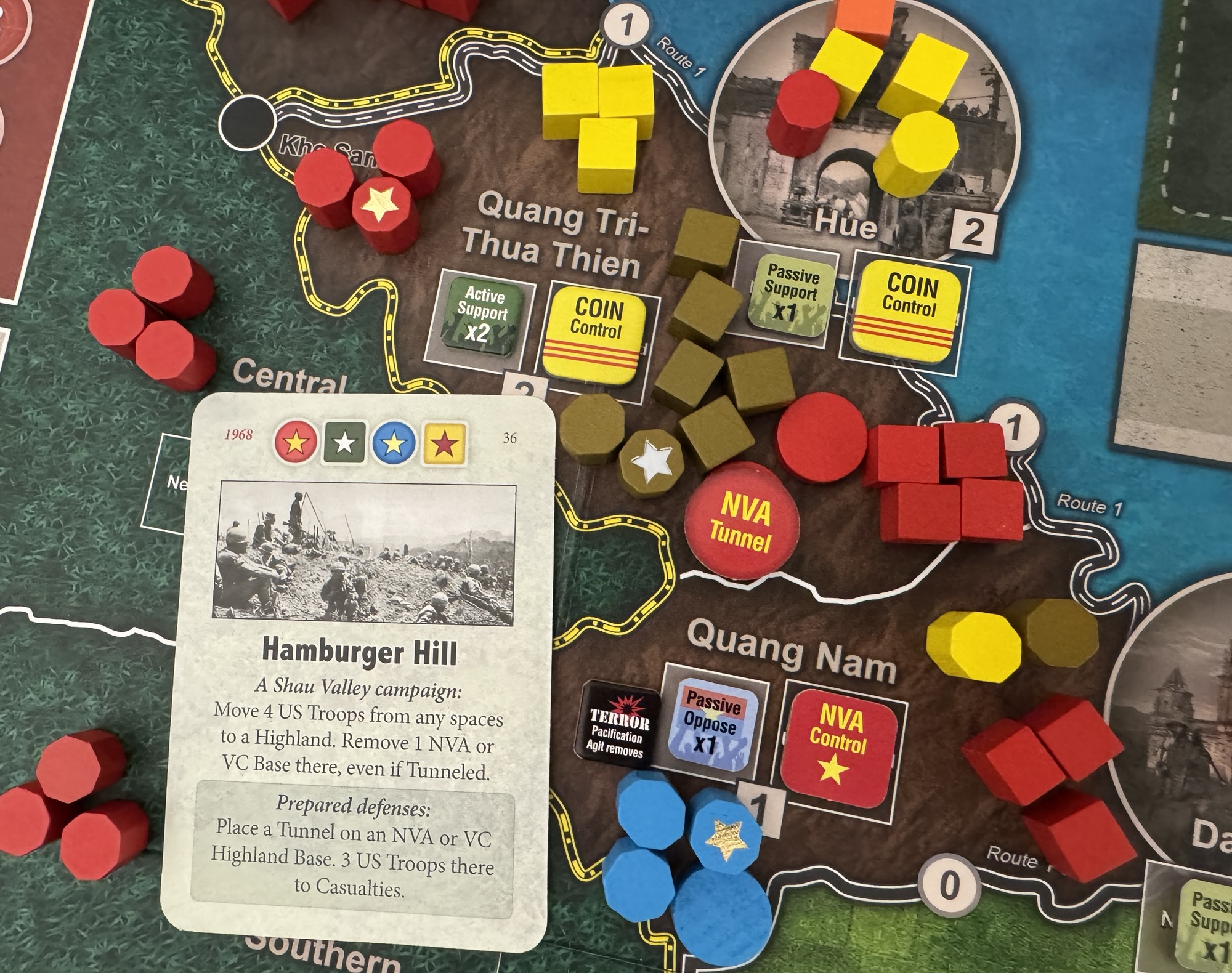
The Hamburger Hill Event Card has a top event and a bottom event, which is the case with all cards found in the decks of COIN Series games. The top event benefits the US/ARVN players while the bottom benefits the NVA/VC players. The top event allows the US player to move 4 US Troop Cubes from any spaces on the board to any Highland space, which are the brown colored regions representing less forgiving elevated terrain and mountainous areas. It then goes onto allow the removal of any NVA or VC base there, even if the base is currently Tunneled. This is a very powerful event as normally moving units requires an Air Lift Special Activity or a Train Operation to place new units into a space. Also, removing a Base, and especially a Tunneled Base, requires multiple turns and a focused approach of Patrol, Sweep and Assault to uncover hiding Insurgent pieces and then to destroy them allowing for a Base to be removed.
The Insurgent half of the event allows them to place a new Tunneled Based into a Highland space as well as remove 3 US Troop Cubes to Casualties. The Casualties Box is where these “dead” cubes are stored until the Coup Round where they will have negative effects on the United States player and then be available again for use in the next turn. This event is very powerful and is a major boon for the Insurgent player in taking control of and maintaining their presence in the Highland Provinces.
I also very much like the historical connection to the Battle of Hamburger Hill and think that the designers did a great job of creating this event with real game effects related to the battle and consequences that are felt from the play of the card. This Hamburger Hill Event is one that will be played by both sides often rather than taking their Operations and Special Activities. The effects are just too efficient and powerful to pass on unless the timing of the game dictates differently.
The Battle of Hamburger Hill was a major battle that lasted from May 13–20, 1969 was fought by United States Army and Army of the Republic of Vietnam (ARVN) forces against People’s Army of Vietnam (PAVN) forces during Operation Apache Snow of the Vietnam War. Though the heavily fortified Hill 937, a ridge of the mountain Dong Ap Bia in central Vietnam near its western border with Laos, had little strategic value, US command ordered its capture by a frontal assault, only to abandon it soon thereafter. The action caused a controversy among both the US armed services and the public back home, and marked a turning point in US involvement in Vietnam.
The battle was primarily an infantry engagement, with the US troops moving up the steeply sloped hill against well-entrenched troops. Attacks were repeatedly repelled by the PAVN defenses. Bad weather also hindered operations. Nevertheless, the Airborne troops took the hill through direct assault with heavy use of artillery and airstrikes, causing extensive casualties to the PAVN forces.
Local Degar tribesmen call the mountain Ap Bia, which means “the mountain of the crouching beast.” Official histories of the engagement refer to it as Hill 937 after the elevation displayed on US Army maps, but the US soldiers who fought there dubbed it “Hamburger Hill,” suggesting that those who fought on the hill were “ground up like hamburger meat.”
The quote was attributed to Sgt. James Spears who said, “Have you ever been inside a hamburger machine? We just got cut to pieces by extremely accurate machine gun fire…”.
US Army photographers climb Hill 937 at Dong Ap Bia after the battle, May 1969.
A few years ago, Worthington Publishing released a new game called Dawn of Battle designed by Mike Nagel. The game was HUGE size wise containing dozens of playable historic scenarios. The game allows players to refight various historical battles from 1500 BC to 1500 AD or a range of 3,000 years of combat. Players take the roles of the great commanders of history, including Xerxes, Alexander the Great, Julius Caesar, Saladin, and William Wallace. Since that time, Blue Panther has agreed to print the game in a new Designer’s Edition and also have added some new content to an already large amount of scenarios and counters. Recently they announced a new Scenario Pack Expansion, which includes MORE scenarios, called Dawn of Battle: Epic Combat! and well it appears to be pretty EPIC! We reached out to Mike to get some inside information about the expansion.
Grant: Mike welcome back to the blog. What is your new expansion Dawn of Battle: Epic Combat!?
Mike: I’m always happy to contribute. Thanks for the opportunity!
Dawn of Battle: Epic Combat! is the only true expansion for Dawn of Battle: Designer’s Edition. By that I mean that it comes with another map as well as more counters and terrain tiles. It’s likely the only expansion that the game is going to get as it fulfills the vision that I have for the game system. Beyond this, it’s all scenario packs…many, many scenario packs.
Grant: For those not familiar, what are the hallmarks of the Dawn of Battle Series?
Mike: Dawn of Battle is a game system of low to moderate complexity that allows players to recreate any battle from roughly 1500 BCE to 1500 CE, although I have strayed a bit further in both directions. As Alan Emrich described the game when he was helping me develop it, it covers everything from guts to gunpowder. The game was derived from my previous design Ancient Battles Deluxe (which Alan published with Victory Point Games). That game was inspired by the old Bill Banks game Ancients (published by Good Industries and 3W). While designing this latest iteration, I had several critical factors in mind. The first was accessibility. The game had to be relatively easy to get into in terms of rules density as well as setup time. The second was accuracy. Despite the scope of the game requiring a certain amount of abstraction, I still wanted to ensure that identifiably historical results could be achieved. The third was portability. The game, which is something of a “hobby in a box,” needed to be able to be pulled off a shelf and easily transported to a game club or convention. The fourth was relative affordability. Given the economic pressures of the day, I wanted to ensure that players really got their money’s worth. Finally, of course, the game has to be appealing and above all, fun to play. I believe I’ve nailed every factor with Dawn of Battle.
Grant: What do you hope to add to the series with the Epic Combat! Expansion?
Mike: One thing that Dawn of Battle cannot do out of the box are the massive battles you see teams of folks playing at conventions. It’s a 2-player game. The goal of Epic Combat! is to present both an option to play Dawn of Battle with up to eight players at a time, but also challenge two players to successfully fight out massive battles as well. Epic Combat! provides the components and structure to do that.
Grant: Why do you feel the system needs this addition?
Mike: A couple of reasons. First, and likely the most expected, is that an epic battles option is available for Richard Borg’s Command & Colors Series. Since Dawn of Battle is similar in scope and scale (but light years away in design and play), it makes sense to offer an option as well. The other reason is that the addition of additional units and terrain tiles allows for greater flexibility in scenario design for those who want to give their own favorite battles a whirl.
Grant: As a team focused game, how do teammates work together? What is the division of leadership between the players in this team approach?
Mike; Let’s assume a maximum load of four players per team. Three of the players are field commanders, represented on the map with their own leader unit. The fourth player acts as the commanding general. Each field commander gets his own action point during a turn to do with as he pleases. Any additional points are granted to the field commanders by the commanding general. The field commanders may not offer suggestions to other field commanders during play. The commanding general allow this, but at a cost.
Grant: What is the new map included in the expansion? What type of terrain is included?
Mike: The map is the same as the map in the base game. The two are mated along a short end to form the epic playing surface. If players ever wondered why one edge of the map had half-hexes rather than a pretty border, now you know. This was the plan from the outset. The terrain tiles are more of the same: woods, hills, rough, and enough rivers and streams to cross the entire length of two maps.
Grant: There are also additional counters. Are these more and different units or just more of those in the base game to create larger battles?
Mike: The counters are also more of the same, beefing up the inventory with a couple of twists. First is the addition of an ‘e’ indicator on each counter, which serves two purposes. One is to distinguish the expansion counters from those from the base game. The other is to allow these counters to be used in a different manner than their counterparts, according to a scenario special rule. Say a variety of Heavy Infantry that might be more mobile than other HI. This adds even more flexibility to scenario design. The second twist is the inclusion of several errata counters that correct misprints from the early printings.
Grant: What is the upgraded command system?
Mike: The command system is much the same, with action points being used to activate formations to perform specific tasks or enhance combat or die results. Where things differ a bit is in how command range works, since there are many more units spread over twice the area.
Grant: How are Command Cards used?
Mike: Command Cards are used by the commanding general. At the beginning of a battle, each commanding general can select a number of these cards to start with. The general is gambling on which cards might be the most useful. There is also a chance that additional cards may be acquired during play. Each card can be used for one of three purposes. The printed event can be used as noted, the card can be discarded as an extra action point, or it can be discarded as a “dispatch,” which allows play stop and players to confer (this is the only time field commanders can interact).
Grant: Can you share with us an example of these Command Cards and explain their layout and anatomy?
Mike: Pretty straightforward.
Grant: What are courageous heroes? How do they work?
Mike: Heroes are the solution to the real estate problem. With so many more units and space, how do you keep them under control? It seemed too clumsy to simply state that command radii were doubled. This made some leaders really strong while not making weaker leaders strong enough. What heroes do is extend a leader’s printed command radius so long as the hero is within that radius. Say a leader with a radius of 2 positions a hero two hexes away (still within the leader’s radius). The hero now inherits a command radius of 2, thus extending the leader’s radius out to 4 hexes. This allows leaders to manage much larger formations. A leader “spawns” a number of heroes equal to their command rating at the beginning of each turn. Heroes can also be used as individual leaders outside of a leader’s command, providing more flexibility of action during a turn.
Grant: Are these generic personas or based in history?
Grant: Like leaders, these are abstracted personalities. It’s up to the scenario background and the leader capabilities to dictate who’s who.
Grant: What epic-sized scenarios are included with this expansion?
Mike: There are 6 total epic-sized scanarios:
Qarqar, 853 BCE
Gaugamela, 331 BCE
Sentinum, 295 BCE
Raphia, 217 BCE
Pydna, 168 BCE
Pharsalus, 48 BCE
Grant: What errata corrections for cards and counters are included for the base game?
Mike: There are about a half dozen units (Light Infantry and Light Archers) that were improperly printed in the first several copies of the base game. Additionally there are about a half dozen cards that were reworded a bit for clarity, so not really errata per se, but still included. There is a chance that the replacement cards are not identical in size to the rest of the cards in the action deck, so unless the cards are sleeved, using them could be more trouble then they’re worth. Mileage may vary.
Grant: What do you feel the series models well?
Mike: I believe the series does a fantastic job at simulating ancient combat. From the clashing of shields to exploitation on the wings, it all works really well. It’s also a lot less luck-dependent than other ancient combat games. This is the game that ticks all of the proverbial boxes for me. That’s the best part of being a designer: making games I want to play!
Grant: What type of new experience does Epic Combat! create? What are you most pleased about with the expansion?
Mike: One of the things I noticed while designing and testing the expansion is that it provides even more of an (ahem) epic sweep to the battles by allowing the armies to spread out further. The heroes and Command Cards also really ramp up the command and control experience. Although I’ll mostly be sticking to standard scenario design going forward, when I want to really ramp things up and there’s space on my table, epic is a great time!
Grant: What other designs are you contemplating or already working on?
Mike: I’ve still got quite a few irons in the fire. Given its great success so far, I’ve started working on Off the Line, Volume II – Winter War that pits the Soviets against the Finns with some cool new features coming to the system. Of course, by the time this is posted, the fifth scenario pack for Dawn of Battle should be available (that’s 120 scenarios so far!). I’ve got a sci-fi skirmish game coming out soon called MASS Impact. Following that is a light dueling game called Have at You! All of these will be printed by Blue Panther. I also hope to have an ancient naval game called Navarchoi published by Legion Wargames soon(ish) and several Flying Colors games are on GMT’s pre-order list. Of course, I’ve also got several other projects on the design table, but more word on those later. I can’t give all my secrets away!
Now, back to the design table…thanks again for the opportunity to share.
Keep in mind that Dawn of Battle: Epic Combat! requires the base game of Dawn of Battle: Designer’s Edition to play, which is sold separately.
Europe, 1702. The death of king Charles II of Habsburg left the throne vacant and started a war all over Europe to settle the matter of the Spanish Succession. The Archduke Charles III of Austria, the Habsburg heir, was discarded by the last will of Charles II, signed almost on his deathbed, in favor of Phillip of Anjou, Louis XIV’s grandson, the Bourbon heir. The Grand Alliance has been formed, by the Treaty of Den Haag, by Great Britain, the Dutch Republic, Austria, Portugal and Savoy to preserve Europe’s balance of power and reclaim the throne for the Archduke Charles.
The players, representing the powers of the Grand Alliance, will fight the Bourbon forces composed by French, Castilian and Bavarian troops. Their goal, defined by a hidden agenda, is to obtain the best commercial and territorial concessions, and conquer the Bourbon territories. But this is no cooperative game: the winning player will need strategy and negotiation skills to achieve the best deals with the enemy and thus be the country with the most benefits thanks to the Peace of Utrecht.
In previous turn reverse order, each player decides how to play one of the seeded cards for the current turn. The players may pay from their resources to use the card’s text or may prefer to “sell” the card to execute one action. Each action is available only once for each turn and the players cannot execute the same action in two consecutive turns. The available actions are Recruit troops, Move them across the map or Attack the enemy in adjacent areas. Other choices include obtaining Resources or paying attention to their own countries Public Opinion (a.k.a. Will to Fight), for this will decide the order in which the new Concessions will be dealed. The card deck, composed by the most relevant battles, events and characters throughout the war, includes the exploits of the Bourbon armies to counter the player’s actions.
“In Signo Hoc Vinces”. Dive into history and heroism with Crusaders: The Siege of Acre 1291, a Tactical level Solitaire-Only board-wargame that immerses you and lets you experience the last stand of the Knights Templar and the Crusaders in the Holy Land. Relive the courageous stand of some 15,000 Crusader soldiers, Knights Templars, Teutonic Knights, and Hospitallers as they defend Acre, the critical port city in the Holy Land, against a massive Mamluk army of some 80,000 soldiers armed with siege engines and catapults during the Ninth Crusade.
Crusaders is a dice rolling, tower defense, solitaire game. Players take the role of Crusaders and try to defend Acre from the Mamluk attackers. Players win or lose depending on if the walls are breached and enough defenders survive.
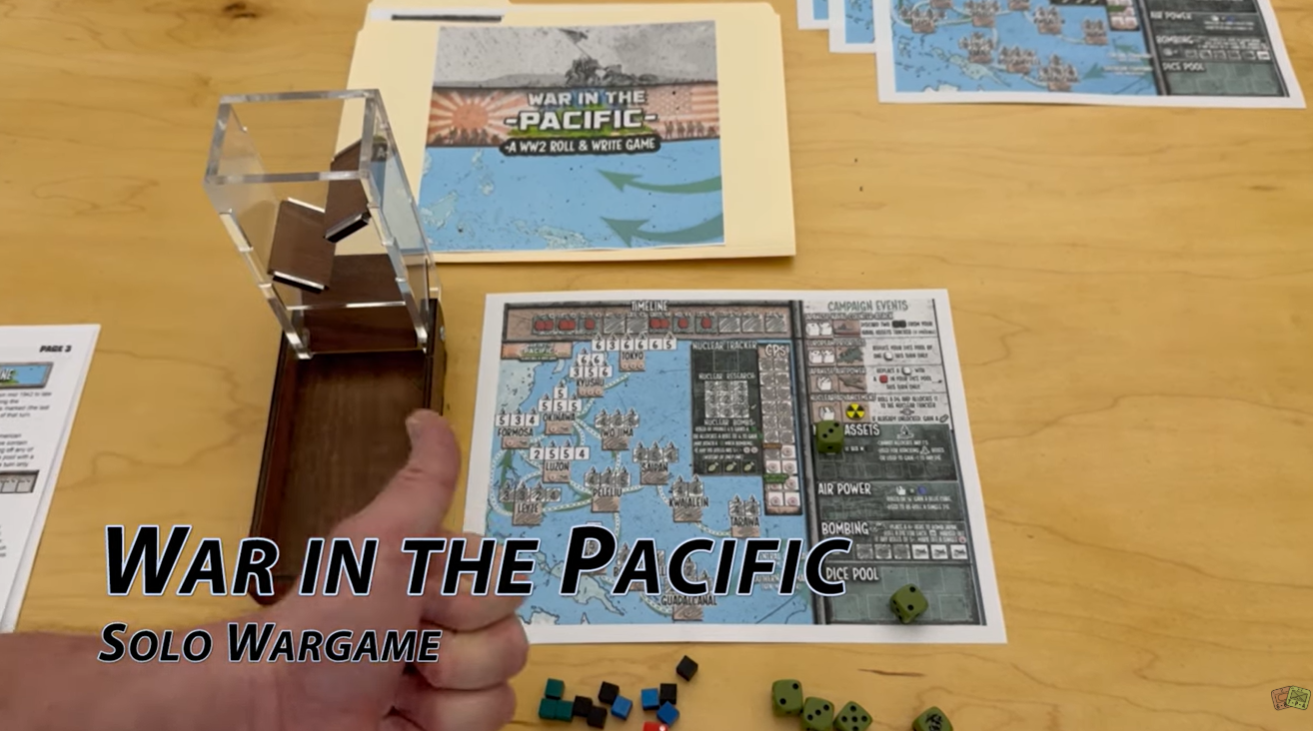
The year is 1942. Japan has rapidly expanded across the Pacific, bombing Pearl Harbor, capturing key territories, and threatening to dominate Asia. The United States, determined to halt this advance, begins a daring island-hopping campaign to weaken Japan’s hold and force their surrender. Can you lead the American forces to victory, or will the Japanese resistance force the United States to a negotiated settlement?
In War in the Pacific, you’ll allocate limited resources to launch attacks, conduct strategic bombing, maintain supply lines, and seize key islands. Your strategy must be swift and decisive, targeting objectives like Guadalcanal, Iwo Jima, and Okinawa. As the war intensifies, you can divert critical resources to the Manhattan Project, researching and developing nuclear weapons. The race to build atomic bombs could be the key to ending the war. Can you balance the demands of the Manhattan Project with the immediate needs of your campaign?
Once you’ve gained a foothold, you’ll face a crucial choice: invade mainland Japan in a costly land assault, or use strategic bombing and nuclear weapons to force Japan’s surrender. Each option is risky as an invasion could end the war quickly, but at great cost, while bombing and nukes may hasten Japan’s surrender, but could come too late.
With fast-paced dice allocation, resource management, and mounting pressure, every decision could mean the difference between victory or failure in your quest to force Japan’s capitulation.
The March 2026 Monthly Debrief Video, which is the 3rd episode in Season 6 of this series, saw us discussing the games of David Thompson. David Thompson burst onto the board game design scene with his 1st game released in 2018 called War Chest, followed closely by the release of Pavlov’s House. His actual first game designed was For What Remains, which is a tactical skirmish game set in a futuristic post-apocalyptic wasteland where factions fight each other for supremacy, but it was not released until 2020 after a successful Kickstarter. Pavlov’s House was his first foray into the historical board game genre and its success has spawned several follow-up games in the Valiant Defense Series. David is a very conscientious designer and wants to put the time in to make sure his games are not only realistic in their play but representative of the time period covered. David also established Digital Capricorn Studios to support his board game design habit and on that website you can learn more about his design philosophy and check out his numerous games.
Also, as usual, we covered the games we played in March, which included the 14 games we played at Buckeye Game Fest.
We will remind you here that we are fortunate to be continuing our relationship with Noble Knight Games as the sponsor for our Monthly Debrief Video series. In case you don’t know, Noble Knight Games specializes in hard to find games but also carry all the new releases. But what makes them truly unique is that you can find some of the rarest games, long out of print games, hand made games, imported games from overseas, etc. Thanks to them for their sponsorship and we hope that you will consider them first when looking for the games we cover.
One of my favorite wars to game is that of the Vietnam War. Part of that is because I was born in the early 1970’s and heard a lot about this war for the rest of that decade and throughout my teenage years. I remember watching the short lived television series Tour of Duty. I also read the graphic novel series The ‘Nam from Marvel Comics. But, my interest really grew after watching movies such as Apocalypse Now and Platoon. I always asked myself, how are you expected to fight a war where you don’t know who the enemy is? But also part of the attraction for me is that the war in anything but conventional. The combatants were diametrically different, the powerful and well funded United States of America and their technology and special forces versus the Viet Cong, a rag tag group of insurgents, and the mighty North Vietnamese Army funded and supported by the Chinese. This war also was set amongst the backdrop of social upheaval and cultural change at home with anti-war protests, freedom for all being sung as a marching song and desegregation and civil rights taking center stage. We have played plenty of games set in this conflict and I want to share my Best 3 Games with…Vietnam!
3. Hearts & Minds: Vietnam 1965-1975 from Worthington Publishing
We really enjoy Card Driven Games and try to play as many of them as we possibly can get our hands on. Also, as I said in the intro, we also enjoy Vietnam wargames. So, when we had a chance to play a CDG on the Vietnam War, it was a no brainer! I got this game for Christmas about 6 years ago and it was a used copy of the 1st Edition published by Worthington Publishing. There is a 2nd Edition out there but I really don’t know what the differences are. Since that time, there also is a new 3rd Edition from Compass Games and it looks really good. But that is neither here nor there.
In Hearts and Minds: Vietnam 1965-1975, players will play as either the US/ARVN forces (with some units from NATO as well as ROK) against the Communist forces which include NVA regulars and VC hidden units. The game has multiple scenarios and covers the entirety of the Vietnam War from 1965 all the way through 1975 as the U.S. forces left and only the ARVN remained to attempt to stem the red tide coming down into South Vietnam.
The ROK unit in Quang Ngai successfully Pacifies the province, placing a blue star marker that will factor in end round calculations for the dreaded Political Will Track.
Players have a hand of 5 cards each round from which they will play 4 that provide Resource Points to perform various actions including activating units to move up to their movement allowance, attacking enemy units, doing bombing missions, pacifying areas or forcing a political change. Each faction has their own deck, the Communist deck is red, the Allies is blue and then there are black cards that are neutral. Players will make their decks from their color and mix in half of the black cards. These cards represent the meat of the game and are the vehicle to make the game progress. The Resource Points are spent to perform the actions mentioned above and also can be used to buy the printed event on the card just played. Sometimes this event will have lasting effects for the entire game, such as the Commando Hunt card that allows Bomber missions to target Laotian border provinces and also allows more than 1 bomber to bomb any given province, or will have a one time effect such as Junction City, that allow you to spend more than one saved Resource Point in a given turn as long as all Battle and Political Control Change actions take place in Zone III. These cards are well done and the game boils down to the efficient use of the hand that you are dealt. Sometimes, you will be given cards with high RP’s of 4 or 5, which will allow you to make a lot of progress with various actions including moving forces, battling the opposition and making political changes. But, there will be times when your draws are not great and you have a hand full of low value RP cards but they might have interesting and very useful events that you must take advantage of. In essence, you have to play the cards you are dealt and make the best go of things. This can be both fun and frustrating but always keeps things interesting and requires that you plan and execute on that plan.
Battle is pretty simple as well as all the counters are pretty much the same for both sides. Each counter has an untried side and a veteran side (with either a 1-6 or 2-6 for ARVN and US troops or a 1-4 or 2-4 for NVA and typically a 1-1 for VC units) and then there are support units such as mortars, artillery, tanks and helicopter gunships. When a players units are located in a province with enemy units, a contested area is created where the players can fight by buying a battle round for the cost of 1 RP. If the battle doesn’t conclude, another battle round can be purchased with an additional RP until the player no longer has RP’s. Units in a province simply total up their battle factors (located in the bottom left corner of the counters), roll a die and consult their specific faction’s Battle Table. The results are the damage that must be applied and fire is considered simultaneous. The results include a specific number of units that must be eliminated but also sometimes has a capital R that means the player must either lose one unit or pay a saved RP. The blue table is slightly better than the red table, but not by much.
The really neat part about the battles is that units can evade before the battle starts with a roll, which becomes more difficult in certain terrain types and also has negative results for even attempting, such as the loss of a unit. This part can be very frustrating for the Allied player as he has finally corned the wily NVA and VC and they then slip right through his fingers with a favorable roll.
How does the game end? Well, players will be fighting each other for control of provinces and for casualties that will affect the will of the fighting powers and adjust the Political Will Track. This track factors in how each side feels about the war and their attitude to continued hostilities. Each scenario has a set level for an immediate victory, which frankly will never happen, and an end scenario number, which is more reachable. The Political Will Track really sums up the game for me and the feelings that many had about the Vietnam War. It seemed that escalation of bombing, more U.S. Troops on the ground and bloodshed didn’t equate to a victory. But simply meant the fighting would linger until one side or the other eventually would give in.
I recommend this game wholeheartedly for anyone that likes CDG’s and for anyone that is interested in a holistic approach and treatment of the Vietnam War. My only negative about this game is that it appears to be very hard for the Communists to win. That is probably an assessment after only one play as we both really didn’t know what we were doing but it is a concern of mine that I would like to see in future plays. It just felt very difficult to do anything that was meaningful with the resources they have and they are also outclassed in combat so that is a concern as battle is a big part of the game. Still a very solid representation of the Vietnam War and frankly a very interesting design by John Poniske.
2. Fire in the Lake: Insurgency in Vietnam from GMT Games
The COIN Series uses cards in a very different way from other CDG’s. These cards are not necessarily the driver of the action but more assistive to the actions of the players by setting eligibility and also providing powerful events. The Event Cards are more often than not, very powerful. They either give you a continuing bonus on future Operations and Special Activities (as in the case of the volumes that include the various Capabilities) or allow you to take Operations and Special Activities more times that round than you would normally have been able to had you not chosen the Event and more often than not, at no cost! Also, because of the power of the cards and their ties to one or more factions, you can take the Event which allows you a huge advantage, only to see that very powerful Event reversed with the next Event or with a regular Operation. This is very frustrating but is one of the major reasons that I love the card-assisted element of the COIN Series.
Fire in the Lake from GMT Games just really sums up the the Vietnam War experience to me and Volko’s magnum opus is Fire in the Lake, without a doubt, as it attempts to answer the question of who the enemy is and does a fantastic job. Fire in the Lake: Insurgency in Vietnam is Volume IV of the COIN Series and teams up two amazing designers in Volko and Mark Herman. The game is an asymmetric treatment of the Vietnam War and pits four players against each other, as even allies want to win the war, but win it in their way. The US Player has control of lots of powerful forces that can utilize Air Lift, Assaults and Sweeps to drive the insurgent guerilla forces of the Viet Cong and NVA back into the jungles but the VC and NVA have tools at their disposal to evade these heavy handed tactics such as tunneled bases, the terrain itself including jungles, rivers and mountains, and the Ho Chi Minh Trail. The US Player must also watch his own back as his ally, the ARVN, is more interested in patronage and lining their pockets with US dollars than necessarily winning the war through brute force. This game design takes into account all of the difficulties with this quagmire of a war and time, and through the cards used to assist the game moving forward, inserts key events such as drug use, protests at home, booby traps and the Tet Offensive.
The US forces are on the move to try to eradicate the VC stronghold in Tay Ninh province, which will not be an easy task as that tunneled VC base is really hard to kill.
If you haven’t played Fire in the Lake, please do yourself a favor, and do so. It is an exquisite experience that will test you on so many levels and leave you exhausted at the end of the effort while yearning for more. But, don’t go into it thinking it will be easy as it will not be and is sure to have you pulling your hair out as you attempt to win this war. Great theme. Great game play. High quality components and a well thought out design. To get a little more insight into why this game is so great, please read my article on Why I find the COIN Series to be Fantastic! I use several examples of the game play from Fire in the Lake to prove my point.
1. Silver Bayonet: The First Team in Vietnam, 1965 from GMT Games
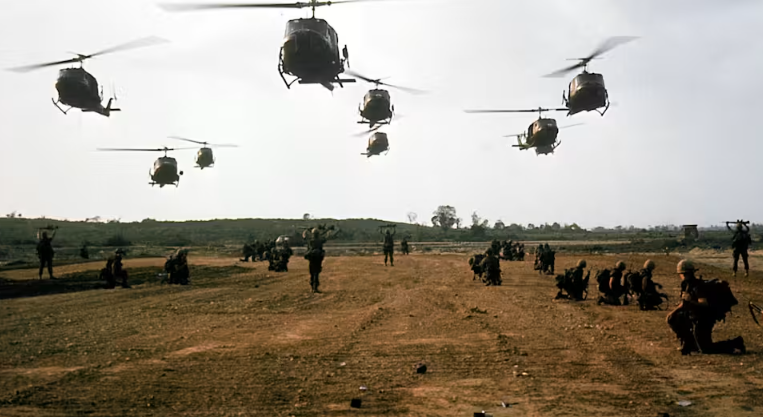
I own and have read the book We Were Soldiers Once..and Young by Lt. Gen. Hal Moore and was fascinated by the story he told of his brave soldiers who fought the first major battle of the Vietnam War. How they went into the Ia Drang Valley and ran into nearly 2,500 NVA regulars who were spoiling for a fight and who outnumbered them 2.5/1 and how that fight lasted 5 days from November 14th through November 18th. I was also amazed at the new tactics used by the 7th Cavalry in using helicopters to jump from landing zone to landing zone to remain maneuverable enough to fight a conventional war that we were comfortable with against a non-conventional enemy in the Viet Cong and the North Vietnamese Army who didn’t want to fight our way. When the new 25th Anniversary Edition of Silver Bayonet was announced I was excited to experience this war and was glad when my friend Alexander P500’ed the game and we got a chance to play it.
So, this isn’t some monster game that covers the whole of the Vietnam conflict, but covers the entirety of the Silver Bayonet campaign. The initial landings of the 1st Cavalry Division are just 1 of 11 or 12 scenarios/campaign games included in the box. It covers 4 days and uses a handful of units in brutal close assaults.
NVA troops try to surround Free World Alliance forces and use numbers to overwhelm them.
Something that I was pleasantly surprised about was that a good number of the scenarios can be played solitaire because most of them don’t involve using the hidden aspects of the game (NVA hidden movement, US secret helicopter basing and staging, etc.). The complexity of the rules, and sub rules, as well as all of the different phases means that the game is very cerebral. There’s a lot to consider, and units/combats might not function in ways that you’re used to in other games. With one stack attacking another you are very unlikely to wipe the other player out. The CRT just isn’t built for that. If you use maneuver combat then the NVA will flee to the hills and then just come back at you. However, NVA assaulting American troops is also deadly, because in assaults the defender inflicts hits first. We found ourselves often in bloody stalemates, with the Americans just barely hanging on for dear life. The US had access to big artillery pieces as well as many points of airstrikes, which learned through hard experience need to be stacked all together in precision strikes in order to do any kind of damage. All of these things lead to just a fascinating, and in my opinion, extremely accurate representation of the type of combat, fought on the jungled hills of South Vietnam. This game felt real and as we played we could really begin to get into the narrative of the situation and even in some small manner, feel the same frustration and disappointment that the US must have felt in fighting an un-fightable enemy! For that alone, I am extremely impressed and cannot wait to play more and just explore the depth that the rest of the scenarios have to offer.
If you can’t tell, I love this game. It’s deep, rich, and flavorful, just like a good curry. There’s volume in the box, so much stuff to play with. The components are unbelievably good value. Something that didn’t feel too great was the importance of the coordination rolls. The NVA would have handed the US their ass early on day 3 if they hadn’t utterly failed this coordination roll. In failing, they were unable to attack with their best stacks that had been meticulously moved into position for the final assault to take LZ X-Ray. And while I understand what it represents, which is is great, but it seemed very ‘swingy’, because it happened on several of my activations during our plays. Coordinating the amount of NVA troops commanded in the jungles whilst being bombarded day and night isn’t an easy thing to do, but that it boiled down to a single d10 roll felt like a little bit of a let down. I might be house ruling a 2d6 method to make that roll less randomly distributed. I also get that over the course of a full campaign those kind of things would have evened themselves out, but in a short scenario like that it kind of felt like bad luck. That being said: It’s still a good model for the command situation, so there is that. Just maybe find a way to be less random?
Well, those are my 3 favorite games focused on the Vietnam War. I have played several others but feel that these 3 best demonstrate what it is like to be in an unwinnable and unmanageable situation that quickly spirals out of your control. What are your favorite Vietnam War games?
As an added bonus, here are links to a few Vietnam related posts that I did during the pandemic on the Music of the Vietnam War:
Post Publishing Edit: I was asked why Purple Haze from PHALANX didn’t make the list and here was my response:
Oh no. It was amazing. We absolutely love the theme and the feel of that game. Fantastic representation of the Vietnam War. Warfighter Vietnam from DVG is also very good.
A few other smaller games I have played and liked on the subject was Fortunate Sons from High Flying Dice Games, Long Cruel Woman from High Flying Dice Games and Dien Ben Phu from Legion Wargames (although not the US war in Vietnam but a great game). Just only wanted to spotlight 3. -Grant
With this My Favorite Wargame Cards Series, I hope to take a look at a specific card from the various wargames that I have played and share how it is used in the game. I am not a strategist and frankly I am not that good at games but I do understand how things should work and be used in games. With that being said, here is the next entry in this series.
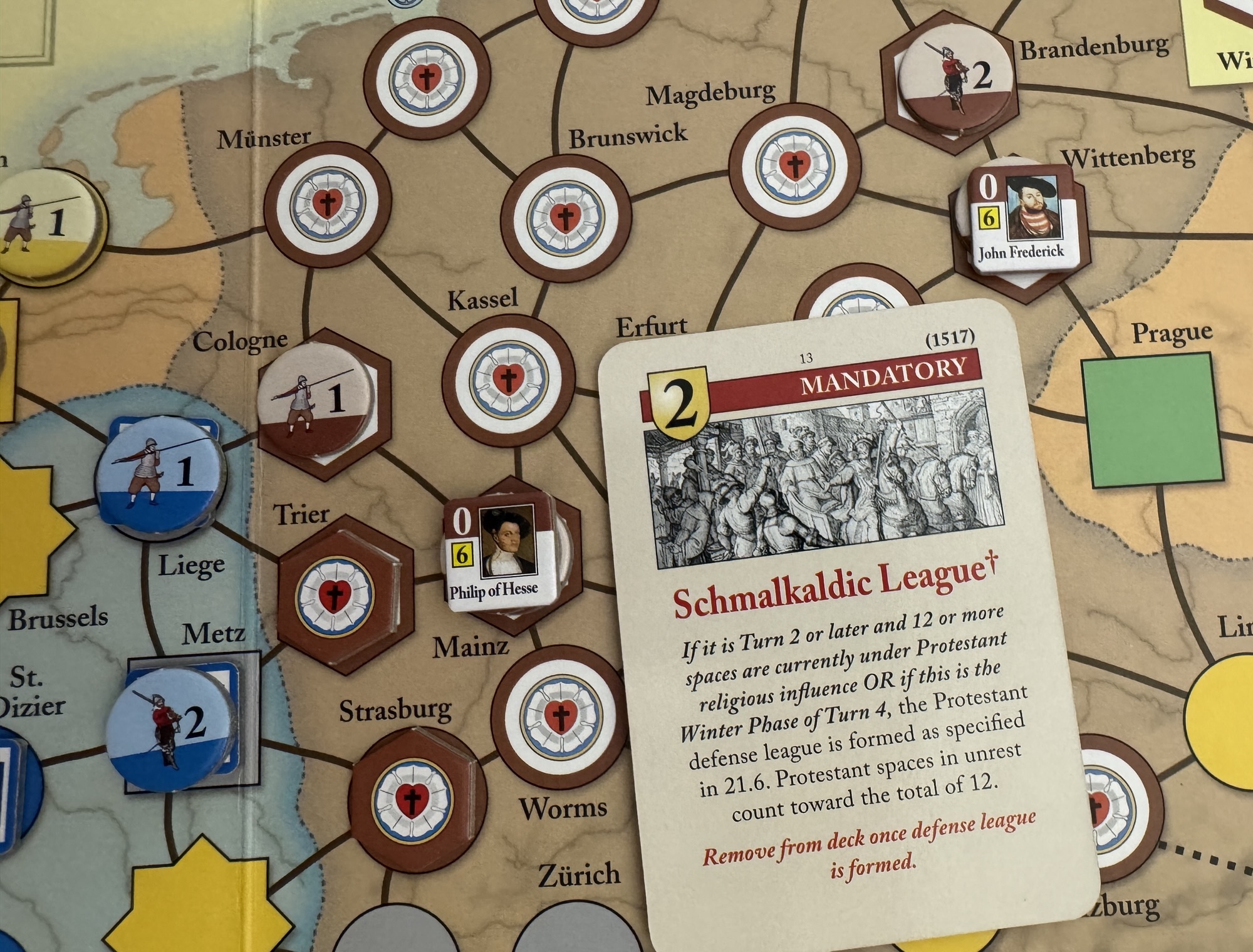
#77: Schmalkaldic League from Here I Stand: Wars of the Reformation, 1517-1555 from GMT Games
Here I Stand: Wars of the Reformation 1517-1555 is an experience packaged in a game that attempts to boldly cover the political and religious conflicts of early 16th Century Europe. The game focuses on the struggle of religious reformers such as Martin Luther, John Calvin and Ulrich Zwingli as they battle the Papacy for changes in their views of God and religion. But it is more than just the Holy War as it deals with the other European countries involved in the affairs of the time including France, England, the mighty Hapsburg Empire and the Ottoman Empire in the east. They all played a role in the process of the Reformation and the design brilliantly weaves this all together into an interesting and engaging experience. The game also covers other plot lines and events of the period, including wars, marriages and ascendancies to thrones, using a unique Card Driven Game (CDG) system that models both the political and religious conflicts of the period.
Today, I want to take a look at a very interesting Mandatory Event card that really shakes things up for the Protestant player in the Schmalkaldic League. This Mandatory Event basically transforms the Protestant player and changes their focus slightly as they now become somewhat of a military power. I use the term “military power” here lightly as they really are not that powerful and this event is really more of a wet blanket thrown onto their spiritual bonfire as they now will have to worry about gearing up for attacks from their neighbors to try and take away their victory points through wresting control of their Electorates from them, which grant extra Victory Points. The Schmalkaldic League Mandatory Event is only triggered when the Protestant has religious influence in 12+ spaces from Turn 2 on, or if not, then automatically by the end of Turn 4.
The Protestant player gaining the ability to create and command military units, including both regulars and mercenaries, is somewhat of a boon as you can now move your troops around the board gaining additional dice for Conversion attempts if those units are adjacent and also the electorates under Protestant religious control, specifically those marked as Protestant home spaces, instantly come under Protestant political control and grant 2 VP for each Electorate up to a maximum of 12 VP total if all 6 are under control. Talk about a turning point…albeit a turning point with some difficulties. The leaders granted to the Protestants are also not very good and do not gain extra dice during combat and frankly cannot command large armies. These leaders include John Frederick and Philip of Hesse.
John Frederick I of Saxony by Lucas Cranach the Younger.
Frankly, I try my best to hope and pray that the Schmalkaldic League card doesn’t come out during the first 4 turns and then will be triggered only during the Winter Phase of Turn 4. This gives the Protestant player some time to expand and attempt to get all of those important VP generating Electorates under their control to set themselves up nicely. But once it happens you will find that you are spending your scarce resources in the form of Command Points on things like recruiting units, moving those units and preparing for attacks. This takes away from your ability to focus solely on spreading the faith and can be a real drag on that effort. But, you take the good with the bad in this game and I have learned to deal with it over the years and turn it into something that benefits me.
The Schmalkaldic League was a military alliance of Lutheran principalities and cities within the Holy Roman Empire during the mid-16th century. It received its name from the German town of Schmalkalden, where the group was founded in 1531. Although created for religious motives soon after the start of the Reformation, its members later came to have the intention that the League would replace the Holy Roman Empire as their focus of political allegiance. While it was not the first alliance of its kind, unlike previous formations, such as the League of Torgau, the Schmalkaldic League had a substantial military to defend its political and religious interests.
The League’s members agreed to provide 10,000 infantry and 2,000 cavalry for their mutual protection. They rarely provoked the Holy Roman Emperor Charles V directly but confiscated church land, expelled bishops and Catholic princes and helped spread Lutheranism throughout northern Germany.
Martin Luther planned to present to the League the Smalcald Articles, a stricter Protestant confession, during a meeting in 1537. He attended the critical meeting in 1537 but spent most of his time suffering from kidney stones. The rulers and princes even met in the home at which Luther was staying. Though Luther was asked to prepare the articles of faith that came to be known as the Smalcald Articles, they were not formally adopted at the time of the meeting, but in 1580, they were included in the Book of Concord.
While attending SPIEL Essen last fall, we became aware of a new narrative driven book wargame coming from PHALANX and designer José Luis Barca. We were supposed to get together with José to discuss the game but due to changes in our schedule and another meeting we just couldn’t break away to get over there. I felt bad about that, and want to apologize to their Marketing and Crowdfunding Director Adrian Turzański, but we did get copies and Alexander has since played it several times. In place of the sit down discussion, I reached out to José to see if he wanted to answer some questions in a designer interview. He was willing and that has led us her to this post.
Grant: José welcome to our blog. First off please tell us a little about yourself. What are your hobbies? What’s your day job?
José: Thank you, it’s a pleasure to be here. Okay. So, I’m a big fan of wargames, role-playing games, and board games who, three years ago, left my regular job to work as a freelancer in translation, layout, and writing for board games, role-playing games, and wargames—making a dream come true: working in a field I’m passionate about.
Grant: What motivated you to break into game design? What have you enjoyed most about the experience thus far?
José: Well, in addition to what I mentioned earlier, I’m a novelist. Right now I have three novels and two short story collections written. As part of my work, I translated gamebooks, so I wanted to try writing a different kind of “novel” that’s tied to the game. Also, on my Instagram, I interact with readers through “choose your own adventure”-style story games. All of this led me to the decision to write a gamebook in which the narrative aspect was the most important thing. From the very beginning, I really enjoyed the experience. Being able to give the main character choices was something that wasn’t possible in a normal novel, and I really enjoyed all the options, including killing him off in many different ways. It was something fresh for my writing.
Grant: What is your new game A Bridge Too Far about?
José: A Bridge Too Far depicts the war as seen through the eyes of a private. The protagonist is a Polish soldier from the 1st Polish Independent Brigade who will try to survive in Driel and Oosterbeek. His decisions will shape his future in the Battle of Arnhem, which was a military failure for the Allies. Thus, the gamebook explores the harshness and cruelty of combat in one of the bloodiest battles of World War II.
Grant: It is described as a paragraph-based game. What does this mean?
José: It’s another name for a gamebook, or, in this case, a wargamebook. The narrative unfolds through paragraphs that, depending on your choices regarding the options presented, lead you to other paragraphs. In this way, you aren’t reading a book in a linear fashion, as you would with a novel, but rather you have to follow the storyline through the paragraphs indicated by the game.
Grant: What is your design goal with the game?
José: The goal was to immerse the reader in the combat, allowing them to witness a battle and its various stages firsthand. It was also to explore the character’s psychology—how their morale and willpower gradually break down. In short, the aim is to paint a realistic picture of combat, or as realistic as possible using nothing but the pages of a book—something no one would ever want to experience.
Grant: What research did you do to get the historical details correct? What one must-read source would you recommend?
José: This was undoubtedly the hardest part. Most books today about the Battle of Arnhem cover the battle in general terms, without providing the level of detail needed for a novel or gamebook. Those of us who write historical fiction always face this problem. When we go into such detail in describing places, people, or objects, we run into a problem that no general overview can solve. For this book, I consulted the two most famous books: A Bridge Too Far by Cornelius Ryan and Arnhem, the Battle for the Bridges, 1944 by Antony Beevor. From the first, I drew some anecdotes about the fighting, and from the second, the general overview of the battle, but I needed something more to fully immerse myself in the epic story of the Poles. So I discovered The Pegasus Archive: The British Airborne Forces, 1940-1945, which contains the transcript of all the orders given by officers during the battle, hour by hour. This source was the definitive one for understanding what really happened to the Poles at Arnhem.
Grant: What role does the player take on in the game?
José: The player is a rank-and-file soldier in an elite unit of the British Army, which is where the Polish Brigade was integrated. As I mentioned earlier, your goal is to survive, and how you do that is up to you: whether you make it to Nijmegen safe, desert and go into hiding, or end up as a prisoner. If you don’t survive, there are plenty more options, hahaha.
Grant: What role does the player play in the creation of the soldier?
José: The character must be created at the beginning. You simply need to assign three numbers to its main attributes. The rest is set by default.
Grant: What are the three attributes focused on? What does each represent?
José: The soldier has the following attributes: Body, which indicates stamina, strength, and hand-to-hand combat ability; Mind, which reflects intelligence, reasoning, and the ability to use weapons; and Will, which reflects morale, willpower, courage, and sanity.
Grant: What does the phrase “choice-driven, demanding gameplay” mean?
José: Well, exactly what it says: every decision matters and could mean the difference between life and death. The player is presented with various choices from time to time and the story will branch off from those choices into a new direction.
Grant: How did you go about creating a tense and decision filled experience?
José: Well, that was my intention, but I’m not sure I pulled it off. It’s up to the readers to decide. But my writing style certainly helped. Many of my readers say I write as if I had a camera slung over my shoulder, and that my scenes are action-packed and very visual. You can easily picture the scene without needing lengthy descriptions. What some experts call “dynamic description.” My descriptions of the situation are woven into the dialogue or the character’s actions, as if the reader were watching a movie. These days, I think that’s the best way to write, since there are almost more viewers of movies and TV shows than readers of books.
Grant: How many different branching options are possible?
José: The book has about 20 alternate endings
Grant: How long did it take to make sure these were all consistent and that there weren’t loops?
José: That’s not enough. Let me explain. These days, there are tools available to help you with the process of checking for loops and errors when writing a gamebook. I used a program called “Librogame Creator,” where you type directly, just like in Word. The real benefit is that you can create the paragraphs within the program and link the choices to their respective paragraphs. In the end, you’re left with a paragraph map that makes it much easier to review and see if any are incomplete, if there are loops, and if any lead to a dead end. In any case, it’s not foolproof, and in a work of this type, errors are inevitable. I apologize in advance.
Grant: How are dice rolls handled for the game?
José: The game tells you when to roll the dice. Basically, you roll a number of dice equal to the designated attribute, and you need to roll (in at least one dice, unless otherwise specified) a total greater than the difficulty level specified in the text. It’s very easy and requires almost no rules.
Grant: Where did you get this idea from? How do you think it works?
José: The idea comes from another Spanish gamebook called Ulrica. I borrowed the core of the system with the authors’ permission and then had to adapt it from a fantasy setting to World War II.I think it’s a system simple enough to let the story take center stage. And that’s what convinced me to use it.
Grant: How does the player manage things like ammunition, morale and life points?
José: You have a character sheet where you can track your remaining ammunition, morale, and health points. You won’t go through much ammunition unless you start missing your rolls, of course. In any case, you’ll find more ammunition during the game to add to your inventory. You might have a harder time finding it in the second part, in Oosterbeek, because that’s exactly what happened there. Health is something that’s bound to go down. There are first-aid kits in the game that let you boost that value, but the risk of dying is real and very easy to reach. Morale is something the game really puts pressure on. That was my intention from the start. The player will be tempted to use those points at every turn, but I suggest using them only in matters of life and death. Because morale points rarely go up during the game
Grant: What is the layout of the character sheet at the back of the book?
José: On one side, you’ll find the stats you’ll use during the game: attributes, morale, health, diary, etc., and on the other side, you’ll find your inventory, which will also change as you acquire new items and/or weapons or lose them. I suggest printing it out for a better experience.
Grant: How is victory determined?
José: Victory points are determined by your diary entries. Depending on your actions in battle, you will be remembered and decorated—or you will end up as an anonymous soldier. Your final score depends on your decisions, not on how many fights you win or lose.
Grant: What do you feel the game models well?
José: I think what the game captures best is the intensity and morale in combat. You’ll see soldiers breaking down mentally, civilians suffering the consequences, and your character experiencing combat stress. I think that’s well reflected in the book
Grant: What are you most pleased about with the design?
José: The ammunition consumption system and large-scale combat are my favorite parts of what I’ve designed.
Grant: What other topics or engagements are you considering for use of this system?
José: Any setting from World War I or World War II, as well as all modern wars, is suitable for this system.With a few adjustments, this system can be used for any military conflict in history.
Grant: What other designs are you contemplating or already working on?
José: Right now I’m working on a different system. I call it a “bookgame,” the opposite of the current one. There are already games where the book itself serves as the game board, like Mike Lambo’s games, for example. Well, my next project will be in this format. I’ve created my own system with some familiar mechanics, which are integrated into the rules to add more gameplay to the narrative. Unlike Mike Lambo’s games, my new game will be much more narrative-driven, and its protagonist will be a historical warlord, I can’t say anything more, sorry. I want the historical aspect to be as accurate as it is in A Bridge Too Far. I hope to achieve that.
Thank you for your time in answering our questions José and we look forward to seeing more from you in the future.
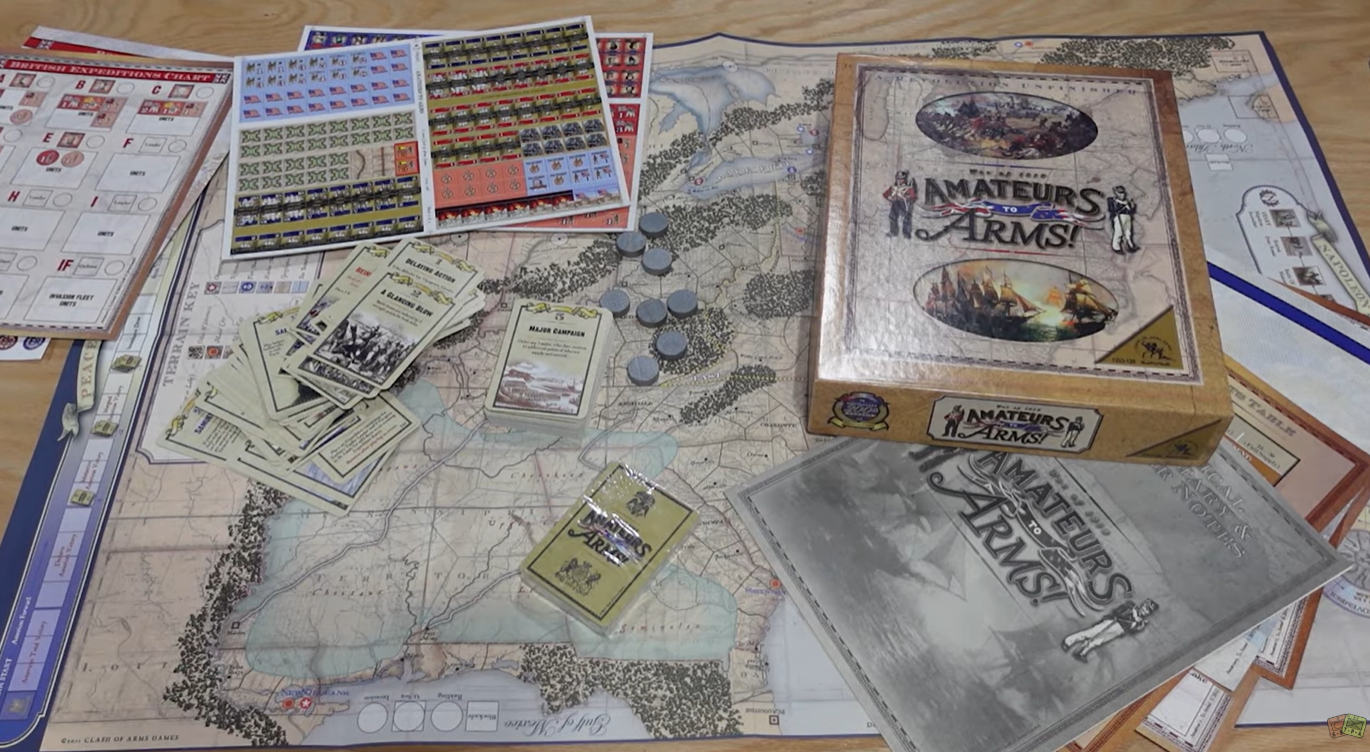
Amateurs to Arms! is a historical simulation game of the War of 1812. One player assumes the role of the British (including Canadian) forces, and the other plays the Americans. This often-overlooked conflict ended in a draw historically, but this was not the only possible outcome. The Americans clearly wished to annex Canada to their young nation, while the British wanted to teach their former colonies a lesson. The game includes all of the theaters of battle from the war: the US/ Canadian border and the Great Lakes (of course) but also the wilderness of the old Northwest, the Atlantic coast of the US, the Civilized Indians of the south, and the site of the final conflict at New Orleans.
Each turn represents a few months of time (depending on the season). A typical turn consists of dealing out to each player the number of cards indicated on the turn track. The winter and spring turns require a few special tasks. The Americans will have more resources to commit to the war- until Napoleon is defeated in Europe, and the English player can focus more resources on their efforts in North America. Each card can be played for the event described on the card, or for the card’s Operations Points, to move Expeditions, build ships and fortifications, or raise troops.
Events on the cards and on the map will cause the markers on the Peace Track to move forward. This represents the war weariness of each side’s people: bad events will cause your people to demand peace. Most events push inexorably towards peace; only a few rally your people for a longer war. When the two markers meet on the Peace Track, the game proceeds to the negotiations at Ghent, and the winner is determined. Oh yes, and then each player plays one more card, while news of the peace travels across the Atlantic!
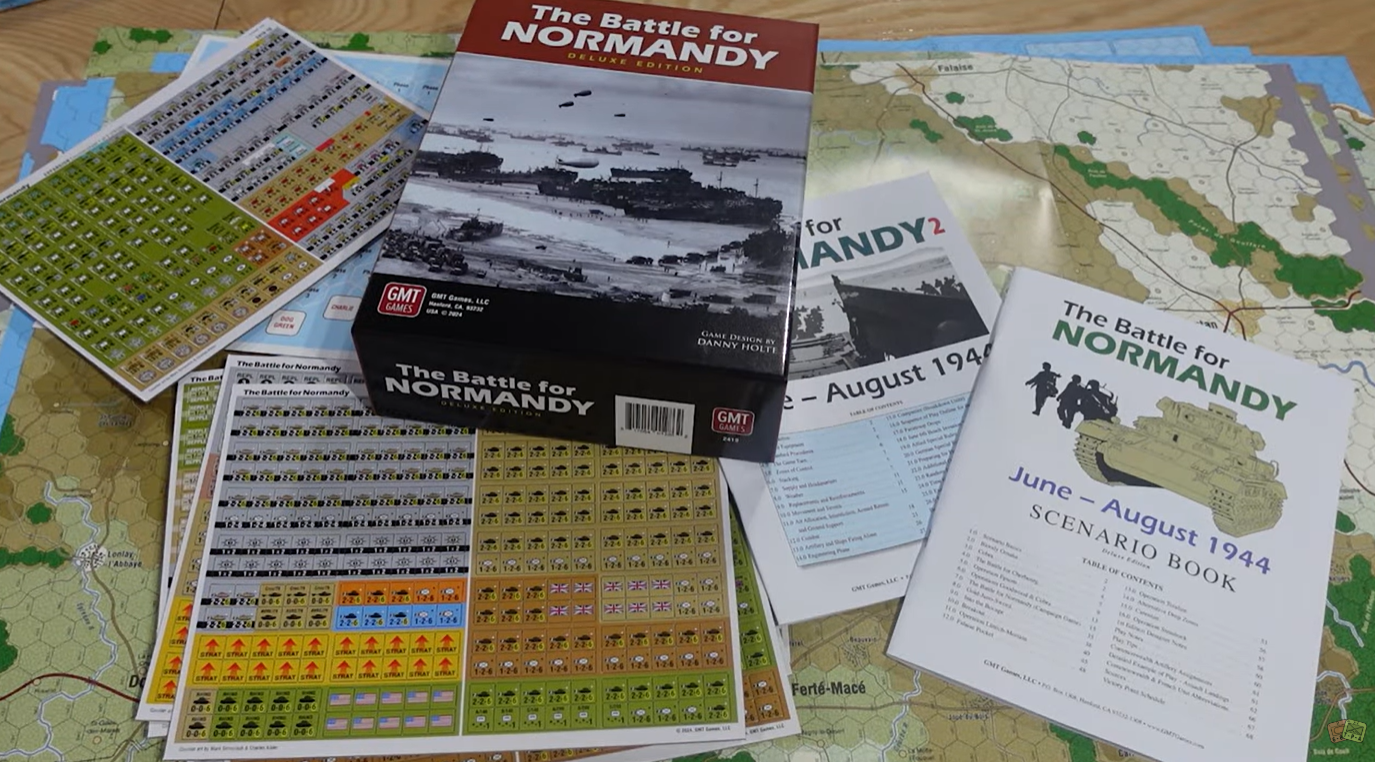
It has been about twelve years since The Battle for Normandy was originally released. Since that time, new research has been made available, and the game has been played countless times by many players around the world who have provided a wealth of feedback. The game system remains basically the same, allowing players to focus on planning and strategy and not an overbearing rules system. Based on that new research and feedback, many units have been adjusted, all of the maps have minor changes, and some whole rules sections have been revamped to better represent the historical reality, while minimizing further complexity. The original expansion is included in this Deluxe Edition (while remaining optional), and there are also new scenarios.
The Battle for Normandy Deluxe Edition Components (basically the original game and expansion combined with a few new components):
11 Countersheets (9 original, 2 from expansion; some of those dropped; the 70 errata counters are now incorporated into originals, plus some breakdowns dropped making room for the new counters) Many updates but the same graphics.
7 Mapsheets 22 x 34” (5 orig, 2 expansion) Many updates but same basic maps.
Rulebook 44 Pages
Scenario Book 68 pages
1 non-perm marker
3 D6 and 1 D10
2 Beach Landing aid cards 8-1/2 x 11
2 Terrain Effects Cards 8-1/2 x 11
2 CRT/Replacement tables 8-1/2 x 11
1 Allied Air Allocation log (laminated) 8-1/2 x 11
1 German Air Allocation log (laminated) 8-1/2 x 11
1 Turn Record Track 8-1/2 x 11
1 Utah Beach area map, cardstock (from original expansion) 8-1/2 x 11
New Components:
1 Random Events Table (8-1/2 x 11”) card stock
12 Interdiction level cards (2×3”, or regular card size)
The Battle for Normandy is a game that represents the climactic campaign in Normandy from D-Day, 6 June 1944 to the first week of August 1944 at primarily battalion level. Numerous scenarios are included to play out various smaller battles in Normandy. It is intended for 2 players or player teams.
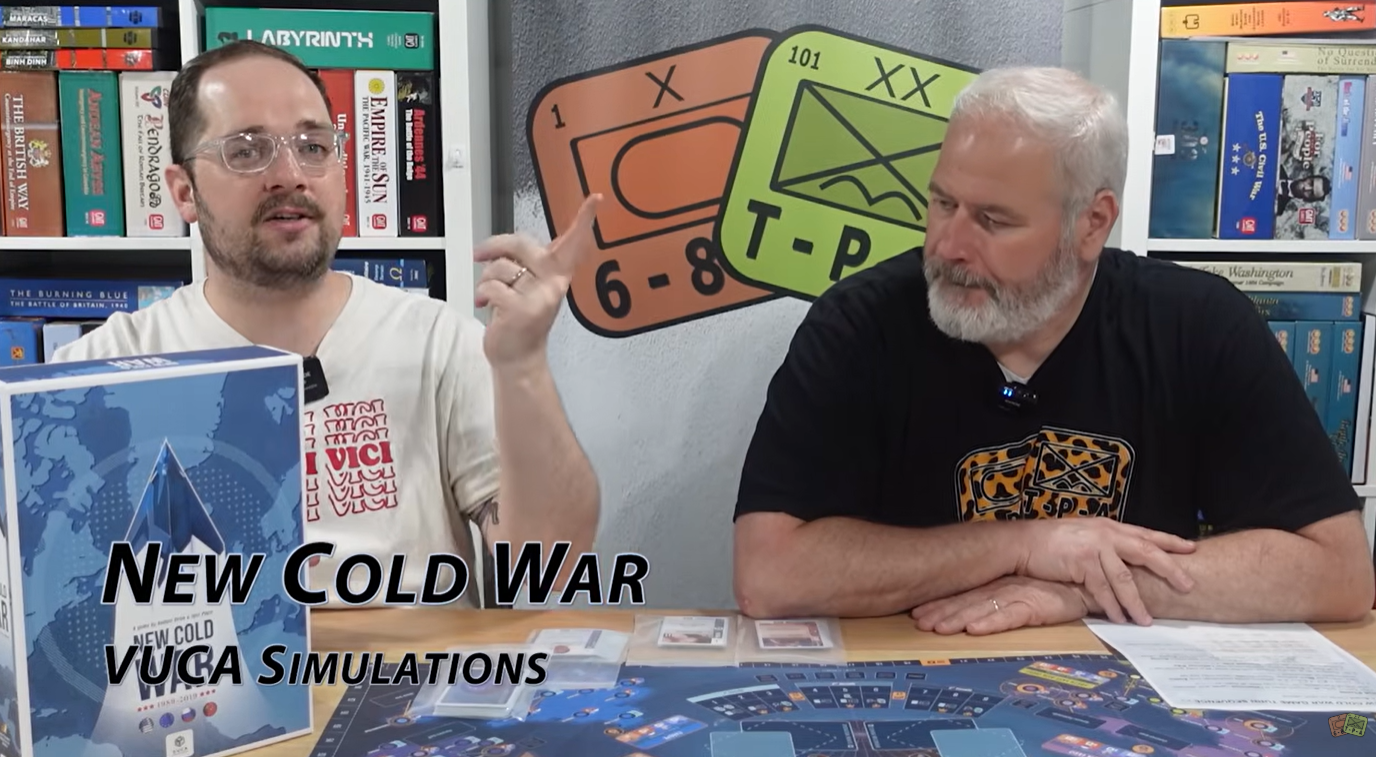
New Cold War: 1989-2019 is a Card-Driven Game based in the most important geopolitical events from 1989 to 2019. Players lead one of the four great powers (Russia, China, US, EU) in their fight for the new world order. Initially, the confrontation is between the red bloc, consisting of Russia and China and the blue bloc, comprising the United States and the European Union. However, each player must also prioritize their own strategy, as only one power can emerge victorious at the end of the game. Therefore, this game starts with cooperation between allied powers in the early stages but becomes entirely competitive as the moment of final victory approaches.
New Cold War utilizes a Card-Driven game mechanic. Players strive to attain victory by gaining international prestige, dominating the media and increasing their control of countries and different regions of the world. Other key factors to manage include military force and United Nations Security Council vetoes. Players’ strategies are determined by a series of hidden objectives they must pursue to achieve victory.
The game accommodates three or two-player versions and includes a solitaire mode through a system of bots.
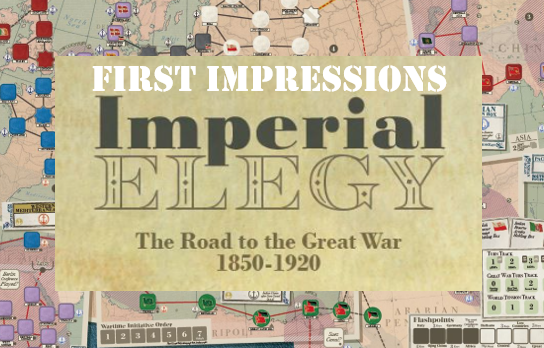
Recently, while attending Buckeye Game Fest in Columbus, Ohio, we were able to coordinate a 6-player game of Imperial Elegy: The Road to the Great War 1850-1920 from VUCA Simulations. Imperial Elegy is a card driven game that blends diplomacy, warfare, and statecraft and feels a bit akin to games like Here I Stand and Virgin Queen from GMT Games. Grand scale sweeping epics that play multiplayers and take a day to play. Players play as 1 of 6 unique major powers in the game including Germany/Prussia, the United Kingdom, France, Austria-Hungary, Russia and the Ottoman Empire. In this First Impressions post, I want to share a very brief overview of the game and the experience that we had with it.
Imperial Elegy is a fantastically themed game that takes place over 7 turns, with each of the turns representing approximately a decade. If the Great War breaks out due to the World Tension Track reaching a certain level, the game can be extended by an additional 6 shorter turns. A turn in the game consists of player impulses that is driven by the play of action cards for their Command Points or for the printed events. Players will use CP and events to take actions like colonize, conduct diplomacy with minor nations, fight wars, as well as hinder their opponents by playing events that take away their actions or resources. A turn will end once all players have consecutively passed or when all players run out of cards.
The game is somewhat of a sandbox style game as you have so many options and choices about what to do during the course of the game. Obviously, your faction has some direction about what you should be doing but really it is up the player to spend their resources how they will to accomplish their ultimate goals and score Victory Points. I truly love that aspect about this game and as we played we saw that sandbox and the asymmetry between the various factions. Particularly at the start, each country has some specific goals that they have drawn from the National Goals Deck that are a source of Victory Points, in fact a major source of Victory Points, and players will need to prioritize these cards and decide which ones to attempt to go after from the start. With only 7 turns, they will have to make progress on these National Goals if they have any hope of actually achieving them.
I actually thought that the National Goals was a really great part of the design and really sets it apart from the other games that have been used for inspiration such as Here I Stand and Virgin Queen. I partly feel this because of the options for replayability but also it forces players to change and adjust their strategy throughout the game keeping things fresh and interesting. It also causes players to have to think outside of the box and sometimes do things that their nation might not have prioritized but has been given an opportunity that they must capitalize on in order to earn their victory. Every 2 turns the players will draw 3 of these secret National Goal Cards and decide to keep just 1 of them, so their strategy must change and evolve with the board state and conditions found in the game at that time. This very key element of the design seems truly simple but it really has the benefit of rewarding those players who are extremely flexible and who can adjust on the fly, take some chances, change the course of their general overall strategy and adapt. I say this because I do feel that sometimes in games like Here I Stand or Virgin Queen, the same strategies and series of actions will generally be taken by each of the factions with just a modicum of variation. As you can see in the picture below, these National Goals are pretty variable and include things like preventing the outbreak of The Great War, gaining colonies in various parts or regions of the board and a focus on various alliances and diplomatic conditions.
The other aspect that I very much enjoyed was the Flashpoints, which represent key regions of competition amongst the great powers of the period including Italy, the Suez Canal, the Balkans, Qing China and more. Dominating flashpoints is sometimes one of the conditions to achieve and complete some of the National Goals but also provide players with certain benefits, including gaining additional cards each turn or even DRM’s. The specific Flashpoint that I thought was very interesting was the Power Projection Flashpoint which is a projection of the total naval supremacy across the globe through control of ports and naval bases in the various seas and oceans. The only downside here though is that this is an added part of record keeping that players will need to keep a handle on. Not overly burdensome but something that maybe should have been better represented on the player boards or the board itself.
Each of the represented nations in the game have their own special player board that contains various tracks that keep various information readily available to the players. Here is a look at the German player board. I very much enjoyed that they have gone to a great deal of effort to make these player boards and also that they gave each of the nation’s Stability, which decides whether various actions like war can be taken or if there are various positive or negative modifiers, the available Manpower that will determine how many armies can be built, Industry that tells how many action pointed you will have to spend during war to maneuver units, attack and replace losses. The focus of the game is about the control of territories both in Europe as well as colonies abroad and there is an automatic victory if a certain target number is met, in the case of Germany 15.
Here is a quick look at the Russia player board for comparison’s sake as each faction is unique and has various starting levels and abilities. These are very well laid out and assist tremendously in playing the game.
As we played, I started to realize that the key focus of the overall world stability and things like the Domestic Stability Tracks, which are focused of both the internal and external pressures faced by the powers. I really very much liked this thematic inclusion as no one wants to start a major global conflagration and there are steps that players have to take to skirt the inevitable troubles that result in their own actions and how they are seen by the other players in the game. But in our limited play, I never really felt threatened by this concept. Either our group was super skilled at avoiding the inevitable increase in tension or due to our short play we didn’t really experience some of the events that would have tipped this over the edge. I think that we say small increases in our full turn play but nothing that seemed unmanageable and we actually had an event that lowered it so it never became an issue. The game is about spending your resources wisely, in the form of your cards and your aspects like Stability, and to use your cards to do the events that could increase tension didn’t seem to be in our best interest, at least not in the 1st decade of the game. But maybe that will come later.
Keep in mind here that we only played the first full turn and it took us about 90 minutes including an hour of setup and rules overview and discussion as only one of us at the table had player previously (John Lapham). But we very much enjoyed the experience and found lots to like. We have scheduled a full count play of the game in mid June and I will have more to report on at that time but suffice it to stay everyone at the table was impressed with the design and everyone had a good time with it.
Thank you so much for following along and I hope that I was able to show off Imperial Elegy a bit and give it the justice it deserves because it really is something and I look forward to playing more in the future.
With this My Favorite Wargame Cards Series, I hope to take a look at a specific card from the various wargames that I have played and share how it is used in the game. I am not a strategist and frankly I am not that good at games but I do understand how things should work and be used in games. With that being said, here is the next entry in this series.
#76: Military Uprising from The Republic’s Struggle: Battle for the Republic, Spain 1931-1939 from NAC Wargames
The Republic’s Struggle is a thematic Card Driven Game that tells the story of the historical events that took place in Spain after the resignation to the throne of King Alfonso XIII, and the proclamation of the II Spanish Republic in 1931. With the creation of the new regime, the struggle for power between the different social, political and ideological sectors increased, which gave rise to continuous changes of political power, alterations of public order, armed uprisings and violent acts, carried out by the numerous ideological factions of the moment; which culminated in 1936, in a failed military uprising. The failure of this coup d’état was the origin for the Spanish Civil War.
The Republic’s Struggle is based on Twilight Struggle from GMT Games and uses the same concepts of area control while adding in some actual combat with units represented on the board. During the game, the Republican player and the National player, will be able to recreate events of the period to increase their popularity in the localities by carrying out political propaganda, recruiting troops or militias, generating revolts or assaults, establishing diplomatic relations or carrying out bombardments. All this will be done by playing their hand of cards in an alternative way, either by using the events or by playing the action points or icons to perform any of the other actions available to the players.
One of the interesting parts of the design is that each player has what is referred to as a Special Card that is included in their hand from the start of the game and can be played during their turn. These cards don’t count towards the maximum number of cards that each player can have in their hand at the beginning of each turn. The 2 cards are Military Uprising, which is given to Nationalist player and Proletarian Revolution, which is given to the Republican player. These cards are single-use event cards and can only be used during the first 4 turns of the game, or in other words during the period referred to as Phase 1 – The Republic. If, after this phase, these cards have not been played, they must be discarded and removed from the game. Both players can choose to use their Special Card in an Action round, instead of using one of the cards from their hand. These cards are played like the rest of the Operation Cards either using their Operations Value or applying the effects of the printed Event. Once played, the card will be removed from the game so it is use it or lose it.
Both cards are very powerful but have some fairly difficult criteria that must be met to fully realize the value of the printed Event. In the case of our featured card Military Uprising, the top part of the card first gives the player the chance to downgrade the European Status Quo Track by 2 levels. The European Status Quo Track allows players to appeal to and in some ways manipulate the stance of the other European Nations regarding their view on the Spanish Civil War. It also the determining factor in how Victory Points are awarded for the crucial Armed Actions aspect of the game. At the end of each turn, if the number of Armed Actions carried out by a player equals or exceeds the current level of the European Status Quo, that player will score 3 Victory Points. Also, as long as the European Status Quo Track is set on level 2, players cannot carryout any action using the Operations Points of cards played to advance in the Diplomatic Relations Track. So this is another tied result to the card as if the level is 1, no cards can be played to advance the Diplomatic Relations Track.
But, remember I said that to fully realize the effects of the card, the Nationalist player would need to control Barcelona, Madrid, Valencia and every Naval Base Location or every Air Base Location. If this is the case when the card is played, then the Nationalist player will earn an automatic victory. Frankly, this is next to impossible, but has a sliver of possibility depending on how diligent and attentive the Republican player is as well as the hand of cards that are drawn by the Nationalist player. If they draw certain other events, as well as have a hand full of higher Operations Point value cards, they can make a run at this but it is not necessarily recommended. The card also has a very useful secondary use as if the condition isn’t met, they will get to place out on the board 1 combatant cube, representing one of their combat units, and also remove all of the influence of the Republican player in Morocco and Galicia and gain 2VP. In order for the card to be used in this manner though the Nationalist player will have had to previously play the El Director card.
Either way this is a very good card and a shrewd Nationalist player can make some significant headway in their efforts to push the Republican out of power in Africa and northwest Spain as well as add combat strength to areas that they wish to conduct future Armed Operations.
In 1934 there was widespread labor conflict and a bloody uprising by miners in Asturias that was suppressed by troops led by General Francisco Franco. A succession of governmental crises culminated in the elections of February 16, 1936, which brought to power a Popular Front government supported by most of the parties of the left and opposed by the parties of the right and what remained of the center.
Spanish Civil War Republican troops manning a machine gun during the Spanish Civil War, 1937.
A well-planned military uprising began on July 17, 1936, in garrison towns throughout Spain. By July 21st, the rebels had achieved control in Spanish Morocco, the Canary Islands, and the Balearic Islands (except Minorca) and in the part of Spain north of the Guadarrama Mountains and the Ebro River, except for Asturias, Santander, and the Basque provinces along the north coast and the region of Catalonia in the northeast. The Republican forces had put down the uprising in other areas, except for some of the larger Andalusian cities, including Seville), Granada and Córdoba. The Nationalists and Republicans proceeded to organize their respective territories and to repress opposition or suspected opposition. Republican violence occurred primarily during the early stages of the war before the rule of law was restored, but the Nationalist violence was part of a conscious policy of terror. The matter of how many were killed remains highly contentious; however, it is generally believed that the toll of Nationalist violence was higher. In any event, the proliferation of executions, murders, and assassinations on both sides reflects the great passions that the Spanish Civil War unleashed.
Here is a link to our full video review of the game:
Grant: Javier welcome back to the blog. What historical period does your new game Partizan! cover? What did you want the title to imply to the players?
Javier: Many thanks. Glad to be back.
Well, I wouldn’t call it a “new” design. A first version of Partizan! was published in World at War Magazine back in 2011. Partizan! is a simulation of the Guerrilla warfare in World War II, from the Axis invasion in the spring of 1941 to late 1944, when the Soviet forces entered the region and the guerrilla struggle ended in the south and east of the country, even though the war iWan Yugoslavia would go on until May 1945.
The title, of course, evokes the epic of the Partisan struggle, the foundational myth of the Communist Yugoslav regime of Josip Broz Tito, “Tito” is a prime example of “Sic Transit Glory Mundi” if there is one. Upon his death, in May 1980, Tito went from being idolized at home and hailed abroad as one of the most outstanding leaders of the 20th century, to being reviled in his own country and all but forgotten abroad.
Grant: Who is publishing this new edition of the game?
Javier: Chinese editor Kilovolt Studio did this new edition.
Grant: How has the game changed from its original publication in 2011 in World at War Magazine?
Javier: It is a boxed version complete with upgraded graphics, a sturdier map and pre-rounded counters. The editor added errata, rules and counters that were left behind from the original version and later published as add-ons online and in later issues of World at War Magazine. Apart from that, the game is basically the same.
Grant: What was your inspiration for this game? Why did you feel drawn to the subject?
Javier: Well, that region of the world (let’s call it Southeastern Europe – “Balkans” can be found offensive by the locals for a number of reasons) is one of my pet subjects, so to speak. So far I have designed several games on WWII in Yugoslavia (Partizan!, Balkans ’44) as well as on the Yugoslav Wars of Independence in the 1990s, including War Returns to Europe: Yugoslavia 1991 and Bosnian War for Strategy & Tactics. As mentioned in earlier interviews, I have travelled extensively across former Yugoslavia and the neighboring countries and always had a great time there.
Grant: What was your design goal with the new edition?
Javier: The game mechanics basically remain the same, although the editor added an important element that was left out from the first edition, namely the Chetniks or Yugoslav royalists that played a key role in the war.
For the Chinese wargaming public, this subject has a particular interest as well because in the People’s Republic of China the Partisan epic (one of the ideological/propaganda foundations of Socialist Yugoslavia) was, and is, wildly popular so much so that the Chinese edition is called Walter’s War. “Walter’s War” refers to the 1972 Yugoslav film Walter Defends Sarajevo (Serb Croatian: Valter brani Sarajevo) based loosely on the military feats of Vladimir Peric, aka “Valter”, who defended Sarajevo during the German retreat from the southern Balkans in late 1944.
Walter’s War is one of the most famous examples of the “Partisan movies” subgenre, a series of films on the Partisan epic made in Yugoslavia between the 1960’s and the 1980’s. It was particularly popular in the Eastern bloc countries-on the year of its release, it was viewed by some 300 million people in the People’s Republic of China alone. Fifty years later, it is still something of a cult movie in China and other countries.
Chinese poster of Walter’s War.
Grant: What type of research did you do to get the details correct? What one must read source would you recommend?
Javier: Thankfully, over the last 20 years quite a few books have been written on the Yugoslav War. This interest in guerrilla warfare was partly due to the use of historical models to understand modern insurgencies such as Iraq in the GWOT years.
Another historical player that began to receive long overdue attention were the Yugoslav Royalists, or Chetniks, that until the early 21st century were almost forgotten or considered a footnote when compared with the Partisan epic of Tito and his guerrilla army. The military museum in Belgrade, Serbia reflects this perfectly. The first time I visited the military museum there were two floors, one dedicated to praise the feats of Tito and his partisan army, the other covering the rest, from Medieval times to the 1999 War against NATO. The second time I visited the museum, in the early years of the 21st century, I found out that the “Partisan” area was closed for reforms, and all Communist era exhibitions were being replaced with exhibitions dedicated to Col. Draza Mihailovic and his Chetniks.
Grant: What from World War II in Yugoslavia was most important to model?
Javier: Simulating what was de facto a three player game (Partisans, Chetniks, Axis and local Allies).
The third player – the Chetnik – presents a major problem. Basically, they didn’t fight the Axis- their policy was to wait for the Western Allies to arrive while preparing for the final showdown against the Communists. On the other hand, while the Partisans had a central command, the Chetniks were a loose coalition of local leaders that followed orders when it suit them to do so, and often reached temporary agreements with the occupying forces to fight the Communist Partisans. Tito had mobile troops which could operate everywhere and hit the enemy targets without concern about the inevitable and brutal enemy reprisals. In fact, the reprisals ended up being a source of recruits for his Partisan army. Mihailovic’s units, however, were strictly territorial, and he could not control them. Most of them (especially the Chetnik units in Bosnia) recognized him only as an honorary leader, but only followed their orders when, and if they matched with their own priorities. So, in practice, the Chetniks are not a “player” in the game, but they can be mobilized by the two players (Axis and Partisans) depending on a number of circumstances.
Grant: What is the scale of the game?
Javier: Turns are quarterly (three months per turn, covering from mid 1941 to late 1944). So to speak, each turn condenses several major operations and smaller actions.
Grant: What different unit types does each side have access to?
Javier: Being a guerrilla war in the Balkans, the standard unit is leg infantry, of course. There are a handful of motorized/armored and cavalry units, but almost all units are infantry. There are air support markers and a Special Forces unit or two.
Grant: What is the anatomy of the counters?
Javier: Units have two basic factors: conventional and guerrilla combat. Guerillas, of course, are better at guerrilla combat, regular units are better at conventional Combat. There are two Combat Tables, guerrilla and conventional-which that is used depends on leadership, initiative and terrain. A guerrilla force fighting in forest or mountain hexes for example has a better chance of using the Guerrilla Table. A conventional unit fighting in a railroad or clear hex has better chance of using the conventional table.
Grant: What is the general Sequence of Play? What type of experience did you want the Sequence of Play to invoke?
Javier: In general, the Guerrilla player has the initiative, while the Axis player has to react. The turn begins with the guerrilla phase were the Partisan player determines resources receives and recruits/upgrades units. This is followed by the objective placement phase, where players deploy a number of targets on map representing intelligence on possible targets provided by their network of spies and other intel sources. Then the Guerilla player moves and attacks targets, and/or enemy units. After that the Axis action phase begins. Upon receiving reinforcements, the Axis player may attack guerilla units. However, catching guerrillas can be difficult-they can easily avoid being forced to fight in particular in forest areas.
The Axis player begins the game with large forces (Germans, Croatians, Italians, Hungarians, Bulgarians) while the Partisan begins with a handful of odreds (detachments). However, as the play goes on, the Italians surrender and the Axis player is increasingly stretched thin. Besides, Bulgarians and Hungarians cannot move from their respective regions. The German and Croatian policies in Yugoslavia all but ensured that the population would join the Partisans.
Grant: What is the layout and area of Yugoslavia covered by the game map?
Javier: The map covers all of Yugoslavia and neighboring areas, from Slovenia to Macedonia and parts of Hungary, Albania and Bulgaria. The map contains all charts and tables needed to play.
Grant: What strategic pinch points does the terrain create?
Javier: Terrain is important, like in the systemic cousin Red Partisans (published by Paper Wars in 2025). Forest, mountains and swamps are the Partisan’s friend. Avoid flat terrain, and particularly railway hexes, that can be reinforced quickly. However, railroads are a major objective of the Partisans, so the Partisan player must strike a balance here.
Grant: What is your focus on Zones of Control in the game?
Javier: In general there are no Zones of Control. Zones of Control are exerted depending on the unit and terrain type. Regular units, for instance, do not exert ZOC on mountain or forest hexes for Partisan units.
Grant: What is the Guerrilla Political Phase? What does this represent from the history?
Javier: Basically, it represents the prestige of the Partisans among the local populace and abroad. If the guerilla player attacks at least one ground attack against an Axis ground unit, they roll for Tito’s Prestige. The higher the prestige, the more resources he can receive from the Western Allies. Tito’s prestige begins at box 1. When it reaches box 6, the Partisans can receive extra resources and the support of the Balkan Air Force (Allied bombers). When it reaches level 7, the Partisans can deploy and use a British Special Force unit, the 2nd SAS.
This simulates the increasing prestige of the Partisan guerrillas among the Western Allies, who initially opted to provide support to the Monarchist forces of Col. Mihailovic. After the reports by the Deakin mission came from Yugoslavia in 1943, and thanks also to ULTRA intercepts, Tito began to be regarded as the only effective guerrilla movement fighting the Germans, while Mihailovic did nothing, or, even worse, reached agreements with the enemy occupiers to fight the partisans.
Grant: What is the Allied Landing Scare roll? What does this represent?
Javier: Several of the major Axis anti-partisan drives in Yugoslavia (Operations Schwarz, Weiss…) were launched with the objective of clearing the coastal areas from hostile guerrillas and prepare the defense of the Balkans against an expected Allied landing. Beginning with 1943, there were several “landing scares” that had all sides (Partisans, Chetniks, Axis) scrambling to occupy the best coastal positions before the arrival of the Western Allies.
For instance, in January 1943, fearing Allied landings in the Balkans, the Axis launched Operation Weiss (White), the largest anti-partisan drive to date, involving 90,000 troops, aimed at destroying Tito’s stronghold at Bihac. Tito planned to move back to Serbia and Eastern Bosnia to destroy the Chetnik forces there before they could join forces with the Western Allies.
Grant: What is the purpose of the Weapons Cache markers? How are they concealed in combat? How does combat work?
Javier: Weapon Cache markers represent weapons sent by the Western Allies along with arms captured to the enemy, used to improve Partisan detachments into Partisan brigades and divisions.
Grant: What is the makeup of the Combat Results Table? What unique odds are represented and why?
Javier: There are two Combat Tables, guerrilla and conventional-which one is used depends on leadership, initiative and terrain. A guerrilla force fighting in forest or mountain hexes for example has better chances of using the Guerrilla Table. A conventional unit fighting in a railroad or clear hex has better chances of using the conventional table.
Grant: How do Replacements and Withdrawals work?
Javier: The Guerilla player collects replacements-the more territories they control, the more replacements received. Control of towns greatly increases recruitment, but guerrilla units are much more vulnerable in urban terrain. Axis reprisals increased the number of recruits. They also receive “weapons caches” that can be used during the game. They represent clandestine weapon factories, and, as the game goes on and Tito gains popularity among the Western Allies, they represent weapons shipments from the West. Certain game results yield weapons caches as well. These can be used to upgrade partisan units into Brigades and Divisions.
The Axis reinforcements and replacements work differently-They receive a fixed number of replacements per turn, with the exception of “Allied landing scare” turns, when they received extra replacement with which to launch anti partisan drives and clear the coastal areas of Partisans.
Grant: How are Artillery, Air and Naval Support handled?
Javier: There are no artillery units in the game. It is modeled into the regular brigades and divisions. There are only two air support markers that add or decrease odds shifts in attack or defense.
The Partisan army, of course, had no air support units, although they can receive the support of the Allied “Balkan Air Force”. The Axis has only one marker -Yugoslavia was very low on the priority list of the Luftwaffe. Naval Support is handled by the “Partisan navy” counter that provides an odd shift in attack or defense in combats in coastal hexes. The Partisan navy counter enters play after the Italian surrender.
Grant: How do players win the game?
Javier: The Partisan player can add Victory Points by blocking railway lines from resource centers (there are five on map) to Germany. This represents the disruption of resource exploitation in the Balkans. Another way to score Victory Points is to destroy objectives such as fuel depots, train stations or bridges, or rescue downed Allied pilots, determined prior to the turn by the objective table. During the Victory check phase of each turn, the Partisan player rolls 1D6 for each objective marker under their control and adds the corresponding modifier for that objective. Destroying a Dam, for instance, adds +3 to the die roll. The final result is the number of VP’s scored for that objective. Control of towns and cities at the end of a turn gives extra VP’s to the Partisan player. (Control of towns and cities, even temporary, allow Partisans to recruit extra manpower and liquidate collaborationists).
Finally, “Landing scare” turns allows the Partisan player to earn VP’s for controlling port towns and cities, from Bar in Montenegro to Zara/Zadar in Croatia. This simulates the chaotic fight that followed the Italian armistice of September 1943. The Italians controlled large parts of former Yugoslavia, and their surrender ignited a race to arrive first to the huge caches of arms and supplies in the Italian zone, in a free for all between Partisans, Germans and Chetniks. Tito was furious at the Allies for not warning him of the upcoming Italian surrender. Some of the Italian forces joined the Partisans against their former Croat-German allies. This is included in the game as well.
The Axis player must try to deny VP’s to the Partisan player, and make him pay dearly for every VP gained: each guerrilla ground unit eliminated deducts 10 VP. The Axis can also kill Tito. If Tito is eliminated, the Partisan player loses 2 VP’s at the start of each subsequent turn, and their prestige is reduced to 1, so they receive no more extra resources from the Western Allies. The Axis player can try an assassination attempt with the 500 SS Parachute Battalion that historically tried to kill or capture Tito in May 1944, in operation “Knight’s Move”.
Grant: What type of an experience does the game create?
Javier: The game creates a cat-and-mouse experience, quite similar to the history, where the Axis launched constant anti-partisan drives but Tito and his Partisan army always escaped to fight another day, despite of suffering huge casualties. By the mid to late game, after the Italian surrender, the Partisans are too powerful and the Axis player lacks enough resources to launch mass offensives, thus remaining mostly on the defensive. It is now time for the Partisans to gain as much terrain as possible before the arrival of the Soviet forces in the Fall of 1944.
Grant: What are you most pleased about with the design?
Javier: I think that the game gives a fair idea of what happened in Yugoslavia in 1941-44. It was an extremely complex situation, with many different national and political loyalties at play. The Axis conduct of the Balkan counterinsurgency was a case study of how not to wage a guerrilla war. Their policies, and in particular that of the Croat state, created the perfect conditions for the Communist movement to thrive and take over: they destroyed the existing authority, set the different nationalities against each other, but lacked sufficient strength and brute force to impose a different system. The final result was anarchy and an ideal situation for the triumph of a revolutionary war, which Tito exploited to the fullest.
Grant: What has been the response of playtesters?
Javier: As far as I know, many players really enjoy the Partisan hidden movement rules in Partizan! and found the cat-and-mouse game play quite engaging. They appreciate the combination of simple rules, short playtime, and asymmetrical game play, with a full game often completed in just one day. The scoring mechanism, which rewards destroying objectives, forces Partisan players to carefully consider their strategy—whether to focus on scoring points or increasing their forces. Axis players get a true feeling of frustration of counterinsurgency operations.
Facing an Axis player with a good memory can sometimes be challenging for the Partisan side. Partisans can counter this by swapping the positions of units within the same hex. Overall, the game offers a simple yet enjoyable take on Partisan warfare. Although some players find it a bit troublesome to place markers every turn, the Chinese edition includes tables and numbered markers to help the setup. Most players find the experience enjoyable.
Grant: What other designs are you working on?
Burmese tribal irregulars in Burma ’45 (World at War #109)
Javier: Strategy & Tacticsjust published Pensacola 1779-82, and soon will be publishing Forgotten Front: Italy 1944-45. Curiously enough, in these games are featured both irregular and conventional forces. In Forgotten Front, for instance, guerrilla and counter guerilla operations play a key role as the ORBAT includes not only regular Axis and Allied divisions and brigades, but also Italian partisans and Fascist Italian counter guerrilla forces, such as the infamous Black Brigades. Pensacola 1779-82 includes irregulars, militias and Indian levies that are highly useful for recon, foraging and to harass enemy regular forces.
World at War will publish my design on the 1945 Burma campaign, where (again) guerrillas played a decisive but little known role.
I am currently working on a number of designs for Decision Games, Paper Wars and Banzai Magazine. I am currently working on the playtest and development of Aragón ’38 for SNAFU Design and Battle for the Mediterranean for VUCA. You can see here some spectacular previews of Battle for the Mediterranean by Pablo Bazerque here.
A look at the board for the upcoming Battle for the Mediterranean from VUCA Simulations.
As always, thanks for your time Javier in answering our questions as I know you are a busy man and always have lots of interesting gaming subjects on your design table.

 Anmelden