Normale Ansicht

2025 Retrospective: A Look Back….And Overview of a Very Good and Busy Year of Wargaming!

Von: Grant
22. Januar 2026 um 14:00

Another year in the books and I am in awe of what we were able to get accomplished in 2025! In this post, I want to take a look back at some of what we did, played and experienced in 2025! But, I also want to share my thoughts and create some discussion here about some very interesting trends and changes that I am seeing. So welcome to my musings as I take a retrospective look back at the year that was 2025.

The Numbers

To start this post off, let’s take a quick look at the numbers associated with our gaming and the content that we created in 2025. This is not a full deep dive into the statistics (like we normally do in our annual State of the Union posts in April) but a quick look at the number of games and then some simple info about the content.

In 2025, I am pleased to announce that we played a total of 26 new wargame titles but we will still get in a few more over the next several months as we don’t put together our “Best of” lists until around March in order to give some time to play at least some of the games released in December. That number is quite a bit less than it was last year. We had a weird 2025 in the gaming time availability department as we were busy with work, family vacations and commitments and some minor health issues. We just didn’t meet each and every week to play, which was a bit disappointing.

I also was able to play a total of 12 solitaire games but am still fiddling around with 4 or 5 titles (Black Skin Black Shirt from White Dog Games, Trench Raid from Compass Games, The Twelfth Battle from HexasimSPQR: The Battle of Alesia from Art of Wargames and Iwo Jima: Hell on Earth from Neva Wargames) that I hope to finish out before March.

I had quite the streak going over the past 2 years plus as I had a post on the blog for 876 consecutive days! By my calculations, that represented 2.4 years straight that something had appeared here! I gave up the streak over the holidays as I was just more interested in spending time with family and friends and enjoying myself. That was a bit mind blowing and I was just in a groove and had the ability to write quickly, sometimes repurposing previous posts, and still had the drive to do it. I am saddened that my streak came to an end but as they say all good things must come to an end! I am now actively trying to get myself back into a good streak but have had a bit of trouble with motivation at this time of year. In 2025, I posted a total of 395 blog posts! That is a bit behind the records for posts we had in 2024 (410) but still a really good number and represents 1.08 blog posts per day. Thanks for reading and consuming what I put up and for the great feedback.

A bit more of the numbers, for 10 out of 12 months we exceeded 50,000 views with 5 of those months far exceeding that number (May 65,344, August 72,868, October 68,081, November 130,612 and December 202,847). I am not sure what happened in those months but the views were really, really good. Maybe I was hacked or spam bots were sharing my content but it was nice to see. So, in 2025, the blog did just fine and keeps chugging along, mainly due to your consumption and I thank you.

Our YouTube Channel has also grown to 21.2K subscribers (we were at 19.5K subscribers in January 2025) and we have posted 184 new videos in 2025! We have a pattern of 1 new video (including unboxings, reviews, interviews, debriefs and other videos) every other day and some times we had 2 or 3 in a row due to timelines for Kickstarter/Gamefound projects, new games we simply wanted to share quickly or mistakes in scheduling. We hope that you find our videso genuine, insightful, helpful and fun because we really enjoy doing them and have plans to continue our torrid pace. Enough with the numbers! Now onto some of the trends we saw or things we did in 2025.

How do you prefer to consume our content? What do you like best about our stuff? What would you like to see?

Proliferation of Solo Wargames

A trend that I have seen expanding is the number of high quality solitaire wargame offerings on the market. I know that there have always been solo wargames, and those 2-player games that are more easily solo able such as Chit-Pull Activation, but the number of dedicated solitaire wargame options has just exploded. In 2025, I acquired 29 new dedicated solitaire wargames. I was only able to play a handful but there are just so many options out there that it is really amazing.

Here is a list of those games that I acquired (with those played bolded):

  • Okinawa: The Last Battle of WWII
  • The Fall of Röhm 3rd Edition
  • Iwo Jima 1945
  • The Pursuit of John Wilkes Booth
  • Battles of the American Civil War
  • Operation Dragoon Travel Game
  • Solitaire D-Day
  • Crusaders: The Siege of Acre 1291
  • Nightfighter Command
  • SPQR: The Battle of Alesia
  • Siege Works: A Napoleonic Siege Roll & Write
  • War In The Pacific: A WW2 Roll & Write
  • Lonely Cairn
  • World War II Solitaire: Echoes of War: (Right Handed Allied Edition)
  • The Twelfth Battle
  • Pocket Air War
  • Combat Volume 3 Arnhem
  • Fields of Fire Deluxe 2nd Edition
  • Bloody Lane
  • French & Indian War Solitaire
  • Lone Wolf: U-Boat Command 
  • Europe at War 1940 Solitaire
  • Shogun Solitaire
  • Black Skin Black Shirt
  • Trench Raid
  • Empire of Grass
  • British Tank Ace
  • Onoda

            I have always been a believer in the market and I think that this proliferation is due to more games being purchased and played than ever before. I hope this trend continues and that I am able to get to more of these games in the future.

            What are your thoughts on dedicated solitaire wargames? How many did you acquire in 2025?

            Shelf of Shame Dustoff! Event Part II – 12 Games from Our Shelves of Shame

            One of the new things that we tried in 2024 and now have continued into 2026 was our Shelf of Shame Dustoff! where we identified 12 older games that have been sitting on our shelves for far too long and need to see the light of day and our gaming tables. We initially chose one game per month to play but due to time and other constraints ended up simply choosing a few games to play this year. We didn’t get around to 12, but still were able to play quite a few that we had owned for a while. The Shelf of Shame! games we were able to play in 2025 were as follows:

            Medieval Conspiracy from UGG – not a wargame per se but a hybrid euro style area control game with bidding and combat along with event and action cards that are used to build up your economy and influence and control fiefdoms to gain prestige and power. The game is set during the Holy Roman Empire of Germany. The HRE is divided into many small earldoms, principalities, and bishoprics. The Ruler of the Empire is the Holy Roman Emperor who is elected by the 7 electoral princes and the players vie for control of these areas to build up trade, wealth and armies to fight wars of conquest. 

            Here is a link to our video review of Medieval Conspiracy:

            Border Reivers: Anglo-Scottish Border Raids, 1513-1603 from GMT Games – In Border Reivers, each player rules over one of the Marches on the border of England and Scotland and has the goal to increase the wealth and fame of their clan by gaining VP’s from successful combats, amassing large herds of livestock consisting of sheep and cattle, and by elevating their notoriety above the other players on the regions of the map. The game is unique and in essence is a limited action selection game where players use cards to target the various marches and perform various atrocities such as raiding and stealing livestock, feuding with rivals and participating in ongoing battles. But the most unique part is the it is made for 2-6 players and is best with 4 or 6 players, though 2 and 3-player versions are also supported where each player leads both an English and a Scottish family.

            Here is a link to our video review of Border Reivers:

            The Napoleonic Wars 2nd Edition from GMT Games – The Napoleonic Wars is a Card Driven Game where the cards have Command Points that can be used to build units, move armies, lay siege, negotiate with neutral countries and other such actions. The game is a strategic level look at the entire Napoleonic Wars from 1805-1815. We had a very good time with the game and are very glad that we had a chance to play it with seasoned and experienced players.

            Here is a link to our video review of The Napoleonic Wars:

            Time of Wars: Eastern Europe 1590 – 1660 from Strategemata – Time of Wars is a multi-player card driven game similar to games like Here I Stand and Virgin Queen designed by Krzysztof Dytczak that focuses on the 16th and 17th centuries in Eastern Europe. The game focuses on the five superpowers of the time in Eastern Europe including the Polish – Lithuanian Commonwealth, the Tsardom of Russia, the Ottoman Empire, the Kingdom of Sweden and the Holy Roman Empire.

            Here is a link to our first impressions video of Time of Wars:

            Black Orchestra from Starling Games – Black Orchestra is a lighter cooperative but seriously thematic game focused on the various coup and assassination attempts on Hitler near the end of World War II. We did a full 5-player game and had a blast with it.

            Here is a link to our video review of Black Orchestra:

            1714: The Case of the Catalans from Devir Games – This is a game that I purchased off Amazon for $18 a few years back and have been wanting to play called 1714: The Case of the Catalans from Devir Games. The game tells the story of the death of king Charles II of Habsburg, which left the throne vacant and started a war all over Europe to settle the matter of the Spanish Succession.

            The players in the game represent the powers of the Grand Alliance and will fight the Bourbon forces composed of French, Castilian and Bavarian troops. The overall goal of the game is to obtain the best commercial and territorial concessions, and conquer the Bourbon territories gaining VP from control. But this is not a true cooperative game as only 1 player will win.

            Here is a link to our video review for 1714: The Case of the Catalans:

            Crusade and Revolution: The Spanish Civil War, 1936-1939 from Compass Games – Crusade and Revolution is a fairly traditional card-driven game system that mimics Paths of Glory but adapts it to the specific circumstances of the Spanish Civil War. Each player, the Republicans and Nationalists, has their own unique deck of strategic cards, which are the heart of the game, and must make difficult choices on their use through-out the game. Each card has four possible uses, but only one of them can be chosen each time the card is played! The possibilities included using it for Ops points to move and attack, the printed Event, Replacement Points to be able to rebuild damaged and eliminated units and Strategic Redeployment to place these units out onto the board.

            Here is a link to our video review of Crusade and Revolution:

            So we only ended up getting 7 games played but that is better than zero!

            Another Busy Convention Year

            Again 2025 was very busy on the convention front as we attended Basement CON, Buckeye Game Fest, the World Boardgaming Championships and the big one in ESSEN Spiele in Germany. We always have such a great time at conventions and love to see our friends and play lots of great games.

            Here are some summaries of those events as well as video debriefs to get you caught up on our experiences.

            Basement CON – At the end of March, Alexander and I traveled to St. Louis, Missouri to meet up with friends to play wargames all weekend during what we affectionately call “Basement CON”. We do this annually, usually in the spring, and play large multiplayer wargames with max players. In the past, we have played games like War RoomVirgin QueenHere I Stand and Tank Duel just to name a few. This year at Basement CON, which was our fourth such gathering, we played multiple games over 3 days including Red Dragon / Green Crescent Deluxe Edition from Decision Games, War Room (again) from Nightingale Games, Dune from Gale Force Nine, Virgin Queen from GMT Games and a few others.

            Here is a link to our debrief video for Basement CON:

            Buckeye Game Fest 2025 was a fantastic time and we got to play a lot of games including Crusade and Revolution: The Spanish Civil War, 1936-1939 from Compass Games, Black Orchestra from Starling Games, 1714: The Case of the Catalans from Devir Games, Congress of Vienna from GMT Games, Tattered Flags No. 1: Into the Whirlpool from Blue Panther, Rebels Against Rebellion from Flying Pig Games coming soon to Crowdfunding, Divine Right from Pungo Games, True Command from Catastrophe Games, Crisis: 1914 from Worthington Publishing, Successors 4th Edition from PHALANX, Nations & Cannons RPG from Flagbearer Games, Time of Crisis from GMT Games, New Cold War from VUCA Simulations and finally The Fellowship of the Ring – Trick Taking Game from Office Dog. That’s a total of 13 games. Amazing!

            Also, I wrote a Daily Debrief Series of posts on the blog while attending and you can read those at the following links:

            BGF 2025 Daily Debrief Series Overview

            BGF 2025 Daily Debrief Series Day 1

            BGF 2025 Daily Debrief Series Day 2

            BGF 2025 Daily Debrief Series Day 3

            BGF 2025 Daily Debrief Series Day 4

            Here is a link to our debrief video for Buckeye Game Fest 2025:

            The World Boardgaming Championships 2025 held at the beautiful Seven Springs Mountain Resort in Seven Springs, Pennsylvania was a great time and we played a lot of games including B-52D Linebacker II from Compass Games, Medieval Conspiracy from UGG, Congress of Vienna from GMT Games, The Napoleonic Wars from GMT Games, Time of Wars from Strategemata, Triumvir from GMT Games, Here I Stand from GMT Games, Operation Valkyrie: A Black Orchestra Game from Starling Games, Battlestar Galactica from Fantasy Flight Games, Border Reivers: Anglo-Scottish Border Raids, 1513-1603 from GMT Games, Eschaton from Archon Games and Great Battles of the American Revolution Germantown from the new American Revolution Tri-Pack from GMT Games.

            Here is a link to our WBC 2025 debrief video:

            Also, I wrote a Daily Debrief Series of posts on the blog while attending and you can read those at the following links:

            WBC 2025 Daily Debrief Series Overview

            WBC 2025 Daily Debrief Series Day 1

            WBC 2025 Daily Debrief Series Day 2

            WBC 2025 Daily Debrief Series Day 3

            WBC 2025 Daily Debrief Series Day 4

            WBC 2025 Daily Debrief Series Day 5

            And finally, we attended ESSEN Spiel in Essen, Germany in October. SPIEL Essen, often referred to as Essen Spiel, is the world’s largest public fair for board games. The convention is held annually in Essen, Germany, typically in late October, and attracts a massive crowd of visitors and exhibitors. The fair is intended for board gamers to be able to discover new games, play demos, meet with game designers, and purchase new products. The convention is more about board games than wargames but we went over due to the generosity of Sound of Drums and Uwe Wallentin. While there, we also spent time driving through Germany, France, Belgium and Holland to take in various historical sites.

            Here is a link to our ESSEN Spiel 2025 debrief video:

            While there, I posted a daily summary of our activities on the blog and you can read those at the following links:

            Europe Trip and SPIEL Essen Convention Road Show Daily Debrief Series Introduction

            Day 1 – Ouvrage Hackenberg (Maginot Fort), Metz and Verdun

            Day 2 – Bastogne and Sedan

            Day 3 – Paris, Versailles and Caen

            Day 4 – Sainte-Mère-Église, Omaha Beach and Pointe du Hoc

            Day 5 – Mons and Waterloo

            Day 6 – Eindhoven, Nijmegen and Arnhem

            Day 7 – Day 1 of the Convention

            Day 8 – Day 2 of the Convention

            Day 9 – Day 3 of the Convention

            What a year it was for us on the convention circuit. We had a lot of fun, played a ton of games and saw many friends and made even more. I look forward to they future of our conventions.

            What was your best convention experience in 2025?

            2025 Gaming Convention Attendance Plans

            We next will take a look at our big plans for 2026 and attendance at several gaming conventions. We are planning to attend our traditional gaming conventions this year with nothing really new.

            BasementCON – March 27-29th – St. Louis, Missouri – Attending our friends BasementCON again in St. Louis in March and hope to play several big games including Here I Stand for the umpteenth time and possibly the new Napoleonic wargame Imperial Borders from Nightingale Games as well as some other large games.

            Buckeye Game Fest – May 10-15th – Columbus, Ohio – This is a staple in our convention schedule and we look forward to playing some games, running some events, including sessions of Nations & Cannons RPG from Flagbearer Games, the COIN Series and some other larger multi-player wargames.

            World Boardgaming Championships (WBC) – July 25–August 2nd – Seven Springs, Pennsylvania – I will be planning to attend again this year but Alexander will once again be out of the country with family and I will be solo. Have no concrete plans as of yet but it will probably involve 8-10 videos, several games (probably including a rematch with Mark Miklos of one of the BoAR Series titles) and meet ups with publishers to discuss upcoming games.

            SDHistCon – November 6-9th – San Diego, California – Back to sunny California for another small and intimate convention where we will play lots of prototype games, shoot designer interview videos and have a great time.

            There might end up being others that we add but our slate is pretty full with these conventions and we hope to see many of you there! I have considered trying to attend Circle DC in late March but am afraid it will conflict with my family’s spring break trip to Florida. I also keep threatening to make the 2 1/2 hour drive over to Columbus, Ohio in June to got to a few days of Origins but June is always so busy for me at work.

            What conventions are you planning on attending in 2026?

            Thank you for following along and please let me know what you loved about 2025 and what you are looking forward to for 2026.

            -Grant
            November/December 2025 Monthly Debrief Video – Winter Wargames

            Von: Grant
            21. Januar 2026 um 14:00

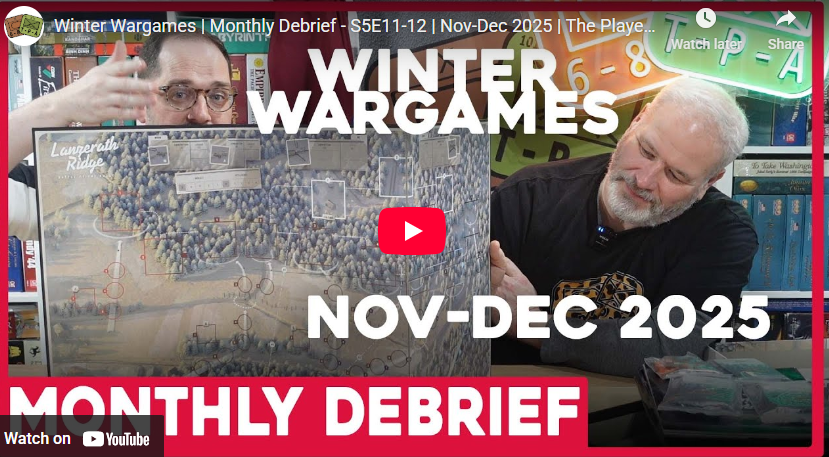
            The November/December 2025 Monthly Debrief Video, which is the 11th and 12th episodes in Season 5 of this series, saw us discussing Winter Wargames. These are games that feature battles and campaigns that happened in snowy and cold wintry conditions. These involve several different theaters and wars but as you would expect does involve the East Front of WWII quite a bit.

            Also, as usual, we covered the games we played in November and December, as well as the games we plan to play in January.

            We will remind you here that we are fortunate to be continuing our relationship with Noble Knight Games as the sponsor for our Monthly Debrief Video series. In case you don’t know, Noble Knight Games specializes in hard to find games but also carry all the new releases. But what makes them truly unique is that you can find some of the rarest games, long out of print games, hand made games, imported games from overseas, etc. Thanks to them for their sponsorship and we hope that you will consider them first when looking for the games we cover.

            -Grant

            My Favorite Wargame Cards – A Look at Individual Cards from My Favorite Games – Card #62: Romanian Autonomy from Twilight Struggle: Red Sea – Conflict in the Horn of Africa from GMT Games

            Von: Grant
            20. Januar 2026 um 14:45

            With this My Favorite Wargame Cards Series, I hope to take a look at a specific card from the various wargames that I have played and share how it is used in the game. I am not a strategist and frankly I am not that good at games but I do understand how things should work and be used in games. With that being said, here is the next entry in this series.

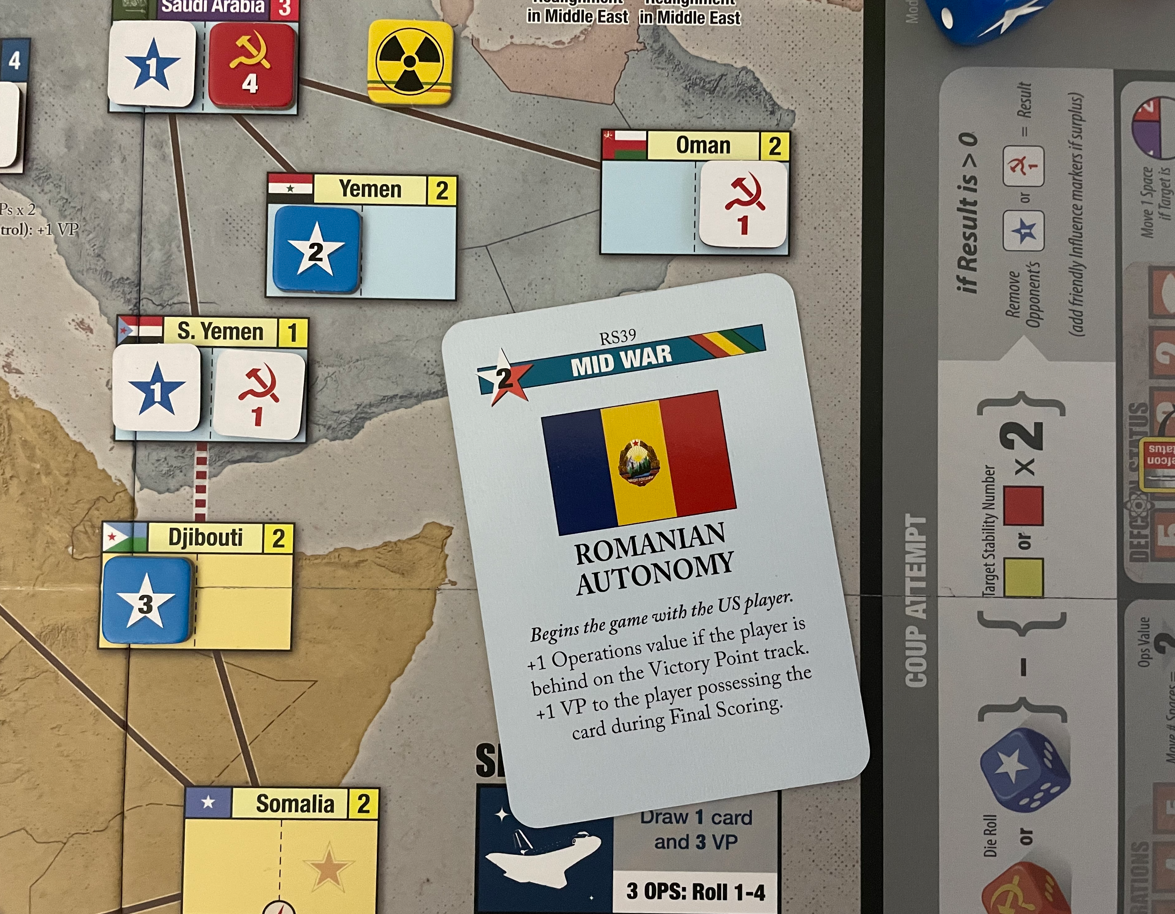
            #62: Romanian Autonomy from Twilight Struggle: Red Sea – Conflict in the Horn of Africa from GMT Games from GMT Games

            We all love Twilight Struggle….and if you say you don’t, you really do but just want to be different or are a contrarian! The game is phenomenal and has done very well for GMT Games with 8 Printings as well as the Turn Zero Expansion and now a series of smaller geographically focused spin off games starting with Twilight Struggle: Red Sea – Conflict in the Horn of AfricaTwilight Struggle: Red Sea deals with just two regions located in the Horn of Africa including Africa and the Middle East. The game uses the familiar Twilight Struggle formula of Cards with both Events and Operations Points that can be used by players to perform Coups, do Realignment Rolls or place Influence in an effort to gain control of the most Countries in the Regions to score Victory Points and win the game. The game is fast, furious and only lasts 2 hands of cards (unless you choose to play the special 3 Turn variant) so there isn’t a lot of time to mess around and players must be focused on what they are trying to accomplish. The best thing about the game is that it plays in 45 minutes as compared to 3-4 hours for Twilight Struggle.

            The next card we will take a look at in this series is the special Romanian Autonomy, which is a unique card that doesn’t play from the deck but starts with the US player and resembles one of the classic cards from the original Twilight Struggle called The China Card. And if you have played Twilight Struggle, you know about the China Card. The China Card is a 4 Ops Value Card that can be held by the player in addition to their hand limit thereby giving them an extra card to use. But the card also has a special ability where if the player uses the card for 4 Ops to place Influence only in Asia, it will grant the player +1 Ops Value to use in placing one additional Influence. The China Card also grant’s the player who holds the card at the end of Turn 10 a +1 VP bonus.

            In Twilight Struggle: Red Sea, the China Card has been replaced by the Romanian Autonomy Card. This card is not as powerful as the China Card but definitely creates some new opportunities and challenges for the player playing the card. The Romanian Autonomy Card can effect their Ops Value from cards by +1 during the Turn that they play it if they are behind on the Victory Point Track and also grants +1 VP to the player holding the card during Final Scoring. I think this is a really interesting concept and I think was included as a sort of catchup mechanic due to the short nature of the game. I look forward through more plays to seeing how its addition changes things and whether it is overpowered or just right. Once again, a small and subtle change to the game to create a new and interesting experience for the avid fan of Twilight Struggle or players who are new to the system.

            Nicolae Ceaușescu visiting Africa during the Cold War.

            During the Cold War, particularly under Nicolae Ceaușescu (1965–1989), Romania maintained a distinct, active presence in Africa, including the Horn of Africa, as part of a strategy to distance itself from Soviet influence, gain international prestige, and foster economic exchanges. While major powers like the Soviet Union and Cuba directly intervened in regional conflicts (such as the Ogaden War), Romania focused on building “fraternal” socialist relations through diplomatic, economic, and technical assistance, often operating with a degree of autonomy from the Warsaw Pact. Romania’s actual African strategy in the Horn of Africa, outlined in its 2023 Africa Strategy, emphasizes partnership, peace, development, education, and security cooperation, not territorial autonomy. Romania aimed to be a bridge between Europe and Africa, strengthening ties through cultural exchange, economic projects, and increased diplomatic presence in strategic capitals like Addis Ababa and Nairobi. Under its former communist regime, Socialist Republic Romania pursued economic independence and influenced African nations, but this was distinct from seeking autonomy within Africa. The phrase “Romanian autonomy in the Horn of Africa” is a game term with strategic implications within the game, while Romania’s real-world engagement with Africa is about broader diplomatic and economic partnerships

            In the next entry in this series, we will take a look at Militia fromStilicho: Last of the Romans from Hollandspiele.

            -Grant

            Interview with Wouter Schoutteten Wargame Graphic Design Artist

            Von: Grant
            19. Januar 2026 um 14:00

            In an effort to keep our content varied and most importantly interesting, we have in the past reached out to Graphic Design Artists to provide them an opportunity to talk about their craft and their works. I for one love a good looking game as much as a well designed game and feel that the visual element to wargames can make them successful or hold them back. Prior interviews with Graphic Design Artists that have appeared on our blog have included Antonio Pinar PeñaNicolás EskubiIlya KudriashovAnia Ziolkowska, Matt White and Iván Cáceres. In this interview, we talk to an up and coming artist who has actually done a lot of really great looking graphics for several wargames over the recent years in Wouter Schoutteten.

            Grant: First off Wouter, please tell us a little about yourself. Where do you live? What are your hobbies and interests? What types of games do you enjoy playing?

            Wouter: I’m Wouter Schoutteten, I live in Belgium, I’m married with 2 kids. I have many interests and hobbies! Gardening, reading, grilling, walking, baking sourdough bread, drawing and being creative all around, collecting music… But my main interest is playing board games. I play all kinds: I play a lot of wargames obviously, but I also play Euro games and last year I really got into TTRPG’s as well. I play a lot solo too – almost every evening, something I enjoy a lot.

            I really appreciate games that are very tight, that have limited mechanics. Games where every decision just is really important. The White Castle is one I like a lot.

            As for wargames, ironically I have more affinity with history before WWII. Though I play WWII games too, and mostly on a tactical scale.

            I’m now diving a bit into the ACW and one game that really stood out for me is Mark Herman’s Rebel Fury. What a clever game, one that I’m blessed to play with my 8-year old.

            Grant: What is your full time profession? How did you get into wargame graphic design?

            Wouter: I work as a graphic designer and illustrator. I do a lot of illustration in the field of branding and marketing. I’ve been working independent close to 10 years now. 

            One day during holiday, I was reflecting on my career as an artist and about the kind of jobs I did so far. 

            I always feel like an artist should set his own goals and should create something he wants to create. You know, something you as an artist would like to put into the world. And it dawned on me I could probably involve my hobby in my profession. I mean, I loved spending time tinkering with boardgames, making my own stuff, laying out little playaids I shared on BGG… But is there such a thing as an artist working in the wargame niche? I felt it would enable me to create something myself and at the same time give something back to the hobby. 

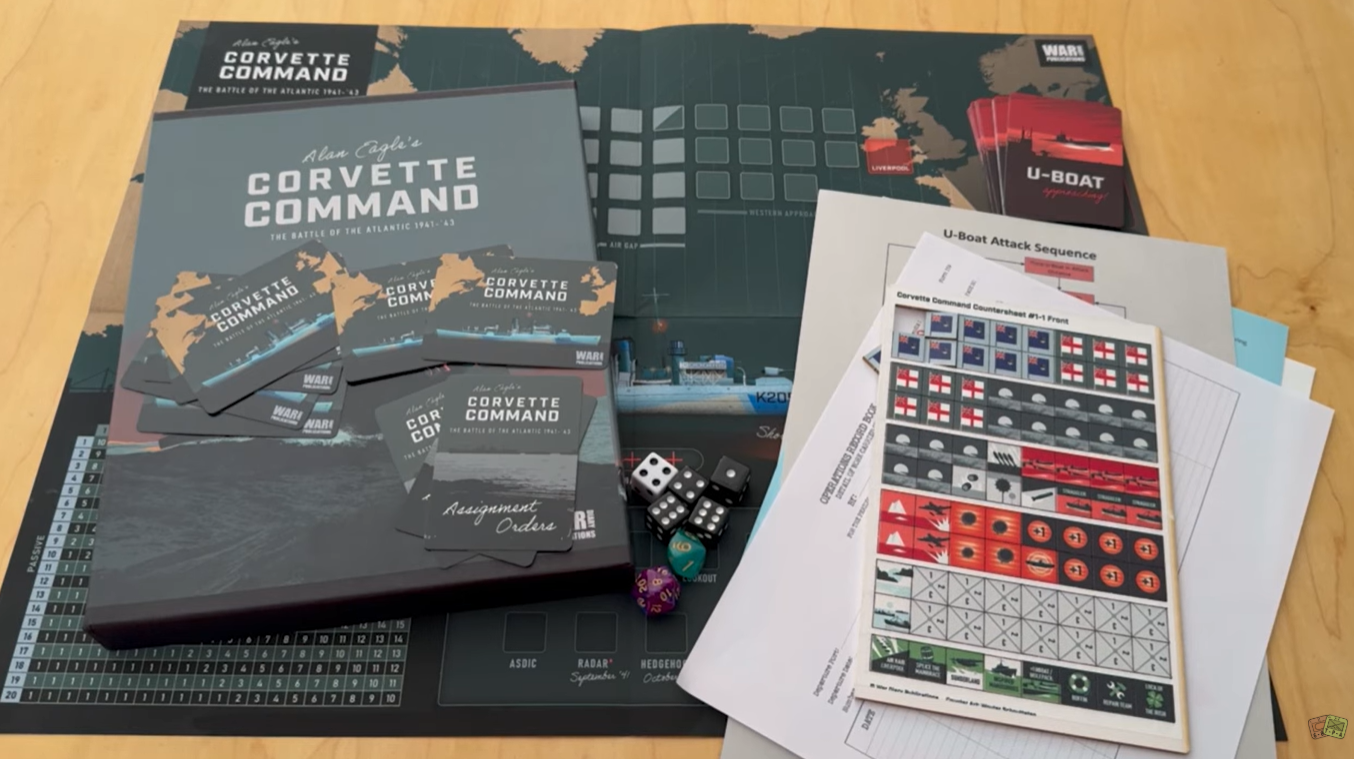
            So I first created the art for Corvette Command, got in touch with Allen Eagle (the designer) next and presented the art to a couple of publishers and that got the ball rolling!

            Grant: What is your favorite part about the graphic design/art process? Conversely, what do you struggle with or find to be the greatest challenge?

            Wouter: My favorite part about it is really pretty early on in the process. Reading up, doing the research and spending a couple of days diving into the topic, looking for documentaries, listening to podcasts and get some understanding of what the topic is about. Something I did with Volko Ruhnke when we were starting on Coast Watchers – We sat together and played a single turn of the game, just so I got an understanding of the basic ideas and hearing from the designer what he is trying to convey, what he thinks the ideal experience for the player should be like. 

            So what is my greatest challenge? In 2025 I started taking on more and more commissions, which was very exciting. I did a lot more work in the war game space than I ever did before. Then I learned that mapping the workload and working out my schedule really is a nightmare! These games can take a long time to develop. There’s a lot of going back and forth and to get everybody on the same line, that could mean a lot of iterations. So working on my planning skills this year!

            Grant: If you are given strict design parameters for a specific game, does this stifle your creativity?

            Wouter: Not really!  As long as the parameters aren’t really about the look and feel of the game, I’m okay with that. Usually being creative is easier within constraints. Starting from a blank canvas, that’s often a bit paralyzing. It’s nice to have some parameters like “we are looking to bring this kind of a feeling” or “this one should really feel like 1600”. These kinds of parameters work really well to spark creativity.

            Grant: How long does it usually take to fully design the graphics for a wargame? What is the starting point for the whole process?

            Wouter: The starting point really is doing research, reading up on the topic, talking with the designer about his vision, what he’s trying to convey, what the players should experience while playing the game. Once I have that, I start with mood boarding, looking for inspirational or similar graphics that I like. Also digging into the whole BGG catalog, looking for other games on the same topic, taking inspiration out of that. Then usually I design a couple of components to get a general look and feel. Then I hope to get the green light from both publisher and designer. Once we have that, I work out everything and usually there’s a couple of iterations that are going back and forth between me, the publisher and the designer.

            Grant: Where do you obtain information from to ensure the accuracy of your subjects, whether it be uniforms, insignia, equipment, maps, terrain, etc.?

            Wouter: So when I say mood boarding it’s more than just finding an esthetic. It’s also about collecting reference images from the appropriate period, so that I will be working on the right uniform, the right insignia and things like that. I like to have at least a couple of different sources. Online groups with miniature painters for exemple are excellent for this, these guys are experts. Also museums, books, documentaries,…

            Wargamers can be really picky about details. And rightly so. I remember a talk from Adrian Goldsworthy, the historian, on historical accuracy in movies. But the same applies to games as well: We create these visuals as a representation of history and they are passed from generation to generation and we expect them to be accurate. Now there’s a big risk in that if we make something inaccurate, not many people will be able to tell. So it’s important for us to try and tell the history as accurately as possible. I like to think of wargames as another form of education, a way of studying history. But also as a way of preserving stories and keeping them alive.

            1920: Nest of Eagles from PHALANX.

            Grant: What role does a good map play in a proper wargame? How does it help tell the narrative of the battle depicted?

            Wouter: One of the things a map does is conveying the feeling of the era. It can also tell a part of the story in itself. Like the board I did for 1812: Napoleon’s Fateful March from VUCA Simulations, if you look to the right top corner, where Moscow is, you will see the colors there are paler and they’re almost white, as opposed to the lower left, where the colors are more green-ish. This is because the French invasion started from these countries with a more mild climate. And as the French marched on toward Moscow, winter was setting in. Once they retreated from Moscow, they had to do so in terrible conditions, freezing severely. For this game, we couldn’t create two maps just for the sake of the narrative. So I worked with this color gradient so the French player would feel, the more he’s moving towards Moscow, the harsher the terrain is, the harsher the conditions are becoming.

            Another one is the map for the upcoming Merville Battery from Dan Verssen Games that I am working on. For the raid on that French coast battery during D-Day, British paratroopers were dropped very early in the morning. By the time they attacked the battery, the sun was almost coming up, so the sun would have created these very long shadows. I visited the site of the battery in person to see how the site looked, but also what kind of colors we have there. I also checked with photo’s from tourists there that were taken early dawn, to really simulate those colors. In my first designs I tried dark blue tones to give it that night ambiance, but we settled for a version with a lot of dark greens with some pastel-like hues, some pink and soft purple. A peculiar color scheme, but one that gives that sense of early dawn on the map.

            Grant: How does the design process for counters compare to the process for maps? What is your goal with the look of counters?

            Wouter: Oh I enjoy drawing counters! I make illustrations based on reference images like photos from miniatures. Counters are drawn by hand. Usually I do a couple of tests to see if they work well when printed small. They have to be clear when used so very tiny. One thing I like about counters when placed on the map is when they really pop out. That’s something I keep in mind, to keep the colors of the map rather subdued and work with brighter colors for the counters.

            Personally, I like if the counters are a bit of a narrative as well. I’m not a fan of NATO symbols because I feel they are too abstract and I lose that emotional connection with the people that were involved in the action.

            Nightfighter Command from War Diary Publications.

            Grant: What wargame companies have you worked with in the past? What games have you been involved with?

            Wouter: I’ve been blessed to work with a very wide roster of publishers in such a short time. Lately I’ve been working with GMT, with VUCA Simulations and with Sound of Drums. But I also work with DVG, Nuts! Publishing and have worked for PHALANX, Fort Circle and War Diary Publications.

            Grant: What games have you been involved with?

            Wouter: 1812: Napoleon’s Fateful March1920: Nest of EaglesAssault Red Horizon 41: Revised Edition and Primosole Bridge ExpansionCorvette Command, Nightfighter Command, Merville Battery, Coast Watchers: Allied Field Intelligence in the South Pacific, 1942-1943 (to be released), The Far Seas (to be released), 1813: Napoleon’s Struggle for Germany (to be released), A House Divided: Designer Edition (to be released) and my own Dreaded Flags: Naval Conflict in the Age of Piracy 1568-1720.

            Grant: How would you classify or describe your distinct graphics style?

            Wouter: I try to inject little bits of innovation in my art, something a bit different at least for the wargame scene. I like clear iconography, clear typography. I’m not a big fan of a lot of drop shadows and special effects. So I think you would classify it more as a bold, flat, very graphic style with some elements of the Franco-Belge comic, DIY and print techniques such as screenprinting, copier effects and lithography. I think these are some common elements you’ll find with other European artists as well. Is there something as a European wargame look?

            Grant: What game’s graphics are you most proud of? Is there one game that you would like another crack at to improve or simply do differently?

            Wouter: I really like the whole package of 1812 and how everything in that box works together. I’m also pretty proud at the humble Corvette Command. It’s published by War Diary Publications and it’s a game by Alan Eagle and more of a narrative-style game in the line of B-17: Queen of the Skies. Usually in these games, you haven’t many visual components in front of you. So for this type of game, I really wanted to create something different, something new, a strong visual game. I like the box art of Corvette Command. I tried a couple of new techniques in there.

            Grant: What graphic designers/artists out there have influenced your style? Do you spend a lot of time studying other’s work?

            Wouter: No, I try not to look too much to other artists. I’m a bit of a perfectionist, prone to tinkering with my own art. And, like many artists, I struggle with the infamous ‘imposter syndrome’. Nothing is ever good enough, especially if you compare it to work made by people who are way more experienced than me. “Comparison is the thief of joy” is a mantra I need daily. Of course, there are artists I admire a lot and if I buy a game, usually it’s because I like the look of it! Work by Nils Johansson, Marc Von Martial, Iván Cáceres, Roland MacDonald, Donal Hegarty, Rick Barber, Albert Monteys, Javi de Castro… Sure, I’m now forgetting many… So many talented artists.

            Grant: What games are you currently working on?

            Wouter: We have the Kickstarter running for Merville Battery by Vince Cooper for DVG. I’m also finishing up Coast Watchers with GMT Games before I start working on A House Divided. I’m also working on 1813 which is the follow-up on 1812, and the next volume in that series. There is this big rework of The Far Seas I’m finishing for Vuca. With Sound of Drums I’m working on their ‘Assault’ line and with Nuts! on a game on the Battle of Borodino. And some other as well, but that’s too early to say anything about!

            Grant: Where do you see your wargaming graphic design career in 5 years?

            Wouter: Difficult question because honestly I didn’t think there was such a thing as an artist career in wargames, because it’s so niche. Something I started to realize is that working in a niche industry is incredibly valuable. It’s very powerful for an artist to find a niche, one where you feel welcome and validated. It gives you focus in your artistic choices and it gives your work longevity. But that being said, I’m incredibly grateful for being able to work in this space and I didn’t expect it to go that fast. Something I really like to do in the future is to be able to work on a medieval or ancients game, because it would be so different to work on. And perhaps break in the TTRPG scene because there are a lot of illustrations used there.

            Grant: What type of software and hardware do you use for design?

            Wouter: Part of my work is deliberately done analog, pen and paper style. Most of the work however is done on computer in Photoshop, Illustrator and some InDesign. Drawings I do analog and a lot on iPad as well. At the moment I’m trying a couple of new things. I’m trying to introduce my scanner and my analog work back into the digital space, combining it with photobashing, which is a very exciting technique to create fast but unique visuals that sit somewhere between photograhpy and illustration.

            Thank you Grant, for taking the time to listen to me. And thanks a lot to you and Alexander for doing The Players’ Aid these past 10 years or so. I think it’s one of the pillars of the hobby and of this wonderful community. I’ve been following the blog for as long as I can remember. It’s how I have been staying in touch with new games, how I discovered a lot of games and the joy of solo gaming too. The blog and YouTube channel has given me so much joy in this hobby. Thank you!

            Thanks for your time Wouter. I know that you are busy working on several new projects but appreciate that you were willing to share your story and give us a little bit of insight into the life of a graphic designer. You have a very impressive list of games that you have done graphics for and I look forward to enjoying your work for years to come.

            -Grant

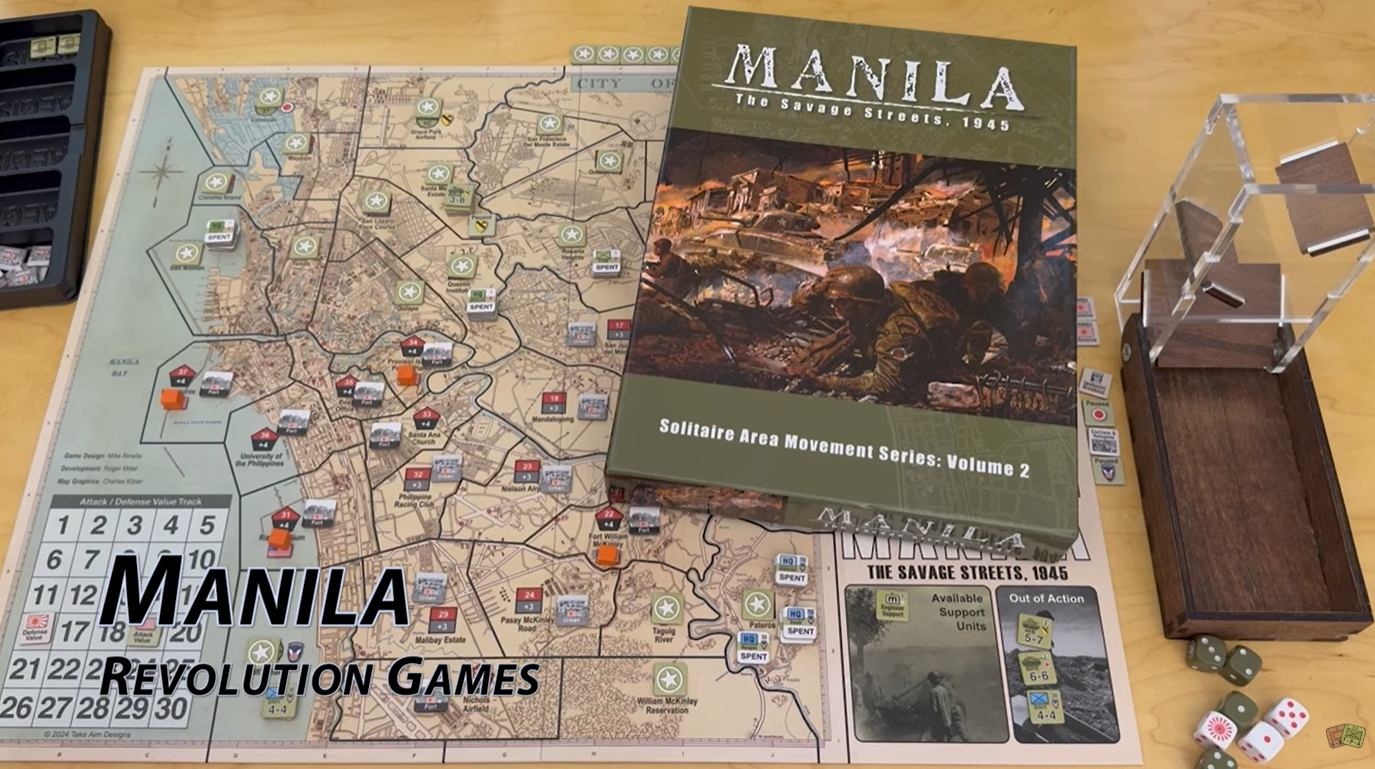
            Solitaire Video Review: Manila: The Savage Streets, 1945 from Revolution Games/Take Aim Designs

            Von: Grant
            18. Januar 2026 um 14:00

            Manila: The Savage Streets, 1945 puts the player in charge of the attacking and far more mobile American side while the game system handles the defending and largely static Japanese side. No two games will ever be the same. Each turn presents new and unique challenges for the player in the form of random events, uncertain supply deliveries, and unknown Japanese area strengths and defensive strategies.

            The primary game is a nine-turn campaign covering the American assault on the city during February and March 1945. The deeper American forces advance, from the city’s less developed periphery to its urban business district and fortress-like government buildings, the greater Japanese resistance becomes. The number of American units fought to exhaustion, effectively out of action, mounts. American determination to secure a rapid victory for Supreme Allied Commander General Douglas MacArthur, represented as “morale” in the game, gradually decreases. The player wins by equaling or exceeding historical American gains and loses if they fail to do so, or if morale falls too low.

            -Grant

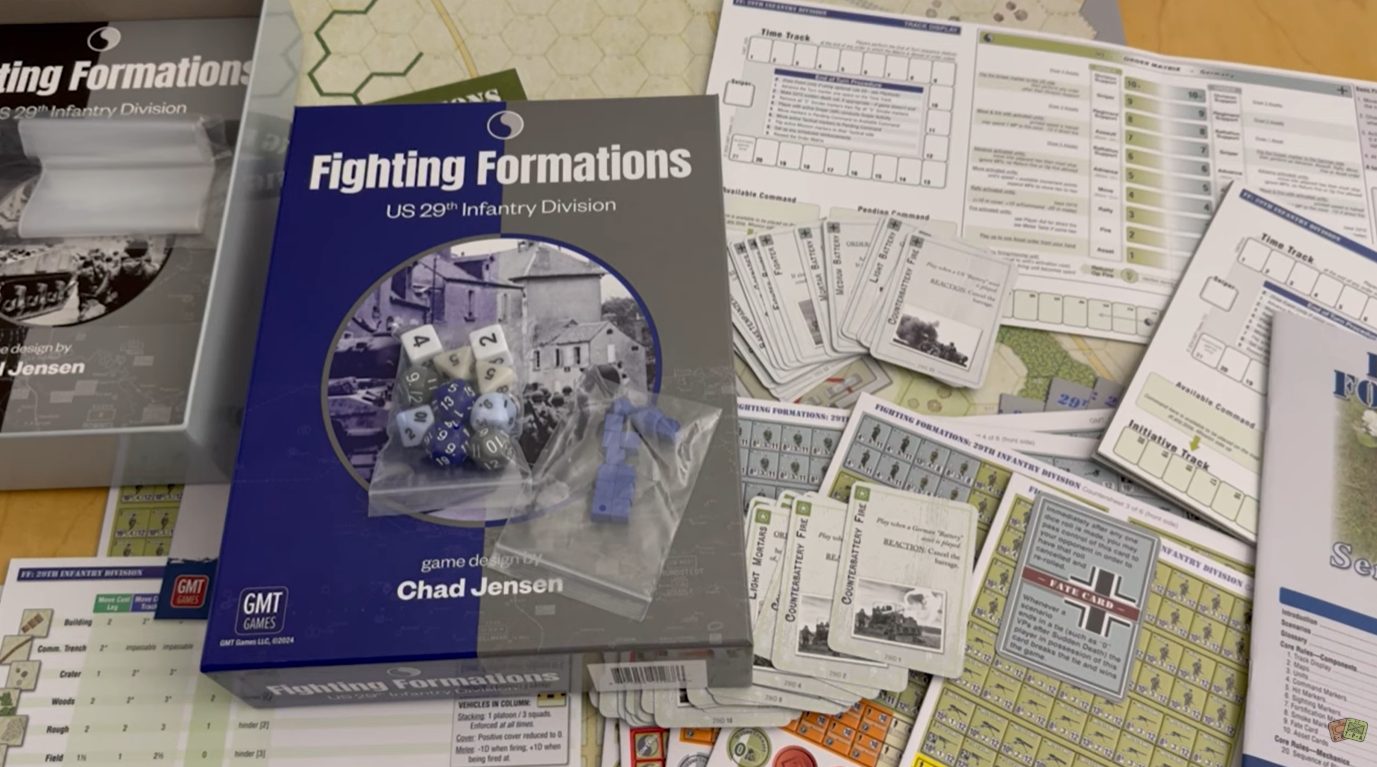
            Unboxing Video: Fighting Formations US 29th Infantry Division from GMT Games

            Von: Grant
            17. Januar 2026 um 14:00

            Fighting Formations is intended to be an ongoing series of wargames covering WWII tactical combined-arms combat at the platoon and squad levels. Each game in the series will feature a distinct combat unit, highlighting battles in which that unit participated as well as its particular order of battle and fighting characteristics. In this second volume of Fighting Formations, GMT features the US 29th Infantry Division—“Blue and Gray”—as it fought from just after D-Day in June of 1944 to the end of the year.

            -Grant

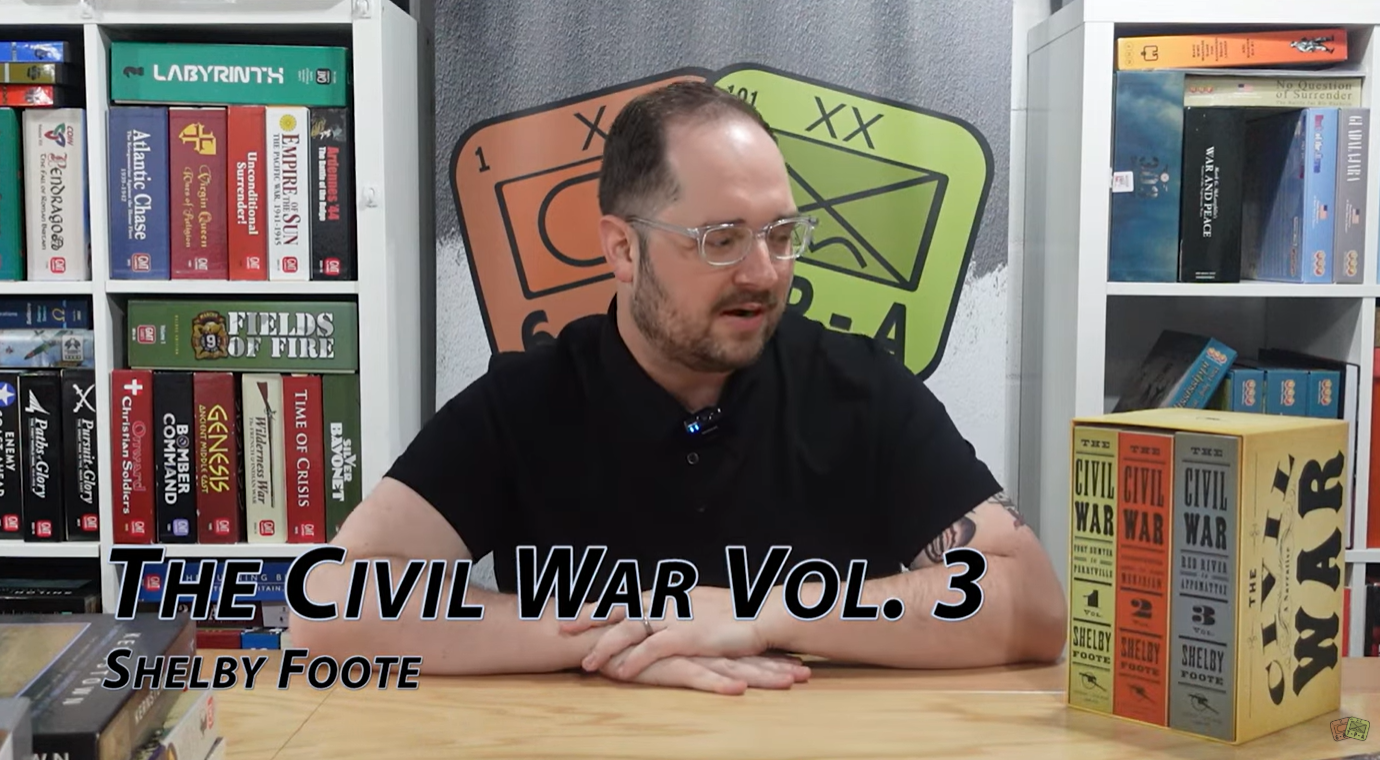
            From Cover to Cover: The Civil War: A Narrative Volume 3 – Shelby Foote

            Von: Grant
            16. Januar 2026 um 14:00

            We have an ongoing video series on our YouTube Channel called From Cover to Cover where we read a book on a subject and then pair that with a discussion of the book while covering a few games also on the subject. In this thirteenth entry in the series, Alexander takes a look at The Civil War: A Narrative Volume 3 by Shelby Foote. He then discusses a few games on the subject including For the People from GMT Games, The U.S. Civil War from GMT Games and Onto Richmond II from Multi-Man Publishing.

            -Grant

            Unboxing Video: Corvette Command: The Battle of the Atlantic, 1941-43 from War Diary Publications

            Von: Grant
            15. Januar 2026 um 15:49

            Corvette Command is a dedicated solitaire wargame that places the player in command of a Flower class corvette, guarding desperately needed supplies being transported across the North Atlantic during the early years of the Second World War. Fighting both the harsh weather and the continual threat of German U-boat attack, mission success – and perhaps even the eventual outcome of the war – hinges on the successful passage of the transports.

            This one surprised me a bit! Initially, I really had just a tad bit of interest and when I got a copy and started to play, it felt a lot like a chart flipper that can be repetitive. But, as I kept at it the game opened up and I really started to love the mechanics, the dice and how they are used, the crew development over time and then I just fell in love playing it.

            -Grant

            Best 3 Games with…Designer R. Ben Madison!

            Von: Grant
            14. Januar 2026 um 14:00

            I have really enjoyed my plays of several games designed by R. Ben Madison. He has a knack for including elements of the history into the gameplay while placing the historical events into the framework of his chosen system, which is usually the States of Siege Series…but not always. He has designed 24 games to date, with most of those being solitaire games, dealing with all types of history including the American Revolutionary War, World War I, World War II, the American Civil War, Ancient Egypt, the pre-Columbian Indian “mound builder” cultures that dominated eastern North America, the Falklands, Napoleonic Wars and many, many more and I frankly have never played one of his that I didn’t like.

            A few years ago, I did a video showcasing many of Ben’s games on our YouTube Channel and you can check that out at the following link:

            In this entry in the Best 3 Games with…Series, we will take a look at some of favorites games by Ben.

            3. Jeff Davis: The Confederacy at War from White Dog Games

            I love a really hard and involved solitaire wargame and I found a really good one in Jeff Davis: The Confederacy at War. The player takes on the role of President of the Confederacy Jefferson Davis, and you have to manage the Confederate government and the Southern war effort during the American Civil War. The choices help determine the fate of armies and the struggle between Robert E. Lee and Ulysses S. Grant. The game uses the States of Siege Series model with a central point being defended from advancing forces on 5 different tracks.

            One of the more interesting design choices in this one was the inclusion of slaves held by the South. Their focus in the game is as a resource to advance and assist the war effort through their labor. These human resources are used to take extra actions for the Confederate States of America, as the noose of the Union closes around them, they will be starved for Action Points as their factories and railroads are taken over by the advancing Federal Troops. I truly appreciate this focus in the game to give a glimpse into the political and social issues that contributed to the start of the American Civil War. I think that all too often our wargames sanitize and whitewash history of all of the darker and less desirable aspects but I think that including this element into the game was a wise choice by the designer.

            The game also uses a very interesting method of determining your per turn funds as you have to run blockades against the Union to get funds to supply armies, move your troops and invest in actions to build defenses. You can also use the Slave tokens as a sort of currency to take actions but then those tokens are used up and cannot be reused. I have really enjoyed this one although it is a full 3 hour game as you have to get through 40+ chits to survive to the end. Lots of tough choices, lots of interesting side issues, such as dealing with slaves in the southern economy and keeping politicians happy. This is a great solo game!

            You can check out our unboxing video to get a good look at the components:

            2. Mound Builders from Victory Point Games

            Mound Builders from Victory Point Games is a solitaire States of Siege game that to me has a very intriguing theme that hasn’t been gamed very often and really caught my eye. In Mound Builders, you represent the two largest pre-Columbian Indian “mound builder” cultures that dominated eastern North America from before the time of Christ until the coming of the European colonists in the 17th century. Your empire represents the earlier Hopewell culture and the later Mississippian culture that derived from it.

            The game plays in two distinct sections or modules. The first module deals with the Hopewell culture, which is the earlier of the two cultures in the game. During this phase of the game, your goal is to simply expand the influence of your empire across the land, trading with various chiefdoms and trying to incorporate their dominions into your own in order to increase your economic power through the accumulation of various types of resources. As time passes, your empire will grow and regress due to various factors including warfare, disease and drought, but more often than not, the real threat to your culture is simply that of the existence of other ways of life and beliefs that will ultimately mix with your own culture.

            During the second phase of the game, you will be beset on all sides by competing tribes as well as the nasty Spaniards and will watch as the empire that you worked so hard to build during the Hopewell Era simply disappears from history. Each turn, a card will be drawn that tells you which of the 5 opposing cultures will move into your lands along a siege track. Sometimes only 1 will move but up to 3 can all move at once, and some can be moved more than once each turn. If you do not attack those cultures when they occupy one of your chiefdoms by the end of your turn and chase them off, your resource will be taken from you and you will no longer be able to produce or trade for that type of good, thereby weakening your economy. This States of Siege system is so very cool and has been replicated in may other additions to the series (such as Ottoman SunsetDawn of the Zeds and Hapsburg Eclipse but also has spawned, or at least inspired several other designers to create equally cool and interesting simulations (Pavlov’s House and Castle Itter). I have definitely reaped the benefits of this States of Siege Series and love me a good solo game with this cool mechanic.

            This is a link to a video unboxing of the game showing off the great components but unfortunately we have never done any other videos on this game:

            1. Kaiserkrieg! The Great War 1914-1918 from White Dog Games

            Kaiserkrieg! is simply fantastic! A solitaire treatment of The Great War using the States of Siege Series model but with a change to a horizontal rather than vertical layout of spaces where enemy forces can build up and perform an “Over the Top” move if you don’t destroy their troops before then. The player takes the side of the Central Powers and must deal with events that replicate the history of the period and the tumult of various revolutions, threats and opportunities. Well done game by Ben Madison that uses chit pull to activate the enemies and cause events. Lots of chaos. Lots of tough choices. Lots of history. And it always seems to come down to the very end. The only draw back to the game though is that it is long, taking 2-3 hours to play through an entire game. Each chit drawn has lots of information and there are always lots of things to do each turn with your very limited actions.

            One of my favorite parts is the use of Blockade Runners to gain your funds for the turn. During the Naval/Air Warfare Phase, the player will place out their available Blockade Runners on various seas zones numbered 1a, 1b, 2a, 2b, 2c, 3 and 4 in order to attempt to break Allied blockades and deliver goods and funds to Germany to fuel the war effort. Each of these numbered sea zones will provide a haul of Reichsmarks based on the number of the sea zone if they are able to evade the British Cruisers. This is determined by rolling 2d6 and consulting the British Cruisers Table to find out in what sea zones the available British Cruisers will be placed. If there is a Blockade Runner in the determined sea zone, it will be destroyed and placed in the Neutral Ports box where it will wait to be built later at a cost of 2 RM. If the rolled sea zone contains a Blockade Runner and the High Seas Fleet marker, the British Cruiser will be unable to destroy the Blockade Runner and a naval combat will ensue.

            In the above picture, the Central Powers defeat the British Cruiser with the High Seas Fleet and the 3 Blockade Runners placed in seas zones 2b, 3 and 4 bring home a cash haul of 9 Reichsmarks that will be used to take actions and push back the amassing Entente forces in the various staging areas to avoid an Over the Top chit from being placed and prevent the built up forces there attacking into Germany. This process of gaining income is very interesting and unique and it really feels correct as you are trying to do your best to avoid and destroy the British Cruisers so that you have your choice of the best producing sea zones without the fear of Entente intervention.

            You can check out our unboxing video to get a good look at the components:

            Here is a link to my video review:

            Well there you have my 3 favorite games from R. Ben Madison. There are so many good titles to choose from making this exercise very difficult but the 3 that I chose were very enjoyable to play. What are your favorite Ben Madison designs?

            -Grant

            My Favorite Wargame Cards – A Look at Individual Cards from My Favorite Games – Card #61: Mobile Vulgus Time of Crisis: The Age of Iron and Rust Expansion from GMT Games

            Von: Grant
            13. Januar 2026 um 14:00

            With this My Favorite Wargame Cards Series, I hope to take a look at a specific card from the various wargames that I have played and share how it is used in the game. I am not a strategist and frankly I am not that good at games but I do understand how things should work and be used in games. With that being said, here is the next entry in this series.

            #61: Mobile Vulgus from Time of Crisis: The Age of Iron and Rust Expansion from GMT Games

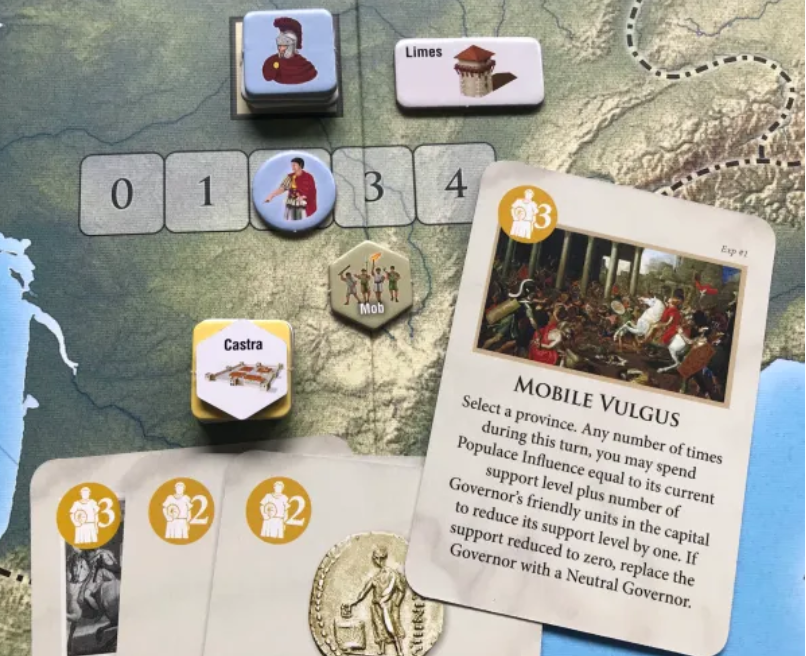
            I really love Time of Crisis from GMT Games. This is a very light, introductory wargame that is just plain fun to play. I have been playing it a ton on the Rally the Troops! online platform and really enjoy it no matter what the outcome of those games are. One card that I enjoy using is called Mobile Vulgus, which is a 3 value Populace Card that really can be a devious way to usurp your enemies. This card was added to the game in The Age of Iron and Rust Expansion and is one of those cards that is very situational but very good.

            As you know, Time of Crisis is a back and forth game that sees players pitted against each other for the control of provinces and ultimately a change in the player who wears the purple robes of Emperor and sits on the throne in Italia. This process is carried out as players play Populace cards to garner Influence points that are then used to Replace a sitting Governor. The problem with the process is the dice. Now, I know what you are saying. Typically, as long as you roll a 2+ on a d6 it is considered a success and garners you a vote but my luck dictates that I will roll multiple 1’s on a roll where you are looking for a number higher than 1. So, if you can somehow get the dice out of the equation, you are better off. Along comes the fantastically powerful card Mobile Vulgus.

            Why exactly do I consider this card so good? Well, you don’t have to rely on rolling dice to get what you want…simple as that. The power is maybe not as efficient as I would like it to be, as you will have to take a Replace Governor Action later to seat your Governor, but it is guaranteed. First off, the card allows you to target a province in which you wish to Replace the current sitting Governor. You normally would play Populace cards to create a number of Influence Points that you would then use to roll 1d6 per point. With Mobile Vulgus you simply play a certain amount of Populace cards to create a total amount of Influence that allows you to overcome their current support level. In the picture above, you can see that the current support level for the Blue Governor in Gallia is at 2. You will also notice though that the Blue General is located in the Provincial Capital with a sizeable army. This army will add to the number of Influence points you will have to spend to reduce that support.

            As we examine the Blue General’s stack of forces, we see that he has 3 units under his control, 2 full strength Legions (XIV Gemina and X Gemina) as well as a lone Militia. These 3 units will add to the amount of Populace Influence points that must be spent to effect the support level of the province. Because there are 3 units, we will add those 3 units to the current support level of 2 to bring our target to reduce to 5. In simpler terms 2 for the current support level + 3 for the units in the provincial capital. This then successfully reduces the support level to 1. Remember, that if using a normal Replace Governor action, you would have been rolling 5 dice (1d6 per Populace Influence point spent) and would have needed to roll 2+ and garner 7 votes (calculated by doubling the current support level and then adding in +1 vote needed for each unit in the capital). You couldn’t have possibly done that using only the two cards shown and would have had to play at least one more Populace card with at least 2 Influence points to get to roll 7 dice!

            Mobile Vulgus is a Latin phrase that means “the fickle crowd”, referring to the changing nature, opinions and reactions of the general public or an audience, which is a derivation of the English word “mob”.  It literally denotes a movable public, or the unstable crowd and recognizes the inconstancy of popular taste and the ease with which clever politicians can influence the great mass of voters. In game terms, the support of the people can sometimes falter as easily as it can be encouraged.

            If you are interested, I wrote a full review for Time of Crisis and you can read that at the following link: https://theplayersaid.com/2017/09/04/the-most-recent-fruits-of-wargame-hybridization-a-review-of-time-of-crisis-the-roman-empire-in-turmoil-235-284-ad-from-gmt-games/

            We also posted a full review video and you can watch that at the following link:

            In the next entry in this series, we will take a look at Romanian Autonomy from Twilight Struggle: Red Sea – Conflict in the Horn of Africa from GMT Games from GMT Games.

            -Grant

            Interview with Matt White Designer of Saving Angels WWII Solitaire Wargame Print and Play Currently on Kickstarter

            Von: Grant
            12. Januar 2026 um 14:00

            Several years ago, we posted an interview with Matt White, who is a very talented graphic artist and budding game designer, that focused on his artistic talents and love of tanks. He has since designed several very interesting small scale wargames, with his most recent series being a World War II tactical wargame series for 1-2 players pitting the British Airborne versus the German Wehrmacht called Until the Bitter End. He then designed the next entry in that series called Until the Bitter End – US Airborne followed by Until the Bitter End – Tanks. He has also done a few others including Would Be Aces, Operation Biting and Today Another Battle that have done very well. Recently, a new game appeared on Kickstarter from Matt called Saving Angels WWII Solitaire Wargame Print and Play, which is a wargame based on the American and guerrilla raid of the Japanese held Los Baños prison camp in World War II. We reached out to Matt and he was more than willing to share on the project.

            If you are interested in Saving Angels WWII Solitaire Wargame Print and Play, you can back the project on the Kickstarter website at the following link: https://www.kickstarter.com/projects/1564988876/saving-angels-ww2-solitaire-wargame?

            Grant: What is your new project on Kickstarter?

            Matt: My new Solitaire game is called Saving Angels and it covers the bold US Airborne and allies, raid of the Japanese held Los Baños prison camp during WWII.

            Grant: What was your inspiration for the name? What do you want it to convey about the design?

            Matt: I came across the history of this subject, whilst researching the Operation Biting game (which is also an Airborne raid, only British) and the name refers to the US 11th Airborne Division, as they were described by the prisoners, who they rescued.

            The main element of the design is that you command the paratroopers and guerrillas on this daring rescue mission. With most wargames, the mission is often defeat the enemy or hold a point, etc., but with this design the rescuing of the prisoners is your objective.

            Grant: What about this historical event made you want to create this game?

            Matt: The main inspiration really was the story, but from the prisoners point of view. They had been treated terribly, for the most part, from their captors. The prisoners were from all walks of life, civilians rather than soldiers who had been captured. I felt it was important to cover this story from WWII, which has not really been covered before. 

            Grant: What research did you do on the subject?

            Matt: I read a lot of history subject books so naturally I read as much as I could on the subject. There are also a few really good videos on YouTube that are also well worth watching.

            Grant: Is this the start of a new series of games?

            Matt: This is my third game in my Raid Series – the other games covering the British paratroopers, with this one being the first game in that series featuring US forces and where the main objective is the rescue.

            Grant: What games have inspired your design?

            Matt: To be honest, the biggest inspiration really is the history side rather than other wargames. I think also the first two games in the series was a natural source.

            Grant: I know the design is a Print and Play offering. Why do you feel this model is best suited for your designs?

            Matt: I like making print and play games as it forces you, as the designer, to make every component count and making the most of the physical space on a sheet of paper. I find that challenge one of the most interesting parts of the creative process.

            Grant: I know you are not only the designer but you do the art as well. Please show us a few examples of your great art.

            Matt: Here are several different pieces from the game.

            Grant: How do you create your art? What is the process and what graphics tools do you use?

            Matt: I use a variety of tools such as Sketchbook and Photoshop. I pretty much draw in a traditional method, just using a Wacom pen and laptop.

            Grant: What difficult decisions do players have to make in the game?

            Matt: The player must try and maximize their units to the best of the counter’s abilities. Each unit will have strengths and weaknesses so coordinating your units is crucial for success.

            Grant: What dangers and threats meet the players with their airborne and amphibious landings?

            Matt: As the player pushes towards the prison they may encounter Japanese enemy threat but also the risks associated with such landings.

            Grant: What objectives does the player have to accomplish?

            Matt: The player’s goal is to get to the camp, free the prisoners and then escort them back to the pick-up zone to make good their escape. This was a daring mission as the Japanese defended the area and the player will have to fend off Japanese reinforcements as the player makes good on their escape.

            Grant: What is the purpose of the 2 different maps?

            Matt: The game comes complete with 2 maps. The first map is for the approach to the Prison Camp and features both Airborne and amphibious landings. The second map is the Prison Camp itself where the player must locate and rescue the prisoners before escaping back across the first map.

            Approach map.
            Prison camp map.

            Grant: How do players control these units and give commands?

            Matt: During the game’s turn the player controls movement of their Units whilst the game’s AI will control the enemy Japanese.

            Grant: What is the goal of the game?  How is victory obtained?

            Matt: Get to the camp, rescue the prisoners and escape, whilst fending off the Japanese enemy. It will take co-ordination of the player’s units, using them to the best of their abilities and a bit of luck!

            Grant: What are you most pleased about with the design?

            Matt: I really wanted to create the strong narrative experience, that’s quite tense, of having multiple objectives (with rescuing all the prisoners) whilst dealing with an unrelenting enemy.

            Grant: What kind of an experience does the game create?

            Matt: For me, the game creates the idea that sometimes you have to be bold, push your luck and try and achieve success by utilizing the resources you have to the best of their abilities.

            Grant: What other designs are you currently working on?

            Matt: I have a plate of other games I am working on, mostly WWII! I’d like to cover more of these historical daring raids whether they are land, sea or air. 

            Thanks to Matt for his time in answering our questions and for his great little print and play games. I love it when one of these new games is brought to light as I get to oodle over the art and see what new things he has created!

            If you are interested in Saving Angels WWII Solitaire Wargame Print and Play, you can back the project on the Kickstarter website at the following link: https://www.kickstarter.com/projects/1564988876/saving-angels-ww2-solitaire-wargame?

            -Grant

            ❌