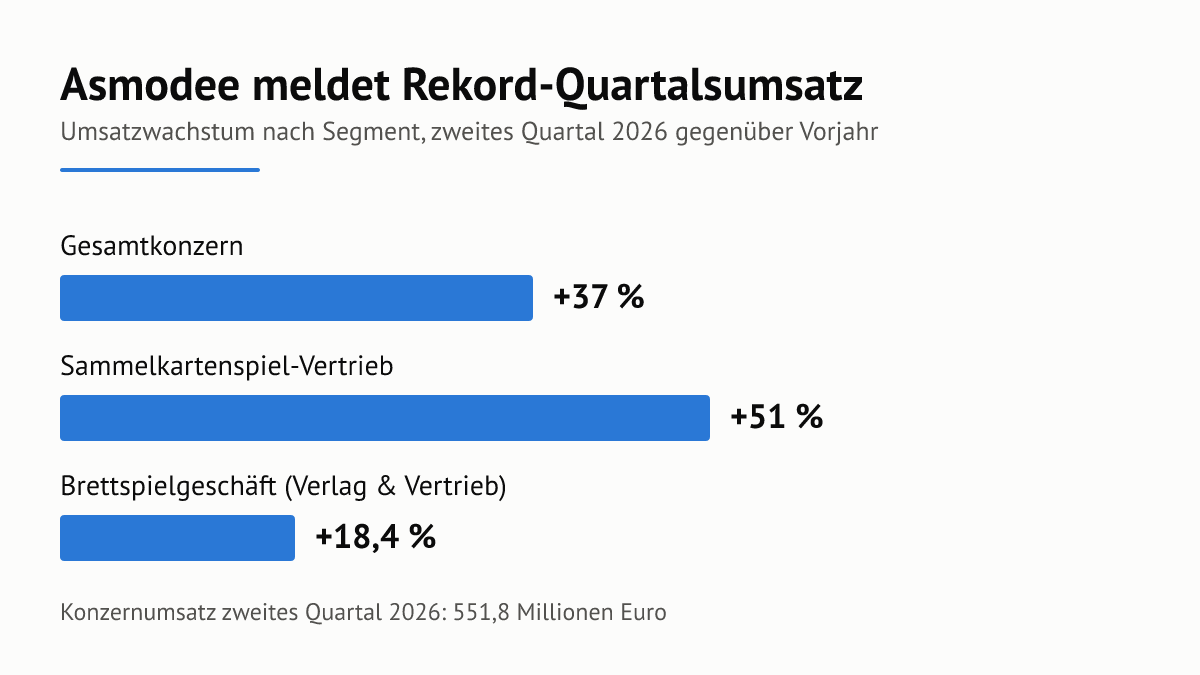
Asmodee hat für das zweite Quartal 2026 einen Rekordumsatz von 551,8 Millionen Euro gemeldet, ein Plus von fast 37 Prozent gegenüber dem Vorjahr. Wie schon im vorigen Quartal treibt vor allem der Boom bei Sammelkartenspielen das Wachstum, wie aus der Analysten-Präsentation von CEO Thomas Koegler und CFO Andrea Gasparini hervorgeht, über die BoardGameWire berichtet.
Sammelkartenspiele bleiben der Wachstumsmotor
Der reine Vertrieb von Sammelkartenspielen wie Pokémon, Magic: The Gathering und Riftbound wuchs um mehr als 51 Prozent auf 343,8 Millionen Euro. Eine größere, zweite Kennziffer betrifft aber nicht nur Sammelkartenspiele, sondern alle Titel, die Asmodee für fremde Verlage vertreibt: Dieser gesamte Drittanbieter-Vertrieb legte um 42,4 Prozent auf 395,6 Millionen Euro zu und macht damit fast 72 Prozent des Konzernumsatzes aus, nicht die reine Sammelkartenspiel-Zahl allein. Laut Koegler sei die gesamte Branche derzeit lieferseitig begrenzt: „The entire industry is constrained on supply. Today, we sell what we have."
Brettspielgeschäft wächst zweistellig, auch dank Zukäufen
Das eigentliche Brettspielgeschäft aus Verlag und Vertrieb legte um 18,4 Prozent auf 167,5 Millionen Euro zu und baut damit auf dem Wachstum des Vorquartals von 16 Prozent auf. Mehr als 40 Prozent dieses Zuwachses kommen laut Gasparini aus der im April abgeschlossenen Übernahme des französischen Party-Spiele-Verlags ATM Gaming, ein Deal, der je nach künftiger Entwicklung von ATM bis zu 250 Millionen Euro wert werden kann. Den übrigen Zuwachs teilen sich laut Gasparini ungefähr zu gleichen Teilen Asmodees eigene Studio-Marken und die Titel fremder Verlage im Sortiment. Die eigenen Studio-Marken selbst wuchsen um 26,5 Prozent auf 144,6 Millionen Euro, laut Koegler kommt davon etwa ein Drittel aus dem Zeitpunkt der Star-Wars-Unlimited-Veröffentlichungen, ein weiteres Drittel aus ATM Gaming und der Rest aus anderen Produkten.
USA erholt sich, Investitionen in Board Game Arena angekündigt
Der US-Umsatz erholte sich nach mehreren schwachen Quartalen um 27,2 Prozent auf 70,1 Millionen Euro. Koegler erklärte den vorherigen Einbruch direkt mit den Zöllen: „We had a dip in the market last year mainly due to the tariffs." Für die Zukunft kündigte Gasparini verstärkte Investitionen in die eigenen Verlagsmarken an, „Priority number one is our portfolio of published products", sowie ausdrücklich in die Plattform Board Game Arena, dort sieht Asmodee laut Gasparini weiteres Potenzial für Publikum und Katalog. Die bereinigte EBITDA-Marge der letzten zwölf Monate liegt laut Konzern bei 18,1 Prozent und übertrifft damit erstmals das eigene mittelfristige Ziel, Koegler kündigte an, trotzdem weiter in langfristiges Wachstum zu investieren. Auch bei Zukäufen bleibt Asmodee aktiv: Neben ATM Gaming zählt Koegler unter anderem Zombicide, Cthulhu: Death May Die, Sheriff of Nottingham und den japanischen Verlag Japon Brand, alle vom finanziell angeschlagenen Verlag CMON übernommen, sowie die Rechte an Time's Up und Welcome To zu den jüngsten Übernahmen der vergangenen zwei Jahre. Über CMONs eigene Krise, fast 23 Millionen US-Dollar Verlust binnen zwei Jahren und eine halbierte Belegschaft, hatten wir im Rahmen unserer Marktanalyse zur Nemesis: Legacy-Kampagne bereits berichtet, Zombicide gehörte schon damals zu den Marken, die CMON deswegen abgeben musste. Was aus den übernommenen Reihen jetzt bei Asmodee wird, ob also etwa Zombicide, Cthulhu: Death May Die oder Sheriff of Nottingham neue Erweiterungen oder Nachdrucke bekommen, sagt der Bericht nicht.
Was wir davon halten
Für uns zeigt dieses Quartal vor allem, wie abhängig Asmodees Rekordzahlen inzwischen vom Sammelkartenspiel-Geschäft sind, das reine Brettspielgeschäft wächst zwar ebenfalls, aber deutlich langsamer und zu einem erheblichen Teil durch Zukäufe wie ATM Gaming statt durch organisches Wachstum der eigenen Marken.
Fertig bedrucktes Gelände spart Zeit, doch auf dem Schlachtfeld soll es auch optisch überzeugen. Micro Art Studio kombiniert im Imperial-II-Bundle klappbare Ruinen mit industriellen Anlagen und transparenten Kunststoffelementen. Wir haben das Gelände zusammengebaut und geprüft, wie gut sich das Set für die elfte Edition von Warhammer 40k eignet.
Die Situation auf dem Planeten Shinju und seinem Mond kommt nicht zur Ruhe. Verdeckte Operationen, angezettelte Revolten und sonstige Konflikte sind an der Tagesordnung. Auch die in der Luft enthaltenen Nano-Bots und die feindselige Natur des Planeten tragen nicht zu einer Entspannung der Situation bei. Es bleibt dramatisch im Infinity-Universum.
A board game exploring the violent protests surrounding the 1968 Democratic National Convention in Chicago has won this year’s Summit Award, which celebrates historical designs that have helped broaden the hobby – while veteran board game critic Dan Thurot has been recognised for his writing and podcast work with the Bobby Nunes Memorial Award.
Yoni Goldstein’s Chicago ’68 triumphed in the fifth edition of the Summit Award after judges praised its approachability, unusual historical subject and portrayal of the conflict between anti-war demonstrators and the city’s political establishment and police.
Thurot, meanwhile, was honoured for his work on long-running board game criticism site Space-Biff! through the third annual Bobby Nunes Memorial Award, created to recognise historical gaming’s most exceptional culture writers, podcasters and video essay makers.
The judges lauded Thurot “for bringing consistently interesting and thought-provoking discussion on both individual games and wider issues in gaming” – and specifically highlighted a widely praised essay on Jo Kelly and Cole Wehrle’s Molly House, a game which explores the lives of queer communities in early 18th-century London.
Both awards were announced at the SDHistCon Summit convention in San Diego, organised by the San Diego Historical Games Convention (SDHist) – which aims to expand the historical gaming hobby by encouraging new voices, subjects and perspectives.
Chicago ’68 was the most-selected game during the Summit Award’s public nomination process earlier this year, before being chosen as the winner by members of SDHist’s board and advisory board.
Chicago ’68 || Photo Credit: Yoni Goldstein
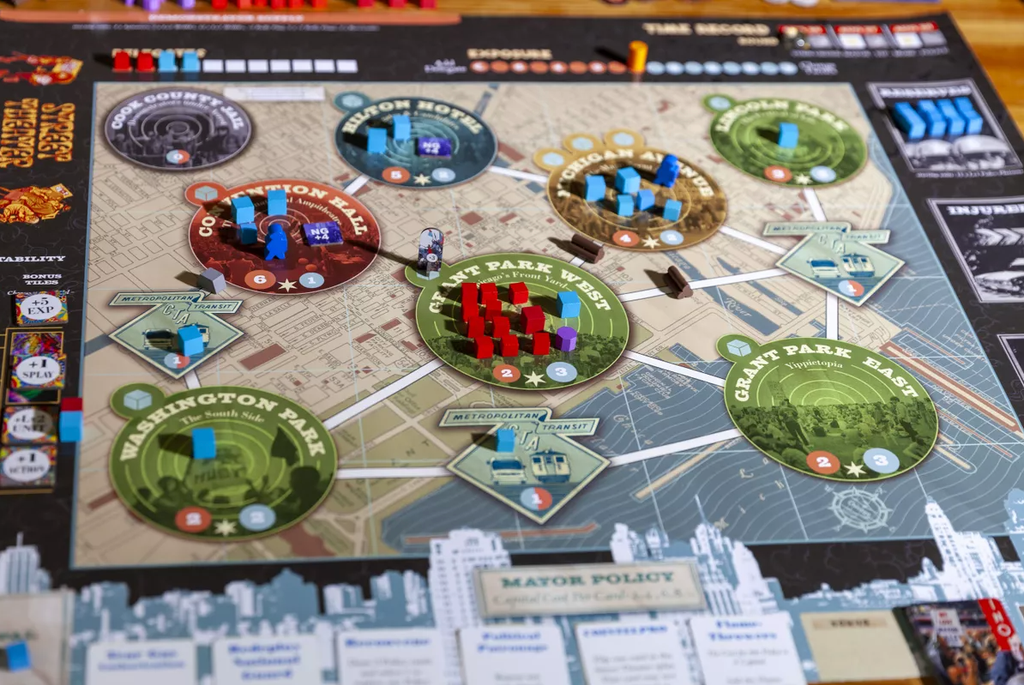
The game divides players between the establishment and demonstrators during the tumultuous 1968 Democratic National Convention, when anti-Vietnam War protests in Chicago were met with a violent police response.
Each side is split into two factions with different powers and objectives, with the mayor’s office and Chicago Police Department facing off against the Yippies and the National Mobilization Committee to End the War in Vietnam.
The asymmetric design uses area control and card activation, with players able to deploy political manoeuvres, street theatre and direct confrontation as they compete to influence the outcome of the protests.
Judges described Chicago ’68 as “a compelling design about a politically relevant subject” and “a thoughtful portrayal of an undercovered conflict”, while also praising its ease of teaching and play.
The award continues a run of victories for historical games tackling subjects and perspectives beyond individual battles or solely military strategy, following Fred Serval’s Red Flag Over Paris in 2022, Tory Brown’s Votes for Women in 2023, Alex Knight’s Land and Freedom in 2024 and Dave Neale and David Thompson’s War Story: Occupied France last year.
Chicago ’68 saw off competition from three other finalists: Paolo Mori and Alessandro Zucchini’s Battlefields of the Napoleonic Wars, Jo Kelly and Cole Wehrle’s Molly House, and Francisco “Pako” Gradaille’s Onoda.
Bobby Nunes plays Combat Commander in 2021 || Photo Credit: Harold Buchanan
Dan Thurot’s Bobby Nunes award victory recognised the range of his work across written reviews, essays, interviews and the Space-Biff! Space Cast podcast.
Thurot launched Space-Biff! as a personal blog in 2011, before shifting its focus to board games over the next couple of years. He has since written more than 1,000 reviews alongside essays exploring game design, history, and the philosophy, art and culture of the hobby.
The Bobby Nunes award was launched in 2024 in memory of Robert “Bobby Factor” Nunes, a historical gaming writer and editor who died that March, and aims to celebrate exceptional media coverage which reflects his interest in discussing important cultural issues within historical gaming. Thurot was previously shortlisted for the award in its inaugural year.
The latter received the most public nominations for this year’s Bobby Nunes award, while judges also gave an honourable mention to GMT Games’ monthly newsletter for its detailed coverage of game development and the people involved in bringing historical designs to publication.
BoardGameWire noted in 2024 and reiterated last year that the award was a welcome addition to a board game industry which, understandably, largely sees its awards focused on celebrating outstanding game designs, designers and successful publishers.
The work of writers and audiovisual creators – many of whom are producing perceptive, considered investigations of the culture in and around game design – still remains very poorly recognised, with the Diana Jones Award the only real major prize to acknowledge excellence outside of design work or general game popularity.
Both SDHist awards are set to return in 2027, with public nominations expected to open in the spring or summer. More information can be found on the Summit Award page on the SDHistCon website.
Beim Skirmisher Infinity von Corvus Belli geht es nicht um große Schlachten, sondern um kleine koordinierte Einsätze. Auch in der Regeledition N5 hat sich daran nichts geändert. Für diese Operationen sind besonders trainierte Spezialtruppen sehr gut geeignet. Mit dem neuen Regel-Update finden die Spec-Ops ihren Weg zurück in die Armeelisten.
Vier Spielsysteme, ein gemeinsames Fundament. OnePageRules setzt auf überschaubare Grundregeln, die sich durch zahlreiche Sonderregeln und optionale Erweiterungen ergänzen lassen. Dabei bleibt den Spielenden selbst überlassen, wie umfangreich sie ihre Partien gestalten möchten. Wir schauen uns an, was hinter diesem Regelansatz steckt und welche Möglichkeiten er bietet.
Römische Soldat*innen ziehen in die Wälder Germaniens und treffen dort auf einen Feind, gegen den ihre Ausbildung wenig hilft. Cohors Cthulhu: Tactics verbindet Miniaturengefechte mit einer fortlaufenden Kampagne für Solo- und kooperatives Spiel. Wir stellen vor, wie sich Kohorte, Gegnersteuerung und Held*innengeschichte im Regelbuch verzahnen.
Was machen ein Elfenprinz und ein Haufen Red Caps zusammen in einer Gruppe bei Warcrow? Die neue narrative Kampagne will diese Frage beantworten. Im brandneuen Action Pack: Quest for Elfleen stellen sich General Nuada und seine Truppe aus goblinähnlichen Kreaturen, den Red Caps, jeder Konfrontation, um Nuadas Ziele zu erreichen.
Neue Fälle, neue Mysterien und generell mehr vom Gleichen? Ein klares Jein. Nephews in Peril! Möchte mit seinen Sweeps Week Mysteries mehr als nur eine simple Erweiterung für das schrullige Cozy-Pen-and-Paper Brindlewood Bay sein. Ob dies auch gelingt, haben wir uns angesehen. Im verschlafenen Küstenstädtchen Brindlewood Bay wird es niemals langweilig. Zumindest nicht für die […]
Der Zweite Weltkrieg hat sich festgefahren und die Atombombe soll die Wende für die United States bringen. Risse in der Realität waren dabei nicht eingeplant. Welche Macht aus diesen Rissen entweicht, ist zunächst nicht klar. Doch was sich dann ereignet, kann nur göttliche Fügung sein.
Die neuen Battlehosts für das Middle-earth Strategy Battle Game sind da – und mit ihnen ein aktualisierter Quickstart Rules Guide. Doch wie viel vom Original steckt in den vereinfachten Regeln? Wir schauen uns die neuen Battlehosts und ihre Regeln genauer an und prüfen, ob der Einstieg damit wirklich gelingt.
Micro Art Studio aus Polen wird nicht müde und liefert in seiner für das Spiel Bolt Action lizensierten Reihe vorbedruckte Gebäude aus MDF für einen weiteren Schauplatz des Zweiten Weltkrieges. Nach der frostigen Ostfront geht es dieses Mal in sonnigere Gefilde. Das Thema ist Italien.
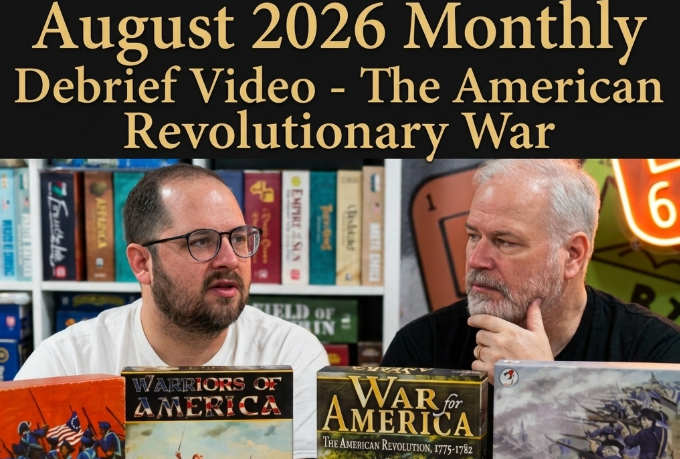
The August 2026 Monthly Debrief Video, which is the 8th episode in Season 6 of this series, saw us discussing American Revolution Wargames. As you may know, I really enjoy the history of the American Revolutionary War. I have read dozens of histories on the subject, with my favorite being Robert Leckie’s George Washington’s War: The Saga of the American Revolution, and it never ceases to amaze me how a group of ragtag rebels were able to best an entire global Empire in open rebellion. The reason for that was the patriots resolve and their ability to run away when outmatched to fight another day when they had a better advantage and not necessarily because they were better armed, or drilled or disciplined. I think that their desire to truly be free was the main difference but that is up for speculation. I love the games on this subject and have played nearly 20 and I was surprised at the number when we had this discussion.
Also, as usual, we covered the games we played in August as well as the games we plan to play in September and had a short discussion of our plans to attend the Gaming the American Revolution Camden 250 Event in Camden, South Carolina sponsored by GMT Games.
We will remind you here that we are fortunate to be continuing our relationship with Noble Knight Games as the sponsor for our Monthly Debrief Video series. In case you don’t know, Noble Knight Games specializes in hard to find games but also carry all the new releases. But what makes them truly unique is that you can find some of the rarest games, long out of print games, hand made games, imported games from overseas, etc. Thanks to them for their sponsorship and we hope that you will consider them first when looking for the games we cover.
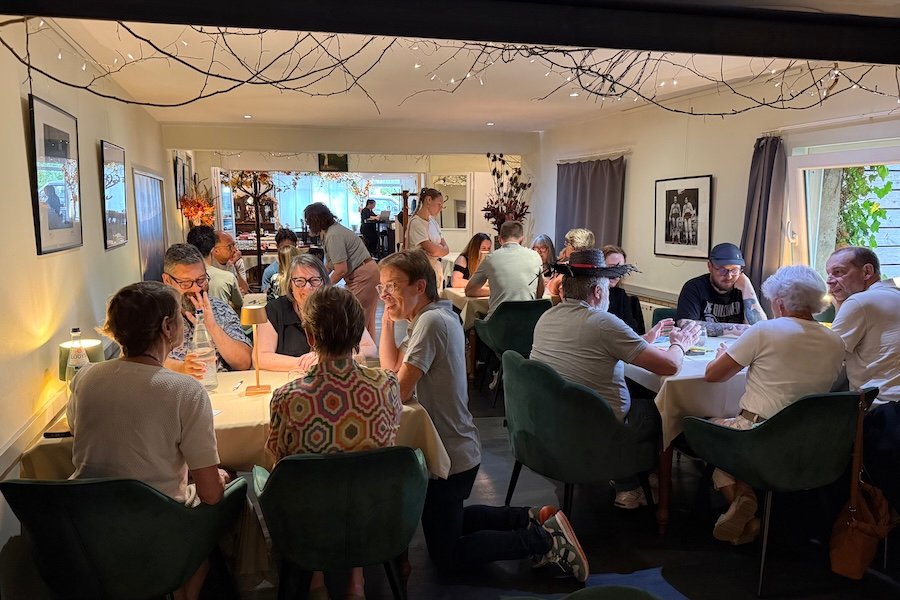
Luxembourg’s hospitality industry has named trick-taker Pili Pili as its board game of the year, continuing an eight-year initiative aimed at getting modern hobby games onto the tables of cafés, bars and restaurants.
Rather than solely recognising the best game of the year, the Bistrospill award is designed to encourage hospitality businesses to offer games for their customers to play, with the aim of reviving a tradition of cafés and bistros as spaces “buzzing with social life, where bonds were forged over a game of cards or dice”.
Bistrospill been run since 2018 by Horesca, Luxembourg’s association of hotels, restaurants and cafés, alongside the country’s biggest board game club Spillfabrik.
Horesca, which represents about 2,900 businesses, said it wants to re-establish tabletop gaming as a “vibrant part” of Luxembourg’s hospitality culture, harking back to the popularity of trick-taking games such as Whist and Belote in the 19th and early 20th century.
The organisation has persuaded cafés and bars to hold gaming afternoons and evenings, while participating businesses have been offered kits including posters, simplified rules, printed beer mats and suggestions for activities.
Its latest material also encourages hospitality businesses to keep a small selection of games available to customers, arguing that venues do not need to become dedicated board game cafés, and that a small shelf or clearly identified box of carefully chosen titles can be enough.
Spillfabrik is responsible for preselecting games suited to the bistro environment as part of the initiative, focusing on titles which are easy to explain, compact enough for café tables, playable by several people and sufficiently interactive to work in a social setting.
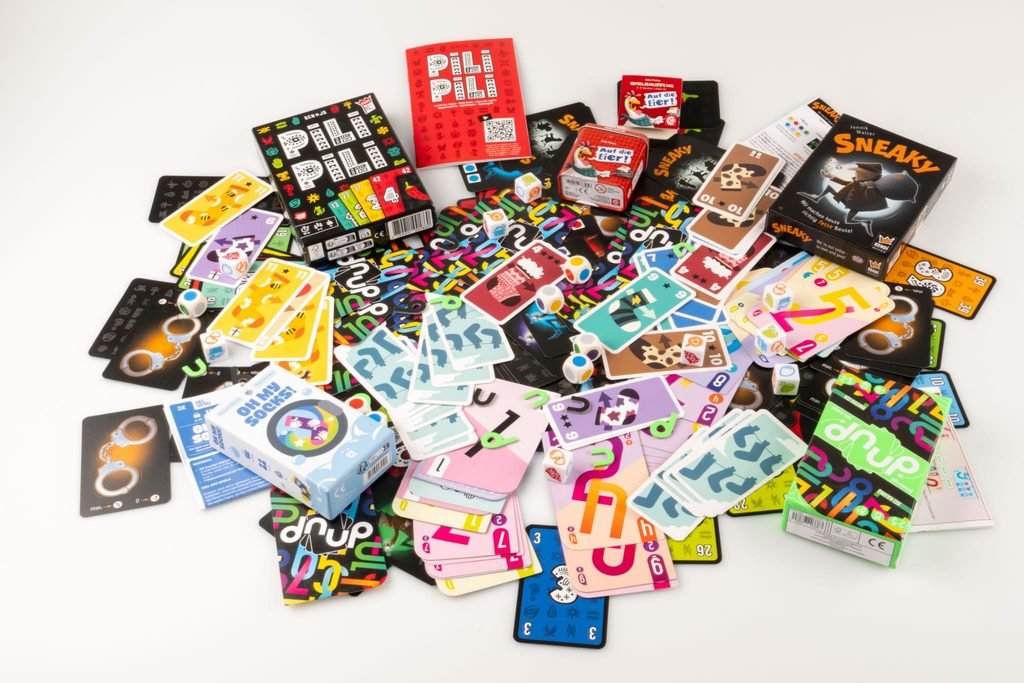
Publishers submitted 76 games for this year’s Bistrospill, with Spillfabrik whittling those down to five finalists – Udo Peise’s design Auf die Eier, Kei Kajino’s dnup, Antoine Bauza and Théo Rivière’s design Oh My Socks! and Sneaky, by Jannik Walter, as well as eventual winner Pili Pili.
Players predict how many tricks they will take each round, receiving penalties if they miss their target, while mission cards alter the rules as the game progresses.
The game’s roughly 20-minute playtime, compact card-based format and simple rules were among the elements highlighted by Bistrospill organisers as making Pili Pili particularly suited to cafés and bars.
Continuing along in this series devoted to the best looking boards found in the wargaming world where I will highlight the art and layout of a different board in a wargame that we have played to show you the various talents of the artists and graphic designers involved. In my humble opinion, a well designed and attractive board can make all the difference in the world to me enjoying a wargame. Don’t get me wrong, the game has to be good, but if it’s also good looking it always is a better experience. A board can draw me in. Can make me feel that I’m there. Can set the stage for the thematic immersion that we all crave. And I have found many of these type of boards and I want to make sure that I share them with you.
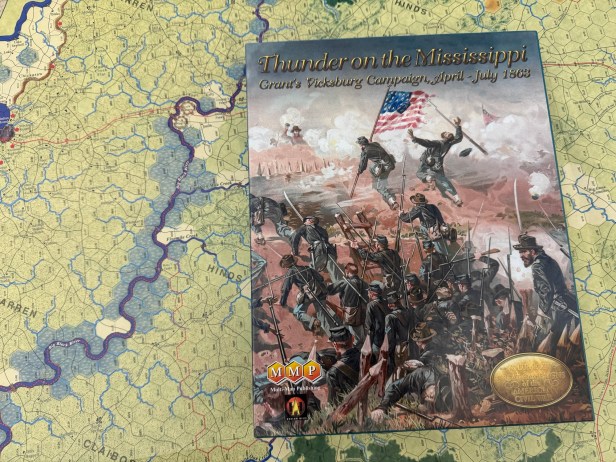
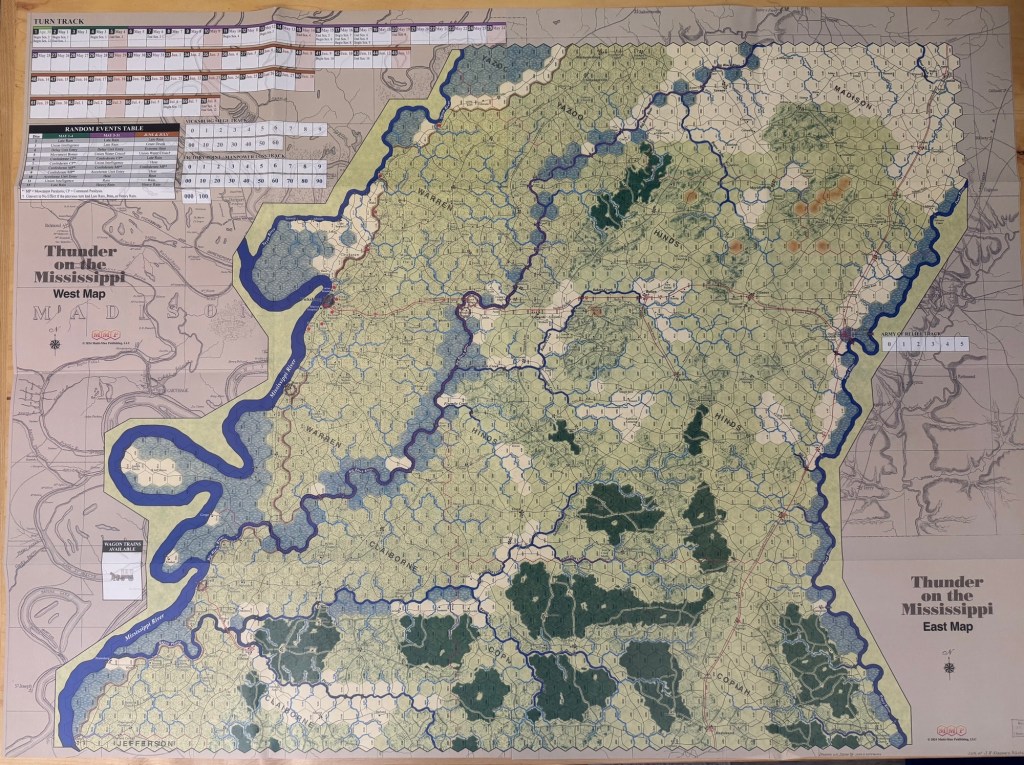
In this entry in the series, we will be taking a look at the fantastic looking board for Great Campaigns of the American Civil War: Thunder On the Mississippi: Grant’s Vicksburg Campaign, April-July, 1863 from Multi-Man Publishing. The board is illustrated by the very talented Charlie Kibler whose work on the Great Campaigns of the American Civil War Series dates back to its creation in 1992. He has done a ton of great looking boards including The Battle for Normandy (2009) from GMT Games, The Day Was Ours: First Bull Run (2021) from Revolution Games, Border Reivers (2023) from GMT Games recently as well as a slew of Advanced Squad Leader boards stretching back through the years and a lot of series games for GMT Games such as Great Battles of the American Civil War and Great Battles of the American Revolution. We have already highlighted a few of his boards in the past like Storm Over Jerusalem from MMP and Battles of the American Revolution Volume II: Brandywine from GMT Games. He is very effective at creating great looking terrain and weaving in very nice details to highlight the main functions of the board and I very much like the simplicity and accurateness of his boards.
The board consists of 2 separate 22″x 32″ full-color map sheets that when combined create a large playing surface. The borders of the board include off-board information that is related to the geography and locations in and around Vicksburg. When I first saw this, I wasn’t really quite sure how to take it but after playing and also thinking about this decision, I really like how it was used to frame up or provide a significant visual contrast to the main game board. The brown coloring really contrasts well with the colorful terrain features and create a clear distinction for the players. I initially thought this was a poor decision and felt that it was a missed opportunity but it works really well.
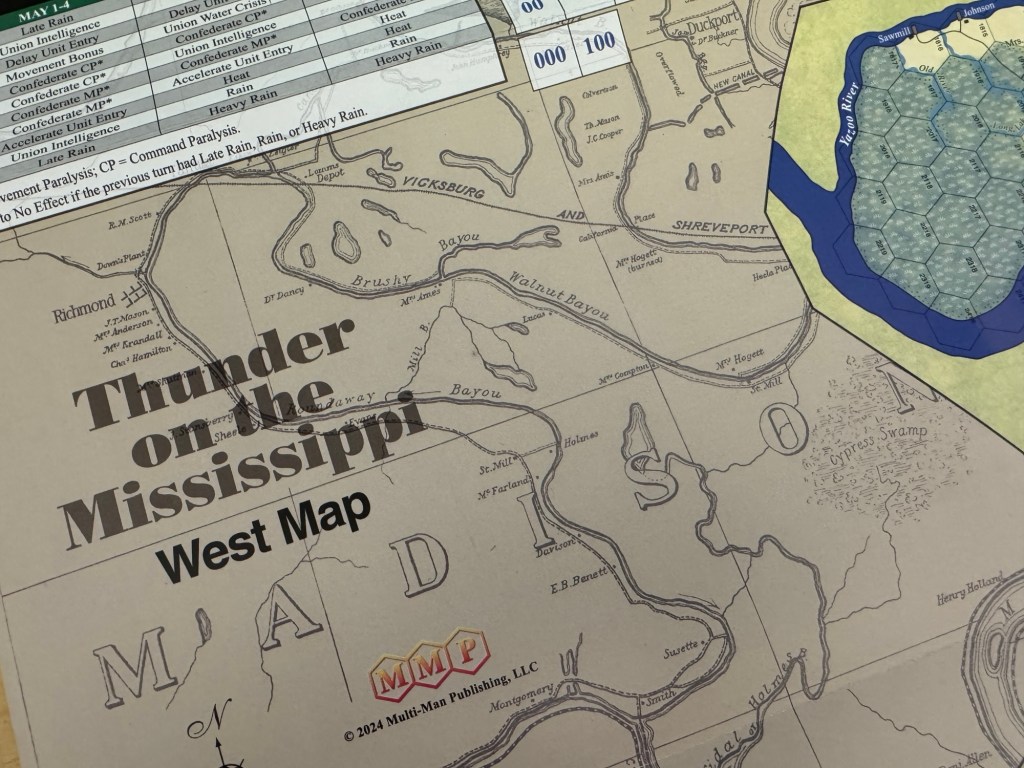
Here is a closeup of this part of the board so you can get a good feel for what I am talking about.
I always like to look at the game title box/area of the board and find these to be really great insights into the mindset and approach of the artist. On the board for Thunder on the Mississippi, we see Charlie used a washed out period look map for the background of this area. The really interesting part is how it transitions from the non-colored portion of the board title box to the game board itself. There is no connection between the 2 and the elements found on the board are not carried over or connected to the period map. I would maybe have liked to see there be a connection for an immersive approach but I understand that this was not the purpose of the use of the period map.
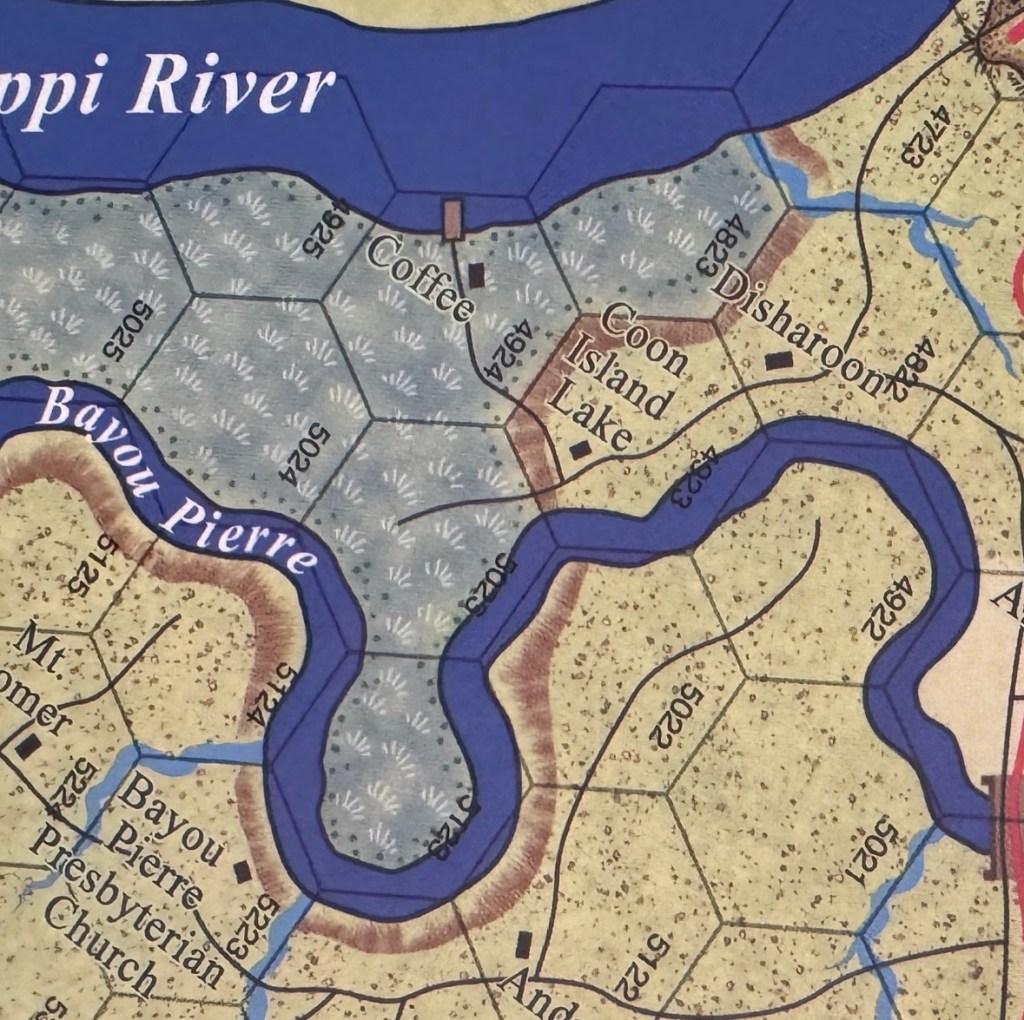
In Thunder on the Mississippi, there are 2 new terrain features unique to the Vicksburg region introduced including loess hills and coastal bluffs. Loess has not been featured before in GCACW Series games. Each loess hex is depicted with many small tan dots superimposed on an olive base color. This stippling gives it a sandy feel and I think really works well as loess is a fine-grained, powdery soil, a wide belt of which runs on the east side of the Mississippi on a southwest – northeast axis. Because loess is highly susceptible to erosion, it is marked by sharp, irregular ravines, many of which were so overgrown with vegetation as to be nearly impassable to military units.
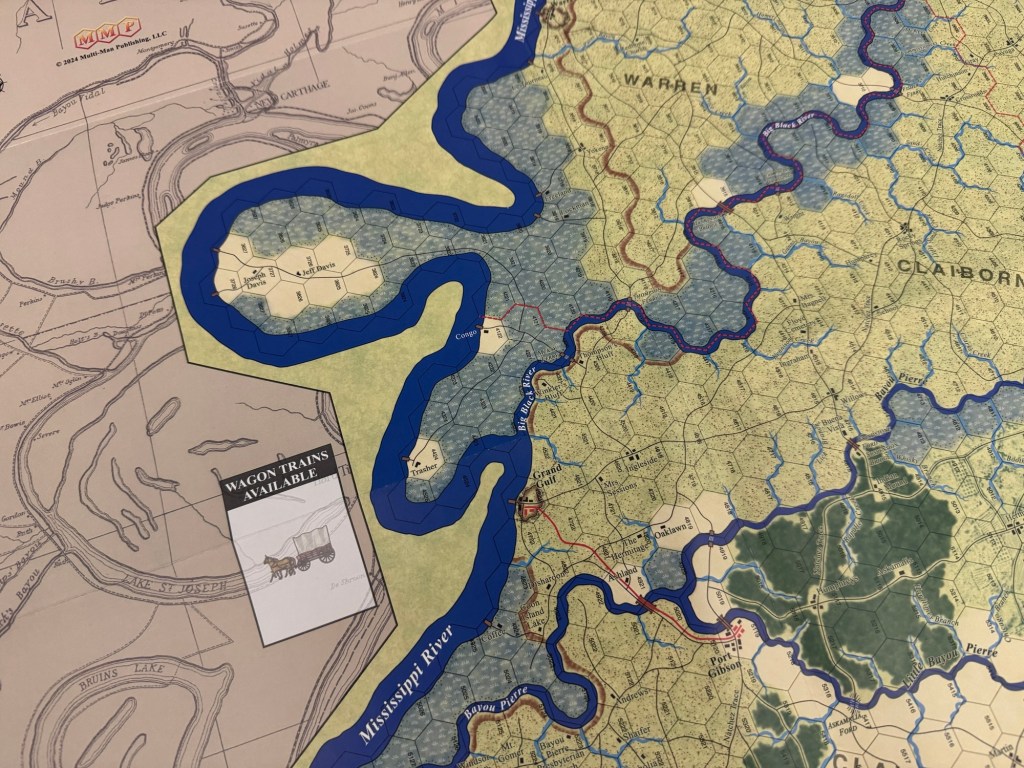
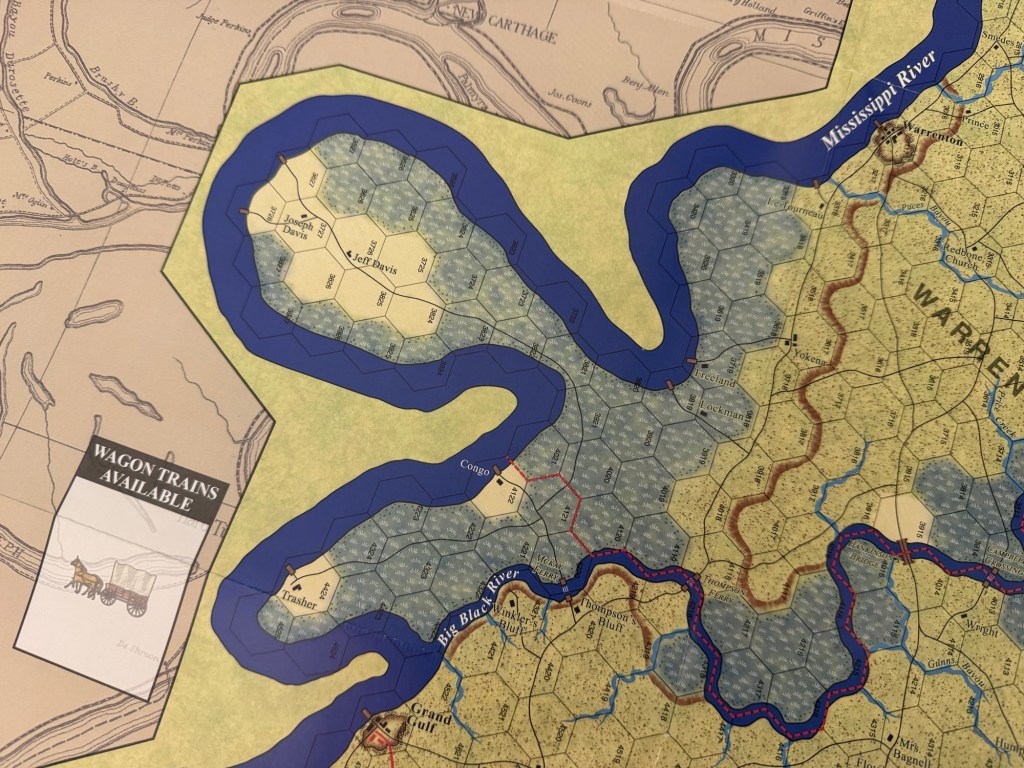
In the game, loess hexes are identical to woods hexes in terms of Movement Point costs and MP penalties to enter a friendly-occupied hex. Also, loess hexsides untraversed by roads or railroads exert a restricted ZOC the same as woods hexsides similarly untraversed. I think that the type of terrain, and what it does to the units that enter, really mimics the soft soil type as it is always hard to run in sand. I very much like the color used as well and it serves to set this specific terrain type apart from the rest of the board. Here is a look at the western portion of the West Map that is up against the Mississippi River.
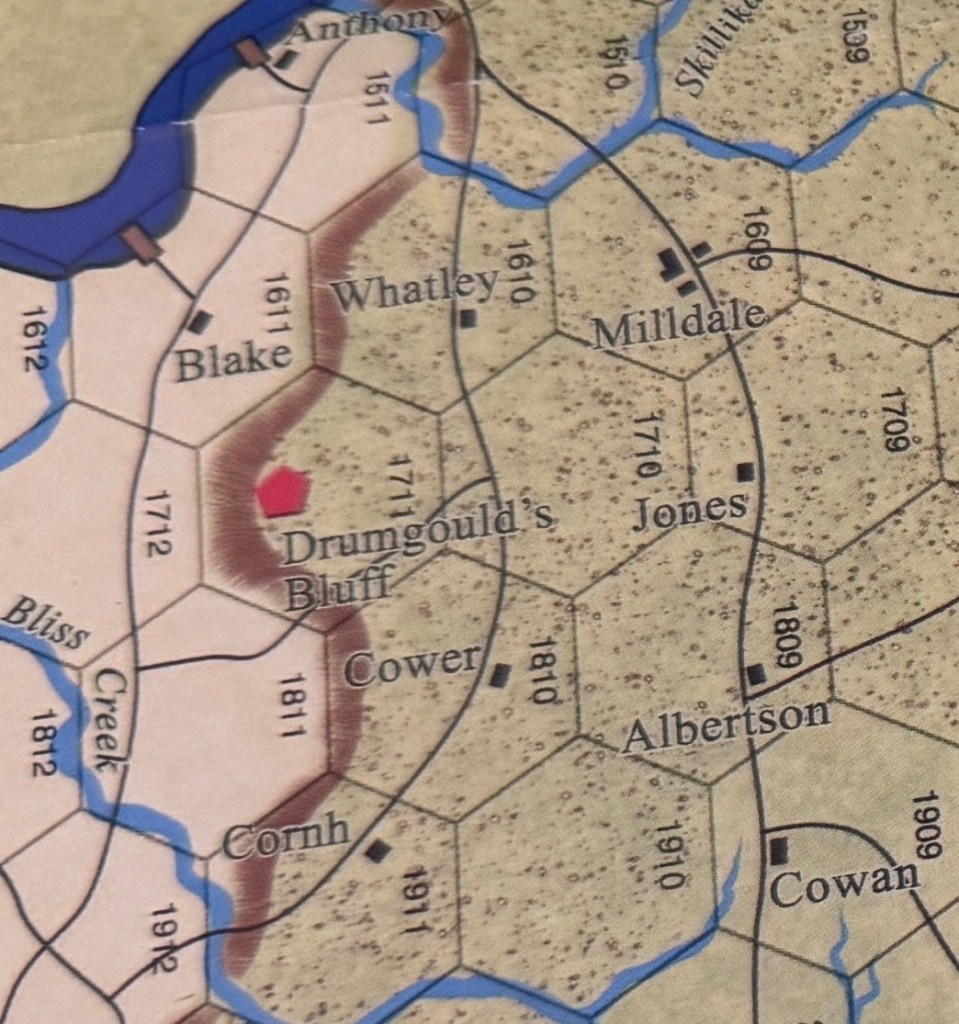
The other new terrain feature is that of coastal bluffs, which has also not been featured before in the series. Each coastal bluff hexside has a downhill side in which the light brown bluff line-pattern is uneven and an uphill side in which the bluff line-pattern is smooth. I know that it might be a bit hard to see in the below picture but the downhill side is found on the left side while the uphill side is on the right. Think of it this way…the uphill is simply a straight line border while the downhill side reflects the ravines from erosion and is made up of multi-length lines pointing out. I very much like this new terrain and also think that Charlie did a great job with the distinction even though it is a bit hard to distinguish from afar.
And that brings me to the portion of the board that I think is my favorite. Not because it is some revolutionary technique but because of the power and permanence that is offers the board, acting as an anchor and a framing of the action to be played out on it, and that is the Mississippi River itself. There is no real use of stylized marks or special features shown on the board but it is just a thick and dark blue line that meanders through the countryside. But the dark blue really gives a sense of size and scope and I very much feel that it is important to the board and what is to transpire on it.
I also very much like how Charlie decided to keep in the exact layout of the river and shows its many twists and turns and oxbows that are found along its length.
The board for Thunder on the Mississippi is really a visual masterpiece. It provides great transition from terrain type to terrain type, frames up the board itself very well and uses very smart and poignant color choices, including the loess terrain color and the dark blue of the Old Man, all to create a fantastic canvas upon which to play out this titanic struggle and key turning point of the American Civil War.
If you are interested, here is a link to our video review:
The next board that we will take a look at in the series is The Marianas Campaign: Volume One: Saipan – The Bloody Rock from Compass Games.
Here are links to the previous entries in the series:
Ein Ende kann auch ein Neuanfang sein. Nach dem Abwurf einer Atombombe auf Dresden im Jahr 1944 nehmen die Ereignisse bei Konflikt 47 einen anderen Verlauf für die Achsenmächte. Ein Geheimbund erhebt sich aus dem Hintergrund und die Nazis sind Geschichte. Es beginnt die Zeit des Grünen Gewölbes.
Es begann mit einer kleinen Gruppe, die ein schnelles und unkompliziertes Regelsystem schaffen wollte. Inzwischen ist OnePageRules mit acht Systemen und einer großen Auswahl an 3D-Modellen ein fester Bestandteil der Tabletop-Community. Mit Broken Truth wagt der bislang vor allem digital aufgestellte Hersteller den Schritt in die lokalen Hobbyläden.
The new era of well-designed automata and solo modes for multiplayer games, coupled with excellent new solo game designs, is actually quite heartening to someone (me!) who finds something very satisfying about physically playing a game: shuffling cards, moving pieces, … Continue reading →
Die zähen und brutalen Orks sammeln sich in riesigen Kriegsscharen und bekämpfen alles, was ihren Weg kreuzt. Diese Horden werden durch die Macht des Waaagh vereint. Mit dem neuen Codex können die Orks direkt in die 11. Edition von Warhammer 40.000 losziehen, um den*die nächstbeste*n Feind*in zu verklopp´n.
Der Begriff Deathmatch beschreibt im Videospielbereich Modi, in denen es vornehmlich um das Ausschalten möglichst vieler Gegenspielenden geht. Allein oder im Team wird gegeneinander angetreten und wird man selbst erwischt, ist es vorbei. Zumindest bis zum Respawn. NeverRealm Industry haben nun das finale Regelwerk ihres Skirmishers mit diesem Thema veröffentlicht.

 Anmelden

 Fertig bedrucktes Gelände spart Zeit, doch auf dem Schlachtfeld soll es auch optisch überzeugen. Micro Art Studio kombiniert im Imperial-II-Bundle klappbare Ruinen mit industriellen Anlagen und transparenten Kunststoffelementen. Wir haben das Gelände zusammengebaut und geprüft, wie gut sich das Set für die elfte Edition von Warhammer 40k eignet.
 Die Situation auf dem Planeten Shinju und seinem Mond kommt nicht zur Ruhe. Verdeckte Operationen, angezettelte Revolten und sonstige Konflikte sind an der Tagesordnung. Auch die in der Luft enthaltenen Nano-Bots und die feindselige Natur des Planeten tragen nicht zu einer Entspannung der Situation bei. Es bleibt dramatisch im Infinity-Universum.


 Beim Skirmisher Infinity von Corvus Belli geht es nicht um große Schlachten, sondern um kleine koordinierte Einsätze. Auch in der Regeledition N5 hat sich daran nichts geändert. Für diese Operationen sind besonders trainierte Spezialtruppen sehr gut geeignet. Mit dem neuen Regel-Update finden die Spec-Ops ihren Weg zurück in die Armeelisten.
 Vier Spielsysteme, ein gemeinsames Fundament. OnePageRules setzt auf überschaubare Grundregeln, die sich durch zahlreiche Sonderregeln und optionale Erweiterungen ergänzen lassen. Dabei bleibt den Spielenden selbst überlassen, wie umfangreich sie ihre Partien gestalten möchten. Wir schauen uns an, was hinter diesem Regelansatz steckt und welche Möglichkeiten er bietet.
 Römische Soldat*innen ziehen in die Wälder Germaniens und treffen dort auf einen Feind, gegen den ihre Ausbildung wenig hilft. Cohors Cthulhu: Tactics verbindet Miniaturengefechte mit einer fortlaufenden Kampagne für Solo- und kooperatives Spiel. Wir stellen vor, wie sich Kohorte, Gegnersteuerung und Held*innengeschichte im Regelbuch verzahnen.
 Was machen ein Elfenprinz und ein Haufen Red Caps zusammen in einer Gruppe bei Warcrow? Die neue narrative Kampagne will diese Frage beantworten. Im brandneuen Action Pack: Quest for Elfleen stellen sich General Nuada und seine Truppe aus goblinähnlichen Kreaturen, den Red Caps, jeder Konfrontation, um Nuadas Ziele zu erreichen.
 Neue Fälle, neue Mysterien und generell mehr vom Gleichen? Ein klares Jein. Nephews in Peril! Möchte mit seinen Sweeps Week Mysteries mehr als nur eine simple Erweiterung für das schrullige Cozy-Pen-and-Paper Brindlewood Bay sein. Ob dies auch gelingt, haben wir uns angesehen. Im verschlafenen Küstenstädtchen Brindlewood Bay wird es niemals langweilig. Zumindest nicht für die […]
 Der Zweite Weltkrieg hat sich festgefahren und die Atombombe soll die Wende für die United States bringen. Risse in der Realität waren dabei nicht eingeplant. Welche Macht aus diesen Rissen entweicht, ist zunächst nicht klar. Doch was sich dann ereignet, kann nur göttliche Fügung sein.
 Die neuen Battlehosts für das Middle-earth Strategy Battle Game sind da – und mit ihnen ein aktualisierter Quickstart Rules Guide. Doch wie viel vom Original steckt in den vereinfachten Regeln? Wir schauen uns die neuen Battlehosts und ihre Regeln genauer an und prüfen, ob der Einstieg damit wirklich gelingt.
 Micro Art Studio aus Polen wird nicht müde und liefert in seiner für das Spiel Bolt Action lizensierten Reihe vorbedruckte Gebäude aus MDF für einen weiteren Schauplatz des Zweiten Weltkrieges. Nach der frostigen Ostfront geht es dieses Mal in sonnigere Gefilde. Das Thema ist Italien.



 Ein Ende kann auch ein Neuanfang sein. Nach dem Abwurf einer Atombombe auf Dresden im Jahr 1944 nehmen die Ereignisse bei Konflikt 47 einen anderen Verlauf für die Achsenmächte. Ein Geheimbund erhebt sich aus dem Hintergrund und die Nazis sind Geschichte. Es beginnt die Zeit des Grünen Gewölbes.
 Es begann mit einer kleinen Gruppe, die ein schnelles und unkompliziertes Regelsystem schaffen wollte. Inzwischen ist OnePageRules mit acht Systemen und einer großen Auswahl an 3D-Modellen ein fester Bestandteil der Tabletop-Community. Mit Broken Truth wagt der bislang vor allem digital aufgestellte Hersteller den Schritt in die lokalen Hobbyläden.
 Die zähen und brutalen Orks sammeln sich in riesigen Kriegsscharen und bekämpfen alles, was ihren Weg kreuzt. Diese Horden werden durch die Macht des Waaagh vereint. Mit dem neuen Codex können die Orks direkt in die 11. Edition von Warhammer 40.000 losziehen, um den*die nächstbeste*n Feind*in zu verklopp´n.
 Der Begriff Deathmatch beschreibt im Videospielbereich Modi, in denen es vornehmlich um das Ausschalten möglichst vieler Gegenspielenden geht. Allein oder im Team wird gegeneinander angetreten und wird man selbst erwischt, ist es vorbei. Zumindest bis zum Respawn. NeverRealm Industry haben nun das finale Regelwerk ihres Skirmishers mit diesem Thema veröffentlicht.
