❌

Normale Ansicht

The Beautiful Boards of Wargaming! – Great Campaigns of the American Civil War: Thunder On the Mississippi: Grant’s Vicksburg Campaign, April-July, 1863 from Multi-Man Publishing

Von: Grant
23. September 2026 um 14:00

Continuing along in this series devoted to the best looking boards found in the wargaming world where I will highlight the art and layout of a different board in a wargame that we have played to show you the various talents of the artists and graphic designers involved. In my humble opinion, a well designed and attractive board can make all the difference in the world to me enjoying a wargame. Don’t get me wrong, the game has to be good, but if it’s also good looking it always is a better experience. A board can draw me in. Can make me feel that I’m there. Can set the stage for the thematic immersion that we all crave. And I have found many of these type of boards and I want to make sure that I share them with you.

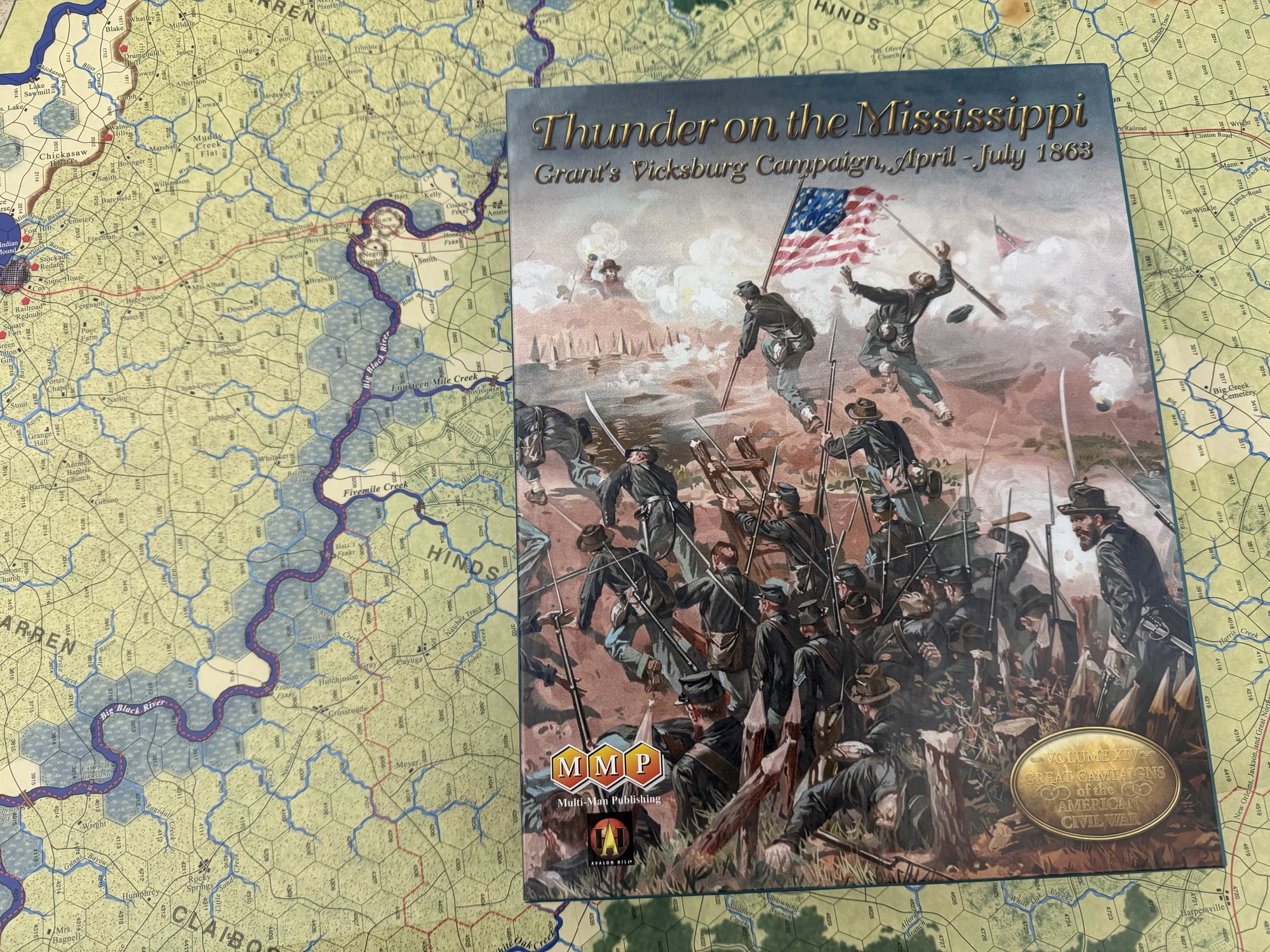
In this entry in the series, we will be taking a look at the fantastic looking board for Great Campaigns of the American Civil War: Thunder On the Mississippi: Grant’s Vicksburg Campaign, April-July, 1863 from Multi-Man Publishing. The board is illustrated by the very talented Charlie Kibler whose work on the Great Campaigns of the American Civil War Series dates back to its creation in 1992. He has done a ton of great looking boards including The Battle for Normandy (2009) from GMT Games, The Day Was Ours: First Bull Run (2021) from Revolution Games, Border Reivers (2023) from GMT Games recently as well as a slew of Advanced Squad Leader boards stretching back through the years and a lot of series games for GMT Games such as Great Battles of the American Civil War and Great Battles of the American Revolution. We have already highlighted a few of his boards in the past like Storm Over Jerusalem from MMP and Battles of the American Revolution Volume II: Brandywine from GMT Games. He is very effective at creating great looking terrain and weaving in very nice details to highlight the main functions of the board and I very much like the simplicity and accurateness of his boards.

The board consists of 2 separate 22″x 32″ full-color map sheets that when combined create a large playing surface. The borders of the board include off-board information that is related to the geography and locations in and around Vicksburg. When I first saw this, I wasn’t really quite sure how to take it but after playing and also thinking about this decision, I really like how it was used to frame up or provide a significant visual contrast to the main game board. The brown coloring really contrasts well with the colorful terrain features and create a clear distinction for the players. I initially thought this was a poor decision and felt that it was a missed opportunity but it works really well.

Here is a closeup of this part of the board so you can get a good feel for what I am talking about.

I always like to look at the game title box/area of the board and find these to be really great insights into the mindset and approach of the artist. On the board for Thunder on the Mississippi, we see Charlie used a washed out period look map for the background of this area. The really interesting part is how it transitions from the non-colored portion of the board title box to the game board itself. There is no connection between the 2 and the elements found on the board are not carried over or connected to the period map. I would maybe have liked to see there be a connection for an immersive approach but I understand that this was not the purpose of the use of the period map.

In Thunder on the Mississippi, there are 2 new terrain features unique to the Vicksburg region introduced including loess hills and coastal bluffs. Loess has not been featured before in GCACW Series games. Each loess hex is depicted with many small tan dots superimposed on an olive base color. This stippling gives it a sandy feel and I think really works well as loess is a fine-grained, powdery soil, a wide belt of which runs on the east side of the Mississippi on a southwest – northeast axis. Because loess is highly susceptible to erosion, it is marked by sharp, irregular ravines, many of which were so overgrown with vegetation as to be nearly impassable to military units.

In the game, loess hexes are identical to woods hexes in terms of Movement Point costs and MP penalties to enter a friendly-occupied hex. Also, loess hexsides untraversed by roads or railroads exert a restricted ZOC the same as woods hexsides similarly untraversed. I think that the type of terrain, and what it does to the units that enter, really mimics the soft soil type as it is always hard to run in sand. I very much like the color used as well and it serves to set this specific terrain type apart from the rest of the board. Here is a look at the western portion of the West Map that is up against the Mississippi River.

The other new terrain feature is that of coastal bluffs, which has also not been featured before in the series. Each coastal bluff hexside has a downhill side in which the light brown bluff line-pattern is uneven and an uphill side in which the bluff line-pattern is smooth. I know that it might be a bit hard to see in the below picture but the downhill side is found on the left side while the uphill side is on the right. Think of it this way…the uphill is simply a straight line border while the downhill side reflects the ravines from erosion and is made up of multi-length lines pointing out. I very much like this new terrain and also think that Charlie did a great job with the distinction even though it is a bit hard to distinguish from afar.

And that brings me to the portion of the board that I think is my favorite. Not because it is some revolutionary technique but because of the power and permanence that is offers the board, acting as an anchor and a framing of the action to be played out on it, and that is the Mississippi River itself. There is no real use of stylized marks or special features shown on the board but it is just a thick and dark blue line that meanders through the countryside. But the dark blue really gives a sense of size and scope and I very much feel that it is important to the board and what is to transpire on it.

I also very much like how Charlie decided to keep in the exact layout of the river and shows its many twists and turns and oxbows that are found along its length.

The board for Thunder on the Mississippi is really a visual masterpiece. It provides great transition from terrain type to terrain type, frames up the board itself very well and uses very smart and poignant color choices, including the loess terrain color and the dark blue of the Old Man, all to create a fantastic canvas upon which to play out this titanic struggle and key turning point of the American Civil War.

If you are interested, here is a link to our video review:

The next board that we will take a look at in the series is The Marianas Campaign: Volume One: Saipan – The Bloody Rock from Compass Games.

Here are links to the previous entries in the series:

Kekionga!: A Dark and Bloody Battleground, 1790 from High Flying Dice Games

Campaigns of 1777 in Strategy & Tactics Magazine #316 from Decision Games

Battle Hymn Volume 1: Gettysburg and Pea Ridge from Compass Games

From Salerno to Rome: World War II – The Italian Campaign, 1943-1944 from Dissimula Edizioni

This War Without an Enemy: The English Civil War 1642-1646 from Nuts! Publishing

Holland ‘44: Operation Market-Garden, September 1944 from GMT Games

Maori Wars: The New Zealand Land Wars, 1845-1872 from Legion Wargames

Imperial Struggle: The Global Rivalry – Britain & France 1697-1789 from GMT Games

Stilicho: Last of the Romans from Hollandspiele

Nevsky: Teutons and Rus in Collision, 1240-1242 from GMT Games

A Most Fearful Sacrifice: The Three Days of Gettysburg from Flying Pig Games

Donnerschlag: Escape from Stalingrad from VUCA Simulations

Keep Up the Fire!: The Boxer Rebellion Deluxe Edition from Worthington Publishing

Liberty or Death: The American Insurrection from GMT Games

Lanzerath Ridge: Battle of the Bulge from Dan Verssen Games

Salerno ’43: The Allied Invasion of Italy, September 1943 from GMT Games

Bayonets & Tomahawks: The French and Indian War from GMT Games

Undaunted: Normandy from Osprey Games

Traces of War from VUCA Simulations

SCS Ardennes II from Multi-Man Publishing

Almoravid: Reconquista and Riposte in Spain, 1085-1086 from GMT Games

Walking a Bloody Path: The Battle of Fallen Timbers, August 20, 1794 from High Flying Dice Games

All Bridges Burning: Red Revolt and White Guard in Finland, 1917-1918 from GMT Games

Storm Over Jerusalem: The Roman Siege from Multi-Man Publishing

Barbarians at the Gates, The Decline and Fall of the Western Roman Empire 337 – 476 from Compass Games

Iron, Blood, Snow & Mud from PHALANX

North Africa ’41: The Western Desert, March to December, 1941 from GMT Games

Battles of the American Revolution Volume II: Brandywine from GMT Games

Ardennes ’44: The Battle of the Bulge from GMT Games

Gandhi: The Decolonization of British India, 1917-1947 from GMT Games

Battles of Napoleon: Volume I – Eylau 1807 from Sound of Drums

Tattered Flags No. 01 – Into the Whirlpool from Blue Panther

Alliance: Multiplayer Napoleonic Wargame from Columbia Games

Phantom Fury: Iraq, November 9, 2004 The Second Battle for Fallujah 2nd Edition from Nuts! Publishing

Almost a Miracle!: The Revolutionary War in the North in Against the Odds Magazine #51 from LPS, Inc.

-Grant

Axis für Konflikt 47 – Manchmal kommen sie wieder (Fraktionsvorstellung)

20. September 2026 um 11:39

Ein Ende kann auch ein Neuanfang sein. Nach dem Abwurf einer Atombombe auf Dresden im Jahr 1944 nehmen die Ereignisse bei Konflikt 47 einen anderen Verlauf für die Achsenmächte. Ein Geheimbund erhebt sich aus dem Hintergrund und die Nazis sind Geschichte. Es beginnt die Zeit des Grünen Gewölbes.

Dieser Beitrag wurde von Dennis Rexin geschrieben

Truth Broken, Promise Kept – Das Grim Dark Future Starterset (Rezension)

19. September 2026 um 19:14

Es begann mit einer kleinen Gruppe, die ein schnelles und unkompliziertes Regelsystem schaffen wollte. Inzwischen ist OnePageRules mit acht Systemen und einer großen Auswahl an 3D-Modellen ein fester Bestandteil der Tabletop-Community. Mit Broken Truth wagt der bislang vor allem digital aufgestellte Hersteller den Schritt in die lokalen Hobbyläden.

Dieser Beitrag wurde von Geoffrey Förste geschrieben

Orkiges Know-Hau – Ork Kodex 11. Edition – (Rezension)

09. September 2026 um 09:00

OKH - BannerDie zähen und brutalen Orks sammeln sich in riesigen Kriegsscharen und bekämpfen alles, was ihren Weg kreuzt. Diese Horden werden durch die Macht des Waaagh vereint. Mit dem neuen Codex können die Orks direkt in die 11. Edition von Warhammer 40.000 losziehen, um den*die nächstbeste*n Feind*in zu verklopp´n.

Dieser Beitrag wurde von Konstantin Paessler geschrieben

Deathmatch Regelbuch – Schraube um Schraube (Rezension)

08. September 2026 um 09:00

Der Begriff Deathmatch beschreibt im Videospielbereich Modi, in denen es vornehmlich um das Ausschalten möglichst vieler Gegenspielenden geht. Allein oder im Team wird gegeneinander angetreten und wird man selbst erwischt, ist es vorbei. Zumindest bis zum Respawn. NeverRealm Industry haben nun das finale Regelwerk ihres Skirmishers mit diesem Thema veröffentlicht.

Dieser Beitrag wurde von Dennis Rexin geschrieben

Middle-earth Strategy Battle Game – neue Battlehosts für Rohan, Mirkwood und Dol Guldur (Vorschau)

03. September 2026 um 09:00

MESBG - BannerEs ist schon einige Zeit her, seit Games Workshop uns mit einer Battlehost-Box beglückt hat. Nun erhält Rohan endlich eine Aktualisierung, und als Überraschung legen die Entwickler gleich zwei weitere Battlehosts nach: Elben aus dem Düsterwald und die berüchtigten Jägerorks um Bolg.

Dieser Beitrag wurde von Nina Horbelt geschrieben

Discussion Thread: Zones of Control – How important are they to you in wargaming?

Von: Grant
26. August 2026 um 14:00

About a month ago, I started a new feature on the blog called Discussion Thread where I pose a question or a situation and seek your input and comments on the issue to gain greater understanding and to encourage thoughtful feedback. The response to the first post about In-Game Retribution was positive and there were a lot comments and opinions shared. I now wanted to do another post in the series but focus on the subject of Zones of Control and their importance in wargames.

A Zone of Control, typically referred to as ZOC, is the area immediately surrounding a military unit that exerts tactical influence over adjacent spaces, which in turn restricts enemy movement, closes up gaps in a line preventing enemy units from moving through, forces combat or triggers some sort of reactive action such as opportunity fire or engagement without the passive player needing to occupy those hexes or take any actions. They are designed to create some sort of resistance to enemy units as they approach. Mimicking real world combat and adding in this concept of awareness of enemy movement.

I think that everyone has an opinion on the subject of ZOC’s and these opinions are mixed regarding complexity, the type, being rigid or sticky, and their in-game effects, but there is a consensus that they simulate well the concept of military friction and holding frontline positions. Let’s take a quick look at the different types of ZOC’s and I will share my thoughts on each.

First up, is the rigid/locking ZOC where units must halt their movement the moment they enter a space where an enemy unit is exerting a Zone of Control. The ZOC in this case forces the moving unit to terminate its movement for that turn. I very much prefer these type of ZOC’s as I think that they really simulate the concept of prepared and even sometimes dug-in troops have the advantage and can force advancing units to stop trough interlocking fields of fire or heavy gun projection on the area such as off-board artillery.

Next, we have the soft ZOC where advancing enemy units can move through enemy ZOC influenced spaces, but suffer some sort of movement point penalties, attrition, or extra costs. I also really like this concept as it typically functions similarly to more rigid ZOC’s by costing a +2 or +3 movement cost which typically ends a units movement but not always. I have seen moving units have to take a step loss to take an extra move or more simply extra movement costs such as the placing of a disrupted marker or the like. This type really focuses on the pressures and cost of moving into and through these Zones of Control but are simpler than the more rigid variety.

Finally, I have seen more fluid ZOC’s such as when units can pass adjacent to enemies, but doing so might trigger attacks of opportunity or reactive fire at a disadvantage such as providing the units projecting the ZOC a positive DRM in their attacks or attacking with a column shift on the Combat Results Table. This concept is that moving or advancing units have less cover, less caution and open themselves up to attack more so than those that are forced to stop.

I think that all 3 of these types have their merits and downsides but their use typically depends on the situation represented in the design, the mindset or experience of the designer and the varying historical troop quality and fire power of the units. A line of tanks dug in is much more fearsome and demands a different level of respect in their ZOC projection than say a small arms squad of soldiers who do not have heavy weapons such as LMG’s. And I think that all are viable in design.

Then there is the lack of Zones of Control. I am not a fan of this concept at all but have found that it is typically used in more introductory wargames that are less complex and focuses on being less of a simulation than a traditional hex and counter affair. Many years ago, and at a time when we were still early in our wargame learning journey, I played a game called Paul Koenig’s Market-Garden: Arnhem Bridge from Victory Point Games. I think that I was attracted to it because of the subject of Market-Garden and the inclusion of Allied airborne units. In looking at the game, the main focus and goal is to move toward the bridge and capture it. The path to move to the bridge is through fairly dense urban hexes with a road leading right to the on-ramps.

Strategically, a German commander would have lined the streets with their best units to prevent the enemy from simply riding right down the middle of the street to the bridge. This commander would have given orders to fire on anything approaching and would have had reserve units located in the buildings to the left and right of the streets to prevent small unit interdiction through the back alleys. These units would have taken up positions to bring heavy fire upon any approach hex and this is typically simulated in other games through the use of a Zone of Control. This ZOC would typically cause advancing units to stop while taking fire from an adjacent unit but in this design, the units just kind of ride on by, waving to the nasty MG-42 nests on the 2nd floor of the buildings and blowing kisses to the Panzers hidden in or behind the piles of rubble!

In reviewing the history of the campaign, one of the major problems the British had in advancing on the bridge was that relatively small German forces had taken up positions in the woods and on the outskirts of the city and effectively pinned down most of the advance of British forces toward Arnhem. This, in my opinion, is a major design flaw and should be house-ruled or cause a redesign of an otherwise fun and good playing game. I have illustrated this point with the pictures below where the British 4-6 Infantry unit simply moves right down the street between 4 better groups of units (an 8-9 Tank, three 6-8 Mobile Infantry and a crack 6-6 SS unit) without taking fire or being stopped! Seems silly doesn’t it?!?

I really tend to prefer the sticky/rigid/locking Zones of Control that seem to be found in most of the hex and counter wargames we play. I am more ok with the less restrictive soft or fluid ZOC’s in a tactical wargame where I can hold actions to then inflict opportunity fire on advancing units. But, as I said before, once you introduce the big guns in the form or tanks or heavy artillery, I really like the sticky/rigid/locking Zones of Control. Is this a taste thing or am I in the minority?

So what are your thoughts on the importance of Zones of Control? Can you enjoy and play a game that doesn’t have them? What is your preference in their stickiness/level of exerted influence in a game? What games do them best? Thanks for reading and for sharing your thoughts. I will come up with a few more of these posts over the next few months to share and I hope to see lots of comments and reaction.

-Grant

Neuheiten der Orks – Rezykling für wummenvaliebte Angeba – (Rezension)

22. August 2026 um 09:30

Orks sind gewalttätige, grünhäutige Xenos, die Stärke, Lärm und Geschwindigkeit lieben. Im Warhammer 40.000-Universum sind sie eine der ältesten und beliebtesten Fraktionen. Das liegt zum einen an ihrem ikonischen Erscheinungsbild, zum anderen an ihrem satirischen, anarchistischen Hintergrund. Mit Beginn der 11. Edition bekommen diesmal zuerst die Orks das neue Dakkazeug.

Dieser Beitrag wurde von Konstantin Paessler geschrieben

Infinity Hexadome Legends – Zurück in der Arena (Rezension)

14. August 2026 um 14:27

Im Infinity-Universum herrschen keine offenen Kriege. Es geht um verdeckte Operationen und lokale Schlagabtausche. In der zivilen Welt nehmen die Dinge also ihren gewohnten Lauf und es bleibt Zeit für Zerstreuung, wie zum Beispiel den blutigen Sport Aristeia. Mit Infinity Hexadome Legends erscheint nun eine überarbeitete Fassung der Brettspiel-Auskopplung.

Dieser Beitrag wurde von Dennis Rexin geschrieben

Nachhaltigkeit im Tabletop: Zwischen grünen Gussrahmen und grauen Armeen

14. August 2026 um 09:00

Artikelbild-TabletopNachhaltigkeit im Tabletop beginnt bei Material, Produktion und Transport, endet aber längst nicht am Maltisch. Seit 2021 verkleinern Verlage ihre Verpackungen, Hersteller sammeln Gussrahmen und veröffentlichen erste Klimadaten. Wie belastbar sind diese Fortschritte, und wo wird das Problem bislang lediglich neu verpackt?

Dieser Beitrag wurde von Roger Lewin geschrieben

The Old World: Krieger des Chaos – Bastelstunde mit dem Drachen (Rezension)

13. August 2026 um 09:00

KdC - TitelDie Chaosbarbaren haben bereits letztes Jahr die alte Welt ein wenig erschüttert. Jetzt wird nachgelegt mit den Kriegern des Chaos. Eine weitere Welle von Neuerscheinungen steht an. Wir haben uns angeschaut, was Games Workshop angekündigt hat. Sind die Krieger des Chaos weiterhin eine ernstzunehmende Bedrohung auf dem Schlachtfeld?

Dieser Beitrag wurde von Nina Horbelt geschrieben

Mounthaven Gelände für Warcrow – Zwergenhandwerk (Rezension)

08. August 2026 um 11:00

Egal in welchem Universum, die Zwerge sind bekannt für ihr handwerkliches Geschick, egal ob Techniker, Steinmetze oder Schmiede. Auch bei Warcrow ist die Nation von Mounthaven keine Ausnahme. Micro Art Studio bieten in ihrer Pre-Painted-Reihe nun passendes Gelände aus MDF an, das eines Zwergenbaumeisters würdig ist.

Dieser Beitrag wurde von Dennis Rexin geschrieben

NEWS: Infinity Hexadome Legends angekündigt

09. Juli 2026 um 15:46

Aristeia ist die blutige Unterhaltungssportart im Infinity-Universum. Kämpfer*innen, Aristos genannt, treten in einer Arena gegeneinander an. Todesfälle kommen vor, doch dank der Cube-Technologie kann ihr Bewusstsein in einen neuen Körper übertragen werden. Mit Infinity Hexadome Legends gehen Corvus Belli nun mit der zweiten Edition des Brettspieles an den Start. Auch in der nicht allzu fernen […]

Dieser Beitrag wurde von Roger Lewin geschrieben

Middle-earth Strategy Battle Game – Neuigkeiten aus Rohan (Kurzcheck)

06. Juli 2026 um 09:00

Die Pferdeherren bekommen nach über 20 Jahren endlich neue Modelle für die zentrale Einheit der Fraktion: die Reiter. Grund genug, nicht nur die neuen Modelle einmal genau unter die Lupe zu nehmen. Wir schauen uns die gesamte Armee von Rohan an – mit allen Vor- und Nachteilen.

Dieser Beitrag wurde von Nina Horbelt geschrieben

The Old World: Grundset – Chaos im Reich der Groß-Cathay (Kurzcheck)

05. Juli 2026 um 12:11

Warhammer: The Old World bekommt endlich ein Grundset für zwei Spielende. Und dazu noch eine sehr spannende Kombination aus dem Großkaiserreich Cathay und den Kriegern des Chaos. Wir werfen für euch einen kurzen Blick in die große Box und zeigen euch, was euch alles erwartet.

Dieser Beitrag wurde von Nina Horbelt geschrieben

Wölfer & Braun Miniaturenpinsel – No Animals were harmed (Rezension)

22. Juni 2026 um 14:58

Beim Miniaturenmalen gilt schon immer, dass gute Pinsel aus Kolinsky-Haaren gefertigt sein müssen. Pinsel aus Synthetik-Haaren haben den Ruf, nur eine günstige Alternative für Anfänger*innen oder für Arbeiten, unter denen die Pinsel leiden, zu sein. Seit einiger Zeit gibt es ein Umdenken und Wölfer & Braun stoßen in diese Lücke.

Dieser Beitrag wurde von Dennis Rexin geschrieben

Konflikt 47 Starter Set – Kein Krieg, sondern das Ende (Rezension)

21. Juni 2026 um 11:00

Die Welt liegt in Trümmern. Der Zweite Weltkrieg dauert nun schon acht Jahre an und ein Ende ist nicht in Sicht. Die Kriegsparteien entwickeln immer neue und noch zerstörerischere Waffen und die Entdeckung der Rift-Technologie macht die Sache auch nicht besser. Willkommen in der Welt von Konflikt 47.

Dieser Beitrag wurde von Dennis Rexin geschrieben

❌