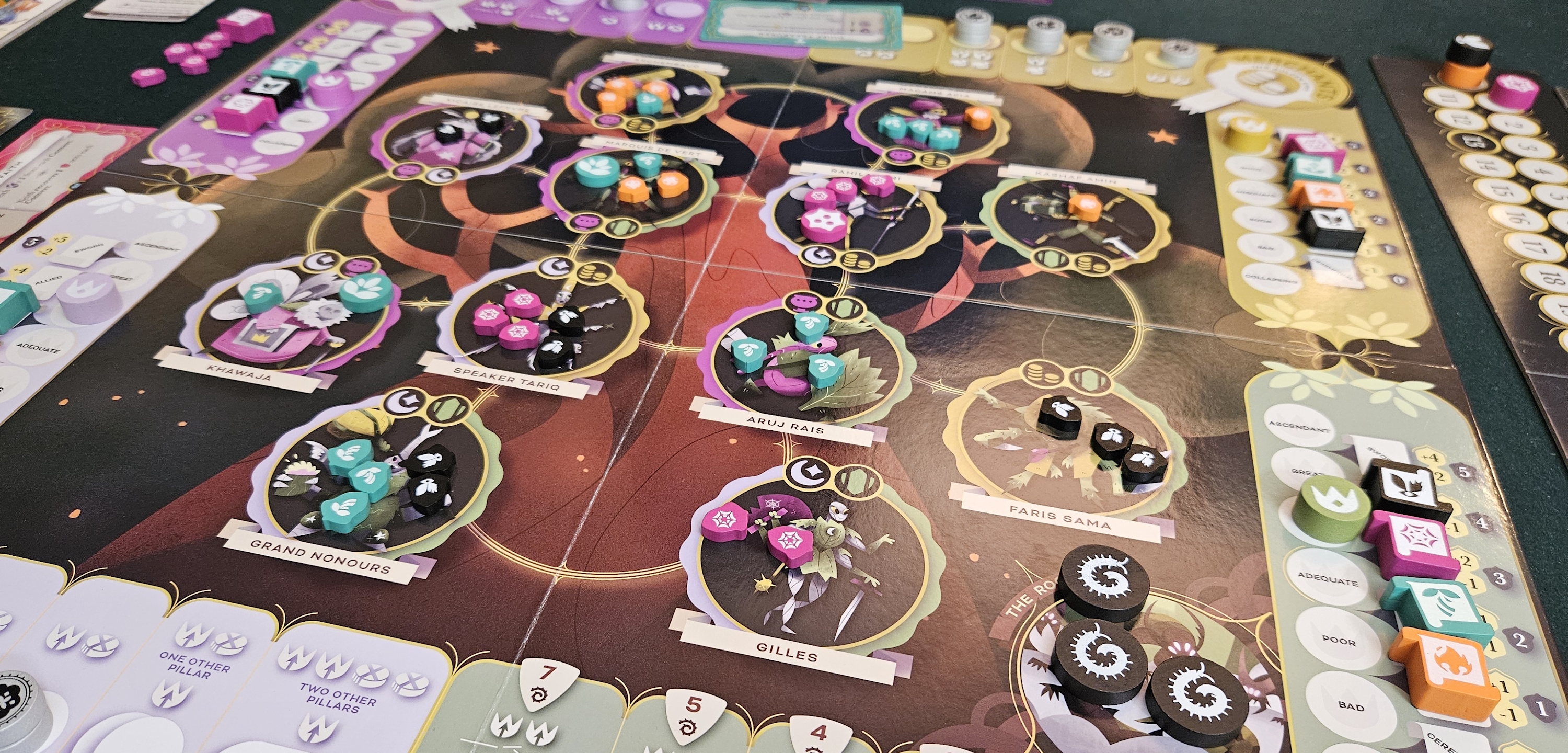
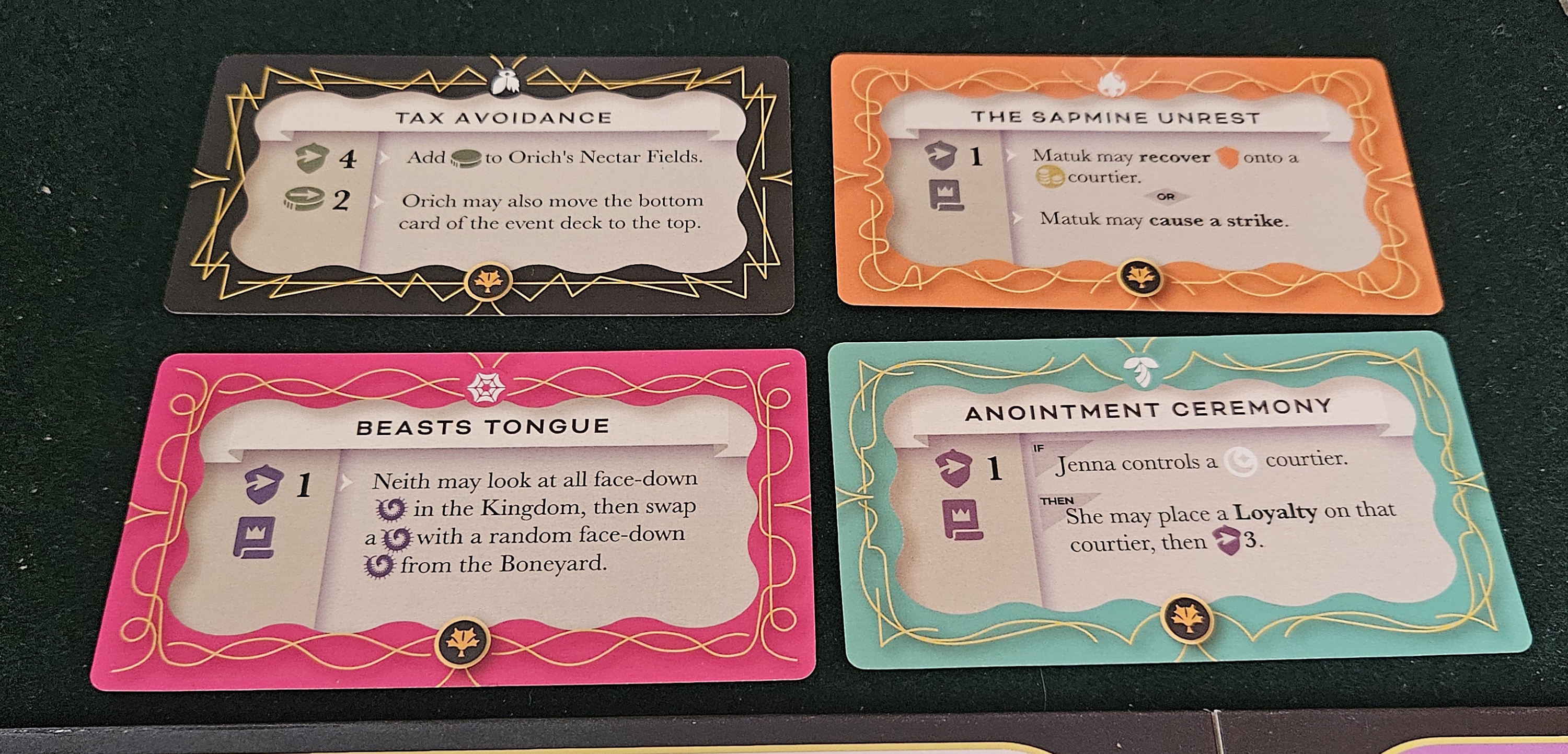
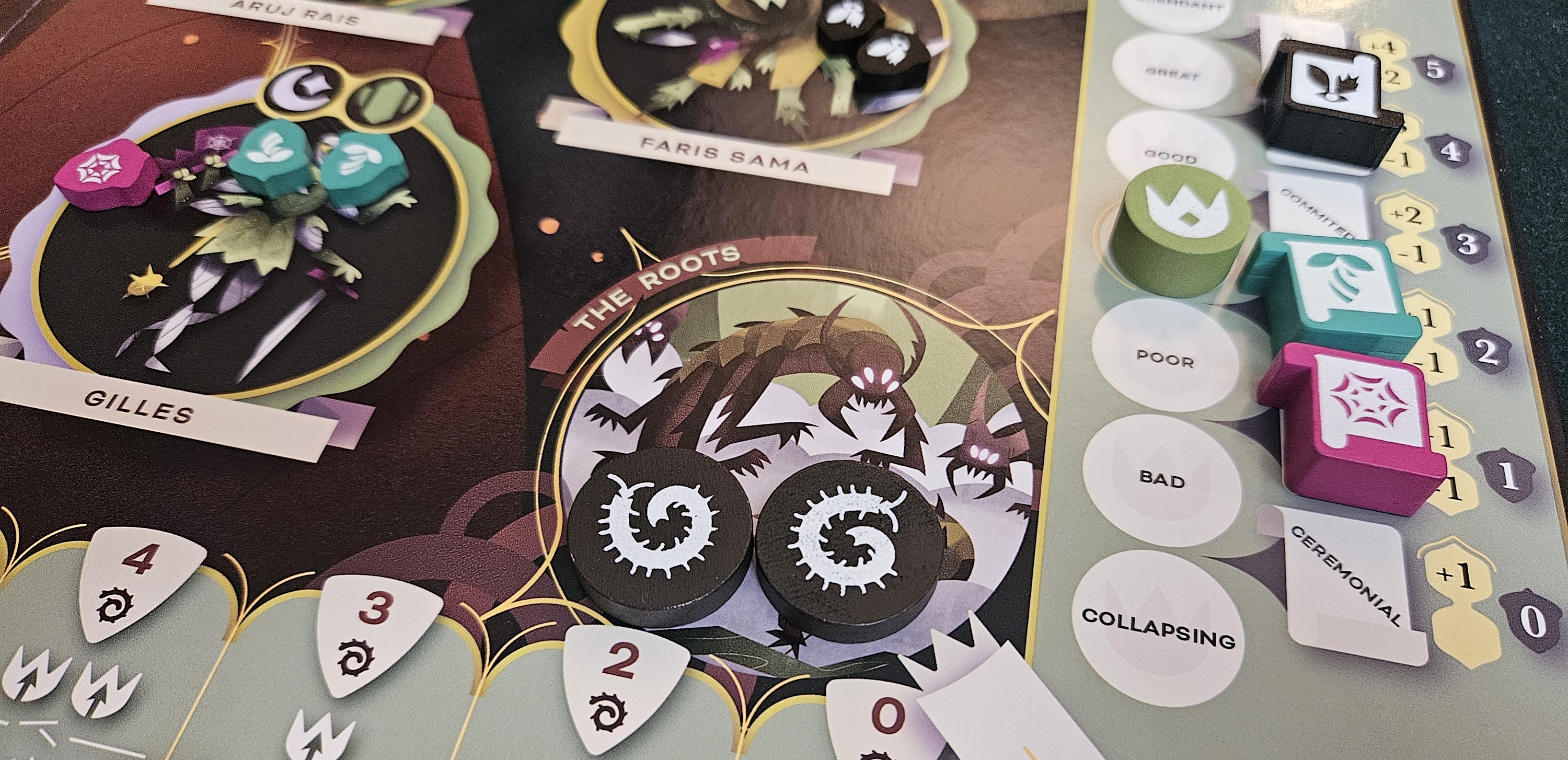
❌

Lese-Ansicht

Woodrow Wilson (Presidential Ratings, #5)

We’ve been assessing the merits of political leaders in (more or less) democratic countries, illustrated by a single board game each, on this blog for a few years now. Today’s subject is another US president – domestic reformer turned foreign policy prophet Woodrow Wilson. And which game could be more appropriate for him than Versailles 1919 (Geoff Engelstein/Mark Herman, GMT Games)?

If you want to read more ratings of historical leaders like this, I strongly recommend you subscribe to the blog – all new posts in your inbox right when they go live!

The Rating System

Some caveats ahead: The presidents will be rated by the knowledge of their time. If they or their contemporaries could not have known about the effects of something, I will not use my hindsight to mark it as a mistake of theirs. The assessment is focused on their conduct as president, but includes their life after holding the office (in which they will still be regarded in the public eye as (ex-)presidents).

Now, to the system itself: There are three policy field categories (foreign, domestic, and economic policy) and three more general ones (vision, pragmatism, integrity). A president can earn from one to five stars in each category (for a total sum of up to 30). In detail, the president is assessed as follows:

Foreign policy: Did the president increase US influence in the world and the security of Americans at home? Did the president wield US power responsibly and with positive results for the regions affected (the latter counting for a greater deal in times of US power being great)?

Domestic policy: Did the president increase the liberty of Americans to express themselves and to participate in the political process? Did the president promote domestic security and shape the framework for fair justice dealing with offenses?

Economic policy: Did the president facilitate the prosperity and economic security of Americans (including in the mid- and long-term)? Was the president’s economic policy based on mutual benefit of those involved or did it unduly burden one side?

Vision: Did the president have an idea of what the United States and the world (the latter counting for more in times of US influence being great) should look like beyond the immediate future? Did the president’s policies steer the United States (and, if applicable, the world) in this direction?

Pragmatism: Did the president succeed in seeing his policy through from inception to completion? How well did the president manage the support from Congress, society, the administration, the media (the latter counting for more in more recent years)?

Integrity: Did the president understand the office as a means to benefit himself, special interest groups, the entire country, or another community? Did the president respect the boundaries of the office?

Wilson’s Life

Receiving and Providing Education

Thomas Woodrow Wilson was born on December 28, 1856 as the son of a Presbyterian pastor in Staunton, Virginia. Wilson grew up in several states of the American South before, during, and after the Civil War. He would be the only American president who had been a citizen of the Confederacy.

Wilson became a lawyer, but found it not to his liking. Instead, he pursued graduate studies in political science with a dissertation on Congressional government at Johns Hopkins University. His PhD, awarded in 1886, makes him to this day the only US president with such an academic distinction. Even though Wilson had never bothered to take a trip from Baltimore to Washington, D.C., to see the object of his study in action, his dissertation was well received. Atypically for a southerner, he advocated for a strong federal government. At the end of his graduate studies, Wilson married Ellen Louise Axson, who came from a southern clergy family like himself.

Wilson’s academic career led him to teach at several universities. Eventually, he became president of Princeton University in 1902. He took the university out of the grip of Presbyterian traditionalists, appointed the first Catholic and Jewish professors, but worked vigorously against the enrolment of Black students. Wilson turned Princeton into one of America’s leading teaching and research institutions, fueled by the large contributions of outside donors which he attracted. At the same time, Wilson advocated – in often fiery rhetoric – for the independence of the university; a contradiction he could never resolve. Both his administrative reforms and his powerful oratory aroused interest in him political circles; and Wilson put out feelers to the Democratic Party.

To the Presidency

The Democrats, perennially shut out of national office since the Civil War, were in dire need of fresh candidates. Wilson seemed like an ideal fit to party bosses due to his reputation as a natural conservative with progressive credentials. He ran for governor of New Jersey in 1910 and was the first Democrat to be elected to the office in 18 years.

Woodrow Wilson was consistent in his support for labor reforms.

Anyone who believed Wilson to be a conservative at heart was swiftly disabused of the notion once he took office. He directed his energy to labor, electoral, and education reform. Within his first two years in office, Wilson had gained nationwide fame as a progressive leader.

That made him a contender for the 1912 presidential election. His campaign was ably run by the Texas businessman Edward M. House, and Wilson entered the 1912 Democratic National Convention second only to Speaker of the House James “Champ” Clark. When Clark gained the support of New York’s Tammany Hall political machine, that threw the liberal wing of the party, led by three-time presidential nominee William Jennings Bryan, into Wilson’s arms. Wilson gained his party’s nomination and went on to run against a split Republican Party in the general election: Incumbent president William H. Taft represented the party’s conservative wing, former president Theodore Roosevelt mounted a progressive challenge. As the Republican vote split, Wilson’s 42% of the popular vote were enough to give him a landslide victory in the electoral college.

Edward M. House ran Wilson’s election campaign, would conduct European diplomacy on Wilson’s behalf during and after World War I. He took great liberties in his diplomatic assignments and would be summarily sacked.

Reforms and Interventions

Wilson started the presidency where he had left off the governorship – with an ambitious domestic reform program. To clinch the reforms, he broke with the tradition that separated the executive and legislative branches of the American government: Wilson was the first president to appear before Congress since John Adams, a precedent which has since become standard practice. In another momentous move, Wilson focused his efforts to build legislative majorities on mobilizing his own party (which held both the Senate and the House), ignoring the Republican opposition. With these measures, Wilson enacted far-reaching economic reforms:

  • He replaced tariffs with a federal income tax as the chief source of federal revenue.
  • He established the Federal Reserve system to stabilize the heretofore decentralized, fragile American finance world.
  • His Antitrust Act clarified that unions and collective bargaining did not constitute a breach of freedom of contract.

Other Wilsonian reforms were less progressive: Wilson introduced segregation in several federal institutions including the Navy Department and the Post Office.

The worst imaginable day for Woodrow Wilson: Having to speak not one, but two people of color with opinions!

Wilson’s belief in a racial hierarchy also carried over into his foreign policy. During his presidency, the United States intervened in Mexico (twice), Nicaragua, the Dominican Republic, and Haiti (where a new constitution imposed on the country reintroduced the forced labor of corvée). The most momentous of these interventions took place in Mexico, where a US-backed coup had brought the authoritarian Victoriano Huerta to the presidency shortly before Wilson’s own accession to power. Wilson opposed Huerta and first imposed an arms embargo on Mexico, then landed forces in the Mexican port of Veracruz. The intervention did not shift the political situation in Mexico, and US forces left Veracruz after seven months of occupation in November 1914.

Wilson’s rhetoric accompanying the intervention was based on lofty principles, but he applied them rather flexibly: He argued both for imposing and for lifting the arms embargo with the “standards of neutrality”; and he justified both beginning and ending the intervention on moral grounds – the former with his commitment to constitutional government, the latter with Mexico’s right to national self-determination.

Self-determination – easy to define in the Americas (no intervention in other countries’ domestic affairs), but a thorny issue in the often ethnically diverse European countries at the Versailles peace negotiations.

Neutrality, Honor, and Prosperity

While the United States had been busy in Mexico, a much bigger conflict had erupted in Europe – the Great War. Over the next years, Wilson pursued a course which would allow the United States to maintain three competing objectives – neutrality, honor, and prosperity.

Wilson was driven by an honest desire to keep the United States out of the war. That did not mean that he was indifferent to its outcome. His sympathies lay clearly with the Allies. Every few months, his administration launched a peace initiative which would invariably come to nothing as they demanded very different things from the belligerents: The Allies were given the idea that Wilson wanted them to win victories before a peace should be negotiated, the Central Powers presented with unacceptable demands (like the cession of Alsace-Lorraine from Germany to France as a precondition for a peace conference).

Honor was an even trickier business than neutrality. Wilson demanded that the belligerent parties adhered to the London Declaration concerning the Laws of Naval War (which none of them had ratified), but in practice complied with the British violations of the Declaration – the harassment of neutral (including American) trade and the blockade of the German coast – while he denounced the German violations – submarine warfare. When a German submarine sunk the British ocean liner Lusitania shortly before it arrived in Liverpool with its cargo of ammunition for the Western front as well as over a thousand passengers – 128 of them American citizens – Wilson was outraged. He declared in a note to the German government that he would hold Germany responsible for any damages to American citizens and property. Secretary of State William Jennings Bryan resigned after the incident, believing Wilson endangered American neutrality with his hardline insistence on German (but not British) respect for trade rights.

“Global Trade” is a mildly isolationist strategy card in Versailles 1919: You focus on industrial growth (icon to the left), your own national happiness (third icon from the left), and try to not have the world blow up (bonus for regions with low unrest, icon to the right).

That brings us the third leg on which Wilson’s stool rested: While he never mentioned prosperity (much unlike neutrality and honor), it was a major motive for his wartime policies. In August 1914, Wilson had publicly opposed bonds for the Allies to be raised by American banks, but when the banks started issuing them, he did not contest it. Consequently, the American economy was effectively mobilized for the Allied cause: US goods were bought with money from US bonds. Allied victory thus became a national interest for the United States to see the bonds repaid.

In the short term, Wilsons’s hard line was successful. He forced Germany to comply with his notions of naval law while the American economy boomed from the war trade to the Allies. America reaped all the benefits of the war at none of the costs.

That made Wilson a strong contender for re-election in 1916. The Democratic Party touted his foreign policy success with “He Kept Us Out of the War” (a slogan which had been adopted without consulting Wilson). Still, Wilson’s main advantage of 1912 – the split Republican field – had evaporated. To beat his Republican opponent Charles Evans Hughes, he had to make inroads in states where Democrats had not fared well over the last decades. As Wilson feared that the new women voters in many of the western and midwestern states might take objection to his marriage to Edith Bolling Galt – just a year after his first wife Ellen had died – he tried to balance it out with publicly supporting women’s suffrage. While we do not have electoral statistics by gender for 1916, Wilson’s strong showing (for a Democrat) in the West and Midwest indicates that his strategy worked. In the end, Wilson’s victory in California by the hair’s breadth of 3,773 voters decided the presidential contest in his favor.

Women’s suffrage remained in the waiting room for a long time thanks to Wilson.

Into the War

In Wilson’s second term, his three-way balancing act between neutrality, honor, and prosperity became ever more precarious. One of them had to give – and the most likely candidate seemed neutrality, whose meaning Wilson had stretched beyond recognition anyway. Ironically, that happened just as Wilson made his first attempt to put pressure on the Allies (by withholding bonds if they did not agree to a peace conference).

Germany, unaware of any rifts between the US and the Allies, played the elephant in the diplomatic China shop again in January 1917: The German Foreign Secretary Arthur Zimmermann secretly instructed the German embassy in Mexico to sound out the Mexicans for an alliance in case the United States entered the war. Two weeks later, Germany resumed unrestricted submarine warfare in the British home waters again. Wilson felt he could not honorably back down from his hardline position of American trade and travel rights which he had taken in 1915, and broke off all diplomatic relations to Germany. A few days later, British naval intelligence relayed the contents of the “Zimmermann Telegram” to Wilson. Its release helped inflame American public opinion against Germany, but the essential decision had been made already: America would enter the war as an “associated power” on the Allied side. Congress voted in favor of a declaration of war at Wilson’s request on April 6, 1917.

Militarily, the United States was a dwarf in 1917. Safe itself due to large oceans and weak neighbors, its armed forces had been minuscule since the end of the Civil War. Expanding and training them would take time. And economically, the awesome might of America had been mobilized for the Allied cause anyway. Thus, the American war entry mattered little for the course of the war in the short term.

It did, however, have immediate domestic repercussions: On the one hand, government spending exploded. The expenses which the federal government accrued in the 19 months of war from April 1917 to November 1918 would exceed those of almost 130 years since the founding of the country. And Wilson cracked down on perceived opponents of the war: The Espionage Act made interference with military operations or recruitment illegal, which in practice meant that any kind of anti-war activism could – and often did – send the protester to prison.  “Illoyal” publications were banned from postal transport which made them practically unavailable at any distance from their printing.

Preparing for the Post-War World

In the meantime, the war raged on. Wilson’s initial lofty rhetoric of a “war without victory” by which the world would be “made safe for democracy” had been largely superseded by the gritty requirements of military buildup and diplomatic compromises with the Allies. The day-to-day realpolitik of the Allies suffered a heavy blow when the October Revolution took Russia out of the Allied coalition in late 1917; and Wilson was subsequently also replaced as the leading visionary by a certain Vladimir Lenin whose radical rejection of imperialist war (along with capitalism as a whole) proved popular with the European masses after three years of carnage – and they set Russia to seal a deal with Germany and leave the war for good.

The second-worst imaginable day for Woodrow Wilson: Having to speak to a person of color with opinions and being usurped as the leading thinker on peace!

Wilson countered by laying out his vision for the post-war world before Congress on January 8, 1918: The Fourteen Points contained a mix of specific territorial changes and universal principles – the freedom of navigation and trade, disarmament, the rejection of secret diplomacy, and the founding of a “general association of nations”.

Wilson’s views condensed into one strategy card: Bonuses for containing Germany, self-determination to various nations, having Japan and Italy sign the Treaty of Versailles (and presumably joining the League of Nations), and for controlling issues pertaining to the League of Nations.

By summer 1918, American forces had arrived in Europe in substantial numbers. They contributed to turning the tide on the Western Front, and their ever-growing numbers (which matched the British and neared the French) and excellent supply situation convinced the German High Command that the war could not be won anymore. The German generals abandoned the sinking ship. Their civilian successors applied for a peace on the basis of the Fourteen Points.

Wilson, meanwhile, urged the American voters to consider the 1918 midterm elections as a plebiscite on his policies, especially the post-war order he had formulated. The voters soundly rejected him by giving majorities in both houses to the Republicans for the first time in eight years.

Germany and the Allies agreed to an armistice on the Western Front on November 11, 1918. While Germany’s new parliamentarian leaders dealt with the turmoil in their new republic, the Allies met on the outskirts of Paris to negotiate the peace treaty, chief of them the “Big Four” France, Britain, Italy, and the United States. Wilson attended the Versailles negotiations in person, which made him the first US president to leave the country on official business. After he had alienated the Republicans by his adversarial rhetoric before the 1918 midterms, he snubbed them even further by not including a single Republican senator in his delegation.

The Big Four on the cover of Versailles 1919. Image ©Rodger B. MacGowan.

Versailles 1919

All of Wilson’s political goals merged at the Versailles peace negotiations. He wanted a new world order which would provide for long-term peace: “I am playing for a hundred years hence”, he told those who asked him why he would forgo short-term American gains. And the US was indeed different as the country did not angle for territorial enlargement – unlike the other major countries, which sought colonial expansion (especially Britain and France in the Middle East and Africa) or direct annexations of regions bordering their mainland (especially France along the Rhine and Italy in the Alps and on the Dalmatian coast). Wilson held mixed views on the territorial changes in Europe, but supported colonial expansion, especially where it benefitted European imperial powers rather than imperial Japan (another expression of his racial views).

Japan, the only non-white major nation at the Versailles peace conference, pushed hard to include a racial equality clause in the League of Nations. Wilson would have none of it.

Make no mistake: The US had direct material interests at stake as well. On the one hand, Wilson’s interest in free trade aligned with American business wanting to sell goods in the European markets, on the other, American finance expected the war bonds to be repaid. In the view of the European debtors, that required large reparations from Germany, so that the vanquished would pay for the costs of the war.

The Iron Bank… er, J.P. Morgan will have its due.

Wilson’s most cherished goal, however, was the establishment of that “association of nations” outlined in the Fourteen Points. In an ironic repudiation of the other principles of the Fourteen Points, Wilson engaged in the secret diplomacy horse-trading of Versailles, making large concessions to the wishes of the other Big Four nations for territorial enlargement, to get them to agree to what would become the League of Nations.

Here the card does not quite grab the nuances of the issue: The “One State, One Vote” camp at least partially had a special notion of it – Britain pushed hard (and eventually was confirmed) in securing a vote not only for its European part, but also for the four settler dominions Canada, Australia, New Zealand, and South Africa, as well as for its colonial possession India. Wilson, a supporter of the British Empire, was sympathetic to this arrangement.

In June 1919, the negotiations were concluded and the Treaty of Versailles presented to Germany. The Germans engaged in some naïve protests and then signed anyway, as the only alternative of resuming hostilities was utterly impossible for the country. Wilson’s task now was to convince his own countrymen that America must join the League of Nations.

The Struggle for Ratification

Initially, popular support for the League was high in America. However, the Senate which needed to ratify the Treaty for America to join the League was not on board with Wilson:

  • A small part of the senators, the “Irreconcilables”, was adamantly against the Treaty. Some of the Irreconcilables were adherents to America’s traditional isolationist foreign policy, others came from (or were supported by) groups which had been against the United States’s entry into the war (chiefly German-Americans and Irish-Americans), a third subset were Republicans eager to get back at Wilson for the hostility he had shown them at least since 1918.
  • A larger, but not sufficiently large group were Wilson’s loyal supporters, who wanted ratification of the Treaty without any changes.
  • Lastly, the largest group were not opposed to the Treaty as such, but wanted changes which would confirm Congress’s sovereignty on foreign policy decisions, ensure that no territorial mandates could be forced on the United States, and that the Monroe Doctrine would be confirmed and its interpretation left to the United States alone.
The fear that America could be forced into militarily intervening on behalf of the League enraged the skeptics of the Treaty of Versailles, but Wilson was adamant on the issue.

Wilson once more relied on public pressure. He embarked on a speaking tour to advocate for the Treaty. When a bipartisan majority of senators, led by Republican Henry Cabot Lodge, put forward a proposal for a Treaty with amendments in November 1919, Wilson rejected it, and the proposal could not find a two-thirds majority in the senate against Wilson’s allies and the Irreconcilables. By then, Wilson had suffered a stroke and was physically unable to partake in competition for hearts and minds in either the Senate or the public arena. The Treaty of Versailles would never be ratified, and America never joined the League of Nations.

The Final Years

Wilson prepared for another presidential run in 1920 (the Twenty-second Amendment limiting presidents to two terms would only be passed under Harry S. Truman). His party, however, had enough of him and chose Ohio governor James M. Cox as their candidate – a mixture of a turn from Wilson’s policies and the simple truth that his poor health made him barely able to discharge the duties of his office in the present, let alone for another four years. Wilson, undeterred by his defeats in 1918 and 1919, framed the 1920 election once more as a plebiscite on his policies, specifically the League of Nations. The American voters had enough of them and gave the Republican party in the person of Warren G. Harding the presidency and enlarged its majorities in both the House and the Senate. The end of Wilson’s presidency also marked the end of the Progressive Era of sweeping in the United States.

Isolationism, or, as Wilson’s successor Warren G. Harding phrased it, “normalcy”, consisted in a retreat to domestic happiness (right), a booming economy (left), and not getting too involved with other countries (bonus VP for self-determination icons and Japan and Italy not signing the Treaty). Notice that Self-Determination appears both on this strategy card and the 14 Points one, which represent diametrically opposed views within American politics.

Four years later, Woodrow Wilson considered another presidential run. Yet just a few days after he had laid out his program, he died on February 3, 1924.

The Rating

Foreign policy:

Woodrow Wilson really pushed America on the global stage with the entry into World War I. From then on, no matter of great importance in the world has been decided without the United States, very much in line with Wilson’s programmatic thinking. His practical policies, however, were disjointed. His interventionism in Latin America infringed on the locals’ freedoms (up to the point of practically reintroducing slave labor in Haiti), but did not come at a high cost for the United States. The entry into World War I, on the other hand, prioritized export opportunities and especially the travel rights of the affluent few over the lives of the American soldiers who then had to defend those rights and opportunities. Despite all these costs, it is hard to find a positive foreign policy outcome for the United States besides its increased global stature.

Rating: 2 out of 5.
John Maynard Keynes is well-known for his scathing criticism of the economic provisions in the Treaty of Versailles, but he also had a few choice words for Wilson’s negotiating skills at Versailles: “[T]he President had thought out nothing; when it came to practice his ideas were nebulous and incomplete. He had no plan, no scheme, no constructive ideas whatever for clothing with the flesh of life the commandments which he had thundered from the White House. He could have preached a sermon on any of them or have addressed a stately prayer to the Almighty for their fulfillment; but he could not frame their concrete application to the actual state of Europe. […] [H]is mind was slow and unadaptable. […] There can seldom have been a statesman of the first rank more incompetent than the President in the agilities of the council chamber.”

Domestic policy:

By 1920, most Americans were less free than they had been eight years before. Wilson’s expansion of segregation shut down opportunities for African Americans, his wartime policies of censorship and oppression limited the traditional American freedom of expression. Women’s suffrage, the great enfranchisement, was brought about during Wilson’s time, but his support for the cause was minimal.

Rating: 1 out of 5.

Economic policy:

Wilson’s early economic reforms (federal income tax replacing tariffs, the Federal Reserve System, and the Antitrust Act) benefitted consumers, workers, and the economy as a whole. Later, Wilson’s interpretation of neutrality meant that the United States enjoyed a long war boom as a supplier of goods to the Allies. This prosperity came with risks, as it relied on the Allies winning the war and eventually being able to repay their loans, which would become a major matter of contentment after the war and endanger both the American and the global economy.

Rating: 4 out of 5.

Vision:

Wilson redefined the presidency. He strengthened the executive and established the president as lawmaker-in-chief, a change which has held up until today.

He looked far beyond the day-to-day issues of politics. While his idea of a liberal internationalist global order was discredited when he left office, and remained so for the next twenty years, it was rehabilitated by Franklin D. Roosevelt and Harry S. Truman. As these later presidents had more political common sense than Wilson, they were able to form them into a bipartisan consensus which only eroded in recent years.

Rating: 4 out of 5.

Pragmatism:

Wilson parlayed his electoral triumph in 1912 into a sweeping reform agenda, which he got through Congress by mobilizing his own party and cowing the opposition with the force of his public oratory. He later found out that there were limits to speaking from the bully pulpit. His electoral success ran out in 1918, and his stubborn intransigence made it impossible for him to reach compromise in Congress. Wilson would rather be right and achieve none of his goals than concede a little and receive a lot – a distinctly unpolitical trait for a politician.

Rating: 2 out of 5.

Integrity:

Wilson was driven by an honest commitment to better his country, and through the means of it, the world. His practical politics were not always this clean. His appointments were often based on loyalty rather than merit, he treated his political opponents as enemies and traitors, and he clung to power even when his health limited his ability to discharge the duties of his office to the point that even his cabinet pondered if to declare him unfit.

Rating: 2 out of 5.

Overall:

Woodrow Wilson was one of the greatest visionaries in the White House. The completion of his visions was left to others due to his own lack of political skills. The great principles for which he strove – prosperity for all, free trade, eternal peace – were mixed with his authoritarian tendencies and his hostility to his political opponents as well as non-whites. His presidency contains the sublime and the ignoble, and calling it middling is charitable.

  1. Abraham Lincoln 28/30
  2. Franklin D. Roosevelt 25/30
  3. Friedrich Ebert 25/30
  4. Winston Churchill 25/30
  5. Robert Walpole 24/30
  6. Willy Brandt 23/30
  7. Konrad Adenauer 22/30
  8. Harry S. Truman 21/30
  9. John F. Kennedy 17/30
  10. Hermann Müller 17/30
  11. Wilhelm Marx 17/30
  12. Woodrow Wilson 15/30
  13. Ludwig Erhard 12/30
  14. Paul von Hindenburg 10/30

How would you rate Wilson? Let me know in the comments!

Further Reading

The most recent full-length biography of Wilson is O’Toole, Patricia: The Moralist. Woodrow Wilson and the World He Made, Simon & Schuster, New York City, NY 2018.

For a snappy, but nuanced biography, see Berg, Manfred: Woodrow Wilson. Amerika und die Neuordnung der Welt. Eine Biographie [Woodrow Wilson. America and the Reshaping of the World. A Biography], C.H. Beck, Munich 2017 (in German).

As always when it comes to American presidents of the 20th century, see the respective chapter in Leuchtenburg, William E.: The American President. From Teddy Roosevelt to Bill Clinton, Oxford University Press, Oxford 2015, pp. 70-116.


  •  

Super Auto Pets Card Battle: Golden Pack Game Review

Auto Battlers Assemble

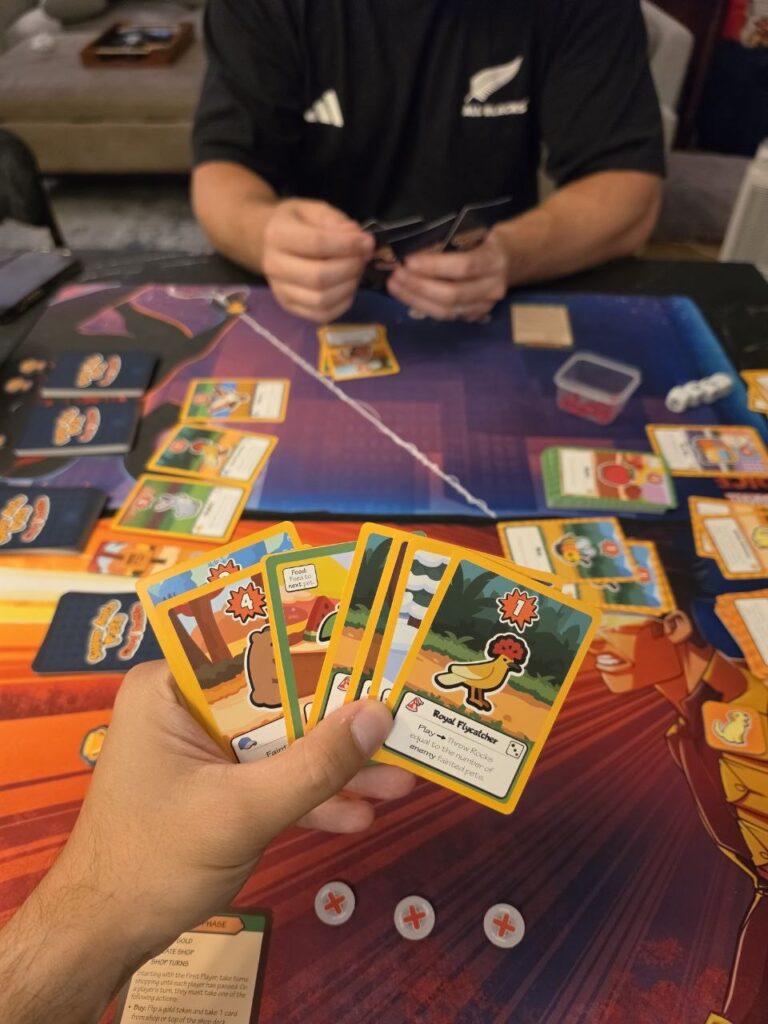
Up until last year, I never really knew what an "auto battler" card game was. Sure, I've played TCGs like Magic: The Gathering and Flesh and Blood, or card battlers like Compile and Radlands, but those games require careful strategy and meticulous timing to come out victorious.

At last year’s Gen Con, I was introduced to Tag Team, my first auto battler, and I was immediately enthralled by how fun and straightforward the concept was. Essentially, you draft cards, arrange them in a specific order, and let the battle play out. There's no strenuous bookkeeping or agonizing over every move. Just compare values, resolve effects, and move on.

Super Auto Pets Card Battle is the tabletop adaptation of the popular video game that somehow flew under my radar. Though I've never played the digital version (and I definitely will now), I've been told the card game is a faithful adaptation in all the best ways.

My appetite for auto battlers is starting to grow, and this one fell into my lap at just the right time. Besides, who couldn't be wooed by adorable animals duking it out on colorful cards?

Pet Friendly

Super Auto Pets Card Battle plays over six rounds,…

The post Super Auto Pets Card Battle: Golden Pack Game Review appeared first on Meeple Mountain.

  •  

GAMA faces fresh leadership shake-up as interim executive director, board vice president announce departures

Editor’s note: GAMA is one of the sponsors of the BoardGameWire newsletter and an advertiser on the site.

Hobby games trade organisation GAMA is facing another shake-up of its senior leadership, with interim executive director Melinda Prickett and board vice president Ross Thompson both announcing they are leaving their roles.

Prickett’s departure is a significant blow for GAMA, having emerged as a key figure in stabilising the organisation and its finances following the resignation of long-serving executive director John Stacy last year.

She joined GAMA as its first chief operating officer in September 2025, before stepping up to become interim executive director just eight months later – and was understood by BoardGameWire to be under strong consideration for the permanent position.

GAMA said its board of directors scheduled a “rapid response meeting” after being informed of Prickett’s departure on October 26, in an effort to determine its next steps – and would be taking immediate steps to appoint temporary leadership to oversee day-to-day operations.

Prickett is set to leave the organisation in less than two weeks, on November 6 – the day before GAMA’s much publicised Game Store Day, and amid the organisation’s preparations for moving its flagship GAMA Expo trade show to Baltimore for the first time.

Her departure leaves GAMA still hunting for a permanent executive director more than a year after its previous leader, John Stacy, announced his resignation.

A statement provided to BoardGameWire from GAMA board president Meredith Placko and secretary Tiffany Reid said, “Recruiting top talent for an executive position is a laborious process, and finding the right fit for our organization has taken longer than anticipated.

“As well, we have been forthright during public board meetings that the biggest reason for the delay was that we needed to get the foundations of the organization in better order, as we had been advised. To that end, Melinda Prickett did amazing work in bringing our financials from a planned deficit for the year, to a resounding success and raised more money than we anticipated for the organization.

“She also worked on creating stability amongst for the organization, the staff, and membership. Her work helped GAMA grow and succeed in the year she was with us.

“That being said, GAMA’s Board of Director’s had interviewed a strong candidate and we were in negotiations with them, but ultimately it did not work out. Because of that we will need to begin the search again.”

The pair said they could not comment on why Prickett’s notice period was so short, or whether she had been a formal candidate for the permanent executive director role.

They added that GAMA was currently working through a short list of people to bring in a new interim executive director “very soon”, adding that the goal was to “make sure GAMA Expo and Origins are a success, and the overall day to day running of the organization is met”.

The statement said, “To that end, the Board of Directors is currently seeking RFPs from firms that specialize in hiring executives in the trade association and member organization sectors. We feel it will be valuable to have the expertise of a company that knows how to recruit top talent in our search for an Executive Director.”

Placko and Reid said there was currently no estimate on when a permanent executive director would be appointed, but said an interim “to handle the most immediate needs of the organization should be decided upon very soon”.

Prickett’s exit comes after GAMA reported a significant improvement in its financial position during her tenure, with the organisation saying it had moved from a deficit budget at the beginning of 2026 to an expected surplus by the end of the year.

In a statement emailed to GAMA members, the board credited Prickett and treasurer Jamie Mathy with stabilising the organisation’s finances, as well as increasing member participation in events outside GAMA Expo and Origins Game Fair and developing new partnerships.

The statement said, “Though it is a bittersweet announcement to make, we are grateful for Melinda’s tireless work with our organization. She has been an incalculable force in leading GAMA during a transition period, setting us up for success in a way that is visibly reverberating through the organization.”

Prickett previously spent more than a decade at Girl Scouts of Ohio Heartland, including almost five years as chief operating officer, before being hired by GAMA last September to oversee its growing day-to-day operations.

Her appointment came just weeks before Stacy announced he was leaving the organisation after seven years as executive director, having just unveiled an ambitious 10-year plan aimed at expanding its international reach, membership and industry advocacy work.

GAMA appointed veteran leadership consultant Zaria Davis as interim executive director last November, initially saying it expected to find a permanent replacement for Stacy by spring 2026.

But Davis’s contract ended in March, with Prickett subsequently confirming to BoardGameWire that she had taken over as interim executive director on May 21.

The latest leadership departure follows a period of significant change for the organisation’s board.

Former president Nicole Brady lost her re-election bid in April to publisher representative Meredith Placko, who had previously served as GAMA vice president.

Ross Thompson, who was elected as vice president following Placko’s elevation to president, has now also resigned from the board after just over six months in the position.

Thompson only joined GAMA’s board in October last year, winning a special election to replace former secretary Monica Rasso, who had stepped down after five years as a director.

His resignation means the organisation will now hold its second special election for the same Media & Events board seat in little more than a year.

The latest departures also follow a turbulent period for GAMA’s board, which publicly apologised in March after some directors were accused of being rude and disrespectful towards members during a heated annual general meeting over proposed changes to the organisation’s bylaws.

GAMA did not give a reason for Thompson’s departure, but praised his work alongside Prickett in streamlining organisational processes and strengthening representation for its Media & Events members.

Thompson wrote on Facebook, “After being part of GAMA for many years, I was happy to lend my time, energy and experience to GAMA serving on the Board during the past year and a half. It was wonderful to be able to work with passionate people, identfying projects that needed support or upkeep, along with bringing new ideas to life.

“By far, GAMA is one of the best organizations to grow your business in the tabletop game industry. The connections made at events like GAMA Expo can revolutionize the way your work and that is truly special.

“There are things that need attention within GAMA, at the Board level and the Organization as a whole. I hope the membership, staff and current Board are able to continue to support GAMA’s mission and identify the obstacles it faces so the tabletop industry can continue to connect.

“I’ll still be around and am not going anywhere, but needed to end my time on the Board.”

The organisation said it would hold a special election to replace Thompson as Media & Events director, with nominations opening today and closing on November 8. Voting will take place between November 10 and 16, with the successful candidate serving until the next annual election in March 2027.

The changes come at a key time for the organisation’s professional trade show GAMA Expo, which has experienced rapid growth in recent years and is preparing to move from Louisville, Kentucky, to Baltimore, Maryland to accommodate rising demand.

This year’s event attracted a record 3,820 attendees, almost 12% above the previous year’s 3,425, continuing a run of growth that had put pressure on the show’s available exhibition and seminar space.

The first Baltimore edition is scheduled for April 25 to 29 next year. A statement provided to BoardGameWire from GAMA board president Meredith Placko and secretary Tiffany Reid said, “We are currently working to ensure there is no visible impact on the preparations for GAMA Expo.

“GAMA staff has been diligent in doing an excellent job to bring us to our new home in Baltimore. They continue with the work that needs to be done, including finalizing programming, working with vendors on booth placement, and everything that needs to happen to make GAMA Expo a success!

“Melinda has led an amazing team, and even in her absence, they will continue with the work that needs to be done.”

GAMA’s other major convention, Origins Game Fair, is set to return to Columbus in June. That show has struggled to recover its pre-pandemic attendance, with visitor numbers falling 2.5% this year to 18,700 – the show’s first annual decline since Covid-19, and still below its 2019 record of 20,642.

The event could face further pressure next year from the launch of PAX Unplugged Houston, a new tabletop gaming convention scheduled to take place just 12 days after Origins, which could potentially force publishers and exhibitors to choose between the two shows.

The post GAMA faces fresh leadership shake-up as interim executive director, board vice president announce departures first appeared on .

  •  

Grin Evil? Grin Good!

I am the cat. No, the balloon. No, the random line over the letter G.

Stop whatever you’re doing. Just stop. I need to tell you about one of the weirdest, wildest, and most interesting board games I’ve played all year. Scratch that. Ever. That’s right. Ever.

This is Grinivil. It was designed, illustrated, and published by Rudy Priecinsky. It’s tempting to lob a jab in there — “I can tell!” hardy har — especially once you get a look at the scattershot rulebook, the potato-headed character portraits, the mishmashed card layouts, the box itself… okay, as soon as you get a look at pretty much anything it has to offer.

But don’t make the easy joke. Set that aside. Because Grinivil is a gift from a parallel universe where Eurogames are never wrung dry through market testing and impersonal development, but instead allowed to blossom into bespoke artifacts that are equally uncanny and compelling and inventive. This is Grinivil. It’s breathtaking.

I knew some land flippers in Montana. They had scruples of various import.

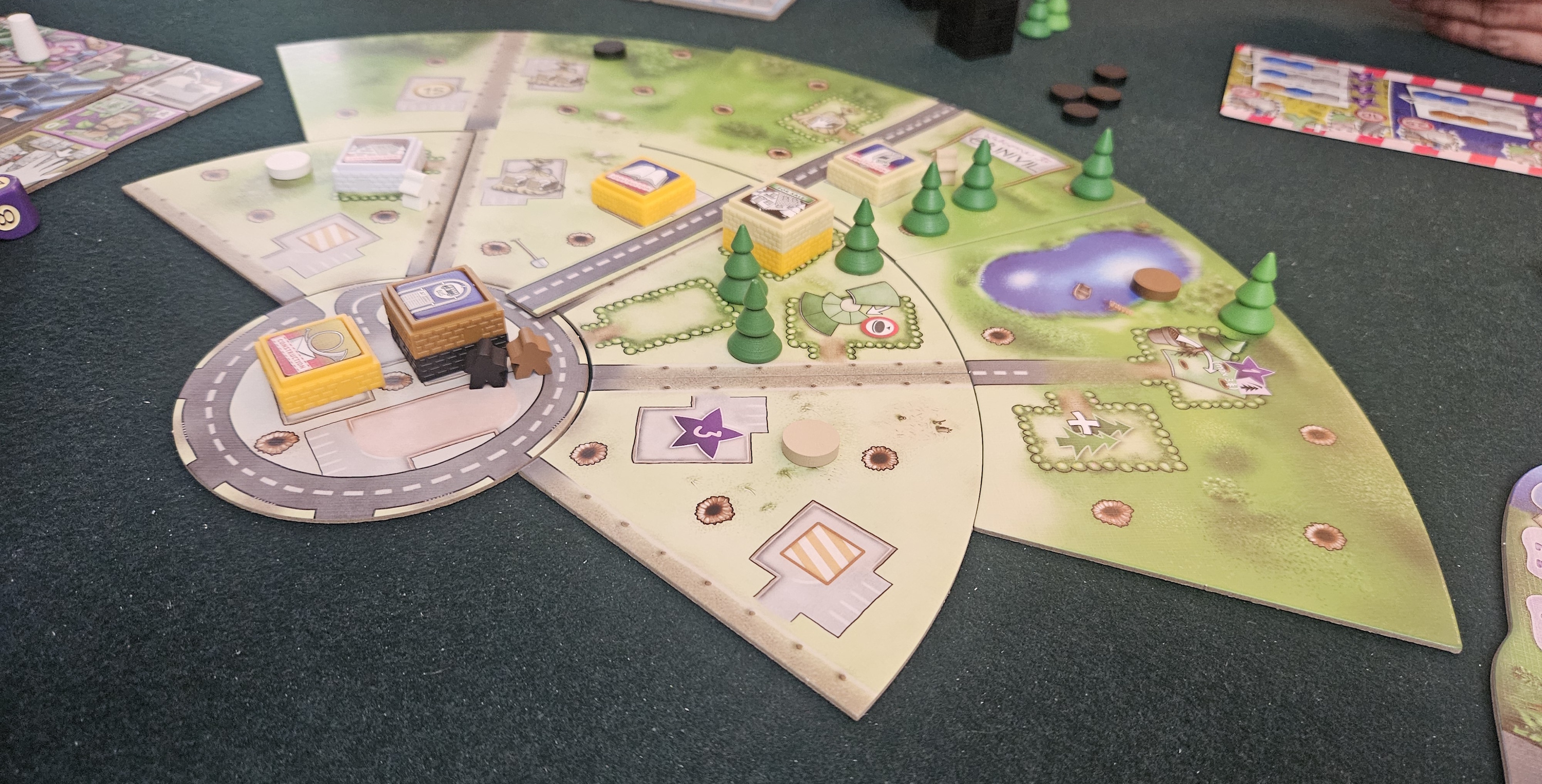
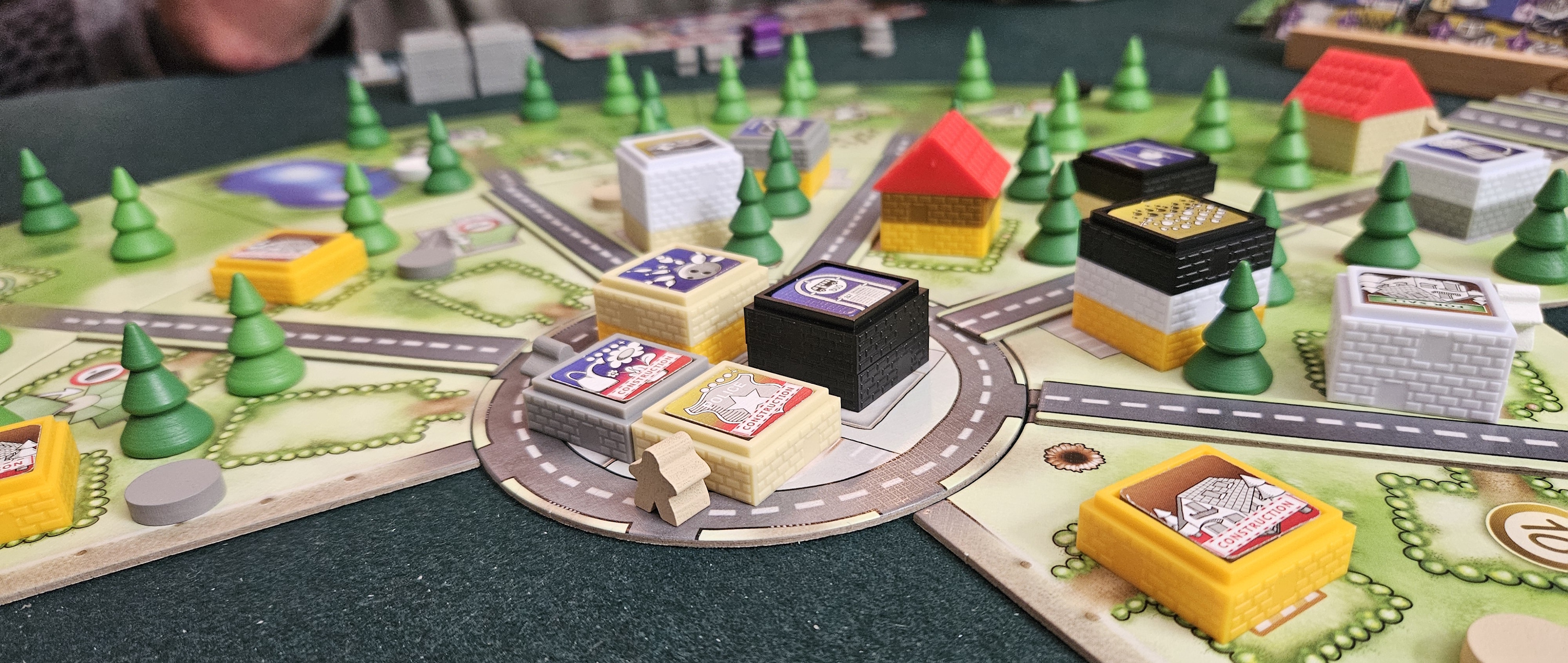
In its early stages, Grinivil is mostly empty lots.

When Grinivil begins, Grinivil — the town the board game is named after — has been thrown open to new development. As towns go, Grinivil is small. Actually, I’m not even sure it qualifies as small. The municipality has started construction on a few things, drawn at random, but they’re as yet unfinished. There are plots for houses and additional commercial spaces, but nobody has filled them. Even the trees have yet to be planted. If Grinivil were deposited in the Old West, they wouldn’t have the livestock to qualify as a one-horse town.

But where there’s a vacuum, there’s opportunity. As a developer, you’re here to buy and sell land, construct amenities, and finagle clients into houses.

It’s a normal enough pitch, in other words. Maybe even an unexciting pitch. There are plenty of board games about real estate, and Grinivil doesn’t sound all that far off from titles like Rebuilding Chicago, The Estates, or Magnate: The First City. Tough competition. Solid games. Good bones.

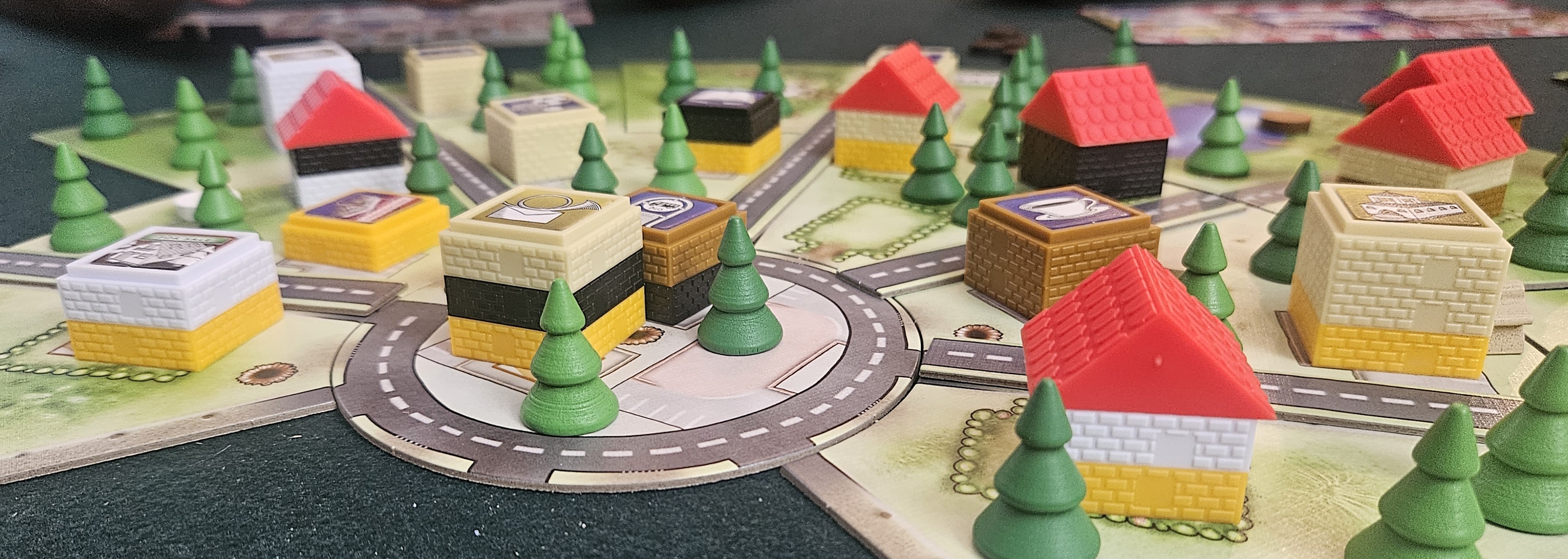
But it takes Grinivil all of ten seconds to set itself apart as those titles’ spiritual opposite. For one thing, there’s the way the game looks. And I promise I’m not about to ding it. Quite the opposite. Grinivil’s earliest state, when it’s nothing more than a traffic loop and a few partially-constructed buildings atop a single pizza-slice of land, is full of potential. You can see what it might become after some walls have been put up and a few trees have been planted.

What’s more, those walls and trees mean something. They signify investment. When you add a floor to a building, you mark it with a piece of your color. Now that isn’t just the second story of a bowling alley or the foundation of a house. It’s your share in the bowling alley. It’s your ability to profit off the sale of the home. Those trees are bumps in property value. That road, now paved, is a sign that a new portion of the town is open for business.

And it isn’t only your investments you’re interested in. It’s everybody else’s, too.

Some actions require you to roll dice. Don't like chance? Don't go there!

The Time Action Ring is a rondel. An amazing rondel.

Let’s approach it from another angle. Turns.

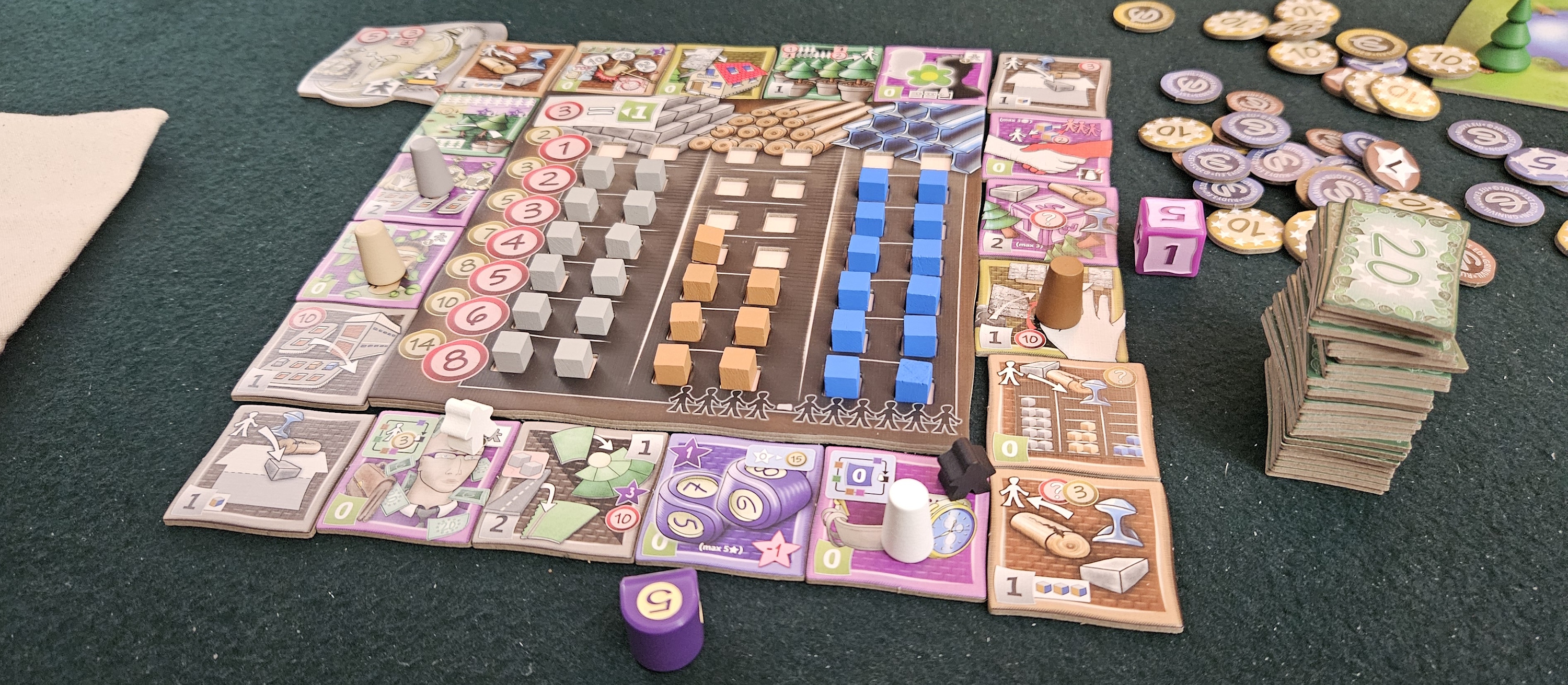
Turns in Grinivil take place on the Time Action Ring, also called the TAR. The TAR is a rondel. Starting at the top-left, you move your pawn clockwise around the TAR, stopping at any action you want to perform. You know. It’s a rondel. It behaves like most rondels.

There are a few wrinkles to this process. First and foremost, most actions, once completed, will move you forward an extra space or two. (Or three or four.) Sometimes this bypasses another action you were hoping to take. Fortunately, you can pay cold hard cash to move fewer spaces. If pouring that foundation will move you forward three spaces, therefore passing the space you were hoping to use next turn, you can pay some money to move a little less.

That’s not all. Unlike some rondels, which limit movement, here you’re allowed to visit any space. You can even circle the entire TAR in a single move if you so desire. The limitation is that passing Go will not award $200. In fact, the opposite is the case. Whenever you pass the space at the top left, you pay both taxes and your workers. Taxes, now, that’s a flat rate. But workers consume a few bucks apiece. If you don’t have any workers on the table, whether constructing a building or squatting on an ability space on the TAR, that’s not the biggest deal. But if you have three workers out, it suddenly behooves you to stretch your time on the TAR as much as possible.

And then there’s the real highlight: the actions themselves. Put simply, Grinivil offers some of the coolest actions I’ve seen put to a rondel. Some are fairly routine, like buying or selling resources, but others transform the state of the board in ways that are hard to describe without seeing them in action.

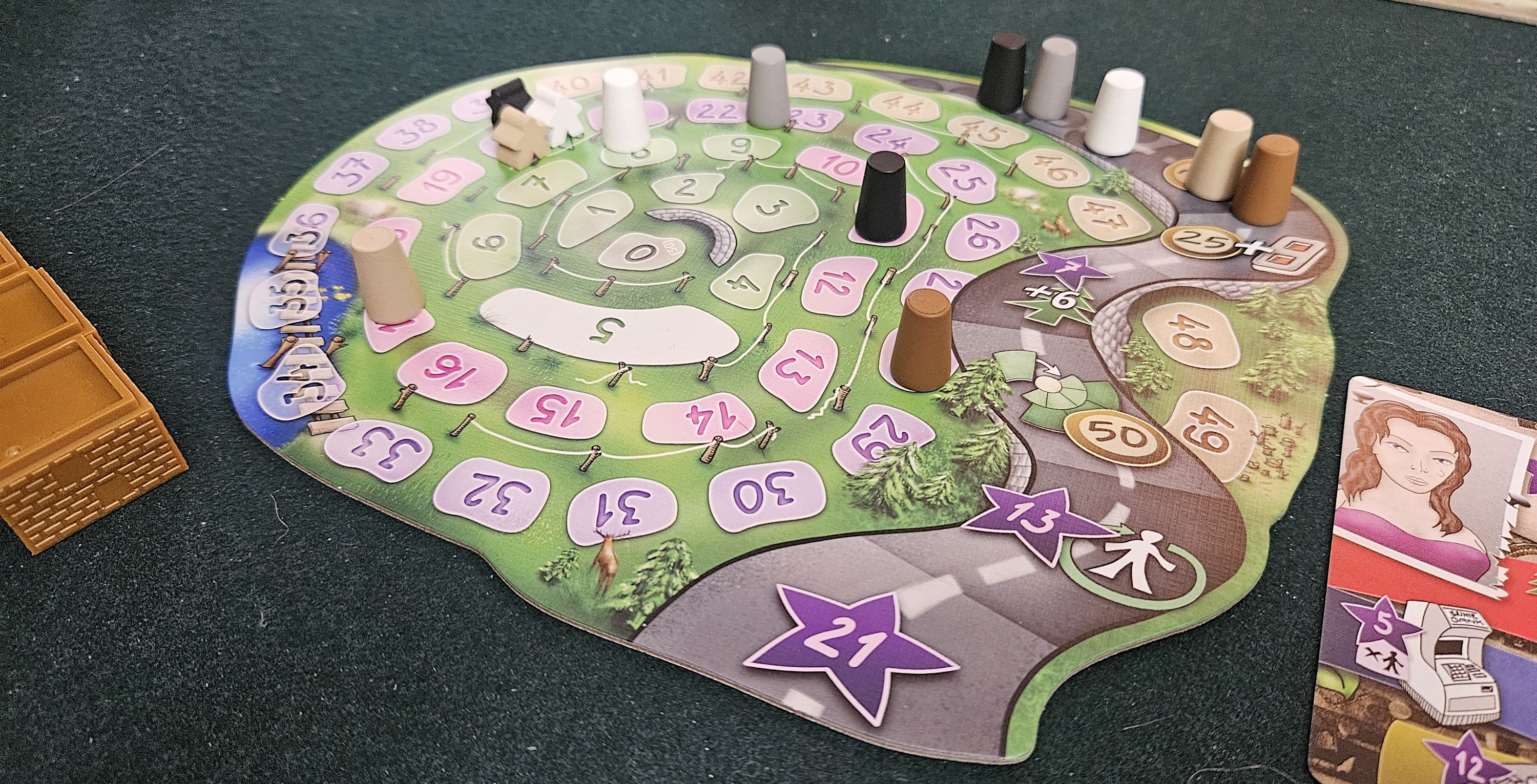
Although I do find it amusing how the score track at one point goes UNDER the road track. That's primo graphics aggression.

I’m not sure the score and road track had to be this, ah, eccentric.

You might, for example, add a wedge to the map. This costs some money and awards a few points. Far more importantly, it gives you ownership over that wedge. Basically, you’re speculating on land. Now whenever anybody wants to build on that land, they’ll be paying a premium for the opportunity.

Or you might turn victory points into cash. Points are the game’s objective, of course, but they don’t really matter until the end. So why not turn them in for walking-around money? This isn’t the first game to feature such an option, but it’s the only one where I’ve seen players accept that devil’s bargain. Sometimes multiple times. If you’re still short, you could also collect unemployment for all the workers who aren’t currently out there collecting a wage, or host an auction and collect the proceeds, or flip all that timber and concrete for more than you spent on it.

Or you could alter the rules altogether. This is mostly the domain of abilities, spots on the TAR that must be occupied by one of your workers. This uses up the worker — and you’ll have to pay them, of course — but gives you that space’s perk until you loop back around to it. To a one, these are ridiculous. There’s the Manager, who removes the need to spend extra time on the TAR. As in, that entire portion of the game is just deleted. Or there’s the Architect. She lets you use any resources when building rather than using specific materials, letting you pass off concrete monstrosities as homes or build a pet store out of nothing but cheap steel. So much for the game’s inventory management! The Banker gives you three coins per turn. Just gives them to you. The Ecologist — my group calls him Treesus — does something similar, adding periodic trees to your inventory.

Surprisingly, the most foundational action, construction, is anything but perfunctory. As you might expect, construction is where you spend materials to add a floor to the map. But it’s also so much more than that, inserting players into the overgrown thicket of incentives that is Grinivil’s principal draw. More on that in a moment.

It might sound like the efficacy of these actions is game-breaking, but in practice it really means that every decision carries considerable heft. On any given turn, you’re presented with a wide-open decision space between three or four tremendous opportunities. Sometimes a shortfall can be covered by having the right resources on-hand, and it isn’t unheard of for an action to become better thanks to a cash infusion. But the real cost is always paid in the opportunities you passed by on your way to something else.

I... don't want to go to there. Nothing against Grinivil, either as a place or as a game.

As Grinivil develops, it becomes a minefield of overlapping interests.

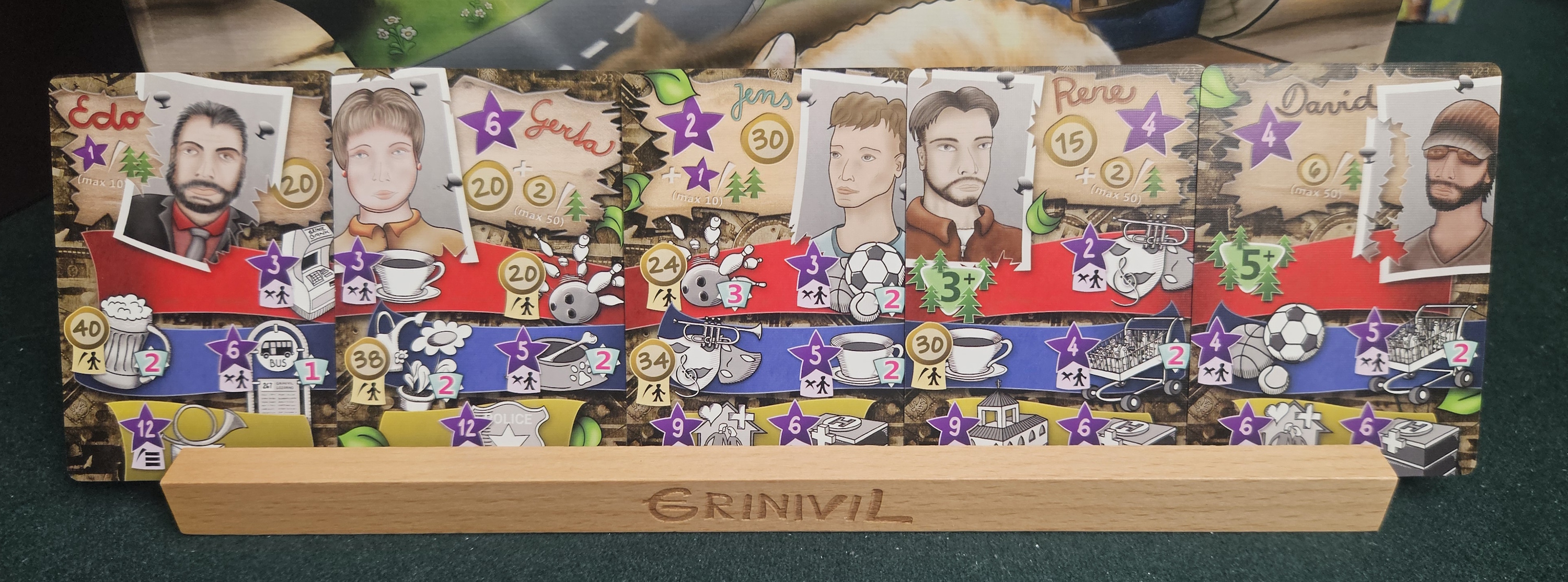
Nowhere is this more evident than in the game’s residents. Grinivil, at its core, is about attracting newcomers to town. Each resident has a number of needs, some underlined in red, others more negotiable. When the game begins, you have two in-hand. There’s also a display of additional cards that can be acquired or swapped out.

Here’s an example. When you first sit down to play, you could be holding Miriam and Nela. Both are worth some points, but Miriam will pay a bunch of cash if her house is on a lot with many trees, whereas Nela is willing to pay a flat rate. Okay, simple enough. So Nela is easier to place on undeveloped land, right?

Sort of! Both also have some hard-coded requirements. Miriam won’t move in unless there’s a grocery store within three spaces of her new home and a bus stop somewhere in town. Nela, meanwhile, isn’t too picky about distance, but wants a pet store and a garden center. When placed, they also provide bonuses. If there’s a playground within two spaces, Miriam will award a few extra points. She’ll also pay a premium for a nearby garden center, giving her some overlap with Nela. For her part, Nela wants a library and a music venue. Deep breath: They also provide end-game bonuses. Miriam wants a hospital in town. Nela insists on a police station.

Here’s the thing. Call it a double-edged sword. Like everything in Grinivil, residents pose a certain hurdle. Their cards are, charitably, a mess of information. Less charitably, they’re just a mess.

But that mess, apart from being somewhat hard to untangle visually, is important, because it’s how everything gets evaluated. When you house a resident, each of those boxes tells you something different. The top box is how many points and coins they give you right away. But everything underneath that, all three boxes of potential rewards, are awarded to whomever owns the thing in question. If I built the garden center for Nela, and then you later welcome Miriam to town, I get the cash for her proximity to the garden center even though you played the card. If I own two of the hospital’s three floors, then two-thirds of Miriam’s fifteen end-game points are mine, even if I never so much as glanced at her until the final tally.

This makes Grinivil a stern plaything indeed, but it’s always fair in its unfairness. There’s hidden information, but not so much that it can’t be overcome with watchfulness and shrewd investments. There are few guardrails, but open-ended actions and a few dashes of chance make it possible to wrestle out of tight spots.

It seems I somehow only picked men. Don't worry, the women are similarly shapely.

I love everything about this.

Which isn’t to say that these rough edges can’t prove frustrating, especially during the first play or two. Once, a player’s early investment in a water treatment plant — and we’re talking about their third or fourth action, maybe fifteen minutes into a two-hour session — translated into a game-winning swing when a half-dozen residents all insisted that their town have potable water.

The beauty of Grinivil, though, is that this was entirely our fault. The table’s fault, I mean. Mine. My co-players’. Because as soon as that rival invested so much in clean water, we should have shifted our priorities. No more residents who care weirdly a lot about their drinking water being certified amoeba-free! Only cop-loving residents, or residents who insist on accessible hospitals, or residents who hang out at churches and retirement communities.

Or, perhaps, we could have ensured that our game-ending tally was dwarfed by residents whose earlier payouts were sufficient to overcome any final swings. There are many ways to earn points in Grinivil, and just about as many ways to invest one’s attention and money.

In all cases, though, this is a game that benefits from both experience and table-talk. It’s a game where it’s not only not impolite, but necessary to say, “Hey, let’s stop attracting so many residents who love the aroma of water being treated.” In that sense, Grinivil is a game about cutting through the clutter to see what’s really important. (And boy howdy is there clutter, hardy har!) It’s about reading the state of the table, about observing which properties are likely to pay off big and which might only be worth a little bit here and there. It’s about watching your opponents and knowing when to feed the animals and when to hold back. Sometimes, it’s even about snaking somebody’s investment by paying a pittance to slap a roof atop their house and hustle one of your residents inside before they can protest.

Conifers. My great enemy.

As more people move in, costs go up. Sorry. Them’s the rules.

I like a polished game. But we’ve reached the point where too many games are polished. Some are so polished, I’d say, so devoid of rough edges, that there’s nothing left to snag one’s attention.

Grinivil is the other thing. Snaggy and shaggy. Some of its actions don’t have immediate utility; others are so potent that it’s impossible to choose between them. Sometimes a corner feels too painted-in. Its art is, um, undeniably not crafted by a plagiarism engine. Personally, I like how it looks. Not only the town, which is gorgeous, but the wackadoo resident cards. Just look at those nerds. I love them like my own ex-girlfriends.

For all of that — or more likely because of it — Grinivil is captivating. As in, it captures and holds one’s attention the way no number of over-smoothed experiences possibly could. It grabs your elbow, shows you the dance floor, and asks you to move. Then it probably shouts at you a little bit, before apologizing and rumpling your shirt and tucking a buck into your back pocket. No matter. This artifact, this singular vision, this gift from another dimension, is so spellbinding that it reminds me why I started playing board games in the first place.


A complimentary copy of Grinivil was provided by the designer and publisher.

(If what I’m doing at Space-Biff! is valuable to you in some way, please consider dropping by my Patreon campaign or Ko-fi. Right now, my third-quarter newsletter is open to all.)

  •  

To Boldly Shuffle

This is the second set. Second Contact is the third, but it's not a standalone. These naming conventions are impossible. Gah.

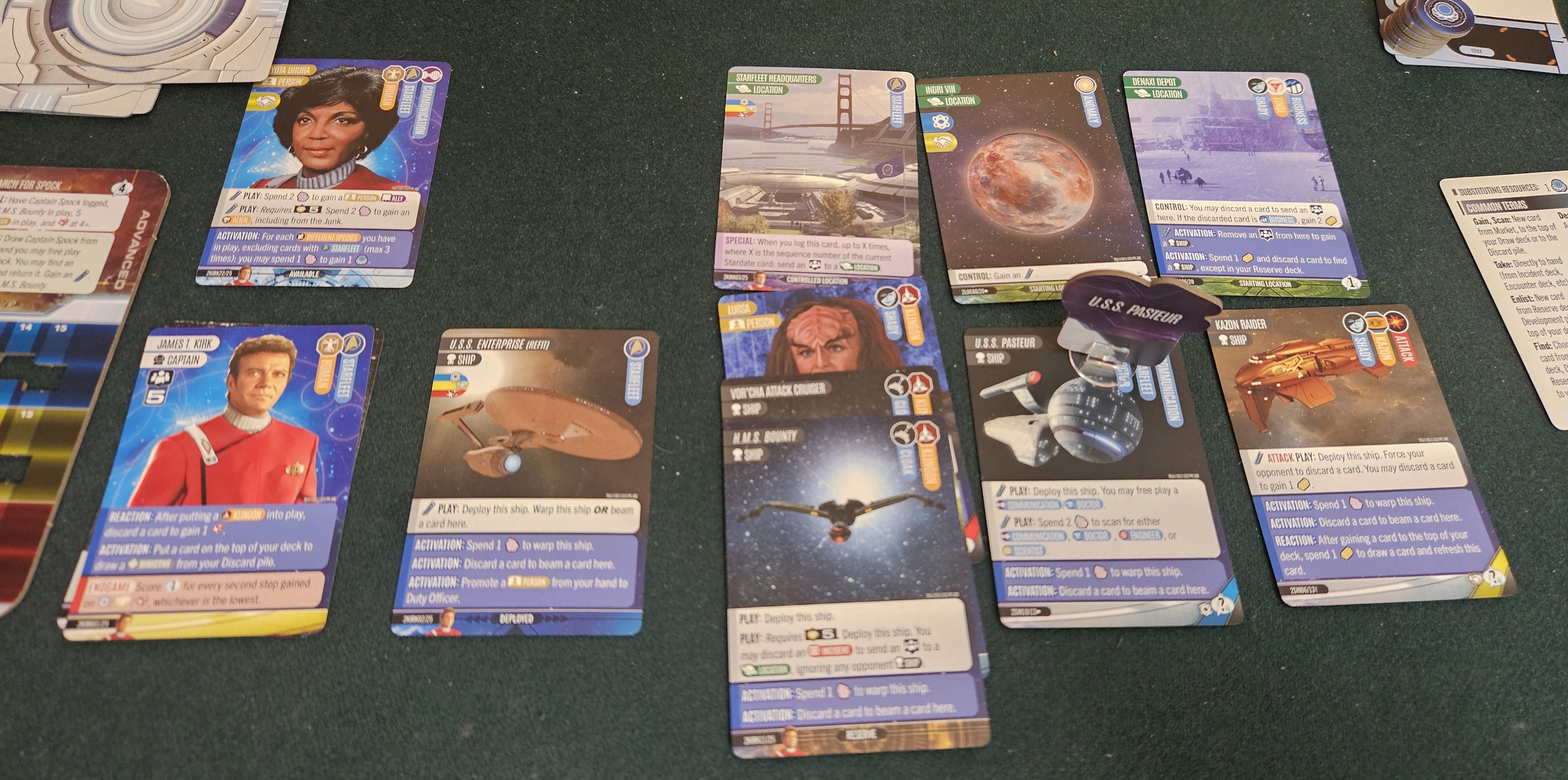
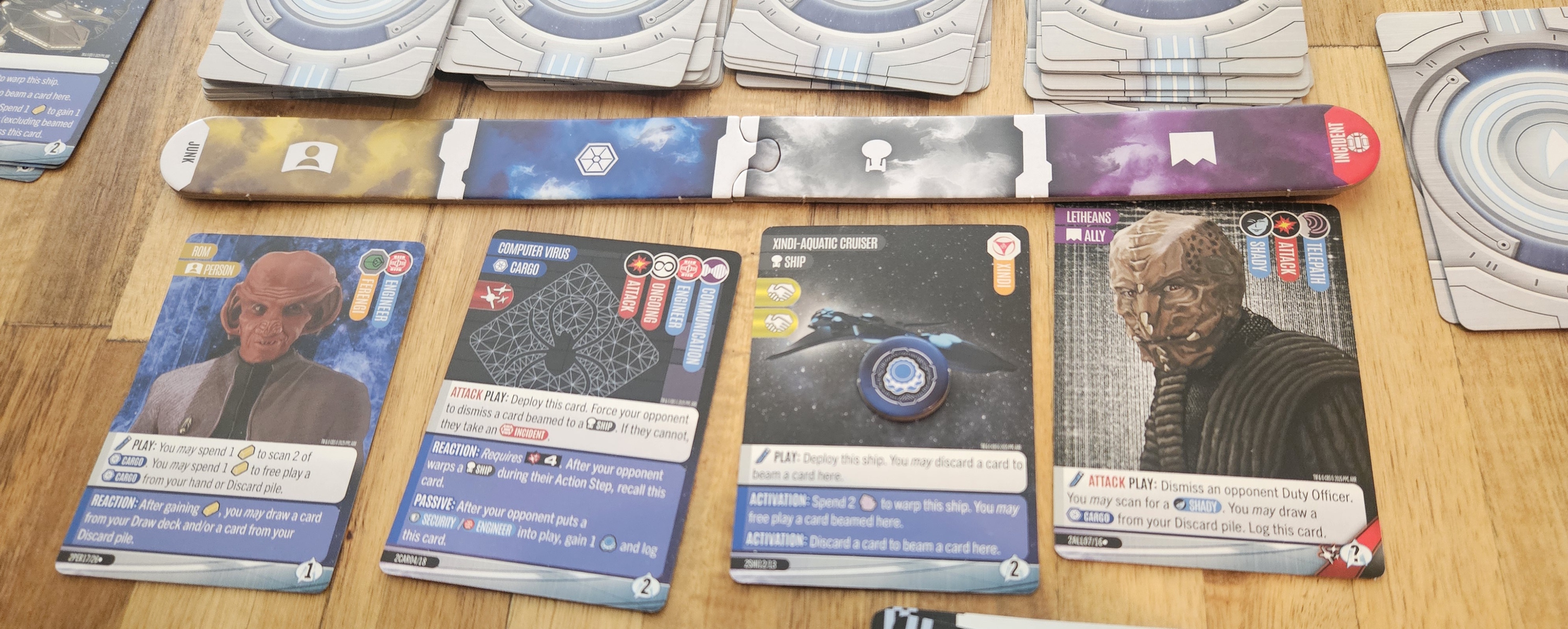
Ah, Captain’s Chair. I’ve already logged my appreciation of Nigel Buckle and Dávid Turczi’s remapping of Imperium into the Star Trek universe. Like that series, now sadly defunct thanks to the shuttering of the board-gaming side of Osprey Games, this is an information-dense deck-builder that absolutely revels in its moreishness. Quite literally. It features more icons, more decks, and more chrome-laden rules per cubic micron than any other deck-builder I can recall.

Now there’s a second-wave box, To Boldly Go. If you’ve played the original, you know what to expect. Seriously, newcomers can just read my previous review.

"Rocket man," he declares, exhaling more cigarette smoke than you've ever seen before.

Kirk out here Kirking.

I really wasn’t bluffing. I’m not about to spill anything new. OR AM I? Look at me, playing like Q.

For the most part, To Boldly Go repeats the accomplishments of that original set, featuring six new captains who can either be commanded in one of the game’s default duels or faced as an opponent in the (excellent) solitaire mode. As with Imperium, these decks are what make Captain’s Chair Captain’s Chair. Like an unassimilated technological and biological lifeform, they’re distinct.

How distinct? Distinct enough that there’s good news and bad news.

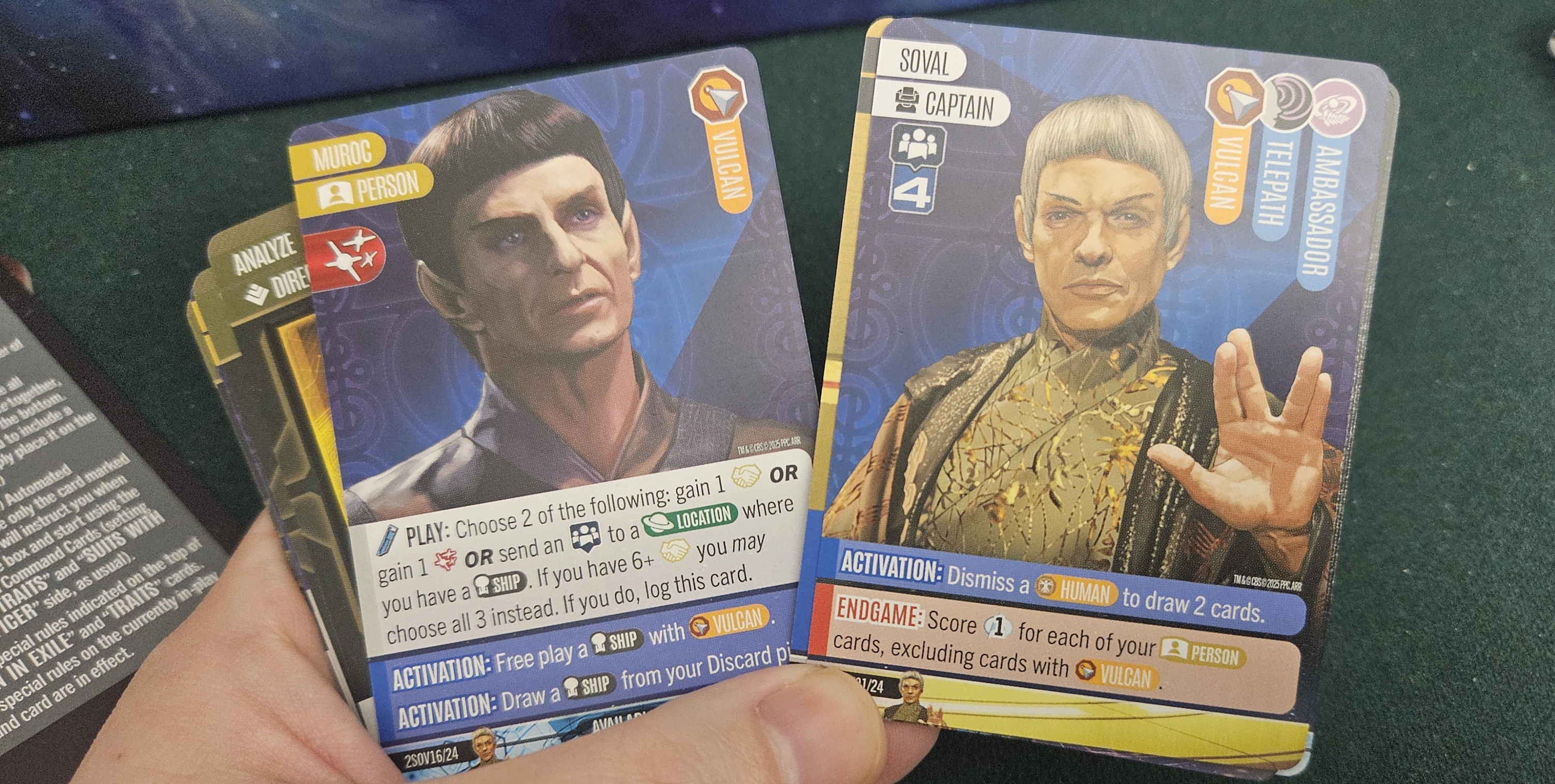
First, the good. The captains in To Boldly Go are even more dissimilar than those in the base box. Even the ones that are relatively “baseline,” like Soval, Philippa Georgiou, and the long-awaited James T. Kirk feel different on the table. Having served as an ambassador to Earth, Soval fuels his abilities by dismissing them as a species — in game terms, by literally chucking them out of his hand. Which is a bit of a double-edged ability, since he wants to fill his deck with enough exemplars of mankind to keep his better abilities churning. Kirk, meanwhile, is an all-rounder, forced to emphasize the game’s various flavors of influence equally. The flipside is that, as the grandfather of this galaxy, he’s more likely to draw encounters, the ultra-powerful scoring cards that most captains only see one or two of throughout an entire session.

The other captains are wackier, and I mean that entirely as a positive. Khan breaks the game’s usual rules, dispensing with the customary science/diplomacy/military track to instead mind-control a diverse crew and start shouting Moby Dick quotes at his enemies. No, really. He has Moby Dick quotes. Archer, being the flashback character, starts with a deck that fits in his starting hand and nearly no away team tokens for conquering planets. Instead, he has to rush to form the Federation from scratch, giving him some incredible early-game momentum but the testiness of having to forge synergies from first principles. And then there’s Rebner. I haven’t seen a single episode of Lower Decks, so I have to trust Buckle and Turczi when they inform me that Rebner’s whole deal is that he’s a total moron. He draws only three cards per turn, can’t utilize science or diplomacy at all, and his cards get stronger as they find and don big hats.

needs a snake draft

Aha, a card market!

Actually, Rebner has become my object lesson for To Boldly Go at large. He’s a total hoot to play, and moreover he’s forced me to embrace a portion of the game I’ve always tended to overlook. Returnees to Captain’s Chair might already know what I’m talking about. In the market, there are four main decks that players can freely recruit from. Three of those decks — people, ships, and allies — offer immediate utility. The fourth, the one called “cargo,” has always been a little trickier to use. These are special items that… well, they do all sorts of things. Which is both the value and the drawback of cargo. You’re never quite sure what you’re going to get. Most function as attachments, things you can merge with other cards to bestow new abilities. But they aren’t always that, and sometimes their wilder effects can be more trouble than they’re worth.

Rebner, with his crew’s emphasis on securing and wearing fancy hats, makes cargo a necessity. His starting deck has a bunch of hats, both in its starting pool and for later recruitment, a stark contrast with most captains who might have one or two tucked into their reserve. What’s more, a couple of additional hats can be found in the cargo market deck. They get a “helmet” tag and everything.

But that reveals an issue with To Boldly Go. More specifically, an issue with merging To Boldly Go with the original Captain’s Chair and any forthcoming sets.

In short, the original game didn’t contain any helmets. Which means that poor stupid Rebner is going to have a heck of a time finding any hats for his crew when using the original Captain’s Chair market, whether on its own or blended with the offerings from To Boldly Go.

Of course, the issue is broader than a shortage of hats. It’s that each captain has their own objectives to pursue, and these objectives often require them to dive through the market for specific keywords. Some of these tags are standardized across sets. Roughly half the card pool has been duplicated from the original box, and there are always plenty of humans, Vulcans, and Klingons. For captains who need specialized tags, merging or crossing-over sets just became a testy proposition.

the guy on the left looks exactly like an ecclesiastical leader I once had who gave his every effort to persuade me to keep going to church

As before, the icons are nice and crisp, but also… there are tons of them.

This isn’t to say the issue is a dealbreaker. Nor that it presents an intractable problem. There have always been tools for rifling through the decks of Captain’s Chair, in particular the “scan” ability that allows players to search through a certain number of cards — even multiple market decks — to mine a specific keyword. It’s pretty rare that you’re beholden solely to whichever cards are currently on display.

But it highlights a certain jankiness to the system. Turczi has compared sets to drafting cubes. Captains function best with the cards in their box, not necessarily when merged across sets. Which, to some degree, makes the whole thing a little less appealing, at least to this guy. I’d much rather rest assured that I could have Kirk face down Koloth or Picard take on some theoretical third-wave Borg Queen without worrying about the composition of the market introducing its own subspace turbulence.

Because, yeah, Captain’s Chair is good enough, even with these bumps, that I want to keep exploring what it has to offer. Even at its most maximal — frankly, thanks to that quantity-is-quality — there’s a thrill to seeing how Buckle and Turczi can mine their deck-building system for new ways to express this particular setting. I loved the diversity of cultures in Imperium, that it was possible to have something sprawling like the Roman Empire throw down with the Olmec and the Inuit, each with their own cultural focuses, and still function at all, let alone present such a compelling contest.

Here, decks are even more distinct. Combined with the additional flexibility of a system that stretches further than its predecessor, the result is a game that keeps me coming back. Even when, on occasion, it frustrates me with its avalanche of icons, a lane-battler core that sometimes gets lost amid everything else, and now the persnicketiness of sets that don’t effortlessly merge.

If anything, I wish it leaned into this a little harder. Oh well!

Captain’s Chair is also a lane-battler. Sorta.

Maybe this was always inevitable. As Imperium grew, that system faced similar aches and readjustments. Any growing pains are only compounded by the sheer enormity of what’s contained in each box. So much for balance; then again, it was always a remote possibility with decks as varied as these.

Either way, here’s to another Captain’s Chair. Going forward, I think I’ll boldly shuffle everything together, consequences be damned.


A complimentary copy of Star Trek: Captain’s Chair: To Boldly Go was provided by the publisher.

(If what I’m doing at Space-Biff! is valuable to you in some way, please consider dropping by my Patreon campaign or Ko-fi. Right now, my third-quarter newsletter is open to all.)

  •  

Two games, two Deutscher Spiele Preis wins: Ark Nova designer Mathias Wigge takes second title with Sanctuary

German board game designer Mathias Wigge has pulled off an impressive feat at the Deutscher Spiele Preis – Germany’s biggest community-voted board game award – by winning with both of his first two standalone games, Ark Nova and Sanctuary.

Sanctuary claimed top spot in the annual award ahead of Pegasus Spiele’s commercial hit Boss Fighters QR and space tourism-themed worker placement title Galactic Cruise, which has already scored a string of major award wins.

The win also cements Feuerland Spiele‘s position as the most successful publisher in the Deutscher Spiele Preis since the company was founded in 2012, with four victories – twice as many as any other publisher over that period.

Feuerland scored an early DSP victory with Terra Mystica in 2013, before a flurry of three wins in eight years via Wingspan in 2019, Wigge’s debut design Ark Nova in 2022, and Sanctuary this year.

Feuerland managing director Stefan Rink told German broadcaster WDR after this year’s award ceremony that Sanctuary had already sold 20,000 copies in Germany, with the publisher hoping the award would provide a further sales boost.

The game, released in Germany as Artengarten last year, aims to offer a shorter and more accessible take on Ark Nova’s zoo-building and wildlife conservation theme, replacing much of the original’s card-driven gameplay with tile placement.

Feuerland also positioned the game at a lower price point than Ark Nova, with a recommended German retail price of €49.90 against €64.90 for the original.

The DSP victory is Sanctuary’s first major award success, having previously picked up a recommendation in this year’s Kennerspiel des Jahres prize and a nomination as Medium Game of the Year in BGG’s Golden Geek awards.

The win follows huge critical and sales success for Wigge’s predecessor design Ark Nova, which had sold more than 300,000 copies worldwide and racked up over 10 million plays on Board Game Arena according to a report from German newspaper Der Patriot in February this year – as well as being ranked in second place among all the titles on BoardGameGeek.

Runner-up Boss Fighters QR, designed by Michael Palm and Lukas Zach, has become a big sales success for Pegasus Spiele, which reportedly ordered the largest initial print run in its history for the game’s launch at Spiel Essen last year – and followed up with another record-sized print run to meet demand.

That title has already sold more than 100,000 copies in 17 countries according to German board game journalist Johannes Blumenberg, who runs the website Ministerium für Brettspielspaß.

The app-driven cooperative game spent six years in development, with Palm and Zach revealing that extensive work was needed to ensure its QR code scanning technology operated reliably and to develop the digitally controlled bosses.

The designers previously won the 2023 Spiel des Jahres with Dorfromantik: The Board Game, which also finished runner-up in that year’s Deutscher Spiele Preis behind Planet Unknown.

Boss Fighters QR was also nominated for this year’s Kennerspiel des Jahres, alongside Moon Colony Bloodbath and eventual winner Rebirth.

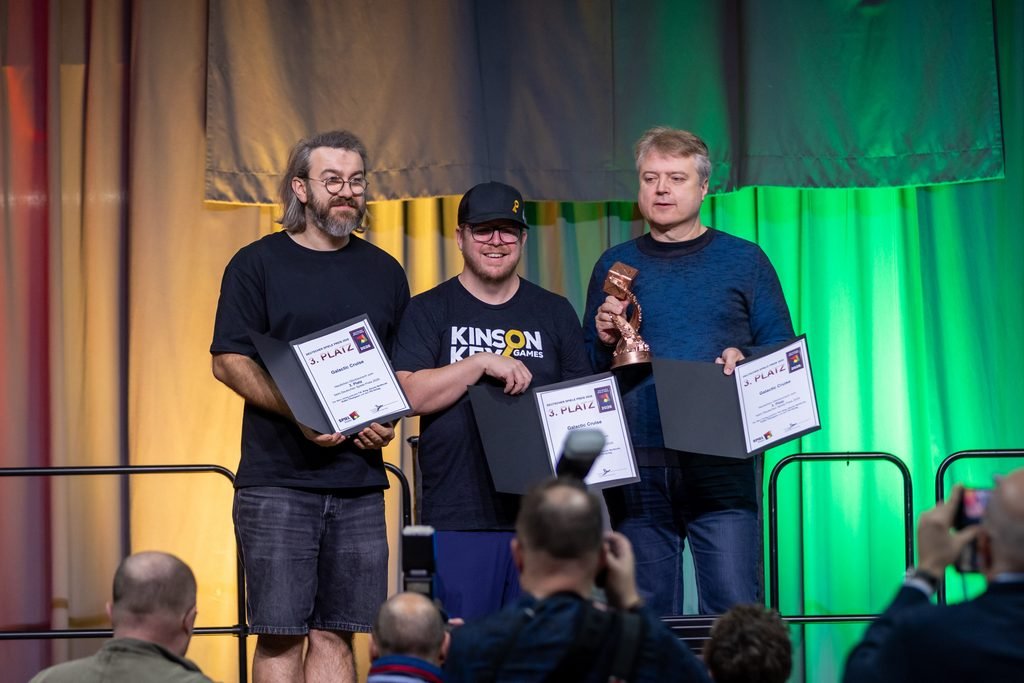
Galactic Cruise’s third place finish follows a striking awards run for the game, which was the first major release from US publisher Kinson Key Games.

The title, designed by TK King, Dennis Northcott and Koltin Thomson, had already been crowned Heavy Game of the Year at BoardGameGeek’s Golden Geek Awards in May, before taking Game of the Year, Best Strategy Game and Best Game from a New Designer at the Dice Tower Awards in August.

Galactic Cruise was a significant crowdfunding success for Kinson Key, raising more than $807,000 from over 8,000 backers through its original Kickstarter campaign in 2024, before securing another $769,000 for an expansion and reprint earlier this year. The game is published in German by PD-Verlag.

Last year’s Deutscher Spiele Preis went to Tomáš Holek’s space exploration game SETI, published by Czech Games Edition, which took top spot ahead of Endeavor: Deep Sea and Bomb Busters.

Other winners over the past decade have included Forest Shuffle, Planet Unknown, Lost Ruins of Arnak, The Crew and Azul.

Board game publishing and distribution giant Asmodee secured four places in the top ten of this year’s DSP – with Fate of the Fellowship, Take Time, Cozy Stickerville and Forest Shuffle expansion Dartmoor – although none of its releases broke into the top three.

Germany’s Frosted Games was represented twice, through Reiner Knizia’s Kennerspiel des Jahres winner Rebirth in sixth place and Star Trek: Captain’s Chair in ninth, while Kosmos took eighth with River of Gold.

This year’s children’s Deutscher Spiele Preis went to Wojciech Grajkowski’s Toriki: The Castaway Island, published by Mirakulus, ahead of Mooki Island and Paleolino.

The Deutscher Spiele Preis, which has been presented since 1990, is decided by public voting among players in Germany, Austria and Switzerland, rather than a specialist jury.

Organisers said “many thousands” of players took part in this year’s voting. Eligible games were released in German between May 1, 2025 and April 30, 2026, with the winners announced at the Spiel Essen game fair.

The post Two games, two Deutscher Spiele Preis wins: Ark Nova designer Mathias Wigge takes second title with Sanctuary first appeared on .

  •  

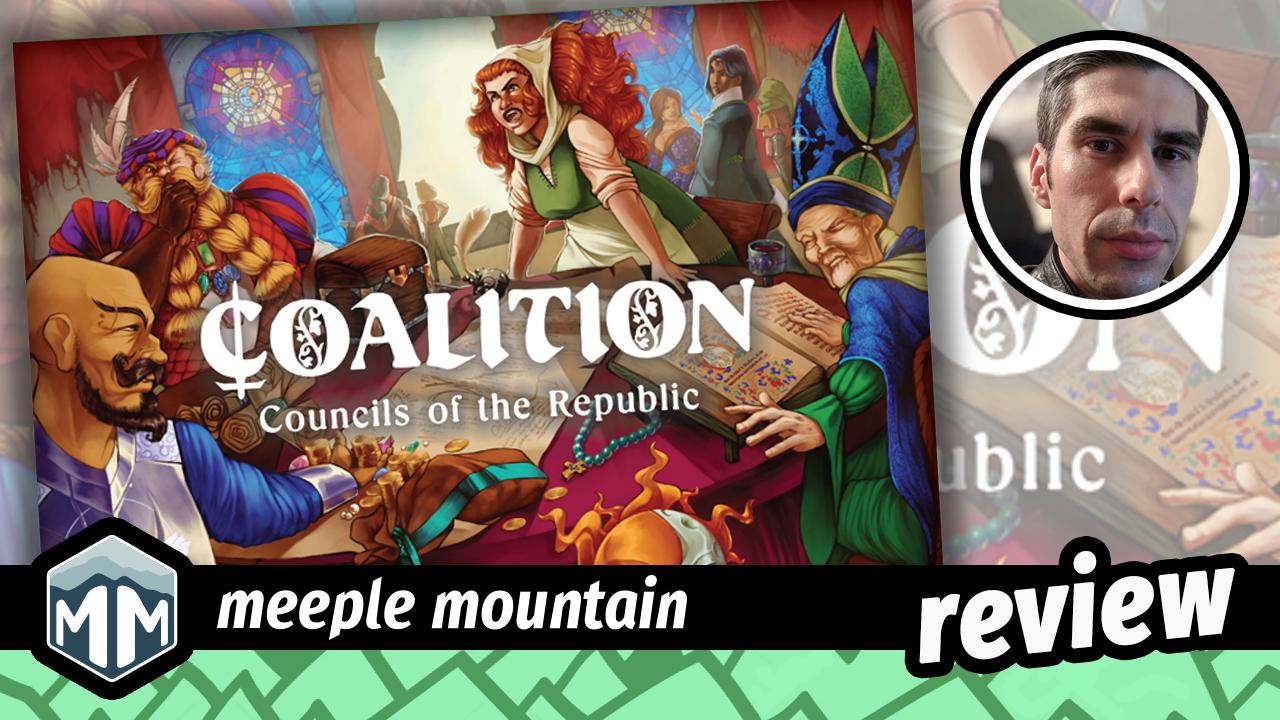
Coalition: Councils of the Republic Game Review

Whenever a game has a double-digit player count, there’s a 99.97% chance it involves social deduction. Now, I love social deduction games. They give you an excuse to break the social contract and lie to your friends and family, all in the name of fun. They’re also one of the few genres that let you discover just how good the people around you are at scheming and lying. Eventually, you start wondering if their name is even real. That said, I’m also kind of sick of every single large group game being dropped in the social deduction box.

Coalition: Council of the Republic sings a different tune here, focusing on negotiation rather than inevitable betrayal. Better yet, it’s team-based, with four teams competing for influence and potentially a few independents thrown in to make things even messier. Instead of simply figuring out who’s lying, you have to convince people to work with you, negotiate deals, cross your fingers while making promises, and figure out how long those lofty alliances will actually last. All of this in one hour.

Draft Laws, Not Friends

The story behind this is a little more complex than most. The country is suffering through political turmoil and demanding reform, so four teams are tasked with drafting new laws. Naturally, each team wants to push laws…

The post Coalition: Councils of the Republic Game Review appeared first on Meeple Mountain.

  •  

Things Had It Coming

MROWR

When she isn’t pretending to be a dragon, my seven-year-old pretends to be a cat. “Mrrrowrrr,” she says when she pounces on me in bed in the morning. “Raawwwrrr,” she purrs when it’s time for her to line up for second grade. “Grrrrrr,” she rumbles at bedtime, her bones suddenly transforming to jelly. If certain “news” articles were to be believed, we’d have a litter box in the bathroom.

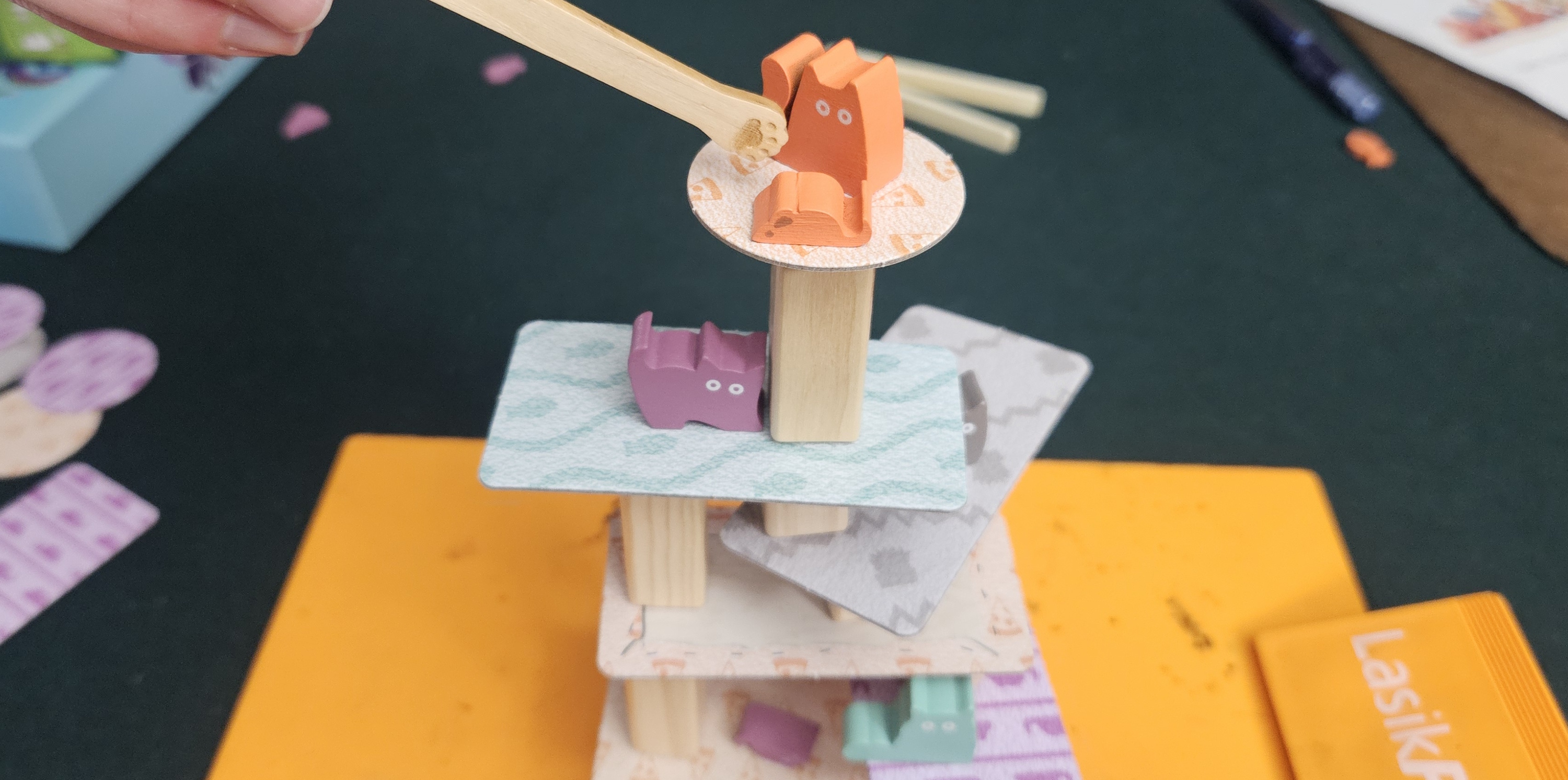
So, as a surprise, I picked up Cats Knocking Things Off Ledges. Designed by Sen-Foong Lim and David Killing, it’s as descriptive a game as they come. My seven-year-old treats it as a tornado simulator.

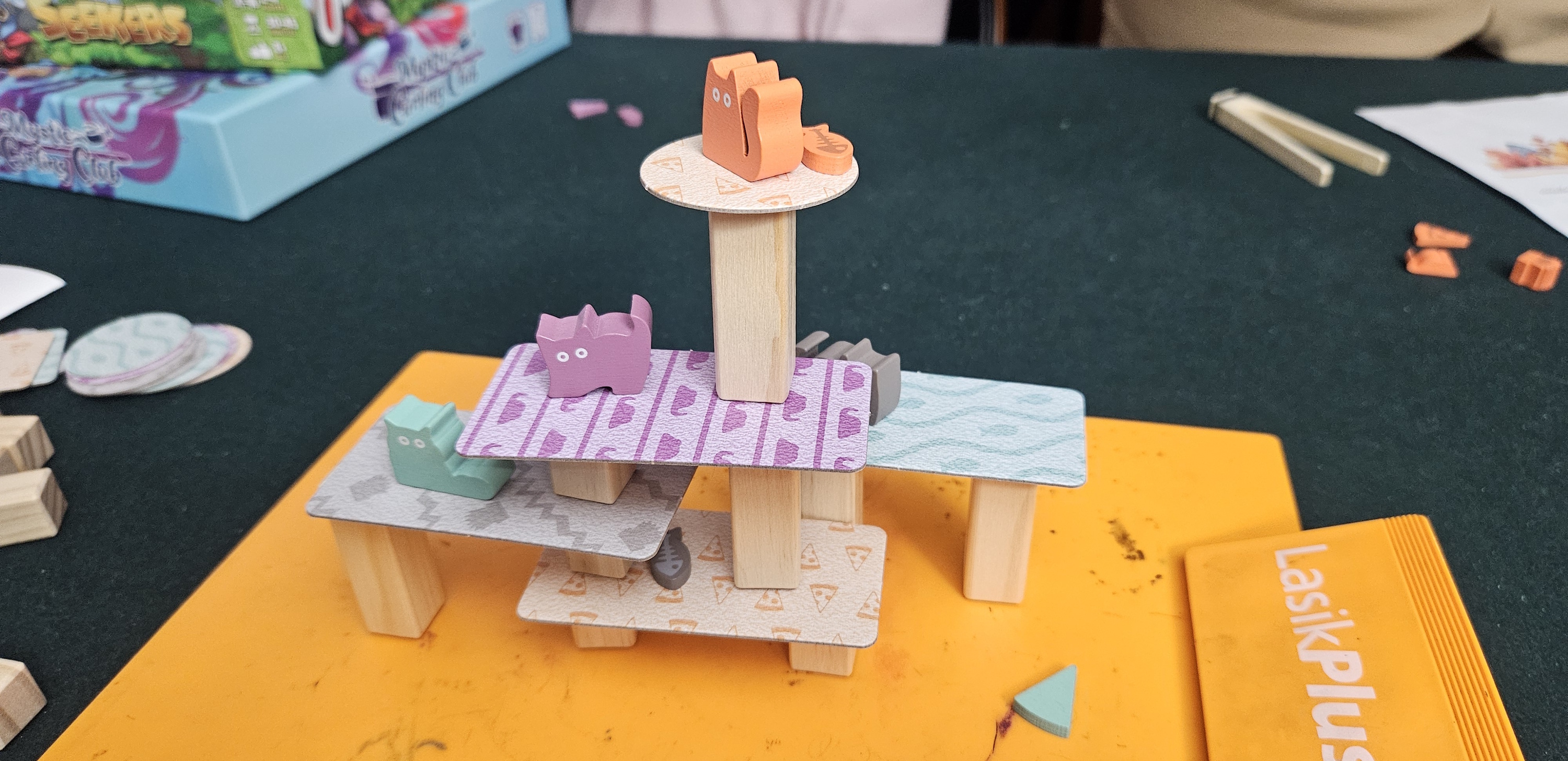
In theory, you can bonk a toy off other pieces to try to keep them on the tower. In practice, you wind up with like one main tower, so either you gently brush it off the edge and it doesn't rebound too far or it just pings off into nothingness.

These cats love to climb.

On the surface, Cats Knocking Things Off Ledges isn’t meant to be a tornado simulator. Instead, it plays like a parallel version to Rhino Hero. Turns consist of three steps. First you expand your kitties’ playspace, adding one or two pillars and a single card, whether rectangular or circular, to create a new climbing platform. Second, your kitty leaps to a new space, managed by a pair of tweezers. Third, your kitty bats a toy from their perch. If it happens to land on another platform, you score points. The greater the fall, the more the score.

It’s adorable. And not in any pejorative sense. The tweezers, for example, have little kitten paws on the inside edges. The toys are wooden versions of squeaky mice and pizza slices. The platforms show fuzzy carpet for kitties to test their claws against, but it’s really their reverse side, which reveals fabric stapled to wooden bases, that feels like something you might actually stack into a climbing tree.

That adorableness extends to the rules. They’re simple, which suits the game’s format and age target. But more importantly, they capture feline caprice. Cats, according to this game, are agents of mischief. Why do they knock things off ledges? One expects the things had it coming. If the things didn’t have it coming, the cats wouldn’t have batted them from their ledges. Simple. Circular. Incontestable.

Which does make it a shame that the components are so darn light. I think back on the original Rhino Hero, before its blown-up version or Rhino Hero Super Battle made it easier to handle, or that popsicle-stick stacking simulator Tokyo Highway that collapsed as though the slightest hand tremor was a seismic event. For little fingers to make a stacking game work — and seven isn’t especially little — the components need a certain heft.

My 7yo has kitten gloves. They barely work. But they're super cute.

Aw.

Sure, the box rates the game for ages 10+. Fair enough. But let’s be real: those are there to cover the publisher’s backside if a kid chokes on a meeple. No matter the specific digit on the box, Cats Knocking Things Off Ledges is what a seven-year-old who wants to be a kitten and only breaks character to insist she wants chicken nuggets for dinner wants to play. Who else would it be for? It isn’t for my twelve-year-old. She regards it coolly. She doesn’t complain. She’ll humor her younger sister. But this isn’t the sort of thing she’ll directly seek out. Who else is there? Me? My wife? Sure, we have a fine time with it. But the one who jumped up and down at the sight of the box was three years below the stated age limit.

In practice, then, Cats Knocking Things Off Ledges becomes a tornado simulator. The platforms in particular are so light that their surface warps ever so slightly, closer to cardstock than proper cardboard. Not even that heavy of cardstock either. Without proper architectural planning — and, again, let’s be real here — it isn’t long before the tower teeters and shudders. At times, that’s part of the fun. Look at our tower, barely held together with thumbtacks! But when the tower keeps collapsing, especially when it collapses from even slight errors, and doubly especially when it always collapses on the youngest kiddo’s turn, well…

Well, it becomes a tornado simulator. Because the kiddo starts knocking things over on purpose. “Mrrrowwwrrr,” she says, jabbing a pillar with the kitten-stick. Everything tumbles.

Which is fine, as these things go. I’m not about to insist she play the cats-making-a-mess game properly. But it puts the game in a strange place. She adores it. But her adoration has been tempered by the fragility of this plaything. It’s so delicate that she can’t help but break it, and so the breaking has become the game. For the rest of us, Cats Knocking Things Off Ledges becomes a game about rebuilding a similar edifice over and over again, eking out one or two points at a time, and then restarting the process.

Gah, what a wasted opportunity. I want the double-sized version of this game.

Bump!

To be honest, I’m surprised. Lim was half of the design team behind Junk Art, one of the chunkiest stacking games on the market. If only this title had received similar care. Instead, it winds up overstaying its welcome and growing repetitive within the span of a single session.

Here’s the good news: my kiddo has repurposed the pieces for building a cat tower beyond the confines of the rules. Good initiative, kitten.


(If what I’m doing at Space-Biff! is valuable to you in some way, please consider dropping by my Patreon campaign or Ko-fi. Right now, my third-quarter newsletter is open to all.)

  •  

GrimBrew Game Review

In the wide world of board game themes and gameplay, ‘Alchemy’ feels like one of the most commonly represented. This might just be my own bias though, as it turns out I have quite a few alchemy focused games in my own collection. From the widely popular Flamecraft to the hit bagbuilder Quacks to marble mayhem favorite Potion Explosion and more, I’d somehow become an accidental alchemy aficionado.

Maybe that’s why when Meeple Mountain was provided with a review copy of Grimbrew from Lucky Omen Studios, I quickly (maybe subconsciously) volunteered to provide a review for it.

Even though Grimbrew thematically has a lot in common with other alchemy themed games, it also separates itself in some unique and interesting ways.

Collect & Brew

As you might have expected, in Grimbrew, two to five players compete to collect the most points by gathering ingredients and brewing potions. Turns are as simple as the premise of the game.

On a player’s turn, they can:

  • Take an ingredient from a shared market
  • Brew a potion
  • Rekindle flames

Active flames are required in order for players to brew potions and refresh the market (more on this in a moment). When taking the ‘rekindle flames’ action, players flip two of their five flame tokens from inactive to active,…

The post GrimBrew Game Review appeared first on Meeple Mountain.

  •  

Accidental Heroes Game Review

Around these parts I'm known as the RPG guy for my love of different systems and the opportunity to immerse myself in the theme of a game. Accidental Heroes, an upcoming app-driven adventure game designed by Wojciech Grajkowski and published by Lucky Duck Games, puts your hero on a topsy-turvy joyride through an ever-changing world bursting with familiar references. Let's hop on the tracks and see how it plays.

Accidental Heroes: The World is Your Oyster

I'll preface my discussion of Accidental Heroes by acknowledging that my experiences are based on a prototype copy that was limited in scope compared to what's expected in the complete game. At first I thought that the lack of content would be disappointing, but instead I was surprised by how many branching paths were available to my heroes as I played.

In Accidental Heroes, players assume the role of an "hero", a term surrounded by quotation marks because whether or not you live up to the moniker is up for you to decide. The object of the game is to pass two difficult Tests associated with Final Missions, acquiring a pair of Dragon Eggs before any other player is able to do so.

Heroes have three main attributes: brain, body, and combat. Each of these attributes is represented in an 'exquisite corpse' fashion…

The post Accidental Heroes Game Review appeared first on Meeple Mountain.

  •  

Tranquility Game Review – A Second Look

Imagine you are on the sea. The ocean before you is liberally dotted with various inhabited islands. The sea is calm and the wind is fair. You want to sail from your home island to another, some distance away. The journey will take some time, enough so that this beautiful dawn will have passed into dusk by the time you arrive. There are no pirates or shark-infested waters along your way, just a need to plot a proper course. And for that, all you need is a tall ship and a star to sail her by…

[caption id="attachment_334826" align="aligncenter" width="750"] There is a light side and a dark side to everything. Not just the force.[/caption]
Thomas Wells wrote a very good review of this game several years ago. His take (from my reading) is that this is more of an art-project, an activity, than truly a game. Some might see it that way. After exploring this little gem, I (and several in my group) see it as more a game than an art-project. Certainly not just an activity. Read on and let me know what you think.

Tranquility is not always Silent…

My wife loves cooperative games. On a recent weekend, our normal game group could not all…

The post Tranquility Game Review – A Second Look appeared first on Meeple Mountain.

  •  

Bewitchments, Buckets, Bugs

can you spot every Wee Aquinas?

Imagine me in a real pickle sandwich. The middle of preview season (ho ho ho), and suddenly I come down with not one illness, but two. Something chronic, something acute. And me with a whole stack of board games to write about. Some of them time-sensitive, counting down the minutes on crowdfunding platforms as we speak.

What’s an old man to do? Write about all three in a single splash, naturally.

In other words, here are three very different tabletop titles, each worth a wink of your time. Come on in. Let me tell you about them. Briskly, before I’m back to bed.

I've been reading too much China Miéville this month.

Runes, crafted, so thus they may be written.

Rune Rite

At a glance, Rune Rite doesn’t look all that dissimilar from any number of other flip-and-writes. Fortunately, designer Jason Katzwinkel makes one alteration that has major implications not only for this game, but for the entire format.

Short version: you craft the card in advance.

Longer version. Like every other instance of the genre, you begin your turn by flipping over a card. This shows some combination of runes — spirals, stars, tildes, triangles, and plusses, with the occasional wild that counts as anything and everything. Then everybody at the table gets to mark a cluster of those symbols onto a personal paper grid. The larger the cluster — say, a polyomino L of stars — the more you mark, all the way down to a single symbol.

The wrinkle is that drawing a card isn’t as simple as drawing a card. You draw the card, yes, right, you’re following I’m sure, but then you choose how to lay that card over the top of any previous cards, all framed within a cardboard holder to establish the selection’s outer boundaries. In more mathematical terms, every card offers a 2×3 selection, but you’re really drawing from a 3×3 grid. So the current card matters, but so do any previous cards that might still be peeking out from previous turns.

The implications are far-reaching. At the first and most obvious level, you’re given some control over which symbols — and furthermore, which shapes of symbols — you’re allowed to draw on your pad. By rotating your card, it’s possible to arrive at unusual shapes indeed.

HMMM

Looks suspiciously like a flip-and-write to me.

But more than that, with some attention you can also sabotage everybody else at the table. Whatever shape the card-puller draws, nobody else is allowed to use. Sometimes this only provides access to smaller leftovers, but there’s room for devious plays. Such as noting that a rival wants a size-two combination of spirals, so instead you hand them a huge cluster of spirals instead. Go for it, bud. Overcommit.

In some ways, Rune Rite feels like a proof of concept. It’s a small game, I mean, with very little variance between sessions apart from the actual shape-crafting that occurs on each and every turn. Unlike something like Cartographers, which changes its victory conditions between sessions, the goal is always the same.

But for a proof of concept, there’s a lot to like here. There’s real tension between specialization and diversification. Points principally come from drawing boxes of similar symbols and filling other boxes with as many different symbols as possible, encouraging you to build across the pad’s boundaries. Which is to say, there’s a definite “best approach” here, but it isn’t one easily or flippantly pursued.

I’d like to see more of this. Crafting the “flip” of the flip-and-write is a stroke of brilliance, and here it’s given perhaps its purest possible expression. The result is little more than a snack, but it’s a snack that might prove transformative if everybody catches the vision. Like a Triscuit.

Rune Rite is on Kickstarter for nine more days.

the problem with throwing the biggest BBQ in Texas is that within three minutes someone else will claim to have thrown the biggest BBQ in Texas

Some of the things I wish I’d done.

Bucket List

According to internet lore, the term “bucket list” was coined by the 2007 comedy film The Bucket List. This is a myth. My proof is a journal entry dated 14 March 2006 which reads: “Bucket List. Item #1. Prove that I, Dan Thurot, came up with the term ‘bucket list,’ not that stupid movie coming out next year.”

Many of the action items in Micah Heiselt’s Bucket List represent similar uphill battles. Spend a night in Dracula’s Castle? Sure, but bring the gauze. Buy a farm for orphaned alpacas? Nothing was ever stopping you but the fear of success. Fill the Louvre with only your art? Kid. Come on. You can’t even finish one board game preview on a site without the slightest quality control.

Then again, that’s much of the charm of this one. You and your friends wrote a bucket list in high school. (Presumably you graduated after 2007.) Now, with death swiftly approaching, you must tick off as many boxes as possible.

What would otherwise be a cutesy gimmick game is elevated by two factors. The first is that the gameplay is a combination of long-term planning, thinking on your toes, and careful risk management. There are only two main resources, time and money, which must be invested into a goal before it can be accomplished. That’s simple enough, but resources come from multiple sources, some more reliable than others, such as action cards versus a turn-initiating roll of the dice. You’ll get something, but whether you can put it to good use is another question. Oh, and any leftovers will anger the Grim Reaper.

could you come for me a little faster please

Death comes for us all.

The Grim Reaper is the other shakeup to the formula. Various triggers will see old boney chasing everyone around the score track. If he catches up to the trailing player, a headstone will be placed to end the game upon the completion of the round. There are ways to cheat death, nudging the Grim Reaper back on the track and returning the headstone to its resting place… except you might not want to delay the end of the game if you’re sitting pretty at the top of the score track, leading to little tussles to delay or hasten your mortality.

It’s a bit grim. But then, so is anything associated with bucket lists. The good news is that it’s also an amusing little plaything, with more to consider than first meets the eye, and lots of goofball moments where death seems around the corner only to be delayed yet again. It’s ultimately a game about picking your battles. There isn’t time or money enough to do everything, so you’re encouraged to pad out your days with goals that can absorb whatever resources happen to come your way.

In that sense, there’s something comforting about it, almost nihilistic in its dedication to self-determination. Maybe it will even inspire me to fulfill the other entries in my bucket list. “Item #2. Change it back to Berenstein Bears before anyone notices.”

Bucket List is on Kickstarter for fifteen more days.

I didn't even notice it was a tree.

This tree is especially bug-infested.

Pact

Pact is what you get when you blend the asymmetry of Root with the hard tradeoffs of a classic card-driven wargame like Twilight Struggle.

First, the Root. Four bug factions occupy the tree kingdom of Branchbourne, each with its own advantages. There’s Jenna Ermine VI, her authority thoroughly entrenched across the branches and boughs of the kingdom, but spread so thin that the slightest tension might crack her carapace. Her closest rival is the Duchesse Orich, incredibly well resourced but also over-leveraged. Somewhat farther underfoot is the revolutionary Matuk Inkclaw, capable of unleashing labor strikes that cripple the kingdom, and the heretic Weaver Neith. Mostly I remember Weaver Neith mind-controlling everybody.

All right, asymmetry is hot right now. But the second half of the game, the card-driven wargame half, controls how things get done. Everything relies on event cards. At any given time, a handful of these are on offer in the market. Taking a turn isn’t as simple as moving pieces. Instead, you select an event. If it’s your own, you either use the card for its action points — adding tokens, moving stuff between locales, that sort of thing — or take its historical outcome, which is always weirder and often more potent, but less directed. On the other hand, if it belongs to someone else, you take the actions while they trigger the event. Pretty normal, as card-driven wargames go, but rather novel when it comes to bug-based fantasy games.

the heartwood? eh? eh?

Events are the heart of Pact.

Making matters more complicated, society in Branchbourne is dominated by four “pillars,” each of which demands some measure of attention lest the kingdom fall into disrepair. These are handled by moving treasures, a nearly zero-sum economy, between their four domains. The Merchants, for instance, are how cash gets infused into the economy. By investing treasures into their domain, additional treasures wink into existence ex nihilo. Invest too much, however, and the Merchants will crash the whole dang thing, reducing the number of treasures in circulation.

Okay, so you want the Merchants to have a lot of treasures, but not so many that they wreck the economy. Except the other pillars also have their own requirements. The Nobility mostly function as parasites, destroying treasures outright, but if not placated they’ll steal treasures from the other pillars. The Church is similar; they like to gather treasures as tithes, but they can manipulate the standings of the other pillars outright. The Military, meanwhile, needs treasure. Lots of treasure. Only their threat is no paper tiger-beetle; if they don’t have enough loot in their vault when the round ends, the centipedes chewing at Branchbourne’s roots will overrun the kingdom and eat everybody.

This prompts a delicate balancing act. Your faction doesn’t only want to survive; they also make pacts (the title! oh ho!) with those pillars to see them succeed in exchange for influence at court. So, depending on how you’ve positioned your faction, you might want the bank to fail this round, since its collapse will humiliate your rival who’s aligned with them, while feeding heaps of glittery to the Church in exchange for their imprimatur on your ascending the throne.

I have a really yucky story about centipedes, but it's basically that one day I was turning over a rock and a centipede walked on my hand, so it's the same as everybody else's childhood-scarring story about centipedes.

Keep forty eye-facets on those centipedes.

Which brings us full circle to that event system, because this is where you can manipulate every little corner of Branchbourne to your advantage. The Duchesse Orich, for example, can use her hives to bestow additional treasures on various pillars of society. But when an event raises the opportunity to do so, will it align with her current goals? The same goes for the firebrand and his labor strikes, the Empress and her loyalty counters, and everything else. Pact is a game of hard tradeoffs. Direct action or powerful but perhaps misaligned events? That’s the question, baby.

All told, the result is a fable about the ever-shifting halls of power that I find mighty intriguing. Like a lot of the best games, designer Zach Hoekstra has keyed into the fact that smart design is often about limitation as much as it is about player agency. Often, turns force a choice between which goals you’ll fail at the least. It’s a lot like tacking into the wind; moving at increments that seem to go nowhere, only that bit by bit move you closer to your objective.

The result is one heady political game indeed. Of the titles on this list, Pact is the heftiest, but it’s also the one I’m most eager to see reach completion. It’s ambitious, it’s weird, it’s full of bugs.

Pact is on Gamefound for nineteen more days.


Prototype copies of Rune Rite, Bucket List, and Pact: The Future of Branchbourne were temporarily provided by their designers and publishers.

(If what I’m doing at Space-Biff! is valuable to you in some way, please consider dropping by my Patreon campaign or Ko-fi. Right now, my third-quarter newsletter is open to all.)

  •  

The Royal Society of Archeology Game Review

A Grand Expedition

In a year that's felt rather light on major Euro releases in the U.S., with publishers seemingly pivoting toward small-box card games, it hasn't been a great year for fans of "beige" games. Fortunately, there's still a trickle of titles making their way stateside, especially with Essen Spiel right around the corner.

As I get older, my tastes have shifted from grinding through three-to-four-hour heavyweight monsters (like Lacerda’s Speakeasy, On Mars, or Kanban EV) toward mid-weight Euros I can finish in under two hours. My brain still appreciates a good workout, just preferably without committing my entire afternoon to it.

Capstone Games has a solid track record when it comes to localizing European titles, and The Royal Society of Archeology, originally published by HUCH!, seems to fit that sweet spot nicely.

Surprisingly thematic for a Euro, players lead teams of explorers on expeditions around the world in search of scientific and cultural wonders, hoping to impress the Royal Society of Archeology at the dawn of the 20th century. Discovered relics are put on display in prestigious museums, all while balancing the high costs of exploration. After all, digging up ancient treasures doesn't come cheap!

A Little Knowledge Goes a Long Way

Using…

The post The Royal Society of Archeology Game Review appeared first on Meeple Mountain.

  •  

The Hunt Game Review

For most of the last two years, I have had an article in my draft folder titled “I Think I Hate Games Where I Have to Read a Lot of Card Text.” It started years ago with a deckbuilding game where I had to lean over the board’s card market to read every card that hit the conveyor belt.

Understanding not only the card’s cost, but its abilities, was critical to success in that game, but it also meant I had to read a lot of card text before making any decisions.

2025’s The Hunt (designed by Renaud Crocombette, Remi Laumonier, and Antoine Pham-Minh) might have pushed me over the edge. That’s because the game is essentially a recipe fulfillment game with fugitive cards. The Hunt is set in the espionage theaters of post World War II Europe, the Americas, and the Middle East, as players guide one of four unique agencies to chase Nazi war criminals down for capture. Taking 1-3 actions each turn, players will visit “investigation zones” to grab cards that match the requirements of the various criminals that must be hunted down during the game.

I typically enjoy games like this, and The Hunt does a great job of keeping the action speedy by forcing…

The post The Hunt Game Review appeared first on Meeple Mountain.

  •  

“I wouldn’t expect this to become the norm”: backers overwhelmingly choose King’s Gambit most expensive tiers, power crowdfund past $2.3m

Restoration Games is no stranger to crowdfunding backers pledging hundreds of dollars for premium versions of its games – but its Kickstarter for The Lord of the Rings: The King’s Gambit has taken that to an entirely new level.

The crowdfund had raised $2.33m from more than 7,300 backers in the early hours of its final day, equivalent to almost $319 per supporter – an average spend well above Restoration’s previous major crowdfunding campaigns, including the roughly $260 from last year’s Battle Monsters: Godzilla x Kong.

Almost three-quarters of backers who have committed to one of the game’s various versions opted to spend at least $379 on one of the Mithril tiers, with more than 2,800 people going all-in on the game’s most expensive $449 option.

Those Mithril pledges together account for about 82% of the total raised at the time of writing – a figure well above that expected by Restoration prior to the campaign’s launch, co-owner Justin Jacobson told BoardGameWire.

Restoration Games co-founder Justin Jacobson

He said the company had expected Mithril to be most popular, but had conservatively projected about three Mithril pledges for every two people committing to the base-level Limited tiers of the game

He said, “I’m not entirely surprised. We created the Limited Edition as a sort-of compromise pledge level for folks who wanted some deluxe elements but didn’t want to go all-in for the Mithril Edition.

“Ultimately, though, most Kickstarter backers are there precisely because they do want to go all in, and we try to make that pledge level as appealing as possible and as good a deal as possible.”

Despite the much higher-than-expected proportion of backers opting for Mithril, Jacobson said the campaign’s overall performance was “pretty in-line” with his expectations ahead of the campaign’s final few days – and that “in a vacuum” he would have hoped for slightly higher numbers.

He pointed to the absence of a standard retail edition from the campaign, Free League’s The One Ring RPG crowdfund running at the same time and wider global economic conditions among the factors potentially working against it.

Jacobson said the pattern of backers favouring Restoration’s most expensive option was familiar from what he described as the company’s previous “spectacle” campaigns, with all-in pledges typically outstripping other pledge levels at the close of those crowdfunds.

But King’s Gambit is generating substantially higher spending per backer compared with Restoration’s previous projects offering similarly expensive all-in options.

Last year’s Battle Monsters: Godzilla x Kong offered a $379 Mega Bundle – the same price as the basic Mithril Edition of King’s Gambit – but averaged about $260 across its 2,301 backers.

Return to Dark Tower: Expeditions went even higher with a $499 all-in pledge including the base game, its expansions and upgraded components – although as an expansion-led campaign, existing owners could enter at just $45. Its $1.49m haul from 11,665 backers amounted to an average of $128 per supporter.

King’s Gambit is currently averaging almost $319 across its backers to date – despite almost 1,000 people having committed just $5 for access to the pledge manager.

Jacobson nevertheless cautioned against seeing the campaign as evidence that $379-plus board games were likely to become commonplace.

“This campaign is unusual, and I wouldn’t expect this to become the norm,” he said. “It stems from the unique way in which the original licensing deal and co-publication arrangement came to be in the first place.”

Opening Gambit

Jacobson told BoardGameWire that the publisher decided to pitch licence holder Middle-earth Enterprises in 2023 for a new version of cult 2000 board game Star Wars: The Queen’s Gambit, but instead based on The Lord of the Rings.

Bringing Queen’s Gambit back had been an ambition for Restoration since its inception – it was the first game Jacobson suggested reviving when he approached designer Rob Daviau about founding the company in 2016, although they decided at the time that it was too ambitious for their first project. Daviau had worked on the original during his time at Hasbro.

Jacobson told BoardGameWire, “I put together a big proposal and sent it in. Meanwhile, while that proposal was under consideration, Rob was at the Cannes Game Festival and got approached by Asmodee about doing the exact same thing.

“It seemed like serendipity so we just started that conversation about working on it together. It offered a lot of benefits to both parties.

“We brought our design pedigree and Kickstarter experience, and they brought their massive team for art, sales, distribution, and more. It’s always challenging working outside your own team, but [Asmodee studio] Space Cowboys have been absolutely amazing and have helped make this game the best it can be.”

Space Cowboys plans to release a retail edition of the game next year, which while sharing the same gameplay will use smaller boards, omit the large plastic Minas Tirith and Mordor set pieces and use just two colours of plastic for its miniatures.

Kickstarter image of components planned for the game

Jacobson said, “It was important that our offering was a stark contrast to the retail edition. That edition will be what lives on for as long as the game is sold, long after the Kickstarter campaign is fulfilled. So, first things first, we had to align on what that version of the game was going to be.

“Then, we basically brainstormed all of the ways we could ‘deluxify’ that. The Limited Edition was a slight bump and the 3D plastic set pieces; the Mithril Edition was the whole list.”

When asked if there had been any concern internally over having such a large gap between the price points of the Limited and Mithril editions, Jacobson said, “Not really. There are so many variables and options in setting up any campaign. You’re never going to be 100% certain that you’ve gone the optimal path.

“That said, we were confident in the overall structure of the campaign, i.e., folks who want the cool 3D set pieces and folks who want everything.

“As I’ve always said, the price is always a function of the cost to produce. So once we determine what a pledge level includes, setting the price is relatively straightforward with some minor adjustments. For example, we actually shaved a bit off the Mithril Edition to try and make it a bit more appealing.”

He added, “It does highlight that all of the economic turmoil folks are feeling are not being felt uniformly.

“It also speaks to hobby gamers in general. When you compare it to other hobbies, it’s still a relatively good deal even at the highest end of things.”

Jacobson told BoardGameWire that Restoration deliberately looked beyond established tabletop audiences when marketing the game, in an attempt to leverage the vast fanbase of The Lord of the Rings.

About half of King’s Gambit backers are supporting a Restoration Games crowdfund for the first time, he said – a slightly higher proportion than the company has seen on some of its more recent campaigns.

“We made a concerted effort to try and reach out to influencers whose audience comprises The Lord of the Rings fans and not specifically gamers,” Jacobson said.

He believes the licence was likely part of the explanation for the campaign’s performance, although added that Restoration titles tend to come with followers even without a large IP, given the nature of the company’s strategy of taking memorable, usually long-out-of-print games and redeveloping them for the modern hobby market.

He said, “Fans of The Lord of the Rings are certainly avid and show up in large numbers, but we’ve seen similar excitement from fans of Return to Dark Tower and the like.”

Aragorn Art

Despite the campaign’s strong performance, the release has attracted a backlash from a small minority of online commenters for depicting Aragorn as Black.

That reaction has spilled into the unreleased title’s BoardGameGeek ratings, where some users have awarded it scores of 10 specifically to counter what they believe are 1 ratings motivated by objections to Aragorn’s skin colour.

Jacobson described the reaction as “disappointing but not entirely unexpected”, while stressing that not everyone who preferred a depiction closer to previous versions of Aragorn was motivated by racism.

Aragorn from Lord of the Rings: King’s Gambit || Kickstarter Image

He said, “The art team for both Space Cowboys and Restoration Games spent countless hours working on an extensively researched and thoughtful art brief for the look of the entire game along with each individual character. It’s 59 pages long!

“Our first priority is always to do something true to the source material. Within those pages though there are a number of interpretations. Ultimately, for each depiction, not just Aragorn, we were looking to do something interesting and perhaps novel that still stays true to the source material.

“I can point to details in the lore that support this depiction, but this just isn’t something I have any interest in debating.

“Great works, whether that’s a game or an epic fantasy novel or something else, only arise when the people creating them have a strong vision for what they want to make and put their full effort into realizing that vision.

“In every case, some folks won’t share that vision. But, in every case, if you set out to try and please everyone, you cannot make something extraordinary.”

He added, “There are folks who prefer a depiction more in keeping with prior ones; where other folks enjoy seeing broader depictions. Whenever you are working with an IP, the fans will have strong opinions. I want to be clear: not everyone who would prefer the former do so from a place of racism.

“That said, there are certainly racists, who are using these types of situations to espouse their abhorrent beliefs. It’s unfortunate that they muddy what can be an otherwise interesting conversation.

“As for folks on BGG rating a game a 1 before it comes out, this has been going on for a while for a host of reasons. There’s nothing we can do about it, so we press on and just make the best game we can.

“When people actually receive and start playing the game, we are confident that there will be a lot of great ratings for it that will make the current kerfuffle just so much background noise.”

The King’s Gambit’s crowdfunding campaign ends at 8.30am EDT on October 20.

The post “I wouldn’t expect this to become the norm”: backers overwhelmingly choose King’s Gambit most expensive tiers, power crowdfund past $2.3m first appeared on .

  •  

Tag Team: Arthur’s Legacy Game Review

Ever since I first played Tag Team with Meeple Mountain's Justin Bell at Gen Con 2025, I've racked up dozens of plays of the 2-player autobattler card game. I revel in its simplicity. After playing thoroughly with the entire stable of Fighters, I still craved more. Enter Tag Team: Arthur's Legacy, introducing six new Fighters from Arthurian myth, available to play standalone or combined with the base game.

Tag Team: Arthur's Legacy: By Merlin's Beard

Instead of rehashing the main mechanics of the original game, I'll let Andrew's Tag Team review speak to that. Tag Team: Arthur's Legacy uses that same core gameplay loop, so instead I'll focus on the six new Fighters and the shenanigans they bring to the (round) table.

First up is Excalibur, the fabled sword gifted to Arthur by the Lady in the Lake, or the sword that he pulled from the stone, depending on the tale you follow as canon. Excalibur enhances your partner, typically offering benefits like increased power. If Excalibur's HP goes to 0, the game isn't over like it normally would. Instead, the card gets flipped over to its Broken side and those positive abilities on Excalibur's deck become accompanied by a negative effect.

Morgan places a Crow…

The post Tag Team: Arthur’s Legacy Game Review appeared first on Meeple Mountain.

  •  

Trickarus Game Review

“So, normal trick-taking rules, must follow, there’s a single trump. But THIS time,...”

Trick-taking games are becoming very difficult to review, because an ocean of new trick-takers get released every week. (If you had told me the “best” part of the tariff backlash is that more companies are producing more cheap-to-make card games with a trick-taking element, I might have retired from games right on the spot. I like trick-taking, but I don’t need it to survive.)

The hardest part of the trick-taking deluge is that you have to both learn each game as if it is new, and you have to try to leverage your years of playing other trick-taking games to account for how to win tricks, or avoid them, or win some to set up losing all the rest, etc. The first sentence of this article is uttered at almost every game night I host now, because I picked up about 20 different trick-taking games at Gen Con or through the mail!

Trickarus (originally released in 2024, but now published by Smirk & Dagger Games in the US) is a must-follow trick-taking game. There’s a trump suit. But THIS time, there is a mechanic where players have cards that have a day half, and a night…

The post Trickarus Game Review appeared first on Meeple Mountain.

  •  

Mountain Goats: Legacy Game Review

My man Andy Matthews wrote a review of the Mountain Goats base game a few months ago. After trying the base game on Board Game Arena, I mostly agree with his summary. Mountain Goats is a very simple dice chucker with just enough strategy to warrant your attention when it is your turn. You roll four dice, then use the pips on each six-sided die to move goats in your player color up one of six different mountain tracks to score points. Only one player can have a goat at the top of a mountain; when another player’s goat arrives, your goat moves to the bottom of that hill, and it might take a couple turns to crest again later.

The base game takes about 20 minutes to play. Mountain Goats: Legacy is the new version of the game, and it has ten chapters, a very family-friendly Storybook that is used to provide just enough flavor text to get players from one chapter to the next, a couple of main characters to follow through a story, and almost the exact same gameplay experience offered by the base game.

And, that’s the problem.

For this review, I completed six of the ten chapters; five with my nine-year-old son,…

The post Mountain Goats: Legacy Game Review appeared first on Meeple Mountain.

  •  
❌