Yesterday we announced Wingspan Pocket, a new standalone 1-5 player game that distills the Wingspan experience down to a lighter, shorter, streamlined experience that has each player activate a single row of cards on each of their turns (even on the same turn you play a bird). The cards are all double sided: a food side and a bird side. Bird powers are primarily indicated by icons instead of text, and they include a new type of power, ongoing (green) benefits.
On Monday I will have an article about the in-depth pre-production copy testing process of Wingspan Pocket, but I haven’t posted the corresponding design diary entry yet, so today I have an interview about a completely different game from another publisher!
Gabe Barrett runs Best With 1 Games, and over the last few years I’ve seen him adapt a really interesting strategy for creating and launching games. With their latest game, Stonefall, in its final days on Gamefound, Gabe was kind to take some time to answer questions about his methods.
As far as I can tell, you’ve run solo-coop game campaigns once a month every month for several years now. Is that correct? How many games are we talking, and what are the biggest hits so far in terms of the campaign and retail?
The biggest hits have been Rome: Fate of an Empire, Radiance, and Small Time Heroes.
Do you manufacture and ship each game independently, or do you have any overlapping production runs and fulfillment (i.e., so multi-campaign backers can pay shipping once for multiple products)?
Each game is sent to the factory independently, but there have been a few instances where the queue line got backed up to the point that several games were printed and shipped at the same time. However, I use a fulfillment company based in China that ships worldwide and charges by the gram, so there are no cost-savings in bundling.
Games ship as soon as they’re completed, and there’s no crossover between campaigns from an admin level – every campaign is a separate spreadsheet.
How have you found the project management puzzle for juggling so many projects? Any key tips or tools that you’ve found work well? Is there something specific about solo games that enables you to have so many projects in the works?
I wish there was some secret or magical piece of software that I could share, but I’ve found that a basic checklist is the best tool overall. I’ve used Trello and other project management apps, but nothing works as well as a good, old fashioned checklist with every aspect of a game’s production broken into line items.
Then, you just work the list and check things off as they’re completed.
The “magic” comes from realizing the checklist needs improvement over and over and over again until you finally get something that works best. And when you run a campaign every single month, you get a lot of opportunities to make revisions.
Nothing about publishing solo games specifically makes things easier, but standardizing as much as possible helps a great deal. I only offer a couple different box sizes which makes designing, publishing, manufacturing, and shipping everything much simpler as I’ve removed all but a few variables. It also allows me to order certain things in bulk and get a better price – shipping boxes and foam, for example.
Are you happy with the current pursuit of 1 game per month, or have you considered spacing out campaigns (e.g., every 2-3 months)? I’m curious about what you view is the advantage of 1 game per month. 12 new games a year seems like a lot for you and for customers–what drives that quantity versus any other quantity of games per month/year? Is that based on what backers have told you they want, sheer momentum, company finances, etc?
“Solo Game of the Month” has a nice ring to it. “Solo game of the quarter” or “solo game of the fortnight” just doesn’t sound quite right.
But once the right systems are in place, and you find great people to work with, twelve games a year is really not that hard to get your arms around. We’ll probably end up doing around 20 new games this year in total. Most of those will be Gamefound campaigns, but others will be direct-to-retail.
However, these aren’t expensive games. Most are $25, and a lot of the “extra” games we’re working on in the background are $15. I don’t think it would be possible to do 12 traditional crowdfunding style games that are $100+ and contain boxes upon boxes of minis and content. The customer base would burn out quickly, most people’s monthly budgets can’t handle it, I would probably be speedrunning my time on this earth, and game shelves wouldn’t be able to support it.
But for the price of a couple meals at McDonald’s, you can get a box the size of a VHS case containing a fun game with great art that offers an excellent solo-gaming experience.
And at that price point, people are more likely to give a game a chance when they might not normally vibe with the theme or core mechanisms. Also, since I don’t print very many extras, a game is easy to sell on the second-hand market, if you don’t enjoy it.
Am I happy with the cadence of one a month? Absolutely. 12+ games a year means I can take some chances on games that might not have wide appeal. It means I get more opportunities to find hits. And it means consistent cashflow to grow a sustainable business.
Are most backers just picking and choosing a few of your games each year, or is there a significant percentage of people who back every Best With 1 campaign? If so, do you offer a subscription option for them? How has it been to work with Gamefound so consistently?
I have a core group of about 500 customers that buy basically everything, and around 40% of my customers have purchased more than one game, so I get a ton of repeat buyers. People often discover the series through a campaign and then purchase a bunch of the previous games.
And that’s by design. I started the company to create a home for solo gamers where everything would be tailored to a one-player experience. The games are all pretty different, but if you like one, you’ll probably like at least ten others.
As far as a subscription, I planned to have one before diving into things in 2024, but I got talked out of it by someone who was doing one. It’s not that they’re bad; they just don’t integrate very well with crowdfunding platforms, and they create a bunch of extra work and overhead. And since simplicity is one of the main pillars of my company, I opted not to go the subscription route.
However, I’m finding other ways to reward repeat customers. For example, a couple months ago, I sent a free game to all 500 of the core customers mentioned above.
And working with Gamefound has been great. I’ve had an awesome account manager named Luke who has been extremely helpful and pretty pivotal to my company’s success.
Last, I was excited to see a game (Stonefall) from Peter and Michael of the One Stop Co-op Shop as the latest Best With 1 campaign. For people who haven’t dived into the world of solo games, are there a few Best With 1 games you recommend they start with?
Yeah, Stonefall is a project I’ve been excited about for a while, and I’m really pleased with how it’s all come together!
As far as recommendations, if you like meaty Euro games, check out Rome: Fate of an Empire. If you like card-crafting and/or rogue-lites, check out Mech Bunny. If you like Slay the Spire and/or deckbuilding games, check out Small Time Heroes. If you like boss battlers, check out Storybook Saga and Witch Hunter.
But in general, if you’re a solo gamer, my catalogue probably has something you’ll enjoy.
And if anyone wants to sign up to be notified when new solo games launch, they can join the newsletter here: https://bestwith1.com/month/
Big thanks to Gabe for answering these questions! I’m curious to hear your thoughts and questions in the comments. If you want to check out other creator interviews and guest posts, here’s a list dating back to 2012!
Grant: Javier welcome back to the blog. What is your new game Battle of Pensacola 1781?
Javier: Thanks for having me again. Pensacola 1781 is a simulation of the American Revolution in the southeast region, stretching from the Mississippi River basin to the Floridas, from the Spanish entry in the war in 1779 to 1782. I must say that the title is a bit deceptive in its scope and included battles.
Grant: What was your inspiration for this game? Why did you feel drawn to the subject?
Javier: The Spanish participation in the American Revolution has recently attracted much interest in Spain. It was, so to speak, the swansong of the empire in the Americas. There aren’t any games that cover the entire campaign. There is only a wargame on the siege of Pensacola from GMT Games which is a part of their Battles of the American Revolution Series, which is a detailed and interesting situation. But I wanted an operational level game showing the big picture, from New Orleans to Mobile, Pensacola and St. Augustine. The game highlights the operations of Bernardo de Gálvez, who led one of the most brilliant campaigns in that theatre, clearing the Mississippi basin of English outposts as well as taking Mobile and Pensacola fighting against all odds. Against the advice of his subordinates, who deemed impossible defending Louisiana without reinforcements from Cuba, Gálvez declared that he preferred “having to answer charges of recklessness, than other type of charges” and took the offensive against the British in the lower Mississippi.
Grant: What was your design goal with the game?
Javier: My goal was to show a “multi domain” 18th century campaign, including amphibious operations, sieges, Indian warfare and diplomacy. The design puts the focus on leadership quality, Indian warfare and chaos. The campaign in Louisiana, modern day Alabama and the Floridas was a bit of a sideshow in a worldwide conflict fought from Canada to the Mediterranean, the 13 colonies, the British channel, Gibraltar or India. The design reflects this in several ways. In this game, reinforcements arrive at the beginning of each year and their arrival depend upon a number of factors, such as victories in earlier turns (thus gaining the favor of their respective courts in London and Madrid) as well as events elsewhere. Fleet squadrons come and go because this is an oceanic war being fought out across the seven seas, and the Caribbean was just only one more front.
Grant: What type of research did you do to get the details correct? What one must-read source wouldyou recommend?
Javier: There are plenty of Spanish sources on the campaigns of Bernardo de Gálvez in the Americas, many of them published in recent times. There are recent English language sources that recognize the major role of Spain in arming and supporting the American Revolution. For instance, the book by Larrie D. Ferreiro Brothers at Arms: American Independence and the Men of France and Spain Who Saved It. Another interesting source in English is the work by Joshua Provan Every Hazard and Fatigue: the Siege of Pensacola, 1781 published by Helion Books. This book provides solid evidence of “the true military consequences of the siege [of Pensacola] on the War of American Independence.”
Grant: What from the American Revolution in the Southeast was most important to model?
Javier: It was important to model that the Mississippi-Floridas campaign was one more theatre in a global war spanning from the Americas to Europe and India. Keeping open the Mississippi River basin to the arms and supplies shipments coming from Spain, France and other nations was a decisive factor in keeping alive the American Revolution. Being just one more theatre, the arrival of reinforcements depends on a number of a factors and events elsewhere. After the first successes of Gálvez, the Spanish decided to reinforce success and provide him with more ships, troops and resources.
Grant: What is the scale of the game? Force structure of units?
Javier: Units are basically regiments and Indian warbands, rated for Indian and Linear warfare. Using one or the other depends on a number of factors, namely leadership quality.
Grant: What area of the Southeast does the map cover?
Javier: The map covers a large area, from the lower Mississippi to Eastern Florida, with off map boxes for outposts in the upper Mississippi and Georgia.
Grant: What off map areas are represented and why are they important?
Javier: There are three: St. Joseph and St. Louis, which are important to keep the Mississippi supply route open, and Georgia, from where the Spanish/Patriot player can launch attacks against East Florida. The 1778 Patriot invasion of East Florida was defeated, but there was the possibility of new offensives in the following years. After the conquest of Pensacola the Allied forces (Spanish, French and Patriots) planned a joint operation against British forces in the Carolinas, but the end of the war cancelled it.
Grant: What key strategic points are contested in the area and what is the geographic goal of the combatants?
Javier: For the Spanish, the first objective is to defend the Mississippi Basin, although Havana is also included in the map so that the Spanish has to keep a sizeable defense there. Historically, the Spanish commander in chief in Havana was extremely reluctant to spare ships and troops for the Floridas. In the words of the chief of the Spanish navy in the island, “This [Cuba] is worth 50 Mobiles or Pensacolas…if the King was here, he would do the same”. The British capture of Havana in 1762 still loomed large.
For the British, the objective is to reach the Mississippi Basin, and, if not possible, to defend West and East Florida. With the arrival of Rodney’s fleet, he can also chance a surprise attack on New Orleans, or even Havana if the Spanish player doesn’t keep there a sizeable force.
Grant: What different unit types does each side have access to?
Javier: There are line infantry, militias, artillery, siege trains, supply trains, Indian warbands, fleets, transport ships, and leaders.
Grant: What is the anatomy of the counters?
Javier: Land units are rated for linear warfare (representing “proper” 18th century warfare) and Indian warfare (irregular tactics, hit and run, pillage, ambushes). Linear infantry and field artillery are better for the first, while militias and Indian warbands are better for the latter. Militias and Indian warbands are also very useful for finding out the makeup and location of the enemy or avoiding interception/ambushes by the enemy force. Leaders are rated for their tactical and diplomatic skills that add modifiers to initiative, combat, diplomacy and other actions. Supply trains are spent to avoid attrition, which can be heavy in the hostile wilderness.
Grant: What is the general Sequence of Play?
Javier: The sequence of play begins with the stratagem markers phase (both players pick at random stratagem markers), followed by reinforcements die rolls at the beginning of the campaign season. Then comes the Indian diplomacy phase, where both players use diplomacy stratagem markers to break or establish alliances with the various Indian tribes. After that both sides can try to recruit Indian warbands among neutral or allied Indian nations. Then comes the recruiting phase, where both sides use accumulated Treasury Points to rebuild destroyed units. Finally, the Spanish operates his naval and land forces in any order he sees fit, followed by the British operations phase. At the end of the turn, both sides roll for attrition, and for the possible withdrawal of Indian bands.
Grant: What type of experience did you want the Sequence of Play to invoke?
Javier: Players can activate their forces in any order they want, so that they can use any combination of land, amphibious and naval operations. The experience I wanted to invoke is that of uncertainty- this is the 18th century warfare in a remote colony. As in many other wars, both sides make plans, but there are many factors that can disrupt them, from hurricanes to unexpected arrival of enemy forces to events elsewhere. There are no communications other than messengers and courier ships, so the possibility of an enemy expedition arriving out of nowhere should make players to be cautious.
Grant: How do the different nations troops coordinate their maneuvers and attacks? What difficulty of command will players experience trying to coordinate French, Spanish and Patriot forces as well as British, Hessian and Loyalist forces?
Javier: In general the troops of different nations can operate together without problem. The Indian forces are a double edged weapon-very useful for reconnaissance and ambush (or to avoid enemy ambushes) but they can leave a force if they decided that they have to return or that they have captured enough loot and captives. Forces can operate any number of units of different nations.
Grant: What role do the Indians of the region play in the game?
Javier: In this game I wanted to emphasize the role of the various Indian nations. Indian warbands are useful for raiding and reconnaissance although they tended to return to their villages after a successful campaign. Historically, the British had a well developed network of Indian agents which gave them advantage in their Indian diplomacy. This is reflected in the “Indian agent” markers, that provide die roll modifiers to the British diplomacy attempts. Historian Josh Provan pointed out in his book on the Pensacola campaign that the Spanish victory was achieved with the assistance of Native American nations, “whom have routinely been dismissed outright for over two hundred years”.
Grant: What are Stratagem markers?
Javier: The Stratagem Marker is a mechanism that I use in many of my designs. These are very useful to simulate things that are beyond the control of players. Represent anything from tropical diseases, campaigns elsewhere in the Americas and in the World, to tactical events such as lucky hit, ambushes or military advantage. The marker “Surprise move” is particularly useful to simulate the uncertainties of 18th century in a remote wilderness such as the old Southeast. Given the right conditions, a surprise move may make a fleet appear out of nowhere and destroy an enemy force. This is the 18th century…there are no communications other than messengers and courier ships. Historically, upon learning about the presence in the Caribbean basin of the squadron of Admiral Rodney, the Spaniards feared that they could catch by surprise the forces besieging Pensacola. Stratagem Markers also simulate the spy networks of both sides. Before the war, Gálvez setup an extensive spy network that was very useful. For instance, his spies got hold of a copy of the secret orders sent to General Campbell at Pensacola, ordering him to organize, if possible, an attack on New Orleans with armed vessels from Jamaica and “as many faithful Indians and the Superintendent could supply”. Gálvez took the initiative and took the British outposts along the lower Mississippi before Campbell could arrange his own offensive.
Grant: What are Treasury Points? How are they gained and lost?
Javier: TP’s represent resources received from their respective metropolis, as well as local contributions used to recruit units. Treasury Points are received from their respective countries during reinforcement turns. Unlike other games, there are no treasury generating regions or cities-everything comes from Havana, Madrid or Britain. Treasury Points are used to rebuild destroyed units.
Grant: What role do Leaders play? What historic personalities are represented?
Javier: Leaders play a key role in diplomacy and combat. The better the leadership, the better chances of gaining initiative in combat, recruiting Indian allies, and so on. Among the historic personalities, the most notable is perhaps Bernardo de Gálvez, the most noted commander in that theatre. After fighting in Europe, North Africa and the Americas (against the Apaches), he was named governor of Louisiana in 1777. In May 1779, a month before Spain declared war on Britain, and three years after the Declaration of Independence, Gálvez assembled a small army with which he attacked the defensive posts the British held along the Mississippi. With a contingent that included free African Americans, Choctaw Indians, Canadians, and American volunteers, Gálvez captured forts such as Manchac, Baton Rouge, and Mobile, and expelled the British from the region. His greatest victory was the conquest of the port city of Pensacola, in northwest Florida in 1781. Galvez’ adversary at Pensacola, Major General John Campbell, a veteran of Culloden in 1746 and the siege of Havana in 1762, is an interesting figure as well.
Grant: How does combat work?
Javier: There are two odds-based Combat Tables-Indian and Linear. Indian represents Indian Warfare-emphasizing mobility, with night attacks, ambushes. Local militias and, of course, Indian warbands are better at them. The other CRT is linear warfare, representing “proper” 18th century linear warfare. In this, Line infantry are artillery are most useful. The choice of CRT is determined by an initiative die roll, modified by the leadership rating of any leaders in the forces, plus the play of Stratagem Markers such as military advantage or ambush.
Grant: What are Military Advantage and Ambush Markers used for?
Javier: They represent tactical opportunities and junior leadership and can be used to modify initiative, interception or operations points die rolls.
Grant: What is the makeup of the CRT?
Javier: As mentioned above, it is odds based. Units add their linear or Indian warfare factors-Linear units add 2 combat factors on the linear CRT, 1 on the Indian CRT. Artillery adds 2 combat factors on the linear CRT, 0 on the Indian CRT. So, a force containing mostly militias and Indian warriors against a force containing line infantry and artillery will chose the Indian CRT. Of course, the system rewards combined arms-it is advisable to combine all types of units in a single force. The Linear CRT is bloodier (more chances of completely destroying an enemy force) the Indian Warfare CRT is more indecisive.
Grant: How do Sieges work?
Javier: In the game there are Fortresses and forts. The first represent stone fortresses such as the ones in Mobile, St. Augustine and Pensacola, while forts represent minor positions made mostly of wood. Players can build siege works to approach the enemy defenses (representing parallel trenches, mining and so on). The force under siege may choose to launch a sortie to destroy the siege works. If the sortie fails, the siege works add a positive modifier to the assault operation against the fortress hex. The player then rolls on the siege table and apply results, which may include Bloody Repulse (Eliminate besieging units equivalent to the number of defending units), Honors of War (with Age of Enlightment chivalry), the defender is given the option to withdraw from the fort or fortress. The defenders are withdrawn and can enter as reinforcements during the next game turn) or Surrender: the fortress is conquered and all defenders are eliminated, including any naval units if it is a coastal fort or fortress.
Grant: How is victory achieved?
Javier: Victory is achieved by taking geographical objectives (Mobile, Pensacola, St. Augustine, New Orleans…) or by preventing the enemy from taking them. The British may win a sudden death victory if they manage to take Havana as in 1762.
Grant: What role do Naval Operations play? Why were they important to include?
Javier: Naval operations were very important because it was the only means to move sizeable forces in this theatre. Overland movement and supply was extremely slow, so the best way to move reinforcements, supplies and to take the fight to the enemy strongholds was by sea.
Grant: What optional rules are included?
Javier: There are four optional rules. In general, these add to the game narrative although it might make game turns somewhat longer. Optional rules are naval infantry. In this one, players can “land” marine infantry from naval ships, which can fight overland in a siege, for instance-if the naval ship is involved in naval combat, it has a negative modifier in combat, representing the missing crew and marines. The other optional rules are Indian supplies (players can purchase supplies to local Indian tribes, like Gálvez did, for instance, during the siege of Pensacola), destroyed forts (players have the option to burn forts, but not fortresses) and valley movement, where players follow river valleys to move faster across the wilderness territory.
Grant: What type of an experience does the game create?
Javier: It creates an experience of uncertainty, in particular with the unexpected arrival of enemy forces from out of nowhere. If this could happen at the tactical level, more so in a strategic game covering all of North America from the Mississippi river basin to Florida. Also, gamers must keep in mind the importance of the human geography-the Indian nations played key roles in the operations of the war, by supplying, providing information and combat troops to the empires at war. Elements such as the “Surprise move” markers, and the arrival of Rodney’s Fleet, provide the game with wild changes of initiative. The British, in particular in the early turns, can try to grab the initiative and attack towards the lower Mississippi or St. Louis.
Grant: What are you most pleased about with the design?
Javier: I think it makes a good work at simulating “multi domain” 18th warfare, covering many aspects, from conventional operations to irregular warfare to diplomacy with a relatively simple set of rules.
Grant: What other designs are you working on?
Javier: I am currently working on several games for SNAFU Design Team, Decision Games, VUCA, Bonsai Games and Compass Games/Paper Wars. S&T will publish in May-June 2026 another of my operational WW2 designs, Forgotten Front: Italy 1944-45. I just turned in to Decision Games the prototype for Ukraine Battles 2. This one covers the early, mobile campaign in Kharkiv in Eastern Ukraine in the spring and summer of 2022. It is an evolution of the system first used in Ukraine Battles 2014-15. Artillery plays a very important role in the system. It is precise and deadly, and can do a number of missions, from interdiction to destroying command posts to supply depots. Plus drones and long range fires, of course.
1942: Battle for the Mediterranean for VUCA Simulations, is, I hope, approaching completion. It is an old project that I first agreed to publish with the company of the late Jack Greene, Quarterdeck International, but later he suggested me to contact VUCA for publication since they did a great job with the new edition of his Bismarck design. 1942: Battle for the Mediterranean is what I would call an operational naval game, with turns representing one month of naval operations. Apart from supplying the war fronts and fighting the enemy at sea, players have to manage their assets and think in the long term. The campaign game covers 10 game turns, from January to October 1942. There are also shorter one turn scenarios simulating the major convoy battles of the 1942 campaign: Second Sirte, Harpoon/Vigorous (Battaglia di Mezzo Giugno, “Battle of Mid June” for the Italians), or Pedestal (Battaglia di Mezzo Agosto, “Battle of Mid August”).
Aragón 38 for SNAFU Team is also in development. Nils Johansson is working on the graphics aspect (map, counters, play aids and cover). It uses an evolution of the Santander ’37 System. While in the Santander campaign we have Brigade-sized units attacking across a mountain range, using speed, firepower and infiltration to overcome the Republican defenses, in Aragon we have a “push” of several Army Corps operating together, with front collapse followed by exploitation, consolidation and conquest of several bridgeheads as bases for future offensive operations. So we had to adapt the system to better simulate that campaign. Bonsai Games from Japan will publish my game Assault on Europe 1943, covering land operations in the Mediterranean Theatre in 1943, from Tunisia to Sicily and Southern Italy. The Allied player can decide whether to land in Corsica and Sardinia before Southern Italy. Rules simulate the painful US Army learning curve (from being called in Tunisia “our Italians” by the British, to a much better performance in Sicily and Southern Italy) and the surrender/collapse of the Italian army (operation Achse). After publishing Red Partisans for Paper Wars, I am working on a small unit game of the fight around Kyiv in February 2022. It is still in a very early design stage.
Thanks for your time Javier in answering our questions as I know you are a busy man and obviously have lots of interesting gaming subjects on your design table. I am very interested in this one, as the American Revolution is one of my favorite gaming topics.
Foto: SPIEL EssenRobin de Cleur ist begeisterter Spieler, langjähriger Besucher der SPIEL und PR-Redakteur. Nach Stationen bei Asmodee und der Brost-Stiftung arbeitet er seit 2023 als Director Communications beim Merz Verlag und ist seitdem für die Außenkommunikation der größten Spielemesse der Welt verantwortlich.Das Interview wurde am 10. Juni 2026 per Videocall geführt und anschließend…
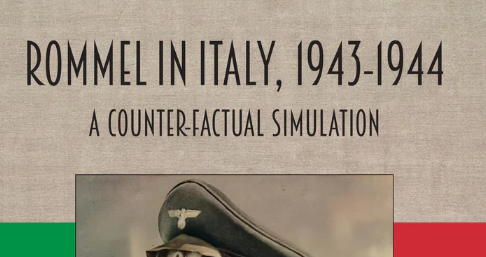
We have interviewed the venerable designer Ty Bomba on numerous occasions over the 10-year life of the blog. In fact, I counted up the interviews and to date we have done 18 total! Wow but the last one we did was in January 2023 and we have just not had him on since. No reason for that other than I have been busy with other games. But recently I saw from War Diary Publications that they were printing one of his What If? style alternative history games called Rommel in Italy, 1943-1944: A Counter-Factual Simulation, which supposes Field Marshal Erwin Rommel had taken command of German forces in Northern Italy rather than being sent to help with the defense of France against the expected Allied invasion. I reached out to Ty and he was more than glad to give me some more information.
Grant: What is your upcoming game Rommel in Italy about?
Ty:Rommel in Italy, 1943-1944: A Counter-Factual Simulation allows 2 players (or one playing 2-hand solitaire) to investigate the strategic and operational potentials that would have been in place across northern Italy from September 1943 through May 1944 if Hitler had left Field Marshal Erwin Rommel in charge there rather than Kesselring. Rommel advocated for immediately pulling back to a shorter, easier to defend, position at the south edge of the Po Valley rather than trying to fight it out farther south, with both the German’s flanks exposed to possible encirclement via Allied amphibious end runs. In effect, it put the Allies into a strategic position that historically they did not achieve until a year later. The question then becomes can they keep up that kind of advance into and across the Alps.
Grant: Why was this a subject that you wanted to design a game around? What assumptions about history did you take into account?
Ty: Historically, we had 2 of Germany’s best field commanders, Rommel and Kesselring at complete odds with each other over theater-level strategy. Kesselring felt confident the Allies would not achieve a level of operational efficiency that would allow them to effectively exploit the supremacy in the seas along both of Italy’s coasts. History showed that he was correct in that assessment, but Rommel’s transfer to France was not a sure thing. Hitler actually tried to send him back to Italy, to take full charge there, shortly after Rommel had gotten on a plane to fly to France. Radio communications temporarily failed, and by the time Hitler’s communications people got that all sorted out, the dictator had again changed his mind and kept Kesselring in place.
Further, the fact Kesselring was shown to have been correct does not mean Rommel was necessarily wrong – and there’s a fun-to-play wargame inherent in that iron.
Grant: What is important from the overall period and setting to model in the game?
Ty: The opening of the campaign, in September 1943, is filled with opportunity – but also fraught with peril – for both sides. At the start of play, there are only a few German garrison units in the far north of Italy, while the 10 (mostly elite) divisions of their Tenth Army start off-map to the south, where they just received Rommel’s order to run north. There are no Allied units setup on the map at all. They enter on the south edge during the first turn, and both players operate using the sequence below.
5.3 Allied Reinforcement & Replacement Phases
During these phases, the Allied player may bring onto the map newly arriving units and reclaim into play units that had been previously eliminated in combat. This phase is skipped on Turn 1.
5.4 German Reinforcement Phases
During these phases, the German player may bring onto the map newly arriving units and reclaim into play units that had been previously eliminated in combat. This phase is skipped on Turn 1.
5.5 Movement & Combat Sequence Determination Phases
In each of these phases, excluding that of Turn 1, the Allied player openly declares whether that turn’s movement phase or combat phase will be taken first. On Turn 1 the sequence is always the movement phase followed by the combat phase.
5.6 Alternating Actions Movement or Combat Phases
Always starting with the Allied player, the two players alternate either launching one attack or moving one unit, depending on whether the present phase is movement or combat. Individual attacks may have more than one attacking unit in them, but moves are always made one unit at a time. The unit(s) committed to those “actions” are, upon their completion, flipped over to show their disrupted sides. If a player does not actually want to make an attack or a move when it is his time to do so, he must flip one unit to its disrupted side, just as if it had moved or launched an attack: no “passing” is allowed.
5.7 Movement or Combat Recovery Phases
A movement or combat phase continues as described above until both players are out of undisrupted units or both agree they want to end the phase. If one player runs out of undisrupted units before the other, the player with remaining undisrupted units may go ahead and complete whatever actions he wants to perform with them within normal strictures, but now uninterrupted by having to pause to allow the opposing player to take an action. When a combat or movement phase is ended, both players should cooperatively turn over all disrupted units on the map so their undisrupted sides are and showing.
5.8 German Supply Check Phases
In each of these phases, both players should cooperatively look over the map to find if there are any German units out of supply. Each such unit is immediately removed to the dead pile.
5.9 Allied Supply Check Phases
In each of these phases, both players should cooperatively look over the map to find if there are any Allied units out of supply. Each such unit is immediately removed to the dead pile.
5.10 Ending & Starting Turns
Each time a Allied Supply Check Phase has been completed, advance the Turn marker one box on the Turn Track printed on the mapsheet and start a new turn with Phase I.
On the first turn, the Allied player has a relatively open front before him. If he can exploit that to get into the Po Valley quickly, he will move the strategic timetable significantly forward of the historic one. However, as he’s moving onto the map, so too it German Tenth Army. Depending on how bold both players are, it is not unusual to see pockets form inside other pockets.
Grant: How has this design changed since its original publication in 2021 in Banzai Magazine under the title Rommel’s Last Stand: Italy 1943-44, What If?
Ty: The new publisher has fixed the (scant) errata from the first (bilingual) Japanese edition from Banzai Magazine. They have also taken all the Japanese off the map and out of the rules, presenting everything fully in English. Other than the removal of those irritants, it is the same game.
Grant: What is the scale and force structure of units used for this design?
Ty: Each hex on the map equals 5 miles (8 km) from side to opposite side. Each full turn represents 2 weeks to 2 months, depending on the time of year. Every ground unit represents a regiment, brigade or division of about 2,500 to 12,000 men and/or 50 to 350 armored fighting vehicles.
Grant: How many maps are used in the game?
Ty: There is 1 large-hex based 34×22” map showing Italy north of the line of the Arno River to Ancona.
Grant: What is the anatomy of the counters?
Ty: The units are standard-classical in their data presentations, except their movement factors are not printed on them. All Allied units have (supplied) MF’s of 16 throughout the game, while the German MF’s are as follows.
German Mechanized Units Turns 1-6 – 16 MF’s
German Non-Mechanized Units Turns 1-6 – 8 MF’s
German Mechanized Units On Turns 7-10 – 12 MF’s
German Non-Mechanized Units On Turns 7-10 – 6 MF’s
Grant: What sources did you consult for the Order of Battle?
Ty: The Armies of Rommel by George Forty was an excellent source for the subtleties in the initial German Order of Battle. Beyond that, I pulled the roughly half-dozen historical Italian campaign games off my shelves and pulled information out of them. This is one of the most thoroughly simulated campaigns in the hobby, going all the way back to Avalon Hill’s Anzio, so I was not looking to find any heretofore undiscovered anomalies in either sides’ OB. The uniqueness in this game’s treatment of it comes from the changed strategic context combined with the tension inherent in the turn sequence, which requires both players to remain alert for sudden danger or fortuitous opportunities all throughout its play
Grant: How does combat work?
Ty: Combat is always voluntary and, when viewed on a battle-by-battle basis, is standard/classical odds ratio using a six-sided die.
Grant: What are the victory conditions?
Ty: Operating in conjunction with the alternating-actions turn sequence, the victory conditions are a further element I used to keep both players on the edges of their seats at all times. See below.
4.1 In General. The Allied player is on the offensive, trying to win by advancing fast enough to cause a major disruption to the historic timeline.
4.2 Allied Victory During 1943 Turns. If Phase 9 of Turn 1 or 2 or 3 or 4 ends with Venice or Milan or Trieste, or any one or more of the four German supply source hexes, occupied by an Allied unit or stack, that game ends at that time in an Allied victory.
4.3 Allied Victory During 1944 Turns. If Phase 9 of Turn 5 or 6 or 7 or 8 or 9 or 10 ends with any one or more of the four German supply source hexes occupied by an Allied unit or stack, that game ends at that time in an Allied victory.
4.4 German 1943 Sudden Death Victory. If any movement or combat phase of a 1943 turn ends with the German player having gained control of the containing the Allied Amphibious Invasion Beachhead marker, the games ends in a German victory at that time.
4.5 German 1944 Sudden Death Victory. If any movement or combat phase of a 1944 turn ends with one or more German units in any hex(es) on the south map edge, that game ends in a German victory at that time.
4.6 German End-Game Victory. If Phase 9 of Turn 10 ends without the Allied player having achieved a victory, the game ends at that time in a German victory.
The “White Dragon Game Designer” dressed as a samurai.
Grant: What are you most pleased with about the design?
Ty: As I mentioned above, the Italian campaign has been one of our hobby’s most thoroughly plowed fields for decades. Despite that, I believe I have offered a new experience with it here. Players will get a new slant on it, one that operates within the broad parameters of the war’s historic decision-making, but that is also tense and entertaining for both commanders.
I also hope its appearance in an easily available all-English edition may lead this and other publishers to look into acquiring the rights to other of my designs that have so far appeared only in East Asia (where I am affectionately known as the “White Dragon Game Designer”). I have done several games that have been well-received there, but are barely known here in the West.
Grant: I know you are a busy man with game design projects as well as editing for various wargame magazines but what other games are you currently working on?
Ty: I am presently working on this alternative history design, which is scheduled to appear in World at War No. 130, called Stalin’s Missed Opportunity: What If He Invaded Romania in May 1940?.
Bleibt Ally der Musik treu oder wechselt sie komplett unter die Autoren? In diesem Interview der „Musikszene“ bei DieHausis sprechen wir mit Ally Storch von Subway to Sally über ihr brandneues Buchprojekt, ihre Erlebnisse mit der Deutschen Bahn und warum sie nun auch zum Stift (und Skizzenblock) gegriffen hat. Wir werfen einen Blick hinter die Kulissen: Vom Schreibprozess über die Zusammenarbeit mit dem Adakia Verlag bis hin zu Gastbeiträgen von Musikkollegen wie Simon Michael. Außerdem erfahrt ihr alles über ihre kommenden Lesungen und welche kreativen Projekte noch in der Pipeline stecken. Viel Spaß beim Anschauen!
PHALANX does some really great games and they have 2 new games that have recently been placed on pre-order in a 2-pack called Pacific War Games (you can order them separately). This package includes 1943: Race to Rabaul designed by Volko Ruhnke and Tora Tora Tora! designed by Wataru Horiba. I have reached out to Volko Ruhnke to discuss his 1943: Race to Rabaul, which is part of the Keep ‘Em Rolling Series of logistics focused wargames that includes titles such as 1944: Race to the Rhine and 1941: Race to Moscow, and he was more than willing to share.
If you are interested in 1943: Race to Rabaul, or its sister game in the Pacific Wargames package called Tora Tora Tora!, you can pre-order copies on the Gamefound pre-order page at the following link: https://gamefound.com/en/projects/phalanx/pacificwar-games
Grant: Volko welcome back to the blog. What is your new upcoming game 1943: Race to Rabaul?
Volko:1943: Race to Rabaul will be the next volume in Phalanx Games’ “Keep ‘Em Rolling” Series, following up on 1944: Race to the Rhine and 1941: Race to Moscow. Also set in World War II, this time you are supplying forces moving and fighting across the South Pacific–with the twists that players are fighting each other and have to manage sea, air, and land operations.
Grant: You have designed logistics focused games in the past such as the Levy & Campaign Series. How has that experience lead you to the Keep ‘EM Rolling Series?
Volko: I’ve always enjoyed wargames that include placing, moving, consuming, destroying actual supply bits on the map–going back at least to The Gamers’ Standard Combat Series AFRIKA. In Levy & Campaign, I wanted to show that for medieval campaigns, in a simple enough way to be fun rather than tedious. When I later played 1944: Race to the Rhine, I saw that that design accomplished that very well indeed, even made it the focus of play. So I was hooked.
Grant: How did this opportunity come to you?
Volko: Two Septembers ago, I was in Prague for Czech Con hosted by Levy & Campaign Žižka designer Petr Mojžíš, where I got to meet Phalanx co-owner Jaro Andruszkiewicz. He invited me to do a design with his company. I at once knew that it had to be something in their “Race” series. Via my research for Coast Watchers from GMT Games, I already had become fascinated by Japanese logistical challenges and Allied counter-logistics strategy in the South Pacific. So the fit seemed a natural.
Grant: What sources did you consult to get the historical details correct? What one must-read source would you recommend?
Volko: I had already done a lot of reading for Coast Watchers. The source that really laid out the Japanese perspective on their difficulties in reinforcing the front line was Kengoro Tanaka’s Operations of the Imperial Japanese Armed Forces in the Papua New Guinea Theater. I also picked up Breaking the Bismarcks Barrier, an official US Navy history of the campaign. My favorite general Pacific War history source is Ronald Spector’s Eagle Against the Sun (as I briefly had the opportunity to study history under Professor Spector at George Washington University.)
Grant: What is your overall design goal and thesis for Race to Rabaul?
Volko: In the South Pacific of 1943, the Allies were far more savvy than just piling their firepower and men directly against the well-fortified Japanese positions. Instead, they wore them down with air strikes over time, while blockading them by air and sea. The key challenge to the Japanese defense was the inability to get enough supplies and men through the growing Allied air and then sea superiority to reinforce–and even just feed the Japanese forces holding the line. In1943: Race to Rabaul, you manage that logistical and counter-logistical struggle on each side.
Grant: How tough was working within the constraints of an existing system?
Volko: I find it easier overall to start with an existing system that I know works and build from there (as I did with classic-CDG Wilderness War and the scenarios and C3iMagazine campaign that I’ve done within Combat Commander). The key challenges for me in bringing the Phalanx “Race” system to the South Pacific were expanding it to opposed play necessary to capture the critical counter-logistical aspect – and to a maritime environment – sea, air, amphibious and land warfare – all with the eye to adding just a dose of added complexity.
Grant: How does the vastness and remoteness of the pacific affect logistics? How did you model this?
Volko: The environmental problem that the Japanese faced and the Allies exploited in the South Pacific was that nearly all logistics came by sea, so air interdiction ruled. There were land campaigns in New Guinea’s interior. But the jungle and ridge terrain there required air lift or coastal transport to build up. And by 1943, the Allies increasingly dominated the air war. Race to Rabaul requires you to move your troops, ammunition, and food across sea–you can’t just march your corps forward. For the more constrained Japanese, that means launching Convoys that the Allies might detect and strike.
Grant: What was most important to model in the game? What about inter-service rivalry?
Volko: That Japanese challenge moving anything and the Allied effort to stop it is most characteristic of the design. But perhaps its most impactful addition to the “Race” system is opposed combat. Rabaul taps the same principle of counting supply bits to determine combat outcomes. But with 2 opposed players, playing cards to hope to out wit each other, as well as land and amphibious attacks, the combat subsystem in this volume is necessarily more involved. For non-wargamers, that is probably a hindrance. But for wargamers, it may make Rabaul even more up their alley than the earlier games. Inter-service rivalry comes to the fore in Rabaul when you have 3 or 4 players. Each side has two Commander roles, “racing” along either the east or west half of the map. Each represents the Japanese or Allied army or naval dominance of the New Guinea and Solomons campaigns, respectively. Whichever player (not side) reaches its goal first wins the game–so you can choose to cooperate with the other Commander on your side or not!
Grant: How does the logistics support differ between the Allies and the Japanese?
Volko: I’ve mentioned the Japanese use of Convoys and Allied Convoy Strikes above. The Allies have that easier–their abundance of transports is assumed wherever they have Air Cover. The problem is that they must take ground and build Air Bases to extend that Air Cover and Convoy Strike range forward. The Allies also get more abundant Men &Material–generally more bits per action at their Supply Bases than the Japanese get at theirs. But, as in the earlier “Race” games, here the Allies must work their Logistics Level up to add to that capacity. The Japanese also have an advantage stalwart austerity in feeding their troops: the Japanese, unlike the Allies, never lose their last Troops piece in a space due to lack of Food, they garden!
Grant: What was the process of taking a series designed for land based campaigns into one involving amphibious supply and operations?
Volko: I had to add some complication to show the maritime environment. Instead of one type of connection between spaces, Race to Rabaul has Land, Sea, and Straight. Instead of just Trucks (and in Moscow Trains), Rabaul has Japanese Freighters, Destroyers and Barges and Allied Landing Craft. Because you have to transport soldiers not just supplies across water, Rabaul has Troops bits instead of Fuel, and Troops become key to feeding requirements, building Air Bases, fortifying, and, naturally, combat. Allied amphibious landings can be disastrous if defeated with the sea at their backs. And air power looms far larger int he naval environment, with Commanders controlling up to 6 Air tokens instead of Rhine’s 1 each.
Grant: What other challenges does each side face in obtaining their goal?
Volko: The Japanese defenders are essentially playing for time, as each Logistics step that the Allies need to trigger will award Japanese medals for holding the Bismarcks Barrier. But just those Japanese medals probably won’t be enough: the Japanese Commanders need to find openings to strike and cause Allied Troop losses as well. That takes timing and will cost Japanese Men & Material or Air tokens–possibly accelerating the Allied drive that will break the Bismarcks Barrier and stop those medal awards for good. The Allied attackers need to manage the troops, supplies, and cards to take Japanese positions efficiently to reduce the number of enemy medals for those Logistics steps. But rushing too much will result in risky attacks–even a potentially disastrous failed invasion–not to mention exposure to Japanese Banzai counterattacks. Pushing Allied Men & Material forward needs to occur even while the Allies keep up the pressure on Japanese convoys and bomb Japanese positions to counter their defensive buildup and digging in.
Grant: What is the layout of the game board and the purpose of the different boxes?
Volko: The board shows 2 tracks, in effect: MacArthur (green player) is racing up the New Guinea coast on the west half, while Halsey (blue) is racing up the Solomon Island chain on the east. These work like the colored areas in the earlier “Race” games, except that each track has a human opponent trying to stop you: Imamura (gold) against MacArthur, and Kusaka (white) against Halsey. The various boxes serve as pools for each side’s Men & Materiel bits and Fleets of Convoys or Landing Craft. Boxes also track what is just temporarily removed or spent rather than out of play (off the board). An Allied Logistics track works very much like those in the earlier games, showing how much each Allied Commander has developed the logistical infrastructure, affecting how many M&M they get per action, how many Air tokens they have, and how many cards they hold.
1943: Race to Rabaul game board art by Donal Hegarty.
Grant: What is the general Sequence of Play?
Volko: The Sequence of Play is quite basic–first the Japanese take actions, then the Allies do. As in the other games, Commanders each get 2 core actions from a menu, plus Bonus actions from cards, in this case at most 1 of the latter.
But before each Japanese turn, there is a free Delivery step in which Convoys drop off cargo. That wrinkle in the sequence means that (mostly) there will be an Allied turn in between Japanese Convoy Launch (an action) and Delivery, so a chance for the Allied players to strike the Japanese ships. The exception is certain Japanese Bonus action cards representing particularly successful “Tokyo Express” runs and the like. Logistics steps, when (mostly) the Allies trigger them, always occur after Allied actions. There are a couple Japanese cards that can force a Logistics step, representing intervention by Japanese fleet commander Yamamoto. Victory is instantaneous, whenever any Commander takes their 12th medal or–far less likely–a Japanese Supply Base such as Rabaul falls.
Grant: How many players is the game designed for?
Volko: The game handles 2, 3, or 4 players. We always have Japanese and Allied players opposing each other, as both logistics and counter-logistics feature. With 4 players, each takes a Commander: the 2 Commanders on a side can help each other with longer-range strikes and intelligence, or they can withhold help or even sabotage each other if their ally is pulling ahead and getting too close to winning. With3 players, one takes both Commanders on a side and must win with both, facing 2 players each as a single Commander. The single player can be either on the Japanese or Allied side, either works. With 2 players, you can either each command a side–the 2 Japanese Commanders versus the 2 Allied–or you can pick either half of the map–New Guinea alone or the Solomons–and play a shorter game with just 1 Commander each side.
Grant: What different commanders do players have a choice to play as? How do they differ?
Volko: The paired Commanders personify not only the conditions in New Guinea and the Solomons, respectively, but also the bureaucratic friction between Army and Navy on each side.
-MacArthur in New Guinea is also the theater commander so gets say in any internal Allied dispute such as order of actions. As an Army General, he has more land assets such as Artillery cards and a related Special Ability to redraw them, more suitable anyway to the New Guinea “track” that involves some interior fighting. Also, MacArthur alone can use Airdrops to seize jungle airstrips.
-Halsey in the Solomons has more Naval Shelling, Cruisers against Japanese Convoys–also his Special Ability–plus Guerrillas but correspondingly less Artillery and attack Divisions. Halsey late in the campaign needs to be the most careful not to get the last of his Divisions beaten up and withdrawn.
-Facing MacArthur, General Imamura represents the overall Japanese Army’s focus on New Guinea and the overall Japanese priority on that axis over the Solomons chain–so that player is the senior partner on the Japanese side. Imamura has more Troop and Ammo unit cards at his disposal and a Special Ability that can redraw them. He has his own Bonus action cards like Supply Road and Barge Assault.
-Admiral Kusaka facing Halsey has an edge in Carrier Pilots–his Special Ability–naval advantages like Long Lance torpedoes, but also the defensively crafty Army General Sasaki, who held up the Allies bloodily on New Georgia.
Grant: How is victory achieved?
Volko: As in the other “Race” games, capture of a Supply Base–here an Allied Commander advancing to either Rabaul, Madang in New Guinea, or Kavieng in the islands–ends the game immediately in an Allied Commander win. But, as in those games, that rarely will occur: the main way to win is to be the first of the 4 Commanders to gather 12 medals along the way.
Grant: What different scenarios are included?
Volko: The game includes 4 scenarios, each of different length. They all end with capture of a Japanese Supply Base or with a 12th medal. They run different play lengths by starting at later and later points in the South Pacific campaign:
-TheFull Campaignbegins with the Japanese still to make their final push on the Kokoda track and Guadalcanal in late 1942. The Allies must battle their way to Buna in Papau before heading up the New Guinea coast, while throwing the Japanese off Guadalcanal before driving up the Solomons chain.
-CARTWHEEL begins with the Allies preparing their historical 1943 drive to conquer or encircle Rabaul. Buna and Guadalcanal are cleared and serving as Allied bases, but the great Allied offensive has not yet launched.
-POSTERN begins with MacArthur primed for the historical September invasion to capture the Japanese New Guinea base of Lae and Halsey’s forces having just fought across New Georgia in the central Solomons.
-Finally, CHERRY BLOSSOM is a small learning scenario for just 2 players on the Solomons half of the board, representing the moment that Halsey is about to invade the Japanese bastion island of Bougainville.
Grant: What do you feel the game models well?
Volko: Phalanx’s “Race” system does so well highlighting the need to gather and push supplies forward in a mobile mechanized campaign–especially one in which the defender is largely on the run. Race to Rabaul I hope similarly succeeds in showing that the overwhelming Allied logistical edge over the Japanese in the South Pacific by 1943 was alone not enough against tenacious, dug-in defenders. The Allies succeeded as they did by smartly targeting Japanese logistics first, and only then throwing ground forces at the enemy bastions. To me, this design makes that counter-logistics approach vivid. I hope players will agree!
Grant: What are you most pleased about with the design?
Volko: I’m pleased with how the one-sided “Race” concept ported here to a full wargame, force on force, and that some added map features, pieces types, and combat rules brought the Phalanx system to “tri-phibious” warfare. The game is more complicated than either 1944: Race to the Rhine or 1941: Race to Moscow, to be sure, but remains more accessible than my usual design space such as Levy & Campaign or Recon Series. (I think so, anyway.)
Grant: What other designs are you contemplating or already working on?
Volko: Jaro of Phalanx, who commissioned this design from me, and I have chatted back and forth about a wide range of settings for a possible next “Race” volume from me. I have a good idea what that would be, if players end up digging Rabaul. But it would be premature to raise particular expectations as yet.
Thank you for the intriguing questions!
If you are interested in 1943: Race to Rabaul, or its sister game in the Pacific Wargames package called Tora Tora Tora!, you can pre-order copies on the Gamefound pre-order page at the following link: https://gamefound.com/en/projects/phalanx/pacificwar-games
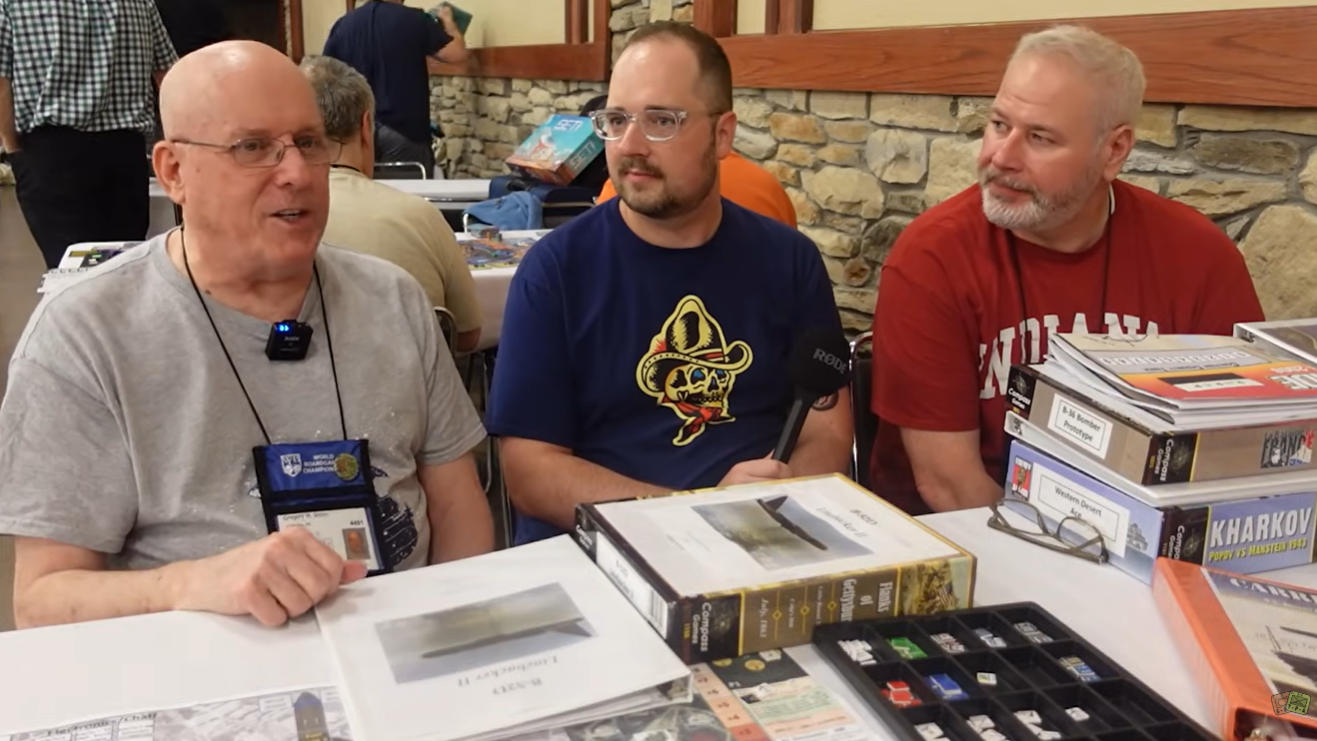
Last year, while attending the World Boardgaming Championships in Pennsylvania, we had the chance to sit down separately with 2 wargaming icons in Gregory M. Smith and Mark Herman and shoot interview videos.
The first is with Greg and covers his ongoing list of in-design games:
The second was with Mark and covered his now recently released Army of the Potomac from GMT Games:
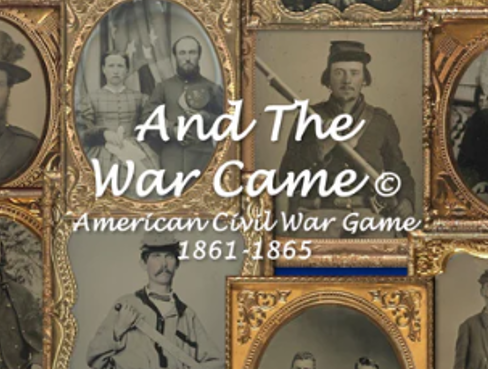
While attending Buckeye Game Fest this spring, we were gifted a copy of a newly published game called And the War Came: American Civil War 1861-1865 from Pinkerton Games, which is published by Blue Panther LLC and Steve Jones. The designer and owner of Pinkerton Games Larry Pinkerton had been their earlier but had to leave due to some other pressing business and we were unable to meet but were very grateful for the game. Upon returning home, I reached out to Larry to see if he would give us a bit of an inside look at the design and he was more than willing to discuss the game.
Grant: Larry welcome to our blog. First off please tell us a little about yourself. What are your hobbies? What’s your day job?
Larry: Grant and Alex, first, thanks for the opportunity to tell you about myself, and my game, And The War Came. I’m a lifelong resident of southwest Ohio, from the Dayton area. I’ve got three great adult kids, each working on their families and/or careers. I’m now retired from both my civilian job, and my almost 34 years as a traditional Ohio National Guard member-last duty assignment as an Air Defense Brigade Commander-so now more time for hobbies.
Now that And The War Came is finally done, I enjoy hanging with my kids, playing music, and traveling. I still do part time contract work in support of US Army training events, which I enjoy as well. And I hope to find more time for playing other wargames too!
Grant: What motivated you to break into game design? What have you enjoyed most about the experience thus far?
Larry: I’ve always been interested in the American Civil War, and many years ago it came to me that a block style game and a strategic level treatment of that war would make a great game-one that didn’t really seem to be available, at least for what I was looking for. I’ve really enjoyed developing the game, adopting, changing or dropping processes, seeking to get at the right balance of playability, workable mechanics and good history. It took a while, but I’m happy with the results.
Grant: What is your upcoming game And the War Came about?
Larry:And the War Came is a strategic level American Civil War game, focused on the southeastern United States. It started life as a block game, but when I decided to self-publish, I switched to rotatable counters due to cost. But play is similar-it’s area movement and card driven, so those familiar with Columbia style block games will recognize some of the mechanics.
Grant: What does the title mean in relation to the history of the American Civil War?
Larry: I bounced so many title ideas and finally settled on And The War Came, which is a sentence in Lincoln’s 2nd inaugural address (March 4, 1865). I felt that line summarized how the United States stumbled and staggered into civil war. And the wonderful Carte de Visite Collection images from the US Library of Congress I chose for the game box spotlight who the actual participants really were.
Grant: What games gave you inspiration for your design?
Larry: Columbia Game’s Hammer of the Scots and Victory Game’s The Civil War 1861-1865 were by far the strongest influences.
Grant: What is important to model or include in a game about the American Civil War?
Larry: Above all, I think it is leaders and leadership at the corps and army level. Any discussion of ACW campaigns seems to hit on the “what ifs” of senior leaders. There were simply so many generals I could have chosen to model in the game, but I finally settled on 22 Union and 19 Confederate leaders that did or could have risen to army or independent command. The formations on both sides were so similar, in my opinion it was the leadership that was truly decisive.
Grant: What challenges did you encounter in the design? How have you overcome them?
Larry: Wow, there were a lot; game flow, simple but historically accurate mechanics, relative strength and play balance, rail and naval capacity, re-playability, map scale-all had to be refined through trial and error, playtesting and compromise. And countless rulebook edits! Rules concepts I thought made perfect sense in my head and on the page drew several questions when reviewed by others. But I think it’s a pretty good final product.
Grant: What is the scale of the game? Force structure of units?
Larry: Regional area movement, and seasonal turns, representing three months. The map is bounded by eastern Kansas to eastern Texas on the western edge, New Jersey to northern Florida along the Atlantic Coast, lower Midwest on the northern edge, and Gulf of Mexico on the southern. Most states contain 4 to 10 areas-states with better road networks tend to have less areas. But there is more territory than units to control it. Fortress cities (i.e. Washington, D.C.), major railroads, navigable rivers, and mountains and swamp areas are also portrayed on the map. Rail and naval support capacity change each year.
Units represent infantry or cavalry corps, with a strength of from 1 to 4 divisions, or forts representing 1 to 4 installations. Unit count is: Union-33 Infantry counters, 10 Cavalry counters, 5 Fort counters, Confederate-26 Infantry counters, 8 Cavalry counters, 8 Fort counters.
Grant: What is the counter anatomy?
Larry: Very straightforward if familiar with Columbia style block wargames-a mechanic I have always admired for simple and clean fog of war, step reduction, and ranged or initiative combat. \Counters are square with strength point symbols (divisions) arrayed along each edge, plus movement and combat ratings. Infantry has a combat value of C2 with a move allowance of 1. Cavalry has a combat value of B1 with a move allowance of 3. Forts have a combat value of A1 with a move allowance of 0-they are stationary. There are also corps insignia (Union) or battle flags (Confederate) just to add historical flavor, and the branch insignia of the period for infantry, cavalry or forts. Ultimately, I chose to give similar units of both sides the same combat or movement ratings (since both Union and Confederate formations grew from the same organizational foundations and traditions), but those ratings can be modified by the leaders who command them, both at corps and army levels, and/or the battlefield terrain.
Grant: What does it mean the “game is We Go turn based”?
Larry: Most functions are conducted by both players at the same time. For example, in the Administration Step, both players recruit (buy) their new units/strength points, enter new or recovered from wounds generals, or administratively move/transfer generals already on the map to new assignments/commands. When both players are done, they go to the next step, (Operations), with Action Phases where each plays a card to determine who moves first, they complete their moves and then resolve any battles that result from movement. The Logistics Step and Victory check complete a turn.
Grant: What type of experience does this approach create?
Larry: It minimizes down time for one. Actions in the Administration Step, Operations Step, Logistics Step happen simultaneously. Only in the Operations Steps’ Action Phase (or depending on the season, phases) does movement happen sequentially. This limits the action/reaction dynamic to operations, where maneuver happens in small chunks due to the seasonal card play. Neither side is able to make big sweeping moves, while the other side can only watch-the mechanic enables campaigns like Gettysburg or Vicksburg, although they may not necessarily occur during the course of play.
Grant: How does the game use cards?
Larry: Cards list the number of “orders” you can issue to units in order to conduct movement or other actions. There are also cards with both events and orders where players must choose which to use. And most cards have a bonus action (improved combat, movement, or leader promotion) to spice things up. The season determines the number of cards each player receives that turn. The Winter season/turn, each player receives only one card-in the single Action Phase, each player compares their card to the other player’s to determine who moves first (initiative), then second, then resolve any combats. This makes for a short turn. In both Spring and Fall seasonal turns, players receive two cards each, then play their cards against each other in each of the two Actions Phases, conducting moves and combat. In the Summer seasonal turn, three cards are dealt to each player-thus there are three Action Phases that turn.
Grant: What type of cards are included? Can you share a few examples?
Larry: There are 30 cards in the common game deck (there are not separate unique decks for Union or Confederate players). The deck includes 22 orders cards, each card with a value of 1, 2, 3, 4 or 5 orders. The orders determine how many units (corps) or commands (see Leaders below) can be moved with that card-a card with only one order allows the movement of only one unit, etc. Orders can also be used to promote generals or repair rail roads, etc. Again, most, but not all of these 22 cards also have a bonus that improves movement, or combat for a unit, or gives a free general promotion.
There are also 8 cards that include a combination of orders and events such as blockade impacts, partisan activities, native uprisings, surprise attacks, diplomatic incidents, immigrant or native recruits, or spy activity-each event with favorable impacts for themselves, or negative impacts for the opposing player. I chose for the event cards to be generic in nature and usable for both sides, verses specific events (i.e. Trent Affair) scripted events. For these 8 cards, players have the option to play the event and still have two orders to move other units, or not play the event at all, and have all three orders for movement.
The entire deck is reshuffled at the start of a new year. Since each player only receives 8 cards in a four season/turn year, only 16 of the 30 cards are played each year-some cards may not get played during the entire war, while others may reappear several times.
Grant: How does combat work?
Larry: Again, similar to other Columbia style block games.
Paraphrased from the rulebook:
Units Fire or Retreat in a combat round. The sequence of combat is A class units fire/retreat first, before B class units, followed by C class units which fire/retreat last. If both sides units are the same class, the defender has the advantage, and fire/retreat before attacking units of the same class. A general’s initiative rating may change who has the first shot advantage. To Fire, roll as many dice as the unit’s current strength points (SP). A hit occurs for each die roll equal to, or less than the unit’s combat number rating. Hits on the enemy take effect as they happen, each hit immediately reducing the enemy unit strength point count by one. Say a 3 division (SP) infantry corps has a combat rating of C2-that corps rolls 3D6 dice and every “1” or “2” rolled is a hit, reducing enemy strength and effectiveness when returning fire. In a battle between a B1 cavalry unit and a C2 infantry unit, the B1 rolls first, but only scores a hit for each 1 rolled. The C2 rolls second and scores a hit for each 1 or 2 rolled. One round of combat is complete when each unit fires or retreats.
Some unit strength may be recovered at the end of combat if the unit is not destroyed-with this recovery rule I’m trying to account for after the battle return to duty wounded, stragglers, local prisoner exchanges, etc. I was aiming for about 20% casualty rates in combat.
Grant: How do Leaders work? How are they killed or wounded?
Larry: Leaders are used to command corps or armies (units under the command of a general are actually called “commands”, i.e. Sherman’s command). A leader imparts his initiative (A, B, or C class) and tactical ratings to the unit or units he commands. In Sherman’s case, he changes a C2 infantry corps under his command to a B2. A leader’s initiative and tactical ratings may change at different ranks. And I’ve added optional rules to randomize when leaders enter the game, and their ratings.
Leader counters also rotate-they all enter the game as a one star general. They may be promoted to two or three star rank. Grant and Sherman can even be promoted to four star (GEN) rank as they historically became army group commanders. A one star general (BG) controls one corps counter; a two star (MG) may command one or two corps.
The only way a leader can be promoted to three stars (LTG) rank is to take command of one of the 5 named armies: Potomac, Cumberland, and Tennessee for the Union; Northern Virginia and Tennessee for the Confederacy. Named armies may contain four or more corps, depending on the army. And only named armies may have subordinates of one or two star rank. If a three star army commander is relieved of command, there is a political cost, and the leader reverts to one or two star rank.
Leaders also represent staffs and logistics trains, so commanded units may engage in two rounds of combat, whereas corps without a commander may only initiate one round of combat-so even lower quality leaders can be beneficial since they allow you to fight an additional round. Most leaders also increase the movement allowance for infantry to 2 instead of the base 1.
And yes, leaders may be wounded, killed or captured. At the end of each combat which involved leaders, a leader casualty assessment is rolled-lower ranked leaders are more likely to be casualties. If assessed as a casualty, another D6 is rolled for severity of wound. Rolls of 1 through 5 indicate the leader is out for that many turns. A roll of 6 means the leader is killed. And if a commanded unit is destroyed but the leader is not killed or wounded, the leader is captured. Captured leaders may be exchanged as prisoners.
Grant: How does the design create fog of war and uncertainty?
Larry: The counter covers hide counter information until opposing units engage in combat. Of course, leader losses will occur, which adds to uncertainty. The cards also provide for a lot of variability in maneuver. And the strength replacement recruiting is a combination of fixed values for the year, plus a die roll for variable recruits each season. Recruitment strengths diminish for both sides over the course of the game. There’re several optional rules that address the Emancipation Proclamation, Drafts, Leader randomization, etc. to add historical flavor or variability to the game.
Grant: Who is the artist for the game?
Larry: I did the artwork…in MS PowerPoint. Whew, not the easiest thing to do! But I’m happy with the results. I used public domain art and was able to generate nice graphic quality with the tools available. And I found you can only go so far in development before you have to start addressing production concerns. And the War Came is definitely a game on a budget!
Grant: How is victory achieved?
Larry: Quite simply, players must accomplish more than their historical counterparts in the same period, for example the 1862 scenario, when the Border States, most of Tennessee and New Orleans were in Union hands by year’s end. So, victory usually means holding more territory, but there are also war weariness and political factors that contribute to, or detract from, victory. Examples are the midterm elections of 1862, Presidential elections of 1864, and weariness of the northern population.
Grant: What do you feel the game models well?
Larry: The overall ebb and flow of the conflict-using corps formations on a large area map just works well. And although there are abstracted naval and logistics rules that function well, I chose to focus on the senior commanders and Lincoln’s and Davis’s struggles to find effective military leadership for their troops at corps and army levels. And I think I’ve got the right level of political factors that contributed to the War’s outcome factored in. It’s hard for the CSA to win, but if the USA sits on it’s hands to build strength and perfect its leadership, the USA will lose. The USA must take the fight south early and often-and that’s a lot of territory to cover.
Grant: What are you most pleased about with the design?
Larry: There’s so many classic ACW titles out there that cover the entire scope of the war in great detail, and yet I think And the War Came fills a niche. For those familiar with board wargames, it’s not overly complex and it plays fairly quickly. I like the unknowns and fog of war, and think the re-playability is there. The historical framework is solid. I tried to not model for effect, so historical campaigns and outcomes are certainly possible, but not preordained. I wanted an interesting beer and pretzels game, one that both those familiar and unfamiliar with the ACW could enjoy. Again, I’m satisfied with the results.
Grant: What other designs are you contemplating or already working on?
Larry: I think if there’s another one in me, it’ll be a strategic treatment of the American Revolution-but to model that conflict will take some work, initially just to get the scope right, and factor in the interrelationship with the wider Anglo-French conflict.
Oh, and I must add a hearty thanks to Blue Panther Games, for their great production and distribution support! I just couldn’t nail down a publisher-but after consulting with Steve Jones (BPG) I realized I could partner with Blue Panther and do it myself! I would recommend them to any aspiring designer who’s interested in self-publishing.
If you are interested in And the War Came: American Civil War1861-1865 from Pinkerton Games, you can order a copy for $65.00 from the Blue Panther LLC website at the following link: https://www.bluepantherllc.com/products/and-the-war-came
Als ich mich das erste Mal mit Believe in me! (please) beschäftigte, kam mir sofort das ikonische Video von Jesus He Knows Me in den Sinn. Die Bildsprache des Brettspiels und der erste Blick auf das Thema ließen sofort Phil Collins vor meinem geistigen Auge tanzen, mit Scheinen wedeln und um zahlungskräftige Anhänger buhlen. Meine...
Foto: Spiel des Jahres e. V.Harald Schrapers, Jahrgang 1964, veröffentlicht seit Anfang der 1990er Brettspielkritiken. Er war freier Mitarbeiter der Fairplay, hat für die Thüringer Allgemeine und Die Zeit geschrieben und ist in aktueller Position freier Mitarbeiter der Spielbox. Seit 1993 betreibt er die Website Games We Play.Seit 2017 ist er Mitglied des Vereins Spiel des Jahres e. V.
Ist die Jury „Spiel des Jahres” wirklich so unabhängig, wie sie behauptet? Wir haben beim Vorsitzenden Harald Schrapers nachgefragt. Im Interview spricht er über Lizenzeinnahmen, Werbeveranstaltungen und einen Streit innerhalb der Jury. Das Interview ist eine Ergänzung eines etwa eineinhalbstündigen Interviews mit Harald Schrapers. Das komplette Gespräch könnt ihr im Podcast Boardcast von Frederik Malsy nachhören. Das Interview mit Tom Werneck, auf das wir uns beziehen, findet ihr unter Tom Werneck: „Schaue mit Neugier auf die Arbeit der Jury, nicht mit Groll“. Unabhängigkeit der Jury In seinem Buch „Das moderne Brettspiel“ schreibt Tom Werneck, es sei fragwürdig, ob die Jury
Folge 40 regt hoffentlich ein wenig zum Nachdenken an. Zumindest uns hat das Interview mit Cosima Werner ebenso die Antennen hochfahren lassen wie die Beschäftigung mit dem Spiel LIMIT von Alexandre Poyé (erschienen bei Ludonaute bzw. bei Spielworxx). Zusätzlich sprechen wir noch intensiver über SKYBRIDGE von Michael Rieneck und Franz Vohwinkel (erschienen bei Deep Print […]
Seit 1. April 2025 ist Nico Finkernagel Chief Technology Officer (CTO) bei Pegasus Spiele. Teil der IT-Abteilung ist er aber bereits seit 2018. Als Software Engineer war er seither an der Realisierung zahlreicher Projekte beteiligt. Er setzte seine Fähigkeiten und Kenntnisse in den Bereichen Datenanalysen und Prozessoptimierungen ein, zum Beispiel bei der Einführung eines neuen Shopsystems und dem Aufbau der IT-Infrastruktur für das Pegasus Spiele Tochterunternehmen Pegasus Spiele North America.
Als CTO hat er nicht nur die Leitung des IT-Teams inne, sondern kümmert sich als Teil des Managements unter anderem auch um den Ausbau der IT-Sicherheitsstrategien, die Einführung neuer Technologien und den Aufbau strategischer Partnerschaften im Bereich IT.
Nach seinem ersten Jahr als CTO blickt er auf die ersten Erfolge und zukünftige Projekte:
Auf welchen Themen liegt dein Hauptaugenmerk seit Beginn deiner Tätigkeit als CTO?
„Seit ich CTO bin, bewegt sich mein Alltag im Grunde zwischen zwei Welten: Zum einen leite ich ein für unsere Unternehmensgröße ziemlich großes IT-Team von fünf Personen. Das heißt ganz konkret: Projekte priorisieren, Strukturen weiterentwickeln, aber vor allem dafür sorgen, dass das Team gut arbeiten kann. Zum anderen ist ein großer Teil meiner Arbeit strategisch geprägt. Ich beschäftige mich viel mit der Frage, welche Technologien für uns wirklich relevant sind und welche eben nicht. Es geht darum, sinnvolle Schwerpunkte zu setzen und die IT so auszurichten, dass sie das Unternehmen langfristig unterstützt. Das betrifft Logistik- und Handelsprozesse, IT-Infrastrukturen, aber auch generelle Tools, die beeinflussen, wie wir im gesamten Pegasus Spiele Team zusammenarbeiten.“
Mit Blick auf über 30 Jahre Firmengeschichte ist ein Jahr als CTO natürlich noch keine lange Zeit, aber gibt es schon Erfolge, auf die du zurückblicken kannst?
„Ein großer Schritt war für mich, dass wir uns als IT-Team neu aufgestellt haben. Zwar arbeiten wir nach wie vor eng zusammen, besprechen uns regelmäßig und sind als Team die Anlaufstelle für alle technischen Probleme, aber wir haben nun auch alle unsere Schwerpunkte: Entweder im Bereich Administration & Tooling mit Fokus auf Identity Management sowie IT- & Netzwerk-Sicherheit oder im Bereich E-Commerce mit besonderem Blick auf SAP als unser Warenwirtschaftssystem, aber auch unser Shopsystem Shopware. Diese Splittung schafft Klarheit bei den Zuständigkeiten, lässt uns aber auch produktiver arbeiten als früher.
Ein weiterer wichtiger Fokus lag im letzten Jahr auf dem Thema IT-Sicherheit. Wir haben begonnen, unsere Architektur stärker in Richtung eines Zero-Trust-Ansatzes weiterzuentwickeln, also weg von klassischen, klar abgegrenzten Netzwerken hin zu einer Umgebung, in der jeder Zugriff grundsätzlich verifiziert wird. Das betrifft unter anderem Identitäten, Geräte und Zugriffsrechte und schafft eine deutlich robustere Grundlage für unsere Systeme.
Darüber hinaus gab es viele kleinere Projekte und Verbesserungen im Alltag, zum Beispiel die flächendeckende Einbindung der SSO-Authentifizierung oder ein vereinfachtes Zeiterfassungsmanagement, die sich jedoch in Summe deutlich bemerkbar machen und unsere Arbeitsweise kontinuierlich voranbringen. Einige dieser Projekte sind in der IT inzwischen State of the Art, für andere mussten wir eigene Soft- bzw. Hardware entwickeln. Ein größeres Projekt im letzten Jahr war außerdem der Relaunch von pegasus.de Mitte 2025, den wir als Teil eines interdisziplinären Website Teams begleitet haben. Insgesamt ging es in meinem ersten Jahr als CTO aber insbesondere darum, Grundlagen zu schaffen, auf denen wir künftig aufbauen können.“
Verrätst du uns, wie dein Arbeitsalltag aussieht?
„Sehr unterschiedlich und ehrlich gesagt mag ich genau das daran. Es gibt Tage, an denen ich gefühlt von Termin zu Termin gehe und viel im Austausch bin: mit meinem Team, mit anderen Abteilungen oder mit externen Partner*innen. An anderen Tagen habe ich mehr Raum für konzeptionelle Arbeit oder tiefere technische Themen.
Was allerdings tatsächlich zu kurz kommt, ist das Programmieren selbst. Das bedaure ich manchmal, weil mir genau dieser Teil nach wie vor großen Spaß macht. Deshalb versuche ich, mir so oft wie möglich kleine Zeitfenster freizuschaufeln, auch wenn das dann nicht selten in einer ‚Nachtschicht‘ endet. Es ist für mich wichtig, den Bezug zum operativen Geschäft nicht zu verlieren und Dinge auch selbst auszuprobieren. Außerdem achte ich darauf, auch mal einen Schritt zurückzutreten und mich zu fragen: Sind wir noch auf dem richtigen Weg? Was müssen wir anpassen? Wo wollen wir eigentlich hin? Den Überblick über das große Ganze zu behalten ist ein wichtiger Faktor meiner Position.“
Woher kommt deine Faszination für IT und Technologie?
„So genau kann ich das gar nicht auf einen bestimmten Moment zurückführen. Ich glaube, mich hat schon früh gereizt, zu verstehen, wie Dinge funktionieren und wie man sie verbessern kann. IT bietet da unglaublich viele Möglichkeiten.“
Brettspiele sind als analoges Medium nicht gerade, woran man bei technologischer Innovation denkt. Wieso reizt dich gerade diese Herausforderung?
„Der Gedanke ist absolut nachvollziehbar. In unserem Fall geht es weniger darum, das Produkt selbst zu digitalisieren, sondern vielmehr um alles, was drumherum passiert: Entwicklung, Planung, Produktion, Logistik oder Datenmanagement. Wenn man an diesen Stellen die richtigen Hebel ansetzt, kann man enorm viel bewegen. Und genau das finde ich spannend, in einem Umfeld zu arbeiten, das nicht per se als ‚tech driven‘ gilt und trotzdem enormes Potenzial bietet.
Gleichzeitig hat uns das Internet sehr deutlich gezeigt, was Digitalisierung leisten kann: Sie ist ein Werkzeug, um viele Menschen zu erreichen und miteinander zu verbinden. Für uns bedeutet das, unsere Vision weiterzutragen, möglichst vielen Menschen den Zugang zu Brettspielen zu ermöglichen und neue Verbindungen zu schaffen. Technologie ist dabei kein Selbstzweck, sondern ein Mittel, um genau das zu unterstützen.“
Welche Ziele hast du dir für die nächsten sechs Monate und welche für die nächsten sechs Jahre gesteckt?
„Kurzfristig möchte ich vor allem weiter an klaren Strukturen arbeiten: Transparenz schaffen, Prozesse sauber aufsetzen und Prioritäten klar definieren. Mir ist wichtig, dass die IT nicht nur als Dienstleister wahrgenommen wird, sondern als aktiver Teil des Unternehmens.
Langfristig denke ich weniger in einzelnen Projekten, sondern in Fähigkeiten. Ich wünsche mir, dass wir eine IT-Organisation aufbauen, die stabil läuft, aber gleichzeitig flexibel genug ist, um schnell und unkompliziert auf Veränderungen reagieren zu können. Denn insbesondere der digitale Sektor ist extrem schnelllebig und eine Innovation jagt die nächste. Dazu kommen rechtliche Vorgaben, aber auch sich ständig wandelnde logistische sowie bürokratische Herausforderungen. Meine Hoffnung ist es, dass ich als CTO bzw. wir als IT-Team dazu beitragen, dass Pegasus Spiele technologisch stets gut gerüstet ist und ein Arbeitsumfeld bietet, in dem Technologie zu Kreativität, Wachstum und nachhaltigem Erfolg beiträgt.“
Es ist Zeit für Musikszene im Interview – DieHausis sprechen mit mal wieder mit Simon Michael Drummer von der Band SUBWAY TO SALLY über privates, die Eisheilge Nacht 2025 Tour im Dezember, über die Band und was ist und kommt 2026, wie z.B. die Nackt3 Tour. Das Interview könnt ihr auch super als Podcast hören.
Seit dreißig Jahren begeistert Catan Menschen auf der ganzen Welt. Zum Jubiläum haben wir Benjamin Teuber dreißig Fragen gestellt – über Raubkopien, den Film zum Spiel und seinen Vater, den Erfinder von Catan. Catan erschien 1995. Klaus Teuber entwickelte es in seiner Freizeit, hauptberuflich arbeitete er damals als Zahntechniker. Sein Sohn Benjamin stieg 2010 ins Familienunternehmen ein. Er leitet seit dem Tod von Klaus Teuber die Catan GmbH mit seinem Bruder Guido. 1. Welche Frage zu Catan kannst Du nicht mehr hören?Warum der Wechsel von Holz auf Kunststoff? Ursprünglich wurde das Spiel mit Holzfiguren ausgeliefert. Ab 2003 erfolgte die Umstellung
Im Zuge der Arbeit am Sammelband "Von bierbrauenden Mönchen und kriegerischen Nonnen - Klöster und Klerus in analogen und digitalen Spielen" enstand ein Interview zwischen Lukas Boch und Randy Rathert, dem Autor von The King`s Abbey. Im Mittelpunkt stand die Frage nach der Entwicklung und Umsetzung des Themas Kloster im Brettspiel.
The latest entry in our interview series Why You Should Back: Death By Coconuts on Kickstarter. We spoke with the creator to get information about their latest launch. They look to be bringing something very interesting to market that walks the fine line between humorous and morbid. The Kickstarter launch date is May 31, 2022. Check out the link below to go directly to Death By Coconuts Kickstarter page or continue on to read the interview with the creator.
1. How would you describe your product in a few sentences?
Death By Coconuts is best described as a race-to-the-finish board game where you move by betting on death statistics.
First, you draw three causes of death, which can be anything from sharks to falling vending machines and projectile Champagne corks. There are additional time periods and geographical parameters to help you work out the answer. Then, when you’ve made your mind up, you bet up to three chips on which of the three you think is most deadly.
If you’re right, you move forward the same number of spaces as chips you bet with. If you’re wrong, the same applies – only you move backward instead! So you can see, it’s a game of risk and reward were betting big or small dictates how quickly you move across the board.
You’ve got to navigate shortcuts and trapdoors, and the treasure chest cards will more often than not expedite your arrival at the finish line. But sometimes they’ll throw a curveball at you. Only the first to the finish wins, unless there’s a tie. In which case we’ve got a pretty dramatic best-of-three tiebreaker to decide the winner. This is our very first attempt at a board game. We’ve created a simpler mechanic than our first Kickstarter game, Plant-Based Riot, but it still delivers bucket loads of quick-fire fun.
2. Introduce the team bringing this to market? What is your background that brought you to launching this?
Marty Pardoe worked behind the scenes of Plant-Based Riot but is at the core of this team. She’s a hugely gifted designer that’s been involved from the early stages when the game went by the rather sinister name of “May Cause Cancer” (a story for another time…). Marty was named as a rising star in Mojo Nation’s 100 Influential Figures list in 2021 for her work on our game Girl Power. It was Marty’s idea to make Death By Coconuts a race-to-the-finish board game and we’ve run with that ever since.
Roberto Rotaru is our artist, graphic designer, motion graphic designer, video editor. He continues to add strings to his bow since our campaign last year. Originally from Romania, he’s the biggest gamer of the bunch – our go-to guy when it comes to making key decisions on mechanics. All the motion graphics and videos you see in relation to this project are down to his artistry.
I’m the content writer for Death By Coconuts. It was my job to trawl the deepest depths of the internet to put together 250 death statistics. It was definitely no day at a tropical beach, I can tell you. You know what they say, though… It’s a tough job, but someone’s gotta do it.
Courtney is the guy that oversees everything. It’s his job to stitch all the individual components together. He started Bubblegum Stuff in Hong Kong back in 2013, so there’s traces of his blood, sweat and tears in this and every other product the company has put out over the years.
We’ve turned to Kickstarter again because we loved the experience last time out. It brought us closer to our community in more ways than one. Like us, the people that backed Plant-Based Riot believe in the power of collaboration. And because they have tons of experience backing games on the platform, they are an invaluable source of insight and opinion. We’re sure many of those guys will play active roles in making key design and gameplay decisions with Death By Coconuts, too.
3. What existing games would you compare your game to?
Death By Coconuts is similar to a few games – and in various ways. It’s got elements of Snakes & Ladders, which we all remember as one of the first games we ever played. The shortcut across the lake and the lava flow trapdoor are essentially a ladder and a snake respectively.
The treasure chest cards also give the sense you’re being given a ladder or a snake, depending on what you’re lucky or unlucky enough to pick up. Saying that, though, they could be likened to the chance or action cards that are fairly ubiquitous in many board games.
There are also similarities with a game from London-based games producer Big Potato. Their game What Came First? uses the same betting mechanic as the method for moving around the board. The difference being in What Came First? you’re betting on what happened first out of two events in history that are paired together on the same card. In Death By Coconuts you’re betting on three separately drawn death stats.
That small difference adds endless amounts of replayability to the game. It means there are over 2.5 million possible combinations of death cards! Each round will feel like a fresh challenge regardless of how many times you’ve played the game. That’s amplified even more when you consider the additional caveats like time period and location.
4. What sets your game apart?
What sets Death By Coconuts apart is the delivery. We’ve produced a game that features 250 causes of death without it feeling overtly morbid. And that was always the mission. It must be said, we’re not making light of death or any of the events featured on the cards in the game. But it is as much a part of life as birth. And we knew if we handled it correctly, it wouldn’t cause offense. Much in the same way that Halloween or the Mayan festival Day of the Dead doesn’t.
Some of the content comes across lighthearted, such as the deaths by falling coconuts, which causes on average 150 deaths a year! (Incidentally, that’s more than sharks – and it’s that fact that was the inspiration behind the game.) However, most of the leavening is being done by the 1950s Americana/tropicana/tiki-style design, artwork and overall theme. The board depicts our little skeleton character getting into all kinds of comedic scrapes with cannibals, krakens, snakes and more. Many of which are causes of death featured in the game. In addition to those Easter eggs, there are 150 coconuts on the board in reference to the stat that started it all. We’ll be impressed if anyone finds them all. You might even notice the spaces stretching from Coconut Beach to Eternal Paradise look familiar…
5. How can everyone be assured that they are going to get quality components and you are going to deliver on all the promises you are making?
As previously mentioned, we’re a slightly expanded team to the one that delivered Plant-Based Riot through Kickstarter last year. And this slightly expanded team is working within Bubblegum Stuff, which is a small gift and game company based in London. We’ve been plying our trade for nearly 10 years. So getting things designed, made and delivered is our bread and butter.
Furthermore, we delivered Plant-Based Riot – our first Kickstarter – through all the turmoil and disruption caused by Covid and one of the worst shipping crises in history. We’re really proud to have delivered the game to our backers, as promised, by Christmas. This meant changing from sea freight to air freight right at the eleventh hour. Seriously… the stock was on a ship in port and we took it off and got it onto a flight!
Not that we wouldn’t go above and beyond for our customers anyway. But the loyalty, support and patience showed to us by our backers last year really moved us. And that’s still ringing in our ears going into this next campaign. We’re committed to delivering on our promises and building on our incredible community through Kickstarter.
6. Why should someone back your project?
Death By Coconuts combines diabolically gruesome subject matter with super funky artwork, near-addictive fun and endless replayability.
It feels incredibly unique but still familiar enough that it’s accessible for pretty much everyone. And the learning to fun time ratio is stacked heavily in favor of fun. That makes it a perfect game to pick up and play, whether you’re looking for a casual game for two or something to sustain a great big games night.
So what are you waiting for? Back our project, grab a few fellow shipwrecked shipmates and get going on the race to Eternal Paradise. Where your knowledge of death might just save your life!
Well we are satisfied!
Great insight and enthusiasm from a passionate and experienced designer. This game has some wonderful funky art and is sure to please a very specific type of gamer. If you are looking for an interesting quick-fire game, give this one a shot. Take a look at their Kickstarter for more info!
Have you received enough info on why you should back Death By Coconuts on Kickstarter? Are you backing? Let us know in the comments below or on our BGH Facebook page.

 Anmelden


 Yesterday we announced Wingspan Pocket, a new standalone 1-5 player game that distills the Wingspan experience down to a lighter, shorter, streamlined experience that has each player activate a single row of cards on each of their turns (even on the same turn you play a bird). The cards are all double sided: a food side and a bird side. Bird powers are primarily indicated by icons instead of text, and they include a new type of power, ongoing (green) benefits.