Jedes Jahr erscheinen beim Verlag Horrible Guild spannende neue Familien- und Kennerspiele. Ich habe mit Davide über die Entstehung des Verlags, große Erfolge und mehr gesprochen. Zudem geht es natürlich um aktuelle Neuheiten und da hat Horrible Guild wieder ein paar interessante Spiele am Start in Essen. Horrible Guild Neuheiten, Erfolge, kreative Ideen, Zukunftspläne und […]
Selbst Brettspiele zu entwickeln ist sicher der Traum vieler und David ist diesen Weg gegangen. Was ihn daran fasziniert und warum nicht alles immer einfach ist, erfahrt ihr heute. Zudem blicken wir ausführlich auf das erste Spiel Ashes & Amber aus seinem Verlag David’s Games. Viel Spaß. David’s Games Neuheit, Spieldesign, Hater, Pläne und mehr […]
The Dietz Foundation has a new game from Yoni Goldstein on Kickstarter called The Nights of King Ludd: The Luddite War on Industry, 1811-? (the game has already funded). The Nights of King Ludd is a 2-4 player game that deals with direct oath-sworn secret societies of English Luddites at the dawn of the Industrial Revolution in the English Midlands. Working together, players will build a secret network of saboteurs, ferry provisions and weapons on the black market, assemble raiding parties, and if all goes as planned, smash those “dark satanic mills” to cinders. Here is Part II of our interview with Yoni.
Grant: What is the layout of the board and the different locations?
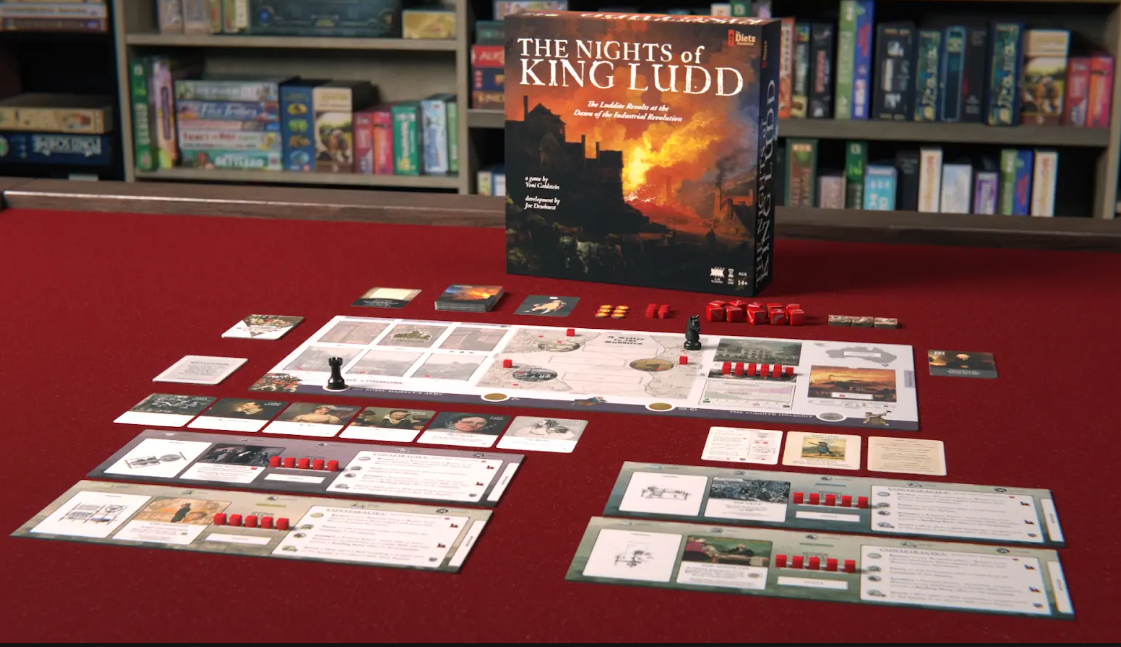
Yoni: The board is divided into three panels. On the left, you will see the two card pools. The top row is where you place the “Regency” Cards, reactionary forces from London sent to quash the Luddite revolts. Below London are three cards representing the “Commons,” a shifting market of dual-use cards helpful to the players.
The central panel features the mills and enclosures. This is where players place their pieces (Weavers sympathizing with the Luddite cause), and the local Militia (the knight piece). The map depicts the “Luddite Triangle:” the West Riding of Yorkshire, Nottinghamshire, and Lancashire.
The right panel holds the Manufacturer’s House (and the current Manufacturer), the pool of Employed Weavers, and the Stocking Market to track wages and productivity in the mills. On the far right panel, is the Australia space for weavers punished by transportation, and the “Saboteur Dice Pool.”
A ribbon at the bottom of the board displays His Royal Majesty’s Army progress toward the Luddite Holdout. This is effectively the round track, if the Luddites are unable to sabotage the three mills by the end of the third round, the game ends in collective defeat.
Grant: How does the game use cards? What different type of cards are included?
Yoni: In The Nights of King Ludd players build a collective card engine by acquiring dual use cards from the “Commons” to upgrade their actions (aka “Conspiracies” – more on those below). The main pool of cards is called “The Commons” which, as the name suggests, represents a mutual aid network of provisions, tactics, and personalities that the Luddites may draw from in the course of their clandestine operations.
“Commons” cards are dual use and drawn from the Draw Deck. They are beneficial in two ways: the top of the card displays a persistent upgrade to any Conspiracy action and is locked into the player board to form a tableau. The bottom of the card displays a “Raiding Party” effect, a one time effect that can be triggered when a Raiding Party is formed and dispatched to a local mill.
The antithesis of the Commons is the “Regency,” a deck of cards reflecting the alignment of the aristocracy in London with an ascendent industrial class against the Luddite cause. They are drawn whenever the Luddites make themselves known in public: fomenting a mob, carrying out an assassination, or setting a factory on fire. When drawn, they set the machines of industry into motion; driving up productivity, plummeting wages, and calling the local constabulary to police the countryside.
Once more than three cards are in the “London” track above the Commons, a nasty event is resolved. These effects will intensify the game’s challenges. Sympathetic weavers will be exiled to Australia, the militia will sweep into the local mill to root out hidden raiders, and the Commons will be parceled off and sold to the highest bidder.
Grant: What is the role of the Persona Cards? Who are these figures?
Yoni: As mentioned in Part I of this interview, each player represents a secret society of Luddites organized around a particular “persona.” These personae introduce a special ability, as well as their their own victory condition, aka a “Motivation”, and a unique “Woe” – a card shuffled into the Draw Deck at setup that will, inevitably, undermine their efforts. There are six persona to choose from.
In clockwise order, they are:
Mary Molyneux, 19, and Lydia Molyneux, 15, were two sisters who, in 1812, stormed a steam-driven cotton mill outside Bolton shouting, “Now Lads!” – encouraging the mob to set the building afire (and they steadfastly did so).
Lady Ludd: “The “Lady Ludd Riots” took place in 1812 when a group of women and young lads – “distressed” by the precipitous rise in corn prices – marched through Leeds, assaulting merchants and “beating up for a mob.” They were led by a disguised person “who was dignified by the title of LADY LUDD.”
George Gordon Byron, 6th Baron Byron, “a young poet with the chiselled good looks, the oddly deformed club foot, and an obscure and very prestigious peerage,” was an eloquent Romantic dandy who rose to defend the Luddites before the House of Lords in 1812. Byron sympathized with the weavers near his home north of Nottingham; “the real cause of their misery [was] the destructive warfare of the last eighteen years, which has destroyed their comfort, your comfort, all men’s comfort.”
Elizabeth Studham was one of seven women tried for arson during the Swing Riots of 1829-30, an echo of the Luddite rebellion. At the age of 19 she set fire to an East Kent workhouse, demanding a wage increase for farmers threatened by threshing machines. Studham was deported and served 14 years and two months in Van Diemen’s Land (Tasmania) during which time she gave birth to two children of whom records are sparse. She would later be sentenced for 10 offences, primarily for bad language.
Lt. George Mellor was a Cropper and Yorkshire Luddite known to the movement as General Ludd’s Right-Hand Man. A strong willed and roguish machine-wrecker, he eventually faced a hanging sentence for the murder of a wealthy mill owner whom he shot in the groin. Eventually, Mellor was arrested in October of 1812. It is said he raised his hands in shackles and shouted “Three cheers for General Ludd!”
John Baines the elder was an “intelligent Hatter” and president of the local Republican Club of St. Crispin. Baines dreamt that Luddism would one day blossom into a democratic revolution; “Let the people now rise and rid themselves of this vile brood who flung upon them the sole taxation of the country and reduced them to the condition of galley slaves!” He was found guilty at the York Special Commission of administering illegal oaths and died on board a prison hulk in a Portsmouth harbour, on December 21st, 1814.
Grant: What is the purpose of the Manufacturer Card?
Yoni: At the beginning of each game, one of the three Manufacturer Cards is selected at random and placed face up in the “Manufacturer’s House” space on the board. The initial effect (tuck 6 cards from the draw deck beneath the manufacturer) represents the nascent industrial class’ emphasis on extracting from the commons, resolving at the start of each round. In practical terms, this prunes away the players’ available card pool over the course of play as well as ambiguates the composition of the draw deck. When a manufacturer is assassinated, all the cards tucked beneath are discarded (and will shuffle back into the Draw Deck) and the Manufacturer Card is flipped to reveal a more reactionary and dangerous side.
Grant: What are Conspiracy Actions?
Yoni: At the beginning of the game, each player has five conspirators (four for Lord Byron) at their command. Spending a conspirator allows the player to activate one of the four following Conspiracy actions (per turn):
Rally Local Weavers: either place a weaver from the supply pool at your presence pawn, or move your pawn and any weavers to another enclosure on the map.
Trade in the Commons: pick up a card from the Commons and tuck into one of the columns on your player board. That card allows for secondary actions whenever that matching Conspiracy is activated.
Assemble a Raiding Party: a two step action, move one or more weavers from an Enclosure (spaces on the map adjacent to Mills) into a Mill. This sets up a future sabotage action. Then, activate one of the Raiding Party effects in the Commons. This is the primary means of building your Saboteur Dice Pool. The more raiders you have at the Mill, the more dice you are permitted to roll during a Sabotage operation.
Lastly, you may Incite a Mob, placing a Mob Tile next to an adjacent Mill. For a sabotage roll to be successful, the die rolls must match an icon depicted on the Mob tile – hammer, gun, or torch.
Grant: What type of secondary effects come from cards tucked into the Column on Player Boards?
Yoni: Once you use a Trade conspiracy to move a card from the Commons to your tableau (your “Secret Society”), you can activate it, along with any other card in that same column on your player board, every time you resolve that conspiracy action. This allows for chaining and sequencing a series of effects that may have significant impact on your objective to destroy the mills.
Grant: Can you show us a few examples and explain their use?
Yoni: For example, let’s say you are George Mellor and you are seeking to assassinate the manufacturer. You resolve the Trade conspiracy to take “Dispatch Delegates to Neighbouring Counties” and place it in your Trade column, meaning it will be available to you immediately after this primary action. In previous turns you’ve already acquired an ongoing ability, “Mellor Takes a Shot at Mr. Horsfall!”, giving you an extra die for Assassination roles (helpful, since these operations are so risky!). You activate “Dispatch Delegates…” to activate a Raiding Party effect (the bottom of the card) in the Commons, which happens to be your partner in crime, “Martha Mellor Defends the Accused.” She allows you to roll for Assassination, but will be removed from play once that effect is resolved.
Grant: How does Sabotage and Assassinations work in the game?
Yoni: At various points in the game, players may elect to roll for Sabotage or Assassination. Of course, certain maneuvers must take place for these brazen attacks to succeed. Sabotages are larger scale events and are aimed at the Mills. You must have assembled a raiding party at the Mill and incited a Mob to spurn them on. As mentioned above, you roll one die per weaver cube at the Mill and attempt results matching the icons on the Mobs you’ve placed. The dice are D6s with the following faces: 3 blanks (a miss), 1 Torch, 1 Gun, and 1 Hammer. So with one Mob tile matching one of those icons, each die you roll has a 1 in 6 chance of hitting. If all three Mobs are in place, the odds climb to 1 in 2 per die.
An assassination is a similar roll, but only one die may be cast and hits are only the gun or hammer. Beware, the Regency will respond with a draw from its deck for both sabotage and assassination rolls!
Grant: What are you most pleased about with the design?
Yoni: As Dan Thurot noted, “The Nights of King Ludd points toward a more experimental direction than Chicago ‘68 and I feel it reflects a degree of growth and maturation as a designer. It’s a game that seeks to capture both the panoramic view of a people’s struggle as well as sketching out the personal incentives that motivate individual participation in (and sometimes sacrifice for) a collective cause”.
Grant: What other games are you currently working on?
Yoni: I am currently working on a commission for an international art exhibition on “sociopolitical freefall.” This will be a smaller box game and will also be developed by Joe Dewhurst. I’m also co-designing a project about Mai ‘68 with Fred Serval. This game is about the French experience of student and labor riots in 1968. While it shares the themes of Chicago ‘68 it’s driven by a completely new system.
Auch in Deutschland entstehen immer wieder kleine Brettspiel-Verlage und dazu gehört zum Beispiel BSL Games. Wer hinter BSL Games steckt, wie der Verlag erschienen ist und was die Zukunfts-Pläne sind, erfahrt ihr im Folgenden. Zudem geht es um spannende aktuelle Neuheiten und zudem gibt es eine sehr interessante Ankündigung bereits für das kommende Jahr. BSL […]
Aus Mazedonien stammt der Brettspiel-Verlag Archona Games und aus dem kleinen Land sind wirklich schon viele spannende Spiele u.a. bis nach Deutschland gekommen. Deshalb habe ich mit dem Gründer von Archona Games über das Entstehen des Verlags, die größten Erfolge, aktuelle Neuheiten und zukünftige Pläne gesprochen. Archona Games Neuheiten, Neuauflagen, Erfolge, Pläne und vieles mehr […]
Wenn man mal wieder in Board Game Geek eintaucht, dann stößt man auch spannende Kleinverlage, wie zum Beispiel Gamia Games aus Island. Mit Svavar konnte ich über seinen Weg ins Hobby und zum Brettspiel-Designer sprechen und es ist das mit Abstand längste Interview geworden, dass ich jemals gemacht habe. Gamia Games Neuheiten, isländische Geschichte, Herausforderungen, […]
Geschichten in Brettspielen zu erleben ist für mich ein großer Reiz und das sieht auch mein heutiger Gesprächspartner von Stormbraver Games so. Mit Joshua spreche ich über seinen Einstieg ins Hobby, warum er angefangen hat Brettspiele zu entwickeln, was er sonst noch so macht und natürlich sein erstes eigenes Spiel. Stormbraver Games Neuheit Legions of […]
Es ist schon faszinierend, dass es immer mehr Kleinverlage gibt, die eigene Brettspiele veröffentlichen und davon leben können. Dass das aber nicht so einfach ist, erzählt uns heute Jeff von Road To Infamy Games (R2i Games). Mit ihm spreche ich über seinen Weg ins Brettspiel-Hobby, seine Arbeit als Spiele-Entwickler, aktuelle Neuheiten und vieles mehr. R2i […]
We have played several games designed by Adam Starkweather in his Company Scale System (CSS). These games are really good solid chit draw systems that really puts some unknown in what groups of units can activate and even when they will activate. There are also events and if the chit cup runs dry before all of the units can activate due to the end round chit then you are just sore out of luck. You have to prepare for this inevitability and I love the concept of prioritizing your activations and making sure you activate what you absolutely have to before doing those units that would be beneficial to activate. Now Adam has created his own publishing company called Bring it on Games and they have announced their first pre-order game in a new system called Advanced Company Scale System Game One:Anzio: A Lost Opportunity. This is a huge wargame and includes 10 large maps, 20 counter sheets and tons and tons of charts, tables and player aids. This is a MONSTER wargame…no doubt about it but it looks really good. I reached out to Adam to see if he could provide us some additional insight into the game and he was more than willing to discuss with us.
If you are interested in Advanced Company Scale System Game One:Anzio: A Lost Opportunity, you can pre-order a copy for $350.00 from the Bring it on Games website at the following link: Shop — Bring it on Games
Grant: Adam welcome to our blog. First off please tell us a little about yourself. What are your hobbies? What’s your day job?
Adam: First off, my hearty thanks to The Players’ Aid crew for giving me the opportunity to introduce myself and tell you about my new adventure.
As my waistline will attest, my hobbies and interests are decidedly sedentary. I love watching basketball and baseball (go Knicks – had a great year). And several years ago, I decided to rekindle – ha! – my love of reading. For many years, for work, I read non-fiction. But now, every night before I crash, I read for fun for a half hour. Currently, I’m reading both for work and for fun as I am journeying through Stephen King’s multiverse with a goal of making a game on it. I have an inside to get to King, and I’m hoping I can get him to glance at it and spark some interest. It will be decidedly war gamey in its presentation.
Believe it or not, for over 20 years, I have been blessed that wargame design has been my main gig and what I do for work. With over 50 titles that I’ve designed, developed, or project managed, it has been a productive period for me in the hobby.
Grant:What motivated you to break into game design? What have you enjoyed most about the experience thus far?What have you learned about design over the years?
Adam: A day I remember well. 3 friends and I were playing SPI’s Highway to the Reich, and it just fell apart while we were playing it. Things were happening that just didn’t make sense, and it wasn’t balanced. Once that suspension of disbelief is done, we wargamers just bail on a game. We thought we could do better. All four of us started making a Market-Garden game, but only I kept with it, and my first design The Devil’s Cauldron, was the result 7 years later. As for enjoying what I do, there are occasional hiccups, of course, but I have a dream job. I’m like a professional NBA player – doing something that is tons of fun, and I get paid to do it. I’m the luckiest man in the world.
As for what I’ve learned, of course, I’ve learned how to design – often under tremendous time pressure, but if I had to name one thing, it is knowing what I’m good at and when I need help. I’m great at coming up with new concepts and innovative mechanics, but I can’t research worth a damn nor do I have the patience to rewrite rules again and again. With my new company Bring it on Games, I have both the time and assets to attack my weaknesses and focus on what I do well – and love doing. I have dedicated researchers, dedicated rules editors, and dedicated playtesters. I finally have the time to do a game the right way.
Grant: What is your upcoming game ACSS Anzio about?
Adam: My first game for my new company is on the Battle of Anzio. It is at company level and at 500 meters a hex. It has two campaign games in the box – one for Operation Shingle (the landing and advance inward to the furious German counterattack) and Operation Buffalo – the final breakout and advance to Rome. The middle months in which a World War One type situation happened is not in the game. Two massive campaign games and some 20 smaller scenarios are included.
Grant: What does the subtitle “A Lost Opportunity” represent from the history?
Adam: It is likely for such a famous operation that most people reading this know that Anzio presented an opportunity to end the Italian Front with an aggressive approach to the battle. Instead, the General in charge (Lucas) was tentative and did not advance with the aggression needed. In all my research, I have found that it wasn’t entirely his fault, but it wasn’t a time to be tentative. In the Campaign game, you can try and defeat the Germans with the hand you were historically dealt, or there is an alternative scenario (aptly called “Killer Whale”) where the restrictions on your aggressiveness are removed, and perhaps you can end the Italian battle in two weeks.
There were also missed opportunities in the second campaign in the box. The Allies went for the glory to capture Rome but allowed the Germans to retreat from the Gothic Line mostly intact. The war in Italy was allowed to continue, but again, it didn’t have to be that way. As with Operation Shingle, there is an alternative campaign game in which glory is set aside for a few weeks, and you as the Allies attempt to cut off the German forces and end the war in Italy.
“We were hurling a wild cat on the shore, but all we got was a beached whale.” -Winston Churchill
Grant: Why was this a subject that drew your interest?
Adam: Why Anzio? As is often the case, the subject matter of a game is about work that has already been done. Why start from scratch if months of work have already been done? My historian worked on a game for another designer several years ago and had a great Order of Battle for the game. There was plenty of game in the battle, so Anzio it became. Utah Beach is likely next up for my company as I’ve already made the Grand Tactical Series game on the battle. So I have a complete order of battle and map already made. After that, or before that, might be Salerno. A gamer has already made the game using another system, but the conversion would be easy enough. And of course, a game for ACSS will be on Market-Garden. I have already made a game at this scale. Years of work have already been done. This also gives me time to start fresh on new topics like Omaha Beach or Gela – they become the game with work already done and join the conga line.
Grant: What is your design goal with the game?
Adam: Oh that’s easy. I want to finally be able to make the best company level game I can make. GTS was made when I was a novice and CSS was made when I was under tremendous time pressure. I have both the expertise and the time to do it right this time.
Grant: How have you modified the Company Scale System to become “Advanced”?
Adam: I started work on this a few years back and called it ACSS. The name stuck with me, and I kept it. It keeps Eric Smith’s brilliant combat system and is a chit pull, but much has also been improved and changed. I think I answer much of the realism issues of both systems with ACSS.
I have the rules available online for anyone to read – simply go to rules and you can read it and see where we are at. 3-4 more edits still to go, but it is more complete than anything I’ve made before, even as it sits now.
As for new stuff and mechanics that my playtesters have said they’ve never seen in a game before – I have two standouts. Situational Awareness matters in this game as does an orders system that influences what and how you do things. They are in the above rules so I won’t go deeply into it – but it has a novel way of presenting Fog of War but still allows for solitaire play. There is much, much more that is new – but those two are mentioned by my playtesters the most.
Grant: What elements do you feel are most important to model from World War II and the Allied invasion of Italy?
Adam: I make wargames, so to me, the most important aspect is to get the history correct and honor those that fought and risked their lives to make a better world for me and my children to live. So the history has to be right and fully immersive. In addition, playing a game on a battle is a different, albeit as involved as reading a book on the battle – but it is also a game. It should have decisions and fun aspects in it to make it fun to play.
Grant: What sources did you consult for the historical details?
Adam: If you go to my website at https://bringitongames.com/, you’ll find everything you need to play an introductory scenario using my system – but if you have a look at the end of the scenario book you can download, you’ll see the extensive bibliography for the game. As an aside, over the last 25 or so years of game design, it is really interesting to see how the web has become indispensable in researching military topics.
Grant: What one must-read source would you recommend?
Adam: I asked this very question of my historian a few months ago. He suggested:
Anzio 1944, The beleaguered beachhead, Osprey Publishing Campaign #155, Steven J. Zaloga, 2008, ISBN 978-1-84176-913-4
Although I’m partial to:
Fatal Decision, Anzio and the Battle for Rome, Carlo D’Este, 2008, ISBN 978-0-06-057649-3
A more involved read and perhaps not as great for wargamers as the Osprey volume, but I think the added effort is worth the trouble.
Grant: What is the scale of the game? Force structure of units?
Adam: As with my other company level systems, ACSS is 500 meters a hex, mostly company level units, and each turn is 2 hours. It is a scale I’ve used for two decades and I’m comfortable at this level. In addition, I fell in love with this scale because it offers both tactical mechanics but you can play an entire battle (although you’ll need space and time of course).
The system uses a chit-draw method to activate units and this is at division level. You draw a chit and do things with an entire division and then move to the next chit.
Grant: What are the differences between the playable factions of the Allies and Axis powers?
Adam: At this level of company actions, the difference between the two armies is quite evident. The Germans have fantastic equipment but are brittle, while the Allies have so much firepower at their disposal. To show one example of what you can show at this scale: the Germans based their tactical dogma on their excellent MG 42 machine gun, while the Americans based their tactics on the excellent Garand rifle. They each operated differently – and I can show this at this scale. Many other aspects from more effective counter-battery fire to specialized tactics are also there. Check out the rulebook above and you’ll see.
Grant: What is the layout of the board?
Adam: Almost all monster games focus on the campaign game, and the scenarios are snippets of the larger campaign game. That is certainly true of my large games. For me at least, it was always a matter of speed. I could test scenarios while I tested the campaign game. My scenarios often started when the campaign game started. There are a few exceptions to this where the scenarios are the primary game, and the campaign game is the added bonus. Games like Pacific War by Victory Games are like this.
I, however, want to have both scenarios and the campaign games have equal importance. Each scenario has its own counter set and its own map. The map size goes from 8 1/2 inches for the introductory scenarios, to one map for the majority of intermediate and advanced scenarios, to two maps for a larger game experience. Finally, there are the two full campaign games, which each have 4 full-sized maps and two half maps – a total of 5 maps. But there are some ten double-sided maps in the game (a total of 20 maps) – this is a map for each scenario and a campaign game map.
“The Rock” Scenario map.
Grant: How are units activated? Why do you feel chit-pull is such an effective method?
Adam: I love chit-pull as a mechanic and have used it for decades. It has the advantage of being great for solo play. There is the drawback that if you have a lot of players, you might have to wait for your turn to come up – although there are ways around this that I talk about in the rulebook, I find the great advantage of board games over computer games is the social aspect of playing them.
Grant: What is the general Sequence of Play?
Adam: A great question. When I first open a game, there are two things I look at first. The Sequence of Play and the victory conditions. They tell me more about the general concepts behind the game than anything else. Of course, a far more complete Sequence of Play is in the rulebook that you can download, but the basic SoP that is used in the VASSAL module is:
But check out the rules for a much more exhaustive Sequence of Play.
As for victory conditions, I blatantly steal from great designers that have great victory conditions – in concept. Some designers just know how to make victory conditions that drive a game and allow for incredible excitement in play. There are some 21 scenarios in the game, and I use different types of victory conditions in each and every one. I did the same thing to a lesser degree in my Greatest Day game. But whatever type of game you like, I’ll have you covered in one or more of the scenarios and the campaign game.
As for how the basic mechanics work, I have a ton of examples in the game for you to have a read and see how things work. Check them out.
Grant: Tell me about Bring it on Games. How are you different from other game companies?
Adam: I changed The Players’ Aid’s last question to talk about this a bit. I take the slogan “A Game Company run by Gamers” seriously. As we have aged, what we expect from games has changed. The games are expensive, but while we all, hopefully, have more money now, we have less time and less patience. I used to love reading rules, but now it is like pulling teeth – it is painful to get into a game. This game and all that follow are about making the games convenient and easy to approach. It is expensive for sure for all of this added stuff that you haven’t seen before – but again, we have more money but less time. You’ll see things here that will make you wonder why all the companies don’t do this.
Also, I don’t want to be GMT or MMP. I want to make games. I won’t have a warehouse, so only orders will be printed. Once I go to press, the game will be out of print. I’ll also limit the total number of orders I will accept. I like making the games. I don’t want to spend my time with all the company stuff. Trust me when I tell you that the owners of all the game companies aren’t having as much fun in the hobby as you are – they are busy running a company, tracking inventory, and all that stuff. I don’t enjoy that very much. So I’ll give up selling games after they print and keep having fun.
I hope you’ll go to my website at www.bringitongames.com and download the sample rules and Vassal set – and see if it’s your thing. I’d love your support. You can also subscribe to my newsletter. And I apologize in advance if you, as more than a few gamers have said to me, “you’ve ruined GTS and CSS for me”.
If you have any questions or comments, you can reach me at:
Thanks so much for your time in answering our questions Adam. I am very much looking forward to this system and wish you the best of luck in bringing it across the finish line. I have very much enjoyed my experience with the Company Scale System (Saipan: The Bloody Rock and The Enemy is at the Gates: Battle for Berlin, 1985 both from Compass Games) as well as the Grand Tactical Series (Devil’s Cauldron and Where Eagle’s Dare both from Multi-Man Publishing) and very much enjoy the feel of the game and the combat system.
If you are interested in Advanced Company Scale System Game One:Anzio: A Lost Opportunity, you can pre-order a copy for $350.00 from the Bring it on Games website at the following link: Shop — Bring it on Games
Rock Manor Games hat schon einige spannende Neuheiten vorzuweisen und gerade der starke Fokus auf spannende Settings und Geschichten gefällt mir sehr. Darüber spreche ich mit Mike und Todd von Rock Manor Games und gehe unter anderem auf aktuelle und zukünftige Neuheiten ein. Viel Spaß. Rock Manor Games Neuheiten, Sci-Fi Welten, Zukunftspläne und mehr Spannende […]
Mit Fireside Games ist ein weiterer kleiner, aber erfolgreicher Brettspiel-Verlag auf der SPIEL in Essen und hat eine spannende Neuheit dabei. Ich konnte mit dem Gründer über die Entstehung des Verlages und über seine Arbeit als Spieleautor sprechen. Zudem gibt es Einblicke in die aktuelle Neuheit. Fireside Games Neuheit, erste Erfolge, Sorgen, Pläne und mehr […]
Cotswold Games ist ein kleiner Verlag, dessen Gründer mit viel Herzblut und Leidenschaft daran arbeiten tolle Brettspiele zu veröffentlichen. Ich konnte mit Maddie ein Interview führen, in dem es um aktuelle Neuheiten, spannende Geschichten und vieles mehr geht. Cotswold Games News, Neuheiten, Spielentwicklung, Mechaniken und mehr Die Themen der Brettspiele von Cotswold Games sind wirklich […]
As you know, I do love me a good Card Driven Game….or a game that uses cards….multi-use cards. I love cards because it allows for the designer to keep a game going while using a vehicle that incorporates special rules that fit a historical situation but also to be able to use bits of the history itself to teach the players about the topic. A few months ago, I caught wind that The Dietz Foundation was working again with Yoni Goldstein on his second game called The Nights of King Ludd: The Luddite War on Industry, 1811-? that recently launched on Kickstarter (the game has already funded). The Nights of King Ludd is a 2-4 player game that deals with direct oath-sworn secret societies of English Luddites at the dawn of the Industrial Revolution in the English Midlands. Working together, players will build a secret network of saboteurs, ferry provisions and weapons on the black market, assemble raiding parties, and if all goes as planned, smash those “dark satanic mills” to cinders. I reached out to Yoni to get a bit more information about the design and he was more than willing to share.
Grant: Yoni welcome back to our blog. What have been your feelings about the reception of your great game Chicago ‘68?
Yoni: I’ve joked that I’ve taught this game now more than I’ve played it (of course this is only true if one just counts the last couple years!). Since 2024, I’ve taught it to a diverse and intergenerational cohort of non gamers, grognards, peace activists, veterans, and even a few spooks. Inevitably players relate the experience they are having on the board to what they see in their neighborhoods: protests and tear gas, troops deployed into cities, election interference, and so on. Those conversations are still ongoing and I’m heartened that Chicago ‘68 is facilitating a space for that.
Grant: What lessons did you learn from that experience that have helped you with your new game?
Yoni: I’m grateful that Joe Dewhurst, who developed both Chicago ‘68 and the upcoming The Nights of King of Ludd, guided me through the design, testing, and development processes. Ludd is my second game and it went through a number of iterations, but this time we had a proper methodology in place. Likewise, The Dietz Foundation was very transparent with the manufacturing and publishing side of things, which gave me a deeper understanding of the timeline and proofing / editing process that accompanies those final stages of production.
Grant: What is your new upcoming game The Nights of King Ludd about?
Yoni:The Nights of King Ludd is a collaborative game for 2-4 players about the Luddite revolts in the English Midlands. Set roughly around 1811, the game tells the story of local workers in the textile industry (“weavers”) forming secret societies and leading armed raids against mills and factories in their communities. Players command an oath-sworn organization of conspirators working with the Luddites to achieve the collective goal of machine wrecking while also attempting to meet their individual motivations (which may include assassinating the local manufacturer, spurring a republican revolution, or just avoiding an Australian exile).
In terms of game mechanics, you are building a dice pool while also maneuvering pieces and collecting multi-use cards to modify your roles. Collectively you are building a tableau and operating it together to mount a series of raids against the three Mills on the map.
Grant: What is the meaning of the title of the game? What should it convey to players about the game and the history it represents?
Yoni: The title of the game is borrowed from a chapter in Gavin Mueller’s book from 2021, Breaking Things at Work. Mueller is among a cohort of authors, including Kirkpatrick Sales (Rebels Against the Future), Brian Merchant (Blood in the Machine) and Cory Doctorow, who are working to reconsider the Luddites’ reputation in the age of AI and the gig economy. Rather than seeing them as misguided revolts against the inevitability of technological progress, these writers appraise the Luddites in their historical context as severely desperate labor movements against tech oligarchies. The Luddites’ aims were, ultimately, to raise the minimum wage, cease child labor, and to maintain a higher standard of craftsmanship and quality in the production of textile goods. At every point their appeals to authority were spurned. So they turned to mob justice. “You may call the people a mob,” remarked Lord Byron before Parliament, “but do not forget that a mob too often speaks the sentiments of the people.”
The subtitle of the game, “The Luddite War on Industry, 1811-?” is also a cheeky nod to Volko’s Labyrinth: The War on Terror, 2001 – ?. While these games don’t share a mechanical similarity, they both explore the ongoing and unpredictable nature of insurgencies.
Grant: Why was this a subject you wanted to focus on?
Yoni: My area of interest in game design, broadly speaking, is movement politics on an operational scale. As with Chicago ‘68, the Luddite war on industry feels an under-explored subject matter in historical gaming. While there are certainly titles about the Industrial Revolution from the perspective of barons and magnates (especially in the Euro game niche), little is mentioned about the social, political, and ecological costs of these endeavors for progress.
Moreover, the story of the Luddites and their “secret societies” is about the tensions of modernity. New technologies combined with extensive wars abroad drove a rise in food costs and detonated an affordability crisis in the imperial homeland. Communication media (handbills, newspaper editorials, and pseudonymous letters) was an instrument of persuasion, vitriol, and threats. Suspected Luddites and their sympathizers were surveilled by the state, which increasingly saw its interests entwined with industrial capital. We’ve seen this all before!
Grant: What are the unique features with the system used for the game?
Yoni: The Nights of King Ludd has a unique framework for collaborative engine building. Initially, players draw from “The Commons” (a shifting card pool) where each card has the same “trade cost.” On your turn, you may activate a Conspirator (spending an action point) to draw a card into one of the columns in your tableau. Each column upgrades your actions with a permanent ability. If you specialize your actions, you can harmonize a collective strategy between players and hone in on the steps you need to take to sabotage the mills.
In the Commons we are evoking the notion of a shared economy. But this may shift dramatically when decreasing wages and increasing productivity converge. Then, the Commons transforms into the “Common Market.” Now, players are building their tableaux with an increasing cost, similar to the Pax Series (for example, Pax Pamir or Pax Renaissance). Each player is now facing a decision: overwork their cabal of conspirators or draw on the labor power of the workers in the textile industry (which drains their militant power on the map).
Grant: What does the collaborative portion of the subtitle mean for the game? How do the players cooperate?
Yoni: I choose “collaborative” not “cooperative” as a descriptor to emphasize the multi-victor nature of the game. In The Nights of King Ludd, each player chooses not only their persona and their role in the Luddite struggle (with asymmetric abilities and effects), they also put forward a “Motivation.” Motivations are personal victory conditions that unlock if the collective win condition (destroying all three mills on the map) is met. This gives shape to the degree of player friction in the game. For example, Lord Byron’s motivation is to turn down the heat from the ruling Regency. His motivation is in conflict with George Mellor’s, the famed assassin, whose attempts at the Manufacturer’s life will ratchet up the crown’s crackdown. But pair John Baines, a republican agitator, with the Molyneux sisters, two young women destined to labor in the mills, and the gameplay will tilt more toward cooperation. In this case, Baines is working to regulate the industriousness of the mill (keeping productivity low and wages high) while the Sisters are interested in keeping workers employed. So the degree of cooperation is up to the players, and as often happens, someone may have to make a noble sacrifice for the collective good.
Grant: What did you need to model regarding the English Luddites at the dawn of the Industrial Revolution?
Yoni: As EP Thompson (The Making of the English Working Class) notes, the history of the Luddites is, at best, “opaque.” We are grappling with a story about secret societies in an era where workers associations were illegal and damaging weaving frames was a capital offence. As such, we have dubious claims from government spies, confessions before “hanging judges,” and pseudonymous letters and handbills. Consequently, the model had to be expansive enough to capture the granular nature of these conspiratorial operations, but also open enough to allow for the plausibility of a broad range of player actions.
For example, one of the core actions is to “rally local weavers,” which is a form of recruitment. In game terms, this means moving one of the Employed Weaver cubes into an Enclosure where they can contribute to your force strength. This action may represent members of your secret society swearing in sympathetic workers in local pubs, or calling a clandestine meeting in the nearby woods. We don’t know precisely how the Luddites organized themselves, so the language has to be inclusive of these possibilities. Players then “assemble a raiding party”, which is to move the cubes from the enclosure into a nearby Mill. Each cube in the Mill space adds a die to the Sabotage roll (which is the primary means of wrecking machines). So here is a group of raiders hiding in the hedge and awaiting the signal from King Ludd. They are spurred on by the Mobs who have surrounded the site, represented by these Mob tiles. Matching a die roll to the symbol on the Mob Tile is how you roll a “hit.” The intention is to shape a series of amorphous and difficult to historicize chain of events into a familiar wargaming mechanism: rolling a handful of dice representing an “attack” and applying modifiers to the results.
Grant: What is your design goal with the game?
Yoni: My overall aim was to develop a system that could express a relationship between an abstract economic system, worker uprisings, and the coming together of industry and aristocracy to form a ruling class. But on a purely design level, I wanted to work within the framework of a Pax Series style market that you encounter in games like Pax Pamir and Pax Renaissance. That is, a shifting market of cards that players can purchase and place into their tableau. It’s an evocative description of history as a bazaar of possibilities and counterfactuals. The Nights of King Ludd tweaks this vision of history as somewhere between a commons (a gift economy) and a market (which costs worker power as in-game resources).
But really, I want this to be a “raiding party game.” Beneath the heady layers of history and theory is a brisk experience featuring dice odds, clever combos, and cooperation with your friends (while slyly pushing your own agenda!).
Grant: What other games did you use as inspiration?
Yoni: John Company from Wehrlegig Games is certainly one of the biggest inspirations, taking place in a similar era of British imperial economic imperialism (Ludd is at the tail end of JoCo’s later scenarios) and drawing on the satirical printworks of the time. Like John Company, players are asked to intervene in an existing ecosystem. In both games, player actions accelerate a system that will simultaneously reward and punish everyone at the table. How this is doled out is uneven, so players have to weave and dodge to make best of a collapsing infrastructure.
Grant: What sources did you consult about the history?
Yoni: An invaluable resource for all things Luddite is the Luddite Bicentenary curated by Richard Holland. This is a comprehensive digital archive of historical ephemera devoted to Luddism, including handbills, court transcripts, and other images and texts. I also quote extensively from Rebels Against the Future by Kilpatrick Sale and The Risings of the Luddites: Chartists and Plug-Drawers by Frank Peel, E.P. Thompson, as well as The Making of the English Working Class also by E.P. Thompson.
Other reference texts include:
Writings of the Luddites edited by Kevin Binfield
Ben o’ Bill’s, The Luddite: A Yorkshire Tale by Daniel Frederick Edward Sykes, George Henry Walker
Breaking Things at Work: The Luddites Are Right About Why You Hate Your Job by Gavin Mueller
The Luddite Rebellion by Brian Bailey
Blood in the Machine by Brian Merchant
Women in Protests 1800-1850 by Malcolm Thomis
Convict Lives at the Launceston Female Factory (A swing rioter: Elizabeth Studhamby Keryn Rivett), edited by Lucy Frost & Meredith Hodgson,
Grant: What is the dice pool building mechanic and how does it work in the design?
Yoni: At the core of the game is a fairly straightforward dice mechanic for resolving raids against the three mills on the map. Throughout the course of the round, players add “saboteur dice” to the dice pool, representing the Luddite’s militant capacity. These are D6’s with the following icons: gun, hammer, and torch (matching the “mobs tiles” – armed rabble surrounding the mill). The remaining three sides are blank and always result in a miss.
When a sabotage operation is initiated, the number of dice rolled is determined by the number of raiders you’ve positioned at the mill and what constitutes a possible hit is determined by the matching icons on the nearby mob tiles (again; gun, hammer, or torch). All misses are returned to supply but if at least one hit is rolled, you may push on and carry out multiple raids, striking at other mills as well.
As your readers can deduce, the purpose of the tableau building and the card engine is to modify the odds of the roll in your favor, i.e. the more raiders you assemble the more dice you will roll, and the more mobs you’ve fomented the more likely you are to roll a hit.
Grant: What is the general Sequence of Play?
Yoni: As neighboring societies of Luddites, you have three rounds before the Crown musters its army and crushes the revolts. Each round is structured the same:
Dawn: Industry Operates – at the beginning of the second and third round your adversaries in London will take actions against you, sending the militia on patrols and accelerating industrial production.
Day: The Manufacturer Speculates – during this phase, the local manufacturer will take an action, depleting the Commons of its resources.
Night: The Luddites Conspire – this is the main phase of the game, where each player takes turns resolving a Conspiracy action by spending a Ready Conspirator cube on their boards. Each player takes a primary Conspiracy Action and resolves any secondary effects on Cards tucked into the Column of that Conspiracy on their Player Boards. In this phase, players can attempt a sabotage roll to destroy the Mills.
Round’s End – when there are no Ready Conspirators (or all players pass) players reset the components for the next round.
Thank you for your time in answering our questions Yoni! I am very much interested in this game and its efforts to tell this very interesting story of resistance. While this is not a traditional wargame, in my opinion it certainly merits a serious look from wargamers who are interested in CDG’s and games that use cards and that are interested in seeing these type of non-traditional historical subjects represented. I have backed the project and look forward to getting my copy next year!
Wargames behandle ich hier zwar nicht so häufig, aber ich habe dafür eine Schwäche. Ein Verlag, der für mich dabei eine wichtige Rolle spielt ist Dan Verssen Games. Mit dem Gründer spreche ich über seinen Einstieg in Wargames, die Spieleentwicklung, aktuelle Neuheiten und vieles mehr. Dan Verssen Games Neuheiten, Wargames, Solo-Spiele, Entwicklung und mehr News […]
Aus Korea kommen immer wieder interessant und kreative Brettspiele. Ich habe mit dem Gründer von Pluto Games über seine aktuelle Neuheit gesprochen. Zudem ging es um bisherige Erfahrungen, Kreativität, Pläne und mehr. Viel Spaß. Pluto Games Neuheit President Maker, Idee, Kreativität, Pläne und mehr Bonghwan gibt sehr interessante Einblicke in seinen Verlag und seine Arbeit […]
Aus der Schweiz stammt der Kleinverlag Humming Games und mit dessen Gründer Markus spreche ich unter anderem über seine spannende Neuheit Mission Amazonia. Zudem geht es um die Spieleentwicklung, KI, Pläne und eine kommende Videospielumsetzung, auf die ich sehr gespannt bin. Humming Games Neuheit, Entwicklung, Pläne, Videospiel-Umsetzung und mehr Markus gibt sehr interessante Einblicke in […]
They recently announced their next Kickstarter project that would take their system to the Anglo-Boer War called The Great Anglo-Boer War: The Battle for South Africa 1899-1902. The game is currently on Kickstarter and I reached out to my contact there Kevin Talley who acts as one of the Developers on the team for his input into the design to give us a better picture of how this new game plays.
Grant: What is the focus of your new upcoming game called The Great Anglo-Boer War?
Kevin:The Great Anglo-Boer War is a grand-strategic level game of the war between the British Empire and the Boer Republics in South Africa from 1899 to 1902.
Grant: Who is the designer and what is their goal with the game?
Kevin: As with all of our designs, R.J. Mills is the designer. He has always been fascinated with the Boer War and the goal was to make a really good hex-and-counter wargame to cover the whole conflict.
Grant: What is important to model from the history of the Anglo-Boer War?
Kevin: Well, the Boer War was very unique. It began as an asymmetric conventional contest in 1899 between the relatively small citizen militia forces of the two Boer Republics (they had no standing professional armies) and nearly the entire army of the British Empire! Then, once the Empire had captured both Boer capitals in 1900, the Boers refused to surrender and instead decided to fight a guerrilla war (and that went on for 2 more years). So, given the dynamics of this truly unique conflict, making a realistic game presented some serious design challenges. The design had to accurately simulate the conventional period, where the fractional Boer forces soundly defeated the British in several key battles during the early months, and it also had to credibly represent the guerrilla phase of the war, where very small numbers of Boers roamed (often unseen) and raided (always with surprise) throughout a vast area nearly twice the size of Texas. For this phase, the Empire forces had 250,000 troops deployed unsuccessfully trying to defeat 20,000 guerrillas! It all ended (finally) 31 May, 1902, with the Treaty of Vereeniging.
Grant: What other games inspired this design?
Kevin: We had not intended to make a Boer War game here at Cadet until after we started seeking a good grand-strategic/operational game about the Boer War to play. We got the “Boer War bug” playing Geoff Noble’s Redver’s Reverse: The Battle of Colenso, 1899 from Legion Games and decided we wanted to play a game of the whole war. We had pledged the KS Campaign for Joseph Miranda’s The Boer War from Canvas Temple Publishing and were hopeful, but it wasn’t what we’d hoped for in the end. Then we tried all the other Boer War games out there, or at least those we knew about, but there just wasn’t a good, realistic, strategic level/operational game of the whole war – especially not with the kind of depth we were looking for. We wanted something more like Nick Karp’s Vietnam: 1965-1975 from Victory Games – but for the Boer War – something with that kind of simulative value, historical chrome and especially guerrilla war operational mechanics. The closest thing we found was the old 3W game from 1991 (Eric Faust and Lew Fisher) called The Boer War. It had a lot of what we were looking for, but it was under-developed, errata-riddled and had too many issues to list. Still, that game had some brilliant design ideas, so we decided to start with that framework and make our own game. We were surprised that this topic didn’t have more published games already.
Grant: How did warfare change during the Victorian Age? How did you capture these changes?
Kevin: The British Army was fighting in drill book formations all the way through the 19th century. Consider that, just a year before in 1898 at Omdurman, the infantry stood in close order (just like in the movie Zulu), easily repelling the 50,000-strong army of the Khalifa with Lee-Metford volleys, Maxims and quick-firing breech loading artillery. This all worked very well when the enemy had swords, spears or primitive firearms. But the Boers had Mausers. And Krupps. And Maxims! Tactics had to evolve to meet this new level of lethality and the British Army was not initially prepared to face an enemy that was equipped with the same weapons as they. And an enemy that chose trenches and concealment – inflicting severe losses on British troops in drill formations. The combat system in the game realistically models the advantages of entrenchments, terrain, unit formation posture, night marches and even artillery effects. The Boers on defense can be very tough. A typical attack will be costly. Best to use open order and artillery to great effect – even better to use maneuver and avoid the prepared defense altogether. It took the British some time to learn their lessons.
Grant: What sources were consulted for the historical details?
Kevin: The bibliography for the game is included in section 26 of the rulebook. We used 20+ books on the topic to get the information for the design, and of course those include all the most important works published about the war: Rayne Kruger, Pakenham, Farwell, Arthur Conan Doyle (who was there), Barthorp, Reitz (a famous Boer Journal of the war), Maurice’s official history, Amery (Times history) and more. Someone who has researched the war and knows the historiography will truly appreciate this game.
Grant: What is the scale of the game? Force structure of units?
Kevin: The map scale is 9 miles to a hex. The map is huge. 34″ x 44″ on the table. The unit scale can be as little as a half battalion on the Empire side (500 men) and a single commando element of as few as 333 for the Boers. But the system is so flexible that a single leader’s counter in a hex on the map could represent as many as 30,000 Empire soldiers (with supporting artillery) and up to 13,320 Boers with several batteries of their guns as well. The game scale works for both large conventional battles (early war) and small guerrilla actions (later war).
Grant: What is the layout and anatomy of the counters?
Kevin: The counters are the typical ½” variety, printed on both sides. There are Entrenchment markers that, when flipped, double as “Scorched Earth” markers; Rail markers (early war) that also double as Blockhouse Line markers (guerrilla phase); Boer Control markers that can also be used as Strength Point counters; Number markers that flip to various increments; dozens of Empire Detachment markers which flip to show either Infantry or Cavalry or Artillery Strength Points (and the rotated position of these markers indicates the detachment strength in the hex); Armoured Train unit counters; Supply Wagon unit counters; Unit Status markers for multiple conditions like Retreated, Disordered, Demoralized, Invasion VP’s and more; and of course the Empire and Boer Leader counters, which are the basic units of maneuver in the game.
Grant: What different types of units are available to both sides?
Kevin: A Leader counter on the map typically indicates a ‘Force’ (which is a leader and the Strength Points of soldiers and artillery in their command) for both sides. These Forces are the maneuver units that move around on the map. There are also Detachments, which are Strength Points of soldiers and artillery without a leader (these secure and patrol an area, with a ZOC but without the counter moving). The Empire Strength Points can be Infantry, Cavalry or Artillery, with each point equating to 500 soldiers or a battery of field guns. The Boers are basically all mounted infantry militia, with each Strength Point representing 333 Boers or one battery of their artillery. The Empire also has Armoured Train units (we kept the English spelling), which function as ‘line of communication’ forces that police Empire-controlled rail lines. The Boers also have their Republic Presidents (Steyn and Kruger) and their small government staffs, which serve to score Victory Points by avoiding capture and maintaining their presence as head of state, either in their capitals or out on the veldt.
Grant: What is the off-map Arrow/Wheel used for?
Kevin: There are “Unit Displays” for both sides. These typically show a small picture of the Leader next to a pair of Strength Point numbered ‘wheels’. The players use counters with little arrows on them to indicate on the ‘wheels’ how many SP’s of soldiers are in a Leader’s Force, with any artillery batteries indicated by using a number marker. This keeps the counter-density on the map low, since the battalions, regiments, batteries or commandos are indicated using these off-map strength displays, and only the Leader’s counter moves on the map.
Grant: What was the inspiration for this mechanism?
Kevin: This came from the 3W game. Some players dislike this method for managing unit strength, and it took some getting used to, but we eventually decided it was the best mechanic we had seen in any design for this aspect of the game. Now we love it. Especially because of the flexibility it allows once the war changes from conventional to guerrilla. Historically the forces changed from divisions and brigades fighting large Boer commandos to much smaller columns of Empire troops chasing small Boer units of a few hundred all over the map.
Grant: How does it show the importance of Leaders in the game?
Kevin: I think this whole method of organizing the armies of both sides by each “Leader’s Force” really works perfectly to simulate the Boer War. It matches the real history. Everything a Force does boils down to the influence and command capabilities of the Leader. And forces of widely varying strength and unit composition were assigned to different leaders on both sides at different times throughout the conflict.
Grant: What is the Leader specific initiative rating system? How does it aid in your telling of the Anglo-Boer War?
Kevin: A Leader has to ‘roll for initiative’ to do most actions. Each Leader has an initiative rating which either helps or hurts their odds of a successful die roll, and the ratings are based on the historical performance of that Leader. This represents more than simply a Leader’s tendency to act decisively or not, but also his relative command influence for scarcity of resources, typical Victorian-era officer rivalries, orders and communications variables, bad intelligence and other typical “frictions” of war. The history of the war is full of instances where orders didn’t get communicated, sometimes weren’t given at all, or were ignored. Battles were lost many times because this leader or that failed to act on their own initiative or had some other priority override their commander’s intent. There are some Leaders whose rating is so good, they can nearly always do anything the player wants (and those are almost exclusively Boers). Other Leaders are reliably ineffective, and special care must be taken by the players to choose the right missions for these people. The realism of the design is greatly enhanced by this aspect – a player might have a great plan, but there is no guarantee that their Leaders will enact it. As Lord Roberts said after the battle at Poplar Grove, “In war you can’t expect everything to come out right.”
Grant: What is the layout of the game board?
Kevin: The Game Map contains almost all of the area of the war, from the eastern Transvaal and much of Swaziland and Zululand all the way to the Kalahari desert in the west; from 150 miles west of Port Elizabeth on the coast all the way up past Durban in Natal – and all of the mountains, ridges, rough and veldt of South Africa contained therein. It is a very large area and the map scale is 9 miles per hex. Using .625 hexes (for standard ½” counters), the map is 34″ x 44″ on the table.
Grant: What key terrain features are included and how do they affect maneuver and tactics?
Kevin: The terrain types for hexes include mountain, rough and veldt. Special hexside types can be ridge or river, bridge or rail. The mountain ranges are all there, as are the ridgelines and heights, rivers and rail, towns, ports and capitals. Even the passes and “neks” are indicated. The actual escarpment of the Drakensberg are all mountain hexes, but the Biggarsberg north of Ladysmith, as an example, is treated as ridge-type hexsides with rough terrain hexes. There is a real distinction between mountains and typical rough country/hills. The geography of South Africa was a serious factor in the conduct of the war and the terrain effects for both movement and combat are significant in the game.
A Force attacking across a river hexside is reduced by 50%; a Force attacking across a ridge or into mountains is reduced by 25%; a Force defending in mountain terrain is doubled; a Cavalry Force crossing a river pays 2 extra movement points to do so, while an Infantry Force pays 3; a veldt hex costs 1 point to enter, a rough hex 2, a mountain hex 4, and crossing a ridge hexside adds 2 points. Geography is key. Often, the only way to effectively dislodge an enemy Force from a position is to maneuver them out of it, because the odds for a successful attack are slim based on the terrain. The Tugela River line in Natal is a famous example of a natural fortress, and so it is with the game. To get past a competent Boer defense there, it will take an Empire player who understands the map and the combat system (plus some good dice and a card or two).
Grant: What type of cards are included? Can you share a few examples.
Kevin: The cards are great. Mostly they modify the combat odds or DR’s by providing for an odds-column shift or a DR mod for one of the many on the Battle Board (the Empire Attack Scouting Effect, the Artillery Effect or the actual combat DR). But there are also many cards that influence very specific game actions – like evasions or recruiting, siege surrender extensions or supply situations, armoured trains or movement or initiative effects. Some cards influence the unit formation or entrenchment posture during a battle, while some may determine the outcome of night marches. Some are related to intelligence and reveal hidden enemy units or prevent unknown strength in a combat event. Others influence scouting and observation, signals and orders, escapes and ambushes…I could go on.
All the cards were created based on actual events that happened during the war. Here is an excerpt from the Campaign language and the “design notes” section of the rulebook: “The game cards are designed to build historic realism into the game, especially for the combat system. As in all wars, small instances of chance – moments of decisive leadership (or not) – a thunderstorm – an oil-less signals lamp – a wire fence – a flooded drift – a poorly drawn map – a mistaken guide – an enemy surprise…all these historic events and elements of chance are represented in our design by game cards for both sides. We think this adds to the design immensely, since these can account for odds column shifts and DR mods that the players cannot anticipate. Like their historical counterparts, the players cannot know exactly what their odds are until the battle is joined and the card(s) are revealed!”
Grant: How does combat work?
Kevin: The combat system uses an odds-based CRT and a combat die roll to determine battle results, so it is fairly typical of a hex-and-counter wargame. What gives the system the right depth is that combat can happen during the movement as well as the combat phases. Combat can also be initiated by the non-phasing player using a reaction mechanism – so it isn’t nearly as simple or predictable as “I go / You go”. Based on the history, we felt the combat system (even at this scale) needed to incorporate strength ratios, unit tactical formations, weather, visibility, unknown Boer strength, artillery strength and effects for both sides, leadership, scouting and intelligence, terrain, night march outcomes, unit morale, “dummy” defensive positions, entrenchments and more.
Grant: How does the Battle Board work?
Kevin: There are so many effects and modifiers that contribute to the combat system that we decided the only way to keep everything straight was to have a Battle Board. For example, an Empire attack vs. a defending Boer Force would look like this: First, the Force attacking commits their desired number of Strength Points to the battle using the Attacker’s SP display, then the defending Boer unit’s SPs are indicated on their display. Any unit status particulars (Disordered, Demoralized, Retreated) are also indicated. The next step is to see how many unknown Boer SPs there are, so a die is rolled and that number goes on the Board (usually the Empire player cannot know their exact combat odds until after they commit their SPs to the attack because of this “unknown SP” die roll). Then any terrain or supply state modifiers are applied (there are markers for these) for both sides to establish the initial combat odds, and a counter for that ratio is placed in the appropriate box on the odds track (always rounded in favor of the defender). Next, any factors that modify the combat odds are noted and applied (entrenchments, the Empire Attack Scouting Effect DR, any other enemy units in the attacker’s ZOC, a Demoralized defender, any cards – attacker first). Now a marker is placed for the final combat odds on the final odds track. The last bit is to calculate what modifier (if any) is going to apply to the combat DR. The Artillery Effect is determined with a DR, if the Empire is using a night march there is another DR, the Empire Force’s Leader combat rating is applied, if the attack is made from a rail-move ZOC it matters, and finally any cards that modify the DR – attacker first. Once the Battle Board has been completely and correctly configured, the combat die is rolled and the CRT consulted to determine the result. The Battle Board is really essential to keep track of all of it.
Grant: What role does scouting and intelligence play in the game?
Kevin: The British generals were famously ignorant of the Boer dispositions in the early battles, for they had almost no intelligence organization in their army corps and they were especially short on mounted troops for effective scouting. The Empire Attack Scouting Effect is built into the combat system to reflect this. If the “E.A.S.E.” DR is greater than the number of Cavalry SP’s in the attacking Force, there is an odds-column shift to the left for the combat on the CRT. Later in the guerrilla phase, there is a “mystery movement” dynamic which keeps the Empire player guessing about which Boer commando markers are real units and which are only decoys. Some of the game cards confer valuable intelligence by allowing the Empire player to reveal a “mystery” commando of their choice (and native spies can help both sides).
Grant: How is artillery used?
Kevin: There is an Artillery Effect Track on the Battle Board which compares the arty strength of the two sides in a battle – whomever wins this comparison gets a modifier that applies to the combat DR. The Boers get a DR to add to their battery count, so even an Empire Force with 8 batteries of guns might not win the Arty Effect Bonus if there are 3 Boer batteries (if they roll a 6, they have 9). This “Boer Arty Effect” DR does not necessarily represent additional unknown batteries/guns, but more simulates the Boer tendency to use superior artillery tactics, multiple prepared positions, gun re-positioning during a battle, indirect fires and hidden gun positions with range and target fire preparation. In addition, the British firepower was often wasted against cunningly prepared “dummy” trenches and positions such that seemingly impressive preparatory fires were completely ineffective. The Boer Arty DR serves to simulate both aspects. The Empire has far greater potential weight of fire, but qualitatively the Boer Arty is superior (as with the historical truth). There are cards for both sides that impact the Artillery Effect for a battle.
Grant; What is the role of Scorched Earth?
Kevin: As the Boers turned more towards guerrilla tactics, the Empire forces began burning farms and killing or confiscating livestock (and especially horses) as reprisals for Boer attacks and to destroy potential shelter and supply sources for the guerrillas. This often resulted in the re-settlement of the Boer women and children in concentration camps, where thousands perished from disease and hunger. There are several game mechanics during the guerrilla phase that simulate this aspect of the war, and one is the “Scorched Earth” program. If the Empire player chooses, they may assign Forces during a game turn to “Scorch” one or more district areas in the Boer Republics. A marker is placed, and Boer movement point costs in that district are doubled, while guerrilla recruiting is halved. Once “Scorched”, a district can no longer provide Boer VP’s during the District Control segment of the VP interphase. But there is a potential cost to this kind of “scorched earth” policy: every turn this is done the Boer rolls a die – if the result is equal to or less than the number of newly “scorched” districts for the turn, the Boers get 5 VP for each. These VP’s reflect negative public opinion, parliamentary outrage and press coverage back in England, as well as increased Boer resentment and dedication to fight to the bitter end to avenge the destruction of their homes and families. The Empire player must balance the military benefits against the possible consequences of the policy (and be careful).
Grant: How does the Attrition Phase work?
Kevin: There is a lot going on during the Attrition and VP interphase. Hundreds of the Boers in just about every Force will simply leave to go home (they are all volunteer militia, not regulars); The Empire may have thousands of losses to typhoid (it was a big deal during the war); Boer family deaths in the concentration camps may cause desertions in the commandos (and uproar back in Britain); Besieged Empire garrisons may suffer losses or surrender; Railheads may advance or be pushed back: Forces might entrench; Unit statuses (like Demoralized units) get updated; VP’s for the game turn are tallied and losses counted, and the totals for the war (or scenario) are arrived at. It gets even busier if a Boer capital has been captured during the turn, as this can drastically increase the number of Boers who choose to “take leave” and go home (low morale). At the end of the phase, the players advance the game turn marker and start the next month of the war.
Grant: How is victory determined?
Kevin: Victory Points are awarded to both sides for all kinds of events. Mostly major or minor battle victories, but also for siege outcomes (relief or surrender), Boer invasions of Empire territory, capture of Leaders and capitals, control of districts, consequences from the scorched earth policy and concentration camps, and even penalties for over-stacking. There is a VP table on the back of the rulebook so the players can double-check during the VP interphase, and there are handy player-turn and interphase record sheets to use as well. Whoever has the most VP’s at the end of the scenario wins, unless an automatic victory for either side ends the contest early.
Grant: What different scenarios are included in the design?
Kevin: There are three scenarios – the Conventional War, the Guerrilla War, and the Grand Campaign Game. Here’s an excerpt from the Campaign language: “The full campaign is the ultimate Boer War experience – from the first desperate siege defenses of 1899 to the treaty of Vereeniging (or maybe not?) – and everything tactical and otherwise in between: Battles, blockhouses, farm-burnings, evasions, escapes, raids, concentration camps, sieges, drives, armoured trains, 1-pdr automatic “pom-poms”, surrenders, entrenchments, typhoid, barbed-wire, native spies, night marches, supply wagons and more. If it was part of the real Boer war – it is in the game.”
Grant: What does the game do well in modeling the Anglo-Boer War?
Kevin: We feel the game succeeds in modeling just about every aspect of the war, but there are a few particulars. Again, from the Campaign language: “For our design, we wanted a more granular scale of both movement and combat than any other strategic-level Boer War game yet published. Rayne Kruger, in chapter 23 of his “Good-Bye Dolly Gray” pointed out that, perhaps more than any other Boer advantage, the Empire was fighting “a war against space.” We ended up having two 22″ x 34″ map sections at 9 miles/hex to pull this off. A very large game on the table – but very typically “Cadet.” As it goes here, bigger is better. More hexes = more realism.”
Also, the Empire forces during the war were especially dependent on the rail lines for supply, while the Boer forces were far less dependent on any supply system to keep their forces in the field. The supply rules in the game really do justice to history, as everything the Empire player wants to do will be substantially constrained by their proximity to a rail line. In fact, some remote districts simply cannot be effectively garrisoned by Empire forces or detachments, because those units will be out of supply. Moreover, the scarcity of draft animals (oxen and mules) during the war meant only a handful of supply wagon units were available to extend an Empire LOS away from any rail line, and so it is with the game. These few substantial wagon convoys are also prime targets for the marauding Boers (as with countless examples from the war).
Grant: What has been the experience of playtesters?
Kevin: The game plays very well, indeed, but there were a few unexpected outcomes from the initial design, especially the combat system. In our first run of the conventional war scenario, we discovered that the “Boer unknown SP DR” mechanic needed a change. The Boers simply fought too well. Every time the Empire committed SP’s to an attack, the Boers would essentially be ‘reinforced’, owing to their unknown SP die roll. It always added SP’s to the Boer Force, since it wasn’t designed to subtract them. True, this kept the Empire player uncertain as to the combat odds until the forces were joined, but it had the effect of representing the Boers as ahistorically disciplined regular troops – prepared to fight to the death and hold their ground even when attacked by 15, 20, or even 30,000 British with 50+ field guns. The Boers just didn’t do that. There are far more examples of the Boer volunteers fleeing in droves from large Empire forces (in spite of exhortations and even threats by their leaders and even presidents) than examples where they stood their ground. In many ways this tendency served to preserve their forces and denied the Empire the showdown battles they hoped for during the second phase of the conventional war. A small rearguard of hardcore Burghers (farmers) would usually hold off the exponentially larger Empire forces, allowing their thousands of fleeing comrades to make their escape. They traded ground for time and blood, almost always avoiding any decisive loss.
So, we amended the rule so the DR can go either way, depending on the size of the attacking Empire force and on another DR modified by the Boer Leader rating of the defending force. This solution made a huge difference and resulted in the historical outcomes we wanted. If you attack Botha with a large Empire Force, he will likely motivate several hundred more Burghers to join the defense. Attack Prinsloo, though, and he’s likely to have several hundred of them (or more) run away before the battle is joined. There is a card in the Empire deck that prevents the unknown SP DR altogether, and now freshly retreated or Demoralized defenders don’t roll either.
Grant: When can we expect the game to be fulfilled?
Kevin: We are optimistic that the community will support our Campaign for this one (gotta get successfully funded first), and we will start the production sample and the rest of the process immediately afterward. Our anticipated timeline is to have the games shipping to the backers by August of next year.
Grant: What projects are in the near future for Cadet Games?
Kevin: We would really like to get our Hamburger Hill game produced. The design is 100% done and it is a really detailed sim of that famous battle. We ran it on Gamefound back in 2025 but it didn’t hit the goal. So, we will likely run that one again to see if we can’t get that produced here sometime soon. We have a ton of other projects in the works, one of which is a solo design covering the Mayaguez incident and the battle for Koh Tang Island from May, 1975. We have been really immersed in the Boer War since the middle of last year, so this one has had almost all of our attention (and still does for now, since we are playing through multiple rounds of the guerrilla phase and all of its intricacies)! We also have Barbarossa ’41 on deck for our Armies & Alliances Series of WWII ‘miniatures and monster map’ designs. Thanks again for helping us get the word out about our passion for military history and wargames!
Thank you for your time in answering our questions Kevin and for the great care you guys are taking with these games to tell a fun and interesting part of history.
Hochwertig ausgestattete Brettspiele sind vor allem durch Crowdfunding möglich geworden, aber auch die Umsetzung kreativer Ideen wurden dadurch möglich, so wie bei Aldarra von Sordane Publishing. Mit dem Inhaber des Spieleverlages spreche ich über Aldarra, die Entstehung des Spiels, spannende Pläne und mehr. Sordane Publishing Interview, Aldarra, Entstehung, Tabletop-Pläne und mehr Luftschiffe finde ich einfach […]
Zivilisations-Spiele mag ich als Geschichtsfan sehr gern und wenn es dann auch noch ein so ungewöhnliches ist, wie Echoes of Emperors von Volcaban Studio, dann muss ich einfach ein Interview machen. Mit Niel spreche ich über sein erstes Brettspiel, wie die Entwicklung lief, was die Besonderheiten sind und einiges mehr. Volcaban Studio Neuheit Echoes of […]
Ungewöhnliche Brettspiel-Themen finde ich immer wieder spannend und so bin ich unter den englischsprachigen SPIEL 2026 Neuheiten auf Paragliders von Thematic Games gestoßen. Mit dem Autor und Verlags-Gründer spreche ich über Thematic Games, frühere Spiele, seine aktuelle Neuheit und vieles mehr. Thematic Games Neuheit Paragliders, Spiele-Entwicklung, Themen, Pläne und mehr Alban von Thematic Games ist […]

 Anmelden


 Jedes Jahr erscheinen beim Verlag Horrible Guild spannende neue Familien- und Kennerspiele. Ich habe mit Davide über die Entstehung des Verlags, große Erfolge und mehr gesprochen. Zudem geht es natürlich um aktuelle Neuheiten und da hat Horrible Guild wieder ein paar interessante Spiele am Start in Essen. Horrible Guild Neuheiten, Erfolge, kreative Ideen, Zukunftspläne und […]