La Der des Ders – The War to End War from Hexasim is a 1-2 player slightly abstracted strategic level look at World War I. The game allows the players to relive the First World War at a strategic level, with each player controlling one of the 2 sides either the Entente, consisting of France, England, Russia, Serbia and other minor nations or the Central Powers including Germany, Austria-Hungary, the Ottoman Empire and a few minors. La Der des Ders can also be played solo, with a dedicated solitaire bot called “Athena” who utilizes special Cornflower Cards to make decisions about what technologies to invest in, where to undertake offensives and how to utilize limited resources and reinforcements. Each turn, players gain an amount of Resource Points dependent on what nations are in the war, which they can allocate to different areas to guide their overall strategy. Victory is achieved by launching offensives that drain the morale of enemy nations, forcing them out of the conflict through collapse.
In Action Point 1, we looked at the Game Board, discussing the Collapse Tracks, Trade Tracks, Russian Revolution Track and Naval Control Table and other various on-board tables and offensive spaces. In Action Point 2, we covered the Technology Phase and the Technology Tree and Technological Improvement Boards. In Action Point 3, we examined the Event Cards and how they inject the historical narrative into the gameplay and also alter the conditions of the game. In Action Point 4, we walked through an example of an Offensive and took a look at the combat procedure. In this Action Point, we will simply review the Victory Conditions.
Victory Conditions
In La Der des Ders, there are a few ways to trigger the concept of Sudden Death, which leads to the game concluding and a victor being declared, or to win the game through armistice being signed and then through the accumulation of Prestige Points. Let’s first take a look at what I think is the most common way for the game to come to an end, Sudden Death.
Sudden Death
The game will end immediately in the event of Sudden Death and this Sudden Death can be triggered in three ways. First, if France surrenders, the Central Powers will immediately win the game, second if Germany surrenders, the Entente will immediately win the game and finally if any one side achieves 6 Victory Points then that side immediately wins the game. Really pretty simple. If countries other than France or Germany surrender, such as Austria-Hungary, Russia or the Ottoman Empire, the game will continue although the Production Value of the surrendered country will no longer be included in the sides Resource Points.
Now there is a remote possibility that both sides could trigger Sudden Death at the same time through an attack. Remember, that if the attacker rolls a 1 on their Attack Dice, it will result a Counter Attack and 1 loss on their Collapse Track and if this would cause them to have to surrender as well as inflicting enough hits on their target to reach the end of their Collapse Track, both will Surrender and then neither side will win. But also, this could possibly occur with the play of the Spanish Flu Event, which causes losses to all powers. This is a rare possibility but it can happen.
One of the things that I very much like about this game is the concept of Collapse and the fatigue and weariness of war. World War I drug on for 4 long years and particularly on the Western Front very little ground was actually gained. During the early years of the war in 1915–1916, these advances were measured in mere feet, while later in the war during the campaigns of 1918, particularly in the case of the Hundred Days Offensive, which began on August 8, 1918, the Allies achieved deep, lasting breakthroughs, pushing the Germans back to their original 1914 lines. But the war was a meat grinder, plain and simple, and attacks were made sometimes to keep the war going because High Command demanded action and not necessarily to gain any ground or obtain any key objectives. Resources dwindled, troops dried up as men were shattered, maimed and demoralized to the point of being unable to stand a watch or fight, and nation’s desire for the war to continue faded. I think that at points, one breakthrough or catastrophic loss could have ended the war and this is very well reflected in La Der des Ders as if you are too low on your own Collapse Track and decide to attack because you believe you can finish your opponent you always have a chance of catastrophe and losses of your own while on the offensive.
Armistice
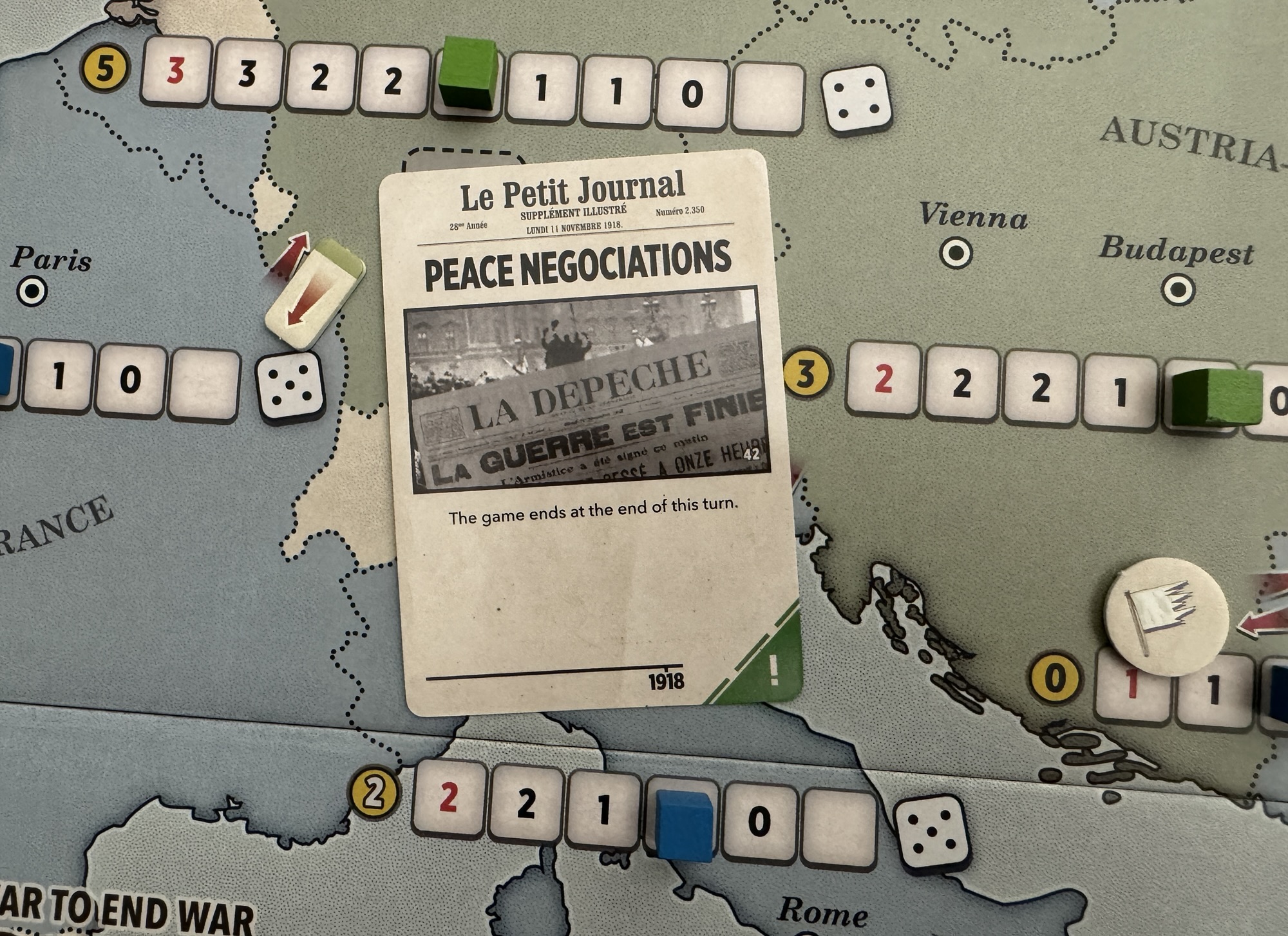
Aside from the Sudden Death ending, the game can end in 2 ways including at the end of the turn during which the Peace Negotiations card was drawn, or at the end of turn 14. In both of these cases, the side with the most Prestige Points is declared the winner. If there is a tie, the Central Powers will win the game.
So what are Prestige Points? Prestige Points are a concept that takes into account the standing of each of the combatant nations on both sides, using the location of the Sector cube on their Collapse Track as a base, and then uses a simple mathematical formula to determine the overall standing and condition of the nations morale, production and will to fight. One of the most important parts of this calculation though is that it only takes into account nations that have not collapsed and surrendered. If a nation has been forced to surrender because their Collapse Track reached the end, they will not count toward the Prestige Points of their allied side.
Each player will calculate their total Prestige Points very simply by paying attention to several numbers such as the Operational Value and Prestige Value. For each country still At War during the Armistice, the player multiplies the sector’s current Operational Value (OV), which is shown by the location of the Sector cube on the Collapse Track, by its Prestige Value (PV), which is the value printed on the left side of the Collapse Track. The various nations’ Prestige Values are Germany 5, France 4, Austria-Hungary 3, Ottoman Empire 3, Italy 3, Middle East 3 and all other Sectors 1.
Let’s take a look at a quick example of how to calculate Germany’s Prestige Points. If Germany is still At War and their Collapse Track is showing an Operational Value of 2, then we will multiply their Prestige Value shown on the far left of the Collapse Track of 5 x the Operational Value of 2 resulting in a total of 10 Prestige Points. The players then add the number of Victory Points (VP) indicated by the location of their marker on the Victory Point Track. You might be wondering Where do Victory Points come from? Victory Points are specifically earned from forcing countries to surrender and the side that caused the surrender will earn a number of Victory Points as shown in the rules. For the Entente, their values are Russia 3 VP, Italy, Middle East and Romania 2 VP and Serbia, Africa and Greece 1 VP. For the Central Powers, their values are Austria-Hungary 3 VP, the Ottoman Empire and Bulgaria 2 VP and the German Colonies 1 VP.
I very much like the concept of only calculating the value for those countries who have not Collapsed and who are still in the war. We all know that it is easier to negotiate a peace that is favorable to your side when you are still a threat and if too many nations of either side have collapsed then their Prestige Points will reflect this as those countries won’t contribute to the final value. And I also like the simplicity of the scoring system. If certain key countries like France and Germany surrender, then that equates to a victory for the side causing the surrender and if the game continues to grind on through the final turn, then there is this calculation that is really pretty simple and gives importance to each goal with a different value that can be earned. Just a solid method for determining victory that makes sense and fits with the historical aspect of the outcome of the Great War.
In Action Point 6, which is the conclusion to this series, we will give an overview of the “Athena” solitaire bot and show how it works for solitaire play.
April is one of my favorite months due to Easter and the warming of the weather. And this month we got a good amount of newly baked wargames, still warm some of them because they are so new, for you to choose from. This month for the Wargame Watch I was able to find 28 games (including the 7 games from our sponsor VUCA Simulations). Interestingly though this was a cooler month for crowdfunding as I only found 4 different campaigns, which did contain a total of 6 games as one was a triple feature, featured on Kickstarter or Gamefound.
This month again we have a sponsor for the Wargame Watch in VUCA Simulations. VUCA Simulations is a newer German publisher that is really crushing it with their graphics and production. Their games are also very good and we have really enjoyed several of their titles including Donnerschlag: Escape from Stalingrad, Traces of War and most recently New Cold War.
But I also want to point your attention to their In Development Section of their website to show you all of the great projects that they are currently working on. Here there are 7 different games listed with pictures of the beautiful covers and a description of the game itself. These titles include Thirty Years of Misery designed by Brian Asklev, Pacific Fleet designed Hiroyuki Inose, The Far Seas designed by Martin Anderson, In Fours to Heaven designed by Grzegorz Kuryłowicz, Gateway to Falaise designed by Andrew Glenn, 1916 – Prelude to Blitzkrieg designed by Paul Hederer and Saint-Lô – The Capital of Ruins designed by Clemm.
VUCA is really doing a great job with their games and we recently played one of their newest games in Imperial Elegy: The Road to the Great War 1850-1920 and it was a sublime experience. We only played 1 full hand with a full table of 6 players, but very much enjoyed what it was that we were trying to do and the production is just fantastic. Can’t wait to get this one back to the table soon!
But now onto the games for April!
Pre-Order
1. Company of Heroes – Desert Warfare Expansion + Reprint from Bad Crow Games Currently on Gamefound
Glitz. Bits. Content. Miniatures. If these things appeal to you and you like a tactical wargame experience then this is your chance. The well regarded Company of Heroes System has a Gamefound campaign for a new expansion called Company of Heroes – Desert Warfare Expansion and they are also offering the base game 2nd Edition as an add-on as you need it to play.
From the game page, we read the following:
The Company of Heroes – Desert Warfare Expansion + Reprint on Gamefound brings the Deutsches Afrika Corps (DAK) to the 2nd Edition board game, featuring high-mobility, mechanized, and elite units. This expansion enhances solo/co-op play with improved AI, offering a fast-paced, tactical tabletop experience with armored, hit-and-run tactics. The Deutsches Africa Corps adds specialized, agile desert combat forces with a focus on armored vehicles, Italian alliance units, and fast, bold maneuvers. The expansion includes a sophisticated AI for solo or cooperative play, featuring an AI commander, HQ board, action deck, and target selection priority cards. The AI is described as aggressive, frequently seizing objectives. The expansion includes new maps, units, and components to expand the core game experience. The campaign also offers a reprint of the 2nd Edition core box, required to play, featuring streamlined rules and high-quality components.
I am going to be honest here. I played the 2nd Edition. We enjoyed it but it wasn’t necessarily as amazing as I thought it would be. I mean the systems are interesting but it feels more Euro game like than wargame like and it is also extremely expensive. Now it is gorgeous and the miniatures, terrain and maps are very well done but I am not sure that this game lives up to the hype. Just my humble opinion.
As of April 1st, the Gamefound campaign has funded and raised $948,465 toward its $100,000 funding goal with 1,928 backers. The campaign will conclude on Thursday, April 16, 2026 at 12:00am EST.
2. T-34 Leader: The World War II Ground Combat Solitaire Strategy Board Game from Dan Verssen Games Currently on Kickstarter
A good solitaire game is always very much welcome on my table. I usually start these entries about solitaire gaming by saying I am not a solitaire gamer. Well, after playing the Leader Series from DVG for the first time about 8 years ago, that statement no longer applies. I used to really only play solitaire games when I had no other choice or available opponents. But, when I put these games on the table, my whole opinion has changed. The Leader Series is a solitaire gaming system that recreates modern combat, including ground combat, air warfare and even submarine warfare and sees the player creating, managing and outfitting a group of soldiers/boats/planes over the course of a variable length campaign. Some of the games offer individual combat systems that are included in the overall game and each handles their theater with specific rules and equipment used historically. Originally, all of the games were designed by Dan Verssen but more recently other designers have been taking up the reigns of the series. Such is the case with their newest offering in the series T-34 Leader designed by Vincent Cooper.
From the game page, we read the following:
You are the commander of a Soviet army combat group in World War II. You will take command in the hardest fought campaigns from Operation Barbarossa (1941) to the Battle of Berlin (1945).
Each of your Campaigns involve both operational and tactical decisions. At the start of a Campaign, you select the Units and Commanders to make up your force. During each Week of the Campaign, you decide which Enemy Battalions to attack, which of your forces to allocate, and then resolve each Battle using the Tactical Battlefield. Your Commanders gain Experience with every Battle, but they also suffer Stress. Each Week you must decide how hard to push your men to achieve Victory. T-34 Leader is a great game for both experienced strategy gamers, as well as new players. Each Campaign takes around 30 minutes to set-up, and each Battle can be resolved in 15 to 30 minutes.
T-34 Leader has been designed from the ground up as a Solitaire wargame. It is not an adaptation of a 2-player wargame and the rules have been specifically designed for the solo player. As a Solitaire wargame, you can play whenever you have time, at your own pace. T-34 Leader is the latest Tank Leader game from DVG, following Tiger Leader and Sherman Leader.
With that look, I will let you know that I very much love Sherman Leader and the ground combat for me is where it is at and I would think that T-34 Leader will be more of the same but on the East Front. I have played Sherman Leader the most in the series, using both short and long campaigns, and really enjoy its systems, the structure of the AI and the management of your units and Commanders. Really engaging and enjoyable experience of ground combat in World War II.
Here is a link to my video review for Sherman Leader that you can view at the following link:
As of April 1st, the Kickstarter campaign has funded and raised $38,484 toward its $30,000 funding goal with 148 backers. The campaign will conclude on Tuesday, April 7, 2026 at 3:02pm EDT.
3. Chalice of Poison: The Iran-Iraq War, 1980-1988 from GMT Games
We met Akar Bharadvaj while attending SDHistCon in 2023 and played his award winning design Tyranny of Blood: India’s Caste System Under British Colonialism, 1750-1947 and very much enjoyed the experience and talking with him about game design. Since that time, he has been working on another designer called Chalice of Poison: The Iran-Iraq War, 1980-1988 from GMT Games, which was recently announced on their P500. Chalice of Poison is the first volume in a new series that models complex conflicts not only as clashes between adversaries in the air, land, and sea, but also as political struggles within the regimes and military forces fighting it.
From the game page, we read the following:
In 1980, Saddam Hussein’s Iraq invaded Iran, hubristically expecting to achieve a quick victory in a few weeks. Instead, the war became a brutal slog that lasted eight years. During the war, both countries had to choose between political and military objectives, balancing between the power of their military forces and the stability of their regimes. In Chalice of Poison you will play as the heads of two very different authoritarian regimes that have structured their militaries to be excellent at forestalling internal threats…but less effective at fighting foreign adversaries. Can you reform your military so that it’s effective enough to win the war, without accidentally creating a force that threatens your power?
A unique game on the Iran-Iraq War, the longest conventional war of the 20th century, and a historically important conflict underexplored in tabletop gaming.
Designed by Zenobia Award-winning designer Akar Bharadvaj, and inspired by Dr. Caitlin Talmadge’s academic research on the fundamental weakness of so-called “strong-man” authoritarian regimes.
Simple mechanics create a tense, dynamic, and meaningful decision space with an exciting narrative, capturing the dilemmas faced by regimes faced with both internal and external threats.
A two-player game that also plays well with four players on competing teams.
Includes two solitaire modes: A simple-to-operate “Al-Jazari” bot that offers a challenging non-player opponent. A more complex “Kissinger mode”—inspired by Mark Herman’s Peloponnesian War—in which the solitaire player represents both sides in the conflict. This mode abstractly models the international community, which cynically supported both sides in the conflict, ensuring a lengthy war in which neither country could win a decisive victory.
“At its most interesting, Chalice of Poison simulates warfare as a social battle as much as one involving tanks and bullets…This might sound complicated, but Bharadvaj presents these fluctuating power levels with refreshing clarity…Even at this early stage it’s an impressive and ambitious plaything. And its critique is unexpectedly timely, highlighting how strongman governments weaken their nations in the name of strengthening their regimes.” ~ Dan “Space-Biff” Thurot
4. Pericles: The Peloponnesian Wars 460-400 BC 2nd Printing from GMT Games
We are admitted Mark Herman fanboys! I am not ashamed of that statement as he is a very good designer and such an interesting person. He has designed a series of games called The Great Statesman Series and there are such fantastic mechanics at play that create a very interesting non-traditional wargame feeling such as Churchill. The 2nd game in the series is called Pericles, unlike Churchill, pits 2 sides, the Athenians and the Spartans against one another. The real game-changer is that each side is made up of two factions. As such it plays best with 4 players, each working to not only have their side win, but to have their faction within that side end with the most honor, and thus be victorious overall. The good news for most of us, is that there’s bots for solitaire, or 3 player games and there’s a fascinating 2 player variant, where each player plays a faction on each side. GMT just put a 2nd Printing up on their P500 and I am so very glad that this game will get some more attention as it is a really great game.
From the game page, we read the following:
Pericles is a ‘sandbox’ (unscripted) wargame that covers the ENTIRE period of conflict described in Thucydides classic history on the Peloponnesian wars. Pericles is a 4-player game, where two teams of Athenian and Spartan factions fight for Hegemony in 5th Century Greece. Each team of two represents a faction vying for control of their City States, strategy, and honor. Athens sees the Aristocrats debate issues with their opposing Demagogues, while in Sparta House Agiad and House Eurypontid contend for royal dominance.
Pericles uses elements from the Golden Geek best Wargame of 2015, Churchill, to simulate war as the extension of politics by other means. In the War portion of the game, it is US versus THEM (Athens versus Sparta), where each team implements their collective strategy to dominate Theaters of War, build economic strength, and fight battles to win Honor. In the respective Political assemblies, it is ME versus YOU (faction versus faction), where the battle for government control has to be balanced by your common interests in a series of wars that must be won, or all is lost.
Pericles uses an Issue Queue preplanning mechanic that the play testers have described as ‘insanely fun’. After your Political assembly has debated and won issues, these issues (military, league, diplomatic, oracle) are secretly placed on the military map in one of the twenty Theaters of war. If you or your opponents place a second issue into a Theater, it creates a queue of issues. Once all issues are placed, they are revealed and resolved one at a time. The order of issues in the queues and the order in which they are resolved across all Theaters tells YOUR story of the Peloponnesian wars.
Strategy in Pericles unfolds in how you create combinations of issues to achieve the historical narrative. Do you want to conduct a Periclean raiding strategy? Then you would play two military issues into a Theater to first move forces into position, then raid. Do you want to build a base in the enemy homeland (historically Pylos or Decelea)? Then you would conduct a military expedition, followed by a league issue. Do you want to raise an opponent’s ally in rebellion? Then you would deploy a diplomatic mission, and sow treachery for immediate or future advantage. It is in the placement, order, and resolution of the issues that the game allows you to explore and experience the broad range of historical situations without a script.
What would a game of Hoplites and Triremes be without a battle mechanic? Battle in Pericles is based on armies and fleets being led by the classic generals of yore, represented as Strategos tokens. During the Political assembly, each faction uses historical personalities to acquire Strategos tokens. Use the Spartan general Brasidas and gain four Strategos tokens, while Epitadas only generates one. Strategos tokens can be thought of as military capital that is spent in the war to lead and move forces. If you send forces to a Theater with enemy forces, a land or naval battle will occur. All players then secretly commit Strategos to the battle. Then, the commanding general of the military expedition and their teammate reveal their Strategos commitment and move wooden land and naval units to the battle. Now the defensive commitment of Strategos is revealed, each side then reveals a random battle card value, and the winner is decided. The winner of the battle now has the option to fight a subsequent naval or land battle. The outcome of these tactical decisions determines if any fortified bases are destroyed by assault or siege. Then the next issue is resolved. Winning battles awards and reduces honor.
Here is a link to our video review that was created when we were younger, had more hair and were not very polished in any part of what we were doing:
5. Silver Bayonet: The First Team in Vietnam, 1965 – 25th Anniversary Edition 2nd Printing from GMT Games
We have had a great experience playing Silver Bayonet a few times over the years and I am glad that it is now getting a 2nd Printing of the 25th Anniversary Edition. Silver Bayonet: The First Team in Vietnam, 1965 – 25th Anniversary Edition is a revamping of their first ever game released all the way back in 1990.
From the game page, we read the following:
Silver Bayonet recreates the pivotal November 1965 battle between a full North Vietnamese Army Division and the US 1st Air Cavalry Division in the Ia Drang Valley. NVA expertise in lure and ambush tactics resulted in significant US casualties. US mobility and the ability to bring massive amounts of firepower to bear quickly virtually destroyed the attacking NVA division and forced a change in NVA tactics.
This re-issue of GMT Games’ 1990 CSR Award winning title that started it all keeps the original operational system, but streamlines to it to include innovative combat resolution integrating maneuver combat, close assault, artillery bombardment, and support from gunships and air sorties.
Increased accessibility to primary and secondary source material has made it possible to make changes to more accurately represent both sides’ unique capabilities without significantly altering or breaking the base game system. The major changes involve patrols, ambushes, landing zones, and the 1st Cav Brigade HQ, while minor changes tweak movement, combat, and coordination game mechanics to showcase radically different strengths and weaknesses the FWA and NVA force brought to the battles in the Ia Drang Valley.
6. I, Napoleon 2nd Edition Update Kit from GMT Games
As you probably know, normally Ted Raicer designs hard core hex and counter wargames such as The Dark Valley: East Front Campaign, 1941-45, The Dark Sands: War in North Africa, 1940-42 and The Dark Summer: Normandy, 1944. These games are fantastic experiences that are true wargames. But, he also has an eclectic side to him and has designed one of the classic card driven games on the subject of World War I in Paths of Glory. So when I heard that he had designed an interesting looking card based historical role-playing game the first thought that came to my mind was “How is he going to accomplish this feat?” Last year, I played I, Napoleon and did enjoy what it was doing even though it felt like it fell a bit short of its ultimate claim. But there is more of the game now and they are doing this Update Kit in case those who want to the updated cards don’t wish to order the Limits of Glory Expansion.
From the game page, we read the following:
For our customers who own the 1st Printing of I, Napoleon and want to upgrade to the 2nd Printing without purchasing the Limits of Glory Expansion, we’re providing an Update Kit.
This Kit includes:
60 Updated Cards
2 Divider Cards (1 New, 1 Adjusted)
Rulebook
Playbook
8.5″x11″ Player Aid
Sticker Sheet (4 stickers to update the Game Board)
NOTE: The Limits of Glory Expansion includes the updated Cards, Divider Cards and Sticker Sheet, as well as a Rulebook, Playbook and Player Aid that can be used with both the expansion and base game.
7. Paper Wars Magazine Issue #116: Roma Invicta: The Roman Republic 400-50BC from Compass Games
Wargame magazines can be a bit hit and miss with their games. But, Paper Wars seems to really pick some great topics and systems to highlight in their pack-in games and this month there is a new pre-order for a game called Roma Invicta: The Roman Republic, 400-50 BC designed by Paul Kallia who did Roma Victrix: Campaigns of the Roman World from Compass Games.
From the game page, we read the following:
Roma Invicta: The Roman Republic & the Western Mediterranean by Paul Kallio is a 2-player, scenario-based design depicting several historic conflicts that occurred in and around the Roman Republic between 400 and 50 BC. This is a systemic brother design to Paul Kallio’s Roma Victrix boxed game. Each game turn represents one year. Infantry unit types include legions, heavy infantry, auxiliaries, and barbarians, and represent about 5,000 men each.
BONUS GAME MATERIAL: This issue will include two new scenarios for play with WWII Campaigns: 1940, 1941, and 1942. For 1941, we have Festung Stalingrad. It covers the German counteroffensive to try to save the Sixth Army trapped in Stalingrad in December 1942. For 1940, we have the Operation Matador variant scenario by David Meyler.
Article highlights include previews of Rise to Glory and Iberian Tide, a work-in-progress report on Island Infernos, a Bitter Woods AAR, an alternate start scenario for Desert Tide, and a new optional fuel dump rule for The Last Gamble.
8. Limits of Glory: Campaigns VI & VII – Jersey New Jersey and A Strong War: The Conflict for North America 1755-60 from Form Square Games Coming to Gamefound April 7th
A few years ago, we became acquainted with Andrew Rourke through his Coalitions design from PHALANX that went on to a successful crowdfunding campaign and has recently been delivered. He has since been a busy guy with starting his own publishing company called Form Square Games and also publishing the first 5 designs in a new series called Limits of Glory that will take a look at the campaigns of Napoleon and other contemporary conflicts. In Campaign I, which is called Bonaparte’s Eastern Empire, the game is focused on the campaign of the French in Egypt between 1798 and 1801. Campaigns II, III and IV was Maida 1806 and Santa Maura & Capri. Campaign V was Donning the Sacred Heart which covers the Vendee Civil War and just recently fulfilled as I have my copy sitting on my gaming table awaiting and unboxing video.
And now, recently, he has announced came out about the next entry in the series which is a two-fer with Campaigns VI and VII called Jersey New Jersey and is set during the American Revolutionary War but also a 2nd game called A Strong War set during the French & Indian War. I think that these games are well timed with this year being the 250th Anniversary of the signing of the Declaration of Independence and I look forward to playing and exploring both of these games. I have also reached out to Andrew to see about him as well as the design duo of Mark Kwasny and John Kwasny for A Strong War doing another interview to give us a look inside the design and get more information for you to digest before the campaign kicks off on April 7th. But at this point the games look great and I love the art and the covers are very eye catching for sure!
From the game page, we read the following:
For the 2 games in the Limits of Glory Series:
Two exciting games in one box, Jersey covers the little known 1781 invasion by the French of the Island of Jersey as part of the American Revolutionary War. The game examines the impact of luck on events and challenges the skill of players to use their commanders to influence these events.
New Jersey covers the famous crossing of the Delaware and the battles of Trenton and Princeton using the same Limits of Glory System to test players ability to mitigate what luck throws at them by the skillful use of commanders and troop positioning.
Limits of Glory represents military campaigns at the highest command level, players take the role of theater commander and must manage their resources of men, material and skill to emerge victorious.
And for the other game in the offering called A Strong War: The Conflict for North America 1755-60:
The title, A Strong War, refers to the type of war the Abenaki Nation threatened to unleash on the land-grabbing British in 1753. The sparks of war, ignited in 1754 near Fort Duquesne by an obscure colonel of Virginia militia, George Washington, spread quickly; soon, flames engulfed the entire globe as England and France vied for control of empire. Over the next 5 years, Regular regiments from the French and British armies, American and French-Canadian provincial units, and Native warriors all fought in a chaotic and violent series of campaigns and frontier raids that culminated in the British conquest of French Canada and the defeat of the Native Nations (most of which had sided with the French).
A Strong War brings this war to life in a simple, fast-playing game. The map (covering the region stretching from Louisbourg to Alexandria, and from New York to Lake Erie) uses point-to-point connections to highlight the key locations that were targeted during the war. Using wooden cubes to represent the different types of forces used (French and British Regulars, British Colonials, French-Canadian Marines, French Bush Rangers, and Native American warriors), each player has only a few pieces (maximum 13 for the British and 10 for the French) to use each turn (one turn = one year, so there are 6 turns/years total).
The heart of the game is the unique combat system where players can deploy forces to a chosen battle and then commit them one by one; or they can call off the battle if it goes badly and save some of those forces for use later in the year. The types of forces committed also play a critical role in combat – the British want to mass their Regulars but the French want to bring in a mixed force to take advantage of the different skill sets each provides. Thus, tension is created in trying to decide if/when (or where) it is best to commit one’s forces: do you avoid combat completely; do you call off a combat that is going badly; or, do you go all in and commit your entire force? But if you lose a battle, initiative then swings to your opponent who may then launch an offensive. Each player has several paths to victory, leading to a “different” game each time, and forcing players to choose between different strategies each turn. Finally, it is a quick game, taking just a couple of minutes to set up, and usually taking less than an hour to play to completion. The game also plays well solitaire, though there is no dedicated solitaire system.
9. Campaign: Operation Bagration from Catastrophe Games Currently on Kickstarter
A few years ago, I played and very much enjoyed a cool little solitaire WWII card-driven game called Campaign: Fall Blau from Catastrophe Games and designer Martin Melbardis where the player attempted to breach the Soviet defenses on the East Front in the pivotal German summer campaign of 1942. The game system is very playable and simple, but has some strategic depth to it as the player has to make a lot of choices about what to go after, how to manage their scarce resources (fuel) and what generals to use to take advantage of their special abilities to amass enough VP to claim victory over the Soviet Union. They now have the counter punch of that game in a new entry in the series called Campaign: Operation Bagration and it is currently being offered on Kickstarter.
From the game page, we read the following:
Campaign: Operation Bagration is the follow-up to Campaign: Fall Blau, the acclaimed solo experience of trying to seize Stalingrad and the prized oil fields beyond. In this game the shoe is on the other foot, as you will be pushing the Red Army to retake the center of the occupied Soviet Union, setting up the capture of Berlin. Stalin is expecting fast results though, so once again you will be racing against the clock trying to achieve enough objectives before your supplies (and Stalin’s patience) runs out.
Campaign: Operation Bagration is a solitaire wargame that takes place during WWII and puts the player in charge of the Soviet summer offensive of 1944 against Army Group Center, code named operation Bagration. Pick your three generals and use your resources wisely in order to obtain your campaign’s objectives.
One month turns. Decide which card (objective) to go after, each with a unique set of Soviet defenses. Manage supplies required for each offensive, or choose to take an operational pause. Receive random event cards that are mostly beneficial but a few are Soviet counterattacks that can throw a serious monkey-wrench into your plans. Play continues until fall begins, and you must report to Stalin with your success or failure.
In order to meet Stalin’s expectations you need to be relentless, while carefully marshalling your troops and material. Drive too hard, and the Germans will crush one of your wings, and your push will stall out. But if you move too slow you know you will be summoned to a special meeting with Stalin, and that is a grim fate.
As of April 1st, the Kickstarter campaign has funded and raised $1,138 toward its $500 funding goal with 14 backers. The campaign will conclude on Monday, April 20, 2026 at 8:51pm EDT.
New Release
1. VaeVictis Magazine Issue #185 Game Edition: Storm on the Ménez Hom 1944 from VaeVictis
VaeVictis is a very fine wargame magazine and they always have very interesting looking pack-in games on various subjects. This month, they have featured a scenario involving the 1944 attack on the Ménez-Hom peak on the Crozon peninsula in a game called Storm on the Ménez Hom 1944. But there is more as the magazine features articles on various wargames including Hubris from GMT Games, La Der des Ders from Hexasim, Thunder on the Mississippi from Multi-Man Publishing, Italia 1917-1918 from Nuts! Publishing, New Cold War from VUCA Simulations, Werwolf from Legion Wargames and many more.
From the game page, we read the following:
During the siege of Brest, the coastal batteries on the Crozon peninsula, on the southern shore of the harbor, were hindering the advance of the US Army. It was therefore crucial to silence them. To achieve this, the barrier closing off the peninsula had to be breached: the Ménez-Hom peak, rising to 330 meters. This mission was entrusted to the FFI-FTP battalions of central Finistère. It took three weeks, from August 12th to September 1st, 1944, and the reinforcement of a US cavalry brigade to finally defeat the German, Russian, and Caucasian defenders.
2. The Coming Storm II: Quadrigames of the Fourth Coalition: October 1806-June 1807 from Operational Studies Group
Large Napoleonic wargames are always interesting. Operational Studies Group does some big games on the subject and their newest offering is called The Coming Storm II: Quadrigames of the Fourth Coalition: October 1806-June 1807 and deals with four different battles including Jena-Auerstadt, Pultusk/Golymin, Eylau and Friedland.
From the game page, we read the following:
These four games explore the major battles of 1806–07, where the French Army encountered two different opponents with different capabilities, from the leadership-challenged Prussians in Saxony to the chaotic battle conditions in winter against the Russians. Based on OSG’s Special Studies, which provide a turn-by-turn narrative of the four battles. Each game shows the approach to the battlefield on the day before battle. The Jena-Auerstadt game has both battlefields on one map and allows both sides to redeploy before battle.
We are offering a new edition, with new maps—not too much different in detail—but rendered in Charles Kibler’s naturalistic style. TCS2 will be updated to use the Universal Deck and latest series rules (deck not included). With few exceptions, the counters will be identical to the first edition.
This is a very popular series of games amongst Grognards and I have heard many people recommend these titles to both of us. We have yet to take the plunge and get one but one day we will…one day!
If you are interested in The Coming Storm II: Quadrigames of the Fourth Coalition: October 1806-June 1807, you can order a copy for $140.00 from the Operational Studies Group website at the following link: https://napoleongames.com/products/the-coming-storm-ii
3. The Maid Ascendant: The Siege of Orleans, October 1428-May 1429 from High Flying Dice Games
Paul Rohrbaugh and his company High Flying Dice Games is a designer I love to follow. He is always doing games on smaller or lesser known conflicts and I just find his work to be superb and really draws me in. Recently I saw where he was releasing a game on the Siege of Orleans and I do like siege games! The game is called The Maid Ascendant and really looks pretty interesting and is definitely a unique subject for a game.
From the game page, we read the following:
The Maid Ascendant is an introductory level wargame on the siege of Orleans. The siege marked the debut of Joan of Arc as a military commander, and a campaign that would see the English eventually evicted from France and the end of the Hundred Years War.
“Begone, or I will make you go!” – Jeanne d’Arc’s command to English and Burgundian troops besieging Orleans.
If you are interested in The Maid Ascendant: The Siege of Orleans, October 1428-May 1429, you can order a copy for $16.95 from the High Flying Dice Games website at the following link: https://www.hfdgames.com/maid.html
4. Mr. Lincoln’s War from Compass Games
You can’t have enough good American Civil War games and Compass Games has been working to bring out a new edition of a classic called Mr. Lincoln’s War designed by Mark McLaughlin.
From the game page, we read the following:
Mr. Lincoln’s War is a historical game which captures the epic struggle of the American Civil War. From their first major battle at Bull Run in 1861, through the campaigns of Vicksburg, Gettysburg and Atlanta and until the final days at Appomattox in 1865, the armies of the Union and the Confederacy raged across America wreaking havoc and bloodshed on a scale never before or since witnessed in the New World.
This box set is organized into two sub-games, “Army of the Tennessee,” which deals with the war in the western theater, and “Army of the Potomac,” which deals with the war in Virginia. Each has four short scenarios that recreate the maneuvers and battles of Shiloh, Gettysburg, Atlanta, and other monumental Civil War contests. Campaign games enabling the players to fight the war in the West or East are provided with each sub-game. They may be combined to play the Mr. Lincoln’s War grand campaign that simulates the entire Civil War, on both fronts.
5. Volume II Civil War Heritage Series Army of the Potomac: Campaigns of 1862 and 1864 from GMT Games
Several years ago, Mark Herman designed a very unique and simple American Civil War game called Gettysburg that appeared in C3i Magazine #32. That game became the basis for his Civil War Heritage Series with the first volume being Rebel Fury that focused on five battles from the Chancellorsville and Chickamauga Campaigns. He has long mentioned working on the follow-up to that game and we finally are getting it with Army of the Potomac.
From the game page, we read the following:
Army of the Potomac: Campaigns of 1862 and 1864 is the second volume in the Civil War HeritageSeries and the follow-up game to the innovative and acclaimed Rebel Fury. Army of the Potomac uses the same core rules as Rebel Fury, so players familiar with Rebel Fury will be able to jump right into the action. Each battle in Army of the Potomac is quick-set-up, quick-playing, and deeply interactive. The density of counters in each scenario is low, allowing you to see and experience the big picture of the battle.
Army of the Potomac covers the battles of Spotsylvania II, North Anna River, Cold Harbor, and the entire Seven Days battle (McClellan vs. Lee), including the prelude Seven Pines (McClellan vs. Johnson) when Johnson’s wounding brought Lee into the command of the Army of Northern Virginia. Each battle places you, the player, in the role of the Army Commander (Grant, McClellan, Lee, Johnson). You maneuver your army to find the enemy’s flanks, concentrate your forces for an attack, and determine where to commit your artillery assets.
I think that one of the most interesting parts is that this new game can be played with Rebel Fury as also included are two bonus scenarios to allow owners of Rebel Fury to fight Spotsylvania II and begin the Campaign scenario from Wilderness to Cold Harbor using their original Rebel Fury map.
Last summer, while attending WBC in late July, we sat down with Mark Herman and did an interview/overview of Army of the Potomac and you can watch that video at the following link:
6. Baltic Empires: The Northern Wars of 1558-1721 from GMT Games
This one is very much anticipated by me and I feel like I have been waiting in it forever since its announcement in 2022. Baltic Empires is a grand looking game that focuses on the conflicts between the states of the Baltic region during the early modern era. The wait is now over as they game is set to ship on April 17th.
From the game page, we read the following:
Baltic Empires is an approachable 2-5 player strategy game about conflicts between the states of the Baltic region during the early modern era, a transformative period of religious conflict, large scale warfare, and constant struggles for power. Players will have to develop their economy, strengthen their administration, secure trade hubs, and finally build armies to become the dominant power of the Baltics. Denmark-Norway, Sweden, Russia, Poland-Lithuania, and Prussia will fight for hegemony, using variable victory conditions that reflect their respective historical objectives.
During the 16th & 17th centuries, religious conflicts between Protestants and Catholics swept Europe, vast colonies were established by the maritime powers, and a series of wars were fought against Louis XIV’s Kingdom of France to maintain the balance of power, eventually culminating in the War of Spanish Succession. While this history might be familiar to many, the related conflicts around the Baltic Sea that took place during these centuries are less well-known.
Where did the French, English, and Dutch acquire the materials they needed to build and maintain their vast navies that won them their colonial empires? Where did they acquire the food they needed to feed their sailors and growing populations? Where did the Swedish juggernaut that suddenly emerged and changed the course of the Thirty Years War come from, and why didn’t its great power status last? How did the Russian and Prussian Empires that became so powerful in later periods first emerge on the European stage? The Baltic region was crucial to the history of Europe, and the conflict for influence over the Baltic Sea was closely intertwined with the balance of power in Western Europe. The outcome of the wars and societal transformation in the Baltic region, from the collapse of the Teutonic Order in Livonia in 1558 to the end of the Great Northern War in 1721, shaped European and world history up until the present day.
Baltic Empires presents these less well-known conflicts in a fun and accessible format, while also doing justice to the fascinating history of the Baltic Sea region during this period. The game features 5 asymmetric factions with different strengths, forces, and historical objectives, along with the capacity to develop their states by investing in economic infrastructure and recruiting key historical characters that offer unique game effects. The game also includes several scenarios for variable player counts and durations, offering additional flexibility and replayability.
7. Three Days of Gettysburg Deluxe Edition from GMT Games
A very popular series featuring one of the most gamed battles of the American Civil War! Quite the combination. And to add to that, a Deluxe Edition treatment with new counters, some new rules, new and updated maps and lots of scenarios. This is a great value for any gamer who wants to game one of the most iconic battles of the American Civil War.
From the game page, we read the following:
GMT Games and the GBACW design team are proud to announce Three Days of Gettysburg Deluxe Edition, the ultimate edition of the definitive game on the Battle of Gettysburg. First published in 1995, 3DoG has stood the test of time as one of the most popular games of the Great Battles of the American Civil WarSeries.
This series is one of the hobby’s longest-lived design concepts, springing from the legendary regimental level Gettysburg game—Terrible Swift Sword (SPI)—designed by Richard Berg in 1976. Under GMT, the rules system has remained stable but has shown remarkable flexibility to allow each game to smoothly incorporate additional rules to reflect the historical battles. The series relies on interactive chit-pull mechanics to simulate the often-chaotic nature of the 19th Century battlefield at the regimental level.
Three Days of Gettysburg Deluxe Edition will include ten plus scenarios. They range from small Skirmisher contests on half sized maps to the ultimate Gettysburg experience on four full full-sized maps depicting the entire battle, including the East Cavalry Battlefield! Other scenarios will depict both the first and second day of the struggle. Experienced players will be able to play many of the scenarios in one sitting. The 3DoG Deluxe Edition will include many exclusive rules to represent the special situations at Gettysburg, including new Skirmisher rules. However, many of the rules are optional, allowing players to decide for themselves what level of complexity they want.
New components and exclusive rules include new cavalry counters, CSA dismounted cavalry counters, corrected artillery types, two types of skirmisher units, artillery sections for some scenarios (Calef’s battery on the first day!), and artillery overshoot. The new maps continue to use Mark Simonitch’s beautiful artwork but include stonewalls, the Devil’s Den, and sloping hexes to better represent the unique terrain at Gettysburg. The large rock formations are represented differently from earlier editions, and artillery will find moving up the slopes of Little Round Top as difficult in the game as it was in the battle.
And just take a look at this big beautiful map of the game….by the talented Mark Simonitch!
8. Dreams of Empire Expansion Kit – Seeds of Empire: The Wars of South & Central India, 1730’s-1750’s from Red Sash Games
Red Sash Games have a reputation for very large, very long playing games that are focused on interesting historical events. This month, they announced their newest offering with their printing partner Blue Panther and it is an expansion to their Seeds of Empire game focused on the wars in South & Central India during the 1730’s through the 1750’s. The game is called Dreams of Empire Expansion Kit – Seeds of Empire: The Wars of South & Central India, 1730’s-1750’s and really looks to be pretty interesting.
From the game page, we read the following:
Seeds of Empire is the second in a series of operational war games covering conflict in India during the 18th Century, using Red Sash Games’ LaceWars rules. SOE extends the environment of Dreams of Empire to include the whole of Central India (the Deccan) and extends the timeline into the 1750s to cover the Second Carnatic War.
The expansion includes several new Powers, divides the Marathas into Clans, and adds Factions for the two — not one, but two — major succession crises simultaneously taking place in the Deccan and Carnatic. This is the period when John Company, the British East India Company, finally got involved in the geopolitics of the Subcontinent. It was the highwater mark of the French presence, and a watershed for the Maratha Confederacy, while for the Mughal Empire it was a period of steep decline.
Seeds of Empire offers eight unique scenarios:
The Second Carnatic War: this scenario uses only the original map set (most of the action took place in a very confined area). Featuring the return of Chanda Sahib and Governor Dupleix, with Bussy-Castelneau, Clive of India, Stringer Lawrence (Father of the Indian Army), and above all, Mohammad Ali Khan.
“Early Start”: An ‘early start’ variant of the same scenario in which Chanda Sahib has the opportunity to slay Anwar ud-Din (or vice versa). Historically the death of Anwar kicked off the Second Carnatic War.
“Capture of Devikotta”: An even earlier start that allows the players to simulate the EIC‘s capture of Devikotta from Tanjore under the guise of restoring the Raja.
“French in the Deccan”: A ‘French in the Deccan’ scenario using only the new maps, focusing on the war for control of the Viceroyalty of the Deccan and the activities of the various Maratha clans.
“Deccan + Dreams of Empire”: A 1740s Deccan sandbox scenario matching the timeline of the original DOE Campaign Game, showing what the Marathas were getting up to.
“Full Territory”: A Campaign Game for the Second Carnatic War that combines the maps.
“Both Carnatic Wars”: A Campaign Game for the 1740s combining the original DOE Campaign with the 1740s Deccan scenario. This scenario can be extended to create a Grand Campaign covering the period of both Carnatic Wars.
“Malabar War”: A small scenario set in Malabar, showcasing the continued expansion of Travancore against Cochin and its allies.
Like Dreams of Empire, Seeds of Empire assigns the various Powers to the players as and when they Activate. However, the Second Carnatic War also creates semi- permanent Alliances, with the French on one side and the British on the other, though only acting as ‘auxiliaries’ to the great Indian lords.
To help the players cope with the material, the original rules, scenarios, charts, and (some) displays have been duplicated, with the new material from Seeds of Empire inserted into the relevant places. The expansion also includes errata and small fixes to the game system.
This is not a complete game and will requires ownership of Dreams of Empire to play.
If you are interested in Dreams of Empire Expansion Kit – Seeds of Empire: The Wars of South & Central India, 1730’s-1750’s, you can order a copy for $240.00 from the Blue Panther website at the following link: https://www.bluepantherllc.com/products/seeds-of-empire
9. Ace of Aces: Powerhouse SeriesDeluxe Edition from Mr. B Games
A classic reborn is how I would classify the next offering on this list. With very unique mechanics trying to provide the experience of dueling it out with an enemy biplane over the fields of World War I, Ace of Aces is now making a comeback with the Powerhouse Series rebirth all the way from 1981.
From the game page, we read the following:
Ace of Aces: Powerhouse is an exciting game of World War 1 aerial dogfighting. Each player is the pilot of a fighter plane in the skies over France trying to shoot down their opponent. The players each have a book that shows the position of their opponent, and what maneuvers they can perform to line up their machine guns on their target. Through an innovative matrix system, the players can fly through the sky and attempt to drive away their enemy. Each game takes 15-20 minutes to complete!
The mechanic used in this series is a very cool little flip book called a Dogfighting Book that has various pictures representing the maneuvers of your plan and the enemies. These flip books are nicely crafted and there is one for both the German Fokker DVII and the British SPAD XIII.
10. Commander: Romans v Dacians – A Solitaire Wargame from Mike Lambo
Over the past several years, print and play solitaire wargames have gained a lot of traction in our hobby. A solitaire wargame that is very affordable at $10-$15 and can be purchased and downloaded online. What is not to like? And the name of Mike Lambo has been tied to a lot these games as he has designed 20+ of these titles and has built quite the rabid and loyal fanbase. His newest game is called Commander: Romans v Dacians – A Solitaire Wargame and can be downloaded from Wargame Vault.
From the game page, we read the following:
In the rugged hills and forests of ancient Dacia (today located in the European country of Romania) Rome fights a war unlike any it has faced before. The legions advance into a land of ridges, valleys and fierce tribal resistance, where every skirmish can turn the tide of battle. You command a small Roman force consisting of legionaries, praetorian guard, cavalry, archers, and spearmen, tasked with holding the line, breaking the enemy, or seizing vital ground before the Dacian horde overwhelms you. Opposing you are the warriors of King Decebalus – swift, unpredictable, ferocious and deadly. Cavalry smash into formations with startling power, warriors surge forward in wild charges, swordsmen hold the line with grim resolve, and archers and falxmen harass and surprise from the rear. Each battle unfolds differently as both armies are drawn at random, events disrupt your plans, and reinforcements arrive to mix things up.
This is a tense solo wargame of tactical decision making and battlefield chaos. Every turn demands adaptation and every clash counts. No two battles will ever play the same, and victory is never guaranteed until it is achieved.
In the game, the Player will be commanding the units of the Roman Empire as they battle a seemingly endless stream of fierce Dacian fighters.
This game is a solitaire wargame. You play the game, and the enemy is controlled by the game (or ‘AI’). You will need three standard six-sided dice to play. It is recommended that the counters provided on the final page of the game are used to play this game (especially for the units). Simply stick them to card and cut them out. A video demonstrating how generally to do this can be found on the Mike Lambo Games YouTube channel.
As usual, thanks so much for reading along and sticking with me this month as I navigated through the many websites and game pages looking for new and interesting games to share.
Finally, thanks once again to this month’s sponsor VUCA Simulations!
With this My Favorite Wargame Cards Series, I hope to take a look at a specific card from the various wargames that I have played and share how it is used in the game. I am not a strategist and frankly I am not that good at games but I do understand how things should work and be used in games. With that being said, here is the next entry in this series.
#71: The Wartburg from Here I Stand: Wars of the Reformation, 1517-1555 from GMT Games
Here I Stand: Wars of the Reformation 1517-1555 is an experience packaged in a game that attempts to boldly cover the political and religious conflicts of early 16th Century Europe. The game focuses on the struggle of religious reformers such as Martin Luther, John Calvin and Ulrich Zwingli as they battle the Papacy for changes in their views of God and religion. But it is more than just the Holy War as it deals with the other European countries involved in the affairs of the time including France, England, the mighty Hapsburg Empire and the Ottoman Empire in the east. They all played a role in the process of the Reformation and the design brilliantly weaves this all together into an interesting and engaging experience. The game also covers other plot lines and events of the period, including wars, marriages and ascendancies to thrones, using a unique Card Driven Game (CDG) system that models both the political and religious conflicts of the period.
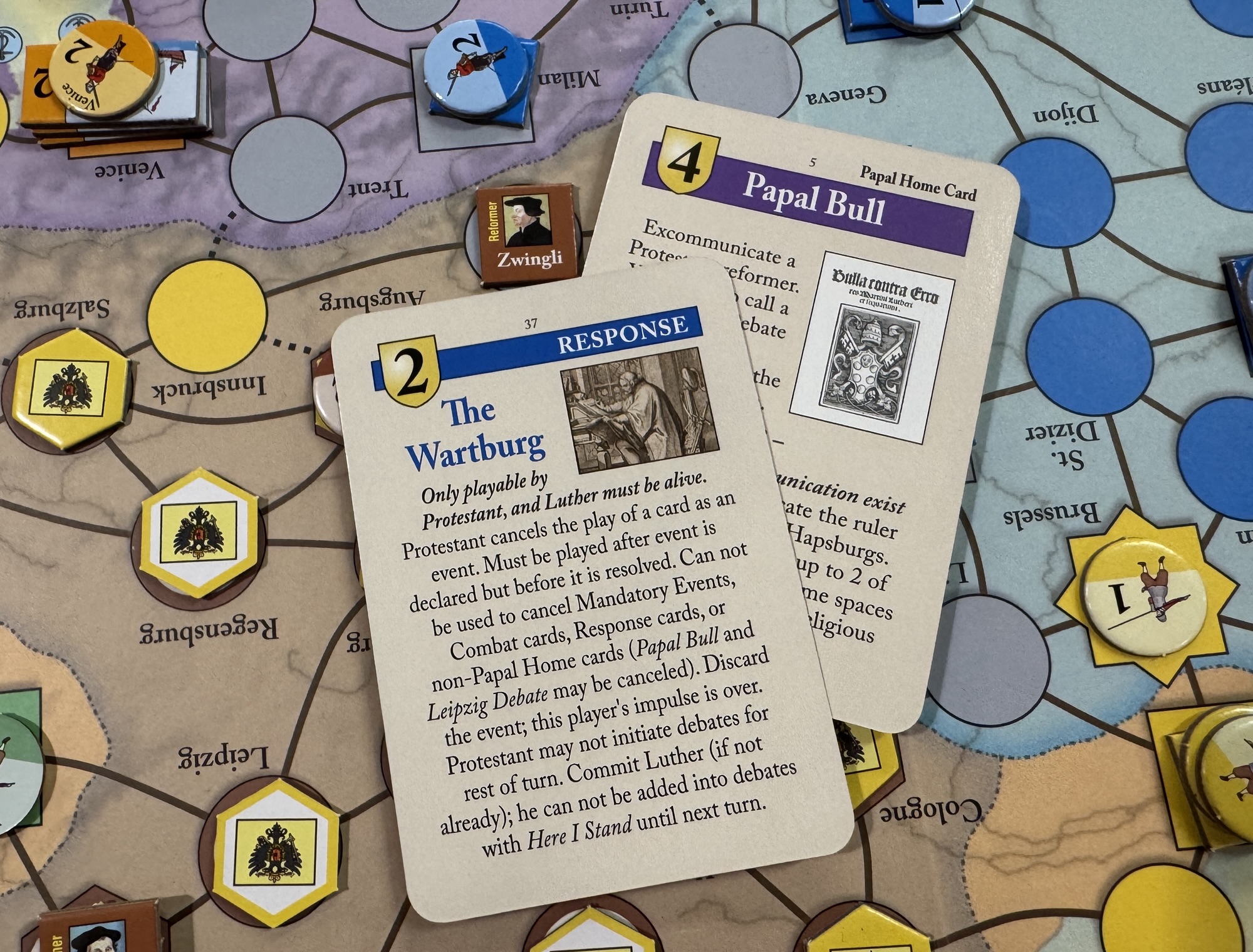
Today, I want to take a look at a very interesting Response card in The Wartburg. Response cards in Here I Stand are event cards that can be played out of turn to interrupt the actions of an opponent or provide immediate reactions to specific game events. Response cards are often used to negate, mitigate, or enhance events and combats, and they may be played during an opponent’s impulse, provided the text allows for this asynchronous timing. These cards also tend to have specific pre-requisites that must be met in order to play the card and The Wartburg states that the card is “only playable by Protestants, and Luther must be alive”. The card itself allows the Protestant player to cancel the play of a card as an event but cannot cancel a Mandatory Event. The card however can cancel the play of the Papal Bull or Leipzig Debate Papal Home Cards, which is probably the way that the card will mostly be used. The card will not only cancel the play of the event but will also end the impulse of the player playing the card. This can be very powerful and when played at the right time can be a game saver for the Protestant player.
For example, in our most recent play at Buckeye Game Fest, I was playing as the Protestants and Bill Simoni as the Papacy. After the forming of the Schmalkaldic League and the Protestants changing into a military power, the focus of the other players turned toward me as I was doing well and near victory. They all then decided to declare war on the Protestants and began to advance upon and attack my fortified Electorates to take away VP I had earned by having both religious and political control in 5 of the 6 as the League was formed. As we came into turn 5, I was at 24 VP and ultimately came up shy of a victory by 1 point at the time. I had been able to take over the entirety of England and change every space and also get about 5-6 spaces in France, but now the Papal Bull came to play and Bill fought me back and forth with him taking over 3-4 spaces followed by me reclaiming 3-4 spaces. It was a beautiful game of back and forth and I used every tool at my disposal to fight him including The Wartburg card to stop the untimely excommunication of Zwingli before he could attempt to embarrass him in a debate. That card play at that very time saved me or most likely he would have used Eck who is his best debater against Zwingli who is just average and I would have lost leading to him being burnt at the stake giving him VP or by allowing him to turn over a few of my hard fought converted spaces back to Catholicism.
The only problem with this card is that it commits Luther so he will be unavailable to be chosen directly to debate during the rest of the turn. But this was a small price to pay at that time and ultimately led to me being able to hold on through the end of Turn 6 where I won a Protestant victory on the tie breaker with England.
Martin Luther stayed at Wartburg Castle from May 1521 to March 1522 under the alias “Junker Jörg” (Knight George) to hide from papal and imperial authorities. During these 300 days of protective custody, he translated the New Testament into German in just 11 weeks, wrote numerous theological works, and grappled with spiritual turmoil. His greatest accomplishment at Wartburg Castle was his translating of the New Testament from Koine Greek into German, which laid the foundation for a unified German language and made the Bible accessible to ordinary people. He also wrote numerous works, including Against Latomus and several tracts. He began his attack on monastic vows during this time, arguing they were contrary to faith. Luther used his time in exile for intense study and writing, referring to his stay as his “Patmos”, referring to the Apostle John’s exile to the Island of Patmos in 95AD. While here though he also experienced significant psychological distress and temptation. According to legend, he threw his inkwell at the devil during a confrontation, leaving a stain on the wall. His exile was organized by Frederick the Wise after the Diet of Worms and the stay was designed to keep Luther safe from those looking for him, ensuring the survival of his reform movement.
Last month, as I was trolling the internet, I came across a new solitaire game from the guys over at War Diary Publications called Battle of the Bismarck Sea designed by Allyn Vannoy. Battle of the Bismarck Sea is a solitaire wargame that uses individual ships and flights/squadrons of aircraft. The Player assumes the role of General George Kenney, Commander of the 5th U.S. Army Air Force, with the mission of intercepting the Japanese effort to reinforce its ground forces on the island of New Guinea. I am always into a good Pacific Theater of Operations game and I reached out to Allyn to get some inside information about the design.
Grant: Allyn welcome to our blog. First off please tell us a little about yourself. What are your hobbies? What’s your day job?
Allyn: I’m retired, having worked 18 years for Intel as a program manager. Presently, I work for a minor league baseball team in the summer, an affiliate of the Arizona Diamond Backs, and volunteer two days a week at the Evergreen Aviation and Space Museum in McMinnville, Oregon, both in the Archives and giving tours of Howard Hughes’ Spruce Goose; I also write (freelance) for a number of military history and gaming magazines.
Grant: What motivated you to break into game design? What have you enjoyed most about the experience thus far?
Allyn: During Covid, I started getting back into gaming, having become interested in Avalon Hill games in the 60’s and as an early subscriber to S&T Magazine. I enjoy the challenge of trying to turn history into a game—a teaching tool—in the process I learn more and hopefully, understand more.
Grant: What is your new game Battle of the Bismarck Sea about?
Allyn: The Battle of the Bismarck Sea, 1943, was the 5th Air Force’s attempt to interrupt the Japanese effort to reinforce its ground forces on the island of New Guinea. The Player must utilize the limited resources available and determine their application over the 10-week period that operations are conducted. The results of these efforts will be borne out in the effectiveness of air operations.
Grant: What games gave you used for inspiration for your design?
Allyn: I hadn’t seen anything like this design; I wanted to make something new and hopefully unique.
Grant: What is important to model or include in a game about the Air Naval combat in the Pacific during WWII?
Allyn: The most important thing to understand is how to organize and implement an air strike force to accomplish the mission given.
Grant: What type of research did you do to get the historical details correct? What one must read source would you recommend?
Allyn: I tried to locate good and detailed sources:
Arbon, J. and Christensen, Chris. The Bismarck Sea Ran Red; Walsworth Press, Marceline, MO, 1979.
Birdsall, Steve. Flying Buccaneers: The Illustrated Story of Kenney’s Fifth Air Force; Doubleday, NY, 1977.
Henebry, John P. The Grim Reapers at Work in the Pacific Theater: The Third Attack Group of the U.S. Fifth Air Force; Pictorial Histories Publishing Company, Missoula, MT, 2002.
Jablonski, Edward. Outraged Skies; Doubleday and Co., Inc., Garden City, NY. 1971.
McAulay, Lex. Battle of the Bismarck Sea; St. Martin’s Press, NY, 1991.
Recommendation: McAulay’s book, Battle of the Bismarck Sea.
Grant: What challenges did the subject cause for the design? How have you overcome them?
Allyn: The design initially focused just on the single action that occurred on March 2-4, 1943, but there was a larger struggle that began in January 1943—that Allied commanders realized they needed to adapt and change their forces and tactics if they were to meet the challenge they faced. Once the design was expanded to a 10-week time frame it became more complex, but also more interesting. This also required more research into the changes that took place within the 5th Air Force.
Grant: What is the scale of the game?
Allyn: Unit scale: single ships and flights (3-10 planes) of aircraft.
Time scale: 10 Command/Support turns, each of one week; 13 Operational turns, over a two day period.
Ground units represent 200-300 personnel.
Grant: What are the different units that the player has control over?
Allyn: The Japanese units include transport ships, destroyers, ground units (presenting the troops and equipment carried on the transports), and fighter aircraft. These are controlled by the Bot. The player controls the Allied units: a mix of aircraft—reconnaissance, heavy bombers, medium bombers, and fighters, and also PT boats.
Grant: What does the concept of Endurance mean for the player? What does this model from the 1943 campaign?
Allyn: Endurance is the amount of time that aircraft can remain airborne. This models the range of aircraft from their bases to the target area. In the initial design, a series of range arcs were used for the individual aircraft types. It was quickly realized this would make for a very complex game. To address playability, aircraft range was changed to consolidate to a single arc (a line on the map) for medium bombers and P-38 fighters, and set Operational turns to 3-hour periods.
Grant: What decisions do they have to make about their assets use and management over the campaign?
Allyn: The game is conducted in two parts: a Command/Support Sequence and an Operational Turn Sequence.
The Command/Support Sequence is a one week period that allows the Allies to receive resource points and reinforcements, then decide how to apply the resource points—rebuilding units, modifying tactics, and determining how to find a convoy at sea.
The Operational Turn Sequence is a two day period where the convoy is moving along convoy routes as the Allies attempt to identify it and then determine the organization of strike forces in an effort to sink it and prevent Japanese forces from reaching Lae, New Guinea.
Grant: As a solitaire wargame how does the Bot behave? What are its priorities and decision points?
Allyn: The Convoy, when dispatched from Rabaul, advances towards its destination (Lae), with random events impacting its progress. The rules introduce the Fog of War that the player must overcome in order to first find the Convoy and then disrupt and attempt to destroy it.
As for decision points, there are several. How are resource points to be spent? When and how to go after a convoy? What assets to use in a given sortie?
Grant: What type of an experience does the Bot create?
Allyn: Designing a solitaire versus a 2-player game presents a whole different set of challenges. Can you design a Bot that will maintain the player’s interest and also challenge them? It should create variety; i.e., when and where will a convoy attempt to make a run; as well as a certain level of anxiety as certain elements are unknown until they can be revealed.
Grant: What are Resource Points and what do they represent?
Allyn: Resource points are the player’s currency and represent personnel, equipment (aircraft), and training.
Grant: What are Resource Points used for?
Allyn: The Resource Points are used by the player to improve tactics, provide replacements for losses, strengthen forces with personnel and equipment, and to launch air attacks. They are the real currency of the game and the player has to use them wisely to do well.
Grant: What is the layout of the board?
Allyn: The board includes the map (the area between New Britain and New Guinea); the turns tracks (for both Command/Support and Operational Turns); the Convoy Display (for air-sea combat); displays for the ships (transports and destroyers) and for tracking victory points and resource points.
Grant: How does combat work?
Allyn: Combat is based on the attack strength of the units for air combat, air-to-surface, and surface combat. The result of a die roll is compared to a unit’s combat strength, and if it’s equal to less than that number (combat strength), a hit is made on the opposing force.
Grant: How are bombers and fighters used in combat?
Allyn: Bombers are used to try and sink the ships of the Convoy. Heavy bombers operate separately from medium bombers, as they drop their bomb loads from altitude, with limited chance of success, while medium bombers engage Japanese ships at low altitude (mast-high approach). Fighters are used to engage the Combat Air Patrol aircraft that the Japanese dispatched to provide air cover for the Convoy.
Grant: How is victory obtained in the game?
Allyn: Victory is based on the number of Japanese troops that fail to reach Lae—by sinking the ships and their cargo of personnel and equipment, they are removed from participation in combat operations on New Guinea.
Grant: What do you feel the game models well?
Allyn: The fog of war; the challenge to figure out how to build and prepare the needed forces, and then how to employ them to accomplish the mission (sink the enemy shipping).
Grant: What has been the experience of your playtesters?
Allyn: Comments led to a major change in design—moving from a single mission to a 10-week campaign and all the elements associated with that larger picture/time frame.
Grant: What are you most pleased about with the design?
Allyn: That it offers two layers to the player experience – organizing and building forces, then utilizing them to execute missions.
Grant: What other designs are you contemplating or already working on?
Allyn: Operation Tidal Wave, the USAAF Ninth Air Force strike on Ploesti, Romania, August 1, 1943.
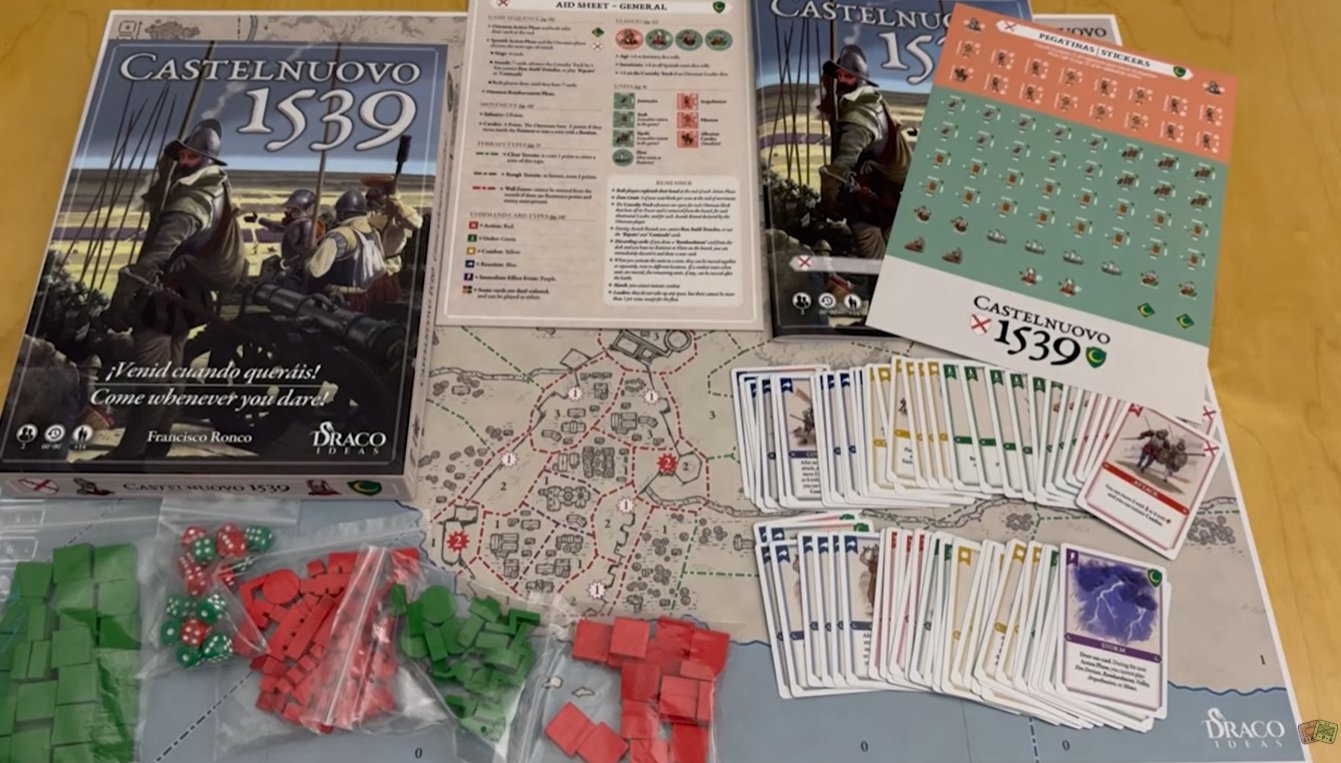
On August 7, 1539 the last resistance of the Spanish garrison of the Albanian village of Castelnuovo (Novi for the Turks) ceased. After 22 days of open trench and more than a month of combats, skirmishes, assaults and bombardments, the last Spanish defenders fulfilled the destiny they promised themselves when they rejected the offers of surrender that, according to the rules of war, Jareidin Barbarossa, admiral of the Ottoman fleet and general in chief of the operation, had made to them. The city and its fortifications, rather meager and outdated, had been taken by the forces of the Holy League in October 1538, so as not to close the campaign with the bad taste of the naval defeat at Preveza. Fourteen companies of Spanish infantry under the command of D. Francisco Sarmiento de Mendoza y Manuel, some 3,500 soldiers, were garrisoned there for the winter. The following summer brought a tide of 54,000 Turks and a fleet of 200 sails before its walls. After Venice’s defection from the League, there was no possibility of naval relief and the Spanish command authorized capitulation, however Sarmiento and his men decided to respond to Barbarossa’s offer with the phrase “Come whenever you want”, which sealed their fate.
In Castelnuovo 1539, two sides face each other in a desperate battle: the town and its fortifications will eventually yield to Turkish power, but the question is, at what cost? In Castelnuovo we will manage our army with wooden pieces in vertical with sticker, where we will not be able to see the type of unit of the opponent. The board is divided into areas and we will have other types of units such as cannon batteries, walls, bastions, trenches, etc. The confrontations will be made by rolling 6-sided dice and a deck of cards for each side, allowing us to play them to give orders, improve the fighting, dig trenches and special events.
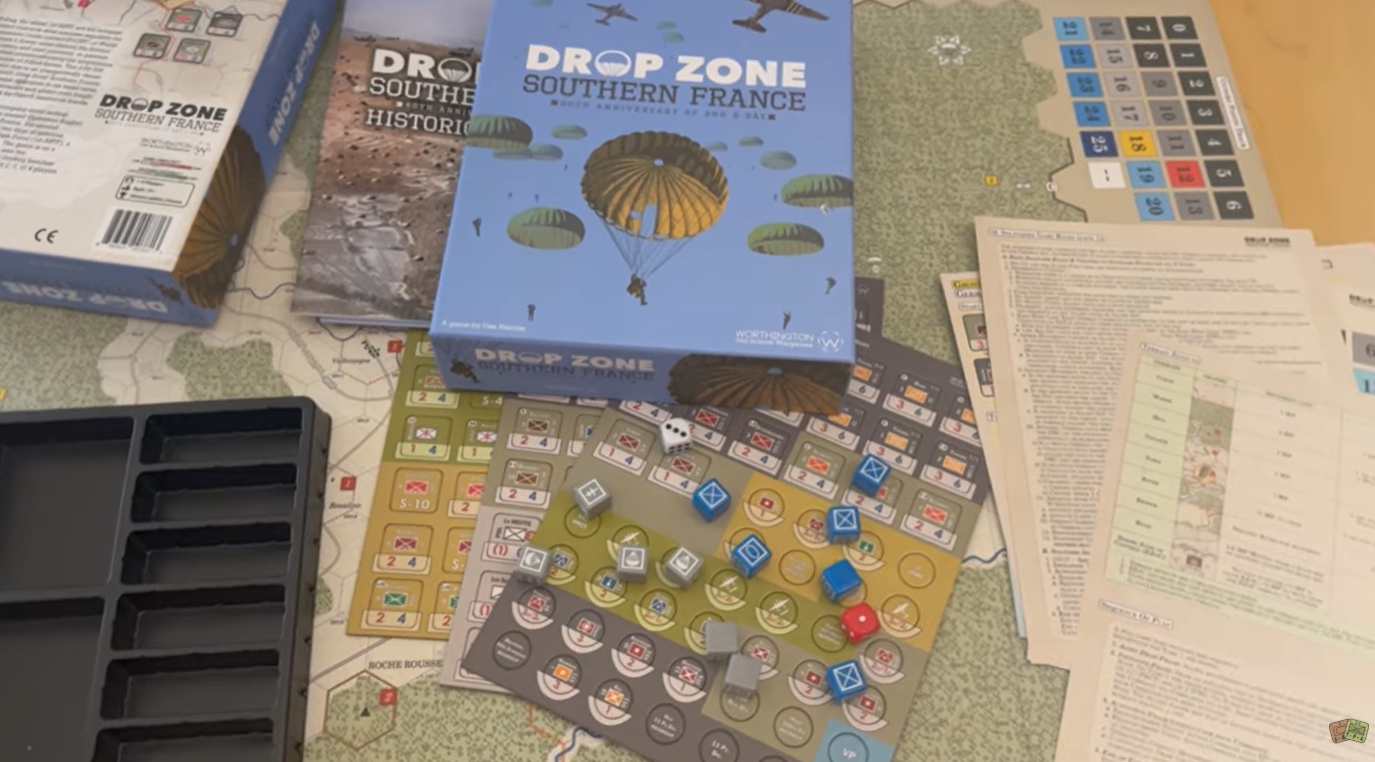
Drop Zone: Southern France is a company-level wargame covering the Allied airborne assault that spearheaded Operation Dragoon, which was the invasion of Southern France or the Second D-Day on August 15, 1944. The history behind this operation is really very interesting as early on the morning of D-Day, the allied First Airborne Task Force (1st ABTF) parachuted a dozen miles behind the Riviera landing beaches to seize key towns and road junctions, to prevent the German occupation forces from counter-attacking the amphibious landing, and to facilitate the advance of Allied forces. The 4:00 AM parachute drop was badly scattered due to an unexpected dense fog bank that blanketed the battlefield. Drop Zone: Southern France covers the first two days of this airborne operation in six game turns, when the American and British paratroopers and glider-men fought surrounded and alone, supported only by French resistance bands. This game is very good and is just a solid wargame.
With this My Favorite Wargame Cards Series, I hope to take a look at a specific card from the various wargames that I have played and share how it is used in the game. I am not a strategist and frankly I am not that good at games but I do understand how things should work and be used in games. With that being said, here is the next entry in this series.
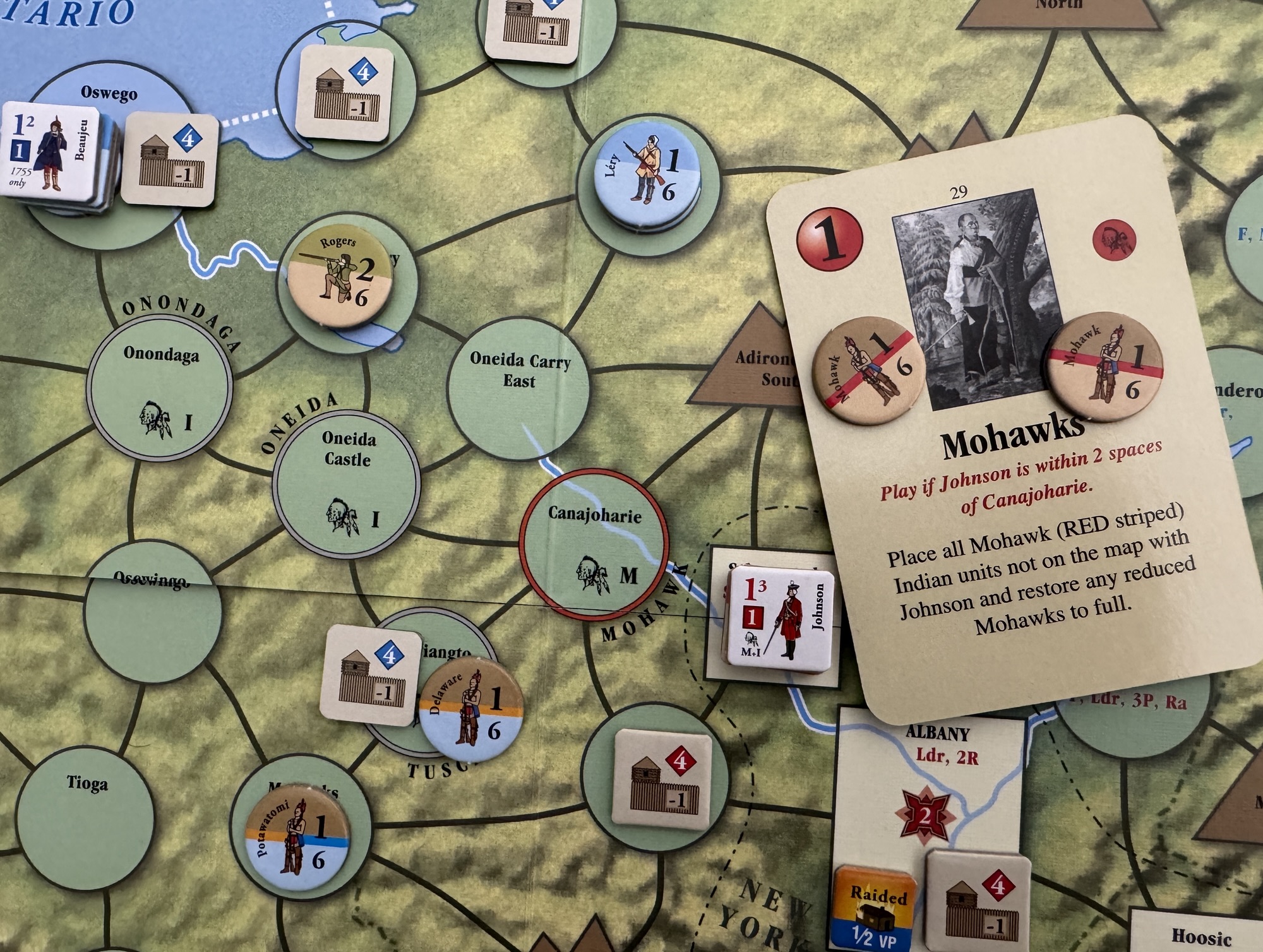
#70: Mohawks from Wilderness War: The French & Indian War, 1755-1760 from GMT Games
One of my fondest memories of our wargaming journey was our initial experience with the full campaign game of Wilderness War from GMT Games. We were 2 very inexperienced wargamers and we slogged through a 9-hour marathon play over a few days that ended in a 0-0 tie of all things. That’s right, the game ended in a tie, even though we both had a card in hand, but I was unable to use mine to activate Levis, which was my only potential Victory Point scoring force, and Alexander’s forces were in too tenuous a position or too wounded to risk an open battle for VP’s. You would think that this would have turned us off to the game but on the contrary it made me fall in love with asymmetric wargames and the Card Driven Game mechanic with its use of Action Points and events to wage war on the North American continent. The end score of our game really followed the tension of the game, and the blunders on the side of the British that counter balanced their various successes.
All in all, this game was excellent to play and we both highly recommend it. The two factions play extremely differently which leads to many intricate and reactive strategic decisions. The British have many powerful forces with their Highlanders and cannon while the French have access to better leaders and mobile troops and Indian allies who can run around the frontier raiding and burning settlements for VP’s. Laying siege and assaulting really feels like it should, and avoiding battle until you are ready is something that is integral to maintaining a strong presence on the board. You cannot always get into every possible fight as you will not survive the attrition of these battles. The deck plays really well, and as you don’t have to worry about the opponents events in your hand going off, the management aspect is much simpler yet very engaging as there are always reaction cards you can play or cards that you want to hold onto for that perfect moment.
In previous posts in this series, we have discussed the importance of the players of both sides gaining the trust and services of the indigenous Indian denizens of North America in the fight. The French and British can both use the Indian recruitment cards, including cards such as Iroquois Alliance, Northern Indian Alliance and Western Indian Alliance, to recruit, restore, and move native allies to gain victory points through raids and controlling of territory. The French hold a significant advantage with more access to a greater number of Indian auxiliaries, and will be using these cards to launch early raids, while the British can recruit specialized units like their Mohawk or Cherokee allies.
In this entry, we will take a look at the British card Mohawks. Mohawks is one of those cards that has a pre-requisite qualifying condition to play the card. In this case, the qualifier is that the leader Johnson must be located on the board within 2 spaces of Canajoharie, which was a Mohawk village located in upstate New York. As long as he is within the required 2 spaces, the card can be played to bring out onto the board the Red striped Mohawk Indian units. These must be placed with Johnson and the other added benefit is that any reduced Mohawks on the board can be flipped to their full side. These pro-British units can only be recruited by the British player and their arrival in New York can be a huge boon to the British as the French and their Indian allies will be raiding the villages and settlements up and down the frontier regularly during the game as one of their most dependable sources of Victory Points. These Mohawk allies can spread out around the area and intercept incoming raids before they can occur. Remember that Indian allies in Wilderness War are not powerful combat units and are best used to raid and prevent other tribes from raiding.
I very much love the thematic connection here as in order to attract the Mohawk Indians as your allies you must have someone that they trust in the area and this is Johnson. Sir William Johnson was a pivotal British superintendent of Indian Affairs whose deep integration into Mohawk society secured the crucial Mohawk Nation alliance for the British during the French and Indian War. By living among them, learning their language, and marrying Mohawk women, he maintained the Iroquois Covenant Chain and led Mohawk warriors in key victories. This is one of the great things about these Card Driven Games and their use of the cards to deliver the bits and bobs of history to enlighten our understanding and to expand our knowledge of the period.
As a young man, Johnson moved to the Province of New York to manage an estate purchased by his uncle, Royal Navy officer Peter Warren, which was located in territory of the Mohawk, one of the Six Nations of the Iroquois League. Johnson learned the Mohawk language and Iroquois customs, and was appointed the British agent to the Iroquois. Johnson commanded Iroquois and colonial militia forces against the French and their allies during the war and was later commissioned a major-general for his role in the British victory at the Battle of Lake George in 1755. His capture of Fort Niagara from the French in 1759 brought him additional renown. Throughout his career as a British official among the Iroquois, Johnson combined personal business with official diplomacy, acquiring tens of thousands of acres of Native land and becoming very wealthy.
Neva Game Press (originally called Neva Wargames) is a new publisher who appeared on the scene in the past few years. When I started seeing their posts on Twitter and Facebook, I was immediately impressed with their interesting topic choices for their upcoming games as well as the fact that they are trying to make small footprint wargames that pack a punch. And the art is also very appealing and brings an aesthetically pleasing and attractive look to their games! Recently, they placed their next few games up for pre-order through their Incoming! Pre-Order System including Peking: 55 Days of Fury andI reached out to the owner of the company and design José to see if he could share some information about the design.
Grant: José welcome back to our blog. What is your new upcoming game Peking: 55 Days of Fury about?
José: Thanks, Grant, it’s a pleasure to be here! I’d like to start by mentioning that we’ve recently rebranded from Neva Wargames to Neva Game Press. This change reflects our evolving catalog, as we’re excited to include more thematic games moving forward.
Today, I’m presenting one of my latest designs: Peking: 55 Days of Fury. It’s a 1-2 player game where one side commands the Chinese forces and the other leads the International Legations (an alliance of 8 nations). The game spans 6 turns—representing roughly 9 days each—where players fight to secure the most victory points by the end of the siege.
A full game typically lasts between 2 and 2 1/2 hours, making it perfect for a single session. Please keep in mind that we are still finalizing the artwork and graphic design, so the images shown here are not final. Also, our second pre-order campaign, featuring both Reformation: Fire and Faith and Peking: 55 Days of Fury launched on March 15th. Don’t miss out on the Early Bird discount!
Grant: What does the subtitle “55 Days of Fury” mean and reference?
José: I imagine many of you have seen the classic film 55 Days at Peking—if not, I highly recommend it! It’s a fantastic movie and a core inspiration for this project. With the subtitle “55 Days of Fury”, I wanted to pay tribute to the original title while carving out its own identity. It reflects the sheer intensity of those 55 days of siege, and I wanted the name to capture that raw energy.
Grant: Why was this a subject you wanted to focus on?
José: I’ve always been fascinated by sieges throughout history, from ancient times to the modern era. Because of this, it’s very likely you’ll see more siege-themed titles from me in the future. I already have several compelling projects in mind, such as the 1453 Siege of Constantinople or the Siege of the Alcázar during the Spanish Civil War. There is so much tactical and human drama in a siege that I’m eager to explore the subject and see how to model the differences in each of the sieges and eras represented.
Grant: What are the unique features with the system used for the game?
José: Sieges are often associated with static gameplay—that’s just the nature of the conflict. However, I wanted to design a system that keeps the action fluid and engaging. To achieve this, the entire besieged area is streamlined into four main zones, allowing for a more dynamic experience.
Each side faces unique strategies and challenges, and that asymmetric touch gives the game immense replayability. At its heart, the cards are the engine of the game. It’s important to note how much depth they offer; your success depends entirely on how you plan and optimize your strategy based on card management. I’ve also implemented a unique twist on Fog of War. Instead of these being ‘dead’ or useless cards, you’ll have to make tough tactical decisions about how to use the Fog of War cards you draw at the end of each turn. They could be a resource, not a penalty.
Grant: What must you model regarding the history in the design?
José: There is a wealth of historical detail in this design. From the unit stats to the card events and specialized mechanics, my goal was to represent the siege as authentically as possible without sacrificing a manageable playtime.
For example, the Boxer units have much lower Firepower than other factions, but they boast the highest Manpower values. This reflects their limited weaponry while highlighting their superior numbers—they have the strength to build and repair barricades quickly. In contrast, the Imperial Chinese Army units have better Firepower but generally lower Manpower.
On the other side, the International units are better armed but severely outnumbered. To represent this attrition, when a Chinese unit is defeated, it returns to the unit pool to potentially reappear later. However, injured International units are sent to the Infirmary instead.
The Infirmary is a critical mechanic; it honors the men and women who worked tirelessly to save lives during the siege. The International player must manage this correctly, or risk losing their limited forces for good. Finally, I’ve included Diplomatic Relationships. Based on historical accounts, the International player will face diplomatic tensions between the allied nations. These tensions carry various penalties, forcing the player to balance military action with the need to restore diplomatic stability to avoid major setbacks.
Grant: What is your design goal with the game?
José: My main objective with this design was to prove that sieges don’t have to be limited to solitaire play. I wanted to turn them into a compelling, dynamic head-to-head experience where two players can truly feel the historical pressure and the weight of their consequences.
I want players to experience the unique hardships each side faced during the siege while navigating a system full of fresh ideas and meaningful choices. By providing so many strategic layers and branching paths, I’ve ensured that the game offers deep replayability every time it hits the table.
Grant: What other games did you use as inspiration?
José: While there are other games on the Boxer Rebellion, Peking: 55 Days of Fury offers a completely different perspective. I’ve taken a fresh approach to this fascinating siege, focusing on dynamics and mechanics that haven’t been explored this way before. That’s exactly what makes it so attractive—it fills a gap in the market by providing a unique experience that feels unlike anything else currently available on the subject.
Grant: What sources did you consult about the history?
José: In terms of research, my design was primarily informed by three key works:
• The Boxer Rebellion by Diana Preston: This was my main reference—an incredibly comprehensive account full of the historical nuances that allowed me to build the game’s framework. • Peking 1900: The Boxer Rebellion by Peter Harrington (Osprey Publishing). • The Boxer Rebellion by Lynn E. Bodin.
While Preston’s book provided the narrative and thematic depth, the works by Harrington and Bodin were essential for the technical details. They helped me accurately determine the troop sizes for each nation and provided the visual references needed to correctly represent the uniforms and equipment of every soldier type.
Grant: What is the scale of the game? Force structure of units?
José: I’d classify this as a tactical-scale game. Each International military unit represents approximately 8 to 10 soldiers, highlighting the small, elite nature of the legation guards. In contrast, the Chinese units represent much larger groups of combatants. This difference in scale on the board really emphasizes the ‘few against many’ tension that defined the historical siege.
Grant: What are the differences between the playable factions of the Eight Nation Alliance and the Qing army and Boxers?
José: The asymmetry between both sides is woven into every aspect of the game. As a general overview, while the International forces possess superior weaponry, they are heavily outnumbered by the Chinese. Their logistics also differ significantly: the International player must struggle to manage dwindling supplies within the besieged legations, whereas the Chinese side operates under a completely different set of pressures. Key thematic elements like Diplomacy, the construction of Siege lines, repairing Barricades, the looming arrival of the Relief Column, and the management of the Infirmary all work together to ensure that playing each side requires a totally different mindset and strategy.
Grant: How did you differentiate them in their mechanics?
José: To give you a better idea of how this asymmetry translates to the table, here are some key differences in how each side operates:
• Unit Quality vs. Quantity: While International units are superior in combat, the Chinese player must compensate for this by effectively using artillery pieces, surveillance markers, and sheer numbers. • The Detachment Display: The International player can have a larger detachment of up to 6 units ready for combat, whereas the Chinese side is limited to a smaller detachment of 3, requiring more frequent rotations or reinforcements. • The Infirmary & Attrition: When International units are injured, they are moved to the Infirmary. If it becomes overcrowded, units will die, awarding Victory Points (VP’s) to the Chinese. Managing this by “installing beds” and healing soldiers is a vital survival sub-game. • The Relief Column Mini-Map: The Chinese player manages a specific mini-map tracking the progress of the two Relief Columns marching toward Peking. Their goal is to stall this advance; the further they keep the rescuers at bay, the more VP’s they secure. • Supply Lines: Logistics are a constant struggle for the besieged International side, whereas the Chinese side enjoys much more reliable access to supplies. • Diplomacy & Defenses: The International player starts with fully built defenses but must navigate precarious diplomatic tensions. Conversely, the Chinese side must actively build and maintain their own barricades throughout the game to score VP’s. • Unique Action Phases: Both sides have access to a distinct set of special actions and historical Fog of War cards, ensuring that no two turns feel the same.
Grant: How does the game use cards?
José: Cards are the primary engine of the game, and I designed them to be highly versatile. You don’t just ‘play’ a card; you have to decide how to use it across different phases:
• Initiative & Events: Cards can be used during the Initiative phase or played for their Main Event. • Boosting Mechanics: You can even activate Secondary Events by ‘boosting’ a card with another from your hand, creating powerful combinations. • Action Points: During the Action phase, cards can be spent for Action Points (AP) to perform essential maneuvers. • Deck-Building Elements: As the game progresses, you can incorporate common cards into your hand to improve your deck—often depending on how you manage your Fog of War cards.
I deliberately split the card-driven mechanics into two distinct phases. I wanted to ensure that even if you draw a ‘difficult’ hand, you still have the Action Point phase to fall back on. This gives you the flexibility to spend those cards as AP, ensuring you always have agency over the situation. It’s all about hand optimization and adapting your strategy to the shifting tides of the siege.
Grant: Can you show us a few examples of these different type of cards?
José: In the cards you will find Faction cards, Common cards and Fog of War cards:
Faction Cards Each side has nine Faction cards.
1) Descriptive image of the event. 2) AP value. 3) Support icon – used to execute a Secondary Event during the Event Phase. A card can have a maximum of two different Support icons. Icons can be of the Lion, Heron, or Dragon type.). 4) Initiative value. 5) Event title. The color of the title indicates which side the card belongs to (blue = International, red = Chinese). 6) Description of the Primary Event. 7) Secondary Event Support icon requirement. 8) Description of the Secondary Event. 9) Card number (for identification purposes only; has no effect on the game).
After a Faction Card is played, it is placed in the playing side’s discard pile. The discard pile is reshuffled to form a new draw deck if the existing deck is exhausted when drawing a new hand at the end of the Turn.
Common Cards
Side colors: red and blue. 2. Reminder to remove the card when its events are used.
Fog of War Cards
Fog of War Icon.
Side color (red or blue).
Reminder to remove the card when its events are used.
Grant: What is the layout of the Board? Who is the artist?
José: The central part of the board is where the heart of the action takes place. It features a detailed map of the International Legations and their surroundings, strategically divided into four key sectors. Surrounding this central battlefield, you’ll find various common and individual tracks, along with dedicated display areas for each player to manage their resources and units.
As for the visuals, we are currently in the middle of the creative process. I’m thrilled to be working with a very talented team: David Prieto is handling the Graphic Design, while Germán Pasti and Moreno Paissan are the illustrators bringing the 1900s to life. Although the artwork is still a work-in-progress, we are striving for an immersive and historically evocative look.
Grant: What is the purpose of the various Outer Zones?
José: The board is designed for maximum clarity, with dedicated zones for each player. On the International side, the player manages their Morale and Supply tracks, along with the Detachment, Diplomacy, and Infirmary displays.
The Chinese side also tracks their Morale and Supplies, but their side of the board features the unique Relief Expedition mini-map. This is where the tension builds as the International forces attempt to advance from Taku to Peking, and the Chinese player must do everything in their power to stall them.
Grant: How is diplomacy and diplomatic relations used in the game? What benefits and detriments does it bring?
José: After the Supply check, the International side performs a Diplomatic Status check. The International side rolls one die for each Diplomacy marker (in the Diplomacy area of the International section) on its Parchment side. On a roll of 1, the marker is flipped to its Tension side to indicate tensions between nations.
When Tension occurs, the International side must apply the revealed effect in any Zone where MU of the nation(s) who’s flag is shown are present. If the first Diplomacy box is affected (with flags of Britain and Russia), only Map Zones with both British and Russian MU present are affected.
Tension effects can be cumulative if multiple effects apply to the same Zone. There are several types of effects such as: Tactical dispute (reduces combat strength), Communication Breakdown (it is not possible to use modifiers), Conflicting Priorities (reduces manpower), Water hoarding (it makes it more difficult to extinguish a fire).
Grant: What is the anatomy of the counters?
José: Here is a look at a few of the counters.
Military Units (MU) Each MU marker represents a group of soldiers.
1) Illustration of the nation’s soldier. 2) Flag of the nation. 3) Combat Strength – Ranging from 1 to 3. During combat, the Combat Strength of all MU on each side are added together. 4) Manpower Factor – Ranging from 0 to 3. Used by the International side to Repair Barricades, and by the Chinese side to Lay or Repair Siege Lines.
Grant: How are units activated and chosen?
José: Units are activated through specific actions, and I’ve designed a system that balances tactical planning with the Fog of War. While units are often drawn randomly from a bag, both sides have a dedicated Detachment Area. This acts as a pool of visible, ‘ready-to-deploy’ units that you can plan around. This means you have the flexibility to deploy known forces from your detachment in addition to the tension of drawing new reinforcements directly from the pool.
Grant: What is the general Sequence of Play?
José: The sequence of play is the following:
Initiative • Both sides reveal one card from their hand, simultaneously. • Tie – the player who had the Initiative in the previous turn wins. • Tie on Turn 1 – the Chinese side wins. • The Initiative cannot be given away. • If Fog of War cards were played, execute the Events (Initiative side first). • Played cards are discarded (or removed if a Fog of War Card of the playing side).
Initial Engagement • The Initiative side places their Engagement marker in any Zone. The non-Initiative side then does the same in another Zone. • The Initiative side resolves the Engagement in their chosen Zone, acting as the attacker. • The non-Initiative side then resolves the Engagement in their chosen Zone, acting as the attacker. • Note: If there are no MU present in the Zone, or only MU from one side, the Engagement does not occur.
Events • The Initiative side plays two cards from their hand for their Events. They may play a third Support card to execute Secondary Events. • The non-Initiative side repeats the process.
Maintenance • Both sides, starting with the Initiative side, perform two types of Maintenance checks. • International: Supply Status check (1 die). Roll of 1 to 4 – Lose two Supply levels. Roll of 5 to 6 – Lose one Supply level. Update the Supply Track. Any Supply Track effects are applied: MU are moved to the Infirmary. Diplomacy Status check (1 die per Diplomacy marker on its Parchment side). A result of 1 flips the Diplomacy marker to its Tension side. The revealed effect applies unless the marker is flipped back to its Parchment side via a Diplomacy Special
Action. • Chinese: • Supply Status check (1 die). Roll of 1 to 2 – Lose two Supply levels. Roll of 3 to 4 – Lose one Supply level. Roll of 5 to 6 – No Supply loss. Update the Supply Track. Any Supply Track effects are applied: Morale level reduction. Relief Expedition roll: 1 die: Number of spaces Relief Expedition marker advances on the Relief Map: (1) = 1, (2-4) = 2, (5-6) = 3.
Action • The Initiative side performs Actions with the APs on the remaining card in their hand. • The non-Initiative side repeats the process. • Two types of Actions: Basic: Common to both sides. Cost 1 AP. Can be repeated once per side per Turn. Special: Different for each side. Cost 2 action points. Cannot be repeated.
Command • 6.1. Scoring & Victory Check: (Turns 3 & 6 only): Chinese side gains or loses VPs based on the position of the Relief Expedition marker on the Relief Map. (Turn 6 only): Both sides gain VPs based on their Intact Barricades (International) and Intact Siege Lines (Chinese). o Check for Automatic Victory (one side has 15+ VP advantage). If Turn 6, determine the winner of the game.
Grant: What actions are available to players?
José: Both players have access to a core set of Basic Actions to manage the conflict:
• Combat: Including Engagements, Raids, and Artillery Fire. • Maneuver: Movement and Surveillance to gain the upper hand. • Logistics: Supplying forces and Repairing vital defenses.
However, the true flavor of the game comes from the Specific Special Actions available to each side, reflecting their unique historical roles:
• The International Player focuses on survival and rescue: Expanding the Infirmary, healing wounded units, advancing the Relief Expedition, managing Diplomacy, and increasing political Commitment or Morale. • The Chinese Player focuses on pressure and persistence: Laying Siege Lines, coordinating Artillery Support, increasing Commitment, and rallying their forces to Raise Morale.
This structure ensures that while the basic rules are easy to learn, the strategy for each side is completely distinct.
Grant: How is supply used in the game?
José: Supply management is a cornerstone of the experience, especially for the International side. During the Maintenance Phase, both players must check their supply status. The consequences of failing to maintain logistics are severe and thematic:
• The International Side: For the besieged, a lack of resources is devastating. Failing to meet supply requirements can force healthy units directly into the Infirmary due to exhaustion or starvation. • The Chinese Side: For the attackers, supply issues represent a loss of momentum and logistical strain, resulting in a direct hit to their Morale.
This ensures that players cannot just focus on combat; they must spend precious actions and cards on the Supply action to keep their war machine running.
Grant: How is victory achieved?
José: To win a game of Peking: 55 Days of Fury you must get more victory points (VP’s) than your opponent. Each side has different ways of doing this:
International Side
For each Chinese MU KIA +1 VP.
For each Chinese Artillery Unit Sabotaged: +1 VP.
For each Intact Barricade at the end of the game: +1 VP.
Chinese Side
For each International MU KIA +1 VP.
For each Destroyed Barricade: +1 VP.
For every two (rounded down) Intact Siege Lines at the end of the game: +1 VP.
If the Relief Expedition marker is held in a +1/+2 VP space on the Relief Map at the end of Turn 3, and again at the end of Turn 6 (it can be scored twice). If the marker is on a –1/-2 VP space, the Chinese sides lose that many VP’s at the end of Turn 3 and Turn 6.
There is a case when the game can end automatically in the following cases:
If any side scores 30 VP’s, they are immediately declared the winner.
If at the end of any Turn a side has a 15 VP advantage or more over their opponent, they are declared the winner.
Grant: What type of experience does the game create for players?
José: The experience is defined by a shifting sense of pressure that is unique to each side. Since it is an asymmetrical game, the tension evolves differently for each player as the siege progresses. In the first half of the game, the International player often feels they have the situation under control, but as the turns pass, the weight of the siege begins to take its toll, and maintaining their position becomes increasingly desperate. Conversely, the Chinese player starts by testing the defenses, and their momentum builds as they tighten the noose around the legations.
This ‘cross-fade’ of emotions—from early confidence to late-game survival for one, and from persistence to a final push for the other—ensures that the tension remains high from the very first turn until the final victory point is counted.
Grant: What are you most pleased about with the design?
José: I am truly proud of the system I’ve built for this game. My goal was to prove that a siege doesn’t have to feel static or repetitive, and I believe we’ve achieved a dynamic flow that will surprise players.
If the community enjoys this system (Siege & Storm Series)—which I’m confident they will—I would love to adapt and implement it for other historical sieges in the future. I am always open to feedback and suggestions! Which historic siege would you like to see next? Let me know in the comments.
Grant: What other games are you working on?
José: Beyond Peking, I have several other exciting projects in the pipeline. I am currently putting the finishing touches on Spartacus: Rome Under Threat, a 1-2 player game focusing on the Third Servile War. I am also mid-way through the development of Cid Campeador: Warlord, a 1-4 player game. It spans the dramatic 15-year period from 1085 to 1099—a time defined by El Cid’s exile, the expansion of the Christian kingdoms, and the rising shadow of the Almoravids.
Looking further ahead, I have plenty of ideas in the works, including a new thematic game centered on the Roman Empire and Volume II of our Blind Valor Series, which will utilize the system from Iwo Jima: Hell on Earth. There’s much more to come from Neva Game Press!
José, thank you so much for your time and effort in responding to our request for this interview and for the great detail that you have given us about this game. I am very much interested in Peking: 55 Days of Fury and cannot wait for it to be available to play!
War Story: Occupied France is a co-operative narrative game for one to six players set in World War II occupied France that captures the stakes and tension of espionage and resistance warfare. Your team of covert operatives is all that stands between the infamous German officer Heidenreich and the systematic destruction of French Resistance forces in Morette.
Through three replayable story missions, you must exploit the specialties of your chosen agents to uncover information, enlist allies, and obtain weaponry. Engage occupying forces on tactical encounter maps where careless positioning could cost your agents’ lives. Remember, no plan survives contact with the enemy…and time is running out.
In early 2024, Worthington Publishing announced a unique 2-pack of games on Kickstarter that were marketed as easy to play travel friendly solitaire games. And you know that I love a good solitaire wargame! And when I heard that these games were small, even portable, then I was even more interested. One of the games covered the Pacific Theater of WWII called Pacific War 1942 Solitaire and the other covers the War of 1812 called (you guessed it) War of 1812 Solitaire. These games are designed by Mike and Grant Wylie and each game has 4 pages of rules, a beautiful mounted board and double sided counters. I played both and really very much enjoyed the experience.
A few years ago, after playing all of the games in the Great Statesmen Series, we heard of a new game in the series from a designer not named Mark Herman and I was immediately interested and intrigued as we have had so much fun with Churchill, Pericles and Versailles 1919. Congress of Vienna from GMT Games is a diplomatic card driven wargame based on Churchill and is the 4th game in the Great Statesmen Series. The game is set during the years of 1813-1814 and sees players take on the role of the main characters of the struggle between the Napoleonic Empire and the coalition of Russia, Austria, and Great Britain with their Prussian, Spanish, Portuguese, and Swedish allies. We played the game recently while attending Buckeye Game Fest and then played a full campaign again while attending the World Boardgaming Championships and absolutely were amazed at the changes and innovations to the system introduced by the designer Frank Esparrago.
Zurmat is a small Pashtun district south of Kabul. In 2007, It was a tense region with a fragile sense of order. The Taliban moved throughout the villages and roads at night, issuing threats to dissuade cooperation with the Afghan government. Zurmat is also a wargame. Some soldiers write about their experience. Tim Densham designs.…
Neva Game Press is really exploring the space of wargame publishing and have games that are being worked on spanning all of history including modern and ancient. They also are looking at non-traditional topics to cover such as the Reformation. Their newest pre-order offering is called Reformation: Fire and Faith and is designed by Clint Warren-Davey. I am keenly interested in this one and have been working with Clint on this interview and maybe a series of other articles on strategies.
Grant: Welcome back to the blog Clint. With 4 published games to your credit what lessons have you learned about the design process and been able to put into practice?
Clint: Thanks for having me back guys! Yes I have learned a lot. Mainly, my iterative loop has become faster. I use mainly digital prototypes on PowerPoint and can get a prototype up and running pretty fast. This means I don’t need to print components and then reprint when things change. I also have a larger “toolbox” of ideas to draw from as I’ve played a wider variety of games. I still have a core design philosophy though – I want games that give players lots of meaningful decisions and a minimum of busywork, plus I generally prefer a high level of player interaction and interdependence.
Grant:How do you pitch games to publishers? What is your approach?
Clint: First I make sure the game is ready. I play-test the game myself a minimum of 20 times. Then I give it to external play-testers (basically my followers on Twitter/X). I keep refining it and make sure all the rules are nailed down. Once I have a fully functional and viable digital prototype, I send an email to a lot of different publishers to see who wants the game. So far, I’ve usually found at least one publisher who will accept each game.
Grant: What is your new game upcoming game Reformation: Fire and Faith about?
Clint: It’s about the wars and religious struggles that tore Europe apart during the Reformation, from 1517 (Martin Luther nailing the 95 Theses to the door of Wittenberg cathedral) to 1555 (the Peace of Augsburg). This is during the “pike and shot” era, which I love. It also includes a lot of political, religious and military conflict that is fascinating on multiple levels. It’s the perfect setting for an asymmetric wargame.
Grant: What image and feeling did you want to convey to players with the subtitle “Fire and Faith”?
Clint: Well this subtitle was decided by my publisher, Jose Neva of Neva Game Press. He wanted to convey both religious and military struggle in the title of the game, hence fire and faith. Before that the game title was undecided – it was either going to be just “Reformation” or “One Hour Reformation” – though upon further development it was clear this game doesn’t really fit with my other “One Hour” games.
Grant: Why was this a game you were inspired to design?
Clint: I am fascinated by the Reformation – both from a religious and a historical perspective. When I converted to Christianity about 10 years ago I had to choose which church to join, which forced me to read more on this time period, and read the arguments put forward by Protestant and Catholic apologists, then and now. I should state here that although I decided upon Catholicism, I hold no ill-feeling towards Protestantism and I understand the impetus behind it.
I was also drawn in by the fascinating geopolitics and tactical level military transformations of the time. The struggles between the French, Habsburgs, English, Ottomans, Venice, Scotland, Hungary, the Papacy and many other much smaller states were kaleidoscopic in their complexity but endlessly entertaining. To take one example of the political maneuvering of the time – the French lost the battle of Pavia to the Habsburgs, partially because 5,000 of their Swiss mercenaries just left and went home to defend their own cantons from rampaging German Landsknechts. Losing Pavia meant that King Francis I was captured. This in turn meant the English sensed weakness and struck in north-eastern France.
Seeking allies against this double threat, the French turned to the one great power that might help them – the Islamic Ottoman Empire! This outraged the Habsburg Emperor Charles V, who had his hands full containing the spread of Protestantism in Germany. The Saxons, Hessians and Brandenburgers following Luther’s lead would be much better used to help defend Vienna from the Turks, but instead both the Pope and the Emperor found themselves facing a full-scale religious revolt at the same time as renewed Ottoman offensives in the Balkans and the Mediterranean. This was all taking place against the backdrop of a military revolution in which pike and shot, and artillery, were replacing feudal levies of armoured knights.
Grant: What other Reformation games did you study for inspiration?
Clint: The complexity of this time period, and the sensitivity of religion as a topic, has meant that few game designers have been willing to tackle it. The exception is Here I Stand, the classic 6-player card-driven game by Ed Beach. This game is a well-renowned and even genre-defining title that managed to cram tons of inter-faction dynamics and historical chrome into the CDG system invented by Mark Herman (who made the first such CDG – We the People). It is absolutely brilliant in so many ways. Baroque, intricate, full of theme. It is almost like a historical equivalent of Twilight Imperium – one of my other favorite games.
The problem? It takes way too long to play for most gamers. Ever since playing Here I Stand many years ago, I had kept the idea of a simplified version at the back of my mind. Then, when I started teaching religious history at a Catholic school, I found myself teaching the Reformation. A classroom game on the topic would sure come in handy. So, in 2024 I made one. The images below give an idea of this, including my very basic graphics made in PowerPoint and Word. In 2025, I revisited the idea and thought it might be worth making into a serious game, still using the basic concepts and inter-faction dynamics borrowed from Here I Stand.
Early prototype version of the board.
Grant: What is your design goal with the game?
Clint: To make a game with 6 asymmetric factions that shows the inter-factional dynamics and key decisions of the period, all with mechanics that are simple enough to be used in a high school classroom AND simple enough for non-wargamers to pick up. Also, a game that players of Here I Stand would enjoy – especially when they are pressed for time. I believe I have succeeded in this goal but time will tell.
Grant: What main mechanics are used in the design?
Clint: The core gameplay loop is very simple. Each faction has a list of actions to choose from. Each turn, each faction will choose two actions. That’s it. But these vary greatly. They include everything from exploring the New World to translating the Bible to raising armies to piracy and everything in between.
All the factions have some actions in common – like Recruit (placing military units) and Campaign (moving and fighting). The two religious factions – the Protestants and the Papacy – are set apart from the others by having most of their actions focus on non-military functions.
Early prototype version of the Papacy Player Board.
The Protestants are trying to convert people to their new faith (or rather, in their terms, restore an older and more purified form of the Christian religion). As such, their overriding focus is placing Followers on the map. As a rough approximation, each Follower piece represents 5-10% of the population converting to Protestantism. What the Protestant faction is aiming for is gaining a majority, or a near-majority, in the countries of Europe. So, their main way of earning Victory Points is by having 5 or more Followers in as many spaces as possible. Now, the Reformation did not initially take hold everywhere. Geographically it was concentrated in Germany above all, then England, then in scattered pockets throughout France. In the game this is basically where the Protestants will be focusing all of their efforts. They start with only 1 Follower on the map in Germany – this represents Martin Luther and the nascent reform movement that started to gather around him in 1517. From this humble beginning, I wanted the Protestants to build up and expand, sometimes rapidly, across the map.
To speed up their placement of Followers, the Protestants can translate the Bible into local languages – German, English and French. This is an idea I took directly from Here I Stand and of course from the actual history of the Reformation. Having the Bible in the vernacular language, and spread by the printing press, was key to the spread of Luther’s ideas. Bible translation is a simple, two-step process in the game. First you need to accumulate “Knowledge” through the Study action and then use the Translate action to place Knowledge markers on the three Bible language spots on the Protestant faction sheet. Initially, this was the only purpose of Knowledge. But then I expanded it to other uses – especially the Debate action, which is a competitive bid against the Papacy that can score a valuable “Issue” token worth a precious VP. These Issue tokens represent the points of dispute in the Reformation, like the role of Scripture, Tradition and authority of the Magisterium. I liked the idea of carefully studying to build up knowledge in preparation for a debate – it’s a case of the game language matching the theme.
Near final look at the board and player boards.
The Papacy works in a similar way to the Protestants – but in reverse. The Pope is trying to remove Protestant Followers, through Preach and Debate actions. Every 3 Protestant Followers is minus 1 Victory Point for the Papacy, so they are incentivized to contain the spread of the Reformation. The Papacy also has ways of building up their own points, through Churches. This general term refers to all the infrastructure of the Catholic religion – not just beautiful cathedrals (like St. Peter’s, which was being built during the Reformation) but also schools, Jesuit universities, seminaries, monasteries, trained clergymen and church councils. I was originally going to have a track or chart on the Papacy faction sheet to measure this but later decided to have it as pieces on the map – the Churches you see in the game.
This was because I wanted the Papacy to have some of physical presence on the map like the other factions. This was loosely inspired by the building tokens in games like Root or the resources placed on the map in Scythe. It has the advantage of opening up the Papacy’s primary victory metric to attacks from the other factions. Just like Protestant Follower pieces, papal Church pieces can be attacked and removed. This represents iconoclasm and persecution of Catholic clergy, as well as periodic waves of destruction like the Sack of Rome in 1527. Unlike Protestant Followers, I had the Papacy’s Churches cost Wealth. This Wealth is gained entirely through the Tithe action – which takes money from any nations that are still Catholic. Early in the game this includes three out of the six factions: Habsburgs, England and France. But England and France might convert to Protestantism, and a greedy Pope constantly demanding their money might hasten this on!
Grant: What are the playable factions? How did you differentiate them?
Clint: There are 6 factions in the game: Protestants, Papacy, Habsburgs, England, France and Ottoman Empire. Each one has a faction sheet, like the one below, which summarizes their victory conditions and available actions.
The Protestants and Papacy are religious-focused factions. They do have military forces, but they are relatively few in number and are not the main priority. The Protestants are trying to build up their knowledge of the Bible and translate it into vernacular languages, preach to the masses and debate the Catholics to spread their ideas. Their main goal is getting their Followers on the map. The Papacy is trying to contain the spread of Protestant Followers and remove them from the map as much as possible, plus place their own Churches. Both Churches and Followers are immobile and do not count as military units. But they can be attacked and persecuted off the map.
The other factions – the Habsburgs, England, France and the Ottomans – function more like the nations in a wargame. Amassing armies and fleets, fighting battles, aiming for control of spaces on the map. There are plenty of differences though. The English, French and Habsburgs have the option of Explore action – sending their Atlantic Fleets to explore the New World, gaining varying amounts of Wealth or a valuable New World colony (at the risk of losing the Fleet). This provides a great way for factions to gamble early on in the game in a high-stakes race for colonies. Two tweaks were made to the Explore action during the design process. First, my co-designer Ed Farren suggested that New World colonies should provide extra income during the Trade action if the owner has a Fleet in the Atlantic.
I loved this idea and implemented it immediately. I later thought that the Habsburgs should have a distinct advantage in exploring the New World, what with Hernan Cortez and Francisco Pizarro active during this time. I gave the Habsburgs a way to boost their Explore action with “Conquistadors” – effectively tripling their chance of finding a colony at the cost of an additional action. This means the Habsburgs will be raking in more money. But there are a lot of ways for the other factions to steal it! The English, French and Ottomans can all use the Piracy action to get that Spanish silver, and the Ottomans can also Raid on land if their Armies make it through to Austria.
The relationship between the military/political factions and the religious factions is also fascinating. I kept the Habsburgs as a staunchly Catholic faction – they can’t change their allegiance and will act as the strong right arm of the Holy See throughout the game. But England and France are a different story. England needed a historically-rooted incentive to convert to Protestantism, and this was solved in two ways. First, if England officially converts, they will earn 1 VP if England itself contains at least 5 Protestant Followers. This also gives 1 VP to the Protestant player, so there would be strong reasons for both players to work together in the conversion for England. I also wanted some of the high drama of Henry VIII and his wives without an entire sub-system and chart like Here I Stand. This became the “Dynasty” action – a simple die roll to gain a VP by producing a viable heir to the throne.
If England is Catholic, they need a 6 for this. But converting to Protestantism offers success on a 5 or a 6, as Henry can start divorcing his infertile wives. England can therefore grab 2 VP quite easily by ushering in the Anglican faith, which is handy because their opportunities for expansion on the continent are quite limited. France can also earn VP by converting to Protestantism and having at least 5 Protestant Followers in France. For both England and France, converting to the new faith costs an action – which Ed quite appropriately labelled “Reform”. This could be a wasted action if Protestantism doesn’t end up spreading in that nation or if the Dynasty action still fails. But it’s a live issue. Among experienced players, I expect that the Papacy player and the Protestant player will spend a lot of their table talk trying to convince England and France to side with them in religious terms.
Grant: What is the layout of the board?
Clint: I made the map as simple as possible. There are 7 land spaces: Spain, France, Germany, England, Austria, Italy and the Ottoman Empire. There are 2 sea spaces: the Atlantic and the Mediterranean. And that’s it! But you will find that this still provides plenty of interesting strategic choices, as there are 6 factions crammed into these 9 spaces. So, like the proverbial “knife fight in a telephone booth,” players are stuck in fierce competition from the very beginning. For example, the Papacy, France and Habsburgs all have some presence in Italy in the game’s set up. Plus, there are pieces from neutral nations there – like Venice and Florence. So inevitably there be some conflict there!
Grant: Why did you feel area movement was the best approach? What strategic decisions are forced upon the players by the layout?
Clint: Honestly, I didn’t want this to be game about operational level maneuver, more about strategic level decisions and inter-faction dynamics. The map is very heavily abstracted. But you can see it this way. Every faction has a “homeland” space. The Habsburgs, being the hegemon of Europe, have two (Spain and Austria). Each faction will usually be aiming to keep its homeland secure while pushing into 1 or 2 other spaces. Taking control of a space is a big deal and will involve good timing, negotiation and applying just enough force. Some spaces – like Germany and Italy – will usually become battleground spaces with multiple factions vying for control.
Grant:What is the counter anatomy? What different units are included?
Clint: Like the map, the counter anatomy is as simple as possible. There is really no information on the counters other than their type. There are Armies and Fleets – which are the only military units in the game. There are also two religious “units” – Churches for the Papacy and Followers for the Protestants. These don’t fight and can’t move, but they are essential for the two religious factions to build up their influence and victory points. There are also counters for many other things – New World Territories, the Royal Heir for England, the Issues that can be won in a Debate, Knowledge, Wealth and a few other things.
Grant: What is the scale of the game?
Clint: There’s no specific ground or time scale as many things have been heavily abstracted. But very roughly you could say that each turn represents about 2-3 years and each army piece represents 5,000-10,000 men.
Grant: What actions do players have each turn?
Clint: Players can choose two actions per turn. As explained above, they are different for each faction. But there are some similarities. I will give a list of the actions for each faction.
Many of these are self-explanatory but I will explain some of my favourite ones. Diplomacy means getting a Minor Nation on your side, or pulling one away from an enemy. These Minor Nations include Venice, Florence, Genoa, Hungary and Scotland and they have their own Armies or Fleets or both.
Piracy means using your Fleets to steal money from the enemy. Explore means trying to find a valuable New World Territory – worth VP and more income during Trade actions if you have a Fleet in the Atlantic.
The Persecute action means placing or removing Protestant Followers. The Reform action – available only to England and France – means officially converting your nation to Protestantism.
Dynasty is unique to England and represents Henry VIII trying to get an Heir (worth a VP). It’s a dice roll, but it’s easier when you’re Protestant to represent Henry being able to divorce and try with a different woman.
Janissaries is unique to the Ottomans and gives them a valuable +2 bonus in battle that turn. Conquistadors is unique to the Habsburgs and gives them a bonus on their Explore rolls – making it more likely that they will grab a New World Territory.
Grant: How does combat work in the design?
Clint: Very simple – add up your Armies/Fleets, add a D3 roll, the highest score wins. If there were a total of 7 or more units in the battle, the winner suffers 1 loss and the loser suffers 2 losses. Otherwise, the loser suffers 1 loss.
Clint: How do players obtain victory?
Clint: Every faction can score Victory Points (VP) in multiple ways. The margins here are very tight – typically the winning faction will score 5 or 6 VP while second and third place will have 4-5. So, a single point really matters. Every faction can score VP for control of spaces – this is hard to pull off as you need more Armies or Fleets in the space than all other factions combined. So, you might retain control of your own homeland, but taking control of another space is hard. Aside from control, each faction has other ways of getting VP:
The Protestants earn 1 VP for translating the Bible into all 3 languages (French, English and German), 1 VP for each space on the map with 5 or more Followers, 1 VP for each Issue you win in a Debate and 1 VP for having more Knowledge than the Papacy. So the Protestants need to focus on their religious actions – studying, translating and preaching.
The Papacy earns 1 VP for each Church they have on the map MINUS 1 for every 3 Protestant Followers on the map. They also earn 1 VP for having more Knowledge than the Protestants, 1 VP for each Issue they win in a Debate and 1 VP for having more Wealth than any other faction. So, the Pope also needs to focus more on his religious goals – but can also use the Tithe action to build up Wealth (for building Churches) and maybe get a point for rolling in cash.
The Habsburgs earn VP for each New World Territory they discover – and they are better at it than other factions because of their Conquistadors. They also earn VP for having 2 or more Churches in their homelands (Spain and Austria) and can earn VP for having the most Wealth.
The English earn VP for New World Territories and for having the most Wealth. They can also earn 1 VP for producing an Heir with their Dynasty action. The Dynasty action represents Henry VIII’s efforts to produce a legitimate male heir for his throne, and is easier if England becomes Protestant. England earns 1 VP if it converts to Protestantism and has 5 or more Protestant Followers in England. If it stays Catholic, it earns 1 VP for having 2 Churches in England.
France is basically like England but doesn’t have the Dynasty action. They will focus on military action, exploration and building up Wealth. If they stay Catholic they will want the Pope to build up Churches in France, if they go Protestant they earn VP for having 5+ Protestant Followers in France.
The Ottomans are the most straightforward – they can earn 1 VP for having the most Wealth but mostly they just get VP for control of spaces – they earn 2 per space instead of 1. They are an expansionist juggernaut and don’t care about the religious squabbles in Europe.
Grant: What type of an experience does the game create?
Clint: I think it gives you an understanding of the key inter-factional dynamics of the Reformation era using mechanics that are simple to understand and easy to enact.
Grant: What are you most pleased about with the design?
Clint: The asymmetry, the simplicity and the interaction between the players. I’m also really happy with the “bot” rules which allow you to play at anything from 1 to 6 players, with non-player-controlled factions run by a simple dice-based action sheet.
Grant:What has been the response of playtesters?
Clint: Very positive. Every play-tester has said the game is really fun and easy to learn, their only suggestions have been refinements to improve the balance between the 6 factions. For example, one play-tester noticed that the Debate action was under-powered and that the Protestants and Papacy were scoring fewer VP than the other factions on average. Changing the Debate action to winning “Issue” markers (worth 1 VP each) solved both problems. This is why play-testers are so valuable!
Grant: What other designs are you working on?
Clint: A lot! I will share a few of them with you.
First, there is One Hour Napoleon and One Hour WW1, sequels to my game One Hour WW2. Napoleon should be out this year, WW1 next year.
Then there is Messiah – my “Jesus COIN game” which is set in 1st century Roman-occupied Israel and lets you play as the Christians, Zealots, Pharisees or Romans. Similarly, there is “Testament” – my card drafting game on the entire Old Testament, inspired by 7 Wonders. These are still in development but they have a publisher and will certainly be made.
Anyone interested in my designs should follow me on X at @Clint_Davey1 to keep up to date with all the new releases. Thanks for having me on again!
If you have followed us for a while now, you know how we feel about Here I Stand: Wars of the Reformation from GMT Games. And, you know that we enjoy multi-player wargames. So, this one really seems to b simple and take in the concepts of negotiation and the asymmetry of each of the factions. I think that this game will be a good quick playing substitute for the longer and more involved Here I Stand experience. I cannot wait to get this one hopefully this year.
Day 4 dawned early and we are really tired. I actually felt like I had slept, although I didn’t fall asleep last night until about 1:30am, but just didn’t feel refreshed and had very little energy. I am a Wargamer and I simply sucked it up and got downstairs where we had breakfast with friends including Russ, Cullen and Hermann Luttmann. We imbibed in the buffet eating more pieces of bacon than someone should in a fortnight and made it to the War Room a bit before 9:00 where we started setting up for our annual 6-player game of Here I Stand from GMT Games.
Playing with us was Russ (France), Cullen (Ottomans), Bill Simoni (Papacy), James (England) with me (Protestants) and Alexander (Hapsburgs).
Not sure what Russ was doing with his hand and Alexander never smiles!
We simply love Here I Stand and have played the game at least 15 times and it just gets better every single time. If you don’t know, Here I Stand: Wars of the Reformation, 1517–1555 is a grand-scale Card Driven Game that simulates the political and religious struggles in Europe during the period covering 1517-1555 referred to as the Reformation. It is designed primarily for six players, each controlling a major power with unique, asymmetric goals and mechanics and is best with max players.
The game takes place over up to 9 turns, but for us a majority of our plays have lasted 4-5 turns with our longest play being today as we finished the game in 6 turns. Each of the turns represent approximately 4 years of historical time. The game utilizes a Card-DrivenGamesystem where players spend cards for their Command Points to perform actions like moving armies or building fleets or for the unique historical event described on the text of the card.
The game is very asymmetrical in its gameplay as each of the factions plays a different game based on its historical role and will win via amassed VP’s that are earned in vastly different ways such through piracy (Ottomans), building of chateaus (France), New World Exploration (England, Hapsburgs, France) and through battles. The Papacy and Protestants will wage a religious war over the souls of European Christians to either sway spaces to Catholicism or Protestantism. But one of my favorite parts is the Diplomacy and making of secret deals between the players to help out their goals.
With that being said our game started off with the nailing of the 95 Theses to the door of the church at Wittenberg and as the Protestants I have never seen a worse opening as I was only able to switch 3 spaces in Wittenberg, Brandenburg and Leipzig. Not a good start at all for the Protestants but I was undaunted, although I said many curses under my breath and to the gamers at the table, and quickly got my self under control and was determined to recover.
A look at one of the poorest starts of all time for the Protestants.
I worked hard over the next few turns to spread the faith and was quickly able to get most of Germany under control and take over 4 of the Electorates which gave me units that would help me continue to spread toward France and England.
It was amazing to see Bill Simoni and the Papacy and I go at it as we held many theological debates, ultimately each of us disgracing a debater and gaining VP, and for me to have the full Bible translated into German during Turn 2 quickly followed by the translation into English by Turn 3. I had made a deal with England for him to play a card that favored me in exchange for a concerted effort to get the Protestant faith rooted in England so he could gain some VP.
Meanwhile the Ottomans got out the Barbary Pirates card early and had built a sizable fleet of corsairs causing France and England to loan the Hapsburgs several boats to combat this green menace in the Mediterranean.
Also several colonies were formed in the New World and ultimately Alexander’s Hapsburgs were able to circumnavigate the globe and score several important VP.
During this time, the Protestants and Papacy were fighting tooth and nail but my dice rolling, and innate ability to win ties, allowed me to build a sizable lead in the religious war. I was in very good shape when the Schmalkaldic League card was played turning the Protestants into a military power and then changing the other players focus to then declare war one and begging to attack my fortified Electorates to take away VP I had earned by having both religious and political control in 5 of the 6.
As we came into turn 5, I was at 24 VP and ultimately came up shy of a victory by 1 point at the time. I had been able to take over the entirety of England and change every space and also get about 5-6 spaces in France. but now the Papal Bull came to play and Bill fought me back and forth with him taking over 3-4 spaces followed by me reclaiming 3-4 spaces. It was beautiful game of back and forth and I used every tool at my disposal to fight him including The Wartburg card to stop the untimely excommunication of Luther before he could attempt to embarrass one of my lesser debaters.
Then England gained ground as a healthy Edward was born and he gained 5 VP and then took over a key from France to get close to my score going into Tuen 6.
At that point it was dog pile the winner as everyone declared war on the Protestants and came after my Electorates but I was able to stave them off and ultimately never lost down to lower than 4 controlled which retained 8 VP for me and allowed me to finish the Bible translation in French and take a sizable lead in VP.
The game came down to the last card play as England and my Protestants tied at 25 VP and I won on tiebreakers as I had the most VP in the turn prior. What a fantastic game that took us over 9 hours to play!
We were all wasted and went to dinner at a nearby bar called The Flat Iron Grill and had a very enjoyable meal. We decided to not play the WWII RPG War Stories and might till tomorrow night as we were all a bit brain dead.
We played about 5 scenarios of the beautiful and very fun trick taking game called The Lord of the Rings Trick Taking Game: The Two Towers from Office Dog. This is a standalone continuation to The Lord of the Rings: The Fellowship of the Ring Trick-Taking Game, with several play modes including solo, 2-player, and 4-player and we did the 4-player version. It is a cooperative card game that follows the narrative of J.R.R. Tolkien’s second book through 18 unique, story-driven chapters.
The game functions as a “must-follow” trick-taker, where players must play a card of the led suit if they have one; otherwise, the highest card of the led suit wins the trick. Unlike many traditional trick-taking games, players work together to meet individual character goals simultaneously to progress through the story. And they s game is very tough with the new edition adding in several very tough challenges as the addition or orc cards that have no function but if lead because you have no other choice lead to a loss. Just great and thinky fun that is very relaxing and frankly very fun to play.
Examples of 2 characters which each have a unique goal that must be completed during the scenario.
This was a perfect way to end the day and we actually made it back to our room at 9:30pm allowing me time to write this post and get in near before midnight.
Tomorrow is our last day and we have big plans as we will be playing Imperial Elegy from VUCA Simulations (a kind of Here I Stand style CDG on the rise and fall of European empires from the 1850’s through WWII), Bretwalda from PHALANX (an Ameritrash combat game set in medieval England) and then a night cap of the RPG War Stories that we didn’t get to this evening. See you tomorrow night!
While I have not played a bunch of games focused on the Punic War, the few that I have played are very good and I am always interested in a good Ancients combat game. Last fall, GMT Games announced a new 2nd Punic War game called Punicus: The Second Punic War designed by a newcomer in Carlos Oliveras. I have been very eager to learn more about this game and reached out to Carlos recently for an interview and he graciously accepted.
*Keep in mind that the design is still undergoing playtesting and development and that any details or component pictures shared in this interview may change prior to final publication as they enter the art department.
Grant: Carlos welcome to our blog. First off please tell us a little about yourself. What are your hobbies? What’s your day job?
Carlos: Thank you for supporting the hobby in these times. As for me, I’m a guy—well, more like a man with presbyopia now—who’s starting to struggle to read the counters without glasses. I’m into the same things most people of my generation grew up with: films, books, and music, plus a hobby that wasn’t nearly as widespread in Spain in the ’80s and ’90s: games—Eurogames, role-playing, video games, and above all, wargames. And to pay for all that, I work as a naval architect.
Grant: What has motivated you to break into game design? What have you enjoyed most about the experience thus far?
Carlos: I’ve been involved in wargames for quite a while. For instance, I was the rules editor for Mark Simonitch’s Stalingrad ’42, I put together the player aids for Craig Besinque’s Conquest & Consequence, and I translated Successors into Spanish—so I suppose the next natural step was this: designing my own game.
There are a lot of fun parts to creating a game, but there’s one aspect that may not be strictly “design” and yet is genuinely enriching: working with so many people from so many different places. You realize that despite differences in countries, cultures, and ways of being, people—if they want to—can understand each other, and we’re not as different as we sometimes think. If there were more wargames, there’d be less war. Coming away with that conviction leaves you with something genuinely positive.
Grant: What is your upcoming game Punicus about?
Carlos: I haven’t exactly found some untouched topic that no one has ever made a wargame about — honestly, I wasn’t that original. It’s another Second Punic War game: Hannibal, Scipio, and the whole cast. It’s a block wargame with cards of medium complexity, designed to be playable in an afternoon.
Grant: What games gave you used in inspiration for your design? Why?
Carlos: Punicus is built on Craig Besinque’s HellenesSystem, one of my all-time favorite games—one of Craig’s real gems. I’ve played it so much that I always wanted to see it applied to other settings: the Second Punic War, the Gallic Wars…I kept hoping Craig would eventually design something along those lines. In the end, I got over my hesitation and decided to do it myself.
Grant: What is the scale of the game? Force structure of units?
Carlos: Because this war is so long, if I want the game to be playable in an afternoon it has to take a very strategic, high-level view. Each turn represents one year. As for the units, given how diverse (and sometimes contradictory) the sources are, I’ve adapted the order of battle to what produced the best balance during playtesting. For example, even though it seems Hannibal began the war with more elephants than his brother, in the game they both start with the same number of elephants.
Grant: How are the units represented? What is the layout of the blocks?
Carlos: The units are essentially wooden blocks with stickers. In short, the sticker shows the unit type (infantry, auxilia, cavalry, etc.); its Combat Value (the number of dice it rolls in combat); its Combat Rating, which determines when it attacks (in alphabetical order) and what it hits on or uses to cause routs; its Movement Rating; and, very importantly, its Home Box, which tells you where that unit can be recruited.
Grant: What advantage do blocks offer the design?
Carlos: Basically, it’s the fog of war. And not just because you don’t know what unit is in a given block—you also don’t know its exact strength state, since a single block can have up to four step levels. On top of that, there’s the physical feel of handling something solid like wood, which—without taking anything away from cardboard counters—is simply satisfying. I know that’s not strictly a design point, but it matters. If I have the choice, I’ll always prefer playing Punicus on the table rather than on Vassal.
Grant: Why was this a subject you wanted to create a game on?
Carlos: I love history, and I have to admit that when I was a kid, Hannibal’s campaign really blew my mind—elephants, crossing the Alps…to me it was like a movie, with the extra thrill that it had actually happened. Years later I was lucky enough to play Mark Simonitch’s Hannibal, and it made me feel like a kid again. So when I found myself with the chance to create a Second Punic War game using the Hellenes engine, I didn’t hesitate. And yes—designing it has been just as fun as discovering who the Carthaginians were back then, and as fun as playing Hannibal years later.
Grant: What are the unique features with the system used for the game?
Carlos: If we compare it to Hellenes, what sets Punicus apart is basically three things. First, the addition of non-combat units such as Generals and Catapults. Generals, for example, improve the units they are stacked with, and if that general also happens to be an active leader for their side, they can apply their special ability. For instance, Marcellus’s special ability improves the assault capabilities of the units with him. Second, new actions like production, piracy, and diplomacy—yes, you can take cities by sending ambassadors and persuading their citizens they’ll be better off with you. And third, the addition of a personal player board where each side can invest Supplies into researching projects, letting you shape your long-term strategy.
Grant: What unique elements of the Punic Wars did you want highlight in the game?
Carlos: I’d like the game to capture two things. First, the asymmetry between the sides. Carthage starts with tremendous striking power, but its enemy is far away. Rome is a sleeping giant: it loses battles, but it keeps standing—unyielding, impossible to discourage. You know it will wake up; how long it takes, and what form that awakening takes, will shape the rest of the war. Second, I wanted to reflect how the war evolves. Early on, players have fewer options, but as the campaign advances new possibilities open up to explore—investing in projects, diplomacy, piracy, and so on. The idea is that turns shouldn’t feel repetitive as the game goes on.
Grant: What various unit types are included in the game? What is unique about these units?
Carlos: There are three classes of units: Civians, Barbarians, and non-combat units. Civians represent the era’s city-based forces: Infantry, Auxilia, Cavalry, Elephants, and Fleets. Each unit type has something that makes it distinct. For example, Cavalry can perform a special attack called Harrying. Elephants are a powerful arm, but with the drawback that they can panic your own troops. Barbarians are slow but hard-hitting units, with the key trait that they dissolve in Winter—unless they are with Hannibal. Finally, there are the non-combat units: Generals and Catapults. They cannot operate on their own, but they can significantly influence battles.
Grant: How are cards used in the design? What are Action Points?
Carlos: The game is played in Years. At the start of each Year, each player is dealt six cards. In each of the seasons that make up the Year, players choose one of their cards face down and reveal them simultaneously. The card’s orientation determines whether the player will resolve its event or use its Action Points—one or the other. Each Action Point allows you to take one action, chosen from: Movement Actions (from standard Maneuvers to Piracy actions), Building Actions (recruiting and reinforcing), Production and Diplomacy.
Grant: Can you share a few examples of the cards?
Carlos: Yes, of course. Here is the “Hannibal Leads Carthage” Card and its key features. This card starts on the Carthaginian player board. It is a Leader card: while it remains on the player board, it grants its player its Leader Value (additional Action Points) and also gives Hannibal’s block a Virtus, or special ability—in this case, it means that any Barbarians with him do not dissolve in Winter. You can also see a value labeled Damage. When a unit crosses a mountain border, or a Fleet runs into a storm, you draw a card to see whether it takes damage.
Grant: How are cards used for research?
Carlos: At the start of the Year, players still play their cards either as events or for Action Points, but in this segment those Action Points are not used to take actions. Instead, they are used either to make an offering to a god (which will allow future appeals to that god to do things like reroll dice) or to invest Supplies in projects. This is the only time projects can be researched. That means that if, in the previous Year, a player didn’t produce Supplies—or spent them on maintaining troops during Winter—they may have no opportunity to research at all.
Grant: What different research options are available and what are their benefits?
Carlos: There are basically three branches: one that boosts production, one that increases naval power, and one that benefits land forces. It’s also worth noting that the projects for each side are not 100% symmetrical, which further differentiates how Rome and Carthage play.
Grant: How does activation work?
Carlos: Units don’t activate on their own; players have to spend their cards’ Action Points to move them. In other words, if a player plays a card as an Event, they won’t be able to move their units that season—the only combat they might still carry out is siege attrition from sieges established in earlier turns. Likewise, if a player plays a card for Action Points but it only provides 1 AP and they spend it on something other than movement—for example, using that AP to produce—then their troops won’t move that season. So each turn you have to think carefully about what you do, because your Action Points are limited: if you do one thing, you can’t do another. It’s that Twilight Struggle feeling of always being short on points—more or less.
Grant: What is the layout of the player boards?
Carlos: The player boards are dual-layer boards, so units and Supply cubes can sit neatly recessed in place. Each player board has a Praetorium, an area that holds units the player cannot recruit at the start of the game; these units will enter play later through Diplomacy Actions or Events. There is also the Proiecta section, where players invest and accumulate Supply cubes while researching projects. At the top, there are slots to hold groups of blocks in case the stack becomes too large to keep on the main map. At the bottom of the player board are the Rostra, where each side places the cards of its active leaders.
Grant: What key choices are forced upon the players?
Carlos: Each season, the player has to ask themselves which card to use and how to use it: for Action Points or for the Event. On top of that, the decision must factor in that the number of Action Points has a direct impact on initiative—who will act first that season. In principle, you don’t know in advance whether you will go before your opponent or not, so even what you intended to do with your Action Points when you committed the card may have to change, because your opponent has altered the board situation. That card-use choice is a recurring one every turn, but there are more decisions. For example, when you are besieging a city and the battle phase arrives, you have to decide what to do: attrition or assault. And for the defending side, when you are assaulted you have the option to capitulate—you lose the city, but in a less dishonorable way than if you were to lose the assault. Also, in battles a side can always choose to withdraw at the start of its round to execute an ordered retreat and limit losses.
Grant: How does combat work?
Carlos: It’s fairly straightforward. In a battle, blocks are revealed and sorted alphabetically by their Combat Rating. Blocks attack in letter order (A/B/C/D…), with defenders acting before attackers when the letter is the same. A block attacks with a number of dice equal to its printed Combat Value, and it scores hits and routs according to its Combat Rating. For example, an A2 block would attack first because it’s an “A” unit, scoring hits on 1–2 and causing routs on 5–6. Each hit reduces the strongest opposing block, and each rout forces the weakest opposing block to leave the battle. When all blocks in the combat have attacked, the Combat Round ends. Combat Rounds repeat until one side is eliminated or retreats. Combat also changes depending on the battle type. For example, in an Assault, the forces inside the city are treated as A2 blocks and they also receive a defensive bonus.
Grant: How is victory achieved?
Carlos: There are different types of victory. A Decisive Victory requires reaching 15 points and controlling an enemy Core City. A Negotiated Victory can be achieved with only 12 points. If neither of those victory conditions is met and the game reaches the end of its campaign years (which, in principle, players also won’t know in advance), a final comparison determines who wins—or whether the game ends in a draw.
Grant: What do you feel the game models well?
Carlos: What I think the game models well is the overall course of the war. It’s not that it perfectly models individual battles or grand strategic movements, because the game is somewhat sandbox in that respect. It’s more about the feeling that, with the sides being so different, both players are under constant pressure to perform at their best—because one mistake can swing the whole game. It feels like a war, not just a series of skirmishes. For example, Carthage starts with an impressive striking force, but its native recruitment base is far away and the war is long, so there’s constant pressure: victory can’t rely on a single great general forever. Rome, on the other hand, knows its potential is enormous, but it has to survive long enough to actually bring that potential online before its opponent brings it down.
I have come to Italy not to make war on the Italians, but to aid the Italians against Rome. – Hannibal Barca
Grant: What has been the experience of your playtesters?
Carlos: I think they’re having a good time. The fact that they want to play it again means the game has them hooked. And beyond that, their help has been invaluable—adding rules that turned out to be fundamental, or even almost creating cards like Mutiny. We’ll most likely put out a call for a new round of playtesters in an upcoming GMT newsletter, so if anyone’s interested, keep an eye out.
Grant: What are you most pleased about with the design?
Carlos: What I’m enjoying most is that the playtesters (including the developer, Joe Dewhurst) have had very few questions about the rulebook wording. It also helps that I started from a very polished manual like Hellenes.
Grant: What other designs are you contemplating or already working on?
Carlos: Right now, almost all my time goes into Punicus, but I have rough outlines for a block game about the Spanish Civil War (something like Spain Front, maybe) and a solo game about a certain Julius Caesar.
I love a good block wargame! And, in my opinion, this game looks extremely interesting and I am very much excited to learn more about it. I also very much like the idea of investing in technology and projects. Just such as neat addition to any wargame as you have to balance investing in replacements for your lost troops or new abilities and strength.
With the Hammer is an asymmetric wargame covering the German Peasants War in Thuringia in 1525 along with the exploits of one of its most famous protagonists – Thomas Müntzer. With the Hammer comes with wooden pieces, counters, 2 rulebooks, and historical commentary by Professor Andrew Drummond, and a 22×17 inch map.
Each player is a peasant or a noble; the peasants win as a team, or the nobles win as a team. There is no true solitaire system, but like most wargames, it can be soloed two-handed.
Operation Barclay is a 2-player game of low/medium complexity about the intelligence war between the Allies and their Abwehr counterparts in the Mediterranean Theater of WWII in 1942-1943. Operation Barclay puts players in the shoes of competing military intelligence directors who are attempting to mask or learn the truth about the Allied invasion plans for 1943. The Abwehr must attempt to learn where the Allies intend to land next. The London Controlling Section (LCS), the core intelligence agency responsible for Allied intelligence, must prevent the Abwehr from discovering the truth.
The LCS player uses a variable set-up, placing tiles face down to establish where in the Mediterranean a primary and a secondary offensive will occur. Over the course of the six game months, the Abwehr player attempts to win sufficient evidence tokens to be able to turn enough of these tiles face-up to reveal where the Allied offensives will come.
To win evidence tokens, players build hands of five cards to take tricks, similar to poker. While having the best hand will secure two evidence tokens, correctly betting after each player reveals the first three cards of each hand on who will have the best five-card hand is worth three evidence tokens.
Further, players have ways to manipulate the decks from which they draw. They may create a double-cross deck, allowing them to leave cards useful to them face down in a deck to draw from when they choose later — unless the other player takes those cards instead…but perhaps the player who planted those cards was bluffing and hoping the other player would waste their draw on a useless card. Alternatively, players may draw from their own dedicated deck to augment their hands with unique abilities inspired by historical figures, events, and capabilities. The LCS has access to Ultra — decrypts of German codes — but this alone will not be enough if it’s not used carefully.
Fighting Formations is intended to be an ongoing series of wargames covering WWII tactical combined-arms combat at the platoon and squad levels. Each game in the series will feature a distinct combat unit, highlighting battles in which that unit participated as well as its particular order of battle and fighting characteristics. In this second volume of Fighting Formations, we feature the US 29th Infantry Division—“Blue and Gray”—as it fought from just after D-Day in June of 1944 to the end of the year.
With this My Favorite Wargame Cards Series, I hope to take a look at a specific card from the various wargames that I have played and share how it is used in the game. I am not a strategist and frankly I am not that good at games but I do understand how things should work and be used in games. With that being said, here is the next entry in this series.
Card #68: Usurper Emperor from Barbarians at the Gates, The Decline and Fall of the Western Roman Empire 337 – 476 from Compass Games
Barbarians at the Gates, The Decline and Fall of the Western Roman Empire 337 – 476 from Compass Games is a Card Driven Game for two players set during the final hundred plus years of the Western Roman Empire as the Barbarian tribes in the north came down with a vengeance as they clashed with civilization and carved out their place amongst it. The time period covered in the game is from the death of Constantine the Great (337 AD) to the deposition of the last Western Roman Emperor by Odoacer in 476 AD. The Roman player will command the Roman Legions loyal to the failing central authority and those Germanic peoples who have settled peacefully inside the Roman Empire, while the Barbarian player leads Usurper Emperors, and controls the migrations of the Germanic peoples, who are the Barbarians at the Gates. This game is really quite good and feels very much like a wargame even though it is a Card Driven Game. There are lots of opportunities for troop movement, combat and maneuver. And I really liked that. The game is a Card Driven Game and the use of cards is all important and very well done. Each player has their own unique deck of cards that are used and these cards are sometimes removed from those decks when played for an event and also new cards will be added to the deck after each turn. The cards played during a player’s impulse which are not used for the Event are then used for their Operation Points value. These Operation Points can be used for many purposes including Activating a leader, Forced Marches, Raiding, Reinforcement, Migration and Successful Usurpation.
The real trick to the cards is to plan out how you are going to use them to your advantage but also how best to use them. Activating Leaders is very important as you can then move them to attack, defend, change control of areas and other actions. Activating a leader depends on their strategy rating (the lower the strategy rating, the better). When a leader activates from a card, they receive a number of Action Points which can be used for movement (1 over highway, 2 over rough or river connections, 3 over strait or for naval movement), continuation after battle (a kind of advance after combat), changing control over unfortified spaces and sieges of fortified spaces. But the cards also are very mean spirited. What do I mean by this? Well, in our first play, I was carefully using my cards to build up my armies to fend off the initial attacks of the Barbarian hordes. I also had begun to build somewhat of a super stack as well to attempt to foray into England and take on the Barbarians there. As I did this building up, I was unaware of the nasty nature of some of the cards. Some of the cards, both for the Barbarians and Romans, allow a play that will turn a single leader and their entire stack into either a Usurper or a Pacified Barbarian Settlement. Both are equally nasty and you have to keep in mind that you can have your best armies simply taken from you and turned to your enemy.
Some of the cards, both for the Barbarians and Romans, allow a play that will turn a single leader and their entire stack into either a Usurper or a Pacified Barbarian Settlement. Both are equally nasty and you have to keep in mind that you can have your best armies simply taken from you and turned to your enemy. Because of this, the Roman player has to decide whether they will group Combat Units under a single leader in order to face the mighty Barbarian challengers at the Gates in which case he risks that leader to Usurp, or to disperse these troops over several stacks never allowing a single leader to amass too many CU but on the other hand also never having a true striking force to attack with. There is an exception here though as an Emperor leader cannot Usurp and you don’t have to worry about that but this is also dangerous as you can lose that Emperor.
Likewise, once they have an Usurper leader on the board the Barbarian player will try to group all Usurper CU with this leader (in order to keep this force strong and in order to allow their Barbarian CU, leader and tribes to march unopposed into the Empire). This creates a very real and historical danger as the Barbarian player is incentivized to do what an Usurper would historically have done and empty the border garrisons in order to march on Rome.
These type of cards are extremely strong and a situation can occur in which most of the Romans still on the board are Usurper leaders and CU. But there is an action that allows for the Roman player to counter these cards and that is the Successful Usurpation action. If the Barbarian player over does it with the Usurper powers, the Roman player can simply steal these conquests by swapping the Roman power for the Usurper power. This in effect has the Usurpation process succeed and the former Usurper leader now becomes the true Emperor!
Usurper emperors in history, particularly in Ancient Rome, were rulers who seized their power illegitimately, often times via a military rebellion rather than legal succession, and were labeled “tyrants” if defeated, or emperors if successful. They were most common during crises and times of turmoil, such as the “Year of the Four Emperors” in 69 AD following the suicide of Nero, often relying on legionary support and issuing their own coins to legitimize authority.
Emperor Galba by Paulus Moreelse (left); with Emperor Marcus Salvius Otho by Gerrit van Honthorst (center left); with Emperor Vitellius by Hendrick Goltzius (center-right); and Emperor Vespasian (far right).
Usurpation was common during the whole imperial era; virtually all imperial dynasties rose to power through usurpation and conspiracies. The “imperial office” established by Augustus never defined an stable system of succession, and emperors often had to rely solely on military power to survive.
In the Eastern Roman Empire (395–1453), rebellion and usurpation were so notoriously frequent as compared to medieval West, where usurpation was rare, that the modern term “byzantine” became a byword for political intrigue and conspiracy.
Here is a look at our unboxing video:
We also did a video review and you can watch that at the following link:
Over the past couple years, we have played a few venerated and respected series games from Multi-Man Publishing for the first time that frankly I had initially turned my nose up at for various reasons. These reasons were not really anything important or truly about the design or mechanics but included things like price, graphic design, style and somewhat because of the complexity and reputation of complexity of those systems. These series included first the Standard Combat Series (SCS) with our first game being Rostov ’41 and now the Battalion Combat Series (BCS) with our first game being Arracourt and since we have played several other volumes including Brazen Chariots and Baptism by Fire. I must admit here that I am actually embarrassed that I hadn’t played those series and readily admit that I just discounted and dismissed them out of hand. I am so very glad that we repented of our stubbornness and found this system because it really is very, very good at what it is trying to teach and demonstrate about warfare at this scale.
So what is the Battalion Combat Series? The Battalion Combat Series is a system designed to model combat at the grand tactical scale from late World War I to the present day. The system has seven published games including Last Blitzkrieg: Wacht am Rhein The Battle of the Bulge (2016), Baptism By Fire: The Battle of Kasserine (2017), Brazen Chariots: Battles for Tobruk, 1941 (2019), Panzers Last Stand: Battles for Budapest, 1945 (2021), Arracourt (2022), Valley of Tears: The Yom Kippur War, 1973 (2023) and now Inflection Point: The Battle for Kalach and the Battle of Chir (2025) and was created to in some ways fill the gap that existed between the operational and the tactical. In my limited experience, the system truly feels much like a smaller scale game, as it deals with various support units and stacking limits are enforced to just a few combat units. The system is fairly crunchy, meaning there are lots of DRM’s and combat modifiers, and attempts to model accurately combat and the importance of both supply on the one hand and command and control on the other. The hallmark of the system is that the games in the series are very playable. I am no expert but this system is made for the gamer while some of the others from MMP, such as OCS, appear to be more for the accurate modeling of warfare on an operational scale. Still playable, but maybe only after the gamer has gained experience with other systems to draw upon that knowledge to assist in digesting the more complex nuances. In this post, I would like to cover some of the basics of the system and deal with things like the way it handles supply, combat, combined arms, activation and air power as well as give you a taste for what this volume in the series has to offer. Overall, I have been very impressed with BCS and have very much enjoyed playing it. In fact, I am really starting to love the series and believe it might be taking over my love of the Standard Combat Series from MMP.
One of the best parts about this new volume in the series is that it is actually 2 games in the same box. One game which is smaller, with fewer counters and formations and that uses a smaller version of the board included in the game and one that is the full campaign with more counters and formations, a larger board and is much more involved. Overall, I would say that the BCS is a fairly straightforward series even for someone who is a beginner and has less experience with the BCS system like me. I think that I thought they were designing Arracourt as the entry to the series, and I still think that is the case, but this volume has some of the same flexibility and approachability that some of the larger titles don’t necessarily have. I feel that players can cut their teeth on this one using the smaller scenario while getting comfortable with the rules and system before you attempt the larger scenarior or even other larger games in the series. I also feel that the game requires somewhat of a paradigm shift before playing. What I mean by that is really two fold.
First, I really feel that usually these big hex and counter wargames are set in their combat methods, namely focused on odds based Combat Results Tables and counting up combat factors to get the perfect odds, and require a bit of calculation. But BCS doesn’t use a traditional CRT but breaks the combat down into more of a collection of DRM’s based on many factors.
Second, the game also has very low counter density, with the scenario we played having about 40 counters per side on the map at any given time, and stacking limits are just 2 combat units with other counters also allowed such as support units or HQ’s. There are not enough counters here to create the long contiguous line or wall of units that are typical in some of the larger systems, which lends this one to a bit more maneuvering of units to get into good position while using terrain to attempt to isolate and cut off units from supply or to prevent the enemy from doing the same to your units. This created somewhat of a back and forth dance for us that kept my focus and attention and was really quite entertaining. Supply is important to the system but not as focused on it as say the Operational Combat Series (OCS). The players must manage their HQ’s and their combat trains to keep their units in full supply and this becomes somewhat of a different type of dance that sees players cautiously keeping their units in a loose perimeter to prevent a freak breakthrough or run around to get to the back of the formations to take out supply sources and cut off units. I really liked the scale and feeling of this BCS system and had a very good time in trying to learn and understand it and also trying to figure out the best strategies to engage.
The counters included in BCS Inflection Point are dual sided but the back side is not to show a reduced unit as is normal with these wargames. The front side is the unit’s move side while the back side is its deployed side. Each of these stances is very important and must be used by each player to get the most out of their units and to take it to their opponent.
Let’s take a closer look at a few examples of counters involved in the game. First off you will notice that the counters are pretty standard using NATO symbols to identify units type with various numbers listed on the top of the counter to include their Battalion, as well as whether they are a two step unit and have breakdown units that are held off map. The units have a colored band shown at the bottom of the counters that identify them as units of a certain formation which will be activated when their activation marker is chosen by the player as this game is Chit-Pull. The 3 numbers printed on the bottom of the counter include from left to right Combat Factors, Action Rating and then Movement, which consists of three different values and two different types. The Red value shown on the armor and mechanized units is the TAC (Tactical) movement, which is significantly better than other movements. White value movement (not shown in the picture below) represents leg unit movement and Black movement is truck movement. Truck movement can get 1/4 movement on primary roads so they can be used to get units up to the front quickly to react and fill holes or vulnerable spots on the front.
Another very important numeric value shown on the counters is their Action Rating, which is shown under the NATO symbol above the combat and movement values. This value represents such items as the unit’s leadership, training, morale, and other soft qualities. On some counters the Action Rating doesn’t change when the unit is flipped for movement or deployment. This value is compared against enemy units in combat and provides a DRM if the attacker is superior to the defender’s value. This rating is very important and we learned quickly to make sure our good units were leading our most important attacks. One other point of note, armor units typically have their Engagement Range increased when they flip from Movement to Deployed. This is a very specific armor on armor combat bonus.
One other important aspect of the counters is the concept of a Combat Train, which is each of the Combat Commands’ mobile supply source that stretches back to the identified main supply source. In BCS, these Combat Train counters are represented by an individual formation counter that has wheels shown on the bottom and then lists the Combat Command number. The placement of these Combat Trains is a very interesting and somewhat precarious part of the design that we really enjoyed. Each Combat Command can only place their Combat Trains in or adjacent to hexes of the various yellow highlighted roads shown on the map. Their resulting Main Supply Route or MSR must then follow along the highlighted road back to one of the various Supply Sources shown on the map and identified in the specific scenario setup. This concept is very important and in my mind really shows the focus of supply on combat and activation as this will add a DRM to the activation SNAFU roll that precedes each unit’s activation to see if they can perform a full action or just a partial.
The really interesting thing about activation in the game was this concept of Fatigue. A formation will track its Fatigue Level with a set of numbered Fatigue markers. The Fatigue level will progress from Fresh through various Fatigue Levels including 0 (which is not considered Fresh), 1, 2, 3 and 4. Fatigue 0 is considered normal (but remember that this is not considered Fresh as Fresh is better than normal) while Fatigue 4 is considered to be exhausted. These Fatigue levels will affect the players SNAFU rolls and will equate to a negative DRM equal to its level. For example, Fatigue 2 is a -2 DRM. Fresh Fatigue gives a +1 DRM but don’t expect much help here as combat and even movement can wear your soldiers down effecting their coordination and cohesion resulting in the addition of a higher number Fatigue marker which will cause a much more difficult time in activating. This Fatigue is tracked by keeping the appropriate Fatigue level marker with the HQ counter so you know where you stand.
The way you will increase Fatigue is interesting as it takes a roll of the die only when certain actions are taken. Each of these actions that can cause Fatigue to increase include placing an Objective Marker (which is like choosing what you are going to attack, barrage or to take control of Victory hexes), conducting any type of engagements or fire attacks, executing a second activation or a full or partial SNAFU. Basically, everything that a formation can do can cause Fatigue. You get to roll a die and consult the Fatigue Increase Table and this table is based upon what type of action you just took as to how likely it is that the result will cause additional Fatigue counters to be added to your HQ. I really liked this part of the system as it just felt really interesting and was a very unique way of handling this concept of battle weariness and effectiveness. As we know, as soldiers fight, they get wounded, run low on ammo, get tired and ultimately become combat ineffective and all commanders must monitor this and make sure that their forces are not pushed beyond their capability. When Fatigue gets too bad, the formation can simply commit to conducting a Fatigue Recovery action when it is activated. No roll needed. The player just reduces the fatigue number down one spot toward Fresh.
I know that a lot of you really love the dense and involved hex and counter games and love your stacks of units lined up in neat lines stretching across the board forming the front. I am not in that group and would much prefer a tight and low counter density game because of the reasons of playability. See my fingers are like small smoked sausage links and I have the finger dexterity of an elephant so playing around stacks of 4-10 counters really makes me nervous ad invariably I will lose grip on my tweezers or just brush up against a stack and cause pandemonium. For me, I really liked the lower counter density of BCS and the scenario of Inflection Point that we chose to play.
The other benefit that I saw from this lower counter density was the concept of trying to scrape too little butter over a large piece of bread. There just never seemed to be enough counters at my disposal to truly cover the battlefield from all avenues of approach and angles and I really found myself searching the terrain and crossroads to select the perfect spots to intercept advancing Soviet units as they moved on the victory hexes that I was tasked with defending. It really caused me to study the board and situation to find the weak or vulnerable parts of my defensive plan and look for ways to improve or back up those weaker areas with reserves or a second line of defense.
To also combat this counter density issue and to keep your formations and stacks all organized, we have purchased counter sled cards that are available online to buy or you can find them on Board Game Geek for several of the volumes that you can print off. These typically hold your conditions like your Fatigue counters, your Prepared Defense posture counter and and any available Support Points. These are a life saver and I highly recommend them. You can get a glimpse of the cards in the above and below pictures. You can purchase these at Make Playing Cards dot com: https://www.makeplayingcards.com/search/search.aspx?ne=inflection%20point
Chrome. We all like it when it is included in the games and this is the case with Inflection Point. In the game, there is a single German tank unit that is radio controlled and is somewhat of a glass cannon as it does some damage but if attacked will not stand up for long. The counter represents a Funklenk Tiger, which was a radio controlled tank that was remotely operated to drive up to a target and open its bins that had a bunch of explosives then drive away and the explosives would be remotely detonated. Mid-war Tigers were used because of their thick armor (prior to that Panzer III’s and StuG’s had been used). Characterized by additional bins, and large radio antennae, the interior of the Tiger would be stripped of heavy ammunition and other unnecessary equipment to make room for the explosives and RC controls.
Finally, I really liked how this game in the series was presented. There are actually 2 separate but related games contained in the box. A smaller game covering Kalach and then the larger game covering both Kalach and Chir River.
Quoting from the game page, we read the following:
Inflection Point is a BCS game depicting two important but relatively unknown battles before and after Stalingrad. The Battle for Kalach was fought in July 1942 following Case Blue, the successful drive into southern Russia. Paulus’ Sixth Army intended to encircle and destroy the Soviet Armies and walk into Stalingrad. The Soviets were still recovering from Operation Barbarossa the year before. The result of the battle set up the epic urban fight that was the turning point of the Eastern Front. By December 1942, the Sixth Army was trapped at Stalingrad by a more capable Red Army. In the Battle of Chir River, the Soviets looked to exploit their gains and prevent German relief operations over a portion of the Kalach battlefield. Initial success along the Chir River changed when the energetic 11th Panzer Division was thrust onto the scene. These two battles show the progression of the Red Army into an offensive army that could start fighting toe-to-toe against the invaders. For the Germans, the days of blitzkrieg successes were waning and were being put on the defensive. There was a marked inflection point around Stalingrad.
They took this history and designed a smaller mini-game on the Battle of Kalach and then the larger game dealing with the whole enchilada or the Battle of Kalach and the Battle of Chir River. The smaller game uses counters that represent the same units that you will find in the larger game but that have special markings on them identifying them as belonging to this game. You will not use these specific counters in the larger game, as it has its own set of counters and a larger map that contains the area of operations around Kalach. I thought that this approach was sheer genius and really hope that people can use this game as a jumping on point for the series. I still think that Arracourt is the prime first game in the series but this one also provides that in a novel and very attractive way.
As is usually the case with these posts, there are a lot of additional parts of the game and series that I didn’t get to cover, but I wanted to give you my first impressions and identify the parts of the design that really spoke to me. This game was a real wargame. An enjoyable wargame at that. A game that used lots of familiar concepts, along with some that were new, such as the dreaded SNAFU roll, but created a game that was very playable yet meaty enough to fulfill my hunger for a good old fashioned hex and counter game. The combat was not odds based so that was also very different and it was really refreshing to be able to play a system that I feel wasn’t simply a clone of other successful systems out there but that attempted to try some new things and do them in a unique and interesting way.
If you are interested, we posted the following unboxing video on the YouTube Channel a few months ago:
Thank you so much for following along and I hope that I was able to do this game the justice it deserves.

 Anmelden