Um in Europa die Verkäufe anzukurbeln, erschuf Marvel einst das X-Men-Spinoff Excalibur. Mit beliebten Figuren wie Kitty Pryde, Nightcrawler und Rachel Summers wurden Mutantenfans angesprochen. Captain Britain und Meggan brachten englische Folklore ins Spiel. Bald war das Team im ganzen Multiversum aktiv. Wir stellen euch hier die wichtigsten Figuren vor.
Batman gehört zu DC, Deadpool zu Marvel… und doch treffen die beiden in Deadpool/Batman und Batman/Deadpool aufeinander! Zum ersten Mal seit 21 Jahren gibt es ein Crossover der beiden größten US-Comicverlage – mehr als Grund genug, hineinzuschauen. Währenddessen verbindet New Gods 1: Die Prophezeiung kosmische Comic-Action mit Manga-Einflüssen. Gelingt das Experiment?
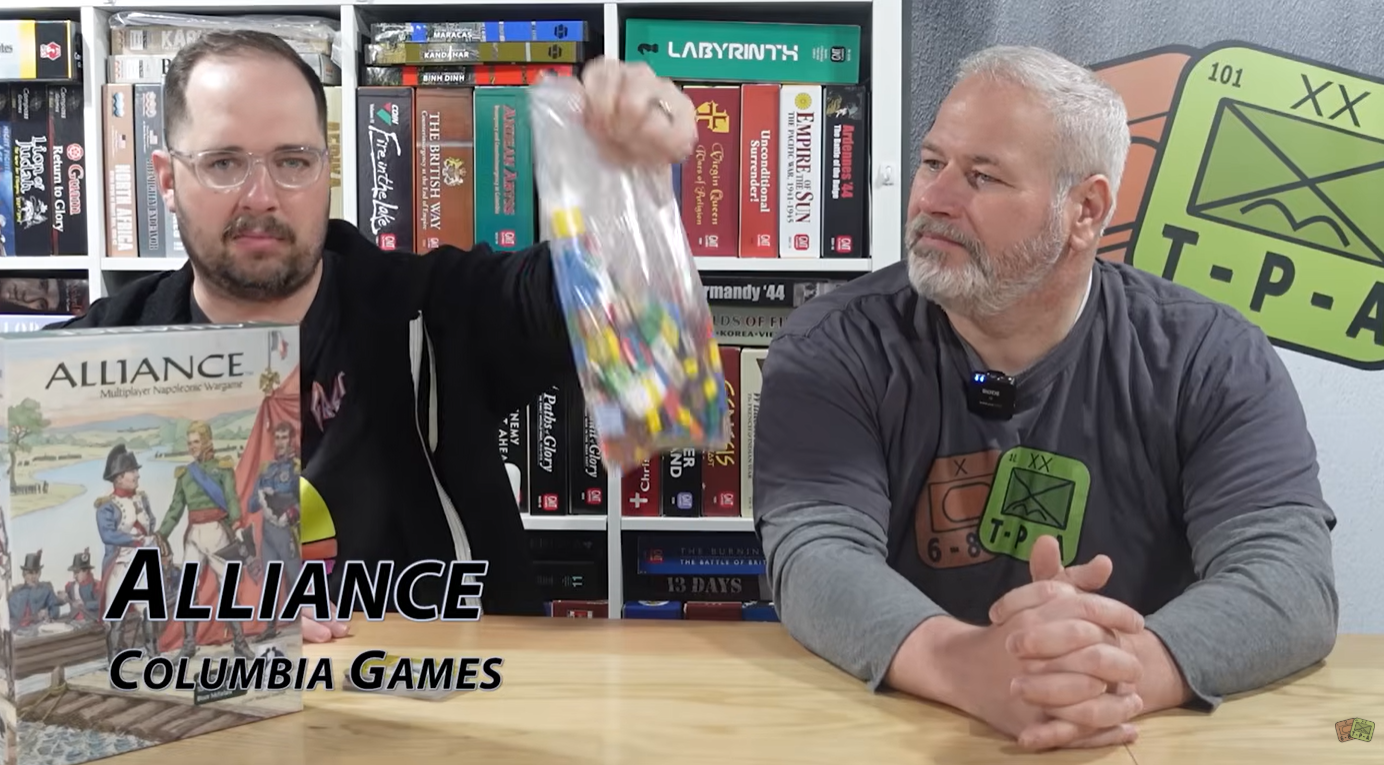
As you know, we very much enjoy multi-player wargames and anytime there is a new multi-player game coming out we very much sit up and take notice. In early 2024, Columbia Games launched a Kickstarter for a game on the Napoleonic Wars called Alliance: Multiplayer Napoleonic Wargame. Alliance is billed as a 1-7 player strategic level game of diplomacy and warfare in the Napoleonic Era with a Columbia Block System twist. The game is huge and plays best with more players. The players take on the roles of different nations during the time and you can play as Austria, England, France, Prussia, Russia, Spain, or the Ottomans. We recently played a full 7-player game and had a grand old time. While the game is not perfect, and there are some quirks that you must get past, the game is really pretty fun and interesting and could be one of those main staples at gaming conventions where you need a lot of players.
Zum Start der neuen Serie von Disney+ fragen sich viele: Wer ist dieser Wonder Man? Statt die Serie zu spoilern, erzählen wir euch, wer Simon Williams in den Marvel-Comics ist, wie er dort als Schurke startete, Teil der Avengers wurde, als Schauspieler Karriere machte und welche Kräfte er besitzt.
With this My Favorite Wargame Cards Series, I hope to take a look at a specific card from the various wargames that I have played and share how it is used in the game. I am not a strategist and frankly I am not that good at games but I do understand how things should work and be used in games. With that being said, here is the next entry in this series.
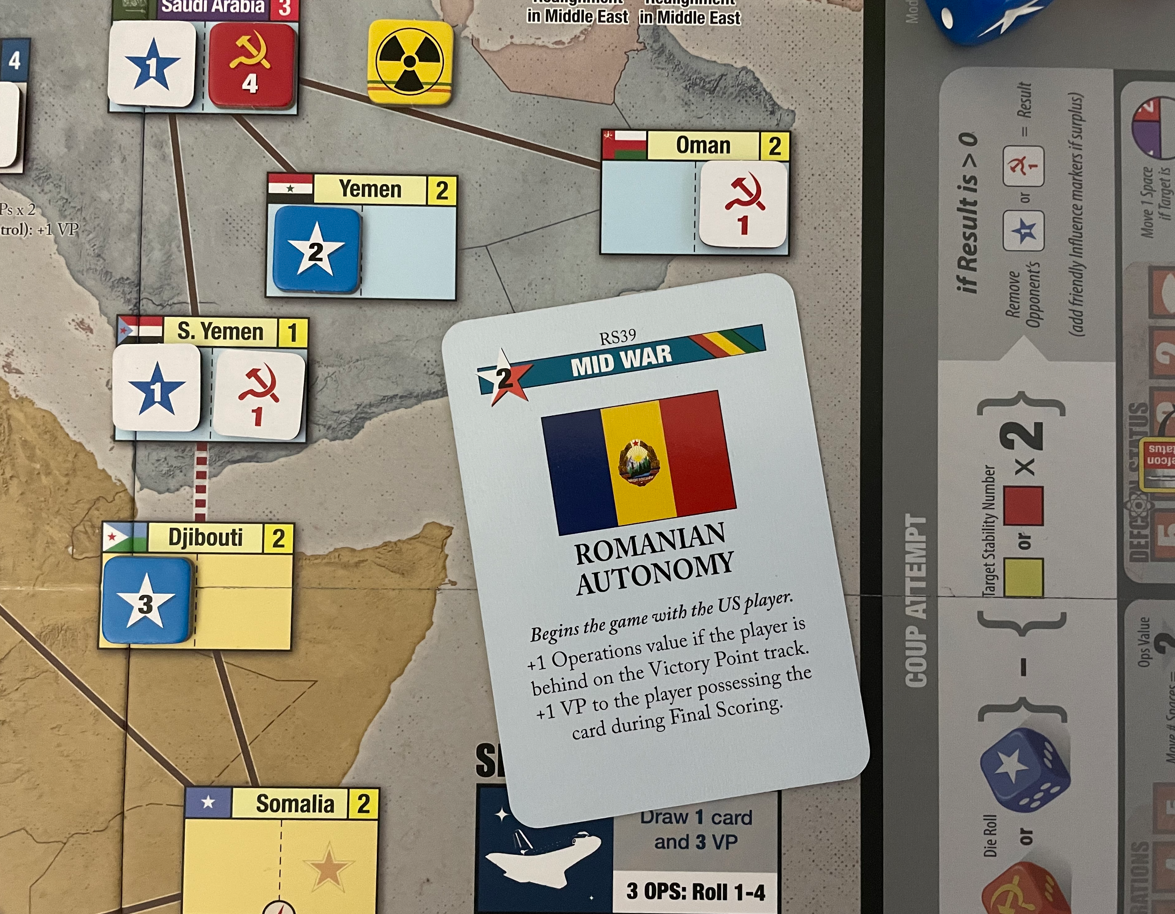
#62: Romanian Autonomy from Twilight Struggle: Red Sea – Conflict in the Horn of Africa from GMT Games from GMT Games
We all love Twilight Struggle….and if you say you don’t, you really do but just want to be different or are a contrarian! The game is phenomenal and has done very well for GMT Games with 8 Printings as well as the Turn Zero Expansion and now a series of smaller geographically focused spin off games starting with Twilight Struggle: Red Sea – Conflict in the Horn of Africa. Twilight Struggle: Red Sea deals with just two regions located in the Horn of Africa including Africa and the Middle East. The game uses the familiar Twilight Struggle formula of Cards with both Events and Operations Points that can be used by players to perform Coups, do Realignment Rolls or place Influence in an effort to gain control of the most Countries in the Regions to score Victory Points and win the game. The game is fast, furious and only lasts 2 hands of cards (unless you choose to play the special 3 Turn variant) so there isn’t a lot of time to mess around and players must be focused on what they are trying to accomplish. The best thing about the game is that it plays in 45 minutes as compared to 3-4 hours for Twilight Struggle.
The next card we will take a look at in this series is the special Romanian Autonomy, which is a unique card that doesn’t play from the deck but starts with the US player and resembles one of the classic cards from the original Twilight Struggle called The China Card. And if you have played Twilight Struggle, you know about the China Card. The China Card is a 4 Ops Value Card that can be held by the player in addition to their hand limit thereby giving them an extra card to use. But the card also has a special ability where if the player uses the card for 4 Ops to place Influence only in Asia, it will grant the player +1 Ops Value to use in placing one additional Influence. The China Card also grant’s the player who holds the card at the end of Turn 10 a +1 VP bonus.
In Twilight Struggle: Red Sea, the China Card has been replaced by the Romanian Autonomy Card. This card is not as powerful as the China Card but definitely creates some new opportunities and challenges for the player playing the card. The Romanian Autonomy Card can effect their Ops Value from cards by +1 during the Turn that they play it if they are behind on the Victory Point Track and also grants +1 VP to the player holding the card during Final Scoring. I think this is a really interesting concept and I think was included as a sort of catchup mechanic due to the short nature of the game. I look forward through more plays to seeing how its addition changes things and whether it is overpowered or just right. Once again, a small and subtle change to the game to create a new and interesting experience for the avid fan of Twilight Struggle or players who are new to the system.
Nicolae Ceaușescu visiting Africa during the Cold War.
During the Cold War, particularly under Nicolae Ceaușescu (1965–1989), Romania maintained a distinct, active presence in Africa, including the Horn of Africa, as part of a strategy to distance itself from Soviet influence, gain international prestige, and foster economic exchanges. While major powers like the Soviet Union and Cuba directly intervened in regional conflicts (such as the Ogaden War), Romania focused on building “fraternal” socialist relations through diplomatic, economic, and technical assistance, often operating with a degree of autonomy from the Warsaw Pact. Romania’s actual African strategy in the Horn of Africa, outlined in its 2023 Africa Strategy, emphasizes partnership, peace, development, education, and security cooperation, not territorial autonomy. Romania aimed to be a bridge between Europe and Africa, strengthening ties through cultural exchange, economic projects, and increased diplomatic presence in strategic capitals like Addis Ababa and Nairobi. Under its former communist regime, Socialist Republic Romania pursued economic independence and influenced African nations, but this was distinct from seeking autonomy within Africa. The phrase “Romanian autonomy in the Horn of Africa” is a game term with strategic implications within the game, while Romania’s real-world engagement with Africa is about broader diplomatic and economic partnerships
The overall blog statistics are pretty meaningless – both last year and this year are skewed by WordPress sending my Farewell 2024 – Historical Fiction! post out to a bajillion people (from Dec 26 to Jan 8), which makes it easily the most popular post of each year (providing more than a fourth of my total views this year). If you factor that out, 2025 has been a good year on the blog, but slightly behind the (organic) record of 2023.
The posts doing particularly well have been the usual suspects, that is, the Most Anticipated Historical Board Games post in January, and the evergreen strategy posts for several games published over the last year. It was nice to see that a few of my research-intensive posts in the American Revolution and the Wallenstein series also did well.
Most of my readers come from the United States (also skewed by the Historical Fiction anomaly, but not entirely), as well as other Anglophone (UK, Canada, Australia) or European (Germany, the Netherlands, Spain, and France) countries. Especially the Dutch have made a leap up… maybe because of my post on the history of Amsterdam? Welkom, anyway.
New arrivals in the top 10 of the countries from which most views stem are Sweden and Poland in a joint Baltic effort.
If you compare views with population numbers, there are possibly no more loyal readers of this blog than the fine people of Ireland, closely followed by Hong Kong, whose views eclipse those of huge countries like Japan, Brazil, or India. The Irish have been devoted to history, board games, and history in board games for some years now, for which I am grateful. The Hongkongers are new in their excitement for the blog – welcome! If you are from Hong Kong, leave a comment below!
I can only speculate what brought people to this blog (but maybe you can enlighten me with a comment, especially if read this blog, but don’t comment often or ever). Here is, however, what I think was the finest which I published this year – as per usual, with six instead of three entries, and without crowning a winner. Let’s go!
Most of the history articles on this blog are about what people in the past did – the politicians, merchants, soldiers of times past. Yet I also like to dwell on what they thought, and thus I’m very happy to have written this post on the political philosophy of the American Revolution, its core value of liberty, and the promise and limitation of that idea. It was also an opportunity to engage with the still-compelling documents of the Revolution – Common Sense and the Declaration of Independence.
It’s been a wild year politically. Almost forgotten by now is the Great Tariff Rollercoaster of April 2025, in which the American federal government announced tariffs on imports from almost all other countries and then engaged in a flurry of raising, lowering, and holding off on them that made everyone’s head spin. By now, the 145% tariff on Chinese goods imported by US buyers is long gone, but at the time it seemed like an existential threat to US board game companies manufacturing their games in China (so, almost all of them), and given that the current US administration will still be in office for another three years, one worth revisiting.
This blog often gives me the opportunity to learn about new subjects. Wallenstein was one of them. I approached the post about his life with not more than a general knowledge about his role in the Thirty Years’ War… and then was sucked into a research rabbit hole in which I read over 2,000 pages about the guy. The result is a four-part series and the longest, most detailed board game assisted biography I have ever written about anyone.
…and this blog also allows me to re-visit topics and games with which I have engaged for years (and sometimes decades) now. Frederick II of Prussia is such a person, and Friedrich (Richard Sivél, Histogame) such a game. Reflecting on their insights on Frederick’s campaigns, the command and control exercised, and Frederick’s psychology was a delight.
Amsterdam is one of the iconic cities of the world. It is a symbol of art, commerce, and progress, and unique in its canal-structured urban layout. Unsurprisingly, these characteristics have also inspired board game designers. I have told Amsterdam’s 750-year history through the lens of the many board games set in Amsterdam – which gives a glimpse into what the city stands for in the popular imagination. As both this and my earlier Venice post were so much fun to write, I should do more city histories!
One of my brighter new ideas was to link historical board games to period music. Of course, that works particularly well from the 20th century on – the age of the music record. I started with an immersive playlist for your next game of Weimar (Matthias Cramer, Capstone Games/Skellig Games/Spielworxx), full of everything that was hot at the time – from traditional songs to jazz, from movie tunes to workers’ songs. It will surely not remain the only such playlist.
And thus concludes the year 2025 on this blog. I hope you had as much fun reading it as I had writing.
I wish you all an excellent year 2026, full of joy, health, and success!
The overall blog statistics are pretty meaningless – both last year and this year are skewed by WordPress sending my Farewell 2024 – Historical Fiction! post out to a bajillion people (from Dec 26 to Jan 8), which makes it easily the most popular post of each year (providing more than a fourth of my total views this year). If you factor that out, 2025 has been a good year on the blog, but slightly behind the (organic) record of 2023.
The posts doing particularly well have been the usual suspects, that is, the Most Anticipated Historical Board Games post in January, and the evergreen strategy posts for several games published over the last year. It was nice to see that a few of my research-intensive posts in the American Revolution and the Wallenstein series also did well.
Most of my readers come from the United States (also skewed by the Historical Fiction anomaly, but not entirely), as well as other Anglophone (UK, Canada, Australia) or European (Germany, the Netherlands, Spain, and France) countries. Especially the Dutch have made a leap up… maybe because of my post on the history of Amsterdam? Welkom, anyway.
New arrivals in the top 10 of the countries from which most views stem are Sweden and Poland in a joint Baltic effort.
If you compare views with population numbers, there are possibly no more loyal readers of this blog than the fine people of Ireland, closely followed by Hong Kong, whose views eclipse those of huge countries like Japan, Brazil, or India. The Irish have been devoted to history, board games, and history in board games for some years now, for which I am grateful. The Hongkongers are new in their excitement for the blog – welcome! If you are from Hong Kong, leave a comment below!
I can only speculate what brought people to this blog (but maybe you can enlighten me with a comment, especially if read this blog, but don’t comment often or ever). Here is, however, what I think was the finest which I published this year – as per usual, with six instead of three entries, and without crowning a winner. Let’s go!
Most of the history articles on this blog are about what people in the past did – the politicians, merchants, soldiers of times past. Yet I also like to dwell on what they thought, and thus I’m very happy to have written this post on the political philosophy of the American Revolution, its core value of liberty, and the promise and limitation of that idea. It was also an opportunity to engage with the still-compelling documents of the Revolution – Common Sense and the Declaration of Independence.
It’s been a wild year politically. Almost forgotten by now is the Great Tariff Rollercoaster of April 2025, in which the American federal government announced tariffs on imports from almost all other countries and then engaged in a flurry of raising, lowering, and holding off on them that made everyone’s head spin. By now, the 145% tariff on Chinese goods imported by US buyers is long gone, but at the time it seemed like an existential threat to US board game companies manufacturing their games in China (so, almost all of them), and given that the current US administration will still be in office for another three years, one worth revisiting.
This blog often gives me the opportunity to learn about new subjects. Wallenstein was one of them. I approached the post about his life with not more than a general knowledge about his role in the Thirty Years’ War… and then was sucked into a research rabbit hole in which I read over 2,000 pages about the guy. The result is a four-part series and the longest, most detailed board game assisted biography I have ever written about anyone.
…and this blog also allows me to re-visit topics and games with which I have engaged for years (and sometimes decades) now. Frederick II of Prussia is such a person, and Friedrich (Richard Sivél, Histogame) such a game. Reflecting on their insights on Frederick’s campaigns, the command and control exercised, and Frederick’s psychology was a delight.
Amsterdam is one of the iconic cities of the world. It is a symbol of art, commerce, and progress, and unique in its canal-structured urban layout. Unsurprisingly, these characteristics have also inspired board game designers. I have told Amsterdam’s 750-year history through the lens of the many board games set in Amsterdam – which gives a glimpse into what the city stands for in the popular imagination. As both this and my earlier Venice post were so much fun to write, I should do more city histories!
One of my brighter new ideas was to link historical board games to period music. Of course, that works particularly well from the 20th century on – the age of the music record. I started with an immersive playlist for your next game of Weimar (Matthias Cramer, Capstone Games/Skellig Games/Spielworxx), full of everything that was hot at the time – from traditional songs to jazz, from movie tunes to workers’ songs. It will surely not remain the only such playlist.
And thus concludes the year 2025 on this blog. I hope you had as much fun reading it as I had writing.
I wish you all an excellent year 2026, full of joy, health, and success!
The opening sequence of Martin Scorsese’s Taxi Driver depicts a New York with enough grit that you can feel it on your teeth. It’s a feral hour of the night. DeNiro’s sedan is cruising down a street awash in the radiant soul of the city. There’s a shot of the vehicle’s quarter panel. Beads of…
Looking for something comic related for that fan in your life for the holidays? Then consider the board game, Corps. of Discovery from Off the Page Games.
As we have seen in the last post, Wallenstein had contrived to make many enemies. His only supporter, Emperor Ferdinand, feared to be upstaged by the seemingly all-powerful general. The news in late 1633 – Wallenstein treating with the Swedes, Wallenstein letting Thurn go free, Wallenstein not defending Regensburg and Bavaria, Wallenstein refusing to support the Spanish mission to the Netherlands – mixed with their tendentious interpretations by the Bavarian and Spanish parties at court convinced the emperor that Wallenstein planned betrayal. To forestall this, the Imperial War Council secretly decided to relieve Wallenstein of his command on December 31, 1633.
Wallenstein and his intimates did not know about the dismissal, but they sensed the shifting wind. His brother-in-law Adam Erdmann, Count Trčka, and his marshal Christian von Ilow had Wallenstein’s officers sign a statement of loyalty to their commander in his winter quarters at Plzeň on January 12. They hoped that this show of unity in the army would remind the emperor that he needed his general. The opposite was the case: Ferdinand took it as another sign of treason.
When Wallenstein had been dismissed in 1630, it had caused both the emperor and the electors immense anxiety about his possible reaction. He had taken it meekly then, but what would he do now? As the emperor and his advisors had resolved that Wallenstein was a traitor, they expected the worst – insubordination, rebellion, joining his army with the Swedes. That needed to be forestalled. A secret court found Wallenstein guilty of treason on January 24, 1634. The court reached out to three of Wallenstein’s officers which they deemed reliable – Wallenstein’s second-in-command, Matthias Gallas, the commander of the embattled left wing at Lützen, Ottavio Piccolomini, and the tenacious defender of Dessau Bridge, Johann von Aldringen. To them, they gave the delicate task of delivering Wallenstein to Vienna – dead or alive.
The three executors of the imperial sentence faced a daunting task. Wallenstein was popular with the common soldiers whose pay was guaranteed by their general, not by the emperor whose coffers were notoriously empty and whose will to pay the army notoriously limited. The officers seemed more promising, as they were honor-bound to the emperor, but they had also sworn loyalty to their commander. Gallas got in touch with those they deemed reliable and instructed them not to follow any orders from Wallenstein, Trčka, or Ilow.
By that time, Wallenstein’s health had deteriorated even more. He was barely able to leave his bed and sometimes could not even sign documents. All the while, he waited for a reply from Hans Georg von Arnim on the potential peace with the electors of Saxony and Brandenburg.
Trčka acted on Wallenstein’s behalf in the day-to-day affairs, confident in his command over the soldiers. Only deep into February did it dawn on him and Wallenstein’s other intimates that imperial agents were prising the army away from them – officer by officer, regiment by regiment.
Wallenstein in his winter quarters at Pilsen (the German spelling of Plzeň) with the three executors of the imperial will dancing around him. Cheb, to the northwest of Plzeň/Pilsen would have given Wallenstein an easy exit west in direction of the Swedish-German forces under Bernard of Weimar or north to the Elector of Saxony. From the Vassal module of Thirty Years War: Europe in Agony, 1618-1648 (David A. Fox/Michael Welker, GMT Games).
Nothing was left to Wallenstein but flight. On February 23, he and those faithful to him made away to Cheb, accompanied by a few regiments of loyal troops. They had been joined by the regiment of Colonel Walter Butler on the way and counted on the garrison of Cheb under the command of John Gordon. Both Butler and Gordon had been contacted by the three conspirators who urged them not to obey Wallenstein. For the time being, Butler and Gordon prevaricated.
As Cheb is in the northwestern corner of Bohemia, Wallenstein could easily leave Bohemia for Saxony or be joined by Swedish forces. That put time pressure on Butler and Gordon. If Wallenstein fled, they would be held responsible. If they arrested him, he would be freed again if the Swedish arrived. Thus, they resolved to murder him and his associates.
Gordon invited Trčka, Ilow, and a few more Wallenstein intimates for dinner up in Cheb’s castle on February 25th – together with Wallenstein, who declined on grounds of his constant bad health. Gordon and Butler, both present at dinner, had a group of soldiers commanded by captain Walter Devereux come in, declare for the emperor, and murder Wallenstein’s associates. With all of them dead, Devereux took his small group down to Wallenstein’s residence in the town. They found Wallenstein in bed already. As he got up, Devereux stabbed him to death.
Wallenstein’s leader counter in Cuius Regio.
Wallenstein’s death is handled in a rather detached manner in Cuius Regio (Francisco Gradaille, GMT Games, forthcoming): Like every other leader, Wallenstein has an initial and a last year of service (1625 and 1634, in his case). In the leader deployment phase before the campaigns of 1635, the player will have to remove Wallenstein. Death – be that from plague, battle, or murder – is inevitable and pre-ordained.
The Catholic player in Thirty Years War: Europe in Agony, 1618—1648 has more freedom. As we have discussed in the last two instalments of the series, Wallenstein can be dismissed and recalled in the game. And if he proves to be too influential (and comes close to the threshold at which his influence would give the Protestants a Major Victory), he can also be assassinated (and thus be removed from the game permanently). There is, however, no inevitability of Wallenstein’s death: As his influence is only raised from recruiting troops, taking cities, and successfully attacking with him, the Catholic player can just forgo those, not use Wallenstein anymore and let him live out his old age in peace. Somehow, this never occurred to the historical Ferdinand II. Implicitly, the game’s treatment of Wallenstein’s assassination posits that the active threat which Wallenstein posed in Ferdinand’s view was nothing but a fabrication of the emperor’s paranoia, and that the emperor remained firmly in command at all times.
Twilight of the Thirty Years’ War
Wallenstein had grown rich on land which had been taken from those the emperor had declared rebels. He ended up on the other side of this bargain. His estates in Bohemia and Silesia were seized (Mecklenburg was lost to the Swedes anyway). A good deal went as spoils to all the officers involved in the conspiracy against him. Gallas, Piccolomini, and Aldringen became great magnates, and those on the lower rungs of the plot did not go unrewarded either, down to an additional month’s pay for all the soldiers in the garrison of Cheb whose only contribution had been to stand by idly while Wallenstein was murdered. The rest of Wallenstein’s estates were sold by the emperor to fix some of his short-term financial problems. Wallenstein’s widow Isabelle kept nothing. Only when she pleaded mercy (instead of justice) from the emperor did she receive a small estate to live on.
Wallenstein had died when the war had already been raging for sixteen years. It would last another fourteen before peace was finally made in 1648. Any time Emperor Ferdinand II had been in a position of strength, he had not made concessions to form a lasting peace, but instead increased his demands, prompting the interventions of first Denmark, then Sweden, and finally France (shortly after Wallenstein’s death).
Ferdinand II died in 1637. At the time of peace, the new emperor Ferdinand III was mostly ruined. Protestantism survived, protected by German princes and foreign powers. Sweden controlled the Baltic Sea. Any hopes of imperial hegemony in the empire or of Habsburg hegemony in Europe were dashed. After Spain had conceded Dutch independence, it fought on against France, and lost that war, too, along with its European primacy.
Afterlife
Wallenstein remained fascinating to his contemporaries after his death, and would continue for centuries. Assessments close to his own time hewed closely to the religious beliefs of the writer: Catholics tended to see Wallenstein as a traitor (following the official account of the emperor), Protestants made him into a Machiavellian mercenary leader, often contrasted with the heroic “Lion from the North” Gustavus Adolphus.
Later treatments focused on individual aspects such as Wallenstein’s purported dependence on astrology. You will have noticed that this is the first time since our first post that astrology is mentioned – because there is no evidence that Wallenstein was more interested in it than his contemporaries, let alone that he made decisions based on horoscopes. The speculations on this issue are based in the accounts of those who bore witness against Wallenstein shortly before and after his death, taking pains to stress anything which might indicate that Wallenstein was anything but a devout Catholic. The idea of Wallenstein, the Star-Seeker, is particularly prevalent in the German mind, as playwright Friedrich Schiller dedicated a trilogy of plays to Wallenstein’s last weeks – and presents the general as an indecisive fatalist, done in by his own passivity as well as the cabals of those around him. That’s (masterful) fiction – but it hews close enough to history (Schiller had taught history at the University of Jena and even written a major book on the Thirty Years’ War) to influence anyone whose first contact with Wallenstein was through Schiller’s plays.
By the time document-based historiography had been firmly established in the 19th century, pre-established views on Wallenstein had become so solidified that historians still argued within their confines – mostly on the matter if Wallenstein had, in fact, betrayed the emperor. Slowly, the view that he had not gained ground.
Interpretations of Wallenstein in the 19th and 20th century often were inspired by current politics: Catholic German nationalists hailed Wallenstein as a proto-Greater German unifier. Czech historians like Josef Pekař adopted their compatriot as a proto-nationalist transcending the multi-national Habsburg Empire. Hellmut Diwald saw in Wallenstein the necessary authoritarian answer to overcome foreign domination of Germany (and subsequently plunged himself into New Right revisionism).
When stories of “Great Men” had decidedly fallen out of favor in academic history, Golo Mann revived the genre with his biography of Wallenstein, testing the limits of academic writing with his literary ambitions. His book dispelled some of the myths around Wallenstein and retained others.
Currently, Wallenstein’s heritage as a Bohemian, a nobleman, a (converted) Catholic, and a magnate have received more attention. History is never completed, but only enriched with more perspectives. Wallenstein’s life and its subsequent interpretations are thus also lessons in historiography.
A recent biography which succeeds at dispelling the Wallenstein myth is Mortimer, Geoff: Wallenstein. The Enigma of the Thirty Years’ War, Palgrave Macmillan, London 2010.
For an older, more encompassing biography with literary aspirations, see Mann, Golo: Wallenstein. His Life Narrated, Holt, Rinehart, and Winston, New York City, NY 1976.
On the reception of Wallenstein and his changing image from his contemporaries all the way through the 20th century, see Bahlcke, Joachim/Kampmann, Christoph: Wallensteinbilder im Widerstreit: Eine historische Symbolfigur in Geschichtsschreibung und Literatur vom 17. bis zum 20. Jahrhundert [Conflicting Conceptions of Wallenstein: A Symbolic Figure from History in Historiography and Literature from the 17th to the 20th Century], Böhlau, Cologne/Weimar/Vienna 2011 [in German].
For a short introduction to the Thirty Years’ War, see Schmidt, Georg: Der Dreißigjährige Krieg [The Thirty Years’ War], C.H. Beck, Munich 2010 [in German].
A magisterial monography on the entire war is Wilson, Peter H.: Europe’s Tragedy. A New History of the Thirty Years’ War, Penguin, London 2009.
We haven’t had a game-assisted biography on this blog for two years! Let’s rectify that with one of the most legendary and mysterious generals of all time – Wallenstein, the emperor’s chief commander in the first half of the Thirty Years’ War. Wallenstein, the mercenary. Wallenstein, the astrology addict. Wallenstein, the traitor. …or was he all of these things? We’ll find out!
The early 17th century was a time of barely contained tension in Europe. Four fundamental conflicts would provide the spark, the oxygen, and the fuel for the great conflagration of the Thirty Years’ War:
Since Luther’s 95 Theses had brought forth a new interpretation of the Christian faith, Protestantism, the Catholic church and Catholic princes had aimed to extinguish it. The denominations had reached a tenuous compromise in the mid-16th century based on the principle that the princes could set the religion for their dominions (cuius regio, eius religio). Yet shifts in the balance of religious power since then – mostly in favor of the Catholic counter-reformation, with the notable exception of the lands of the Crown of Saint Wenceslas (Bohemia, Moravia, and Silesia), where the Protestant nobles forming the estates gained in power – threatened the compromise.
The Holy Roman Empire had traditionally been a state where power was shared between the emperor and the princes (most importantly, the seven electors which, as the name indicates, elected the emperor). Other states Spain, France, and England saw a centralization of power around their respective kings. Such a centralization – a true monarchy – also appealed to the emperor.
The Holy Roman Empire in 1618 with its many principalities (note the many coats-of-arms on the map). Bohemia, Moravia, and Silesia are in the center-east. Map of Holy Roman Empire (Mark McLaughlin, 3W).
In the north, the Holy Roman Empire bordered the Baltic Sea. Whoever controlled its shorelines, liberally dotted with merchant cities which had gotten rich in the trade with timber, grain, fish, and many other valuable commodities, would hold the dominium Maris Baltici – the command of the Baltic Sea. The chief contenders in the early 17th century were the Polish-Lithuanian Commonwealth, the Kingdom of Denmark-Norway, and the Kingdom of Sweden… yet others would surely be interested, if only they could gain a foothold on the shores of the Baltic Sea.
The emperor came from the House of Habsburg (or Hapsburg, as it is sometimes spelled in English). Half a century before Wallenstein’s birth, Emperor Charles V had ruled not only the Habsburg possessions in the Holy Roman Empire (including Austria and the Crown of Saint Wenceslas), but had also been King of Spain and held extensive territories in Italy and Burgundy (in modern-day France and the Benelux countries). Charles had split the Habsburg holdings between his brother Ferdinand who succeeded him as Holy Roman Emperor and his son Philip who had inherited all the lands and titles in Spain, Italy, and Burgundy (as well as Spain’s overseas colonies). Individually, the two Habsburg branches were powerful. And together, they were on the verge of European hegemony.
Bohemian, Noble, Soldier, Convert
Wallenstein was born on September 24, 1583, in the Bohemian village Heřmanice, as Albrecht von Waldstein, a scion of an old, but poor Bohemian noble family. While the family name (in either the original Waldstein or Wallenstein’s own preferred Wallenstein spelling) may sound Germanic, Wallenstein’s native tongue was Czech. However, his education in Silesia and Franconia taught him German and Latin, his subsequent European tour as a young man Italian as well as a dose of French and Spanish.
Wallenstein had been orphaned at the age of eleven. As a young nobleman and landholder, he had to chart his own path in life. His lands were neither extensive enough for a comfortable income nor to command his full attention. For a fruitful ecclesial career, Wallenstein was too lowborn. Instead, he resorted to the third suitable career paths for nobles – war – and enlisted in the imperial army for two years in the Long Turkish War.
Wallenstein returned from the war aged 23. Over the next years, he made several momentous decisions. The most important – and least understood – is his conversion. Wallenstein had been raised Protestant like most Bohemians, but converted to Catholicism around the end of his military service. While we cannot search Wallenstein’s heart for his religious convictions, we know that he never displayed particular religious zeal later – and he was remarkably tolerant of other faiths, and regularly entrusted Protestants with important positions under him. From a more worldly perspective, Wallenstein’s conversion isolated himself from most of his Bohemian peers. It was in that regard, though, that his conversion proved fruitful a few years later: When the wealthy Catholic widow Lucretia of Víckov sought to remarry, Wallenstein was one of the few eligible Catholic nobles in the region. He thus came to manage her extensive holdings in Moravia, and, when she died in 1614, the inheritance turned him into one of the richest landholders sworn to the Crown of Saint Wenceslas.
Finally, these years saw another event which would be of great importance to Wallenstein’s biographers (but not so much to him): Following the fashions of the time, he requested a horoscope from the leading astronomer of the time, Johannes Kepler. As horoscopes go, it foretold some things which would happen (albeit at different times than predicted, like his marriage to a wealthy woman), others which wouldn’t (an interest in alchemy and sorcery), and a good deal of vague fluff which could be applied to most people.
Rise in the Conflagration
In 1617, Wallenstein went to war again. This time, he paid out of his own pocket for a cavalry company to join the war against Venice commanded by Ferdinand of Habsburg, Emperor Matthias’s appointed successor. Soon after Wallenstein had joined the fray, Matthias fell seriously ill and Ferdinand was recalled to ensure a smooth transition of power as both the Crown of Saint Wenceslas and the imperial crown were elective. Despite Ferdinand’s reputation as an ardent Catholic counter-reformer (he had forced the conversion of his Protestant subjects in Styria and Carinthia as one of his first acts as an adult ruler), the Protestant-majority Bohemian estates elected Ferdinand king in an act of doubtful strategic vision.
Ferdinand was careful not to violate Protestant rights too flagrantly, yet the estates soon found out that he retained his counter-reformatory spirit when he decided any arising small property disputes in favor of Catholic claimants. Redoubling on their strategic ineptitude, the Bohemian estates now defied the king they had accepted as legitimate just one year before: They threw three of Ferdinand’s counselors out of a window (all of them miraculously survived the fall) on May 23, 1618, and rose in armed rebellion. As their new king they chose Frederick V, elector of the Palatinate and the son-in-law to King James I of England. When Matthias died in 1619, Frederick would be the only of the seven electors not voting for Ferdinand II to become Holy Roman Emperor – a devastating setback for the Bohemians who had hoped that Frederick’s second vote as King of Bohemia would be acknowledged, and that the Protestant electors of Saxony and Brandenburg would also support Frederick.
The Bohemian estates (blue) had a mobilization advantage over the imperial forces and their Catholic German allies (yellow) in 1618. The westernmost blue stack is led by Frederick V in his native Palatinate, the easternmost (in Moravia) by Count Thurn, ready to threaten Vienna (Wien), the seat of Habsburg power in the Holy Roman Empire. Setup for the campaign game of Cuius Regio: The Thirty Years War (Francisco Gradaille, GMT Games, forthcoming) – playtest art.
Wallenstein had been born in Bohemia, but the estate inherited from his wife lay in Moravia. The Moravian estates delayed their commitment to the Bohemian cause which suited Wallenstein well – he had no sympathy for the rebellion. As one of the chief military officials of Moravia, he raised a cavalry regiment which he offered to Ferdinand. Push came to shove when one of the Bohemian armies under Count Matthias of Thurn marched into Moravia in 1619 to rouse the Moravians into supporting the Bohemian rebellion. Wallenstein attempted to spirit his regiment away (knowing the soldiers’ and officers’ sympathies for their Bohemian neighbors). When the major in charge of logistics attempted to swing the regiment in favor of the rebellion, Wallenstein slew him on the spot with his saber. Then he brought the regiment to the emperor’s seat Vienna, and with it, the war chest of the Moravian estates – a welcome present to the always cash-strapped emperor.
Wallenstein had gained the emperor’s favor. While he was not personally involved in the decisive imperial victory over the Bohemian forces at White Mountain (albeit some of his soldiers served under the commander of the Catholic League’s army, Johann Tserclaes, Count of Tilly), that favor gave him access to the inevitable spoils of victory. And here his genius first showed.
Wallenstein became a part of the imperial coin consortium tasked to supply silver and mint debased coins to pay for the emperor’s war efforts. That was a mildly profitable endeavor in itself, but more importantly, it got Wallenstein in touch with men of finance, chiefly the Dutch banker Hans de Witte. Wallenstein used his new-found access to credit to take out huge loans with which he purchased vast estates in Bohemia confiscated from the defeated rebels, and as so much land was auctioned at the same time by the imperial crown, Wallenstein paid bargain prices to became one of the chief Bohemian magnates.
The loans still needed to be repaid. Wallenstein expended most of his energy on developing his estates in the following years, and turned them into an efficiently administered, wealthy domain, for which he was granted the title of Prince of Friedland. Wallenstein’s activities as a landed aristocrat are represented in the most famous game featuring him, Wallenstein (Dirk Henn, Queen Games), which has up to five players (one of them Wallenstein) build markets, churches, and palaces in their holdings… and make some war on the other players should good opportunities arise.
Wallenstein remarried in 1623. His wife Isabel was the daughter of the imperial count Karl of Harrach from the emperor’s inner circle of advisors, giving Wallenstein access to inner workings of the imperial court. Yet despite his successes, Wallenstein was anxious.
His holdings were not secure as long as the exiled Bohemian rebels had hopes of recovering them. Wallenstein thus needed peace, peace on the Emperor’s terms. Yet while the imperial armies had won one victory after another, not only crushing the Bohemian rebels but also invading the Palatinate homeland of their erstwhile King Frederick, the emperor did not know how to make peace. He found himself unable to deal with the roaming armies of Protestant warlords like Ernst of Mansfeld or Christian of Halberstadt. And instead of extending an olive branch to the princes fearing imperial domination, he deposed Frederick and gave the title of elector to his ally Maximilian, Duke of Bavaria – an unthinkable breach of princely privileges.
As Ferdinand also seemed on the verge of rolling back Protestantism in central and northern Germany, the Protestant princes and the powers of the Baltic Sea grew concerned. King Christian IV of Denmark was anxious on both accounts. If he opposed Ferdinand, he could certainly count on the Protestant warlords and Bohemian exiles, and he sounded out eventual allies
among the northern German princes,
the Protestant Dutch (embroiled in their own struggle with for independence from the Spanish Habsburgs),
the English (whose King James I resented the snub to his son-in-law Frederick), and even
Denmark’s rival Sweden, a rising Protestant power in the north.
Nobody knew how big the Protestant intervention from the north would be. Yet it was almost certain that it would come. And the imperial region closest to Denmark was Bohemia. Wallenstein despaired over the emperor’s lack of preparation (caused both by the eternally empty imperial coffers and Ferdinand’s anxiety that raising an army would cause the Protestants to take measures of their own, thus causing the war he wanted to avoid). Wallenstein became convinced that he needed to take the security of his principality into his own hands. He offered to raise and equip an army for the emperor, paying for it up front. After long delaying, Ferdinand accepted his offer.
Ferdinand made Wallenstein chief imperial general in the Holy Roman Empire (contrary to the traditional title of lieutenant general based on the fiction that the actual commander was the monarch himself), created him Duke of Friedland lest he be outranked by other aristocratic commanders, and tasked him to raise his army. Wallenstein would apply himself to the task with his characteristic energy… in the next instalment of this series.
A recent biography which succeeds at dispelling the Wallenstein myth is Mortimer, Geoff: Wallenstein. The Enigma of the Thirty Years’ War, Palgrave Macmillan, London 2010.
For an older, more encompassing biography with literary aspirations, see Mann, Golo: Wallenstein. His Life Narrated, Holt, Rinehart, and Winston, New York City, NY 1976.
On the reception of Wallenstein and his changing image from his contemporaries all the way through the 20th century, see Bahlcke, Joachim/Kampmann, Christoph: Wallensteinbilder im Widerstreit: Eine historische Symbolfigur in Geschichtsschreibung und Literatur vom 17. bis zum 20. Jahrhundert [Conflicting Conceptions of Wallenstein: A Symbolic Figure from History in Historiography and Literature from the 17th to the 20th Century], Böhlau, Cologne/Weimar/Vienna 2011 [in German].
For a short introduction to the Thirty Years’ War, see Schmidt, Georg: Der Dreißigjährige Krieg [The Thirty Years’ War], C.H. Beck, Munich 2010 [in German].
A magisterial monography on the entire war is Wilson, Peter H.: Europe’s Tragedy. A New History of the Thirty Years’ War, Penguin, London 2009.
You’ll find a short discussion of the various origins of the war in Gutmann, Myron P.: The Origins of the Thirty Years‘ War, in: Journal of Interdisciplinary History 18, 4, 1988, p. 749—770, online here (free registration required).
2025 is in the distant future, right? …nope, that’s right now. Actually, it’s halfway over already. So here are some snapshots from my board gaming in the first six months of this year.
The Raw Numbers
Let’s start with a statistical overview (as of June 29):
I’ve played 23 different games (slightly up compared to last year at this point).
9 of them were new to me (also slightly up).
These 23 games resulted in a total of 52 plays (lower than last year, but higher than 2023)
The month in which I played most games was January (with 17 plays), the months with the fewest plays March and April (4 each).
Of the 23 different games, 17 are historical. These account for 43 of the plays (twice the games, three times the plays compared to last year).
Just one of the plays was solo (utterly collapsing from last year’s 17).
32 of the 52 plays were digital, which makes for a digital majority for the first time since getting out of the pandemic in 2022.
The overall trend this year for me has been more digital and more historical gaming – or, from the other side, less on-the-table casual gaming. There are a few reasons for that, including me being mostly homebound for several months taking care of our cat which requires medication twice daily.
Most importantly: She continues to live a happy cat life (except for the few minutes in the morning when she has to take a pill that tastes very bitter)!
Besides that, I’m happy for the gaming I got so far this year. Here are some highlights.
Ottomans at Vienna!Monarchists in Essen!Cars on the race track!
Rally the Troops!
I play more digitally these days because I lack some face-to-face opportunities, but I also play more digitally because the offers have gotten very good. My main platform is the admirable Rally the Troops! which allows you to play a variety of historical board games (especially block and card-driven games) in a visually appealing, rules-enforcing manner in your browser for free. I’ve used it to get back to old favorites like 1989 (Jason Matthews/Ted Torgerson, GMT Games) or Maria (Richard Sivél, Histogame) as well as to try out games about which I’ve heard my friends rave for years… for example, the game which I’ve played most often this year so far.
Austria (white) has recovered and is pressing Prussia (blue) hard in Silesia (east) as well as in the western reaches of Prussia proper. From the Maria implementation on Rally the Troops!
One of my discoveries of last year – so much strategy and bluffing with so little rules overhead!
Pompeius (gold) holds Spain, Africa, and Sicily; but Caesar’s (red) march through the east all the way to Egypt proved decisive. From the implementation on Rally the Troops!
The struggle between Caesar and Pompeius for mastery of the Roman Republic requires sharp wits, calm nerves, and a little bit of luck when you cast the die crossing the Rubicon. The games are dynamic and play out in a variety of ways – sometimes, your armies stalk each other in the east, sometimes, you slug it out in bloody battles in Spain, and sometimes, amphibious landings turn erstwhile quiet regions into sudden flashpoints. May the gods favor you… but not too much.
I’ve played Julius Caesar around a dozen times since December last year, and it hasn’t lost its charm.
And, to finish this post, here are two new discoveries of mine on Rally the Troops!:
I’m excited to learn new things from and with games. One topic I knew next to nothing about is the 14th century in India. That, however, has changed a bit now due to Vijayanagara, a COIN-lite treatment of the collapse of the Delhi Sultanate’s hegemony under the challenge of invasion from the north (Timur’s Mongols) and centrifugal forces in the south (the nascent Bahmani Kingdom and Vijayanagara Empire).
My yellow Vijayanagara Empire has a few strongholds in the south, and, with the Delhi Sultanate (black) currently busy fending off the Mongols (red) in the north, will have some breathing space… yet the Bahmani Kingdom (turquoise) might fill the power vacuum. From the implementation on Rally the Troops!
Chaos – some games hate it, others, like Time of Crisis, embrace it. Whoever wants to be Roman emperor in the tumultuous third century must be prepared to deal with a whole whirlwind of challenges: Angry mobs want to drag your governors into the gutter, Barbarian tribes stand ready to cross the border into your provinces, and, worst of all, the rest of the Roman elite wants to be emperor, too, and will gleefully take whatever you possess. I have been thwarted in my imperial aspirations by my fellow bloggers Dave, Grant, and Michal, and have been loving every minute of it.
My (red) emperor sits in Italia, yet the yellow pretender empire seems to be the most dynamic faction right now. From the implementation on Rally the Troops!
What have the first six months of 2025 brought to you in gaming? – Let me know in the comments!
In this episode, Jamey Stegmaier and I chat about the various trends we’re seeing in the current game design landscape. We talk about solo and 2-player games, open worlds, licensed IPs, and more!
In this episode, Jamey Stegmaier and I chat about the various trends we’re seeing in the current game design landscape. We talk about solo and 2-player games, open worlds, licensed IPs, and more!
My game design book, Find the Fun, recently came out, and in this episode, I do a brief synopsis and give you the audio version of the first three chapters.
My game design book, Find the Fun, recently came out, and in this episode, I do a brief synopsis and give you the audio version of the first three chapters.
In this BGDL rewind from June of 2020, Corey Konieczka breaks down his entire design process.
Corey has several games ranked in the top 100 games of all time, and it was incredibly insightful to learn about how he brings a game to life. We chat about his path into the industry, his prototyping process, the challenges of working on IPs like Star Wars, when to walk away from a design, and more!
In this BGDL rewind from June of 2020, Corey Konieczka breaks down his entire design process.
Corey has several games ranked in the top 100 games of all time, and it was incredibly insightful to learn about how he brings a game to life. We chat about his path into the industry, his prototyping process, the challenges of working on IPs like Star Wars, when to walk away from a design, and more!
In this BGDL rewind from April of 2020, Ignacy Trzewiczek, founder of Portal Games and designer of Robinson Crusoe, discusses his company’s motto: Games that tell stories.
We go in-depth into Ignacy’s design process, talk about his most popular games, and get to the heart of what it looks like to create games that have players leaving the table with a story to tell.

 Anmelden


 Um in Europa die Verkäufe anzukurbeln, erschuf Marvel einst das X-Men-Spinoff Excalibur. Mit beliebten Figuren wie Kitty Pryde, Nightcrawler und Rachel Summers wurden Mutantenfans angesprochen. Captain Britain und Meggan brachten englische Folklore ins Spiel. Bald war das Team im ganzen Multiversum aktiv. Wir stellen euch hier die wichtigsten Figuren vor.