Normale Ansicht

Deck-Build with the Devil

23. April 2026 um 17:54

Every time I write about a game with a "demonic theme," somebody comes along to tell me why they won't play games with demons in them. Look, we know why. Because you're a goofball. We get it. It's fine. But that doesn't mean I care to hear about it.

I don’t know what I expected Tom Lehmann to design next, but Dominion on Adderall wasn’t on the list. That’s as short a summary as I can muster for Dark Pact, and it’s a surprisingly apt comparison, right down to the action limits and buy phase that marked Donald X. Vaccarino’s genre-defining title. Like the version of Dominion you’d get if a moody teenager popped a double dose and spent six hours scribbling demons in their spiral-bound notebook.

Is it good? Yeah, it’s good. Is it great? Hm. It sits somewhere near Res Arcana in Lehmann’s ludography, sans that game’s brevity, plus a bit of Justin Gary’s Ascension in its flowing market and excessive tallying. Great might be a stretch. Perhaps it would be fairest to say that it contains moments of greatness.
I think I get especially eye-rolly about the "no demons in games" thing because my mother insisted that face cards were demonic. This was written directly into a doctrinal book that was important to Mormonism, despite it not being canon at any point. This had very little impact on my upbringing except to prevent me from playing trick-takers until I was an adult.

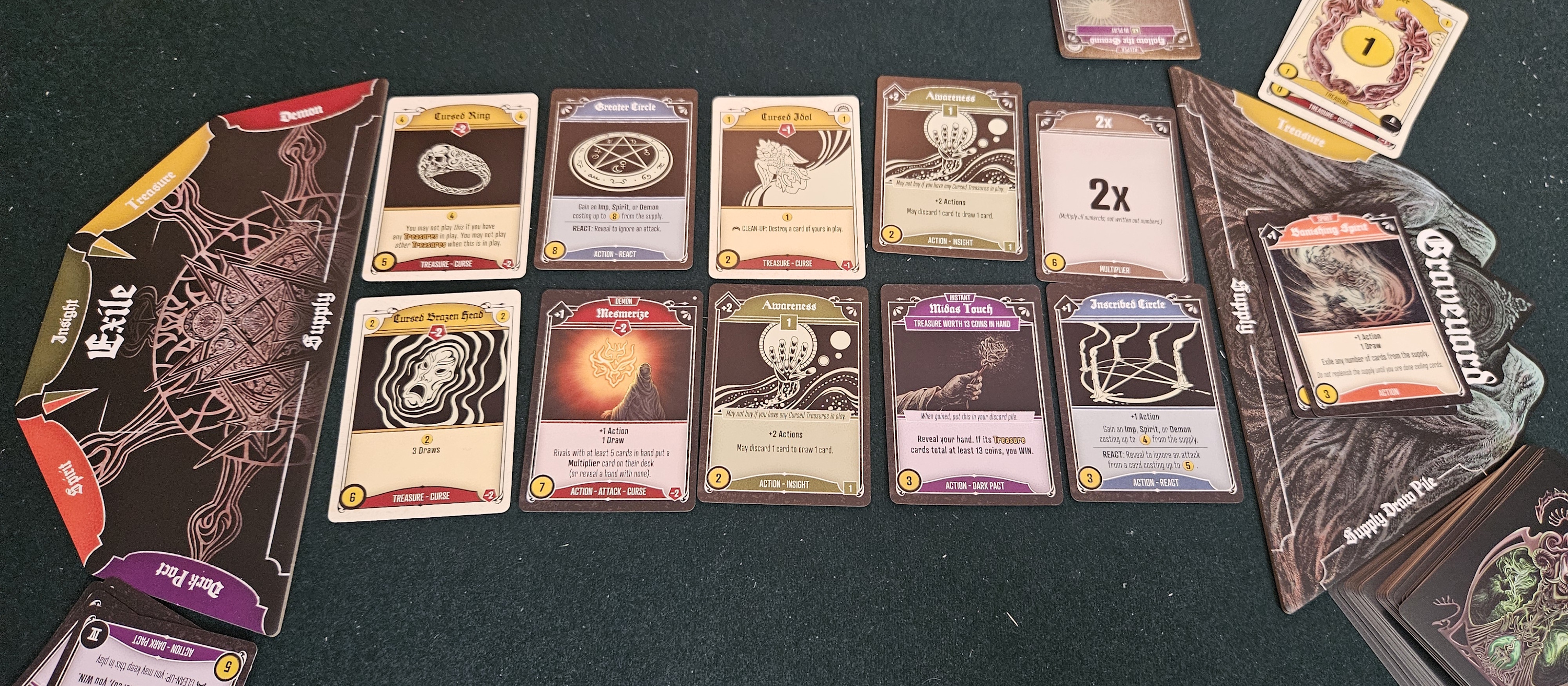
An old-fashioned (but not that old-fashioned) card market.

At a setting level, Dark Pact is about striking a bargain with a demon. I don’t have any experience in such a discipline, but it seems as close to otherworldly binding as Dominion was to Medieval villages. There’s a moment in the game, usually about five minutes into a session, when I can still appreciate Dug Nation’s woodblock-styled illustrations. Five minutes after that, those illustrations have faded from view, along with the remainder of the game’s trappings. All that remains is the machine I’m hopefully streamlining into something aerodynamic enough to drag two dozen cards into motion.

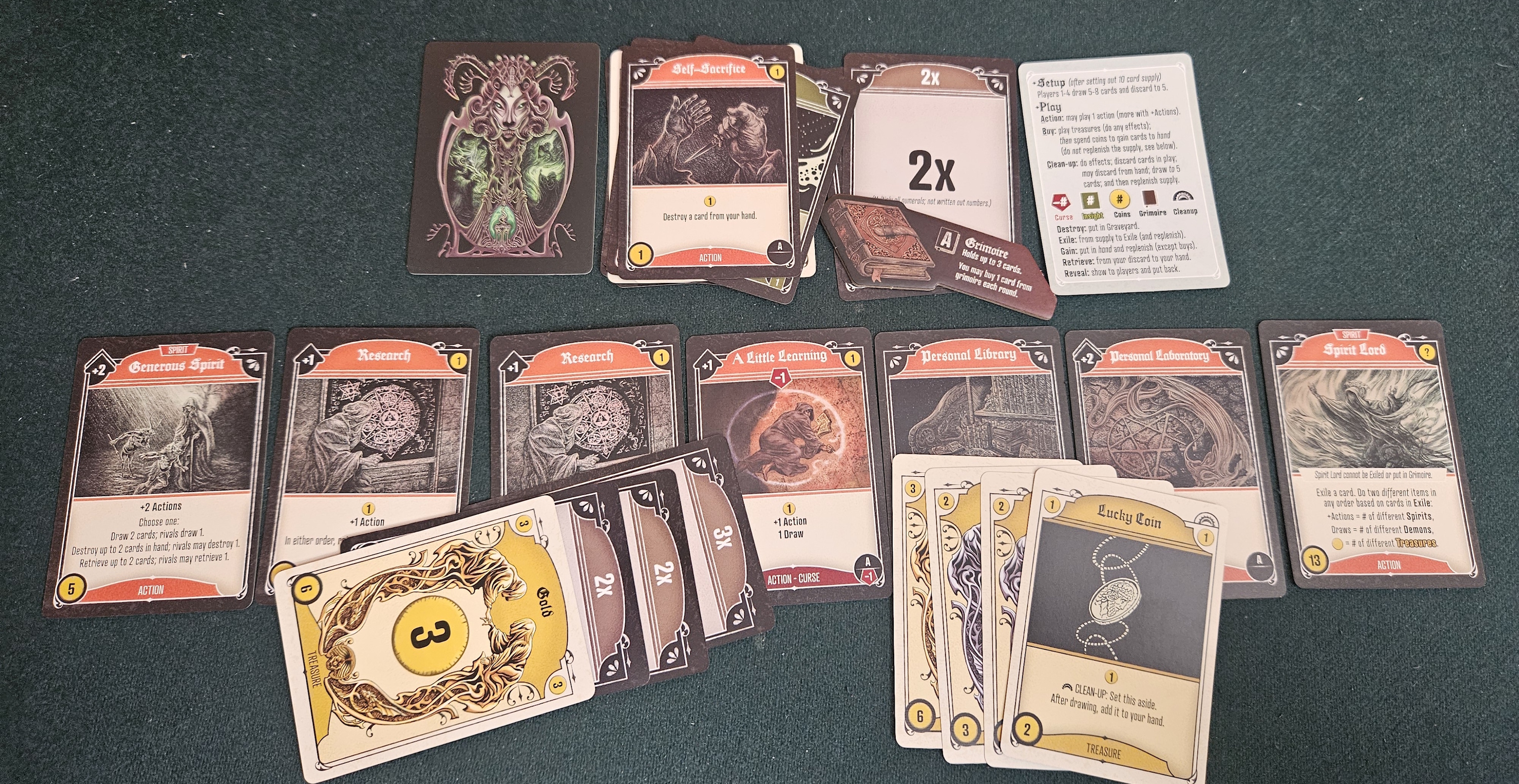
If you’ve played Dominion, you can play Dark Pact. By now the five-card hand has become industry standard, but even a few of Dominion’s other hallmarks return intact. By default you only receive a single action. That’s one card played to the table to activate its effect. Often that card will provide another action. Then its followup provides another two actions and some draws. Then the next card lets you retrieve something from your discard pile and, baby, you’ve got a stew going.

Also returning is Vaccarino’s market phase. After your actions are done, you’re allowed to play as much treasure as you can and purchase new cards. There are a few wrinkles this time around. For one thing, there are none of Dominion’s limited buys. If you want to split up your gold to purchase five cards, well, go nuts. For another, the market is now an ever-shifting offer rather than Dominion’s static display. What you see this turn may well disappear into your opponent’s deck before you get another stab at it.
Except, in Mormonism at least, it turned out that the entire cards-are-demonic thing came from a church leader's desire to stop women from getting together to play bridge — to prevent them from developing a third space that was out of reach of the church's male-dominated structure. There was an element of preventing gambling as well, but the earliest crackdowns and sermons mostly focused on bridge clubs.

Turns eventually spool into madness. Seems fitting.

Unsurprisingly, this is where Lehmann dives in with full gusto. There are cards aplenty to grab, with heaps of effects, and all of them are useful for one objective or another. But there are two in particular that transform Dark Pact from spooky-art Dominion into something that feels distinctly Lehmann-esque.

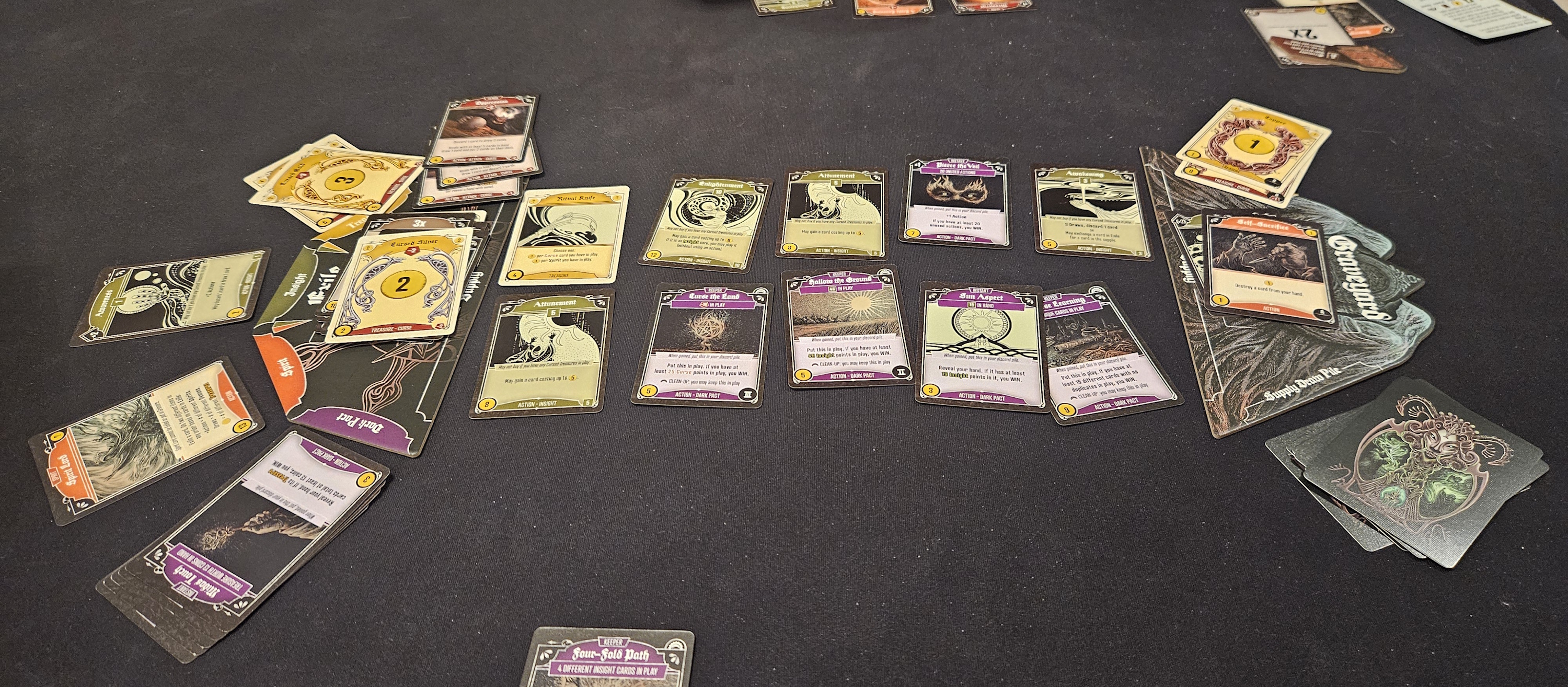
The first is the pacts. The dark pacts. Of Dark Pact fame. There are thirteen in all, all of them shuffled into the deck, and all offering a game-winning condition that initially sounds impossible. You might, in the course of your demonic experimentation, uncover a dark pact called Diverse Learning that will let you win if you have 15 unique cards in play. Or perhaps you’ll pursue Secular Power, the card that wins if you enter the market phase with 40 unspent coins. Or Great Potential. That one wins if you have 19 cards in hand.

For Lehmann-heads, dark pacts aren’t far off from the monuments and places of power in Res Arcana. It’s just that they’re hidden in the deck like your average demon-summoning ritual or cursed ring, get shuffled into your deck, and present conditions that let you win outright rather than offering spills of points. If their targets sound intimidating, that’s deliberate. When the game opens, most dark pacts are well out of reach. Especially, remember, because you only get one action per turn, five cards per draw phase, the usual limitations.

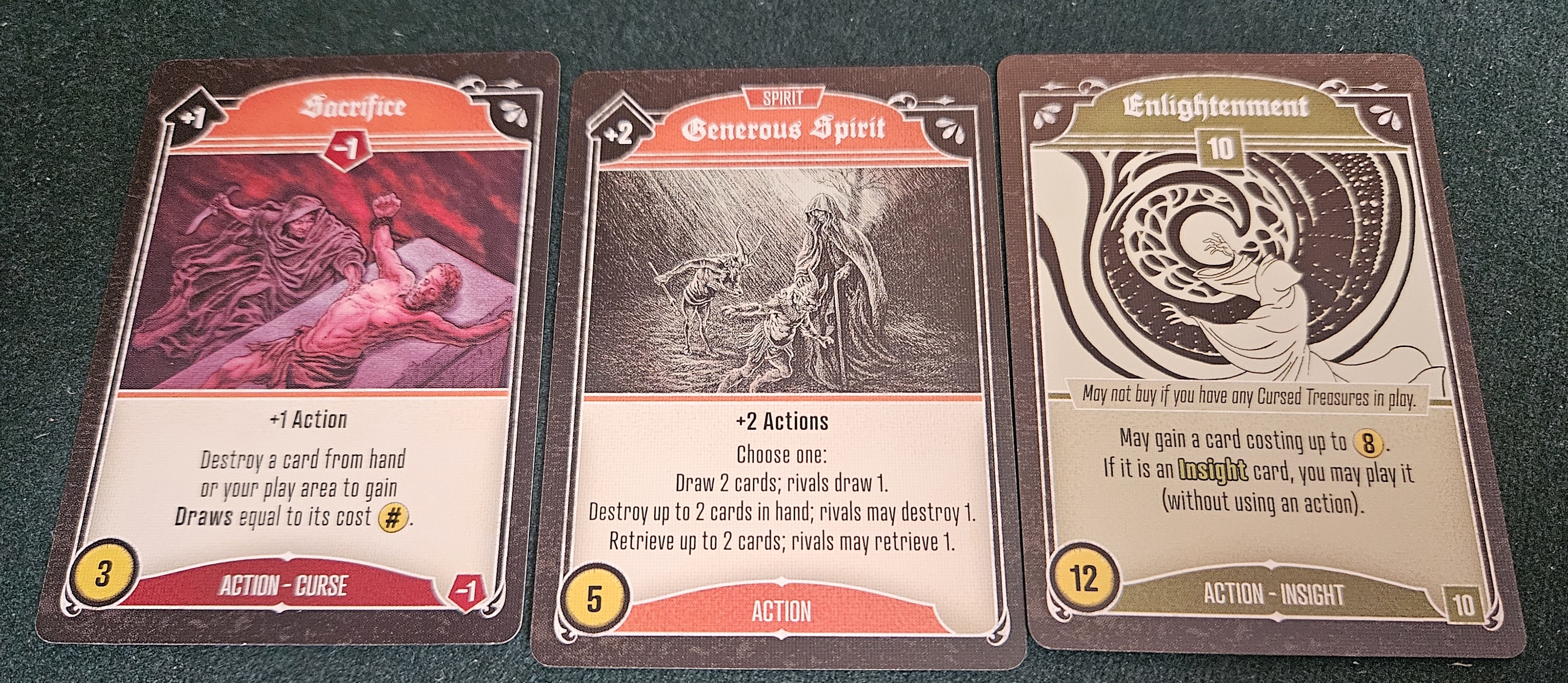
That’s where the second special card comes in: multipliers. They’re… multipliers. No spooky gauze this time. Just a simple 2x or 3x. These also circulate through your deck, and can be attached to any card to amplify the effects of its printed numerals. Gold coin? Now it’s worth two or three times more. Summoning circle? Now you can nab a card worth 16 or 24 coins rather than a measly eight. Generous spirit? Enjoy your six extra actions and nearly your entire discard pile popping back into your hand.

Things really get bonkers when you discover that multipliers multiply multipliers. Before long, some turns are transformed into those obnoxious order-of-operations social media tests. (“Only one in thirty people can solve this equation!”) The effects can be staggering. Thanks to multiple 3x cards stacked atop some silver, I once generated something like 70-ish coins in a turn. I wasn’t even holding the pact that let me win from having so many coins. It was so much that I could have bought out the entire market. I didn’t do it, of course. Winnowing is every bit as worthwhile in Dark Pact as any other deck-builder. It’s possible to over-stuff your card pool, so I reined myself in. But I considered grabbing all ten cards on offer for the lifetime accomplishment award.
This emphasis on niche issues like playing cards or "demonic themes" thus presents an ethical inversion for a faith community. The boundary marker becomes something easy for rank-and-file members of the group to accomplish ("Don't play card games") while the harder tasks ("Feed the poor, clothe the naked, visit the prisoner," etc.) become idealized rather than concrete. It allows the disengaged to feel like they're doing something active, while ignoring the imperatives that were actually requested of them by the faith community's founders and core texts.

Another day at the office.

At its best, these cards result in a deck-builder that’s incredibly familiar, to such a degree that it feels like a throwback to 2008, while also chucking everybody down a slip-n-slide to see who can break the game the fastest. In those moments, Dark Pact is Lehmann in top form. All the broken combos of Res Arcana. All the busted dice-assembling of Dice Realms. All the recursive triggers of Race for the Galaxy. All of it and more, wrapped in a tidy package that barely asks deck-building veterans to learn anything new. Truly, it’s impressive how smoothly the game riffs on the genre’s basics. When I say you can play Dark Pact if you’ve played Dominion, I mean it.

At the same time, Dark Pact sometimes feels one or two elements shy of a summoning ritual.

The biggest issue is duration. Basically, it’s often too slow for its own good. Turns are anything but simple, with one power begetting another, often after drawing from the deck, retrieving from the discard pile, and refreshing a segment of the market, all of which make it difficult to plan during one’s off-turn. It might sound like the exception to have a dozen cards trigger in sequence, but that’s the goal of Dark Pact, which makes turns sprawl more often than not. Even with only two players, the downtime and duration can be formidable. At three or four, they grow interminable. I would play the heck out of this game via an asynchronous app; on the table, it needs optimal conditions to thrive.

Meanwhile, I’m sure much will be made of the card balance. Multipliers are powerful, that goes without saying, and the early game often feels like a race to secure an economic engine that will springboard your longer-term plans. Fortunately, Lehmann offers a few solutions to sidestep the usual deck-building snares. Purchased cards go straight to your hand rather than first cycling through your discard and deck, and everybody begins with a few cards in their own private grimoire that can be purchased at their leisure, including, crucially, a deck’s second 2x multiplier. It’s a clever move that eases the whims of the flowing market without totally erasing what makes it interesting.

Personally, I’m more interested in the dark pacts. These don’t need to be balanced. I would go so far as to say they oughtn’t be. For all I know, they’ve been painstakingly playtested and algorithmically tuned. But some of them feel like a breeze compared to some others. Is this a problem? Only insofar as you make it one. It’s an open bar. If somebody nabs a pact that’s more reasonably completed than one you’ve taken, maybe it’s time to run interference. But there are some, maybe two, that feel so comparatively easy that I’m always going to give them priority. In a game this muscular, even the slightest flab seems especially visible, like a world-class bodybuilder with one sagging boob.
This is relatively common in faith communities over time. Nitpicky "side rules" become emphasized while core tenets atrophy, allowing easier boundary maintenance at the cost of shedding the same identity that is being maintained. BUT ANYWAY card games are cool huh? Play demonic games.

When nobody is sure which pact to buy, the market tends to clog with them.

Sagging boob or no, Dark Pact is fascinating for how Lehmann has taken a familiar formula and made it new again. This is Dominion, but rather than coming across as goofy when the optimal deck consists of seven sentries and four throne rooms, Dark Pact’s flowing market and sheer busted nature make the process feel vibrant and alive. It’s funny to get excited about trashing a card after all this time.

Which is to say, yeah, there are downsides. Some cards feel mistuned. The downtime is considerable. Four players? Forget about it. But Dark Pact once again showcases Lehmann as a master at work. In his hands, cards become more than cardstock. They’re components in a machine, one that sputters to life with every shuffle, draw, purchase, and winnow. The game is its own demon, and whatever dark pact Lehmann has struck to summon so many bangers in one lifetime, let’s hope the price never comes due.


(If what I’m doing at Space-Biff! is valuable to you in some way, please consider dropping by my Patreon campaign or Ko-fi. Right now, supporters can read my first-quarter update of 2026: the best board games, movies, books, and more!)

When to Make an Essential Edition (Featuring Euphoria)

23. April 2026 um 16:57

Yesterday I announced the Euphoria Essential Edition, which combines the core game with the expansion and includes some revised rules/components, particularly the board layout. It will be on the Stonemaier Games webstore, ready to ship, starting on May 13.

While discussing the game on yesterday’s livecast, I started to reflect on the factors that result in us considering an “essential” version of an existing game (e.g., Viticulture, Between Two Cities, Between Two Castles, and now Euphoria). I mentioned a few then, and I’ve added a few more to this list:

  1. The game only has 1 expansion, and we can combine the expansion with the game without significantly increasing the price of the essential version compared the original game’s price. This is critical, as we are always focused on price accessibility. If a $60 game and a $30 expansion combined together would still be close to $90 due to the manufacturing cost, we might as well keep them separate. But if the combination leads to some production optimization for a new price of $65, that’s great.
  2. The combined game plus expansion is still accessible to newcomers. Any first expansion of a Stonemaier game is at least partially the result of learning from what people say about the game. Many–but not all–first expansions offer seamless additions rather than new elements that make the game more complex, making them prime for essential editions.
  3. The game and the expansion have successfully been on the market for years. I like to give our games the time to find their audience and thrive in the wild for a long time before revisiting them before considering an essential edition (opposed to releasing the game and then creating a new edition right away).
  4. The game is out of stock but still in demand. For us and the amazing retailers who support our games, we wouldn’t want to create a new edition of a game while there’s still ample inventory of the previous version. We also only consider games with continual sales month-to-month.
  5. We are excited to revisit the game to offer the best version. Even if we’re literally just combining the core game and the expansion, there’s a lot of work involved, especially for the rulebook (but also potentially the box, reference cards, punchboards, etc). And sometimes–like with Euphoria–it’s even more work, as it’s an opportunity to improve the original. I spent a lot of time redesigning the board to make the order of operations and interconnected elements much easier to understand, learn, and teach, and artist Jacqui Davis completely remade the art to match the revised design. We’re passionate about all of our products, but there needs to be a special spark to revisit something that was deemed final for so long.
  6. If there are changes, they do not negate the investment of anyone who already owns the game and the expansion. This is really important to me, and it’s why we created an update pack for Euphoria that includes the new board, updated rulebooks, and the smaller artifact cards. It’s for this reason that I try to be very intentional while weighing the importance of making gameplay changes opposed to just seamlessly combining the game and expansion.

What do you think about these reasons? Is there anything else you would like me to consider for future essential editions (none of which are in the works)?

If you’re curious to learn more about the inception of Euphoria Essential, I’ve included the latest design diary post below.

***

April 23: The Inception of Euphoria Essential Edition

In March 2025, almost exactly 13 years after finishing the design for Euphoria, it was time to reprint the game. We’ve reprinted Euphoria a number of times over the years–a reprint is simply printing more of the same exact game–but this time I reached out to Morten (who had designed the Ignorance Is Bliss expansion) with the idea of updating Euphoria with everything I’ve learned about the game over the last decade.

Here’s what I proposed to Morten: 

  • Player mats and big tokens: Remember the tiles in Euphoria that let you quickly adjust token quantities (1x, 2x, 3x, etc)? I’m thinking we could update the player mats to have those tracks, allowing us to remove the big wooden tokens.
  • Board and bazaar: The inclusion of the player mats allows us to use the area of the game board currently occupied by tracks for the bazaar. It might be just a little tight, though–maybe decrease the size of artifact cards? Also, I would like to offer a double-sided board (bringing back the grayscale look of the original version on one side).
  • Recruits: I would love to offer a single set of recruits instead of telling players to use only the new or original recruits. To accomplish this goal, I’m open to removing some of the original recruits that aren’t balanced well for the expansion changes. I would also prefer to remove the factionless recruits. They’re clever, but by nature they are exceptions to standard recruit rules.
  • Markets: I feel similarly about the markets–I just want to shuffle them all together. If we need to remove some markets to accomplish this, that’s fine.
  • Gameplay: There are 4 elements of Euphoria that I don’t fully love: It’s difficult to teach despite its weight, I’m not sure the ethical dilemmas are necessary, it feels really bad to lose a worker due to a knowledge check (or even to see someone else lose a worker), and it feels impossible to catch up once someone has 9 stars and you’re behind. I’m not necessarily saying that anything needs to change to address these issues, but this is an opportunity to do so if we choose.

[end of message to Morten]

I’ll cut to the chase on a few of these elements: The final result was that we  consolidated information onto player mats, we combined all recruits (102 total: asymmetric abilities that each player has), and we combined all market tiles (34 total: worker-placement actions to construct on the board). This essentially results in Euphoria plus the Ignorance Is Bliss expansion, offering a ton of variability with everything seamlessly integrated into a single box.

What do you think about this inception story? Join us tomorrow to dive into the core elements of the Essential Edition’s board, including a few minor-but-impactful rule changes! You can also click here to get a May 13 launch notification (followed by shipping later in May).

Arkham Horror: The Card Game Core Set Game Review

Crispy Core

I love Arkham Horror: The Card Game. It’s probably one of my “desert island” games, thanks to the sheer amount of content and replayability. The game has evolved into an entire franchise, aptly named the “Arkham Files,” expanding into video games, novellas, tabletop RPGs, and even comic books published by powerhouse Dark Horse Comics.

Last year, the game’s storyline concluded with a great calamity in The Sinking City campaign, leading into the “soft reset” in 2026 with Chapter 2. Not only does this create a fresh launching point for a new storyline, but it also gives new players an ideal place to jump in.

Fantasy Flight’s vision for Arkham Horror breaks down into a “legacy environment,” in which all existing and past content can be used alongside future content, and a “current environment.” The current environment has a smaller card pool, and future campaigns are structured around mechanics in that evolving meta, though what exactly that will look like, we’ll have to wait and see. Presumably, this is meant to reset deckbuilding to a more even playing field. With so much existing content, it’s easy to build an overpowered deck and breeze through what should be a challenging experience.

The post Arkham Horror: The Card Game Core Set Game Review appeared first on Meeple Mountain.

Hasbro delays Q1 results after cyber attack, expects revenue rise from ongoing Magic strength

23. April 2026 um 14:32

Toy and game maker Hasbro has delayed its quarterly results by almost a month after suffering a cyber attack, but said it expects to post Q1 revenues of up to $985m thanks to continued strong performance of Magic: The Gathering.

Hasbro said it identified “unauthorized access” to the company’s network on March 28, but believes that access has been “contained” – adding that Magic’s shipments and release cadence had continued unaffected.

The company expects Q1 revenue to be between $970m and $985m, a rise of between 9% and 11% compared to the same period last year – while operating profit is expected to reach $235m to $245m, a 38% to 44% jump.

Those preliminary results are expected to be solidified when Hasbro eventually releases its full Q1 financial report, which is now scheduled for May 20.

Magic continues to underpin Hasbro’s fortunes, with the veteran trading card game’s revenue having soared 59% last year to mark its strongest annual performance yet.

Hasbro saw its wider 2025 revenue rise almost 14% to $4.7bn, driven by a record 45% growth in its Magic, D&D and digital gaming division Wizards of the Coast, the company revealed in February.

Magic’s record-breaking year was capped off by a storming fourth quarter, which saw revenues from the game up 141% compared to Q4 2024 on the strength of the Avatar: The Last Airbender and Final Fantasy releases.

That stellar performance of Wizards, and Magic in particular, was in stark contrast to Hasbro’s consumer products segment – which includes Nerf guns, Transformers and Peppa Pig toys.

That segment saw revenues drop 4% last year “amongst macro and retailer volatility brought on by tariff announcements in Q2″ – and unlike for Magic, Hasbro said that the cyber incident would likely impact second quarter revenues and operating profit in consumer products due to expected order processing, shipping and invoicing delays.

Hasbro added that it still expects full-year revenues to rise between 3% and 5% in 2026. Hasbro CFO and COO Gina Goetter said in February that the company expects Wizards of the Coast to deliver mid-single-digit revenue growth in 2026, “supported by a healthy release cadence and continued engagement across the Magic ecosystem”.

The post Hasbro delays Q1 results after cyber attack, expects revenue rise from ongoing Magic strength first appeared on .

Best 3 Games with…Designer John Poniske!

Von: Grant
23. April 2026 um 14:00

John Poniske is a prolific designer and we have enjoyed several of his games including Revolution Road from Compass Games, Plains Indian Wars from GMT Games, Bleeding Kansas from Decision Games, Hearts and Minds from Worthington Games and Maori Wars: The New Zealand Land Wars 1845-1872 from Legion Wargames. We also own several of his designs but have not had a chance to get them tabled yet including King Philip’s War from Multi-Man Publishing and Pontiac’s War: Frontier Rebellion, 1763-66 from Compass Games. We have done several interviews with John over the years and I always enjoy this thoughts on the subjects that he decides to cover. In this entry in the Best 3 Games with…Series, I take a look at 3 of John’s designs that have spoken to me.

3. Maori Wars: The New Zealand Land Wars, 1845-1872 from Legion Wargames

Maori Wars: The New Zealand Land Wars, 1845-1872 from Legion Wargames is a game that uses as a background the uprisings that took place between 1845 and 1872 due to British colonial incursions into native Maori lands on the North Island of New Zealand. The ensuing conflict over a period covering nearly 30 years involved the destruction of a number of Maori villages, Pas, which are fortified villages that featured intricate trench-works and some colonial settlements. The war introduced the British to a very skilled and strategic combatant who used a strategy of ambushes and bush raiding to catch off guard and frustrate the professional British ranks. The hallmark of the game is that it is highly playable by featuring low counter density, a play time of under two hours for most of the scenarios and easy to understand rules.

Playing as the British, players will have to deal with swinging tribal loyalty and will need to master the rivers and seas to move their more powerful troops and gunboats around while the Maori player will be focused on bush-raiding, which allows the Maori to move units temporarily off the board and out of harms way, but then to later bring them back in a more favorable strategic location of their choosing. The asymmetry in the fighting styles is really very good and I like the way it factors into account the history.

Maori Wars is a great game with some really beautiful art, not only on the board but also on the counters. The game is a slugfest between the mighty British and their Queenite allies against the inhabitants of the island in the various Maori tribes that resisted their colonial oppressors. The tribes have lots of tricks up their sleeves and use the land and their knowledge of it to great advantage as they conduct bush raids regularly and are very difficult to bring to decisive battle.

Here is a look at our unboxing video for Maori Wars: The New Zealand Land Wars, 1845-1872 :

We also did a video review and you can watch that at the following link:

2. Bleeding Kansas from Decision Games

Bleeding Kansas is a very well designed 2-player game that deals with the violence and politics of pre-statehood Kansas from 1854-1861. The game focuses on the tensions between pro-slave and abolitionist parties and their attempts to win over emigrants to Kansas to their cause and thereby influence the outcome of elections to move the state toward their leaning on the issue of slavery. The game has four elections that players will fight over trying to have the most influence in Kansas counties to score victory points. At its heart, the game is an area control game that has splashes of election dynamics that feels very Euro-like as it uses cubes to represent forces.

The core mechanism in the game is the cards. Each of these cards is tied to an historical event, important person or other factor involved in the conflict and allows players to choose their actions for that immediate turn. The game proceeds as players alternate the play of one of the cards from their hand to take various actions from symbols that appear on the cards. These symbols provide actions such as influencing new settlers to the region to join their side in the conflict, build up forces for the coming battle, take control of counties by moving these forces around or displacing those of your opponent, attacking the opposition, burning down their population centers, enticing settlers to migrate to their areas or request intervention from the Federal Garrison stationed at Leavenworth. The cards carry out the plans of players and create a historical narrative of the conflict.

The game really is pretty simple mechanically but don’t let the game’s simplicity fool you. This is a knock down drag out bare knuckle fight for supremacy in the Kansas Territory and will test you’re meddle as you fight back and forth undoing what your opponent has just done. The game boils down to staying the course and playing your cards smartly to gain the upper hand in elections. You have to be able to judge where control stands as you play each card and you have to plan as scoring elections can really sneak up on you if you are not paying attention.

Here is a look at our unboxing video so you can get a good look at the components:

Here is a look at our video review of the game:

Here also are links to a series of Action Points on the various aspects of the game:

Action Point 1 – Burn and Skirmish Actions

Action Point 2 – Movement and Influence Actions

Action Point 3 – Politics, Migration and Cooperation Actions

Action Point 4 – Election Track and Election Process

We also did an interview with designer John Poniske that you can read on our written blog at the following link: https://theplayersaid.com/2019/07/08/interview-with-john-poniske-designer-of-bleeding-kansas-from-decision-games/

1. Devil Dogs: Belleau Wood 1918 from Worthington Publishing

Devil Dogs: Belleau Wood 1918 is an easy to learn, fast-playing card-driven game for 2 players. The play map covers the historical French battlefield geography and the 300 counters and markers represent the historical units and incidents involved along with chits that determine initiative and order choice. The game is unique in that it captures the tension and high rate of casualties without ever casting a single die, relying more on planning and issuing orders as the active or reactive player. Each side will have a 30 card deck that is faction specific.

I love Multi-Use Cards in a game and this one uses faction specific decks that can be used in several different ways. The combat system is also quite unique as hits are not calculated by a die roll and reference to a CRT but by the combat strength of the units attacking determined by the play of a card and then in what terrain the targets are hiding. The best element of the game though was having to play a card to each sector on the map without knowing what your opponent will play and then seeing how you did. Really interactive and interesting game and this one was a big hit with both of us! Although the rules were a bit challenging in their format and presentation but nothing that we couldn’t handle after a few turns into the game.

Here is a link to our video review of the game:

There you have it. My Best 3 Games with…Designer John Poniske! He has done so many good games and the narrative and historical immersion of all of them are top notch.

What are your favorite games from John Poniske?

-Grant

Moon Review

23. April 2026 um 12:59
MoonExtraterrestrial settings are popular for board games, possibly because they avoid the potential geopolitical quandary or insensitivity of area control, settlement, and resource/worker exploitation inherent to games of more Earthly environs. Thus, designers are free to escalate conflict without offense, such as in titles like Moon Colony: Bloodbath, Moonrakers, and Skymines. This is where 2023’s […]

Source

Malaysia Boardgame Show on national TV

The Malaysia Boardgame Show was covered on national television. See the clip here (the video is in Malay): https://www.facebook.com/reel/4243861829210835 The organiser Jon. My friend is on TV! Effendy's game Melaka won 3rd place in the Zenobia AwardsMany Malaysian themed games were showcased at the event

Heavy is the Head that Wears the Crown

by Steph Hodge

A heavy hitter today with these new releases

[imageid=6268503 medium rep]▪️ Coming this May we can expect to see The Queen's Dilemma released by Horrible Guild. Many of you have played or heard of The King's Dilemma, which was the first legacy game set in the Kingdom of Ankist. The Queen's Dilemma is a follow-up sequel set hundreds of years later. It will use an improved card system and tell a whole new story through a legacy campaign.

From the newsletter:
If you played The King’s Dilemma, you already know the tension of debating, negotiating, and voting on critical issues that define the future of the kingdom. This sequel builds on that foundation with:
▪️ a deeper ideology system, with opposing principles that constantly pull the kingdom in different directions
▪️ memorable council members with their own backgrounds, public alignments, and secret agendas that shape debates and long-term goals
▪️ an expanded economy and territory management system, where regions can rise in influence or fall into unrest, directly impacting negotiations and map development
▪️ a refined Dilemma Card System that unlocks envelopes and Mystery bags, introducing new events, rules, and components as your campaign evolves
▪️ new narrative layers built for a multi-session arc (up to 17 sessions, over 30 hours of gameplay), where every vote leaves lasting consequences and story threads carry forward

Each session runs around 90 minutes, and every vote leaves a permanent mark on the campaign: alliances will form, promises will break, and the kingdom will change according to your decisions.


▪️ The Last Spell: The Board Game is a new release based on the Ishtar Games' video game published in English by Ares Games. This game was successfully funded back in 2023 on Kickstarter from Tabula Games and has been fulfilled to backers and is now available for sale.

This is a cooperative tower defense campaign game, but you can play one-off missions as well.

From BGG:
The game is set in a dark fantasy, post-apocalyptic world in which you have to carefully manage the scarce resources at your disposal to survive long enough. Gameplay revolves around three cycles of day and night in which players use daylight hours to bolster the game economy, fortify defenses against nocturnal invaders, and upgrade their heroes' equipment to unlock more power.


▪️ Mayfair Games joined forces with Alion – by Dr Ø to exlusively release Recall in the United States. Today is the scheduled retail release date, so you should be able to acquire it! This was a very popular title at BGG.CON Fall 2025 after its Spiel release.

Recall is brought to you by the designers of Revive (Helge Meissner, Kristian Amundsen Østby, Kjetil Svendsen, Anna Wermlund). The games have similar mechanics in a few ways, but the overall gameplay and feeling is completely different. For those who love crunchy Euros, you are in luck for this US release.

From BGG:
Recall is a deep strategy game from the designers of Revive that focuses on engine building and exploration. Each player begins the game with one of fourteen unique tribes and one of eighteen unique gadgets, both of which will heavily influence your strategy and opportunities. Throughout the game, you will lead your tribe, explore the lands, and discover traces of ancient civilizations to learn from them. On your turn, you either:
• Use a keycard to activate an action box, or
• Recall to produce resources and regain your keycards.

When you use a keycard, you activate the abilities of the keycard itself and the effects of the chosen action box. The chosen combination of keycard and action box will therefore determine what you get to do on your turn: populate the lands, move your followers, explore new regions, and build workshops, vaults, or monuments. During the game, you will improve your tribe by acquiring new keycards, upgrading your action boxes, or collecting ability stones and relics.


Orloj: The Prague Astronomical Clock Game Review

There was a moment late in my first game of the medium-weight strategy game Orloj: The Prague Astronomical Clock where I pretty much landed on my final thoughts about the game.

I had just taken a turn that felt pretty dope. That turn began when I took the Construction action, and spent four resources to construct the second-to-last piece of the month dial on the big clock at the center of the board. That netted me eight points, for the gold, two wood, and paint I had spent to build it. Then I placed one of my workers on the clock, and thanks to adjacency rules, scored four more points. Then I got a bonus based on the position of that completed space on an outer wheel that surrounds the clock, a track that lists bonuses on what is known as the Painter track.

That bonus gave me a free apostle. These apostle tiles are earned and placed in one of two storage slots on each player’s personal board. As a free action, I took that new apostle and placed it in a column on my personal, 12-space apostle board. It was the third apostle in one of the columns, which earned me another bonus: an Assistant tile, which went into the newly vacated storage space where that apostle…

The post Orloj: The Prague Astronomical Clock Game Review appeared first on Meeple Mountain.

Madcala Review

22. April 2026 um 14:53
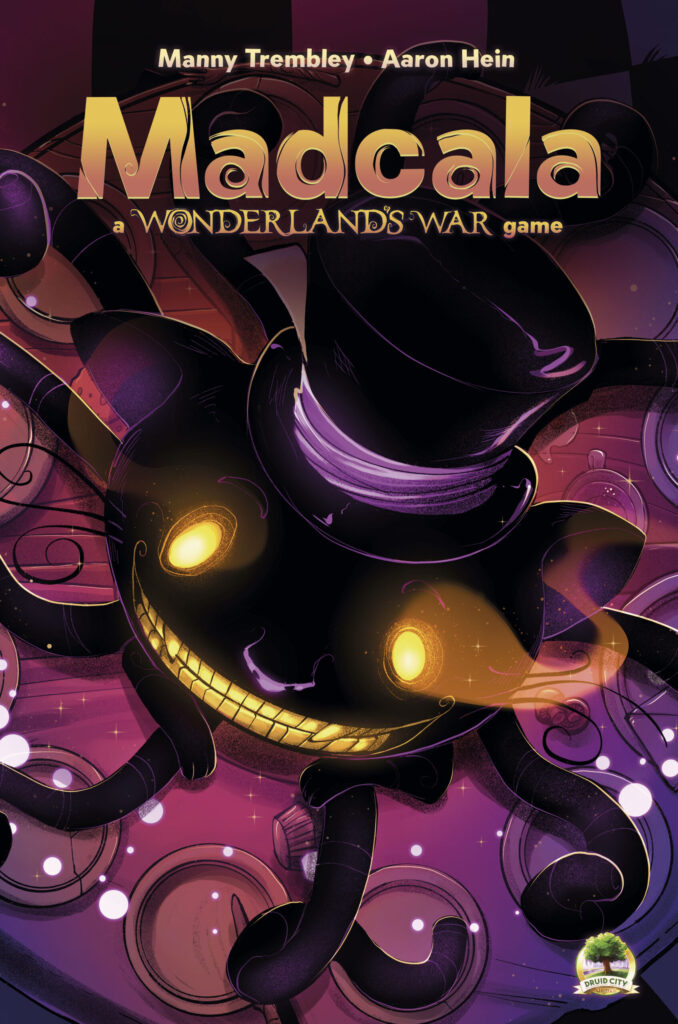
MadcalaI love it when game designers give us a unique take on mechanics that have been around for a long time. Fight 5 gave us a new spin on the card game war, Samurai Spirit channeled its inner blackjack, and quite a few games have pulled from the ancient game Mancala, notably Five Tribes. Today, […]

Source

High-IQ society Mensa reveals its top board games after annual four-day judging marathon

22. April 2026 um 14:17

The American arm of high IQ society Mensa has unveiled the latest crop of board games winning its Mensa Select seal, which are voted on by hundreds of organisation members during an annual four-day gaming marathon.

Alex Cutler and Peter C Hayward both saw two of their creations win the seal this year, including their co-design Critter Kitchen, Hayward’s Things in Rings and Cutler’s A Place for All My Books – which he co-created with Michael Mihealsick.

Things in Rings publisher Allplay also saw its title Twinkle Twinkle, designed by Ammon Anderson, pick up a Select seal, while other winners this year included Matthew O’Malley and Ben Rosset’s Fromage, Yoann Levet’s Got Five and Tomáš Holek design Galileo Galilei.

Entries to the annual Mensa Mind Games are judged on aesthetics, instructions, originality, play appeal and play value, Mensa says, with the award aiming to highlight games that are original in concept, challenging and well-designed.

Not all games released during the past year are eligible for the award, however – entries carry a fee of several hundred dollars each, and games up for consideration need to have an average play time of 90 minutes or less.

Barnes & Noble and other major retailers have previously given special consideration to games bearing the Mensa Select seal, while winning games are also featured by American Mensa’s official online retailers and on its website.

Fromage is the most decorated of this year’s seal winners, having previously won the Origins Award for best light strategy game, as well as picking up nominations for medium game of the year, most innovative game and best artwork in the 2024 Golden Geek Awards.

Fromage, designed by Matthew O’Malley and Ben Rosset

Things in Rings was previously nominated in both the Golden Geeks and Origins Awards in the best party game category.

Last year’s Mensa Select seal winners included Agueda: City of Umbrellas, Diatoms, HutanIn the Footsteps of Marie Curie and Farms Race: Deluxe Edition.

This year’s Mensa Select seal winners in full:

  • A Place for All My Books – designed by Alex Cutler and Michael Mihealsick (published by Smirk & Dagger Games)
  • Critter Kitchen – Alex Cutler and Peter C Hayward (Cardboard Alchemy)
  • Fromage – Matthew O’Malley and Ben Rosset (R2i Games)
  • Galileo Galilei – Tomáš Holek (Capstone Games)
  • Got Five – Yoann Levet (Blue Orange Games)
  • Things in Rings – Peter C Hayward (Allplay)
  • Twinkle Twinkle – Ammon Anderson (Allplay)

The post High-IQ society Mensa reveals its top board games after annual four-day judging marathon first appeared on .

My Favorite Wargame Cards – A Look at Individual Cards from My Favorite Games – Card #74: Open Borders from 2040: An American Insurgency from Compass Games

Von: Grant
22. April 2026 um 14:00

With this My Favorite Wargame Cards Series, I hope to take a look at a specific card from the various wargames that I have played and share how it is used in the game. I am not a strategist and frankly I am not that good at games but I do understand how things should work and be used in games. With that being said, here is the next entry in this series.

#74: Open Borders from 2040: An American Insurgency from Compass Games

2040: An American Insurgency is a card driven game that attempts to simulate a near future US civil war in the 21st century. In this 2-player game that plays in less than 3 hours, the blue team is the Federals representing agents of the government in Washington. The red team are the Rebels including militia groups trying to seize control of states, highways, and cities. The conflict spreads across the entire continental US, from Miami to Seattle and from Los Angeles to New York.

This game is not perfect and it has some issues and the graphics are not that great frankly. As I played the game, I actually felt like it was a pretty decent game, with some very interesting mechanics covering an interesting topic. I know it isn’t perfect and in some ways the designer was so careful not to offend anyone in the game that he really didn’t get to say anything about the situation and its causes, and the game somewhat suffers from that. But it was interesting and I believe that we are about the only ones who played the game.

In this post, I will be taking a look at a Neutral Card called Open Borders. Remember, that each event is either friendly, enemy, or neutral. Friendly events help you; enemy events help your enemy while Neutral events can help either player. Gray cards such as Open Borders have no identifying side’s markings in the bottom right corner and when you play a Neutral Card, you may choose to do the Ops or the Event. Open Borders is a very good Neutral Card because it is a 3 Ops card and can be used to take various standard operations, such as raising
troops, fundraising and attacking. The card also is identified as a Momentum Card, which means that if played as the event, the effect will persist until a time specified in the text of the Event or, if none, until the end of the game. With Open Borders, the spaces of Mexico and Canada become playable areas on the board. These areas typically become a way for the Rebels to build and develop bases from which they recruit fresh insurgent units and then cross over the Open Borders to attack those States that border these areas eroding their Order and creating chaos and Revolt. The Open Borders Card allows this but also allows the Federal player to respond by crossing over the border and attempting to squash these recruiting centers.

The other effects of the Event provides both sides with a bonus when they take certain actions such as Tax for the Federals and Recruit for the Rebels. When the card has been played and is in effect, the Federal Tax Action will provide an additional $4 worth of income from the action. This is an effect of open borders and the unrestricted use of free trade and cross border commerce creating new jobs, providing additional sources of income and employing workers who ultimately pay income taxes on those improved wages. The Rebel Recruit Action will gain an additional Militia unit per space where taken. This reflects the stoking of anger at home as illegals and other bad actors are able to pour across the borders unfettered. I very much like this card for its game effect but also for the questions and concerns that it raises in this debate. Such an interesting economic spin on this issue through the game and I think is a very well done part of the design.

The concept of open borders highlights a fundamental tension between national security, economic openness, and civil liberties. Post-9/11, critics argue that porous or “open” borders allow terrorists to exploit security gaps, while proponents of open borders emphasize that excessive restrictions hurt economic freedom and that security should be managed through intelligence rather than isolation. The biggest concern regarding open borders is that unvetted, irregular migration through porous borders can be exploited by extremists to enter countries and perform acts of terrorism, sedition or general mayhem. To manage the tension between security and economic openness, many nations have turned to the concept of biometric borders. This involves using risk profiling and digital identity such as fingerprints and facial recognition to separate “civilized” business travelers from “illegitimate” and bad actors. This use of these high tech instruments in surveillance, data tracking and technology to distinguish between legitimate travel and potential threats has raised more concerns with civil liberty and privacy. This debate often pits “secure borders” against “open doors,” with officials grappling with protecting citizens without sacrificing the democratic principles of open societies. In one of the most famous quotes from history about privacy, Benjamin Franklin stated “Those who would give up essential liberty, to purchase a little temporary safety, deserve neither liberty nor safety“. Where do you land on this issue of Open Borders?

Here is a link to our unboxing video showing the components:

Here also is a link to our full video review:

I also posted an interview with the designer Edward Castronova on the blog and you can read that at the following link: https://theplayersaid.com/2023/04/04/interview-with-edward-castronova-designer-of-2040-an-american-insurgency-from-compass-games-currently-on-kickstarter/

In the next entry in this series, we will take a look at The Second Funnel from The Hunt from Salt & Pepper Games.

-Grant

Arydia leads Golden Geek nominations with nods in six categories, Vantage and Fate of the Fellowship up for five each

22. April 2026 um 12:37

Co-op fantasy adventuring game Arydia: The Paths We Dare Tread has scored six nominations in the 20th annual Golden Geek Awards, which are selected and voted on by BoardGameGeek users.

Cody Miller’s “green legacy” design, which can be fully reset after each dozens-of-hours-long campaign, is up for heavy game of the year, most innovative game and best thematic game, as well as for the best artwork, solo game and co-op game categories.

Fellow open-world exploration game Vantage, designed by Scythe and Viticulture creator Jamey Stegmaier, is challenging across five categories this year, as is Pandemic creator Matt Leacock’s spin-off design The Lord of the Rings: Fate of the Fellowship.

Both those titles will battle it out for the Medium Game of the Year prize, which is also being contested by popular releases including Galactic Cruise, Eternal Decks and fellow Stonemaier Games title Finspan.

Eternal Decks, a limited communication co-op game designed by Hiroken, has picked up four nominations

Other titles picking up nominations across multiple categories included Eternal Decks, Star Trek: Captain’s Chair and Hot Streak, with four each, while Magical Athlete, Molly House, Luthier, Galactic Cruise, Corps of Discovery, The Old King’s Crown, Speakeasy and The Elder Scrolls: Betrayal of the Second Era all picked up three nods.

The Golden Geeks is one of board gaming’s highest profile awards, as well as being among the earliest of the major competitions to unveil its winners each year – with the Dice Tower Awards falling in May, the Spiel des Jahres in July and Deutscher Spiel Priese in October.

Notable awards which have already named their winners this year include France’s highest-profile board game prize, the As d’Or, which picked Paolo Mori and Alessandro Zucchini’s Toy Battle in its main prize for 2026.

Toy Battle is nominated in two categories in the Golden Geeks: best two-player game and best wargame. The latter category will see the title go up against a huge variety of different designs, including Memoir ’44-inspired Star Wars: Battle of Hoth, whist-themed English civil war strategy title A Very Civil Whist, and heavyweight GMT Games releases such as Congress of Vienna and Seljuk: Byzantium Besieged, 1068-1071.

As well as published board games, the Golden Geeks also features categories for best print and play design, best board game app and best podcast.

Voting will be undertaken by BoardGameGeek users who have paid an annual support fee in any year, who pay a one-time 20 GeekGold fee, or who have purchased an avatar on the site. They will rank nominees in individual categories, with voting set to end on April 30.

Last year’s Golden Geeks saw Arcs, the hybrid trick-taking wargame from Root and Oath designer Cole Wehrle, win a trio of awards, while fellow space-themed game SETI notched up a pair of wins.

This year’s Golden Geek Awards nominations in full:

2-Player Game
Azul Duel
Duel for Cardia
Everdell Duo
Flamecraft Duals
Iliad
Star Trek: Captain’s Chair
Star Wars: Battle of Hoth
Tag Team
Toy Battle
Zenith

Artwork & Presentation
Arydia: The Paths We Dare Tread
Eternal Decks
Galactic Cruise
Hot Streak
The Lord of the Rings: Fate of the Fellowship
Luthier
Magical Athlete
The Old King’s Crown
Speakeasy
Vantage

Cooperative Game
Arydia: The Paths We Dare Tread
Corps of Discovery: A Game Set in the World of Manifest Destiny
The Elder Scrolls: Betrayal of the Second Era
Eternal Decks
The Lord of the Rings: Fate of the Fellowship
Nemesis: Retaliation
Regicide Legacy
Take Time
Unmatched Adventures: Teenage Mutant Ninja Turtles
Vantage

Expansion
Castle Combo: Out of the Oubliette!
Clank!: Catacombs – Underworld
Dune: Imperium – Bloodlines
Earth: Abundance
Heat: Tunnel Vision
The Lord of the Rings: Duel for Middle-Earth – Allies
Lost Ruins of Arnak: Twisted Paths
Sea Salt & Paper: Extra Pepper
SETI: Space Agencies
Wyrmspan: Dragon Academy

Innovative
Arydia: The Paths We Dare Tread
Corps of Discovery: A Game Set in the World of Manifest Destiny
Eternal Decks
Hot Streak
Light Speed: Arena
Molly House
Moon Colony Bloodbath
The Old King’s Crown
Tag Team
Vantage

Light GOTY
Duel for Cardia
Flamecraft Duals
FlipToons
The Hobbit: There and Back Again
Hot Streak
Magical Athlete
Railroad Tiles
Star Wars: Battle of Hoth
Take Time
Toy Battle

Medium GOTY
The Druids of Edora
Eternal Decks
Finspan
Formaggio
The Lord of the Rings: Fate of the Fellowship
Moon Colony Bloodbath
Sanctuary
Skara Brae
Vantage
Zenith

Heavy GOTY
Ada’s Dream
Arydia: The Paths We Dare Tread
The Elder Scrolls: Betrayal of the Second Era
Galactic Cruise
Luthier
Molly House
The Old King’s Crown
Speakeasy
Star Trek: Captain’s Chair
Sweet Lands

Party Game
Alibis
Barbecubes
Brick Like This!
La Cuenta
Hitster Rock: Bob!
Hot Streak
Light Speed: Arena
Magical Athlete
Take Time
Wine Cellar

Print & Play
52 Duels
Chronicles of Civilization
Crosswhords!
Dungeons of the Oak Dell
Elevation (fan expansion for Android: Netrunner)
The Promise
Rise of the Oak Dell
Terra Mystica: Fan Factions

Solo Game
The Anarchy
Arydia: The Paths We Dare Tread
Corps of Discovery: A Game Set in the World of Manifest Destiny
Deckers
The Elder Scrolls: Betrayal of the Second Era
The Lord of the Rings: Fate of the Fellowship
Skara Brae
Star Trek: Captain’s Chair
Unstoppable
Vantage

Thematic Game
Arydia: The Paths We Dare Tread
Galactic Cruise
The Lord of the Rings: Fate of the Fellowship
Luthier
Molly House
Moon Colony Bloodbath
Nemesis: Retaliation
Speakeasy
Star Trek: Captain’s Chair
Vantage

Wargame
Battlefields of the Napoleonic Wars
China’s War 1937-1941
Congress of Vienna
Cross Bronx Expressway
Fields of Fire: Deluxe Edition
General Orders: Sengoku Jidai
Seljuk: Byzantium Besieged, 1068-1071
Star Wars: Battle of Hoth
Toy Battle
A Very Civil Whist

Best Podcast
Blue Peg, Pink Peg
Board Game Hot Takes
Board Games Insider
Decision Space
Five Games for Doomsday
Game Brain: A Board Game Podcast About Our Gaming Group
Shelf Stable: A Board Gaming Podcast
Space-Biff! Space-Cast!
Sporadically Board with Mike and Dan
Talk Cardboard

Best Board Game App
Ark Nova
Carnegie: The Board Game
Cascadia Digital
Caverna
The Isle of Cats
Kingdomino: The Board Game
MicroMacro: Downtown Detective
Reiner Knizia’s My City
SpaceCorp
Watergate – The Board Game

The post Arydia leads Golden Geek nominations with nods in six categories, Vantage and Fate of the Fellowship up for five each first appeared on .

BGI 416 The One About 3 Degrees from Kevin Bacon in Board Games 

22. April 2026 um 09:32

BGI 416 The One About 3 Degrees from Kevin Bacon in Board Games 

Board Games InsiderJoin our Guild on Board Game Geek Guild | Like us on FB

Social media:

Ignacy Trzewiczek / Portal Games: website | FB | Twitter | Youtube

Corey Thompson / Above Board TV:  website | Youtube

Stephen Buonocore / “The Podfather Of Gaming”: website | FB | Twitter | Youtube

Intro Music: Happy Rock – Bensound.com

💾

Malaysia Boardgame Show 2026: 2 busy days!

18-19 Apr 2026 was the Malaysia Boardgame Show. It was held at Jaya One shopping mall in PJ. In the past few years there has been several different boardgame-specific events in Malaysia, like Asian Board Game Festival (in Penang), Boxcon, All Aboard, Dice & Dine, Anigames. Not all are recurring. MBS is organised by Jon, who is currently the most active game designer in Malaysia. He has

Reichbusters: Reloaded v1

21. April 2026 um 23:22

You’re in it now, up to your neck!

Infiltrate the Third Reich with your Reichbusters: Reloaded rules and reference!

I spent a lot of time and money on the original Reichbusters: Projeck Vril. Painting all those miniatures was a huge job, which is why I was very relieved when Monolith bought the property from the crashing-and-burning Mythic Games and promised a new version with better rules. The original version suffered from a fiddly, clunky ruleset that bogged the game down in the second half and frustrated more than entertained. Could Monolith provide a game worthy of all those characterful miniatures?

Well, it cost me a lot more more money to get it of course, but thankfully they did. I’m very happy to say that Reichbusters: Reloaded is finally a fun game that I look forward to playing. It’s not perfect by any means – after the alarm goes off there’s still a lot of enemy wrangling to do – but it no longer feels like a game of two separate parts, one fun, the other not. Instead of constantly fiddling about with noise rolls, you have a pretty good idea how long you can get away with your team killing bad guys before the alarm goes off and all hell breaks loose; and once it does, controlling them isn’t quite so onerous and you still have a very good chance to fulfil your objectives and get out. I also love the way the objectives have been broken into three levels of difficulty – not only can you decide to go for a more difficult objective on the fly if things are going well, but extra objectives increase replayability by incentivising a return to a scenario armed with the knowledge gained on earlier playthroughs.

Thankfully, all the fiddly little tokens have completely gone, replaced by item cards and clearly laid out character reference sheets. In fact, this version is so well done I find myself looking at the original and wondering “what were they thinking?”. Probably something like “that’ll do, we’ll fix it later with an upgrade pack at huge expense”, which is no doubt one of the reasons Mythic went bust.

But enough of the past, Reichbusters: Reloaded is now the fun, frantic, silly, Nazi-bashin’ and alien-shootin’ game I always wanted it to be, and all those many hours of miniature painting were not in vain. Thanks Monolith!

Nepo Demibabies

21. April 2026 um 20:50

oh yeah, that's the stuff. glaze an amphora for me. I love it.

Yesterday we looked at Pillars of Fate, a kinda-sorta remake of extended family reunion simulator Veiled Fate, and found it wanting for much the same reason as the original. The gods are capricious, everybody knows that, but their fickleness doesn’t exactly make them the most appealing playmates.

But here’s the thing. At the same time Austin Harrison, Max Anderson, and Zac Dixon were designing Pillars of Fate, another remake was, um, remade. On a superficial level, this one, Scales of Fate, resembles its namesakes. As in those other titles, dueling gods intend to deduce the identity of their rival’s offspring, minimize their impact on the world, and elevate their own bastards over everybody else. Basically, it’s a race to promote your nepo babies over everybody else’s at the family tire shop. And that tire shop happens to be the eternal mountain at the root of the world.

And it’s excellent. Scales of Fate just might be one of the tightest, nastiest deduction games out there. That it was built for two players only makes it the more impressive.

I don't really understand why this is Scales of Fate. Maybe they're fish-scales? Is the world a fish? I hope so.

But these are the ones standing on pillars…

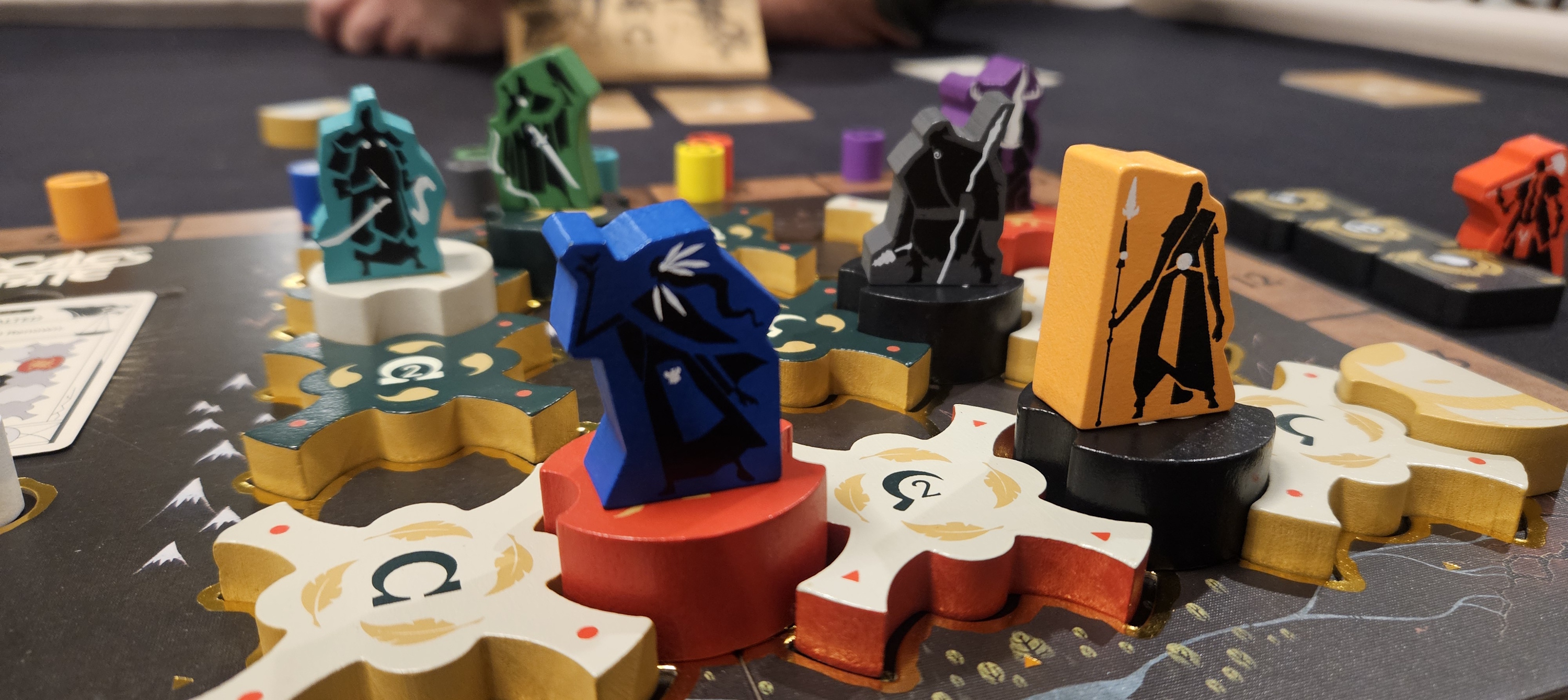
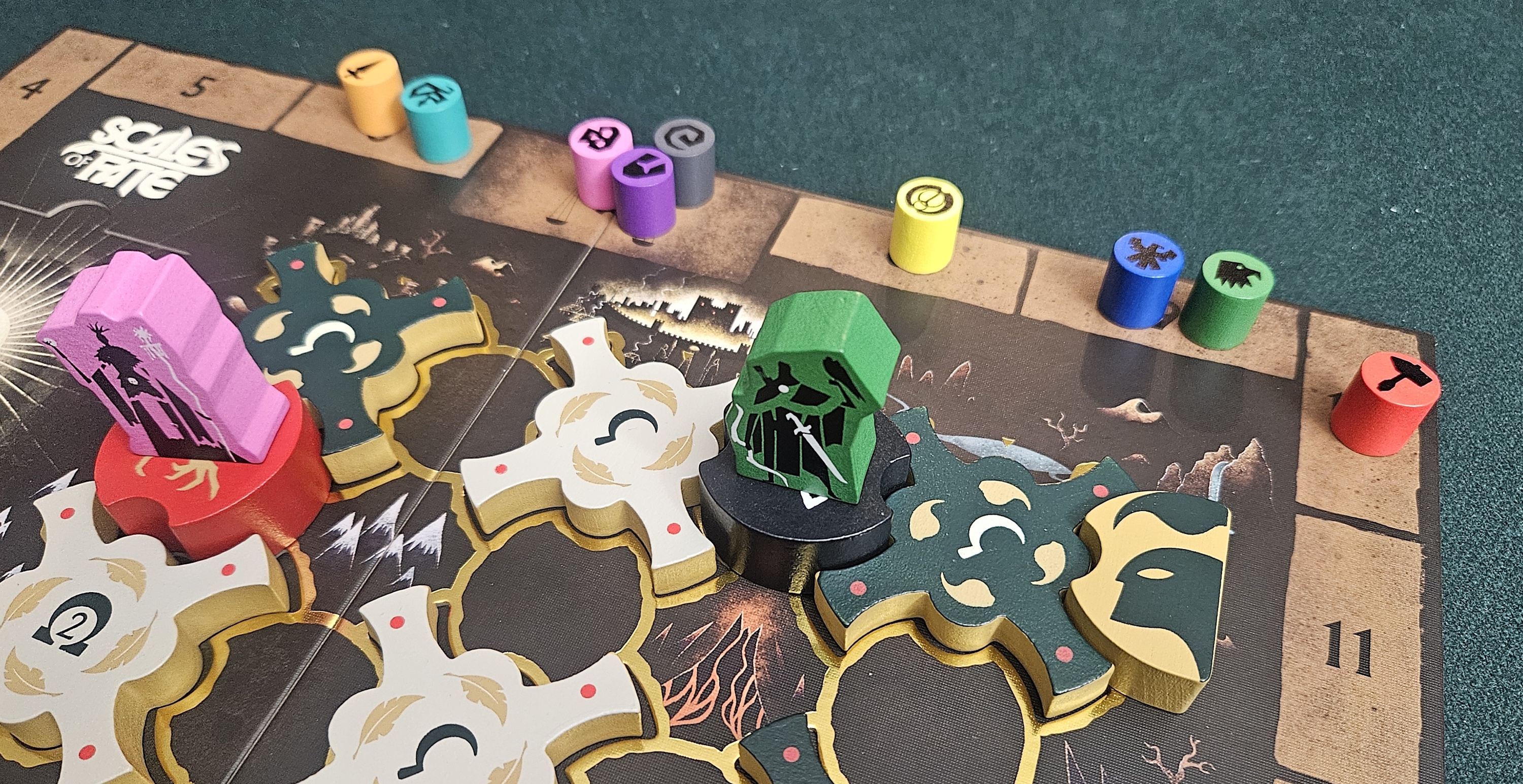
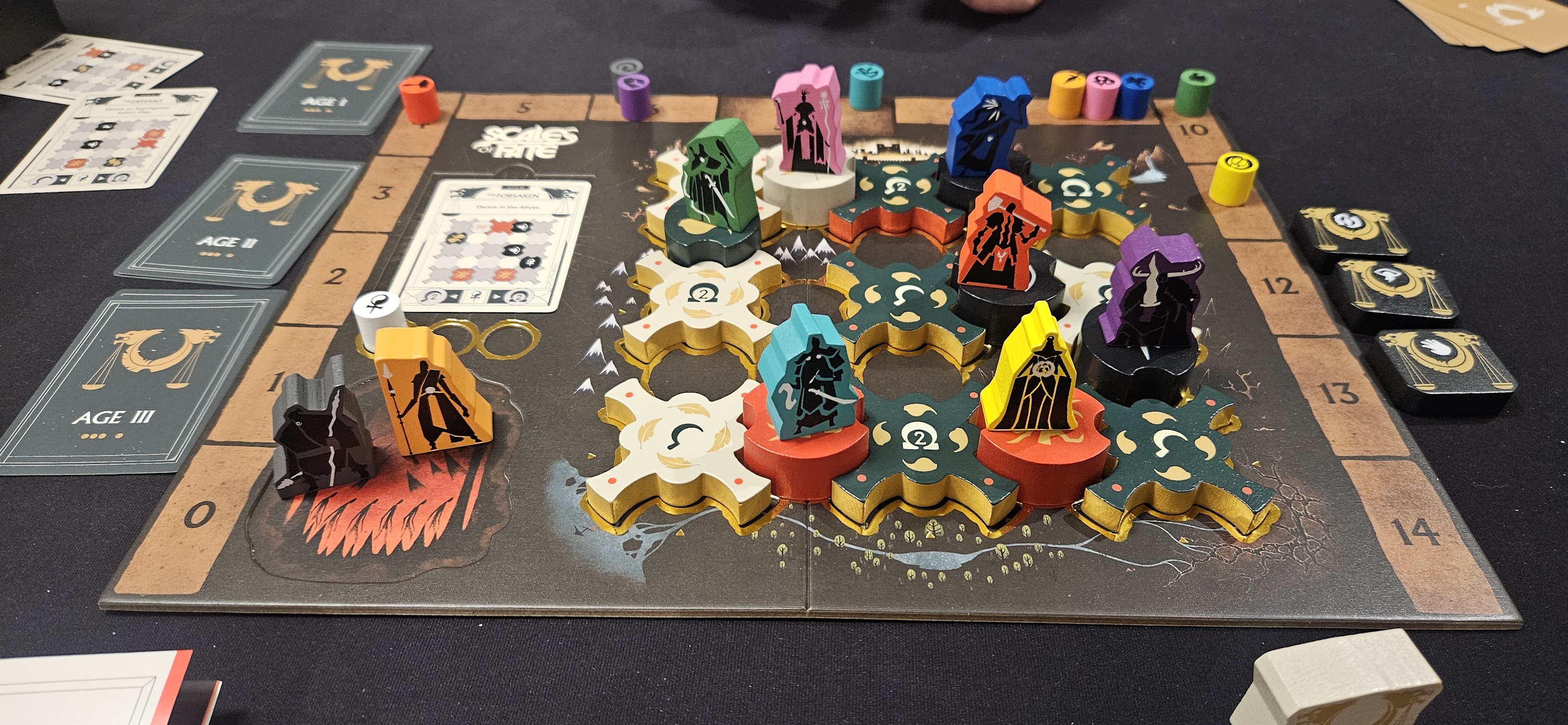
For first-timers, the board presented by Scales of Fate is wonderfully labyrinthine. I say “wonderfully” because just look at it. It’s colorful. The pieces slot together like joined fingers. There’s a topography to the whole thing. You can tell the elevated pieces will be more important than the pieces seated a few millimeters below them. Even when I had no idea what any of these components portended, I wanted to know. Needed to know. Were they gears? Would my demigods traverse them? Veiled Fate presented its map as a wheel. Pillars of Fate offered three lanes. Both are fine. Good, even. But I’ve seen wheels and lanes before. A series of interlocked cogs and risers is something new. That’s a metaphorical depiction of a landscape if ever there was one.

In practice, Scales of Fate is surprisingly easy to get a handle on. Turns consist of three possible actions. One of those, while important, functions more as an exception, an occasional bolt of lightning, than as business as usual.

The main two actions, meanwhile, immediately explain the function of those wonderful cogs and pillars. First, a demigod can be placed atop a pillar to trigger its ability. Whether it’s to smite another demigod down to the underworld to cool their heels, obtain the loyalty of a servant, or… well, that’s it. Rather than offering a wide menu of abilities, there are really only two to keep in mind. Sure, there’s some variety within those categories, but they fall into camps rather than cluttering the decision-space with branching paths.

The second action has to do with those servants. Placed along the edge of the board’s cogs, they trigger the quests that will increase or decrease each demigod’s renown. But to understand what that means, we need to back up a bit.

In this case, those quests made them look like big buffoons. (Also, as in Pillars of Fate, the +/- renown icons could have stood to be slightly different shades.)

A servant sends two demigods on important quests.

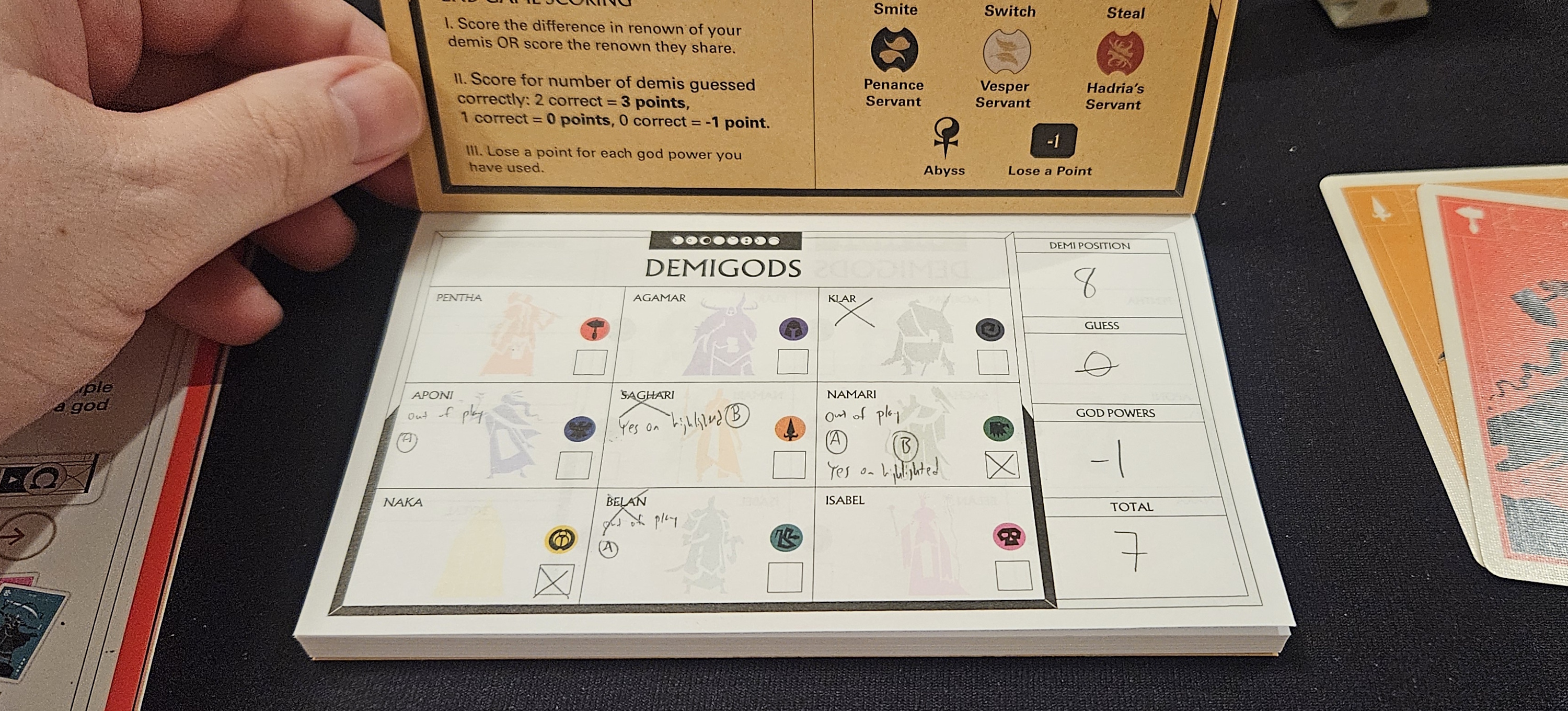
Okay, so you’ve fathered/mothered/sea-foamed two half-divine offspring. Their identities are determined in secret at the beginning of the game. Put a pin in that. We’ll come back to it.

You want to elevate your children. Doing so openly is a surefire way to attract the wrath of your co-pantheonists. So you work in secret. The problem is that every demigod’s current standing is shown on the renown track, visible to both players. When the game begins, all nine demigods share the middle space. That’s seven renown. Even before they’ve done anything interesting, your offspring are worth something by means of their divine parentage.

What will they accomplish? Rather than doing the obvious thing — say, by asking you to push them up the renown track — Scales of Fate makes a tantalizing offer. Your children score points in one of two ways. If they occupy the same renown space when the game ends, they score its value. If both are seated on their starting space, having neither moved up nor down, that means they’ll be worth seven points. That’s respectable. Polite. Not a bad score. But if they move to different spaces on the track, now they score equal to the distance between them. Ticking one child up a single space means their combined value is one point. On the other hand, if your children should do the twin thing by embracing entirely opposite ends of the spectrum, they’ll be worth a whole lot more.

This introduces a wonderful sense of risk and reward to Scales of Fate, not to mention fixes my hangups with Veiled Fate. In that game, players earned points for ensuring their holy bastard earned the most renown. But that made their identity almost trivial. Once any one demigod got too hot for their britches, everyone would work together to take them down a peg. It was simple. Too simple.

Here, their relative standing makes the family tree more tangled. With nine demigods in the world, they’ll be all over the renown track. But what does that mean? Are those clusters on the track actually siblings working in tandem? Are those gods at the farthest edges secretly growing into a hero-villain rivalry that will shake the foundations of the earth?

My one quibble: There are only three cards per age. Gimme more!

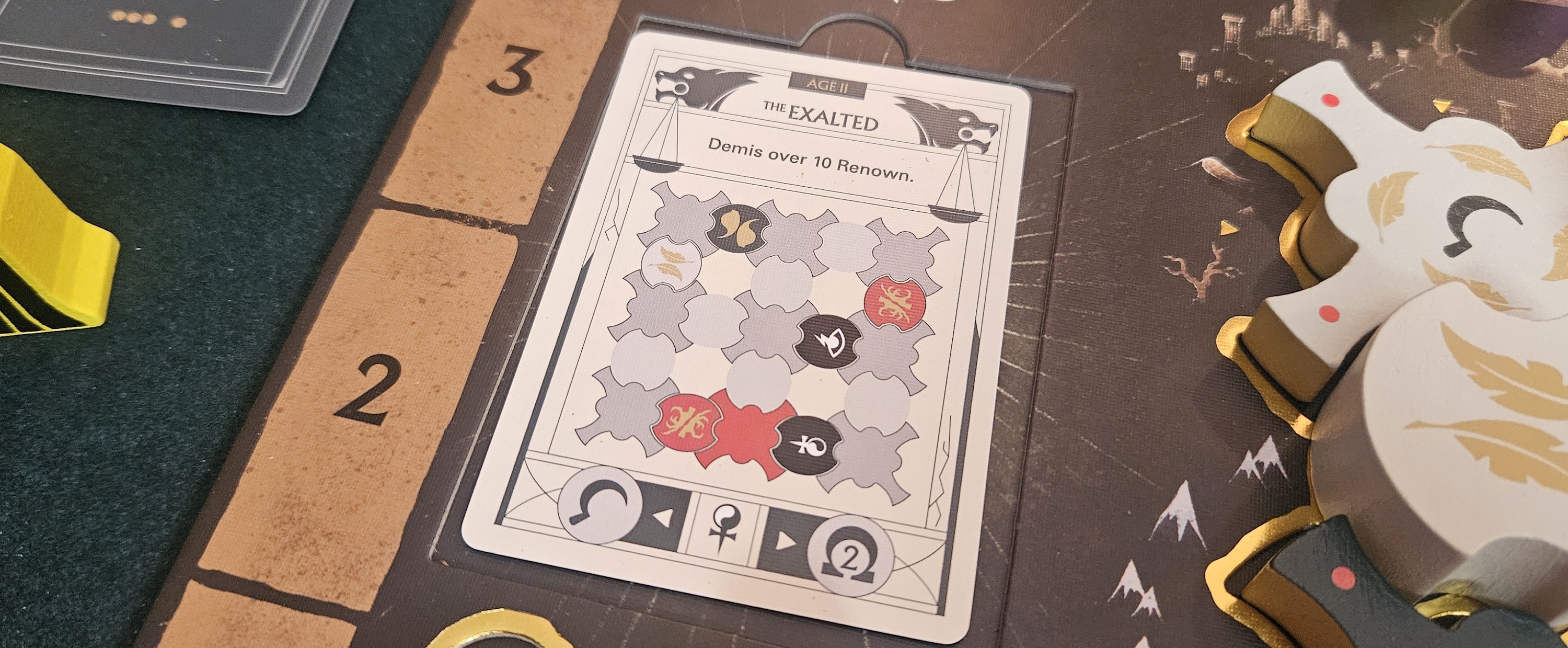
Each age provides new clues on your rival’s childrens’ identities.

Of course, this is a deduction game, which means there are tools for producing those deductions. Some of these tools are subtle. With experience, I’ve made a habit of watching my opponent like a hawk and marking whenever they idly touch a piece or linger too long over a move. More often than not, some correlation can be drawn over time, hinting at favoritism or resolute neglect. (Similarly, I’ve developed the habit of studiously avoiding my own offspring. This, I’m sure, is a tell in its own right. If I reach out to tentatively brush the pink demigod, Isabel, before pulling back like my fingers were singed by her presence, you can reliably infer that I have nothing to do with her.)

But the game’s more explicit tool is provided each age. Scales of Fate takes place over three rounds, each of which provides a different criterion that will be checked at the round’s end. Early on, for example, you might be required to inform your opponent whether you have any demigods out of play. That means they weren’t sent to the board, whether to trigger actions or because someone blasted them down to the underworld. Later, your suspicions might be confirmed by evidence of divine parentage for any demigod placed on a highlighted action pillar.

Crucially, these cards ask yes/no questions rather than demanding specifics. If you’re clever enough to ensure that only one of your two children meets the current age’s criterion, you can simply say “yes” to their presence without giving too much away. For example, one first-age card asks whether one of your children is still seated at four to six renown on the track. Saying yes is almost worse than saying no, especially if nearly all of the demigods have yet to make a name for themselves.

In the meantime, nearly everything adjusts their standing on the renown track. When servants trigger quests — the cogs that surround the action pillars — the surrounding demigods shift up or down. When sent to the underworld, another action will determine the place’s magma forecast, thus providing feats or humiliations that also adjust their standing. Every little detail matters.

Shown: What my detective notebook would look like. "(A) or (B)! If x is guilty, then y is probably not. Syllogism: ö ≠ ü."

Now that’s nice.

And we still haven’t talked about the game’s cleverest touch. Remember when I mentioned we would return to the question of your children’s parentage? Turns out this pantheon is rocking one big orgy, with all the problems it poses for any paternity/maternity/sea-foam tests.

In most deduction games, including the basic rules for Veiled Fate, holding a card means nobody else is holding it. In Scales of Fate, both sides have their own duplicate deck. Just because your children are Agamar and Saghari doesn’t mean your rival won’t have some personal interest in one of them as well. Maybe even both of them, although that’s unlikely. This adds no small amount of static to the ongoing deductions. When one of your demigods gets bumped off their current space, is that because your rival has figured out that they’re your kid and is trying to mess with you, or are they chasing an ambition of their own? Some of my favorite matches have featured duplicate offspring, and while this calls into question what’s so demi- about these so-called demigods, it’s a brilliant addition to a shared-control deduction game.

That goes for the entire package. To some degree, I wish I could play a version of this game that featured more than two players. The idea behind Veiled Fate was always one that appealed to me, and while it finds its best expression here, there’s a slightness to Scales of Fate that I wish would be transposed into a more robust framework. Of course, it’s entirely possible that this game only functions because its manipulations are so laser-focused. It’s generally possible to figure out your rival’s progeny. At least one of them. I’m not sure that would be the case if we had to keep an eye on three other players rather than staring down only one person.

Along the way, there are other little touches that elevate the experience. Like the game-breaking powers that let you smite anyone or swap two demigods, but subtract points from your final tally. Or the way the end-game deduction rewards a correct genealogical discovery but only penalizes you for not uncovering at least one of your rival’s kids. Like the board’s cogs and pillars, everything locks together into one elegant whole, resulting in a crystallized experience where nothing is out of place.

This is my extended family reunion at this point. We barely know each other, but somebody's gonna bring up that time you did the thing when you were eleven.

Chillin’ with the cousins.

Honestly, it’s such a breath of fresh air. Not only that Scales of Fate is this good, but that it takes such a novel approach to almost every corner of its design. From the non-literal map to the way it uses relative proportions to signify importance, both on the board and between renown trackers. From the clever approach to shared control to the way players might find themselves accidentally co-parenting a demigod. It’s achingly smart.

More than smart, it feels great to handle, to push around, to study a rival and mark down a clue. When I first saw Scales of Fate, I knew I had to figure out how those pieces fit together. The beautiful thing is, their inner workings proved even better than they seemed from afar.


A complimentary copy of Scales of Fate was provided by the publisher.

(If what I’m doing at Space-Biff! is valuable to you in some way, please consider dropping by my Patreon campaign or Ko-fi. Right now, supporters can read my first-quarter update of 2026: the best board games, movies, books, and more!)
❌