❌

Normale Ansicht

Published yesterday — 17. November 2026 ⏭ BoardGameGeek News | BoardGameGeek

From Botswana to the Board Game Table: The Story Behind Kavango

17. November 2026 um 16:00

by Mazaza Games

New to Kavango? Kavango is an award-winning, beautiful, strategic and fast-paced board game. You’ll play as a conservation expert rewilding your own unique landscape in southern Africa. With over 200 hand-drawn illustrations, Kavango creates an immersive experience. Simultaneous turns, satisfying tableau-building and tough strategy decisions create a dynamic and rewarding gameplay experience.

Hi everyone!

We started designing Kavango in 2020 while living and working on conservation in Botswana. We were inspired by real-life conservation success stories all around us and wanted to capture the beauty of the southern African wilderness and tell a positive story about nature conservation.

Fast forward to a couple of weeks ago at SPIEL Essen 2026, and we found ourselves watching Kavango being played by hundreds of people at Europe Masters, having been selected as one of just four games featured in this year's international tournament. It was an incredible moment for us.

For anyone unfamiliar with Europe Masters, it's an annual international board game tournament held at SPIEL Essen. This year was the biggest yet, with 39 teams, totalling 156 players representing 17 countries.

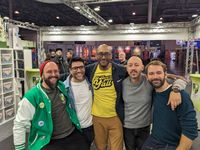
Kavango was selected alongside Rebirth, Wispwood and Endeavor Deep Sea. We're incredibly honoured to now be included in the Europe Masters Hall of Fame (see the picture of us below holding Gioco, the mascot of Europe Masters!).

It was a wonderful full-circle moment since we launched Kavango on Kickstarter during SPIEL Essen just three years ago.

Lots of you have asked us where Kavango came from, how we developed the idea and how our experiences in conservation influenced the game. So we thought it was about time we shared the story!


1. Where it all began: From Life on Earth to Kavango

Our original game was called 'Life on Earth' and had a global focus. Players were rewilding in four global regions: the Himalayas, the Congo Basin, the Kalahari and the Arctic Tundra. In this version of the game, there were event cards and bad things could happen that would reduce protection levels for players and potentially remove species from their ecosystems - we removed this pretty quickly after a couple of games where we lost our Polar Bears! Way too sad.

Then we moved to Botswana and we knew almost immediately that this was where our game needed to be rooted. We were spending so much time outdoors, exploring the incredible landscape, encountering wildlife and meeting people who had devoted their lives to restoring nature and protecting wildlife.

What struck us most was that their efforts were working. We were seeing real examples of nature recovering and thriving because of the dedication of individuals and communities.

Here was a story of optimism and hope that we felt the climate and nature world so badly needed.

We had both spent much of our professional lives working on environmental challenges. Zara had been working on combating the illegal wildlife trade, while Matt was working in sustainable civil and structural engineering. We were both passionate about protecting the natural world, but sometimes found it difficult to maintain a sense of optimism.

So much of the conversation around climate and nature focuses on what we're losing, what we're destroying and what needs to be stopped. These are incredibly important issues, but we couldn't shake the feeling that there needed to be more balance. We wanted to create something that celebrated the people working to restore nature and showed what was possible when we invest in protecting it.

Over the next three years, we built out the gameplay and artwork for Kavango and it became deeply rooted in our lived experience and love for the region and people we've met along the way.


2. Bringing the Real World to the Table

One of our favourite things about Kavango is how much of the real world has made its way into the game.

Matt's hand-drawn animal illustrations are largely based on our photographs of wildlife we've encountered ourselves.


Each of the player boards represents a real place in Botswana that we've visited regularly. The green board is Chobe National Park, blue is the Okavango Delta, yellow is the Central Kalahari, purple is the Makgadikgadi Salt Pans, orange is the Kalahari Transfrontier Park. These landscapes all have their own distinctive characteristics, and we captured that in the asymmetric starting resources on each board. The background artwork is based on our photos in those places.

We spent a lot of time thinking about whether to include player boards. They take up quite a bit of table space, and we were conscious of keeping the game accessible. However, our play testing consistently showed us that players felt more immersed and enjoyed the experience more when they had their own boards. So, we kept them!

The conservation experts in the game are inspired by real-life conservation heroes we've met and who have inspired us. They are designed to tell a story of all the different people required to make conservation a success.


3. Turning Conservation Into a Board Game

One of our biggest design challenges was working out how to translate real-world conservation methods into balanced, fun and strategic gameplay. We’re proud that our mechanics are designed around principles of sustainable conservation rather than the other way around.

An important starting point is that as a player, you are a world-class conservationist. Every decision you make is ultimately successful and you are always growing and building your reserve. Any animal you introduce represents a sustainable population of that species, and to safely release it into your reserve, you need to ensure that the right food and protection are in place for it to survive. We did a lot of play testing with the University of Botswana and their support was so encouraging and valuable as we finalised the game.


Several of the game's core mechanics are taken directly from real life:

The Sanctuary Spaces

The sanctuary mechanic was inspired by our experience of rhino conservation when we were in southern Africa. Due to a high poaching threat, many rhinos were relocated out of wild areas and into protected environments until they could be safely released.

In the game, the sanctuary allows you to collect animals before meeting all the requirements to introduce them into your reserve. This massively enhances the card drafting mechanic, allowing players to play more conservative or high risk strategies depending on how they use their sanctuary spaces.


Food requirements and animal classifications


One of the key design challenges was categorising the animals into different types and accurately representing the food requirements of the different species across different rungs of the food chain. We wanted these classifications to be ecologically realistic while also creating a balanced and interesting game.

We aimed for a roughly even distribution of animals in each of the seven animal categories, i.e. there are roughly the same number of small mammals as there are birds of prey. In a real-life ecosystem the distribution would be much more skewed to the bottom of the food chain, which is why trophic levels are often explained graphically using a triangle or a pyramid. We designed the animal food requirements around achieving this flat distribution because it is ultimately more fun to have a wide range of biodiversity, including at the top of the food chain, in your nature reserve at the end of the game.


This took quite a bit of playtesting. Some animals were reclassified as the game developed, as we worked out how best to represent their ecological characteristics and feeding preferences and ensure the different paths to victory remained viable.

One design element which took a lot of iterations was the special invertebrate subcategories: bees and termites.

It would have been easier to design the game without these specific subcategories, but doing so would have compromised the ecological realism of the game. Termites and bees are completely fundamental to the Kavango ecosystems and many animals have highly specialised diets and have evolved specifically to eat them.

We wanted to capture this level of ecological detail, and think it adds another dimension to the gameplay strategy.


Research Tasks

The research tasks that change each round were inspired by the challenges conservation organisations face when adapting to different funding priorities.

In real life, conservation projects often depend on specific grants and funding pots, each with its own objectives. We wanted to capture some of that uncertainty and challenge in the game, with players having to adapt their strategies as the research priorities change and get harder every round.


Protection Levels

Increasing protection in your reserve comes at a cost. This was a deliberate design decision, reflecting the reality that effective conservation requires significant resources and investment.


Variable Difficulty Depending on Player Experience

One of our key aims in designing Kavango was to make the game fun and easy to learn for people who are new to the hobby while providing a strategic challenge for more experienced gamers. We designed the game so you can alter the difficulty level based on your experience by changing the money that each player starts with. For beginners, we recommend starting with $3m, intermediate starts with $2m and expert with $1m - when we play, we start with $0!

Starting with different amounts of money allows players of different experience levels to play together. This works well for teaching new players and giving a handicap to the more experienced ones so that the scores can be balanced at the end.


Long-term Goals

We also wanted players to have the opportunity to develop particular specialisms. Our goal cards encourage you to focus on animals with shared characteristics, such as being nocturnal, migratory or scavengers.

These goals help anchor your drafting strategy while subtly introducing players to some of the fascinating characteristics of the animals themselves.

Ultimately, the conservation theme is integral to the gameplay and mechanics rather than simply a thematic choice. The strategic decisions should make sense within the world you're creating.

With asymmetric player boards, conservation character cards and over 200 species cards, there are also plenty of different combinations to explore, giving Kavango lots of replayability.


Note: the goal cards have been updated to now include icons that correspond with the characteristic


4. Designing a Sustainable Product

Sustainability has always been a priority for us, not just in the subject matter of our games but in the physical products themselves.

When we started designing Kavango, we wanted to avoid compromising on either the quality of the product or the price for consumers. That meant spending considerably more time working through the design and manufacturing process to find alternatives to conventional components.

Two examples we're particularly pleased with are the card trays and the box sleeve. Both were designed as sustainable alternatives to components that would traditionally be made from plastic.

Getting these right took a lot of iteration and teamwork with our manufacturer, Panda. We wanted components that worked beautifully, looked great and were practical for players, while also reducing the environmental impact of the game. We're really proud of the result.

Kavango uses no plastic in its production and is made from 65% recycled card and paper. The card trays also double up as a helpful box organiser!


We're delighted that our approach was recognised in 2026, when Kavango received the Green Games Guide Award for Sustainable Product Design, alongside recognition through the Origins and Game Manufacturers Association Sustainability Award.

For us, the principle is simple: sustainable products need to compete directly with conventional alternatives in both cost and quality. Only then will we start to shift the powerful systems driving our consumption patterns.

We're always looking for ways to improve, and it's exciting to see how much further we can take these ideas with our newer games.

Our latest game, Scavengers, uses the same sustainable production principles as Kavango, but takes things a step further:
    
- Made from 80% recycled materials
    
- Manufactured in Spain using solar power
    
- No plastics

We hope that by continuing to experiment with materials and manufacturing methods, we can demonstrate that beautiful, high-quality board games don't need to come at the expense of the planet.

5. Growing the Kavango World

As Kavango developed, we always had ideas for ways to expand the experience. But we were conscious that the original game needed to remain accessible and relatively light.

This led to two quite different projects: Kavango Lodges Expansion and Let's Go Kavango.

Kavango Lodges Expansion: Adding Puzzly Placement Mechanics

We always had an idea to include a spatial element in Kavango which is another reason we wanted to keep the boards in the base game. However, we decided to hold back from including it in the original game because we wanted to keep the core experience streamlined.

The Lodges expansion introduces ecotourism into your nature reserve, allowing players to build lodges within their reserves. These attract tourism providing additional victory points and, if you play on the hardest level, extra money to invest in growing your reserve.

Each Lodge requires a particular combination of surrounding animals placed in a 2x2 grid. This creates a satisfying spatial puzzle alongside the existing card-drafting mechanics.

You'll choose lodge cards at the beginning of the game, so you’ll be planning out what animals you want to draft and where you want to place them from the start of the game.

Lodges adds another layer of strategic depth and introduces a conservation narrative we were keen to explore: the role that responsible ecotourism can play in supporting wildlife conservation.

The expansion is modular, allowing you to vary the difficulty. For seasoned gamers, we recommend playing with the full difficulty and the community protection module. With the community protection, the placement and timing of building your lodges is vital. You need sustainable income in order to continue expanding your nature reserve. This is designed to show how important it is that communities living alongside wildlife see the economic benefits of ecotourism for conservation to succeed and be sustainable.


Let's Go Kavango: the Travel Version of Kavango

At the other end of the spectrum, we created Let's Go Kavango.

We wanted to explore whether we could take the essence of Kavango and translate it into a smaller, streamlined card game. The result is a travel-friendly version that retains all the wildlife and strategy of the original just in a smaller box. We’ve also introduced a child-friendly variant for ages 6+ to inspire budding conservationists!

It's designed to slide into your backpack and be taken with you on adventurous game nights anywhere.

We initially developed Let's Go Kavango because we wanted to update the card decks in Kavango for our original Kickstarter backers (we’d changed some things for the retail version). But we didn’t want their old Kavango cards to go to waste. So we designed a way of giving new and exciting life to existing Kavango cards, while updating the base-game decks for our wonderful supporters.

The result was a great card-only version of Kavango which is a very satisfying stand-alone game in its own right. All the wildlife. All the strategy. Just in a smaller box.


More Wildlife!

We've also released booster packs featuring additional animals.

We absolutely love researching and illustrating new species, and it's been wonderful to see the enthusiasm for these releases. There are so many fascinating animals out there, and we love hearing from people about their favourites, it always makes us laugh at how much love the sausage tree gets!

6. Behind the Ccenes: How We Design Our Games

Our design process tends to revolve around four interconnected elements: telling a story, developing the game mechanics, creating the artwork and physically producing and bringing the game to market.

We each have different areas of expertise, and that's one of the things that makes working together so enjoyable.

Matt: Mechanics, engineering and artwork Matt's background is in engineering and sustainability. He leads the development of the game mechanics and balance, as well as overseeing the product design and manufacturing process. He's also our in-house artist and graphic designer. His hand-drawn illustrations are a huge part of what gives Kavango its identity, bringing the wildlife and landscapes to life on the table.We love the fact that the artistic and technical sides of the design come together like this!


Zara: Conservation and storytelling Zara has spent much of her career working in conservation, across southern Africa on combating the illegal wildlife trade and globally on protecting our oceans and seas. She's also a trustee of the Beaver Trust in the UK. As our in-house conservation expert, Zara makes sure that our games tell a realistic story about conservation and reflect the ecological relationships and challenges found in the real world. She's our storyteller in chief, keeping the design grounded in our wider purpose and ensuring that the experience feels authentic.


Working Together Although we tend to take the lead on different aspects of the process, the games really come together through collaboration and playtesting. An idea for a game always starts with a story we want to tell about nature. From there, we work through the concept together, testing, refining and occasionally going back to the drawing board! It's a process that can take years, but that's part of what we love about it.


7. What's Next?

Kavango was our first game and we’re so happy that we’ve been able to keep working on games to tell positive stories about our natural world.

We launched our latest game in the Kavango world, Scavengers, at SPIEL Essen 2026. We came up with the idea for Scavengers when we were visiting one of our charity partners, Vulpro, in South Africa in January 2026. We heard from them the importance of vultures to African ecosystems as a vital clean-up crew to stop the spread of disease. But they are difficult to conserve and protect because they have a PR issue. So we decided to make a game about vultures and other scavengers to showcase the beauty, power and importance of these animals.

It’s designed for 2-5 players, ages 8+, with a playtime of around 20-30 minutes. It’s an easy-to-learn, small-box, quick-playing card game in the same genre as games like SCOUT, Skull King, Flip 7 and Perudo… but with the bonus of some beautiful animals! It is a lot of fun and has high player interaction, making it perfect for group game night or family holidays!


We're also working on our next big project: Beaver: Born to Rewild.

This one is particularly close to our hearts. Zara's work as a trustee of the Beaver Trust has given us a real insight into the incredible potential of beavers to transform landscapes and restore ecosystems across Britain.

You’ll play as a family of beavers reintroduced into the Scottish Highlands. Your mission is to rewild and restore a wetland habitat.

As you gather resources to build and grow your dam, you'll engineer a new wetland ecosystem and strategically create habitats for a range of native animals. Gain cascading rewards as your wetland ecosystem grows, earn points each time you introduce a new species, and win big if you can build an abundance of food for Scotland's most iconic and endangered predators.

The beaver family with the most points at the end of the game wins.

We’re working towards launching this on Kickstarter in mid-2027 and are having a lot of fun playtesting it at the moment.

8. Our Commitment to Conservation

Everything we do at Mazaza Games is driven by one purpose: inspiring people around the world to protect our planet's biodiversity.

Living and working in Botswana inspired us to create Kavango, and we're committed to supporting the conservation organisations working to protect the region's extraordinary wildlife.

We donate 50% of our profits to conservation charities working on the front line of the climate and nature crises. Here we are with one of our partners, The Ecoexist Trust, who work on human-elephant co-existance in Northern Botswana.


For us, making games is about more than creating something fun to play. It's about sharing the places, wildlife and people that have inspired us, and hopefully encouraging others to take an interest in protecting the natural world.

We hope that when you sit down to play Kavango, you enjoy the strategy, the wildlife and the challenge of building a thriving reserve. But we also hope that it leaves you feeling a little more connected to the natural world and optimistic about what we can achieve to protect it.

Thank you to everyone who has supported Kavango along the way. From those who backed us on Kickstarter, to the people who have played, reviewed, and recommended Kavango to others, we are incredibly grateful.

And thank you to everyone who is helping us bring more nature to the board game table. If you want to hear more from us and keep up to date on our new projects then you can sign up to our newsletter on our website.

Happy gaming!

Matt & Zara
Mazaza Games
Published — 16. November 2026 ⏭ BoardGameGeek News | BoardGameGeek

Tinycon

by Justin Bell


Over the weekend, I spent a day and a half at 18North, a small, 18xx-themed “playcon” in St. Paul, Minnesota. Some of the folks I’ve gotten to know through Railways of the Lost Atlas—Kevin Delger and Jacob Schacht—are local to the Twin Cities area. I won’t claim to be a train game expert or a hardcore train game junkie, but I do enjoy private company auctions, track upgrades, route optimization, and the occasional financial shenanigan or two.

Normally when I hit tabletop shows, the shows are massive, shows like Gen Con, Festival International des Jeux, and SPIEL Essen. After spending a week in Germany at a show that hit 230,000 attendees last month, I was pretty excited about hitting a show that was a little smaller.

Maybe a LOT smaller.

18North was set to host about 50 people, tiny by SPIEL Essen standards. Sold!


18North is my second train game convention, after hitting TraXX in 2024. Like 18North, TraXX is a 50-ish person convention that takes place in a small conference room every year. Both cons have a library of train game titles that are the absolute opposite of the word sexy. (Edu Valls was NOT hired for character illustrations for the game 1817. In part, that’s because there are no character illustrations in 1817!)

Many of these 18xx titles are in simple, white cardboard boxes in print-and-play formats, with cover artwork featuring a train blowing its way through the American plains or the European wilderness. In some cases, you get historical photographs of people staring at a locomotive, as if a spaceship just landed on their front lawn.

This is part of the charm of these games; no one bothered to make most of the older 18xx productions attractive for people passing by a table at a coffee shop. It can serve as culture shock when games like the upcoming production of The Old Prince 1871 hit crowdfunding, because it’s almost impossible to believe that someone might bother to create something that looks more inviting than the front cover of a dry Hallmark anniversary card. (Sidebar: I love the TOP artwork. New ideas that move the 18xx production format forward? Count me in!)


Small conventions like 18North and TraXX end up being really magical to me, because they are often a person’s only chance in the course of a year to play the games that they really want to play en masse, with other enthusiasts who fit the profile of “a niche of a niche.” In the leadup to 18North, my 10-year-old kept asking when I would be flying to St. Paul to attend, using his running acronym, the “BTGC.”

BTGC stands for “Boring Train Game Convention.” (My kids like making fun of train games.)

Showing up at a small tabletop convention always has the look, the feel, the smell, the vibe of a room full of nerds…geeks, even. I arrived on the second day of 18North, replete with my 18North swag: 18North t-shirt, underneath a grey 18North no-zip hoodie. Of course, I’m a nerd, so I had some of my other train game gear in the travel bag: train t-shirt from my trip to Silverton, Colorado, striped train conductor cap, green TraXX t-shirt. Sadly, I forgot my train socks, a door prize from the TraXX show.


I had to have the gear to match the venue, because the geek stakes were high: 18North is hosted at an actual train depot, the Union Depot in downtown St. Paul. I mean, can you imagine? A train game convention, INSIDE A TRAIN STATION? A train station featuring a hobby train store in the lobby? If any of you know of something more geek than a train game convention inside of a train station, please list this in the comments…with some level of certainty, I will come to your convention in 2027.

The actual 18North play area is contained within a small conference room on the second floor of the depot, with a nearby breezeway that leads to an overlook where you can see the main seating area of the station.


Union Depot adds flavor to the whole affair, but ultimately, 18North is the kind of “BTGC” that reminds me of what I love about all small shows like this…it’s fun to play board games all day, even if I personally never do it. Other “tinycons” I’ve attended over the years inspired this article, such as the four-person weekend gaming event I did with three of my high school friends, to my Wednesday group’s annual “Lakecon” activity (about 10 people), to “Johncon” (my friend John’s birthday gaming event in Chicago, with in-and-out traffic that ranges up to about 15 people).

I don’t make much time for all-weekend gaming very often…in fact, 18North’s first day will end up being the only day I play board games from sun up to sun down for the entire year, because I’m sure I won’t have the time to do it again. But each time I commit, I love the result.


You’re probably wondering about the games I tabled across my ~18 hours at 18North. No, that amount of time was not intentional; work travel forced me to miss the first day of the show. Those jobs will get ya!

I did four plays at 18North: Shikoku 1889, 18Korea, 18Ireland, and Railways of the Lost Atlas with the recent expansion, Landmarks of the Lost Atlas. The games were mostly a good time, and as usual, that was thanks to the people. (Like most of these playcons, I showed up alone, not really knowing anyone besides the show organizers. Time to make some new friends!)

Prior to sitting down for my first game, I picked up my badge—18North organizer extraordinaire Phil Chen deserves a Lifetime Achievement Award for the level of organization he puts into something so intimate—and sorted through a list of what games were in the library, as well as which games other players had on their personal hit list. Phil’s badging system listed everything players needed to know: the four 18xx titles that player most desired to table during the show, their 18xx.games handle, their Discord name, their home town. (Something tells me Phil has run a networking event before.)


My play of Shikoku 1889 (or just “89”, because train gamers can’t be bothered to say the word “eighteen”) was a five-player game that kicked off my 9 AM start on Friday morning. A guy named Tucker and another person named Dan were sitting nearby; Tucker was looking to kick something off, and he had a hard stop at 1 PM to teach a scheduled play of 1833NE.

I introduced myself and stated my intentions: I was happy to play anything for the first game of the day. Tucker grabbed 89 and began to set up the game…two other folks who were local to Minneapolis, Aaron and Ben, walked in looking for two seats, so we collectively kicked off one of the fastest plays of 89 I’ve ever done in person. After setting up, our play only took about two hours, and we used a spreadsheet to math out the winner well before noon. (Tucker had an iPad ready to roll for the “spreadsheeting.” Train gamers, babeeee!)

The play was fun—89 is a classic for a reason—but the beauty of any small show is spending a little time with almost every single person at the event, especially if you are in town for a full four days and mix up your play groups. In case you haven’t heard, 18xx games are typically long, so while someone else is operating a company, it’s easy to squeeze in some small talk. Or talk a little smack. Or discuss the high points of maple-iced donuts from Dunkin. Or discuss their favorite non-train board games.


By the time we wrapped 89, the day was off and running…in the process, I made a couple more show buddies. Dan joined me for the Korea play. We picked up another player along the way: a guy named Dave, in town from California. That formed our threesome for Korea (and, like me, Dave arrived solo and was open to playing games with anyone else who showed up).

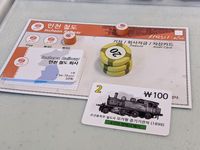
Korea was on my hitlist because of the current crowdfunding campaign for the “Big Box” edition; my only previous Korea play took place at TraXX, but I remember really loving the way the game’s player powers (Asset cards) and Korean War event changed up the typical 18xx formula. Our play at 18North this weekend turned Korea into a must-back.


We all loved Korea, but when you spend four hours playing a board game with other folks, you better find a way to enjoy it. Tiny playcons offer such a luxury when it comes to time; the brackets aligned with weeknight play were off the table, and we spent just the right amount of time re-reading parts of the rules that set Korea apart from other 18xx titles before setting the game up and diving in.

Turns took a while, but that didn’t matter to us. We had the kind of “competitive teamwork” I love when players are friendly and spending time getting to know each other. If Dan ran a route that didn’t take advantage of enough cash, I made sure to call out a more profitable route. When Dave ran a company that included Dan or I as a shareholder, he reminded everyone to grab chips from the bank. When I ran into the East Sea post-war, Dan made sure I got my $20 (whoops! ₩20!) bonus.


By the end of that four-hour opus, we used Korea to springboard into a much-needed dinner. Phil and Jacob joined us, and we walked into the Union Depot lobby for dinner at the Depot’s signature restaurant, 1881. (Friends, I wish I was kidding: the restaurant we hit at 18North, for an 18xx convention, in a train station lobby, is called 1881. Sometimes, the articles write themselves.)

After dinner, the five of us did Ireland, which was on Dan’s list and was a favorite of both Jacob and Phil. (In the end, it was NOT a favorite of mine, although I am told Ireland is better at a lower player count. I’ll never know.)

The gameplay itself was not a highlight, but the experience was, and our fivesome laughed a whole heck of a lot across a play that started at 7 PM and ran until the end of my night around 11. By the end, Jacob and I committed to a morning play of Railways of the Lost Atlas (“ROTLA”) with the expansion, so I hustled back to the local Springhill Suites for just enough sleep to get my brain ready for more math in the morning.


My final play of the weekend was so-so—Kevin and Jacob joined me and a fourth player, Chris, who was completely new to 18xx and made ROTLA and its expansion (complete with events, “direct-to-majors”, special tiles and the Metropolitan) his 18xx debut experience. To call this a tricky and unconventional introduction to a gaming system would be an understatement, so a HUGE kudos to Chris for jumping into the deep end.

I was out of play early—the other players cratered the value of my first minor, then I made a mistake calculating the number of 3 and 4 trains on the roster—but I love ROTLA’s variable map system and the elements that affect play because of each minor’s ongoing power. (This is not surprising, as a fan of Eurogames where players have a unique way to attack a game’s base systems.) All of us enjoyed helping Chris navigate some of the unique things about ROTLA in comparison to other 18xx titles Chris had studied, and sitting at the table with the same people for four hours created lots of chances to poke at the game decisions made during play.

After exchanging pleasantries, I got a picture with the group and made my way to the airport. I thought a lot about 18North and my desire to spend a couple more days next year playing games all day.

I know I’m lucky; I usually play games every day when I’m in Chicago, either with my groups or with my family, for at least a few minutes, sometimes much more. Settling in for a long day of games, at a small convention in environments where it is easy to meet new players, is a must…now it is on me to find a way to make that happen a little more often!

Published — 15. November 2026 ⏭ BoardGameGeek News | BoardGameGeek

Designer Diary: Jure Grando - Turning a 17th-Century Vampire Legend into a Board Game

15. November 2026 um 16:00

by Damir Debanic


The question asked was: "Why don't you make a game about Jure?"

I was asked this question in my car while driving near Kringa, Istria. (the place where the legend places Europe's first vampire) I had known about the legend of Jure Grando for some 20 years by then... and after my first Balkan game, Propuh, was well accepted it sounded like a good idea.

It was! And it had a bunch of "problems" and opportunities attached!

Folklore in my region exists mostly in oral form, with only a few legends written down. This has proven to be a blessing in disguise! While this may be a historian's nightmare, for designing a game it offers immense creative freedom, with just one responsibility: to keep the tone of the local folklore alive and avoid wandering into more standard fantasy themes and solutions.

The Jure Grando legend, however, is unusually well documented. In 1689, Johann Weikhard von Valvasor included the story in The Glory of the Duchy of Carniola, describing events said to have taken place in Kringa decades earlier. And that gave me something extremely useful for designing the game: a starting point - a name, a time, and a location.


So. What is actually true? The truth is that Valvasor documented the legend.

The year was 1672 For generations, the people of Kringa have lived quiet lives among the forests and hills of central Istria. But strange events have begun to unsettle the village. Livestock disappear without explanation. Darkness gathers along forgotten paths. Doors are marked in the night by unseen hands, while a silent black cat watches from the shadows. The townsfolk know the old stories. They speak of Jure Grando, a man who died years ago yet refused to remain in his grave. They say he is a strigun, a restless horror that returns to prey upon the living.

Inspired by "The Glory of the Duchy of Carniola" written by Johann Weikhard von Valvasor

Now all I needed to do was design the game.

And initially it was meant to be a smaller and less ambitious project, not too heavy and following just the narrow path of the written legend.
   
"Jure Grando rises each night,
   
knocks on doors - people die,
   
the townsfolk gather,
   
find his grave,
   
and end his reign of terror"

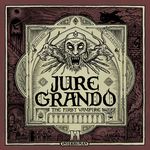
Simple and nice. And then my graphic designer, Zdravko, made the box cover design 😅


And it seemed like a shame to use this kind of design on a small box - don't you agree?

And figurines would be nice as well 😂 - and here Nikolay Dimchev did his part!


And at last Endi from Strigun Art made the map of Kringa.


And brought its characters to life!


And as you can guess, this is where the simple little game stopped being simple. (or little)

The legend gave me a sequence of events:
   
Jure rises.
   
Jure knocks on doors.
   
People die.
   
The villagers find his grave.
   
They confront him.

That's a story. But what do the players actually do? Should they fight Jure? How to make the combat mechanics? Collecting items? Inventory?

The problem was that once the game grew physically, my ideas for the gameplay grew with it. More locations. More characters. More things to do. Crafting. RPG elements. Player boards...

You know, all the things that obviously make a game better. They didn't.

I had mechanisms. Too many mechanisms. But, I wanted to make a Folk-Horror game (well, not at the start but the idea grew on me). So I decided to focus on how I want the players to feel!

They will not be fantasy heroes, just ordinary townsfolk (and Granny). No superpowers. No holy weapons (even the hawthorn stake just keeps Jure at bay and cannot harm him). Just people trying to survive the night and prepare for the inevitable showdown with ancient knowledge, folklore, and a superstition or two. They need to prepare themselves, the town, and its inhabitants for the fight to come.


I want players to be afraid for their characters - ordinary folk faced with an ancient evil! And here comes the next problem. The legend of Jure Grando only gets me so far. Because the moment Jure comes on the board, he is an evil that can be faced or avoided. He is no longer a looming threat.

And the next solution! The local folklore is incredibly rich and varied, to the level that even neighbouring villages have different stories and superstitions.
SO Here comes the black cat - Jure's demonic companion. In one much more recent oral version, Jure was remembered walking through Kringa with a dead sheep over one shoulder and a black cat over the other. Valvasor never mentioned the cat. But I really liked the cat.

So the cat enters the story!

(my cat on an early board prototype)


And as cats tend to, it becomes the main protagonist of the first part! The cat also solved a group of problems that came from the fact that Jure comes just for the Endgame (a design choice to make him more Folk horror and less Usual horror).

But what will the cat do? Driven only by a few icons on the bottom of a Kringa card (Draft at the end of each player's turn) it cannot be too complex.


So now the cat moves, steals, and causes terror!
    
Moves - quite obvious: moves; less obvious: moves towards the closest player; if in doubt, towards the closest player with more items
    
Steals - this is the nasty one; the cat steals one item from the location or player and takes it to a random location (several games were lost to this)
    
Causes terror - well, a cat jumps on your back in the middle of the night while you are hunting for the vampire; if that does not cause terror, neither will a vampire :)

Now We Come to the Terror
Since there is no combat in the game and no hit points, health, or something similar, I needed something to keep the pressure and "punish players" This is TERROR - it does not hurt or injure, but the fear grips you and makes you incapable of acting!


Each time you get terror, you lose one of your actions - not permanently, just until you recover by resting, using garlic, or something of the kind.
This is not terribly punishing, but it tends to be cumulative, and pretty soon you end up with only one or two actions. Also, you cannot remove terror while in darkness!

Darkness

This is not the nice and quiet darkness when you can get some well-deserved rest and sleep. This is the darkness that extinguishes light, safety, and hope.
As the night goes on, the darkness will gradually creep in and steal your courage. Also, when the whole town goes dark, all hope is lost, and you lose the game even if Jure did not join the fight - so you have to be fast!!! To make things worse, when Jure does show up, he moves through areas of darkness instantly.

So darkenss it is a pretty nice pressure mechanism.

But players need a choice (I am a push-your-luck fan) And in our folklore we have a perfect thing just for that...

Crossroads - Where the Witches Meet, and Deals With the Devil Are Made!

In Jure Grando, the characters do neither of those things (sorry for the disappointment - maybe in another game) But crossroads are tricky - walk into them at night without a care in the world... and you might get something to worry about!!!

Entering crossroads can do a number of things to you! It might do nothing. It might summon the cat at your side (not a good thing). It might give you a decent scare (terror). Or it might extinguish the light, which is quite bad.

Can you avoid it? Yes, you can - by throwing a nice round stone in the crossroads! You just have to find it first!
Needless to say, if you waste a whole lot of time avoiding dangers, you have little chance of even making it far enough to face Jure Grando!
And... so on...

And this is pretty much how the rest of the game developed. Whenever I needed a solution, I first looked back at the legend, local folklore, and old superstitions. Garlic, red thread, hawthorn stakes, crossroads, stones... they were not added just because they looked thematic. They gave me ways to turn the folklore into actual game mechanisms. Of course, not everything worked. Quite a lot didn't.

The game went through several versions, lost most of its RPG and crafting elements, gained and lost mechanisms, and was playtested over and over again.
A lot of it I have already forgotten - similar to the whims of oral tradition, I forget a lot too.

But somewhere along the way I finally understood what I wanted Jure Grando to be.

Not a game about fighting a vampire. A game about being afraid that the vampire is coming, and still holding your ground and doing your best! Not because you have a perfect plan and are confident you can win, but in spite of knowing that you probably can't! And there are even a few ways to win the game after all the players have been eliminated. For me, that is the charm of folk horror!

And now, the GameFound campaign was successful (in 78 minutes).

So Jure Grando the First Vampire was unleashed upon an unsuspecting world this October, first to our backers and at then at SPIEL as well! If you happen to stop by our booth at SPIEL, I hope you enjoyed a chat, a game, and maybe a drink (rakija).


Published — 14. November 2026 ⏭ BoardGameGeek News | BoardGameGeek

Designer Diary: Lightning City - A shocking Roll and Write

14. November 2026 um 16:00

by Jannik Auth

Five years after my prototype “Tokyo Districts” first saw the light of day, I’m so excited to see it come to life as Lightning City: Tokyo - my first ever game to hit the market! In Lightning City: Tokyo you roll dice to build restaurants, karaoke boxes, stores, and arcades, deciding how to lay them out to score as many points as possible. But beware of the brewing storm. If you postpone putting roofs on your buildings for too long, lightning may strike and ruin your day.

The story of Lightning City: Tokyo begins in 2021 at my girlfriend Jenni’s old family house. Creativity often comes from boredom, which is one of many good reasons to put away your smartphone from time to time and just be bored for a second. I don’t quite remember what they were doing, but Jenni and her family left for an hour or two, leaving me alone with nothing exciting to do. My love for board games was at a very different stage at that point. I wasn’t yet a maniac playing new games every single week. My family and I were perfectly content playing the same game for a year or more. Dominion by Donald X. Vaccarino, for example, was an endless treasure chest for us. Another game my family and Jenni enjoyed a whole lot at that time was the amazing Cartographersby Jordy Adan. I was fascinated by its modular setup and how much replayability it offered. But there weren’t any expansions for the game yet, so I was sitting there alone in Jenni's room thinking, “Man, some more different cards would be nice!”

Infinitely far from any intention of pitching a game to a publisher, I had played around with two or three very poorly made prototypes before. So it came naturally to me to try creating something similar myself. Instead of building something from a bird’s-eye view, in this game let’s construct something from the bottom up – some houses, I guess. I grabbed some dice and decided their colors would determine which kind of room to draw. Because building one room at a time seemed too slow, I settled on building two rooms at once by choosing two dice. I then wrote down the first four scoring criteria that came to me and could already start playing. From the first roll of the dice, the game was fun. After a few turns, I asked myself, “So, when will it end?” In hindsight, it was pretty amazing that I came up with the whole brewing-storm idea immediately: the storm threatens your buildings, and you need to protect them by adding roofs. This also gave me a timer. Once a certain number of lightning strikes have occurred, the game ends.

By the time Jenni returned, I already had a working game we could try together. By now it has become a staple of my life that Jenni is always the first person to try my prototypes. But at the time, that wasn’t really a thing yet, so she was surprised by how fun this random thing I had come up with was. Over the following weeks and months, I had a lot of fun thinking up different scoring cards and simply playing “Tokyo Districts” like a regular game from my small shelf of around 20 games, improving it little by little.

One amazing thing about creating board games is the people your game meets along the way. Every person who plays it influences the game just a little bit. With Lightning City: Tokyo, this is especially meaningful to me because it’s the only prototype my late father played with us. I vividly remember him being overwhelmed by the fifth scoring category I had added by then, which provided a way to score roofs. After that test, I dropped it and replaced it with a simple rule: “Each building with a roof scores one point per room.” That made the game much more streamlined.


We kept playing “Tokyo Districts” for quite some time, but eventually new games came along, relegating it to the shelf, where it quietly slept for around two or three years. I never really gave any thought to pitching the game to publishers. As time went on, I got much deeper into the board gaming hobby. I randomly stumbled upon a local gaming spot, Spielebrücke, where about 20 people meet every Wednesday to play all kinds of board games. So instead of one or two new games per year, I was now playing three new games per week and living my best board gaming life. My collection grew, and at some point I played Agricola by Uwe Rosenberg, which is still my favorite game to this day. After playing it an absurd number of times, I again felt the urge to create something more or less similar myself.

Much to my surprise, the prototype that came out of that urge was signed by Joachim and Lisa from Steinbock Brettspiele in late 2024. I had randomly connected with the local publisher through the Spielebrücke's WhatsApp group, and what started as a chance encounter eventually became my first signed game, now titled “Era of Pioneers”. All of a sudden, there was this open door: “Wait a minute, releasing a game is actually not quite as impossible as pulling Excalibur out of the stone!” With that realization, I looked up how to pitch prototypes to publishers, and it was clear as day that I had to be at the Spieleautorentreffen in Göttingen in 2025 (editor's note - German game designers convention).

So I finally grabbed “Tokyo Districts” from my shelf again, along with a card game prototype called “Balgerei”. With a rush of motivation, I managed to improve both games by quite a lot. For “Tokyo Districts”, I added foundations to the game sheet, allowing some places to start higher. I also added a rule that if lightning destroys one of your buildings, you may move one of your rooms, reducing frustrating moments. And I simplified the scoring cards.

Then Göttingen 2025 came around, and it was such a great experience: so many fellow designers and editors in the same big room, overflowing with passion for board games. Because no one knew me and I hadn’t made any contacts with publishers online, I expected limited success. But to my surprise, right after the kickoff, two very friendly editors sat down to play “Balgerei” with me and afterwards actually took a copy of the prototype with them.


That great start eased my mind a lot. Because of it, I had no problem sitting through many hours with much less success until, quite late in the event, Jakob from NSV sat down at my table. Apart from the two editors who had tried “Balgerei”, Jakob was the only editor who not only listened to my pitch but also played a full game. I’m very grateful that he took the time because, with the knowledge I have now, the prototype should have looked almost impossible for NSV - or any other German publisher - to publish in terms of components. It wasn’t language-independent, the player boards were too big, and it had far too many dice. Luckily, Jakob wasn’t afraid of the extra work it would cause him, and he took the prototype with him anyway.


In the aftermath of Göttingen, the editor who had taken “Balgerei” expressed interest in the game very early, which made me feel like I might have a good chance with it. But surprisingly, after a few months of waiting, things turned out very differently. While “Balgerei” got close but ultimately wasn’t signed, an email from NSV reached me with a long list of very substantial feedback.

It was amazing to read such a detailed analysis of one of my prototypes. While I was used to working with the valuable feedback of friends, this was very different - and quite impressive. Some suggestions were things I had already tried and knew wouldn’t move the game in the right direction. But others were simply correct and improved the game immediately. The overall message was that the game was already fun, but it still needed a lot of adjustments to become a real candidate for publication.

At the time, I was simply very happy that my prototype had been thoroughly tested by the publisher and taken so seriously. The following weeks of email conversations were a whole lot of fun. From the start, I always felt this belief that we could arrive at a very good result, because the team at NSV was always making good points without forcing anything on me regarding the game’s mechanics. Basically, they pointed out problems and offered possible ideas for solving them, but ultimately let me come up with solutions I was happy with myself.

After we had already made some good improvements, I remember facing something that felt like the final boss. I was using 12 dice in my prototype, which was far too many for the format. The number had to come down significantly. For a week or two, I racked my brains over how to reduce it. I came up with a six-dice solution that played just a little worse than the original prototype, but I thought it was still good enough.


But as I’ve learned by now, it’s exactly in those moments when you think, “It’s fine, whatever,” that the editor comes in and says, “No, it’s not. Do better.” So I racked my brain for another week and finally I got it. By using a die with differently colored sides, I managed to halve the number of dice and make the game even more fun in the process. With that update, I remember Jakob writing that he liked it too and would take that version to show the others at NSV. I was pretty sure that meant they would either sign it now or they wouldn’t. You can imagine how long those days felt while waiting for the answer.

Luckily, the test at NSV went well, and I was finally offered a contract! Obviously, I was super happy. But even after that, we continued improving the game. The biggest thing left to do was decide which scoring cards should be in the final version. There are four categories, each with four scoring cards, for a total of 16. We went back and forth multiple times, ultimately arriving at the right mix of simple yet diverse criteria. This took a few months of work as well. So overall, the development was quite time-consuming for both NSV and me, but definitely worth it. I’m very thankful that they were patient with me at every stage of development and just as eager to put in the work themselves.


At SPIEL Essen 2025, we had an appointment where I was able to physically sign the contract. That meeting was one of the coolest things I’ve experienced. Jenni was able to join, and we not only met the NSV team but also Oliver Freudenreich, who would illustrate the game together with his wife Sandra. Oliver has illustrated games for almost every major German publisher and is such an amazing personality, glowing with creativity and passion.

Regarding the Japan theme of Lightning City: Tokyo, the stars somewhat aligned. Before we met again at Spielwarenmesse Nürnberg 2026, Oliver went on a long trip to Japan, surely fueling his creativity. When we met, he showed us photos from his trip as well as the first sketches for the cover art:


Here's also some sketches of the player boards. In the second one, Oliver experimented with possible icons to use for the four different room types.


By the way, I chose Japan as the setting for the prototype because I’ve always liked Japanese pop culture and had also visited Japan in 2020, just before the pandemic. I wouldn’t have minded if NSV had chosen another theme, but it’s still pretty cool that they kept it. I couldn’t be happier with the whole look, Oliver, and Sandra gave the game. See for yourself what an eye-catcher the final product has become!

As a final note, I feel very lucky that Lightning City: Tokyo actually became a reality. There was a very good chance the prototype would never leave my shelf. I was very inexperienced as a designer and therefore needed a lot of time and help to make this happen. Fortunately, Jenni was there to play the game with me countless times, and later Jakob as editor and the whole team at NSV gave me the time and support I needed to bring the game to life.

Since then, I feel like I’ve already improved quite a bit as a board game designer. At the time I’m writing this, I’ve already received my beautiful copies of the game, and it is just about to hit the market! I hope it will provide people with hours of fun. Thanks for reading!

Published — 13. November 2026 ⏭ BoardGameGeek News | BoardGameGeek

Gretchen’s Garden - Designer Diary

13. November 2026 um 16:00

by Ryan Boucher


Or, Hardy Plants Need Hardy Designers

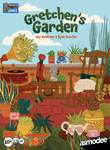
Gretchen’s Garden is a tableau builder for 2-4 players (aged 10+, around 30-45 minutes) about collecting, potting and propagating succulents. It was designed by Jay Bendixen and me, Ryan Boucher, and is published by Lookout Games. This is the story of how a house slowly filling up with succulents turned into a game.

First Ideas

Gretchen’s Garden began life as an observation that many of the people in my life were slowly collecting succulents. Even in my house would these hardy little beasts manifest. So yes, I have my partner Jess and the other women in my life to thank for the origin of this game.

I started to read the succulent books that were on the shelf at home and was impressed by the variety. I began to realise that to many people, succulents and indoor plants are different things. People who liked succulent plants didn’t necessarily care for indoor plants.

I decided I would design a game with this theme and this audience in mind. It started off as a single card from the game. I made a mock up and used this to gauge interest. “Given a card that looked a bit like this, would you be interested in playing this game?” Naturally, the people I asked were also board gamers.


No one could tell if the game was good from a single card. That was fine. What I wanted to know was whether the theme was enough to capture attention.

And then Verdant launched on Kickstarter and I paused the game. I know, I said it was a different audience but I was worried the market would be overgrown. It did affect us when pitching, with some publishers worried about competing against Verdant or had already localised it.

Collaboration

Skip forward to mid-to-late 2022 and I’m on the TGDA (Tabletop Game Designers of Australia) Discord, I’ve self-published some sport-related board games and I’m play testing a game called Surf’s Up by Jay Bendixen (my co-designer) and I’m considering publishing it. That never happened, but what most impressed me about Jay was his work ethic and how he approached iteration and testing.

I suggested we try co-designing something together and we talked about how that could work. One of my key takeaways from this phase was how we approached co-design, and how important it was for both of us to own the design.

It would have been easy for me to say: “Let’s work on succulents, here is my design” but there would always be this tension of Jay pulling the design away from where it started and who had the final say.

So before we started we proposed that we would pitch the other person three designs. I would then take Jay’s three games and spend a couple of weeks on them. Jay would do the same with mine. We would then pitch back our own version of the other person’s game.

We held this design review and picked our favourite design to work on. That game ended up being “Sidewalk Succulents”, Jay’s version of my original succulent design.


Our first combined version has changed a fair bit since that day, and yet some things remain the same. Flowers still go in the centre of the cards, we combine pot and plant cards but it stopped being a card stacking game pretty early on as we leant into different plant types and used tokens for leaves.

Remote Co-Design

It’s always a challenge working with another person, it’s harder again when you’re 2,000km apart and on the other side of the planet from publishers. The benefit we had was that 2,000km was roughly along the same longitude and so we’re in the same time zone most of the year.

We split our testing into two modes, we would use online play testing groups like the TGDA discord in Australia as well as Protospiel Online (although that often resulted in some very late nights or very early mornings). Then we’d do semi-regular physical tests independently. The physical tests were mostly looking at in-person affordances. It can be easy to get lost in a digital design and forget that at the end of the day, upkeep, scoring and mechanisms need to be intuitive when the game is on the table. So we used these sessions to check whether the mechanics worked. Did water and leaf conversion work? Is the cutting supply visible and intuitive?

Propagation

The cutting mechanic ended up being core to the design for us. We loved how it leant into the theme of propagating succulents. We wanted to stay away from take-that as it didn't suit the game. The original cutting mechanic was push-your-luck based. We had aphids on the plants and you could take a cutting but you weren’t sure if the leaf had an aphid on it. I think there was a ladybug too (they eat aphids). That ladybug became the first player token (the ladybug of initiative) before being replaced with a cactus in the final version. Fun fact: cacti are succulents but most succulents are not cacti.

To know whether the game was working for us, we recorded the number of times the cutting action was taken per game. If the number was too low, then we would find ways to bump the numbers. We wanted it to feel like a natural choice without forcing players to use it. So we looked at altering the market, adding plants that encouraged cutting, etc.

We would go back to testing and see whether the changes were making a difference. Jay and I are big on play testing to settle decisions and I’m big on tracking the things that matter. So we generally knew whether a change was having the desired effect.


Plant Powers & Multiple Decks

We spent time researching different succulents and seeing how they could be used to pull the game and the player decisions in different directions. We ended up with so many plants to choose from that we had the opportunity to create multiple decks of plants and then organise them loosely around the colours. Green and blue were non-scoring plants, yellow were designed to encourage propagation.

If you’ve played Timber Town, you’ll know that I’m a big fan of swappable scoring conditions. But we’re also sensitive to the cognitive load of which plants we choose when we play. This is where the A deck and B deck came in. Those two decks have natural affinities and if you don’t want to think about it, pick deck A or deck B. If you want to mix it up you can but there is a natural path to variability without front-loading it onto new players.

Flowering and End-Game Tension

Here is an old message from a chat with Jay from late-2022.

I've got this idea around converting leaves to flowers towards game end. I think it could work. So the first phase of the game is about getting more plants, then about getting growth (you may turn these two around if you want to strike growth first). But at some point you need flowers for VPs so you switch to convert leaves to flowers and that may trigger the others to do so. I like the idea that the game end is not player driven, but some external factor like cards in a deck. So you're trying to work out how long you can leave it before converting leaves to flowers and hope you've cut it fine. Finishing too early is points on the table. Leave it too late and you won't convert enough.


The game didn’t end up that way, because play testing told us it wasn’t right. The end game tension, which we really liked, came back in flower scarcity. There is only one of each flower and because it stops a plant from growing, you need to push that as far as you can but not so far that others flower before you. The single flower action meant that players were naturally limited by actions on flowering. There is so much you want to do but only 12 seasons to get it done.

Visual Design

This was a design where we had a perspective on the look and feel before we pitched it. We had this sense of light, joyous succulent plant designs, and that stuck. Lookout’s art direction build on our pitch, and the illustrators, Carrie Cantwell and Nele Diel brought it to life.


One of my favourite parts of the final design was how our pet rock, Dwayne, got renamed. In the German version he got renamed to Kevin. A solid name for a solid plant buddy. In French, he became Pierre. I like to think that, independently, two translators looked at Dwayne and thought “nope, that’s never gonna work” and set about finding a better name for a rock.


Pitching (and Pitching, and Pitching)

Lookout was the 39th publisher we pitched Gretchen’s Garden to. Succulents are hardy plants: they survive neglect and drought and keep going. So did this pitch, through many publishers before Lookout said yes. If there’s one thing I’d want another designer to take from this diary, it’s that: keep growing, I mean keep going.

We and the game benefited from all these rejections. We had very interested publishers along the way who would take the time to give us feedback and help us refine the game, often helping us make it lighter. Even if they didn’t end up signing the game, we often kept their changes because they did make it better.

And even when they weren’t interested, we would extract everything we could get out of that rejection. If we sensed a publisher had mis-interpreted the rules, we would adjust our pitch to be clearer next time. Every rejection gave us an opportunity to refine the pitch.

Along the way, Gretchen’s Garden was a finalist in the TGDA Take My Money Award in 2023 and a finalist in the ION Awards in 2024. These little events gave us confidence we were heading in the right direction.


Publisher Development

By the time Lookout signed it, the game was in good shape. When a game goes through almost 40 publishers, many of whom were interested enough to iterate on it, it’s in a pretty good place. But Lookout still changed a few things and we think for the better. One of these is the pot scoring, giving players an out on the final turn as they try to maximise their score. We had pot scoring a long time ago, but it was based on the pot and plant colour matching, something that moved over to flower scoring.

End Game

In Gretchen’s Garden, there is so much you want to do but only 12 seasons to get it done. Designing it felt a bit like that too. After a few false starts, the game flowered with Lookout. We’re very happy with Lookout’s final production. The little box to store the tokens in is a nice touch to replace plastic baggies. We love their approach to eco-friendly games which is very fitting for a game about plants. Gretchen’s Garden is out now at your local board game store.

Thanks for reading, and thank you to everyone who sat down at a table, real or virtual, to help this game grow. If you’ve ever brought home “just one more” succulent, I hope Gretchen’s Garden feels a little familiar. Hardy plants, it turns out, need hardy designers.


Thanks for reading,

Ryan Boucher
Published — 11. November 2026 ⏭ BoardGameGeek News | BoardGameGeek

The Melodies Under the Leaves Came From the Citadels Duel Over Tea & Rum

11. November 2026 um 18:00

by Steph Hodge


[imageid=8636789 medium rep]▪️ Under the Leaves is now available from Grand Gamers Guild. From designers Trevor Benjamin (War Chest) and Brett J. Gilbert (The Guild of Merchant Explorers). A new charming world to discover with pattern buildings and tile-placement. Under the Leaves plays 2-4 players in 25-40 minutes. You can also play it now on BGA, if you just wanted to check it out.

From BGG:
If we are able to maintain the health and diversity of our garden, then it will fill up with life and become a refuge for fascinating creatures. Hummingbirds and bees are the first to arrive, filling the air with color and movement, but if we stop and observe with more attention, we will discover a hidden and unknown world: tiny inhabitants abound in the mushrooms, puddles, and foliage. They are under our feet, living out their lives without being perceived...until we decide to look under the leaves.

Each turn in Under the Leaves is played in two phases: the placement of a garden tile, then the possible arrival of new beings. Whoever gets the most pieces in total wins.


▪️ Citadels Duel is a new release Z-Man Games & asmodee. From the Designers Guillaume Montiage (Kemet) and Manuel Rozoy (T.I.M.E Stories). Based on the classic Citadels, this is a reimagined game for 2 players and plays in 30 minutes.

From the asmodee website:

Scheme Your Way to Victory! Vie for control of the city in Citadels Duel, a strategy and deduction game for two players. Sway the council, build new districts, and utilize unique character powers to stay one step ahead of your opponent in this two-player version of the award-winning classic.

BUILT FOR TWO PLAYERS: Designed exclusively for head-to-head play, Citadels Duel delivers tense strategy, bluffing, and tactical choices in every match.
SCHEME & OUTTHINK YOUR RIVAL: Use clever deduction and timing to predict your opponent’s moves, disrupt their plans, and seize control of the city.
ICONIC CHARACTER POWERS: Sway the council by selecting characters with unique abilities, creating powerful combos and mind-game moments each round.
FAST, TACTICAL CITY BUILDING: Construct districts, manage resources, and adapt your strategy as the city grows—every decision matters in this streamlined duel format.
CLASSIC FEEL, MODERN TWIST: A refined two-player adaptation of the award-winning Citadels, offering high replayability and deep strategy in a compact experience.


▪️ Melodies is a new release from Next Move Games & asmodee. From the designer of Decrypto, Thomas Dagenais-Lespérance. If you enjoy games like The Crew: The Quest for Planet Nine, this is similar in that it is a cooperative, campaign-driven game where you work through boxes and games together. A hand management game that will rock 2-5 players in 30 minutes.

From BGG:

Melodies is a cooperative card game in which players form a band and complete songs by playing cards from their hand.

Each turn, every player plays one or more cards or passes. The most played value becomes the Melody for that note and must follow the song's progression. A song is completed only when all notes are played correctly, and all players have emptied their hands.

Communication is limited: the group can discuss strategy but never reveal their cards or intended actions.

From Mom's Garage to the biggest stages, each new venue introduces new rules, instruments, audience members, and challenges that reshape the way the group plays together.


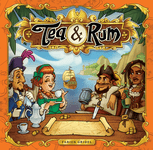
▪️ Tea & Rum is a new release from Captain Games SRL. From the designer of Turing Machine, Fabien Gridel. This is a worker-placement game for 2-4 players and plays in 60-120 minutes.

From BGG:

In Tea & Rum, strive for victory by serving the Crown or by becoming the greatest King of Pirates!

Within 5 rounds, upgrade your resources and carefully place and unplace your workers to fulfill your ambitions.

Will you prove your allegiance to the Crown, or will you join the rebellion and rule the seas? Be careful to keep your intentions hidden: angering the Crown or the people could compromise your chances.

At the end of the game, only two players will win the game… and two will be defeated.

Published — 09. November 2026 ⏭ BoardGameGeek News | BoardGameGeek

Illustrator Avenue: Villő Farkas, Mindclash Games

by Justin Bell

Welcome back to Illustrator Avenue! In this edition, I spoke with Villő Farkas, the Art Director, Graphic Designer and Project Manager at Mindclash Games, the publisher of both casual and serious Eurogame titles such as Anachrony, Emberheart (via the more casual Mindclash Play line) and Voidfall.

Villő and I first met a couple years ago, and I’ve had the chance to spend time with Villő and the rest of the Mindclash team during a visit to their offices in Budapest last year.

Enjoy! And if you like this series and/or are an illustrator or graphic designer, please reach out. I’d love to chat about future features in this series.


Justin Bell (JB): Villő! It’s always a pleasure. I’ve gotten to know you a little bit over the last few years but for the benefit of our audience, let’s learn more about you. When did you join Mindclash, and what were you doing before you joined the team there?

Villő Farkas (VF): 38 years ago...just kidding. In a nutshell, I have loved drawing since I was a child, as most of us did at that age :) but I continued diligently and during my high school years it became clear that I wanted to pursue further studies in the field of the arts. It's worth noting that, back then, I never would have imagined that I would one day become a board game artist. :) I graduated from Applied Arts Institute as a graphic designer in Sopron (Hungary) in 2012. During my final year of college, I interned at an advertising agency called Café Design (a division of Café Communications in Budapest), and I continued working there. I learned a great deal here about graphic design for advertising and useful tips for using Adobe programs, which is why I always look back fondly on my first job and the mentors I worked with. They were the ones who encouraged me to start working in digital illustration, and they were the ones who gave me my first Wacom tablet too (digital drawing tablet). I have gone through quite a few of them since then.

I joined Mindclash Games more than 12 years ago, no this is not true. :) I was already there back then when we became a publisher. One fine day around spring 2014, together with our former co-owner, Richard Ámann and our current CEO, Viktor Peter, we decided to quit our jobs (I know Ricsi from Café Communications) and devoted a year to developing and designing our first board game. In the fall of that year, I visited SPIEL Essen for the first time in my life. (Europe’s largest board game expo is held there every year). Yes, we went there by car approximately 1100 km and yes we brought all our equipment and our good spirits. The entire event and the industry as a whole made a deep impression on us, and we made an impression on them as well. (See the photo below of our first booth.) I remember that even Tom Vasel stopped by to check out what this game was all about. After that experience, it became clear that this was what we wanted to focus on in the future. Following our successful Kickstarter campaign in January 2015 for the game Trickerion: Legends of Illusion, we had no doubts left: we wanted to start our own publishing company - and the rest is history.


JB: I first fell in love with your work, like many players, with Trickerion. The worldbuilding is part of why Mindclash has so many fans today, but it all began with Trickerion. What are some of your earliest memories about helping to create things like the board, the portraits of each magician, and the challenges of that first project?

VF: I know this interview is supposed to be about me, but I don't want to take credit away from anyone else - we really did create the world of Trickerion together with Ricsi and several other illustrators (Gergő Ádám, Csilla Biró, László Fejes, Márton Gyula Kiss, Attila Sáfrány, Ágnes Staudt), and the truth is, I’m at my best when I’m working as part of a team; I couldn’t be further from the lone-wolf artist archetype.

So how did I feel when I started working on Trickerion? I immediately realized I was taking on a rather ambitious project, but at the same time, it was incredibly exciting, and I wasn't alone. Perhaps other board game artists would agree that designing an entire board game - everything that fits in the box and the box itself - is an extremely complex graphic and artistic undertaking. Every element of the game is interconnected, and if I do my job well, I feel like a conductor who maintains harmony among all the game components and provides the audience with a lasting gaming experience - and that’s why I’ve always loved working on board games, especially in my role as an art director. Back then, we were perhaps among the first development teams (we weren't a publisher yet) dedicated to creating the rich worlds of Euro-style board games - and that has remained our trademark ever since. I can’t even imagine it being any other way. :)

How does it work? In our design process, world-building has been closely intertwined with the core of the game mechanics from the very beginning. In fact, the theme itself inspired this game; all three of us were deeply influenced by Christopher Nolan’s film The Prestige. And the guys started building the entire game mechanism around the theme of stage magic. (If you are interested in the whole game design process, you can read about it here). Then, at some point in the process, the third area - graphic design - comes into play. Yes, I know, we'll get to illustrations soon, too. For example: How big can the cards be? What components need to fit on them? Do cards need to fit on the main board? How can we help players remember the rules when they sit around the table? And many other important questions. I usually design user interfaces, game branding and icons at the same time, and I really enjoy using the icons to develop the game's unique language, but Ian O'Toole remains the uncrowned king of this genre. I typically say that if I can't express a certain “action” using our icon system, then perhaps that “action” still needs to be developed - much to the delight of our game designers. These three fields (world building, game design, graphic design) influence one another, shaping the game’s final form and its individual elements.

We've finally gotten to the illustration of the main board. This is the part of the game where I can best show the fantasy world we’ve built: The tale of Dahlgaard the Magnificent is entwined with Magoria, a sleepy town at the dawn of the Industrial Revolution. I wanted players to feel, while playing, as if they’d been transported to a bustling city, and the user interface is an integral part of the overall design. I collected a lot of old photos of Victorian-era buildings for inspiration to draw the city, as well as photos of strange early 20th-century machines, which I also used to design the cityscape. So, when you place your worker (I have forgotten to mention but this is a worker placement game :)) to the “Downtown” space, you’re actually stepping there in the game world. That’s why I didn’t choose the usual bird’s-eye or isometric view for the cityscape, but rather a one-point perspective where you can see the details of the building façades and the people in the city.


Even on the illustration created for the first edition, there are countless tiny details to discover while playing; in fact, if you look at both sides of the board, you can see the town is a little bit different - for example the renovation of “The Magnus Pantheon” is being completed and “Dark Alley” location is available with the fortune teller, and with her new mechanics were added to the base game.


The biggest challenge was representing three theaters in the middle of town with just one enlarged Theater location on the board. The user interface also had to show which magician would headline at each theater and when, how magicians could appear in one another’s performances, and how everything would be scored. As I explain it now, the memories come flooding back. Whatever solution we considered, players still needed to use a little imagination and accept some abstraction.

As a first step, I tried to set this location slightly apart from the rest of the game board, so I changed the viewpoint to make it seem as if we were a spider sitting on the ceiling, watching what’s happening behind the scenes of a performance. We can see the audience, which also serves as a scoring scale, while a performance is currently taking place on stage; meanwhile, the crew (specialists) is working behind the scenes. Using the user interface, you can find out which magician is performing on which day over the weekend, and the various performance cards (not part of the main board) show you the actual theater along with the show’s schedule, where you can perform alongside others as the lead magician. If you’ve played the game before, you know the rules are more complicated than that, but I won’t go into any more detail here.


To be honest, my career in character design came to a complete halt after Trickerion. I really enjoyed this aspect of illustration as well, but I focused more on developing other aspects of my skills. The reason I’m still attached to the character illustrations from the first edition is that I had the opportunity to sneak us - the creators - and those close to us into this world. I have to admit that I use photographs as a basis for character design, but not just any photos - we held special photo shoots to capture the best poses and take pictures of anything that even remotely resembled the outfits we’d envisioned.


And finally I’d like to share an interesting detail about character design. In this fantasy world we’ve created, we set the rules - and while many things in the game don’t correspond to reality, the characters do. Even in the early 20th century, there were already female magicians and magicians from other ethnic groups. Now you’re probably wondering how I know about people from the Yoruba tribe. Through my dear friend Emőke, who served as the model for none other than the fortune-teller character. Regardless, the effort to ensure that everyone is represented has remained an important mission of ours ever since.

JB: It was fun to visit the Mindclash office to see what kinds of games all of you play during breaks in the work day. Outside of work, what types of games do you like to play? Maybe more importantly, how often do you find the time to play games? What do your playgroups look like? And what is your all-time favorite title?

VF: I have to admit that in real life, I’m not much of a board game player. I usually play with coworkers - Robin and Soma Gál always manage to find a game I’m happy to sit down and play. I love designing mind-bending strategy games, but I only like to play ones that are visually appealing, where world-building plays a major role, and where there’s someone to explain the rules. Usually, one of those three conditions isn’t met. Mindclash has ruined my taste forever. That’s why I prefer games like Harmonies, Azul and Hitster - my own group of friends tends to be more casual gamers, too.

JB: Who are some of your favorite tabletop artists? How about your favorite graphic design and UI work in the industry? I love learning more about what work other artists admire from afar.

VF: It’s not hard to guess that I’m a fan of Ian’s work; I look up to him for his expertise in both illustration and graphic design, but I don’t want to write about famous board game artists right now. I’d like to highlight that here at Mindclash Games, we have two amazing graphic designers, Atesz Kerek and Albert Bochnert, without whom we wouldn’t have so many beautiful games. I know that most of the time, it’s the illustrators who get the recognition, or artists who excel in multiple fields. But a beautiful illustration is worth nothing if the rest of the game’s graphics aren’t well-designed. When a board game’s graphic design works well, the UI almost disappears into the experience while making the game easier to play.


JB: Let’s talk about a new project that you recently finished. With the release of Courtroom: The Noir Trilogy, I’m still quite surprised that Mindclash released a game based on a real-life period and not another fantasy world like the ones your teams created for projects like Cerebria: The Inside World and Ironwood. How much of the final game’s art is yours? What kinds of items are illustrated here? I’m curious about the scope of the work you completed for this project, and how long it took to finalize.

Walk us through some of the images from Courtroom, especially if there are a few that you are particularly proud of. How did this go from concept to what it looks like in the game’s final production?

VF: I’d like to put this game into context. A few years ago, we launched a sub-brand called Mindclash Play, which brings smart but less complex games to the retail market, and Courtroom is our fourth game. World-building plays a key role here as well, along with the visuals, but we’d like to reach new audiences with these games. Courtroom is a competitive, team-based investigation game where the case has no predetermined solution. Players pick a side - Defense or Prosecution - look for clues that support their side of the story, build a stronger case than the opposing team, and aim for victory!

Although I really love creating fictional worlds, it was a great experience to work within the framework of a specific historical period - though it was also more challenging. Robin Hegedűs and Tünde Máté, the two designers, put a tremendous amount of research into ensuring that the details of the stories were completely accurate. In a fictional world, any rule is possible, and with this type of game, it’s important to think in terms of that specific era. That was one of the reasons we chose a real historical era, but we made sure to list fictional companies and change the addresses of the official agencies.

I don’t consider any of our games to be entirely my own creation, and Courtroom is no exception. It’s the result of four people working together. Tünde and Robin shared what they had found in their research, and the three of us discussed it at length. I then looked further into the details of everyday life in that era.

What everyday items were in style back then, and what kinds of cars did people drive? Was the 911 emergency number in use in New York in 1936? I’ll let you in on a secret: not yet. In the meantime Barbara Bernát, our character illustrator, worked with Robin to research the clothing and hairstyles of the era, and she drew the witnesses based on that research. I took it a step further. I researched what fonts were in use at the time, what newspaper front pages, receipts, business cards, movie posters, official documents, and black-and-white crime scene photos looked like. And based on the information I gathered, I designed every single detail of the evidence cards. Although Art Deco was the popular style of the era, I used it mainly in the box design and not so prominently on the components. While I personally adore film noir aesthetics, we restricted that specific visual flair strictly to the black-and-white photography elements. I wanted players to feel as if they were stepping into a time capsule when they opened the case envelope. It would be nice to see them all at once, wouldn’t it? I’m very sorry, but I can only show a few details without spoiling the rest of the gaming experience.


I worked on this project from August of last year through May of this year. There were some intense periods, but I think my craziest idea was the following: In one case, the suspect was a female painter, and I didn’t want to use an actual painting, so I spent 2 weekends stepping into the character’s shoes and created three surrealist images digitally. Robin liked them so much that he thought it wasn't enough for them to just appear on an Evidence card, so he came up with a separate mini-game called *The Postcard Mystery*.


Unusually for me, the first step in the design process wasn’t the graphic design and illustration of the components - I always start with that and leave the box cover design for last. Yes, I know, most board game artists do it the other way around. So now I tried this path. I’m not giving away any big secrets, but this game should be viewed as part of a series, and the challenge was figuring out how to create a box cover design that would work with and tie together every member of the series, while still distinguishing them from one another. My solution was to use the statue of Justice as the central element, which is the same on all three covers, while the background illustration and logo are designed in a style appropriate to the respective era.


As I began working on the sketch and continued painting the background illustration, I was even able to sneak in the iconic silhouettes of one or two skyscrapers from that era into the overall composition. One of my favorite discoveries during my research was that in 1936, they were still using the longer “Hollywoodland” sign. My latest project is always the one closest to my heart, but I really poured all my knowledge and love into this one.


JB: One other question for you, since you have the same gaming headset that I have at home: are you also a regular video game player? What are some of your favorites?

VF: You're right - those are gaming headphones. I bought them so that when I had free time, I could play Horizon Zero Dawn on my PS4, but this year I've always ended up doing something else or just relaxing. Still, maybe it's time for me to return to that universe.


A big thanks to Villő for spending some time answering my questions for this interview. Also, a big thanks to the Mindclash team for sharing some of the incredible imagery from their past and future catalog. You can check out the complete Mindclash catalog at https://mindclashgames.com/.

Are you an illustrator and/or graphic designer involved in the creation of images and iconography for the tabletop space? Please reach out! I’m building up a repository of people interested in contributing to this series. Just message me here on BGG and we’ll get to work. Thanks for reading!
Published — 07. November 2026 ⏭ BoardGameGeek News | BoardGameGeek

Designer Diary: Kalypso

07. November 2026 um 16:00

by Gilles Turbide

Origins
Hi, my name is Gilles, and I’m excited to share the story behind Kalypso, published by Inside Up Games.

The idea for Kalypso grew out of my lifelong connection with the ocean. Having grown up on an island, water has always been part of my identity, so the thought of building a floating city felt almost inevitable. Of course, the movie Waterworld left its mark on my imagination, but I wanted to steer the theme in a brighter, more optimistic direction—less diesel and grime, more greenery and hope. My vision leaned closer to Solarpunk or Ecopunk, where creativity and sustainability shape a better future.

From Notebooks to Prototypes
In the summer of 2020, my first sketches already hinted at what Kalypso might become: buildings, palisades, and resource tiles spread across a floating city.


I’ve always kept notebooks for my ideas—sometimes it’s a mechanic, other times it’s just a theme that pops into my head. Over the years, I’ve filled nearly a dozen of them. They’re indispensable, because there’s no way I could remember every detail otherwise. And whenever I need inspiration, I can flip through the pages and instantly reconnect with old ideas waiting to be rediscovered.

Finding the Core Mechanic
In the earliest prototypes, floating buildings carried resources on their reverse side. When a player collected a tile, they first gained its resources from the supply, then flipped the tile to reveal a building that could be constructed if they had the right materials.


It worked—but I’ve never been fond of games that rely on constant resource juggling: taking tokens from the supply when you gain them, only to put them back when you spend them. I wanted something cleaner, simpler, more elegant.

The breakthrough came when I asked myself: What if buildings were constructed directly on top of resource tiles? That single idea reshaped the game and gave it a clear identity. From there, two distinct tile types emerged: resource tiles (double-sided for flexibility) and building tiles (also double-sided, each offering different powers).


Resources and Buildings
The game revolves around five types of resources, but I wanted plastic to feel undesirable. In the earliest versions, players lost points for every piece of plastic still visible at the end of the game. Even after I removed that penalty, plastic (red) remained the “bad” resource: unlike wood (yellow), rubber (black), seaweed (green), or metal (gray), it couldn’t be used to construct the four core building types.

Each building type required just one resource, making the rules easier to learn and the board state clearer. Since the game is played on a grid, constructing a building means forming a group of three matching resources in a 2x2 square, then placing the building tile on top. I also wanted Kalypso to be full of combos, so players would feel a sense of accomplishment every turn. The very first building I designed gave players an extra T-shaped tile with 5 resources to place immediately. Because that effect was powerful, I balanced it with a lower victory point value. In general, every building was designed with this tradeoff between power and points.

In the end, I settled on four main types of buildings: houses (yellow), workshops (gray), farms (green), and warehouses (black). The color of the building is also associated with the color of the resource required for that building. And since tiles are double-sided, I gave each building type two possible abilities, letting players choose which side to build.

Later, I introduced monuments—larger buildings that require a 3x3 area with at least five matching resources. Early versions also had oversized buildings for each type, but I streamlined everything into this single “big build.”


Shaping the Tiles and Player Experience
During playtesting, I noticed that players often tried to “fill in” gaps as if they were playing Tetris. To break that predictable pattern, I switched to a more chaotic shape—the T-piece—which immediately gave the game its own character.


I also wanted to eliminate downtime. Since the mechanics allowed it, I opted for simultaneous play. Combined with tile drafting, this created a lively dynamic: players would pass along less useful tiles to their neighbors, almost like dumping garbage. That imagery fit the theme perfectly and inspired the name of the shared drafting board—the “garbage vortex” that moves around the table.

In an early version of the game, players could send sharks to opponents each round, blocking certain spaces and forcing everyone to adapt while continuing to expand their floating city. Over the months of development, the shared objectives evolved as well. They shifted from a competitive race into a system where every player could pursue goals at their own pace, earning points only at the end if they succeeded.

Playtesting and Recognition
In the beginning, most of the testing took place within my circle of fellow designers, which we call the LAB. Because the game involved hundreds of tiles, online playtesting quickly became a lifesaver—it spared me from endless hours with an X-Acto knife and saved my arms from serious strain. Once I was confident in the results of the digital tests, though, there was no escaping it: I rolled up my sleeves and cut out hundreds of tiles for the physical prototype.


By October 2021, I had a polished prototype ready to bring to public events around Québec City. The feedback was encouraging, so I entered two regional design contests. Kalypso became a finalist in one and won gold in the other.


Buoyed by this success, I began pitching the game to publishers. In the fall of 2022, I reached out to several french companies, but received no positive responses. Winning contests is never a guarantee—every publisher has their own vision and priorities. I decided to try my luck in English instead, which meant translating all of my pitch materials, even though it isn’t my first language.

Signing with Inside Up Games
I only sent one email submission in English. My first step was to email Inside Up in early 2023. About a month later, they got back to me and suggested an online playtest. Over the following weeks, we ran several more sessions—I think Conor McGoey wanted full team approval before moving forward.

I’ll never forget my very first test with Conor. He was traveling through Europe with his family, and despite a long day of travel, he stayed up late to play Kalypso. It was around midnight, his family asleep, and there he was on his laptop, testing my game. At first, I wondered if it was really a good idea to play under those conditions, but Conor proved to be incredibly kind, generous, and enthusiastic.

Finally, in September 2023, the game was officially signed.

Small Tweaks, Big Impact
When Conor suggested adding a cooperative mode, I approached it cautiously. I didn’t want Kalypso to lose its identity or force players to relearn the game entirely—cooperative variants can sometimes feel like a completely different game. Fortunately, the team’s changes were subtle and thoughtful, refining the experience rather than overhauling it. The foundation I had built remained solid, and at its core, Kalypso was still the game I had envisioned from the start. I had experimented with a cooperative mode before, but I was never fully satisfied with it. Inside Up’s version, which even included a solo option, was far superior—streamlined, elegant, and much closer to what the game could truly be.


Another major shift in the game was replacing the shark mechanic with Forecast cards. This change added a whole new layer of player interactivity, as each card introduced unique challenges that forced players to think strategically about how to build their floating city. Beyond the mechanical impact, the Forecast cards brought thematic richness to the game, introducing events that reflected environmental shifts and challenges in the world of Kalypso. They also greatly increased replayability, ensuring that no two games would ever feel exactly the same. I was immediately drawn to this new direction, as it brought both depth and narrative flavor to the gameplay in a way that the shark mechanic never could.

When it came to the look and feel of the game, the first glimpse I had was a teaser of the cover art. That alone was exciting, but seeing the full set of components later—the Forecast cards, the objectives, the tiles—was even more special. Amelia Sales’s illustrations bring the world of Kalypso to life in such a vibrant way. Every image reinforces the theme and makes the floating city feel real, colorful, and alive.


A few months later, I learned that the team was working on a custom component designed to keep tiles from sliding around during play. It might sound like a small detail, but it really spoke to the level of care and craftsmanship Inside Up brings to their projects. That dedication reassured me that Kalypso was in the best possible hands.

After the success of the Kickstarter campaign last year, I’m really looking forward to seeing this game make its way into homes and stores. Thank you for following along with my journey in creating Kalypso. I hope you’ll find as much joy in building your own floating city as I did in designing it. Dive in, explore, and make the experience uniquely yours!

Gilles Turbide
Published — 04. November 2026 ⏭ BoardGameGeek News | BoardGameGeek

From Greenwood to the Cosmos there was Harmony in the Chimerium

04. November 2026 um 18:00

by Steph Hodge


[imageid=9564394 medium rep]▪️ Greenwood is now available from Capstone Games. from designers Christos Giannakoulas and Manolis Zachariadis, this is the next big box Euro game! This game plays 1-4 players in 40-160 minutes!

From the Capstone Website:
In Greenwood, you play as Primal Spirits and lead your companions to save Greenwood.

On each turn, you face the difficult decision of whether to use the abilities of your own companions, to use the abilities of other players’ companions, or to send one of your companions into the forest to improve your wayfinding and rescue mystical creatures.

In the advanced game, each clan has a unique ability – a small additional rule that has a major impact on the game. What makes this special is that players can use the unique ability of any clan currently in play, not just their own.

The game is played over the course of 3 nights, and whoever scored the most victory points wins.


▪️ Chimerium is a new release coming in Q1 from Synapses Games. From the Designers of Encyclopedia & Museum, Eric Dubus and Olivier Melison. A new dice-drafting and area-control game. For 1-4 players and plays in 45-60 minutes

From BGG:

Chimerium is a dice management and area majority game that offers intense strategic depth in both competitive and solo modes.

During the game, players utilize their dice to Study creatures, Acquire Artifacts, or target specific locations in the Nexus to release their Chimeras.

Every choice influences your standing in the majorities—adapt your strategy, watch your opponents, and win the Guild’s favor.


▪️ Cosmo is a new release from Helvetiq. Fromthe designer of Trio, 宮野 華也 (Kaya Miyano). This is a new hand-management game to create the best poker hand! For 2-5 players and plays in 15-20 minutes.

From BGG:

Build your best poker hand by strategically recruiting the perfect crew for your Mission to Mars. Simply draw Cards from any of the six decks! The twist: Some of the players' cards are visible, others are hidden. Can you really be sure the others will end up with a better crew than you?! Once everyone has five cards, it’s time to shine. The strongest hand … uh, crew wins the ticket to Mars.

- Draw cards from any of the six decks and aim for the strongest poker hand.
- Bet on the best hand before drawing your last cards.
- Once everyone has five cards, it’s time to shine. The strongest hand wins.


▪️ Harmonies: Crescendo from Libellud is a new expansions for Harmonies that was just released. If you are looking to expand your game of Harmonies, you can expect 3 new modules to mix in. From designers Johan Benvenuto and Mathieu Rivero. An easy gift for the holidays to that gamer in your life who already loves the base game.

From BGG:
The Crescendo expansion for Harmonies includes 3 new modules that can be used individually or in combination with other modules.

Sanctuaries: Build unique landscapes that can accommodate multiple animals.

New personal game boards offer new field layouts and ways to score points.

Whisper Creatures: Add new cards to your animal cards and create synergies between animals and Whisper Creatures.


Published — 02. November 2026 ⏭ BoardGameGeek News | BoardGameGeek

Look, Another Remastered Edition!

by Justin Bell


I don’t typically back games on crowdfunding platforms. Usually, I’m happy to wait, especially on games that will be available at retail later. I am also hesitant to buy a game that I have not played before, which I have noted in earlier pieces here on BGG as well as the place where I spend most of my time reviewing games, Meeple Mountain.

Like some of you, I’ve been burned by campaigns in the past, be it games that never fulfilled or games that arrived and confirmed my suspicions: it really WAS all marketing, and the gameplay for that cool-looking game with all those fancy minis wasn’t worth the tens or hundreds of dollars I paid for the right to get the box two or three years later.

That script flips for one specific category: reprints and twists on games I already know. This extends to updates of games I’m pretty sure I know, with updates to the art, or maybe some of the mechanics, or nerfing some of the overpowered cards or player abilities, or anniversary editions of games long out of print.

If it’s a remaster of a game I already know, count me in.


I do a lot of work with the team at Cranio Creations, and when news broke of the team’s plans to remaster Lorenzo il Magnifico, two of my playgroups were (and still are) buzzing with excitement.

Older versions of Lorenzo are certainly not hard to find; my copy sits patiently on my game closet shelves at the ready, and every time I do a math trade it feels like copies are made available by players looking to cull portions of their collections. Many friends own the base game, or the Houses of Renaissance expansion, or other promo items and cards, or all of it…heck, you can even play Lorenzo now on Board Game Arena if you need a hit, so Lorenzo is certainly not suffering from an accessibility perspective.

Now that the Lorenzo crowdfunding campaign has wrapped up, my personal excitement is spiking. The campaign offers a big box edition with the base game (now referred to as Lorenzo il Magnifico: Prima Lux) with new art and deluxe components, great for those who don’t already own the base game or want the base game with a new coat of paint and all the previously-released content in one spot.

I’m more excited for the game’s new edition, Lorenzo il Magnifico: Maiestas, and that’s the one I backed for this campaign. The base game does get a little predictable, and this new version seems to take into account thoughts from long-time players to balance some gameplay elements and freshen up others. And I like that there’s a separate add-on for solo if one wants to try the game that way, along with other extras that are purely cosmetic. (Yes, I “need” marble dice to replace my wooden dice from the base game.)


Outside of Lorenzo, it feels like I’m seeing anniversary/remastered/deluxe/second/ultimate editions a LOT lately…you are too, right?

Many of you know that I am a huge fan of City of the Big Shoulders, so a chance to grab Chicago 1875: City of the Big Shoulders last year was a no-brainer. I got the chance to play someone else’s copy of Food Chain Magnate: Deluxe Edition a few months ago and now admit that I should have picked up a copy of my own.

The Trickerion: Anniversary Edition? Sold. I moved my copy of Unearth out of the collection a couple years ago after a long run of plays with my family, only to find that Unearth: 10th Anniversary Edition hit earlier this year. I got the chance to finally try Goa for the first time last spring…then was thrilled to learn that Quined Games announced a new edition. (It almost feels like the team at Quined is spying on me, because when I learned that they are launching a campaign for an ultimate edition of the Euro classic Troyes, I yelped with joy during the Novelty Show at SPIEL Essen a couple weeks ago.)

Reiner Knizia’s Samurai is exceptional, but it was another older title that was hard to find. Or, at least it was until Keymaster Games released Hanami, the Samurai remaster, earlier this year. Now, not only do you get a gorgeous production with cool cover art, but you get both OG Samurai and a slightly different version for play on the board’s reverse side. As abstracts go, I think Samurai is a must for any serious player, so Hanami gives everyone a chance to add this beauty to their collection.

There were so many other new releases of older titles the last couple years that it’s hard to remember them all. Euphoria Essential Edition. Innovation Ultimate. The Stefan Feld “City Collection” games from Queen. In just the last month, my groups are still buzzing about the launch of the second edition of An Infamous Traffic, the multimillion-dollar campaign for the Clank! 10-year anniversary, and a grail 18xx game that is infamously hard to find, 18Korea.

I don’t always bite, especially if I just bought copies of a game before I learned of an upcoming “all in” edition. I bought a copy of Concordia Venus just two years ago online, so I didn’t pony up for the recent deluxified version. I enjoy Ark Nova and added Marine Worlds a couple years ago, but didn’t bite on the Ark Nova: 3Dition campaign late last year…even though 17,000 other people did. The Castles of Burgundy is incredible, but I usually play that game’s digital version on my iPad, so I saved a few bucks by skipping out on the Special Edition.


It’s fun to find so many publishers who are fans of these older designs, because I think 2027 is going to be even richer with these sorts of campaigns for older games mixed in with the hundreds of campaigns we already see for fresh tabletop experiences.

I was thrilled to find out that an English edition of Helvetia is making its way to crowdfunding next year from the folks at CrowD. Like CrowD’s work on Nippon: Zaibatsu, Helvetia: Second Edition will get a thorough round of development and playtesting to ensure the game fits for modern players…and if the result is anywhere close to what CrowD did on Zaibatsu, I will be first in line for a copy of the refreshed Helvetia.

I am following the campaign for the Marco Polo reprints from Board&Dice closely. They did great work with the La Granja Deluxe Master Set a couple years ago and getting my hands on new editions of both Marco Polo games has me fired up. (During my Board&Dice meeting at SPIEL Essen, they shared news of another game they will bring back for a deluxe edition in 2028…the future is bright, my friends.)

The more fascinating angle for me are games that were not in need of a 10-year anniversary edition or a second edition with fancy art. Sometimes, I see this with games that came out just a couple years ago getting fresh development work to make the original ideas really shine.


Take Asian Tigers: A Story of Prosperity, for example. I noted in my review of Asian Tigers—a 2024 release—that my major issue with the game had nothing to do with the gameplay. That first edition was…I’ll politely say that it was pretty bland. Absolutely not a looker. That extended into the board’s layout, which was certainly “spreadsheet” in nature but also not very easy to parse in terms of execution. The rulebook was a major challenge. And the board came as jigsaw-style pieces that were attached in a way that left creases at critical intersections of the play area.

I met with Nuno Santos, the sales exec of PYTHAGORAS during SPIEL Essen, and during our meeting I noticed new artwork for Asian Tigers on a banner along one of the booth walls. “Are we getting a new version of Asian Tigers??” I asked excitedly. Nuno smiled as he confirmed my suspicions. People are going to feel like they have made a discovery if Asian Tigers shows up in a year or two with better all-around production elements, because the production of the original is the reason I donated my review copy.

Railway Boom is another example. The original game, self-published by Hisashi Hayashi (Yokohama, Circadia) under his OKAZU Brand just four years ago, got an update via development work by Hayashi and Simone Luciani, a fresh coat of graphic design from Ian O’Toole, and became one of the 10 best games I played in 2025. I C E: Second Edition is an updated version of I C E, which was only published by the team at This Way! three years ago and features a wide array of quality-of-life upgrades from the original design.

Publishers are increasingly finding ways to spruce up games that just hit the market a few years ago. I’m fascinated by this; games that were close, but maybe didn’t quite hit it out of the park are going back into the lab almost immediately, an acknowledgement that small edits to strong foundations can hit the market as something special even if the name is vaguely familiar to hobby players.

Fresh takes on older games help balance out the brand-new titles that reach us each year, creating a nice range of opportunities to celebrate the old and the new. For newer hobbyists, this is really important, and I think this helps people appreciate older designs in the same way fresh takes on old movies bring people closer to appreciating why some of those films are considered classics.
Published — 01. November 2026 ⏭ BoardGameGeek News | BoardGameGeek

Designer Diary: Tea & Rum — Fabien Gridel

Von: Krazey
01. November 2026 um 16:00

by Fabien Gridel


When you sit down to design an expert game, you have much more freedom than when you design anything else. Players will forgive convoluted mechanisms, longer rules, and above all a playing time longer than an hour.

That said, just like my last expert title (Path of Civilization), it still has to be easy to get into. It has to play smoothly, and it has to end at the right moment. I'm firmly in the European school of design, where chaos, luck and noise take a back seat to planning, management and strategy.

Where Do You Even Start?

I'm lazy. I'll think for hours before I actually do anything. I take almost no notes. And my thinking always circles around one idea I want to dig into: something new, or something I think board games haven't made enough of yet.

No, Tea & Rum isn't going to reinvent modern board gaming. But I did want to bring something new to the table. Little mechanical hooks, as I think of them: the kind that flip how players look at a game, and that get people interested the moment you describe them out loud. That was the brief from day one, do something new.

I. Standing on Other Designers' Shoulders

Designers are gamers first. Of course we feed off everything we've played. Tea & Rum is unconsciously the descendant of a hundred different games. But here are the ones that actually made me stop and think, and what I took from each.

Die Säulen der Erde (The Pillars of the Earth), and how you get your resources


Die Säulen der Erde – Sonderausgabe – game box front (cropped) – Source: BGG

Every resource management game has two halves:
   
● getting the resources
   
● spending them
In a lot of games, getting them is the whole point, that's the engine. Tea & Rum turn it over. In Tea & Rum, what matters is what you turn them into: Captains, Contracts, Buildings.

So how do you make acquisition interesting without letting it take over the game?

Enter The Pillars of the Earth (Kosmos, 2006), by Stefan Stadler and Michael Rieneck. Their answer: a fixed resource draft. Which turned out to be exactly what I needed.

Resource cards for The Pillars of the Earth - Source: BGG

   
● The rate is great. The cash-per-cube ratio is good enough that you always want to buy something.
   
● It's strategic, because you have to already know how you're going to convert those goods later.
   
● A draft is interactive by construction.
   
● Sometimes you're better off sitting on your money to grab a Captain at the top of the Round. You shouldn't be buying at any price, and that tension gives you plenty to chew on.
   
● Unlike Pillars of the Earth, every Ship card in Tea & Rum offers you several different options.


Tzolk'in, and the Joy of Picking Workers Back Up

You can't talk about Tea & Rum without talking about Tzolk'in. Why? Because it's worker placement where you get to do the action when you take the worker off the board. The longer you leave it out there, the stronger the payoff.


English second edition (2014) cover – Source: BGG

Tea & Rum uses that same idea, but uses it completely differently. On even Rounds you place workers. On odd Rounds you unplace them. Either way, placing or unplacing, you take an action.

Each of the four Action Boards in Tea & Rum has its own personality, its own perks, its own actions. Everyone starts with workers spread across the four of them, but nothing keeps you honest after that. Drop two workers in the port on Round 2 and take two actions there, and you've just committed yourself to two more port actions next Round when you pick them back up.

That's a big deal, because it hands the player real control: you can guarantee yourself actions where you want them. And in an interactive management game, where what's available to you depends partly on what your opponents just did, locking down that certainty is worth a lot. It also means planning ahead, because you'd better make sure those actions are still worth being taken when you play the next Round.


Antiquity (2004)


Antiquity, Splotter Spellen, 2017 — front cover (image provided by the publisher) – Source: BGG

In the early 2000s I was fascinated by Jeroen Doumen and Joris Wiersinga's games. In 2004 the pair put out a monster: Antiquity. Long, brutal, with upkeep that borders on unbearable AND it stuck with me, because nothing else looked or made you play like it. That modern feeling that every game is gorgeous and every game is the same rubs me the wrong way. Antiquity is ugly, and Antiquity is new.


Of all the ideas crammed into that box, the one that stayed with me is that you pick your own victory condition by building your cathedral, a cathedral that also hands you a unique advantage. It's sneaky. It's fresh.

Choosing how you win. Now that's worth pulling on. But in a modern game, that choice can't be a trap. It has to be something a strategy leads you to, not something that punishes you for guessing wrong. So in Tea & Rum, the decision to play nice with the Crown and go for Governor got rebuilt around three ideas.

First, it's a draft: first player to 8 blue VP picks first its Allegiance Objective. That builds in a race, and the more you play, the more you'll notice that some allegiances are worth far more than others depending on how the game is shaping up. Second, you don't actually have to pull it off. Somebody is always crowned Pirate King, so failing your allegiance is nowhere near as fatal as blowing your cathedral in Antiquity. Third, the red VP attached to each allegiance are nothing to sneeze at anywhere from 1 to 5. Which opens the door to counter-drafting: taking an allegiance you are fully aware you'll never complete, purely for the red points and to keep it out of an opponent's hands.


And finally, more on this later, it's one of the things that keeps the game from repeating itself.

II. The Co-op Wave, and the Second Winner

Since Pandemic in 2008, the co-op wave has been strong enough to swamp the hobby for a solid decade. There were great co-ops before it (Knizia's Lord of the Rings, Cathala and Laget's Shadows over Camelot), but I think that wave forced every designer to ask what kind of fun a game is actually selling.

A designer friend of mine put it well: sharing a loss takes the sting out of it, and sharing a win makes it sweeter. Win alone against everyone at the table and you have to be gracious about it. Win as a group, after a real fight, and you get to celebrate. So why does it have to be one winner or everyone? Nothing says it does. That's where the double victory in Tea & Rum comes from. Two winners means two players potentially walking away happy. And it costs you nothing in competitive tension along the way.

In other words: pure upside.

What it does for Tea & Rum is huge. For one thing, you have to watch what everyone else is doing. For another, the game can never end without a winner, because someone is always crowned Pirate King. And in the two-player game, knowing that nobody might win at all is honestly delicious.

III. Trying to Have It Both Ways

The victory point constraint was argued over for a long time.

In the final version, you can't finish with more than a 10 VP gap between your blue points (the Crown) and your red points (the Pirates). Without a constraint, the game simply doesn't work. Players would tunnel on one color and completely ignore the other. Make it too tight, let’s say 5 VP, and the endgame becomes a nightmare. Ideally, a player chasing the win in Tea & Rum should be riding that gap right up to the limit. 35 red and 35 blue is a weaker position than 40 red and 30 blue. After a huge amount of testing, and weighing up how it actually felt at the table, 10 VP turned out to be the sweet spot.


IV. Nobody Gets a Playbook

You know that sinking feeling in a heavy game when someone at the table already knows exactly what they're going to do sometimes before the lid even comes off the box? They know the game, they know which line is too good, and off they go. Everything in Tea & Rum is built to stop that. Sure, one game you'll think: wow, this allegiance is a free win. Then next game that same allegiance is a slog, because the building you needed isn't in play. And since you never play with all the buildings (except in a two-player game), I wouldn't be surprised if groups start pulling specific ones on purpose, rather than randomly, just to try all the different strategies. You can't skip reading the Captains and the Contracts either, because in some setups they're worth far more than in others, and you'll want to adjust accordingly.

Maybe that's the one word behind the whole design: adapt. Constantly.

That 'infinite replayability' everyone claims as proof that a game will last is, most of the time, not true.


V. Worker Placement, Or Action Draft?

Design-wise, worker placement is usually just an action draft wearing a hat. Here's what I mean: when you put a worker down, you pull an action out of the pool and nobody else can have it. Functionally, that's the same as holding every action card in your hand, taking one, and passing the rest along. Tea & Rum is worker placement, but it drifts a long way from a straight draft. Why? Because what your action does depends on how many workers are there.


So instead of removing an action from the pool, you're changing one.

In most worker placement games, that kind of thing gets filed under indirect interaction. In Tea & Rum, you're not just taking an action somebody else wanted, you also have to think about which action you're handing them in its place.

VI. Interactive, Or Just Mean?

Anyone who plays expert games knows the deal: a lot of them are solo multiplayer, politely rebranded as "indirect interaction." The ship draft I mentioned earlier, the activation system that swaps one option out for another, the race for Allegiances, the sliding bonuses on the Contract board, all of it is there to put players in each other's way, and to make the game interactive without making it unpredictable or chaotic. No hidden information. No gotchas. You can see what your opponents are able to do. And YES ! This is fully intentional, and I'll happily own it. The game can be mean. Killing an opponent's shot at Governor by taking the last bit of Reputation they needed can be a genuinely great play. What's funny is how differently groups handle that. Some tables are vicious with it. Others just build their own engine and let an opponent run away with it, even when tripping them up would clearly have been the better move.

VII. Adding Insult To Injury

Kicking a player while they're down is a feeling I work hard to design out. You know the pattern: here's an objective hit it and you get a reward, miss it and you eat a penalty on top. Where does that come up in Tea & Rum? If you followed why the Ship phase and the start-of-round Resource choice matter so much, you'll see that having room in your warehouse is everything. Early versions had rigid storage. The result: any Round you failed to convert your goods as planned, you got hit twice, you missed out on whatever you were buying toward, and your warehouse was full, so you couldn't play the next Ship phase properly either.

We tried every formula to turn that into a management problem rather than a punishment. Sure, failing to cash in your resources on schedule should still hurt a little. But the fix we landed on is that you can pay to expand your Warehouse at any time. That kills the double penalty dead, because right after start-of-round income you can always afford enough space to take a normal part in the ship phase.


VIII. The Two-Player Game

Wait?! there's a two-player mode for a game designed around two winners? Yep. And you know what? It's terrific.
The game was originally built for three and four only, and honestly, three is still my favorite. But right at the tail end of development with Captain Games, a two-player version went from "nice to have" to "we need this." Lucky break: a colleague of mine loves expert games and plays almost exclusively at two. Hundreds of games of Agricola, for example all two-player.

Even better, he'd never seen the prototype when I showed him the two-player draft. We played a three-player game first so the rules were rock solid, then I walked them through the two-player changes. I left the prototype with them for two weeks, and they came back with an incredible stack of play logs and notes 20 plus games and more than 30 suggested changes.

The result: 90% of their suggestions made it in, and several of them fed back into the three and four player game and made the whole ruleset more consistent.
So no, there's no double win at two players. Victory takes shape round by round, pulled between the pirates and the Crown, with a new kind of tension that keeps forcing you to adapt and yes, it can end with nobody winning at all. That's rare, and it takes two genuinely nasty players to get there.

IX. On Publishing, Illustration and Finishing Touches

The game design of a board game can never skip a long development phase carried out with the publisher, covering ergonomics, but also the illustrator, who brings the game to life visually. The work done on both the artwork and the iconography contributes enormously not only to the readability of the game, but also to its fluidity.

Adrien, Captain Games' in-house illustrator, spent an endless amount of time reworking every icon and refining every drawing. This is not only a matter of publishing and art direction. It is also slightly tied to the creation of the board game and to the game design it serves. Many gameplay elements came out of this shared development with Captain Games. The development team in charge of the project was particularly proactive in putting forward ideas to solve several points of friction and balancing issues, among them: the removable Action Board tiles, which prevent any one position from being too advantageous, the streamlined management of the Warehouse...

Tea & Rum is an expert game, and it required close collaboration between all parties involved: the designer, the publisher and the illustrator, in order to produce the best possible version of the game.

Last Word

Designing Tea & Rum was long and hard, and like every game at this weight, it's full of dead ends, backtracking and hours of staring at the ceiling. But it's here: Captain Games has turned into a real product a vision of a heavy game that doesn't quite want to be like the others. It'd be easy to call it a patchwork of borrowed ideas. I'd like to think it's a little more inventive than its ancestors, and a lot more modern.

Go find it, play it, and share it.

Designer Interview: The Jailbreak

01. November 2026 um 16:00

by Karl Lange

Welcome to The Jailbreak - a cooperative deduction game for 2-4 players where your perspective and clever communication are key to your escape!

When we were thinking back through the design and development of this game we realised the game had three very distinct almost independent phases of work completed throughout its life. Given this process, we thought it would be fun to frame this diary as questions from each of us to the others to give you all a sense of how the game progressed and evolved through each person's unique input on The Jailbreak!

An Idea is Born: Co-Designer Joel Kennedy

[heading]Can you give us an overview of the game?[/heading]
In The Jailbreak 2-4 players must work together, using double-sided tool tiles to make their great escape!

The game is a mixture of puzzle solving, deduction and different perspectives. Use the right tool, in the right place and the right orientation to defeat each challenge. Can you complete all 44 levels?

[heading]When did you start working on the game?[/heading]
I put together the first prototype all the way back in April, 2021. This game started its life as a solo design. Over the following eight months I tested and refined the game, before submitting it to the Cardboard Edison in January 2022 (under the name Double Jeopardy) - where it was selected as a finalist.

It was the first time I had entered that competition and it was pleasing to have such a promising result. It gave me a lot of confidence to not only continue to pursue this design, but also designing games in general.

The game was signed with Adam's Apple Games, LLC in 2025 and will be released at SPIEL Essen this year (2026).

[heading]Where did the original idea for The Jailbreak come from? [/heading]
I love seeking out designs that take something fundamental about games and flip them on their head. To do this, I often write out lists of all of the basic assumptions that I have about games - and then wonder how I could challenge those assumptions.

On this occasion (sometime in April 2021) one of the things I wrote down was the fact that cards have a front side and a back side.
It made me wonder what would happen if cards had two front sides.
At the time, it was just an abstract idea. I pondered on it a little and wrote it down, but I didn’t have much else to go on.

It was about a week later, whilst pairing a very large pile of socks, that I was suddenly struck with the urge to make a game about socks. Something felt interesting to me about the idea of a game where the cards were simply depictions of socks - and players needed to work together to find each sock’s pair card.

Inspired by the theme I began putting together a deck of cards for a game called Odd Socks.
And as I did, the thought bubble of double-sided cards re-appeared to me. Given the light-hearted theme and the unknown element of how to play with double sided cards, I decided to merge the two ideas into one.

Here’s what the first version looked like:

Initially the socks came in three different types (striped, solid and checkered) and six different colours. That meant 18 unique sock designs. 18 cards meant 36 faces, which meant exactly one pair of each type.

Why 18 cards? Initially I thought that if the game worked I could enter into one of Button Shys' 18 card contests. And more generally, I am a fan of games with a small footprint (no pun intended). And it would be remiss of me to not mention the influence the game Love Letter has had on me.

[heading]How did the design progress through the testing process?[/heading]
From the very first test I knew that I had something worth pursuing.

The game was jam-packed with moments of dramatic irony. You would see the cards you needed on the back of someone else’s hand… but would you be able to effectively let them know about it? Would they accidentally play that card using the card’s other face first? This game felt puzzly and there was already some great tension at the table.

But something wasn’t quite right.

For the first test, I had constructed the deck such that there was no obvious connection between the two sides of each card. I had felt that I didn’t want players to be able to infer what was on the reverse side of their cards, but rather force them to rely on the clues from the other players to figure it all out.

In that first test, my long time friend and collaborator Matt Gleeson suggested that the game would work better if the two sides of the cards were connected - such that you could deduce something about the reverse side by looking at its front.
He was absolutely right and so I set about working out how to construct the deck such that the two sides were connected in some way. The solution was in having each card face tell you information about what was not on its reverse side. For example, if you were looking at a stripy yellow sock then the back of the card would not be yellow and not be stripy.

The next challenge was in figuring out how the players would be allowed to interact with one another.

I have played Hanabi quite a bit and it was clear to me this game shared some key DNA with it. As a result, I was keen to explore some different ways for the players to give clues.

The first, most logical option was to let players ‘flip’ a card - so they would now see its reverse face - and everyone else would see what they had been looking at. This mechanism was introduced very early on and became a cornerstone of the design. The card flip was always such a fun “aha!” moment at the table. To me it always felt like a little magic trick - that yellow stripy sock in your hand is now a solid blue sock. Ta-da!

Above: An example of some of the early Action tiles players could use. At this stage the game had changed to a theme about Detectives investigating a crime. The actions in the final game are simpler than these. The Compel action exists in the final game almost exactly as it is here. The other actions shown here did not survive until the final version.

Early on - a week or two after the first few tests - I was doing a solo test of the game on Tabletop Simulator. Between each turn I would click to change my seat at the table, so I would then see things from the next player’s perspective. The thing that struck me was just how different every player’s perspective at the table actually was. Each player was looking at the same game - but seeing something different.

I wanted to lean really hard into that element of the game and that’s when I had the idea for clues that took into consideration all of the cards a player could see - both on the fronts of their own cards and the backs of other players cards. A player would announce, for example, “I can see four blue cards” and the other players needed to cross-check that information against what they could see.

This achieved exactly what I wanted, as it clearly highlighted to the players just how different each other's perspectives were. It was the ‘whack of the side of the head’ I wanted players to experience.

(As an aside, the book ‘A Whack on the Side of the Head’ is one of my favourite books on creative thinking - I highly recommend it).

The game was coming together nicely, until I hit a road bump of a different kind - a technical challenge, unrelated to the game itself. Earlier I mentioned I was testing the game in Tabletop Simulator (TTS). April 2021 was smack bang in the middle of the covid pandemic and, living in Melbourne, we were living in hard lockdown for most of that year.

Testing online was the only option available to many of us during this time.


The challenge was that in TTS the custom card component has two defined sides - a ‘front’ and a ‘back.’ When I uploaded the cards I had to define which was the front and which was the back (that part was fine). However, when a card is in a player's hand (a special ‘zone’ in TTS) it is hardcoded that the player in that seat sees the card ‘front’ and each other player sees the card ‘back.’

This meant when you flipped a card in a player’s hand - it would change the face that player could see - but not the face that others at the table could see. Other players would still simply see the image of the cards back - which made the game unplayable.

It took me several weeks to find a workaround, before I discovered card states. In the mod I set up each card to have two states: The first was a copy of the card showing A/B as the front/back and the second was the same card showing B/A as the front/back.

Now when a player flipped a card they would instead click on it and select to change the card’s state. It was a little bit clunky, but it did work, and the game was playable again.

By March 2022, I began doing a lot of testing in real life with my wife Sarah - who was a tremendous help with getting the game to where it is today.

By this time I had decided the game should have a modular set of challenge cards.

Above: An early draft of the ‘challenge’ cards that players would be working to complete. At this particular time I was also dabbling with a theme of defusing a bomb (I do like to try on different themes to a game!) Many of the initial concepts have survived until the final game - although they were simplified and streamlined.

In June 2022, my friend Karl Lange, who had been helping playtest the game, approached me about being more involved with it - and I enthusiastically agreed. In particular, Karl had some great ideas about creating a campaign for the game and I knew he would do a great job.

Karl took ownership of designing the game’s 44 level campaign. He also added a compelling narrative structure to the game alongside some important tweaks to the way the player actions worked.

Since this game, Karl and I have worked on several other games together (one of which is coming out next year - watch this space!)

[heading]Were there any designs that inspired the design?[/heading]
Certainly Hanabi was an inspiration as mentioned.
Another inspiration was Hanamikoji. The action tiles in that game directly inspired the shared action tiles used in The Jailbreak.
The Crew was also an inspiration, especially in the sense that it had inspired me to want to work on more co-operative games and also a campaign-driven game.

[heading]How much of the original prototype survived to the final product? [/heading]
The game’s primary components and gameplay are mostly unchanged, although in the finished product they have been upgraded to tiles drawn from a bag (an update I’m very excited by).

The publisher - Adams Apple Games - has also added some extra tokens to make the final levels even more challenging which is a really great touch. Adam has been a fantastic asset for the game. He has been a pleasure to work with and seeing him put his own flair and design prowess into this game has been an inspiration for me.

The Teenage Years: Co-Designer Karl Lange

[heading]What drew you to want to be part of the game?[/heading]
I have known Joel for many years initially from Melbourne Incubator playtest meetups, then multiple times per week online through covid lockdowns, and always admire his ability to just throw new idea after new idea into a game. I often have a very product focused view when I work on games and when I first saw what became The Jailbreak I was immediately excited by the core of the double sided cards with a different state on each side.

When I first saw the game, it was two players only and had a mission system more akin to The Crew where you would draw cards to get different, random puzzles to solve. I know Joel and his wife Sarah play a lot of co-op deduction games, so are very very good at them. My first feedback on the design was if the difficulty could be toned way down to introduce players to the system and then ramp up the difficulty as players progress, and if he thought the design could accommodate four players.

After some back and fourth with feedback and changes implemented by Joel, I asked if I could come on as a bigger part of the game.

I could see this becoming a great game, taking Joel's current ideas and really diving deep and exploring what this core system would allow. I pitched a concept where we have missions of increasing difficulty, used to gently onboard players into the unique deduction of the game then give them some serious challenges once they understand the system.

From there I basically took over the game, working on it for about a year, with meetings every few months with Joel to show him my progress and direction.

Above: the starting three decks of Escape Cards in my original prototype - Circles, Squares, and Crescent - Alarms, Padlocks, and Cameras in the final version. These introduce three core levers of the game - playing cards from the side you can't see, playing cards in a certain order, and playing a specific card.

[heading]Tell us about how you approached designing the campaign mode for the game?[/heading]
A lot of the work was around creating a smooth introduction and onboarding of new players into the game.

First step was expanding the set of what became the Escape Cards. I started by dividing the cards into six decks, each deck having variations of the same or similar objectives, each introducing a slightly more complex rule - this gave me six levers to introduce but kept each game unique from the last.

In my master spreadsheet™ I then assigned each deck a complexity value. I could then make new missions and have the spreadsheet calculate how difficult they were in relation to the other missions already created. From here I set to creating the 44 missions in the game, slowly introducing cards from new decks, new abilities for players, additional cards to increase the challenge overall, making sure each level was slightly harder than the last. This took many iterations to get correct, and many discussions with playtesters asking "did that level feel harder than the previous? or the other way around".

There were many changes to the complexity values, the makeup of the decks, and the costs on the actions (Whispers Cards in the final game) to make sure everything felt right.

Another element I wanted to introduce was grouping missions into a play session - one thing I felt was lacking in The Crew was a defined end point - should you play only one mission? Or all the missions? Finding the 'right time' to pause always felt like a negotiation with the other players. This led to being able to have each session (what became Days in the final game) being able to share mechanical similarities, while increasing the challenge for the players, and having larger elements introduced at the start of each day.

Above: Prototype of the Square Escape Cards - Hand in the final version. This introduces the challenge of knowing what is on both sides of a card.

[heading]What is one of the key challenges you faced working on this game?[/heading]
There were a few challenges, mostly around ensuring players had a firm grasp of the game before they even began playing.

Making sure players understood the makeup of the deck of Tool Tiles and how the double sided nature of them worked (that there are three colours, and three symbols in the game, and the colour and symbol on the back of a Tool must be different from what you can see).

A big part of getting the game humming smoothly overall was getting the terminology and icons on the cards clear. This was much harder than anticipated and there were many iterations of front / back, seen / unseen, open / closed, etc. We finally settled on Public / Private with public being the side everyone else can currently see, and private being the side only you can currently see. The icons remained mostly unchanged to the final version of the game.

[heading]What's the moment in a play of this game you most want people to experience?[/heading]
My favorite moment when watching people play any game is when the strategy clicks in their head and you see their eyes light up - making players feel smart as they work out how to solve each new challenge. My hope with how the Escape and Whisper cards are introduced throughout the game, is that players will continually be rewarded with that feeling each session for their first run through of the game.

[heading]What is your favourite part about working with another designer?[/heading]
I probably experienced this less in The Jailbreak than some other co-designs due to the more segmented design process, but being able to go back and fourth with someone who has as much buy in to the game as you do is fantastic! Seeing their passion, and having it intertwined with your ideas and vice versa is just a really neat way to design, and I think you get a much better product, much faster than working on a game alone.

Above: Prototype of the Star Escape Cards - Wall in the final version. This is my favorite deck, introducing some chaos to the missions. All these cards allow any card to be played to them, but you can easily corner yourself if you don't consider the more restrictive objectives first! This deck went through the most changes to make sure all the cards were roughly the same difficulty, and were all well understood by players.

[heading]Are you working on any other designs together? What can you tell us about them?[/heading]
In addition to working on The Jailbreak, Joel and I have quite a few other games in the works, with one other game signed together. Interestingly most of our other co-designs are also cooperative games. We have co-operative games with pick and pass drafting; sliding tiles from your perspective; and deduction using coloured glasses!

Older and Wiser: Adam's Apple Games, LLC - Adam Rehberg

[heading]What drew you to the game when you first saw it?[/heading]
I was instantly drawn to the concept because I thought it might contain some of the magic that I felt when I first learned Hanabi. In fact, the concept had me so interested that I immediately asked for a print and play because I knew the designers were from Australia and was assembling the prototype by hand within hours of receiving the pitch email.

[heading]What did you change from when you signed the design to the final product?[/heading]
The gameplay was super rock solid when we first tried it, so the development turned out to be pretty minor, but here is a list of the things we focused on:
    
- One of the main hiccups that needed solving was the method of distributing tools to each player. The pitch came with a deck box that helped obfuscate hidden information when drawing tools each round, and a method of randomizing that required a combination of shuffling and flipping cards underneath the table to preset the deck box. This is the type of player experience that would cause me to keep this game shelved more often than not, so this was the most important thing to solve. We tried some off-the-wall 3D-printed solutions and then eventually landed on a very simple and familiar solution, a bag with tiles.
    
- After plugging the logbook into the final graphic design template, we noticed there were some pages that had some blank space. This was a result of the game getting harder requiring more escape cards, but not introducing anything new. We used this blank space as an opportunity to sprinkle some additional thematic challenges and threats in the form of tokens to keep each mission fresh.
    
- Lastly, we spent some time on the insert to right-size the box and ensure good setup and storage experiences to make the game as easy to get into as possible.

[heading]Can you give us some thoughts around the theme and art direction of the game?[/heading]
Left to right: Artist Zak, co-designer Karl, and publisher Adam at Jailbreak public announcement - Gen Con 2026

One of our biggest decisions was whether to retheme this game or not. Internally, we bounced around on a few different theme ideas and eventually decided to invert the theme from a cooperative series heists (breaking in) to a cooperative escape (breaking out). With The Jailbreak, we knew we wanted a striking art style and chose to lean into one of the core game mechanisms to influence this style. The game system utilizes three icons across three colors to achieve imperfect information, so we naturally we chose three strongly thematic colors to bring the theme to life. Other than that, we really just let Zak Eidsvoog cook as the artist and graphic design lead, because we know he's very talented at both.

[heading]Who will this game appeal to the most? [/heading]
This game will appeal to people who like unpuzzling imperfect information with some moments of logic and some of luck. We think players familiar with Hanabi, The Crew, and The Gang could easily fall in love with The Jailbreak. Additionally, The Jailbreak plays extremely well at all player counts, including two-players which we're excited about as a must-have differentiator from the previously mentioned titles.

[heading]When and where will people be able to get the game?[/heading]
The English Edition of The Jailbreak launched at SPIEL Essen '26 with release to the US via FLGS from October 31st, and Australia and New Zealand through Ark Angel Games late 2026. Keep your eyes peeled for more news and dates which we cannot yet say!
Published — 30. Oktober 2026 ⏭ BoardGameGeek News | BoardGameGeek

Designer Diary - Greylune

Von: wlam
30. Oktober 2026 um 15:00

by William Attia

More than 20 years after it was released, Caylus is probably the game of mine which people are most likely to have heard about or played, but several years later, Ystari Games published another game of mine – one of the last games they would release – Spyrium. Although it has never been as successful as Caylus, either in sales or in ratings, I have always been quite proud of it and consider it to be a better design than Caylus.

Spyrium was out-of-print after a while and no further print run was planned, and that could have been the end of the story.

Meanwhile, Sorry We Are French, besides entirely original designs, had been releasing new versions of previously published games – starting with IKI in 2021. When Emmanuel Beltrando contacted me in 2023 to enquire about the status of the rights to Spyrium, they were preparing Zhanguo: The First Empire, the new version of Zhanguo, which they would release at SPIEL Essen that year.

Emmanuel and I first met about two decades ago, around the time when Caylus was released (2005). After some time at Asmodee, he created his company Moonster Games in 2010, then Sorry We Are French in 2017 – and during all these years, we met once in a while at various fairs such as Festival International de Jeux or SPIEL Essen, chatted and occasionally played a game.

What is Spyrium?

Spyrium could be described as a worker placement game. During each of the six rounds of the game, a market is built with 3x3 cards, then players take turns placing workers between two adjacent cards (which does not prevent further workers from being placed there) – or a player may choose instead to remove one of their workers to activate one of the adjacent cards. Once a player has started removing workers, they may no longer place workers in this round, but each player decides individually when the transition from the placement to the activation phase takes place for them.

Image by @Ghost_Palm_Technique

To activate a card is a choice between two options:
- pay to use one of the adjacent cards (depending on the card, it will go into the player's tableau or remain for further activations) – where other workers placed next to this card will increase the cost of this use
- renounce the use of the adjacent cards, but collect money – where other workers placed next to a card will increase the amount gained

Playing a game of Spyrium requires making lots of plans and discarding most of them, as other players make the card you covet too expensive, snap a card which you did not expect them to go for, or maybe allow you to collect more money than anticipated.

These few lines try to describe what defines Spyrium – what the cards actually do and how the players score points is not very relevant. With Ystari Games, we had chosen a Victorian England steampunk setting, where players would collect green crystals of spyrium in mines and build factories or laboratories to convert these crystals into victory points.

Making a New Spyrium

At SPIEL Essen that year (2023), I met with Emmanuel and Matthieu Verdier (who was in charge of development at SWAF and would be working with me on this new version). They both shared a love of Spyrium and a conviction that the game would have deserved a better fate, but none of us had a clear idea about how far the changes would go.

I had prepared a list of ideas, possible improvements and directions to explore – and when I met with Emmanuel and Matthieu, we realized quickly that we were in agreement on a lot of these points.

I was not interested in making a game 95% similar to Spyrium, with only minor adjustments. And since it was clear from the beginning that they wanted to get rid of the steampunk England setting – which was fine with me, as I had no strong attachment to it – we could change as much as we wanted until we would be satisfied with the result.

In that case… maybe my original thought about setting this new version in the Ganymede universe (which they had used as a setting for several games), mining ores to convert them into victory points, was not bold enough. Maybe we could go further and completely remove the factories from the game, and have players do something different instead. We just had to find out what they could do.

Among the ideas which we considered for a while, Emmanuel had a thought about a possible license – which I happened to be familiar with – and we spent some time mapping the various elements of Spyrium into that universe and figuring out what it would be necessary to add and change. I was not entirely convinced, though, and felt more relief than disappointment when we stopped exploring that way.

Let's Go on an Adventure!

Heroic fantasy was one of the themes which we had mentioned, and the one I was the most tempted to explore – with reminiscences of the Dungeons&Dragons, Warhammer RPG and RoleMaster sessions in my teenage years – which is why I started exploring in that direction.

I try to be disciplined when I scribble down ideas or design notes about a game and do my best to always write down the date, but I still forget quite often – and that's why I cannot remember exactly when I wrote the three pages of notes containing most of the ideas which would end up being used in Greylune. I suspect these notes were written a few weeks after SPIEL Essen.


First design notes about Greylune, mostly in French.

My first page of note (shown above) starts with the drawing of two tracks:
- an XP (experience) track, where the would gain new workers every few steps and a few Victory Points on the final steps
- a track for both STR (strength) and MAG (magic), starting at 1 and going up to 5

Further down the page are three actions, each of them using a worker:
- Go on an adventure
- Train
- Boast about one's feats at the tavern

I haven't written down how these actions were supposed to integrate into the game, which probably means that it was really obvious to me at this point – about as obvious as the current date.

The first page also describes the encounters, which have requirements and one among three colors (with the note: forest/mountain/plain) which is used for set collection. No rewards are mentioned, but the "Pack of wolves" card I have sketched nearby shows that there is one.

On the second page, I have noted down that encounter cards are placed in a row at the beginning of each round. A "Travel X" action would allow a player to move their "Adventurer pawn" up to X steps.

Another note points out that experience points and victory points are too similar and that XP should be removed. They did not last long.

The third page deals with new workers and introduces a new type of cards in the village: Companions. They are similar to items but do not take space in the backpack, they come with a new worker, have a special ability and a way to score victory points, and they reduce income by one gold.

Designing With Placeholders

Most of the ideas from these three pages of notes found their way in the final version of Greylune – even if I could obviously not know that at this stage. What mattered then, however, was that I had imagined enough of the game to prepare a very rough prototype of "the new Spyrium" or "Spyrium II", as it would still be named for a long time.

Of course, what made this first step much easier in that case, compared to working on a new game from scratch, is that I did not have to imagine everything – I could just use the corresponding parts of Spyrium, at least as a placeholder.

For instance, Spyrium has a random event each round, which each player can use at most once, as an action which they can take either in the placement or in the activation phase. I do not remember at which stage of the history of Spyrium these events were introduced, but since they are not part of the core system, they were probably not there right from the beginning. Here, my initial notes barely mention them: "events? keep about the same at first".

The events in Greylune ended up working slightly differently from the ones in Spyrium – in particular, the players now have to use one of their workers to benefit from the event, which is a more expensive cost than just using their event disk which serves no other purpose. That change means that the events in Greylune should be relatively stronger than the ones in Spyrium, but also introduced a way to use workers stranded in the market between two removed cards. In Spyrium, you had to remove them for nothing, which was punishing and made the players feel bad – whereas in Greylune, you can use one of the workers you have previously placed in the market to trigger the event. That provides a nice backup plan and opens some opportunities for clever play.

Two other elements which I liked in Spyrium and wanted to keep, as far as possible, in its reimplementation, were the tokens with values 1, 2 or 3 which were used in various ways to introduce variation in the effects or costs of some cards; and the immediate rewards which a player could select when they reach 8 VPs then 20 VPs (either money or an extra worker for the first threshold, then the other one for the second threshold). Neither of these was mentioned in my notes, but even my first list of cards in November that year uses tokens. It must have been obvious to me that they could be used in a similar way.


Tokens in Spyrium (left) and Greylune (right).

Successive Versions

My initial goal was to make a set of cards sufficient for the first two rounds of the game – the I decks. I filled a spreadsheet with basic ideas: a few buildings, a few items, a few companions for the Village deck, and then 4 encounters in each of the three terrain types.

The goal was merely to check that the game would still work if I kept working on it in the direction that I had in mind, and that was the case – to some extent. Playing in the village was still similar enough to Spyrium, but the new main part, the encounters, were a bit wonky at first, and the experience could be frustrating. The single row of encounters did not work well and was too frustrating, so that would have to change.

It was still early 2024 and the game was not the current priority for SWAF, but I was in touch with Matthieu regularly and we exchanged ideas. Also, whereas my usual prototypes are minimalist or very rough – much to the despair of playtesters – he provided me with a much better-looking version, including placeholder artwork.

There have been several main versions over the following few months. The encounters were improved by gaining a fixed distance. Since more encounters would be within reach, the players could plan alternative moves more easily – and the distance could be a factor to adjust when making the encounters more varied, but still balanced.

The second version still had only two decks of cards, and we only made the III cards in the third main version, although we had known all along that there would be three periods. What was clear to me as well was that – like in Spyrium – there should be only nine cards in the final period, so that players could know in advance what they could expect, without someone being at the mercy of an unlucky draw if the key card for their strategy would not appear.

Among the changes introduced in this third version, one of them is obvious, at least in retrospect: instead of having three available actions on their personal board, the players would have only one space and would have to decide if they wanted to use it to improve their skills, tell a story, or travel. Fewer villagers used on the personal board means that more of them are used in the village, where they interact with the other players.

The quests were also added in this version, as variable strategic goals to complement the mainly tactical play in the village and with the encounters. Each of them had its own VP value at first and it wasn't until much later that the reward was changed to depend only on the distance – a much easier solution.

How To Tell a Story

The fourth main version was the final one, when we finally changed the way encounters were turned into stories. The different types of encounters, corresponding to symbols which the players were collecting and turning into points, were replaced with a numerical value. I was not really convinced at first by Matthieu's proposal, as I feared that it would be too abstract, but I had to admit pretty quickly that it worked much better than the previous one.

That change also allowed us to provide much more varied tavern rewards, instead of only VP – and distinguish between the most mundane adventures (with value 0) which are not even worth telling, the anecdotes (with value 1) which would get you a small reward at the tavern, up to the epic stories (with value 3) which would attract a large audience and the biggest rewards.

Now we had reached a point where we were satisfied with the core system we had, and the following months saw a succession of minor changes. We playtested, took notes about the cards which the players liked and the ones they tended to ignore, sent each other post-game reports and comments, and discussed regularly to prepare a new version.


Final versions of an Encounter and a Village card

Meanwhile, Ulric and David started working on the artwork – another major step towards the finished game, and another improvement to the prototypes used for the final playtests, just like the custom wooden villagers.

And once everything was ready, we just had to wait a few long months until the game was produced and finally ready for the players to go on adventures and tell their stories.
Published — 28. Oktober 2026 ⏭ BoardGameGeek News | BoardGameGeek

Battlestar Galactica was Spooky to the Unseen Mind

by Steph Hodge


[imageid=354500 medium rep]▪️ The moment everyone has been waiting for... The announcement of a reprinted Battlestar Galactica: The Board Game announced by Ghost Galaxy. In partnership with Universal and Fantasy Flight Games, Ghost Galaxy is set to publish a new version and will hit crowdfunding in early 2027.

From the press release:
The original Battlestar Galactica board game, designed by Corey Konieczka, was originally released in 2008 by Fantasy Flight Games to much acclaim. The game was bolstered by three expansions and taught a whole generation of gamers to ask the question: “Are you a Cylon?”

Ghost Galaxy has been working on an updated design of the classic game, which will be launched via crowdfunding in early 2027.

“I had the pleasure to oversee the publication of this phenomenal board game during its first lease on life”, said Christian T. Petersen CEO of Ghost Galaxy (and former CEO and founder of Fantasy Flight Games). “We’re having a lot of fun returning to the great characters and story of Battlestar Galactica, and we’re working hard to ensure that our new edition will make a great game design even better!”

“We’re thrilled to have Ghost Galaxy take on this classic game”, said Bill Altig, SVP of Narrative Games at Fantasy Flight Games. “We can’t wait to see it back in print.”


▪️ Prague Unseen is a new release from Capstone Games. This city-building game is from designers: Jindřich Pavlásek, Michal Peichl, and Petr Vojtěch. Prague Unseen is a game for 1-4 players and plays in 120 minutes.

From BGG:

Set foot in mythical Prague back in the 19th century, when fantastical creatures walked the streets freely. Meet helpful Golems, amassing ancient knowledge, cunning Horned, controlling the city’s wealth, resourceful Robots, or eccentric Vodniks. Use their unique meeples to calm the river Vltava, rebuild the flooded centre, and control the city’s fate.

This euro-style worker placement game allows players to build their own action spaces, participate in four distinct “mini-games” based on retelling the myth-infused history of Prague, gain unique abilities, and fight over influence in four neighbourhoods.


▪️ Spooky season is upon us, and it calls for a game like Spooky Bar from Edition Spielwiese that is set to release in a few weeks! From designer Benjamin Schwer (The Great Game Of Canada, Djinn). I see a similar mechanic here, where you bottle up ghosts, as I do with bottling up Djinns in his game Djinn. As for the rest of the game, it seems like a light card game that is for 2-4 players and plays in 15-20 minutes.

From BGG:

Rumour has it, ghosts have been stirring up all kinds of mischief in this mysterious little town, and curious thrill-seekers are pouring in to catch a glimpse of the paranormal action. Sensing a golden opportunity, you decide to jump on the trend and open your very own spooky bar! Ghoulish drinks, eerie vibes, and ghostly encounters? Yes, please! Just don’t let things get too spooky... If the haunt level gets out of hand, your terrified guests might run out screaming – without paying their tab!

At each of your bars, 5 guests are hanging out, ready to enjoy some drinks and maybe take home a spooky souvenir—ghosts trapped in bottles! Each round, everyone picks and plays 2 action cards at the same time. What you can do with them depends not just on your own cards, but also on what the others play! The game is over when the last guest leaves one of the bars.
Whoever has the most money at the end wins!


▪️ Mind Sweeper from Floodgate Games is set to release this December at PaxU. Skyrockets: Festivals of Fire is another Floodgate title which was also designed by Charlie McCarron! Mind Sweeper is a new party game for 2-10 players and plays in 11-25 minutes.

From BGG:
Mind Sweeper is a cooperative word-guessing game where one player uses a tiny broom and a pile of tokens to silently guide their team to a secret word.

Sweep tokens together as your team tries to guess one of six suspiciously linked answers.


Published — 27. Oktober 2026 ⏭ BoardGameGeek News | BoardGameGeek

Designer Diary: DECKO

27. Oktober 2026 um 15:00

by Haakon Gaarder


The idea for DECKOcame when I played the fantastic computer game Balatro, a great experience of multiplying numbers and manipulating a bizarre poker slot machine with jokers that seem to hack the system. While I loved this, I felt inspired to create something different. Something a lot closer to real poker with all the betting and bluffing, combined with my own take on what the ultimate deckbuilder should feel like. Poker is a game full of moments that beg for some board game fun to be added to them. So I started making DECKO.

The Design Process
I started by playing a super simplistic version of the game in Tabletop Simulator. A regular deck of cards was in the middle to buy from, and all players had a small starting deck. Every round would be like playing a hand of poker, followed by buying new cards. Playing a too simple and boring version of a game idea is a great way of getting me inspired to figure out what a game design needs to make it fun. It was currently too random and too linear (no big moments, no spikes of excitement); it took a long time to see the effect of your deckbuilding and it could end before anyone had time to build a good deck. I had my work cut out for me.


The first version of DECKO, the "minimum viable concept"

I knew I would be adding jokers and crazier poker cards (inspired by Balatro), and that alone would add a lot of fun to it, but before adding that, I wanted to challenge myself to improve it in other ways. I made the minimum bets go higher and higher from round to round; this happening in tandem with the decks improving would make the game have a nice dramaturgy of escalating stakes. Furthermore, I also changed the starting decks to be as weak as possible, making the deckbuilding feel much more impactful.

A gripe I have with every deckbuilding game I’ve tried is that they seem to be very restricted when it comes to letting players remove cards from their decks; apparently, this is something that must be done in a very small capacity. Wouldn’t it be cool if you could remove a card every round in a deckbuilder? I added that, and it worked really well; it just sped up the whole deckbuilding process, making it an express deckbuilder. A side effect of letting players trim their decks so fast is that inevitably players will be able to make very consistent decks, and one player will then probably have a deck that’s consistently the best. This is probably why most deckbuilders avoid this; they want to avoid an “early winner” spoiling the game before its end. In DECKO this problem is solved by embracing it as a feature; it’s a race to create the most broken deck and earn 60 chips the fastest, leading to the game ending just around that moment that a player gets unbeatable. I want to revisit this format of an express deckbuilder with frequent card burning in future games that are not about poker.

At this point the game already had some interesting balancing going on, as making something almost unbeatable like a deck that gets four aces or a royal flush consistently was hard and took a long time, while more “medium” decks that focused on getting the lower numbers could be made faster. So you could go for a mid deck that would give you lots of wins in early and midgame, spend longer trying to build something stronger, or first do the mid deck and then pivot to a stronger late game deck. Or make a medium deck while hate drafting high deck cards, at the expense of hurting your own deck. Several approaches were viable, and it all depended on what everyone else was doing. I now had a strong foundation, it was time to spice it up and add juicy twists, opening the game further.


An early prototype of DECKO, now with card powers and jokers. At this point burned cards went to a shared burn pile, and there were victory point goal cards that didn't work well.

Adding the Cool Stuff
When adding special effects to all the cards in the market deck (then named flop deck), I used my experience with the simplistic version of the game to figure out which cards should have which powers. Initially the lower numbered cards got the stronger powers, otherwise it would simply be a no brainer to always go for higher cards. The twos got the Crypto mechanism for example, giving you exponentially more chips for collecting them, a hand of four Cryptos would award you 16 chips regardless of winning or losing for example. With more testing it felt like the higher cards were less good than lower cards. These cards are less attractive because you don’t start with any of them. Why would I buy a ten that I couldn’t even make a pair with, instead of an eight that would enable me three of a kind and probably full house soon? It turned out the higher cards needed really strong powers as well to be attractive. Aces were so good by default they didn’t need much help, but you would often be stuck with a single Ace or get very few as all players would buy them. The Assisting Aces were born out of this, now we had aces that would help your other cards by adjusting their number, so they would be useful even if you didn’t get several. The royal cards were in a similar position to the aces, and got all kinds of powers that worked with other cards.


A playtesting session in Oslo, shoutout to Brettspillskaperlauget. This version of the game let you get jokers when folding (bad idea), and could end when someone got to 40 chips (too soon).

Dealing With Luck
A game about poker and deckbuilding is inherently lucky. I had no ambitions of making this a game with no luck element, in fact I think a little luck and randomness is essential in games. But I wanted to make the game as low luck and strategic as possible, and also make it possible for players with bad luck to catch up with luckier players. I approached this directly from both ends. First of all the winning player of each poker hand would not be allowed to buy new cards. The players winning lots of chips (which are victory points in this) would stagnate in their deckbuilding, while those who lost lots chips would be buying more cards and getting better decks. Secondly, the players who folds (that’s when you forfeit a bet) would be able to get any one card in the market display for free. This would be a great boon particularly in the earliest rounds where the luck factor is at its peak. A side effect of this system is that losing or folding can feel better than winning in early rounds, particularly if bets are low. Further adjustments were made in the game to make winning early rounds better. A core part of it is that you need to have a good chip economy to do well in the mid and late game. Jokers are bought for chips, you can’t get jokers when folding and the increasing starting and maximum bets mean you need quite a few chips to be in the bets. The wildcard rounds also have antes (mandatory bets) players must pay. Players who win much tend to get smaller decks as they remove (burn) a card every round while not buying any. This is good because your deck becomes smaller so that buying a few cards can have a big impact and instantly power up your deck. In the end winning and loosing felt just about right. In the first round losing is kind of good (though winning isn't bad either), then as the game progresses winning becomes more and more important, and at the same time who wins is increasingly determined by whoever built the best deck and joker engine, to the point where it usually feels very deterministic in the final rounds.


A playtest session where the game was voluntarily played two times back to back, a positive sign! Shoutout to Spilloteket, Oslo's finest board game bar.

The Jokers
I knew from the start the jokers would be in tableaus next to the players and have ongoing abilities or special actions instead of being mixed into with the decks. Initially the jokers were in one big deck full of random abilities. I used these to add a lot of complexity and twists to the game, and really take a stab at subverting what goes on in regular poker. Like what if someone has a reason to raise their bet even when they have a bad hand? What if someone earns chips by prolonging the round? What if someone can earn more from folding than raising? Could you win the game without winning bets? I had a ton of ideas and made a deck of jokers. I noticed quite early I needed a better system than having them all in one deck. A player that was behind on the deckbuilding could really use a joker that triggers when folding, or a joker that discounts card buys. But if they were randomly buried in the joker deck, tough luck. Something had to be done.


The joker shop, in the final prototype that was very close to the final product. Cards were ordered from makeplayingcards, the mat was sourced at a shop for mats, poker chips from a fancy poker chip brand.

The joker abilities had trigger points, some were used when folding, others when raising, some when drawing cards and so on. Sorting the jokers into separate decks based on their triggers was the obvious thing to do. Not only did it solve the problem mentioned above by giving players constant access to the joker types they might want, it also made the game easier to learn and parse on the table. Instead of reading all the joker text all the time, a player could learn at the start that the blue jokers work when folding, the red ones work when raising and the teal ones are for buying. A quick glance at the opponent’s joker tableau would tell you if they likely benefited from raising, calling or folding the most. Making the jokers anchored to the trigger points made them a really cool feature of the game, making them a core part of the strategy. Will you be a player who folds half your hands with great rewards, or someone that keeps raising bets to repeatedly trigger an effect and win bets?

Adding a Big Twist
The game had really shaped up, but I felt like I could make it more interesting. Something that would make each game different from the last, something that would make you deckbuild differently in every game. Imagine a deckbuilder where you must build your deck not only for one ruleset, but for two rulesets. Or what if you had to build for three rulesets? Originally an expansion idea, I added the wildcard rounds. For two rounds in every game, there would be a random special rule really changing how you win, and a much higher pot. These rules would be visible from the start of the game, so that players could plan for them. As an example there is a wildcard round that only lets you score one card, another one makes you draw your hand from your burn pile. As you can imagine, this will affect how you build your deck. I found one could do really well by focusing on the wildcard rounds at the expense of doing slightly worse in regular rounds. At the same time deliberately ignoring them could work, if you did really well in the rest of the game.


Some of the wildcards in the close to finished version

Artwork and Graphic Design
For all my games I make the art and graphic design myself. I really think of how the product is going to work as a whole when I do the visuals. I see it much like being a UX designer, creating an interface for players to interact with the game system. It’s also like being an art director focused on creating a viable commercial product.


Figuring out the look for DECKO involved a lot of sketching and testing out different designs. I usually have to draw things many times before I get to a good result.

DECKO needed to look like a regular deck of cards (to communicate it’s a poker game), but it also needed to look like something more. If it had regular card icons and artwork it would probably look too cheap and not sell well. What I came up with was symbols that represent meta items from the world of poker, the clovers are made of poker chips, the spades are two cards, and the hearts are poker tables. For a while the game was going to be named Meta Poker, but I changed it as I didn’t want it to be mistaken for just being another home made poker variant. Part of the look of regular decks of cards is having a very restrictive color palette. Usually there’s mostly black and red, and small amounts of blue and golden/dark yellow. I decided to make a restricted palette a core part of the design (a limited palette usually makes graphic design better anyway!). I went with red and gold for diamonds, black and teal for clovers, blue and black for spades and red and black for hearts.

In the beginning I was thinking of having a hell theme for the game, it had the tagline “13 clowns gather in hell to play poker”. I pivoted away from this, choosing a more whimsical theme of just having random poker and clown related stuff. In the end the game has more of a style and vibe rather than a theme and story, which felt refreshing and liberating to me as I usually work with a lot of worldbuilding in my head. The presence of flames on the cover and burn board is a remnant of this original theme, which I kept in because burning cards is a major part of the game. The graphics were given a raster dot texture and some white specks imitating chipped off paper as if the game is already well used, adding to the meta theme and suggesting something is slightly off (something strange is going on with this poker deck!).


Making the artwork for the royal cards proved the most challenging, as I had to teach myself how to make characters that are like mirrored conjoined twins. It became easier with some practice. I first sketched them out fast to test the concept, then created the final art in vector graphics. I worked within the boundaries of the strict color palette I had established, only allowing myself to use the suit colors and sticking with dark/golden yellow skin and black hair for all the characters (making them look ethnically ambiguous). The queens each have unique abilities that are hinted at in their artwork, and the kings have beards and some sort of fake or proxy crowns.


Some of the fold jokers, identified by their blue coloring. Most of them have a catch-up mechanism theme, fitting well with folding.

The jokers were the most fun to draw, as they could be all kinds of things that vaguely represented their abilities. Also here I went with a color scheme limitation. Each joker type would have one color that would be the main color on the artwork, that could be combined with colors from the other joker types in small amounts, as well as black and golden yellow. It was important to have the main color prominent to let the players easily identify their type.


The final production of the game with it's deluxified components

Crowdfunding and Reception
The game had a successful crowdfunding campaign offering a deluxe product with a playmat, gilded cards and some very heavy poker chips. The stretch goals were presented as glossy booster packs of jokers that were opened when they were unlocked. Backers have received their games, and from looking at the BGG ratings this is my most well received game this far. I’m very grateful for all the backers who believed in this project and took a chance backing it.


Some of the booster packs the stretch goal components were marketed with.


Promotional picture of the base game and upcoming expansion.


What’s Next for DECKO?
This autumn a new expansion for DECKO will launch on Gamefound! It will add what backers have wished for the most, lots of new cards! It introduces the Pistachio deck, which can be used separately or together with the vanilla (base game) deck, massively increasing the replay value with 52 new cards. New jokers and wildcards will also be introduced.

I hope you enjoyed reading this designer diary, and that you want to give DECKOa try! Feel free to ask any questions you may have here.

Thanks for reading!
Haakon

Published — 26. Oktober 2026 ⏭ BoardGameGeek News | BoardGameGeek

SPIEL Essen 2026—22 Many Things About the Show

by Justin Bell


If you missed my roundup of the pre-fair Novelty Show, click here.

***

“Man, this thing is HUGE.”

I was talking to someone on the second day of SPIEL Essen 2026 and we were talking about the sheer scale of a thing we had both been to a number of times. Even for those of us who have been going for five years (me), 13 years (this other person), 25 years, or just this show, it felt like the first day of SPIEL Essen 2026 was the most crowded I had ever seen the show.

“Felt like a Saturday,” said another show veteran I spoke to. “And that’s sort of shocking, given that there’s an entirely new hall that was also jam packed all day.”


Over the course of my four days at SPIEL Essen, I have to think that the people at Merz Verlag (the people who run the show) are at least considering the fact that Messe Essen is getting a bit tight. Walking space in some of the halls was really jammed at times, with no offender worse than Hall 3. Hall 3 (the main hall dedicated to "expert" and strategy games) was often so crowded that I could swear I saw people having actual panic attacks as they tried to navigate the halls with their new toys, and I’m not making light of the situation at all. (Saturday featured more families than Thursday, and the mix of stroller traffic alongside parents letting their toddlers walk in Hall 3, or the Galleria / food truck area at lunchtime, was quite often a challenge.)

So, space is an issue…and the show organizers say that SPIEL Essen won’t get any bigger, with a cap of the 230,000 visitors who can attend the four-day show now. I will politely respond with: we’ll see.


I’m editing this article in the evening after the fourth day of the show, in part to try to capture as many of my thoughts as possible before I board a flight back to Chicago Monday morning.

In no particular order, here are 22 things I thought about during the fair; apologies for the length and a few too many pictures. A big thanks to every person who agreed to spend time with me, or make silly faces at the camera, or include me in their drinks / dinners / evening booth parties, or let me store my big orange bag (aka “Ol’ Bessie”) as I parked it in various places to avoid moving it around through the halls. Enjoy!


1. I’ve met a lot of people in the tabletop space, but never someone who manages a publisher, designs games, and is a classically-trained singer. Although I think the catalog of inPatience is quite interesting and has a clear goal of providing interesting, small box, solo and two-player hobby productions to the community, I was much more intrigued by the personal story of Shadi Torbey, the designer of Onirim and an opera singer based on Belgium. Games are cool, but opera? Dope.


2. The best booth of the show belonged to the team behind Magic: The Gathering Star Trek…because these people put together a Starship Enterprise booth complete with stairs that lead up a flight of stairs into the main play area. The artwork for the various Star Trek captains over the years was cool as well, but man, the look of that ship made people stop in their tracks. Or treks. (I’ll see myself out.)


3. For the first time in my five years attending SPIEL Essen, I played a game outside the Messe with friends. We played Qork, a game so simple that I could use the next 30 words to tell you all the rules. (Instead, just go out and buy a copy, it’s great, 10 years old, and offers solid, dumb fun.) After Qork, we played Hitster, and laughed as we learned that my very deep but narrow focus on 80s and 90s hip-hop doesn’t seem very helpful when you're trying to win.


4. Chris Whitpan is the man! I met Chris at TraXX (a small but mighty 18xx gaming convention in Colorado) a couple years ago, and we usually run into each other randomly—at or near the Lonny Games booth, to say hi to Leonhard “Lonny” Orgler and talk train games. Then I came to realize that Chris runs the PAX tabletop events. Across breakfast one day and a couple cab rides together during the week, Chris and I spent enough random snippets of time together that I now wish he lived in Chicago so that we could toss him into our other game nights. Not surprisingly, Chris is the guy that knows everyone, so he’s not a bad guy to slide up to at a local drinking establishment.


5. At one of the booth parties on Friday night, I met a guy from Spain who does a podcast and is just generally a gamer. Walking out of a publisher presentation, I ran into Giulia Amici, an Italian content creator I met last year, and she had some interesting opinions about the booths she had visited. Another person I met wanted to chat about the quality of the pretzels at one of the food stands. A community manager for an exhibitor had pointed opinions about the curry on sale outside of her booth’s hall. This is why I love chatting with people who I don’t know—everyone has an angle, something interesting to say about a demo, or the food, or an old game they snagged from a used game booth. You only get that kind of thing at conventions, and I love it.


6. Superstar designer run-in #1: While I was standing in the Devir booth on the show’s second day, I got to meet Isra and Shei, the designers also known as Llama Dice. The White Castle is in my personal top five, and many of the other Llama Dice titles remain in my collection. I might have yelped out loud when I met those two and it was a pleasure to chat about a bunch of things not related to games during a second run-in the next day. It’s always fun to chat with the designers of your favorite games…it’s even better when you get to share a laugh.


7. More Hegemony? Yes please. The best game I played in 2023 has a third expansion launching on crowdfunding next year titled Hegemony: Shadows of Authority. The addition of new action cards, new elements on the Politics Table (including crime and the environment), and a couple new mechanics mean that one of the biggest table hogs in recent memory is getting a little bigger…count me in!


8. There’s a spot outside of the Galleria, at the Messe where the line of food trucks indoors turns into a line of trucks outdoors, that has a vendor with a red tent and an extra-long smoker. That tent does pulled pork, but pulled pork in a few different shades: a pulled pork sandwich, fries topped with pulled pork, pulled pork a la mode. (I made at least one of those up.) In general, I think convention food is never better than fine. But that pulled pork was solid. Tasty, interesting, juicy but not quite juicy enough, a good amount of flavor. This point is here mainly to remind myself that I’m hitting that puppy again next year.


9. I had never met Zev Shlasinger in person before this year’s show. Zev used to run Z-Man Games and now leads Play to Z. It’s pretty hard to out-energy me, but by the show’s second day, Zev looked like a man who was the living embodiment of “always be selling.” Super high energy. Big laugh, bigger than my own by a mile. Customers kept coming to the Play to Z stand, and he greeted each and every person like they were a friend of the family. I don’t know a lot of people who I would call “personalities” in the tabletop space, but Zev absolutely fits the bill. If you haven’t met him, I highly recommend stopping by Zev’s booth at a future show…it will be time well spent.


10. Devir made a big announcement at the fair: the next game in the “Kemushi” saga (games that include Bitoku, Sand, and the recently-released strategy game Shugendo) is Kaiju, War of the Yokai. The major selling point: the three-person design team includes the people who made War of the Ring: Second Edition (currently #8 on BGG’s overall rankings) and Dune: War for Arrakis. The gathered audience for this announcement produced audible gasps when this was unveiled at Devir’s booth party. I have a feeling that now is a great time to double down on my imaginary Devir shares.


11. The random run-ins you get with designers of all shades at SPIEL Essen is an absolute thrill. I bumped into Simone Luciani three different times on the first day of the fair. I met up with Cardner Babakitis to grab her new games. During a meeting in hall 2, I made eyes with Fabio Lopiano, and after we exchanged pleasantries, he stopped to sign autographs by other fans. (Fabio, can we get more corporations for Shackleton Base? Call me.) I had an interesting conversation with Daniele Tascini outside of the Board&Dice booth. Martin Wallace and I had drinks at a booth party one night. Liz Davidson and I…well, Liz Davidson and I did what it seems like we do each time we run into each other, which is laugh a lot.


12. I demoed four games this year. One is already available: ICE Second Edition, from This Way!. The other three are inbound, either through retail soon or crowdfunding in the next few months: Chimerium, from Synapses Games (possibly the world’s first chimera crafting game?), Ports of Call: The Board Game from Game Inventors (the supply and demand mechanics were very interesting, and it is based on a video game from something young people won’t recognize: the Amiga!!), and Foundation: Isaac Asimov, based on the Foundation novel series. I had a blast sitting through all the games; this is why I believe so much in the idea of “try before you buy”, and SPIEL Essen is an excellent opportunity to do that before backing or buying a new game.


13. There were massive queues everywhere during the fair, but the line I will remember is the one that built up each day in front of the Combo Games booth for their new release Queen Alice. Around 10 AM on the show’s second day, I heard a small stampede coming my way, then looked up to see geeks of all shapes and sizes making a beeline for the Combo booth. (A few hundred copies of Queen Alice were available to buy from the booth each morning. They never lasted long.) When combined with the lines for CGE’s Kingdom Come: Deliverance—The Board Game, situated near Combo in Hall 3, there were some nasty lines snaking around a number of nearby stands. Look, you can’t blame or penalize a vendor for selling games, and this gets back to my concerns about Messe Essen being able to handle the increasing size and scale of this event. There will always be hot games on display!


14. I made a point to meet with a lot of small and/or “new to me” vendors at this year’s show, and even though I booked almost 40 meetings, there were dozens of vendors I still wanted to meet. Every time I find myself getting down about games feeling too “samey” or serving as safe bets from established brands, I meet a publisher who worked on a single game for the last six years with a really original idea. I’m actually loving where things are from a variety perspective in tabletop…for every large, or even medium-sized, publisher, there are shops with 1-5 employees who are crushing it right now with fresh ideas and a very steady output of games with top-notch art, production, design, and development in place.


15. Starstruck designer run-in #2: after lunch on the third day of the show, I strolled the Messe with my friend Danni and spent some time catching up. At each show, I only buy one game; it’s fair to call out that this is a first-world problem, the admittedly-privileged life of a game reviewer. This year, I decided to hit the Saashi & Saashi booth to buy Railway Porters. As I was paying for my copy, I noticed a man standing near the booth’s business/storage area and realized that I was staring at…Saashi Takarai himself! A moment later, I was getting a picture with the designer of some of my favorite games, including Come Sail Away!, Let’s Make a Bus Route, and my favorite Saashi & Saashi design, Photograph (Wind the Film!).


15a. As I was snapping a picture with Saashi, I looked to my left and saw a woman whose nametag got me even more excited: Takako Takarai! Takako is the artist for all of the Saashi & Saashi games, so I asked Saashi and Takako to join me for a picture and I did my best to not lose my mind that the moment was really happening. Saashi and Saashi! At the Saashi & Saashi booth! They even autographed my copy of Railway Porters!!


16. Every time I go to SPIEL Essen, one thing really shocks me, as a man in his early 50s trying to imagine what gaming life will look like as I age: there are a bunch of people at SPIEL Essen in their 60s, 70s, and maybe even older who are walking the halls to pick up new games. I love it. I’m not saying that other shows discourage older players from attending; everyone loves a customer, regardless of age. But at SPIEL Essen, the wide range of ages is quite noticeable and I embrace it.


17. The thing that everyone fights when they go to a convention: trying as hard as they can to NOT lose their voice. This is particularly true for any kind soul who agreed to demo a game dozens of times across a multi-day show. I have to pound cough drops all day to even come close to having a voice by a show’s final day. At one of the booths, a distributor provided mics and small speakers so that their demo teams could be heard at each table without straining to be heard among the crowds in hall 2. That’s the only way to fly!


18. At three different meetings on the show’s third day, a marketer or a publisher used the word “deluxify” in a sentence. “We’re still not sure which components we’ll deluxify for the next version of _____, but we’re working on it.” I have been saying for years that “deluxify” would have its time in the sun, and I was on the cutting edge of this significant change in the way we talk about games. The edge, baby!


19. I can only comment on the meetings that I attended, but I was surprised how often a theme emerged, unsolicited, around a focus on releasing fewer games in 2027 and 2028. Sometimes, this came from publishers that already make just one or two games a year, and these same publishers are excited to see those with larger catalogs consider making fewer games. In one case, a publisher planned to come down from six games in 2026 to 4-5 games (including expansions) next year. I love games, but the rapid rate of releases means I go to a fair with 1,800 games and have no shot of seeing any real slice of that total…and that’s only the publishers who have a booth at SPIEL!!


20. The afternoon on the show’s final day, Sunday, felt like a Saturday at past shows in terms of foot traffic. I was still ducking and diving out of the way of people at 4:45 PM on Sunday. Even at SPIEL Essen last year, I spent time wandering the relatively quiet halls late in the day talking with publishers who were beginning to break down their booths to get out as soon as they could after 6 PM. This year? People were still buying games, demoing the hottest titles, and waiting in long restroom lines late in the show’s final day.


21. I was forced to ship two boxes from the fair this year—a large box Saturday, then a medium box Sunday. In total, I shipped 97 pounds of games (44 kgs) back to Chicago. That was expensive—about 600 euros—but I’m more obsessed with what the number will be when I get the bill for the tariffs back to the US. The shipping operation at the fair? A mixed bag. On Saturday, it took 56 minutes for me to navigate box packing, a wait in line, then some work with a slower agent. (I tried my best to be pleasant.) Sunday, I was in and out in 17 minutes, well in advance of the 6 PM hall closing time.


22. There’s a level of sadness when I leave the Messe on Sunday afternoon, and that kicked in again for this year’s show. Some of that is the genuine love I have for the people, but some sadness was linked to regret: I didn’t make enough time to try out more games. There’s not nearly enough time across four days unless you really commit to a battle plan to hammer two, maybe three of the halls. Hitting every stand and demoing games as much as you can is critical, but just talking to the people who love talking about their games with players is a thrill.

SPIEL Essen is still my favorite show of them all. My feet are thankful that the show has ended…but I’m already fired up for SPIEL Essen 2027!

Published — 24. Oktober 2026 ⏭ BoardGameGeek News | BoardGameGeek

Designer Diary: Brushwood

24. Oktober 2026 um 16:00

by filippo landini

I first started thinking about a game that could recreate the experience of walking in the woods back in August 2021, right after returning home from summer vacation.

Ever since I was a child, I’ve spent part of August in the Italian Alps, as my mother was born in Val di Fiemme and we still have my grandparents' house there.
Even now that I have a family of my own, I love going hiking in the mountains with my wife and kids. Those moments are deeply relaxing and peaceful, and I thought it would be wonderful to capture that exact same feeling in a board game.


When designing a game, I don't always start with the theme or the atmosphere I want players to experience. Often, I'm drawn to the idea of making a mechanic I came up with work, or tweaking a system I tried elsewhere and found interesting.
For Brushwood, however, the spark came directly from thinking about the beauty of the mountains and the tranquility of those walks.

The core idea—building the journey of a walk by laying down forest cards side by side—was the very first building block, and it remained completely unchanged all the way to the published version.


The rest of the game, on the other hand, went through a major evolution between the first prototype and the final edition. Unless I’m miscounting, I think I went through as many as 16 different versions, tweaking everything from the cards to the main board. Initially, I wanted to include as many forest elements as possible to capture everything that makes a hike enjoyable and exciting. On top of what’s in the game today—like birds, mushrooms, and squirrels—the early cards also featured butterflies, beetles, and bees.

As is often the case with me, I tend to start designing by overloading the game with options. Maybe out of fear that it will feel too simple, maybe to offer more choices, or to create deeper strategic layers... Whatever the reason, during development, I also experimented with lumberjacks, rangers, scouts, and explorers.


But as the design progressed, I realized the importance of stripping away the excess and keeping only what was strictly necessary. The goal was to ensure a lighthearted, pleasant gameplay experience that still offered just the right amount of tension in the player's simple decisions.

The card drafting system—a square board with two draw piles on each side—also remained identical from the first prototype. Originally, though, berries were placed in pairs in the center of the board, corresponding to each card stack. When a player moved the shared pawn, they had to choose whether to pick the berries or draw the card from the space where it stopped. While this structure created an asymmetry in the number of cards players finished the game with (which I really liked), it forced players to constantly refill berry tokens and caused way too much analysis paralysis.

On top of evaluating the next three available cards, players also had to consider three possible pairs of berries—an overload of information that didn't fit the relaxed vibe I wanted to convey. So, I redesigned this dynamic by placing a designated space for berry tokens on the board between the cards. This allowed players to choose a forest card to add to their tableau and, alongside it, take one of the two berries located to its left or right.


While this solution worked better than the first, it still wasn't quite there. I remember testing the game during a meetup with other Italian designers, where Paolo Mori gave me a few invaluable suggestions to simplify the berry collection. His feedback helped shape the definitive system that I eventually presented at the SPIEL Essen fair in October 2023. At SPIEL Essen, I pitched the prototype to several publishers, and almost all of them asked for a review copy. Korea Boardgames was the fastest to offer a contract, even though another publisher had requested to be notified before I signed anything.


When I accepted Korea Boardgames' offer and informed the other publishers that the game was no longer available—asking if they’d like me to arrange the return of their prototypes—I received a response that I still look back on with great fondness. One publisher wrote back: "One final personal question: If it is not needed, may I keep the prototype to play it with my mother-in-law once in a while? That would be great." The mother-in-law in question was over ninety years old and enjoyed playing Brushwood so much that she wanted to keep the prototype. That little anecdote filled me with immense pride!

Development with Korea Boardgames took a bit of time, not because of the game mechanics—which ultimately saw minimal changes—but rather to find the right art direction. In December 2023, an illustrator had initially been selected, but a few months later the team decided to entrust the artwork to Matt Sanz, who hit the nail on the head and did a fantastic job. We heavily focused on designing a card background sequence where the trees weren't repetitive, but still formed a seamless forest panorama no matter the order cards were placed next to each other.


The goal was to create three or four variant backgrounds with varying tree layouts whose left and right edges connect seamlessly in any sequence. The end result came together perfectly and looks fantastic on the table.


The game was originally slated to debut at Nuremberg in 2025, but due to these artistic updates, we decided to push the launch back by a year and officially present the game at the 2026 Nuremberg Toy Fair, in the final form you can finally enjoy today.

Published — 22. Oktober 2026 ⏭ BoardGameGeek News | BoardGameGeek

Designer Diary: Final Titan

22. Oktober 2026 um 16:00

by Richard Garfield


The Origin

I forget the exact chain of events that lead up to Christian sharing an early prototype of Final Titan with me. We were talking about autobattlers, a digital game form that I think is particularly good for board game players. My early attempts to make autobattler board games felt clumsy; like they would be more fun on computer than around a table. We were also talking about making an analog to Magical Athlete – a simple battling game with warriors that have special powers rather than a simple racing game where the racers have special powers. I am not sure if I realized, at that point, that Magical Athlete was effectively an autobattler.

way, to avoid having to go in and fight it. The fights themselves are resolved through rolling a single die, which in turn triggers all kinds of attacks, rerolls and crazy abilities. It sounds dumb, and it kind of is. Yet also strangely exciting once you try it.No ThanksThe gameplay, described briefly: Each player drafts a team of Titans. These take turns fighting 1-on-1 in the middle of the table. When one Titan wins, it stays in the middle and the other players spend resources in a

. But they were also a small company. We considered if a company of that size could really pull it off. I remember Richard had a strong vision for the game, and he really wanted it done right. He agreed to go with Nerdlab on one condition: There should be 100 Titans in the game. This is an absolutely crazy and wildly ambitious number. I think most companies would do 20-30. But Marvin agreed and we are all extremely proud to have delivered on that promise.Mindbug participated in those very early playtests and immediately offered to sign the game. Despite it being in a rough and very early prototype state, he immediately saw huge potential in it. Nerdlab had knocked it out of the park with NerdlabMarvin from

, though I had a vague idea of how it worked. This was one of those designs where the initial prototype was already working extremely well and though many mechanisms changed, the feelings and excitement of the players remained from those initial plays. Magical Athlete: An amusing fact is that at that point, I had actually never played Christian


The Interaction
The thing that most excited me about Christian’s design was the interaction, which he described as a No Thanks! style auction. I am always interested in the interaction in games – I enjoy many low interaction games but feel that higher interaction games are often underrepresented. Being able to interact more with another player can bring a host of problems – and I have a big virtual toolbox for ways to deal with that, and this felt like something new.

To illustrate what I mean, consider my game King of Tokyo, which was originally an exercise to make Yahtzee more interactive. In King of Tokyo, I use a king of the hill style interaction; players can generally only affect a player who is on the hill (in Tokyo), and a player who is being attacked can always retreat from the hill. This makes it so you can have a highly interactive game but aren’t constantly needing to choose who to pick on, and can limit how much people can pick on you.

With Christian’s No Thanks! interaction, you have a champion and players bid for the right not to challenge them. Eventually someone will have to challenge the champion, but players aren’t choosing which other player to pick on, and, they have some agency in what battles they are involved with; it serves a similar purpose to the interaction in King of Tokyo but feels fresh. It also reminded me of Poker; even though Poker is usually played with many people, the interaction often ends up being two players with other players saying “No Thanks!”

This idea is powerful – in a game where you want to be the last standing the best position to be in is always watching other players fight. Bidding for that position rather than, say, the right to fight makes a lot of sense.

will probably never think of it as an auction game, but indeed one of the central mechanisms is a no-thanks style auction, where players are spending upgrade-cards to avoid going in and fighting the blood thirsty Champion that is waiting in the middle and probably totally overpowered.Final Titan: Players of Christian

Evolving the Interaction
Originally the bidding was done with chips, each player had some chips and could spend them to avoid a fight. Early on, however, we felt we could use cards instead of chips and give the cards some play value. This would give players some more decision making with the card play, and with figuring out which cards to spend to avoid a fight. As anyone who has played No Thanks! would expect, the chips were already much more interesting than they seemed at first since the value of the chips changes based on what the current distribution of chips are. Making it so that the chips were different from each other gave us another layer of interest.

This wasn’t an easy transition, however. We were all on board for adding these cards, but what cards to add and how powerful they should be? I would guess, in fact, that this was the biggest design challenge in the entire project. I believe the main issue always came back to power level. We wanted the cards to be spent to avoid fights, not just played to win fights.

If the cards become powerful enough to reliably swing a battle then the dynamic is more about collecting and spending cards than it is about ducking dangerous fights, particularly since we wanted to give a bonus card to the victor each time. At its extreme, no one will spend cards to avoid fights – the next person in line will challenge rather than give up a card and the dynamic becomes one focused on the cards rather than the hero match-up. A good game can be made this way – and in fact I think we went through several – but it is much more pedestrian… you step up on your turn and decide how many cards it is worth investing, rather than spend cards to duck the fight and possibly get a big haul of cards when you choose to fight.

I remember many iterations where alarms were going off in my head as players became too attached to their cards and would always step up to avoid spending them. This sort of thing is sometimes difficult to spot as a designer, because we know how the game is ‘supposed’ to be played and we tend to play it that way. If we aren’t actually in the game though, and people choose – correctly or not – to play in this way the entire game can suffer.

Final Titan worked fine, in fact, I think it worked great with the cards just being blank. That emphasized everything we wanted the game to be about, finding the right matchups and only being able to avoid the wrong ones so many times. However, we couldn’t simply make the cards weak – there were some versions we played where the cards were so weak and uninteresting that I stopped paying any attention to them. At this point we would be better off going back to chips, which felt like a lost opportunity. The cards had to be strong enough to consider and compare, but not so strong that you wouldn’t look at a fight and say… “nah, I think this should be someone else’s problem.” To me, it was that particular decision that made this game special.

One approach that worked pretty well was making cards that were situationally good, or good for particular characters or matchups. These could be relevant and potentially game changing, and yet clearly worth pitching to avoid the wrong fight.

The other problem facing the cards was keeping them from slowing down the game. If you have cards that you can play during the fight, then you risk slowing the game down a lot. Cards like ‘reroll an attack’, or ‘dodge an attack’ will inevitably lead to the game slowing down as players stop to make sure there is no card play, or barrel ahead and hear “wait – go back, I didn’t get a chance to play this card!” There were some natural windows to keep the cards in which wouldn’t slow the game down much – like – cards that are played before you roll, or before the fight starts, or after the fight ends.


: Ah yes, figuring out the right way to do cards was definitely the trickiest part of development. I was particularly sensitive to the occasional occurrence of “Oh don’t roll your die yet, I was considering playing a card”, despite it generally having very good gameplay. In the end, we went for all card plays happening before the start of each fight, to make the fight flow as smooth as possible.Christian


Evolving the Fights
The way the fights worked also evolved over time. At first we threw everything into the game to get a sense of what worked well and what didn’t. This is often a technique I use, rather than carefully prescribe a domain which I know will work, I try it all then cut back as needed.

One of the most important features added was a critical hit, which eventually lead to a fun, distinct ultimate power for each fighter. This came about in part because situations could often feel hopeless, and it gave the player a way to win.

The other side of the coin was the fail, the miss, the blank side of the die. The presence of that along with the ultimate power meant that every roll, in general, could succeed or fail; which kept the matches alive and with the possibility of surprise far longer than when these were not a baked in part of every character. There will still be hopeless situations, like with poison, but their rarity makes them special.

There were some times where we experimented with giving the standing champion a disadvantage in order to make the turnover more reliable. I think there was one character in particular that made us consider that – maybe it was a well-known Barbarian – who had a bit of difficulty winning the first match but would heal and get stronger after each victory. I always came down on the side of wanting the champions, if anything, to have more defensive power because it is the entrenched victor that has an epic battle to oust that stands out as the most exciting sort of story that can come out of Final Titan. The standing champions usually have a disadvantage anyway since they often have diminished life points, and always have the disadvantage of their opponent being able to choose the best matchup from those available. I think the game just tends to become more exciting as a champion notches up a few victories; and if they can ride that all the way home? Well, it is a short game, play again!

: For a while, all characters had the same “ultimate attack”, which was simply a KO. The guys at Nerdlab really wanted each character to have its own Ultimate attack. I remember fighting this for months as I did not for a second believe that there would be enough design space to make this a reality. In the end, mostly to finally shut them up, we gave it a shot giving each character their own ultimate attack. It immediately worked super well and I kick myself for having fought against it for so long.Christian

The Flavor
Final Titan was a battling game, a game in which players drafted and then fought some sort of character in a series of 1v1 battles that would leave a single champion. But, what were those characters? Where was that battle? The first draft was a collection of characters taken from public domain books, including, for example, King Arthur, Alice (of Alice in Wonderland), Frankenstein’s Monster, Sherlock, the Artful Dodger, and even Moby Dick. It was meant to be a placeholder flavor, but its charm helped guide it to its final place.

As champions were added to the mix, many were not public domain – which we intended not to use but to inspire us for mechanics and tone – like Conan and Shelob. As we understood and explored the mechanics more we began to make champions from the mechanics – for which we often used a faux-superhero flavor.

To this point we hadn’t really decided what the flavor was going to be, and there were many places it could have gone. I remember one approach in particular was kids battling toys in a toy grand melee; so all the champions would have been Dolls, Toy Cars, and Stuffed Animals, for example. The merit of such an approach is that it looks fresh, unlike, say, generic fantasy. The problem with such an approach is that a potential player doesn’t really understand what is going on immediately, and when they are picking the champions they often can’t read much into the images. You have some idea of what a dragon or an ogre might represent in a battle, but, a rocking horse and a football?

In the end we chose to go with Superheroes. It was easy and fun to translate what we had into superheroes, and the origin of the characters from its public domain roots often gave them an original, but plausible presence. Tying them together with art from their comic books really gave the game a cohesive feeling – one in which any onlooker could tell what was going on. Also, it felt endlessly expandable – so we could make as many as we wanted, and any fans of the game could easily add their own if inspired to do so.

: As a little anecdote, I wanted to have a character representing my home town of Odense, which is probably most famous for being the birthplace of author Hans Christian Andersen. We chose one of his characters, The Ugly Duckling, though of course it was represented in an over the top crazy muscular version which felt fitting to the game.Christian


The Name
During most of the game development we called the game G.O.A.T. We all liked the name; I even mocked up a box cover complete with a goat bursting through the background. However, it turned out that there are legal claims to the name and we would be better off choosing a different one.

As usual, this process was difficult. When my games have had to be renamed, they often end up being unable to stand up to the original name, at least in the minds of the people who had lived with that name for so long. Sometimes you end up with a worse name, like I think happened when "Fat Dracula" got changed to The Hunger. Occasionally a better name, like when "Inconceivable" got changed to Half-Truth. Sometimes we give up and go back to the original as happened with Magic, which changed to "Mana Clash" briefly before we went back with Magic: The Gathering.

With G.O.A.T. we couldn’t find anything that pleased us all in the same way. We worked on it quite a while and it felt like we weren’t ever going to find something with the feel we wanted – light humor with something of the nature of the game reflected in the title. It was undoubtedly not helped by the fact that we had people from at least four different countries weighing in who saw, for example, different connotations for the word Titan. For a long time my favorite name was one of Christian’s (I think), 100 Titans. I liked it because it felt humorous and would also force us to deliver at least 100 characters – which was the sort of epic number of champions I wanted to see. Also, leading with a number felt distinctive.

Not everyone cared for 100 Titans, though. One reason was quite legitimate, which is that it did commit us to 100, and also it might look weird if we added more. We ended up with Final Titan, and for me, this name works quite well. I liked that it told you something about the game, and felt a little cheesy but was still, to me at least, pretty cool. I hope that the rest of the team has grown to like it as much as I have.

is now being released into the wild. I actually expected the game to be quite divisive, but so far it has been extremely well received from reviewers and players, who really seem to feel that same weird excitement of rolling a die and seeing what happens. I will end with a quote I really liked from a comment here on BGG:Final Titan

: And here we are, at the end. Development was long as this was one of the most ambitious projects I have been a part of. But we are very happy with where it ended: A box of 100 cool, different, weird, and wonderful Titans to keep players excited and engaged for a long time (actually more like 140 if you include expansions and promos). While development is a lot of hard work, we also got the pleasure of continuously seeing new and exciting artwork from the super talented team of artists that worked on the game. Seeing our ideas turn into these amazing comic-book-like characters was such a thrill, it is just the best feeling.Christian


“I was a doubter. I watched some videos. Heard the rule summary. Draft dudes, then roll until someone wins. How could that be fun? Where's the crunchy decisions? Really, where's any of the decisions? But then I saw the a demo on TTS, so why not? I tried it out... and then immediately late pledged.

I think you need to see it to believe it.”

SPIEL Essen 2026—The Novelty Show

by Justin Bell


On the day before SPIEL Essen opens to the general public, the fair hosts a media session and awards activity to show off the latest and greatest data. Part of the press conference includes an awards announcement for the Deutscher Spiele Presse (German Games Prize); the main category for family and adult gamers was won by the game Artengarten (Sanctuary), the lighter Ark Nova release designed by Mathias Wigge and published in Germany by Feuerland in 2025.

In a release shared by the events and PR team behind SPIEL Essen, Merz Verlag, lots of fun info was included:
* The show’s first three days are already sold out; assuming Sunday also sells out, more than 230,000 visitors will stroll the eight halls of Messe Essen this weekend, a new record.
* The fair has broken its attendance record for four years in a row.
* 997 exhibitors will have wares on display this weekend…and, you can tell even from the release, everyone wishes that the number topped a thousand. (Next year? Probably, although I’m not sure where else Merz Verlag will be able to accommodate more booths!!)
* Those exhibitors call 53 different countries home. While Germany, the US, France, China, and Poland lead the way, even Iceland has a booth this year. Kuwait does too! The people who make these games, toys and puzzles come from everywhere, so it is a delight to have the opportunity to meet people from so many different places.
* There are more than 1,800 novelties repped by those exhibitors this year. It’s gonna be tough to see everything, but you can’t argue about one thing: gamers of all shades should be able to find SOMETHING they like!

Of those 1,800 new products, about a thousand of them were on display at the press event that opened up for a few hours after the press conference, known as the Novelty Show. In essence, press members get to snap photos of the show’s hottest games up close, before the masses descend on each publisher’s booth and get in the way of my very amateur-looking photos taken with my Pixel phone’s camera. (I kid…sort of.)


The other great thing about the Novelty Show is the access to a range of each publisher’s representatives, to chat about the games or the things they have coming up soon. That might mean anything from a conversation with a marketing rep about plans for upcoming crowdfunding campaigns, to a studio head excited to talk about their 2026 results, to game designers who can provide a brief overview of a game you have never seen before.

I’m always fascinated by what each exhibitor decides to do for the Novelty Show. In limited cases, a smaller exhibitor might have someone who sits in all three of these roles, like Leonie Grundler, the founder of Lioness Games who also designed Biome and struck me as the lead marketer for the items in the Lioness catalog. (She is also one of the tallest people in tabletop, so it was a little shocking to meet someone at the Novelty Show who was noticeably taller than I am.)


The Novelty Show is so large that Merz Verlag organized the event in the Grugahalle, a multilevel event and stage space in between the Messe and the Atlantic Congress Hotel Essen. A funny tagline surfaced among the gathered media/content creator community during the Novelty Show: “wait, there’s a downstairs, too?” Those who entered from street level saw an entire floor’s worth of games…and then learned that the morning press conference that took place upstairs had another whole floor of games, but there wasn’t clear signage for anyone who skipped the initial press conference.

So, there’s an opportunity for next year. The other ding: the exhibitors on the first floor had lighting that was poor in certain parts of the space. That meant many of my pictures required flash photography and/or professional equipment to really shine. A number of media members get away with using mobile phone cameras for their images; some exhibitors suffered a bit from the lack of better overhead lighting.


Strolling the Novelty Show took a couple hours. Hugs and high fives were available everywhere I looked, and everyone had their full, normal-sounding voice for what is likely the final time of the weekend.

There were a number of highlights, outside of the catch-ups and the networking on display.

For the first time, I met designer Friedemann Friese (2F-Spiele, and the designer of many “F”-titled classics over the years, such as Findorff, Fishing, and Funkenschlag, which is the first edition of the game now known as Power Grid). Friedemann is hard to miss, not only because of the bright green hair but more because of the big, hearty laugh.

He was the person manning the 2F table, on the Grugahalle’s upper level. We had a brief conversation about tabletop celebrity status that resonates, now that I have met other popular game designers over the years.

At SPIEL Essen, Friedemann is a celebrity; making great games for 20+ years will do that for you. But he was so excited to meet players from around the world, something he gets excited for every year. “I only have to be a celebrity for five days, then I can go home and not be a celebrity for the rest of the year!”

At the Czech Games Edition booth, I ran into Eleni, a member of the CGE marketing team who handles teach and promo videos for the company (and who you usually see running around doing CGE vlogs at SPIEL Essen and Gen Con). Eleni had a busy morning, including putting the finishing touches on the edits for the now-live teach-while-playing video for Kingdom Come: Deliverance—The Board Game. I’m still shocked by how many people I have met or know through my networks who have been anxiously awaiting a rulebook, so this teach video will probably have thousands of views by the time I wake up Thursday morning.


I also ran into Branislav Berec at CGE’s booth, the man behind the Nithrania—Game in a Nutshell video series of board game instruction videos. I love Branislav’s work, and it sounds like we’ll be seeing more content from him in the very near future. The teach space for medium- and medium-plus strategy games is crowded, and for good reason: there are so many providers of great content right now, in a category that seems to be getting bigger every year.

The best part of that stand visit was getting a picture with designers Vlaada Chvátil and Tomáš Holek, dressed in costume for their appearances tied to Kingdom Come: Deliverance—The Board Game. They’ll be at the CGE booth all weekend signing autographs and taking pictures with fans.


And, even though I thought I had a long journey to Essen from my home in Chicago, the reality is that many people come from outside of Europe to attend the show. Two of my favorite people in tabletop are Maggie and Amy, the Australian couple better known to their community as Thinker Themer. I ran into them while running around the Novelty Show.

It sounded crazy to me when I heard it, but it felt even crazier after talking to them at the show: they are doing a multiweek round-trip tour that launched in Australia, then went to Tokyo Game Market in Japan, then arrived in Germany for SPIEL Essen, then they’re flying back home to Australia. I love board games as much as anyone, but I could feel my body weight shift when they shared the flight pattern. I’m turned over just by flying to Germany…imagine doing that across so many more time zones. Thinker Themer, we salute you!

I’ll let the pictures do the rest of the talking. But first: a big thanks to the people who stopped me at the Novelty Show to say thanks for the work I’m doing here at BGG. It means a lot, but it also helps to know that for some, the work is resonating in ways I was hoping for when I joined this team. It’s pretty cool to meet people from all over the world who read BGG to get some of their tabletop news. From the BGG folks behind the scenes to the community here and abroad, it’s great to be one slice of the news pie you bite into every time you need it!


Published — 21. Oktober 2026 ⏭ BoardGameGeek News | BoardGameGeek

Take Time to Rage about the Hunt for Ring in the Castle!

by Steph Hodge


[imageid=9603186 medium rep]▪️ Libellud Just released Take Time: Mirage. You will need Take Time to play as this is a small expansion that includes one more envelope to play and a new mechanic to include in past envelopes to increase the difficulty. from designers: Alexi Piovesan & Julien Prothière. This expansion plays 2-4 players in about 30 minutes.

From Asmodee:
This first expansion explores a different facet of the experience by moving away from the chapters of the base game. Featuring a fresh theme and brand-new mechanics, it introduces a surprising standalone twist that can be enjoyed independently. Designed to welcome both newcomers and returning players, it expands the Take Time universe while remaining true to its core identity.

STANDALONE EXPANSION EXPERIENCE: Enjoy a fresh Take Time adventure that can be played independently from the base game.
NEW MECHANICS & GAMEPLAY TWIST: Introduces innovative systems and surprising gameplay elements that expand strategic possibilities.
FRESH THEME & DESIGN: Explores a new facet of the Take Time universe with a distinct theme while maintaining its core identity.
ACCESSIBLE FOR ALL PLAYERS: Designed for both newcomers and returning fans, offering an easy entry point with added depth.
EXPAND YOUR GAMEPLAY OPTIONS: Adds variety, replayability, and new ways to experience the Take Time series.


▪️ Another game that just released last week is Star Trek: Space Hunt from Matagot. From designers Roberto Fraga, Yohan Lemonnier, & Delphine Lemonnier. This game reimplements Captain Sonar and Sonar. It plays 2-4 players and takes 25-40 minutes. Buckle up, we are jumping into wapr speed for this!

From BGG:

Star Trek: Space Hunt is a real-time, hidden movement game that uses the Captain Sonar system, for 2-4 players that demands intense coordination and sharp deduction.

Players are divided into two opposing crews, each commanding iconic starships from across the franchise’s history with each vessel featuring unique builds for asymmetric gameplay.
The game covers several generations of the saga, allowing players to step into the roles of legendary duos such as Captain Kirk and Spock, Captain Picard and Data, or even the formidable Khan and Joachim.


▪️ Blood Rage: Valhalla from Tycoon Games is set to release this November. From designer Eric M. Lang (Blood Rage). This is a whole new game that plays 3-5 players and takes 60-90 minutes.

From Asmodee:

Rage into the afterlife in Blood Rage: Valhalla! Occurring after Ragnarök ends the world, take up arms and empower your clan beyond their mortal limits, competing against your rivals for glory, honor, and the favor of the Gods.

RAGE INTO THE AFTERLIFE: Take your Viking conquest beyond the mortal realm! Blood Rage: Valhalla shifts the action to the afterlife, where players empower their clans and compete for eternal glory, honor, and the favor of the Gods after Ragnarök has ended the world.
DYNAMIC GOD POWERS: Experience a fresh challenge every time you play. The Gods shift each game, drastically changing the powers and strategies available to players. You must adapt your tactics on the fly to remain the most powerful clan in the afterlife.
DEEP STRATEGIC DEPTH: Master the art of war with refined card drafting and intense simultaneous combat. Valhalla challenges you to outthink your rivals in a high-stakes environment where every decision and card play is a test of your strategic foresight.
THE RAINBOW BRIDGE MODULE: Connect your games! This expansion includes the iconic Rainbow Bridge module, which allows you to link your Blood Rage base game and Valhalla sessions into one epic, long-form match that starts in Ragnarök and ends in the afterlife.


▪️ The Lord of the Rings: Circle of Conflict from Office Dog is set to release this November. From designers Stephen Buonocore & Geoff Engelstein. An epic game for 2-4 players that takes 60-90 minutes to play. Many tough choices to make in this dice game.

From BGG:
It is the Third Age of Middle-earth, and a great war between the many nations is unfolding. In The Lord of the Rings: Circle of Conflict, you simultaneously command both The Shadow and The Free Peoples armies; your Free Peoples will fight the Shadow of the opponent to your left, and your Shadow will fight the Free Peoples of the opponent to your right.

As the dice are rolled, you will decide how to apply the results. Will you recruit iconic characters for The Free Peoples or perhaps muster the troops of Mordor to fight for The Shadow in one of two pivotal battles? Will you hunt your opponent’s Fellowship with your Nazgûl or secretly move your Fellowship to evade Sauron’s watchful Eye?

To win as The Free Peoples, get The Fellowship to reach Mount Doom or defeat The Shadow in battle. As The Shadow, you must fully corrupt The Fellowship or defeat them in battle.


▪️ For those who enjoy digital games on your phone, there is a new app for Castle Combo from Catch Up Games and Mantita Games. This is currently available for both Android and iOS. New additions to the game, like a 12-chapter campaign solo mode!

❌