❌

Normale Ansicht

Spiel Essen hits record 230,000 attendance as publishers report booming sales – but world’s biggest board game fair has reached its limit

02. November 2026 um 16:49

Spiel Essen has broken its visitor record for the fourth consecutive year by hitting a record 230,000 attendance – with publishers reporting bumper sales despite increasingly fierce competition for attention from more than 2,000 new releases.

The world’s largest board game fair once again sold out all four days this year, drawing 10,000 more visitors than in 2025 after expanding into an eighth exhibition hall and taking over the entirety of the Messe Essen exhibition centre – its home for over 40 years – for the first time.

Almost 1,000 exhibitors from 53 countries packed into the 2026 show – up 5% compared to last year – while the event’s floorspace grew to a record 81,200 sq m – larger than 15 American football fields.

The new record attendance continues a period of rapid growth for Spiel, which attracted 193,000 visitors in 2023, 204,000 in 2024 and 220,000 last year – the latter of which outstripped the show’s previous record attendance of 209,000 from just prior to the Covid-19 pandemic.

But that ability to squeeze in larger and larger crowds has now reached its limit, Merz Verlag managing director Carol Rapp confirmed to BoardGameWire, with any further growth set to come via new events and experiences rather than increased attendance or exhibition space.

She said, “It will stay at 230 [thousand]”, adding that although the show was technically below its “legal maximum” attendance, the current levels allowed for visitors to make their way around the already crowded show floor more easily.

A shortage of exhibition space, however, has already been a recurring problem for Merz Verlag – which has been forced to introduce waiting lists for prospective exhibitors in each of the last three years, despite repeatedly expanding the show.

Organisers had to repeatedly rearrange hall layouts ahead of the 2024 show in order to accommodate as many publishers as possible while keeping safe amounts of aisle space. Expanding out into Hall 7 last year failed to eliminate the problem, and despite another expansion into Hall 8 this year, all available stands were booked up ahead of the April 30 application deadline.

That leaves the organiser facing the prospect of turning away more prospective exhibitors in future years, with no further exhibition halls available to accommodate them.

BoardGameWire reported in March this year that Spiel organiser Merz Verlag had “no intention” of relocating the show away from Essen in order to continue its expansion, saying that the event would remain in its current home “for the foreseeable future”.

Rapp has now doubled down on that sentiment, saying, “We are well aware that we are pushing Messe Essen to its absolute limits. But to immediately dispel any rumors: A relocation is not on the table.

“Our focus now is on continuing to refine and develop Spiel at the Essen location in the coming years.”

Expanded Focus

That development had already been apparent in recent years, with Spiel beginning to break out from its long-time status as a game-buying fair and opportunity for business meetings by adding a series of new events.

They include introducing Games Workshop’s Golden Demon miniature-painting competition in 2024, running a world record-setting game of Catan – Connect with more than 1,100 people in 2025, and adding the TCG Awards and Warhammer 40,000 laser tag this year.

The organiser also launched Essen spielt! in 2026, a partnership with the city which brought gaming events to venues across Essen during the fair – and said it plans to develop the initiative further in 2027.

Other new developments for 2026 included a business matchmaking platform aimed at helping publishers, designers, retailers and other industry professionals find potential business partners and arrange meetings before arriving at the fair.

Rapp told BoardGameWire she was pleased with how this year’s expansion had worked out – particularly the addition of a new northern entrance, which noticeably helped spread visitors more effectively across the exhibition halls, and helped reduce the vast queues which have formed at the start of each day in previous years.

She added that the new Hall 8 had also exceeded expectations, despite initial uncertainty about how exhibitors would make use of the slightly unusually-shaped space.

US publisher Allplay took Spiel up on an offer to move into a central position in the new Hall 8 – and COO Joe Wiggins told BoardGameWire that shift had paid off handsomely, with sales up 40% compared to the previous year’s show, marking the publisher’s most successful Spiel to date.

He picked out Enchanted Ivy as one of its big hits of the show, saying demand for the 450 copies of the title it brought was “non-stop” until the game was sold out at 3pm on opening day.

Wiggins said sales were good across its portfolio, from light titles to heavier strategy games – adding that the new location right at the show’s main entrance meant visitors were far more likely to discover its booth.

That interest was capitalised upon by Allplay through its decision to run a large number of demo tables as part of its booth, with Wiggins saying seeing games in action had helped draw people in, even if they weren’t a “typical” Allplay customer.

German publisher Pegasus Spiele also reported stronger-than-expected sales, despite arriving at Essen with relatively conservative expectations.

Company co-CEO Karsten Esser told BoardGameWire on Friday afternoon that sales were already ahead of the equivalent point in 2025, even without the benefit of a single major award-winning release driving demand.

Pegasus brought more than 40 new releases to the event, and said the breadth of its portfolio had helped compensate for the absence of an obvious blockbuster title.

Other exhibitors BoardGameWire spoke to also reported substantial sales increases, while the consensus generally was that last year’s busy Friday, Saturday and Sunday were added to this year with a Thursday which felt like a return to pre-Covid crowds.

Spiel Squeeze

While most halls saw attendees flowing easily, if slowly, around them during the fair, the long and narrow Hall 3 once again proved the trickiest to get around – especially given the enormous queues which formed at several different booths during the show.

Chief among those were the queues at Spanish publisher Combo Games, which snaked along one whole end of the hall and out of the doors – creating a line Carol Rapp said was among the longest she had ever seen at the show.

Combo had benefitted from its new release Queen Alice, which combines elements of chess with eurogame mechanics and an Alice in Wonderland-inspired setting, being the ‘most-thumbed’ title on BoardGameGeek’s Spiel Essen preview – leading to a sea of attendees trying to reach the booth to get their hands on the game.

The queue for Queen Alice publisher Combo Games at Spiel Essen 2026, snaking out of Hall 3 and into the Galeria food court

Company co-founder Antonio Guillamó told BoardGameWire on the show floor that it had brought about 2,000 copies of the game to Essen, including stock earmarked for fulfilling Gamefound pledges, but had sold out by around lunchtime on Friday.

Demand was so intense that the Combo team was forced to concentrate purely on sales rather than demoing its games – and the huge buzz created other problems for the publisher.

Guillamó told BoardGameWire that Spiel had been “fighting” the publisher over the long queues, which ended up blocking access to other booths such as the nearby Dice Throne.

Rapp told BoardGameWire Spiel had provided advice on how to guide the queue to avoid it blocking other booths, as well as providing extra security from Messe Essen – which Combo had to pay for – to help manage the line.

The Combo Games team demoing and selling some of their other titles after Queen Alice had sold out

She said, “They had one of the hottest titles of the show, and nobody can plan for that. I get that, and the team gets that. But if the crowd waiting to buy is turning into a safety issue, then we have to do something.”

Rapp said her team was always “counting the seconds on the first day” to find out where the biggest queues were emerging, in order to step in quickly and help prevent any blockages.

She added that another blockage at the 2026 event had arisen at Pegasus Spiele, with large groups of people congregating by the booth after buying their games – saying that Pegasus was told to fix the issue or their booth would be closed. That problem was sorted the next morning by introducing a guard rail, she said.

Rapp said in an interview with German board game channel Brettspiel-Kollektiv that one exhibitor had repeatedly ignored instructions intended to keep queues under control, leading organisers to prohibit further sales for the remainder of the day. The publisher involved was not identified.

She stressed to BoardGameWire that managing congestion was essential to keeping the event safe and enjoyable, particularly as the number of visitors and exhibitors continued to grow.

“As long as the people are moving, everything is fine,” she said. “As soon as you have a block, a cluster or whatever, in the aisles, and it’s taking too long, people will go crazy.”

The pressure of accommodating record numbers at Spiel also extended beyond the exhibition halls, with severe crowding on Essen’s public transport system each morning in the run-up to the show opening.

Standing Out

The growing scale of Spiel has also brought fresh challenges for publishers trying to stand out among the thousands of games competing for attention.

This year’s 2,012 new releases represented another increase on the prior record, with the volume of new titles becoming a significant consideration for companies deciding when and how to launch their games.

The head of one large board game publisher who spoke to BoardGameWire at the show suggested that while smaller publishers often needed the exposure provided by major events such as Spiel, the rising competition on site might make it more beneficial for them to spread releases more evenly through the year.

He argued that publishers should consider whether launching at a quieter time of year might make it easier for their games to attract attention – particularly given that consumers were increasingly buying board games year round rather than concentrating their purchases around Christmas.

The challenge was echoed by other industry figures at the event, who described an increasingly crowded market in which the quality of new games continued to improve, but with individual releases potentially struggling to establish themselves.

Value Judgement

For publishers, however, Spiel’s value continues to extend well beyond the opportunity to sell games directly to consumers – something especially crucial given the high cost of running even a small booth at the event.

While the base cost of the smallest booth option – 15 sq m – comes in at about €1,500, that figure can easily balloon to several thousand euros after adding mandatory charges for booth partitions, waste disposal, and the cost of transporting, paying for and accommodating even tiny numbers of booth staff.

Pandasaurus Games told BoardGameWire ahead of the event that it had heavily downsized its Spiel Essen booth this year, having previously spent more than €50,000 ($57,000) attending Spiel with its larger setup.

The US publisher shifted to using European Player Network, Asmodee‘s specialist English-language sales and distribution operation in the region, to handle its stock and sales at the giant German show this year – removing the need for Pandasaurus to transport and store hundreds of games, staff its own retail operation and devote much of its booth to selling them.

Pandasaurus CEO Nathan McNair estimated to BoardGameWire that the costs under its current model would fall between $20,000 and $25,000, with the expectation of selling similar numbers of games under the new setup.

Archona Games, the publisher of titles including Small Star Empires and Pest, told BoardGameWire at the event, “Our focus here isn’t the sales so much. It’s always nice to sell, and I mean, I’d love to have the success of some of the other currently hot games out there – I wouldn’t say no!

“But I think for us, the strategic sort of part of it is really what we do with our community as well as our partners.”

They said in-show meetings with potential partners had already created promising opportunities for 2027, and added that demoing games, gathering feedback and building customer relationships were all key reasons for attending the fair.

French publisher IELLO’s large booth and demo area at Spiel Essen 2026

IELLO communications manager Roger Anthony-Gerroldt told BoardGameWire at the show that it had brought six staff dedicated to scouting new games and localisation opportunities, with three project managers seeking new designs for its main catalogue, two looking for titles to bring to the French market, and another representing its children’s games brand Loki.

He told BoardGameWire the team spent much of the event moving between meetings with designers and publishers, hoping to discover games capable of becoming long-term commercial successes.

He said, “They just take meetup after meetup after meetup, and they look at a lot of designs, and they hope that they find the diamond that will take the place in the market and stay here.”

But he acknowledged that identifying those potential hits was increasingly difficult, with IELLO typically finding only one or two games each year that met its ambitions – and some promising projects ultimately failing to make it into the company’s catalogue.

That challenge has become more pronounced as the number of new releases continues to grow, Anthony-Gerroldt said, with even successful titles increasingly struggling to maintain sales beyond their first year or two.

Ukrainian publisher Boardova, meanwhile, described its first experience running a booth at Spiel as a valuable opportunity for promoting its games and building relationships – while stressing that the costs of attending meant the event should be viewed as a wider marketing investment rather than simply a sales opportunity.

Pegasus Spiele co-CEO Karsten Esser

Pegasus Spiele co-CEO Karsten Esser told BoardGameWire that direct sales at Spiel remained an important part of covering the company’s costs of attending, saying, “Well, to be honest, we run the company because we want to earn money. Of course, we love games, but we are also interested in earning money. I have to say, therefore, yes – the number of games that we sell here do matter, and they help us to break even. And maybe we can even reach a surplus. We will see.”

But he added that the longer-term value of the fair came from the market intelligence it provided, particularly the opportunity to gauge consumer demand across the company’s new releases, and identify which titles might become future commercial successes.

AI Divide

The ongoing debate over the use of generative AI in tabletop gaming was also visible at this year’s Spiel, with an anti-AI sign campaign from Neon Hope publisher Hopeful Games taking place, while some publishers and accessories sellers were clearly making use of generative AI for their artwork.

AI-Free signs at the Press Preview event at Spiel Essen 2026

Spiel organiser Merz Verlag has yet to introduce restrictions on exhibitors using AI-generated artwork, in contrast to several other major tabletop conventions which have adopted explicit policies in the past year.

UK Games Expo introduced a strict AI policy several weeks ago, prohibiting exhibitors from displaying or selling products created wholly or substantially using generative AI, while PAX Unplugged bans the sale of products incorporating substantial AI-generated content.

Origins Game Fair also requires products sold or distributed at the event to be created by human artists and creators. Gen Con, meanwhile, prohibits AI-generated imagery in its Art Show, although it has not introduced an equivalent general ban for exhibitors.

The issue has particular significance for Spiel, which faced widespread criticism in 2023 after using AI-generated illustrations on its official tickets, posters and app.

Merz Verlag subsequently abandoned AI-generated artwork for its 2024 marketing campaign, citing criticism from industry professionals and consumers, alongside continuing legal uncertainty around the technology.

Rapp told BoardGameWire at the time that the organiser had reconsidered its approach following the backlash, but did not believe it was Spiel’s place to make decisions about the wider industry’s use of AI.

The absence of a general exhibitor ban three years later leaves Spiel as an outlier among the major tabletop game conventions.

BoardGameWire contacted Merz Verlag in September with a series of questions about whether the show planned to follow suit with its own AI policy, but was told by a spokesperson that the topic was too wide ranging to be able to address while preparations for this year’s event were taking place.

Future Plans

With its exhibition halls full and visitor numbers now capped, Spiel’s organisers face the challenge of finding new ways to develop the event without increasing its physical footprint.

Rapp told BoardGameWire during the show that Merz Verlag was still exploring what that might look like, with the company due to hold its annual planning workshop this month.

“Maybe it’s focusing more on events, like you said, or celebrating the industry. I don’t know yet, but we will have some good stuff coming up next year,” Rapp said.

Spiel Essen 2027 is scheduled to take place from October 21 to 24.

The post Spiel Essen hits record 230,000 attendance as publishers report booming sales – but world’s biggest board game fair has reached its limit first appeared on .
Panika – Spielkritik

Von: Paddy
31. Oktober 2026 um 14:09
Panika

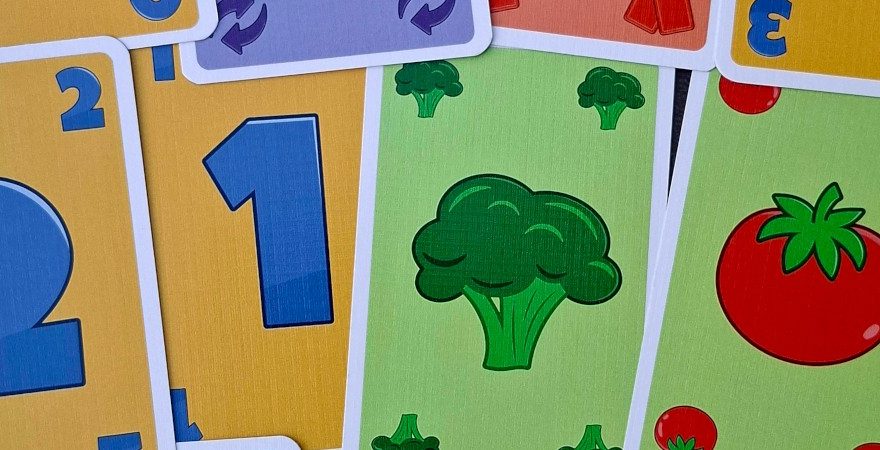
Das Kartenspiel Panika bedient sich an einem äusserst bekannten Spielprinzip. Mit der dazugehörigen App kommt viel Unberechenbarkeit ins Spiel, die für sehr unterhaltsame Momente am Spieltisch sorgt. Wer legt seine Karten zuerst ab? Die App zum Spiel wird dringend benötigt.

Der Beitrag Panika – Spielkritik erschien zuerst auf brettspielblog.ch.

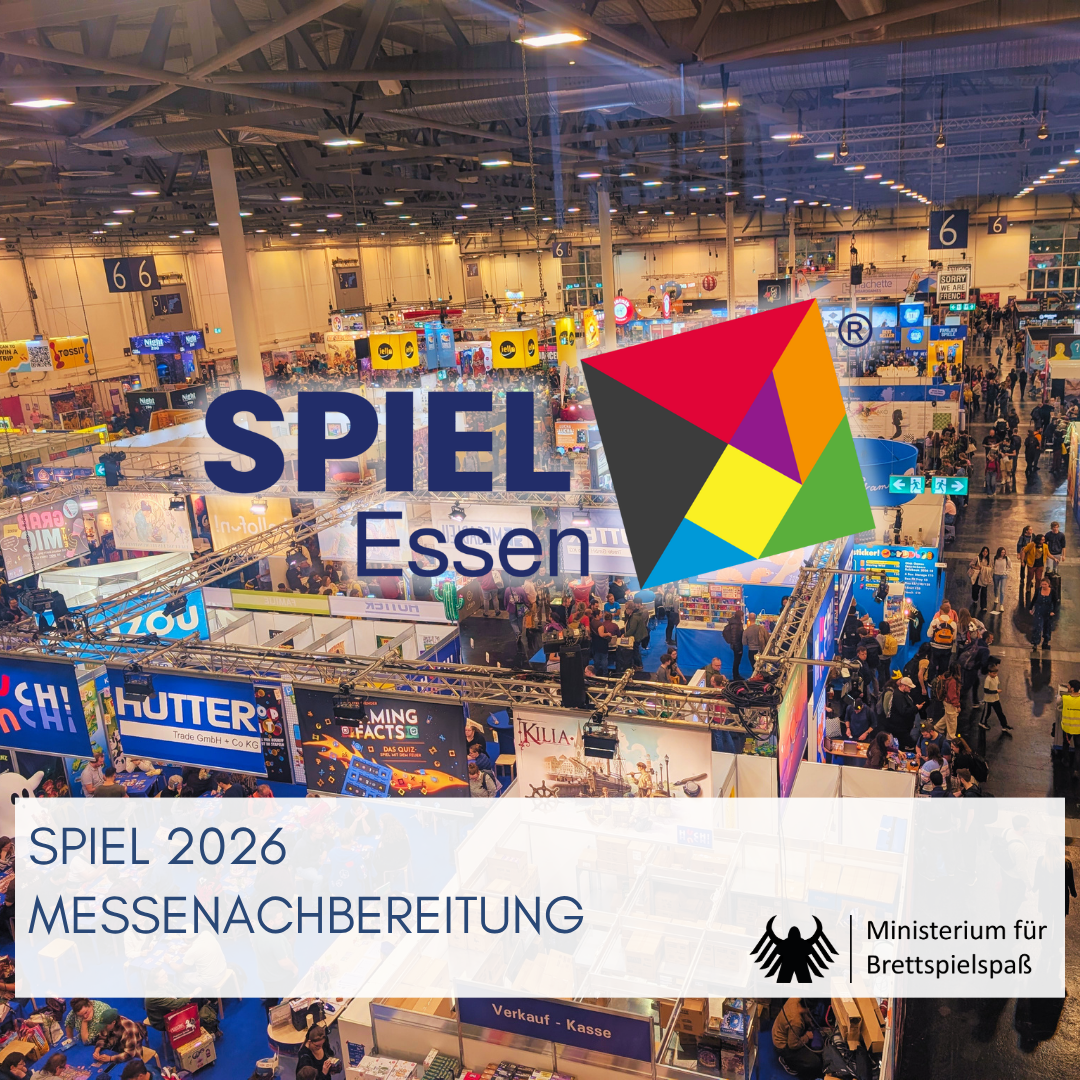
Spiel 2026: Messenachbereitung - Größer, kleiner, günstiger und intelligenter?

26. Oktober 2026 um 10:55

Nach der Pilgerreise haben die meisten Gläubigen wunde Füße, sind aber beseelt von der Erfahrung (vgl. Daniel Bernsen über diese Analogie). Das Gefühl wurde mir von den meisten, die ich in den vergangenen Tagen in den heiligen Hallen getroffen habe, bestätigt.Zu den wunden Füßen trug wohl auch der enorme Umfang der Messe bei. Die Superlative wurden bereits im Bericht zur Pressekonferenz genannt.

Quelle

Spiel 2026: Tag 1 - Pressekonferenz und Neuheitenshow

21. Oktober 2026 um 15:10

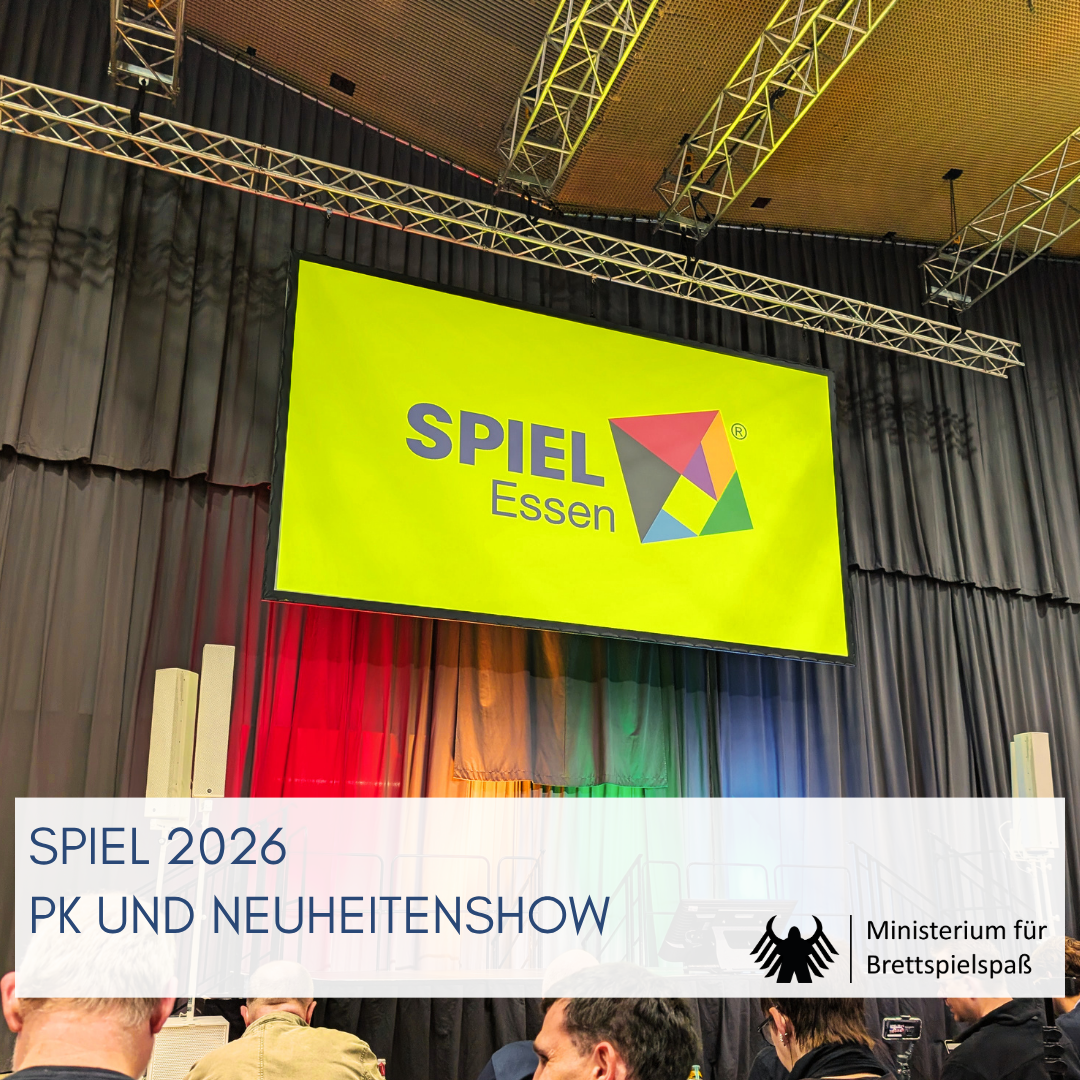
230.000 Besucher*innen, 81.200 m² Fläche, 1.885 Neuheiten in der App, 997 Aussteller aus 53 Ländern und 5 Kontinenten, 8 Hallen – Zuwächse an allen Ecken und Enden. Die Spiel 2026 ist in vielerlei Hinsicht eine Messe der Superlative. Eine Innovation spüre ich beim traditionellen Einstieg am eigenen Leib, der einen anderen Weg nehmen muss. Weil Halle 8 hinzukommt, steht sie nicht mehr für die…

Quelle

Codenames makes Netflix debut after streaming giant approached CGE for licence – then hired it to develop the game instead

02. Oktober 2026 um 15:44

Czech Games Edition‘s huge-selling word guessing game Codenames has made the jump to Netflix, with the publisher developing a new digital version of its biggest-selling title for the streaming giant’s push into TV-based social gaming.

CGE told BoardGameWire that Netflix originally approached it about licensing Codenames, before changing tack and asking CGE to develop the digital version itself after trying out the publisher’s existing mobile app for the game.

Codenames Party can be played by Netflix subscribers through their TV by using their phones as controllers, and includes a new ‘party’ mode allowing up to 10 people to compete as individuals rather than in teams.

The deal provides a new source of players for a game which is already closing in on 20 million physical copies sold, a CGE spokesperson told BoardGameWire, adding that “the branding benefits and opportunity to reach a new audience” were important to the publisher.

Codenames and its spin-off titles already account for about 80% of CGE’s annual sales – although company marketing manager Ondřej Skácel told Czech business publication CzechCrunch the new deal would not transform CGE financially, saying revenues from the tabletop version of Codenames remained on another level.

CGE was paid to develop the Netflix version of the Vlaada Chvátil design, and will also receive ongoing licensing payments, that report added – with Skácel telling the outlet “at first, we didn’t believe it and thought it was some sort of hoax” when Netflix got in touch.

Codenames Party on Netflix

Codenames Party’s visual style has prompted questions from some players about whether generative AI was used in its creation – something CGE strongly denied to BoardGameWire.

The spokesperson said, “There are no AI assets in the game or in marketing materials. We saw those comments, but we want to clarify that the new art style was made by illustrators and graphic designers who spent countless hours on it.

“In general, we use human graphic designers and illustrators on all our projects. We’re in turbulent times, but we’re still enjoying the whole ‘old-school’ process of making games.”

CGE also left open the possibility of bringing more of its games to Netflix or similar platforms, telling BoardGameWire, “We’re always open to any new opportunities. If we find a good fit with our games and the specific platforms, we would definitely consider it.”

Codenames was first released by CGE in late 2015 and quickly became an international hit, winning the coveted Spiel des Jahres prize the following year.

The game has since spawned a string of spin-offs and licensed editions, including Codenames: Pictures and two-player cooperative version Codenames: Duet.

CGE has increasingly experimented with bringing Codenames into digital formats, beginning with the free browser-based Codenames Online in 2019 before launching a mobile adaptation developed by its CGE Digital team in 2024.

That app, which clearly made an impression on the Netflix team, introduced asynchronous multiplayer, matchmaking, progression and new game modes rather than simply recreating the tabletop game.


The post Codenames makes Netflix debut after streaming giant approached CGE for licence – then hired it to develop the game instead first appeared on .

Play that Song!

Von: ferengi
26. September 2026 um 08:07

Hitster mit Quizfragen

Oft hätte ich bei Hitster gern meine Fachkenntnisse zu einem Song oder den Musikern eingebracht, doch ich sollte lediglich das Erscheinungsjahr des Songs chronologisch einordnen. Hans-Hermann Pein hat mit seinem Team diese Lücke geschlossen und läßt uns mit Spotify mehr oder weniger schwierige Fragen zu einem Song beantworten. Hierbei quizzen wir in Teams gegeneinander, oder jeder für sich.

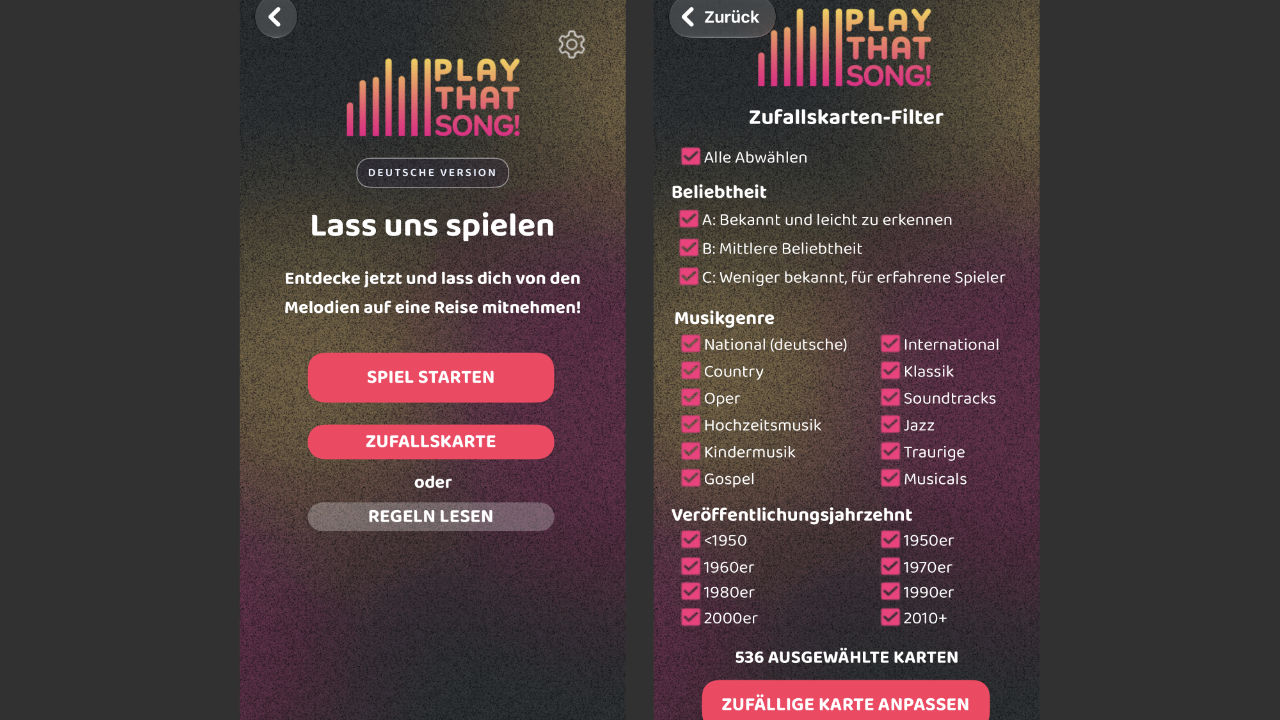
Die Songauswahl kann man eingrenzen, so dass für alle ein vergleichbares Vorwissen gefunden werden kann

Optimal wäre es, wenn ein Spieler als Quizmaster das Spiel leitet und dann nicht mitspielt. Dafür braucht man aber eine große Runde Musikfans. Denn nachdem die App die Karte mit dem Song und die Fragen/Antworten per Zufall ausgewählt hat, wird der QR-Code gescannt, und man sieht auf dem Handy den Song. Auch natürlich die Fragen und Antworten auf der Karte.

Wir haben daher reihum die Rolle des Quizmasters weiter gegeben, so dass dieser in der Runde nicht mitspielen konnte. Dies war dann aber teilweise ungerecht, da der eine bei einer Howard Carpendale – Karte als Quizmaster pausieren musste, der andere bei einem unbekannten Opernsong gespannt auf Antworten warten konnte, denn da gab es keine Punkte zu verteilen.

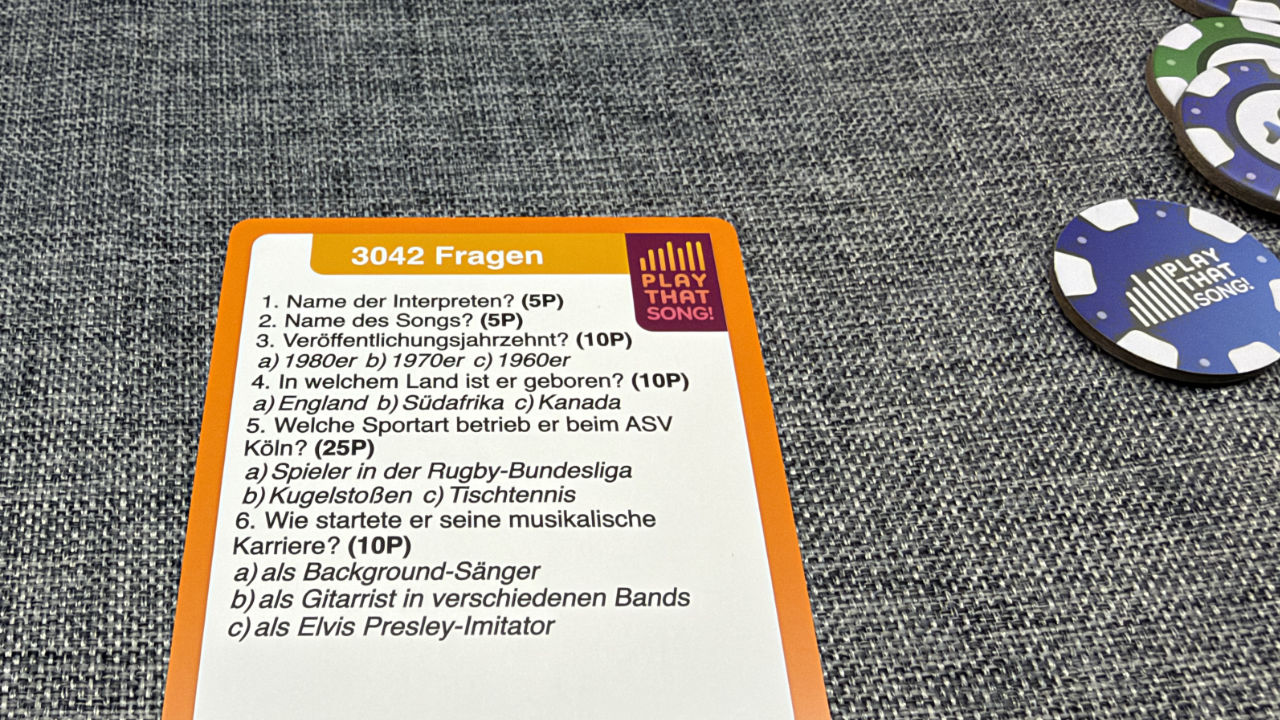
Und so geht es: Die Teams (oder Einzelspieler) hören abwechselnd einen Song und bekommen dann vom Quizmaster sechs Fragen gestellt. Einfach, und daher wenig Punkte bringend, sind die ersten Fragen zu Interpret, Singtitel und Jahrzehnt. Antwortet das Team nicht, können die anderen buzzern und sich die Punkte holen.
Bei den anderen drei Fragen gibt es Antwortoptionen. Kann man die Frage beantworten, ohne dass die Optionen vorgelesen werden, bekommt man doppelte Punkte. Ansonsten liest der Quizmaster die Antwortoptionen vor. Weiß man die Antwort nicht, wird die Frage für alle anderen geöffnet und die anderen Spieler legen ihre Antwortkarten A, B oder C verdeckt ab und wettet mit seinen Chips auf diese Antwortoption. Da sind aber auch schon echt schwierige Fragen bei und man kann einfach passen, damit man keine Chips verliert.

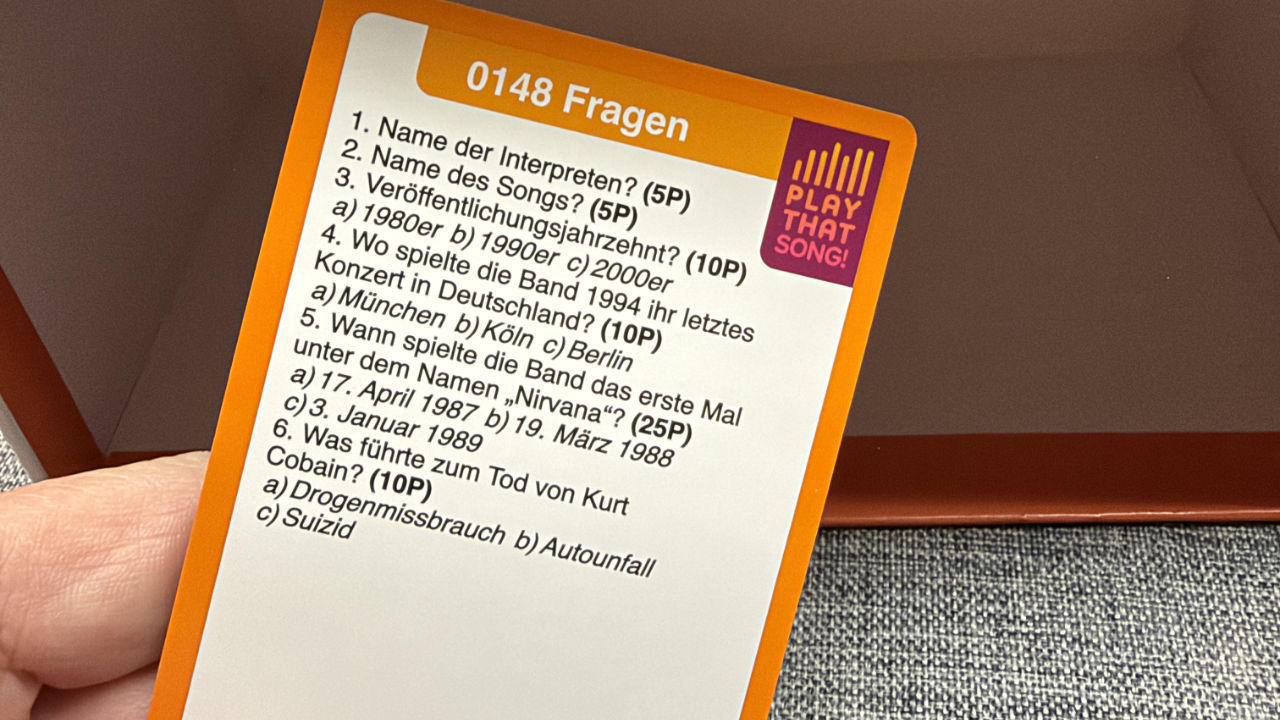
Anhand der Fragen kann man zumindest den Interpreten erahnen, ohne einen Song zu hören.
Smells like teen Spirit. Frage 5 ist aber schon knifflig, da sollte das Jahr reichen. Da merkt man, dass die KI auch bei den Fragen geholfen hat.
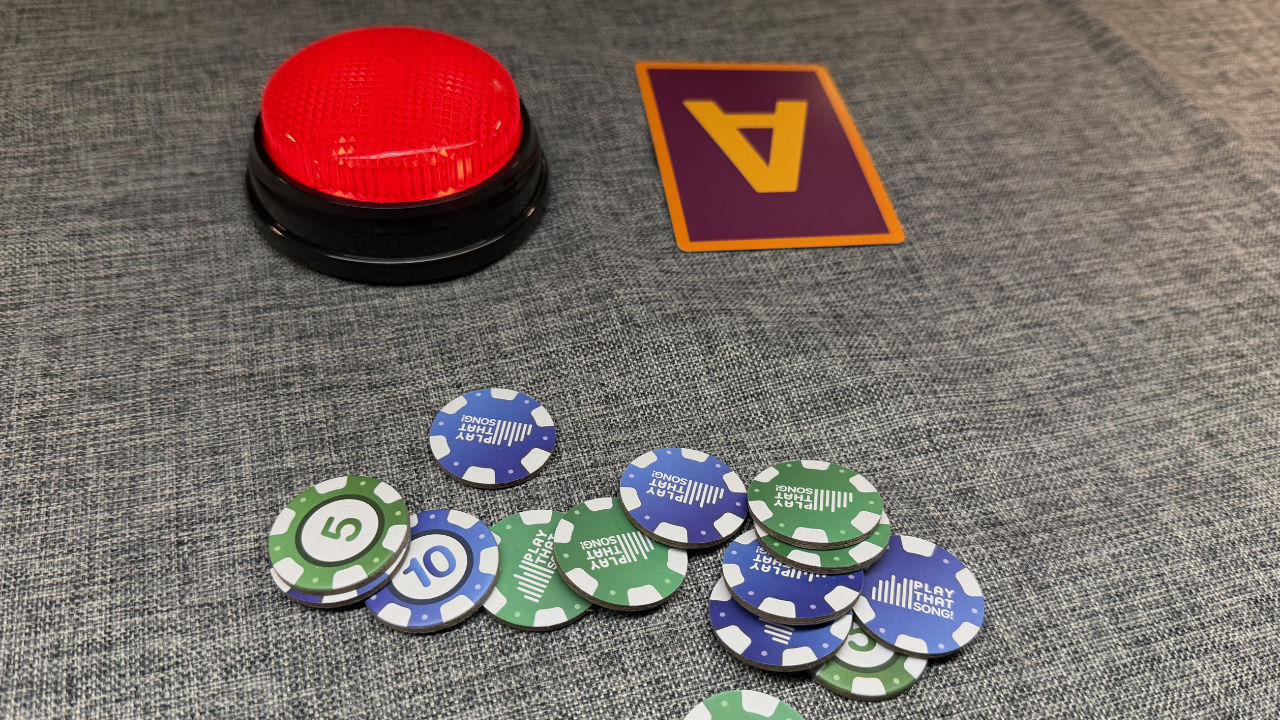
Buzzer, Punktechips und mein Tipp für Antwort A.

Fazit:

Ich erinnere mich noch gut an die Hitster-Anfänge und die Problematik mit der Kompatibilität der App mit Spotify. Die App bei Play That Song! startet den Song einwandfrei, aber die Nutzbarkeit des Timers ist nicht möglich, da man nach dem Scannen des Codes zu Spotify kommt und man somit den Timer nicht sehen kann. Klickt man zurück, ist man wieder bei der Songauswahl. Aber nach ein paar Runden haben wir den Timer sowieso nicht mehr genutzt.

Man merkt schon, dass hier ein kleines Team ein Riesenprojekt angestoßen hat und zur „Erleichterung“ und zum Kostensparen die KI kräftig geholfen hat. Das sieht man an der Packung, aber auch an den Texten und Karten. Wer fleissig sucht, wird also Fehler finden. Aber die gibt es auch bei Spotify, wenn ich da nur an die Remakes oder Mixes von Songs denke, die dann einfach mal 20 Jahre später waren, der QR-Code aber auf den Ursprungssong zeigt.

Wir hatten in unseren Runden bisher viel Spaß. Wichtig ist allerdings, dass die Teams ähnliches Fachwissen haben sollte, damit man niemanden abhängt. Es ist somit eine frische Alternative zu Hitster für Musikfans, die mehr als das Erscheinungsjahr eines Songs raten möchten.

Noch ein Tipp für eine Hausregel: Wenn man nicht innerhalb 10 Sekunden antwortet, wird die Frage für alle zum buzzern geöffnet. Will man nicht, dass die anderen Punkte bekommen können, antwortet man also irgendwas, damit die Frage geschlossen wird. Das fanden wir in der Regel nicht gut und haben die Frage auch bei Falschantworten für die anderen geöffnet. Ausnahmen waren die Ja/Nein-Fragen.

Stubenscore: 7,3 / 10


PLAY THAT SONG!
BoardGameGeek

Spieledatenbank Luding

Brettspiel (getestet)

Unlock! Schrödingers Katze

Von: ferengi
24. September 2026 um 07:50

Gut oder schlecht oder beides


Nach dem Engelsflug aus der Unlock! – Short Adventures-Serie haben wir nun das Paradoxon von Erwin Schrödinger aus 1935 uns spielerisch vorgenommen.
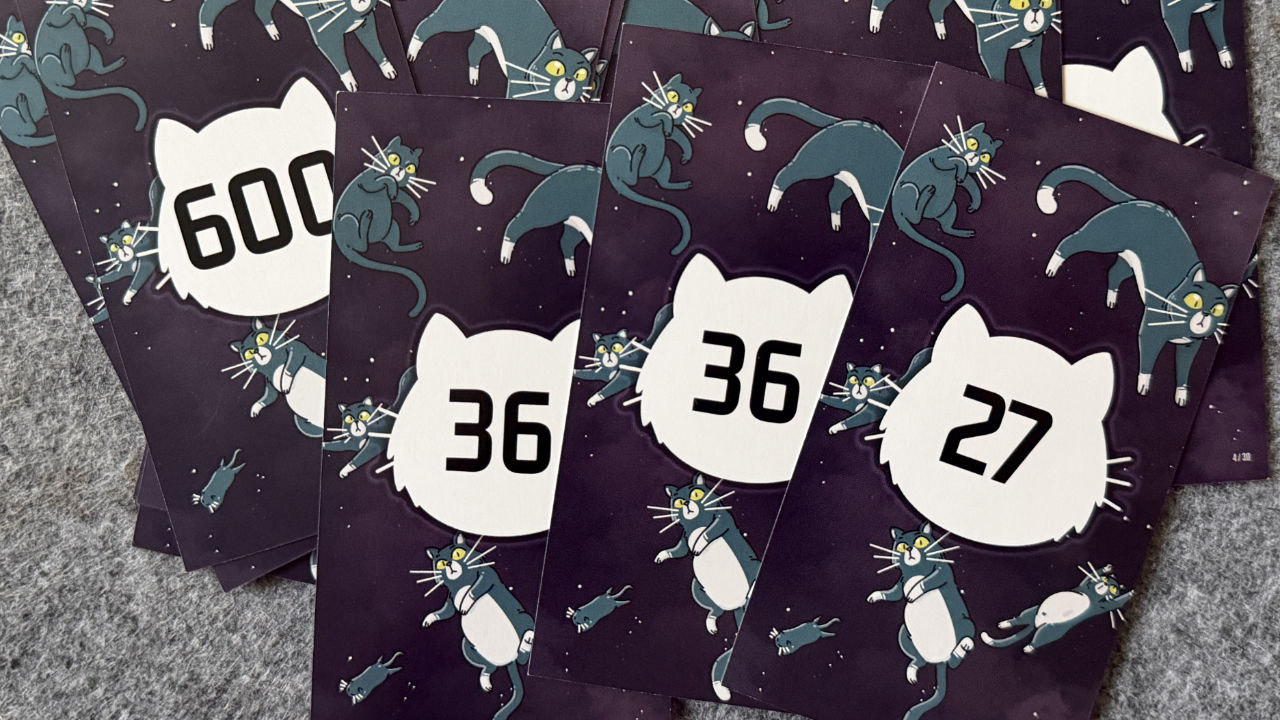
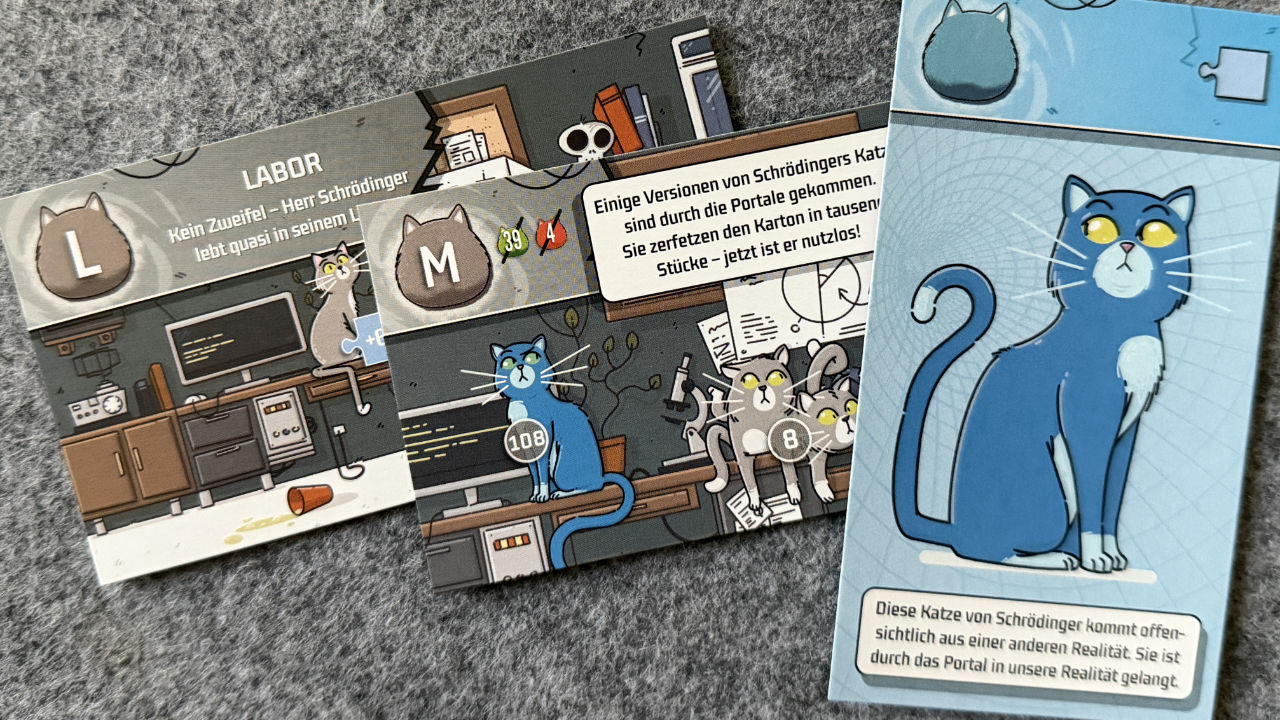
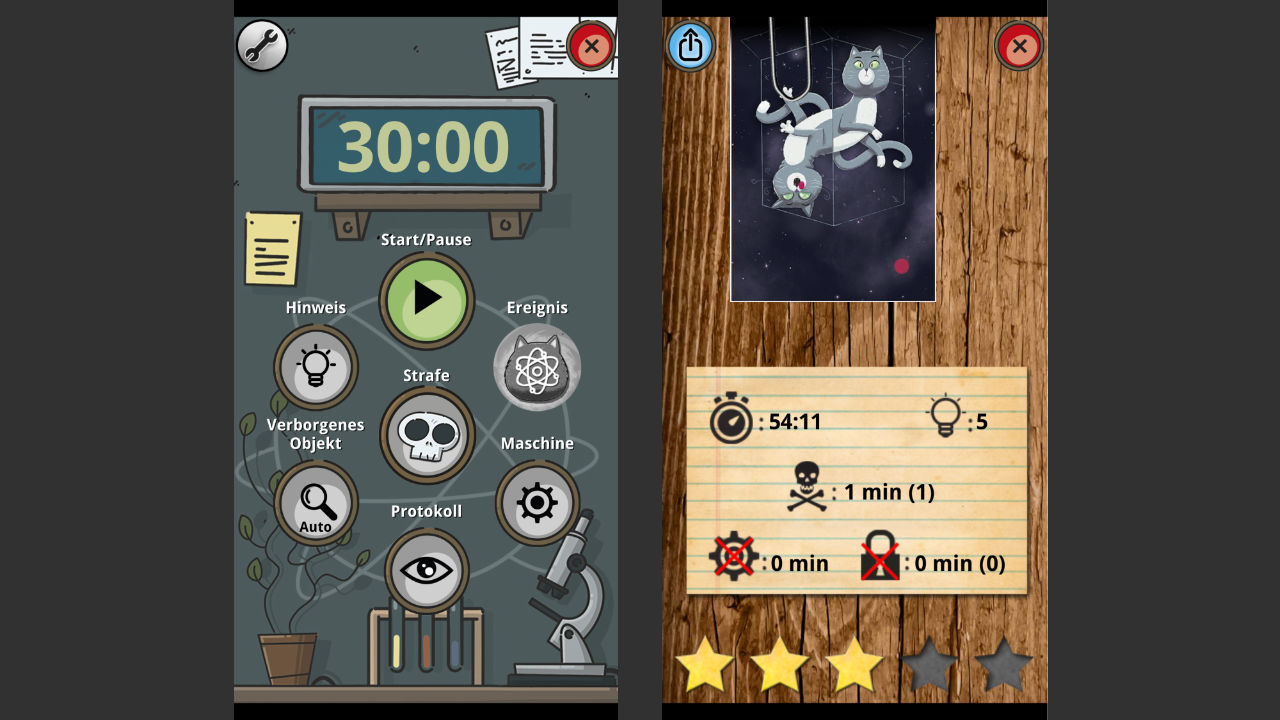
30 Karten haben wir als Spielmaterial. Nach der Einführung puzzeln und suchen wir neue Zahlen oder auch Bilder, um weitere passende Karten mit der Zahl/Symbol zu suchen. Und die Hinweise hierzu sollte man wirklich genau lesen, denn es wird herausfordernd.

Die Zahlen zu den nächsten Karten erhält man nicht nur durch Addition

Ohne App geht es nicht. Wir fanden uns schnell. 30 Minuten war die Zeitvorgabe. Und rechts unser Ergebnis.

Fazit:

Vorteilhaft ist sicher, dass man es als Reisespiel überall hin mitnehmen kann und es auch unterwegs mit wenig Fläche spielbar ist. Und es ist sicher gewollt, dass man um die Ecke denken soll. Zumal die Thematik des Schrödinger-Paradoxons ja auch nicht allen sofort verständlich ist. Leider kamen wir an einem Punkt nicht weiter und die Lösung in der App gab dann noch mehr Rätsel auf. Wenn man verstehen möchte, warum die Lösung so ist, wäre in der App doch genügend Platz vorhanden, um uns dies zu erklären. Schade, so war die Lust zum Weiterrätseln etwas gedämpft und man hoffte dem Ende Nahe zu sein …

Stubenscore: 6,5 / 10


UNLOCK! SCHRÖDINGERS KATZE
BoardGameGeek

Spieledatenbank Luding

Brettspiel (getestet)

Light Speed Arena Review

17. September 2026 um 14:22
Light Speed ArenaThe first electronic-enabled games I played in my youth were from the 1980s: Dungeons & Dragons Computer Labyrinth Game and Dark Tower. It’s hard to believe it now, but those games were unique and probably cutting-edge for their time. Fast forward to today, and now app-driven games are much more common, and the technology around […]

Source

They’re Just Questions, Leon – A Totally Human Review

14. September 2026 um 15:00
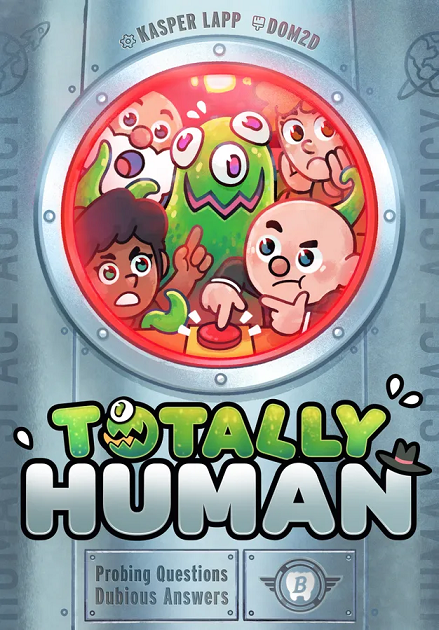
Kasper Lapp, Voight-Kampff test, 10-minute social deduction game is the kind of pitch I hope to hear when riding the elevator. Lapp previously designed quirky hits like Magic Maze and That’s Not a Hat, so his brand of silly seems uniquely appropriate for this sort of nonsense. When it works the playful interrogation is both…

Read more →

Vantage auf Deutsch: Jetzt auch mit App-Alternative

Von: ravn
08. September 2026 um 21:46

Das Warten hat ein Ende. Feuerland hat derweil seine deutschsprachige Special-Edition an die Vorbesteller ausgeliefert. In wenigen Tagen ist auch die Retail-Version bei den Fachhändlern in Muttersprache lieferbar. Als mehr als nur kleine Überraschung gibt es eine offiziell unterstützte App-Alternative dazu. Ich zeige die Versionen – original englisch und deutsch im Vergleich per bebilderter Auspack-Session. Eine fette Empfehlung inklusive.

Mit einer Auflage von 2200 Exemplaren und gut 6 kg Gesamtgewicht ist die Vantage Special-Edition etwas ganz Besonderes. Für 127 Euro inklusive Versand konntet Ihr bis zum 29. Oktober 2025 diese deutschsprachige Version vorbestellen und noch vor der Retail-Version spielen. Das Versprechen wurde eingehalten und gut verpackt kam auch meine selbstbezahlte Special-Edition an. Durch eine gesundheitsbedingte Zwangspause musste die allerdings noch einige Wochen auf mich zu Hause warten. Die Auspack-Session habe ich nun nachgeholt – wie Ihr in folgenden Bildimpressionen miterleben könnt.

Wer die Vorbestellphase verpasst hat, der braucht sich nicht grämen. Ihr könnt bis auf die größere Verpackung mit auffällig silberglänzendem Schriftzug auf die Retail-Version ausweichen und Euch die Deluxe-Erweiterungen einzeln dazukaufen. Charaktertableaus, Holzmarker und Metallmünzen sind in Summe zwar teurer als der Vorbestellpreis, aber Ihr müsst auf nichts verzichten. Gut gepackt passen die auch mit minimalem Deckel-Anhub bestens in die Retail-Spieleschachtel. Warum ich das genau weiß? Weil ich es genauso mit meiner englischen Version von Stonemaier Games gemacht habe.

Ein Nachteil der deutschsprachigen Version war bisher ein großes Manko. Die Begleit-App von Rulepop für die englischsprachige Version von Vantage war für mich unverzichtbar geworden. Denn damit sparte ich mir das Geblättere in den acht Aktionsbüchern, um die passende Textpassage dort zu finden. Zudem spoilerte ich mich nicht selbst, weil in der App immer nur die aktuelle Würfelprobe und die Situation mit ihren Auswirkungen schrittweise angezeigt wird. Auch waren die aktuellsten Korrekturen direkt eingepflegt, ich brauchte also nicht in Errata und Klarstellungen nachzulesen. Eine Lokalisation konnte Feuerland leider nicht leisten.

Aber es gibt Abhilfe, von Fanhand entwickelt und mit offizieller Genehmigung von Feuerland. Deshalb auch auf der Feuerland-Webpage gehostet – einfach online aufrufen und alle wichtigen Kernfunktionalitäten sind enthalten. Ein fettes Dankeschön an den Entwickler Guido „derLetzteW“ Weiler, der uns Nutzern diesen Service kostenfrei zur Verfügung stellt und auch weiter pflegt. Mehr dazu im unknowns.de-Forum.

Ich selbst bin auf meine Erstpartie Vantage in meiner Muttersprache und mit App-Alternative gespannt. Endlich keine mir kryptischen Begriffe, die ich nicht verstehe, falsch deute oder umständlich nachschlagen muss. Mein Ersteindruck zeigte mir eine einwandfreie und professionelle Lokalisierung. Spielerherz, was willst du mehr?

Hitster: Urban & Hip-Hop

06. September 2026 um 02:33

Hister bleibt eine Gelddruckmaschine. Nach u. a. Rock, Schlager und Christmas widmet man sich in dieser Erweiterung Urban Music und Hip-Hop und groovt sich durch sechs Jahrzehnte Hip-Hop, R&B und…

The post Hitster: Urban & Hip-Hop appeared first on Reich der Spiele.

Spiel Essen launches B2B matchmaking system to help industry professionals find potential business partners

03. September 2026 um 11:38

Spiel Essen has launched a dedicated B2B matchmaking system aimed at helping publishers, designers, retailers and other industry professionals find potential business partners and arrange meetings before arriving at the world’s biggest board game fair.

The new service, which is restricted to exhibitors and people with business visitor tickets, lets users create profiles detailing what they are looking for and what they can offer, send specific business inquiries, connect via chat and schedule appointments at the show using the built-in calendar.

Spiel said today that the system will be integrated directly into its dedicated app, adding that the move is intended to make networking between trade visitors, professionals and publishers “more targeted, simple, and effective”.

Business has long been an important part of Spiel despite its status as a public-facing convention, with major publishers operating their own dedicated B2B areas for meetings with retailers and other industry professionals.

B2B-specific companies such as manufacturers, crowdfunding services and trade organisations were still scattered across various halls in 2019, but that situation began to change after Spiel was taken over in 2022 by Merz Verlag – whose core event, Spielwarenmesse, is one of the world’s biggest B2B toy trade fairs.

Those companies began to be more concentrated in Hall 4 during the 2022 event – a move which intensified the following year amid a major reorganisation of the halls which attempted to more obviously split the fair into themed segments such as children’s games, family and light-to-medium games, expert games, tabletop and miniature games, roleplaying games and TCGs.

Florian Hess, managing director of Merz Verlag, said after last year’s record-breaking Spiel, “For exhibitors at the fair the focus is also on the joy of the games. At the same time, an incredible number of effective business developments emerge here – and this happens naturally alongside everything else.

“I don’t know of any other event that is as strong a springboard for a business’s launch as Spiel. I have met exhibitors who started here a few years ago with a small booth and are now occupying several hundred square meters and selling games internationally.

“Experiencing this kind of B2B rocket launch never ceases to fascinate me.”

Hall 3 at Spiel Essen 2025

The new system arrives as Spiel prepares for its biggest-ever event from October 22 to 25 this year – with an expansion into all eight main halls at the Messe Essen exhibition centre for the first time expected to see the event challenge its record 220,000 attendance set last year.

Spiel said earlier this year that it had reached the reached the limits of its expansion at its long-time home after boosting floor space to 81,200 sq m – larger than 15 American football fields – amid what it called “overwhelming interest” from exhibitors.

But despite the show bumping against its space limits at its long-time home, a Merz Verlag spokesperson told BoardGameWire in March, “We love Essen – as a venue and the city – and have no intention of leaving. For the foreseeable future SPIEL will remain in Essen as it has for more than 40 years now.”

The fair’s expansion into a seventh hall last year helped the four-day show to its record 220,000 attendance, outstripping the 209,000 visitor record it set just before the Covid-19 pandemic.

Spiel might have broken its attendance record in 2024 were it not for a self-imposed visitor cap, which limited the number of attendees each day to about 50,000 – a measure introduced alongside wider aisles post-pandemic to help visitors move around the often crowded halls more easily.

More than 920 exhibitors from 53 countries are expected at this year’s event, with Merz Verlag saying in March that demand had come both from long-term exhibitors keen to “significantly increase” their booth space, as well as an “impressive number” of first-time exhibitors hoping to attend this year.

About half of the available tickets for Thursday, Friday and Saturday have already been sold, seven weeks before the show opens, with Sunday sales currently “lagging slightly behind”, the show announced today.

Access to the matchmaking platform comes as part of Spiel’s €46 business visitor ticket, which compares with €25 for a standard adult day ticket.

Spiel Essen 2026 takes place at Messe Essen from October 22 to 25.

The post Spiel Essen launches B2B matchmaking system to help industry professionals find potential business partners first appeared on .

Clank! Digital: Die Brettspiel-App jetzt vollständig auf Deutsch

09. August 2026 um 09:12
Clank! Digital: Die Brettspiel-App jetzt vollständig auf Deutsch

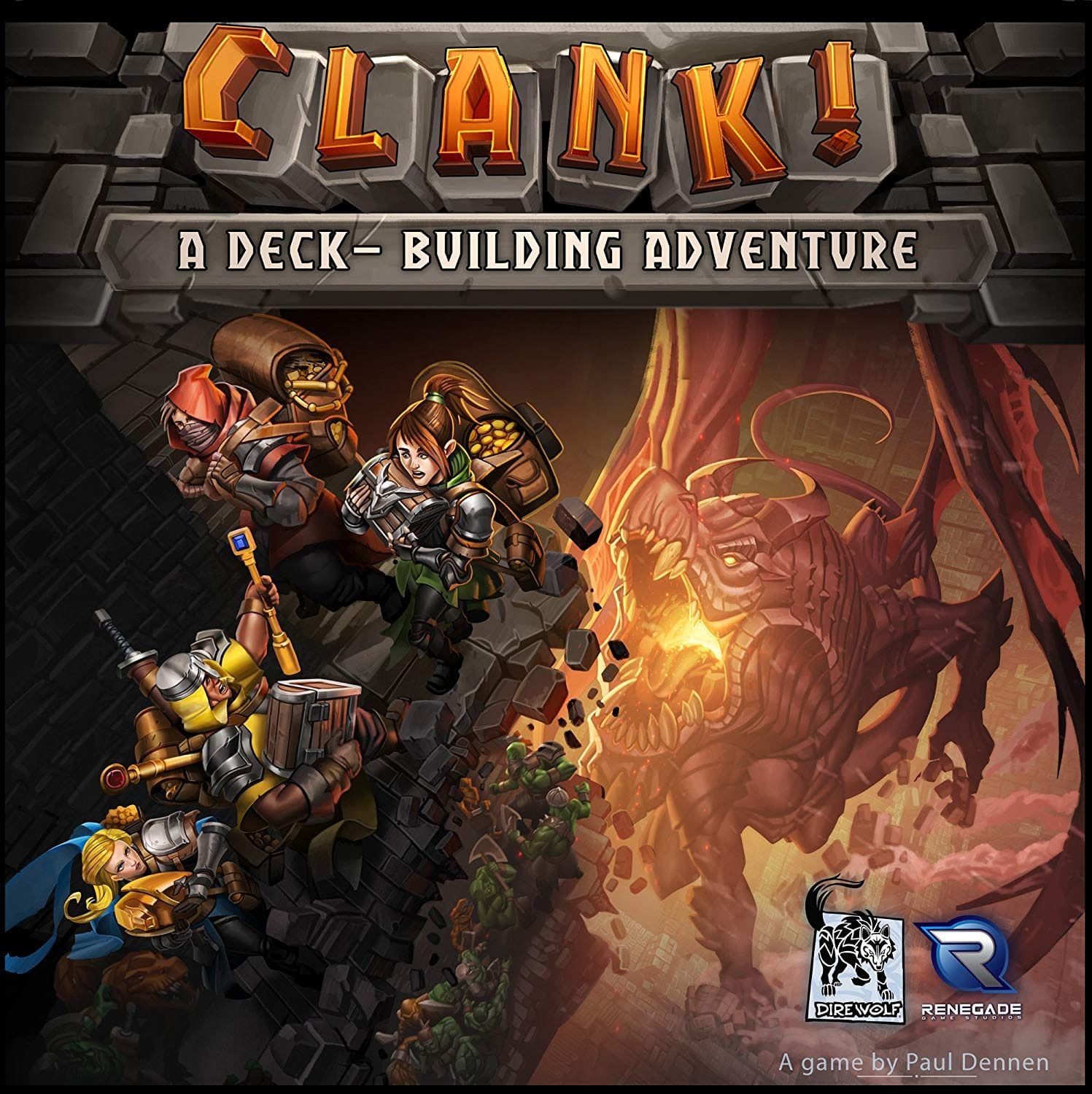
Clank! gehört zu den beliebtesten Deckbauspielen der letzten zehn Jahre. Seit Oktober 2024 gibt es das Spiel auch als vollständige App, und das mit einem klaren Vorteil für die DACH-Region: Clank! Digital ist komplett auf Deutsch lokalisiert, Benutzeroberfläche, Sprachausgabe und Untertitel inklusive.

Was steckt hinter Clank!?

Clank!: A Deck-Building Adventure erschien 2016, entworfen von Paul Dennen und verlegt von Dire Wolf und Renegade Game Studios. Das Brettspiel funktioniert auf zwei Ebenen. Erstens baut jede Spielerin ihr eigenes Kartendeck auf: Mit Karten kauft man neue Karten, schlägt Monster und bewegt sich durch den Dungeon. Zweitens ist da der namensgebende Clank. Wer in der Drachenhöhle zu laut herumstolpert, erzeugt Lärm-Marker, die in einen Beutel wandern. Je öfter der Drache zuschlägt, desto gefährlicher wird der eigene Lärm. Das ist Push-your-luck auf Kartenebene: Man will tief in die Höhle, das wertvollste Artefakt schnappen und rechtzeitig heraus, bevor der Drache zuschlägt. Wer stirbt, scheidet aus; wer mit einem Artefakt entkommen ist und die meisten Punkte hat, gewinnt. Das Grundspiel für 2 bis 4 Spielende dauert 30 bis 60 Minuten und ist ab 12 Jahren empfohlen.

Die digitale Umsetzung: Plattformen und Modi

Clank! Digital wurde von Dire Wolf Digital entwickelt und am 21. Oktober 2024 plattformübergreifend veröffentlicht, nach einem Early-Access-Zeitraum ab Juli 2024. Das Spiel läuft auf Steam (Windows und macOS), iOS und Android. Crossplay ist über alle drei Plattformen hinweg möglich.

Die digitale Version bietet mehrere Spielmodi: Solo gegen KI mit anpassbaren Partien, Online-Mehrspieler mit offenem oder privatem Matchmaking und Crossplay, Pass & Play für bis zu vier Personen an einem Gerät, 13 Challenge-Szenarien mit Sonderregeln sowie rotierende Heist-Ranglisten gegen die globale Community. Solo-Spielende bekommen damit einen echten Modus, den das Brettspiel selbst ohne Erweiterung nicht bietet.

Preis, Sprache und Umfang

Clank! Digital kostet auf Steam regulär 20,99 Euro (Preise auf iOS und Android können abweichen). Der reguläre Preis gilt dauerhaft; Sonderangebote laufen zeitlich begrenzt und sollten vor dem Kauf auf der jeweiligen Store-Seite geprüft werden. Als DLC gibt es zwei kostenpflichtige Erweiterungen: Clank! Sunken Treasures und Clank! The Mummy's Curse, beide bekannte Zusätze aus der physischen Spielreihe.

Die deutsche Lokalisierung ist vollständig: Menüs, Regeltext, Sprachausgabe und Untertitel sind auf Deutsch verfügbar, auf allen drei Plattformen.

Zu Monetarisierung oder bekannten technischen Problemen des Spiels macht Dire Wolf Digital in der offiziellen Kommunikation keine expliziten Aussagen. Nutzerbewertungen auf Steam können hier als Zusatzquelle dienen, bevor man kauft.

Für wen lohnt die App?

Wer Clank! vom Tisch kennt und das Spiel auch unterwegs oder mit Freunden auf anderen Plattformen spielen möchte, bekommt eine solide digitale Umsetzung. Der Crossplay-Ansatz macht Clank! Digital besonders dann interessant, wenn die eigene Spielgruppe auf verschiedene Geräte verteilt ist. Solo-Spielende profitieren von einem vollwertigen KI-Modus, den das physische Grundspiel nicht mitbringt. Neueinsteiger ohne Kenntnis des Brettspiels finden in Clank! Digital einen zugänglichen Einstieg in Deckbau und Dungeon-Crawling, die Lernkurve ist moderat.

Der reguläre Preis von 20,99 Euro auf Steam ist fair für den gebotenen Umfang. Die beiden DLCs sind optional; das Grundspiel ist vollständig spielbar.

Magic Maze

Von: ferengi
18. Juli 2026 um 10:50

Diebstahl im Einkaufszentrumlabyrinth

Kooperativ steuern wir vier Helden durch ein Einkaufszentrum, um Ausrüstungsgegenstände zu klauen und dann unbemerkt zu entkommen. Hierzu hat jeder Spieler Aktionsmöglichkeiten, die sich dann in Summe ergänzen.

So kann ein Spieler Helden nach Norden bewegen, ein anderer die Rolltreppe nutzen oder mit Erkunden das Labyrinth um eine weitere Karte erweitern. Es spielt also nicht jeder Spieler einen Helden, jeder kann jeden Helden steuern.

Vor Beginn des Spiels und nach bestimmten Aktionen dürfen wir uns kurz beraten, ansonsten muss aber jeder Spieler seine Aktion bei Bedarf intuitiv einsetzen. So oft und wann man möchte. Da die Zeit tickt, können hier auch hektische Momente entstehen, wenn alle darauf warten, dass ein Spieler einen Helden weiterbewegt oder die Spielzeit verlängert werden muss, bevor das Spiel beendet wird. Um Spieler anzustupsen gibt es die „Tu was“-Figur, die man dann dem Spieler hinstellt und der Spieler dann hoffentlich schnell merkt, was er zu tun hat. Das hebt aber auch den Stresslevel bei der Person, die nun von den anderen gesagt bekommt „Du musst was machen, wir warten nur auf Dich“. Das kann demotivierend sein, doch wenn man die Level dann geschafft hat ist man happy und letztendlich haben alles etwas zur Strategie gelernt. Hier merkt man schon, dass es wichtig ist, Anfänger im Spiel mitzunehmen und nicht gleich zu demotivieren.

Zu Beginn stehen die vier Helden auf dem Startfeld und warten, dass sie gezogen werden. Die drei Spieler haben jeweils eine blaue Aktionskarte und der Spieler rechts macht dann einen Zug „Roter Held ein Feld nach Norden.“
Ist ein Held an einem Randfeld kann er „erkunden“ (Lupe) und somit ein weiteres Labyrinthfeld ergänzen. Erst so entsteht eine größere Karte und so können dann auch erst die Aufgaben gelöst werden. Also die Ausrüstungsgegenstände aufnehmen und dann zum Ausgang laufen.

Fazit:

Das 2017 zum Spiel des Jahres nominierte Spiel bietet 17 Level in der Kampagne, in der immer neue Regeln ergänzt werden. So wird es nach kurzer Zeit schon komplex und auch etwas hektisch. Spiel des Jahres 2017 wurde Kingdomino. Mir gefallen beide Spiele, wobei Kingdomino deutlich stressfreier ist.

Doch wenn alle Spieler gleichschnell denken und im Flow sind ist das schon ein cooles Erlebnis. Und letztendlich ist es aber ja nur ein Spiel. Die Spieldauer ist durch die Uhr und der maximalen Verlängerungszeit vorgegeben: 3 bis 15 Minuten.

Stubenscore: 7,5 / 10


MAGIC MAZE

BoardGameGeek

Spieledatenbank Luding

Brettspiel (getestet)

boardgame.digital mit AMA von Ben & Frosted-Team

Von: Michael
11. Juni 2026 um 20:41

Diese Woche startet die Fussball-WM und auch wir können verkünden, dass wir uns mit euch in die Spiele stürzen wollen. Für Brettspielende unter Umständen interessanter könnte ab morgen, Freitag, 12. Juni 2026 ab 18 Uhr nämlich die boardgame.digital sein. Veranstaltet von Geekpunkt lädt diese virtuelle Brettspielmesse nämlich zum virtuellen Brettspielwochenende – und Frosted Games ist mit dabei. Bis Sonntag, 22 Uhr habt ihr im Rahmen dieser Veranstaltung dann die Gelegenheit, mit uns zumindest virtuell unsere Neuheiten zu spielen und kennen zu lernen. Und das sogar bei noch nicht erschienenen Spielen wie TIR NA NOG, aber auch bei dem gerade erschienenen WUSELIGE WIESEN. Lasst euch von unseren Spiele-Angeboten auf der Board Game Arena und auf unserem Discord überraschen und wetteifert mit der größten deutschen Brettspiel-Community „League of Geeks“ virtuell vor Ort auf bga. Holt euch zudem die aftergame APP, um keine Aktionen zu verpassen. Geplant ist neben den Spielerunden unter anderem am Samstag auch ein AMA ASK ME ANYTHING am Samstag mit Ben Schönheiter und weiteren Mitarbeitenden aus dem Frosted Games Team sowie ein Panel rund um die Grafik bei Brettspielen am Sonntag. 

Die boardgame.digital sieht sich dabei nicht als Ersatz für eure klassischen Brettspielrunden, sondern möchte ein darüber hinausgehendes Angebot für die Brettspiele-Community unter einem gemeinsamen Label – der boardgame.digital – bieten und zusätzliche Möglichkeiten schaffen, Menschen unabhängig von Wohnort, Mobilität oder sozialen Hürden zusammenzubringen. Im Mittelpunkt stehen virtuelle Spielrunden vor allem auf Board Game Arena, können aber grundsätzlich auch plattformoffen und künftig auch von Spielenden selbst angeboten werden. Über den Technikpartner aftergame können Besucher Spielrunden einfach erstellen, finden und sich direkt anmelden. Ergänzt wird das Ganze durch Livestreams, Sonderaktionen, Talks, Community-Events und weitere Inhalte rund um Brettspiele. Kurz gesagt: Wie eine echte Convention oder Brettspiel-Wochenende … nur diesmal ganz ohne von zu Hause weg zu müssen!

Alles zu den Spielrunden von Frosted Games erfahrt ihr in Kürze hier und natürlich über die Event-Webseite, die APP und die Spielerunden auch über bga. Auf Board Game Arena werden diesmal nämlich alle Frosted-Spielerunden exklusiv stattfinden. Wir wollen euch zudem auf unserem Discord auf dem Laufenden halten und für Rückfragen zur Verfügung stehen.
boardgame.digital – Die virtuelle Brettspiel-Convention
boardgamearena.com
discord.com/@frostedgames

Unsere Events (Auswahl/Links führen zu discord!!)

FREITAG

Auftakt auf der Discord-Bühne mt Michael, Dennis, Jens und Co ab 18 Uhr – wir spielen WUSELIGE WIESEN und TIR NA NOG

SAMSTAG

AMA mit Ben und Frosted Team ab 14 UHR

Brettspielen Live mit Michael und Basti/Geekpunkt (twitch.tv) ab 19 Uhr

SONNTAG

Brettspielen Live mit Hesy auf bga und auf der Discord-Bühne ab 13 UHR

boardgame.digital – Brettspielgrafik Live mit Anna und Basti (twitch.tv) ab 16 UHR


Der Beitrag boardgame.digital mit AMA von Ben & Frosted-Team erschien zuerst auf Frosted Games.

Boss Fighters QR

Von: Krys
31. Mai 2026 um 20:12

Boss Fighters QR ist ein kooperatives Kampagnen-Boss-Battler für zwei bis vier Personen. Der zentrale Punkt vorweg: Das Spiel funktioniert nur mit App. Die App ist kein optionales Hilfsmittel, sondern steuert den gesamten Bosskampf, wertet Karten aus, löst Effekte aus und

The post Boss Fighters QR first appeared on Spiele-Akademie.de.

Flamme Rouge: A (Solo) App Experience

Flamme Rouge is an excellent board game for crowded tables and thrilling, tactical multiplayer races. But how does it hold up as a solo experience, and how smoothly can bot teams be integrated? While the box includes an official Automa, the community has designed brilliant fan-made variants that add much deeper strategic layers.

I tried one of these custom rulesets myself and quickly ran into a dilemma: the tactical depth was amazing, but managing multiple physical bot decks became tedious. It made me wonder: Could a dedicated web app fully automate the card-drawing process for the bots? And more importantly—was I capable of programming such an app myself?

This hub brings together my three-part journey with the cycling classic. Below, you will find my mechanical analysis of the core game, the finished companion app itself, and a detailed field report from an eleven-stage Grand Tour that served as the ultimate stress test for my custom code.

Have fun reading, testing & racing!
Oliver

The Game

In this extensive review of Flamme Rouge (+ Expansions), I analyze the mechanics behind the popular bicycle racing board game. I take a close look at the tactical hand management, the slipstream system, and the crucial balance of exhaustion. Read my full assessment to see how the game performs on the table. Review in German only.

The App

My Flamme Rouge web companion app fully automates the card management for the unofficial ‚Specialist Bots‘ variant. It draws, shuffles, and tracks Exhaustion cards for up to five simulated teams. Skip printing multiple decks, keep your table clear, and focus entirely on your own racing tactics.

The Grand Tour

I completed an eleven-stage Grand Tour in Flamme Rouge to evaluate the new Specialist Riders across diverse terrains and to run a live trial of my custom-built companion app. I wanted to observe exactly how asymmetric rider abilities alter the peloton’s dynamics and test whether the software effectively streamlines the race management.

Der Beitrag Flamme Rouge: A (Solo) App Experience erschien zuerst auf .

❌