Anmelden
Deck-Build with the Devil

I don’t know what I expected Tom Lehmann to design next, but Dominion on Adderall wasn’t on the list. That’s as short a summary as I can muster for Dark Pact, and it’s a surprisingly apt comparison, right down to the action limits and buy phase that marked Donald X. Vaccarino’s genre-defining title. Like the version of Dominion you’d get if a moody teenager popped a double dose and spent six hours scribbling demons in their spiral-bound notebook.
Is it good? Yeah, it’s good. Is it great? Hm. It sits somewhere near Res Arcana in Lehmann’s ludography, sans that game’s brevity, plus a bit of Justin Gary’s Ascension in its flowing market and excessive tallying. Great might be a stretch. Perhaps it would be fairest to say that it contains moments of greatness.
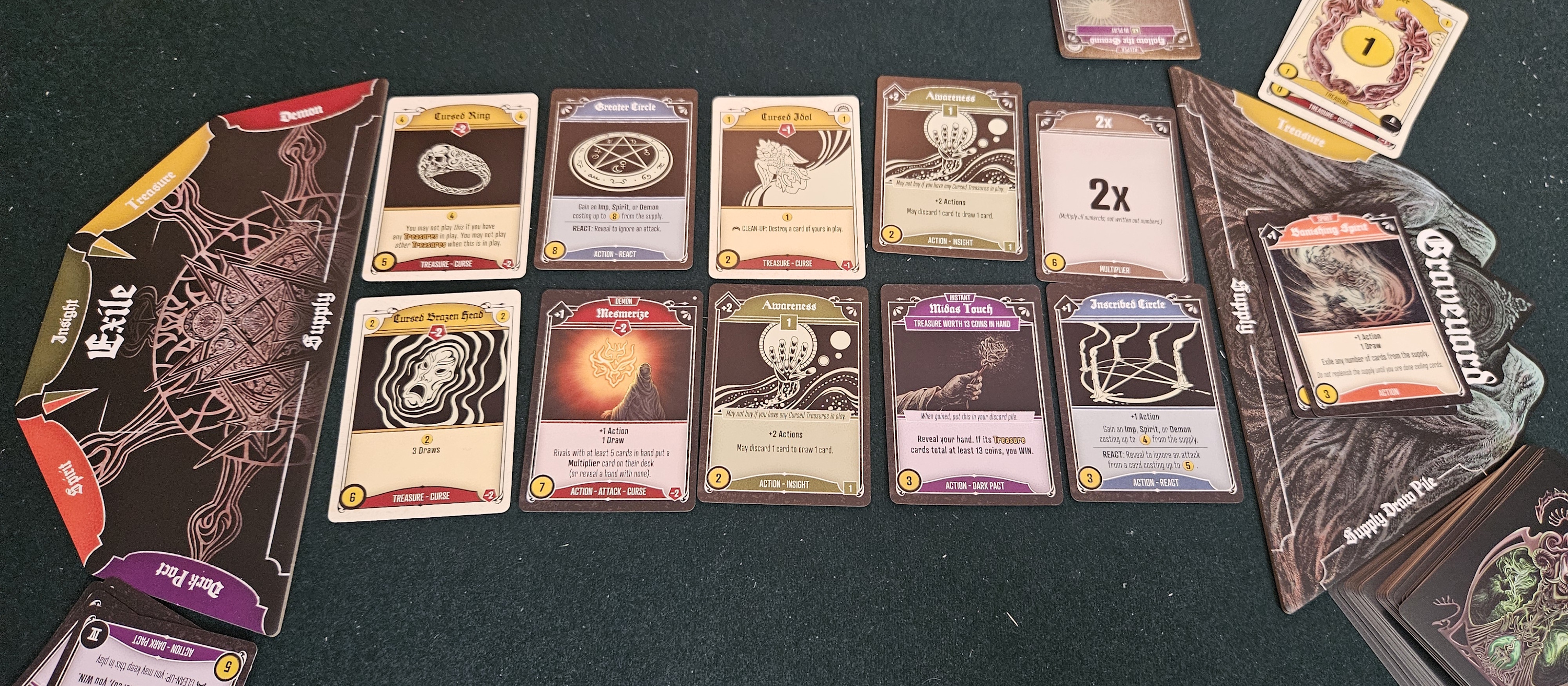
An old-fashioned (but not that old-fashioned) card market.
At a setting level, Dark Pact is about striking a bargain with a demon. I don’t have any experience in such a discipline, but it seems as close to otherworldly binding as Dominion was to Medieval villages. There’s a moment in the game, usually about five minutes into a session, when I can still appreciate Dug Nation’s woodblock-styled illustrations. Five minutes after that, those illustrations have faded from view, along with the remainder of the game’s trappings. All that remains is the machine I’m hopefully streamlining into something aerodynamic enough to drag two dozen cards into motion.
If you’ve played Dominion, you can play Dark Pact. By now the five-card hand has become industry standard, but even a few of Dominion’s other hallmarks return intact. By default you only receive a single action. That’s one card played to the table to activate its effect. Often that card will provide another action. Then its followup provides another two actions and some draws. Then the next card lets you retrieve something from your discard pile and, baby, you’ve got a stew going.
Also returning is Vaccarino’s market phase. After your actions are done, you’re allowed to play as much treasure as you can and purchase new cards. There are a few wrinkles this time around. For one thing, there are none of Dominion’s limited buys. If you want to split up your gold to purchase five cards, well, go nuts. For another, the market is now an ever-shifting offer rather than Dominion’s static display. What you see this turn may well disappear into your opponent’s deck before you get another stab at it.
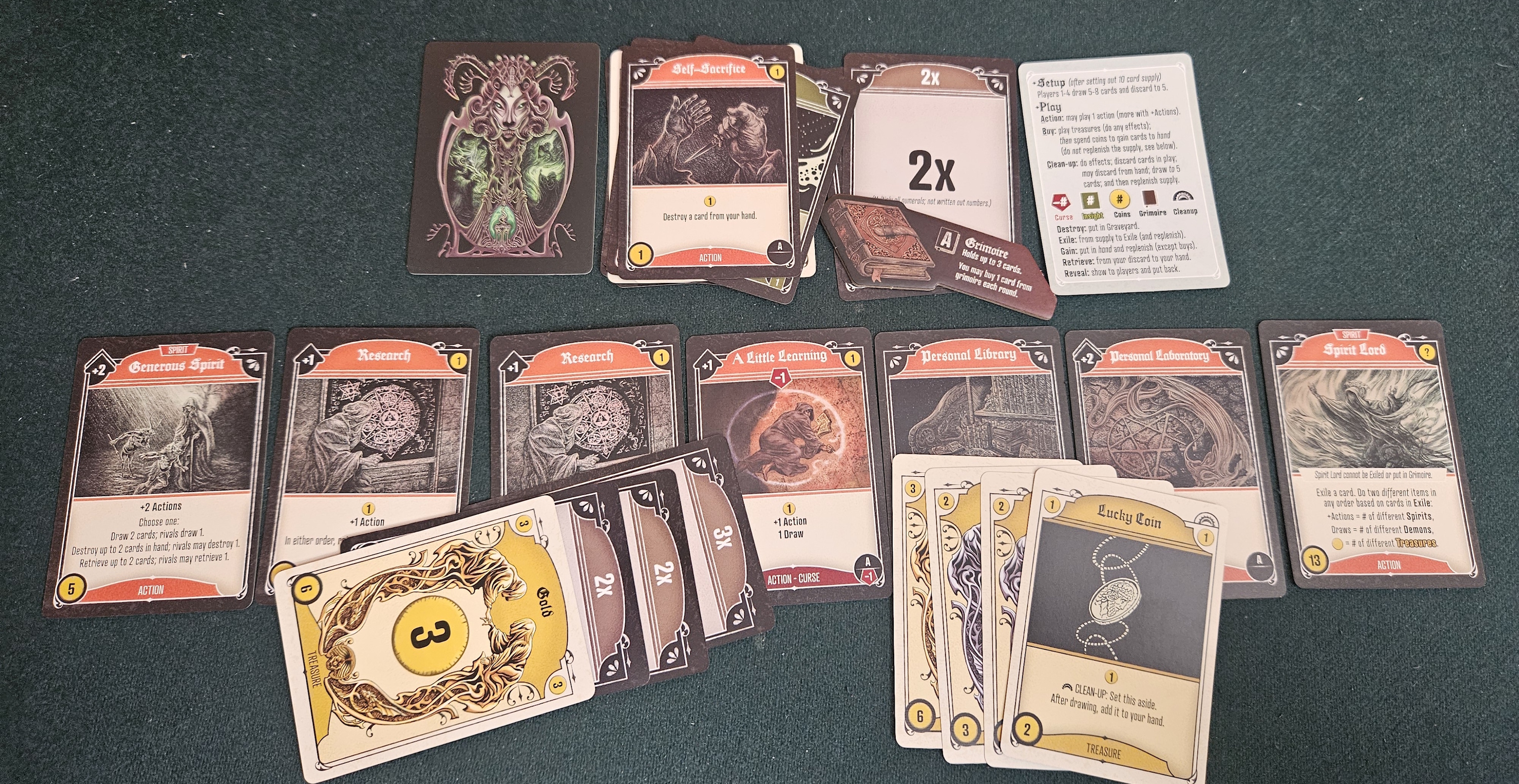
Turns eventually spool into madness. Seems fitting.
Unsurprisingly, this is where Lehmann dives in with full gusto. There are cards aplenty to grab, with heaps of effects, and all of them are useful for one objective or another. But there are two in particular that transform Dark Pact from spooky-art Dominion into something that feels distinctly Lehmann-esque.
The first is the pacts. The dark pacts. Of Dark Pact fame. There are thirteen in all, all of them shuffled into the deck, and all offering a game-winning condition that initially sounds impossible. You might, in the course of your demonic experimentation, uncover a dark pact called Diverse Learning that will let you win if you have 15 unique cards in play. Or perhaps you’ll pursue Secular Power, the card that wins if you enter the market phase with 40 unspent coins. Or Great Potential. That one wins if you have 19 cards in hand.
For Lehmann-heads, dark pacts aren’t far off from the monuments and places of power in Res Arcana. It’s just that they’re hidden in the deck like your average demon-summoning ritual or cursed ring, get shuffled into your deck, and present conditions that let you win outright rather than offering spills of points. If their targets sound intimidating, that’s deliberate. When the game opens, most dark pacts are well out of reach. Especially, remember, because you only get one action per turn, five cards per draw phase, the usual limitations.
That’s where the second special card comes in: multipliers. They’re… multipliers. No spooky gauze this time. Just a simple 2x or 3x. These also circulate through your deck, and can be attached to any card to amplify the effects of its printed numerals. Gold coin? Now it’s worth two or three times more. Summoning circle? Now you can nab a card worth 16 or 24 coins rather than a measly eight. Generous spirit? Enjoy your six extra actions and nearly your entire discard pile popping back into your hand.
Things really get bonkers when you discover that multipliers multiply multipliers. Before long, some turns are transformed into those obnoxious order-of-operations social media tests. (“Only one in thirty people can solve this equation!”) The effects can be staggering. Thanks to multiple 3x cards stacked atop some silver, I once generated something like 70-ish coins in a turn. I wasn’t even holding the pact that let me win from having so many coins. It was so much that I could have bought out the entire market. I didn’t do it, of course. Winnowing is every bit as worthwhile in Dark Pact as any other deck-builder. It’s possible to over-stuff your card pool, so I reined myself in. But I considered grabbing all ten cards on offer for the lifetime accomplishment award.
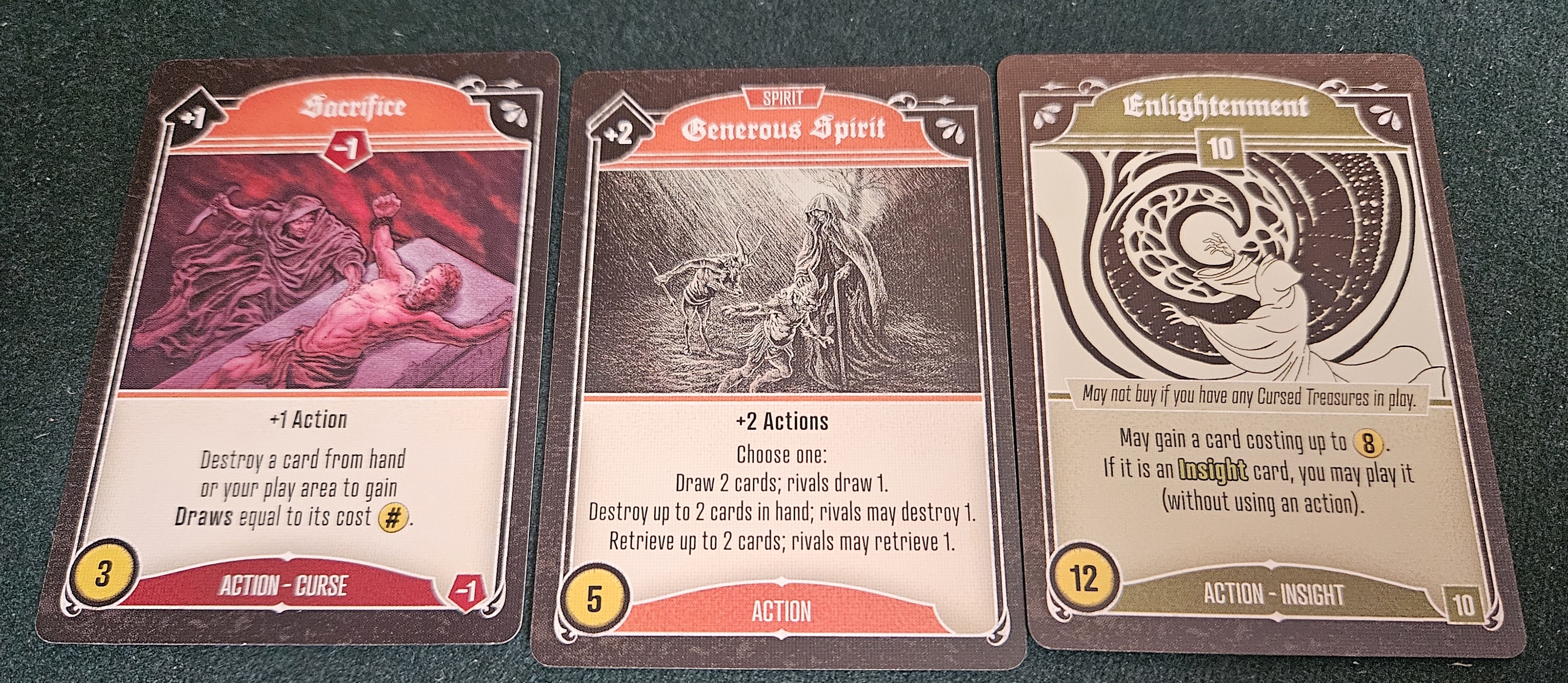
Another day at the office.
At its best, these cards result in a deck-builder that’s incredibly familiar, to such a degree that it feels like a throwback to 2008, while also chucking everybody down a slip-n-slide to see who can break the game the fastest. In those moments, Dark Pact is Lehmann in top form. All the broken combos of Res Arcana. All the busted dice-assembling of Dice Realms. All the recursive triggers of Race for the Galaxy. All of it and more, wrapped in a tidy package that barely asks deck-building veterans to learn anything new. Truly, it’s impressive how smoothly the game riffs on the genre’s basics. When I say you can play Dark Pact if you’ve played Dominion, I mean it.
At the same time, Dark Pact sometimes feels one or two elements shy of a summoning ritual.
The biggest issue is duration. Basically, it’s often too slow for its own good. Turns are anything but simple, with one power begetting another, often after drawing from the deck, retrieving from the discard pile, and refreshing a segment of the market, all of which make it difficult to plan during one’s off-turn. It might sound like the exception to have a dozen cards trigger in sequence, but that’s the goal of Dark Pact, which makes turns sprawl more often than not. Even with only two players, the downtime and duration can be formidable. At three or four, they grow interminable. I would play the heck out of this game via an asynchronous app; on the table, it needs optimal conditions to thrive.
Meanwhile, I’m sure much will be made of the card balance. Multipliers are powerful, that goes without saying, and the early game often feels like a race to secure an economic engine that will springboard your longer-term plans. Fortunately, Lehmann offers a few solutions to sidestep the usual deck-building snares. Purchased cards go straight to your hand rather than first cycling through your discard and deck, and everybody begins with a few cards in their own private grimoire that can be purchased at their leisure, including, crucially, a deck’s second 2x multiplier. It’s a clever move that eases the whims of the flowing market without totally erasing what makes it interesting.
Personally, I’m more interested in the dark pacts. These don’t need to be balanced. I would go so far as to say they oughtn’t be. For all I know, they’ve been painstakingly playtested and algorithmically tuned. But some of them feel like a breeze compared to some others. Is this a problem? Only insofar as you make it one. It’s an open bar. If somebody nabs a pact that’s more reasonably completed than one you’ve taken, maybe it’s time to run interference. But there are some, maybe two, that feel so comparatively easy that I’m always going to give them priority. In a game this muscular, even the slightest flab seems especially visible, like a world-class bodybuilder with one sagging boob.
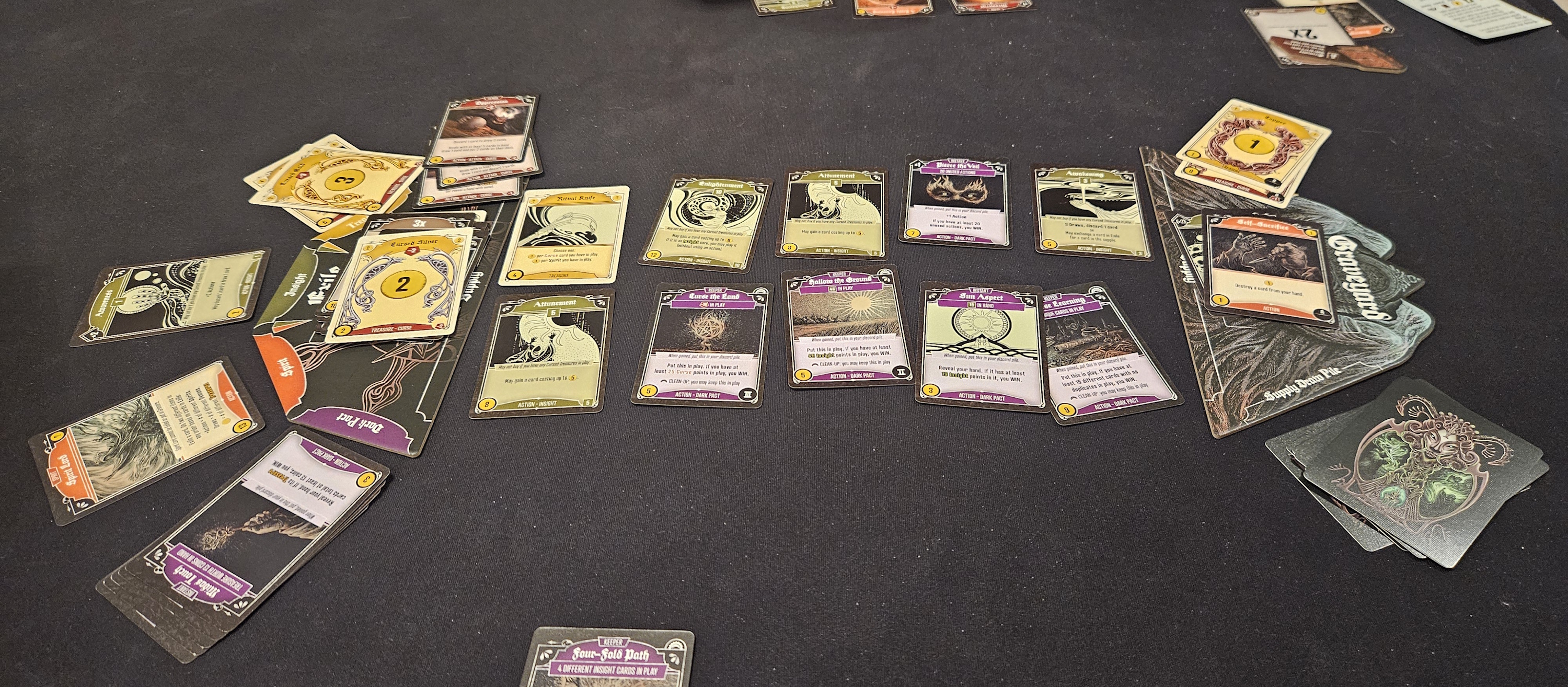
When nobody is sure which pact to buy, the market tends to clog with them.
Sagging boob or no, Dark Pact is fascinating for how Lehmann has taken a familiar formula and made it new again. This is Dominion, but rather than coming across as goofy when the optimal deck consists of seven sentries and four throne rooms, Dark Pact’s flowing market and sheer busted nature make the process feel vibrant and alive. It’s funny to get excited about trashing a card after all this time.
Which is to say, yeah, there are downsides. Some cards feel mistuned. The downtime is considerable. Four players? Forget about it. But Dark Pact once again showcases Lehmann as a master at work. In his hands, cards become more than cardstock. They’re components in a machine, one that sputters to life with every shuffle, draw, purchase, and winnow. The game is its own demon, and whatever dark pact Lehmann has struck to summon so many bangers in one lifetime, let’s hope the price never comes due.
(If what I’m doing at Space-Biff! is valuable to you in some way, please consider dropping by my Patreon campaign or Ko-fi. Right now, supporters can read my first-quarter update of 2026: the best board games, movies, books, and more!)









 Extraterrestrial settings are popular for board games, possibly because they avoid the potential geopolitical quandary or insensitivity of area control, settlement, and resource/worker exploitation inherent to games of more Earthly environs. Thus, designers are free to escalate conflict without offense, such as in titles like Moon Colony: Bloodbath, Moonrakers, and Skymines. This is where 2023’s […]

/pic7458460.png)
/pic8886325.png)
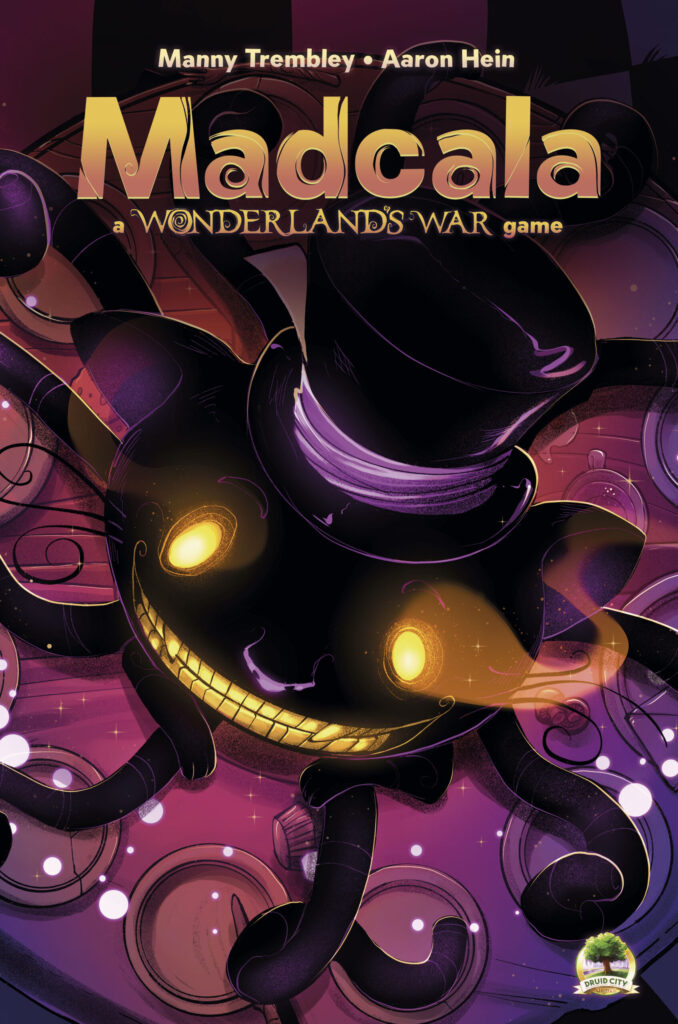 I love it when game designers give us a unique take on mechanics that have been around for a long time. Fight 5 gave us a new spin on the card game war, Samurai Spirit channeled its inner blackjack, and quite a few games have pulled from the ancient game Mancala, notably Five Tribes. Today, […]