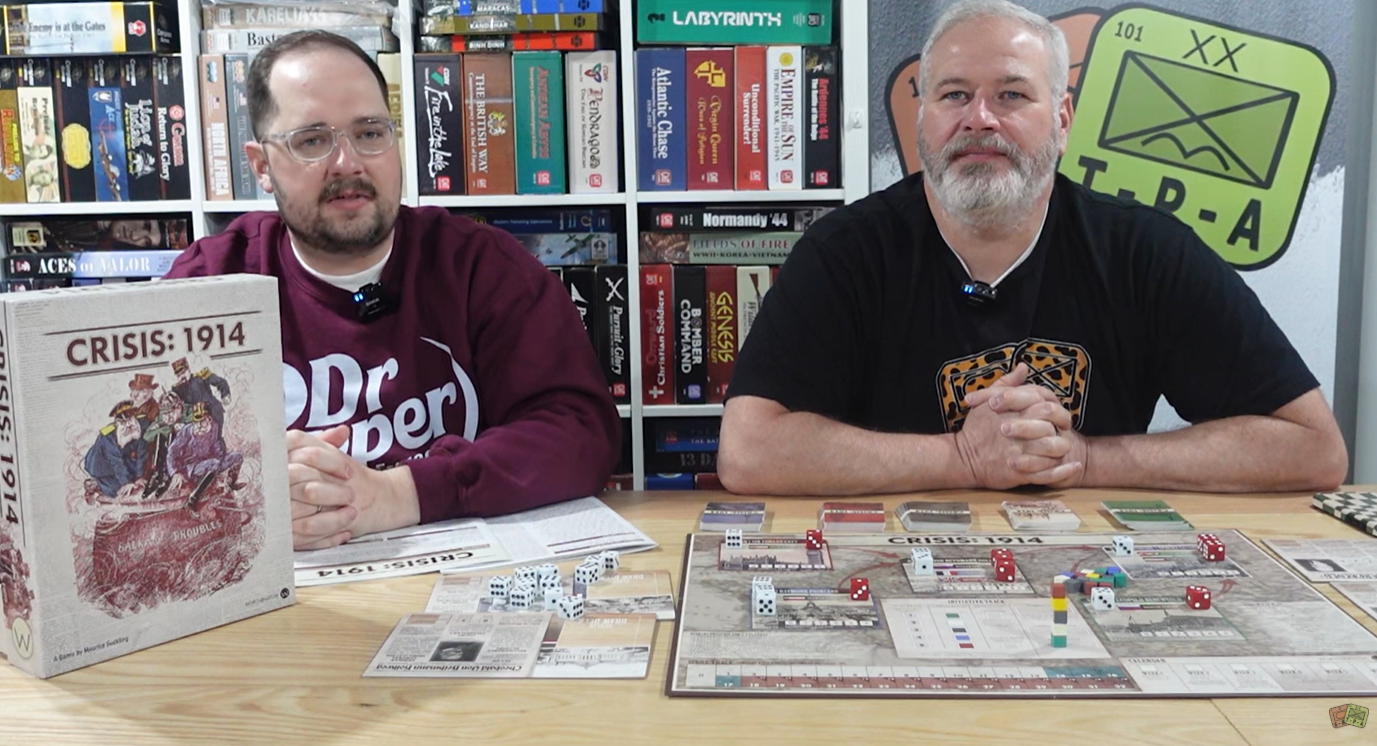
Crisis: 1914 is a game of international brinkmanship – if you back down too soon, you lose. If you back down too late you lose. But you have hawks and doves in your cabinet and in your government, and out of these conflicting views you must somehow formulate a coherent response to the crisis to win the day and prevent war.
There are 3 interrelated concepts at the heart of Crisis: 1914: Prestige, Tension, and Diplomatic Pressure (DP). Diplomatic Pressure (DP) is how you score Prestige. Tension is how you lose. Every card has a DP value. You apply DP by playing cards. The player with the most Diplomatic Pressure at the end of a turn earns Prestige points. There are other ways of scoring Prestige points too, but this is the most important one. Prestige is how you win. The player with the most Prestige at the end of the game is the winner.
While this game is not necessarily a wargame, but more of a war themed Euro game with a bit of negotiation and tension as you build your tableau of cards, we had a great time with it and really feel that the game is a bit under the radar of folks and should be one of those games that is played at conventions as it seats up to 5 players and is really quite good.
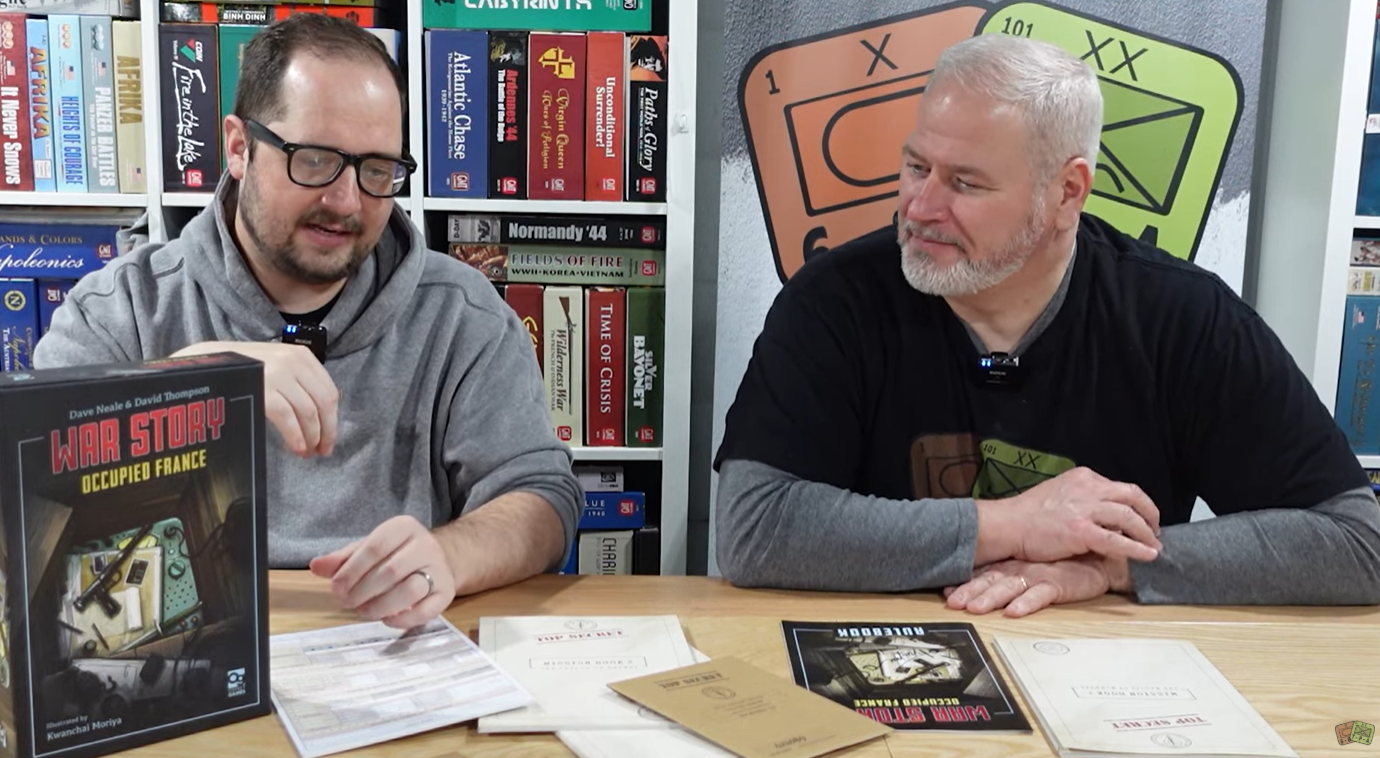
War Story: Occupied France is a co-operative narrative game for one to six players set in World War II occupied France that captures the stakes and tension of espionage and resistance warfare. Your team of covert operatives is all that stands between the infamous German officer Heidenreich and the systematic destruction of French Resistance forces in Morette.
Through three replayable story missions, you must exploit the specialties of your chosen agents to uncover information, enlist allies, and obtain weaponry. Engage occupying forces on tactical encounter maps where careless positioning could cost your agents’ lives. Remember, no plan survives contact with the enemy…and time is running out.
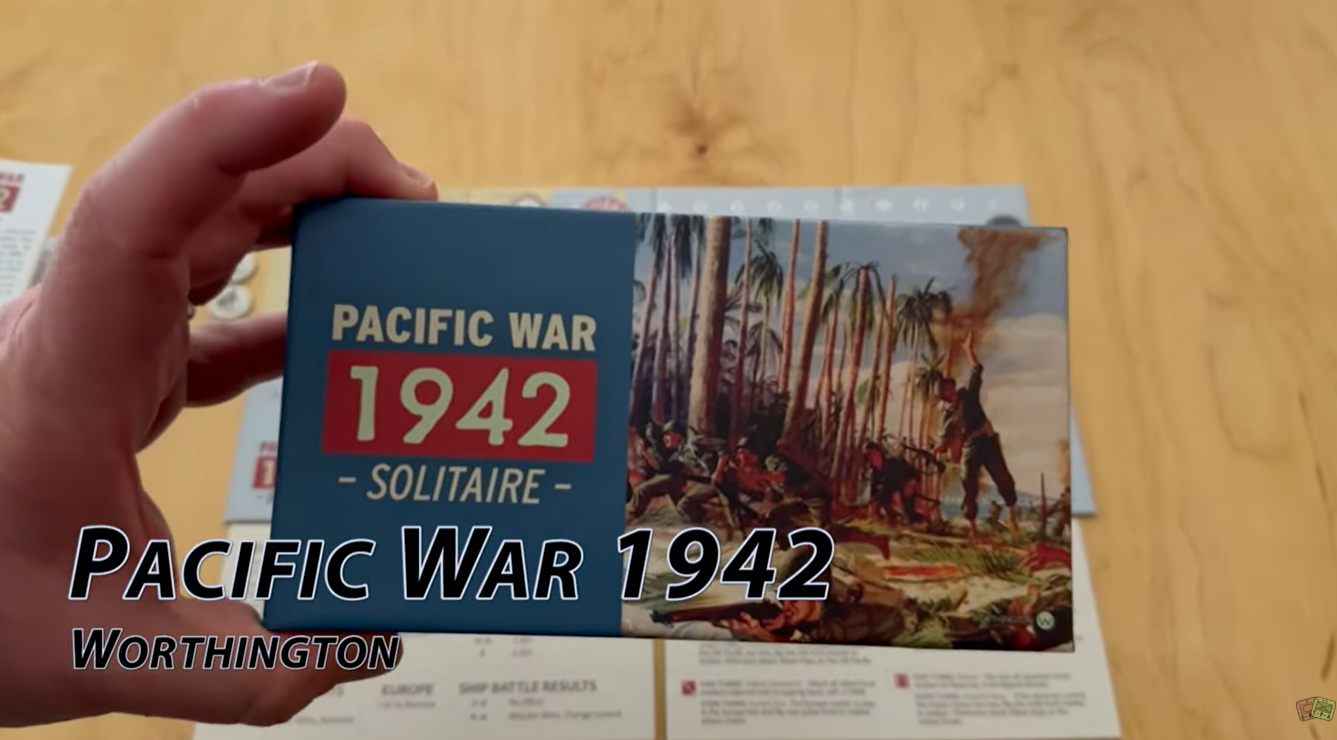
In early 2024, Worthington Publishing announced a unique 2-pack of games on Kickstarter that were marketed as easy to play travel friendly solitaire games. And you know that I love a good solitaire wargame! And when I heard that these games were small, even portable, then I was even more interested. One of the games covered the Pacific Theater of WWII called Pacific War 1942 Solitaire and the other covers the War of 1812 called (you guessed it) War of 1812 Solitaire. These games are designed by Mike and Grant Wylie and each game has 4 pages of rules, a beautiful mounted board and double sided counters. I played both and really very much enjoyed the experience.
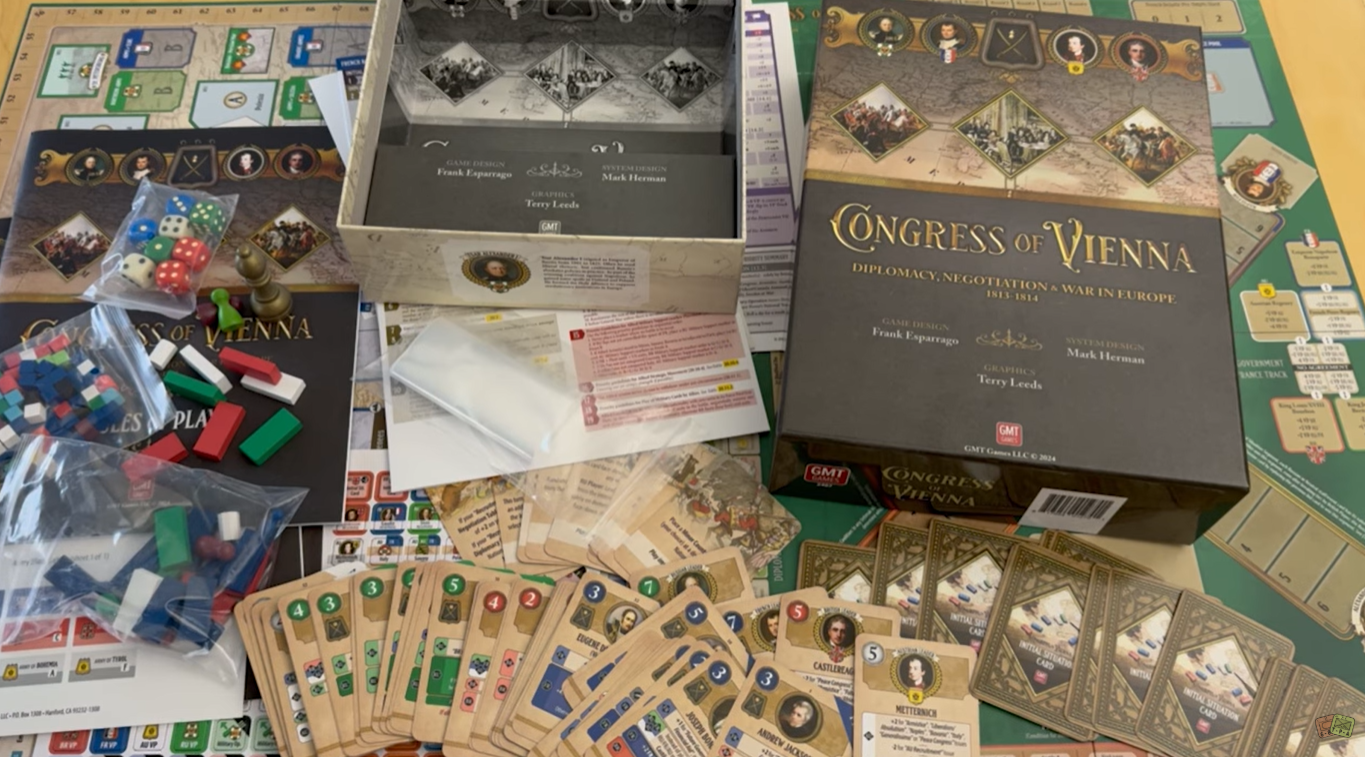
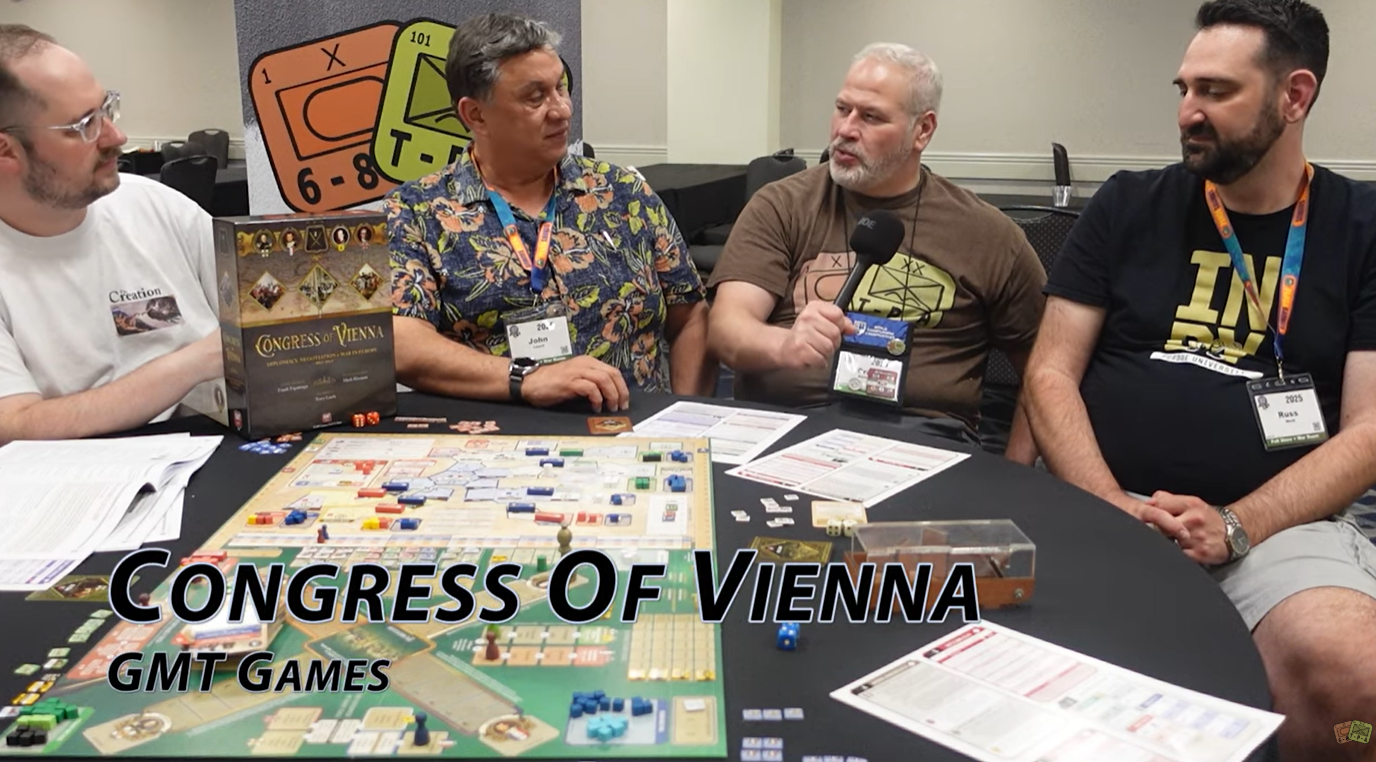
A few years ago, after playing all of the games in the Great Statesmen Series, we heard of a new game in the series from a designer not named Mark Herman and I was immediately interested and intrigued as we have had so much fun with Churchill, Pericles and Versailles 1919. Congress of Vienna from GMT Games is a diplomatic card driven wargame based on Churchill and is the 4th game in the Great Statesmen Series. The game is set during the years of 1813-1814 and sees players take on the role of the main characters of the struggle between the Napoleonic Empire and the coalition of Russia, Austria, and Great Britain with their Prussian, Spanish, Portuguese, and Swedish allies. We played the game recently while attending Buckeye Game Fest and then played a full campaign again while attending the World Boardgaming Championships and absolutely were amazed at the changes and innovations to the system introduced by the designer Frank Esparrago.
Day 3 started off a bit slow as we dragged in the morning getting ready and didn’t get out the door till around 8:15am and after breakfast didn’t make it to the War Room until almost 9:00am. But, upon arrival we got right to gaming by setting up Cross Bronx Expressway from GMT Games with Russ Wetli from Cardboard Conflicts as our third.
Cross Bronx Expressway is the 3rd game in the Irregular Conflicts Series and attempts to simulate the socio-economic processes of urban development, and the human costs that result, as a competitive city-builder with collective loss conditions in the South Bronx between 1940 and 2000, with their unique faction pursuing their own goals while cooperating to keep the borough viable. Through a card driven sequence of play, they will work to solve the economic challenges facing the area by building infrastructure and organizations, forming coalitions, mitigating the multitude of issues facing the vulnerable population, and managing resources to stay out of debt.
Cross Bronx Expressway is a very interesting and engaging way to learn about the history of American cities as an economic simulation of sorts. Players will have to deal with the conflicting incentives and complex factors shaping urban life and together determine the fate of the Bronx.
We very much enjoyed this one and felt like it was very insightful and thematically connected with the subject and the times to create a very brain melting but interesting experience. I felt like I really had no idea what I was doing…but very much liked it.
We ended up losing the game as it is semi-cooperative and players can lose together due to bankruptcy or the overcrowding of prisons that will lead to higher social difficulties. But we learned a lot and I very much look forward to playing this one again.
We then played our 1st game of the interesting COIN Series like game Werwolf: Insurgency in Occupied Germany, 1945-1948 from Legion Wargames with Dave (a new friend from Michigan) and Gary of Ardwulf’s Lair. The game is designed by Clint Warren-Davey and Benjamin Feine and is an alternate history game, but the story that is presented is entirely plausible. Werwolf was a real underground guerrilla group, comprised of SS and Hitler Youth members. It was intended to lead an insurgency against the invading Allies and Soviets when it became clear that Germany was losing the war in a conventional sense in the mid-1940’s. They did in fact have a few successes and American intelligence officer Frank Manuel said that the Werwolves were prepared “to strike down the isolated soldier in his jeep, the MP on patrol, the fool who goes a-courting after dark, the Yankee braggart who takes a back road.”
The game allows players to take on the role of the occupying Soviets and Western Allies along with this Werwolf insurgency and the Edwlweiss insurgency.
After about 3 hours we finished 3 decks and the Werwolf Insurgency was declared the winner. All had a good time and I am looking forward to taking this to WBC in July and playing again.
I then sat down with Tim Densham with Catastrophe Games and he gave me a look at several of their planned upcoming games. These will all go on Kickstarter in order to fund the publication.
First was a look at War Cabinet, which is an economic and logistics focused take on WWII in the European Theater of Operation.
Next was Afghanistan: Decades of Strife, which is an area control game in the Conflict of Wills Series.
Then we got a look at Brothers of the Sword: Baltic Crusades which is set in 1100 AD.
All of these games will be coming to Kickstarter in the next 6-8 months and I am very much interested in them all. I was able to shoot a 30 minute video interview with Tim with more details and that’ll be on the channel soon.
We then sat down with Steve Jones from Blue Panther and Hermann Luttmann to play the new Dawn of the Zeds Designer Edition which will be available for pre-order in May and will be published at the end of July.
You know well the original Dawn of the Zeds from Victory Point Games and this has now had the rights reacquired by Hermann who is working with Steve to bring it back to life with new art, a new combat system with custom dice and some new characters. We played for about an hour and had the same fun we have always had with the game and I am very much looking forward to this new edition.
We shot a 20 minute video with Hermann and that’ll be up on the channel soon.
We then played our final game of the night, a 4-player game of War of the Ring: The Card Game from Ares with Cullen and Bad Russ. This is a game that I have had on my shelf for a few years, even purchasing all of the various expansions to date, but just have not had a chance to get it played…until now.
This was our 1st play and while it took us a good amount of time to get comfortable with the mechanics, and about 3 hours to play the entire game, we all had a great time and very much enjoyed what it was doing. The art in the game is just amazing and the game play is smart, with lots of bluffing and gamesmanship on how to play and manage your limited cards. Just a very solid multi-player card game.
It is now well after midnight and I am tired. Sorry for the brevity of my comments about the games but it’s just too late.
Tomorrow we have a full 6-player game of Here I Stand from GMT Games at 9:00am and then an evening role playing game with a WWII historical RPG called War Stories from Firelock Games. Should be a blast!
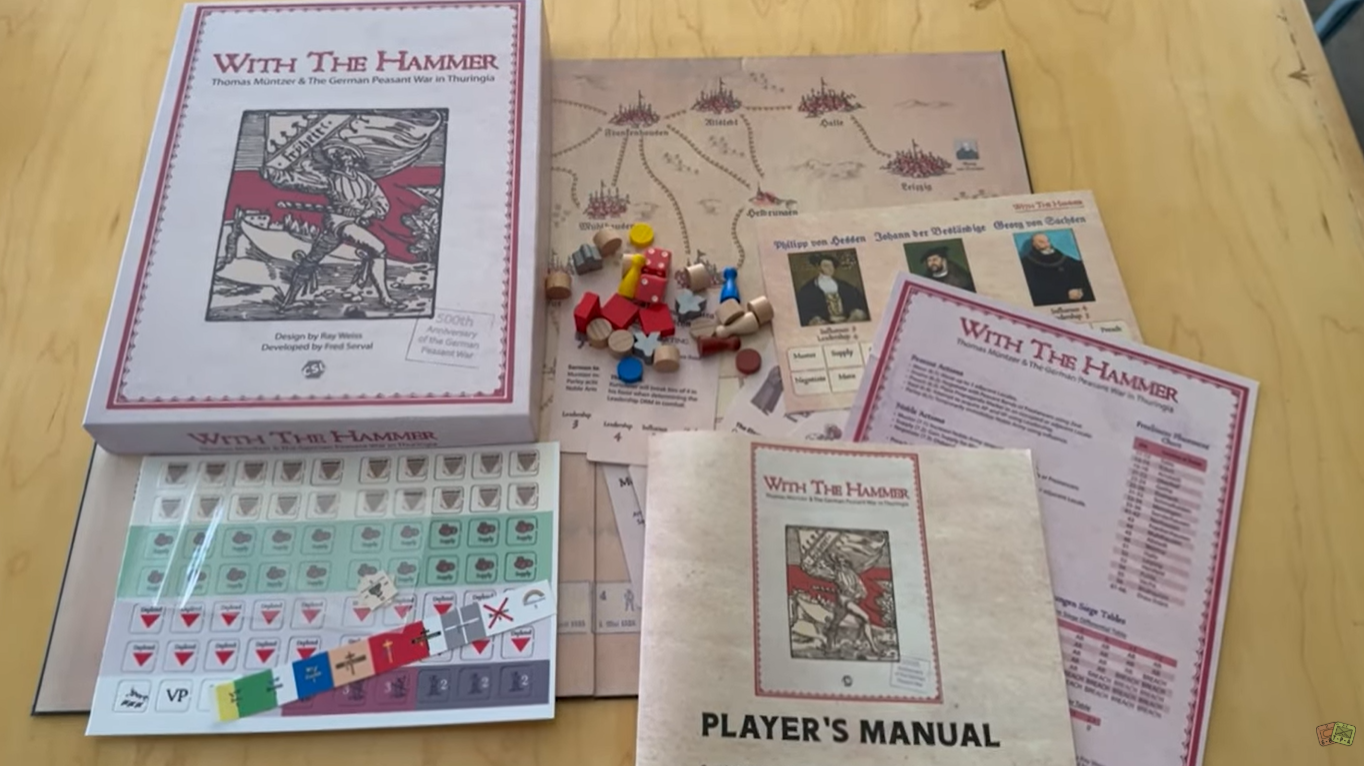
With the Hammer is an asymmetric wargame covering the German Peasants War in Thuringia in 1525 along with the exploits of one of its most famous protagonists – Thomas Müntzer. With the Hammer comes with wooden pieces, counters, 2 rulebooks, and historical commentary by Professor Andrew Drummond, and a 22×17 inch map.
Each player is a peasant or a noble; the peasants win as a team, or the nobles win as a team. There is no true solitaire system, but like most wargames, it can be soloed two-handed.
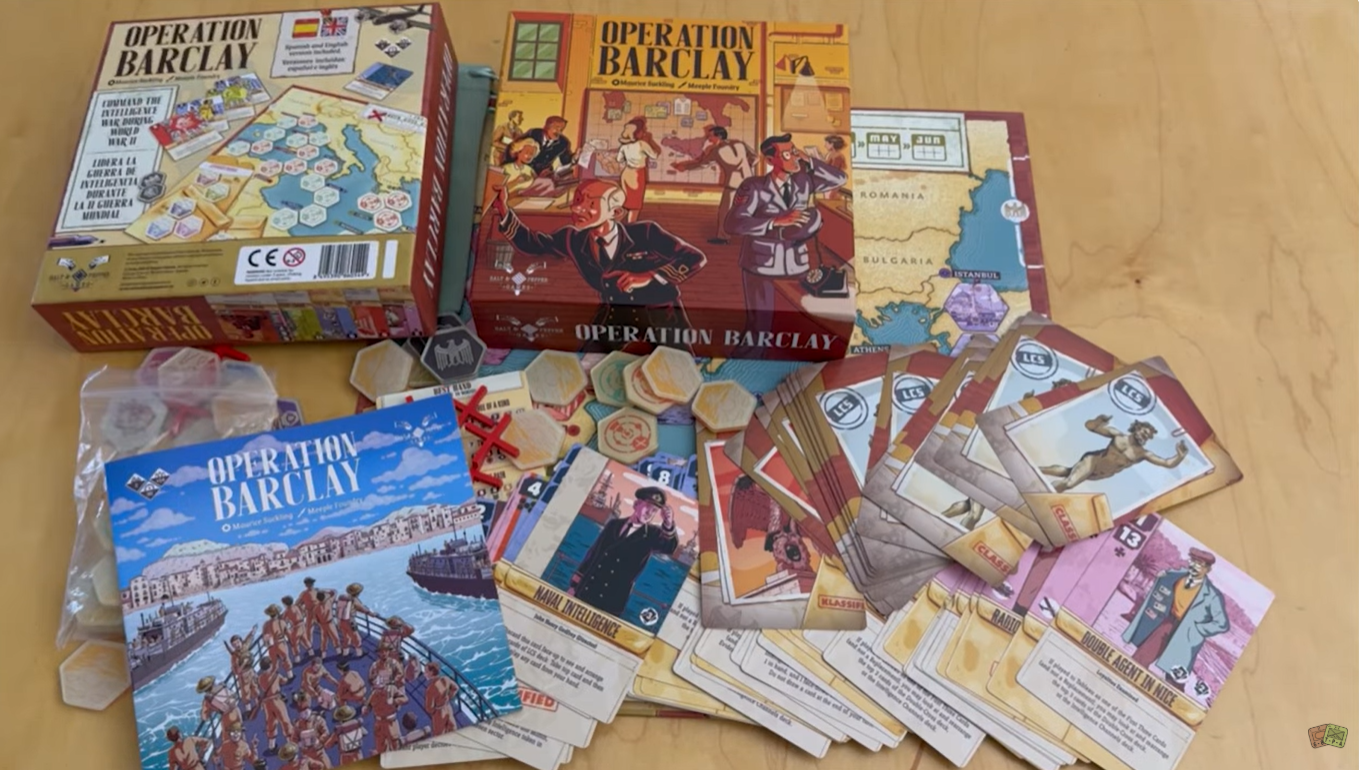
Operation Barclay is a 2-player game of low/medium complexity about the intelligence war between the Allies and their Abwehr counterparts in the Mediterranean Theater of WWII in 1942-1943. Operation Barclay puts players in the shoes of competing military intelligence directors who are attempting to mask or learn the truth about the Allied invasion plans for 1943. The Abwehr must attempt to learn where the Allies intend to land next. The London Controlling Section (LCS), the core intelligence agency responsible for Allied intelligence, must prevent the Abwehr from discovering the truth.
The LCS player uses a variable set-up, placing tiles face down to establish where in the Mediterranean a primary and a secondary offensive will occur. Over the course of the six game months, the Abwehr player attempts to win sufficient evidence tokens to be able to turn enough of these tiles face-up to reveal where the Allied offensives will come.
To win evidence tokens, players build hands of five cards to take tricks, similar to poker. While having the best hand will secure two evidence tokens, correctly betting after each player reveals the first three cards of each hand on who will have the best five-card hand is worth three evidence tokens.
Further, players have ways to manipulate the decks from which they draw. They may create a double-cross deck, allowing them to leave cards useful to them face down in a deck to draw from when they choose later — unless the other player takes those cards instead…but perhaps the player who planted those cards was bluffing and hoping the other player would waste their draw on a useless card. Alternatively, players may draw from their own dedicated deck to augment their hands with unique abilities inspired by historical figures, events, and capabilities. The LCS has access to Ultra — decrypts of German codes — but this alone will not be enough if it’s not used carefully.
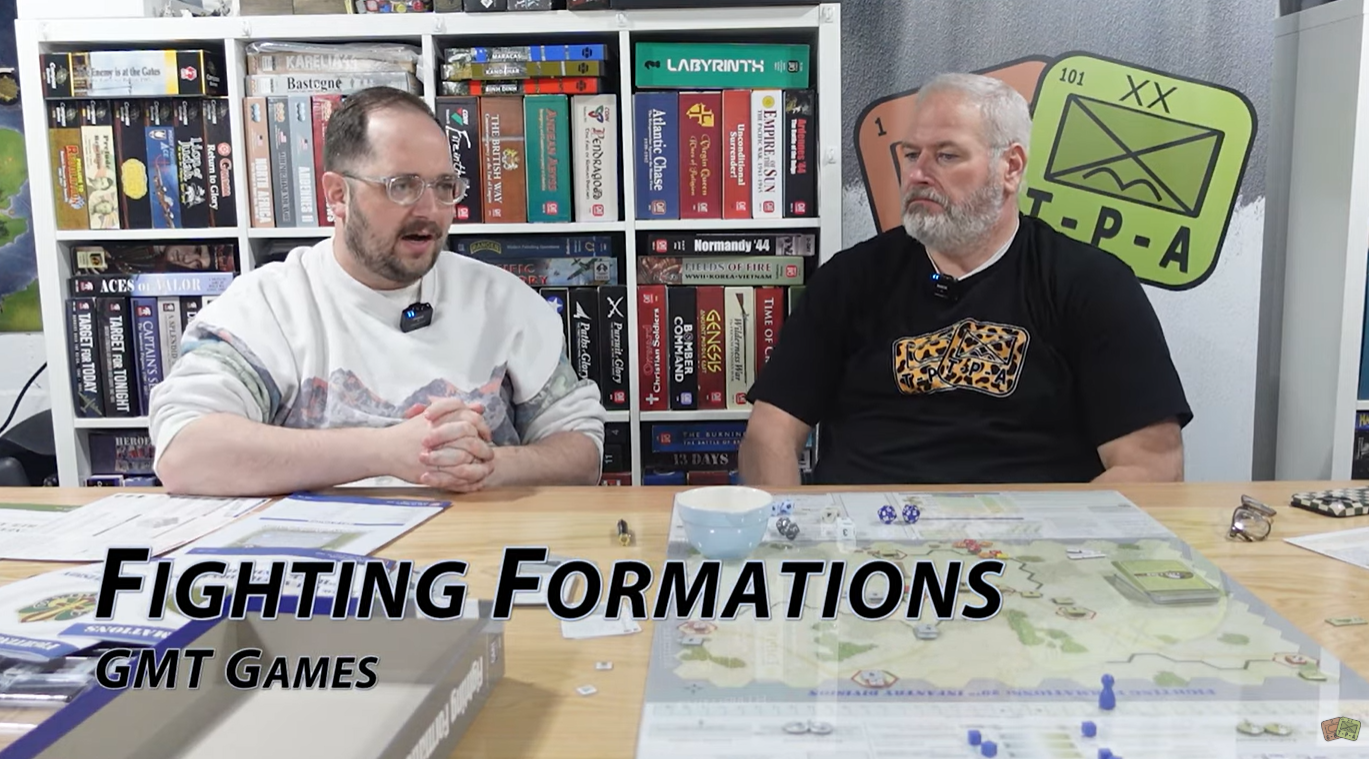
Fighting Formations is intended to be an ongoing series of wargames covering WWII tactical combined-arms combat at the platoon and squad levels. Each game in the series will feature a distinct combat unit, highlighting battles in which that unit participated as well as its particular order of battle and fighting characteristics. In this second volume of Fighting Formations, we feature the US 29th Infantry Division—“Blue and Gray”—as it fought from just after D-Day in June of 1944 to the end of the year.
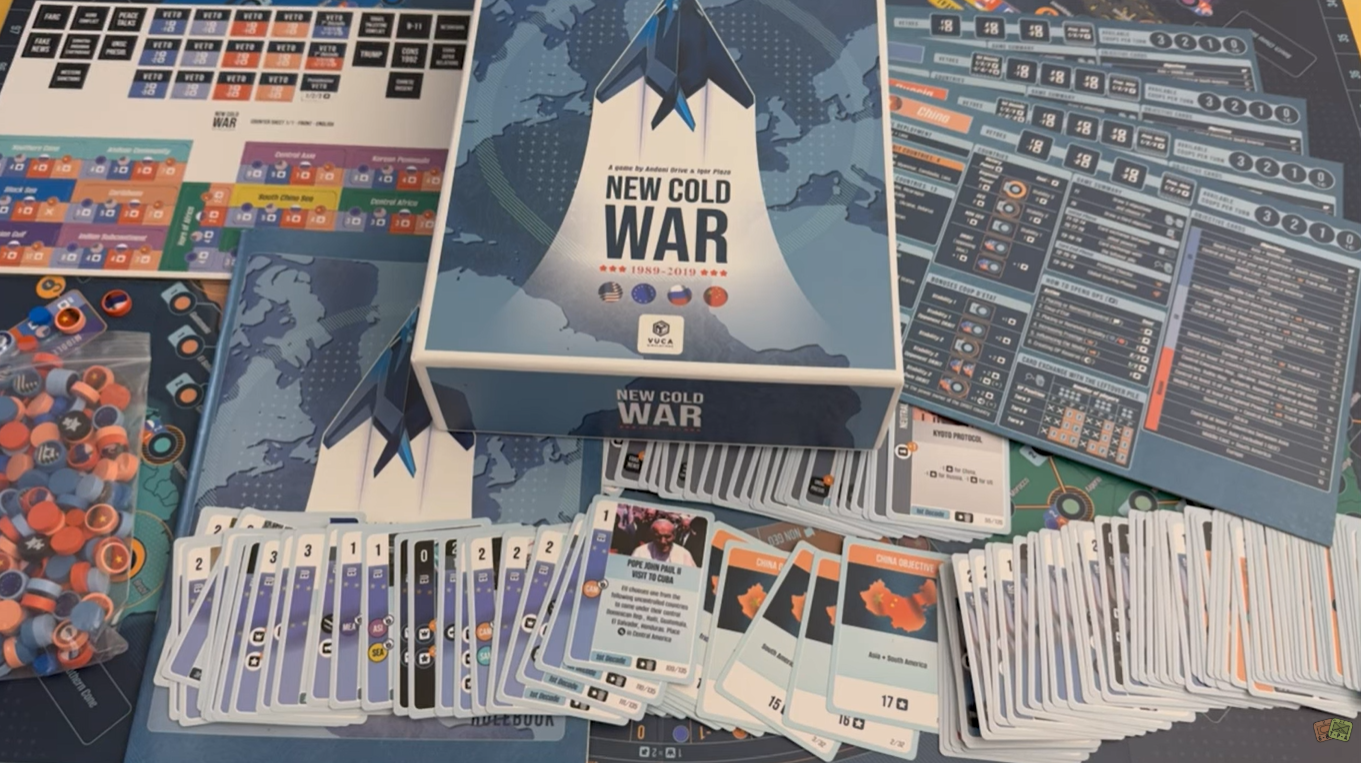
New Cold War: 1989-2019 is a Card-Driven Game based in the most important geopolitical events from 1989 to 2019. Players lead one of the four great powers (Russia, China, US, EU) in their fight for the new world order. Initially, the confrontation is between the red bloc, consisting of Russia and China and the blue bloc, comprising the United States and the European Union. However, each player must also prioritize their own strategy, as only one power can emerge victorious at the end of the game. Therefore, this game starts with cooperation between allied powers in the early stages but becomes entirely competitive as the moment of final victory approaches.
New Cold War utilizes a Card-Driven game mechanic. Players strive to attain victory by gaining international prestige, dominating the media and increasing their control of countries and different regions of the world. Other key factors to manage include military force and United Nations Security Council vetoes. Players’ strategies are determined by a series of hidden objectives they must pursue to achieve victory.
The game accommodates three or two-player versions and includes a solitaire mode through a system of bots.
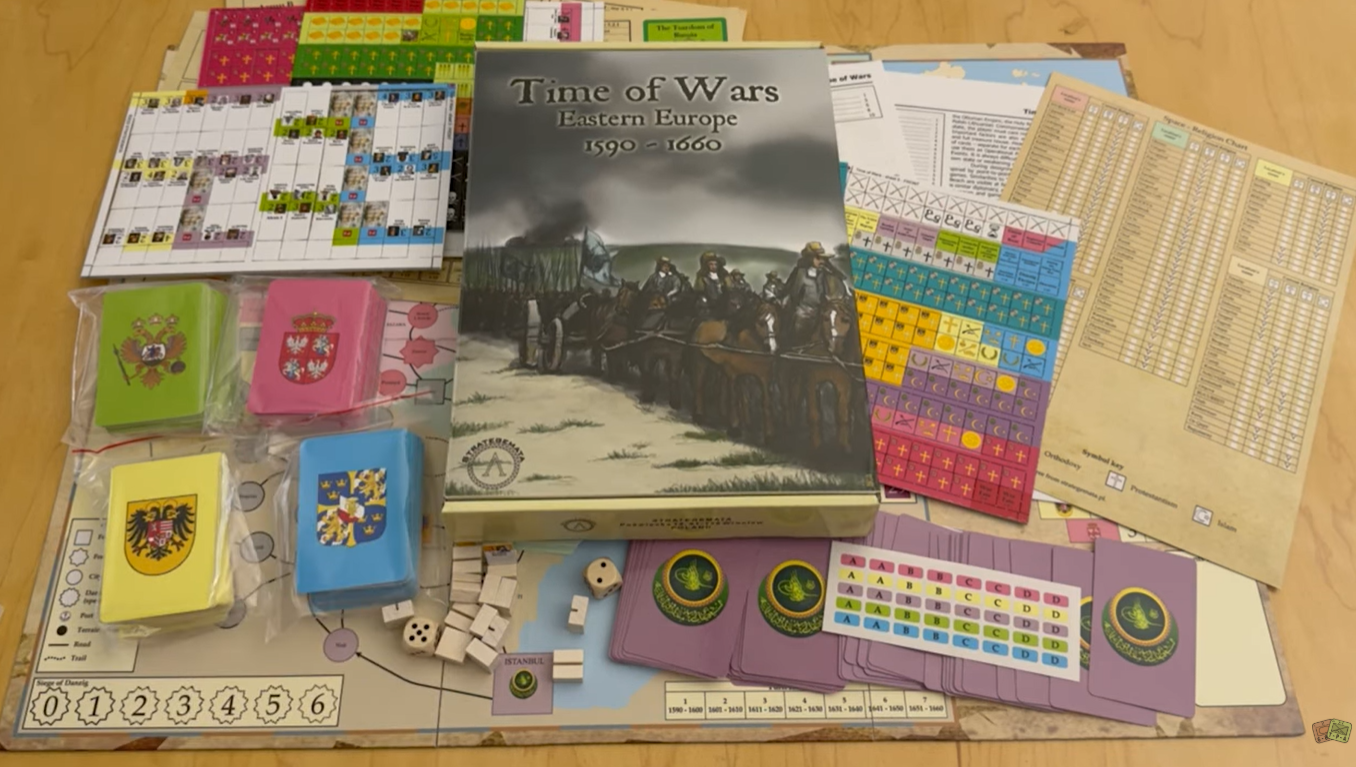
Time of Wars: Eastern Europe 1590-1660 is a card-driven multiplayer game in which players assume the roles of rulers of five superpowers in Eastern Europe – the Polish-Lithuanian Commonwealth, the Empire of Russia, the Ottoman Empire, the Kingdom of Sweden and the Holy Roman Empire. There are also smaller states – Denmark, Brandenburg, Moldova, Wallachia, Transylvania and the Crimean Khanate. They can be the basis of strong competition between players or the source of internal problems.
The game presents the turn of the 16th and 17th centuries. This period was full of famous figures (rulers and commanders) and critical events – for example Great Sadness in Russia, Thirty Years’ War in the German Reich, “Swedish Deluge” in the Polish-Lithuanian Commonwealth. All of this and more are elegantly integrated into the gameplay.
At the heart of the game are five decks of cards – one for each superpower. Each time a player uses a specific card, he has to make a difficult decision – play the card as Operations Points or as an Event. The background of the choice is the need to develop one’s own country or weaken the enemy’s position.
There is a lot of interaction between players during the game. They can declare wars or form alliances through secret negotiations. Winning battles and wars are important, but players must also keep their countries healthy. The game shows factors such as economy, domestic politics, military level and religion. All of them can affect specific player actions.
The game has many options for each player, and each country has its own problems and advantages. Despite this, the gameplay is extremely well-balanced. Moreover, the random factor is reduced to the necessary minimum. As a result, players feel that the fate of Eastern Europe is in their hands and depends on their decisions.
The January 2026 Monthly Debrief Video, which is the 1st episode in Season 6 of this series, saw us discussing the games of The Lord of Rings. We both love the writings of J.R.R. Tolkien and The Lord of the Rings Series including The Hobbit and other books such as The Silmarillion and Unfinished Tales. As we thought about this topic, we were very surprised by the number of games set in Middle Earth and were quite excited to share them.
Also, as usual, we covered the games we played in January, as well as the games we plan to play in February.
We will remind you here that we are fortunate to be continuing our relationship with Noble Knight Games as the sponsor for our Monthly Debrief Video series. In case you don’t know, Noble Knight Games specializes in hard to find games but also carry all the new releases. But what makes them truly unique is that you can find some of the rarest games, long out of print games, hand made games, imported games from overseas, etc. Thanks to them for their sponsorship and we hope that you will consider them first when looking for the games we cover.
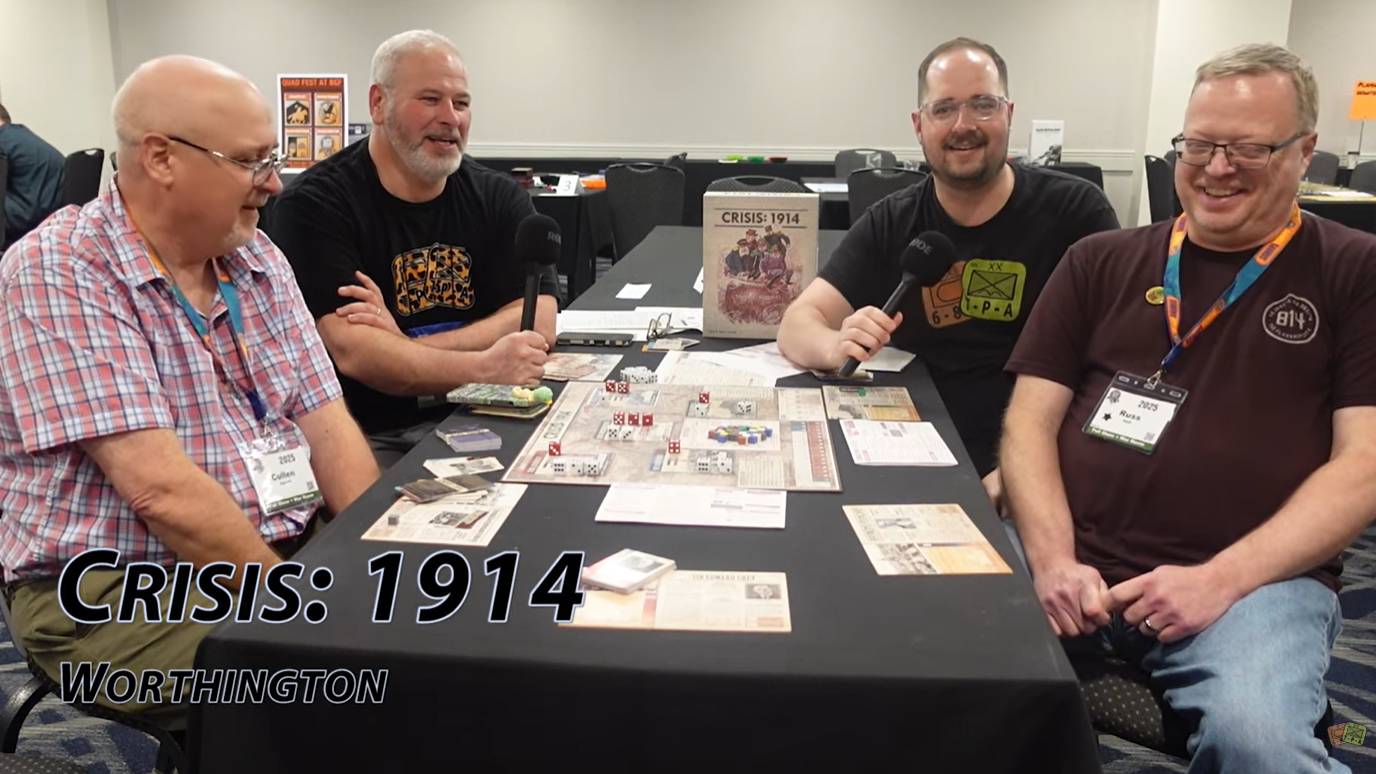
Crisis: 1914 is a game of international brinkmanship – if you back down too soon, you lose. If you back down too late you lose. But you have hawks and doves in your cabinet and in your government, and out of these conflicting views you must somehow formulate a coherent response to the crisis to win the day and prevent war.
There are 3 interrelated concepts at the heart of Crisis: 1914: Prestige, Tension, and Diplomatic Pressure (DP). Diplomatic Pressure (DP) is how you score Prestige. Tension is how you lose. Every card has a DP value. You apply DP by playing cards. The player with the most Diplomatic Pressure at the end of a turn earns Prestige points. There are other ways of scoring Prestige points too, but this is the most important one. Prestige is how you win. The player with the most Prestige at the end of the game is the winner.
While this game is not necessarily a wargame, but more of a war themed Euro game with a bit of negotiation and tension as you build your tableau of cards, we had a great time with it and really feel that the game is a bit under the radar of folks and should be one of those games that is played at conventions as it seats up to 5 players and is really quite good.
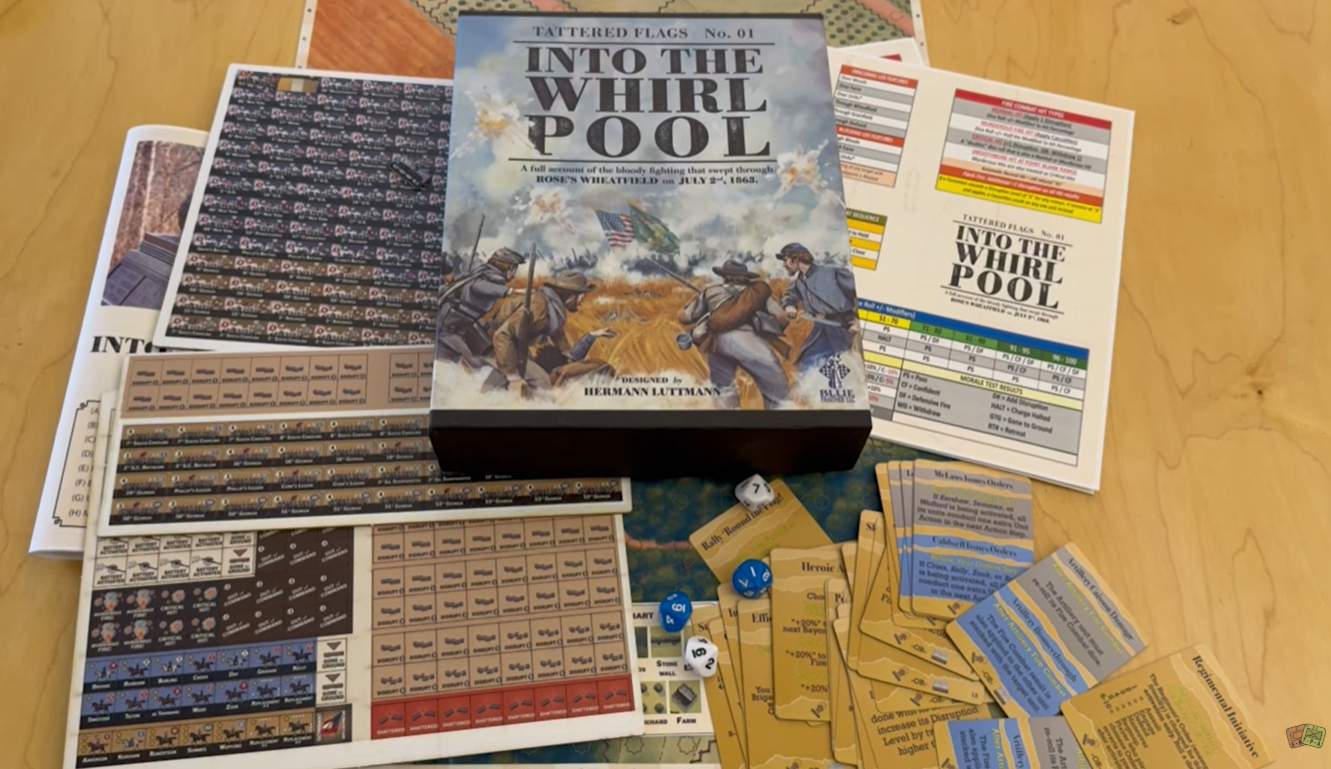
Tattered Flags: Into The Whirlpool is a hybrid historical miniatures/board game design that simulates tactical American Civil War combat in a playable format. The game depicts in detail the series of engagements that occurred in and around the salient formed by Union General Dan Sickles’ III Corps as he was attacked by Confederate General James Longstreet’s Corps at the Battle of Gettysburg on July 2nd, 1863.
The game is primarily designed as a 2-player game, one player taking Union forces and the other the Confederate (or Rebel) forces. However, more players are easily accommodated as commands or sectors for each side can be divided amongst multiple players.
Rodney Smith, the founder and host of board game ‘how to play’ video giant Watch It Played, has accused long-time site colleague Chaz Marler of misleading advertisers on the latter’s Game Night Picks YouTube channel by paying to boost viewer numbers on its videos.
A detailed report distributed by Smith to board game publishers yesterday said Marler had used YouTube advertising to boost views on Game Night Picks – formerly known as Pair of Dice Paradise – in November and December last year, with typical viewers per video rising from the low thousands to an average of 36,700 across those months.
While that might seem ideal for publisher advertisers, Smith added that Game Night Picks had establised a ‘per view’ fee structure early last year – and said more than 90% of viewers in November and December left the videos within the first minute, well short of the point at which publisher advertising was shown.
A graph distributed by Rodney Smith showing the fall in viewership over time for an unspecified YouTube video, which he said made use of YouTube Advertising to boost viewer numbers
Smith said in the report, “Despite the sudden influx of 145,300 subscribers, the behind-the-scenes analytics (which only those with access to the YouTube account can see) showed that traffic ‘from subscribers’ did not change in any perceptible way.
“If even 1% of the new subscribers had returned to watch future videos with some regularity, traffic ‘from subscribers’ would have increased by roughly 1,453, but there was no noticeable change. It suggests that you can pay to have the ‘YouTube Advertising’ feature provide you with subscribers and/or views, but it cannot make those subscribers (or viewers) engage with your content.”
He added, “Would a publisher agree to pay a ‘per view’ fee if they knew only 3% to 6% of the viewers were still watching a video by the time their ad aired?
“It would seem that this advertising model can only be effective if the publisher remains unaware of the underlying data (which only the channel owner has access to) – I also had access to it, due to our working relationship.”
Data from social media analytics website SocialBlade, showing the surge in subscribers for Board Game Picks in the last two months of 2025
Smith said that after he noticed the change in analytics he approached Marler in December, telling him he believed the latter was “engaged in a deceptive practice” – and was told some publishers who bought ads in November and December had been issued discounts of ‘half or more’.
“He expressed that providing discounts to publishers would fix what he was doing, but it was clear in my mind that discounting unethical practices do not make them ethical.”
Smith continued in his written report, “I assured [Marler] that his activities would be discovered due to the overt and unnatural viewer and subscriber growth he had obtained through ‘YouTube Advertising’.
“Once uncovered, publishers might reasonably (but incorrectly) assume I was also engaged in this practice due to his six-year association with Watch It Played. They might reasonably assume I’d instructed him on how to do it.
“Although I have never engaged in any of these activities personally, his actions threatened to undermine the relationships and trust I have cultivated with publishers and viewers over the past 15 years – risking irreparable damage to my career and reputation.”
Chaz Marler hosting one of the videos on his Game Night Picks YouTube channel
Marler confirmed to BoardGameWire yesterday that he had made use of YouTube’s built-in promotions tools in November for Game Night Picks “to see how it works”, but added that the tool “didn’t produce the results I was looking for, in terms of viewership quality or sustainability” and was no longer being used by the site.
Update 10/2/26: Rodney Smith contacted BoardGameWire in the wake of reading Marler’s response here to add the following statement:
“The owner of Game Night Picks first used the YouTube Advertising feature in August, and then again in October. One would reasonably presume that the first and second time a tool like this is used, a creator would be paying close attention to the effects of how it works – especially as they are paying to influence the final resulting views.
“In November, the owner of Game Night Picks started using the YouTube Advertising feature again, but this time did not stop. It was used on each of the following 19 videos one, after the other. Each showing the same relative viewer retention within the document I shared, and this article.
“As I said to him in December: after three or four, or maybe five of these videos, the pattern was clear. Why continue the ‘experiment’ 15 more times (which does not include the experiments in August and October)? To my mind, he had lost plausible deniability about the effects of this tool after the fifth attempt. And I would say that’s being generous.
“I would want to remind readers, the issue is not that the tool was used. The document I presented was to show how ‘in combination’ with the YouTube advertising tool, the lack of information the publishers had, and the fee structure, unethical and legal implications were introduced.”
Update ends
Marler would not comment on the accusation he had willingly engaged in unethical behaviour towards advertisers, or say whether he had properly reimbursed advertisers featured on Game Night Picks during the period in question after the issue was raised with him by Smith.
Marler did tell BoardGameWire, “While I’m not going to detail specific invoices here, I can say that each invoice and project has always been taken on a case-by-case basis.
“That same approach was applied to the invoices incurred during the time in question. It would gain a channel nothing to overcharge clients, especially in an industry as intimate as ours.”
He said that while he had stopped using YouTube advertising, “if a solution does become available that benefits the sponsors, viewers, and the channel, while removing ambiguity, I think that would be worth looking into. The trick would be accomplishing that, while also ensuring clarity and transparency for all parties.”
He added, “I don’t think that anyone is making the case that investing in promotion in-and-of itself is unacceptable. The objective, as with any endeavor, is to set expectations and responsibly provide value to those you’re serving (including both viewers and sponsors).”
When asked what changes Marler planned to make to Game Night Picks, and how it offers advertising to publishers, he said, “Part of the plan is to continue communicating as openly as possible to sponsors, colleagues, and viewers. For example, in late November, a newsletter was sent to all the sponsors I work with informing them of the surge in viewership numbers that was being experienced.
“Subsequent newsletters have outlined updates to the way sponsorships are billed, to accommodate when experiencing lower overall viewer retention due to any reason.
“The channel’s ‘Video Services’ document, which is provided to sponsors, was also updated during that time to restate this updated policy. That policy is also included in cold-call and follow-up emails related to advertising that are sent out.
“The cornerstone of any collaboration process is communication and mutually setting expectations between colleagues, viewers, and sponsors. That has been the focus since the sponsorship system was launched, and it will continue to be, into the future.”
He did not respond to BoardGameWire’s request to see copies of those sponsor-focused newsletters or the channel’s ‘video services’ document.
Marler also runs the website TableTop Media Makers, which says it aims to handle the “sponsorship grunt-work” of running a board game-focused YouTube channel by “securing sponsorships, tracking down ad assets, writing ad copy, reporting video views, billing advertisers, and managing the financials”.
Further Fallout
Watch It Played, which was launched by Smith in 2011, has grown to become the hobby’s biggest YouTube channel for videos explaining how to play specific games, with more than 413,000 subscribers.
The vast majority of its videos up to 2020 were fronted by Smith, with support from members of his family, and Pep MacDonald also involved in making instructional and gameplay videos for the site between 2015 and 2019.
A slew of new faces began appearing on the site from 2020, however, as Smith expanded its scope to include content such as news roundups and top ten lists.
Smith announced seven days ago during a Marler-fronted video on Watch It Played that the site would return to a solo operation exclusively focused on tutorial videos – without offering an explanation as to why – with the rest of its hosts leaving to continue at their other respective outlets.
They include Marler, Deming and Jude, as well as Monique Macasaet and Naveen Sharma from board game playthrough and review YouTube channel Before You Play.
Of those, Deming and Jude also both appear on Game Night Picks videos – but Smith said in his statement, “I have no reason to believe any of the other people appearing in Game Night Picks videos have knowledge of the underlying data that would demonstrate how these inflated channel numbers were gained, nor would I imagine they know the full extent of the advertising practices the owner of Game Night Picks is using.
“Unless they chose to share it, only the YouTube channel owner would have access to that data.”
He added, “I also do not believe this is a widespread problem in the board game media community. I do not want the actions taken by the owner of Game Night Picks to reflect on other media creators who have grown their channels organically through the creative work they have published.”
Smith also spoke on yesterday’s video about his decision to pare back the site to a solo operation, saying, “This whole situation brought me to another hard-learned realization. I’m just not comfortable having my channel, and my reputation, entangled in the decisions other people might decide to make.
“Again, I have no reason to doubt the character of Matthew, Paula, Monique or Naveen – quite the opposite.
“But I would have said the same about the person who did engage in unethical behaviour that we’re now discussing. I imagine you can appreciate, my trust has been a bit shaken.
“I don’t want what has happened to make me cynical, and I would like to believe I could revisit collaborations in the future. But you’ll likely understand if I would just like Watch It Played to go back to being fully my responsibility, and not tied to the actions of anyone else.”
We picked up Churchill back in 2014 when it first was printed. From what I could tell at the time was that it wasn’t getting a lot of buzz amongst board gamers on BGG and there were only 2 YouTube videos about the game where we could learn a little more (one from Mark Herman and his wife, the other from Stuka Joe). I realize now that I was wrong to a large extent about the presumptive popularity of the game. First, we had bought it while it was brand new so the buzz was just getting started in a major way. Secondly, Churchill is viewed by many as a wargame and as such many euro gamers are hesitant to give it the try it so rightly deserves. But the game system and what it is trying to do is just fantastic with its debating over issues, seeing those issues translate to action on the board in the further prosecution of the war and then the way that people work to coordinate their actions. Just a really solid system.
A few years ago, after playing all of the games in the Great Statesmen Series, we heard of a new game in the series from a designer not named Mark Herman and I was immediately interested and intrigued as we have had so much fun with Churchill, Pericles and Versailles 1919. Congress of Vienna from GMT Games is a diplomatic card driven wargame based on Churchill and is the 4th game in the Great Statesmen Series. The game is set during the years of 1813-1814 and sees players take on the role of the main characters of the struggle between the Napoleonic Empire and the coalition of Russia, Austria, and Great Britain with their Prussian, Spanish, Portuguese, and Swedish allies. We played the game recently while attending Buckeye Game Fest and then played a full campaign again while attending the World Boardgaming Championships and absolutely were amazed at the changes and innovations to the system introduced by the designer Frank Esparrago.
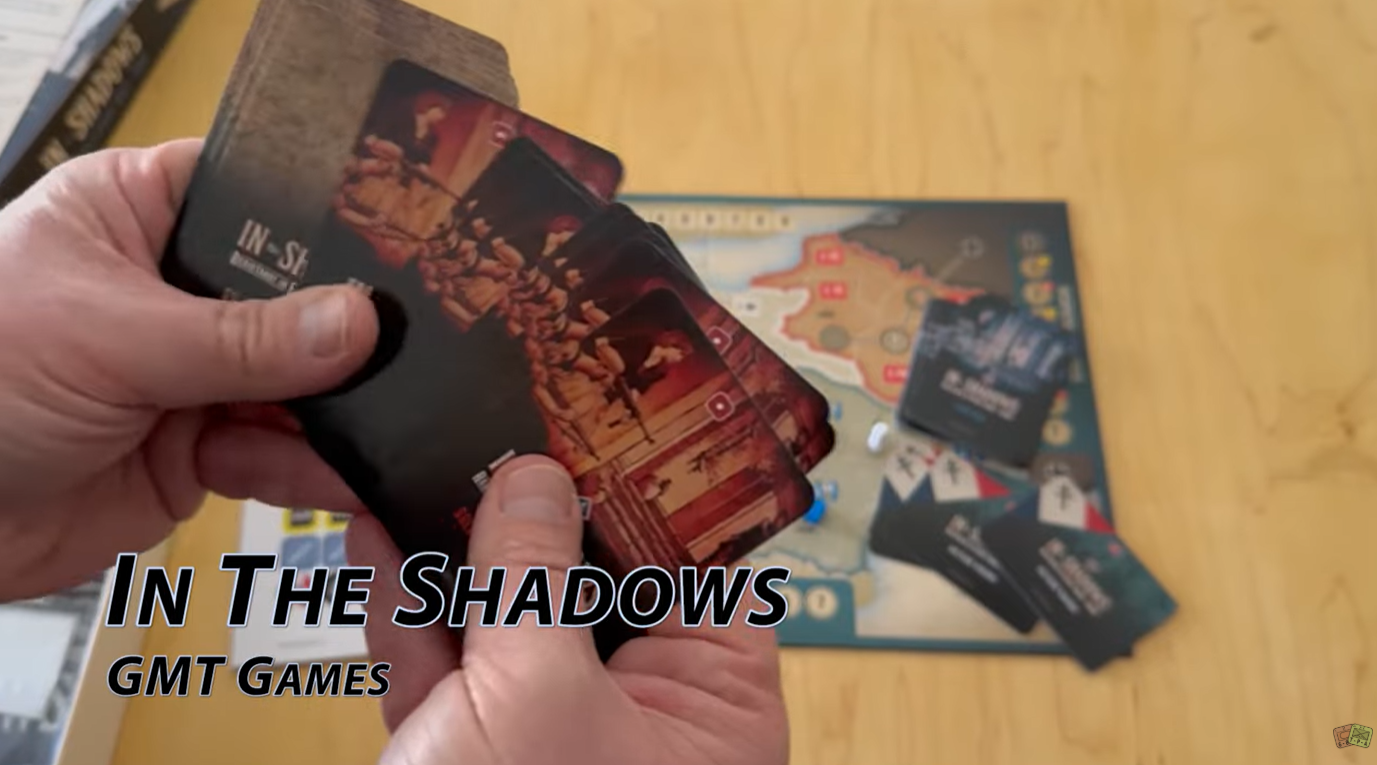
In the Shadows: Resistance in France, 1943-1944 from GMT Games is a 2-player card-driven game about the desperate struggle of the French Resistance against the occupying Nazi and collaborating French forces between January 1943 and June 1944. In the game you will play as either the Resistance or the Occupation in a fight over the hearts and minds of the French People. The game strives to have players better understand the nuances of the resistance and the clandestine nature of the fight that led to the founding of the fourth French Republic.
The gameplay of In the Shadows is driven by Event cards and Actions based on suits. The game relies on three different suits (the Resistance Cross, the Victory Cross, and the Iron Cross) to determine the cost and effectiveness of your Actions. Narratively, this is meant to represent the vital importance of local networks and resources. You may be working with resources in Paris but need to perform Sabotage Actions in Vichy. In this way, the game can better replicate the choices that the leaders of the Occupation and Resistance needed to make.
In this video, I run down my list of the Top 10 Solitaire Wargames that I played in 2024. These games included many that are designed for solitaire play only as well as a few of the games that I played solo but were designed for 2-player. They also included some Print and Play offerings as well.
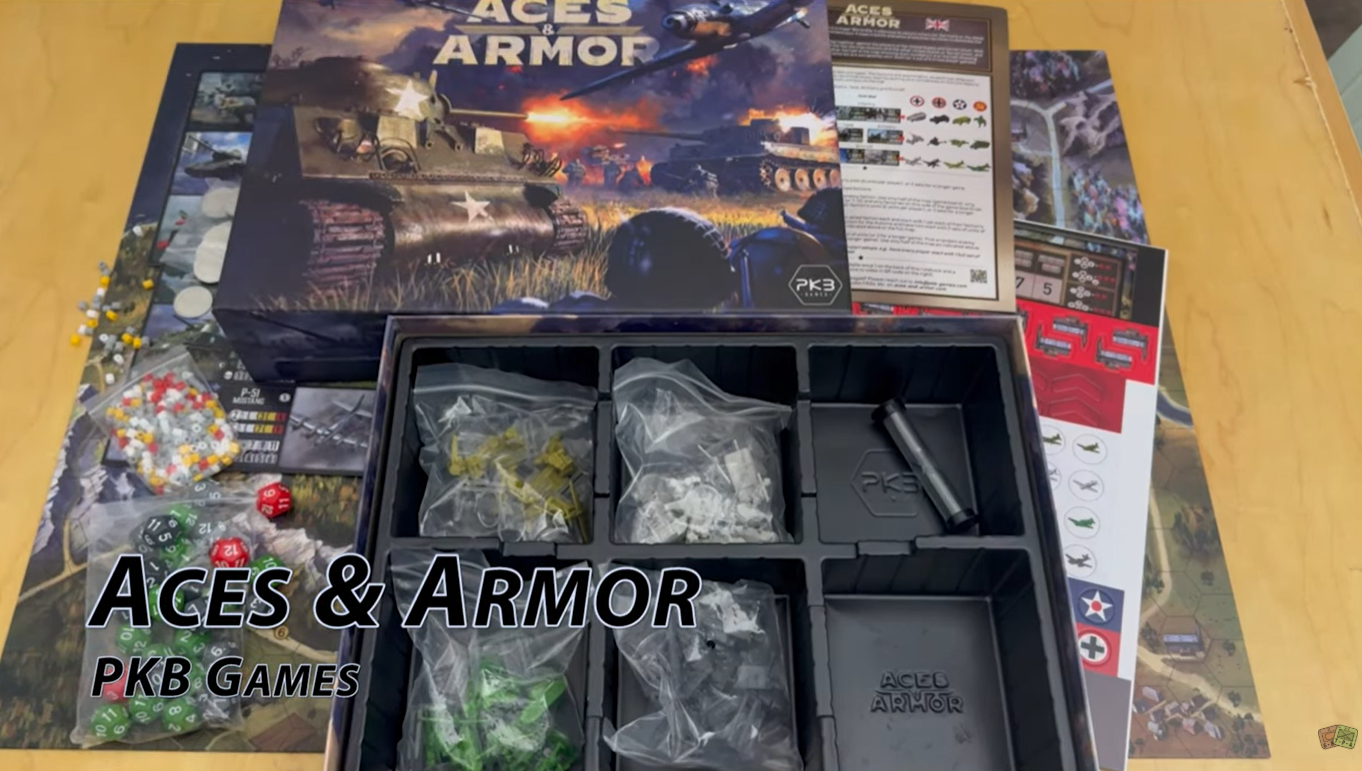
Take the role of a general (United States, Russia or Germany) in Aces & Armor, which is a complex (but easy to learn) strategy game. In addition to attack strength and armor of your troops, their tactical setup, combat experience, damage and terrain have a decisive influence on the outcome of the battle. Since each unit brings its own strengths, you must cleverly assemble your army to win the victory over your opponents.
Cooperative or competitive
Solo mode
Detailed miniatures with many different unit types
High re-playability due to the variable start setup
Complex combat system that depends on type of unit, combat damage, experience, strategic formation, terrain and armor (known from highly rated game Trench Club)
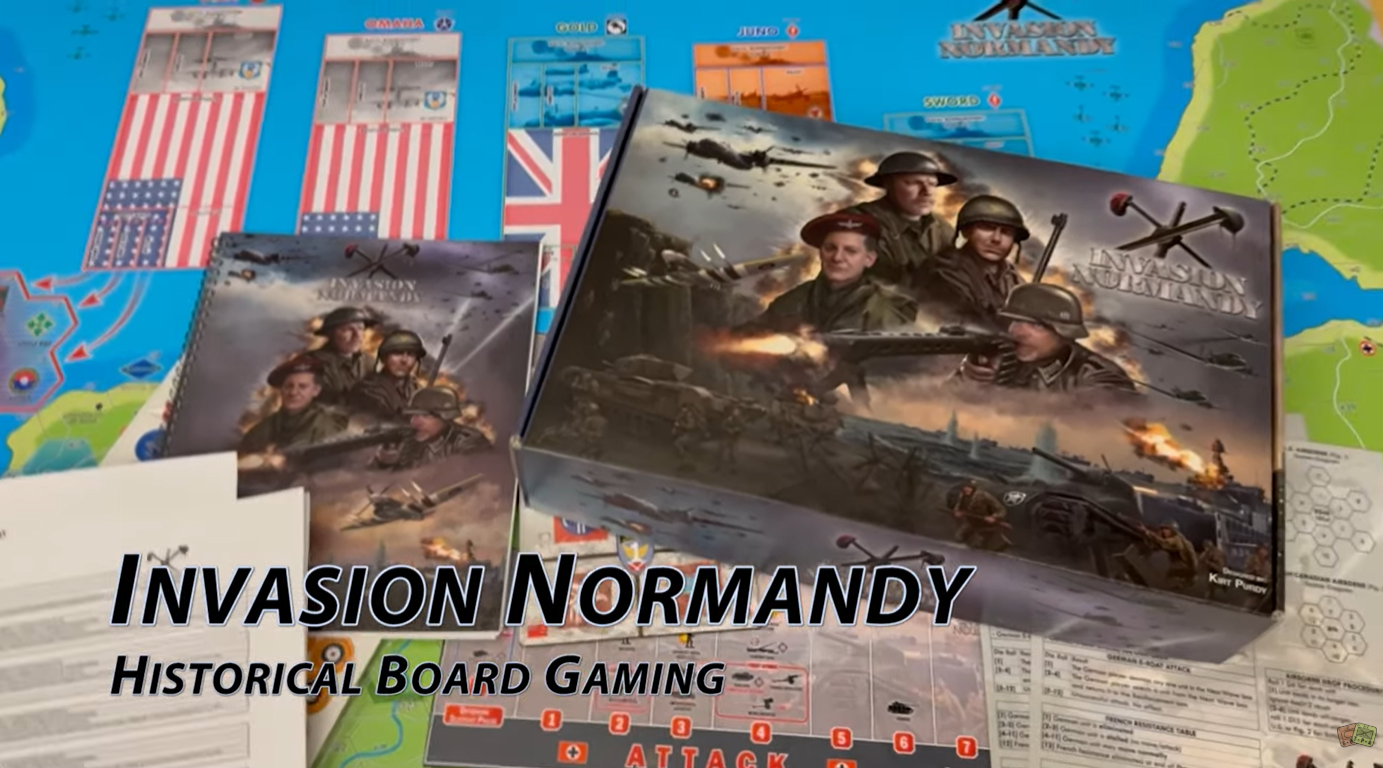
Invasion Normandy by Historical Board Gaming, designed by Kirt Purdy, is a historically accurate D-Day board game developed over three years of design and playtesting. This WWII strategy game immerses players in the Allied invasion of Normandy, featuring a detailed map in three sizes, battleboards for combat resolution, wire-bound rulebooks, reference sheets, and cardstock roundels and markers for strategic gameplay. Plastic pieces are not included, allowing players to use their own game components.
Experience the challenge of commanding forces during one of the most pivotal battles of World War II!
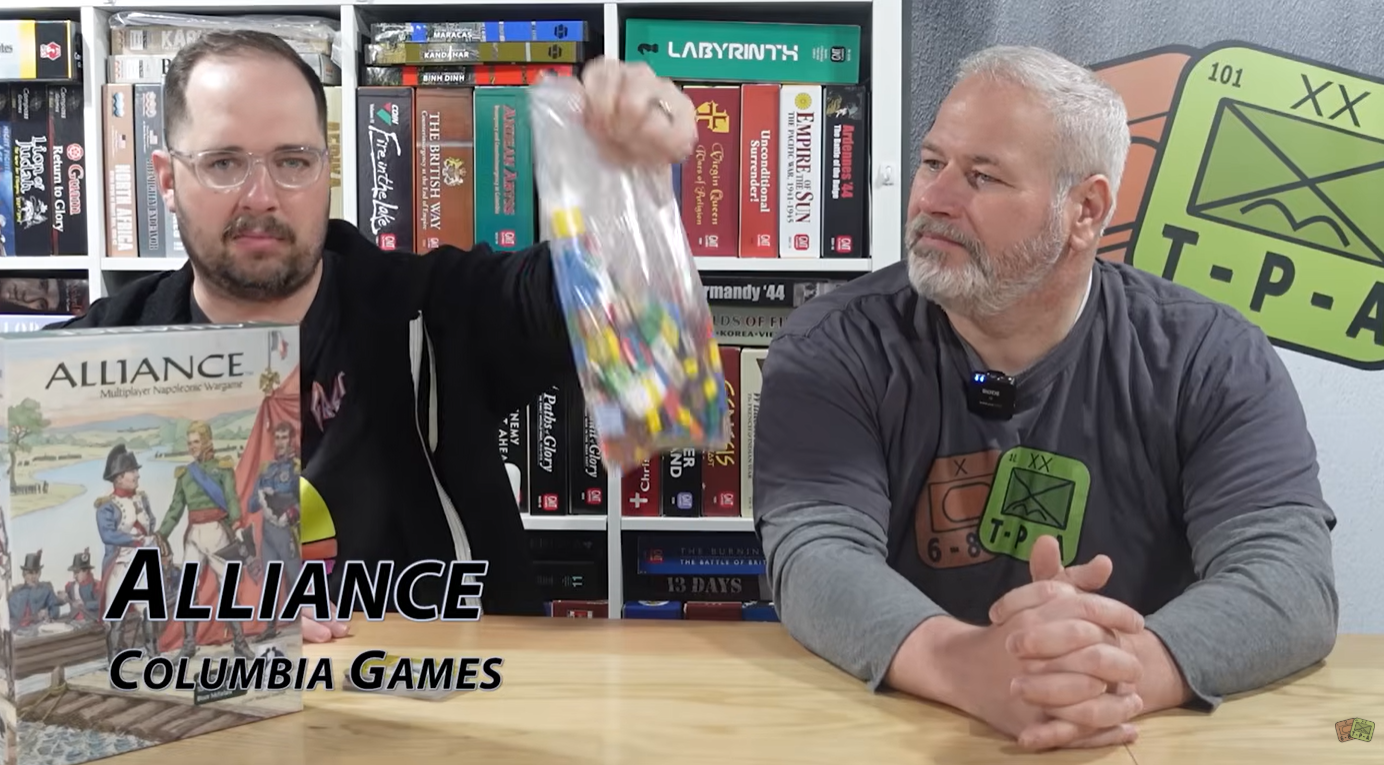
As you know, we very much enjoy multi-player wargames and anytime there is a new multi-player game coming out we very much sit up and take notice. In early 2024, Columbia Games launched a Kickstarter for a game on the Napoleonic Wars called Alliance: Multiplayer Napoleonic Wargame. Alliance is billed as a 1-7 player strategic level game of diplomacy and warfare in the Napoleonic Era with a Columbia Block System twist. The game is huge and plays best with more players. The players take on the roles of different nations during the time and you can play as Austria, England, France, Prussia, Russia, Spain, or the Ottomans. We recently played a full 7-player game and had a grand old time. While the game is not perfect, and there are some quirks that you must get past, the game is really pretty fun and interesting and could be one of those main staples at gaming conventions where you need a lot of players.

 Anmelden