Anmelden
Playte Revives Thurn & Taxis, Manila, Carolus Magnus & More
25. September 2026 um 22:08
Korean game publisher Playte brings dozens of titles to SPIEL Essen 26



Korean game publisher Playte brings dozens of titles to SPIEL Essen 26
/pic9225193.png)

The team at Board gave us the chance to cover their initial push late last year, and now that the platform is pushing out a new game every month, it’s been much easier to get my kids to join me at the table to check out the new wares. (If you’ve never heard of Board or need a quick overview of its features, check out our product review of the Board electronic device.)
Now that Board is fully up and running, new games are coming to market every month. We asked the Board team if we could continue covering new content, and they have been kind enough to oblige. Luckily, I have two children (ages 12 and 9) who loved the initial batch of games and are constantly looking for new ways to engage with the platform.
Once a quarter, I’ll offer thoughts on the newest batch of releases—both community-designed games as well as centralized releases from the Board development team, using a review style similar to our regular Quick Peaks coverage. Enjoy! (All images here were provided by the Board marketing team.)
After spending almost two months playing Board regularly on our living room table over the previous holiday season, the lack of new…
The post The Quarterly Board Meeting—Summer 2026 appeared first on Meeple Mountain.
Exit: The Game has been synonymous with “escape room” in my circle, and though there are many similar contenders (just look at your local Walmart/Target games aisle!), Exit continues to be the gold standard for the experience.
Amazingly, so many can be cranked out so quickly with various themes and still keep the puzzles fresh. At least, I would assume so. I can’t say I’m an Exit die-hard; I’ve only played a few of them, so I can’t attest to every iteration’s uniqueness, but I’ve felt that each puzzle was wildly different from all the others I’ve played.
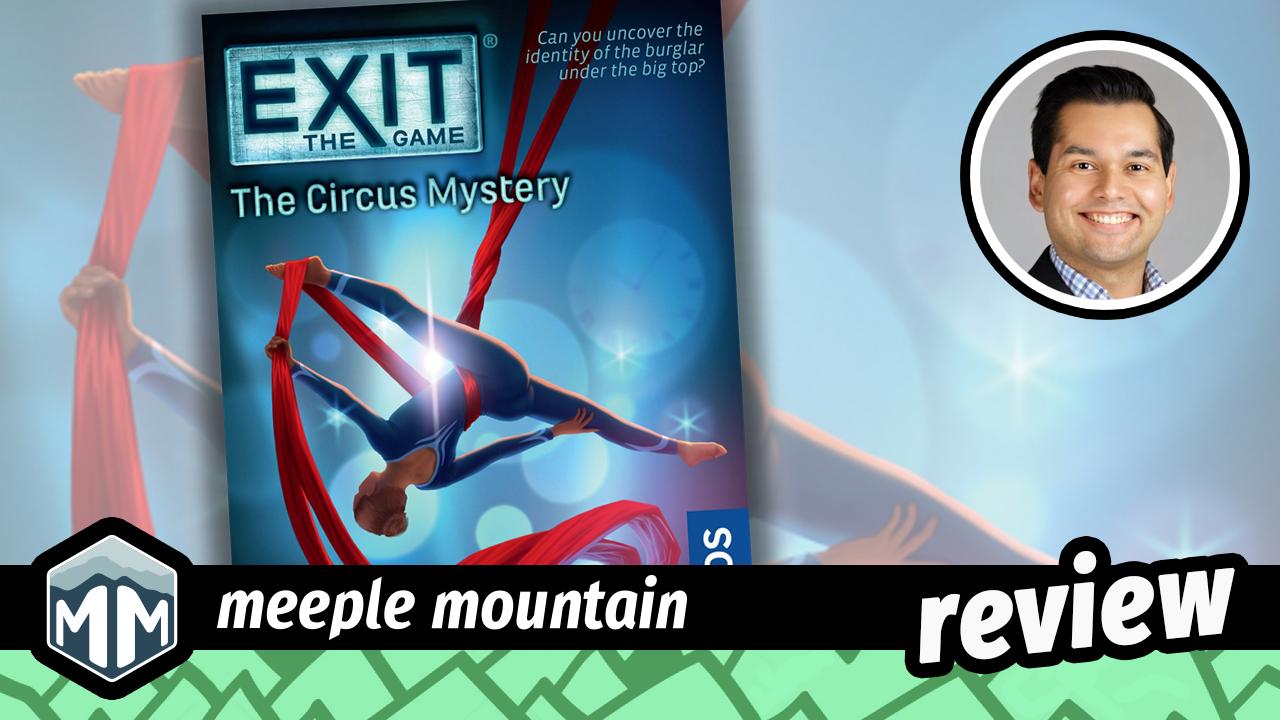
EXIT: The Game – The Circus Mystery has players solving a string of heists, with the common denominator being that a certain circus is in town. The components immediately jump out at you as you assemble a number of 3D trapeze artists, strange swords, and a foldable magician’s assistant. The premise sends players on a quest to explore the different circus performers’ wagons in hopes of solving the ultimate whodunnit.
Without going into spoilers, I had a great time with the puzzles. It follows the same formula of figuring out a three-digit code and then using a decoder wheel to search the answer deck and test your theories. Like past…
The post EXIT: The Game – The Circus Mystery Game Review appeared first on Meeple Mountain.
I’m not that crazy about polyomino games, but Rebuilding Chicago is the kind of thing I like—razor sharp. I think that that sharpness decreases at lower player counts, but at four players, our game was over in 20 minutes with a point spread of 50. The schtick of this one is that you can either lay the polyominos in your little city board or activate an event that affects everyone. So, you’re constantly seeing how little you can do to edge out opponents, and they’re doing the same with you. Multiple times during our game, an event resolution would result in someone scoring 15-20 points, with someone else getting nothing. It’s got an enormous amount of variability, and for my money, I’d happily polyomino Chicago any time.
Ease of entry?
★★★★☆ - The odd bump or two
Would I play it again?
★★★★☆ - Would like to play it again
Read more articles from Thomas Wells
This cute, cozy title comes from Wonderful World Board Games, a publisher that infuses Taiwanese culture and heritage into many of its games.
Dragonarium has players drafting polyomino tiles to create same-colored habitats, though doing…
The post Quick Peaks – Rebuilding Chicago, Dragonarium, Shape it, My Island, Las Vegas appeared first on Meeple Mountain.
I don’t know about you, but I’m always rationalizing why I need to buy another board game. It’s even better when someone else does it for me, so I’m here to help you with that. If you’re not familiar with the term STEM, it stands for Science, Technology, Engineering, and Mathematics. Every toy store has […]
Quest for the Holy Grail with your Avalon: The Riven Veil rules & reference!
The first game by Shadowbourne Games, Oathsworn: Into the Deepwood, has become one of my favourite story-based adventure and combat games, so I was surprised to see their next game was a more traditional Euro-style area control and card management game, albeit with heavy theme, miniatures, and lots of colour. So much colour! Avalon: The Riven Veil is a little too colourful for my taste, so much so that sometimes the illustrations feel like they’re shouting while the text and icons struggle to be heard.
It’s an impressive game nonetheless which I’m sure will be very popular with those who love to get very deep into strategies and card play, but sadly it left me a bit cold. While I appreciated the systems – the variety of actions controlled by cards, paying for cards with other cards, placing settlements to anchor regions, the reset of the board each season of play, bidding for monster control, even the slightly arbitrary push-your-luck combat mini-game – I was left feeling that any theme could have been pasted on this one. When it boils down it’s dudes-on-a-map area control, which is not a favourite style of mine. And there are quite a lot of fiddly rules in the pretty rough rulebook. But I insist, in this case don’t let my personal opinion out you off: I can see a lot of people getting into this game and enjoying the many possibilities offered by the asymmetric factions.
It’s interesting to see Shadowbourne go in such a different direction for this second release, and I’m looking forward to seeing what they come up with next. In the meantime, here’s my rules summary and reference for Avalon: The Riven Veil.
Oh, and by the way, this is my 500th rules & reference. FIVE HUNDRED! It’s staggering to think I’ve made so many in the last 20 or so years, and nice to reach this significant milestone.
What a long day! Made up mostly of travel but I’m exhausted. We left my house this morning at 8:30am via an Uber to the airport where we made it through security and to our gate for a 10:15am flight from Indianapolis to Chicago where we transferred over with a 2-hour layover to a 1:30pm flight to Columbia, South Carolina.
We landed in Columbia at 4:30pm, grabbed our luggage and picked up our rental car to make the 35 minute drive to Camden, South Carolina on I-20.
We checked into the hotel and made our way over to the Camden Revolutionary War Visitor Center for the opening social event where we gathered with about 60 fellow wargamers who have all made the effort to travel here to play games over their weekend and also to tour the historic sites in and around Camden. If you didn’t know, Camden was pivotal to the story of the Southern Campaign during the American Revolutionary War with two battles fought within 6 miles of each other, bracketing the British occupation of the town. The Battle of Camden in 1780 was a decisive British victory that crushed the American Southern Army and brought disgrace to American General Horatio Gates. The Battle of Hobkirk’s Hill in 1781 was a British tactical victory that proved to be a strategic defeat.
We were able to catch up with lots of viewers of our videos and friends we have known for a long time as well as several designers, including Sam London and Justin Fassino. I also got a chance to chat with Gene Billingsley from GMT Games for about 30 minutes on a number of topics including gaming, publishing games, life and the event. I want to say that I took this opportunity to beg Gene to see about making a Deluxe Edition of Here I Stand as they have done with other games such as Combat Commander and For the People with new updated art, components and boards. He was not spilling any beans on the subject and wouldn’t give me an indication if it was either in the works or planned fur the future. Bummer but I made my pitch.
We then had a fantastic introduction on the event and the commemoration of America’s 250th Anniversary from Battles of the American Revolution Series designer Mark Miklos and Gene Billingsley. There were a lot of very touching and patriotic words spoken by these 2 and I truly felt great pride in our nation and the experiment that created it and has kept us strong these past 250 years.
We then were treated to a live artillery firing by local volunteers of a period 1-pounder and it was quite impressive. When it was fired, it was past sunset and quite dark and the explosion was quite impressive and very loud.
Here are 2 videos we took of the firing with one being in real speed and the other in slow motion.
That was our evening and I’m very excited for tomorrow as there is an opening ceremony at 8:30am followed by open gaming. Alexander and I will be playing Oriskany, which is a bonus game included in Newtown from the American Revolution Tri-Pack #2, followed by a 4-player game of Liberty or Death. The evening will conclude with a group dinner.
-Grant
Rikki Tahta brings Coup energy to La Mame Games' 2026 release
This weekend, just a few days before yesterday’s Braided Skies reveal, Stonemaier Games hosted its 13th annual Design Day. On Sunday, the Design Day itself featured designers, playtesters, and gamers from St. Louis and around the country for 12+ hours of playtesting and gaming at Pieces Board Game Bar and Cafe.
The purpose of Design Day is to bring together designers, playtesters, and content creators to give and receive feedback on game prototypes, expand their network within the gaming community, and learn from clever mechanisms in published games. If you’d like to know details about how the day is structured, you can read about previous Design Days here, here, here, here, here, here, here, here, here, here, and here.
Why We Run This Event
On paper, the event doesn’t make much sense. We’re not promoting anything. There’s really no focus on Stonemaier Games at all. To put it simply, Design Day is just something we like doing.
We like doing it for the designers, the playtesters and gamers, and the content creators. The creative energy is palpable and inspiring, and it seems to be a worthwhile, joyous experience for attendees. I’m also on the lookout for future Stonemaier products (so far we’ve published four games that appeared at Design Day), but I’m mostly just trying to be helpful to other creators and maybe help them find the right publisher.
How Does Design Day Work?
How Were the Games?
I truly am inspired and awestruck by the creativity, innovation, and vulnerability of the designers at this event. Everyone puts a lot of work into these games, and I loved listening to the constructive interactions between designers and playtesters.
Design Day isn’t a competition, but as a way of helping designers see how far along their games are, we ask attendees to rate each game on a 1-6 scale indicating how close a game is to being publishable.
Based on this rating scale–basically, how close they are to being a successful publishable game–here are the top-rated games of Design Day 2026, with brief descriptions in the words of the designers:
Other games rated 5.00 on average were Dice Rogue (Joe Totherow), Franchise Wars (Pete Wissinger), Magic Tricks (Chris Porter), and Pips (Ben Morayta).
If publishers are curious to learn more about some of these games, I’m happy to talk to you about them and connect you to the designers (if they’re looking for a publisher)!
Next Year
If you want to attend Design Day next year, you can use this year’s listing to get a notification for 2027, and if there are any extra slots, we’ll likely announce them in our April e-newsletter.
Have you found value in running or attending events related to your industry? As alternatives to Design Day, there are Protospiel, Unpub, and other playtest events around the country, including some at Geekway to the West in St. Louis in May.
***
If you gain value from the 100 articles Jamey publishes on this blog each year, please consider championing this content! You can also listen to posts like this in the audio version of the blog.
Huge demand for Asmodee‘s co-operative puzzle game Take Time has seen the publishing giant print more than 325,000 copies less than a year after release – outstripping even the company’s high expectations which surrounded its record-breaking launch.
Asmodee printed a massive 145,000 copies of Alexi Piovesan and Julien Prothière’s design for its worldwide launch last October, citing heavy enthusiasm from its distribution teams, board game media and pre-release playtesters.
Game line manager Auguste Lecoeur told BoardGameWire, “As soon as the game’s prototype was shown to us and signed, it became an internal priority, with resources and manpower being redirected from other projects to Take Time.
“Huge credit goes to everyone involved in the project for getting it done so quickly while maintaining such a high level of quality, especially considering that the game went through only around six months of visual development.
“When the game was first presented to Asmodee’s distribution units and partners, the enthusiasm was immediate as well, with Take Time being flagged as a key new release for Libellud.
“The same enthusiasm was shared by media outlets and players that were able to test the game prior to its release, so we had multiple positive signals ahead of launch.
“In that sense, we were definitely expecting a strong first print run, but you can never realistically expect to reach 145,000 copies. It was a very pleasant surprise and clearly exceeded our expectations, even though we were prepared for strong numbers.”
Every major reprint of the game since has topped 60,000 copies, Lecoeur said, with Asmodee currently planning another two to three global print runs of the same size each every year to keep up with demand.
Lecoeur said, “At this point, it is clear that Take Time won’t be a ‘one-hit wonder’, a game that enjoys a high initial print run but then quickly fades. Instead, the game is maintaining a strong sales pace and continues to perform well across markets.”
He added, “The game gained strong visibility and positive feedback at conventions such as Cannes’ FIJ and Spiel Essen, while also achieving higher-than-usual numbers online, thanks in part to its visual appeal and the buzz surrounding it.
“More broadly, the game was quickly validated by the core and specialist market, as well as by opinion leaders, critics and content creators within the board game community. It received strong critical acclaim – it is now ranked [in] the top 95 family games on BGG – and was nominated for multiple awards, which played a huge part in its success.
“Sure, we would have loved to win the As d’Or and Spiel des Jahres (who wouldn’t?), but I guess we’re being picky here!”
Success Story
Part of the game’s powerful performance has been down to it penetrating well beyond the specialist board games market, with Asmodee saying its distribution is now relatively evenly split between hobby stores, mass-market retailers and e-commerce.
Lecoeur said, “I’m convinced that this wouldn’t have been possible if the game hadn’t first been embraced by the core gaming community. Their strong support and enthusiasm for the game helped open the door to other distribution channels much more quickly.”
He added that part of Take Time’s wider appeal was down to the game’s compact size and “accessible price point”, as well as its “high level of replayability and substantial gameplay content”.
Those first two elements have become increasingly important amid ongoing financial strain for people in some of Asmodee’s core markets, such as France, Germany, the UK and US, with rising food and energy prices and ongoing economic uncertainty putting pressure on their purchases.
Other successful initiatives which helped boost Take Time’s appeal included what Lecoeur described as an “unusual” cardboard demo kit, with detachable cards and clocks, which could be ordered by distribution units to give players a taste of the game’s core mechanisms.
He said the kit “generated strong enthusiasm at launch”, but added that the format was not something which could be replicated for every one of its releases.
Award nominations also helped drive sales, especially in Germany and France, which Lecoeur said had been two of the strongest markets for the game from day one.
He said Take Time’s Spiel des Jahres recommendation was followed by a higher-than-usual reprint demand from Germany of 30,000 copies – and added that the impact of other ‘smaller’ awards “should not be overlooked”.
Take Time triumphed in this year’s Swiss Gamers Award and also took the Austrian game of the year prize, in addition to its ‘recommended’ nod in the Spiel des Jahres and nomination in France’s As d’Or.
Lecoeur also believes Take Time benefitted from the success of Libellud’s previous release Harmonies, which also picked up a Spiel des Jahres recommendation and the Swiss Gamers Award, as well as a Golden Geek – and was highlighted by Asmodee CEO Thomas Koegler as having had a strong launch.
Lecoeur said, “The fact that Libellud’s previous release, Harmonies, had been a hit certainly helped. It raised expectations around the studio’s next title and put the spotlight on its launch.
“It’s clear that each publisher develops its own reputation and ‘brand’ image based on its releases (among other things) and that this plays a significant role in the confidence they receive from retailers and, to some extent, from players.
“The success or failure of each release will inevitably have an impact on the games that follow, particularly when it comes to forecasts and initial orders.”
Time After Time
Asmodee is now beginning to turn Take Time into a wider product line, with debut expansion Mirage set for release next month, and the company having “many more ideas we’re currently working on for the range”.
Lecoeur said, “As soon as we received the first feedback on the game and it became clear that the launch was going to be massive, the first discussions about an expansion began in April 2025 with Alexi Piovesan and Julien Prothière, the game’s designers, to explore the possibilities for additional content.
“They worked on it and presented an iteration that led to a contract being signed in November 2025, as the first market feedback started coming in and multiple markets were selling out.
“However, this timeline was only possible because the designers were fully confident that the game offered enough design space to support an expansion, and because they presented an idea that genuinely excited the team, both mechanically and thematically.
“We’re not releasing expansions simply for the sake of releasing them or to get a marketing boost. If an expansion is published, it’s because we believe it genuinely adds something to the game and offers players a meaningful new experience.”
He added, “Mirage’s format also played an important role. It is a compact expansion, with a €7.99 MSRP, that introduces a new chapter while also adding a new gameplay twist that can be used to replay the entire base game in a different way.
“It isn’t a large expansion that takes up a significant amount of shelf space in stores or represents a massive financial commitment; instead, it is designed to complement the base game and extend the experience without overshadowing it. Its difficulty is also carefully tuned so that players can enjoy the expansion even if they haven’t finished the base game.
“Regarding expansions and product lines, there is a balance to strike between fully trusting your game and not overcommitting. You want to anticipate demand for expansions and reprints in order to avoid out-of-stock situations or a lack of releases and support that could hurt a game’s prospects in the medium to long-term.
“At the same time, a game needs to demonstrate commercial stability before being turned into a full-fledged product line and treated as such.
“It’s no secret that overproducing a game is one of the easiest ways for a publisher to get into financial trouble, and we’re doing our best to avoid that. We want to support successful games and build on their potential while remaining disciplined about production and inventory.”
A Board Game Arena version of the base game is also due for release in Q4 of this year.
The post “It is clear that Take Time won’t be a one-hit wonder”: Asmodee hit passes 325,000 copies after record-breaking launch first appeared on .
There’s a level of chaos that appears when a player’s turn is up in the new word-association party game Mind Sweeper (2026, Floodgate).
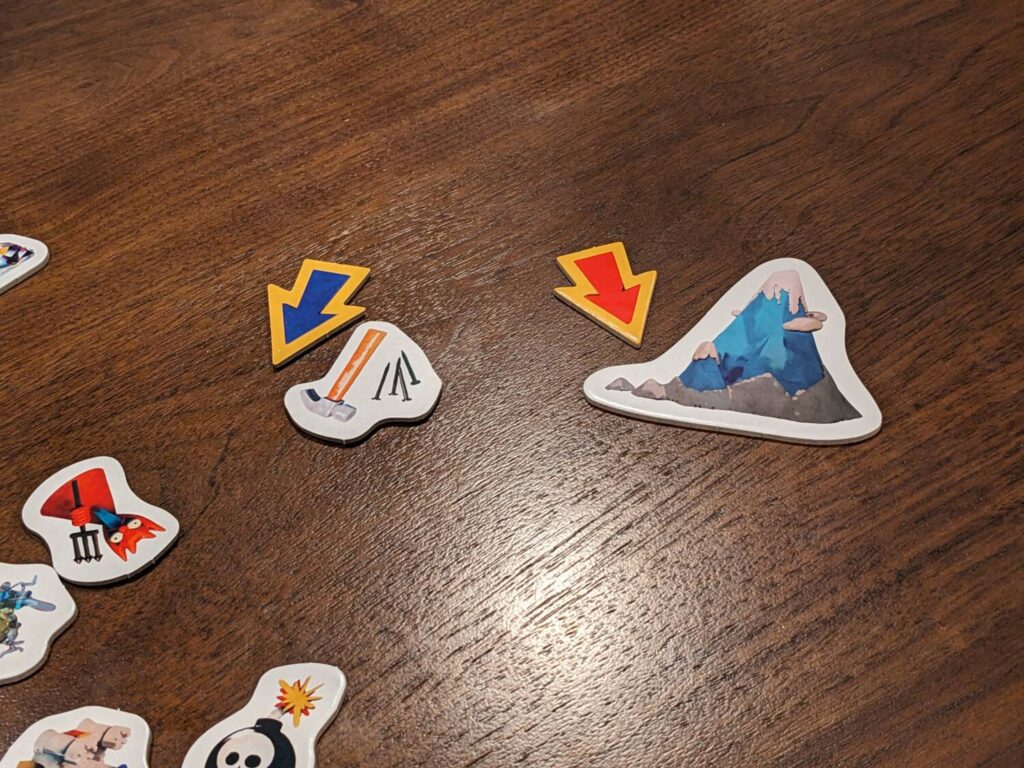
You see, players are staring at a table that has like 50 small cardboard tokens scattered here and there, from easy visuals (like one of those Egyptian-style pyramids, or a sword, or an apple) to some that are a bit opaque, like a single exclamation point. The active player is dealt a card with six words, and separately a number token forcing the player to illustrate a specific word (using those tokens) over the next 60 seconds.
Get your team to guess what the word is, and you score the card. Players can shout anything as soon as the timer starts, adding to the chaos. If they don’t get the word in those 60 seconds, the active player flips the word card in view of all players, then the team gets 60 more seconds to guess which of the six words was the original answer.
Across 10 word cards, you’re looking at a 15-20 minute experience, in a cooperative, high-score challenge that pushes players to get as many of the 10 words right as they can.
The keys here is twofold. Each card’s clue words are…
The post Mind Sweeper Game Review appeared first on Meeple Mountain.
Surplus of Sloths (2026, Weird Giraffe Games) isn’t bad.
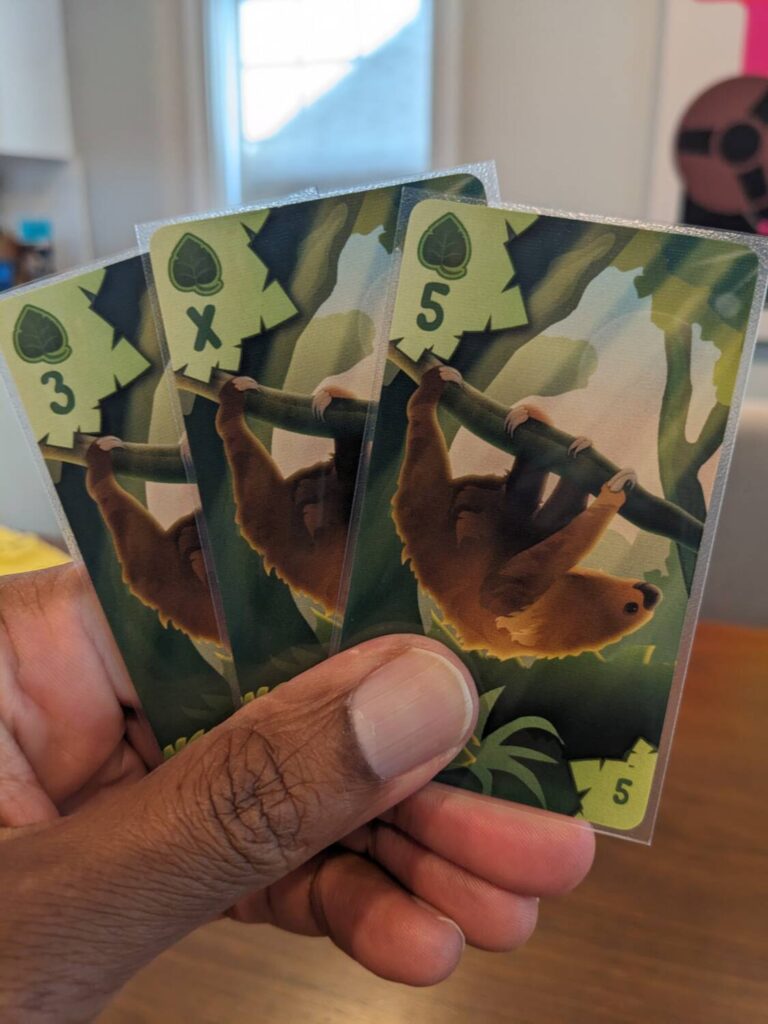
It’s a card drafting game where players try to build a hand of ascending card runs across five different suits of sloths. A market wipe mechanic pushes one leftover market card into a “surplus net” after each round, and players can view and gauge whether it is worth trying to score a suit at the end of the game.
I just gave you 75% of the rules, and designer Charlie McCarron (Skyrockets, the Kites riff I quite enjoyed) has given us a game so quick that my 12-year-old and I played it twice within a 15-minute stretch. Even winning one of those two games didn’t impress the 12-year-old, who shrugged their shoulders before admitting that the game was “only OK” before heading off to their room.
You’re right; that’s not an endorsement. My review crew joined me for a four-player game the following day, and the winner of that game also shrugged their shoulders and landed in the same rating range I landed on for this review.
Surplus of Sloths isn’t bad because its scoring mechanic is interesting. In an ideal world, you want to build up a run of three, four, maybe even five low cards of…
The post Surplus of Sloths Game Review appeared first on Meeple Mountain.
One of my favorite things about the games released under Carla and Nick Kopp’s Weird Giraffe banner: the games are often legitimately weird.
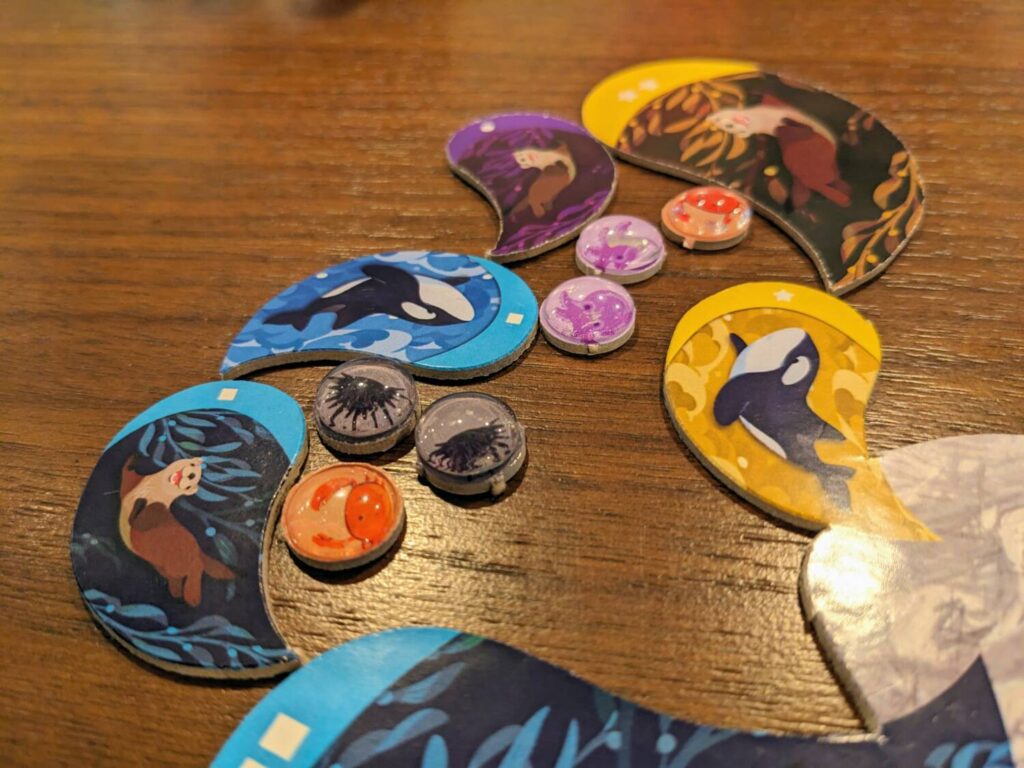
Here’s what I mean. I was explaining the rules to my wife and nine-year-old for our first play of Effervescent (a Carla design currently on crowdfunding, set for release in 2027), and when I tried to explain the main concept of placing sea-based creature tiles in such a way that the tail of a newly-placed tile must touch the head of a previously-placed animal tile, my wife openly balked.
“So, like, this way?” She used a large whale tile as an example.
“Well, sort of,” I began. “Each tile has a head area, a distinct tail point…then, every other part of the tile is a ‘side.’”
“Seems kind of weird,” she said. And our first play went that way, as players took tiles in one of three sizes to create scoring patterns that would trigger with a mix of scoring sequences, tied to “Drift” cards and Harmony cards, the latter of which were established before the game as public milestones that are always available to score.
Turns are simple. Place a tile, and if a placed tile meets a Drift card scoring condition, a player puts…
The post Effervescent Game Review appeared first on Meeple Mountain.
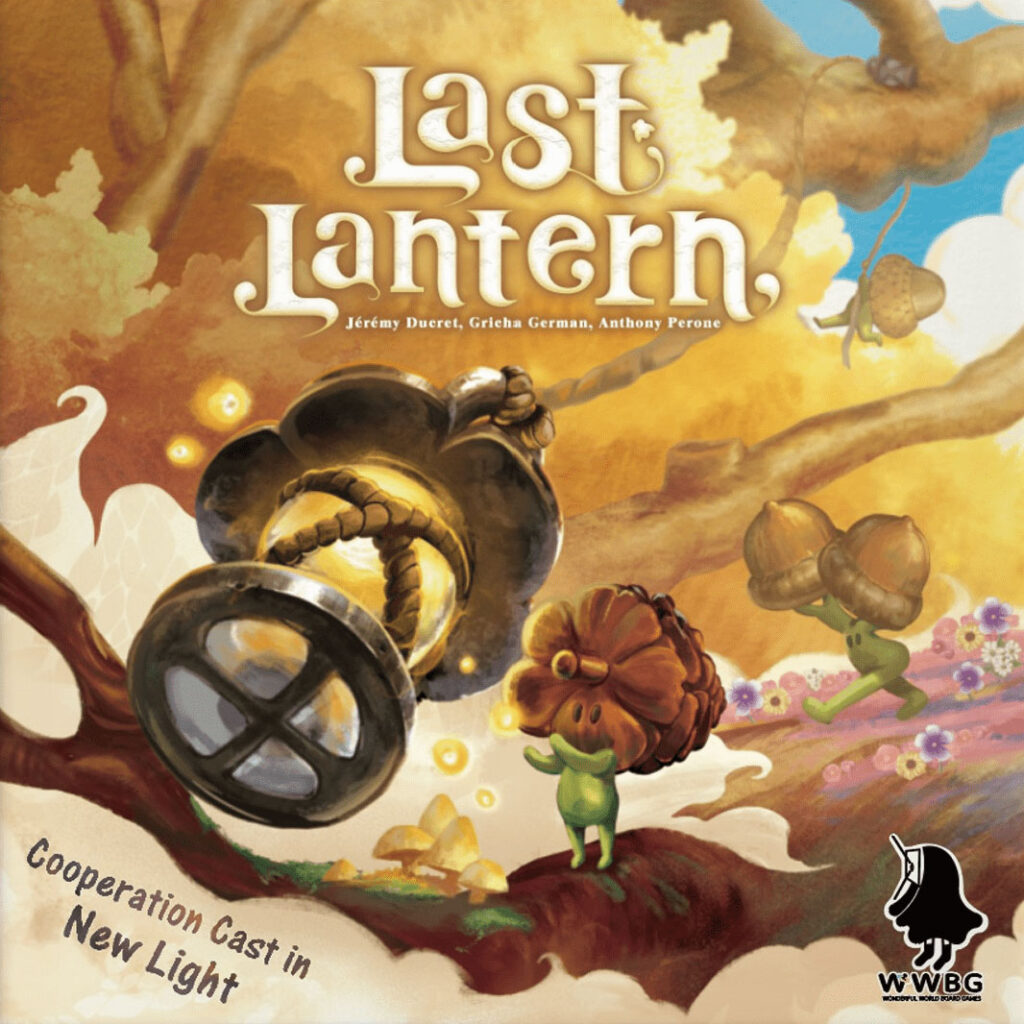
A fog lingers over our tree, and we are lost in our home. We need to set out and place the last lantern to fend off the fog. *Pause for dramatic effect* *Crickets chirp* *sighs* Last Lantern is a cooperative game with points of limited communication for two to four players that plays in about […]
Financially-troubled board game publisher CMON has secured a $19m injection of new capital as it battles to turn around years of heavy losses and dwindling cash reserves – which had left it with just $368,000 in bank and cash balances at the start of August.
The huge investment from new shareholders gives the crowdfunded board game giant much-needed financial breathing room, as it continues its attempt to recover from losses of almost $23m across 2024 and 2025.
CMON warned in the summer that its core business was suffering a “prolonged structural downturn” and was still consuming more cash than it generates, despite a drastic restructuring which has seen the company halve its workforce, sell off some of its biggest game IPs and halt new crowdfunding campaigns.
Those efforts dramatically reduced its losses, with the company reporting a loss of just over $2m for the first half of this year, compared to almost $7m for the same period in 2025.
But CMON’s balance sheet remained under pressure at the end of June, with $7.34m more in short-term liabilities than short-term assets, up from $6.89m at the end of 2025.
A significant part of CMON’s liabilities relates to eight crowdfunded games whose campaigns raised $14m from backers, but which the company has yet to deliver – including DC Super Heroes United, which raised more than $4.4m, and DCeased, which brought in over $2.5m.
CMON’s directors in its H1 report that the liabilities position had caused the company’s directors to give “careful consideration to the future liquidity and performance of the group and its available sources of financing in assessing whether the group will have sufficient financial resources to continue as a going concern”.
The directors added that they believed CMON would be be able to continue operating – but central to that assessment was the success of the planned share sale, which was designed to raise up to HK$150.5m, or about $19m.
Existing shareholders agreed to buy just 7.76% of the new shares offered to them by the August deadline, leaving CMON looking to raise more than $17.5m from other investors through the rights issue – a figure approaching 2.5-times the valuation of the entire company implied by its last share sale in February this year.
But the company has now revealed that placing agent Yuen Meta managed to sell every remaining share on offer, giving the business the full $19m it had been seeking – a significant mark of belief in the beleagured business.
That capital injection is more than 50-times CMON cash balance from early August, and almost double the $9.9m in revenue CMON generated across the whole of last year, although it pales in comparison to the $37m to $45m revenues it posted each year between 2021 and 2024.
CMON said it plans to use 40% of the newly-raised money to fund its day-to-day operations across the next 12 months, including staff costs, royalties, shipping and distribution, professional fees and other administrative and operating expenses.
Of that slice, about 30% – which works out to $2.28m – was set to go towards staff costs including salaries, bonuses and allowances, 30% towards selling and distribution expenses, and 35% towards general administrative and operating expenses, including its sales operation, utilities, insurance, government registration and filing fees, listing fee, repairs and maintenance. The the final 5% was earmarked for paying professional fees
That news could provide some relief to the tens of thousands of backers still waiting for their games via CMON’s heavily-delayed crowdfunding campaigns – although the publisher has not specified exactly how much of the capital will be used to deliver the overdue titles, or whether the capital is enough to ensure all eight will be fulfilled.
CMON has not completed fulfillment of a crowdfunding project since Zombicide: White Death in mid-2025, but did manage to deliver pre-orders for Cthulhu: Dark Providence, Marvel United: Witching Hour and Dune: Desert War in the first half of this year.
Four other pre-order titles: Assassin’s Creed Role Playing Game, The Adventurers, The Dead Keep and Super Fantasy Brawl Reborn, all remain undelivered, although the first of those is currently slated for completion in Q3.
| Game | Amount raised | Number of backers | Fundraise completed | Initial delivery estimate | Latest delivery estimate (as of September 24, 2026) |
|---|---|---|---|---|---|
| Mordred | $669,976 | 5,687 | July 2023 | August 2024 | Q4 2026 |
| Masters of the Universe: The Board Game – Clash for Eternia | $719,664 | 4,182 | January 2024 | November 2024 | Q1 2027 |
| DCeased | $2,564,789 | 12,787 | December 2023 | April 2025 | Q1 2027 |
| DC Super Heroes United | $4,478,989 | 14,040 | August 2024 | August 2025 | Q1 2027 |
| God of War | $832,945 | 4,388 | May 2024 | June 2025 | Q2 2027 |
| Massive Darkness: Dungeons of Shadowreach | $2,854,553 | 9,842 | February 2025 | March 2026 | Q3 2027 |
| A Song of Ice & Fire: Tactics | $1,886,509 | 6,406 | February 2024 | February 2025 | Q3 2027 |
| Degenesis: Clan Wars | $339,742 | 1,232 | June 2024 | July 2025 | n/a |
| Total Dollars | $14,347,167 |
About 20% of CMON’s newly-raised capital is earmarked for repaying debts and other outstanding liabilities, including $2.46m owed to a CMON director and $385,000 of unsecured advances from employees, as well as outstanding production, shipping, royalty and other operating costs.
CMON has slated 25% of the new money for expansion in existing and new markets, including strengthening the company’s presence in Europe through marketing and potential attendance at events including Spiel Essen and Cannes, as well as targeting growth in Japan and the Philippines.
The company added that it plans to put 15% of the new capital towards potential acquisitions as part of a push into digital gaming, although said it had not yet identified any targets.
CMON said it intends to look for between one and three businesses, primarily in Asia-Pacific, valued at between about $1.3m and $2.5m each, which could help it develop digital adaptations of its existing games, companion apps and other digitally-enabled features.
The publisher stressed that it intends to retain physical tabletop games as its core business, with the digital push designed to complement rather than replace them.
CMON’s capital raise has also radically reshaped the ownership of the company, with chairman and CEO Ng Chern Ann ceasing to be the largest shareholder after his overall stake was diluted down from about 20% to just over 5%.
The capital raise has made investor Yip Ka Ki Cherry CMON’s largest disclosed shareholder with a roughly 19% stake, personally and via her investment holding company Legend One.
Yip was already an investor in CMON before the rights issue, with a stake of about 4.8%. Her other previous investments through Legend One include Japanese entertainment business TryHard Holdings.
CMON has also strengthened its board following the capital raise, appointing two new independent non-executive directors – veteran financial management, corporate governance and audit executive Chan Ka Kit, and corporate communications, marketing and investor relations specialist Claire Luk.
The post CMON succeeds with $19m capital raise in major boost to financially-troubled publisher’s turnaround first appeared on .
If you have been following our blog for a while now, you know of my affinity for the history of the American Revolutionary War. I am a proud American, believe deeply in the principles of our land and the Constitution that governs it and am grateful to God every single day that our country was successful in our fight for its freedom in order to create a better society and to assist all peoples with protecting their “unalienable rights” endowed by a Creator, which include “Life, Liberty and the pursuit of Happiness”. I enjoy playing wargames on the American Revolutionary War and very much enjoy learning about the history and its key battles. There are many out there that feel the same as I do and they have designed lots of these type of games and with 2026 being our 250th Anniversary of the Declaration of Independence, there are events that are planned to celebrate it.
One of which is an event put on by GMT Games and Mark Miklos called Gaming the American Revolution – Camden 250 being held in Camden, South Carolina September 24-27th. The event includes 3 days of gaming centered on American Revolutionary Wargames produced and published by GMT Games but also includes several events, gatherings and historic tours of the Camden Battlefield.
We are attending and at the time of the posting of this are already on a flight on our way to Columbia, South Carolina via a short stop in Chicago, Illinois. We are very much looking forward to the event and have plans to play at least 2 games from the Battles of the American Revolution Tri-Pack II including Newtown and Oriskany, as well as any other opportunity that presents itself. We also are going to participate in the various tours of the Camden Revolutionary War Visitor Center and nearby battlefield and also plan to drive to a few others sites on our way home to the airport namely Waxhaws and Cowpens.
At the end of each day, I will be putting together a short summary of what we did that day at the convention. I would like to keep this to just a few paragraphs with several pictures to give you an idea of the games we played that day, people we talked with and other activities we participated in. We will still work on doing multiple videos as well that will be released on the YouTube Channel over the next few months but this written coverage will supplement the videos. This summary will most likely not be posted until near midnight EST each night so you might be checking it out the next morning which is fine.
Finally, if you are at the event please feel free to find us and say hello. I believe that we are very friendly and accessible and love to make connections with our fans and followers. In fact, we have TPA buttons and stickers to give away so just ask. We also would like to take a picture with you so we can document it in our writings.
Please check back each day for a summary of the days exploits. Thanks for following along.
Because this is a wargaming blog, I am going to share below some of our content we have made regarding AmRev War games for your review:
Gaming the American Revolution – Ranking the Games We Have Played – 2025 Edition
The Beautiful Boards of Wargaming! – Liberty or Death: The American Insurrection from GMT Games
My Favorite Wargame Cards – A Look at Individual Cards from My Favorite Games – Card #59: Sullivan Expedition vs. Iroquois and Tories from Liberty or Death: The American Insurrection from GMT Games
My Favorite Wargame Cards – A Look at Individual Cards from My Favorite Games – Card #53: The World Turned Upside Down from Liberty or Death: The American Insurrection from GMT Games
My Favorite Wargame Cards – A Look at Individual Cards from My Favorite Games – Card #48: George Rogers Clark Leads a Western Offensive from Washington’s War from GMT Games
COIN Workshop: Liberty or Death: The American Insurrection from GMT Games – Indian Faction
Best 3 Games with…The American Revolution!
“The Revolution was effected before the War commenced. The Revolution was in the minds and hearts of the people…” – A Review of Washington’s War from GMT Games
Interview with Sam London Designer of Common Sense: An American Revolution, 1775-1783 from GMT Games
Video Review for Battles of the American Revolution Tri-Pack II: Germantown:
Video Review for Battles of the American Revolution: Savannah with Mark Miklos:
Video Interview with Sam London Designer of Common Sense (as of yet unreleased):
Video Interview with Bruno Sinigaglio and Dave Stiffler Designers of Small BoaR Series: Battle of Cowpens:
-Grant