Normale Ansicht

Fry n’ Write

27. März 2026 um 18:45

now I want chicken

Food trucks, like roll-and-write games, went from unknowns circa 2013 to oversaturated by 2021 to fresh all over again in this the year 2026. At least that’s the hope behind Chicken Fried Dice, a chuck-and-scrawler and food truck simulator from Ashwin Kamath and Rob Newton.

How does it perform? We’ll wait in line together.
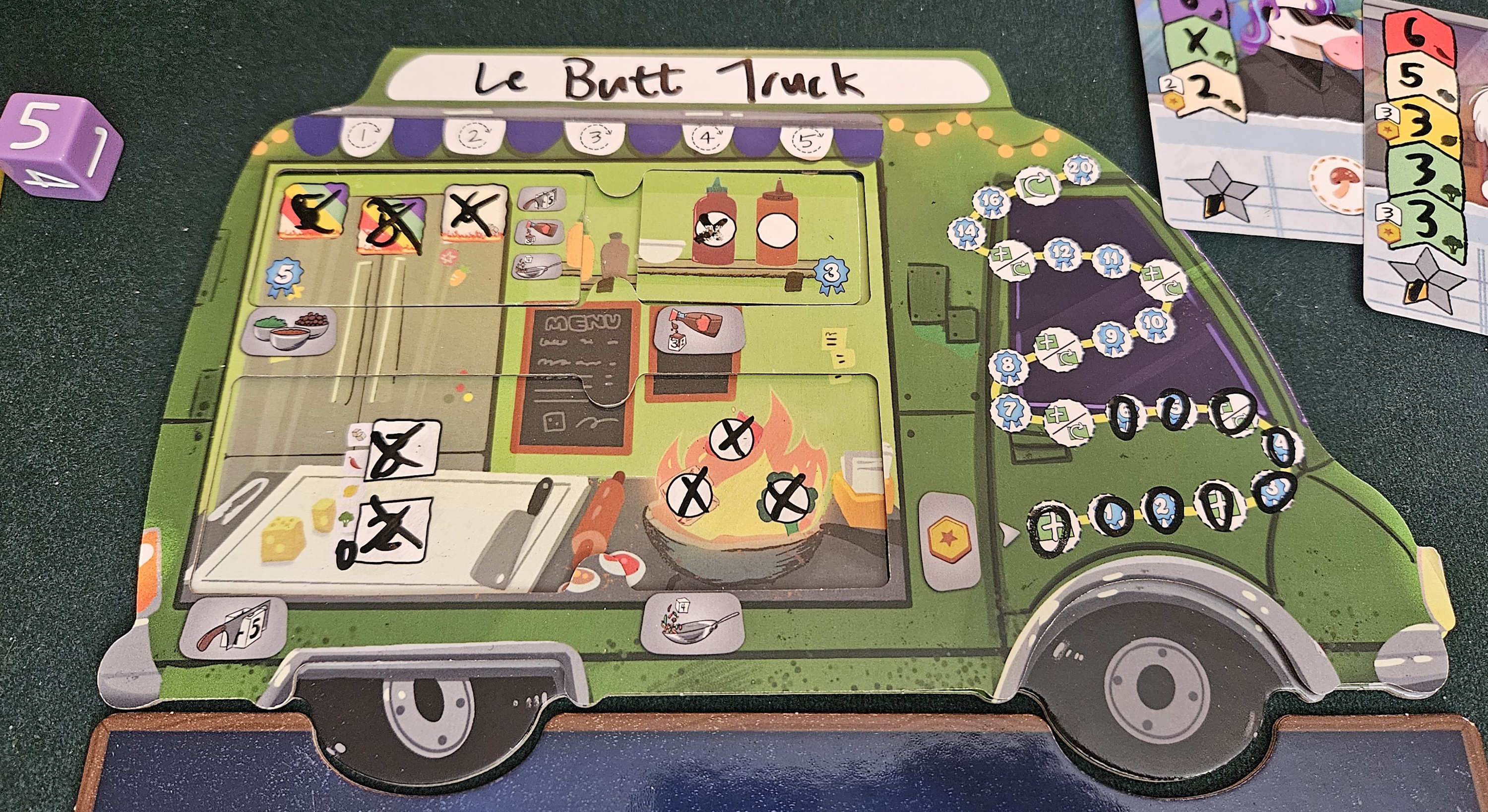
I'd eat there.

Ah, my dream job. (This is a lie.)

When Chicken Fried Dice opens, you have a food truck not unlike the rolling disaster from Jon Favreau’s Chef. In the language of dice, that means your options are limited, confined to a few rerolls, the ability to “chop” a die to divide a large number into two smaller numbers, and dousing an ingredient in sauce to make it seem like something else entirely. Ah, the secrets of the trade. I always suspected that if I slathered a bread crust in non-gluten barbecue sauce, I could legally label it GF.

Those tools are essential. On the surface, Chicken Fried Dice is another roll-and-write. You roll some dice, you write down their digits.

But what sets it apart from the competition is how thoroughly you can knead those rolls. For one thing, this is a simultaneous game. Everybody begins by chucking a handful of dice into a shared pot, then fishing them out one at a time. It’s possible to work fast to secure the best ingredients for yourself, but this is rarely easy. See, for instance, the aforementioned methods for altering your rolls. Getting what you want is often possible, but may require some trimming and/or a dash of luck.
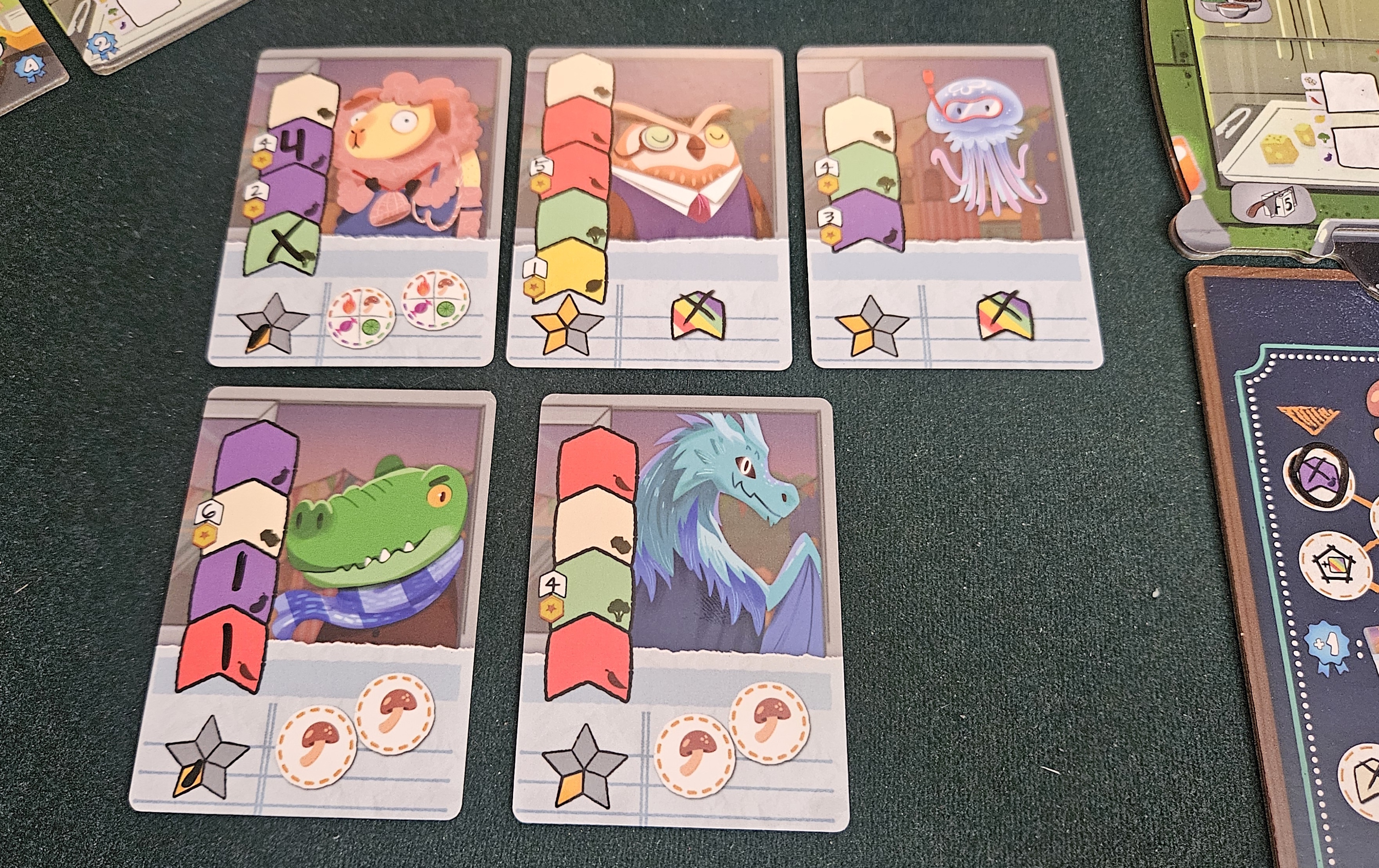
Especially that owl. Get outta here, ya jerk. We don't serve your kind. (Owls.)

I have never resented an anthropomorphic animal more.

Even more persnickety, though, are the customers lined up outside your truck. I hate them. Everybody hates them. At their most basic, each customer has a list of ingredients they want in their meal. Say, peppers, broccoli, tofu, and more peppers. The first problem is that these represent portions. Each color has to match, of course — bring on the sauce — but each successive digit must also increase, or at the very least match what came before. This turns every order into its own ramen bowl of competing portions, ingredients, and custom instructions.

Naturally, providing customers with their desired meal is how you score points, but there’s so much more to it than that. Customers are willing to stick around between rounds, but the point-earning stars they’ll award your truck diminish over time. Worse, the picky jerks may leave a tip, but only if certain spaces meet their approval. Sometimes this isn’t such a bad thing, like when a number near the bottom requires a low digit. But what about when the bottom-most space demands a 4? And the order is five stonking ingredients long? And the customer doesn’t intend to stick around for more than a few minutes?

As with the best roll-and-writes, Chicken Fried Dice very quickly becomes a game about identifying and enacting one’s priorities. Not every customer will get served, so choosing the best clientele is a must. Those meager tips likely won’t let you improve every station of your food truck, so it becomes necessary to shore up your weak points. Depending on who you feed, little bonuses become available. Free ingredients, various flavors… I’m not sure what’s happening here, because it seems a lot like we’re carving haunches out of satisfied customers to feed the next group, but it does make for some nice combo-building. As your food truck transforms into the renovated sandwich wagon from the latter half of Jon Favreau’s Chef, it becomes possible to serve more and better meals.
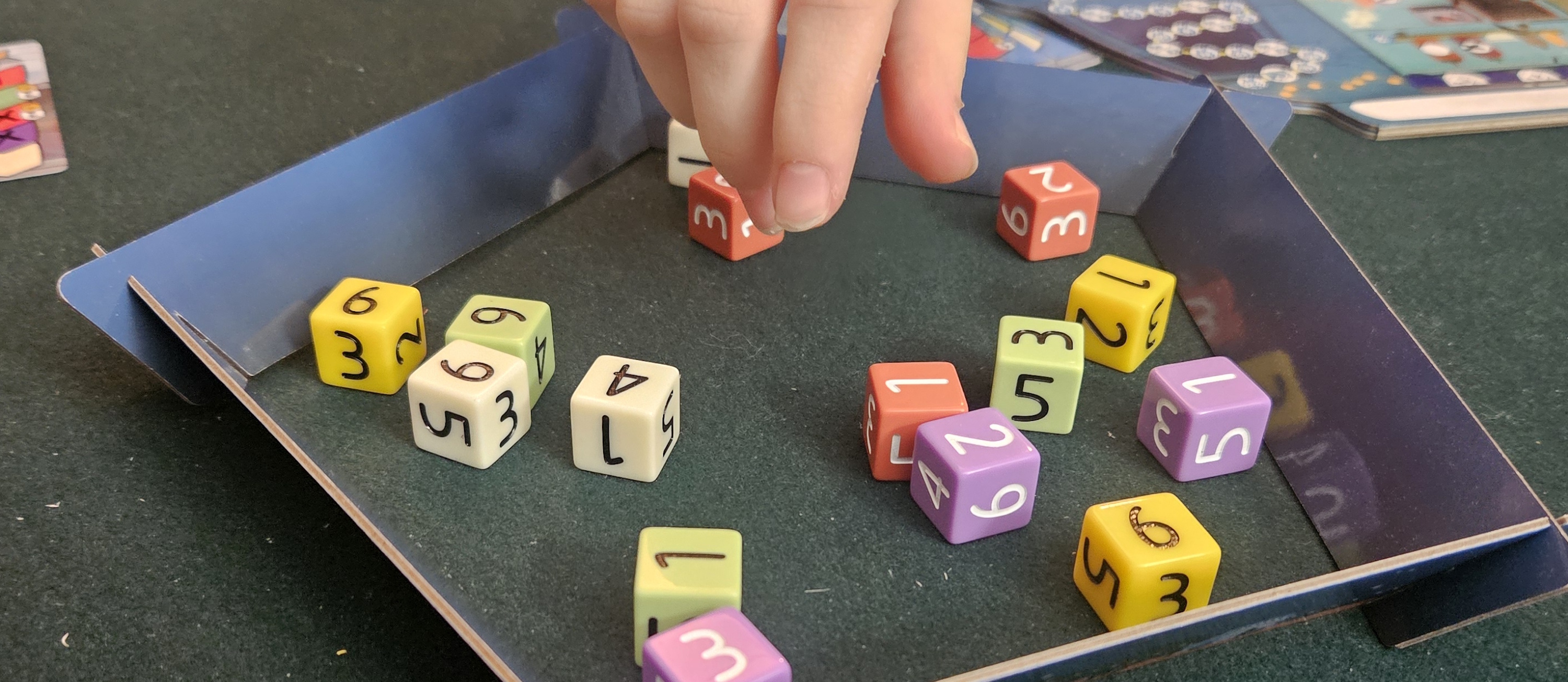
It's very hard to not say the f-word during the chuck n' pluck phase.

Chuck and pluck!

The whole thing is a delight. The race to nab dice works in part because it’s harried but not overly punitive. Barring the occasional bonus, players are only allowed to grab four dice, so it’s rare to find yourself under too much pressure. Upgrading your work stations offers tangible improvements, and we have yet to play without someone showing off the name they invented for their truck. The complexity level can be adjusted, with two modes for using the bonus “flavors” provided by customers, whether a simple cluster of four tracks or a more open-ended picnic minigame. The dice-chopping has even provided a nice way to get my twelve-year-old to think about algebra beyond the confines of her math class.

Oh, and the solo mode is nice. Every truck has a reverse side that shows a different puzzle boss to beat, sort of like the uppity food critic from Jon Favreau’s Chef. I haven’t seen them all yet, in part because the prototype wasn’t content-complete, but the ones I’ve tackled have struck a nice balance between putting up a challenge and affording the player a measure of control over the rival trucker’s moves.

Is it a perfect game? Oh, I dunno. It’s a little airier than I prefer, a little more limited, especially when it comes to things like the upgrades. More often than not, it’s possible to upgrade the entire truck in those five rounds, making the game feel more boxed-in than some of my favorite exemplars of the genre. Chicken Fried Dice is a light game, but not so light that there isn’t some crunch mixed into its rice bowl.
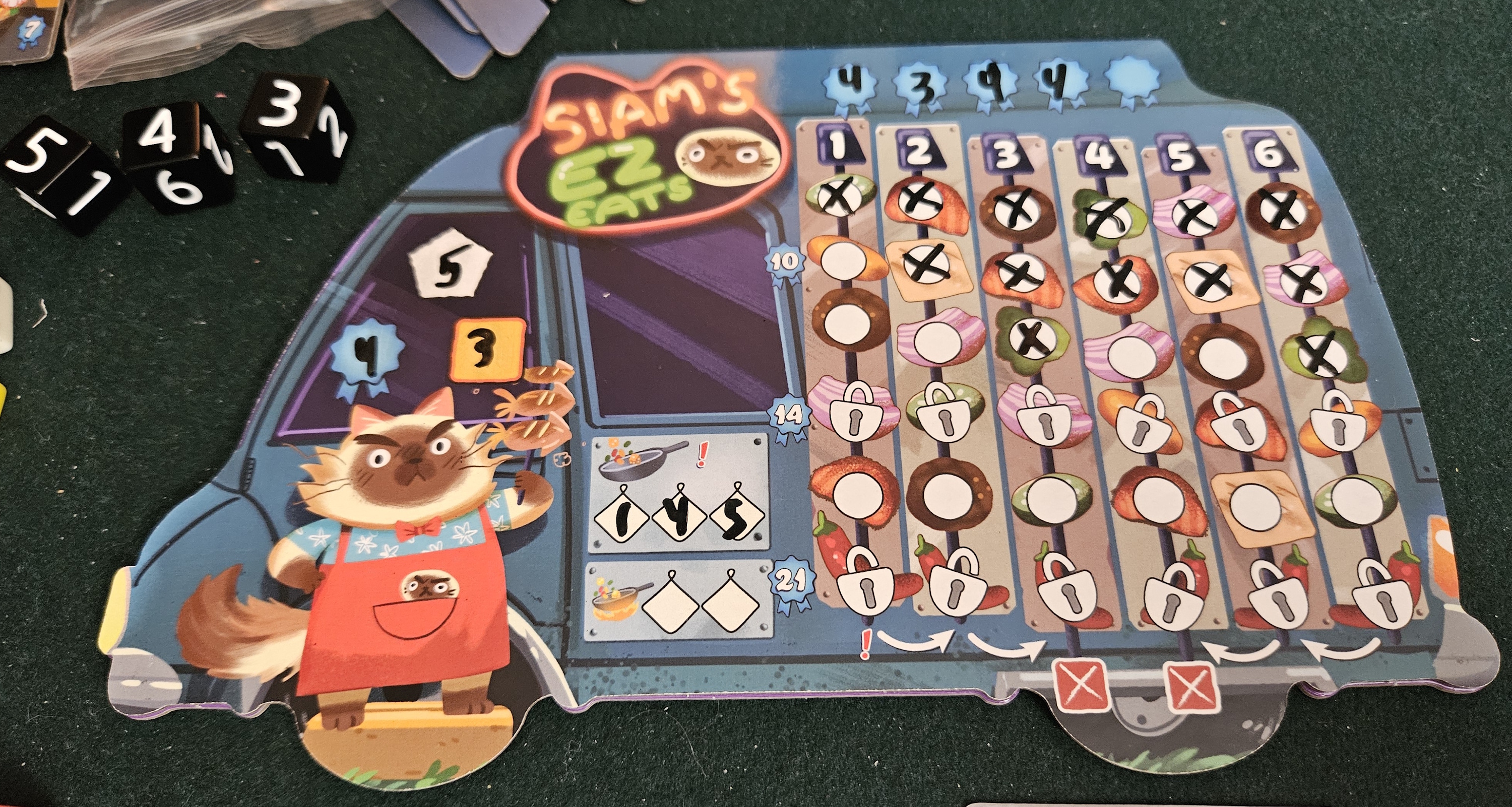
This morning I had this image open on the computer while I was getting my six-year-old ready for school. She ran over to it and declared, "Aw, Daddy, I love that angry cat!"

There are five solitaire bots. Or there will be. The prototype only had a few of them.

The short version is that Chicken Fried Dice is something I would play with my sister’s family. They play plenty of games, but require a curated middle ground, neither too light nor as brain-burny as The Anarchy or Fliptown. This is that sort of game: silly but not off-putting, cutely thematic, mathy but not frustratingly so, breezy without zoning me out. To sum it up with a quote by John Leguizamo from Jon Favreau’s Chef: “I’m putting a little corn starch on my huevos, man.”


A prototype copy of Chicken Fried Dice was temporarily provided by the publisher.

(If what I’m doing at Space-Biff! is valuable to you in some way, please consider dropping by my Patreon campaign or Ko-fi. Right now, supporters can read about which films I watched in 2025, including some brief thoughts on each. That’s 44 movies! That’s a lot, unless you see, like, 45 or more movies in a year!)

More than half of board game designers in TTGDA survey have used generative AI in their work

27. März 2026 um 16:29

More than half of board game designers responding to a Tabletop Game Designers Association member survey say they have used generative AI for some elements of their work.

About a quarter of the 171 designers who answered the TTGDA survey said they had used a genAI platform to come up with game ideas or mechanisms – while more than half indicated they were ‘strongly opposed’ to using AI in that way.

TTGDA – a professional organisation launched in 2024 to advocate for tabletop game creators in North America – asked designers about seven use cases, comprising:

● Coming up with ideas for games or mechanisms
● Writing placeholder text
● Writing text for the final version of a published game
● Editing or proofreading text
● Making placeholder art
● Making art for the final version of a published game
● Creating marketing materials for a game

The organisation said that while 28% of respondents were ‘strongly opposed’ to all seven use cases, almost a fifth were not strongly opposed to any of them, with the remaining respondents offering a mix of use cases they consider either acceptable or not.

Image credit: The Tabletop Game Designers Association

TTGDA’s report of its findings stated, “In the free-response section of the survey, multiple designers said that the process of chatting with the AI particularly helped them better articulate their own goals or ideas for a game.

“One said, ‘It’s like asking another human who may not know much about games. They know enough to at least bounce a couple ideas, which ends up with me getting to where I want to go’.

“Several designers who had tried asking generative AI platforms to come up with its own ideas described the material they got from the AI with terms such as ‘derivative’ or ‘slop’.

“One designer said that when they tried to prompt an AI for ideas, the AI recommended inappropriate mechanisms from mass market games, like ‘lose a turn’.

“Some said that a fraction of the output from their prompts would contain nuggets of useful ideas or angles that were worth considering.”

The results for use of AI art in final products were much more clear cut, with roughly four out of five respondents ‘strongly opposed’, and only two respondents out of the 171 saying they either regularly or occasionally generate art with AI that they plan to keep in a final game.

Many more designers (30%) were accepting of using AI to generate placeholder art for their designs – but 39% of respondents were ‘strongly opposed’ to that use.

TTGDA’s report cited one respondent as saying, “Publishers want pretty prototypes and the AI art makes me better able to illustrate the narrative direction and make play less boring than it would be with black and white words or “close enough” illustrations. Some of the games I am working on have no illustrations in the real world that anyone has done and if I wanted those I would have to pay artists which I cannot afford to do.”

Image credit: The Tabletop Game Designers Association

But it added that other designers said AI assistants had failed to create usable placeholder art in response to their prompts, with several saying that after trying AI-generated placeholder art they had returned to clipart and other online searches.

TTGDA said that when asked how they feel about publishers using AI for placeholder art, 40% of respondents said they would be ok with it, but 29% would like to contractually prohibit it and another 31% said they ‘don’t like it, but wouldn’t really fight it’.

The report added, “Of all the AI uses that the survey asked about, editing and proofreading had the lowest
number of ‘strongly opposed’ responses, at 35% for personal use and 30% for publisher use.

“About a quarter of designers (28%) are using AI to edit things they’ve written at least occasionally.

“Some designers gave examples of AI not working well as an editor for their games, saying it ‘made the rulebook worse’, or ‘creates more problems than it solves’.

“The problems they described included hallucinations and inappropriate tone. Designers also raised concerns that publishers might use AI for proofreading without a final human check, leaving the game vulnerable to errors.”

TTGDA also noted that more than 80% of respondents did not want publishers to use AI to generate marketing materials for their games, with multiple designers commenting that they were turned off by the use of AI in content creation around games, and will not work with influencers who use genAI in their workflow.

The report noted that of issues raised by designers when asked about their concerns around AI, “the most commonly voiced concern was that current generative AI tools are based on plagiarism, because they were trained on art and written materials without the creators’ consent.”

It noted, “Many said things like, ‘All uses of stolen material are problematic’. Multiple designers also mentioned that they want contract language that will prohibit a publisher from allowing AIs to be further trained on their game materials.

“The next most common concern was AI’s high environmental cost. A ChatGPT request uses ten times more electricity than a typical Google search (2.0Wh vs 0.3Wh). Other impacts include the use of rare earth elements, mercury, and lead in data center equipment; and the use of large amounts of water for cooling.

“Some designers worry that AI could flood the market with bad games. One designer thought it would be easy for unethical publishers to quickly create ‘clones that are slightly different’ and crowd the games they are copying out of the market.

“Another designer worried that ‘AI is great at making things that look like games for crowd funding campaigns, but without actual rules that make sense’.

“The general sentiment from these and other designers was the worry that in a market where it is already difficult for a game to stand out, these practices will only make it harder.”

Recent Repercussions

TTGDA’s report comes just over a month after Ryan Dancey, a more than 30-year veteran of the tabletop gaming industry, lost his COO job at publisher Alderac Entertainment Group after saying AI could generate game ideas as good as his company’s titles Tiny Towns and Cubitos.

Dancey said Alderac CEO John Zinser told him it was time to “move on to new adventures” in the “aftermath” of his LinkedIn post discussing the use of AI in board game design, which quickly attracted a flurry of negative comments from tabletop designersAEG’s business partners and bodies such as the Tabletop Game Designers Association, as well as board gamers across social media.

Wingspan designer Elizabeth Hargrave, the co-founder of TTGDA, dismissed Dancey’s suggestion when speaking to BoardGameWire the day after his departure from AEG.

She said at the time, “I absolutely do not think AI could be prompted to come up with even the basic idea for those games, let alone a fully fleshed out ruleset for them. For fun, I’ve prompted several different options for ideas for Wingspan cards and not one of them has given me an actionable idea.

“I had a friend who ran a rulebook through AI for proofreading and it hallucinated that people needed to shout ‘bingo’. Apparently that’s AI’s conception of board games right now.”

She told BoardGameWire at the time that the TTGDA board had been discussing the use of AI in board game design, adding that it was “a conversation we need to have with our membership”.

Wingspan designer and TTGDA co-founder Elizabeth Hargrave

She said, “We’re working on a model contract to offer to our members right now, and that will offer a clause that designers can request that will require publishers not to use AI in their final product. A lot of contracts ask us to certify that a board game design is our own, and not plagiarized.

“It’s my opinion that using AI in a final product goes against that, because it’s using a machine that’s built entirely on plagiarism.”

Hargrave added last month, “I do see people using AI for things like generating a bunch of placeholder names in a prototype. They’re often clunky options but they do the job when you know everything will change 50 times before you’re done anyway. I’m not aware of anyone who has successfully actually gotten good, original ideas for mechanisms from AI.

“What I wish we were talking about is how AI could be built to help designers run models of their games repeatedly to catch weird edge cases or broken strategies. I wish someone would build that tool instead of the language models that just focus on advanced auto-complete.

“This would never replace actual playtesting with humans for psychology and actual fun, but it might save me some repetitions.”

The TTGDA survey noted that one of the most common additional uses mentioned was as a source for help with probability, mathematics, and thinking about balance.

It said, “In some cases, designers are having the AI write spreadsheet formulas that they then use to do calculations in the spreadsheet. In others, they are simply asking the AI to do calculations.

“However, nearly as many designers said they had quite poor results with asking LLMs to do math, reporting errors and hallucinations. For example, one designer who used ChatGPT to calculate detailed probabilities (e.g. how often a certain set of cards might appear in a starting hand) said when they checked the results, they were wrong ‘roughly 1/4th of the time’. Another called ChatGPT ‘surprisingly bad at maths’.”

Last week board game publisher Awaken Realms responded to a wave of anti-AI art review bombing for its upcoming crowdfund, Concordia: Special Edition, by saying no AI-generated imagery will be used in the finished game.

Awaken Realms is one of highest-profile tabletop publishers to confirm it uses AI image generators, with other notable adopters of the technology including Stronghold Games – which attracted significant ire for its use of AI art in its $2.2m More Terraforming Mars! crowdfunding campaign.

The technology has been widely criticised by artists angry that the models are built upon their work without licensing or recompense, in addition to outcry over its environmental costs and threats to jobs in the creative and other industries.


The post More than half of board game designers in TTGDA survey have used generative AI in their work first appeared on .

GAMA unveils board of directors election winners, current president and secretary re-elected to board

27. März 2026 um 15:18

Editor’s note: GAMA is one of the sponsors of the BoardGameWire newsletter

Hobby games trade organisation GAMA has revealed the winning candidates in its latest board of directors election, with the organisation’s current president and secretary both retaining their board seats.

President Nicole Brady, who runs review site SAHM Reviews, was re-elected to the board by GAMA’s media and events member group, while treasurer Tiffany Reid from Southern Hobby Distribution won re-election from the wholesale group.

Current GAMA secretary Jamie Mathy – who runs game store Red Racoon Games – was re-elected by the organisation’s ‘Team Retail’ group alongside Red Claw Gaming’s Lea-Anne Welter, while David Wheeler from Dragon’s Lair and Boyd Stephenson from Game Kastle were also voted in as retailer representatives.

One of those four will be selected by Team Retail to fill a retailer seat on the GAMA board of directors, with all successful board candidates working for a two-year term.

The other newly elected members of the GAMA board are Michael Maggiotto Jr, who was selected by GAMA’s production members, Heather O’Neill from 9th Level Games representing publishers, and LegalWATCH’s Eartha Johnson from the creator membership group.

The GAMA Board of Directors is comprised of twelve individuals elected to represent the six voting membership groups, with half of the cohort up for election each year.

That board in turn elects GAMA’s four officers – president, vice-president, treasurer and secretary – each year.

Current GAMA president Brady has been in her current officer role since May 2024, having previously been treasurer of the organisation from the end of 2022.

GAMA President Nicole Brady

Brady has been a key driver of GAMA’s current plan to become the “epicentre” of global tabletop gaming, underpinned by the organisation unveiling its first-ever 10-year plan last October.

The array of plans spread across the next decade include boosting its membership within both hobby games and the mass market, expanding itself into a global organisation, shifting its finances away from the current heavy reliance on the annual GAMA Expo and Origins shows, and leading the conversation on sustainability within the industry.

Advocacy and brand protection is also one of its near-term priorities – underscored by the organisation’s recent intensive lobbying and awareness efforts around the impact on the industry of US tariffs.

Those efforts included multiple trips to Washington DC to lobby politicians, conducting dozens of media interviews to highlight the devastating impact of tariffs on the hobby, and supporting two lawsuits disputing Trump’s power to set the tariffs without agreement from the US Congress.

Brady told BoardGameWire earlier last year that the move was an attempt to get the organisation away from “playing whack-a-mole” on important issues rather than managing them in a long-term strategy.

GAMA is currently working to secure a permanent replacement for its previous executive director John Stacy, who left the association last October just after the 10-year plan had been revealed.

Leadership consultant Zaria Davis was named as interim executive director last November.

Earlier this month GAMA’s board of directors apologised for some of its elected leaders being “rude and disrespectful” during a “heated” annual general meeting at the recent GAMA Expo trade show.

This year’s GAMA Expo sealed another record attendance, ahead of its planned move to Baltimore in 2027 to contend with rapidly growing demand.

More than 3,820 attendees showed up to this year’s event in Louisville, Kentucky, up almost 12% on last year’s previous record of 3,425 – which had already left the show pressed for space across the exhibition hall and its extensive programme of seminars.

The post GAMA unveils board of directors election winners, current president and secretary re-elected to board first appeared on .

Neuroshima Hex Game Review

Neuroshima Hex has known three previous editions, each ultimately widening the pool of available factions and improving on what was already a very good design. Now, on the occasion of its 20th anniversary, publisher Portal Games has rebooted the line again. Blessed are we who live to see such times. Finally, you can own a base set of Neuroshima Hex with a box that doesn’t look like absolute butt. Aesthetics was never the point of all this, but goodness.

Inside that box, you’ll find four factions’ worth of tiles with which to play this marvelous game. Do the tiles look better? Listen, there are limits to what you can manage when designing a game that has to convey a large amount of information in a small amount of space. Do the tiles look good? No. Do they look bad? No! They’re a miracle of legibility. Don’t worry about it.

The basic idea is pretty straightforward: on your turn, you draw up to three tiles, discard one, and then play, discard, or save the others. Your tiles are a mix of Troops that attack and hinder your opponent, Modules that provide buffs and debuffs to the pieces on the board, and Actions, which can do all variety of things depending on the faction. As the game progresses, the board gets…

The post Neuroshima Hex Game Review appeared first on Meeple Mountain.

Top 10 Board Games Paul and I Disagree On

27. März 2026 um 13:52
Top 10 Board Games Paul and I Disagree OnSo who is Paul? No, I’m not referring to Paul Dennen (Dune Imperium/Uprising), Paul Salomon (Honey Buzz), or Paul Peterson (Smash Up), though I’m sure I could find gaming disagreements with each of these fine designers. Rather, I am referring to my wonderful husband Paul, the man who introduced me to the strategy board gaming […]

Source

Video Review: Crisis: 1914 from Worthington Publishing

Von: Grant
27. März 2026 um 13:00

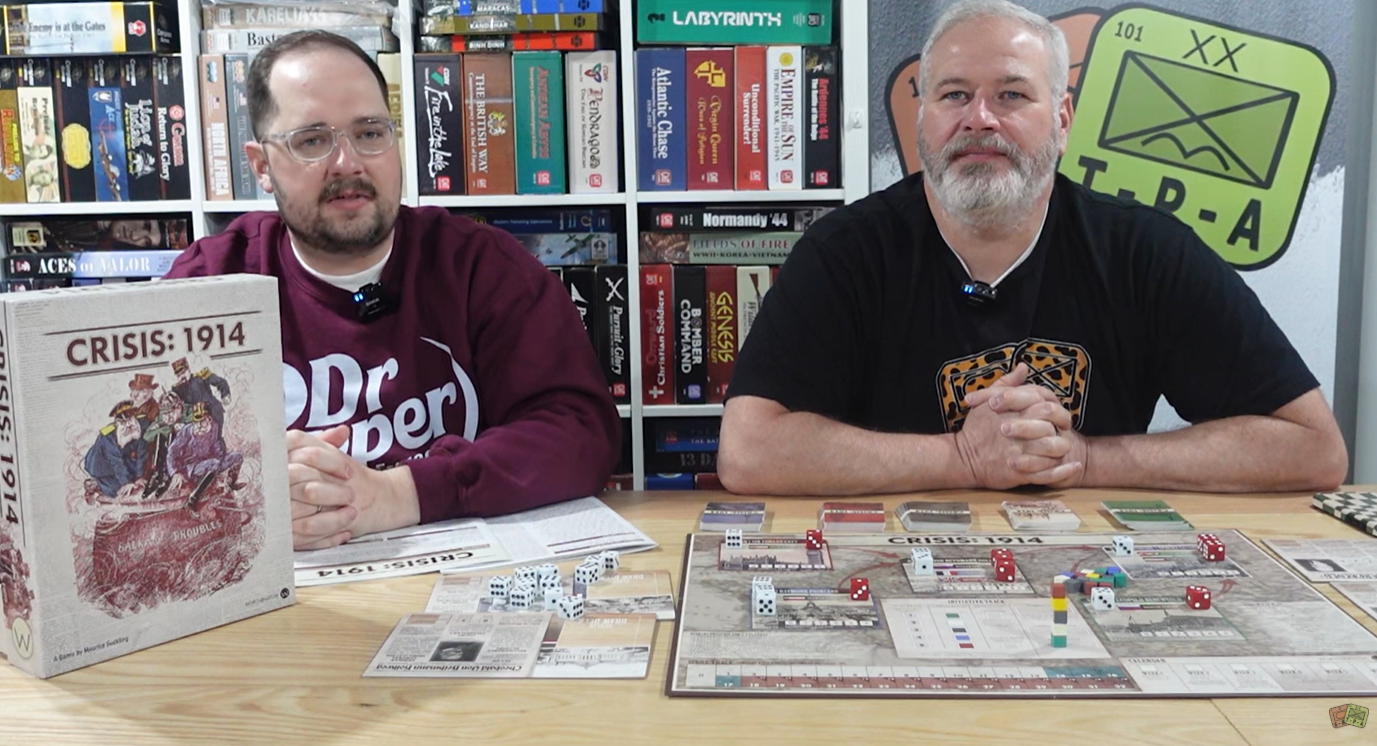
Crisis: 1914 is a game of international brinkmanship – if you back down too soon, you lose. If you back down too late you lose. But you have hawks and doves in your cabinet and in your government, and out of these conflicting views you must somehow formulate a coherent response to the crisis to win the day and prevent war.

There are 3 interrelated concepts at the heart of Crisis: 1914: Prestige, Tension, and Diplomatic Pressure (DP). Diplomatic Pressure (DP) is how you score Prestige. Tension is how you lose. Every card has a DP value. You apply DP by playing cards. The player with the most Diplomatic Pressure at the end of a turn earns Prestige points. There are other ways of scoring Prestige points too, but this is the most important one. Prestige is how you win. The player with the most Prestige at the end of the game is the winner.

We published an interview on the blog with the designer Maurice Suckling and you can read that at the following link: https://theplayersaid.com/2023/07/12/interview-with-maurice-suckling-designer-of-crisis-1914-from-worthington-publishing-currently-on-kickstarter/

Also, in a lead up to the game’s release, I worked with the Maurice to do the following Event Card Spoiler posts:

Crisis: 1914 Event Card Spoilers with Designer Maurice Suckling – Series Introduction and General Mobilization Cards

Austria-Hungary, Part One

Austria-Hungary, Part Two

Russia, Part One

Russia, Part Two

Germany, Part One

Germany, Part Two

France, Part One

France, Part Two

Britain, Part One

Britain, Part Two

Britain, Part Three

While this game is not necessarily a wargame, but more of a war themed Euro game with a bit of negotiation and tension as you build your tableau of cards, we had a great time with it and really feel that the game is a bit under the radar of folks and should be one of those games that is played at conventions as it seats up to 5 players and is really quite good.

-Grant

Can a Publisher Serve Backers with Different Budgets?

26. März 2026 um 20:40

“The largest U.S. carriers seek to capture corporate travelers and affluent leisure passengers who are willing to pay more for comfort. Increasingly, airlines are betting on selling fewer seats at higher yields rather than packing planes more densely with standard economy passengers.” —NTD

Here’s how one might rewrite this quote if it were about tabletop crowdfunding:

“Tabletop publishers seek to capture affluent gamers and those who want to focus on fewer, deluxified games. Increasingly, publishers are betting on selling expensive games (lower total quantities) at higher yields rather than lower-priced games (higher total quantities) at lower margins.”

Two recent examples are Brass Pittsburgh and Slay the Spire: Downfall. Both campaigns are impeccably crafted and highly successful: Even just a few days in, they’ve raised close to $7 million combined.

If I wanted to pledge to the highest core levels for both campaigns ($425 for the game and expansion for Slay the Spire and $350 for all three Brass games), I would spend close to $800. Out of around 31,000 backers between the two campaigns, close to 3,000 people have already backed at those levels (around 10%). These top pledges have raised around $1 million out of the combined $7 million total (around 14%).

Clearly there is an audience for these top-tier reward levels, particularly for highly acclaimed games that have earned their value (Brass Birmingham is ranked #1 on BoardGameGeek; Slay the Spire is #18). Perhaps at least part of this stems from hobby gamers with bursting collections who want to focus on fewer, fancier games.

Unlike airlines, however, there isn’t limited space on a crowdfunding campaign–these publishers have found a way to serve more budget-conscious backers too. Roxley included a $79 reward for Brass Pittsburgh (821 backers) and Contention Games included an $84 reward (2325 backers) for the Downfall expansion.

Another example is Garden Club, which has a $39 level and a $69 level on Kickstarter now. Chris Couch Games can serve both budget-conscious backers who just want the game and wealthier backers who want everything.

Here’s my hope: Selling some premium, high-margin products can help publishers maintain lower prices for the masses.

What do you think? How do you feel as a consumer right now, and what would you like publishers to learn from these campaigns? Is there such thing as an economy that serves all types of people?

***

If you gain value from the 100 articles Jamey publishes on this blog each year, please consider championing this content! You can also listen to posts like this in the audio version of the blog.

Smitten 2 Game Review

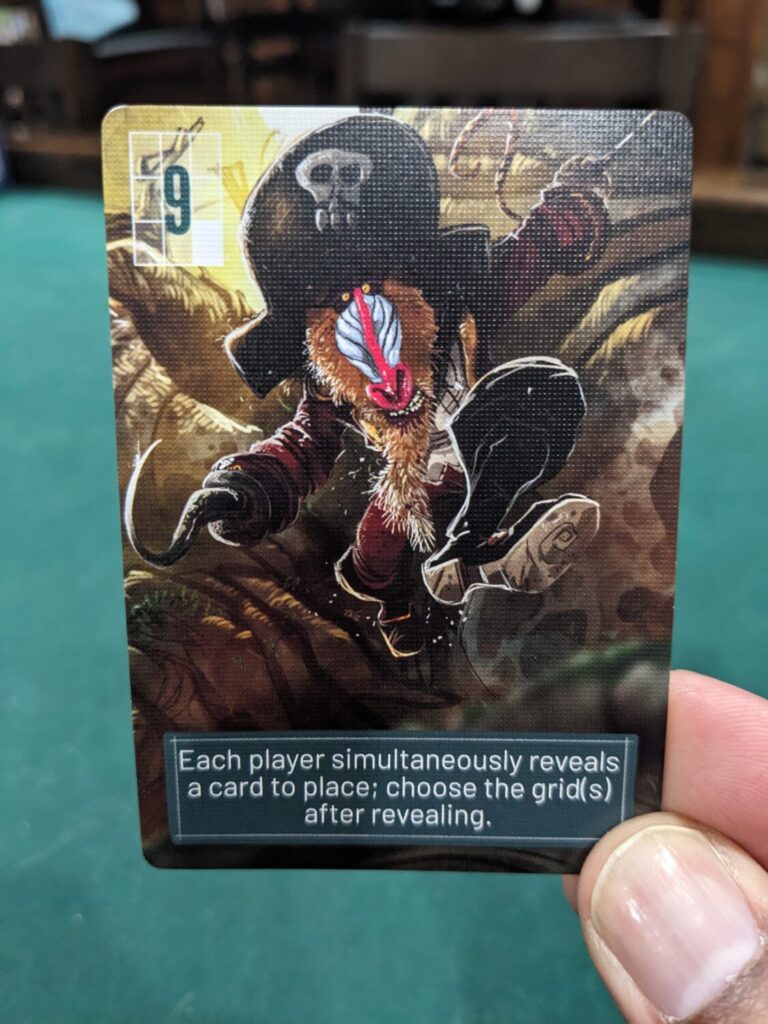
I recently had the chance to pull in a review copy of the Stonemaier title Origin Story, a game I first learned about during SPIEL Essen 2025. As a bonus, Stonemaier threw in a free copy of a small card game called Smitten 2, based on the game Smitten, a title I was not aware of. When Smitten 2 arrived, I broke it out and did a couple solo plays.

The setup is quick, and the goal is simple: using a small hand of cards, players must build two matching 3x3 grids of cards, with the win condition tied to placing 17 of the 18 cards in the deck. During setup, all cards are shuffled with one being left out, unseen…in solo, the player manipulates two hands and has to play each tableau off each other, using the card powers aligned with each card and its specific playable position in the grid. (The 5 card can only be played in the middle of each tableau, while the 1 card can only be played in the upper left corner, for example.)

Across those first two plays, I didn’t win, but some interesting choices were on offer. Each card’s placement rules make for a fun puzzle, and I came close…

The post Smitten 2 Game Review appeared first on Meeple Mountain.

Cardboard Cinema – Lawrence of Arrakis

26. März 2026 um 14:00
One thing a board game will never formally have, is an overture. The three hour and 47-minute epic Lawrence of Arabia begins with a four-minute piece that encompasses a medley of themes pertaining to the film’s atmosphere, setting, and characters. It sets the stage for the powerful cinema you are about to experience. The closest…

Read more →

Forestry Review

26. März 2026 um 13:02
ForestryWood is a common resource input in board games, whether it’s for building fences, buildings, or any of a number of wooden trinkets. There are even some games with wood-centric theming, like Woodcraft and Lignum, which delve into some detail about processing and manipulating wood to attain final products. These games typically treat wood as […]

Source

La Der des Ders – The War to End War from Hexasim – Action Point 4

Von: Grant
26. März 2026 um 13:00

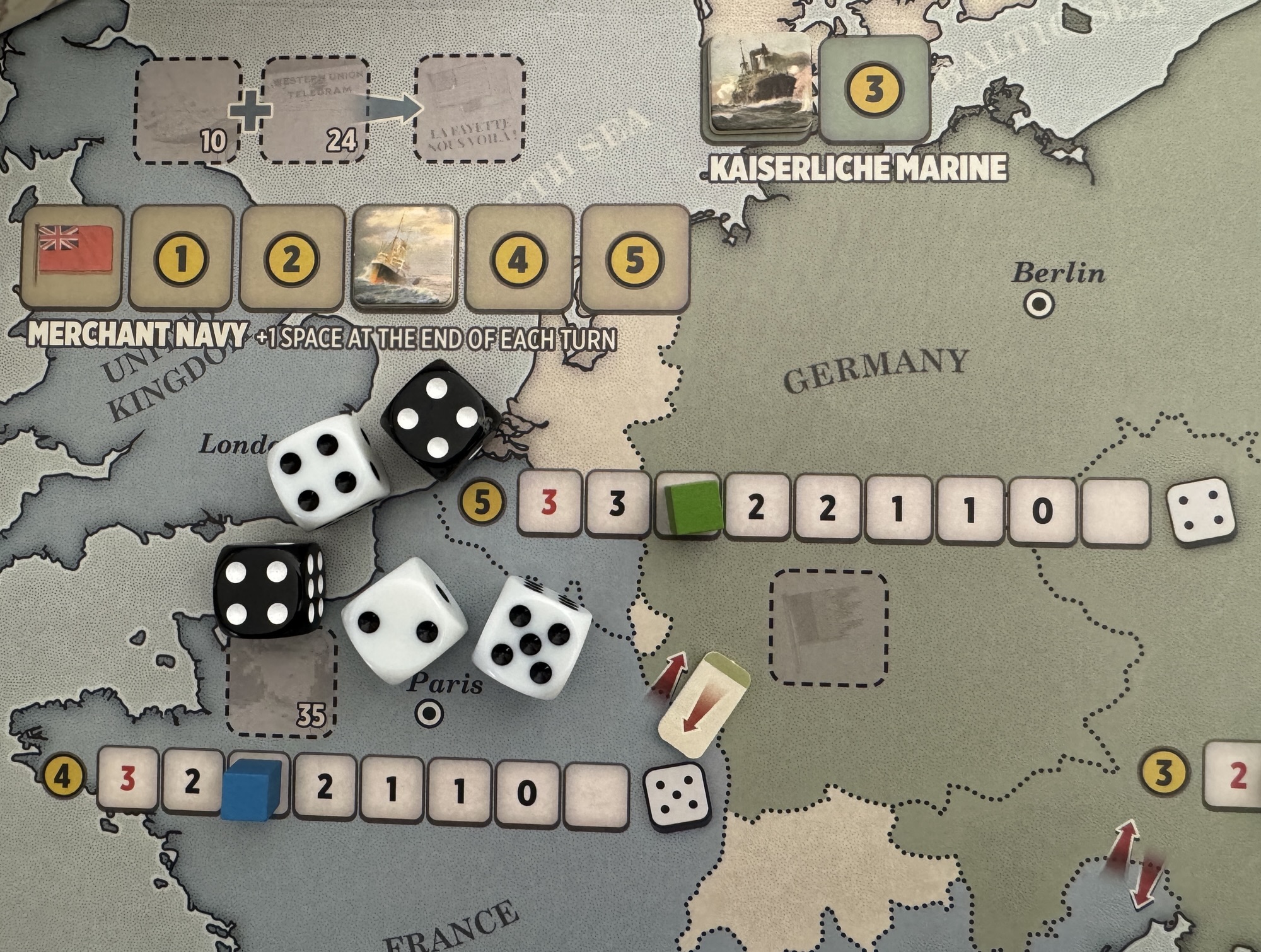
La Der des Ders – The War to End War from Hexasim is a 1-2 player slightly abstracted strategic level look at World War I. The game allows the players to relive the First World War at a strategic level, with each player controlling one of the 2 sides either the Entente, consisting of France, England, Russia, Serbia and other minor nations or the Central Powers including Germany, Austria-Hungary, the Ottoman Empire and a few minors. La Der des Ders can also be played solo, with a dedicated solitaire bot called “Athena” who utilizes special Cornflower Cards to make decisions about what technologies to invest in, where to undertake offensives and how to utilize limited resources and reinforcements. Each turn, players gain an amount of Resource Points dependent on what nations are in the war, which they can allocate to different areas to guide their overall strategy. Victory is achieved by launching offensives that drain the morale of enemy nations, forcing them out of the conflict through collapse.

In Action Point 1, we looked at the Game Board, discussing the Collapse Tracks, Trade Tracks, Russian Revolution Track and Naval Control Table and other various on-board tables and offensive spaces. In Action Point 2, we covered the Technology Phase and the Technology Tree and Technological Improvement Boards. In Action Point 3, we examined the Event Cards and how they inject the historical narrative into the gameplay and also alter the conditions of the game. In this Action Point, we will walk through an example of an Offensive and take a look at the combat procedure.

Offensives

As we discussed in Action Point 1, shown on the board are the Offensive Arrows that will remind the players about what Offensives they can undertake, meaning what Sectors may be attacked, and what Sectors have already taken their one Offensive against that adjacent Sector per turn. These are identified by red arrows connecting adjacent Sectors and will be covered up by the appropriate Offensive Marker when undertaken. In the below picture, we will take a look at Serbia as an example. You can see that Serbia is surrounded by Central Power countries including Austria-Hungary and Bulgaria (Neutral at the start of the war). They also have a few of their Allied nations adjacent including Romania (Neutral at the start of the war) and Greece (Neutral at the start of the war). From each of the adjacent Sectors there are 2 Offensive Arrows represented meaning that this Sector can both be attacked and can attack the adjacent Sector.

The process of taking Offensives is really pretty simple as players take turns to activate one of their sectors that has not yet been activated this turn. The sector chosen will then be activated and must launch an Offensive against an adjacent enemy sector. There is a cost to the launching of Offensives though as the player will have to pay the appropriate cost by first choosing the size of their Offensive, which in game turns means the number of dice they will pay to roll in the Offensive. The size of the Offensive must be at least 1 and can be up to the current Operational Value of the attacking sector. The player launching the offensive then spends as many Resource Points as the size of the Offensive.

For example, The Entente player decides to attack Austria-Hungary from Russia. If Russia’s Operational Value is currently 2, the size of the Offensive must be between 1 and 2. If the Entente player chooses a size 2 Offensive they will have to spend 2 Resource Points. This would allow Russia to roll 2D6 along with any black dice for their Artillery Technology.

Once both of the players have activated a sector, each player may then continue with Offensives by choosing to activate a new sector until no new sectors can be activated. Each of the sectors can make but a single Offensive per turn. I really like this restriction as it reflects the logistical and material difficulties in planning, funding and executing these large Offensives. A player may always decide to pass rather than activate a sector but once you do pass the Resource Spending phase ends for them. The other player can continue to activate the sectors they want and are able to until they decide to pass on their turn or are no longer able to activate a sector.

Now let’s cover the mechanics of how the Offensive resolves with dice. The player will roll as many white dice as the size of the Offensive they funded. These dice are called Attack Dice and it is important to remember that some technologies allow modifiers to be added to Attack Dice or will grant additional dice to be rolled, usually in the form of Artillery Dice. Each level of Attack Technology implemented in the attacking sector grants a DRM (Die Roll Modifier) of +1 to each Attack Die roll. Each level of Defense Technology implemented in the targeted sector inflicts a Die Roll Modifier of -1 to each Attack Die roll. Each level of Artillery Technology implemented in the attacking sector allows the Attacker to roll 1 black Artillery Die. These dice are not subject to the bonuses/penalties conferred by either Attack or Defense Technologies. Also, keep in mind that the number of Artillery dice cannot exceed the size of the Offensive. This is a mistake that I have made many times in my plays of the game and wish there was a better way to remember this. In the case of Artillery Dice, if the player has developed the Aviation Technology, the attacker may re-roll as many Artillery Dice that failed to inflict a loss as the difference between their Aviation Level and the defender’s Aviation Level.

Each result greater than or equal to the attacking player’s Attack Value inflicts one loss on the defender. The Attack Value of a sector is represented by the die depicted at the end of the Collapse Track. Germany has the best value at a 4 while all other countries, with the exception of Greece who is a 6, have a 5. For each loss suffered in an Offensive, the defender moves the cube on the attacked sector’s Collapse Track by one space to the right. If a cube needs to be moved forward on the Collapse Track, but is already on the right-most space and can’t be moved forward, that country immediately surrenders. The Offensives process is really very simple, and it just fits with the chosen format and scale of the game. Nice and easy but fun with lots of dice rolling.

Counter Attacks

One more thing that I need to share about these Offensives is the concept of a Counter Attack. If at least one of the Attack Dice rolled comes up a natural 1, the attacker will suffer one loss and the cube in their own sector is moved forward one space on the Collapse Track. This is not one loss per 1 result but only 1 such loss with an Offensive. With my luck, I could lose my whole army and have to surrender! Also, remember that Artillery Dice are not affected by the Counter Attack rule.

The process of Offensives in La Der des Ders is very simple and straightforward but works very well in the framework of the game to create many tough choices about how to spend your limited Resource Points and who to attack and from where. As the Central Powers, attacking with Germany each turn makes the most sense as they have the best odds of scoring hits and causing losses to France and Russia but they will have to gauge where they stand and who else might be closer to Collapse and surrender. As the Entente, France and Russia should put a heavy focus on Germany and Austria-Hungary and force the Central Powers player to have to replace losses rather than spending on Technology upgrades and replacements. Continually attacking them will lead to results over the course of the game.

In Action Point 5, we will simply review the Victory Conditions.

-Grant

Asmodee to pay up to €250m to buy French party, social game publisher ATM Gaming

26. März 2026 um 11:19

Asmodee has sealed its second major acquisition in a week by agreeing to pay up to €250m for French social and party game publisher ATM Gaming.

The board game giant said buying ATM, the publisher of titles including Speed Bac/Quickstop, Mouton Mouton and Pili Pili, was predicated on social games being “the fastest growing category of the board games market”.

Asmodee expects a compound annual growth rate (CAGR) for social games of between 4% and 8% between 2025 and 2030, compared to about 4% for the wider board games market, citing mass market sales research for the US and ‘main European countries’ conducted by Arthur D Little.

ATM has scored rapid success since it was launched in 2018, with Asmodee saying the company has shown particular strength in building an “e-retailer distribution engine”, using advertising, advanced SEO and real-time analytics to help its titles rank highly in online stores such as Amazon.

The company’s standout title, Speed Bac from designer Rémy Wannerbroucq, has sold more than 3 million copies since it was launched in 2024, with about 2 million of those sales coming in 2025 alone.

ATM Gaming’s standout release Speed Bac, which has sold about three million copies since its 2024 debut

Speaking in a press conference about the acquisition, Asmodee CEO Thomas Koegler said the fast-paced word game, which has also been published as Slingz, “shows clear potential to become an evergreen”.

Asmodee said the game managed to hold the number one spot in Amazon’s Toys & Games category across four different European countries during both Christmas 2024 and 2025, while other ATM games have also managed to seal high rankings.

Pili Pili, which has sold more than 300,000 copies since its July 2025 launch, was ranked second behind Speed Bac in Amazon’s Toys & Games category in France last Christmas, while Mouton Mouton, which has sold 200,000 copies since being launched last September, was ranked third.

That success has seen ATM grow from four co-founders with backgrounds across companies such as Meta, Deloitte and Johnson & Johnson to a team of more than 40 people, with its net sales CAGR more than doubling between 2023 and 2025 to reach about €34m last year.

Asmodee said it expects ATM to contribute at least €50m in net sales over the 2026/27 financial year, boosted by its new owner’s geographic reach and “know-how in operational efficiency”.

The company has agreed to pay €180m for ATM Gaming on a cash-free and debt-free basis, with another €70m paid in newly-issued Asmodee shares contingent on ATM’s future performance.

ATM is already established across France, Germany, Italy and Spain, Asmodee said, with “emerging” sales in countries including the US and UK, as well as in wider Europe and Latin America.

Koegler said a “key differentiator” for ATM was the company’s strength in e-retail, which has been their primary sales channel over the last three years. He added, “Their expertise in digital marketing and social media will also strengthen our go-to-market capabilities.”

Asmodee CEO Thomas Koegler

Asmodee has distributed ATM titles since 2019, with about 10% of the company’s current sales made through the Asmodee network – mainly in Italy and Spain.

Koegler said, “Over time we expect to further integrate distribution within Asmodee. Geographically the combination is highly complementary.

“ATM Gaming is strong in Europe, while Exploding Kittens provides a strong foothold in the US. Together this creates a balanced platform with significant expansion potential across both regions, but also beyond.”

Exploding Kittens is among Asmodee’s current heavyweight hits in its party and social games portfolio, alongside other high-selling titles such as Dobble.

Koegler said in the company’s Q2 report last November that Asmodee had seen “good momentum” in its lower price-point products in the US mass market, singling out Exploding Kittens as a particularly strong performer in what he called a “challenging market”.

Expanding Horizons

A month earlier Asmodee continued its reignited expansion strategy by launching a new party games studio, Moodbox Games, as part of a push into the US mass market.

That strategy has seen Asmodee make five acquisitions in the past 12 months – including last week’s buyout of Japon Brand from CMON, anchoring the board game giant’s push into a “currently untapped market” for the company.

Its other recent acquisitions include picking up ZombicideCthulhu: Death May Die and Sheriff of Nottingham from CMON, which is attempting to recover from heavy losses over the past couple of years.

Sheriff of Nottingham

Asmodee announced in November 2024 that it was preparing to “reignite” its strategy of buying up smaller board game publishers and distributors, saying at the time that it had a pipeline of more than 20 acquisition opportunities.

The revived M&A process is yet to fully mirror Asmodee’s private equity-fuelled buying spree from the latter half of the 2010s, however, during which it acquired more than 40 companies and IPs.

That heavy expansion included the company adding more than 20 game studios, including Days of Wonder, Fantasy Flight Games, Lookout Games, Catan Studio and Z-Man Games.

Koegler was asked during the company’s quarterly results presentation last month whether the company was ready to make “more meaningful” acquisitions rather than small bolt-on deals.

He said in response, “Without being specific, the activity in the pipeline is in accordance with our plan. The smaller acquisitions are faster. IP acquisitions and asset deals are faster to execute. I’m satisfied.”

Speaking during the ATM acquisition press conference, he said, “Our M&A pipeline remains quite active. We are well positioned to continue executing on our strategy.”

Asmodee posted record sales of €524m during the last quarter of 2025 despite a slump in its US performance, with trading card game earnings in Europe acting as a driving force for the business.

The board game giant’s overall net sales jumped 22.2% across October to December 2025 compared to the same period a year earlier, with the performance of products it distributes for other companies surging more than 50%.

Net sales for games published by Asmodee itself fell almost 13% year-on-year in the quarter, however, weighed down by US net sales slumping 23% to €70.4m.

That drop saw the US fall behind both France and the UK in Q3 in terms of the company’s highest-performing countries for net sales, with France surging 47% year-on-year to over €111m, and the UK growing 41% to €82.7m.

The post Asmodee to pay up to €250m to buy French party, social game publisher ATM Gaming first appeared on .

Games should end once the Winner is Known

26. März 2026 um 02:22

aka “Jorbs responds to Slay the Spire Beta Drama”

There is a video where Jorbs talks about StS2’s Beta branch and the many complaints about a Boss called the Doormaker. This is mostly “inside baseball,” but Jorbs brings up a problem common to many games. (For reference, the modified Doormaker steals every 10th card you draw. The point was to stop infinite combos where you draw your entire deck, which lets you play the important cards and draw them again, etc all during the same turn).

Jorb points out that at the start of the game, the game state (what you can do) keeps branching and growing. You get more options, the number of variables increases, etc. He continues….1

“An issue that StS1 always had and StS2 had on release is that at the end of Act II, this game tree funnels a lot. … It stops expanding and more and more things start compressing as you get to a point where … you see how to win all the fights ahead of you.” (And you just have to click the buttons for 20-30 minutes).

While I’m not the player that he is, it is somewhat true. Typically I die in Act I or Act II. Rarely in Act III and when I finally beat Ascension 10 for the first time, I was fairly confident of winning once I won Act II. (I was not on the Beta branch). The Doormaker is a major “bomb” in game design terms. If your deck requires you play a specific card to win, there is a 10% chance he’ll eat it. If your deck requires you to play the same card dozens of times … well, now you need a new plan. (Which does exist, and is more inside baseball).

(Slay the Spire 2 offers you a positive “bomb” at the start of act III to balance this, you will get a huge bonus from the Ancient One).

  1. This is from the transcript, except cleaned up to remove ums and things like that ↩

Kings of War (4th edition) v1

25. März 2026 um 23:24

But it is not this day! This day we fight!

Be victorious on the battlefield with your Kings of War rules & reference!

I’ve been covering a lot of Mantic Games lately (especially since a certain other company decided they didn’t want the support of content creators), and I’ve been very pleasantly surprised by their offerings. The new Epic Warpath is a great system with a wide range of classic scifi factions to play with, and Halo: Flashpoint is coming into its own as the range of available models increases. But the one game of theirs I haven’t explored yet is Kings of War. It’s perfect timing then, because the new 4th edition has just been released!

Kings of War is a classic ‘rank and flank’ fantasy tabletop miniatures game, in the tradition of the old Warhammer Fantasy Battle (now Warhammer: The Old World). It’s been interesting to see these old regimental games enjoy a resurgence of popularity – Hobgoblin and Conquest: Last Argument of Kings are two others – and there’s certainly something very satisfying about pushing around trays of warriors in neat rectangular formations. Kings of War commits completely to the concept because you actually model the miniatures attached to the base, rather than have them individually standing on it. It may mean a lot more modelling – building and painting 10 miniatures to make a single unit is a big job – but it certainly looks spectacular when you have a full army on the field.

As for the rules themselves, they’ve been cleaned up from previous editions. I haven’t played yet (I’ve been busy painting, which is now all done – watch out for a tips video), but will film a game when I do so you can see how it goes; but Mantic have a habit of making very solid rules systems, so I have high hopes. The new starter set Claws in the Sand is a good introduction box for new players and features two unusual small armies – the aquatic Trident Kingdom and the Medieval Japanese-syled dogmen of the Xirkaali Kingdom.

In the meantime, here’s my rules and reference to make your games easier and smoother – and of course you can also find it in my rules app Tabletop Codex!

Burned Notice

25. März 2026 um 20:04

My name is Hot Secret Agent Man In An Improbable Orange Jacket, and I used to be a spy.

There’s a problem with most hidden movement games, and I say that as the mechanism’s greatest devotee. Namely, they’re slow. So slow. Maybe it would be kinder to call them “deliberate,” but even that doesn’t quite transform the ding into a compliment. Stealth, in theory, can be deliberate. Stick insects are deliberate. But it can also be harried, adrenal, instinctual. Like a panther. Like an owl. Like me ducking out of a Super Bowl party before the uncles start complaining about the halftime show.

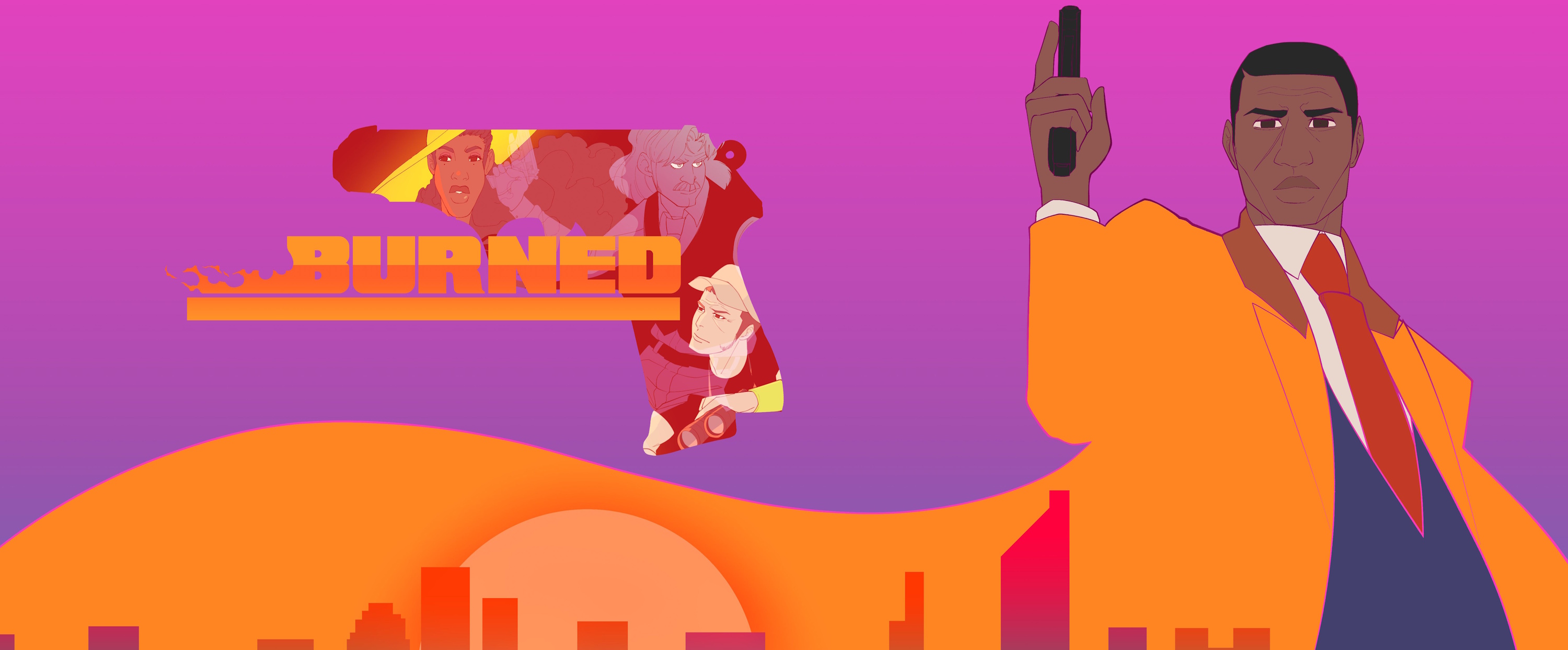
Burned occupies the untapped middle ground between those two poles. Designed by Jon Moffat, who gave us last year’s top game about poop carts, Burned is neither Mind MGMT nor Captain Sonar. Instead, it’s the closest a board game has ever gotten to making me feel like a highly-trained secret agent picking off mooks in broad daylight. Usually right before they tackle me to the ground and stomp me to death.

"... and not in a Heated Rivalry kind of way. Get out of there, Hot Secret Agent Man In An Improbable Orange Jacket!"

“You have thirty seconds before they’re on top of you…”

Picture with me, if you will, the moment in any spy thriller when the baddies are stomping up the stairs. Go ahead, close your eyes and picture it. Close them. Now open them. This ain’t no radio drama. You, the secret agent, can hear them coming. They’ll be on you in seconds. Not minutes. Certainly not hours. Seconds. They’re at the door. The wood is splintering. They sweep into the room, and you’re

gone.

Burned is about those split seconds. A session takes ten minutes, maybe fifteen at most, and comes across as no longer then five.

Which makes it all the more impressive that it isn’t real-time. Nothing explicitly hurries you along. The Burned Asset takes his turn. Then the Agency pursues him. Back and forth it goes, back and forth, until one side or the other has been planted.

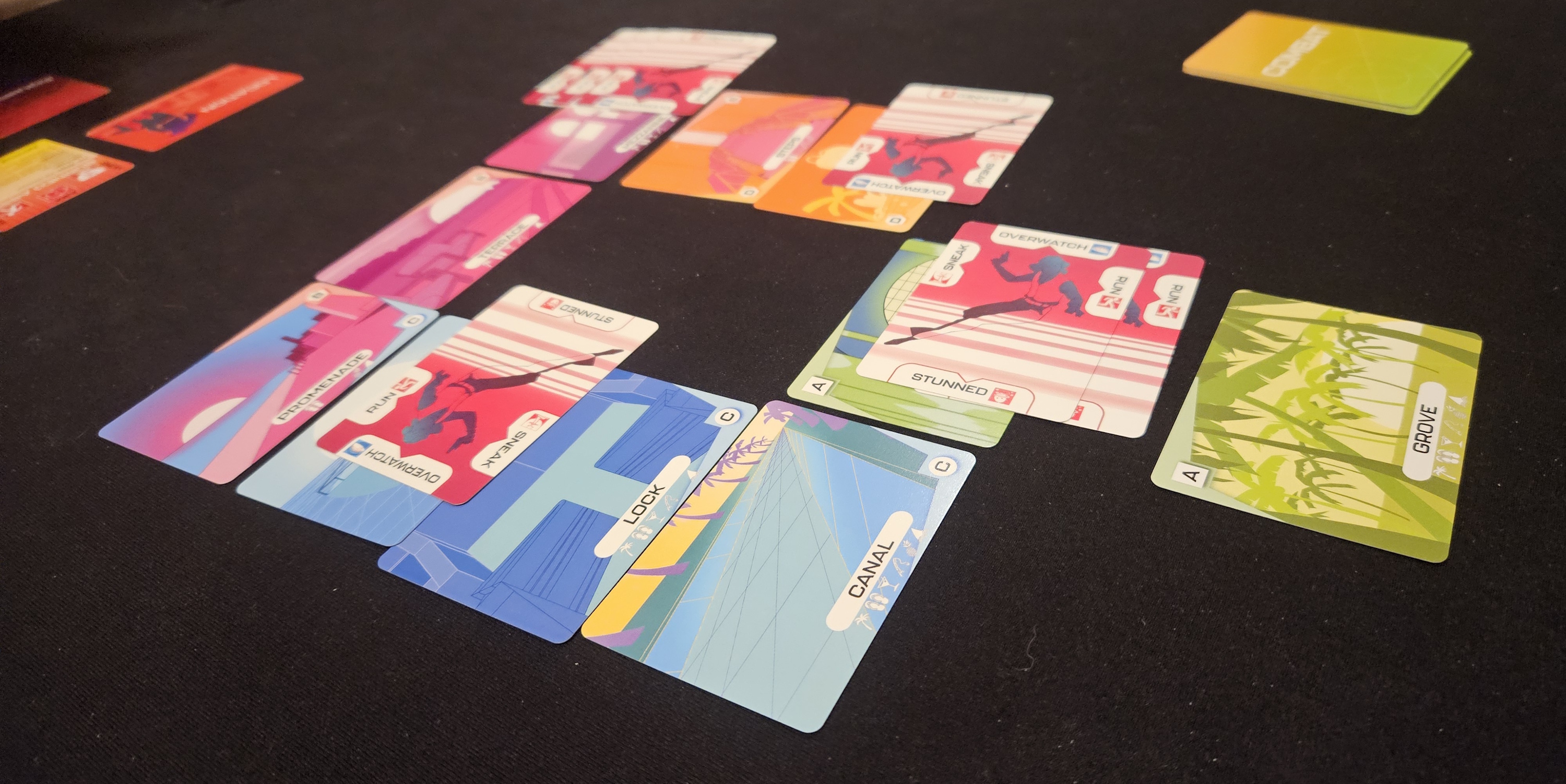
Along the way, Moffat deploys considerable tricks to sell the illusion that the entire encounter is measured in heartbeats. For example, there’s the map. Unlike many other hidden movement games, which deploy geography in the most literal sense, the space in Burned is more impressionistic. Depending on the layout, the entire area might be confined to the square footage of a hotel. And not an especially large hotel. One card will be a courtyard; another, a terrace. One space is just “steps.” Another is a fountain. Stealth, then, is a matter of ducking out of sight, not putting miles between pursued and pursuer.

This sensation of proximity extends well beyond card titles. Both sides move the same way, either walking or running from one card to another. Walking means moving to a card that matches the color of the one you’re standing on; running means moving anywhere — literally anywhere at all — but incurring a penalty, whether announcing the color of the destination if you’re the Burned Asset, or putting your mooks at risk if you’re the Agency. Meanwhile, some cards show multiple colors. These are crossroads, spots one might pass between colors without having to tip their hand.

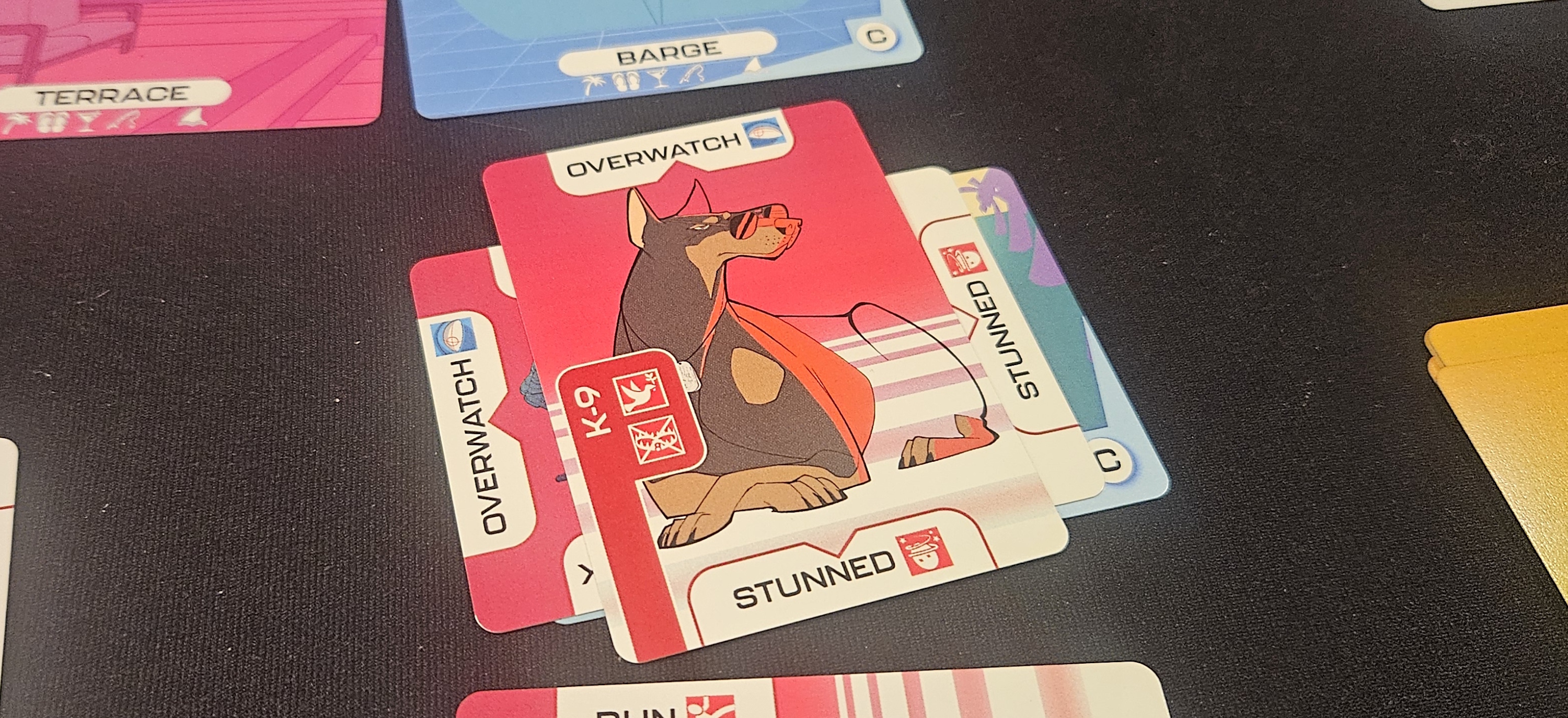
rawrf

That is one cool pup.

The effect is thrilling. Because every spot on the map is within reach of every other spot, there’s no such thing as outrunning your opponent. You can buy time, sure. You can duck away from a fight that’s getting too hot. But Burned is a chase scene in a confined space, not an entire cat-and-mouse flick. It’s like that moment in A History of Violence where one character outfoxes another by shutting a door in their face, or the single-take fight scene from Atomic Blonde that rolls through a single apartment block, or every other scene in a Bourne movie.

Of course, this wouldn’t work without Burned’s unusually high body count. Most hidden movement games offer a certain asymmetry of vulnerability, where the one being pursued is in danger of losing their life while the greatest risk to the pursuer is the loss of some time. I’m thinking of the Hunters from Specter Ops, who can be stunned but never put down for good, or even the shark from Kelp, for whom failure means missing out on dinner.

Here, nothing could be further from the truth. The Burned Asset is uniquely vulnerable because he’s alone. But the Agency, despite being the better-staffed half of this equation, is almost assured to suffer the greater casualties. When the scene opens, they have seven agents. Most of these will probably be run-of-the-mill operatives. Mooks, in other words, there to chase the Burned Asset and, in all likelihood, give their lives in the attempt. One or two might be spotters, relatively peaceful mooks who are better avoided than assaulted directly, or even canine units that are experts at sniffing out traps.

But the Agency isn’t untouchable. Their principal aim is to kill the Burned Asset, but they’re playing a double game. This entire shebang began as an ambush. So the big guy is here, the Director of the whole rotten apple pie, along with his body double. If the Burned Asset takes down the Director — and possibly the body double as well, depending on the order things shake out — then it’s curtains for the Agency.

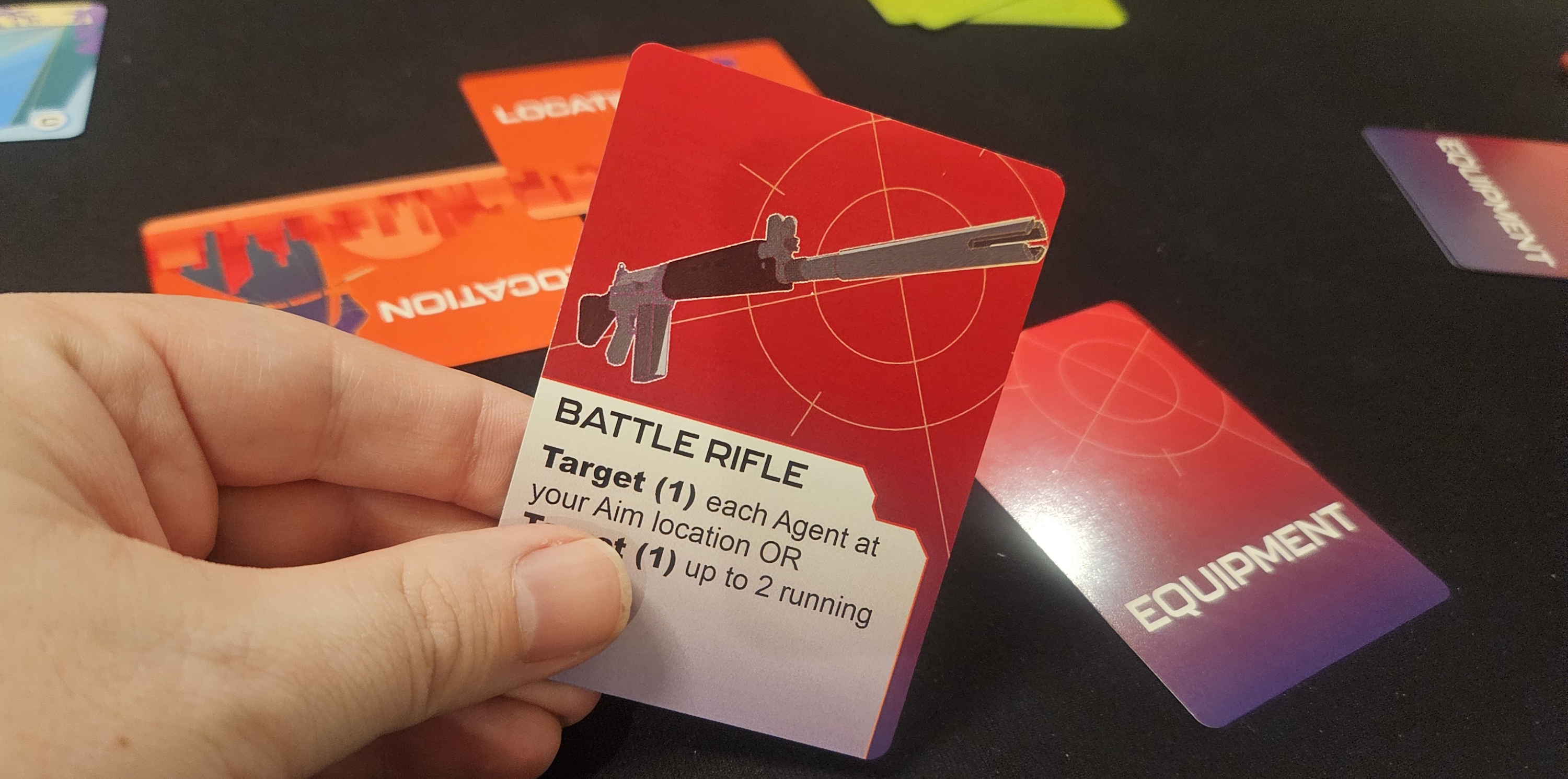
The result is a chase in both directions. A highly lopsided chase, to be sure. A chase where one side is doing the bulk of the chasing and the other is usually the chasee. But it’s also a chase where the hunted can very rapidly turn the tables and become the hunter. With the application of a few bullets, a grenade, maybe a bear trap, anything is possible.

The game allows you to choose from a number of kits, and even build your own. Already I have my favorites.

Blammo.

I suppose it bears mentioning that the Burned Asset is the harder role to play. Manpower counts for a lot, and seven to one makes for formidable odds.

In a game this kinetic, this cinematic, and this brief, however, it’s hard to consider that a shortcoming. I have complicated thoughts about balance in the first place — foremost that it’s overrated — and it strikes me as fitting that a contest between one man, no matter how well trained and outfitted, against seven other killers, should be a little tipsy on the scales.

More than that, though, many of my favorite moments in Burned were those that saw me failing to accomplish my objective. One instance in particular stands out. After setting up the map, I positioned myself at an intersection, an obvious hiding place with ready access to two major areas. Right away, the Agency zeroed in on my position. Within a single action, I had been injured. We’re talking twenty seconds into the game here.

But I had planned for this. All according to plan. I popped some tear gas, a single-use tool that stunned every agent at locations of my color. This just so happened to be every single agent in the game. And while two agents had fanned out to secure the area, the rest were clustered atop a single mezzanine.

That gave me a free move, completely unharassed, to do whatever I wanted. That’s an eternity in Burned. So I chose my next move carefully. I took careful aim at the mezzanine. Five agents in my crosshairs. And then I sprayed lead.

Hits in Burned resolve according to a simple deck draw. One by one, we went through the agents. The first one, an operative: DEAD. The next, the body double: DEAD. Third, another operative: MISSED. Who cares, my target is the big bastard. And there he was. The Director. It was entirely plausible that I might win the match within one minute of completing setup. We flipped the next card, and

MISSED.

Dammit. The other agent got away, too. I’ll type it out for consistency’s sake: MISSED. But, hey, that was fine. With so much of its manpower already bleeding out, the Agency was in a bind. I ran. Hid. Tried to regroup.

It didn’t pan out. A little while later, another agent found me and inflicted my second wound. I killed him back, but the exchange left me on death’s door. On the next turn, I shot the wrong guy. He turned out to be a spotter. Which meant whatever sniper was covering his location popped me next. Blammo. Lights out for the Burned Asset.

But the takeaway from this anecdote isn’t that I failed. It’s that Burned produces moments of effortless kino. Every duel feels close. Every shot, every flipped card, every knife duel, every booby trap, every reveal. Sure, the outcome was more The American than John Wick. Sometimes, that’s how the cookie crumbles. When I missed the Director after shooting his body double, I shouted. Yelped, more like. Woke up my friend’s dog. That’s how invested we were in that moment.

As the Burned Asset you can, in theory, double back to where you've been shot. It's always a bad idea. Instead of hiding, you mope around in the open, surely traumatized by the gunshot wound, which inevitably draws too much attention.

Injuries and overwatch both restrict the Burned Asset’s movements.

This isn’t the first time I’ve been excited about a tiny stealth game. I’m thinking about Fugitive, another box that can squeeze into your average jeans pocket. (Or slip comfortably into a cargo pocket, if you happen to be a person of high fashion and leisure.)

But what makes Burned remarkable is not only its size, not only its duration. It’s the way the game conveys cinematic action rather than deductive logic. This is one of those rare hidden movement games that’s about motion instead of movement ranges. At no point does anyone count spaces. There’s no fretting over doubling-back rules. In place of the mechanism’s usual trappings, one finds pure animation, pure punch, pure heft. Which is to say, it evokes feeling more than analysis, a rare strength in such an analytical medium.

In more straightforward terms, it handles like a weapon. It feels heavy and dangerous in my hand. It incites to deeds of make-believe violence. I missed my shot at the Director this time. Next time, and the next, and the time after that, the bastard is going all the way down.


A complimentary copy of Burned was provided by the designer.

(If what I’m doing at Space-Biff! is valuable to you in some way, please consider dropping by my Patreon campaign or Ko-fi. Right now, supporters can read about which films I watched in 2025, including some brief thoughts on each. That’s 44 movies! That’s a lot, unless you see, like, 45 or more movies in a year!)

Shiny New Editions of Fan Favorites

by Steph Hodge

I have been playing and hearing about a bunch of new editions for games getting reprinted with new artwork. This excites me because I love it when a game gets a boost, as it often means new gamers can discover and play it.

▪️ Floodgate Games just released a remastered version of Sagrada along with plans to release expansions as well.

Sagrada is a cozy, puzzley dice-drafting game where you build a stained glass window by placing colorful translucent dice on your board. The rules take about 5 minutes to learn, but every game gives you a completely different puzzle to solve.


The first expansion to be released is Sagrada: Panorama, which will include playing with up to 6 players as well as other new content:

Lightboards: New personal boards that offer long-term planning and strategic opportunities.
Panorama Shared Objectives: A new cooperative-style scoring mechanism where artisans must work with their immediate neighbors to score points.
Focal Point Private Objectives: Private goals that reward players for placing specific dice in designated spaces within their window.
New Tools: Includes 6 additional tool cards to manipulate dice and navigate placement restrictions.

I got permission to share this early.


▪️ CrowD Games had a very successful Kickstarter back in May 2025 for the highly anticipated Nippon: Zaibatsu. Nippon designed by Nuno Bizarro Sentieiro and Paulo Soledade, has been on my shelf since it was released, but it is also an example of a game that was very hard to get. Gamers are looking for this type of game revival. A hot, hard-to-find game with gorgeous presentation and streamlined mechanics.

Nippon: Zaibatsu is a fast-paced, highly competitive area-majority worker-placement game where actions can’t be blocked. It is set in a Meiji-era Japan, when rapid industrialization was transforming the life of the entire country.

In the game, players invest in new industries, build factories and railroads, and produce goods to saturate local markets and fulfill contracts — all to grow their influence and power and to become rulers of the new modernized country.

Nippon: Zaibatsu is an enhanced and reimagined anniversary edition of Nippon (2015), which was well-acclaimed and popular around the world.

[imageid=8820600 medium rep]

Nuno Bizarro Sentieiro and Paulo Soledade with Nippon: Zaibatsu pre-production copy at LeiriaCon - [user=deerstop][/user]


▪️ Allplay has been releasing a bunch of smaller boxed games each year, and there are always a handful of games being revived with a fresh new look. I am always in awe of all the games they are able to create each year. Here are just a few.

Piñatas by Reiner Knizia has been reimaged a few times before. Originally, it was known as Voodoo Prince , then later as Marshmallow Test. Piñatas has that burst of color that fits right in line with the other Allplay titles. This is part of the Allplay "Tricky Card Game" series, as it is a trick-taking game.

Another Knizia card game of interest might be High Society which has been through many iterations. The game was originally released in 1995 and has been a staple in many collections throughout the years. I am all in favor of bringing back classic auction and bidding games, as they are mechanics I highly enjoy and would always love to see more of. About High Society:
Bid to acquire number and multiplier cards, trying to avoid the pitfalls of wealth (negative and divisor cards). Careful—the player with the least money can’t win!


Container is a game that is always looking for more editions because it is so well-loved. This is an all-new edition releasing in Q4. Container first released in 2007 and then later in 2018 as Container: 10th Anniversary Jumbo Edition!. This is a highly sought-after game, so it is great for Allplay to make the game more accessible now.

Build factories, produce containers, set prices, negotiate with your rivals, and sail across the sea to trade. Obviously, buy low, sell high. But can you make it happen?
It's the definitive Container experience. With modern production, beautiful components, and delightful artwork that a game of this caliber deserves, it's poised to become your favorite game (before you've ever even played it).

❌