❌

Normale Ansicht

Playing with Cellulose Fiber

24. Juli 2026 um 23:06

Uh oh, did I list these in increasing order of goodness? YES. YES I DID. FOR I AM THE DECIDER OF GAMES, AND ALL SHALL KNOW MY LOGIC.

Paper! Despite the meddling of the internet, it’s still everywhere. There’s a good chance you have some in your very own home. In fact, it’s probably within arm’s reach right now. Coming for you. Fluttering closer. Ready to give you a stingy cut on the fingertip.

But for all its sins, paper is good for a few things. Making board games happens to be one of them. And today, I’m going to talk about three paper games I’ve been playing this week.
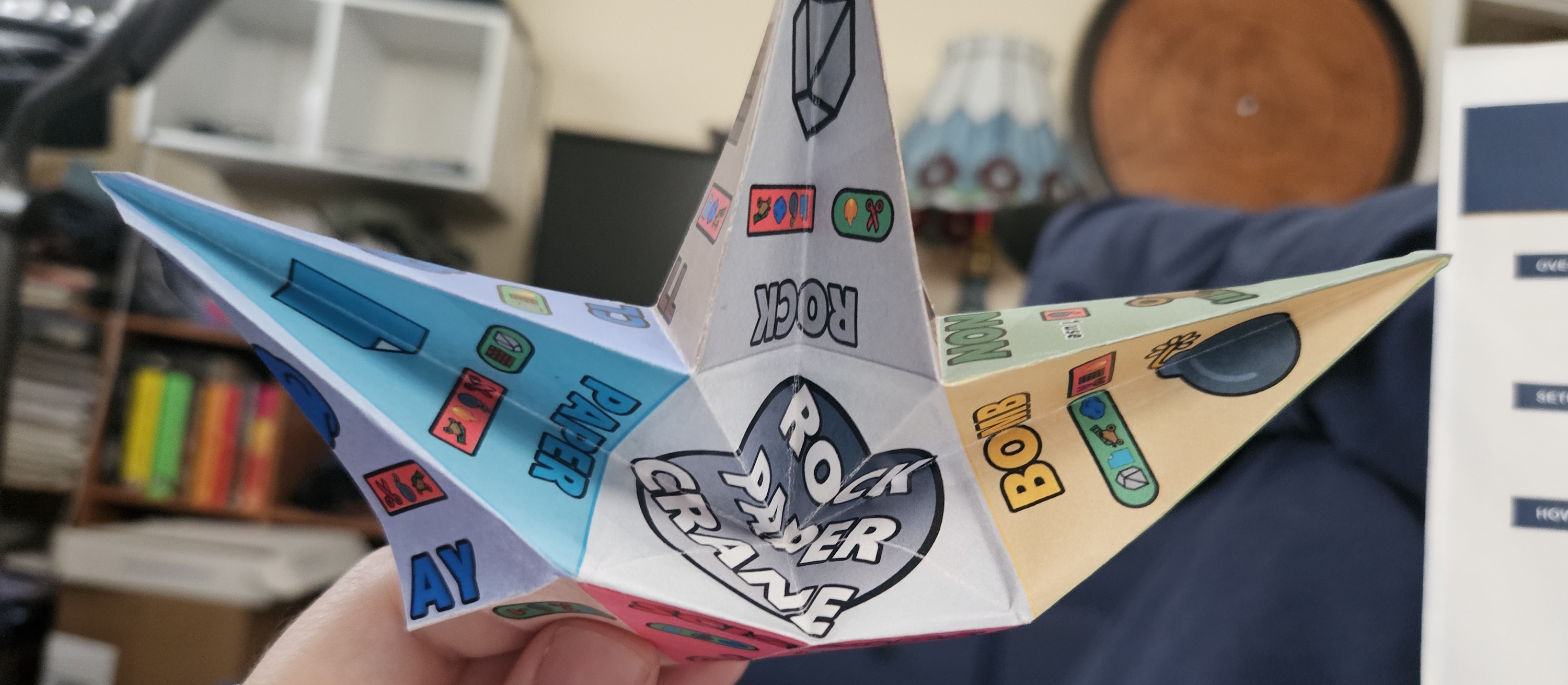
they're called colts, but that's super weird

A crane chick.

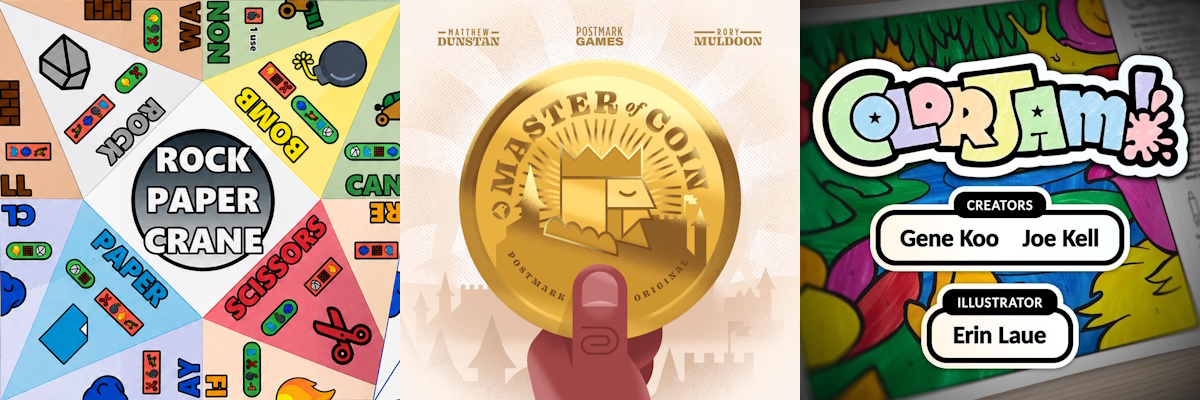
Rock Paper Crane

Rock Paper Crane bills itself as the world’s first-ever origami card game. True to its word, its construction requires you to craft the first couple of steps for making an origami crane.

Okay, so that’s the first problem. I dabbled in origami once. But I also happened to be six years old. Also, my little sister ruined my collection of nice origami papers, so I decided to spite her by never going back to the hobby or informing her or really imposing even the slightest imposition on her in any way. Which is to say, I finally fumbled together those first few steps. But the magic is in the fingers, not the voice, so as I labored to instruct my wife in how to shape her crane, I may have uttered the phrase, “You need to tuck in that piece, you’ve got it all popped out and flabby,” to which she replied, with a rather elevated voice, “You’re all popped out and flabby!”

So. Um. Be careful who you play Rock Paper Crane with.
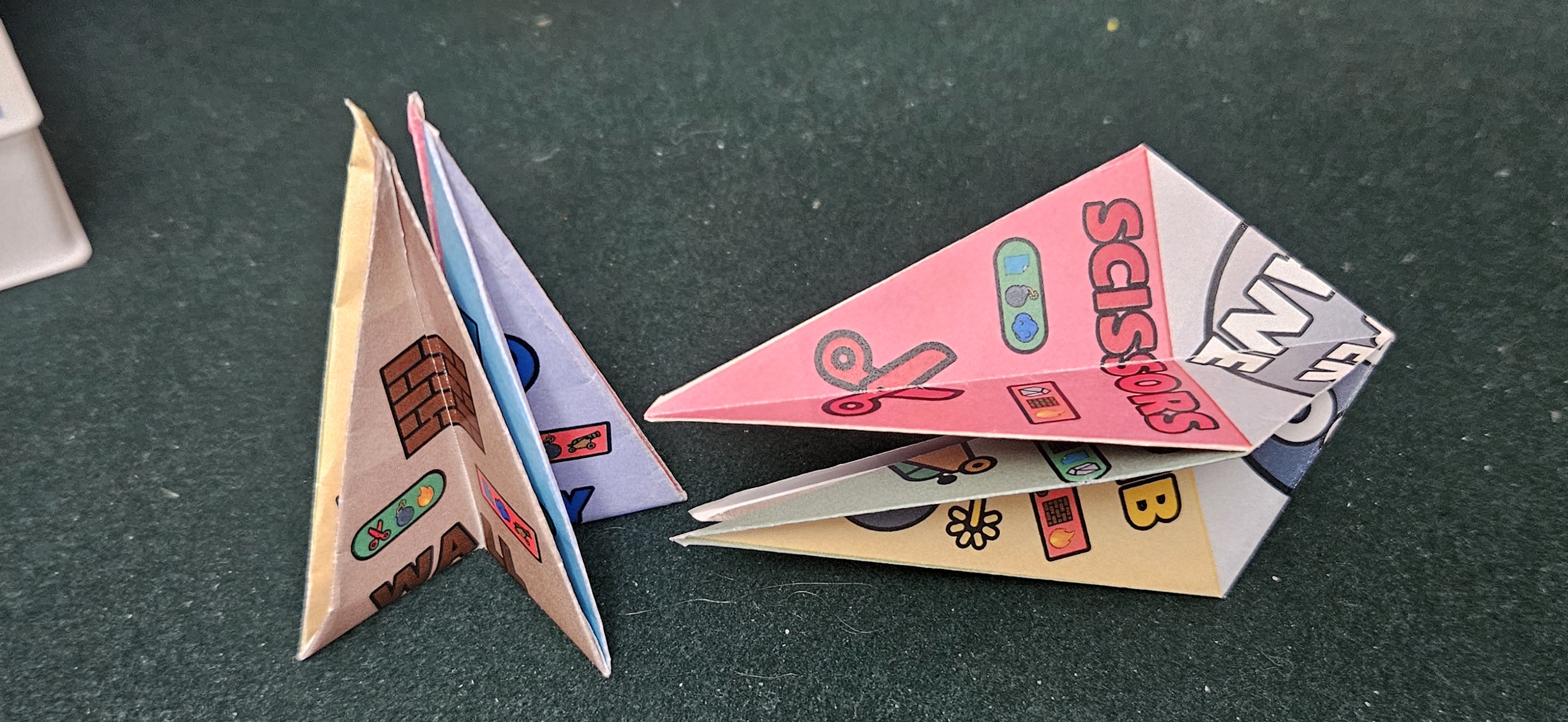
I don't remember the next step. Nor will I ever.

Crane, interrupted.

Once assembled, Rock Paper Crane is Rock Paper Scissors with extra steps. For one thing, there’s an extra piece, the bomb. For another, winning a throw means you upgrade one of your sides. (Pause for origami.) Rock becomes wall. Paper becomes clay. Scissors become fire. That sort of thing.

Your objective, ultimately, is to win four throws, which will bring you one step closer to a finished crane. More importantly, you will have won the game. Or lost it, which is just as good, because, like I said, Rock Paper Crane is Rock Paper Scissors with extra steps.

Did I finish my crane? Nope. I couldn’t remember past those first two steps. Honestly, it’s pretty amazing that I got this far at all. Maybe I could have looked up the next instructions. But I swore an oath to never finish an origami ever again, and I’m true to my word. Take that, Mary.
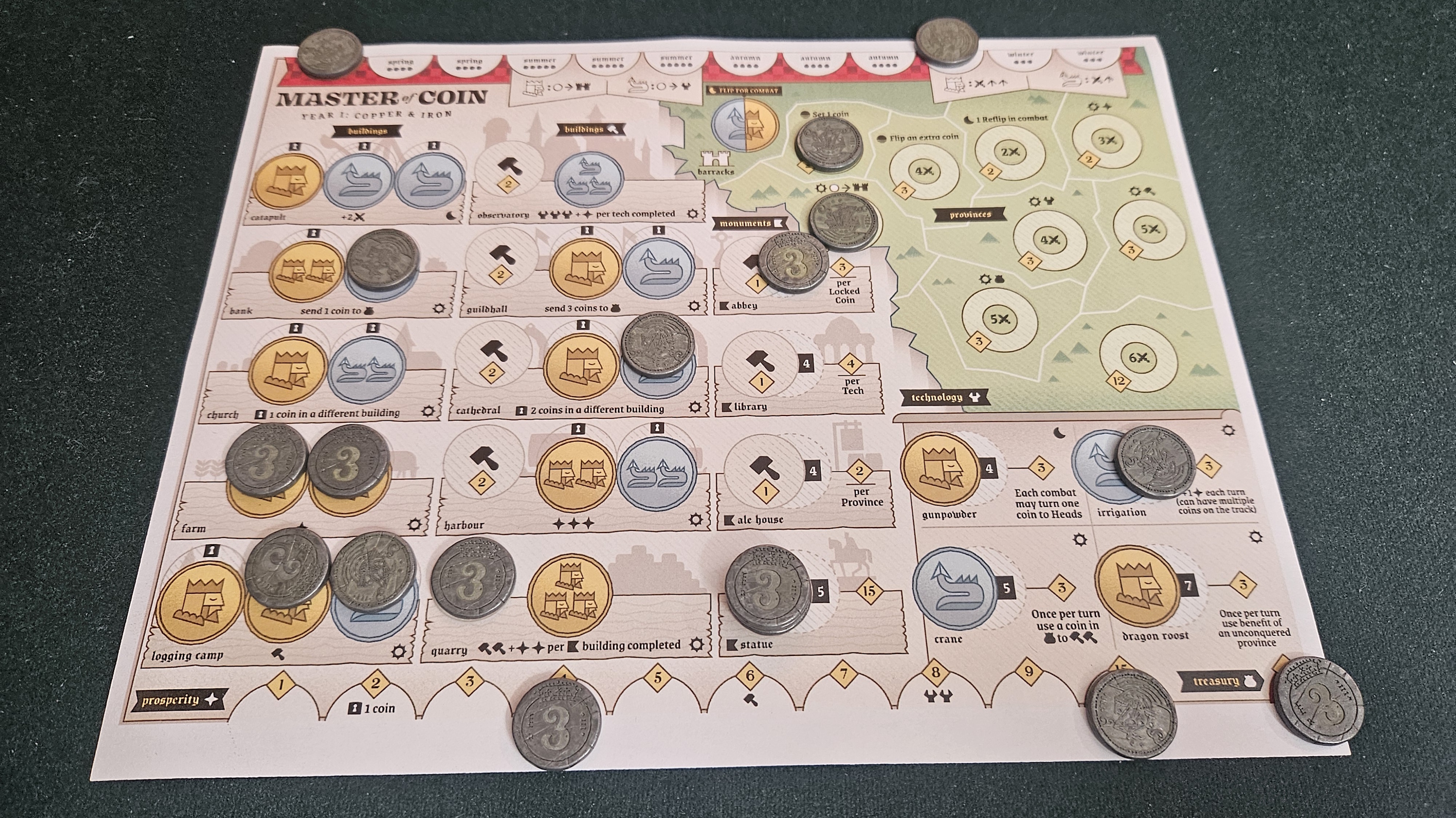
Hm. Can I use this game to teach my children how to operate my kingdom long after I have departed this mortal realm?

Putting coins on paper.

Master of Coin

Master of Coin is the eighth title from Postmark Games that I’ve played, and this time Rory Muldoon and Matthew Dunstan are ditching the dice and the cards. Their replacement? Coins, of course. It’s right there the title.

As you might expect, Master of Coin makes good on its conceit by requiring you to flip so many coins that your fingers will start to smell rather pockety indeed. Covering a single year in the history of a small kingdom, you begin each month by picking up some number of coins — the exact quantity varies by season — and flipping them to determine how many heads and tails you have to work with.

Early on, your options are finite. A few basic buildings, some technologies, and any leftover orphans packed off to the army. But it isn’t long before the gameplay begins to accelerate. Once completed, you can clear a building of its coins to activate its ability, whether to unlock better structures, develop your nation’s economic infrastructure, obtain perks in war and peace, or maybe construct monuments that unlock better scoring benefits. Crucially, some abilities let you “lock” coins, sliding them a few millimeters upward on your sheet. From that point on, when you clear the corresponding structure, any locked coins stay in place.

As a concept, Master of Coin is solid. Consider the army. When it’s time to march on neighboring provinces, you pick up all the coins in your army and give them a flip. Heads become indicators of conquest, while tails are failures. But there are so many ways to massage the odds. Certain buildings, like the catapult, can be cleared to produce guaranteed successes in battle. Or there are techs, like gunpowder, that let you shift a coin from tails to heads, saving you in the nick of time. All this is to say that there are ample ways to get ahead. Even if you, as happened to our group, happen to play a session with novelty coins that always flip heads.
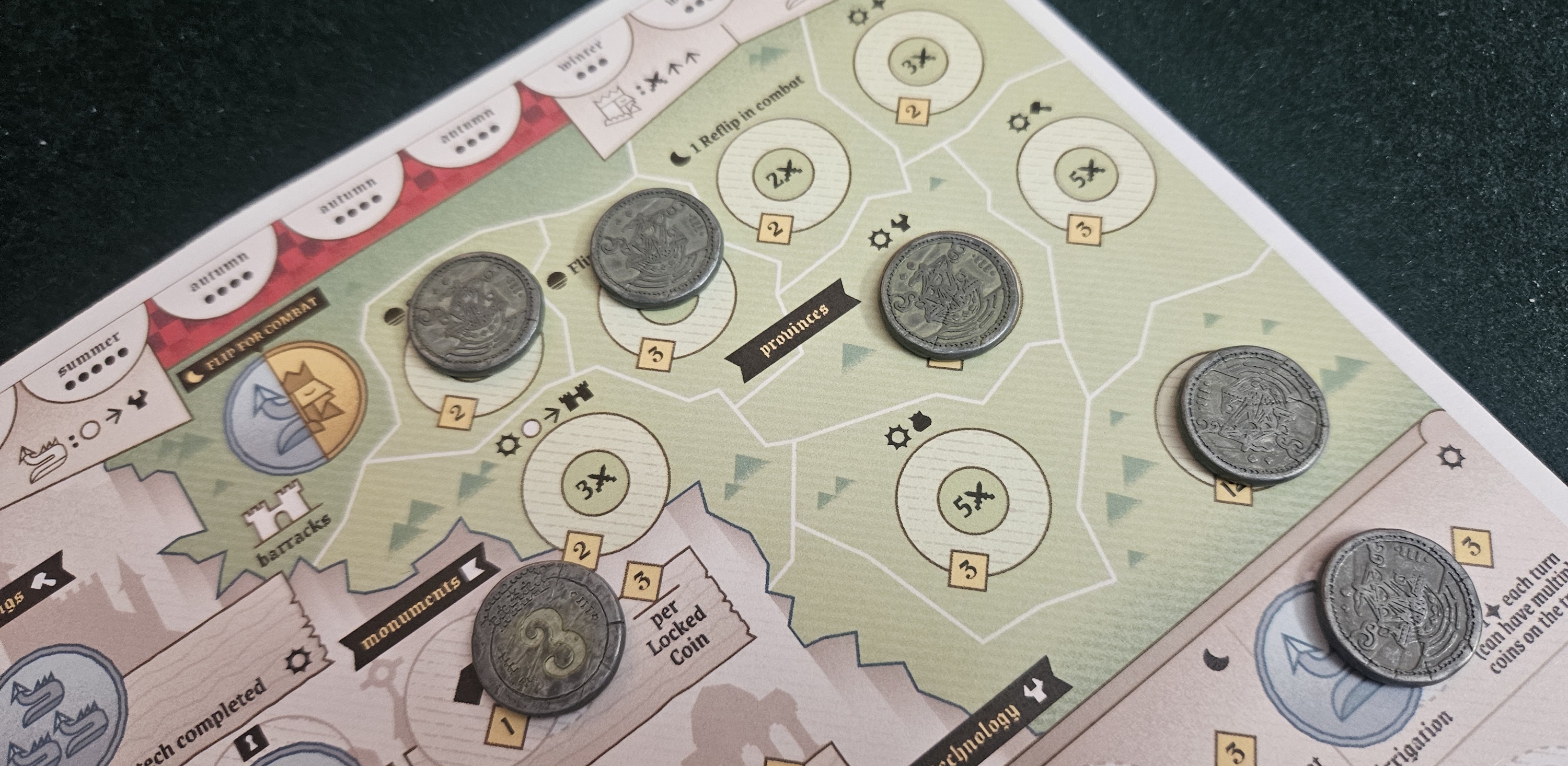
aitg

Money is great for conquering distant nations.

Of course, there’s more to be seen. As with previous Postmark titles, Master of Coin isn’t limited to a single map. The game is on Kickstarter right now, and according to the campaign there will be five scenarios in all, each adding a year to the story of this wealthy kingdom and its unfortunate neighbors.

Unlike those previous Postmark titles, however, I’ve only tried the first scenario, so I’m unable to furnish a full review at this time. The good news is that what I’ve played has been exemplary. Very quickly, I was surprised that my kingdom’s main limitation didn’t lie with having too little money, but rather in keeping too many coins tied up in other projects. The kingdom only has access to twenty coins, you see, and two of those are reserved for tracking the month and any possible events. It isn’t long before you’ll need to make some tough decisions, forsaking certain appendages of your financial project altogether to double down on whatever has become most important.

Anyway. After not being all that enthralled with Postmark’s playing card games, Master of Coin feels like a return to form, capturing some of the tight but expressive playspace of titles like Voyages and Waypoints. I’m excited to see how this one develops.
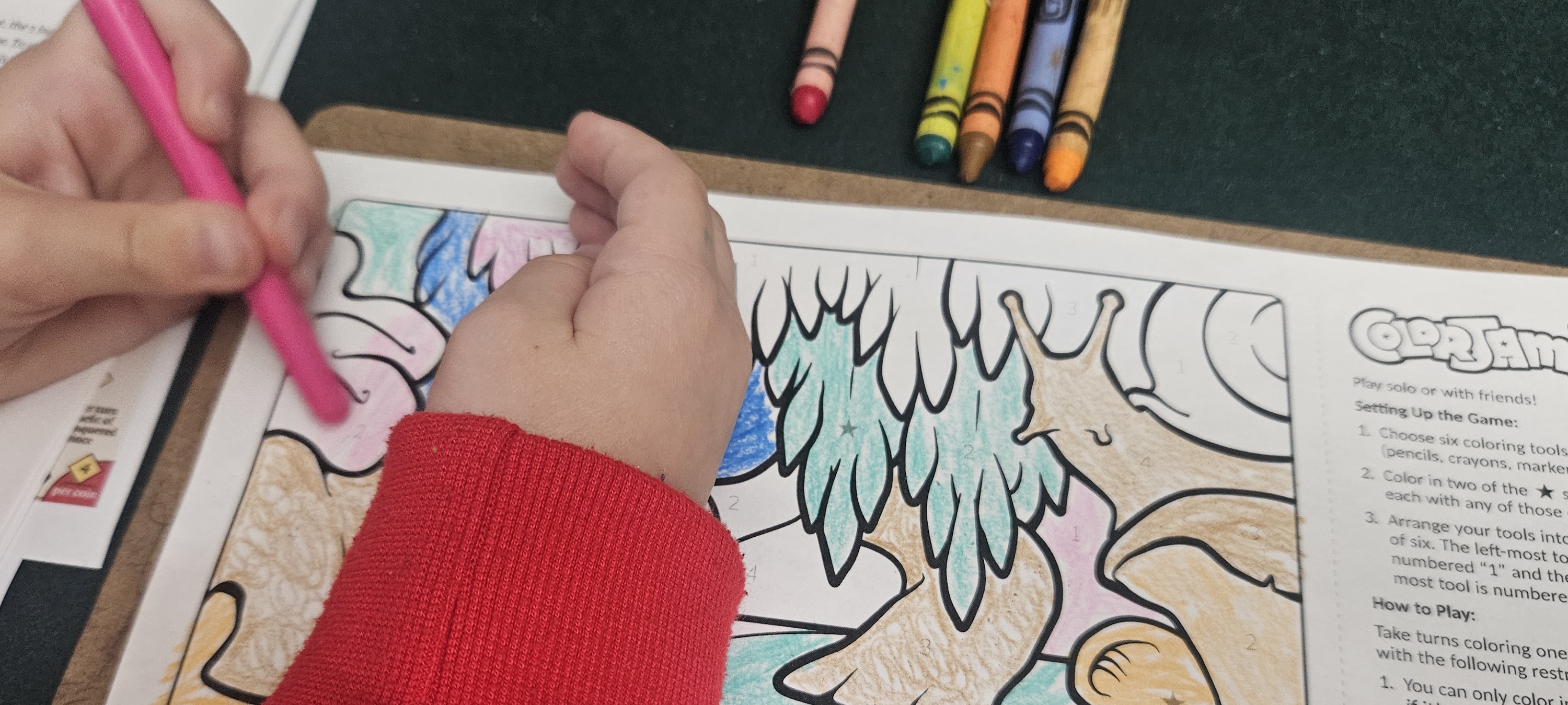
With rice. Maybe butter. Kidding! I don't like rice.

I love little fingers.

Color Jam

When’s the last time you colored by numbers? Being a parent to a recent kindergartner means it hasn’t been as long as it might have been otherwise, but this still isn’t a regular occurrence of my daily life.

Until Color Jam. Designed by Gene Koo and Joe Kell, and illustrated by Erin Laue, Color Jam is about coloring by numbers. And contrary to my expectations going in, it’s wonderful.

But first, a note. Color Jam is being published by Lunarpunk Games, the indie imprint operated by Xoe Allred and Matthew Hocker. If you’re elbows-deep in the indie scene, this might already tell you something about the game. Foremost, Color Jam doesn’t have the usual victory conditions. Nor does it really have goals, at least not goals of the foreordained variety. You’re here to make your own fun, set your own benchmarks, and, hopefully, come away charmed.
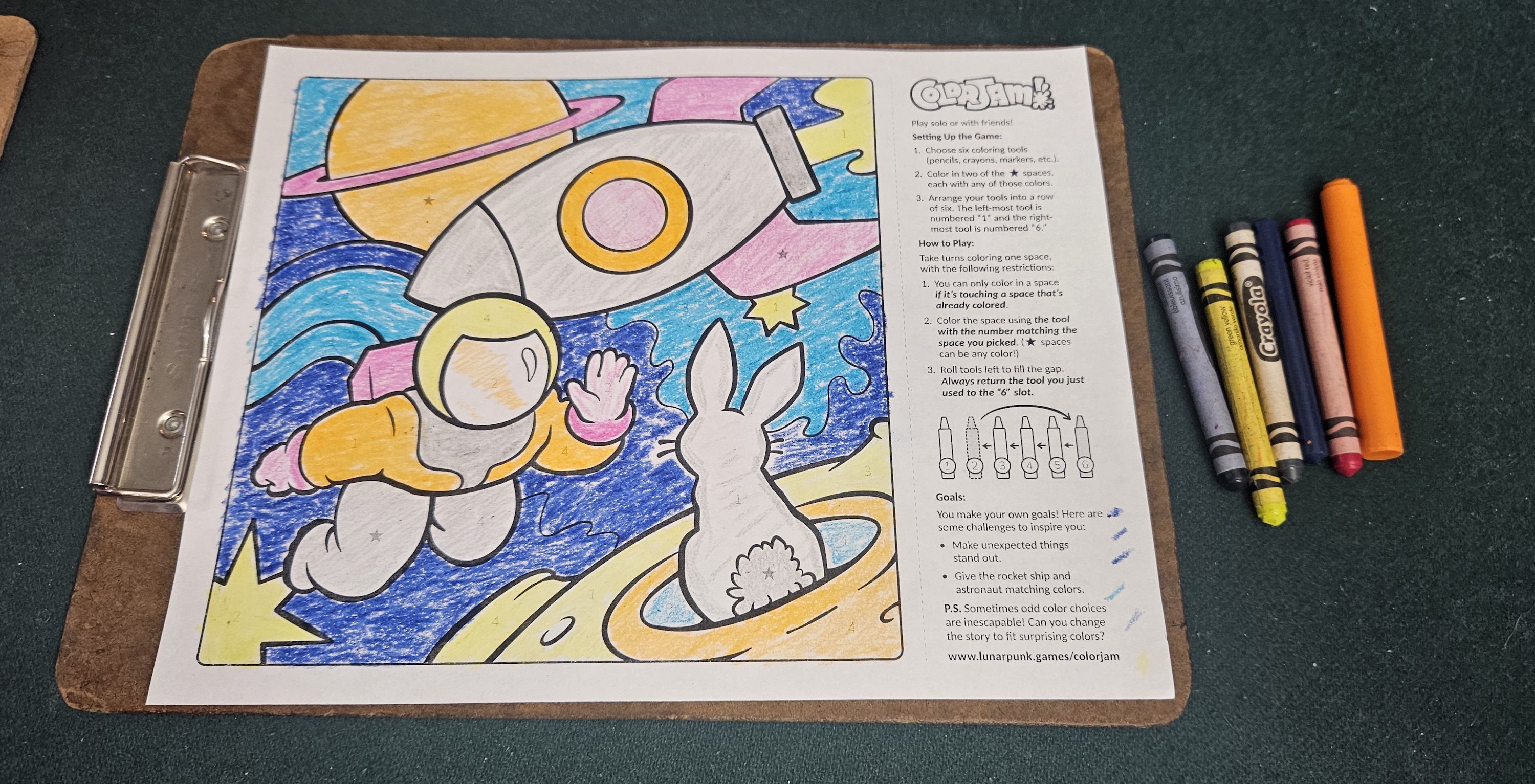
This is the future liberals want.

I am inordinately proud of my art.

The basic idea is as simple as it gets. You take a picture and six crayons. Then you color in two of the spaces with stars in them. There are always four options, giving you some range to where you begin on the page.

From that humble beginning, you start to color in the entire thing. But there are limitations. Beautiful, expansive limitations. For one thing, you can only color a cell next to something you’ve already filled in. More importantly, those six crayons? You put them in order, numbered one to six. When you color a space, you use the corresponding crayon. Then — and this is where the game starts to breathe — you take that crayon and shift it to the last place.

Now, this might not sound like much. But it transforms Color Jam from an elementary school project into something unexpected. You might want consistency. The wings of a butterfly to align, perhaps. But the right crayon might not be available. Or, when the right crayon comes up again, maybe you’ll want it for something else.

What do you do? Well, you get creative. Maybe this butterfly is prismatic, like a jeweled brooch, its colors vibrant but mismatched. The colors can become revelatory, streaks of the unexpected in what might have otherwise been an ordinary picture. Or maybe you start to plan ahead, counting the crayons down until the right one is ready for another scribble, transforming the page into a low-stakes logic puzzle. Or perhaps you get artistic. You can do a lot with shading, with the strokes of a crayon, with the application of a smudge or a smear. Two spaces that both use orange don’t need to look the same. This isn’t the paint bucket in an image editor. You can do whatever you like.
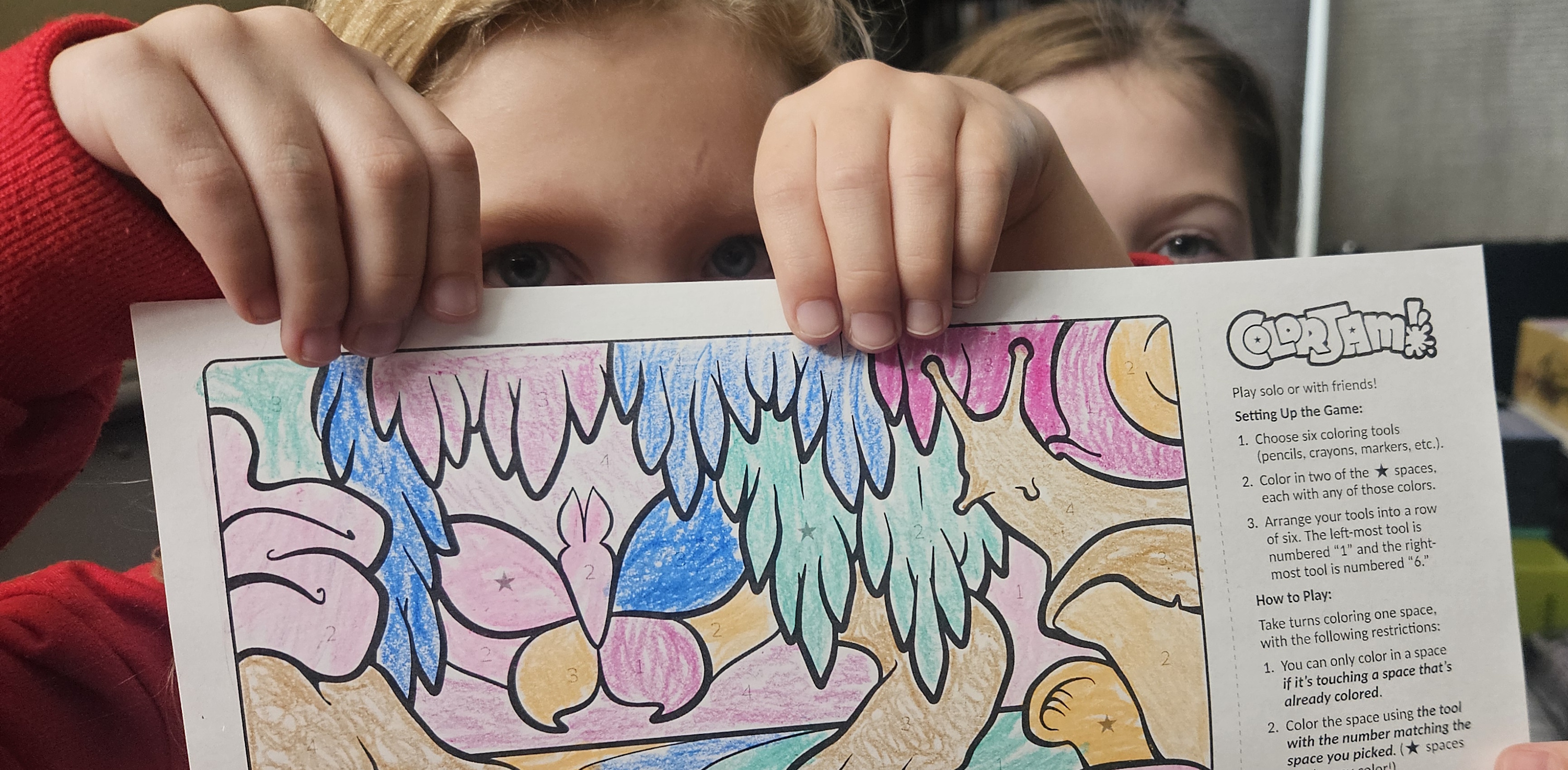
One day this picture will be worth no cents, because a robot will have ripped it off to make slop.

The artists.

More than that, Color Jam is flexible. It’s possible to play solitaire, one person making every decision. But it’s also possible to play as a group. I played with both of my daughters, and everybody got a say in the creation of our picture. Over which crayons we pulled from the bucket. Over the turn order. Eventually, over how to account for colors that wouldn’t quite fit where we wanted them.

The most unsurprising thing about Color Jam, but which bears repeating, is that it’s simply delightful. It’s soothing to play, but thinkier than one might expect from a distance. We played together, and then we all played apart. And then Summer came home and wanted to play as well, so we did that, too. In each case, we came away having crafted something wonderful, whether in collaboration or on our own, whether according to strict logic and long-term thinking or creative storytelling, and felt all the richer for it.

Color Jam will be on Kickstarter sometime in the next month or so.


Access to the files and/or complimentary copies of Rock Paper Crane, Master of Coin, and Paper Jam were provided by the designers.

(If what I’m doing at Space-Biff! is valuable to you in some way, please consider dropping by my Patreon campaign or Ko-fi. Right now, supporters can read the next installment in my series Talking About Games, this time tackling the topic of what makes a good list! Naturally, the piece includes a list.)

Inkwell Review – For illustrative purposes only?

Von: Adam
24. Juli 2026 um 17:27

A review copy of Inkwell was kindly provided by Zatu Trade. Thoughts & opinions are my own. Inkwell is one of those games that makes you want to touch it. The soft closing of the magnetic clasp on the box. The cloth playmat. The satisfying heft of the little golden cubes. It’s a lovely thing. As far as draft and set-collection games go, it’s pretty decent. There’s a lot here to like…

Source

Top 10 Board Games I Thought I’d Love But Broke Up With

24. Juli 2026 um 15:06
Scythe ReviewWe’ve all been there. You see a game, love the art, hear the hype, and think: “This is the one. We are going to grow old together.” But then the cardboard hits the table, you play it, and the spark just isn’t there. Not because they’re bad games, but because they just weren’t the right […]

Source

Leviathan Wilds: Shattered Peak Expansion Review

Part of the fun of engaging with a system built around different characters, classes, species, or any other mode of substantive differentiation, is finding the build that’s right for you. Everyone who likes Root has a favorite faction, everyone who plays Magic has a favorite color, and the wonderful thing is that these preferences are almost always deeper than mechanics. If you’re lucky, if everything clicks, your chosen avatar feels ‌like an extension of yourself. There is something about playing as the Lizard Cult that elicits a deeper joy for me. Am I going to win? Probably not, but boy I’m going to have a great time. Blue may leave me with no friends, but I’m enjoying myself.

Leviathan Wilds has been my favorite cooperative game for a while now, and while I was equally fulsome in my praise of the first expansion, it is only now with second expansion Shattered Peak that I can say I have found the Class for me. The Geomancer, one of three new Classes that join three new Climbers and eleven new Leviathans in this box, feels like home. All the builds in Leviathan Wilds are about running around and smashing infectious crystals, but the Geomancer is the first to mess with those troublesome fungal blooms. He can manipulate their values…

The post Leviathan Wilds: Shattered Peak Expansion Review appeared first on Meeple Mountain.

Quick Peaks – Pirates of Maracaibo: Bermuda Triangle, Kittens in Space, Haunted Mouse, Trans-Siberian Railroad, Dirt & Dust

Pirates of Maracaibo: Bermuda Triangle - Justin Bell

I stand by my 2024 review of the Pirates of Maracaibo base game: I think it is designer Alexander Pfister’s best work, a co-design with Ralph Bienert and Ryan Hendrickson based on Pfister’s 2019 release Maracaibo that completely eliminated the older original from my collection. It’s a race that shears off all the loose ends of Maracaibo, with better card play (the entire map is actually a series of cards), simpler combat, a more comprehensive use of the Exploration board, and a shorter playtime. It was one of the top 10 games I played that year, and I’ve played it more than 15 times in person and more than 100 times on Board Game Arena.

Pirates of Maracaibo: Commanders has a “raison d’etre”: Euro players like to have their asymmetric powers, so Commanders very much as a reason to exist. Pirates of Maracaibo: Bermuda Triangle is the latest expansion, but it is very much a mini expansion. There is a small deck of cards that can be integrated into the decks of the base game, there’s a single solo card, and there’s a single location card (the Kraken) that may or may not add a little flair…

The post Quick Peaks – Pirates of Maracaibo: Bermuda Triangle, Kittens in Space, Haunted Mouse, Trans-Siberian Railroad, Dirt & Dust appeared first on Meeple Mountain.

From Cover to Cover: The Napoleonic Wars: A Global History – Alexander Mikaberidze

Von: Grant
24. Juli 2026 um 14:25

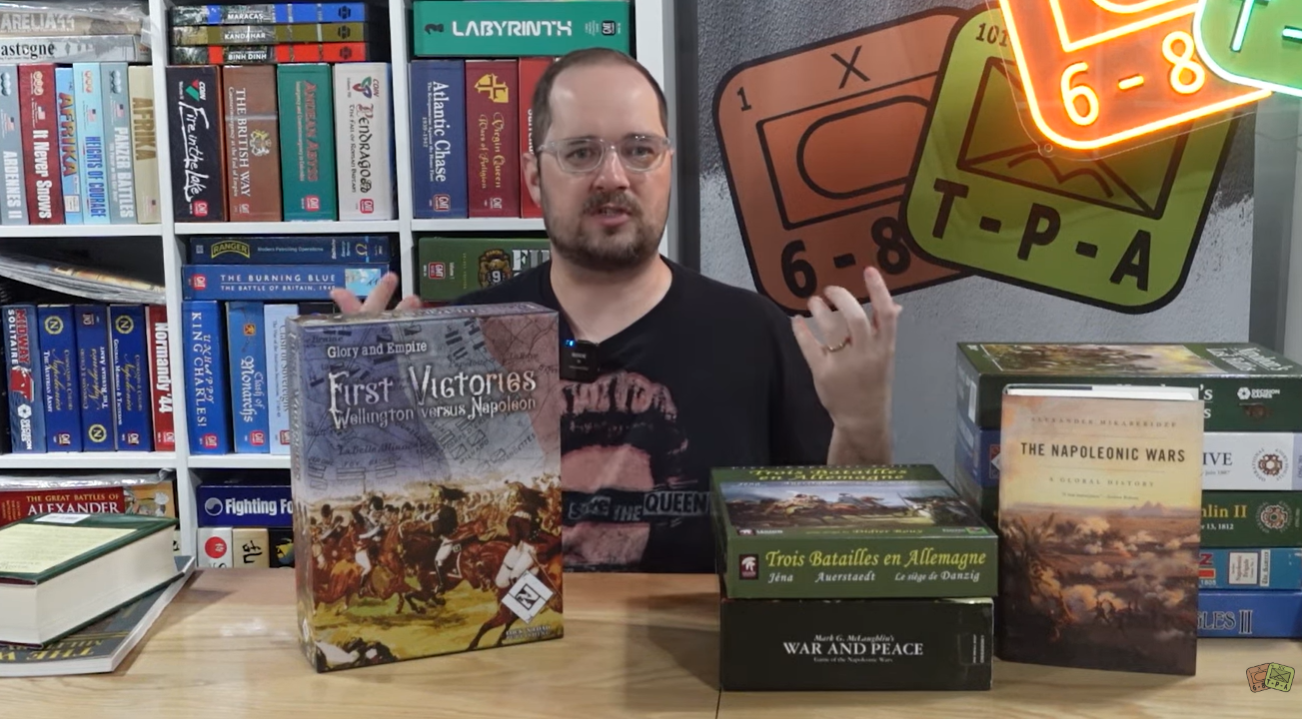
We have an ongoing video series on our YouTube Channel called From Cover to Cover where we read a book on a subject and then pair that with a discussion of the book while covering a few games also on the subject. In this 14th entry in the series, Alexander takes a look at The Napoleonic Wars: A Global History by Alexander Mikaberidze. He then discusses a few games on the subject including Congress of Vienna from GMT Games, Imperial Struggle from GMT Games, Alliance from Columbia Games, Commands & Colors: Napoleonics from GMT Games and The Napoleonic Wars from GMT Games. amongst many others

-Grant

French board game distributor, publisher Atalia enters liquidation, blames market saturation and battle for bestsellers

24. Juli 2026 um 12:55

French board game distributor and publisher Atalia has entered compulsory liquidation, saying an increasingly saturated market, the limited capacity of retailers and the loss of distribution rights to bestselling titles left the business unable to remain viable.

A statement posted to Atalia’s Facebook page said the rapid expansion of the tabletop market since the company was founded in 2015 had created a tougher commercial environment for smaller distributors, despite the industry’s continued growth.

Atalia said that despite soaring numbers of players in that time, “so many new games are being released today that the market has become saturated. Shops no longer have the space, the time or the cash flow to stock all the games arriving each week”.

It added, “They therefore naturally turn to distributors with the biggest marketing budgets, some of whom invest sums each year that exceed Atalia’s annual turnover.

“This year, Atalia has lost the distribution rights for its latest bestsellers, as their publisher has chosen to entrust them to a distributor offering greater financial and marketing resources.

“We naturally respect these decisions, but we cannot hide our regret. Without these bestsellers, it has become increasingly difficult to finance new releases and ensure the company’s long-term viability.

French board game distribution is dominated by industry heavyweights Asmodee and Hachette, the latter via its Gigamic and Blackrock subsidiaries.

Atalia was founded in 2015 as a French board game distributor, before expanding into localisation and then publishing in 2021. It distributed games to hundreds of specialist retailers across France and neighbouring francophone territories.

The company says on its website that it deliberately maintained a relatively small catalogue, so individual games entrusted to it would not be “lost amongst an overwhelming number of titles”.

Earlier this year Atalia revealed it was halting its own distribution operations to focus on publishing and localisation, with its distribution being handled by MAD from May.

Atalia’s previously published releases include French localisations of games including Underwater Cities and Lorenzo il Magnifico, while recent titles published by the company include The Royal Society of Archeology and Hands Off!.

The company had also faced financial difficulties in 2019, despite a prior year in which it had generated revenues of more than €1.8m and continued profitability.

Atalia’s decision to double its headcount to six amid that success backfired when the publisher of Limite Limite, a French adaptation of Cards Against Humanity which accounted for about half Atalia’s revenue, switched to a new distributor in 2019 with no prior warning.

The company placed itself into receivership the same year, but emerged intact from that process in early 2020, citing strong sales of its bestsellers including Punto and Dreamscape, and receiving court-ordered compensation from the publisher of Limite Limite for the abrupt termination of its distribution deal.

Atalia founder Cesare Mainardi

The company’s liquidation announcement today came a month after Atalia founder and managing director Cesare Mainardi revealed it was “facing an extremely difficult period”, and cancelled its planned attendance at the Paris est Ludique festival, citing financial difficulties and organisational constraints.

Atalia officially entered compulsory liquidation on July 8 via Nanterre Commercial Court.

The company’s assets, including stock, brand and customer database, will now be offered for sale by the liquidator. Mainardi said interested parties should contact him via private message on Facebook.

He said in the Facebook post, “Today, we turn the page with our heads held high, feeling immense pride in everything we have built together.

“The people we’ve met, the games we’ve played and the memories created during this adventure will remain with us forever.”

The post French board game distributor, publisher Atalia enters liquidation, blames market saturation and battle for bestsellers first appeared on .

Dale Yu: Review of Splendor Duel and The Counterfeiters expansion

Von: Dale Yu
24. Juli 2026 um 10:24
    Splendor Duel and the Counterfeiters expansion  Designers: Marc Andre, Bruno Cathala  Publisher: Space Cowboys Players: 2 Age: 10+ Time: 30 minutes Amazon affiliate link: https://amzn.to/4aSuCOg ,  https://amzn.to/4fAEBdF Played with review copy provided by publisher Confront your rival guild … Continue reading →

Bean to Bar

Bean to Bar is not your typical Japanese game. When I hear Japanese game, by default I imagine a short, minimalistic and clever card game with few components. Bean to Bar is a complex and heavy Euro style game with many more stuff than just cards. It is a game about making and selling chocolate. You build and run an artisan chocolate empire.  In the game you need to

Yawpz

24. Juli 2026 um 01:44

I'm the little kaiser-kisser on the right, sipping tea with my peers across the lines, oblivious to the carnage around me.

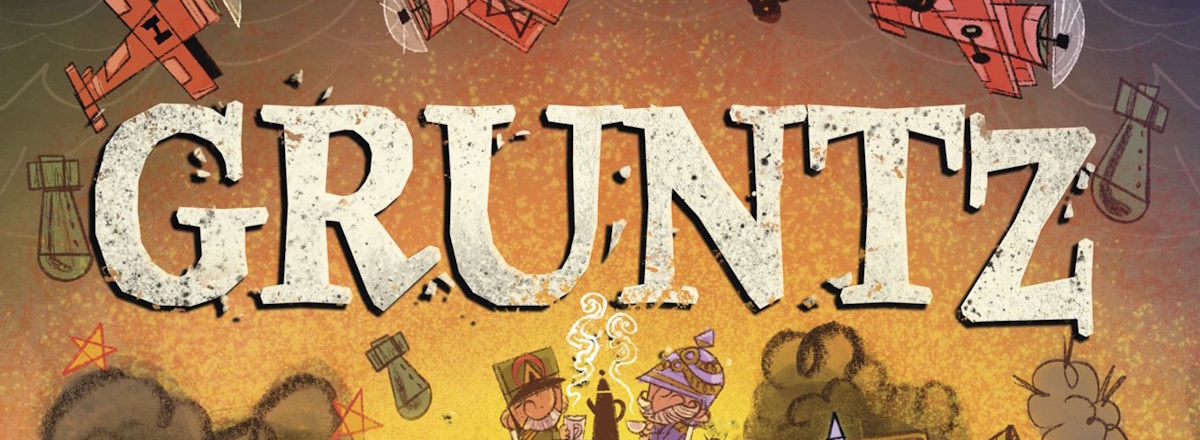
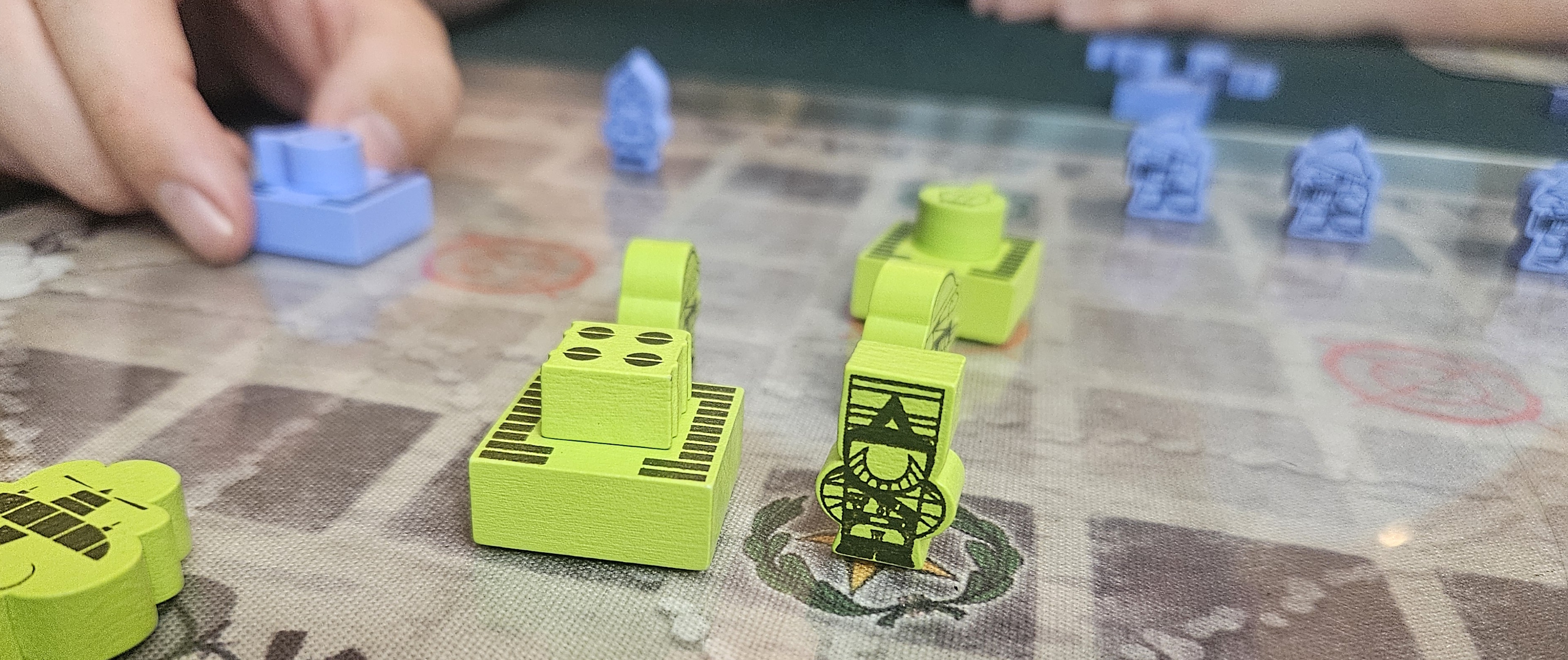
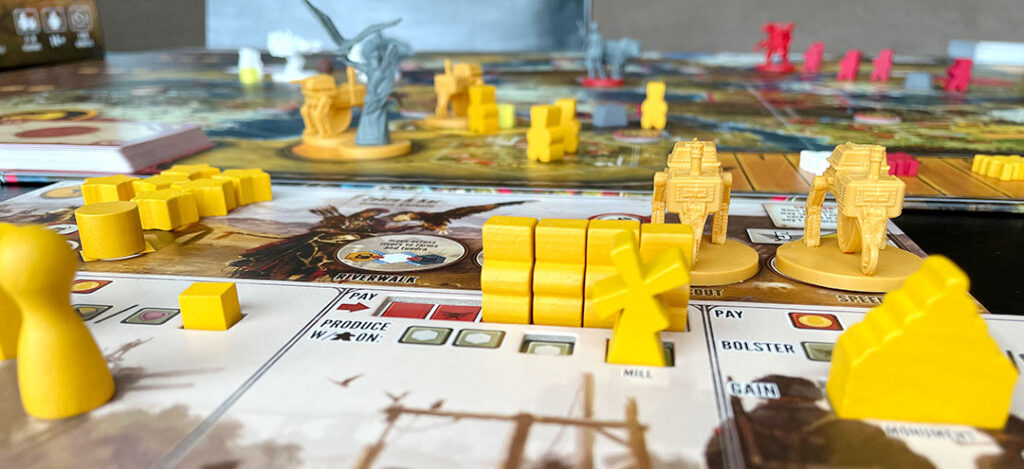
This might sound funny, but the game that kept springing to mind while playing Gruntz, the tiny-as-it-gets wargame by Carter Scott, was none other than Kurt Vonnegut’s GHQ. Like that ancient (but now resuscitated) title, Gruntz is about a pair of World War-era armies bashing it out on the field. They’re both highly attritional, encouraging a tit-for-tat gameplay that’s either enthralling or exhausting depending on your tolerance for swapping one piece for another.

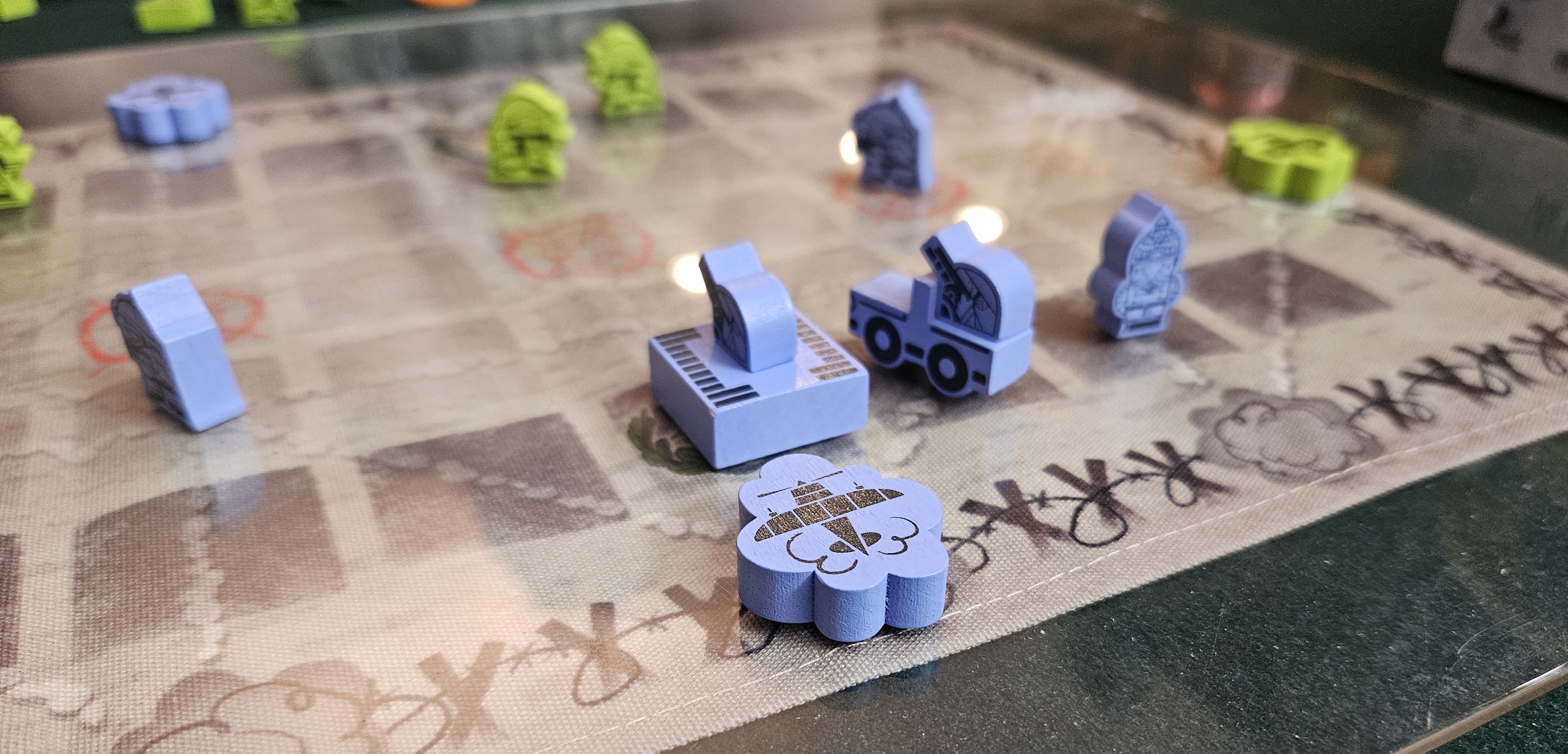
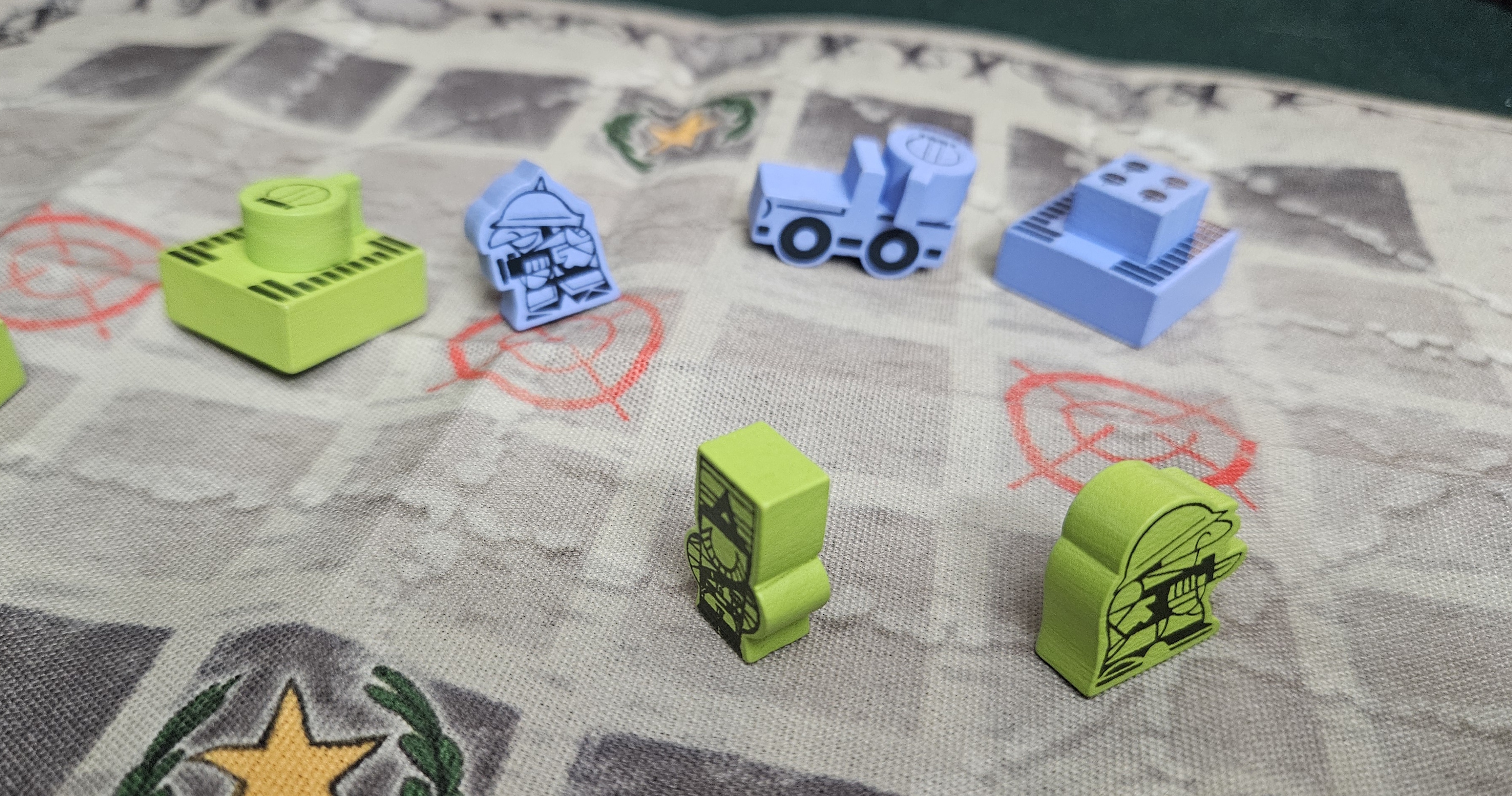
More than that, they’re both games about both movement and reinforcement. It isn’t enough to position your troops smartly. You also need to know when — and what — to call up from the rear. In the case of Gruntz, that sometimes means snapping a range of equipment onto a chassis to create a custom-built war machine.

This is never not cool. Because magnets, baby. I’m always in a mood for magnets.

This game would benefit from a soundboard of growly but cute tank, truck, and biplane noises.

Screening my fighter with plentiful anti-air.

The parallels don’t stop there, although I’m hell-bent on preventing this from becoming a comparison piece between two board games that are similarly under-known and probably wouldn’t appreciate the association anyway. Still, there’s something to be said about the way these titles portray their miniature battlefields. Where GHQ was a pale representation of Vonnegut’s WWII battlefields, dominated by artillery and armor, with infantry more or less serving as a screen for the good stuff, Gruntz is more timeless. Which is a polite way of saying that it isn’t quite as distinctive, history-wise, despite the visuals and hardware looking a little more Great War.

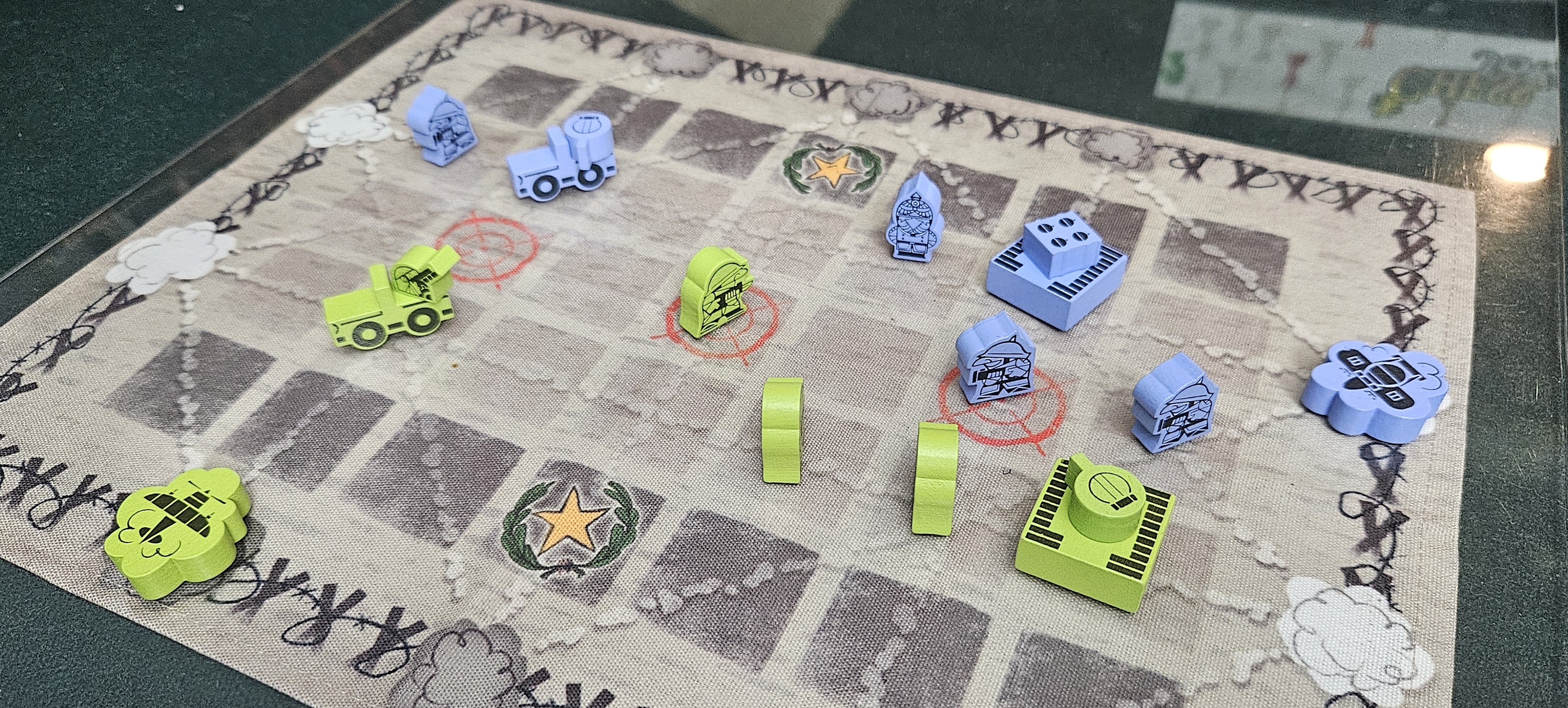
Perhaps the best place to start would be with the units. Infantry — the titular gruntz — represent a never-ending supply of bodies. Really, that’s their main trait: when killed, they bounce back into their general’s reserve rather than disappearing permanently from the table. They’re also useful for capturing control points, and can be moved en masse thanks to a captain who’s the spitting image of a gentleman officer in the midst of a war that’s very quickly eliminating the aristocracy at a pace that leaves every revolution red-faced with envy.

Those control points are the game’s biggest advantage over something like GHQ. Controlling two of the map’s three points at the end of a turn will award a star; controlling all three is worth two stars. Reaching three stars means victory, so there’s a strong incentive to usher your boys forward, even if it means they’ll get chewed up on the following turn.

To oblige said chewing, there are ample instruments. Both sides have access to quite the range of hardware. There are planes, both fighters and bombers, which tootle along wisps of contrail over the main battlefield, and are especially keen to obliterate anyone foolish enough to position their manpower in a straight line. These are matched on the ground by vehicles, which are built of two components, chassis and attachment. The chassis, whether armor or truck, either trundles or sprints across the battlefield, while providing more or less protection. The attachments, meanwhile, offer anti-air capabilities — more of an area denial strategy than an actual threat, it should be noted — a cannon for defeating anything in range, or a transport for depositing infantry closer to enemy lines.

By mixing and matching the best attachments, you can assemble the right tools for the current crisis. That’s the idea, anyway. Most of the time, armor gets the cannons and trucks become speedy transports. It’s a case of play mirroring life, a bit like how evolution tends to produce crabs because armor and pincers present obvious competitive benefits.

The ability to move a unit twice in a row is deadly. Maybe broken? Although I also feel that not being able to do it would make the game a little too considerate of relative ranges to be playable.

Tanks checking their ranges.

Very much unlike GHQ, which allowed its generals to divvy up their moves and reinforcements as they saw fit, Gruntz employs a stricter formula. Either you move twice and deploy once or move once and deploy twice. This ensures a steady stream of troops will enter the battlefield, and also that many of those troops will be demolished before the last clouds of smoke have blown clear.

Its most conspicuous absence is artillery. This is its biggest departure from something like GHQ, not to mention easy historical placement. Put simply, this is not simulationist fare. Units capture their peers in the manner of chess, by moving onto them, rather than pelting their targets from a quarter-mile out. The effect, then, is approximate to playing with little green army men, all bayonets and glory rather than ignoble death from afar.

To be clear, this isn’t a complaint so much as an errant thought. For all its symmetry, Vonnegut’s attempt reflected the unfairness of the war he took part in, the absence of rules, the capriciousness of the howitzer and the carpet bomb. Writing about the former war, Hemingway described modern combat as dying like a dog for no good reason.

In Gruntz, your gruntz die for good reason. The stakes are crystal clear. To defeat someone, you move into range of the counter-attack. This imbues the process with a necessary attrition. Of course, you try to avoid losing troops. A well-positioned flak cannon can stave off a bomber; a tank in the right spot can discourage an infantry push. But this isn’t a game about decapitating the serpent so much as trading bites with it, fang for fang and venom for venom, until one side is too exhausted to continue.

Then again, it does a better job of evoking a broken no man's land. Any time your grunt tips over, it's a leg sprain. Back to the hospital.

The fabric mat is a pain to deal with.

There are always back-of-mind benchmarks for combinatorial titles like this, and these exchanges make Gruntz feel more like Checkers than Chess, more about constant trades than graceful maneuvers. The one exception would be the aircraft, which glide over entire lanes and columns. A bomber is one of the few things that can ruin a tank’s day, which makes its appearance rather potent indeed. This can lead to interesting bottlenecks, anti-aircraft guns strangling any viable avenues of approach, only to grow obsolete the moment the threat has subsided.

The entire thing is full of misdemeanors like that. Obsolete units. A playmat that’s too creased to allow the gruntz to stay upright. The ease with which reinforcements appear, all but necessitating a protracted first act to clear out the chaff and force both sides to prioritize a few units. These are shortcomings, not outright game-breakers, but that only makes them more galling.

And then there’s the expansion. Allplay does this thing where they sell premium pieces separately from the main game. In most cases, it’s a positive practice. Those who want the metal bits can pay a few dollars more, while those of us who are fine with cardboard punch-outs can settle for the more affordable core box. It’s a smart middle ground.

Here, though, there’s an entire expansion that’s omitted from the main box despite only requiring a pair of reminder sheets and five cardboard tokens. Supplies, it’s called, and it adds — you guessed it — little supply markers. These can be spent to activate special abilities, like charging all your gruntz forward at once, making a crucial extra move with a vehicle, or swapping a now-obsolete AA gun for a big stonking cannon.

On its own, the Supplies expansion improves my opinion of the game considerably. It’s exactly what Gruntz needs to shine, adding a crucial but rules-light layer of resource management atop the game’s straightforward rules. Using a bomber to drop a bunch of paratroopers is incredibly cool, not to mention game-swinging; the limitation, naturally, is that your opponent also has access to their own cache of supplies. Without the expansion, Gruntz is handsome and interesting, but deeply flawed. With it, the flaws are still present, but dulled sufficiently that it becomes one of the more formidable precious-scale battlefield games out there.

Yes, you caught me, this is not from actual gameplay. But look in the plexiglass: CHESS JOKER looks on, smirking. "I am not the only mixed review this week," it says.

The view from on high.

All told, Gruntz is a strange offering, especially for Allplay’s small box line. Its direct conflict and zero-chance combat make it more confrontational than one might expect. This is no feel-good trick-taker or Peter Hayward deduction game. There will be blood. Or at least scrapings of green and blue crayon across the pavement.

Despite its shortcomings, however, I feel kindly toward Gruntz. It doesn’t have the pedigree of GHQ, and its diminutive scale may preclude it from broader adoption. But there’s something here, a certain sangfroid, some marginal strategy, that makes me want to get better at maneuvering its dweeby little guys and chonky tanks and turbulent aircraft. I want to stroll my captain into the enemy base for a more elegant win. I want to figure out how to keep its gun-trucks alive long enough to swing a battle. Is the depth there? I have my doubts. But it feels like something is lurking there, beneath the fabric.

Also… it has magnets. How do they even work? We may never know. Like I said, put magnets in your game and I’ll give it higher marks than otherwise. That’s a Space-Biff! promise.


A complimentary copy of Gruntz was provided by the publisher.

(If what I’m doing at Space-Biff! is valuable to you in some way, please consider dropping by my Patreon campaign or Ko-fi. Right now, supporters can read the next installment in my series Talking About Games, this time tackling the topic of what makes a good list! Naturally, the piece includes a list.)
CMON scraps $2.1m NFT game maker investment, three months after betting on deal to expand revenue, remain ‘relevant’

24. Juli 2026 um 00:35

Financially-troubled board game publisher CMON has terminated its planned $2.1m investment in NFT video game maker Blissful Link, three months after pinning its future on a push into digital game development and blockchain-based projects.

CMON’s board had planned to transition the company’s titles such as Massive Darkness and Super Fantasy Brawl Reborn into “high-quality digital assets” through the investment, saying the move was necessary for it to “continue to be relevant in the games industry and to expand the group’s revenue stream”.

But the board game publisher has now terminated the deal according to a new filing it submitted to the Hong Kong stock exchange, saying the conditions necessary to complete the investment had not been fulfilled.

CMON did not disclose which conditions had not been satisfied, nor whether it intends to pursue alternative investments as part of the announced digital strategy.

Super Fantasy Brawl Reborn || CMON crowdfunding image

The conditions of the deal included CMON being satisfied with the results of due diligence of Blissful Link’s finances, assets and legal structure – particularly around its Capverse game – approval of both parties, and warranties related to the agreement “remaining true and accurate and not misleading at completion”.

Capverse is a play-to-earn video game built on blockchain technology, in which players buy NFT ‘Sumer’ characters to battle with online.

The proposed investment would have valued Blissful Link at more than $95m. Blissful Link made a loss of about $197,000 in 2024, on revenues of just over $408,000, and had net liabilities of about $889,000, according to unaudited figures provided by CMON in April. It did not include finances for 2025.

CMON was mocked in multiple places online after it announced the NFT deal in April, with commentors largely expressing that they believed the deal was not financially sound, and questioning CMON’s decision to bank on NFT and web3 technology to fix its financial problems.

The veteran crowdfunding giant’s $23m losses across 2024 and 2025 were almost 5.5-times larger than its profits from the preceding nine years combined, and have pressed the company into a string of asset sales as it attempts to fulfill more than $14.3m of as-yet-undelivered crowdfunding campaigns.

Those IP sales included parting with its most famous and profitable title Zombicide – which has raised more than $40m on Kickstarter since its 2012 launch – to Asmodee, as well as Blood Rage, Rising Sun and Ankh to Tycoon Games.

It followed those by selling the IP for former Mythic Games titles Anastyr and Hel: The Last Saga to Don’t Panic Games in September, and parting with the lucrative Cthulhu: Death May Die IP to Asmodee a month later – the latter a series which has raised almost $10m from backers to date.

Earlier this year an independent auditor hired by the company questioned whether it CMON had the resources to stay in business for the foreseeable future, saying the publisher’s $19.9m annual loss, its net liabilities of more than $3.5m and contract liabilities of over $7.5m “indicate a material uncertainty which may cast significant doubt about the group’s ability to continue as a going concern.”

CMON’s directors had a different view, however, saying in the company’s 2025 financial report that it “should be able to continue as a going concern” thanks to a trio of factors.

They include financial support from some of the directors “sufficient to finance CMON’s working capital requirements”, the roughly $2.4m proceeds from selling its Singapore office that it received in January, and about $1.25m of gross proceeds from a successful share sale in February.

CMON’s hefty liabilities are largely due to its eight undelivered crowdfunding campaigns, which are not recognised as revenue on the company’s books until they are fulfilled to backers.

They include DC Super Heroes United, which raised more than $4.4m, and DCeased, which brought in over $2.5m. Both campaigns were initially due to be delivered last year, but are now expected to be delivered in Q4 of 2026, according to CMON’s latest estimates.

DCeased || CMON crowdfunding image

CMON also has several undelivered pre-order campaigns on its books, including Super Fantasy Brawl Reborn and the Assassin’s Creed Role Playing Game. The company is currently in the process of fulfilling a trio of other pre-orders including Dune Desert War, Cthulhu: Dark Providence and Marvel United: Witching Hour.

The company pulled the plug on crowdfunding launches and new game development in April 2025, citing the economic uncertainty created by US tariff hikes – which at the time had reached 145% for China, where the vast majority of hobby board games are manufactured.

But CMON announced in March this year that it plans to relaunch its halted crowdfunding operations later in 2026.

NFTs, which emerged out of cryptocurrency technology such as Bitcoin, exploded into the public eye in 2021 thanks to big-money speculative purchases – such as an NFT of Twitter founder Jack Dorsey’s first tweet selling for $2.9m.

That speculative bubble had already burst a year later, however with many of the digital assets involved losing more than 90% of their peak value. The Dorsey tweet NFT, for example, received a high bid of $6,800 when it was put back on the market in April 2022.

Other board games that have pushed into NFTs are few and far between, with one of the highest profile examples being SolForge Fusion, which allows players to mint decks as digital assets in addition to playing the game in physical form.

Two years ago CCG project Wonders of the First had to pull a $1.4m campaign from Kickstarter after falling foul of the crowdfunding platform’s ban on NFTs. The game went on to raise about $1.2m after relaunching without NFT content.

The post CMON scraps $2.1m NFT game maker investment, three months after betting on deal to expand revenue, remain ‘relevant’ first appeared on .

What Puts You Over the Edge to Buy/Back a Game?

23. Juli 2026 um 17:55

Have you ever been on the fence about buying or backing a game? You’re following along, you’ve watched some playthroughs and reviews, you have trust in the publisher, and you can afford the price. The game intrigues you, but you’re just not sure yet. What questions do you ask to put you over the edge?

For example:

  1. Who will play this game with me?
  2. Will I be able to learn, teach, and retain this? Does the setup look cumbersome?
  3. If the game costs more than $25, will I play it more than once?
  4. Will I actually enjoy playing this?
  5. Will this fill a desired niche in my collection?
  6. Am I missing out on the next big thing if I don’t buy this?
  7. Among my friends, am I the only person local to me who will have this?
  8. Am I excited to have this on my table, or could I just play it digitally or at a convention?

Recently I’ve faced this conundrum with a few games. Sometimes simply being on the fence is indicative to me that the game might not be the right fit. But there are plenty of games that I was hesitant to explore and ended up loving, so I try to keep an open mind.

This type of decision is highly subjective, but I’m curious if publishers can do certain things to help on the product page:

  1. Who will play this game with me? –Showcase photos of people playing the game, potentially in different situations if the game scales well to various player counts (or focus on the most common situation in which this game will be played).
  2. Will I be able to learn, teach, and retain this? Does the setup look cumbersome? –Use a 3-step infographic to convey the core steps of the game and mention rulebook length and setup time.
  3. If the game costs more than $25, will I play it more than once? –Mention the strongest asset for replayability without overwhelming the customer with too many modes or options.
  4. Will I actually enjoy playing this? –Share playthrough videos and offer demo versions online and even pre-production copies at local game stores (IV Studios does this well).
  5. Will this fill a desired niche in my collection? –Accentuate 3 truly unique elements about the game.
  6. Am I missing out on the next big thing if I don’t buy this? –Direct attention toward social proof (i.e., the number of backers, if it is high).
  7. Among my friends, am I the only person local to me who will have this? –I’m not sure a publisher can answer this question.
  8. Am I excited to have this on my table, or could I just play it digitally, at a convention, or at a local game cafe? –Highlight great art and the component hook(s), and don’t offer the full version digitally until well after the tabletop release.

I try to do a few of these things in our infographics (see below), but I’m realizing that there’s a lot of “over the edge” questions not answered in this format. What do you think about these questions and how publishers can help to answer them when you’re on the fence?


Also read: The 10 Reasons I’ll Back a Kickstarter Project

If you gain value from the 100 articles Jamey publishes on this blog each year, please consider championing this content! You can also listen to posts like this in the audio version of the blog.

Xeno Counterstrike

23. Juli 2026 um 16:08

Following up the earlier post, I’ve now played a twice (once just the Frontier game, once the full Counterstrike game).

The Frontier Game (aka “only the regular cards, mostly”)

  • “A little bit more race” — 15 tableau, 15 VP/player and the frontier worlds.

The Counter Strike Game (Fight the Aliens!):

  • A wild dancing bear Ginger Rogers, doing everything a normal dancing bear does but in heels and backwards. Frankenstein’s monster splitting a hookah hit with Flash Gordon, fighting crime with Snoop Dog, tastes great AND less filling. Yet more filling.
  • In all seriousness, this has flaws. Race is fast enough that snowballing happens and sometimes you just shrug, but this version is long enough that it’s a problem. In my first game I easily beat the other two players …. only counting my VP chips and awards. Not even counting my tableau of 20-ish cards.
  • I agree that you are heavily incentivized to go military (for your start world), but hey, it’s the military Arc.
  • But I would happily play, and if I get snowballed, so be it.

A group I know in Boston has already banned a card.

Nucleum: Gibraltar Game Review

This is my fourth Nucleum article.

If you’ve followed my thoughts on the three other Nucleum products I’ve covered—the base game, Nucleum: Australia, and Nucleum: Energy Research Institute–it’s pretty clear that I think Nucleum is the second-best route/network building gaming system in my collection after the Brass games.

And, in a world where I already love Nucleum, Nucleum: Gibraltar might be the system’s best content. It combines the things I love about the base game, adds juicy new building tiles to the mix alongside new contracts and special powers, and then does what I didn’t think would be possible: Gibraltar’s map is the best combination of Nucluem’s design powers all in one place.

“I think this is the best map now,” said two players who joined me for separate plays, players who have extensive experience with both the base map as well as Australia. I was pretty sure that was my feeling as well after my first play, but winner’s bias set in and I wanted to try again to make sure that’s where I really landed.

The answer? Yep. Nucleum: Gibraltar is the system’s best map!

The Middle is a Warzone

There are three new elements on display in Nucleum: Gibraltar: the new map,…

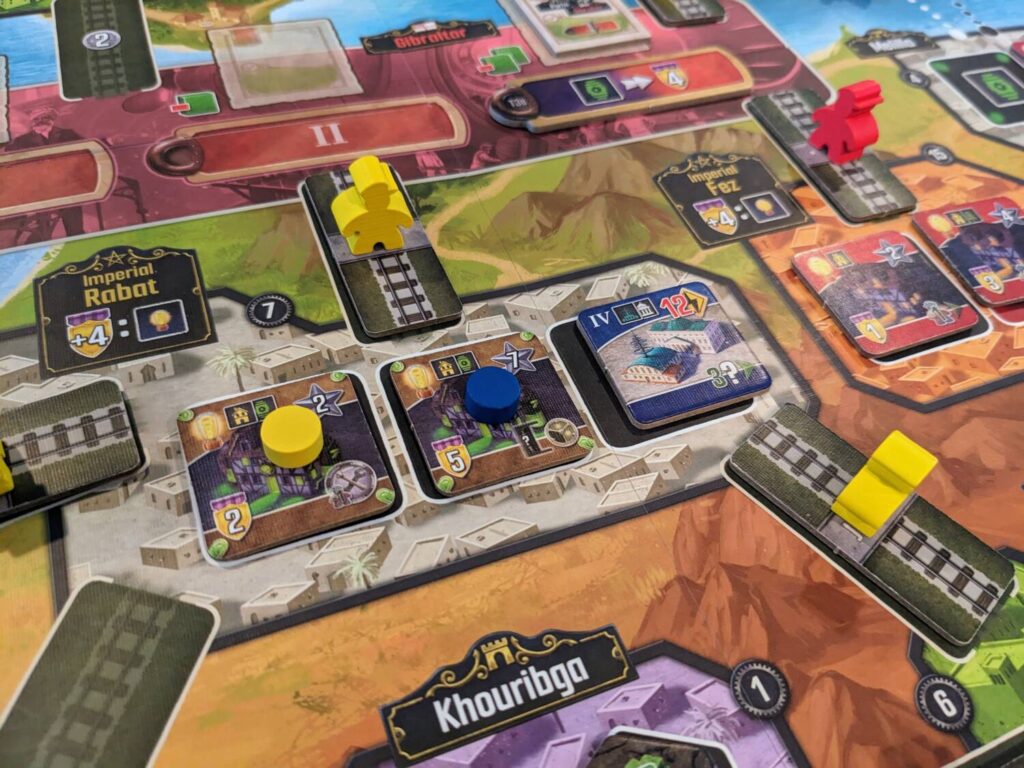
The post Nucleum: Gibraltar Game Review appeared first on Meeple Mountain.

The Networks: Primetime Review

23. Juli 2026 um 14:02
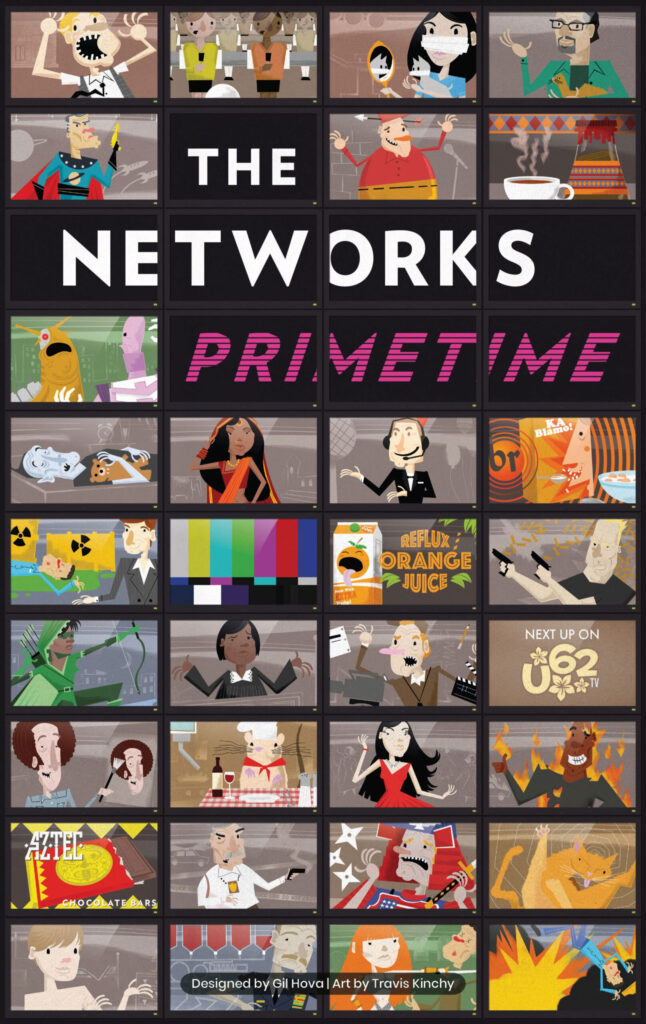
The Networks: PrimetimeAre you searching for something to watch in the doldrum days of summer reruns? Do you find yourself endlessly scrolling through the options on multiple streaming services looking for something that catches your eye? Do you then settle on a show that you’ve seen a hundred times already when the scrolling gets to be too […]

Source

My Favorite Wargame Cards – A Look at Individual Cards from My Favorite Games – Card #87: Proletarian Revolution from The Republic’s Struggle: Battle for the Republic, Spain 1931-1939 from NAC Wargames

Von: Grant
23. Juli 2026 um 14:00

With this My Favorite Wargame Cards Series, I hope to take a look at a specific card from the various wargames that I have played and share how it is used in the game. I am not a strategist and frankly I am not that good at games but I do understand how things should work and be used in games. With that being said, here is the next entry in this series.

#87: Proletarian Revolution from The Republic’s Struggle: Battle for the Republic, Spain 1931-1939 from NAC Wargames

The Republic’s Struggle is a thematic Card Driven Game that tells the story of the historical events that took place in Spain after the resignation to the throne of King Alfonso XIII, and the proclamation of the II Spanish Republic in 1931. With the creation of the new regime, the struggle for power between the different social, political and ideological sectors increased, which gave rise to continuous changes of political power, alterations of public order, armed uprisings and violent acts, carried out by the numerous ideological factions of the moment; which culminated in 1936, in a failed military uprising. The failure of this coup d’état was the origin for the Spanish Civil War.

The Republic’s Struggle is based on Twilight Struggle from GMT Games and uses the same concepts of area control while adding in some actual combat with units represented on the board. During the game, the Republican player and the National player, will be able to recreate events of the period to increase their popularity in the localities by carrying out political propaganda, recruiting troops or militias, generating revolts or assaults, establishing diplomatic relations or carrying out bombardments. All this will be done by playing their hand of cards in an alternative way, either by using the events or by playing the action points or icons to perform any of the other actions available to the players.

One of the interesting parts of the design is that each player has what is referred to as a Special Card that is included in their hand from the start of the game and can be played during their turn. These cards don’t count towards the maximum number of cards that each player can have in their hand at the beginning of each turn. The 2 cards are Military Uprising, which is given to the Nationalist player and Proletarian Revolution, which is given to the Republican player. These cards are single-use event cards and can only be used during the first 4 turns of the game, or in other words during the period referred to as Phase 1 – The Republic. If, after this phase, these cards have not been played, they must be discarded and removed from the game. Both players can choose to use their Special Card in an Action round, instead of using one of the cards from their hand. These cards are played like the rest of the Operation Cards either using their Operations Value or applying the effects of the printed Event. Once played, the card will be removed from the game so it is use it or lose it.

Both cards are very powerful but have some fairly difficult criteria that must be met to fully realize the value of the printed Event. In the case of our featured card Proletarian Revolution, the top part of the card first gives the player the chance to downgrade the European Status Quo Track by 2 levels. The European Status Quo Track allows players to appeal to and in some ways manipulate the stance of the other European Nations regarding their view on the Spanish Civil War. It also is the determining factor in how Victory Points are awarded for the crucial Armed Actions aspect of the game. At the end of each turn, if the number of Armed Actions carried out by a player equals or exceeds the current level of the European Status Quo, that player will score 3 Victory Points. Also, as long as the European Status Quo Track is set on level 2, players cannot carryout any action using the Operations Points of cards played to advance in the Diplomatic Relations Track. So this is another tied result to the card as if the level is 1, no cards can be played to advance the Diplomatic Relations Track.

But, remember I said that to fully realize the effects of the card, the Republican player would need to control Barcelona, Madrid, Valencia and every Naval Base Location or every Air Base Location. If this is the case when the card is played, then the Republican player will earn an automatic victory. Frankly, this is next to impossible, but has a sliver of possibility depending on how diligent and attentive the Nationalist player is as well as the hand of cards that are drawn by the Republican player. If they draw certain other events, as well as have a hand full of higher Operations Point value cards, they can make a run at this but it is not necessarily recommended. The card also has a very useful secondary use as if the condition isn’t met, they will get to place out on the board 1 combatant cube, representing one of their combat units, and also remove all of the influence of the Nationalist player in the Catalonia and Valencia Regions. This literally means all of the Nationalist influence in these regions which each has several locations. In order for the card to be used in this manner though the Republican player will have had to previously play the Defense Committees card.

The proletarian revolution in the Spanish Civil War refers to the widespread social revolution that erupted in the summer of 1936. Triggered by the failed military coup of July 17, workers spontaneously armed themselves, taking control of factories, collectivizing agriculture, and establishing anti-fascist militias primarily in Catalonia, Aragon, and Andalusia. When General Francisco Franco and conservative military officers attempted to overthrow the democratically elected Second Spanish Republic, the working class retaliated by launching a massive wave of grassroots social reorganization. This proletarian movement aimed to permanently dismantle capitalist structures and the influence of the conservative elite and the Catholic Church.

In major industrial hubs like Barcelona, workers’ committees seized factories, transport networks, and public utilities, shifting control directly to the trade unions. In the countryside, particularly in the region of Aragon, peasants seized large agricultural estates. They abolished private property and reorganized land into self-sustaining collectives operating under libertarian socialist or communist principles. Instead of relying on a traditional military hierarchy, fighting forces were formed as democratic workers’ militias led by trade unions and political parties like the CNT (anarcho-syndicalist) and the POUM (Marxist).

The suppression of the revolutionary movement divided the Republican forces. Deprived of its radical grassroots momentum and lacking support from Western democracies, the Republican cause lost ground to Franco’s well-equipped Nationalist army (which was heavily backed by Nazi Germany and Fascist Italy). The Spanish Revolution was ultimately defeated in 1939, leading to the collapse of the Second Republic and the beginning of Franco’s 36-year dictatorship.

Here is a link to our full video review of the game:

In the next entry in this series, we will take a look at National American Woman Suffrage Association from Votes for Women from Fort Circle Games.

-Grant

Afterlife for Auction

23. Juli 2026 um 01:01

I don't know what my eyes think this says, but it isn't the game's title. REAUNI REOVNOONING, maybe.

I find Realm of Reckoning, the latest title by Max Anderson, Zac Dixon, and Austin Harrison, to be fascinating. There’s the cosmological angle: an afterlife fallen into disrepair, now pieced back into working order through the clashing imperatives of feuding factions. Personally, I’d be a fanatical member of the Eat As Much Cake As You Like Without Getting Tummy Sick sect.

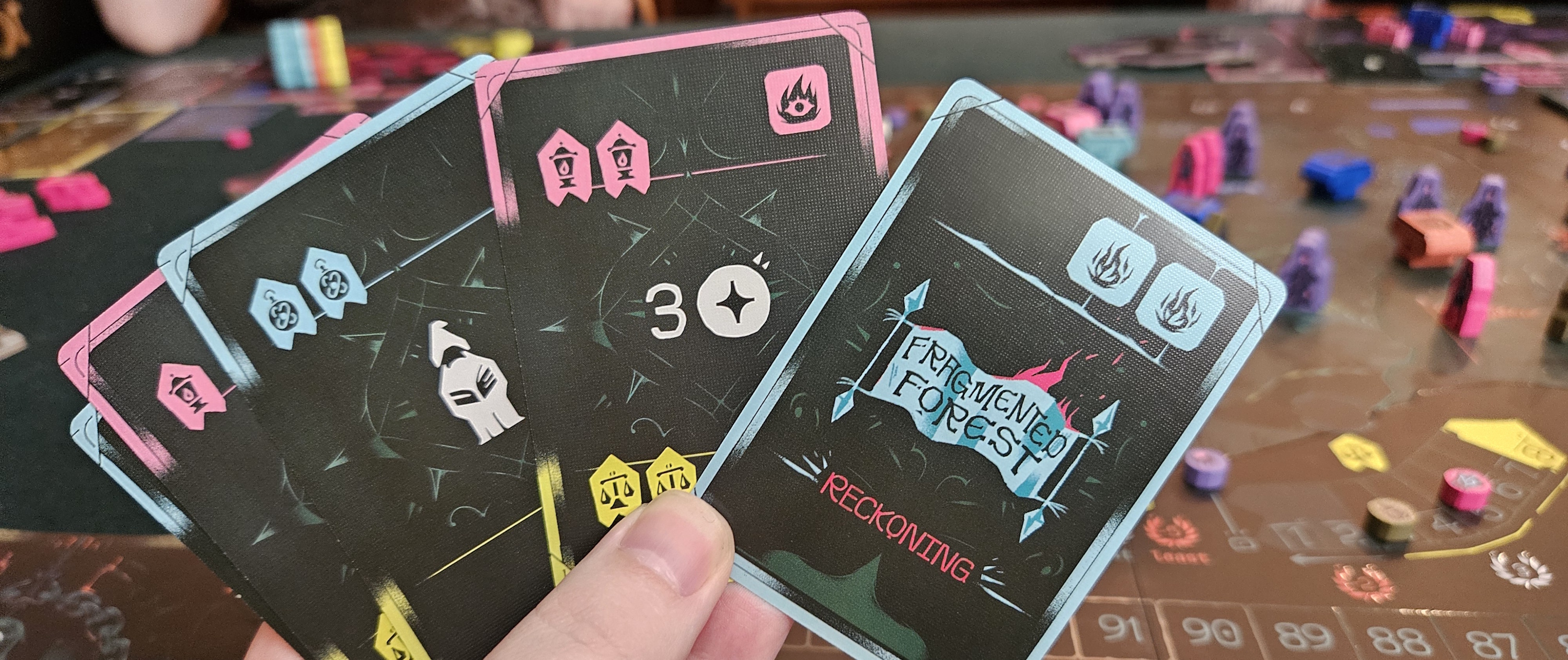
But more even than that, it carves out a new space in the whole “dudes on a map” genre. (Are we still saying that?) There are fingerprints of the greats all over the design. A splash of Blood Rage, some Inis, even a little bit of Arcs. It’s something of a mashup, and not every part works as smoothly as the others, but the result is a gripping struggle over an ashen landscape.

second-stage biblical afterlife here

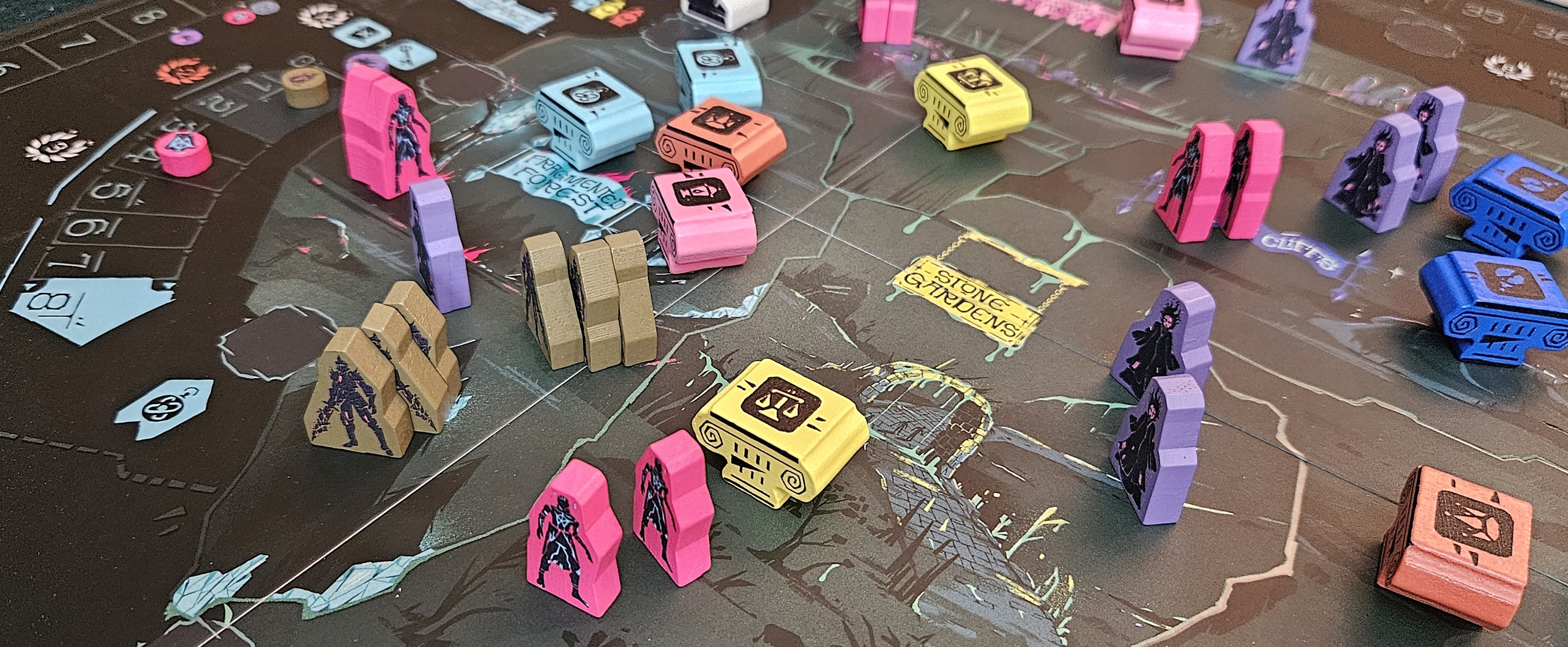
Clashing over the broken prairie of the afterlife.

Right away, there’s nothing typical about Realm of Reckoning. The factions are presented in gaudy colors. Or perhaps they’re only gaudy because the terrain is so smudged and dismal.

For all its aesthetic ruin, it’s really a rather simple space. The entire battlefield consists of five territories, each connected with a different flavor of influence. There are also five flavors of pillar, themselves coded to the assistance of gnomic wardens and tide-turning mercenaries, but maybe that’s more information than you strictly need to understand what’s going on here.

As for the rest of it, Realm of Reckoning structures itself around three rounds of drafting. This is where its similarities to Blood Rage seem most apparent, although if Veiled Fate, Pillars of Fate, and Scales of Fate are anything to go by, the folks at IV Studio really like their three-act structures. Each age is structured much the same: a hand of cards is dealt out, everyone picks one to resolve, and then the rest are passed around to repeat the process until there’s nothing left, at which point there’s a final battle before a quick tally of points.

It’s clean. At that mile-high remove, anyway.

the garden gnomes are an incredible investment. trust me.

Cards, both for action and battle, are drafted one at a time.

Down in the grit, affairs are a little more complicated.

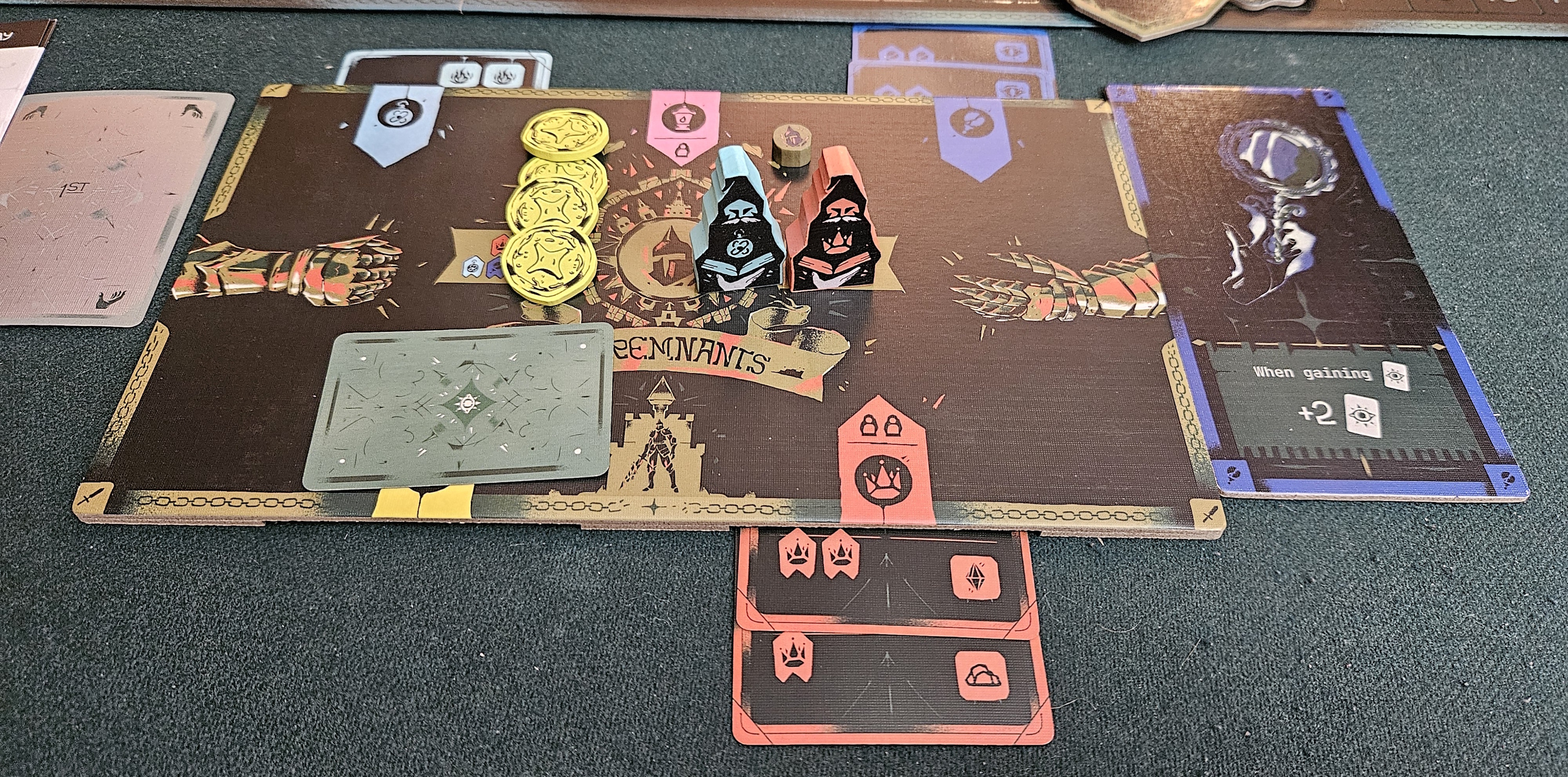
Consider the cards. There are two types in the draft. The vast majority are action cards. These confer some resource — coins, wardens, soldiers for the battlefield, mercenaries to be spent and discarded — followed by a choice of where to tuck the card under your faction mat. This latter choice is more loaded than it initially appears, moving your marker along the corresponding influence track, but also providing icons that, at least on the first play, don’t bear immediate import.

The other type of card is the reckoning. There are only two of these shuffled into each age’s hand of cards. Their rarity marks them as major flashpoints. This is because reckonings trigger a battle in the indicated region. Not at the end of the round or even upon completing the current hand of drafted actions, but immediately, at the exact moment that the player who drafted it would normally take their resources and move along their chosen influence track.

Even when these reckonings are anticipated, such as when you’ve seen them coming from a hand of cards you passed along, they always come across as an intrusion. The usual cycle of gathering and positioning is interrupted. Now everyone picks up a dial and tallies in a number. This is how much they’re willing to spend to win. Four. Six. Eleven. More. Battles escalate as the game progresses, the result of all those extra arms everyone’s been amassing.

I don't really get into the artifacts in this review, but they're kinda important too. Oh nooooo. I didn't explain every detail. Throw a fit. OooooooOOOooo.

Some of the many things you’ll collect in Realm of Reckoning.

To be honest, the battles themselves are a mixed bag, the game at its strongest and weakest.

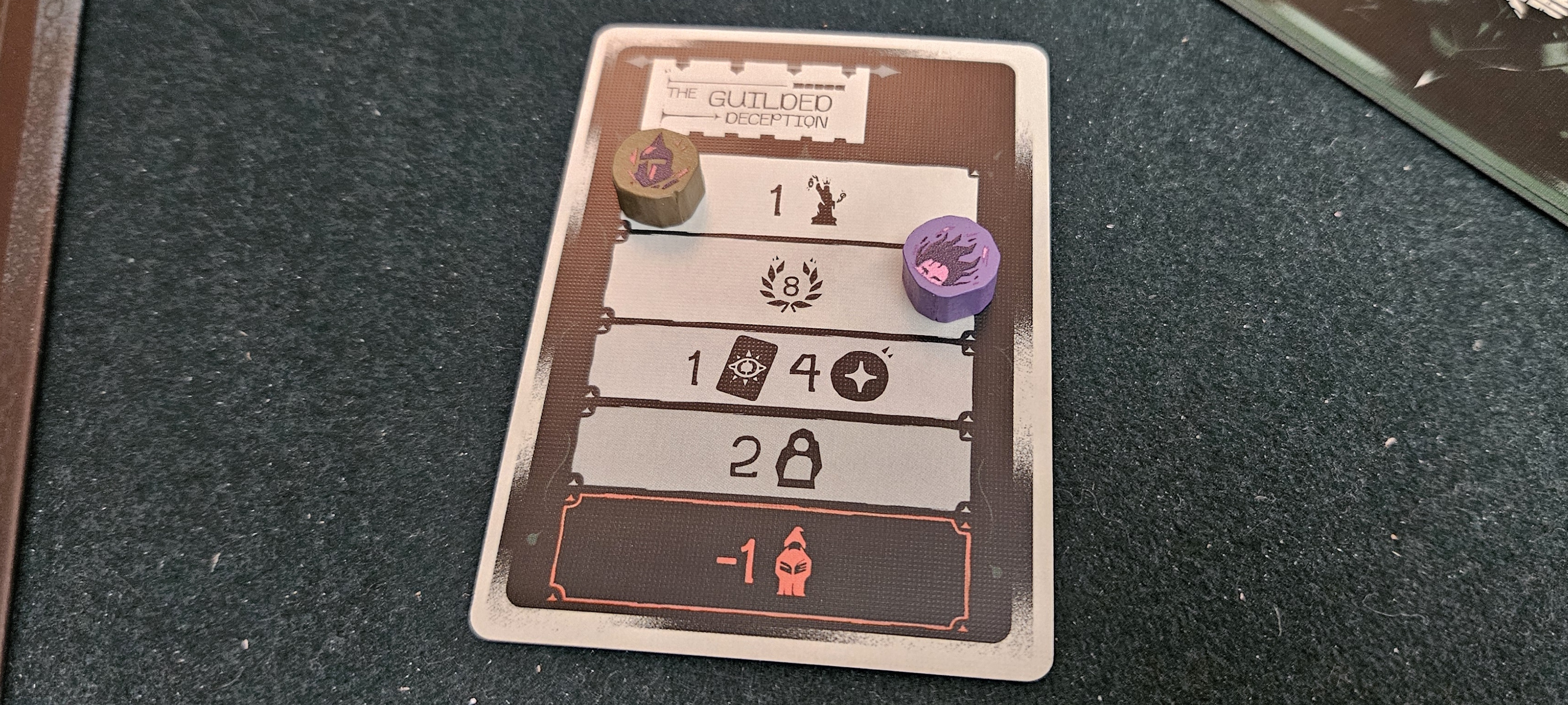
Strongest, because they’re nail-biters. Rather than simply winning or losing, players are vying for placement on a rewards card, a clever turn that might dictate how strongly you feel about the current contest. It’s even possible to accept a negative reward to avoid spending your bid, a maneuver that’s sometimes smarter than it might sound.

But battles are also frustrating. They’re a little too complicated for their own good. IV Studio has a reputation for games that contain “complicated counting,” and these tallies certainly qualify. Soldiers can be spent for a point of strength. Wardens also provide a point, but only if they match a pillar in the contested territory, and even then they can be spent instead to produce a bump of three. Mercenary cards matter, although again there’s some pillar-matching to consider, and coins too, although these are spent in increasing increments. Oh, and your influence in that region. It’s easy to forget that one, especially if you’re currently benefiting from that region’s power-boosting artifact.

All of this is to say that bids are fraught indeed, slowing the game dramatically but also producing… well, drama. High drama. Revealing one’s bid is as tense as it gets, as good as any round-robin antes in Inis. These are the hinges upon which Realm of Reckoning turns. Slowly, sometimes, with no small amount of creaking and groaning, but still.

I choose you, Lady Liberty!

Picking your reward for a reckoning.

For my part, I’m willing to accept the shortcomings of these reckonings for the boons they provide. The drama, yes, but also the way they feed into the game’s consideration of victory. Everything in Realm of Reckoning is building toward these moments of revelation.

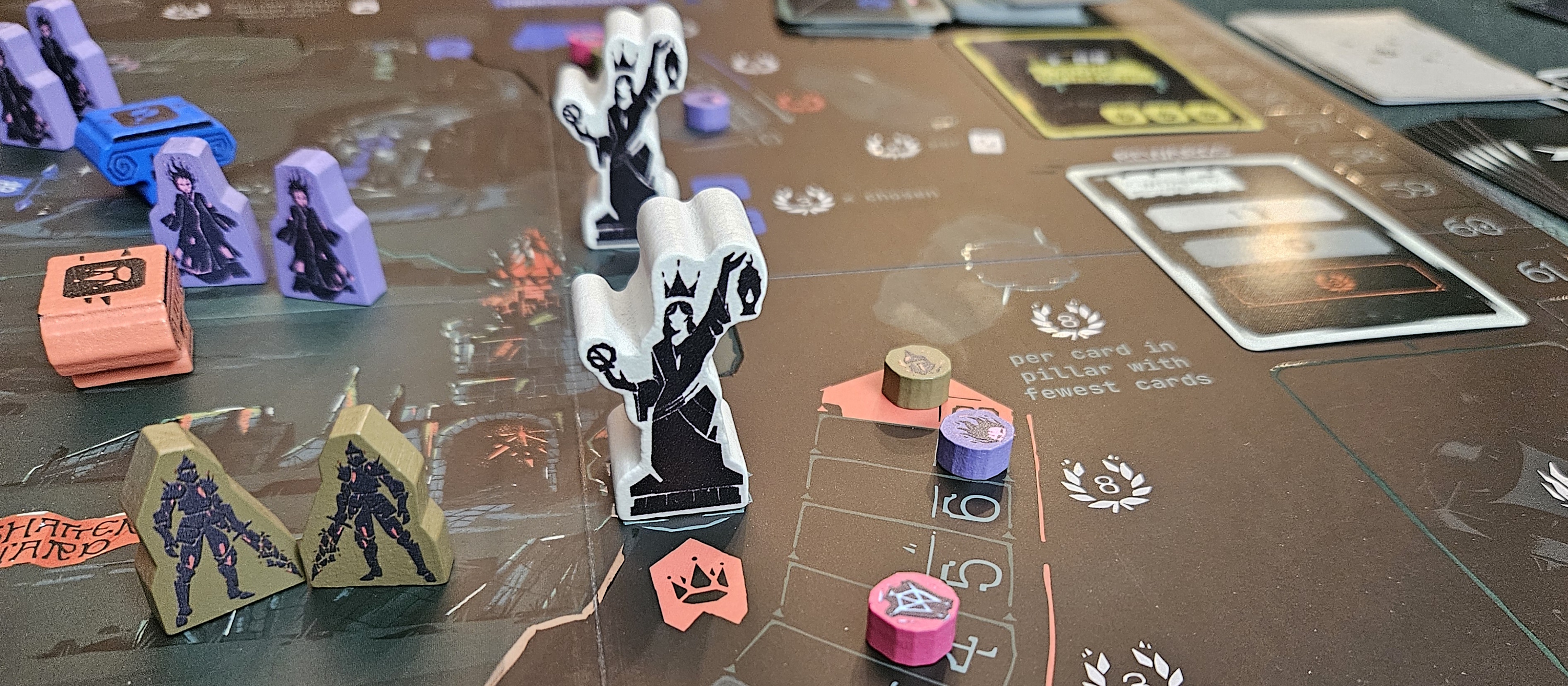
And here, the revelation matters. Some players will claims points or cards or coins. Extra soldiers. Maybe a warden. But the real prize is the chance to designate which victory condition will score at the conclusion of every round hereafter. One player — usually the highest bidder in the reckoning but not always — takes a shrine, a statue that looks comically like Lady Liberty herself, and plops it onto one of the victory markers.

There’s no shortage of options. There are spaces for military domination over specific territories; others for economic advantage in coin or hired help. Some initiate struggles against your neighbors. Others provide groundswells of points that everyone can benefit from with some effort.

This is also where those icons come into play. The ones from earlier, on the cards, tucked beneath your player mat. You might find yourself racing to collect sets of gems, or vying to command the most purses of gold, or cursing because a rival chose to emphasize the closed-eye icon rather than the open peepers. Whatever the selection, it informs the game from that moment forward. It’s a little bit like Arcs in that regard, the players choosing what matters and then clashing over it, except these are permanent alterations. Early selections, before the factions have specialized, become exploratory, triggering multiple times before the game ends but also allowing players to adjust, while those added later are hotly contested because their outcome is less prone to adjustment.

What would you choose as the scoring criteria for your own afterlife? I'd go for cuddles with babies. Just the best.

Victory conditions are selected over the course of the struggle.

Perhaps there’s an irony to be dredged from all this fuss. For the second time, Realm of Reckoning hinges on a bunch of complicated counting.

But this is also where the designers manage to carve out their own niche in a crowded genre. And, as niches go, it’s closer to an alcove than a toehold. There’s such a variety to the objectives that there always seems to be something worth pursuing. There’s even a spot that awards points to whomever’s sitting in last place — a whole catch-up system, but one that asks the players whether they would like to switch it on or leave it untouched.

It’s smart, although in a way that demands its own attention rather than simply aping what’s gone before. Sure, it has drafting like some other titles. But where Blood Rage evoked a heavy boot smashing into your nose, where Inis was all tribal politics, where Arcs is… a lot of things, Realm of Reckoning is about currencies and auctions. Players gather resources to spend them, but only as carefully as possible, and then the outcomes of those auctions become longer-term auctions for absolute victory. In that respect, it feels like a smoother, more contemporary version of a lesser-known map-battler called Mezo. But, again, Realm of Reckoning provides such an emphasis on who can most cleverly accrue and spend coins of various denominations that it feels entirely new again.

Entirely new. Sometimes slow, especially at higher counts, and sometimes a little too tally-heavy. But still new, and smart, and bound up in calculations that feel shrewd rather than merely arithmetic.

I guess I could talk about visual representations of afterlife, and how this actually does a pretty good job of capturing what Hades should look like... but look, that's for nerds.

War in heaven. Or hell. I dunno.

I can hear what you’re asking through the screen. “Dan, does this say anything about the afterlife?” Sorry, but no. It does not.

But it does say something about how great it is to smash somebody through superior tallies and bids. Combat in Realm of Reckoning isn’t visceral. Strictly speaking, you’re inflicting the casualties on yourself, not the other way around. But this is one smart cookie, ultra smooth in practice, and a delight to handle. It takes a play or two to get a handle on its particulars, but this is one afterlife worth pursuing — and then remaking in your own image.


A complimentary copy of Realm of Reckoning was provided by the publisher.

(If what I’m doing at Space-Biff! is valuable to you in some way, please consider dropping by my Patreon campaign or Ko-fi. Right now, supporters can read the next installment in my series Talking About Games, this time tackling the topic of what makes a good list! Naturally, the piece includes a list.)
Armoured Clash | More New Regiment Boxes!

23. Juli 2026 um 00:42

You’re a formidable opponent, Lady Penelope!

More new regiment boxes for Armoured Clash – Check them out!

Now you’ve seen the new Commonwealth and Crown heavy regiment boxes, allow me to show you two more, this time for the Enlightened and Union factions. Both small boxes contain some very tasty new units to beef up your armies. Enjoy!

Making high quality tabletop gaming content at the EOG takes time and money. Please consider becoming a Patreon supporter or making a donation so I can continue this work! Thankyou!

❌