If you’re not interested in buying games on sale, then please ignore this… But it’s time for the annual Amazon Prime day (well 4 day) sale, and lots of bargains to be had on games. Below is a list of … Continue reading →
The Birth of Jackpot Version 0 - 2020 The earliest version of Jackpot: Set the Reel was born at KalCon, a small Swedish board game convention where Kristian was demoing and recruiting backers for Goetia: Nine Kings of Solomon. During the event, inspiration struck and this childhood memory of us playing slot machines on the ferry between Finland and Sweden made us tinker with the idea of making a deck builder slot machine.
Even back then, we were fascinated by slot machines as a physical and emotional experience. There’s something universally recognizable about the rhythm of spinning symbols lining up. Part of the original vision was simply recreating that feeling in tabletop form: revealing three cards at a time like the reels of a slot machine and letting players chase combinations.
Kristian likes to take picture of the very first versions of a game. This is the very first hotel-room-prototype of Jackpot.
Breaking the Bank Early in the development, players were trying to hit three-of-a-kind as often as possible in order to gain coins - just the way the old slot machines worked. The coins in the bank eventually became the timer of the game thus making the working title “Jackpot: Break the Bank”.
Artwork People say that you should not spend money on artwork for prototypes, but Kristian stumbled upon some beautiful cherries somewhere and decided to track down the artist, who was surprised that Kristian had found some of his old artworks.
He agreed to sell us the art pieces to use, since Kristian was convinced that he would make this into another Kickstarter, so he might as well get the rights to use his artwork straight away. The artwork would end up being used to draw looks and raise interest, but these art pieces never ended up in the final version.
Early Artwork used in Prototype
Designing Variants That “breaking the bank” concept stayed at the heart of the game for a long time. Every decision players made brought the table collectively closer to the end.
Early versions experimented with all kinds of mechanics. There was a hold mechanic inspired directly by video poker, where players could lock certain symbols while rerolling others. At one point the game drifted surprisingly close to being a memory game, asking players to track information across turns. We also introduced income mechanics tied to clover symbols, giving players more long-term strategic engines to build around.
One early mechanic that Kristian thought was interesting was the fact that you gave your cards to your opponents, and if they used those cards when they won some coins, you gained some coins because your cards were used. This caused the players to get an influx of coins out of turn. The coins could then be used to purchase new cards to improve your hand.
Early on, the game used achievements with decrementing values, so the first player to hit a three-of-a-kind would get the highest victory point token. Variants of this remained in the game and eventually ended up becoming simply cards that were awarded to the players.
Decreasingly valued VP cards awarded when hitting 3 of a kind
Later iterations used a game board where players were moving between casinos and trying to break each and every one of the banks.
A version had players move between casinos and collect poker chips
The hold mechanic showed promise, but caused the timing of the game to become strange. Players needed to be finished with their turn at the same time to create order.
The Pitch Project The game eventually took shape into something representable. During the peak of Covid, Jay Cormier and Sen-Foong Lim realized the lack of opportunities for designers to pitch games to publishers, so they organized an event called the Pitch Project. The workshops during this event built the foundation and taught us how to properly pitch games to publishers.
Sell Sheets The requirement to enter the competition was to make a Sell Sheet and use that to qualify for the online pitch where dozens of publishers would look at your game.
The sell sheets went through many iterations. Initial versions had too much text, then later versions were too rules-heavy, and slowly the feedback shaped them into something more refined.
Evolution of the sell sheet
First Contract Jackpot qualified for the Top 50 out of roughly 750 submitted sell sheets and was set to hold a two minute video pitch for publishers. Shortly after the Pitch Project, the game was evaluated by multiple publishers and was eventually signed by an American publisher and entered a longer development process.
Development Seeing another team engage deeply with the design was exciting and slowly but surely made improvements to the game.
The development team aimed to improve Jackpot’s pacing and deck-building feel by reducing or removing the coins while keeping and refining popular features like wild cards, and allowing longer gameplay for better progression. Some of the ideas explored during that period still echo in the current version of the game. Hold was scrapped, coins were cut, and eventually clovers were introduced as currency, shifting the focus towards pacing, accessibility, and making every turn feel active for all players.
Game Is Put On Hold Unfortunately, the publisher later ran into internal difficulties and had to let the project go. After a couple of years, the rights reverted back to Kristian, along with a huge amount of valuable feedback gathered during development.
Jackpot was put on ice whilst other designs were made. Two years went by.
Enter Kenny Zetterberg For the next couple of years, Kristian and Kenny Zetterberg started to make multiple designs together. At some point, they revisited Jackpot and began tweaking it further, while also exploring what else could be done with the jackpot mechanic.
Jackpot itself remained on ice while other designs explored what we now call the “jackpot mechanic”. This was added as an action selection system in other projects, eventually leading to a eurogame using that core idea.
Prototype of the eurogame Kalix using the Jackpot mechanic
Exploring the jackpot mechanic in other designs proved valuable. We realized that, contrary to traditional slot machines, partial matches needed to be rewarded. Matching one or two symbols still gave players something. The game became more generous, more energetic, and far less swingy, keeping players emotionally engaged even when narrowly missing the perfect result.
A crucial discovery during this period was the income phase. At the end of each round, players received income that could be used to purchase more cards, whereas earlier versions only rewarded wins directly.
Clover indicating income at the end of a round
Jackpot was occasionally revisited, and bonus actions were introduced when players achieved two-of-a-kind, which felt like the missing piece. The game timer was changed to “first to 33 VP wins,” and the game was ready to be pitched again.
Reddit During the sell sheet design, Kristian posted in the r/tabletopgamedesign subreddit for feedback. Dranda Games had seen Jackpot during the Pitch Project and noticed that several years had passed without release. An old sell sheet post caught their attention, and they reached out to test the game.
Conversations started, prototypes were sent, and before long Jackpot had found a new home.
Dranda Games The development team at Dranda Games loved the game but felt there was more design space to explore, particularly inspired by mini-games found in modern slot machines.
We began experimenting with very small mini-games integrated into the core gameplay. Designing these was an interesting challenge, as players would only experience them for a few turns. They added variety and created playful breaks in the flow of the game.
Some experiments proved too complex and were cut, including Roulette and Minotaurs Maze, which required too many components and slowed the experience.
Mini-game development exploration
Seven Seas mini game Prototype
Kickstarter - Jackpot: Set the Reel What started as a simple idea in a hotel room opened up many doors and possibilities, and six years later found a home with Dranda Games. Jackpot reached its funding goal on September 5th and has its official release at UKGE 2026.
Award-winning board game store owner Matthew Mičetić says independent tabletop retailers can no longer rely on product sales alone, as rising costs, tariff uncertainty and changing consumer behaviour continue to reshape the hobby retail landscape.
Mičetić was named Oregon Small Business Person of the Year last week by the US Small Business Administration, celebrating the 16-year growth of Portland-based Red Castle Games from a small neighbourhood game store into a vibrant space offering organised play, youth camps, community events and an on-site cafe.
He told BoardGameWire the complexity of running a game store had increased dramatically since the store opened in 2010 – but added that widening the venue’s scope had been a key ingredient in Red Castle’s success.
Mičetić said, “Competing solely on product selection and price has become increasingly difficult in a world where customers can order almost anything online and have it delivered to their door.
“What independent game stores can offer that online retailers cannot is community. We can provide places for people to learn, play, compete, socialize, and build friendships. The retail sales often follow from those relationships.”
He continued, “We aren’t just retailers anymore. We’re event organizers, community managers, educators, food service operators, e-commerce businesses, and increasingly technology companies as well.
“The encouraging part is that the core mission hasn’t changed. People still want places to gather, play games, make friends, and feel like they belong.
“The stores that continue to succeed are the ones that adapt to the changing business environment while never losing sight of the community they’re there to serve.”
Mičetić’s drive has seen that community expand from traditional hobby gamers and TCG players to include young people, families and more casual gamers keen to dip their toes into the hobby – something he believes is one of the biggest opportunities for game stores today.
He said, “Some of our most successful recent initiatives have been our youth programs, including Dungeons & Dragons, Magic: The Gathering, and Pokémon camps and after-school programs.
“Parents are looking for opportunities that help kids build friendships, creativity, problem-solving skills, social-emotional skills, and confidence. Tabletop games are uniquely positioned to provide that.
“We’ve also had success reaching beyond the traditional hobby audience. There are a lot of people who can benefit from what tabletop gaming offers who may never have considered walking into a game store.
“That means being willing to experiment, try new things, and sometimes fail. Not every idea works, and that’s okay. The important thing is to learn from it, make adjustments, and keep moving forward.
“I’ve always believed in looking for 1% improvements. Small improvements compound over time. If you can make your store, your programs, your customer experience, and your operations just a little bit better every day, those gains add up to something significant over the course of years.”
He added, “While retail is still the foundation of the business, these complementary activities have become increasingly important both financially and strategically. They reinforce one another.
“Someone might discover us through a D&D camp, become a regular event participant, buy games and accessories, meet friends through the community, and eventually become a long-term customer.
“The café, events, camps, and retail operation all work together to create a stronger overall ecosystem. For independent game stores, I think that’s one of the biggest lessons of the last decade. The future isn’t just about selling products, it’s about creating reasons for people to keep coming back.”
Organised play remains a “core pillar” of the store’s financial prosperity, Mičetić told BoardGameWire, while Magic remains its strongest offering and continues to be a cornerstone of organised play.
Mičetić receiving his Oregon Small Business Person of the Year award
He added, “One Piece has been one of the biggest success stories of the last several years, drawing strong participation. Star Wars Unlimited has also developed a passionate local community and has exceeded our expectations.
“Beyond TCGs, Dungeons & Dragons continues to be a major driver of participation through campaigns, youth programs, and camps. Board game events, painting nights, and miniature gaming also contribute meaningfully to overall attendance, even if they don’t always attract the same numbers as the largest TCG communities.
“What excites me most isn’t any individual game. It’s the diversity of the community. I believe the healthiest stores aren’t dependent on a single title. They’re places where someone can come in for Pokémon, discover D&D, try a board game, join a painting event, and ultimately find multiple ways to engage with the hobby.”
Speaking about current growth areas on the retail side – and areas which could be in decline – Mičetić told BoardGameWire TCGs continue to be the strongest growth category in the hobby, while oversaturation in higher-price point board games was beginning to show strain.
He said, “Magic remains a powerhouse, Pokémon continues to bring in new players, and we’ve seen strong engagement from newer games [such as One Piece and Warlord] as well.
“That said, I do worry that we’re in a boom cycle. I don’t know when it will happen, but historically every collectible market experiences corrections and I think it’s wise for retailers to plan accordingly.
“In board games, I think we’re seeing softness at the higher end of the market. For years, the industry benefited from an explosion of new releases and crowdfunding projects, but I also think the market became oversaturated.
“Self-publishing and crowdfunding lowered barriers to entry, which brought some fantastic games to market, but also a tremendous number of mediocre ones. Consumers have more choices than ever and less time to play them.
“Where I’ve seen the most consistent strength is in smaller board and card games, particularly titles under about $25. At that price point, they’re an easy impulse purchase and a lower-risk way for customers to try something new.
“RPGs are interesting. Product sales have slowed somewhat for us, but organized play and events remain strong. People still want to gather around a table and tell stories together, even if they’re buying fewer books than they once did.
“Miniatures remain a challenging category outside of Games Workshop. Many lines have passionate fan bases, but Games Workshop continues to outperform expectations and demonstrates the power of consistent support, organized play, and strong intellectual property.
“As for crowdfunding, we’ve largely stepped away from it as a retailer. There are certainly successful projects, but we’ve experienced too many delays, failures, and fulfillment issues over the years.
“Tying up cash and shelf space for products that may arrive years late, or not at all, has become increasingly difficult to justify.”
Mičetić said that on the distribution side, relationships had become both more important and more complicated since 2020, with the pandemic having exposed just how dependent the industry is on supply chains and allocation systems.
Mičetić said distribution relationships had become more complicated since the pandemic – and more important
He said, “In many categories, especially TCGs, we spent years dealing with product shortages, allocations, delayed releases, and uncertain restocks. More recently, while still dealing with those allocation issues, we’ve added questions around tariffs, pricing, inventory levels, and market demand.
“The underlying challenge remains the same, uncertainty. At the same time, retailers are being asked to make increasingly complex purchasing decisions with limited capital and shelf space.
“When talking with distributors today, my primary focus is predictability and partnership. I don’t expect every product to be available in unlimited quantities, but I do want transparency around allocations, release schedules, and restock expectations.
“The better information we have, the better decisions we can make. I also spend a lot of time discussing breadth versus depth. Every distributor wants retailers to carry more products, but shelf space, cash flow, and staff attention are finite resources.
“We’re increasingly focused on products that have strong community support, organized play opportunities, or demonstrated demand rather than simply chasing every new release.”
Mičetić’s award recognition follows a turbulent series of challenges in recent years, ranging from navigating the Covid-19 pandemic to enduring ten break-ins over a twenty-month period – a spate of crimes which resulted in more than $250,000 in losses and property damage.
He told BoardGameWire that while the experience was “frustrating and demoralizing”, he was “not willing to let a handful of criminals determine [Red Castle’s] future” – adding that the show of support from customers following the break-ins had helped reinforce why the store exists in the first place.
Mičetić said, “The primary targets were trading card games, particularly sealed Pokémon and Magic products, along with Games Workshop product. Unfortunately, those products are small, portable, and have a well-established secondary market, which makes them attractive targets for theft.
“The financial losses were significant but the larger challenge was the operational and emotional toll. Every break-in meant dealing with police reports, emergency repairs, damaged property, disrupted operations, and the uncertainty of whether it would happen again.
“There were periods when it felt like we were spending almost as much time thinking about security as we were thinking about growing the business.”
He advised other hobby retailers to “invest in security before you need it”, adding that the experience had changed his own understanding of risk.
Mičetić said, “Small businesses often operate on relatively thin margins and repeated criminal activity can have an outsized impact.
“It’s a reminder that when people talk about crime affecting businesses, they’re not just talking about stolen merchandise, they’re talking about the time, money, stress, and opportunity cost that comes with recovering from it over and over again.”
Speaking of his SBA award win, which recognises business owners who demonstrate outstanding business growth, innovation, resilience, and contributions to their communities, Mičetić said, “This recognition is incredibly meaningful because it reflects the community that built Red Castle Games.
“Every customer, staff member, volunteer, and supporter has played a role in our success. This award belongs to all of them.”
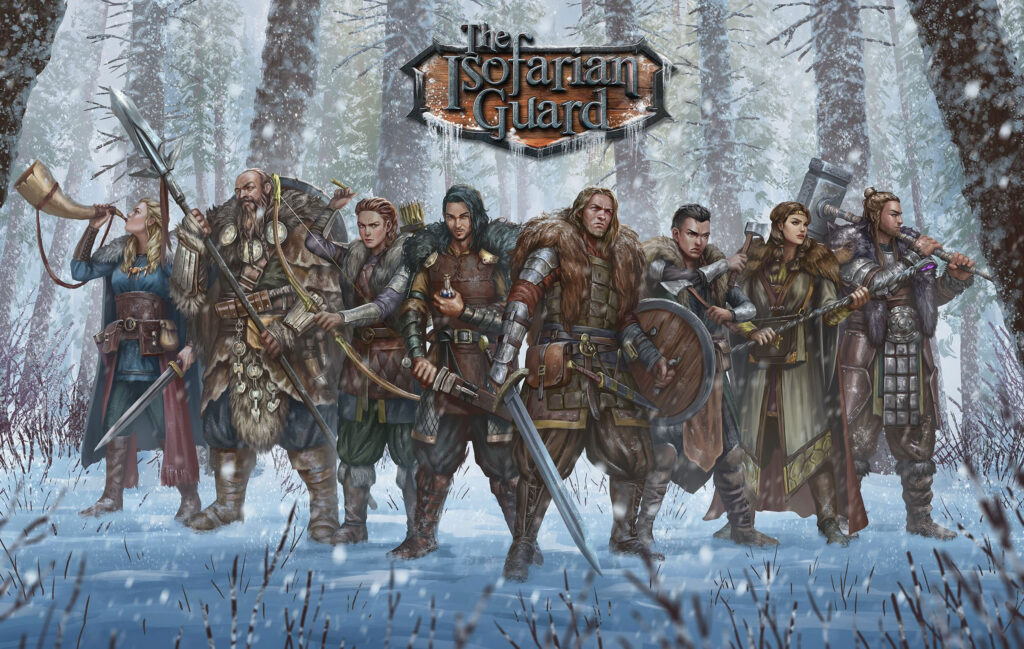
Welcome to Isofar, a wild land severe in its beauty. As a member of the Isofarian guard, life is never dull. You try to keep the peace among your fellow Isofarians (a never-ending job), as well as deal with constant threats from the aggressive Falmund Empire to the south. That’s the phrase that first caught […]
Ever since I slept on Bestiary of Sigillum: Collector’s Edition a couple years ago, I decided that CrowD Games should be closer to the top of my list of favorite publishers. As a result, I’ve spent a lot of time with their catalog over the last two years, playing through every single game the team at CrowD would send my way.
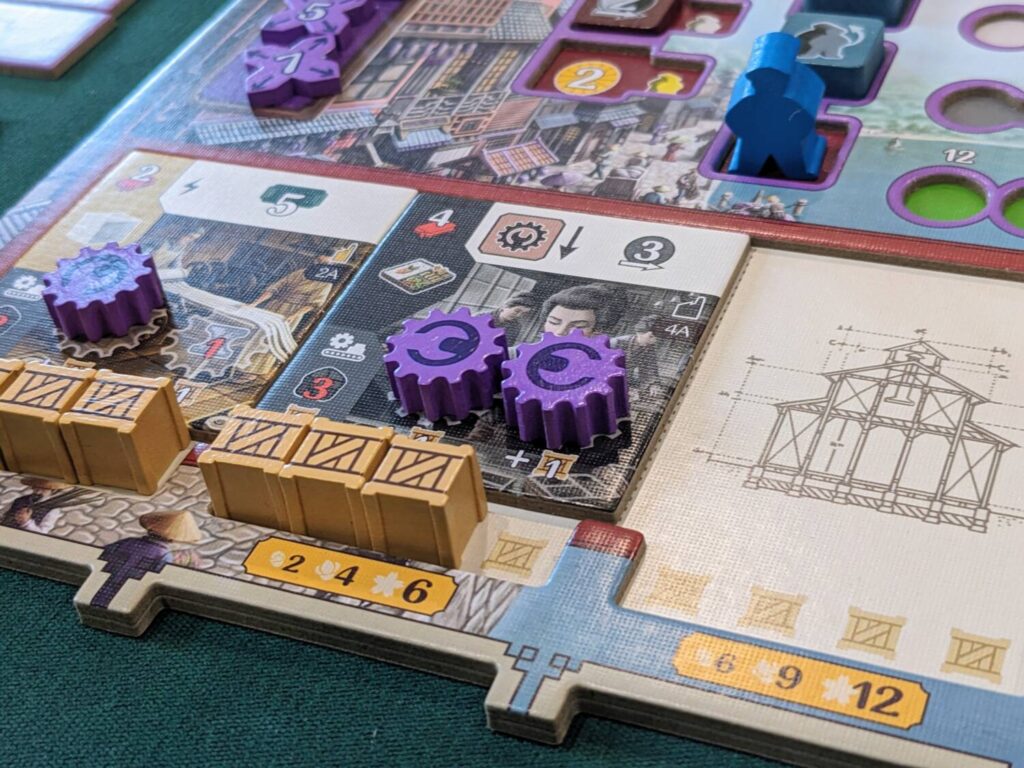
With very limited exceptions, CrowD has always delivered the goods…and with the recent fulfillment of the medium weight strategy title Nippon: Zaibatsu (based on the 2015 game Nippon), I’m ready to shout it to the masses: people should be following CrowD’s every move.
About a year ago (around the time that the original Zaibatsu campaign went up on crowdfunding platforms), I began playing Nippon on Board Game Arena, mainly to see if this was the kind of game I wanted to back when the campaign for Nippon: Zaibatsu went live. I liked what I saw out of the 2015 original, enough to put down some money for a copy of Zaibatsu.
Then, life punched me in the gut. I was laid off from my full-time job, and I shut down any talk of backing not only this game, but buying any board games for a few…
Nippon: Zaibatsu—2026’s updated version of the 2015 original, Nippon—is so hot in my gaming circles that I had the chance to play the base game three times over the course of a week, and it seemed like the game was popping up at game nights all over Chicago for the first couple months after it hit the market.
After drafting my initial review of the game, I learned that the game’s first expansion, Nippon: Genro, is hitting crowdfunding in late June of this year. A couple prototypes were floating around the US, so I reached out to CrowD Games to see if I could grab a pre-production copy to play for about a week, and I’m excited to share that CrowD obliged.
Nippon: Zaibatsu is a relatively easy game to learn, but it is a very difficult game to play well. By that, I mean that the game’s high volume of timing decisions make for a tricky gaming affair, and I’m surprised how often I had a plan to get all my ducks in a row during each play only to have an opponent snipe end-game turn order, or mid-game area control elements, or the perfect worker color for my consolidation plans just before I could.
Nippon: Zaibatsu may come across as a cutthroat area majority experience. Moving…
With this My Favorite Wargame Cards Series, I hope to take a look at a specific card from the various wargames that I have played and share how it is used in the game. I am not a strategist and frankly I am not that good at games but I do understand how things should work and be used in games. With that being said, here is the next entry in this series.
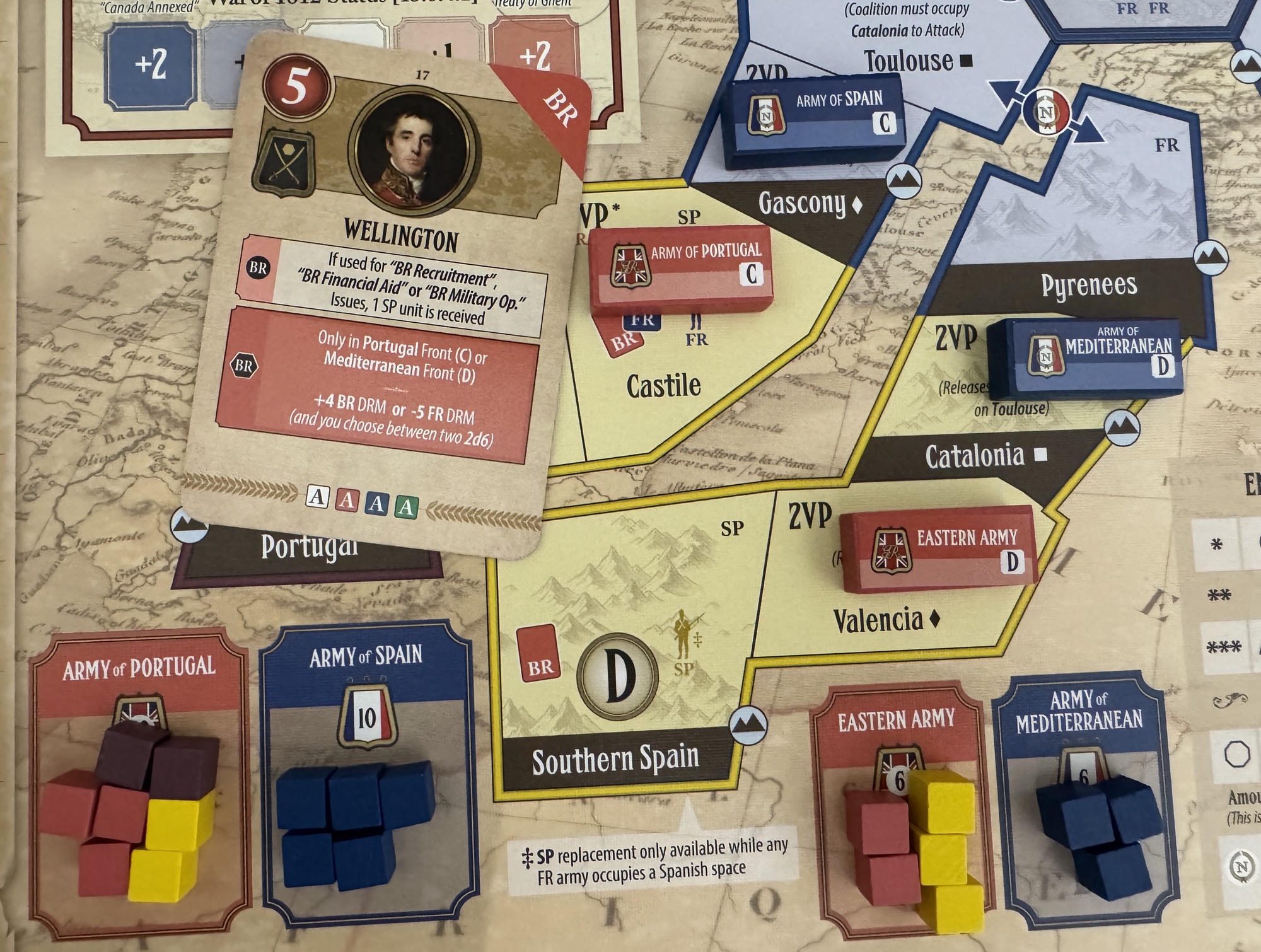
#83: British Leader Wellington from Congress of Vienna from GMT Games
Congress of Vienna from GMT Games is a diplomatic card driven wargame based on Churchill and is the 4th game in the Great Statesmen Series. The game is set during the years of 1813-1814 and sees players take on the role of the main characters of the struggle between the Napoleonic Empire and the coalition of Russia, Austria, and Great Britain with their Prussian, Spanish, Portuguese, and Swedish allies. Congress of Vienna has two different but related phases including the conference table where players first debate over the control of issues germane to the factions and the period of the war and second these issues are then used on the battlefield to recruit units, attack and take overall command of battles. The players will be playing cards from their hands to “debate” over the various issues that were placed on the table, which include all types of things such as Military Operations, Recruitment, who will lead the combined Coalition forces (Generalissimo), Future of French Government, British Financial Aid, Liberalism vs. Absolutism, Austrian Neutrality and several other issues, and then later the players will use their accumulated Resources gained from the issues to enact action on the Military Map and do things like mobilize troops, place Military Support Markers and the ultimately to conduct warfare.
The game relies on cards and cards can be used to negotiate, i.e. move an issue to your National Track. Cards can provide a particular issue with positive and negative DRM’s depending on which nation plays them and can also be traded with another player during the Diplomacy Phase. Certain cards are better than others for debating an issue moved by another player; and finally, if they are saved for the War Phase, staff cards can be used to modify dice rolling in battles. These are very versatile cards and the players will have to learn them and their benefits in order to be effective at the game.
In this entry, we are going to take a look at the British Leader Wellington card. The Wellington card is the most powerful British military asset available and the British player should work hard to make sure that they get the card either by luck of the draw or by attempting to trade cards with other players. The major benefit of the card is during the War Phase, as it provides multiple benefits that can make combat much easier for the British. The bottom part of the card gives a boost during combat by granting an impressive +4 DRM in battles or to make the French have a -5 DRM. This is a very important decision and will mainly come into play to ensure losses are greater for the French or to make sure that a battle can we won. The combat benefit can only be used in the Portugal or Mediterranean Fronts but that is fine as this is where a majority of the British military actions will occur. But even more important than the DRM’s is the re-roll of the combat dice for the British. The other part of the combat benefit shown on the card is that the British player will get to roll 2d6 twice and then select the highest result during battles, greatly mitigating their risks of rolling poorly. Just a very powerful card for battles and I would definitely recommend its use in this fashion.
But, the top part of the card is also very important, particularly in the early part of the game, as when the card is used to move a British Recruitment, Financial Aid or Military Op Issue at the negotiating table they will gain a 1 SP unit that can be placed in the future into Fronts. This extra unit recruitment allows the British to slowly build up their forces without having to solely focus on choosing Recruitment Issues. This gives them the opportunity to focus on other Issues which can be very beneficial and give them a more well rounded approach.
Field Marshal Arthur Wellesley, 1st Duke of Wellington was a British Army officer and statesman who was one of the leading military and political figures in Britain during the early 19th century, twice serving as Prime Minister. He was one of the British commanders who ended the Anglo-Mysore wars by defeating Tipu Sultan in 1799, and was among those generals who ended the Napoleonic Wars in a major Coalition victory when the Seventh Coalition defeated Napoleon at the Battle of Waterloo in 1815.
Wellesley was born into a Protestant Ascendancy family in Dublin, in the Kingdom of Ireland. He was commissioned as an ensign in the British Army in 1787, serving in Ireland as aide-de-camp to 2 successive lords lieutenant of Ireland. He was also elected as a member of Parliament in the Irish House of Commons. Rising to the rank of colonel by 1796, Wellesley served in the Flanders campaign before being sent to India, where he fought in the Fourth Anglo-Mysore War, ending the conflict with a victory at Seringapatam in 1799. He was appointed governor of Seringapatam and Mysore and, as a newly appointed major general, won a decisive victory over the Maratha Confederacy at the Battle of Assaye in 1803.
Rising to prominence as a general officer during the Peninsular War, Wellesley was promoted to field marshal after leading British-led forces to victory against a French army at the Battle of Vitoria in 1813. Following Napoleon’s first exile in 1814, he served as the British ambassador to France and was made Duke of Wellington. During the Hundred Days campaign in 1815, Wellington commanded another British-led army which, together with a Prussian army under Field Marshal Gebhard von Blücher defeated Napoleon at Waterloo.
After the end of his active military career, Wellington returned to politics, becoming a prominent member of the British Tory party. He served as prime minister from 1828 to 1830, as well as on an interim basis for a little less than a month in 1834. Wellington oversaw the passage of the Roman Catholic Relief Act 1829 and opposed the Reform Act 1832. He continued to be one of the leading figures in the House of Lords until his retirement in 1846 and remained Commander-in-Chief of the Forces until his death in 1852.
Portrait of the Duke of Wellington by Sir Thomas Lawrence, c. 1815–1816.
We have done 2 videos on this game including the following RAW Video after out 1st play at Buckeye Game Fest in May 2025:
We then did the following full Review Video after our 2nd play at WBC last July:
Asmodee’s recently-launched party games studio Moodbox Games has unveiled its first four releases, with Guess the Mess, Link Out Loud, Photo Dump and Who Says? Friends set to hit retail shelves in July.
The announcement marks the first product reveal from the women-led studio, which Asmodee launched last October as part of a push to reach players beyond traditional hobby gamers.
Moodbox says its games are designed around a philosophy that “playing games should feel like a dose of serotonin”, with a focus on approachable rules, social interaction and creating memorable shared experiences for families and friend groups.
Moodbox head Kelli Schmitz said, “The goal with Moodbox Games is to create experiences that instantly bring energy, laughter, and connection to the table.
“This first lineup reflects the kind of social play we know people are craving right now — games that are approachable, highly interactive, and memorable whether you’re playing with family, close friends, or a large group.”
The initial range draws on a mix of established and emerging tabletop design talent, including Happy Salmon co-designer Ken Gruhl, his Mantis co-creator Jeremy Posner, Word on the Street designer Jack Degnan and first-time published designer Annika Wierichs.
Guess the Mess is a family party game for ages eight and up from Degnan and development studio Hedyverse, which challenges players to decipher deliberately chaotic clues in a race against their opponents.
Link Out Loud || Photo Credit: Asmodee
Link Out Loud, designed by Posner and Gruhl and also developed by Hedyverse, is a team-based word association and communication game in which players attempt to make connections and relay them to teammates under pressure.
Photo Dump, designed by Wierichs and developed by Hedyverse, takes a co-op approach, using players’ own photos as clues in a storytelling-focused experience.
The fourth title, Who Says? Friends, is a quote-guessing game designed by Lloyd Mintz and developed by Bolt Games, with players aiming to identify memorable lines and pop-culture references either individually or in teams.
Moodbox highlighted that Guess the Mess, Link Out Loud and Photo Dump were developed, edited and published by teams of women, describing the process as a “collaborative and inclusive creative approach from concept to shelf”.
The studio is led by former Catan Studio director of brand development Kelli Schmitz and long-time young adult-focused book editor Shaina Olmanson, who joined Asmodee as an operations and communications manager in May last year.
Prior to leading Moodbox Schmitz spent a year working on inventor relations for Asmodee’s social games in the US market, across its family game studio Zygomatic, quiz and party games-focused Bezzerwizzer Studio, and Dotted Games, which Asmodee launched in 2024 to create new LEGO board games.
Moodbox’s development partner Hedyverse was co-launched in 2024 by Jessica Aceti – who previously helped establish Seattle-based game design collective Prospero Hall, was VP of business development, marketing and licensing at board game design studio Forrest-Pruzan Creative, and helped launch Funko Games after Funko acquired Forrest-Pruzan Creative in 2019.
It followed that a month later by picking up the rights to party game Time’s Up! from R&R Games, continuing an expansion push predicated on social games being the fastest growing category of the board games market.
Asmodee said at the time of the ATM acquisition that it expects a compound annual growth rate (CAGR) for social games of between 4% and 8% between 2025 and 2030, compared to about 4% for the wider board games market, citing mass market sales research for the US and ‘main European countries’ conducted by Arthur D Little.
For many people, Spiel des Jahres is something they encounter only once a year. A list of nominees appears, winners are announced, and the familiar Red Pawn finds its way onto board game boxes that in turn appear on shop shelves. Yet, the award itself is only the most visible part of the organisation's work. Behind the annual announcements sits an association that funds projects, supports research, encourages new designers, and promotes the social value of play. In this third article in the series, I want to look at those activities that reveal a side of Spiel des Jahres that is often overlooked, particularly outside German-speaking countries, where the organisation is frequently seen only as a prestigious board game award.
The voting for the 2025 Meeples Choice Awards is complete and, due to ties, there are more winning games than usual. Instead of the usual three winning games, this time there are five. The winners are: LORD OF THE RINGS: … Continue reading →
Ready for a confession? I didn’t love Balatro, the roguelike poker deck-building game from a couple years back. Don’t get me wrong, the number-go-up part of my brain adored Balatro. But the rest, the foam of consciousness so certain it’s in control of the mammalian beast, the me suspicious of anything hypnotic, found the whole process incredibly off-putting. Which, of course, is why I played it for (oh no) 76.9 hours, about which I cannot tell you a single anecdote. Which, incidentally, is also why I hate it.
Rolling Deep is the forthcoming solitaire board game by Peter C. Hayward. Given his explicit efforts to emulate Balatro, which he’s detailed at length in a series of design diaries, one might suppose that Rolling Deep is not my jam. The Anti-Dan, as it were. But having played it a handful of times, I’ve come away with the opposite impression. Yes, this is more or less Balatro: The Board Game. But it’s so much more than that.
It’s better than Balatro, for one thing.
Gosh, I love being able to change a die’s faces.
What so many people in this medium call “theme” is a funny old thing. Rolling Deep is the sort of game with a “theme,” in the sense of being this discrete veil divorced from and layered atop the game’s mechanisms. What is that theme? It doesn’t matter. I mean, it matters in the sense that it provides some context for the game’s actions, looks pleasant with its Cuphead-esque homage to early Disney and Fleischer Studios animation, and justifies a portion of the game’s budget. But it simultaneously doesn’t matter to the story being told by the artwork or the proper nouns in the rulebook. At no point did I flip a card and say, “Oh no! An evil mushroom!” Instead, the story is wholly mechanistic. At the card’s turn, I would say, “Oh no! How am I going to deal with this new probabilistic conundrum?”
That might sound like a bad thing, especially given my usual emphasis on the stories that arise when we play games. But, to be clear, this is a story. It just doesn’t happen to be a story about how three dice-headed adventurers reached the center of the Earth.
Instead, Rolling Deep is the story of how I transformed three meager dice into powerhouses that rolled seventy-nine in a single go. This moment was a triumph of careful resource management, broken combo-building, sly damage mitigation, and no small amount of luck. It was exciting, tangible, and, in the game’s sharpest departure from its inspiration, memorable.
Each boss sets the tone for the round.
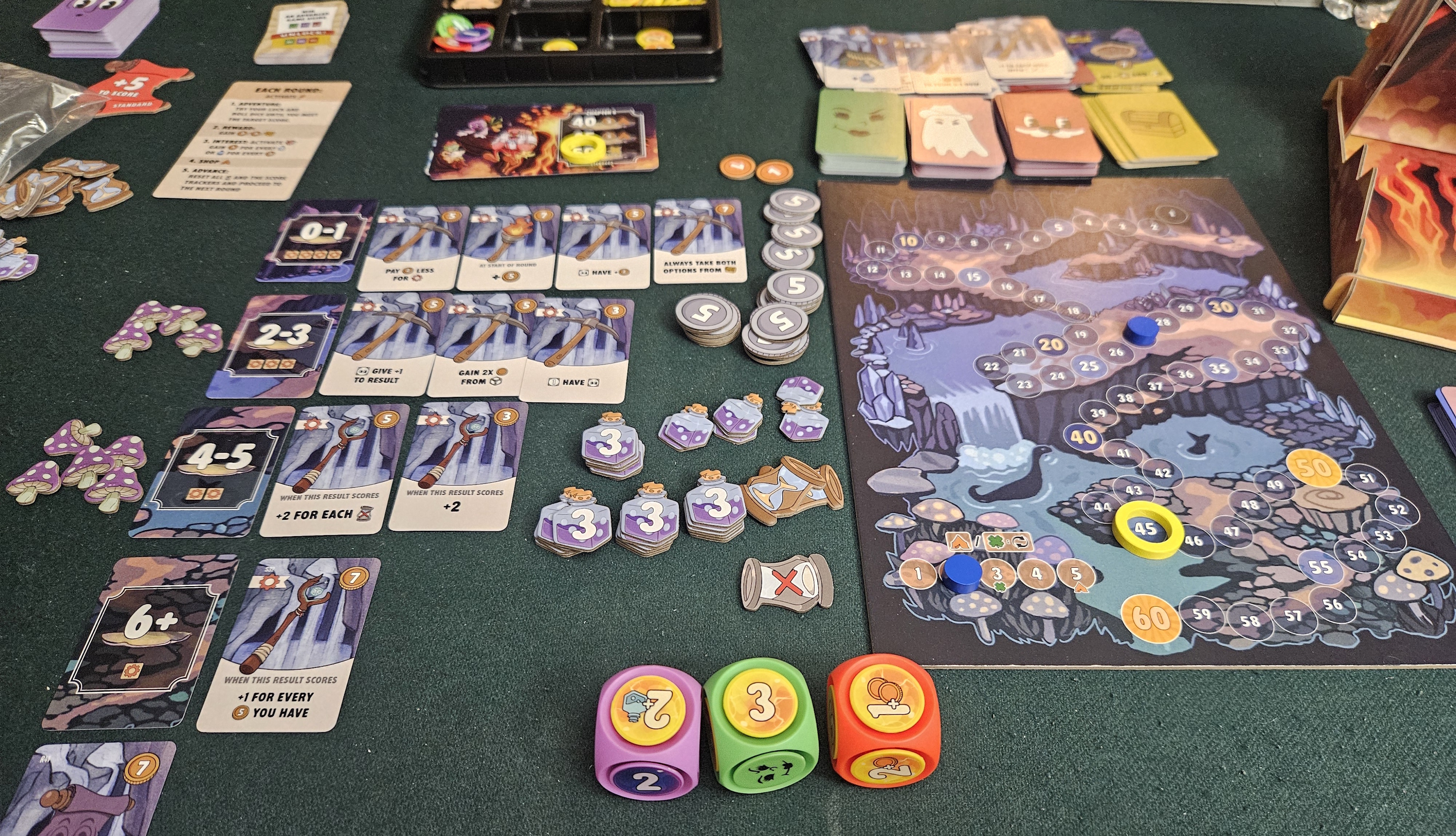
Every round in Rolling Deep goes like this. You’re facing a challenge that happens to be a number. Say, twenty-three. Last round, the number was lower. Twenty. Next round, it will be higher. Twenty-seven. Steadily it climbs, round by round, increasing the pressure at a steady pace, like a numerical hyperbaric chamber.
You have three rolls, all summed together, to meet that number.
But there’s a problem. At the game’s outset, reaching those later targets is impossible. These dice, you see, have rather low digits. At best, you can roll a 2. More likely, you’ll roll a 1 or even a 0, albeit perhaps a 1 or 0 that also grants you a coin or a reroll potion. Over three rolls, that means you can maybe hit a target of eighteen. And that’s with some pretty extreme luck.
Fortunately, there are two solutions to this problem.
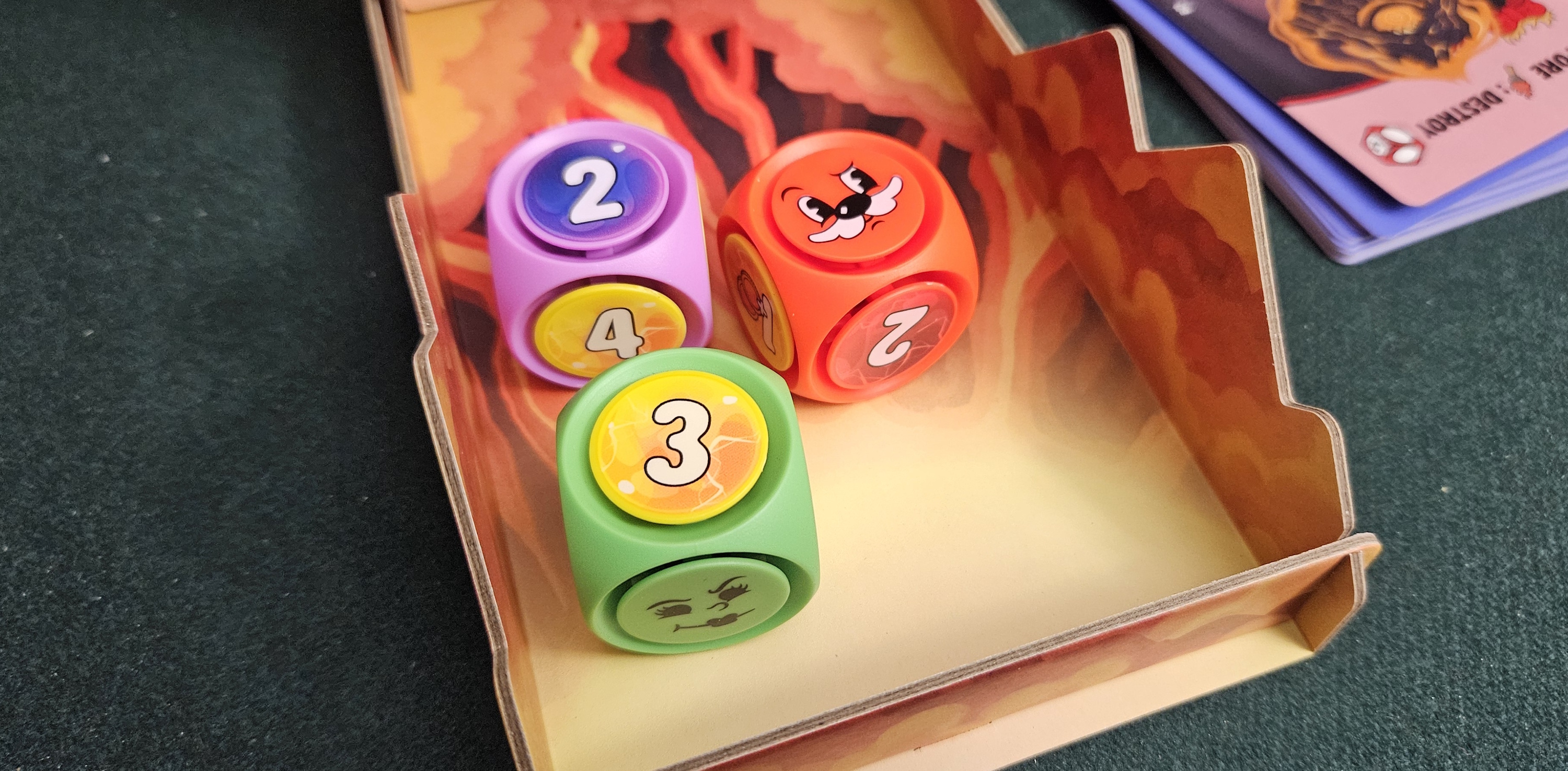
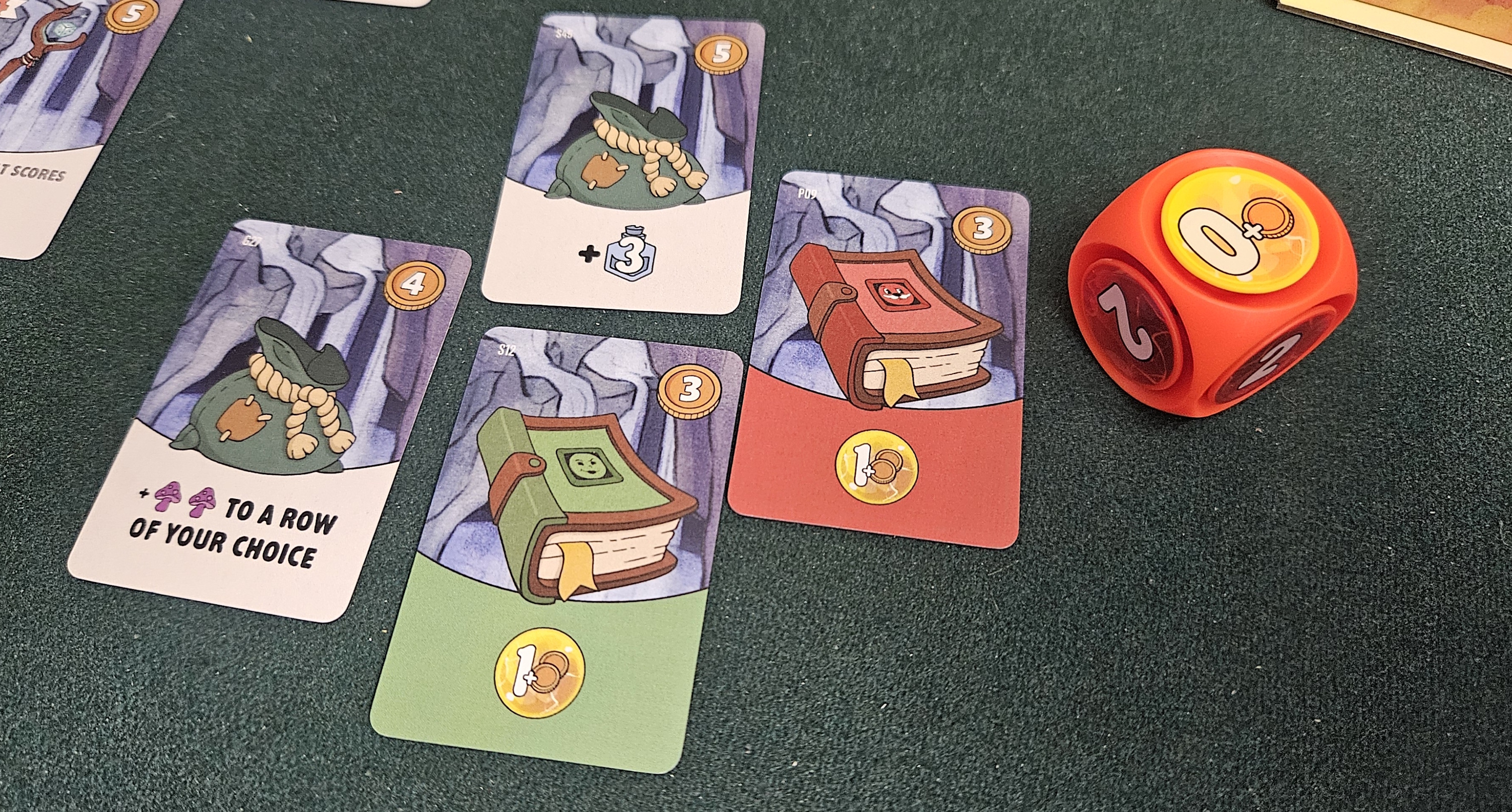
First, the faces of your dice have custom faces that can be swapped out. Picture the dice from Tom Lehmann’s Dice Realms, but way easier to handle, without the weird LEGO-breaker tool for prying faces away from the frame. Here everything clicks into and out of place with a breezy snap. Out with the 0, in with a 2 plus a potion. Click. Sayonara 1 with a pity coin, hello whopping 5. Click. Oops, now you’re rolling too high — yes, that might be a thing — so let’s turn that 5 into a 3 with a coin. Click.
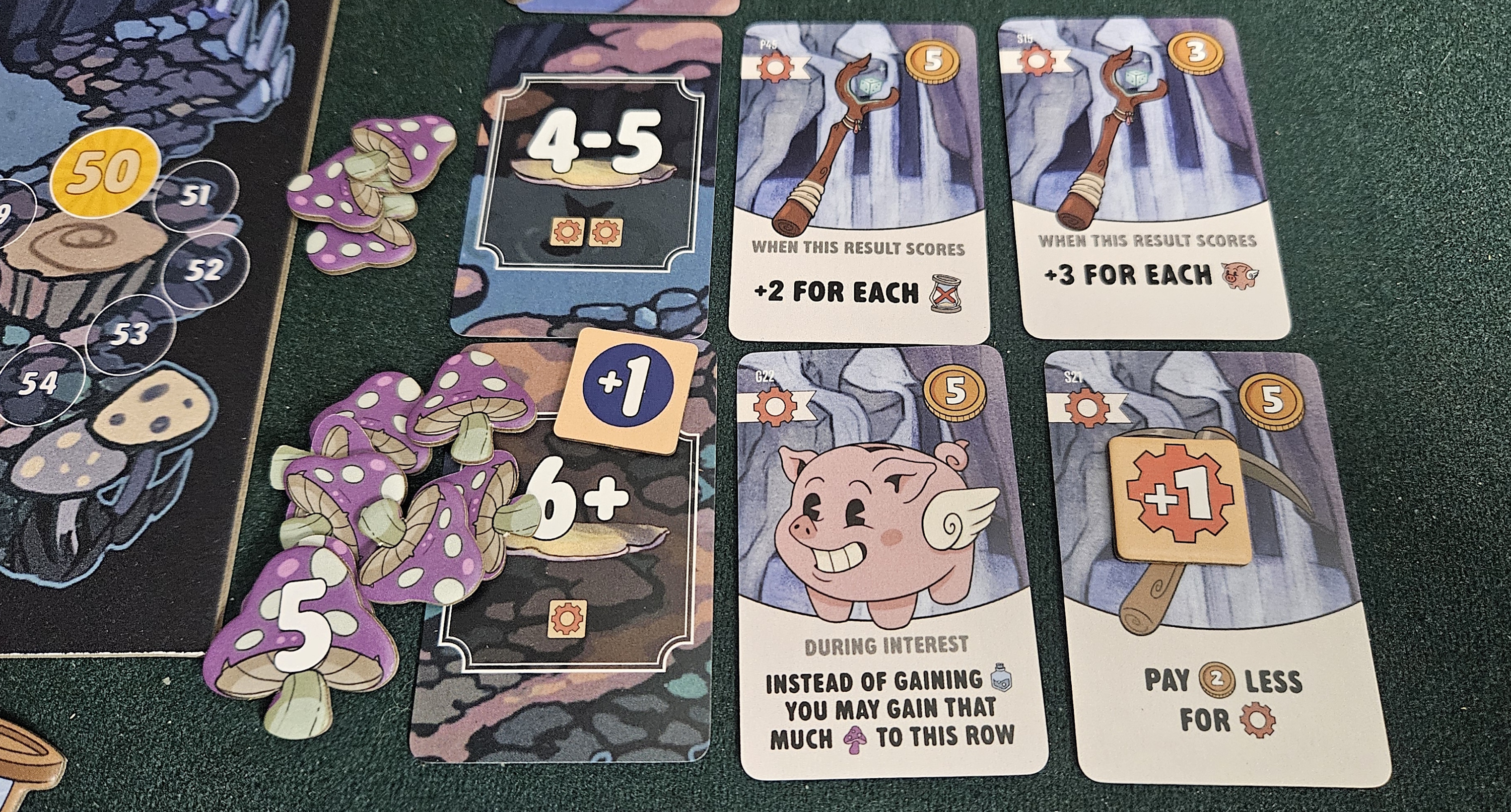
Second, the way you purchase these new faces also offers a way to improve your performance by other means. By a lot of means. You could purchase an upgrade that gives a permanent +2 to every roll. That’s the easy stuff. You might also earn a wand that only triggers with a natural roll of 4-5, and awards +3 for every piggy bank ability. Now you have a synergy going. That wand, plus as many piggy banks you can afford from the market.
Little by little, your cards produce an engine. (Hopefully.)
Thus the game’s irresistible tempo. You roll, perhaps spend potions or use your upgrades to massage the numbers, and add that total to your sum. If you reach the target number after three tries, you gain a prize, earn interest on any leftover cash and potions, reveal and purchase upgrades from the market, and then do it all over again with a higher target number.
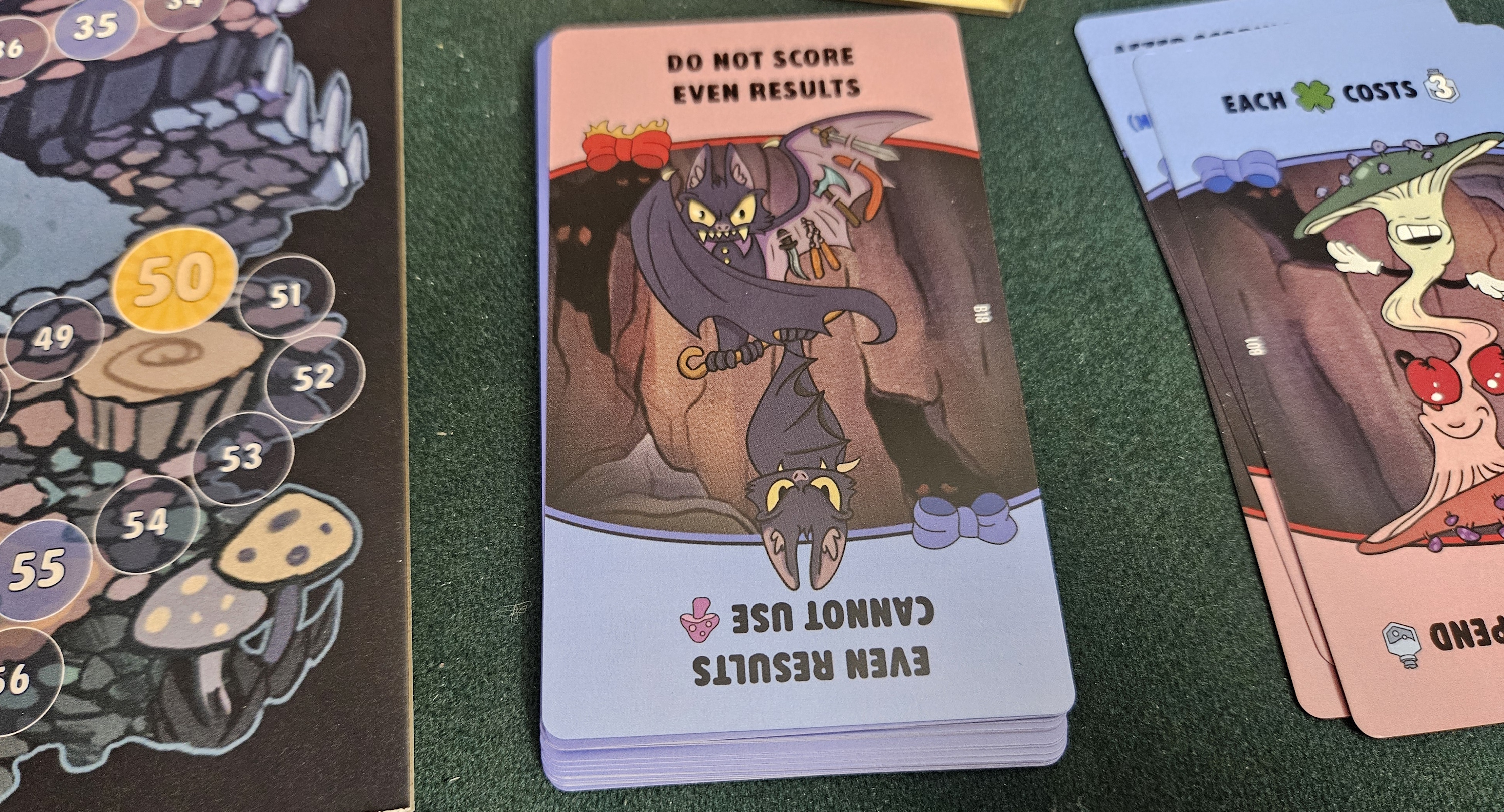
Every third round, you face a boss with an obnoxious special ability. Like, for example, a cartoon bat who prevents you from scoring results that are even. Or a cartoon mushroom that makes it harder to spend potions for crucial rerolls. Or a different cartoon mushroom that destroys some of your upgrades. Nasty stuff, but nasty stuff you see coming for a couple rounds before it hits you. Nasty stuff you can prepare for.
If this sounds like Balatro — well, look, Hayward isn’t concealing Rolling Deep’s influences. The dice faces are your poker deck. The upgrades are jesters. The mushrooms that boost your sum before withering are… I guess multipliers? There aren’t actual multipliers in Rolling Deep, probably because the game’s numerical targets increase linearly rather than exponentially. The possibility of expanding how many upgrades you can hold are akin to Balatro’s spectral cards. It’s all familiar. It even has achievements and unlocks. Beat the game on easy mode, you earn access to tougher delves. Break the game in one way, you gain tools that are a little weirder than the starting kit. I won’t spoil the wilder unlocks, but they’re in there for the sickos.
But if this is all so familiar, why do I say it’s better than Balatro? I knew you’d ask.
Buying new options at the market.
For one thing, the medium itself demands a very different sort of attention from a digital game. Where Balatro hypnotizes, Rolling Deep focuses. Sure, I suppose I could zone out. But as soon as I’m asked to shift my tally along the target track, flip some upgrade cards, or shift resource tokens from one place to another, my feet are given purchase on solid ground again. If that doesn’t do it, sure as shooting the alteration of a die face will. Click.
This breeds an entirely different headspace. At no point did I awaken from a three-hour binge. Instead, the processes — the ones that are concealed behind the dazzling lights of Balatro — are entirely my responsibility. I must count the numbers or nothing happens. I must pay attention to my bonuses lest I lose them. There’s no option to glaze over and make number go up. Every upgrade must be considered, weighed against my tableau’s current strengths and gaps, and ultimately purchased or discarded. Very quickly, the physical actions that are automated in a video game become loci of concentration and even pleasure. It helps that Hayward has developed this game until it’s smooth as cream. But the remaining points of friction, some of them inherent to the medium, give me purchase in the real world.
And that extends to the gameplay itself. Because Rolling Deep is more grounded in the real, its challenges are presented as tangible, applied things, rather than wholly abstract. It’s the difference between being told some measurements and shown them against the wall or along the motor’s belt. When I assess my odds, I physically heft one of those chunky plastic dice and turn it around in my fingers. When determining where to slot an upgrade, I slot the card into a physical representation of where my rolls have aggregated. The medium becomes the gameplay and vice versa.
It helps, too, that Rolling Deep’s limited format gives it a more intimate edge. It never disappears into n-space, its numbers beyond intuitive human comprehension. My dumb animal brain grasps the gap between 23 and 41 better than that of 23,749,011 out of 41,000,000, even though they’re fundamentally similar. By scrapping the sky-high escalations of Balatro, Hayward turns Rolling Deep into a puzzle that doesn’t slide off the brain like so much oil.
For such a wild game, Rolling Deep never spirals into too much complexity.
And it is memorable. I mean that. Not as much as a story, not as much as something with characters or relatable confrontations. But thinking back on my sessions with Rolling Deep, I can remember specific problems and the solutions I forged to face them. I could never tell you what had happened in any given session of Balatro even a few minutes after it ended. Something about a banana? Getting a shiny joker? Opening a few card packs?
Rolling Deep is excellent. It’s a very particular kind of excellent, to be sure, a mathematical solitaire game that’s long on odds and probabilities and sums rather than story beats. But within that window, it not only matches the ambition of its inspirations, but exceeds them. Balatro who? This is Rolling Deep, baby.
A prototype copy of Rolling Deep was temporarily provided by the publisher.
(If what I’m doing at Space-Biff! is valuable to you in some way, please consider dropping by my Patreon campaign or Ko-fi. Right now, supporters can read the next installment in my series Talking About Games, this time tackling the topic of what makes a good list! Naturally, the piece includes a list.)
Maybe you’re quite new to board and card games and have heard people talking about trick-taking games. Maybe you’ve been into the hobby for ages and don’t know anything about trick-taking, but you’re too scared to ask at this point. Either way, I’ve got you covered. In the context of card games, a trick is usually a round of play in a card game. Most commonly in trick-taking games…
Tabletop gaming’s most eclectic prize, the Diana Jones Award, has unveiled the latest clutch of finalists for its annual celebration of excellence in the field of gaming.
Price Johnson, the new CEO of Gloomhaven publisher Cephalofair, is among the five finalists for this year’s award, as are miniatures game Trench Crusade and Minnesota-based game retailer Mischief Toy Store.
TTRPG designer and journalist Rob Wieland
They are joined by Jo Kelly and Cole Wehrle’s board game Molly House, which explores the joy and fear experienced by gender-defying Londoners in 18th century society, and Rob Wieland, a much-loved TTRPG designer and journalist who died last October aged 47.
Price Johnson’s nomination comes less than two months after the long-time Cephalofair COO was promoted to CEO at the publisher – with Isaac Childres, the company founder and designer of its runaway successes Gloomhaven and Frosthaven, stepping back to focus exclusively on game design at the company.
Johnson has been a high-profile voice in campaigning against tariffs imposed by US President Donald Trump over the last year, aiming to highlight the heavy financial burden it has placed on tabletop game publishers – many of which rely on Chinese manufacturing for their titles.
The Diana Jones nominations committee praised that work, saying Johnson’s appearance on multiple national news outlets, “consistently and clearly explained how the tariffs posed an existential danger to many companies in the adventure gaming industry”.
Mischief Toy Store in the Twin Cities was also selected for its involvement in a lawsuit against the US tariffs last year, as well as its work battling activity from anti-immigration ICE agents.
The committee said that hours after criticizing ICE in a TV interview the store was targeted with a surprise audit, but resisted turning over their employee records to DHS.
It added, “They have been printing ICE OUT posters to distribute as fast as they can and have organized a network of 3D printing hobbyists to distribute thousands of ICE whistles.
“Amid the chaos in Minnesota, they had to suspend online ordering, and their website directed folks to support local immigrant rights organizations instead. They work hard to make space at the gaming table for everyone.”
Trench Crusade, which focuses on an alternate 1914 in which humans have been battling the forces of hell for 800 years, was picked out by the committee as “a triumph of community and creativity”.
The Factory Fortress-published title was built around initial sketches and lore created by artist Mike Franchina, who later teamed up with sculptor James Sherriff and game designer Tuomas Pirinen to design the game.
Diana Jones’ nominations committee described Rob Wieland as “a relentless advocate and promoter for the entire tabletop gaming community for years”.
It said, “He served as a mentor to countless others, and he brought the industry to wider and greater awareness through his work with Forbes and other publications.
“In addition, he regularly hosted on-stage sessions of The Extraordinary Adventures of Baron Munchausen at conventions to raise money for charity.”
The 2026 Diana Jones Award ceremony will be held in Indianapolis on July 29 at its annual gathering of tabletop games industry professionals, marking the unofficial kick-off of Gen Con.
The original Diana Jones Award trophy, which was lost in the post several years ago
The award aims to celebrates “everything that’s the best about gaming”, with previous winners across the award’s 26-year run having included Blood Rage designer Eric Lang, Nigerian games industry publisher and evangelist NIBCARD, and the entire ‘actual play’ movement of people livestreaming and podcasting roleplaying games.
Last year’s award resulted in a tie between Daybreak, the climate change-themed board game designed by Matt Leacock and Matteo Menapace, and Rose Estes, an early TSR employee who went on to write the Endless Quest series of choose-your-own-adventure game books.
The original Diana Jones award trophy was a clear lucite pyramid containing the burned remains of an Indiana Jones roleplaying game from the 1980s – one element of which spelled ‘Diana Jones’ after the preceding letters were burned away.
That trophy was lost in the post six years ago during the traditional handover from one winner to another, never to be recovered – but a replacement trophy has now been created by the organisation.
The Diana Jones Award also runs a separate emerging designer programme prize, which aims to help up-and-coming creators via a $6,500 prize package that includes an all-expenses trip to Gen Con.
The biggest reason Stonemaier Games hasn’t returned to crowdfunding is the gap between asking customers for payment and actually delivering the product to those customers. Even if a game is 99% production ready leading into the campaign, roughly 6 months are needed for pre-production, production, and freight shipping.
So I’m always fascinated when publishers employ creative methods to close that gap in service of their customers (and also as a marketing tool). Some publishers offer a demo version of the game digitally, Earthborne Games and Covenant offered free preview decks of Hubworld Aidalon, and the recent campaign for The Old King’s Crown started production on the first reprint before the campaign via Gamefound’s “express crowdfunding” option, allowing some backers to receive the pre-printed games just a few months after the campaign’s conclusion. There are also the options to demo games at conventions and even game stores before their release or to offer partial print-and-play copies of the game for people to try at home.
Let’s jump forward to early May 2026, when I saw a Facebook ad for an upcoming crowdfunding project, Cataclysm Arcade. It featured some intriguing mechanisms, so normally I would have just clicked the prelaunch “follow” button and waited for a launch notification (especially as a trading card game).
However, Cataclysm Arcade combined two elements in the ad that made me pull out my wallet: One, it offered curious customers the option of buying a few booster packs before the campaign for $5 each. Two, as long as each player has a booster pack, that’s all you need to play a game of Cataclysm Arcade!
I want to call this “try before you buy,” but it isn’t exactly that, as I literally spent $10 to buy two packs. It felt that way, though. The real hook for me was the ability to play a full game using just 1 booster pack per player. Cataclysm Arcade accomplishes this by using a modern deckbuilding mechanism: If you run out of cards in your deck to draw, simply shuffle your discard pile to form a fresh deck.
Not only was this a player-friendly sneak preview, but it was also great marketing: It had me actively thinking about the game before the Kickstarter project, it showed that the game was fully designed and ready to print, it gave potential backers a chance to try the game before backing it, and it gave content creators a timely way to talk about the game (as I did on our channel).
As I mentioned in last year’s article about free preview decks, this method won’t work for most games. Small packs of cards are incredibly cost-effective, so you need a cards-only game where you can play the game with a small subset of the cards while still leaving players wanting more. Yet it’s a pretty cool tool to consider during the design and marketing process.
Do you have an example of a game you were able to try on the table well before crowdfunding fulfillment? How did it impact your experience with the game? Did you end up backing the project?
Welcome to this week’s batch of crowdfunding campaigns. We have a variety of offerings here, so we hope you will find something that catches your eye. Also, if you want to chat with the BGQ team, join our Discord Server where we talk about games, movies, sports, and other fun stuff. Check it out and […]
From the rulesheet: “A curse has cast a shadow over the valley, causing the inhabitants to run from the villages and the animals to flee their nests. From the top of a ridge, a mysterious creature named Buh has noticed the desolation and decided to bring the light back. As they stroll through the valley, Buh uses their magic to seek out and restore the light. As darkness recedes, wildlife and the village’s inhabitants begin to return and revel in the sun’s life-giving warmth once again.”
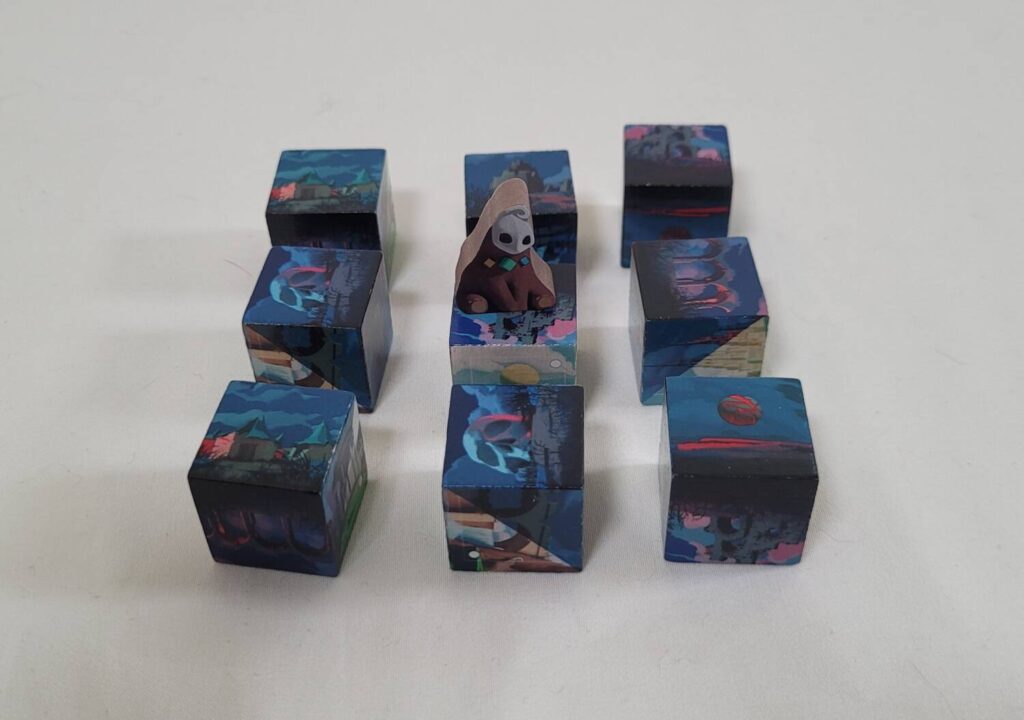
Light Seeker is a two-player strategy game composed of 9 wooden cubes and a single meeple, called the ‘Buh meeple’ (which sort of resembles a cartoon badger). Each wooden cube has a number of dark sides, bright sides, and a couple of half-bright/half-dark sides. At the start of the game, the cubes are arranged into a 3x3 grid, dark sides up. The Buh meeple is placed atop the centermost cube.
On a player’s turn, they will be performing two actions from a list of two possible action types. The same action can be repeated if the player wishes. The two possible actions are ‘slide cube’ or ‘tilt cube’. Sliding involves moving a cube from its current spot to an orthogonally adjacent location without…
We have interviewed the venerable designer Ty Bomba on numerous occasions over the 10-year life of the blog. In fact, I counted up the interviews and to date we have done 18 total! Wow but the last one we did was in January 2023 and we have just not had him on since. No reason for that other than I have been busy with other games. But recently I saw from War Diary Publications that they were printing one of his What If? style alternative history games called Rommel in Italy, 1943-1944: A Counter-Factual Simulation, which supposes Field Marshal Erwin Rommel had taken command of German forces in Northern Italy rather than being sent to help with the defense of France against the expected Allied invasion. I reached out to Ty and he was more than glad to give me some more information.
Grant: What is your upcoming game Rommel in Italy about?
Ty:Rommel in Italy, 1943-1944: A Counter-Factual Simulation allows 2 players (or one playing 2-hand solitaire) to investigate the strategic and operational potentials that would have been in place across northern Italy from September 1943 through May 1944 if Hitler had left Field Marshal Erwin Rommel in charge there rather than Kesselring. Rommel advocated for immediately pulling back to a shorter, easier to defend, position at the south edge of the Po Valley rather than trying to fight it out farther south, with both the German’s flanks exposed to possible encirclement via Allied amphibious end runs. In effect, it put the Allies into a strategic position that historically they did not achieve until a year later. The question then becomes can they keep up that kind of advance into and across the Alps.
Grant: Why was this a subject that you wanted to design a game around? What assumptions about history did you take into account?
Ty: Historically, we had 2 of Germany’s best field commanders, Rommel and Kesselring at complete odds with each other over theater-level strategy. Kesselring felt confident the Allies would not achieve a level of operational efficiency that would allow them to effectively exploit the supremacy in the seas along both of Italy’s coasts. History showed that he was correct in that assessment, but Rommel’s transfer to France was not a sure thing. Hitler actually tried to send him back to Italy, to take full charge there, shortly after Rommel had gotten on a plane to fly to France. Radio communications temporarily failed, and by the time Hitler’s communications people got that all sorted out, the dictator had again changed his mind and kept Kesselring in place.
Further, the fact Kesselring was shown to have been correct does not mean Rommel was necessarily wrong – and there’s a fun-to-play wargame inherent in that iron.
Grant: What is important from the overall period and setting to model in the game?
Ty: The opening of the campaign, in September 1943, is filled with opportunity – but also fraught with peril – for both sides. At the start of play, there are only a few German garrison units in the far north of Italy, while the 10 (mostly elite) divisions of their Tenth Army start off-map to the south, where they just received Rommel’s order to run north. There are no Allied units setup on the map at all. They enter on the south edge during the first turn, and both players operate using the sequence below.
5.3 Allied Reinforcement & Replacement Phases
During these phases, the Allied player may bring onto the map newly arriving units and reclaim into play units that had been previously eliminated in combat. This phase is skipped on Turn 1.
5.4 German Reinforcement Phases
During these phases, the German player may bring onto the map newly arriving units and reclaim into play units that had been previously eliminated in combat. This phase is skipped on Turn 1.
5.5 Movement & Combat Sequence Determination Phases
In each of these phases, excluding that of Turn 1, the Allied player openly declares whether that turn’s movement phase or combat phase will be taken first. On Turn 1 the sequence is always the movement phase followed by the combat phase.
5.6 Alternating Actions Movement or Combat Phases
Always starting with the Allied player, the two players alternate either launching one attack or moving one unit, depending on whether the present phase is movement or combat. Individual attacks may have more than one attacking unit in them, but moves are always made one unit at a time. The unit(s) committed to those “actions” are, upon their completion, flipped over to show their disrupted sides. If a player does not actually want to make an attack or a move when it is his time to do so, he must flip one unit to its disrupted side, just as if it had moved or launched an attack: no “passing” is allowed.
5.7 Movement or Combat Recovery Phases
A movement or combat phase continues as described above until both players are out of undisrupted units or both agree they want to end the phase. If one player runs out of undisrupted units before the other, the player with remaining undisrupted units may go ahead and complete whatever actions he wants to perform with them within normal strictures, but now uninterrupted by having to pause to allow the opposing player to take an action. When a combat or movement phase is ended, both players should cooperatively turn over all disrupted units on the map so their undisrupted sides are and showing.
5.8 German Supply Check Phases
In each of these phases, both players should cooperatively look over the map to find if there are any German units out of supply. Each such unit is immediately removed to the dead pile.
5.9 Allied Supply Check Phases
In each of these phases, both players should cooperatively look over the map to find if there are any Allied units out of supply. Each such unit is immediately removed to the dead pile.
5.10 Ending & Starting Turns
Each time a Allied Supply Check Phase has been completed, advance the Turn marker one box on the Turn Track printed on the mapsheet and start a new turn with Phase I.
On the first turn, the Allied player has a relatively open front before him. If he can exploit that to get into the Po Valley quickly, he will move the strategic timetable significantly forward of the historic one. However, as he’s moving onto the map, so too it German Tenth Army. Depending on how bold both players are, it is not unusual to see pockets form inside other pockets.
Grant: How has this design changed since its original publication in 2021 in Banzai Magazine under the title Rommel’s Last Stand: Italy 1943-44, What If?
Ty: The new publisher has fixed the (scant) errata from the first (bilingual) Japanese edition from Banzai Magazine. They have also taken all the Japanese off the map and out of the rules, presenting everything fully in English. Other than the removal of those irritants, it is the same game.
Grant: What is the scale and force structure of units used for this design?
Ty: Each hex on the map equals 5 miles (8 km) from side to opposite side. Each full turn represents 2 weeks to 2 months, depending on the time of year. Every ground unit represents a regiment, brigade or division of about 2,500 to 12,000 men and/or 50 to 350 armored fighting vehicles.
Grant: How many maps are used in the game?
Ty: There is 1 large-hex based 34×22” map showing Italy north of the line of the Arno River to Ancona.
Grant: What is the anatomy of the counters?
Ty: The units are standard-classical in their data presentations, except their movement factors are not printed on them. All Allied units have (supplied) MF’s of 16 throughout the game, while the German MF’s are as follows.
German Mechanized Units Turns 1-6 – 16 MF’s
German Non-Mechanized Units Turns 1-6 – 8 MF’s
German Mechanized Units On Turns 7-10 – 12 MF’s
German Non-Mechanized Units On Turns 7-10 – 6 MF’s
Grant: What sources did you consult for the Order of Battle?
Ty: The Armies of Rommel by George Forty was an excellent source for the subtleties in the initial German Order of Battle. Beyond that, I pulled the roughly half-dozen historical Italian campaign games off my shelves and pulled information out of them. This is one of the most thoroughly simulated campaigns in the hobby, going all the way back to Avalon Hill’s Anzio, so I was not looking to find any heretofore undiscovered anomalies in either sides’ OB. The uniqueness in this game’s treatment of it comes from the changed strategic context combined with the tension inherent in the turn sequence, which requires both players to remain alert for sudden danger or fortuitous opportunities all throughout its play
Grant: How does combat work?
Ty: Combat is always voluntary and, when viewed on a battle-by-battle basis, is standard/classical odds ratio using a six-sided die.
Grant: What are the victory conditions?
Ty: Operating in conjunction with the alternating-actions turn sequence, the victory conditions are a further element I used to keep both players on the edges of their seats at all times. See below.
4.1 In General. The Allied player is on the offensive, trying to win by advancing fast enough to cause a major disruption to the historic timeline.
4.2 Allied Victory During 1943 Turns. If Phase 9 of Turn 1 or 2 or 3 or 4 ends with Venice or Milan or Trieste, or any one or more of the four German supply source hexes, occupied by an Allied unit or stack, that game ends at that time in an Allied victory.
4.3 Allied Victory During 1944 Turns. If Phase 9 of Turn 5 or 6 or 7 or 8 or 9 or 10 ends with any one or more of the four German supply source hexes occupied by an Allied unit or stack, that game ends at that time in an Allied victory.
4.4 German 1943 Sudden Death Victory. If any movement or combat phase of a 1943 turn ends with the German player having gained control of the containing the Allied Amphibious Invasion Beachhead marker, the games ends in a German victory at that time.
4.5 German 1944 Sudden Death Victory. If any movement or combat phase of a 1944 turn ends with one or more German units in any hex(es) on the south map edge, that game ends in a German victory at that time.
4.6 German End-Game Victory. If Phase 9 of Turn 10 ends without the Allied player having achieved a victory, the game ends at that time in a German victory.
The “White Dragon Game Designer” dressed as a samurai.
Grant: What are you most pleased with about the design?
Ty: As I mentioned above, the Italian campaign has been one of our hobby’s most thoroughly plowed fields for decades. Despite that, I believe I have offered a new experience with it here. Players will get a new slant on it, one that operates within the broad parameters of the war’s historic decision-making, but that is also tense and entertaining for both commanders.
I also hope its appearance in an easily available all-English edition may lead this and other publishers to look into acquiring the rights to other of my designs that have so far appeared only in East Asia (where I am affectionately known as the “White Dragon Game Designer”). I have done several games that have been well-received there, but are barely known here in the West.
Grant: I know you are a busy man with game design projects as well as editing for various wargame magazines but what other games are you currently working on?
Ty: I am presently working on this alternative history design, which is scheduled to appear in World at War No. 130, called Stalin’s Missed Opportunity: What If He Invaded Romania in May 1940?.
Ray Charles and I agree: night time really IS the right time, particularly when it comes to my energy level.
Some of that is tied to the fact that I have children (ages 12 and 9) and I have a wife, all of whom typically go to bed by 9 or 10 PM every night. That means Dedicated Justin Time starts around 10, and I try to squeeze a lot in between 10 PM and maybe 1 AM every day.
In some ways, nights for me start as soon as my typical weekend afternoon siesta ends around 4 or 4:30 PM, because I try to take a nap each day on the weekends and select days during the week, especially if I can find or create a gap somewhere each afternoon when “that 2:30 PM feeling” kicks in.
So even though I love mornings, I find that my body’s peak energy sweet spot typically runs from about 5 PM until 1 AM. I have a passion for things like happy hour, dinner parties, evening networking events, and the Chicago nightlife. I also have a passion for playing board games at night, typically starting after 7 PM and running late, if I can find the right people to hang with me.
For me, the body clock is set. Board games exist in my world as an evening activity, and that activity is not limited to playing lighter fare at night either. In fact, some of my best memories of the last 10+ years are playing heavy games that ran late, that went past midnight, that featured people squawking at each other into the wee hours of the morning.
Conventions are sometimes worse for me because I will always find a way to start a game late when “free play” halls are open 24 hours a day. I have many memories of doing what I consider the absolute worst thing one can do at a show: opening a new treasure at like 10 PM, then ripping off the shrink and trying to table a new game by learning that game from the rulebook (“Justin…NOT FROM THE RULEBOOK!!”) when I have no business trying something like that.
You know the situation. “Yeah, I just picked up a copy of [insert new strategy title here]…we should DEFINITELY play it tonight. No, there are no teach or learn-while-playing videos out there because the game is so new. Yes, this is the right time to punch the cardboard chits, set it up then learn it by reading the 24-page rulebook tonight.”
“Is there any chance we finish this by 1 or 2 in the morning?” a brave soul, doubling as your group’s voice of reason, will offer.
“Absolutely. All we have to do is get through the rulebook; I’ll bet we are up and running in 20, maybe 30 minutes.”
Then you try to play the game…and find that you’ve just finished the first of four rounds, and it is already 1 AM.
But thanks to Ray Charles’ voice in the back of my head, my body is always telling me that night time is the right time to do just about anything. So, I’m the joker who tries this or just agrees with your plan—learning a new game from the rulebook is absolutely the right idea late at night during a show, so we should go ahead and commit to learning it. Strike while the iron is hot, even when it looks like everyone else is essentially asleep.
I still remember when a friend tried to get a game of 1861: Railways of the Russian Empire rolling, a first play we started at like 10 PM. (No, we didn’t finish.) A first play of Hegemony: Lead Your Class to Victory that went from a teach to a final turn that ended just after 1 AM on a Monday night? No sweat; those five hours just flew by.
Rebel Princess: Deluxe Edition at a convention free play space that started after midnight? Home, sweet home. A five-player game of Eclipse: Second Dawn for the Galaxy that started at 9 PM and required a teach? Count me in, even as one player hid in the corner of the map to earn a victory while the other players space-battled their way into a four-hour slugfest at the center of the playspace. (Naturally, that was the second game of a very long night of chucking dice.)
I’ve got dozens of stories like this, and I’m thankful that I’ve found other players who love playing games late at night as much as I do. That’s because I struggle carving out the time to play games during the day.
I certainly like the idea of playing board games starting at, say, 11 AM or noon on a Saturday. But the reality is that being a dad also means trying to avoid tough conversations at home.
“Honey, listen…my friend Beth is doing a game day from 12-6 PM. I’m thinking that, well, maybe I just bail on the family all day long, and you can run the kids to soccer, then band practice, then that third-grader birthday party downtown. We’re cool, right?”
Talk about a recipe for divorce! Instead, I try to carve out one day each month when I actually do bail on my family and tackle daytime gaming. Lately, that means starting around 4 PM with friends in the suburbs on a Sunday here and there. But getting out of parental responsibilities is tough and it never feels great, so I try to balance the day gaming option where I can.
Even if I wasn’t a dad, my body still loves afternoon down time. That makes my already-legendary lack of patience a bigger issue, so I try to avoid these trouble spots by not making critical board game decisions at 2 or 3 PM on a Saturday. Plus, no one I know plays games early, and I’m not a part of a 6 AM commuter game day where I can do card games with folks at a coffee shop downtown or something. (Maybe I need older gamers to join my network, since the people I know who love early mornings the most are also seniors. Some of those folks have already retired, so I’ll have to start making a list of potential gaming buds out of local retirees.)
Maybe it’s different in other parts of the world. There have to be people playing Grand Austria Hotel in an actual hotel lobby somewhere at 8 AM, right? Wargamers who kick off new campaigns at the crack of dawn? Post-yoga trick-taking game mornings with folks from a local gym?
I’ll keep an eye out; maybe mornings give me a chance to shake up the night owl formula that has worked wonders over the years.
In the meantime, nights will do. Thankfully, my body prefers late nights anyway.

 Anmelden

/pic8922576.jpg)






/pic9649271.jpg)
