Angekündigt: Neu: Updates: ANGEKÜNDIGT In der kommenden Woche Crowdfunding. Wenige Projekte sind angekündigt. Hier der Überblick über die kommende Woche: Brass: Pittsburgh Brass: Pittsburgh ist ein eigenständiger (dritter) Titel im Brass System und führt in den industriellen Aufschwung des späten 19. Jahrhunderts in den nordöstlichen USA. Ihr übernehmt die Rolle von Industriellen, baut Netzwerke aus Eisenbahnen, […]
Publisher Equinox scrapped the crowdfund for Altered’s Roots of Corruption expansion yesterday after raising more than €420,000, having launched the campaign last week with a €50,000 target – a figure it described on the project page as a “technical necessity” in order to use Gamefound’s stretch goal system.
Equinox said in an update yesterday that it had also collected €680,000 through retailer pre-orders for the expansion – but added that the €1.1m total was “far too far” from the €2m the company required “to guarantee the future of the game”.
The statement said, “It would be dishonest to tell you that we can still turn the tide by Friday evening. We must face reality: the numbers simply aren’t there.
“It is with a heavy heart that we have decided to cancel the Roots of Corruption campaign. As we committed to doing, all backers – both players and retailers – will be reimbursed in full. This is the cornerstone of our responsibility toward you, and it is the most obvious decision to make.
“This campaign does not only mark the end of a crowdfunding project; unfortunately, it also marks the end of the Altered adventure.”
Altered shattered the crowdfunding record for a TCG on Kickstarter through its debut campaign in 2023, pulling in more than €6.2m (about $7.1m) from about 15,000 backers.
Altered aimed to stand out from high-profile competitors such as Magic: The Gathering through its focus on exploration and bringing heroes together, rather than battles between characters and monsters, as well as innovations such as a print-on-demand and a digital marketplace for cards.
That digital marketplace also made it difficult for retailers to offer the TCG staple of being able to buy, sell and trade single cards, and the game’s powerful early momentum waned as the title struggled to go toe-to-toe with offerings based on hugely popular IPs.
Equinox returned to crowdfunding for Altered’s fifth expansion, Seeds of Unity, in October last year – but faced similar problems to the most recent crowdfund in reaching its necessary totals.
That campaign hit the €50,000 goal set by Equinox in less than nine minutes, but an update from the publisher two weeks later revealed that the actual amount needed to create the game was €2.5m – a figure which if it did not reach, “the adventure will come to an end, and both backers and retailers will of course be refunded”.
Noting the €50,000 crowdfunding goal for that project, and the message on the Gamefound page describing it as more than 1,000% funded, Equinox made no mention of it being a technical necessity for the stretch goal system.
It said at the time, “The funding goal displayed on Gamefound is symbolic, as it usually is in crowdfunding campaigns.
“It’s chosen to help build early momentum but doesn’t reflect our actual needs. Setting the bar too high sometimes makes a project feel out of reach, while a more accessible goal helps get the collective energy moving right from the start.”
That campaign ultimately collected almost €900,000 after being extended for several days, with another €1.4m coming through retailer pre-orders.
Equinox said at the conclusion of that campaign, “While we haven’t reached the objective of €2.5m mentioned initially, we’re not that far off our goal, and with some adjustments on our part (which includes reviewing some budgets and determining new production processes) we believe we can cover that difference.”
Equinox had come under fire from some Altered players for launching its Roots of Corruption campaign before Seeds of Unity had been fully delivered to backers.
The company said in an update to Seeds of Unity backers that while it aimed for a four-month cycle per set, production delays meant that it “no longer [had] the flexibility to push dates back”.
Uncertain Future
Equinox founder Régis Bonnessée acknowledged in the latest update announcing the end of Altered that players would inevitably have questions about the future of their digital collections, the game’s availability on Board Game Arena and “the legacy of this universe”.
He said, “We are not going to leave you in a vacuum. We simply need some time to digest this moment, to properly close this chapter, and to provide you with clear and respectful answers. Thank you for every card played, for every smile exchanged, and for everything you put of yourselves into this adventure. It was an honor to imagine it with you.”
Bonnessée added, “I have experienced the end of projects before – cycles that come to a close. But today feels different. Tonight, we feel a profound sadness as we reflect on what Altered has become for all of us.
“Tonight, we are thinking of you – our players, our community, our ambassadors. To everyone who accompanied us, supported us, and sometimes challenged us. Altered managed to create something rare: a sincere, kind, and committed community.
“We say this because we met you time and again. You often surprised us. We are sad tonight because we realize what this game represented for many of you. And because we also realize all that we failed to achieve.
“We are thinking of the game stores. To those who believed in the game before it was a certainty, who championed it to their customers, and who ordered stock on a gamble. Running a game store is an act of faith in itself; betting on an independent French TCG with an original universe and no established license to lean on… that deserves to be acknowledged. Thank you to them.
“We are thinking of our artists. Altered is a universe, a visual identity—something recognizable at a single glance. This world did not exist until they drew it. Thank you to them for giving substance to all of this.
“We are thinking of our partners—those we call such for lack of a better word, because “partner” describes a contract but not the relationship. For their advice, for what they taught us by their side, for the moments they believed in the project even more than we perhaps deserved. We grew together, and that cannot be erased.
“And of course, on a personal level, my thoughts are with the team. To the women and men who continued to believe, even when the headwind became exhausting. To their resilience in the face of invisible obstacles, to their total dedication. They have been extraordinary. I know that word can feel worn out, but here, it takes on its full meaning. Thank you to them for allowing this universe to exist, if only for a time.”
MingYang Lu’s puzzle fighter-style board game Re;MATCH has had a storming start to its Kickstarter campaign, picking up almost $250,000 from over 1,250 backers with half of the month-long crowdfund still to go. In this sponsored interview, Lu talks about why his design looks to derive fun from game mastery rather than discovery, the importance of conventions for small publishers, and why AI art “cheapens creativity”.
Hi Ming!A big part of your design philosophy for Re;MATCH is centred around the difference between ‘mastery’ and ‘discovery’. Can you give an overview of what you mean by those terms?
Yeah! So I’ve developed this personal philosophy about the different types of fun designers can incorporate into hobby board games, and I currently feel there are two main types.
First is Discovery, which is the fun you get from being presented with new information to respond to. This could mean seeing new cards revealed in a shop for an engine or deck builder game, or encountering a new enemy or event card in a miniatures game.
Second is Mastery, which is instead the fun derived from realizing new combos or optimizations with the options you already have. This could involve learning the optimal strategies in a roll-and-write game, or realizing the political intricacies between the factions in Root.
I don’t think these two types of fun are mutually exclusive. In video games, particularly single player ones, both are almost mandatory for a great experience.
Can you give us an overview of Re;MATCH, its design and mechanisms, and how that sets it towards either mastery or discovery?
Happily! Re;MATCH a 1 vs 1 competitive fighting game inspired by Puzzle Fighting games. Players take turns pulling connected and matching marbles from a tray of marbles, and the color and number of marbles you pull will resolve a corresponding attack on your character’s move list.
In the same vein as my first game, Re;ACT, it is a skill expression game that focuses primarily on mastery type fun. All of your abilities are shown upfront, and you must figure out how to use these options to win. There are no event decks to shake things up mid game, and no new options to consider as you play. The fun in Re;MATCH is more about seeing the floor of possibilities open up as you start to understand the system and the characters.
This is pretty standard for fighting video games though. In those games, after selecting your character, you can immediately pause to see the massive list of your abilities and combos, and it’s up to you to learn how to use them to win.
Re;MATCH being demonstrated at PAX Unplugged in December 2025
How do you think mastery relates to complexity? And what are the design challenges for a game like Re;MATCH, in terms of getting that balance right?
Mastery and complexity are not directly related in my mind. Most abstract games provide fun exclusively through mastery. From Chess to Hive, the complexity might be low, but the potential for skill expression is high, leading to repeated plays being the source of joy in the game.
How do you see mastery vs discovery-style titles doing in the current board game hobby landscape, especially when it comes to crowdfunding campaigns and online marketing?
I’ve noticed that in recent years, hobby game releases – games that aren’t party games and generally cost $30 or more – tend to focus on discovery rather than mastery. With so many games being sold on vibes and people posting their opinions or reviews after just a few or even only one playthrough, it’s more important than ever to make sure that first game experience is as smooth and perfect as possible.
Games that front load too much information typically don’t have a smooth first game experience, so you want to slowly drip out the options a player can take. Giving a player a deck of cards with a ton of variety and telling them not to worry about what’s inside that deck upfront is a great way to do this, as you’ll discover new and cool options every single time you draw a different card. However, such randomness can make one group’s first game wildly different from another’s. So this wide variety of cards that feel different actually needs to produce very consistently similar outputs, ensuring that most first games deliver as optimal of an experience as possible.
I think this meta has produced a lot of games that feel incredibly satisfying on your first playthrough, constantly offering new options to explore or challenges to overcome, but don’t really hold that spark after repeated playthroughs.
Of course there are games that successfully offer lots of both types of fun, and I think those are the games that we remember. All of the most replayable deck building games are great examples of games that offer both!
I’ve already seen this game shared on social media, especially from people spotting it at Pax Unplugged last year – and I think part of that is its use of bright colours, those attention-grabbing marbles and that it generally doesn’t look like most of the other board games out there. Was that an intentional decision, in terms of potential marketing, or is this just how you wanted the game to be?
The artstyle was certainly intentional. The hardest part of selling games, or anything really, is getting people to even notice it in the first place. For Re;ACT, featuring very large acrylic standees with bases that can hold tokens was driven by what would make people stop and look when passing by the game at a convention.
Re;MATCH, however, is a really old design. When I first came up with the very first iteration of Re;MATCH, I was inspired by my favorite game at the time, Battlecon, with its very asymmetric characters and fully open information, brain-burning game play, and the idea of using marbles as a component due to the popularity of Potion Explosion and Gizmos at the time.
But after learning many lessons with Re;ACT, I realized that Re;MATCH needed a much more colorful and eye catching art style to match the energy of the marble tower.
The game board for Re;MATCH character The DJ
How did you find artists PsyOptima and machimile, and what was your process in terms of getting to the final artwork? Did you have strong ideas early on, and how much were you guided by those artists / were they guided by you as the process progressed?
Both of them were actually artists on my previous fan projects! Just between Anna’s Roundtable, Genshin Tarot, and Star Rail Tarot, I’ve commissioned over 400 artists. My vision for Re;MATCH was a much bolder and funkier aesthetic compared to Re;ACT, and both of these artists were perfect for that.
Having worked with so many artists over the years, I’ve also grown pretty comfortable acting as an art director for my teams. I’m certainly no drawer, but I’ve learned how to communicate effectively to guide my team towards my visions.
You’ve been very frank online in your opinions about AI generated imagery being used within the board game industry. Why do you think some publishers are leaning into it, despite the well-publicised concerns around copyright, ethics and the environmental impact?
I’ve become increasingly frustrated about the use of genAI to replace or supplement artists in games. To me, the issue is very existential. I am not surprised that already massively successful publishers are leaning into using AI art. There have always been companies trying to squeeze profit out of any artistic medium, from movies to books and beyond. But AI slop feels different from just disingenuous cash grabs. Environmental impacts and stolen work is one part of it, but the idea of letting AI produce the art we consume really cheapens creativity as a whole.
The joy of creativity is so fundamental to life, and the spark of inspiration passed from one person to the next is so vital for human progress. If people continue to consume these things, be it AI art in games, AI written screenplays, or AI generated music, I fear that the very light of human existence will dim.
What would you say to smaller publishers and solo operators who believe they can only bring their projects to completion by leaning on AI generators?
I can see the argument from new designers who want to make games but feel like AI is the most effective way to make their games ready for sale, either because they can’t find a publisher or they can’t afford to pay for art. To these people I would ask: Why do you want to make games? Why do you play games yourself?
I think games can be art, just like novels, music, and movies can be art. The reason I enjoy any of these things is intrinsically tied to the shared human experience I feel when consuming them. A board game’s only component other than rules are its visuals, so I believe the human intentionality behind how the game looks is just as important as how it plays. The artists who want to paint are just as passionate as the designers who want to make good games, so don’t cut them out of the process! There are tons of affordable artists on VGen, and you can always just pick up a pen and make simple drawings yourself! “The enemy of art is the absence of limitations,” so let the limitations of your budget or your art skills be part of your creative process. Just look at how Stardew Valley or Undertale were made!
In aiming for the mastery experience, does that mean you’re not too concerned about expanding this game? Because it looks to me to be ripe for expansions, especially in terms of new fighter characters. How does that fit into your mastery and discoverability theory?
I definitely want to keep adding more characters to both Re;ACT and Re;MATCH! In fact, receiving new characters and discovering their interactions with existing ones is the main source of discovery type fun in these games. This is similar to TCGs, where every new set front loads you with a ton of new options to tinker with.
But the cost of a new character for these games is much higher than just adding more variance to a deck of cards or more enemies in a miniatures game. Not only does each character require a ton of assets, but every new character is exponentially more difficult to balance and integrate successfully into the game. This is why I’ve made additional characters our primary stretch goal targets back during Re;ACT and now Re;MATCH!
Re;MATCH designer MingYang Lu
Can you give us a little background about your time in the board game industry – where did you start out, and how did you get to here?
Sure! I guess I first started experimenting with making card games like many other kids: my friend (Eric Zeringue, who still helps me with game design today) and I designed our very own very bad TCG. In college, I took things a bit more seriously by designing my own pretty bad deck builder based on isekai anime, and then I designed a not so bad fan game based on the indie video game Crawl (one of my favorite indie games of all time).
I then just kept making fan games, and eventually, I made one for Fire Emblem and posted it on Reddit. This one kind of blew up, and Kotaku even wrote an article covering it. I then just kept making print and play fan games and posting them online. I did one for Code Geass, Darling in the FranXX, and Persona 5, among several others that never saw the light of day.
Right around the time I designed the Darling in the FranXX game, I also designed the very first version of Re;MATCH. I brought it to a prototyping convention, posted it to YouTube, entered it into a design competition, and eventually signed it to the publisher Penguin and Panda, who renamed it Sento. After that, I met Chris Lin, who had his very own design for TCG that I enjoyed the core of. While Sento progressed with Penguin and Panda, I started working with Chris to completely redesign his TCG into a board game instead of a TCG, which eventually became Re;ACT.
After Covid hit, it became clear that Penguin and Panda wouldn’t be able to publish Sento, so I focused entirely on Re;ACT, brought it to several conventions, obtained my US citizenship, funded it on Kickstarter, and then quit my job to pursue board games full time.
You’ve run several Kickstarter campaigns before, for Re;ACT – The Arts of War in 2024 as well as several for dice and standee collections and other accessories. What were your big lessons learned through those campaigns, and how are they applicable to running the campaign for Re;MATCH?
Honestly, I’m still figuring things out myself [laughs]. But I will say that the most important thing for me is to always be authentic and only make things I would want to buy myself. Doing something purely to make money is a slippery slope, and I constantly remind myself that if I wanted to just make money, I would’ve stayed at my comfortable 9 to 5 desk job.
But if someone asked me for some more practical advice, specific to running a board game Kickstarter, I would say to just get your game in front of as many eyes as possible beforehand. Bring it to conventions, post playthroughs, and do whatever you can to make it eye-catching. Obviously the game needs to be good for people to stick around, but no one will know if it’s a good game if they don’t sit down to try it first! For Re;ACT, I brought it to Pax Unplugged, Gen Con, and ProtoATL two years in a row before we launched. Re;MATCH moved a bit faster, with me taking it to Pax East, Origins, Gen Con, and Pax Unplugged all in the same year.
An early version of Re;MATCH being demonstrated at the ProtoATL convention in 2018
That’s a lot of conventions! I think there’s a feeling among smaller publishers that it’s a big financial hit to attend multiple cons a year, and it can be hard to stand out against the competition on show floors. What advice would you give for attending conventions as a small publisher yourself?
Definitely agreed that cons are expensive, and I started small as well! In 2023, I attended Gen Con by myself and just offered ticketed event demos. Two of the people who played my games loved them so much that they ended up helping me teach demos at Gen Con in 2024 and 2025! Hosting events at Gen Con is free (outside the cost of travel), and in 2023 I stayed together with over 20 other indie designers and publishers in a big Airbnb to save on cost.
Another cheap option is prototyping and protospiel conventions. I attend ProtoATL nearly every single year, and its by far one of my favorite weekends every year. Many of the early prototype photos of Re;MATCH come from ProtoATL! The badges are very cheap, and you get your prototype ripped apart and rebuilt so many times that you make more progress in three days than you would have in three months. You also make so many meaningful connections with other designers and publishers, who are often avid supporters of games themselves!
I recommend exhibiting at a consumer convention only after gaining experience pitching games to strangers. Prototyping cons and hosting events lets you practice with a captive audience, but working at the booths of established publishers is a great way to practice pitching to passing customers. (I’m always hiring as well!) Another great opportunity is the Indie Games Night Market, which New Mill Industries has hosted at Pax Unplugged for the last two years. This event gives indie designers a single table to sell a small print run (think five to 50 copies) of their game, often with homemade elements.
Once you are ready, Pax Unplugged is by far the best choice as an indie publisher to exhibit at. Unlike Gen Con, Pax really cares about indies (see Indie Games Night Market), has a strong culture of inclusivity, and doesn’t allow AI grifters into their show! Standing out at a convention is definitely very hard though, and I’m still figuring that step out for myself. My booths are pretty basic looking still, but working with really great artists has worked out very well for me, so I’d recommend that as well!
I saw that you’re providing access to the full game on Tabletop Simulator for free. How important do you think that will be for discoverability, and how do you think that balances against the chance some people will just use the digital version and not back the physical campaign?
Super important. Personally speaking for board game Kickstarters, if I don’t see a playable demo, I am very unlikely to pledge. Even if I don’t have the time to personally try it, not allowing backers to try the game before they buy signals to me that the publisher lacks confidence in the game. A good game should make players want to buy it after playing it, end of story.
Not to mention the benefit of getting so many more eyes on your game to tell you what is bad about your game before you hit the irreversible button to start printing! For me, there are absolutely no downsides to having the game fully playable for free digitally during a Kickstarter, and I try really hard to ensure it’s available long before that as well.
What are your ideal goals for this campaign – what does a success look like for you, and how do you ideally see the rest of the year panning out?
For me, I’d like to surpass the number of backers I had on Re;ACT and POND as a minimum. Re;ACT had 1,730 backers, and POND had 1,900 backers. If Re;MATCH hits at least 2,200 backers, that will indicate a consistent growth trajectory for me as a publisher, so that is my real goal.
After Re;MATCH, I’ll be working on Season 2 of Re;ACT, along with several unannounced secret projects I’ve been working on for quite some time now, so please look forward to them!
Angekündigt: Neu: Updates: ANGEKÜNDIGT In der kommenden Woche Crowdfunding. Wenige Projekte sind angekündigt. Hier der Überblick über die kommende Woche: APEX APEX: Carnivore ist ein direktes Deckbuilding Duell, in dem ihr aus einem gemeinsamen Vorfahren eure eigene Raubtierlinie entwickelt. Von der Miacidae Ausgangsart aus evolviert ihr in drei mögliche Familien: Felidae (Katzen), Ursidae (Bären) oder Mustelidae (Marderartige). Jede neue Eigenschaft […]
Die Menschheit hat die sterbende Erde verlassen und nach tausenden Jahren in den Tiefen des Alls eine neue mögliche Heimat gefunden: Eden. Doch das Paradies ist nicht unbewohnt. Menschgemachte Evolution hat eine Spezies erschaffen, die mit den Neuankömmlingen zusammenstößt. Dies ist die Prämisse von Children of Time.
OffDutyNinja, the tabletop marketing specialist which has worked on $25m of crowdfunding campaigns since its 2018 launch, has been acquired by industry peer Game Brands.
The combined company will operate under the OffDutyNinja name, with Game Brands adding its web design, search engine and answer engine optimisation, and blog content creation offerings to ODN’s marketing and crowdfunding services.
ODN’s work over the years has included crowdfunding and marketing support for companies such as Roxley Games, Indie Boards & Cards and Stronghold Games, Devir North America and Allplay, while the more than 100 campaigns it has worked with include the $2.2m More Terraforming Mars! Kickstarter and Marvel Dice Throne X-Men, which raised over $4.2m.
The acquisition follows a period of ODN quietly closing down its operations, Game Brands founder Ryan Eichenwald told BoardGameWire, with company founder Kira Peavley having shifted to a full-time director of operations role at Brass: Birmingham publisher Roxley Games over the past couple of years.
Eichenwald becomes CEO of Off Duty Ninja, with former CEO Peavley staying on in an advisory capacity for the next year to help ease the transition.
Peavley told BoardGameWire, “It came down to timing, and the timing was right. I had reached a point where I was ready for my next chapter, and when the opportunity with Ryan and Game Brands came together, it just made sense.
OffDutyNinja founder Kira Peavley || Photo Credit: OffDutyNinja
“The clients, the team, the work they have all built deserve to keep going and growing, and this deal makes that possible. It felt like the right ending to my chapter and the right beginning for theirs. It has been quite emotional but also quite positive.”
Speaking of ODN’s growth and the changes in board game crowdfunding and marketing over the years, Peavley said, “OffDutyNinja launched October 31, 2018, originally as a media management consultancy. That lasted about five minutes, honestly, because clients needed more and I was able to offer it.
“Very quickly it evolved into a full digital marketing agency for tabletop games, helping publishers with their everyday marketing needs as well as crowdfunding. The scope grew, and then ebbed, and then grew again.
“Covid hit hard and when publishers/creators are having to make difficult decisions about whether they can afford to keep their doors open and keep making games, marketing support understandably moves down the priority list.
“Tariffs have brought that same energy back in a different way. Through all of it we just tried to stay flexible and meet clients where they were.
“The other challenge has been the shift in how Kickstarter works. Ten years ago you could launch with no budget and no existing audience and still find success because the platform itself was driving discovery.
“That window has been closing for tabletop for a while now, and it has fundamentally changed what creators need to consider before launching a crowdfunding project.”
She continued, “That discovery shift really gets to the heart of the biggest challenge we see now. The audience has to exist before you launch. Full stop.
“The campaigns that succeed are the ones where the publisher has spent months, sometimes a full year, building a community that is genuinely excited to back on day one. The first 24 to 48 hours drive the algorithm, and the algorithm doesn’t care about your campaign if you don’t come in with momentum already built.
“The biggest obstacle to that? Time. Creators sometimes wait way too long to get started. We’d sometimes hear from people who reached out only a month or two before their planned launch date, or in some cases after they had already gone live.
“At that point every job gets harder: the audience building is rushed, the creative is rushed, and the campaign pays for it. The earlier you start, the better every single piece of it gets.
“The other big thing is expectation calibration. There are a lot of headline funding numbers out there from mega-campaigns that skew what success looks like.
“For most publishers, especially indie and first-time creators, a realistic and fully funded campaign that delivers well is worth so much more than swinging for a number you can’t hit.”
When asked about her take on ODN’s biggest successes in the crowdfunding space, Peavley said, “Honestly, it’s hard to point to a single success.
“People probably want to hear about the big IP projects, and those are genuinely exciting. Getting to work on something like Power Rangers: Heroes of the Grid across multiple campaigns, or Marvel Dice Throne, or Lord of the Rings, or Terraforming Mars is a thrill for obvious reasons.
Marvel Dice Throne: X-Men || Kickstarter image
“But the truth is every project we worked on was a big success to us, from a first-time creator finding their footing to a major publisher launching their next big title. The scale is completely different but the care that goes into it is exactly the same.
“And that’s really the point. A tremendous amount of love, heart, and work goes into every campaign, and that’s not just from our side. It’s from the client, the designers, the artists, the playtesters, the partners, the backers, the community.
“Tabletop is a real group effort, and when all of those pieces come together the way they’re supposed to, that’s the success. Every single time. That never got old.”
Crowdfunding Future
Game Brands launched three years ago as Board Burst, before renaming itself to Digital Wizard. That company consisted of Game Brands, which focused on digital marketing and web support for the board, tabletop, and video game industries, and Opmasis, which provided the same services for realtors, personal injury lawyers and contractors.
Eichenwald told BoardGameWire that Opmasis would be closing its doors following the ODN acquisition. He said the new company would also cease reaching out to potential video game clients “for at least the time being” – although added that it would still accept video game clients if they request its services.
Game Brands’ previous experience in the tabletop industry includes working with Steve Jackson Games “to help them wrangle their website”, backend work for Restoration Games which Eichenwald said doubled the company’s website traffic, and providing website design assistance for Gamelyn Games prior to its acquisition by Tabletop Tycoon (now Tycoon Games).
Eichenwald said, “ODN’s number of clients is currently at 11, including the combined client bases of both companies. ODN has started moving in a very crowdfunding-heavy direction over the last few months, and I’m very excited to continue that work.
New OffDutyNinja CEO Ryan Eichenwald
“ODN’s crowdfunding team is second-to-none, and I’m looking forward to being able to help new games reach audiences in much more concrete, measurable ways than ever before.
“ODN has also had a very board and card game-focused history, but the addition of the Game Brands team – and Brad Bound especially – gives us deep roots in the TTRPG space as well that we’re eager to bring to ODN’s experienced team.”
The ODN team will also include CFO Chris Ortega and backer experience manager Carissa Yaffe, in addition to lead graphic designer Kevin Haemmerle. Editorial manager Anais Torres was already in the process of leaving ODN prior to the sale, but is currently helping with the company’s transition, Peavley added.
Asked to give her predictions for how tabletop crowdfunding might change over the next year or so, Peavley said, “I think we’re going to continue seeing Gamefound grow, and I’m genuinely hopeful that the increased competition will push Kickstarter to make some positive changes. A little pressure never hurts.
“I personally love what the BackerKit crowdfunding platform is doing and I hope to see it pick up more momentum in our space. The platform landscape is more interesting right now than it’s been in a long time, which is good for creators and backers both.”
Eichenwald, who attended the GAMA Expo trade show as part of ODN at the end of last month, said, “One of the big things that came up was just how many people were looking for crowdfunding support, especially after the economic shocks from last year.
“A lot of the newer games seemed to be small-box or app-enabled, and I got a sense of excitement this year that hadn’t been there the year previous – which makes sense, given that GAMA 2025 was overshadowed by the first round of tariffs.”
Elf Creek Games has begun fulfilling a wave of overdue crowdfunding campaigns after returning to profitability under the leadership of Genius Games founder John Coveyou.
The publisher said it has broken a three-year run of losses since bringing in Coveyou to restructure the company last July, with the profits allowing it to get Santa’s Workshop into the hands of backers, as well as starting to pay some of the backlog of royalties it owes designers.
Elf Creek raised $1.6m through eight Kickstarter campaigns following its launch in 2017, scoring significant successes for games including Merchants of the Dark Road and Honey Buzz.
But the publisher entered years of turmoil after being hit with a $226,000 freight bill for shipping Merchants of the Dark Road in 2022 – more than four-times its initial $50,000 estimate – when global freight costs soared in the wake of the Covid-19 pandemic.
Rather than hold back fulfillment until prices fell, Elf Creek ploughed on in delivering the game at the vastly inflated cost, relying on the entirety of the game’s profits, credit, and forecasts for future sales – a decision from which company founder Brent Dickman admitted in 2024 the business had “never fully recovered”.
The announcement of Coveyou’s appointment last summer ended almost a year of silence from Elf Creek about the status of its undelivered crowdfunding projects – although company founder Brent Dickman confirmed to BoardGameWire in December 2024 that he was “actively looking for a home and way forward for all of our games, including our unpublished Kickstarter projects, and will make official statements when I am able”.
Genius Games founder and Elf Creek Games executive director John Coveyou
Coveyou founded Genius Games in 2013 following a career as an engineer, a science and chemistry teacher and a spell in the US Army. That company specialises in science-themed games with an educational bent, with its best known releases including 2019’s Ecosystem and 2021 release Genotype: A Mendelian Genetics Game (2021)
He is also the founder and director of accounting and tax firm Simple Financials, which Elf Creek said last year specialises in “helping small businesses recover from crises like ours”.
Elf Creek revealed at the end of February this year that it posted a 12.3% profit as a percentage of gross revenue in 2025, following losses of 8.8% in 2024, 33.25% in 2023 and 11.6% in 2022.
The detailed announcement from Coveyou and Dickman expounded on the extensive financial and operational changes the company had undertaken since the Genuis Games founder’s arrival.
It said, “Turning a business around isn’t about discovering a new or a secret playbook. It’s about returning to the fundamentals that every healthy business runs on. These are the things that, somewhere along the way, were deprioritized, deferred, or lost amid growth and day-to-day stressors.
“Most business crises are not sudden events; they are the outcome of the slow accumulation of small decisions that move a business away from the basics.
“None of this changes the impact on backers and partners who have been waiting, or the seriousness of outstanding obligations. The goal has been to restore operational stability so commitments can be met consistently and transparently.”
Those measures were listed by the company as:
Stop all non-essential spending immediately. Every expense was reviewed and non-essential spending was cut. Software subscriptions, agencies, marketing, new projects—anything that wasn’t directly tied to generating income or keeping the business operating was put on hold.
Gain visibility and control over cash flow and operations. A weekly cash and operations dashboard and tracking system was built so the team could see cash and inventory coming in, cash and inventory going out, and exactly where the business stood, in order to make proactive decisions instead of reactive ones.
Get to accurate financials. If the books are wrong, the decisions are wrong. The bookkeeping and accounting were caught up, reorganized for better insights, and reconciled back to the bank statements. Every decision going forward was then based on reality and insights instead of assumptions.
Prioritize and accelerate cash inflows. Core revenue channels were identified and reinforced, keeping the right inventory in stock, continuing to reconnect with key customers, and making sure the parts of the business generating cash had what they needed to keep doing so.
Generate cash from what’s already there. We made a focused effort to collect on outstanding invoices, liquidate dead or excess inventory, and find new ways to monetize existing IP or underutilized resources – with ongoing work still in progress.
Gain additional runway by renegotiating obligations. Many companies struggle under the weight of debt and accumulated obligations. The weight of this can be debilitating, and resolving it is often one of the most difficult steps. Keeping a company running is essential, because a shutdown stops repayment and harms all parties. We restructured debt, worked out new payment plans with vendors, and negotiated revised terms to ensure the company stayed viable and can continue paying back everything owed.
Focus on a few key priorities. Identify a few major “game changers” that will have the greatest impact, then stay focused while avoiding distractions. With the business more stable, we concentrated available time and energy on three key priorities: fulfillment of Santa’s Workshop, getting base games back in stock, and rebuilding critical sales channels to keep revenue flowing and support ongoing obligations.
The company added that it had also paid all outstanding 2025 designer royalties across the Elf Creek Games product line, and was making “steady payments” toward remaining balances from 2024 and earlier.
It said, “Our business exists because of the games we publish. And those games exist because of the designers who create them. Without great products, we simply don’t have a company.”
BoardGameWire reported last December that Paul Salomon, the designer of Elf Creek’s Honey Buzz and Stonemaier Games title Stamp Swap, had left the publisher in September 2024 while owed “an enormous and life changing amount of money”.
Speaking in the wake of Elf Creek’s new announcement, he told BoardGameWire, “I finally received a statement of all of the royalties that I am owed, which hadn’t happened in several years.
“Looking at it now, ‘life-changing’ may have been a bit hyperbolic, but it is definitely making a big difference in the financial reality for my family. I have in fact been paid all of my 2025 royalties! Amazing.
“And in fact, I have been receiving steady and substantial payments on back royalties. Again fantastic.
“Finally, I renegotiated my contract so that Elf Creek can continue to print and sell Honey Buzz products. I am really happy with how that worked out and there’s no question that John Coveyou has done an amazing job as executive director.”
Honey Buzz: Deluxe Edition
Elf Creek said that now fulfillment of Santa’s Workshop is complete in the US, and expected to be delivered worldwide in April, it would be prioritising small-batch fulfillment of Atlantis Rising Monstrosities, production of The Paradox Initiative, finalization and production of Secret Villages, and reprints of base games for Honey Buzz, Atlantis Rising, Merchants of the Dark Road, and Santa’s Workshop.
The company announcement said, “The hardest parts are mostly behind us, but there is still a long road ahead. We are hopeful that the future holds more opportunity than heartache.
“Our focus now is on executing the next phase responsibly and bringing the right people around the table to support long-term stability and reliable fulfillment.
“We’re looking to build a board of advisors, including those who have been in the trenches and understand what it takes to run and grow a business, as well as individuals who can contribute expertise, resources, or connections. If you have experience, resources, or a network that could help, we’d welcome a conversation.
“We’re open to exploring strategic partnerships, outside investment, or proposals that support operational stability and our next phase of growth. If there’s a business, brand, or operator out there who sees the value in what Elf Creek can become, the door is open.”
Angekündigt: Neu: Updates: ANGEKÜNDIGT In der kommenden Woche Crowdfunding. Wenige Projekte sind angekündigt. Hier der Überblick über die kommende Woche: The Glasgow Train Robbery Am 03. März startet ein neues Salt and Pepper Brettspiel. Thema ist dieses Mal der Postraub von Glasgow aus den 60er Jahren. The Glasgow Train Robbery ist ein kooperatives Zwei-Personen Spiel, inspiriert […]
Eine Allianz, die man vielleicht nie erwartet hätte: Nach Myranor geht mit Melliador – Aventurien die Reise von Das Schwarze Auge mit den Regeln von D&D 5E weiter. Ermöglicht wird das durch die ELF, die „Extended License for Friends“. Der Uhrwerk Verlag hat ein umfangreiches Crowdfunding gestartet.
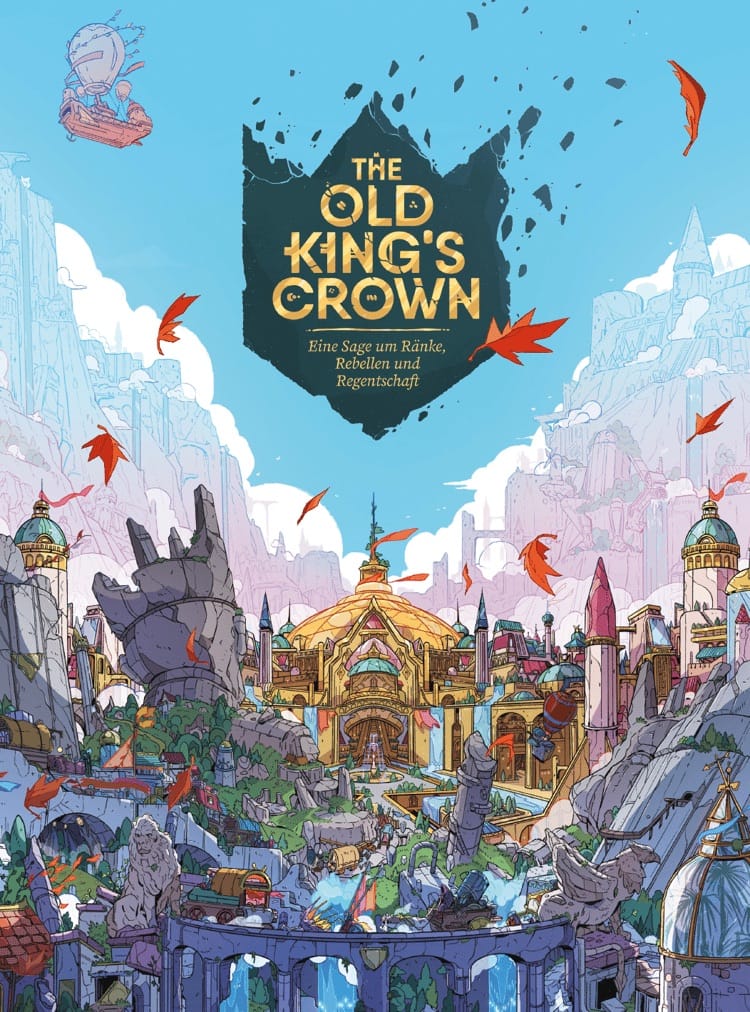
Die Gamefound-Kampagne zu The Old King's Crown ist gestartet und bringt neben einem Second Print auch die neue Erweiterung Songs of Home. Wer die deutsche Ausgabe bevorzugt, kann diese direkt bei Spielworxx vorbestellen.
Kartengetriebene Machtkämpfe mit Bluff und Timing
The Old King's Crown ist ein kartengetriebenes Spiel für 1–4 Personen, in dem Thronerben um die Vorherrschaft über ein vom Verfall gezeichnetes Königreich kämpfen. Vom bröckelnden Schloss bis zur geheimnisvollen Nekropole birgt jede Region des Spielplans eigene Chancen und Gefahren.
Im Kern bewegen die Spielenden ihre Banner über den Spielplan, um strategisch wichtige Orte zu beanspruchen. Anschließend werden Karten gleichzeitig und verdeckt in die verschiedenen Regionen gespielt, bevor sie aufgedeckt und abgehandelt werden. Dieses gleichzeitige Ausspielen sorgt für Spannung und minimiert Wartezeiten.
Gebiete werden sowohl offen mit Herolden beansprucht als auch verdeckt über Karten beeinflusst. Es entsteht ein Mix aus Bluff, Planung und Täuschung, bei dem nicht rohe Stärke entscheidet, sondern das Lesen der Mitspieler und der richtige Moment zum Zuschlagen. Jede Fraktion verfügt dabei über eigene Fähigkeiten und Gefolgsleute mit individuellen Eigenschaften, die unterschiedliche Spielstile ermöglichen.
Machtproben entscheiden über Sieg oder Niederlage und belohnen erfolgreiche Personen mit Einfluss, der zentralen Ressource des Spiels. Nach einer festgelegten Anzahl von Runden gewinnt, wer den größten Einfluss über das Reich errungen hat.
Verfügbarkeit und Vorbestellung
The Old King's Crown ist für 1–4 Personen ab 14 Jahren ausgelegt, eine Partie dauert 60–120 Minuten. Die Auslieferung der deutschen Ausgabe ist für Oktober 2026 geplant. Vorbestellungen sind bei Spielworxx für 70,00 € möglich.
I am very tired of the cold and dreary days of winter. I want it to be warm soon but we are realistically a few months away from consistently nice weather. But, this month, even though the weather has been brutally cold, we saw a warming trend with historical wargames. This month for the Wargame Watch I was able to find 33 games (including the 3 games from our sponsor Bellica Third Generation). Interestingly though this was a cooler month for crowdfunding as I only found 4 games featured on Kickstarter or Gamefound.
This month again we have a sponsor for the Wargame Watch in Bellica Third Generation, or Bellica 3G for short, owned by designer Francisco Ronco. I asked him to write up a summary of his company and their core values and he has provided the following:
Bellica Third Generation is a group of players with many games played between them and a longstanding and deep interest in everything related to Military History. Our members come from Cadiz and Seville (Spain) and we are proud to have started this Andalusian and Spanish project in the field of strategy and simulation games.
Please let us introduce ourselves:
Francisco Ronco Poce (1969).
Game designer and producer. A Napoleonic fan for over 45 years. He is both the heart and manager of the team. And has designed the four first game series that our company will start developing shortly.
Reyes Gallardo Gutiérrez (1978)
Our newest gamer. A military history enthusiast as a hobby and teacher of physics at a secondary school by trade. She is an outstanding playtester, with a critical and analytic mind.
Ramón López Martín (1973).
An experienced gamer. Game designer and play tester. Well known for his skill eliminating all game counters in play; both his and his opponent’s…
What do we do?
Strategy and simulation games. In fact they are “cardboard simulators”. Computer and video games based on the simulation of car races, first person adventures, aircraft -or spacecraft flight- or tank driving are both widely accepted and successful. Now we propose something similar; our games strive to make the player confront the experiences that historical commanders and leaders lived. Facing the same situations, managing resources and making decisions about a hardly predictable outcome.
The main attributes of a simulation as we understand it are:
Resource management
Essential role of logistics
Game centred on decision marketing
Uncertainty and fog of war
All of them are present in every one of our games. With the firm intent of achieving this with the least possible number of rules. We do not feel that elaborate and complex rules are necessary if the internal dynamics of a game system can produce the desired effect. Likewise, it is our intention to follow an editorial line based on game SERIES, thus the players may learn a new game effortlessly having to deal with just a negligible number of new special rules. In our view, the games will contain a “Series Rulebook” dealing with all the elements forming the game system and another “Special Rulebook” containing those rules that reflect the peculiarities of a given scenario.
Our commitment is to offer the player a maximum of playability and variability for their money without an unnecessary effort or learning rules. Our simulations are fun to play, both for those who are already versed in Military History – since they are simulation models – and for the uninitiated looking for a good opportunity to learn the hobby.
After years playing war games of all kinds, periods and scales (from World War II to Ancient Rome, including XVIII century or Napoleonic tactical games) we are convinced that there are basically two different approaches to war gaming; one is game oriented while the other emphasizes simulation. To reach an equilibrium between these two tendencies is not an easy task. There are games whose mechanics and effects might equally apply to a Panzer Division or a Roman Legion. These games are usually easy to learn and are nicely presented, essentially they provide competitive play, are fun and quick paced. Others try to accurately portray a period, campaign or battle where the player must play the role of a corporal firing a machine gun and –at the same time- that of the Army Corps Commander; sometimes they have plenty of rules, exceptions and an alleged “realism”. Quite often, this double perspective has presented “playability” as opposed to “realism”. Quite often, this double perspective has presented “playability” as opposed to “realism”. We think that this approach completely misses the point; We rather see it as a question of “game” vs “simulation”.
We make games:
Rules systems that allow players to perform certain actions while forbid others; with goals that all participants may and want to reach. But our desire is to provide “simulations”; our rules try to establish a framework as close as possible to the one that historical participants faced so that the goals that players must achieve correspond to their historical counterparts, then it is up to the players to find the means.
We have produced not only in-house designs but also designs from other designers. Recently, we have released An Impossible War from David Gómez Relloso -designer of the famous Crusade & Revolution from Compass Games.
An Impossible War is a game about the decisive years of the First Carlist War in the North. Infantry and cavalry are represented by blocks, which introduce fog of war into operations. There are also artillery counters (field and mountain artillery) and logistics units (supply trains and backpacks).
The main map is a point-to-point board covering the northern theater of operations: Navarre, the Basque Country, and surrounding areas of La Rioja, Burgos, and Cantabria. In addition to provincial capitals, major towns and other localities are shown, along with primary and secondary routes of communication. There is also a smaller map of the rest of peninsular Spain, showing the regions affected by the Carlist uprising and allowing expeditions being launched from the North.
Each turn, players compete for initiative and carry out a variable number of actions. There is also a card deck for each side, including historical, operational, and tactical events. The cards add background and unpredictability to the game, helping make each session different. This is NOT a card-driven game, but one assisted by cards.
An Impossible War simulates the historical conflict, which featured numerous skirmishes, few major battles, and significant siege warfare. It is an asymmetric game in which each side has strengths and weaknesses. Players must exploit their advantages and mitigate their disadvantages to achieve victory.
The Carlist player must make use of superior mobility and unit quality to consolidate territory, wear down the enemy, and threaten cities. The Liberal player must contain and suppress the insurrection; they have more troops, but of lower quality and plagued by logistical nightmares. Additionally, they must quell uprisings and chase down Carlist expeditions across the rest of Spain.
We produced the games fully in Spanish and English versions, this game also had an Italian version.
Now we are preparing the reprint of our small but well-known Santa Cruz 1797, the forefather of Von Manstein’s Triumph and Castelnuovo 1539. And the soon to be released Volume IV of the Campaign Commander Series: White Sea, which covers the Spanish-Ottoman struggle in the Mediterranean from 1565 to 1574.
Both of these games are planned to be released later this year.
In summary, here is a look at a sampling of Bellica Third Generation’s games from their website. Many of these are out of print but can be found on the secondary market at places like Noble Knight Games. Click the image below to be taken to the Bellica Third Generation selection of games at NKG.
But now onto the games for March!
Pre-Order
1. Combat! 4: Eastern Front from Compass Games
This month we had another one of the huge downloading of a large amount of new pre-order games from Compass Games that I have affectionately referred to in the past as “Pre-Order Palooza”. The first game that I am highlighting here is the next volume in the highly thought of Combat! Series of solitaire wargames. These games represent man to man combat on the battlefields of World War II where typically each of the counters on the board represent a single soldier. This small tactical scale is one of my favorite wargaming modes as I just enjoy the decisions required regarding movement, the use of tactical strategy such as scoot and shoot, throwing smoke for cover, suppressing fire and the like. I have yet to play any of the previous 3 volumes, even though I own all 3, but they are high on my want to play list and I am very much interested in this system.
The newest volume is called Combat! 4: Eastern From and deals with the fierce fighting on the East Front of World War II during Operation Barbarossa in 1941-1943.
From the game page, we read the following:
Combat! is a solitaire game series of man-to-man combat in World War II. This is the fourth game in the series. The system uses a unique AI to make for intense combat situations as well as unlimited replayability. You will stand on the defense against a relentless foe. Can you hold on?
Combat! Eastern Front is a solitaire game of man-to-man combat on the Eastern Front in WWII. The player can command a squad of German or Soviet soldiers in various engagements. This game includes the all-new Series Rules, which have been clarified and streamlined from the original rules, and now enable players to control either nationality in this game.
There are 11 tense scenarios across 4 full-size maps ranging from forest partisan warfare, to urban fighting in Stalingrad, to desperate battles on the steppes. A comprehensive random scenario generator further expands the possibilities and will create a limitless supply of unique scenarios. In addition, the included campaign game allows the player to lead a squad of men through 10 battles.
One of the things that I do like about this system and the various volumes is that it is not just cookie cutter churning out new games but each game has their own unique elements modeled into the game play as special rules or changes to account for the history of the setting. Here is a look at the changes in this new volume:
Soviet and German OOB’s contrast the crude but determined Red Army with the efficient Wehrmacht.
City fighting with demolition charges, factories, upper stories, fortress buildings, and other forms of close-quarter fighting.
Light Mortars are long-range nuisances able to saturate an enemy position with explosives.
Weather and Fire add flavor and realism to any battle.
Artillery is now a frightful weapon with a new and accurate placement process.
Confidence rules ensure that a side will not fight to the last man, but may retreat or waver if they sustain too many casualties.
2. Man of War: Fleet Combat in the Age of Sail, 1775-1815 from Compass Games
I have only ever played a few Age of Sail games but have always been interested in the era and the concept of gaming that out on the tabletop. One of the recent pre-order offerings from Compass Games is Man of War: : Fleet Combat in the Age of Sail, 1775-1815 designed by Stephen Newberg. The game looks very interesting and I am definitely looking forward to seeing what it has to offer.
From the game page, we read the following:
Man of War is a game of naval combat between sailing ships from 1775 to 1815. Turns are of variable length and represent up to 4 minutes. Ships are represented individually, but the concentration of the game system is on actions involving a number of ships on each side, that is, squadron and fleet level actions.
Rules cover wind speed and direction, which affect movement. The firing broadsides with crews rated for their proficiency ranging from green to excellent. It is possible to board enemy ships, have them strike the colors, and take them as a prize!
You take command from the viewpoint of a fleet commander.
The game is scenario based and it offers a total of 12 historical playable scenarios as follows:
• USHANT, 27 July, 1778
• DOGGER BANK, 5 August 1781
• CHESAPEAKE BAY, 5 September 1781
• MADRAS, 17 February 1782
• THE SAINTS, 12 April 1782
• THE GLORIOUS FIRST OF JUNE, 1794
• CAPE ST. VINCENT, 14 February 1797
• CAMPERDOWN, 11 October 1797
• CABRITA POINT, 12 July 1801
• TRAFALGAR, 21 October 1805
• SAN DOMINGO, 5 February 1806
• LISSA, 14 March 1811
I think that one of the most interesting parts of the way this is designed is that there is an ability to create custom scenarios to play out “what-if” scenarios or to create larger battles with tons of ships just because you can.
As I said above, I have not had the chance to play any of the games in the Combat! Series but am interested in them and own the 1st 3 volumes. This month, Compass Games released information on their next volume following Combat! 4: Eastern Front, which was just announced as well, called Combat! Crete. Combat! Crete is a stand-along game that can be played without any other games in the series. When I saw this I was immediately taken as I have played a few smaller scale tactical games on the ground combat in Crete but was excited to see this subject come to a solitaire system. And the opportunity to play as the British Tommies against the German Fallschirmjäger is always a welcome opportunity on my gaming table!
From the game page, we read the following:
Combat! Crete is a stand-alone solitaire game of man-to-man combat in WWII. The player commands a squad of British Tommies or German Fallschirmjäger in various engagements. The included scenarios are set on the islands of Crete and Leros, but full-war OOB’s are included for both factions.
The comprehensive Random Scenario generator further expands your gaming possibilities. With this tool, players can generate a limitless supply of unique scenarios for Combat! Crete or combine their game with Combat! Eastern Front and/or Combat! Tunisia & Sicily to create an even more expansive gaming experience.
In addition, the included Campaign Game allows the player to lead a squad of men through 10 battles, gaining experience along the way.
One of the things that I do like about this system and the various volumes is that it is not just cookie cutter churning out new games but each game has their own unique elements modeled into the game play as special rules or changes to account for the history of the setting. Here is a look at the changes in this new volume:
Off Board Artillery rules including air support (Stukas!).
New Terrain types including Vineyards, Weapon Pits, and an Airfield.
Parachute Drops, with a massive four map paradrop scenario.
Scenarios with Australian, New Zealand, and Maori troops.
Scenarios on Leros which feature Fallschirmjägers with FG42s.
Competitive Play rules for head-to-head battles!
Armed Cretan Civilians give the Fallschirmjägers a nasty welcome.
I have played a few games from Joe Miranda over the years and have always found them to be good and well designed games. This month, Compass released a 2-pack of a few of his interesting card driven games called Imperial Wars. This box set includes 2 games in the card-driven Imperial Wars System—Sikh War and Caucasus Campaign. Both become a contest between great powers fighting for control of regions with wider strategic implications. With multiple scenarios for each game, Imperial Wars provides you with many opportunities to alter the course of history on far-flung and lesser gamed frontiers. This box set really looks unique and I am very much intrigued and will be reaching out to Joe to see if I can get a designer interview completed to share.
From the game page, we read the following:
Sikh Wars covers the 1845-46 conflict between the British Indian Empire and the Sikh Kingdom of the Punjab. Roth powers were expanding in northwest India, and their armies clashed from the Sutlej River to the outskirts of Afghanistan. The war led to the later expansion of British India to what became the Northwest Frontier.
Caucasus Campaign has the Russian and Ottoman Empires fighting for control of the mountainous region between the Black and Caspian Seas as part of the wider Crimean War. This campaign had a considerable impact on the future of the Middle East.
Players command armies composed of regiments, brigades, and divisions, which fight using battle and skirmish combat results tables. Certain units have elite status, giving them greater resiliency in combat. The many imponderables of leadership, expeditionary warfare, and chaotic political situations are accounted for in each player’s deck of Campaign cards. Astute play of cards can decide a battle or spark an uprising deep within enemy territory.
Both games have multiple scenarios. There are also options for bringing in additional forces, which can swing the tide of a campaign. Each game becomes a contest between great powers fighting for control of regions with wider strategic implications. Imperial Wars provides the opportunity to alter the course of history on far-flung frontiers
We have played several of Adam Starkweather’s games and systems and have very much enjoyed them, particularly the Company Scale System or CSS. He is a very solid designer and his newest game coming from Compass Games is Warriors of Mexico, which deals with the Mexican-American War of 1846-1848. The game looks to be pretty good and uses the system first seen in Warriors of America and Warriors of Politics, adapted to the unique military situation that existed in 1846.
From the game page, we read the following:
Warriors of Mexico is a fast-playing game of the conflict between the United States and Mexico from 1846 to 1848, using a similar system to the one used in Warriors of America and Warriors of Politics, but adapted to the unique military situation that existed in 1846. As was the case in those times, image and perception are as important as military success. Players will navigate the treacherous waters of time and yet fulfill America’s ambitious land expansion.
6. The Battles of Burgoyne’s Campaigns from Compass Games
Several years ago, while attending Buckeye Game Fest in Columbus, Ohio, we met a new designer named Ken Repel and got a chance to take a look at a few of his games including 1812! War on the Great Lakes Frontier from Compass Games and The Battles ofBurgoyne’s Campaign that was announced this past month from Compass Games. The summer and fall of 1777 was a major turning point in the fate of the American Colonies and the Revolutionary War and this game captures the action at 3 of those key battles including the Battle of Hubbardton, the Battle of Bennington and the Battle of Freeman’s Farm.
From the game page, we read the following:
During the sweltering summer of 1777, the American Revolution reached a turning point in the rugged terrain of upstate New York where the Saratoga Campaign unfolded. Led by General John Burgoyne, the British Army marched south from Canada aiming to cleave the American colonies in two by defeating General Horatio Gates’ Continental Army, capturing the Hudson River Valley and gaining control of Albany.
The Battles of Burgoyne’s Campaign is a 2-sided historical board game with one player commanding the Gates’ Continental Army and the other player commanding Burgoyne’s British Army. The game depicts three critically important battles fought during the Saratoga Campaign of 1777, The Battle of Hubbardton, The Battle of Bennington, and The Battle of Freeman’s Farm. Each contest presents the players with a unique tactical situation: Hubbardton is a rearguard action, Bennington a surprise attack, and Freeman’s Farm a meeting engagement.
While attending Buckeye Game Fest in the Spring of 2023, we shot the following video that contains a discussion about this game. You can watch that at the following link:
I was once told that you cannot understand warfare until you under naval warfare and how important it is to the overall scope of the tactics. Well, a new game called Lords of the Seas appears to examine strategic naval warfare during the 5th Century through the 16th Century AD. The game is designed by Stephen Newberg, who has done several naval focused wargames, and is set in the Mediterranean Sea.
From the game page, we read the following:
Lords of the Seas is an uncomplicated 2-player war game centered on the naval campaigns during the era when rowed warships vied for dominance of the Great Middle Sea, the Mediterranean.
The game depicts this conflict at a strategic level, with most operational and tactical details represented by fast and easy-to-play systems, rather than intricate mechanisms.
Players take the part of the commanding leadership of opposing States in historically-based scenarios. The intent of the game is to provide a broad overview of the historical events while being fun to play.
The object of the game is for each player to use their naval forces to keep open the trade routes of their State while also controlling the coastal sea areas needed for the land forces operations of their respective States.
The specifics of these objectives are set out in each scenario, as well as the forces involved, any reinforcements arriving, and the time frame of the scenario or campaign. The time scale of the game is 2 turns per year.
Both players must obtain their objectives by deploying their naval resources into the sea areas on the map and engaging in combats that are resolved on the Battle Board.
Victory points are earned for sea areas and trade routes under their control at the end of each turn of the scenario, as well as for inflicting hits on opposing units in combat. Each represents an individual State as indicated by the scenario.
The Boer War is a conflict that I have never really played a game on. I know that there are several out there but I have just not had a chance but maybe that will change with this beauty called simply Boer War from Compass Games.
From the game page, we read the following:
The Boers, white settlers of Dutch and French descent, started to colonize the shores of what would become Cape Town in 1652. Over time, British settlers and pressure forced them inland, where they founded the Orange Free State and Transvaal, isolated areas rich in gold and diamonds. The British continued to try to subdue the Boers in the Transvaal War of 1881 and the Jameson Raid of 1895. Anticipating a third attempt by a feared invasion, the Boers decided to invade the British colonies first in October of 1899. It is here that the game begins.
Boer War is a 1-2 player game split into two phases, the Conventional War Phase and the Guerrilla Phase. It is played in 6 turns, with each player alternating between spending Action Points and playing Event Cards. With unique victory conditions and Event Cards for each phase, and the Guerrilla Phase being playable as a separate scenario, players get two games in one box. As the British try to keep up their Morale and the Boers destroy and plunder through Guerrilla warfare, who will be the one in control when no one is left standing?
9. Historical Advanced Squad Leader (HASL) ModulePrelude to War: Marco Polo Bridge, 8 July, 1937 from Multi-Man Publishing
Last year, I finally played ASL! As you may have seen, I wrote my First Impressions post about the Advanced Squad Leader Starter Kit #4: Pacific Theater of Operations after playing a scenario with a friend I had a very enjoyable time. I still have lots to learn and lots to experience but at least that first plunge is done. And I definitely want to play more! So this month, I saw that they are bringing back a few things including ASL Prelude to War: Marco Polo Bridget, 8 July, 1937.
From the game page, we read the following:
Prelude To War: Marco Polo Bridge is a Historical Advanced Squad Leader (HASL) module depicting the battle outside the walled town on Wanping, China on July 8, 1937 when Chinese troops resisted Japanese attempts to force their way into town on the pretext of finding a lost soldier. This precipitated the War of Resistance Against Japanese Aggression, commonly called the Second Sino-Japanese War, which was the start of WWII. The battle focuses on the key railroad bridge over the Yongding River just outside the walled town.
Prelude To War: Marco Polo Bridge comes with a historically accurate 22″ x 34″ map of the area outside the walled town crafted by designer Ken Dunn and artist Charlie Kibler. There are five stand-alone scenarios on the map recreating portions of the battle. Then there is the Campaign Game covering the entire action, with the calendar day divided into five Campaign Game scenarios separated by a special Refit Phase that allows players to regroup and reposition their forces. The Campaign Game starts with the Japanese attacking onto the map to capture the bridge, followed by the desperate Chinese defense of the bridge and the Dragon Temple (a prominent feature east of the river), the possibility of a Japanese river assault in boats, and concludes with a Chinese night assault by special broad-sword equipped Volunteer units. The only other ASL modules needed to play are Beyond Valor and Rising Sun.
If you are interested in Historical Advanced Squad Leader (HASL) ModulePrelude to War: Marco Polo Bridge, 8 July, 1937, you can pre-order a copy for $33.00 from the Multi-Man Publishing website at the following link: https://mmpgamers.com/asl-prelude-to-war-marco-polo-bridge-p-455
10. Advanced Squad Leader Starter Kit Historical Module (HASLSK) Prelude to War: Marco Polo Bridge from Multi-Man Publishing
And along with the regular ASL Historical Module for Marco Polo Bridge, they also offered their Starter Kit version of the game on pre-order. I will be picking this one up this summer at WBC hopefully and add it to my ASL Starter Kit #4 box.
From the game page, we read the following:
Prelude To War: Marco Polo Bridge (SK) is the second Advanced Squad Leader Starter Kit Historical Module and covers the battle outside the walled town on Wanping, China on July 8, 1937 when Chinese troops resisted Japanese attempts to force their way into town on the pretext of finding a lost soldier. This precipitated the War of Resistance Against Japanese Aggression, commonly called the Second Sino-Japanese War, which was the start of WWII. The battle focuses on the key railroad bridge over the Yongding River just outside the walled town.
Prelude To War: Marco Polo Bridge (SK) comes with a historically accurate 22″ x 34″ map of the area outside the walled town crafted by designer Ken Dunn and artist Charlie Kibler. There are five stand-alone scenarios on the map recreating portions of the battle. Then there is the Campaign Game covering the entire action, with the calendar day divided into five Campaign Game scenarios separated by a special Refit Phase that allows players to regroup and reposition their forces. The Campaign Game starts with the Japanese attacking onto the map to capture the bridge, followed by the desperate Chinese defense of the bridge and the Dragon King Temple (a prominent feature east of the river), and concludes with a Chinese night assault by special broad-sword equipped Volunteer units. All the necessary counters for Chinese units are included. ASL Starter Kit #4 (Japanese) is required to play.
Prelude To War: Marco Polo Bridge (SK) contains:
one box and lid
one 22″ x 34″ map sheet
two counter sheets
five scenarios
one Campaign Game rules booklet, with all of the new rules needed to play the scenarios and the Campaign Game, including rules for rivers, railroads, bridges, hedges, roadblocks, offboard artillery, night combat, and special broad-sword equipped Chinese Volunteer units.
one page Data Chart
one reduced-size copy of the map sheet
If you are interested in Historical Advanced Squad Leader (HASL) ModulePrelude to War: Marco Polo Bridge, 8 July, 1937, you can pre-order a copy for $33.00 from the Multi-Man Publishing website at the following link: https://mmpgamers.com/asl-prelude-to-war-marco-polo-bridge-p-455
11. Peking: 55 Days of Fury from Neva Game Press
Neva Games Press (formerly Neva Wargames) is a new publisher who has appeared on the scene in the past couple of years. When I started seeing their posts on Twitter and Facebook, I was immediately impressed with their interesting topic choices for their upcoming games as well as the fact that they are trying to make small footprint wargames that pack a punch. And the art is also very appealing and brings an aesthetically pleasing and attractive look to their games! Their next set of pre-order games is ready to launch in mid-March and the first game that I will highlight here is Peking: 55 Days of Fury that deals with the Boxer Rebellion in China in 1900.
From the game page, we read the following:
Peking: 55 Days of Fury is a tactical wargame that places players in the heart of the 1900 Boxer Rebellion. Players choose to command either the besieged Eight-Nation Alliance or the attacking Chinese forces, each with unique objectives and strategies.
The game is designed for 1-2 players and offers a tense, immersive experience lasting approximately 1.5 hours. In solo play, players take control of the beleaguered Eight-Nation Alliance.
Each turn represents roughly 11 days of the siege. The game board depicts the International Legations, divided into four main areas. Players use a combination of event cards and operation points to execute actions, such as firefights, raids, artillery attacks, and barricade repairs.
The game begins with an initiative phase, determining the order of play. The player with the initiative initiates a mandatory firefight, followed by the other player. Players then play event cards to trigger various effects, supported by additional cards if conditions are met.
Next, the eight nation alliance player must manage supplies, with shortages potentially leading to epidemics or desertions. In the operation phase, players use remaining cards as operation points to perform actions. Finally, the maintenance phase involves checking victory conditions, handling fog of war cards, and preparing for the next turn.
A distinctive fog-of-war mechanic sets this games apart. Mastering this element is key to outmaneuvering opponents.
Will you be able to withstand the siege and protect the International Legations?
Experience the intensity of the Boxer Rebellion in this tactical wargame.
I am currently working on a designer interview with the designer José Manuel Neva (who is also the owner of the company) and hope to have that out in the next few weeks.
12. Reformation: Fire and Faith from Neva Game Press
The 2nd game of Neva’s new release pre-order phase is the interesting looking Reformation: Fire and Faith designed by Clint Warren-Davey. I am keenly interested in this one and have been working with Clint to do an interview and maybe a series of other articles on strategies.
From the game page, we read the following:
Reformation: Fire and Faith is a game about the wars and religious struggles that raged in Europe from 1517 to 1555. This time saw the Protestant Reformation sparked by the renegade monk Martin Luther and the subsequent wars of religion in Germany and elsewhere, as Christianity was shaken to its core on. It saw numerous wars between the great powers of Europe regardless of religious affiliation. The Ottoman Empire was at its height and threatened the Christian world from the south-east, while at the same time new lands were discovered in the Americas that started a race for colonial expansion. In this game, 1 to 6 players will use their Armies, Fleets, Followers and Churches in an attempt to achieve their victory conditions and attain the most Victory Points (VP). It plays in about 60-90 minutes. The rules are very simple and easy to teach as the game was originally designed for use in a high school setting by the highly experienced game designer and teacher, Clint Warren-Davey. The game includes 6 unique Factions that are all competing for dominance in their own way
A few years ago, while attending SDHistCon we sat down with Sam London and played his new upcoming game called Common Sense (it was originally called Absolved from All Allegiance), which was recently announced on GMT Games P500. The game is an American Revolutionary War Strategic Level game that uses trick-taking and is a struggle over the Will to Fight Track that measures the level of commitment by both sides to the fight. We very much enjoyed playing the prototype and really could see what the design was trying to do and that it did it very well.
From the game page, we read the following:
Common Sense is an asymmetrical trick-taking card driven wargame. One player will take control of the 13 colonies in their fight for independence while the other uses the might of the British crown to quash the rebellion. The game revolves around the Will to Fight Track which tracks both sides’ willingness to continue to fight the war. As it is an asymmetrical game, both sides have different problems they will have to manage to resist the decline of their Will to Fight. The colonies are primarily concerned with morale and their ability to believe that they could potentially win their independence. Losing control of colonies and failures of the Continental Congress to galvanize the colonies will have the heaviest impact on their conviction. The British on the other hand never had hearts and minds to begin with, as the war was never popular at home. Instead, their Will to Fight represents parliament’s willingness to continue to fund the war. Poor results relative to commitment of forces as well as losses of British Regulars can spell a speedy exit from the war for them. The game will end when both player’s Will to Fight markers converge on the track, or rarely at the end of 1783, with position on the track determining much of the game’s scoring.
Common Sense is played with 2 unique 36 card decks. Each card in a player’s deck is also unique, and represents a key personality, battle, event, or concept from the American Revolution. Cards are divided into 4 suits, which are Battle, Mobilize, Recruit, and Special. Since the game is asymmetrical, while Battle, Mobilize, and Recruit serve similar purposes for both players, their actual executions vary in some ways. Battles let you engage in fights with the enemy in the same space, Mobilize lets you move your armies between spaces, and Recruit lets you bolster your forces. The Special suit on the other hand varies radically and really showcases differences between the two sides. The Colonial Special suit governs training of militia into the Continental Army as well as all interactions with the French. The British Special suit on the other hand manages native led operations as well as the might of the British navy. Each card grants a certain number of actions of a specific type, as well as a historical themed event. Events can be one off effects, powerful action modifiers for the current turn, or remain in play for multiple turns granting powerful abilities or changing core rules. Each card also has a numbered value that is used for the trick taking.
The game is played over a series of 10 card hands (each hand is considered a year of the war). Each year consists of 10 tricks, wherein the winner of the trick is given the chance to perform actions. The lead player chooses and plays a card from their hand face up. The other player then plays a card from their hand based on what their opponent played. If they have at least one card that matches the suit of the card their opponent played, they must play one of those cards. If not, they can play any card that they wish. If the card they played matched the suit of the lead player’s card and was the same value or higher, they win the trick and will get to take the turn and become the new lead player. Otherwise, the lead player gets the turn. If the responding player does not have a card of the matching suit they could also win by playing the highest value card they have of the trump suit that corresponds to the lead suit. In any case, the player who wins the trick gets to resolve the event on the card and perform the actions on the card. Alternatively, the player can always choose not to resolve the winning card to perform any one action of their choice.
Here is a link to a designer interview and discussion with Sam London regarding Common Sense at SDHistCon in 2024:
14. Iron Triangle: Search and Destroy Operations in the Vietnam War from GMT Games
A new series, and we have seen how well series have done at GMT GMT Games, a new designer and a new concept to wargaming (lane battler), I think that this game has great potential and it happens to be focused on one of my most liked wars to game – the Vietnam War. Iron Triangle: Search and Destroy Operations in the Vietnam War is designed by Darren McGuire takes a look at the struggle between the United States military and the Viet Cong insurgents as they fight over control of three key “lanes” or key regions. I am very much excited about this one and will be reaching out soon to Darren for some additional information.
From the game page, we read the following:
Iron Triangle opens the new Lines of ConflictSeries with a focused and tense asymmetric lane battler set during the Vietnam War search and destroy operations from 1966 up to the Tet Offensive in 1968. Two players assume opposing roles: the Viet Cong, leveraging concealment, mobility, and disruption, and the United States, applying sustained pressure and attritional tactics to limit insurgent influence. Across three rounds, players commit action cards to search and destroy operations along three lanes, contesting control of three key regions in III Corps: War Zone C, War Zone D, and the infamous Iron Triangle.
Each faction employs distinct tactical systems. The Viet Cong may deploy cards in three states—tunnelled (face down), concealed (face down and rotated), or exposed (face up)—and, through careful resource management, can flip and rotate these cards to conduct hit and run attacks and ambushes, lay booby traps, and establish Tunnel Bases to accelerate gains or blunt U.S. advances. The U.S. player focuses on revealing and eliminating insurgent units by exposing tunnelled and concealed Viet Cong cards with Tunnel Rats, restricting movement and concealment through tools such as Defoliation and ADSIDs (Air Delivered Seismic Intrusion Devices), or or employing more forceful measures such as napalm, saturation bombing, and zippo raids, which, while effective at disrupting Viet Cong support networks, also undermine the stability of urban areas like Saigon.
At the end of each round, players evaluate operational outcomes and their impact on control across the three areas, adjusting regional stability and tracking the resulting shifts in South Vietnamese public opinion. Players can achieve victory if the Viet Cong drives Public Opinion low enough or if the U.S. accomplishes its body count objective while stabilising the region. Otherwise, the conflict culminates in the Tet Offensive—a final chit-pull from a bag shaped by the position of control markers on the area tracks, remaining Viet Cong Tunnel Bases, and the scale of the refugee crisis—where each Tet chit drawn represents a stronger offensive that further erodes Public Opinion toward U.S failure.
I am all in on this concept and the new series and very much look forward to what might be included in future conflicts and how the series grows.
15. Levy & Campaign Ost Bot Solitaire System from GMT Games
One of the more active series out there today is the Levy & Campaign Series from GMT Games from the mind of Volko Ruhnke. The series had its start with Nevsky: Teutons & Rus in Collision, 1240-1242 and then followed that up with Almoravid: Reconquista and Riposte in Spain, 1085-1086. Since that time, there have been multiple other games published including Inferno: Guelphs and Ghibellines Vie for Tuscany, 1259-1261 and the most recent Plantagenet: Cousins’ War for England, 1459 – 1485. In addition to the released volumes, there are many others on the P500 with at least another dozen (or more) that have yet to be announced but are being developed and playtested. With such a popular series and with solitaire gaming becoming a mandatory part of any new wargame, I am very glad to see that GMT has prioritized this new offering and released it on the P500. The Levy & Campaign Ost Bot Solitaire System is designed by Jan Arvanitakis and Christophe Correia, who have significant experience in developing the L&C Series and I couldn’t be more excited about this offering.
From the game page, we read the following:
Introducing Ost, a solitaire system for the acclaimed Levy and Campaign Series that allows you to play 5 Volumes in the series against a non-player opponent.
The system eases the tedium of bot upkeep and simplifies the implementation of the bot’s turn so that you can concentrate on your move.
Your opponent will complete the game’s signature Levy & Campaign phases of each turn—including Arts of War, Muster, & Call To Arms. On its turn, a Non-Player Active Actions flowchart will dictate the bot’s main action—March, Siege, Storm, Sally, Tax, etc. Then, a dedicated chart for each action will briskly lead the player through a number of simple Yes/No questions until the action’s full resolution. The system thus sidesteps the need to evaluate complex priorities and check for conditions each turn.
The bot does not use any assets, such as Provender and Coin, nor Levies Capabilities, further easing the burden of bot upkeep. Yet key Capabilities are incorporated as part of the bot’s actions, Battle, & Storm. The system features special rules for automating non-player Lords’ Service shifts on the Calendar, as well as preparing the bot’s Campaign Plan.
Ost will present you with an unpredictable and challenging, yet easy to implement opponent that is responsive to your moves and the current game state. It offers a realistic simulation of the moves a human player would make—like approaching your Lords in the field, laying siege to your Strongholds, blocking Supply Routes, and marching to friendly ground before an upcoming Levy phase.
Ost is named after the service d’ost, the French feudal military service owed by vassals to a Lord. It is an allusion to one of the game’s underlying concepts. The service d’ost, or ost, often lasted around 40 days per year and was imposed on all free men, vassals, and vavasors (a vassal’s vassal).
16. Next War: Korea 2nd Edition, 2nd Printing from GMT Games
The Next War Series of wargames from GMT is very popular and also very large and detailed. We still have been unable to get our copy of Next War: Korea to the table yet but one day we will. But, for now there is a 2nd Edition being offered on the P500.
From the game page we read the following:
This reprint edition includes all known errata (including counters) as well as updated counters for the US, Chinese, Russian, and Japanese Orders of Battle. The map has changed slightly as we bring both the bridging rules from Next War: India-Pakistan back to this game, which necessitates noting which hex sides can’t be bridged, as well as defining Beaches and Invasion Hexes a la Next War: Taiwan, which actually takes us back to the original Crisis: Korea 1995 map. The Series Rules and Player Aid Cards will be brought up to the latest standards, and, of course, the Game Specific Rules will have to be changed to incorporate all of the above.
From Pyongyang in North Korea to Pusan in the South, the war rages. In a scene reminiscent of the first attack by the In Min Gun in 1950, the North Korean People’s Army surges across the Demilitarized Zone and penetrates deep into South Korea. Special Operations Forces from both sides conduct raids, interdiction, and reconnaissance missions behind enemy lines while airborne, air assault, and amphibious forces strike far behind those lines attempting to outflank the main army forces of both sides. In the air, both sides wage a heated campaign in an effort establish superiority over the skies of Korea. With rough terrain and the full ferocity of modern armor, airmobile, airborne, and marine warfighting capabilities, there is no safe haven in the lethal cauldron of battle which has engulfed the Korean Peninsula.
While North and South battle for a quick, decisive victory, the world awaits the response of the two military superpowers in the region: the United States of America and the People’s Republic of China. Will the United States, stung by high casualties among the soldiers of its 2nd Infantry Division near the DMZ during the surprise artillery barrages and initial assaults on the first day of the war, be able to reinforce the South quickly enough, and, if so, how and in what strength? Will the Communist Chinese again react to a massive US response and intervene, thus widening the conflict? As the situation evolves, choices are made, forces are committed, and the security of Japan and the future of the two Koreas hangs in the balance.
Next War: Korea, Game #1 in our Next War series, allows players to fight a near future war on the Korean peninsula. In this updated and improved version of the previously-released Crisis: Korea 1995, players have access to virtually all military assets of North and South Korea, as well as large forces from the USA and the PRC. The integrated, easy to learn air-land combat system allows for unit efficiency, armor effects, light infantry, attack helicopters, Close Air Support, Cruise Missiles, and the particularly tough terrain of Korea.
Make no mistake: Next War: Korea is not an Introductory wargame. Rather, we have intended herein to create a system (and a series) that will allow detailed study of modern warfare in various venues as well as engaging gameplay. That said, the Standard Game rules encompass a fairly straightforward ruleset that will, we think, be considered pretty “easy to learn” by experienced wargamers. So players who choose to play Standard Game scenarios can have a relatively quick game when that’s what suits them. The real flavor of a war in the theatre, though, comes through in the Advanced Game, where you get much more control over airpower and can more clearly see each side’s strengths and weaknesses. For players who want a “mini-monster game” experience, playing the Advanced Game Campaign Scenarios with some or all of the optional rules will definitely “deliver.”
So our hope is that we have created a game with enough variety and scaling of complexity that you can find an engaging and maybe even enlightening experience whether you want to play a fast two-player game, a longer monster game, or an ongoing solitaire study. We intend to provide tools for online game play as well (a Vassal module is being created now for use during
17. Révolutions! France 1820-1880 from Fellowship of Simulations Coming to Kickstarter Soon
We have played and enjoyed several of the games offered by Fellowship of Simulations with my 3 favorite being Verdun 1916: Steel Inferno, Wars of Religion France 1562-1598 and Napoléon’s Conquests. They recently announced their next project that deals with the French Revolution called Révolutions! France 1820-1880, which is coming to Kickstarter soon.
From the game page, we read the following:
Révolutions – France 1820-1880 is an immersive political simulation for 3, 4 or 5 players.
Get ready to relive 60 years of political conflicts, civil wars and major societal choices. Whether in the Chamber of Deputies or on the barricades, Ultras, Orleanists, Bonapartists, Republicans or Socialists clash to ensure the triumph of their ideals. Each faction has its own starting situation, objectives and assets.
You’ll need to constantly adapt your strategy to the situation at hand, and convince allies to impose your vision of society.
Each turn, players begin by taking their action cards, which represent their supporters. They use them to develop their influence in six Society zones: Songs, Newspapers, Notables, Peasants, Workers and Clergy. They can also modify Social Tensions, which determine the stability of the government.
If the regime is stable, a Chamber of Deputies is elected. Players take advantage of the influence they have acquired in the Society zones to obtain votes. These votes give access to the best seats in the Chamber. Players receive political influence tokens according to their posi¬tion. Political influence is the «currency» that enables legislative action to change the current regime.
If social tensions become too great, Paris will rise up, and a civil war will begin. Players mobilize Society zones to support the government or fuel the insurrection. If the revolution triumphs, the victorious insurgents can make more radical changes to the state.
If you are interested in Révolutions! France 1820-1880, you can learn more about the project on the Kickstarter preview page at the following link: Révolutions! by Walter Vejdovsky — Kickstarter
18. Pacific War Games (including 1943: Race to Rabaul and Tora Tora Tora!) from PHALANX
PHALANX does some really great games and they have 2 new games that have been recently placed on pre-order in a 2-pack called Pacific War Games. This package includes 1943: Race to Rabaul designed by Volko Ruhnke and Tora Tora Tora! designed by Wataru Horiba.
From the game page, we read the following:
1943: Race to Rabaul
In 1943 the Allied push across the Pacific reached a critical phase. Every step toward Rabaul demanded nerve, planning and a constant fight with the limits of supply. 1943: Race to Rabaul puts you right in the middle of that pressure.
This time the series introduces opposed play. You can play as a team or head-to-head, with one or two players commanding the Japanese side and one or two leading the Americans. Both fronts chase momentum, both struggle with logistics and both try to outthink the other before their plans run dry. The map is wide, resources are tight and every choice has weight.
The result is a game where ambition always meets resistance, and the path to Rabaul is never straightforward.
Tora Tora Tora!
Tora Tora Tora! is a two-player strategic game that presents a holistic and dynamic view of the Pacific War. Rather than focusing on individual historical battles, the game captures the broader struggle for control across the theater, emphasizing tempo, positioning, and resource management.
Players take command of either Japan or the Allies, each operating under a different economic logic. Japan pays to expand across areas of the map, while the Allies pay per unit regardless of distance. This fundamental asymmetry shapes every decision, forcing each side to approach movement, expansion, and confrontation in a distinct way.
Actions require limited resources, and battles involve hidden commitments before resolution, creating tension even before dice are rolled. Overextending can leave forces undersupplied and vulnerable, so players must constantly balance immediate gains against long-term sustainability. The game rewards careful pressure, territorial control, and forcing the opponent into inefficient responses.
The game ends after a fixed number of rounds, and victory is determined by strategic control of key areas and overall position on the map. Winning is less about a single decisive clash and more about managing tempo, preserving strength, and gradually exhausting the opponent’s options.
If you are interested in Pacific War Games (including Race to Rabaul 1943 and Tora Tora Tora!), you can pre-order one or both of the games at the Gamefound page located at the following link: Pacific War Games by PHALANX – Gamefound
19. Fix Bayonets! Volume II1809: Talavera from Tactical Workshop Currently on Gamefound
Last year, I caught wind of a new edition of a very interesting looking Napoleonics wargame getting a second edition. The game was 1811: Albuera Second Edition from Tactical Workshop, which was originally released in 2020 designed by Frederic Delstanches. Now, he is seeking crowdfunding for the next game in the series called 1809: Talavera.
From the game page, we read the following:
1809: Talavera is the second volume in the Fix Bayonets! Series of Napoleonic tactical wargames. It covers, at the battalion level, the two days of the battle with one player in charge of the Anglo-Spanish armies and the other leading the French forces. The game allows players to recreate the eponymous battle of the Peninsular War, face to face with another player or as a solitaire experience.
Take command of the French army under Joseph, Napoleon’s older brother, and shatter the nascent Anglo-Spanish Alliance standing their ground near the town of Talavera! Alternatively, you can lead the Allied armies and attempt to hold the line with your disparate force. Can you equal the tactical victory achieved by the future Duke of Wellington and his Spanish ally general Cuesta or will the bloody engagement result in the rout of your armies?
As of March 1st, the Gamefound campaign has funded and raised $7,322 toward its $7,000 funding goal with 99 backers. The campaign will conclude on April 1, 2026 at 1:00am EST.
New Release
1. 2025 Errata Counter Sheet from GMT Games
Errata is a fact of life with all publishers and all games! No matter what, a mistake will always slip through and cause us gamers a bit of angst. This is where GMT Games stands head and shoulders above the competition though as they admit to their mistakes and more importantly try to make them right. We have seen this time and time again. So they have a solution for errata found on counters in their new games this year that makes a lot of sense and makes it economically very easy to acquire: a replacement countersheet.
From the P500 page, we read the following:
We are happy to announce today that we have created a 2025 Replacement Countersheet that includes all of the counter updates that we and the designers know of as errata for games from 2025. We’re setting this up as a P500 item like we did last year—except that it’s already approved to print. We just need to know how many of you want the item. Please get your order in over the coming few weeks so we can get these in your hands by year-end.
The price for this item will be $5 for US customers and $10 for non-US customers. Note that the cost INCLUDES shipping. Clearly, we’re supplementing most of the cost on these, which we think is only fair, in that these counters represent mostly errata that we missed when we produced the games the counters belong to.
The games with counters on the sheet are:
By Swords & Bayonets
Here I Stand NOTE: These are the same as the 2024 versions but not everyone got theirs so we’re printing them again.
2. Silent Victory: U.S. Submarines in the Pacific, 1941-45 3rd Printing from GMT Games
One of my favorite movies of all time is Das Boot. I know that this is a movie about a German submarine and I am using it as the introduction to a post about American submarines but it is simply so good and really helped to give me an understanding of the absolute hell that those submariners endured in the depths in a slender metal tube being depth charged to death. I remember the scene where the Chief Machinist Johann loses it and has to be restrained. As we follow along on the patrol of the U-96, we grow to understand the difficulty with which those men had to deal as they did their job and took the punishment. As you know, the movie ends when they are in a sub base and are bombed by Allied planes and we see the Captain and most of the crew shot up and dying as they watch the U-96 slip under the water. After playing Silent Victory, where the player takes the helm of an American submarine in the Pacific Ocean during World War II, I could understand (not physically or psychologically) emotionally how they felt, just a bit, as my boat was depth charged mercilessly and I simply could not get away from the Escort. Eventually, I did get away but not before I lost a few crew to injuries and basically nearly sank myself by deciding to go past test depth to escape.
From the game page, we read the following:
Silent Victory is a solitaire tactical level game placing you in command of an American submarine during WWII in the Pacific. Your mission is to destroy as much Japanese shipping and as many warships as possible while advancing your crew quality and decorations – all while remembering you have to make it home.
Silent Victory is purposely designed to deliver a brisk yet intensive gaming experience that forces many decisions upon you as you take command of one of the major U.S. Fleet submarine types in service. Patrols will take you to differing parts of the Pacific as time progresses in the war. The most successful commanders will be those that can manage the risks they take while prosecuting as many targets as possible.
The game engine is built upon the successful The Hunters design and has proven to be a solid, playable experience. All the major U.S. Fleet boat types are accounted for with every level of detail including period of service, armaments, crew makeup, damage capacity, and more.
As a Fleet submarine commander, you will be confronting many decisions during your patrols. To begin with, seven U.S. Fleet submarines are profiled and available for you to choose from. Patrol zones reflect the changing operational areas as the war progresses, from the Philippines to Midway, the Solomons, and even patrols to the waters just off the coast of Japan and China.
Conducting patrols is the heart of the system, as you will be resolving encounters against individual ships, convoys, or even enemy aircraft and submarines. Situations you face and decisions you make suddenly come in quick succession:
How will you engage a convoy once spotted?
Do you close the initial target range at increased risk of detection for a more lethal attack?
If your engagement is at night, will you conduct a surface attack?
Do you launch one or two fire salvos, and how many torpedoes do you fire?
Will you try to follow a convoy or ship to engage in additional rounds of combat?
How will you slip away from escorts to avoid or minimize damage?
3. The Hunters: German U-Boats at War, 1939-1943 4th Printing from GMT Games
Another fantastic solitaire submarine game designed by the incomparable Gregory M. Smith is The Hunters and they are now releasing the 4th Printing version of the game. 4 printings should tell you something about the game and how good it is!
From the game page, we read the following:
The Hunters is a solitaire tactical level game placing you in command of a German U-boat during WWII. Your mission is to destroy as much Allied Shipping and as many Capital ships as possible while advancing your crew quality and increasing your commander rank culminating in special decoration ‒ all while remembering you have to make it home.
The Hunters is purposely designed to deliver a brisk yet intensive gaming experience that forces many decisions upon you as you will take command among the major German U-boat models in service during WWII, and try to complete an entire tour. If you ultimately survive all patrols from 1939 to 1943, you will be transferred to the U-boat Training Command for the remainder of the war, having successfully carried out your service for the Fatherland.
Those familiar with the classic Avalon Hill game title, B-17: Queen of the Skies, will come to enjoy the same type of gaming experience of the German U-boat War. All major U-boat models are accounted for with every level of detail including period of service, armaments, crew make-up, damage capacity, and more.
As U-Boat commander, you will be confronting many decisions during your patrol. To begin with, eight German U-Boat models are profiled and available for you to choose from. Patrol zones reflect the time period during the war at sea and will shift as the war progresses. All stages of the U-Boat campaign are represented as missions become increasingly more difficult as your adversary makes advances in anti-submarine warfare.
Conducting patrols is the heart of the system as you will be resolving encounters against individual ships, convoys, or even enemy aircraft. Situations you face and decisions you make suddenly come in quick succession:
How will you engage a convoy once spotted?
Do you close the initial target range at increased risk of detection for a more lethal attack?
If your engagement is at night, will you conduct a surface attack?
Do you launch one or two fire salvos, and how many torpedoes do you fire?
Will you try to follow a convoy or ship to engage in additional rounds of combat?
How will you slip away from escorts to avoid or minimize damage?
What evasive maneuvers do you undertake?
The major German U-Boat models are represented and accurately profiled for the patrols you will undertake:
Type VII A
Type VII B
Type VII C
Type VII D
Type VII FlaK
Type IX A
Type IX B
Type IX C
Patrol Assignments include:
Atlantic
British Isles
Spanish Coast
Mediterranean
Norway
West African Coast
North America
Arctic
Caribbean
The game delivers an historical narrative as 350+ ship targets are uniquely identified (including tonnage) with their historical counterparts that were sunk during the war, including freighters, tankers, and American ships.
4. COIN Series Multi-Pack #2 The Guerilla Generation: Cold War Insurgencies in Latin America from GMT Games
Stephen Rangazas has been active behind the scenes over the past few years with his development work on Fall of Saigon: A Fire in the Lake Expansion. He used his background and research capabilities to great effect as he did the background work on the Event cards for that game. From that experience, he has now come forward with a few of his own designs in The British Way: Counterinsurgency at the End of Empire, which was announced in 2021 as well as Sovereign of Discord announced in 2022. Now, his most recent work on a new COIN Series Multi-Pack that deals with insurgencies in Latin America during the height of the Cold War called The Guerrilla Generation is shipping.
From the game page, we read the following:
The Guerrilla Generation: Cold War Insurgencies in Latin America is the second COINMulti-Pack, containing four separate games exploring a series of thematically related insurgencies. Building on the The British Way, this new multipack allows players to explore variations in insurgent groups’ organizational structures, strategies, and relationship with civilians, across four insurgencies in Central and South America between 1968 and 1992. During this part of the Cold War era, Latin America experienced an incredible number of different insurgent groups, many inspired by the Cuban Revolution featured in Cuba Libre, ranging from popular backed rural insurgencies, flexible urban guerrillas, externally sponsored raiders, and brutal ideologically rigid groups. This multipack features a game exemplifying each of these types of insurgencies, to offer players the chance to compare different approaches to rebellion highlighted in the quote by scholar Jeremy Weinstein above. The Guerrilla Generation also offers four longer and more complex individual games than those found in The British Way, as well as an entirely different approach to the linked campaign scenario, which combines two games into a simultaneous side-by-side experience.
This Multi-Pack includes four full games in one box, which is a fantastic value that will allow players to explore four different conflicts set during the height of Cold War Latin America between 1968 and 1992. Each game uses a unique ruleset building on the same general mechanical structure, ensuring that they are easy to pick up while still offering a distinctive experience.
I also love these Multi-Packs because they have a small board footprint with each of the 4 games playing in under 2 hours and taking place on a single 17” x 22” board. But, the game doesn’t just treat these games as individual as they are designed to experience at least a portion of the full span of the period and be used to learn more about these insurgencies.
There is also a “Resisting Reagan” Campaign designed into the game. A linked campaign scenario allowing up to 4 players to play El Salvador and Nicaragua side-by-side, with new mechanisms to represent the Central American peace and solidarity movement’s efforts to resist the Reagan Administration’s aid to both the Salvadoran government and the Contra insurgency, by influencing Congress and American public opinion.
5. Battle of the Bismarck Sea from War Diary Publications
As I was recently trolling the internet, I came across a new solitaire game from the guys over at War Diary Publications. The game is called Battle of the Bismarck Sea and is designed by Allyn Vannoy.
From the game page, we read the following:
Battle of the Bismarck Sea is a solitaire wargame that uses individual ships and flights/squadrons of aircraft. The Player assumes the role of General George Kenney, Commander of the 5th U.S. Army Air Force, with the mission of intercepting the Japanese effort to reinforce its ground forces on the island of New Guinea. The Player must utilize the limited resources available and then determine how best to apply them within specific time constraints. The results of these efforts will be borne out in the effectiveness of air operations.
This design by Allyn Vannoy contains: one 22″ x 32″ Mapsheet, a 16-page rulebook, one Player Aid Card, and 114 oversized laser-cut counters.
6. Souls to Waste: The Battle of An Bao, May 5, 1968 from High Flying Dice Games
Paul Rohrbaugh is a designer I love to follow. He is always doing games on smaller or lesser known conflicts and I just find his work to be superb and really draws me in. He has done a line of games dealing with different battles from the Vietnam War and always names them after popular songs of the time including games like Long Cruel Woman: The Attack on Firebase Mary Ann, March 28, 197, No Satisfaction: Operation Hump November 5-8, 1965 and As Tears Go By: Operation StarliteAugust 1965. Recently I saw one of their newest games on the Battle of An Bao called Souls to Waste and I guess it might be named after the Rolling Stone’s song Sympathy for the Devil (Souls to Waste).
From the game page, we read the following:
Souls to Waste portrays the epic fight waged between the 1st Battalion, 50th Infantry Regiment of the 173rd Airborne Brigade and tanks and the 1/69th Tank Battalion against three Battalions of the 22nd Regiment, 3rd PAVN (People’s Army of Vietnam) Infantry Division.
The NVA laid a trap in the hills to the west of three firebases maintained by the 173rd Infantry Brigade. The NVA’s 22nd Infantry Regiment was recently deployed to the area and well-armed with the latest Soviet weaponry, especially new Rocket-Propelled Grenades (RPGs) that could easily penetrate the armor of the American’s M-113 Armored Personnel Carriers (APCs), as well as mortars and heavy machine guns. The goal was to lure one of the US troop companies into an ambush, and then either inflict more casualties on any relief force that would come to their aid, or fall back and do it again at a time and place of their choosing.
Each turn represents 30 minutes of time. An inch on the map corresponds to about 100 yards in actual distance. Infantry type units are platoons, and armored units represent 1 or 2 vehicles.
If you are interested in Souls to Waste: The Battle of An Bao, May 5, 1968, you can order a copy for $22.95 from the High Flying Dice Games website at the following link: https://www.hfdgames.com/anbao.html
7. Death or Glory: The Battle of Rorke’s Drift from Art of Wargames
Solitaires games are plentiful this month and another one that I found was Death or Glory: The Battle of Rorke’s Drift from Art of Wargames. This one looks pretty interesting and has some really interesting mechanics to it. Plus, it is a solitaire game on one of the most known and greatest battles of history.
From the game page, we read the following:
Dive into history and Heroism in Death or Glory: The Battle of Rorke’s Drift, a war game that immerses you in the heart of this legendary clash. Relive the valiant stand of 150 British soldiers as they defend a mission station against a Zulu “impi” numbering in the thousands, during the Anglo-Zulu War of 1879.
As the clock strikes 4:30 PM, the earth trembled with the thundering chant of “Usuthu!” – the Zulu battle cry. Masses of warriors surged forward in wave after wave, their horns echoing across the plains and their assegai spears flashing in the sun. The British defenders, entrenched in the makeshift redoubt, met the onslaught with unwavering resolve and disciplined volleys of rifle fire.
When the dust settled, the battlefield lied eerily quiet, strewn with hundreds of casualties. Eleven British heroes will be awarded the Victoria Cross for their extraordinary bravery.
8. And the War Came: American Civil War 1861-1865 from Pinkerton Games
Add this one to the publisher that I didn’t know about until now category but this game looks to be very interesting. And the War Came: American Civil War 1861-1865 from Pinkerton Games is a strategic level look at the American Civil War and looks to be well made with good solid components.
From the game page, we read the following:
Civil war came to the United States on April 12, 1861, and finally ended 4 bloody Aprils later in 1865. And The War Came is a strategic level boardgame on that conflict, the American Civil War. Play either the side of the United States, attempting to restore the Union; or the rebelling Confederate States of America attempting to gain southern independence.
The game is “We Go” turn based. In the same three-month seasonal turn, both players recruit and mobilize replacement units, promote and reassign generals, play orders cards to activate corps sized units to conduct area movement and engage in combat, and perform logistics functions.
By both land and naval movement, or successful combat actions, players gain victory points by seizing areas or taking victory points away from the enemy. Generals may command units in combat and movement, and higher ranked generals can command more units-but generals may also be killed, wounded or captured. To create fog of war and uncertainty there are covers that hide unit strength and type from the opposing side until committed to combat.
There are four short length yearly scenarios (1861 through 1864), two multi-year campaign scenarios, (1861-1863, and 1863-1865) and the entire war scenario. Select a Scenario, deploy your troops, and prepare for action!
VUCA Simulations is a new company on the scene the last few years and they are coming out with some really great looking games. We have played several of their games and always have a great experience with them. One of their newest pre-order offerings is called Operation Overlord designed by Clem. It covers the D-Day invasion and as usual looks to be of the highest quality and production.
From the game page, we read the following:
Operation Overlord is a deep, historically grounded strategic wargame that simulates the Normandy invasion and the critical battles that followed from June to August 1944. One player commands the Allied SHAEF forces, planning and executing the largest amphibious operation in history, while the opposing player takes the role of Oberbefehlshaber West, defending the Atlantic Wall and attempting to delay the Allied advance long enough to alter the course of the war.
Rather than focusing on tactical skirmishes, Operation Overlord operates at the operational–strategic level, where timing, logistics, intelligence, and command structure are decisive. Players maneuver divisions and army corps across a detailed map of Normandy, manage supply networks and reinforcements, execute historical and fictional operations, and influence battles through doctrine, supports, and event cards.
Each month begins with high-level planning: the Allied player secretly schedules strategic and special operations, while the German player designates key cities as Festungen, to be held at all costs. Weekly turns then unfold through intelligence gathering, supply allocation, reinforcement arrivals, and alternating unit activations that combine maneuver and combat into a tense, fluid system. Fog of war is maintained through hidden unit values and simultaneous combat card reveals, ensuring constant uncertainty and meaningful decision-making.
Victory is not measured simply by territory, but by time and consequences. The German player is unlikely to drive the Allies back into the sea—but every week gained has far-reaching implications for morale, resources, and other fronts of the war. Likewise, an Allied breakthrough ahead of schedule can dramatically reshape history. Each scenario and campaign outcome includes historically reasoned consequences that frame the result within the broader context of World War II.
With multiple scenarios (June, July, August, and a full campaign), robust asymmetry, and a strong emphasis on planning and operational art, Operation Overlord offers a demanding and rewarding experience for players seeking a serious, historically informed wargame.
If you are interested in Operation Overlord, you can order a copy for €119,99 ($141.68 in US Dollars) from the VUCA Simulations website at the following link: https://vucasims.com/products/operation-overlord
10. Hold the Line: Hannibal from Worthington Publishing
Love me some Ancients and particularly if those Ancients include elephants! Such is the case with the newest game from Worthington Publishing called Hold the Line: Hannibal. The Hold the Line Series is a series of historical wargames by Worthington Publishing focused typically on horse-and-musket era combat, specifically the American Revolution. The game features quick-playing, tactical, hex-based scenarios and the series uses custom dice for combat.
From the game page, we read the following:
Hold the Line: Hannibal is a grand tactical two-player game covering 10 of the greatest battles of the Punic Wars. Following in the footsteps of Richard Borg’s Commands and Colors system and more directly Worthington’s Hold the Line series, Hannibal includes the same standard size map board, 13 hexes wide and 9 hexes deep. Combat is resolved with custom dice.
The scale is 300-400 meters per hex, 90 minutes per turn and units of 3-6,000 infantry, 2-4,000 cavalry and 15-25 war elephants. The units are mainly of 4-steps and include four types of infantry: elite, regular, barbarian and light; three types of cavalry: regular, barbarian and light; and, of course, war elephants. Some units have missile capability, which enhances lethality in combat.
Hold the Line: Hannibal, features 10 battles of the Punic Wars between Carthage and Rome.
As usual, thanks so much for reading along and sticking with me this month as I navigated through the many websites and game pages looking for new and interesting games to share.
Finally, thanks once again to this month’s sponsor Bellica 3rd Generation!
Der Incursion Day bringt mehr als neue Seeker. Mit zwei 2-Spieler-Starterboxen und einer neu strukturierten Produktlinie will Maeadiction den Einstieg vereinfachen und gleichzeitig mehr Wahlfreiheit schaffen. Ob STL, Aufsteller oder Miniatur: Künftig haben die Spieler*innen eine Wahl, wie sie die Welt von Agnar betreten wollen.
Angekündigt: Neu: Updates: ANGEKÜNDIGT Es geht derzeit wieder rund im Crowdfunding. Einige Projekte sind angekündigt. Hier der Überblick über die kommende Woche: Heroes of the Shire Light & Shadow Am 03. März startet Heroes of the Shire: Light & Shadow auf Gamefound. Heroes of the Shire ist ein rundenbasiertes Kampfspiel, in dem ihr Zauber wirkt, Fähigkeiten […]
Das verrückte Labyrinth feiert 2026 seinen 40. Geburtstag. Über 30 Millionen verkaufte Exemplare und zahlreiche Auszeichnungen machen den Klassiker zu einem der erfolgreichsten Brettspiele überhaupt. Zum Jubiläum entsteht in Zusammenarbeit mit dem Verlag Awaken Realms eine neue Ausgabe: Labyrinth Chronicles. Die Kampagne läuft bereits auf Gamefound und kann dort noch 20 Tage unterstützt werden.
Das klassische Labyrinth in drei Dimensionen
Labyrinth Chronicles überführt das bekannte Spielprinzip in eine dreidimensionale Spielwelt. Statt flacher Plättchen verschiebst du physische 3D-Module mit Mauern und Gängen. 50 Labyrinth-Module und vier Spielbrett-Puzzleteile bilden das Grundgerüst. Detailreiche Miniaturen für Charaktere, Portale, Goblins und Wächter ergänzen das Spielfeld.
Neben dem neuen Look enthält die Box auch die klassischen Spielvarianten. Sowohl die Classic-Version als auch die anspruchsvollere Meister-Version von Labyrinth sind vollständig enthalten. In der Classic-Variante sammelst du Schätze und kehrst zu deinem Startfeld zurück. Die Meister-Version verlangt, Gegenstände in einer bestimmten Reihenfolge einzusammeln und dabei möglichst viele Punkte zu erzielen.
Das Herzstück der Jubiläumsausgabe ist der kooperative Kampagnen-Modus. In den sogenannten Chronicles erkundest du mit deiner Gruppe eine fortlaufende Geschichte. Jede Partie öffnet ein neues Kapitel und erweitert die Regeln Schritt für Schritt. Im Kampagnen-Ordner sammelst du Karten und Fortschritte. Im Laufe der Kampagne öffnest du Mystery Boxes, die neue Mechaniken, Storylinien und Komponenten freischalten. Mit magnetischen Dorfmarkern baust du zudem das Dorf Fairyvale wieder auf. Der Einstieg ist ab 9 Jahren möglich, durch die steigende Komplexität bleibt das Spiel aber auch für erfahrene Gruppen fordernd.
Pledges und Verfügbarkeit
Die Core Box kostet in der Kampagne 89 Euro. Der reguläre Verkaufspreis soll bei 179 Euro liegen. Enthalten sind unter anderem vier Charaktermodelle, vier Portalmodelle, neun Gegnermodelle, zwei Würfel, ein Kampagnen-Ordner, über 170 Tokens und mehr als 290 Karten. Laut Kampagnenseite sind die Boxen versandbereit und werden direkt nach dem Pledge verschickt.
Für 119 Euro gibt es das Gameplay-All-in-Pledge. Dieses Paket enthält zusätzlich die Erweiterung Personal Stories mit vier Charaktermagneten, 24 Skill-Karten, 12 Tokens, vier persönlichen Questbögen und einem Skriptbuch. Wer seine Miniaturen mit einer Sundrop-Bemalung haben möchte, zahlt jeweils 15 Euro extra. Das Spiel erscheint in mehreren Sprachen, darunter Deutsch, Englisch, Französisch, Spanisch, Polnisch und Italienisch.
Board game, TCG and comics distribution major Universal Distribution has agreed an exclusive deal with Dice Throne to become the sole distributor of the company’s products in the US and Canada.
Dice Throne games and add-on packs have previously been distributed by companies including Universal and ACD Distribution, as well as Alliance Game Distributors, which Universal acquired in May last year.
The dice and card-focused combat game has become a crowdfunding heavyweight following its original $180,000 Kickstarter project from Mind Bottling Games in 2018, going on to raise almost $13m across a string of subsequent campaigns.
Universal said the exclusive distribution deal “marks a significant step in supporting Dice Throne’s expanding presence in retail stores, especially as the brand continues to grow its Organized Play program and introduce new product formats designed to increase accessibility and drive community engagement”.
Dice Throne’s Organized Play program is designed to help stores build consistent communities and host recurring events, with kits on offer including promo items, prize support and products needed to run casual or competitive play.
The publisher has also recently introduced a new single hero pack format, with the aim of offering a lower entry point for new players and flexibility for collectors and Organized Play participants.
Dice Throne CEO Casey Sershon, who took on the top role at the company at the start of last year, said, “We are excited to partner with Universal Distribution as our exclusive distributor in the US and Canada.
“Their expertise and strong retail network will help bring Dice Throne to even more players across North America.”
Cardboard Alchemy has taken the next step in its rapid expansion by shifting to distribute its own games into retail, powered by the evergreen success of its dragon-themed design Flamecraft.
More than 400,000 copies of the worker placement game have now been sold, company co-founder Peter Vaughan told BoardGameWire, creating an early smash hit which has underpinned Cardboard Alchemy’s growth since the game’s $2m Kickstarter campaign five years ago.
Vaughan said Flamecraft “and the fans that love it” had been a “game changer” for the company, allowing it to quickly expand from its original two-person team of Vaughan and fellow co-founder Brad Brooks, and paving the way for subsequent successful releases such as Andromeda’s Edge and Critter Kitchen.
He said, “We knew soon after the first crowdfunding campaign that this game would be an evergreen game in our line. At that point, we committed to making more promos, an expansion, merchandise that our fans wanted, and have started work on a standalone sequel game, FlameBound.”
The publisher has decided to make the two-player travel-friendly title its first to be self-released and distributed into retail, ending a five-year partnership with Lucky Duck Games and its worldwide localization and licensing division GPN.
Flamecraft Duals || Kickstarter image
The new system sees it enter a partner programme with publisher Allplay, in which Cardboard Alchemy will handle and manage its own retail sales, distribution, conventions and localization, with the latter providing global warehouses, pledge management and e-commerce services.
Vaughan said, “We are excited that retailers can get access to our games and other publishers’ games in one hub, for optimum savings”, adding: “The biggest challenges so far are the ramp up of logistics, operations and sales responsibilities.
“This can be a tough task for a mostly creative team, but we have the players in place and have taken our time to implement this stage.
“We know there will be many things to learn along the way for our small company, but we feel our great games will continue to thrive in retail environments.”
Part of Cardboard Alchemy’s expansion to direct retail has included the recent hire of Patrick Fitzgibbon as hobby retail manager, following seven years of sales at companies including Genius Games, Elf Creek Games, Greater than Games and, most recently, Quartermaster Logistics.
The team also includes Nicole Cutler, who joined the business as director of operations at the end of 2024 after several years working on production and logistics at Arcane Wonders and Pandasaurus Games.
Cutler said that demand for Flamecraft Duals had “far exceeded even our expectations” ahead of its official January 28 release date, with the company moving forward with a third print run of the game before it was even available in wider retail.
That confidence was partly inspired by Cardboard Alchemy’s picking up a big early win in the mass market, with the company agreeing a deal with retail giant Barnes & Noble to get the game on its shelves from early last month.
Vaughan told BoardGameWire, “It is a thrill to see our third title in Barnes & Noble. There has been such a growing diversity of games carried by this strong player in the mass market space.
“Flamecraft and Critter Kitchen are on the shelves at B&N and it seemed a natural fit to add Flamecraft Duals to the party.
“We are honored that Barnes & Noble would commit so early to Flamecraft Duals, and place it prominently in their stores to start the year.”
For global distribution, Vaughan said, “Cardboard Alchemy localized our games previously via the Global Publishing Network, a part of Lucky Duck Games.
“We are thankful for that network, as it has placed Flamecraft in 25-plus languages, Critter Kitchen in a ‘baker’s dozen’ of regions and Andromeda’s Edge in 11 languages so far.
“We now look to work with these publishers directly and invite more partnerships worldwide to distribute our titles.”
Those partners will include existing Cardboard Alchemy collaborator CrowD Games, which previously localised Flamecraft into Russian via GPN, and will now do so for Andromeda’s Edge, Critter Kitchen and Flamecraft Duals.
Manny Vega design Flamecraft, published by Cardboard Alchemy
Like many overnight successes, Cardboard Alchemy’s was actually multiple years in the making. The company was launched by Vaughan and Brooks in 2020 after years of collaboration between the pair across Vaughan’s indie design and development studio Squirmy Beast and Dwellings of Eldervale publisher Breaking Games.
Squirmy Beast partnered with Breaking Games to publish Letter Tycoon in 2015 – with Vaughan providing some of the artwork – and a year later Vaughan joined Breaking as director of development, overseeing games including Brooks’ Rise of Tribes.
Cardboard Alchemy’s first Kickstarter, for Mission Catastrophe in 2020, raised just over $100,000, before the success of the Flamecraft campaign a year later catapulted the company into ongoing success.
The publisher’s next planned Kickstarter will see it crank up the complexity compared to its Flamecraft titles, with the launch of a campaign for Brooks’ co-design Whisperwood, a bag-building heavy strategy game, later this spring.
That game has been co-designed by Asking for Trobils designers Erin McDonald and Cardboard Alchemy developer Christian Strain, the latter of whom also co-designed the solo mode for Critter Kitchen.
Vaughan said, “We’ll be planning over-the-top production (as usual), bringing everything we know about game production to date to the forefront of crowdfunding.”
Angekündigt: Neu: Updates: ANGEKÜNDIGT Aktuell ist nicht so viel los im Crowdfunding. Ein paar Projekte sind angekündigt. Für die kommenden Wochen ist sehr wenig in der Vorbereitung. Clouds of War Tales: Nuvitrum Nuvitrum ist ein taktisches, asymmetrisches Deckbuilding Spiel in einer Bergwelt, in der ein Mineral namens Croconium und die Geheimnisse hinter den wolkenverhangenen Gipfeln im Mittelpunkt stehen. […]